WO2001032639A1 - Nonpeptide substituted benzothiazepines as vasopressin antagonists - Google Patents
Nonpeptide substituted benzothiazepines as vasopressin antagonists Download PDFInfo
- Publication number
- WO2001032639A1 WO2001032639A1 PCT/US2000/030114 US0030114W WO0132639A1 WO 2001032639 A1 WO2001032639 A1 WO 2001032639A1 US 0030114 W US0030114 W US 0030114W WO 0132639 A1 WO0132639 A1 WO 0132639A1
- Authority
- WO
- WIPO (PCT)
- Prior art keywords
- compound
- substituted
- formula
- aryl
- carbonyl
- Prior art date
- Legal status (The legal status is an assumption and is not a legal conclusion. Google has not performed a legal analysis and makes no representation as to the accuracy of the status listed.)
- Ceased
Links
- 0 **(C1)N*1C1*c(cccc2)c2N(*c(ccc(*)c2)c2Cl)*C1 Chemical compound **(C1)N*1C1*c(cccc2)c2N(*c(ccc(*)c2)c2Cl)*C1 0.000 description 2
Classifications
-
- C—CHEMISTRY; METALLURGY
- C07—ORGANIC CHEMISTRY
- C07D—HETEROCYCLIC COMPOUNDS
- C07D281/00—Heterocyclic compounds containing rings of more than six members having one nitrogen atom and one sulfur atom as the only ring hetero atoms
- C07D281/02—Seven-membered rings
- C07D281/04—Seven-membered rings having the hetero atoms in positions 1 and 4
- C07D281/08—Seven-membered rings having the hetero atoms in positions 1 and 4 condensed with carbocyclic rings or ring systems
- C07D281/10—Seven-membered rings having the hetero atoms in positions 1 and 4 condensed with carbocyclic rings or ring systems condensed with one six-membered ring
-
- A—HUMAN NECESSITIES
- A61—MEDICAL OR VETERINARY SCIENCE; HYGIENE
- A61P—SPECIFIC THERAPEUTIC ACTIVITY OF CHEMICAL COMPOUNDS OR MEDICINAL PREPARATIONS
- A61P1/00—Drugs for disorders of the alimentary tract or the digestive system
- A61P1/16—Drugs for disorders of the alimentary tract or the digestive system for liver or gallbladder disorders, e.g. hepatoprotective agents, cholagogues, litholytics
-
- A—HUMAN NECESSITIES
- A61—MEDICAL OR VETERINARY SCIENCE; HYGIENE
- A61P—SPECIFIC THERAPEUTIC ACTIVITY OF CHEMICAL COMPOUNDS OR MEDICINAL PREPARATIONS
- A61P13/00—Drugs for disorders of the urinary system
- A61P13/12—Drugs for disorders of the urinary system of the kidneys
-
- A—HUMAN NECESSITIES
- A61—MEDICAL OR VETERINARY SCIENCE; HYGIENE
- A61P—SPECIFIC THERAPEUTIC ACTIVITY OF CHEMICAL COMPOUNDS OR MEDICINAL PREPARATIONS
- A61P25/00—Drugs for disorders of the nervous system
-
- A—HUMAN NECESSITIES
- A61—MEDICAL OR VETERINARY SCIENCE; HYGIENE
- A61P—SPECIFIC THERAPEUTIC ACTIVITY OF CHEMICAL COMPOUNDS OR MEDICINAL PREPARATIONS
- A61P27/00—Drugs for disorders of the senses
- A61P27/16—Otologicals
-
- A—HUMAN NECESSITIES
- A61—MEDICAL OR VETERINARY SCIENCE; HYGIENE
- A61P—SPECIFIC THERAPEUTIC ACTIVITY OF CHEMICAL COMPOUNDS OR MEDICINAL PREPARATIONS
- A61P7/00—Drugs for disorders of the blood or the extracellular fluid
- A61P7/02—Antithrombotic agents; Anticoagulants; Platelet aggregation inhibitors
-
- A—HUMAN NECESSITIES
- A61—MEDICAL OR VETERINARY SCIENCE; HYGIENE
- A61P—SPECIFIC THERAPEUTIC ACTIVITY OF CHEMICAL COMPOUNDS OR MEDICINAL PREPARATIONS
- A61P9/00—Drugs for disorders of the cardiovascular system
-
- A—HUMAN NECESSITIES
- A61—MEDICAL OR VETERINARY SCIENCE; HYGIENE
- A61P—SPECIFIC THERAPEUTIC ACTIVITY OF CHEMICAL COMPOUNDS OR MEDICINAL PREPARATIONS
- A61P9/00—Drugs for disorders of the cardiovascular system
- A61P9/04—Inotropic agents, i.e. stimulants of cardiac contraction; Drugs for heart failure
-
- A—HUMAN NECESSITIES
- A61—MEDICAL OR VETERINARY SCIENCE; HYGIENE
- A61P—SPECIFIC THERAPEUTIC ACTIVITY OF CHEMICAL COMPOUNDS OR MEDICINAL PREPARATIONS
- A61P9/00—Drugs for disorders of the cardiovascular system
- A61P9/10—Drugs for disorders of the cardiovascular system for treating ischaemic or atherosclerotic diseases, e.g. antianginal drugs, coronary vasodilators, drugs for myocardial infarction, retinopathy, cerebrovascula insufficiency, renal arteriosclerosis
-
- A—HUMAN NECESSITIES
- A61—MEDICAL OR VETERINARY SCIENCE; HYGIENE
- A61P—SPECIFIC THERAPEUTIC ACTIVITY OF CHEMICAL COMPOUNDS OR MEDICINAL PREPARATIONS
- A61P9/00—Drugs for disorders of the cardiovascular system
- A61P9/12—Antihypertensives
Definitions
- NONPEPTIDE SUBSTITUTED BENZOTHIAZEPINES AS VASOPRESSIN ANTAGONISTS
- This invention relates to novel nonpeptide substituted vasopressm receptor antagonists. More particularly, the compounds of the present invention interrupt the binding of the peptide hormone vasopressm to its receptors and are therefore useful for treating conditions involving increased vascular resistance and cardiac insufficiency.
- Vasopressm is a nonapeptide hormone that is secreted primarily from the posterior pituitary gland. The hormone effects its actions through the vascular V-1 and renal V-2 receptor subtypes.
- the functions of vasopressm include contraction of uterine, bladder, and smooth muscle; stimulation of glycogen breakdown m the liver; release of corticotropm from the anterior pituitary; induction of platelet aggregation; and central nervous system modulation of behaviors and stress responses.
- the V-1 receptor mediates the contraction of smooth muscle, and hepatic glycogenolytic and central nervous system effects of vasopressm.
- the V-2 receptor presumably found only m the kidney, effects the antidiuretic actions of vasopressm via stimulation of adenylate cyclase.
- Elevated plasma vasopressm levels appear to play a role m the pathogenesis of congestive heart failure (P. A. Van Zwieten, Progr. Pharmacol . Clm . Pharmacol . 1990, 7, 49) .
- nonpeptide vasopressm V-2 receptor antagonists As progress toward the treatment of congestive heart failure, nonpeptide vasopressm V-2 receptor antagonists have induced low osmolality aquaresis and decreased peripheral resistance conscious dogs with congestive heart failure (H. Ogawa, J. Med. Chem. 1996, 39, 3547) .
- plasma vasopressm levels may be inappropriately elevated for a given osmolality, thereby resulting m renal water retention and hyponatremia. Hyponatremia, associated with edematous conditions
- vasopressm V-2 antagonists have corrected their existing hyponatremia (G. Fujisawa, Kidney Int . 1993, 44 ( 1 ) , 19). Due m part to the contractile actions of vasopressm at its V-1 receptor m the vasculature, vasopressm V-1 antagonists have reduced blood pressure as a potential treatment for hypertension as well.
- vasopressm receptor antagonists could be useful as therapeutics m the conditions of hypertension, congestive heart failure/cardiac insufficiency, coronary vasospasm, cardiac ischemia, liver cirrhosis, renal vasospasm, renal failure, cerebral edema and ischemia, stroke, thrombosis, and water retention.
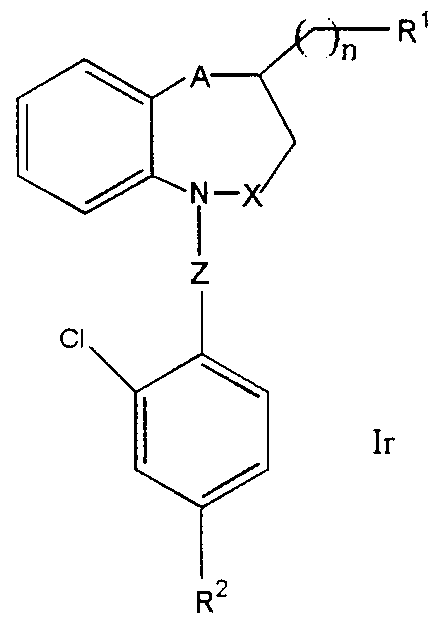
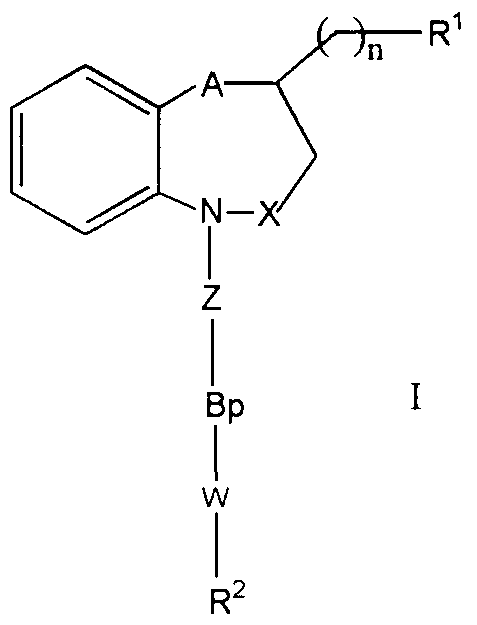
- the present invention is directed to compounds represented by the following Formula I:
- R 1 is selected from -COOH, formyl, o-mesylate, -S0OH, alkoxysulfonyl, alkylcarboxy, substituted alkylcarboxy, aralcarboxy, substituted aralcarboxy, - NR 4 R 5 , -OH, cyano, N-morpholmo, alkoxy, aralkoxy, alkylcarbamoyl, substituted alkylcarbamoyl, alkoxycarbonyl, substituted alkoxycarbonyl, -NHCOR 6 and -CONR 7 R 8 , wherein
- R 4 , R r , R U , R 7 , and R P are independently selected from the group consisting of H, alkyl, and aryl;
- A is S, SO or S0 2 ;
- X is CH 2 or carbonyl;
- Z is CH 2 , S0 2 or carbonyl, with the proviso that X is B is (CH 2 )m, NH or 0;
- W is aryl, substituted aryl, heteroaryl or substituted heteroaryl ;
- R 2 is -N(H)YR ' ' or -YN(H)R 3 wherem Y is H or carbonyl;
- R 3 is H, alkyl, substituted alkyl, aryl or substituted aryl;
- n is 1-5 ;
- the compounds of the present invention are vasopressm receptor antagonists useful as aquaretics and, m general, m disease states of vascular resistance.
- Illustrative of the invention is a pharmaceutical composition comprising a pharmaceutically acceptable carrier and any of the compounds described above.
- Illustrating the invention is a pharmaceutical composition made by mixing any of the compounds described above and a pharmaceutically acceptable carrier.
- An illustration of the invention is a process for making a pharmaceutical composition comprising mixing any of the compounds described above and a pharmaceutically acceptable carrier.
- An example of the invention is a method of treating congestive heart failure m a subject m need thereof comprising administering to the subject a therapeutically effective amount of any of the compounds or pharmaceutical compositions described above.
- Another example of the invention is a method of inhibiting the onset of a condition of vascular resistance m the subject, which comprises administering to the subject a prophylactically effective dose of the pharmaceutical composition of a compound of Formula I .
- Further exemplifying the invention is the method of treating congestive heart failure, wherem the therapeutically effective amount of the compound is about 1 to about 30 mg/kg/day.
- Still further exemplifying the invention is the method of inhibiting the onset of congestive heart failure, wherein the prophylactically effective amount of the compound is about 1 to about 30 mg/kg/day.
- An additional illustration of the invention is a method of treating a condition selected from hypertension, congestive heart failure, cardiac insufficiency, coronary vasospasm, cardiac ischemia, liver cirrhosis, renal vasospasm, renal failure, cerebral edema and ischemia, stroke, thrombosis, or water retention m a subject m need thereof comprising administering to the subject a therapeutically effective amount of any of the compounds or pharmaceutical compositions described above.
- the therapeutically effective amount of the compound administered for treating any of these conditions is about 1 to about 30 mg/kg/day.
- the invention is the use of any of the compounds described above for the preparation of a medicament for treating a condition selected from inner ear disorders, hypertension, congestive heart failure, cardiac insufficiency, coronary vasospasm, cardiac ischemia, liver cirrhosis, renal vasospasm, renal failure, cerebral edema and ischemia, stroke, thrombosis, or water retention m a subject m need thereof.
- a condition selected from inner ear disorders, hypertension, congestive heart failure, cardiac insufficiency, coronary vasospasm, cardiac ischemia, liver cirrhosis, renal vasospasm, renal failure, cerebral edema and ischemia, stroke, thrombosis, or water retention m a subject m need thereof.
- the present invention provides nonpeptide substituted benzothiazepine compounds which are useful as antagonists of vasopressin. More particularly, the compounds of Formula I inhibit the binding of vasopressin to V-1 and V- 2 receptors, and are therefore useful in treating conditions with increased vascular resistance. Examples of conditions with increased vascular resistance include, but are not limited to, congestive heart failure, edema, water retaining states, and the like. More particularly, the present invention is directed to compounds of Formula I:
- R 1 is selected from -COOH, formyl, o-mesylate, -S00H, alkoxysulfonyl, alkylcarboxy, substituted alkylcarboxy, aralcarboxy, substituted aralcarboxy, - NR M R 5 , -OH, cyano, N-morpholino, alkoxy, aralkoxy, alkylcarbamoyl, substituted alkylcarbamoyl, alkoxycarbonyl, substituted alkoxycarbonyl, -NHCOR° and -CONR 7 R 8 , wherein R 4 , R 5 , R 6 , R 7 , and R 8 are independently selected from the group consisting of H, alkyl, and aryl;
- A is S, SO or S0 2 ;
- X is CH 2 or carbonyl
- Z is CH 2 , S0 2 or carbonyl, with the proviso that X is not CH 2 when Z is CH 2 ;
- B is (CH 2 ) m , NH or 0;
- W is aryl, substituted aryl, heteroaryl or substituted heteroaryl;
- R 2 is -N(H)YR 3 or -YN(H)R 3 wherein Y is H or carbonyl;
- R 3 is H, alkyl, substituted alkyl, aryl or substituted aryl; m is 1-3 ; n is 1-5; and p is 0 or 1.
- the nonpeptide substituted benzodiazepine compounds of the present invention are vasopressin receptor antagonists, in a preferred embodiment, the compounds are orally active.
- the compounds show the ability to block vasopressin binding to recombinant V-1 and V-2, and therefore are useful as therapeutics in or prophylactics against the conditions of hypertension, congestive heart failure/cardiac insufficiency, coronary vasospasm, cardiac ischemia, liver cirrhosis, renal vasospasm, renal failure, cerebral edema and ischemia, stroke, thrombosis, and water retention.
- R 1 is selected from -NH 2 , -NHCH 3 , -N(CH 3 ) 2 , -NHBOC, -
- N(BOC) 2 -NHCOC(CH 3 ) 2 NH 2 , -N (COC (CH 3 ) 2 NH 2 ) 2 and - NCH 2 (2, 5-OCH 3 ) Ph;
- W is Ph or substituted Ph;
- R 2 is -NH 2 , -NHAc, -NHCO (2-CH 3 ) Ph or -NHCO (2-Ph) Ph; and p is 0 are also particular embodiments of the present invention .
- R 1 is -OH;
- W is heteroaryl, Ph or substituted Ph;
- R 2 is -NH 2 , -NHAc, -NHCOCH ⁇ , -NHCO (2-CH 3 ) Ph, -NHCO (2-
- Ph)Ph -NHCO(2-CH 3 , 5-F) Ph, or -NHCO ( 3, 4-C1 ) Ph; and p is 0 are also particular embodiments of the present invention.
- the compounds of the present invention may also be present m the form of a pharmaceutically acceptable salt or salts.
- the salt or salts of the compounds of this invention refer to non-toxic "pharmaceutically acceptable salt or salts.”
- Other salts may, however, be useful m the preparation of compounds according to this invention or of their pharmaceutically acceptable salts.
- organic or inorganic acids include, but are not limited to, hydrochloric, hydrobromic, hydriodic, perchloric, sulfu ⁇ c, nitric, phosphoric, acetic, propionic, glycolic, lactic, succmic, maleic, fumaric, malic, tartaric, citric, benzoic, mandelic, methanesulfonic, hydroxyethanesulfonic, benezenesulfonic, oxalic, pamoic, 2-naphthalenesulfon ⁇ c, p-toluenesulfonic, cyclohexanesulfamic, salicylic, saccharinic or trifluoroacetic acid.
- Representative basic/cationic salts include, but are not limited to, benzathine, chloroprocaine, choline, diethanolamine, ethylenedia ine, meglumine, procaine, aluminum, calcium, lithium, magnesium, potassium, sodium, or zinc.
- the compounds according to this invention may accordingly exist as enantiomers. Where the compounds possess two or more stereogenic centers, they may additionally exist as diastereomers . It is to be understood that all such isomers and mixtures thereof are encompassed within the scope of the present invention. Furthermore, some of the crystalline forms for the compounds may exist as polymorphs and as such are intended to be included in the present invention. In addition, some of the compounds may form solvates with water (i.e., hydrates) or common organic solvents, and such solvates are also intended to be encompassed within the scope of this invention.
- subject refers to an animal, preferably a mammal, most preferably a human, who has been the object of treatment, observation or experiment .
- treating means eliminating or otherwise ameliorating the cause and/or effects thereof.
- To “inhibit” or “inhibiting” the onset of a disorder means preventing, delaying or reducing the likelihood of such onset.
- Methods are known m the art for determining therapeutically and prophylactically effective doses for the instant pharmaceutical composition.
- therapeutically effective amount means that amount of active compound or pharmaceutical agent that elicits the biological or medicinal response m a tissue system, animal or human that is being sought by a researcher, veterinarian, medical doctor or other clinician, which includes alleviation of the symptoms of the disease or disorder being treated.
- prophylactically effective amount refers to that amount of active compound or pharmaceutical agent that inhibits m a subject the onset of a disorder as being sought by a researcher, veterinarian, medical doctor or other clinician, the delaying of which disorder is mediated by the reduction of increased vascular resistance.
- alkyl and “alkoxy” as used herein, whether used alone or as part of a substituent group, include straight and branched chains having 1 to 8 carbon atoms, or any number withm this range.
- alkyl radicals include methyl, ethyl, n-propyl, isopropyl, n-butyl, isobutyl, sec-butyl, t-butyl, n- pentyl, 3- (2-methyl) butyl, 2-pentyl, 2-methylbutyl, neopentyl, n-hexyl, 2-hexyl and 2-methylpentyl .
- Alkoxy radicals are oxygen ethers formed from the previously described straight or branched chain alkyl groups. Cycloalkyl groups contain 3 to 8 ring carbons and preferably 5 to 7 ring carbons.
- Ar refers to an aromatic group such as phenyl and naphthyl.
- Ar or aryl group may have one to three substituents which are independently selected from C ⁇ C 8 alkyl, C ⁇ -C 8 alkoxy, fluormated C ⁇ -C 8 alkyl (e.g., trifluoromethyl) , fluormated C ⁇ C 8 alkoxy (e.g., trifluoromethoxy) , halogen, cyano, hydroxy, ammo, nitro, C1-C alkylammo (i.e., -NH-C1-C4 alkyl), C1-C4 dialkylammo (i.e., -N- [C1-C4 alkyl] 2 wherem the alkyl groups can be the same or different) , or unsubstituted, mono-, di- or t ⁇ -sub
- heteroaryl represents a stable five or six membered monocyclic aromatic ring system which consists of carbon atoms and from one to three heteroatoms selected from N, 0 or S .
- the heteroaryl group may be attached at any heteroatom or carbon atom which results m the creation of a stable structure.
- heteroaryl groups include, but are not limited to pyridmyl, pyrazmyl, py ⁇ dazmyl, pyrimidmyl, thiophenyl, furanyl, lmidazolyl, isoxazolyl, oxazolyl, pyrazolyl, pyrrolyl, thiazolyl, thiadiazolyl, t ⁇ azolyl, benzimidazolyl, benzofuranyl, benzothienyl, benzisoxazolyl, benzoxazolyl, benzopyrazolyl, indolyl, benzothiazolyl, benzothiadiazolyl, benzotriazolyl or quinolinyl.
- Prefered heteroaryl groups include pyridinyl, thiophenyl, furanyl and quinolinyl.
- the heteroaryl group may have one to three substituents which are independently selected from C ⁇ -C 8 alkyl, halogen, aryl, heteroaryl, alkoxy, alkylammo, dialkylammo, arylamino, nitro, and hydroxy.
- aralkoxy indicates an alkoxy group substituted with an aryl group (e.g., benzyloxy) .
- acyl as used herein, whether used alone or as part of a substituent group, means an organic radical having 2 to 6 carbon atoms (branched or straight chain) derived from an organic acid by removal of the hydroxyl group .
- halogen shall include iodine, bromine, chlorine and fluorine.
- substituted alkylcarboxy denote alkylcarboxy, aralcarboxy and alkylcarbamoyl substituted with radicals including, but not limited to, halogen, alkyl, alkoxy, amino, and the like.
- alkyl Whenever the term "alkyl”, “acyl”, or “aryl” or either of their prefix roots appear in a name of a substituent (e.g., aralkyl, dialkylammo) it shall be interpreted as including those limitations given above for “alkyl”, “acyl”, and “aryl.” Designated numbers of carbon atoms (e.g., Ci-C ⁇ ) shall refer independently to the number of carbon atoms m an alkyl or cycloalkyl moiety or to the alkyl portion of a larger substituent m which alkyl appears as its prefix root.
- a substituent e.g., aralkyl, dialkylammo
- substituents and substitution patterns on the compounds of this invention can be selected by one of ordinary skill m the art to provide compounds that are chemically stable and that can be readily synthesized by techniques known m the art as well as those methods set forth herein.
- composition is intended to encompass a product comprising the specified ingredients m the specified amounts, as well as any product which results, directly or indirectly, from combinations of the specified ingredients m the specified amounts.
- the utility of the compounds to treat disorders of increased vascular resistance can be determined according to the procedures described herein.
- the present invention therefore provides a method of treating vascular resistance disorders m a subject m need thereof which comprises administering any of the compounds as defined herein m a quantity effective to treat vascular resistance disorders.
- the compound may be administered to a patient by any conventional route of administration, including, but not limited to, intravenous, oral, subcutaneous, intramuscular, mtradermal and parenteral.
- the present invention also provides pharmaceutical compositions comprising one or more compounds of this invention m association with a pharmaceutically acceptable carrier .
- compositions of this invention one or more compounds of Formula I or salt thereof of the invention as the active ingredient, is intimately admixed with a pharmaceutical carrier according to conventional pharmaceutical compounding techniques, which carrier may take a wide variety of forms depending of the form of preparation desired for administration, e.g., oral or parenteral such as intramuscular.
- a pharmaceutical carrier may take a wide variety of forms depending of the form of preparation desired for administration, e.g., oral or parenteral such as intramuscular.
- any of the usual pharmaceutical media may be employed.
- suitable carriers and additives include water, glycols, oils, alcohols, flavoring agents, preservatives, coloring agents and the like;
- suitable carriers and additives include starches, sugars, diluents, granulating agents, lubricants, binders, disintegrating agents and the like. Because of their ease m administration, tablets and capsules represent the most advantageous oral dosage unit form, m which case solid pharmaceutical carriers are obviously employed. If desired, tablets may be sugar coated or enteric coated by standard techniques.
- the carrier will usually comprise sterile water, through other ingredients, for example, for purposes such as aiding solubility or for preservation, may be included.
- injectable suspensions may also be prepared, m which case appropriate liquid carriers, suspending agents and the like may be employed.
- the pharmaceutical compositions herein will contain, per dosage unit, e.g., tablet, capsule, powder, injection, teaspoonful and the like, an amount of the active ingredient necessary to deliver an effective dose as described above.
- compositions herein will contain, per unit dosage unit, e.g., tablet, capsule, powder, injection, suppository, teaspoonful and the like, of from about 1 mg to 30 mg/kg and may be given at a dosage of from about 1 to 30 mg/kg/day (preferred 3 to 15 mg/kg/day) .
- the dosages may be varied depending upon the requirement of the patients, the severity of the condition being treated and the compound being employed. The use of either daily administration or post-periodic dosing may be employed.
- compositions are m unit dosage forms such as tablets, pills, capsules, powders, granules, sterile parenteral solutions or suspensions, metered aerosol or liquid sprays, drops, ampoules, automjector devices or suppositories; for oral parenteral, mtranasal, sublmgual or rectal administration, or for administration by inhalation or insufflation.
- the composition may be presented m a form suitable for once- weekly or once-monthly administration; for example, an insoluble salt of the active compound, such as the decanoate salt, may be adapted to provide a depot preparation for intramuscular injection.
- the principal active ingredient is mixed with a pharmaceutical carrier, e.g. conventional tableting ingredients such as corn starch, lactose, sucrose, sorbitol, talc, stearic acid, magnesium stearate, dicalcium phosphate or gums, and other pharmaceutical diluents, e.g. water, to form a solid preformulation composition containing a homogeneous mixture of a compound of the present invention, or a pharmaceutically acceptable salt thereof.
- a pharmaceutical carrier e.g. conventional tableting ingredients such as corn starch, lactose, sucrose, sorbitol, talc, stearic acid, magnesium stearate, dicalcium phosphate or gums, and other pharmaceutical diluents, e.g. water
- a pharmaceutical carrier e.g. conventional tableting ingredients such as corn starch, lactose, sucrose, sorbitol, talc, stearic acid, magnesium stearate, dicalcium phosphate
- This solid preformulation composition is then subdivided into unit dosage forms of the type described above containing from 0.1 to about 500 mg of the active ingredient of the present invention.
- the tablets or pills of the novel composition can be coated or otherwise compounded to provide a dosage form affording the advantage of prolonged action.
- the tablet or pill can comprise an inner dosage and an outer dosage component, the latter being in the form of an envelope over the former.
- the two components can be separated by an enteric layer which serves to resist disintegration in the stomach and permits the inner component to pass intact into the duodenum or to be delayed in release.
- enteric layers or coatings such materials including a number of polymeric acids with such materials as shellac, cetyl alcohol and cellulose acetate.
- the liquid forms m which the novel compositions of the present invention may be incorporated for administration orally or by injection include, aqueous solutions, suitably flavoured syrups, aqueous or oil suspensions, and flavoured emulsions with edible oils such as cottonseed oil, sesame oil, coconut oil or peanut oil, as well as elixirs and similar pharmaceutical vehicles.
- Suitable dispersing or suspending agents for aqueous suspensions include synthetic and natural gums such as tragacanth, acacia, alg ate, dextran, sodium carboxymethylcellulose, methylcellulose, polyvinyl- pyrrolidone or gelatin.
- the compounds may be prepared m racemic form, or individual enantiomers may be prepared either by enantiospecific synthesis or by resolution.
- the compounds may, for example, be resolved into their components enantiomers by standard techniques, such as the formation of diastereomeric pairs by salt formation.
- the compounds may also be resolved by formation of diastereomeric esters or amides, followed by chromatographic separation and removal of the chiral auxiliary. Alternatively, the compounds may be resolved using a stereogenic HPLC column.
- it may be necessary and/or desirable to protect sensitive or reactive groups on any of the molecules concerned. This may be achieved by means of conventional protecting groups, such as those described in Protective Groups in Organic Chemistry, ed.
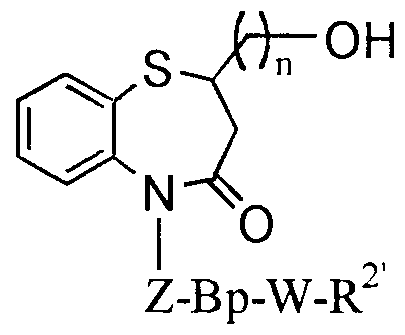
- R is -COOH, formyl , alkoxy, aralkoxy, or -0(CO)R 9
- R 9 is alkyl, substituted alkyl, aryl or substituted aryl
- R 2' is nitro, -N(H)YR 3 or -YN(H)R 3
- A, X, Z, Bp, W, Y, R 2 , R 3 , n are as described above
- a base such as t ⁇ ethylamme is added to a mixture of 2-ammoth ⁇ ophenol and a compound of Formula II, such as 5, 6-d ⁇ hydro-2H-pyran-2-one, all of which are either commercially available or may be readily prepared by known methods.
- the mixture can be dissolved m an appropriate non-polar solvent like methylene chloride and then heated m refluxmg xylene to obtain the corresponding compound of Formula III.
- the compound of Formula III can be alkylated under basic conditions (such as with potassium carbonate or NaH) to yield the corresponding compound of Formula IV, such as by treatment with an alkylatmg agent including but not limited to substituted benzyl bromide or chlorides refluxmg acetone, dimethylformamide (DMF) , or tetrahydrofuran (THF) .
- the compound of Formula III can be treated with an appropriate reducing agent such as diborane or lithium aluminum hydride m an appropriate solvent such as tetrahydrofuran, ether or 1,4-d ⁇ oxane to obtain the corresponding compound of Formula V.
- an appropriate reducing agent such as diborane or lithium aluminum hydride
- an appropriate solvent such as tetrahydrofuran, ether or 1,4-d ⁇ oxane
- the compound of Formula V can be alkylated or acylated preferably at a temperature m the range of 0-60°C to form the corresponding compound of Formula VI, such as by adding either substituted benzyl, substituted benzene sulfonyl, or phenacyl halides to a solution of the corresponding compound of Formula V m tetrahydrofuran, ether or methylene chloride pretreated with N, 0- bis (trimethylsilyl) acetamide.
- Compounds of Formulae IV and VI wherem R 2' is nitro or acetamide can be converted to substituted anilines via standard procedures such as catalytic hydrogenation or acid treatment.
- the aniline can then be further substituted with a variety of substituted phenacyl halides m an appropriate solvent such as methylene chloride or THF and a base such as triethylamme once treated with N, O-bis (trimethylsilyl) acetamide to form the corresponding compounds of Formula la wherein R 2 is -N(H)YR 3 or -YN(H)R .
- the compounds of Formulae IV and VI can be alkylated, acylated, or oxidized to form compounds of Formula la.
- Alkylation or acylation at the hydroxyl position can be accomplished by the addition of an alkyl or acylhalide in the presence of a base such as sodium hydride, potassium hydride or triethylamine in an appropriate solvent such as THF, DMF or methylene chloride.
- Phenyl or substituted phenyl ethers can be formed by the addition of phenol or substituted phenols to compound of Formulae IV and VI using triphenylphosphine and diethyl azodicarboxylate in a solvent such as tetrahydrofuran.
- Oxidation can be executed by using oxidizing agents such as pyridinium chlorochromate, pyridinium dichromate or Jones reagent using known procedures for this transformation.
- R 10 is alkyl or substituted alkyl, and A, X, Z, Bp, W, R 2 ,
- the intermediates (III and V) may be oxidized to form the corresponding compounds of Formula VII using oxidizing agents such as 3- chloroperoxybenzoic acid m an appropriate solvent such as methylene chloride.
- Alkylation or acylation on the ring nitrogen of Formula VII can be achieved preferably at a temperature m the range of 0-60°C to form the corresponding compound of Formula lb, such as by adding either substituted benzyl, or phenacyl halides to a solution of the corresponding compound of Formula VII m tetrahydrofuran, ether or methylene chloride pretreated with N, O-bis (trimethylsilyl) acetamide .
- the hydroxyl group the compound of Formula lb can be converted under basic conditions such as TEA to the mesylate m the compound of Formula lc.
- the mesylate can then be displaced with a variety of substituted amines or morpholme preferably at a temperature between 60 and 80°C m an appropriate solvent such as tetrahydrofuran or dimethylformamide to give compounds of the Formula Id.
- the mesylate can also be heated under similar conditions with ammonium hydroxide to afford compounds of the Formula Ih which can be further functionalized by treatment with substituted acylhalides and t ⁇ ethylamme m non-polar solvents such as THF or methylene chloride to give the corresponding compounds of the Formula Ii.
- the mesylate of Formula lc can be treated with sodium cyanide m an appropriate solvent such as dimethylformamide to give the compound of Formula Ie.
- the compound of Formula Ie can be further hydrolyzed to form the compound of Formula If under basic conditions such as NaOH. 7 ⁇ n alternative way to extend the CH 2 chain connecting R 1 is reduction of the compound of Formula If with an appropriate reducing agent such as lithium aluminum hydride (LAH) to obtain the compound of Formula VIII, which can then be used m place of lb for making the compounds of Formulae Ic-Ik.
- LAH lithium aluminum hydride
- Esters of Formula Ig can be prepared by treating the carboxylic acids of Formula If with an alkylhalide under basic conditions (such as with NaH or potassium carbonate) m dimethylforamide or tetrahydrofuran.
- the unsubstituted amides of Formula Ig can be prepared by treating the carboxylic acids of Formula If with di-tert-butyl dicarbonate, ammonium hydrogen carbonate and pyridme m a suitable solvent such as dioxane.
- Substituted amides of Formula Ig can be obtained by forming the acid chlorides of Ig using thionylchloride as the reagent. The acid chloride can then be reacted with substituted amines.
- the mesylate of Formula lc can also be converted to a bromide using a metal halide such as lithium, potassium, or sodium bromide m dry tetrahydrofuran, dimethylforamide or acetonit ⁇ le .
- a metal halide such as lithium, potassium, or sodium bromide m dry tetrahydrofuran, dimethylforamide or acetonit ⁇ le .
- This can then be converted to the sulfonic acid m the compound of Formula I by treating the bromide with sodium sulfite an appropriate solvent such as ethanol/water .
- the sulfonic acids can be converted to sulfonyl chlorides by treatment with thionyl chloride or phosphorous pentachloride followed by treatment with an alkanol using a base such as pyridme under known conditions to give the corresponding compounds of Formula Ik.
- the compounds of this invention exist m a racemic form as well as (-) and (+) enantiomers.
- the racemate can be resolved into the optical antipodes by known methods, such as chiral HPLC methods, conversion and separation of diastereomeric salts, or formation and separation of diastereomeric esters or carbamates.
- the method of treating vascular resistance disorders described m the present invention may also be carried out using a pharmaceutical composition comprising any of the compounds as defined herein and a pharmaceutically acceptable carrier.
- the pharmaceutical composition may contain between about 100 mg and 1000 mg, preferably about 100 to 500 mg, of the compound, and may be constituted into any form suitable for the mode of administration selected.
- Carriers include necessary and inert pharmaceutical excipients, including, but not limited to, binders, suspending agents, lubricants, flavorants, sweeteners, preservatives, dyes, and coatings.
- compositions suitable for oral administration include solid forms, such as pills, tablets, caplets, capsules (each including immediate release, timed release and sustained release formulations), granules, and powders, and liquid forms, such as solutions, syrups, elixers, emulsions, and suspensions.
- forms useful for parenteral administration include sterile solutions, emulsions and suspensions.
- compounds of the present invention may be administered m a single daily dose, or the total daily dosage may be administered divided doses of two, three or four times daily.
- compounds for the present invention can be administered mtranasal form via topical use of suitable mtranasal vehicles, or via transdermal skin patches well known to those of ordinary skill m that art.
- the dosage administration will, of course, be continuous rather than intermittent throughout the dosage regimen.
- the active drug component can be combined with an oral, non-toxic pharmaceutically acceptable inert carrier such as ethanol, glycerol, water and the like.
- suitable binders include, without limitation, starch, gelatin, natural sugars such as glucose or beta-lactose, corn sweeteners, natural and synthetic gums such as acacia, tragacanth or sodium oleate, sodium stearate, magnesium stearate, sodium benzoate, sodium acetate, sodium chloride and the like.
- Disintegrators include, without limitation, starch, methyl cellulose, agar, bentonite, xanthan gum and the like.
- the liquid forms can be m suitably flavored suspending or dispersing agents such as the synthetic and natural gums, for example, tragacanth, acacia, methyl- cellulose and the like.
- suspending or dispersing agents such as the synthetic and natural gums, for example, tragacanth, acacia, methyl- cellulose and the like.
- sterile suspensions and solutions are desired.
- Isotonic preparations which generally contain suitable preservatives are employed when intravenous administration is desired.
- the compound of the present invention can also be administered m the form of liposome delivery systems, such as small unilamellar vesicles, large unila ellar vesicles, and multilamellar vesicles.
- Liposomes can be formed from a variety of phospholipids, such as cholesterol, stearylamine or phosphatidylcholines .
- Compounds of the present invention may also be delivered by the use of monoclonal antibodies as individual carriers to which the compound molecules are coupled.
- the compounds of the present invention may also be coupled with soluble polymers as targetable drug carriers.
- Such polymers can include polyvinylpyrrolidone, pyran copolymer, polyhydroxypropylmethacrylamidephenol, polyhydroxy- ethylaspartamidephenol, or polyethyl eneoxidepolylysine substituted with palmitoyl residue.
- the compounds of the present invention may be coupled to a class of biodegradable polymers useful in achieving controlled release of a drug, for example, polylactic acid, polyepsilon caprolactone, polyhydroxy butyeric acid, polyorthoesters, polyacetals, polydihydropyrans, polycyanoacrylates and cross-linked or amphipathic block copolymers of hydrogels.
- a drug for example, polylactic acid, polyepsilon caprolactone, polyhydroxy butyeric acid, polyorthoesters, polyacetals, polydihydropyrans, polycyanoacrylates and cross-linked or amphipathic block copolymers of hydrogels.
- Compounds of this invention may be administered in any of the foregoing compositions and according to dosage regimens established in the art whenever treatment of disorders of vascular resistance is required.
- the daily dosage of the products may be varied over a wide range from 100 to 1000 mg per adult human per day.
- the compositions are preferably provided in the form of tablets containing the active ingredient in the amount sufficient for the symptomatic adjustment of the dosage to the patient to be treated.
- An effective amount of the drug is ordinarily supplied at a dosage level of from about 1 mg/kg to about 30 mg/kg of body weight per day.
- the range is from about 3 to about 15 mg/kg of body weight per day, most preferably, from about 5 to about 10 mg/kg of body weight per day.
- the compounds may be administered on a regimen of 1 to 2 times per day.
- Optimal dosages to be administered may be readily determined by those skilled m the art, and will vary with the particular compound used, the mode of administration, the strength of the preparation, the mode of administration, and the advancement of the disease condition. In addition, factors associated with the particular patient being treated, including patient age, weight, diet and time of administration, will result m the need to adjust dosages.
- Excess Jones reagent prepared by a slow addition of concentrated sulfuric acid (150ml) to a cold solution (0-5°C) of Cr0 3 (180g, 1.8M) in ice water (1.21) and stirred for one hour at 0°C, was slowly added to a cold mixture of Compound 17 as prepared m Example 3 (4.0g, 7.8mM) m acetone (60ml) . The resulting mixture was stirred at room temperature overnight. Water (100ml) was then slowly added and the volatile solvents removed in vacuo . The aqueous mixture was extracted with ethyl acetate (2 x 100ml) .
- Methanesulfonyl chloride (1.8ml, 23mM) was slowly added to a cold solution of 2- (2-hydroxyethyl) -1, 5- benzothiazepine as prepared in Example 2 (5g, 23mM) and triethylamine (6.6ml, 47mM) in methylene chloride (100ml). The mixture was stirred at 0°C for three hours then poured into ice water (100ml) . The layers were separated and the methylene chloride layer dried (MgS0 4 ) .
- the solution containing the desired mesylate product was treated with triethylamine (4.8ml, 34mM) then with 4- nitrobenzoylchloride (4.2g, 23mM) .
- the mixture was stirred at room temperature overnight, poured into water (150ml) and layers were separated.
- the methylene chloride was dried (MgS0 4 ), evaporated in vacuo and purified by column chromatography to give the desired product (8.7g,
- Example 14 A mixture of Compound 13 as prepared in Example 10 (0.050g, 0.09mM) in tetrahydrofuran (4ml) was treated as described in Example 12 with ammonium hydroxide (1ml) substituted for dimethylamine to give a white solid product, m/z (MH + )446
- Example 14 A mixture of Compound 13 as prepared in Example 10 (0.050g, 0.09mM) in tetrahydrofuran (4ml) was treated as described in Example 12 with ammonium hydroxide (1ml) substituted for dimethylamine to give a white solid product, m/z (MH + )446
- Example 14 A mixture of Compound 13 as prepared in Example 10 (0.050g, 0.09mM) in tetrahydrofuran (4ml) was treated as described in Example 12 with ammonium hydroxide (1ml) substituted for dimethylamine to give a white solid product, m/z (MH + )446
- Example 14 A mixture of Compound 13 as prepared in
- Ammonium hydrogen carbonate (0.029g, 0.36mM) was added to a mixture of Compound 29 as prepared in Example 4 (0.160g, 0.31mM), di-tert-butyl dicarbonate (0.078g, 0.36mM) and pyridine (0.2ml) in dioxane (10ml). The mixture was stirred at room temperature overnight and water was added. The precipitates were collected and dried to give a white solid product (0.11g,68%) m/z (MH + )522
- the mixture was cooled to room temperature, poured into ice water (300ml) and stirred for one hour. The resulting precipitates were collected and dried to give the azide as an off-white solid (8.2g, 72%).
- the azide (8.0g, 32.2mM) dissolved in dry tetrahydrofuran (60ml) was added to a cooled solution of lithium aluminum hydride (48ml; IM solution in THF) in THF (100ml) .
- the mixture was stirred at room temperature for three hours and a saturated K 2 C0 3 solution was slowly added.
- the mixture was filtered through Celite and the THF was removed under reduced pressure.
- the resulting mixture was diluted with ethyl acetate (250ml) and washed with water (1x250ml) then with brine (1x250ml) .
- the ethyl acetate extract was dried (MgS0 4 ) , filtered and evaporated in vacuo to give the amine as a yellow oil (3.96g, 56%).
- Example 30 was dissolved m methylene chloride and treated with excess trifluoroacetic acid. The mixture was stirred at room temperature overnight and diluted with saturated so ⁇ ium bicarbonate. The layers were separated and the methylene chloride layer dried (MgS0 4 ), filtered and evaporated m vacuo to give the desired product as a solid m/z (MH + ) 446.
- Example 37 2- (2-Hydroxyethyl) -5- ( 4-acetamidobenzene-sulfonyl ) - 1, 5-benzothiazepine as prepared in Example 24 was treated as described in Example 33 with morpholine substituted for dimethylamine . Then the product was further treated as described in Examples 25 and 27 to give the product as a solid, m/z (MH+) 552.
- Example 37
- Methanesulfonyl chloride (0.04ml, 0.55mM) was added to
- Methanesulfonyl chloride (0.02ml, 0.278mM) was added to Compound 19 as prepared in Example 26 (0.151g, 0.278 mM) and triethylamine (0.07ml, 0.55mM) following the procedure described in Example 29 to give the solid product, m/z
- Methyl iodide (0.06ml, 0.96mM) was added to a mixture of Compound 29 as prepared m Example 4 (0.5g, 0.96mM) and potassium carbonate (0.26g, 1.88mM) m dimethyl formamide (10ml) . The mixture was stirred at room temperature overnight and slowly added to water (80ml) . The white solid precipitates were collected and dried to give the product, m/z (MH + ) 537.
- Assay buffer is 50mM T ⁇ s-Cl, 5mM MgCl2, 0.1% BSA (pH 7.5) containing 5ug/ml of aprotmm, leupeptm, pepstatm, 50ug/ml bacitracm, and ImM Pefabloc.
- H3 vasopressin is 3 H- argmme-8-vasopressm ( 68.5C ⁇ /mmol, final concentration m assay is 0.65-0.75nM) .
- test compound containing cloned human V2 receptor
- H3 vasopress Into wells of 96-well round bottom polypropylene plates are added buffer, test compound, membrane (containing cloned human V2 receptor) , and H3 vasopress . The reaction plates are allowed to sit at room temperature for one hour.
- the anti-hypertensive activity of a compound may be assessed using an anesthetized model of vasopressin- induced hypertension.
- Male Long Evans, normotensive rats of between 350 and 450 g in body weight may be anesthetized with pentobarbital (35 mg/kg, ip) and maintained throughout the procedure with an ip infusion of 10 mg/kg/hr.
- Arginine vasopressin can be infused at 30 ng/kg/min, iv, to induce a stable hypertensive state (ca. 50 mmHg increase in mean arterial blood pressure) .
- Compounds of interest can be administered in an ascending dose fashion and the maximum decrease in mean arterial blood pressure can be recorded.
- An ED 50 may be determined from the linear portion of the dose-response relationship for each animal .
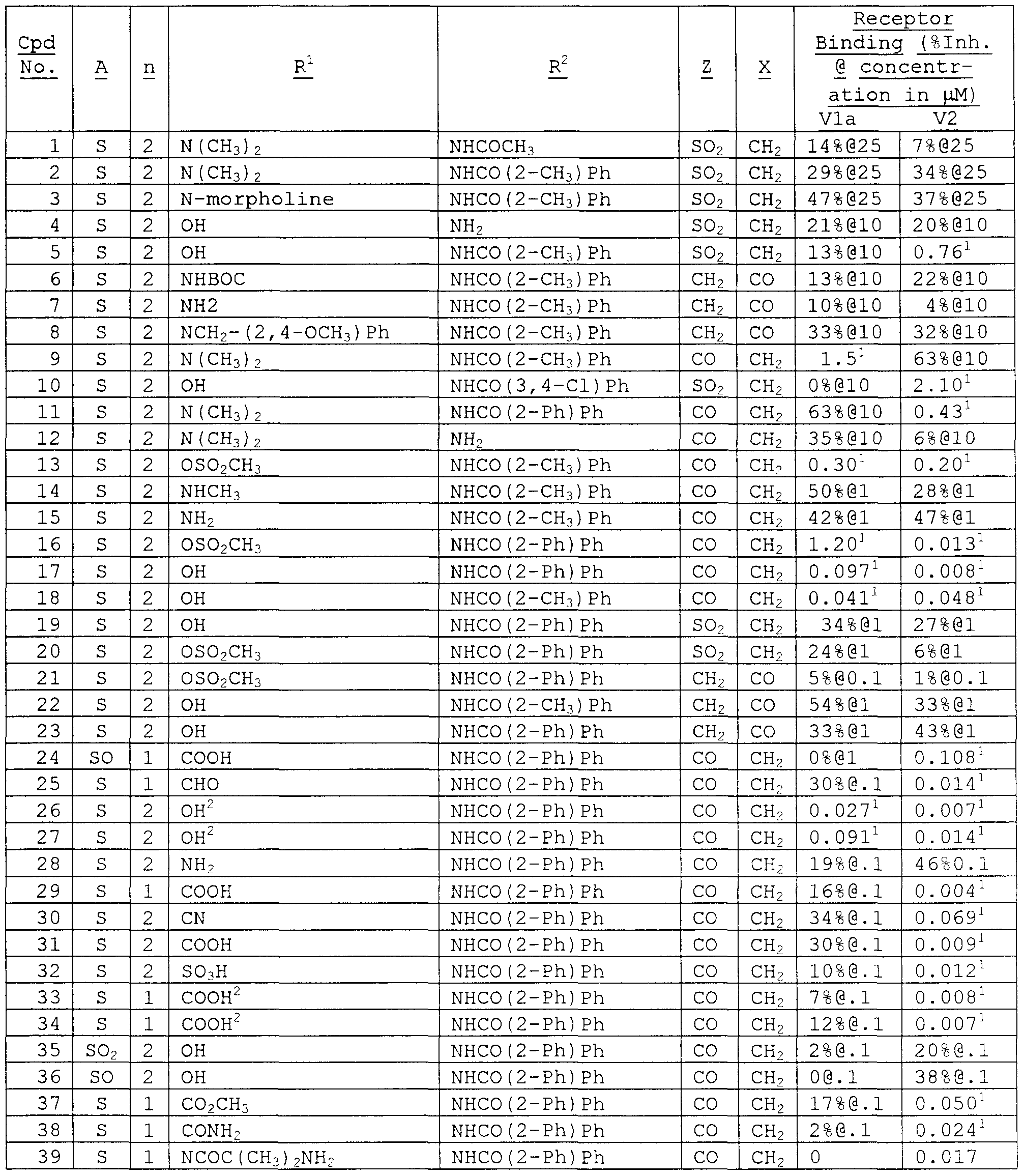
- This model can be modified slightly to assess the bioavailability of compounds of interest. Rather than dosing the animals iv in an ascending dose fashion, a single dose per animal cab be administered directly into the duodenum. The anti-hypertensive effects can be then monitored for 60 minutes and the maximum percent reversal can then be calculated. Tables I and II below set forth the vasopressin receptor binding data of some compounds of the instant invention.
Landscapes
- Health & Medical Sciences (AREA)
- Chemical & Material Sciences (AREA)
- Organic Chemistry (AREA)
- Engineering & Computer Science (AREA)
- Bioinformatics & Cheminformatics (AREA)
- General Health & Medical Sciences (AREA)
- Chemical Kinetics & Catalysis (AREA)
- General Chemical & Material Sciences (AREA)
- Medicinal Chemistry (AREA)
- Nuclear Medicine, Radiotherapy & Molecular Imaging (AREA)
- Pharmacology & Pharmacy (AREA)
- Life Sciences & Earth Sciences (AREA)
- Animal Behavior & Ethology (AREA)
- Public Health (AREA)
- Veterinary Medicine (AREA)
- Cardiology (AREA)
- Heart & Thoracic Surgery (AREA)
- Urology & Nephrology (AREA)
- Hospice & Palliative Care (AREA)
- Vascular Medicine (AREA)
- Diabetes (AREA)
- Hematology (AREA)
- Biomedical Technology (AREA)
- Neurology (AREA)
- Neurosurgery (AREA)
- Gastroenterology & Hepatology (AREA)
- Pharmaceuticals Containing Other Organic And Inorganic Compounds (AREA)
- Medicines That Contain Protein Lipid Enzymes And Other Medicines (AREA)
- Nitrogen- Or Sulfur-Containing Heterocyclic Ring Compounds With Rings Of Six Or More Members (AREA)
- Plural Heterocyclic Compounds (AREA)
Abstract
Description







Claims




Priority Applications (10)
| Application Number | Priority Date | Filing Date | Title |
|---|---|---|---|
| BR0015299-4A BR0015299A (en) | 1999-11-04 | 2000-11-02 | Nonpeptide substituted benzothiazepines as vasopressin antagonists |
| SK605-2002A SK6052002A3 (en) | 1999-11-04 | 2000-11-02 | Nonpeptide substituted benzothiazepines as vasopressin antagonists |
| CA002389439A CA2389439A1 (en) | 1999-11-04 | 2000-11-02 | Nonpeptide substituted benzothiazepines as vasopressin antagonists |
| EP00980254A EP1226132A1 (en) | 1999-11-04 | 2000-11-02 | Nonpeptide substituted benzothiazepines as vasopressin antagonists |
| PL00354759A PL354759A1 (en) | 1999-11-04 | 2000-11-02 | Nonpeptide substituted benzothiazepines as vasopressin antagonists |
| AU17540/01A AU778810B2 (en) | 1999-11-04 | 2000-11-02 | Nonpeptide substituted benzothiazepines as vasopressin antagonists |
| JP2001534790A JP2003513082A (en) | 1999-11-04 | 2000-11-02 | Non-peptide substituted benzothiazepines as vasopressin antagonists |
| KR1020027005650A KR20020047321A (en) | 1999-11-04 | 2000-11-02 | Nonpeptide substituted benzothiazepines as vasopressin antagonists |
| MXPA02004513A MXPA02004513A (en) | 1999-11-04 | 2000-11-02 | Nonpeptide substituted benzothiazepines as vasopressin antagonists. |
| HU0204278A HUP0204278A2 (en) | 1999-11-04 | 2000-11-02 | Nonpeptide substituted benzothiazepines as vasopressin antagonists, process for their preparation, pharmaceutical compositions containing them and their use |
Applications Claiming Priority (2)
| Application Number | Priority Date | Filing Date | Title |
|---|---|---|---|
| US16354499P | 1999-11-04 | 1999-11-04 | |
| US60/163,544 | 1999-11-04 |
Publications (1)
| Publication Number | Publication Date |
|---|---|
| WO2001032639A1 true WO2001032639A1 (en) | 2001-05-10 |
Family
ID=22590503
Family Applications (1)
| Application Number | Title | Priority Date | Filing Date |
|---|---|---|---|
| PCT/US2000/030114 Ceased WO2001032639A1 (en) | 1999-11-04 | 2000-11-02 | Nonpeptide substituted benzothiazepines as vasopressin antagonists |
Country Status (17)
| Country | Link |
|---|---|
| US (1) | US6489321B1 (en) |
| EP (1) | EP1226132A1 (en) |
| JP (1) | JP2003513082A (en) |
| KR (1) | KR20020047321A (en) |
| CN (1) | CN1414958A (en) |
| AR (1) | AR026360A1 (en) |
| AU (1) | AU778810B2 (en) |
| BR (1) | BR0015299A (en) |
| CA (1) | CA2389439A1 (en) |
| CZ (1) | CZ20021492A3 (en) |
| HU (1) | HUP0204278A2 (en) |
| MX (1) | MXPA02004513A (en) |
| PL (1) | PL354759A1 (en) |
| RU (1) | RU2002111660A (en) |
| SK (1) | SK6052002A3 (en) |
| WO (1) | WO2001032639A1 (en) |
| YU (1) | YU32702A (en) |
Cited By (2)
| Publication number | Priority date | Publication date | Assignee | Title |
|---|---|---|---|---|
| US7524957B2 (en) | 2001-08-17 | 2009-04-28 | Astrazeneca Ab | Compounds effecting glucokinase |
| US7642263B2 (en) | 2005-07-09 | 2010-01-05 | Astrazeneca Ab | Heteroaryl benzamide derivatives for use as GLK activators in the treatment of diabetes |
Families Citing this family (3)
| Publication number | Priority date | Publication date | Assignee | Title |
|---|---|---|---|---|
| AR051780A1 (en) * | 2004-11-29 | 2007-02-07 | Japan Tobacco Inc | FUSIONED RING COMPOUNDS CONTAINING NITROGEN AND USING THEMSELVES |
| JP3988832B2 (en) * | 2004-11-29 | 2007-10-10 | 日本たばこ産業株式会社 | Nitrogen-containing fused ring compounds and uses thereof |
| JO3109B1 (en) * | 2012-05-10 | 2017-09-20 | Ferring Bv | V1a receptor agonists |
Citations (2)
| Publication number | Priority date | Publication date | Assignee | Title |
|---|---|---|---|---|
| WO1991005549A1 (en) * | 1989-10-20 | 1991-05-02 | Otsuka Pharmaceutical Co., Ltd. | Benzoheterocyclic compounds |
| WO1999037637A1 (en) * | 1998-01-27 | 1999-07-29 | Fujisawa Pharmaceutical Co., Ltd. | Benzamide derivatives as vasopressin antagonists |
Family Cites Families (19)
| Publication number | Priority date | Publication date | Assignee | Title |
|---|---|---|---|---|
| JP2751287B2 (en) * | 1989-01-09 | 1998-05-18 | 吉富製薬株式会社 | 1,5-benzothiazepine-2-carboxylic acid amide compound |
| TW199153B (en) | 1990-08-07 | 1993-02-01 | Dtsuka Seiyaku Kk | |
| JPH05320135A (en) | 1992-05-19 | 1993-12-03 | Yamanouchi Pharmaceut Co Ltd | Tetrahydrobenzazepine derivative |
| JPH0680641A (en) | 1992-09-01 | 1994-03-22 | Otsuka Pharmaceut Co Ltd | Production of optically active 5-hydroxybenzoazepine derivative |
| SK94393A3 (en) | 1992-09-11 | 1994-08-10 | Thomae Gmbh Dr K | Cyclic derivatives of urea, process for their production and their pharmaceutical agents with the content of those |
| CN1052224C (en) | 1993-04-07 | 2000-05-10 | 大塚制药株式会社 | Peripheral Vasodilating agent containing N-acylated 4-amino piperidine derivatives as active ingredients |
| FI974437A0 (en) | 1995-06-06 | 1997-12-05 | Pfizer | Substituted N- (indole-2-carbonyl) amides and derivatives as glycogen phosphorylase inhibitors |
| JP3314938B2 (en) | 1995-06-06 | 2002-08-19 | ファイザー・インコーポレーテッド | Substituted N- (indole-2-carbonyl) -glycinamides and derivatives as glycogen phosphorylase inhibitors |
| DE69734321T2 (en) | 1996-02-23 | 2006-08-10 | Eli Lilly And Co., Indianapolis | NON-PEPTIDIC VASOPRESSIN VIA ANTAGONISTS |
| AU721035C (en) | 1996-09-10 | 2004-09-02 | Dr. Karl Thomae Gmbh | Modified aminoacids, pharmaceuticals containing these compounds and method for their production |
| US5952322A (en) | 1996-12-05 | 1999-09-14 | Pfizer Inc. | Method of reducing tissue damage associated with non-cardiac ischemia using glycogen phosphorylase inhibitors |
| US6025372A (en) | 1997-04-04 | 2000-02-15 | Merck & Co., Inc. | Somatostatin agonists |
| US6063796A (en) | 1997-04-04 | 2000-05-16 | Merck & Co., Inc. | Somatostatin agonists |
| US6057338A (en) | 1997-04-04 | 2000-05-02 | Merck & Co., Inc. | Somatostatin agonists |
| DE19748763A1 (en) | 1997-11-05 | 1999-05-06 | Hans Peter Zenner | Use of vasopressin antagonists |
| WO1999064401A2 (en) | 1998-06-12 | 1999-12-16 | Societe De Conseils De Recherches Et D'applications Scientifiques Sas | Imidazolyl derivatives and their use as somatostatin receptor ligands |
| WO2000018764A1 (en) | 1998-09-30 | 2000-04-06 | Merck Sharp & Dohme Limited | Benzimidazolinyl piperidines as cgrp ligands |
| GB9823873D0 (en) | 1998-10-30 | 1998-12-30 | Pharmacia & Upjohn Spa | 2-ureido-thiazole derivatives,process for their preparation,and their use as antitumour agents |
| US6297234B1 (en) | 1999-02-04 | 2001-10-02 | American Home Products Corporation | Arylthiophene vasopressin agonists |
-
2000
- 2000-11-02 EP EP00980254A patent/EP1226132A1/en not_active Withdrawn
- 2000-11-02 WO PCT/US2000/030114 patent/WO2001032639A1/en not_active Ceased
- 2000-11-02 RU RU2002111660/04A patent/RU2002111660A/en not_active Application Discontinuation
- 2000-11-02 MX MXPA02004513A patent/MXPA02004513A/en unknown
- 2000-11-02 PL PL00354759A patent/PL354759A1/en not_active Application Discontinuation
- 2000-11-02 CA CA002389439A patent/CA2389439A1/en not_active Abandoned
- 2000-11-02 SK SK605-2002A patent/SK6052002A3/en unknown
- 2000-11-02 BR BR0015299-4A patent/BR0015299A/en not_active Application Discontinuation
- 2000-11-02 KR KR1020027005650A patent/KR20020047321A/en not_active Withdrawn
- 2000-11-02 JP JP2001534790A patent/JP2003513082A/en active Pending
- 2000-11-02 HU HU0204278A patent/HUP0204278A2/en unknown
- 2000-11-02 AU AU17540/01A patent/AU778810B2/en not_active Ceased
- 2000-11-02 CN CN00818031A patent/CN1414958A/en active Pending
- 2000-11-02 YU YU32702A patent/YU32702A/en unknown
- 2000-11-02 US US09/704,314 patent/US6489321B1/en not_active Expired - Fee Related
- 2000-11-02 CZ CZ20021492A patent/CZ20021492A3/en unknown
- 2000-11-03 AR ARP000105813A patent/AR026360A1/en unknown
Patent Citations (2)
| Publication number | Priority date | Publication date | Assignee | Title |
|---|---|---|---|---|
| WO1991005549A1 (en) * | 1989-10-20 | 1991-05-02 | Otsuka Pharmaceutical Co., Ltd. | Benzoheterocyclic compounds |
| WO1999037637A1 (en) * | 1998-01-27 | 1999-07-29 | Fujisawa Pharmaceutical Co., Ltd. | Benzamide derivatives as vasopressin antagonists |
Cited By (3)
| Publication number | Priority date | Publication date | Assignee | Title |
|---|---|---|---|---|
| US7524957B2 (en) | 2001-08-17 | 2009-04-28 | Astrazeneca Ab | Compounds effecting glucokinase |
| US7642263B2 (en) | 2005-07-09 | 2010-01-05 | Astrazeneca Ab | Heteroaryl benzamide derivatives for use as GLK activators in the treatment of diabetes |
| US7642259B2 (en) | 2005-07-09 | 2010-01-05 | Astrazeneca Ab | Heteroaryl benzamide derivatives for use as GLK activators in the treatment of diabetes |
Also Published As
| Publication number | Publication date |
|---|---|
| PL354759A1 (en) | 2004-02-23 |
| CA2389439A1 (en) | 2001-05-10 |
| BR0015299A (en) | 2003-04-15 |
| SK6052002A3 (en) | 2003-09-11 |
| KR20020047321A (en) | 2002-06-21 |
| CN1414958A (en) | 2003-04-30 |
| RU2002111660A (en) | 2003-11-27 |
| YU32702A (en) | 2005-06-10 |
| JP2003513082A (en) | 2003-04-08 |
| AU778810B2 (en) | 2004-12-23 |
| US6489321B1 (en) | 2002-12-03 |
| AU1754001A (en) | 2001-05-14 |
| CZ20021492A3 (en) | 2003-06-18 |
| AR026360A1 (en) | 2003-02-05 |
| MXPA02004513A (en) | 2004-09-10 |
| HUP0204278A2 (en) | 2003-04-28 |
| EP1226132A1 (en) | 2002-07-31 |
Similar Documents
| Publication | Publication Date | Title |
|---|---|---|
| KR101769079B1 (en) | Novel compounds for the treatment and prevention of metabolic disorders and pharmaceutical compositions containing the same | |
| AU769081B2 (en) | NPY antagonists: spiroisoquinolinone derivatives | |
| TWI840348B (en) | Modulators of g-protein coupled receptors | |
| DE69431974T2 (en) | Benzamide derivatives and their use as vasopressin antagonists | |
| KR0130976B1 (en) | 3-£4-(1-substituted - 4 piperazinyl)butyl-4- thiazolidinone, process for the preparation thereof and pharmaceutical compositions containing thereof | |
| CZ285799B6 (en) | Indole derivatives, process of their preparation, their use in the preparation of pharmaceutical preparations and pharmaceutical compositions containing thereof | |
| WO2003029245A1 (en) | Spiro-hydantoin compounds useful as anti-inflammatory agents | |
| JPH08502252A (en) | Benzo-fused lactams that promote growth hormone release | |
| US7442693B2 (en) | Diazepine compounds as ligands of the melanocortin 1 and/or 4 receptors | |
| US6495542B1 (en) | Benzamide derivatives as vasopressin antagonists | |
| JP4916639B2 (en) | Non-peptide substituted spirobenzazepines as vasopressin antagonists | |
| AU2001271780A1 (en) | Nonpeptide substituted spirobenzoazepines as vasopressin antagonists | |
| EP1226132A1 (en) | Nonpeptide substituted benzothiazepines as vasopressin antagonists | |
| KR950007589B1 (en) | Process for preparing cyclic amine derivatives | |
| AU5617000A (en) | Indoloazepines as vasopressin receptor antagonists | |
| NZ206305A (en) | Benzazepine and benzodiazepine derivatives and pharmaceutical compositions | |
| US20120041194A1 (en) | Nitrogen and sulfur-containing hetrocycle derivatives | |
| FR2640975A1 (en) | ||
| AU2002334771A1 (en) | Spiro-hydantoin compounds useful as anti-inflammatory agents |
Legal Events
| Date | Code | Title | Description |
|---|---|---|---|
| WWE | Wipo information: entry into national phase |
Ref document number: P-327/02 Country of ref document: YU |
|
| AK | Designated states |
Kind code of ref document: A1 Designated state(s): AE AG AL AM AT AU AZ BA BB BG BR BY BZ CA CH CN CR CU CZ DE DK DM DZ EE ES FI GB GD GE GH GM HR HU ID IL IN IS JP KE KG KP KR KZ LC LK LR LS LT LU LV MA MD MG MK MN MW MX MZ NO NZ PL PT RO RU SD SE SG SI SK SL TJ TM TR TT TZ UA UG UZ VN YU ZA ZW |
|
| AL | Designated countries for regional patents |
Kind code of ref document: A1 Designated state(s): GH GM KE LS MW MZ SD SL SZ TZ UG ZW AM AZ BY KG KZ MD RU TJ TM AT BE CH CY DE DK ES FI FR GB GR IE IT LU MC NL PT SE TR BF BJ CF CG CI CM GA GN GW ML MR NE SN TD TG |
|
| 121 | Ep: the epo has been informed by wipo that ep was designated in this application | ||
| DFPE | Request for preliminary examination filed prior to expiration of 19th month from priority date (pct application filed before 20040101) | ||
| WWE | Wipo information: entry into national phase |
Ref document number: PV2002-1492 Country of ref document: CZ |
|
| WWE | Wipo information: entry into national phase |
Ref document number: 17540/01 Country of ref document: AU |
|
| ENP | Entry into the national phase |
Ref document number: 2002 2002111660 Country of ref document: RU Kind code of ref document: A |
|
| WWE | Wipo information: entry into national phase |
Ref document number: 6052002 Country of ref document: SK Ref document number: 2389439 Country of ref document: CA |
|
| ENP | Entry into the national phase |
Ref document number: 2001 534790 Country of ref document: JP Kind code of ref document: A |
|
| WWE | Wipo information: entry into national phase |
Ref document number: P20020384A Country of ref document: HR Ref document number: 1020027005650 Country of ref document: KR Ref document number: 518720 Country of ref document: NZ |
|
| WWE | Wipo information: entry into national phase |
Ref document number: PA/a/2002/004513 Country of ref document: MX |
|
| WWE | Wipo information: entry into national phase |
Ref document number: 2000980254 Country of ref document: EP |
|
| WWP | Wipo information: published in national office |
Ref document number: 1020027005650 Country of ref document: KR |
|
| WWE | Wipo information: entry into national phase |
Ref document number: 008180318 Country of ref document: CN |
|
| WWP | Wipo information: published in national office |
Ref document number: 2000980254 Country of ref document: EP |
|
| REG | Reference to national code |
Ref country code: DE Ref legal event code: 8642 |
|
| WWP | Wipo information: published in national office |
Ref document number: PV2002-1492 Country of ref document: CZ |
|
| WWW | Wipo information: withdrawn in national office |
Ref document number: 2000980254 Country of ref document: EP |
|
| WWR | Wipo information: refused in national office |
Ref document number: PV2002-1492 Country of ref document: CZ |
|
| WWG | Wipo information: grant in national office |
Ref document number: 17540/01 Country of ref document: AU |