WO2001038286A1 - PROCESS FOR PRODUCING t-BUTYL ESTERS OF BRIDGED-RING POLYCARBOXYLIC ACIDS - Google Patents
PROCESS FOR PRODUCING t-BUTYL ESTERS OF BRIDGED-RING POLYCARBOXYLIC ACIDS Download PDFInfo
- Publication number
- WO2001038286A1 WO2001038286A1 PCT/JP2000/008182 JP0008182W WO0138286A1 WO 2001038286 A1 WO2001038286 A1 WO 2001038286A1 JP 0008182 W JP0008182 W JP 0008182W WO 0138286 A1 WO0138286 A1 WO 0138286A1
- Authority
- WO
- WIPO (PCT)
- Prior art keywords
- polycarboxylic acid
- ring
- butyl
- formula
- cyclic polycarboxylic
- Prior art date
- Legal status (The legal status is an assumption and is not a legal conclusion. Google has not performed a legal analysis and makes no representation as to the accuracy of the status listed.)
- Ceased
Links
Classifications
-
- G—PHYSICS
- G03—PHOTOGRAPHY; CINEMATOGRAPHY; ANALOGOUS TECHNIQUES USING WAVES OTHER THAN OPTICAL WAVES; ELECTROGRAPHY; HOLOGRAPHY
- G03F—PHOTOMECHANICAL PRODUCTION OF TEXTURED OR PATTERNED SURFACES, e.g. FOR PRINTING, FOR PROCESSING OF SEMICONDUCTOR DEVICES; MATERIALS THEREFOR; ORIGINALS THEREFOR; APPARATUS SPECIALLY ADAPTED THEREFOR
- G03F7/00—Photomechanical, e.g. photolithographic, production of textured or patterned surfaces, e.g. printing surfaces; Materials therefor, e.g. comprising photoresists; Apparatus specially adapted therefor
- G03F7/004—Photosensitive materials
- G03F7/0045—Photosensitive materials with organic non-macromolecular light-sensitive compounds not otherwise provided for, e.g. dissolution inhibitors
-
- C—CHEMISTRY; METALLURGY
- C07—ORGANIC CHEMISTRY
- C07C—ACYCLIC OR CARBOCYCLIC COMPOUNDS
- C07C67/00—Preparation of carboxylic acid esters
- C07C67/14—Preparation of carboxylic acid esters from carboxylic acid halides
-
- C—CHEMISTRY; METALLURGY
- C07—ORGANIC CHEMISTRY
- C07C—ACYCLIC OR CARBOCYCLIC COMPOUNDS
- C07C67/00—Preparation of carboxylic acid esters
- C07C67/48—Separation; Purification; Stabilisation; Use of additives
-
- C—CHEMISTRY; METALLURGY
- C07—ORGANIC CHEMISTRY
- C07C—ACYCLIC OR CARBOCYCLIC COMPOUNDS
- C07C69/00—Esters of carboxylic acids; Esters of carbonic or haloformic acids
- C07C69/74—Esters of carboxylic acids having an esterified carboxyl group bound to a carbon atom of a ring other than a six-membered aromatic ring
- C07C69/753—Esters of carboxylic acids having an esterified carboxyl group bound to a carbon atom of a ring other than a six-membered aromatic ring of polycyclic acids
-
- C—CHEMISTRY; METALLURGY
- C07—ORGANIC CHEMISTRY
- C07C—ACYCLIC OR CARBOCYCLIC COMPOUNDS
- C07C2602/00—Systems containing two condensed rings
- C07C2602/36—Systems containing two condensed rings the rings having more than two atoms in common
- C07C2602/42—Systems containing two condensed rings the rings having more than two atoms in common the bicyclo ring system containing seven carbon atoms
-
- C—CHEMISTRY; METALLURGY
- C07—ORGANIC CHEMISTRY
- C07C—ACYCLIC OR CARBOCYCLIC COMPOUNDS
- C07C2603/00—Systems containing at least three condensed rings
- C07C2603/56—Ring systems containing bridged rings
- C07C2603/58—Ring systems containing bridged rings containing three rings
- C07C2603/70—Ring systems containing bridged rings containing three rings containing only six-membered rings
- C07C2603/74—Adamantanes
Definitions
- the present invention relates to a method for producing t-butyl carboxylate polycarboxylate useful as a sensitizer or the like for a resist, and a novel t-butyl ester of norbornane polycarboxylate.
- Cross-linked cyclic polycarboxylic acid such as adamantane dicarboxylic acid t-butyl ester, etc. Since it has a t-butoxycarbonyl group that decomposes to form a carboxyl group, it has attracted attention as a photosensitizer or dissolution inhibitor for photoresist.
- a crosslinked cyclic polycarboxylic acid t-butyl ester is added to the resist resin composition, a sharp pattern can be formed.
- the crosslinked cyclic polycarboxylic acid t-butyl ester When used as a photosensitive agent for a photo resist, the content of impurities such as a metal component and a coloring substance is reduced so as not to impair the performance of the resist. A few high-purity products are required.
- a crosslinked cyclic polycarboxylic acid t-butyl ester such as the above adamantane dicarboxylic acid t-butyl ester has been produced by reacting a crosslinked cyclic polycarboxylic acid with isobutylene in the presence of an acid catalyst. .
- this method has a remarkably low yield of about 20%, which is extremely insufficient as an industrial production method.
- a method for obtaining the above-mentioned crosslinked cyclic polycarbonate t-butyl ester with high purity is not known.
- conventional t-butyl carboxylate polycarboxylic acid t-butyl ester is not always satisfactory as a sensitizer or a dissolution inhibitor for the photo resist, and a higher-performance substance is required. Have been.
- Another object of the present invention is to provide a method for easily producing a high-quality t-butyl carboxylate polycarboxylate having a low impurity content such as a metal component.
- the inventors of the present invention have conducted intensive studies to achieve the above object.As a result, when a bridged cyclic polycarboxylic acid halide was reacted with t-butyl alcohol or an alkali metal salt thereof, both components were bulky compounds. Despite this, the corresponding esters are produced in surprisingly high yields, and a specific treatment of the reaction products gives high purity tert-butyl carboxycyclic polycarboxylates. I found that. In the course of these studies, a novel crosslinked cyclic polycarboxylic acid t-butyl ester was discovered. The present invention has been completed based on these findings.
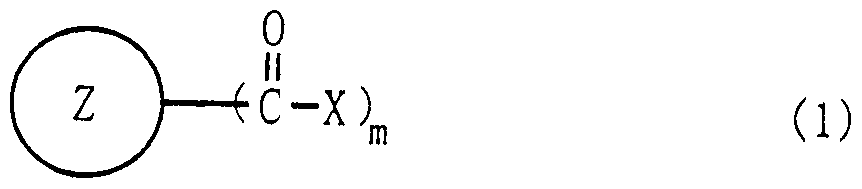
- ring Z represents a bridged carbocyclic ring
- X represents a halogen atom
- m represents an integer of 2 or more.
- Ring Z may have a substituent
- the t-butyl alcohol or an alkali metal salt thereof is reacted with a cyclic polycarboxylic acid halide represented by the following formula (2)
- ring Z represents a bridged carbocyclic ring, m represents an integer of 2 or more. Ring Z may have a substituent.
- the above-mentioned production method comprises a step of adsorbing a reaction product of a bridged cyclic polycarboxylic acid halide represented by the formula (1) with t-butyl alcohol or its metal salt by an adsorbent. At least the adsorption treatment step to be added may be included.
- the production method comprises the step of: reacting a reaction product of the cyclic polycarboxylic acid halide represented by the formula (1) with t-butyl alcohol or an alkali metal salt thereof with water and water miscibility. At least a crystallization step for crystallization using a mixed solvent with a solvent may be included.
- a crosslinked cyclic polycarboxylic acid halide represented by the formula (1), t-butyl alcohol or an alkali metal salt thereof The reaction product of the above is subjected to (A) a washing step of washing with water, (B) an adsorption treatment step of adsorption treatment with an adsorbent, and (C) a crystallization step to purify the reaction product, whereby Polycarboxylic acid t-butyl ester may be obtained.
- the ring Z in the formula (1) includes, for example, 2 to 4 bridged cyclic carbocycles such as an adamantane ring and a norbornane ring.
- the present invention also provides the following formula (4)
- R represents a substituent attached to a norbornane ring
- n represents the time.
- N indicating an integer number of 0-5 is 2 or more, R may be different from each.
- Iota beta u is t one-butyl Represents a group, and m represents an integer of 2 or more
- FIG. 1 is a manufacturing process diagram showing an example of the method of the present invention. BEST MODE FOR CARRYING OUT THE INVENTION
- ring Z represents a bridged cyclic carbocycle.
- the above-mentioned cyclic carbocycle is not particularly limited, and examples thereof include a perhydrodonaphthalene ring (a decaline ring), a perhydrodroanthracene ring, a perhydrodrophenanthrene ring, a perhydrodroacenaphthene ring, and a perhydrodrophenalen.
- Examples of such a substituent include a halogen atom (a fluorine, chlorine, bromine, or iodine atom), an alkyl group (a C ⁇ 4 alkyl group such as a methyl, ethyl, and isopropyl group), a cycloalkyl group, Ariru group (full Eniru group, a naphthyl group), human Dorokishiru group, arsenate Dorokishimechiru group, an alkoxy group (main butoxy, et butoxy, etc.
- a halogen atom a fluorine, chlorine, bromine, or iodine atom
- an alkyl group a C ⁇ 4 alkyl group such as a methyl, ethyl, and isopropyl group
- Ariru group full Eniru group, a naphthyl group
- human Dorokishiru group arsenate Dorokishimechiru group
- an alkoxy group
- C 4 ⁇ alkoxy group such as i isopropoxy group
- Ashiruokishi group Asechiruokishi, Puropioniruo alkoxy group, C 2, such as (meth) Atta Li Roiruokishi groups - such as 4 aliphatic Ashiruoki shea group
- a carboxyl group a carboxymethyl group, an alkoxycarbonyl alkylsulfonyl group (main-butoxycarbonyl, et butoxycarbonyl, such as propoxy carboxymethyl sulfonyl group C 4 alkoxy monocarbonyl group etc.
- cycloalkyl Substitution or substitution of a carbonyl group such as a cyclohexyloxycarbonyl group
- an aryloxycarbonyl group such as a phenyloxycarbonyl group
- an aralkyloxycarbonyl group such as a benzyloxycarbonyl group
- hydroxyl group, hydroxymethyl group, carboxyl group, carboxymethyl group, amino group and the like may be protected by a conventional protecting group.
- preferred substituents include a halogen atom, a Ci- 4 alkyl group, an oxo group, a hydroxyl group optionally protected by a protecting group, a carboxyl group optionally protected by a protecting group, and the like. included.
- examples of the halogen atom represented by X include a chlorine, bromine, and iodine atom.
- M represents an integer of 2 or more, preferably an integer of 2 to 4.
- t Alkali metal in the alkali metal salt of monobutyl alcohol examples include lithium, sodium, and potassium.
- the preferred alkali metal is sodium or potassium, with sodium being particularly preferred.
- the reaction (a dehydrohalogenation reaction or a desalination reaction) between the pendant cyclic polycarboxylic acid halide represented by the above formula (1) and t-butyl alcohol or an alkali metal salt thereof is usually carried out with an organic compound. Performed in a solvent.
- the organic solvent may be any solvent that does not inhibit the reaction, and examples thereof include aliphatic hydrocarbons such as hexane and octane; aromatic hydrocarbons such as benzene, toluene and xylene; Alicyclic hydrocarbons; amides such as N, N-dimethylformamide (DMF) and N, N-dimethylacetamide; chloroform, dichloromethane, dichloroethane, carbon tetrachloride, carbon benzene, trifluoro Halogenated hydrocarbons such as romethylbenzene; esters such as ethyl acetate and butyl acetate; mixed solvents thereof and the like can be used.
- aliphatic hydrocarbons such as hexane and octane
- aromatic hydrocarbons such as benzene, toluene and xylene
- Alicyclic hydrocarbons amides such as N, N-dimethylformamide (DMF)
- the reaction is usually performed in the presence of a base.
- a base include Triethyla Organic bases such as min and pyridine can be used.
- the reaction temperature of the dehydrohalogenation reaction or desalination reaction is, for example, about ⁇ 20 ° C. to 100 ° C., preferably about 10 ° C. to 50 ° C. is there.
- the reaction can be carried out in any of a batch system, a semi-batch system, and a continuous system.
- the resulting t-butyl ester of the cyclic polycarboxylic acid is separated and purified, for example, by filtration, concentration, distillation, extraction, crystallization, washing, recrystallization, adsorption, column chromatography, etc. Separation and purification can be performed by these combinations.
- the crosslinked cyclic polycarboxylic acid halide represented by the above formula (1) and t-butyl alcohol or its alkanol are used.
- reaction product it is also preferable to purify the reaction product by sequentially subjecting the reaction product to (A) a washing step of washing with water, (B) an adsorption treatment step of adsorption treatment with an adsorbent, and (C) a crystallization step.
- the reaction product may be subjected to the adsorption treatment step as it is, but is preferably subjected to the washing step (A) for washing with water before that.
- the cleaning liquid only needs to contain at least water. By this washing process, Water-soluble impurities such as salts contained in the reaction mixture can be efficiently removed.
- the amount of the cleaning liquid used is, for example, about 100 to 200 parts by weight, and preferably about 20 to 100 parts by weight, per 100 parts by weight of the liquid to be cleaned per one cleaning treatment.
- the temperature at the time of washing is, for example, about 10 to 100 ° C.
- the washing can be performed by a known or commonly used method such as a batch system, a continuous system, and a multistage system.
- the reaction mixture or the washing treatment liquid obtained in the above-mentioned washing step (A) is subjected to solvent exchange (exchange) as required, and then subjected to adsorption treatment.
- the adsorption treatment method is not particularly limited as long as it can remove impurities in the reaction product, but at least one adsorbent selected from activated carbon, chelate resin, chelate fiber, and zeta potential membrane Is preferred.
- the processing method used in the silica gel and the adsorbent is also preferably les, 0
- the adsorption treatment may be performed by combining two or more treatment methods. By combining two or more treatment methods, it is possible to obtain a product with higher purity.
- a combination of two or more treatment methods for example, at least one treatment method selected from activated carbon treatment and silica gel treatment and at least one treatment selected from chelate resin treatment, chelate fiber treatment and zeta potential membrane treatment And a combination with one processing method.
- the processing may be performed in one stage or may be performed stepwise.
- the solvent replacement can be performed, for example, by distilling off the reaction solvent in the reaction mixture or the washing solution obtained in the washing step (A), and adding a solvent used for the adsorption treatment.
- the reaction solvent does not necessarily need to be completely removed, but may be, for example, only concentrated to about 4 to 15 times.
- the distilled reaction solvent can be reused.
- the activated carbon used for the activated carbon treatment is not particularly limited, and any of gas activated carbon and chemical activated carbon can be used.
- the origin of activated carbon is also not particularly limited, and activated carbon obtained from plant-based materials such as wood, sawdust, fruit husk, and fruit husk charcoal; minerals such as peat, lignite, lignite, coke, coal pitch, and oil pitch Activated carbon obtained from raw materials; any of activated carbon obtained from synthetic resin raw materials such as phenolic resin and acrylic resin can be used.
- the shape of the activated carbon is also not particularly limited, and may be any of powder, granule, fiber, and the like.
- the specific surface area of the activated carbon is, for example, about 10 to 300 m 2 / g.
- the liquid to be subjected to the activated carbon treatment is not particularly limited as long as it is a solution. From the viewpoint of the effect of removing impurities, for example, alcohols such as methanol and ethanol are preferable as the solvent of the liquid to be treated. .
- the concentration of the cross-linked cyclic polycarboxylic acid t-butyl ester in the liquid to be treated for the activated carbon treatment can be appropriately selected within a range that does not impair the treatment efficiency, workability, and the like, but is generally 1 to 50% by weight. Degree, preferably about 5 to 30% by weight.
- the amount of the alcohol used is, for example, 200 to 100 parts by weight based on 100 parts by weight of t-butyl cross-linked cyclic polycarboxylic acid. It is about 100 parts by weight.
- the amount of activated carbon used can also be appropriately selected in consideration of treatment efficiency, workability, and the like. For example, based on 100 parts by weight of t-butyl carboxylic acid polycarboxylic acid t-butyl ester contained in the liquid to be treated, It is about 5 to 100 parts by weight, preferably about 10 to 100 parts by weight.
- the treatment temperature in the activated carbon treatment is, for example, about 10 to 150 ° C.
- a known method such as a batch method, a continuous method, a fixed bed method, and a fluidized bed method can be adopted.
- the activated carbon treatment mainly the coloring components can be efficiently removed, and a crosslinked cyclic polycarboxylate t_butyl ester having an excellent hue can be easily obtained.
- the Tachibana cyclic poly with a low degree of coloration Carboxylic acid t-butyl ester is extremely useful as a photosensitizer or dissolution inhibitor for photoresists.
- the chelate resin used for the chelate resin treatment is not particularly limited as long as it has a functional group capable of forming a chelate with a metal, and a typical example thereof is iminodiacetic acid type. And polyamine-type chelate resins.
- the exchange capacity of the chelating resin is not particularly limited, but for example, a capacity of about 0.1 to 2 mol / 1 is used.
- the liquid to be treated to be subjected to the chelate resin treatment is not particularly limited as long as it is a solution.
- methanol or ethanol is used as a solvent for the liquid to be treated.
- alcohols such as ethyl acetate and esters such as ethyl acetate and butyl acetate.
- the concentration of the cross-linked cyclic polycarboxylic acid t-butyl ester in the liquid to be subjected to the chelate resin treatment can be appropriately selected within a range that does not impair the treatment efficiency, workability, and the like, but is generally about 1 to 50% by weight. It is preferably about 5 to 30% by weight.
- the amount of the chelate resin used can be appropriately selected in consideration of the processing efficiency, workability, and the like. For example, 100 mol to 100 mol as an exchange group per 1 mol of metal contained in the liquid to be treated. It is about 0.000 mol.
- the processing temperature in the chelating resin processing is, for example, about 10 to 150 ° C.
- known methods such as a batch method, a continuous method, a fixed bed method, and a fluidized bed method can be employed.
- trace metal components eg, Fe, A1, etc.
- the crosslinked cyclic polycarboxylic acid t-butyl ester which has been subjected to the chelating resin treatment can be suitably used as a photosensitizer or a dissolution inhibitor for photoresist.
- a chelate functional group for example, iminodiacetic acid type resin
- natural fiber by chemical bonding.
- chelate fibers based on cellulose trade name: "Kires Tofu Fiber J", manufactured by Kiresto Co., Ltd., etc.
- the liquid to be treated for the chelate fiber treatment is not particularly limited as long as it is a solution, but from the viewpoint of the effect of removing impurities, for example, methanol, ethanol, Alcohols such as isopropinoleanolone and octanole; Estenoles such as ethyl acetate and butyl acetate; aromatic hydrocarbons such as toluene; aliphatic hydrocarbons such as hexane and heptane; methylene chloride; Halogenated hydrocarbons such as dichloromethane and ethers such as tetrahydrofuran are preferred.
- the concentration of t-butyl crosslinked polycarboxylate in the liquid to be treated for the chelate fiber treatment can be appropriately selected within a range that does not impair the treatment efficiency, workability, and the like.
- the amount of chelating fiber used can also be appropriately selected in consideration of processing efficiency and workability.
- the processing temperature in the chelate fiber processing is, for example, about 10 to 150 ° C.
- a known method such as a batch method, a continuous method, a fixed bed method, and a fluidized bed method can be adopted.
- trace metal components eg, Fe, A1, etc.
- the zeta potential membrane treatment is performed by passing a liquid to be treated through a zeta potential membrane.
- the zeta potential membrane used for the zeta potential membrane treatment is not particularly limited as long as it is a filtration membrane capable of adsorbing fine particles based on the zeta potential.
- Zeta Plus trade name, manufactured by Cuno Corporation
- Etc can be used.
- Examples of the material of the zeta potential membrane include resin, cellulose, perlite, diatomaceous earth, and glass fiber.
- the solvent of the liquid to be treated for the zeta potential membrane treatment is not particularly limited, but typical examples thereof include alcohols such as methanol and ethanol. Esters; esters such as ethyl acetate and butyl acetate; and aromatic hydrocarbons such as toluene and xylene.
- the concentration of t-butyl carboxylate polycarboxylate in the liquid to be subjected to zeta potential membrane treatment can be appropriately selected within a range that does not impair the treatment efficiency, workability, etc., but is generally 1 to 50 weight. . /. Preferably 5 to 30 weight. / 0 or so.
- the amount of the liquid to be treated is, for example, about 1 to 30 kg per 1 m 2 of the zeta potential membrane.
- the processing speed is, for example, about 0.02 to 2 m 3 / m 2 Z.
- the processing temperature in the zeta potential membrane processing is, for example, about 10 to 150 ° C.
- zeta potential membrane treatment mainly trace metal components (eg, Fe, A1, etc.) can be efficiently removed. Therefore, the crosslinked cyclic polycarboxylic acid t-butyl ester which has been subjected to zeta potential membrane treatment can be suitably used as a photosensitizer or a dissolution inhibitor for a photo resist.
- the liquid to be subjected to the silylation gel treatment is not particularly limited as long as it is a solution.
- the same solvent as the liquid to be treated to be subjected to the chelate fiber treatment can be used.
- the concentration of the cross-linked cyclic polycarboxylic acid t-butyl ester in the solution to be subjected to the silylation gel treatment can be appropriately selected within a range that does not impair the treatment efficiency, workability, and the like, but is generally 1 to 50% by weight. %, Preferably about 5 to 30% by weight.
- the amount of the silylation gel can also be appropriately selected in consideration of processing efficiency, workability, and the like.
- the processing temperature in the sily gel treatment is, for example, about 10 to 150 ° C.
- known methods such as a batch type, a continuous type, a fixed bed type, and a fluidized bed type can be adopted.
- high-boiling organic substances and coloring components can be efficiently removed.
- t-butyl carboxylate polycarboxylate having a very low content of high-boiling organic substances, etc. Is useful as a photosensitizer or dissolution inhibitor for photoresists.
- the reaction product After passing through the adsorption treatment step (B), the reaction product is usually subjected to a crystallization step (C).
- the crystallization step (C) the crosslinked cyclic polycarboxylic acid t-butyl ester is crystallized from the adsorption treatment solution obtained in the adsorption treatment step (B) (after solvent replacement as necessary).
- the reaction product (reaction mixture) may be subjected to the crystallization step (C) as it is, or the cleaning solution obtained in the washing step (A) may be subjected to the crystallization step (C).
- crystallization solvent examples include aromatic hydrocarbons such as benzene, toluene, xylene, and ethylbenzene; aliphatic hydrocarbons such as hexane, heptane, and octane; alicyclic hydrocarbons such as cyclohexane; carbon tetrachloride Halogenated hydrocarbons such as chlorophenol, dichloromethane, 1,2-dichloroethane, triphenylenomethyl benzene, and benzene; alcohols such as methanol, ethanol, isopropyl alcohol, and butanol; ketones such as acetone and methyl ethyl ketone.
- aromatic hydrocarbons such as benzene, toluene, xylene, and ethylbenzene
- aliphatic hydrocarbons such as hexane, heptane, and octane
- alicyclic hydrocarbons such
- Esters such as methyl acetate, ethyl acetate, isopropyl acetate, butyl acetate, and ethyl benzoate; ditrinoles such as acetonitrile, propionitrile, and benzonitrile; dimethyl ether, diisopropyl ether, and t-butyl.
- Chain or cyclic ethers such as tyl ether, dibutyl ether, dimethoxetane, anisol, dioxane, tetrahydrofuran; non-proton polar solvents such as N, N-dimethylformamide, N, N-dimethylacetamide; Carbon disulfide; water; a mixed solvent thereof, and the like.
- the crystallization solvent include a mixed solvent of water and a water-miscible solvent (for example, a cyclic ether such as tetrahydrofuran, or an alcohol such as methanol or isopropyl alcohol).
- solvent replacement is performed.
- the solvent replacement can be carried out by removing the solvent in the adsorption treatment step and adding a crystallization solvent.
- the solvent distilled off can be reused.
- the amount of the crystallization solvent varies depending on the type of the solvent, but is generally 20 to 100 parts by weight, preferably 100 to 100 parts by weight, per 100 parts by weight of the t-butyl ester of the cyclic polycarboxylic acid. It is about 25 to 800 parts by weight.
- the crystallization operation is often performed, for example, by cooling from a temperature of about 30 to 100 ° C to a temperature of about 120 to 30 ° C.
- the obtained crystals are washed (rinsed) with a solvent, whereby a higher purity crosslinked cyclic polycarboxylic acid t-butyl ester can be obtained.
- a solvent for example, a mixed solvent of water and a water-miscible solvent (eg, an alcohol such as methanol and isopropyl alcohol) is preferable.
- the amount of the solvent (rinse solvent) used for washing is, for example, 100 to 100 parts by weight, preferably 50 to 100 parts by weight, per 100 parts by weight of the cyclic polycarboxylic acid t-butyl ester. It is about 400 parts by weight.
- the temperature of the solvent used for washing may be about room temperature, but is preferably about ⁇ 10 to 1 ° C.
- the drying conditions of the crystals obtained by crystallization or the crystals that have been further washed can be set as appropriate within a range that does not impair the quality and work efficiency.
- the temperature is about 10 to 100 ° C
- the pressure is normal pressure or reduced pressure.
- Drying may be performed in a stream of an inert gas such as nitrogen.
- the solvent can be recovered from the mother liquor obtained by crystallization and the washing treatment liquid by distillation or evaporation. Recovered solvent can be reused
- FIG. 1 is a manufacturing process diagram showing an example of the manufacturing method of the present invention.
- the starting materials, a crosslinked cyclic polycarboxylic acid halide, t-butyl alcohol or an alkali metal salt thereof, and a reaction solvent are supplied to the reactor 1 (reaction step).
- the reaction mixture is transferred from the reactor 1 to the washing tank 2 and washed with a washing solution such as water (washing step).
- the washed organic layer usually contains the cross-linked cyclic polycarboxylic acid t-butyl ester formed by the reaction, trace amounts of by-products, and the reaction solvent.
- the washed aqueous layer contains alkali metal halide and the like.
- the organic layer after the washing is supplied to the evaporator 3, and the reaction solvent is distilled off (desolvent step).
- the bottom liquid is supplied to an adsorption treatment tank 4 together with an adsorption treatment solvent such as methanol and an adsorbent, and subjected to an adsorption treatment (adsorption treatment step).
- an adsorption treatment solvent such as methanol and an adsorbent
- adsorption treatment step adsorption treatment step.
- two or more adsorption methods can be combined.
- the reaction solvent and the solvent in the adsorption treatment are the same, the operation of replacing the solvent can be omitted.
- the treated liquid after the adsorption treatment is filtered by the filter 5, and the obtained filtrate is supplied to the evaporator 6, where the solvent for the adsorption treatment is distilled off (desolvation step).
- a solvent having a higher boiling point than the adsorption treatment solvent (crystallization solvent 1) among the crystallization solvents used in the next crystallization step is added to the filtrate, and supplied to the evaporator 6.
- Solvent replacement can be easily performed.
- another crystallization solvent 2 is added to the bottom liquid of the evaporator 6, and the mixture is cooled to crystallize a crosslinked cyclic polycarbonic acid t-butyl ester (crystallization step).
- the adsorption treatment When the medium and the crystallization solvent are the same, the operation of replacing the solvent can be omitted.
- the crystallized cross-linked cyclic polycarboxylic acid t-butyl ester is filtered through a filter 8, washed with a washing solvent (rinsing step), and dried in a vacuum drier 9 (drying step) to obtain a product.
- Be transformed into The mother liquor and the washing liquid (filtrate) obtained in the crystallization step and the rinsing step are supplied to the evaporator 10 and collected from the top (solvent recovery step).
- the reaction is smooth even though the crosslinked cyclic polycarboxylic acid halide and t-butyl alcohol or its metal salt used as raw materials are both bulky compounds.
- the desired ester compound is produced in high yield.
- the target product is produced in an extremely high yield (for example, 90% or more). Therefore, t-butyl carboxylate polycarboxylic acid t-butyl ester can be industrially and efficiently produced.
- the crosslinked cyclic polycarboxylic acid halide represented by the above formula (1) used as a reaction raw material is, for example, a crosslinked cyclic polycarboxylic acid rubric acid represented by the above formula (3) and a halogenating agent.
- Can be obtained by reacting This reaction is usually performed in an organic solvent, and for example, the above-mentioned solvents can be used as the organic solvent.
- halogenating agent for example, thionyl halides such as thionyl chloride and thionyl bromide; oxyhalogenated phosphorus such as phosphorus oxychloride and phosphorus oxybromide; phosphorus trichloride, phosphorus pentachloride and the like
- a conventional halogenating agent such as oxalyl halide such as oxalyl chloride; phosphorus trichloride; dichlorotriphenylphosphorane, dichlorotriphenylphosphine / diphosphorane, etc. be able to.
- preferred halogenating agents include thionyl halides such as thionyl chloride. I can do it.
- the amount of the halogenating agent to be used is, for example, 1 mol or more with respect to 1 mol of the carboxyl group of the crosslinked cyclic polycarboxylic acid represented by the formula (3), and a large excess can be used.
- reaction accelerator N, N-dimethylformamide or the like as a reaction accelerator.
- the amount of the reaction accelerator to be used is about 0.1 to 10% by weight, preferably about 0.1 to 5% by weight, based on the halogenating agent.
- a reaction accelerator can be used as a solvent.
- the reaction temperature of the halogenation reaction can be appropriately selected depending on the type of the halogenating agent and the like, but is generally about ⁇ 10 ° C. to 150 ° C.
- the reaction can be performed in any of a batch system, a semi-batch system, and a continuous system.
- a bridged carboxylic polycarboxylic acid halide represented by the above formula (1) is produced in a very high yield.
- the resulting crosslinked polycarboxylic acid halide can be subjected to the desalting reaction as it is or after a simple treatment such as concentration and purification.
- R represents a substituent bonded to a norbornane ring.
- substituents include those exemplified above. Among them, preferred substituents include a halogen atom, a d- 4 alkyl group, an oxo group, a hydroxyl group optionally protected by a protecting group, a carboxyl group optionally protected by a protecting group, and the like. .
- n represents an integer of 0 to 5, and when n is 2 or more, Rs may be different from each other.
- m is an integer of 2 or more, preferably about 2 to 4, particularly 2.
- the bonding position of the butoxycarbonyl group in the norbornane ring is not particularly limited, but is preferably bonded at least to the 2- and 3-positions. Les ,.
- the norbornane polycarboxylic acid t-butyl ester compound may have a stereoisomer, and all such compounds are included in the present invention.
- the norbornane polycarboxylic acid t-butyl ester compound represented by the formula (4) can be obtained in high yield by utilizing the above-mentioned method for producing a crosslinked cyclic polycarboxylic acid t-butyl ester according to the present invention.
- This compound has a norbornane ring that contributes to the etching resistance and has a t-butoxycarbonyl group that can be easily decomposed by an acid generated from a photoacid generator to generate a carboxyl group. It can be used as an additive for a resist, for example, as a sensitizer or a dissolution inhibitor.
- tachibana cyclic polycarboxylic acid t-butyl ester can be industrially and efficiently produced.
- reaction mixture was cooled to room temperature, and 599.9 g (2.294 mol) of 1,3-adamantane dicarboxylic acid dichloride was obtained by removing the remaining thionyl chloride and DMF under reduced pressure. Obtained as a purified product.
- 1,3-adamantanedicarboxylic acid di-t-butyl ester 490 represented by the following formula.
- g (1.455 mol) was obtained as a white solid [purity 9.9% (by gas chromatography)].
- the obtained white solid was recrystallized from methanol-aqueous system to obtain 460 g (1.369 g) of purified 1,3-adamantanedicarboxylic acid di-t-butyl ester as white powder. [Melting point: 65-66 ° C; purity 99.5% (by gas chromatography)].
- adamantane-1,3-dicarboxylic acid di-tert-butyl ester was produced.
- the reaction solution was transferred to a washing tank 2 equipped with a stirrer, and washed three times with water at a temperature of 30 ° C. In each case, 60 parts by weight of the cleaning liquid was used with respect to 100 parts by weight of the liquid to be cleaned. By this washing operation, a toluene solution of adamantane-1,3-dicanolevonic acid-t-butinoleestenole was obtained as an organic layer.
- This organic layer was concentrated using a glass evaporator 13 having an internal volume of 10 L [50 mmHg (6664 Pa)] to obtain 60. C], 433.5 g of a concentrated solution was obtained.
- the reaction solution was transferred to a washing tank 2 equipped with a stirrer, and washed three times with water at a temperature of 30 ° C. In each case, 60 parts by weight of the cleaning liquid was used with respect to 100 parts by weight of the liquid to be cleaned. By this washing operation, a tonoleene solution of adamantane-1,3-dicanolevonic acid-t-butynoleestenole was obtained as an organic layer.
- the organic layer was concentrated using a glass evaporator one 3 having an inner volume of 1 0 L [5 0 mmH g (6 6 64 P a), 6 0 ° C] to obtain a concentrated solution of lambda 4 3 3. 5 g Was.
- the filtrate was heated and refluxed, and water (515 g) was added.
- the mixture was stirred and cooled under ice cooling for 3 hours, and adamantane-1,1,3-dicarboxylic acid-di-tert-butyl ester was crystallized to obtain a slurry. .
- the temperature of this slurry is 2. C.
- the crystals were separated by filtration and washed with 500 g of a cold 50% by weight aqueous methanol solution. After washing is completed, the crystals are separated by filtration and dried in a vacuum dryer.
Landscapes
- Chemical & Material Sciences (AREA)
- Organic Chemistry (AREA)
- Physics & Mathematics (AREA)
- Spectroscopy & Molecular Physics (AREA)
- General Physics & Mathematics (AREA)
- Organic Low-Molecular-Weight Compounds And Preparation Thereof (AREA)
Description


Claims



Priority Applications (3)
| Application Number | Priority Date | Filing Date | Title |
|---|---|---|---|
| EP00976375A EP1148043A1 (en) | 1999-11-24 | 2000-11-21 | PROCESS FOR PRODUCING t-BUTYL ESTERS OF BRIDGED-RING POLYCARBOXYLIC ACIDS |
| US09/889,882 US6515165B1 (en) | 1999-11-24 | 2000-11-21 | Process for producing t-butyl esters of bridged-ring polycarboxylic acids |
| KR1020017009229A KR20010094749A (ko) | 1999-11-24 | 2000-11-21 | 가교고리형 폴리카르복실산 t-부틸에스테르의 제조법 |
Applications Claiming Priority (2)
| Application Number | Priority Date | Filing Date | Title |
|---|---|---|---|
| JP11/333484 | 1999-11-24 | ||
| JP33348499 | 1999-11-24 |
Publications (1)
| Publication Number | Publication Date |
|---|---|
| WO2001038286A1 true WO2001038286A1 (en) | 2001-05-31 |
Family
ID=18266586
Family Applications (1)
| Application Number | Title | Priority Date | Filing Date |
|---|---|---|---|
| PCT/JP2000/008182 Ceased WO2001038286A1 (en) | 1999-11-24 | 2000-11-21 | PROCESS FOR PRODUCING t-BUTYL ESTERS OF BRIDGED-RING POLYCARBOXYLIC ACIDS |
Country Status (5)
| Country | Link |
|---|---|
| US (1) | US6515165B1 (ja) |
| EP (1) | EP1148043A1 (ja) |
| KR (1) | KR20010094749A (ja) |
| TW (1) | TWI225480B (ja) |
| WO (1) | WO2001038286A1 (ja) |
Cited By (1)
| Publication number | Priority date | Publication date | Assignee | Title |
|---|---|---|---|---|
| JP2002365804A (ja) * | 2001-06-08 | 2002-12-18 | Jsr Corp | 感放射線性樹脂組成物 |
Families Citing this family (1)
| Publication number | Priority date | Publication date | Assignee | Title |
|---|---|---|---|---|
| EP1564604B1 (en) * | 2004-02-16 | 2013-06-19 | Ricoh Company, Ltd. | Fixing device with cleaning member, and image forming apparatus using the fixing device |
Citations (5)
| Publication number | Priority date | Publication date | Assignee | Title |
|---|---|---|---|---|
| JPS51138665A (en) * | 1975-05-27 | 1976-11-30 | Kao Corp | Process for preparing 4-homoisotwistane-3-carbonyl halides |
| JPS523046A (en) * | 1975-06-24 | 1977-01-11 | Kao Corp | Prepration of 4-homotwistane-3-carboxylic acid esters |
| JPS58110538A (ja) * | 1981-12-25 | 1983-07-01 | Japan Synthetic Rubber Co Ltd | シクロペンタジエン多量体の酸クロリド及びその製造方法 |
| US4931584A (en) * | 1987-03-05 | 1990-06-05 | Laboratoires Upsa | Process for the preparation of monoesters or diesters of-9,10-endoethano-9,10-dihydroanthracene-11,11-dicarboxylic acid and for the preparation of symmetrical or asymmetrical methylidenemalonates |
| US6143465A (en) * | 1998-08-18 | 2000-11-07 | Samsung Electronics Co., Ltd. | Photosensitive polymer having cyclic backbone and resist composition comprising same |
-
2000
- 2000-11-21 EP EP00976375A patent/EP1148043A1/en not_active Withdrawn
- 2000-11-21 US US09/889,882 patent/US6515165B1/en not_active Expired - Fee Related
- 2000-11-21 KR KR1020017009229A patent/KR20010094749A/ko not_active Ceased
- 2000-11-21 WO PCT/JP2000/008182 patent/WO2001038286A1/ja not_active Ceased
- 2000-11-22 TW TW089124731A patent/TWI225480B/zh not_active IP Right Cessation
Patent Citations (5)
| Publication number | Priority date | Publication date | Assignee | Title |
|---|---|---|---|---|
| JPS51138665A (en) * | 1975-05-27 | 1976-11-30 | Kao Corp | Process for preparing 4-homoisotwistane-3-carbonyl halides |
| JPS523046A (en) * | 1975-06-24 | 1977-01-11 | Kao Corp | Prepration of 4-homotwistane-3-carboxylic acid esters |
| JPS58110538A (ja) * | 1981-12-25 | 1983-07-01 | Japan Synthetic Rubber Co Ltd | シクロペンタジエン多量体の酸クロリド及びその製造方法 |
| US4931584A (en) * | 1987-03-05 | 1990-06-05 | Laboratoires Upsa | Process for the preparation of monoesters or diesters of-9,10-endoethano-9,10-dihydroanthracene-11,11-dicarboxylic acid and for the preparation of symmetrical or asymmetrical methylidenemalonates |
| US6143465A (en) * | 1998-08-18 | 2000-11-07 | Samsung Electronics Co., Ltd. | Photosensitive polymer having cyclic backbone and resist composition comprising same |
Non-Patent Citations (1)
| Title |
|---|
| L.T. EREMENKO ET AL.: "Cubane derivatives 2. Synthesis and structures of some esters of 1,4-cubanedicarboxylic acid", RUSS. CHEM. BULL., vol. 47, no. 3, 1998, pages 441 - 446, XP002936599 * |
Cited By (1)
| Publication number | Priority date | Publication date | Assignee | Title |
|---|---|---|---|---|
| JP2002365804A (ja) * | 2001-06-08 | 2002-12-18 | Jsr Corp | 感放射線性樹脂組成物 |
Also Published As
| Publication number | Publication date |
|---|---|
| TWI225480B (en) | 2004-12-21 |
| KR20010094749A (ko) | 2001-11-01 |
| EP1148043A1 (en) | 2001-10-24 |
| US6515165B1 (en) | 2003-02-04 |
Similar Documents
| Publication | Publication Date | Title |
|---|---|---|
| JPH1045655A (ja) | フルオレン誘導体の製造方法 | |
| JP5137982B2 (ja) | アダマンタン誘導体及びその製造方法 | |
| JPH08133999A (ja) | ゲラニルゲラニオ−ルの製造方法 | |
| JP2000309558A (ja) | 2−アダマンチル(メタ)アクリレート類の製造方法 | |
| JP2005104964A (ja) | アダマンチルエステル類の精製方法 | |
| JPH1045656A (ja) | フルオレン誘導体の製造法 | |
| US6515165B1 (en) | Process for producing t-butyl esters of bridged-ring polycarboxylic acids | |
| FR2510110A1 (ja) | ||
| JPWO1997018182A1 (ja) | ヒドロキシナフタレンカルボン酸類の分離精製法 | |
| JPS6289684A (ja) | ヒドロキシフエニルプロピオン酸エステルの製造法 | |
| JP2003146979A (ja) | ラクトン類の製造方法 | |
| JPH1045654A (ja) | フルオレン誘導体の精製方法 | |
| JP3640319B2 (ja) | ベンズアミド誘導体の製造方法 | |
| JPH06166683A (ja) | O,o´−ジアシル酒石酸無水物の製造法 | |
| JP2002030044A (ja) | テトラアルキルアンモニウムハライドの製造方法 | |
| JPWO2001038286A1 (ja) | 架橋環式多価カルボン酸t−ブチルエステルの製造法 | |
| JP4379970B2 (ja) | オレフィン化合物の製造法 | |
| JP4768145B2 (ja) | 光学活性2−フェノキシプロピオン酸の光学精製方法 | |
| JPH06116236A (ja) | ビスイミド化合物の製造方法 | |
| JPH09176063A (ja) | アルコール類の製造方法 | |
| JPS60169434A (ja) | 光学活性なビシクロケトン類の製法 | |
| JPH04342597A (ja) | 結晶性テトラキス(トリフェニルホスフィン)パラジウム及びその製造法 | |
| CH616424A5 (ja) | ||
| JP3694923B2 (ja) | 光学活性 1−(2,4−ジクロロフェニル) エチルアミンの製造方法 | |
| JP2002348257A (ja) | 3,3,3−トリフルオロ−2−ヒドロキシ−2−メチルプロピオン酸の光学分割法 |
Legal Events
| Date | Code | Title | Description |
|---|---|---|---|
| AK | Designated states |
Kind code of ref document: A1 Designated state(s): JP KR US |
|
| AL | Designated countries for regional patents |
Kind code of ref document: A1 Designated state(s): DE FR GB |
|
| ENP | Entry into the national phase |
Ref document number: 2001 539843 Country of ref document: JP Kind code of ref document: A |
|
| WWE | Wipo information: entry into national phase |
Ref document number: 1020017009229 Country of ref document: KR |
|
| WWE | Wipo information: entry into national phase |
Ref document number: 2000976375 Country of ref document: EP Ref document number: 09889882 Country of ref document: US |
|
| 121 | Ep: the epo has been informed by wipo that ep was designated in this application | ||
| WWP | Wipo information: published in national office |
Ref document number: 2000976375 Country of ref document: EP |
|
| WWP | Wipo information: published in national office |
Ref document number: 1020017009229 Country of ref document: KR |
|
| WWW | Wipo information: withdrawn in national office |
Ref document number: 2000976375 Country of ref document: EP |
|
| WWR | Wipo information: refused in national office |
Ref document number: 1020017009229 Country of ref document: KR |