WO2001043330A2 - Data rate estimation in a communication system - Google Patents

Data rate estimation in a communication system Download PDF

Info

Publication number
WO2001043330A2
WO2001043330A2 PCT/EP2000/011874 EP0011874W WO0143330A2 WO 2001043330 A2 WO2001043330 A2 WO 2001043330A2 EP 0011874 W EP0011874 W EP 0011874W WO 0143330 A2 WO0143330 A2 WO 0143330A2
Authority
WO
WIPO (PCT)
Prior art keywords
data
spreading factor
signal
smallest
rate
Prior art date
Legal status (The legal status is an assumption and is not a legal conclusion. Google has not performed a legal analysis and makes no representation as to the accuracy of the status listed.)
Ceased
Application number
PCT/EP2000/011874
Other languages
French (fr)
Other versions
WO2001043330A3 (en
Inventor
Marko HEINILÄ
Ülo PARTS
Current Assignee (The listed assignees may be inaccurate. Google has not performed a legal analysis and makes no representation or warranty as to the accuracy of the list.)
Nokia Oyj
Nokia Inc
Original Assignee
Nokia Networks Oy
Nokia Inc
Priority date (The priority date is an assumption and is not a legal conclusion. Google has not performed a legal analysis and makes no representation as to the accuracy of the date listed.)
Filing date
Publication date
Application filed by Nokia Networks Oy, Nokia Inc filed Critical Nokia Networks Oy
Priority to EP00991137A priority Critical patent/EP1238470B1/en
Priority to DE60021206T priority patent/DE60021206T2/en
Priority to AT00991137T priority patent/ATE299312T1/en
Priority to US10/149,150 priority patent/US7180932B1/en
Priority to AU31549/01A priority patent/AU3154901A/en
Publication of WO2001043330A2 publication Critical patent/WO2001043330A2/en
Publication of WO2001043330A3 publication Critical patent/WO2001043330A3/en
Anticipated expiration legal-status Critical
Ceased legal-status Critical Current

Links

Classifications

    • HELECTRICITY
    • H04ELECTRIC COMMUNICATION TECHNIQUE
    • H04LTRANSMISSION OF DIGITAL INFORMATION, e.g. TELEGRAPHIC COMMUNICATION
    • H04L25/00Baseband systems
    • H04L25/02Details ; arrangements for supplying electrical power along data transmission lines
    • H04L25/0262Arrangements for detecting the data rate of an incoming signal
    • HELECTRICITY
    • H04ELECTRIC COMMUNICATION TECHNIQUE
    • H04JMULTIPLEX COMMUNICATION
    • H04J13/00Code division multiplex systems
    • H04J13/0007Code type
    • H04J13/004Orthogonal
    • H04J13/0044OVSF [orthogonal variable spreading factor]
    • HELECTRICITY
    • H04ELECTRIC COMMUNICATION TECHNIQUE
    • H04BTRANSMISSION
    • H04B2201/00Indexing scheme relating to details of transmission systems not covered by a single group of H04B3/00 - H04B13/00
    • H04B2201/69Orthogonal indexing scheme relating to spread spectrum techniques in general
    • H04B2201/707Orthogonal indexing scheme relating to spread spectrum techniques in general relating to direct sequence modulation
    • H04B2201/70703Orthogonal indexing scheme relating to spread spectrum techniques in general relating to direct sequence modulation using multiple or variable rates
    • H04B2201/70705Rate detection

Definitions

  • the present invention relates to a method and circuitry for estimating spreading factors and/or data rates of signals transmitted in a communication system, and more particularly, but not explicitly, between stations in a cellular code division multiple access (CDMA) or any analogous communication system.
  • CDMA code division multiple access
  • data is transmitted as a plurality of data symbols in subsequent data frames.
  • the signals carrying the data may be transmitted with variable data transmission rates (data speeds) , wherein the transmission rate may be different in subsequent frames of the transmission.
  • data speeds data speeds
  • data speeds data speeds
  • data speeds data speeds
  • data speeds data speeds
  • data speeds data speeds
  • data is encoded for transmission by processing data symbols to be transmitted by a spreading code and a unique scrambling code for each transmission channel.
  • the length of the spreading code i.e. the number of " ⁇ chips" per a data symbol
  • the effect of a spreading code is to spread the frequency band of a transmission to a chip rate which is larger than the actual information bit rate. This results that more symbols or bits are transmitted than what the actual number of information symbols or bits is.
  • the used spreading factor is eight, eighth bits (referred to as "chips") are transmitted for every information bit.
  • the scrambling code is unique for each mobile station transmitting to a single base station so that the transmission from individual mobile stations can be distinguished at the base station.
  • the spreading codes as well as the scrambling codes are preferably as far as possible orthogonal to allow for a plurality of different mobile stations to communicate with a base station on selectively coded channels.
  • variable- rate (multi-rate) connection where the data rate of the information bits, and thus the spreading code used in the spreading modulation of these bits, varies from radio frame to radio frame (e.g. every 10 ms) .
  • the data rates used in such a connection are not arbitrary, but for each radio frame duration, one of the plurality of pre-defined data rates is used. Moreover, every higher data rate is dividable by a lower data rate, the division factor being 2 k for k ⁇ O .
  • variable-rate connection spreading factors 4, 8, 16, 32, 64, 128 and 256 and corresponding data rates it is evident that also other spreading factors and data rates could be used without departing from the basic concept of the variable data rate (or multi-rate) transmission.
  • the relation between the spreading factors (SF) and the data rates is such that spreading factors 4, 8, 16, 32, 64, 128 and 256 correspond data rates 1024, 512, 256, 128, 64, 32 and 16 kbps, respectively.
  • the chip rate frequency changes, the relation between the spreading factors and data rates will change accordingly.
  • channel estimation When a signal is transmitted between a base station and a mobile station (either on the uplink or the downlink) of a CDMA system, the receiving station needs to establish from the received signal some information about the communication path along which the signal has travelled. This procedure is referred to herein as "channel estimation".
  • the channel estimation is typically carried out in a channel estimation unit.
  • Various techniques are known for channel estimation.
  • a channel impulse response generated by the estimation unit is required in order to properly decode and process incoming data.
  • the spreading factor and/or the corresponding data transmission rate of the received signal can be used in the channel estimation.
  • the correct data rate has to be determined by some means, e.g. by trying several possible data spreading factors for the transmission.
  • the information symbols in said radio frame are usually obtained by means of detecting the complex data symbols assuming that the highest-possible data rate is used for transmission, and using the lowest-possible spreading factor in the receiving station.
  • the receiver unit In practice, if the code length i.e. the spreading factor is not known, the receiver unit must perform the first despreading based on an assumption that the shortest possible code (minimal SF) was used for the transmission. For example, assuming that the data rate of the received radio frame was 1024 kbps in the first place, this corresponds to the spreading factor of 4 (at 4.096 Mcps) used in the detection of the data symbols. The result of this detection should be a data vector of all detected complex information symbols corresponding to the received radio frame.
  • minimal SF the code length
  • the transmission between the stations may or may not include explicit information of the spreading factors and/or data rates of the transmitted signal.
  • this information is usually given in a separate channel, for example in an DPCCH (Dedicated Physical Control Channel) .
  • DPCCH Dedicated Physical Control Channel
  • this information is often encoded in such a way that the actual data rate of the received radio frame is not known at the time the data symbols of the radio frame are detected.
  • it may be necessary in some applications to be able to establish another estimate of the data rate, for example for the purposes of verification and/or correction of the received ata race information.
  • so called unknown or blind data rate estimation may be used at the receiving station in order to define at the receiver the actual data rate of the received signal.
  • a mechanism is needed for estimating the data rate or spreading factor in a receiving station (e.g. a base station or a mobile station) .
  • This estimate may be desirable e.g. when this information is not available, or when an early estimate of the data rate is required before decoding, or when a confirmation of data rate information received from the transmitting station is desired.
  • One prior art proposal for detecting the data rate of the received signal before decoding is based on the power difference of the received bits in the data channel and the control channel (i.e. the power ratio between the data and control channels) .
  • the method is relatively simple as it requires only the average power estimates of the received control symbols and data symbols.
  • the disadvantage of the power ratio method is that it is not very accurate and/or reliable.
  • noise becomes very dominant in the detection process. This degrades substantially the performance of the data symbol power estimation.
  • CRC Cyclic Redundancy Check: an error detection signal
  • a convolutional code or any other appropriate code e.g. so called turbo code that is typically applied for high-speed data transmission
  • turbo code e.g. so called turbo code that is typically applied for high-speed data transmission
  • a CRC theck is accomplished for the results. If a torrect CRC _s detected, a correct data rate has been found.
  • the method is based on a data rate assumption at each decoding stage and a subsequent selection of a data rate which gives either a correct or an incorrect CRC word.
  • a CRC check would be calculated directly for the information symbols of the received radio frame by assuming firstly a data rate of 1024 kbps.
  • the resulting CRC word is stored.
  • Two adjacent received symbols are summed together, assuming a data rate of 512 kbps, and a further CRC check is calculated for these information symbols.
  • the resulting CRC word is stored.
  • the process continues summing two adjacent information symbols together and calculating CRC checks for all these information streams until a lowest-possible data rate is achieved. Thereafter the stored CRC words are verified and such a data rate is selected that corresponds the rate used in the transmitter when a right CRC check was obtained (if such existed at all) .
  • the CRC method is computationally complex and involves a substantially large amount of processing since the convolutional code or similar must be decoded for each possible frame length. If there are N possible data rates, this requires N consequent CRC decoding processes before a decision of the transmitter data rate can be made.
  • the spreading factor detector based on the CRC has to be located after decoding, and the data rate for a frame can be calculated only after the entire radio frame has been received. Thus this method cannot be used e.g. when the spreading factor has to be known all the time during the receiving process, and the CRC check may not be applied in applications where the data rate information has to be available before the entire radio frame has been received.
  • the above method delays the final decision of the data rate of the received signal -to a stage where at least some decoding of the data is needed for the first time. This will make the operation difficult for receiver structures that require an estimate of the data transmission rates of the received signals at an earlier stage than the first decoding.
  • One such receiver comprises an Interference Cancellation (IC) receiver.
  • IC Interference Cancellation
  • the method does not give any data rate at all if the algorithm does not give an exactly matching CRC check.
  • a transmitted signal includes a plurality of data symbols in one or several data frames, the data symbols being spread in each of the data frames in a manner defined by a respective spreading factor, comprising: receiving the signal; estimating noise variances for the spreading factors that.
  • a data frame in the signal based on information that is determined by assuming that the smallest possible spreading factor was used for the transmission of the data frame; scaling the estimated noise variances by predefined constants, each of the constants depending on the respective possible spreading factor; determining the DP. ⁇ of the scaled nois; ' riance estimates that has the smallest value; and estimating the most probable spreading factor of the received data frame based on the determined smallest scaled noise variance estimate.
  • a signal receiving circuitry for use in a communication system with variable data transmission rates wherein data is transmitted as a plurality of data symbols spread over one or several data frames, the spreading of the data symbols within each of the data frames being defined by a respective spreading factor
  • the signal receiving circuitry comprising processor means for estimating noise variances for the data spreading factors that are possible for a data frame, wherein the estimate is based on information of the signal that is determined by assuming that the spreading factor used for the transmission of the data frame is the smallest spreading factor possible for the transmission of the data frame, for scaling the estimated noise variances by predefined constants, each of the constants depending on the respective possible spreading factor, for determining the one of the scaled variance estimates that has the smallest value, and for estimating the most probable spreading factor of the received data frame based on the determination of the smallest scaled variance estimate.
  • the embodiments of the present invention provide several advantages.
  • the embodiments of the invention may be applied to provide a spreading factor or data rate estimate when no rate information is transmitted.
  • the embodiments of the invention may be applied when the rate information is transmitted but cannot, for reason or another, be used or detected from the signal during the receiving process.
  • One possible use of the embodiments is to orovide an additional data rate information which can be used e.g. for correction or error check of a rate information detected from the transmitted signal.
  • the estimate of data transmission rate can also be used in other parts of the received signal processing sequence, e.g. in an IC receiver.
  • the possibility for an early detection of the unknown data rate may enable use of any such receiver structure which makes use of the data rate information at an early stage.
  • the estimate can also be used to assist in rate selection for applications such as Viterbi decoding of the incoming data symbols, or to assist in decision of an alternative transmission rate for decoding if an error check fails.
  • embodiments of the invention may provide a data rate detection that is not too sensitive to SNR (Signal -to-Noise Ratio) fluctuation.
  • the embodiment may also provide a less complex detection structure and computations than the prior art proposals.
  • Figure 1 is a block diagram of a mobile communication system
  • Figure 2 illustrates a reception circuitry in a station
  • Figure 3 illustrates a slot structure for physical channels for a transmission with unknown data rate
  • Figure 4 is a flow chart for a blind rate classification according to one embodiment of the invention.
  • Figure 5 shows an exemplifying embodiment as a C- language program code;
  • Figures 6a to 6g show simulation results obtained with different spreading factors as a probability of rate detection error relative to frame error a e
  • Figures 7a to 7g show simulation results obtained with different spreading factors as a probability of rate detection error relative to bit error rate.
  • Figure 1 is a block diagram illustrating a context in which the present invention may be used. That is, a CDMA mobile communication system that allows a plurality of mobile stations MSI, MS2 , MS3 to communicate with a base
  • FIG. 2 is a block diagram of a receive circuitry at a base station in a WCDMA system (Wideband
  • the receive circuitry of Figure 2 is for use in uplink direction, i.e. for receiving signals from the- mobile stations (MS) . It is noted that even though the receive circuitry implementation in the downlink direction, i.e. at the mobile station, may be somewhat different, the invention is analogously applicable to the downlink and the mobile stations as well.
  • Data to be transmitted between a mobile station (MS) and a base transceiver station (BTS) may be speech data, video data or other data.
  • the data is encoded into a form suitable for transmission at a bit rate which is dependent on the source of the data.
  • the encoded user data is typically supplied to a frame multiplexer.
  • the user data may also be supplied to a CRC encoder which generates a check sequence (CRC) for each frame of data. Error correction coding and bit interleaving of the frame sequence can be accomplished prior to transmission in a manner known in the art.
  • the error correction is used in order to protect the user data from errors in a radio channel so that e.g. a Viterbi decoder can recover the coded data even if some of the bits are corrupted.
  • tail bits defining the end of each user data sequence may also be added to the end of user data sequence . Bit interleaving spreads burst errors which typically occur in radio channels more evenly in time to allow the decoder to more efficiently correct the errors from the coded data.
  • a frame multiplexer organises the data for transmission into a frame sequence.
  • Figure 3 illustrates an example of a slot structure for physical channels DPCCH (Dedicated Physical Control Channel) and DPDCH (Dedicated Physical Data Channel) in the frame sequence.
  • the DPCCH part of the frame contains a pilot sequence (PILOT) , a possible but not necessary rate information (RI) sequence (not shown) and a transmission power control (TPC) sequence.
  • the DPDCH part of the frame contains the whole interleaved user data sequence (user bits and possible CRC bits and possible tail bits) .
  • the user data of the DPDCH is divided into frame periods, such as periods of 10 milliseconds each. Each frame can be transmitted with a different rate.
  • the transmitter is enabled to multiplex data from different sources into the frame sequence for transmission and to provide different transmission rates in different frames of the frame sequence.
  • the data rate detection at the receiver is subjected to the DPDCH sequence of the frame.
  • the frame sequence is supplied to a spreader which receives spreading and scrambling codes from a code generator.
  • the spreading and scrambling codes are known and may be generated in accordance with known CDMA techniques and will thus not be described further herein.
  • the effect of the spreading code is to spread the frequency band for transmission to a chip rate which is larger than the bit rate.
  • the scrambling code is unique for each mobile station transmitting to a single base station so that the transmission from individual mobile stations can be distinguished at the base station. If M parallel code channels are employed, M data symbols are spread using different spreading codes and then the results are summed together.
  • the spread signal is then typically supplied to a modulator which modulates the signal ready for transmission, for example according to QPSK modulation.
  • modulation may be carried out prior to spreading. This sequence of events, however, has no impact on the present invention.
  • the spread, modulated signal is then be supplied to a digital to analogue (D/A) converter and further to an RF (radio frequency) unit which supplies the spread signal ready for transmission.
  • D/A digital to analogue
  • RF radio frequency
  • the present invention relates to the reception side of the connection.
  • the reception of the spread signal will now be described with reference to Figure 2.
  • signals incoming at an antenna 30 are received by an RF unit 28 and supplied to an analogue to digital (A/D) converter 32.
  • A/D analogue to digital
  • Samples or a portion of the digital signal may be provided to a synchronisation unit 34 and/or to a impulse response measurement unit.
  • the synchronisation unit 34 handles the synchronisation between the mobile station and the base station 3T3 after power has been turned on as well as in a handover case.
  • the synchronisation procedure includes searching for signals which have been transmitted with a scrambling code that is unique for that particular transmitting station.
  • the synchronisation unit 34 receives the unique code from a code generator 22. To perform the search function, the synchronisation unit correlates the unique code with the incoming signal until a strong correlation is detected. After the synchronisation procedure is completed, a dedicated traffic channel can be established between the transmitting and receiving stations.
  • the digital signal is provided also to one or more despreading and channel estimation units 36a, 36b. More than two units may be employed, and the required number of the units 36a, 36b depends on the radio propagation environment and/or the communication application.
  • the despreading is based on assumption that the spreading employed for the transmission is the smallest possible spreading factor.
  • the channel phase estimate by the unit 36a and/or 36b is typically needed for combining and demodulation of the received data symbols.
  • Precombiner 38 is arranged to combine the data symbols received from the despread and channel estimation unit 36a and/or 36b.
  • the signal from despreader 36a may be assumed to be the strongest signal (i.e. a signal that came in along the primary path) . It is also possible to supply information from a plurality of the despreader units to the precombiner.
  • the data symbols received from the unit 36a and/or unit 36b are combined i.e. summed in order to provide soft data symbols.
  • the circuitry comprises also a rate estimator 40 for providing data rate estimate for the further processing of the received signal.
  • the estimator 40 may be implemented, for example, by using a digital signal processor (DSP) or several DSPs.
  • DSP digital signal processor
  • An advantage of the DSPs is that they enable a flexible implementation of the estimation unit.
  • An alternative is to implement the estimator by means of an application specified integrated circuit (ASIC) or several ASICs.
  • ASIC application specified integrated circuit
  • the general architecture of the processing functionality may also vary, and it is possible to distribute the various functions required in the estimation to several separate and/or different processing units, as may be appropriate.
  • An estimate of the data rate is needed from the rate estimator 40 in order to be able to decide how many successful data symbols are to be summed together.
  • the operation of the unit 40 will be discussed in more detail below when explaining possible methods for the data rate estimation embodiments.
  • the completely despread signal may then be subjected to further processing, such as channel decoding at a channel decoder 44 and so on.
  • the circuit is provided with a rate estimator unit 40 that is arranged to receive information of the signal from the precombiner 38.
  • the information comorises soft svmbols that are derived from the signal.
  • an estimator of a receiver assumes that a smallest possible spreading factor of the plurality of possible spreading factors (and thus the largest possible data rate) is used from the transmission. By means of this basic assumption it is possible to avoid the need for several subsequent or parallel decoding attempts.
  • a noise variance is estimated for each possible spreading factor.
  • the estimate is preferably estimated by processing further soft bits which were initially calculated based on the above assumption of the largest possible data rate (smallest possible spreading factor) .
  • the resultant noise variances for different spreading .factors are scaled by appropriate constants which each depend on the respective spreading factor. The results of the computations are examined in order to define a scaled noise variance of the plurality of scaled noise variances that has the smallest value.
  • the most probable spreading factor, and hence the data rate, of the received signal can be determined based on the information of the smallest scaled noise variance estimate value. More precisely, it has been found that the most probable spreading factor associates with the scaled noise variance that has the smallest value.
  • the noise variance estimation can be based on simple methods, as will be discussed below. Suitable scaling tonstants may also be easily defined such that the embodiments may work if a fading channel with fast transmission power control is used.
  • the rate detection algorithm may be based on processing of soft data bit samples x obtained for the smallest possible spreading factor S 0 .
  • a maximal ratio combined (MRC) soft data symbol can be expressed as:
  • n d ControlA + ⁇ if (1)
  • d m is a data symbol (e.g. ⁇ 1)
  • A represents signal amplitude
  • ⁇ i gaussian noise with variance ⁇ 2.
  • equation (4) may be used directly for determining the spreading factor.
  • equation (4) may not be the most straightforward and easiest approach for all practical applications. The following will this discuss a preferred embodiment for the data rate estimation.
  • the inventors have found that in order to simplify the spreading factor detection procedure it is possible to avoid any need of having any a priori knowledge of the actual amplitude A or variance ⁇ , as will be demonstrated below. The requirement of the a priori knowledge may be avoided and the equitation (4) may be simplified if it is assumed that the data amplitude remains constant .
  • a noise variance estimate for all possible spreading factors may be calculated by:
  • the noise variances are calculated separately for each time slot because the power control of the communication system changes the amplitude in each slot, and thus the amplitude may not remain the same in the successive slots.
  • oise variance estimates may then be averaged over N s successive time slots:
  • the averaging is not required in all applications.
  • the averaging may not be required in applications which do not employ power control or in applications which do not present any substantial fading.
  • the averaging is, however, preferred as it improves the reliability of the results obtainable by the embodiments. The reliability is improved since it is possible to shorten the length of the time slots by means of the averaging.
  • the most probable data speed can be obtained by determining the smallest of the scaled averages of the variance estimates
  • FIG. 5 An exemplifying C-language floating-point implementation of the above embodiment is shown in Figure 5.
  • the above discussed data rate detection algorithm has also been tested by simulating with realistic signals.
  • the test signals were produced assuming fading radio channel, realistic channel estimation, and fast transmission oower control. Two antennas and one propagation path per antenna were also assumed to be employed by the simulated implementation.
  • the length of the radio frame was 10 ms in all simulations.
  • Channel interleaving was carried out with a simple matrix interleaver over 16 WCDMA time slots.
  • the channel estimation method was based on simple sliding average over 2 subsequent time slots. Pilot channel amplitudes were given by G times data amplitude, where the G factor was 0.25, 0.28, 0.31, 0.36, 0.44, 0.54, 0.69 for spreading factors 4, 8, 16, 32, 64, 128, and 256, respectively.
  • the rate detection was used to estimate the correct spreading factor SF amongst 7 different possibilities.
  • the possible SF values were 4, 8, 16, 32, 64, 128, and 256. All spreading factors SF were assumed to have the same a priori probability, i.e. all SF values were equally likely to occur.
  • the probability of an incorrect data rate decision was estimated by using different averaging lengths from 2 to 16 WCDMA time slots, i.e. the averaging time used for the computations was from 1.25 ms to 10 ms .
  • the probability of an incorrect data rate estimate is plotted as a function of frame error rate (FER) .
  • FER frame error rate
  • Figures 7a to 7g as a function of bit error rate (BER) without employing any convolutional code.

Landscapes

  • Engineering & Computer Science (AREA)
  • Computer Networks & Wireless Communication (AREA)
  • Signal Processing (AREA)
  • Power Engineering (AREA)
  • Communication Control (AREA)
  • Mobile Radio Communication Systems (AREA)
  • Maintenance And Management Of Digital Transmission (AREA)

Abstract

The present invention relates to a method and a circuitry for estimating a spreading factor and/or data transmission rate in a communication system that employs variable data transmission rates. A received transmission signal is analysed in order to estimate noise variances for those spreading factors that are possible for a data frame in the signal. The estimate is based on information that is determined by assuming that the smallest possible spreading factor was used for the transmission of the signal. The estimates are then scaled by predefined constants, each of the constants depending on the respective possible spreading factor. The smallest one of the scaled estimates is determined, whereafter the most probable spreading factor of the received data frame is determined based on the smallest variance estimate.

Description

DATA RATE ESTIMATION IN A COMMUNICATION SYSTEM
Field of the invention
The present invention relates to a method and circuitry for estimating spreading factors and/or data rates of signals transmitted in a communication system, and more particularly, but not explicitly, between stations in a cellular code division multiple access (CDMA) or any analogous communication system.
Background of the Invention
In a communication system data is transmitted as a plurality of data symbols in subsequent data frames. The signals carrying the data may be transmitted with variable data transmission rates (data speeds) , wherein the transmission rate may be different in subsequent frames of the transmission. For example, in a cellular CDMA (Code Division Multiple Access) system data is encoded for transmission by processing data symbols to be transmitted by a spreading code and a unique scrambling code for each transmission channel. The length of the spreading code (i.e. the number of "Λchips" per a data symbol) is defined by a spreading factor. The effect of a spreading code is to spread the frequency band of a transmission to a chip rate which is larger than the actual information bit rate. This results that more symbols or bits are transmitted than what the actual number of information symbols or bits is. For example, if the used spreading factor is eight, eighth bits (referred to as "chips") are transmitted for every information bit. The scrambling code is unique for each mobile station transmitting to a single base station so that the transmission from individual mobile stations can be distinguished at the base station. The spreading codes as well as the scrambling codes are preferably as far as possible orthogonal to allow for a plurality of different mobile stations to communicate with a base station on selectively coded channels.
For example, it is thus possible to set up such a variable- rate (multi-rate) connection where the data rate of the information bits, and thus the spreading code used in the spreading modulation of these bits, varies from radio frame to radio frame (e.g. every 10 ms) . The data rates used in such a connection are not arbitrary, but for each radio frame duration, one of the plurality of pre-defined data rates is used. Moreover, every higher data rate is dividable by a lower data rate, the division factor being 2k for k ≥ O . Although this specification presents an example employing variable-rate connection spreading factors 4, 8, 16, 32, 64, 128 and 256 and corresponding data rates, it is evident that also other spreading factors and data rates could be used without departing from the basic concept of the variable data rate (or multi-rate) transmission. To give an example, in a CDMA with a chip rate of 4.096 MHz the relation between the spreading factors (SF) and the data rates is such that spreading factors 4, 8, 16, 32, 64, 128 and 256 correspond data rates 1024, 512, 256, 128, 64, 32 and 16 kbps, respectively. However, if the chip rate frequency changes, the relation between the spreading factors and data rates will change accordingly.
When a signal is transmitted between a base station and a mobile station (either on the uplink or the downlink) of a CDMA system, the receiving station needs to establish from the received signal some information about the communication path along which the signal has travelled. This procedure is referred to herein as "channel estimation". The channel estimation is typically carried out in a channel estimation unit. Various techniques are known for channel estimation. A channel impulse response generated by the estimation unit is required in order to properly decode and process incoming data.
The spreading factor and/or the corresponding data transmission rate of the received signal can be used in the channel estimation. However, if the spreading factor and/or data rate of a received radio frame is not directly available at the receiving station, the correct data rate has to be determined by some means, e.g. by trying several possible data spreading factors for the transmission. For example, in the CDMA the information symbols in said radio frame are usually obtained by means of detecting the complex data symbols assuming that the highest-possible data rate is used for transmission, and using the lowest-possible spreading factor in the receiving station. The shortest possible spreading code (e.g. with spreading factor SF=4) has to be known so that all the other codes can be constructed from the shortest code by multiplying the shortest code by an integer. In practice, if the code length i.e. the spreading factor is not known, the receiver unit must perform the first despreading based on an assumption that the shortest possible code (minimal SF) was used for the transmission. For example, assuming that the data rate of the received radio frame was 1024 kbps in the first place, this corresponds to the spreading factor of 4 (at 4.096 Mcps) used in the detection of the data symbols. The result of this detection should be a data vector of all detected complex information symbols corresponding to the received radio frame.
However, after a MRC (maximal ratio combination) a correct spreading factor has o be used, otherwise ~he received data cannot be properly represented or used otherwise decoded and/or will be lost. Therefore the above assumption of the data rate is not enough, but it has to be estimated what was the actual data rate of the signal at the transmitting station during the transmission. For example, as the basic assumption may be incorrect, this stage might give a decision that instead of the assumed and initially used 1024 kbps (with spreading factor 4 and frequency 4.096 MHz) the actual data rate in the received radio frame was 256 kbps (corresponding to the spreading factor of 16) . After the estimation of the correct data rate, as many adjacent symbols as is indicated by the spreading factor are summed together to get one actual information symbol. In the above example, this would lead to summing up every four adjacent symbols to get one actual information symbol (4x4=16) . Therefore it would be advantageous to be able to have information of the actual data rate and/or spreading factor of the transmission already at the time of the detection of the signal at the receiver circuitry.
The transmission between the stations may or may not include explicit information of the spreading factors and/or data rates of the transmitted signal. In the first case, i.e. if the variable-rate connection includes explicit information on the used data rates for each received radio frame, this information is usually given in a separate channel, for example in an DPCCH (Dedicated Physical Control Channel) . However, this information is often encoded in such a way that the actual data rate of the received radio frame is not known at the time the data symbols of the radio frame are detected. In addition, it may be necessary in some applications to be able to establish another estimate of the data rate, for example for the purposes of verification and/or correction of the received ata race information. In the latter case, . e . if the explicit information is not included in the received signal, so called unknown or blind data rate estimation may be used at the receiving station in order to define at the receiver the actual data rate of the received signal.
Therefore a mechanism is needed for estimating the data rate or spreading factor in a receiving station (e.g. a base station or a mobile station) . This estimate may be desirable e.g. when this information is not available, or when an early estimate of the data rate is required before decoding, or when a confirmation of data rate information received from the transmitting station is desired.
One prior art proposal for detecting the data rate of the received signal before decoding is based on the power difference of the received bits in the data channel and the control channel (i.e. the power ratio between the data and control channels) . The method is relatively simple as it requires only the average power estimates of the received control symbols and data symbols. However, the disadvantage of the power ratio method is that it is not very accurate and/or reliable. Especially, if a low spreading factor is used in detecting the data symbols (SF=4 in the above example) in the first place, noise becomes very dominant in the detection process. This degrades substantially the performance of the data symbol power estimation.
Another prior art method is based on CRC (Cyclic Redundancy Check: an error detection signal) decoding of the received signal. In here a convolutional code or any other appropriate code (e.g. so called turbo code that is typically applied for high-speed data transmission) is decoded for each possible spreading factor and a CRC theck is accomplished for the results. If a torrect CRC _s detected, a correct data rate has been found. In other words, the method is based on a data rate assumption at each decoding stage and a subsequent selection of a data rate which gives either a correct or an incorrect CRC word. To give an example, assuming again that the possible data rates are 32, 64, 128, 256, 512, and 1024 kbps, a CRC check would be calculated directly for the information symbols of the received radio frame by assuming firstly a data rate of 1024 kbps. The resulting CRC word is stored. Two adjacent received symbols are summed together, assuming a data rate of 512 kbps, and a further CRC check is calculated for these information symbols. The resulting CRC word is stored. The process continues summing two adjacent information symbols together and calculating CRC checks for all these information streams until a lowest-possible data rate is achieved. Thereafter the stored CRC words are verified and such a data rate is selected that corresponds the rate used in the transmitter when a right CRC check was obtained (if such existed at all) .
However, the CRC method is computationally complex and involves a substantially large amount of processing since the convolutional code or similar must be decoded for each possible frame length. If there are N possible data rates, this requires N consequent CRC decoding processes before a decision of the transmitter data rate can be made. In addition, the spreading factor detector based on the CRC has to be located after decoding, and the data rate for a frame can be calculated only after the entire radio frame has been received. Thus this method cannot be used e.g. when the spreading factor has to be known all the time during the receiving process, and the CRC check may not be applied in applications where the data rate information has to be available before the entire radio frame has been received. The above method delays the final decision of the data rate of the received signal -to a stage where at least some decoding of the data is needed for the first time. This will make the operation difficult for receiver structures that require an estimate of the data transmission rates of the received signals at an earlier stage than the first decoding. One such receiver comprises an Interference Cancellation (IC) receiver. Moreover, the method does not give any data rate at all if the algorithm does not give an exactly matching CRC check.
Summary of the Invention
It is an aim of the embodiments of the present invention to address one or several of the disadvantages of the prior art and/or to provide a new type of solution for spreading factor and/or data rate estimation.
According to an aspect of the present invention there is provided a method in a communication system with variable data transmission rates, wherein a transmitted signal includes a plurality of data symbols in one or several data frames, the data symbols being spread in each of the data frames in a manner defined by a respective spreading factor, comprising: receiving the signal; estimating noise variances for the spreading factors that. are possible for a data frame in the signal based on information that is determined by assuming that the smallest possible spreading factor was used for the transmission of the data frame; scaling the estimated noise variances by predefined constants, each of the constants depending on the respective possible spreading factor; determining the DP.Θ of the scaled nois; ' riance estimates that has the smallest value; and estimating the most probable spreading factor of the received data frame based on the determined smallest scaled noise variance estimate.
According to another aspect of the present invention there is provided a signal receiving circuitry for use in a communication system with variable data transmission rates wherein data is transmitted as a plurality of data symbols spread over one or several data frames, the spreading of the data symbols within each of the data frames being defined by a respective spreading factor, the signal receiving circuitry comprising processor means for estimating noise variances for the data spreading factors that are possible for a data frame, wherein the estimate is based on information of the signal that is determined by assuming that the spreading factor used for the transmission of the data frame is the smallest spreading factor possible for the transmission of the data frame, for scaling the estimated noise variances by predefined constants, each of the constants depending on the respective possible spreading factor, for determining the one of the scaled variance estimates that has the smallest value, and for estimating the most probable spreading factor of the received data frame based on the determination of the smallest scaled variance estimate.
The embodiments of the present invention provide several advantages. The embodiments of the invention may be applied to provide a spreading factor or data rate estimate when no rate information is transmitted. In addition, the embodiments of the invention may be applied when the rate information is transmitted but cannot, for reason or another, be used or detected from the signal during the receiving process. One possible use of the embodiments is to orovide an additional data rate information which can be used e.g. for correction or error check of a rate information detected from the transmitted signal. The estimate of data transmission rate can also be used in other parts of the received signal processing sequence, e.g. in an IC receiver. The possibility for an early detection of the unknown data rate may enable use of any such receiver structure which makes use of the data rate information at an early stage. The estimate can also be used to assist in rate selection for applications such as Viterbi decoding of the incoming data symbols, or to assist in decision of an alternative transmission rate for decoding if an error check fails. In addition, embodiments of the invention may provide a data rate detection that is not too sensitive to SNR (Signal -to-Noise Ratio) fluctuation. The embodiment may also provide a less complex detection structure and computations than the prior art proposals.
Brief Description of Drawings
For a better understanding of the invention and to show how the same may be carried into effect reference will now be made by way of example to the accompanying drawings in which:
Figure 1 is a block diagram of a mobile communication system; Figure 2 illustrates a reception circuitry in a station;
Figure 3 illustrates a slot structure for physical channels for a transmission with unknown data rate;
Figure 4 is a flow chart for a blind rate classification according to one embodiment of the invention; Figure 5 shows an exemplifying embodiment as a C- language program code;
Figures 6a to 6g show simulation results obtained with different spreading factors as a probability of rate detection error relative to frame error a e,- and Figures 7a to 7g show simulation results obtained with different spreading factors as a probability of rate detection error relative to bit error rate.
Description of Preferred Embodiments of the Invention
Figure 1 is a block diagram illustrating a context in which the present invention may be used. That is, a CDMA mobile communication system that allows a plurality of mobile stations MSI, MS2 , MS3 to communicate with a base
(transceiver) station BTS in a common cell via respective channels CHI, CH2 , CH3. These channels are distinguished from one another by the use of scrambling codes in a manner which is known in the art. Figure 2 is a block diagram of a receive circuitry at a base station in a WCDMA system (Wideband
CDMA) . The receive circuitry of Figure 2 is for use in uplink direction, i.e. for receiving signals from the- mobile stations (MS) . It is noted that even though the receive circuitry implementation in the downlink direction, i.e. at the mobile station, may be somewhat different, the invention is analogously applicable to the downlink and the mobile stations as well.
Before describing the exemplifying receiving circuitry of Figure 2 that employs an embodiment of the invention, a transmit circuitry (not shown) within a transmitting station will be briefly described. Data to be transmitted between a mobile station (MS) and a base transceiver station (BTS) may be speech data, video data or other data. The data is encoded into a form suitable for transmission at a bit rate which is dependent on the source of the data. The encoded user data is typically supplied to a frame multiplexer. In some embodiments the user data may also be supplied to a CRC encoder which generates a check sequence (CRC) for each frame of data. Error correction coding and bit interleaving of the frame sequence can be accomplished prior to transmission in a manner known in the art. The error correction is used in order to protect the user data from errors in a radio channel so that e.g. a Viterbi decoder can recover the coded data even if some of the bits are corrupted. For error coding and decoding purposes, tail bits defining the end of each user data sequence may also be added to the end of user data sequence . Bit interleaving spreads burst errors which typically occur in radio channels more evenly in time to allow the decoder to more efficiently correct the errors from the coded data.
A frame multiplexer organises the data for transmission into a frame sequence. Figure 3 illustrates an example of a slot structure for physical channels DPCCH (Dedicated Physical Control Channel) and DPDCH (Dedicated Physical Data Channel) in the frame sequence. The DPCCH part of the frame contains a pilot sequence (PILOT) , a possible but not necessary rate information (RI) sequence (not shown) and a transmission power control (TPC) sequence. The DPDCH part of the frame contains the whole interleaved user data sequence (user bits and possible CRC bits and possible tail bits) . Typically, the user data of the DPDCH is divided into frame periods, such as periods of 10 milliseconds each. Each frame can be transmitted with a different rate. Thus, the transmitter is enabled to multiplex data from different sources into the frame sequence for transmission and to provide different transmission rates in different frames of the frame sequence. In the following exemplifying embodiments the data rate detection at the receiver is subjected to the DPDCH sequence of the frame.
The frame sequence is supplied to a spreader which receives spreading and scrambling codes from a code generator. The spreading and scrambling codes are known and may be generated in accordance with known CDMA techniques and will thus not be described further herein. The effect of the spreading code is to spread the frequency band for transmission to a chip rate which is larger than the bit rate. As explained, the scrambling code is unique for each mobile station transmitting to a single base station so that the transmission from individual mobile stations can be distinguished at the base station. If M parallel code channels are employed, M data symbols are spread using different spreading codes and then the results are summed together. The spread signal is then typically supplied to a modulator which modulates the signal ready for transmission, for example according to QPSK modulation. In some systems, modulation may be carried out prior to spreading. This sequence of events, however, has no impact on the present invention. The spread, modulated signal is then be supplied to a digital to analogue (D/A) converter and further to an RF (radio frequency) unit which supplies the spread signal ready for transmission.
The present invention relates to the reception side of the connection. The reception of the spread signal will now be described with reference to Figure 2. As is shown, signals incoming at an antenna 30 are received by an RF unit 28 and supplied to an analogue to digital (A/D) converter 32. It will readily be understood that a signal may arrive at the receiving station having experienced multipaths with differing propagation delays. Samples or a portion of the digital signal may be provided to a synchronisation unit 34 and/or to a impulse response measurement unit. The synchronisation unit 34 handles the synchronisation between the mobile station and the base station 3T3 after power has been turned on as well as in a handover case. The synchronisation procedure includes searching for signals which have been transmitted with a scrambling code that is unique for that particular transmitting station. The synchronisation unit 34 receives the unique code from a code generator 22. To perform the search function, the synchronisation unit correlates the unique code with the incoming signal until a strong correlation is detected. After the synchronisation procedure is completed, a dedicated traffic channel can be established between the transmitting and receiving stations.
The digital signal is provided also to one or more despreading and channel estimation units 36a, 36b. More than two units may be employed, and the required number of the units 36a, 36b depends on the radio propagation environment and/or the communication application. The despreading is based on assumption that the spreading employed for the transmission is the smallest possible spreading factor. The channel phase estimate by the unit 36a and/or 36b is typically needed for combining and demodulation of the received data symbols.
Precombiner 38 is arranged to combine the data symbols received from the despread and channel estimation unit 36a and/or 36b. The signal from despreader 36a may be assumed to be the strongest signal (i.e. a signal that came in along the primary path) . It is also possible to supply information from a plurality of the despreader units to the precombiner. The data symbols received from the unit 36a and/or unit 36b are combined i.e. summed in order to provide soft data symbols.
The circuitry comprises also a rate estimator 40 for providing data rate estimate for the further processing of the received signal. The estimator 40 may be implemented, for example, by using a digital signal processor (DSP) or several DSPs. An advantage of the DSPs is that they enable a flexible implementation of the estimation unit. An alternative is to implement the estimator by means of an application specified integrated circuit (ASIC) or several ASICs. However, it is to be appreciated that also other types of processing arrangements are possible. The general architecture of the processing functionality may also vary, and it is possible to distribute the various functions required in the estimation to several separate and/or different processing units, as may be appropriate.
An estimate of the data rate is needed from the rate estimator 40 in order to be able to decide how many successful data symbols are to be summed together. The operation of the unit 40 will be discussed in more detail below when explaining possible methods for the data rate estimation embodiments.
After the determination of the data rate it is possible to accomplish a final despreading of the signal at despreader 42. The completely despread signal may then be subjected to further processing, such as channel decoding at a channel decoder 44 and so on.
It is noted that several alternative circuit structures to the embodiment shown in Figure 2 are possible to implement the embodiments of the present invention.
As already briefly mentioned above, the circuit is provided with a rate estimator unit 40 that is arranged to receive information of the signal from the precombiner 38. In a oreferred embodiment the information comorises soft svmbols that are derived from the signal.
The following will describe, with reference to Figure 4, an embodiment for estimating the spreading factor and thus transmission data rate of subsequent frames by estimating the data rate directly from soft data symbols derived from the received signal and provided to a data rate estimator.
In the mechanism described in the following an estimator of a receiver assumes that a smallest possible spreading factor of the plurality of possible spreading factors (and thus the largest possible data rate) is used from the transmission. By means of this basic assumption it is possible to avoid the need for several subsequent or parallel decoding attempts. A noise variance is estimated for each possible spreading factor. The estimate is preferably estimated by processing further soft bits which were initially calculated based on the above assumption of the largest possible data rate (smallest possible spreading factor) . In the embodiments of the invention the resultant noise variances for different spreading .factors are scaled by appropriate constants which each depend on the respective spreading factor. The results of the computations are examined in order to define a scaled noise variance of the plurality of scaled noise variances that has the smallest value. The inventors have found that the most probable spreading factor, and hence the data rate, of the received signal can be determined based on the information of the smallest scaled noise variance estimate value. More precisely, it has been found that the most probable spreading factor associates with the scaled noise variance that has the smallest value.
The noise variance estimation can be based on simple methods, as will be discussed below. Suitable scaling tonstants may also be easily defined such that the embodiments may work if a fading channel with fast transmission power control is used.
The rate detection algorithm may be based on processing of soft data bit samples x obtained for the smallest possible spreading factor S0 . Generally speaking, a maximal ratio combined (MRC) soft data symbol can be expressed as:
n = d„A + ηif (1)
where dm is a data symbol (e.g. ±1) , A represents signal amplitude and ηi represents gaussian noise with variance σ2. The probability distribution of η is then given by:
Figure imgf000018_0001
In order to solve the probability of the spreading factor S it is possible to write:
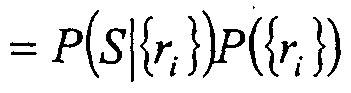
P({r i},S) = P({r i s)p(S)
Figure imgf000018_0002
(3)
so that the Bayes rule may be obtained for the probability of S that is conditioned on the received samples {z"i} :
Figure imgf000018_0003
p({n}s)p(s)/p({η}). (4)
where
Figure imgf000018_0004
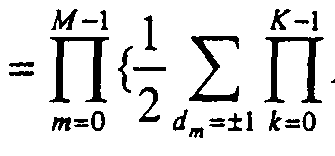
({r,.}μ,σ,S) P{rKm+k \ dm,A,σ)}. [1]
Figure imgf000019_0001
The maximum value of the equation (4) as a function of S will describe the most probable spreading factor. Thus equation (4) may be used directly for determining the spreading factor. However, even though the operation of the rate estimator may be based on the above equation (4) , this may not be the most straightforward and easiest approach for all practical applications. The following will this discuss a preferred embodiment for the data rate estimation.
Even though the signal amplitude A and the noise variance may depend to some extent of the spreading factor, the inventors have found that in order to simplify the spreading factor detection procedure it is possible to avoid any need of having any a priori knowledge of the actual amplitude A or variance σ, as will be demonstrated below. The requirement of the a priori knowledge may be avoided and the equitation (4) may be simplified if it is assumed that the data amplitude remains constant .
In the following equation the sample index i has been assumed to have the values i = 0, ..., Ns N-l , where Ns is the number of time slots and N designates the number of samples per one time slot. For example, in WCDMA it is possible to have N=640 when S0=4. As explained above, all possible spreading factors can be defined by multiplying the smallest possible spreading factor S0 l i.e. S = KS0 , wherein K value presents an integer indicating the division factor 2K for K > 0. In other words, K = s/So .
For each time slot j -Q , ..., Ns - 1 , a noise variance estimate for all possible spreading factors may be calculated by:
σj (K) ιN+mK+k (8)
Figure imgf000020_0001
In the above equation the quantity M = N/K, i.e. M is the number of symbols per time slot for the spreading factor S=KS0. The noise variances are calculated separately for each time slot because the power control of the communication system changes the amplitude in each slot, and thus the amplitude may not remain the same in the successive slots.
oise variance estimates may then be averaged over Ns successive time slots:
Figure imgf000020_0002
The averaging is not required in all applications. For example, the averaging may not be required in applications which do not employ power control or in applications which do not present any substantial fading. The averaging is, however, preferred as it improves the reliability of the results obtainable by the embodiments. The reliability is improved since it is possible to shorten the length of the time slots by means of the averaging.
Finally, the most probable data speed can be obtained by determining the smallest of the scaled averages of the variance estimates
1 aΕσ;v? (K) (10) over the possible X values. The quantity of the term α may be selected by minimizing detection error rate. Good scaling factors for different data speeds have been found to be given when the constant α in the term
aκ (11)
has the value α=2.8. The proposed value cc=2.8 was found to give good results in simulations that will be discussed below. Consequently, good performance is obtained if the scaling constants for the K values K= 1, 2, 4, 8, 16, 32, and 64 are proportional to 2.8, 1.673, 1.294, 1.137, 1.0665, 1.0327, and 1.0162, respectively, with the chip frequency 4.096 MHz.
An exemplifying C-language floating-point implementation of the above embodiment is shown in Figure 5. In the example the function int_defcection (float r [Nsample] ) returns the most probable spreading factor. The input vector r [Nsample] contains the samples for the smallest spreading factor (SF=4 in the example) . Nsample is the number of samples for the smallest spreading factor. In the example of Figure 5 the averaging was done over one frame, so Nsample = 16*10*256/4. Nblock is the processing block length of the variance estimation. The example is based on a further assumption that one block is used for the entire block length, so Nblock = 10*256/4. MaxK is the largest SF divided by the smallest SF, i.e. MaxK = 256/4 = 2**6 = 64. MaxLog2K is the base 2 logarithm of the MaxK, i.e. MaxLog2K = 6.
The above discussed data rate detection algorithm has also been tested by simulating with realistic signals. The test signals were produced assuming fading radio channel, realistic channel estimation, and fast transmission oower control. Two antennas and one propagation path per antenna were also assumed to be employed by the simulated implementation. The fading radio channel was modeled with a Jakes type Doppler spectrum. Doppler frequency of 10 Hz was used. Conventional 1/3 -rate K=9 convolutional code was used as the channel code. The length of the radio frame was 10 ms in all simulations. Channel interleaving was carried out with a simple matrix interleaver over 16 WCDMA time slots. The channel estimation method was based on simple sliding average over 2 subsequent time slots. Pilot channel amplitudes were given by G times data amplitude, where the G factor was 0.25, 0.28, 0.31, 0.36, 0.44, 0.54, 0.69 for spreading factors 4, 8, 16, 32, 64, 128, and 256, respectively.
In the simulations the rate detection was used to estimate the correct spreading factor SF amongst 7 different possibilities. The possible SF values were 4, 8, 16, 32, 64, 128, and 256. All spreading factors SF were assumed to have the same a priori probability, i.e. all SF values were equally likely to occur.
The probability of an incorrect data rate decision was estimated by using different averaging lengths from 2 to 16 WCDMA time slots, i.e. the averaging time used for the computations was from 1.25 ms to 10 ms . In Figures 6a to 6g the probability of an incorrect data rate estimate is plotted as a function of frame error rate (FER) . In order to facilitate comparisons with other simulations and data rate detection methods, the same results are also shown in Figures 7a to 7g as a function of bit error rate (BER) without employing any convolutional code.
It can be noted from Figures 6g and 7g that the behavior for SF = 256 is extent lor.al for:ι the results obt ined for the other spreading factors. This is because 256 is the largest considered spreading factor value and the employed rate detection method assumed the largest spreading factor (i.e. SF=256) as a default when the signal-to-noise ratio appeared to be very poor. Because of this, the weakest performance is seen in the case of SF=128 (Figures 6f and 7f) instead of SF=256.
It was found that data rates for SF = 4, 8, 16 (Figures 6a to 6c and 7a to 7c) can- be estimated with good accuracy with averaging over 2 time slots. At FER = 0.1 rate detection error probability was found to be less than 0.1 for every spreading factor if the averaging is performed over 8 time slots .
Therefore it was concluded that the proposed embodiments give a simple and promising solution to the blind data rate detection. Knowledge of the signal amplitude, noise variance or signal-to-noise ratio is not needed, as the embodiments may use only soft bit samples obtained for the smallest possible data spreading factor. The above discussed simulations indicate that reliable date rate estimates are also provided in the case of a fading channel with fast transmission power control (TPC) .
Although the invention has been described in the context of a CDMA based system, it will be appreciated that similar principles can be applied in other communication systems, for example in a TDMA system or in any telecommunications device receiving data symbols at variable rates and requiring information of the spreading factor or the data transmission rate, such as in modems.
While the invention has been described above in connection with the blind data rate detection, the described data rate estimation method could be used together with rate information bits or similar data rate information in order to produce verified and/or corrected data rate estimate. This is a viable alternative especially in implementations having high requirements for the accuracy of the transmission rate estimation.
It is also noted herein that while the above describes exemplifying embodiments of the invention, there are several variations and modifications which may be made to the disclosed solution without departing from the scope of the present invention as defined in the appended claims.

Claims

1. A method in a communication system with variable data transmission rates, wherein a transmitted signal includes a plurality of data symbols in one or several data frames, the data symbols being spread in each of the data frames in a manner defined by a respective spreading factor, comprising: receiving the signal; estimating noise variances for the spreading factors that are possible for a data frame in the signal based on information that is determined by assuming that the smallest possible spreading factor was used for the transmission of the data frame; scaling the estimated noise variances by predefined constants, each of the constants depending on the respective possible spreading factor; determining the one of the scaled noise variance estimates that has the smallest value; and estimating the most probable spreading factor of the received data frame based on the determined smallest scaled noise variance estimate.
2. A method according to claim 1, wherein the information is determined by processing soft data bit samples computed for the smallest possible spreading factor.
3. A method according to claim 1 or 2 , wherein the noise variance estimates for each of the possible values are averaged over a predefined number of successive time slots, and the smallest value is the smallest value of the scaled averages of the noise variance estimates.
4. A method according to any of the preceding claims, further comprising estimating the data rate of the data frame based on the estimated spreading factor.
5. A method according to any of the preceding claims, wherein the constant for scaling the respective spreading factor is defined by equation
aκ , wherein the term α is a predefined constant and the term K is an integer defining the length of the respective spreading factor as a multiple of the length of the smallest possible spreading factor.
6. A method according to claim 5, wherein the term α equals approximately 2.8.
7. A method according to any preceding claims, wherein the communication system comprises a cellular code division multiple access communications network, and the data is transmitted between a mobile station and a base station of the network over a radio interface.
8. A method for channel estimation in a cellular code division multiple access communication system wherein the data transmission rate is estimated in accordance with any of claims 1 to 7.
9. A method according to claim 8, wherein the estimate of the data transmission rate is used to assist in rate selection for Viterbi decoding of the received data symbols.
10. A method according to claim 8 or 9, wherein the channel estimation is based both on a data rate information received from a transmitting station and the estimated data transmission rate.
11. Signal receiving circuitry for use in a communication system with variable data transmission rates wherein data is transmitted as a plurality of data symbols spread over one or several data frames, the spreading of the data symbols within each of the data frames being defined by a respective spreading factor, the signal receiving circuitry comprising processor means for estimating noise variances for the data spreading factors that are possible for a data frame, wherein the estimate is based on information of the signal that is determined by assuming that the spreading factor used for the transmission of the data frame is the smallest spreading factor possible for the transmission of the data frame, for scaling the estimated noise variances by predefined constants, each of the constants depending on the respective possible spreading factor, for determining the one of the scaled variance estimates that has the smallest value, and for estimating the most probable spreading factor of the received data frame based on the determination of the smallest scaled variance estimate.
12. Signal receiving circuitry according to claim 11, wherein said processor means comprise a digital signal processor.
13. Signal receiving circuitry according to claim 11, wherein said processor means comprise a application specific integrated circuit.
14. Signal receiving circuitry according to any of claims 11 to 13, wherein said processor means are arranged to determine said information of signal by processing soft data bit samples computed for the smallest possible spreading factor.
15. A receiver station of a cellular radio communications system including signal receiving circuitry according to any of claims 11 to 14.
PCT/EP2000/011874 1999-12-10 2000-11-28 Data rate estimation in a communication system Ceased WO2001043330A2 (en)

Priority Applications (5)

Application Number Priority Date Filing Date Title
EP00991137A EP1238470B1 (en) 1999-12-10 2000-11-28 Data rate estimation in a communication system
DE60021206T DE60021206T2 (en) 1999-12-10 2000-11-28 DATA RATE ESTIMATION IN A COMMUNICATION SYSTEM
AT00991137T ATE299312T1 (en) 1999-12-10 2000-11-28 DATA RATE ESTIMATION IN A COMMUNICATIONS SYSTEM
US10/149,150 US7180932B1 (en) 1999-12-10 2000-11-28 Data rate estimation in a communication system
AU31549/01A AU3154901A (en) 1999-12-10 2000-11-28 Data rate estimation in a communication system

Applications Claiming Priority (2)

Application Number Priority Date Filing Date Title
GBGB9929373.0A GB9929373D0 (en) 1999-12-10 1999-12-10 Data rate estimation in a communication system
GB9929373.0 1999-12-10

Publications (2)

Publication Number Publication Date
WO2001043330A2 true WO2001043330A2 (en) 2001-06-14
WO2001043330A3 WO2001043330A3 (en) 2001-11-29

Family

ID=10866173

Family Applications (1)

Application Number Title Priority Date Filing Date
PCT/EP2000/011874 Ceased WO2001043330A2 (en) 1999-12-10 2000-11-28 Data rate estimation in a communication system

Country Status (7)

Country Link
US (1) US7180932B1 (en)
EP (1) EP1238470B1 (en)
AT (1) ATE299312T1 (en)
AU (1) AU3154901A (en)
DE (1) DE60021206T2 (en)
GB (1) GB9929373D0 (en)
WO (1) WO2001043330A2 (en)

Cited By (2)

* Cited by examiner, † Cited by third party
Publication number Priority date Publication date Assignee Title
GB2381422A (en) * 2001-10-24 2003-04-30 Ipwireless Inc Code division multiple access receiver
WO2011061721A1 (en) 2009-11-23 2011-05-26 Telefonaktiebolaget L M Ericsson (Publ) Blind spreading factor detection for wcdma

Families Citing this family (6)

* Cited by examiner, † Cited by third party
Publication number Priority date Publication date Assignee Title
US20060154633A1 (en) * 2003-01-29 2006-07-13 Hai Wang Uplink sinr estimation
US7397839B2 (en) * 2004-01-27 2008-07-08 Ntt Docomo, Inc. OFDM communication system and method
US8204923B1 (en) * 2006-10-31 2012-06-19 Marvell International Ltd. Systems and methods for scaling parameters
GB0712701D0 (en) * 2007-06-29 2007-08-08 Inc Icera Processing transmission in a wireless communication system
CN113644933B (en) * 2021-09-29 2022-05-10 中南大学 Adaptive direct sequence spread spectrum communication method, system and medium
CN114759947B (en) * 2022-04-11 2023-03-24 西安电子科技大学 Method for detecting spreading factor of multi-path linear spread spectrum signal under parallel transmission

Family Cites Families (2)

* Cited by examiner, † Cited by third party
Publication number Priority date Publication date Assignee Title
KR970013834A (en) * 1995-08-23 1997-03-29 사와무라 시코우 A computing apparatus of transmission rate
GB2330992A (en) * 1997-11-03 1999-05-05 Nokia Mobile Phones Ltd Channel estimation in a variable data rate communication system

Cited By (4)

* Cited by examiner, † Cited by third party
Publication number Priority date Publication date Assignee Title
GB2381422A (en) * 2001-10-24 2003-04-30 Ipwireless Inc Code division multiple access receiver
US7369601B2 (en) 2001-10-24 2008-05-06 Ipwireless, Inc. Code division multiple access receiver
WO2011061721A1 (en) 2009-11-23 2011-05-26 Telefonaktiebolaget L M Ericsson (Publ) Blind spreading factor detection for wcdma
US8374219B2 (en) 2009-11-23 2013-02-12 Telefonaktiebolaget L M Ericsson (Publ) Blind spreading factor detection for wideband code division multiple access (WCDMA)

Also Published As

Publication number Publication date
GB9929373D0 (en) 2000-02-09
EP1238470B1 (en) 2005-07-06
US7180932B1 (en) 2007-02-20
DE60021206T2 (en) 2006-04-27
EP1238470A2 (en) 2002-09-11
ATE299312T1 (en) 2005-07-15
WO2001043330A3 (en) 2001-11-29
AU3154901A (en) 2001-06-18
DE60021206D1 (en) 2005-08-11

Similar Documents

Publication Publication Date Title
EP0916190B1 (en) Coherent signal processing for cdma communication system
US6434366B1 (en) Method and system for estimating adaptive array weights used to transmit a signal to a receiver in a wireless communication system
US7233591B2 (en) Method and apparatus for controlling transmission power in a CDMA communication system
US5450453A (en) Method, apparatus and system for decoding a non-coherently demodulated signal
US7333420B2 (en) Receiving process method and receiving apparatus in mobile communication system
EP1210803B1 (en) Determination of data rate, based on power spectral density estimates
US6782059B2 (en) Discontinuous transmission (DTX) detection
EP0969604A2 (en) Signal to interference ratio estimation
US7924907B2 (en) Apparatus and method for spreading/de-spreading data using pair of child orthogonal variable spreading factor codes
US6996385B2 (en) Channel code decoding for the CDMA forward link
US20050002444A1 (en) Systems and methods for hierarchically demodulating and decoding a data signal using a pilot signal and an additional signal
CN101119130A (en) Adaptive channel estimation in a wireless communication system
US6678314B2 (en) Spreading factor determination
EP1832030A1 (en) Low complexity blind transport format detection
EP1238470B1 (en) Data rate estimation in a communication system
WO1997005717A1 (en) Apparatus and method for rate determination in on-off variable-rate communication systems
US7023901B2 (en) Spreading factor estimation system and method
US7035659B1 (en) Estimation of forward link signal-to-noise ratio
US20050163200A1 (en) Digital communication systems having decreased memory
KR20000011422A (en) Iterative signal-to-interference ratio estimation for wcdma
HK1104169A (en) Method and apparatus for controlling transmission power in a cdma communication system
HK1113867A (en) Adaptive channel estimation in a wireless communication system
HK1020814B (en) Coherent signal processing for cdma communication system

Legal Events

Date Code Title Description
AK Designated states

Kind code of ref document: A2

Designated state(s): AE AG AL AM AT AU AZ BA BB BG BR BY BZ CA CH CN CR CU CZ DE DK DM DZ EE ES FI GB GD GE GH GM HR HU ID IL IN IS JP KE KG KP KR KZ LC LK LR LS LT LU LV MA MD MG MK MN MW MX MZ NO NZ PL PT RO RU SD SE SG SI SK SL TJ TM TR TT TZ UA UG US UZ VN YU ZA ZW

AL Designated countries for regional patents

Kind code of ref document: A2

Designated state(s): GH GM KE LS MW MZ SD SL SZ TZ UG ZW AM AZ BY KG KZ MD RU TJ TM AT BE CH CY DE DK ES FI FR GB GR IE IT LU MC NL PT SE TR BF BJ CF CG CI CM GA GN GW ML MR NE SN TD TG

121 Ep: the epo has been informed by wipo that ep was designated in this application
DFPE Request for preliminary examination filed prior to expiration of 19th month from priority date (pct application filed before 20040101)
AK Designated states

Kind code of ref document: A3

Designated state(s): AE AG AL AM AT AU AZ BA BB BG BR BY BZ CA CH CN CR CU CZ DE DK DM DZ EE ES FI GB GD GE GH GM HR HU ID IL IN IS JP KE KG KP KR KZ LC LK LR LS LT LU LV MA MD MG MK MN MW MX MZ NO NZ PL PT RO RU SD SE SG SI SK SL TJ TM TR TT TZ UA UG US UZ VN YU ZA ZW

AL Designated countries for regional patents

Kind code of ref document: A3

Designated state(s): GH GM KE LS MW MZ SD SL SZ TZ UG ZW AM AZ BY KG KZ MD RU TJ TM AT BE CH CY DE DK ES FI FR GB GR IE IT LU MC NL PT SE TR BF BJ CF CG CI CM GA GN GW ML MR NE SN TD TG

WWE Wipo information: entry into national phase

Ref document number: 2000991137

Country of ref document: EP

WWP Wipo information: published in national office

Ref document number: 2000991137

Country of ref document: EP

REG Reference to national code

Ref country code: DE

Ref legal event code: 8642

NENP Non-entry into the national phase

Ref country code: JP

WWG Wipo information: grant in national office

Ref document number: 2000991137

Country of ref document: EP