WO2001047807A1 - Method for preparing ortho silicic acid, ortho silicic acid as obtained, and its use - Google Patents
Method for preparing ortho silicic acid, ortho silicic acid as obtained, and its use Download PDFInfo
- Publication number
- WO2001047807A1 WO2001047807A1 PCT/EP2000/012929 EP0012929W WO0147807A1 WO 2001047807 A1 WO2001047807 A1 WO 2001047807A1 EP 0012929 W EP0012929 W EP 0012929W WO 0147807 A1 WO0147807 A1 WO 0147807A1
- Authority
- WO
- WIPO (PCT)
- Prior art keywords
- silicic acid
- ortho silicic
- silicon
- acid
- carrier
- Prior art date
- Legal status (The legal status is an assumption and is not a legal conclusion. Google has not performed a legal analysis and makes no representation as to the accuracy of the status listed.)
- Ceased
Links
Classifications
-
- A—HUMAN NECESSITIES
- A61—MEDICAL OR VETERINARY SCIENCE; HYGIENE
- A61Q—SPECIFIC USE OF COSMETICS OR SIMILAR TOILETRY PREPARATIONS
- A61Q19/00—Preparations for care of the skin
-
- A—HUMAN NECESSITIES
- A23—FOODS OR FOODSTUFFS; TREATMENT THEREOF, NOT COVERED BY OTHER CLASSES
- A23K—FODDER
- A23K20/00—Accessory food factors for animal feeding-stuffs
- A23K20/20—Inorganic substances, e.g. oligoelements
- A23K20/28—Silicates, e.g. perlites, zeolites or bentonites
-
- A—HUMAN NECESSITIES
- A23—FOODS OR FOODSTUFFS; TREATMENT THEREOF, NOT COVERED BY OTHER CLASSES
- A23L—FOODS, FOODSTUFFS OR NON-ALCOHOLIC BEVERAGES, NOT OTHERWISE PROVIDED FOR; PREPARATION OR TREATMENT THEREOF
- A23L33/00—Modifying nutritive qualities of foods; Dietetic products; Preparation or treatment thereof
- A23L33/10—Modifying nutritive qualities of foods; Dietetic products; Preparation or treatment thereof using additives
- A23L33/16—Inorganic salts, minerals or trace elements
-
- A—HUMAN NECESSITIES
- A61—MEDICAL OR VETERINARY SCIENCE; HYGIENE
- A61K—PREPARATIONS FOR MEDICAL, DENTAL OR TOILETRY PURPOSES
- A61K8/00—Cosmetics or similar toiletry preparations
- A61K8/18—Cosmetics or similar toiletry preparations characterised by the composition
- A61K8/19—Cosmetics or similar toiletry preparations characterised by the composition containing inorganic ingredients
- A61K8/25—Silicon; Compounds thereof
-
- A—HUMAN NECESSITIES
- A61—MEDICAL OR VETERINARY SCIENCE; HYGIENE
- A61P—SPECIFIC THERAPEUTIC ACTIVITY OF CHEMICAL COMPOUNDS OR MEDICINAL PREPARATIONS
- A61P3/00—Drugs for disorders of the metabolism
- A61P3/02—Nutrients, e.g. vitamins, minerals
-
- C—CHEMISTRY; METALLURGY
- C01—INORGANIC CHEMISTRY
- C01B—NON-METALLIC ELEMENTS; COMPOUNDS THEREOF; METALLOIDS OR COMPOUNDS THEREOF NOT COVERED BY SUBCLASS C01C
- C01B33/00—Silicon; Compounds thereof
- C01B33/113—Silicon oxides; Hydrates thereof
- C01B33/12—Silica; Hydrates thereof, e.g. lepidoic silicic acid
-
- A—HUMAN NECESSITIES
- A23—FOODS OR FOODSTUFFS; TREATMENT THEREOF, NOT COVERED BY OTHER CLASSES
- A23V—INDEXING SCHEME RELATING TO FOODS, FOODSTUFFS OR NON-ALCOHOLIC BEVERAGES AND LACTIC OR PROPIONIC ACID BACTERIA USED IN FOODSTUFFS OR FOOD PREPARATION
- A23V2002/00—Food compositions, function of food ingredients or processes for food or foodstuffs
-
- A—HUMAN NECESSITIES
- A61—MEDICAL OR VETERINARY SCIENCE; HYGIENE
- A61K—PREPARATIONS FOR MEDICAL, DENTAL OR TOILETRY PURPOSES
- A61K2800/00—Properties of cosmetic compositions or active ingredients thereof or formulation aids used therein and process related aspects
- A61K2800/80—Process related aspects concerning the preparation of the cosmetic composition or the storage or application thereof
- A61K2800/92—Oral administration
-
- A—HUMAN NECESSITIES
- A61—MEDICAL OR VETERINARY SCIENCE; HYGIENE
- A61Q—SPECIFIC USE OF COSMETICS OR SIMILAR TOILETRY PREPARATIONS
- A61Q3/00—Manicure or pedicure preparations
-
- A—HUMAN NECESSITIES
- A61—MEDICAL OR VETERINARY SCIENCE; HYGIENE
- A61Q—SPECIFIC USE OF COSMETICS OR SIMILAR TOILETRY PREPARATIONS
- A61Q5/00—Preparations for care of the hair
Definitions
- the present invention relates to a method for preparing ortho silicic acid, to the ortho silicic acid obtainable by this method and to its use as a silicone preparation in the production of animal feed, food, food or feed supplement, and for the production of a pharmaceutical or cosmetic preparation.
- Silicon (Si) has been recognized as an essential trace element for diatoms, Si accumulating plants and higher animals.
- the best documented function of silicon in vertebrates is its regulatory action in bone calcification and its chemical association with several constituents of the extracellular matrix in connective tissues (Carlisle E. (1989), Silicon, in : Handbook of Nutri tionally Essential Mineral Elemen ts, ed. B.L. O'Dell and R.A. Sunde, Marcel Dekker Inc., New York, pp. 603-618).
- This matrix consists primarily of fibrous proteins such as collagen, embedded in a hydrated polysaccharide gel. Silicon being bound to components of this matrix is regarded to be important for the structural integrity, the development and the regulatory functions of connective tissue.
- Gastro-intestinal absorption of Si is only possible after hydrolysis of dietary Si-compounds into ortho silicic acid.
- the solubility of silicon compounds in the diet is low and consequently these compounds have a limited bioavailability .
- Organic compounds comprising Si-C bounds are not found in biological systems and several classes of synthetized products were found to have an unacceptable high toxicity.
- the natural soluble silicon compound, ortho silicic acid also called monomeric silicic acid is present both in fresh and sea water but only at very low concentrations ( ⁇ 1 mmol l "1 [Sullivan C. (1986) Silicification by diatoms, in ; Sili con Biochemis try, CIBA Foundation Symposium 121 , John Wiley and Sons, New York, pp. 24-39].) Higher concentrations in aqueous media initiates a polymerization reaction of into non- bioavailable colloids and ultimately gels.
- a method for the preparation of a stabilized formulation of ortho silicic acid is disclosed US 5,922,360.
- the present invention has for its object to provide a method for preparing ortho silicic acid starting from relatively inexpensive and market available starting materials while polymerisation of formed ortho silicic acid is substantially avoided.
- the starting material which is an acid hydrolizable silicon compound, may be selected from a silicate, such as a monomeric silicate such as silicon halogenide, methyl ortho silicate, sodium or magnesium orthosilicates, or from hydrated silicate such as crystalline sodium silicate.
- a silicate such as a monomeric silicate such as silicon halogenide, methyl ortho silicate, sodium or magnesium orthosilicates, or from hydrated silicate such as crystalline sodium silicate.
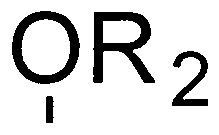
- the acid hydrolizable silicon compound has the general formula OR 2 R 3 0-Si-OR
- R-* . , R 2 , R 3 and R 4 are independently selected from H, C ⁇ -C ⁇ 2 alkyl, C ⁇ -C ⁇ 2 alkoxy which are optionally substituted by an hydroxyl group, under the proviso that Ri, R 2 , R 3 and R 4 are not simultaneously H.
- Ri, R 2 , R 3 and R 4 are selected from H, C ⁇ -C alkyl, C ⁇ -C 4 alkoxy optionally substituted by an hydroxylgroup.
- Ri, R 2 , R 3 and R 4 are preferably selected such that the compound split off from the hydrolisable silicon compound is removable using traditional techniques such as evaporation and distillation, and most preferably is non-toxic (LD 50 orally in rat higher than lg/kg bodyweight) .
- the most preferred silicon compound is tetra-ethoxy-silanol .
- Other preferred examples for R are C 2 H 5 , CH 3 CO, HCO,
- the solution may comprise 1-80%, preferably 10-70%, more preferably 40-60% solvent agent.
- the non toxic solvent agent used in the acid solution for stabilizing the formed ortho silicic acid may be selected from the group comprising glycol, glycerol, (poly) alkylene glycol, DMSO and polysorbate 80.
- the (poly) alkylene glycol may be polypropylene glycol or polyethylene glycol.
- the alkylene glycol may be ethylene glycol or propylene glycol.
- a common set of properties for all non toxic solvent agents are a high solubility in water (more than 30%), a boiling point higher than 130°C, a liquid state between -10°C and 40°C and a stability at an acid pH of generally 0- .
- the formed ortho silicic acid stabilized by the non toxic solvent agent may be stabilized further by contacting the ortho silicic acid with a non toxic particulate carrier.
- this non toxic particulate carrier adsorbed ortho silicic acid has a bioavailability which is comparable or even improved over the stabilized formulation, as disclosed in US 5,922,360.
- the bioavailability is a critical issue since it was recently shown in comparative human supplementation studies that solid silicon supplements such as colloidal silica and phytolytic silicates are not bioavailable whereas a solution of stabilized ORTHO SILICIC ACID in a HCl-choline matrix has a high bioavailability [Calomme M. , Cos P., Vingerhoets R. , Van Hoorebeke C, Vanden Berghe D.
- the present invention also provides a silicon preparation, comprising ortho silicic acid adsorbed on a particulate carrier, obtainable by the process comprising the steps of: i) providing a solution, comprising ortho silicic acid stabilized with said acid solvent agent; and ii) contacting the ortho silicic acid comprising solution with the particulate carrier.
- a silicon preparation comprising ortho silicic acid adsorbed on a particulate carrier, obtainable by the process comprising the steps of: i) providing a solution, comprising ortho silicic acid stabilized with said acid solvent agent; and ii) contacting the ortho silicic acid comprising solution with the particulate carrier.
- the ortho silicic acid is formed in situ. The handling and the formation of dosing forms of the silicon preparation are further improved when the carrier, after contact with ortho silicic acid, is extruded.
- the silicon preparation according to the invention may contain ortho silicic acid over a broad silicon content range depending on the contemplated use of the silicon preparation.
- the silicon content of the silicon preparation is within the range of 0.01-50 wt . % , preferably within the range of 0.01-10 wt.%, more preferably within the range of 0.1-10 wt.%, and most preferably within the range of 0.1-5 wt.%.
- the silicon preparation may be used in a dosing regime which is suitable for most contemplated food, feed, pharmaceutical and cosmetic utilities.
- the pharmaceutical and cosmetic preparation will have a positive effect on nails, hair, skin, teeth, collagen, connetive tissue, bones, encourages cell generation, stimulates the immune system against infections and toxins and inhibits degenerative (ageing) -process .
- the solvent agent and carrier should be non toxic which means not initiating adverse toxic effects in man, animal and plant.
- the silicon preparation has a desired high bioavailability expressed as the total silicon absorption by an organism such as a human being. Over a period of 0-8 hours the relative bioavailability was much improved over the afore mentioned colloidal and phytolytic silica preparations. In other words the total silicon absorption over 8 hours is more than 250 ⁇ g Si.h/1, preferably more than 500 ⁇ g Si.h/1, more preferably more than 600 ⁇ g Si.h/1, such as 250-700 ⁇ g Si.h/1, preferably 300-700 ⁇ g Si.h/1.
- the silicon preparation according to the invention adsorbed on a carrier may be used as such or in combination with any acceptable carrier material, excipient or diluent.
- the silicon preparation according to the invention may be administared orally or in any other suitable fashion. Oral administration is preferred and the silicon preparation may have the form of a tablet, aqueous dispersion, dispersable powder or granule, emulsion, hard or soft capsule, syrup, elixir or gel.
- the dosing forms may be prepared using any method known in the art for manufacturing these pharmaceutical or cosmetic compositions and may comprise as additives sweeteners, flavoring agents, coloring agents, preservatives and the like.
- Carrier materials and excipients may include calcium carbonate, sodium carbonate, lactose, calcium phosphate or sodium phosphate; granulating and disintegrating agents, binding agents and the like.
- the silicon preparation may be included in a gelatin capsule mixed with any inert solid diluent or carrier material, or has the form of a soft gelatin capsule, in which the ingredient is mixed with a water or oil medium.
- Aqueous dispersions may comprise the silicon preparation in combination with a suspending agent, dispersing agent or wetting agent.
- Oil dispersions may comprise suspending agents such as a vegetable oil.
- a gel formulation may be prepared following the teaching given in US 5, 922,360. It is now possible to make dry mixtures of carrier- bound ortho silicic acid with other components such as trace elements, vitamins, amino acids, sugars, plant extracts, and other ingredients used in the manufacturing of food and food supplements.
- ortho silicic acid remains in its monomeric form in carrier-bound ortho silicic acid and is therefore different from non-bioavailable polymerized forms of ort.ho silicic acid such as in colloidal or solid silicic acid and silicates.
- Ortho silicic acid is for instance prepared in the presence of the acid solvent agent and in situ by (a) hydrolysis of monomeric silicon compounds such as silicon halogenide or methyl orthosilicate [Her R. (1979) Monosilicic acid, in : The Chemistry of Silica, John Wiley and Sons, New York, pp. 178- 180.], (b) by reacting monomeric silicates such as sodium or magnesium orthosilicates or hydrated crystalline sodium silicate with dilute acid (Her 1979), (c) by hydolyzing organic alkylsilanol compounds. It is noted that next to the formed ortho silicic acid the other hydrolization reaction compounds should be non-toxic and if desired should be removed from the reaction mixture.
- monomeric silicon compounds such as silicon halogenide or methyl orthosilicate
- the alkylsilanol compound is an ethoxysilanol compound and the formed ethanol may be separated without difficulty.
- the freshly prepared ortho silicic acid is bound to the carrier or a combination of carriers.
- a second method is to bind first a organic silicon compound on a carrier and thereafter hydrolyzing the organic silicon compound into ortho silicic acid for instance at a pH of lower than 4, such as 0.2-2.5, more preferably 0.8-1.0.
- the solid carrier or combination of solid carriers may be selected from the group comprising: i) natural and semi-synthetic fibers, ii) plant metabolites such as polyfenols, lignans, flavonoid, iii) fatty acids and esters thereof such as stearates, palmitates, linoleates, oleates, adipates, caprylates, caprates, cocoates, iv) phosholipids and derivates thereof, v) polyalcohols such as inositol, trehalose, vi) hydrogenated and sulfated compounds, vii) salts such as chlorides, sulfates, nitrates, etc., viii) pectines and alginates, ix) sugars or sugar alcohols and derivatives thereof such as lactose, sucrose, mannitol, sorbitol, sorbitolesters, x) poly- and oligosaccharides sili
- Ortho silicic acid is prepared as followed. Two liters of a fresh solution of cold sodiumsilicate (27 % Si0 2 in 14 % NaOH) is mixed with 2 - 4 liters of glycerol (pro analyse, 100 %) until a homogeneous solution is obtained. To decrease the pH, one liter of cold, concentrated hydrochloric acid is added and the mixture is stirred strongly at a temperature between 0 - 10 °C. During continuous mixing, solid or a suspension of calciumcarbonate is added until a pH of 1-3 is obtained. During mixing C0 2 gas will be formed.
- Half a liter of freshly prepared combination of concentrated ortho silicic acid is mixed with 0.5 kg of gelatine, or 0.5 kg of cheese whey, or 200 g of cellulose, or 1 kg of galactose, or 1 kg of saccharose.
- the resulting paste is mixed until a homogeneous paste is obtained.
- the paste is dried in vacuo.
- the final product contains minimum 0.1 % elemental silicon and preferably between 1 - 5 % elemental silicon.
- the carrier (65 %) microcrystalline cellulose is mixed with 35 % of a combination of concentrated ortho silicic acid with glycerol (see example A). Demineralized water is added during continuous mixing to obtain an appropiate quality of the granulated material.
- the plastic mass is extruded with a basket extruder (Caleva Model 10, Sturminster Newton, Great Britain) at 750 rpm.
- the extruded strands are spheronized (Caleva Model 120 spheronizer) .
- the resulting pellets are dried to a final water content of lower than 5 %. Typical pellet size is between 800 and 1200 ⁇ m.
- the pellets are encapsulated in hard gelatine capsules size 00. Each capsule contains 0.54 g pellets equal to 5 mg elemental silicon in the form of carrier-bound ortho silicic acid.
- the loading capacity of the microcrystalline cellulose can be increased to 45 % ortho silicic acid.
- Example C Example C
- the carrier a mixture (1:1) of soy proteins and mays proteins (70 %) are mixed with 30 % of a combination of ortho silicic acid with glycerol (see example A). Demineralized water is added during continuous mixing to obtain an homogenous plastic mass. The mixture is dried by lyophilization. Following granulation the protein-bound ortho silicic acid is directly encapsulated or used as a raw material in the manufacturing of animal feed, food, food supplements, cosmetics or pharmaceutical preparations.
- the carrier (65 %) a mixture (3:1) of microcrystalline cellulose and fructans is mixed with 35 % of a combination of concentrated ortho silicic acid with glycerol (see example A) .
- Demineralized water is added during continuous mixing to obtain an appropiate quality of the granulated material.
- the plastic mass is extruded with a basket extruder (Caleva Model 10, Sturminster Newton, Great Britain) at 750 rpm.
- the extruded strands are spheronized (Caleva Model 120 spheronizer) .
- the resulting pellets are dried to a final water content of lower than 5 %.
- Typical pellet size is between 800 and 1400 ⁇ m.
- the pellets are pressed to tablets or used as a raw material in the manufacturing of animal feed, food, food supplements, cosmetics or pharmaceutical preparations.
- Dissolution assays of the preparations of Examples A-E prove that ortho silicic acid is released within 30 minutes into the dissolution medium. This is demonstrated by measuring the silicon content of the dissolution medium at fixed time-points with Zeeman corrected Electrothermal Atomic Absorption Spectometry (Perkin Elmer). The fact that ortho silicic acid is released during dissolution demonstrates clearly that binding of ortho silicic acid to the carrier will not result in polymerization of ortho silicic acid but remains in a dissociatable form. Dissolution assays were repeated at 3, 6 and 12 months after the production date without difference in results demonstrating that carrier-bound ortho silicic acid is chemically stable over a long period of time.
- ortho silic acid OSA
- polymerized ortho silicic acid forms such as colloidal silica or phytolytic silica.
- the kinetic absorption profile for carrier-bound ortho silicic acid indicates a slower- release effect compared to liquid ortho silicic acid.
- the relative bioavailability calculated as the area under the time curve (A.U.C.) was not significantly different between the different silicon forms (mean ⁇ SD) : 132 ⁇ 28 ⁇ g h/L for placebo, 795 ⁇ 231 ⁇ g h/L for OSA liquid, 869 ⁇ 448 ⁇ g h/L for fresh prepared carrier-bound OSA, and 622 ⁇ 251 ⁇ g h/L for 1 year old carrier-bound OSA respectively.
- Feed-pellets for sows are mixed with a combination of concentrated ortho silicic acid with glycerol (see example A) until a concentration of 15 mg Si/ kg feed in the form of carrier-bound OSA is obtained. Sows are fed daily 4kg of this 'carrier-bound OSA' diet starting 1 week before insemination until weaning. A control group of sows received a normal feed, identical in composition except for the presence of carrier-bound OSA. Blood was withdrawn from the piglets at the age of 4 weeks (weaning) and the silicon concentration was determined in the serum with graphite furnace atomic absorption spectrometry .
- the mean serum silicon concentration in piglets fed the 'carrier- bound OSA' diet was 150 % higher compared to the controls (table 1) which illustrates clearly that (a) carrier-bound OSA has a high bioavailability, (b) the absorbed silicon from carrier-bound OSA is tranferred between the lactating sow and the offspring by either the placenta or the milk or a combination of both.
- Table 1 The effect of feeding sows a OSA-bound diet on the serum silicon concentration of the offspring.
- OSA-bound diet 277 ⁇ 20 Fig. 1 Increase in silicon concentration in serum from the baseline value in healthy subjects after supplementation of respectively 10 mg Si in the form of carrier-bound OSA, 10 mg Si in the form of liquid OSA, 20 mg Si in the form of colloidal silica, 20 mg of Si in the form of phytolytic silica.
- Fig. 2 Total absorption of silicon in serum over a period of 0-8 hours p.p. measured in healthy subjects after supplementation of respectively 10 mg Si in the form of carrier-bound OSA, 10 mg Si in the form of liquid OSA, 20 mg Si in the form of colloidal silica, 20 mg of Si in the form of phytolytic silica.
Landscapes
- Chemical & Material Sciences (AREA)
- Life Sciences & Earth Sciences (AREA)
- Health & Medical Sciences (AREA)
- Inorganic Chemistry (AREA)
- Polymers & Plastics (AREA)
- Organic Chemistry (AREA)
- Engineering & Computer Science (AREA)
- Veterinary Medicine (AREA)
- General Health & Medical Sciences (AREA)
- Public Health (AREA)
- Animal Behavior & Ethology (AREA)
- Food Science & Technology (AREA)
- Nutrition Science (AREA)
- Birds (AREA)
- Dermatology (AREA)
- Mycology (AREA)
- Zoology (AREA)
- Epidemiology (AREA)
- Animal Husbandry (AREA)
- General Chemical & Material Sciences (AREA)
- Nuclear Medicine, Radiotherapy & Molecular Imaging (AREA)
- Hematology (AREA)
- Obesity (AREA)
- Chemical Kinetics & Catalysis (AREA)
- Bioinformatics & Cheminformatics (AREA)
- Medicinal Chemistry (AREA)
- Diabetes (AREA)
- Pharmacology & Pharmacy (AREA)
- Medicinal Preparation (AREA)
- Fodder In General (AREA)
- Pharmaceuticals Containing Other Organic And Inorganic Compounds (AREA)
- Silicon Compounds (AREA)
- Cosmetics (AREA)
- Coloring Foods And Improving Nutritive Qualities (AREA)
- Organic Low-Molecular-Weight Compounds And Preparation Thereof (AREA)
Abstract
Description


Claims
Priority Applications (10)
| Application Number | Priority Date | Filing Date | Title |
|---|---|---|---|
| IL15037000A IL150370A0 (en) | 1999-12-24 | 2000-12-18 | Method for preparing ortho silicic acid, ortho silicic acid as obtained and its use |
| AU30143/01A AU783216B2 (en) | 1999-12-24 | 2000-12-18 | Method for preparing ortho silicic acid, ortho silicic acid as obtained, and its use |
| EP00990794A EP1242307B1 (en) | 1999-12-24 | 2000-12-18 | Method for preparing ortho silicic acid, ortho silicic acid as obtained, and its use |
| CA002394987A CA2394987C (en) | 1999-12-24 | 2000-12-18 | Method for preparing ortho silicic acid, ortho silicic acid as obtained, and its use |
| JP2001549291A JP4454200B2 (en) | 1999-12-24 | 2000-12-18 | Method for preparing orthosilicic acid, the resulting orthosilicic acid and its use |
| DE60019805T DE60019805T2 (en) | 1999-12-24 | 2000-12-18 | PROCESS FOR PREPARING ORTHOKYLIC ACID, ORTHOKYLIC ACID PRODUCED BY THE METHOD AND ITS USE |
| DK00990794T DK1242307T3 (en) | 2000-12-18 | 2000-12-18 | Process for the preparation of ortho silicic acid, ortho silicic acid as obtained and its use |
| AT00990794T ATE294137T1 (en) | 1999-12-24 | 2000-12-18 | METHOD FOR PRODUCING ORTHOSILICIC ACID, AND SILICIC ACID PRODUCED BY THE METHOD AND THE USE THEREOF |
| IL150370A IL150370A (en) | 1999-12-24 | 2002-06-23 | Method for preparing ortho silicic acid, ortho silicic acid as obtained and its use |
| US12/561,812 US20100068294A1 (en) | 1999-12-24 | 2009-09-17 | Method for Preparing Ortho Silicic Acid, Ortho Silicic Acid as Obtained, and its Use |
Applications Claiming Priority (2)
| Application Number | Priority Date | Filing Date | Title |
|---|---|---|---|
| EP99204496.6 | 1999-12-24 | ||
| EP99204496A EP1110909A1 (en) | 1999-12-24 | 1999-12-24 | Method for preparing ortho silicic acid, ortho silicic acid as obtained, and its use |
Related Child Applications (1)
| Application Number | Title | Priority Date | Filing Date |
|---|---|---|---|
| US12/561,812 Continuation US20100068294A1 (en) | 1999-12-24 | 2009-09-17 | Method for Preparing Ortho Silicic Acid, Ortho Silicic Acid as Obtained, and its Use |
Publications (2)
| Publication Number | Publication Date |
|---|---|
| WO2001047807A1 true WO2001047807A1 (en) | 2001-07-05 |
| WO2001047807A8 WO2001047807A8 (en) | 2001-07-26 |
Family
ID=8241064
Family Applications (1)
| Application Number | Title | Priority Date | Filing Date |
|---|---|---|---|
| PCT/EP2000/012929 Ceased WO2001047807A1 (en) | 1999-12-24 | 2000-12-18 | Method for preparing ortho silicic acid, ortho silicic acid as obtained, and its use |
Country Status (11)
| Country | Link |
|---|---|
| US (2) | US20030099676A1 (en) |
| EP (2) | EP1110909A1 (en) |
| JP (1) | JP4454200B2 (en) |
| CN (2) | CN101199318B (en) |
| AT (1) | ATE294137T1 (en) |
| AU (1) | AU783216B2 (en) |
| CA (1) | CA2394987C (en) |
| DE (1) | DE60019805T2 (en) |
| ES (1) | ES2237492T3 (en) |
| IL (2) | IL150370A0 (en) |
| WO (1) | WO2001047807A1 (en) |
Cited By (3)
| Publication number | Priority date | Publication date | Assignee | Title |
|---|---|---|---|---|
| EP2371220A1 (en) | 2010-03-31 | 2011-10-05 | Taminco | Stabilized bio-available soluble silicate solution |
| CN102046530B (en) * | 2008-04-17 | 2014-08-27 | 吉施博雷股份有限公司 | Suspensions containing hydronium ion-stabilized colloidal silicic acid nanoparticles, formulations obtained from said diluted suspensions, powders obtained from said dehydrated suspensions, compositions obtained from said powders and their preparation and use |
| US9132083B2 (en) | 2009-07-30 | 2015-09-15 | Sisaf Ltd. | Delivery system comprising a silicon-containing material |
Families Citing this family (22)
| Publication number | Priority date | Publication date | Assignee | Title |
|---|---|---|---|---|
| US9078465B2 (en) | 2002-03-20 | 2015-07-14 | Bio Minerals N.V. | Choline-silicic acid complex with osmolytes and divalent trace elements |
| EP1371289A1 (en) * | 2002-03-20 | 2003-12-17 | Bio Minerals N.V. | Choline-silicic acid complex |
| EP1391426A1 (en) * | 2002-08-12 | 2004-02-25 | Bio Minerals N.V. | Method for the preparation of a silicic acid comprising extrudate, said extrudate, its use and a pharmaceutical composition comprising the said extrudate |
| US20090124501A1 (en) * | 2006-05-31 | 2009-05-14 | Incorporated Administrative Agency Fisheries Research Agency | Silicic Acid Componenet Supplying Agent For Algae And Method For Supplying Silicic Acid Component To Algae |
| GB0805279D0 (en) * | 2008-03-20 | 2008-04-30 | Univ Nottingham Trent | Food supplement |
| WO2011010188A1 (en) * | 2009-07-23 | 2011-01-27 | Societe Anonyme Des Eaux Minerales D'evian "S.A.E.M.E" | A process for producing water enriched with natural orthosilicic acid |
| US20120276165A1 (en) | 2009-12-09 | 2012-11-01 | Barlaa B.V. | Micro-colloidal silicic acid/boric acid composition and a method of preparing a bioenhancing solution and powder |
| CN102389107B (en) * | 2011-07-25 | 2013-03-20 | 吉林大学 | Method for preparing orthosilicic acid extract and silicon supplement by utilizing silicon-rich plants |
| PL403902A1 (en) * | 2013-05-15 | 2014-11-24 | Przedsiębiorstwo Intermag Spółka Z Ograniczoną Odpowiedzialnością | Silicon preparation with properties stimulating plant growth, a process for preparing a silicon preparation stimulating plant and its use |
| CN104161770A (en) * | 2013-05-17 | 2014-11-26 | 蒋临沂 | Silicic acid complex |
| DE102015214146A1 (en) * | 2015-07-27 | 2017-02-02 | Beiersdorf Ag | Sweat reducing cosmetic preparation |
| DE102015214137A1 (en) * | 2015-07-27 | 2017-02-02 | Beiersdorf Ag | Sweat reducing cosmetic preparation |
| DE102015214145A1 (en) * | 2015-07-27 | 2017-02-02 | Beiersdorf Ag | Sweat reducing cosmetic preparation |
| DE102015214143A1 (en) * | 2015-07-27 | 2017-02-02 | Beiersdorf Ag | Sweat reducing cosmetic preparation |
| DE102015214144A1 (en) * | 2015-07-27 | 2017-02-02 | Beiersdorf Ag | Sweat reducing cosmetic preparation |
| DE102015214140A1 (en) * | 2015-07-27 | 2017-02-02 | Beiersdorf Ag | Sweat reducing cosmetic preparation |
| ES2972389T3 (en) | 2015-09-09 | 2024-06-12 | Cindro Holding BV | Emulsions comprising silicic acid |
| WO2019150382A1 (en) * | 2018-01-30 | 2019-08-08 | Privi Life Science Private Limited | A method for preparation of othro silicic acid for agriculture |
| PL238905B1 (en) * | 2018-02-16 | 2021-10-18 | Centrum Badawczo Rozwojowe Glokor Spolka Z Ograniczona Odpowiedzialnoscia | Method for production of concentrate for production of silicon compounds containing health-oriented beverage, used as the enterotransporter or enterosorbent and the modular system for production of concentrate |
| EP3549578A1 (en) | 2018-04-06 | 2019-10-09 | Bio Minerals N.V. | Silicic acid formulation and use thereof |
| EP3632449A1 (en) * | 2018-10-05 | 2020-04-08 | Bio Minerals N.V. | Silicic acids for use in the treatment of periodontitis |
| EP3650011A1 (en) * | 2018-11-09 | 2020-05-13 | Bio Minerals NV | Water soluble silicon-containing granulate |
Citations (4)
| Publication number | Priority date | Publication date | Assignee | Title |
|---|---|---|---|---|
| SU540654A1 (en) * | 1974-01-11 | 1976-12-30 | Институт Физической Химии Им.Л.В.Писаржеского Ан Украинской Сср | The method of obtaining hygroscopic film adsorbent based on silicic acid |
| JPH0459614A (en) * | 1990-06-27 | 1992-02-26 | Akiyama:Kk | Aqueous solution of silicic acid at ph5-7 |
| WO1995021124A1 (en) * | 1994-02-07 | 1995-08-10 | Bio Pharma Sciences B.V. | Stabilized orthosilicic acid comprising preparation and biological preparation |
| JPH09143032A (en) * | 1995-11-27 | 1997-06-03 | Narisu Keshohin:Kk | Powder for cosmetics and cosmetics |
Family Cites Families (8)
| Publication number | Priority date | Publication date | Assignee | Title |
|---|---|---|---|---|
| DE2654358C2 (en) * | 1976-12-01 | 1985-01-10 | Chemische Werke Hüls AG, 4370 Marl | Process for the production of powdery, free-flowing rubber-filler mixtures, optionally containing plasticizer oil |
| US4200548A (en) * | 1976-08-02 | 1980-04-29 | Elektrokemiska Aktiebolaget | Silicic acid detergent product for microdeposition of silicic acid on textiles |
| US5186743A (en) * | 1990-12-13 | 1993-02-16 | Akzo N.V. | Low volatile organic content hybrid silica binder |
| JP2594222B2 (en) * | 1993-09-28 | 1997-03-26 | 日本臓器製薬株式会社 | New physiologically active substance-KF |
| US6160067A (en) * | 1995-10-03 | 2000-12-12 | Dsm N.V. | Reactive silica particles, process for manufacturing the same, use of the same |
| US5807607A (en) * | 1995-11-16 | 1998-09-15 | Texas Instruments Incorporated | Polyol-based method for forming thin film aerogels on semiconductor substrates |
| US6495352B1 (en) * | 1999-04-15 | 2002-12-17 | Sandia Corporation | Sol-gel method for encapsulating molecules |
| US6318124B1 (en) * | 1999-08-23 | 2001-11-20 | Alliedsignal Inc. | Nanoporous silica treated with siloxane polymers for ULSI applications |
-
1999
- 1999-12-24 EP EP99204496A patent/EP1110909A1/en not_active Withdrawn
-
2000
- 2000-12-18 DE DE60019805T patent/DE60019805T2/en not_active Expired - Lifetime
- 2000-12-18 CN CN2007103059149A patent/CN101199318B/en not_active Expired - Lifetime
- 2000-12-18 EP EP00990794A patent/EP1242307B1/en not_active Expired - Lifetime
- 2000-12-18 AT AT00990794T patent/ATE294137T1/en active
- 2000-12-18 CN CNB008182566A patent/CN100368292C/en not_active Expired - Lifetime
- 2000-12-18 US US10/168,599 patent/US20030099676A1/en not_active Abandoned
- 2000-12-18 CA CA002394987A patent/CA2394987C/en not_active Expired - Lifetime
- 2000-12-18 IL IL15037000A patent/IL150370A0/en active IP Right Grant
- 2000-12-18 ES ES00990794T patent/ES2237492T3/en not_active Expired - Lifetime
- 2000-12-18 JP JP2001549291A patent/JP4454200B2/en not_active Expired - Lifetime
- 2000-12-18 WO PCT/EP2000/012929 patent/WO2001047807A1/en not_active Ceased
- 2000-12-18 AU AU30143/01A patent/AU783216B2/en not_active Expired
-
2002
- 2002-06-23 IL IL150370A patent/IL150370A/en unknown
-
2009
- 2009-09-17 US US12/561,812 patent/US20100068294A1/en not_active Abandoned
Patent Citations (5)
| Publication number | Priority date | Publication date | Assignee | Title |
|---|---|---|---|---|
| SU540654A1 (en) * | 1974-01-11 | 1976-12-30 | Институт Физической Химии Им.Л.В.Писаржеского Ан Украинской Сср | The method of obtaining hygroscopic film adsorbent based on silicic acid |
| JPH0459614A (en) * | 1990-06-27 | 1992-02-26 | Akiyama:Kk | Aqueous solution of silicic acid at ph5-7 |
| WO1995021124A1 (en) * | 1994-02-07 | 1995-08-10 | Bio Pharma Sciences B.V. | Stabilized orthosilicic acid comprising preparation and biological preparation |
| US5922360A (en) * | 1994-02-07 | 1999-07-13 | Bio Pharma Sciences B.V. | Stabilized orthosilicic acid comprising preparation and biological preparation |
| JPH09143032A (en) * | 1995-11-27 | 1997-06-03 | Narisu Keshohin:Kk | Powder for cosmetics and cosmetics |
Non-Patent Citations (4)
| Title |
|---|
| CHEMICAL ABSTRACTS, vol. 127, no. 7, 18 August 1997, Columbus, Ohio, US; abstract no. 99539, WASHIO YUTAKA: "SURFACE-TREATED INORGANIC POWDERS FOR COSMETICS" XP002138347 * |
| CHEMICAL ABSTRACTS, vol. 86, no. 24, 13 June 1977, Columbus, Ohio, US; abstract no. 173652, SLINYAKOVA I. B. ET AL.: "Hygroscopic film adsorbent based on silicic acid" XP002138348 * |
| DATABASE WPI Section Ch Week 199215, Derwent World Patents Index; Class C04, AN 1992-118232, XP002138349 * |
| HERBERT FUNK: "Über Lösungen der Monokieselsäure Si(OH)4", CHEMISCHES ZENTRALBLATT, no. 4, 1964, pages 47, XP002138346 * |
Cited By (6)
| Publication number | Priority date | Publication date | Assignee | Title |
|---|---|---|---|---|
| CN102046530B (en) * | 2008-04-17 | 2014-08-27 | 吉施博雷股份有限公司 | Suspensions containing hydronium ion-stabilized colloidal silicic acid nanoparticles, formulations obtained from said diluted suspensions, powders obtained from said dehydrated suspensions, compositions obtained from said powders and their preparation and use |
| US9132083B2 (en) | 2009-07-30 | 2015-09-15 | Sisaf Ltd. | Delivery system comprising a silicon-containing material |
| EP2371220A1 (en) | 2010-03-31 | 2011-10-05 | Taminco | Stabilized bio-available soluble silicate solution |
| WO2011120872A2 (en) | 2010-03-31 | 2011-10-06 | Taminco | Stabilized bio-available soluble silicate solution |
| WO2011120872A3 (en) * | 2010-03-31 | 2012-03-15 | Taminco | Stabilized bio-available soluble silicate solution |
| KR101860961B1 (en) | 2010-03-31 | 2018-05-24 | 타민코 비브이비에이 | Stabilized bio-available soluble silicate solution |
Also Published As
| Publication number | Publication date |
|---|---|
| DE60019805T2 (en) | 2006-02-02 |
| IL150370A (en) | 2006-06-11 |
| CN100368292C (en) | 2008-02-13 |
| IL150370A0 (en) | 2002-12-01 |
| ES2237492T3 (en) | 2005-08-01 |
| EP1242307A1 (en) | 2002-09-25 |
| EP1242307B1 (en) | 2005-04-27 |
| JP4454200B2 (en) | 2010-04-21 |
| DE60019805D1 (en) | 2005-06-02 |
| ATE294137T1 (en) | 2005-05-15 |
| US20030099676A1 (en) | 2003-05-29 |
| CA2394987C (en) | 2009-11-03 |
| JP2003519068A (en) | 2003-06-17 |
| US20100068294A1 (en) | 2010-03-18 |
| CN101199318A (en) | 2008-06-18 |
| CN1420843A (en) | 2003-05-28 |
| AU3014301A (en) | 2001-07-09 |
| AU783216B2 (en) | 2005-10-06 |
| EP1110909A1 (en) | 2001-06-27 |
| WO2001047807A8 (en) | 2001-07-26 |
| CN101199318B (en) | 2012-07-18 |
| CA2394987A1 (en) | 2001-07-05 |
Similar Documents
| Publication | Publication Date | Title |
|---|---|---|
| EP1242307B1 (en) | Method for preparing ortho silicic acid, ortho silicic acid as obtained, and its use | |
| RU2387136C2 (en) | Primary composition to provide body with functional ingredients, its production method and application (versions), composition for peroral use (versions) | |
| EP1551763B1 (en) | Method for the preparation of a silicic acid comprising extrudate, said extrudate, its use and a pharmaceutical composition comprising the said extrudate | |
| CN103619842B (en) | The crystallization of pyrro-quinoline quinone (PQQ) disodium salt and manufacture method thereof | |
| WO2007037249A1 (en) | Cellooligosaccharide-containing composition | |
| WO2015033216A1 (en) | Solid compositions based on minerals and orally disintegrating formulations containing the same. | |
| TW200538057A (en) | Method of producing dietary fiber-containing health food | |
| JP3037654B2 (en) | Easy-absorbable folic acid preparation, production method thereof and feed containing the same | |
| JPH08242773A (en) | Process for producing calcium-casein phosphopeptide preparation, bone mineral loss suppressing food and bone mineral loss suppressing agent | |
| RU2438364C1 (en) | Method for production of briquetted food hematogen with medium moisture content based on binding protein mass made of farm animals blood plasma | |
| JPH0678226B2 (en) | Dehydrated medicine and its manufacturing method | |
| JP2020000073A (en) | Oral composition | |
| JPH0710341B2 (en) | Dehydrating agent and method for dehydrating hydrate using the same | |
| KR20250109280A (en) | Preparing method of calcium l-ascorbate with excellent productivity | |
| JP2024160657A (en) | Healthy lifespan promotion agent and method for producing the same | |
| JPH0678225B2 (en) | Dehydrated medicine and its manufacturing method | |
| JP2024160656A (en) | Composition, additive, and method for producing the composition | |
| JP2003321352A (en) | Coenzyme Q10-containing composition | |
| JP2005143506A (en) | Solid food containing composite compound of yucca extract and quillaja extract | |
| CN119345118A (en) | Doxycycline hydrochloride oral paste and preparation method thereof | |
| JP2018168121A (en) | Cell proliferation inhibitor | |
| TW200427414A (en) | Method for producing nutritional product containing L-Arginine | |
| JP2012077015A (en) | Skin collagen production promoter |
Legal Events
| Date | Code | Title | Description |
|---|---|---|---|
| AK | Designated states |
Kind code of ref document: A1 Designated state(s): AE AG AL AM AT AU AZ BA BB BG BR BY BZ CA CH CN CR CU CZ DE DK DM DZ EE ES FI GB GD GE GH GM HR HU ID IL IN IS JP KE KG KP KR KZ LC LK LR LS LT LU LV MA MD MG MK MN MW MX MZ NO NZ PL PT RO RU SD SE SG SI SK SL TJ TM TR TT TZ UA UG US UZ VN YU ZA ZW |
|
| AL | Designated countries for regional patents |
Kind code of ref document: A1 Designated state(s): GH GM KE LS MW MZ SD SL SZ TZ UG ZW AM AZ BY KG KZ MD RU TJ TM AT BE CH CY DE DK ES FI FR GB GR IE IT LU MC NL PT SE TR BF BJ CF CG CI CM GA GN GW ML MR NE SN TD TG |
|
| AK | Designated states |
Kind code of ref document: C1 Designated state(s): AE AG AL AM AT AU AZ BA BB BG BR BY BZ CA CH CN CR CU CZ DE DK DM DZ EE ES FI GB GD GE GH GM HR HU ID IL IN IS JP KE KG KP KR KZ LC LK LR LS LT LU LV MA MD MG MK MN MW MX MZ NO NZ PL PT RO RU SD SE SG SI SK SL TJ TM TR TT TZ UA UG US UZ VN YU ZA ZW |
|
| AL | Designated countries for regional patents |
Kind code of ref document: C1 Designated state(s): GH GM KE LS MW MZ SD SL SZ TZ UG ZW AM AZ BY KG KZ MD RU TJ TM AT BE CH CY DE DK ES FI FR GB GR IE IT LU MC NL PT SE TR BF BJ CF CG CI CM GA GN GW ML MR NE SN TD TG |
|
| CFP | Corrected version of a pamphlet front page | ||
| CR1 | Correction of entry in section i |
Free format text: PAT. BUL. 27/2001 UNDER (51) REPLACE THE EXISTING SYMBOLS BY "C01B 33/12, A23K 1/175, A23L 1/304,A61K 33/00, A61K 7/48" |
|
| 121 | Ep: the epo has been informed by wipo that ep was designated in this application | ||
| DFPE | Request for preliminary examination filed prior to expiration of 19th month from priority date (pct application filed before 20040101) | ||
| WWE | Wipo information: entry into national phase |
Ref document number: 30143/01 Country of ref document: AU |
|
| WWE | Wipo information: entry into national phase |
Ref document number: 2394987 Country of ref document: CA |
|
| WWE | Wipo information: entry into national phase |
Ref document number: 150370 Country of ref document: IL |
|
| ENP | Entry into the national phase |
Ref country code: JP Ref document number: 2001 549291 Kind code of ref document: A Format of ref document f/p: F |
|
| WWE | Wipo information: entry into national phase |
Ref document number: 2000990794 Country of ref document: EP |
|
| WWE | Wipo information: entry into national phase |
Ref document number: 008182566 Country of ref document: CN |
|
| WWP | Wipo information: published in national office |
Ref document number: 2000990794 Country of ref document: EP |
|
| WWE | Wipo information: entry into national phase |
Ref document number: 10168599 Country of ref document: US |
|
| REG | Reference to national code |
Ref country code: DE Ref legal event code: 8642 |
|
| WWG | Wipo information: grant in national office |
Ref document number: 2000990794 Country of ref document: EP |
|
| WWG | Wipo information: grant in national office |
Ref document number: 30143/01 Country of ref document: AU |