WO2001051439A1 - Method for production of phenol and acetone by decomposition of cumene hydroperoxide - Google Patents
Method for production of phenol and acetone by decomposition of cumene hydroperoxide Download PDFInfo
- Publication number
- WO2001051439A1 WO2001051439A1 PCT/US2000/034442 US0034442W WO0151439A1 WO 2001051439 A1 WO2001051439 A1 WO 2001051439A1 US 0034442 W US0034442 W US 0034442W WO 0151439 A1 WO0151439 A1 WO 0151439A1
- Authority
- WO
- WIPO (PCT)
- Prior art keywords
- neutralization
- alkyl
- crude product
- temperature effects
- substituted
- Prior art date
- Legal status (The legal status is an assumption and is not a legal conclusion. Google has not performed a legal analysis and makes no representation as to the accuracy of the status listed.)
- Ceased
Links
Classifications
-
- C—CHEMISTRY; METALLURGY
- C07—ORGANIC CHEMISTRY
- C07C—ACYCLIC OR CARBOCYCLIC COMPOUNDS
- C07C37/00—Preparation of compounds having hydroxy or O-metal groups bound to a carbon atom of a six-membered aromatic ring
- C07C37/08—Preparation of compounds having hydroxy or O-metal groups bound to a carbon atom of a six-membered aromatic ring by decomposition of hydroperoxides, e.g. cumene hydroperoxide
-
- C—CHEMISTRY; METALLURGY
- C07—ORGANIC CHEMISTRY
- C07C—ACYCLIC OR CARBOCYCLIC COMPOUNDS
- C07C45/00—Preparation of compounds having >C = O groups bound only to carbon or hydrogen atoms; Preparation of chelates of such compounds
- C07C45/51—Preparation of compounds having >C = O groups bound only to carbon or hydrogen atoms; Preparation of chelates of such compounds by pyrolysis, rearrangement or decomposition
- C07C45/53—Preparation of compounds having >C = O groups bound only to carbon or hydrogen atoms; Preparation of chelates of such compounds by pyrolysis, rearrangement or decomposition of hydroperoxides
-
- Y—GENERAL TAGGING OF NEW TECHNOLOGICAL DEVELOPMENTS; GENERAL TAGGING OF CROSS-SECTIONAL TECHNOLOGIES SPANNING OVER SEVERAL SECTIONS OF THE IPC; TECHNICAL SUBJECTS COVERED BY FORMER USPC CROSS-REFERENCE ART COLLECTIONS [XRACs] AND DIGESTS
- Y02—TECHNOLOGIES OR APPLICATIONS FOR MITIGATION OR ADAPTATION AGAINST CLIMATE CHANGE
- Y02P—CLIMATE CHANGE MITIGATION TECHNOLOGIES IN THE PRODUCTION OR PROCESSING OF GOODS
- Y02P20/00—Technologies relating to chemical industry
- Y02P20/50—Improvements relating to the production of bulk chemicals
- Y02P20/52—Improvements relating to the production of bulk chemicals using catalysts, e.g. selective catalysts
Definitions
- the present invention relates to an improved method for production of phenol and acetone by decomposition of cumene hydroperoxide to phenol, acetone, and - methylstyrene in the presence of an acidic catalyst.
- the improvement comprises neutralization of the acidic catalyst after substantial completion of the decomposition by addition of a substituted amine.
- phenol is oxidized in air to produce cumene hydroperoxide (CHP).
- CHP cumene hydroperoxide
- the CHP is then cleaved to phenol and acetone in the presence of an acidic catalyst.
- This process also produces ⁇ -methylstyrene (AMS), along with other byproducts, including acetophenone, dimethylphenylcarbinol, and cumylphenols.
- AMS ⁇ -methylstyrene
- the acidic catalyst is a strong, and not heavily corrosive inorganic acid, such as sulfuric or phosphoric acid. The acidic catalyst must be removed or neutralized to prevent further, unwanted reactions in the downstream purification steps that produce the phenol and acetone products.
- ion exchange resins are temperature sensitive, the crude product stream must be cooled substantially prior to contact with the resin. The need to cool the product stream increases energy costs significantly because the crude product stream must then be re-heated prior to downstream purification operations.
- a further drawback of ion exchange resins is that they must be regenerated frequently, a labor-intensive and costly process which also results in formation of large amounts of aqueous waste.
- ion exchange resins give a highly variable final pH in the crude product stream, adversely affecting final product yields, and can also release alkali salts which cause fouling of equipment.
- a strong base such as sodium hydroxide or potassium hydroxide to neutralize the acidic catalyst is not desirable because it is difficult to achieve accurate pH control in a neutralization reaction between a strong acid and a strong base.
- metal hydroxides generate salts that have a propensity to deposit on heat exchange surfaces, causing fouling and decreasing efficiency.
- the present invention is directed to an improved method for production of phenol and acetone from cumene hydroperoxide by decomposition of cumene hydroperoxide in the presence of an acidic catalyst, wherein the improvement comprises neutralization of the acidic catalyst after substantial completion of the decomposition by addition of a substituted amine selected from the group consisting of: (i) a secondary or tertiary amine having from 4 to 21 carbon atoms and not having hydrolytically unstable substituents or acidic substituents; and (ii) a primary amine of formula
- R 1 and R 2 are independently hydrogen or -C 12 alkyl
- R 3 is hydrogen, Cr 2 alkyl or C ⁇ -C 12 alkyl substituted by hydroxyl, amino or dimethylamino, provided that at least two of R 1 , R 2 and R 3 are not hydrogen.
- alkyl is used herein to refer to a saturated acyclic hydrocarbyl substituent group which may be linear or branched.
- alkylene is used herein to refer to an acyclic hydrocarbyl substituent group having at least one carbon-carbon double bond, and which may be linear or branched.
- secondary or tertiary amine is used herein to refer to an amine in which there is at least one nitrogen atom directly bonded to at least two carbon atoms.
- acidic substituents is used herein to refer to substituents having a pKa value in aqueous media of less than about 5.
- acidic substituents include the acid forms of carboxylates, nitrates, phosphates, phosphonates, sulfates and sulfonates.
- hydrolytically unstable substituents is used herein to refer to those substituents that undergo substantial hydrolysis and/or condensation reactions at a pH in the range from about 3.5 to about 1.5 and a temperature in the range from about 30°C to about 180°C in a period of about two hours.
- hydrolytically unstable groups are esters, anhydrides, amides, acid halides, amidines, aminals, enamines, aldehydes, ethers, acetals, hemi-acetals, ketals, hemi-ketals, epoxides and alkynes.
- a substituted amine employed in the present invention contains no elements other than carbon, hydrogen, nitrogen and oxygen, and no functional groups containing nitrogen or oxygen other than amine and hydroxyl groups.
- the substituted amine employed in the present invention allows neutralization of product streams from decomposition of cumene hydroperoxide at elevated temperatures with minimal formation of byproducts from reactions between the amine and organic constituents of the product stream, e.g., acetone.
- Performing the neutralization at elevated temperatures i.e., temperatures near the normal process temperature for decomposition of the hydroperoxide, eliminates the need to cool the process stream prior to neutralization, and then reheat prior to performing purification operations.
- the preferred temperature range for the neutralization process of this invention is from about 30°C to about 180°C, more preferably from about 60°C to about 160°C, and most preferably from about 120°C to about 160°C.
- the amines employed in the present invention exhibit a final pH at a high temperature that is much closer to the final pH observed at low temperature.
- These amines are more sterically hindered or are more highly substituted on the nitrogen. Without being bound to theory, it is believed that these amines do not undergo reactions with organic constituents of the product stream as readily due to the aforementioned characteristics, and are thus more efficient neutralizing agents, especially at high temperatures.
- the method of the present invention allows better control of the post-neutralization pH of the product stream than conventional methods, especially when the neutralization is conducted at elevated temperatures.
- the target final pH is in the range from about 2.0 to about 3.5, most preferably from about 2.2 to about 2.8.
- the secondary or tertiary amine is selected from the group consisting of
- R 4 and R 5 are independently hydrogen or methyl, and R , R 7 and R 8 are independently hydrogen or -C 4 alkyl;
- R and R 10 are independently CrC 12 alkyl, C 2 -C 12 alkyl substituted by hydroxyl, arnino or dimethylamino, C -C 7 alkylene or R 9 and R 10 join with NR ⁇ to form a cyclic aliphatic amine having from 5 to 7 ring atoms, e.g., hexamethyleneimine, and R 11 is hydrogen, C 2 -C 12 alkyl, C 2 -C 12 alkyl substituted by hydroxyl, C 5 -C 6 cycloalkyl or C 3 -C 7 alkylene, provided that R 9 , R 10 and R 11 taken together contain at least six carbon atoms; and
- R 12 , R 13 and R 14 are independently hydrogen or - alkyl.
- the substituted amine is
- R 9 and R 10 are independently C 2 -C 6 alkyl or C 2 -C 6 alkyl substituted by hydroxyl, or R 9 and R 10 join with NR 11 to form a cyclic aliphatic amine having from 6 to 7 ring atoms; and R 11 is hydrogen, C 2 -C 6 alkyl or C 2 -C 6 alkyl substituted by hydroxyl.
- the substituted amine contains at least six carbon atoms.
- Preferred amines in this embodiment of the invention are triethylamine, tri-n-propylamine, triisopropylamine, triisopropanolamine, di-n-propylamine, di-isopropylamine, di-n-butylamine, di-n- hexylamine and hexamethyleneimine. More preferably, R 9 , R 10 and R ⁇ are independently C 2 -C 6 alkyl or C 2 -C 6 alkyl substituted by hydroxyl. Particularly preferred amines in this embodiment of the invention are triethylamine, tri-n-propylamine, triisopropylamine and triisopropanolamine.
- R 9 , R 10 and R n are independently C3-C6 alkyl or C -C 6 alkyl substituted by hydroxyl.
- the most preferred amines in this embodiment are tri-n-propylamine, triisopropylamine and triisopropanolamine.
- the substituted amine is
- R 1 and R 2 are independently C1-C9 alkyl, and R 3 is C C 9 alkyl or -Cg alkyl
- R and R are independently CpC alkyl, and R 3 is C 2 -C 9 alkyl.
- Preferred amines include tert-amylamine (1,1- dimethylpropylamine) and tert-octylamine (1,1,3,3-tetramethylbutylamine). It is further preferred that R 1 and R 2 are methyl and R 3 is C 3 -C 9 alkyl. Most preferably, R 1 and R 2 are methyl and R 3 is C 5 -C alkyl. The most preferred amine in this embodiment of the invention is tert-octylamine.
- the substituted amine is selected from the group consisting of a 2,6-dialkylaniline, N-methyl aniline and N,N-dimethylaniline.
- Particularly preferred anilines of this type are 2,6-dimethylaniline, 2,6-diethylaniline and N-methylaniline.
- tetraalkylammonium hydroxides where the alkyl groups independently contain from one to ten carbon atoms, are efficient neutralizing agents under the conditions described herein, as illustrated by Examples 29 and 30.
- the following Examples are intended solely to illustrate certain preferred embodiments of the invention, and not to limit the invention.
- Example 1 The method and apparatus described in Example 1 were used to determine temperature effects on neutralization of crude product with an aqueous solution of hexamethylenediamine (HMD A). Results of pH measurement for each run are presented in the following table:
- Example 1 The method and apparatus described in Example 1 were used to determine temperature effects on neutralization of crude product with an aqueous solution of n-propylamine. Results of pH measurement for each run are presented in the following table:
- Example 1 The method and apparatus described in Example 1 were used to determine temperature effects on neutralization of crude product with an aqueous solution of iso-propylamine. Results of pH measurement for each run are presented in the following table:
- Example 1 The method and apparatus described in Example 1 were used to determine temperature effects on neutralization of crude product with an aqueous solution of tert-amylamine ("t- amylamine). Results of pH measurement for each run are presented in the following table:
- Example 1 The method and apparatus described in Example 1 were used to determine temperature effects on neutralization of crude product with an a cumene solution of tert-octylamine ("t-octylamine"). Results of pH measurement for each run are presented in the following table:
- Example 1 The method and apparatus described in Example 1 were used to determine temperature effects on neutralization of crude product with an aqueous solution of BHMT. Results of pH measurement for each run are presented in the following table:
- EXAMPLE 8 Temperature Effects on Neutralization of Crude Product with DYTEK®- EP.
- Example 1 The method and apparatus described in Example 1 were used to determine temperature effects on neutralization of crude product with an aqueous solution of 1,3- diaminopentane (available from Aldrich Chemical Co. under the name DYTEK®-EP). Results of pH measurement for each run are presented in the following table:
- Example 1 The method and apparatus described in Example 1 were used to determine temperature effects on neutralization of crude product with a cumene solution of Di-n-propylamine ("Di-n-PrNH2"). Results of pH measurement for each run are presented in the following table:
- Example 1 The method and apparatus described in Example 1 were used to determine temperature effects on neutralization of crude product with a cumene solution of Di-n-butylamine ("Di-n-BuNH2"). Results of pH measurement for each run are presented in the following table:
- Example 1 The method and apparatus described in Example 1 were used to determine temperature effects on neutralization of crude product with an aqueous solution of HMI. Results of pH measurement for each run are presented in the following table:
- EXAMPLE 12 Temperature Effects on Neutralization of Crude Product with N- Methylaniline.
- Example 1 The method and apparatus described in Example 1 were used to determine temperature effects on neutralization of crude product with a cumene solution of N-methylaniline ("N-MeAn"). Results of pH measurement for each run are presented in the following table:
- Example 1 The method and apparatus described in Example 1 were used to determine temperature effects on neutralization of crude product with a cumene solution of aniline. Results of pH measurement for each run are presented in the following table:
- Example 1 The method and apparatus described in Example 1 were used to determine temperature effects on neutralization of crude product with an aqueous solution of 1,4-PDA. Results of pH measurement for each run are presented in the following table:
- Example 1 The method and apparatus described in Example 1 were used to determine temperature effects on neutralization of crude product with a cumene solution of m-toluidine. Results of pH measurement for each run are presented in the following table:
- Example 1 The method and apparatus described in Example 1 were used to determine temperature effects on neutralization of crude product with a cumene solution of o-toluidine. Results of pH measurement for each run are presented in the following table:
- Example 1 The method and apparatus described in Example 1 were used to determine temperature effects on neutralization of crude product with a cumene solution of 2-ethylaniline ("2- EtAn"). Results of pH measurement for each run are presented in the following table:
- Example 1 The method and apparatus described in Example 1 were used to determine temperature effects on neutralization of crude product with a cumene solution of 2-n-PrAn. Results of pH measurement for each run are presented in the following table:
- Example 1 The method and apparatus described in Example 1 were used to determine temperature effects on neutralization of crude product with a cumene solution of 2-i-PrAn. Results of pH measurement for each run are presented in the following table:
- Example 1 The method and apparatus described in Example 1 were used to determine temperature effects on neutralization of crude product with a cumene solution of pyridine. Results of pH measurement for each run are presented in the following table:
- EXAMPLE 21 Temperature Effects on Neutralization of Crude Product with Tri-n- Propylamine.
- Example 1 The method and apparatus described in Example 1 were used to determine temperature effects on neutralization of crude product with a cumene solution of tri-n-propylamine ("Tri-n-PrNH2"). Results of pH measurement for each run are presented in the following table:
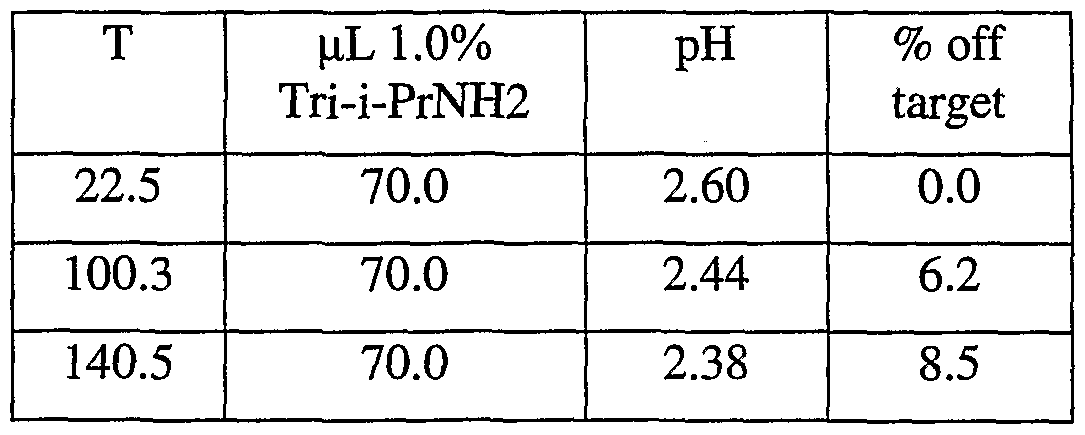
- Example 1 The method and apparatus described in Example 1 were used to determine temperature effects on neutralization of crude product with a cumene solution of tri-iso-propylamine ("Tri-i-PrNH2"). Results of pH measurement for each run are presented in the following table:
- Example 1 The method and apparatus described in Example 1 were used to determine temperature effects on neutralization of crude product with an aqueous solution of TIPA. Results of pH measurement for each run are presented in the following table:
- Example 1 The method and apparatus described in Example 1 were used to determine temperature effects on neutralization of crude product with a cumene solution of 2,6-Di-MeAn. Results of pH measurement for each run are presented in the following table:
- Example 1 The method and apparatus described in Example 1 were used to determine temperature effects on neutralization of crude product with a cumene solution of 2,6-Di-EtAn. Results of pH measurement for each run are presented in the following table:
- Example 1 The method and apparatus described in Example 1 were used to determine temperature effects on neutralization of crude product with a cumene solution of 2,5-Di-tBuAn. Results of pH measurement for each run are presented in the following table:
- Example 1 The method and apparatus described in Example 1 were used to determine temperature effects on neutralization of crude product with a cumene solution of 2,6-Di-iPrAn. Results of pH measurement for each run are presented in the following table:
- EXAMPLE 28 Temperature Effects on Neutralization of Crude Product with Di-n- Hexylamine.
- Example 1 The method and apparatus described in Example 1 were used to determine temperature effects on neutralization of crude product with a cumene solution of di-n-hexylamine ("Di-n-HexNH2"). Results of pH measurement for each run are presented in the following table:
- EXAMPLE 29 Temperature Effects on Neutralization of Crude Product with Tetramethylammonium Hydroxide ("TMAH").
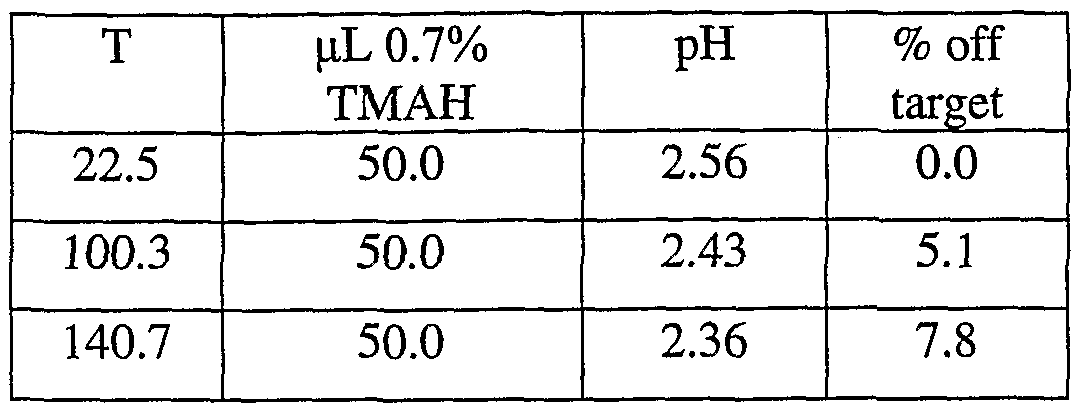
- Example 1 The method and apparatus described in Example 1 were used to determine temperature effects on neutralization of crude product with an aqueous solution of TMAH. Results of pH measurement for each run are presented in the following table:
- EXAMPLE 30 Temperature Effects on Neutralization of Crude Product with Tetra-n- Butylammonium Hydroxide ("TBAH").
- Example 1 The method and apparatus described in Example 1 were used to determine temperature effects on neutralization of crude product with an aqueous solution of TBAH. Results of pH measurement for each run are presented in the following table:
- EXAMPLE 31 Temperature Effects on Neutralization of Crude Product with Triethylamine ("TEA").
- Example 1 The method and apparatus described in Example 1 were used to determine temperature effects on neutralization of crude product with an aqueous solution of TEA. Results of pH measurement for each run are presented in the following table:
- Example 1 The method and apparatus described in Example 1 were used to determine temperature effects on neutralization of crude product with a cumene solution of Di-i-PrNH2. Results of pH measurement for each run are presented in the following table:
- Example 1 The method and apparatus described in Example 1 were used to determine temperature effects on neutralization of crude product with ammonium hydroxide. Results of pH measurement for each run are presented in the following table:
- Example 1 The method and apparatus described in Example 1 were used to determine temperature effects on neutralization of crude product with aqueous solutions of sodium hydroxide. Results of pH measurement for each run are presented in the following tables:
Landscapes
- Chemical & Material Sciences (AREA)
- Organic Chemistry (AREA)
- Organic Low-Molecular-Weight Compounds And Preparation Thereof (AREA)
- Low-Molecular Organic Synthesis Reactions Using Catalysts (AREA)
Abstract
Description






Claims


Priority Applications (4)
| Application Number | Priority Date | Filing Date | Title |
|---|---|---|---|
| EP00986565A EP1248759B1 (en) | 2000-01-10 | 2000-12-19 | Method for production of phenol and acetone by decomposition of cumene hydroperoxide |
| AU2001222783A AU2001222783A1 (en) | 2000-01-10 | 2000-12-19 | Method for production of phenol and acetone by decomposition of cumene hydroperoxide |
| JP2001551822A JP3441723B2 (en) | 2000-01-10 | 2000-12-19 | Production method of phenol and acetone by decomposition of cumene hydroperoxide |
| DE60029008T DE60029008T2 (en) | 2000-01-10 | 2000-12-19 | PROCESS FOR THE PREPARATION OF PHENOL AND ACETONE BY DECOMPOSITION OF CUMOLHYDROPEROXYD |
Applications Claiming Priority (2)
| Application Number | Priority Date | Filing Date | Title |
|---|---|---|---|
| US09/480,206 | 2000-01-10 | ||
| US09/480,206 US6201157B1 (en) | 2000-01-10 | 2000-01-10 | Method for production of phenol and acetone by decomposition of cumene hydroperoxide |
Publications (1)
| Publication Number | Publication Date |
|---|---|
| WO2001051439A1 true WO2001051439A1 (en) | 2001-07-19 |
Family
ID=23907070
Family Applications (1)
| Application Number | Title | Priority Date | Filing Date |
|---|---|---|---|
| PCT/US2000/034442 Ceased WO2001051439A1 (en) | 2000-01-10 | 2000-12-19 | Method for production of phenol and acetone by decomposition of cumene hydroperoxide |
Country Status (10)
| Country | Link |
|---|---|
| US (1) | US6201157B1 (en) |
| EP (1) | EP1248759B1 (en) |
| JP (1) | JP3441723B2 (en) |
| KR (1) | KR100527418B1 (en) |
| CN (1) | CN1231438C (en) |
| AT (1) | ATE330925T1 (en) |
| AU (1) | AU2001222783A1 (en) |
| DE (1) | DE60029008T2 (en) |
| ES (1) | ES2266017T3 (en) |
| WO (1) | WO2001051439A1 (en) |
Cited By (1)
| Publication number | Priority date | Publication date | Assignee | Title |
|---|---|---|---|---|
| WO2015161466A1 (en) * | 2014-04-23 | 2015-10-29 | Dow Global Technologies Llc | Neutralization of acidic catalysts in production of phenol |
Families Citing this family (29)
| Publication number | Priority date | Publication date | Assignee | Title |
|---|---|---|---|---|
| AU2003222202A1 (en) * | 2002-02-08 | 2003-09-02 | General Electric Company | Process and catalyst for purifying phenol |
| RU2217409C2 (en) | 2002-02-08 | 2003-11-27 | Общество с ограниченной ответственностью "Петрофенол" | Method and catalyst for production of paracumylphenol |
| RU2217408C2 (en) * | 2002-02-08 | 2003-11-27 | Общество с ограниченной ответственностью "Петрофенол" | Method and catalyst for cumene treatment of phenol |
| KR20070002039A (en) * | 2004-03-31 | 2007-01-04 | 제너럴 일렉트릭 캄파니 | How to prepare phenol |
| US7141700B1 (en) | 2005-08-19 | 2006-11-28 | Uop Llc | Decomposition of cumene hydroperoxide |
| US7141701B1 (en) | 2005-08-19 | 2006-11-28 | Uop Llc | Decomposition of cumene hydroperoxide |
| US7888537B2 (en) * | 2006-12-29 | 2011-02-15 | Uop Llc | Solid acid catalyst and process for decomposition of cumene hydroperoxide |
| WO2012134549A1 (en) | 2011-03-28 | 2012-10-04 | Exxonmobil Chemical Patents Inc. | Production of cyclohexylbenzene hydroperoxide |
| US9029611B2 (en) | 2010-02-05 | 2015-05-12 | Exxonmobil Chemical Patents Inc. | Dehydrogenation of cyclohexanone to produce phenol |
| WO2011096989A1 (en) | 2010-02-05 | 2011-08-11 | Exxonmobil Chemical Patents Inc. | Dehydrogenation of cyclohexanone to produce phenol |
| US20110306800A1 (en) | 2010-06-09 | 2011-12-15 | Scott Roy Keenan | Method for the decomposition of cumene hydroperoxide |
| CN103097351B (en) | 2010-09-14 | 2016-03-09 | 埃克森美孚化学专利公司 | The method for oxidation of phenylcyclohexane |
| CN103052618B (en) | 2010-09-14 | 2015-08-05 | 埃克森美孚化学专利公司 | Produce the method for phenol |
| US8921610B2 (en) | 2010-09-14 | 2014-12-30 | Exxonmobil Chemical Patents Inc. | Oxidation of alkylbenzenes |
| CN105646156B (en) | 2010-09-14 | 2018-07-13 | 埃克森美孚化学专利公司 | The method for being used to prepare phenol |
| US9242918B2 (en) | 2010-09-14 | 2016-01-26 | Exxonmobil Chemical Patents Inc. | Dehydrogenation processes and phenol compositions |
| WO2012036826A2 (en) | 2010-09-14 | 2012-03-22 | Exxonmobil Chemical Patents Inc. | Processes for producing phenol |
| WO2012067711A1 (en) | 2010-11-16 | 2012-05-24 | Exxonmobil Chemical Patents Inc. | Process for producing phenol |
| KR101538084B1 (en) | 2010-12-17 | 2015-07-21 | 엑손모빌 케미칼 패턴츠 인코포레이티드 | Dehydrogenation catalyst and process |
| SG192612A1 (en) | 2011-02-18 | 2013-09-30 | Exxonmobil Chem Patents Inc | Process for producing cyclohexylbenzene |
| US9017641B2 (en) | 2011-02-21 | 2015-04-28 | Exxonmobil Chemical Patents Inc. | Hydrogen purification process |
| WO2012118542A1 (en) | 2011-02-28 | 2012-09-07 | Exxonmobil Chemical Patents Inc. | Process for producing phenol |
| SG193427A1 (en) | 2011-03-28 | 2013-10-30 | Exxonmobil Chem Patents Inc | Dehydrogenation process |
| WO2013052216A1 (en) | 2011-10-07 | 2013-04-11 | Exxonmobil Chemical Patents Inc. | Process for producing phenol from cyclohexylbenzene hydroperoxide |
| US8981158B2 (en) | 2011-12-19 | 2015-03-17 | Exxonmobil Chemical Patents Inc. | Oxidation of cyclohexylbenzene |
| WO2013109348A1 (en) | 2012-01-18 | 2013-07-25 | Exxonmobil Chemical Patents Inc. | Process for producing phenol |
| US8865957B2 (en) * | 2012-03-09 | 2014-10-21 | Honeywell Intenational Inc. | Method for producing alpha-methyl styrene from cumene |
| FR3012138B1 (en) | 2013-10-22 | 2015-10-30 | Arkema France | USE OF ALKANE-SULFONIC ACID FOR THE PREPARATION OF PHENOLIC ALCOHOL |
| CN113135819B (en) * | 2021-04-29 | 2022-07-15 | 北京工业大学 | A kind of method that improves the yield of m-dicumene oxidation to prepare resorcinol |
Citations (2)
| Publication number | Priority date | Publication date | Assignee | Title |
|---|---|---|---|---|
| EP0085289A1 (en) * | 1981-12-24 | 1983-08-10 | Monsanto Company | Process for direct neutralization of product mixture resulting from acid catalyzed cleavage of alkyl aromatic hydroperoxides |
| US5254751A (en) * | 1992-09-14 | 1993-10-19 | General Electric Company | Method for the decomposition of cumene hydroperoxide by acidic catalyst to phenol and acetone |
Family Cites Families (2)
| Publication number | Priority date | Publication date | Assignee | Title |
|---|---|---|---|---|
| US4267379A (en) * | 1978-12-04 | 1981-05-12 | Gulf Research & Development Company | Decomposition of cumene hydroperoxide and recovery of boron trifluoride catalyst |
| US5491268A (en) | 1994-09-23 | 1996-02-13 | General Electric Company | Process for removal of acidic compounds from phenol process streams |
-
2000
- 2000-01-10 US US09/480,206 patent/US6201157B1/en not_active Expired - Lifetime
- 2000-12-19 EP EP00986565A patent/EP1248759B1/en not_active Expired - Lifetime
- 2000-12-19 ES ES00986565T patent/ES2266017T3/en not_active Expired - Lifetime
- 2000-12-19 JP JP2001551822A patent/JP3441723B2/en not_active Expired - Fee Related
- 2000-12-19 WO PCT/US2000/034442 patent/WO2001051439A1/en not_active Ceased
- 2000-12-19 CN CNB008192863A patent/CN1231438C/en not_active Expired - Lifetime
- 2000-12-19 DE DE60029008T patent/DE60029008T2/en not_active Expired - Lifetime
- 2000-12-19 KR KR10-2002-7008716A patent/KR100527418B1/en not_active Expired - Lifetime
- 2000-12-19 AT AT00986565T patent/ATE330925T1/en not_active IP Right Cessation
- 2000-12-19 AU AU2001222783A patent/AU2001222783A1/en not_active Abandoned
Patent Citations (2)
| Publication number | Priority date | Publication date | Assignee | Title |
|---|---|---|---|---|
| EP0085289A1 (en) * | 1981-12-24 | 1983-08-10 | Monsanto Company | Process for direct neutralization of product mixture resulting from acid catalyzed cleavage of alkyl aromatic hydroperoxides |
| US5254751A (en) * | 1992-09-14 | 1993-10-19 | General Electric Company | Method for the decomposition of cumene hydroperoxide by acidic catalyst to phenol and acetone |
Cited By (3)
| Publication number | Priority date | Publication date | Assignee | Title |
|---|---|---|---|---|
| WO2015161466A1 (en) * | 2014-04-23 | 2015-10-29 | Dow Global Technologies Llc | Neutralization of acidic catalysts in production of phenol |
| US9890099B2 (en) | 2014-04-23 | 2018-02-13 | Dow Global Technologies Llc | Neutralization of acidic catalysts in the production of phenol |
| EP3134378A4 (en) * | 2014-04-23 | 2018-02-14 | Dow Global Technologies LLC | Neutralization of acidic catalysts in production of phenol |
Also Published As
| Publication number | Publication date |
|---|---|
| JP3441723B2 (en) | 2003-09-02 |
| KR20020062777A (en) | 2002-07-29 |
| DE60029008D1 (en) | 2006-08-03 |
| CN1450985A (en) | 2003-10-22 |
| KR100527418B1 (en) | 2005-11-09 |
| AU2001222783A1 (en) | 2001-07-24 |
| US6201157B1 (en) | 2001-03-13 |
| DE60029008T2 (en) | 2007-01-11 |
| ATE330925T1 (en) | 2006-07-15 |
| CN1231438C (en) | 2005-12-14 |
| EP1248759B1 (en) | 2006-06-21 |
| ES2266017T3 (en) | 2007-03-01 |
| EP1248759A1 (en) | 2002-10-16 |
| JP2003519672A (en) | 2003-06-24 |
Similar Documents
| Publication | Publication Date | Title |
|---|---|---|
| US6201157B1 (en) | Method for production of phenol and acetone by decomposition of cumene hydroperoxide | |
| CN102285891B (en) | Method for preparing arylamine by catalytic hydrogenation of aromatic nitro compound | |
| EP2280925B1 (en) | Process for the manufacture of nitropropanes | |
| RU2402558C2 (en) | Method for synthesis of aminopolyalkylene phosphonic acid compounds | |
| Voice et al. | Oxidation of amines at absorber conditions for CO2 capture from flue gas | |
| US5756803A (en) | Process for the condensation of an aldehyde with hydrogen cyanide | |
| MXPA97009461A (en) | Process for the preparation of 3- (methylene) propanal and 2-hydroxy-4- (methylthy) butanonitr | |
| US4067905A (en) | Preparation of 2-amino-n-butanol | |
| EP1179526A2 (en) | Cyanoethylation of cycloaliphatic vicinal primary diamines | |
| US5686625A (en) | Process for the preparation of N-substituted glycine acids or glycine esters and the use of the process for indigo synthesis | |
| US4277622A (en) | Process for production of 1,17-diamino-9-azaheptadecane | |
| PL188133B1 (en) | Method of obtaining nitrones and method obtaining n-monosubstituted hydroxylamines | |
| US4597911A (en) | Production of amino aliphatic and cycloaliphatic hydrogen sulfates | |
| JP3636381B2 (en) | Purification method of tertiary amine | |
| EP3134378B1 (en) | Neutralization of acidic catalysts in production of phenol | |
| EP1229021A1 (en) | Synthesis of new polynitriles from cycloaliphatic vicinal primary diamines | |
| EP3452443B1 (en) | Process for reducing cpi in a dinitrile stream | |
| EP1027327A1 (en) | Formation of quinonediimines from phenylenediamines by catalytic oxidation | |
| CN119874633B (en) | Oilfield water treatment corrosion inhibitor and synthesis method thereof | |
| KR101905257B1 (en) | Method for storage of triethanolamine for preventing discoloring | |
| Das | Aromatic and Aliphatic Amines | |
| JPH08245531A (en) | Method for producing halo-substituted aminophenol | |
| KR20070112803A (en) | How to minimize aldehyde based impurities in the process stream | |
| Hein | The Organic Chemistry Of Nitroxyl. | |
| SK63793A3 (en) | Method of producing of aminopropionitriles |
Legal Events
| Date | Code | Title | Description |
|---|---|---|---|
| AK | Designated states |
Kind code of ref document: A1 Designated state(s): AE AG AL AU BA BB BG BR BZ CA CN CR CU CZ DM DZ EE GE HR HU ID IL IN IS JP KP KR LC LK LR LT LV MA MD MG MK MN MX NO NZ PL RO SG SI SK TR TT UA UZ VN YU ZA |
|
| AL | Designated countries for regional patents |
Kind code of ref document: A1 Designated state(s): GH GM KE LS MW MZ SD SL SZ TZ UG ZW AM AZ BY KG KZ MD RU TJ TM AT BE CH CY DE DK ES FI FR GB GR IE IT LU MC NL PT SE TR BF BJ CF CG CI CM GA GN GW ML MR NE SN TD TG |
|
| 121 | Ep: the epo has been informed by wipo that ep was designated in this application | ||
| DFPE | Request for preliminary examination filed prior to expiration of 19th month from priority date (pct application filed before 20040101) | ||
| WWE | Wipo information: entry into national phase |
Ref document number: 1020027008716 Country of ref document: KR Ref document number: IN/PCT/2002/00902/MU Country of ref document: IN |
|
| WWE | Wipo information: entry into national phase |
Ref document number: 2000986565 Country of ref document: EP |
|
| ENP | Entry into the national phase |
Ref document number: 2001 551822 Country of ref document: JP Kind code of ref document: A |
|
| WWP | Wipo information: published in national office |
Ref document number: 1020027008716 Country of ref document: KR |
|
| WWE | Wipo information: entry into national phase |
Ref document number: 008192863 Country of ref document: CN |
|
| WWP | Wipo information: published in national office |
Ref document number: 2000986565 Country of ref document: EP |
|
| WWG | Wipo information: grant in national office |
Ref document number: 1020027008716 Country of ref document: KR |
|
| WWG | Wipo information: grant in national office |
Ref document number: 2000986565 Country of ref document: EP |