WO2001070708A1 - Substituted piperidines as melanocortin receptor agonists - Google Patents
Substituted piperidines as melanocortin receptor agonists Download PDFInfo
- Publication number
- WO2001070708A1 WO2001070708A1 PCT/US2001/008935 US0108935W WO0170708A1 WO 2001070708 A1 WO2001070708 A1 WO 2001070708A1 US 0108935 W US0108935 W US 0108935W WO 0170708 A1 WO0170708 A1 WO 0170708A1
- Authority
- WO
- WIPO (PCT)
- Prior art keywords
- mmol
- alkyl
- compound
- aryl
- cycloalkyl
- Prior art date
- Legal status (The legal status is an assumption and is not a legal conclusion. Google has not performed a legal analysis and makes no representation as to the accuracy of the status listed.)
- Ceased
Links
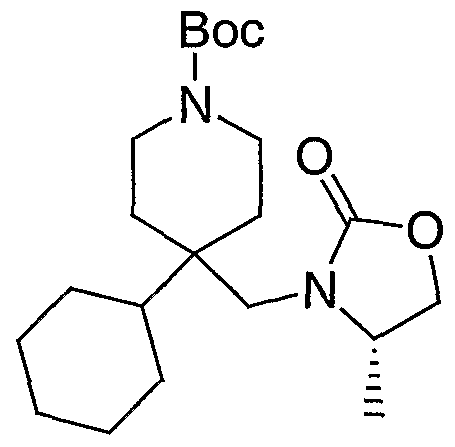
- 0 *C(C(N1CCC(*)(*)CC1)=O)NC(*)=O Chemical compound *C(C(N1CCC(*)(*)CC1)=O)NC(*)=O 0.000 description 8
- MXFMWPQUUGHVCH-UHFFFAOYSA-N CC(C)(C)NC(C(CC1)(CCN1C(OC(C)(C)C)=O)C1(C)C=CCCC1)=O Chemical compound CC(C)(C)NC(C(CC1)(CCN1C(OC(C)(C)C)=O)C1(C)C=CCCC1)=O MXFMWPQUUGHVCH-UHFFFAOYSA-N 0.000 description 1
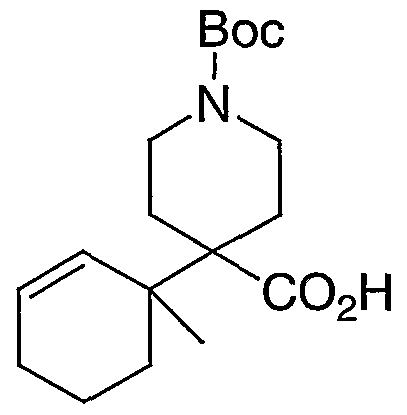
- ZTYUPPZGSRRZLX-UHFFFAOYSA-N CC(C)(C)OC(N(CC1)CCC1(C1(C)C=CCCC1)C(O)=O)=O Chemical compound CC(C)(C)OC(N(CC1)CCC1(C1(C)C=CCCC1)C(O)=O)=O ZTYUPPZGSRRZLX-UHFFFAOYSA-N 0.000 description 1
- NAKZNUBCXKFMHJ-QXPUDEPPSA-N CCCCN(C)C(C(CC1)(CCN1C([C@@H](Cc(cc1)ccc1F)NC(C1NCC(C)(C)NC1)=O)=O)C1CCCCC1)=O Chemical compound CCCCN(C)C(C(CC1)(CCN1C([C@@H](Cc(cc1)ccc1F)NC(C1NCC(C)(C)NC1)=O)=O)C1CCCCC1)=O NAKZNUBCXKFMHJ-QXPUDEPPSA-N 0.000 description 1
Classifications
-
- C—CHEMISTRY; METALLURGY
- C07—ORGANIC CHEMISTRY
- C07D—HETEROCYCLIC COMPOUNDS
- C07D401/00—Heterocyclic compounds containing two or more hetero rings, having nitrogen atoms as the only ring hetero atoms, at least one ring being a six-membered ring with only one nitrogen atom
- C07D401/02—Heterocyclic compounds containing two or more hetero rings, having nitrogen atoms as the only ring hetero atoms, at least one ring being a six-membered ring with only one nitrogen atom containing two hetero rings
- C07D401/12—Heterocyclic compounds containing two or more hetero rings, having nitrogen atoms as the only ring hetero atoms, at least one ring being a six-membered ring with only one nitrogen atom containing two hetero rings linked by a chain containing hetero atoms as chain links
-
- A—HUMAN NECESSITIES
- A61—MEDICAL OR VETERINARY SCIENCE; HYGIENE
- A61P—SPECIFIC THERAPEUTIC ACTIVITY OF CHEMICAL COMPOUNDS OR MEDICINAL PREPARATIONS
- A61P15/00—Drugs for genital or sexual disorders; Contraceptives
-
- A—HUMAN NECESSITIES
- A61—MEDICAL OR VETERINARY SCIENCE; HYGIENE
- A61P—SPECIFIC THERAPEUTIC ACTIVITY OF CHEMICAL COMPOUNDS OR MEDICINAL PREPARATIONS
- A61P15/00—Drugs for genital or sexual disorders; Contraceptives
- A61P15/10—Drugs for genital or sexual disorders; Contraceptives for impotence
-
- A—HUMAN NECESSITIES
- A61—MEDICAL OR VETERINARY SCIENCE; HYGIENE
- A61P—SPECIFIC THERAPEUTIC ACTIVITY OF CHEMICAL COMPOUNDS OR MEDICINAL PREPARATIONS
- A61P3/00—Drugs for disorders of the metabolism
- A61P3/04—Anorexiants; Antiobesity agents
-
- A—HUMAN NECESSITIES
- A61—MEDICAL OR VETERINARY SCIENCE; HYGIENE
- A61P—SPECIFIC THERAPEUTIC ACTIVITY OF CHEMICAL COMPOUNDS OR MEDICINAL PREPARATIONS
- A61P3/00—Drugs for disorders of the metabolism
- A61P3/08—Drugs for disorders of the metabolism for glucose homeostasis
- A61P3/10—Drugs for disorders of the metabolism for glucose homeostasis for hyperglycaemia, e.g. antidiabetics
-
- C—CHEMISTRY; METALLURGY
- C07—ORGANIC CHEMISTRY
- C07D—HETEROCYCLIC COMPOUNDS
- C07D401/00—Heterocyclic compounds containing two or more hetero rings, having nitrogen atoms as the only ring hetero atoms, at least one ring being a six-membered ring with only one nitrogen atom
- C07D401/14—Heterocyclic compounds containing two or more hetero rings, having nitrogen atoms as the only ring hetero atoms, at least one ring being a six-membered ring with only one nitrogen atom containing three or more hetero rings
-
- C—CHEMISTRY; METALLURGY
- C07—ORGANIC CHEMISTRY
- C07D—HETEROCYCLIC COMPOUNDS
- C07D413/00—Heterocyclic compounds containing two or more hetero rings, at least one ring having nitrogen and oxygen atoms as the only ring hetero atoms
- C07D413/14—Heterocyclic compounds containing two or more hetero rings, at least one ring having nitrogen and oxygen atoms as the only ring hetero atoms containing three or more hetero rings
-
- C—CHEMISTRY; METALLURGY
- C07—ORGANIC CHEMISTRY
- C07D—HETEROCYCLIC COMPOUNDS
- C07D487/00—Heterocyclic compounds containing nitrogen atoms as the only ring hetero atoms in the condensed system, not provided for by groups C07D451/00 - C07D477/00
- C07D487/02—Heterocyclic compounds containing nitrogen atoms as the only ring hetero atoms in the condensed system, not provided for by groups C07D451/00 - C07D477/00 in which the condensed system contains two hetero rings
- C07D487/08—Bridged systems
Definitions
- the present invention relates to piperidine derivatives, their synthesis, and their use as melanocortin receptor (MC-R) agonists. More particularly, the compounds of the present invention are selective agonists of the melanocortin-4 receptor (MC-4R) and are thereby useful for the treatment of disorders responsive to the activation of MC-4R, such as obesity, diabetes, male sexual dysfunction, and female sexual dysfunction.
- M-R melanocortin receptor
- Pro-opiomelanocortin (POMC) derived peptides are known to affect food intake.
- GPCRs G-protein coupled receptors
- M-R melanocortin receptor
- a specific single MC-R that may be targeted for the control of obesity has not yet been identified, although evidence has been presented that MC-4R signalling is important in mediating feed behavior (S.Q. Giraudo et al., "Feeding effects of hypothalamic injection of melanocortin-4 receptor ligands.” Brain Research. 80: 302-306 (1998)).
- MC-R's Evidence for the involvement of MC-R's in obesity includes: i) the agouti (A vy ) mouse which ectopically expresses an antagonist of the MC-lR, MC-3R and -4R is obese, indicating that blocking the action of these three MC-R's can lead to hyperphagia and metabolic disorders; ii) MC-4R knockout mice (D.
- MC-lR Five distinct MC-R's have thus far been identified, and these are expressed in different tissues.
- MC-lR was initially characterized by dominant gain of function mutations at the Extension locus, affecting coat color by controlling phaeomelanin to eumelanin conversion through control of tyrosinase.
- MC-lR is mainly expressed in melanocytes.
- MC-2R is expressed in the adrenal gland and represents the ACTH receptor.
- MC-3R is expressed in the brain, gut, and placenta and may be involved in the control of food intake and thermogenesis.
- MC-4R is uniquely expressed in the brain, and its inactivation was shown to cause obesity (A.
- MC-5R is expressed in many tissues, including white fat, placenta and exocrine glands. A low level of expression is also observed in the brain. MC-5R knockout mice reveal reduced sebaceous gland lipid production (Chen et al., Cell, 91 : 789-798 (1997)).
- Erectile dysfunction denotes the medical condition of inability to achieve penile erection sufficient for successful sexual intercourse.
- impotence is oftentimes employed to describe this prevalent condition.
- Erectile dysfunction can arise from either organic or psychogenic causes, with about 20% of such cases being purely psychogenic in origin. Erectile dysfunction increases from 40% at age 40, to 67% at age 75, with over 75% occurring in men over the age of 50.
- IC-351 (ICOS Corp.) is claimed to have greater selectivity for PDE-V over PDE-VI than sildenafil.
- Other PDE-V inhibitors include M-54033 and M-54018 from Mochida Pharmaceutical Co. and E-4010 from Eisai Co., Ltd.
- sildenafil and phentolamine act peripherally and are considered to be “enhancers” or “facilitators” of the sexual response to erotic stimulation, sildenafil appears to be efficacious in both mild organic and psychogenic erectile dysfunction.
- Sildenafil has an onset of action of 30-60 minutes after an oral dose with the effect lasting about 4 hours, whereas phentolamine requires 5-30 minutes for onset with a duration of 2 hours. Although sildenafil is effective in a majority of patients, it takes a relatively long time for the compound to show the desired effects. The faster-acting phentolamine appears to be less effective and to have a shorter duration of action than sildenafil. Oral sildenafil is effective in about 70% of men who take it, whereas an adequate response with phentolamine is observed in only 35-40% of patients. Both compounds require erotic stimulation for efficacy.
- sildenafil indirectly increases blood flow in the systemic circulation by enhancing the smooth muscle relaxation effects of nitric oxide, it is contraindicated for patients with unstable heart conditions or cardiovascular disease, in particular patients taking nitrates, such as nitroglycerin, to treat angina.
- Other adverse effects associated with the clinical use of sildenafil include headache, flushing, dyspepsia, and "abnormal vision," the latter the result of inhibition of the type VI phosphodiesterase isozyme (PDE-VI), a cyclic-GMP-specific phosphodiesterase that is concentrated in the retina.
- "Abnormal vision” is defined as a mild and transient "bluish” tinge to vision, but also an increased sensitivity to light or blurred vision.
- Synthetic melanocortin receptor agonists have been found to initiate erections in men with psychogenic erectile dysfunction [See H. Wessells et al., "Synthetic Melanotropic Peptide Initiates Erections in Men With Psychogenic Erectile Dysfunction: Double-Blind, Placebo Controlled Crossover Study," UroL, 160: 389-393 (1998); Fifteenth American Peptide Symposium. June 14-19, 1997 (Nashville TN)]. Activation of melanocortin receptors of the brain appears to cause normal stimulation of sexual arousal.
- MT-II the centrally acting ⁇ -melanocyte-stimulating hormone analog, melanotan-H (MT-II), exhibited a 75% response rate, similar to results obtained with apomorphine, when injected intramuscularly or subcutaneously to males with psychogenic erectile dysfunction.
- MT-II is a synthetic cyclic heptapeptide, Ac-Nle-c[Asp-His-DPhe-Arg- Trp-Lys]-NH2 > which contains the 4-10 melanocortin receptor binding region common to ⁇ -MSH and adrenocorticotropin, but with a lactam bridge.
- MT-JJ also referred to as PT-14
- PT-14 Erectide®
- TheraTech, Inc. is presently in clinical development by Palatin Technologies, Inc. and TheraTech, Inc. as a non- penile subcutaneous injection formulation. It is considered to be an "initiator" of the sexual response.
- the time to onset of erection with this drug is relatively short (10-20 minutes) with a duration of action approximately 2.5 hours.
- Adverse reactions observed with MT-JJ include nausea, flushing, loss of appetite, stretching, and yawning and may be the result of activation of MC-lR, MC-2R, MC-3R, and/or MC- 5R.
- MT-JJ must be administered parenterally, such as by subcutaneous, intravenous, or intramuscular route, since it is not absorbed into the systemic circulation when given by the oral route.
- MT-IJ's erectogenic properties apparently are not limited to cases of psychogenic erectile dysfunction in that men with a variety of organic risk factors developed penile erections upon subcutaneous injection of the compound; moreover, the level of sexual desire was significantly higher after MT-II administration than after placebo [see H. Wessells, "Effect of an Alpha-Melanocyte Stimulating Hormone Analog on Penile Erection and Sexual Desire in Men with Organic Erectile Dysfunction," Urology. 56: 641-646 (2000)].
- compositions of melanotropic peptides and methods for the treatment of psychogenic erectile dysfunction are disclosed in U.S. Patent No. 5,576,290, assigned to Competitive Technologies. Methods of stimulating sexual response in females using melanotropic peptides have been disclosed in U.S. Patent No. 6,051,555.
- Spiropiperidine and piperidine derivatives have been disclosed in WO 99/64002 (16 December 1999) and WO 00/74679 (14 December 2000), respectively, as agonists of the melanocortin receptor(s) and thereby useful for the treatment of diseases and disorders, such as obesity, diabetes, and sexual dysfunction, including erectile dysfunction and female sexual dysfunction.
- the present invention relates to novel substituted piperidines of structural formula (I):
- piperidine derivatives are effective as melanocortin receptor agonists and are particularly effective as selective melanocortin-4 receptor (MC-4R) agonists. They are therefore useful for the treatment and/or prevention of disorders responsive to the activation of MC-4R, such as obesity, diabetes as well as male and female sexual dysfunction, in particular, male erectile dysfunction.
- MC-4R melanocortin-4 receptor
- the present invention also relates to pharmaceutical compositions comprising the compounds of the present invention and a pharmaceutically acceptable carrier.
- the present invention also relates to methods for the treatment or prevention of disorders, diseases, or conditions responsive to the activation of the melanocortin receptor in a mammal in need thereof by administering the compounds and pharmaceutical compositions of the present invention.
- the present invention also relates to methods for the treatment or prevention of obesity, diabetes mellitus, male sexual dysfunction, and female sexual dysfunction by administering the compounds and pharmaceutical compositions of the present invention.
- the present invention also relates to methods for treating erectile dysfunction by administering the compounds and pharmaceutical compositions of the present invention.
- the present invention also relates to methods for treating erectile dysfunction by administering the compounds of the present invention in combination with a therapeutically effective amount of another agent known to be useful to treat the condition.
- the present invention also relates to methods for treating or preventing obesity by administering the compounds of the present invention in combination with a therapeutically effective amount of another agent known to be useful to treat the condition.
- the present invention relates to substituted piperidines useful as melanocortin receptor agonists.
- Representative compounds of the present invention are described by structural formula (I):
- Z is O, S, or NR4b ; each p is independently 1 or 2; each n is independently 0, 1, or 2;
- Rl is selected from the group consisting of hydrogen
- R2 is selected from the group consisting of hydrogen, Ci_8 alkyl,
- each R3 is independently selected from the group consisting of hydrogen, C ⁇ _8 alkyl, (CH 2 )n-aryl, (CH2) n C3-6 cycloalkyl,
- (CH2)n-heteroaryl, and (CH2)n-heterocyclyl in which aryl and heteroaryl are unsubstituted or substituted with one to three groups independently selected from R6; and alkyl, cycloalkyl, and heterocyclyl are unsubstituted or substituted with one to three groups independently selected from R6 and oxo; or R3 and R a and the carbons to which they are attached form a 5- to 7-membered ring optionally containing an additional heteroatom selected from O, S, and NR7;
- R ⁇ a and R4b are each independently selected from the group consisting of hydrogen
- CONR7R7 and in which aryl and heteroaryl are unsubstituted or substituted with one to three groups independently selected from R6; and alkyl, cycloalkyl, and heterocyclyl are unsubstituted or substituted with one to three groups independently selected from R6 and oxo; or R4a and R2 and the carbons to which they are attached form a 5- to 7-membered ring optionally containing an additional heteroatom selected from O. S, and NR7; or R4a and R4b and the atoms to which they are attached form a 5- to 7-membered ring;
- R5a and R5b are each independently selected from the group consisting of hydrogen
- R6 is selected from the group consisting of hydrogen, Ci-8 alkyl, (CH2)n-aryl, (CH2) n C3-7 cycloalkyl, (CH2)n-heteroaryl, halogen, OR7,
- each R7 is independently selected from the group consisting of hydrogen, C ⁇ _8 alkyl, (CH2)n-aryl, and (CH 2 ) n C3-7 cycloalkyl;
- each R8 is independently selected from the group consisting of
- (CH2) n C3-7 cycloalkyl wherein aryl and heteroaryl are unsubstituted or substituted with one to three groups independently selected from R6; and alkyl, cycloalkyl, heterocyclyl, and (CH2)n are unsubstituted or substituted with one to three groups independently selected from R ⁇ 5 and oxo; or two R° " groups together with the atoms to which they are attached form a 5- to 8- membered mono- or bi-cyclic ring system optionally containing an additional heteroatom selected from O, S, NR7, NBoc, and NCbz;
- each R9 is independently selected from the group consisting of hydrogen
- X is selected from the group consisting of
- Y is selected from the group consisting of hydrogen, Ci-8 alkyl,
- Z is O or NR4b ; and R2, R3, R4a, R4b R5a, R5b and R9 are as defined above.
- R2, R3, R4a, R4b R5a and R5b are as defined above.
- R4a and R4b are each independently selected from the group consisting of hydrogen, C ⁇ _8 alkyl,
- R3, R5a ; and R5b are each independently hydrogen, C1-.4 alkyl, C3-.6 cycloalkyl, or aryl; wherein aryl is unsubstituted or substituted with one to three groups independently selected from R6; or R3 and R5 and the carbons to which they are attached form a 6-membered ring optionally containing an additional heteroatom selected from O, S, and NR7.
- R ⁇ a and R 4b are each independently selected from the group consisting of hydrogen
- R3, R5a, and R5b are each independently hydrogen, Ci-4 alkyl, C3-6 cycloalkyl, or phenyl; wherein phenyl is unsubstituted or substituted with one to three groups independently selected from R6; or R3 and R5a and the carbons to which they are attached form a 6-membered ring optionally containing an additional heteroatom selected from O, S, and NR7.
- Rl is CHR7-aryl, CHR7 ⁇ CHR7-aryl, or CHR7-heteroaryl wherein aryl and heteroaryl are optionally substituted with one or two R6 groups.
- Rl is benzyl optionally substituted with one or two groups selected from halogen, C ⁇ _4 alkyl, Ci-4 alkoxy, CN, CF3, and OCF3.
- Rl is 4- chlorobenzyl; 4-fluorobenzyl; 3,4-difluorobenzyl; 3,5-difluorobenzyl; 2-cyano-4- fluorobenzyl; or 4-methoxybenzyl.
- R2 is H or CH3.
- X is C 1-6 alkyl, (CH2) n -aryl, (CH 2 ) n -heteroaryl, (CH2) n -heterocyclyl, (CH 2 ) n C(O)N(R8)(R8), (CH 2 )nCO 2 R8, (CH 2 ) n OR8, (CH 2 ) n S(O) ⁇ -2R 8 , (CH 2 ) n NHC(O)R8, (CH2) n OC(O)NR ⁇ R8 5 G r (CH2) n NR8SO2R 8 ; wherein aryl and heteroaryl are optionally substituted with one to three groups selected from R6; heterocyclyl is optionally substituted with one to three groups selected from R6 and oxo; the (CH2)n group is optionally substituted with one to three groups selected from R7, halogen, S(O)0-2R > N(R7)2, and OR 7 ; and R8
- X is Ci_6 alkyl, (CH2) ⁇ -l -heteroaryl, CH2-heterocyclyl, CO2R 8 , CH2OR8, CH2S(O) ⁇ -2R 8 , N ⁇ C(0)R8, CH2NR8SO2R8, CH2OC(O)NR8R8, CH2NR8SO2R8, or C(O)N(R8)(R8); wherein heteroaryl is optionally substituted with one to three groups selected from R6; heterocyclyl is optionally substituted with one to three groups selected from R6 and oxo; and R8 is each independently selected from H, C ⁇ _8 alkyl, and C3-6 cycloalkyl optionally substituted with one to three groups selected from R6 and oxo; or two R8 groups together with the atoms to which they are attached form a 5- to 8-membered mono- or bi-cyclic ring system optionally containing an additional heteroatom selected from O, S, NR7, NBo
- Y is C ⁇ _8 alkyl, (CH2)nC3-7 cycloalkyl, (CH2)n-aryl, (CH2)n-heterocyclyl, or (CH2)n-heteroaryl; wherein aryl and heteroaryl are optionally substituted with one to three groups selected from R6; and (CH2)h, alkyl, cycloalkyl, and heterocyclyl are optionally substituted with one to three groups selected from R6 and oxo.
- Y is cyclohexyl, cycloheptyl, cyclopentyl, or Ci-6 alkyl, unsubstituted or substituted with one to three groups selected from R6 and oxo.
- Y is cyclohexyl or Ci-6 alkyl, wherein the cyclohexyl and alkyl groups are unsubstituted or substituted with one to three groups selected from R6 and oxo.
- the carbon atom marked with * has the R configuration.
- X is selected from the group consisting of:
- the compounds of structural Formula I are effective as melanocortin receptor agonists and are particularly effective as selective agonists of the MC-4R. They are therefore useful for the treatment and/or prevention of disorders responsive to the activation of MC-4R, such as obesity, diabetes as well as male and/or female sexual dysfunction, in particular, erectile dysfunction, and further in particular, male erectile dysfunction.
- Another aspect of the present invention provides a method for the treatment or prevention of obesity or diabetes in a mammal which comprises administering to said mammal an effective amount of a compound of formula I.
- Another aspect of the present invention provides a method for the treatment or prevention of male or female sexual dysfunction including erectile dysfunction which comprises administering to a patient in need of such treatment or prevention an effective amount of a compound of formula I.
- Yet another aspect of the present invention provides a pharmaceutical composition
- a pharmaceutical composition comprising a compound of formula I and a pharmaceutically acceptable carrier.
- alkyl groups specified above are intended to include those alkyl groups of the designated length in either a straight or branched configuration.
- exemplary of such alkyl groups are methyl, ethyl, propyl, isopropyl, butyl, sec-butyl, tertiary butyl, pentyl, isopentyl, hexyl, isohexyl, and the like.
- halogen is intended to include the halogen atoms fluorine, chlorine, bromine and iodine.
- aryl includes phenyl and naphthyl.
- heteroaryl includes mono- and bicyclic aromatic rings containing from 1 to 4 heteroatoms selected from nitrogen, oxygen and sulfur.
- “5- or 6-membered heteroaryl” are monocyclic heteroaromatic rings, examples thereof include thiazole, oxazole, thiophene, furan, pyrrole, imidazole, isoxazole, pyrazole, triazole, thiadiazole, tetrazole, oxadiazole, pyridine, pyridazine, pyrimidine, pyrazine, and the like.
- Bicyclic heteroaromatic rings include, but are not limited to, benzothiadiazole, indole, benzothiophene, benzofuran, benzimidazole, benzisoxazole, benzothiazole, quinoline, benzotriazole, benzoxazole, isoquinoline, purine, furopyridine and thienopyridine.
- the term "5- or 6-membered carbocyclyl" is intended to include non- aromatic rings containing only carbon atoms such as cyclopentyl and cyclohexyl.
- 5 and 6-membered heterocyclyl is intended to include non- aromatic heterocycles containing one to four heteroatoms selected from nitrogen, oxygen and sulfur.
- Examples of a 5 or 6-membered heterocyclyl include piperidine, morpholine, thiamorpholine, pyrrolidine, imidazolidine, tetrahydrofuran, piperazine, and the like.
- NR 7 R 7 may represent NH2, NHCH3, N(CH3)CH2CH3, and the like.
- composition as in pharmaceutical composition, is intended to encompass a product comprising the active ingredient(s), and the inert ingredient(s) that make up the carrier, as well as any product which results, directly or indirectly, from combination, complexation or aggregation of any two or more of the ingredients, or from dissociation of one or more of the ingredients, or from other types of reactions or interactions of one or more of the ingredients.
- pharmaceutical compositions of the present invention encompass any composition made by admixing a compound of the present invention and a pharmaceutically acceptable carrier.
- “Erectile dysfunction” is a disorder involving the failure of a male mammal to achieve erection, ejaculation, or both.
- Symptoms of erectile dysfunction include an inability to achieve or maintain an erection, ejaculatory failure, premature ejaculation, or inability to achieve an orgasm.
- An increase in erectile dysfunction is often associated with age and is generally caused by a physical disease or as a side- effect of drug treatment.
- a melanocortin receptor "agonist” is meant an endogenous or drug substance or compound that can interact with a melanocortin receptor and initiate a pharmacological response characteristic of the melanocortin receptor.
- a melanocortin receptor “antagonist” is meant a drug or a compound that opposes the melanocortin receptor-associated responses normally induced by another bioactive agent.
- the "agonistic" properties of the compounds of the present invention were measured in the functional assay described below. The functional assay discriminates a melanocortin receptor agonist from a melanocortin receptor antagonist.
- binding affinity is meant the ability of a compound/drug to bind to its biological target, in the the present instance, the ability of a compound of formula I to bind to a melanocortin receptor. Binding affinities for the compounds of the present invention were measured in the binding assay described below and are expressed as IC50's. "Efficacy” describes the relative intensity with which agonists vary in the response they produce even when they occupy the same number of receptors and ' with the same affinity. Efficacy is the property that enables drugs to produce responses. Properties of compounds/drugs can be categorized into two groups, those which cause them to associate with the receptors (binding affinity) and those that produce a stimulus (efficacy).
- the term "efficacy" is used to characterize the level of maximal responses induced by agonists. Not all agonists of a receptor are capable of inducing identical levels of maximal responses. Maximal response depends on the efficiency of receptor coupling, that is, from the cascade of events, which, from the binding of the drug to the receptor, leads to the desired biological effect.
- the functional activities expressed as ECso's and the"agonist efficacy" for the compounds of the present invention at a particular concentration were measured in the functional assay described below. Optical Isomers - Diastereomers - Geometric Isomers - Tautomers
- Compounds of Formula I contain one or more asymmetric centers and can thus occur as racemates and racemic mixtures, single enantiomers, diastereomeric mixtures and individual diastereomers. The present invention is meant to comprehend all such isomeric forms of the compounds of Formula I.
- Some of the compounds described herein may exist as tautomers such as keto-enol tautomers.
- the individual tautomers as well as mixtures thereof are encompassed with compounds of Formula I.
- Compounds of the Formula I may be separated into their individual diastereoisomers by, for example, fractional crystallization from a suitable solvent, for example methanol or ethyl acetate or a mixture thereof, or via chiral chromatography using an optically active stationary phase.
- a suitable solvent for example methanol or ethyl acetate or a mixture thereof
- any diastereomer of a compound of the general Formula I or la may be obtained by stereospecific synthesis using optically pure starting materials or reagents of known configuration.
- salts refers to salts prepared from pharmaceutically acceptable non-toxic bases or acids including inorganic or organic bases and inorganic or organic acids.
- Salts derived from inorganic bases include aluminum, ammonium, calcium, copper, ferric, ferrous, lithium, magnesium, manganic salts, manganous, potassium, sodium, zinc, and the like. Particularly preferred are the ammonium, calcium, lithium, magnesium, potassium, and sodium salts.
- Salts derived from pharmaceutically acceptable organic non-toxic bases include salts of primary, secondary, and tertiary amines, substituted amines including naturally occurring substituted amines, cyclic amines, and basic ion exchange resins, such as arginine, betaine, caffeine, choline, N,N-dibenzylethylenediamine, diethylamine, 2-diethylaminoethanol, 2-dimethylaminoethanol, ethanolamine, ethylenediamine, N-ethyl-morpholine, N-ethylpiperidine, glucamine, glucosamine, histidine, hydrabamine, isopropylamine, lysine, methylglucamine, morpholine, piperazine, piperidine, polyamine resins, procaine, purines, theobromine, triethylamine, trimethylamine, tripropylamine, tromethamine, and the like.
- basic ion exchange resins such as
- salts may be prepared from pharmaceutically acceptable non-toxic acids, including inorganic and organic acids.
- acids include acetic, benzenesulfonic, benzoic, camphorsulfonic, citric, ethanesulfonic, formic, fumaric, gluconic, glutamic, hydrobromic, hydrochloric, isethionic, lactic, maleic, malic, mandelic, methanesulfonic, malonic, mucic, nitric, pamoic, pantothenic, phosphoric, propionic, succinic, sulfuric, tartaric, p- toluenesulfonic acid, trifluoroacetic acid, and the like.
- Compounds of formula I are melanocortin receptor agonists and as such are useful in the treatment, control or prevention of diseases, disorders or conditions responsive to the activation of one or more of the melanocortin receptors including, but are not limited to, MC-1, MC-2, MC-3, MC-4, or MC-5.
- Such diseases, disorders or conditions include, but are not limited to, obesity (by reducing appetite, increasing metabolic rate, reducing fat intake or reducing carbohydrate craving), diabetes mellitus (by enhancing glucose tolerance, decreasing insulin resistance), hypertension, hyperlipidemia, osteoarthritis, cancer, gall bladder disease, sleep apnea, depression, anxiety, compulsion, neuroses, insomnia/sleep disorder, substance abuse, pain, male and female sexual dysfunction (including impotence, loss of libido and erectile dysfunction), fever, inflammation, immunemodulation, rheumatoid arthritis, skin tanning, acne and other skin disorders, neuroprotective and cognitive and memory enhancement including the treatment of Alzheimer's disease.
- Some compounds encompassed by formula I show highly selective affinity for the melanocortin-4 receptor relative to MC-lR, MC-2R, MC-3R, and MC-5R, which makes them especially useful in the prevention and treatment of obesity, as well as male and/or female sexual dysfunction, including erectile dysfunction.
- “Male sexual dysfunction” includes impotence, loss of libido, and erectile dysfunction.
- Erectile dysfunction is a disorder involving the failure of a male mammal to achieve erection, ejaculation, or both. Symptoms of erectile dysfunction include an inability to achieve or maintain an erection, ejaculatory failure, premature ejaculation, or inability to achieve an orgasm.
- An increase in erectile dysfunction and sexual dysfunction can have numerous underlying causes, including but not limited to (1) aging, (b) an underlying physical dysfunction, such as trauma, surgery, and peripheral vascular disease, and (3) side-effects resulting from drug treatment, depression, and other CNS disorders.
- “Female sexual dysfunction” can be seen as resulting from multiple components including dysfunction in desire, sexual arousal, sexual receptivity, and orgasm related to disturbances in the clitoris, vagina, periurethral glans, and other trigger points of sexual function. In particular, anatomic and functional modification of such trigger points may diminish the orgasmic potential in breast cancer and gynecologic cancer patients.
- Treatment of female sexual dysfunction with an MC-4 receptor agonist can result in improved blood flow, improved lubrication, improved sensation, facilitation of reaching orgasm, reduction in the refractory period between orgasms, and improvements in arousal and desire.
- "female sexual dysfunction” also incorporates sexual pain, premature labor, and dysmenorrhea. Administration and Dose Ranges
- Any suitable route of administration may be employed for providing a mammal, especially a human with an effective dosage of a compound of the present invention.
- oral, rectal, topical, parenteral, ocular, pulmonary, nasal, and the like may be employed.
- Dosage forms include tablets, troches, dispersions, suspensions, solutions, capsules, creams, ointments, aerosols, and the like.
- compounds of Formula I are administered orally or topically.
- the effective dosage of active ingredient employed may vary depending on the particular compound employed, the mode of administration, the condition being treated and the severity of the condition being treated. Such dosage may be ascertained readily by a person skilled in the art.
- the compounds of the present invention are administered at a daily dosage of from about 0.001 milligram to about 100 milligrams per kilogram of animal body weight, preferably given in a single dose or in divided doses two to six times a day, or in sustained release form.
- the total daily dose will generally be from about 0.07 milligrams to about 3500 milligrams. This dosage regimen may be adjusted to provide the optimal therapeutic response.
- the compounds of the present invention are administered at a daily dosage of from about 0.001 milligram to about 100 milligram per kilogram of animal body weight, preferably given in a single dose or in divided doses two to six times a day, or in sustained release form.
- the total daily dose will generally be from about 0.07 milligrams to about 350 milligrams.
- This dosage regimen may be adjusted to provide the optimal therapeutic response.
- sexual dysfunction compounds of the present invention are given in a dose range of 0.001 milligram to about 100 milligram per kilogram of body weight, preferably as a single dose orally or as a nasal spray.
- Combination Therapy Compounds of Formula I may be used in combination with other drugs that are used in the treatment/prevention/suppression or amelioration of the diseases or conditions for which compounds of Formula I are useful. Such other drugs may be administered, by a route and in an amount commonly used therefor, contemporaneously or sequentially with a compound of Formula I.
- a pharmaceutical composition containing such other drugs in addition to the compound of Formula I is preferred.
- the pharmaceutical compositions of the present invention include those that also contain one or more other active ingredients, in addition to a compound of Formula I. Examples of other active ingredients that may be combined with a compound of Formula I, either administered separately or in the same pharmaceutical compositions, include, but are not limited to:
- insulin sensitizers including (i) PPAR ⁇ agonists such as the glitazones (e.g. troglitazone, pioglitazone, englitazone, MCC-555, BRL49653 and the like), and compounds disclosed in WO97/27857, 97/28115, 97/28137 and 97/27847; (ii) biguanides such as metformin and phenformin;
- ⁇ -glucosidase inhibitors such as acarbose
- cholesterol lowering agents such as (i) HMG-CoA reductase inhibitors (lovastatin, simvastatin, pravastatin, fluvastatin, atorvastatin, and other statins), (ii) sequestrants (cholestyramine, colestipol and a dialkylaminoalkyl derivatives of a cross-linked dextran), (ii) nicotinyl alcohol nicotinic acid or a salt thereof, (iii) proliferator-activater receptor agonists such as fenofibric acid derivatives (gemfibrozil, clofibrate, fenofibrate and benzafibrate), (iv) inhibitors of cholesterol absorption for example beta-sitosterol and (acyl CoA holesterol acyltransferase) inhibitors for example melinamide, (v) probucol, (vi) vitamin E, and (vii) thyromimetics;
- antiobesity compounds such as fenfluramine, dexfenfluramine, phentermine, sibutramine, orlistat, or ⁇ 3 adrenergic receptor agonists
- feeding behavior modifying agents such as neuropeptide Y antagonists (e.g. neuropeptide Y5) such as those disclosed in WO 97/19682, WO 97/20820, WO 97/20821, WO 97/20822 and WO 97/20823;
- (k) serotonin reuptake inhibitors such as fluoxetine and sertraline; (1) growth hormone secretagogues such as MK-0677; and (m) agents useful in the treatment of male and/or female sexual dysfunction, such as type N cyclic-GMP-specific phosphodiesterase (PDE-N) inhibitors, including sildenafil and IC-351; alpha-adrenergic receptor antagonists, including phentolamine and yohimbine and pharmaceutically acceptable salts thereof; and dopamine receptor agonists, such as apomorphine.
- PDE-N type N cyclic-GMP-specific phosphodiesterase
- alpha-adrenergic receptor antagonists including phentolamine and yohimbine and pharmaceutically acceptable salts thereof
- dopamine receptor agonists such as apomorphine.
- the second ingredient to be combined with a compound of Formula I can be a type N cyclic-GMP-specific phosphodiesterase (PDE-N) inhibitor, such as sildenafil and IC-351 or a pharmaceutically acceptable salt thereof; an alpha- adrenergic receptor antagonist, such as phentolamine and yohimbine or a pharmaceutically acceptable salt thereof; or a dopamine receptor agonist, such as apomorphine or a pharmaceutically acceptable salt thereof.
- PDE-N type N cyclic-GMP-specific phosphodiesterase
- compositions which comprises a compound of Formula I and a pharmaceutically acceptable carrier.
- the pharmaceutical compositions of the present invention comprise a compound of Formula I as an active ingredient or a pharmaceutically acceptable salt thereof, and may also contain a pharmaceutically acceptable carrier and optionally other therapeutic ingredients.
- pharmaceutically acceptable salts refers to salts prepared from pharmaceutically acceptable non-toxic bases or acids including inorganic bases or acids and organic bases or acids.
- the compounds of Formula I can be combined as the active ingredient in intimate admixture with a pharmaceutical carrier according to conventional pharmaceutical compounding techniques.
- the carrier may take a wide variety of forms depending on the form of preparation desired for administration, e.g., oral or parenteral (including intravenous).
- any of the usual pharmaceutical media may be employed, such as, for example, water, glycols, oils, alcohols, flavoring agents, preservatives, coloring agents and the like in the case of oral liquid preparations, such as, for example, suspensions, elixirs and solutions; or carriers such as starches, sugars, microcrystalline cellulose, diluents, granulating agents, lubricants, binders, disintegrating agents and the like in the case of oral solid preparations such as, for example, powders, hard and soft capsules and tablets, with the solid oral preparations being preferred over the liquid preparations. Because of their ease of administration, tablets and capsules represent the most advantageous oral dosage unit form in which case solid pharmaceutical carriers are obviously employed.
- tablets may be coated by standard aqueous or nonaqueous techniques.
- Such compositions and preparations should contain at least 0.1 percent of active compound.
- the percentage of active compound in these compositions may, of course, be varied and may conveniently be between about 2 percent to about 60 percent of the weight of the unit.
- the amount of active compound in such therapeutically useful compositions is such that an effective dosage will be obtained.
- the active compounds can also be administered intranasally as, for example, liquid drops or spray.
- the tablets, pills, capsules, and the like may also contain a binder such as gum tragacanth, acacia, corn starch or gelatin; excipients such as dicalcium phosphate; a disintegrating agent such as corn starch, potato starch, alginic acid; a lubricant such as magnesium stearate; and a sweetening agent such as sucrose, lactose or saccharin.
- a dosage unit form is a capsule, it may contain, in addition to materials of the above type, a liquid carrier such as a fatty oil.
- tablets may be coated with shellac, sugar or both.
- a syrup or elixir may contain, in addition to the active ingredient, sucrose as a sweetening agent, methyl and propylparabens as preservatives, a dye and a flavoring such as cherry or orange flavor.
- Compounds of formula I may also be administered parenterally. Solutions or suspensions of these active compounds can be prepared in water suitably mixed with a surfactant such as hydroxy-propylcellulose. Dispersions can also be prepared in glycerol, liquid polyethylene glycols and mixtures thereof in oils. Under ordinary conditions of storage and use, these preparations contain a preservative to prevent the growth of microorganisms.
- the pharmaceutical forms suitable for injectable use include sterile aqueous solutions or dispersions and sterile powders for the extemporaneous preparation of sterile injectable solutions or dispersions.
- the form must be sterile and must be fluid to the extent that easy syringability exists. It must be stable under the conditions of manufacture and storage and must be preserved against the contaminating action of microorganisms such as bacteria and fungi.
- the carrier can be a solvent or dispersion medium containing, for example, water, ethanol, polyol (e.g. glycerol, propylene glycol and liquid polyethylene glycol), suitable mixtures thereof, and vegetable oils.
- novel compounds of the present invention can be prepared according to the procedure of the following schemes and examples, using appropriate starting materials and are further exemplified by the following specific examples.
- the compounds illustrated in the examples are not, however, to be construed as forming the only genus that is considered as the invention.
- the following examples further illustrate details for the preparation of the compounds of the present invention. Those skilled in the art will readily understand that known variations of the conditions and processes of the following preparative procedures can be used to prepare these compounds. All temperatures are degrees Celsius unless otherwise noted.
- standard peptide coupling reaction conditions means coupling a carboxylic acid with an amine using an acid activating agent such as EDC, DCC, and BOP in a inert solvent such as dichloromethane in the presence of a catalyst such as HOBT.
- an acid activating agent such as EDC, DCC, and BOP
- a inert solvent such as dichloromethane
- HOBT a catalyst
- protecting groups for amine and carboxylic acid to facilitate the desired reaction and minimize undesired reactions is well documented. Conditions required to remove protecting groups are found in standard textbooks such as Greene, T, and Wuts, P. G. M., Protective Groups in Organic Synthesis, John Wiley & Sons, Inc., New York, NY, 1991.
- CBZ and BOC are commonly used protecting groups in organic synthesis, and their removal conditions are known to those skilled in the art.
- CBZ may be removed by catalytic hydrogenation with hydrogen in the presence of a noble metal or its oxide such as palladium on activated carbon in a protic solvent such as ethanol.
- a noble metal or its oxide such as palladium on activated carbon in a protic solvent such as ethanol.
- removal of CBZ groups can also be achieved by treatment with a solution of hydrogen bromide in acetic acid, or by treatment with a mixture of TFA and dimethylsulfide.
- Removal of BOC protecting groups is carried out in a solvent such as methylene chloride or methanol or ethyl acetate, with a strong acid, such as trifluoroacetic acid or hydrochloric acid or hydrogen chloride gas.
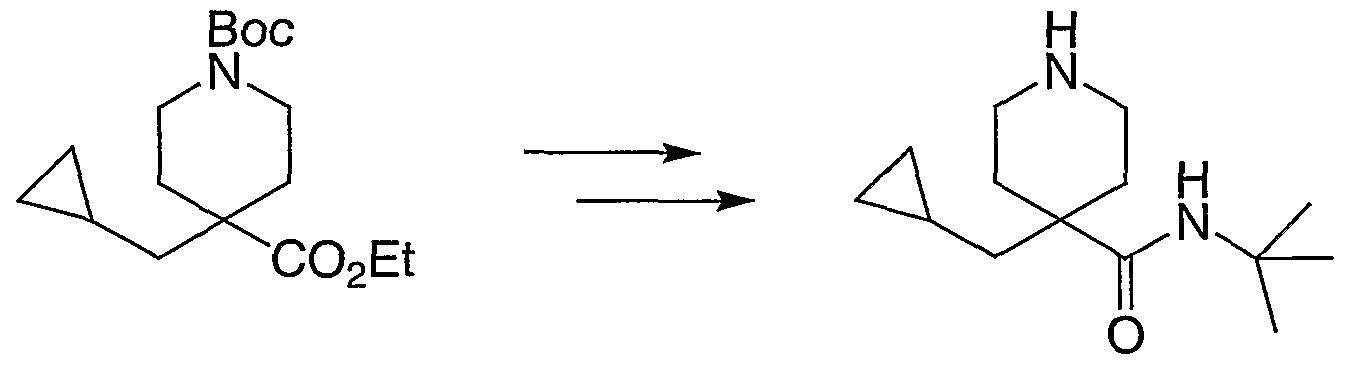
- the catalyst was filtered off and solvent was removed to give a colorless oil, which was dissolved in methanol and made basic by addition of NaOH (5N, 4 ml) and concentrated. The residue was partitioned between water and CH 2 C1 2 , the two layers separated, and the aqueous layer extracted with CH 2 C1 2 . The combined organic extracts were washed with brine, dried over MgSO 4 and concentrated to give the title compound as a colorless oil (2.1 g).
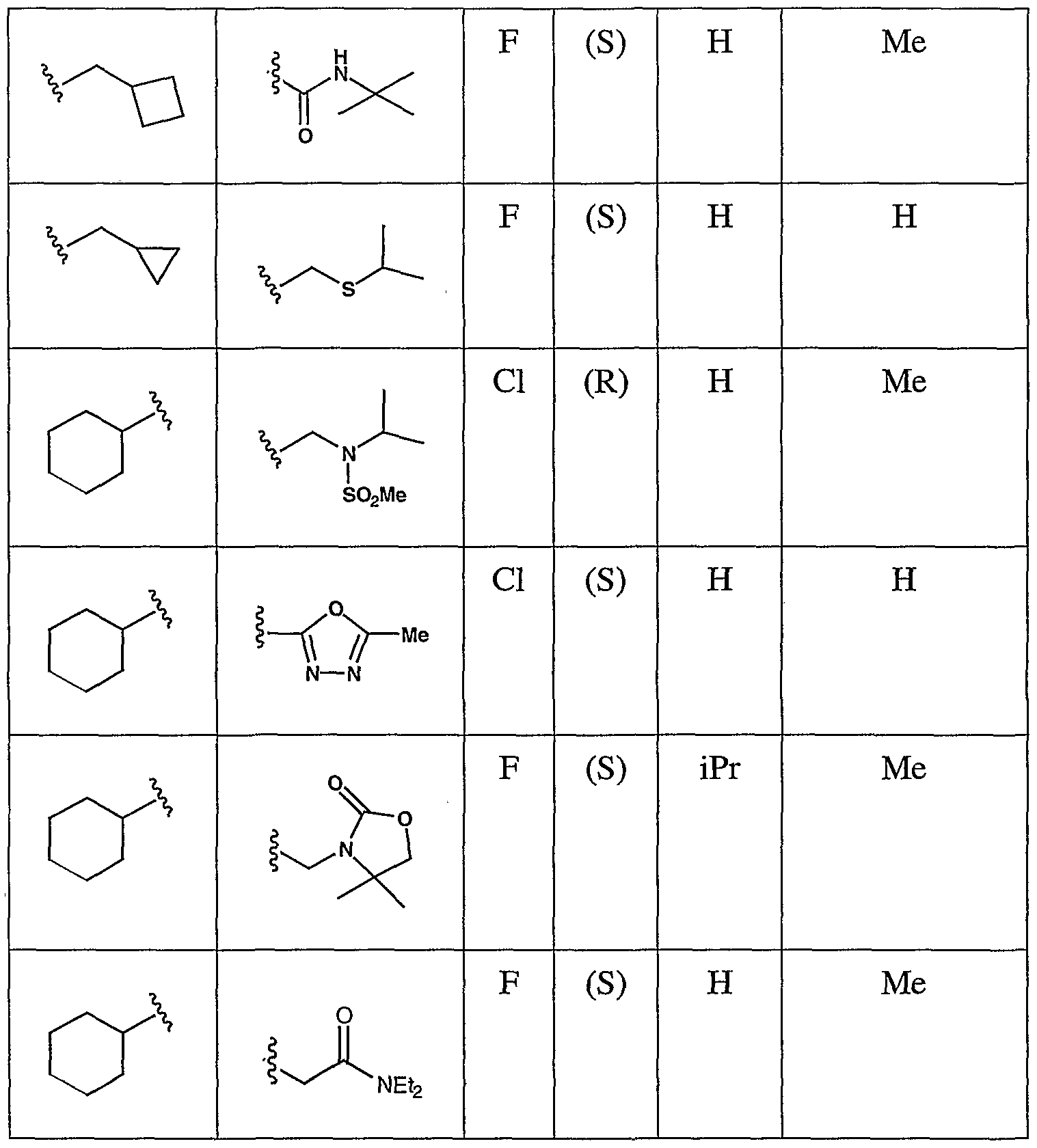
- This intermediate was prepared in the same manner as Intermediate 23 but using cyclobutylmethyl bromide in place of cyclopropylmethyl bromide in the alkylation step.
- N-(Benzyloxycarbonyl)-4-cyclohexyl-piperidine-4-carboxylic acid (1-1) (2.5 g, 7.24 mmol) was dissolved in 36 mL of CH C1 2 and cooled at 0°C in an ice-H 2 O bath.
- Oxalyl chloride (2.0 M solution in CH 2 C1 2 , 3.98 mL, 7.96 mmol) was then added dropwise followed by the addition of 1-2 drops of DMF. This mixture was stirred at 0 °C for 2 h and then concentrated with toluene.
- N-Boc-(D)-4-chlorophenylalanine (0.935 g, 3.12 mmol) was dissolved in 14.2 mL of methylene chloride, and then amine L3 (0.755 g, 2.84 mmol), NMM (1.20 mL, 11.36 mmol), EDC (0.598 g, 3.12 mmol), and HOBt (0.422 g, 3.12 mmol) were added. The resulting mixture was stirred at room temperature overnight, and then diluted with 20 mL of CH 2 C1 2 and washed with 20 mL of IN HCl solution, 20 mL of saturated NaHCO 3 solution, 20 mL of H O, and 20 mL of saturated NaCl solution.
- the bis-protected (S)-piperazine-2-carboxamide intermediate (2-1) was prepared by coupling amine lb) with (S)-4-(benzyloxycarbonyl)-l-(tert- butoxycarbonyl)-piperazine-2-carboxylic acid in place of (S)-4-methyl-l-(tert- butoxycarbonyl)-piperazine-2-carboxylic acid in Step I of Example 1.
- Step B Compound 2 ⁇ (0.164 g, 0.206 mmol) was dissolved in 0.6 mL of methylene chloride and 30% HBr in acetic acid (0.409 mL, 2.06 mmol) was added. The mixture was stirred at room temperature for 45 min (TLC showed no starting material). To this orange solution, diethyl ether (5 mL) was added, and the precipitate was filtered and washed with ether. The solid was dissolved in ethyl acetate and washed with IN NaOH and the aqueous layer was extracted with EtOAc. The combined organics were dried over K 2 CO 3 , filtered and concentrated to give a white solid (0.1096 g).
- Step B Compound 7b2 (0.219 g, 0.324 mmol) was dissolved in 0.80 mL of methylene chloride and 0.80 ml of trifluoroacetic acid. This solution was stirred for 30 min at room temperature, and then concentrated with toluene (5 mL X 2) and diethyl ether (5 mL X 2) to give a white foamy solid. The solid was dissolved in EtOAc and washed with IN NaOH, and the aqueous layer was extracted with EtOAc. The combined organics were dried over K 2 CO 3 , filtered and concentrated. Purification by column chromatography (5% - 10% methanol in methylene chloride) provided a white foamy solid.
- N ⁇ -(tert-butoxycarbonyl)-N ⁇ -substituted-piperazine-2-carboxylic acid amide intermediates shown in Table 6 below were prepared by reductive alkylation of N ⁇ -(tert-butoxycarbonyl)-piperazine-2-carboxylic acid methyl ester with the appropriate aldehyde or nucleophilic displacement of an alkyl halide with N&- (tert-butoxycarbonyl)-piperazine-2-carboxylic acid methyl ester, followed by saponification, and coupling with the appropriate substituted N-piperidinyl-Phe amine intermediate.
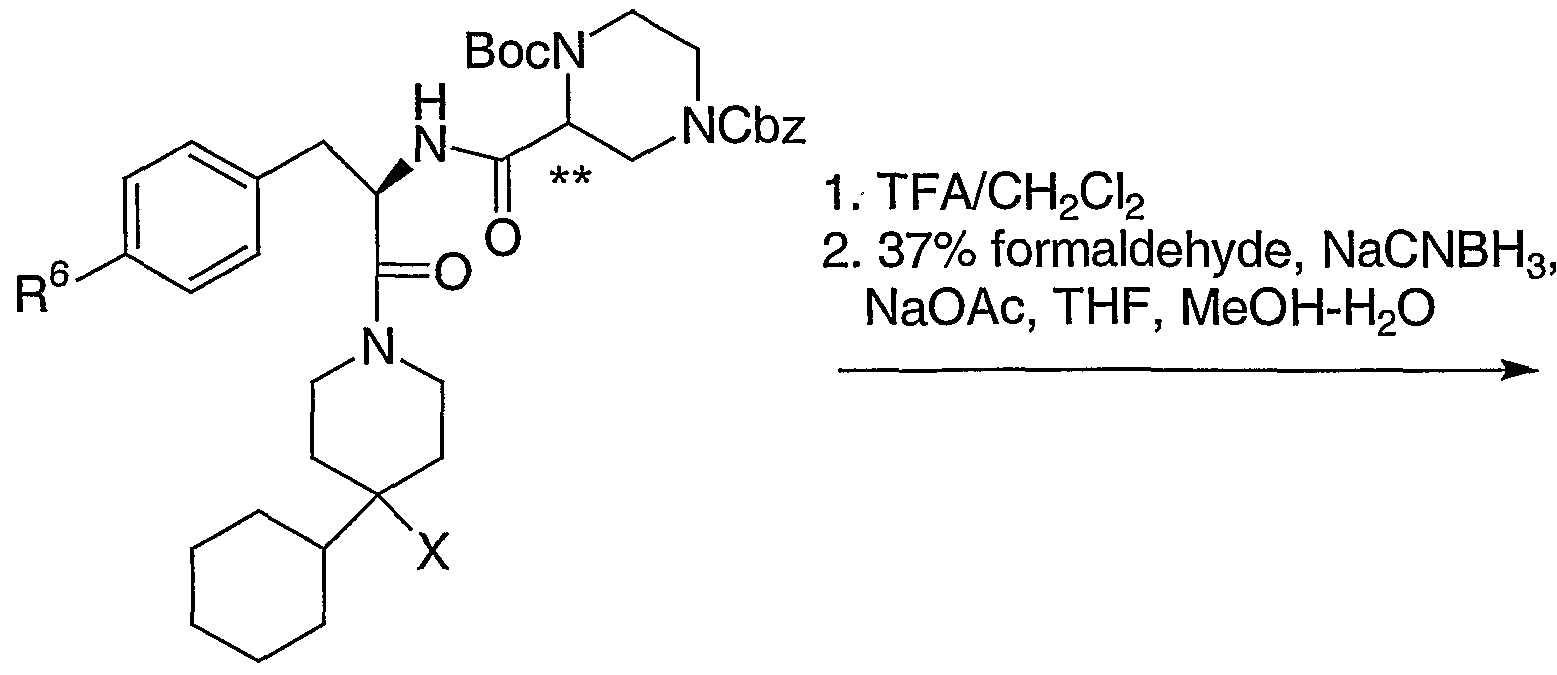
- N «-(tert-butoxycarbonyl)-N ⁇ -(Cbz)-piperazine-2- carboxylic acid was EDC-coupled with the substituted N-piperidinyl-4-halo-Phe amine intermediate, the Cbz group cleaved by hydrogenolysis (H2, Pd/C), and then either reductive alkylation of the ⁇ -piperazine nitrogen with the appropriate aldehyde or nucleophilic displacement of an alkyl halide.
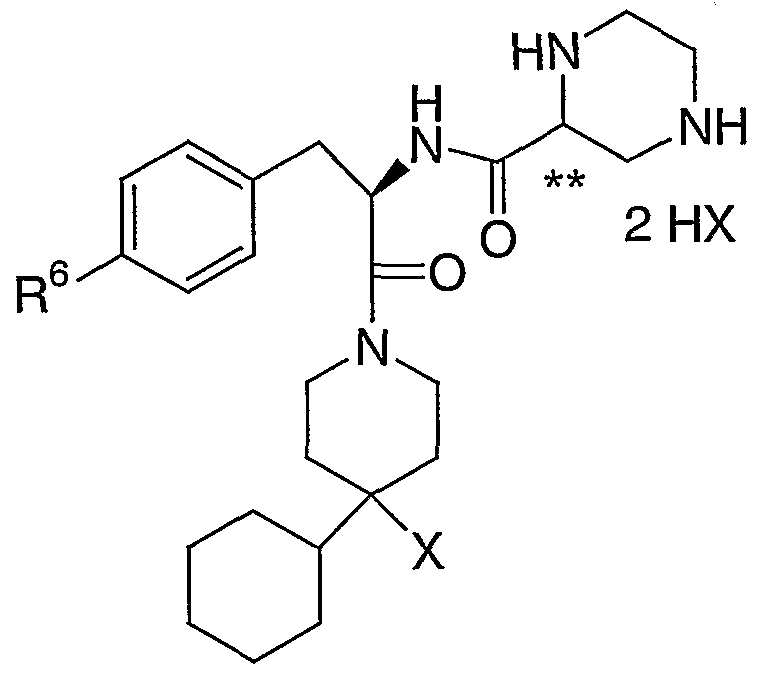
- N 0C -unsubstituted-N ⁇ -(R4b)-piperazine Examples shown in Table 7 below above with the indicated stereochemistry at the stereogenic center marked with ** were prepared as their bis-hydrochloride salts by cleavage of the N0L(Boc) group in the corresponding compounds in Table 6 to afford the trifluoroacetate salt, which upon neutralization and subsequent treatment with HCl in diethyl ether afforded the hydrochloride salt.
- Step A 4-Phenyl-l,4-piperidinedicarboxylic acid l-(l.l-dimethylethyl) ester
- Step B 4-Cyclohexyl-4-piperidinecarboxylic acid hydrochloride (8-3) 4-Phenyl-l,4-piperidinedicarboxylic acid l-(l,l-dimethylethyl) ester
- Step C 4-Cyclohexyl-l,4-piperidinedicarboxylic acid l-(phenylmethyl) ester
- the residue was diluted with 2 L of water and the pH was adjusted to about 12 using 5 N NaOH solution.
- the mixture was then extracted with 1 L of ethyl acetate.
- the aqueous layer was acidified to pH 1.5-2.0 using 2 N HCl solution, and extracted with three 1-L portions of ethyl acetate.
- the combined organic layers were washed with 1 L of saturated sodium chloride solution, dried over sodium sulfate, filtered and concentrated to give 165 g of title compound 8 ⁇ 4 as a white solid.
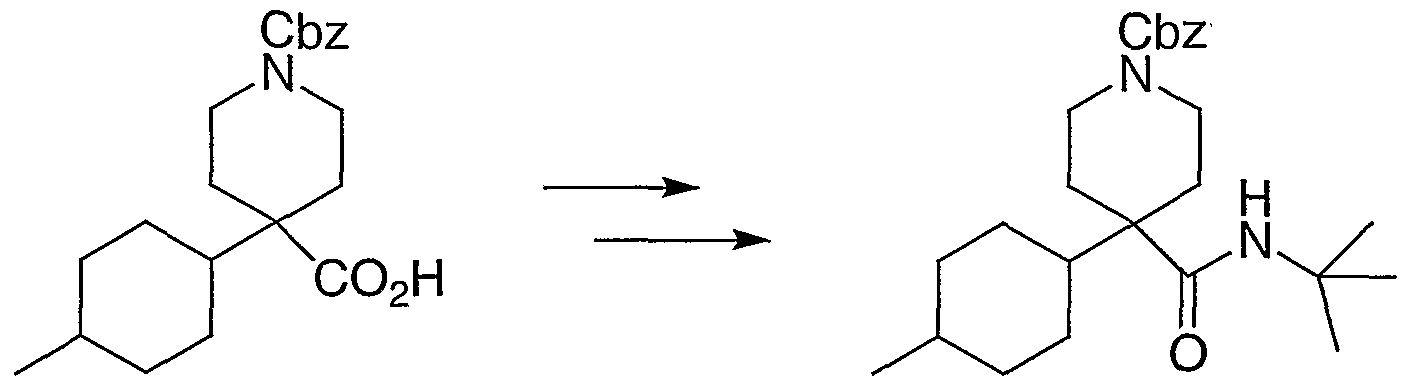
- Step D 4-Cyclohexyl-4-r r (l,l-dimethylethyl)amino1carbonyl1-l- piperidinecarboxylic acid phenylmethyl ester (8-5) 4-Cyclohexyl-l,4-piperidinedicarboxylic acid 1 -(phenylmethyl) ester (8-4) (2.50 g, 7.24 mmol) was dissolved in 36 mL of methylene chloride and cooled at 0°C in an ice-water bath. Oxalyl chloride (2.0 M solution in CH 2 C1 2 , 3.98 mL, 7.96 mmol) was then added dropwise followed by the addition of 1-2 drops of DMF.
- Oxalyl chloride 2.0 M solution in CH 2 C1 2 , 3.98 mL, 7.96 mmol
- Step E 4-Cyclohexyl-N-(l , 1 -dimethylethyl)-4-piperidinecarboxamide (8-6) 4-Cyclohexyl-4- [[( 1 , 1 -dimethylethyl)amino]carbonyl] - 1 - piperidinecarboxylic acid phenylmethyl ester (8-5) (10.0 g, 25.0 mmol) was dissolved in 130 mL of ethyl alcohol and 10% palladium on carbon (1 g) was added. The mixture was evacuated and purged with hydrogen three times and then stirred at room temperature overnight.
- Step F r(lR)-2-r4-Cvclohexyl-4-rr(Ll-dimethylethyl)amino1carbonyll-l- piperidinyll - 1 - r(4-fluorophenyl)methyl1 -2-oxoethyll carbamic acid 1.1-dimethylethyl ester (8-7) ⁇ -Boc-( )-4-fluorophenylalanine (7.26 g, 25.63 mmol) was dissolved in 116.5 mL of methylene chloride, and amine 8 ⁇ 6 (6.21 g, 23.3 mmol), DIEA (16.2 mL, 93.2 mmol), EDC • HCl (4.91 g, 25.6 mmol), and HOBt (3.46 g, 25.6 mmol) were added.
- Steps G and H (2Sb2-r.. (lRV2-r4-cvclohexyl-4-rr(Ll- dimethylethyl)amino ⁇
- Steps I and J (2S)-2-rrr(lRV2-r4-Cyclohexyl-4-rr( l- dimethylethyl)aminolcarbonyll-l-piperidinvn-l-r(4- fluorophenvDmethvn -2-oxoethyll aminol carbonyll -4-methyl- 1 - piperazinecarboxylic acid Ll-dimefhylethyl ester (8-9)
- the crude amine intermediate from Step I (3.28 g, 5.10 mmol) was dissolved in 25.5 mL of methanol, and sodium acetate (2.09 g, 25.5 mmol), trifluoroacetic acid (0.39 mL, 5.10 mmol), and 37% aqueous formaldehyde solution (1.83 mL, 24.5 mmol) were added.
- the reaction mixture was stirred at room temperature for 20 min and then sodium cyanoborohydride (1.0 M in THF, 16.3 mL, 16.3 mmol) was added.
- the resulting mixture was stirred at room temperature overnight and then concentrated to give a white sludge.
- Steps K and L (2S)-N-r(lR)-2-r4-Cvclohexyl-4-IT(Ll- dimethylethyl)amino1carbonyl1-l-piperidinyl1-l-r(4- fluorophenyDmethyll -2-oxoethyll -4-methyl-2- piperazinecarboxamide dihvdrochloride (8-11)
- Step L The crude amine from Step K (1.89 g, 3.39 mmol) was dissolved in 8 mL of methylene chloride and 1.0 M HCl in ethyl ether (8.13 mL, 8.13 mmol) was added. The precipitate was filtered and dried under vacuum to give 2.09 g as a white solid.
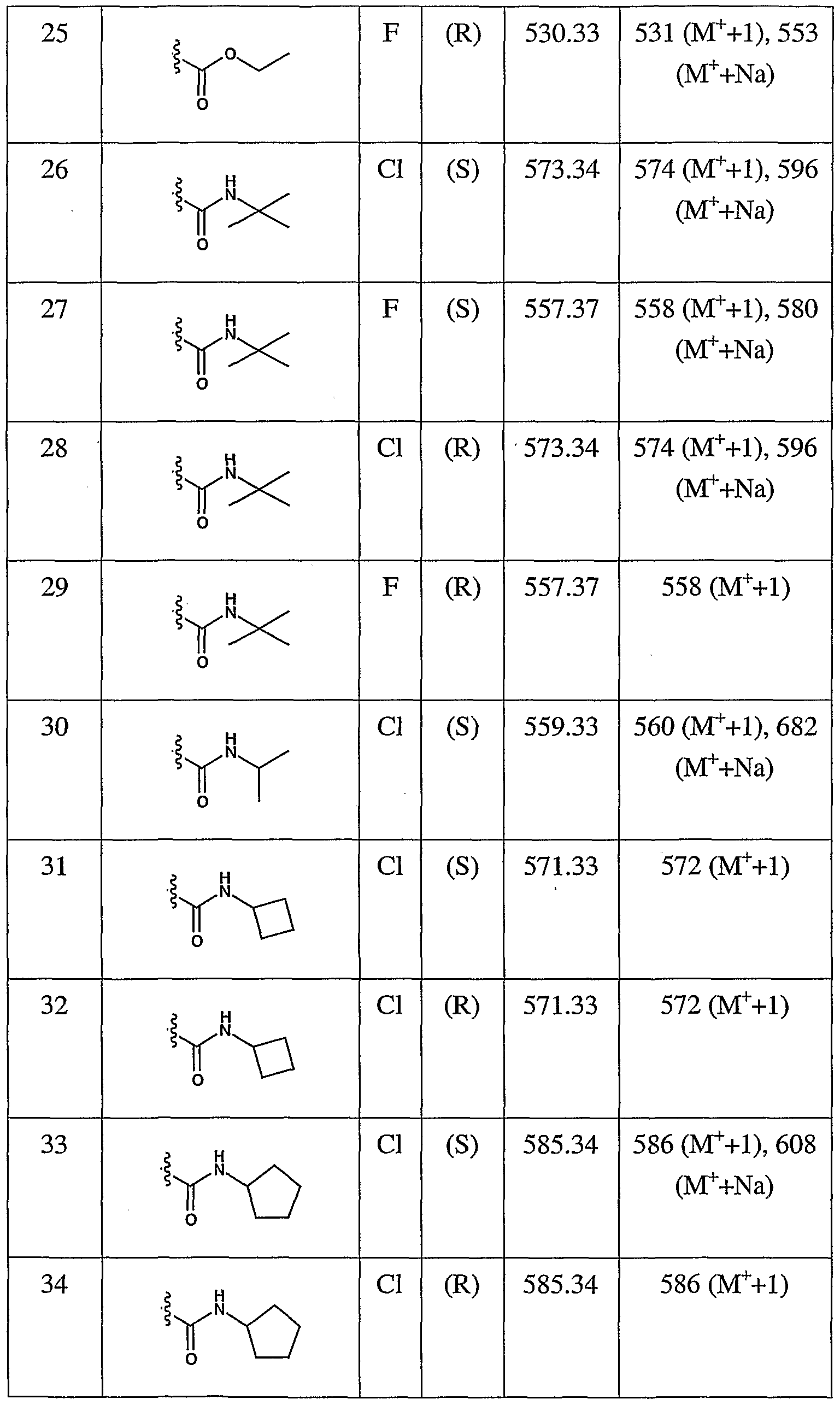
- Example 103 was prepared in a similar fashion as Example 102, but using the 4-cyclohexyl-4-(ethoxycarbonyl)-piperidine intermediate instead; mass spectrum: Calcd for C3 2 H 49 N4O4CI: 588.34; Found: 589 (MM).
- Step B Ester 11-2 (0.022 g, 0.081 mmol) was dissolved in 0.5 mL of methanol and lithium hydroxide in 0.5 mL of water was added. The mixture was stirred at 50°C overnight, and then concentrated. The residue was dissolved in water and then the pH was adjusted to about 6. The solution was then concentrated twice with toluene to give 11-3 as a solid. Mass spectrum: Calcd for C 1 H 22 N 2 O 4 : 258.16; Found: 259 (MM).
- the crude acid 11-3 (0.081 mmol) was dissolved in 0.4 mL of methylene chloride, and then the amine intermediate 1-5 (0.033 g, 0.074 mmol), NMM (0.033 mL, 0.296 mmol), EDC (0.016 g, 0.074 mmol), and HOBt (0.011 g, 0.074 mmol) were added.
- the resulting mixture was stirred at room temperature overnight, and then diluted with 5 mL of CH 2 C1 2 and washed with 2 mL of IN HCl, 2 mL of saturated NaHCO 3 , 2 mL of H O, and 2 mL of saturated NaCl solution, dried over MgSO , filtered and concentrated to give a yellow oil.
- Step D Intermediate 11-4 was dissolved in 0.05 mL of methylene chloride and
- Ester 12-2 was dissolved in methanol and IN NaOH solution was added. The mixture was stirred at room temperature overnight, and then concentrated.
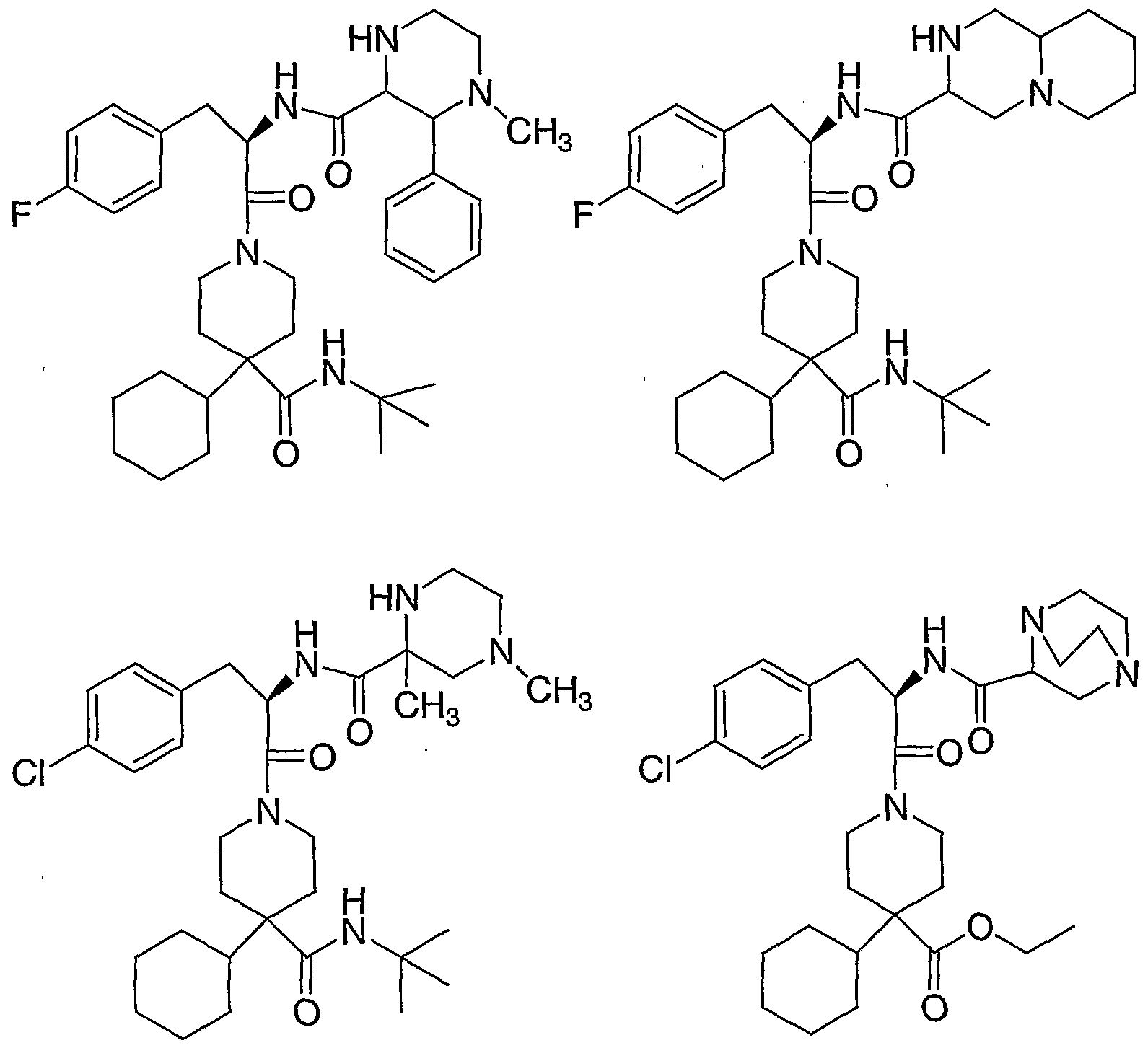
- Bridged piperazine acid 12-3 was coupled with the appropriate amine, and the isolated product was treated with HCl in diethyl ether to afford Examples 105- 111 as their bis-hydrochloride salts.
- Example 112 was prepared in a similar fashion as Examples 105-111 but using the D-3-(2-naphthyl)alanine-derived amine intermediate for the coupling reaction. Mass spectrum: Calcd for C 34 H 46 N 4 O 4 : 574.35; Found: 575 (MM).
- the required saturated quinoxaline intermediate 13-4 was prepared as follows:
- Step A Cis-l,2-diaminocyclohexane (13-1) (2.95 g, 25.87 mmol) was charged with 45 mL of THF, benzaldehyde (5.78 mL, 56.91 mmol) and MgSO 4 (1.61 g), and stirred at room temperature for 2 h. The mixture was filtered and the solution was concentrated. The residue was dissolved in methanol (129.35 mL) and sodium acetate was added. After 20 min, sodium cyanoborohydride (1.0 M in THF, 77.6 mL, 77.6 mmol) was added, and the reaction mixture was stirred at room temperature overnight.
- Ester 13-3 (0.215 g, 0.55 mmol) was charged with 2.75 mL of methanol and a solution of lithium hydroxide (0.026 g, 1.10 mmol) in 0.5 mL of water. The mixture was stirred at 50°C for 2 days and concentrated. The residue was dissolved in water and the pH was adjusted to 6. The mixture was then concentrated with toluene twice to give 13-4 as a solid (0.351 g, 57% purity). Mass spectrum: Calcd for C 23 H 28 N 2 O 2 : 364.22; Found: 365 (MM).
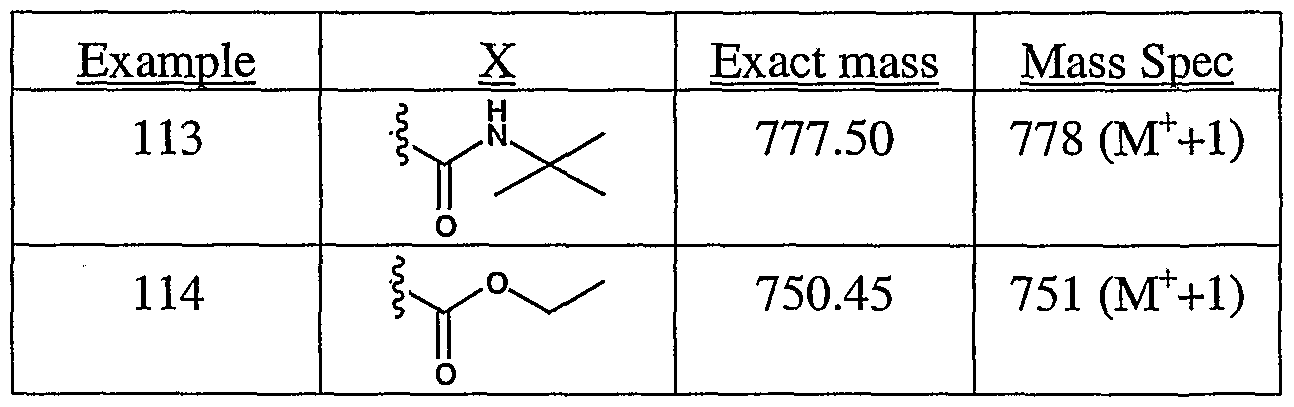
- Example 113 (0.021 g, 0.027 mmol) was charged with 0.14 mL of EtOH and 10% Pd/C (0.0063 g). A H 2 balloon was placed on the top of the condenser via a 3-way stopcock, and the system was evacuated and purged with H 2 three times. The mixture was then stirred at 60°C under H 2 overnight. The oil bath was removed and the flask was evacuated and purged with N 2 three times. The reaction mixture was filtered through a pad of Celite and concentrated to give a foamy solid. The solid was dissolved in CH 2 C1 2 and 1.0 M HCl in diethyl ether was added. The mixture was then concentrated to give Example 115 as a solid (0.017 g). Mass spectrum: Calcd for C 36 H 5 6N 5 O 3 F: 625.44; Found: 626 (MM).
- Example 114 (0.021 g, 0.027 mmol) was charged with 0.14 mL of EtOH, 3.0 M HCl (0.12 mL, 0.122 mmol), and 10% Pd/C (0.0063 g).
- a H 2 balloon was placed on the top of the condenser via 3-way stop-cock and the system was evacuated and purged with H 2 three times. The mixture was then stirred at room temperature under H 2 for 5 h. The flask was evacuated and purged with N three times, and then the reaction mixture was filtered through a pad of Celite and concentrated to give Example 116 as a solid (0.010 g).
- Mass spectrum Calcd for C 32 H 47 N 4 O 3 F: 570.36; Found: 571 (MM).
- N- ⁇ -Cbz-N- ⁇ -Boc-(D)-diaminopropionic acid (14-3) was dissolved in 75 mL of DMF, and then K 2 CO 3 (2.47 g, 17.89 mmol) and methyl iodide (4.64 mL, 74.55 mmol) were added. This mixture was stirred at RT overnight. The cloudy solution was diluted with EtOAc-H 2 O, and the aqueous layer was extracted with EtOAc. The combined organics were washed with brine, dried over MgSO 4 , filtered, and concentrated. Purification by chromatography on silica gel (30% EtOAc/hexane) gave 1 ⁇ as a clear oil (5.21 g, 99%). LCMS (ESI): m/z 253 (MM-Boc).
- Step D Compound 16-5 (0.88 g, 2.54 mmol) was dissolved in 8 mL of MeOH and IN aqueous NaOH solution (5.08 mL, 5.08 mmol) was added. The resulting mixture was stirred at RT overnight and then concentrated. Water was added and the pH was adjusted to about 2 using IN HCl solution. The acidic solution was extracted with EtOAc, and the combined organic layers were washed with brine, dried over MgSO 4 , filtered, and concentrated to give intermediate 16-6 as a white solid (0.65 g, 81%).
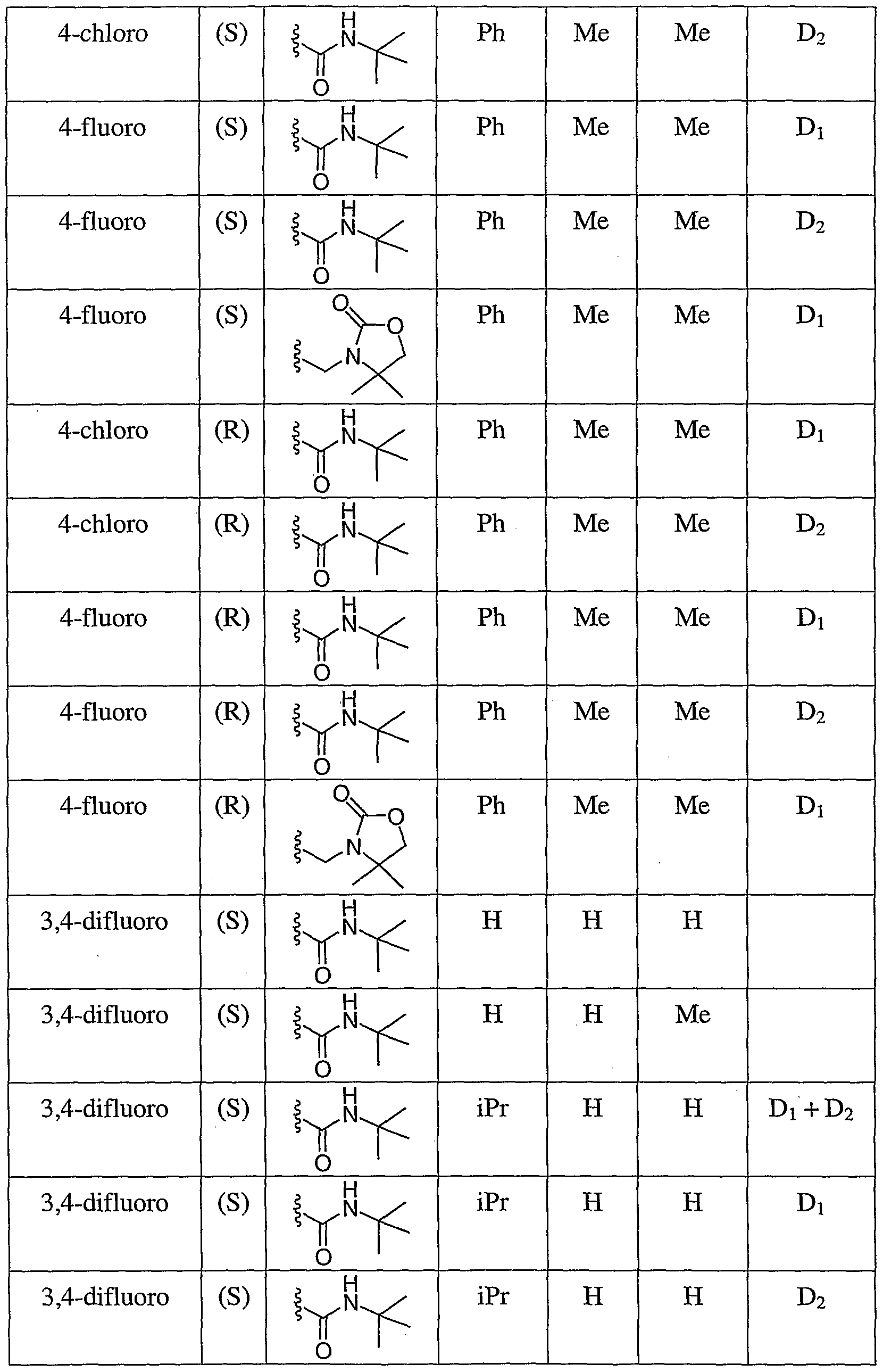
- Step E The following Examples shown in Table 12 were prepared following the procedures shown in Scheme 1 and detailed in Example 1 but using the appropriately substituted Boc-phenylalanine intermediate as prepared in Steps A-D above or commercially available Boc-phenylalanines and the appropriately protected piperazine-2-carboxylic acid intermediate.
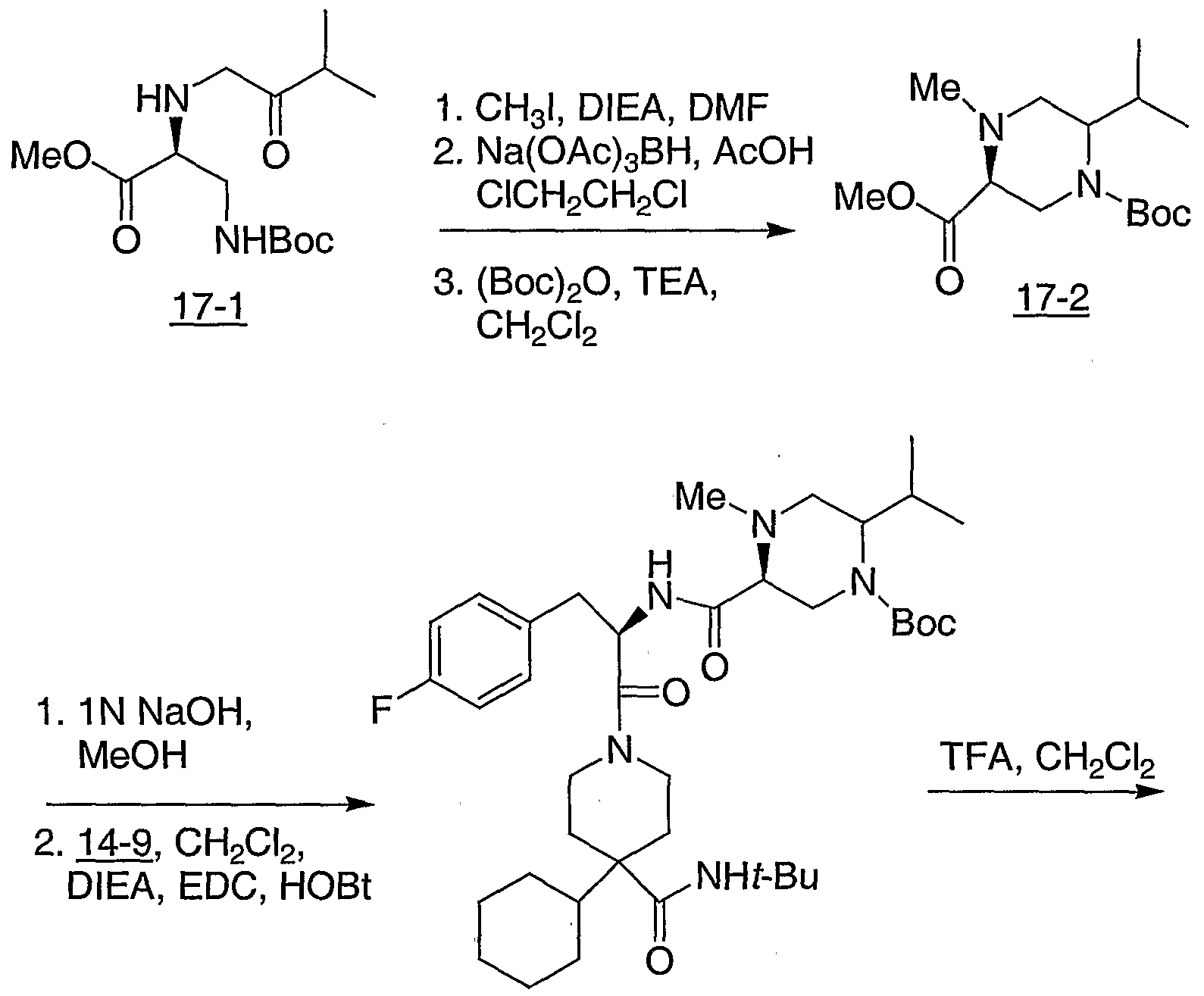
- Step A Intermediate 17-1 (0.28 g, 0.926 mmol) was dissolved in 4.6 mL of
- the crude compound was dissolved in 18 mL of 1,2- dichloroethane, and then sodium triacetoxyborohydride (0.275 g, 1.30 mmol) and acetic acid (0.053mL, 0.926 mmol) were added .
- the reaction mixture was stirred at RT under N 2 overnight.
- the reaction mixture was then diluted with 9 mL of saturated aqueous NaHCO 3 solution and then concentrated with toluene to give a yellow solid.
- the crude compound was dissolved in 4.6 mL of CH 2 C1 , and then Boc-anhydride (0.22 g, 1.02 mmol) and TEA (0.19 mL, 1.39 mmol) were added.
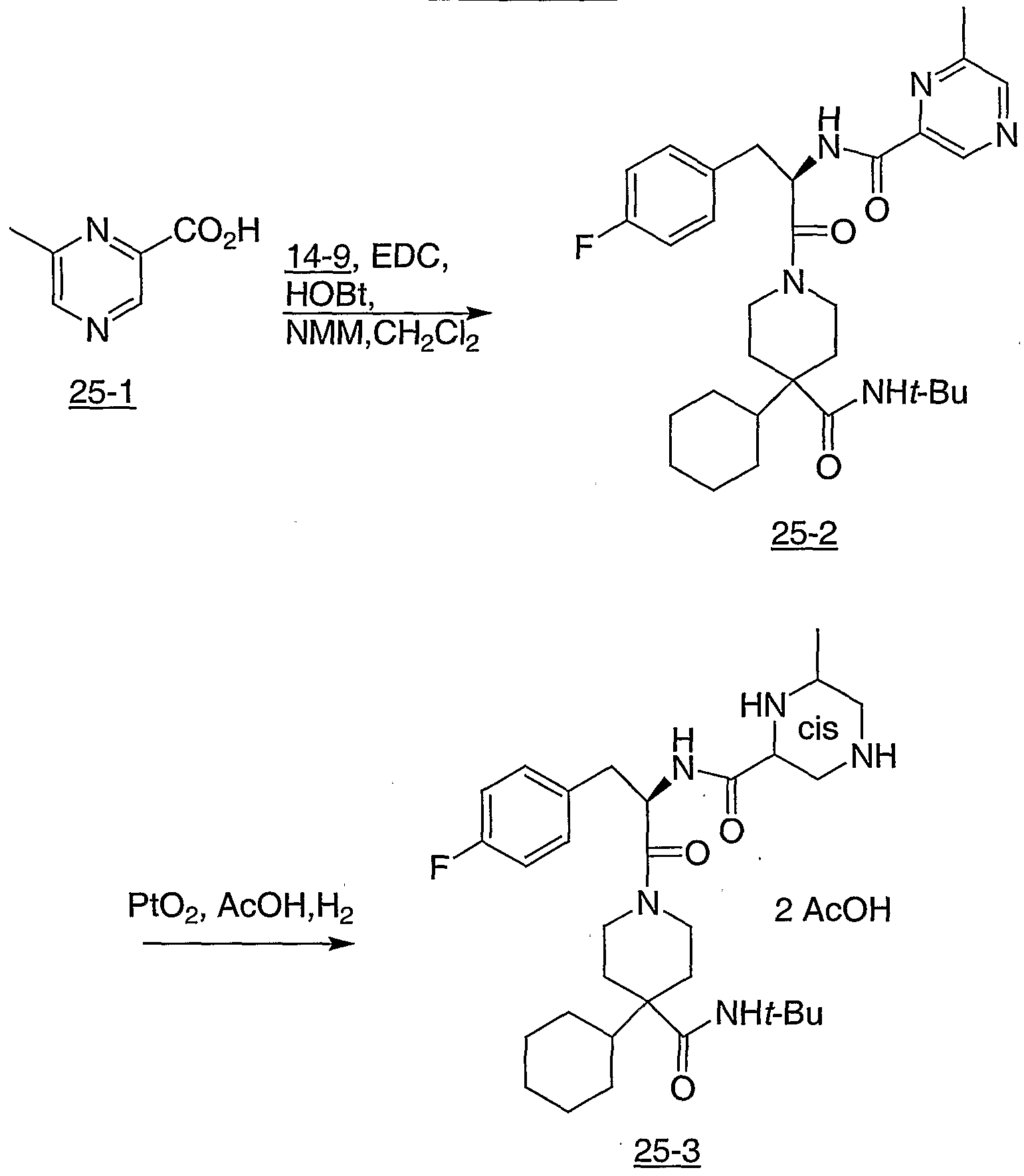
- This acid was dissolved in 0.5 mL of methylene chloride, and then the amine intermediate 14-9 (0.027 g, 0.061 mmol), DIEA (0.04 mL, 0.244 mmol), EDC (0.013 g, 0.067 mmol), and HOBt (0.009 g, 0.067 mmol) were added. The resulting mixture was stirred at room temperature overnight. The resulting mixture was diluted with CH 2 C1 2 and washed with H 2 O, and brine, and the organic phase was dried over MgSO 4 , filtered, and concentrated.
- N- -Cbz-(L)-Diaminopropionic acid (18-1) (4.0 g, 16.79 mmol) was suspended in 32 mL of MeOH and the flask was cooled at 0 °C in an ice-water bath. Chlorotrimethylsilane (4.7 mL, 36.94 mmol) was then added dropwise and the reaction mixture was stirred at 0 °C for lh, and then warmed to RT and stirred at RT overnight. This mixture was concentrated and dried under vacuum to give 18-2 as a white solid (4.77 g, 98%).
- N,N-Di-Boc-6-isopropyl-(S)-piperazine-2-carboxylic acid (18-6) (0.08 g, 0.215 mmol) was dissolved in 1.0 mL of methylene chloride, and then amine intermediate 14 9 (0.0843 g, 0.195 mmol), DIEA (0.14 mL, 0.78 mmol), EDC (0.041 g, 0.215 mmol), and HOBt (0.029 g, 0.215 mmol) were added.
- Acid 19-4 (0.51 g, 0.142 mmol) was dissolved in 0.65 mL of methylene chloride, and then amine intermediate 14-9 (0.058 g, 0.129 mmol), DIEA (0.09 mL, 0.516 mmol), EDC (0.027 g, 0.142 mmol), and HOBt (0.027 g, 0.142 mmol) were added. The resulting mixture was stirred at room temperature overnight, and then diluted with 10 mL of CH 2 C1 2 and washed with 5 mL of IN HCl solution, 5 mL of saturated NaHCO 3 solution, 5 mL of H 2 O, and 5 mL of saturated NaCl solution.
- Step B Compound 21-1 (0.999 g, 3.96 mmol) was dissolved in 20 mL of
- Acid 21-6 (0.160 mmol) was dissolved in 1.0 mL of methylene chloride, and then amine intermediate 14-9 (0.065 g, 0.145 mmol), DIEA (0.10 mL, 0.580 mmol), EDC (0.031 g, 0.160 mmol), and HOBt (0.022 g, 0.160 mmol) were added. The resulting mixture was stirred at room temperature overnight, and then diluted with 10 mL of CH 2 C1 2 and washed with 5 mL of saturated NaHCO 3 solution, 5 mL of H 2 O, and 5 mL of saturated NaCl solution. The organic phase was dried over Na 2 SO , filtered, and concentrated to give a yellow oil.
- Example 187 was prepared in a similar fashion as Example 187, but using the protected D-piperazine-2-carboxylic acid for coupling with 14-9, in place of the L-piperazine 21-6.
- Reaction mixture was filtered through a short pad of celite and concentrated to afford 22-4 as a white foam.
- Step A A mixture of 3-chloro-2,5-dimethylpyrazine (24-1) (100 mmol, 14.26 g), DPPE (5 mmol, 2.06 g), Pd(OAc) 2 (5 mmol, 1.22 g) and sodium acetate (100 mmol, 8.2 g) in DMF/H 2 O (3:1) (80 mL) was stirred at 40 psi CO at 60°C overnight. Mixture was filtered through a short pad of celite, concentrated and partitioned between CH 2 C1 2 /1N NaOH. Aqueous phase was washed with CH 2 C1 2 , acidified with 2N HCl and extracted wih EtOAc. Organic extracts were washed with brine, dried over Na 2 SO 4 and evaporated to give 24-2 (1.6 g).
- Step B To an ice-cold solution of 26-2 (171 mg, 0.249 mmol) in water (2 mL) was added a solution of NaNO 2 (20 mg, 0.28 mmol) until the resultant solution tested positive for excess nitrous acid with Kl-starch paper. The solution was neutralized with Na 2 CO 3 and was added to a suspension of KCN and CuCN in water (4 mL) at rt.
- Binding Assay The membrane binding assay was used to identify competitive inhibitors of 125 I-NDP-alpha-MSH binding to cloned human MCRs expressed in L- or CHO- cells.
- Cell lines expressing melanocortin receptors were grown in T-180 flasks containing selective medium of the composition: 1 L Dulbecco's modified Eagles Medium (DMEM) with 4.5 g L-glucose, 25 mM Hepes, without sodium pyruvate, (Gibco/BRl); 100 ml 10% heat-inactivated fetal bovine serum (Sigma); 10 ml 10,000 unit/ml penicillin & 10,000 ug ml streptomycin (Gibco BRl); 10 ml 200 mM L-glutamine (Gibco/BRl); 1 mg/ml Geneticin (G418) (Gibco/BRl). The cells were grown at 37°C with CO2 and humidity control until the desired cell density and cell number was obtained.
- DMEM Dulbecco's modified Eagles Medium
- Gibco/BRl 100 ml 10% heat-inactivated fetal bovine serum
- the medium was poured off and 10 mls/monolayer of enzyme-free dissociation media (Specialty Media Inc.) was added.
- the cells were incubated at 37°C for 10 minutes or until cells sloughed off when flask was banged against hand.
- the cells were harvested into 200 ml centrifuge tubes and spun at 1000 rpm, 4° C, for 10 min. The supernatant was discarded and the cells were resuspended in 5 mls/monolayer membrane preparation buffer having the composition: 10 M Tris pH 7.2-7.4; 4 ug/ml Leupeptin (Sigma); 10 uM Phosphoramidon (Boehringer Mannheim); 40 ug/ml Bacitracin (Sigma); 5 ug/ml Aprotinin (Sigma); 10 mM Pefabloc (Boehringer Mannheim).
- the cells were homogenized with motor-driven dounce (Talboy setting 40), using 10 strokes and the homogenate centrifuged at 6,000 rpm, 4°C, for 15 minutes.
- the pellets were resuspended in 0.2 mls/monolayer membrane prep buffer and aliquots were placed in tubes (500-1000 ul/tube) and quick frozen in liquid nitrogen and then stored at -80°C.
- Test compounds or unlabelled NDP- ⁇ -MSH was added to 100 ⁇ L of membrane binding buffer to a final concentration of 1 ⁇ M.
- the membrane binding buffer had the composition: 50 mM Tris pH 7.2; 2 mM CaC12; 1 mM MgC12; 5 mM KC1; 0.2% BSA; 4 ug/ml Leupeptin (SIGMA); 10 uM Phosphoramidon (Boehringer Mannheim); 40 ug/ml Bacitracin (SIGMA); 5 ug/ml Aprotinin (SIGMA); and 10 mM Pefabloc (Boehringer Mannheim).
- membrane binding buffer containing 10-40 ug membrane protein was added, followed by 100 ⁇ M 125I-NDP- - MSH to final concentration of 100 pM.
- the resulting mixture was vortexed briefly and incubated for 90-120 min at room temp while shaking.
- the mixture was filtered with Packard Microplate 196 filter apparatus using Packard Unifilter 96-well GF/C filter with 0.1% polyethyleneimine (Sigma).
- the filter was washed (5 times with a total of 10 ml per well) with room temperature of filter wash having the composition: 50mM Tris-HCl pH 7.2 and 20 mM NaCl.
- the filter was dried, and the bottom sealed and 50 ul of Packard Microscint-20 was added to each well. The top was sealed and the radioactivity quantitated in a Packard Topcount Microplate Scintillation counter.
- Functional assay Functional cell based assays were developed to discriminate melanocortin receptor agonists from antagonists.
- Cells for example, CHO- or L-cells or other eukaryotic cells
- a human melanocortin receptor see e.g. Yang-YK; Ollmann-MM; Wilson- BD; Dickinson-C; Yamada-T; Barsh-GS; Gantz-I; Mol-Endocrinol. 1997 Mar; 11(3): 274-80
- Ca and Mg free phosphate buffered saline 14190-136, Life Technologies, Gaithersburg, MD
- enzyme free dissociation buffer S-014-B, Specialty Media, Lavellette, NJ
- Antagonist activity was defined as the ability of a compound to block cAMP production in response to alpha-MSH.
- Solution of test compounds and suspension of receptor containing cells were prepared and mixed as described above; the mixture was incubated for 15 min., and an EC50 dose (approximately 10 nM alpha-MSH) was added to the cells. The assay was terminated at 45 min. and cAMP quantitated as above. Percent inhibition was determined by comparing the amount of cAMP produced in the presence to that produced in the absence of test compound.
- Rats are gently restrained in a supine position with their anterior torso placed inside a cylinder of adequate size to allow for normal head and paw grooming. For a 400-500 gram rat, the diameter of the cylinder is approximately 8 cm.
- the lower torso and hind limbs are restrained with a non- adhesive material (vetrap).
- An additional piece of vetrap with a hole in it, through which the glans penis will be passed, is fastened over the animal to maintain the preputial sheath in a retracted position. Penile responses will be observed, typically termed ex copula genital reflex tests.
- a series of penile erections will occur spontaneously within a few minutes after sheath retraction.
- the types of normal reflexogenic erectile responses include elongation, engorgement, cup and flip.
- An elongation is classified as an extension of the penile body.
- Engorgement is a dilation of the glans penis.
- a cup is defined as an intense erection where the distal margin of the glans penis momentarily flares open to form a cup.
- a flip is a dorsiflexion of the penile body.
- Baseline and or vehicle evaluations are conducted to determine how and if an animal will respond. Some animals have a long duration until the first response while others are non-responders altogether.
- mice can be dosed by a number of routes of administration depending on the nature of the study to be performed.
- the routes of administration includes intravenous (TV), intraperitoneal (IP), subcutaneous (SC) and intracerebral ventricular (ICN).
- TV intravenous
- IP intraperitoneal
- SC subcutaneous
- ICN intracerebral ventricular
- Rodent assays relevant to female sexual receptivity include the behavioral model of lordosis and direct observations of copulatory activity. There is also a urethrogenital reflex model in anesthetized spinally transected rats for measuring orgasm in both male and female rats. These and other established animal models of female sexual dysfunction are described in McKenna KE et al, A Model For The Study of Sexual Function In Anesthetized Male And Female Rats, Am. J. Physiol. (Regulatory Integrative Comp. Physiol 30): R1276-R1285, 1991; McKenna KE et al, Modulation By Peripheral Serotonin of The Threshold For sexual Reflexes In Female Rats. Pharm. Bioch.
- Example 2 As a specific embodiment of an oral composition of a composition of the present invention, 5 mg of Example 2 is formulated with sufficient finely divided lactose to provide a total amount of 580 to 590 mg to fill a size O hard gelatin capsule.
- Example 2 As another specific embodiment of an oral composition of a compound of the present invention, 2.5 mg of Example 2 is formulated with sufficient finely divided lactose to provide a total amount of 580 to 590 mg to fill a size O hard gelatin capsule.
- Representative compounds of the present invention were tested and found to bind to the melanocortin-4 receptor. These compounds were generally found to have IC50 values less than 2 ⁇ M. Representative compounds of the present invention were also tested in the functional assay and found generally to activate the melanocortin-4 receptor with EC50 values less than 1 ⁇ M.
Landscapes
- Chemical & Material Sciences (AREA)
- Organic Chemistry (AREA)
- Health & Medical Sciences (AREA)
- Veterinary Medicine (AREA)
- Life Sciences & Earth Sciences (AREA)
- Public Health (AREA)
- General Health & Medical Sciences (AREA)
- Bioinformatics & Cheminformatics (AREA)
- Chemical Kinetics & Catalysis (AREA)
- General Chemical & Material Sciences (AREA)
- Medicinal Chemistry (AREA)
- Nuclear Medicine, Radiotherapy & Molecular Imaging (AREA)
- Engineering & Computer Science (AREA)
- Pharmacology & Pharmacy (AREA)
- Diabetes (AREA)
- Animal Behavior & Ethology (AREA)
- Endocrinology (AREA)
- Obesity (AREA)
- Hematology (AREA)
- Reproductive Health (AREA)
- Child & Adolescent Psychology (AREA)
- Emergency Medicine (AREA)
- Gynecology & Obstetrics (AREA)
- Pharmaceuticals Containing Other Organic And Inorganic Compounds (AREA)
- Plural Heterocyclic Compounds (AREA)
- Medicines That Contain Protein Lipid Enzymes And Other Medicines (AREA)
- Nitrogen Condensed Heterocyclic Rings (AREA)
Abstract
Description


























Claims





Priority Applications (5)
| Application Number | Priority Date | Filing Date | Title |
|---|---|---|---|
| AU4929601A AU4929601A (en) | 2000-03-23 | 2001-03-20 | Substituted piperidines as melanocortin receptor agonists |
| JP2001568918A JP2003528088A (en) | 2000-03-23 | 2001-03-20 | Substituted piperidines as melanocortin receptor agonists |
| EP01922501A EP1268449A4 (en) | 2000-03-23 | 2001-03-20 | SUBSTITUTED PIPERIDINES AS MELANOCORTINE RECEPTOR AGONISTS |
| CA2403686A CA2403686C (en) | 2000-03-23 | 2001-03-20 | Substituted piperidines as melanocortin receptor agonists |
| AU2001249296A AU2001249296B2 (en) | 2000-03-23 | 2001-03-20 | Substituted piperidines as melanocortin receptor agonists |
Applications Claiming Priority (4)
| Application Number | Priority Date | Filing Date | Title |
|---|---|---|---|
| US19144200P | 2000-03-23 | 2000-03-23 | |
| US60/191,442 | 2000-03-23 | ||
| US24226500P | 2000-10-20 | 2000-10-20 | |
| US60/242,265 | 2000-10-20 |
Publications (1)
| Publication Number | Publication Date |
|---|---|
| WO2001070708A1 true WO2001070708A1 (en) | 2001-09-27 |
Family
ID=26887048
Family Applications (1)
| Application Number | Title | Priority Date | Filing Date |
|---|---|---|---|
| PCT/US2001/008935 Ceased WO2001070708A1 (en) | 2000-03-23 | 2001-03-20 | Substituted piperidines as melanocortin receptor agonists |
Country Status (6)
| Country | Link |
|---|---|
| US (1) | US6458790B2 (en) |
| EP (1) | EP1268449A4 (en) |
| JP (1) | JP2003528088A (en) |
| AU (2) | AU4929601A (en) |
| CA (1) | CA2403686C (en) |
| WO (1) | WO2001070708A1 (en) |
Cited By (108)
| Publication number | Priority date | Publication date | Assignee | Title |
|---|---|---|---|---|
| WO2002047670A1 (en) * | 2000-12-15 | 2002-06-20 | Pfizer Limited | Treatment of male sexual dysfunction |
| WO2002059107A1 (en) * | 2001-01-23 | 2002-08-01 | Eli Lilly And Company | Substituted piperidines/piperazines as melanocortin receptor agonists |
| WO2002068387A3 (en) * | 2001-02-28 | 2003-02-20 | Merck & Co Inc | Acylated piperidine derivatives as melanocortin-4 receptor agonists |
| KR20030027439A (en) * | 2001-09-28 | 2003-04-07 | 주식회사 엘지생명과학 | Melanocortin receptor agonists |
| KR20030035588A (en) * | 2001-10-31 | 2003-05-09 | 주식회사 엘지생명과학 | Melanocortin receptor agonists |
| KR20030035589A (en) * | 2001-10-31 | 2003-05-09 | 주식회사 엘지생명과학 | Melanocortin receptor agonists |
| KR20030035586A (en) * | 2001-10-31 | 2003-05-09 | 주식회사 엘지생명과학 | Melanocortin receptor agonists |
| KR20030035592A (en) * | 2001-10-31 | 2003-05-09 | 주식회사 엘지생명과학 | Melanocortin receptor agonists |
| US6589990B1 (en) | 1997-05-06 | 2003-07-08 | Panagiotis Kanakaris | Methods and compositions for misoprostol compound treatment of erectile dysfunction |
| EP1338592A1 (en) * | 2002-02-22 | 2003-08-27 | Nippon Zoki Pharmaceutical Co., Ltd. | Novel 2-phenylpiperazine derivatives |
| US6638927B2 (en) | 2000-08-31 | 2003-10-28 | Chiron Corporation | Guanidinobenzamides |
| WO2003093234A1 (en) * | 2002-04-30 | 2003-11-13 | The Procter & Gamble Company | Melanocortin receptor ligands |
| WO2003092690A1 (en) * | 2002-04-30 | 2003-11-13 | The Procter & Gamble Company | N-acyl piperidine derivatives for use as melanocortin receptor ligands in the treatment of feeding disorders |
| WO2003094918A1 (en) * | 2002-05-10 | 2003-11-20 | Neurocrine Biosciences, Inc. | Substituted piperazine as melanocortin receptors ligands |
| WO2004002986A2 (en) | 2002-06-28 | 2004-01-08 | Banyu Pharmaceutical Co., Ltd. | Novel benzimidazole derivatives |
| US6713487B2 (en) | 2001-03-02 | 2004-03-30 | Bristol-Myers Squibb Co. | Compounds useful as modulators of melanocortin receptors and pharmaceutical compositions comprising same |
| US6716840B2 (en) | 2001-04-09 | 2004-04-06 | Chiron Corporation | Guanidino compounds |
| US6818658B2 (en) | 2001-02-28 | 2004-11-16 | Merck & Co., Inc. | Acylated piperidine derivatives as melanocortin-4 receptor agonists |
| WO2005028438A1 (en) | 2003-09-22 | 2005-03-31 | Banyu Pharmaceutical Co., Ltd. | Novel piperidine derivative |
| US6897239B1 (en) | 1998-08-14 | 2005-05-24 | Lavipharm S.A. | Use of misoprostol and/or metabolites of misoprostol for treating sexual dysfunction in women |
| WO2005047251A1 (en) * | 2003-11-12 | 2005-05-26 | Lg Life Sciences Ltd. | Melanocortin receptor agonists |
| WO2005047253A1 (en) * | 2003-11-12 | 2005-05-26 | Lg Life Sciences Ltd. | Melanocortin receptor agonists |
| US6911447B2 (en) | 2001-04-25 | 2005-06-28 | The Procter & Gamble Company | Melanocortin receptor ligands |
| WO2005097759A1 (en) | 2004-03-29 | 2005-10-20 | Merck & Co., Inc. | Diaryltriazoles as inhibitors of 11-beta-hydroxysteroid dehydrogenase-1 |
| FR2873690A1 (en) * | 2004-07-29 | 2006-02-03 | Sanofi Synthelabo | OXOPIPERIDINE DERIVATIVES, THEIR PREPARATION AND THEIR THERAPEUTIC APPLICATION |
| WO2006017542A1 (en) | 2004-08-06 | 2006-02-16 | Merck & Co., Inc. | Sulfonyl compounds as inhibitors of 11-beta-hydroxysteroid dehydrogenase-1 |
| US7012084B2 (en) | 2001-02-28 | 2006-03-14 | Merck & Co., Inc. | Acylated piperidine derivatives as melanocortin-4 receptor agonists |
| US7034033B2 (en) | 2002-05-23 | 2006-04-25 | Chiron Corporation | Substituted quinazolinone compounds |
| US7049323B2 (en) | 2003-04-25 | 2006-05-23 | Bristol-Myers Squibb Company | Amidoheterocycles as modulators of the melanocortin-4 receptor |
| US7115628B2 (en) | 2001-07-18 | 2006-10-03 | Merck & Co., Inc. | Bridged piperidine derivatives as melanocortin receptor agonists |
| US7132539B2 (en) | 2002-10-23 | 2006-11-07 | The Procter & Gamble Company | Melanocortin receptor ligands |
| WO2006129826A1 (en) | 2005-05-30 | 2006-12-07 | Banyu Pharmaceutical Co., Ltd. | Novel piperidine derivative |
| US7160886B2 (en) | 2003-03-03 | 2007-01-09 | Merck & Co., Inc. | Acylated piperazine derivatives as melanocortin-4 receptor agonists |
| US7169777B2 (en) | 2001-01-23 | 2007-01-30 | Eli Lilly And Company | Melanocortin receptor agonists |
| WO2007018248A1 (en) | 2005-08-10 | 2007-02-15 | Banyu Pharmaceutical Co., Ltd. | Pyridone compound |
| WO2007024004A1 (en) | 2005-08-24 | 2007-03-01 | Banyu Pharmaceutical Co., Ltd. | Phenylpyridone derivative |
| US7186715B2 (en) | 2001-01-08 | 2007-03-06 | Eli Lilly And Company | Piperazine- and piperidine-derivatives as melanocortin receptor agonists |
| WO2007029847A1 (en) | 2005-09-07 | 2007-03-15 | Banyu Pharmaceutical Co., Ltd. | Bicyclic aromatic substituted pyridone derivative |
| WO2007041052A2 (en) | 2005-09-29 | 2007-04-12 | Merck & Co., Inc. | Acylated spiropiperidine derivatives as melanocortin-4 receptor modulators |
| WO2007049798A1 (en) | 2005-10-27 | 2007-05-03 | Banyu Pharmaceutical Co., Ltd. | Novel benzoxathiin derivative |
| WO2007055418A1 (en) | 2005-11-10 | 2007-05-18 | Banyu Pharmaceutical Co., Ltd. | Aza-substituted spiro derivative |
| EP1801098A1 (en) | 2005-12-16 | 2007-06-27 | Merck Sante | 2-Adamantylurea derivatives as selective 11B-HSD1 inhibitors |
| US7276520B2 (en) | 2003-03-26 | 2007-10-02 | Merck & Co., Inc. | Bicyclic piperidine derivatives as melanocortin-4 receptor agonists |
| US7307063B2 (en) | 2001-02-13 | 2007-12-11 | Palatin Technologies, Inc. | Melanocortin metallopeptides for treatment of sexual dysfunction |
| WO2004058735A3 (en) * | 2002-12-20 | 2007-12-27 | Neurocrine Biosciences Inc | Ligands of melanocortin receptors and compositions and methods related thereto |
| US7314879B2 (en) | 2002-01-23 | 2008-01-01 | Eli Lilly And Company | Melanocortin receptor agonists |
| WO2008007930A1 (en) * | 2006-07-14 | 2008-01-17 | Lg Life Sciences Ltd. | Melanocortin receptor agonists |
| WO2008038692A1 (en) | 2006-09-28 | 2008-04-03 | Banyu Pharmaceutical Co., Ltd. | Diaryl ketimine derivative |
| US7368453B2 (en) | 2003-11-19 | 2008-05-06 | Chiron Corporation | Quinazolinone compounds with reduced bioaccumulation |
| WO2008074384A1 (en) | 2006-12-21 | 2008-06-26 | Merck Patent Gmbh | 2-ADAMANTYL-BUTYRAMIDE DERIVATIVES AS SELECTIVE 11βETA-HSD1 INHIBITORS |
| US7414057B2 (en) | 2002-09-11 | 2008-08-19 | Merck & Co., Inc. | Piperazine urea derivatives as melanocortin-4 receptor agonists |
| WO2008120653A1 (en) | 2007-04-02 | 2008-10-09 | Banyu Pharmaceutical Co., Ltd. | Indoledione derivative |
| EP2088154A1 (en) | 2004-03-09 | 2009-08-12 | Ironwood Pharmaceuticals, Inc. | Methods and compositions for the treatment of gastrointestinal disorders |
| WO2009110510A1 (en) | 2008-03-06 | 2009-09-11 | 萬有製薬株式会社 | Alkylaminopyridine derivative |
| WO2009119726A1 (en) | 2008-03-28 | 2009-10-01 | 萬有製薬株式会社 | Diarylmethylamide derivative having antagonistic activity on melanin-concentrating hormone receptor |
| EP2110374A1 (en) | 2008-04-18 | 2009-10-21 | Merck Sante | Benzofurane, benzothiophene, benzothiazol derivatives as FXR modulators |
| US7618987B2 (en) | 2004-07-19 | 2009-11-17 | Merck & Co., Inc. | Acylated piperidine derivatives as melanocortin 4-receptor agonists |
| US7625909B2 (en) | 2003-05-23 | 2009-12-01 | Novartis Vaccines And Diagnostics, Inc. | Substituted quinazolinone compounds |
| WO2009154132A1 (en) | 2008-06-19 | 2009-12-23 | 萬有製薬株式会社 | Spirodiamine-diarylketoxime derivative |
| US7652024B2 (en) | 2005-10-18 | 2010-01-26 | Merck Sharp & Dohme Corp. | Acylated spiropiperidine derivatives as melanocortin-4 receptor modulators |
| WO2010013595A1 (en) | 2008-07-30 | 2010-02-04 | 萬有製薬株式会社 | (5-membered)-(5-membered) or (5-membered)-(6-membered) fused ring cycloalkylamine derivative |
| US7691843B2 (en) | 2002-07-11 | 2010-04-06 | Pfizer Inc. | N-hydroxyamide derivatives possessing antibacterial activity |
| WO2010047982A1 (en) | 2008-10-22 | 2010-04-29 | Merck Sharp & Dohme Corp. | Novel cyclic benzimidazole derivatives useful anti-diabetic agents |
| WO2010051206A1 (en) | 2008-10-31 | 2010-05-06 | Merck Sharp & Dohme Corp. | Novel cyclic benzimidazole derivatives useful anti-diabetic agents |
| WO2010056022A2 (en) | 2008-11-12 | 2010-05-20 | Lg Life Sciences Ltd. | Melanocortin receptor agonists |
| WO2010056717A1 (en) | 2008-11-17 | 2010-05-20 | Merck Sharp & Dohme Corp. | Substituted bicyclic amines for the treatment of diabetes |
| WO2011011506A1 (en) | 2009-07-23 | 2011-01-27 | Schering Corporation | Spirocyclic oxazepine compounds as stearoyl-coenzyme a delta-9 desaturase inhibitors |
| WO2011011508A1 (en) | 2009-07-23 | 2011-01-27 | Schering Corporation | Benzo-fused oxazepine compounds as stearoyl-coenzyme a delta-9 desaturase inhibitors |
| EP2305352A1 (en) | 2004-04-02 | 2011-04-06 | Merck Sharp & Dohme Corp. | 5-alpha-reductase inhibitors for use in the treatment of men with metabolic and anthropometric disorders |
| WO2011058193A1 (en) | 2009-11-16 | 2011-05-19 | Mellitech | [1,5]-diazocin derivatives |
| WO2011069038A2 (en) | 2009-12-03 | 2011-06-09 | Synergy Pharmaceuticals, Inc. | Agonists of guanylate cyclase useful for the treatment of hypercholesterolemia, atherosclerosis, coronary heart disease, gallstone, obesity and other cardiovascular diseases |
| EP2332526A2 (en) | 2005-10-21 | 2011-06-15 | Novartis AG | Combination of a renin-inhibitor and an anti-dyslipidemic agent and/or an antiobesity agent |
| WO2011106273A1 (en) | 2010-02-25 | 2011-09-01 | Merck Sharp & Dohme Corp. | Novel cyclic benzimidazole derivatives useful anti-diabetic agents |
| WO2011137024A1 (en) | 2010-04-26 | 2011-11-03 | Merck Sharp & Dohme Corp. | Novel spiropiperidine prolylcarboxypeptidase inhibitors |
| WO2011143057A1 (en) | 2010-05-11 | 2011-11-17 | Merck Sharp & Dohme Corp. | Novel prolylcarboxypeptidase inhibitors |
| WO2011156246A1 (en) | 2010-06-11 | 2011-12-15 | Merck Sharp & Dohme Corp. | Novel prolylcarboxypeptidase inhibitors |
| US8247442B2 (en) | 2006-03-29 | 2012-08-21 | Purdue Pharma L.P. | Benzenesulfonamide compounds and their use |
| WO2012116145A1 (en) | 2011-02-25 | 2012-08-30 | Merck Sharp & Dohme Corp. | Novel cyclic azabenzimidazole derivatives useful as anti-diabetic agents |
| US8399486B2 (en) | 2007-04-09 | 2013-03-19 | Purdue Pharma L.P. | Benzenesulfonyl compounds and the use thereof |
| US8476227B2 (en) | 2010-01-22 | 2013-07-02 | Ethicon Endo-Surgery, Inc. | Methods of activating a melanocortin-4 receptor pathway in obese subjects |
| WO2013138352A1 (en) | 2012-03-15 | 2013-09-19 | Synergy Pharmaceuticals Inc. | Formulations of guanylate cyclase c agonists and methods of use |
| WO2014022528A1 (en) | 2012-08-02 | 2014-02-06 | Merck Sharp & Dohme Corp. | Antidiabetic tricyclic compounds |
| US8648073B2 (en) | 2009-12-30 | 2014-02-11 | Fochon Pharma, Inc. | Certain dipeptidyl peptidase inhibitors |
| EP2698157A1 (en) | 2006-09-22 | 2014-02-19 | Merck Sharp & Dohme Corp. | Method of treatment using fatty acid synthesis inhibitors |
| US8765736B2 (en) | 2007-09-28 | 2014-07-01 | Purdue Pharma L.P. | Benzenesulfonamide compounds and the use thereof |
| US8791264B2 (en) | 2006-04-13 | 2014-07-29 | Purdue Pharma L.P. | Benzenesulfonamide compounds and their use as blockers of calcium channels |
| WO2014130608A1 (en) | 2013-02-22 | 2014-08-28 | Merck Sharp & Dohme Corp. | Antidiabetic bicyclic compounds |
| WO2014139388A1 (en) | 2013-03-14 | 2014-09-18 | Merck Sharp & Dohme Corp. | Novel indole derivatives useful as anti-diabetic agents |
| WO2014151200A2 (en) | 2013-03-15 | 2014-09-25 | Synergy Pharmaceuticals Inc. | Compositions useful for the treatment of gastrointestinal disorders |
| WO2014151206A1 (en) | 2013-03-15 | 2014-09-25 | Synergy Pharmaceuticals Inc. | Agonists of guanylate cyclase and their uses |
| EP2810951A2 (en) | 2008-06-04 | 2014-12-10 | Synergy Pharmaceuticals Inc. | Agonists of guanylate cyclase useful for the treatment of gastrointestinal disorders, inflammation, cancer and other disorders |
| WO2014197720A2 (en) | 2013-06-05 | 2014-12-11 | Synergy Pharmaceuticals, Inc. | Ultra-pure agonists of guanylate cyclase c, method of making and using same |
| US8937181B2 (en) | 2006-04-13 | 2015-01-20 | Purdue Pharma L.P. | Benzenesulfonamide compounds and the use thereof |
| WO2015051725A1 (en) | 2013-10-08 | 2015-04-16 | Merck Sharp & Dohme Corp. | Antidiabetic tricyclic compounds |
| US9044606B2 (en) | 2010-01-22 | 2015-06-02 | Ethicon Endo-Surgery, Inc. | Methods and devices for activating brown adipose tissue using electrical energy |
| WO2016030534A1 (en) | 2014-08-29 | 2016-03-03 | Tes Pharma S.R.L. | INHIBITORS OF α-AMINO-β-CARBOXYMUCONIC ACID SEMIALDEHYDE DECARBOXYLASE |
| EP2998314A1 (en) | 2007-06-04 | 2016-03-23 | Synergy Pharmaceuticals Inc. | Agonists of guanylate cyclase useful for the treatment of gastrointestinal disorders, inflammation, cancer and other disorders |
| EP3241839A1 (en) | 2008-07-16 | 2017-11-08 | Synergy Pharmaceuticals Inc. | Agonists of guanylate cyclase useful for the treatment of gastrointestinal, inflammation, cancer and other disorders |
| WO2018069532A1 (en) | 2016-10-14 | 2018-04-19 | Tes Pharma S.R.L. | Inhibitors of alpha-amino-beta-carboxymuconic acid semialdehyde decarboxylase |
| WO2018106518A1 (en) | 2016-12-06 | 2018-06-14 | Merck Sharp & Dohme Corp. | Antidiabetic heterocyclic compounds |
| WO2018118670A1 (en) | 2016-12-20 | 2018-06-28 | Merck Sharp & Dohme Corp. | Antidiabetic spirochroman compounds |
| US10080884B2 (en) | 2014-12-29 | 2018-09-25 | Ethicon Llc | Methods and devices for activating brown adipose tissue using electrical energy |
| US10092738B2 (en) | 2014-12-29 | 2018-10-09 | Ethicon Llc | Methods and devices for inhibiting nerves when activating brown adipose tissue |
| US10294214B2 (en) | 2016-06-07 | 2019-05-21 | Vanderbilt University | Positive allosteric modulators of human melanocortin-4 receptor |
| WO2020104456A1 (en) | 2018-11-20 | 2020-05-28 | Tes Pharma S.R.L | INHIBITORS OF α-AMINO-β-CARBOXYMUCONIC ACID SEMIALDEHYDE DECARBOXYLASE |
| WO2021091283A1 (en) * | 2019-11-07 | 2021-05-14 | Lg Chem, Ltd. | Melanocortin-4 receptor agonists |
| RU2786864C1 (en) * | 2019-11-07 | 2022-12-26 | ЭлДжи КЕМ, ЛТД. | Melanocortin-4 receptor agonists |
| CN116891439A (en) * | 2023-07-11 | 2023-10-17 | 天津绿菱气体有限公司 | A kind of preparation method of 2-methylpiperazine |
Families Citing this family (23)
| Publication number | Priority date | Publication date | Assignee | Title |
|---|---|---|---|---|
| US20020091129A1 (en) * | 2000-11-20 | 2002-07-11 | Mitradev Boolell | Treatment of premature ejaculation |
| US7456184B2 (en) | 2003-05-01 | 2008-11-25 | Palatin Technologies Inc. | Melanocortin receptor-specific compounds |
| US7732451B2 (en) | 2001-08-10 | 2010-06-08 | Palatin Technologies, Inc. | Naphthalene-containing melanocortin receptor-specific small molecule |
| US7655658B2 (en) | 2001-08-10 | 2010-02-02 | Palatin Technologies, Inc. | Thieno [2,3-D]pyrimidine-2,4-dione melanocortin-specific compounds |
| US7354923B2 (en) * | 2001-08-10 | 2008-04-08 | Palatin Technologies, Inc. | Piperazine melanocortin-specific compounds |
| US7718802B2 (en) | 2001-08-10 | 2010-05-18 | Palatin Technologies, Inc. | Substituted melanocortin receptor-specific piperazine compounds |
| WO2003013571A1 (en) * | 2001-08-10 | 2003-02-20 | Palatin Technologies, Inc. | Peptidomimetics of biologically active metallopeptides |
| US6873883B2 (en) * | 2001-12-26 | 2005-03-29 | Hewlett-Packard Development Company, L.P. | Adaptive fan controller for a computer system |
| AU2002367427A1 (en) * | 2001-12-28 | 2003-07-24 | Takeda Chemical Industries, Ltd. | Biaryl compound and use thereof |
| AU2003248888A1 (en) * | 2002-07-09 | 2004-01-23 | Palatin Technologies, Inc. | Peptide composition for treatment of sexual dysfunction |
| US7727990B2 (en) | 2003-05-01 | 2010-06-01 | Palatin Technologies, Inc. | Melanocortin receptor-specific piperazine and keto-piperazine compounds |
| US7727991B2 (en) | 2003-05-01 | 2010-06-01 | Palatin Technologies, Inc. | Substituted melanocortin receptor-specific single acyl piperazine compounds |
| US7968548B2 (en) | 2003-05-01 | 2011-06-28 | Palatin Technologies, Inc. | Melanocortin receptor-specific piperazine compounds with diamine groups |
| US7550602B1 (en) * | 2004-01-14 | 2009-06-23 | Palatin Technologies, Inc. | Small molecule compositions for sexual dysfunction |
| US7709484B1 (en) | 2004-04-19 | 2010-05-04 | Palatin Technologies, Inc. | Substituted melanocortin receptor-specific piperazine compounds |
| FR2873691B1 (en) * | 2004-07-29 | 2006-10-06 | Sanofi Synthelabo | AMINO-PIPERIDINE DERIVATIVES, THEIR PREPARATION AND THEIR THERAPEUTIC APPLICATION |
| DE602005024838D1 (en) * | 2004-09-30 | 2010-12-30 | Merck Sharp & Dohme | Cyclopropylpiperidinglycin-transporter-inhibitor |
| TW200630337A (en) | 2004-10-14 | 2006-09-01 | Euro Celtique Sa | Piperidinyl compounds and the use thereof |
| US20080027072A1 (en) * | 2006-04-20 | 2008-01-31 | Ampla Pharmaceuticals, Inc. | Potentiation of MC4 receptor activity |
| US7834017B2 (en) | 2006-08-11 | 2010-11-16 | Palatin Technologies, Inc. | Diamine-containing, tetra-substituted piperazine compounds having identical 1- and 4-substituents |
| CN101846475B (en) * | 2009-03-25 | 2013-12-11 | 三花控股集团有限公司 | Fin for heat exchanger and heat exchanger with same |
| UA118034C2 (en) * | 2013-11-14 | 2018-11-12 | Елі Ліллі Енд Компані | Substituted piperidyl-ethyl-pyrimidine as ghrelin o-acyl transferase inhibitor |
| WO2017168174A1 (en) | 2016-04-02 | 2017-10-05 | N4 Pharma Uk Limited | New pharmaceutical forms of sildenafil |
Citations (1)
| Publication number | Priority date | Publication date | Assignee | Title |
|---|---|---|---|---|
| US4100152A (en) * | 1976-03-23 | 1978-07-11 | Takeda Chemical Industries, Ltd. | Peptides |
Family Cites Families (8)
| Publication number | Priority date | Publication date | Assignee | Title |
|---|---|---|---|---|
| US5578593A (en) | 1992-12-11 | 1996-11-26 | Merck & Co., Inc. | Spiro piperidines and homologs promote release of growth hormone |
| US5492920A (en) | 1993-12-10 | 1996-02-20 | Merck & Co., Inc. | Piperidine, pyrrolidine and hexahydro-1H-azepines promote release of growth hormone |
| US5721251A (en) | 1993-12-10 | 1998-02-24 | Merck & Co., Inc. | Piperidine, pyrrolidine and hexahydro-1H-azepines promote release of growth hormone |
| US5767118A (en) | 1994-10-26 | 1998-06-16 | Merck & Co., Inc. | 4-Heterocyclic peperidines promote release of growth hormone |
| AU2334097A (en) | 1996-03-21 | 1997-10-10 | Merck & Co., Inc. | 4-spiroindoline piperidines promote release of growth hormone |
| WO1998010653A1 (en) | 1996-09-13 | 1998-03-19 | Merck & Co., Inc. | Piperidines, pyrrolidines and hexahydro-1h-azepines promote release of growth hormone |
| AU742425B2 (en) * | 1998-06-11 | 2002-01-03 | Merck & Co., Inc. | Spiropiperidine derivatives as melanocortin receptor agonists |
| WO2000074679A1 (en) | 1999-06-04 | 2000-12-14 | Merck & Co., Inc. | Substituted piperidines as melanocortin-4 receptor agonists |
-
2001
- 2001-03-20 CA CA2403686A patent/CA2403686C/en not_active Expired - Fee Related
- 2001-03-20 AU AU4929601A patent/AU4929601A/en active Pending
- 2001-03-20 EP EP01922501A patent/EP1268449A4/en not_active Withdrawn
- 2001-03-20 AU AU2001249296A patent/AU2001249296B2/en not_active Ceased
- 2001-03-20 US US09/812,965 patent/US6458790B2/en not_active Expired - Fee Related
- 2001-03-20 JP JP2001568918A patent/JP2003528088A/en not_active Withdrawn
- 2001-03-20 WO PCT/US2001/008935 patent/WO2001070708A1/en not_active Ceased
Patent Citations (1)
| Publication number | Priority date | Publication date | Assignee | Title |
|---|---|---|---|---|
| US4100152A (en) * | 1976-03-23 | 1978-07-11 | Takeda Chemical Industries, Ltd. | Peptides |
Non-Patent Citations (1)
| Title |
|---|
| See also references of EP1268449A4 * |
Cited By (157)
| Publication number | Priority date | Publication date | Assignee | Title |
|---|---|---|---|---|
| US6589990B1 (en) | 1997-05-06 | 2003-07-08 | Panagiotis Kanakaris | Methods and compositions for misoprostol compound treatment of erectile dysfunction |
| US6897239B1 (en) | 1998-08-14 | 2005-05-24 | Lavipharm S.A. | Use of misoprostol and/or metabolites of misoprostol for treating sexual dysfunction in women |
| US6995269B2 (en) | 2000-08-31 | 2006-02-07 | Chiron Corporation | Guanidinobenzamides |
| US6638927B2 (en) | 2000-08-31 | 2003-10-28 | Chiron Corporation | Guanidinobenzamides |
| WO2002047670A1 (en) * | 2000-12-15 | 2002-06-20 | Pfizer Limited | Treatment of male sexual dysfunction |
| US7186715B2 (en) | 2001-01-08 | 2007-03-06 | Eli Lilly And Company | Piperazine- and piperidine-derivatives as melanocortin receptor agonists |
| WO2002059107A1 (en) * | 2001-01-23 | 2002-08-01 | Eli Lilly And Company | Substituted piperidines/piperazines as melanocortin receptor agonists |
| US7169777B2 (en) | 2001-01-23 | 2007-01-30 | Eli Lilly And Company | Melanocortin receptor agonists |
| US7291619B2 (en) | 2001-01-23 | 2007-11-06 | Eli Lilly And Company | Melanocortin receptor agonists |
| US7157463B2 (en) | 2001-01-23 | 2007-01-02 | Eli Lilly And Company | Substituted piperidines/piperazines as melanocortin receptor agonists |
| US7307063B2 (en) | 2001-02-13 | 2007-12-11 | Palatin Technologies, Inc. | Melanocortin metallopeptides for treatment of sexual dysfunction |
| US6818658B2 (en) | 2001-02-28 | 2004-11-16 | Merck & Co., Inc. | Acylated piperidine derivatives as melanocortin-4 receptor agonists |
| JP2008150394A (en) * | 2001-02-28 | 2008-07-03 | Merck & Co Inc | Acylated piperidine derivatives as melanocortin-4 receptor agonists |
| US7012084B2 (en) | 2001-02-28 | 2006-03-14 | Merck & Co., Inc. | Acylated piperidine derivatives as melanocortin-4 receptor agonists |
| US7700778B2 (en) | 2001-02-28 | 2010-04-20 | Merck Sharp & Dohme Corp. | Acylated piperidine derivatives as melanocortin-4 receptor agonists |
| WO2002068387A3 (en) * | 2001-02-28 | 2003-02-20 | Merck & Co Inc | Acylated piperidine derivatives as melanocortin-4 receptor agonists |
| US6979691B2 (en) | 2001-03-02 | 2005-12-27 | Bristol-Myers Squibb Company | Compounds useful as modulators of melanocortin receptors and pharmaceutical compositions comprising same |
| US6713487B2 (en) | 2001-03-02 | 2004-03-30 | Bristol-Myers Squibb Co. | Compounds useful as modulators of melanocortin receptors and pharmaceutical compositions comprising same |
| US7067525B2 (en) | 2001-03-02 | 2006-06-27 | Bristol-Myers Squibb Co. | Compounds useful as modulators of Melanocortin Receptors and pharmaceutical compositions comprising same |
| US6960582B2 (en) | 2001-04-09 | 2005-11-01 | Chiron Corporation | Guanidino compounds |
| US7189727B2 (en) | 2001-04-09 | 2007-03-13 | Chiron Corporation | Guanidino compounds |
| US6716840B2 (en) | 2001-04-09 | 2004-04-06 | Chiron Corporation | Guanidino compounds |
| US7456183B2 (en) | 2001-04-09 | 2008-11-25 | Novartis Vaccines And Diagnostics, Inc. | Guanidino compounds |
| US7087759B2 (en) | 2001-04-25 | 2006-08-08 | The Procter & Gamble Company | Melanocortin receptor ligands |
| US6911447B2 (en) | 2001-04-25 | 2005-06-28 | The Procter & Gamble Company | Melanocortin receptor ligands |
| US7115628B2 (en) | 2001-07-18 | 2006-10-03 | Merck & Co., Inc. | Bridged piperidine derivatives as melanocortin receptor agonists |
| KR20030027439A (en) * | 2001-09-28 | 2003-04-07 | 주식회사 엘지생명과학 | Melanocortin receptor agonists |
| KR20030035589A (en) * | 2001-10-31 | 2003-05-09 | 주식회사 엘지생명과학 | Melanocortin receptor agonists |
| KR20030035588A (en) * | 2001-10-31 | 2003-05-09 | 주식회사 엘지생명과학 | Melanocortin receptor agonists |
| KR20030035592A (en) * | 2001-10-31 | 2003-05-09 | 주식회사 엘지생명과학 | Melanocortin receptor agonists |
| KR20030035586A (en) * | 2001-10-31 | 2003-05-09 | 주식회사 엘지생명과학 | Melanocortin receptor agonists |
| US7314879B2 (en) | 2002-01-23 | 2008-01-01 | Eli Lilly And Company | Melanocortin receptor agonists |
| US6906074B2 (en) | 2002-02-22 | 2005-06-14 | Nippon Zoki Pharmaceutical Co., Ltd. | 2-phenylpiperazine derivatives |
| EP1338592A1 (en) * | 2002-02-22 | 2003-08-27 | Nippon Zoki Pharmaceutical Co., Ltd. | Novel 2-phenylpiperazine derivatives |
| WO2003093234A1 (en) * | 2002-04-30 | 2003-11-13 | The Procter & Gamble Company | Melanocortin receptor ligands |
| US7026335B2 (en) | 2002-04-30 | 2006-04-11 | The Procter & Gamble Co. | Melanocortin receptor ligands |
| WO2003092690A1 (en) * | 2002-04-30 | 2003-11-13 | The Procter & Gamble Company | N-acyl piperidine derivatives for use as melanocortin receptor ligands in the treatment of feeding disorders |
| WO2003094918A1 (en) * | 2002-05-10 | 2003-11-20 | Neurocrine Biosciences, Inc. | Substituted piperazine as melanocortin receptors ligands |
| US7034033B2 (en) | 2002-05-23 | 2006-04-25 | Chiron Corporation | Substituted quinazolinone compounds |
| US7858631B2 (en) | 2002-05-23 | 2010-12-28 | Novartis Vaccines And Diagnostics, Inc. | Substituted pyrido [2,3-d] pyrimidinone compounds |
| US7858641B2 (en) | 2002-05-23 | 2010-12-28 | Novartis Vaccines And Diagnostics, Inc. | Substituted dihydroisoquinolinone compounds |
| WO2004002986A2 (en) | 2002-06-28 | 2004-01-08 | Banyu Pharmaceutical Co., Ltd. | Novel benzimidazole derivatives |
| US7691843B2 (en) | 2002-07-11 | 2010-04-06 | Pfizer Inc. | N-hydroxyamide derivatives possessing antibacterial activity |
| US7414057B2 (en) | 2002-09-11 | 2008-08-19 | Merck & Co., Inc. | Piperazine urea derivatives as melanocortin-4 receptor agonists |
| US7132539B2 (en) | 2002-10-23 | 2006-11-07 | The Procter & Gamble Company | Melanocortin receptor ligands |
| WO2004058735A3 (en) * | 2002-12-20 | 2007-12-27 | Neurocrine Biosciences Inc | Ligands of melanocortin receptors and compositions and methods related thereto |
| US7160886B2 (en) | 2003-03-03 | 2007-01-09 | Merck & Co., Inc. | Acylated piperazine derivatives as melanocortin-4 receptor agonists |
| US7276520B2 (en) | 2003-03-26 | 2007-10-02 | Merck & Co., Inc. | Bicyclic piperidine derivatives as melanocortin-4 receptor agonists |
| US7049323B2 (en) | 2003-04-25 | 2006-05-23 | Bristol-Myers Squibb Company | Amidoheterocycles as modulators of the melanocortin-4 receptor |
| US7625909B2 (en) | 2003-05-23 | 2009-12-01 | Novartis Vaccines And Diagnostics, Inc. | Substituted quinazolinone compounds |
| WO2005028438A1 (en) | 2003-09-22 | 2005-03-31 | Banyu Pharmaceutical Co., Ltd. | Novel piperidine derivative |
| WO2005047253A1 (en) * | 2003-11-12 | 2005-05-26 | Lg Life Sciences Ltd. | Melanocortin receptor agonists |
| WO2005047251A1 (en) * | 2003-11-12 | 2005-05-26 | Lg Life Sciences Ltd. | Melanocortin receptor agonists |
| US7989634B2 (en) | 2003-11-12 | 2011-08-02 | Lg Life Sciences Ltd. | Melanocortin receptor agonists |
| US7368453B2 (en) | 2003-11-19 | 2008-05-06 | Chiron Corporation | Quinazolinone compounds with reduced bioaccumulation |
| EP2088154A1 (en) | 2004-03-09 | 2009-08-12 | Ironwood Pharmaceuticals, Inc. | Methods and compositions for the treatment of gastrointestinal disorders |
| WO2005097759A1 (en) | 2004-03-29 | 2005-10-20 | Merck & Co., Inc. | Diaryltriazoles as inhibitors of 11-beta-hydroxysteroid dehydrogenase-1 |
| EP2305352A1 (en) | 2004-04-02 | 2011-04-06 | Merck Sharp & Dohme Corp. | 5-alpha-reductase inhibitors for use in the treatment of men with metabolic and anthropometric disorders |
| US7618987B2 (en) | 2004-07-19 | 2009-11-17 | Merck & Co., Inc. | Acylated piperidine derivatives as melanocortin 4-receptor agonists |
| RU2376298C2 (en) * | 2004-07-29 | 2009-12-20 | Санофи-Авентис | Derivatives of oxopiperidine, their production and use in therapy |
| AU2005276353B2 (en) * | 2004-07-29 | 2011-12-01 | Sanofi-Aventis | Oxopiperidine derivatives, preparation and therapeutic use thereof |
| WO2006021655A3 (en) * | 2004-07-29 | 2006-04-20 | Sanofis Aventis | Oxopiperidine derivatives, preparation and therapeutic use thereof |
| AU2005276353C1 (en) * | 2004-07-29 | 2012-03-29 | Sanofi-Aventis | Oxopiperidine derivatives, preparation and therapeutic use thereof |
| FR2873690A1 (en) * | 2004-07-29 | 2006-02-03 | Sanofi Synthelabo | OXOPIPERIDINE DERIVATIVES, THEIR PREPARATION AND THEIR THERAPEUTIC APPLICATION |
| JP2008508240A (en) * | 2004-07-29 | 2008-03-21 | サノフイ−アベンテイス | Oxopiperidine derivatives, their preparation and therapeutic use |
| WO2006017542A1 (en) | 2004-08-06 | 2006-02-16 | Merck & Co., Inc. | Sulfonyl compounds as inhibitors of 11-beta-hydroxysteroid dehydrogenase-1 |
| WO2006129826A1 (en) | 2005-05-30 | 2006-12-07 | Banyu Pharmaceutical Co., Ltd. | Novel piperidine derivative |
| WO2007018248A1 (en) | 2005-08-10 | 2007-02-15 | Banyu Pharmaceutical Co., Ltd. | Pyridone compound |
| WO2007024004A1 (en) | 2005-08-24 | 2007-03-01 | Banyu Pharmaceutical Co., Ltd. | Phenylpyridone derivative |
| WO2007029847A1 (en) | 2005-09-07 | 2007-03-15 | Banyu Pharmaceutical Co., Ltd. | Bicyclic aromatic substituted pyridone derivative |
| WO2007041052A2 (en) | 2005-09-29 | 2007-04-12 | Merck & Co., Inc. | Acylated spiropiperidine derivatives as melanocortin-4 receptor modulators |
| US8293900B2 (en) | 2005-09-29 | 2012-10-23 | Merck Sharp & Dohme Corp | Acylated spiropiperidine derivatives as melanocortin-4 receptor modulators |
| US7652024B2 (en) | 2005-10-18 | 2010-01-26 | Merck Sharp & Dohme Corp. | Acylated spiropiperidine derivatives as melanocortin-4 receptor modulators |
| EP2332526A2 (en) | 2005-10-21 | 2011-06-15 | Novartis AG | Combination of a renin-inhibitor and an anti-dyslipidemic agent and/or an antiobesity agent |
| WO2007049798A1 (en) | 2005-10-27 | 2007-05-03 | Banyu Pharmaceutical Co., Ltd. | Novel benzoxathiin derivative |
| WO2007055418A1 (en) | 2005-11-10 | 2007-05-18 | Banyu Pharmaceutical Co., Ltd. | Aza-substituted spiro derivative |
| EP1801098A1 (en) | 2005-12-16 | 2007-06-27 | Merck Sante | 2-Adamantylurea derivatives as selective 11B-HSD1 inhibitors |
| US8247442B2 (en) | 2006-03-29 | 2012-08-21 | Purdue Pharma L.P. | Benzenesulfonamide compounds and their use |
| US8791264B2 (en) | 2006-04-13 | 2014-07-29 | Purdue Pharma L.P. | Benzenesulfonamide compounds and their use as blockers of calcium channels |
| US8937181B2 (en) | 2006-04-13 | 2015-01-20 | Purdue Pharma L.P. | Benzenesulfonamide compounds and the use thereof |
| WO2008007930A1 (en) * | 2006-07-14 | 2008-01-17 | Lg Life Sciences Ltd. | Melanocortin receptor agonists |
| RU2411240C2 (en) * | 2006-07-14 | 2011-02-10 | Эл Джи Лайф Сайенсиз Лтд. | Melanocortin receptor agonists |
| US7879852B2 (en) | 2006-07-14 | 2011-02-01 | Lg Life Sciences Ltd. | Melanocortin receptor agonists |
| EP2946778A1 (en) | 2006-09-22 | 2015-11-25 | Merck Sharp & Dohme Corp. | Method of treatment using fatty acid synthesis inhibitors |
| EP2698157A1 (en) | 2006-09-22 | 2014-02-19 | Merck Sharp & Dohme Corp. | Method of treatment using fatty acid synthesis inhibitors |
| WO2008038692A1 (en) | 2006-09-28 | 2008-04-03 | Banyu Pharmaceutical Co., Ltd. | Diaryl ketimine derivative |
| WO2008074384A1 (en) | 2006-12-21 | 2008-06-26 | Merck Patent Gmbh | 2-ADAMANTYL-BUTYRAMIDE DERIVATIVES AS SELECTIVE 11βETA-HSD1 INHIBITORS |
| WO2008120653A1 (en) | 2007-04-02 | 2008-10-09 | Banyu Pharmaceutical Co., Ltd. | Indoledione derivative |
| US8399486B2 (en) | 2007-04-09 | 2013-03-19 | Purdue Pharma L.P. | Benzenesulfonyl compounds and the use thereof |
| EP2998314A1 (en) | 2007-06-04 | 2016-03-23 | Synergy Pharmaceuticals Inc. | Agonists of guanylate cyclase useful for the treatment of gastrointestinal disorders, inflammation, cancer and other disorders |
| US8765736B2 (en) | 2007-09-28 | 2014-07-01 | Purdue Pharma L.P. | Benzenesulfonamide compounds and the use thereof |
| WO2009110510A1 (en) | 2008-03-06 | 2009-09-11 | 萬有製薬株式会社 | Alkylaminopyridine derivative |
| WO2009119726A1 (en) | 2008-03-28 | 2009-10-01 | 萬有製薬株式会社 | Diarylmethylamide derivative having antagonistic activity on melanin-concentrating hormone receptor |
| EP2110374A1 (en) | 2008-04-18 | 2009-10-21 | Merck Sante | Benzofurane, benzothiophene, benzothiazol derivatives as FXR modulators |
| WO2009127321A1 (en) | 2008-04-18 | 2009-10-22 | Merck Patent Gmbh, | Benzofurane, benzothiophene, benzothiazol derivatives as fxr modulators |
| EP2810951A2 (en) | 2008-06-04 | 2014-12-10 | Synergy Pharmaceuticals Inc. | Agonists of guanylate cyclase useful for the treatment of gastrointestinal disorders, inflammation, cancer and other disorders |
| WO2009154132A1 (en) | 2008-06-19 | 2009-12-23 | 萬有製薬株式会社 | Spirodiamine-diarylketoxime derivative |
| EP3241839A1 (en) | 2008-07-16 | 2017-11-08 | Synergy Pharmaceuticals Inc. | Agonists of guanylate cyclase useful for the treatment of gastrointestinal, inflammation, cancer and other disorders |
| WO2010013595A1 (en) | 2008-07-30 | 2010-02-04 | 萬有製薬株式会社 | (5-membered)-(5-membered) or (5-membered)-(6-membered) fused ring cycloalkylamine derivative |
| WO2010047982A1 (en) | 2008-10-22 | 2010-04-29 | Merck Sharp & Dohme Corp. | Novel cyclic benzimidazole derivatives useful anti-diabetic agents |
| WO2010051206A1 (en) | 2008-10-31 | 2010-05-06 | Merck Sharp & Dohme Corp. | Novel cyclic benzimidazole derivatives useful anti-diabetic agents |
| US8183243B2 (en) | 2008-11-12 | 2012-05-22 | Lg Life Sciences Ltd. | Melanocortin receptor agonists |
| WO2010056022A2 (en) | 2008-11-12 | 2010-05-20 | Lg Life Sciences Ltd. | Melanocortin receptor agonists |
| US8236955B2 (en) | 2008-11-12 | 2012-08-07 | Lg Life Sciences Ltd. | Melanocortin receptor agonists |
| US8288386B2 (en) | 2008-11-12 | 2012-10-16 | Lg Life Sciences Ltd. | Melanocortin receptor agonists |
| US8039622B2 (en) | 2008-11-12 | 2011-10-18 | Lg Life Sciences Ltd. | Melanocortin receptor agonists |
| WO2010056717A1 (en) | 2008-11-17 | 2010-05-20 | Merck Sharp & Dohme Corp. | Substituted bicyclic amines for the treatment of diabetes |
| WO2011011506A1 (en) | 2009-07-23 | 2011-01-27 | Schering Corporation | Spirocyclic oxazepine compounds as stearoyl-coenzyme a delta-9 desaturase inhibitors |
| WO2011011508A1 (en) | 2009-07-23 | 2011-01-27 | Schering Corporation | Benzo-fused oxazepine compounds as stearoyl-coenzyme a delta-9 desaturase inhibitors |
| US8765728B2 (en) | 2009-11-16 | 2014-07-01 | Mellitech | [1,5]-diazocin derivatives |
| WO2011058193A1 (en) | 2009-11-16 | 2011-05-19 | Mellitech | [1,5]-diazocin derivatives |
| EP2923706A1 (en) | 2009-12-03 | 2015-09-30 | Synergy Pharmaceuticals Inc. | Agonists of guanylate cyclase useful for the treatment of hypercholesterolemia |
| WO2011069038A2 (en) | 2009-12-03 | 2011-06-09 | Synergy Pharmaceuticals, Inc. | Agonists of guanylate cyclase useful for the treatment of hypercholesterolemia, atherosclerosis, coronary heart disease, gallstone, obesity and other cardiovascular diseases |
| US9340523B2 (en) | 2009-12-30 | 2016-05-17 | Fochon Pharma, Inc. | Certain dipeptidyl peptidase inhibitors |
| US8648073B2 (en) | 2009-12-30 | 2014-02-11 | Fochon Pharma, Inc. | Certain dipeptidyl peptidase inhibitors |
| US11040196B2 (en) | 2010-01-22 | 2021-06-22 | Cilag Gmbh International | Methods and devices for activating brown adipose tissue using electrical energy |
| US10201695B2 (en) | 2010-01-22 | 2019-02-12 | Ethicon Endo-Surgery, Inc. | Methods and devices for activating brown adipose tissue using electrical energy |
| US9662486B2 (en) | 2010-01-22 | 2017-05-30 | Ethicon Endo-Surgery, Inc. | Methods and devices for activating brown adipose tissue using electrical energy |
| US9044606B2 (en) | 2010-01-22 | 2015-06-02 | Ethicon Endo-Surgery, Inc. | Methods and devices for activating brown adipose tissue using electrical energy |
| US8476227B2 (en) | 2010-01-22 | 2013-07-02 | Ethicon Endo-Surgery, Inc. | Methods of activating a melanocortin-4 receptor pathway in obese subjects |
| WO2011106273A1 (en) | 2010-02-25 | 2011-09-01 | Merck Sharp & Dohme Corp. | Novel cyclic benzimidazole derivatives useful anti-diabetic agents |
| WO2011137024A1 (en) | 2010-04-26 | 2011-11-03 | Merck Sharp & Dohme Corp. | Novel spiropiperidine prolylcarboxypeptidase inhibitors |
| WO2011143057A1 (en) | 2010-05-11 | 2011-11-17 | Merck Sharp & Dohme Corp. | Novel prolylcarboxypeptidase inhibitors |
| WO2011156246A1 (en) | 2010-06-11 | 2011-12-15 | Merck Sharp & Dohme Corp. | Novel prolylcarboxypeptidase inhibitors |
| EP3243385A1 (en) | 2011-02-25 | 2017-11-15 | Merck Sharp & Dohme Corp. | Novel cyclic azabenzimidazole derivatives useful as anti-diabetic agents |
| WO2012116145A1 (en) | 2011-02-25 | 2012-08-30 | Merck Sharp & Dohme Corp. | Novel cyclic azabenzimidazole derivatives useful as anti-diabetic agents |
| WO2013138352A1 (en) | 2012-03-15 | 2013-09-19 | Synergy Pharmaceuticals Inc. | Formulations of guanylate cyclase c agonists and methods of use |
| EP3708179A1 (en) | 2012-03-15 | 2020-09-16 | Bausch Health Ireland Limited | Formulations of guanylate cyclase c agonists and methods of use |
| WO2014022528A1 (en) | 2012-08-02 | 2014-02-06 | Merck Sharp & Dohme Corp. | Antidiabetic tricyclic compounds |
| WO2014130608A1 (en) | 2013-02-22 | 2014-08-28 | Merck Sharp & Dohme Corp. | Antidiabetic bicyclic compounds |
| WO2014139388A1 (en) | 2013-03-14 | 2014-09-18 | Merck Sharp & Dohme Corp. | Novel indole derivatives useful as anti-diabetic agents |
| WO2014151206A1 (en) | 2013-03-15 | 2014-09-25 | Synergy Pharmaceuticals Inc. | Agonists of guanylate cyclase and their uses |
| WO2014151200A2 (en) | 2013-03-15 | 2014-09-25 | Synergy Pharmaceuticals Inc. | Compositions useful for the treatment of gastrointestinal disorders |
| WO2014197720A2 (en) | 2013-06-05 | 2014-12-11 | Synergy Pharmaceuticals, Inc. | Ultra-pure agonists of guanylate cyclase c, method of making and using same |
| WO2015051725A1 (en) | 2013-10-08 | 2015-04-16 | Merck Sharp & Dohme Corp. | Antidiabetic tricyclic compounds |
| US9708272B2 (en) | 2014-08-29 | 2017-07-18 | Tes Pharma S.R.L. | Inhibitors of α-amino-β-carboxymuconic acid semialdehyde decarboxylase |
| US11254644B2 (en) | 2014-08-29 | 2022-02-22 | Tes Pharma S.R.L. | Inhibitors of alpha-amino-beta-carboxymuconic acid semialdehyde decarboxylase |
| WO2016030534A1 (en) | 2014-08-29 | 2016-03-03 | Tes Pharma S.R.L. | INHIBITORS OF α-AMINO-β-CARBOXYMUCONIC ACID SEMIALDEHYDE DECARBOXYLASE |
| US10513499B2 (en) | 2014-08-29 | 2019-12-24 | Tes Pharma S.R.L. | Inhibitors of alpha-amino-beta-carboxymuconic acid semialdehyde decarboxylase |
| US10080884B2 (en) | 2014-12-29 | 2018-09-25 | Ethicon Llc | Methods and devices for activating brown adipose tissue using electrical energy |
| US10207102B2 (en) | 2014-12-29 | 2019-02-19 | Ethicon Llc | Methods and devices for activating brown adipose tissue using electrical energy |
| US10391298B2 (en) | 2014-12-29 | 2019-08-27 | Ethicon Llc | Methods and devices for activating brown adipose tissue using electrical energy |
| US10092738B2 (en) | 2014-12-29 | 2018-10-09 | Ethicon Llc | Methods and devices for inhibiting nerves when activating brown adipose tissue |
| US11679252B2 (en) | 2014-12-29 | 2023-06-20 | Cilag Gmbh International | Methods and devices for activating brown adipose tissue using electrical energy |
| US10994123B2 (en) | 2014-12-29 | 2021-05-04 | Cilag Gmbh International | Methods and devices for activating brown adipose tissue using electrical energy |
| US10960201B2 (en) | 2014-12-29 | 2021-03-30 | Ethicon Llc | Methods and devices for inhibiting nerves when activating brown adipose tissue |
| US10294214B2 (en) | 2016-06-07 | 2019-05-21 | Vanderbilt University | Positive allosteric modulators of human melanocortin-4 receptor |
| WO2018069532A1 (en) | 2016-10-14 | 2018-04-19 | Tes Pharma S.R.L. | Inhibitors of alpha-amino-beta-carboxymuconic acid semialdehyde decarboxylase |
| WO2018106518A1 (en) | 2016-12-06 | 2018-06-14 | Merck Sharp & Dohme Corp. | Antidiabetic heterocyclic compounds |
| WO2018118670A1 (en) | 2016-12-20 | 2018-06-28 | Merck Sharp & Dohme Corp. | Antidiabetic spirochroman compounds |
| WO2020104456A1 (en) | 2018-11-20 | 2020-05-28 | Tes Pharma S.R.L | INHIBITORS OF α-AMINO-β-CARBOXYMUCONIC ACID SEMIALDEHYDE DECARBOXYLASE |
| US12186317B2 (en) | 2018-11-20 | 2025-01-07 | Tes Pharma S.R.L. | Inhibitors of alpha-amino-beta-carboxymuconic acid semialdehyde decarboxylase |
| WO2021091283A1 (en) * | 2019-11-07 | 2021-05-14 | Lg Chem, Ltd. | Melanocortin-4 receptor agonists |
| RU2786864C1 (en) * | 2019-11-07 | 2022-12-26 | ЭлДжи КЕМ, ЛТД. | Melanocortin-4 receptor agonists |
| US12516047B2 (en) | 2019-11-07 | 2026-01-06 | Lg Chem, Ltd. | Melanocortin-4 receptor agonists |
| RU2868543C2 (en) * | 2021-05-06 | 2026-08-20 | ЭлДжи КЕМ, ЛТД. | Crystalline form vii of melanocortin receptor agonist compound and method for its production |
| CN116891439A (en) * | 2023-07-11 | 2023-10-17 | 天津绿菱气体有限公司 | A kind of preparation method of 2-methylpiperazine |
Also Published As
| Publication number | Publication date |
|---|---|
| US6458790B2 (en) | 2002-10-01 |
| AU4929601A (en) | 2001-10-03 |
| CA2403686C (en) | 2010-01-26 |
| EP1268449A1 (en) | 2003-01-02 |
| EP1268449A4 (en) | 2004-09-15 |
| AU2001249296B2 (en) | 2005-03-24 |
| US20020019523A1 (en) | 2002-02-14 |
| JP2003528088A (en) | 2003-09-24 |
| CA2403686A1 (en) | 2001-09-27 |
Similar Documents
| Publication | Publication Date | Title |
|---|---|---|
| US6458790B2 (en) | Substituted piperidines as melanocortin receptor agonists | |
| EP1411940B1 (en) | Bridged piperidine derivatives as melanocortin receptor agonists | |
| AU2001249296A1 (en) | Substituted piperidines as melanocortin receptor agonists | |
| AU2001249281B2 (en) | Spiropiperidine derivatives as melanocortin receptor agonists | |
| AU2001264977B2 (en) | Melanocortin receptor agonists | |
| US6767915B2 (en) | Substituted piperidines as melanocortin receptor agonists | |
| EP1385506B1 (en) | Acylated piperidine derivates as melanocortin-4 receptor agonists | |
| US6350760B1 (en) | Substituted piperidines as melanocortin-4 receptor agonists | |
| AU2002320494A1 (en) | Bridged piperidine derivatives as melanocortin receptor agonists | |
| EP1383501B1 (en) | Acylated piperidine derivatives as melanocortin-4 receptor agonists | |
| US6294534B1 (en) | Spiropiperidine derivatives as melanocortin receptor agonists | |
| AU2001264977A1 (en) | Melanocortin receptor agonists | |
| AU2001288285A1 (en) | Substituted piperidines as melanocortin receptor agonists | |
| AU2001249281A1 (en) | Spiropiperidine derivatives as melanocortin receptor agonists | |
| AU2002250343A1 (en) | Acylated piperidine derivatives as melanocortin-4 receptor agonists |
Legal Events
| Date | Code | Title | Description |
|---|---|---|---|
| AK | Designated states |
Kind code of ref document: A1 Designated state(s): AE AG AL AM AT AU AZ BA BB BG BR BY BZ CA CH CN CO CR CU CZ DE DK DM DZ EE ES FI GB GD GE GH GM HR HU ID IL IN IS JP KE KG KR KZ LC LK LR LS LT LU LV MA MD MG MK MN MW MX MZ NO NZ PL PT RO RU SD SE SG SI SK SL TJ TM TR TT TZ UA UG US UZ VN YU ZA ZW |
|
| AL | Designated countries for regional patents |
Kind code of ref document: A1 Designated state(s): GH GM KE LS MW MZ SD SL SZ TZ UG ZW AM AZ BY KG KZ MD RU TJ TM AT BE CH CY DE DK ES FI FR GB GR IE IT LU MC NL PT SE TR BF BJ CF CG CI CM GA GN GW ML MR NE SN TD TG |
|
| 121 | Ep: the epo has been informed by wipo that ep was designated in this application | ||
| DFPE | Request for preliminary examination filed prior to expiration of 19th month from priority date (pct application filed before 20040101) | ||
| WWE | Wipo information: entry into national phase |
Ref document number: 2001249296 Country of ref document: AU |
|
| WWE | Wipo information: entry into national phase |
Ref document number: 2001922501 Country of ref document: EP |
|
| WWE | Wipo information: entry into national phase |
Ref document number: 2403686 Country of ref document: CA |
|
| ENP | Entry into the national phase |
Ref country code: JP Ref document number: 2001 568918 Kind code of ref document: A Format of ref document f/p: F |
|
| WWP | Wipo information: published in national office |
Ref document number: 2001922501 Country of ref document: EP |
|
| WWG | Wipo information: grant in national office |
Ref document number: 2001249296 Country of ref document: AU |