WO2001072741A2 - N-benzodioxanylmethyl-1-piperidyl-methylamine compounds for the treatment of central nervous system disorders - Google Patents

N-benzodioxanylmethyl-1-piperidyl-methylamine compounds for the treatment of central nervous system disorders Download PDF

Info

Publication number
WO2001072741A2
WO2001072741A2 PCT/EP2001/003463 EP0103463W WO0172741A2 WO 2001072741 A2 WO2001072741 A2 WO 2001072741A2 EP 0103463 W EP0103463 W EP 0103463W WO 0172741 A2 WO0172741 A2 WO 0172741A2
Authority
WO
WIPO (PCT)
Prior art keywords
disorders
formula
compound
compounds
drug
Prior art date
Legal status (The legal status is an assumption and is not a legal conclusion. Google has not performed a legal analysis and makes no representation as to the accuracy of the status listed.)
Ceased
Application number
PCT/EP2001/003463
Other languages
French (fr)
Other versions
WO2001072741A3 (en
Inventor
Alan Martin Birch
Patricia Lesley Needham
Current Assignee (The listed assignees may be inaccurate. Google has not performed a legal analysis and makes no representation or warranty as to the accuracy of the list.)
Abbott GmbH and Co KG
Original Assignee
Knoll GmbH
Priority date (The priority date is an assumption and is not a legal conclusion. Google has not performed a legal analysis and makes no representation as to the accuracy of the date listed.)
Filing date
Publication date
Application filed by Knoll GmbH filed Critical Knoll GmbH
Priority to AU2001273903A priority Critical patent/AU2001273903A1/en
Priority to US10/240,180 priority patent/US20040039023A1/en
Priority to EP01940264A priority patent/EP1274703A2/en
Publication of WO2001072741A2 publication Critical patent/WO2001072741A2/en
Publication of WO2001072741A3 publication Critical patent/WO2001072741A3/en
Anticipated expiration legal-status Critical
Ceased legal-status Critical Current

Links

Classifications

    • CCHEMISTRY; METALLURGY
    • C07ORGANIC CHEMISTRY
    • C07DHETEROCYCLIC COMPOUNDS
    • C07D405/00Heterocyclic compounds containing both one or more hetero rings having oxygen atoms as the only ring hetero atoms, and one or more rings having nitrogen as the only ring hetero atom
    • C07D405/02Heterocyclic compounds containing both one or more hetero rings having oxygen atoms as the only ring hetero atoms, and one or more rings having nitrogen as the only ring hetero atom containing two hetero rings
    • C07D405/12Heterocyclic compounds containing both one or more hetero rings having oxygen atoms as the only ring hetero atoms, and one or more rings having nitrogen as the only ring hetero atom containing two hetero rings linked by a chain containing hetero atoms as chain links
    • AHUMAN NECESSITIES
    • A61MEDICAL OR VETERINARY SCIENCE; HYGIENE
    • A61PSPECIFIC THERAPEUTIC ACTIVITY OF CHEMICAL COMPOUNDS OR MEDICINAL PREPARATIONS
    • A61P25/00Drugs for disorders of the nervous system

Definitions

  • the present invention relates to novel therapeutic agents which have affinity for 5-HT ⁇ and/or ct ⁇ and/or D 2 receptors, to processes for their preparation, to pharmaceutical compositions containing them and to their use in the treatment of central nervous system disorders, for example depression, anxiety, psychoses (for example schizophrenia), tardive dyskinesia, Parkinson's disease, obesity, hypertension, Tourette's syndrome, sexual dysfunction, drug addiction, drug abuse, cognitive disorders, Alzheimer's disease, senile dementia, obsessive-compulsive behaviour, panic attacks, eating disorders and anorexia, cardiovascular and cerebrovascular disorders, migraine, non-insulin dependent diabetes mellitus, hyperglycaemia, constipation, arrhythmia, disorders of the neuroendocrine system, stress, prostatic hypertrophy, drug-induced extrapyramidal symptoms and spasticity.
  • central nervous system disorders for example depression, anxiety, psychoses (for example schizophrenia), tardive dyskinesia, Parkinson's disease, obesity, hypertension, Tourette's syndrome, sexual dysfunction, drug addiction
  • A is methylene or -O-; B is methylene or -O-; and g is 0, 1 , 2, 3 or 4;
  • R-i represents, halo, optionally substituted alkyl, optionally substituted alkoxy, optionally substituted alkylthio, hydroxy, acyloxy, hydroxymethyl, cyano, alkanoyl, alkoxycarbonyl, optionally ⁇ /-substituted carbamoyl, carbamoylmethyl, sulphamoyl or sulphamoylmethyl, an amino group optionally substituted by one or two alkyl groups, or two adjacent R- ⁇ groups together with the carbon atoms to which they are attached form a fused benz ring;
  • R 2 is H, aikyl or alkoxy;
  • R 3 and R which are the same or different, are H, or alkyl;
  • U is analkylene chain optionally substituted by one or more alkyl;
  • Q represents a di
  • WO99/62902 discloses compounds of formula
  • WO99/62902 discloses that (S)-(-)-1-[1-(4-fluoro-2-methoxyphenyl)piperid-4- yl]- ⁇ /-(7-trifluoromethyl-2,3-dihydro-1 ,4-benzodioxin-2-ylmethyl)methylamine and (S)- (-)-1-[1-(2-methoxyphenyl)piperid-4-yl]- ⁇ /-(7-trifluoromethyl-2,3-dihydro-1 ,4-benzo- dioxin-2-ylmethyl)methylamine have unexpectedly superior activity to the compounds disclosed in WO95/07274.
  • the present invention provides compounds of formula
  • R represents halo or pseudohalo and R 2 represents H or an acyl group derived from a C -C 18 saturated aliphatic carboxylic acid; with the proviso that when R-i is CI or CF 3 and R 2 is H then these compounds are in isolated form.
  • pseudohalo includes trifluoromethyl, trifluoromethoxy and trifluoromethylthio and other pharmaceutically acceptable pseudohalo groups known to those skilled in the art.
  • the pseudohalo group is trifluoromethyl, trifluoromethoxy and trifluoromethylthio.
  • halo includes chloro, bromo and fluoro.
  • R 2 represents H, heptanoyl, decanoyl, dodecanoyl, hexadecanoyl or octadecanoyl. More preferably R 2 is H.
  • R represents CI or CF 3 , including pharmaceutically acceptable salts thereof, in isolated form.
  • the term isolated is used to indicate that the compounds of the invention are in pure form and are not present in a human or an animal either in a free form or in an associated form.
  • the compounds of the present invention are advantageous over compounds known in the prior art because of their selectivity in receptor binding assays and their superior oral activity.
  • Compounds of formula I may exist as salts with pharmaceutically acceptable acids.
  • Such salts include hydrochlorides, hydrobromides, sulphates, methanesulphonates, nitrates, maleates, acetates, citrates, fumarates, tartrates [eg (+)-tartrates, (-)-tartrates or mixtures thereof including racemic mixtures], succinates, benzoates and salts with amino acids such as glutamic acid.
  • Compounds of formula I and their salts may exist in the form of soivates (for example hydrates). Certain compounds of formula I and their salts may exist in more than one crystal form and the present invention includes each crystal form and mixtures thereof. Certain compounds of formula I and their salts may also exist in the form of solvates, for example hydrates, and the present invention includes each solvate and mixtures thereof.
  • the present invention also includes pharmaceutical compositions containing a therapeutically effective amount of a compound of formula I or a salt thereof together with a pharmaceutically acceptable diluent or carrier.
  • the term active compound denotes a compound of formula I or a salt thereof.
  • the active compound may be administered orally, rectally, parenterally or topically, preferably orally.
  • the therapeutic compositions of the present invention may take the form of any of the known pharmaceutical compositions for oral, rectal, parenteral or topical administration.
  • Pharmaceutically acceptable carriers suitable for use in such compositions are well known in the art of pharmacy.
  • the compositions of the invention may contain 0.1-99% by weight of active compound.
  • the compositions of the invention are generally prepared in unit dosage form. Preferably the unit dosage of active ingredient is 1-500 mg.
  • the excipients used in the preparation of these compositions are the excipients known in the pharmacist's art.
  • compositions for oral administration are the preferred compositions of the invention and these are the known pharmaceutical forms for such administration, for example tablets, capsules, syrups and aqueous or oil suspensions.
  • the excipients used in the preparation of these compositions are the excipients known in the pharmacist's art.
  • Tablets may be prepared by mixing the active compound with an inert diluent such as calcium phosphate in the presence of disintegrating agents, for example maize starch, and lubricating agents, for example magnesium stearate, and tableting the mixture by known methods.
  • the tablets may be formulated in a manner known to those skilled in the art so as to give a sustained release of the compounds of the present invention.
  • Such tablets may, if desired, be provided with enteric coatings by known methods, for example by the use of cellulose acetate phthalate.
  • capsules for example hard or soft gelatin capsules, containing the active compound with or without added excipients, may be prepared by conventional means and, if desired, provided with enteric coatings in a known manner.
  • the tablets and capsules may conveniently each contain 1 to 500 mg of the active compound.
  • Other compositions for oral administration include, for example, aqueous suspensions containing the active compound in an aqueous medium in the presence of a non-toxic suspending agent such as sodium carboxymethyl- cellulose, and oily suspensions containing a compound of the present invention in a suitable vegetable oil, for example arachis oil.
  • the active compound may be formulated into granules with or without additional excipients.
  • the granules may be ingested directly by the patient or they may be added to a suitable liquid carrier (for example water) before ingestion.
  • the granules may contain disintegrants (for example a pharmaceutically acceptable effervescent couple formed from an acid and a carbonate or bicarbonate salt) to facilitate dispersion in the liquid medium.
  • compositions of the invention suitable for rectal administration are the known pharmaceutical forms for such administration, for example, suppositories with cocoa butter or polyethylene glycol bases.
  • compositions of the invention suitable for parenteral administration are the known pharmaceutical forms for such administration, for example sterile suspensions or sterile solutions in a suitable solvent.
  • compositions for topical administration may comprise a matrix in which the pharmacologically active compounds of the present invention are dispersed so that the compounds are held in contact with the skin in order to administer the compounds transdermally.
  • a suitable transdermal composition may be prepared by mixing the pharmaceutically active compound with a topical vehicle, such as a mineral oil, petrolatum and/or a wax, for example paraffin wax or beeswax, together with a potential transdermal accelerant such as dimethyl sulphoxide or propylene glycol.
  • the active compounds may be dispersed in a pharmaceutically acceptable cream or ointment base.
  • the amount of active compound contained in a topical formulation should be such that a therapeutically effective amount of the compound is delivered during the period of time for which the topical formulation is intended to be on the skin.
  • the compounds of the present invention may also be administered by continuous infusion either from an external source, for example by intravenous infusion or from a source of the compound placed within the body.
  • Internal sources include implanted reservoirs containing the compound to be infused which is continuously released for example by osmosis and implants which may be (a) liquid such as a suspension or solution in a pharmaceutically acceptable oil of the compound to be infused for example in the form of a very sparingly water-soluble derivative such as a dodecanoate salt or ester or (b) solid in the form of an implanted support, for example of a synthetic resin or waxy material, for the compound to be infused.
  • the support may be a single body containing all the compound or a series of several bodies each containing part of the compound to be delivered.
  • the amount of active compound present in an internal source should be such that a therapeutically effective amount of the compound is delivered over a long period of time.
  • the compounds of the present invention in the form of particles of very small size, for example as obtained by fluid energy milling.
  • the active compound may, if desired, be associated with other compatible pharmacologically active ingredients.
  • compositions containing a therapeutically effective amount of a compound of formula I or a salt thereof may be used to treat depression, anxiety, psychoses (for example schizophrenia), tardive dyskinesia, Parkinson's disease, obesity, hypertension, Tourette's syndrome, sexual dysfunction, drug addiction, drug abuse, cognitive disorders, Alzheimer's disease, senile dementia, obsessive-compulsive behaviour, panic attacks, eating disorders, anorexia, cardiovascular and cerebrovascular disorders, migraine, non-insulin dependent diabetes mellitus, hyperglycaemia, constipation, arrhythmia, disorders of the neuroendocrine system, stress, prostatic hypertrophy, drug-induced extrapyramidal symptoms and spasticity in human beings.
  • psychoses for example schizophrenia
  • tardive dyskinesia for example schizophrenia
  • Parkinson's disease for example schizophrenia
  • obesity for example schizophrenia
  • hypertension for example schizophrenia
  • Tourette's syndrome sexual dysfunction
  • drug addiction drug abuse
  • cognitive disorders Alzheimer's disease
  • senile dementia obsessive
  • the amount of active compound administered in such treatment is in the range 1 to 1000 mg preferably 5 to 500 mg given in single or divided doses at one or more times during the day.
  • 5-hydroxytryptamine (5- HT) receptors The ability of compounds of formula I to interact with 5-hydroxytryptamine (5- HT) receptors has been demonstrated by the following test which determines the ability of the compounds to inhibit tritiated ligand binding to 5-HT receptors in vitro and in particular to 5-HT 1A receptors.
  • Hippocampal tissue from the brains of male Charles River CD rats weighing between 150-250 g were homogenised in ice-cold 50 mM Tris-HCI buffer (pH 7.7) when measured at 25°C, 1 :40 w/v) and centrifuged at 30,000 g at 4°C for 10 minutes. The pellet was rehomogenised in the same buffer, incubated at 37°C for 10 minutes and centrifuged at 30,000 g at 4°C for 10 minutes.
  • the final pellet was resuspended in 50 mM Tris-HCI buffer (pH 7.7) containing 4 mM CaCI 2 , 0.1% L- ascorbic acid and 10 ⁇ M pargyline hydrochloride (equivalent to 6.25 mg wet weight of tissue/ml) and used immediately in the binding assay.
  • the filters were washed with ice-cold Tris-HCI buffer and dried. The filters were punched out into vials, scintillation fluid added and radioactivity determined by liquid scintillation counting. The percentage displacement of specific binding of the tritiated ligand was calculated for the single concentration (10 '6 M) of test compound. Displacement curves were then produced for those compounds which displaced >50% of specific binding of the tritiated ligand at 10 "6 M using a range of concentrations of the compound. The concentration which gave 50% inhibition of specific binding (IC 50 ) was obtained from the curve. The inhibition coefficient Ki was then calculated using the formula
  • [ligand] is the concentration of the tritiated ligand used and K D is the equilibrium dissociation constant for the ligand.
  • the final pellet was resuspended in 50 mM Tris-HCI, pH 7.6 (equivalent to 12.5 mg wet weight of tissue/ml) and used immediately in the binding assay. Aliquots (400 ⁇ l; equivalent to 5 mg wet weight of tissue/tube) of this suspension were added to tubes containing the ligand (50 ⁇ l; 0.1 nM) and distilled water (50 ⁇ l; total binding) or phentolamine (50 ⁇ l; 5 ⁇ M; non-specific binding) or test compound (50 ⁇ l; at a single concentration of lO ⁇ M or at 10 concentrations ranging from 10 "11 - 10 '3 M).
  • the ligand was [7-methoxy- 3 H]prazosin and the mixture was incubated at 30°C for 30 minutes before the incubation was terminated by rapid filtration.
  • the filters were washed with ice-cold Tris-HCI buffer and dried. The filters were punched out into vials, scintillation fluid added and radioactivity determined by liquid scintillation counting. The percentage displacement of specific binding of the tritiated ligand was calculated for the single concentration (10" 6 M) of test compound. Displacement curves were then produced for those compounds which displaced >50% of specific binding of the tritiated ligand at 10 "6 M using a range of concentrations of the compound. The concentration which gave 50% inhibition of specific binding (IC 50 ) was obtained from the curve. The inhibition coefficient Ki was then calculated using the formula
  • [ligand] is the concentration of the tritiated ligand used and K D is the equilibrium dissociation constant for the ligand.
  • Tris salts buffer (equivalent to 2 mg wet weight of tissue/ml). Aliquots (720 ⁇ l; equivalent to 1.44 mg wet weight of tissue/tube) of this suspension were then added to tubes containing the ligand (40 ⁇ l; 1 nM) and Tris salts buffer (40 ⁇ l; total binding) or spiroperidol (40 ⁇ l; 10 nM; non-specific binding) or test compound (40 ⁇ l; at a single concentration of lO ⁇ M or at 6 concentrations ranging from lO ' ⁇ -IO ⁇ M).
  • the ligand was tritiated (S)-sulpiride and the mixture was incubated at 4°C for 40 minutes before the incubation was terminated by rapid filtration.
  • the filters were washed with ice-cold Tris-HCI buffer and dried. The filters were punched out in to vials, scintillation fluid added and were left for about 20 hours before being counted by scintillation , spectrophotometry.
  • the percentage displacement of specific binding of the tritiated ligand was calculated for the single concentration (10 "6 M) of test compound. Displacement curves were then produced over a range of concentrations for those compounds which displaced >50% of specific binding of the tritiated ligand at 10 "6 M. The concentration which gave a 50% inhibition of specific binding (IC 50 ) was obtained from the curve.
  • the inhibition coefficient Ki was then calculated using the formula
  • [ligand] is the concentration of the tritiated ligand used and K D is the equilibrium dissociation constant for the ligand.
  • mice Groups of 10 male mice weighing 18-35 g (max. range 10 g) were treated with test compound or control vehicle by po administration. 30 minutes later, mice were injected subcutaneously with apomorphine (0.88 mg/kg). Immediately after the apomorphine injection the mice were placed in the test cages and the climbing behaviour of each mouse was assessed at 10 and 20 minutes on a simple 0-2 ranking scale.
  • ED 50 values dose causing 50% of the control score
  • 95% confidence limits were calculated.
  • ED 50 values are calculated as free base equivalents and are given in Table 2 alongside Comparative Example A.
  • the compounds of the present invention are more potent orally than compounds previously described. More potent compounds are advantaged as they are less likely to induce systemic toxicological effects on organs which are not the therapeutic target.
  • R 2 represents H
  • a de-alkylating agent for example hydrobromic acid, pyridine hydrochloride or boron tribromide optionally in the presence of a suitable solvent or mixture of solvents, for example water or glacial acetic acid, or mixtures thereof, at a temperature in the range of 0 - 250°C.
  • Compounds of formula I in which R 2 represents an -O-acyl group may be prepared by acylating a compound of formula I in which R 2 represents H by methods known to those skilled in the art, for example by reaction with an anhydride or an acyl chloride, optionally in the presence of a solvent and optionally in the presence of a base.
  • a compound of formula I in which R 2 represents H by methods known to those skilled in the art, for example by reaction with an anhydride or an acyl chloride, optionally in the presence of a solvent and optionally in the presence of a base.
  • the methylamine nitrogen is protected before the acylation and then deprotected after the acylation by methods known to those skilled in the art.
  • the invention is illustrated by the following Examples which are given by way of example only.
  • the final product of each of these Examples was characterised by one or more of the following procedures: gas-liquid chromatography; high performance liquid chromatography; elemental analysis, nuclear magnetic resonance spectroscopy and infrared spectroscopy.
  • Trifluoroacetic acid (7 ml) was added dropwise with care over a period of 5 minutes to an ice-cold stirred solution of the product from 3b) (3.0 g) in dichloromethane (100 ml). The mixture was allowed to warm to ambient temperature and stirred at this temperature for 24 hours. The mixture was poured into water (300 ml) and then basified with solid sodium bicarbonate. The organic layer was separated and the aqueous layer was extracted with dichloromethane.
  • active compound denotes any compound of the invention but particularly any compound which is the final product of one of the preceding Examples.
  • capsules 10 parts by weight of active compound and 240 parts by weight of lactose are de-aggregated and blended. The mixture is filled into hard gelatin capsules, each capsule containing a unit dose or part of a unit dose of active compound.
  • Tablets are prepared from the following ingredients.
  • the active compound, the lactose and some of the starch are de-aggregated, blended and the resulting mixture is granulated with a solution of the polyvinyl- pyrrolidone in ethanol.
  • the dry granulate is blended with the magnesium stearate and the rest of the starch.
  • the mixture is then compressed in atabletting machine to give tablets each containing a unit dose or a part of a unit dose of active compound.
  • Tablets are prepared by the method described in (b) above.
  • the tablets are enteric coated in a conventional manner using a solution of 20% cellulose acetate phthalate and 3% diethyl phthalate in ethanol:dichloromethane (1 :1).
  • suppositories 100 parts by weight of active compound is incorporated in 1300 parts by weight of triglyceride suppository base and the mixture formed into suppositories each containing a therapeutically effective amount of active ingredient.

Landscapes

  • Chemical & Material Sciences (AREA)
  • Organic Chemistry (AREA)
  • Health & Medical Sciences (AREA)
  • General Chemical & Material Sciences (AREA)
  • Nuclear Medicine, Radiotherapy & Molecular Imaging (AREA)
  • Neurosurgery (AREA)
  • Biomedical Technology (AREA)
  • Chemical Kinetics & Catalysis (AREA)
  • Bioinformatics & Cheminformatics (AREA)
  • Medicinal Chemistry (AREA)
  • Neurology (AREA)
  • Engineering & Computer Science (AREA)
  • Pharmacology & Pharmacy (AREA)
  • Life Sciences & Earth Sciences (AREA)
  • Animal Behavior & Ethology (AREA)
  • General Health & Medical Sciences (AREA)
  • Public Health (AREA)
  • Veterinary Medicine (AREA)
  • Pharmaceuticals Containing Other Organic And Inorganic Compounds (AREA)

Abstract

Compound of formula (I) including pharmaceutically acceptable salts thereof in which R1 represents halo or pseudohalo and R2 represents H or an acyl group derived from a C7-C18 saturated aliphatic carboxylic acid; with the proviso that when R1 is Cl or CF3 and R2 is H then these compounds are in isolated form, their preparation and their use in the treatment of depression, anxiety, psychoses, Parkison's disease, obesity, hypertension, Tourette's syndrome, sexual dysfunction, drug addiction, drug abuse, cognitive disorders, Alzheimer's disease, senile dementia, obsessive-compulsive behaviour, panic attacks, eating disorders, anorexia, cardiovascular and cerebrovascular disorders, non-insulin dependent diabetes mellitus, hyperglycaemia, constipation, arrhythmia, disorders of the neuroendocrine system, stress, prostatic hypertrophy, drug-induced extrapyramidal symptoms or spasticity; are described.

Description

Therapeutic Agents
The present invention relates to novel therapeutic agents which have affinity for 5-HT^ and/or ctι and/or D2 receptors, to processes for their preparation, to pharmaceutical compositions containing them and to their use in the treatment of central nervous system disorders, for example depression, anxiety, psychoses (for example schizophrenia), tardive dyskinesia, Parkinson's disease, obesity, hypertension, Tourette's syndrome, sexual dysfunction, drug addiction, drug abuse, cognitive disorders, Alzheimer's disease, senile dementia, obsessive-compulsive behaviour, panic attacks, eating disorders and anorexia, cardiovascular and cerebrovascular disorders, migraine, non-insulin dependent diabetes mellitus, hyperglycaemia, constipation, arrhythmia, disorders of the neuroendocrine system, stress, prostatic hypertrophy, drug-induced extrapyramidal symptoms and spasticity.
In WO93/17017 there are described [(benzodioxanyl, benzofuranyl and benzopyranyl)alkylamino]alkyl substituted 2-pyrimidinyl compounds which have vasoconstrictor activity. These compounds are claimed to be useful in treating conditions related to vasodilation.
In WO95/07274 compounds of formula I
Figure imgf000002_0001
and pharmaceutically acceptable salts thereof in which A is methylene or -O-; B is methylene or -O-; and g is 0, 1 , 2, 3 or 4; R-i represents, halo, optionally substituted alkyl, optionally substituted alkoxy, optionally substituted alkylthio, hydroxy, acyloxy, hydroxymethyl, cyano, alkanoyl, alkoxycarbonyl, optionally Λ/-substituted carbamoyl, carbamoylmethyl, sulphamoyl or sulphamoylmethyl, an amino group optionally substituted by one or two alkyl groups, or two adjacent R-\ groups together with the carbon atoms to which they are attached form a fused benz ring; R2 is H, aikyl or alkoxy; R3 and R , which are the same or different, are H, or alkyl; U is analkylene chain optionally substituted by one or more alkyl; Q represents a divalent group of formula lla, lib or lie
Figure imgf000003_0001
in which V is a bond or an alkylene chain optionally substituted by one or more alkyl; VN is an alkylene chain optionally substituted by one or more alkyl; X is a bond or an alkylene chain and X' is an alkylene chain, provided that the total number and carbon atoms in X and X' amounts to 3 or 4; R5 is H, or alkyl; and T represents an optionally substituted aromatic group which optionally contains one or more N atoms, provided that T is not 2-pyrimidinyl when A is -0-; are disclosed as having utility in the treatment of central nervous system disorders, for example depression, anxiety, psychoses (for example schizophrenia), tardive dyskinesia, Parkinson's disease, obesity, hypertension, Tourette's syndrome, sexual dysfunction, drug addiction, drug abuse, cognitive disorders, Alzheimer's disease, senile dementia, obsessive- compulsive behaviour, panic attacks, eating disorders and anorexia, cardiovascular and cerebrovascular disorders, non-insulin dependent diabetes mellitus, hyperglycaemia, constipation, arrhythmia, disorders of the neuroendocrine system, stress, prostatic hypertrophy, and spasticity.
WO99/62902 discloses compounds of formula
Figure imgf000003_0002
including pharmaceutically acceptable salts thereof in which R represents H or F as a selection invention over WO95/07274. WO99/62902 discloses that (S)-(-)-1-[1-(4-fluoro-2-methoxyphenyl)piperid-4- yl]-Λ/-(7-trifluoromethyl-2,3-dihydro-1 ,4-benzodioxin-2-ylmethyl)methylamine and (S)- (-)-1-[1-(2-methoxyphenyl)piperid-4-yl]-Λ/-(7-trifluoromethyl-2,3-dihydro-1 ,4-benzo- dioxin-2-ylmethyl)methylamine have unexpectedly superior activity to the compounds disclosed in WO95/07274.
Surprisingly, it has been found that compounds related to those in WO95/07274, where T is a hydroxyphenyl group, are potently orally active in animal models of psychosis, despite the potential for the hydroxyphenyl group to undergo first pass conjugation.
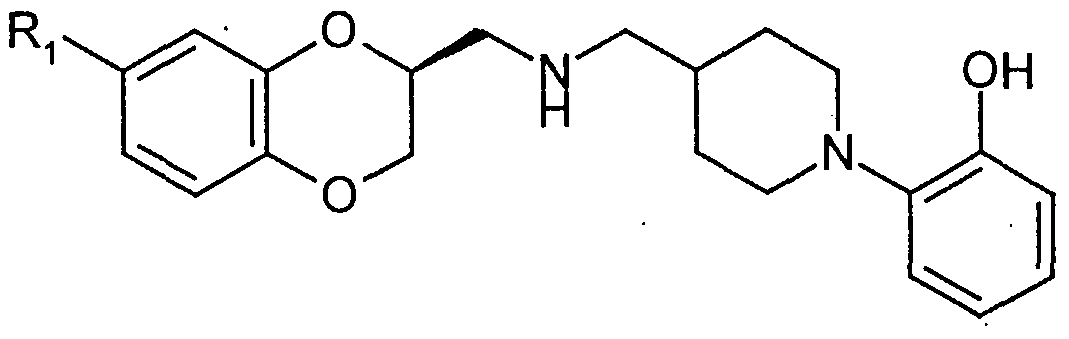
The present invention provides compounds of formula
Figure imgf000004_0001
including pharmaceutically acceptable salts thereof in which R, represents halo or pseudohalo and R2 represents H or an acyl group derived from a C -C18 saturated aliphatic carboxylic acid; with the proviso that when R-i is CI or CF3 and R2 is H then these compounds are in isolated form.
The term pseudohalo includes trifluoromethyl, trifluoromethoxy and trifluoromethylthio and other pharmaceutically acceptable pseudohalo groups known to those skilled in the art. Preferably the pseudohalo group is trifluoromethyl, trifluoromethoxy and trifluoromethylthio. The term halo includes chloro, bromo and fluoro.
Preferably R2 represents H, heptanoyl, decanoyl, dodecanoyl, hexadecanoyl or octadecanoyl. More preferably R2 is H.
Preferred compounds of formula I are represented by formula II
Figure imgf000005_0001
in which R, represents CI or CF3, including pharmaceutically acceptable salts thereof, in isolated form.
The term isolated is used to indicate that the compounds of the invention are in pure form and are not present in a human or an animal either in a free form or in an associated form.
Specific compounds of the present invention are:
(S)-(-)-2-{4-[Λ/-(7-chloro-2,3-dihydro-1 ,4-benzodioxin-2ylmethyl)aminomethyl]- piperidinojphenol and
(S)-(-)-2-{4-[Λ/-(7-trifluoromethyl-2,3-dihydro-1 ,4-benzodioxin-2-ylmethyl)- aminomethyl]piperidino}phenol
and pharmaceutically acceptable salts thereof.
The compounds of the present invention are advantageous over compounds known in the prior art because of their selectivity in receptor binding assays and their superior oral activity.
Compounds of formula I may exist as salts with pharmaceutically acceptable acids. Examples of such salts include hydrochlorides, hydrobromides, sulphates, methanesulphonates, nitrates, maleates, acetates, citrates, fumarates, tartrates [eg (+)-tartrates, (-)-tartrates or mixtures thereof including racemic mixtures], succinates, benzoates and salts with amino acids such as glutamic acid. Compounds of formula I and their salts may exist in the form of soivates (for example hydrates). Certain compounds of formula I and their salts may exist in more than one crystal form and the present invention includes each crystal form and mixtures thereof. Certain compounds of formula I and their salts may also exist in the form of solvates, for example hydrates, and the present invention includes each solvate and mixtures thereof.
The present invention also includes pharmaceutical compositions containing a therapeutically effective amount of a compound of formula I or a salt thereof together with a pharmaceutically acceptable diluent or carrier.
As used hereinafter, the term active compound denotes a compound of formula I or a salt thereof. In therapeutic use, the active compound may be administered orally, rectally, parenterally or topically, preferably orally. Thus the therapeutic compositions of the present invention may take the form of any of the known pharmaceutical compositions for oral, rectal, parenteral or topical administration. Pharmaceutically acceptable carriers suitable for use in such compositions are well known in the art of pharmacy. The compositions of the invention may contain 0.1-99% by weight of active compound. The compositions of the invention are generally prepared in unit dosage form. Preferably the unit dosage of active ingredient is 1-500 mg. The excipients used in the preparation of these compositions are the excipients known in the pharmacist's art.
Compositions for oral administration are the preferred compositions of the invention and these are the known pharmaceutical forms for such administration, for example tablets, capsules, syrups and aqueous or oil suspensions. The excipients used in the preparation of these compositions are the excipients known in the pharmacist's art. Tablets may be prepared by mixing the active compound with an inert diluent such as calcium phosphate in the presence of disintegrating agents, for example maize starch, and lubricating agents, for example magnesium stearate, and tableting the mixture by known methods. The tablets may be formulated in a manner known to those skilled in the art so as to give a sustained release of the compounds of the present invention. Such tablets may, if desired, be provided with enteric coatings by known methods, for example by the use of cellulose acetate phthalate. Similarly, capsules, for example hard or soft gelatin capsules, containing the active compound with or without added excipients, may be prepared by conventional means and, if desired, provided with enteric coatings in a known manner. The tablets and capsules may conveniently each contain 1 to 500 mg of the active compound. Other compositions for oral administration include, for example, aqueous suspensions containing the active compound in an aqueous medium in the presence of a non-toxic suspending agent such as sodium carboxymethyl- cellulose, and oily suspensions containing a compound of the present invention in a suitable vegetable oil, for example arachis oil.
The active compound may be formulated into granules with or without additional excipients. The granules may be ingested directly by the patient or they may be added to a suitable liquid carrier (for example water) before ingestion. The granules may contain disintegrants (for example a pharmaceutically acceptable effervescent couple formed from an acid and a carbonate or bicarbonate salt) to facilitate dispersion in the liquid medium.
Compositions of the invention suitable for rectal administration are the known pharmaceutical forms for such administration, for example, suppositories with cocoa butter or polyethylene glycol bases.
Compositions of the invention suitable for parenteral administration are the known pharmaceutical forms for such administration, for example sterile suspensions or sterile solutions in a suitable solvent.
Compositions for topical administration may comprise a matrix in which the pharmacologically active compounds of the present invention are dispersed so that the compounds are held in contact with the skin in order to administer the compounds transdermally. A suitable transdermal composition may be prepared by mixing the pharmaceutically active compound with a topical vehicle, such as a mineral oil, petrolatum and/or a wax, for example paraffin wax or beeswax, together with a potential transdermal accelerant such as dimethyl sulphoxide or propylene glycol. Alternatively the active compounds may be dispersed in a pharmaceutically acceptable cream or ointment base. The amount of active compound contained in a topical formulation should be such that a therapeutically effective amount of the compound is delivered during the period of time for which the topical formulation is intended to be on the skin.
The compounds of the present invention may also be administered by continuous infusion either from an external source, for example by intravenous infusion or from a source of the compound placed within the body. Internal sources include implanted reservoirs containing the compound to be infused which is continuously released for example by osmosis and implants which may be (a) liquid such as a suspension or solution in a pharmaceutically acceptable oil of the compound to be infused for example in the form of a very sparingly water-soluble derivative such as a dodecanoate salt or ester or (b) solid in the form of an implanted support, for example of a synthetic resin or waxy material, for the compound to be infused. The support may be a single body containing all the compound or a series of several bodies each containing part of the compound to be delivered. The amount of active compound present in an internal source should be such that a therapeutically effective amount of the compound is delivered over a long period of time.
In some formulations it may be beneficial to use the compounds of the present invention in the form of particles of very small size, for example as obtained by fluid energy milling.
In the compositions of the present invention the active compound may, if desired, be associated with other compatible pharmacologically active ingredients.
The pharmaceutical compositions containing a therapeutically effective amount of a compound of formula I or a salt thereof may be used to treat depression, anxiety, psychoses (for example schizophrenia), tardive dyskinesia, Parkinson's disease, obesity, hypertension, Tourette's syndrome, sexual dysfunction, drug addiction, drug abuse, cognitive disorders, Alzheimer's disease, senile dementia, obsessive-compulsive behaviour, panic attacks, eating disorders, anorexia, cardiovascular and cerebrovascular disorders, migraine, non-insulin dependent diabetes mellitus, hyperglycaemia, constipation, arrhythmia, disorders of the neuroendocrine system, stress, prostatic hypertrophy, drug-induced extrapyramidal symptoms and spasticity in human beings. Whilst the precise amount of active compound administered in such treatment will depend on a number of factors, for example the age of the patient, the severity of the condition and the past medical history and always lies within the sound discretion of the administering physician, the amount of active compound administered per day is in the range 1 to 1000 mg preferably 5 to 500 mg given in single or divided doses at one or more times during the day.
The ability of compounds of formula I to interact with 5-hydroxytryptamine (5- HT) receptors has been demonstrated by the following test which determines the ability of the compounds to inhibit tritiated ligand binding to 5-HT receptors in vitro and in particular to 5-HT1A receptors.
Hippocampal tissue from the brains of male Charles River CD rats weighing between 150-250 g were homogenised in ice-cold 50 mM Tris-HCI buffer (pH 7.7) when measured at 25°C, 1 :40 w/v) and centrifuged at 30,000 g at 4°C for 10 minutes. The pellet was rehomogenised in the same buffer, incubated at 37°C for 10 minutes and centrifuged at 30,000 g at 4°C for 10 minutes. The final pellet was resuspended in 50 mM Tris-HCI buffer (pH 7.7) containing 4 mM CaCI2, 0.1% L- ascorbic acid and 10 μM pargyline hydrochloride (equivalent to 6.25 mg wet weight of tissue/ml) and used immediately in the binding assay. Aliquots (400 μl; equivalent to 2.5 mg wet weight of tissue/tube) of this suspension were added to tubes containing the ligand (50 μl; 2 nM) and distilled water (50 μl; total binding) or 5-HT (50 μl; 10 μM; non-specific binding) or test compound (50 μl; at a single concentration of 10"6 M or at 10 concentrations ranging from 10"11-10"3 M). The ligand was [3H]8-hydroxy-2-(dipropylamino)tetralin ([3H]8-OH-DPAT) and the mixture was incubated at 25°C for 30 minutes before the incubation was terminated by rapid filtration.
The filters were washed with ice-cold Tris-HCI buffer and dried. The filters were punched out into vials, scintillation fluid added and radioactivity determined by liquid scintillation counting. The percentage displacement of specific binding of the tritiated ligand was calculated for the single concentration (10'6 M) of test compound. Displacement curves were then produced for those compounds which displaced >50% of specific binding of the tritiated ligand at 10"6 M using a range of concentrations of the compound. The concentration which gave 50% inhibition of specific binding (IC50) was obtained from the curve. The inhibition coefficient Ki was then calculated using the formula
IC50
Figure imgf000010_0001
1+([ligand]/KD)
in which [ligand] is the concentration of the tritiated ligand used and KD is the equilibrium dissociation constant for the ligand.
The ability of compounds of formula I to interact with adrenoceptor binding sites has been demonstrated by the following test which determines the ability of the compounds to inhibit tritiated ligand binding toadrenoceptors in vitro and in particular αι-adrenoceptors.
Whole cortical tissue from the brains of male Charles River CD rats weighing between 150-250 g were homogenised in ice-cold 50 mM Tris-HCI, pH 7.6 (at 25°C; 1 :40 w/v) and centrifuged at 1000 g at 4°C for 10 minutes. The supernatant was centrifuged at 30,000 g at 4°C for 10 minutes. The pellet was rehomogenised in 50 mM Tris-HCI, pH 7.6 (1 :40 w/v) and centrifuged at 30,000 g at 4°C for 10 minutes. The final pellet was resuspended in 50 mM Tris-HCI, pH 7.6 (equivalent to 12.5 mg wet weight of tissue/ml) and used immediately in the binding assay. Aliquots (400 μl; equivalent to 5 mg wet weight of tissue/tube) of this suspension were added to tubes containing the ligand (50 μl; 0.1 nM) and distilled water (50 μl; total binding) or phentolamine (50 μl; 5 μM; non-specific binding) or test compound (50 μl; at a single concentration of lO^M or at 10 concentrations ranging from 10"11 - 10'3M). The ligand was [7-methoxy-3H]prazosin and the mixture was incubated at 30°C for 30 minutes before the incubation was terminated by rapid filtration.
The filters were washed with ice-cold Tris-HCI buffer and dried. The filters were punched out into vials, scintillation fluid added and radioactivity determined by liquid scintillation counting. The percentage displacement of specific binding of the tritiated ligand was calculated for the single concentration (10"6 M) of test compound. Displacement curves were then produced for those compounds which displaced >50% of specific binding of the tritiated ligand at 10"6 M using a range of concentrations of the compound. The concentration which gave 50% inhibition of specific binding (IC50) was obtained from the curve. The inhibition coefficient Ki was then calculated using the formula
iC50
Figure imgf000011_0001
1+([ligand]/KD)
in which [ligand] is the concentration of the tritiated ligand used and KD is the equilibrium dissociation constant for the ligand.
The ability of compounds of formula I to interact with dopamine receptors has been demonstrated by the following test which determines the ability of the compounds to inhibit tritiated ligand binding to dopamine receptors in vitro and in particular to the D2 dopamine receptors.
Striatal tissue from the brains of male Charles River CD rats weighing between 140-250 g were homogenised in ice-cold 50 mM Tris-HCI buffer (pH 7.7 when measured at 25°C) and centrifuged at 40,000 g for 10 minutes. The pellet was resuspended in Tris salts buffer (50 mM Tris-HCI buffer containing 120 mM NaCI, 5 mM KCI, 2 mM CaCI2 and 1 mM MgCI2 with the addition of 6 mM ascorbic acid; pH 7.7 when measured at 25°C), and again centrifuged at 40,000 g for 10 minutes. The final pellet was stored at -80°C. Before each test the pellet was resuspended in Tris salts buffer (equivalent to 2 mg wet weight of tissue/ml). Aliquots (720 μl; equivalent to 1.44 mg wet weight of tissue/tube) of this suspension were then added to tubes containing the ligand (40 μl; 1 nM) and Tris salts buffer (40 μl; total binding) or spiroperidol (40 μl; 10 nM; non-specific binding) or test compound (40 μl; at a single concentration of lO^M or at 6 concentrations ranging from lO'^-IO^M). The ligand was tritiated (S)-sulpiride and the mixture was incubated at 4°C for 40 minutes before the incubation was terminated by rapid filtration. The filters were washed with ice-cold Tris-HCI buffer and dried. The filters were punched out in to vials, scintillation fluid added and were left for about 20 hours before being counted by scintillation , spectrophotometry. The percentage displacement of specific binding of the tritiated ligand was calculated for the single concentration (10"6 M) of test compound. Displacement curves were then produced over a range of concentrations for those compounds which displaced >50% of specific binding of the tritiated ligand at 10"6M. The concentration which gave a 50% inhibition of specific binding (IC50) was obtained from the curve. The inhibition coefficient Ki was then calculated using the formula
IC 50
Figure imgf000012_0001
1+([ligand]/KD)
in which [ligand] is the concentration of the tritiated ligand used and KD is the equilibrium dissociation constant for the ligand.
The Kj values obtained in the above tests for 5-HT1A, α-i and D2 binding for each of the final products of Examples 1 , 2, and Comparative ExampleA are given in Table I below. It is clear from these data that compounds of the present invention have significantly less affinity for the ccι adrenoceptor than compounds previously described. This is important as it is known in the art that c^ receptor antagonism mediates serious side-effects such as hypotension, sedation and sexual dysfunction. Thus, compounds which interact preferentially with D2 and 5-HT1A receptors whilst having less interaction with α^ receptors are advantaged.
TABLE 1
Figure imgf000012_0002
Antagonism of Apomorphine-lnduced Climbing in Mice
Groups of 10 male mice weighing 18-35 g (max. range 10 g) were treated with test compound or control vehicle by po administration. 30 minutes later, mice were injected subcutaneously with apomorphine (0.88 mg/kg). Immediately after the apomorphine injection the mice were placed in the test cages and the climbing behaviour of each mouse was assessed at 10 and 20 minutes on a simple 0-2 ranking scale.
The ED50 values (dose causing 50% of the control score) for the test compounds and 95% confidence limits were calculated. ED50 values are calculated as free base equivalents and are given in Table 2 alongside Comparative Example A. The compounds of the present invention are more potent orally than compounds previously described. More potent compounds are advantaged as they are less likely to induce systemic toxicological effects on organs which are not the therapeutic target.
TABLE 2
Figure imgf000013_0001
Processes for the preparation of compounds of formula I will now be described. These processes form a further aspect of the present invention. The processes are preferably carried out at atmospheric pressure. The substituents are as defined for formula I above unless otherwise stated.
Compounds of formula I in which R2 represents H may be prepared by reacting a compound of formula 111
Figure imgf000014_0001
in which Ri is as previously defined and R3 is a C1-6 alkyl group with a de-alkylating agent for example hydrobromic acid, pyridine hydrochloride or boron tribromide optionally in the presence of a suitable solvent or mixture of solvents, for example water or glacial acetic acid, or mixtures thereof, at a temperature in the range of 0 - 250°C.
Compounds of formula I in which R2 represents an -O-acyl group may be prepared by acylating a compound of formula I in which R2 represents H by methods known to those skilled in the art, for example by reaction with an anhydride or an acyl chloride, optionally in the presence of a solvent and optionally in the presence of a base. Preferably the methylamine nitrogen is protected before the acylation and then deprotected after the acylation by methods known to those skilled in the art.
The invention is illustrated by the following Examples which are given by way of example only. The final product of each of these Examples was characterised by one or more of the following procedures: gas-liquid chromatography; high performance liquid chromatography; elemental analysis, nuclear magnetic resonance spectroscopy and infrared spectroscopy.
Example 1
(S)-(-)-Λ/-(7-Chloro-1 ,4-benzodioxan-2-ylmethyl)-1 -(1 -(2-methoxyphenyl)piperid-4-yl)- methylamine (4.54 g) (also known as (S)-(-)-Λ/-(7-chloro-2,3-dihydro-1 ,4- benzodioxin-2-methyl)-1 -(1 -(2-methoxyphenyl)piperid-4-yl)methylamine) was prepared as described in WO 95/07274 and then dissolved in 48% hydrobromic acid (50 ml). The mixture was boiled under reflux for 18 hours. The mixture was cooled, poured into water (500 ml) and basified with concentrated aqueous ammonia solution. The resulting suspension was extracted with dichloromethane (3 x 200 ml). The combined organic extracts were washed with water (200 ml), dried over sodium sulphate and evaporated under reduced pressure to give (S)-(-)-2-{4-[Λ/-(7-ch!oro- 2,3-dihydro-1 ,4-benzodioxin-2-ylmethyl)aminomethyl]piperidino}phenol ( or alternatively named as Λ/-(7-chloro-2,3-dihydro-1 ,4-benzodioxin-2-ylmethyl)-(S)-(-)-1- [1-(2-hydroxyphenyl)-piperid-4-yl]methylamine) as a pale yellow oil which solidified on standing (m.p. 84-86°C). The structure was confirmed by 1Hnmr and infrared spectroscopy.
Example 2
(S)-(-)-1-[1-(2-Methoxyphenyl)piperid-4-yl]-Λ/-(7-trifluoromethyl-2,3-dihydro- 1 ,4-benzodioxin-2-ylmethyl)methylamine (0.45 g) prepared as described in WO99/62902, was heated with pyridine hydrochloride (10.0 g) at 180°C for 6 hours. Further pyridine hydrochloride (5.0 g) was added and the mixture was heated for a further 6 hours at 180°C and left to stand at ambient temperature for 72 hours. The resulting solid was dissolved in water (200 ml) and then basified to pH8 with concentrated aqueous ammonia solution. The mixture was extracted with ethyl acetate (2 x 100 ml). The combined organic extracts were dried, filtered and evaporated to give a brown oil which was purified by flash column chromatography to give (S)-(-)-2-{4-[Λ/-(7-trifluoromethyl-2,3-dihydro-1 ,4-benzodioxin-2- ylmethyl)aminomethyl]piperidino}phenol {or alternatively named as (S)-(-)-1-[1-(2- hydroxyphenyl)piperid-4-yl]-Λ/-(7-trifluoromethyl-2,3-dihydro-1 ,4-benzodioxin-2- ylmethyl)methylamine} as an oil.
Example 3
a) A solution of di-terf-butyl dicarbonate (0.14 g) in methanol (25 ml) was added dropwise to a stirred solution of (S)-(-)-Λ -(7-Chloro-1 ,4-benzodioxan-2- ylmethyl)-1-(1-(2-methoxyphenyl)piperid-4-yl)methylamine (0.5 g) in methanol (25 ml) at ambient temperature. The mixture was stirred at this temperature for 24 hours and then a further portion of di-terf-butyl dicarbonate (0.14 g) was added and the mixture was stirred at ambient temperature for 24 hours.
The solvent was removed under reduced pressure to give a (S)-(-)-2-{4-[/V- tert-butoxycarbonyI-Λ/-(7-chloro-2,3-dihydro-1 ,4-benzodioxin--2-ylmethyl)- aminomethyl]piperidino}phenol as a yellow oil. b) Sodium hydride (0.19 g of a 60% dispersion in mineral oil) was added to the solution of the product from a) (3.55 g) in tetrahydrofuran (100 ml) with stirring at ambient temperature under nitrogen. The mixture was stirred at ambient temperature for 5 minutes and then a solution of decanoyl chloride (1.38 g) was added dropwise. The mixture was stirred at ambient temperature for
16 hours and then poured into water (100 ml). The mixture was extracted with ethyl acetate to give an orange oil which was purified by flash column chromatography on silica using 15% ethyl acetate in petrol as the mobile phase. Appropriate fractions were combined and evaporated to give :(S)-(-)- 2-{4-[/V-feπt-butoxycarbonyl-Λ/-(7-chloro-2,3-dihydro-1 ,4-benzodioxin-2- ylmethyl)aminomethyl]piperidino}phenyl decanoate an oil which was identified by mass spectroscopy and Hnmr.
c) Trifluoroacetic acid (7 ml) was added dropwise with care over a period of 5 minutes to an ice-cold stirred solution of the product from 3b) (3.0 g) in dichloromethane (100 ml). The mixture was allowed to warm to ambient temperature and stirred at this temperature for 24 hours. The mixture was poured into water (300 ml) and then basified with solid sodium bicarbonate. The organic layer was separated and the aqueous layer was extracted with dichloromethane. The combined organic layers were washed with water, dried over magnesium sulphate and evaporated to give (S)-(-)-2-{4-[Λ/-(7- chloro-2,3-dihydro-1 ,4-benzodioxin-2-ylmethyl)aminomethyl]piperidino}- phenyl decanoate as an oil.
Comparative Example A
(S)-(-)-Λ/-(7-Chloro-1 ,4-benzodioxan-2-ylmethyl)-1 -(1 -(2-methoxyphenyl)piperid-4- yl)methylamine (also known as (S)-(-)-Λ/-(7-chloro-2,3-dihydro-1 ,4-benzodioxin-2- methyl)methylamine) was prepared as described in WO 95/07274. Example A
The use of compounds of the present invention in the manufacture of pharmaceutical compositions is illustrated by the following description. In this description the term "active compound" denotes any compound of the invention but particularly any compound which is the final product of one of the preceding Examples.
a) Capsules
In the preparation of capsules, 10 parts by weight of active compound and 240 parts by weight of lactose are de-aggregated and blended. The mixture is filled into hard gelatin capsules, each capsule containing a unit dose or part of a unit dose of active compound.
b) Tablets
Tablets are prepared from the following ingredients.
Parts by weight
Active compound 10
" Lactose 190
Maize starch 22 Polyvinylpyrrolidone 10
Magnesium stearate 3
The active compound, the lactose and some of the starch are de-aggregated, blended and the resulting mixture is granulated with a solution of the polyvinyl- pyrrolidone in ethanol. The dry granulate is blended with the magnesium stearate and the rest of the starch. The mixture is then compressed in atabletting machine to give tablets each containing a unit dose or a part of a unit dose of active compound. c) Enteric coated tablets
Tablets are prepared by the method described in (b) above. The tablets are enteric coated in a conventional manner using a solution of 20% cellulose acetate phthalate and 3% diethyl phthalate in ethanol:dichloromethane (1 :1).
d) Suppositories
In the preparation of suppositories, 100 parts by weight of active compound is incorporated in 1300 parts by weight of triglyceride suppository base and the mixture formed into suppositories each containing a therapeutically effective amount of active ingredient.

Claims

Claims
1. Compounds of formula I
Figure imgf000019_0001
including pharmaceutically acceptable salts thereof in which R, represents halo or pseudohalo and R2 represents H or an acyl group derived from a C7-C18 saturated aliphatic carboxylic acid; with the proviso that when Ri is CI or CF3 and R2 is H then these compounds are in isolated form.
2. A compound according to claim 1 which is (S)-(-)-2-{4-[Λ/-(7-trifluoromethyl- 2,3-dihydro-1 ,4-benzodioxin-2-ylmethyl)aminomethyl]piperidino}phenol and pharmaceutically acceptable salts thereof in isolated form.
3. A compound according to claim 1 which is (S)-(-)-2-{4-[Λ/-(7-chloro-2,3- dihydro-1 ,4-benzodioxin-2-ylmethyl)aminomethyl]piperidino}pheπol and pharmaceutically acceptable salts thereof in isolated form.
4. Pharmaceutical compositions comprising a therapeutically effective amount of a compound of formula I as claimed in any one of claims 1-3, together with a pharmaceutically acceptable diluent or carrier.
5. A method of treating depression, anxiety, psychoses, Parkinson's disease, obesity, hypertension, Tourette's syndrome, sexual dysfunction, drug addiction, drug abuse, cognitive disorders, Alzheimer's disease, senile dementia, obsessive- compulsive behaviour, panic attacks, eating disorders, anorexia, cardiovascular and cerebrovascular disorders, migraine, non-insulin dependent diabetes mellitus, hyperglycaemia, constipation, arrhythmia, disorders of the neuroendocrine system, stress, prostatic hypertrophy, drug-induced extrapyramidal symptoms or spasticity which comprises the administration of a therapeutically effective amount of a compound of formula I as claimed in any one of claims 1-3 to a patient in need thereof.
6. A method as claimed in claim 5 for treating schizophrenia.
7. A method as claimed in claim 5 for treating anxiety.
8. A compound of formula I as claimed in any one of claims 1-3 for use as a medicament.
9. A compound of formula I as claimed in any one of claims 1-3 for use as a medicament for treating depression, anxiety, psychoses, tardive dyskinesia, Parkinson's disease, obesity, hypertension, Tourette's syndrome, sexual dysfunction, drug addiction, drug abuse, cognitive disorders, Alzheimer's disease, senile dementia, obsessive-compulsive behaviour, panic attacks, eating disorders, anorexia, cardiovascular and cerebrovascular disorders, migraine, non-insulin dependent diabetes mellitus, hyperglycaemia, constipation, arrhythmia, disorders of the neuroendocrine system, stress, prostatic hypertrophy, drug-induced extrapyramidal symptoms or spasticity.
10. The use of a compound of formula I as claimed in any one of claims 1-3 in the manufacture of a medicament for treating depression, anxiety, psychoses, tardive dyskinesia, Parkinson's disease, obesity, hypertension, Tourette's syndrome, sexual dysfunction, drug addiction, drug abuse, cognitive disorders, Alzheimer's disease, senile dementia, obsessive-compulsive behaviour, panic attacks, eating disorders, anorexia, cardiovascular and cerebrovascular disorders, migraine, non-insulin dependent diabetes mellitus, hyperglycaemia, constipation, arrhythmia, disorders of the neuroendocrine system, stress, prostatic hypertrophy, drug-induced extrapyramidal symptoms or spasticity.
11. Compounds according to claim 1 in which R^ is CI or CF3 and R^ is H.
12. A process for preparing compounds of formula I according to claim 1 comprising reacting a compound of formula II
Figure imgf000021_0001
in which Ri is as previously defined and R2 is a C1-6 alkyl group with a de-alkylating agent for example hydrobromic acid or pyridine hydrochloride.
PCT/EP2001/003463 2000-03-28 2001-03-27 N-benzodioxanylmethyl-1-piperidyl-methylamine compounds for the treatment of central nervous system disorders Ceased WO2001072741A2 (en)

Priority Applications (3)

Application Number Priority Date Filing Date Title
AU2001273903A AU2001273903A1 (en) 2000-03-28 2001-03-27 Therapeutic agents
US10/240,180 US20040039023A1 (en) 2000-03-28 2001-03-27 Therapeutic agents
EP01940264A EP1274703A2 (en) 2000-03-28 2001-03-27 N-benzodioxanylmethyl-1-piperidyl-methylamine compounds for the treament of central nervous system disorders

Applications Claiming Priority (2)

Application Number Priority Date Filing Date Title
GBGB0007376.7A GB0007376D0 (en) 2000-03-28 2000-03-28 Therapeutic agents
GB0007376.7 2000-03-28

Publications (2)

Publication Number Publication Date
WO2001072741A2 true WO2001072741A2 (en) 2001-10-04
WO2001072741A3 WO2001072741A3 (en) 2002-01-03

Family

ID=9888485

Family Applications (1)

Application Number Title Priority Date Filing Date
PCT/EP2001/003463 Ceased WO2001072741A2 (en) 2000-03-28 2001-03-27 N-benzodioxanylmethyl-1-piperidyl-methylamine compounds for the treatment of central nervous system disorders

Country Status (5)

Country Link
US (1) US20040039023A1 (en)
EP (1) EP1274703A2 (en)
AU (1) AU2001273903A1 (en)
GB (1) GB0007376D0 (en)
WO (1) WO2001072741A2 (en)

Cited By (8)

* Cited by examiner, † Cited by third party
Publication number Priority date Publication date Assignee Title
WO2004002483A1 (en) * 2002-06-27 2004-01-08 Actelion Pharmaceuticals Ltd Substituted 3- and 4- aminomethylpiperidines for use as beta-secretase in the treatment of alzheimer’s disease
US6800635B2 (en) 2000-03-24 2004-10-05 Pharmacia Italia, S.P.A. Crystalline form II of cabergoline
WO2004082570A3 (en) * 2003-03-17 2005-01-27 Bayer Healthcare Ag Diagnostics and therapeutics for diseases associated with dopamine receptor d2 (drd2)
WO2006116158A1 (en) * 2005-04-22 2006-11-02 Wyeth Benzodioxane and benzodioxolane derivatives and uses thereof
US7297704B2 (en) 2005-02-17 2007-11-20 Wyeth Cycloalkyfused indole, benzothiophene, benzofuran and idene derivatives
WO2009133109A1 (en) * 2008-04-29 2009-11-05 Nsab, Filial Af Neurosearch Sweden Ab, Sverige Modulators of dopamine neurotransmission
US8492372B2 (en) 2008-04-29 2013-07-23 Integrated Research Laboratories Sweden Ab Modulators of dopamine neurotransmission
US8524766B2 (en) 2008-04-29 2013-09-03 Nsab, Filial Af Neurosearch Sweden Ab, Sverige Modulators of dopamine neurotransmission

Family Cites Families (5)

* Cited by examiner, † Cited by third party
Publication number Priority date Publication date Assignee Title
GB9318431D0 (en) * 1993-09-06 1993-10-20 Boots Co Plc Therapeutic agents
GB9704948D0 (en) * 1997-03-11 1997-04-30 Knoll Ag Therapeutic agents
JP3955386B2 (en) * 1998-04-09 2007-08-08 富士通株式会社 Semiconductor device and manufacturing method thereof
GB9811879D0 (en) * 1998-06-03 1998-07-29 Knoll Ag Therapeutic agents
US6297063B1 (en) * 1999-10-25 2001-10-02 Agere Systems Guardian Corp. In-situ nano-interconnected circuit devices and method for making the same

Cited By (8)

* Cited by examiner, † Cited by third party
Publication number Priority date Publication date Assignee Title
US6800635B2 (en) 2000-03-24 2004-10-05 Pharmacia Italia, S.P.A. Crystalline form II of cabergoline
WO2004002483A1 (en) * 2002-06-27 2004-01-08 Actelion Pharmaceuticals Ltd Substituted 3- and 4- aminomethylpiperidines for use as beta-secretase in the treatment of alzheimer’s disease
WO2004082570A3 (en) * 2003-03-17 2005-01-27 Bayer Healthcare Ag Diagnostics and therapeutics for diseases associated with dopamine receptor d2 (drd2)
US7297704B2 (en) 2005-02-17 2007-11-20 Wyeth Cycloalkyfused indole, benzothiophene, benzofuran and idene derivatives
WO2006116158A1 (en) * 2005-04-22 2006-11-02 Wyeth Benzodioxane and benzodioxolane derivatives and uses thereof
WO2009133109A1 (en) * 2008-04-29 2009-11-05 Nsab, Filial Af Neurosearch Sweden Ab, Sverige Modulators of dopamine neurotransmission
US8492372B2 (en) 2008-04-29 2013-07-23 Integrated Research Laboratories Sweden Ab Modulators of dopamine neurotransmission
US8524766B2 (en) 2008-04-29 2013-09-03 Nsab, Filial Af Neurosearch Sweden Ab, Sverige Modulators of dopamine neurotransmission

Also Published As

Publication number Publication date
GB0007376D0 (en) 2000-05-17
EP1274703A2 (en) 2003-01-15
WO2001072741A3 (en) 2002-01-03
AU2001273903A1 (en) 2001-10-08
US20040039023A1 (en) 2004-02-26

Similar Documents

Publication Publication Date Title
AU689802B2 (en) Bicyclic aromatic compounds as therapeutic agents
EP0679642B1 (en) Condensed heterocyclic compounds, their production and use
EP0876372B1 (en) Heteroarylcarboxamide derivatives
EP0839144B1 (en) Piperazine derivatives as therapeutic agents
JPH11512701A (en) Selective β ▲ 3 ▼ adrenergic agonist
EP0610793A1 (en) Tetracyclic morpholine derivatives and their use or analgesics
KR20070062609A (en) Pyrroloindole, pyridoindole and azepineindole as 5-HT2C agonists
JP2001515485A (en) Dioxino derivatives and their use as therapeutics
US6391891B1 (en) Bicyclic compounds as ligands for 5-HT1 receptors
JP2007522142A (en) Benzimidazole-substituted thiophene derivatives having activity against IKK3
KR0128288B1 (en) Naphthyloxazolidone derivatives
RU2169147C2 (en) DERIVATIVES OF CARBOXYLIC ACID AMIDES WITH HETEROCYCLIC SUBSTITUENTS AND COMPOSITION SHOWING ABILITY TO INHIBIT 5-HT1A- AND/OR alpfa- AND/OR alpfa- AND/OR alpfa- AND/OR α1-RECEPTORS
WO2001072741A2 (en) N-benzodioxanylmethyl-1-piperidyl-methylamine compounds for the treatment of central nervous system disorders
FR2860792A1 (en) THIOPHENE-2-CARBOXAMIDE DERIVATIVES, THEIR PREPARATION AND THEIR THERAPEUTIC USE
KR100240242B1 (en) Optically Active Alkylenedioxybenzene Derivatives and Uses in Therapeutics
US6136825A (en) Sulfonamide compounds having 5-HT receptor activity
WO1999062902A1 (en) N-benzodioxanylmethyl-1-piperidyl-methylamine compounds having affinity for 5-ht receptors
JPH09512025A (en) Tricyclic derivatives as 5HT-lower 2C and 5HT-lower 2B antagonists
KR100437561B1 (en) Novel Heterocyclic Compounds
McQuaid et al. Substituted 5-amino-4, 5, 6, 7-tetrahydroindazoles as partial ergoline structures with dopaminergic activity
CA2007401A1 (en) Bisarylalcene derivatives, process for their preparation and pharmaceutical compositions containing them
CN112457265A (en) Tetrazole derivative, preparation method thereof, pharmaceutical composition containing tetrazole derivative and application of pharmaceutical composition
US5234948A (en) Optically active alkylenedioxybenzene derivatives and their use in therapy
MXPA00011523A (en) N-benzodioxanylmethyl-1-piperidyl-methylamine compounds having affinity for 5-ht receptors
JPH02221274A (en) New derivative

Legal Events

Date Code Title Description
AK Designated states

Kind code of ref document: A2

Designated state(s): AE AG AL AM AT AU AZ BA BB BG BR BY BZ CA CH CN CO CR CU CZ DE DK DM DZ EE ES FI GB GD GE GH GM HR HU ID IL IN IS JP KE KG KP KR KZ LC LK LR LS LT LU LV MA MD MG MK MN MW MX MZ NO NZ PL PT RO RU SD SE SG SI SK SL TJ TM TR TT TZ UA UG US UZ VN YU ZA ZW

AL Designated countries for regional patents

Kind code of ref document: A2

Designated state(s): GH GM KE LS MW MZ SD SL SZ TZ UG ZW AM AZ BY KG KZ MD RU TJ TM AT BE CH CY DE DK ES FI FR GB GR IE IT LU MC NL PT SE TR BF BJ CF CG CI CM GA GN GW ML MR NE SN TD TG

DFPE Request for preliminary examination filed prior to expiration of 19th month from priority date (pct application filed before 20040101)
121 Ep: the epo has been informed by wipo that ep was designated in this application
AK Designated states

Kind code of ref document: A3

Designated state(s): AE AG AL AM AT AU AZ BA BB BG BR BY BZ CA CH CN CO CR CU CZ DE DK DM DZ EE ES FI GB GD GE GH GM HR HU ID IL IN IS JP KE KG KP KR KZ LC LK LR LS LT LU LV MA MD MG MK MN MW MX MZ NO NZ PL PT RO RU SD SE SG SI SK SL TJ TM TR TT TZ UA UG US UZ VN YU ZA ZW

AL Designated countries for regional patents

Kind code of ref document: A3

Designated state(s): GH GM KE LS MW MZ SD SL SZ TZ UG ZW AM AZ BY KG KZ MD RU TJ TM AT BE CH CY DE DK ES FI FR GB GR IE IT LU MC NL PT SE TR BF BJ CF CG CI CM GA GN GW ML MR NE SN TD TG

WWE Wipo information: entry into national phase

Ref document number: 2001940264

Country of ref document: EP

WWE Wipo information: entry into national phase

Ref document number: 10240180

Country of ref document: US

WWP Wipo information: published in national office

Ref document number: 2001940264

Country of ref document: EP

WWW Wipo information: withdrawn in national office

Ref document number: 2001940264

Country of ref document: EP

NENP Non-entry into the national phase

Ref country code: JP