WO2001081997A1 - Selectively colorable polymerizable compositions - Google Patents

Selectively colorable polymerizable compositions Download PDF

Info

Publication number
WO2001081997A1
WO2001081997A1 PCT/US2001/012971 US0112971W WO0181997A1 WO 2001081997 A1 WO2001081997 A1 WO 2001081997A1 US 0112971 W US0112971 W US 0112971W WO 0181997 A1 WO0181997 A1 WO 0181997A1
Authority
WO
WIPO (PCT)
Prior art keywords
composition
color
color former
leuconitrile
cyanomethane
Prior art date
Legal status (The legal status is an assumption and is not a legal conclusion. Google has not performed a legal analysis and makes no representation as to the accuracy of the status listed.)
Ceased
Application number
PCT/US2001/012971
Other languages
French (fr)
Inventor
Douglas C. Neckers
Alexandre Mejiritski
Oleg V. Grinevich
John H. Malpert
Current Assignee (The listed assignees may be inaccurate. Google has not performed a legal analysis and makes no representation or warranty as to the accuracy of the list.)
Spectra Group Ltd Inc
Original Assignee
Spectra Group Ltd Inc
Priority date (The priority date is an assumption and is not a legal conclusion. Google has not performed a legal analysis and makes no representation as to the accuracy of the date listed.)
Filing date
Publication date
Application filed by Spectra Group Ltd Inc filed Critical Spectra Group Ltd Inc
Priority to EP01928738A priority Critical patent/EP1277086A4/en
Priority to AU2001255566A priority patent/AU2001255566A1/en
Publication of WO2001081997A1 publication Critical patent/WO2001081997A1/en
Anticipated expiration legal-status Critical
Ceased legal-status Critical Current

Links

Classifications

    • GPHYSICS
    • G03PHOTOGRAPHY; CINEMATOGRAPHY; ANALOGOUS TECHNIQUES USING WAVES OTHER THAN OPTICAL WAVES; ELECTROGRAPHY; HOLOGRAPHY
    • G03CPHOTOSENSITIVE MATERIALS FOR PHOTOGRAPHIC PURPOSES; PHOTOGRAPHIC PROCESSES, e.g. CINE, X-RAY, COLOUR, STEREO-PHOTOGRAPHIC PROCESSES; AUXILIARY PROCESSES IN PHOTOGRAPHY
    • G03C7/00Multicolour photographic processes or agents therefor; Regeneration of such processing agents; Photosensitive materials for multicolour processes
    • BPERFORMING OPERATIONS; TRANSPORTING
    • B29WORKING OF PLASTICS; WORKING OF SUBSTANCES IN A PLASTIC STATE IN GENERAL
    • B29CSHAPING OR JOINING OF PLASTICS; SHAPING OF MATERIAL IN A PLASTIC STATE, NOT OTHERWISE PROVIDED FOR; AFTER-TREATMENT OF THE SHAPED PRODUCTS, e.g. REPAIRING
    • B29C35/00Heating, cooling or curing, e.g. crosslinking or vulcanising; Apparatus therefor
    • B29C35/02Heating or curing, e.g. crosslinking or vulcanizing during moulding, e.g. in a mould
    • B29C35/08Heating or curing, e.g. crosslinking or vulcanizing during moulding, e.g. in a mould by wave energy or particle radiation
    • GPHYSICS
    • G03PHOTOGRAPHY; CINEMATOGRAPHY; ANALOGOUS TECHNIQUES USING WAVES OTHER THAN OPTICAL WAVES; ELECTROGRAPHY; HOLOGRAPHY
    • G03FPHOTOMECHANICAL PRODUCTION OF TEXTURED OR PATTERNED SURFACES, e.g. FOR PRINTING, FOR PROCESSING OF SEMICONDUCTOR DEVICES; MATERIALS THEREFOR; ORIGINALS THEREFOR; APPARATUS SPECIALLY ADAPTED THEREFOR
    • G03F7/00Photomechanical, e.g. photolithographic, production of textured or patterned surfaces, e.g. printing surfaces; Materials therefor, e.g. comprising photoresists; Apparatus specially adapted therefor
    • G03F7/0037Production of three-dimensional images
    • GPHYSICS
    • G03PHOTOGRAPHY; CINEMATOGRAPHY; ANALOGOUS TECHNIQUES USING WAVES OTHER THAN OPTICAL WAVES; ELECTROGRAPHY; HOLOGRAPHY
    • G03FPHOTOMECHANICAL PRODUCTION OF TEXTURED OR PATTERNED SURFACES, e.g. FOR PRINTING, FOR PROCESSING OF SEMICONDUCTOR DEVICES; MATERIALS THEREFOR; ORIGINALS THEREFOR; APPARATUS SPECIALLY ADAPTED THEREFOR
    • G03F7/00Photomechanical, e.g. photolithographic, production of textured or patterned surfaces, e.g. printing surfaces; Materials therefor, e.g. comprising photoresists; Apparatus specially adapted therefor
    • G03F7/004Photosensitive materials
    • G03F7/038Macromolecular compounds which are rendered insoluble or differentially wettable
    • GPHYSICS
    • G03PHOTOGRAPHY; CINEMATOGRAPHY; ANALOGOUS TECHNIQUES USING WAVES OTHER THAN OPTICAL WAVES; ELECTROGRAPHY; HOLOGRAPHY
    • G03FPHOTOMECHANICAL PRODUCTION OF TEXTURED OR PATTERNED SURFACES, e.g. FOR PRINTING, FOR PROCESSING OF SEMICONDUCTOR DEVICES; MATERIALS THEREFOR; ORIGINALS THEREFOR; APPARATUS SPECIALLY ADAPTED THEREFOR
    • G03F7/00Photomechanical, e.g. photolithographic, production of textured or patterned surfaces, e.g. printing surfaces; Materials therefor, e.g. comprising photoresists; Apparatus specially adapted therefor
    • G03F7/004Photosensitive materials
    • G03F7/09Photosensitive materials characterised by structural details, e.g. supports, auxiliary layers
    • G03F7/105Photosensitive materials characterised by structural details, e.g. supports, auxiliary layers having substances, e.g. indicators, for forming visible images
    • BPERFORMING OPERATIONS; TRANSPORTING
    • B29WORKING OF PLASTICS; WORKING OF SUBSTANCES IN A PLASTIC STATE IN GENERAL
    • B29CSHAPING OR JOINING OF PLASTICS; SHAPING OF MATERIAL IN A PLASTIC STATE, NOT OTHERWISE PROVIDED FOR; AFTER-TREATMENT OF THE SHAPED PRODUCTS, e.g. REPAIRING
    • B29C35/00Heating, cooling or curing, e.g. crosslinking or vulcanising; Apparatus therefor
    • B29C35/02Heating or curing, e.g. crosslinking or vulcanizing during moulding, e.g. in a mould
    • B29C35/08Heating or curing, e.g. crosslinking or vulcanizing during moulding, e.g. in a mould by wave energy or particle radiation
    • B29C35/0805Heating or curing, e.g. crosslinking or vulcanizing during moulding, e.g. in a mould by wave energy or particle radiation using electromagnetic radiation
    • B29C2035/0833Heating or curing, e.g. crosslinking or vulcanizing during moulding, e.g. in a mould by wave energy or particle radiation using electromagnetic radiation using actinic light
    • BPERFORMING OPERATIONS; TRANSPORTING
    • B29WORKING OF PLASTICS; WORKING OF SUBSTANCES IN A PLASTIC STATE IN GENERAL
    • B29KINDEXING SCHEME ASSOCIATED WITH SUBCLASSES B29B, B29C OR B29D, RELATING TO MOULDING MATERIALS OR TO MATERIALS FOR MOULDS, REINFORCEMENTS, FILLERS OR PREFORMED PARTS, e.g. INSERTS
    • B29K2105/00Condition, form or state of moulded material or of the material to be shaped
    • B29K2105/0005Condition, form or state of moulded material or of the material to be shaped containing compounding ingredients
    • B29K2105/0032Pigments, colouring agents or opacifiyng agents

Definitions

  • the present invention relates to selectively colorable polymerizable compositions and to a method for forming selectively colored polymeric bodies using such compositions
  • a selectively colorable solid object is an object that can be colored at small individual, but specifically defined, sites by irradiating light of a particular wavelength and specific intensity for a specified duration
  • the light sources capable of producing the selectively colorable solid object include (a) a laser interfaced with an XY scanner (for polymer films), (b) a laser interfaced with an XYZ scanner (for 3D parts), (c) digital mirror device, (d) UV and Visible lamps with a masking device, etc
  • a selectively colorable resin (SCR) system consists of (a) the matrix (a blend of polymerizable material or a solid polymer), (b) a color former, (c) a color initiator (species that generate other species capable of reacting with color former, may not be needed in some systems), and (d) a chain reaction initiator (radical or catiomc or none depending on the system)
  • the conventional method for forming a colored plastic body is to add a dye or pigment to the liquid prepolymer composition
  • the composition is then cured with actinic radiation
  • actinic radiation The latter requires that the absorption spectra of the photo initiator and the dye/pigment differ If the dye/pigment absorbs actinic radiation at the same wavelength as the photoinitiator, slower or no cure will be achieved
  • the color formation method is also not selective
  • the entire plastic is uniformly colored
  • the photopolyme ⁇ zation process requires actinic radiation, but the color forming process requires only that the composition be well mixed Though one of the processes can be controlled by the intensity /wavelength of the actinic radiation, the other is unaffected by it Thus there is no selectivity of color formation in the plastic body
  • the present invention discloses selectively colorable polymerizable compositions and a method for forming selectively colored polymeric bodies using such compositions.
  • a selectively colorable polymerizable composition comprising both a leucobase color former and a leuconitrile color former is irradiated with light of a particular wavelength and specific intensity for a specified duration. Exposure to actinic radiation cures the composition and activates the color formers.
  • the irradiation dosage can be varied to selectively color the polymeric body whereby the resultant color of any particular area depends on the exposure dose received at that location. By varying the dose, a polymeric body can be prepared having distinctly colored elements at specific locations.
  • the composition of the present invention provides a photopolymerizable selectively colorable polychromic system.
  • a composition which can be exposed to different levels of irradiation to produce a selectively colored polymeric body.
  • color formation depends primarily on Scheme 1 wherein exposure of a leucobase to light in the presence of a oxidizing agent yields a first dye cation of a first color.
  • TAM triarylme hane
  • Ox represents an oxidizing agent
  • TAM + represents the colored species. It is anticipated that the scheme below will also be valid for diarylme hane (DAM) leucodyes (DAMH and DAMCN).
  • TAM + Ox -hv * ⁇ TAM + (colored)
  • the other mechanism is the heterolysis of a second color former which yields a second dye cation and a leaving group. This mechanism is illustrated below for a triarylmethane leuconitrile (TAM-CN) color former.
  • TAM-CN is susceptible to photochemical heterolysis and forms a colored species through the heterolytic cleavage of the C-CN bond. Accordingly, mechanism 2 also yields a leaving group (CN) upon heterolysis of the leuconitrile color former.
  • the reactants are selected such that mechanism 1 is much faster than mechanism 2 at high concentrations of the oxidizing agent (Ox).
  • the leucobase and leuconitrile color formers can be selected such that the dye cation derived from the leucobase (TAM + ) is less stable than the dye cation derived from the leuconitrile ((TAM)' + ). Accordingly, at higher doses of irradiation, bleaching of the less stable TAM + occurs while the amount of color formed by (TAM) ,+ increases. Therefore, the color of the polymeric body at higher doses of irradiation is primarily determined by the (TAM)' + cation.
  • a polychromic polymeric body is produced by increasing the irradiation dose to cause bleaching of both colored dye cations.
  • the dye cation formed from heterolysis of the leuconitrile color former is bleachable at high doses of actinic radiation. Therefore, a selectively colorable, polychromic composition is obtained wherein low light exposure creates a polymer of one color, intermediate light exposure changes the color of the polymer and a high dosage of light exposure bleaches the color of the polymer.
  • a composition which can be selectively colored by exposure to actinic radiation and a method leading to the formation of selectively colored, polychromic, polymer bodies that can be cured photochemically are provided.
  • the invention is particularly useful for the selective color development and photopolymerization of films using a leucobase color former, a leuconitrile color former and an oxidizing agent.
  • the composition of the present invention can be used in a solid or a liquid.
  • the color determinative irradiation step can be conducted before, after or simultaneously with the polymerization or crosslinking step.
  • selective coloration of a polymeric body in accordance with the present invention can be carried out using one exposure or light source to polymerize or crosslink the composition and a second exposure or light source to induce the photochromic response, or using a single light source to polymerize the composition at a first intensity and using the same light source at a plurality of intensities to induce the photochromic response.
  • the latter system has the advantage that it involves the use of only one light source and it will be appreciated that this system is easily implemented using highly sensitive photohardenable systems, which can be easily polymerized using a lower intensity light exposure.
  • agents such as photoinitiators, used to initiate polymerization will be more efficient than the photoresponsive agents described below so more or different energy will be required to color the selectively colorable composition than to form the polymeric film or body and colorization will be induced at higher intensities than polymerization.
  • the present invention involves the interaction of two different color formers to generate a photosensitive, polychromic composition.
  • the first color former yields a first dye cation of a first color upon actinic exposure in the presence of an oxidizing agent.
  • the second color former undergoes heterolysis upon actinic exposure to yield a second dye cation of a second color and a leaving group.
  • the color former is a triarylmethane or diarylmethane leuco base susceptible to oxidation, with triarylmethane leuco base (TAM-H) being the most preferred color former.
  • triarylmethane based color formers include tris(4-(NN- dimethylamino)phenyl)methane (Leuco Crystal Violet), bis(4-(N,N- dimethylamino)phenyl)phenylmethane (Leuco Malachite Green), tris(4-aminophenyl)methane (Leuco Basic Fuchsin), b ⁇ s(4-(N,N-d ⁇ methylammo)phenyl)pentafluorophenylmethane, b ⁇ s(4- (N,N-d ⁇ methylammo)phenyl)-2-fluorophenylmethane, b ⁇ s(4-(NN-d ⁇ methylammo)phenyl)-3- fluorophenylmethane, b ⁇ s(4-(NN-d ⁇ methylammo)phenyl)-2,6-d ⁇ fluorophenylmethane, b ⁇ s(3- (2-methy
  • diarylmethane based color formers include b ⁇ s(4-am ⁇ nophenyl)methane, b ⁇ s(4-(NN-d ⁇ methylammo)phenyl)methane,b ⁇ s(4-am ⁇ no-3,5-d ⁇ methylphenyl)methane,b ⁇ s(4- ammo-3-chlorophenyl)methane, b ⁇ s(4-am ⁇ no-2-chloro-3,5-d ⁇ ethylphenyl)methane, b ⁇ s(4- ammophenyl)methane, 4-ammophenyl-(4-ammo-3-bromophenyl)methane and the like
  • the second type of color formers useful in the present invention include those which form color primarily through heterolysis to generate a dye cation and a leaving group (L)
  • Suitable color formers of this type are, for example, triarylmethane leuco dyes (TAM'-L), diarylmethane leuco dyes (DAM'-L) and monoarylmethane leuco dyes (Ar'-CR 2 L) wherein L is a leaving group such as C ⁇ , SO 2 , P(O)OR 2 , or CH 2 -heterocycle, etc Irradiation of these color formers causes heterolysis with dye formation and release of the leaving group moiety
  • TAM'-L triarylmethane leuco dyes
  • DAM'-L diarylmethane leuco dyes
  • Al'-CR 2 L monoarylmethane leuco dyes
  • L is a leaving group such as C ⁇ , SO 2 , P(O)OR 2 , or CH 2 -heter
  • Oxidizing agents useful m the present invention include molecular oxygen or compounds which generate an oxidizing agent which, in turn, oxidizes the leuco dye and generates the colored carbocation
  • Typical photosensitive oxidizing agents include onium salts such as lodonium, sulfonium and the like, transition metals, iron salts, uranyl salts, etc used in the absence or presence of an oxidizing species such as hydrogen peroxide
  • the oxidizing agent, to oxidize the leucodye will have a photoreduction potential less than the first color former
  • Onium salts such as sulfonium or lodonium salts are particularly preferred for use as oxidizing agents in the invention It is believed that upon photochemical or thermal decomposition, an lodonium salt generates radicals and cations, either or both of which can be used to initiate polymerization, while oxidizing the color precursor which converts the color precursor into its colored form
  • compositions in accordance with the present invention in their simplest form include a curable compound, an onium salt and at least two color precursors
  • the compositions may also include a hydrogen donor, although not essential in the principal embodiments, and for many applications it will also be desirable to include a photoimtiator in the composition
  • triarylsulfonium salts such as triarylsulfonium hexafluoroantimonate or mixtures of triarylsulfonium hexafluoroantimonates and the like are preferred onium salts, other sulfonium salts and lodonium salts are also suitable for use in the invention.
  • onium salts useful in the present invention include lodonium salts and sulfonium salts and, more particularly, diaryhodonium hexaflurophosphates, diaryhodonium arsenates and diaryhodonium antimonates
  • the counter ion of the onium salts is usually a nonnucleophihc semimetal complex such as B(C 6 F 5 ) 4 , A1(C 6 F 5 ) 4 ,Ga( F 5 ) 4 , In(QF 5 , Th(Q F 5 ⁇ , SbF 6 , AsF 6 , PF 6 , and BF 4
  • lodonium salts include salts having the following structures C n H 2n+ ,C 6 H 4 I + (C 6 H 5 ),
  • monomers which can be polymerized by cations. These monomers can be classified according to their functionality. They include cyclic ethers, cyclic formals and acetals, vinyl ethers, and epoxy compounds. These monomers can be monofunctional, difunctional and multifunctional. They may also be large molecular weight prepolymers and oligomers.
  • Examples of cationically polymerizable compounds include epoxy compounds, vinyl or allyl monomers, vinyl or allylic prepolymers, vinyl ethers, vinyl ether functional prepolymers, cyclic ethers, cyclic esters, cyclic sulfides, melamineformaldehyde prepolymers, phenol formaldehyde prepolymers, cyclic organosiloxanes, lactans and lactones, cyclic acetals and epoxy functional silicone oligomers.
  • Epoxy monomers are the most important class of cationic polymerizable substrates. These materials are readily available and the resulting cured polymers possess excellent dimensional and thermal stability as well as superior mechanical strength and chemical resistance. They are widely used in the coating, painting and adhesives industry. Examples of cationically polymerizable epoxy compounds described in the literature include any monomeric, dimeric or oligomeric or polymeric epoxy material containing one or a plurality of epoxy functional groups.
  • polymerizable epoxy compounds include bisphenol-A- diglycidyl ether, trimethylene oxide, 1,3-dioxolane, 3,4-epoxycyclohexylmefhyl-3',4'- epoxycyclohexyl carboxylate, phenyl glycidyl ether, 4-vinylcyclohexene dioxide, limonene dioxide, cycloaliphatic epoxides such as 1,2-cyclohexene oxide, epichlorohydrin, glycidyl acrylate, glycidyl me hacrylate, styrene oxide, allyl glycidyl ether, etc.
  • Resins which result from the reaction of bisphenol A (4,4-isopropylidenediphenol) and epichlorohydrin, or from the reaction of low molecular weight phenol-formaldehyde resins (Novolak resins) with epichlorohydrin have been used alone or in combination with an epoxy containing compound.
  • polymerizable epoxy compounds include polymeric materials containing terminal or pendant epoxy groups. Examples of these compounds are vinyl copolymers containing glycidyl acrylate or methacrylate as one of the comonomers.
  • Other classes of epoxy containing polymers amenable to cure have also been described in the literature and include epoxy-siloxane resins, epoxy-polyurethanes and epoxy-polyesters.
  • Epoxy-siloxane resins and the method for making them are more particularly shown by E.P. Plueddemann and G. Ganger, J. Am. Chem. Soc. 81 632-5 (1959), and in Crivello et al., Proceeding ACS, PMSE, 60, 217 (1989).
  • epoxy resins can also be modified in a number of standard ways such as reactions with amines, carboxylic acids, thiols, phenols, alcohols, etc. as shown in U.S. Patent Nos.
  • vinyl or allyl organic monomers which have been used in the literature in the practice of the cationic polymerization include, for example, styrene, vinyl acetamide, methyl styrene, isobutyl vinyl ether, n-octyl vinylether, acrolein, 1,1-diphenylethylene.
  • R- pinene vinyl arenes such as 4-vinyl biphenyl, 1 -vinyl pyrene, 2-vinyl fluorene, acenapthylene, 1 and 2-vinyl napthylene; 9-vinyl carbazole, vinyl pyrrolidone, 3-methyl-l-butene; vinyl cycloaliphatics such as vinylcyclohexane, vinylcyclopropane, 1-phenyvinylcyclopropane; dienes such as isobutylene, isoprene, butadiene,, 1 ,4-pentadiene, 2-chloroethyl vinyl ether, etc.
  • multi-functional vinylethers such as 1,2,3-propane triviny
  • a further category of cationically polymerizable materials are cyclic ethers which are convertible to thermoplastics. Included by such cyclic ethers are, for example, oxetanes such as 3,3-bis-chloromethyloxetane alkoxyoxetanes as shown by U.S. Pat. No. 3,673,216; oxolanes such as tetrahydrofuran, oxepanes, oxygen containing spiro compounds, trioxane, dioxolane, etc.
  • oxetanes such as 3,3-bis-chloromethyloxetane alkoxyoxetanes as shown by U.S. Pat. No. 3,673,216
  • oxolanes such as tetrahydrofuran, oxepanes, oxygen containing spiro compounds, trioxane, dioxolane, etc.
  • cyclic esters such as lactones, for example, propiolactone, cyclic amines, such as 1,3,3-trimefhylazetidine and cyclic organosiloxanes, for example.
  • cyclic organosiloxanes include hexamethyl trisiloxane, octamethyl tetrasiloxane, etc.
  • Cyclic acetals may also be used as the cationic polymerizable material. Examples of epoxy functional silicone oligomers are commercially available from General Electric and are described in ACS PMSE Proceeding 1989, Vol. 60, pp. 217, 222.
  • free radical polymerizable monomers include both monomers having one or more ethylemcally unsaturated groups, such as vmyl or allyl groups, and polymers having terminal or pendant ethylemc unsaturation
  • free radical polymerizable monomers include acrylic and methacryhc esters of polyhyd ⁇ c alcohols such as t ⁇ methylolpropane, pentaeryth ⁇ tol and the like, and acrylate or me hacrylate terminated epoxy resms, acrylate or methacrylate terminated polyesters, etc
  • Representative examples include ethylene glycol diacrylate, ethylene glycol dimethacrylate, t ⁇ mefhylolpropane t ⁇ acrylate (TMPTA), pentaeryth ⁇ tol tetraacrylate, pentaeryth ⁇
  • Examples of materials which are both cationically and free radically cured include glycidyl methacrylates, epoxy acrylates, acrylated melamine formaldehyde and epoxidized siloxanes
  • glycidyl methacrylates epoxy acrylates
  • acrylated melamine formaldehyde acrylated melamine formaldehyde
  • epoxidized siloxanes epoxidized siloxanes
  • a photoimtiator is included in the self coloring photohardenable composition
  • Some typical examples of photoinitiators which are expected to be useful m the present invention are ⁇ '-alkoxy phenyl ketones, O- acylated- ⁇ r-ox ⁇ mmoketones, polycychc qumones, benzophenones and substituted benzophenones, xanthones, thioxanthones, halogenated compounds such as chlorosulfonyl and chloromethyl polynuclear aromatic compounds, chlorosulfonyl and chloromethyl heterocychc compounds, chlorosulfonyl and chloromethyl benzophenones and fluorenones, haloalkanes, - halo-tf-phenylacetophenones, halogenated paraffins (e g , brommated or chlorinated paraffin) and benzoin alkyl ethers
  • halogenated paraffins e g
  • a hydrogen donor in the compositions of the invention
  • Useful hydrogen donors can be selected from among those known in the art and, more particularly, from known hydrogen donating comitiators
  • Non- nucleophihc ammes such as aromatic amines of low basicity are particularly useful in the invention
  • the relative efficiency of the hydrogen donor in cationic polymerization not only depends on the efficiency of radical generation, but also on the efficiency of the oxidation of the radicals to cations as well as on the efficiency of the cation to initiate the cationic polymerization
  • the hydrogen donor must have a low basicity and low nucleophihcity If the hydrogen donor is too basic, it will deactivate the cationic center responsible for initiation Only aromatic ammes with hydrogens are capable of initiating ring opening polymerization of cyclohexene oxide Aliphatic amines, aromatic amines without hydrogens and non-amme hydrogen donors are incapable of the initiation with cyclohexene oxide
  • NN-d ⁇ alkylan ⁇ l ⁇ nes useful in the present invention are 4- cyano-NN-dimethylanilme, 4-acetyl-N,N-d ⁇ methylan ⁇ hne, 4-bromo-NN-d ⁇ methylan ⁇ lme, 4- methyl-NN-d ⁇ methylan ⁇ l ⁇ ne, 4-ethoxy-NN-d ⁇ methylan ⁇ lme, NN-dimethylthioamcidme, 4- ammo-NN-dimethylanihne, 3-hydroxy-NN-d ⁇ methylan ⁇ hne, NNN'N'-tetramethyl- 1 ,4- diamhne, 4-acetam ⁇ do-N,N-d ⁇ meff ⁇ ylan ⁇ hne, 2,6-d ⁇ ethyl-NN-d ⁇ methylan ⁇ hne, NN,2,4,6- pentamethylan ⁇ hne(PMA) p-t-butyl-NN-dimethylanilme and NN-dimefhyl-2,6-dnsopropyl aniline
  • Solvents may be necessary to dissolve components of the system including the photoimtiator, the color precursor, etc , if they are not sufficiently soluble in the monomer Some examples of useful solvents are ethyl acetate, etc. Other useful solvents can be identified readily.
  • compositions in accordance with the present invention will vary with the particular use of the compositions, the emission characteristics of the exposure sources, the development procedures, the physical properties desired in the polymerized product and other factors. With this understanding, compositions in accordance with the invention will generally fall within the following compositional ranges in parts by weight (based on 100 parts total).
  • compositions in accordance with the invention more typically are anticipated to have the following formulation:
  • the color formers are present in an amount sufficient to provide a contrast ratio of at least 1.5, more preferably at least 3.
  • contrast ratio means the ratio of absorbance maximum values at two doses. These doses are the largest dose and the dose at which the polymer is formed unless specified otherwise.
  • contrast ratio refers to the absorbance of the colored polymeric film or body at the high irradiation dose divided by the absorbance at the low dose at the specified wavelength. Contrast ratio is a function of a number of variables including, but not limited to, the light source, irradiation dosage, curable compound, photoinitiator and color formers.
  • the number of color formers, type of color formers, the concentration of the color formers, the interaction between the different color formers and the relative concentrations of the color formers influence the contrast ratio.
  • the color formers are present in a ratio (leucobase to leuconitrile by weight) of from about 0.1 to 20, preferably from about 1 to 10.
  • compositions of the present invention are useful in the following applications: creating color contrast in printing plates such as in flexographic plates, other proofing and identification purposes, end of line manufacturing identification, fraud protection, selective imagewise colorization of a wire or other plastic objects, color printing of relief and 3D images with various light sources, and the like.
  • the photohardenable composition of the invention may also be advantageous for use in the three dimensional modeling process taught in U.S. Pat. 4,575,330 to Hull and commonly assigned U.S. Pat. No. 5,514,519, the latter being hereby incorporated by reference.
  • Irradiation of resins consisting of monomers, preferably acrylates or epoxides and most preferably a mixture of acrylates and epoxides, a leuconitrile color precursor, a leucobase color former and a sulfonium salt can result in selectively colored films in which the polymerization process and the color formation occur simultaneously.
  • the polymerization process can be conducted prior to or after the color formation.
  • a photopolymerizable composition comprising a cationically polymerizable epoxide, a triarylsulfonium salt photoinitiator, an acrylate and a free radical photoinitiator is polymerized in the presence of both a triarylmethane leucobase color former (TAMH) and a triarylmethane leuconitrile color former ((TAM)'CN).
  • TAMH triarylmethane leucobase color former
  • TAM triarylmethane leuconitrile color former
  • mechanism 1 is much faster than mechanism 2 at high concentrations of oxidizing agent (Ox) such that at low doses of irradiation the color is primarily determined by TAMM
  • the colored cation generated by the oxidation of the leucobase color former (TAM + ) preferably is less stable than the colored cation generated by the heterolysis of the leuconitrile color former ((TAM)' + ). Accordingly, upon further irradiation the less stable TAJVT cation is bleached.
  • TAJVT cation is bleached.
  • a composition which can be selectively colored by exposure to actinic radiation which comprises a first color former which yields a first dye cation upon exposure in the presence of an oxidizing agent and a second color former which yields a second dye cation and a leaving group by heterolysis, wherein the first and second dye cations are bleached by further radiation.
  • the irradiation dosage can be varied to produce a selectively colorable polychromic composition.
  • the photocurable composition can be irradiated in selected areas to produce lightly colored polymer by exposure to a low dosage, highly colored or different colored polymer by exposure to an intermediate light dosage and bleached polymer by exposure to a high dosage of actinic radiation.
  • the bleaching leuconitrile effect which characterizes this embodiment is typically observed in slightly polar solvents and certain hybrid resins.
  • a selectively colorable photocurable composition can be prepared by including both a TAM-H color former and a TAM'-CN color former in a resin called Resin 1 containing cationically polymerizable epoxide(s) (60-90%), triarylsulfonium hexafluoroantimonate photoinitiator(s) (0.5-8%), acrylate esters (5-35%), free radical photoinitiator(s) (0.5-5.0%).
  • Resin 1 can be polymerized in the presence of both a TAM'-CN and TAM-H color former.
  • a stereolithography resin is polymerized in the presence of both a TAM'-CN and TAM-H color former wherein both colorformers are bleachable when exposed to high levels of actinic radiation.
  • 0.05% MGH and 0.0025% BFCN are included in Resin 2 containing cationically polymerizable epoxide(s) (60-90%), triarylsulfonium hexafluoroantimonate photoinitiator(s) (0.1-2%), acrylate esters (5-35%), free radical photoinitiator(s) (1-8%).
  • Resin 2 containing cationically polymerizable epoxide(s) (60-90%), triarylsulfonium hexafluoroantimonate photoinitiator(s) (0.1-2%), acrylate esters (5-35%), free radical photoinitiator(s) (1-8%).
  • a 200 ⁇ m thin layer is drawn down on a glass slide. It is scanned with a He/Cd (325 nm) laser with a 1.5 mm diameter beam. The dose ranges from 40-800 mJ/cm 2 with a typical maximum dose being 600 mJ/cmM A low dose of 40 to 80 mJ/cm 2 is employed to polymerize the composition. A contrast ratio is measured at the maximum abso ⁇ tion with the absorbance at the high dose being ratioed to the absorbance at the lowest dose at the specified wavelength.

Landscapes

  • Physics & Mathematics (AREA)
  • General Physics & Mathematics (AREA)
  • Health & Medical Sciences (AREA)
  • Toxicology (AREA)
  • Oral & Maxillofacial Surgery (AREA)
  • Thermal Sciences (AREA)
  • Spectroscopy & Molecular Physics (AREA)
  • Engineering & Computer Science (AREA)
  • Architecture (AREA)
  • Structural Engineering (AREA)
  • Polymerisation Methods In General (AREA)

Abstract

Selectively colorable polymerizable compositions and a method for forming selectively colored polymeric bodies using such compositions are disclosed. In accordance with the invention, a selectively colorable polymerizable composition comprising both a leucobase color former and a leuconitrile color former is irradiated with light of a particular wavelength and specific intensity for a specified duration. Exposure to actinic radiation cures the composition and activates the color formers. The irradiation dosage can be varied to selectively color the polymeric body whereby the resultant color of any particular area depends on the exposure dose received at that location. By varying the dose, a polymeric body can be prepared having distinctly colored elements at specific locations.

Description

SELECTIVELY COLORABLE POLYMERIZABLE COMPOSITIONS
BACKGROUND OF THE INVENTION
The present invention relates to selectively colorable polymerizable compositions and to a method for forming selectively colored polymeric bodies using such compositions
A selectively colorable solid object is an object that can be colored at small individual, but specifically defined, sites by irradiating light of a particular wavelength and specific intensity for a specified duration The light sources capable of producing the selectively colorable solid object include (a) a laser interfaced with an XY scanner (for polymer films), (b) a laser interfaced with an XYZ scanner (for 3D parts), (c) digital mirror device, (d) UV and Visible lamps with a masking device, etc
A selectively colorable resin (SCR) system consists of (a) the matrix (a blend of polymerizable material or a solid polymer), (b) a color former, (c) a color initiator (species that generate other species capable of reacting with color former, may not be needed in some systems), and (d) a chain reaction initiator (radical or catiomc or none depending on the system)
The conventional method for forming a colored plastic body is to add a dye or pigment to the liquid prepolymer composition The composition is then cured with actinic radiation The latter requires that the absorption spectra of the photo initiator and the dye/pigment differ If the dye/pigment absorbs actinic radiation at the same wavelength as the photoinitiator, slower or no cure will be achieved The color formation method is also not selective The entire plastic is uniformly colored Still another problem is that the photopolymeπzation process requires actinic radiation, but the color forming process requires only that the composition be well mixed Though one of the processes can be controlled by the intensity /wavelength of the actinic radiation, the other is unaffected by it Thus there is no selectivity of color formation in the plastic body
Accordingly, there is a need for selectively colorable polymerizable compositions and for a method of forming selectively colored polymeric bodies using such compositions wherein the coloπzation process can be controlled as to the location and intensity of the color formed SUMMARY OF THE INVENTION
The present invention discloses selectively colorable polymerizable compositions and a method for forming selectively colored polymeric bodies using such compositions. In accordance with the invention, a selectively colorable polymerizable composition comprising both a leucobase color former and a leuconitrile color former is irradiated with light of a particular wavelength and specific intensity for a specified duration. Exposure to actinic radiation cures the composition and activates the color formers. The irradiation dosage can be varied to selectively color the polymeric body whereby the resultant color of any particular area depends on the exposure dose received at that location. By varying the dose, a polymeric body can be prepared having distinctly colored elements at specific locations.
It is believed that, upon irradiation of the polymerizable composition of the present invention containing a polymerizable compound, a leuconitrile color former, a leucobase color former and an onium salt, a number of interacting mechanisms occur for color formation. One mechanism is the generation of a first dye cation upon exposure of a leucobase dye precursor in the presence of an oxidizing agent and a second mechanism is the generation of a second dye cation and a leaving group by heterolysis of a leuconitrile color former. Upon further exposure a third mechanism occurs whereby the first dye cation is bleached in the presence of the second color former. At still higher doses of irradiation the first and second dye cations are both bleached. Accordingly, the composition of the present invention provides a photopolymerizable selectively colorable polychromic system.
In one embodiment of the present invention, a composition is provided which can be exposed to different levels of irradiation to produce a selectively colored polymeric body. Under low dosage, color formation depends primarily on Scheme 1 wherein exposure of a leucobase to light in the presence of a oxidizing agent yields a first dye cation of a first color. The mechanism is illustrated below for a triarylme hane (TAM) leucobase (TAMH) susceptible to oxidation. Ox represents an oxidizing agent and TAM+ represents the colored species. It is anticipated that the scheme below will also be valid for diarylme hane (DAM) leucodyes (DAMH and DAMCN).
Scheme 1
TAMH + Ox -hv =*■ TAM+ (colored) The other mechanism is the heterolysis of a second color former which yields a second dye cation and a leaving group. This mechanism is illustrated below for a triarylmethane leuconitrile (TAM-CN) color former. TAM-CN is susceptible to photochemical heterolysis and forms a colored species through the heterolytic cleavage of the C-CN bond. Accordingly, mechanism 2 also yields a leaving group (CN) upon heterolysis of the leuconitrile color former.
Scheme 2
(TAM)'CN -hv → (TAM)'++ CN"
Preferably, the reactants are selected such that mechanism 1 is much faster than mechanism 2 at high concentrations of the oxidizing agent (Ox). Thus, at low doses of actinic exposure the color is primarily determined by TAMM TO increase the color contrast, the leucobase and leuconitrile color formers can be selected such that the dye cation derived from the leucobase (TAM+) is less stable than the dye cation derived from the leuconitrile ((TAM)'+). Accordingly, at higher doses of irradiation, bleaching of the less stable TAM+ occurs while the amount of color formed by (TAM),+ increases. Therefore, the color of the polymeric body at higher doses of irradiation is primarily determined by the (TAM)'+ cation.
In another embodiment of the present invention, a polychromic polymeric body is produced by increasing the irradiation dose to cause bleaching of both colored dye cations. In accordance with this embodiment, the dye cation formed from heterolysis of the leuconitrile color former is bleachable at high doses of actinic radiation. Therefore, a selectively colorable, polychromic composition is obtained wherein low light exposure creates a polymer of one color, intermediate light exposure changes the color of the polymer and a high dosage of light exposure bleaches the color of the polymer.
DETAILED DESCRIPTION OF THE INVENTION
In accordance with the present invention, a composition which can be selectively colored by exposure to actinic radiation and a method leading to the formation of selectively colored, polychromic, polymer bodies that can be cured photochemically are provided. The invention is particularly useful for the selective color development and photopolymerization of films using a leucobase color former, a leuconitrile color former and an oxidizing agent. The composition of the present invention can be used in a solid or a liquid.
Those skilled in the art will appreciate that the color determinative irradiation step can be conducted before, after or simultaneously with the polymerization or crosslinking step. Furthermore, selective coloration of a polymeric body in accordance with the present invention can be carried out using one exposure or light source to polymerize or crosslink the composition and a second exposure or light source to induce the photochromic response, or using a single light source to polymerize the composition at a first intensity and using the same light source at a plurality of intensities to induce the photochromic response. The latter system has the advantage that it involves the use of only one light source and it will be appreciated that this system is easily implemented using highly sensitive photohardenable systems, which can be easily polymerized using a lower intensity light exposure. As a general rule, agents, such as photoinitiators, used to initiate polymerization will be more efficient than the photoresponsive agents described below so more or different energy will be required to color the selectively colorable composition than to form the polymeric film or body and colorization will be induced at higher intensities than polymerization.
The present invention involves the interaction of two different color formers to generate a photosensitive, polychromic composition. The first color former yields a first dye cation of a first color upon actinic exposure in the presence of an oxidizing agent. The second color former undergoes heterolysis upon actinic exposure to yield a second dye cation of a second color and a leaving group.
Examples of color formers which yield a colored cation upon exposure to actinic radiation in the presence of an oxidizing agent include thiazine, oxazine and phenazine leuco dyes as well as triarylmethane leuco dyes (TAM-X), diarylmethane leuco dyes (DAM-X) and monoarylmethane leuco dyes (Ar-CR2X) wherein X is H, OH, OR, NR2, N-heterocycle, and R is hydrogen, alkyl, aryl or aralkyl and the like. Preferably, the color former is a triarylmethane or diarylmethane leuco base susceptible to oxidation, with triarylmethane leuco base (TAM-H) being the most preferred color former.
Examples of triarylmethane based color formers include tris(4-(NN- dimethylamino)phenyl)methane (Leuco Crystal Violet), bis(4-(N,N- dimethylamino)phenyl)phenylmethane (Leuco Malachite Green), tris(4-aminophenyl)methane (Leuco Basic Fuchsin), bιs(4-(N,N-dιmethylammo)phenyl)pentafluorophenylmethane, bιs(4- (N,N-dιmethylammo)phenyl)-2-fluorophenylmethane, bιs(4-(NN-dιmethylammo)phenyl)-3- fluorophenylmethane, bιs(4-(NN-dιmethylammo)phenyl)-2,6-dιfluorophenylmethane, bιs(3- (2-methyhndyl))phenylmethane, Benzoyl Leucomethylene Blue and the like
Examples of diarylmethane based color formers include bιs(4-amιnophenyl)methane, bιs(4-(NN-dιmethylammo)phenyl)methane,bιs(4-amιno-3,5-dιmethylphenyl)methane,bιs(4- ammo-3-chlorophenyl)methane, bιs(4-amιno-2-chloro-3,5-dιethylphenyl)methane, bιs(4- ammophenyl)methane, 4-ammophenyl-(4-ammo-3-bromophenyl)methane and the like
The second type of color formers useful in the present invention include those which form color primarily through heterolysis to generate a dye cation and a leaving group (L) Suitable color formers of this type are, for example, triarylmethane leuco dyes (TAM'-L), diarylmethane leuco dyes (DAM'-L) and monoarylmethane leuco dyes (Ar'-CR2L) wherein L is a leaving group such as CΝ, SO2, P(O)OR2, or CH2-heterocycle, etc Irradiation of these color formers causes heterolysis with dye formation and release of the leaving group moiety Examples of preferred color formers susceptible to photochemical heterolysis include triarylmethane leuconitπles such as tπs(4-(NN-dιmethylammo)phenyl)cyanomethane (Crystal Violet Leuconitrile), bιs(4-(NN-dιmethylammo)phenyl)(phenyl)cyanomethane (Malachite Green Leuconitrile), tπs(4-amιnophenyl)cyanomefhane (Basic Fuchsin Leuconitrile), bιs(4- NN- dιmethylammo)phenyl)(pentafluorophenyl) cyanomethane, bιs(4-(NN- dιmethylamιno)phenyl)-(2-fluorophenyl)cyanomethane, bιs(4-(NN-dιmethylamιno)phenyl)- (3-fluorophenyl)cyanomethane, bιs(4-(Ν,Ν-dιmethylamιno)phenyl)-(2,6- dιfluorophenyl)cyanomethane, bιs(3-(2-methylmdyl))(phenyl)cyanomethane, bιs(4- ammophenyl)-(4-ammo-3-methyphenyl)cyanomethane (Unsymmetπc Basic Fuchsin Leuconitrile), tπs[4-(N-tπphenylmethyl)ammophenyl] cyanomethane (Protected Basic Fuchsin Leuconitrile), bιs(4-(NN-dιethylamιno)phenyl)( 1 -[4-(N-ethylamιno)naphthyl]) cyanomethane (Victoria Pure Blue Leuconitrile) and the like The dye cation generated by the first color former will typically have fewer auxochromic groups in the ortho and para positions than the dye cation formed by the second color former The reason for this is that auxochromic groups provide more stability to the catiomc species Examples of auxochromic groups are ΝH2, NR2, OH, OR, where R is a hydrocarbon
Oxidizing agents useful m the present invention include molecular oxygen or compounds which generate an oxidizing agent which, in turn, oxidizes the leuco dye and generates the colored carbocation Typical photosensitive oxidizing agents include onium salts such as lodonium, sulfonium and the like, transition metals, iron salts, uranyl salts, etc used in the absence or presence of an oxidizing species such as hydrogen peroxide The oxidizing agent, to oxidize the leucodye, will have a photoreduction potential less than the first color former
Onium salts such as sulfonium or lodonium salts are particularly preferred for use as oxidizing agents in the invention It is believed that upon photochemical or thermal decomposition, an lodonium salt generates radicals and cations, either or both of which can be used to initiate polymerization, while oxidizing the color precursor which converts the color precursor into its colored form
Self-coloring photohardenable compositions in accordance with the present invention in their simplest form include a curable compound, an onium salt and at least two color precursors In some cases, the compositions may also include a hydrogen donor, although not essential in the principal embodiments, and for many applications it will also be desirable to include a photoimtiator in the composition
While triarylsulfonium salts such as triarylsulfonium hexafluoroantimonate or mixtures of triarylsulfonium hexafluoroantimonates and the like are preferred onium salts, other sulfonium salts and lodonium salts are also suitable for use in the invention. Decomposition of tπarylsulfonium hexafluoroantimonate can be achieved photochemically Examples of onium salts useful in the present invention include lodonium salts and sulfonium salts and, more particularly, diaryhodonium hexaflurophosphates, diaryhodonium arsenates and diaryhodonium antimonates The counter ion of the onium salts is usually a nonnucleophihc semimetal complex such as B(C6F5)4 , A1(C6F5)4 ,Ga( F5)4 , In(QF5 , Th(Q F5 } , SbF6 , AsF6 , PF6 , and BF4 A more complete list of lodonium salts appears in published International Application PCT/US/95/05613 Representative examples of lodonium salts include salts having the following structures CnH2n+,C6H4I+(C6H5), (CnH2n+,C6H4)2I+, (CnH2n+1OC6H4)I+(C6H3) and (CnH2n+1OC6H4)2r where n is preferably 1 to 12 and typically 8 to 12 and most preferably, the diaryhodonium salts such as 4,4'-dιmethyldιphenyhodonιum tetrafluoroborate and (4- octyloxyphenyl) phenyhodomum hexafluoroantimonate (OPPI) Representative examples of sulfonium salts include triarylsulfonium hexafluoroantimonate, triarylsulfonium hexafluorophosphate, triarylsulfonium tetra(perfluoro)phenylgallate, tetra(perfluoro)phenylborate and the like Because decomposition of the onium salt is accompanied by the generation of free radicals and cations, the curable material may be a free radical curable or a cation curable material or a blend of the two. There is a large number of monomers which can be polymerized by cations. These monomers can be classified according to their functionality. They include cyclic ethers, cyclic formals and acetals, vinyl ethers, and epoxy compounds. These monomers can be monofunctional, difunctional and multifunctional. They may also be large molecular weight prepolymers and oligomers. Examples of cationically polymerizable compounds include epoxy compounds, vinyl or allyl monomers, vinyl or allylic prepolymers, vinyl ethers, vinyl ether functional prepolymers, cyclic ethers, cyclic esters, cyclic sulfides, melamineformaldehyde prepolymers, phenol formaldehyde prepolymers, cyclic organosiloxanes, lactans and lactones, cyclic acetals and epoxy functional silicone oligomers.
Epoxy monomers are the most important class of cationic polymerizable substrates. These materials are readily available and the resulting cured polymers possess excellent dimensional and thermal stability as well as superior mechanical strength and chemical resistance. They are widely used in the coating, painting and adhesives industry. Examples of cationically polymerizable epoxy compounds described in the literature include any monomeric, dimeric or oligomeric or polymeric epoxy material containing one or a plurality of epoxy functional groups. Examples of polymerizable epoxy compounds include bisphenol-A- diglycidyl ether, trimethylene oxide, 1,3-dioxolane, 3,4-epoxycyclohexylmefhyl-3',4'- epoxycyclohexyl carboxylate, phenyl glycidyl ether, 4-vinylcyclohexene dioxide, limonene dioxide, cycloaliphatic epoxides such as 1,2-cyclohexene oxide, epichlorohydrin, glycidyl acrylate, glycidyl me hacrylate, styrene oxide, allyl glycidyl ether, etc. Resins which result from the reaction of bisphenol A (4,4-isopropylidenediphenol) and epichlorohydrin, or from the reaction of low molecular weight phenol-formaldehyde resins (Novolak resins) with epichlorohydrin have been used alone or in combination with an epoxy containing compound. In addition, polymerizable epoxy compounds include polymeric materials containing terminal or pendant epoxy groups. Examples of these compounds are vinyl copolymers containing glycidyl acrylate or methacrylate as one of the comonomers. Other classes of epoxy containing polymers amenable to cure have also been described in the literature and include epoxy-siloxane resins, epoxy-polyurethanes and epoxy-polyesters. Such polymers usually have epoxy functional groups at the ends of their chains. Epoxy-siloxane resins and the method for making them are more particularly shown by E.P. Plueddemann and G. Ganger, J. Am. Chem. Soc. 81 632-5 (1959), and in Crivello et al., Proceeding ACS, PMSE, 60, 217 (1989). As described in the literature, epoxy resins can also be modified in a number of standard ways such as reactions with amines, carboxylic acids, thiols, phenols, alcohols, etc. as shown in U.S. Patent Nos. 2,935,488; 3,235,620; 3,369,055; 3,379,653; 3,398,211; 3,403,199; 3,563,850; 3,567,797; 3,677,995, etc. Further examples of epoxy resins are shown in the Encyclopedia of Polymer Science and Technology, Vol. 6, 1967, Interscience Publishers, New York, pp. 209-271.
Examples of vinyl or allyl organic monomers which have been used in the literature in the practice of the cationic polymerization include, for example, styrene, vinyl acetamide, methyl styrene, isobutyl vinyl ether, n-octyl vinylether, acrolein, 1,1-diphenylethylene. R- pinene; vinyl arenes such as 4-vinyl biphenyl, 1 -vinyl pyrene, 2-vinyl fluorene, acenapthylene, 1 and 2-vinyl napthylene; 9-vinyl carbazole, vinyl pyrrolidone, 3-methyl-l-butene; vinyl cycloaliphatics such as vinylcyclohexane, vinylcyclopropane, 1-phenyvinylcyclopropane; dienes such as isobutylene, isoprene, butadiene,, 1 ,4-pentadiene, 2-chloroethyl vinyl ether, etc. Some of the vinyl organic prepolymers which have been described are, for example, CH2 = CH-O- (CH2O)n-CH=CH2, where n is a positive integer having a value up to about 1000 or higher; multi-functional vinylethers, such as 1,2,3-propane trivinyl ether, trimetheylolpropane trivinyl ether, polyethyleneglycol divinylether (PEGDVE), triethyleneglycol divinyl ether (TEGDVE), vinyl ether-polyurethane, vinyl ether-epoxy, vinyl ether-polyester, vinyl ether-polyether and other vinyl ether prepolymers such as 1 ,4-cyclohexane dimethanol-divinylether, commercially available from GAF and others, and low molecular weight polybutadiene having a viscosity of from 200 to 10,000 centipoises at 25 °C, etc.
A further category of cationically polymerizable materials are cyclic ethers which are convertible to thermoplastics. Included by such cyclic ethers are, for example, oxetanes such as 3,3-bis-chloromethyloxetane alkoxyoxetanes as shown by U.S. Pat. No. 3,673,216; oxolanes such as tetrahydrofuran, oxepanes, oxygen containing spiro compounds, trioxane, dioxolane, etc. In addition to cyclic ethers, there are also included cyclic esters such as lactones, for example, propiolactone, cyclic amines, such as 1,3,3-trimefhylazetidine and cyclic organosiloxanes, for example. Examples of cyclic organosiloxanes include hexamethyl trisiloxane, octamethyl tetrasiloxane, etc. Cyclic acetals may also be used as the cationic polymerizable material. Examples of epoxy functional silicone oligomers are commercially available from General Electric and are described in ACS PMSE Proceeding 1989, Vol. 60, pp. 217, 222. Because the photoimtiator generates both free radicals and cations, it is possible to utilize a combination of free radical polymerizable and cationic polymerizable monomers Examples of free radical polymerizable monomers include both monomers having one or more ethylemcally unsaturated groups, such as vmyl or allyl groups, and polymers having terminal or pendant ethylemc unsaturation Such compounds are well known in the art and include acrylic and methacryhc esters of polyhydπc alcohols such as tπmethylolpropane, pentaerythπtol and the like, and acrylate or me hacrylate terminated epoxy resms, acrylate or methacrylate terminated polyesters, etc Representative examples include ethylene glycol diacrylate, ethylene glycol dimethacrylate, tπmefhylolpropane tπacrylate (TMPTA), pentaerythπtol tetraacrylate, pentaerythπtol tetramethacrylate, dipentaerythπtol hydroxypentacrylate (DPHPA), hexanediol- 1 , 6-dιmethacrylate, and diethyleneglycol dimethacrylate
Examples of materials which are both cationically and free radically cured include glycidyl methacrylates, epoxy acrylates, acrylated melamine formaldehyde and epoxidized siloxanes The simultaneous utilization of a cationically and free radical curable system enables rapid curing to be accomplished and provides a wide latitude in the design of product performance For example, when a solution of acrylate and epoxy acrylate is used as the dual curable composition, film properties ranging from flexible to rigid can be produced and desired adhesive characteristics can be produced by selection of designed ratios of functional groups The epoxy functionality provides high temperature resistance, excellent adhesion and reduced oxygen sensitivity whereas the acrylate functionality provides rapid curing speed, excellent weatherabihty, flexibility and desirable viscosity Other examples of dual curable systems will be envisioned and appreciated by those skilled in the art It has been found that a mixture of an acrylate and an epoxy compound is particularly desirable for use herein
In accordance with one embodiment of the present invention, a photoimtiator is included in the self coloring photohardenable composition Some typical examples of photoinitiators which are expected to be useful m the present invention are β'-alkoxy phenyl ketones, O- acylated-<r-oxιmmoketones, polycychc qumones, benzophenones and substituted benzophenones, xanthones, thioxanthones, halogenated compounds such as chlorosulfonyl and chloromethyl polynuclear aromatic compounds, chlorosulfonyl and chloromethyl heterocychc compounds, chlorosulfonyl and chloromethyl benzophenones and fluorenones, haloalkanes, - halo-tf-phenylacetophenones, halogenated paraffins (e g , brommated or chlorinated paraffin) and benzoin alkyl ethers A wide range of xanthene or fluorone dyes may be used as photoinitiators in accordance with the invention Some examples include Methylene Blue, rhodamine B, Rose Bengal, 3-hydroxy-2,4,5,7-tetraιodo-6-fluorone,5,7-dnodo-3-butoxy-6- fluorone, erythrosin B, Eosin B, ethyl erythrosin, Acridme Orange, 6'-acetyl-4,5,6,7-tetrachloro- 2',4',5',6',7'-tetraιodofluoresceιn (RBAX), and the fluorones disclosed in U S Patent 5,451,343
For some applications it may be desirable to include a hydrogen donor in the compositions of the invention Useful hydrogen donors can be selected from among those known in the art and, more particularly, from known hydrogen donating comitiators Non- nucleophihc ammes such as aromatic amines of low basicity are particularly useful in the invention The relative efficiency of the hydrogen donor in cationic polymerization not only depends on the efficiency of radical generation, but also on the efficiency of the oxidation of the radicals to cations as well as on the efficiency of the cation to initiate the cationic polymerization The hydrogen donor must have a low basicity and low nucleophihcity If the hydrogen donor is too basic, it will deactivate the cationic center responsible for initiation Only aromatic ammes with hydrogens are capable of initiating ring opening polymerization of cyclohexene oxide Aliphatic amines, aromatic amines without hydrogens and non-amme hydrogen donors are incapable of the initiation with cyclohexene oxide
Representative examples of NN-dιalkylanιlιnes useful in the present invention are 4- cyano-NN-dimethylanilme, 4-acetyl-N,N-dιmethylanιhne, 4-bromo-NN-dιmethylanιlme, 4- methyl-NN-dιmethylanιlιne, 4-ethoxy-NN-dιmethylanιlme, NN-dimethylthioamcidme, 4- ammo-NN-dimethylanihne, 3-hydroxy-NN-dιmethylanιhne, NNN'N'-tetramethyl- 1 ,4- diamhne, 4-acetamιdo-N,N-dιmeffιylanιhne, 2,6-dιethyl-NN-dιmethylanιhne, NN,2,4,6- pentamethylanιhne(PMA) p-t-butyl-NN-dimethylanilme and NN-dimefhyl-2,6-dnsopropyl aniline Also useful as hydrogen donors are N-phenylglycme and NN-dimethyltoluidme However, the invention is not limited to the use of ammes or aromatic ammes as hydrogen donors Other compounds present in the composition may be capable of functioning as a hydrogen donor For example, many monomers are capable of acting as hydrogen donors and compositions containing these compounds may be used effectively with or without ammes A specific example of such monomer are certain cycloahphatic epoxides
Solvents may be necessary to dissolve components of the system including the photoimtiator, the color precursor, etc , if they are not sufficiently soluble in the monomer Some examples of useful solvents are ethyl acetate, etc. Other useful solvents can be identified readily.
The nature of the monomer or polymerizable material, the amount of the color precursor and onium salt in curable self-coloring compositions in accordance with the present invention will vary with the particular use of the compositions, the emission characteristics of the exposure sources, the development procedures, the physical properties desired in the polymerized product and other factors. With this understanding, compositions in accordance with the invention will generally fall within the following compositional ranges in parts by weight (based on 100 parts total).
Curable compound 60 to 99
Color Precursors 0.001 to 1
Photoinitiator 0 to 10
Onium Salt 0.05 to 15
Compositions in accordance with the invention more typically are anticipated to have the following formulation:
Curable compound 85 to 98
Color Precursors 0.02 to 0.2
Photoinitiator 0.5 to 5.0
Onium Salt 0.1 to 1.0
Preferably, the color formers are present in an amount sufficient to provide a contrast ratio of at least 1.5, more preferably at least 3. The term "contrast ratio" means the ratio of absorbance maximum values at two doses. These doses are the largest dose and the dose at which the polymer is formed unless specified otherwise. As used herein contrast ratio refers to the absorbance of the colored polymeric film or body at the high irradiation dose divided by the absorbance at the low dose at the specified wavelength. Contrast ratio is a function of a number of variables including, but not limited to, the light source, irradiation dosage, curable compound, photoinitiator and color formers. The number of color formers, type of color formers, the concentration of the color formers, the interaction between the different color formers and the relative concentrations of the color formers influence the contrast ratio. Typically, the color formers are present in a ratio (leucobase to leuconitrile by weight) of from about 0.1 to 20, preferably from about 1 to 10.
The compositions of the present invention are useful in the following applications: creating color contrast in printing plates such as in flexographic plates, other proofing and identification purposes, end of line manufacturing identification, fraud protection, selective imagewise colorization of a wire or other plastic objects, color printing of relief and 3D images with various light sources, and the like. The photohardenable composition of the invention may also be advantageous for use in the three dimensional modeling process taught in U.S. Pat. 4,575,330 to Hull and commonly assigned U.S. Pat. No. 5,514,519, the latter being hereby incorporated by reference.
Irradiation of resins consisting of monomers, preferably acrylates or epoxides and most preferably a mixture of acrylates and epoxides, a leuconitrile color precursor, a leucobase color former and a sulfonium salt can result in selectively colored films in which the polymerization process and the color formation occur simultaneously. Alternatively, the polymerization process can be conducted prior to or after the color formation.
In a preferred embodiment of the present invention, a photopolymerizable composition comprising a cationically polymerizable epoxide, a triarylsulfonium salt photoinitiator, an acrylate and a free radical photoinitiator is polymerized in the presence of both a triarylmethane leucobase color former (TAMH) and a triarylmethane leuconitrile color former ((TAM)'CN). Color formation proceeds according to the following mechanisms:
Mechanism 1 : TAMH + Ox -hv =► TAM+
Mechanism 2 : (TAM) ' CN -hv =» (TAM) ,+ + CN"
Preferably, mechanism 1 is much faster than mechanism 2 at high concentrations of oxidizing agent (Ox) such that at low doses of irradiation the color is primarily determined by TAMM Furthermore, the colored cation generated by the oxidation of the leucobase color former (TAM+) preferably is less stable than the colored cation generated by the heterolysis of the leuconitrile color former ((TAM)'+). Accordingly, upon further irradiation the less stable TAJVT cation is bleached. Although not wishing to be bound by theory, applicants believe that the bleaching effect could be the result of the less stable TAJVf trapping the cyanide moiety released during the heterolysis of (TAM)'CN. Reaction of the cyanide moiety shifts the leuconitrile heterolysis equilibrium to the right and increases the production of TAM'+ and consequently, increases the amount of color formed by TAM'M Therefore, at higher doses of irradiation the color of the polymeric body depends primarily on the TAM'+ cation.
In another embodiment of the present invention, a composition is provided which can be selectively colored by exposure to actinic radiation which comprises a first color former which yields a first dye cation upon exposure in the presence of an oxidizing agent and a second color former which yields a second dye cation and a leaving group by heterolysis, wherein the first and second dye cations are bleached by further radiation. In accordance with this embodiment, the irradiation dosage can be varied to produce a selectively colorable polychromic composition. Accordingly, the photocurable composition can be irradiated in selected areas to produce lightly colored polymer by exposure to a low dosage, highly colored or different colored polymer by exposure to an intermediate light dosage and bleached polymer by exposure to a high dosage of actinic radiation. The bleaching leuconitrile effect which characterizes this embodiment is typically observed in slightly polar solvents and certain hybrid resins.
EXAMPLE 1
A selectively colorable photocurable composition can be prepared by including both a TAM-H color former and a TAM'-CN color former in a resin called Resin 1 containing cationically polymerizable epoxide(s) (60-90%), triarylsulfonium hexafluoroantimonate photoinitiator(s) (0.5-8%), acrylate esters (5-35%), free radical photoinitiator(s) (0.5-5.0%). Resin 1 can be polymerized in the presence of both a TAM'-CN and TAM-H color former. In a typical 2 color experiment, 0.04% MGH (Malachite Green leucobase) and 0.005% BFCN (Basic Fuchsin leuconitrile) are included in Resin 1. The contrast ratios obtained are 4.4 at 570 nm and 0.3 at 630 nm. The polymer colors are blue and red/purple.
EXAMPLE 2
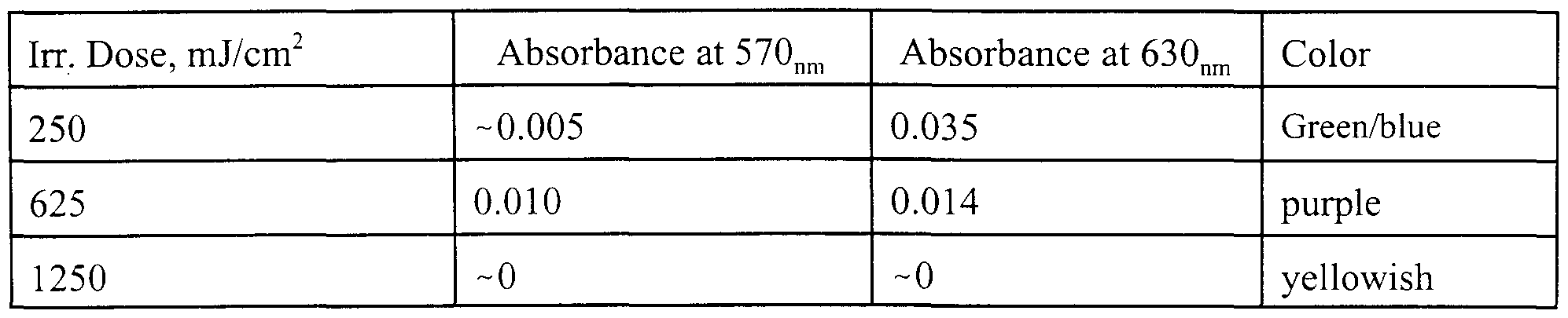
In accordance with another embodiment of the invention a stereolithography resin is polymerized in the presence of both a TAM'-CN and TAM-H color former wherein both colorformers are bleachable when exposed to high levels of actinic radiation. In a typical polychromic color experiment, 0.05% MGH and 0.0025% BFCN are included in Resin 2 containing cationically polymerizable epoxide(s) (60-90%), triarylsulfonium hexafluoroantimonate photoinitiator(s) (0.1-2%), acrylate esters (5-35%), free radical photoinitiator(s) (1-8%). The following absorbances and polymer color are obtained:
Figure imgf000015_0001
Experimental:
Samples are prepared as follows:
A 200 μm thin layer is drawn down on a glass slide. It is scanned with a He/Cd (325 nm) laser with a 1.5 mm diameter beam. The dose ranges from 40-800 mJ/cm2 with a typical maximum dose being 600 mJ/cmM A low dose of 40 to 80 mJ/cm2 is employed to polymerize the composition. A contrast ratio is measured at the maximum absoφtion with the absorbance at the high dose being ratioed to the absorbance at the lowest dose at the specified wavelength.
Having described the invention in detail, it will be apparent that modifications and variations are possible without departing from the scope of the invention defined in the appended claims.
What is claimed is:
Claims

CLAIMS A composition which can be selectively colored by exposure to actinic radiation which comprises an oxidizing agent, a first color former which yields a first dye cation upon exposure m the presence of the oxidizing agent, and a second color former which yields a second dye cation and a leaving group by heterolysis, wherein said first dye cation is bleached by further radiation in the presence of said second color former
The composition of claim 1 wherein the oxidizing agent is a compound having a photoreduction potential less than said first color former
The composition of claim 2 wherein said oxidizing agent is an onium salt
The composition of claim 3 wherein said onium salt is a sulfonium salt or an lodonium salt
The composition of claim 4 wherein said sulfonium salt is a triarylsulfonium salt
The composition of claim 1 wherein said first dye cation is less stable than said second dye cation such that said first dye cation is preferentially bleached in the presence of said second dye cation
The composition of claim 6 wherein said first dye cation includes fewer auxochromic groups in the ortho and para positions than said second dye cation
The composition of claim 1 wherein said first color former and said second color former are present in an amount sufficient to provide a contrast ratio of at least 1 5
The composition of claim 1 wherein the rate with which said first color former is oxidized is greater than the rate of heterolysis of said second color former
The composition of claim 1 wherein said composition is a solid or a liquid
The composition of claim 1 wherein said composition is sensitive to light having a wavelength less than 375nm
12. The composition of claim 1 wherein said composition can be selectively colored by exposure to radiation of different intensity.
13. The composition of claim 1 wherein said composition is selectively colored by exposure to radiation of different wavelength.
14. The composition of claim 1 further comprising a curable compound.
15. The composition of claim 14 wherein said curable compound is selected from the group consisting of epoxides, cyclic formals, cyclic acetals, cyclic ethers, cyclic esters, cyclic sulfides, alkyl monomers, vinyl monomers, vinyl ether functional prepolymers, melamine-formaldehyde prepolymers, phenol-formaldehyde prepolymers, cyclic organosiloxanes, actams, lactones, epoxy functional silicone oligomers, acrylates, mefhacrylates, vinyl ethers and mixtures thereof.
16. The composition of claim 15 wherein said curable compound is a mixture of an epoxide and one or more acrylates.
17. The composition of claim 1 wherein said first color former is selected from the group consisting of triarylmethane leuco dyes, diarylmethane leuco dyes and monoarylmethane leuco dyes.
18. The composition of claim 17 wherein said first color former is a triarylmethane leuco base.
19. The color former of claim 18 wherein said triarylmethane leucobase is Malachite Green leucobase.
20. The composition of claim 1 wherein said second color former is selected from the group consisting of triarylmethane leuco dyes, diarylmethane leuco dyes and monoarylmethane leuco dyes. 21 The composition of claim 20 wherein said triarylmethane leuco dye is a triarylmethane leuconitrile
22 The composition of claim 21 wherein said triarylmethane leuconitrile is selected from the group consisting of tπs(4-(NN-dιmethylammo)phenyl)cyanomethane (Crystal Violet Leuconitrile), bιs(4-(N,N-dιmethylamιno)phenyl)(phenyl)cyanomethane (Malachite Green Leuconitrile), tπs(4-ammophenyl)cyanomethane (Basic Fuchsin Leuconitrile), bιs(4-(N,N-dιmethylamιno)phenyl) (pentafluorophenyl)cyanomethane, bιs(4-(NN- dιmethylammo)phenyl)- (2 -fluorophenyl )cyanomethane, bιs(4-N,N- dιmethylamιno)phenyl)- (3 -fluorophenyl) cyanomethane, bιs(4-(N,N- dιmethylammo)phenyl)-(2,6-dιfluorophenyl)cyanomethane, bιs(3-(2- methyhndyl))(phenyl)cyanomethane, bιs(4 amιnophenyl)-(4-amιno-3- methylphenyl)cyanomethane (Unsymmetπc Basic Fuchsin Leuconitrile), tπs[4-(N- tπphenylmethyl)amιnophenyl]cyanomethane (Protected Basic Fuchsin Leuconitrile), bιs(4-( VN-dιethylamιno)phenyl)( 1 -[4-(N-ethylammo)naphthyl])cyanomethane (Victoria Pure Blue Leuconitrile) and mixtures thereof.
23. The composition of claim 1 wherein said first color former is Malachite Green leucobase, said second color former is Basic Fuchsin leuconitrile and said oxidizing agent is a triarylsulfonium salt.
24 The composition of claim 1 wherein said second dye cation is bleached by exposure to a high dosage of actinic radiation.
25 A method comprising the steps of: a. providing a composition which comprises a first color former which yields a first dye cation upon exposure in the presence of an oxidizing agent and a second color former which yields a second dye cation and a leaving group by heterolysis, b selectively exposing the composition to a low dosage of actinic radiation thereby forming a colored area of a first color, and c selectively exposing the composition to an intermediate dosage of actinic radiation thereby forming a colored area of a second color.
26. The method of claim 25 including the additional step of: d. exposing selected areas of the composition to actinic radiation of a higher dosage thereby forming a colored area of a third color.
27. The method of claim 25 wherein said radiation is accomplished using at least one laser.
28. The method of claim 26 wherein said laser is a He/Cd (325nm) laser.
PCT/US2001/012971 2000-04-26 2001-04-23 Selectively colorable polymerizable compositions Ceased WO2001081997A1 (en)

Priority Applications (2)

Application Number Priority Date Filing Date Title
EP01928738A EP1277086A4 (en) 2000-04-26 2001-04-23 Selectively colorable polymerizable compositions
AU2001255566A AU2001255566A1 (en) 2000-04-26 2001-04-23 Selectively colorable polymerizable compositions

Applications Claiming Priority (2)

Application Number Priority Date Filing Date Title
US09/558,599 US6309797B1 (en) 2000-04-26 2000-04-26 Selectively colorable polymerizable compositions
US09/558,599 2000-04-26

Publications (1)

Publication Number Publication Date
WO2001081997A1 true WO2001081997A1 (en) 2001-11-01

Family

ID=24230177

Family Applications (1)

Application Number Title Priority Date Filing Date
PCT/US2001/012971 Ceased WO2001081997A1 (en) 2000-04-26 2001-04-23 Selectively colorable polymerizable compositions

Country Status (4)

Country Link
US (1) US6309797B1 (en)
EP (1) EP1277086A4 (en)
AU (1) AU2001255566A1 (en)
WO (1) WO2001081997A1 (en)

Cited By (1)

* Cited by examiner, † Cited by third party
Publication number Priority date Publication date Assignee Title
WO2007112921A1 (en) * 2006-03-30 2007-10-11 Dsm Ip Assets B.V. Cationic composition and methods of making and using the same

Families Citing this family (43)

* Cited by examiner, † Cited by third party
Publication number Priority date Publication date Assignee Title
CA2324794A1 (en) * 2000-10-25 2002-04-25 American Dye Source, Inc. Organic-inorganic hybrid photocurable compositions
US20030149124A1 (en) * 2001-11-27 2003-08-07 Thommes Glen A. Radiation curable resin composition for making colored three dimensional objects
DE10161242C1 (en) * 2001-12-13 2003-03-13 Andreas Peter Galac Production of laminated glass, including safety glass, uses ultraviolet-curable casting resin containing bleachable, photoreactive dye for bonding panes of glass
US6713125B1 (en) 2002-03-13 2004-03-30 3D Systems, Inc. Infiltration of three-dimensional objects formed by solid freeform fabrication
US6855482B2 (en) * 2002-04-09 2005-02-15 Day International, Inc. Liquid transfer articles and method for producing the same using digital imaging photopolymerization
EP1502922A1 (en) * 2003-07-30 2005-02-02 Loctite (R &amp; D) Limited Curable encapsulant compositions
WO2005030853A1 (en) * 2003-09-30 2005-04-07 Nuplex Industries Limited Epoxy compositions and methods of detecting cure
US7977026B2 (en) * 2004-02-06 2011-07-12 Rohm And Haas Electronic Materials Llc Imaging methods
US20050175941A1 (en) 2004-02-06 2005-08-11 Rohm And Hass Electronic Materials, L.L.C. Imaging composition and method
US7144676B2 (en) * 2004-02-06 2006-12-05 Rohm And Haas Electronic Materials Llc Imaging compositions and methods
KR101125678B1 (en) * 2004-02-06 2012-03-28 롬 앤드 하스 일렉트로닉 머트어리얼즈, 엘.엘.씨. Improved imaging compositions and methods
US7270932B2 (en) * 2004-02-06 2007-09-18 Rohm And Haas Electronic Materials Llc Imaging composition and method
US7198834B2 (en) 2005-03-22 2007-04-03 Hewlett-Packard Development Company, L.P. Imaging media including interference layer for generating human-readable marking on optical media
US7270944B2 (en) * 2005-03-29 2007-09-18 Hewlett-Packard Development Company, L.P. Compositions, systems, and methods for imaging
CN100376887C (en) * 2005-04-29 2008-03-26 农业部环境保护科研监测所 A test paper, preparation method and application for rapid detection of heavy metal cadmium
US20070116910A1 (en) * 2005-11-23 2007-05-24 Polykarpov Alexander Y Multilayer laminated structures
US20130083286A1 (en) * 2011-09-30 2013-04-04 Johnson & Johnson Vision Care, Inc. Method of creating a visible mark on lens using a leuco dye
US20130083287A1 (en) * 2011-09-30 2013-04-04 Johnson & Johnson Vision Care, Inc. Method of creating a visible mark on lens using a leuco dye
US8846295B2 (en) 2012-04-27 2014-09-30 International Business Machines Corporation Photoresist composition containing a protected hydroxyl group for negative development and pattern forming method using thereof
MX2016016627A (en) 2014-06-23 2017-06-06 Carbon Inc Methods of producing three-dimensional objects from materials having multiple mechanisms of hardening.
CN107438513B (en) 2015-02-05 2020-12-29 卡本有限公司 Additive Manufacturing Method by Intermittent Exposure
US10391711B2 (en) 2015-03-05 2019-08-27 Carbon, Inc. Fabrication of three dimensional objects with multiple operating modes
CN104873410A (en) * 2015-05-04 2015-09-02 上海应用技术学院 Methyl methacrylate cross-linked polymer microparticle loaded with lipid-soluble dye and preparation method of microparticle
WO2017040883A1 (en) 2015-09-04 2017-03-09 Carbon, Inc. Cyanate ester dual cure resins for additive manufacturing
WO2017044381A1 (en) 2015-09-09 2017-03-16 Carbon3D, Inc. Epoxy dual cure resins for additive manufacturing
US10647873B2 (en) * 2015-10-30 2020-05-12 Carbon, Inc. Dual cure article of manufacture with portions of differing solubility
WO2017079502A1 (en) 2015-11-05 2017-05-11 Carbon, Inc. Silicone dual cure resins for additive manufacturing
WO2017112483A2 (en) 2015-12-22 2017-06-29 Carbon, Inc. Accelerants for additive manufacturing with dual cure resins
WO2017112571A1 (en) 2015-12-22 2017-06-29 Carbon, Inc. Dual cure additive manufacturing of rigid intermediates that generate semi-rigid, flexible, or elastic final products
US10343331B2 (en) 2015-12-22 2019-07-09 Carbon, Inc. Wash liquids for use in additive manufacturing with dual cure resins
WO2017112653A1 (en) 2015-12-22 2017-06-29 Carbon, Inc. Dual precursor resin systems for additive manufacturing with dual cure resins
WO2017112751A1 (en) 2015-12-22 2017-06-29 Carbon, Inc. Blocked silicone dual cure resins for additive manufacturing
US10501572B2 (en) 2015-12-22 2019-12-10 Carbon, Inc. Cyclic ester dual cure resins for additive manufacturing
CN108475008B (en) 2015-12-22 2020-11-06 卡本有限公司 A method of forming a three-dimensional object
AU2017264964B2 (en) 2016-05-13 2021-11-25 MSI Coatings Inc. System and method for using a VOC free low radiant flux LED UV curable composition
US10500786B2 (en) 2016-06-22 2019-12-10 Carbon, Inc. Dual cure resins containing microwave absorbing materials and methods of using the same
WO2018094131A1 (en) 2016-11-21 2018-05-24 Carbon, Inc. Method of making three-dimensional object by delivering reactive component for subsequent cure
WO2018165090A1 (en) 2017-03-09 2018-09-13 Carbon, Inc. Tough, high temperature polymers produced by stereolithography
CN213006569U (en) 2017-06-21 2021-04-20 卡本有限公司 A system for additive manufacturing and a dispensing system useful for dispensing resin for additive manufacturing
US12157831B1 (en) 2017-07-26 2024-12-03 MSI Coatings Inc. Energy curable composition and method of using the same
US11338320B1 (en) * 2018-02-03 2022-05-24 MSI Coatings Inc. Composition for aerosol cans, method of making and using the same
US11504903B2 (en) 2018-08-28 2022-11-22 Carbon, Inc. 1K alcohol dual cure resins for additive manufacturing
US12486341B2 (en) 2020-06-29 2025-12-02 Board Of Regents, The University Of Texas System Photocurable compositions and methods of use thereof

Citations (3)

* Cited by examiner, † Cited by third party
Publication number Priority date Publication date Assignee Title
US4780393A (en) * 1986-01-25 1988-10-25 Hoechst Aktiengesellschaft Photopolymerizable composition and photopolymerizable recording material containing same
US5677107A (en) * 1991-10-02 1997-10-14 Spectra Group Limited, Inc. Production of three-dimensional objects
US5983065A (en) * 1997-07-23 1999-11-09 Xerox Corporation Method of printing secure documents

Family Cites Families (12)

* Cited by examiner, † Cited by third party
Publication number Priority date Publication date Assignee Title
US4017313A (en) * 1974-09-30 1977-04-12 E. I. Du Pont De Nemours And Company Photosensitive composition containing a leuco dye, a photosensitizer, an aromatic aldehyde and a secondary or tertiary amine and the use thereof in a direct-print process
GB2139369B (en) 1983-05-06 1987-01-21 Sericol Group Ltd Photosensitive systems showing visible indication of exposure
DE3717038A1 (en) 1987-05-21 1988-12-08 Basf Ag PHOTOPOLYMERIZABLE RECORDING MATERIALS, PHOTORESIS LAYERS AND FLAT PRINTING PLATES BASED ON THESE RECORDING MATERIALS
US4859572A (en) 1988-05-02 1989-08-22 Eastman Kodak Company Dye sensitized photographic imaging system
DE3834300A1 (en) * 1988-10-08 1990-04-12 Hoechst Ag RADIATION-SENSITIVE MIXTURE AND RADIATION-SENSITIVE COPIER MATERIAL PRODUCED HEREOF
US5286612A (en) 1992-10-23 1994-02-15 Polaroid Corporation Process for generation of free superacid and for imaging, and imaging medium for use therein
JPH0713330A (en) * 1993-06-24 1995-01-17 Toray Ind Inc Photosensitive resin composition
US5441850A (en) 1994-04-25 1995-08-15 Polaroid Corporation Imaging medium and process for producing an image
DK0854783T3 (en) 1995-09-09 2003-02-24 Vantico Ltd Process for producing polymer layers with selectively colored areas
US5942554A (en) 1996-02-20 1999-08-24 Spectra Group Limited, Inc. Method for forming highly colored polymeric bodies
CN1248047C (en) 1998-07-25 2006-03-29 范蒂科有限公司 Colour changing composition and colouring polymeric articles made therefrom
US6200646B1 (en) * 1999-08-25 2001-03-13 Spectra Group Limited, Inc. Method for forming polymeric patterns, relief images and colored polymeric bodies using digital light processing technology

Patent Citations (3)

* Cited by examiner, † Cited by third party
Publication number Priority date Publication date Assignee Title
US4780393A (en) * 1986-01-25 1988-10-25 Hoechst Aktiengesellschaft Photopolymerizable composition and photopolymerizable recording material containing same
US5677107A (en) * 1991-10-02 1997-10-14 Spectra Group Limited, Inc. Production of three-dimensional objects
US5983065A (en) * 1997-07-23 1999-11-09 Xerox Corporation Method of printing secure documents

Non-Patent Citations (1)

* Cited by examiner, † Cited by third party
Title
See also references of EP1277086A4 *

Cited By (1)

* Cited by examiner, † Cited by third party
Publication number Priority date Publication date Assignee Title
WO2007112921A1 (en) * 2006-03-30 2007-10-11 Dsm Ip Assets B.V. Cationic composition and methods of making and using the same

Also Published As

Publication number Publication date
EP1277086A1 (en) 2003-01-22
US6309797B1 (en) 2001-10-30
AU2001255566A1 (en) 2001-11-07
EP1277086A4 (en) 2007-01-03

Similar Documents

Publication Publication Date Title
US6309797B1 (en) Selectively colorable polymerizable compositions
US6433035B1 (en) Selectively colorable polymerizable compositions
US5942554A (en) Method for forming highly colored polymeric bodies
US5677107A (en) Production of three-dimensional objects
JPH09509437A (en) Cationic polymerization
US5981616A (en) Photo-curable resin composition used for photo fabication of three-dimensional objects
US4442197A (en) Photocurable compositions
JP5138870B2 (en) Curing agent for cationic curable compositions
JPS609248B2 (en) photosensitive mixture
CN1283685C (en) Radiation curable resin composition for making colored three dimensional objects
EP1918316A1 (en) Photo-curable resin composition
JPH0586149A (en) Resin composition for optical three-dimensional molding and formation of three-dimensional molded product
EP1772774B1 (en) Protected ketone photoinitiators
JPS61500974A (en) Photocurable composition containing two curing types of prepolymers
JPH11310626A (en) Photocurable liquid resin composition
EP0408227A1 (en) Photohardenable or photosoftenable compositions
US3895952A (en) Phototropic compounds as acid catalyst for epoxy materials
JP3838234B2 (en) Energy sensitive acid generator, acid generating method, and energy sensitive curable composition
JP2776878B2 (en) Microcapsule imaging system with improved dynamic range
US20020160310A1 (en) Method for producing selectively colorable printing plates
JP4529641B2 (en) Energy sensitive acid generator, acid generating method, and energy sensitive curable composition
JPH10251615A (en) Base generator, curable composition and cured product thereof
KR100461688B1 (en) Photo-curable resin composition
US3996052A (en) Phototropic compounds as acid catalyst in photopolymerizing process
Crivello Diaryliodonium salt photoacid generators

Legal Events

Date Code Title Description
AK Designated states

Kind code of ref document: A1

Designated state(s): AE AG AL AM AT AU AZ BA BB BG BR BY BZ CA CH CN CO CR CU CZ DE DK DM DZ EE ES FI GB GD GE GH GM HR HU ID IL IN IS JP KE KG KP KR KZ LC LK LR LS LT LU LV MA MD MG MK MN MW MX MZ NO NZ PL PT RO RU SD SE SG SI SK SL TJ TM TR TT TZ UA UG UZ VN YU ZA ZW

AL Designated countries for regional patents

Kind code of ref document: A1

Designated state(s): GH GM KE LS MW MZ SD SL SZ TZ UG ZW AM AZ BY KG KZ MD RU TJ TM AT BE CH CY DE DK ES FI FR GB GR IE IT LU MC NL PT SE TR BF BJ CF CG CI CM GA GN GW ML MR NE SN TD TG

121 Ep: the epo has been informed by wipo that ep was designated in this application
DFPE Request for preliminary examination filed prior to expiration of 19th month from priority date (pct application filed before 20040101)
REG Reference to national code

Ref country code: DE

Ref legal event code: 8642

WWE Wipo information: entry into national phase

Ref document number: 2001928738

Country of ref document: EP

WWP Wipo information: published in national office

Ref document number: 2001928738

Country of ref document: EP

NENP Non-entry into the national phase

Ref country code: JP

WWW Wipo information: withdrawn in national office

Ref document number: 2001928738

Country of ref document: EP