WO2001092264A1 - Adenosine a2a receptor antagonists - Google Patents
Adenosine a2a receptor antagonists Download PDFInfo
- Publication number
- WO2001092264A1 WO2001092264A1 PCT/US2001/016954 US0116954W WO0192264A1 WO 2001092264 A1 WO2001092264 A1 WO 2001092264A1 US 0116954 W US0116954 W US 0116954W WO 0192264 A1 WO0192264 A1 WO 0192264A1
- Authority
- WO
- WIPO (PCT)
- Prior art keywords
- alkyl
- alkoxy
- formula
- compound
- mmol
- Prior art date
- Legal status (The legal status is an assumption and is not a legal conclusion. Google has not performed a legal analysis and makes no representation as to the accuracy of the status listed.)
- Ceased
Links
- 0 ***[n]1ncc2c1nc(N)[n]1nc(*)nc21 Chemical compound ***[n]1ncc2c1nc(N)[n]1nc(*)nc21 0.000 description 4
- QHPYRHIUFSIQHB-UHFFFAOYSA-N CCC(CCNC)(C(NC1)=O)N1c1ccccc1 Chemical compound CCC(CCNC)(C(NC1)=O)N1c1ccccc1 QHPYRHIUFSIQHB-UHFFFAOYSA-N 0.000 description 1
- GXWOMPBPYQPEJU-UHFFFAOYSA-N CCCC(CNC)c1ccccc1 Chemical compound CCCC(CNC)c1ccccc1 GXWOMPBPYQPEJU-UHFFFAOYSA-N 0.000 description 1
- ZQPJZSBDDDDMBD-UHFFFAOYSA-N CN(CC1)CC2=C1C=C=C2 Chemical compound CN(CC1)CC2=C1C=C=C2 ZQPJZSBDDDDMBD-UHFFFAOYSA-N 0.000 description 1
- QEBFVZBHTOIKBX-UHFFFAOYSA-N CN(CC1)CCC1=[NH+][O-] Chemical compound CN(CC1)CCC1=[NH+][O-] QEBFVZBHTOIKBX-UHFFFAOYSA-N 0.000 description 1
- JOFKCNJIUXPJAC-UHFFFAOYSA-N CN(CC1)Cc2c1c1ccccc1[nH]2 Chemical compound CN(CC1)Cc2c1c1ccccc1[nH]2 JOFKCNJIUXPJAC-UHFFFAOYSA-N 0.000 description 1
- RMFQOVASJJFORN-UHFFFAOYSA-N Cc(cc1)ccc1-c1nccnc1 Chemical compound Cc(cc1)ccc1-c1nccnc1 RMFQOVASJJFORN-UHFFFAOYSA-N 0.000 description 1
- VIYCUIHNSLUUDQ-UHFFFAOYSA-N Cc1nc(N)nc(C)c1C=O Chemical compound Cc1nc(N)nc(C)c1C=O VIYCUIHNSLUUDQ-UHFFFAOYSA-N 0.000 description 1
- UHHNJMPSUBMFNF-UHFFFAOYSA-N Cc1nc(N)nc(NNC(c2ccc[o]2)=O)c1C=O Chemical compound Cc1nc(N)nc(NNC(c2ccc[o]2)=O)c1C=O UHHNJMPSUBMFNF-UHFFFAOYSA-N 0.000 description 1
- BHYWWNHXUGUZKV-UHFFFAOYSA-O NC([NH2+]1)=NC(NCCN(CC2)CCC2C(c2ccccc2)O)=C(C=N)C1=NC(c1ccc[o]1)=N Chemical compound NC([NH2+]1)=NC(NCCN(CC2)CCC2C(c2ccccc2)O)=C(C=N)C1=NC(c1ccc[o]1)=N BHYWWNHXUGUZKV-UHFFFAOYSA-O 0.000 description 1
- YKWJNVFPKLFRRE-UHFFFAOYSA-N Nc1nc([nH]nc2)c2c2nc(-c3ccc[o]3)n[n]12 Chemical compound Nc1nc([nH]nc2)c2c2nc(-c3ccc[o]3)n[n]12 YKWJNVFPKLFRRE-UHFFFAOYSA-N 0.000 description 1
- JZAMQDDHRXHDFR-UHFFFAOYSA-N Nc1nc([n](CCN(CC2)CCN2c(ccc(F)c2)c2F)nc2)c2c2nc(-c3ccc[o]3)n[n]12 Chemical compound Nc1nc([n](CCN(CC2)CCN2c(ccc(F)c2)c2F)nc2)c2c2nc(-c3ccc[o]3)n[n]12 JZAMQDDHRXHDFR-UHFFFAOYSA-N 0.000 description 1
- CESLYADTBJIPJO-UHFFFAOYSA-N Nc1nc([n](CCO)nc2)c2c(NNC(c2ccc[o]2)=O)n1 Chemical compound Nc1nc([n](CCO)nc2)c2c(NNC(c2ccc[o]2)=O)n1 CESLYADTBJIPJO-UHFFFAOYSA-N 0.000 description 1
- CBHWZESTUNVRSU-UHFFFAOYSA-N Nc1nc([n](CCO)nc2)c2c2nc(-c3ccc[o]3)n[n]12 Chemical compound Nc1nc([n](CCO)nc2)c2c2nc(-c3ccc[o]3)n[n]12 CBHWZESTUNVRSU-UHFFFAOYSA-N 0.000 description 1
Classifications
-
- C—CHEMISTRY; METALLURGY
- C07—ORGANIC CHEMISTRY
- C07D—HETEROCYCLIC COMPOUNDS
- C07D487/00—Heterocyclic compounds containing nitrogen atoms as the only ring hetero atoms in the condensed system, not provided for by groups C07D451/00 - C07D477/00
- C07D487/12—Heterocyclic compounds containing nitrogen atoms as the only ring hetero atoms in the condensed system, not provided for by groups C07D451/00 - C07D477/00 in which the condensed system contains three hetero rings
- C07D487/14—Ortho-condensed systems
-
- A—HUMAN NECESSITIES
- A61—MEDICAL OR VETERINARY SCIENCE; HYGIENE
- A61P—SPECIFIC THERAPEUTIC ACTIVITY OF CHEMICAL COMPOUNDS OR MEDICINAL PREPARATIONS
- A61P25/00—Drugs for disorders of the nervous system
-
- A—HUMAN NECESSITIES
- A61—MEDICAL OR VETERINARY SCIENCE; HYGIENE
- A61P—SPECIFIC THERAPEUTIC ACTIVITY OF CHEMICAL COMPOUNDS OR MEDICINAL PREPARATIONS
- A61P25/00—Drugs for disorders of the nervous system
- A61P25/08—Antiepileptics; Anticonvulsants
-
- A—HUMAN NECESSITIES
- A61—MEDICAL OR VETERINARY SCIENCE; HYGIENE
- A61P—SPECIFIC THERAPEUTIC ACTIVITY OF CHEMICAL COMPOUNDS OR MEDICINAL PREPARATIONS
- A61P25/00—Drugs for disorders of the nervous system
- A61P25/14—Drugs for disorders of the nervous system for treating abnormal movements, e.g. chorea, dyskinesia
- A61P25/16—Anti-Parkinson drugs
-
- A—HUMAN NECESSITIES
- A61—MEDICAL OR VETERINARY SCIENCE; HYGIENE
- A61P—SPECIFIC THERAPEUTIC ACTIVITY OF CHEMICAL COMPOUNDS OR MEDICINAL PREPARATIONS
- A61P25/00—Drugs for disorders of the nervous system
- A61P25/24—Antidepressants
-
- A—HUMAN NECESSITIES
- A61—MEDICAL OR VETERINARY SCIENCE; HYGIENE
- A61P—SPECIFIC THERAPEUTIC ACTIVITY OF CHEMICAL COMPOUNDS OR MEDICINAL PREPARATIONS
- A61P25/00—Drugs for disorders of the nervous system
- A61P25/28—Drugs for disorders of the nervous system for treating neurodegenerative disorders of the central nervous system, e.g. nootropic agents, cognition enhancers, drugs for treating Alzheimer's disease or other forms of dementia
-
- A—HUMAN NECESSITIES
- A61—MEDICAL OR VETERINARY SCIENCE; HYGIENE
- A61P—SPECIFIC THERAPEUTIC ACTIVITY OF CHEMICAL COMPOUNDS OR MEDICINAL PREPARATIONS
- A61P43/00—Drugs for specific purposes, not provided for in groups A61P1/00-A61P41/00
Definitions
- the present invention relates to substituted 5-amino-pyrazolo-[4,3-e]-1 ,2,4- triazolo[1 ,5-c]pyrimidine adenosine A 2a receptor antagonists, the use of said compounds in the treatment of central nervous system diseases, in particular Parkinson's disease, and to pharmaceutical compositions comprising said compounds.
- the invention also relates to a process for preparing 5-amino-2- (substituted)pyrazolo[4,3-e]-1 ,2,4-triazolo-[1 ,5-c]pyrimidines, intermediates useful in preparing the claimed compounds.
- Adenosine is known to be an endogenous modulator of a number of physiological functions. At the cardiovascular system level, adenosine is a strong vasodilator and a cardiac depressor. On the central nervous system, adenosine induces sedative, anxiolytic and antiepileptic effects. On the respiratory system, adenosine induces bronchoconstriction. At the kidney level, it exerts a biphasic action, inducing vasoconstriction at low concentrations and vasodilation at high doses. Adenosine acts as a lipolysis inhibitor on fat cells and as an antiaggregant on platelets.
- Adenosine action is mediated by the interaction with different membrane specific receptors which belong to the family of receptors coupled with G proteins.
- Biochemical and pharmacological studies, together with advances in molecular biology, have allowed the identification of at least four subtypes of adenosine receptors: A A 2a , A 2b and A 3 .
- A, and A 3 are high-affinity, inhibiting the activity of the enzyme adenylate cyclase, and A 2a and A 2b are low-affinity, stimulating the activity of the same enzyme.
- Analogs of adenosine able to interact as antagonists with the A v A 2a , A 2b and A 3 receptors have also been identified.
- a 2a antagonists for the A 2a receptor are of pharmacological interest because of their reduced level of side affects.
- a 2a antagonists can have antidepressant properties and stimulate cognitive functions.
- data has shown that A 2a receptors are present in high density in the basal ganglia, known to be important in the control of movement.
- a 2a antagonists can improve motor impairment due to neurodegenerative diseases such as Parkinson's disease, senile dementia as in Alzheimer's disease, and psychoses of organic origin.
- xanthine-related compounds have been found to be A receptor selective antagonists, and xanthine and non-xanthine compounds have been found to have high A 2a affinity with varying degrees of A 2a vs. A, selectivity.
- Triazolo-pyrimidine adenosine A 2a receptor antagonists with different substitution at the 7-position have been disclosed previously, for example in WO 95/01356; US 5,565,460; WO 97/05138; and WO 98/52568.
- the present invention relates to compounds having the structural formula I
- R is R 1 -furanyl, R 1 -thienyl, R -pyridyl, R 1 -pyridyl N-oxide, R 1 -oxazolyl,
- R 10 -phenyl, R 1 -pyrrolyl or C 4 -C 6 cycloalkenyl;
- X is C 2 -C 6 alkylene or -C(O)CH 2 -;
- Y is -N(R 2 )CH 2 CH 2 N(R 3 )-, -OCH 2 CH 2 N(R 2 )-, -0-, -S-, -CH.S-, -(CH 2 ) 2 -NH-, or and
- Z is R 5 -phenyl, R 5 -phenyl(C C 6 )alkyl, R 5 -heteroaryl, diphenylmethyl, R 6 -C(0)-,
- R 1 is 1 to 3 substituents independently selected from hydrogen, -CF 3 , halogen, -N0 2 , -NR 2 R 13 , C C 6 alkoxy, C C 6 alkylthio, C,-C ⁇ alkylsulfinyl, and alkylsulfonyl;
- R 2 and R 3 are independently selected from the group consisting of hydrogen and C ⁇ -C 8 alkyl;
- m and n are independently 2-3;
- R 5 is 1 to 5 substituents independently selected from the group consisting of hydrogen, halogen, C C s alkyl, hydroxy, C ⁇ C g alkoxy, -CN, di-((C 1 -C 6 )alkyl)amino, -CF 3 , -OCF 3 , acetyl, -N0 2 , hydroxy(C 1 -C 6 )alkoxy, (C 1 -C 6 )-alkoxy(C 1 -C 6 )alkoxy, di-((C C 6 )-alkoxy)(C 1 -C 8 )alkoxy, (C 1 -C 6 )-alkoxy(C 1 -C 6 )alkoxy-(C 1 -C 6 )-alkoxy-(C 1 -C 6
- R 6 is (C C 6 )alkyl, R 5 -phenyl, R 5 -phenyl(C 1 -C 6 )alkyl, thienyl, pyridyl, (C 3 -C 6 )- cycloalkyl, (C 1 -C 6 )alkyl-OC(0)-NH-(C 1 -C 6 )alkyl-, di-((C 1 -C 6 )alkyl)aminomethyl, or
- R 7 is (C 1 -Cg)alkyl, R 5 -phenyl or R ⁇ pheny C ⁇ alkyl;
- R 8 is hydrogen or C C 6 alkyl; or
- R 7 and R 8 together are -(CH 2 ) p -A-(CH 2 ) q , wherein p and q are independently 2 or 3 and A is a bond, -CH 2 -, -S- or -0-, and form a ring with the nitrogen to which they are attached;
- R 9 is 1-2 groups independently selected from hydrogen, alkyl, hydroxy, C ⁇ C g alkoxy, halogen, -CF 3 and (C 1 -C 6 )alkoxy(C 1 -C 6 ) alkoxy ;
- R 10 is 1 to 5 substituents independently selected from the group consisting of hydrogen, halogen, 0,-0 6 alkyl, hydroxy, di-((C C 6 )alkyl)amino, -CF 3 , -OCF 3 and -S(O) 0.2 (C C 6 )alkyl;
- R 11 is H, C C 6 alkyl, phenyl, benzyl, C 2 -C 6 alkenyl, C ⁇ C g alkoxy ⁇ alkyl, di- ((C 1 -C 6 )alkyl)amino(C 1 -C 8 )alkyl, pyrrolidinyl(C 1 -C 6 )alkyl or piperidino ⁇ -C ⁇ alkyl;
- R 12 is H or C C 6 alkyl
- R 13 is (C C 6 )alkyl-C(0)- or (C C 6 )alkyI-S0 2 -.
- Preferred compounds of formula I are those wherein R is RMuranyl, R 1 -thienyl, R 1 -pyrrolyl or R 10 -phenyl, more preferably RMuranyl.
- R is preferably hydrogen or
- Q preferably being nitrogen.
- m and n are each 2, and R 4 is H.
- a preferred definition for Z is R 5 -phenyl, R 5 -heteroaryl, R 6 -C(0)- or R 6 -SO 2 -.
- R 5 is preferably H, halogen, alkyl, alkoxy, hydroxyalkoxy or alkoxyalkoxy.
- R 6 is preferably R 5 -phenyl.
- Another aspect of the invention is a pharmaceutical composition comprising a therapeutically effective amount of a compound of formula I in a pharmaceutically acceptable carrier.
- Yet another aspect of the invention is a method of treating central nervous system diseases such as depression, cognitive diseases and neurodegenerative diseases such as Parkinson's disease, senile dementia or psychoses of organic origin, and stroke, comprising administering a compound of formula I to a mammal in need of such treatment.
- the invention is drawn to the method of treating Parkinson's disease comprising administering a compound of formula I to a mammal in need of such treatment.
- Another aspect of the invention is a process for preparing 5-amino-2-(R- substituted)-pyrazolo[4,3-e]-1 ,2,4-triazolo-[1 ,5-c]pyrimidines of formula II, which are intermediates useful in the preparation of compounds of formula I.
- the process of preparing compounds of formula II wherein R is as defined above, comprises
- a preferred aspect of the process is the dehydrative rearrangement of the intermediate of formula IX to obtain the 5-amino-2-(R-substituted)-pyrazolo[4,3-e]- 1 ,2,4-triazolo[1 ,5-c]pyrimidine of formula II.
- Preferred embodiments of the process use 2-furoic hydrazide or 2-thienoylhydrazide in step 2, thus preparing compounds of formula II wherein R is 2-furyl or 2-thienyl.
- Another aspect of the invention is a process for preparing 7-bromoalkyl-5- amino-2-(R-substituted)-pyrazolo[4,3-e]-1 ,2,4-triazolo-[1 ,5-c]pyrimidines of formula Ilia, which are intermediates useful in the preparation of compounds of formula I.
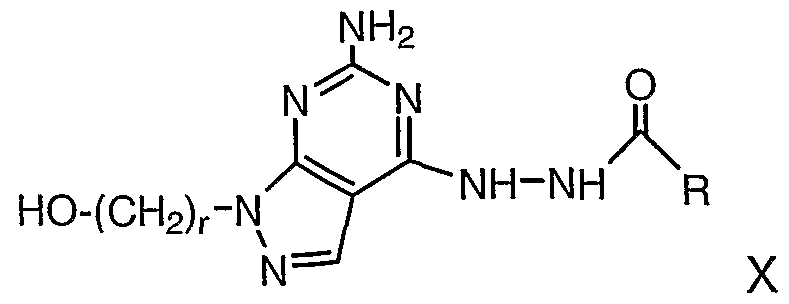
- the process of preparing compounds of formula Ilia wherein R is as defined above, comprises (1) treating a chloride of formula VIII
- Still another aspect of the invention is a method of treating Parkinson's disease with a combination of a compound of formula l and one or more agents known to be useful in the treatment of Parkinson's disease, for example dopamine; a dopaminergic agonist; an inhibitor of monoamine oxidase, type B (MAO-B); a DOPA decarboxylase inhibitor (DCI); or a catechol-O-methyltransferase (COMT) inhibitor.
- a pharmaceutical composition comprising a compound of formula I and one or more agents known to be useful in the treatment of Parkinson's in a pharmaceutically acceptable carrier.
- alkyl includes straight or branched chains.
- Alkylene referring to a divalent alkyl group, similarly refers to straight or branched chains.
- Cycloalkylene refers to a divalent cycloalkyl group.
- Cycloalkenyl refers to a C 4 -C B cycloalkyl ring comprising one double bond.
- Heteroaryl means a single ring, bicyclic or benzofused heteroaromatic group of 5 to 10 atoms comprised of 2 to 9 carbon atoms and 1 to 4 heteroatoms independently selected from the group consisting of N, O and S, provided that the rings do not include adjacent oxygen and/or sulfur atoms. N-oxides of the ring nitrogens are also included.
- single-ring heteroaryl groups are pyridyl, oxazolyl, isoxazolyl, oxadiazolyl, furanyl, pyrrolyl, thienyl, imidazolyl, pyrazolyl, tetrazolyl, thiazolyl, isothiazolyl, thiadiazolyl, pyrazinyl, pyrimidyl, pyridazinyl and triazolyl.
- bicyclic heteroaryl groups are naphthyridyl (e.g., 1 , 5 or 1 ,7), imidazopyridyl, pyrido[2,3]imidazolyl, pyridopyrimidinyl and 7-azaindoIyl.
- benzofused heteroaryl groups are indolyl, quinolyl, isoquinolyl, phthalazinyl, benzothienyl (i.e., thionaphthenyl), benzimidazolyl, benzofuranyl, benzoxazolyl and benzofurazanyl.
- R 5 -substituted heteroaryl refers to such groups wherein substitutable ring carbon atoms have a substituent as defined above.
- Certain compounds will be acidic in nature, e.g. those compounds which possess a carboxyl or phenolic hydroxyl group. These compounds may form pharmaceutically acceptable salts. Examples of such salts may include sodium, potassium, calcium, aluminum, gold and silver salts. Also contemplated are salts formed with pharmaceutically acceptable amines such as ammonia, alkyl amines, hydroxyalkylamines, N-methylglucamine and the like.
- Certain basic compounds also form pharmaceutically acceptable salts, e.g., acid addition salts.
- pyrido-nitrogen atoms may form salts with strong acid, while compounds having basic substituents such as amino groups also form salts with weaker acids.
- suitable acids for salt formation are hydrochloric, sulfuric, phosphoric, acetic, citric, oxalic, malonic, salicylic, malic, fumaric, succinic, ascorbic, maleic, methanesulfonic and other mineral and carboxylic acids well known to those skilled in the art.
- the salts are prepared by contacting the free base form with a sufficient amount of the desired acid to produce a salt in the conventional manner.
- the free base forms may be regenerated by treating the salt with a suitable dilute aqueous base solution such as dilute aqueous NaOH, potassium carbonate, ammonia and sodium bicarbonate.
- a suitable dilute aqueous base solution such as dilute aqueous NaOH, potassium carbonate, ammonia and sodium bicarbonate.
- the free base forms differ from their respective salt forms somewhat in certain physical properties, such as solubility in polar solvents, but the acid and base salts are otherwise equivalent to their respective free base forms for purposes of the invention. All such acid and base salts are intended to be pharmaceutically acceptable salts within the scope of the invention and all acid and base salts are considered equivalent to the free forms of the corresponding compounds for purposes of the invention.
- Compounds of formula I can be prepared by known methods from starting materials either known in the art or prepared by methods known in the art; see, for example, WO 95/01356 and J. Med. Chem., 39 (1996) 1164-1171.
- the compounds of formula I are prepared by the methods shown in the following reaction schemes.
- Scheme 1 alkylation of a 5-amino-pyrazolo[4,3-e]- [1 ,2,4]-triazolo[l ,5-c]pyrimidine of formula II is used to prepare compounds of formula I
- Starting materials of formula II can be reacted with an alkyl diol ditosylate and a base such as NaH in an inert solvent such as dimethylformamide (DMF), or with a chloro-bromo- or dibromo-alkyl compound under similar conditions, to obtain the alkyl-substituted intermediate of formula III.
- the compound of formula III is then reacted with an amine of the formula Z-Y-H in an inert solvent such as DMF at an elevated temperature to obtain a compound of formula la, i.e., a compound of formula I wherein X is alkylene.
- staring materials of formula II can be reacted with a compound of formula Z-Y-X-CI and a base such as NaH in an inert solvent such as DMF to obtain a mixture of a 7-substituted compound of formula I and the corresponding 8-substituted compound.
- chloropyrazolo-pyrimidine V is reacted with a compound of formula Z-Y-X-CI in a manner similar to the alkylation procedure of Scheme 1 , and the resultant intermediate is reacted with a hydrazide of formula H 2 N-NH-C(0)-R (or with hydrazine hydrate, followed by a compound of formula CI-C(O)-R).
- the resultant hydrazide undergoes dehydrative rearrangement, e.g., by treatment with N,0-bis- (trimethylsilyl)acetamide (BSA) or a combination of BSA and hexamethyldisilazane (HMDS) and at elevated temperatures.
- BSA N,0-bis- (trimethylsilyl)acetamide
- HMDS hexamethyldisilazane
- 2-amino-4,6-dihydroxypyrimidine (VI) is converted to the corresponding 4,6-dichloro-5-carboxaldehyde by treatment with POCI 3 or SOCI 2 in DMF as described in Helv. Chim. Acta. 69 (1986), 1602-1613.
- the reaction is carried out at an elevated temperature, preferably about 100°C, for 2 to 8 hours, preferably about 5 hours.
- 2-amino-4,6-dichloropyrimidine-5-carboxaldehyde (VII) is treated with a hydrazide of the formula H 2 N-NH-C(0)-R, wherein R is as defined above, to obtain the compound of formula VIII; the compound of formula VI and the hydrazide are used in a molar ratio of approximately 1 :1 , with a slight excess of the hydrazide being preferred.
- the reaction is carried out at room temperature or up to about 80°C in a solvent such as CH 3 CN or DMF.
- the reaction time is about 16 hours (e.g., overnight).
- the compound of formula VIII is heated at 60-100°C with 1-5 equivalents of hydrazine hydrate in a solvent such as CH 3 CN or DMF for 1-24 hours to obtain the compound of formula IX.
- the compound of formula IX undergoes dehydrative rearrangement by treatment with a mixture of HMDS and BSA or with BSA alone.
- the reaction is carried out at elevated temperatures, preferably about 120°C, for about 16 hours (e.g., overnight)
- the crude material is purified by conventional methods, e.g., extraction and/or recrystallization.
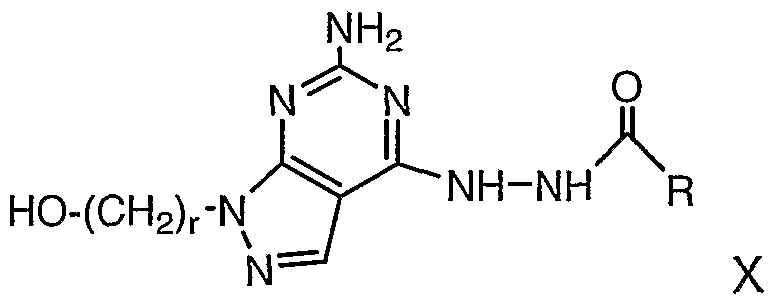
- Chloride VIM is treated with a hydroxyalkyl-hydrazine in an inert solvent such as ethanol at temperatures from ambient to 100°C to furnish derivative X. This is subjected to dehydrative cyclization, similarly to IX, such as with BSA, to provide tricyclic XI. Tricyclic XI is then converted to bromide Ilia with PBr 3 at elevated temperature from 80°C to 150°C for 1 to 24 hours. Intermediate XI can also be converted into the tosylate analogous to Ilia by toluenesulfonyl chloride and base. Bromide Ilia is converted to compounds of formula I as described above for III. Another method for preparing compounds of formula I is illustrated in the following Scheme 5:
- chloride V is converted into alkylated compound XII, and this is further reacted with carbazate XIV, where R' is preferably f-butyl or benzyl, to obtain derivative XIII.
- a solvent such as DMF may be employed at a temperature of 60-120°C. This is then reacted as in Scheme 1 to furnish XV.
- the R' group is next removed, such as removal of a f-butyl group with HCI or TFA, furnishing hydrazine XVI.
- Acylation of XVI furnishes XVII, which is subjected to dehydrative cyclization as described above to provide desired la.
- XII may be reacted with a hydrazide XVIII to obtain XIX, which can be converted to XVII analogously to preparation of XV.
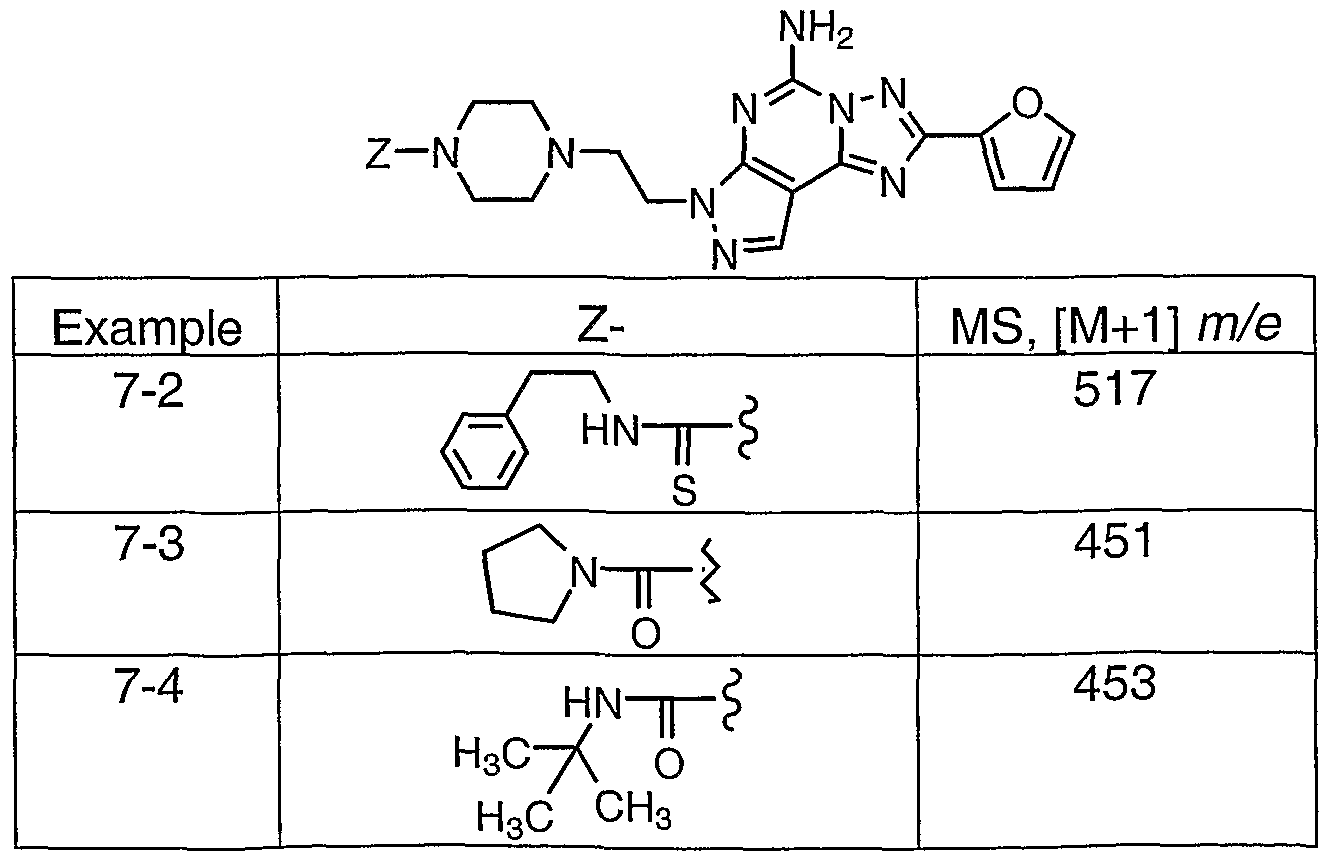
- the following compounds were prepared.
- 1 -(5-Ethyl-2-pyrimidinyl)piperazine is prepared from 2-chloro-5-ethylpyrimidine. Heat the chloride (2.0 g, 14 mmol) and piperazine (3.0 g, 35 mmol) in EtOH (70 ml) at 90 s C for 2h in a sealed vessel. Concentrate and partition between CH 2 CI 2 and 2N NaOH. Dry the organic with MgS0 and concentrate. Chromatograph the crude product on silica (CH 2 CI 2 -CH 3 OH) to obtain the piperazine as a yellow oil.
- 1-(4-(2-Methoxyethoxy)phenyl)piperazine is prepared from 4-(4-hydroxy- phenyl)-1 -acetylpiperazine.
- NaH 50% in mineral oil, 0.79 g, 20 mmol
- DMF 25 ml
- 2-bromoethyl methyl ether 2.27 g, 16.3 mmol
- Stir at RT 18h concentrate, and partition between EtOAc and 5% citric acid. Wash the organic with 1 N NaOH, then brine. Dry over MgS0 , and concentrate to obtain the alkylated product as a white solid.
- 4-(2-Methylaminoethoxy)fluorobenzene is prepared from 4-(2-bromo-ethoxy)- fluorobenzene. Combine the bromide (1.0 g, 4.6 mmol) in CH 3 OH (5 ml) with CH3NH 2 in CH 3 OH (2M, 46 ml, 92 mmol) in a sealed vessel. Heat at 60 Q C for 18h, concentrate, and partition between EtOAc and sat. NaHC0 3 . Wash the organic with brine, dry with MgS0 , and concentrate to obtain the amine as a yellow oil. N-methyl-2-(4-(2-methoxyethoxy)phenoxy)ethylamine was prepared in two steps.
- 1-Phenyl-2-piperazinone is prepared from 4-benzyloxycarbonyl-1-phenyl-2- piperazinone. Combine this material (1.61 g, 5.2 mmol) with 10%Pd/C (0.4 g) in EtOH (50 ml) and 1 N HCI (6 ml). Hydrogenate at 45 psi for 2h and filter. Concentrate and chromatograph the residue on silica (eluting with CH2CI 2 :CH 3 OH:NH 4 OH) to obtain the piperazinone as a cream solid. Preparation 6
- Step 2 Heat the product of Step 1 (0.10 g, 0.33 mmol) in BSA (10 ml) for 4 h at
- Step 3 Combine the product of Step 2 (0.285 g, 1.0 mmol) and PBr 3 (2.0 ml, 21 mmol). Heat at 145°C for 2 h, cool, and pour onto ice. Filter and dry the solid.
- Example 1-3 The compound of Example 1-3 is similarly prepared, as are the following compounds:
- Step 1
- Step 2 To the product of Step 1 (2.15 g, 7.2 mmol) in THF (10 ml), add LiAIH 4 (1 .0 M in THF, 4.4 ml, 4.4 mmol) dropwise. Heat at 60°C 1 h, add water (0.16 ml), 15% NaOH (0.16 ml), and then water (0.49 ml). Filter and concentrate to obtain the alcohol as a yellow oil, NMR (CDCI 3 ) consistent.
- Step 2 To the product of Step 2 (0.90 g, 3.5 mmol) in CH 2 CI 2 (10 ml) at 5°C, add SOCI2 (0.38ml, 5.3 mmol). Allow to warm and stir 16 h. Concentrate and partition between CH 2 CI 2 and 1 N NaOH, wash with water, dry (MgS0 ) and concentrate to obtain the crude product as a yellow oil.
- Example 5 Using the procedure of Example 1 , substituting the tosylate of Preparation 4 for the tosylate of Preparation 2, prepare the following compounds:
- Step 1 Combine 1 -bromo-2,4-difluorobenzene (1.00 g, 5.18 mmol), N,N'-dimethyl- ethylenediamine (2.74 g, 31.1 mmol), NaO-f-Bu (0.70 g, 7.2 mmol), Pd(dba) 2 (0.060 g, 0.10 mmol) and ( ⁇ )-BINAP (0.19 g, 0.31 mmol) in toluene (10 ml). Heat at 110° for 18 h, allow to cool, and extract with 1 N HCI. Basify the aqueous solution with NaOH and extract with CH 2 CI 2 . Dry, concentrate, and purify by PLC to give N-(2,4-difluoro- phenyl)-N,N'-dimethylethylenediamine.
- Example 11 The compound of Example 1-2 was also prepared by the following procedure.
- Step 1 To NaH (60% in oil, 142 mg, 3.5 mmol) in DMF (15 ml) add the chloride of Example 1 1 , Step 1 (500 mg, 2.9 mmol). Add to this 1 -(2-chloroethyl)-4-(2,4- difluorophenyl)piperazine (846 mg, 3.5 mmol). Stir at RT 90h and concentrate. Chromatograph to obtain the desired compound as a white solid.
- Step 1 To NaH (2.14 g, 60% in oil, 53 mmol) in DMF (20 ml), add the product of
- Example 11 Step 1 (7.55 g, 45 mmol). Add 1-bromo-2-chloroethane (14.8 ml, 178 mmol). Stir 1.5 h and concentrate. Chromatograph to give the dichloride as a white solid.
- Step 2 To the product of Step 1 (3.7 g, 16 mmol) in DMF (20 ml) add f-butyl carbazate (2.53 g, 19 mmole). Heat at 80°C for 18 h and concentrate.
- Step 3 To the product of Step 2 (3.16 g, 9.6 mmol) and Kl (1.6 g, 9.6 mmol) in DMF
- Step 4 Dissolve the product of Step 3 (3.38 g, 6.9 mmol) in 1 :1 CH 3 OH-CH 2 CI 2 (50 ml). Add 4M HCI in dioxane (20 ml). Stir 16 h and add aq. NH 3 to pH 11-12.
- Step 5 Combine the product of Step 4 (0.120 g, 0.31 mmol) with 5-bromo-2-furoic acid (0.071 g, 0.37 mmol) and HOBt - H 2 0 (0.050 g, 0.37 mmol) in DMF (6 ml). Add
- Step 6 Dissolve the product of Step 5 (0.163 g, 0.28 mmol) in N,0-bis(trimethylsilyl) acetamide (6 ml). Heat at 120°C for 16 h and pour into CH 3 OH. Concentrate and chromatograph to obtain the title product as an off-white solid: MS m/e 544+546
- Step 1 To the product of Example 13, Step 2 (3.54 g, 10.8 mmol) and Kl (1.79 g, 10.8 mmol) in DMF (35 ml) add 1-(4-(2-methoxyethoxy)phenyl)piperazine (5.1 g, 22 mmol). Heat at 90°C for 90 h and concentrate. Chromatograph to obtain the piperazine as a brown solid. Step 2: Treat the product of Step 1 with HCI as in Example 13, Step 4, to obtain the hydrazine as a yellow solid.
- Step 3 Treat the product of Step 2 with 5-chloro-2-furoic acid as in Example 13, Step 5, to obtain the hydrazide as a yellow solid.
- Step 4 Treat the product of Step 3 with BSA as in Example 13, Step 6. Chromatograph to obtain the title compound as a white solid, MS m/e 538+540 (M+1).
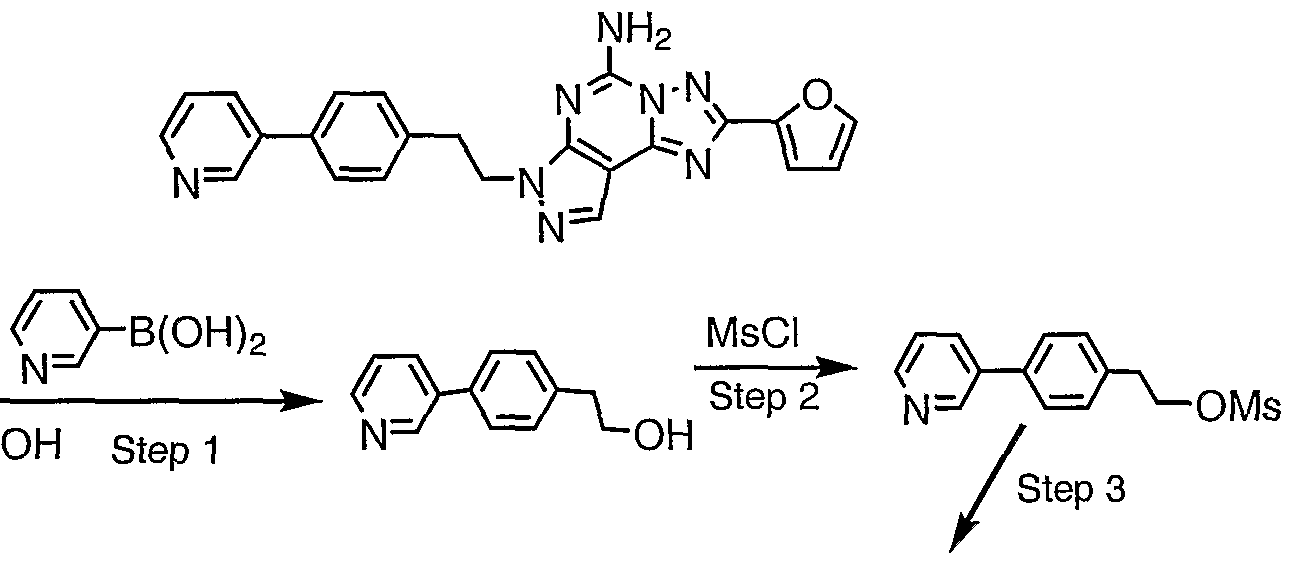
- Step 2 To the product of Step 1 (0.540 g, 2.71 mmol) in CH 2 CI 2 (15ml) at 0°C add mesyl chloride (0.35 ml, 3.52 mmol) and Et 3 N (0.57 ml, 4.00 mmol). Stir 2.5 h and extract with CH 2 CI 2 . Dry (Na 2 S0 4 ) and concentrate to obtain the mesylate.
- Step 3 Add the product of Preparation 4 (0.347 g, 1.44 mmol) to the mesylate of Step 2 (0.480 g, 1.73 mmol) in DMF (4.5 ml), followed by NaH (60% in oil, 0.082 g, 4.04 mmol). Stir 18 h and extract with EtOAc. Wash with H 2 0, dry (K 2 C0 3 ) and concentrate. Purify by PTLC (5% CH 3 OH/CH 2 CI 2 , developed twice) to obtain the title compound as a white solid, MS: 423 (M+1).
- Step 1 Combine 4-bromophenethyl alcohol (3.00 g, 14.9 mmol), triethylamine (2.68 ml, 19.2 mmol), dimethylaminopyridine (0.180 g, 1.47 mmol) and f-butyldimethylsilyl chloride (2.45 g, 16.3 mmol) in CH 2 CI 2 (75 ml). Stir 1 h, wash with H 2 0, dry (K-CO j ,), and concentrate. Chromatograph on silica (hexanes) to obtain the silyl ether.
- Step 2 To the compound of Step 1 (0.300 g, 0.95 mmol) in dry toluene (15 ml) add 2-(tri-butylstannyl)pyridine (1.05 g, 2.86 mmol) and tetrakis(triphenylphosphine)- palladium (0.11 g, 0.095 mmol). Flush with N 2 and heat 16 h at 120°C. Cool, filter through Celite, and wash with NH 4 CI, brine and then water. Dry (K 2 C0 3 ) and concentrate. Chromatograph on silica (3-5% EtOAc/hexanes) to obtain the biaryl, MS 314 (M+1).
- Step 3 Combine the biaryl of Step 2 (0.180 g, 0.57 mmol) and TBAF (1.0 M in THF, 1.7 ml) in THF (5.7 ml). Stir 2 h, wash with saturated NH 4 CI, and extract with EtOAc. Wash with H 2 0 several times, dry (K 2 C0 3 ) and concentrate to obtain the alcohol.
- Steps 4 and 5 Conduct as in Example 18, Steps 2 and 3, to obtain the title compound as a white solid, MS: 423 (M+1).
- Example 18 To the product of Example 18 (0.055 g, 0.13 mmol) in CH 2 CI 2 (1.5 ml) at -78°C add m-CPBA (0.050 g, 0.29 mmol). Allow to warm, stir 5 h, and wash successively with sat. Na 2 S 2 0 3 5% K 2 C0 3 , and H 2 0. Dry (Na 2 S0 4 ) and concentrate. Purify by PTLC (10% CH 3 OH/CH 2 CI 2 ) to obtain the title compound, MS: 439 (M+1).
- Step 1 Combine 1 ,4-dioxa-8-azaspiro(4,5)decane (0.48 ml, 3.8 mmol) with the product of Preparation 2 (0.66 g, 1.5 mmol) in DMF (10 ml). Heat at 90 ° C for 16 h, allow to cool, filter and wash with CH 3 OH to give off-white solid, MS: m/e 411 (M+1).
- Step 2 Heat the product of Step 1 (0.476 g, 1.16 mmol) in acetone (10 ml) and 5%
- Step 3 Combine the product of Step 2 (0.050 g, 0.13 mmol) with O-methylhydroxyl- amine hydrochloride (0.033 g, 0.39 mmol) in pyridine (3 ml). Stir for 16 h and concentrate. Partition between NaHC0 3 (sat.) and 5% CH 3 OH in CH 2 CI 2 . Dry
- Step 1 Combine benzyl 4-oxo-1-piperidinecarboxylate (1.0 g, 4.3mmol) with H 2 NOH ' HCI (0.89 g, 13 mmol) in pyridine (5 ml). Stir 16 h and concentrate. Partition between NaHC0 3 (sat.) and EtOAc, dry (MgS04) and concentrate to give the oxime.
- Step 2 Combine the product of Step 1 (0.44 g, 1.8 mmol) with 2-bromoethyl methyl ether (0.20 ml, 2.2 mmol) and NaH (0.10 g, 2.7 mmol) in DMF (8 ml). Stir 16 h and concentrate. Partition between NH 4 CI (sat.) and ether, dry (MgS ⁇ 4), and concentrate.
- Step 3 Stir the product of Step 2 (0.45 g, 1.47 mmol) over 5% Pd/C (0.045 g) in
- Step 4 Treat the amine of Step 3 with the product of Preparation 2 as in Example 24,
- Step 1 to obtain the title compound as a white solid, MS: m/e 440 (M+1).
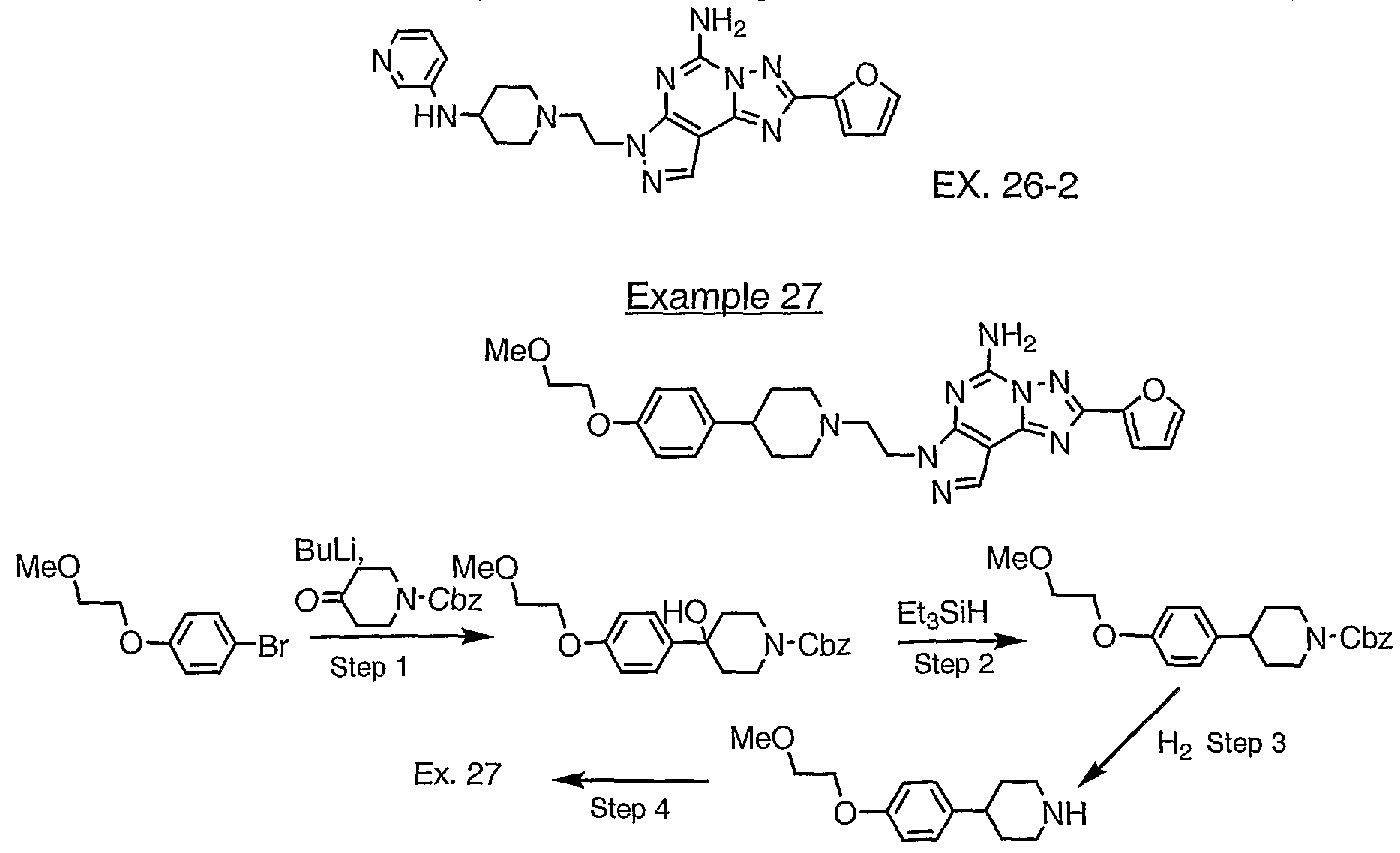
- Step 1 Combine 4-bromophenol (3.46 g, 20.0 mmol) with 2-bromoethyl methyl ether (2.82 ml, 30.0 mmol) and r ⁇ CO g (8.30 g, 60.0 mmol) in acetone (50 ml). Heat at reflux 16 h, cool, filter, and concentrate. Chromatograph on silica with 5% EtOAc/hexane to give the ether as a clear oil. To this ether (2.73 g, 11.8 mmol) in dry THF (50 ml) at -78 ° C add ⁇ -BuLi (1.6 M in hexane, 7.4 ml, 11.8 mmol). Stir for 10 min.
- Step 2 To a solution of the product of Step 1 (0.386 g, 1.0 mmol) and triethylsilane (0.80 ml, 5.0 mmol) in dry CH 2 CI 2 (10 ml) at -78 ° C add trifluoroacetic acid (0.38 ml, 5.0 mmol). Allow to warm over 2 h and partition between sat. NaHC0 3 and CH 2 CI 2 . Dry (MgS04) and concentrate. Chromatograph on silica with 20% EtOAc/hexane to obtain the reduction product, MS: m/e 370 (M+1).
- Step 3 Stir the product of Step 2 (0.300 g, 0.758 mmol) over 5% Pd/C (0.030 g) in
- Step 4 Treat the amine of Step 3 with the product of Preparation 2 as in Example
- Example 1-145 Treat the product of Example 1-145 (0.020 g, 0.044 mmol) in EtOH (0.5 ml) at 0°C with sodium borohydride (0.005 g, 0.13 mmol) and with an equal amount again after 0.75 h. After another 0.75 h, partition between CH 2 CI 2 and sat. NH 4 CI. Dry (Na 2 S0 4 ) and concentrate. Purify by PTLC (10% CH 3 OH/CH 2 CI 2 ) to obtain the title compound as a white solid, MS: 459 (M+1).
- Example 1-145 Treat the product of Example 1-145 (0.020 g, 0.044 mmol) in pyridine (0.5 ml) with methoxyamine hydrochloride (0.011 g, 0.13 mmol). Stir 16 h and concentrate. Partition between CH 2 CI 2 and sat. NaHC0 3 . Dry (Na 2 S0 4 ) and concentrate. Purify by PTLC (5% CH 3 OH/CH 2 CI 2 ) to obtain the title compound as a white solid, MS: 486 (M+1).
- compounds of the present invention are useful in the treatment of depression, cognitive function diseases and neurodegenerative diseases such as Parkinson's disease, senile dementia as in Alzheimer's disease, and psychoses of organic origin.
- the compounds of the present invention can improve motor-impairment due to neurodegenerative diseases such as Parkinson's disease.
- the other agents known to be useful in the treatment of Parkinson's disease which can be administered in combination with the compounds of formula I include: L-DOPA; dopaminergic agonists such as quinpirole, ropinirole, pramipexole, pergolide and bromocriptine; MAO-B inhibitors such as deprenyl and selegiline;
- DOPA decarboxylase inhibitors such as carbidopa and benserazide
- COMT inhibitors such as tolcapone and entacapone.
- One to three other agents can be used in combination with the compounds of formula I, preferably one.
- the pharmacological activity of the compounds of the invention was determined by the following in vitro and in vivo assays to measure A 2a receptor activity.
- a 2a Human A 2a Adenosine Receptor membranes, Catalog #RB-HA2a, Receptor
- Membrane dilution buffer Dulbecco's Phosphate Buffered Saline (Gibco/BRL) + 10 mM MgCI 2 .
- Ligands A 2a : [3H]-SCH 58261 , custom synthesis, AmershamPharmacia Biotech, Piscataway, NJ. Stock is prepared at 1 nM in membrane dilution buffer. Final assay concentration is 0.5 nM.
- a 2a To determine non-specific binding, add 100 nM CGS 15923 (RBI, Natick, MA). Working stock is prepared at 400 nM in compound dilution buffer.
- mice Male Sprague-Dawley rats (Charles River, Calco, Italy) weighing 175-200 g are used.
- the cataleptic state is induced by the subcutaneous administration of the dopamine receptor antagonist haloperidol (1 mg/kg, sc), 90 min before testing the animals on the vertical grid test.
- the rats are placed on the wire mesh cover of a 25x43 plexiglass cage placed at an angle of about 70 degrees with the bench table.
- the rat is placed on the grid with all four legs abducted and extended ("frog posture").
- the use of such an unnatural posture is essential for the specificity of this test for catalepsy.
- the time span from placement of the paws until the first complete removal of one paw is measured maximally for 120 sec.
- the selective A 2A adenosine antagonists under evaluation are administered orally at doses ranging between 0.03 and 3 mg/kg, 1 and 4 h before scoring the animals.
- the anticataleptic effects of the reference compound, L-DOPA 25, 50 and 100 mg/kg, ip
- 275-300 g are used in all experiments.
- the rats are housed in groups of 4 per cage, with free access to food and water, under controlled temperature and 12 hour light/ dark cycle. The day before the surgery the rats are fasted over night with water ad libitum.
- Unilateral 6-hydroxydopamine (6-OHDA) lesion of the middle forebrain bundle is performed according to the method described by Ungerstedt et al. (Brain Research. 1971 , 6-OHDA and Cathecolamine Neurons, North Holland, Amsterdam, 101-127), with minor changes.
- the animals are anaesthetized with chloral hydrate (400 mg/kg, ip) and treated with desipramine (10 mpk, ip) 30 min prior to 6-OHDA injection in order to block the uptake of the toxin by the noradrenergic terminals. Then, the animals are placed in a stereotaxic frame. The skin over the skull is reflected and the stereotaxic coordinates (-2.2 posterior from bregma (AP), +1.5 lateral from bregma (ML), 7.8 ventral from dura (DV) are taken, according to the atlas of Pellegrino et al (Pellegrino L.J., Pellegrino A.S. and Cushman A.J..
- a Stereotaxic Atlas of the Rat Brain. 1979, New York: Plenum Press A burr hole is then placed in the skull over the lesion site and a needle, attached to a Hamilton syringe, is lowered into the left MFB. Then 8 ⁇ g 6-OHDA-HCI is dissolved in 4 ⁇ l of saline with 0.05% ascorbic acid as antioxidant, and infused at the constant flow rate of 1 ⁇ l /1 min using an infusion pump. The needle is withdrawn after additional 5 min and the surgical wound is closed and the animals left to recover for 2 weeks.
- rats Two weeks after the lesion the rats are administered with L-DOPA (50 mg/kg, ip) plus benserazide (25 mg/kg, ip) and selected on the basis of the number of full contralateral turns quantified in the 2 h testing period by automated rotameters (priming test). Any rat not showing at least 200 complete turns /2h is not included in the study.
- L-DOPA 50 mg/kg, ip
- benserazide 25 mg/kg, ip
- Selected rats receive the test drug 3 days after the priming test (maximal dopamine receptor supersensitivity).
- the new A 2A receptor antagonists are administered orally at dose levels ranging between 0.1 and 3 mg/kg at different time points (i.e., 1 , 6, 12 h) before the injection of a subthreshold dose of L-DOPA (4 mpk, ip) plus benserazide (4 mpk, ip) and the evaluation of turning behavior.
- results of the binding assay on compounds of the invention showed A 2a Ki vaules of 0.3 to 57 nM, with preferred compounds showing Ki values between 0.3 and 5.0 nM.
- Selectivity is determined by dividing Ki for A1 receptor by Ki for A2a receptor.
- Preferred compounds of the invention have a selectivity ranging from about 100 to about 2000.
- Preferred compounds showed a 50-75% decrease in descent latency when tested orally at 1 mg/kg for anti-cataleptic activity in rats.
- inert, pharmaceutically acceptable carriers can be either solid or liquid.
- Solid form preparations include powders, tablets, dispersible granules, capsules, cachets and suppositories.
- the powders and tablets may be comprised of from about 5 to about 70 percent active ingredient.
- Suitable solid carriers are known in the art, e.g. magnesium carbonate, magnesium stearate, talc, sugar, lactose. Tablets, powders, cachets and capsules can be used as solid dosage forms suitable for oral administration.
- a low melting wax such as a mixture of fatty acid glycerides or cocoa butter is first melted, and the active ingredient is dispersed homogeneously therein as by stirring. The molten homogeneous mixture is then poured into convenient sized molds, allowed to cool and thereby solidify.
- Liquid form preparations include solutions, suspensions and emulsions. As an example may be mentioned water or water-propylene glycol solutions for parenteral injection.
- Liquid form preparations may also include solutions for intranasal administration.
- Aerosol preparations suitable for inhalation may include solutions and solids in powder form, which may be in combination with a pharmaceutically acceptable carrier, such as an inert compressed gas. Also included are solid form preparations which are intended to be converted, shortly before use, to liquid form preparations for either oral or parenteral administration. Such liquid forms include solutions, suspensions and emulsions.
- the compounds of the invention may also be deliverable transdermally.
- the transdermal compositions can take the form of creams, lotions, aerosols and/or emulsions and can be included in a transdermal patch of the matrix or reservoir type as are conventional in the art for this purpose.
- the compound is administered orally.
- the pharmaceutical preparation is in unit dosage form.
- the preparation is subdivided into unit doses containing appropriate quantities of the active component, e.g., an effective amount to achieve the desired purpose.
- the quantity of active compound of formula I in a unit dose of preparation may be varied or adjusted from about 0.1 mg to 1000 mg, more preferably from about 1 mg to 300 mg, according to the particular application.
- the actual dosage employed may be varied depending upon the requirements of the patient and the severity of the condition being treated. Determination of the proper dosage for a particular situation is within the skill of the art. Generally, treatment is initiated with smaller dosages which are less than the optimum dose of the compound. Thereafter, the dosage is increased by small increments until the optimum effect under the circumstances is reached. For convenience, the total daily dosage may be divided and administered in portions during the day if desired.
- a typical recommended dosage regimen for compounds of formula I is oral administration of from 10 mg to 2000 mg/day preferably 10 to 1000 mg/day, in two to four divided doses to provide relief from central nervous system diseases such as Parkinson's disease.
- the compounds are non-toxic when administered within this dosage range.
- the doses and dosage regimen of the other agents for treating Parkinson's disease will be determined by the attending clinician, for example in view of the approved doses and dosage regimen in the package insert, taking into consideration the age, sex and condition of the patient and the severity of the disease. It is expected that when the combination of a compound of formula I and another agent is administered, lower doses of the components will be effective compared to the doses of the components administered as monotherapy.
Landscapes
- Health & Medical Sciences (AREA)
- Organic Chemistry (AREA)
- Chemical & Material Sciences (AREA)
- Bioinformatics & Cheminformatics (AREA)
- Engineering & Computer Science (AREA)
- Neurosurgery (AREA)
- Neurology (AREA)
- Biomedical Technology (AREA)
- Medicinal Chemistry (AREA)
- General Chemical & Material Sciences (AREA)
- Life Sciences & Earth Sciences (AREA)
- Animal Behavior & Ethology (AREA)
- General Health & Medical Sciences (AREA)
- Public Health (AREA)
- Veterinary Medicine (AREA)
- Chemical Kinetics & Catalysis (AREA)
- Nuclear Medicine, Radiotherapy & Molecular Imaging (AREA)
- Pharmacology & Pharmacy (AREA)
- Pain & Pain Management (AREA)
- Psychiatry (AREA)
- Hospice & Palliative Care (AREA)
- Psychology (AREA)
- Pharmaceuticals Containing Other Organic And Inorganic Compounds (AREA)
- Nitrogen Condensed Heterocyclic Rings (AREA)
- Nitrogen And Oxygen Or Sulfur-Condensed Heterocyclic Ring Systems (AREA)
Abstract
Description













Claims



Priority Applications (21)
| Application Number | Priority Date | Filing Date | Title |
|---|---|---|---|
| SK1671-2002A SK287748B6 (en) | 2000-05-26 | 2001-05-24 | Substituted 5-amino-pyrazolo[4,3-e]-1,2,4,triazolo[1,5-c]- pyrimidines, method for the production thereof, pharmaceutical composition comprising same and their use |
| JP2002500877A JP4574112B2 (en) | 2000-05-26 | 2001-05-24 | Adenosine A2A receptor antagonist |
| SI200130336T SI1283839T1 (en) | 2000-05-26 | 2001-05-24 | |
| CA002410237A CA2410237C (en) | 2000-05-26 | 2001-05-24 | Adenosine a2a receptor antagonists |
| AU2001268089A AU2001268089C1 (en) | 2000-05-26 | 2001-05-24 | Adenosine A2a receptor antagonists |
| EP01945991A EP1283839B1 (en) | 2000-05-26 | 2001-05-24 | Adenosine a2a receptor antagonists |
| IL15272601A IL152726A0 (en) | 2000-05-26 | 2001-05-24 | Adenosine a2a receptor antagonists |
| DK01945991T DK1283839T3 (en) | 2000-05-26 | 2001-05-24 | Adenosine A2a receptor antagonists |
| NZ522326A NZ522326A (en) | 2000-05-26 | 2001-05-24 | Adenosine A2A receptor antagonists |
| BR0111015-2 BRPI0111015B8 (en) | 2000-05-26 | 2001-05-24 | adenosine a2a receptor antagonist compound, pharmaceutical composition comprising the same, its use and processes for the preparation of intermediate compounds |
| AU6808901A AU6808901A (en) | 2000-05-26 | 2001-05-24 | Adenosine a2a receptor antagonists |
| HK03101315.3A HK1049007B (en) | 2000-05-26 | 2001-05-24 | Adenosine a2a receptor antagonists |
| KR10-2002-7015699A KR100520907B1 (en) | 2000-05-26 | 2001-05-24 | Adenosine A2a receptor antagonists |
| AT01945991T ATE293627T1 (en) | 2000-05-26 | 2001-05-24 | ADENOSINE A2A RECEPTOR ANTAGONISTS |
| PL360472A PL218764B1 (en) | 2000-05-26 | 2001-05-24 | Adenosine a2a receptor antagonists |
| HU0600239A HU230420B1 (en) | 2000-05-26 | 2001-05-24 | Adenosine a2a receptor antagonists |
| MXPA02011625A MXPA02011625A (en) | 2000-05-26 | 2001-05-24 | Adenosine a2a receptor antagonists. |
| DE60110219T DE60110219T2 (en) | 2000-05-26 | 2001-05-24 | ADENOSINE A2A RECEPTOR ANTAGONISTS |
| IL152726A IL152726A (en) | 2000-05-26 | 2002-11-10 | 5-AMINO-{PYRAZOLO-[4,3-e]-1,2,4-TRIAZOLO[1,5-c]PYRIMIDINE}-2- AND 7-SUBSTITUTED DERIVATIVES AS ADENOSINE A2A RECEPTOR INHIBITORS |
| NO20025651A NO325008B1 (en) | 2000-05-26 | 2002-11-25 | Adenosine A2A Receptor Antagonists |
| IL220174A IL220174A (en) | 2000-05-26 | 2012-06-04 | Acid addition salts of 2- and 7-substituted derivatives of 5-amino-{pyrazolo[4,3-e]-1,2,4-triazolo[1,5-c]pyrimidine} and pharmaceutical compositions comprising them |
Applications Claiming Priority (2)
| Application Number | Priority Date | Filing Date | Title |
|---|---|---|---|
| US20714300P | 2000-05-26 | 2000-05-26 | |
| US60/207,143 | 2000-05-26 |
Publications (1)
| Publication Number | Publication Date |
|---|---|
| WO2001092264A1 true WO2001092264A1 (en) | 2001-12-06 |
Family
ID=22769372
Family Applications (1)
| Application Number | Title | Priority Date | Filing Date |
|---|---|---|---|
| PCT/US2001/016954 Ceased WO2001092264A1 (en) | 2000-05-26 | 2001-05-24 | Adenosine a2a receptor antagonists |
Country Status (31)
| Country | Link |
|---|---|
| US (4) | US6630475B2 (en) |
| EP (1) | EP1283839B1 (en) |
| JP (3) | JP4574112B2 (en) |
| KR (1) | KR100520907B1 (en) |
| CN (2) | CN100384847C (en) |
| AR (1) | AR028621A1 (en) |
| AT (1) | ATE293627T1 (en) |
| AU (2) | AU2001268089C1 (en) |
| BR (1) | BRPI0111015B8 (en) |
| CA (1) | CA2410237C (en) |
| CZ (1) | CZ303790B6 (en) |
| DE (1) | DE60110219T2 (en) |
| DK (1) | DK1283839T3 (en) |
| EC (1) | ECSP024364A (en) |
| ES (1) | ES2237576T3 (en) |
| HK (1) | HK1049007B (en) |
| HU (1) | HU230420B1 (en) |
| IL (3) | IL152726A0 (en) |
| MX (1) | MXPA02011625A (en) |
| MY (1) | MY132006A (en) |
| NO (1) | NO325008B1 (en) |
| NZ (1) | NZ522326A (en) |
| PE (1) | PE20020062A1 (en) |
| PL (1) | PL218764B1 (en) |
| PT (1) | PT1283839E (en) |
| RU (1) | RU2315053C2 (en) |
| SI (1) | SI1283839T1 (en) |
| SK (1) | SK287748B6 (en) |
| TW (1) | TWI288137B (en) |
| WO (1) | WO2001092264A1 (en) |
| ZA (1) | ZA200208898B (en) |
Cited By (55)
| Publication number | Priority date | Publication date | Assignee | Title |
|---|---|---|---|---|
| WO2003032996A1 (en) | 2001-10-15 | 2003-04-24 | Schering Corporation | Imidazo (4,3-e)-1,2,4-triazolo(1,5-c) pyrimidines as adenosine a2a receptor antagonists |
| WO2003048165A1 (en) * | 2001-11-30 | 2003-06-12 | Schering Corporation | ADENOSINE A2a RECEPTOR ANTAGONISTS |
| WO2003101455A3 (en) * | 2002-05-30 | 2004-05-21 | King Pharmaceuticals Res & Dev | Pharmaceutically active compounds having a tricyclic pyrazolotriazolopyrimidine ring structure and methods of use |
| WO2004092172A2 (en) | 2003-04-09 | 2004-10-28 | Biogen Idec Ma Inc. | Triazolo[1,5-c]pyrimidines and pyrazolo[1,5-c]pyrimidines useful as a2a adenosin e receptor antagonists |
| WO2004094431A3 (en) * | 2003-04-23 | 2004-12-02 | Schering Corp | 2-alkynyl-and 2-alkenyl-pyrazolo-[4,3-e]-1,2,4-triazolo-[1,5-c]-pyrimidine adenosine a2a receptor antagonists |
| WO2004111004A1 (en) * | 2003-06-12 | 2004-12-23 | Novo Nordisk A/S | Substituted piperazine carbamates for use as inhibitors of hormone sensitive lipase |
| US6875772B2 (en) | 2001-11-30 | 2005-04-05 | Schering Corporation | [1,2,4]-Triazole bicyclic adeonsine A2a receptor antagonists |
| WO2005044245A1 (en) * | 2002-12-19 | 2005-05-19 | Schering Corporation | USES OF ADENOSINE A2a RECEPTOR ANTAGONISTS |
| WO2005054245A3 (en) * | 2003-12-01 | 2005-08-11 | Schering Corp | Process for preparing substituted 5-amino-pyrazolo-[4,3-e]-1,2,4-triazolo[1,5-c]pyrimidines |
| WO2005103055A1 (en) | 2004-04-21 | 2005-11-03 | Schering Corporation | PYRAZOLO-[4,3-e]-1,2,4-TRIAZOLO-[1,5-c]-PYRIMIDINE ADENOSINE A2A RECEPTOR ANTAGONISTS |
| WO2005060981A3 (en) * | 2003-12-19 | 2005-12-29 | Schering Corp | Pharmaceutical compositions |
| JP2006527264A (en) * | 2003-06-10 | 2006-11-30 | 協和醗酵工業株式会社 | How to treat anxiety disorders |
| WO2007035542A1 (en) | 2005-09-19 | 2007-03-29 | Schering Corporation | 2-HETEROARYL-PYRAZOLO-[4, 3-e]-1, 2, 4-TRIAZOLO-[1,5-c]-PYRIMIDINE AS ADENOSINE A2a RECEPTOR ANTAGONISTS |
| WO2007045705A2 (en) | 2005-10-14 | 2007-04-26 | Proyecto De Biomedicina Cima, S.L. | Compounds for the treatment of auricular fibrillation |
| US7223861B2 (en) | 2003-10-28 | 2007-05-29 | Schering Corporation | Process for preparing substituted 5-amino-pyrazolo-[4,3-e]-1,2,4-triazolo-[1,5-c]-pyrimidines |
| EP2044940A2 (en) | 2002-01-28 | 2009-04-08 | Kyowa Hakko Kogyo Co., Ltd | Methods of treating patients suffering from movement disorders |
| US7572802B2 (en) | 2005-09-23 | 2009-08-11 | Schering Corporation | 7-[2-[4-(6-fluoro-3-methyl-1,2-benzisoxazol-5-yl)-1-piperazinyl]ethyl]-2-(1-propynyl)-7H-pyrazolo-[4,3-e]-[1,2,4]-triazolo-[1,5-C]-pyrimidin-5-amine |
| WO2009114533A2 (en) | 2008-03-10 | 2009-09-17 | Cornell University | Modulation of blood brain barrier permeability |
| WO2009145289A1 (en) | 2008-05-29 | 2009-12-03 | 協和発酵キリン株式会社 | Inhibitor of analgesic tolerance |
| WO2010010908A1 (en) | 2008-07-23 | 2010-01-28 | 協和発酵キリン株式会社 | Therapeutic agent for migraine |
| US7691869B2 (en) | 2007-03-30 | 2010-04-06 | King Pharmaceuticals Research And Development, Inc. | Pyrrolotriazolopyrimidine derivatives, pharmaceutical compositions containing them and methods of treating conditions and diseases mediated by the adenosine A2A receptor activity |
| WO2010103547A2 (en) | 2009-03-13 | 2010-09-16 | Advinus Therapeutics Private Limited | Substituted fused pyrimidine compounds |
| US7816353B2 (en) * | 2003-10-24 | 2010-10-19 | Exelixis, Inc. | P70S6 kinase modulators and method of use |
| EP2258372A1 (en) | 2005-06-07 | 2010-12-08 | Kyowa Hakko Kirin Co., Ltd. | A2A antagonists for use in the treatment of motor disorders |
| WO2011101861A1 (en) | 2010-01-29 | 2011-08-25 | Msn Laboratories Limited | Process for preparation of dpp-iv inhibitors |
| US8222259B2 (en) | 2008-03-04 | 2012-07-17 | Schering Corporation | 1,2,4-triazolo[4,3-c]pyrimidin-3-one and pyrazolo[4,3-e]-1,2,4-triazolo[4,3-c]pyrimidin-3-one compounds for use as adenosine A2a receptor antagonists |
| US8273754B2 (en) | 2008-12-30 | 2012-09-25 | Arqule, Inc. | Substituted 1H-pyrazolo[3,4-D]pyrimidine-6-amine compounds |
| WO2012129381A1 (en) * | 2011-03-22 | 2012-09-27 | Concert Pharmaceuticals Inc. | Deuterated preladenant |
| US8343961B2 (en) | 2009-03-31 | 2013-01-01 | Arqule, Inc. | Substituted heterocyclic compounds |
| WO2013024474A1 (en) * | 2011-08-18 | 2013-02-21 | Mapi Phrarma Ltd. | Polymorphs of preladenant |
| US8722743B2 (en) | 2010-04-19 | 2014-05-13 | Oryzon Genomics S.A. | Lysine specific demethylase-1 inhibitors and their use |
| US8859555B2 (en) | 2009-09-25 | 2014-10-14 | Oryzon Genomics S.A. | Lysine Specific Demethylase-1 inhibitors and their use |
| US8946296B2 (en) | 2009-10-09 | 2015-02-03 | Oryzon Genomics S.A. | Substituted heteroaryl- and aryl-cyclopropylamine acetamides and their use |
| US8993808B2 (en) | 2009-01-21 | 2015-03-31 | Oryzon Genomics, S.A. | Phenylcyclopropylamine derivatives and their medical use |
| US9006449B2 (en) | 2010-07-29 | 2015-04-14 | Oryzon Genomics, S.A. | Cyclopropylamine derivatives useful as LSD1 inhibitors |
| US9061966B2 (en) | 2010-10-08 | 2015-06-23 | Oryzon Genomics S.A. | Cyclopropylamine inhibitors of oxidases |
| US9181198B2 (en) | 2010-07-29 | 2015-11-10 | Oryzon Genomics S.A. | Arylcyclopropylamine based demethylase inhibitors of LSD1 and their medical use |
| US9186337B2 (en) | 2010-02-24 | 2015-11-17 | Oryzon Genomics S.A. | Lysine demethylase inhibitors for diseases and disorders associated with Hepadnaviridae |
| US9469597B2 (en) | 2011-10-20 | 2016-10-18 | Oryzon Genomics S.A. | (Hetero)aryl cyclopropylamine compounds as LSD1 inhibitors |
| US9487512B2 (en) | 2011-10-20 | 2016-11-08 | Oryzon Genomics S.A. | (Hetero)aryl cyclopropylamine compounds as LSD1 inhibitors |
| US9616058B2 (en) | 2010-02-24 | 2017-04-11 | Oryzon Genomics, S.A. | Potent selective LSD1 inhibitors and dual LSD1/MAO-B inhibitors for antiviral use |
| US9790196B2 (en) | 2010-11-30 | 2017-10-17 | Oryzon Genomics S.A. | Lysine demethylase inhibitors for diseases and disorders associated with Flaviviridae |
| US9908859B2 (en) | 2011-02-08 | 2018-03-06 | Oryzon Genomics, S.A. | Lysine demethylase inhibitors for myeloproliferative disorders |
| WO2019135259A1 (en) * | 2018-01-04 | 2019-07-11 | Impetis Biosciences Ltd. | Tricyclic compounds, compositions and medicinal applications thereof |
| WO2019196803A1 (en) * | 2018-04-08 | 2019-10-17 | Beigene, Ltd. | Pyrazolotriazolopyrimidine derivatives as a2a receptor antagonist |
| WO2020020097A1 (en) * | 2018-07-23 | 2020-01-30 | Beigene, Ltd. | Pyrazolotriazolopyrimidine derivatives as a2a receptor antagonist |
| WO2020260196A1 (en) | 2019-06-24 | 2020-12-30 | Helmholtz-Zentrum Dresden-Rossendorf E.V. | Deuterated 7-(3-(4-(2-([18f]fluor)ethoxy)phenyl)propyl)-2-(furan-2-yl)-7h-pyrazolo[4,3-e][1,2,4]triazolo[1,5-c]pyrimidin-5-amine derivatives |
| WO2021018173A1 (en) | 2019-07-30 | 2021-02-04 | 杭州阿诺生物医药科技有限公司 | Adenosine receptor antagonist |
| WO2021018172A1 (en) | 2019-07-30 | 2021-02-04 | 杭州阿诺生物医药科技有限公司 | Adenosine receptor antagonist |
| US11161850B2 (en) | 2018-07-05 | 2021-11-02 | Incyte Corporation | Fused pyrazine derivatives as A2A / A2B inhibitors |
| US11168089B2 (en) | 2018-05-18 | 2021-11-09 | Incyte Corporation | Fused pyrimidine derivatives as A2A / A2B inhibitors |
| CN114667287A (en) * | 2019-07-17 | 2022-06-24 | 泰昂治疗公司 | Adenosine A2A receptor antagonists and uses thereof |
| US11390624B2 (en) | 2019-01-29 | 2022-07-19 | Incyte Corporation | Pyrazolopyridines and triazolopyridines as A2A / A2B inhibitors |
| US11673894B2 (en) | 2018-02-27 | 2023-06-13 | Incyte Corporation | Imidazopyrimidines and triazolopyrimidines as A2A / A2B inhibitors |
| US12060357B2 (en) | 2018-11-30 | 2024-08-13 | Merck Sharp & Dohme Llc | 9-substituted amino triazolo quinazoline derivatives as adenosine receptor antagonists, pharmaceutical compositions and their use |
Families Citing this family (34)
| Publication number | Priority date | Publication date | Assignee | Title |
|---|---|---|---|---|
| SI1283839T1 (en) * | 2000-05-26 | 2005-08-31 | Schering Corp | |
| WO2003022283A1 (en) * | 2001-09-13 | 2003-03-20 | Schering Corporation | Combination of an adenosine a2a receptor antagonist and an antidepressant or anxiolytic |
| FR2832405B1 (en) * | 2001-11-19 | 2004-12-10 | Sanofi Synthelabo | TETRAHYDROPYRIDYL-ALKYL-HETEROCYCLES NITROGEN, PROCESS FOR THEIR PREPARATION AND PHARMACEUTICAL COMPOSITIONS CONTAINING THEM |
| TW200300686A (en) | 2001-11-30 | 2003-06-16 | Schering Corp | Adenosine A2a receptor antagonists |
| US20060106040A1 (en) * | 2002-12-19 | 2006-05-18 | Michael Grzelak | Adenosine A2a receptor antagonists for the treatment of extra-pyramidal syndrome and other movement disorders |
| WO2008008398A2 (en) * | 2006-07-14 | 2008-01-17 | Shionogi & Co., Ltd. | Oxime compounds and the use thereof |
| TW200840566A (en) * | 2006-12-22 | 2008-10-16 | Esteve Labor Dr | Heterocyclyl-substituted-ethylamino-phenyl derivatives, their preparation and use as medicaments |
| WO2009110955A2 (en) * | 2008-02-29 | 2009-09-11 | Albert Einstein College Of Medicine Of Yeshiva University | Ketoconazole-derivative antagonists of human pregnane x receptor and uses thereof |
| US20100093702A1 (en) * | 2008-10-13 | 2010-04-15 | Barbay J Kent | METHYLENE AMINES OF THIENO[2,3-d]PYRIMIDINE AND THEIR USE AS ADENOSINE A2a RECEPTOR ANTAGONISTS |
| CA2750265A1 (en) | 2009-01-20 | 2010-07-29 | Marc Cantillon | Methods of alleviating or treating signs and/or symptoms associated with moderate to severe parkinson's disease |
| WO2010147941A1 (en) | 2009-06-15 | 2010-12-23 | Marvell World Trade Ltd. | System and methods for gamut bounded saturation adaptive color enhancement |
| EP2462144B1 (en) | 2009-08-07 | 2017-09-20 | Merck Sharp & Dohme Corp. | PROCESS FOR PREPARING A 2-ALKYNYL SUBSTITUTED 5-AMINO-PYRAZOLO-[4,3-e]-1,2,4-TRIAZOLO[1,5-c]PYRIMIDINE |
| JP5843869B2 (en) * | 2010-09-24 | 2016-01-13 | アドヴィナス・セラピューティックス・リミテッド | Condensed tricyclic compounds as adenosine receptor antagonists |
| WO2012127472A1 (en) * | 2011-03-22 | 2012-09-27 | Mapi Pharma Ltd. | Process and intermediates for the preparation of preladenant and related compounds |
| WO2014071512A1 (en) * | 2012-11-06 | 2014-05-15 | Universite Laval | Combination therapy and methods for the treatment of respiratory diseases |
| WO2014101120A1 (en) | 2012-12-28 | 2014-07-03 | Merck Sharp & Dohme Corp. | Heterobicyclo-substituted-7-methoxy-[1,2,4]triazolo[1,5-c]quinazolin-5-amine compounds with a2a antagonist properties |
| JP6779204B2 (en) | 2014-11-18 | 2020-11-04 | メルク・シャープ・アンド・ドーム・コーポレーションMerck Sharp & Dohme Corp. | Aminopyrazine compound with A2A antagonist properties |
| US10138212B2 (en) | 2015-02-06 | 2018-11-27 | Merck Sharp & Dohme Corp. | Aminoquinazoline compounds as A2A antagonist |
| EP3307067B1 (en) | 2015-06-11 | 2022-11-02 | Merck Sharp & Dohme LLC | Aminopyrazine compounds with a2a antagonist properties |
| WO2017008205A1 (en) | 2015-07-10 | 2017-01-19 | Merck Sharp & Dohme Corp. | Substituted aminoquinazoline compounds as a2a antagonist |
| US9687475B1 (en) | 2016-03-24 | 2017-06-27 | Ezra Pharma Llc | Extended release pharmaceutical formulations with controlled impurity levels |
| US9675585B1 (en) | 2016-03-24 | 2017-06-13 | Ezra Pharma | Extended release pharmaceutical formulations |
| CN115873022A (en) * | 2017-03-30 | 2023-03-31 | 伊忒欧斯比利时股份公司 | 2-oxothiazole derivatives as A2A inhibitors and compounds for the treatment of cancer |
| WO2018178338A1 (en) * | 2017-03-30 | 2018-10-04 | Iteos Therapeutics | 2-oxo-thiazole derivatives as a2a inhibitors and compounds for use in the treatment of cancers |
| US11498923B2 (en) | 2017-12-13 | 2022-11-15 | Merck Sharp & Dohme Llc | Substituted imidazo[1,2-c]quinazolines as A2A antagonists |
| CN108276345A (en) * | 2018-03-22 | 2018-07-13 | 重庆奥舍生物化工有限公司 | A kind of preparation method of pharmaceutical intermediate pyrimidine -5-formaldehyde |
| CN108864114B (en) | 2018-06-04 | 2020-11-06 | 应世生物科技(南京)有限公司 | Selectivity A2AReceptor antagonists |
| AU2019401649B2 (en) | 2018-12-20 | 2025-08-28 | Incyte Corporation | Imidazopyridazine and imidazopyridine compounds as inhibitors of activin receptor-like kinase-2 |
| WO2020227156A1 (en) * | 2019-05-03 | 2020-11-12 | Nektar Therapeutics | Adenosine 2 receptor antagonists |
| CN111072675A (en) * | 2019-12-12 | 2020-04-28 | 广东东阳光药业有限公司 | Nitrogen-containing fused tricyclic derivatives and uses thereof |
| CN113773327B (en) * | 2021-09-13 | 2022-07-15 | 八叶草健康产业研究院(厦门)有限公司 | Preparation method of pyrazolopyrimidinyltriazole ring compound |
| CN117946123A (en) * | 2024-01-26 | 2024-04-30 | 北京脑重大疾病研究院 | Radioactive triazolopyrimidinyl derivatives and preparation methods and applications thereof |
| CN118812539B (en) * | 2024-06-19 | 2025-11-28 | 苏州大学 | 5-Aminotriazolopyrimidine derivative and preparation method thereof |
| CN118812544A (en) * | 2024-06-19 | 2024-10-22 | 厦门大学 | Adenosine A2AR targeting small molecule compound, nuclide labeled probe, preparation method, application and pharmaceutical composition thereof |
Citations (3)
| Publication number | Priority date | Publication date | Assignee | Title |
|---|---|---|---|---|
| WO1995001356A1 (en) * | 1993-06-29 | 1995-01-12 | Schering-Plough S.P.A. | 1,2,4-TRIAZOLO[1,5-c]PYRIMIDINE HETEROCYCLIC ANALOGUES HAVING ANTAGONISTIC ACTIVITY ON ADENOSINE A2 RECEPTOR |
| WO1998052568A1 (en) * | 1997-05-21 | 1998-11-26 | Schering-Plough S.P.A. | THE USE OF 1,2,4-TRIAZOLO[1,5-c]PYRIMIDINE HETEROCYCLIC ANALOGUES FOR THE PREPARATION OF MEDICAMENTS USEFUL FOR THE TREATMENT OF CEREBROVASCULAR DISTURBANCES |
| US5935964A (en) * | 1995-07-28 | 1999-08-10 | Schering Corporation | 1,2,4-triazolo 1,5-c! pyrimidine heterocyclic analogues having antagonistic activity on adenosine A2a receptor |
Family Cites Families (10)
| Publication number | Priority date | Publication date | Assignee | Title |
|---|---|---|---|---|
| DE3677445D1 (en) | 1985-09-30 | 1991-03-14 | Ciba Geigy Ag | 2-SUBSTITUTED-E-CONDENSED (1,5-C) -PYRIMIDINE, PHARMACEUTICAL PREPARATIONS AND THEIR USE. |
| SU1739850A3 (en) * | 1987-08-31 | 1992-06-07 | Такеда Кемикал Индастриз, Лтд (Фирма) | Method for synthesis of condensed derivatives of pyrazolo-[3,4-d]-pyrimidine |
| ATE208199T1 (en) | 1993-07-27 | 2001-11-15 | Kyowa Hakko Kogyo Kk | MEDICINAL PRODUCTS FOR PARKINSON'S DISEASE |
| SI1283839T1 (en) * | 2000-05-26 | 2005-08-31 | Schering Corp | |
| US6916811B2 (en) * | 2001-11-30 | 2005-07-12 | Schering Corporation | Adenosine A2a receptor antagonists |
| AU2003304527B2 (en) * | 2002-12-19 | 2010-09-09 | Merck Sharp & Dohme Corp. | Uses of adenosine A2a receptor antagonists |
| PT1678182E (en) * | 2003-10-28 | 2007-04-30 | Schering Corp | Process for preparing substituted 5-amino-pyrazolo- [4,3-e]-1,2,4-triazolo [1,5-c]pyrimidines |
| JP2007513091A (en) * | 2003-12-01 | 2007-05-24 | シェーリング コーポレイション | Process for the preparation of substituted 5-amino-pyrazolo- [4,3-e] -1,2,4-triazolo [1,5-c] pyrimidines |
| KR20060135901A (en) * | 2004-04-21 | 2006-12-29 | 쉐링 코포레이션 | Pyrazolo- [4,3-e] -1,2,4-triazolo- [1,5-c] pyrimidine adenosine A2a receptor antagonist |
| CA2622741A1 (en) * | 2005-09-19 | 2007-03-29 | Schering Corporation | 2-heteroaryl-pyrazolo-[4, 3-e]-1, 2, 4-triazolo-[1,5-c]-pyrimidine as adenosine a2a receptor antagonists |
-
2001
- 2001-05-24 SI SI200130336T patent/SI1283839T1/xx unknown
- 2001-05-24 AT AT01945991T patent/ATE293627T1/en active
- 2001-05-24 RU RU2002135620/04A patent/RU2315053C2/en active
- 2001-05-24 BR BR0111015-2 patent/BRPI0111015B8/en not_active IP Right Cessation
- 2001-05-24 MX MXPA02011625A patent/MXPA02011625A/en active IP Right Grant
- 2001-05-24 DE DE60110219T patent/DE60110219T2/en not_active Expired - Lifetime
- 2001-05-24 SK SK1671-2002A patent/SK287748B6/en not_active IP Right Cessation
- 2001-05-24 HU HU0600239A patent/HU230420B1/en unknown
- 2001-05-24 AU AU2001268089A patent/AU2001268089C1/en not_active Expired
- 2001-05-24 US US09/865,071 patent/US6630475B2/en not_active Ceased
- 2001-05-24 CN CNB2006100049297A patent/CN100384847C/en not_active Expired - Lifetime
- 2001-05-24 NZ NZ522326A patent/NZ522326A/en not_active IP Right Cessation
- 2001-05-24 WO PCT/US2001/016954 patent/WO2001092264A1/en not_active Ceased
- 2001-05-24 EP EP01945991A patent/EP1283839B1/en not_active Expired - Lifetime
- 2001-05-24 AR ARP010102483A patent/AR028621A1/en active IP Right Grant
- 2001-05-24 IL IL15272601A patent/IL152726A0/en unknown
- 2001-05-24 PT PT01945991T patent/PT1283839E/en unknown
- 2001-05-24 AU AU6808901A patent/AU6808901A/en active Pending
- 2001-05-24 CA CA002410237A patent/CA2410237C/en not_active Expired - Lifetime
- 2001-05-24 CZ CZ20023886A patent/CZ303790B6/en not_active IP Right Cessation
- 2001-05-24 MY MYPI20012466A patent/MY132006A/en unknown
- 2001-05-24 PE PE2001000475A patent/PE20020062A1/en active IP Right Grant
- 2001-05-24 DK DK01945991T patent/DK1283839T3/en active
- 2001-05-24 JP JP2002500877A patent/JP4574112B2/en not_active Expired - Lifetime
- 2001-05-24 TW TW090112461A patent/TWI288137B/en not_active IP Right Cessation
- 2001-05-24 HK HK03101315.3A patent/HK1049007B/en not_active IP Right Cessation
- 2001-05-24 CN CNB018134491A patent/CN1247588C/en not_active Expired - Lifetime
- 2001-05-24 KR KR10-2002-7015699A patent/KR100520907B1/en not_active Expired - Lifetime
- 2001-05-24 PL PL360472A patent/PL218764B1/en unknown
- 2001-05-24 ES ES01945991T patent/ES2237576T3/en not_active Expired - Lifetime
-
2002
- 2002-11-01 ZA ZA200208898A patent/ZA200208898B/en unknown
- 2002-11-10 IL IL152726A patent/IL152726A/en active IP Right Grant
- 2002-11-25 NO NO20025651A patent/NO325008B1/en not_active IP Right Cessation
- 2002-11-25 EC EC2002004364A patent/ECSP024364A/en unknown
-
2003
- 2003-05-30 US US10/448,854 patent/US6897216B2/en not_active Expired - Lifetime
-
2004
- 2004-08-06 US US10/912,834 patent/US7067655B2/en not_active Expired - Lifetime
-
2006
- 2006-05-02 JP JP2006128415A patent/JP4938348B2/en not_active Expired - Lifetime
-
2007
- 2007-03-16 JP JP2007069618A patent/JP2007145875A/en not_active Withdrawn
-
2012
- 2012-04-06 US US13/441,140 patent/USRE44205E1/en not_active Expired - Lifetime
- 2012-06-04 IL IL220174A patent/IL220174A/en active IP Right Grant
Patent Citations (3)
| Publication number | Priority date | Publication date | Assignee | Title |
|---|---|---|---|---|
| WO1995001356A1 (en) * | 1993-06-29 | 1995-01-12 | Schering-Plough S.P.A. | 1,2,4-TRIAZOLO[1,5-c]PYRIMIDINE HETEROCYCLIC ANALOGUES HAVING ANTAGONISTIC ACTIVITY ON ADENOSINE A2 RECEPTOR |
| US5935964A (en) * | 1995-07-28 | 1999-08-10 | Schering Corporation | 1,2,4-triazolo 1,5-c! pyrimidine heterocyclic analogues having antagonistic activity on adenosine A2a receptor |
| WO1998052568A1 (en) * | 1997-05-21 | 1998-11-26 | Schering-Plough S.P.A. | THE USE OF 1,2,4-TRIAZOLO[1,5-c]PYRIMIDINE HETEROCYCLIC ANALOGUES FOR THE PREPARATION OF MEDICAMENTS USEFUL FOR THE TREATMENT OF CEREBROVASCULAR DISTURBANCES |
Non-Patent Citations (1)
| Title |
|---|
| P. G. BARALDI ET. AL.: "Pyrazolo[4,3-e]-1,2,4-triazolo[1,5-c]pyrimidine Derivatives. Potent and Selective A2A Adenosine Antagonists.", JOURNAL OF MEDICINAL CHEMISTRY, vol. 39, no. 5, 1 March 1996 (1996-03-01), pages 1164 - 71, XP002180962 * |
Cited By (119)
| Publication number | Priority date | Publication date | Assignee | Title |
|---|---|---|---|---|
| US6653315B2 (en) | 2001-10-15 | 2003-11-25 | Schering Corporation | Adenosine A2a receptor antagonists |
| WO2003032996A1 (en) | 2001-10-15 | 2003-04-24 | Schering Corporation | Imidazo (4,3-e)-1,2,4-triazolo(1,5-c) pyrimidines as adenosine a2a receptor antagonists |
| WO2003048165A1 (en) * | 2001-11-30 | 2003-06-12 | Schering Corporation | ADENOSINE A2a RECEPTOR ANTAGONISTS |
| US6875772B2 (en) | 2001-11-30 | 2005-04-05 | Schering Corporation | [1,2,4]-Triazole bicyclic adeonsine A2a receptor antagonists |
| US7078408B2 (en) | 2001-11-30 | 2006-07-18 | Schering Corporation | [1,2,4]-Triazole bicyclic adenosine A2a receptor antagonists |
| US6916811B2 (en) | 2001-11-30 | 2005-07-12 | Schering Corporation | Adenosine A2a receptor antagonists |
| EP2942082A2 (en) | 2002-01-28 | 2015-11-11 | Kyowa Hakko Kogyo Co., Ltd | A2A receptor antogonists for use in the treatment of movement disorders |
| EP2260850A2 (en) | 2002-01-28 | 2010-12-15 | Kyowa Hakko Kogyo Co., Ltd | A2A receptor antogonists for use in the treatment of movement disorders |
| EP2044940A2 (en) | 2002-01-28 | 2009-04-08 | Kyowa Hakko Kogyo Co., Ltd | Methods of treating patients suffering from movement disorders |
| US7064204B2 (en) | 2002-05-30 | 2006-06-20 | King Pharmacueticals Reserch And Development, Inc. | Pharmaceutically active compounds having a tricyclic pyrazolotriazolopyrimidine ring structure and methods of use |
| WO2003101455A3 (en) * | 2002-05-30 | 2004-05-21 | King Pharmaceuticals Res & Dev | Pharmaceutically active compounds having a tricyclic pyrazolotriazolopyrimidine ring structure and methods of use |
| AU2010214749B2 (en) * | 2002-12-19 | 2011-06-09 | Merck Sharp & Dohme Corp. | Uses of adenosine A2a receptor antagonists |
| EP2295047A3 (en) * | 2002-12-19 | 2011-05-18 | Schering Corporation | Use of adenosine A2a receptor antagonists for the treatment of restless leg syndrome and other movement disorders |
| CN100415217C (en) * | 2002-12-19 | 2008-09-03 | 先灵公司 | Application of Adenosine A2a Receptor Antagonist |
| US7414058B2 (en) * | 2002-12-19 | 2008-08-19 | Schering Corporation | Adenosine A2a receptor antagonists for the treatment of extra-pyramidal syndrome and other movement disorders |
| JP2006514697A (en) * | 2002-12-19 | 2006-05-11 | シェーリング コーポレイション | Use of an adenosine A2a receptor antagonist |
| EP1578409A1 (en) * | 2002-12-19 | 2005-09-28 | Schering Corporation | Uses of adenosine a2a receptor antagonists |
| AU2003304527B2 (en) * | 2002-12-19 | 2010-09-09 | Merck Sharp & Dohme Corp. | Uses of adenosine A2a receptor antagonists |
| JP2011006431A (en) * | 2002-12-19 | 2011-01-13 | Schering Corp | USE OF ADENOSINE A2a RECEPTOR ANTAGONIST |
| EP2269596A3 (en) * | 2002-12-19 | 2011-09-14 | Schering Corporation | Use of adenosine A2a receptor antagonists for the treatment of extrapyramidal syndrome and other movement disorders |
| WO2005044245A1 (en) * | 2002-12-19 | 2005-05-19 | Schering Corporation | USES OF ADENOSINE A2a RECEPTOR ANTAGONISTS |
| WO2004092172A2 (en) | 2003-04-09 | 2004-10-28 | Biogen Idec Ma Inc. | Triazolo[1,5-c]pyrimidines and pyrazolo[1,5-c]pyrimidines useful as a2a adenosin e receptor antagonists |
| JP2006523619A (en) * | 2003-04-23 | 2006-10-19 | シェーリング コーポレイション | 2-alkynyl-pyrazolo- [4,3-e] -1,2,4-triazolo- [1,5-c] -pyrimidine adenosine A2a receptor antagonist and 2-alkenyl-pyrazolo- [4,3-e]- 1,2,4-Triazolo- [1,5-c] -pyrimidine adenosine A2a receptor antagonist |
| US6897217B2 (en) | 2003-04-23 | 2005-05-24 | Schering Corporation | 2-Alkynyl-and 2-alkenyl-pyrazolo-[4,3-e]-1,2,4-triazolo-[1,5-c]-pyrimidine adenosine A2a receptor antagonists |
| CN100503609C (en) * | 2003-04-23 | 2009-06-24 | 先灵公司 | 2-Alkynyl- and 2-alkenyl-pyrazolo-[4,3-e]-1,2,4-triazolo[1,5-c]-pyrimidineadenosine A2a receptor antagonists |
| US7368449B2 (en) | 2003-04-23 | 2008-05-06 | Schering Corporation | 2-alkynyl- and 2-alkenyl-pyrazolo-[4,3-e]-1,2,4-triazolo-[1,5-c]-pyrimidine adenosine A2a receptor antagonists |
| KR100831107B1 (en) * | 2003-04-23 | 2008-05-20 | 쉐링 코포레이션 | 2-Alkynyl- and 2-alkenyl-pyrazolo-[4,3-e]-1,2,4-triazolo-[1,5-c]-pyrimidine adenosine A2a receptor antagonists and a pharmaceutical composition comprising the same |
| WO2004094431A3 (en) * | 2003-04-23 | 2004-12-02 | Schering Corp | 2-alkynyl-and 2-alkenyl-pyrazolo-[4,3-e]-1,2,4-triazolo-[1,5-c]-pyrimidine adenosine a2a receptor antagonists |
| JP4778894B2 (en) * | 2003-06-10 | 2011-09-21 | 協和発酵キリン株式会社 | How to treat anxiety disorders |
| JP2006527264A (en) * | 2003-06-10 | 2006-11-30 | 協和醗酵工業株式会社 | How to treat anxiety disorders |
| WO2004111004A1 (en) * | 2003-06-12 | 2004-12-23 | Novo Nordisk A/S | Substituted piperazine carbamates for use as inhibitors of hormone sensitive lipase |
| US7816353B2 (en) * | 2003-10-24 | 2010-10-19 | Exelixis, Inc. | P70S6 kinase modulators and method of use |
| US7223861B2 (en) | 2003-10-28 | 2007-05-29 | Schering Corporation | Process for preparing substituted 5-amino-pyrazolo-[4,3-e]-1,2,4-triazolo-[1,5-c]-pyrimidines |
| US7439361B2 (en) | 2003-10-28 | 2008-10-21 | Schering Corporation | Process for preparing substituted 5-amino-pyrazolo-[4,3-e]-1,2,4-triazolo[1,5-c]pyrimidines |
| US7235659B2 (en) | 2003-12-01 | 2007-06-26 | Schering Corporation | Process for preparing substituted 5-amino-pyrazolo-[4,3-e]-1,2,4-triazolo[1,5-c]pyrimidines |
| WO2005054245A3 (en) * | 2003-12-01 | 2005-08-11 | Schering Corp | Process for preparing substituted 5-amino-pyrazolo-[4,3-e]-1,2,4-triazolo[1,5-c]pyrimidines |
| CN100528162C (en) * | 2003-12-19 | 2009-08-19 | 先灵公司 | Pharmaceutical compositions |
| WO2005060981A3 (en) * | 2003-12-19 | 2005-12-29 | Schering Corp | Pharmaceutical compositions |
| WO2005103055A1 (en) | 2004-04-21 | 2005-11-03 | Schering Corporation | PYRAZOLO-[4,3-e]-1,2,4-TRIAZOLO-[1,5-c]-PYRIMIDINE ADENOSINE A2A RECEPTOR ANTAGONISTS |
| US7709492B2 (en) | 2004-04-21 | 2010-05-04 | Schering Corporation | Pyrazolo-[4,3-e]-1,2,4-triazolo-[1,5-c]-pyrimidine adenosine A2a receptor antagonists |
| EP2258372A1 (en) | 2005-06-07 | 2010-12-08 | Kyowa Hakko Kirin Co., Ltd. | A2A antagonists for use in the treatment of motor disorders |
| US7465740B2 (en) | 2005-09-19 | 2008-12-16 | Schering Corporation | 2-heteroaryl-pyrazolo-[4,3-e]-1,2,4-triazolo-[1,5-c]-pyrimidine adenosine A2a receptor antagonists |
| WO2007035542A1 (en) | 2005-09-19 | 2007-03-29 | Schering Corporation | 2-HETEROARYL-PYRAZOLO-[4, 3-e]-1, 2, 4-TRIAZOLO-[1,5-c]-PYRIMIDINE AS ADENOSINE A2a RECEPTOR ANTAGONISTS |
| RU2417997C2 (en) * | 2005-09-23 | 2011-05-10 | Шеринг Корпорейшн | 7-[2-[4-(6-FLUORO-3-METHYL-1,2-BENZIOXAZOL-5-YL)-1-PIPERAZINYL]ETHYL]-2-(PROPYNYL)-7H-PYRAZOLO-[4, 3-e]-[1, 2, 4]-TRIAZOLO-[1, 5-c]PYRIMIDINE-5-AMINE |
| JP4808779B2 (en) * | 2005-09-23 | 2011-11-02 | シェーリング コーポレイション | 7- [2- [4- (6-Fluoro-3-methyl-1,2-benzisoxazol-5-yl) -1-piperazinyl] ethyl] -2- (1-propynyl) -7H-pyrazolo- [4,3-e]-[1,2,4] -Triazolo- [1,5-c] -pyrimidin-5-amine |
| US7572802B2 (en) | 2005-09-23 | 2009-08-11 | Schering Corporation | 7-[2-[4-(6-fluoro-3-methyl-1,2-benzisoxazol-5-yl)-1-piperazinyl]ethyl]-2-(1-propynyl)-7H-pyrazolo-[4,3-e]-[1,2,4]-triazolo-[1,5-C]-pyrimidin-5-amine |
| US8389532B2 (en) | 2005-09-23 | 2013-03-05 | Merck Sharp & Dohme Corp. | 7-[2-[4-(6-fluoro-3-methyl-1,2-benzisoxazol-5-yl)-1-piperazinyl]ethyl]-2-(1-propynyl)-7H-pyrazolo-[4,3-E]-[1,2,4]-triazolo-[1,5-C]-pyrimidin-5-amine |
| WO2007045705A2 (en) | 2005-10-14 | 2007-04-26 | Proyecto De Biomedicina Cima, S.L. | Compounds for the treatment of auricular fibrillation |
| EP2129220A4 (en) * | 2007-03-30 | 2010-12-29 | King Pharmaceuticals Res & Dev | Adenosine a2a receptor antagonists |
| US7723343B2 (en) | 2007-03-30 | 2010-05-25 | King Pharmaceuticals Research And Development, Inc. | Adenosine A2A receptor antagonists |
| US7691869B2 (en) | 2007-03-30 | 2010-04-06 | King Pharmaceuticals Research And Development, Inc. | Pyrrolotriazolopyrimidine derivatives, pharmaceutical compositions containing them and methods of treating conditions and diseases mediated by the adenosine A2A receptor activity |
| US8222259B2 (en) | 2008-03-04 | 2012-07-17 | Schering Corporation | 1,2,4-triazolo[4,3-c]pyrimidin-3-one and pyrazolo[4,3-e]-1,2,4-triazolo[4,3-c]pyrimidin-3-one compounds for use as adenosine A2a receptor antagonists |
| WO2009114533A2 (en) | 2008-03-10 | 2009-09-17 | Cornell University | Modulation of blood brain barrier permeability |
| WO2009145289A1 (en) | 2008-05-29 | 2009-12-03 | 協和発酵キリン株式会社 | Inhibitor of analgesic tolerance |
| EA022994B1 (en) * | 2008-05-29 | 2016-04-29 | Киова Хакко Кирин Ко., Лтд. | Method for suppressing tolerance to an opioid-type analgesic |
| US8865731B2 (en) | 2008-05-29 | 2014-10-21 | Kyowa Hakko Kirin Co., Ltd. | Inhibitor of analgesic tolerance |
| US9254283B2 (en) | 2008-07-23 | 2016-02-09 | Kyowa Hakko Kirin Co., Ltd. | Therapeutic agent for migraine |
| WO2010010908A1 (en) | 2008-07-23 | 2010-01-28 | 協和発酵キリン株式会社 | Therapeutic agent for migraine |
| AU2009274876B2 (en) * | 2008-07-23 | 2015-10-22 | Kyowa Kirin Co., Ltd. | Therapeutic agent for migraine |
| EA023267B1 (en) * | 2008-07-23 | 2016-05-31 | Киова Хакко Кирин Ко., Лтд. | Method for treating and/or preventing migraine |
| AU2009274876C1 (en) * | 2008-07-23 | 2016-08-18 | Kyowa Kirin Co., Ltd. | Therapeutic agent for migraine |
| EP2564871A1 (en) | 2008-07-23 | 2013-03-06 | Kyowa Hakko Kirin Co., Ltd. | Therapeutic Agent for Migraine |
| US8273754B2 (en) | 2008-12-30 | 2012-09-25 | Arqule, Inc. | Substituted 1H-pyrazolo[3,4-D]pyrimidine-6-amine compounds |
| US8993808B2 (en) | 2009-01-21 | 2015-03-31 | Oryzon Genomics, S.A. | Phenylcyclopropylamine derivatives and their medical use |
| US8859566B2 (en) | 2009-03-13 | 2014-10-14 | Advinus Therapeutics Private Limited | Substituted fused pyrimidine compounds |
| US9284316B2 (en) | 2009-03-13 | 2016-03-15 | Advinus Therapeutics Private Limited | Substituted fused pyrimidine compounds |
| WO2010103547A2 (en) | 2009-03-13 | 2010-09-16 | Advinus Therapeutics Private Limited | Substituted fused pyrimidine compounds |
| US8343961B2 (en) | 2009-03-31 | 2013-01-01 | Arqule, Inc. | Substituted heterocyclic compounds |
| US8859555B2 (en) | 2009-09-25 | 2014-10-14 | Oryzon Genomics S.A. | Lysine Specific Demethylase-1 inhibitors and their use |
| US8946296B2 (en) | 2009-10-09 | 2015-02-03 | Oryzon Genomics S.A. | Substituted heteroaryl- and aryl-cyclopropylamine acetamides and their use |
| WO2011101861A1 (en) | 2010-01-29 | 2011-08-25 | Msn Laboratories Limited | Process for preparation of dpp-iv inhibitors |
| US9186337B2 (en) | 2010-02-24 | 2015-11-17 | Oryzon Genomics S.A. | Lysine demethylase inhibitors for diseases and disorders associated with Hepadnaviridae |
| US9616058B2 (en) | 2010-02-24 | 2017-04-11 | Oryzon Genomics, S.A. | Potent selective LSD1 inhibitors and dual LSD1/MAO-B inhibitors for antiviral use |
| US10202330B2 (en) | 2010-04-19 | 2019-02-12 | Oryzon Genomics, Sa | Lysine specific demethylase-1 inhibitors and their use |
| US8722743B2 (en) | 2010-04-19 | 2014-05-13 | Oryzon Genomics S.A. | Lysine specific demethylase-1 inhibitors and their use |
| US9149447B2 (en) | 2010-04-19 | 2015-10-06 | Oryzon Genomics S.A. | Lysine specific demethylase-1 inhibitors and their use |
| US9181198B2 (en) | 2010-07-29 | 2015-11-10 | Oryzon Genomics S.A. | Arylcyclopropylamine based demethylase inhibitors of LSD1 and their medical use |
| US10233178B2 (en) | 2010-07-29 | 2019-03-19 | Oryzon Genomics, S.A. | Arylcyclopropylamine based demethylase inhibitors of LSD1 and their medical use |
| US9676701B2 (en) | 2010-07-29 | 2017-06-13 | Oryzon Genomics, S.A. | Cyclopropylamine derivatives useful as LSD1 inhibitors |
| US9006449B2 (en) | 2010-07-29 | 2015-04-14 | Oryzon Genomics, S.A. | Cyclopropylamine derivatives useful as LSD1 inhibitors |
| US9708309B2 (en) | 2010-07-29 | 2017-07-18 | Oryzon Genomics, S.A. | Arylcyclopropylamine based demethylase inhibitors of LSD1 and their medical use |
| US9061966B2 (en) | 2010-10-08 | 2015-06-23 | Oryzon Genomics S.A. | Cyclopropylamine inhibitors of oxidases |
| US9790196B2 (en) | 2010-11-30 | 2017-10-17 | Oryzon Genomics S.A. | Lysine demethylase inhibitors for diseases and disorders associated with Flaviviridae |
| US9908859B2 (en) | 2011-02-08 | 2018-03-06 | Oryzon Genomics, S.A. | Lysine demethylase inhibitors for myeloproliferative disorders |
| WO2012129381A1 (en) * | 2011-03-22 | 2012-09-27 | Concert Pharmaceuticals Inc. | Deuterated preladenant |
| WO2013024474A1 (en) * | 2011-08-18 | 2013-02-21 | Mapi Phrarma Ltd. | Polymorphs of preladenant |
| US9670136B2 (en) | 2011-10-20 | 2017-06-06 | Oryzon Genomics S.A. | (Hetero)aryl cyclopropylamine compounds as LSD1 inhibitors |
| US9487512B2 (en) | 2011-10-20 | 2016-11-08 | Oryzon Genomics S.A. | (Hetero)aryl cyclopropylamine compounds as LSD1 inhibitors |
| US9469597B2 (en) | 2011-10-20 | 2016-10-18 | Oryzon Genomics S.A. | (Hetero)aryl cyclopropylamine compounds as LSD1 inhibitors |
| US9944601B2 (en) | 2011-10-20 | 2018-04-17 | Oryzon Genomics, S.A. | (Hetero)aryl cyclopropylamine compounds as LSD1 inhibitors |
| US10214477B2 (en) | 2011-10-20 | 2019-02-26 | Oryzon Genomics S.A. | (Hetero)aryl cyclopropylamine compounds as LSD1 inhibitors |
| US10329256B2 (en) | 2011-10-20 | 2019-06-25 | Oryzon Genomics, S.A. | (Hetero)aryl cyclopropylamine compounds as LSD1 inhibitors |
| WO2019135259A1 (en) * | 2018-01-04 | 2019-07-11 | Impetis Biosciences Ltd. | Tricyclic compounds, compositions and medicinal applications thereof |
| US11981679B2 (en) | 2018-01-04 | 2024-05-14 | Impetis Biosciences Ltd. | Tricyclic compounds, compositions and medicinal applications thereof |
| CN111770926B (en) * | 2018-01-04 | 2023-07-21 | 因佩蒂斯生物科学有限公司 | Tricyclic compound, composition and medical application thereof |
| CN111770926A (en) * | 2018-01-04 | 2020-10-13 | 因佩蒂斯生物科学有限公司 | Tricyclic compounds, compositions and their medical applications |
| US11407758B2 (en) | 2018-01-04 | 2022-08-09 | Impetis Biosciences Ltd. | Tricyclic compounds, compositions and medicinal applications thereof |
| US11673894B2 (en) | 2018-02-27 | 2023-06-13 | Incyte Corporation | Imidazopyrimidines and triazolopyrimidines as A2A / A2B inhibitors |
| CN112313234A (en) * | 2018-04-08 | 2021-02-02 | 百济神州有限公司 | Pyrazolo-triazolopyrimidine derivatives as A2A receptor antagonists |
| US11472811B2 (en) | 2018-04-08 | 2022-10-18 | Beigene, Ltd. | Pyrazolotriazolopyrimidine derivatives as A2A receptor antagonist |
| WO2019196803A1 (en) * | 2018-04-08 | 2019-10-17 | Beigene, Ltd. | Pyrazolotriazolopyrimidine derivatives as a2a receptor antagonist |
| CN112313234B (en) * | 2018-04-08 | 2022-04-29 | 百济神州有限公司 | Pyrazolotriazolopyrimidine derivatives as A2A receptor antagonists |
| US11168089B2 (en) | 2018-05-18 | 2021-11-09 | Incyte Corporation | Fused pyrimidine derivatives as A2A / A2B inhibitors |
| US11873304B2 (en) | 2018-05-18 | 2024-01-16 | Incyte Corporation | Fused pyrimidine derivatives as A2A/A2B inhibitors |
| US11161850B2 (en) | 2018-07-05 | 2021-11-02 | Incyte Corporation | Fused pyrazine derivatives as A2A / A2B inhibitors |
| US11999740B2 (en) | 2018-07-05 | 2024-06-04 | Incyte Corporation | Fused pyrazine derivatives as A2A / A2B inhibitors |
| US20210300936A1 (en) * | 2018-07-23 | 2021-09-30 | Beigene, Ltd. | Pyrazolotriazolopyrimidine derivatives as a2a receptor antagonist |
| CN112469722A (en) * | 2018-07-23 | 2021-03-09 | 百济神州有限公司 | Pyrazolo-triazolopyrimidine derivatives as A2A receptor antagonists |
| WO2020020097A1 (en) * | 2018-07-23 | 2020-01-30 | Beigene, Ltd. | Pyrazolotriazolopyrimidine derivatives as a2a receptor antagonist |
| US12060357B2 (en) | 2018-11-30 | 2024-08-13 | Merck Sharp & Dohme Llc | 9-substituted amino triazolo quinazoline derivatives as adenosine receptor antagonists, pharmaceutical compositions and their use |
| US11390624B2 (en) | 2019-01-29 | 2022-07-19 | Incyte Corporation | Pyrazolopyridines and triazolopyridines as A2A / A2B inhibitors |
| US11884665B2 (en) | 2019-01-29 | 2024-01-30 | Incyte Corporation | Pyrazolopyridines and triazolopyridines as A2A / A2B inhibitors |
| US12454536B2 (en) | 2019-06-24 | 2025-10-28 | Helmholtz-Zentrum Dresden-Rossendorf E.V. | Deuterated 7-(3-(4-(2-([18F]fluoro)ethoxy)phenyl)propyl)-2-(furan-2-yl)-7H- pyrazolo [4,3-e][1,2,4]triazolo[1,5-C]pyrimidine-5-amine derivatives |
| WO2020260196A1 (en) | 2019-06-24 | 2020-12-30 | Helmholtz-Zentrum Dresden-Rossendorf E.V. | Deuterated 7-(3-(4-(2-([18f]fluor)ethoxy)phenyl)propyl)-2-(furan-2-yl)-7h-pyrazolo[4,3-e][1,2,4]triazolo[1,5-c]pyrimidin-5-amine derivatives |
| CN114667287A (en) * | 2019-07-17 | 2022-06-24 | 泰昂治疗公司 | Adenosine A2A receptor antagonists and uses thereof |
| EP3999513A4 (en) * | 2019-07-17 | 2022-12-21 | Teon Therapeutics, Inc. | ADENOSINE A2A RECEPTOR ANTAGONISTS AND THEIR USES |
| WO2021018172A1 (en) | 2019-07-30 | 2021-02-04 | 杭州阿诺生物医药科技有限公司 | Adenosine receptor antagonist |
| US12410188B2 (en) | 2019-07-30 | 2025-09-09 | Xiamen Biotime Biotechnology Co., Ltd. | Adenosine receptor antagonist |
| WO2021018173A1 (en) | 2019-07-30 | 2021-02-04 | 杭州阿诺生物医药科技有限公司 | Adenosine receptor antagonist |
Also Published As
Similar Documents
| Publication | Publication Date | Title |
|---|---|---|
| EP1283839B1 (en) | Adenosine a2a receptor antagonists | |
| AU2001268089A1 (en) | Adenosine A2a receptor antagonists | |
| US6653315B2 (en) | Adenosine A2a receptor antagonists | |
| EP1448565B1 (en) | ADENOSINE A2a RECEPTOR ANTAGONISTS | |
| EP1453835B1 (en) | Adenosine a 2a receptor antagonists | |
| AU2002340184A1 (en) | Imidazo (4,3-E)-1,2,4-triazolo(1,5-C) pyrimidines as adenosine A2A receptor antagonists | |
| HK1063780B (en) | Adenosine a2a receptor antagonists |
Legal Events
| Date | Code | Title | Description |
|---|---|---|---|
| AK | Designated states |
Kind code of ref document: A1 Designated state(s): AE AG AL AM AT AU AZ BA BB BG BR BY BZ CA CH CN CO CR CZ DE DK DM DZ EC EE ES FI GB GD GE HR HU ID IL IN IS JP KG KR KZ LC LK LR LT LU LV MA MD MG MK MN MX MZ NO NZ PL PT RO RU SE SG SI SK SL TJ TM TR TT TZ UA US UZ VN YU ZA |
|
| AL | Designated countries for regional patents |
Kind code of ref document: A1 Designated state(s): GH GM KE LS MW MZ SD SL SZ TZ UG ZW AM AZ BY KG KZ MD RU TJ TM AT BE CH CY DE DK ES FI FR GB GR IE IT LU MC NL PT SE TR BF BJ CF CG CI CM GA GN GW ML MR NE SN TD TG |
|
| 121 | Ep: the epo has been informed by wipo that ep was designated in this application | ||
| DFPE | Request for preliminary examination filed prior to expiration of 19th month from priority date (pct application filed before 20040101) | ||
| WWE | Wipo information: entry into national phase |
Ref document number: 522326 Country of ref document: NZ |
|
| WWE | Wipo information: entry into national phase |
Ref document number: 2002/08898 Country of ref document: ZA Ref document number: 200208898 Country of ref document: ZA |
|
| WWE | Wipo information: entry into national phase |
Ref document number: 152726 Country of ref document: IL |
|
| WWE | Wipo information: entry into national phase |
Ref document number: 2001268089 Country of ref document: AU |
|
| WWE | Wipo information: entry into national phase |
Ref document number: 2001945991 Country of ref document: EP Ref document number: 02103708 Country of ref document: CO |
|
| WWE | Wipo information: entry into national phase |
Ref document number: 1020027015699 Country of ref document: KR |
|
| WWE | Wipo information: entry into national phase |
Ref document number: 16712002 Country of ref document: SK Ref document number: 2410237 Country of ref document: CA |
|
| WWE | Wipo information: entry into national phase |
Ref document number: PA/a/2002/011625 Country of ref document: MX Ref document number: IN/PCT/2002/1932/CHE Country of ref document: IN |
|
| WWE | Wipo information: entry into national phase |
Ref document number: PV2002-3886 Country of ref document: CZ |
|
| WWP | Wipo information: published in national office |
Ref document number: 1020027015699 Country of ref document: KR |
|
| WWE | Wipo information: entry into national phase |
Ref document number: 018134491 Country of ref document: CN |
|
| WWP | Wipo information: published in national office |
Ref document number: PV2002-3886 Country of ref document: CZ |
|
| WWP | Wipo information: published in national office |
Ref document number: 2001945991 Country of ref document: EP |
|
| WWG | Wipo information: grant in national office |
Ref document number: 2001945991 Country of ref document: EP |
|
| WWG | Wipo information: grant in national office |
Ref document number: 2001268089 Country of ref document: AU |
|
| WWG | Wipo information: grant in national office |
Ref document number: 1020027015699 Country of ref document: KR |
|
| WWP | Wipo information: published in national office |
Ref document number: 522326 Country of ref document: NZ |
|
| WWE | Wipo information: entry into national phase |
Ref document number: 220174 Country of ref document: IL |
|
| WWE | Wipo information: entry into national phase |
Ref document number: PV2012-908 Country of ref document: CZ |