WO2001097760A1 - Strukturverbessernde haarpflegemittel enthaltend vitamin b6 und derivate - Google Patents

Strukturverbessernde haarpflegemittel enthaltend vitamin b6 und derivate Download PDF

Info

Publication number
WO2001097760A1
WO2001097760A1 PCT/EP2001/006557 EP0106557W WO0197760A1 WO 2001097760 A1 WO2001097760 A1 WO 2001097760A1 EP 0106557 W EP0106557 W EP 0106557W WO 0197760 A1 WO0197760 A1 WO 0197760A1
Authority
WO
WIPO (PCT)
Prior art keywords
group
hair
acid
monohydroxyalkyl
vitamin
Prior art date
Legal status (The legal status is an assumption and is not a legal conclusion. Google has not performed a legal analysis and makes no representation as to the accuracy of the status listed.)
Ceased
Application number
PCT/EP2001/006557
Other languages
English (en)
French (fr)
Other versions
WO2001097760A8 (de
Inventor
Astrid Kleen
Frank Naumann
Horst Höffkes
Oliver BRABÄNDER
Current Assignee (The listed assignees may be inaccurate. Google has not performed a legal analysis and makes no representation or warranty as to the accuracy of the list.)
Henkel AG and Co KGaA
Original Assignee
Henkel AG and Co KGaA
Priority date (The priority date is an assumption and is not a legal conclusion. Google has not performed a legal analysis and makes no representation as to the accuracy of the date listed.)
Filing date
Publication date
Priority claimed from DE10030313A external-priority patent/DE10030313A1/de
Priority claimed from DE2001120306 external-priority patent/DE10120306A1/de
Application filed by Henkel AG and Co KGaA filed Critical Henkel AG and Co KGaA
Priority to DE50112233T priority Critical patent/DE50112233D1/de
Priority to AU2001267533A priority patent/AU2001267533A1/en
Priority to EP01945271A priority patent/EP1292265B1/de
Priority to JP2002503237A priority patent/JP4981234B2/ja
Publication of WO2001097760A1 publication Critical patent/WO2001097760A1/de
Publication of WO2001097760A8 publication Critical patent/WO2001097760A8/de
Priority to US10/314,098 priority patent/US6787128B2/en
Anticipated expiration legal-status Critical
Ceased legal-status Critical Current

Links

Classifications

    • AHUMAN NECESSITIES
    • A61MEDICAL OR VETERINARY SCIENCE; HYGIENE
    • A61QSPECIFIC USE OF COSMETICS OR SIMILAR TOILETRY PREPARATIONS
    • A61Q5/00Preparations for care of the hair
    • A61Q5/10Preparations for permanently dyeing the hair
    • AHUMAN NECESSITIES
    • A61MEDICAL OR VETERINARY SCIENCE; HYGIENE
    • A61KPREPARATIONS FOR MEDICAL, DENTAL OR TOILETRY PURPOSES
    • A61K8/00Cosmetics or similar toiletry preparations
    • A61K8/18Cosmetics or similar toiletry preparations characterised by the composition
    • A61K8/30Cosmetics or similar toiletry preparations characterised by the composition containing organic compounds
    • A61K8/67Vitamins
    • A61K8/673Vitamin B group
    • AHUMAN NECESSITIES
    • A61MEDICAL OR VETERINARY SCIENCE; HYGIENE
    • A61QSPECIFIC USE OF COSMETICS OR SIMILAR TOILETRY PREPARATIONS
    • A61Q5/00Preparations for care of the hair
    • A61Q5/04Preparations for permanent waving or straightening the hair
    • AHUMAN NECESSITIES
    • A61MEDICAL OR VETERINARY SCIENCE; HYGIENE
    • A61QSPECIFIC USE OF COSMETICS OR SIMILAR TOILETRY PREPARATIONS
    • A61Q5/00Preparations for care of the hair
    • A61Q5/08Preparations for bleaching the hair

Definitions

  • the invention relates to the use of compounds of the vitamin B6 group and their derivatives to improve the structure and strength of hair keratin and the fastness to washing of hair colors in preparations for topical application.
  • the hair keratin suffers from damage to the tincture, which results in weight loss, a lowering of the keratin melting point and in increasing brittleness, difficult combing of the hair and a deterioration in fit and Fullness of the hairstyle makes it felt. Structurally damaged hair also often has a dull and lackluster appearance.
  • hair cosmetic preparations have already structure-improving agents, for. B. formaldehyde and formaldehyde releasing compounds, S-acetylsuccinic anhydride, ammonium vinyl phosphonate, ammonium phosphate, boric acid, oxazolidines, reducing sugar, tocopherols or so-called on acids (z. B. Gluconic acid) added.
  • B. formaldehyde and formaldehyde releasing compounds S-acetylsuccinic anhydride, ammonium vinyl phosphonate, ammonium phosphate, boric acid, oxazolidines, reducing sugar, tocopherols or so-called on acids (z. B. Gluconic acid) added.
  • these substances show a certain effectiveness, the effect is still unsatisfactory, especially with severely damaged hair. Therefore, there was still the task of finding hair structure-improving additives which are suitable for the aftertreatment of the hair by permanent wave or dyeing processes.
  • Pyridoxine (pyridoxol) and other compounds belonging to the vitamin B6 group have already been proposed in hair tonics to reduce re-greasing and to stimulate hair growth.
  • EP 0678293 A2 proposes topical compositions containing pyridoxin tripropionate for the treatment of hair and skin.
  • AI cosmetic compositions with an antiseborrheic effect are described which contain pyridoxine tripalmitate as the active ingredient.
  • the present invention relates to the use of vitamin B6 derivatives of the formula I,
  • a and B are independently hydrogen, halogen, C ⁇ -C 4 - alkyl group, a C 3 -C 6 cycloalkyl group, a - monohydroxyalkyl group, a C 2 -C oligohydroxyalkyl group, a C 1 -C 4 aminoalkyl group, a group - oR or a group -NR R wherein R and R independently represent hydrogen, a C ⁇ -C 4 alkyl group or a C 1 -C 4 monohydroxyalkyl group or R 1 and R 2 together with the nitrogen atom a Form a saturated ring, C represents a group -OR, -NR * R 2 , -OP (O) (OR 3 ) 2 , a -C-C 4 - monohydroxyalkyl group, a C 2 -C 4 -oligohydroxyalkyl group or a CrC 4 - alkyl group,
  • D represents a group -OR, a carboxy group, a dC 22 alkoxycarbonyl group, a formyl radical, a group -CH 2 OR or a group -CH 2 - NR 2 ,
  • E represents a group -OR, -OP (O) (OR 3 ) 2 , a C 1 -C 4 monohydroxyalkyl group or a C 2 -C 4 oligohydroxyalkyl group,
  • Each R is hydrogen, a C 1 -C 4 alkyl group, a -C 22 - acyl group, a hydroxy-C 2 -C 22 -acylgru ⁇ pe, a C 2 -C 10 carboxy acylgrup- pe, a C 3 -do-oligocarboxyacyl group, an oligocarboxy-monohydroxy-C 3 -cio-acyl group, an oligocarboxy-oligohydroxy-Cs-o-acyl group, a C 3 - C 8 cycloalkyl group, a C 1 -C 4 -monohydroxyalkyl group , a C 2 -C -oligo-hydroxyalkyl group, an aryl group which may contain a hydroxyl, nitro or amino group, a heteroaromatic radical or a group in which R 1 and R 2 are as defined above, R 3 each represents hydrogen or a C 1 -C 5 alkyl group,
  • C represents a hydroxy group, a d-C monohydroxyalkyl group or a C -C oligohydroxyalkyl group.
  • D represents a hydroxymethyl group, a hydroxyl group, a carboxy group, a group --CH - NR 2 , or a formyl radical.
  • C1-C4-alkyl groups in the compounds according to the invention are methyl, ethyl, n-propyl, isopropyl, n-butyl and tert-butyl.
  • Preferred alkyl groups are methyl and ethyl, methyl is a particularly preferred alkyl group.
  • Preferred C 3 -C 6 cycloalkyl groups are cyclopropyl, cyclobutyl, cyclopentyl, cyclohexyl. Cyclohexyl and cyclopentyl are particularly preferred groups.
  • Preferred C 1 -C 4 - monohydroxyalkyl groups are the groups hydroxymethyl, 2-hydroxyethyl, 3-hydroxypropyl or 4-hydroxybutyl; Hydroxymethyl and 2-hydroxyethyl are particularly preferred monohydroxyalkyl groups.
  • a preferred C 4 -C 4 oligohydroxyalkyl group is the 1,2-dihydroxyethyl group.
  • Preferred C 1 -C 22 acyl groups are, for example, acetyl, propionyl, butyryl, valeryl, capryl, lauryl, myristyl, palmityl, stearyl, linolyl, behenyl. Examples of a hydroxy-C 2 -C 22 acyl group are salicylic acid or lactic acid.
  • Preferred C -do-carboxyacyl groups are derived, for example, from malonic acid, succinic acid or adipic acid.
  • An example of a preferred C 3 -do-oligocarboxyacyl group is glyceric acid.
  • a preferred oligocarboxy-monohydroxy-C 3 -C 10 -acyl group is derived, for example, from citric acid or malic acid.
  • Preferred oligocarboxy-oligohydroxy-C -C 0 - acyl groups are derived, for example, from tartaric acid.
  • fluorine, chlorine, bromine and iodine are preferred as halogen substituents; chlorine and bromine are particularly preferred.
  • Physiologically acceptable salts include salts of inorganic or organic acids, e.g. B. hydrochlorides, sulfates or hydrobromides understood. According to the invention, the other terms used are derived from the definitions given here.
  • the ester derivatives of the compounds according to formula (I) also have physiological and hair structure-improving properties. This applies in particular to the esters of pyridoxine, which can be converted into the pyridoxine by hydrolysis. In addition, the ester derivatives have improved lipid solubility compared to the non-esterified derivatives.
  • carboxylic acid ester derivatives of pyridoxine are derived from carboxylic acids such as formic acid, acetic acid, propionic acid, Butyric acid, isobutyric acid, valeric acid, isovaleric acid, pivalic acid, oxalic acid, malonic acid, succinic acid, glutaric acid, glyceric acid, glyoxylic acid, adipic acid, pimelic acid, suberic acid, azelaic acid, sebacic acid, propiolic acid, crotonic acid, isocrotonic acid, maidic acid, mesaconic acid, malic acid, malic acid, malic acid, malic acid, malic acid, malic acid, malic acid, malic acid, malic acid, malic acid, maleic acid camphoric acid, benzoic acid, o, m, p-phthalic acid, naphthoic acid, Toluo
  • n a number from 4 to 12 and one of the two groups X and Y for a COOH group and the other for hydrogen or a methyl or Ethyl radical
  • dicarboxylic acids of the general formula (II) which additionally carry 1 to 3 methyl or ethyl substituents on the cyclohexene ring
  • dicarboxylic acids which formally form from the dicarboxylic acids of the formula (II) by the addition of a molecule of water to the double bond in the cyclohexene ring dicarboxylic acids of the general formula (II) which additionally carry 1 to 3 methyl or ethyl substituents on the cyclohexene ring
  • the structure-improving effect of the vitamin B6 derivatives on the hair keratin can be determined quantitatively by high-pressure differential calorimetric measurements (HP-DSC) of the keratin melting behavior (cf. example part).
  • HP-DSC high-pressure differential calorimetric measurements
  • the improvement in the washing resistance of the hair can be quantified by colorimetric measurement of the color difference between the dyed, unwashed and the dyed, repeatedly washed hair.
  • the invention therefore furthermore relates to a process for the oxidizing or reducing treatment of hair, in which the hair is aftertreated immediately after the oxidizing or reducing treatment step with a composition which contains a vitamin B6 derivative of the formula I in an amount of 0 , 05-2% by weight.
  • This composition for aftertreatment can be a shampoo, a rinse, a care lotion, a setting lotion, a foam, a hair tonic or a spray, ie it can be a “rinse-off * ” or a “leave on” product ,
  • the composition can be an aqueous care lotion.
  • the vitamin B6 derivative can be added to the permanent wave fixation.
  • the aftertreatment can also be carried out after the permanent wave fixation, which is itself an oxidizing hair treatment.
  • the vitamin B6 derivative is used in the form of a care lotion.
  • the composition with the vitamin B6 derivative is preferably used as a care lotion after oxidative hair coloring or for permanent wave fixation.
  • this preparation can contain all the components that are customary for the formulation of hair care products and are beneficial for the hair or the scalp. ⁇
  • the preparations for carrying out the oxidative fixation in the permanent wave process contain z. B. hydrogen peroxide and the usual stabilizers for stabilizing aqueous hydrogen peroxide preparations.
  • the pH of such aqueous H 2 O 2 preparations which contain about 0.5 to 3% by weight of H 2 O 2 is preferably 2 to 4; it is adjusted with inorganic acids, preferably with phosphoric acid.
  • the preferred oxidizing agent is sodium or potassium bromate. These bromates are used in a concentration of 1 to 10% by weight and the pH of the preparations is adjusted to 4 to 7.
  • these permanent wave fixing agents can contain other components, e.g. B. surfactants, quaternary ammonium salts, cationic polymers, water-soluble protein or protein derivatives, fragrances, opacifiers, etc. contain.
  • a care lotion that is applied after permanent wave fixation can, for. B. contain strengthening, conditioning, care or antistatic components, alkaline earth or aluminum salt and other components.
  • a particularly preferred object of the invention is therefore a hair care lotion, especially for use after dyeing or bleaching the hair
  • Suitable oil or fat components are paraffins, silicone oils, vegetable oils and animal fats (triglycerides), fatty acid fatty alcohol esters (wax esters), fatty acid esters of short-chain alcohols, dicarboxylic acid fatty alcohol esters, linear and branched chain alcohols and diols with 10-20 C atoms, fatty acid monoglycerides and other oils, fats or waxes.
  • Suitable cationic surfactants are compounds with a free or substituted amino group or quaternary ammonium group which contain one or two longer-chain alkyl or acylaminoalkyl or acyloxyalkyl groups and up to three short-chain alkyl groups and optionally a benzyl group on the nitrogen atom.
  • suitable quaternary ammonium surfactants are e.g. B.
  • cationic surfactants are e.g. B. longer chain primary, secondary or tertiary amines in the form of their salts, e.g. B. the hydrochlorides or sulfates.
  • hair care lotions according to the invention can e.g. non-ionic surfactants and emulsifiers (for the oil and fat components), water-soluble proteins, protein degradation products or protein derivatives, amino acids (e.g. serine), water-soluble cationic polymers, setting, film-forming polymers such as e.g. B. polyvinylpyrrolidone, glucose and other structuring or scalp care agents such. B. panthenol, tocopherol, allantoin, plant extracts such. B. birch or chamomile extract, antidandruff active ingredients, vitamins, e.g. B.
  • non-ionic surfactants and emulsifiers for the oil and fat components
  • water-soluble proteins for the oil and fat components
  • protein degradation products or protein derivatives amino acids (e.g. serine)
  • water-soluble cationic polymers setting
  • film-forming polymers such as e.g. B. polyvinylpyrrolidone, glucose and other structuring or scalp
  • Vitamin B1 thiamine
  • B2 riboflavin
  • B3 nicotinic acid, nicotinic acid amide
  • B7 biotin
  • B12 cyanocobalamin
  • C ascorbic acid
  • E tocopherol acetate
  • the hair care lotion according to the invention therefore also contains a light stabilizer, preferably in the form of an ultraviolet ray-absorbing substance. Such substances are commercially available in large numbers. A distinction is made between water-soluble and lipid-soluble light stabilizers. In a preferred embodiment, the care lotion according to the invention contains a combination of water-soluble and lipid-soluble light stabilizers.
  • Suitable water-soluble light protection agents are e.g. B .: - 2-Hydroxy-4-methoxy-benzophenone-5-sulfonic acid p-methoxycinnamic acid-diethanolamine salt
  • Suitable lipid-soluble light stabilizers are e.g. B.
  • the care lotion according to the invention is preferably in the form of an oil-in-water emulsion of the emulsified oil or fat components, which is either already used to wash out the excess coloring agent from the hair, or after rinsing out the excess dye or the excess bleaching agent applied to the hair with water in a separate step and evenly distributed in the hair.
  • the content of emulsified oil or fat components is kept low, preferably below 3% by weight. Usually, however, a rinse with clear water is carried out after the treatment with the care lotion.
  • Thermoanalytical investigations are particularly suitable for the characterization of two-phase systems, which also include human hair as fiber keratins with their crystalline ⁇ -helix and amorphous matrix components.
  • glass transitions and aging behavior of the amorphous matrix can be examined, on the other hand, the melting behavior of the crystalline, helical phase provides important information.
  • Thermoanalytical investigations were first described in 1899, the first differential thermal analyzes (DTA) on protein fibers were carried out in the late 1950s (F. Schwenker, JH Dusenbury, Text. Res. J. 1963, 30, page 800 ff; WD Felix, MA McDowall, H. Eyring, ibid.
  • DTA differential thermal analyzes
  • thermoanalytical measurement methods such as DTA, HP -DTA (high pressure, high-pressure DTA) and DSC (differential scanning calorimetry, dynamic differential calorimetry), were applied to keratin fibers in order to, for example, the phenomenon of super contraction, ⁇ -ß -Examine phase transitions of the helices or denaturation processes.
  • DTA high pressure, high-pressure DTA
  • DSC differential scanning calorimetry, dynamic differential calorimetry
  • the IIP-DSC method has been used to examine keratin fibers that solve the problems with pyrolytic effects, as they occur in conventional DSC, and problems with data acquisition and interpretation, such as those contained in the DTA, are excluded.
  • DSC measurements are carried out on keratins which are enclosed with water in commercially available, pressure-resistant measuring capsules. In the keratin-water system, a high pressure of water vapor develops in the encapsulated steel crucibles when heated above 100 ° C, from which the HP-DSC analysis is derived.
  • HP-DSC thermograms of human hair compared to normal DSC thermograms is that the endothermic peaks, the transformation point and Show the enthalpy of conversion, here shifted by approx. 90 ° C to lower temperatures. This is due to the fact that the water after diffusion into the hair fiber by weakening and splitting hydrogen bonds and salt bonds reduces the protein stability and thus reduces the "gluing temperature" of the keratins.
  • DSC dynamic differential calorimetry
  • structural and chemical states and changes in fiber keratins and in particular in human hair can be determined.
  • the calorimetrically detectable processes can be recorded in human hair using thermograms and their peak positions, structures and surfaces can be used as an indicator for influencing order-disorder transitions by changing internal and / or external parameters.
  • Tab. 2 (Re) structuring through vitamin B6 depending on the conc.
  • Escalor HP 610 dodecyl- [3 (p-dimethylaminobenzamido) propyl] - dimethylammonium p-toluenesulfonate with propylene glycol monostearate (QAV min 65%, H 2 O: 12-18%)

Landscapes

  • Health & Medical Sciences (AREA)
  • Life Sciences & Earth Sciences (AREA)
  • Animal Behavior & Ethology (AREA)
  • General Health & Medical Sciences (AREA)
  • Public Health (AREA)
  • Veterinary Medicine (AREA)
  • Birds (AREA)
  • Epidemiology (AREA)
  • Cosmetics (AREA)
  • Pharmaceuticals Containing Other Organic And Inorganic Compounds (AREA)
  • Medicines Containing Material From Animals Or Micro-Organisms (AREA)

Abstract

Vitamin B6-Derivate, bevorzugt Pyridoxin, Pyridoxal, Pyridoxal-5'-phosphat und Pyridoxamin, eignen sich als strukturverbessernde Komponenten in Haarbehandlungsmitteln, insbesondere zur Nachbehandlung des Haars im Anschluss an oxidierende oder reduzierende Behandlungsverfahren, z.B. nach der oxidativen Haarfärbungen oder bei der Dauerwellfixierung. Durch die Behandlung erhöht sich der Schmelzpunkt der Haarkeratins und die Waschbeständigkeit von Haarfärbungen.

Description

STRUKTURVERBESSERNDE HAARPFLEGEMITTEL
Die Erfindung betrifft die Verwendung von Verbindungen der Gruppe Vitamin B6 und deren Derivaten zur Verbesserung der Struktur und Festigkeit des Haarkeratins und der Waschechtheit von Haarfarbungen in Zubereitungen zur topischen Applikation.
Durch regelmäßige Behandlung mit alkalischen, stark reduzierenden oder oxidierenden Chemikalien, z. B. beim Dauerwellen, Färben oder Bleichen der Haare erleidet das Haar- keratin eine Schädigung der Stinktur, die sich in einem Gewichtsverlust, einer Senkung des Keratin-Schmelzpunktes und in einer zunehmenden Brüchigkeit, erschwerter Kämm- barkeit der Haare und einer Verschlechterung von Sitz und Fülle der Frisur bemerkbar macht. Ein strukturgeschädigtes Haar weist darüber hinaus oft ein stumpfes und glanzloses Aussehen auf.
Um diesem Übelstand zu begegnen, hat man haarkosmetischen Präparaten schon strukturverbessernde Wirkstoffe, z. B. Formaldehyd und Formaldehyd abspaltende Verbindungen, S-Acetylsuccinanhydrid, Ammoniumvinylphosphonat, Ammoniumphosphat, Borsäure, Oxazolidine, reduzierend wirkende Zucker, Tocopherole oder sogenannte On- Säuren (z. B. Gluconsäure) zugesetzt. Obwohl diese Stoffe eine gewisse Wirksamkeit zeigen, ist besonders bei stark geschädigtem Haar die Wirkung noch unbefriedigend. Daher bestand weiterhin die Aufgabe, haarstrukturverbessernde Zusätze aufzufinden, die sich zur Nachbehandlung des Haars nach Dauerwell- oder Färbeverfahren eignen.
Pyridoxin (Pyridoxol) und andere Verbindungen, die zur Vitamin B6-Gruppe gehören, sind in Haartonika zur Verringerung des Nachfettens und zur Stimulierung des Haarwuchses schon vorgeschlagen worden.
In EP 0678293 A2 werden topische Zusammensetzungen mit einem Gehalt von Pyri- doxin-tripropionat zur Behandlung des Haars und der Haut vorgeschlagen. In EP 001079 AI sind kosmetische Zusammensetzungen mit antiseborrhoischer Wirkung beschrieben, die Pyridoxin-tripalmitat als Wirkstoff enthalten.
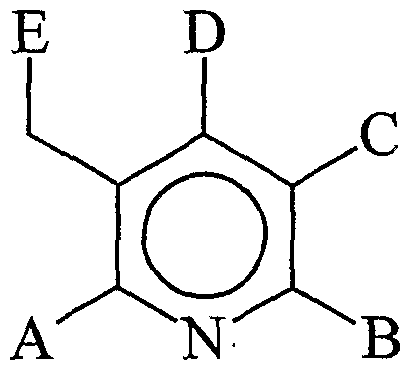
Gegenstand der vorliegenden Erfindung ist die Verwendung von Vitamin B6-Derivaten der Formel I,
Figure imgf000003_0001
(I) worin
A und B stehen unabhängig voneinander für Wasserstoff, Halogen, eine Cι-C4- Alkylgruppe, eine C3-C6-Cycloalkylgruppe, eine - -Monohydroxyalkylgruppe, eine C2-C -Oligohydroxyalkylgruppe, eine C1-C4-Aminoalkylgruppe, eine Gruppe - OR oder eine Gruppe -NR R , in der R und R unabhängig voneinander für Wasserstoff, eine Cι-C4-Alkylgruppe oder eine C1-C4-Monohydroxyalkylgruppe stehen, oder R1 und R2 zusammen mit dem Stickstoffatom einen gesättigten Ring bilden, C steht für eine Gruppe -OR, -NR*R2, -OP(O)(OR3)2, eine Cι-C4- Monohydroxyalkylgruppe, eine C2-C4-Oligohydroxyalkylgruppe oder eine CrC4- Alkylgruppe,
D steht für eine Gruppe -OR, eine Carboxygruppe, eine d-C22-Alkoxy- carbonylgruppe, einen Formylrest, eine Gruppe -CH2OR oder eine Gruppe -CH2- NR2,
E steht für eine Gruppe -OR, -OP(O)(OR3)2, eine C1-C4-Monohydroxyalkylgruppe oder eine C2-C4-Oligohydroxyalkylgruppe,
wobei
R jeweils steht für Wasserstoff, eine C1-C4-Alkylgruppe, eine CrC22- Acylgruppe, eine Hydroxy-C2-C22-acylgruρpe, eine C2-C10-Carboxy- acylgrup- pe, eine C3-do-Oligocarboxyacylgruppe, eine Oligocarboxy-monohydroxy-C3- Cio-acylgruppe, eine Oligocarboxy-oligohydroxy-Cs- o-acylgruppe, eine C3- C8-Cycloalkylgruppe, eine C1-C4-Monohydroxyalkylgruppe, eine C2-C -Oligo- hydroxyalkylgruppe, eine Arylgruppe, welche eine Hydroxy-, Nitro- oder Aminogruppe enthalten kann, einen heteroaromatischen Rest oder eine Gruppe
Figure imgf000004_0001
in der R1 und R2 wie oben definiert sind, R3 jeweils steht für Wasserstoff oder eine C 1-C5- Alkylgruppe,
oder eines der entsprechenden physiologisch verträglichen Salze, zur Verbesserung der Struktrur und Festigkeit des Haarkeratins und der Waschbeständigkeit von Haarfärbungen durch topische Applikation diese enthaltender Zubereitungen.
Bevorzugt sind Verbindungen der Formel I, in denen eine der beiden Gruppen A oder B für Wasserstoff steht.
Bevorzugt werden Verbindungen der Formel I, in denen eine der beiden Gruppen A oder B Wasserstoff und die andere Gruppe eine Cι-C -Alkylgruppe ist.
Ebenfalls bevorzugt sind Verbindungen der Formel I, bei denen C für eine Hydroxygrup- pe, eine d-C -Monohydroxyalkylgruppe oder eine C -C -Oligohydroxyalkylgruppe steht.
Die Verbindungen der Formel I werden erfindungsgemäß bevorzugt, in denen D für eine Hydroxymethylgruppe, eine Hydroxygruppe, eine Carboxygruppe, eine Gruppe -CH - NR2, oder einen Formylrest steht.
Ferner sind Verbindungen der Formel I bevorzugt, in denen E eine Hydroxygruppe oder eine Gruppe -OP(O)(OH)2 ist.
Besonders bevorzugte Verbindungen nach Formel I sind Pyridoxin (A = H, B = CH3, C = OH, D = CH2OH, E = OH), Pyridoxal (A = H, B = CH3, C = OH, D = CHO, E = OH), Pyridoxal-5'-phosphat (A = H, B = CH3, C = OH, D = CHO, E = OP(O)(OH)2) und Pyri- doxamin (A = H, B = CH3, C = OH, D = CH2NH2, E = OH).
Beispiele für C1-C4- Alkylgruppen in den erfindungsgemäßen Verbindungen sind Methyl, Ethyl, n-Propyl, Isopropyl, n-Butyl und tert-Butyl. Bevorzugte Alkylgruppen sind Methyl und Ethyl, Methyl ist eine besonders bevorzugte Alkylgruppe. Bevorzugte C3-C6- Cycloalkylgruppen sind Cyclopropyl, Cyclobutyl, Cyclopentyl, Cyclohexyl. Cyclohexyl und Cyclopentyl sind besonders bevorzugte Gruppen. Bevorzugte Cι-C4- Monohydroxyalkylgruppen sind die Gruppen Hydroxymethyl, 2-Hydroxyethyl, 3- Hydroxypropyl oder 4-Hydroxybutyl; Hydroxymethyl und 2-Hydroxyethyl sind besonders bevorzugte Monohydroxyalkylgruppen. Eine bevorzugte C -C4- Oligohydroxyalkylgruppe ist die 1,2-Dihydroxyethylgruppe. Bevorzugte Cι-C22- Acylgruppen sind beispielsweise Acetyl, Propionyl, Butyryl, Valeryl, Capryl, Lauryl, Myristyl, Palmityl, Stearyl, Linolyl, Behenyl. Beispiele für eine Hydroxy-C2-C22- acylgruppe sind Salicylsäure oder Milchsäure. Bevorzugte C -do-Carboxyacylgruppen leiten sich beispielsweise ab von der Malonsäure, Bernsteinsäure oder Adipinsäure. Ein Beispiel für eine bevorzugte C3-do-Oligocarboxyacylgruppe ist die Glycerinsäure. Eine bevorzugte Oligocarboxy-monohydroxy-C3-C10-acylgruppe leitet sich z.B. von der Zitronensäure oder Äpfelsäure ab. Bevorzugte Oligocarboxy-oligohydroxy-C -Cι0- acylgruppen sind z.B. abgeleitet aus Weinsäure. Als Halogensubstituenten eignen sich erfindungsgemäß bevorzugt Fluor, Chlor, Brom und Iod, besonders bevorzugt sind Chlor und Brom. Unter physiologisch verträglichen Salzen werden Salze anorganischer oder organischer Säuren, z. B. Hydrochloride, Sulfate oder Hydrobromide, verstanden. Die weiteren verwendeten Begriffe leiten sich erfindungsgemäß von den hier gegebenen Definitionen ab.
Die Ester-Derivate der Verbindungen gemäß Formel (I) weisen auch physiologische und die Haarstruktur verbessernde Eigenschaften auf. Dies gilt insbesondere für die Ester des Pyridoxins, die durch Hydrolyse in das Pyridoxin übergehen können. Darüber hinaus erlangen die Esterderivate eine verbesserte Lipidlöslichkeit verglichen mit den nicht veresterten Derivaten. Weitere Beispiele für Carbonsäure-Esterderivate des Pyridoxins leiten sich ab von den Carbonsäuren wie Ameisensäure, Essigsäure, Propionsäure, Buttersäure, Isobuttersäure, Valeriansäure, Isovaleriansäure, Pivalinsäure, Oxalsäure, Malonsäure, Bernsteinsäure, Glutarsäure, Glycerinsäure, Glyoxylsäure, Adipinsäure, Pimelinsäure, Korksäure, Azelainsäure, Sebacinsäure, Propiolsäure, Crotonsäure, Isocrotonsäure, Elaidinsäure, Maleinsäure, Fumarsäure, Muconsäure, Citraconsäure, Mesaconsäure, Camphersäure, Benzoesäure, o,m,p-Phthalsäure, Naphthoesäure, Toluoylsäure, Hydratropasäure, Atropasäure, Zimtsäure, Isonicotinsäure, Nicotinsäure, Bicarbaminsäure, 4,4'-Dicyano-6,6'-binicotinsäure, 8-Carbamoyloctansäure, 1,2,4- Pentantricarbonsäure, 2-Pyrrolcarbonsäure, 1 ,2,4,6,7-Napthalinpentaessigsäure,
Malonaldehydsäure, 4-Hydroxy-phthalamidsäure, 1-Pyrazolcarbonsäure, Gallussäure oder Propantricarbonsäure, sowie von den Dicarbonsäuren ausgewählt aus der Gruppe, die gebildet wird durch Verbindungen der allgemeinen Formel (II),
Figure imgf000006_0001
(II)
in der Z steht für eine lineare oder verzweigte Alkyl- oder Alkenylgruppe mit 4 bis 12 Kohlenstoffatomen, n für eine Zahl von 4 bis 12 sowie eine der beiden Gruppen X und Y für eine COOH-Gruppe und die andere für Wasserstoff oder einen Methyl- oder Ethylrest, Dicarbonsäuren der allgemeinen Formel (II), die zusätzlich noch 1 bis 3 Methyl- oder Ethylsubstituenten am Cyclohexenring tragen sowie Dicarbonsäuren, die aus den Dicarbonsäuren gemäß Formel (II) formal durch Anlagerung eines Moleküls Wasser an die Doppelbindung im Cyclohexenring entstehen.
Die strukturverbessernde Wirkung der Vitamin B6-Derivate auf das Haarkeratin kann man durch hochdruck-differenzkalorimetrische Messungen (HP-DSC) des Keratin- Schmelzverhaltens quanititativ bestimmen (vgl. Beispielteil). Die Verbesserung der Waschbeständigkeit der Haare kann man durch farbmetrische Messung des Farbabstandes zwischen dem gefärbten, ungewaschenen und dem gefärbten, mehrfach gewaschenen Haar quantitativ bestimmen. Diese Effekte sind besonders auffallend, wenn man ein stark strapaziertes Haar mit einer Zusammensetzung behandelt, die Vitamin B6-Derivate ent- hält. Solch stark strapaziertes Haar entsteht insbesondere durch oxidierende oder reduzierende Behandlungsverfahren, also z. B. beim Färben der Haare mit Oxidationsfärbemit- teln, beim Bleichen der Haare mit Oxidationsmitteln oder beim Verfbrmen, z. B. beim Dauerwellen oder Glätten der Haare mit starken Keratinreduktionsmitteln, z. B. mit Thio- glycolat-Salzen oder mit Sulfiten.
Ein weiterer Gegenstand der Erfindung ist daher ein Verfahren zur oxidierenden oder reduzierenden Behandlung der Haare, bei dem man das Haar unmittelbar im Anschluß an die oxidierende oder reduzierende Behandlungsstufe mit einer Zusammensetzung nachbehandelt, die ein Vitamin B6-Derivat der Formel I in einer Menge von 0,05-2 Gew.-% enthält. Diese Zusammensetzung zur Nachbehandlung kann dabei ein Shampoo, eine Spülung, eine Pflegelotion, eine Festigerlotion, ein Schaum, ein Haarwasser oder ein Spray sein, d. h. es kann sich um ein „rinse-off* ' oder um ein „leave on"-Produkt handeln.
Wenn die Zusammensetzung nach dem Haarefarben angewandt wird, kann es sich zum Beispiel um eine wässrige Pflegelotion handeln. Wenn die Nachbehandlung nach der reduzierenden Stufe einer Dauerwellbehandlung erfolgen soll, kann das Vitamin B6- Derivat der Dauerwellfixierung zugesetzt werden. Die Nachbehandlung kann aber auch im Anschluß an die Dauerwellfixierung, die ja selbst eine oxidierende Haarbehandlung darstellt, erfolgen. In diesem Falle wird das Vitamin B6-Derivat die Form einer Pflegelotion angewandt. Bevorzugt wird die Zusammensetzung mit dem Vitamin B6-Derivat als Pflegelotion nach der oxidativen Haarfärbung oder zur Dauerwellfixierung verwendet. Neben dem Vitamin
B6-Derivat kann diese Zubereitung alle für die Formulierung von Haarpflegemitteln üblichen und für das Haar oder die Kopfhaut zuträglichen Komponenten enthalten. ι
Die Zubereitungen zur Durchführung der oxidativen Fixierung im Dauerwellverfahren enthalten als Oxidationsmittel z. B. Wasserstoffperoxid und die zur Stabilisierung wässri- gen Wasserstoffperoxidzubereitungen üblichen Stabilisatoren. Der pH- Wert solcher wäss- riger H2O2-Zubereitungen, die etwa 0,5 bis 3 Gew.-% H2O2 enthalten, liegt bevorzugt bei 2 bis 4; er wird mit anorganischen Säuren, bevorzugt mit Phosphorsäure, eingestellt. Das bevorzugte Oxidationsmittel ist jedoch Natrium- oder Kaliumbromat. Diese Bromate werden in Konzentration von 1 bis 10 Gew.-% eingesetzt und der pH- Wert der Zubereitungen auf 4 bis 7 eingestellt.
Außer den Oxidationsmitteln können diese Dauerwellfixiermittel weitere Komponenten, z. B. oberflächenaktive Stoffe, quartäre Ammoniumsalze, kationische Polymere, wasserlösliche Proteine- oder Proteinderivate, Duftstoffe, Trübungsmittel u.s.w enthalten. Eine Pflegelotion, die nach der Dauerwellfixierung angewendet wird, kann z. B. festigende, konditionierende, pflegende oder antistatische Komponenten, Erdalkali- oder Aluminiumsalz und andere Komponenten enthalten.
Von besonderer Bedeutung ist das erfindungsgemäße Verfahren zur Strukturverbesserung des Haarkeratins im Zusammenhang mit der oxidativen Färbung und/oder Bleichung der Haare. Ein besonders bevorzugter Gegenstand der Erfindung ist daher eine Haarpflegelotion, insbesondere zur Anwendung nach dem Färben oder Bleichen der Haare, die
1 - 10 Gew.-% emulgierter Öl-, Fett- oder Wachskomponenten
0,l - 5 Gew.-% kationischer Tenside
0,2 - 2 Gew.-% eines Vitamin B6-Derivats der Formel I
in einem wässrigen Träger enthält.
Als Öl- oder Fettkomponenten eignen sich Paraffine, Silikonöle, pflanzliche Öle und tierische Fette (Triglyceride), Fettsäurefettalkoholester (Wachsester), Fettsäureester kurz- kettiger Alkohole, Dicarbonsäure-Fettalkoholester, lineare und verzweigtkettige Alkohole und Diole mit 10-20 C-Atomen, Fettsäuremonoglyceride und andere Öle, Fette oder Wachse.
Als kationische Tenside eignen sich Verbindungen mit einer freien oder substituierten Aminogruppe oder quartären Ammoniumgruppe, die am Stickstoff atom eine oder zwei längerkettige Alkyl- oder Acylaminoalkyl- oder Acyloxyalkylgruppen und bis zu drei kurzkettigen Alkylgruppen und ggf. eine Benzylgruppe enthalten. Beispiele für geeignete quartäre Ammoniumtenside sind z. B.
- Cetyltrimethylammonium-chlorid
- Lauryl-dimethyl-benzyl-ammonium-bromid
- Stearyl-trimethylammonium-chlorid
- Di-stearoyloxyethyl-dimethylammonium-methoxysulfat
- Kokosacylaminopropyl-trimethylammonium-chlorid
Andere kationische Tenside sind z. B. längerkettige primäre, sekundäre oder tertiäre Amine in Form ihrer Salze, z. B. der Hydrochloride oder Sulfate.
Zusätzlich zu den genannten Komponenten können erfindungsgemäße Haarpflegelotionen z.B. nichtionogene Tenside und Emulgatoren (für die Öl- und Fettkomponente), wasserlösliche Proteine, Proteinabbauprodukte oder Proteinderivate, Aminosäuren (z. B. Serin), wasserlösliche kationische Polymere, festigende, filmbildende Polymere wie z. B. Po- lyvinylpyrrolidon, Glucose und andere strukturierende oder die Kopfhaut pflegende Wirkstoffe wie z. B. Panthenol, Tocopherol, Allantoin, Pflanzenextrakte wie z. B. Birkenoder Kamillen-Extrakt, Antischuppenwirkstoffe, Vitamine, z. B. Vitamin Bl (Thiamin), B2 (Riboflavin), B3 (Nicotinsäure, Nicotinsäureamid), B7 (Biotin), B12 (Cyanocobala- min), C (Ascorbinsäure), E (Tocopherolacetat), Duftstoffe und Lichtschutzmittel enthalten.
Lichtschutzmittel haben eine besondere Bedeutung für den langzeitigen Schutz des Haarkeratins vor den schädlichen Einflüssen der Sonne. In einer bevorzugten Ausführung enthält die erfindungsgemäße Haarpflegelotion daher auch ein Lichtschutzmittel, bevorzugt in der Form einer Ultraviolettstrahlen absorbierenden Substanz. Solche Substanzen sind in großer Zahl im Handel. Dabei unterscheidet man wasserlösliche und lipidlösliche Lichtschutzmittel. In einer bevorzugten Ausführung enthält die erfindungsgemäße Pflegelotion eine Kombination aus wasserlöslichen und lipidlöslichen Lichtschutzmitteln.
Geeignete wasserlösliche Lichtschuztmittel sind z. B.: - 2-Hydroxy-4-methoxy-benzophenon-5-sulfonsäure p-Methoxyzimtsäure-Diethanolaminsalz
- p-Aminobenzoesäure 2-Phenyl-benzimidazol-5-sulfonsäure Triethanolamin-Salicylat und
- Lauryl-[3-( -Dime ylaminobenzamido)-propyl]-dimethylammonium-p- Toluolsulfonat
Geeignete lipidlösliche Lichtschutzmittel sind z. B.
- 2-Hydroxy-4-methoxy-benzophenon
- 2-Aminobenzoesäure-menthylester
- 4 Bis (2-hydroxypropyl)-aminobenzoesäure-ethylester
- 4- Aminobenzoesäure-2,3 -dihydroxypropyl-ester
- 2-Ethylhexyl-2-cyano-3,3-diphenyl-acrylat
- p-Methoxyzimtsäure-2-ethylhexylester
- 4-Methylbenzyliden-campher
- 4-tert.-Buty 1-4 ' -methoxy-dibenzoy lmethan
Die erfindungsgemäße Pflegelotion liegt bevorzugt in der Form einer Öl-in- Wasser Emulsion der emulgierten Öl-oder-Fettkomponenten vor, die entweder schon zum Auswaschen des überschüssigen Färbemittels aus dem Haar verwendet wird, oder die nach dem Ausspülen des überschüssigen Farbstoffs oder des überschüssigen Bleichmittels mit Wasser in einem separaten Arbeitsgang auf das Haar aufgetragen und gleichmäßig im Haar verteilt wird.
Wenn die Pflegelotion auf dem Haar verbleiben soll (leave-on-Anwendung), wird der Gehalt an emulgierten Öl- oder Fettkomponenten niedrig, bevorzugt unter 3 Gew.-% gehalten. Üblicherweise wird aber nach der Behandlung mit der Pflegelotion noch eine Spülung mit klarem Wasser vorgenommen.
Die folgenden Beispiele sollen den Gegenstand der Erfindung näher erläutern: Beispiele:
1. Nachweis der strukturgebenden Wirkung von Vitamin B6 bei topischer Applikation:
1.1 Prüfmethodik
HP -DSC (High Pressure Differential Scanning Calorimetry)
Thermoanalytische Untersuchungen eignen sich besonders zur Charakterisierung von Zweiphasensystemen, zu denen die Humanhaare als Faserkeratine mit ihrem kristallinen α-Helix- Anteil und amorphen Matrix- Anteil ebenfalls gehören. Auf der einen Seite können Glasübergänge und Alterungsverhalten der amorphen Matrix untersucht werden, auf der anderen Seite liefert das Schmelzverhalten der kristallinen, helicalen Phase wichtige Erkenntnisse. Thermoanalytische Untersuchungen sind erstmals 1899 beschrieben, erste Differenzthermoanalysen (DTA) an Proteinfasern wurden Ende der fünfziger Jahre durchgeführt (F. Schwenker, J.H. Dusenbury, Text. Res. J. 1963, 30, Seite 800 ff; W. D. Felix, M.A. McDowall, H. Eyring, ibid. (1963), 33, Seite 465 ff). In den folgenden Jahren sind unterschiedliche thermoanalytische Meßverfahren, wie DTA, HP -DTA (High Pressure, Hochdruck-DTA) und DSC (Differential Scanning Calorimetry, Dynamische Differenz- Kalorimetrie), an Keratinfasern angewendet worden um z.B. das Phänomen der Superkontraktion, α-ß-Phasenübergänge der Helices oder Denaturierungsvorgänge zu untersuchen. In jüngster Zeit wird, insbesondere am Deutschen Wollforschungsinstitut in Aachen (F.J. Wortmann, H. Deutz, J. Appl. Polym. Sei. 1993, 48, Seite 137ff), die Methode der IIP-DSC zur Untersuchung von Keratinfasern genutzt, die die Probleme mit pyrolytischen Effekten, wie sie bei der konventionellen DSC auftreten, und Probleme mit der Datenerfassung und -Interpretation, wie sie die DTA birgt, ausschließt. Dabei werden DSC-Messungen an Keratinen durchgeführt, die mit Wasser in kommerziell erhältlichen, druckfesten Meßkapseln eingeschlossen sind. Im Keratin- Wasser-System entwickelt sich beim Erhitzen oberhalb von 100°C in den verkapselten Stahltiegeln ein Wasserdampfhochdruck, woraus sich die HP-DSC Analyse ableitet. Der gravierende Unterschied der HP-DSC-Thermogramme von Humanhaaren im Vergleich zu normalen DSC- Thermogrammen ist der, daß die endothermen Peaks, die den Umwandlungspunkt und Umwandlungsenthalpie wiedergeben, hier um ca. 90 °C zu niedrigeren Temperaturen verschoben sind. Das rührt daher, daß das Wasser nach Diffusion in die Haarfaser durch Schwächung und Spaltung von Wasserstoffbrücken- und Salzbindungen die Proteinstabilität vermindert und so die „Verleimungstemperatur" der Keratine herabsetzt. Werden durch das superkontrahierende Agens wie Wasser nur Wasserstoffbrücken und Salzbrük- ken gelöst, so ist der thermische Effekt reversibel (Superkontraktion). Der Vorgang wird jedoch irreversibel, sobald auch kovalente Bindungen, wie z. B. Disulfidbrücken, gespalten werden. Dies tritt ein, wenn man Humanhaarfasern in druckfesten Kapseln mit Wasser auf über 150 °C erhitzt. Die irreversible Umwandlung, interpretiert als Übergang der α-helicalen Bereiche in den Proteinen in einen ungeordneten Zustand, resultiert in endothermen Peaks, wobei die Peaklage den Umwandlungs- oder auch Denaturierungspunkt und die Peakfläche die Umwandlungs- oder Denaturierungs-Enthalpie wiedergibt.
Unter Verwendung der Dynamischen Differenz-Kalorimetrie (DSC) können demnach strukturelle sowie chemische Zustände und Veränderungen in Faserkeratinen und insbesondere in Humanhaaren erfaßt werden. Unter genau definierten Versuchsbedingungen kann man bei Humanhaaren die kalorimetrisch erfaßbaren Vorgänge anhand von Ther- mogrammen aufzeichnen und sie bezüglich der Peaklagen, -Strukturen und -flächen als Indikator für die Beeinflussung von Ordnungs-Unordnungsübergangen durch Änderungen innerer und/oder äußerer Parameter, hervorrufen z. B. durch kosmetische Behandlung der Haare, verwenden. D. h. aus den im Thermogramm von Humanhaaren aufgezeichneten endothermen Peaks lassen sich aufgrund von Peaklage (Umwandlungspunkt) und Peakfläche (Umwandlungsenthalpie) Aussagen über Festigkeit bzw. Schädigung der Humanhaarfaser treffen.
Ausfuhrliche Untersuchungen bezüglich des Einflusses des Cystingehaltes auf die Denaturierung der α-Helices in Keratinen haben z. B. gezeigt, daß die Denaturierungs- Temperatur (Übergangstemperatur) des Keratins linear mit dem Cystingehalt ansteigt. Die erhöhte Stabilität des Matrixbereichs aufgrund des höheren Vernetzungsgrades des erhöhten Anteils an Disulfidbrücken in der Matrix führt dazu, daß die Umwandlung der in diese Matrix eingebetteten Helices erschwert wird und resultiert somit in einer Erhöhung der Denaturierungs-Temperatur. Umgekehrt kann in der Regel eine Denaturierungs- Temperatur- und vor allem Denaturierungs-Enthalpieerniedrigung bei durch Dauerwelle oder Bleichung bzw. Färbung behandelten Humanhaaren beobachtet werden (H. Deutz, Doktorarbeit, RWTH Aachen 1993).
1.2 Durchführung
Humanhaar (Alkinco 6633 und Alkinco 6634) wurde gezielt durch eine Dauerwellbehandlung (Marktprodukt Poly Lock extra starke Dauerwelle, 40 min. Dauerwelle, 10 min. Fixierung) geschädigt. Anschließend wurden jeweils 0,5 g Strähnen beider Haarqualitäten für 10 min mit einer l%igen wäßrigen Lösung der in Tabelle 1 aufgelisteten Wirkstoffe behandelt und nach dem Abspülen getrocknet. Mittels thermoanalytischer Untersuchungen wurde dann auf (re)strukturierende Effekte der Wirkstoffe geprüft. Die erhaltenen Keratinschmelzpunkte sind in Tabelle 1 aufgelistet.
Figure imgf000013_0001
Tab.l : (Re)strukturierung durch Vitamin B6 und Derivate
Mit Ausnahme der Schmelzpunkt-Erhöhung um 0,5 °C durch Pyridoxin* bei Alkinco 6633 sind alle Effekte statistisch hochsignifikant.
Durch Einsatz von Pyridoxin in einer Emulsionsformulierung (Anwendungsbeispiel 3.1) konnte ebenfalls ein in Abh. von der Einsatz-Konzentration steigender (re)strukturierender Effekt nachgewiesen werden. Auch hier wurden thermoanalytische Untersuchungen an Humanhaar (Alkinco 6634) durchgeführt, das zum Nachweis des gewünschten Effektes - wie oben beschrieben - gezielt vorgeschädigt wurde und anschließend 2 min. mit dem Pyridoxin in unterschiedlichen Konzentrationen enthaltenden Con- ditioner (Anwendungsbeispiel 3.1) nachbehandelt wurde. Die Ergebnisse sind in Tabelle 2 aufgeführt.
Figure imgf000014_0001
Tab.2: (Re)strukturierung durch Vitamin B6 in Abh. von der Konz.
Bereits der durch den Einsatz von 0,2 % Vitamin B6 hervorgerufene Effekt ist im Vergleich zur Referenzprobe statistisch signifikant.
2. Nachweis der Verbesserung der Waschbeständigkeit von Haarfärbungen
Eine Verbesserung der Waschechtheit von Haarfarben, insbesondere Oxidationshaarfar- ben mit Rot- oder Violettreflex durch Vitamin B6 und Derivate konnte durch folgende Versuche nachgewiesen werden:
Es wurden Humanhaare (Kerling Naturweiß) verwendet. Die Haare wurden im Spitzenbereich gezielt geschädigt (2-fach blondiert und 2-fach dauergewellt), um stark strapaziertes Haar zu simulieren. Die Humanhaare wurden mit einer Rot-Braun-Nuance einer oxidativen Haarfarbe (Poly Diadem 718 - Haselnuß) nach Gebrauchsanweisung eingefarbt, gespült und anschließend mit einer Spülung (Anwendungsbeispiel 3.2), enthaltend 2 % Aktivsubstanz Vitamin B6 bzw. Derivat (Referenz ohne Wirkstoff) für 5 min. nachbehan- delt. Nach Spülen und Trocknen wurden farbmetrische Messungen (Haarlängen und - spitzen gesondert) durchgeführt, anschließend 6x gewaschen und wiederum farbmetrische Messungen durchgeführt. Die ermittelten Werte für den Gesamtfarbabstand DE* (=Farbabstand Muster bzw. Referenz zu entsprechendem ungewaschenem, gefärbtem Haar) sind in Tabelle 3 aufgeführt. Je kleiner DE*, desto geringer der Farbverlust durch Shampoonierung und desto höher die Waschechtheit.
Figure imgf000015_0001
Tab.3: Verbesserung der Waschechtheit durch Vitamin B6 und Derivate
Die erhöhte Waschechtheit der Haarfarben ist - insbesondere auf den stark strapazierten Spitzen - auch mit dem bloßen Auge gut zu erkennen.
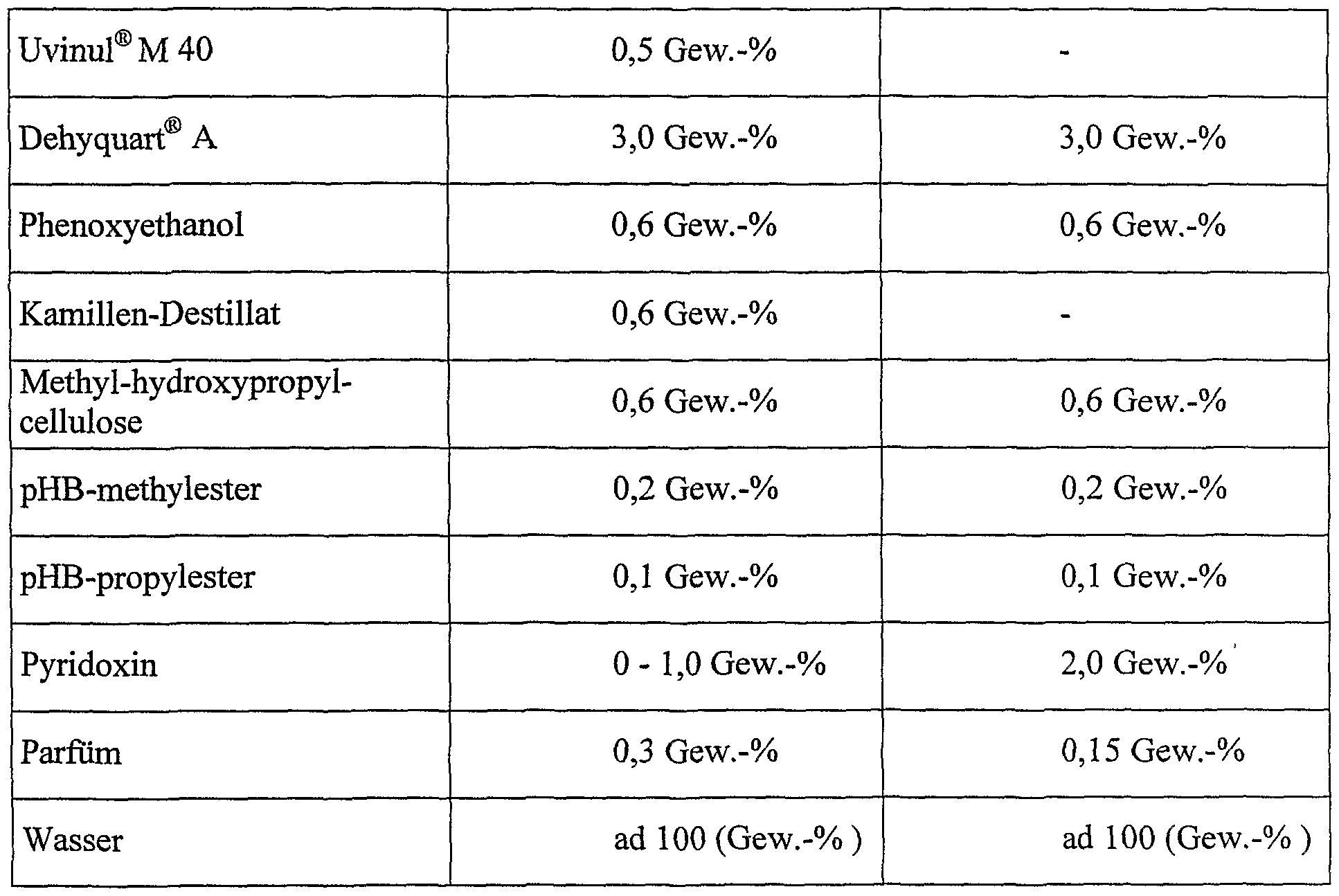
3. Anwendungsbeispiele (Haarpflegelotionen)
Figure imgf000015_0002
Figure imgf000016_0001
Es wurden die folgenden Handelsprodukte verwendet:
Escalor HP 610: Dodecyl- [3 (p-Dimethylaminobenzamido)-propyl]- dimethylammonium-p-toluolsulfonat mit Propylenglycol- monostearat (QAV min 65 %, H2O: 12-18 %)
Uvinul® M40: 2-Hydroxy-4-methoxybenzophenon Dehyquart® A: Cetyltrimethylammonium-chlorid (25%ig in Wasser)

Claims

Patentansprüche
Verwendung von Vitamin B6-Derivaten der Formel I,
Figure imgf000017_0001
(i) worin
A und B stehen unabhängig voneinander für Wasserstoff, Halogen, eine - C - Alkylgruppe, eine C3-C6-Cycloalkylgruppe, eine d-C4-Monohydroxy- alkylgruppe, eine C2-C -Oligohydroxyalkylgruppe, eine Cι-C -Amino- alkylgruppe, eine Gruppe -OR oder eine Gruppe -NR'R2, in der R1 und R2 unabhängig voneinander für Wasserstoff, eine Cι-C4- Alkylgruppe oder eine Cp C4-Monohydroxyalkylgruppe stehen, oder R1 und R2 zusammen mit dem Stickstoffatom einen gesättigten Ring bilden,
C steht für eine Gruppe -OR, -NR*R2, -OP(O)(OR3)2, eine d-C4- Monohydroxyalkylgruppe, eine C2-C -Oligohydroxyalkylgruppe oder eine C ι -C4- Alkylgruppe,
D steht für eine Gruppe -OR, eine Carboxygruppe, eine Cι-C -Alkoxy- carbonylgruppe, einen Formylrest, eine Gruppe -CH2OR oder eine Gruppe - CH2-NR2,
E steht für eine Gruppe -OR, -OP(O)(OR3)2, eine d-C4- Monohydroxyalkylgruppe oder eine C2-C4-Oligohydroxyalkylgruρpe,
wobei R jeweils steht für Wasserstoff, eine Cι-C4- Alkylgruppe, eine CrC22- Acylgruppe, eine Hydroxy-C2-C22-acylgruppe, eine C2-C10-Carboxy- acylgruppe, eine C3-do-Oligocarboxyacylgruppe, eine Oligocarboxy- onohydroxy-Cs-Cjo-acylgruppe, eine Oligocarboxy-oligohydroxy-C3-Cι0- acylgruppe, eine C3-Cs-Cycloalkylgruppe, eine Cι-C -Monohydroxy- alkylgruppe, eine C2-C4-Oligohydroxyalkylgruppe, eine Arylgruppe, welche eine Hydroxy-, Nitro- oder Aminogruppe enthalten kann, einen heteroaromatischen Rest oder eine Gruppe
Figure imgf000018_0001
in der R1 und R2 wie oben definiert sind, R3 jeweils steht für Wasserstoff oder eine d-Cs-Alkylgruppe,
oder eines der entsprechenden physiologisch verträglichen Salze, zur Verbesserung der Struktrur und Festigkeit des Haarkeratins und der Waschbeständigkeit von Haarfärbungen durch topische Applikation diese enthaltender Zubereitungen.
2. Verwendung nach Anspruch 1, dadurch gekennzeichnet, daß eine der beiden Gruppen A oder B für Wasserstoff steht.
3. Verwendung nach einem der Ansprüche 1 oder 2, dadurch gekennzeichnet, daß eine der beiden Gruppen A oder B Wasserstoff und die andere Gruppe eine Cι-C4- Alkylgruppe ist.
4. Verwendung nach einem der Ansprüche 1 bis 3, dadurch gekennzeichnet, daß C für eine Hydroxygruppe, eine d-C4-Monohydroxyalkylgruppe oder eine C2-C4- Oligohydroxy-alkylgruppe steht.
5. Verwendung nach einem der Ansprüche 1 bis 4, dadurch gekennzeichnet, daß D für eine Hydroxymethylgruppe, eine Hydroxygruppe, eine Carboxygruppe, eine Gruppe -CH2-NR2 oder einen Formylrest steht.
6. Verwendung nach einem der Ansprüche 1 bis 5, dadurch gekennzeichnet, daß E für eine Hydroxygruppe oder eine Gruppe -OP(O)(OH)2 steht.
7. Verwendung nach einem der Ansprüche 1 bis 6, dadurch gekennzeichnet, daß als Vitamin B6-Derivat eine Verbindung aus der Gruppe Pyridoxin, Pyridoxal, Pyri- doxal-5'-phosphat und Pyridoxamin eingesetzt wird.
8. Verfahren zur oxidierenden oder reduzierenden Behandlung von Haaren, dadurch gekennzeichnet, daß man das Haar unmittelbar im Anschluß an die oxidierende oder reduzierende Behandlungsstufe mit einer Zusammensetzung nachbehandelt, die eine Verbindung der Formel I gemäß Patentanspruch 1 in einer Menge von 0,05-2 Gew.-% enthält.
9. Verfahren nach Anspruch 8, dadurch gekennzeichnet, daß die Zusammensetzung als Pflegelotion nach der oxidativen Haarfarbung oder zur Dauerwellfixierung verwendet wird.
10. Haarpflegelotion, insbesondere zur Anwendung nach dem Färben oder Bleichen der Haare, die
1 - 10 Gew.-% emulgierter Öl-, Fett- oder Wachskomponenten
0,1 - 5 Gew.-% eines kationischen Tensids
0,05-2 Gew.-% eines Vitamin B6-Derivats der Formel I gemäß Anspruch 1 in einem wässrigen Träger enthält.
11. Haarpflegelotion gemäß Anspruch 10, dadurch gekennzeichnet, daß zusätzlich ein Lichtschutzmittel in Form einer UN-Strahlen absorbierenden Substanz enthalten ist.
PCT/EP2001/006557 2000-06-20 2001-06-09 Strukturverbessernde haarpflegemittel enthaltend vitamin b6 und derivate Ceased WO2001097760A1 (de)

Priority Applications (5)

Application Number Priority Date Filing Date Title
DE50112233T DE50112233D1 (de) 2000-06-20 2001-06-09 Verwendung von Vitamin B6-Derivaten zur Haarstrukturverbesserung
AU2001267533A AU2001267533A1 (en) 2000-06-20 2001-06-09 Structure-improving hair care agents
EP01945271A EP1292265B1 (de) 2000-06-20 2001-06-09 Verwendung von Vitamin B6-Derivaten zur Haarstrukturverbesserung
JP2002503237A JP4981234B2 (ja) 2000-06-20 2001-06-09 組織改良毛髪ケア剤
US10/314,098 US6787128B2 (en) 2000-06-20 2002-12-06 Structure-improving hair care agents

Applications Claiming Priority (4)

Application Number Priority Date Filing Date Title
DE10030313A DE10030313A1 (de) 2000-06-20 2000-06-20 Oxidationsfärbemittel
DE10120306.3 2001-04-26
DE10030313.7 2001-04-26
DE2001120306 DE10120306A1 (de) 2001-04-26 2001-04-26 Strukturverbessernde Haarpflegemittel

Related Child Applications (1)

Application Number Title Priority Date Filing Date
US10/314,098 Continuation US6787128B2 (en) 2000-06-20 2002-12-06 Structure-improving hair care agents

Publications (2)

Publication Number Publication Date
WO2001097760A1 true WO2001097760A1 (de) 2001-12-27
WO2001097760A8 WO2001097760A8 (de) 2002-03-07

Family

ID=26006153

Family Applications (1)

Application Number Title Priority Date Filing Date
PCT/EP2001/006557 Ceased WO2001097760A1 (de) 2000-06-20 2001-06-09 Strukturverbessernde haarpflegemittel enthaltend vitamin b6 und derivate

Country Status (7)

Country Link
US (1) US6787128B2 (de)
EP (1) EP1292265B1 (de)
JP (1) JP4981234B2 (de)
AT (1) ATE357207T1 (de)
AU (1) AU2001267533A1 (de)
DE (1) DE50112233D1 (de)
WO (1) WO2001097760A1 (de)

Cited By (4)

* Cited by examiner, † Cited by third party
Publication number Priority date Publication date Assignee Title
EP1437120A1 (de) * 2003-01-11 2004-07-14 Wella Aktiengesellschaft Zum Abspülen bestimmtes kosmetisches Mittel mit UV-Schutz
US8003615B2 (en) 2003-10-01 2011-08-23 Daiichi Fine Chemical Co., Ltd. Stable vitamin B6 derivative
EP1789010B1 (de) * 2004-09-16 2012-08-29 Henkel AG & Co. KGaA Wirkstoffgemisch zur behandlung keratinischer fasern
WO2014095158A3 (de) * 2012-12-21 2015-01-22 Henkel Ag & Co. Kgaa Verfahren zur schonenden wärmeunterstützten umformung keratinhaltiger fasern

Families Citing this family (7)

* Cited by examiner, † Cited by third party
Publication number Priority date Publication date Assignee Title
JP2003535876A (ja) * 2000-06-20 2003-12-02 ヘンケル・コマンディットゲゼルシャフト・アウフ・アクチエン 毛髪酸化処理における保護成分としてのビタミンb6誘導体
DE102005062360A1 (de) * 2005-12-23 2007-06-28 Henkel Kgaa Haarfärbeverfahren
HRP20100210T1 (hr) 2006-06-01 2010-05-31 Nobera Pharma Upotreba alopurinola u liječenju eritrodisestezije dlana i stopala
US7972388B2 (en) 2007-10-30 2011-07-05 L'oreal S.A. Methods and kits for maintaining the condition of colored hair
US8729108B2 (en) * 2008-06-17 2014-05-20 Christopher J Dannaker Waterborne topical compositions for the delivery of active ingredients such as azelaic acid
JP2010237098A (ja) * 2009-03-31 2010-10-21 Shiseido Co Ltd 角層評価方法及び抗肌荒れ成分選別方法
JP2011042584A (ja) * 2009-08-19 2011-03-03 Hoyu Co Ltd 毛髪処理方法及び毛髪処理キット

Citations (4)

* Cited by examiner, † Cited by third party
Publication number Priority date Publication date Assignee Title
US4201235A (en) * 1978-01-03 1980-05-06 Mare Corporation Amino acid-vitamin formulations for skin, hair and scalp conditioners
DE19613567A1 (de) * 1996-04-04 1997-10-09 Henkel Kgaa Zubereitung zur Behandlung keratinischer Fasern
US5681554A (en) * 1995-06-28 1997-10-28 Cosmair, Inc. Composition for treating hair and method for using the same
WO1998051265A1 (en) * 1997-05-16 1998-11-19 L'oreal Composition for treating hair

Family Cites Families (3)

* Cited by examiner, † Cited by third party
Publication number Priority date Publication date Assignee Title
DE2748463A1 (de) 1977-09-14 1979-03-29 Hoffmann La Roche Kosmetisches praeparat
EP0678293A3 (de) 1994-03-25 1996-02-21 Hoffmann La Roche Pyridoxinester enthaltendes Präparat, Verfahren zu dessen Herstellung und dessen Verwendung.
US5833998A (en) * 1995-11-06 1998-11-10 The Procter & Gamble Company Topical compositions for regulating the oily/shiny appearance of skin

Patent Citations (4)

* Cited by examiner, † Cited by third party
Publication number Priority date Publication date Assignee Title
US4201235A (en) * 1978-01-03 1980-05-06 Mare Corporation Amino acid-vitamin formulations for skin, hair and scalp conditioners
US5681554A (en) * 1995-06-28 1997-10-28 Cosmair, Inc. Composition for treating hair and method for using the same
DE19613567A1 (de) * 1996-04-04 1997-10-09 Henkel Kgaa Zubereitung zur Behandlung keratinischer Fasern
WO1998051265A1 (en) * 1997-05-16 1998-11-19 L'oreal Composition for treating hair

Cited By (4)

* Cited by examiner, † Cited by third party
Publication number Priority date Publication date Assignee Title
EP1437120A1 (de) * 2003-01-11 2004-07-14 Wella Aktiengesellschaft Zum Abspülen bestimmtes kosmetisches Mittel mit UV-Schutz
US8003615B2 (en) 2003-10-01 2011-08-23 Daiichi Fine Chemical Co., Ltd. Stable vitamin B6 derivative
EP1789010B1 (de) * 2004-09-16 2012-08-29 Henkel AG & Co. KGaA Wirkstoffgemisch zur behandlung keratinischer fasern
WO2014095158A3 (de) * 2012-12-21 2015-01-22 Henkel Ag & Co. Kgaa Verfahren zur schonenden wärmeunterstützten umformung keratinhaltiger fasern

Also Published As

Publication number Publication date
JP2003535880A (ja) 2003-12-02
US6787128B2 (en) 2004-09-07
WO2001097760A8 (de) 2002-03-07
EP1292265B1 (de) 2007-03-21
US20030113280A1 (en) 2003-06-19
EP1292265A1 (de) 2003-03-19
AU2001267533A1 (en) 2002-01-02
JP4981234B2 (ja) 2012-07-18
DE50112233D1 (de) 2007-05-03
ATE357207T1 (de) 2007-04-15

Similar Documents

Publication Publication Date Title
EP1328242B1 (de) Verwendung von kreatin, kreatinin und/oder cyclokreatin zur stärkung und verbesserung der haarstruktur
EP3079653B1 (de) Verfahren zum glätten, konditionieren und färben von haaren, insbesondere von haaren mit starker krause
DE202016008491U1 (de) Zusammensetzung zur Haarverfestigung und deren Anwendung zum Festigen der Haare
WO2015090804A1 (de) Saure mittel zum färben von keratinfasern enthaltend spezielle aminosilikone und säurefarbstoffe
DE3631991A1 (de) Mittel und verfahren zur dauerhaften haarverformung
DE102017221630A1 (de) Restrukturierung von blondierten Haaren durch Mittel mit aliphatischen Polyolen und cyclischen Carbonaten
EP1292265B1 (de) Verwendung von Vitamin B6-Derivaten zur Haarstrukturverbesserung
EP1156774B1 (de) Zubereitungen zur behandlung keratinischer fasern
DE102016209980A1 (de) "Nachbehandlungsmittel für die reduktive Entfärbung von gefärbten keratinischen Fasern"
EP0648103A1 (de) Haarbehandlungsmittel
EP0662815B1 (de) Haarbehandlungsmittel
DE4411856A1 (de) Keratinfaser-Behandlungszusammensetzung
DE19943597A1 (de) Verwendung basischer Aminosäuren als Fönschutz in Haarbehandlungsmitteln
WO2015086002A1 (de) Verfahren und kit zum färben von haaren mit verbesserter grauabdeckung und verbesserter waschbeständigkeit
EP3233033B1 (de) Resorcinderivate in mitteln zum gleichzeitigen umformen und färben von keratinischen fasern
DE3610394A1 (de) Verfahren zur verformung von haaren
KR20220006016A (ko) 모발용 화장료
EP0880916B1 (de) Haardauerverformungsverfahren mit zunächst höherem und später niedrigerem pH-Wert in der Reduktionsstufe
DE10119608A1 (de) Verwendung von Kreatin und/oder Kreatin-Derivaten in Haarbehandlungsmitteln und Haarnachbehandlungsmitteln zum Schutz vor Schäden durch chemische Behandlung und zur Reparatur bereits geschädigter Haare
DE10120306A1 (de) Strukturverbessernde Haarpflegemittel
WO2015086269A1 (de) Verfahren und kit zum glätten und färben von haaren mit verbesserter grauabdeckung und verbesserter waschbeständigkeit
EP2934471B1 (de) Verfahren zur schonenden wärmeunterstützten umformung keratinhaltiger fasern
EP0895469B1 (de) Verfahren und mittel zum gleichzeitigen färben und pflegen von keratinischen fasern
DE102013225787A1 (de) Verfahren und Kit zum Glätten und Färben von Haaren mit verbesserter Waschechtheit und verbesserter Grauabdeckung
DE19751395A1 (de) Splißregenerierende Haarbehandlungsmittel

Legal Events

Date Code Title Description
AK Designated states

Kind code of ref document: A1

Designated state(s): AU BR CA CN CZ HU JP NO PL RU SK US VN

AL Designated countries for regional patents

Kind code of ref document: A1

Designated state(s): AT BE CH CY DE DK ES FI FR GB GR IE IT LU MC NL PT SE TR

121 Ep: the epo has been informed by wipo that ep was designated in this application
AK Designated states

Kind code of ref document: C1

Designated state(s): AU BR CA CN CZ HU JP NO PL RU SK US VN

AL Designated countries for regional patents

Kind code of ref document: C1

Designated state(s): AT BE CH CY DE DK ES FI FR GB GR IE IT LU MC NL PT SE TR

CFP Corrected version of a pamphlet front page

Free format text: REVISED TITLE RECEIVED BY THE INTERNATIONAL BUREAU AFTER COMPLETION OF THE TECHNICAL PREPARATIONS FOR INTERNATIONAL PUBLICATION

DFPE Request for preliminary examination filed prior to expiration of 19th month from priority date (pct application filed before 20040101)
WWE Wipo information: entry into national phase

Ref document number: 10314098

Country of ref document: US

WWE Wipo information: entry into national phase

Ref document number: 2001945271

Country of ref document: EP

ENP Entry into the national phase

Ref country code: JP

Ref document number: 2002 503237

Kind code of ref document: A

Format of ref document f/p: F

WWP Wipo information: published in national office

Ref document number: 2001945271

Country of ref document: EP

WWG Wipo information: grant in national office

Ref document number: 2001945271

Country of ref document: EP