WO2002000259A1 - Remedial agent for anxiety neurosis or depression and piperazine derivative - Google Patents
Remedial agent for anxiety neurosis or depression and piperazine derivative Download PDFInfo
- Publication number
- WO2002000259A1 WO2002000259A1 PCT/JP2001/005524 JP0105524W WO0200259A1 WO 2002000259 A1 WO2002000259 A1 WO 2002000259A1 JP 0105524 W JP0105524 W JP 0105524W WO 0200259 A1 WO0200259 A1 WO 0200259A1
- Authority
- WO
- WIPO (PCT)
- Prior art keywords
- group
- substituted
- compound
- alkyl
- hydrogen atom
- Prior art date
- Legal status (The legal status is an assumption and is not a legal conclusion. Google has not performed a legal analysis and makes no representation as to the accuracy of the status listed.)
- Ceased
Links
Classifications
-
- C—CHEMISTRY; METALLURGY
- C07—ORGANIC CHEMISTRY
- C07D—HETEROCYCLIC COMPOUNDS
- C07D295/00—Heterocyclic compounds containing polymethylene-imine rings with at least five ring members, 3-azabicyclo [3.2.2] nonane, piperazine, morpholine or thiomorpholine rings, having only hydrogen atoms directly attached to the ring carbon atoms
- C07D295/04—Heterocyclic compounds containing polymethylene-imine rings with at least five ring members, 3-azabicyclo [3.2.2] nonane, piperazine, morpholine or thiomorpholine rings, having only hydrogen atoms directly attached to the ring carbon atoms with substituted hydrocarbon radicals attached to ring nitrogen atoms
- C07D295/12—Heterocyclic compounds containing polymethylene-imine rings with at least five ring members, 3-azabicyclo [3.2.2] nonane, piperazine, morpholine or thiomorpholine rings, having only hydrogen atoms directly attached to the ring carbon atoms with substituted hydrocarbon radicals attached to ring nitrogen atoms substituted by singly or doubly bound nitrogen atoms
- C07D295/125—Heterocyclic compounds containing polymethylene-imine rings with at least five ring members, 3-azabicyclo [3.2.2] nonane, piperazine, morpholine or thiomorpholine rings, having only hydrogen atoms directly attached to the ring carbon atoms with substituted hydrocarbon radicals attached to ring nitrogen atoms substituted by singly or doubly bound nitrogen atoms with the ring nitrogen atoms and the substituent nitrogen atoms attached to the same carbon chain, which is not interrupted by carbocyclic rings
-
- A—HUMAN NECESSITIES
- A61—MEDICAL OR VETERINARY SCIENCE; HYGIENE
- A61K—PREPARATIONS FOR MEDICAL, DENTAL OR TOILETRY PURPOSES
- A61K31/00—Medicinal preparations containing organic active ingredients
- A61K31/33—Heterocyclic compounds
- A61K31/395—Heterocyclic compounds having nitrogen as a ring hetero atom, e.g. guanethidine or rifamycins
- A61K31/495—Heterocyclic compounds having nitrogen as a ring hetero atom, e.g. guanethidine or rifamycins having six-membered rings with two or more nitrogen atoms as the only ring heteroatoms, e.g. piperazine or tetrazines
-
- A—HUMAN NECESSITIES
- A61—MEDICAL OR VETERINARY SCIENCE; HYGIENE
- A61K—PREPARATIONS FOR MEDICAL, DENTAL OR TOILETRY PURPOSES
- A61K31/00—Medicinal preparations containing organic active ingredients
- A61K31/33—Heterocyclic compounds
- A61K31/395—Heterocyclic compounds having nitrogen as a ring hetero atom, e.g. guanethidine or rifamycins
- A61K31/495—Heterocyclic compounds having nitrogen as a ring hetero atom, e.g. guanethidine or rifamycins having six-membered rings with two or more nitrogen atoms as the only ring heteroatoms, e.g. piperazine or tetrazines
- A61K31/496—Non-condensed piperazines containing further heterocyclic rings, e.g. rifampin, thiothixene or sparfloxacin
-
- A—HUMAN NECESSITIES
- A61—MEDICAL OR VETERINARY SCIENCE; HYGIENE
- A61K—PREPARATIONS FOR MEDICAL, DENTAL OR TOILETRY PURPOSES
- A61K45/00—Medicinal preparations containing active ingredients not provided for in groups A61K31/00 - A61K41/00
- A61K45/06—Mixtures of active ingredients without chemical characterisation, e.g. antiphlogistics and cardiaca
-
- A—HUMAN NECESSITIES
- A61—MEDICAL OR VETERINARY SCIENCE; HYGIENE
- A61P—SPECIFIC THERAPEUTIC ACTIVITY OF CHEMICAL COMPOUNDS OR MEDICINAL PREPARATIONS
- A61P25/00—Drugs for disorders of the nervous system
-
- A—HUMAN NECESSITIES
- A61—MEDICAL OR VETERINARY SCIENCE; HYGIENE
- A61P—SPECIFIC THERAPEUTIC ACTIVITY OF CHEMICAL COMPOUNDS OR MEDICINAL PREPARATIONS
- A61P25/00—Drugs for disorders of the nervous system
- A61P25/22—Anxiolytics
-
- A—HUMAN NECESSITIES
- A61—MEDICAL OR VETERINARY SCIENCE; HYGIENE
- A61P—SPECIFIC THERAPEUTIC ACTIVITY OF CHEMICAL COMPOUNDS OR MEDICINAL PREPARATIONS
- A61P25/00—Drugs for disorders of the nervous system
- A61P25/24—Antidepressants
-
- C—CHEMISTRY; METALLURGY
- C07—ORGANIC CHEMISTRY
- C07C—ACYCLIC OR CARBOCYCLIC COMPOUNDS
- C07C2601/00—Systems containing only non-condensed rings
- C07C2601/02—Systems containing only non-condensed rings with a three-membered ring
-
- C—CHEMISTRY; METALLURGY
- C07—ORGANIC CHEMISTRY
- C07C—ACYCLIC OR CARBOCYCLIC COMPOUNDS
- C07C2601/00—Systems containing only non-condensed rings
- C07C2601/06—Systems containing only non-condensed rings with a five-membered ring
- C07C2601/08—Systems containing only non-condensed rings with a five-membered ring the ring being saturated
-
- C—CHEMISTRY; METALLURGY
- C07—ORGANIC CHEMISTRY
- C07C—ACYCLIC OR CARBOCYCLIC COMPOUNDS
- C07C2601/00—Systems containing only non-condensed rings
- C07C2601/12—Systems containing only non-condensed rings with a six-membered ring
- C07C2601/14—The ring being saturated
Definitions
- the present invention is related MC 4 receptor antagonist anxiety or depression lowering agents as active ingredients, and to novel piperidines Rajin derivatives with MC 4 receptor antagonist activity. '
- Such neuropeptides include corticotropin-releasing factor (CRF), pro-opiomelanocortin (POMC) and the like.
- CRF corticotropin-releasing factor
- POMC pro-opiomelanocortin
- CRF has been shown to play a central role in the stress response, such as enhancement of the hypothalamus-pituitary-adrenal system, and has also been implicated in anxiety and depression.
- Melanocortins (ACTH, melanocyte stimulating hormone (MSH)) produced from POMC are the major neuropeptides in the hypothalamus, but stress response and depression of substances acting on melanocortin receptors ⁇ No treatment for anxiety has been reported.
- MC 4 receptor agonist showed anxiety-inducing effect
- MC 4 receptor agonist showed anti-stress, anti-anxiety and antidepressant effects
- the MC 4 receptor agonist showed anxiety. It was found to be effective in treating neurosis and depression. Further, the present inventors have found a novel perazine derivative which is an MC 4 receptor antagonist, and have completed the present invention.
- the present invention consists of the following items 1 to 3.
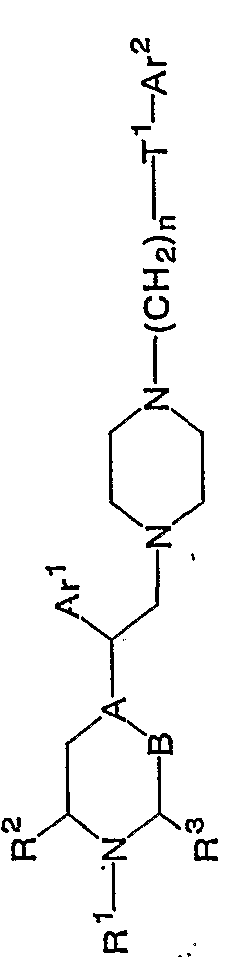
- a drug for treating anxiety or depression which comprises an MC 4 receptor antagonist as an active ingredient. .2. MC 4 receptor antenna gonist formula [1]
- a r 1 is a phenyl group, a substituted phenyl group, a naphthyl group or a substituted naphthyl group
- a r 2 is a naphthyl group, a substituted naphthyl group, a quinolyl group
- X—Y is CH—NH, CH—O. CH—S or N—0).
- R 5 is a hydrogen atom, a hydroxyl group or a di.alkoxy group.
- R 1 is a hydrogen atom, d-. Alkyl group, C 3 - 8 cycloalkyl group, C 3 - 10 ⁇ alkenyl group, phenyl group, 1-Shianoechiru group, pyrimidine one 2-I le group or haa Mijiru group, R 2 and R 3 are the same or different Differently hydrogen or.
- T 1 is a single bond
- n is a single bond of T 1 ,
- T 1 is —N (R 6 ) — or —O—, it is an integer of 210.
- a therapeutic agent for anxiety or depression which is a pyrazine derivative or a pharmaceutically acceptable salt thereof represented by the formula: 3.
- the Anne evening agonist belonging to MC 4 receptor is a compound having an action against ⁇ the MC 4 receptor.
- C X -y means that the group that follows has xy carbon atoms.
- a substituted phenyl group is d-i. Alkyl group, C 3 - 8 cycloalkyl group, C 3 - 8 consequent opening alkyl d-5 alkyl groups, d-i. Alkoxy groups, C 3 - 8 cycloalkoxy group,
- the substituted naphthyl group is d—i. Alkyl group, C 3 - 8 cycloalkyl group, C 3 - 8 consequent opening alkyl d - S alkyl group, C i-i. Alkoxy groups, C 3 - 8 cycloalkoxy group, C 3 - 8 cycloalkyl d - 5 alkoxy group, Benjiruokishi group, a hydroxyl group, d-5 alkoxide aryloxycarbonyl methoxy, force Luba moil methoxy, eight androgenic atom, a nitro group , (4 4 R) (wherein NR 3 3, R 3 3 and R 4 or 4 is a hydrogen atom or a C 6 alkyl group the same or different, or a cyclic amine 5-8 membered together with the adjacent nitrogen atom And a naphthyl group substituted with 1 to 3 groups arbitrarily selected from the group represented by) and a trifluoromethyl group.
- An alkyl group, d-i. 1 to 3 arbitrarily selected from an alkoxy group, a hydroxyl group, a d-5 alkoxyl carbonyl group, a carbamoyl group, a halogen atom, an amino group and an amino group in which one or two d- 6 alkyl groups are substituted Is a naphthyl group substituted with These include, for example, 2-methylnaphthalene-1-yl, 3-methylnaphthalene-1-yl, 4-methylnaphthalene-11-yl, 2-ethylnaphthylene-1-yl, 3-ethylnaphthalene 1-yl group, 4-ethylnaphthalene-1-yl group, 2—propylnaphthalene-1-yl group, 3-propylnaphthalene-1-yl Group, 4-propylnaphthalene-11-yl group, 2-methoxynaphthalene-11-yl group, 3-meth
- the alkyl group is a linear or branched alkyl group having 1 to 10 carbon atoms, for example, a methyl group, an ethyl group, a propyl group, an isopropyl group, a butyl group, an isobutyl group, a pentyl group, an isopentyl group, Examples include 1-ethylpropyl group, hexyl group, isohexyl group, 1-ethylbutyl group, heptyl group, isoheptyl group, octyl group, nonyl group, and decyl group.
- the cycloalkyl group is a cycloalkyl group having 3 to 8 carbon atoms, for example cyclopropyl, Shikuropuchiru group, shea Kuropenchiru group, cyclohexyl group, etc. cyclohexylene.
- the alkenyl group is a linear or branched alkenyl group having 3 to 10 carbon atoms, such as an aryl group, a 1-butene-4-yl group, a 2-butene-4-yl group, Examples thereof include a pentene-to-pentyl group, a 2-pentene-5-yl group, and a prenyl group.
- An alkoxy group is a linear or branched alkoxy having 1 to 10 carbon atoms. Methoxy, ethoxy, propoxy, isopropoxy, butoxy, isobutoxy, pentyloxy, isopentyloxy, hexyloxy, heptyloxy, octyloxy, nonyloxy, decyloxy And the like.
- C 3 - 8 The cycloalkoxy group is a cycloalkyl Kokishi group having a carbon number of 3 8, for example, cyclopropoxy group, cyclopentyloxy Ruo alkoxy group, a cycloalkyl Okuchiruokishi group.
- Cycloalkyl 5 alkoxy C i and substituted cycloalkyl group having a carbon number of 3 8 - a 5 alkoxy group for example, glow propyl methoxy, cyclopentyl methoxy, with hexyl ethoxy group cyclohexylene is there.
- An amino group substituted with one or two C 6 alkyl groups is an amino group substituted with one or two linear or branched alkyl groups having 16 carbon atoms, such as a methylamino group and an ethylamino group.
- the amino group represented by ⁇ is, for example, a methylamino group, an ethylamino group, a propylamino group, a dimethylamino group, a acetylamino group, a dipropylamino group and the like.
- cyclic amino group represented by the formula NRU CR 2 2) for example pylori Jinomoto, piperidino group, piperazino group, morpholino group, Ru der like thiomorpholino group.
- Amino group of formula NR 3 3 (R 44) is, for example Mechiruamino group, Echiruamino group, propylamino group, Jimechiruamino group, Jechiruamino group, a Jipuropiruami cyano group or the like.
- cyclic amino group represented by the formula NR 3 3 (R 44) is, for example pylori Jinomoto, piperidino group, piperazino group, morpholino group, Ru der like thiomorpholino group.
- a halogen atom is a fluorine, chlorine, bromine or iodine atom.
- the pharmaceutically acceptable salts in the present invention include, for example, salts with mineral acids such as sulfuric acid, hydrochloric acid, and phosphoric acid, acetic acid, oxalic acid, lactic acid, tartaric acid, fumaric acid, maleic acid, methanesulfonic acid, and benzenesulfonic acid. And the like with organic acids such as
- R 3 represents a alkenyl group, a phenyl group or a pyrimidine-12-yl group
- R 9 represents a general amino group such as a t-butoxycarbonyl group, an ethoxycarbonyl group or a benzyloxycarbonyl group.
- R 1Q represents d- 10 alkyl group, 1-cyanoethyl group or amidino group
- R 11 represents R 9 other than t-butoxycarbonyl group
- Boc group represents t-butoxy carboxy group.
- a Bn group represents a benzyl group
- * represents optical activity.
- the base refers to, for example, organic amines such as trieduramine, diisopropylethylamine and pyridine, and inorganic bases such as potassium carbonate, sodium hydrogencarbonate, sodium hydroxide, potassium hydroxide and sodium hydride.
- Reduction refers to sodium borohydride, sodium cyanoborohydride, lithium borohydride, boron-based reducing agents such as L-Selec tride, K-Selec tride, lithium aluminum hydride, Red A1, hydrogen Indicates reduction under acidic, neutral or basic conditions using an aluminum-based reducing agent such as diisobutylaluminum fluoride.
- the halogenating agent means a general hydroxylating agent such as thionyl chloride, thionyl bromide or phosphoryl chloride.
- Sulfonylating agents such as alkylsulfonyl octylides or arylsulfonyl halides are, for example, sulfonylating agents for general alcohols such as methanesulfonyl chloride, benzenesulfonyl chloride, toluenesulfonyl chloride, and trifluoromethanesulfonyl chloride. Is shown.
- Inert solvents include, for example, alcohols such as methanol and ethanol, ethers such as dimethyl ether and tetrahydrofuran, hydrocarbons such as toluene and benzene, halogenated carbon solvents such as chloroform and dichloromethane, and dimethylformamide. , Acetonitrile, water or a mixed solvent thereof.
- Compound (9) can be obtained from compound (1) in the same manner as in the step of obtaining compound (6) from compound (1) in General Production Method 1. Subsequently, the amino group of compound (9) is deprotected to give compound (10), and then condensed with compound (11) in an inert solvent to give compound (12), and then the amide group of compound (12) Is reduced in an inert solvent to obtain the present compound (6).
- the deprotection of the compound (9) is performed using PROTECTIVE GROUPS IN ORGANIC SYNTHESIS, The method described in THEODORA W. GREENE and PETER GM WU TS can be used.
- Condensation means, for example, amidation via an acid chloride such as acid chloride or acid bromide, amidation via a mixed acid anhydride using ethyl chlorocarbonate, isobutyl chlorocarbonate, or the like.
- the inert solvent includes, for example, alcohols such as methanol and ethanol, ethers such as getyl ether and tetrahydrofuran, hydrocarbons such as toluene and benzene, and halogenated carbons such as chloroform and dichloromethane.
- Compound (13) can be obtained from compound (1) in the same manner as in the step of obtaining compound (6) from compound (1) in General Production Method 1. Removal of the Boc group of compound (13) Thus, the compound of the present invention (14) can be obtained. Subsequently, the compound (15) of the present invention can be obtained by reacting the compound (14) with an alkylating agent or an amidylating agent in the presence or absence of a base in an inert solvent.
- the alkylating agent is, for example, an alkylated peroxygen such as methyl iodide, butyl iodide, 1-bromopropane, 2-promopropane, 2-bromopropionitrile, or an alkyl sulfate such as dimethyl sulfate or getyl sulfate.
- the oxidizing agent refers to an amidylating agent such as cyanamide, S-methylthioperyl, and aminoiminomethanesulfonic acid.
- the base includes, for example, organic amines such as triethylamine, diisopropylethylamine, and pyridine; and inorganic bases such as potassium carbonate, sodium hydrogen carbonate, sodium hydroxide, potassium hydroxide, and sodium hydride.
- Inert solvents include, for example, alcohols such as methanol and ethanol, ethers such as getyl ether and tetrahydrofuran, hydrocarbons such as toluene and benzene, halogenated carbon solvents such as chloroform and dichloromethane, and dimethylform. Examples include amide, acetonitril, water, or a mixed solvent thereof.
- the compound of the present invention is obtained by reacting the compound (10) obtained by the general production method 2 with the compound (16) in the presence or absence of a base in an inert solvent. (17) can be obtained.
- the base refers to, for example, organic amines such as triethylamine, diisopropylethylamine and pyridine, and inorganic bases such as potassium carbonate, sodium hydrogen carbonate, sodium hydroxide, potassium hydroxide and sodium hydride.
- Inert solvents include, for example, alcohols such as methanol and ethanol, ethers such as dimethyl ether and tetrahydrofuran, hydrocarbons such as toluene and benzene, halogenated carbon solvents such as chloroform and dichloromethane, and dimethylformamide. , Acetonitrile, water or a mixed solvent thereof.
- the base is, for example, a metal amide such as lithium diisopropylamide, lithium hexamethyldisilazide, sodium hexamethyldisilazide, and potassium hexamethyldisilazide, and a metal hydride such as sodium hydride and potassium hydride.
- Acids are, for example, inorganic acids such as hydrochloric acid, hydrobromic acid, sulfuric acid, nitric acid and phosphoric acid, and organic acids such as p-toluenesulfonic acid, methanesulfonic acid, trifluoroacetic acid and formic acid.
- Hydrogenation refers to a reaction in a hydrogen atmosphere using a commonly used metal catalyst such as palladium carbon, palladium black, palladium hydroxide, platinum dioxide, and Raney nickel in an inert solvent.
- Condensation is, for example, amidation via an acid halide such as acid chloride or acid bromide, amidation via a mixed acid anhydride using ethyl ethyl carbonate or isobutyl carbonate, or 1- (3, 3—Dimethylaminopropyl) —Amidation using a condensing agent such as 3—ethylcarposimide, 1,3-dicyclohexylcarposimide, diphenylphosphoryl azide, getyl cyanophosphate, or carbonyldiimidazole.
- a condensing agent such as 3—ethylcarposimide, 1,3-dicyclohexylcarposimide, diphenylphosphoryl azide, getyl cyano
- Reduction refers to the reduction of acidic, neutral, or basic conditions using, for example, a boron-based reducing agent such as diborane, an aluminum-based reducing agent such as lithium aluminum hydride, Red Al, diisobutylaluminum hydride, or the like. Indicates reduction.
- the inert solvent include alcohols such as methanol and ethanol, ethers such as getyl ether and tetrahydrofuran, hydrocarbons such as toluene and benzene, halogenated carbon solvents such as chloroform and dichloromethane, and dimethylformamide. , Acetonitrile, water or a mixed solvent thereof.
- compound (25) of the present invention can be obtained from compound (20) and compound (26) of the present invention can be obtained from compound (21) .
- the condensation means, for example, amidation via an acid halide such as acid chloride or acid bromide, amidation via a mixed acid anhydride using ethyl ethyl carbonate or isobutyl carbonate, or 1- (3, 3-dimethylaminopropyl)-3-ethyl ruposimidide.
- an acid halide such as acid chloride or acid bromide
- amidation via a mixed acid anhydride using ethyl ethyl carbonate or isobutyl carbonate, or 1- (3, 3-dimethylaminopropyl)-3-ethyl ruposimidide Shows amidation using a condensing agent such as 1,3-dicyclohexylcarposimide, diphenylphosphoryl azide, getyl cyanophosphate, or sulphonyldiimidazole.
- Deprotection of compound (28) is performed using PROTECTIVE GROUPS IN ORGANIC SYNTHE
- GREENE and PETER GM WU TS can be used.
- Reduction refers to reduction under acidic, neutral or basic conditions using, for example, a boron-based reducing agent such as diporane, aluminum-based reducing agent such as lithium aluminum hydride, Red Al, diisobutylaluminum hydride, or the like. Indicates reduction.
- Inert solvents include, for example, alcohols such as methanol, ethanol, etc., ethers such as dimethyl ether, tetrahydrofuran, hydrocarbons such as toluene and benzene, and halogenated carbons such as chloroform and dichloromethane. Solvent, dimethylformamide, athonitrile, water or a mixed solvent thereof.
- -Compound (33) can be synthesized by reacting compound (29) obtained by general production method 7 with compound (32) in the presence or absence of a base in an inert solvent. .
- the compound (31) of the present invention can be obtained by reducing the amide group of the compound (33) in an inert solvent. '.
- the base is, for example, an organic amine such as triethylamine, diisopropylethylamine, or pyridine, or an inorganic base such as potassium carbonate, sodium hydrogencarbonate, sodium hydroxide, potassium hydroxide, or sodium hydride.
- Reduction refers to, for example, boron-based reducing agents such as diporane, lithium aluminum hydride, Indicates reduction under acidic, neutral or basic conditions using an aluminum-based reducing agent such as diisobutylaluminum hydride.
- the inert solvent includes, for example, alcohols such as methanol and ethanol, ethers such as getyl ether and tetrahydrofuran, hydrocarbons such as toluene and benzene, halogenated carbon solvents such as chloroform, dichloromethane, and the like; Examples include dimethylformamide, acetonitrile, water, or a mixed solvent thereof.
- Compound (35) can be obtained from compound (18) in the same manner as in the step of obtaining compound (20) from compound (18) in General Production Method 5.
- the compound (35) is subjected to the same operation as the step of obtaining the compound (21) from the compound ('20) in General Production Method 5 and then protected again with an amino group with a B0c group.
- (36) can be obtained.
- the compound (23) can be synthesized by reacting with an alkylating agent in the presence or absence of a base in an inert solvent.
- the present compound (24) can be obtained by reducing the amide group of the compound (23) in an inert solvent.
- the protection of the amino group by the Boc group and the removal of the Boc group can be carried out by the method described in PROTECTIVE GROUPS IN ORGANIC SYNTHESIS, THEODORA W. GREENE and PETER GM WUTS.
- Hydrogenation refers to a reaction in a hydrogen atmosphere using a commonly used metal catalyst such as palladium carbon, palladium black, palladium hydroxide, platinum dioxide, and Raney nickel in an inert solvent.
- Condensation refers to, for example, amidation via an acid halide such as acid chloride or acid bromide, amidation via a mixed acid anhydride using ethyl ethyl carbonate, iseptyl carbonate, or the like, or 1-1 (3,3- This shows amidation using a condensing agent such as dimethylaminopropyl) -3-ethylcarbodiimide, 1,3-dicyclohexylcarbodiimide, diphenylphosphorylazide, getyl cyanophosphate, or carbonyldiimidazole.
- an acid halide such as acid chloride or acid bromide
- 1-1 3,3- This shows amidation using a condensing agent such as dimethylaminopropyl) -3-ethylcarbodiimide, 1,3-dic
- the base is, for example, organic amines such as triethylamine, diisopropylethylamine, pyridine and the like, and inorganic bases such as potassium carbonate, sodium hydrogen carbonate, sodium hydroxide, potassium hydroxide, sodium hydride and the like.
- the alkylating agent is, for example, an alkyl halide such as methyl iodide, butyl iodide, 1-bromopropane, 2-bromopropane or 2-bromopropionitrile, or an alkyl sulfate such as dimethyl sulfate or dimethyl sulfate. .
- Reduction refers to reduction under acidic, neutral or basic conditions using, for example, a boron-based reducing agent such as diporane, lithium aluminum hydride, or an aluminum-based reducing agent such as Red-A-diisobutylaluminum hydride.
- Inert solvents include, for example, alcohols such as methanol and ethanol; Ethers such as toluene and benzene, hydrocarbons such as toluene and benzene, carbon-based solvents such as chloroform and dichloromethane, dimethylformamide, acetonitrile, water, and mixtures thereof.
- the condensation means, for example, amidation via an acid halide such as acid chloride or acid bromide, amidation via a mixed acid anhydride using ethyl ethyl carbonate or isobutyl carbonate, or 1- (3, Shows amidation using a condensing agent such as 3-dimethylaminopropyl) -1-ethylcarbodiimide, 1,3-dicyclohexylcarbodiimide, diphenylphosphoryl azide, getyl cyanophosphate or carbonyldiimidazole. .
- an acid halide such as acid chloride or acid bromide
- 1- Shows amidation using a condensing agent such as 3-dimethylaminopropyl) -1-ethylcarbodiimide, 1,3-dicyclohexylcarbodiimide, diphen
- the base is, for example, an organic amine such as triethylamine, diisopropylethylamine, or pyridin; or an inorganic base such as potassium carbonate, sodium hydrogencarbonate, sodium hydroxide, potassium hydroxide, or sodium hydride.
- the alkylating agent refers to, for example, alkyl halides such as methyl iodide, butyl iodide, 1-bromopropane, 2-bromopropane, and 2-bromopropionitrile, and alkyl sulfates such as dimethyl sulfate and getyl sulfate.
- the method described in PROTECTIVE GROUPS IN ORGANIC SYNTHESIS, THEODORA W. GREENE and PETER GM WUTS can be used.
- the inert solvent include alcohols such as methanol and ethanol, ethers such as dimethyl ether and tetrahydrofuran, hydrocarbons such as toluene and benzene, halogenated carbon solvents such as chloroform and dichloromethane, and the like. Examples include dimethylformamide, acetonitrile, water, or a mixed solvent thereof.
- Compound (44) can be obtained from compound (37) in the same manner as in the step of obtaining compound (42) from compound (39) in General Production Method 1.1.
- the amide group of compound (44) is reduced in an inert solvent to give compound (45).
- compound (16) is converted to a compound (16) in the presence of a base.
- the compound of the present invention (46) can be obtained by reacting in the absence of an inert solvent.
- reduction refers to acidic, neutral or basic conditions using, for example, a boron-based reducing agent such as diporane, an aluminum-based reducing agent such as lithium aluminum hydride, Red-A1, diisobutylaluminum hydride, or the like.
- a boron-based reducing agent such as diporane
- an aluminum-based reducing agent such as lithium aluminum hydride, Red-A1, diisobutylaluminum hydride, or the like.
- Shows the reduction of The benzyl group can be removed by the method described in PROTECTIVE GROUPS IN ORGANIC SYNTHESIS, THEODORA W. GREENE and PETER GM WUTS.
- the base is, for example, organic amines such as trieduramine, diisopropylethylamine, pyridine, etc., potassium carbonate, sodium hydrogen carbonate, sodium hydroxide, potassium hydroxide, sodium hydride, etc. Inorganic bases.
- the inert solvent includes, for example, alcohols such as methanol and ethanol, ethers such as dimethyl ether and tetrahydrofuran, hydrocarbons such as toluene and benzene, halogenated carbons such as chloroform and dichloromethane. Solvent, dimethylformamide, acetate nitrile, water or a mixed solvent thereof.
- the optically active compound (6), (14), (15), (17), (24), (25), (26), (31) or (46) is a racemic compound of the present invention.
- (6), (14), (15), (17), (24), (25), (26), (31) or (46) can be used for general optical resolution using an acidic chiral resolving agent or It can be obtained by optical resolution with HP LC using a chiral stationary phase.
- the optically active compound (6) is obtained by converting the racemic synthetic intermediate (4), (8), (9), (10) or (12) into an HP LC using an acidic chiral resolving agent or a chiral stationary phase.
- the compound can be synthesized by the method described in General Production Method 1 or 2.
- optically active compound (14) or (15) is described in General Production Method 3 after the racemic synthesis intermediate (13) is optically resolved by HP LC using an acidic chiral resolving agent or a chiral stationary phase.
- the optically active compound (17) is synthesized by the method described in General Production Method 4 after the racemic synthesis intermediate (10) is resolved by HP LC using an acidic chiral resolving agent or a chiral stationary phase. can do.
- the optically active compound (46) is synthesized by the method described in General Production Method 12 after optically resolving the racemic synthetic intermediate (45) into HP LC using an acidic chiral resolving agent or chiral stationary phase. be able to.
- the acidic chiral resolving agent is (+) or (-)-di-P-toluoyltartaric acid, (+) or (-)-dibenzoyltartaric acid, (+) or (1-)-tartaric acid, (+) or ( (1)-Mandelic acid, (+) or (-)-camphoric acid, or (+) or (1)-camphoric sulfonic acid.
- the chiral stationary phase is a derivative such as cellulose ester, cellulose carbamate, amylose carpamate, crown ether or polymethacrylate.
- An optically active alcohol (47) can be obtained by asymmetric reduction of compound (1) in an inert solvent. After epoxidation by treating compound (47) in the presence or absence of a base in an inert solvent, the compound (2) is reacted with the compound (2) in an inert solvent to give the optically active compound (4). Can be synthesized.
- the optically active compound (6) of the present invention can be obtained from the optically active compound (4) in the same manner as in the step of obtaining the compound (6) from the compound (4) in General Production Method 1.
- the asymmetric reduction means (R) -5,5-diphenyl-2-methyl-1,4-propano-1,3,2-oxazaporolidine, (S) -5,5- Reduction of oxazaporolidines such as diphenyl-2-methyl-3,4-propano-1,3,2-oxazaporolidine with an asymmetric auxiliary group using a porane-tetrahydrofuran complex, (R) — B— 3-Pinanyl-1-9-porabicyclo [3.3.1] nonane, (S) —B—3-Pinanyl-1-91-borabicycloBOOK[3.3.1] nonane, (I) -chlorodiisopinocamphenylporan, ( +) —Chlorodiisopinocamphenylporan, (R, R) —2,5-dimethylpoloran, (S, S) —2,5-dimethylporolane, (R) —
- the ⁇ group includes, for example, organic amines such as triethylamine, diisopropylethylamine, and pyridine; inorganic bases such as potassium carbonate, sodium hydrogencarbonate, sodium hydroxide, potassium hydroxide, and sodium hydride; and lithium diisopropylate.
- organic amines such as triethylamine, diisopropylethylamine, and pyridine
- inorganic bases such as potassium carbonate, sodium hydrogencarbonate, sodium hydroxide, potassium hydroxide, and sodium hydride
- lithium diisopropylate lithium diisopropylate.
- Metal amides such as ruamide, lithium hexamethyldisilazide, sodium hexamethyldisilazide, and sodium hexamethyldisilazide
- metal hydrides such as sodium hydride and potassium hydride.
- the inert solvent includes, for example, alcohols such as methanol and ethanol, ethers such as dimethyl ether and tetrahydrofuran, hydrocarbons such as toluene and benzene, halogenated carbon such as chloroform and dichloromethane.
- System solvent dimethylformamide, acetonitrile, water or a mixed solvent thereof.
- Optically active compound (8) can be obtained from compound (1) in the same manner as in the step of obtaining compound (4) from compound (1) in General Production Method 14.
- the optically active compound (6) can be obtained from the optically active compound (8) in the same manner as in the step of obtaining the compound (6) from the compound (8) in General Production Method 2.
- General manufacturing method 16 Deprotection
- optically active compound (13) can be obtained from the compound (1) in the same manner as in the step of obtaining the compound (6) from the compound (1) in General Production Method 14.
- optically active compounds (14) and (15) of the present invention can be obtained from the optically active compound (13) in the same manner as in the step of General Production Method 3.
- optically active compound (10) obtained by the general production method 15 an optically active compound of the present invention (17) can be obtained in the same manner as in the step of the general production method 4.
- the compounds according to the invention can be administered orally or parenterally.
- the dosage form is tablets, capsules, granules, powders, powders, troches, ointments, creams, emulsions, suspensions, suppositories, injections, etc. (Method specified in the 12th revised Japanese Pharmacopoeia). These administration forms can be appropriately selected depending on the patient's condition, age and purpose of treatment.
- common excipients eg, crystalline cellulose, starch, lactose, mannitol, etc.
- binders eg, hydroxypropylcellulose, polypinylpiperidone, etc.
- lubricants eg, , Magnesium stearate, talc, etc.
- disintegrants eg, calcium carboxymethylcellulose
- the dose of the compound of the present invention is 1 to 2000 mg per day when treating an adult, and the compound is administered once or several times a day. This dose can be adjusted appropriately according to the age, weight and condition of the patient.
- Tables 1 and 2 show the structure and physical property data of this compound and the compound obtained in the same manner.
- Tables 1 and 2 show the structure and physical property data of this compound and the compound obtained in the same manner.
- Table 1 shows the structure and physical property data of this compound and the compound obtained in the same manner.
- Table 1 shows the structure and physical property data of this compound and the compound obtained in the same manner.
- Example 1 1- [2- (4-Nitrophenyl) -l- (4-methylpiperazino) ethyl] -l- (4-naphthalene-l-yluptyl) pidazine trimaleate obtained in the same manner as in Example 1 0.54 g was dissolved in a 1 M aqueous sodium hydroxide solution, and extracted with a black hole form. The organic layer was dried over anhydrous sodium sulfate. After the desiccant was filtered off, the filtrate was concentrated under reduced pressure. The residue was dissolved in 20 ml of ethanol, 10 mg of platinum oxide was added, and the mixture was stirred at room temperature under a hydrogen atmosphere for 2 hours.
- Table 1 shows the structure and physical property data of this compound and the compound obtained in the same manner.
- Tables 1 and 2 show the structure and physical property data of this compound and the compound obtained in the same manner.
- Table 1 shows the structure and physical property data of this compound and the compound obtained in the same manner.
- Table 1 shows the structure and physical property data of this compound and the compound obtained in the same manner.
- reaction solution was concentrated under reduced pressure, the residue was dissolved in tetrahydrofuran (2.5 ml), a 25% aqueous ammonia solution was added, and the mixture was stirred at room temperature for 1 hour.
- the reaction solution was diluted with ethyl acetate, and washed with a saturated aqueous solution of sodium hydrogen carbonate and a saturated saline solution.
- the organic layer was dried over anhydrous sodium sulfate. After filtering off the drying agent, the filtrate was concentrated under reduced pressure.
- the residue is purified by silica gel column chromatography.
- Table 1 shows the structure and physical property data of this compound and the compound obtained in the same manner.
- Table 1 shows the structure and physical property data of this compound and the compound obtained in the same manner.
- Table 2 shows the structure and physical property data of this compound and the compound obtained in the same manner.
- Example 1 1.37 g of 1-t-butoxycarbonyl-4- [carboxy_ (4-fluorophenyl) methyl] -4-hydroxypiperidine obtained in (1) of 11 was added to dimethylformamide 2 Om 1 Dissolved, 1- (4-naphthylene-1-yl-butyl) piperazine dihydrochloride 2.50 g, 1- (3,3-dimethylaminopropyl) _3-ethylethyl carbodiimide hydrochloride 1.9 g, 1 -Hydroxybenzotriazole monohydrate (1.9 g) and triethylamine (3.5 ml) were added, and the mixture was stirred at room temperature.
- reaction solution was diluted with ethyl acetate, and washed with a saturated aqueous sodium hydrogen carbonate solution and a saturated saline solution.
- the organic layer was dried over anhydrous sodium sulfate. After the desiccant was filtered off, the filtrate was concentrated under reduced pressure.
- Table 2 shows the structure and physical property data of this compound and the compound obtained in the same manner.
- Example 11 0.49 g of 1-t-butoxycarbonyl 4- [carboxy-mono (4-fluorophenyl) methyl] —3,6-dihydro-2H-pyridine obtained in 1 (2) was added to dimethyl Dissolve in 5 ml of formamide and add 0.55 g of 1- (4-naphthalene-11-yl-butyl) pidazine dihydrochloride, and 1- (3,3-dimethylaminopropyl) -13-ethylcarboimide Hydrochloride 0.34 g, 1-hydroxybenzotriazole
- the mixture was concentrated under reduced pressure, ethyl acetate was added to the residue, and the mixture was washed with 1 M aqueous sodium hydroxide solution and saturated saline, and the organic layer was dried over anhydrous sodium sulfate.
- the residue was diluted with acetonitrile (5 ml).
- 37% formalin 340 acetic acid 2001 and 9 Omg of sodium dihydrocyanoborohydride were added thereto, followed by stirring at room temperature for 1 hour.
- the reaction solution was diluted with ethyl acetate and washed with a saturated aqueous solution of sodium hydrogencarbonate and saturated saline.
- the organic layer was dried over anhydrous sodium sulfate.
- Table 2 shows the structure and physical property data of this compound and the compound obtained in the same manner.
- Example 11 4- (1- (4-fluorophenyl) -1- 2- [4- (4- (2-methoxynaphthalene-111-yl) butyl) pyrazine obtained in 1-5) 0.21 g of 1-yl ⁇ -2-year-old oxoethyl) piperidine hydrochloride was dissolved in 2 ml of dimethylformamide, and 93 mg of potassium carbonate and 41 n 1 of 2-iodopropane were added, followed by stirring at room temperature with stirring. The reaction solution was diluted with ethyl acetate, and washed with saturated aqueous sodium hydrogen carbonate solution and saturated saline. The organic layer was dried over anhydrous sodium sulfate.
- Table 2 shows the structure and physical property data of this compound and the compound obtained in the same manner.
- Table 1 shows the structure and physical property data of this compound and the compound obtained in the same manner.
- Table 1 shows the structure and physical properties of this compound and the compound obtained in the same manner.
- Table 1 shows the structure and physical property data of this compound and the compound obtained in the same manner.
- MC 4 receptor binding experiments were carried out according to published methods in Pharmacology & Toxicology, 79, 16 Bok 165, 1996.
- Human MC 4 receptor-expressing cell membrane in which human MC 4 receptor was expressed in HEK-293 cells was purchased from Piolinx.
- the cell membrane was homogenized with a 5 OmM Tris-HCl buffer (pH 7.4) containing 2 mM ethylenediamine tetraacetic acid, 1 OmM calcium chloride and 100 iM phenylmethylsulfonyl fluoride.
- the homogenate was centrifuged at 48,000 X g for 20 minutes at 4 ° C.
- the sediment obtained by centrifugation was re-homogenized with the same buffer, and the homogenate was centrifuged at 48,000 xg for 20 minutes at 4. This operation was repeated twice.
- the precipitate was adjusted to a protein concentration of 100 g / m1 with a 5 OmM Tris-HCl buffer containing 2 mM ethylenediaminetetraacetic acid, 1 OmM calcium chloride, 100 M phenylmethylsulfonyl fluoride, and 0.1% serum albumin ( pH 7.4) and used for binding experiments as a crude membrane preparation.
- the amount of binding in the presence of 1 zM N 1 e 4 -D-Ph e 7 -a-MSH is defined as non-specific binding, and in the absence of 1 M N 1 e 4 -D-Ph e 7 -a -MSH
- the specific binding was obtained by subtracting the non-specific binding from the total binding which was the binding of.
- the test drug was dissolved in a 100% DMS ⁇ solution and added to the membrane preparation at the same time as [ 125 I] N 1 e 4 -D-Phe 7 - ⁇ -MSH.
- IC 5 from the suppression curve at 10 9 to 10-5 concentration. Values were calculated. As a result, for example, compound 4 showed 164 nM, and its optically active compound 6 showed 90 nM.
- a-MS H and M ⁇ ⁇ were purchased from Beninsula.
- the animals used were male SD rats (body weight 220-240 g; Nippon Charls River). La for 48 hours
- the test group was divided into 5 animals, and a predetermined amount of 1 MSH or ⁇ was dissolved in saline containing 0.1% ⁇ serum albumin in the rats of the test drug administration group.
- the prepared test drug was administered, and saline containing 0.1% serum albumin was administered to the rats in the control group not administered with the test drug (11/2 minutes).
- the rats were placed on the experimental device, and their free drinking behavior for three minutes was measured. During free drinking, an electrical stimulus of 0.4 mA was applied for every 2 seconds (cumulative time) of contact with the nozzle. The evaluation in this test was performed using the number of times of electrical stimulation. The results are shown in FIG.
- Symbols # and ## in Fig. 1 indicate that P ⁇ 0.05 and P ⁇ 0.01 in 0.1% ⁇ serum albumin containing serum albumin when the significance test was performed by the Dunnet test, respectively. Indicates that there is a significant difference compared to the control group.
- the animals used were male SD rats (body weight: 220-240 g, Nippon Steel Slipper).
- the rats that had been deprived of water for 48 hours were divided into groups of 10 rats, and a predetermined amount of the compound 4 in Table 1 was dissolved in saline for injection in rats of the test drug administration group.
- a test drug prepared by adding 5 M sodium hydroxide solution until the pH reached 4 to 5 was administered by subcutaneous injection.
- the rats were placed on an experimental device, and their free drinking behavior for three minutes was measured.
- 1.0 mA electrical stimulation was applied for every 2 seconds (cumulative time) of contact with the drinking nozzle.
- the evaluation in this test was performed using a load circuit of electrical stimulation. The results are shown in FIG.
- the symbol ** in Fig. 2 indicates that when a significant difference test was performed by the Dunnet test, there was a significant difference compared with the control group where no electrical stimulation was applied to the drinking nozzle at P ⁇ 0.01.
- the symbol ## indicates that there is a significant difference between the group administered with saline and the group with electrical stimulation applied to the drinking nozzle at P ⁇ 0.01 when the significant difference test is performed by the Dunnet test.
- the rats in the group subjected to the electrical stimulation were significantly reduced in the number of times of drinking compared to the rats in the group not subjected to the electrical stimulation.
- this reduced drinking frequency was significantly and dose-dependently antagonized by subcutaneously administering Compound 4 in Table 1 at a dose of lmgZkg, 31118 / / : or 1 OmgZkg.
- the animals used were male SD rats (body weight 220-240 g, Nippon Charlsriver). Rats were divided into groups of 10 rats each, and a prescribed amount of compound 4 in Table 1 was dissolved in saline for injection in rats to which the test drug was administered, and 0.5 M sodium hydroxide solution was added at pH 4 to 4. The test drug prepared by adding it to 5 was administered by subcutaneous injection. Thirty minutes after administration, forced swimming stress was applied by placing the rat in a black cylinder having an inner diameter of 20 cm and a height of 40 cm into which 25 water was injected to a depth of 25 cm. A forced swimming stress was applied for 2 minutes, and an anxiolytic effect was examined in an elevated cross maze test 5 minutes after the forced swimming stress.
- the elevated cross maze used in the test consisted of an open maze (width 10 cm, length 50 cm) and a closed maze (width 10 cm, length 50 cm).
- the closed circuit was covered with 40 cm high transparent plexiglass.
- the maze was fixed at a position 50 cm from the floor.
- the illuminance was 40 lux at the center of the device.
- the rats placed their heads in the center of the cross maze with the head facing the closed path and started the measurement, and measured the time spent on the open path for 5 minutes. The results are shown in FIG.
- the animals used were male SD rats (body weight 220-240 g, Nippon Charles River). Under anesthesia with pentobarbital, the olfactory bulb was aspirated off by a metal pipe connected to a water-flow aspirator. Two weeks after removal of the olfactory bulb, the rats were divided into 10 to 11 rats in each group, and a predetermined amount of the compound 4 in Table 1 was dissolved in saline for injection in the rats to which the test drug was administered. The test drug prepared by adding sodium hydroxide solution until the pH reached 4 to 5 was administered by subcutaneous injection once a day for 2 weeks. Twenty-four hours after the final administration, the rat was placed in the center of a circular open field device having a diameter of 70 cm and divided into 25 sections, and the number of section crossings for 3 minutes was measured. Figure 4 shows the results.
- the number of compartment crossings in the open field was significantly increased in the rats in the olfactory bulbectomy group compared to the rats in the non-olfactory bulbectomy group.
- the increased number of compartment crossings in the open field can be significantly and dose-dependently increased by subcutaneously administering lmg / kg, 3mg / kg or 10mg / kg of compound 4 in Table 1.
- MC 4 compounds showing effects as a receptor antagonist because it has an action to suppress the anxiety-like symptoms and depressive-like symptoms, it is useful as depression disorder or anxiety neurosis Osamu Ryoyaku.
- FIG. 1 shows the results of an anxiety-like symptom-inducing effect test by the rat Voge 1 test in Test Example 2.
- FIG. 2 shows the results of an anxiolytic effect test in Test Example 3 by the rat Voge 1 test.
- FIG. 3 shows the results of an anxiolytic action test in the rat forced swimming stress-induced anxiety model of Test Example 4.
- FIG. 4 shows the results of an antidepressant action test on olfactory bulb-excised rats of Test Example 5.
Landscapes
- Health & Medical Sciences (AREA)
- Chemical & Material Sciences (AREA)
- Medicinal Chemistry (AREA)
- Veterinary Medicine (AREA)
- Public Health (AREA)
- General Health & Medical Sciences (AREA)
- Animal Behavior & Ethology (AREA)
- Life Sciences & Earth Sciences (AREA)
- Pharmacology & Pharmacy (AREA)
- Organic Chemistry (AREA)
- Epidemiology (AREA)
- Biomedical Technology (AREA)
- Nuclear Medicine, Radiotherapy & Molecular Imaging (AREA)
- General Chemical & Material Sciences (AREA)
- Chemical Kinetics & Catalysis (AREA)
- Neurosurgery (AREA)
- Neurology (AREA)
- Bioinformatics & Cheminformatics (AREA)
- Engineering & Computer Science (AREA)
- Psychiatry (AREA)
- Pain & Pain Management (AREA)
- Pharmaceuticals Containing Other Organic And Inorganic Compounds (AREA)
Description






Claims


Priority Applications (18)
| Application Number | Priority Date | Filing Date | Title |
|---|---|---|---|
| AU6634201A AU6634201A (en) | 2000-06-27 | 2001-06-27 | Remedial agent for anxiety neurosis or depression and piperazine derivative |
| CA002413506A CA2413506A1 (en) | 2000-06-27 | 2001-06-27 | Remedial agent for anxiety neurosis or depression and piperazine derivative |
| SK1832-2002A SK18322002A3 (sk) | 2000-06-27 | 2001-06-27 | Terapeutický prostriedok proti úzkosti alebo depresii a piperazínové deriváty |
| JP2002505040A JP5002881B2 (ja) | 2000-06-27 | 2001-06-27 | 不安神経症又はうつ症治療薬、及びピペラジン誘導体 |
| EP01943844A EP1295608A4 (en) | 2000-06-27 | 2001-06-27 | THERAPEUTIC FOR TREATING ANXIETY NEWROSES OR DEPRESSION THAT ALSO CONTAINS A PIPERAZINE DERIVATIVE |
| HU0301719A HUP0301719A2 (hu) | 2000-06-27 | 2001-06-27 | Szorongásos neurózis vagy depresszió kezelésére szolgáló gyógyszerkészítmény és piperazinszármazékok |
| US10/311,429 US6949552B2 (en) | 2000-06-27 | 2001-06-27 | Remedial agent for anxiety neurosis or depression and piperazine derivative |
| MXPA02012707A MXPA02012707A (es) | 2000-06-27 | 2001-06-27 | Preparacion terapeutica para neurosis de ansiedad o depresion y derivados de piperazina. |
| NZ523800A NZ523800A (en) | 2000-06-27 | 2001-06-27 | Therapeutic preparation comprising a melanocortin receptor (MC4) antagonist or a piperazine derivative thereof for treating anxiety neurosis or depression |
| EEP200200717A EE200200717A (et) | 2000-06-27 | 2001-06-27 | Ravimpreparaat ängistusneuroosi või depressiooni raviks ja piperasiiniderivaadid |
| HR20030056A HRP20030056A2 (en) | 2000-06-27 | 2001-06-27 | Remedial agent for anxiety neurosis or depression and piperazine derivative |
| PL36028601A PL360286A1 (en) | 2000-06-27 | 2001-06-27 | Remedial agent for anxiety neurosis or depression and piperazine derivative |
| IL15370601A IL153706A0 (en) | 2000-06-27 | 2001-06-27 | Therapeutic preparation of anxiety neurosis or depression, and piperazine derivatives |
| AU2001266342A AU2001266342B2 (en) | 2000-06-27 | 2001-06-27 | Remedial agent for anxiety neurosis or depression and piperazine derivative |
| BR0111976-1A BR0111976A (pt) | 2000-06-27 | 2001-06-27 | Preparação terapêutica para neurose ou depressão por ansiedade, e, derivado de piperazina |
| EA200300071A EA005737B1 (ru) | 2000-06-27 | 2001-06-27 | Терапевтический препарат для лечения невроза страха (тревоги) или депрессии |
| BG107371A BG107371A (bg) | 2000-06-27 | 2002-12-11 | Лекарствено средство за невроза с тревожност или депресия и пиперазинови производни |
| NO20026122A NO20026122L (no) | 2000-06-27 | 2002-12-19 | Terapeutisk preparat mot angstneurose eller depresjon og piperazinderivater |
Applications Claiming Priority (2)
| Application Number | Priority Date | Filing Date | Title |
|---|---|---|---|
| JP2000-192856 | 2000-06-27 | ||
| JP2000192856 | 2000-06-27 |
Publications (1)
| Publication Number | Publication Date |
|---|---|
| WO2002000259A1 true WO2002000259A1 (en) | 2002-01-03 |
Family
ID=18691931
Family Applications (1)
| Application Number | Title | Priority Date | Filing Date |
|---|---|---|---|
| PCT/JP2001/005524 Ceased WO2002000259A1 (en) | 2000-06-27 | 2001-06-27 | Remedial agent for anxiety neurosis or depression and piperazine derivative |
Country Status (22)
| Country | Link |
|---|---|
| US (1) | US6949552B2 (ja) |
| EP (1) | EP1295608A4 (ja) |
| JP (1) | JP5002881B2 (ja) |
| KR (1) | KR20030013470A (ja) |
| CN (1) | CN1438897A (ja) |
| AU (2) | AU6634201A (ja) |
| BG (1) | BG107371A (ja) |
| BR (1) | BR0111976A (ja) |
| CA (1) | CA2413506A1 (ja) |
| CZ (1) | CZ20024165A3 (ja) |
| EA (2) | EA200500087A1 (ja) |
| EE (1) | EE200200717A (ja) |
| HR (1) | HRP20030056A2 (ja) |
| HU (1) | HUP0301719A2 (ja) |
| IL (1) | IL153706A0 (ja) |
| MX (1) | MXPA02012707A (ja) |
| NO (1) | NO20026122L (ja) |
| NZ (1) | NZ523800A (ja) |
| PL (1) | PL360286A1 (ja) |
| SK (1) | SK18322002A3 (ja) |
| WO (1) | WO2002000259A1 (ja) |
| ZA (1) | ZA200210386B (ja) |
Cited By (8)
| Publication number | Priority date | Publication date | Assignee | Title |
|---|---|---|---|---|
| WO2003053927A1 (en) * | 2001-12-21 | 2003-07-03 | Taisho Pharmaceutical Co.,Ltd. | Piperazine derivative |
| US6949552B2 (en) | 2000-06-27 | 2005-09-27 | Taisho Pharmaceutical Co., Ltd. | Remedial agent for anxiety neurosis or depression and piperazine derivative |
| JP2007508393A (ja) * | 2003-10-14 | 2007-04-05 | ワイス | 縮合アリールおよびヘテロアリール誘導体およびその使用方法 |
| US7354923B2 (en) | 2001-08-10 | 2008-04-08 | Palatin Technologies, Inc. | Piperazine melanocortin-specific compounds |
| US7456184B2 (en) | 2003-05-01 | 2008-11-25 | Palatin Technologies Inc. | Melanocortin receptor-specific compounds |
| EP2072050A1 (en) | 2007-12-21 | 2009-06-24 | Santhera Pharmaceuticals (Schweiz) AG | Compounds with anti-emetic effect |
| US8609672B2 (en) | 2010-08-27 | 2013-12-17 | University Of The Pacific | Piperazinylpyrimidine analogues as protein kinase inhibitors |
| EP2933265A2 (en) | 2005-06-03 | 2015-10-21 | Amicus Therapeutics, Inc. | Pharmacological chaperones for treating obesity |
Families Citing this family (14)
| Publication number | Priority date | Publication date | Assignee | Title |
|---|---|---|---|---|
| WO2003013571A1 (en) | 2001-08-10 | 2003-02-20 | Palatin Technologies, Inc. | Peptidomimetics of biologically active metallopeptides |
| US7655658B2 (en) | 2001-08-10 | 2010-02-02 | Palatin Technologies, Inc. | Thieno [2,3-D]pyrimidine-2,4-dione melanocortin-specific compounds |
| US7718802B2 (en) | 2001-08-10 | 2010-05-18 | Palatin Technologies, Inc. | Substituted melanocortin receptor-specific piperazine compounds |
| US7732451B2 (en) | 2001-08-10 | 2010-06-08 | Palatin Technologies, Inc. | Naphthalene-containing melanocortin receptor-specific small molecule |
| US7727990B2 (en) | 2003-05-01 | 2010-06-01 | Palatin Technologies, Inc. | Melanocortin receptor-specific piperazine and keto-piperazine compounds |
| US7968548B2 (en) * | 2003-05-01 | 2011-06-28 | Palatin Technologies, Inc. | Melanocortin receptor-specific piperazine compounds with diamine groups |
| US7727991B2 (en) | 2003-05-01 | 2010-06-01 | Palatin Technologies, Inc. | Substituted melanocortin receptor-specific single acyl piperazine compounds |
| US7491723B2 (en) | 2003-10-14 | 2009-02-17 | Wyeth | Alkanol and cycloalkanol-amine derivatives and methods of their use |
| US7709484B1 (en) | 2004-04-19 | 2010-05-04 | Palatin Technologies, Inc. | Substituted melanocortin receptor-specific piperazine compounds |
| CA2602267A1 (en) * | 2005-04-04 | 2006-10-12 | Takeda Pharmaceutical Company Limited | Use of ramelteon to treat and prevent depression and anxiety disorders |
| US7834017B2 (en) | 2006-08-11 | 2010-11-16 | Palatin Technologies, Inc. | Diamine-containing, tetra-substituted piperazine compounds having identical 1- and 4-substituents |
| WO2008039863A2 (en) * | 2006-09-27 | 2008-04-03 | Braincells, Inc. | Composition comprising a melanocortin receptor (mcr) modulating agent alone or in combination with a second neurogenic agent for treating nervous system disorders |
| BR112012005119A2 (pt) * | 2009-09-07 | 2016-11-22 | Vifor Int Ag | novos antagonistas de hepcidina etanodiaminas |
| WO2012100342A1 (en) | 2011-01-27 | 2012-08-02 | Université de Montréal | Pyrazolopyridine and pyrazolopyrimidine derivatives as melanocortin-4 receptor modulators |
Citations (4)
| Publication number | Priority date | Publication date | Assignee | Title |
|---|---|---|---|---|
| EP0479546A2 (en) * | 1990-10-03 | 1992-04-08 | JOHN WYETH & BROTHER LIMITED | Piperazine derivatives |
| WO1993014076A1 (en) * | 1992-01-08 | 1993-07-22 | John Wyeth & Brother Limited | Piperazine derivatives as 5-ht receptors antagonists |
| JPH0641071A (ja) * | 1991-09-06 | 1994-02-15 | Taisho Pharmaceut Co Ltd | インドール酢酸エステル誘導体 |
| WO1998037097A1 (en) * | 1997-02-21 | 1998-08-27 | Wapharm Ab | Msh-receptor subtype selective cyclic peptides |
Family Cites Families (5)
| Publication number | Priority date | Publication date | Assignee | Title |
|---|---|---|---|---|
| FR1317053A (fr) * | 1961-03-17 | 1963-02-01 | Soc Ind Fab Antibiotiques Sifa | Nouveaux dérivés de la pipérazine, et procédé de préparation |
| CA918659A (en) * | 1969-07-31 | 1973-01-09 | Yoshitomi Pharmaceutical Industries | 11-(4-substituted-1-piperazinyl)-dibenzo (b,f) (1,4) thiazepines |
| FR2601364B1 (fr) * | 1986-07-09 | 1988-10-21 | Adir | Nouveaux derives de la piperazine dione-2,6, leurs procedes de preparation et les compositions pharmaceutiques qui les contiennent. |
| AU742425B2 (en) | 1998-06-11 | 2002-01-03 | Merck & Co., Inc. | Spiropiperidine derivatives as melanocortin receptor agonists |
| BR0111976A (pt) | 2000-06-27 | 2003-12-09 | Taisho Pharmaceutical Co Ltd | Preparação terapêutica para neurose ou depressão por ansiedade, e, derivado de piperazina |
-
2001
- 2001-06-27 BR BR0111976-1A patent/BR0111976A/pt not_active IP Right Cessation
- 2001-06-27 NZ NZ523800A patent/NZ523800A/en unknown
- 2001-06-27 SK SK1832-2002A patent/SK18322002A3/sk unknown
- 2001-06-27 EA EA200500087A patent/EA200500087A1/ru unknown
- 2001-06-27 HU HU0301719A patent/HUP0301719A2/hu unknown
- 2001-06-27 HR HR20030056A patent/HRP20030056A2/hr not_active Application Discontinuation
- 2001-06-27 AU AU6634201A patent/AU6634201A/xx not_active Withdrawn
- 2001-06-27 JP JP2002505040A patent/JP5002881B2/ja not_active Expired - Fee Related
- 2001-06-27 KR KR1020027017682A patent/KR20030013470A/ko not_active Withdrawn
- 2001-06-27 CZ CZ20024165A patent/CZ20024165A3/cs unknown
- 2001-06-27 MX MXPA02012707A patent/MXPA02012707A/es unknown
- 2001-06-27 EA EA200300071A patent/EA005737B1/ru not_active IP Right Cessation
- 2001-06-27 CA CA002413506A patent/CA2413506A1/en not_active Abandoned
- 2001-06-27 AU AU2001266342A patent/AU2001266342B2/en not_active Ceased
- 2001-06-27 IL IL15370601A patent/IL153706A0/xx unknown
- 2001-06-27 US US10/311,429 patent/US6949552B2/en not_active Expired - Fee Related
- 2001-06-27 WO PCT/JP2001/005524 patent/WO2002000259A1/ja not_active Ceased
- 2001-06-27 PL PL36028601A patent/PL360286A1/xx not_active Application Discontinuation
- 2001-06-27 EP EP01943844A patent/EP1295608A4/en not_active Withdrawn
- 2001-06-27 CN CN01811767A patent/CN1438897A/zh active Pending
- 2001-06-27 EE EEP200200717A patent/EE200200717A/xx unknown
-
2002
- 2002-12-11 BG BG107371A patent/BG107371A/bg unknown
- 2002-12-19 NO NO20026122A patent/NO20026122L/no not_active Application Discontinuation
- 2002-12-20 ZA ZA200210386A patent/ZA200210386B/en unknown
Patent Citations (4)
| Publication number | Priority date | Publication date | Assignee | Title |
|---|---|---|---|---|
| EP0479546A2 (en) * | 1990-10-03 | 1992-04-08 | JOHN WYETH & BROTHER LIMITED | Piperazine derivatives |
| JPH0641071A (ja) * | 1991-09-06 | 1994-02-15 | Taisho Pharmaceut Co Ltd | インドール酢酸エステル誘導体 |
| WO1993014076A1 (en) * | 1992-01-08 | 1993-07-22 | John Wyeth & Brother Limited | Piperazine derivatives as 5-ht receptors antagonists |
| WO1998037097A1 (en) * | 1997-02-21 | 1998-08-27 | Wapharm Ab | Msh-receptor subtype selective cyclic peptides |
Non-Patent Citations (3)
| Title |
|---|
| KASK A. ET AL.: "Discovery of a novel superpotent and selective melanocortin-4 receptor antagonist (HS024): evaluation in vitro and in vivo", ENDOCRINOLOGY, vol. 139, no. 12, 1998, pages 5006 - 5014, XP002946959 * |
| See also references of EP1295608A4 * |
| VEDJELEK Z. ET AL.: "Potential antitussives: synthesis and pharmacology of a series of 1-(2-amino-2-(4-fluorophenyl)ethyl)-4-(2-benzoylpropyl)piperazines", COLLECT. CZECH. CHEM. COMMUN., vol. 48, no. 10, 1983, pages 2977 - 2988, XP002946958 * |
Cited By (8)
| Publication number | Priority date | Publication date | Assignee | Title |
|---|---|---|---|---|
| US6949552B2 (en) | 2000-06-27 | 2005-09-27 | Taisho Pharmaceutical Co., Ltd. | Remedial agent for anxiety neurosis or depression and piperazine derivative |
| US7354923B2 (en) | 2001-08-10 | 2008-04-08 | Palatin Technologies, Inc. | Piperazine melanocortin-specific compounds |
| WO2003053927A1 (en) * | 2001-12-21 | 2003-07-03 | Taisho Pharmaceutical Co.,Ltd. | Piperazine derivative |
| US7456184B2 (en) | 2003-05-01 | 2008-11-25 | Palatin Technologies Inc. | Melanocortin receptor-specific compounds |
| JP2007508393A (ja) * | 2003-10-14 | 2007-04-05 | ワイス | 縮合アリールおよびヘテロアリール誘導体およびその使用方法 |
| EP2933265A2 (en) | 2005-06-03 | 2015-10-21 | Amicus Therapeutics, Inc. | Pharmacological chaperones for treating obesity |
| EP2072050A1 (en) | 2007-12-21 | 2009-06-24 | Santhera Pharmaceuticals (Schweiz) AG | Compounds with anti-emetic effect |
| US8609672B2 (en) | 2010-08-27 | 2013-12-17 | University Of The Pacific | Piperazinylpyrimidine analogues as protein kinase inhibitors |
Also Published As
| Publication number | Publication date |
|---|---|
| CA2413506A1 (en) | 2002-12-20 |
| SK18322002A3 (sk) | 2003-09-11 |
| NO20026122D0 (no) | 2002-12-19 |
| EE200200717A (et) | 2004-08-16 |
| US6949552B2 (en) | 2005-09-27 |
| IL153706A0 (en) | 2003-07-06 |
| NO20026122L (no) | 2003-02-25 |
| HRP20030056A2 (en) | 2005-02-28 |
| EP1295608A4 (en) | 2004-03-31 |
| AU2001266342B2 (en) | 2005-01-27 |
| AU6634201A (en) | 2002-01-08 |
| EA200300071A1 (ru) | 2003-06-26 |
| BG107371A (bg) | 2003-08-29 |
| EA005737B1 (ru) | 2005-06-30 |
| NZ523800A (en) | 2005-02-25 |
| CN1438897A (zh) | 2003-08-27 |
| BR0111976A (pt) | 2003-12-09 |
| HUP0301719A2 (hu) | 2003-09-29 |
| CZ20024165A3 (cs) | 2004-03-17 |
| JP5002881B2 (ja) | 2012-08-15 |
| EP1295608A1 (en) | 2003-03-26 |
| MXPA02012707A (es) | 2003-04-25 |
| KR20030013470A (ko) | 2003-02-14 |
| US20030186992A1 (en) | 2003-10-02 |
| EA200500087A1 (ru) | 2005-06-30 |
| ZA200210386B (en) | 2004-02-10 |
| PL360286A1 (en) | 2004-09-06 |
Similar Documents
| Publication | Publication Date | Title |
|---|---|---|
| CN100482646C (zh) | N-[苯基(哌啶-2-基)甲基]苯甲酰胺衍生物,其制备方法及其在治疗中的应用 | |
| JP3342478B2 (ja) | Orl1−レセプターアゴニストとしての4−(2−ケト−1−ベンズイミダゾリニル)ピペリジン化合物 | |
| JP5002881B2 (ja) | 不安神経症又はうつ症治療薬、及びピペラジン誘導体 | |
| JP4488891B2 (ja) | N−[フェニル(ピペリジン−2−イル)メチル]ベンズアミド誘導体、その製造法、およびその治療用途 | |
| US20060094716A1 (en) | 1-Pyridin-4-yl-urea derivatives | |
| JP2005505585A (ja) | セロトニン再取り込み阻害剤としてのフェニル−ピペラジン誘導体 | |
| CA2380032A1 (en) | Amine and amide derivatives as ligands for the neuropeptide y y5 receptor useful in the treatment of obesity and other disorders | |
| JPWO2003053927A1 (ja) | ピペラジン誘導体 | |
| CN1318416C (zh) | 5-羟色胺能试剂吲唑酰胺化合物 | |
| JP2003525928A (ja) | 新規ccr5モジュレーター:ベンズイミダゾール類またはベンズトリアゾール類 | |
| JPWO2002000259A1 (ja) | 不安神経症又はうつ症治療薬、及びピペラジン誘導体 | |
| JP4851328B2 (ja) | 新規なピリジン誘導体 | |
| JP2007506692A6 (ja) | 新規なピリジン誘導体 | |
| JP6173693B2 (ja) | アリールピペラジンオピオイド受容体アンタゴニスト | |
| JP2002532472A (ja) | 5−ht1a受容体活性を有するアリールピペリジンおよびアリール−1,2,5,6−テトラヒドロピリジン尿素誘導体 | |
| EP2200982B1 (en) | Piperidine derivatives as nk3 receptor antagonists | |
| JP2001131149A (ja) | 選択的セロトニン再取り込み阻害剤 | |
| JPWO2005030722A1 (ja) | N−置換−n−(4−ピペリジニル)アミド誘導体 | |
| JP2005035983A (ja) | 不安神経症又はうつ症治療薬 | |
| JP2006052181A (ja) | 新規なキノリン誘導体 |
Legal Events
| Date | Code | Title | Description |
|---|---|---|---|
| AK | Designated states |
Kind code of ref document: A1 Designated state(s): AE AG AL AM AT AU AZ BA BB BG BR BY BZ CA CH CN CO CR CU CZ DE DK DM DZ EC EE ES FI GB GD GE GH GM HR HU ID IL IN IS JP KE KG KP KR KZ LC LK LR LS LT LU LV MA MD MG MK MN MW MX MZ NO NZ PL PT RO RU SD SE SG SI SK SL TJ TM TR TT TZ UA UG US UZ VN YU ZA ZW |
|
| AL | Designated countries for regional patents |
Kind code of ref document: A1 Designated state(s): GH GM KE LS MW MZ SD SL SZ TZ UG ZW AM AZ BY KG KZ MD RU TJ TM AT BE CH CY DE DK ES FI FR GB GR IE IT LU MC NL PT SE TR BF BJ CF CG CI CM GA GN GW ML MR NE SN TD TG |
|
| 121 | Ep: the epo has been informed by wipo that ep was designated in this application | ||
| ENP | Entry into the national phase |
Ref document number: 2002 505040 Country of ref document: JP Kind code of ref document: A |
|
| REG | Reference to national code |
Ref country code: DE Ref legal event code: 8642 |
|
| ENP | Entry into the national phase |
Ref document number: 2001 107371 Country of ref document: BG Kind code of ref document: A |
|
| WWE | Wipo information: entry into national phase |
Ref document number: 10311429 Country of ref document: US Ref document number: PV2002-4165 Country of ref document: CZ Ref document number: PA/a/2002/012707 Country of ref document: MX |
|
| WWE | Wipo information: entry into national phase |
Ref document number: 2001943844 Country of ref document: EP Ref document number: 2002/10386 Country of ref document: ZA Ref document number: 18322002 Country of ref document: SK Ref document number: 2413506 Country of ref document: CA Ref document number: 200210386 Country of ref document: ZA Ref document number: IN/PCT/2002/1557/KOL Country of ref document: IN |
|
| WWE | Wipo information: entry into national phase |
Ref document number: 2001266342 Country of ref document: AU |
|
| WWE | Wipo information: entry into national phase |
Ref document number: 1200201195 Country of ref document: VN |
|
| WWE | Wipo information: entry into national phase |
Ref document number: 1020027017682 Country of ref document: KR Ref document number: 018117678 Country of ref document: CN Ref document number: 153706 Country of ref document: IL |
|
| WWE | Wipo information: entry into national phase |
Ref document number: 523800 Country of ref document: NZ Ref document number: 200300071 Country of ref document: EA |
|
| WWE | Wipo information: entry into national phase |
Ref document number: P20030056A Country of ref document: HR |
|
| WWP | Wipo information: published in national office |
Ref document number: 1020027017682 Country of ref document: KR |
|
| WWP | Wipo information: published in national office |
Ref document number: 2001943844 Country of ref document: EP |
|
| WWP | Wipo information: published in national office |
Ref document number: PV2002-4165 Country of ref document: CZ |
|
| WWP | Wipo information: published in national office |
Ref document number: 523800 Country of ref document: NZ |
|
| WWG | Wipo information: grant in national office |
Ref document number: 2001266342 Country of ref document: AU |
|
| WWG | Wipo information: grant in national office |
Ref document number: 523800 Country of ref document: NZ |
|
| WWW | Wipo information: withdrawn in national office |
Ref document number: 2001943844 Country of ref document: EP |