Biphenylcarbonsaureamide, ihre Herstellung und ihre Verwendung als Arzneimittel
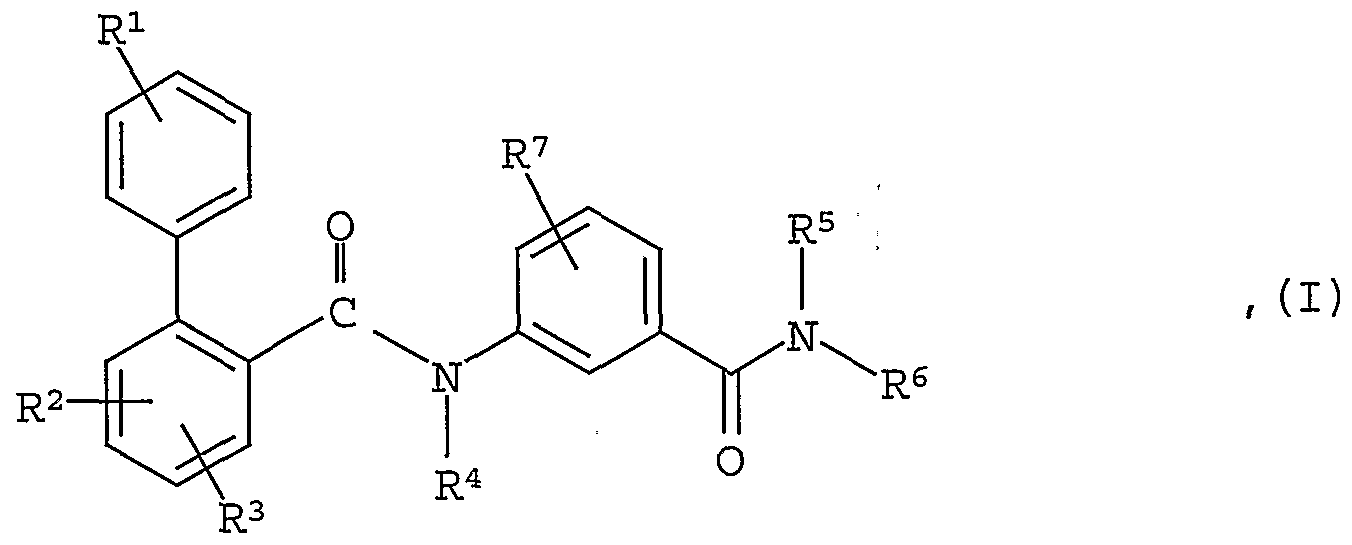
Gegenstand der vorliegenden Erfindung sind Biphenylcarbonsaureamide der allgemeinen Formel
deren Tautomere, deren Diastereomere, deren Enantiomere, deren Gemische und deren Salze, insbesondere deren physiologisch verträgliche ,Salze, welche wertvolle pharmakologische Eigenschaften aufweisen, diese Verbindungen enthaltende Arzneimittel, deren Verwendung und Verfahren zu ihrer Herstellung.
Die Verbindungen der obigen allgemeinen Formel I stellen wertvolle Inhibitoren des mikrosomalen Triglyzerid-Transferproteins (MTP) dar und eignen sich daher zur Senkung der Plasmaspiegel der atherogenen Lipoproteine .
In der obigen allgemeinen Formel I bedeutet
R1, R2 und R3, die gleich oder verschieden sein können, jeweils ein Wasserstoff-, Fluor-, Chlor- oder Bromatom, eine gerad- kettige oder verzweigte C1.3-Alkylgruppe, in der die Wasserstoffatome ganz oder teilweise durch Fluoratome ersetzt sein können, eine Hydroxy- , C1.3-Alkoxy-, Amino-, C1_3-Alkylamino- oder Di- (C1_3-Alkyl) -aminogruppe,
wobei R1 und R2 in ortho, ortho ' -Position des Biphenylrestes der Formel I zusammen auch eine Carbonylgruppe darstellen können,
R4 ein Wasserstoffatom oder eine C1_3-Alkylgruppe,
R
5 ein Wasserstoffatom oder eine geradkettige oder verzweigte
R
s eine geradkettige oder verzweigte
eine Amino-, C1_3-Alkylamino- oder Di- (C1-3-Alkyl) -aminogruppe,
eine C3_7-Cycloalkylamino- oder N- (C-^-Alkyl) -C3_7-cycloalkyl- aminogruppe, wobei
jeweils die Methylengruppe in 4-Stellung eines 6- oder 7-gliedrigen Cycloalkylrests durch ein Sauerstoff- oder Schwefelatom oder durch eine gegebenenfalls durch eine C^-Alkyl-, Phenyl-, C1.3-Alkyl-carbonyl- , Benzoyl-, Phenyl- (C^-alkyl) -carbonyl-, C1_3-Alkyl-aminocarbonyl- , Di- (C1.3-Alkyl) -aminocarbonyl- , Phenylaminocarbonyl- oder N- (C^-Alkyl) -phenylaminocarbonylgruppe substituierte Imino- gruppe ersetzt sein kann,
eine Arylamino-, N- (C-^-Alkyl) -arylamino- , Heteroarylamino- , N- (C^-Alkyl) -heteroarylamino-, C-^-Alkyl-carbonylamino- , N- (C^-Alkyl) -C-^-alkyl-carbonylamino- , Arylcarbonylamino- , Heteroarylcarbonylamino-, N- (C-^-Alkyl) -arylcarbonylamino- , N- (C
1.
3-Alkyl) -heteroarylcarbonylamino-,
amino- oder N-
-carbonylaminogruppe,
einen Aryl-, Aryl-carbonyl-aryl- , Aryl-C1_3-alkoxy-aryl- oder Aryl-C1.3-alkyl-arylrest,
einen Heteroarylrest,
einen durch einen Heteroarylrest substituierten Arylrest,
einen C3_7-Cycloalkyl- oder C3.7-Cycloalkyl-arylrest, wobei
jeweils die Methylengruppe in 4-Stellung eines 6- oder 7-gliedrigen Cycloalkylrests durch ein Sauerstoff- oder Schwefelatom oder durch eine gegebenenfalls durch eine C1_3-Alkyl-, Phenyl-, C^-Alkyl-carbonyl- , Benzoyl-, Phenyl- (C^-alkyl) -carbonyl-, Cx_3-Alkyl-aminocarbonyl- , Di- (Cj^-Alkyl) -aminocarbonyl- , Phenylaminocarbonyl- oder N- (C-^-Alkyl) -phenylaminocarbonylgruppe substituierte Iminogruppe ersetzt sein kann oder
die beiden Wasserstoffatome der Methylengruppe in 3 -Stellung einer Cyclopentylgruppe oder in 3- oder -Stellung einer Cyclohexyl- oder Cycloheptylgruppe durch eine n-Butylen-, n-Pentylen-, n-Hexylen-, 1,2-Ethylendioxy- oder 1, 3-Propylendioxygruppe ersetzt sein können oder
in einem 5- oder 6-gliedrigen Cycloalkylrest eine oder zwei durch mindestens eine Bindung voneinander und von der Position 1 getrennte Einfachbindungen jeweils mit einem Phenylrest kondensiert sein können,
einen Phenylcarbonylamino-aryl- , Phenylaminocarbonyl-aryl- , N_ ( L-3-Alkyl) -phenylcarbonylamino-aryl- oder N- (C1.3-Alkyl) - phenylaminocarbonyl-arylrest ,
eine in 1-Stellung gegebenenfalls durch einen C3.5-Cycloalkylrest oder eine C-^-Alkylgruppe substituierte geradkettige C^-Alkylgruppe, die terminal
durch einen Aryl- oder Heteroarylrest,
durch einen Aryl-C≡C-, Heteroaryl-C≡C- , Aryl-CH=CH- oder Heteroaryl-CH=CH- Rest,
durch einen Arylrest, der über zwei benachbarte Kohlenstoff- atome mit einem Heteroarylrest kondensiert ist,
durch einen Heteroarylrest, der über zwei benachbarte Kohlenstoffatome oder, im Fall eines 5-gliedrigen Heteroaryl- restes, auch über ein Iminostickstoffatom und ein benachbar- tes Kohlenstoffatom mit einem Aryl- oder Heteroarylrest kondensiert ist,
durch einen Arylrest, der
durch einen Aryl- oder Heteroarylrest,
durch einen C3.7-Cycloalkylrest oder eine 4- bis 7-glied- rige Cycloalkyleniminogruppe, die
über zwei benachbarte Kohlenstoffatome jeweils mit einem Phenylring kondensiert sein können oder
wobei jeweils die beiden Wasserstoffatome der Methylengruppe in Position 3 eines 5-gliedrigen oder in Position 3 oder 4 eines 6- oder 7-gliedrigen Ringes durch eine n-Butylen-, n-Pentylen-, n-Hexylen-, 1, 2-Ethylendioxy- oder 1, 3-Propylendioxygruppe oder durch ein Sauerstoffatom ersetzt sein können oder
wobei jeweils die Methylengruppe in 4-Stellung eines 6- oder 7-gliedrigen Ringes durch ein Sauerstoff- oder Schwefelatom oder durch eine gegebenenfalls durch eine
oxy-carbonyl- , Benzoyl-, Phenyl- (Cj__
3-alkyl-carbonyl) - , C^-Alkyl-aminocarbonyl- , Di- (C
1-3-Alkyl) -aminocarbonyl-, Phenylaminocarbonyl- oder N- (C
1_
3-Alkyl) -phenylaminocarbonylgruppe substituierte Iminogruppe ersetzt sein kann,
oder durch eine Phenylaminosulfonyl- oder Phenylsulfo- nylaminogruppe
substituiert ist,
durch einen C3.7-Cycloalkylrest , wobei
jeweils die Methylengruppe in 4-Stellung eines 6- oder 7-gliedrigen Cycloalkylrests durch ein Sauerstoff- oder Schwefelatom oder durch eine gegebenenfalls durch eine C
1.
3-Alkyl-, Phenyl-, C .
B-Alkyl-carbonyl- ,
oxy-carbonyl-, Benzoyl-, Phenyl- (C
1_
3-alkyl-carbonyl) -, C^-Alkyl-aminocarbonyl-, Di- (C
1.
3-Alkyl) -aminocarbonyl-, Phenylaminocarbonyl- oder N- {C
x_
3-Alkyl) -phenylaminocarbonylgruppe substituierte Iminogruppe ersetzt sein kann,
durch eine Phenylcarbonylamino-aryl-, Phenylaminocarbonyl- aryl-, N- (C1.3-Alkyl) -phenylcarbonylamino-aryl- oder N- (C^-Alkyl) -phenylaminocarbonyl-arylgruppe,
durch eine Heteroarylcarbonylamino-aryl-, Heteroarylaminocarbonyl-aryl-, Heteroarylcarbonyl-N- (Cx_3-alkyl) -amino-aryl- oder Heteroaryl-N- (C _2-alkyl) -aminocarbonyl-arylgruppe,
durch eine geradkettige oder verzweigte C4_7-Alkyl-carbonyl- amino-aryl- oder N- (C1„3-Alkyl) -C4_7-alkyl-carbonylami- no-arylgruppe,
durch eine C3_7-Cycloalkyl-carbonylamino-aryl- oder
N- (C^-Alkyl) -C3_7-cycloalkyl-carbonylamino-arylgruppe,
durch eine C3.7-Cycloalkyl-aminocarbonyl-aryl- oder
N- {C _3-Alkyl) -C3.7-cycloalkyl-aminocarbonyl-arylgruppe,
durch eine Cycloalkylenimino-carbonylamino-aryl- oder Cycloalkylenimino-carbonyl-N- (C1.3-alkyl) -amino-arylgruppe, in
denen der Cycloalkyleniminoteil jeweils 4- bis 7-gliedrig ist,
durch eine Aryl-aminocarbonylamino-arylgruppe, in der ein oder beide Amino-Wasserstoffatome jeweils durch eine C1_3-Al- kylgruppe ersetzt sein können,
durch eine Hydroxycarbonyl- , G,^-Alkoxy-carbonyl- , C3.7-Cycloalkyloxycarbonyl-, Aryloxycarbonyl- , Heteroar l- oxycarbonyl- , Aryl-C1.3-alkoxycarbonyl- oder Hetero- aryl-C^-alkoxycarbonyl-gruppe oder
durch eine Aminocarbonyl-, Cx_3-Alkyl-aminocarbonyl-, Aryl-Cx.3-alkyl-aminocarbonyl-, N- (C^-Alkyl) - aryl-G,^-alkyl-aminocarbonyl-, Di- (C _3-Alkyl) -aminocarbonyl-, Aminocarbonyl-C^-alkyl-aminocarbonyl- oder Cx_3-Alkoxy-carbonyl-C1_3-alkyl-aminocarbonylgruppe
substituiert ist,
eine geradkettige oder verzweigte C2_6-Alkylgruppe, die terminal
durch eine Hydroxy-, G^-Alkoxy- , Aryloxy- , Heteroaryloxy- Aryl-Ci.3-alkoxy- oder Heteroaryl-C1_3-alkoxygruppe,
durch eine Amino-, C^-Alkylamino- , Di- (C _3-Alkyl) -amino- , C _3-Alkyl-carbonylamino- , N- (C-^-Alkyl) -C^-alkyl-carbo- nylamino-, Arylcarbonylamino- , Heteroarylcarbonylamino-, N- (C1.3-Alkyl) -arylcarbonylamino- oder N- (G^-Alkyl) -hetero- arylcarbonylaminogruppe
substituiert ist,
oder R5 und R6 zusammen mit dem eingeschlossenen Stickstoffatom eine 4- bis 7-gliedrige Cycloalkyleniminogruppe, in der der Cycloalkylenteil mit einem Phenylring kondensiert sein kann,
R7 ein Wasserstoff-, Fluor-, Chlor-, Brom- oder Iodatom, eine Cj__3-Alkyl-, C1.3-Alkoxy-, Nitro- oder Aminogruppe,
wobei unter einem vorstehend genannten Arylrest ein Phenyl-, 1-Naphthyl- oder 2-Naphthylrest zu verstehen ist,
unter einem vorstehend genannten Heteroarylrest ein über ein Stickstoff- oder Kohlenstoffatom verknüpfter 5-gliedriger heteroaromatischer Ring, der
eine Iminogruppe, ein Sauerstoff- oder Schwefelatom,
eine Iminogruppe und ein Sauerstoff-, Schwefel- oder Stickstoffatom,
eine Iminogruppe und zwei Stickstoffatome enthält oder
ein Sauerstoff- oder Schwefelatom und zwei Stickstoffatome enthält,
oder ein über ein Kohlenstoffatom verknüpfter 6-gliedriger heteroaromatischer Ring, der ein oder zwei Stickstoffatome enthält, zu verstehen ist,
und wobei an die vorstehend erwähnten 5-gliedrigen heteroaromatischen Ringe über zwei benachbarte Kohlenstoffatome oder über ein Iminostickstoffatom und ein benachbartes Kohlenstoffatom als auch an die 6-gliedrigen heteroaromatischen Ringe jeweils über zwei benachbarte Kohlenstoffatome eine 1, 4-Butadienylen- gruppe angefügt sein kann und die so gebildeten bicyclischen hetero-aromatischen Ringe auch über ein Kohlenstoffatom der 1,4-Butadienylengruppe gebunden sein können,
ein an ein Stickstoffatom der vorstehend genannten 5-gliedrigen monocyclischen oder kondensierten Heteroarylreste gebundenes Wasserstoffatom durch eine Cx_3-Alkyl-, Phenyl-, Phenyl-
C1.3-alkyl-, C1_3-Alkylcarbonyl- , Phenylcarbonyl- oder Phenyl-C^-alkylcarbonylgruppe ersetzt sein kann,
alle vorstehend genannten Phenyl-, Aryl- und Heteroarylreste sowie aromatischen oder heteroaromatischen Molekülteile im Kohlenstoffgerüst durch ein Fluor- , Chlor- oder Bromatom, durch eine geradkettige oder verzweigte C1.4-Alkylgruppe, durch eine C3.7-Cycloalkylgruppe oder eine 4- bis 7-gliedrige Cycloalkyleniminogruppe, wobei
jeweils die Methylengruppe in Position 4 einer 6- oder 7-gliedrigen Cycloalkyleniminogruppe durch ein Sauerstoff- oder Schwefelatom, durch eine Sulfinyl- oder Sulfonylgruppe oder durch eine gegebenenfalls durch eine G^-Alkyl-, Phenyl-, G^-Alkyl-carbonyl- , G^-Alkoxy-carbonyl- , Cx_3-Alkyl-aminocarbonyl- oder Di- (G^-Alkyl) -aminocarbonyl- gruppe substituierte Iminogruppe ersetzt sein kann,
durch eine Trifluormethyl-, Phenyl-, Hydroxy- , C1_3-Alkoxy- , Phenyl-C1_3-alkoxy- , Difluormethoxy- , Trifluormethoxy- , Amino-, G^-Alkylamino- , Di- (Cl3-Alkyl) -amino- , Amino-C1_3-alkyl- , tert .Butoxycarbonylamino-C1_3-alkyl- , G^-Alkylamino-G^-alkyl- , Di- (C1.3-Alkyl) -amino-C1_3-alkyl- , Amino-C1_3-alkyl-carbonyl- amino-, C^-Alkylamino-G^-alkyl-carbonyl-amino- , Di- (C1_3-Al- kyl) -amino -Cx_3-alkyl-carbonyl-amino-, Phenylamino- , N- (Cx_3-Al- kyl) -phenylamino-, Acetylamino- , Propionylamino- , Benzoylami- no-, N- (C^j-Alkyl) -benzoylamino- , Acetyl-, Propionyl-, Benzoyl-, Hydroxycarbonyl- , C1.4-Alkoxy-carbonyl-, Aminocarbonyl-, C1.3-Alkylamino-carbonyl- , 2, 2, 2-Trifluorethyl-ami- no-carbonyl- oder Di- {Cx,3-Alkyl) amino-carbonylgruppe, durch eine 4- bis 7-gliedrige Cycloalkylenimino-carbonylgruppe oder eine Cyanogruppe monosubstituiert oder, mit Ausnahme von mehr als zwei Heteroatome enthaltenden 5-gliedrigen Heteroarylres- ten oder heteroaromatischen Molekülteilen, durch einen der vorstehend genannten Substituenten und einen Sustituenten ausgewählt aus der der Gruppe Fluor, Chlor, Brom, C1.3-Alkyl, Trifluormethyl, G^-j-Alkoxy, Hydroxy und Amino auch disubsti-
tuiert sein können, wobei zwei benachbarte Wasserstoffatome in einer Phenylgruppe oder einem in den vorstehend definierten Gruppen enthaltenen Phenylteil auch durch eine Methylendioxy- oder 1, 2-Ethylendioxygruppe ersetzt sein können, oder durch drei Substituenten ausgewählt aus Fluor-, Chlor- und Bromatomen und C _3-Alkylgruppen auch trisubstituiert sein können, wobei die Substituenten gleich oder verschieden sein können und vorstehend genannte Phenylgruppen oder Phenylteile ihrerseits jeweils durch ein Fluor-, Chlor- oder Bromatom, durch eine Methyl-, Trifluormethyl- oder Methoxygruppe substituiert sein können,
in allen vorstehend genannten 4-bis 7-gliedrigen Cycloalkylen- iminogruppen der Cycloalkylenteil mit einem Phenylring kondensiert sein kann oder
ein oder zwei Wasserstoffatome jeweils durch eine Cx_3-Alkyl- gruppe ersetzt sein können oder/und
jeweils die Methylengruppe in Position 4 einer 6- oder 7-gliedrigen Cycloalkyleniminogruppe durch eine Hydroxycar- bonyl-, C-L.g-Alkoxycarbonyl- , Aminocarbonyl-, C1_3-Alkylaminocarbonyl-, Di- (C1_3-alkyl) -aminocarbonyl- , Phenyl-Cx.3-alkyl- amino- oder N- (C^-Alkyl) -phenyl-C-^-alkylaminogruppe substituiert oder
durch ein Sauerstoff- oder Schwefelatom, durch eine Sulfinyl- oder Sulfonylgruppe oder durch eine gegebenenfalls durch eine C-^-Alkyl-, Phenyl-, G,^-Alkyl-carbonyl- , Benzoyl-, Phe- nyl-C1.3-alkyl-carbonyl-, C^-Alkyl-aminocarbonyl- , Di- (C1.3-Al- kyl) -aminocarbonyl- , Phenylaminocarbonyl- oder N- (C^-Alkyl) - phenylaminocarbonylgruppe substituierte Iminogruppe ersetzt sein kann,
die Wasserstoffatome in den bei der Definition der vorstehend genannten Reste erwähnten G^-Alkyl- und Alkoxygruppen, teilweise oder ganz durch Fluoratome ersetzt sein können,
zusätzlich eine in den vorstehend genannten Resten vorhandene Carboxy-, Amino- oder Iminogruppe durch einen in-vivo abspaltbaren Rest substituiert sein und somit in Form eines Prodrug- restes vorliegen kann,
und unter einem von einer Imino- oder Aminogruppe in-vivo ' abspaltbaren Rest beispielsweise eine Hydroxygruppe, eine Acylgruppe, wie die Benzoyl- oder Pyridinoylgruppe oder eine C
1_
16-Alkanoylgruppe wie die Formyl-, Acetyl-, Propionyl-, Bu- tanoyl-, Pentanoyl- oder Hexanoylgruppe, eine Allyloxycarbo- nylgruppe, eine
wie die Methoxy-
■ carbonyl-, Ethoxycarbonyl- , Propoxycarbonyl- , Isopropoxycar- bonyl- , Butoxycarbonyl- , tert .Butoxycarbonyl- , Pentoxycarbo- nyl- , Hexyloxycarbonyl- , Octyloxycarbonyl- , Nonyloxycarbonyl- , Decyloxycarbonyl-, Undecyloxycarbonyl- , Dodecyloxycarbonyl- oder Hexadecyloxycarbonylgruppe, eine
nylgruppe wie die Benzyloxycarbonyl- , Phenylethoxycarbonyl- oder Phenylpropoxycarbonylgruppe, eine C
1.
3-Alkylsulfonyl- C
2.
4-alkoxycarbonyl-, C
1_
3-Alkoxy-C
2_
4-alkoxy-C
2_
4-alkoxycarbonyl- oder R
eCO-0- (R
fCR
g) -0-C0-Gruppe, in der
R
e eine
C
5_
7-Cycloalkyl- , Phenyl- oder Phenyl- G^-alkylgruppe,
Rf ein Wasserstoffatom, eine G^-Alkyl-, C5.7-Cycloalkyl- oder Phenylgruppe und
Rg ein Wasserstoffatom, eine C1.3-Alkyl- oder
ReC0-0- (RfCRg) -O-Gruppe, in der Re bis Rg wie vorstehend erwähnt definiert sind, darstellen,
zu verstehen ist, wobei die vorstehend erwähnten Esterreste ebenfalls als in-vivo in eine Carboxygruppe überführbare Gruppe verwendet werden können.
Desweiteren schließen die bei der Definition der vor- und nachstehend erwähnten gesättigten Alkyl- und Alkoxyteile, die mehr als 2 Kohlenstoffatome enthalten, auch deren verzweigte Isomere wie beispielsweise die Isopropyl-, tert.Butyl-, Isobutylgruppe etc. ein, sofern nichts anderes erwähnt wurde.
Bevorzugte Verbindungen der obigen allgemeinen Formel I sind diejenigen, in denen
R1 ein Wasserstoff-, Fluor-, Chlor- oder Bromatom oder eine C±_3-Alkylgruppe, in der die Wasserstoffatome ganz oder teilweise durch Fluoratome ersetzt sein können,
R2 ein Wasserstoffatom oder eine G^-Alkylgruppe oder
R1 und R2 in ortho, ortho ' -Position des Biphenylrestes der Formel I zusammen auch eine Carbonylgruppe,
R3, R4 und Rs die gleich oder verschieden sein können, jeweils ein Wasserstoffatom oder eine C^-Alkylgruppe,
R6 eine geradkettige oder verzweigte C1.4-Alkylgruppe,
eine Amino-, C1.3-Alkylamino- oder Di- (C^-Alkyl) -aminogruppe,
eine C3.7-Cycloalkylamino- oder N- (C1_3-Alkyl) -C3.7-cycloalkyl- aminogruppe, wobei
jeweils die Methylengruppe in 4-Stellung des Cyclohexylrests durch ein Sauerstoff- oder Schwefelatom oder durch eine gegebenenfalls durch eine C
1.
3-Alkyl-, Phenyl-, C
1.
3-Alkyl- carbonyl-,
, Benzoyl-, C
x.
3-Alkyl- aminocarbonyl- , Di- (G^-Alkyl) -aminocarbonyl- , Phenylaminocarbonyl- oder N- (G^-Alkyl) -phenylaminocarbonylgruppe substituierte Iminogruppe ersetzt sein kann,
eine am Stickstoffatom gegebenenfalls durch eine C
1_
3-Alkylgrup- pe substituierte Phenylamino-, 1-Naphthylamino- oder 2-Naph- thylaminogruppe,
eine C1.4-Alkyl-carbonylamino-, Phenylcarbonylamino- oder C-L.g-Alkoxy-carbonylaminogruppe,
eine Phenyl-, Biphenyl-, 1-Naphthyl-, 2-Naphthyl-, Phenylcar- bonyl-phenyl- , Phenyl-C1.3-alkoxy-phenyl- oder Phenyl-C1_3-alkyl- phenylgruppe, die in den aromatischen Teilen jeweils durch ein Fluor- , Chlor- , Brom- oder Iodatom, durch eine geradkettige oder verzweigte Cx_4-Alkylgruppe, durch eine Trifluormethyl-, Hydroxy-, G^-Alkoxy-, Amino-, Cx_3-AI-kylamino- , Di- (C^-Alkyl) -amino-, Acetylamino- , Benzoylamino- , Acetyl-, Benzoyl-, Ci.3-Alkylamino-carbonyl- oder Cyanogruppe substi-tuiert sein können,
eine Heteroarylgruppe oder eine Heteroaryl-phenylgruppe,
eine C3-7-Cycloalkyl- oder C3_7-Cycloalkyl-phenylgruppe, wobei
jeweils die Methylengruppe in 4-Stellung der Cyclohexyl- gruppe durch ein Sauerstoff- oder Schwefelatom oder durch eine gegebenenfalls durch eine C-^-Alkyl- , Phenyl-, G,^-Alkyl-carbonyl-, Benzoyl-, C^-Alkyl-aminocarbonyl- , Di- ( C _3-Alkyl) -aminocarbonyl- , Phenylaminocarbonyl- oder N- (C1_3-Alkyl) -phenylaminocarbonylgruppe substituierte Iminogruppe ersetzt sein kann oder
die beiden Wasserstoffatome der Methylengruppe in 3-Stellung einer Cyclopentylgruppe oder in 4-Stellung einer Cyclohexyl- gruppe durch eine n-Butylen-, n-Pentylen-, 1, 2-Ethylendioxy- oder 1, 3-Propylendioxygruppe ersetzt sein können oder
in einem Cyclopentylrest oder Cyclohexylrest eine oder zwei durch mindestens eine Bindung voneinander und von der
Position 1 getrennte Einfachbindungen jeweils mit einem Phenylrest kondensiert sein können,
eine Phenylcarbonylamino-phenyl- , Phenylaminocarbonyl-phenyl- , N- (C^-Alkyl) -phenylcarbonylamino-phenyl- oder N- (Cx_3-Alkyl) -phenylaminocarbonyl-phenylgruppe,
eine in 1-Stellung gegebenenfalls durch eine Cyclopropylgruppe oder eine C1-3-Alkylgruppe substituierte geradkettige C1.4-Alkyl- gruppe, die terminal
durch eine gegebenenfalls durch ein Fluor-, Chlor-, Bromoder Iodatom, eine geradkettige oder verzweigte C^-Alkyl- gruppe, eine Trifluormethyl-, Hydroxy-, C1.3-Alkoxy-, Difluormethoxy-, Benzyloxy- , Ami omethyl- , Amino-, ,^-Alkylamino- , Di- ( ^-Alkyl) -amino- , Phenylamino-, N- (C^-Alkyl) -phenylamino-, Acetylamino- , Acetyl-, Propio- nyl- , Benzoyl- , Hydroxycarbonyl- , C^-Alkoxycarbonyl- , Aminocarbonyl-, G^-Alkylamino-carbonyl-, Di- (G^-Alkyl) ami- no-carbonyl-, 2 , 2 , 2-Trifluorethylaminocarbonyl- , Pyrroli- dinocarbonyl-, Piperidinocarbonyl- oder Cyanogruppe substituierte Phenyl-, Biphenyl-, 1-Naphthyl- oder 2-Naphthyl- gruppe, in denen zwei benachbarte Wasserstoffatome auch durch eine Methylendioxy- oder 1, 2-Ethylendioxygruppe ersetzt sein können,
durch eine im Kohlenstoffgerüst gegebenenfalls durch ein Fluor- , Chlor- , Brom- oder Iodatom, durch eine geradkettige oder verzweigte C1.4-Alkyl- oder C1-3-Alkoxygruppe, durch eine Trifluormethyl-, Phenyl- oder Cyanogruppe substituierte Heteroarylgruppe,
durch einen Phenyl-C≡C- oder Phenyl-CH=CH- Rest, die im Phenylteil jeweils durch ein Fluor-, Chlor-, Brom- oder Iodatom, durch eine geradkettige oder verzweigte C-^-Alkyl- oder C1_3-Alkoxygruppe, durch eine Trifluormethyl-, Dimethyl- amino-, Phenyl- oder Cyanogruppe substituiert sein können,
durch eine über ein Kohlenstoffatom oder im Fall der beiden erstgenannten Gruppen auch über ein Stickstoffatom gebundene Indolyl-, Benzimidazolyl-, Chinolinyl-, Isochinolinyl-, Chinoxalinyl- oder Chinazolinylgruppe,
durch eine Phenylgruppe, die durch eine im Kohlenstoffgerüst gegebenenfalls durch ein Fluor-, Chlor-, Brom- oder Iodatom, durch eine geradkettige oder verzweigte C1-4-Alkylgruppe, durch eine C3.7-Cycloalkyl- , Trifluormethyl-, Phenyl- oder Cyanogruppe substituierte Heteroarylgruppe substituiert ist,
durch einen C5_s-Cycloalkylrest oder eine 5- oder β-gliedrige Cycloalkyleniminogruppe, die
über zwei benachbarte Kohlenstoffatome jeweils mit einem Phenylring kondensiert sein können oder
wobei jeweils die beiden Wasserstoffatome der Methylengruppe in Position 3 eines 5-gliedrigen oder in Position 4 eines 6-gliedrigen Ringes durch eine n-Butylen-, n-Penty- len-, n-Hexylen-, 1, 2-Ethylendioxy- oder 1, 3-Propylendi- oxygruppe oder durch ein Sauerstoffatom ersetzt sein können oder
wobei die Methylengruppe in 4-Stellung eines β-gliedrigen Ringes durch ein Sauerstoff- oder Schwefelatom oder durch eine gegebenenfalls durch eine C1.3-Alkyl-, Phenyl-, ^-Alkyl-carbonyl- , C^-Alk-oxy-carbonyl- oder Benzoylgruppe substituierte Iminogruppe ersetzt sein kann,
durch eine Phenylaminosulfonylphenyl- oder Pheny1sulfonyl- aminophenylgruppe,
durch einen C3_7-Cycloalkylrest , wobei
jeweils die Methylengruppe in 4-Stellung des Cyclohexyl- rests durch ein Sauerstoff- oder Schwefelatom oder durch eine gegebenenfalls durch eine C1.3-Alkyl-, Phenyl-, C1_3-Alkyl-carbonyl- , Benzoyl- , C^-Alkyl-aminocarbonyl- , Di- (G^-Alkyl) -aminocarbonyl-, Phenylaminocarbonyl- oder N- (C-^-Alkyl) -phenylaminocarbonylgruppe substituierte Iminogruppe ersetzt sein kann,
durch eine Phenylcarbonylamino-phenyl-, Phenylaminocarbonyl- phenyl-, N- (G^-Alkyl) -phenylcarbonylamino-phenyl- oder N- (C1.3-Alkyl) -phenylaminocarbonyl-phenylgruppe, Phenyl-C1_3- alkyl-aminocarbonyl-phenyl-, N- (C1„3-Alkyl) -phenyl-C1_3-alkyl- , amino-carbonyl-phenyl- , C3_7-Cycloalkyl-carbonylamino-phe- nyl-, N- (Cx_3-Alkyl) -C3.7-Cycloalkyl-carbonylamino-phenyl- , C3.7-Cycloalkyl-aminocarbonyl-phenyl-, N- (G^-Alkyl) -C3_7- cycloalkyl-aminocarbonyl-phenyl- , C4.6-Alkyl-carbonylamino- phenyl- , N- (C-^-Alkyl) -C4.s-alkyl-carbonylamino-phenyl- , Heteroarylcarbonylamino-phenyl-, N- (C-^-Alkyl) -heteroaryl- carbonylamino-phenyl- , Pyrrolidinocarbonyl-amino-phenyl- , Piperidinocarbonyl-amino-phenyl-, N- (C-^-Alkyl) -pyrrolidinocarbonyl-amino-phenyl- , N- (C1.3-Alkyl) -piperidinocarbonyl- amino-phenyl-, Phenylaminocarbonylamino-phenyl- , N- (C1.3-Alkyl) -phenylaminocarbonylamino-phenyl- oder N,N-Di- (C-^-Al- kyl) -phenylaminocarbonylamino-phenylgruppe,
durch eine Hydroxycarbonyl- , C-^-Alkoxycarbonyl-, Phenyloxy- carbonyl- oder Heteroaryl-oxycarbonylgruppe,
durch eine Aminocarbonyl-, Cα_3-Alkyl-aminocarbonyl- , Benzyl- aminocarbonyl- , Di- (C^-Alkyl) -aminocarbonyl- , Aminocarbonyl-GL.3-alkyl-aminocarbonyl- oder Cx.3-Alkoxy-carbonyl- C.^3-alkyl-aminocarbonylgruppe
substituiert ist,
eine geradkettige C2.3-Alkylgruppe, die terminal
durch eine Hydroxy-, C1_3-Alkoxy- , Phenoxy- oder Phenyl- C^-alkoxygruppe oder
durch eine Amino-, C1.3-Alkylamino- , Di- (C^-Alkyl) -amino- , Cx_3-Alkyl-carbonylamino-, N- (G,^-Alkyl) -G^-alkyl-carbo- nylamino-, Phenylcarbonylamino- oder N- (Cx_3-Alkyl)phenylcar- bonylaminogruppe
substituiert ist,
oder Rs und R6 zusammen mit dem eingeschlossenen Stickstoffatom eine Pyrrolidino- oder Piperidinogruppe, die
über zwei benachbarte Kohlenstoffatome jeweils mit einem gegebenenfalls durch ein oder zwei C1_3-Alkoxygruppen, durch eine Amino-, G^-Alkylamino- , Acetylamino- , Aminomethyl- carbonylamino- oder Dimethylaminomethylcarbonylaminogruppe substituierten Phenylring kondensiert sein können,
oder eine Piperazino-, Morpholino- oder Thiomorpholinogruppe, wobei das Stickstoffatom in 4-Stellung der Piperazinogruppe durch eine G^-Alkyl-, Phenyl-, G^-AI-kyl-carbonyl- , Benzoyl-, G^-Alkyl-aminocarbonyl- oder Phenylaminocarbonylgruppe substituiert sein kann, und
R7 ein Wasserstoff-, Fluor-, Chlor- oder Bromatom, eine G^-Alkylgruppe, eine Nitro-oder Aminogruppe bedeuten,
wobei, sofern nichts anderes erwähnt wurde, unter einer vorstehend genannten Heteroarylgruppe eine im Kohlenstoffgerüst gegebenenfalls durch bis zu drei C1.3-Alkylgruppen substituierte 2-Pyridyl-, 3-Pyridyl-, 4-Pyridyl-, Pyrazinyl-, 2-Pyrimidi- nyl-, 4-Pyrimidinyl- , 5-Pyrimidinyl- , 3-Pyridazinyl- , 4-Pyri- dazinyl-, 1-Pyrrolyl-, 2-Pyrrolyl-, 3-Pyrrolyl-, 2-Furyl-, 3-Furyl-, 2-Thienyl-, 3-Thienyl-, 1-Imidazolyl- , 2-Imidazo- lyl-, 4-Imidazolyl-, 1-Pyrazolyl- , 3-Pyrazolyl- , 4-Pyrazolyl- , 2-Thiazolyl-, 4-Thiazolyl- , 5-Thiazolyl- , [1, 2 , 3] -Thiadia-
zol-4-yl-, Benzimidazol-2-yl-, Benzimidazol-5-yl- , oder Imidazo- [1, 2-a] pyridin-2-yl-gruppe zu verstehen ist und
alle vorstehend genannten Phenylgruppen, Heteroarylgruppen, aromatischen oder heteroaromatischen Molekülteile im Kohlenstoffgerüst gegebenenfalls zusätzlich durch ein Fluor-, Chloroder Bromatom, durch eine Cyanogruppe oder durch eine geradkettige oder verzweigte G^-Alkyl- oder Trifluormethylgruppe substituiert sein können,
oder/und ein an ein Stickstoffatom einer Heteroarylgruppe > oder heteroaromatischen Molekülteils gebundenes Wasserstoffatom durch eine
ersetzt sein kann,
deren Tautomere, deren Diastereomere, deren Enantiomere, deren Gemische und deren Salze.
Besonders bevorzugte Verbindungen der obigen allgemeinen Formel I sind diejenigen, in denen
R1 ein Wasserstoff-, Fluor-, Chlor- oder Bromatom, eine G^-Al- kyl- oder Trifluormethylgruppe,
R2 ein Wasserstoffatom oder eine G^-Alkylgruppe oder
R1 und R2 in ortho, ortho ' -Position des Biphenylrestes der Formel I zusammen auch eine Carbonylgruppe,
R3 und R4 jeweils ein Wasserstoffatom,
R5 ein Wasserstoffatom oder eine C1.3-Alkylgruppe,
Rδ eine geradkettige oder verzweigte C-^-Alkylgruppe,
eine Phenyl-, Biphenyl- oder Phenyl-C1_3-alkylphenylgruppe,
eine in 1-Stellung gegebenenfalls durch eine Cyclopropylgruppe oder eine C1_3-Alkylgruppe substituierte geradkettige C^-Alkyl- gruppe, die terminal
durch eine Phenyl- oder Biphenylgruppe, die jeweils durch ein Fluor-, Chlor- oder Bromatom, durch eine geradkettige oder verzweigte C1.4-Alkylgruppe, durch eine Trifluormethyl-, Hydroxy-, Phenylamino- oder N- (G^-Alkyl) -phenylamino- gruppe substituiert sein kann,
durch eine 2-Pyridyl-, 3-Pyridyl-, 4-Pyridyl- oder lH-Benzimidazol-2-ylgruppe,
durch eine Phenylgruppe, die durch eine 2-Pyridyl-, 3-Pyri- dyl-, 4-Pyridyl-, Pyrazinyl-, 2-Pyrimidinyl- , 4-Pyrimi- dinyl-, 5-Pyrimidinyl- , 3-Pyridazinyl- , 4-Pyridazinyl- , 1-Pyrrolyl-, 2-Pyrrolyl-, 3-Pyrrolyl-, 1-Imidazolyl- , 2-Imidazolyl- , 4-Imidazolyl- , 1-Pyra-zolyl- , 3-Pyrazolyl- , 4-Pyrazolyl-, 2-Thiazolyl- , 4-Thiazolyl- , 5-Thiazolyl- , [1, 2, 3] -Thiadiazol-4-yl-, Benzimidazol-2-yl- oder Imidazo- [1, 2-a]pyridin-2-yl-gruppe substituiert ist, wobei die genannten heteroaromatischen Gruppen im Kohlenstoffgerüst durch ein Fluor-, Chlor- oder Bromatom, durch eine Phenyl-, C-^-Alkyl-, Trifluormethyl-, C-^-Alkoxy- , Dirnethylamino- oder C3.7-Cycloalkylgruppe substituiert sein können,
durch eine Phenylgruppe, die durch eine gegebenenfalls mit einer Phenylgruppe kondensierten Pyrrolidino- oder Piperi- dinogruppe substituiert ist,
durch einen Phenyl-C≡C- Rest, der im Phenylteil durch ein Fluor-, Chlor- oder Bromatom, durch eine geradkettige oder verzweigte C1.4-Alkyl- oder C1.3-Alkoxygruppe, durch eine Trifluormethyl- oder Phenylgruppe substituiert sein kann,
durch eine am Stickstoffatom gegebenenfalls durch eine C _3-Alkyl-, Cx_3-Alkyl-carbonyl-, Benzoyl-., G^-Alkyl-aminocarbonyl-, Di- (C1_3-Alkyl) -aminocarbonyl-, Phenylaminocarbonyl- oder N- (C^-Alkyl) -phenylaminocarbonylgruppe substituierte 4-Piperidinylgruppe,
durch eine in den terminalen Phenylteilen gegebenenfalls durch eine C-^-Alkylgruppe substituierte Phenylcarbonylamino-phenyl-, Phenylaminocarbonyl-phenyl- , N- (Ca.3-Alkyl) - phenylcarbonylamino-phenyl- oder N- (G^-Alkyl) -phenylaminocarbonyl-phenylgruppe oder
durch eine Heteroaryl-carbonylamino-phenyl- oder N- (Cx_3-Alkyl) -heteroaryl-carbonylamino-phenylgruppe, wobei der Heteroarylteil ausgewählt ist aus der Gruppe 2-Pyridyl, 3-Pyridyl, 4-Pyridyl, Pyrazinyl, 2-Pyrimidinyl, 4-Pyrimidi- nyl, 5-Pyrimidinyl, 3-Pyridazinyl, 4-Pyridazinyl, 1-Pyrro- lyl, 2-Pyrrolyl, 3-Pyrrolyl, 1-Imidazolyl, 2-Imidazolyl, 4-Imidazolyl, 1-Pyrazolyl, 3-Pyrazolyl, 4-Pyrazolyl, 2-Thia- zolyl, 4-Thiazolyl, 5-Thiazolyl und [1, 2 , 3] -Thiadiazol-4-yl, wobei ein an ein Stickstoffatom eines heteroaromatischen Restes gebundenes Wasserstoffatom oder/und ein an ein Kohlenstoffatom eines heteroaromatischen Restes gebundenes Wasserstoffatom jeweils durch eine C1-3-Alkylgruppe ersetzt sein kann,
substituiert ist, und
R7 ein Wasserstoff-, Fluor-, Chlor- oder Bromatom, eine G^-Alkylgruppe oder eine Aminogruppe bedeuten,
wobei alle vorstehend genannten Phenylgruppen, Heteroarylgrup- pen, aromatischen oder heteroaromatischen Molekülteile im Kohlenstoffgerüst gegebenenfalls zusätzlich durch ein Fluor-, Chlor- oder Bromatom, durch eine geradkettige oder verzweigte C1.3-Alkyl-gruppe, durch eine Cyano- oder eine Trifluormethyl- gruppe substituiert sein können,
deren Tautomere, deren Diastereomere, deren Enantiomere, deren Gemische und deren Salze.
Als besonders bevorzugte Verbindungen seien beispielsweise folgende erwähnt :
(a) N- [4- (3-Methyl-5-phenyl-pyrazol-1-yl) -phenylmethyl] -3- (4 ' - trifluormethylbiphenyl-2-carbonylamino) -benzoesäureamid
(b) N- (4 ' -Methylbiphenyl-4-methyl) -3- (biphenyl-2- carbonylamino) -benzoesäureamid
(c) N- [4- (Pyridin-2-yl-carbonylamino) -phenylmethyl] -3- (4 ' - trifluormethylbiphenyl-2-carbonylamino) -benzoesäureamid,
(d) N- [3- (4-Isopropylphenyl) -prop-2-in-yl] -3- (4 ' - trifluormethylbiphenyl-2-carbonylamino) -benzoesäureamid und
(e) N- [4- (1,2, 3,4-Tetrahydrochinolin-l-yl) -phenylmethyl] -3- (4 ' -trifluormethylbiphenyl-2-carbonylamino) -benzoesäureamid
sowie deren Salze.
Erfindungsgemäß erhält man die neuen Verbindungen nach literaturbekannten Verfahren, beispielsweise nach folgenden Verfahren:
a. Umsetzung einer Verbindung der allgemeinen Formel
in der
R1 bis R4 und R7 wie eingangs erwähnt definiert sind, und Z eine
Carboxygruppe oder ein reaktives Derivat einer Carboxygruppe darstellt,
mit einem, Amin der allgemeinen Formel
in der
R5 und R6 wie eingangs erwähnt definiert sind.
Die Umsetzung wird zweckmäßigerweise mit einem entsprechenden Halogenid oder Anhydrid der allgemeinen Formel III in einem Lösungsmittel wie Methylenchlorid, Chloroform, Tetrachlorkohlenstoff, Ether, Tetrahydrofuran, Dioxan, Benzol, Toluol, Acetonitril oder Sulfolan gegebenenfalls in Gegenwart einer anorganischen oder organischen Base bei Temperaturen zwischen -20 und 200°C, vorzugsweise jedoch bei Temperaturen zwischen
-10 und 160°C, durchgeführt. Diese kann jedoch auch mit der freien Säure gegebenenfalls in Gegenwart eines die Säure aktivierenden Mittels, z. B. Propanphosphonsäurecycloanhydrid oder 2- (IH-Benzotriazol-l-yl) -1,1,3, 3-tetramethyluronium-tetra- fluoroborat (TBTU), oder eines wasserentziehenden Mittels, z.B. in Gegenwart von Chlorameisensäureisobutylester, Thionylchlo- rid, Trimethylchlorsilan, Chlorwasserstoff, Schwefelsäure, Methansulfonsäure, p-Toluolsulfonsäure, Phosphortrichlorid, Phosphorpentoxid, N,N' -Dicyclohexylcarbodiimid, N,N' -Dicyclo- hexylcarbodiimid/N-Hydroxysuccinimid oder 1-Hydroxy-benztri- azol, N,N' -Carbonyldiimidazol' oder N,N' -Thionyldiimidazol oder Triphenylphosphin/Tetrachlorkohlenstoff, bei Temperaturen zwischen -20 und 200°C, vorzugsweise jedoch bei Temperaturen zwischen -10 und 160 °C, durchgeführt werden.
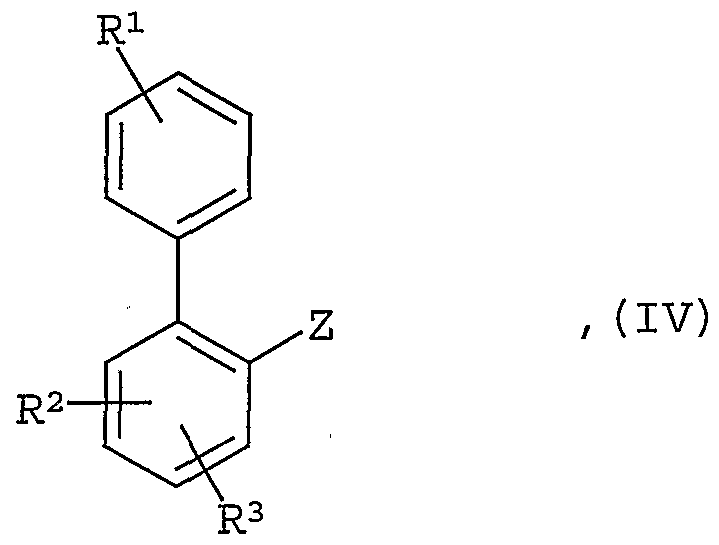
b. Umsetzung einer Verbindung der allgemeinen Formel
in der
R1 bis R3 wie eingangs erwähnt definiert sind, und Z eine
Carboxygruppe oder ein reaktives Derivat einer Carboxygruppe darstellt,
mit einem Amin der allgemeinen Formel
in der
R4 und R7 wie eingangs erwähnt definiert sind.
Die Umsetzung kann entsprechend den vorstehend bei Verfahren (a) genannten Bedingungen erfolgen.
Erhält man erfindungsgemäß eine Verbindung der allgemeinen Formel I, die eine Amino-, Alkylamino- oder Iminogruppe enthält, so kann diese mittels Acylierung oder Sulfonylierung in eine entsprechende Acyl- oder SulfonylVerbindung der allgemeinen Formel I übergeführt werden oder
eine Verbindung der allgemeinen Formel I, die eine Amino-, Alkylamino- oder Iminogruppe enthält, so kann diese mittels Alkylierung oder reduktiver Alkylierung in eine entsprechende AlkylVerbindung der allgemeinen Formel I übergeführt werden oder
eine Verbindung der allgemeinen Formel I, die eine Carboxygruppe enthält, so kann diese mittels Veresterung in einen entsprechenden Ester der allgemeinen Formel I übergeführt werden oder
eine Verbindung der allgemeinen Formel I, die eine Carboxy- oder Estergruppe enthält, so kann diese mittels Amidierung in ein entsprechendes Amid der allgemeinen Formel I übergeführt werden.
Die nachträgliche Acylierung oder Sulfonylierung wird gegebenenfalls in einem Lösungsmittel oder Lösungsmittelgemisch wie Methylenchlorid, Dimethylformamid, Benzol, Toluol, Chlorben-
zol, Tetrahydrofuran, Benzol/Tetrahydrofuran oder Dioxan mit einem entsprechenden Acyl- oder Sulfonylderivat gegebenenfalls in Gegenwart einer tertiären organischen Base oder in Gegenwart einer anorganischen Base oder in Gegenwart eines wasserentziehenden Mittels, z.B. in Gegenwart von Chlorameisensäure- isobutylester, Thionylchlorid, Trimethylchlorsilan, Schwefelsäure, Methansulfonsäure, p-Toluolsulfonsäure, Phosphortri- chlorid, Phosphorpentoxid, M,N' -Dicyclohexylcarbodiimid, N,N* -Dicyclohexylcarbodiimid/N-Hydroxysuccinimid oder 1-Hy- droxy-benztriazol und gegebenenfalls zusätzlich in Gegenwart von 4-Dirnethylamino-pyridin, N,N' -Carbonyldiimidazol oder Triphenylphosphin/Tetrachlorkohlenstoff, zweckmäßigerweise bei Temperaturen zwischen 0 und 150°C, vorzugsweise bei Temperaturen zwischen 0 und 80°C, durchgeführt.
Die nachträgliche Alkylierung wird gegebenenfalls in einem Lösungsmittel oder Lösungsmittelgemisch wie Methylenchlorid, Di- methylformamid, Benzol, Toluol, Chlorbenzol, Tetrahydrofuran, Benzol/Tetrahydrofuran oder Dioxan mit einem Alkylierungsmit- tel wie einem entsprechenden Halogenid oder Sulfonsäureester, z.B. mit Methyljodid, Ethylbromid, Dimethylsulfat oder Benzyl- chlorid, gegebenenfalls in Gegenwart einer tertiären organischen Base oder in Gegenwart einer anorganischen Base zweckmäßigerweise bei Temperaturen zwischen 0 und 150°C, vorzugsweise bei Temperaturen zwischen 0 und 100°C, durchgeführt.
Die nachträgliche reduktive Alkylierung wird mit einer entsprechenden CarbonylVerbindung wie Formaldehyd, Acetaldehyd, Propionaldehyd, Aceton oder Butyraldehyd in Gegenwart eines komplexen Metallhydrids wie Natriumborhydrid, Lithiumborhydrid oder Natriumcyanoborhydrid zweckmäßigerweise bei einem pH-Wert von 6-7 und bei Raumtemperatur oder in Gegenwart eines Hydrierungskatalysators, z.B. mit Wasserstoff in Gegenwart von Palladium/Kohle, bei einem Wasserstoffdruck von 1 bis 5 bar durchgeführt. Die Methylierung wird jedoch vorzugsweise in Gegenwart von Ameisensäure als Reduktionsmittel bei erhöhten
Temperaturen, z.B. bei Temperaturen zwischen 60 und 120°C, durchgeführt .
Die nachträgliche Veresterung wird gegebenenfalls in einem Lösungsmittel oder Lösungsmittelgemisch wie Methylenchlorid, Di- methylformamid, Benzol, Toluol, Chlorbenzol, Tetrahydrofuran, Benzol/Tetrahydrofuran oder Dioxan oder besonders vorteilhaft in einem entsprechenden-Alkohol gegebenenfalls in Gegenwart einer Säure wie Salzsäure oder in Gegenwart eines wasserentziehenden .Mittels, z.B. in Gegenwart von C lorameisensäure- isobutylester, ThionylChlorid, Trimethylchlorsilan, Schwefelsäure, Methansulfonsäure, p-Toluolsulfonsäure, Phosphortri- chlorid, Phosphorpentoxid, N,N' -Dicyclohexylcarbodiimid, N,N' -Dicyclohexylcarbodiimid/N-Hydroxysuccinimid oder 1-Hydroxy-benztriazol und gegebenenfalls zusätzlich in Gegenwart von 4-Dimethylamino-pyridin, N,N' -Carbonyldiimidazol oder Triphenyl-phosphin/Tetrachlorkohlenstoff, zweckmäßigerweise bei Temperaturen zwischen 0 und 150°C, vorzugsweise bei Temperaturen zwischen 0 und 80°C,..durchgeführt .
Die nachträgliche Amidierung wird durch Umsetzung eines entsprechenden reaktionsfähigen Carbonsäurederivates mit einem entsprechenden Amin gegebenenfalls in einem Lösungsmittel oder Lösungsmittelgemisch wie Methylenchlorid, Dimethylformamid, Benzol, Toluol, Chlorbenzol, Tetrahydrofuran, Benzol/Tetra- hydrofuran oder Dioxan, wobei das eingesetzte Amin gleichzeitig als Lösungsmittel dienen kann, gegebenenfalls in Gegenwart einer tertiären organischen Base oder in Gegenwart einer anorganischen Base oder mit einer entsprechenden Carbonsäure in Gegenwart eines wasserentziehenden Mittels, z:B. in Gegenwart von Chlorameisensäureisobutylester, Thionylchlo- rid, Trimethylchlorsilan, Schwefelsäure, Methansulfonsäure, p-Toluolsulfonsäure, Phosphortrichlorid, Phosphorpentoxid, O- (Benzotriazol-1-yl) -N,N,N' ,N' -tetramethyluronium-tetra- fluoroborat, N,N' -Dicyclohexylcarbodiimid, N,N' -Dicyclohexyl- carbodiimid/N-Hydroxysuccinimid oder 1-Hydroxy-benztriazol und gegebenenfalls zusätzlich in Gegenwart von 4-Dimethylamino-py-
ridin, N,N' -Carbonyldiimidazol oder Triphenylphosphin/Tetra- chlorkohlenstoff, zweckmäßigerweise bei Temperaturen zwischen 0 und 150°C, vorzugsweise bei Temperaturen zwischen 0 und 80°C, durchgeführt .
Bei den vorstehend beschriebenen Umsetzungen können gegebenenfalls vorhandene reaktive Gruppen wie Hydroxy-, Carboxy-, Amino-, Alkylamino- oder Iminogruppen während der Umsetzung durch übliche Schutzgruppen geschützt werden, welche nach der Umsetzung wieder abgespalten werden.
Beispielsweise kommt als Schutzrest für eine Hydroxygruppe die Trimethylsilyl-, tert .Butyl-dimethylsilyl- , Acetyl-, Benzoyl-, Methyl-, Ethyl-, tert.Butyl-, Trityl-, Benzyl- oder Tetrahy- dropyranylgruppe,
als Schutzreste für eine Carboxygruppe die Trimethylsilyl-, Methyl-, Ethyl-, tert.Butyl-, Benzyl- oder Tetrahydropyranyl- gruppe und
als Schutzreste für eine Amino-, Alkylamino- oder Iminogruppe die Formyl-, Acetyl-, Trifluoracetyl- , Ethoxycarbonyl-, tert .Butoxycarbonyl- , Benzyloxycarbonyl- , Benzyl- , Methoxy- benzyl- oder 2 ,4-Dimethoxybenzylgruppe und für die Aminogruppe zusätzlich die Phthalylgruppe Betracht.
Die gegebenenfalls anschließende Abspaltung eines verwendeten Schutzrestes erfolgt beispielsweise hydrolytisch in einem wässrigen Lösungsmittel, z.B. in Wasser, Isopropanol/Wasser, Essigsäure/Wasser, Tetrahydrofuran/Wasser oder Dioxan/Wasser, in Gegenwart einer Säure wie Trifluoressigsäure, Salzsäure oder Schwefelsäure oder in Gegenwart einer Alkalibase wie Natriumhydroxid oder Kaliumhydroxid oder aprotisch, z.B. in Gegenwart von Jodtrimethylsilan, bei Temperaturen zwischen 0 und 120°C, vorzugsweise bei Temperaturen zwischen 10 und 100°C. - Die Abspaltung einer Silylgruppe kann jedoch auch mittels Te- trabutylammoniumfluorid wie vorstehend beschrieben erfolgen.
Die Abspaltung eines Benzyl-, Methoxybenzyl- oder Benzyloxy- carbonylrestes erfolgt jedoch beispielsweise hydrogenolytisch, z.B. mit Wasserstoff in Gegenwart eines Katalysators wie Palladium/Kohle in einem geeigneten Lösungsmittel wie Methanol, Ethanol, Essigsäureethylester oder Eisessig gegebenenfalls unter Zusatz einer Säure wie Salzsäure bei Temperaturen zwischen 0 und 100°C, vorzugsweise jedoch bei Temperaturen zwischen 20 und 60°C, und bei einem Wasserstoffdruck von 1 bis 7 bar, vorzugsweise jedoch von 3 bis 5 bar. Die Abspaltung eines 2,4-Di- methoxybenzylrestes erfolgt jedoch vorzugsweise in Trifluor- essigsäure in Gegenwart von Anisol.
Die Abspaltung eines tert.-Butyl- oder tert . -Butyloxycarbonyl- restes erfolgt vorzugsweise durch Behandlung mit einer Säure wie Trifluoressigsäure oder Salzsäure oder durch Behandlung mit Jodtrimethylsilan gegebenenfalls unter Verwendung eines Lösungsmittels wie Methylenchlorid, Dioxan, Methanol oder Di- ethylether.
Die Abspaltung eines Trifluoracetylrestes erfolgt vorzugsweise durch Behandlung mit einer Säure wie Salzsäure gegebenenfalls in Gegenwart eines Lösungsmittels wie Essigsäure bei Temperaturen zwischen 50 und 120°C oder durch Behandlung mit Natronlauge gegebenenfalls in Gegenwart eines Lösungsmittels wie Tetrahydrofuran bei Temperaturen zwischen 0 und 50°C.
Die Abspaltung eines Phthalylrestes erfolgt vorzugsweise in Gegenwart von Hydrazin oder eines primären Amins wie Methylamin, Ethylamin oder n-Butylamin in einem Lösungsmittel wie Methanol, Ethanol, Isopropanol, Toluol/Wasser oder Dioxan bei Temperaturen zwischen 20 und 50°C.
Ferner können die erhaltenen Verbindungen der allgemeinen Formel I, wie bereits eingangs erwähnt wurde, in ihre Enantiome- ren und/oder Diastereomeren aufgetrennt werden. So können beispielsweise cis-/trans-Gemische in ihre eis- und trans-Iso-
mere, und Verbindungen mit mindestens einem optisch aktiven Kohlenstoffatom in ihre Enantiomeren aufgetrennt werden.
So lassen- sich beispielsweise die erhaltenen cis-/trans-Gemi- sche durch Chromatographie in ihre eis- und trans-Isomeren, die erhaltenen Verbindungen der allgemeinen Formel I, welche in Racematen auftreten, nach an sich bekannten Methoden (siehe Allinger .N. L. und Eliel E. L. in "Topics in Stereochemistry" , Vol. 6, Wiley Interscience, 1971) in ihre optischen Antipoden und Verbindungen der allgemeinen Formel I mit mindestens 2 asymmetrischen Kohlenstoffatomen auf Grund ihrer physikalischchemischen Unterschiede nach an sich bekannten Methoden, z.B. durch Chromatographie und/oder fraktionierte Kristallisation, in ihre Diastereomeren auftrennen, die, falls sie in racemi- scher Form anfallen, anschließend wie oben erwähnt in die -Enantiomeren getrennt werden können.
Die: Enantiomerentrennung erfolgt vorzugsweise durch Säulentrennung an chiralen Phasen oder durch Umkristallisieren aus einem optisch aktiven Lösungsmittel oder durch Umsetzen mit einer, mit der racemisehen Verbindung Salze oder Derivate wie z.B. Ester oder Amide bildenden optisch aktiven Substanz, insbesondere Säuren und ihre aktivierten Derivate oder Alkohole, und Trennen des auf diese Weise erhaltenen diastereomeren Salzgemisches oder Derivates, z.B. auf Grund von verschiedenen Löslichkeiten, wobei aus den reinen diastereomeren Salzen oder Derivaten die freien Antipoden durch Einwirkung geeigneter Mittel freigesetzt werden können. Besonders gebräuchliche, optisch aktive Säuren sind z.B. die D- und L-Formen von Weinsäure oder Dibenzoyl einsäure, Di-o-TolylWeinsäure, Äpfel- säure, Mandelsäure, Camphersulfonsäure, Glutaminsäure, Aspara- ginsäure oder Chinasäure. Als optisch aktiver Alkohol kommt beispielsweise (+) - oder (-) -Menthol und als optisch aktiver Acylrest in Amiden beispielsweise (+) -oder (-) -Menthyloxycar- bonyl in Betracht .
Desweiteren können die erhaltenen Verbindungen der Formel I in ihre Salze, insbesondere für die pharmazeutische Anwendung in ihre physiologisch verträglichen Salze mit anorganischen oder organischen Säuren, übergeführt werden. Als Säuren kommen hierfür beispielsweise Salzsäure, Bromwasserstoffsäure, Schwefelsäure, Phosphorsäure, Fumarsäure, Bernsteinsäure, Milchsäure, Zitronensäure, Weinsäure oder Maleinsäure in Betracht.
Außerdem lassen sich die so erhaltenen neuen Verbindungen ■ der Formel I, falls diese eine saure Gruppe wie eine Carboxygruppe enthalten, gewünschtenfalls anschließend in ihre Salze mit anorganischen oder organischen Basen, insbesondere für die pharmazeutische Anwendung in ihre physiologisch verträglichen Salze, überführen. Als Basen kommen hierbei beispielsweise Natriumhydroxid, Kaliumhydroxid, Arginin, Cyclohexylamin, Ethanol- amin, Diethanolamin und Triethanolamin in Betracht.
Die als Ausgangsstoffe verwendeten Verbindungen der allgemeinen Formeln II bis V sind entweder literaturbekannt oder man erhält diese nach literaturbekannten Verfahren bzw. werden in den Beispielen beschrieben.
Eine Verbindung der allgemeinen Formel II erhält man beispielsweise durch Umsetzung einer Verbindung der allgemeinen Formel
in der R
1 bis R
3 wie eingangs erwähnt definiert sind und Z
1 eine Carboxygruppe oder ein reaktives Derivat einer Carboxygruppe darstellt, mit einem Amin der allgemeinen Formel
in der R4 bis R7 wie eingangs erwähnt definiert sind und Z2 ein Schutzgruppe für eine Carboxygruppe darstellt, und anschließender Abspaltung der Schutzgruppe.
Die Amine der allgemeinen Formel III, in denen Rs einen Heteroaryl-arylrest oder eine Heteroaryl-aryl-C^g-alkylgruppe darstellt, können beispielsweise durch Aufbau des heteroaromatischen Ringes aus geeignet substituierten Aryl- oder Aryl-C1-6-alkyl-Edukten, etwa durch Kondensationsreaktionen mit geeigneten DicarbonylVerbindungen, hergestellt werden.
Die Biphenyl-2-carbonsäuren gemäß der allgemeinen Formel IV sind literaturbekannt oder lassen sich mittels literaturbekannter Verfahren aus entsprechenden Biphenyl-Edukten herstellen.
Die 3-Amino-benzoesäureamide gemäß der allgemeinen Formel VI sind ebenfalls literaturbekannt oder lassen sich in einfacher Weise aus gegebenenfalls substituierten 3-Aminobenzoesäuren durch Umsetzung mit den entsprechenden Aminen herstellen.
Wie bereits eingangs erwähnt, weisen die Verbindungen der allgemeinen Formel I und deren physiologisch verträgliche Salze wertvolle pharmakologische Eigenschaften auf. Diese stellen insbesondere wertvolle Inhibitoren des mikrosomalen Triglyzerid-Transferproteins (MTP) dar und eignen sich daher zur Senkung der Plasmaspiegel der atherogenen Lipoproteine .
Beispielsweise wurden die erfindungsgemäßen Verbindungen auf ihre biologischen Wirkungen wie folgt untersucht :
Inhibitoren von MTP wurden durch einen zellfreien MTP-Akti- vitätstest identifiziert. Solubilisierte Lebermikrosomen aus verschiedenen Spezies (z.B. Ratte, Schwein) können als MTP-Quelle benutzt werden. Zur Herstellung von Donor- und Akzeptorvesikeln wurden in organischen Lösungsmitteln gelöste Lipide in einem geeigneten Verhältnis gemischt und durch Verblasen des Lösungsmittels im Stickstoffström als dünne Schicht auf eine Glasgefäßwand aufgebracht . Die zur Herstellung von Donorvesikeln verwendete Lösung enthielt 400 μM Phosphatidyl- cholin, 75 μM Cardiolipin und 10 μM [14C] -Triolein (68,8 μCi/mg) . Zur Herstellung von Akzeptorvesikeln wurde eine Lösung aus 1,2 mM Phosphatidylcholin, 5 μM Triolein und 15 μM [3H] -Dipalmitoylphosphatidylcholin (108 mCi/mg) verwendet. Vesikel entstehen durch Benetzung der getrockneten Lipide mit Testpuffer und anschließende Ultrabeschallung. Vesikelpopula- tionen einheitlicher Größe wurden durch Gelfiltration der ultrabeschallten Lipide erhalten. Der MTP-Aktivitätstest enthält Donorvesikel, Akzeptorvesikel sowie die MTP-Quelle in Testpuffer. Substanzen wurden aus konzentrierten DMSO-haltigen Stammlösungen zugegeben, die Endkonzentration an DMSO im Test betrug 0,1%. Die Reaktion wurde durch Zugabe von MTP gestartet. Nach entsprechender Inkubationszeit wurde der Transferprozeß durch Zugabe von 500 μl einer SOURCE 30Q Anionenaustau- scher-Suspension (Pharmacia Biotech) gestoppt. Die Mischung wurde für 5 Minuten geschüttelt und die an das Anionenaus- tauschermaterial gebundenen Donorvesikel durch Zentrifugation abgetrennt. Die sich im Überstand befindende Radioaktivität von [3H] und [14C] wurde durch Flüssigkeits-Szintillations- Messung bestimmt und daraus die Wiederfindung der Akzeptorvesikel und die Triglyzerid-Transfer-Geschwindigkeit berechnet. Die Verbindungen der allgemeinen Formel I zeigen in dem beschriebenen Test IC5Q- erte < lOOμM.
Auf Grund der vorstehend erwähnten biologischen Eigenscha ten eignen sich die Verbindungen der allgemeinen Formel I und deren physiologisch verträgliche Salze insbesondere zur Senkung der Plasmakonzentration von atherogenen Apolipoprotein B
(apoB) -haltigen Lipoproteinen wie Chylomikronen und/oder Lipo- proteinen sehr niedriger Dichte (VLDL) sowie deren Überreste wie Lipoproteine niedriger Dichte (LDL) und/oder Lipoprote- in(a) (Lp(a)), zur Behandlung von Hyperlipidämien, zur Vorbeugung und Behandlung der Atherosklerose und ihrer klinischen Folgen, und zur Vorbeugung und Behandlung verwandter Erkrankungen wie Diabetes mellitus, Adipositas und Pankreatitis, wobei die orale Applikation bevorzugt ist.
Die zur Erzielung einer entsprechenden Wirkung erforderliche Tagesdosis liegt beim Erwachsenen zwischen 0,5 und 500 mg, zweckmäßigerweise zwischen 1 und 350 mg, vorzugsweise jedoch zwischen 5 und 200 mg.
Hierzu lassen sich die erfindungsgemäß hergestellten Verbindungen der Formel I, gegebenenfalls in Kombination mit anderen Wirksubstanzen wie anderen Lipidsenker, beispielsweise mit HMG-CoA-Reduktase-Inhibitoren, Cholesterolbiosynthese-Inhibitoren wie Squalensynthase-Inhibitoren und Squalenzyklase-Inhibitoren, Gallensäure-bindende Harze, Fibrate, Cholesterol-Resorptions-Inhibitoren, Niacin, Probucol, CETP Inhibitoren und ACAT Inhibitoren zusammen mit einem oder mehreren inerten üblichen Trägerstoffen und/oder Verdünnungsmitteln, z.B. mit Maisstärke, Milchzucker, Rohrzucker, mikrokristalliner Zellulose, Magnesiumstearat, Polyvinylpyrrolidon, Zitronensäure, Weinsäure, Wasser, Wasser/Ethanol, Wasser/Glycerin, Wasser/- Sorbit, Wasser/Polyethylenglykol, Propylenglykol, Cetylstea- rylalkohol, Carboxymethylcellulose oder fetthaltigen Substanzen wie Hartfett oder deren geeigneten Gemischen, in übliche galenische Zubereitungen wie Tabletten, Dragees, Kapseln, Pulver, Suspensionen oder Zäpfchen einarbeiten.
Die nachfolgenden Beispiele dienen der näheren Erläuterung der Erfindung:
Bei spiel 1
N- [4- (3 -Methyl -5-phenyl-pyrazol-1-yl) -phenylmethyl] - 3- (4 ' -methylbiphenyl-2 -carbonylamino) -benzoesäureamid
a. 4- ( -Methyl - -phenyl-pyrazol-1-yl) -benzonitr.il
Eine Lösung aus 20.0 g (0.118 mol) 4-Cyanophenylhydrazin und
19.1 g (0.118 mol) Benzoylaceton in 600 ml Methanol wird mit 16.7 ml Triethylamin versetzt und zwei Tage gerührt. Das Lösungsmittel wird abdestilliert, der Rückstand in Dichlorme- than/Wasser verteilt und die vereinigten organischen Extrakte getrocknet. Der Rückstand wird an Kieselgel chromatographiert , wobei mit Dichlormethan eluiert wird.
Ausbeute: 22.2 g (73% der Theorie),
Rf-Wert: 0.9 (Kieselgel; Dichlormethan/Methanol= 19:1)
C17H13N3 (259.31)
Massenspektrum: (M+H) + = 260
b. 4- ( -Methyl-5-phenyl-pyrazol-1-yl -phenylmethylamin
22.2 g (0.086 mol ) 4- (3-Methyl-5-phenyl-pyrazol-1-yl) -benzo- nitril werden in 660 ml methanolischem Ammoniak gelöst und nach Zugabe von Raney-Nickel bei Raumtemperatur mit Wasserstoff hydriert. Der Katalysator wird abfiltriert und die Lösung eingedampft. Der Rückstand wird an Kieselgel chromatographiert, wobei mit Dichlormethan/Methanol = 4:1 eluiert wird. Ausbeute: 22 g (97 % der Theorie) ,
Rf-Wert: 0.2 (Kieselgel; Dichlormethan/Methanol= 9:1) C17H17N3 (263.35)
Massenspektrum: (M+H) + = 264
M+ = 263
c . 3- (4 < -Methyl biphenyl-2-carbonylamino) -benzoesäureethylester 1.6 g (9.9 mmol) 3-Aminobenzoesäureethylester werden in 80 ml Tetrahydrofuran und 2.8 mol (20 mmol) Triethylamin vorgelegt, eine Lösung aus 2.3 g (9.9 mmol) ' -Methylbiphenyl-2-carbon- säurechlorid wird zugetropft und 1 Stunde nachgerührt . Das Lösungsmittel wird abdestilliert, der Rückstand in Essigester/Wasser verteilt, die vereinigten organischen Extrakte getrocknet und eingedampft .
Ausbeute: 3.5 g (98 % der Theorie),
Rf-Wert : 0.7 (Kieselgel ; Dichlormethan/Methanol= 19:1)
d. 3- (4 ' -Methylbiphenyl-2-carbonylamino) -benzoesäure
3.5 g (9.7 mmol) 4 ' -Methylbiphenyl-2-carbonylamino) -benzoesäureethylester werden in 100 ml Methanol und 15 ml 2 molare Natronlauge 1 Stunde bei 50°C gerührt. Das Lösungsmittel wird abdestilliert, der Rückstand mit Wasser versetzt und mit 2 molarer Salzsäure angesäuert. Ausgefallenes Produkt wird abgesaugt .
Ausbeute: 3.2 g (99% der Theorie), Rf-Wert: 0.2 (Kieselgel; Dichlormethan/Methanol= 19:1)
e . 3- (4 ' -Methylbiphenyl-2-carbonylamino) -benzoesäurechlorid 490 mg (1.5 mmol) 4 ' -Methylbiphenyl-2-carbonylamino) -benzoesäure werden in 5 ml Thionylchlorid unter Zusatz von 3 Tropfen Dirnethylformamid 1 Stunde gerührt. Anschließend wird eingedampft und der Rückstand direkt weiter umgesetzt. Ausbeute: 518 mg (100% der Theorie) .
f. N- [4- (3-Methyl-5-phenyl-pyrazol-l-yl) -phenylmethyl] -3- ( '- methylbiphenyl-2-carbonylamino) -benzoesäureamid
Ein Gemisch aus 518 mg (1.5 mmol) 3- (4 ' -Methylbiphenyl-2-carbonylamino) -benzoesäurechlorid, 390 mg (1.5 mmol) 4- (3-Methyl- 5-phenyl-pyrazol-1-yl) -phenylmethylamin und 0.7 ml (5 mmol) Triethylamin werden in 20 ml Tetrahydrofuram 1 Stunde gerührt. Das Lösungsmittel wird abdestilliert und der Rückstand an Kieselgel chromatographiert, wobei mit Dichlormethan/Ethanol 0-4 % eluiert wird.
Ausbeute: 340 mg (40% der Theorie),
Rf-Wert: 0.7 (Kieselgel; Dichlormethan/Ethanol= 9:1)
C3aH32N402 (576 . 70)
Massenspektrum : (M+H) + = 577
(M-HK = 575
(M+Na) + = 599
N- [4- (3 -Methyl-5-phenyl-pyrazol-1-yl) -phenylmethyl] -3- (4 ' - triflnormethylbiphenyl - -carbonylamino) -benzoesäuream d Hergestellt analog Beispiel lf aus 3- (4 ' -Trifluormethyl-biphenyl-2 -carbonylamino) -benzoesäurechlorid und 4- (3-Methyl-5- phenyl-pyrazol-1-yl) -phenylmethylamin in Tetrahydrofuran unter Zusatz von Triethylamin. Ausbeute: 47 % der Theorie,
Rf-Wert: 0.5 (Kieselgel; Dichlormethan/Ethanol= 19:1) C38H23F3N402 (630.67) Massenspektrum: (M+H) + = 631
(M-H)" = 629
(M+Na)+ = 653
Beispiel 3
N- [4- (3 -Methyl-5-phenyl-pyrazol-1-yl) -phenylmethyl] -3- (bi- phenyl-2-carbonylamino) -benzoesäureamid
Hergestellt analog Beispiel lf aus 3- (biphenyl-2-carbonylamino) -benzoesäurechlorid und 4- (3 -Methyl-5-phenyl-pyrazol-1-yl) - phenylmethylamin in Tetrahydrofuran unter Zusatz von Triethylamin.
Ausbeute: 54 % der Theorie,
Rf-Wert: 0.4 (Kieselgel; Dichlormethan/Ethanol= 19:1) C37H30N4O2 (562.67) Massenspektrum: (M+H)+ = 563 i (M-H)" = 561
(M+Na)+ = 585
Beispiel 4.
N- [4- (3-Methyl-5-phenyl-pyrazol-l-yl) -phenylmethyl] -3- (4 ' - fluorbiphenyl-2 -carbonylamino) -benzoesäureamid
Hergestellt analog Beispiel lf aus 3- (4 ' -Fluorbiphenyl-2- ■ carbonylamino) -benzoesäurechlorid und 4- (3 -Methyl-5-phenyl-
pyrazol-1-yl) -phenylmethylamin in Tetrahydrofuran unter Zusatz von Triethylamin. ■> ■
Ausbeute: 52 % der Theorie,
Rf-Wert: 0.2 (Kieselgel; Dichlormethan/Ethanol= 50:1) C37H29FN402 (580.66) Massenspektrum: (M-H)" = 579
(M+Na)+ = 603.
Beispiel 5
N- [4- (N-Methyl-N-phenylaminocarbonyl) -phenylmethyl] -3- (4 ' -. tri luormethylbiphenyl-2-carbonylamino) -benzoesäureamid
Hergestellt analog Beispiel lf aus 3- (4 ■ -Trifluormethyl-biphe- nyl-2-carbonylamino) -benzoesäurechlorid und 4-Amino-N-methyl-
N-phenyl-benzoesäureamid in Tetrahydrofuran unter Zusatz von
Triethylami .
Ausbeute: 37 % der Theorie,
Rf-Wert: 0.5 (Kieselgel; Dichlormethan/Ethanol= 19:1)
C36H28F3N303 (607.64)
Massenspektrum: (M+H) + = 608
(M-H)" = 606
(M+Na)+ = 630
Beispie] 6.
N- [4- (N-Methyl-N-phenylaminocarbonyl) -phenylmethyl] -3-
(biphenyl-2 -carbonyl mino) -benzoesäureamid
Hergestellt analog Beispiel lf aus 3- (Biphenyl-2 -carbonylamino) -benzoesäurechlorid und 4-Amino-N-methyl-N-phenyl-benzoesäureamid in Tetrahydrofuran unter Zusatz von Triethylamin Ausbeute: 35 % der Theorie,
Rf-Wert: 0.4 (Kieselgel; Dichlormethan/Ethanol= 19:1) 3SH29N303 (539.64) Massenspektrum: (M+H) + = 540
(M-H)" = 538
(M+Na)+ = 562
Beispiel 7
N- (Biphenyl-4-methyl) -3- (4 ' -trifluormethylbiphenyl-2-car- bonylamino) -benzoesäureamid
Eine Lösung aus 0.3 g (0.8 mmol) 3- (4 ' -Trifluormethylbiphenyl- 2-carbonylamino) -benzoesaure, 0.1 g (0.8 mmol) 4-Phenyl-ben- zylamin und 0.5 ml (4.6 mmol) N-Methylmorpholin in 25 ml Di- chlormethan wird bei -10°C mit 0.9 ml (1.6 mmol) Propanphos- phonsäurecycloanhydrid (50 Gewichts-% in Essigester) versetzt und 2 Stunden unter Kühlung gerührt. Der Ansatz wird an Kieselgel chromatographiert, wobei mit einem Gradienten von 100%-Dichlormethan bis Dichlor ethan/Methanol/Ammoniak = 20:77.5:2.5 eluiert wird. Ausbeute: 0.2 g (47 % der Theorie),
Rf-Wert: 0.75 (Kieselgel; Dichlormethan/Ethanol= 9:1) C34H25F3N202 (550.58) Massenspektrum: (M-H)" = 549
Beispiel—ä
N- (Pyridin-3 -yl -methyl ) -3 - (4 ' -trif luormethylbiphenyl -2 -car- bonylamino) -benzoesäi/ireami d
Hergestellt analog Beispiel 7 aus 3- (4 ' -Trifluormethylbiphe- nyl-2-carbonylamino) -benzoesaure und 3-Picolylamin in Dichlor- methan unter Zusatz von Propanphosphonsäurecycloanhydrid und
N-Methylmorpholin.
Ausbeute: 81 % der Theorie
Rf-Wert: 0.75 (Kieselgel; Dichlormethan/Ethanol= 9:1)
C27H20F3N3O2 (475 . 47)
Massenspektrum: (M-H)" = 474
Beispie]—_
N- (2-Phenylethyl) -3- (4 ' -trifluormethylbiphenyl-2-carbonyl- amino) -benzoesäureamid
Hergestellt analog Beispiel 7 aus 3- (4 ' -Trifluormethylbiphenyl-2-carbonylamino) -benzoesaure und 2-Phenylethylamin in
Dichlormethan unter Zusatz von Propanphosphonsäurecyclo- anhydrid und N-Methylmorpholin.
Ausbeute: 60 % der Theorie
Rf-Wert: 0.72 (Kieselgel; Dichlormethan/Ethanol= 9:1)
C29H23F3N2Cy (488.51)
Massenspektrum: (M-H)" = 487
Beispiel IQ
N-(4-Benzoylamino-phenylmethyl) -3- (biphenyl-2 -carbonylamino) - benzoesäureamid
Hergestellt analog Beispiel 7 aus 3- (Biphenyl-2-carbonylamino) -benzoesaure und 4-Benzoylamino-phenylmethylamin in Dichlormethan unter Zusatz von Propanphosphonsäurecycloanhydrid und N-Methylmorpholin. Ausbeute: 57 % der Theorie
Rf-Wert: 0.56 (Kieselgel; Dichlormethan/Ethanol= 9:1) C34H27N3θ3 (525.61) Massenspektrum: (M-H)" = 524
Bei spi l 11
N- (2-Acetylamino-ethyl) -3- (4 ' -trifluormethylbiphenyl-2 -car- onyla ino) -benzoesäureamid
Hergestellt analog Beispiel 7 aus 3- (4 ' -Trifluormethylbi- phenylen-2 -carbonylamino) -benzoesaure und N- (2-Amino-ethyl) - acetamid in Dichlormethan unter Zusatz von Propanphosphon- säurecycloanhydrid und N-Methylmorpholin. Ausbeute: 41 % der Theorie
Rf-Wert: 0.45 (Kieselgel; Dichlormethan/Ethanol= 9:1) C25H22F3N303 (469.46) Massenspektrum: (M-H)" = 468
Beispiel 12.
N- (4-Benzoylamino-phenylmethyl) -3- (4 ' -trifluormethylbiphenyl- 2 -carbonylamino) -benzoesäureamid
Hergestellt analog Beispiel 7 aus 3- (4 ' -Trifluormethylbiphenyl-2-carbonylamino) -benzoesaure und 4-Benzoylamino-phe- nylmethylamin in Dichlormethan unter Zusatz von Propanphos- phonsäurecycloanhydrid und N-Methylmorpholin. Ausbeute: 30 % der Theorie
R
f-Wert: 0.72 (Kieselgel; Dichlormethan/Ethanol= 9:1)
Massenspektrum: (M-H)
" = 592
Beispiel 13
N-Phenyl-3- ( ' -trifluormethylbiphenyl-2-carbonylamino) -benzoesäureami
Hergestellt analog Beispiel 7 aus 3- (4 ' -Trifluormethylbi- phenyl-2-carbonylamino) -benzoesaure und Anilin in Dichlormethan unter Zusatz von Propanphosphonsäurecycloanhydrid und N-Methylmorpholin. Ausbeute: 59 % der Theorie
Rf-Wert : 0.72 (Kieselgel ; Dichlormethan/Ethanol= 9:1) C27H19F3N202 (460.46) Massenspektrum: (M-H)" = 459
(M+Na)+ = 483
Beispiel 14
N-Methyl-N-propyl-3- (4 ' -trifluormethylbiphenyl-2-carbonyl- amino) -benzoesäureamid
Hergestellt analog Beispiel 7 aus 3- (4 ' -Trifluormethylbiphenyl-2-carbonylamino) -benzoesaure und N-Methyl-propylamin in Dichlormethan unter Zusatz von Propanphosphonsäurecycloanhy- drid und N-Methylmorpholin. Ausbeute : 44 % der Theorie
Rf-Wert: 0.73 (Kieselgel; Dichlormethan/Ethanol= 9:1) C25H23F3N202 (440.47) Massenspektrum: (M-H)" = 439
Beispiel 15
N- (2-Ethoxycarbonylethyl) -3- (4 ' -trifluormethylbiphenyl-2- carbonyla ino) -benzoesäureamid
Hergestellt analog Beispiel 7 aus 3- (4 ' -Trifluormethylbiphe- nyl-2-carbonylamino) -benzoesaure und ß-Alanin-ethylester in Dichlormethan unter Zusatz von Propanphosphonsäurecycloanhy- drid und N-Methylmorpholin. Ausbeute: 11 % der Theorie
Rf-Wert: 0.73 (Kieselgel; Dichlormethan/Ethanol= 9:1) C26H23F3N204 (484.48) Massenspektrum: (M-H)" = 483
(M+Na)+ = 507
Beispiel 16
N-tert .Butoxycarbonylamino-3- (4 ' -trifluormethylbiphenyl-2- carbonyl mino) -benzoesäureamid
Hergestellt analog Beispiel 7 aus 3- (4 ' -Trifluormethylbiphenyl-2 -carbonylamino) -benzoesaure und Hydrazinoameisen- säure-tert .butylester in Dichlormethan unter Zusatz von Propanphosphonsäurecycloanhydrid und N-Methylmorpholin. Ausbeute: 46 % der Theorie
Rf-Wert : 0 . 58 (Kieselgel ; Dichlormethan/Ethanol= 9 : 1) C26H24F3N304 (499 .49) Massenspektrum: (M-H) " = 498
Bei spi el 1 7
N-Phenylamino-3- (4 ■ -trifluormethylbiphenyl-2 -carbonylamino) - benzoesäureamid
Hergestellt analog Beispiel 7 aus 3- (4 ' -Trifluormethylbiphe- nyl-2-carbonylamino) -benzoesaure und Phenylhydrazin in Dichlormethan unter Zusatz von Propanphosphonsäurecycloanhydrid und N-Methylmorpholin. Ausbeute : 8 % der Theorie Rf-Wert : 0.72 (Kieselgel ; Dichlormethan/Ethanol= 9:1)
C27H20F3N3O2 (475 . 47 ) Massenspektrum : (M-H) " = 474
(M+Na) + = 498
Beispiel - 1
N-,(N-tert .Butoxycarbonyl-piperidin-4-yl-methyl) -3- (4 ' -tri- fluormethylbiphenyl-2 -carbonylamino) -benzoesäureamid
Hergestellt analog Beispiel 7 aus 3- (4 ' -Trifluormethylbiphe- nyl-2-carbonylamino) -benzoesaure und N-tert .Butoxy-carbonyl- piperidin-4-yl-methylamin in Dichlormethan unter Zusatz von Propanphosphonsäurecycloanhydrid und N-Methylmorpholin. Ausbeute: 38 % der Theorie
Rf-Wert: 0.68 (Kieselgel; Dichlormethan/Ethanol= 9:1) C32H34F3N304 (581.64) Massenspektrum: (M-H)" = 580
(M+Na)+ = 604
Beispiel 19
N-Phenylmethyl-3- (4 ' -trifluormethylbiphenyl-2-carbonylamino) - benzoesäureamid
Hergestellt analog Beispiel 7 aus 3- (4 ' -Trifluormethylbiphenyl-2 -carbonylamino) -benzoesaure und Benzylamin in Dichlormethan unter Zusatz von Propanphosphonsäurecycloanhydrid und N-Methylmorpholin. Ausbeute: 46 % der Theorie
Rf-Wert : 0.68 (Kieselgel; Dichlormethan/Ethanol= 9:1) C28H21F3N202 (474.49) Massenspektrum: (M-H)" = 473
(M+Na)+ = 497
Beispiel 20
N- (Biphenyl-2 -methyl) -3- (4 ' -trifluormethylbiphenyl-2-carbonyl- m no) -benzoesäureamid
Hergestellt analog Beispiel 7 aus 3- (4 ' -Trifluormethylbiphenyl-2 -carbonylamino) -benzoesaure und 2-Phenyl-benzylamin in Dichlormethan unter Zusatz von Propanphosphonsäurecycloan- hydrid und N-Methylmorpholin. Ausbeute: 65 % der Theorie
Rf-Wert: 0.74 (Kieselgel; Dichlormethan/Ethanol= 9:1) C34H25F3N202 (550.59) Massenspektrum: (M-H)" = 549
(M+Na)+ = 573
Beispiel 21
N-Propyl-3- (4 ' -trifluormethylbiphenyl-2 -carbonylamino) -benzoe- säureamid :
Hergestellt analog Beispiel 7 aus 3- (4 ' -Trifluormethylbi- phenyl-2 -carbonylamino) -benzoesaure und Propylamin in Dichlormethan unter Zusatz von Propanphosphonsäurecycloanhydrid und N-Methylmorpholin. Ausbeute: 33 % der Theorie
Rf-Wert : 0.67 (Kieselgel; Dichlormethan/Ethanol= 9:1) C24H21F3N202 (426.44) Massenspektrum: (M-H)" = 425
(M+Na)+ = 449
Beispiel 22
N-Ethoxycarbonylmethyl-3- (4 ' -trifluormethylbiphenyl-2 -car- bonyla ino) -benzoesäureamid
Hergestellt analog Beispiel 7 aus 3- (4 ' -Trifluormethylbiphenyl-2-carbonylamino) -benzoesaure und Glycinethylester- hydrochlorid in Dichlormethan unter Zusatz von Propanphos- phonsäurecycloanhydrid und N-Methylmorpholin. Ausbeute: 79 % der Theorie
Rf-Wert : 0.67 (Kieselgel; Dichlormethan/Ethanol= 9:1) C25H21F3N204 (470.45) Massenspektrum: (M-H)" = 469
(M+Na)+ = 493
Beispiel 23
N-Dimethylamino~3- (4 ' -trifluormethylbiphenyl-2 -carbonylamino) benzoesäureamid
Hergestellt analog Beispiel 7 aus 3- (4 ' -Trifluormethylbiphenyl-2 -carbonylamino) -benzoesaure und N,N-Dimethylhydrazin in Dichlormethan unter Zusatz von Propanphosphonsäurecycloan- hydrid und N-Methylmorpholin. Ausbeute: 57 % der Theorie
Rf-Wert: 0.85 (Kieselgel; Dichlormethan/Ethanol= 9:1) C23H20F3N3O2 (427.43) Massenspektrum: (M-H)" = 426
(M+H)+ = 428
(M+Na)+ = 450
Beispiel 24
N-Phenylmethyl-N-methyl-3- (4 ' -trifluormethylbiphenyl-2- carbonylamino) -benzoesäureamid :
Hergestellt analog Beispiel' 7 aus 3- (4 ' -Trifluormethylbiphenyl-2 -carbonylamino) -benzoesaure und N-Methyl-benzylamin in Dichlormethan unter Zusatz von Propanphosphonsäurecycloan- hydrid und N-Methylmorpholin. Ausbeute: 95 % der Theorie
Rf-Wert: 0.72 (Kieselgel; Dichlormethan/Ethanol= 9:1) C29H23F3N202 (488.51) Massenspektrum: (M-H)" = 487
(M+Na)+ = 511
Bei pi l. 25
N- [4- (Phenylmethyl) -phenyl] -3- (4-methylbiphenyl-2-carbonyl- amino) -benzoesäureamid
Hergestellt analog Beispiel lf aus 4 ' -Methylbiphenyl-2-car- bonsäurechlorid und 3-Amino-N- (4-benzyl-phenyl) -benzoesäureamid in Tetrahydrofuran unter Zusatz von Triethylamin.
Ausbeute: 83 % der Theorie,
Rf-Wert: 0.6 (Kieselgel; Dichlormethan/Ethanol= 9:1)
C34H2aN202 (496.61)
Massenspektrum: (M-H)" = 495
Beispie '26
N- (Biphenyl-3-methyl) -3- (4 ' -trifluormethylbiphenyl-2-carbonylamino) -benzoesäureamid
Hergestellt analog Beispiel 7 aus 3- (4 ' -Trifluormethylbiphenyl-2 -carbonylamino) -benzoesaure und 3-Phenylbenzylamin in Dichlormethan unter Zusatz von Propanphosphonsäurecyclo- anhydrid und N-Methylmorpholin. Ausbeute: 58 % der Theorie
R£-Wert: 0.71 (Kieselgel; Dichlormethan/Ethanol= 9:1) C34H2SF3N202 (550.59) Massenspektrum: (M-H)" = 549
(M+Na)+ = 573
Beispiel 27
N- [4- (lH-Imidazol-2-yl) -phenylmethyl] -3- (biphenyl-2 -car- bonylamino) -bβnzoesäureamid-hydrochlori
Hergestellt analog Beispiel 7 aus 3- (Biphenyl-2 -carbonylamino) -benzoesaure und 4- (lH-Imidazol-2-yl)benzylamin in Dichlormethan unter Zusatz von Propanphosphonsäurecyclo- anhydrid und N-Methylmorpholin. Ausbeute: 96 % der Theorie
Rf-Wert: 0.5 (Kieselgel; Dichlormethan/Ethanol= 95:5) C30H24N4O2 x HC1 (472.54/509.01) Massenspektrum: (M+H)+ = 473
Beispiel 28
N- (Biphenyl-4-methyl) -3- (biphenyl-2-carbonylamino) -benzoe- säureamid
Hergestellt analog Beispiel 7 aus 3- (Biphenyl-2 -carbonylamino) -benzoesaure und 4-Phenylbenzylamin in Dichlormethan unter Zusatz von Propanphosphonsäurecycloanhydrid und N-Methylmorpholin. Ausbeute: 88 % der Theorie
Rf-Wert: 0.76 (Kieselgel; Dichlormethan/Ethanol= 95:5) C33H26N202 (482.59) Massenspektrum: (M-H)" = 481
(M+H)+ = 483
(M+Na)+ = 505
Beispiel 29
N- (4 ' -Hydroxybiphenyl-4-methyl) -3- (biphenyl-2-carbonylamino) - benzoesäureamid
Hergestellt analog Beispiel 7 aus 3- (Biphenyl-2 -carbonylamino) -benzoesaure und 4- (4-Hydroxyphenyl) -benzylamin in Dichlormethan unter Zusatz von Propanphosphonsäurecycloanhydrid und N-Methylmorpholin. Ausbeute: 6 % der Theorie
Rf-Wert: 0.88 (Kieselgel; Dichlormethan/Ethanol= 95:5) C33H2SN203 (498.59) Massenspektrum: (M-H)" = 497
(M+Cl)" = 533/35 (Chlorisotope)
Beispiel 30
N- (Piperidin-4-yl-methyl) -3- (4 ' -trifluormethylbiphenyl-2- carbonylamino) -benzoesäureamid-trifluoracetat
0.2 g (0.27 mmol) N- (N-tert .Butoxycarbonyl-piperidin-4-yl- methyl) -3- (4 ' -trifluormethylbiphenyl-2-carbonylamino) - benzoesäureamid werden in 30 ml Dichlormethan und 3 ml Trifluoressigsäure 17 Stunden bei Raumtemperatur gerührt. Anschließend wird im Vakuum zur Trockene eingedampft. Ausbeute: 0.2 g (98 % der Theorie),
Rf-Wert : 0 . 42 (Kieselgel ; Dichlormethan/Ethanol= 9 : 1) C27H26F3N302 X CF3COOH (481 . 52/595 . 55)
Massenspektrum: (M+H) + = 482
Beispiel 31
N- [N- (N-Methyl-N-phenylaminocarbonyl) -piperidin-4-yl-methyl] - 3- (4 ' -trifluormethylbiphenyl-2 -carbonylamino) -benzoesäureamid Hergestellt analog Beispiel lf aus N- (Piperidin-4-yl-methyl) - 3- (4 ' -trifluormethylbiphenyl-2 -carbonylamino) -benzoesäure- amid-trifluoracetat und N-Methyl-N-phenyl-carbamoylchlorid in Tetrahydrofuran unter Zusatz von Triethylamin. Ausbeute: 99 % der Theorie,
Rf-Wert: 0.57 (Kieselgel; Dichlormethan/Ethanol= 9:1) C35H33F3N403 (614.67) Massenspektrum: (M-H)" = 613
Beispiel 3_2
N- [4- (3-Methyl-5-tert .butyl-pyrazol-1-yl) -phenylmethyl] -3- (4 ' - trifluormethylbiphenyl- -carbonylamino) -benzoesäureamid Hergestellt analog Beispiel 7 aus 3- (4 ' -Trifluormethylbiphe- nyl-2 -carbonylamino) -benzoesaure und 4- (5-tert . -Butyl-3-me- thyl-pyrazol-1-yl) -benzylamin in Dichlormethan unter Zusatz von Propanphosphonsäurecycloanhydrid und N-Methylmorpholin. Ausbeute : 53 % der Theorie
Rf-Wert: 0.5 (Kieselgel; Dichlormethan/Ethanol= 19:1) C3SH33F3N402 (610.69) Massenspektrum: (M-H)" = 609
(M+H)+ = 611
(M+Na)+ = 633
Beispiel 3_3_
N-Methyl-N- [4- (3-Methyl-5-phenyl-pyrazol-l-yl) -phenylmethyl] -
3- (4 ' -methylbiphenyl-2-carbonylamino) -benzoesäureamid
Hergestellt analog Beispiel lc aus 4 ' -Methylbiphenyl-2-carbon- säurechlorid und N-Methyl-N- [4- (3 -Methyl-5-phenyl-pyrazol-1-
yl) -phenylmethyl] -3 -amino-benzoesäureamid in Tetrahydrofuran unter Zusatz von Triethylamin. Ausbeute: 22 % der Theorie
Rf-Wert: 0.6 (Kieselgel; Dichlormethan/Methanol= 9:1) C39H34N402 (590.73) Massenspektrum: (M-H)" = 589
(M+H)+ = 591
Beispie] 3_i
N- (Pyridin-3-yl-methyl) -3- (biphenyl-2-carbonylamino) -benzoe- säurea id
3.2 mg (10 μmol) 3- (Biphenyl-2 -carbonylamino) -benzoesaure werden in 0.4 ml Dirnethylformamid vorgelegt und nach Zugabe von 1.6 mg (15 μmol) 3-Picolylamin, 3.9 mg (12 μmol) O- (Benzo- triazol-1-yl) -N,N,N' ,N' -tetramethyluroniumtetrafluorborat (TBTU) und 7 mg (50 μmol), N-Ethyl-diisopropylamin 12 Stunden gerührt . Die Lösung wird eingedampft .
Rf-Wert: 0.2 (Kieselgel; Dichlormethan/Ethanol= 19:1) C26H21N302 (407.47) Massenspektrum: (M+H) + = 408
Beispiel. 35
N-Phenyl-3- (biphenyl - -carbonylamino) -benzoesäureamid Hergestellt analog Beispiel 34 aus 3- (Biphenyl-2 -carbonylamino) -benzoesaure, Anilin, TBTU und N-Ethyldiisopropylamin in Dirnethylformamid .
Rf-Wert : 0.75 (Kieselgel; Dichlormethan/Ethanol= 19:1) C26H20N2O2 (392.46) Massenspektrum: (M+Na)+ = 415
Beispiel 36
N-ter .Butyl-3- (bi henyl-2-carbonylamino) -benzoesäureamid Hergestellt analog Beispiel 34 aus 3- (Biphenyl-2-carbonylamino) -benzoesaure, tert .Butylamin, TBTU und N-Ethyldiisopro- pylamin in Dimethylformamid.
Rf-Wert: 0.4 (Kieselgel; Dichlormethan/Ethanol= 19:1) C24H24N202 (372.47) Massenspektrum: (M+Na) + = 395
Beispiel 37
N-Hydroxyethyl-3- (biphenyl-2 -carbonylamino) -benzoesäureami Hergestellt analog Beispiel 34 aus 3- (Biphenyl-2-carbonylamino) -benzoesaure, 2 -Aminoethanol , TBTU und N-Ethyl-diisopropyl- amin in Dimethylformamid.
Rf-Wert: 0.2 (Kieselgel; Dichlormethan/Ethanol= 19:1) C22H20N2O3 (360.41) Massenspektrum: (M+Na) + = 383
Beispiel 38
N- (2-Dimethylamino-ethyl) -3- (biphenyl-2-carbonylamino) -benzoe- äureamid :
Hergestellt analog Beispiel 34 aus 3- (Biphenyl-2 -carbonylamino) -benzoesaure, N,N-Dimethylethylendiamin, TBTU und N- Ethyldiisopropylamin in Dimethylformamid. Rf-Wert: 0.15 (Kieselgel; Dichlormethan/Ethanol= 4:1) C24H25N302 (387.48) Massenspektrum: (M+H) + = 388
M+ = 387
Beispiel 39
N- (2 -Carboxy-ethyl) -3- (biphenyl-2 -carbonylamino) -benzoesäure- amid-natriumsal v.
Hergestellt analog Beispiel 34 aus 3- (Biphenyl-2-carbonylamino) -benzoesaure, ß-Alanin, TBTU, Natronlauge und N-Ethyldi- isopropylamin in Dimethylformamid.
Rf-Wert: 0.15 (Kieselgel; Dichlormethan/Ethanol= 9:1) C23H19NaN204 (410.41), freie Säure C23H20N2O4 (388.42) Massenspektrum: (M-H)" = 387
Beisp el 40
N- (4- [1,2,3] -Thiadiazol-4-yl-phenylmethyl) -3- (4 ' -trifluor- methylbiphenyl-2 -carbonylamino) -benzoesäureamid
Hergestellt analog Beispiel 7 aus 3- (4 ' -Trifluormethylbiphenyl -2 -carbonylamino) -benzoesaure und 4- [1,2,3] -Thiadiazol -4- yl-benzylamin in Dichlormethan unter Zusatz von Propanphos- phonsäurecycloanhydrid und N-Methylmorpholin. . Ausbeute: 18 % der Theorie
Rf-Wert: 0.75 (Kieselgel; Dichlormethan/Ethanol= 9:1) C30H21F3N402S (558.58) Massenspektrum: (M-H)" = 557
(M+H)+ = 559
(M+Na)+ = 581
Beispiel 41
N- ( -Phenylaminosulfonyl-phenylmethyl) -3- ( ' -trifluormethylbi- henyl-2 -carbonylamino) -benzoesäureamid
Hergestellt analog Beispiel 7 aus 3- (4 ' -Trifluormethylbiphenyl -2 -carbonylamino) -benzoesaure und 4-Aminomethyl -N-phenyl - benzolsulfonamid in Dichlormethan unter Zusatz von Propan- phosphonsäurecycloanhydrid und N-Methylmorpholin. Ausbeute: 73 % der Theorie
Rf-Wert: 0.68 (Kieselgel; Dichlormethan/Ethanol= 9:1) C34H2SF3N304S (629.66) Massenspektrum: (M-H)" = 628
(M+H)+ = 630
(M+Na)+ = 652
Beispiel 42
N- (4-Piperidin-1-yl-phenylmethyl) -3- (4 ' -trifluormethylbi- phenyl-2 -carbonylamino) -benzoesäur ami d
Hergestellt analog Beispiel 7 aus 3- (4 ' -Trifluormethylbiphenyl-2-carbonylamino) -benzoesaure und -Piperidin-1-yl-benzyl- amin in Dichlormethan unter Zusatz von Propanphosphonsäure- cycloanhydrid und N-Methylmorpholin. Ausbeute: 47 % der Theorie
Rf-Wert: 0.69 (Kieselgel; Dichlormethan/Ethanol= 9:1) C33H30F3N3O2 (557.61) Massenspektrum: (M-H)" = 556
(M+Na)+ = 580
Beispiel 43
N- (4-Phenylsulfonylamino-phenylmethyl) -3- (4 ' -trifluormethylbi- phenyl -2-carbonylamino) -benzoesäureamid
Hergestellt analog Beispiel 7 aus 3- (4 ' -Trifluormethylbiphenyl-2-carbonylamino) -benzoesaure und 4-Phenylsulfonylamino- benzylamin in Dichlormethan unter Zusatz von Propanphosphon- säurecycloanhydrid und N-Methylmorpholin. Ausbeute: 57 % der Theorie
Rf-Wert: 0.67 (Kieselgel; Dichlormethan/Ethanol= 9:1) C34H26F3N304S (629.66) Massenspektrum: (M-H)" = 628
(M+H)+ = 630
(M+Na)+ = 652
Beispiel. 44
N- [4- (2 -Methyl-pyrrol-1-yl) -phenylmethyl] -3- (41 -trifluorme- thylbiphenyl- -carbonylamino) -benzoesäureamid
Hergestellt analog Beispiel 7 aus 3- (4 ' -Trifluormethylbiphenyl-2-carbonylamino) -benzoesaure und 4- (2-Methyl-pyrrol-1-yl) - benzylamin in Dichlormethan unter Zusatz von Propanphosphon- säurecycloanhydrid und N-Methylmorpholin. Ausbeute: 22 % der Theorie Rf-Wert: 0.73 (Kieselgel; Dichlormethan/Ethanol= 9:1)
C33H26F3N302 (553.58)
Massenspektrum: (M-H)" = 552
(M+H)+ = 554
(M+Na)+ = 576
Beispiel 45
N- (2 ' -Methylbiphenyl-4-methyl) -3- (4 ' -trifluormethylbiphenyl-2- carbonylamino) -benzoesäureami d
Hergestellt analog Beispiel 7 aus 3- (4 ' -Trifluormethylbiphenyl-2-carbonylamino) -benzoesaure und 4- (2-Methylphenyl) ben- zylamin in Dichlormethan unter Zusatz von Propanphosphonsäu- recycloanhydrid und N-Methylmorpholin. Ausbeute: 21 % der Theorie
Rf-Wert: 0.72 (Kieselgel; Dichlormethan/Ethanol= 9:1) C35H27F3N202 (564.60) Massenspektrum: (M-H)" = 563
(M+Na)+ = 587
Beispiel. 46
N- (4-tert .Butyl-phenylmethyl) -3- (4 ' -trifluormethylbiphenyl-2- carbonylamino) -benzoesäureami d
Hergestellt analog Beispiel 7 aus 3- (4 ' -Trifluormethylbiphenyl-2-carbonylamino) -benzoesaure und 4-tert .Butyl-benzylamin in Dichlormethan unter Zusatz von Propanphosphonsäurecyclo- anhydrid und N-Methylmorpholin. Ausbeute: 53 % der Theorie
Rf-Wert: 0.69 (Kieselgel; Dichlormethan/Ethanol= 9:1) C32H29F3N202 (530.59) Massenspektrum: (M-H)" = 529
(M+Na)+ = 553
Beispiel 47
N- (4-Isopropyl-phenylmethyl) -3- (4 ' -trifluormethylbiphenyl-2- carbonylamino) -benzoesäureamid
Hergestellt analog Beispiel 7 aus 3- (4 ' -Trifluormethylbiph - nyl-2-carbonylamino) -benzoesaure und 4-Isopropylbenzylamin in Dichlormethan unter Zusatz von Propanphosphonsäurecycloan- hydrid und N-Methylmorpholin. Ausbeute: 58 % der Theorie
Rf-Wert: 0.67 (Kieselgel; Dichlormethan/Ethanol= 9:1) C31H27F3N202 (516.56) Massenspektrum: (M-H)" = 515
(M+Na)+ = 539
Beispiel 48
N- (4-Brom-phenylmethyl) -3- (4 ' -trifluormethylbiphenyl-2- carbon lamino) -benzoesäureamid
Hergestellt analog Beispiel 7 aus 3- (4 ' -Trifluormethylbiphenyl-2-carbonylamino) -benzoesaure und 4-Brombenzylamin in Dichlormethan unter Zusatz von Propanphosphonsäurecycloan- hydrid und N-Methylmorpholin. Ausbeute: 51 % der Theorie
Rf-Wert: 0.64 (Kieselgel; Dichlormethan/Ethanol= 9:1) C28H20BrF3N2O2 (553.38)
Massenspektrum: (M-H)" = 551/53 (Bromisotope)
(M+Na)+ = 575/77 (Bromisotope)
Beispiel 49
N- (4-Trifluormethyl-phenylmethyl) -3- (4 ' -trifluormethylbi- henyl-2-carbonylamino) -benzoesäureamid
Hergestellt analog Beispiel 7 aus 3- (4 ' -Trifluormethylbiphenyl-2-carbonylamino) -benzoesaure und 4-Trifluormethyl-ben- zylamin in Dichlormethan unter Zusatz von Propanphosphon- säurecycloanhydrid und N-Methylmorpholin. Ausbeute: 48 % der Theorie
Rf-Wert: 0.63 (Kieselgel; Dichlormethan/Ethanol= 9:1) C29H20F6N2O2 (542.48) Massenspektrum: (M-H)" = 541
(M+Na)+ = 565
Beispiel 50
N- (4-Acetylamino-phenylmethyl) -3- (4 ' -trifluormethylbiphenyl-2- carbony mino) -benzoesäureami d
Hergestellt analog Beispiel 7 aus 3- (4 ' -Trifluormethylbiphe- nyl-2-carbonylamino) -benzoesaure und 4-Acetylaminobenzylamin in Dichlormethan unter Zusatz von Propanphosphonsäurecyclo- anhydrid und N-Methylmorpholin. Ausbeute: 38 % der Theorie
Rf-Wert : 0.60 (Kieselgel ; Dichlormethan/Ethanol= 9:1) C30H24F3N303 (531.53) Massenspektrum: (M+Na)+ = 554
Beispiel 5L
N- (IH-Benzimidazol-2 -yl-methyl) -3- (4 ' -trifluormethylbi-phenyl-
2 -carbonylamino) -benzoesäureamid
Hergestellt analog Beispiel 7 aus 3- (4 ' -Trifluormethylbiphe- nyl-2-carbonylamino) -benzoesaure und 2- (Aminomethyl) -benzimi- dazol in Dichlormethan unter Zusatz von Propanphosphonsäure- cycloanhydrid und N-Methylmorpholin. Ausbeute: 19 % der Theorie
Rf-Wert: 0.58 (Kieselgel; Dichlormethan/Ethanol= 9:1) C29H21F3N402 (514.51) Massenspektrum: (M-H)" = 513
(M+H)+ = 515
Beispiel 52
N- (4 ' -Methylbiphenyl-4-methyl) -3- (4 ' -trifluormethylbiphenyl-2- carbonylamino) -benzoesäureami d
Hergestellt .analog Beispiel 7 aus 3- (4 ' -Trifluormethylbiphenyl-2 -carbonylamino) -benzoesaure und 4- (4 ' -Methylphenyl) - benzylamin in Dichlormethan unter Zusatz von Propanphosphon- säurecycloanhydrid und N-Methylmorpholin. Ausbeute: 21 % der Theorie
R£-Wert: 0.73 (Kieselgel; Dichlormethan/Ethanol= 9:1) C35H27F3N202 (564.61) Massenspektrum: (M-H)" = 563
(M+Na)+ = 587
Beispiel 53
N- (4-Methyl-phenylmethyl) -3- (4 ' -trifluormethylbiphenyl-2-car~ bonylamino) -benzoesäureamid
Hergestellt analog Beispiel 7 aus 3- (4 ' -Trifluormethylbiphenyl-2 -carbonylamino) -benzoesaure und 4-Methylbenzylamin in Dichlormethan unter Zusatz von Propanphosphonsäurecyclo- anhydrid und N-Methylmorpholin. Ausbeute: 82 % der Theorie
Rf-Wert: 0.75 (Kieselgel; Dichlormethan/Ethanol= 9:1) C29H23F3N202 (488.51) Massenspektrum: (M-H)" = 487
(M+Na)+ = 511
Beispiel 54.
N- (Biphenyl-4-methyl) -2-methyl-5- (biphenyl-2-carbonylamino) - benzoesäureamid
Hergestellt analog Beispiel lc aus Biphenyl-2-carbonsäurechlo- rid und N- (Biphenyl-4-methyl) -2 -methyl-5-amino-benzoesäureamid in Tetrahydrofuran und Triethylamin. Ausbeute : 92 % der Theorie
Rf-Wert: 0.74 (Kieselgel; Dichlormethan/Ethanol= 9:1) C34H28N202 (496.61) Massenspektrum: (M-H)" = 495
(M+Na)+ = 519
Beispiel 55
N- (Biphenyl-4-methyl) -4-methyl-3- (biphenyl-2 -carbonylamino) - benzoesäureamid
Hergestellt analog Beispiel 7 aus 3- (Biphenyl-2-carbonylamino) -4-methyl-benzoesaure und Biphenyl-4-methylamin in Dichlormethan unter Zusatz von Propanphosphonsäurecycloanhydrid und N-Methylmorpholin. Ausbeute: 30 % der Theorie
Rf-Wert: 0.73 (Kieselgel; Dichlormethan/Ethanol= 9:1) C34H28N202 (496.61) Masse'nspektrum: (M-H)" = 495
Beispiel 56
N- (Naphthalin-2 -yl-methyl) -3- (4 ' -trifluormethylbiphenyl-2- oarbonyl mino) -benzoesäureamid .
Hergestellt analog Beispiel 7 aus 3- (4 ' -Trifluormethylbiphenyl-2 -carbonylamino) -benzoesaure und Naphthalin-2 -yl-methylamin in Dichlormethan unter Zusatz von Propanphosphonsäure- cycloanhydrid und N-Methylmorpholin. Ausbeute: 50 % der Theorie Rf-Wert: 0.73 (Kieselgel; Dichlormethan/Ethanol= 9:1)
C32H23F3N202 ( 524 . , 54 )
Massenspektrum : (M-H) " = 523
(M+H) + = 525
(M+Na) + = 547
Beispiel 57
N- [4- (N-Methyl-N-cyclohexyl-aminocarbonyl) -phenylmethyl] -3-
(biphenyl -2 -carbonylamino) -benzoesäureamid
Hergestellt analog Beispiel 7 aus 3- (Biphenyl-2 -carbonylamino) -benzoesaure und 4- (N-Methyl-N-cyclohexyl-aminocarbonyl) ■ phenylmethylamin in Dichlormethan unter Zusatz von Propan- phosphonsäurecycloanhydrid und N-Methylmorpholin. Ausbeute: 72 % der Theorie
Rf-Wert: 0.61 (Kieselgel; Dichlormethan/Ethanol= 9:1) C35H35N303 (545.68) Massenspektrum: (M-H)" = 544
(M+Na)+ = 568
Beispiel 5_a
N- [4- (N-Methyl-N-phenylcarbonyl-amino) -phenylmethyl] -3-
(biphenyl -2 -carbonylamino) -benzoesäureamid
Hergestellt analog Beispiel 7 aus 3- (Biphenyl-2-carbonylamino) -benzoesaure und 4- (N-Methyl-N-phenylcarbonyl-amino) -phenylmethylamin in Dichlormethan unter Zusatz von Propanphos- phonsäurecycloanhydrid und N-Methylmorpholin. Ausbeute: 37 % der Theorie
Rf-Wert: 0.59 (Kieselgel; Dichlormethan/Ethanol= 9:1) C35H29N303 (539.64) Massenspektrum: (M-H)" = 538
(M+H)+ = 540
(M+Na)+ = 562
Beispiel 59
N- (4-Brom-phenylmethyl) -3- (biphenyl-2 -carbonylamino) - benzoesäureamid
Hergestellt analog Beispiel 34 aus 3- (Biphenyl-2 -carbonylamino) -benzoesaure, 4-Brom-benzylamin, TBTU und N-Ethyldiisopro- pylamin in Dimethylformamid. Ausbeute: 100 % der Theorie
Rf-Wert: 0.75 (Kieselgel; Dichlormethan/Ethanol= 9:1) C27H21BrN202 (485.38) Massenspektrum: (M+ Na) + = 507/509 (Bromisotope)
Beispiel 6ü
N- (IH-Benzimidazol-5-ylmethyl) -3- (4 ' -trifluormethylbiphenyl-2- carbonylami o) -benzoesäureamid
Hergestellt analog Beispiel 7 aus 3- (4 ' -Trifluormethylbiphenyl-2-carbonylamino) -benzoesaure und (IH-Benzimidazol-5-yl) - methylamin in Dichlormethan unter Zusatz von Propanphosphon- säurecycloanhydrid und N-Methylmorpholin. Ausbeute : 93 % der Theorie
Rf-Wert : 0 . 65 (Kieselgel ; Dichlormethan/Ethanol= 9 : 1) C29H21F3N402 (514 . 51) Massenspektrum: (M-H) " = 513
(M+Na) + = 537
Beispiel 6L
N- (4 ' -Methylbiphenyl-4-methyl) -3- (biphenyl-2-carbonylamino) - benzoesäureamid :
Hergestellt analog Beispiel 7 aus 3- (Biphenyl-2-carbonylamino) -benzoesaure und 4- (4-Methylphenyl) -benzylamin in Dichlormethan unter Zusatz von Propanphosphonsäurecycloanhydrid und N-Methylmorpholin. Ausbeute: 47 % der Theorie
Rf-Wert: 0.7 (Kieselgel; Dichlormethan/Ethanol= 9:1) C34H28N202 (496.61) Massenspektrum: (M-H)" = 495
(M+Na)+ = 519
Bei piel £2
N- (2.' -tert . Butoxycarbonylbiphenyl-4-methyl) -3- (4 ' - trifluormethylbiphenyl-2 -carbonylamino) -benzoesäureami Hergestellt analog Beispiel 7 aus 3- (4 ' -Trifluormethylbiphe- nyl-2 -carbonylamino) -benzoesaure und 4- (2-tert .Butoxyphenyl) - benzylamin in Dichlormethan unter Zusatz von Propanphosphon- säurecycloanhydrid und N-Methylmorpholin. Ausbeute: 46 % der Theorie
Rf-Wert: 0.81 (Kieselgel; Dichlormethan/Ethanol= 9:1) C39H33F3N204 (650.70) Massenspektrum: (M-H)" = 649
(M+Na)+ = 673
Beispiel 63
N- (2 ' -Hydroxycarbonylbiphenyl -4-methyl) -3- (4 ' - trifluormethylbiphenyl-2 -carbonylami o) -benzoesäureamid
Hergestellt analog Beispiel 30 aus N- (2 ' -tert . Butoxycarbonyl- biphenyl-4-methyl) -3- (4 ' -trifluormethylbiphenyl-2 -carbonylamino) -benzoesäureamid und Trifluoressigsäure in Dichlormethan .
Ausbeute: 95 % der Theorie
Rf-Wert: 0.64 (Kieselgel; Dichlormethan/Ethanol= 9:1) C35H25F3N204 (594.59) Massenspektrum: (M-H)" = 593
Beispie] £4.
N- (4-Aminophenyl)methyl-3- (4 ' -trifluormethylbiphenyl-2- carbonylamino) -benzoesäureamid-hydrochlorid
Hergestellt analog Beispiel 34 aus 3- (4 ' -Trifluormethylbiphe- nyl-2 -carbonylamino) -benzoesaure, 4-Amino-benzylamin, TBTU und N-Ethyl-diisopropylamin in Dimethylformamid und anschließende Behandlung mit verdünnter HCl . Ausbeute: 24 % der Theorie
Rf-Wert: 0.28 (Kieselgel; Dichlormethan/Ethanol= 9.5:0.5) C28H22F3N302 X HCl (489.50/525.96) Massenspektrum: (M-H)" = 488
(M+Na)+ = 512
(M+Cl)" = 524/26 (Chlorisotope)
Beispiel 65
N- [4- (N-Methyl-N-cyclohexylcarbonyl-amino) -phenylmethyl] -3- (4 ' -trifluormethylbiphenyl-2-carbonylamino) -benzoesäureamid Hergestellt analog Beispiel 7 aus 3- (4 ' -Trifluormethylbiphenyl-2 -carbonylamino) -benzoesaure und 4- (N-Methyl-N-cyclohexylcarbonyl-amino) -benzylamin in Dichlormethan unter Zusatz von Propanphosphonsäurecycloanhydrid und N-Methylmorpholin. Ausbeute: 49 % der Theorie
Rf-Wert : 0 . 72 (Kieselgel ; Dichlormethan/Ethanol= 9 : 1) C36H34F3N303 (613 . 68) Massenspektrum : (M-H) " = 612
Beispiel 66
N- (1-Phenyl-piperidin-4-yl-methyl) -3- ( ' -trifluormethyl- biphenyl-2 -carbonylamino) -benzoesäureamid
Hergestellt analog Beispiel 7 aus 3- (4 ' -Trifluormethylbiphe- nyl-2 -carbonylamino) -benzoesaure und (1-Phenyl-piperidin-4- yl) -methylamin in Dichlormethan unter Zusatz von Propanphos- phonsäurecycloanhydrid und N-Methylmorpholin. Ausbeute: 50 % der Theorie
Rf-Wert: 0.68 (Kieselgel; Dichlormethan/Ethanol= 9:1) C33H30F3N3O2 (557.62) Massenspektrum: (M-H)" = 556
(M+Na)+ = 580
Beispiel 6.2
N- [3-Methyl-4- (phenylcarbonylamino) -phenylmethyl] -3- (4 ' - rifluormethylbiphenyl-2-carbonylamino) -benzoesäureamid
Hergestellt analog Beispiel 7 aus 3- (4 ' -Trifluormethylbiphe- nyl-2 -carbonylamino) -benzoesaure und 3-Methyl-4- (phenylcarbo- nylamino) -benzylamin in Dichlormethan unter Zusatz von Propan- phosphonsäurecycloanhydrid und N-Methylmorpholin. Ausbeute: 89 % der Theorie
Rf-Wert: 0.66 (Kieselgel; Dichlormethan/Ethanol= 9:1) C3SH28F3N303 (607.63) Massenspektrum: (M-H)" = 606
Beispiel 6_8_
N- (4-Cyclohexylcarbonylamino-phenylmethyl) -3- (4 ' -trifluor- methylbiphenyl -2 -carbonylamino) -benzoesäureamid
Hergestellt analog Beispiel lf aus N- (4-Amino-phenylmethyl) -3- (4 ' -trifluormethylbiphenyl-2 -carbonylamino) -benzoesäureamid und Cyclohexancarbonsäurechlorid in Tetrahydrofuran unter Zusatz von Triethylamin. Ausbeute : 6 % der Theorie Rf-Wert : 0.87 (Kieselgel ; - Dichlormethan/Ethanol= 4:1)
C35H32F3N303 ( 599 . 65 ) Massenspektrum : (M-H) " = 598
Beispiel 6_9_
N- (4-tert .Butoxycarbonylamino-phenylmethyl) -3- (4 ' -trifluormethylbiphenyl-2 -carbonylamino) -benzoesäureamid
Hergestellt analog Beispiel lf aus N- (4-Amino-phenylmethyl) -3- (4 ' -trifluormethylbiphenyl-2-carbonylamino) -benzoesäureamid und Pivalinsäurechlorid in Tetrahydrofuran unter Zusatz von Triethylamin .
Ausbeute: 46 % der Theorie
Rf-Wert: 0.78 (Kieselgel; Dichlormethan/Ethanol= 4:1) C33H30F3N3O3 (573.62) Massenspektrum: (M-H)" = 572
Beispiel 70
N- (Naphthalin-1-yl-methyl) -3- (4 ' -trifluormethylbiphenyl-2 -car- onylamino) -benzoesäureamid
Hergestellt analog Beispiel 7 aus 3- (4 ■ -Trifluormethylbiphenyl-2 -carbonylamino) -benzoesaure und 1-Aminomethyl-naphthalin in Dichlormethan unter Zusatz von Propanphosphonsäurecyclo- anhydrid und N-Methylmorpholin. Ausbeute : 53 % der Theorie
Rf-Wert: 0.70 (Kieselgel; Dichlormethan/Ethanol= 9:1) C32H23F3N202 (524.54) Massenspektrum: (M-H)" = 523
(M+Na)+ = 547
Beispiel 71
N- (3-Phenyl-prop-2-in-ylamino) -3- (4 ' -trifluormethylbiphenyl-2- carbonylamino) -benzoesäureamid
Hergestellt analog Beispiel 7 aus 3- (4 ' -Trifluormethylbiphe- nyl-2-carbonylamino) -benzoesaure und 3-Phenyl-prop-2-in-ylamin
in Dichlormethan unter Zusatz von Propanphosphonsäurecyclo- anhydrid und N-Methylmorpholin. Ausbeute : 54 % der Theorie
Rf-Wert: 0.72 (Kieselgel; Dichlormethan/Ethanol= 9:1) C30H21F3N2O2 (498.51) Massenspektrum: (M-H)" = 497
(M+Na)+ = 521
Beispiel 72
N- (Biphenyl-4-methyl) -N-methyl-3- (4 ' -trifluormethylbiphenyl-2- carbony mino) -benzoesäureamid
Hergestellt analog Beispiel 7 aus 3- (4 ' -Trifluormethylbiphenyl-2-carbonylamino) -benzoesaure und N-Methyl-4-phenylbenzyl- amin in Dichlormethan unter Zusatz von Propanphosphonsäure- cycloanhydrid und N-Methylmorpholin. Ausbeute : 92 % der Theorie
Rf-Wert: 0.70 (Kieselgel; Dichlormethan/Ethanol= 9:1) C35H27F3N202 (564.61) Massenspektrum: (M-H)" = 563
Beispiel 73
N- (Biphenyl-4 -methyl) -3- (6-methylbiphenyl-2-carbonylamino) - benzoesäureamid
Hergestellt analog Beispiel 7 aus 6-Methyl-biphenyl-2- carbonsäure und N- (Biphenyl-4-methyl) -3 -amino-benzoesäureamid in Dichlormethan unter Zusatz von Propanphosphonsäurecyclo- anhydrid und N-Methylmorpholin. Ausbeute: 19 % der Theorie
Rf-Wert: 0.75 (Kieselgel; Dichlormethan/Ethanol= 9:1) C34H28N202 (496.61) Massenspektrum: (M-H)" = 495
(M+Na)+ = 519
Beispiel 74
N- [4- (Pyridin-3 -yl-carbonylamino) -phenylmethyl] -3- (4'- trifluormethyl.biphenyl-2 -carbonylamino) -benzoesäureamid Hergestellt analog Beispiel lf aus N- (4-Amino-phenylmethyl) -3- (4 ' -trifluormethylbiphenyl-2-carbonylamino) -benzoesäureamid und Nicotinsäurechlorid in Tetrahydrofuran unter Zusatz von Triethylamin.
Ausbeute: 39 % der Theorie
Rf-Wert: 0.72 (Kieselgel; Dichlormethan/Ethanol= 4:1) C34H25F3N403 (594.59) Massenspektrum: (M-H)" = 593
Beispiel 75.
N- (4-Butylcarbonylamino-phenylmethyl) -3- (4 ' -trifluormethylbi- henyl-2-carbonylamino) -benzoesäureamid
Hergestellt analog Beispiel lf aus N- (4-Amino-phenylmethyl) -3- (4 ' -trifluormethylbiphenyl-2 -carbonylamino) -benzoesäureamid und Valeriansäurechlorid in Tetrahydrofuran unter Zusatz von Triethylamin.
Ausbeute: 79 % der Theorie
Rf-Wert: 0.77 (Kieselgel; Dichlormethan/Ethanol= 4:1) C33H30F3N3O3 (573.62) Massenspektrum: (M-H)" = 572
(M+Na)+ = 596
Beispiel 7_£
N- (4-Dimethylamino-phenylmethyl) -3- (biphenyl-2 -carbonylamino) - benzoesäureamid
Hergestellt analog Beispiel 34 aus 3- (Biphenyl-2-carbonylamino) -benzoesaure, 4-Dimethylamino-benzylamin, TBTU und N-Ethyl- diisopropylamin in Dimethylformamid. Ausbeute: 100 % der Theorie
Rf-Wert: 0.35 (Kieselgel; Dichlormethan/Ethanol= 19:1) C29H27N302 (449.55) Massenspektrum: (M-H)" = 448
(M+Na)* = 472
Beispiel 77
N- [4- (Pyridin-4-yl-carbonylamino) -phenylmethyl] -3- (4 ' - trifluormethylbiphenyl-2 -carbonylamino) -benzoesäureami Hergestellt analog Beispiel lf aus N- (4-Amino-phenylmethyl) -3- (4 ' -trifluormethylbiphenyl-2-carbonylamino) -benzoesäureamid und Isonicotinsäurechlorid in Tetrahydrofuran unter Zusatz von Triethylami .
Ausbeute: 40 % der Theorie,
Rf-Wert: 0.78 (Kieselgel; Dichlormethan/Ethanol= 4:1) C34H2SF3N403 (594.59) Massenspektrum: (M-H)" = 593
(M+H)+ = 595
Beispiel 78
N- (2 ' -Methylaminocarbonylbiphenyl -4-methyl) -3- (4 ' -trifluor- methylbiphenyl-2 -carbonylamino) -benzoesäureamid
Hergestellt analog Beispiel 7 aus N- (2 ' -Hydroxycarbonylbiphe- nyl-4-methyl) -3- (4 ' -trifluormethylbiphenyl-2 -carbonylamino) - benzoesäureamid und Methylamin in Dichlormethan unter Zusatz von Propanphosphonsäurecycloanhydrid und N-Methylmorpholin. Ausbeute : 7 % der Theorie
Rf-Wert : 0 . 43 (Kieselgel ; Dichlormethan/Ethanol= 95 : 5 ) C36H28F3N303 (607 . 64 ) Massenspektrum: (M-H) " = 606
(M+Na) + = 630
Bei spi el 79
N- [4- (Pyrrolidin-1-yl-carbonylamino) -phenylmethyl-3- (4 ' - trifluormethylbi phenyl-2 -carbonyl.amino) -benzoesäureamid Hergestellt analog Beispiel lf aus N- (4-Amino-phenylmethyl) -3- (4 ' -trifluormethylbiphenyl-2 -carbonylamino) -benzoesäureamid und Pyrrolidin-1-carbonsäurechlorid in Tetrahydrofuran unter Zusatz von Triethylamin.
Ausbeute: 81 % der Theorie,
Rf-Wert: 0.45 (Kieselgel; Dichlormethan/Ethanol= 9:1)
C33H29F3N403 (586.62)
Massenspektrum: (M-H)" = 585
Beispiel 80
N- [4- (4-Methyl-piperazin-l-yl) -phenylmethyl] -3- (biphenyl-2- oarbonylami o) -benzoesäureamid
Hergestellt analog Beispiel 34 aus 3- (Biphenyl-2 -carbonylamino) -benzoesaure, 4- (4-Methyl-piperazin-1-yl) -benzylamin, TBTU und N-Ethyldiisopropylamin in Dimethylformamid. Rf-Wert: 0.20 (Kieselgel; Dichlormethan/Ethanol= 9:1) C32H32N402 (504.63) Massenspektrum: (M-H)" = 503
(M+H)+ = 505
(M+Na)+ = 527
Beispiel 81
N- (4-Phenylcarbonylamino-phenylmethyl) -3- (6-methylbiphenyl-2- carbonylamino) -benzoesäureamid [
Hergestellt analog Beispiel lf aus 6-Methyl-biphenyl-2 -carbon- säurechlorid und N- (4 -Phenylcarbonylamino-phenylmethyl) -3- amino-benzoesäureamid in Tetrahydrofuran unter Zusatz von Triethylamin.
Ausbeute: 85 % der Theorie
Rf-Wert: 0.40 (Kieselgel; Dichlormethan/Ethanol= 19:1) C3sH29N303 (539.64) Massenspektrum: (M-H)" = 538
(M+Na)+ = 562
Beispiel 82
N- [4- (Pyrrolidin-1-yl) -phenylmethyl] -3- (biphenyl-2- ca.rbonylami.no) -benzoesäureamid
Hergestellt analog Beispiel 34 aus 3- (Biphenyl-2 -carbonylamino) -benzoesaure, 4- (Pyrrolidin-1-yl) -phenylmethylamin, TBTU und N-Ethyldiisopropylamin in Dimethylformamid. Rf-Wert: 0.70 (Kieselgel; Dichlormethan/Ethanol= 9:1) C31H29N302 (475.59) Massenspektrum: (M-H)" = 474
(M+H)+ = 476
(M+Na)+ = 498
Beispiel 83
N- [4- (2-Methyl-phenylcarbonylamino) -phenylmethyl] -3- (4 ' - trifluormethyl biphenyl-2 -carbonylamino) -benzoesäureamid Hergestellt analog Beispiel lf aus N- (4-Aminophenylmethyl) -3- (4 ' -trifluormethylbiphenyl -2-carbonylamino) -benzoesäureamid und 2-Tolylsäurechlorid in Tetrahydrofuran unter Zusatz von Triethylamin.
Ausbeute: 71 % der Theorie
Rf-Wert: 0.55 (Kieselgel; Dichlormethan/Ethanol= 9:1) C3SH28F3N303 (607.63) Massenspektrum: (M-H)" = 606
(M+Na)+ = 630
Beispiel 84
N- [4- (4-Methyl-phenylcarbonylamino) -phenylmethyl] -3- (4 ' - trifluormethylbiphenyl-2 -carbonylamino) -benzoesäureamid Hergestellt analog Beispiel lf aus N- (4-Aminophenylmethyl) -3- (4 ' -trifluormethylbiphenyl-2 -carbonylamino) -benzoesäureamid und 4-Tolylsäurechlorid in Tetrahydrofuran unter Zusatz von Triethylamin.
Ausbeute : 95 % der Theorie
Rf-Wert: 0.56 (Kieselgel; Dichlormethan/Ethanol= 9:1) C36H28F3N303 (607.63) Massenspektrum: (M-H)" = 606
(M+Na)+ = 630
Beispiel 8_5_
N- (2 ' -Dimethylaminocarbonylbiphenyl-4-methyl) -3- (4 ' -trifluormethylbiphenyl-2-carbonylamino) -benzoesäureamid
Hergestellt analog Beispiel 7 aus N- (2 ' -Hydroxycarbonylbiphe- nyl-4-methyl) -3- (4 ' -trifluormethylbiphenyl-2-carbonylamino) - benzoesäureamid und Dimethylamin in Dichlormethan unter Zusatz von Propanphosphonsäurecycloanhydrid und N-Methylmorpholin. Ausbeute: 24 % der Theorie
Rf-Wert: 0.41 (Kieselgel; Dichlormethan/Ethanol= 95:5) C37H30F3N3O3 (621.66) Massenspektrum: (M-H)" = 620
(M+Na)+ = 644
Beispiel 86
N- (2 ' -Pyrrolidin-l-yl-carbonylbiphenyl-4-methyl) -3- (4' -tri- f uormethylbiphenyl - -carbonylamino) -benzoesäureamid
Hergestellt analog Beispiel 7 aus N- (2 ' -Hydroxycarbonylbiphe- nyl-4-methyl) -3- (4 ' -trifluormethylbiphenyl-2 -carbonylamino) - benzoesäureamid und Pyrrolidin in Dichlormethan unter Zusatz von Propanphosphonsäurecycloanhydrid und N-Methylmorpholin. Ausbeute: 92 % der Theorie
Rf-Wert: 0.44 (Kieselgel; Dichlormethan/Ethanol= 95:5) C39H32F3N303 (647.70) Massenspektrum: (M-H)" = 646
(M+Na)+ = 670
Bei piel 87
N- [2 ' (2,2, 2 -Trifluorethyl-aminocarbonyl) -biphenyl-4-methyl] -3- (4 ' -trifluormethylbiphenyl - -carbonylamino) -benzoesäureamid Hergestellt analog Beispiel 7 aus N- (2 ' -Hydroxycarbonylbiphe- nyl-4-methyl) -3- (4 ' -trifluormethylbiphenyl-2 -carbonylamino) - benzoesäureamid und 2, 2, 2 -Trifluorethylamin in Dichlormethan unter Zusatz von Propanphosphonsäurecycloanhydrid und N-Methylmorpholin.
Ausbeute: 18 % der Theorie
Rf-Wert: 0.41 (Kieselgel; Dichlormethan/Ethanol= 95:5) C37H27FsN303 (675.63) Massenspektrum: (M-H)" = 674
(M+Na)+ = 698
Beispiel 88
N- [4- (Pyridin-2 -yl-carbonylamino) -phenylmethyl] -3- (4 ' - trifluormethylbiphenyl-2 -carbonylamino) -benzoesäureamid Hergestellt analog Beispiel lf aus N- (4 -Aminophenylmethyl) -3- (4 ' -trifluormethylbiphenyl -2 -carbonylamino) -benzoesäureamid und Pyridin-2-carbonsäurechlorid in Tetrahydrofuran unter Zusatz von Triethylamin. Ausbeute: 74 % der Theorie
Rf-Wert : 0.64 (Kieselgel ; Dichlormethan/Ethanol= 9:1) C34H25F3N403 (594.59) Massenspektrum: (M-H)" = 593
(M+H)+ = 595
(M+Na)+ = 617
Beispiel 8_9_
N- (4 ' -Methylbiphenyl -4 -methyl) -2-methyl-3- (biphenyl-2- carbonyl mino) -benzoesäureamid
Hergestellt analog Beispiel lf aus N- (4 ' -Methylbiphenyl -4- methyl) -3-amino-2-methyl-benzoesäureamid und Biphenyl-2- carbonsäurechlorid in Tetrahydrofuran unter Zusatz von Triethylamin.
Ausbeute: 22 % der Theorie
Rf-Wert: 0.79 (Kieselgel; Dichlormethan/Ethanol= 9:1) C35H30N2O2 (510.64) Massenspektrum: (M-H)" = 509
(M+Na)+ = 533
Beispiel. 90
N- (Biphenyl-4-methyl) -3- (biphenyl-2 -carbonylamino) -5-nitro- benzoesäureamid
Hergestellt analog Beispiel lf aus N- (Biphenyl-4-methyl) -3- amino-5-nitro-benzoesäureamid und Biphenyl-2-carbonsäurechlo- rid in Tetrahydrofuran unter Zusatz von Triethylamin. Ausbeute: 55 % der Theorie
Rf-Wert: 0.88 (Kieselgel; Dichlormethan/Ethanol= 9:1) C33H25N304 (527.58)
Massenspektrum: (M-H)" = 526
(M+Na) + = 550
Beispiel 91
N- (Biphenyl-4-methyl) -3- (biphenyl-2 -carbonylamino) -5-methyl- benzoesäureamid
Hergestellt analog Beispiel lf aus N- (Biphenyl-4-methyl) -3 - amino-5-methyl-benzoesäureamid und Biphenyl-2-carbonsäurechlo- rid in Tetrahydrofuran unter Zusatz von Triethylamin. Ausbeute: 5 % der Theorie
Rf-Wert: 0.80 (Kieselgel; Dichlormethan/Ethanol = 9:1) C34H28N202 (496.61) Massenspektrum: (M-H)" = 495
(M+Na)+ = 519
Beispiel 22
N- (Biphenyl-4-methyl) -3- (biphenyl-2 -carbonylamino) -4-fluor- benzoesäureamid
Hergestellt analog Beispiel lf aus N- (Biphenyl-4 -methyl) -3- amino-4-fluor-benzoesäureamid und Biphenyl-2-carbonsäurechlo- rid in Tetrahydrofuran unter Zusatz von Triethylamin. Ausbeute: 100 % der Theorie Rf-Wert: 0.45 (Kieselgel; Dichlormethan) C33H25FN202 (500.57) Massenspektrum: (M-H)" = 499
(M+Na)+ = 523
Beispiel 93
N- (Biphenyl-4-methyl) -5-amino-3- (biphenyl-2 -carbonylamino) - benzoesäureamid
60 mg (0.11 mmol) N- (Biphenyl-4-methyl) -5-nitro-3- (biphenyl-2- carbonylamino) -benzoesäureamid werden in 20 ml Methanol und 10 ml Dichlormethan gelöst und nach Zugabe von 16 mg Palladium auf Aktivkohle (20 %ig) 3 Stunden bei Raumtemperatur mit
Wasserstoff hydriert. Der Katalysator wird abfiltriert und die
Lösung eingedampft .
Ausbeute: 56 mg (100 % der Theorie),
Rf-Wert: 0.56 (Kieselgel; Dichlormethan/Ethanol = 9:1)
C33H27N302 (497.60)
Massenspektrum: (M-H)" = 496
(M+H)+ = 498
(M+Na)+ = 520
Beispiel 9.
N- (Biphenyl-4-methyl) -5- (biphenyl-2-carbonylamino) -2-fluor- benzoesäureamid
Hergestellt analog Beispiel lf aus N- (Biphenyl-4-methyl) -5- amino-2-fluor-benzoesäureamid und Biphenyl-2 -carbonsäurechlo- rid in Tetrahydrofuran unter Zusatz von Triethylamin. Ausbeute: 64 % der Theorie
Rf-Wert: 0.68 (Kieselgel; Dichlormethan/Ethanol = 9:1) C33H25FN202 (500.57) Massenspektrum: (M-H)" = 499
(M+Na)+ = 523
Beispiel 95
N- [4- (Pyrazin-2-yl-carbonylamino) -phenylmethyl] -3- (4 ' - trif uormethylbiphenyl - -carbonylamino) -benzoesäureamid Hergestellt analog Beispiel lf aus N- (4-Amino-phenylmethyl) -3- (4 ' -trifluormethylbiphenyl-2-carbonylamino) -benzoesäureamid
und Pyrazin-2 -carbonsaurechlorid in Tetrahydrofuran unter Zusatz von Triethylamin. Ausbeute: 22 % der Theorie
Rf-Wert: 0.95 (Kieselgel; Dichlormethan/Ethanol = 8:2) C33H24F3N503 (595.58) Massenspektrum: (M-H)" = 594
(M+Na)+ = 618
Beispiel 96
N- [4- (Pyrimidin-4-yl-carbonylamino) -phenylmethyl] -3- (4 ' - trifluormethylbiphenyl- -carbonylamino) -benzoesäureamid Hergestellt analog Beispiel 7 aus N- (4-Amino-phenylmethyl) -3- (4 ' -trifluormethylbiphenyl-2-carbonylamino) -benzoesäureamid und Pyrimidin-4 -carbonsäure in Dichlormethan unter Zusatz von Propanphosphonsäurecycloanhydrid und N-Methylmorpholin. Ausbeute: 29 % der Theorie
Rf-Wert: 0.35 (Kieselgel; Petrolether/Essigester = 3:7) C33H24F3N503 (595.58) Massenspektrum: (M-H)" = 594
(M+Na)+ = 618
Beispiel 97
N- [4- (3-Methyl-5-phenyl-pyrazol-1-yl) -phenylmethyl] -
3- (6-methylbiphenyl-2 -carbonyl mino) -benzoesäureamid
Hergestellt analog Beispiel lf aus N- [4- (3 -Methyl-5-phenyl- pyrazol-1-yl) -phenylmethyl] -3-amino-benzoesäureamid und 6- Methylbiphenyl-2 -carbonsaurechlorid in Dimethylformamid unter Zusatz von Triethylamin. Ausbeute: 24 % der Theorie
Rf-Wert: 0.20 (Kieselgel; Petrolether/Essigester = 1:1) C38H32N402 (576.70) Massenspektrum: (M-H)" = 575
(M+H)+ = 577
(M+Na)+ = 599
Beispiel 9_S_
N- [3- (4-Methylphenyl) -prop-2-in-yl] -3- (4 ' -trifluormethylbiphe- nyl-2-carbonylamino) -benzoesäureamid
Hergestellt analog Beispiel 7 aus 3- (4 ' -Trifluormethylbiphenyl-2-carbonylamino) -benzoesaure und 3- (4-Methylphenyl) -prop- 2-in-yl-amin in Dichlormethan unter Zusatz von Propanphosphon- säurecycloanhydrid und N-Methylmorpholin. Ausbeute: 24 % der Theorie
Rf-Wert: 0.45 (Kieselgel; Dichlormethan/Ethanol = 95:5) C31H23F3N202 (512.53) Massenspektrum: (M-H)" = 511
(M+Na)+ = 535
Beispiel 99
N- [3- (4-Isopropylphenyl) -prop-2-in-yl] -3- (4 ' -trifluormethylbi- phenyl-2 -carbonylamino) -benzoesäureamid
Hergestellt analog Beispiel 7 aus 3- (4 ' -Trifluormethylbiphe- nyl-2 -carbonylamino) -benzoesaure und 3- (4-Isopropylphenyl) - prop-2-in-yl-amin in Dichlormethan unter Zusatz von Propanphosphonsäurecycloanhydrid und N-Methylmorpholin. Ausbeute: 46 % der Theorie
Rf-Wert: 0.43 (Kieselgel; Dichlormethan/Ethanol = 95:5) C33H27F3N202 (540.59) Massenspektrum: (M-H)" = 539
(M+Na)+ = 563
Beispiel 1QQ
N- (Biphenyl-4-methyl) -N-methyl-5- (biphenyl-2 -carbonylamino) -2- methyl- benzoesäureamid
Hergestellt analog Beispiel lf aus N- (Biphenyl-4-methyl) -N- methyl-5-amino-2-methyl-benzoesäureamid und Biphenyl-2 -carbonsaurechlorid in Tetrahydrofuran unter Zusatz von Triethylamin. Ausbeute: 72 % der Theorie Rf-Wert: 0.50 (Kieselgel; Dichlormethan/Ethanol = 19:1)
C35H30N2O2 ( 510 . 64 ) Massenspektrum : (M-H) " = 509
(M+Na) + = 533
Beispiel 1HL
N- (4-Phenylamino-phenylmethyl) -3- (biphenyl-2-carbonylamino) - benzoesäureamid
Hergestellt analog Beispiel lf aus 3- (Biphenyl-2 -carbonylamino) -benzoesaure und 4-Phenylamino-benzylamin in Tetrahydrofuran unter Zusatz von Triethylamin. Ausbeute: 57 % der Theorie
Rf-Wert: 0.50 (Kieselgel; Dichlormethan/Ethanol = 9:1) C33H27N302 (497.60) Massenspektrum: (M+Na) + = 520
M+ = 497
Bei spi el 1 2
N-'(4-Morpholin-4-yl-phenylmethyl) -3- (biphenyl-2-carbonylami- no) -benzoesäureamid
Hergestellt analog Beispiel lf aus 3- (Biphenyl-2-carbonylamino) -benzoesaure und 4- (Morpholin-4-yl) -benzylamin in Tetrahydrofuran unter Zusatz von Triethylamin. Ausbeute: 27 % der Theorie
Rf-Wert: 0.50 (Kieselgel; Dichlormethan/Ethanol = 9:1} C31H29N303 (491.59) Massenspektrum: (M+Na)+ = 514
(M-H)" = 490 M+ = 491
Beispiel 103
N- [4- (5-Methylpyrazin-2-yl-carbonylamino] -phenylmethyl-3- (4 ' - trifluormethylbiphenyl- -carbonylamino) -benzoesäureami Hergestellt analog Beispiel 7 aus N- (4-Amino-phenylmethyl) -3- (4 ' -trifluormethylbiphenyl-2-carbonylamino) -benzoesäureamid
und 5-Methylpyrazin-2-carbonsäure in Dichlormethan unter Zusatz von Propanphosphonsäurecycloanhydrid und N-Methylmorpholin.
Ausbeute: 32 % der Theorie
Rf-Wert: 0.14 (Kieselgel; Petrolether/Essigester = 2:3) C34H26F3N503 (609.61) Massenspektrum: (M-H)" = 608
Beispiel 104
N- [4- (lH-Pyrrol-2-yl-carbonylamino] -phenylmethyl-3- (4 ' - trifluormethylbiphenyl-2 -carbonylamino) -benzoesäureamid Hergestellt analog Beispiel 7 aus N- (4-Amino-phenylmethyl) -3- (4 ' -trifluormethylbiphenyl-2 -carbonylamino) -benzoesäureamid und Pyrrol-2 -carbonsäure in Dichlormethan unter Zusatz von Propanphosphonsäurecycloanhydrid und N-Methylmorpholin. Ausbeute : 14 % der Theorie
Rf-Wert: 0.32 (Kieselgel; Petrolether/Essigester = 2:3) C33H25F3N403 (582.58) Massenspektrum: (M-H)" = 581
Beispiel HL5.
N- [3- (4-Isopropylphenyl) -prop-2-in-yl] -3- (biphenyl-2-carbonyl- mino) -benzoesäureamid
Hergestellt analog Beispiel 7 aus 3- (Biphenyl-2-carbonylamino) -benzoesaure und 3- (4-Isopropylphenyl) -prop-2-in-yl-amin in Dichlormethan unter Zusatz von Propanphosphonsäurecycloanhy- drid und N-Methylmorpholin. Ausbeute: 41 % der Theorie
Rf-Wert: 0.42 (Kieselgel; Dichlormethan/Ethanol = 95:5) C32H28N202 (472.59) Massenspektrum: (M-H)" = 471
(M+Na)+ = 495
Bei spi el 1 6
N- [4- (N-Methylpyrrol-2-yl) -carbonylaminophenylmethyl] -3- (4 ' - trifluormethylbiphenyl- -carbonylamino) -benzoesäureamid Hergestellt analog Beispiel lf aus N- (4-Amino-phenylmethyl) -3- (4 ' -trifluormethylbiphenyl-2 -carbonylamino) -benzoesäureamid und N-Methylpyrrol-2 -carbonsaurechlorid in Tetrahydrofuran unter Zusatz von Triethylamin. Ausbeute: 58 % der Theorie
Rf-Wert : 0 . 43 (Kieselgel ; Petrolether/Essigester = 2 : 3 ) C34H27F3N403 ( 596 . 61 )
Massenspektrum : (M+Na) + = 619
M+ = 596
Beispiel 107
N- (4 ' -Methylbiphenyl-4-methyl) -3- (4 ' -fluorbiphenyl-2- carbonylami.no) -benzoesäureamid
Hergestellt analog Beispiel lf aus N- (4 ' -Methylbiphenyl-4- methyl) -3 -amino-benzoesäureamid und 4 ' -Fluorbiphenyl-2- carbonsäurechlorid in Tetrahydrofuran unter Zusatz von Triethylamin.
Ausbeute : 74 % der Theorie
Rf-Wert: 0.50 (Kieselgel; Dichlormethan/Ethanol = 19:1) C34H27FN202 (514.60) Massenspektrum: (M-H)" = 513
(M+Na)+ = 537
Beispiel 1 8
N- (4 ' -Trifluormethylbiphenyl-4-methyl) -3- (biphenyl-2- carbonylami o) -benzoesäureamid
Hergestellt analog Beispiel lf aus 3- (Biphenyl-2 -carbonylamino) -benzoesäurechlorid und 4- (4-Trifluormethylphenyl) - benzylamin in Tetrahydrofuran unter Zusatz von Triethylamin. Ausbeute: 46 % der Theorie
Rf-Wert: 0.65 (Kieselgel; Dichlormethan/Ethanol= 9:1) C34H2SF3N202 (550.58) Massenspektrum: (M-H)" = 549
Beispiel 109
N- (4 ' -Fluorbiphenyl-4-methyl) -3- (biphenyl-2-carbonylamino) - benzoesäureamid
Hergestellt analog Beispiel 34 aus 3- (Biphenyl-2-carbonylami- no) -benzoesaure, 4- (4-Fluorphenyl) -benzylamin, TBTU und N-Ethyldiisopropylamin in Dimethylformamid. Ausbeute: 89 % der Theorie
Rf-Wert: 0.40 (Kieselgel; Dichlormethan/Ethanol= 19:1) C33H25FN202 (500.57) Massenspektrum: (M-H)" = 499
(M+Na)+ = 523
Beispiel 11
N- [4- (Pyridin-4-yl) -phenylmethyl] -3- (4 ' -trifluormethylbiphe- nyl -2 -carbonylamino) -benzoesäureamid
Hergestellt analog Beispiel 34 aus 3- (4 ' -Trifluormethylbiphe- nyl-2-carbonylamino) -benzoesaure, 4- (Pyridin-4-yl) -benzylamin,
TBTU und N-Ethyldiisopropylamin in Dimethylformamid.
Ausbeute: 79 % der Theorie
Rf-Wert: 0.5 (Kieselgel; Dichlormethan/Ethanol= 9:1)
C33H24F3N302 (551.57)
Massenspektrum: (M-H)" = 550
Beispiel 11,1
N- (4 ' -Chlorbiphenyl-4-methyl) -3- (4 ' -trifluormethylbiphenyl-2- carbonyl a i no) -benzoesäureamid
Hergestellt analog Beispiel 34 aus 3- (4 ' -Trifluormethylbiphenyl-2 -carbonylamino) -benzoesaure, 4- (4-Chlorphenyl) -benzylamin, TBTU und N-Ethyldiisopropylamin in Dimethylformamid. Ausbeute: 75 % der Theorie
Rf-Wert: 0.0.6 (Kieselgel; Dichlormethan/Ethanol= 9:1) C34H24C1F3N202 (585.03) Massenspektrum: (M-H)" = 583/585 (Chlorisotope)
Beispiel 112
N- [3- (4-Isopropylphenyl)propyl] -3- (4 ' -trifluormethylbiphenyl-
2 -carbonylamino) -benzoesäureamid
Herstellung analog Beispiel 93 aus N- [3- (4-Isopropylphenyl) - prop-2-in-yl] -3- ( ' -trifluormethylbiphenyl-2-carbonylamino) - benzoesäureamid und Palladium auf Aktivkohle in Ethanol . Ausbeute: 99 % der Theorie
Rf-Wert: 0.35 (Kieselgel; Petrolether/Essigester = 3:2) C33H31F3N202 (544.62) Massenspektrum: (M-H)" =543
(M+Na)+ =567
Beispiel 1.13
N-{4- [N-Methyl-N- (3 -methylphenyl) amino] -phenylmethyl} -3- (4 ' - trifluormethylbiphenyl - -carbonylamino) -benzoesäureamid
Hergestellt analog Beispiel lf aus N- {4- [N-Methyl-N- (3 ' - methylphenyl) amino] -phenylmethyl} -3 -amino-benzoesäureamid und 4 ' -Trifluormethylbiphenyl -2 -carbonsaurechlorid in Tetrahydrofuran unter Zusatz von Triethylamin. Ausbeute: 32 % der Theorie
Rf-Wert: 0.60 (Kieselgel; Dichlormethan/Methanol = 9:1) C36H30F3N3O2 (593.65) Massenspektrum: (M-H)" = 592
(M+Na)+ = 616
Bei spi e 11 4
N- [4- (1,2,3,4-Tetrahydrochinolin-l-yl) -phenylmethyl] -3- (4 ' - fluormethyl biphenyl-2 -ca bonylamino) -be oesäureamid
Hergestellt analog Beispiel lf aus N- [4- (1, 2 , 3 , 4-Tetrahydro chinolin-1-yl) -phenylmethyl] -3 -amino-benzoesäureamid und 4' - Fluormethylbiphenyl-2 -carbonsaurechlorid in Tetrahydrofuran unter Zusatz von Triethylamin. Ausbeute: 82 % der Theorie
Rf -Wert : 0 . 80 (Kieselgel ; Dichlormethan/Ethanol = 9 : 1) C36H30FN3O2 ( 555 . 65 ) Massenspektrum : (M-H) " = 554
(M+Na) + = 578
Beispiel 115
N- [4- (3, 5-Dimethyl-4-propyl-pyrazol-l-yl) -phenylmethyl] -3- (4 ' trifluormethylbiphenyl-2 -carbonylamino) -benzoesäureamid
Hergestellt analog Beispiel lf aus N- [4- (3, 5-Dimethyl-4-pro- pyl-pyrazol-1-yl) -phenylmethyl] -3 -amino-benzoesäureamid und 4 ' -Trifluormethylbiphenyl-2 -carbonsaurechlorid in Tetrahydrofuran unter Zusatz von Triethylamin. Ausbeute: 66 % der Theorie
Rf-Wert: 0.50 (Kieselgel; Dichlormethan/Ethanol = 9:1) C36H33F3N402 (610.68) Massenspektrum: (M-H)" = 609
(M+H)+ = 611
(M+Na)+ = 633
Beispiel H6_
N- [4- (Imidazo- [1, 2-a] pyridin-2-yl) phenylmethyl] -3- (4 ' -tri- fluormethylbiphenyl -2 -carbonylamino) -benzoesäureamid
Hergestellt analog Beispiel lf aus N- [4- (Imidazo- [1, 2-a] pyri- din-2-yl) phenylmethyl] -3 -amino-benzoesäureamid und 4'-Tri- fluormethylbiphenyl-2 -carbonsaurechlorid in Tetrahydrofuran unter Zusatz von Triethylamin. Ausbeute: 35 % der Theorie
Rf-Wert: 0.65 (Kieselgel; Dichlormethan/Methanol = 9:1) C35H25F3N402 (590.60) Massenspektrum: (M-H)" = 589
(M+H)+ = 591
(M+Na)+ = 613
Bei spi el 1 1 7
N- [4- (1,2,3,4-Tetrahydrochinolin-l-yl) -phenylmethyl] -3- (4 ' - tri fluormethylbiphenyl- -carbonyl amino) -benzoesäureamid Hergestellt analog Beispiel lf aus N- [4- (1, 2, 3 , 4-Tetrahydro- chinolin-1-yl) -phenylmethyl] -3-amino-benzoesäureamid und 4 ' - Trifluormethylbiphenyl-2-carbonsaurechlorid in Tetrahydrofuran unter Zusatz von Triethylamin. Ausbeute: 60 % der Theorie
Rf-Wert: 0.30 (Kieselgel; Dichlormethan/Ethanol = 50:1) C37H30F3N3O2 (605.66) Massenspektrum: (M-H)" = 604
(M+Na)+ = 628
Beispiel 118
N- [4- (l-Methylbenzimidazol-2-yl) -phenylmethyl] -3- (4 ' -trifluor- methylbiphenyl-2-carbonylamino) -benzoesäureamid
Hergestellt analog Beispiel 7 aus 4- (l-Methylbenzimidazol-2- yl) -benzylamin und 3- (4 ' -Trifluormethylbiphenyl-2-carbonylamino) -benzoesaure in Dichlormethan unter Zusatz von Propanphos- phonsäurecycloanhydrid und N-Methylmorpholin. Ausbeute: 31 % der Theorie
Rf-Wert: 0.70 (Kieselgel; Dichlormethan/Ethanol = 19:1) C36H27F3N402 (604.63) Massenspektrum: (M-H)" = 603
(M+H)+ = 605
(M+Na)+ = 627
Beispie] 112.
N- (4-Phenylcarbonylphenyl) -3- (4 ' -methylbiphenylcarbonylamino) - benzo.es.aurea.mi-d
Hergestellt analog Beispiel lf aus N- (4-Phenylcarbonylphenyl) - 3-amino-benzoesäureamid und 4 ' -Methylbiphenyl-2-carbonsaurechlorid in Tetrahydrofuran unter Zusatz von Triethylamin. Ausbeute: 90 % der Theorie
Rf-Wert: 0.40 (Kieselgel; Dichlormethan/Ethanol = 19:1) C34H26N203 (510.59)
Massenspektrum: (M-H)" = 509
(M+H)+ = 511 (M+Na)+ = 533
Beispiel 120
N- (4-Phenylaminocarbonylamino-phenylmethyl) -3- (4 ' -trifluorme- thylbiphenyl-2 -carbonylamino) -benzoesäureamid
500 mg (0.95 mMol) N- (4-Amino-phenylmethyl) -3- (4 ' -trifluormethylbiphenyl-2-carbonylamino) -benzoesäureamid-hydrochlorid, 0.1 ml (1.05 mMol) Phenylisocyanat und 0.3 ml (2.3 mMol) Triethylamin werden in 20 ml Tetrahydrofuran 3 Stunden zum Rückfluß erhitzt. Das Lösungsmittel wird abdestilliert, der Rückstand in Essigester gelöst und mit 2 molarer Salzsäure und 5 %iger Natriumhydrogencarbonatlösung gewaschen. Die vereinigten organischen Extrakte werden getrocknet und eingedampft. Das Rohprodukt wird an Kieselgel chromatographiert, wobei mit Dichlormethan/Ethanol (1-3 %) eluiert wird. Ausbeute: 97 mg (17 % der Theorie),
Rf-Wert: 0.29 (Kieselgel; Dichlormethan/Ethanol = 95:5) C35H27F3N403 (608.62) Massenspektrum: (M-H) " = 607
(M+Na)+ = 631
Beispiel, 121
N- (Ethoxycarbonylmethyl-aminocarbonylmethyl) -3- (4 ' -trifluor- methylbiphenyl- -carbonylamino) -benzoesäureamid
Hergestellt analog Beispiel 34 aus 3- (4 ' -Trifluormethyl-biphenyl-2-carbonylamino) -benzoesaure, Glycylglycinethylester, TBTU und N-Ethyldiisopropylamin in Dimethylformamid. Ausbeute: 79 % der Theorie
Rf-Wert: 0.49 (Kieselgel; Petrolether/Essigester = 3:2) C27H24F3N305 (527.50) Massenspektrum: (M-H)" = 526
(M+H)+ = 528
(M+Na)+ = 550
Beispiel 1 2
N- (Biphenyl-4-methyl) -3- (9-oxofluoren-4-carbonylamino) -benzoe- säureami d
Hergestellt analog Beispiel 34 aus 3 -Amino-N- (biphenyl-4-methyl) -benzoesäureamid, 9-Oxofluoren-4-carbonsäure, TBTU und N- Ethyldiisopropylamin in Dimethylformamid. Ausbeute: 33 % der Theorie
Rf-Wert: 0.37 (Kieselgel; Dichlormethan/Ethanol = 95:5) C34H24N203 (508.58) Massenspektrum: (M-H)" = 507
(M+Na)+ = 531
Bei spi el 1 23
N- (2 -Methyl-phenylmethyl) -3- (4 ' -trifluormethylbiphenyl-2- carbonylamino) -benzoesäureamid
Hergestellt analog Beispiel 34 aus 3- (4 ' -Trifluormethyl-biphenyl-2 -carbonylamino) -benzoesaure, 2-Methylbenzylamin, TBTU und N-Ethyldiisopropylamin in Dimethylformamid. Ausbeute: 82 % der Theorie
Rf-Wert: 0.54 (Kieselgel; Dichlormethan/Ethanol= 9:1) C29H23F3N202 (488.51) Massenspektrum: (M-H)" = 487
(M+H)+ = 489
(M+Na)+ = 511
Bei spi el 1 4
N- [4- (6-Methylpyridazin-3-yl) -phenylmethyl] -3- (4 ' -trifluorme- thylbiphenyl-2 -carbonylamino) -benzoesäureamid
Hergestellt analog Beispiel 34 aus 3- (4 ' -Trifluormethyl-biphenyl-2 -carbonylamino) -benzoesaure, 4- (6-Methylpyridazin-3-yl) - benzylamin, TBTU und N-Ethyldiisopropylamin in Dimethylformamid. Ausbeute: 36 % der Theorie
Rf-Wert : 0 . 7 (Kieselgel ; Dichlormethan/Ethanol = 9 : 1) C33H25F3N402 ( 566 . 58 )
Massenspektrum : (M-H) " = 565
(M+H) + = 567
Beispiel 125
N- (2-Difluormethoxy-phenylmethyl) -3- (4 ' -trifluormethylbiphe- nyl -2 -carbonylamino) -benzoesäureamid
Hergestellt analog Beispiel 34 aus 3- (4 ' -Trifluormethyl-biphenyl-2-carbonylamino) -benzoesaure, 2-Difluormethoxybenzylamin, TBTU und N-Ethyldiisopropylamin in Dimethylformamid. Ausbeute: 80 % der Theorie
Rf-Wert: 0.69 (Kieselgel; Dichlormethan/Ethanol= 19:1) C29H21FsN203 (540.49) Massenspektrum: (M-H)" = 539
(M+H)+ = 541
(M+Na)+ = 563
Bei spi el 1 6
N-Cyclohexylmethyl-3- (4 ' -trifluormethylbiphenyl-2 -carbonyl- amino) -benzoesäureamid
Hergestellt analog Beispiel 34 aus 3- (4 ' -Trifluormethyl-biphenyl-2 -carbonylamino) -benzoesaure, Aminomethylcyclohexan, TBTU und N-Ethyldiisopropylamin in Dimethylformamid. Ausbeute: 87 % der Theorie
Rf-Wert: 0.72 (Kieselgel; Dichlormethan/Ethanol = 9:1) C28H27F3N202 (480.53) Massenspektrum: (M-H)" = 479
(M+H)+ = 481
(M+Na)+ = 503
Beispiel 127
N- (9-Fluorenyl) -3- (4 ' -trifluormethylbiphenyl-2 -carbonylamino) - benzoesäureamid
Hergestellt analog Beispiel 34 aus 3- (4 ' -Trifluormethylbiphenyl-2-carbonylamino) -benzoesaure, 9-Aminofluoren- hydrochlorid, TBTU und N-Ethyldiisopropylamin in Dimethylformamid.
Ausbeute: 96 % der Theorie
Rf-Wert: 0.75 (Kieselgel; Dichlormethan/Ethanol = 19:1) C34H23F3N202 (548.57) Massenspektrum: (M-H)" = 547
(M+H)+ = 549
(M+Na)+ = 571
Beispiel 128
N- (2 -Aminocarbonylethyl) -3- (4 ' -trifluormethylbiphenyl-2- carbonyl-amino) -benzoesäureamid
Hergestellt analog Beispiel 34 aus 3- (4 ' -Trifluormethyl-biphenyl-2-carbonylamino) -benzoes ure, Beta-Alaninamid, TBTU und N-Ethyldiisopropylamin in Dimethylformamid. Ausbeute: 61 % der Theorie
Rf-Wert: 0.53 (Kieselgel; Dichlormethan/Ethanol = 19:1) C24H20F3N3O3 (455.44) Massenspektrum: (M-H)" = 454
(M+H)+ = 456
Beispiel 122.
N- (1-Aminocarbonyl-2 -phenyl-ethyl) -3- (4 ' -trifluormethyl- biphenyl-2 -carbonylamino) -benzoesäureamid
Hergestellt analog Beispiel 34 aus 3- (4 ' -Trifluormethyl - biphenyl-2 -carbonylamino) -benzoesaure, D,L-Phenylalaninamid, TBTU und N-Ethyldiisopropylamin in Dimethylformamid. Ausbeute: 73 % der Theorie
Rf-Wert: 0.75 (Kieselgel; Dichlormethan/Ethanol = 9:1) C30H24F3N3O3 (531.53) Massenspektrum: (M-H)" = 530
(M+H)+ = 532
Beispiel 130
N- [4- (l,4-Dioxa-spiro[4.5]dec-8-yl) -phenyl] -3- (4 ' -trifluor- methylbiphenyl-2-carbonyl amino) -benzoesäureamid •
Hergestellt analog Beispiel 34 aus 3- (4 ' -Trifluormethyl-biphenyl-2 -carbonylamino) -benzoesaure, 4- (1,4-Dioxa-spiro [4.5] dec- 8-yl) -phenylamin, TBTU und N-Ethyldiisopropylamin in Dimethylformamid.
Ausbeute: 90 % der Theorie
Rf-Wert: 0.77 (Kieselgel; Dichlormethan/Ethanol = 9:1) C35H31F3N204 (600.64) Massenspektrum: (M-H)" = 599
(M+H)+ = 601
(M+Na)+ = 623
Beispiel 131
N- (1-Phenylmethylaminocarbonyl-ethyl) -3- (4 ' -trifluormethyl- biphenyl-2 -carbonylamino) -benzoesäureamid
Hergestellt analog Beispiel 34 aus 3- (4 ' -Trifluormethyl-biphenyl-2 -carbonylamino) -benzoesaure, 2-Amino-N-benzyl-propion- amid, TBTU und N-Ethyldiisopropylamin in Dimethylformamid. Ausbeute: 73 % der Theorie
Rf-Wert: 0.74 (Kieselgel; Petrolether/Essigester = 3:2) C31H26F3N303 (545.56) Massenspektrum: (M-H)" = 544
Beispiel 132.
N- (Aminocarbonylmethylaminocarbonylmethyl) -3- (4 ' -trifluor- methylbiphenyl-2 -carbonyl i no) -benzoesäureamid
Hergestellt analog Beispiel 34 aus 3- (4 ' -Trifluormethylbiphenyl-2 -carbonylamino) -benzoesaure, H-Gly-Gly-NH2 (Glycylglycinamid) , TBTU und N-Ethyldiisopropylamin in Dimethylformamid. Ausbeute: 71 % der Theorie Rf-Wert: 0.75 (Kieselgel; Petrolether/Essigester = 3:2)
C2sH21F3N404 (498.46) Massenspektrum: (M-H)" = 497
(M+H)+ = 499
Beispie] 122.
N- (1,2,3,4-Tetrahydronaphthalin-l-yl) -3- (4 ' -trifluormethyl- biphenyl -2 -carbonylamino) -benzoesäuramid
Hergestellt analog Beispiel 34 aus 3- (4 ' -Trifluormethyl- biphenyl-2 -carbonylamino) -benzoesaure, 1, 2, 3,4-Tetrahydro- naphthalin-l-ylamin, TBTU und N-Ethyldiisopropylamin in Dimethylformamid . Ausbeute: 72 % der Theorie
Rf-Wert: 0.60 (Kieselgel; Dichlormethan/Ethanol = 19:1) C31H25F3N202 (514.55) Massenspektrum: (M-H)" = 513
(M+H)+ = 515
Beispiel 134
N- (4-tert . Butoxycarbonylaminomethyl-phenylmethyl) -3- (4 ' -tri- fluormethyl biphenyl -2-carbonylamino) -benzoesäureamid
Hergestellt analog Beispiel 34 aus 3- (4 ' -Trifluormethyl-biphenyl-2 -carbonylamino) -benzoesaure, 4- (tert .Butoxycarbonyl-ami- nomethyl) -benzylamin, TBTU und N-Ethyldiisopropylamin in Dimethylformamid.
Ausbeute: 89 % der Theorie
Rf-Wert: 0.70 (Kieselgel; Dichlormethan/Ethanol = 9:1) C34H32F3N304 (603.64) Massenspektrum: (M-H)" = 602
(M+Na)+ = 626
Beispiel 123.
N- (3-tert . -Butoxycarbonylamino-propyl) -3- (4 ' -trifluormethyl- biphenyl -2-carbonyl amino) -benzoesäureamid
Hergestellt analog Beispiel 34 aus 3- (4 ' -Trifluormethyl-biphenyl-2-carbonylamino) -benzoesaure, 3 -tert . -Butoxycarbonyl- amino-propylamin, TBTU und N-Ethyldiisopropylamin in Dimethylformamid. Ausbeute: 71 % der Theorie
Rf-Wert: 0.50 (Kieselgel; Dichlormethan/Ethanol = 19:1) C29H30F3N3O4 (541.57) Massenspektrum: (M-H)" = 540
(M+H)+ = 542
Beispiel 136
N- (3-Dimethylamino-propyl) -3- (4 ' -trifluormethylbiphenyl-2- carbonylamino) -benzoesäureamid
Hergestellt analog Beispiel 34 aus 3- (4 ' -Trifluormethyl-biphenyl-2-carbonylamino) -benzoesaure, N,N-Dimethyl-1, 3 -propan-dia- min, TBTU und N-Ethyldiisopropylamin in Dimethylformamid. Ausbeute: 26 % der Theorie
Rf-Wert: 0.08 (Kieselgel; Dichlormethan/Ethanol = 9:1) C26H26F3N302 (469.51) Massenspektrum: (M-H)" = 468
(M+H)+ = 470
Beispie 137
N- [4- (1,2, 3,4-Tetrahydroisochinolin-2-yl) -phenylmethyl] -3- (4 ' - trifluormethylbiphenyl-2 -carbonylamino) -benzoesäureamid
Hergestellt analog Beispiel 34 aus 3- (4 ' -Trifluormethyl-biphenyl-2-carbonylamino) -benzoesaure, 4- (1, 2, 3 , 4-Tetrahydroisochi- nolin-2-yl) -benzylamin, TBTU und N-Ethyldiisopropylamin in Dimethylformamid. Ausbeute: 20 % der Theorie
Rf-Wert: 0.30 (Kieselgel; Dichlormethan/Ethanol = 50:1) C37H30F3N3O2 (605.66) Massenspektrum: (M-H)" = 604
(M+HCOO)" = 650
(M+H)+ = 606
Beispiel 138
N- [3- (6, 7-Dimethoxy-l, 2, 3 , 4-tetrahydroisochinolin-2-yl-carbo- nyl) -phenyl 1 -4 ' -trifluormethylbiphenyl -2 -carbonsäureamid
Hergestellt analog Beispiel 34 aus 3- (4 ' -Trifluormethyl-biphe- nyl-2 -carbonylamino) -benzoesaure, 6, 7-Dimethoxy-l, 2 , 3 , 4-tetra- hydroisochinolin, TBTU und N-Ethyldiisopropylamin in Dimethylformamid.
Ausbeute: 8 % der Theorie
Rf-Wert: 0.50 (Kieselgel; Dichlormethan/Ethanol = 19:1) C32H27F3N204 (560.57) Massenspektrum: (M-H)" = 559
(M+H)+ = 561
(M+Na)+ = 583
Beispiel 1 9
N- {3- [5-Dimethylaminomethylcarbonylamino-l, 3-dihydro-isoindol- 2-carbonyl] -phenyl} -4 ' -trifluormethylbiphenyl -2 -carbonsäureami
Hergestellt analog Beispiel 34 aus 3- (4 ' -Trifluormethyl-biphenyl-2-carbonylamino) -benzoesaure, N- (2 , 3-Dihydro-lH-isoindol- 5-yl) -2-dimethylamino-acetamid, TBTU und N-Ethyldiisopropylamin in Dimethylformamid. Ausbeute: 87 % der Theorie
Rf-Wert: 0.70 (Kieselgel; Dichlormethan/Ethanol = 9:1) C33H29F3N403 (586.62) Massenspektrum: (M-H)" = 585
(M+H)+ = 587
Beispiel 140
N- [Cyclopropyl- (4-methoxy-phenyl) -methyl] -3- (4 ' -trifluormethyl-biphenyl-2-carbonylamino) -benzoesäureamid und N- [1- (4- Methoxy-phenyl) -butyl] -3- (4 ' -trifluormethylbiphenyl-2 -carbo- nylami.no) -benzoesäureamid im Verhältnis 1:1
Hergestellt analog Beispiel 34 aus 3- (4 ' -Trifluormethyl-biphenyl-2 -carbonylamino) -benzoesaure, einem l:l-Gemisch aus 1- (4-Methoxy-phenyl) -n-butylamin und C-Cyclopropyl-C- (4-me- thoxy-phenyl) -methylamin im Verhältnis 1:1, TBTU und N-Ethyldiisopropylamin in Dimethylformamid. Ausbeute: 18 % der Theorie
Rf-Wert: 0.80 (Kieselgel; Petrolether/Essigester = 3:2) N- [Cyclopropyl- (4-methoxy-phenyl) -methyl] -3- (4 ' -trifluorme- thyl-biphenyl-2 -carbonylamino) -benzoesäureamid C32H27F3N203 (544.58) Massenspektrum: (M+H) + = 545
N- [1- (4-Methoxy-phenyl) -butyl] -3- (4 ' -trifluormethylbiphenyl-2- carbonylamino) -benzoesäureamid C32H29F3N203 (546.59) Massenspektrum: (M+H) + = 547
Beispi l 141.
N- [1- (4-Brom-phenyl) ethyl] -3- (biphenyl-2-carbonylamino) - benzoesäureamid
Hergestellt analog Beispiel 34 aus 3- (Biphenyl-2 -carbonylamino) -benzoesaure, 1- (4-Bromphenyl) ethylamin, TBTU und N-Ethyldiisopropylamin in Dimethylformamid. C28H23BrN202 (499.41) Massenspektrum: (M-H)" = 497/499 (Bromisotope)
Beispiel 142
N- [1- ( -Chlor-phenyl) ethyl] -3- (biphenyl-2 -carbonylamino) - benzoesäureamid
Hergestellt analog Beispiel 34 aus 3- (Biphenyl -2 -carbonylamino) -benzoesaure, 1- (4-Chlorphenyl) ethylamin, TBTU und N-Ethyldiisopropylamin in Dimethylformamid. C28H23C1N202 (454.96) Massenspektrum: (M-H)" = 453
Beispiel 143
N- [1- (2-naphtyl) ethyl] -3- (biphenyl-2-carbonylamino) -benzoesäureamid
Hergestellt analog Beispiel 34 aus 3- (Biphenyl-2-carbonylami- no) -benzoesaure, 1- (2 -Naphtyl) ethylamin, TBTU und N-Ethyldiisopropylamin in Dimethylformamid. C32H26N202 (470.57) Massenspektrum: (M+ Na) + = 469
Beispiel 144
N- {2 - [ - (4-Hydroxyphenyl) phenyl] ethyl } -3 - (biphenyl-2-carbonyl ■ amino) -benzoesäureamid
Hergestellt analog Beispiel 34 aus 3- (Biphenyl-2-carbonylamino) -benzoesaure, 2- (4*"-Hydroxybiphenyl-4-yl) ethylamin, TBTU und N-Ethyldiisopropylamin in Dimethylformamid. C34H28N203 (512.61) Massenspektrum: (M-H)" = 511
Beispie] 1A3
N- [2- (4-Benzyloxyphenyl) ethyl] -3- (biphenyl-2-carbonylamino) - benzoesäureamid
Hergestellt analog Beispiel 34 aus 3- (Biphenyl-2 -carbonylamino) -benzoesaure, 2- (4-Benzyloxyphenyl) ethylamin, TBTU und N- Ethyldiisopropylamin in Dimethylformamid. C35H30N2O3 (526.63) Massenspektrum: (M+ H) + = 527
Beispiel 146
N- (Benzo [1,3] dioxol-5-ylmethyl) -3- (biphenyl-2 -carbonylamino) - benzoesäureami d
Hergestellt analog Beispiel 34 aus 3- (Biphenyl-2 -carbonylamino) -benzoes ure, 3,4- (Methylendioxy) -benzylamin, TBTU und N- Ethyldiisopropylamin in Dimethylformamid.
C28H22N204 (450.49)
Massenspektrum: (M-H)" = 449
Auf analoge Weise und nach literaturbekannten Wegen können die folgenden Verbindungen hergestellt werden:
(1) N- (3,4-Dimethoxy-phenylmethyl) -3- (4 ' -trifluormethylbiphenyl -2 -carbonylamino) -benzoesäureamid
(2) N- [3- (4-Biphenylyl) -prop-2-enyl] -3- (4 ' -trifluormethyl- biphenyl-2-carbonylamino) -benzoesäureamid
(3) N- (4 -Aminomethyl-phenylmethyl) -3- (4 ' -trifluormethyl- biphenyl-2 -carbonylamino) -benzoesäureamid
(4) N- [4- (1,4-Dioxa-spiro [4,5] dec-8-yl) -phenylmethyl] -3- (4 ' - trifluormethylbiphenyl-2 -carbonylamino) -benzoesäureamid
(5) N- [4- (l,4-Dioxa-8-aza-spiro [4, 5] dec-8-yl) -phenylmethyl] -3- (4 ' -trifluormethylbiphenyl -2 -carbonylamino) -benzoesäureamid
(6) N- [4- (4-Oxocyclohexyl) -phenylmethyl] -3- (4 ' -trifluormethylbiphenyl -2 -carbonylamino) -benzoesäureamid
(7) N- [4- (5-Dimethylaminopyridin-2-yl) -phenylmethyl] -3- (4 ' - trifluormethylbiphenyl-2 -carbonylamino) -benzoesäureamid
(8) N- (2-Dimethylaminoethyl) -3- (4 ' -trifluormethylbiphenyl-2- carbonylamino) -benzoesäureamid
(9) N- [3- (4-Biphenylyl) -prop-2-inyl] -3- (4 ' -trifluormethylbiphenyl-2 -carbonylamino) -benzoesäureamid
(10) N- [3- (4-tert. -Butylphenyl) -prop-2-inyl] -3- (4 ' -trifluormethylbiphenyl -2 -carbonylamino) -benzoesäureamid
(11) N- [3- (4-tert. -Butylphenyl) -propyl] -3- (4 ' -trifluormethylbiphenyl-2 -carbonylamino) -benzoesäureamid
(12) N- [3- ( -Biphenylyl) -propyl] -3- (4 ' -trifluormethylbiphenyl- 2-carbonylamino) -benzoesäureamid
Beispiel 147
Tabletten mi 5 mg Wirkstoff pro Tablette
Zusammensetzung :
Wirkstoff 5,0 mg
Lactose-monohydrat 70,8 mg
Mikrokristalline Cellulose 40,0 mg
Carboxymethylcellulose-Natrium, unlöslich quervernetzt 3,0 mg
Magnesiumstearat 1,2 mg
Herstellung:
Der Wirkstoff wird für 15 Minuten zusammen mit Lactose-monohydrat, mikrokristalliner Cellulose und Carboxymethylcellulose- Natrium in einem geeigneten Diffusionsmischer gemischt. Magnesiumstearat wird zugesetzt und für weitere 3 Minuten mit den übrigen Stoffen vermischt.
Die fertige Mischung wird auf einer Tablettenpresse zu runden, flachen Tabletten mit Facette verpreßt . Durchmesser der Tablette : 7 mm Gewicht einer Tablette: 120 mg
Beispiel 148
Kapseln mit 50 mg Wirkstoff pro Kapsel
Zusammensetzung :
Wirkstoff 50,0 mg
Lactose-monohydrat 130,0 mg
Maisstärke 65,0 mg
Siliciumdioxid hochdispers 2,5 mg
Magnesiumstearat 2,5 mg
Herstellung:
Eine Stärkepaste wird hergestellt, indem ein Teil der Maisstärke mit einer geeigneten Menge heißen Wassers angequollen wird. Die Paste läßt man danach auf Zimmertemperatur abkühlen.
Der Wirkstoff wird in einem geeigneten Mischer mit Lactose- monohydrat und Maisstärke für 15 Minuten vorgemischt. Die Stärkepaste wird zugefügt und die Mischung wird ausreichend mit Wasser versetzt, um eine homogene feuchte Masse zu erhalten. Die feuchte Masse wird durch ein Sieb mit einer Maschenweite von 1,6 mm gegeben. Das gesiebte Granulat wird auf Horden bei etwa 55°C für 12 Stunden getrocknet.
Das getrocknete Granulat wird danach durch Siebe mit den Maschenweiten 1,2 und 0,8 mm gegeben. Hochdisperses Silicium wird in einem geeigneten Mischer in 3 Minuten mit dem Granulat vermischt . Danach wird Magnesiumstearat zugesetzt und für wie- tere 3 Minuten gemischt.
Die fertige Mischung wird mit Hilfe einer Kapselfüllmaschine in leere Kapselhüllen aus Hartgelatine der Größe 1 gefüllt.
Beispiel 149
Tabletten mit 200 mg Wirkstoff pro Tablette
Zusammensetzung :
Wirkstoff 200,0 mg
Lactose-mMonohydrat 167,0 mg
Microkristalline Cellulose 80,0 mg
Hydroxypropyl-methylcellulose, Typ 2910 10,0 mg
Poly-l-vinyl-2-pyrrolidon, unlöslich quervernetzt 20,0 mg
Magnesiumstearat 3 , 0 mg
Herstellung:
HPMC wird in heißem Wasser dispergiert. Die Mischung ergibt nach dem Abkühlen eine klare Lösung.
Der Wirkstoff wird in einem geeigneten Mischer für 5 Minuten mit Lactose Monohydrat und mikrokristalliner Cellulose vorgemischt. Die HPMC- Lösung wird hinzugefügt und das Mischen fortgesetzt bis eine homogene feuchte Masse erhalten wird. Die feuchte Masse wird durch ein Sieb mit der Maschenweite 1,6 mm gegeben. Das gesiebte Granulat wird auf Horden bei etwa 55°C für 12 Stunden getrocknet .
Das getrocknete Granulat wird danach durch Siebe der Maschenweite 1,2 und 0,8 mm gegeben. Poly-l-vinyl-2-pyrrolidon wird in einem geeigneten Mischer für 3 Minuten mit dem Granulat vermischt. Danach wird Magnesiumstearat zugesetzt und für weitere 3 Minuten gemischt.
Die fertige Mischung wird auf einer Tablettenpresse zu oblong- förmigen Tabletten verpreßt (16,2 x 7,9 mm). Gewicht einer Tablette: 480 mg