WO2002012400A2 - Thermally stable, anthraquinone colorants containing copolymerizable vinyl groups - Google Patents
Thermally stable, anthraquinone colorants containing copolymerizable vinyl groups Download PDFInfo
- Publication number
- WO2002012400A2 WO2002012400A2 PCT/US2001/020347 US0120347W WO0212400A2 WO 2002012400 A2 WO2002012400 A2 WO 2002012400A2 US 0120347 W US0120347 W US 0120347W WO 0212400 A2 WO0212400 A2 WO 0212400A2
- Authority
- WO
- WIPO (PCT)
- Prior art keywords
- compounds according
- alkyl
- anthraquinone compounds
- hydrogen
- alkylene
- Prior art date
- Legal status (The legal status is an assumption and is not a legal conclusion. Google has not performed a legal analysis and makes no representation as to the accuracy of the status listed.)
- Ceased
Links
- 0 O=C(c1cccc(Nc2ccccc2*c2ccccc2)c11)c(c(Nc2c(*c3ccccc3)cccc2)ccc2)c2C1=O Chemical compound O=C(c1cccc(Nc2ccccc2*c2ccccc2)c11)c(c(Nc2c(*c3ccccc3)cccc2)ccc2)c2C1=O 0.000 description 3
Classifications
-
- C—CHEMISTRY; METALLURGY
- C08—ORGANIC MACROMOLECULAR COMPOUNDS; THEIR PREPARATION OR CHEMICAL WORKING-UP; COMPOSITIONS BASED THEREON
- C08F—MACROMOLECULAR COMPOUNDS OBTAINED BY REACTIONS ONLY INVOLVING CARBON-TO-CARBON UNSATURATED BONDS
- C08F290/00—Macromolecular compounds obtained by polymerising monomers on to polymers modified by introduction of aliphatic unsaturated end or side groups
- C08F290/02—Macromolecular compounds obtained by polymerising monomers on to polymers modified by introduction of aliphatic unsaturated end or side groups on to polymers modified by introduction of unsaturated end groups
- C08F290/06—Polymers provided for in subclass C08G
-
- C—CHEMISTRY; METALLURGY
- C08—ORGANIC MACROMOLECULAR COMPOUNDS; THEIR PREPARATION OR CHEMICAL WORKING-UP; COMPOSITIONS BASED THEREON
- C08F—MACROMOLECULAR COMPOUNDS OBTAINED BY REACTIONS ONLY INVOLVING CARBON-TO-CARBON UNSATURATED BONDS
- C08F246/00—Copolymers in which the nature of only the monomers in minority is defined
-
- C—CHEMISTRY; METALLURGY
- C08—ORGANIC MACROMOLECULAR COMPOUNDS; THEIR PREPARATION OR CHEMICAL WORKING-UP; COMPOSITIONS BASED THEREON
- C08F—MACROMOLECULAR COMPOUNDS OBTAINED BY REACTIONS ONLY INVOLVING CARBON-TO-CARBON UNSATURATED BONDS
- C08F283/00—Macromolecular compounds obtained by polymerising monomers on to polymers provided for in subclass C08G
-
- C—CHEMISTRY; METALLURGY
- C08—ORGANIC MACROMOLECULAR COMPOUNDS; THEIR PREPARATION OR CHEMICAL WORKING-UP; COMPOSITIONS BASED THEREON
- C08F—MACROMOLECULAR COMPOUNDS OBTAINED BY REACTIONS ONLY INVOLVING CARBON-TO-CARBON UNSATURATED BONDS
- C08F283/00—Macromolecular compounds obtained by polymerising monomers on to polymers provided for in subclass C08G
- C08F283/006—Macromolecular compounds obtained by polymerising monomers on to polymers provided for in subclass C08G on to polymers provided for in C08G18/00
- C08F283/008—Macromolecular compounds obtained by polymerising monomers on to polymers provided for in subclass C08G on to polymers provided for in C08G18/00 on to unsaturated polymers
-
- C—CHEMISTRY; METALLURGY
- C08—ORGANIC MACROMOLECULAR COMPOUNDS; THEIR PREPARATION OR CHEMICAL WORKING-UP; COMPOSITIONS BASED THEREON
- C08F—MACROMOLECULAR COMPOUNDS OBTAINED BY REACTIONS ONLY INVOLVING CARBON-TO-CARBON UNSATURATED BONDS
- C08F290/00—Macromolecular compounds obtained by polymerising monomers on to polymers modified by introduction of aliphatic unsaturated end or side groups
- C08F290/02—Macromolecular compounds obtained by polymerising monomers on to polymers modified by introduction of aliphatic unsaturated end or side groups on to polymers modified by introduction of unsaturated end groups
- C08F290/06—Polymers provided for in subclass C08G
- C08F290/061—Polyesters; Polycarbonates
-
- C—CHEMISTRY; METALLURGY
- C08—ORGANIC MACROMOLECULAR COMPOUNDS; THEIR PREPARATION OR CHEMICAL WORKING-UP; COMPOSITIONS BASED THEREON
- C08F—MACROMOLECULAR COMPOUNDS OBTAINED BY REACTIONS ONLY INVOLVING CARBON-TO-CARBON UNSATURATED BONDS
- C08F290/00—Macromolecular compounds obtained by polymerising monomers on to polymers modified by introduction of aliphatic unsaturated end or side groups
- C08F290/08—Macromolecular compounds obtained by polymerising monomers on to polymers modified by introduction of aliphatic unsaturated end or side groups on to polymers modified by introduction of unsaturated side groups
- C08F290/14—Polymers provided for in subclass C08G
-
- C—CHEMISTRY; METALLURGY
- C08—ORGANIC MACROMOLECULAR COMPOUNDS; THEIR PREPARATION OR CHEMICAL WORKING-UP; COMPOSITIONS BASED THEREON
- C08F—MACROMOLECULAR COMPOUNDS OBTAINED BY REACTIONS ONLY INVOLVING CARBON-TO-CARBON UNSATURATED BONDS
- C08F290/00—Macromolecular compounds obtained by polymerising monomers on to polymers modified by introduction of aliphatic unsaturated end or side groups
- C08F290/08—Macromolecular compounds obtained by polymerising monomers on to polymers modified by introduction of aliphatic unsaturated end or side groups on to polymers modified by introduction of unsaturated side groups
- C08F290/14—Polymers provided for in subclass C08G
- C08F290/141—Polyesters; Polycarbonates
-
- C—CHEMISTRY; METALLURGY
- C09—DYES; PAINTS; POLISHES; NATURAL RESINS; ADHESIVES; COMPOSITIONS NOT OTHERWISE PROVIDED FOR; APPLICATIONS OF MATERIALS NOT OTHERWISE PROVIDED FOR
- C09B—ORGANIC DYES OR CLOSELY-RELATED COMPOUNDS FOR PRODUCING DYES, e.g. PIGMENTS; MORDANTS; LAKES
- C09B69/00—Dyes not provided for by a single group of this subclass
- C09B69/10—Polymeric dyes; Reaction products of dyes with monomers or with macromolecular compounds
- C09B69/101—Polymeric dyes; Reaction products of dyes with monomers or with macromolecular compounds containing an anthracene dye
-
- C—CHEMISTRY; METALLURGY
- C09—DYES; PAINTS; POLISHES; NATURAL RESINS; ADHESIVES; COMPOSITIONS NOT OTHERWISE PROVIDED FOR; APPLICATIONS OF MATERIALS NOT OTHERWISE PROVIDED FOR
- C09D—COATING COMPOSITIONS, e.g. PAINTS, VARNISHES OR LACQUERS; FILLING PASTES; CHEMICAL PAINT OR INK REMOVERS; INKS; CORRECTING FLUIDS; WOODSTAINS; PASTES OR SOLIDS FOR COLOURING OR PRINTING; USE OF MATERIALS THEREFOR
- C09D4/00—Coating compositions, e.g. paints, varnishes or lacquers, based on organic non-macromolecular compounds having at least one polymerisable carbon-to-carbon unsaturated bond ; Coating compositions, based on monomers of macromolecular compounds of groups C09D183/00 - C09D183/16
-
- C—CHEMISTRY; METALLURGY
- C09—DYES; PAINTS; POLISHES; NATURAL RESINS; ADHESIVES; COMPOSITIONS NOT OTHERWISE PROVIDED FOR; APPLICATIONS OF MATERIALS NOT OTHERWISE PROVIDED FOR
- C09D—COATING COMPOSITIONS, e.g. PAINTS, VARNISHES OR LACQUERS; FILLING PASTES; CHEMICAL PAINT OR INK REMOVERS; INKS; CORRECTING FLUIDS; WOODSTAINS; PASTES OR SOLIDS FOR COLOURING OR PRINTING; USE OF MATERIALS THEREFOR
- C09D4/00—Coating compositions, e.g. paints, varnishes or lacquers, based on organic non-macromolecular compounds having at least one polymerisable carbon-to-carbon unsaturated bond ; Coating compositions, based on monomers of macromolecular compounds of groups C09D183/00 - C09D183/16
- C09D4/06—Organic non-macromolecular compounds having at least one polymerisable carbon-to-carbon unsaturated bond in combination with a macromolecular compound other than an unsaturated polymer of groups C09D159/00 - C09D187/00
Definitions
- This invention pertains to certain thermally-stable, anthraquinone colorant compounds (dyes) which contain one or more vinyl groups which render the compounds copolymerizable with reactive vinyl monomers to produce colored, polymeric compositions such as acrylate and methacrylate polymeric materials.
- the compounds possess good fastness (stability) to ultraviolet (UV) light, good solubility in vinyl monomers, good color strength and excellent thermal stability.
- the present invention includes acrylic polymeric materials, i.e., polymers derived from acrylic acid esters, methacrylic acid esters and/or other copolymerizable vinyl t compounds, having copolymerized therein one or more ofthe dye compounds of the present invention.
- Patent 4,115,056 describes the preparation of blue, substituted 1,4-diaminoanthraquinone dyes containing one acryloyloxy group and and the use ofthe dyes in coloring various fibers, especially polyamide fibers.
- Patent 4,943,617 discloses liquid crystalline copolymers containing certain blue, substituted l,5-diamino-4,8-dihydroxyanthraquinone dyes containing an olefinic group copolymerized therein to provide liquid crystal copolymers having high dichromism.
- U.S. Patent 5,055,602 describes the preparation of certain substituted 1,4-diaminoanthraquinone dyes containing polymerizable acryloyl and methacryloyl groups and their use in coloring polyacrylate contact lens materials by copolymerizing.
- U.S. Patent 5,362,812 discloses the conversion of a variety of dye classes, including anthraquinones, into polymeric dyes by (a) polymerizing 2-alkenylazlactones and reacting the polymer with dyes containing nucleophilic groups and by (b) reacting a nucleophilic dye with an alkenylazlactone and then polymerizing the free radically polymerizable dyes thus produced.
- the polymeric dyes are reported to be useful for photoresist systems and for colorproofing.
- Patent 5,367,039 discloses a process for preparing colored vinyl polymers suitable for inks, paints, toners and the like by emulsion polymerization of a vinyl monomer with reactive anthraquinone dyes prepared by functionalizing certain anthraquinone dyes with methacryloyl groups.
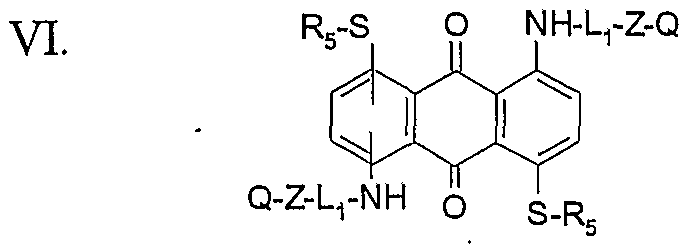
- the anthraquinone dye compounds provided by the present invention are represented by general Formulae I-XXI set forth below.
- Formulae I- VII are blue-cyan colorants
- the dyes having Formulae VIII - XVIII are red-magenta colorants
- the dyes having Formulae XIX - XXI are yellow colorants.
- R is selected from hydrogen or 1-3 groups selected from Ci - C 6 -alkyL Ci - C 6 -alkoxy and halogen;
- Ri is selected from Ci - C ⁇ -alkyl, substituted Ci - C 6 -alkyl, C 3 - C 8 -alkenyl, C 3 - C 8 -cycloalkyl, aryl and -Li-Z-Q;
- R 2 selected from hydrogen, Ci - C 6 -alkyl, substituted Ci - C 6 -alkyl, C 3 - Cg-cycloalkyl and aryl;
- R 3 and R 4 are independently selected from - C 6 -alkyl and bromine;
- R 5 is selected from Ci - C 6 -alkyl, substituted Ci - C 6 alkyl, C 3 - C 8 - cycloalkyl, aryl, heteroaryl, -Li-Z-Q,
- R ⁇ 5 is selected from
- R 7 is selected from hydrogen, substituted or unsubstituted - C ⁇ -alkyl, Ci - C ⁇ -alkoxy, halogen, hydroxy, substituted or unsubstituted - C ⁇ -alkylthio, sulfamoyl and substituted sulfamoyl;
- R 8 is selected from hydrogen and Ci - C 6 -alkyl
- R 9 is selected from the groups represented by Ri and -L - Z - Q;
- Rio is selected from hydrogen and halogen
- X is a covalent bond or a divalent linking group selected from -O-, -S-, -SO 2 -, -CO 2 -, -CON(Y) - and -SO 2 N(Y)-, wherein Y is selected from hydrogen, Ci- C ⁇ -alkyl, substituted C ⁇ -C 6 -alkyl, C 3 -C 8 -cycloalkyl, C 3 -C 8 -alkenyl, aryl and -L-Z- Q;
- Xi is selected from -O-, -S-, -SO 2 - and -SO 2 N(Y)-;
- X 2 is selected from -CO 2 - and -SO 2 N(Yi), wherein Yt is a group selected from hydrogen, Ci-C ⁇ -alkyl, substituted Ci-C ⁇ -alkyl, C 3 -C 8 -alkenyl, C 3 -C 8 -cycloalkyl, aryl heteroaryl and X 3 is selected from -CO 2 -, -SO 2 N(Y)-; j is selected from -CO 2 -, -O- and -SO 2 N(Y ⁇ )-;
- L is a divalent linking group selected from C ⁇ -C 8 -alkylene, d-C ⁇ -alkylene- arylene, arylene, C ⁇ -C 6 -alkylene-arylene -Ci-C 6 -alkylene, C -C 8 -cycloalkylene, CrC6-alkylene-C 3 -C 8 -cycloalkylene -Ci-C ⁇ -alkylene, Ci-C ⁇ -alkylene - Zi-arylene- Zi-Ci-C ⁇ -alkylene and C2-C6-alkylene-[-Z ⁇ -C 2 -C6-alkylene-] n - wherein Zi is selected from -O-, -S- and -SO 2 .andn is 1-3;
- Li is a divalent linking group selected from C 2 -C 6 -alkylene, Ci-C ⁇ -alkylene- C 3 -C 8 -cycloalkylene-C ⁇ -C6-alkylene, d-Cs-alkylene-arylene,
- L 2 is selected from C 2 -C6-alkylene, Ci-C ⁇ -alkylene- arylene-Ci-C ⁇ alkylene and C ⁇ -C6-alkylene-C 3 -C 8 -cycloalkylene-C ⁇ -C6-alkylene;
- Z is a divalent group selected from -O-, -S-, -NH-, -N(Ci-C6-alkyl)-, -N(C 3 -C 8 alkenyl)-, -N(C 3 -C 8 cycloalkyl)-, -N(aryl)-, -N(SO 2 C 1 -C 6 -alkyl) and
- Q is a photopolymerizable optionally substituted maleimide radical, Z represents a covalent bond;
- Q is an ethylenically-unsaturated, photosensitive polymerizable group; and
- the ethylenically-unsaturated, photosensitive copolymerizable groups represented by Q are selected from the following organic radicals:
- R ⁇ is selected from hydrogen and Ci-C 6 -alkyl
- R 12 is selected from hydrogen; Ci-C 6 -alkyl; phenyl and phenyl substituted with one or more groups selected from d-C ⁇ -alkyl, C ⁇ -C 6 -alkoxy, -N(Ci-C 6 -alkyl), nitro, cyano, Ci-C 6 -alkoxycarbonyl, C ⁇ -C 6 -alkanoyloxy and halogen; 1- and 2-naphthyl which may be substituted with d-C ⁇ -alkyl or Ci-C 6 -alkoxy; 2- and 3-thienyl which may be substituted with C ⁇ -C 6 -alkyl or halogen; 2- or 3-furyl which may be substituted with Ci-C ⁇ -alkyl; R ⁇ 3 and R ⁇ 4 are selected from hydrogen, Ci-C ⁇ -alkyl, substituted d-C 6 - alkyl, aryl or may be combined to represent a -[-CH 2 -]3
- R 15 is selected from hydrogen, C ⁇ -C 6 -alkyl, substituted Ci-C ⁇ -alkyl, C 3 -C 8 -alkenyl, C 3 -C 8 -cycloalkyl and aryl;
- R 16 is selected from hydrogen, Ci - C 6 -alkyl and aryl.
- Ci-C ⁇ -alkyl is used herein to denote a straight or branched chain, saturatedaliphatic hydrocarbon radical containing one to six carbon atoms.
- substituted d-C ⁇ -alkyl is used to denote a Ci-C ⁇ -alkyl group substituted with one or more groups, preferably one to three groups, selected from the group consisting of hydroxy, halogen, cyano, aryl, aryloxy, arylthio, d-C 6 alkylthio, C -C 8 -cycloalkyl, Ci-C ⁇ -alkanoyloxy and -[-O-R ⁇ -)-R ⁇ 8 , wherein R ⁇ 7 is selected from the group consisting of C ⁇ -C 6 alkylene, C ⁇ -C 6 -alkylene-arylene, cyclohexylene, arylene, Ci-C ⁇ -alkylene-cyclohexylene and C ⁇ -C 6 -alkylene- cyclohexylene-Ci-C ⁇ -alkylene;
- Ris is selected from the group consisting of hydrogen, hydroxy, carboxy, Ci-C ⁇ -alkanoyloxy, d-C ⁇ -alkoxycarbonyl, aryl and C 3 -C 8 -cycloalkyl; and p is 1, 2, or 3.
- Ci-C ⁇ -alkylene and "C ⁇ -C 8 -alkylene” are used to denote straight or branched chain, divalent, aliphatic hydrocarbon radicals containing one to six and one to eight carbons, respectively, and these radicals substituted with one to three groups selected from Ci-C ⁇ -alkoxy, Ci-C ⁇ -alkoxycarbonyl,
- Ci-C ⁇ -alkanoyloxy, hydroxy, aryl and halogen Ci-C ⁇ -alkanoyloxy, hydroxy, aryl and halogen.
- d-Ce- alkylene is used to denote a straight or branched chain, divalent, hydrocarbon radical which may be unsubstituted or substituted as described in this paragraph for the Ci-Ce-alkylene and d-C 8 -alkylene radicals.
- Ci-Ce-alkoxy "d-Ce-alkoxycarbonyl", “C ⁇ -C 6 -alkanoyloxy” and “C ⁇ -C6-alkanoylamino” are used to denote radicals corresponding to the structures -OR ⁇ 9 , -CO2R19, -OCOR19 andNHCOR ⁇ 9 , respectively, wherein R ⁇ 9 is d-C6-alkyl or substituted C ⁇ -C 6 -alkyl.
- C 3 - Cs-alkenyl is used to denote an aliphatic hydrocarbon radical containing at least one double bond.
- C - C 8 -cycloalkyl is used to denote a saturated, carbocyclic hydrocarbon radical having three to eight carbon which may be unsubstituted or substituted with one to three Ci-C ⁇ -alkyl group(s).
- C 3 - C 8 -cycloalkylene is used to denote a carbocyclic, divalent hydrocarbon radical which contains three to eight carbon atoms, preferably five or six carbons.
- aryl denotes phenyl and phenyl substituted with one to three substituents selected from Ci-C- ⁇ -alkyl, substituted C ⁇ -C-6-alkyl, Ci.C ⁇ -alkoxy, halogen, carboxy, cyano, Ci-C ⁇ -alkanoyloxy, C ⁇ -C 6 -alkylthio, Ci.C 6 .alkylsulfonyl, trifluoromethyl, hydroxy, C ⁇ -C 6 -alkoxycarbonyl, Ci- Ce-alkanoylamino and -O-R 20 , S-R 20) -SO 2 -R 2 o, -NHSO 2 R 2 o and -NHCO 2 R 20 , wherein R 20 is phenyl or phenyl substituted with one to three groups selected from Ci-C- ⁇ -alkyl, substituted C ⁇ -C-6-alkyl, Ci.C ⁇ -alkoxy, halogen, carboxy, cyan
- arylene denotes includes 1,2-, 1,3- and 1 ,4-phenylene and such divalent radicals substituted with one to three groups selected from Ci-Ce-alkyl, d-C 6 -alkoxy and halogen.
- heteroaryl denotes a 5- or 6- membered aromatic ring containing one to three hetero atom selected from oxygen, sulfur and nitrogen.
- heteroaryl groups examples include thienyl, furyl, pyrrolyl, imidazolyl, pyrazolyl, thiazolyl, isothiazolyl, oxazolyl, isoxazolyl, triazolyl, thiadiazolyl, oxadiazolyl, tetrazolyl, pyridyl, pyrimidyl, benzoxazolyl, benothiazolyl, benzimidazolyl, indolyl and the like.
- the heteroaryl radicals may be substituted with one to three groups selected from Ci-C ⁇ -alkyl, d-C ⁇ -alkoxy, substituted
- Ci.C ⁇ -alkyl halogen, Ci-C ⁇ -alkylthio, aryl, arylthio, aryloxy, d-C 6 -alkoxycarbonyl and Ci - C ⁇ -alkanoylamino.
- halogen is used to include fluorine, chlorine, bromine, and iodine.
- sulfamoyl and substituted sulfamoyl denote radicals having the structure -SO2N(R2i)R22, wherein R2 1 and R22 are independently selected from hydrogen, C ⁇ -C 6 -alkyl, substituted Ci-Cg-alkyl, C 3 -C 8 -alkenyl, C 3 -C 8 -cycloalkyl, aryl and heteroaryl.
- the preferred dye compounds of Formulae I, II, III, IV, V, VI, VIII, IX, X, XII, Xi ⁇ , XTV, XVI, XVII, XIX, and XX are those where Z is -O-.
- These dyes are prepared by reacting the corresponding dihydroxy dye [Dye (OH)2] with a reagent to introduce the reactive vinyl functionality.
- the dyes wherein Q corresponds to structure la, Via, Xla, respectively, are prepared by reacting the dihydroxy dyes with the corresponding acid chlorides and/or anhydrides as follows:
- the dyes wherein Z is -O- and Q corresponds to structures Ila, Ilia, and Villa are prepared by reacting the dihydroxy dyes with the corresponding isocyanates:
- the dyes were Z is -O- and where Q corresponds to structure IVa are prepared by reacting the dihydroxy dyes with 2-alkenylazlactones as generally described in Encyclopedia of Polymer Science and Eng., Second Ed., Vol. 11, John Wiley & Sons, pp. 558 - 571:
- the dyes wherein Z is -O- and Q corresponds to structure Va are generally prepared by reacting the dihydroxy dyes with maleic anhydride to give the mono maleate esters:
- the remaining acid groups may be esterified by the usual type esterification reactions such as heating in alcohols in the presence of acid catalysts and reacting the alkali metal salts ofthe acids with alkylating agents such as alkyl halides, alkyl sulfates and alkyl sulfonates, such as methyl 4-toluene sulfonate, to prepare the methyl ester.
- alkylating agents such as alkyl halides, alkyl sulfates and alkyl sulfonates, such as methyl 4-toluene sulfonate
- Fumaric acid and its derivatives also may be used to prepare the dyes where Q is radical Va.
- Itaconic anhydride methylenesuccinic anhydride
- Anthraquinone dyes containing carboxy groups and which are useful in the practice ofthe invention are disclosed in U.S. Patents 4,359,570, 4,403,092, 4,999,418, 5,372,864, 5,955,564, 5,962,557 and WO 98/23690.
- Hydroxy alkyl groups may be introduced into these compounds by alkylation ofthe acids with hydroxyalkyl halides or alkylene carbonates to give the hydroxyalkyl derivatives useful for reacting further as shown herein to introduce reactive Q groups.
- the reaction is easily accomplished in the presence of alkali metal carbonates and trialkyl amines as bases.
- the yellow, red-magenta, blue-cyan dyes of this invention are particularly useful for making combination shades as subtractive colors. They have particular value for copolymerizing into acrylic polymeric materials by free radical polymerization, having one or more advantages over the prior art dyes such as thermal stability, solubility in the acrylate or methacrylate ester comonomer(s) to be used, fastness to UV light, color strength, ease of manufacture and the like.
- the dyes of this invention are particularly useful for providing acrylic polymer color coatings for glass optical fibers where good thermal stability of dyes is required. Examples
- copolymerizable dye compounds provided by the present invention and the preparation thereof are further illustrated by the following examples.
- EXAMPLE 7a A mixture of l,5-bis-(2-carboxyphenylthio) anthraquinone (U.S. Patent
- the functionahzed red dye had an absorption maximum at 526nm in DMF solution in the UV- visible absorption spectrum.
- EXAMPLE 10a A mixture of l,5-bis-(carboxyanilino) anthraquinone (U.S. Patent
- the functionahzed dyes which contain vinyl or substituted vinyl groups are polymerizable or copolymerizable, preferably by free radical mechanisms, said free radicals being generated by exposure to UV light by methods known in the art of preparing UV-cured resins. Polymerization can be facilitated by the addition of photoinitiators.
- the colored acrylic polymeric materials normally are prepared by dissolving the functionahzed dyes containing copolymerizable groups in a polymerizable monomer with or without another solvent and then preparing the resin by typical polymerization methods.
- Typical copolymerizable monomers useful in the present invention include (meth)acrylic acid and their anhydrides, crotonic acid, itaconic acid and its anhydride, cyanoacrylic acid and its esters; esters of (meth)acrylic acid such as allyl, methyl, ethyl, n-propyl, isopropyl, butyl, tetrahydrofurfuryl, cyclohexyl, isobornyl, n-hexyl, n-octyl, isooctyl, 2-ethylhexyl, lauryl, stearyl, benzyl, and di(meth)acrylate esters of ethylene and propylene glycols, 1,3-butylene glycol, 1 ,4-butanediol, diethylene and dipropylene glycols, triethylene and tripropylene glycols, 1,6-hexanediol, neopen
- copolymerizable compositions ofthe present invention optionally may contain organic solvents if desired to facilitate application and coating ofthe compositions onto the surface of substrates.
- suitable solvents include, but are not limited to ketones, alcohols, esters, chlorinated hydrocarbons, glycol ethers, glycol esters, and mixtures thereof.
- Specific examples include, but are not limited to acetone, 2-butanone, 2-pentanone, ethyl acetate, propyl acetate, isopropyl acetate, butyl acetate, isobutyl acetate, ethylene glycol diacetate, ethyl 3-ethoxypropionate, methyl alcohol, ethyl alcohol, propyl alcohol, isopropyl alcohol, butyl alcohol, ethylene glycol, propylene glycol, ethylene glycol monomethyl ether, ethylene glycol monoethyl ether, ethylene glycol monopropyl ether, ethylene glycol monobutyl glycol, diethylene glycol monomethyl ether, diethylene glycol monoethyl ether, diethylene glycol monobutyl ether, propylene glycol monomethyl ether, diethylene glycol monobutyl ether acetate, diethylene glycol monoethyl ether acetate, ethylene glycol monobutyl ether acetate, prop
- Certain monomers may serve as both reactant and solvent. These contain at least one unsaturated group capable of undergoing polymerization upon exposure to UV radiation in the presence of a photoinitiator. Specific examples include, but are not limited to: methacrylic acid, acrylic acid, ethyl(meth)acrylate, methyl(meth)acrylate, hydroxy ethyl(meth)acrylate, diethylene glycol diacrylate, trimethylolpropane triacrylate, 1,6 hexanediol di(meth)acrylate, neopentyl glycol di(meth)acrylate, N- vinyl pyrrolidone, and mixtures thereof.
- compositions ofthe present invention may be dispersed in water rather than dissolved in a solvent to facilitate application and coating ofthe substrate surface.
- a co-solvent is optionally used.
- suitable cosolvents include but are not limited to acetone, 2-butanone, methanol, ethanol, isopropyl alcohol, ethylene glycol monomethyl ether, ethylene glycol monoethyl ether, ethylene glycol monopropyl ether, and ethylene glycol monobutyl ether, ethylene glycol, and propylene glycol.
- Typical examples of water-soluble ethylenically unsaturated solvents include but are not limited to: methacrylic acid, acrylic acid, N- vinyl pyrrolidone, 2-ethoxyethyl (meth) aery late, polyethylene glycol dimethacrylate polypropylene glycol mono(meth)acrylate, and mixtures thereof.
- suitable aqueous organic solvent i.e., organic solvent and water
- the amount of suitable aqueous organic solvent (i.e., organic solvent and water) in the dispersed coating compositions ofthe present invention is 10 to 90 weight percent, preferably 75 to 90 weight percent ofthe total coating composition.
- the coating compositions ofthe present invention optionally contain a photoinitiator.
- the amount of photoinitiator is typically 2 to 7 wt.% based on the weight ofthe non- volatile, ethylenically unsubstituted content ofthe coating composition; preferably 3 to 5 wt. %.
- Typical photoinitiators include benzoin and benzoin ethers such as marketed under the tradenames ESACURE BO, EB1, EB3, and EB4 from Fratelli Lamberti; VICURE 10 and 30 from Stauffer; benzil ketals such as IRGACURE 651 from Ciba Geigy, Uvatone 8302 by Upjohn; alpha, alpha- dialkoxyacetophenone derivatives such as DEAP and UVATONE 8301 from
- Another embodiment ofthe present invention comprises a curable composition as described above, further comprising one or more leveling, rheology, and flow control agents such as silicones, fluorocarbons or cellulosics; flatting agents; pigment wetting and dispersing agents; surfactants; ultraviolet (UV) absorbers; UV light stabilizers; tinting pigments; defoaming and antifoaming agents; anti-settling, anti-sag and bodying agents; anti-skinning agents; anti- flooding and anti-floating agents; fungicides and mildewcides; corrosion inhibitors; thickening agents; or coalescing agents.
- the compositions ofthe present invention also may contain non-reactive modifying resins.
- Typical non-reactive modifying resins include homopolymers and copolymers of (meth) acrylic acid; alkyl esters of (meth)acrylic acid such as methyl, ethyl, n-propyl, isopropyl, butyl, tetrahydro- furfuryl, cyclohexyl, isobornyl, n-hexyl, n-octyl, isooctyl, 2-ethylhexyl, lauryl, stearyl, benzyl; (meth)acrylated urethane, epoxy, and polyester resins, silicone acrylates, cellulose esters such as cellulose acetate butyrates, cellulose acetate, propionates, nitrocellulose, cellulose ethers such as methyl cellulose, ethyl cellulose, hydroxypropyl cellulose, and hydroxypropyl methyl cellulose.
- alkyl esters of (meth)acrylic acid such as
- Typical plasticizers include alkyl esters of phthalic acid such as dimethyl phthalate, diethyl phthalate, dipropyl phthalate, dibutyl phthalate, and dioctyl phthalate; citrate esters such as triethyl citrate and tributyl citrate; triacetin and tripropionin; and glycerol monoesters such as Eastman 18-04, 18-07, 18-92 and 18- 99 from Eastman Chemical Company. Specific examples of additional additives can be found in Raw Materials Index, published by the National Paint & Coatings
- the coatings ofthe compositions ofthe present invention typically have a solvent resistance of at least 100 double rubs using ASTM Procedure D-3732; preferably a solvent resistance of at least 200 double rubs. Such coatings also typically have a pencil hardness of greater than or equal to F using ASTM
- Procedure D-3363 preferably a pencil hardness of greater than or equal to H.
- the coating compositions can be applied to substrates with conventional coating equipment. The coated substrates are then exposed to radiation such as ultraviolet light in air or in nitrogen which gives a cured finish. Mercury vapor or Xenon lamps are applicable for the curing process.
- the coatings ofthe present invention can also be cured by electron beam.
- the radiation-curable compositions of this invention are suitable as adhesives and coatings for such substrates as metals, plastics, glass, wood, and leather.
- Various additional pigments, plasticizers, and stabilizers may be incorporated to obtain certain desired characteristics in the finished products.
- the dried film on the glass plate was exposed to UV radiation from a 200 watt per inch medium pressure mercury vapor lamp housed in an American Ultraviolet Company instrument using a belt speed of 25 ft. per minute.
- One to five passes under the lamp resulted in a crosslinked coating with maximum hardness and solvent resistance.
- Each cured coating (film) may be evaluated for pencil hardness (ASTM D3363), solvent resistance by the methyl ethyl ketone double-rub test, and solubility in acetone before and after exposure to UV radiation.
- the pencil hardness scale is in order of increasing hardness: 5B 4B 3B 2B B HB F H 2H 3H 4H 5H.
- MEK methyl ethyl ketone
- the methyl ethyl ketone (MEK) double rub test is carried out by saturating a piece of cheesecloth with methyl ethyl ketone, and with moderate pressure, rubbing the coating back and forth. The number of double rubs is counted until the coating is removed. This test is in accordance with ASTM Procedure D-3732.
- the acetone solubility test is carried out by immersing a dry, pre-weighed sample ofthe cured film in acetone for 48 hours at 25°C. The film is removed, dried for 16 hours at 60°C in a forced-air oven, and reweighed. The weight percent ofthe insoluble film remaining is calculated from the data.
Landscapes
- Chemical & Material Sciences (AREA)
- Organic Chemistry (AREA)
- Health & Medical Sciences (AREA)
- Chemical Kinetics & Catalysis (AREA)
- Medicinal Chemistry (AREA)
- Polymers & Plastics (AREA)
- Life Sciences & Earth Sciences (AREA)
- Engineering & Computer Science (AREA)
- Materials Engineering (AREA)
- Wood Science & Technology (AREA)
- Addition Polymer Or Copolymer, Post-Treatments, Or Chemical Modifications (AREA)
- Organic Low-Molecular-Weight Compounds And Preparation Thereof (AREA)
Abstract
Description




Claims


Priority Applications (2)
| Application Number | Priority Date | Filing Date | Title |
|---|---|---|---|
| JP2002517694A JP2004506061A (en) | 2000-08-07 | 2001-06-27 | Thermally stable anthraquinone colorant containing copolymerizable vinyl groups |
| EP01950510A EP1307514A2 (en) | 2000-08-07 | 2001-06-27 | Thermally stable, anthraquinone colorants containing copolymerizable vinyl groups |
Applications Claiming Priority (2)
| Application Number | Priority Date | Filing Date | Title |
|---|---|---|---|
| US63354800A | 2000-08-07 | 2000-08-07 | |
| US09/633,548 | 2000-08-07 |
Publications (2)
| Publication Number | Publication Date |
|---|---|
| WO2002012400A2 true WO2002012400A2 (en) | 2002-02-14 |
| WO2002012400A3 WO2002012400A3 (en) | 2002-04-18 |
Family
ID=24540075
Family Applications (1)
| Application Number | Title | Priority Date | Filing Date |
|---|---|---|---|
| PCT/US2001/020347 Ceased WO2002012400A2 (en) | 2000-08-07 | 2001-06-27 | Thermally stable, anthraquinone colorants containing copolymerizable vinyl groups |
Country Status (4)
| Country | Link |
|---|---|
| US (1) | US6689828B2 (en) |
| EP (1) | EP1307514A2 (en) |
| JP (1) | JP2004506061A (en) |
| WO (1) | WO2002012400A2 (en) |
Cited By (3)
| Publication number | Priority date | Publication date | Assignee | Title |
|---|---|---|---|---|
| WO2013026451A1 (en) | 2011-08-24 | 2013-02-28 | Coloplast A/S | Polymers comprising photoinitiator moieties and dye moieties |
| WO2015177062A1 (en) * | 2014-05-21 | 2015-11-26 | Rolic Ag | Polymerizable dichroic dyes |
| JP2023540174A (en) * | 2020-09-10 | 2023-09-22 | クーパーヴィジョン インターナショナル リミテッド | colored contact lenses |
Families Citing this family (3)
| Publication number | Priority date | Publication date | Assignee | Title |
|---|---|---|---|---|
| US7802883B2 (en) * | 2007-12-20 | 2010-09-28 | Johnson & Johnson Vision Care, Inc. | Cosmetic contact lenses having a sparkle effect |
| JP5897906B2 (en) * | 2009-12-17 | 2016-04-06 | 株式会社メニコン | Polymeric anthraquinone dye, ophthalmic lens material and ophthalmic lens using the same |
| JP6614996B2 (en) * | 2016-02-18 | 2019-12-04 | 株式会社トクヤマデンタル | Method for producing polymerizable monomer |
Family Cites Families (27)
| Publication number | Priority date | Publication date | Assignee | Title |
|---|---|---|---|---|
| DE1115926B (en) * | 1960-05-20 | 1961-10-26 | Basf Ag | Process for the production of colored, crosslinked emulsion polymers |
| GB1046751A (en) * | 1963-01-26 | 1966-10-26 | Asahi Chemical Ind | A process for producing coloured polymers from polymerizable dyestuffs, and uses of such dyestuffs |
| US3288778A (en) * | 1964-10-05 | 1966-11-29 | Polaroid Corp | Azo and anthraquinone dye developers |
| US3689501A (en) | 1969-02-27 | 1972-09-05 | Eastman Kodak Co | Anthraquinone compounds containing a triazolylthio group |
| US4115056A (en) | 1975-05-26 | 1978-09-19 | Ciba-Geigy Ag | Methods for dyeing or printing using amino-anthraquinone reactive disperse dyes |
| US4267306A (en) | 1979-02-15 | 1981-05-12 | Eastman Kodak Company | Polyester polymers containing residues of anthroquinone dyes |
| US4359570A (en) | 1980-05-08 | 1982-11-16 | Eastman Kodak Company | Colored polyester containing copolymerized dyes as colorants |
| US4403092A (en) | 1982-11-22 | 1983-09-06 | Eastman Kodak Company | Polyesters containing copolymerized, anthraquinone colorant compounds containing sulfonamido groups |
| DE3631841A1 (en) | 1986-09-19 | 1988-03-24 | Basf Ag | LIQUID CRYSTALINE COPOLYMER |
| MX169697B (en) | 1987-12-28 | 1993-07-19 | Ppg Industries Inc | IMPROVEMENTS TO RADIATION-FRAGABLE COMPOSITIONS BASED ON UNSATURATED POLYESTERS AND COMPOUNDS HAVING AT LEAST TWO GROUPS OF VINYL ETER |
| US4804719A (en) | 1988-02-05 | 1989-02-14 | Eastman Kodak Company | Water-dissipatable polyester and polyester-amides containing copolymerized colorants |
| US5367039A (en) | 1988-07-06 | 1994-11-22 | Nippon Paint Company, Ltd. | Production of colored vinyl polymer particles by polymerizing a vinyl polymerizable monomer with a polymerizable dye |
| US5055602A (en) * | 1989-05-02 | 1991-10-08 | Bausch & Lomb Incorporated | Polymerizable dye |
| US5032670A (en) * | 1989-08-30 | 1991-07-16 | Eastman Kodak Company | Copolymerized anthraquinone-polyester color concentrates |
| US4999418A (en) * | 1989-08-31 | 1991-03-12 | Eastman Kodak Company | Polyesters colored with the residue of heat stable anthraquinone compounds |
| US5109097A (en) | 1990-09-07 | 1992-04-28 | Minnesota Mining And Manufacturing Company | Radiation curable coating |
| US5194463B1 (en) | 1991-09-27 | 1995-06-20 | Eastman Kodak Co | Light-absorbing polyurethane compositions and thermoplastic polymers colored therewith |
| US5578419A (en) | 1991-12-12 | 1996-11-26 | Mitsui Toatsu Chemicals, Incorporated | Dyes for color filters, and photosensitive resist resin composition containing the same |
| US5362812A (en) | 1993-04-23 | 1994-11-08 | Minnesota Mining And Manufacturing Company | Reactive polymeric dyes |
| US5372864A (en) | 1993-09-03 | 1994-12-13 | Eastman Chemical Company | Toners for polyesters |
| GB9411586D0 (en) | 1994-06-09 | 1994-08-03 | Zeneca Ltd | Coating process |
| MX9700051A (en) | 1994-07-05 | 1997-12-31 | Ppg Ind Ohio Inc | Polyester and vinyl ether radiation curable compositions with reactive diluent. |
| US5900445A (en) | 1994-12-20 | 1999-05-04 | Bic Corporation | Erasable ink composition containing a polymer dye obtained from ethylenic monomers and marking instrument containing same |
| SE506958C2 (en) | 1996-06-20 | 1998-03-09 | Mcwhorter Technologies Ab | Photopolymerizable polyester composition and varnish or paint formulation |
| US5962557A (en) | 1996-09-30 | 1999-10-05 | Eastman Chemical Corporation | Polyesters containing copolymerized substituted 1,4-bis(2,6-dialkylanilino)-9, 10-anthraquinones as colorants |
| US5955564A (en) * | 1996-11-27 | 1999-09-21 | Eastman Chemical Company | 1,5(8)-bis (substituted-N-propylamino)-4,8(5)-bis(arylthio)anthraquinone compounds |
| CN1245516A (en) | 1996-11-27 | 2000-02-23 | 伊斯曼化学公司 | Process for preparing light-absorbing polymer compositions |
-
2001
- 2001-06-27 EP EP01950510A patent/EP1307514A2/en not_active Withdrawn
- 2001-06-27 JP JP2002517694A patent/JP2004506061A/en active Pending
- 2001-06-27 WO PCT/US2001/020347 patent/WO2002012400A2/en not_active Ceased
- 2001-07-24 US US09/911,789 patent/US6689828B2/en not_active Expired - Fee Related
Cited By (5)
| Publication number | Priority date | Publication date | Assignee | Title |
|---|---|---|---|---|
| WO2013026451A1 (en) | 2011-08-24 | 2013-02-28 | Coloplast A/S | Polymers comprising photoinitiator moieties and dye moieties |
| WO2015177062A1 (en) * | 2014-05-21 | 2015-11-26 | Rolic Ag | Polymerizable dichroic dyes |
| US10385215B2 (en) | 2014-05-21 | 2019-08-20 | Rolic Ag | Polymerizable dichroic dyes |
| JP2023540174A (en) * | 2020-09-10 | 2023-09-22 | クーパーヴィジョン インターナショナル リミテッド | colored contact lenses |
| JP7515004B2 (en) | 2020-09-10 | 2024-07-11 | クーパーヴィジョン インターナショナル リミテッド | Colored contact lenses |
Also Published As
| Publication number | Publication date |
|---|---|
| WO2002012400A3 (en) | 2002-04-18 |
| US6689828B2 (en) | 2004-02-10 |
| EP1307514A2 (en) | 2003-05-07 |
| JP2004506061A (en) | 2004-02-26 |
| US20020068725A1 (en) | 2002-06-06 |
Similar Documents
| Publication | Publication Date | Title |
|---|---|---|
| EP1307515B1 (en) | Colorant compounds containing copolymerizable vinyl groups | |
| EP1307517B1 (en) | Thermally stable, anthraquinone colorants containing copolymerizable vinyl groups | |
| EP1307516B1 (en) | Colorants containing copolymerizable vinyl groups and sulfonamide linkages | |
| US7172634B2 (en) | Ethylenically-unsaturated blue anthraquinone dyes | |
| EP1310527B1 (en) | Anthraquinone colorants containing copolymerizable vinyl groups | |
| EP1307514A2 (en) | Thermally stable, anthraquinone colorants containing copolymerizable vinyl groups | |
| US7105688B2 (en) | Ethylenically-unsaturated red anthraquinone dyes | |
| US20070207331A1 (en) | Azo compounds and coating compositions containing the azo compounds | |
| US20070032598A1 (en) | Thermally stable, anthraquinone colorants containing copolymerizable vinyl groups | |
| US20060147737A1 (en) | Reactive colorant compounds and polymeric materials copolymerized therewith |
Legal Events
| Date | Code | Title | Description |
|---|---|---|---|
| AK | Designated states |
Kind code of ref document: A2 Designated state(s): CA JP MX |
|
| AL | Designated countries for regional patents |
Kind code of ref document: A2 Designated state(s): AT BE CH CY DE DK ES FI FR GB GR IE IT LU MC NL PT SE TR |
|
| 121 | Ep: the epo has been informed by wipo that ep was designated in this application | ||
| AK | Designated states |
Kind code of ref document: A3 Designated state(s): CA JP MX |
|
| AL | Designated countries for regional patents |
Kind code of ref document: A3 Designated state(s): AT BE CH CY DE DK ES FI FR GB GR IE IT LU MC NL PT SE TR |
|
| DFPE | Request for preliminary examination filed prior to expiration of 19th month from priority date (pct application filed before 20040101) | ||
| WWE | Wipo information: entry into national phase |
Ref document number: 2001950510 Country of ref document: EP |
|
| WWP | Wipo information: published in national office |
Ref document number: 2001950510 Country of ref document: EP |
|
| WWW | Wipo information: withdrawn in national office |
Ref document number: 2001950510 Country of ref document: EP |