WO2002016306A2 - Degradable, amorphous, fluoroacrylate polymers - Google Patents
Degradable, amorphous, fluoroacrylate polymers Download PDFInfo
- Publication number
- WO2002016306A2 WO2002016306A2 PCT/US2001/025626 US0125626W WO0216306A2 WO 2002016306 A2 WO2002016306 A2 WO 2002016306A2 US 0125626 W US0125626 W US 0125626W WO 0216306 A2 WO0216306 A2 WO 0216306A2
- Authority
- WO
- WIPO (PCT)
- Prior art keywords
- compound
- polymer
- substrate
- acrylate
- composition
- Prior art date
- Legal status (The legal status is an assumption and is not a legal conclusion. Google has not performed a legal analysis and makes no representation as to the accuracy of the status listed.)
- Ceased
Links
Classifications
-
- C—CHEMISTRY; METALLURGY
- C09—DYES; PAINTS; POLISHES; NATURAL RESINS; ADHESIVES; COMPOSITIONS NOT OTHERWISE PROVIDED FOR; APPLICATIONS OF MATERIALS NOT OTHERWISE PROVIDED FOR
- C09D—COATING COMPOSITIONS, e.g. PAINTS, VARNISHES OR LACQUERS; FILLING PASTES; CHEMICAL PAINT OR INK REMOVERS; INKS; CORRECTING FLUIDS; WOODSTAINS; PASTES OR SOLIDS FOR COLOURING OR PRINTING; USE OF MATERIALS THEREFOR
- C09D133/00—Coating compositions based on homopolymers or copolymers of compounds having one or more unsaturated aliphatic radicals, each having only one carbon-to-carbon double bond, and at least one being terminated by only one carboxyl radical, or of salts, anhydrides, esters, amides, imides, or nitriles thereof; Coating compositions based on derivatives of such polymers
- C09D133/04—Homopolymers or copolymers of esters
- C09D133/14—Homopolymers or copolymers of esters of esters containing halogen, nitrogen, sulfur or oxygen atoms in addition to the carboxy oxygen
- C09D133/16—Homopolymers or copolymers of esters containing halogen atoms
-
- C—CHEMISTRY; METALLURGY
- C07—ORGANIC CHEMISTRY
- C07C—ACYCLIC OR CARBOCYCLIC COMPOUNDS
- C07C69/00—Esters of carboxylic acids; Esters of carbonic or haloformic acids
- C07C69/62—Halogen-containing esters
- C07C69/63—Halogen-containing esters of saturated acids
-
- C—CHEMISTRY; METALLURGY
- C08—ORGANIC MACROMOLECULAR COMPOUNDS; THEIR PREPARATION OR CHEMICAL WORKING-UP; COMPOSITIONS BASED THEREON
- C08F—MACROMOLECULAR COMPOUNDS OBTAINED BY REACTIONS ONLY INVOLVING CARBON-TO-CARBON UNSATURATED BONDS
- C08F120/00—Homopolymers of compounds having one or more unsaturated aliphatic radicals, each having only one carbon-to-carbon double bond, and only one being terminated by only one carboxyl radical or a salt, anhydride, ester, amide, imide or nitrile thereof
- C08F120/02—Monocarboxylic acids having less than ten carbon atoms; Derivatives thereof
- C08F120/10—Esters
- C08F120/22—Esters containing halogen
- C08F120/24—Esters containing halogen containing perhaloalkyl radicals
-
- C—CHEMISTRY; METALLURGY
- C08—ORGANIC MACROMOLECULAR COMPOUNDS; THEIR PREPARATION OR CHEMICAL WORKING-UP; COMPOSITIONS BASED THEREON
- C08F—MACROMOLECULAR COMPOUNDS OBTAINED BY REACTIONS ONLY INVOLVING CARBON-TO-CARBON UNSATURATED BONDS
- C08F20/00—Homopolymers and copolymers of compounds having one or more unsaturated aliphatic radicals, each having only one carbon-to-carbon double bond, and only one being terminated by only one carboxyl radical or a salt, anhydride, ester, amide, imide or nitrile thereof
- C08F20/02—Monocarboxylic acids having less than ten carbon atoms, Derivatives thereof
- C08F20/10—Esters
- C08F20/22—Esters containing halogen
- C08F20/24—Esters containing halogen containing perhaloalkyl radicals
Definitions
- the present invention relates to a novel class of degradable, amorphous fluorochemical acrylate monomers, oligomers, and/or polymers containing pendant branched fluoroalkyl groups that may exhibit low surface energy and improved environmental compatibility.
- fluorochemical repellents In the art of repellent treatments for substrates, fluorochemicals have found extensive use for nearly half a century as low surface energy materials for imparting repellency to a variety of substrates. For an overview of fluorochemical repellents, see Mason Hayek, Waterproofing and Water/Oil Repellency, 24 Kirk-Othmer Encyclopedia Of Chemical Technology 448-455, 460-462, 3rd ed. (1979).
- fibrous substrates e.g., carpets, fabrics, leather, nonwovens and paper
- fluorochemical repellents to render them repellent to water and oil-based stains and resistant to dry soil
- fibrous substrates resist the discoloration that results from normal staining and soiling and thus retain their original aesthetic appeal.
- fluorochemical repellents are known and described in the art. Among them are the fluorochemical acrylate polymers disclosed in U.S. Pat. No. 3,341,497 (Sherman et al.) and U.S. Pat. No.
- fluorochemical polymers In addition to being useful as repellents, fluorochemical polymers have found use as low refractive index coatings for glass optical fibers to help retain the light in the fiber.
- U.S. Pat No. 5,223,593 (McAllister et al.) describes optical fiber coatings made from homopolymers of 1,1-dihydroperfluorocyclohexylmethyl methacrylate.
- fluorochemicals containing long chain perfluoroalkyl moieties i.e., C 6 F 13 - to C ⁇ 2 F 25 -
- moieties impart very low surface energy to the substrate surface and thus provide the treated substrate with excellent water and oil repellency.
- fluorochemical repellents containing primarily straight-chain perfluorooctyl (C 8 F 17 -) moieties are particularly preferred.
- repellents such as water containing perfluorooctyl moieties
- This liquid crystalline-like structure is normally formed by heating the substrate treated with a polymer containing perfluorooctyl moieties, to an elevated temperature, e.g., from about 100°C to about 150°C, to properly orient the perfluoroalkyl chains.
- perfluorooctyl group-containing polymers can ultimately degrade to form functional perfluorooctyl-containing compounds.
- this invention relates to compounds comprising at least one acrylate monomer, said monomer comprising at least one pendant group of the structure -O- CH(Rf)(Rf'), wherein R f is a straight chain or branched perfluoroalkyl group with five or less carbon atoms, and R f ' is a branched perfluoroalkyl group with three to five carbon atoms.
- this invention relates to a method of treating a substrate to render it oil-and/or water-repellent comprising treating the substrate with a composition comprising a compound that comprises at least one acrylate monomer, said monomer comprising at least one pendant group of the structure -O-CH(R f )(R f '), wherein R f is a straight chain or branched perfluoroalkyl group with five or less carbon atoms, and R ' is a branched perfluoroalkyl group with three to five carbon atoms.
- this invention relates to a method of reducing the surface tension of a liquid comprising adding to the liquid a compound comprising at least one acrylate monomer, said monomer comprising at least one pendant group of the structure -O-CH(R f )(R f ), wherein R f is a straight chain or branched perfluoroalkyl group with five or less carbon atoms, and R is a branched perfluoroalkyl group with three to five carbon atoms.
- this invention relates to an article comprising a substrate treated with a composition comprising a compound comprising at least one acrylate monomer, said monomer comprising at least one pendant group of the structure -O- CH(R f )(R f '), wherein R is a straight chain or branched perfluoroalkyl group with five or less carbon atoms, and R f is a branched perfluoroalkyl group with three to five carbon atoms.
- the compounds of this invention containing pendant -O-CH(Rf)(Rf') groups offer two additional advantages.
- the expected ultimate degradation products of compounds of this invention will generally have minimal adverse environmental effects because these degradation products have a low molecular weight. Oxidation and/or hydrolysis of the compounds will release the fluorinated alcohol or ketone.
- ketones have at least 5 carbon atoms and have recently been shown to exhibit low toxicity, in contrast to lower carbon atom-containing perfluoroketones such as CF 3 C(O)CF 3 , which can be very toxic.
- some perfluorinated ketones of the formula RfC(O)Rf' and their corresponding alcohols are known to be cleaved by strong bases to form RfCOOH plus Rf ⁇ , suggesting that their environmental lifetimes will be short compared with linear Rf protective groups. This ketone degradation is especially facile when R f 1 is (CF 3 ) 2 CF-.
- the compounds of this invention do not require curing at elevated temperatures in order to develop their repellent properties and thus can be cured at ambient conditions.
- known polymers containing the core crystalline pendant straight-chain perfluoroalkyl groups e.g., C 8 F ⁇ - or C V
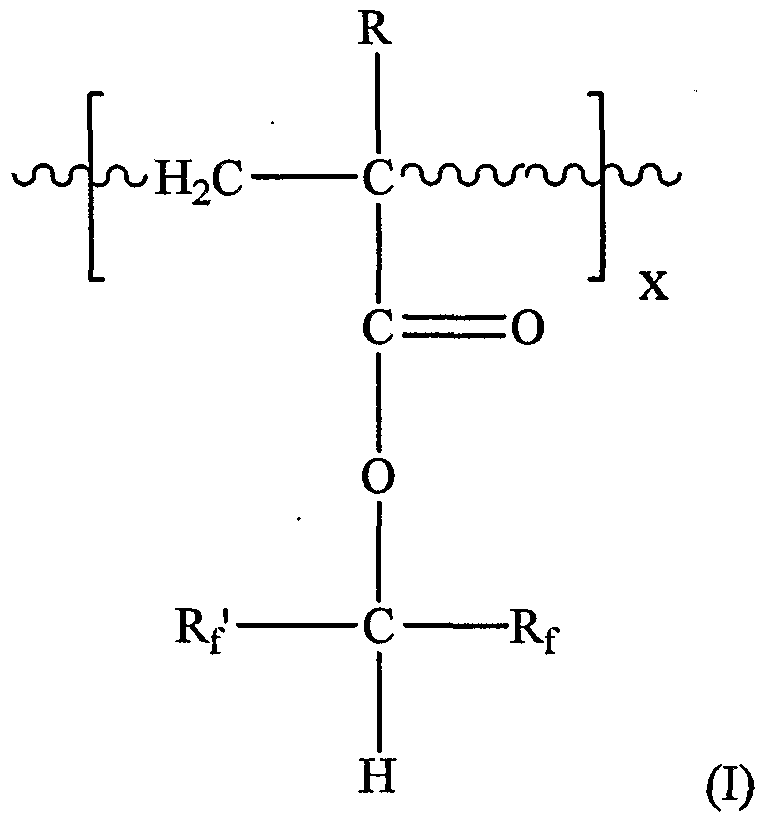
- This invention relates to novel amorphous, degradable fluorochemical compounds comprising at least one acrylate monomer comprising polymerizable or a polymer chain of units of the monomer, said compound having at least one pendant group of the structure - O-CH(R f )(R f ), wherein R f is a straight chain or branched perfluoroalkyl group with five or less carbon atoms, and R f ' is a branched perfluoroalkyl group with three to five carbon atoms.
- ⁇ - T U represents a bond in a polymerizable or a polymer chain
- Rf is a straight chain or branched perfluoroalkyl group with five or less carbon atoms
- R f is a branched perfluoroalkyl group with three to five carbon atoms; R is hydrogen, methyl, fluoro or chloro; and x is at least 1.
- Preferred monomer compounds are depicted in Formula II:
- R is hydrogen, methyl, fluoro or chloro
- R f is a straight chain or branched perfluoroalkyl group with five or less carbon atoms
- R f is a branched perfluoroalkyl group with three to five carbon atoms.
- Fluorochemical acrylate polymers of this invention contain within the polymer backbone (co)polymerized units having the formula depicted in Formula III:
- R is hydrogen, methyl, fluoro or chloro; and R f is a straight chain or branched perfluoroalkyl group with five or less carbon atoms;
- Rf' is a branched perfluoroalkyl group with three to five carbon atoms; and x is at least 2.
- the fluorochemical acrylate polymer can be considered an oligomer (i.e., a very low molecular weight polymer). Such oligomers are useful as surfactants for coating compositions containing high surface energy organic materials.
- the fluorochemical acrylate polymer is useful as a repellent treatment for fibrous or hard surface substrates and is useful as an optical fiber coating.
- R is preferably CF 3 -, CF 3 CF 2 -, CF 3 CF 2 CF 2 -, (CF 3 ) 2 CF- or (CF 3 ) 2 CFCF 2 - and R f ' is either -CF(CF 3 ) 2 or - CF 2 CF(CF 3 ) 2 . More preferably, R f is CF 3 CF 2 - or CF 3 CF 2 CF 2 - and R f ' is -CF(CF 3 ) 2 .
- Examples of useful -O-CH(R f )(R f ') groups include but are not limited to -O- CH(CF 3 )(CF(CF 3 ) 2 ), -O-CH(CF 2 CF 3 )(CF(CF 3 ) 2 ), -O-CH(CF 2 CF 2 CF 3 )(CF(CF 3 ) 2 ), -O- CH(CF(CF 3 ) 2 ) 2 and -O-CH(CF 2 CF(CF 3 ) 2 ) 2 .
- a halogen atom e.g., CI or F
- the alcohol can be prepared for example by reduction with sodium borohydride of the corresponding perfluoroketone of the formula R f -C(O)-R f '; see Fokin, AN., et al.; Bull. Acad. Sci. USSR; E ⁇ ; 27; 8; 1692-1695 (1978); and Saloutina, L.N. et al; J. Org. Chem. USSR; E ⁇ ; 18; 685-689 (1982).
- novel fluorochemical acrylate polymers of this invention can be made for example by homopolymerizing or copolymerizing the monomer of Formula II, employing free-radical polymerization techniques well known to one skilled in the art.
- Useful free- radical initiators include but are not limited to: a persulfate; an azo compound such as azoisobutyronitrile or azo-2-cyanovaleric acid; a hydroperoxide such as cumene, t-butyl, or t-amyl hydroperoxide; a dialkyl peroxide such as di-t-butyl and dicumyl peroxide; a peroxyester such as t-butyl perbenzoate or di-t-butylperoxy phthalate; a diacylperoxide such as benzoyl peroxide; lauroyl peroxide; and the like.
- the initiating radical formed by the initiator can be incorporated into the fluorochemical acrylate polymer to varying degrees depending on the type and amount of initiator used.
- a suitable amount of initiator depends on the particular initiator and other reactants being used.
- About 0.1 percent to about 5 percent by weight of an initiator can be used, based on the total weight of the monomers in the reaction, depending upon the desired molecular weight of the fluorochemical acrylate polymer to be made.
- a mono-, di-, or polythiol chain transfer agent can be employed, such as for example ethanethiol, propanethiol, butanethiol, hexanethiol, n-octylthiol, t-dodecylthiol, 2-mercaptoethyl ether, 2- mercaptoimidazole, 2-mercaptoethylsulfide, 2-mercaptoimidazole, 8-mercaptomenthone, 2,5-dimercapto-l,3,4-thiadiazole, 3,4-toluenedithiol, o-, m-, and p-thiocresol, ethylcyclohexanedithiol, p-menthane-2,9rdithiol, 1,2-ethanedithiol, 3-mercapto-l,2- propanediol, 2-mercaptopyrimidine,
- the chain transfer agent is generally used in an amount of about 0.025 to about 0.2 equivalents, per equivalent of combined olefinic monomers.
- oligomers i.e., where x in formula I is from 2 to 10.
- higher levels of chain transfer agent can be employed.
- the repellent fluorochemical acrylate polymers of this invention are amorphous materials typically having glass transition temperatures ranging from about 0 °C to about 60 °C.
- a fluorine-free comonomer preferably a comonomer that is non-gaseous under ambient conditions
- fluorine-free comonomer preferably a comonomer that is non-gaseous under ambient conditions
- higher amounts of fluorine-free comonomer i.e., up to about 80% by weight
- fluorine-free comonomer i.e., up to about 80% by weight
- Useful fluorine-free comonomers include alkyl acrylate esters, vinyl acetate, vinylidene chloride, styrene, alkyl vinyl ethers, alkyl methacrylate esters, acrylic acid, methacrylic acid, acrylamide, methacrylamide, acrylonitrile, methacrylonitrile, and N-vinylpyrrolidone.
- Alkyl acrylate esters are preferred fluorine-free comonomers and include straight-chain, cyclic, and branched-chain isomers of alkyl esters containing d - C 50 alkyl groups.
- alkyl acrylate esters include methyl acrylate, ethyl acrylate, n-propyl acrylate, 2-butyl acrylate, iso-amyl acrylate, n-hexyl acrylate, heptyl acrylate, n-octyl acrylate, iso-octyl acrylate, 2-ethylhexyl acrylate, nonyl acrylate, decyl acrylate, undecyl acrylate, dodecyl acrylate, tridecyl acrylate, and tetradecyl acrylate.
- the free-radical polymerization is carried out in solvent at any suitable concentration, e.g., from about 5 percent to about 90 percent by weight based on the total weight of the reaction mixture.
- suitable solvents include aliphatic and alicyclic hydrocarbons (e.g., hexane, heptane, cyclohexane), aromatic solvents (e.g., benzene, toluene, xylene), ethers (e.g., diethylether, glyme, diglyme, diisopropyl ether), esters (e.g., ethyl acetate, butyl acetate), alcohols (e.g., ethanol, isopropyl alcohol), ketones (e.g., acetone, methyl ethyl ketone, methyl isobutyl ketone), sulfoxides (e.g., dimethyl sulfoxide), amides (e.g.,
- the solvent is a low water-solubility solvent such as an ester (e.g., ethyl acetate or butyl acetate), a ketone (e.g., methyl ethyl ketone or methyl isobutyl ketone), or an ether (e.g., diisopropyl ketone).
- ester e.g., ethyl acetate or butyl acetate
- a ketone e.g., methyl ethyl ketone or methyl isobutyl ketone
- an ether e.g., diisopropyl ketone
- the polymerization to form the desired polymer can be carried out at any temperature suitable for conducting an organic free-radical reaction.
- Particular temperature and solvents for use can be easily selected by those skilled in the art based on considerations such as the solubility of reagents, the temperature required for the use of a particular initiator, and the like
- compounds of the invention can be most conveniently used as an aqueous composition, in particular an aqueous dispersion in water.
- the polymer or oligomer can subsequently be dispersed in water by vigorously mixing the solution polymer or oligomer with water containing cationic, anionic, amphoteric and/or nonionic surfactants and, if appropriate, other auxiliaries and solvents, employing ultrasonic treatment or treatment in a high pressure homogenizer to provide the energy to form a stable dispersion.
- a solvent-free dispersion of the compound can then be obtained by subsequent removal via distillation of the polymerization solvent.
- the aqueous dispersion as a concentrate contains 5 to 50% by weight of polymer or oligomer, 0.5 to 15% by weight of one- or more dispersing and/or emulsifying agents, and 0 to 30% by weight of a solvent or solvent mixture, the remainder being water.
- the aqueous fluorochemical acrylate polymer or oligomer dispersion may be produced by emulsion polymerization of the fluorochemical acrylate monomer in water in the presence of a cationic, anionic, amphoteric and/or nonionic surfactant, using a water-soluble free- radical initiator such as ammonium persulfate to initiate the polymerization.
- Aqueous solutions or dispersions of the fluorochemical acrylate polymers may be topically applied onto any substrate, including fibrous substrates and hard surface substrates to render that substrate resistant to soiling and repellent to water- and oil-based stains.
- Any topical method of application that produces a uniform thin coating of the polymer on the substrate surface may be employed, such as immersion, flooding, spraying, padding or painting.
- the polymer treatment may be dried onto the substrate either under ambient conditions or at elevated temperatures to produce a long-lasting altered surface that does not change the appearance of the substrate.
- the penetration of the polymer treatment into the porous substrate surface generally prevents significant adsorption of staining fluids into the substrate (i.e., the fluids will not soak in), even after extensive outdoor exposure, since the coating below the surface is not degraded.
- Useful fibrous substrates which may be protected when topically treated with polymers of this invention, include natural textiles and fabrics such as cotton or wool and synthetic fabrics or textiles such as polyester or nylon, as well as paper and leather(e.g., textiles, carpets, leather, nonwovens, paper).
- Topical treatment application to fibrous substrates can be accomplished via immersion, spray, foam, kiss roll and metering.
- the substrate can be immersed in a dispersion or solution of the fluorochemical acrylate polymer and agitated until it is saturated.
- the saturated fibrous substrate can then be run through a padder/roller to remove excess dispersion, dried in an oven at a relatively low temperature (e.g., at 70 °C) for a time sufficient to remove the dispersion medium (e.g. solvents such as those used in the polymerization reaction), and cured at a temperature and for a time sufficient to provide a cured treated substrate.
- a relatively low temperature e.g., at 70 °C
- the dispersion medium e.g. solvents such as those used in the polymerization reaction
- This curing process can be carried out at temperatures between ambient temperature and about 150°C depending on the particular composition used. In general, a temperature of about 40 to 150 °C for a period of about 10 minutes is suitable.
- the cured treated fibrous substrate can be cooled to room temperature and used as desired, e.g., incorporated or fashioned into apparel or upholstery.
- Hard surface substrates which may be protected when topically treated with the fluorochemical acrylate polymers of this invention include porous hard surfaces such as masonry (i.e., human-made hard porous materials such as concrete, brick, tile, grout) and stone (i.e., naturally occurring porous materials), substrates used extensively in the construction of buildings, roads, parking ramps, driveways, garage flooring, fireplaces, fireplace hearths, and counter tops.
- masonry and stone surfaces quickly discolor from exposure to water- and oil-based stains and gradually deteriorate from spalling and efflorescence induced by water penetration and weather exposure.
- optical fibers comprise a light carrying core, for example an inorganic glass such as fused silica or a polymer such as polymethyl methacrylate, and a cladding material having a lower refractive index than the core.
- the cladding material serves to confine the light energy within the core and thereby allows propagation of light by a phenomenon generally known as "total internal reflection.”
- Fiber-guided modulated light beams are useful in many applications, for example, telecommunications, computer linkups, and automotive controls.
- fiber optic linkages have a greater information carrying capacity as compared to metal wires carrying electrical signals. Furthermore, fiber optics are less likely to suffer from external interference, such as electromagnetic radiation.
- the fluorochemical acrylate polymers of this invention can also be employed to apply a coating to an electrical device.
- coating applications include anti-stiction coatings for computer hard drives, barrier coatings to protect sensitive substrates such as circuit boards, and antimigration coatings to prevent the migration of lubricants.
- Copolymers of the fluorochemical acrylate monomer with for example a small amount of (meth)acrylic acid i.e., less than 10% by weight, preferably less than 5% by weight
- polar substrates such as the metal circuits etched on circuit boards or the metallic surfaces of computer hard drives or optical pellicle frames.
- the amount of the fluorochemical compound applied to a substrate in accordance with this invention is chosen so that desirably high surface modification (e.g., water and/or oil repellency, refractive index reduction) is imparted to the substrate surface, said amount usually being such that 0.01% to 5% by weight, preferably 0.05 to 2% by weight, of fluorine is present on the treated substrate.
- desirably high surface modification e.g., water and/or oil repellency, refractive index reduction
- the amount, which is sufficient to impart desired repellency or refractive index reduction can be determined empirically and can be increased as necessary or desired.
- the fluorochemical acrylate polymers of this invention are also useful as surfactants for lowering the surface tension of liquids and thus can be employed to improve the wetting properties of coating compositions containing high surface energy organic materials.
- Such "difficult-to-wet-with" materials include thermoset resins (e.g., high solids formulations containing epoxy resins, acrylic resins, aminoplasts and/or polyols) and thermoplastic resins (e.g., plasticized polyvinyl chloride dispersions).
- Particularly useful as surfactants are copolymers of the fluorochemical acrylate monomers of this invention with polyoxyalkylene acrylate esters, such as the acrylate esters of PLURONICTM propylene oxide/ethylene oxide copolymers (copolymers available from BASF Corp., Mount Olive, NJ) or the acrylate esters of CARBOWAXTM polyethylene glycols (glycols available from Union Carbide Corp., South Charleston, WN).
- An effective use level for the surfactants is at least 0.1%, preferably at least 0.2%, and more preferably at least 0.5% by weight of the high surface energy organic material.
- Glass Transition Temperature (Tg) For each glass transition temperature determination, the sample used consisted of polymer solids obtained by removing the solvent from the polymer solution by drying the solution in a forced air oven at 100 °C for at least 30 minutes.
- the glass transition temperature (Tg) of each sample was determined by Differential Scanning Calorimetry using a Perkin-Elmer 7-Series Thermal Analysis System (Perkin-Elmer Corp., Norwalk, Conn.) with a general temperature range of -50 to 200 °C. Tg values were determined according to ASTM protocol E1356-91 except a 20 °C/minute ramp was used.
- the temperature range was expanded as needed. Measurements were made after two heat and cool cycles. The Tg was recorded as a midpoint determination of the point at which the derivative of the interpolated slope of the transition equaled zero.
- Advancing and Receding Contact Angle Test provides a quick and precise prediction of the surface properties of a coating material . Advancing and Receding contact angle values measured with water and w-hexadecane using this test have correlated well with fluid repellency values measured on fabrics and carpets.
- a solution, emulsion, or suspension (typically at about 3% solids) is applied to a polymer film (nylon or polyester) by dip-coating.
- the polymer film is prepared as follows. Polymer film is cut into 85 mm x 13 mm rectangular strips. Each strip is cleaned by dipping into methyl alcohol, wiping with a KfMWIPETM wiper (commercially available from Kimberly-Clark Corp., Neenah, WI), taking care not to touch the strip's surface, and allowing the strip to dry for 15 minutes. Then, using a small binder clip to hold one end of the strip, the strip is immersed in the treating solution, and the strip is withdrawn slowly and smoothly from the solution.
- KfMWIPETM wiper commercially available from Kimberly-Clark Corp., Neenah, WI
- the coated film strip is tilted to allow any solution run-off to accumulate at the corner of the strip, and aKIMWIPETM wiper is touched to the corner to pull away the solution buildup.
- the coated film strip is allowed to air dry in a protected location for a minimum of 30 minutes and then cured for 10 minutes at 121 °C unless otherwise indicated.
- the advancing and receding contact angles are measured using a CAHN Dynamic Contact Angle Analyzer, Model DC A 322 (a Wilhelmy balance apparatus equipped with a computer for control and data processing, commercially available from ATI, Madison, WI).
- the CAHN Dynamic Contact Angle Analyzer is calibrated using a 500 mg weight. An alligator clip is fastened to a piece of coated film strip about 30 mm long, and the clip and film piece are hung from the stirrup of the balance.
- a 30 mL glass beaker containing approximately 25 mL of water or «-hexadecane is placed under the balance stirrup, and the beaker is positioned so that the coated film strip is centered over the beaker and its contents but not touching the walls of the beaker.
- the platform supporting the beaker is carefully raised until the surface of water or «-hexadecane is 2-3 mm from the lower edge of the film strip.
- the door to the apparatus is closed, the "Configure” option is chosen from the "Initialize” menu of the computer, the "Automatic” option is chosen from the "Experiment” menu, and the computer program then calculates the time for a scan.
- the apparatus then raises and lowers the liquid so that the scan is taken (the advancing angle is measured as the liquid moves up and over the surface, while the receding angle is determined as the liquid moves down and away from the surface of the plastic film).
- the "Least Squares" option is then selected from the "Analysis” menu, and the average receding contact angle is calculated from the scan of the film sample.
- Three separate films are prepared for each material to be tested as previously described.
- the 95% confidence interval for the average of the 3 scans is typically about 1.2°. This procedure is repeated for water and n- hexadecane.
- Perfluoro(methyl isopropyl ketone) 64 g, 0.24 mol, can be prepared as described in Example 5 of World Published Application WO 01/05468) was reduced to the corresponding alcohol with NaBFL, (10.9 g, 0.29 mol, available from Sigma-Aldrich
- Fluorine NMR analysis showed the following peaks: -74.3 (3F), -75.5(3F), -182.7(1F), - 72.4(3F).
- Proton NMR analysis showed the following peaks: 6.15 (1H), and 3 olefinic hydrogens at 6.6, 6.2, and 6.1 ppm.
- the purified acrylate ester (5.5 g, 0.017 mol) and NAZOTM 64 initiator (28 mg ) was then dissolved in 30 g of ethyl acetate in a 4 oz (110 g) polymerization bottle.
- the solution was purged for 90 seconds using ⁇ 2 at 1 L/min, then polymerization was affected by heating the solution for 26 hours by rotating the bottle in a heated water bath. After the polymerization, the solvent was removed by rotary evaporation. The resulting yellow oil was twice dissolved in acetone and precipitated from solution with chloroform. The resulting solid was collected by filtration and dried.
- the structure of the homopolymer was verified by proton and fluorine NMR. Tg was 53.9 °C with onset at 27.7 °C.
- the solid collected by filtration was dissolved at 3% solids in C4F9OCH3 (available as HFE-7100 Engineering Fluid from 3M Company, St. Paul, MN).
- EtOAc ethyl acetate
- the resulting solution was purged for 35 seconds using N 2 at 1 L/min, then heated for 22 hours by rotating the bottle in a heated water bath set at 60 °C.
- C 3 F 7 C(O)CF(CF 3 ) 2 (can be prepared as described in Example 3 of World Published Application WO 01/05468), using the borohydride reduction procedure described in the preparation of Polymer 2.
- the resulting alcohol was converted to the corresponding acrylate ester monomer by esterification with acryloyl chloride, also described in the preparation of Polymer 2 (b.p. 38-60 °C at 15 torr).
- a homopolymer acrylate was then prepared by homopolymerizing 10.0 g acrylate ester monomer in 30 g EtOAc using 76 mg NAZOTM 64 initiator. The resulting precipitated homopolymer had a Tg of 11 °C. The homopolymer was dissolved at 3% solids in C4F9OCH3.
- Perfluoro(diisopropyl ketone) (96.5 g, 0.26 mol, can be prepared as described in Example 5 of World Published Application WO 01/05468) was reduced to the corresponding alcohol, [(CF 3 ) 2 CF] 2 CHOH, by reacting the ketone with ⁇ aBIL (11 g, 0.29 mol) in 250 mL of anhydrous diglyme (anhydrous diethylene glycol dimethyl ether, available from Sigma-Aldrich Chemical Co.) at approximately 0 °C. The reaction mixture was quenched with cold 10% aqueous HCI (250 mL).
- the fluorochemical acrylate homopolymer was then prepared by polymerizing 5.0 g fluorochemical acrylate monomer using 0.05 g NAZOTM 64 initiator in 50 mL ethyl acetate. The homopolymer was precipitated from the ethyl acetate solution, filtered, washed with fresh ethyl acetate, and dried. The dried polymer was dissolved at 3% solids in C 4 F9OCH3.
- the solvent was removed by distillation to leave 1583.5 g of opaque tan liquid, shown by gas- liquid chromatography (glc) to contain primarily two main components, 31% perfluoro-2,6- dimethyl-4-heptanone and 53% 4H-perfluoro-(2,6-dimethyl-4-heptyl)trifIuoroacetate).
- the tan liquid was filtered and distilled to yield a series of fractions boiling from 110 °C/745 torr to 90 °C/40 torr, with the ketone predominant in the initial fractions.
- the initial fractions were recombined to form a mixture containing approximately 419 g (0.88 mol) ketone and 764 g (1.35 mol) trifluoroacetate, for an overall yield of 67% of crude product.
- 4H-perfluoro-2,6-dimethyl-4-heptanol was prepared from this ketone-containing mixture and mixtures prepared in a similar fashion by using several methods.
- the polymer was precipitated from solution using methyl alcohol, a sample was dried, and the measured Tg was 45 °C. The remaining polymer was then dissolved in 1,1,2-trifluoro- 1,2,2- trichloroethane to form a clear solution.
- thermocouple Into a flask equipped with an overhead stirrer, a thermocouple and an addition funnel was placed 25 g (0.067 mol) of l-pentafluoroethyl-2-(trifluoromethyl)-2,3,3,3- tetrafluoropropyl acrylate ester, 0.3 g (0.0042 mol) of acrylic acid (AA, available from Sigma-Aldrich Chemical Co.), 143 g of C 4 F 9 OC2H5 (available as NOVECTM HFE-7200 engineering fluid from 3M Company) and 1.01 g of LUPEROXTM 26-M50 initiator (50% solution in mineral spirits, available from Elf Atochem North America, Philadelphia, PA).
- the resulting solution was degassed several times using a nitrogen stream, and the polymerization was carried out at 73 °C for 16 hours.
- the resulting polymer was completely soluble in so the reaction solution was poured into methanol, causing the polymer to precipitate.
- the precipitate was separated, air dried and subsequently redissolved in GjFgOCHsto give an 8.3% solids solution.
- the solution was further diluted with C ⁇ OCHs to give a 3% solids solution.
- the Tg for this polymer was 16 °C.
- the l-pentafluoroethyl-2-(trifluoromethyl)-2,3,3,3-tetrafluoropropyl acrylate ester was prepared from the alcohol by reacting the alcohol with acryloyl chloride using a tertiary amine catalyst, N,N-diisopropylethyl amine, as described for Polymer 1
- the l-pentafluoroethyl-2-(trifluoromethyl)-2,3,3,3-tetrafluoropropyl alcohol was prepared as follows. Into a flask equipped with an overhead stirrer, a thermocouple and an addition funnel were placed 53.9 g (1.47 mol) of NaBF , and 500 mL of tetraethylene glycol diethyl ether. The resulting mixture was cooled to under 10 °C, and 37,5 g (1.19 mol) of 1,1, 1,2,4,4,5, 5, 5-nonafluoro-2-trifluoromethyl-pentan-3-one was added over approximately a four hour period, keeping the reaction mixture temperature under 17 °C.
- the reaction mixture was then stirred for 1 hour, allowing the temperature to warm to 15 °C.
- the reaction mixture was then cooled back down to 5 °C using an ice bath, and 10% aqueous HCI was added in two 250 mL aliquots, adding the aqueous acid slowly over a 2 hour time period to minimize foaming.
- an additional 400 mL of 10% aqueous HCI was added to completely dissolve the solids.
- the mixture was transferred to a 2-L separatory funnel and the clear lower phase was saved.
- the upper aqueous phase was then extracted with a 200 mL aliquot of perfluorohexane and was combined with the lower phase. The residual water was removed by distillation with a Dean Stark trap with return.
- CF 3 CF 2 C(O)CF(CF 3 ) 2 was prepared as follows. Into a clean dry 600 mL Parr reactor equipped with a stirrer, a heater and a thermocouple were added 5.6 g (0.10 mol) of anhydrous potassium fluoride and 250 g of anhydrous diglyme. The anhydrous potassium fluoride used in this synthesis was spray dried, stored at 125 °C and ground shortly before use. The contents of the reactor were then stirred while 21.0 g (0.13 mol) of C 2 F 5 COF
- the reactor contents were allowed to cool and were one-plate distilled to obtain 307.1 g containing 90.6% 1,1, 1,2,4,4,5,5, 5-nonafluoro-2- trifluorornethyl-pentan-3-one and 0.37% C ⁇ F 12 (hexafluoropropylene dimers) as determined by gas chromatography.
- the crude fluorinated ketone was water-washed, distilled, and dried by contact with silica gel to provide a fractionated fluorinated ketone of 99% purity that contained 0.4% hexafluoropropylene dimers.
- MAA methacrylic acid
- the resulting copolymer was precipitated from solution in C 4 F 9 OC 2 H5 by addition of methanol. The precipitate was isolated by decantation, air-dried and then dissolved at 11.9% solids in C ⁇ FgOCHs. The resulting solution was further diluted to 3% solids with additional C ⁇ OCHs before testing.
- the resulting copolymer had a Tg of 2.3 °C.
- CH 2 CHC(O)-O-CH(CF 2 CF 3 )(CF(CF 3 ) 2 ) (30 g), PLURONICTM L-44 acrylate (140 g, about 63% solids in toluene) (theoretically HO(CH2CH 2 O) 1 ⁇ [CH(CH 3 )CH2 ⁇ ]2 1 can be prepared as described in Example 1 of U.S. Pat. No. 3,787,351), NAZOTM 64 initiator (3.6 g), 3-merca ⁇ to-l,2-pro ⁇ anediol chain transfer agent (7.2 g, available from Sigma-Aldrich Chemical Co.) and toluene (194 g).
- the resulting solution was de-gassed several times using dry nitrogen and was then heated to 79 °C with stirring. After a brief exotherm to 84 °C, the temperature was maintained at 79 °C for 6 hours.
- the toluene was then removed from the polymer reaction product using rotary evaporation at 55 °C and water aspirator vacuum to yield 111 g of polymeric surfactant product.
- Polymer 20 18 g FC monomer, 2 g VC1 2 (90/10 copolymer) Polymer 21 19 g FC monomer, 1 g VC1 2 (95/5 copolymer)
- the measured Tg was 37.8 °C.
- Glass transition temperatures (Tg) and advancing and receding contact angles (ACA and RCA) vs. water and n-hexadecane ( «-C ⁇ eH 3 ) were measured for Polymers 1-5, several fluorochemical homopolymers of this invention containing pendant -O-CH(Rf)(Rf') groups.
- Each homopolymer was coated onto polyester film from a 3% solids polymer solution in either C 4 F9OCH3 (available as NO VECTM HFE-7100 engineering fluid from 3M Company, St. Paul, MN) or ⁇ , ⁇ , ⁇ -trifluorotoluene (available from Sigma-Aldrich Chemical Co., Milwaukee, WI). The coated film was then cured for 24 hours at ambient temperature prior to contact angle testing.
- Comparative Example CI Polymer 6, the simplest secondary alcohol-based fluorochemical acrylate polymer (i.e., where Rf and Rf' are both CF 3 -) was evaluated.
- the fluorochemical acrylate polymer (Polymer 8) was similar to the polymers of this invention except that R f ' was a straight chain perfluorohexyl group (i.e., not the required branched chain). Polymer 8 was cured at 150 °C before contact angle measurements were taken.
- Polymers 9 and 10 demonstrate very high advancing and receding water and hexadecane contact angles when heated to 150 °C and cooled to room temperature. However, they must be heated past their melt point temperatures of 115 °C and 80 °C, respectively, to exhibit optimum repellency.
- Polymers 11 and 12 fluorochemical acrylate polymers containing C 8 F 17 groups, are no longer crystalline, resulting in substantially lower receding contact angles.
- each polymer solution was diluted with to 0.2% solids solution, coupons of 6061 T-6 bare aluminum (available from Metaspec Co., San Antonio, TX, coupon size of 1 in (2.5 cm) x 1 in (2.5 cm) x 0.032 in (0.8 mm), polished, with hanging hole) were dipped into each diluted polymer test solution, each wafer was allowed to dry under ambient conditions, and advancing (Adv), static (Stat) and receding (Rec) contact angles were measured with n-hexadecane and deionized water. Results are presented in TABLE 4.
- UVRTM 6110 cycloaliphatic epoxy resin available from CHEMCENTRAL Corp.
Landscapes
- Chemical & Material Sciences (AREA)
- Organic Chemistry (AREA)
- Health & Medical Sciences (AREA)
- Polymers & Plastics (AREA)
- Medicinal Chemistry (AREA)
- Chemical Kinetics & Catalysis (AREA)
- Wood Science & Technology (AREA)
- Life Sciences & Earth Sciences (AREA)
- Materials Engineering (AREA)
- Engineering & Computer Science (AREA)
- Addition Polymer Or Copolymer, Post-Treatments, Or Chemical Modifications (AREA)
- Materials Applied To Surfaces To Minimize Adherence Of Mist Or Water (AREA)
- Paints Or Removers (AREA)
- Organic Low-Molecular-Weight Compounds And Preparation Thereof (AREA)
- Adjustment Of The Magnetic Head Position Track Following On Tapes (AREA)
- Application Of Or Painting With Fluid Materials (AREA)
- Synthetic Leather, Interior Materials Or Flexible Sheet Materials (AREA)
- Treatments For Attaching Organic Compounds To Fibrous Goods (AREA)
- Compositions Of Macromolecular Compounds (AREA)
Abstract
Description








Claims

Priority Applications (5)
| Application Number | Priority Date | Filing Date | Title |
|---|---|---|---|
| DE60131671T DE60131671T2 (en) | 2000-08-18 | 2001-08-16 | DEGRADABLE AMORPHO FLUOROACRYLATE POLYMERS |
| AU2001283399A AU2001283399A1 (en) | 2000-08-18 | 2001-08-16 | Degradable, amorphous, fluoroacrylate polymers |
| KR1020037002285A KR100808711B1 (en) | 2000-08-18 | 2001-08-16 | Degradable, Amorphous Fluorinated Acrylate Polymers |
| EP01962202A EP1326902B1 (en) | 2000-08-18 | 2001-08-16 | Degradable, amorphous, fluoroacrylate polymers |
| JP2002521182A JP2004506784A (en) | 2000-08-18 | 2001-08-16 | Degradable amorphous fluorochemical acrylate polymer |
Applications Claiming Priority (2)
| Application Number | Priority Date | Filing Date | Title |
|---|---|---|---|
| US22623500P | 2000-08-18 | 2000-08-18 | |
| US60/226,235 | 2000-08-18 |
Publications (2)
| Publication Number | Publication Date |
|---|---|
| WO2002016306A2 true WO2002016306A2 (en) | 2002-02-28 |
| WO2002016306A3 WO2002016306A3 (en) | 2003-03-20 |
Family
ID=22848098
Family Applications (2)
| Application Number | Title | Priority Date | Filing Date |
|---|---|---|---|
| PCT/US2001/025527 Ceased WO2002016517A2 (en) | 2000-08-18 | 2001-08-15 | Fluoroalkyl (meth)acrylate copolymer coating compositions |
| PCT/US2001/025626 Ceased WO2002016306A2 (en) | 2000-08-18 | 2001-08-16 | Degradable, amorphous, fluoroacrylate polymers |
Family Applications Before (1)
| Application Number | Title | Priority Date | Filing Date |
|---|---|---|---|
| PCT/US2001/025527 Ceased WO2002016517A2 (en) | 2000-08-18 | 2001-08-15 | Fluoroalkyl (meth)acrylate copolymer coating compositions |
Country Status (8)
| Country | Link |
|---|---|
| US (1) | US6649719B2 (en) |
| EP (2) | EP1311637B8 (en) |
| JP (3) | JP5220978B2 (en) |
| KR (2) | KR100807896B1 (en) |
| AT (1) | ATE322524T1 (en) |
| AU (2) | AU2001283381A1 (en) |
| DE (2) | DE60118576T2 (en) |
| WO (2) | WO2002016517A2 (en) |
Cited By (14)
| Publication number | Priority date | Publication date | Assignee | Title |
|---|---|---|---|---|
| US6894105B2 (en) | 2002-07-26 | 2005-05-17 | 3M Innovatives Properties Company | Dyed fluoropolymers |
| US6930184B2 (en) | 2002-07-26 | 2005-08-16 | 3M Innovative Properties Company | Functional fluorescent dyes |
| WO2006073866A1 (en) * | 2004-12-30 | 2006-07-13 | 3M Innovative Properties Company | Fluorochemical polymeric surfactants |
| US7160850B2 (en) | 2004-12-30 | 2007-01-09 | 3M Innovative Properties Company | Compositions of monomeric surfactants |
| US7320829B2 (en) | 1998-03-05 | 2008-01-22 | Omnova Solutions Inc. | Fluorinated polymer and amine resin compositions and products formed therefrom |
| US7495118B2 (en) | 2004-12-30 | 2009-02-24 | 3M Innovative Properties Company | Compositions containing C4-swallow tail silanes |
| US7501074B2 (en) * | 2004-03-04 | 2009-03-10 | Barbara Haviland Minor | Haloketone refrigerant compositions and uses thereof |
| US7569715B2 (en) | 2006-07-05 | 2009-08-04 | 3M Innovative Properties Company | Compositions containing silanes |
| US7629298B2 (en) | 2006-02-21 | 2009-12-08 | 3M Innovative Properties Company | Sandstone having a modified wettability and a method for modifying the surface energy of sandstone |
| CN102153902A (en) * | 2011-03-11 | 2011-08-17 | 陈永康 | Fluorocarbon anti-shrinkage flatting agent for coating ink |
| CN104926966A (en) * | 2014-03-19 | 2015-09-23 | 中国科学院上海有机化学研究所 | Fluorine-containing polymer for low-energy surface coating and preparation method thereof |
| US9751893B2 (en) | 2003-07-30 | 2017-09-05 | Rigel Pharmaceuticals, Inc. | Methods of treating or preventing autoimmune diseases with 2,4-pyrimidinediamine compounds |
| US10917982B2 (en) | 2014-05-28 | 2021-02-09 | Nitto Denko Corporation | Metal housing and ventilation structure employing same |
| EP3691990A4 (en) * | 2017-09-27 | 2021-06-30 | Arkema Inc. | HALOGENATED ORGANIC COMPOUNDS WITH HETEROALKENYL AND HETEROALKYL FUNCTION AND THEIR PREPARATION PROCESSES |
Families Citing this family (82)
| Publication number | Priority date | Publication date | Assignee | Title |
|---|---|---|---|---|
| JP3714870B2 (en) * | 2000-12-28 | 2005-11-09 | セントラル硝子株式会社 | Transparent fluorine-containing copolymer |
| US7514263B2 (en) * | 2001-04-02 | 2009-04-07 | 3M Innovative Properties Company | Continuous process for the production of combinatorial libraries of materials |
| DE60201213T2 (en) * | 2001-05-08 | 2005-09-29 | Merck Patent Gmbh | Polymerizable liquid crystal material |
| WO2002092660A2 (en) | 2001-05-14 | 2002-11-21 | Omnova Soltions Inc | Polymeric surfactants derived from cyclic monomers having pendant fluorinated carbon groups |
| TWI329105B (en) | 2002-02-01 | 2010-08-21 | Rigel Pharmaceuticals Inc | 2,4-pyrimidinediamine compounds and their uses |
| US7491491B2 (en) * | 2002-03-12 | 2009-02-17 | Polytechnic Institute Of New York University | Detecting and/or measuring a substance based on a resonance shift of photons orbiting within a microsphere |
| US7078454B2 (en) * | 2002-04-17 | 2006-07-18 | 3M Innovative Properties Company | Repellent fluorochemical compositions |
| HRP20050089B1 (en) | 2002-07-29 | 2015-06-19 | Rigel Pharmaceuticals | Methods of treating or preventing autoimmune diseases with 2,4-pyrimidinediamine compounds |
| US6903173B2 (en) * | 2002-08-02 | 2005-06-07 | 3M Innovative Properties Co. | Fluorinated polymers |
| US7632916B2 (en) | 2002-08-02 | 2009-12-15 | 3M Innovative Properties Company | Process to modify polymeric materials and resulting compositions |
| US7157283B2 (en) * | 2002-08-02 | 2007-01-02 | 3M Innovative Properties Company | Continuous process for the production of combinatorial libraries of modified materials |
| US20040043224A1 (en) * | 2002-08-30 | 2004-03-04 | Shmuel Sternberg | Enhanced hydrophobic membranes and methods for making such membranes |
| US6992224B2 (en) * | 2004-05-12 | 2006-01-31 | Honeywell International Inc. | Manufacture of fluorinated alcohols |
| US7074343B2 (en) * | 2004-05-26 | 2006-07-11 | E. I. Du Pont De Nemours And Company | 1,1,1,2,2,4,5,5,5-nonafluoro-4-(trifluoromethyl)-3-pentanone refrigerant compositions comprising a hydrocarbon and uses thereof |
| FR2871898B1 (en) * | 2004-06-18 | 2006-09-08 | Alcatel Sa | FIBER OPTIC COMPONENT AND OPTICAL FIBER THEREFOR |
| SI1814878T1 (en) | 2004-11-24 | 2012-06-29 | Rigel Pharmaceuticals Inc | Spiro-2, 4-pyrimidinediamine compounds and their uses |
| US7682771B2 (en) | 2004-12-29 | 2010-03-23 | 3M Innovative Properties Company | Compositions containing photosensitive fluorochemical and uses thereof |
| US7531730B2 (en) * | 2005-02-08 | 2009-05-12 | Phillip Jason Everly | Non-toxic chemical musical instrument string coating and preservative |
| US7576099B2 (en) * | 2005-02-28 | 2009-08-18 | Renovis, Inc. | Amide derivatives as ion-channel ligands and pharmaceutical compositions and methods of using the same |
| WO2007061329A1 (en) * | 2005-11-25 | 2007-05-31 | Pfc-Tec Llc | Method for producing a film-forming fluorine-containing component and a composition based thereon |
| US7385089B2 (en) * | 2005-12-23 | 2008-06-10 | 3M Innovative Properties Company | Fluorochemical ketone compounds and processes for their use |
| KR100838345B1 (en) * | 2006-02-17 | 2008-06-13 | 에스케이씨하스디스플레이필름(유) | Surface protection coating composition and surface protection film using the same |
| US7951524B2 (en) | 2006-04-28 | 2011-05-31 | International Business Machines Corporation | Self-topcoating photoresist for photolithography |
| US8034532B2 (en) * | 2006-04-28 | 2011-10-11 | International Business Machines Corporation | High contact angle topcoat material and use thereof in lithography process |
| US8945808B2 (en) | 2006-04-28 | 2015-02-03 | International Business Machines Corporation | Self-topcoating resist for photolithography |
| JP2009203247A (en) * | 2006-06-16 | 2009-09-10 | Asahi Glass Co Ltd | Fluorine-containing polymer solution composition |
| JP2010516451A (en) | 2007-01-19 | 2010-05-20 | スリーエム イノベイティブ プロパティズ カンパニー | Fluorinated surfactant and method of using the same |
| CA2678751C (en) * | 2007-03-26 | 2016-05-17 | Egene, Inc. | Capillary electrophoresis using clear coated capillary tubes |
| WO2008154279A1 (en) | 2007-06-06 | 2008-12-18 | 3M Innovative Properties Company | Fluorinated compositions and surface treatments made therefrom |
| EP2166026B1 (en) * | 2007-07-11 | 2014-01-15 | Asahi Glass Company, Limited | Method for production of water-repellant/oil-repellant composition, and article |
| US8319095B2 (en) * | 2007-11-27 | 2012-11-27 | Guardian Industries Corp. | Method of making an antireflective silica coating, resulting product, and photovoltaic device comprising same |
| US7923133B2 (en) * | 2007-12-21 | 2011-04-12 | 3M Innovative Properties Company | Coatings and methods for particle reduction |
| US8202579B2 (en) | 2008-03-31 | 2012-06-19 | Cooley Group Holdings, Inc. | Water-resistant fabrics and methods of preparation thereof |
| EP2297271B1 (en) | 2008-05-05 | 2014-04-02 | 3M Innovative Properties Company | Methods for treating hydrocarbon-bearing formations having brine |
| US9200102B2 (en) | 2008-07-18 | 2015-12-01 | 3M Innovative Properties Company | Cationic fluorinated polymer compositions and methods for treating hydrocarbon-bearing formations using the same |
| CN102333841B (en) | 2008-12-18 | 2014-11-26 | 3M创新有限公司 | Method of contacting a hydrocarbon containing formation with a fluorinated phosphate and phosphonate composition |
| JP5423227B2 (en) | 2009-08-11 | 2014-02-19 | 富士ゼロックス株式会社 | Image forming apparatus and program |
| EP2473673B1 (en) * | 2009-09-01 | 2016-12-21 | Daikin Industries, Ltd. | Water and oil resistant agent for paper, treatment process and paper |
| JP5546184B2 (en) * | 2009-09-08 | 2014-07-09 | 株式会社ネオス | Fluorine-containing nonionic surfactant |
| EP2536772B1 (en) * | 2010-02-15 | 2016-02-10 | Daikin Industries, Ltd. | Water and oil resistant agent for paper and paper treatment process |
| US9029452B2 (en) | 2010-05-27 | 2015-05-12 | E I Du Pont De Nemours And Company | Fluoropolymer additive for coatings |
| US9290596B2 (en) | 2010-05-27 | 2016-03-22 | The Chemours Company Fc, Llc | Solvent-based fluoropolymer additives and their use in coating compositions |
| KR101145439B1 (en) * | 2010-06-28 | 2012-05-15 | 한국생산기술연구원 | Water Repellent Article and The Preparation Method Thereof |
| EP2851376B1 (en) | 2010-11-04 | 2016-04-20 | 3M Innovative Properties Company | Fluorinated composition comprising phosphorus containing acid group and alkoxy silane group |
| US9296904B2 (en) | 2010-12-20 | 2016-03-29 | 3M Innovative Properties Company | Coating compositions comprising non-ionic surfactant exhibiting reduced fingerprint visibility |
| US8742022B2 (en) | 2010-12-20 | 2014-06-03 | 3M Innovative Properties Company | Coating compositions comprising non-ionic surfactant exhibiting reduced fingerprint visibility |
| MX355184B (en) | 2010-12-21 | 2018-04-09 | 3M Innovative Properties Co | Method for treating hydrocarbon-bearing formations with fluorinated amine. |
| US20120285645A1 (en) * | 2011-03-29 | 2012-11-15 | Daikin Industries, Ltd. | Water- and oil-resistant agent having a decreased content of vinyl pyrrolidone monomer |
| CN103717625B (en) * | 2011-08-04 | 2016-05-04 | 株式会社Lg化学 | Fluororesin and photosensitive resin composition containing same |
| CN104755562B (en) | 2012-06-19 | 2017-05-17 | 3M创新有限公司 | Additive comprising low surface energy group and hydroxyl groups and coating compositions |
| JP6218820B2 (en) | 2012-06-19 | 2017-10-25 | スリーエム イノベイティブ プロパティズ カンパニー | Coating composition comprising a polymerizable nonionic surfactant exhibiting low fingerprint visibility |
| WO2014078845A1 (en) | 2012-11-19 | 2014-05-22 | 3M Innovative Properties Company | Method of contacting hydrocarbon-bearing formations with fluorinated ionic polymers |
| US9890294B2 (en) | 2012-11-19 | 2018-02-13 | 3M Innovative Properties Company | Composition including a fluorinated polymer and a non-fluorinated polymer and methods of making and using the same |
| CN104884486A (en) | 2012-12-20 | 2015-09-02 | 3M创新有限公司 | Copolymers including ultraviolet absorbing groups and fluoropolymer compositions including them |
| CN105073909B (en) | 2012-12-20 | 2019-05-21 | 3M创新有限公司 | Fluoropolymer compositions comprising oligomers with UV absorbing groups |
| US9988536B2 (en) * | 2013-11-05 | 2018-06-05 | E I Du Pont De Nemours And Company | Compositions for surface treatments |
| US9777170B2 (en) | 2014-02-25 | 2017-10-03 | The Chemours Company Tt, Llc | Fluorinated polymer additives derived using hydrophilic chain transfer agents for architectural coatings |
| JP6656180B2 (en) | 2014-06-18 | 2020-03-04 | スリーエム イノベイティブ プロパティズ カンパニー | Light transmitting fluoropolymer compositions and articles |
| US11110689B2 (en) | 2014-06-25 | 2021-09-07 | 3M Innovative Properties Company | Pressure sensitive adhesive composition including ultraviolet light-absorbing oligomer |
| KR101884576B1 (en) | 2014-06-25 | 2018-08-29 | 쓰리엠 이노베이티브 프로퍼티즈 캄파니 | Fluoropolymer composition including at least one oligomer |
| CN104830192A (en) * | 2015-04-29 | 2015-08-12 | 广德嘉宝莉化工有限公司 | High-weatherability and high-toughness aqueous paint |
| US10519350B2 (en) | 2015-06-25 | 2019-12-31 | 3M Innovative Properties Company | Copolymer including ultraviolet light-absorbing group and compositions including the same |
| CN109072113B (en) * | 2016-01-27 | 2022-01-18 | Nippeco株式会社 | Foreign matter removal lubricating composition, coating member for foreign matter removal lubricating composition, and method for using foreign matter removal lubricating composition |
| EP3448923B1 (en) | 2016-04-25 | 2021-03-17 | 3M Innovative Properties Company | Composite particles for curing epoxy resin compositions and curable and cured epoxy resin compositions prepared using the particles |
| TWI738819B (en) * | 2016-07-08 | 2021-09-11 | 日商大金工業股份有限公司 | Curable composition, manufacturing method thereof, and article using the same |
| JP6753280B2 (en) | 2016-11-24 | 2020-09-09 | コニカミノルタ株式会社 | Electrophotographic photosensitive member |
| EP3336112A1 (en) | 2016-12-19 | 2018-06-20 | 3M Innovative Properties Company | Fluoroalkyl (meth)acrylate polymers and compositions |
| EP3592817A2 (en) | 2017-03-08 | 2020-01-15 | 3M Innovative Properties Company | Blue led light cure on demand compositions |
| CN110945078B (en) * | 2017-07-27 | 2023-03-31 | 日产化学株式会社 | Composition for forming release layer and release layer |
| US11987657B2 (en) | 2017-08-02 | 2024-05-21 | Massachusetts Institute Of Technology | Durable water resistant coatings |
| JP2019061003A (en) * | 2017-09-26 | 2019-04-18 | コニカミノルタ株式会社 | Electrophotographic photoreceptor and image forming apparatus |
| JP7157307B2 (en) * | 2018-05-11 | 2022-10-20 | ダイキン工業株式会社 | Water and oil repellents and textile products |
| US12476052B2 (en) * | 2018-06-21 | 2025-11-18 | KYOCERA AVX Components Corporation | Delamination-resistant solid electrolytic capacitor |
| CN112424647A (en) | 2018-07-18 | 2021-02-26 | 3M创新有限公司 | Vehicle sensor including repellent surface, protective film, repellent coating composition, and method |
| WO2020100113A1 (en) | 2018-11-16 | 2020-05-22 | 3M Innovative Properties Company | Composition including solvent and fluorinated polymer and method of treating a hydrocarbon-bearing formation |
| CN121064672A (en) * | 2019-03-22 | 2025-12-05 | 汉高股份有限及两合公司 | Coating for waterproofing electronic components |
| BE1027888B1 (en) * | 2019-12-19 | 2021-07-27 | Unilin Bv | Use of a coating material on the edges of decorative panels and method |
| US20230347296A1 (en) * | 2020-08-18 | 2023-11-02 | Donaldson Company, Inc. | Article including filtration media and fluoropolymer and methods of making and using same |
| US11837415B2 (en) | 2021-01-15 | 2023-12-05 | KYOCERA AVX Components Corpration | Solid electrolytic capacitor |
| KR20230142731A (en) | 2021-02-03 | 2023-10-11 | 도날드슨 컴파니, 인코포레이티드 | Compositions and articles comprising perfluoropolyether bottle brush type polymer, and methods of making and using the same |
| KR102571576B1 (en) * | 2021-05-17 | 2023-08-28 | 이근수 | Fluoride-Based Copolymer, Preparation Process Thereof, Anti-Reflection Film Including Thereof and Application Thereof |
| CN119954619A (en) * | 2023-11-07 | 2025-05-09 | 三明市海斯福化工有限责任公司 | A hydrofluoroether compound and its application and preparation method |
Family Cites Families (41)
| Publication number | Priority date | Publication date | Assignee | Title |
|---|---|---|---|---|
| US2666797A (en) | 1950-05-26 | 1954-01-19 | Minnesota Mining & Mfg | Fluorinated alcohols and acetate esters |
| US2841573A (en) | 1955-12-29 | 1958-07-01 | Minnesota Mining & Mfg | Fluorocarbon vinyl-type esters and polymers |
| US2803615A (en) | 1956-01-23 | 1957-08-20 | Minnesota Mining & Mfg | Fluorocarbon acrylate and methacrylate esters and polymers |
| US3398182A (en) | 1962-06-22 | 1968-08-20 | Minnesota Mining & Mfg | Fluorocarbon urethane compounds |
| US3177185A (en) | 1963-10-28 | 1965-04-06 | Allied Chem | Sym-hexafluoroisopropyl acrylate compounds and polymers thereof |
| US3341497A (en) | 1966-01-21 | 1967-09-12 | Minnesota Mining & Mfg | Organic solvent soluble perfluorocarbon copolymers |
| US3462296A (en) | 1966-07-22 | 1969-08-19 | Du Pont | Fluorinated oil- and water-repellent copolymer and process for treating fibrous materials with said copolymer |
| DE1595696A1 (en) * | 1966-11-29 | 1970-04-23 | Hoechst Ag | Polymeric acrylic acid perfluoro-2,3-dimethyl-buthyl ester as oil and water repellent coatings |
| US3811933A (en) * | 1969-12-15 | 1974-05-21 | Air Prod & Chem | Oil and grease resistant paper products and process for treating cellulosic materials |
| US3792128A (en) * | 1969-12-15 | 1974-02-12 | Air Prod & Chem | Fluoropolymer-carboxylated styrene-butadiene functional surface coating compositions |
| US3770685A (en) * | 1972-01-24 | 1973-11-06 | Air Prod & Chem | Functional surface coating compositions for cellulosic material |
| JPS512560B2 (en) | 1972-03-06 | 1976-01-27 | ||
| ZA738419B (en) | 1972-11-06 | 1974-09-25 | Christiaens Sa A | New derivatives of 2-aminoindane,the preparation and use thereof |
| US4001305A (en) | 1974-02-04 | 1977-01-04 | Ciba-Geigy Corporation | Rf-glycols containing two perfluoroalkylthio groups and useful compositions therefrom |
| US4029585A (en) | 1975-07-26 | 1977-06-14 | E. I. Du Pont De Nemours And Company | Aqueous dispersions of perfluoroalkyl esters for treating textiles |
| US4264484A (en) | 1979-01-24 | 1981-04-28 | Minnesota Mining And Manufacturing Company | Carpet treatment |
| JP2578735B2 (en) * | 1985-12-24 | 1997-02-05 | ソシエテ シミツク デ シヤルボナ−ジユ エス.ア− | Protective varnish |
| FR2592055B1 (en) * | 1985-12-24 | 1988-05-06 | Charbonnages Ste Chimique | PROTECTIVE VARNISH |
| JP2502059B2 (en) | 1986-02-05 | 1996-05-29 | 旭硝子株式会社 | Water and oil repellent with high stain removal |
| EP0250996A3 (en) * | 1986-06-21 | 1988-06-01 | Daikin Industries, Limited | Optical fibers |
| JPH01106001A (en) * | 1987-10-20 | 1989-04-24 | Mitsubishi Rayon Co Ltd | Resin composition for optical fiber sheath |
| US4849291A (en) | 1987-12-02 | 1989-07-18 | Eastman Kodak Company | Magnetic recording element |
| JPH02298384A (en) * | 1989-05-12 | 1990-12-10 | Mitsubishi Rayon Co Ltd | Method for forming film |
| JPH0312269A (en) * | 1989-06-12 | 1991-01-21 | Mitsubishi Rayon Co Ltd | Film forming method |
| US5410073A (en) | 1989-12-29 | 1995-04-25 | E. I. Du Pont De Nemours And Company | Manufacture of polyfluoro nitrogen containing organic compounds |
| JPH0425569A (en) * | 1990-05-22 | 1992-01-29 | Mitsubishi Rayon Co Ltd | Paint composition for paper polishing |
| US5223593A (en) | 1991-08-08 | 1993-06-29 | Minnesota Mining And Manufacturing Company | Fluorine containing plastic optical fiber cores |
| US5274159A (en) | 1993-02-18 | 1993-12-28 | Minnesota Mining And Manufacturing Company | Destructable fluorinated alkoxysilane surfactants and repellent coatings derived therefrom |
| US5488142A (en) | 1993-10-04 | 1996-01-30 | Minnesota Mining And Manufacturing Company | Fluorination in tubular reactor system |
| US6037429A (en) | 1995-06-16 | 2000-03-14 | 3M Innovative Properties Company | Water-soluble fluorochemical polymers for use in water and oil repellent masonry treatments |
| US5641844A (en) * | 1995-12-13 | 1997-06-24 | W. L. Gore & Associates, Inc. | Polymers with crystallizable fluoropolymers |
| US5688884A (en) | 1995-08-31 | 1997-11-18 | E. I. Du Pont De Nemours And Company | Polymerization process |
| WO1997035919A1 (en) * | 1996-03-22 | 1997-10-02 | Nippon Zeon Co., Ltd. | Lubricative polymer containing liquid and method of forming film of lubricative polymer |
| US5772817A (en) | 1997-02-10 | 1998-06-30 | Micro Lithography, Inc. | Optical pellicle mounting system |
| US6005137A (en) | 1997-06-10 | 1999-12-21 | 3M Innovative Properties Company | Halogenated acrylates and polymers derived therefrom |
| JPH1143641A (en) * | 1997-07-29 | 1999-02-16 | Nagoya Gosei Kk | Fluororesin coating agent for cutting blade |
| US6197426B1 (en) * | 1998-01-12 | 2001-03-06 | 3M Innovative Properties Company | Fluorochemical copolymer and fluorochemical copolymer compositions useful for imparting repellency properties to a substrate |
| JP4035892B2 (en) * | 1998-06-05 | 2008-01-23 | 旭硝子株式会社 | Coating composition |
| US6238798B1 (en) | 1999-02-22 | 2001-05-29 | 3M Innovative Properties Company | Ceramer composition and composite comprising free radically curable fluorochemical component |
| US6478979B1 (en) | 1999-07-20 | 2002-11-12 | 3M Innovative Properties Company | Use of fluorinated ketones in fire extinguishing compositions |
| JP4855616B2 (en) | 1999-10-27 | 2012-01-18 | スリーエム イノベイティブ プロパティズ カンパニー | Fluorochemical sulfonamide surfactant |
-
2001
- 2001-08-15 DE DE60118576T patent/DE60118576T2/en not_active Expired - Lifetime
- 2001-08-15 AT AT01962184T patent/ATE322524T1/en not_active IP Right Cessation
- 2001-08-15 WO PCT/US2001/025527 patent/WO2002016517A2/en not_active Ceased
- 2001-08-15 EP EP01962184A patent/EP1311637B8/en not_active Expired - Lifetime
- 2001-08-15 JP JP2002521601A patent/JP5220978B2/en not_active Expired - Lifetime
- 2001-08-15 AU AU2001283381A patent/AU2001283381A1/en not_active Abandoned
- 2001-08-15 KR KR1020037002284A patent/KR100807896B1/en not_active Expired - Lifetime
- 2001-08-16 EP EP01962202A patent/EP1326902B1/en not_active Expired - Lifetime
- 2001-08-16 WO PCT/US2001/025626 patent/WO2002016306A2/en not_active Ceased
- 2001-08-16 AU AU2001283399A patent/AU2001283399A1/en not_active Abandoned
- 2001-08-16 JP JP2002521182A patent/JP2004506784A/en active Pending
- 2001-08-16 US US09/931,215 patent/US6649719B2/en not_active Expired - Lifetime
- 2001-08-16 KR KR1020037002285A patent/KR100808711B1/en not_active Expired - Lifetime
- 2001-08-16 DE DE60131671T patent/DE60131671T2/en not_active Expired - Lifetime
-
2012
- 2012-08-17 JP JP2012180827A patent/JP2013028807A/en active Pending
Cited By (16)
| Publication number | Priority date | Publication date | Assignee | Title |
|---|---|---|---|---|
| US7320829B2 (en) | 1998-03-05 | 2008-01-22 | Omnova Solutions Inc. | Fluorinated polymer and amine resin compositions and products formed therefrom |
| US6930184B2 (en) | 2002-07-26 | 2005-08-16 | 3M Innovative Properties Company | Functional fluorescent dyes |
| US6894105B2 (en) | 2002-07-26 | 2005-05-17 | 3M Innovatives Properties Company | Dyed fluoropolymers |
| US9751893B2 (en) | 2003-07-30 | 2017-09-05 | Rigel Pharmaceuticals, Inc. | Methods of treating or preventing autoimmune diseases with 2,4-pyrimidinediamine compounds |
| US7501074B2 (en) * | 2004-03-04 | 2009-03-10 | Barbara Haviland Minor | Haloketone refrigerant compositions and uses thereof |
| US7776983B2 (en) | 2004-12-30 | 2010-08-17 | 3M Innovative Properties Company | Fluorochemical polymeric surfactants |
| WO2006073866A1 (en) * | 2004-12-30 | 2006-07-13 | 3M Innovative Properties Company | Fluorochemical polymeric surfactants |
| US7160850B2 (en) | 2004-12-30 | 2007-01-09 | 3M Innovative Properties Company | Compositions of monomeric surfactants |
| US7495118B2 (en) | 2004-12-30 | 2009-02-24 | 3M Innovative Properties Company | Compositions containing C4-swallow tail silanes |
| US7629298B2 (en) | 2006-02-21 | 2009-12-08 | 3M Innovative Properties Company | Sandstone having a modified wettability and a method for modifying the surface energy of sandstone |
| US7569715B2 (en) | 2006-07-05 | 2009-08-04 | 3M Innovative Properties Company | Compositions containing silanes |
| CN102153902A (en) * | 2011-03-11 | 2011-08-17 | 陈永康 | Fluorocarbon anti-shrinkage flatting agent for coating ink |
| WO2012122722A1 (en) * | 2011-03-11 | 2012-09-20 | Chen Yongkang | Fluorocarbon anti-cratering levelling agent for coatint and ink |
| CN104926966A (en) * | 2014-03-19 | 2015-09-23 | 中国科学院上海有机化学研究所 | Fluorine-containing polymer for low-energy surface coating and preparation method thereof |
| US10917982B2 (en) | 2014-05-28 | 2021-02-09 | Nitto Denko Corporation | Metal housing and ventilation structure employing same |
| EP3691990A4 (en) * | 2017-09-27 | 2021-06-30 | Arkema Inc. | HALOGENATED ORGANIC COMPOUNDS WITH HETEROALKENYL AND HETEROALKYL FUNCTION AND THEIR PREPARATION PROCESSES |
Also Published As
| Publication number | Publication date |
|---|---|
| DE60131671D1 (en) | 2008-01-10 |
| KR20030031981A (en) | 2003-04-23 |
| EP1326902A2 (en) | 2003-07-16 |
| US6649719B2 (en) | 2003-11-18 |
| JP2004506810A (en) | 2004-03-04 |
| WO2002016306A3 (en) | 2003-03-20 |
| JP2004506784A (en) | 2004-03-04 |
| KR20030027034A (en) | 2003-04-03 |
| AU2001283381A1 (en) | 2002-03-04 |
| KR100808711B1 (en) | 2008-02-29 |
| EP1311637B1 (en) | 2006-04-05 |
| JP2013028807A (en) | 2013-02-07 |
| EP1311637B8 (en) | 2006-06-28 |
| DE60118576D1 (en) | 2006-05-18 |
| DE60131671T2 (en) | 2008-10-30 |
| US20020042470A1 (en) | 2002-04-11 |
| ATE322524T1 (en) | 2006-04-15 |
| EP1326902B1 (en) | 2007-11-28 |
| EP1311637A2 (en) | 2003-05-21 |
| AU2001283399A1 (en) | 2002-03-04 |
| DE60118576T2 (en) | 2006-11-02 |
| WO2002016517A3 (en) | 2002-05-23 |
| WO2002016517A2 (en) | 2002-02-28 |
| JP5220978B2 (en) | 2013-06-26 |
| KR100807896B1 (en) | 2008-02-27 |
Similar Documents
| Publication | Publication Date | Title |
|---|---|---|
| EP1326902B1 (en) | Degradable, amorphous, fluoroacrylate polymers | |
| CA2677192C (en) | Fluorine-containing copolymer having excellent washing resistance and soil release agent | |
| JP5167649B2 (en) | Soil release agent comprising a fluoropolymer | |
| EP0408917B1 (en) | Novel copolymer comprising an acrylate or methacrylate ester having a fluoroalkyl group | |
| JP2004352976A (en) | Surface treatment agent comprising a fluorinated polymer | |
| US8389657B2 (en) | Poly(meth)acrylamides and poly(meth)acrylates containing flourinated amide | |
| EP2810966A1 (en) | Fluorine-containing copolymer and method for producing same, and water repellent/oil repellent agent composition | |
| CN101094876A (en) | Fluoropolymer Surfactants | |
| JP5556179B2 (en) | Fluoropolymer and antifouling agent | |
| EP2177550B1 (en) | Fluorine-containing fiber processing agent having alcohol repellency and soil release properties | |
| JPH0713118B2 (en) | New copolymer and water and oil repellent | |
| JPWO2020158354A1 (en) | Fluorine-containing polymer, paint composition, manufacturing method of painted articles and painted articles | |
| JP2926770B2 (en) | New copolymer | |
| US20070066762A1 (en) | Triazole-containing fluorinated polymers | |
| JPH09328677A (en) | Water and oil repellent composition | |
| JP2009191272A (en) | Surface treatment agent comprising fluorine-containing polymer | |
| MXPA06007129A (en) | Compositions for aqueous delivery of fluorinated oligomeric silanes |
Legal Events
| Date | Code | Title | Description |
|---|---|---|---|
| AK | Designated states |
Kind code of ref document: A2 Designated state(s): AE AG AL AM AT AT AU AZ BA BB BG BR BY BZ CA CH CN CO CR CU CZ CZ DE DE DK DK DM DZ EC EE EE ES FI FI GB GD GE GH GM HR HU ID IL IN IS JP KE KG KP KR KZ LC LK LR LS LT LU LV MA MD MG MK MN MW MX MZ NO NZ PL PT RO RU SD SE SG SI SK SK SL TJ TM TR TT TZ UA UG UZ VN YU ZA ZW |
|
| AL | Designated countries for regional patents |
Kind code of ref document: A2 Designated state(s): GH GM KE LS MW MZ SD SL SZ TZ UG ZW AM AZ BY KG KZ MD RU TJ TM AT BE CH CY DE DK ES FI FR GB GR IE IT LU MC NL PT SE TR BF BJ CF CG CI CM GA GN GQ GW ML MR NE SN TD TG |
|
| 121 | Ep: the epo has been informed by wipo that ep was designated in this application | ||
| WWE | Wipo information: entry into national phase |
Ref document number: 2002521182 Country of ref document: JP |
|
| WWE | Wipo information: entry into national phase |
Ref document number: 1020037002285 Country of ref document: KR |
|
| WWE | Wipo information: entry into national phase |
Ref document number: 2001962202 Country of ref document: EP |
|
| WWP | Wipo information: published in national office |
Ref document number: 1020037002285 Country of ref document: KR |
|
| REG | Reference to national code |
Ref country code: DE Ref legal event code: 8642 |
|
| WWP | Wipo information: published in national office |
Ref document number: 2001962202 Country of ref document: EP |
|
| WWG | Wipo information: grant in national office |
Ref document number: 2001962202 Country of ref document: EP |