WO2002022529A2 - 1,4-diaryl-2,3-difluoro-2-butene insecticidal and acaricidal agents - Google Patents
1,4-diaryl-2,3-difluoro-2-butene insecticidal and acaricidal agents Download PDFInfo
- Publication number
- WO2002022529A2 WO2002022529A2 PCT/EP2001/010466 EP0110466W WO0222529A2 WO 2002022529 A2 WO2002022529 A2 WO 2002022529A2 EP 0110466 W EP0110466 W EP 0110466W WO 0222529 A2 WO0222529 A2 WO 0222529A2
- Authority
- WO
- WIPO (PCT)
- Prior art keywords
- formula
- alkyl
- compounds
- alkoxy
- substituted
- Prior art date
- Legal status (The legal status is an assumption and is not a legal conclusion. Google has not performed a legal analysis and makes no representation as to the accuracy of the status listed.)
- Ceased
Links
Classifications
-
- C—CHEMISTRY; METALLURGY
- C07—ORGANIC CHEMISTRY
- C07C—ACYCLIC OR CARBOCYCLIC COMPOUNDS
- C07C43/00—Ethers; Compounds having groups, groups or groups
- C07C43/02—Ethers
- C07C43/257—Ethers having an ether-oxygen atom bound to carbon atoms both belonging to six-membered aromatic rings
- C07C43/29—Ethers having an ether-oxygen atom bound to carbon atoms both belonging to six-membered aromatic rings containing halogen
-
- C—CHEMISTRY; METALLURGY
- C07—ORGANIC CHEMISTRY
- C07C—ACYCLIC OR CARBOCYCLIC COMPOUNDS
- C07C22/00—Cyclic compounds containing halogen atoms bound to an acyclic carbon atom
- C07C22/02—Cyclic compounds containing halogen atoms bound to an acyclic carbon atom having unsaturation in the rings
- C07C22/04—Cyclic compounds containing halogen atoms bound to an acyclic carbon atom having unsaturation in the rings containing six-membered aromatic rings
- C07C22/08—Cyclic compounds containing halogen atoms bound to an acyclic carbon atom having unsaturation in the rings containing six-membered aromatic rings containing fluorine
-
- A—HUMAN NECESSITIES
- A01—AGRICULTURE; FORESTRY; ANIMAL HUSBANDRY; HUNTING; TRAPPING; FISHING
- A01N—PRESERVATION OF BODIES OF HUMANS OR ANIMALS OR PLANTS OR PARTS THEREOF; BIOCIDES, e.g. AS DISINFECTANTS, AS PESTICIDES OR AS HERBICIDES; PEST REPELLANTS OR ATTRACTANTS; PLANT GROWTH REGULATORS
- A01N31/00—Biocides, pest repellants or attractants, or plant growth regulators containing organic oxygen or sulfur compounds
- A01N31/08—Oxygen or sulfur directly attached to an aromatic ring system
- A01N31/14—Ethers
-
- C—CHEMISTRY; METALLURGY
- C07—ORGANIC CHEMISTRY
- C07C—ACYCLIC OR CARBOCYCLIC COMPOUNDS
- C07C17/00—Preparation of halogenated hydrocarbons
- C07C17/093—Preparation of halogenated hydrocarbons by replacement by halogens
- C07C17/16—Preparation of halogenated hydrocarbons by replacement by halogens of hydroxyl groups
-
- C—CHEMISTRY; METALLURGY
- C07—ORGANIC CHEMISTRY
- C07C—ACYCLIC OR CARBOCYCLIC COMPOUNDS
- C07C17/00—Preparation of halogenated hydrocarbons
- C07C17/23—Preparation of halogenated hydrocarbons by dehalogenation
-
- C—CHEMISTRY; METALLURGY
- C07—ORGANIC CHEMISTRY
- C07C—ACYCLIC OR CARBOCYCLIC COMPOUNDS
- C07C17/00—Preparation of halogenated hydrocarbons
- C07C17/26—Preparation of halogenated hydrocarbons by reactions involving an increase in the number of carbon atoms in the skeleton
- C07C17/263—Preparation of halogenated hydrocarbons by reactions involving an increase in the number of carbon atoms in the skeleton by condensation reactions
- C07C17/269—Preparation of halogenated hydrocarbons by reactions involving an increase in the number of carbon atoms in the skeleton by condensation reactions of only halogenated hydrocarbons
-
- C—CHEMISTRY; METALLURGY
- C07—ORGANIC CHEMISTRY
- C07C—ACYCLIC OR CARBOCYCLIC COMPOUNDS
- C07C17/00—Preparation of halogenated hydrocarbons
- C07C17/361—Preparation of halogenated hydrocarbons by reactions involving a decrease in the number of carbon atoms
-
- C—CHEMISTRY; METALLURGY
- C07—ORGANIC CHEMISTRY
- C07C—ACYCLIC OR CARBOCYCLIC COMPOUNDS
- C07C317/00—Sulfones; Sulfoxides
- C07C317/16—Sulfones; Sulfoxides having sulfone or sulfoxide groups and singly-bound oxygen atoms bound to the same carbon skeleton
- C07C317/18—Sulfones; Sulfoxides having sulfone or sulfoxide groups and singly-bound oxygen atoms bound to the same carbon skeleton with sulfone or sulfoxide groups bound to acyclic carbon atoms of the carbon skeleton
-
- C—CHEMISTRY; METALLURGY
- C07—ORGANIC CHEMISTRY
- C07C—ACYCLIC OR CARBOCYCLIC COMPOUNDS
- C07C323/00—Thiols, sulfides, hydropolysulfides or polysulfides substituted by halogen, oxygen or nitrogen atoms, or by sulfur atoms not being part of thio groups
- C07C323/10—Thiols, sulfides, hydropolysulfides or polysulfides substituted by halogen, oxygen or nitrogen atoms, or by sulfur atoms not being part of thio groups containing thio groups and singly-bound oxygen atoms bound to the same carbon skeleton
- C07C323/11—Thiols, sulfides, hydropolysulfides or polysulfides substituted by halogen, oxygen or nitrogen atoms, or by sulfur atoms not being part of thio groups containing thio groups and singly-bound oxygen atoms bound to the same carbon skeleton having the sulfur atoms of the thio groups bound to acyclic carbon atoms of the carbon skeleton
- C07C323/16—Thiols, sulfides, hydropolysulfides or polysulfides substituted by halogen, oxygen or nitrogen atoms, or by sulfur atoms not being part of thio groups containing thio groups and singly-bound oxygen atoms bound to the same carbon skeleton having the sulfur atoms of the thio groups bound to acyclic carbon atoms of the carbon skeleton the carbon skeleton containing six-membered aromatic rings
-
- C—CHEMISTRY; METALLURGY
- C07—ORGANIC CHEMISTRY
- C07C—ACYCLIC OR CARBOCYCLIC COMPOUNDS
- C07C43/00—Ethers; Compounds having groups, groups or groups
- C07C43/02—Ethers
- C07C43/03—Ethers having all ether-oxygen atoms bound to acyclic carbon atoms
- C07C43/14—Unsaturated ethers
- C07C43/17—Unsaturated ethers containing halogen
- C07C43/174—Unsaturated ethers containing halogen containing six-membered aromatic rings
- C07C43/1742—Unsaturated ethers containing halogen containing six-membered aromatic rings with halogen atoms bound to the aromatic rings
-
- C—CHEMISTRY; METALLURGY
- C07—ORGANIC CHEMISTRY
- C07C—ACYCLIC OR CARBOCYCLIC COMPOUNDS
- C07C43/00—Ethers; Compounds having groups, groups or groups
- C07C43/02—Ethers
- C07C43/257—Ethers having an ether-oxygen atom bound to carbon atoms both belonging to six-membered aromatic rings
- C07C43/295—Ethers having an ether-oxygen atom bound to carbon atoms both belonging to six-membered aromatic rings containing hydroxy or O-metal groups
-
- C—CHEMISTRY; METALLURGY
- C07—ORGANIC CHEMISTRY
- C07C—ACYCLIC OR CARBOCYCLIC COMPOUNDS
- C07C45/00—Preparation of compounds having >C = O groups bound only to carbon or hydrogen atoms; Preparation of chelates of such compounds
- C07C45/27—Preparation of compounds having >C = O groups bound only to carbon or hydrogen atoms; Preparation of chelates of such compounds by oxidation
- C07C45/30—Preparation of compounds having >C = O groups bound only to carbon or hydrogen atoms; Preparation of chelates of such compounds by oxidation with halogen containing compounds, e.g. hypohalogenation
-
- C—CHEMISTRY; METALLURGY
- C07—ORGANIC CHEMISTRY
- C07C—ACYCLIC OR CARBOCYCLIC COMPOUNDS
- C07C47/00—Compounds having —CHO groups
- C07C47/20—Unsaturated compounds having —CHO groups bound to acyclic carbon atoms
- C07C47/277—Unsaturated compounds having —CHO groups bound to acyclic carbon atoms containing ether groups, groups, groups, or groups
-
- C—CHEMISTRY; METALLURGY
- C07—ORGANIC CHEMISTRY
- C07F—ACYCLIC, CARBOCYCLIC OR HETEROCYCLIC COMPOUNDS CONTAINING ELEMENTS OTHER THAN CARBON, HYDROGEN, HALOGEN, OXYGEN, NITROGEN, SULFUR, SELENIUM OR TELLURIUM
- C07F7/00—Compounds containing elements of Groups 4 or 14 of the Periodic Table
- C07F7/02—Silicon compounds
- C07F7/08—Compounds having one or more C—Si linkages
- C07F7/0803—Compounds with Si-C or Si-Si linkages
- C07F7/081—Compounds with Si-C or Si-Si linkages comprising at least one atom selected from the elements N, O, halogen, S, Se or Te
Definitions
- the present invention provides l,4-diaryl-2,3-difluoro-2-butene compounds which are useful as insecticidal and acaricidal agents.
- the compounds are also useful for protecting plants from damage caused by insect and acarid attack and infestation.
- Ar is phenyl which is unsubstituted or substituted with any combination of from one to three halogen, C ⁇ -C 4 alkyl, C ⁇ -C-halo- alkyl, C ⁇ -C 4 -alkoxy, C ⁇ -C-haloalkoxy or hydroxy groups,
- 1-or 2-naphthyl which is unsubstituted or substituted with any combination of from one to three halogen, C ⁇ -C-alkyl, C ⁇ -C 4 -haloalkyl, C ⁇ -C 4 -alkoxy or C ⁇ -C 4 -haloalkoxy groups, or
- a 5- or 6-membered heteroaromatic ring containing one to four nitrogen atoms or one to three nitrogen atoms and one sulfur atom or oxygen atom or one or two sulfur and/or oxygen atoms which is unsubstituted or substituted with any combination of from one to three halogen, C ⁇ -C 4 -alkyl, C ⁇ -C 4 -haloalkyl, C ⁇ -C 4 -alkoxy or C ⁇ -C 4 -haloalkoxy groups;
- R is C 2 -C 6 -alkenyl, C 4 -C 6 -cycloalkenyl or C ⁇ -C -alkoxy-C 2 -C 6 -al- kyl;
- Ar 1 is phenoxyphenyl which is unsubstituted or substituted with any combination of from one to six halogen, C ⁇ -C 4 -alkyl, C ⁇ -C 4 -haloalkyl, C ⁇ -C 4 -alkoxy or C ⁇ -c 4 -haloalkoxy groups,
- phenyl which is unsubstituted or substituted with any combination of from one to five halogen, C ⁇ -C 4 -alkyl, C ⁇ -C 4 -haloal- kyl, C ⁇ -C 4 -alkoxy or C ⁇ -C 4 -haloalkoxy groups, biphenyl which is unsubstituted or substituted with any combination of from one to five halogen, C ⁇ -C 4 -alkyl, C ⁇ -C 4 -halo- alkyl, C ⁇ -C 4 -alkoxy or C ⁇ -C 4 -haloalkoxy groups,
- phenoxypyridyl which is unsubstituted or substituted with any combination of from one to five halogen, C ⁇ -C 4 -alkyl, C ⁇ -C 4 -haloalkyl, C ⁇ -C 4 -alkoxy or C ⁇ -C 4 -haloalkoxy groups,
- benzylpyridyl which is unsubstituted or substituted with any combination of from one to five halogen, C ⁇ -C 4 -alkyl,
- benzylphenyl which is unsubstituted or substituted with any combination of from one to five halogen, C ⁇ -C 4 -alkyl, Ci r C 4 -haloalkyl, C ⁇ -C 4 -alkoxy or C ⁇ -C 4 -haloalkoxy groups,
- benzoylphenyl which is unsubstituted or substituted with any combination of from one to five halogen, C ⁇ -C 4 -alkyl, C ⁇ -C-haloalkyl, C ⁇ -C 4 -alkoxy or C ⁇ -C 4 -haloalkoxy groups,
- a 5- or 6-membered heteroaromatic ring containing one to four nitrogen atoms or one to three nitrogen atoms and one sulfur atom or oxygen atom or one or two sulfur and/or oxygen atoms which is unsubstituted or substituted with any combination of from one to three halogen, C ⁇ -C 4 -alkyl, C ⁇ -C 4 -haloalkyl, C ⁇ -C 4 -alkoxy or C ⁇ -C-haloalkoxy groups, and
- optical isomers thereof and the (E)- and (Z)- isomers thereof.
- This invention also provides intermediates and methods for the preparation of compounds of formula I, compositions containing the compounds, and methods for using the compounds and compositions .
- EP-A 916 640 describes certain insecticidal and acaricidal l,4-diaryl-2,3-difluoro-2-butenes, as well as methods for their preparation. Said application, however, does not disclose l,4-diaryl-2,3-difluoro-2-butenes having alkoxy alkyl or alkenyl substituents in the 1-position.
- the insecticidal and acaricidal activity of the compounds disclosed in the above-mentioned prior art in many cases is not fully satisfying.
- the present invention also provides a method for the control of insect or acarid pests which comprises contacting said pests or their food supply, habitat or breeding grounds with a pestici- dally effective amount of a compound of formula I.
- the present invention also provides a method for the protection of growing plants from attack or infestation by insect or acarid pests which comprises applying to the foliage of the plants, or to the soil or water in which they are growing, a pesticidally effective amount of a compound of formula I .
- 5- and 6-membered heteroaromatic rings containing one to four nitrogen atoms or one to three nitrogen atoms and one sulfur atom or oxygen atom or one or two sulfur and/or oxygen atoms include, but are not limited to, pyridyl, pyrazolyl, imidazolyl, triazolyl, isoxazolyl, tetrazolyl, pyrazinyl, pyrida- zinyl, triazinyl, furanyl, thienyl and thiazolyl rings each unsubstituted or substituted as described in formula I above.
- halogen hereinabove are fluorine, chlorine, bromine and iodine;
- alkyl is defined as a saturated, straight or branched chain hydrocarbon with 1 to 4 or 2 to 6 carbon atoms, such as methyl, ethyl, propyl, 1-methyl-ethyl, butyl, 1-methyl-propyl, 2-methyl-propyl, 1,1-dimethyl-propyl, pentyl, 1-methyl-butyl, 2-methyl-butyl, 3-methyl-butyl, 2,2-dimethyl-propyl, 1-ethyl-pro- pyl, hexyl, 1, 1-dimethyl-propyl, 1,2-dimethyl-propyl, 1-methyl- pentyl, 2-methyl-pentyl, 3-methyl-pentyl, 4-methyl-pentyl, 1,1-dimethyl-butyl, 1,2-dimethyl-butyl, 1,3-dimethyl-butyl, 2, 2-dimethyl-butyl, 2,3-dimethyl-butyl, 3,3-dimethyl-but
- cycloalkyl is defined as a monocyclic, saturated hydrocarbon group with 3 to 6 carbon ring atoms, such as cyclopro- pyl, cyclobutyl, cyclopentyl, and cylohexyl;
- haloalkyl is defined as an alkyl group, as defined above, wherein the hydrogen atoms may be partially or totally substituted with halogen atoms as defined above, wherein the halogen atoms may be the same or different, for example C ⁇ -C 2 -halo- alkyl such as chloro-methyl, bromomethyl, dichloro-methyl, trich- loro-methyl, fluoro-methyl, difluoro-methyl, trifluoro-methyl, chloro-fluoro-methyl, dichlorofluoro-methyl, chloro-difluoro-methyl, 1-chloro-ethyl, 1-bromo- ethyl, 1-fluoro-ethyl, 2-fluoro- ethyl, 2, 2-difluoro-ethyl, 2,2,2-trifluoro-ethyl, 2-chloro-2-fluoro-ethyl, 2-chloro-
- haloalkoxy is defined as an alkoxy group as defined above, wherein the hydrogen atoms may be partially or totally substituted with one or more halogen atoms as defined above, whe- rein the halogen atoms may be the same or different;
- halocycloalkyl is defined as a cycloalkyl group as defined above, wherein the hydrogen atoms may be partially or totally substituted with one or more halogen atoms as defined above, wherein the halogen atoms may be the same or different;
- alkenyl is defined as an unsaturated, straight or branched chain hydrocarbon with 2 to 6 carbon atoms and a double bond in an arbitrary position, such as ethenyl, 1-propenyl, 2-propenyl, 1-methyl-ethenyl, 1-butenyl, 2-butenyl, 3-butenyl, 1-methyl-l-propenyl, 2-methyl-1-propenyl, l-methyl-2-propenyl, 2-methyl-2-propenyl, 1-pentenyl, 2-pentenyl, 3-pentenyl, 4-pente- nyl, 1-methyl-l-butenyl, 2-methyl-l-butenyl, 3-methyl-1-butenyl, l-methyl-2-butenyl, 2-methyl-2-butenyl, 3-methyl-2-butenyl, 1-me- thyl-3-butenyl, 2-methyl-3-butenyl, 3-methyl-3-butenyl, 1,1-dime- thenyl
- cycloalkenyl is defined as an unsaturated, monocyclic hydrocarbon group with 4 to 6 carbon atoms with one double bond in an arbitrary position, such as cyclobutene, cyclopentene, and cyclohexene.
- Wavy lines in structural formulae depict the carbon-carbon double bond in both the E- or the Z- isomeric configuration.
- Preferred pesticidal agents of formula I are those wherein the variables have the following meanings, each alone or in combination:
- Ar is phenyl which is unsubstituted or substituted with any combination of from one to three halogen, preferably chlorine.
- R is C 2 -C 4 -alke- nyl or C ⁇ -C 2 -alkoxy-C 2 -C 6 ⁇ alkyl.
- R is C-C 4 -alkenyl, preferably C 2 -C 3 -alkenyl.
- R is C ⁇ -C 2 -alkoxy-C 2 -C 4 -alkyl, preferably C ⁇ -C 2 -alko- xy-C 2 -C 3 -alkyl.
- R is 2-methoxy- ethyl, vinyl or allyl.
- 3-phenoxyphenyl which is unsubstituted or substituted with any combination of from one to six halogen, C ⁇ -C 4 -alkyl, C 1 -C 4 -haloalkyl, C ⁇ -C 4 -alkoxy or C ⁇ -C 4 -haloalkoxy groups,
- 3-biphenyl which is unsubstituted orsubstituted with any combination of from one to five halogen, C ⁇ -C 4 -alkyl, C ⁇ -C 4 -halo- alkyl, C ⁇ -C 4 -alkoxy or C ⁇ -C 4 -haloalkoxy groups, or
- Ar 1 is 3-phe- noxy-phenyl which is unsubstituted or substituted with any com- bination of from one to six halogen, C ⁇ -C 4 -alkyl, C ⁇ -C 4 -haloalkyl, C ⁇ -C 4 -alkoxy or C ⁇ -C 4 -haloalkoxy groups.
- Ar 1 is 3-phenoxyphenyl which is unsubstituted or substituted with any combination of from one to six halogen, preferably fluorine.
- Most preferred insecticidal and acaricidal compounds of formula I agents are those wherein Ar is phenyl which is unsubstituted or substituted with any combination of from one to three halogen, C ⁇ -C 4 -alkyl, C ⁇ -C 4 -haloalkyl, C ! ⁇ C 4 -alkoxy or C ⁇ -C 4 -haloalkoxy groups ;
- R is C 2 -C 3 -alkenyl or C ⁇ -C 2 -alkoxy-C 2 -C 3 -alkyl
- Ar 1 is 3-phenoxyphenyl which is unsubstituted or substituted with any combination of from one to six halogen, C ⁇ -C 4 -alkyl, C ⁇ -C 4 -ha- loalkyl, C ⁇ -C 4 -alkoxy or C ⁇ -C4-haloalkoxy groups.
- the fluorine atoms attached to the carbon atoms of the double bond in the formula I compounds are in the (E)- configuration with respect to each other.
- Formula I compounds of this invention which are particularly ef- fective insecticidal agents include 1-[ ( 2E) -4- ( 4-chlorophenyl ) -2 , 3-difluoro-6-methoxy-2-hexe- nyl ] -3-phenoxybenzene;
- EP-A 916 640 and illustrated in Flow Diagram I by reacting 1, 1,2-trifluoro-l-propenes of formula II.1 with a defluorinating agent such as sodium bis ( 2-methoxyethoxy) aluminum hydride and a mineral acid such as hydrochloric acid to form 1,2-di- fluoro-1-propene compounds of formula II.2, and sequentially reacting such formula II.2 compounds with a base such as an alkyl- lithium base, preferably ⁇ -butyllithium, zinc chloride, tetra- kis (triphenylphosphine)palladium(O) and a substituted methyl ha- lide of formula IV, wherein Z is halogen, preferably chlorine, bromine or iodine and Ar 1 is as defined for compounds of formula I above to afford compounds of formula I.
- a defluorinating agent such as sodium bis ( 2-methoxyethoxy) aluminum hydride and a mineral acid such as hydrochloric acid
- Allyl compounds of formula Ic are synthesized by the method depicted in Flow Diagram III.
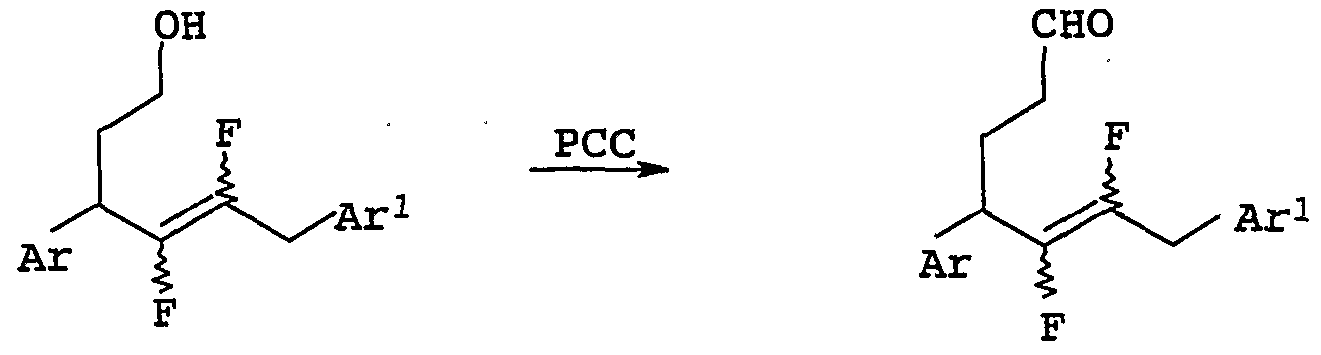
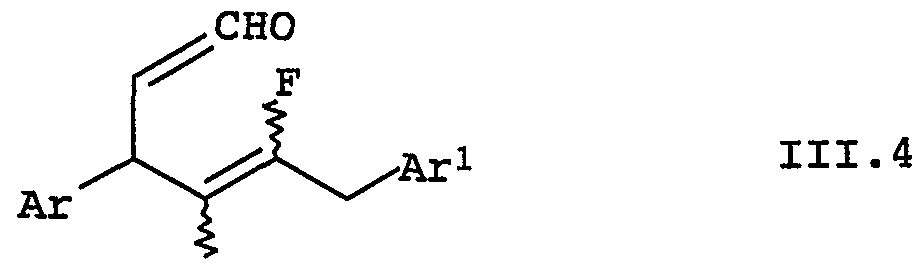
- Alcohols of formula III.l are treated with an oxidizing agent, such as pyridinium chlorochromate, and the resulting aldehydes of formula III.4 are treated with a sily- lating agent, such as trimethylsilylmethyl magnesium chloride, to afford compounds of formula III.5.
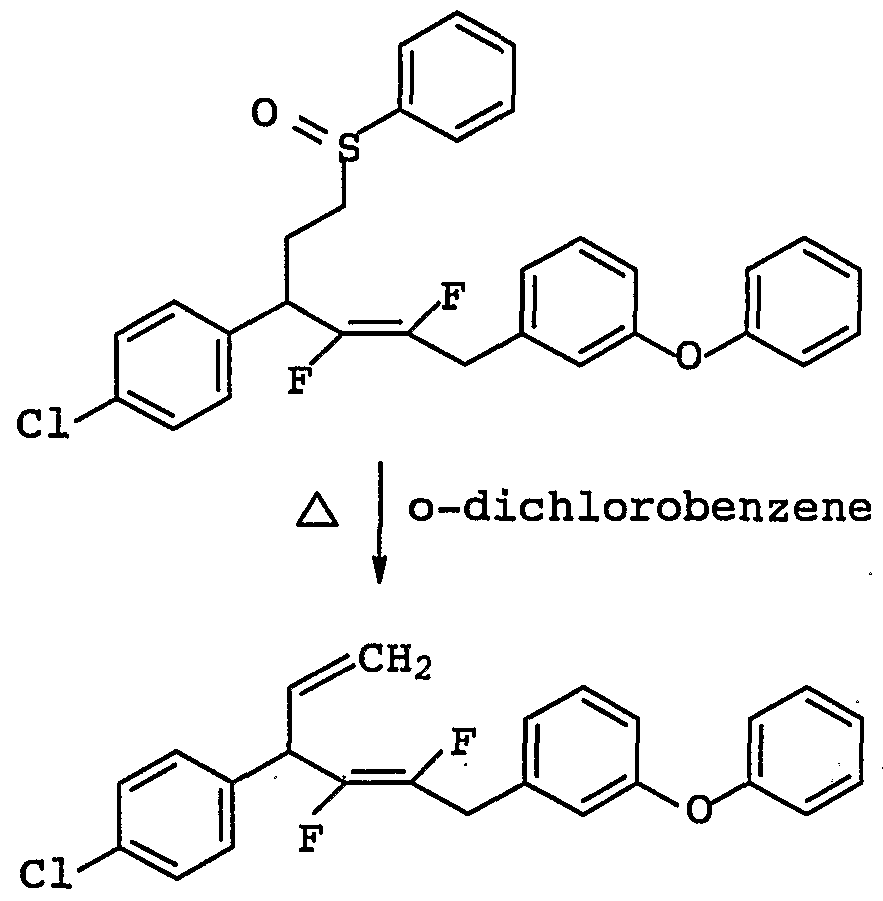
- an acid such as acetic acid, affords allyl compounds of formula Ic.
- the fluorine atoms attached to the carbon atoms of the double bond in the formula I compounds are in the (E)- configuration with respect to each other.
- Compounds of formula I wherein the fluorine atoms at the double bond are in the (Z)- configuration may be prepared by isomerizing certain intermediate compounds described hereinabove which are predominantly in the (E)-configuration using conventional procedures such as exposure to light.
- the present invention provides intermediates of formula II,
- optical isomers thereof and the (E)- and (Z)- isomers thereof.
- Ar is as defined for formula I and R 2 is hydrogen or fluorine, which are especially useful for the preparation of compounds of formula I wherein R is 2-methoxyethy1, vinyl, or allyl.
- the fluorine atoms attached to the carbon atoms of the double bond in compounds of formula II and II.A are in the (E)- configuration with respect to each other.
- the present invention also provides intermediates of formula III,
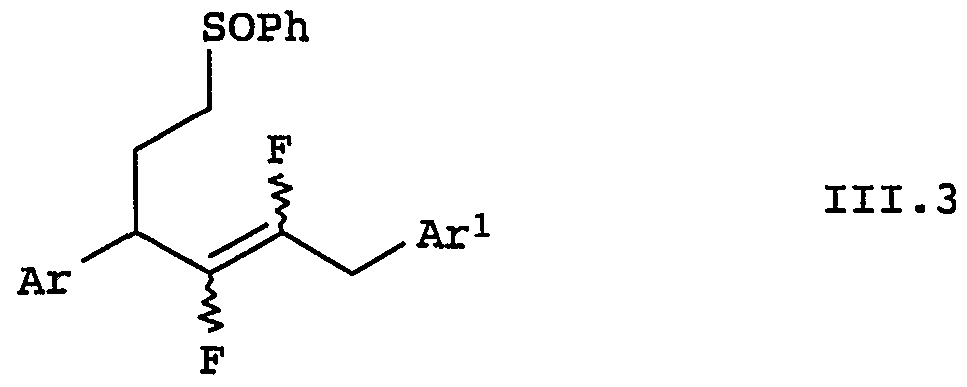
- Ar and Ar 1 are defined as above for compounds of formula I and R 3 is phenylthio-C 2 -C 6 -alkyl, phenylsulfinyl-C 2 -C 6 -alkyl, hy- droxy-C 2 -C 6 -alkyl, formyl-C 2 -C 5 -alkyl, or C 2 -C 6 -alkyl vicinally substituted with hydroxy and trimethylsilyl, and
- optical isomers thereof and the (E)- and (Z)- isomers thereof.
- the fluorine atoms attached to the carbon atoms of the double bond in the formula III compounds are in the (E)- configuration with respect to each other.
- Compounds of formula I are effective for controlling insect and acarid pests. Those compounds are also effective for protecting growing or harvested crops from damage caused by insect and acarid attack and infestation.
- Insects controlled by compounds of formula I include Lepidoptera such as tobacco budworms, cabbage loopers, cotton boll worms, beet armyworms, southern armyworms and diamondback moths; Homop- tera such as aphids, leaf hoppers, plant hoppers and white flies; Thysanoptera such as thrips; Coleoptera such as boll weevils, Co- lorado potato beetles, southern corn rootworms, western corn rootworms and mustard beetles; and Orthoptera such as locusts, crickets, grasshoppers and cockroaches.
- Acarina controlled by the compounds of this invention include mites such as two-spotted spider mites, carmine spider mites, banks grass mites, strawberry mites, citrus rust mites and leprosis mites.
- Compounds of formula I are especially useful for the control of tobacco budworms, southern armyworms and corn rootworms.
- ppm to 10000 ppm and preferably 100 ppm to 5000 ppm of a formula I compound, dispersed in water or an- other liquid carrier, is effective when applied to plants or the soil in which the plants are growing to protect the plants from insect and acarid attack and infestation.
- Compounds of formula I are also effective for controlling insect and acarid pests when applied to the foliage of plants and/or to the soil or water in which said plants are growing in sufficient amount to provide a rate of 0,1 kg/ha to 4,0 kg/ha of active ingredient.
- compounds of formula I are effective for controlling insect and acarid pests when employed alone, they may also be used in combination with other biological chemicals, including other insecticides and acaricides.
- the compounds of formula I may be used effectively in conjunction or combination with py- rethroids, phosphates, carbamates, cyclodienes, endotoxin of Bacillus thuringiensis (Bt), formamidines, phenol tin compounds, chlorinated hydrocarbons, benzoylphenyl ureas, pyrroles and the like.
- Compounds of formula I may be formulated as emulsifiable concentrates, flowable concentrates or wettable powders which are diluted with water or other suitable polar solvent, generally in situ, and then applied as a dilute spray. Said compounds may also be formulated in dry compacted granules, granular formulations, dusts, dust concentrates, suspension concentrates, microemulsions and the like all of which lend themselves to seed, soil, water and/or foliage applications to provide the requisite plant protection. Such formulations or compositions of the present invention include a compound of formula I (or combinations thereof) admixed with one or more agronomically acceptable inert, solid or liquid carriers.
- compositions contain a pesticidally effective amount of said compound or compounds, which amount may vary depending upon the particular compound, target pest, and method of use. Those skilled in the art can readily determine what is a pesticidally effective amount without undue experimentation. In order to facilitate a further understanding of the invention, the following examples are presented primarily for the purpose of illustrating more specific details thereof.
- Bromotrifluoroethylene (41,5 g, 257 mmol) was distilled (dry ice condenser) into a flask containing zinc (13,6 g, 208 mmol) and N,N-dimethylformamide (153 ml), and the resulting mixture was heated at approximately 60°C for two hours.
- the reaction mixture was purged with nitrogen for one hour, cooled to -8°C, treated with cuprous bromide (29,83 g, 208 mmol), and stirred for 30 minutes without external cooling.
- Tetrakis(triphenyl-phosphine)palladium (0,066 g, 0,057 mmol) in tetrahydrofuran (1 ml) was added, followed by ⁇ -bromo-3-phenoxy- toluene (0,70 g, 2,66 mmol) in tetrahydrofuran (2 ml), and the resulting mixture was stirred and allowed to warm to room temperature over four hours and was then stirred for another sixteen hours. The reaction mixture was then quenched with water, diluted with 10% hydrochloric acid and thoroughly extracted with ethyl acetate. The combined organic extracts were dried over anhydrous sodium sulfate and concentrated in vacuo to a brown oil (1,378 g).
- Test solutions are prepared by dissolving the test compound in a 35% acetone in water mixture to give a concentration of 10000 ppm. Subsequent dilutions are made with water as needed.
- a Sieva lima bean leaf expanded to 7-8 cm in length is dipped in the test solution with agitation for 3 seconds and allowed to dry in a hood.
- the leaf is then placed in a 100 x 10 mm petri dish containing a damp filter paper on the bottom and ten 3rd instar caterpillars. After 5 days, observations are made of mortality, reduced feeding, or any interference with normal molting.
- One ccm of fine talc is placed in a 30 ml wide-mouth screw-top glass jar.
- One ml of the appropriate acetone test solution is pipetted onto the talc so as to provide 1.25 mg of active ingredient per jar.
- the jars are set under a gentle air flow until the acetone is evaporated.
- the dried talc is loosened, 1 ccm of millet seed is added to serve as food for the insects and 25 ml of moist soil is added to each jar.
- the jar is capped and the contents thoroughly mixed mechanically. Following this, ten 3rd in- star rootworms are added to each jar and the jars are loosely capped to allow air exchange for the larvae.
- the treatments are held for 5 days when mortality counts are made. Missing larvae are presumed dead, since they decompose rapidly and cannot be found.
- the concentrations of active ingredient used in this test correspond approximately to 50 kg/ha.
- Cotton cotyledons are dipped in the test solution and allowed to dry in a hood. When dry, each is cut into quarters and ten sections are placed individually in 30 ml plastic medicine cups containing a 5 to 7 mm long piece of damp dental wick. One 3rd in- star caterpillar is added to each cup and a cardboard lid placed on the cup. Treatments are maintained for 3 days before mortality counts and estimates of reduction in feeding damage are made.
- Pots containing single nasturtium plants (Tropaeolum sp.) about 5 cm tall are infested with about 100-200 aphids one day before the test.
- Each pot is sprayed with the test solution for 2 revolutions of a 4 rounds per minute (rpm) turntable in a hood. The spray is directed to give complete coverage of the plants and aphids.
- the sprayed pots are set on their sides on white trays and held for 2 days, following which mortality estimates are made.
- Tetranychus urticae OP-resistant strain
- TMS 2-spotted spider mite
- Sieva lima bean plants with primary leaves expanded to 7-8 cm are selected and cut back to one plant per pot.
- a small piece is cut from an infested leaf taken from the main colony and placed on each leaf of the test plants. This is done about 2 hours before treatment to allow the mites to move over to the test plant to lay eggs.
- By the size of the cut, infested leaf is varied to obtain about 100 mites per leaf.
- the piece of leaf used to transfer the mites is removed and discarded.
- the newly-infested plants are dipped in the test solution for 3 seconds with agitation and set in the hood to dry. After 2 days, one leaf is removed and mortality counts are made. The tests are rated according to the scale shown below and the data obtained are shown in Table I.
Landscapes
- Chemical & Material Sciences (AREA)
- Organic Chemistry (AREA)
- Life Sciences & Earth Sciences (AREA)
- Chemical Kinetics & Catalysis (AREA)
- Dentistry (AREA)
- Zoology (AREA)
- Health & Medical Sciences (AREA)
- Engineering & Computer Science (AREA)
- Pest Control & Pesticides (AREA)
- General Health & Medical Sciences (AREA)
- Wood Science & Technology (AREA)
- Plant Pathology (AREA)
- Environmental Sciences (AREA)
- Agronomy & Crop Science (AREA)
- Agricultural Chemicals And Associated Chemicals (AREA)
- Organic Low-Molecular-Weight Compounds And Preparation Thereof (AREA)
- Pyridine Compounds (AREA)
- Low-Molecular Organic Synthesis Reactions Using Catalysts (AREA)
Abstract
Description







Claims





Priority Applications (5)
| Application Number | Priority Date | Filing Date | Title |
|---|---|---|---|
| CA002421861A CA2421861A1 (en) | 2000-09-12 | 2001-09-11 | 1,4-diaryl-2,3-difluoro-2-butene insecticidal and acaricidal agents |
| KR10-2003-7003545A KR20030029971A (en) | 2000-09-12 | 2001-09-11 | 1,4-Diaryl-2,3-Difluoro-2-Butene Insecticidal and Acaricidal Agents |
| AU2002223534A AU2002223534A1 (en) | 2000-09-12 | 2001-09-11 | 1,4-diaryl-2,3-difluoro-2-butene insecticidal and acaricidal agents |
| EP01984635A EP1351913A2 (en) | 2000-09-12 | 2001-09-11 | 1,4-diaryl-2,3-difluoro-2-butene insecticidal and acaricidal agents |
| JP2002526730A JP2004509088A (en) | 2000-09-12 | 2001-09-11 | 1,4-diaryl-2,3-difluoro-2-butene for insecticides / miticides |
Applications Claiming Priority (2)
| Application Number | Priority Date | Filing Date | Title |
|---|---|---|---|
| US23199600P | 2000-09-12 | 2000-09-12 | |
| US60/231,996 | 2000-09-12 |
Publications (2)
| Publication Number | Publication Date |
|---|---|
| WO2002022529A2 true WO2002022529A2 (en) | 2002-03-21 |
| WO2002022529A3 WO2002022529A3 (en) | 2003-07-24 |
Family
ID=22871458
Family Applications (1)
| Application Number | Title | Priority Date | Filing Date |
|---|---|---|---|
| PCT/EP2001/010466 Ceased WO2002022529A2 (en) | 2000-09-12 | 2001-09-11 | 1,4-diaryl-2,3-difluoro-2-butene insecticidal and acaricidal agents |
Country Status (8)
| Country | Link |
|---|---|
| US (1) | US6506800B2 (en) |
| EP (1) | EP1351913A2 (en) |
| JP (1) | JP2004509088A (en) |
| KR (1) | KR20030029971A (en) |
| CN (1) | CN1461292A (en) |
| AU (1) | AU2002223534A1 (en) |
| CA (1) | CA2421861A1 (en) |
| WO (1) | WO2002022529A2 (en) |
Families Citing this family (1)
| Publication number | Priority date | Publication date | Assignee | Title |
|---|---|---|---|---|
| KR101010045B1 (en) * | 2010-05-19 | 2011-01-21 | 경신가동보(주) | Hydraulic lift gate |
Family Cites Families (11)
| Publication number | Priority date | Publication date | Assignee | Title |
|---|---|---|---|---|
| US5248834A (en) * | 1984-04-09 | 1993-09-28 | British Technology Group Limited | Pesticides |
| GB2173789B (en) * | 1985-02-28 | 1988-07-13 | Sumitomo Chemical Co | A vinyl or ethynyl substituted aralkyl aryl compound for use as an insecticide/acaricide |
| DE3602169A1 (en) * | 1986-01-22 | 1987-07-23 | Schering Ag | NEW ALKANE AND ALKOXYAL CANDERIVATIVES, METHOD FOR THE PRODUCTION THEREOF AND INSECTICIDES AND ACARICIDES CONTAINING THESE COMPOUNDS |
| GB9219612D0 (en) | 1992-09-16 | 1992-10-28 | Khambay Bhupinder P S | Pesticidal fluoroolefins |
| GB9408605D0 (en) | 1994-04-29 | 1994-06-22 | British Tech Group | Pesticidal fluoroolefins |
| GB9522144D0 (en) | 1995-10-30 | 1996-01-03 | British Tech Group | Control of whitefly |
| US5892131A (en) * | 1997-05-29 | 1999-04-06 | American Cyanamid Company | Process for the preparation of pesticidal fluoroolefin compounds |
| US5998673A (en) | 1996-06-03 | 1999-12-07 | American Cyanamid Company | 1, 4-diaryl-2-fluoro-2-butene insecticidal and acaricidal agents |
| US6288011B1 (en) * | 1997-11-12 | 2001-09-11 | American Cyanamid Co. | 1,4-diaryl-2,3-difluoro-2-butene insecticidal and acaricidal agents |
| TW467889B (en) * | 1997-11-12 | 2001-12-11 | American Cyanamid Co | 1,4-diaryl-2,3-difluoro-2-butene insecticidal and acaricidal agents |
| US6342642B1 (en) * | 1999-11-09 | 2002-01-29 | Basf Aktiengesellschaft | 1,4-diaryl-2-fluoro-1-buten-3-ol compounds and their use in the preparation of 1,4-diaryl-2-fluoro-1,3-butadiene and 1,4-diaryl-2-fluoro-2-butene compounds |
-
2001
- 2001-09-11 EP EP01984635A patent/EP1351913A2/en not_active Withdrawn
- 2001-09-11 WO PCT/EP2001/010466 patent/WO2002022529A2/en not_active Ceased
- 2001-09-11 KR KR10-2003-7003545A patent/KR20030029971A/en not_active Withdrawn
- 2001-09-11 AU AU2002223534A patent/AU2002223534A1/en not_active Abandoned
- 2001-09-11 JP JP2002526730A patent/JP2004509088A/en not_active Withdrawn
- 2001-09-11 CN CN01815425A patent/CN1461292A/en active Pending
- 2001-09-11 CA CA002421861A patent/CA2421861A1/en not_active Abandoned
- 2001-09-12 US US09/950,860 patent/US6506800B2/en not_active Expired - Fee Related
Also Published As
| Publication number | Publication date |
|---|---|
| JP2004509088A (en) | 2004-03-25 |
| EP1351913A2 (en) | 2003-10-15 |
| CA2421861A1 (en) | 2002-03-21 |
| US20020058660A1 (en) | 2002-05-16 |
| AU2002223534A1 (en) | 2002-03-26 |
| KR20030029971A (en) | 2003-04-16 |
| WO2002022529A3 (en) | 2003-07-24 |
| US6506800B2 (en) | 2003-01-14 |
| CN1461292A (en) | 2003-12-10 |
Similar Documents
| Publication | Publication Date | Title |
|---|---|---|
| US4397864A (en) | 2-Arylpropyl ether or thioether derivatives and insecticidal and acaricidal agents containing said derivatives | |
| JPS6217583B2 (en) | ||
| US5849958A (en) | 1,4,diaryl-2-fluoro-2-butene insecticidal and acaricidal agents | |
| US5998673A (en) | 1, 4-diaryl-2-fluoro-2-butene insecticidal and acaricidal agents | |
| EP0811593B1 (en) | 1,4-diaryl-2-fluoro-2-butene insecticidal and acaricidal agents | |
| US4200644A (en) | Arylthiovinylcyclopropanecarboxylate insecticides | |
| EP0062659A4 (en) | 3-(pyrrol-1-yl)phenylmethyl esters and intermediates. | |
| US6506800B2 (en) | 1,4 diaryl-2,3-difluoro-2-butene insecticidal and acaricidal agents | |
| AU657214B2 (en) | New derivatives of 7-ethynyl alpha-(methoxymethylene) 1-naphthalene acetic acid, their preparation process and their use as pesticides | |
| GB1596903A (en) | Insecticidal and acaricidal phenyl alkanoic acid esters | |
| AU745695B2 (en) | 1,4-diaryl-2,3-difluoro-2-butene insecticidal and acaricidal agents | |
| US6288011B1 (en) | 1,4-diaryl-2,3-difluoro-2-butene insecticidal and acaricidal agents | |
| EP0031041A2 (en) | Pyrethroids and their preparation, their pesticidal composition; intermediates and their preparation | |
| US5710102A (en) | Difluorovinylsilane insecticidal and acaricidal agents | |
| US4346251A (en) | 4-Substituted-2-indanols | |
| HK1019583A (en) | 1,4-diaryl-2,3-difluoro-2-butene insecticidal and acaricidal agents | |
| US4408057A (en) | 4-Heterocyclic-substituted-2-indanyl alcohols and insecticidal ester derivatives | |
| US4442296A (en) | 4-Heterocyclic-substituted-2-indanyl alcohols and insecticidal ester derivatives | |
| EP0796860A2 (en) | Difluorvinylsilane insecticidal and acaridal agents | |
| HK1002860A (en) | 1,4-diaryl-2-fluoro-2-butene insecticidal and acaricidal agents | |
| MXPA97003924A (en) | Insecticides and accaricides of 1,4-diaril-2-fluoro-2- but |
Legal Events
| Date | Code | Title | Description |
|---|---|---|---|
| AK | Designated states |
Kind code of ref document: A2 Designated state(s): AE AG AL AM AT AU AZ BA BB BG BR BY BZ CA CH CN CO CR CU CZ DE DK DM DZ EC EE ES FI GB GD GE GH GM HR HU ID IL IN IS JP KE KG KP KR KZ LC LK LR LS LT LU LV MA MD MG MK MN MW MX MZ NO NZ PH PL PT RO RU SD SE SG SI SK SL TJ TM TR TT TZ UA UG UZ VN YU ZA ZW |
|
| AL | Designated countries for regional patents |
Kind code of ref document: A2 Designated state(s): GH GM KE LS MW MZ SD SL SZ TZ UG ZW AM AZ BY KG KZ MD RU TJ TM AT BE CH CY DE DK ES FI FR GB GR IE IT LU MC NL PT SE TR BF BJ CF CG CI CM GA GN GQ GW ML MR NE SN TD TG |
|
| 121 | Ep: the epo has been informed by wipo that ep was designated in this application | ||
| DFPE | Request for preliminary examination filed prior to expiration of 19th month from priority date (pct application filed before 20040101) | ||
| WWE | Wipo information: entry into national phase |
Ref document number: 2001984635 Country of ref document: EP |
|
| WWE | Wipo information: entry into national phase |
Ref document number: 2002526730 Country of ref document: JP |
|
| WWE | Wipo information: entry into national phase |
Ref document number: 2421861 Country of ref document: CA |
|
| WWE | Wipo information: entry into national phase |
Ref document number: 2002223534 Country of ref document: AU Ref document number: 1020037003545 Country of ref document: KR Ref document number: 018154255 Country of ref document: CN |
|
| WWP | Wipo information: published in national office |
Ref document number: 1020037003545 Country of ref document: KR |
|
| REG | Reference to national code |
Ref country code: DE Ref legal event code: 8642 |
|
| WWP | Wipo information: published in national office |
Ref document number: 2001984635 Country of ref document: EP |
|
| WWW | Wipo information: withdrawn in national office |
Ref document number: 2001984635 Country of ref document: EP |