WO2002028875A2 - Improved synthesis of purine locked nucleic acid analogues - Google Patents
Improved synthesis of purine locked nucleic acid analogues Download PDFInfo
- Publication number
- WO2002028875A2 WO2002028875A2 PCT/DK2001/000649 DK0100649W WO0228875A2 WO 2002028875 A2 WO2002028875 A2 WO 2002028875A2 DK 0100649 W DK0100649 W DK 0100649W WO 0228875 A2 WO0228875 A2 WO 0228875A2
- Authority
- WO
- WIPO (PCT)
- Prior art keywords
- optionally substituted
- alkyl
- aryl
- para
- methanesulfonyl
- Prior art date
- Legal status (The legal status is an assumption and is not a legal conclusion. Google has not performed a legal analysis and makes no representation as to the accuracy of the status listed.)
- Ceased
Links
- 0 **C[C@@]1(C(*)C(*)C*1)C#* Chemical compound **C[C@@]1(C(*)C(*)C*1)C#* 0.000 description 2
Classifications
-
- C—CHEMISTRY; METALLURGY
- C07—ORGANIC CHEMISTRY
- C07H—SUGARS; DERIVATIVES THEREOF; NUCLEOSIDES; NUCLEOTIDES; NUCLEIC ACIDS
- C07H19/00—Compounds containing a hetero ring sharing one ring hetero atom with a saccharide radical; Nucleosides; Mononucleotides; Anhydro-derivatives thereof
- C07H19/02—Compounds containing a hetero ring sharing one ring hetero atom with a saccharide radical; Nucleosides; Mononucleotides; Anhydro-derivatives thereof sharing nitrogen
- C07H19/04—Heterocyclic radicals containing only nitrogen atoms as ring hetero atom
Definitions
- the present invention relates to a new strategy for the synthesis of purine LNA (Locked Nucleic Acid) analogues which provides higher overall yields, and thus more cost efficient than previously known methods for the synthesis of purine LNA analogues.
- purine LNA Locked Nucleic Acid
- the present invention provides a novel strategy for the synthesis of purine LNA analogues comprising a regioselective 9-N purine glycosylation reaction followed by a one-pot nucleophilic aromatic substitution reaction of the 6-substituent in the purine ring and simultaneous nucleophile-induced intramolecular ring closure of the C-branched carbohydrate to form novel purine LNA analogues.
- the novel strategy is demonstrated by the synthesis of the novel compound (1 S,3f?,4f?,7S)-7-benzyloxy-1-methanesulfonyl- methyl-3-(guanin-9-yl)-2,5-dioxabicyclo[2.2.1]heptane which is easily converted into (1 S,3R,4f?,7S)-7-hydroxy-1-hydroxymethyl-3-((2- ⁇ /-isobutyrylguanin-9-yl)-2,5-dioxa- bicyclo[2.2.1]heptane after isobutyryl protection of the 2-amino purine group and subsequent substitution of 1-methanesulfonyl with benzoate, debenzoylation and debenzylation.
- the novel strategy can easily be extended to the synthesis of purine LNAs containing other 6-substituted analogues and can be further extended to other heteroatoms than oxygen in the bicycle, such as nitrogen and sulphur.
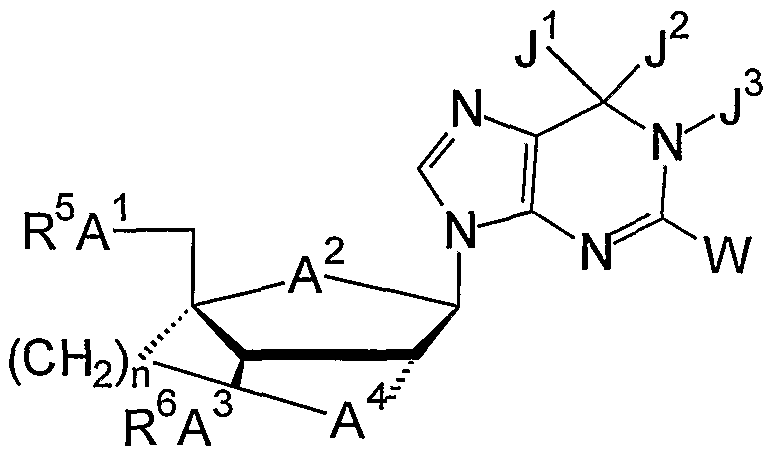
- the present invention relates to a method for the synthesis of novel purine LNA analogues of the general formula I
- W is selected from NR ⁇ R , OR d and SR 4
- a 1 , A 2 , A 3 , and A 4 are independently selected from -O-, -S- and -NR 13 -, where R 13 is selected from hydrogen, optionally substituted C 1-6 -alkyl and optionally substituted (C 1-6 -alkyl)carbonyl;
- each of the substituents R 1 , R 2 , R 3 , R 4 , R 9 , R 10 , R 11 , and R 12 are independently selected from hydrogen, optionally substituted C 1-12 -alkyl, optionally substituted C 2-12 -alkenyl, optionally substituted C 2- ⁇ 2 -alkynyl, optionally substituted aryl, optionally substituted carbonyl, optionally substituted C 1-12 -alkyl carbonyl, optionally substituted C 2-12 -alkenyl carbonyl, optionally substituted C 2-12 -alkynyl carbonyl, optionally substituted arylsulfonyl, optionally substituted C 1-12 -alkylsulfonyl, optionally substituted C 2- ⁇ 2 -alkenylsulfonyl, optionally substituted C 2-12 -alkynylsulfonyl, C 1-12 -alkoxycarbonyl, formyl, tetrahydropyran
- R 5 is selected from optionally substituted alkylsulfonyl, optionally substituted arylsulfonyl, optionally substituted aryl(C 1-6 alkyl), optionally substituted arylcarbonyl and tri(alkyl/aryl)silyl;
- R 6 is selected from optionally substituted aryl(C 1-6 -alkyl), optionally substituted tetrahydropyran-2-yl, optionally substituted arylcarbonyl, optionally substituted aryl and tri(alkyl/aryl)silyl;
- R 5 and R 6 may also represent dialkyldisiloxanylidene
- n is an integer from 1 to 3;
- said method comprising the following step:
- a 1 , A 2 , A 3 , A 4 , R 5 , R 6 , R 13 , W and n are as defined above;
- a 5 is selected from -O-, -S- and -NR 13 -;
- R 7 is selected from optionally substituted alkylsulfonyl, optionally substituted arylsulfonyl, optionally substituted aryl(C.
- R 8 is selected from hydrogen, optionally substituted (C 1-6 -alkyl)carbonyl, optionally substituted arylcarbonyl, tri(alkyl/aryl)silyl, and fluorenyl(C 1-6 -alkyl)oxycarbonyl; and
- X is selected from halogen, CN, optionally substituted sulfonyl and optionally substituted arylsulfonyl;
- the present invention also relates to compounds of the general formula I as defined above.
- the present invention furthermore relates to a method for the synthesis of the key intermediate of the general formula II, said method comprising the following step:
- a 1 , A 2 , A 3 , A 4 , A 5 , R 5 , R 6 , R 7 , R 8 and n are as defined above;
- R 14 is selected from optionally substituted (C ⁇ -6 -alkyl)carbonyloxy, optionally substituted C 1-6 -alkoxy, halogen, optionally substituted arylthio, optionally substituted C 1-6 -alkylthio, and optionally substituted aryloxy;
- the present invention furthermore relates to novel compounds of the general formula II as defined above.
- the present invention relates to a method for the synthesis of purine LNA analogues of the general formula I as defined above:
- the method of the invention comprises treatment of the key intermediate of the general formula II as defined above:
- the nucleophilic reagent is selected from optionally substituted hydroxy(C 1 . 6 -alkane), optionally substituted phenol, optionally substituted hydroxy(C -6 -alkyl)benzene, NH 3 , optionally substituted amino(C 1-6 -alkane), optionally substituted aniline, optionally substituted amino(C ⁇ .. 6 -alkyl)benzene, optionally substituted thio(C 1-6 -alkane), optionally substituted benzenethiol, optionally substituted thio(C 1 . 6 -alkyl)benzene, M-K-OH, M-K-NH 2 and M-K-SH (e.g.
- M is a flurophor (such as flourescein, pyrene, anthracene, etc.), biotin, anthraqinonyl, etc. and K is -(CH 2 ) n - such as described below).
- flurophor such as flourescein, pyrene, anthracene, etc.
- K is -(CH 2 ) n - such as described below.
- the molar ratio between compound II and the nucleophilic reagent is typically in the range of 1 :2 to 1 :10, preferably 1 :2-1 :8, more preferably 1 :2-1 :6.
- nucleophilic reagents when used in excess can bring about an additional elimination reaction of the initially formed substitution product affording the 6-oxo- and 6- thio purine LNA analogues.
- a feature of these nucleophilic reagents is that they comprise an acidic ⁇ -hydrogen which can participate in a ⁇ -elimination reaction such as 3-hydroxypropionitrile, 3-mercaptopropionitrile, 2-hydroxy-ethylbenzene, 2-hydroxy-1-nitroethane.
- the treatment of compound II with the nucleophilic reagent is typically performed at -30°C to 100°C, such as -20°C to 60°C.
- the treatment of compound II with the nucleophilic reagent may be carried out in the presence of a non-nucleophilic strong base, such as NaH, LiH, lithium diisopropylamide, and lithium terf-butoxide.
- a non-nucleophilic strong base such as NaH, LiH, lithium diisopropylamide, and lithium terf-butoxide.
- the presence of a non-nucleophilic strong base will generate the desired nucleophile.
- the treatment is performed in the presence of NaH or LiH, preferably NaH.
- the treatment of compound II with the nucleophilic reagent typically is carried out in the presence of a solvent, such as tetrahydrofuran, toluene, xylene, benzene, diethyl ether, acetonitril, triethylamine, N,N- dimethylformamide, dimethylsulfoxide, dichloromethane, and 1 ,2-dichloroethane, preferably tetrahydrofuran.
- a solvent such as tetrahydrofuran, toluene, xylene, benzene, diethyl ether, acetonitril, triethylamine, N,N- dimethylformamide, dimethylsulfoxide, dichloromethane, and 1 ,2-dichloroethane, preferably tetrahydrofuran.
- each of the substituents A 1 , A 2 , A 3 , A 4 and A 5 represent -O-.
- R 13 preferably represents hydrogen or methyl, most preferably hydrogen.
- W represents OH, SH or NH 2 , preferably NH 2 .
- the substituents J 1 and J 2 together represent oxo or thiono, preferably oxo, and J 3 represent hydrogen.
- J 1 represents OR 9 , NR 10 R 11 , or SR 12
- J 2 together with J 3 represents a double bond.
- X is selected from chloro, fluoro, bromo, iodo, CN, methanesulfonyl, ⁇ -toluenesulfonyl, preferably chloro.
- n is an integer from 1 to 3, such as 1 , 2 or 3, preferably n is 1.
- Each of the substituents R 1 , R 2 , R 3 , R 4 , R 9 , R 10 , R 11 , and R 12 are preferably independently selected from hydrogen, methyl, trifluoromethyl, ethyl, propyl, / ' so-propryl, butyl, f-butyl, pentyl, cyclopentyl, hexyl, cyclohexyl, phenyl, benzyl, phenylethyl, ortho-, meta-, and para-methyl benzyl, 2-chlorobenzyl, 4-phenylbenzyl, 2-cyanoethyl, and "active/functional" groups where M designates psoralens, ethidium bromide, acridine, anthraquinone, biotin, rhodamine or fluorescein and K designates polyethylene glycol, polymethylene, etc.
- K designates a single bond so that the "active/functional" part of the group in question is attached directly to the purine ring.
- each of the substituents R 5 and R 7 independently represent methanesulfonyl, trifluoromethanesulfonyl, ethanesulfonyl, 2,2,2- trifluoroethanesulfonyl, propanesulfonyl, iso-propanesulfonyl, butanesulfonyl, nonafluoro- butanesulfonyl, pentanesulfonyl, cyclopentanesulfonyl, hexanesulfonyl, cyclohexane- sulfonyl, ⁇ -toluenesulfonyl, 2-chloro- ⁇ -toluenesulfonyl, ortho-, meta-, para-toluenesulfonyl, benzenesulfonyl, ortho-, meta-, para-bromobenzenesulfonyl, ortho-,
- R 5 and R 7 represent methanesulfonyl, trifluoromethanesulfonyl, ethanesulfonyl, 2,2,2-trifluoroethanesulfonyl, butanesulfonyl, nonafluorobutanesulfonyl, ⁇ -toluenesulfonyl, para-toluenesulfonyl, benzenesulfonyl, para- bromobenzenesulfonyl, para-nitrobenzenesulfonyl, trimethylsilyl, terf-butyldimethylsilyl, terf-butyldiphenylsilyl, terf-butylmethoxyphenylsilyl and terf-butoxydiphenylsilyl, preferably methanesulfonyl, trifluoromethanesulfonyl, para-toluene
- R 5 and R 7 are identical and are selected from methanesulfonyl, trifluoromethanesulfonyl, ethanesulfonyl, 2,2,2-trifluoro- ethanesulfonyl, butanesulfonyl, nonafluorobutanesulfonyl, ⁇ -toluenesulfonyl, para- toluenesulfonyl, benzenesulfonyl, para-bromobenzenesulfonyl, and para-nitrobenzenesulfonyl, preferably methanesulfonyl, trifluoromethanesulfonyl, para-toluenesulfonyl and para-bromobenzenesulfonyl, more preferably methanesulfonyl, and para-toluenesulfonyl, even more preferably methanesulfonyl, even more
- R 6 comprises benzyl, ortho-, meta-, para-methylbenzyl, 2- chlorobenzyl, 4-phenylbenzyl, tetrahydropyran-2-yl, benzoyl, phenyl, trimethylsilyl, tri- ethylsilyl, triisopropylsilyl, dimethylisopropylsilyl, diethylisopropylsilyl, dimethylthexyl, isopropylsilyl, terf-butyldimethylsilyl, tetf-butyldiphenylsilyl, tribenzylsilyl, tri-para-xylylsilyl, triphenylsilyl, diphenylmethylsilyl, di-terf-butylmethylsilyl, tris(trimethylsilyl)silyl, terf-butyl- methoxyphenylsilyl, terf-butoxydiphenylsily
- R 5 and R 6 together represent di-terf-butylsilylene, 1 ,3- (1 ,1 ,3,3-tetraisopropyl)disiloxanylidene or 1 ,3-(1 ,1 ,3,3-tetra-terf-butoxy)disiloxanylidene.
- R 8 is selected from hydrogen, optionally substituted alkylcarbonyl (e.g. acetyl and trifluoroacetyl), optionally substituted arylcarbonyl (e.g. benzoyl and m-trifluoromethylbenzoyl), terf-butyldimethylsilyl, terf-butyl- diphenylsilyl, and 9-fluorenylmethyloxycarbonyl, with the proviso that when A 4 represent - NR 13 -, then R 8 is selected from trifluoroacetyl and 9-fluorenylmethyloxycarbonyl.
- alkylcarbonyl e.g. acetyl and trifluoroacetyl
- arylcarbonyl e.g. benzoyl and m-trifluoromethylbenzoyl
- terf-butyldimethylsilyl terf-butyl- diphenylsilyl
- R 8 is selected from acetyl, benzoyl and m- trifluoromethylbenzoyl, preferably acetyl.
- R 6 represents benzyl
- R 5 and R 7 both represent methanesulfonyl
- R 8 represents acetyl.
- a 1 , A 2 , A 3 , A 4 and A 5 all represent oxygen, X is chloro, W is NH 2 , both of the substituents R 5 and R 7 are methanesulfonyl, R 6 represents benzyl, R 8 represent acetyl and n is 1.
- the present invention also relates to the compound of the general formula I as defined above, with the proviso that R 1 is not hydrogen and R 2 is not isobutyryl or vice versa when A 1 , A 2 , A 3 and A 4 all represent oxygen, R 5 is methanesulfonyl, R 6 is benzyl and n is 1.
- the present invention furthermore relates to a method for the synthesis of the key intermediate of the general formula II, said method comprising the following step:
- a 1 , A 2 , A 3 , A 4 , A 5 , R 5 , R 6 , R 7 , R 8 and n are as defined above;
- R 14 is selected from optionally substituted (C 1-6 -alkyl)carbonyloxy, optionally substituted C -6 -alkoxy, halogen, optionally substituted arylthio, optionally substituted C 1-6 -alkylthio, and optionally substituted aryloxy, such as acetyloxy, methoxy, ethoxy, chloride, fluoride, bromide or iodide, or SC 6 H 5 .
- the glycosylation reaction is performed according to the Vorbr ⁇ ggen glycosylation method involving the reaction of the starting material III with silylated purine in the presence of a Lewis acid.
- the glycosylation reaction is performed as a "one-pot" Vorbr ⁇ ggen glycosylation reaction involving the coupling of the starting material III with the purine.
- the reaction can be facilitated in the presence of a silylating agent, such as ⁇ /,0-bis(trimethylsilyl)acetamide (BSA) and 1 ,1 ,1 ,3,3,3-hexamethyldisilazane (HMDS), and/or a Lewis acid such as tin(IV)chloride and trimethylsilyl trifluoromethansulfonate (TMS-triflate).
- a silylating agent such as ⁇ /,0-bis(trimethylsilyl)acetamide (BSA) and 1 ,1 ,1 ,3,3,3-hexamethyldisilazane (HMDS)
- HMDS hexamethyldisilazane
- TMS-triflate trimethylsilyl trifluoromethansulfonate
- the silylating agent is N, O-bis(trimethylsilyl)- acetamide and the Lewis acid is trimethylsilyl trifluoromethansulfonate.
- R 8 is selected from acetyl, benzoyl and A77-trifluoromethylbenzoyl, preferably acetyl
- R 14 is selected from acetyloxy, methoxy, ethoxy, chloride, fluroride, bromide, iodide and SC 6 H 5 , preferably acetyloxy and methoxy, even more preferably acetyloxy.
- a 1 , A 2 , A 3 , A 4 and A 5 all represent oxygen, R 6 represents benzyl, R 5 and R 7 both represent methanesulfonyl, R 8 represents acetyl, and R 14 represents acetyloxy.
- the present invention furthermore relates to compounds of the general formula II as defined above. Synthesis of purine LNA analogues
- Figure 1 illustrates an overall synthesis of G-LNA utilising the invention.
- Figure 2 illustrates the novel strategy according to the invention comprising: regioselective 9-N purine glycosylation reaction followed by a one-pot nucleophilic aromatic substitution reaction of the 6-chloro in the purine ring and nucleophile-induced intramolecular ring closure of the C-branched carbohydrate to form guanine-9-yl LNA.
- C ⁇ -12 -alkyl means a linear, cyclic or branched hydrocarbon group having 1 to 12 carbon atoms, such as methyl, ethyl, propyl, /so-propyl, cyclopropyl, butyl, tetf-butyl, /so-butyl, cyclobutyl, pentyl, cyclopentyl, hexyl, cyclohexyl, and dodecyl.
- C -6 -alkyl means a linear, cyclic or branched hydrocarbon group having 1 to 6 carbon atoms, such as methyl, ethyl, propyl, /so-propyl, butyl, terf-butyl, /so-butyl, pentyl, cyclopentyl, hexyl, cyclohexyl, in particular methyl, ethyl, propyl, /so-propyl, tett-butyl, /so-butyl and cyclohexyl.
- C 2-12 -alkenyl covers linear, cyclic or branched hydrocarbon groups having 2 to 12 carbon atoms and comprising one unsaturated bond.
- alkenyl groups are vinyl, allyl, butenyl, pentenyl, hexenyl, heptenyl, octenyl, dodecaenyl.
- C 2- ⁇ 2 -al ynyl means a linear or branched hydrocarbon group having 2 to 12 carbon atoms and comprising a triple bond. Examples hereof are ethynyl, propynyl, butynyl, octynyl, and dodecanyl.
- alkyl In the present context, i.e. in connection with the terms “alkyl”, “alkenyl”, and “alkynyl”, the term “optionally substituted” means that the group in question may be substituted one or several times, preferably 1-3 times, with group(s) selected from hydroxyl, C 1-6 -alkoxy, carboxyl, C 1-6 -alkoxycarbonyl, C ⁇ -6 -alkylcarbonyl, formyl, aryl, aryloxycarbonyl, arylcarbonyl, heteroaryl, amino, mono- and d Ci- ⁇ -alkyOamino, carbamoyl, mono- and di(C ⁇ -6 -alkyl)aminocarbonyl, amino-C -6 -alkyl-aminocarbonyl, mono- and di(C 1-6 - alkyl)amino-C 1-6 -alkyl-aminocarbonyl, C ⁇ -alkylcarbonylamino, cyan
- hydroxyl, C 1-6 -alkoxy, carboxyl, aryl, heteroaryl, amino, mono- and di(C ⁇ -6 -alkyl)amino, and halogen where aryl and heteroaryl may be substituted 1-3 times with C 1-4 -alkyl, C 1-4 - alkoxy, nitro, cyano, amino or halogen.
- Aryl and heteroaryl may be substituted as specifically describe below for "optionally substituted aryl and heteroaryl".
- aryl means a fully or partially aromatic carbocyclic ring or ring system, such as phenyl, naphthyl, 1 ,2,3,4-tetrahydronaphthyl, anthracyl, phenanthracyl, pyrenyl, benzopyrenyl, fluorenyl and xanthenyl, among which phenyl is a preferred example.
- heteroaryl groups examples include oxazolyl, isoxazolyl, thiazolyl, isothiazolyl, pyrrolyl, imidazolyl, pyrazolyl, pyridinyl, pyrazinyl, pyridazinyl, piperidinyl, coumaryl, furyl, quinolyl, benzothiazolyl, benzotriazolyl, benzodiazolyl, benzooxozolyl, phthalazinyl, phthalanyl, triazolyl, tetrazolyl, isoquinolyl, acridinyl, carbazolyl, dibenzazepinyl, indolyl, benzopyrazolyl, phenoxazonyl.
- the term “optionally substituted” means that the group in question may be substituted one or several times, preferably 1-5 times, in particular 1-3 times with group(s) selected from hydroxyl (which when present in an enol system may be represented in the tautomeric keto form), C 1-6 -alkyl, C 1-6 -alkoxy, oxo (which may be represented in the tautomeric enol form), carboxyl, C 1-6 -alkoxycarbonyl, C 1-6 -alkylcarbonyl, formyl, aryl, aryloxy, aryloxy- carbonyl, arylcarbonyl, heteroaryl, amino, mono- and di(C 1-6 -alkyl)amino; carbamoyl, mono- and di(C ⁇ -6 -alkyl)aminocarbonyl, amino-C 1 .
- 6 -alkyl-aminocarbonyl mono- and di(C ⁇ . 6 -alkyl)amino-C 1 . 6 -alkyl-aminocarbonyl, C ⁇ -alkylcarbonylamino, cyano, guanidino, carbamido, C 1-6 -alkanoyloxy, sulphono, C 1-6 -alkylsulphonyloxy, nitro, sulphanyl, dihalogen- C 1- -alkyl, trihalogen-C 1-4 -alkyl, halogen, where aryl and heteroaryl representing substituents may be substituted 1-3 times with C 1-4 -alkyl, C 1-4 -alkoxy, nitro, cyano, amino or halogen.
- Preferred examples are hydroxyl, C 1-6 -alkyl, C 1-6 -alkoxy, carboxyl, C 1-6 -alkoxy- carbonyl, C ⁇ -alkylcarbonyl, aryl, amino, mono- and di(C 1-6 -alkyl)amino, and halogen, wherein aryl may be substituted 1-3 times with C 1-4 -alkyl, C 1- -alkoxy, nitro, cyano, amino or halogen.
- tri(alkyl/aryl)silyl means a silyl group substituted with 0-3 alkyl groups and/or 0-3 aryl groups, with the provision that the total number of alkyl and aryl groups is 3, selected from trimethylsilyl, allyldimethylsilyl, dimethylphenylsilyl, diphenylmethylsilyl, isopropyldimethylsilyl, terf-butyldimethylsilyl, terf-butyldiphenylsilyl, triethylsilyl, triisopropylsilyl, diethylisopropylsilyl, dimethylthexylisopropylsilyl, tribenzylsilyl, tri-para-xylylsilyl, triphenylsilyl, diphenylmethylsilyl, di-fet/-butylmethylsilyl, tris(trimethyl- silyl)silyl
- dialkyldisiloxanylidene means siloxane substituted with 4 alkyl groups selected from 1 ,3-(1 ,1 ,3,3-tetraisopropyl)disiloxanylidene and 1 , 3-(1 , 1 ,3,3- tetra-terf-butoxy)disiloxanylidene.
- Halogen includes fluoro, chloro, bromo, and iodo.
- DNA intercalator means a group which can intercalate into a DNA or RNA helix, duplex or triplex.
- functional parts of DNA intercalators are acridines, anthracene, quinones such as anthraquinone, indole, quinoline, isoquinoline, dihydroquinones, anthracyclines, tetracyclines, methylene blue, anthracyclinone, psoralens, coumarins, ethidium-halides, dynemicin, metal complexes such as 1 ,10-phenanthroline-copper, tris(4,7-diphenyl-1 ,10-phenanthroline)ruthenium- cobalt-enediynes such as calcheamicin, porphyrins, distamycin, netropcin, viologen, daunomycin.
- acridines, quinones such as anthraquinon
- photochemically active groups covers compounds which are able to undergo chemical reactions upon irradiation with light.
- functional groups hereof are quinones, especially 6-methyl-1 ,4-naphtoquinone, anthraquinone, naphtoquinone, and 1 ,4-dimethyl-anthraquinone, diazirines, aromatic azides, benzophenones, psoralens, diazo compounds, and diazirino compounds.
- thermochemically reactive group is defined as a functional group which is able to undergo thermochemically-induced covalent bond formation with other groups.
- functional parts thermochemically reactive groups are carboxylic acids, carboxylic acid esters such as activated esters, carboxylic acid halides such as acid fluorides, acid chlorides, acid bromide, and acid iodides, carboxylic acid azides, carboxylic acid hydrazides, sulfonic acids, sulfonic acid esters, sulfonic acid halides, semicarbazides, thiosemicarbazides, aldehydes, ketones, primary alkohols, secondary alkohols, tertiary alkohols, phenols, alkyl halides, thiols, disulphides, primary amines, secondary amines, tertiary amines, hydrazines, epoxides, maleimides, and boronic
- chelating group means a molecule that contains more than one binding site and frequently binds to another molecule, atom or ion through more than one binding site at the same time.
- functional parts of chelating groups are iminodiacetic acid, nitrilotriacetic acid (NTA), ethylenediamine tetraacetic acid (EDTA), aminophosphonic acid, etc.
- reporter group means a group which is detectable either by itself or as a part of an detection series.
- functional parts of reporter groups are biotin, digoxigenin, fluorescent groups (groups which are able to absorb electromagnetic radiation, e.g.
- dansyl (5-dimethylamino)-1-naphthalenesulfonyl
- DOXYL N-oxyl-4,4- dimethyloxazolidine
- PROXYL N-oxyl-2,2,5,5-tetramethylpyrrolidine
- TEMPO N-oxyl- 2,2,6,6-tetramethylpiperidine
- dinitrophenyl acridines, coumarins, Cy3 and Cy5 (trademarks for Biological Detection Systems, Inc.), erytrosine, coumaric acid, umbelliferone, texas red, rhodamine, tetramethyl rhodamine, Rox, 7-nitrobenzo-2-oxa-1- diazole (NBD), pyrene, fluorescein, Europium, Ruthenium, Sama
- paramagnetic probes e.g. Cu 2+ , Mg 2+
- enzymes such as peroxidases, alkaline phosphatases, ⁇ -galactosidases, and glucose oxidases
- antigens antibodies
- haptens groups which are able to combine with an antibody, but which cannot initiate an immune response by itself, such as peptides and steroid hormones
- carrier systems for cell membrane penetration such as: fatty acid residues, steroid moieties (cholesteryl), vitamin A, vitamin D, vitamin E, folic acid peptides for specific receptors, groups for mediating endocytose, epidermal growth factor (EGF), bradykinin, and platelet derived growth factor (PDGF).
- biotin fluorescein, Texas Red, rhodamine, dinitrophenyl, digoxigen
- Ligands can comprise functional groups such as: aromatic groups (such as benzene, pyridine, naphtalene, anthracene, and phenanthrene), heteroaromatic groups (such as thiophene, furan, tetrahydrofuran, pyridine, dioxane, and pyrimidine), carboxylic acids, carboxylic acid esters, carboxylic acid halides, carboxylic acid azides, carboxylic acid hydrazides, sulfonic acids, sulfonic acid esters, sulfonic acid halides, semicarbazides, thiosemicarbazides, aldehydes, ketones, primary alcohols, secondary alcohols, tertiary alcohols, phenols, alkyl halides, thiols, disulphides, primary amines, secondary amines, tertiary amines, hydrazines, epoxide
- aromatic groups such as benzene, pyridine
- spacer means a thermochemically and photochemically non-active distance-making group and is used to join two or more different moieties of the types defined above. Spacers are selected on the basis of a variety of characteristics including their hydrophobicity, hydrophilicity, molecular flexibility and length (e.g. see Hermanson et. al., "Immobilised Affinity Ligand Techniques", Academic Press, San Diego, California (1992), p. 137-ff). Generally, the length of the spacers is less than or about 400 A, in some applications preferably less than 100 A.
- the spacer thus, comprises a chain of carbon atoms optionally interrupted or terminated with one or more heteroatoms, such as oxygen atoms, nitrogen atoms, and/or sulphur atoms.
- the spacer K may comprise one or more amide, ester, amino, ether, and/or thioether functionalities, and optionally aromatic or mono/polyunsaturated hydrocarbons, polyoxyethylene such as polyethylene glycol, oligo/polyamides such as poly- ⁇ -alanine, polyglycine, polylysine, and peptides in general, oligosaccharides, oligo/polyphosphates.
- the spacer may consist of combined units thereof.
- the spacer includes a chemically cleavable group.
- chemically cleavable groups include disulphide groups cleavable under reductive conditions, peptide fragments cleavable by peptidases, or selenides cleavable under oxidative conditions, etc.
- nucleoside means a glycoside of a heterocyclic base.
- nucleoside is used broadly as to include non-naturally occurring nucleosides, naturally occurring nucleosides as well as other nucleoside analogues.
- Illustrative examples of nucleosides are ribonucleosides comprising a ribose moiety as well as deoxyribonuclesides comprising a deoxyribose moiety.
- bases of such nucleosides it should be understood that this may be any of the naturally occurring bases, e.g. adenine, guanine, cytosine, thymine, and uracil, as well as any modified variants thereof or any possible unnatural bases.
- 1 ,2-0-lsopropylidene-3-O-benzyl-4-C-methanesulfonyloxymethyl-5-0- methanesulfonyloxymethyl- ⁇ -D-ribofuranose (2, 20 g, 43 mmol) is dissolved in acetic acid (175 ml), acetic anhydride (28 ml) is added and finally 320 ⁇ l concentrated sulphuric acid. The solution is stirred over night.
- the solution is then evaporated to half volume at a water bath temperature at 35 °C. Then water (300 ml) is added. The formed emulsion is extracted 3 times with ether (150 ml) and twice with DCM (at this point an emulsion is formed). The combined organic phases are washed twice with water and saturated HCO 3 " (intense CO 2 evolution). The organic phase is evaporated to a syrup, redissolved in DCM (200 ml) and residual acetic anhydride is quenched by vigorously agitation in a two phase system of DCM and saturated HCO 3 " (150 ml). Additional HCO 3 " (solid) may be added if the aqueous phase turns acidic.
- the ⁇ / ⁇ ratio can be seen from HPLC but there is no really difference in Rf (MeOH/DCM: 5:95) compared to the starting material.
- the TLC is developed in 20 % Sulphuric acid + heat. This product is used without further purification.
- N,O-bis(trimethylsilyl)acetamide (29.6 g, 35 ml) was added to a stirred slurry of (3) (30 g, 58.8 mmol) and 2-amino-6-chloropurine (12 g, 70 mmol) in 1 ,2-dichloroethane (dried over sieves, 450 ml) and the mixture was refiuxed for 40 min. to give a homogenous solution. The mixture was then removed from the heat and trimethylsilyltriflat (22 ml, 118 mmol) was added dropwise. The reaction mixture was refiuxed for another 2 h.
- the reaction mixture was cooled to room temperature and a saturated aqueous solution of bicarbonate (400 ml) was added. The slurry was allowed to stir for 15 min, pH was adjusted to 7-8 using glacial acetic acid and the mixture was extracted with chloroform. The aqueous phase was extracted with AcOEt and chloroform and the organic phases were combined. The organic phase was washed with brine (2 x 250 ml) and bicarbonate (2 x 250 ml). The organic phase was dried over sodium sulfate and concentrated under reduced pressure to give compound (4) as a yellowish foam which expands during vacuum dessication Yield: 35,4 g, 97 %.
- reaction mixture is reduced to 20 %, poured into saturated aq. bicarbonate (200 ml) and the mixture is stirred for 30 min.
- target molecule is extracted into EtOAc, the organic phase is dried with sodium sulfate and the solvent is removed by evaporation to give compound (6) as a slightly yellow foam (19.9 g), which is used without further purification in the following step.
- the organic phase is washed two times with 50 ml 1 M K 2 SO 4 .
- the resulting blurred organic phase is transferred to a round-bottomed flask and is stirred with 25 ml fresh 1 M K 2 SO 4 for 30 minutes after which the clear organic phase is separated in a separation funnel and dried over MgSO 4 (6 g).
- the dried solution is filtrated on a G3 filter, which subsequently is washed with 50 ml methylene chloride.
- the resulting light yellow solution is evaporated (Rotavapor, 53°C, 100 to 20 mbar).
- the resulting pale yellow oil is dried intensively (1 mbar, 50°C).
- the yield is 27.6 g (102 % including residual solvent), and is pure as determined by TLC (CH 2 CI 2 /TBME/Et 3 N 9.5:0.5:0.1); Developer: MeOH/sulphuric acid 1 :1.
- TMS-OTf (18.2 ml) is added dropwise over 10 minutes via a syringe and under N 2 .
- the resulting clear red-orange solution is refiuxed for 90 minutes.
- the reaction mixture is shaken with 100 ml water and 120 ml CH 2 CI 2 . The phases tend to emulsify.
- Phase-separation An upper clear yellow aqueous phase and a lower yellow organic phase.
- the aqueous phase is extracted with 100 ml methylene chloride.
- the combined organic phases are washed with 100 ml 1 M K 2 HPO 4 .
- the yellow emulsion is filtered on G3 filter and the filter cake (excess chloroguanine) is washed with 20 ml methylene chloride.
- the aqueous phase is washed with 100 ml methylene chloride.
- the organic phase is washed with 100 ml 1 M K 2 HPO 4 ; phase separation.
- 3-hydroxypropionitrile (14.84 g, freshly distilled) is dissolved in a 1 I 3-necked flask with mechanical stirring and N 2 -flow in THF (257 ml HPLC-grade). The solution is cooled in an ice-bath to less than 5°C, after which 12.2 g (51 %) NaH is strewed into the solution in small portions over 10 minutes; slightly exothermic reaction, gas development. The greyish suspension is stirred at 5-10 °C for 30 minutes.
- phase separation (aqueous phase lowest).
- the aqueous phase is extracted with THF (50 ml).
- the combined organic phases are extracted twice with NaCI (100 ml, 25%) + K 2 HPO 4 (25 ml, 1 M). pH (resulting aqueous phase) 7.
- the resulting organic phase (440 ml) is evaporated to near dryness. Re-dissolution in THF (250 ml) and evaporation again.
- THF (50 ml) is added twice and evaporated to dryness. The remanence is suspended in 146 ml methylene chloride and the suspension is filtrated on G3. Wash with 53 ml methylene chloride.
- the resulting solution is evaporated to dryness and the remanence is re-dissolved in 145 ml methylene chloride and transferred to a 3- necked flask with 5 ml CH 2 CI 2 . 163 ml TBME is added dropwise and very slowly under vigorous stirring (300 rpm) to the red solution. After addition of 20 ml MTBE, yellow crystals precipitate on the side of the flask. The crystals are scraped into the solution with seed-crystals from the earlier batch. Over 90 minutes, 60 ml of MTBE is added and precipitation is initiated so that a blurred solution is formed. 80 ml added - clear precipitation of light crystals. The solution is seeded again.
- Re-precipitation of the raw product 17.8 g of the filter cake is suspended in 50 ml DMSO in a flask equipped with a mechanical stirrer. The suspension is heated to 90°C (contact thermometer) and 150 ml of ion exchanged water is slowly added dropwise with a stirring over 30 minutes at 85-90°C. After the addition of 30 ml, a precipitation of a substance on the side of the flask is observed, and after 60 ml precipitation occurs after each drop added. After the last addition, the heating cover is turned off and further 40 ml of water is added. The flask is stirred and allowed to cool to 20°C. Seeding at 50°C.
- Isobutyric anhydride (16.70 g) is added and the reaction mixture is heated to 60 °C for 4 hours (96 % product in the reaction mixture using HPLC).
- 50 ml of ion exchanged water and 50 ml CH 2 CI 2 are added to the warm reaction mixture, and the solution is stirred for 60 minutes (in order to quench excess anhydride).
- 20 ml CH 2 CI 2 is added and the phases are separated using a separation funnel.
- the aqueous phase (50 ml) is extracted with 40 ml CH 2 CI 2 .
- the organic phases are combined and washed with 60 ml ion exchanged water.
- the phase separation is relieved by using saturated NaCI (5 ml).
- the clear red organic phase is evaporated (Rotavapor, 50°C, 200 to 10 mbar).
- the yield is 35.2 g red oil. This oil can be used directly in subsequent steps.
- the pyridine residual can, if necessary, be removed by azeotropic distillation with toluene.
Landscapes
- Chemical & Material Sciences (AREA)
- Organic Chemistry (AREA)
- Engineering & Computer Science (AREA)
- Health & Medical Sciences (AREA)
- Biochemistry (AREA)
- Biotechnology (AREA)
- General Health & Medical Sciences (AREA)
- Genetics & Genomics (AREA)
- Molecular Biology (AREA)
- Life Sciences & Earth Sciences (AREA)
- Saccharide Compounds (AREA)
- Pharmaceuticals Containing Other Organic And Inorganic Compounds (AREA)
- Low-Molecular Organic Synthesis Reactions Using Catalysts (AREA)
- Medicines That Contain Protein Lipid Enzymes And Other Medicines (AREA)
Abstract
Description



Claims


Priority Applications (5)
| Application Number | Priority Date | Filing Date | Title |
|---|---|---|---|
| JP2002532457A JP4413493B2 (en) | 2000-10-04 | 2001-10-04 | Improved method for the synthesis of purine LNA analogues |
| EP01974067A EP1334109B1 (en) | 2000-10-04 | 2001-10-04 | Improved synthesis of purine locked nucleic acid analogues |
| DE60119562T DE60119562T2 (en) | 2000-10-04 | 2001-10-04 | IMPROVED SYNTHESIS OF PURIN-BLOCKED NUCLEIC ACID ANALOGUE |
| DK01974067T DK1334109T3 (en) | 2000-10-04 | 2001-10-04 | Improved synthesis of purine-blocked nucleic acid analogues |
| AU2001293687A AU2001293687A1 (en) | 2000-10-04 | 2001-10-04 | Improved synthesis of purine locked nucleic acid analogues |
Applications Claiming Priority (2)
| Application Number | Priority Date | Filing Date | Title |
|---|---|---|---|
| DKPA200001473 | 2000-10-04 | ||
| DKPA200001473 | 2000-10-04 |
Publications (2)
| Publication Number | Publication Date |
|---|---|
| WO2002028875A2 true WO2002028875A2 (en) | 2002-04-11 |
| WO2002028875A3 WO2002028875A3 (en) | 2002-05-30 |
Family
ID=8159763
Family Applications (1)
| Application Number | Title | Priority Date | Filing Date |
|---|---|---|---|
| PCT/DK2001/000649 Ceased WO2002028875A2 (en) | 2000-10-04 | 2001-10-04 | Improved synthesis of purine locked nucleic acid analogues |
Country Status (8)
| Country | Link |
|---|---|
| US (1) | US6998484B2 (en) |
| EP (1) | EP1334109B1 (en) |
| JP (1) | JP4413493B2 (en) |
| AT (1) | ATE325806T1 (en) |
| AU (1) | AU2001293687A1 (en) |
| DE (1) | DE60119562T2 (en) |
| DK (1) | DK1334109T3 (en) |
| WO (1) | WO2002028875A2 (en) |
Cited By (66)
| Publication number | Priority date | Publication date | Assignee | Title |
|---|---|---|---|---|
| WO2003095467A1 (en) * | 2002-05-08 | 2003-11-20 | Santaris Pharma A/S | Synthesis of locked nucleic acid derivatives |
| WO2004069991A2 (en) | 2003-02-10 | 2004-08-19 | Santaris Pharma A/S | Oligomeric compounds for the modulation of survivin expression |
| WO2005061710A1 (en) | 2003-12-23 | 2005-07-07 | Santaris Pharma A/S | Oligomeric compounds for the modulation of bcl-2 |
| WO2006050734A2 (en) | 2004-11-09 | 2006-05-18 | Santaris Pharma A/S | Potent lna oligonucleotides for the inhibition of hif-1a expression |
| WO2006085964A2 (en) | 2004-06-30 | 2006-08-17 | Applera Corporation | Log-linear amplification |
| JP2007505138A (en) * | 2003-09-09 | 2007-03-08 | アイシス・ファーマシューティカルス・インコーポレーテッド | Gapped oligomeric compounds having a bicyclic sugar moiety linked to the end |
| WO2008005674A2 (en) | 2006-06-30 | 2008-01-10 | Applera Corporation | Methods of analyzing binding interactions |
| EP1882748A3 (en) * | 2002-09-11 | 2008-06-25 | Exiqon A/S | A population of nucleic acids including a subpopulation of LNA oligomers |
| WO2008153933A2 (en) | 2007-06-06 | 2008-12-18 | Avi Biopharma, Inc. | Soluble her2 and her3 splice variant proteins, splice-switching oligonucleotides, and their use in the treatment of disease |
| WO2009043353A2 (en) | 2007-10-04 | 2009-04-09 | Santaris Pharma A/S | Micromirs |
| US7569575B2 (en) | 2002-05-08 | 2009-08-04 | Santaris Pharma A/S | Synthesis of locked nucleic acid derivatives |
| WO2009152336A1 (en) | 2008-06-13 | 2009-12-17 | Codexis, Inc. | Method of synthesizing polynucleotide variants |
| US7713738B2 (en) | 2003-02-10 | 2010-05-11 | Enzon Pharmaceuticals, Inc. | Oligomeric compounds for the modulation of survivin expression |
| EP2194129A2 (en) | 2006-04-03 | 2010-06-09 | Santaris Pharma A/S | Pharmaceutical composition comprising anti-miRNA antisense oligonucleotides |
| US7737264B2 (en) | 2002-04-05 | 2010-06-15 | Enzon Pharmaceuticals, Inc. | Oligomeric compounds for the modulation HIF-1α expression |
| EP2261333A2 (en) | 2006-04-03 | 2010-12-15 | Santaris Pharma A/S | Pharmaceutical composition comprising anti-miRNA antisense oligonucleotides |
| WO2010144103A1 (en) | 2009-06-11 | 2010-12-16 | Codexis, Inc. | Combined automated parallel synthesis of polynucleotide variants |
| WO2011105900A2 (en) | 2010-02-23 | 2011-09-01 | Academisch Ziekenhuis Bij De Universiteit Van Amsterdam | Antagonists of complement component 8-alpha (c8-alpha) and uses thereof |
| WO2011105901A2 (en) | 2010-02-23 | 2011-09-01 | Academisch Ziekenhuis Bij De Universiteit Van Amsterdam | Antagonists of complement component 9 (c9) and uses thereof |
| WO2011105902A2 (en) | 2010-02-23 | 2011-09-01 | Academisch Ziekenhuis Bij De Universiteit Van Amsterdam | Antagonists of complement component 8-beta (c8-beta) and uses thereof |
| WO2012010711A1 (en) | 2010-07-23 | 2012-01-26 | Santaris Pharma A/S | Process |
| WO2012027206A1 (en) | 2010-08-24 | 2012-03-01 | Merck Sharp & Dohme Corp. | SINGLE-STRANDED RNAi AGENTS CONTAINING AN INTERNAL, NON-NUCLEIC ACID SPACER |
| US8173428B2 (en) | 2004-11-09 | 2012-05-08 | Santaris Pharma A/S | LNA oligonucleotides and the treatment of cancer |
| US8299237B2 (en) | 2007-08-30 | 2012-10-30 | Hadasit Medical Research Services & Development Ltd. | Nucleic acid sequences comprising NF-κB binding site within O(6)-methylguanine-DNA-methyltransferase (MGMT) promoter region and uses thereof for the treatment of cancer and immune-related disorders |
| US8329888B2 (en) | 2006-03-23 | 2012-12-11 | Santaris Pharma A/S | Small internally segmented interfering RNA |
| US8361980B2 (en) | 2008-03-07 | 2013-01-29 | Santaris Pharma A/S | Pharmaceutical compositions for treatment of microRNA related diseases |
| US8470791B2 (en) | 2007-03-22 | 2013-06-25 | Santaris Pharma A/S | RNA antagonist compounds for the inhibition of Apo-B100 expression |
| US8492357B2 (en) | 2008-08-01 | 2013-07-23 | Santaris Pharma A/S | Micro-RNA mediated modulation of colony stimulating factors |
| US8563528B2 (en) | 2009-07-21 | 2013-10-22 | Santaris Pharma A/S | Antisense oligomers targeting PCSK9 |
| US8580756B2 (en) | 2007-03-22 | 2013-11-12 | Santaris Pharma A/S | Short oligomer antagonist compounds for the modulation of target mRNA |
| US8653252B2 (en) | 2003-03-21 | 2014-02-18 | Santaris Pharma A/S | Short interfering RNA (siRNA) analogues |
| US8658616B2 (en) | 2006-11-24 | 2014-02-25 | University College Cardiff Consultants Limited | Nucleoside aryl phosphoramidates and their use as anti-viral agents for the treatment of hepatitis C virus |
| WO2014071406A1 (en) | 2012-11-05 | 2014-05-08 | Pronai Therapeutics, Inc. | Methods of using biomarkers for the treatment of cancer by modulation of bcl2|expression |
| WO2014108759A1 (en) | 2013-01-14 | 2014-07-17 | Pierfrancesco Tassone | INHIBITORS OF miRNAs 221 AND 222 FOR ANTI-TUMOR ACTIVITY IN MULTIPLE MYELOMA |
| US9034837B2 (en) | 2009-04-24 | 2015-05-19 | Roche Innovation Center Copenhagen A/S | Pharmaceutical compositions for treatment of HCV patients that are poor-responders to interferon |
| WO2015075166A1 (en) | 2013-11-22 | 2015-05-28 | INSERM (Institut National de la Santé et de la Recherche Médicale) | Methods and pharmaceutical compositions for treatment of a bacterial infection |
| WO2015118407A2 (en) | 2014-01-29 | 2015-08-13 | INSERM (Institut National de la Santé et de la Recherche Médicale) | Oligonucleotides and methods for inhibiting or reducing bacterial biofilms |
| US9211537B2 (en) | 2007-11-07 | 2015-12-15 | The University Of British Columbia | Microfluidic device and method of using same |
| WO2016041058A1 (en) | 2014-09-18 | 2016-03-24 | The University Of British Columbia | Allele-specific therapy for huntington disease haplotypes |
| EP3000480A1 (en) | 2005-12-01 | 2016-03-30 | ProNAi Therapeutics, Inc. | Cancer therapies and pharmaceutical compositions used therein |
| US9428534B2 (en) | 2002-11-18 | 2016-08-30 | Roche Innovation Center Copenhagen A/S | Antisense design |
| US9447138B2 (en) | 2004-11-09 | 2016-09-20 | Roche Innovation Center Copenhagen A/S | Potent LNA oligonucleotides for the inhibition of HIF-1a expression |
| US9879265B2 (en) | 2013-06-27 | 2018-01-30 | Roche Innovation Center Copenhagen A/S | Oligonucleotide conjugates |
| WO2018024849A1 (en) | 2016-08-03 | 2018-02-08 | Aalborg Universitet | ANTISENSE OLIGONUCLEOTIDES (ASOs) DESIGNED TO INHIBIT IMMUNE CHECKPOINT PROTEINS |
| WO2019076919A1 (en) | 2017-10-17 | 2019-04-25 | INSERM (Institut National de la Santé et de la Recherche Médicale) | Combination treatment for cystic fibrosis |
| WO2021005223A1 (en) | 2019-07-10 | 2021-01-14 | INSERM (Institut National de la Santé et de la Recherche Médicale) | Methods for the treatment of epilepsy |
| IT201900017234A1 (en) | 2019-09-25 | 2021-03-25 | Int Centre For Genetic Engineering And Biotechnology | Anti-miRNA for the treatment of leiomyoma |
| WO2021074657A1 (en) | 2019-10-17 | 2021-04-22 | INSERM (Institut National de la Santé et de la Recherche Médicale) | Combination treatment for cystic fibrosis |
| WO2021099394A1 (en) | 2019-11-19 | 2021-05-27 | INSERM (Institut National de la Santé et de la Recherche Médicale) | Antisense oligonucleotides and their use for the treatment of cancer |
| WO2022011262A1 (en) | 2020-07-10 | 2022-01-13 | Inserm (Institut National De La Sante Et De La Recherche Medicale) | Methods and compositions for treating epilepsy |
| WO2022174113A1 (en) | 2021-02-12 | 2022-08-18 | Merand Pharmaceuticals, Inc. | Agents, compositions, and methods for the treatment of hypoxia and ischemia-related disorders |
| WO2022200633A1 (en) | 2021-03-26 | 2022-09-29 | Neumirna Therapeutics Aps | Microrna-27b inhibitors |
| WO2022200632A1 (en) | 2021-03-26 | 2022-09-29 | Neumirna Therapeutics Aps | Microrna-134 inhibitors |
| WO2022254021A1 (en) | 2021-06-04 | 2022-12-08 | Neumirna Therapeutics Aps | Antisense oligonucleotides targeting adenosine kinase |
| WO2023021184A1 (en) | 2021-08-19 | 2023-02-23 | Neumirna Therapeutics Aps | Antisense oligonucleotides targeting adenosine kinase |
| WO2023022504A1 (en) | 2021-08-17 | 2023-02-23 | 한국과학기술원 | Antisense oligonucleotide targeting cav3.1 gene and uses thereof |
| WO2023152369A1 (en) | 2022-02-14 | 2023-08-17 | INSERM (Institut National de la Santé et de la Recherche Médicale) | Nucleic acid mir-9 inhibitor for the treatment of cystic fibrosis |
| WO2024017990A1 (en) | 2022-07-21 | 2024-01-25 | Institut National de la Santé et de la Recherche Médicale | Methods and compositions for treating chronic pain disorders |
| EP4332239A1 (en) | 2022-08-30 | 2024-03-06 | Istituto Romagnolo per lo Studio dei Tumori "Dino Amadori" - IRST S.r.l. | Mir-based assay for gastro-entero-pancreatic neuroendocrine tumor diagnosis and prognosis |
| WO2024146935A1 (en) | 2023-01-06 | 2024-07-11 | Institut National de la Santé et de la Recherche Médicale | Intravenous administration of antisense oligonucleotides for the treatment of pain |
| EP4450626A1 (en) | 2023-04-21 | 2024-10-23 | IFOM - Istituto Fondazione di Oncologia Molecolare ETS | Fnip2 inhibitors for treating ataxia telangiectasia |
| WO2025008406A1 (en) | 2023-07-04 | 2025-01-09 | Institut National de la Santé et de la Recherche Médicale | Antisense oligonucleotides and their use for the treatment of cancer |
| EP4512899A1 (en) | 2023-08-23 | 2025-02-26 | Lipigon Pharmaceuticals AB | Angptl4 aso compositions for treatment of atherosclerosis in humans |
| WO2025237990A1 (en) | 2024-05-14 | 2025-11-20 | Institut National de la Santé et de la Recherche Médicale | Antisense oligonucleotides and their use for the treatment of pulmonary fibrosis |
| WO2026061986A1 (en) | 2024-09-17 | 2026-03-26 | Institut National de la Santé et de la Recherche Médicale | Antisense oligonucleotide (aso)-mediated down-regulation of cd33 to safely enrich for genetically modified cells |
| WO2026068729A1 (en) | 2024-09-26 | 2026-04-02 | Neumirna Therapeutics Aps | Antimir-27b for treatment of parkinson's disease |
Families Citing this family (222)
| Publication number | Priority date | Publication date | Assignee | Title |
|---|---|---|---|---|
| EP2229457A4 (en) | 2007-12-14 | 2011-01-26 | Minitube America Inc | Gender-specific separation of sperm cells and embryos |
| WO2011032034A2 (en) | 2009-09-10 | 2011-03-17 | University Of Idaho | Nucleobase-functionalized conformationally restricted nucleotides and oligonucleotides for targeting nucleic acids |
| CA2792561C (en) | 2010-04-06 | 2021-10-26 | Alnylam Pharmaceuticals, Inc. | Compositions and methods for inhibiting expression of cd274/pd-l1 gene |
| CA2801066C (en) | 2010-06-02 | 2021-02-09 | Alnylam Pharmaceuticals, Inc. | Compositions and methods directed to treating liver fibrosis |
| WO2012061810A1 (en) | 2010-11-05 | 2012-05-10 | Miragen Therapeutics | Base modified oligonucleotides |
| EP2649182A4 (en) | 2010-12-10 | 2015-05-06 | Alnylam Pharmaceuticals Inc | COMPOSITIONS AND METHOD FOR INCREASING AN ERYTHROPOIETIN (EPO) PREPARATION |
| EP2648763A4 (en) | 2010-12-10 | 2014-05-14 | Alnylam Pharmaceuticals Inc | Compositions and methods for inhibiting expression of klf-1 and bcl11a genes |
| EA201370139A1 (en) | 2010-12-15 | 2013-10-30 | Мираген Терапеутикс | MICRO-RNA INHIBITORS CONTAINING CLOSED NUCLEOTIDES |
| KR102365961B1 (en) | 2011-03-29 | 2022-02-23 | 알닐람 파마슈티칼스 인코포레이티드 | Compositions and methods for inhibiting expression of tmprss6 gene |
| ES2923573T3 (en) | 2011-06-21 | 2022-09-28 | Alnylam Pharmaceuticals Inc | Angiopoietin-like protein 3 (ANGPTL3) RNAi compositions and methods of using the same |
| EP3366312A1 (en) | 2011-06-23 | 2018-08-29 | Alnylam Pharmaceuticals, Inc. | Serpina 1 sirnas: compositions of matter and methods of treatment |
| AU2012275841A1 (en) | 2011-06-27 | 2014-01-16 | The Jackson Laboratory | Methods and compositions for treatment of cancer and autoimmune disease |
| WO2013013068A2 (en) | 2011-07-19 | 2013-01-24 | University Of Idaho | Embodiments of a probe and method for targeting nucleic acids |
| JP2014526887A (en) | 2011-08-01 | 2014-10-09 | アルナイラム ファーマシューティカルズ, インコーポレイテッド | How to improve the success rate of hematopoietic stem cell transplantation |
| WO2013059740A1 (en) | 2011-10-21 | 2013-04-25 | Foundation Medicine, Inc. | Novel alk and ntrk1 fusion molecules and uses thereof |
| US10202643B2 (en) | 2011-10-31 | 2019-02-12 | University Of Utah Research Foundation | Genetic alterations in glioma |
| CN104114572A (en) | 2011-12-16 | 2014-10-22 | 现代治疗公司 | Modified nucleosides, nucleotides and nucleic acid compositions |
| AU2013243948A1 (en) | 2012-04-02 | 2014-10-30 | Moderna Therapeutics, Inc. | Modified polynucleotides for the production of proteins associated with human disease |
| CA2868391A1 (en) | 2012-04-02 | 2013-10-10 | Stephane Bancel | Polynucleotides comprising n1-methyl-pseudouridine and methods for preparing the same |
| US9133461B2 (en) | 2012-04-10 | 2015-09-15 | Alnylam Pharmaceuticals, Inc. | Compositions and methods for inhibiting expression of the ALAS1 gene |
| US9127274B2 (en) | 2012-04-26 | 2015-09-08 | Alnylam Pharmaceuticals, Inc. | Serpinc1 iRNA compositions and methods of use thereof |
| US9388408B2 (en) | 2012-06-21 | 2016-07-12 | MiRagen Therapeutics, Inc. | Oligonucleotide-based inhibitors comprising locked nucleic acid motif |
| CA2890346A1 (en) | 2012-11-05 | 2014-05-08 | Foundation Medicine, Inc. | Novel fusion molecules and uses thereof |
| AU2013337277B2 (en) | 2012-11-05 | 2018-03-08 | Foundation Medicine, Inc. | Novel NTRK1 fusion molecules and uses thereof |
| WO2014081507A1 (en) | 2012-11-26 | 2014-05-30 | Moderna Therapeutics, Inc. | Terminally modified rna |
| US20140200261A1 (en) | 2013-01-17 | 2014-07-17 | Moderna Therapeutics, Inc. | Signal-sensor polynucleotides for the alteration of cellular phenotypes |
| EP2945652B1 (en) | 2013-01-18 | 2021-07-07 | Foundation Medicine, Inc. | Methods of treating cholangiocarcinoma |
| WO2014130922A1 (en) | 2013-02-25 | 2014-08-28 | Trustees Of Boston University | Compositions and methods for treating fungal infections |
| EP2968391A1 (en) | 2013-03-13 | 2016-01-20 | Moderna Therapeutics, Inc. | Long-lived polynucleotide molecules |
| EP2971010B1 (en) | 2013-03-14 | 2020-06-10 | ModernaTX, Inc. | Formulation and delivery of modified nucleoside, nucleotide, and nucleic acid compositions |
| CA3216595A1 (en) | 2013-03-14 | 2014-10-02 | Kevin Fitzgerald | Complement component c5 irna compositions and methods of use thereof |
| CA2902571A1 (en) | 2013-03-15 | 2014-09-18 | MiRagen Therapeutics, Inc. | Bridged bicyclic nucleosides |
| CN105188715B (en) | 2013-03-15 | 2018-12-25 | 米拉根医疗股份有限公司 | Locked nucleic acid inhibitor of MIR-145 and application thereof |
| US8980864B2 (en) | 2013-03-15 | 2015-03-17 | Moderna Therapeutics, Inc. | Compositions and methods of altering cholesterol levels |
| KR102486617B1 (en) | 2013-05-22 | 2023-01-12 | 알닐람 파마슈티칼스 인코포레이티드 | Tmprss6 compositions and methods of use thereof |
| TW201936624A (en) | 2013-05-22 | 2019-09-16 | 美商阿尼拉製藥公司 | Serpina1 iRNA compositions and methods of use thereof |
| WO2014197835A2 (en) | 2013-06-06 | 2014-12-11 | The General Hospital Corporation | Methods and compositions for the treatment of cancer |
| SMT202100691T1 (en) | 2013-07-11 | 2022-01-10 | Modernatx Inc | Compositions comprising synthetic polynucleotides encoding crispr related proteins and synthetic sgrnas and methods of use |
| US20160194625A1 (en) | 2013-09-03 | 2016-07-07 | Moderna Therapeutics, Inc. | Chimeric polynucleotides |
| US20160194368A1 (en) | 2013-09-03 | 2016-07-07 | Moderna Therapeutics, Inc. | Circular polynucleotides |
| US10077444B2 (en) | 2013-10-02 | 2018-09-18 | Alnylam Pharmaceuticals, Inc. | Compositions and methods for inhibiting expression of the LECT2 gene |
| JP2016538829A (en) | 2013-10-03 | 2016-12-15 | モデルナ セラピューティクス インコーポレイテッドModerna Therapeutics,Inc. | Polynucleotide encoding low density lipoprotein receptor |
| TWI768330B (en) | 2013-10-04 | 2022-06-21 | 美國西奈山伊坎醫學院 | Compositions and methods for inhibiting expression of the alas1 gene |
| EP3502270B1 (en) | 2013-10-21 | 2020-03-18 | The General Hospital Corporation | Methods relating to circulating tumor cell clusters and the treatment of cancer |
| SG10201804960RA (en) | 2013-12-12 | 2018-07-30 | Alnylam Pharmaceuticals Inc | Complement component irna compositions and methods of use thereof |
| US9994831B2 (en) | 2013-12-12 | 2018-06-12 | The Regents Of The University Of California | Methods and compositions for modifying a single stranded target nucleic acid |
| AU2014364520B2 (en) | 2013-12-20 | 2020-01-02 | The General Hospital Corporation | Methods and assays relating to circulating tumor cells |
| AU2015217301A1 (en) | 2014-02-11 | 2016-08-25 | Alnylam Pharmaceuticals, Inc. | Ketohexokinase (KHK) iRNA compositions and methods of use thereof |
| TW201607559A (en) | 2014-05-12 | 2016-03-01 | 阿尼拉製藥公司 | Methods and compositions for treating a SERPINC1-associated disorder |
| CA3215908A1 (en) | 2014-05-22 | 2015-11-26 | Alnylam Pharmaceuticals, Inc. | Angiotensinogen (agt) irna compositions and methods of use thereof |
| MX2016015569A (en) | 2014-06-02 | 2017-04-25 | Children´S Medical Center Corp | METHODS AND COMPOSITIONS FOR IMMUNOMODULATION. |
| GB201410693D0 (en) | 2014-06-16 | 2014-07-30 | Univ Southampton | Splicing modulation |
| EP3169693B1 (en) | 2014-07-16 | 2022-03-09 | ModernaTX, Inc. | Chimeric polynucleotides |
| WO2016014846A1 (en) | 2014-07-23 | 2016-01-28 | Moderna Therapeutics, Inc. | Modified polynucleotides for the production of intrabodies |
| ES2985036T3 (en) | 2014-08-29 | 2024-11-04 | Childrens Medical Ct Corp | Methods and compositions for the treatment of cancer |
| EP3191591A1 (en) | 2014-09-12 | 2017-07-19 | Alnylam Pharmaceuticals, Inc. | Polynucleotide agents targeting complement component c5 and methods of use thereof |
| CN107109411B (en) | 2014-10-03 | 2022-07-01 | 冷泉港实验室 | Targeted increase in nuclear gene export |
| TWI864340B (en) | 2014-10-10 | 2024-12-01 | 美商艾爾妮蘭製藥公司 | Compositions and methods for inhibition of hao1 (hydroxyacid oxidase 1 (glycolate oxidase)) gene expression |
| WO2016061131A1 (en) | 2014-10-14 | 2016-04-21 | The J. David Gladstone Institutes | Compositions and methods for reactivating latent immunodeficiency virus |
| WO2016061487A1 (en) | 2014-10-17 | 2016-04-21 | Alnylam Pharmaceuticals, Inc. | Polynucleotide agents targeting aminolevulinic acid synthase-1 (alas1) and uses thereof |
| EP3212794B1 (en) | 2014-10-30 | 2021-04-07 | Genzyme Corporation | Polynucleotide agents targeting serpinc1 (at3) and methods of use thereof |
| TWI710633B (en) | 2014-11-10 | 2020-11-21 | 美商阿尼拉製藥公司 | HEPATITIS B VIRUS (HBV) iRNA COMPOSITIONS AND METHODS OF USE THEREOF |
| HK1244843A1 (en) | 2014-11-17 | 2018-08-17 | Alnylam Pharmaceuticals, Inc. | Apolipoprotein c3 (apoc3) irna compositions and methods of use thereof |
| US9885042B2 (en) | 2015-01-20 | 2018-02-06 | MiRagen Therapeutics, Inc. | miR-92 inhibitors and uses thereof |
| WO2016130806A2 (en) | 2015-02-13 | 2016-08-18 | Alnylam Pharmaceuticals, Inc. | Patatin-like phospholipase domain containing 3 (pnpla3) irna compositions and methods of use thereof |
| WO2016164746A1 (en) | 2015-04-08 | 2016-10-13 | Alnylam Pharmaceuticals, Inc. | Compositions and methods for inhibiting expression of the lect2 gene |
| EP3303634B1 (en) | 2015-06-03 | 2023-08-30 | The Regents of The University of California | Cas9 variants and methods of use thereof |
| EP4365291A3 (en) | 2015-06-12 | 2024-08-14 | Alnylam Pharmaceuticals, Inc. | Complement component c5 irna compositions and methods of use thereof |
| WO2016205323A1 (en) | 2015-06-18 | 2016-12-22 | Alnylam Pharmaceuticals, Inc. | Polynucleotde agents targeting hydroxyacid oxidase (glycolate oxidase, hao1) and methods of use thereof |
| WO2016209862A1 (en) | 2015-06-23 | 2016-12-29 | Alnylam Pharmaceuticals, Inc. | Glucokinase (gck) irna compositions and methods of use thereof |
| US10494632B2 (en) | 2015-07-10 | 2019-12-03 | Alnylam Pharmaceuticals, Inc. | Insulin-like growth factor binding protein, acid labile subunit (IGFALS) compositions and methods of use thereof |
| JP6835826B2 (en) * | 2015-08-24 | 2021-02-24 | ロシュ イノベーション センター コペンハーゲン エーエス | LNA-G process |
| KR20250145703A (en) | 2015-09-02 | 2025-10-13 | 알닐람 파마슈티칼스 인코포레이티드 | PROGRAMMED CELL DEATH 1 LIGAND 1 (PD-L1) iRNA COMPOSITIONS AND METHODS OF USE THEREOF |
| EP3359685B1 (en) | 2015-10-09 | 2026-01-28 | University Of Southampton | Modulation of gene expression for deregulated protein expression |
| FI3386518T3 (en) | 2015-12-07 | 2025-09-25 | Genzyme Corp | METHODS AND COMPOSITIONS FOR TREATING SERPINC1 RELATED DISORDER |
| US11096956B2 (en) | 2015-12-14 | 2021-08-24 | Stoke Therapeutics, Inc. | Antisense oligomers and uses thereof |
| EP3933041B1 (en) | 2015-12-14 | 2024-01-31 | Cold Spring Harbor Laboratory | Antisense oligomers for treatment of autosomal dominant retardation |
| MA45295A (en) | 2016-04-19 | 2019-02-27 | Alnylam Pharmaceuticals Inc | HIGH DENSITY LIPOPROTEIN BINDING PROTEIN (HDLBP / VIGILINE) RNA COMPOSITION AND METHODS FOR USING THEM |
| EP3469083A1 (en) | 2016-06-10 | 2019-04-17 | Alnylam Pharmaceuticals, Inc. | COMPLEMENT COMPONENT C5 iRNA COMPOSITIONS AND METHODS OF USE THEREOF FOR TREATING PAROXYSMAL NOCTURNAL HEMOGLOBINURIA (PNH) |
| TW202313978A (en) | 2016-11-23 | 2023-04-01 | 美商阿尼拉製藥公司 | Serpina1 irna compositions and methods of use thereof |
| AU2017376950B2 (en) | 2016-12-16 | 2024-02-22 | Alnylam Pharmaceuticals, Inc. | Methods for treating or preventing TTR-associated diseases using transthyretin (TTR) iRNA compositions |
| IL269927B2 (en) | 2017-04-18 | 2025-04-01 | Alnylam Pharmaceuticals Inc | Methods for the treatment of subjects having a hepatitis b virus (hbv) infection |
| UY37803A (en) | 2017-07-10 | 2019-02-28 | Genzyme Corp | METHODS AND COMPOSITIONS TO TREAT A BLEEDING EVENT IN A SUBJECT THAT HAD HEMOPHILIA |
| SG11202001590RA (en) | 2017-08-25 | 2020-03-30 | Stoke Therapeutics Inc | Antisense oligomers for treatment of conditions and diseases |
| AU2018360697A1 (en) | 2017-11-01 | 2020-05-14 | Alnylam Pharmaceuticals, Inc. | Complement component C3 iRNA compositions and methods of use thereof |
| US20200385719A1 (en) | 2017-11-16 | 2020-12-10 | Alnylam Pharmaceuticals, Inc. | Kisspeptin 1 (kiss1) irna compositions and methods of use thereof |
| WO2019100039A1 (en) | 2017-11-20 | 2019-05-23 | Alnylam Pharmaceuticals, Inc. | Serum amyloid p component (apcs) irna compositions and methods of use thereof |
| JP2021508491A (en) | 2017-12-18 | 2021-03-11 | アルナイラム ファーマシューティカルズ, インコーポレイテッドAlnylam Pharmaceuticals, Inc. | High Mobility Group Box-1 (HMGB1) iRNA Composition and How to Use It |
| US12060558B2 (en) | 2018-05-04 | 2024-08-13 | Stoke Therapeutics, Inc. | Methods and compositions for treatment of cholesteryl ester storage disease |
| TWI851574B (en) | 2018-05-14 | 2024-08-11 | 美商阿尼拉製藥公司 | ANGIOTENSINOGEN (AGT) iRNA COMPOSITIONS AND METHODS OF USE THEREOF |
| EP3833762A4 (en) | 2018-08-09 | 2022-09-28 | Verseau Therapeutics, Inc. | OLIGONUCLEOTIDE COMPOSITIONS FOR TARGETING CCR2 AND CSF1R AND THEIR USES |
| CA3106701A1 (en) | 2018-08-13 | 2020-02-20 | Alnylam Pharmaceuticals, Inc. | Hepatitis b virus (hbv) dsrna agent compositions and methods of use thereof |
| US11987792B2 (en) | 2018-08-16 | 2024-05-21 | Alnylam Pharmaceuticals, Inc. | Compositions and methods for inhibiting expression of the LECT2 gene |
| US12275964B2 (en) | 2018-08-22 | 2025-04-15 | The Regents Of The University Of California | Variant type V CRISPR/Cas effector polypeptides and methods of use thereof |
| CA3105385A1 (en) | 2018-09-18 | 2020-03-26 | Alnylam Pharmaceuticals, Inc. | Ketohexokinase (khk) irna compositions and methods of use thereof |
| US10913951B2 (en) | 2018-10-31 | 2021-02-09 | University of Pittsburgh—of the Commonwealth System of Higher Education | Silencing of HNF4A-P2 isoforms with siRNA to improve hepatocyte function in liver failure |
| CA3117730A1 (en) | 2018-11-09 | 2020-05-14 | Inari Agriculture, Inc. | Rna-guided nucleases and dna binding proteins |
| WO2020117706A1 (en) | 2018-12-03 | 2020-06-11 | Triplet Therapeutics, Inc. | Methods for the treatment of trinucleotide repeat expansion disorders associated with mlh3 activity |
| US20220056455A1 (en) | 2018-12-20 | 2022-02-24 | Praxis Precision Medicines, Inc. | Compositions and methods for the treatment of kcnt1 related disorders |
| MY206794A (en) | 2018-12-20 | 2025-01-08 | Humabs Biomed Sa | Combination hbv therapy |
| KR20210116509A (en) | 2019-01-16 | 2021-09-27 | 젠자임 코포레이션 | SERPINC1 IRNA composition and method of use thereof |
| KR20210134003A (en) | 2019-02-27 | 2021-11-08 | 스톡 테라퓨틱스, 인크. | Antisense oligomers for the treatment of conditions and diseases |
| US12215382B2 (en) | 2019-03-01 | 2025-02-04 | The General Hospital Corporation | Liver protective MARC variants and uses thereof |
| CA3130789A1 (en) | 2019-03-07 | 2020-09-10 | The Regents Of The University Of California | Crispr-cas effector polypeptides and methods of use thereof |
| SG11202112240VA (en) | 2019-05-13 | 2021-12-30 | Vir Biotechnology Inc | Compositions and methods for treating hepatitis b virus (hbv) infection |
| WO2021022108A2 (en) | 2019-08-01 | 2021-02-04 | Alnylam Pharmaceuticals, Inc. | CARBOXYPEPTIDASE B2 (CPB2) iRNA COMPOSITIONS AND METHODS OF USE THEREOF |
| EP4007812A1 (en) | 2019-08-01 | 2022-06-08 | Alnylam Pharmaceuticals, Inc. | Serpin family f member 2 (serpinf2) irna compositions and methods of use thereof |
| EP4013870A1 (en) | 2019-08-13 | 2022-06-22 | Alnylam Pharmaceuticals, Inc. | Small ribosomal protein subunit 25 (rps25) irna agent compositions and methods of use thereof |
| AU2020343255A1 (en) | 2019-09-03 | 2022-03-24 | Alnylam Pharmaceuticals, Inc. | Compositions and methods for inhibiting expression of the LECT2 gene |
| EP4038189A1 (en) | 2019-10-04 | 2022-08-10 | Alnylam Pharmaceuticals, Inc. | Compositions and methods for silencing ugt1a1 gene expression |
| WO2021076828A1 (en) | 2019-10-18 | 2021-04-22 | Alnylam Pharmaceuticals, Inc. | Solute carrier family member irna compositions and methods of use thereof |
| TW202134435A (en) | 2019-10-22 | 2021-09-16 | 美商阿尼拉製藥公司 | Complement component c3 irna compositions and methods of use thereof |
| CN119499394A (en) | 2019-11-01 | 2025-02-25 | 阿尔尼拉姆医药品有限公司 | Huntington (HTT) iRNA pharmaceutical composition and method of use thereof |
| WO2021087325A1 (en) | 2019-11-01 | 2021-05-06 | Alnylam Pharmaceuticals, Inc. | Compositions and methods for silencing dnajb1-prkaca fusion gene expression |
| KR20220115946A (en) | 2019-11-13 | 2022-08-19 | 알닐람 파마슈티칼스 인코포레이티드 | Methods and compositions for treating angiotensinogen (AGT) related disorders |
| WO2021102373A1 (en) | 2019-11-22 | 2021-05-27 | Alnylam Pharmaceuticals, Inc. | Ataxin3 (atxn3) rnai agent compositions and methods of use thereof |
| EP4073251A1 (en) | 2019-12-13 | 2022-10-19 | Alnylam Pharmaceuticals, Inc. | Human chromosome 9 open reading frame 72 (c9orf72) irna agent compositions and methods of use thereof |
| TW202138559A (en) | 2019-12-16 | 2021-10-16 | 美商阿尼拉製藥公司 | Patatin-like phospholipase domain containing 3 (pnpla3) irna compositions and methods of use thereof |
| WO2021154941A1 (en) | 2020-01-31 | 2021-08-05 | Alnylam Pharmaceuticals, Inc. | Complement component c5 irna compositions for use in the treatment of amyotrophic lateral sclerosis (als) |
| MX2022009763A (en) | 2020-02-10 | 2022-09-09 | Alnylam Pharmaceuticals Inc | COMPOSITIONS AND METHODS TO SILENCE THE EXPRESSION OF VASCULAR ENDOTHELIAL GROWTH FACTOR A (VEGF-A). |
| KR20220143106A (en) | 2020-02-18 | 2022-10-24 | 알닐람 파마슈티칼스 인코포레이티드 | Apolipoprotein C3 (APOC3) iRNA composition and method of use thereof |
| WO2021178607A1 (en) | 2020-03-05 | 2021-09-10 | Alnylam Pharmaceuticals, Inc. | Complement component c3 irna compositions and methods of use thereof for treating or preventing complement component c3-associated diseases |
| KR20220152270A (en) | 2020-03-06 | 2022-11-15 | 알닐람 파마슈티칼스 인코포레이티드 | Compositions and methods for inhibiting the expression of transthyretin (TTR) |
| BR112022017822A2 (en) | 2020-03-06 | 2022-11-08 | Alnylam Pharmaceuticals Inc | KETEXOCINASE (KHK) IRNA COMPOSITIONS AND METHODS OF USE THEREOF |
| EP4121534A1 (en) | 2020-03-18 | 2023-01-25 | Alnylam Pharmaceuticals, Inc. | Compositions and methods for treating subjects having a heterozygous alanine-glyoxylate aminotransferase gene (agxt) variant |
| WO2021195307A1 (en) | 2020-03-26 | 2021-09-30 | Alnylam Pharmaceuticals, Inc. | Coronavirus irna compositions and methods of use thereof |
| EP4127171A2 (en) | 2020-03-30 | 2023-02-08 | Alnylam Pharmaceuticals, Inc. | Compositions and methods for silencing dnajc15 gene expression |
| WO2021202902A1 (en) | 2020-04-01 | 2021-10-07 | Alnylam Pharmaceuticals, Inc. | ALPHA-2A ADRENERGIC RECEPTOR (ADRA2A) iRNA AGENT COMPOSITIONS AND METHODS OF USE THEREOF |
| EP4133078A1 (en) | 2020-04-06 | 2023-02-15 | Alnylam Pharmaceuticals, Inc. | Compositions and methods for silencing myoc expression |
| WO2021206922A1 (en) | 2020-04-07 | 2021-10-14 | Alnylam Pharmaceuticals, Inc. | Transmembrane serine protease 2 (tmprss2) irna compositions and methods of use thereof |
| EP4133076A1 (en) | 2020-04-07 | 2023-02-15 | Alnylam Pharmaceuticals, Inc. | Angiotensin-converting enzyme 2 (ace2) irna compositions and methods of use thereof |
| CA3179678A1 (en) | 2020-04-07 | 2021-10-14 | Alnylam Pharmaceuticals, Inc. | Compositions and methods for silencing scn9a expression |
| KR20230018377A (en) | 2020-04-27 | 2023-02-07 | 알닐람 파마슈티칼스 인코포레이티드 | Apolipoprotein E (APOE) IRNA preparation composition and method of use thereof |
| MX2022013606A (en) | 2020-04-30 | 2023-01-16 | Alnylam Pharmaceuticals Inc | COMPOSITIONS OF INTERFERENT RIBONUCLEIC ACID (ARNI) OF COMPLEMENT FACTOR B (CFB) AND METHODS OF USE THEREOF. |
| BR112022022889A2 (en) | 2020-05-11 | 2023-04-04 | Stoke Therapeutics Inc | OPA1 ANTI-SENSE OLIGOMERS FOR TREATMENT OF CONDITIONS AND DISEASES |
| WO2021231673A1 (en) | 2020-05-15 | 2021-11-18 | Korro Bio, Inc. | Methods and compositions for the adar-mediated editing of leucine rich repeat kinase 2 (lrrk2) |
| EP4150078A1 (en) | 2020-05-15 | 2023-03-22 | Korro Bio, Inc. | Methods and compositions for the adar-mediated editing of argininosuccinate lyase (asl) |
| WO2021231675A1 (en) | 2020-05-15 | 2021-11-18 | Korro Bio, Inc. | Methods and compositions for the adar-mediated editing of argininosuccinate synthetase (ass1) |
| WO2021231685A1 (en) | 2020-05-15 | 2021-11-18 | Korro Bio, Inc. | Methods and compositions for the adar-mediated editing of transmembrane channel-like protein 1 (tmc1) |
| EP4150089A1 (en) | 2020-05-15 | 2023-03-22 | Korro Bio, Inc. | Methods and compositions for the adar-mediated editing of retinoschisin 1 (rs1) |
| WO2021231680A1 (en) | 2020-05-15 | 2021-11-18 | Korro Bio, Inc. | Methods and compositions for the adar-mediated editing of methyl-cpg binding protein 2 (mecp2) |
| WO2021231679A1 (en) | 2020-05-15 | 2021-11-18 | Korro Bio, Inc. | Methods and compositions for the adar-mediated editing of gap junction protein beta 2 (gjb2) |
| WO2021231692A1 (en) | 2020-05-15 | 2021-11-18 | Korro Bio, Inc. | Methods and compositions for the adar-mediated editing of otoferlin (otof) |
| WO2021237097A1 (en) | 2020-05-21 | 2021-11-25 | Alnylam Pharmaceuticals, Inc. | Compositions and methods for inhibiting marc1 gene expression |
| AR122534A1 (en) | 2020-06-03 | 2022-09-21 | Triplet Therapeutics Inc | METHODS FOR THE TREATMENT OF NUCLEOTIDE REPEAT EXPANSION DISORDERS ASSOCIATED WITH MSH3 ACTIVITY |
| CN116075592A (en) | 2020-06-09 | 2023-05-05 | 阿尔尼拉姆医药品有限公司 | SIRNA compositions and methods for silencing GPAM (mitochondrial glycerol-3-phosphate acyltransferase 1) expression |
| WO2021252557A1 (en) | 2020-06-09 | 2021-12-16 | Alnylam Pharmaceuticals, Inc. | Rnai compositions and methods of use thereof for delivery by inhalation |
| TW202214856A (en) | 2020-06-18 | 2022-04-16 | 美商阿尼拉製藥公司 | Xanthine dehydrogenase (xdh) irna compositions and methods of use thereof |
| CA3182458A1 (en) | 2020-06-24 | 2021-12-30 | Laura ROSEN | Engineered hepatitis b virus neutralizing antibodies and uses thereof |
| EP4217489A1 (en) | 2020-09-24 | 2023-08-02 | Alnylam Pharmaceuticals, Inc. | Dipeptidyl peptidase 4 (dpp4) irna compositions and methods of use thereof |
| JP2023544413A (en) | 2020-10-05 | 2023-10-23 | アルナイラム ファーマシューティカルズ, インコーポレイテッド | G protein-coupled receptor 75 (GPR75) iRNA compositions and methods of use thereof |
| EP4232581A1 (en) | 2020-10-21 | 2023-08-30 | Alnylam Pharmaceuticals, Inc. | Methods and compositions for treating primary hyperoxaluria |
| EP4232582A1 (en) | 2020-10-23 | 2023-08-30 | Alnylam Pharmaceuticals, Inc. | Mucin 5b (muc5b) irna compositions and methods of use thereof |
| KR20230107625A (en) | 2020-11-13 | 2023-07-17 | 알닐람 파마슈티칼스 인코포레이티드 | Coagulation factor V (F5) iRNA composition and method of use thereof |
| WO2022119873A1 (en) | 2020-12-01 | 2022-06-09 | Alnylam Pharmaceuticals, Inc. | Methods and compositions for inhibition of hao1 (hydroxyacid oxidase 1 (glycolate oxidase)) gene expression |
| WO2022125490A1 (en) | 2020-12-08 | 2022-06-16 | Alnylam Pharmaceuticals, Inc. | Coagulation factor x (f10) irna compositions and methods of use thereof |
| EP4274896A1 (en) | 2021-01-05 | 2023-11-15 | Alnylam Pharmaceuticals, Inc. | Complement component 9 (c9) irna compositions and methods of use thereof |
| WO2022174000A2 (en) | 2021-02-12 | 2022-08-18 | Alnylam Pharmaceuticals, Inc. | Superoxide dismutase 1 (sod1) irna compositions and methods of use thereof for treating or preventing superoxide dismutase 1- (sod1-) associated neurodegenerative diseases |
| CN117222739A (en) | 2021-02-25 | 2023-12-12 | 阿尔尼拉姆医药品有限公司 | Prion protein (PRNP) IRNA compositions and methods of use thereof |
| TW202302847A (en) | 2021-02-26 | 2023-01-16 | 美商艾拉倫製藥股份有限公司 | Ketohexokinase (khk) irna compositions and methods of use thereof |
| IL305442A (en) | 2021-03-04 | 2023-10-01 | Alnylam Pharmaceuticals Inc | Angiopoietin-like3 (angptl3) irna compositions and method of use thereof |
| WO2022192519A1 (en) | 2021-03-12 | 2022-09-15 | Alnylam Pharmaceuticals, Inc. | Glycogen synthase kinase 3 alpha (gsk3a) irna compositions and methods of use thereof |
| WO2022212231A2 (en) | 2021-03-29 | 2022-10-06 | Alnylam Pharmaceuticals, Inc. | Huntingtin (htt) irna agent compositions and methods of use thereof |
| EP4314293A1 (en) | 2021-04-01 | 2024-02-07 | Alnylam Pharmaceuticals, Inc. | Proline dehydrogenase 2 (prodh2) irna compositions and methods of use thereof |
| MX2023012586A (en) | 2021-04-26 | 2023-10-31 | Alnylam Pharmaceuticals Inc | COMPOSITIONS OF INTERFERENCE RIBONUCLEIC ACID (ARNI) OF SERINE 6, TRANSMEMBRANARY PROTEASE (TMPRSS6) AND THEIR METHODS OF USE. |
| JP2024519293A (en) | 2021-04-29 | 2024-05-10 | アルナイラム ファーマシューティカルズ, インコーポレイテッド | Signal Transducer and Activator of Transcription 6 (STAT6) iRNA Compositions and Methods of Use Thereof |
| WO2022245583A1 (en) | 2021-05-18 | 2022-11-24 | Alnylam Pharmaceuticals, Inc. | Sodium-glucose cotransporter-2 (sglt2) irna compositions and methods of use thereof |
| EP4341405A1 (en) | 2021-05-20 | 2024-03-27 | Korro Bio, Inc. | Methods and compositions for adar-mediated editing |
| WO2022256283A2 (en) | 2021-06-01 | 2022-12-08 | Korro Bio, Inc. | Methods for restoring protein function using adar |
| EP4347823A1 (en) | 2021-06-02 | 2024-04-10 | Alnylam Pharmaceuticals, Inc. | Patatin-like phospholipase domain containing 3 (pnpla3) irna compositions and methods of use thereof |
| CN117561334A (en) | 2021-06-04 | 2024-02-13 | 阿尔尼拉姆医药品有限公司 | Human chromosome 9 open reading frame 72 (C9ORF72) iRNA pharmaceutical composition and method of use thereof |
| EP4351541A2 (en) | 2021-06-08 | 2024-04-17 | Alnylam Pharmaceuticals, Inc. | Compositions and methods for treating or preventing stargardt's disease and/or retinal binding protein 4 (rbp4)-associated disorders |
| US20230194709A9 (en) | 2021-06-29 | 2023-06-22 | Seagate Technology Llc | Range information detection using coherent pulse sets with selected waveform characteristics |
| WO2023278410A1 (en) | 2021-06-29 | 2023-01-05 | Korro Bio, Inc. | Methods and compositions for adar-mediated editing |
| IL309296A (en) | 2021-06-30 | 2024-02-01 | Alnylam Pharmaceuticals Inc | Methods and compositions for treating an angiotensinogen- (agt-) associated disorder |
| WO2023003805A1 (en) | 2021-07-19 | 2023-01-26 | Alnylam Pharmaceuticals, Inc. | Methods and compositions for treating subjects having or at risk of developing a non-primary hyperoxaluria disease or disorder |
| CA3226878A1 (en) | 2021-07-23 | 2023-01-26 | Alnylam Pharmaceuticals, Inc. | Beta-catenin (ctnnb1) irna compositions and methods of use thereof |
| JP2024529437A (en) | 2021-07-29 | 2024-08-06 | アルナイラム ファーマシューティカルズ, インコーポレイテッド | 3-hydroxy-3-methylglutaric-coa reductase (hmgcr) iRNA compositions and methods of use thereof |
| CA3227852A1 (en) | 2021-08-03 | 2023-02-09 | Alnylam Pharmaceuticals, Inc. | Transthyretin (ttr) irna compositions and methods of use thereof |
| IL310295A (en) | 2021-08-04 | 2024-03-01 | Alnylam Pharmaceuticals Inc | iRNA COMPOSITIONS AND METHODS FOR SILENCING ANGIOTENSINOGEN (AGT) |
| KR20240045300A (en) | 2021-08-13 | 2024-04-05 | 알닐람 파마슈티칼스 인코포레이티드 | Factor XII (F12) iRNA compositions and methods of using the same |
| WO2023034837A2 (en) | 2021-08-31 | 2023-03-09 | Alnylam Pharmaceuticals, Inc. | Cell death-inducing dffa-like effector b (cideb) irna compositions and methods of use thereof |
| JP2024535850A (en) | 2021-09-17 | 2024-10-02 | アルナイラム ファーマシューティカルズ, インコーポレイテッド | iRNA Compositions and Methods for Silencing Complement Component (C3) |
| AU2022345881A1 (en) | 2021-09-20 | 2024-03-21 | Alnylam Pharmaceuticals, Inc. | Inhibin subunit beta e (inhbe) modulator compositions and methods of use thereof |
| KR20240067943A (en) | 2021-09-24 | 2024-05-17 | 알닐람 파마슈티칼스 인코포레이티드 | Microtubule-Associated Protein Tau (MAPT) iRNA Preparation Composition and Method of Using Same |
| MX2024004011A (en) | 2021-10-01 | 2024-07-01 | Adarx Pharmaceuticals Inc | Prekallikrein-modulating compositions and methods of use thereof. |
| US20250352667A1 (en) | 2021-10-22 | 2025-11-20 | Korro Bio, Inc. | Methods and compositions for disrupting nrf2-keap1 protein interaction by adar mediated rna editing |
| TW202333749A (en) | 2021-10-29 | 2023-09-01 | 美商艾拉倫製藥股份有限公司 | Complement factor b (cfb) irna compositions and methods of use thereof |
| WO2023076450A2 (en) | 2021-10-29 | 2023-05-04 | Alnylam Pharmaceuticals, Inc. | HUNTINGTIN (HTT) iRNA AGENT COMPOSITIONS AND METHODS OF USE THEREOF |
| MX2024007790A (en) | 2021-12-22 | 2024-09-06 | Camp4 Therapeutics Corp | MODULATION OF GENE TRANSCRIPTION USING ANTISENSE OLIGONUCLEOTIDES TARGETING REGULATORY RNAS. |
| WO2023141314A2 (en) | 2022-01-24 | 2023-07-27 | Alnylam Pharmaceuticals, Inc. | Heparin sulfate biosynthesis pathway enzyme irna agent compositions and methods of use thereof |
| EP4536831A2 (en) | 2022-06-10 | 2025-04-16 | Camp4 Therapeutics Corporation | Methods of modulating progranulin expression using antisense oligonucleotides targeting regulatory rnas |
| US20260002163A1 (en) | 2022-07-06 | 2026-01-01 | Molecular Axiom, Llc | Compositions and methods for treating pancreatic cancer |
| JP2025527531A (en) | 2022-08-18 | 2025-08-22 | アルナイラム ファーマシューティカルズ, インコーポレイテッド | Universal non-targeting SIRNA compositions and methods of use thereof |
| JP2025532593A (en) | 2022-09-15 | 2025-10-01 | リジェネロン・ファーマシューティカルズ・インコーポレイテッド | 17B-hydroxysteroid dehydrogenase type 13 (HSD17B13) IRNA compositions and methods of use thereof |
| AU2023403208A1 (en) | 2022-12-01 | 2025-06-19 | Camp4 Therapeutics Corporation | Modulation of syngap1 gene transcription using antisense oligonucleotides targeting regulatory rnas |
| EP4662311A2 (en) | 2023-02-09 | 2025-12-17 | Alnylam Pharmaceuticals, Inc. | Reversir molecules and methods of use thereof |
| WO2024220930A2 (en) | 2023-04-20 | 2024-10-24 | Adarx Pharmaceuticals, Inc. | Mapt-modulating compositions and methods of use thereof |
| WO2024220746A2 (en) | 2023-04-21 | 2024-10-24 | Flagship Pioneering Innovations Vii, Llc | Rnai agents targeting fatty acid synthase and related methods |
| CN121398851A (en) | 2023-05-12 | 2026-01-23 | 阿达尔克斯制药有限公司 | NMDA ligand conjugated compounds and uses thereof |
| IL324720A (en) | 2023-05-26 | 2026-01-01 | Adarx Pharmaceuticals Inc | Sod1-modulating compositions and methods of use thereof |
| CN121712891A (en) | 2023-06-20 | 2026-03-20 | 阿达尔克斯制药有限公司 | LRRK2 conditioning composition and its usage |
| AU2024287308A1 (en) | 2023-07-13 | 2025-12-18 | Korro Bio, Inc. | Rna-editing oligonucleotides and uses thereof |
| AU2024299328A1 (en) | 2023-07-21 | 2026-01-22 | Marrow Therapeutics, Inc. | Hematopoietic cell targeting conjugates and related methods |
| TW202519653A (en) | 2023-07-25 | 2025-05-16 | 美商旗艦先鋒創新有限責任(Vii)公司 | Cas endonucleases and related methods |
| AU2024299627A1 (en) | 2023-07-25 | 2026-01-22 | Flagship Pioneering Innovations Vii, Llc | Cas endonucleases and related methods |
| KR20260049597A (en) | 2023-08-04 | 2026-04-14 | 알닐람 파마슈티칼스 인코포레이티드 | Method and composition for treating CTNNB1-related diseases |
| WO2025072331A1 (en) | 2023-09-26 | 2025-04-03 | Flagship Pioneering Innovations Vii, Llc | Cas nucleases and related methods |
| WO2025076031A2 (en) | 2023-10-03 | 2025-04-10 | Alnylam Pharmaceuticals, Inc. | Peritoneal macrophages comprising a nanoparticle encapsulating a nucleic acid molecule and methods of use thereof |
| CN121909203A (en) | 2023-10-31 | 2026-04-21 | 科罗生物公司 | Oligonucleotides containing aminophosphodiester bonds |
| WO2025117877A2 (en) | 2023-12-01 | 2025-06-05 | Flagship Pioneering Innovations Vii, Llc | Cas nucleases and related methods |
| WO2025128799A1 (en) | 2023-12-12 | 2025-06-19 | Korro Bio, Inc. | Double-stranded rna-editing oligonucleotides and uses thereof |
| US20250263702A1 (en) | 2024-02-19 | 2025-08-21 | Flagship Pioneering Innovations Vii, Llc | Rnai agents targeting cideb and related methods |
| TW202603166A (en) | 2024-03-20 | 2026-01-16 | 美商維泰克斯製藥公司 | Mucin-5b (muc5b) targeted sirna and antisense oligonucleotides and methods of use thereof |
| WO2025217275A2 (en) | 2024-04-10 | 2025-10-16 | Flagship Pioneering Innovations Vii, Llc | Immune cell targeted compositions and related methods |
| WO2025255388A1 (en) | 2024-06-05 | 2025-12-11 | Camp4 Therapeutics Corporation | Modulation of syngap1 gene transcription using antisense oligonucleotides targeting regulatory rnas |
| WO2025259747A2 (en) | 2024-06-12 | 2025-12-18 | Alnylam Pharmaceuticals, Inc. | Dystrophy myotonic protein kinase (dmpk) irna compositions and methods of use thereof |
| WO2025259743A1 (en) | 2024-06-12 | 2025-12-18 | Alnylam Pharmaceuticals, Inc. | Dual conjugate compounds for extrahepatic delivery |
| WO2026006436A1 (en) | 2024-06-25 | 2026-01-02 | Korro Bio, Inc. | Methods and compositions for the adar-mediated editing of tar dna binding protein 43 kda (tdp43) |
| WO2026050243A1 (en) | 2024-08-26 | 2026-03-05 | Korro Bio, Inc. | Galnac conjugated oligonucleotides for rna editing |
| WO2026055461A1 (en) | 2024-09-05 | 2026-03-12 | Aperture Therapeutics, Inc. | Antibody oligonucleotide conjugates comprising an antisense polynucleotide agent conjugated to a cd33 antibody and methods of use thereof |
| WO2026057749A1 (en) | 2024-09-11 | 2026-03-19 | Sixfold Bioscience Ltd. | Method and product |
Family Cites Families (5)
| Publication number | Priority date | Publication date | Assignee | Title |
|---|---|---|---|---|
| JP3756313B2 (en) * | 1997-03-07 | 2006-03-15 | 武 今西 | Novel bicyclonucleosides and oligonucleotide analogues |
| AU9063398A (en) | 1997-09-12 | 1999-04-05 | Exiqon A/S | Oligonucleotide analogues |
| CZ296576B6 (en) | 1999-02-12 | 2006-04-12 | Sankyo Company Limited | Nucleoside analogue, oligonucleotide analogue, pharmaceutical composition, probe and a primer containing thereof |
| JP4768132B2 (en) | 1999-03-24 | 2011-09-07 | エクシコン エ/エス | [2.2.1] Improved process for producing bicyclonucleosides |
| US7569575B2 (en) * | 2002-05-08 | 2009-08-04 | Santaris Pharma A/S | Synthesis of locked nucleic acid derivatives |
-
2001
- 2001-10-04 JP JP2002532457A patent/JP4413493B2/en not_active Expired - Lifetime
- 2001-10-04 US US09/971,364 patent/US6998484B2/en not_active Expired - Lifetime
- 2001-10-04 AU AU2001293687A patent/AU2001293687A1/en not_active Abandoned
- 2001-10-04 AT AT01974067T patent/ATE325806T1/en not_active IP Right Cessation
- 2001-10-04 DK DK01974067T patent/DK1334109T3/en active
- 2001-10-04 WO PCT/DK2001/000649 patent/WO2002028875A2/en not_active Ceased
- 2001-10-04 EP EP01974067A patent/EP1334109B1/en not_active Expired - Lifetime
- 2001-10-04 DE DE60119562T patent/DE60119562T2/en not_active Expired - Lifetime
Cited By (108)
| Publication number | Priority date | Publication date | Assignee | Title |
|---|---|---|---|---|
| US8357670B2 (en) | 2002-04-05 | 2013-01-22 | Enzon Pharmaceuticals, Inc. | Oligomeric compounds for the modulation of HIF-1A expression |
| EP2264172A1 (en) | 2002-04-05 | 2010-12-22 | Santaris Pharma A/S | Oligomeric compounds for the modulation of HIF-1alpha expression |
| US8785617B2 (en) | 2002-04-05 | 2014-07-22 | Santaris Pharma A/S | Oligomeric compounds for the modulation of HIF-1A expression |
| US7846911B2 (en) | 2002-04-05 | 2010-12-07 | Enzon Pharmaceuticals, Inc. | Oligomeric compounds for the modulation of HIF-1alpha expression |
| US7737264B2 (en) | 2002-04-05 | 2010-06-15 | Enzon Pharmaceuticals, Inc. | Oligomeric compounds for the modulation HIF-1α expression |
| US8207140B2 (en) | 2002-04-05 | 2012-06-26 | Santaris Pharma A/S | Oligomeric compounds for the modulation of HIF-1α expression |
| US7569575B2 (en) | 2002-05-08 | 2009-08-04 | Santaris Pharma A/S | Synthesis of locked nucleic acid derivatives |
| US8492390B2 (en) | 2002-05-08 | 2013-07-23 | Santaris Pharma A/S | Synthesis of locked nucleic acid derivatives |
| WO2003095467A1 (en) * | 2002-05-08 | 2003-11-20 | Santaris Pharma A/S | Synthesis of locked nucleic acid derivatives |
| EP1882748A3 (en) * | 2002-09-11 | 2008-06-25 | Exiqon A/S | A population of nucleic acids including a subpopulation of LNA oligomers |
| US9890383B2 (en) | 2002-11-18 | 2018-02-13 | Roche Innovation Center Copenhagen A/S | Antisense design |
| US9708614B2 (en) | 2002-11-18 | 2017-07-18 | Roche Innovation Center Copenhagen A/S | Antisense design |
| US9994850B2 (en) | 2002-11-18 | 2018-06-12 | Roche Innovation Center Copenhagen A/S | Antisense design |
| US9428534B2 (en) | 2002-11-18 | 2016-08-30 | Roche Innovation Center Copenhagen A/S | Antisense design |
| US9951333B2 (en) | 2002-11-18 | 2018-04-24 | Roche Innovation Center Copenhagen A/S | Antisense design |
| US7713738B2 (en) | 2003-02-10 | 2010-05-11 | Enzon Pharmaceuticals, Inc. | Oligomeric compounds for the modulation of survivin expression |
| WO2004069991A2 (en) | 2003-02-10 | 2004-08-19 | Santaris Pharma A/S | Oligomeric compounds for the modulation of survivin expression |
| US7741309B2 (en) | 2003-02-10 | 2010-06-22 | Enzon Pharmaceuticals | Oligomeric compounds for the modulation of survivin expression |
| US8026355B2 (en) | 2003-02-10 | 2011-09-27 | Santaris Pharma A/S | Oligomeric compounds for the modulation of survivin expression |
| US9738894B2 (en) | 2003-03-21 | 2017-08-22 | Roche Innovation Center Copenhagen A/S | Short interfering RNA (siRNA) analogues |
| US9297010B2 (en) | 2003-03-21 | 2016-03-29 | Roche Innovation Center Copenhagen A/S | Short interfering RNA (siRNA) analogues |
| US8653252B2 (en) | 2003-03-21 | 2014-02-18 | Santaris Pharma A/S | Short interfering RNA (siRNA) analogues |
| JP2007505138A (en) * | 2003-09-09 | 2007-03-08 | アイシス・ファーマシューティカルス・インコーポレーテッド | Gapped oligomeric compounds having a bicyclic sugar moiety linked to the end |
| US7622453B2 (en) | 2003-12-23 | 2009-11-24 | Santaris Pharma A/S | Oligomeric compounds for the modulation of Bcl-2 |
| WO2005061710A1 (en) | 2003-12-23 | 2005-07-07 | Santaris Pharma A/S | Oligomeric compounds for the modulation of bcl-2 |
| WO2006085964A2 (en) | 2004-06-30 | 2006-08-17 | Applera Corporation | Log-linear amplification |
| US7939507B2 (en) | 2004-11-09 | 2011-05-10 | Enzon Pharmaceuticals, Inc. | Potent LNA oligonucleotides for the inhibition of HIF-1a expression |
| WO2006050734A2 (en) | 2004-11-09 | 2006-05-18 | Santaris Pharma A/S | Potent lna oligonucleotides for the inhibition of hif-1a expression |
| US9938527B2 (en) | 2004-11-09 | 2018-04-10 | Roche Innovation Center Copenhagen A/S | Potent LNA oligonucleotides for the inhibition of HIF-1A expression |
| US8410071B2 (en) | 2004-11-09 | 2013-04-02 | Santaris Pharma A/S | Potent LNA oligonucleotides for the inhibition of HIF-1A expression |
| US8173428B2 (en) | 2004-11-09 | 2012-05-08 | Santaris Pharma A/S | LNA oligonucleotides and the treatment of cancer |
| US9447138B2 (en) | 2004-11-09 | 2016-09-20 | Roche Innovation Center Copenhagen A/S | Potent LNA oligonucleotides for the inhibition of HIF-1a expression |
| US7589190B2 (en) | 2004-11-09 | 2009-09-15 | Enzon Pharmaceuticals, Inc. | Potent LNA oligonucleotides for the inhibition of HIF-1A expression |
| EP3000480A1 (en) | 2005-12-01 | 2016-03-30 | ProNAi Therapeutics, Inc. | Cancer therapies and pharmaceutical compositions used therein |
| US8329888B2 (en) | 2006-03-23 | 2012-12-11 | Santaris Pharma A/S | Small internally segmented interfering RNA |
| EP2194129A2 (en) | 2006-04-03 | 2010-06-09 | Santaris Pharma A/S | Pharmaceutical composition comprising anti-miRNA antisense oligonucleotides |
| EP3502255A1 (en) | 2006-04-03 | 2019-06-26 | Roche Innovation Center Copenhagen A/S | Pharmaceutical composition |
| US8729250B2 (en) | 2006-04-03 | 2014-05-20 | Joacim Elmén | Antisense oligonucleotides for inhibition of microRNA-21 |
| US8163708B2 (en) | 2006-04-03 | 2012-04-24 | Santaris Pharma A/S | Pharmaceutical composition comprising anti-mirna antisense oligonucleotide |
| EP2261333A2 (en) | 2006-04-03 | 2010-12-15 | Santaris Pharma A/S | Pharmaceutical composition comprising anti-miRNA antisense oligonucleotides |
| EP3431602A1 (en) | 2006-04-03 | 2019-01-23 | Roche Innovation Center Copenhagen A/S | Pharmaceutical composition comprising anti-mirna antisense oligonucleotides |
| WO2008005674A2 (en) | 2006-06-30 | 2008-01-10 | Applera Corporation | Methods of analyzing binding interactions |
| US8658616B2 (en) | 2006-11-24 | 2014-02-25 | University College Cardiff Consultants Limited | Nucleoside aryl phosphoramidates and their use as anti-viral agents for the treatment of hepatitis C virus |
| US8470791B2 (en) | 2007-03-22 | 2013-06-25 | Santaris Pharma A/S | RNA antagonist compounds for the inhibition of Apo-B100 expression |
| US8580756B2 (en) | 2007-03-22 | 2013-11-12 | Santaris Pharma A/S | Short oligomer antagonist compounds for the modulation of target mRNA |
| WO2008153933A2 (en) | 2007-06-06 | 2008-12-18 | Avi Biopharma, Inc. | Soluble her2 and her3 splice variant proteins, splice-switching oligonucleotides, and their use in the treatment of disease |
| US7884194B2 (en) | 2007-06-06 | 2011-02-08 | Avi Biopharma Inc. | Soluble HER2 and HER3 splice variant proteins, splice-switching oligonucleotides, and their use in the treatment of disease |
| US8299237B2 (en) | 2007-08-30 | 2012-10-30 | Hadasit Medical Research Services & Development Ltd. | Nucleic acid sequences comprising NF-κB binding site within O(6)-methylguanine-DNA-methyltransferase (MGMT) promoter region and uses thereof for the treatment of cancer and immune-related disorders |
| EP2623598A1 (en) | 2007-10-04 | 2013-08-07 | Santaris Pharma A/S | Micromirs |
| US8440637B2 (en) | 2007-10-04 | 2013-05-14 | Santaris Pharma A/S | Combination treatment for the treatment of hepatitis C virus infection |
| WO2009043353A2 (en) | 2007-10-04 | 2009-04-09 | Santaris Pharma A/S | Micromirs |
| US8288356B2 (en) | 2007-10-04 | 2012-10-16 | Santaris Pharma A/S | MicroRNAs |
| EP3492594A1 (en) | 2007-10-04 | 2019-06-05 | Roche Innovation Center Copenhagen A/S | Micromirs |
| US9211537B2 (en) | 2007-11-07 | 2015-12-15 | The University Of British Columbia | Microfluidic device and method of using same |
| US8404659B2 (en) | 2008-03-07 | 2013-03-26 | Santaris Pharma A/S | Pharmaceutical compositions for treatment of MicroRNA related diseases |
| US8361980B2 (en) | 2008-03-07 | 2013-01-29 | Santaris Pharma A/S | Pharmaceutical compositions for treatment of microRNA related diseases |
| WO2009152336A1 (en) | 2008-06-13 | 2009-12-17 | Codexis, Inc. | Method of synthesizing polynucleotide variants |
| EP3023494A1 (en) | 2008-06-13 | 2016-05-25 | Codexis, Inc. | Method of synthesizing polynucleotide variants |
| US8492357B2 (en) | 2008-08-01 | 2013-07-23 | Santaris Pharma A/S | Micro-RNA mediated modulation of colony stimulating factors |
| US9034837B2 (en) | 2009-04-24 | 2015-05-19 | Roche Innovation Center Copenhagen A/S | Pharmaceutical compositions for treatment of HCV patients that are poor-responders to interferon |
| WO2010144103A1 (en) | 2009-06-11 | 2010-12-16 | Codexis, Inc. | Combined automated parallel synthesis of polynucleotide variants |
| EP3026113A2 (en) | 2009-06-11 | 2016-06-01 | Codexis, Inc. | Combined automated parallel synthesis of polynucleotide variants |
| US8563528B2 (en) | 2009-07-21 | 2013-10-22 | Santaris Pharma A/S | Antisense oligomers targeting PCSK9 |
| WO2011105900A2 (en) | 2010-02-23 | 2011-09-01 | Academisch Ziekenhuis Bij De Universiteit Van Amsterdam | Antagonists of complement component 8-alpha (c8-alpha) and uses thereof |
| WO2011105901A2 (en) | 2010-02-23 | 2011-09-01 | Academisch Ziekenhuis Bij De Universiteit Van Amsterdam | Antagonists of complement component 9 (c9) and uses thereof |
| WO2011105902A2 (en) | 2010-02-23 | 2011-09-01 | Academisch Ziekenhuis Bij De Universiteit Van Amsterdam | Antagonists of complement component 8-beta (c8-beta) and uses thereof |
| WO2012010711A1 (en) | 2010-07-23 | 2012-01-26 | Santaris Pharma A/S | Process |
| WO2012027206A1 (en) | 2010-08-24 | 2012-03-01 | Merck Sharp & Dohme Corp. | SINGLE-STRANDED RNAi AGENTS CONTAINING AN INTERNAL, NON-NUCLEIC ACID SPACER |
| EP3372684A1 (en) | 2010-08-24 | 2018-09-12 | Sirna Therapeutics, Inc. | Single-stranded rnai agents containing an internal, non-nucleic acid spacer |
| WO2014071406A1 (en) | 2012-11-05 | 2014-05-08 | Pronai Therapeutics, Inc. | Methods of using biomarkers for the treatment of cancer by modulation of bcl2|expression |
| WO2014108759A1 (en) | 2013-01-14 | 2014-07-17 | Pierfrancesco Tassone | INHIBITORS OF miRNAs 221 AND 222 FOR ANTI-TUMOR ACTIVITY IN MULTIPLE MYELOMA |
| US10443058B2 (en) | 2013-06-27 | 2019-10-15 | Roche Innovation Center Copenhagen A/S | Antisense oligomers targeting PCSK9 |
| US9879265B2 (en) | 2013-06-27 | 2018-01-30 | Roche Innovation Center Copenhagen A/S | Oligonucleotide conjugates |
| US11739332B2 (en) | 2013-06-27 | 2023-08-29 | Roche Innovation Center Copenhagen A/S | Antisense oligomers targeting PCSK9 |
| US10385342B2 (en) | 2013-06-27 | 2019-08-20 | Roche Innovation Center Copenhagen A/S | Methods of treatment using antisense oligomers and conjugates targeting PCSK9 |
| US10370668B2 (en) | 2013-06-27 | 2019-08-06 | Roche Innovation Center Copenhagen A/S | Manufacture of antisense oligomers and conjugates targeting PCSK9 |
| US12421516B2 (en) | 2013-06-27 | 2025-09-23 | Roche Innovation Center Copenhagen A/S | Antisense oligomers targeting PCSK9 |
| WO2015075166A1 (en) | 2013-11-22 | 2015-05-28 | INSERM (Institut National de la Santé et de la Recherche Médicale) | Methods and pharmaceutical compositions for treatment of a bacterial infection |
| WO2015118407A2 (en) | 2014-01-29 | 2015-08-13 | INSERM (Institut National de la Santé et de la Recherche Médicale) | Oligonucleotides and methods for inhibiting or reducing bacterial biofilms |
| WO2016041058A1 (en) | 2014-09-18 | 2016-03-24 | The University Of British Columbia | Allele-specific therapy for huntington disease haplotypes |
| WO2018024849A1 (en) | 2016-08-03 | 2018-02-08 | Aalborg Universitet | ANTISENSE OLIGONUCLEOTIDES (ASOs) DESIGNED TO INHIBIT IMMUNE CHECKPOINT PROTEINS |
| WO2019076919A1 (en) | 2017-10-17 | 2019-04-25 | INSERM (Institut National de la Santé et de la Recherche Médicale) | Combination treatment for cystic fibrosis |
| WO2021005223A1 (en) | 2019-07-10 | 2021-01-14 | INSERM (Institut National de la Santé et de la Recherche Médicale) | Methods for the treatment of epilepsy |
| WO2022008725A1 (en) | 2019-07-10 | 2022-01-13 | Inserm (Institut National De La Sante Et De La Recherche Medicale) | Compounds for use in the treatment of epilepsy |
| IT201900017234A1 (en) | 2019-09-25 | 2021-03-25 | Int Centre For Genetic Engineering And Biotechnology | Anti-miRNA for the treatment of leiomyoma |
| WO2021058524A1 (en) | 2019-09-25 | 2021-04-01 | International Centre For Genetic Engineering And Biotechnology - Icgeb | Anti-mirnas for the treatment of leiomyoma |
| WO2021074657A1 (en) | 2019-10-17 | 2021-04-22 | INSERM (Institut National de la Santé et de la Recherche Médicale) | Combination treatment for cystic fibrosis |
| WO2021099394A1 (en) | 2019-11-19 | 2021-05-27 | INSERM (Institut National de la Santé et de la Recherche Médicale) | Antisense oligonucleotides and their use for the treatment of cancer |
| WO2022011262A1 (en) | 2020-07-10 | 2022-01-13 | Inserm (Institut National De La Sante Et De La Recherche Medicale) | Methods and compositions for treating epilepsy |
| WO2022174113A1 (en) | 2021-02-12 | 2022-08-18 | Merand Pharmaceuticals, Inc. | Agents, compositions, and methods for the treatment of hypoxia and ischemia-related disorders |
| WO2022200633A1 (en) | 2021-03-26 | 2022-09-29 | Neumirna Therapeutics Aps | Microrna-27b inhibitors |
| WO2022200632A1 (en) | 2021-03-26 | 2022-09-29 | Neumirna Therapeutics Aps | Microrna-134 inhibitors |
| WO2022254021A1 (en) | 2021-06-04 | 2022-12-08 | Neumirna Therapeutics Aps | Antisense oligonucleotides targeting adenosine kinase |
| WO2023022504A1 (en) | 2021-08-17 | 2023-02-23 | 한국과학기술원 | Antisense oligonucleotide targeting cav3.1 gene and uses thereof |
| WO2023021184A1 (en) | 2021-08-19 | 2023-02-23 | Neumirna Therapeutics Aps | Antisense oligonucleotides targeting adenosine kinase |
| WO2023152369A1 (en) | 2022-02-14 | 2023-08-17 | INSERM (Institut National de la Santé et de la Recherche Médicale) | Nucleic acid mir-9 inhibitor for the treatment of cystic fibrosis |
| WO2024017990A1 (en) | 2022-07-21 | 2024-01-25 | Institut National de la Santé et de la Recherche Médicale | Methods and compositions for treating chronic pain disorders |
| EP4332239A1 (en) | 2022-08-30 | 2024-03-06 | Istituto Romagnolo per lo Studio dei Tumori "Dino Amadori" - IRST S.r.l. | Mir-based assay for gastro-entero-pancreatic neuroendocrine tumor diagnosis and prognosis |
| WO2024047022A1 (en) | 2022-08-30 | 2024-03-07 | Istituto Romagnolo Per Lo Studio Dei Tumori "Dino Amadori" - Irst S.R.L. | Mir-based assay for gastro-entero-pancreatic neuroendocrine tumor diagnosis and prognosis |
| WO2024146935A1 (en) | 2023-01-06 | 2024-07-11 | Institut National de la Santé et de la Recherche Médicale | Intravenous administration of antisense oligonucleotides for the treatment of pain |
| WO2024218055A1 (en) | 2023-04-21 | 2024-10-24 | IFOM - Istituto Fondazione di Oncologia Molecolare ETS | Fnip2 inhibitors for treating ataxia telangiectasia |
| EP4450626A1 (en) | 2023-04-21 | 2024-10-23 | IFOM - Istituto Fondazione di Oncologia Molecolare ETS | Fnip2 inhibitors for treating ataxia telangiectasia |
| WO2025008406A1 (en) | 2023-07-04 | 2025-01-09 | Institut National de la Santé et de la Recherche Médicale | Antisense oligonucleotides and their use for the treatment of cancer |
| EP4512899A1 (en) | 2023-08-23 | 2025-02-26 | Lipigon Pharmaceuticals AB | Angptl4 aso compositions for treatment of atherosclerosis in humans |
| WO2025040795A1 (en) | 2023-08-23 | 2025-02-27 | Lipigon Pharmaceuticals Ab | Angptl4 aso compositions for treatment of atherosclerosis in humans |
| WO2025237990A1 (en) | 2024-05-14 | 2025-11-20 | Institut National de la Santé et de la Recherche Médicale | Antisense oligonucleotides and their use for the treatment of pulmonary fibrosis |
| WO2026061986A1 (en) | 2024-09-17 | 2026-03-26 | Institut National de la Santé et de la Recherche Médicale | Antisense oligonucleotide (aso)-mediated down-regulation of cd33 to safely enrich for genetically modified cells |
| WO2026068729A1 (en) | 2024-09-26 | 2026-04-02 | Neumirna Therapeutics Aps | Antimir-27b for treatment of parkinson's disease |
Also Published As
| Publication number | Publication date |
|---|---|
| WO2002028875A3 (en) | 2002-05-30 |
| US6998484B2 (en) | 2006-02-14 |
| AU2001293687A1 (en) | 2002-04-15 |
| JP4413493B2 (en) | 2010-02-10 |
| DK1334109T3 (en) | 2006-10-09 |
| JP2004510779A (en) | 2004-04-08 |
| EP1334109A2 (en) | 2003-08-13 |
| DE60119562T2 (en) | 2007-05-10 |
| US20020086998A1 (en) | 2002-07-04 |
| ATE325806T1 (en) | 2006-06-15 |
| EP1334109B1 (en) | 2006-05-10 |
| DE60119562D1 (en) | 2006-06-14 |
Similar Documents
| Publication | Publication Date | Title |
|---|---|---|
| US6998484B2 (en) | Synthesis of purine locked nucleic acid analogues | |
| JP6281599B2 (en) | Pseudo solid phase protecting groups and nucleotides | |
| RU2079508C1 (en) | Method of nucleoside linkage by 3'--5'-internucleotide silyl unit | |
| US20030082807A1 (en) | Xylo-LNA analogues | |
| JPH0730108B2 (en) | Modified phosphoramidite method for producing modified nucleic acids | |
| JPH0694475B2 (en) | Nucleoside derivative | |
| JP2012097095A (en) | Process for fluorocytidine derivative | |
| FR2632955A1 (en) | NUCLEOSIDE DERIVATIVES THAT CAN BE USED FOR THE SYNTHESIS OF TRADEMARK OLIGONUCLEOTIDES, OLIGONUCLEOTIDES OBTAINED FROM THESE DERIVATIVES AND THEIR SYNTHESIS | |
| US5633366A (en) | Pyrimidine nucleoside derivatives and methods for producing them | |
| CN110914278B (en) | Photoresponsive nucleotide analogs capable of photocrosslinking in the visible region | |
| FR2662165A1 (en) | Branched nucleoside derivatives, process for preparing them and their use as medicinal products | |
| JP7776154B2 (en) | Chimeric nucleic acid oligomer containing phosphorothioate and boranophosphate, and method for producing the same | |
| CN110357821A (en) | A kind of method of the trans- carbocyclic ring pyrimidine nucleoside of synthesis of chiral | |
| WO2005080404A1 (en) | Silyl linker for solid-phase synthesis of nucleic acid | |
| CN111732623B (en) | Tri-isopropyl silaacetylene modified deoxycytidine phosphoramidite monomer and preparation method and application thereof | |
| WO2021081881A1 (en) | Functional carbohydrate molecule based on tdg molecular scaffold, and preparation method therefor | |
| KR101259648B1 (en) | A manufacturing process of 2′,2′-difluoronucloside and intermediate | |
| PT98963B (en) | PROCESS FOR THE PREPARATION OF INTERMEDIATE COMPOUNDS FOR THE OLIGONUCLEOTID CHEMICAL SYNTHESIS AND FOR THE PREPARATION OF NUCLEOSID, NUCLEOTID AND OLIGONUCLEOTID DERIVATIVES, USED THESE INTERMEDIARIES | |
| JPH01224390A (en) | Production of nucleoside derivative | |
| WO1997043295A1 (en) | D-pentofuranose derivatives and process for the preparation thereof | |
| JP2006076905A (en) | Photoreactive nucleic acid and reversible nucleic acid photoligation or cleavage method | |
| CN117903225A (en) | Liver tissue targeted delivery compound and preparation method and application thereof | |
| CN119954878A (en) | A method for synthesizing β-D-glucosyl-5-hydroxymethyluracil | |
| JP2005348645A (en) | Deoxyribose derivatives having a phenol skeleton and photoresponsive nucleotides | |
| JPH0967392A (en) | Vinylated deoxyguanosine derivative |
Legal Events
| Date | Code | Title | Description |
|---|---|---|---|
| AK | Designated states |
Kind code of ref document: A2 Designated state(s): AE AG AL AM AT AT AU AZ BA BB BG BR BY BZ CA CH CN CO CR CU CZ CZ DE DE DK DK DM DZ EC EE EE ES FI FI GB GD GE GH GM HR HU ID IL IN IS JP KE KG KP KR KZ LC LK LR LS LT LU LV MA MD MG MK MN MW MX MZ NO NZ PH PL PT RO RU SD SE SG SI SK SK SL TJ TM TR TT TZ UA UG US UZ VN YU ZA ZW |
|
| AL | Designated countries for regional patents |
Kind code of ref document: A2 Designated state(s): GH GM KE LS MW MZ SD SL SZ TZ UG ZW AM AZ BY KG KZ MD RU TJ TM AT BE CH CY DE DK ES FI FR GB GR IE IT LU MC NL PT SE TR BF BJ CF CG CI CM GA GN GQ GW ML MR NE SN TD TG |
|
| AK | Designated states |
Kind code of ref document: A3 Designated state(s): AE AG AL AM AT AT AU AZ BA BB BG BR BY BZ CA CH CN CO CR CU CZ CZ DE DE DK DK DM DZ EC EE EE ES FI FI GB GD GE GH GM HR HU ID IL IN IS JP KE KG KP KR KZ LC LK LR LS LT LU LV MA MD MG MK MN MW MX MZ NO NZ PH PL PT RO RU SD SE SG SI SK SK SL TJ TM TR TT TZ UA UG US UZ VN YU ZA ZW |
|
| AL | Designated countries for regional patents |
Kind code of ref document: A3 Designated state(s): GH GM KE LS MW MZ SD SL SZ TZ UG ZW AM AZ BY KG KZ MD RU TJ TM AT BE CH CY DE DK ES FI FR GB GR IE IT LU MC NL PT SE TR BF BJ CF CG CI CM GA GN GQ GW ML MR NE SN TD TG |
|
| DFPE | Request for preliminary examination filed prior to expiration of 19th month from priority date (pct application filed before 20040101) | ||
| 121 | Ep: the epo has been informed by wipo that ep was designated in this application | ||
| WWE | Wipo information: entry into national phase |
Ref document number: 2002532457 Country of ref document: JP |
|
| WWE | Wipo information: entry into national phase |
Ref document number: 2001974067 Country of ref document: EP |
|
| WWP | Wipo information: published in national office |
Ref document number: 2001974067 Country of ref document: EP |
|
| REG | Reference to national code |
Ref country code: DE Ref legal event code: 8642 |
|
| WWG | Wipo information: grant in national office |
Ref document number: 2001974067 Country of ref document: EP |