WO2002032338A2 - Dental impression material utilizing ruthenium catalyst - Google Patents

Dental impression material utilizing ruthenium catalyst Download PDF

Info

Publication number
WO2002032338A2
WO2002032338A2 PCT/US2001/024004 US0124004W WO0232338A2 WO 2002032338 A2 WO2002032338 A2 WO 2002032338A2 US 0124004 W US0124004 W US 0124004W WO 0232338 A2 WO0232338 A2 WO 0232338A2
Authority
WO
WIPO (PCT)
Prior art keywords
composition
catalyst
complex
telechelic
paste
Prior art date
Legal status (The legal status is an assumption and is not a legal conclusion. Google has not performed a legal analysis and makes no representation as to the accuracy of the status listed.)
Ceased
Application number
PCT/US2001/024004
Other languages
French (fr)
Other versions
WO2002032338A3 (en
Inventor
Christos Angeletakis
Mingfei Chen
Current Assignee (The listed assignees may be inaccurate. Google has not performed a legal analysis and makes no representation or warranty as to the accuracy of the list.)
Kerr Corp
Original Assignee
Kerr Corp
Priority date (The priority date is an assumption and is not a legal conclusion. Google has not performed a legal analysis and makes no representation as to the accuracy of the date listed.)
Filing date
Publication date
Application filed by Kerr Corp filed Critical Kerr Corp
Priority to MXPA03003449A priority Critical patent/MXPA03003449A/en
Priority to JP2002535577A priority patent/JP2004513892A/en
Priority to CA002425485A priority patent/CA2425485A1/en
Priority to DE60124290T priority patent/DE60124290T2/en
Priority to AU2001280925A priority patent/AU2001280925A1/en
Priority to EP01959361A priority patent/EP1326574B1/en
Priority to BR0114679-3A priority patent/BR0114679A/en
Publication of WO2002032338A2 publication Critical patent/WO2002032338A2/en
Publication of WO2002032338A3 publication Critical patent/WO2002032338A3/en
Anticipated expiration legal-status Critical
Ceased legal-status Critical Current

Links

Classifications

    • AHUMAN NECESSITIES
    • A61MEDICAL OR VETERINARY SCIENCE; HYGIENE
    • A61KPREPARATIONS FOR MEDICAL, DENTAL OR TOILETRY PURPOSES
    • A61K6/00Preparations for dentistry
    • A61K6/90Compositions for taking dental impressions

Definitions

  • This invention relates to dental impression materials.
  • Impression materials used in dentistry are one of several types of
  • elastomers such as polysulf ⁇ des, condensation silicones, polyethers or polyvinyl
  • siloxanes (addition-curable silicones). These materials are normally two-paste systems
  • the platinum-based catalyst can be inactivated by sulfur-containing impurities present in the latex gloves ordinarily used by dentists, as well as by certain medicaments used in the oral cavity. In addition, there may be
  • the present invention provides a composition for use as a dental
  • the composition comprises a polymerizable telechelic oligomer or
  • the composition is a paste/paste system in which a base paste includes the
  • paste includes the catalyst dissolved in an inert solvent and a filler system.
  • the telechelic oligomer or polymer is a polydimethylsiloxane
  • the catalyst is a ruthenium carbene complex with at least
  • composition of the present invention exhibits reduced sensitivity to sulfur impurities.
  • the present invention provides formulations for dental impression
  • composition of the present invention uses a telechelic resin system that is cured by ROMP with the aid of a catalyst based on a ruthenium complex.
  • the catalyst paste comprises a ruthenium
  • the base paste generally comprises a polymerizable ⁇
  • telechelic (end functionalized) polymers with any of a variety of
  • the resin may be a telechelic polydimethyl-
  • siloxane terminated with norbornyl groups according the following structure:
  • n 5-5000, for example 27-1590.
  • Other examples of telechelic polysiloxanes are
  • n 5-5000, such as 27-1590;
  • the resin may be polytetrahydrofuran-polyethylene oxide
  • the copolymer terminated with norbornyl groups.
  • the resin may be a norbornyl carboxylate terminated polybutadiene.
  • the catalysts useful in the present invention include the ruthenium
  • the ring-opening metathesis activity of the parent complex A can be increased by
  • ligands may be 4,5-dihydroimidazol-2-ylidenes, which have the following general
  • composition of the present invention such as substituted ruthenium carbene complexes
  • the catalyst component of the dental impression material is formulated by dissolving
  • the ruthenium carbene complex in an inert solvent.
  • the solvent, or diluent, is chosen
  • the solvent may be, for example, 3-phenyl-heptamethyl-trisiloxane.
  • the fillers useful in the composition of the present invention include
  • reinforcing and/or non-reinforcing (extending) fillers are reinforcing and/or non-reinforcing (extending) fillers. Suitable reinforcing fillers
  • precipitated silicas include precipitated silicas, fumed silica, calcium silicate (Wbllastonite), crystalline
  • fillers include diatomaceous earth, aluminas, magnesias, titanium dioxide, zirconium
  • Typical surface treatments include silanization and the like.
  • mixtures of fillers with different particle sizes include silanization and the like.
  • sized particles (2-10 ⁇ m) of close particle size distribution is used as a varying filler
  • the filler may be present in amounts of from about 15 wt.% to
  • the sub-micron sized filler and/or the micron sized filler may
  • composition may be any suitable organic compound.
  • sub-micron sized filler in an amount up to about 10 wt.%, the micron sized filler in an
  • composition of the present may further include
  • additives known to one skilled in the art such as pigments, that do not interfere
  • reaction temperature was raised to 70 °C, and stirring was continued for 4 hours at
  • reaction mixture was next diluted with 500 mL of
  • a second compound was produced following the same procedure as
  • the base component or base paste
  • Table 1 the base component, or base paste
  • suspensions are referred to as the catalyst components, or
  • test base paste composition was combined
  • test catalyst paste compositions in a base to catalyst ratio of 10:1 and
  • compositions are detailed in Tables 3 and 4, respectively.
  • control pastes were combined in a base paste to catalyst paste ratio of 1 : 1.
  • test compositions and control compositions are classified as type 2 or 3 impression materials, meaning that they have low to medium consistency, as
  • compositions were determined using ISO Specification No. 4823 for evaluation of work time, set time, mixed consistency, dimensional change, strain and compression and
  • Table 5 also includes the results of a test devised to determine the
  • control base paste and the control catalyst paste were mixed in a 1 :1
  • test impression materials exhibited a reduction in
  • test impression material of the present invention is a test impression material that has sensitivity to sulfiir impurities.
  • test impression material of the present invention utilizing the complex A catalyst at least
  • control impression material utilizing the
  • platinum complex catalyst did not set at all at the contact surface within 20 minutes of
  • compositions of the present invention including a ruthenium carbene

Landscapes

  • Health & Medical Sciences (AREA)
  • Oral & Maxillofacial Surgery (AREA)
  • Epidemiology (AREA)
  • Life Sciences & Earth Sciences (AREA)
  • Animal Behavior & Ethology (AREA)
  • General Health & Medical Sciences (AREA)
  • Public Health (AREA)
  • Veterinary Medicine (AREA)
  • Dental Preparations (AREA)
  • Catalysts (AREA)
  • Organic Low-Molecular-Weight Compounds And Preparation Thereof (AREA)

Abstract

A composition for use as a dental impression material including a polymerizable telechelic oligomer or polymer curable by ring-opening metathesis polymerization, a filler system, and a ruthenium carbene complex catalyst, whereby the catalyst initiates ring-opening metathesis polymerization of the composition. The invention includes a paste/paste system in which a base paste includes the polymerizable telechelic oligomer or polymer and a filler system and in which a catalyst paste includes the catalyst dissolved in an inert solvent and a filler system. The telechelic oligomer or polymer may be, for example, a polydimethylsiloxane end-functionalized with norbornyl groups. The catalyst may be, for example, a ruthenium carbene complex with a ligand having a basicity higher than tricyclohexylphosphine. The composition of the present invention exhibits reduced sensitivity to sulfur impurities.

Description

DENTAL IMPRESSION MATERIAL UTILIZING RUTHENIUM CATALYST
Field of the Invention
This invention relates to dental impression materials. Background of the Invention
Impression materials used in dentistry are one of several types of
elastomers, such as polysulfϊdes, condensation silicones, polyethers or polyvinyl
siloxanes (addition-curable silicones). These materials are normally two-paste systems
that are mixed immediately before use, then placed in contact with the tooth structure.
Mixing of the two pastes initiates a chemical reaction that results in the formation of the
elastic rubber impression material after setting, thereby forming a negative impression
of the tooth structure involved. The addition-curable silicones, which exhibit fast
curing speeds and low shrinkages, typically use a platinum-containing hydrosilation
catalyst. This type of catalyst necessitates the use of silicon-containing oligomers,
which are generally expensive. Also, the platinum-based catalyst can be inactivated by sulfur-containing impurities present in the latex gloves ordinarily used by dentists, as well as by certain medicaments used in the oral cavity. In addition, there may be
undesirable hydrogen evolution from the decomposition of the hydrosiloxane cross-
linkers that are present in the systems. This may increase the time and effort necessary
to take an impression with these materials because extra precautionary steps have to be taken.
In view of these drawbacks, there is a need for dental impression
materials that do not exhibit the various sensitivity problems described above. Summary of the Invention
The present invention provides a composition for use as a dental
impression material. The composition comprises a polymerizable telechelic oligomer or
polymer curable by ring-opening metathesis polymerization (ROMP), a filler system,
and a ruthenium carbene complex catalyst, whereby the catalyst initiates the ring-
opening metathesis polymerization of the composition. In an embodiment of the
invention, the composition is a paste/paste system in which a base paste includes the
polymerizable telechelic oligomer or polymer and a filler system and in which a catalyst
paste includes the catalyst dissolved in an inert solvent and a filler system. In one
example of the invention, the telechelic oligomer or polymer is a polydimethylsiloxane
end-functionalized with norbornyl groups and having between 5 and 5000
dimethylsiloxane units, and the catalyst is a ruthenium carbene complex with at least
one of the ligands having a basicity higher than tricyclohexylphosphine. The
composition of the present invention exhibits reduced sensitivity to sulfur impurities. Detailed Description of the Invention
The present invention provides formulations for dental impression
materials using a telechelic resin system that is cured by ROMP with the aid of a catalyst based on a ruthenium complex. The composition of the present invention
comprises a catalyst paste and base paste in intimate admixture with one another in a
paste/paste system. Curing is obtained by a ROMP reaction using a ruthenium carbene
as a catalyst. Generally, in this system, the catalyst paste comprises a ruthenium
catalyst for initiating polymerization, a solvent for the catalyst that is miscible or
dispersible with the base paste, and fillers for optimizing viscosity for the application of
the paste and for reinforcement of the cured material. Fillers for non-reinforcing
purposes can always also be used. The base paste generally comprises a polymerizable ■
oligomer and/or polymer resin system that is curable via the ROMP mechanism, and
fillers as described above for the catalyst paste.
The type of oligomers and/or polymers that may be used in the present
invention include telechelic (end functionalized) polymers with any of a variety of
backbones, as long as the chain ends are functionalized with reactive by ROMP groups,
such as norbornyl groups. For example, the resin may be a telechelic polydimethyl-
siloxane terminated with norbornyl groups according the following structure:
Figure imgf000004_0001
where n=5-5000, for example 27-1590. Other examples of telechelic polysiloxanes are
those having the following structure:
Figure imgf000005_0001
where n=5-5000, such as 27-1590;
Rι»
Figure imgf000005_0002
where R3, R4=C,-C18hydrocarbon, and m=0-2; and
Figure imgf000005_0003
For an alternative example, the resin may be polytetrahydrofuran-polyethylene oxide
copolymer terminated with norbornyl groups. As yet another alternative example, the resin may be a norbornyl carboxylate terminated polybutadiene.
The catalysts useful in the present invention include the ruthenium
carbene complexes. The parent benzylidene ruthenium complex A, with the following
structure, exhibits high air and water stability:
Figure imgf000005_0004
PCy3
A The ring-opening metathesis activity of the parent complex A can be increased by
substituting a saturated imidazole ligand for a tricyclohexylphosphine ligand. The
ligands may be 4,5-dihydroimidazol-2-ylidenes, which have the following general
structure:
Figure imgf000006_0001
These substituted ligands have a basicity higher than that of tricyclohexylphosphine, as
indicated by a higher pKa, which is believed to contribute to the higher activity.
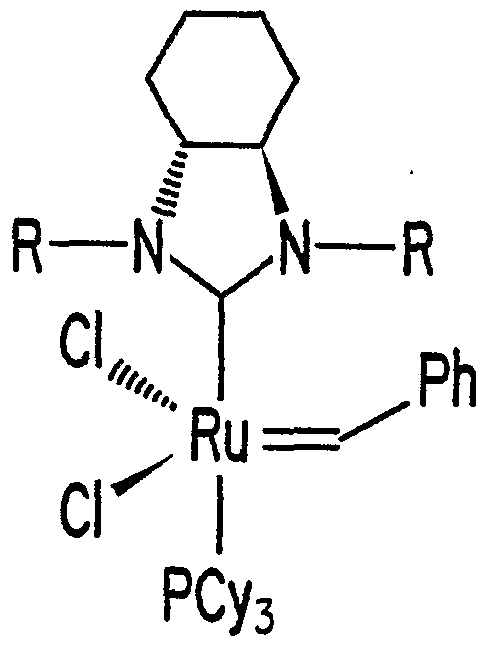
Ruthenium complex B, a derivative of complex A and having the structure shown
below, is a substituted ruthenium carbene complex including such a ligand:
Figure imgf000006_0002
B Other derivatives of parent complex Ά. can also be used in the resin system of the
composition of the present invention, such as substituted ruthenium carbene complexes
C and D having the following structures:
Figure imgf000007_0001
D
The catalyst component of the dental impression material is formulated by dissolving
the ruthenium carbene complex in an inert solvent. The solvent, or diluent, is chosen
such that the solvent and the complex are miscible (soluble) or dispersible with the base
pastes, and such that the solvent does not interfere with the reaction. The solvent may be, for example, 3-phenyl-heptamethyl-trisiloxane.
The fillers useful in the composition of the present invention include
reinforcing and/or non-reinforcing (extending) fillers. Suitable reinforcing fillers
include precipitated silicas, fumed silica, calcium silicate (Wbllastonite), crystalline
silica, and the like. The addition of reinforcing filler improves the mechanical strength,
such as tensile and tear strengths, of the cured composition. Suitable non-reinforcing
fillers include diatomaceous earth, aluminas, magnesias, titanium dioxide, zirconium
silicate, calcium carbonate, metallic oxides, and the like. Surface-treated fillers may
also be used. Typical surface treatments include silanization and the like. In accordance with the present invention, mixtures of fillers with different particle sizes
may be used. A bimodal filler system blended with sub-micron (< l ^m) and micron-
sized particles (2-10μm) of close particle size distribution is used as a varying filler
loading to provide dental impression materials with low, medium or high consistency,
as defined by ISO Specification No. 4823 (2nd. Ed. 1992), suitable for use in all dental
impression techniques. The filler may be present in amounts of from about 15 wt.% to
about 50 wt.% of the composition. To adjust the consistency of the two-paste
embodiment of the present invention to achieve either a low, medium or high
consistency composition, the sub-micron sized filler and/or the micron sized filler may
be adjusted in one or both of the catalyst and base pastes. The higher the consistency
desired, the more beneficial it is to increase the sub-micron filler to a greater extent than
the increase in the micron sized filler, whereby the sub-micron filler particles are
worked into the interstitial spaces between micronized particles during mixing.
By way of example only and not limitation, the composition may
comprise the polymerizable resin in an amount of about 5wt.% to about 95wt.%, the
sub-micron sized filler in an amount up to about 10 wt.%, the micron sized filler in an
amount of about 10wt.% to about 60wt.%, and the catalyst in an amount of about
0.001wt.% to about lwt.%. The composition of the present may further include
optional additives known to one skilled in the art, such as pigments, that do not interfere
with the reaction.
EXAMPLE
A telechelic polydimethylsiloxane terminated with norbornyl groups was
synthesized according to the following scheme:
Figure imgf000009_0001
A three-neck round bottom flask equipped with a mechanical stirrer, a condenser and N2
inlet-outlet was charged with 360.0 g silanol terminated poly(dimethyl siloxane) (DMS-
S27, n=243, from Gelest Corp.) and 4.85 g triethylamine containing 1% 4-(N,N-
dimethyl)amino-pyridine. A quantity of 9.02 g of 2-(5-norbor-2-enyl)-ethyl-
dimethylchlorosilane was added dropwise to the flask with stirring. After the addition,
the reaction temperature was raised to 70 °C, and stirring was continued for 4 hours at
that temperature. Then, 2 mL methanol was added to the mixture and stirring was
continued for 1 hour longer. The reaction mixture was next diluted with 500 mL of
hexanes and filtered to remove the white salt. The hexane solution was washed three
times with 1% HC1 and three times with deionized water. The solution was then dried
over Na2SO4. After evaporation of the solvent under vacuum, a clear liquid product was
obtained. This compound 1, having n=243 (average), exhibited the following infrared
peaks (cm"1): 2963, 1411, 1260, 1020, 800, and 702.
A second compound was produced following the same procedure as
above, but this time using a silanol terminated poly(dimethyl siloxane) having n=27 (average). These two resulting compounds were then mixed and compounded with
fillers and dispersed in a three-roll mill to form a suspension. This suspension is
referred to as the base component, or base paste, and its composition is detailed in Table
1.
TABLE 1
Figure imgf000010_0001
Two catalyst pastes were then formulated by dissolving in 3-phenyl-
heptamethyl-trisiloxane the ruthenium carbene complex A and B, respectively, each
catalyst complex having been obtained from Strem Chemicals Inc., Newburyport, MA.
The solutions were then compounded with fillers and dispersed in a three-roll mill to
form suspensions. These suspensions are referred to as the catalyst components, or
catalyst pastes, and are further described in Table 2.
TABLE 2
Figure imgf000010_0002
For comparative purposes, the test base paste composition was combined
with each of the test catalyst paste compositions in a base to catalyst ratio of 10:1 and
mixed by spatulation. Separately, for use in the comparison, catalyst and base pastes
were prepared for an addition-curable silicone composition using a platinum-containing
hydrosilation catalyst. The comparative control base paste and control catalyst paste
compositions are detailed in Tables 3 and 4, respectively.
TABLE 3
Figure imgf000011_0001
TABLE 4
Figure imgf000011_0002
The control pastes were combined in a base paste to catalyst paste ratio of 1 : 1.
Both the test compositions and control compositions are classified as type 2 or 3 impression materials, meaning that they have low to medium consistency, as
defined by ISO Specification No. 4823. The physical properties of the cured
compositions were determined using ISO Specification No. 4823 for evaluation of work time, set time, mixed consistency, dimensional change, strain and compression and
deformation recovery. The results are given below in Table 5.
Table 5 also includes the results of a test devised to determine the
relative sensitivity of these formulations to residual sulfur compound containing
surfaces, such as latex gloves used by dentists. The sulfiir sensitivity test comprised
preparing a 1% solution of an approximately 30%/70% mixture of mono- and di-octyl
tin bis (2-ethylhexylthioglycolate) esters in hexane. A microbrush was dipped in this
solution, and the solution was painted on the edge of a 3x6 inch dental impression
mixing pad. The control base paste and the control catalyst paste were mixed in a 1 :1
ratio (0.5g/0.5g) and the test base paste and the test catalyst paste were mixed in a 10:1
ratio (1.0 g/O.lg), each by spatulation for 20 seconds, and each mixture was partially
placed on top of the area of the pad where the hexane solution was painted on. After the
bulk of the material had set, as indicated by set time and recovery from deformation, the
mixture was lifted off the pad, and the area that was in contact with the painted area was checked to see if it had also set. The materials were checked 10 minutes after
placement on the pad to ascertain whether setting was achieved at the sulfur contact area
after the bulk material had already set. The results of this sulfur sensitivity test, along
with the physical properties set forth in ISO Specification No. 4823 are set forth in
Table 5.
12 TABLE 5
Figure imgf000013_0001
From the data in Table 5, it is shown that the materials of the present invention pass the
requirements of ISO specification 4823 for Type 2 and/or 3 dental impression materials,
including requirements for compatibility with gypsum and detail reproduction.
In addition, the test impression materials exhibited a reduction in
sensitivity to sulfiir impurities. The test impression material of the present invention
incorporating the complex B catalyst exhibited significantly reduced sulfur sensitivity,
as indicated by its ability to fully set at surfaces in contact with a sulfur impurity. The test impression material of the present invention utilizing the complex A catalyst at least
partially set at the contact surface after 10 minutes, although it did not fully set within 20 minutes after placement. In contra&c, the control impression material utilizing the
platinum complex catalyst did not set at all at the contact surface within 20 minutes of
contacting the sulfur impurity. As defined in ISO specification 4823, a material has set
when it develops a recovery from deformation of between 96.5% and 100%. Thus,
while the bulk of the impression material may fully set within 10 minutes in each of the
test and control materials, surfaces in contact with sulfur impurities may be prevented
from setting due to the sulfur deactivating the catalyst, possibly by a chelation
mechanism. The parent benzylidene ruthenium complex A caused a reduction in sulfur
sensitivity, and the high ring-opening metathesis active ruthenium carbene complexes
having substituted imidazole ligands exhibited the highest reduction in sulfur sensitivity
during polymerization, as indicated by the full setting of the material at the contacting
surface. Thus, compositions of the present invention including a ruthenium carbene
complex with a ligand having a basicity higher than that of tricyclonexylphosphine can achieve a recovery after deformation of at least 96.5% within 20 minutes of contacting a
thin film of an oxidizable sulfur-containing compound.
While the present invention has been illustrated by the description of an
embodiment thereof, and while the embodiment has been described in considerable
detail, it is not intended to restrict or in any way limit the scope of the appended claims
to such detail. Additional advantages and modifications will readily appear to those
skilled in the art. The invention in its broader aspects is therefore not limited to the
specific details, representative methods and illustrative examples shown and described.
Accordingly, departures may be made from such details without departing from the scope or spirit of applicant's general inventive concept.
WHAT IS CLAIMED IS:

Claims

1. A composition for use as a dental impression material, comprising:
a polymerizable resin comprising a telechelic oligomer or polymer curable by
ring-opening metathesis polymerization;
a filler system; and
a ruthenium carbene complex catalyst, wherein the catalyst is capable of
initiating the ring-opening metathesis polymerization of the composition.
2. The composition of claim 1, wherein the polymerizable resin is telechelic
polydimethylsiloxane end-functionalized with norbonyl groups and having between about 5 and about 5000 dimethylsiloxane units.
3. The composition of claim 2, wherein the polydimethylsiloxane includes between
about 27 and about 1590 dimethylsiloxane units.
4. The composition of claim 1, wherein the polymerizable resin is a telechelic
polysiloxane having the following structure:
Figure imgf000015_0001
where n=5-5O00,
R1( R2=CrCi8 hydrocarbon or CH2CH2-j-CH2CHθ -R4
where R3,
Figure imgf000015_0002
and
Figure imgf000015_0003
drocarbon
Figure imgf000015_0004
5. The composition of claim 1, wherein the polymerizable resin is telechelic
polytetrahydrofuran-polyethylene oxide end-fuctionalized with norbonyl groups.
6. The composition of claim 1, wherein the composition comprises about 5 wt.% to
about 95 wt.% of the polymerizable resin.
7. The composition of claim 1, wherein the filler system is bimodal, including a
sub-micron sized filler component and a micron sized filler component.
8. The composition of claim 7, wherein the composition comprises up to about 10
wt.% sub-micron sized filler and about 10 wt.% to about 60 wt.% micron sized filler.
9. The composition of claim 1, wherein the catalyst is a benzylidene ruthenium
complex of the formula:
Figure imgf000016_0001
wherein Cy is cyclohexyl and Ph is phenyl.
10. The composition of claim 1, wherein the catalyst is a 4,5-dihydroimidazol-2-
ylidene-substituted ruthenium carbene complex.
11. The composition of claim 1 , wherein the catalyst is a ruthenium carbene
complex with one ligand having a basicity higher than tricyclohexylphosphine.
12. The composition of claim 11 , wherein the complex is of the formula:
Figure imgf000017_0001
B
wherein Cy is cyclohexyl, Ph is phenyl and R is mesityl.
13. The composition of claim 11 , wherein the complex is of the formula:
Figure imgf000017_0002
wherein Cy is cyclohexyl, Ph is phenyl and R is mesityl.
14. The composition of claim 11 , wherein the complex is of the formula:
Figure imgf000018_0001
D wherein Cy is cyclohexyl, Ph is phenyl and R is mesityl.
15. The composition of claim 1 , wherein the composition achieves a recovery after
deformation of at least 96.5% within 20 minutes of contacting a film of an oxidizable
sulfiir-containing compound.
16. The composition of claim 1 wherein the composition comprises about 0.001wt.% to about lwt.% of the catalyst.
17. A composition for use as a dental impression material, comprising:
a base paste including a polymerizable resin that is a telechelic oligomer or
polymer curable by ring-opening metathesis polymerization and a filler system; and
a catalyst paste including a ruthenium carbene complex catalyst dissolved in a
solvent which is miscible with the base paste, and a filler system, wherein the catalyst is
capable of initiating the ring-opening metathesis polymerization of the composition.
18. The composition of claim 17, wherein the ratio of the base paste to the catalyst
paste in the composition is in the range of about 10:1 to about 1:10.
19. The composition of claim 17, wherein the polymerizable resin is telechelic
polydimethylsiloxane end-functionalized with norbonyl groups and having between
about 5 and about 5000 dimethylsiloxane units.
20. The composition of claim 19, wherein the polydimethylsiloxane includes
between about 27 and about 1590 dimethylsiloxane units.
21. The composition of claim 17, wherein the polymerizable resin is a telechelic
polysiloxane having the following structure:
Figure imgf000020_0001
where n=5-5000
Figure imgf000020_0002
where R3,
Figure imgf000020_0003
and
Figure imgf000020_0004
and
Figure imgf000020_0005
22. The composition of claim 17, wherein the polymerizable resin is telechelic
polytetrahydrofuran-polyethylene oxide end-fuctionalized with norbonyl groups.
23. The composition of claim 17, wherein the composition comprises about 5 wt.%
to about 95 wt.% of the polymerizable resin.
24. The composition of claim 17, wherein the filler system in each of the base paste
and the catalyst paste is bimodal, including a sub-micron sized filler component and a
micron sized filler component.
25. The composition of claim 24, wherein the composition comprises up to about 10
wt.% sub-micron sized filler and about 10 wt.% to about 60 wt.% micron sized filler.
26. The composition of claim 17, wherein the catalyst is a benzylidene ruthenium
complex of the formula:
Figure imgf000021_0001
wherein Cy is cyclohexyl and Ph is phenyl.
27. The composition of claim 17, wherein the catalyst is a 4,5-dihydroimidazol-2-
ylidene-substituted ruthenium carbene complex.
28. The composition of claim 17, wherein the catalyst is a ruthenium carbene
complex with one ligand having a basicity higher than tricyclohexylphosphine.
29. The composition of claim 28, wherein the complex is of the formula:
Figure imgf000021_0002
B
wherein Cy is cyclohexyl, Ph is phenyl and R is mesityl.
30. The composition of claim 28, wherein the complex is of the formula:
Figure imgf000022_0001
PCy2
wherein Cy is cyclohexyl, Ph is phenyl and R is mesityl.
31. The composition of claim 28, wherein the complex is of the foimula:
Figure imgf000022_0002
wherein Cy is cyclohexyl, Ph is phenyl and R is mesityl.
32. The composition of claim 17, wherein the composition achieves a recovery after
deformation of at least 96.5% within 20 minutes of contacting a film of an oxidizable
sulfur-containing compound.
33. The composition of claim 17 wherein the composition comprises about
0.001wt.% to about lwt.% of the catalyst.
34. A composition for use as a d 2e3ntal impression material, comprising:
a base paste including a telechelic polysiloxane curable by ring-opening
metathesis polymerization and a filler system; and
a catalyst paste including a substituted ruthenium carbene complex with a
substituted ligand having a basicity higher than tricyclohexylphosphine, the complex
dissolved in a solvent which is miscible with the base paste, and a filler system,
wherein the catalyst is capable of initiating the ring-opening metathesis
polymerization of the composition, and
wherein the composition achieves a recovery after deformation of at least 96.5%
within 20 minutes of contacting a solution of 1 % or less of an oxidizable sulfur-
containing compound in hexane.
PCT/US2001/024004 2000-10-17 2001-07-31 Dental impression material utilizing ruthenium catalyst Ceased WO2002032338A2 (en)

Priority Applications (7)

Application Number Priority Date Filing Date Title
MXPA03003449A MXPA03003449A (en) 2000-10-17 2001-07-31 Dental impression material utilizing ruthenium catalyst.
JP2002535577A JP2004513892A (en) 2000-10-17 2001-07-31 Dental impression material using ruthenium catalyst
CA002425485A CA2425485A1 (en) 2000-10-17 2001-07-31 Dental impression material utilizing ruthenium catalyst
DE60124290T DE60124290T2 (en) 2000-10-17 2001-07-31 Use of a ruthenium catalyst for the production of dental impression materials
AU2001280925A AU2001280925A1 (en) 2000-10-17 2001-07-31 Dental impression material utilizing ruthenium catalyst
EP01959361A EP1326574B1 (en) 2000-10-17 2001-07-31 Dental impression material utilizing ruthenium catalyst
BR0114679-3A BR0114679A (en) 2000-10-17 2001-07-31 Compositions for use as a dental impression material

Applications Claiming Priority (2)

Application Number Priority Date Filing Date Title
US09/690,236 2000-10-17
US09/690,236 US6455029B1 (en) 2000-10-17 2000-10-17 Dental impression material utilizing ruthenium catalyst

Publications (2)

Publication Number Publication Date
WO2002032338A2 true WO2002032338A2 (en) 2002-04-25
WO2002032338A3 WO2002032338A3 (en) 2002-10-10

Family

ID=24771661

Family Applications (1)

Application Number Title Priority Date Filing Date
PCT/US2001/024004 Ceased WO2002032338A2 (en) 2000-10-17 2001-07-31 Dental impression material utilizing ruthenium catalyst

Country Status (11)

Country Link
US (1) US6455029B1 (en)
EP (1) EP1326574B1 (en)
JP (1) JP2004513892A (en)
CN (1) CN1469730A (en)
AT (1) ATE344004T1 (en)
AU (1) AU2001280925A1 (en)
BR (1) BR0114679A (en)
CA (1) CA2425485A1 (en)
DE (1) DE60124290T2 (en)
MX (1) MXPA03003449A (en)
WO (1) WO2002032338A2 (en)

Cited By (8)

* Cited by examiner, † Cited by third party
Publication number Priority date Publication date Assignee Title
EP1317914A1 (en) * 2001-12-06 2003-06-11 Kerr Corporation Dental impression material utilizing ruthenium metathesis catalyst
WO2003093351A1 (en) * 2002-05-06 2003-11-13 Kerr Corporation Composition curable by metathesis reaction
EP1656924A1 (en) * 2004-11-15 2006-05-17 Kerr Corporation Metathesis-curable composition
DE202008009873U1 (en) 2008-07-22 2008-10-02 Kettenbach Gmbh & Co. Kg Dental bleaching composition and dental varnish
EP1842521A3 (en) * 2006-02-21 2009-10-14 Kerr Corporation Polyether-based dental impression material curable by metathesis reaction
US7625991B2 (en) 2006-02-21 2009-12-01 Kerr Corporation Method for making alkoxy-siloxane polyether carboxylates terminated with functional olefin groups
US7645443B2 (en) 2004-11-15 2010-01-12 Kerr Corporation Polyether-based composition curable by metathesis reaction
DE102009021553A1 (en) 2009-05-09 2010-11-18 Kettenbach Gmbh & Co. Kg Curable compositions, cured products made therefrom and their use

Families Citing this family (17)

* Cited by examiner, † Cited by third party
Publication number Priority date Publication date Assignee Title
DE60205444T2 (en) 2001-12-06 2006-06-01 Kerr Corp., Orange Accelerator for metathesis catalyst
DE10261720A1 (en) * 2002-12-30 2004-07-15 Meyer, Gerhard, Prof. Dr. Milling ceramics made of metal oxide powders with bimodal grain size distribution
US7060770B2 (en) * 2003-05-06 2006-06-13 Kerr Corporation Metathesis-curable composition with a reaction control agent
US7060769B2 (en) * 2003-05-06 2006-06-13 Kerr Corporation Method of curing composition by metathesis reaction using reaction control agent
US7683148B2 (en) * 2003-05-06 2010-03-23 Kerr Corporation Metathesis-curable composition with a reaction control agent
US7173097B2 (en) * 2003-05-06 2007-02-06 Kerr Corporation Metathesis-curable composition with a reaction control agent
FR2864543B1 (en) * 2003-12-30 2006-03-03 Rhodia Chimie Sa PROCESS FOR THE PREPARATION OF POLYORGANOSILOXANES (POS) BY POLYMERIZATION BY OPENING CYCLE (S) AND / OR REDISTRIBUTION OF POS, IN THE PRESENCE OF CARBENE (S) AND POS COMPOSITIONS IMPLEMENTED IN SAID METHOD
DE102004002178A1 (en) * 2004-01-15 2005-08-11 Ivoclar Vivadent Ag Dental matrials based on RÖMP composites
ATE519473T1 (en) * 2004-06-30 2011-08-15 Ivoclar Vivadent Ag DENTAL MATERIALS OBTAINED BY PHOTOINDUCED RING OPENING METATHESIS POLYMERIZATION OF CYCLIC OLEFINS
US20070016253A1 (en) * 2005-07-15 2007-01-18 Amanda Doherty Primary dental teether
US20070016252A1 (en) * 2005-07-15 2007-01-18 Doherty Amanda L Primary dental eruption teether
DE102006001126A1 (en) * 2006-01-09 2007-07-12 Kettenbach Gmbh & Co. Kg Dental impression compounds, hardened products prepared therefrom and use of surfactants for the production of dental impression compounds
ATE480216T1 (en) * 2006-02-02 2010-09-15 3M Innovative Properties Co SOLIDS OBTAINED THROUGH ROMP
FR2900153B1 (en) * 2006-04-21 2008-07-18 Rhodia Recherches & Tech PROCESS FOR CONDENSING SILYLATED PATTERNS USING CARBENE TYPE CATALYST
EP1882469A1 (en) * 2006-07-28 2008-01-30 3M Innovative Properties Company Polyether-based preparations and use thereof
EP1942125A1 (en) * 2006-12-20 2008-07-09 3M Innovative Properties Company Compositions curable by ring opening metathesis polymerarization at low temperatures and their application in the dental field
US9873094B2 (en) 2015-08-14 2018-01-23 Ut-Battelle, Llc Cross-linked polymeric membranes for carbon dioxide separation

Family Cites Families (8)

* Cited by examiner, † Cited by third party
Publication number Priority date Publication date Assignee Title
US5266670A (en) 1986-10-14 1993-11-30 Loctite Corporation Selective monohydrosilation of vinyl and ethynyl functional norbornenes and curable products produced thereby
US5728785A (en) 1995-07-07 1998-03-17 California Institute Of Technology Romp polymerization in the presence of peroxide crosslinking agents to form high-density crosslinked polymers
US5831108A (en) * 1995-08-03 1998-11-03 California Institute Of Technology High metathesis activity ruthenium and osmium metal carbene complexes
CA2199567C (en) * 1996-03-20 2003-01-14 Volker Rheinberger Functionalized and polymerizable polymer
DE19730515A1 (en) * 1997-07-16 1999-01-21 Espe Dental Ag Silicone-based impression material
DE19742981B4 (en) * 1997-09-29 2013-07-25 3M Deutschland Gmbh ROMP curable dental materials
DE19905093A1 (en) * 1999-02-01 2000-08-03 Ivoclar Ag Schaan Low shrinkage dental materials
US6649146B2 (en) * 2000-10-17 2003-11-18 Kerr Corporation Dental impression material utilizing ruthenium metathesis catalyst

Cited By (12)

* Cited by examiner, † Cited by third party
Publication number Priority date Publication date Assignee Title
EP1317914A1 (en) * 2001-12-06 2003-06-11 Kerr Corporation Dental impression material utilizing ruthenium metathesis catalyst
WO2003093351A1 (en) * 2002-05-06 2003-11-13 Kerr Corporation Composition curable by metathesis reaction
EP1656924A1 (en) * 2004-11-15 2006-05-17 Kerr Corporation Metathesis-curable composition
US7625551B2 (en) 2004-11-15 2009-12-01 Kerr Corporation Polyether-based dental impression material curable by metathesis reaction
US7645443B2 (en) 2004-11-15 2010-01-12 Kerr Corporation Polyether-based composition curable by metathesis reaction
EP1842521A3 (en) * 2006-02-21 2009-10-14 Kerr Corporation Polyether-based dental impression material curable by metathesis reaction
US7625991B2 (en) 2006-02-21 2009-12-01 Kerr Corporation Method for making alkoxy-siloxane polyether carboxylates terminated with functional olefin groups
DE202008009873U1 (en) 2008-07-22 2008-10-02 Kettenbach Gmbh & Co. Kg Dental bleaching composition and dental varnish
DE102009021553A1 (en) 2009-05-09 2010-11-18 Kettenbach Gmbh & Co. Kg Curable compositions, cured products made therefrom and their use
EP2253302A2 (en) 2009-05-09 2010-11-24 Kettenbach GmbH & CO. KG Hardening compounds, products derived from same and use thereof
DE202009018142U1 (en) 2009-05-09 2011-02-24 Kettenbach Gmbh & Co. Kg Curable compositions, cured products made therefrom and their use
US8614262B2 (en) 2009-05-09 2013-12-24 Kettenbach Gmbh & Co. Kg Curable compositions, cured products produced therefrom and use thereof

Also Published As

Publication number Publication date
CA2425485A1 (en) 2002-04-25
AU2001280925A1 (en) 2002-04-29
BR0114679A (en) 2003-10-07
WO2002032338A3 (en) 2002-10-10
CN1469730A (en) 2004-01-21
ATE344004T1 (en) 2006-11-15
DE60124290D1 (en) 2006-12-14
MXPA03003449A (en) 2004-01-29
JP2004513892A (en) 2004-05-13
EP1326574B1 (en) 2006-11-02
EP1326574A2 (en) 2003-07-16
DE60124290T2 (en) 2007-04-19
US6455029B1 (en) 2002-09-24

Similar Documents

Publication Publication Date Title
US6455029B1 (en) Dental impression material utilizing ruthenium catalyst
EP1317914B1 (en) Dental impression material utilizing ruthenium metathesis catalyst
US7732508B2 (en) Automixable putty impression material
JP3122238B2 (en) Transparent materials for dental applications
US5998561A (en) Catalyst and composition for silicone dental impression materials
DE60106151T2 (en) Addition curable silicone elastomer blends, their preparation and use
US8067496B2 (en) Curable silicone impression materials with high tear strength and low consistency
EP0231420B1 (en) Dental impression material
JPH02262503A (en) Impression material composition
GB1494670A (en) Manufacture of curable organopolysiloxane compositions
US3082527A (en) Process for making dental impression masses
DE10103446A1 (en) Mixing materials that can be hardened in two stages
JP3220639B2 (en) Room temperature curable organopolysiloxane composition
JPH0639570B2 (en) Putty-like curable organopolysiloxane composition
US20080319100A1 (en) Dental Impression Masses, Hardened Products Produced from them, and Use of Surfactants for the Production of Dental Impression Masses
JPH0322905B2 (en)
JPH1067935A (en) Curable organopolysiloxane composition
JP2007224031A (en) Dental impression material based on polyether curable by metathesis reaction
JPH06157914A (en) Curable silicone rubber composition
JP2732164B2 (en) Method for producing silicone cured microsuspension
JP2651836B2 (en) Organopolysiloxane composition
EP1650263B1 (en) Composition containing unsaturated silicone compounds, dental materials containing them and use thereof
JP3248766B2 (en) Soft lining material
EP1741420A1 (en) Quick set silicone based dental impression materials
JP3673838B2 (en) Dental impression material

Legal Events

Date Code Title Description
AK Designated states

Kind code of ref document: A2

Designated state(s): AE AG AL AM AT AU AZ BA BB BG BR BY BZ CA CH CN CO CR CU CZ DE DK DM DZ EC EE ES FI GB GD GE GH GM HR HU ID IL IN IS JP KE KG KP KR KZ LC LK LR LS LT LU LV MA MD MG MK MN MW MX MZ NO NZ PL PT RO RU SD SE SG SI SK SL TJ TM TR TT TZ UA UG UZ VN YU ZA ZW

AL Designated countries for regional patents

Kind code of ref document: A2

Designated state(s): GH GM KE LS MW MZ SD SL SZ TZ UG ZW AM AZ BY KG KZ MD RU TJ TM AT BE CH CY DE DK ES FI FR GB GR IE IT LU MC NL PT SE TR BF BJ CF CG CI CM GA GN GQ GW ML MR NE SN TD TG

AK Designated states

Kind code of ref document: A3

Designated state(s): AE AG AL AM AT AU AZ BA BB BG BR BY BZ CA CH CN CO CR CU CZ DE DK DM DZ EC EE ES FI GB GD GE GH GM HR HU ID IL IN IS JP KE KG KP KR KZ LC LK LR LS LT LU LV MA MD MG MK MN MW MX MZ NO NZ PL PT RO RU SD SE SG SI SK SL TJ TM TR TT TZ UA UG UZ VN YU ZA ZW

AL Designated countries for regional patents

Kind code of ref document: A3

Designated state(s): GH GM KE LS MW MZ SD SL SZ TZ UG ZW AM AZ BY KG KZ MD RU TJ TM AT BE CH CY DE DK ES FI FR GB GR IE IT LU MC NL PT SE TR BF BJ CF CG CI CM GA GN GQ GW ML MR NE SN TD TG

121 Ep: the epo has been informed by wipo that ep was designated in this application
DFPE Request for preliminary examination filed prior to expiration of 19th month from priority date (pct application filed before 20040101)
WWE Wipo information: entry into national phase

Ref document number: 2425485

Country of ref document: CA

WWE Wipo information: entry into national phase

Ref document number: 2001280925

Country of ref document: AU

WWE Wipo information: entry into national phase

Ref document number: PA/a/2003/003449

Country of ref document: MX

Ref document number: 2002535577

Country of ref document: JP

WWE Wipo information: entry into national phase

Ref document number: 018175163

Country of ref document: CN

WWE Wipo information: entry into national phase

Ref document number: 2001959361

Country of ref document: EP

WWP Wipo information: published in national office

Ref document number: 2001959361

Country of ref document: EP

REG Reference to national code

Ref country code: DE

Ref legal event code: 8642

WWG Wipo information: grant in national office

Ref document number: 2001959361

Country of ref document: EP