WO2002051925A1 - Flame retardant carbonate polymers and use thereof - Google Patents
Flame retardant carbonate polymers and use thereof Download PDFInfo
- Publication number
- WO2002051925A1 WO2002051925A1 PCT/US2001/031777 US0131777W WO02051925A1 WO 2002051925 A1 WO2002051925 A1 WO 2002051925A1 US 0131777 W US0131777 W US 0131777W WO 02051925 A1 WO02051925 A1 WO 02051925A1
- Authority
- WO
- WIPO (PCT)
- Prior art keywords
- additive
- fluorinated
- anion
- highly fluorinated
- carbonate polymer
- Prior art date
- Legal status (The legal status is an assumption and is not a legal conclusion. Google has not performed a legal analysis and makes no representation as to the accuracy of the status listed.)
- Ceased
Links
Classifications
-
- C—CHEMISTRY; METALLURGY
- C08—ORGANIC MACROMOLECULAR COMPOUNDS; THEIR PREPARATION OR CHEMICAL WORKING-UP; COMPOSITIONS BASED THEREON
- C08K—Use of inorganic or non-macromolecular organic substances as compounding ingredients
- C08K5/00—Use of organic ingredients
- C08K5/36—Sulfur-, selenium-, or tellurium-containing compounds
- C08K5/41—Compounds containing sulfur bound to oxygen
- C08K5/42—Sulfonic acids; Derivatives thereof
-
- C—CHEMISTRY; METALLURGY
- C08—ORGANIC MACROMOLECULAR COMPOUNDS; THEIR PREPARATION OR CHEMICAL WORKING-UP; COMPOSITIONS BASED THEREON
- C08K—Use of inorganic or non-macromolecular organic substances as compounding ingredients
- C08K5/00—Use of organic ingredients
- C08K5/0008—Organic ingredients according to more than one of the "one dot" groups of C08K5/01 - C08K5/59
- C08K5/0066—Flame-proofing or flame-retarding additives
-
- C—CHEMISTRY; METALLURGY
- C08—ORGANIC MACROMOLECULAR COMPOUNDS; THEIR PREPARATION OR CHEMICAL WORKING-UP; COMPOSITIONS BASED THEREON
- C08K—Use of inorganic or non-macromolecular organic substances as compounding ingredients
- C08K5/00—Use of organic ingredients
- C08K5/36—Sulfur-, selenium-, or tellurium-containing compounds
- C08K5/43—Compounds containing sulfur bound to nitrogen
- C08K5/435—Sulfonamides
Definitions
- the present invention is directed to flame retardant carbonate polymer compositions and articles prepared therefrom.
- the carbonate polymer contains a flame retardant additive comprising metal salts of highly fluorinated methides, i ides or amides.
- the composition provides flame retardancy at relatively low levels of additive, may allow a broader processing window of additive compositions and can have high transparency.
- Carbonate polymers derived from the reaction of bis-hydroxy or dihydroxy compounds with carbonic acid derivatives are widely used because of their desirable physical and chemical properties. In particular, carbonate polymers are used in the manufacture of molded parts wherein rigidity, impact strength, toughness, ductility, heat stability, clarity and high dielectric properties are desired.
- carbonate polymers may exhibit a burning time when contacted with an open flame, and so are precluded from many applications for safety reasons.
- Many carbonate polymers are classified as N-2 in the burning test defined in Underwriter's Laboratories Tests for Flammability of Plastic Materials test UL 94, of May 14, 1993.
- Polycarbonates have been modified with various additives in attempts to reduce the flammability (or increase the combustion resistance).
- additives have included phosphites, phosphates, thiophosphoric acid esters containing halogenated al yl radicals and other halogenated organic compounds. With many such additives, they must be added at relatively high weight percentages that may adversely affect the physical and/or optical properties of the resulting articles.
- Polytetrafluoroethylene has been added, as an anti-drip and flame retardant agent, to polycarbonate resins, but adversely affects the clarity and transparency of molded articles made therefrom.
- Glass fibers may be added, but the addition adversely affects the polymer matrix and optical properties.
- the polycarbonate molding composition is rendered opaque by the addition of pigments to mask the reduced optical properties.
- Perfluoroalkyl sulfonate salts have been added to polycarbonates. While they reduce the flammability of the resulting articles, they have a very narrow window of processibility. Too low a concentration and the flammability is not sufficiently reduced. Too high a concentration and the optical properties, such as transparency and clarity, suffer.
- the present invention is directed to flame retardant compositions comprising a carbonate polymer, and an additive metal salt comprising an anion selected from the group consisting of (a) a highly fluorinated methide, (b) a highly fluorinated imide, (c) a highly fluorinated amide, and any combinations thereof.
- the flame retardant carbonate polymer compositions of the present invention are useful in the preparation of shaped articles, such as those produced by casting, molding or extrusion. Included are automobile parts, electric motors housings, appliances, computer equipment such as monitor housings, aircraft parts, glass replacement, optical and headlamp lenses. Because the additive metal salt may be added at sufficient levels to reduce the flammability of the article without deleteriously affecting the optical properties, the composition is particularly useful in those applications where transparency or clarity is desired but where heretofore, opaque polycarbonates have been used.
- Anions useful as the anionic portion of the metal salt additives of the present invention may be generally classified as highly fluorinated (including perfluorinated) alkyl- or arylsulfonyl, imides, methides and amides.
- highly fluorinated it is meant that the degree of fluorination on the chain is sufficient to provide the chain with properties similar to those of a perfluorinated chain.
- aromatic rings “highly fluorinated” means replacement of the aromatic hydrogen atoms without saturation of the aromatic ring. More particularly, a highly fluorinated alkyl group will have more than half the total number of hydrogen atoms on the chain replaced with fluorine atoms.
- hydrogen atoms may remain on the chain, it is preferred that all hydrogen atoms be replaced with fluorine to form a perfluoroalkyl group. Though not preferred for environmental reasons, any hydrogen atoms beyond at least half replaced with fluorine that are not replaced with fluorine may be replaced with bromine and or chlorine. It is more preferred that at least two - thirds of the hydrogen atoms on the alkyl group be replaced with fluorine, still more preferred that at least three-fourths of the hydrogen atoms be replaced with fluorine and most preferred that all hydrogen atoms be replaced with fluorine to form a perfluorinated alkyl group.
- Preferred salts of this invention comprise fluorinated anions which are highly fluorinated imides or amides (I), or highly fluorinated methides (II) having the respective formulas:
- Q is a divalent organic linking group, preferably Q is selected from-SO 2 -, -CO-, and -SO 3 -;
- X is selected from the groups: H, halide, alkyl, alkenyl, aryl, alkaryl, - SO 2 R, - SO 2 R f , -SO 2 F, -SO 3 R, -C(O)R, and -C(O)R f , and -CN, but is preferably -SO 2 R f ,
- R is selected from the group consisting of alkyl, cycloalkyl, aralkyl, substituted alkyl, aryl, and substituted aryl groups.
- the substituted aryl may contain halogen or haloalkyl substituents, preferably fluorine or fluoroalkyl substituents,
- R f is a fluorinated aromatic or aliphatic radical containing at least one carbon atom.
- the radical contains a plurality of carbon atoms in a skeletal chain, such chain may be linear, branched, acyclic, cyclic, saturated or unsatured.
- the skeletal chain of carbon atoms can be interrupted by heteroatoms, such as divalent oxygen or trivalent nitrogen atoms each of which is bonded only to carbon atoms, or hexavalent sulfur atoms each of which may be bonded to carbon, fluorine, or oxygen atoms, but preferably where such heteroatoms are present, such skeletal chain does not contain more than one said heteromoiety for every two carbon atoms.
- Carbon bonded hydrogen atoms, bromine atoms or chlorine atoms may be present. Where present, however, they preferably are present not more than once for every two carbon atoms on the average.
- the non- skeletal valence bonds are preferably carbon-to-fluorine bonds. That is, R f is preferably perfluorinated.
- the total number of carbon atoms in R f can vary and be, for example, 1 to 12, preferably 1 to 8, and more preferably 1 to 4.
- Rf is or contains a cyclic structure
- such structure preferably has 5 or 6 ring members, one or two of which can be said heteroatoms, e.g., oxygen and/or nitrogen.
- two or more R f groups occur in a single formula, they can be the same or different and may be linked together to form a cyclic structure.
- R f can be a fluorinated or fluoroalkylated aromatic group or a fluorine atom.
- the methides, amides and imides may also be cyclic, when a combination of any two Rf groups are linked to form a cyclic structure.
- Preferred salts of this invention comprise fluorinated anions that are highly fluorinated imides or amides or highly flurorinated methides.
- the additive salts may be monomeric, dimeric, oligomeric or polymeric in nature.
- the most preferable salts may be generally classified as highly fluorinated (including perfluorinated) tris alkyl- or arylsulfonyl methides, and the corresponding bis alkyl- or arylsulfonyl imides, as represented by Formulas III and IN, respectively, and hereinafter referred to as "methide” and "imide” anions, respectively, for brevity,
- each Rf is independently selected from the group consisting of highly fluorinated or perfluorinated alkyl or fluorinated aryl radicals.
- the methides and imides may also be cyclic, when a combination of any two Rf groups are linked to form a cyclic structure.
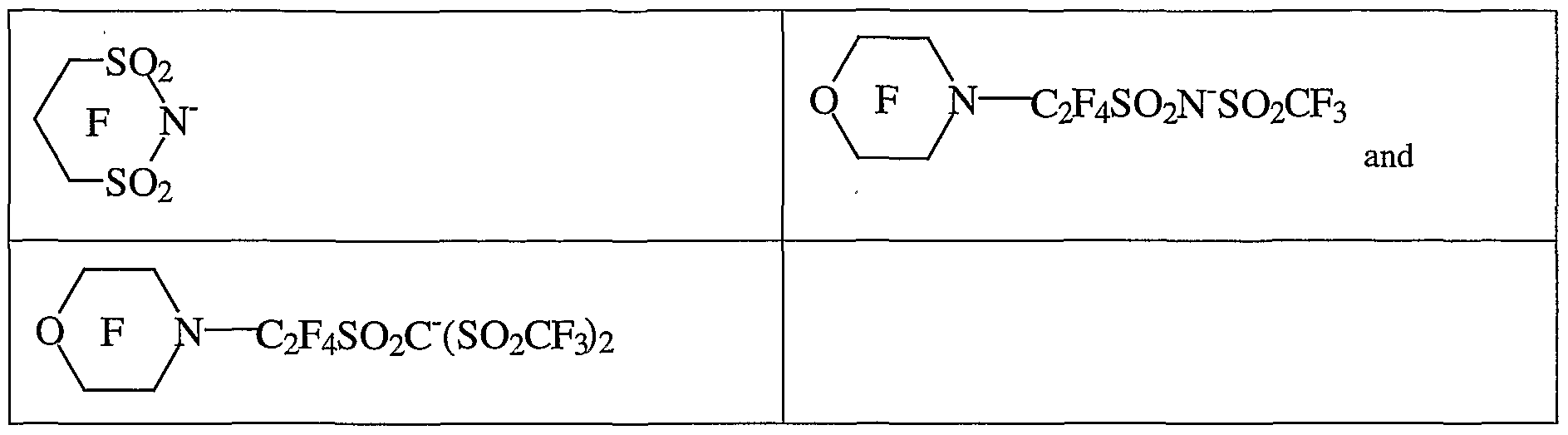
- anions useful in the practice of this invention include:
- F in the ring indicates a perfluorinated ring.
- Salts of the general formula R f SO 2 (CN)N " and R f SO 2 (CN)2C " may be prepared as described in WO 00/11742.
- any metal cation may be used as the cation of the flame-retardant additive salts.
- Alkali metal and alkali-earth metal salts are preferred. It will be understood that if the valence of the metal cation is greater than 1, an equal number of anions will be associated with the metal. This may comprise multiple methide, amide or imide anions, or a mixture with a non-reactive anion such as a halide anion or an anion of the formulas (Rf SO2) 3 C ⁇ ,
- the additive metal salt therefore may comprise compounds of the formula
- M 2+ is a metal salt of valency 2+
- X' is a halide anion, (Rf SO 2 ) 3 C, (R f SO 2 )2 N “ , R f SO 3 " , Rf SO 2 NH “ , SO 3 2 ⁇ PO 4 3' SbF 6 " , PF 6 ⁇ BF 4 “ , ClO 4 ⁇ SO 4 2' or NO 3 ⁇
- Useful carbonate polymers include aliphatic and aromatic carbonate homo- and copolymers, as well as blends thereof may be used in the carbonate polymer composition of this invention.
- Aromatic carbonate polymer resins useful in the flame retardant carbonate polymer compositions may be any carbonate polymer useful for molding, casting or extrusion.
- Carbonate polymers may be derived from but are not limited to bisphenols derived from the condensation of 2 moles of phenol with aldehydes and ketones such as acetone, formaldehyde, cyclopentanone and fluorenone.
- Examples include, but are not limited to 2,2-bis-(4-hydroxyphenyl)propane (known as bisphenol-A), bis-(4- hydroxyphenyl)methane, 2,2-bis-(4-hydroxy — 3,5-dimethylphenyl)propane, 2,2-bis-(4- hydroxy — 3-methylphenyl)propane, 2,2-bis-(4-hydroxy — 3,5-dibromophenyl)propane, 2,2-bis-(4-hydroxy-3-methylphenyl)methane, 1 , l-bis-(4-hydroxyphenyl)cyclohexane, 1- bis-(4-hydroxyphenyl)sulfide, 2,2-bis-(4-hydroxy — 3,5-dimethylpheny
- Halogenated bis-hydroxyphenyl compounds may also be used, exemplified but not limited to 2,2-(3,5,3', 5'-tetrachloro-4,4'dihydroxydiphenyl)propane, 2,2-(3,5,3',5'- tetrabromo-4,4'dihydroxydiphenyl)propane, (3,3'-dichloro-4,4'dihydroxyphenyl)methane, 2,2-(3,5,-dichloro-4,4'dihydroxydiphenyl)propane, 2,2-(3,5,-dibromo- 4,4'dihydroxydiphenyl)propane and the like.
- Other useful bis-hydroxyphenyl compounds are described in Kirk-Othmer Encyclopedia of Chemical Technology, 4 th Edition, volume 19, pages 584-609, John Wiley and Sons, N.Y., N.Y.
- bis-(hydroxyphenyl-alkylidines), exemplified by bisphenol-A are preferred.
- Preferred bisphenol-A composition include homopolymers and blends thereof and copolymers including 4,4'-dihydroxydiphenyl, bis-(4-hydroxyphenyl)-p- isopropylbenzene, hydroquinone, bis-(hydroxyphenyl)sulfides, bis-(hydroxyphenyl)ethers, bis-(hydroxyphenyl)ketones, bis-(hydroxyphenyl)sulfoxides, and bis-
- the carbonate copolymer may comprise up to 20 weight percent of other bis-hydroxyphenyl compounds or dihydroxy phenyl compounds, based on the weight of the copolymers.
- a blend or mixture of a bisphenol-A homopolymer preferably may comprise up to 20 weight percent of homo- or copolymers based on other bis- or dihydroxyphenyl compounds.
- the carbonate polymer may comprise two or more different bis- or di-hydroxyphenyl compounds or a copolymer of a dihydroxyphenyl compound with a diol or with a hydroxy- or acid-terminated polyesters, or with a dibasic acid where a carbonate copolymer or interpolymer rather than a homopolymer is desired.
- the carbonate composition may comprise two or more of the above bis- or dihydroxyphenyl compounds, or blends of homo- and copolymers derived from the bis- or dihydroxyphenyl compounds.
- carbonate polymers may be prepared by ring-opening polymerization of cyclic polycarbonate precursors. Such carbonate polymers are available, for example, from Cyclic Corp, Rennselaer, NY.
- carbonate polymers that may be used in this invention include CalibreTM from Dow Chemical, and MakrolonTM, BayfolTM and ApecTM from Dow Chemical.
- the carbonate copolymer may be branched by inclusion of small amounts, preferably amounts of about 0.05 to 2 mole percent (based on dihydroxy phenols used, of polyfunctional compounds such as trifunctional compounds, particularly those with at least three aryl hydroxy groups.
- polyfunctional compounds such as trifunctional compounds, particularly those with at least three aryl hydroxy groups.
- trifunctional compounds include 2,4-bis-
- the carbonate precursor that is reacted with the described dihydroxy compounds is generally a carbonyl halide, a carbonate ester or a haloformate.
- the carbonyl halides from which the carbonate polymers may be prepared include carbonyl chloride, carbonyl bromide and mixtures thereof.
- the carbonate esters from which the carbonate polymers may be prepared include diphenyl carbonate, di-(halophenyl)carbonate, such as di- (chlorophenyl)carbonate, di-(bromophenyl)carbonate, di-(trichlorophenyl)carbonate, and the like, di-(alkylphenyl)carbonate, such as ditolyl carbonate, dinapthyl carbonate, phenyl tolyl carbonate, and the like, and mixtures thereof.
- the haloformates from which the carbonate polymers may be prepared include bis-haloformates of dihydroxyl phenols such as bis-haloformates of hydroquinone and the like, bis-haloformates of ethylene glycol. While other carbonate polymer precursors are known in the art and may be used, phosgene is preferred.
- the carbonate polymers are generally prepared using a molecular weight regulator, an acid scavenger and a catalyst.
- Useful molecular weight regulators include mono- hydroxy compounds such as phenol, t-butyl phenol, bromophenol, and the like.
- the acid scavenger may be an organic or inorganic base.
- Suitable organic bases include pyridine, triethyl amine, dimethyl amine, dimethyl aniline, and the like.
- Useful inorganic bases include a hydroxide, a carbonate, a bicarbonate, or an alkali- or alkali-earth metal phosphate.
- Useful syntheses of carbonate polymers are described in Kirk-Othmer (supra) and include the Schotten-Bauman reaction of phosgene and bis- or dihydroxyphenyl compounds in an amine catalyzed interfacial condensation reaction, ring-opening polymerization of a cyclic carbonate precursor, or the base catalyzed transesterification of an bis- or dihydroxyphenyl compounds with a monomeric carbonate.
- Suitable catalysts for base-catalyzed transesterification are exemplified by tertiary amines such as trimethyl amine, triethyl amine, dimethylaniline, quaternary ammonium compounds such as tetraethyl ammonium bromide, cetyl triethyl ammonium bromide, tetramethyl ammonium hydroxide, benzyl trimethyl ammonium chloride and tetramethyl ammonium chloride; and quaternary phosphonium compounds such as butyl triphenyl phosphonium bromide.
- tertiary amines such as trimethyl amine, triethyl amine, dimethylaniline
- quaternary ammonium compounds such as tetraethyl ammonium bromide, cetyl triethyl ammonium bromide, tetramethyl ammonium hydroxide, benzyl trimethyl ammonium chloride and tetramethyl am
- the carbonate polymers generally have a M w of between 10,000 and 200,000, preferably between 20,000 and 80,000.
- the Mw may be measured, for example by the light scattering chromatography, gel-permeation chromatography, or by measurement of intrinsic or inherent viscosity, as such techniques are known in the art.
- the carbonate polymer is of injection-molding grade having an intrinsic viscosity of 0.50 - 0.55 dL/g in chloroform at 30°C.
- the carbonate polymers are clear and colorless, i.e. optically clear and transparent.
- Shaped articles e.g., molded, cast, or extruded articles
- shaped articles can be made, e.g., by blending or otherwise uniformly mixing an effective amount of the additive and the polymer, for example by intimately mixing the additive with pelletized or powdered polymer, and melt extruding the mixture into shaped articles such as pellets, fibers, or films by known methods.
- effective amount it is meant an amount sufficient to improve the flame retardancy of the carbonate polymer.
- the additive is added in amounts of .01 to 2 weight percent, relative to the carbonate polymer.
- the highly fluorinated methide or highly fluorinated imide additive is used in amounts of 0.1 to 1.0 weight percent.
- Shaped articles may also be prepared by polymerizing a cyclic polymer precursor in the presence of the flame retardant additive.
- the additive can be mixed per se with the polymer or can be mixed with the polymer in the form of a "masterbatch" (concentrate) of the additive salt in the polymer.
- Masterbatches of polymers are prepared to achieve better mixing and homogeneity of relatively low concentrations of additives throughout the polymer. Masterbatches typically contain about 5-20 times or more preferably 10 to 15 times the concentration of the final desired level of the additive.
- an organic solution of the additive may be mixed with the powdered or pelletized polymer, the mixture dried to remove solvent, then melted and extruded or molded into the desired shaped article.
- the molten additive or masterbatch can be injected into a molten polymer stream to form a blend just prior to shaping into the desired article.
- the flame-retardant additive may also comprise one or more secondary flame-retardant additives.
- Useful secondary flame retardant additives may include, but are not limited to, halogenated organic compounds, organic phosphorus-containing compounds (such as organic phosphates), inorganic compounds and inherently flame retardant polymers.
- the secondary flame-retardant additive may comprise 1 to 99 weight percent, relative to the total amount of flame retardant present in the composition.
- Useful secondary flame-retardant additives are described, for example, in the Kirk-Othmer Encyclopedia of Technology, 4 th Ed., vol. 10, pp 954-76, John Wiley & Sons, N.Y., N.Y., 1993.
- the preferred secondary additive are fluoroalkylsulfonates, which may be used (in combination with the highly fluorinated imides, methides and amides) at higher total loading while maintaining optical clarity.
- Fluoroalkylsulfonates are described in U.S. 3,775,367 (Nouvertne et al.) the disclosure of which is incorporated herein by reference.
- halogenated organic secondary flame retardant additives include substituted benzenes, exemplified by tetrabromobenzene, hexachlorobenzene, hexabromobenzene, and biphenyls such as 2,2'-dichlorobiphenyl, 2,4'- dibromobiphenyl, 2,4 -dichlorobiphenyl, hexabromobiphenyl, octabromobiphenyl, decabromobiphenyl and halogenated diphenyl ethers, containing 2 to 10 halogen atoms.
- substituted benzenes exemplified by tetrabromobenzene, hexachlorobenzene, hexabromobenzene, and biphenyls such as 2,2'-dichlorobiphenyl, 2,4'- dibromobiphenyl, 2,4 -dichlorobiphenyl, hexabromobiphen
- the preferred halogenated organic secondary flame retardant additives for this invention are aromatic halogen compounds such as brominated benzene, chlorinated biphenyl, or a compound comprising two phenyl radicals separated by a divalent linking group (such as a covalent bond or alkylene group) and having at least two chlorine or bromine atoms per phenyl nucleus, and mixtures thereof.
- aromatic halogen compounds such as brominated benzene, chlorinated biphenyl, or a compound comprising two phenyl radicals separated by a divalent linking group (such as a covalent bond or alkylene group) and having at least two chlorine or bromine atoms per phenyl nucleus, and mixtures thereof.
- decabromodiphenyl oxide pentabromodiphenyl oxide
- octabromodiphenyl oxide octabromodiphenyl oxide.
- organic phosphorus compounds Among the useful organic phosphorus secondary additives are organic phosphorus compounds, phosphorus-nitrogen compounds and halogenated organic phosphorus compounds. Often organic phosphorus compounds function as flame-retardants by forming protective liquid or char barriers, which minimize transpiration of polymer degradation products to the flame and/or act as an insulating barrier to minimize heat transfer.
- the preferred phosphate compounds are selected from organic phosphonic acids, phosphonates, phosphinates, phosphonites, phosphinites, phosphine oxides, phosphines, phosphites or phosphates. Illustrative is triphenyl phosphine oxide.
- Phosphorus-containing flame retardant additives are described, for example, in Kirk-Othmer (supra) pp. 976-98.
- secondary flame-retardant additives for this invention are compounds containing phosphorus-nitrogen bonds, such as phosphonitrilic chloride, phosphorus ester amides, phosphoric acid amides, phosphonic acid amides or phosphinic acid amides.
- useful inorganic secondary flame retardant additives include compounds of antimony, such as include antimony trioxide, antimony pentoxide, and sodium antimonate; boron, such as barium metaborate, boric acid, sodium borate and zinc borate; aluminum, such as alumina trihydrate; magnesium, such as magnesium hydroxide; molybdenum, such as molybdic oxide, ammonium molybdate and zinc molybdate, phosphoras, such as phosphoric acid; and tin, such as zinc stannate.
- the mode of action is often varied and may include inert gas dilution, (by liberating water for example), and thermal quenching (by endothermic degradation of the additive).
- Useful inorganic additives are described for example in Kirk-Othmer (supra), pp 936-54.
- the secondary flame retardant additive may be chosen from fine particles of an inherently flame retardant polymer.
- Inherently flame retardant polymers due to their chemical structure, either do not support combustion, or are self-extinguishing. These polymers often have increased stability at higher temperatures by incorporating stronger bonds (such as aromatic rings or inorganic bonds) in the backbone of the polymers or are highly halogenated.
- Examples of inherently flame retardant polymers include poly(vinyl chloride), poly(vinylidine chloride), chlorinated polyethylene, polyimides, polybenzimidazoles, polyether ketones, polyphosphazenes, and polytetrafluoroethylene.
- Useful inherently flame retardant films generally have a Limiting Oxygen Index (LOI) of at least 28% as determined by ASTM D-2863-91.
- LOI Limiting Oxygen Index
- Especially useful are mixed additives of an antimony additive and a halogenated organic additive, described as "antimony-halogen" additives which produces an especially effective secondary flame retardant.
- the two additives react synergistically at flame temperatures to produce an antimony halide or oxyhalide that produce radical species (which compete with chain propagating and branching steps in the combustion process) as well as promoting char formation.
- the carbonate polymer composition may further comprise other additives such as dyes, pigments, UN stabilizers, antioxidants, heat stabilizers, mold release agents, fillers and anti-drip agents.
- additives such as dyes, pigments, UN stabilizers, antioxidants, heat stabilizers, mold release agents, fillers and anti-drip agents.
- Methide salts (Sample Nos. 28 - 30. Table C .
- the methide salts were essentially prepared according to syntheses described in US Pat. Nos. 5,514,493, 5,554,6645,273,840 and Turowsky et al., Inorg. Chem., 27, 2135 (1988). Testing of Carbonate Polymer Plaques with Flame Retardant Additives
- Clarity Test The clarity test of the prepared polymer plaques was based on visual inspection. The rating system is outlined in Table A.
- Flammability of Plastic Materials for Parts in Devices and Appliances was used for testing flame retardancy of the polycarbonate plaques. Vertical burning tests were performed.
- Haake Rhoemix 3000 (available from Thermohaake, Barrington, IL) @ 300°C, allowing it to be melted and mixed at a mixing rate of 15 rpm for the first 2 minutes and at 50 rpm for 8 minutes.
- the melted mass was removed from the apparatus, cooled and guillotined into pieces using an air activated knife.
- the resulting guillotined pieces were further ground into approximately 0.3 cm cubes using a mechanical grinder (Thomas Wiley Laboratory Mill, Model 43000; available from Rubber City Machinery Corp; Akron, OH) and oven dried at 110°C for 10 hours.
- a construction was assembled to allow for molding of plaques.
- a steel caul plate (30.48 cm by 38.74 cm with a thickness of 0.3175 cm) were symmetrically placed four 12 cm by 20cm sheets of polyimide film (available from Dupont, Wilmington, DE) each centered under one of the four 10 cm by 18 cm frames in a 30.48 cm by 38.74 cm mold with suitable thickness to yield plaques of the desired thickness.
- a suitable quantity of the resulting ground, dried sample (about 55g for 3.35mm thick samples and about 33.5g for 2.13 or 1.93 mm thick samples) was evenly placed in each frame of 10 cm by 18 cm dimension and each frame was covered with another 12 cm by 20cm sheet of polyimide film.
- the sample was held at about 60,000 kg on a ram with a 20 cm diameter for 5 minutes after which time the frame containing the sample was removed from the press and allowed to cool to room temperature (25°C).
- the plaque was cut into rectangles of 1.25 cm by 18.0 cm dimensions on a band saw to prepare samples for flame retardant testing using UL-94* test procedure.
- Some sample plaques prepared using this preparation method contained air bubbles and some were yellow in color.
- Lithium imide salts and potassium imide salts (Sample Nos.l- 4 and 8 -21, Table C) all showed V-0 UL-94* ratings and "0" clarity ratings with the exception of samples of
- Lithium methide salts and potassium methide salts (Sample Nos. 29, 30 and 31, Table C) all exhibited UL-94* ratings of V-0. Surprisingly, the sample of (CF 3 SO 2 ) 3 C "+ Li at a concentration of 0.16% showed a clarity value of "0".
- N/A Does not apply :* Qualified UL-94* V-2 rating. One sample of five issued a drip after t 2 .
Landscapes
- Chemical & Material Sciences (AREA)
- Health & Medical Sciences (AREA)
- Chemical Kinetics & Catalysis (AREA)
- Medicinal Chemistry (AREA)
- Polymers & Plastics (AREA)
- Organic Chemistry (AREA)
- Compositions Of Macromolecular Compounds (AREA)
- Fireproofing Substances (AREA)
- Organic Low-Molecular-Weight Compounds And Preparation Thereof (AREA)
Abstract
Description




Claims


Priority Applications (5)
| Application Number | Priority Date | Filing Date | Title |
|---|---|---|---|
| EP01981472A EP1348005B1 (en) | 2000-12-27 | 2001-10-10 | Flame retardant carbonate polymers and use thereof |
| DE60109491T DE60109491T2 (en) | 2000-12-27 | 2001-10-10 | Flame retardant carbonates and their use |
| AT01981472T ATE291057T1 (en) | 2000-12-27 | 2001-10-10 | FLAME RETARDANT CARBONATE POLYMERS AND USE THEREOF |
| JP2002553410A JP3921173B2 (en) | 2000-12-27 | 2001-10-10 | Flame retardant carbonate polymers and their use |
| KR10-2003-7008645A KR20030068565A (en) | 2000-12-27 | 2001-10-10 | Flame Retardant Carbonate Polymers and Use Thereof |
Applications Claiming Priority (2)
| Application Number | Priority Date | Filing Date | Title |
|---|---|---|---|
| US09/749,101 | 2000-12-27 | ||
| US09/749,101 US6518347B1 (en) | 2000-12-27 | 2000-12-27 | Flame retardant carbonate polymers and use thereof |
Publications (1)
| Publication Number | Publication Date |
|---|---|
| WO2002051925A1 true WO2002051925A1 (en) | 2002-07-04 |
Family
ID=25012258
Family Applications (1)
| Application Number | Title | Priority Date | Filing Date |
|---|---|---|---|
| PCT/US2001/031777 Ceased WO2002051925A1 (en) | 2000-12-27 | 2001-10-10 | Flame retardant carbonate polymers and use thereof |
Country Status (7)
| Country | Link |
|---|---|
| US (1) | US6518347B1 (en) |
| EP (1) | EP1348005B1 (en) |
| JP (1) | JP3921173B2 (en) |
| KR (1) | KR20030068565A (en) |
| AT (1) | ATE291057T1 (en) |
| DE (1) | DE60109491T2 (en) |
| WO (1) | WO2002051925A1 (en) |
Cited By (1)
| Publication number | Priority date | Publication date | Assignee | Title |
|---|---|---|---|---|
| WO2023032908A1 (en) | 2021-08-31 | 2023-03-09 | 三菱エンジニアリングプラスチックス株式会社 | Resin composition and molded article |
Families Citing this family (18)
| Publication number | Priority date | Publication date | Assignee | Title |
|---|---|---|---|---|
| US7649040B2 (en) * | 2002-04-11 | 2010-01-19 | Sabic Innovative Plastics Ip B.V. | Flame retardant fiber reinforced composition with improved flow |
| US20050038145A1 (en) * | 2003-08-11 | 2005-02-17 | General Electric Company | Flame retardant fiber reinforced composition with improved flow |
| US7390450B2 (en) * | 2002-06-07 | 2008-06-24 | General Electric Company | Process for preparing a fire resistant polycarbonate composition |
| US20050241756A1 (en) * | 2004-04-28 | 2005-11-03 | L&L Products, Inc. | Adhesive material and structures formed therewith |
| US20060074718A1 (en) * | 2004-05-20 | 2006-04-06 | Idexx Laboratories, Inc. | Portable veterinary medical record apparatus and method of use |
| US8070994B2 (en) | 2004-06-18 | 2011-12-06 | Zephyros, Inc. | Panel structure |
| US20100025147A1 (en) * | 2005-10-31 | 2010-02-04 | L&L Products, Inc. | Damping material, method of forming the damping material and method of using the damping material |
| JP4870447B2 (en) * | 2006-02-22 | 2012-02-08 | 富士フイルム株式会社 | Ink-jet ink for color filter, color filter, production method thereof, and liquid crystal display device using the same |
| US20070225416A1 (en) * | 2006-03-23 | 2007-09-27 | General Electric Company | Flame retardant polycarbonate compositions having good transparency and low haze, method of manufacture, and articles prepared therefrom |
| US20080029214A1 (en) * | 2006-08-04 | 2008-02-07 | Zephyros, Inc. | Multiple or single stage cure adhesive material and method of use |
| US7870207B2 (en) * | 2006-12-21 | 2011-01-11 | Research In Motion Limited | Method and apparatus for efficient polling |
| US20090043016A1 (en) * | 2007-08-06 | 2009-02-12 | Jing-Chung Chang | Flame retardant polytrimethylene terephthalate composition |
| CN103619959A (en) | 2011-04-14 | 2014-03-05 | Frx聚合物股份有限公司 | Polyphosphonate and copolyphosphonate additive mixtures |
| US8691915B2 (en) | 2012-04-23 | 2014-04-08 | Sabic Innovative Plastics Ip B.V. | Copolymers and polymer blends having improved refractive indices |
| US10167377B2 (en) | 2013-01-22 | 2019-01-01 | Frx Polymers, Inc. | Phosphorus containing epoxy compounds and compositions therefrom |
| CN117120548A (en) * | 2021-04-05 | 2023-11-24 | 出光兴产株式会社 | Polycarbonate resin composition and molded products |
| CN113930029B (en) * | 2021-10-25 | 2023-06-20 | 云南锡业集团(控股)有限责任公司研发中心 | Halogen-free nano composite flame retardant and preparation method thereof |
| US20240328950A1 (en) * | 2023-03-08 | 2024-10-03 | Authentix, Inc. | Stable nir absorbance and fluorescence reference standards |
Citations (7)
| Publication number | Priority date | Publication date | Assignee | Title |
|---|---|---|---|---|
| US4387222A (en) * | 1981-01-30 | 1983-06-07 | Minnesota Mining And Manufacturing Company | Cyclic perfluoroaliphaticdisulfonimides |
| JPH06287427A (en) * | 1993-04-06 | 1994-10-11 | Teijin Chem Ltd | Flame-retardant polycarbonate resin composition |
| US5554664A (en) * | 1995-03-06 | 1996-09-10 | Minnesota Mining And Manufacturing Company | Energy-activatable salts with fluorocarbon anions |
| EP0825662A2 (en) * | 1996-08-19 | 1998-02-25 | Denso Corporation | Flame-retardant solid electrolytes |
| JPH11273734A (en) * | 1998-03-23 | 1999-10-08 | Sanyo Chem Ind Ltd | Flame-retardant non-aqueous electrolyte and secondary battery using the same |
| US6063522A (en) * | 1998-03-24 | 2000-05-16 | 3M Innovative Properties Company | Electrolytes containing mixed fluorochemical/hydrocarbon imide and methide salts |
| EP1035169A1 (en) * | 1997-11-28 | 2000-09-13 | Sumitomo Dow Limited | Flame-retardant polycarbonate resin composition |
Family Cites Families (23)
| Publication number | Priority date | Publication date | Assignee | Title |
|---|---|---|---|---|
| AT297333B (en) | 1969-06-13 | 1972-03-27 | Bayer Ag | Process for the production of polycarbonates with reduced flammability |
| DE2320007A1 (en) | 1973-04-19 | 1974-11-07 | Bayer Ag | HARDLY FLAMMABLE MOLDED BODY MADE OF HIGH MOLECULAR LINEAR POLYESTERS |
| US3948851A (en) | 1973-12-28 | 1976-04-06 | General Electric Company | Flame retardant polycarbonate composition |
| US4380598A (en) | 1981-02-12 | 1983-04-19 | Union Carbide Corporation | Flame retardant polyarylate compositions |
| FR2527602A1 (en) | 1982-06-01 | 1983-12-02 | Anvar | BIS PERHALOGENOACYL- OR SULFONYL- IMIDURES OF ALKALI METALS, THEIR SOLID SOLUTIONS WITH PLASTIC MATERIALS AND THEIR APPLICATION TO THE CONSTITUTION OF CONDUCTIVE ELEMENTS FOR ELECTROCHEMICAL GENERATORS |
| US4626563A (en) | 1983-11-10 | 1986-12-02 | The Dow Chemical Company | Fire retardant carbonate polymer composition |
| EP0162243A1 (en) | 1984-04-11 | 1985-11-27 | General Electric Company | Flame retardant polycarbonates |
| DE3425122A1 (en) | 1984-07-07 | 1986-01-16 | Bayer Ag, 5090 Leverkusen | PERFLUORALKAN SULPHONIC ACID ALTERES AS AN ANTI-DRIP AGENT IN FLAME-RESISTANT MOLDS BASED ON THERMOPLASTIC, AROMATIC POLYCARBONATES |
| US4555540A (en) | 1984-12-28 | 1985-11-26 | General Electric Company | Stabilization of flame retardant polycarbonate-polyester compositions |
| FR2606217B1 (en) | 1986-10-30 | 1990-12-14 | Elf Aquitaine | NOVEL ION CONDUCTIVE MATERIAL CONSISTING OF A SALT SOLUTION IN A LIQUID ELECTROLYTE |
| US5162177A (en) | 1986-10-30 | 1992-11-10 | Hydro-Quebec | Ion conductive material composed of a salt in solution in a liquid electrolyte |
| DE3708316A1 (en) | 1987-03-14 | 1988-09-22 | Bayer Ag | FLUORINATED ALKYLAMIDOSULFONATES, THEIR PRODUCTION, THE USE THEREOF AS FLAME RETARDANT AND THE POLYCARBONATE MOLDING CONTAINING THE SAME |
| FR2645533B1 (en) | 1989-04-06 | 1991-07-12 | Centre Nat Rech Scient | PROCESS FOR THE SYNTHESIS OF SULFONYLIMIDURES |
| US5273840A (en) | 1990-08-01 | 1993-12-28 | Covalent Associates Incorporated | Methide salts, formulations, electrolytes and batteries formed therefrom |
| US5233049A (en) * | 1991-10-29 | 1993-08-03 | Occidental Chemical Corporation | Highly fluorinated bis-imides |
| US5478874A (en) | 1993-07-27 | 1995-12-26 | Teijin Chemicals Ltd. | Flame-retardant aromatic polycarbonate resin composition and molded article |
| JP3117369B2 (en) | 1994-09-12 | 2000-12-11 | セントラル硝子株式会社 | Method for producing sulfonimide |
| US5874616A (en) | 1995-03-06 | 1999-02-23 | Minnesota Mining And Manufacturing Company | Preparation of bis (fluoroalkylenesulfonyl) imides and (fluoroalkysulfony) (fluorosulfonyl) imides |
| US5514493A (en) | 1995-03-06 | 1996-05-07 | Minnesota Mining And Manufacturing Company | Perfluoroalkylsulfonates, sulfonimides, and sulfonyl methides, and electrolytes containing them |
| US5652072A (en) | 1995-09-21 | 1997-07-29 | Minnesota Mining And Manufacturing Company | Battery containing bis(perfluoroalkylsulfonyl)imide and cyclic perfluoroalkylene disulfonylimide salts |
| US5681963A (en) | 1995-12-21 | 1997-10-28 | E. I. Du Pont De Nemours And Company | Fluorinated melt additives for thermoplastic polymers |
| US5817376A (en) | 1996-03-26 | 1998-10-06 | Minnesota Mining And Manufacturing Company | Free-radically polymerizable compositions capable of being coated by electrostatic assistance |
| US6294289B1 (en) | 1998-08-25 | 2001-09-25 | 3M Innovative Properties Company | Cyano-substituted methide and amide salts |
-
2000
- 2000-12-27 US US09/749,101 patent/US6518347B1/en not_active Expired - Fee Related
-
2001
- 2001-10-10 KR KR10-2003-7008645A patent/KR20030068565A/en not_active Ceased
- 2001-10-10 AT AT01981472T patent/ATE291057T1/en not_active IP Right Cessation
- 2001-10-10 JP JP2002553410A patent/JP3921173B2/en not_active Expired - Fee Related
- 2001-10-10 EP EP01981472A patent/EP1348005B1/en not_active Expired - Lifetime
- 2001-10-10 DE DE60109491T patent/DE60109491T2/en not_active Expired - Lifetime
- 2001-10-10 WO PCT/US2001/031777 patent/WO2002051925A1/en not_active Ceased
Patent Citations (7)
| Publication number | Priority date | Publication date | Assignee | Title |
|---|---|---|---|---|
| US4387222A (en) * | 1981-01-30 | 1983-06-07 | Minnesota Mining And Manufacturing Company | Cyclic perfluoroaliphaticdisulfonimides |
| JPH06287427A (en) * | 1993-04-06 | 1994-10-11 | Teijin Chem Ltd | Flame-retardant polycarbonate resin composition |
| US5554664A (en) * | 1995-03-06 | 1996-09-10 | Minnesota Mining And Manufacturing Company | Energy-activatable salts with fluorocarbon anions |
| EP0825662A2 (en) * | 1996-08-19 | 1998-02-25 | Denso Corporation | Flame-retardant solid electrolytes |
| EP1035169A1 (en) * | 1997-11-28 | 2000-09-13 | Sumitomo Dow Limited | Flame-retardant polycarbonate resin composition |
| JPH11273734A (en) * | 1998-03-23 | 1999-10-08 | Sanyo Chem Ind Ltd | Flame-retardant non-aqueous electrolyte and secondary battery using the same |
| US6063522A (en) * | 1998-03-24 | 2000-05-16 | 3M Innovative Properties Company | Electrolytes containing mixed fluorochemical/hydrocarbon imide and methide salts |
Non-Patent Citations (2)
| Title |
|---|
| PATENT ABSTRACTS OF JAPAN vol. 1995, no. 01 28 February 1995 (1995-02-28) * |
| PATENT ABSTRACTS OF JAPAN vol. 2000, no. 01 31 January 2000 (2000-01-31) * |
Cited By (1)
| Publication number | Priority date | Publication date | Assignee | Title |
|---|---|---|---|---|
| WO2023032908A1 (en) | 2021-08-31 | 2023-03-09 | 三菱エンジニアリングプラスチックス株式会社 | Resin composition and molded article |
Also Published As
| Publication number | Publication date |
|---|---|
| US6518347B1 (en) | 2003-02-11 |
| JP3921173B2 (en) | 2007-05-30 |
| KR20030068565A (en) | 2003-08-21 |
| JP2004521166A (en) | 2004-07-15 |
| US20030022971A1 (en) | 2003-01-30 |
| ATE291057T1 (en) | 2005-04-15 |
| DE60109491D1 (en) | 2005-04-21 |
| DE60109491T2 (en) | 2006-04-06 |
| EP1348005A1 (en) | 2003-10-01 |
| EP1348005B1 (en) | 2005-03-16 |
Similar Documents
| Publication | Publication Date | Title |
|---|---|---|
| EP1348005B1 (en) | Flame retardant carbonate polymers and use thereof | |
| US9527984B2 (en) | Polyphosphonate and copolyphosphonate additive mixtures | |
| KR100976714B1 (en) | Flame Retardant Polycarbonate Resin Composition | |
| US7947770B2 (en) | Flame retardant polycarbonate compositions | |
| KR101249626B1 (en) | Clear and flame retardant polycarbonate resin film | |
| JPS6310190B2 (en) | ||
| JP3645910B2 (en) | Carbonate polymer composition | |
| CA1193082A (en) | Stabilizer compositions, their use for stabilizing thermoplastic polycarbonates and stabilized thermoplastic polycarbonates | |
| US3845007A (en) | Flame-resistant thermoplastic molding compositions and moldings made therefrom | |
| JP4951835B2 (en) | Polycarbonate resin composition | |
| JP3503095B2 (en) | Flame retardant polycarbonate composition | |
| EP0320658A1 (en) | Polycarbonate composition containing phosphites | |
| EP0342696B1 (en) | Flame-retardant polycarbonate resin composition | |
| US3876580A (en) | Flame-resistant thermoplastic molding compositions and moldings made therefrom | |
| US4962144A (en) | Composition | |
| EP0170851B1 (en) | Aryl ester of perfluoroalkane-sulphonic acid as an antidripping agent in flame-resistant compositions based on thermoplastic aromatic polycarbonates | |
| US4268429A (en) | Novel flame retardant polycarbonate compositions | |
| KR20010082298A (en) | Chlorine and Bromine-Free Flame Resistant Polycarbonate Moulding Substances | |
| CA1189529A (en) | Flame retardant polycarbonates | |
| JPS6210539B2 (en) | ||
| US4757103A (en) | Self-extinguishing polycarbonate composition | |
| US4721583A (en) | Fire-resistant polycarbonates | |
| EP0412347B1 (en) | Flame retardant thermoplastic containing (iso) cyanurate | |
| JPH02202544A (en) | Flame-retardant polycarbonate resin composition | |
| JPH05209086A (en) | Flame-retardant thermoplastic resin composition |
Legal Events
| Date | Code | Title | Description |
|---|---|---|---|
| AK | Designated states |
Kind code of ref document: A1 Designated state(s): AE AG AL AM AT AT AU AZ BA BB BG BR BY BZ CA CH CN CO CR CU CZ CZ DE DE DK DK DM DZ EC EE EE ES FI FI GB GD GE GH GM HR HU ID IL IN IS JP KE KG KP KR KZ LC LK LR LS LT LU LV MA MD MG MK MN MW MX MZ NO NZ PH PL PT RO RU SD SE SG SI SK SK SL TJ TM TR TT TZ UA UG US UZ VN YU ZA ZW |
|
| AL | Designated countries for regional patents |
Kind code of ref document: A1 Designated state(s): GH GM KE LS MW MZ SD SL SZ TZ UG ZW AM AZ BY KG KZ MD RU TJ TM AT BE CH CY DE DK ES FI FR GB GR IE IT LU MC NL PT SE TR BF BJ CF CG CI CM GA GN GQ GW ML MR NE SN TD TG |
|
| DFPE | Request for preliminary examination filed prior to expiration of 19th month from priority date (pct application filed before 20040101) | ||
| 121 | Ep: the epo has been informed by wipo that ep was designated in this application | ||
| WWE | Wipo information: entry into national phase |
Ref document number: 2002553410 Country of ref document: JP Ref document number: 1020037008645 Country of ref document: KR |
|
| WWE | Wipo information: entry into national phase |
Ref document number: 2001981472 Country of ref document: EP |
|
| WWP | Wipo information: published in national office |
Ref document number: 1020037008645 Country of ref document: KR |
|
| WWP | Wipo information: published in national office |
Ref document number: 2001981472 Country of ref document: EP |
|
| REG | Reference to national code |
Ref country code: DE Ref legal event code: 8642 |
|
| WWG | Wipo information: grant in national office |
Ref document number: 2001981472 Country of ref document: EP |