WO2002070610A2 - Novel reactive dyes and the use thereof for dyeing substrates containing nucleophilic groups - Google Patents
Novel reactive dyes and the use thereof for dyeing substrates containing nucleophilic groups Download PDFInfo
- Publication number
- WO2002070610A2 WO2002070610A2 PCT/EP2002/002385 EP0202385W WO02070610A2 WO 2002070610 A2 WO2002070610 A2 WO 2002070610A2 EP 0202385 W EP0202385 W EP 0202385W WO 02070610 A2 WO02070610 A2 WO 02070610A2
- Authority
- WO
- WIPO (PCT)
- Prior art keywords
- groups
- reactive dye
- group
- hair
- dyeing
- Prior art date
- Legal status (The legal status is an assumption and is not a legal conclusion. Google has not performed a legal analysis and makes no representation as to the accuracy of the status listed.)
- Ceased
Links
- 0 C*1=CC=CCC1 Chemical compound C*1=CC=CCC1 0.000 description 1
- WSAKZWIRIBWQNS-UHFFFAOYSA-N CCCC=[N](C)(C(N)=O)=CC=O Chemical compound CCCC=[N](C)(C(N)=O)=CC=O WSAKZWIRIBWQNS-UHFFFAOYSA-N 0.000 description 1
Classifications
-
- C—CHEMISTRY; METALLURGY
- C09—DYES; PAINTS; POLISHES; NATURAL RESINS; ADHESIVES; COMPOSITIONS NOT OTHERWISE PROVIDED FOR; APPLICATIONS OF MATERIALS NOT OTHERWISE PROVIDED FOR
- C09B—ORGANIC DYES OR CLOSELY-RELATED COMPOUNDS FOR PRODUCING DYES, e.g. PIGMENTS; MORDANTS; LAKES
- C09B62/00—Reactive dyes, i.e. dyes which form covalent bonds with the substrates or which polymerise with themselves
- C09B62/44—Reactive dyes, i.e. dyes which form covalent bonds with the substrates or which polymerise with themselves with the reactive group not directly attached to a heterocyclic ring
- C09B62/503—Reactive dyes, i.e. dyes which form covalent bonds with the substrates or which polymerise with themselves with the reactive group not directly attached to a heterocyclic ring the reactive group being an esterified or non-esterified hydroxyalkyl sulfonyl or mercaptoalkyl sulfonyl group, a quaternised or non-quaternised aminoalkyl sulfonyl group, a heterylmercapto alkyl sulfonyl group, a vinyl sulfonyl or a substituted vinyl sulfonyl group, or a thiophene-dioxide group
-
- A—HUMAN NECESSITIES
- A61—MEDICAL OR VETERINARY SCIENCE; HYGIENE
- A61K—PREPARATIONS FOR MEDICAL, DENTAL OR TOILETRY PURPOSES
- A61K8/00—Cosmetics or similar toiletry preparations
- A61K8/18—Cosmetics or similar toiletry preparations characterised by the composition
- A61K8/30—Cosmetics or similar toiletry preparations characterised by the composition containing organic compounds
- A61K8/40—Cosmetics or similar toiletry preparations characterised by the composition containing organic compounds containing nitrogen
- A61K8/41—Amines
- A61K8/418—Amines containing nitro groups
-
- A—HUMAN NECESSITIES
- A61—MEDICAL OR VETERINARY SCIENCE; HYGIENE
- A61Q—SPECIFIC USE OF COSMETICS OR SIMILAR TOILETRY PREPARATIONS
- A61Q5/00—Preparations for care of the hair
- A61Q5/10—Preparations for permanently dyeing the hair
Definitions
- the present invention relates to novel reactive dyes of formula I
- R 1 to R 9 independently hydrogen, Ci-Cs alkyl, C -Cs alkyl, in which non-adjacent CH 2 groups can be replaced by oxygen atoms, imi- no groups or C ⁇ -C alkylimino groups, and/or CH groups by carbonyl groups, C -C ⁇ alkenyl or -a group containing an active site or the precursor of an active site,
- radicals R 1 to R 9 are a group which contains an active site or the precursor of an active site.
- the present invention also relates to the use of the reactive dyes of formula I for dyeing substrates containing nucleophilic. groups.
- the present invention also relates to compositions containing at least one reactive dye of formula I.
- the reactive dyes of formula I are usually present in protonized form.
- the reactive dyes may also exist in the form of their, preferably physiologically acceptable, salts.
- suitable cations are derived from, in particular, metal or ammonium ions. These primarily include lithium, sodium, or potassium ions or unsubstituted or substituted ammonium cations.
- Substituted ammonium cations are, for example, monoalkyl, dialkyl, trialkyl, tetraalkyl, or benzyltrialkylamo- nium cations or such cations as are derived from nitrogen-containing five-membered or six-membered saturated heterocyclic com- pounds, such as pyrrolidinium, piperidinium, morpholinium, piper- azinium, or N-alkylpiperazinium cations or their N-monoalkyl or N,N-dialkyl-substituted products.
- alkyl we generally mean linear or branched C ⁇ -C o . alkyl, which can be substituted by 1 or 2 hydroxyl groups and/or may be interspersed by from 1
- Ci-Cs alkyl represented by R 1 to R 9 are branched or unbranched alkyl chains , such as methyl , ethyl , n- propyl, i ⁇ opropyl, n-butyl , sec-butyl, isobutyl, tert-butyl, n- pentyl, 1-methylbutyl , 2-methylbutyl , 3-methylbutyl , 2,2-dime- thylpropyl, 1-ethylpropyl , n-hexyl, 1, 1-dimethylpropyl, 1,2-dime- thylpropyl, 1-methylpentyl , 2-methylpentyl , 3-methylpentyl , 4-me- thylpentyl , 1 , 1-dimethylbutyl , 1 , 2-dimethylbutyl , 1 , 3-dimethylbu- tyl, 2 , 2-dimethylbutyl,
- suitable C -C 8 alkenyl represented by R 1 to R 9 there may be mentioned branched or unbranched alkenyl chains, such as vinyl, propenyl, isopropenyl, 1-butenyl, 2-butenyl, 1-pentenyl, 2-pentenyl, 2-methyl-l-butenyl , 2-methyl-2-butenyl , 3-methyl-l-butenyl, 1-hexenyl, 2-hexenyl, 1-heptenyl, 2-heptenyl, 1-octenyl, or 2-octenyl.
- branched or unbranched alkenyl chains such as vinyl, propenyl, isopropenyl, 1-butenyl, 2-butenyl, 1-pentenyl, 2-pentenyl, 2-methyl-l-butenyl , 2-methyl-2-butenyl , 3-methyl-l-butenyl, 1-hexenyl, 2-hexenyl, 1-heptenyl,
- Examples of suitable C 2 -Cs alkyl, in which non-adjacent CH groups can be replaced by oxygen atoms, imino groups, or C ⁇ -C alkylimino groups, and/or CH groups may be replaced by carbonyl groups, as represented by R 1 to R 9 are, eg,
- R independently denotes hydrogen, methyl, ethyl, n-propyl, iso- propyl, n-butyl , sec-butyl, isobutyl, or tert-butyl .
- the latter formulas cover, for example, the radicals -CH 2 -0-C (0) -H and -CH 2 -C-(0)-0-H (in each case r is 0), -CH 2 -0-C (0) -CH 3 and - CH -C(0)-0-CH 3 (in each case r is 1) , and -CH 2 -0-C (0) -C 2 H 5 and - CH 2 -C(0)-0-CH 5 (in each case r is 2).
- radicals R 1 to R 9 when they denote a group containing an active site or the precursor of an active site.
- a group con- taining an active site or the precursor of an active site is referred to below a "reactive group” .
- the reactive groups take part in an addition reaction with the relevant groups in the substrate, eg, with the amino or hydroxy groups of hair, this means, for example with reference to the vinyl sulfone site, that the amino or hydroxy groups in the hair are added to the reactive groups as follows: - (hair ) -S0 2 -CH 2 -CH 2 -Nuc (hair )
- the reactive groups take part in a substitution reaction with the relevant nucleophilic groups (HNuc-) in the substrate, eg, with the amino or hydroxy groups in hair, this means, for example with reference to the chlorotriazine site, that the leaving groups or atoms (eg, in this case chlorine) in the reactive groups are substituted by the amino groups in hair according to the following diagram:
- radicals R 1 to R 9 as (additively reacting) groups containing the precursor of an active site, are, in par- ticular, -M 1 -S0 -CHQ, where M 1 stands for phenylene or linear or branched Ci-Cs alkene in which non-adjacent CH groups may be replaced by oxygen atoms, imino groups or C 1 -C 4 alkylimino groups.
- these are CH 2 , (CH 2 ) 2 , (CH 2 ) 3 , (CH 2 ) 4 , CH(CH 3 )CH 2 , CH(CH 3 )CH(CH 3 ) , (CH 2 ) 5 , (CH 2 ) 6 , (CH 2 ) 2 0 (CH 2 ) 2 , (CH 2 ) 3 0 (CH 2 ) 2 , (CH 2 ) 2 0(CH 2 ) 2 0(CH 2 ) 2 , (CH 2 ) 2 NH (CH 2 ) 2 , (CH 2 ) 3 NH (CH 2 ) 2 , (CH 2 ) 2 NH(CH 2 ) 2 NH(CH 2 ) 2 NH(CH 2 ) 2 ,
- the radical Q stands for a group that is capable of being split off under alkaline reaction conditions, such as chlorine, bromine, C 1 -C 4 alkylsulfonyl, phenyl ⁇ ulf onyl , 0S0 3 H, SS0 3 H, 0P(0) (0H) 2 , C 1 -C 4 alkylsulfonyloxy, phenylsulfonyloxy, C3 . -C 4 alka- noyloxy, C 1 -C 4 dialkylamino or a radical of the formula
- Z 1 , Z 2 , and Z 3 are the same or different and independently denote C 1 -C 4 alkyl or benzyl, and An ⁇ denotes an equivalent of an anion.
- Suitable anions include, for example, fluoride, chloride, bromide, iodide, monochloro, dichloro, or trichloroacetate, methane sulfonate, benzene sulfonate or 2- or 4-methylbenzene sulfo- nate .
- Preferred radicals Q are chlorine, acetate, and SS0 3 H and, more preferably, Q stands for 0S0 3 H.
- groups containing an active site or the precursor of an active site are, for example, groups of formulas Ila to lie, where U designates either -CH 4 Q, as defined above, or a vinyl group.
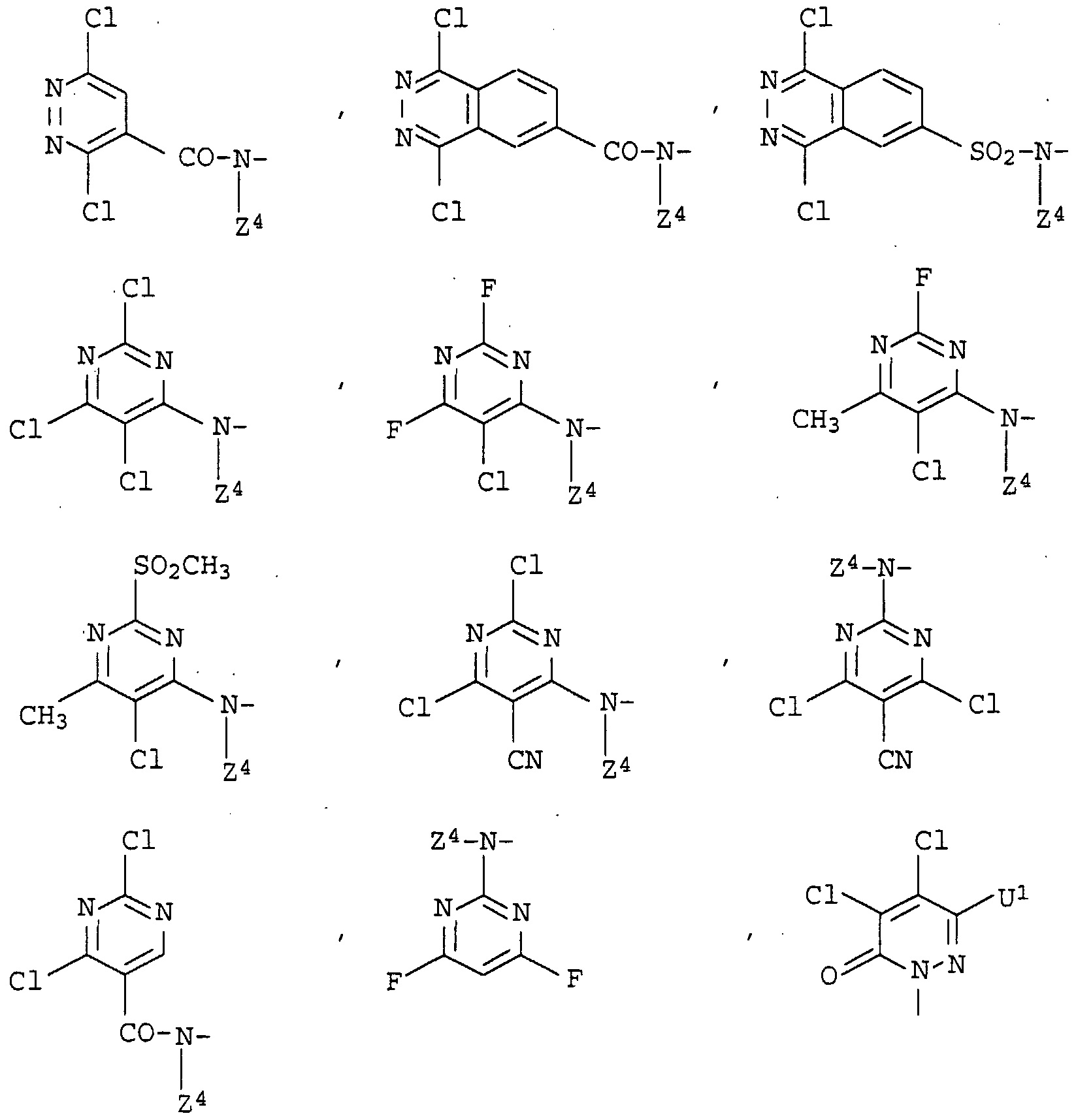
- R 1 to R 9 substitutively reacting reactive groups represented by R 1 to R 9 are halogen-substituted radicals derived from 1 , 3 , 5-triazine, quinoxaline, phthalazine, pyrimidine, pyridazine, or 2-alkylsulfonylbenzthiazol as heterocyclic parent substances.
- heterocyclic radicals which may additionally contain additively reacting substituents:
- Z 4 independently stands for hydrogen , C ⁇ -C 6 alkyl , or phenyl ,
- Hal denotes fluorine , chlorine , or bromine
- U 1 denotes hydrogen or nitro
- U 2 and U 3 independently denote hydrogen or Ci-C ⁇ alkyl, optionally substituted by hydroxy, halogen, cyano, hydroxysulfonyl or a radical of the formula -S0 2 -U, where U has the meaning stated above, and optionally interspersed by 1 or 2 non-adjacent oxygen atoms, imino groups or C 1 -C 4 alkylimino groups, or
- U 2 and U 3 form, together with the interconnecting nitrogen atom, a pyrrolidinyl, piperidinyl, morpholinyl, piperazinyl or N-(C ⁇ -C 4 alkyl )piperazinyl radical, or
- rings B 1 and B 2 may be monosubstituted or disubsti- tuted by hydroxysulfonyl and/or benzoanellated, and ring B 2 may independently be monosubstituted or disubstituted by chlorine, nitro, C 1 -C 4 alkyl, C 1 -C 4 alkoxy, cyano, carboxyl, acetylamino, hydroxysulfonylmethyl or a radical of the formula CH 2 -S0 2 -U,
- U and U 2 have the aforementioned meanings and L stands for C 2 -C 6 alkene, optionally ⁇ ubstituted by hydroxy, chlorine, cyano, carboxyl, C 3. -C 4 alkoxy- carbonyl , C 1 -C 4 alkanoyloxy or ⁇ ulfato and optionally inter ⁇ per ⁇ ed by 1 or 2 non-adjacent oxygen atoms, imino groups, or C ⁇ -C 4 alky- limino groups. 5
- Suitable radicals U 2 and U 3 include, for example, methyl, ethyl, propyl, isopropyl, butyl, isobutyl, sec-butyl, tert-butyl, pentyl, isopentyl, neopentyl, tert-pentyl , hexyl, or 2-methylpentyl .
- radicals U 2 and U 3 are hydroxy (C 1 -C 4 alkyl) , such as hydroxymethyl , 1-hydroxyethyl-l , 2-hydroxyethyl-l , 1-hy- droxypropyl-1, 2-hydroxypropyl-l, 3-hydroxypropyl-l , 1-hydroxy- propyl-2, 2-hydroxypropyl-2 , 1-hydroxybutyl-l , 2-hydroxybutyl-l , 3-hydroxybutyl-l, 4-hydroxybutyl-l , l-hydroxybutyl-2 , 2-hydroxy-
- radicals U 2 and U 3 are cyanomethyl , cyanoethyl, 20 cyanopropyl, or cyanobutyl and also hydroxysulfonylmethyl, 2-hy- droxysulfonylethyl, 2- or 3-hydroxysulfonylpropyl, or 2- or 4-hy- droxy ⁇ ulfonylbutyl .
- the radical L is, eg, (CH 2 ) 2 , (CH 2 ) 3 , (CH 2 ) 4 , CH(CH 3 )CH 2 , 25 CH(CH 3 )CH(CH 3 ) , (CH 2 ) 5 , or (CH 2 ) 6 .
- the radical L may also be, for example, (CH 2 ) 0 (CH 2 ) 2 , (CH 2 ) 3 0(CH 2 ) 2 , (CH 2 ) 2 0(CH 2 ) 2 0(CH 2 ) 2 , (CH 2 ) 2 S (CH 2 ) 2 , (CH 2 ) 3 S (CH 2 ) 2 , (CH 2 ) 2 S(CH 2 ) 2 S(CH 2 ) 2 , (CH 2 ) 2 NH(CH 2 ) 2 , (CH 2 ) 3 NH (CH 2 ) 2 , 30 (CH 2 ) 2 NH(CH 2 ) 2 NH(CH 2 ) 2 ,
- aliphatic or aromatic sulfonic acid deriva- tives and also the aliphatic sulfonic acid derivatives partially or completely substituted by fluorine are suitable for this purpose.
- Preferred reactive dyes of the invention are those in which X de- notes N0 2 •
- Y denotes SR 8 , S0 2 R 9 - or a group that is suitable for use as a leaving group un- der the conditions of nucleophilic, aromatic ⁇ ub ⁇ titution.
- the pre ⁇ ent invention also relates to the use of the reactive dyes of the invention and to their preferred embodiments for dyeing ⁇ ubstrates containing nucleophilic groups.
- Such sub ⁇ trate ⁇ comprise, for example, a great variety of grades of cellulose products, such a ⁇ textile ⁇ based on cotton, paper for the production of newspaper ⁇ and magazines, cellulosic material for, say, sanitary purpose ⁇ , and wooden product ⁇ , for exam- pie for the production of furniture, hide ⁇ , such as leather, and animal skins, also human skin, for example when applying temporary tattoos, and human hair.
- the reactive dyes of the invention and their preferred embodi- ments are preferably used for dyeing substrates containing hydroxy, mercapto, amino, and/or imino groups.
- the reactive dyes of the invention and their preferred embodiments are u ⁇ ed for dyeing keratinic fiber ⁇ , of which animal or human hair is particularly ⁇ ignificant.
- the pre ⁇ ent invention al ⁇ o relate ⁇ to compo ⁇ ition ⁇ containing at least one reactive dye of the invention.
- the reactive dyes of the invention are usually employed in di ⁇ - ⁇ olved form.
- the reactive dyes are dissolved in an aqueous, cosmetically acceptable medium.
- the pH varie ⁇ between pH 3 to pH 11, more preferably pH 6 to pH 11. It i ⁇ set to the desired value by mean ⁇ of inorganic or organic ba ⁇ e ⁇ , ⁇ alts of weak acids, or buffers.
- the reactive dyes are present in said compositions in concentra- tions of from 0.01 to 10 wt%, based on the total weight of the composition.
- compositions for hair coloration are anion- ic, cationic, non-ionic, or amphoteric surface-active compounds or mixtures thereof .
- Example ⁇ of surface-active compound are soap ⁇ , alkylbenzene sulfonates, alkyl naphthalene ⁇ ulfonate ⁇ , ⁇ ul- fate ⁇ , fatty alcohol polyglycol ⁇ ulfate ⁇ , and ⁇ ulfonates of fatty alcohols, quarternary ammonium salt ⁇ , ⁇ uch a ⁇ trimethylcetylamo- nium bromide, cetylpyridinium bromide, quaternium 1 to X (INCI) , cocoyltrimethylammonium methylsulfate (INCI) , hydroxyethyl cetyl- dimomium phosphate ⁇ (INCI) , cetyltrimethylammonium chloride, optionally oxyethylenized fatty acid ethanolamides , polyoxyethyle- nized
- auxiliaries are organic solvents acting as so- lubilizing agents, eg, C 1 -C 4 alcohol such as ethanol and isopro- panol, glycol ⁇ , glycol ether ⁇ , ⁇ uch a ⁇ ethylene glycol, propylene glycol, 2-methoxyethanol, 2-ethoxyethanol , or 2-butoxyethanol, and al ⁇ o glycerol .
- the ⁇ e ⁇ olvent ⁇ are u ⁇ ually present in a con- centration of 0 - 40 wt%, based on the total weight of the composition.
- thickeners are usually added as auxiliarie ⁇ .
- Common thick- ener ⁇ are cellulo ⁇ e derivatives, such as methyl, hydroxymethyl , hydroxyethyl, hydroxypropyl , or carboxymethyl cellulose, ⁇ odium alginate, gum arabic, gum xanthan, gum traganth, acrylic acid polymer ⁇ , polyvinylpyrrolidone, poly (vinyl acetate-co-crotonic acid)s, poly (vinyl acetate-co-vinyl pyrrolidone) s, poly (butylvi- nyl ether-co-maleic anhydride) ⁇ , or poly (methylvinyl ether-co-maleic anhydride) ⁇ .
- Inorganic thickener ⁇ uch a ⁇ bentonite, are al ⁇ o ⁇ uitable.
- the ⁇ e thickener ⁇ are usually employed in a con- centration of up to 5 wt%, based on the total weight of the composition.
- Hair-care compositions which are to be used in the form of gels al ⁇ o contain gel-forming substances, such as carbomers (INCI).
- the compo ⁇ ition ⁇ may additionally contain cationic polymer ⁇ and silicone compounds.
- Suitable cationic polymers are, for example, polyquaternium 1 to x (INCI) , copolymers of vinyl pyrrolidone/vinyl imidazolium salts (Luviquat® FC, Luviquat® HM; , sold by BASF Aktiengesellschaft, udwigshafen) , copolymer ⁇ of vinyl pyrrolidone/dimethylaminoethyl methacrylate, quaternized with diethyl ⁇ ulfate (Luviquat PQ 11) ; cationic cellulose derivatives (polyquaternium 4 and 10) , acryla- mide copolymers (polyquaternium 7) and cationic guar gum deriva- tive ⁇ , eg
- auxiliaries are mild antioxidants that do not react with the dyes, penetrating agents, ⁇ eque ⁇ tering agents, buffers, perfume oils, light-stabilizing agent ⁇ (UV-A and UN-B filters) , preservatives, shampoo ⁇ , and active substance ⁇ ⁇ uch a ⁇ (d(+) -pantothenyl alcohol, bi ⁇ abolol and vitamins, eg, vitamins A, C, and E.
- the compo ⁇ ition ⁇ of the invention can be used in liquid form, usually thickened, as a cream, paste, gel, or any other ⁇ uitable form.
- the hair colouring compo ⁇ itions of the present invention may, in addition to the dyes discussed herein above include other nonoxi- dative, oxidative and other dye materials.
- Optional nonoxidative and other dye ⁇ suitable for use in the hair colouring composi- tions and processes according to the present invention include demi-permanent, semi-permanent, temporary and other dyes.
- ⁇ on-ox- idative dyes as defined herein include the so-called "direct action dyes", metallic dye ⁇ , metal chelate dye ⁇ , fibre reactive dyes, acid dyes, ba ⁇ ic dye ⁇ , non-ionic dye ⁇ , anionic dye ⁇ , ca- tionic dye ⁇ , HC dye ⁇ and other ⁇ ynthetic and natural dyes.
- Oxidative hair colouring agents to be u ⁇ ed in the compo ⁇ itions herein are typically, but without intending to be limited thereby, oxidative hair colouring agents, consi ⁇ ting e ⁇ sentially of at least two components, which are collectively referred to as dye forming intermediates (or precursor ⁇ ) .
- Dye forming intermediates can react in the presence of a ⁇ uitable oxidant to form a coloured molecule.
- the dye forming intermediates u ⁇ ed in oxidative hair colorant ⁇ include: aromatic diamine ⁇ , aminophenols, various heterocycle ⁇ , phenols, naphthols and their various diami- nobenzene or its derivatives.
- the hair colouring composition ⁇ may al ⁇ o comprise at least one oxidising agent, which may be an inorganic or organic oxidising agent .
- the oxidising agent is preferably present in the colouring composition at a level of from about 0.01% to about 20%, more preferably from about 0.01% to about 10%, more preferably from about 1% to about 6% by weight of the compo ⁇ ition.
- a preferred oxidi ⁇ - ing agent for u ⁇ e herein i ⁇ an inorganic peroxygen oxidising agent.
- a hair-care composition is applied to the hair and allowed to act thereon over a period of from 5 to 50 minutes and preferably from 10 to 30 minutes, after which the hair is rinsed and optionally washed with a conventional shampoo.
- Dyeing can be accelerated by using the composition in a warm state or by applying heat externally, or intensified if the period of action is not ⁇ hortened.
- temperatures ranging from 20° to 40°C are used.
- the reactive dyes of the invention yield level dyeings and cover even white hair well.
- the dyeing ⁇ how good fa ⁇ tne ⁇ to light, washing, weathering, and abrasion, as external influences.
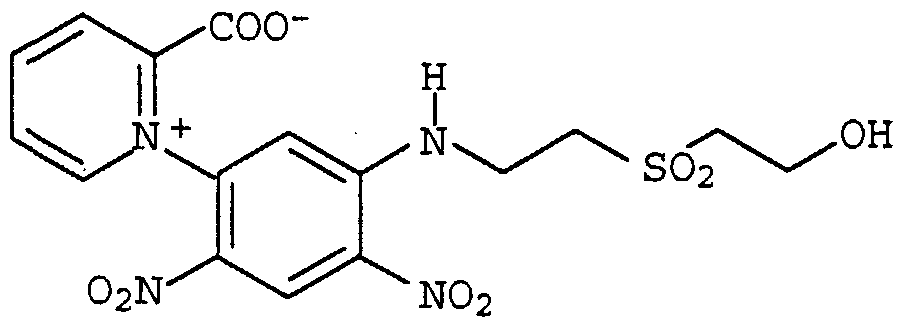
- Example 4b 37 g (0.1 mol) of the fluorine compound of Example lb were added to 250 mL of water and 0.2 g of Emulan® EL were added. 11 g (0.12 mol) of thioglycollic acid (sold by Merck KGaA, Darmstadt) were then added and the mixture was set to a pH of 6.5 with sodium hydrogencarbonate. The batch was heated to 40°C and stirring was continued at this temperature over a period of 6 hours. Following cooling, the precipitated product wa ⁇ filtered off and dried in vacuo at 35°C. The yield wa ⁇ 33.9 g.
- Example 4b 35 g (0.1 mol) of the fluorine compound of Example lb were added to 250 mL of water and 0.2 g of Emulan® EL were added. 11 g (0.12 mol) of thioglycollic acid (sold by Merck KGaA, Darmstadt) were then added and the mixture was set to a pH of 6.5 with sodium hydrogen
- the pH was set to 5 by the addition of calcium carbonate at from 5° to 10°C.
- the precipitated calcium sulfate was filtered off, and the filtrate set to pH 4.5 with acetic acid and concentrated to drynes ⁇ at 30°C in the vacuum of a rotary film evaporator. Further drying was carried out at room temperature in a vacuum drying cabinet.
- the yield of the product of the formula shown above was 20.3 g (HPLC 93.4 % by area).
- phase II
- phase II was added to phase II.
- phase III wa ⁇ added.
- a bleached skein of human hair (2 g) was treated with 0.5 g of the dyeing creme, which wa ⁇ allowed to act for 20 min.
- a water- rin ⁇ e followed. There wa ⁇ obtained a hair coloration a ⁇ described in the coloration example.
- Luviskol® VA 64 ( ⁇ old by BASF Aktiengesellschaft, Ludwig- shafen) , (PVP/VA copolymer (INCI))
- a bleached skein of human hair (2 g) was treated with 0.5 g of the hair-coloring mousse, which was allowed to act for 15 min, followed by a water rinse.
- the hair i ⁇ very easy to comb and has a well- groomed appearance.
- Betain L 7 ( ⁇ old by Goldschmidt AG Degus ⁇ a AG, Du ⁇ - seldorf)
- a hair-coloring shampoo makes it pos ⁇ ible to clean and dye the hair in one.
- Aerosil 15g Aerosil (sold by Degu ⁇ sa AG, Dus ⁇ eldorf)
- Lutrol® F 127 polyethylene glycol, ⁇ old by BASF Aktien- ge ⁇ ell ⁇ chaft, Ludwig ⁇ hafen
- a bleached skein of human hair (2 g) was treated with 0.5 g of the hair-coloring paste, which wa ⁇ allowed to act for 15 min, followed by a water rinse. There was obtained a hair coloration as described in the coloration example.
- the dye emulsion base is prepared by a one pot process as follows :
- fatty alcohol ⁇ and any ethoxylated fatty alcohol ⁇ e.g. ceteareth-25, cetyl, ⁇ tearyl and steareth-2, and allow to melt. Increase agitation.
- the hydrogen peroxide cream is also prepared similarly using a one pot proce ⁇ .
Landscapes
- Health & Medical Sciences (AREA)
- Life Sciences & Earth Sciences (AREA)
- Public Health (AREA)
- Animal Behavior & Ethology (AREA)
- General Health & Medical Sciences (AREA)
- Veterinary Medicine (AREA)
- Organic Chemistry (AREA)
- Chemical & Material Sciences (AREA)
- Birds (AREA)
- Epidemiology (AREA)
- Cosmetics (AREA)
- Coloring (AREA)
- Plural Heterocyclic Compounds (AREA)
- Nitrogen And Oxygen Or Sulfur-Condensed Heterocyclic Ring Systems (AREA)
- Pyridine Compounds (AREA)
Abstract
Description






Claims


Priority Applications (6)
| Application Number | Priority Date | Filing Date | Title |
|---|---|---|---|
| JP2002570639A JP2004530001A (en) | 2001-03-05 | 2002-03-05 | A novel reactive dye and its use for dyeing nucleophilic group-containing substrates |
| DE60205466T DE60205466T2 (en) | 2001-03-05 | 2002-03-05 | NEW REACTIVE PURPOSES AND THEIR USE FOR DYING SUBSTRATES WITH NUCLEOPHILIC GROUPS |
| US10/469,600 US7108727B2 (en) | 2001-03-05 | 2002-03-05 | Reactive dyes and the use thereof for dyeing substrates containing nucleophilic groups |
| AU2002308234A AU2002308234A1 (en) | 2001-03-05 | 2002-03-05 | Novel reactive dyes and the use thereof for dyeing substrates containing nucleophilic groups |
| EP02748331A EP1368433B1 (en) | 2001-03-05 | 2002-03-05 | Novel reactive dyes and the use thereof for dyeing substrates containing nucleophilic groups |
| AT02748331T ATE301692T1 (en) | 2001-03-05 | 2002-03-05 | NEW REACTIVE DYES AND THEIR USE FOR COLORING SUBSTRATES WITH NUCLEOPHIL GROUPS |
Applications Claiming Priority (2)
| Application Number | Priority Date | Filing Date | Title |
|---|---|---|---|
| DE10110552.5 | 2001-03-05 | ||
| DE10110552A DE10110552A1 (en) | 2001-03-05 | 2001-03-05 | New reactive dyes and their use for coloring substrates which contain nucleophilic groups |
Publications (2)
| Publication Number | Publication Date |
|---|---|
| WO2002070610A2 true WO2002070610A2 (en) | 2002-09-12 |
| WO2002070610A3 WO2002070610A3 (en) | 2002-11-28 |
Family
ID=7676368
Family Applications (1)
| Application Number | Title | Priority Date | Filing Date |
|---|---|---|---|
| PCT/EP2002/002385 Ceased WO2002070610A2 (en) | 2001-03-05 | 2002-03-05 | Novel reactive dyes and the use thereof for dyeing substrates containing nucleophilic groups |
Country Status (8)
| Country | Link |
|---|---|
| US (1) | US7108727B2 (en) |
| EP (1) | EP1368433B1 (en) |
| JP (1) | JP2004530001A (en) |
| CN (1) | CN1494576A (en) |
| AT (1) | ATE301692T1 (en) |
| AU (1) | AU2002308234A1 (en) |
| DE (2) | DE10110552A1 (en) |
| WO (1) | WO2002070610A2 (en) |
Families Citing this family (3)
| Publication number | Priority date | Publication date | Assignee | Title |
|---|---|---|---|---|
| CN106890106A (en) * | 2009-12-22 | 2017-06-27 | 莱雅公司 | The dyeing of the condensation polymer comprising oxirane and expoxy propane and/or bleaching composition |
| FR2954148B1 (en) * | 2009-12-22 | 2012-02-17 | Oreal | COMPOSITION COMPRISING A CAPILLARY DYE AND A POLYCONDENSATE OF ETHYLENE OXIDE AND PROPYLENE OXIDE |
| US12091552B2 (en) * | 2022-08-11 | 2024-09-17 | Nantong University | Reactive dyes and preparation methods thereof |
Family Cites Families (12)
| Publication number | Priority date | Publication date | Assignee | Title |
|---|---|---|---|---|
| BE790986A (en) | 1971-11-05 | 1973-05-07 | Farwerke Hoechst A G Vormals M | REACTIVE MONOAZOIC DYES |
| US4036825A (en) | 1971-11-05 | 1977-07-19 | Hoechst Aktiengesellschaft | Monoazo reactive dyestuffs |
| DE2331518A1 (en) | 1972-06-23 | 1974-01-10 | Ciba Geigy Ag | NEW COLORS, THEIR PRODUCTION AND USE |
| CH586739A5 (en) * | 1973-10-17 | 1977-04-15 | Hoechst Ag | |
| EP0107614B1 (en) | 1982-09-30 | 1987-10-21 | Ciba-Geigy Ag | Reactive dyes, their preparation and their use |
| DE3502991A1 (en) | 1984-07-20 | 1986-01-30 | Hoechst Ag, 6230 Frankfurt | SUBSTITUTED PHENYLOXETHYL SULPHONES AND METHOD FOR THE PRODUCTION THEREOF |
| DE3441273A1 (en) | 1984-11-12 | 1986-05-15 | Hoechst Ag, 6230 Frankfurt | MONOCYCLIC BIS-OXETHYLSULFONYL-ANILINE AND METHOD FOR THE PRODUCTION THEREOF |
| US4799934A (en) * | 1987-10-30 | 1989-01-24 | Clairol Incorporated | Sulfur-containing nitroaminobenzene dyes, process and hair dye compositions |
| DE59307910D1 (en) | 1992-03-05 | 1998-02-12 | Ciba Geigy Ag | Reactive dyes, processes for their production and their use |
| CA2148535A1 (en) * | 1994-06-24 | 1995-12-25 | Mu-Ill Lim | 5-mercapto-2-nitro paraphenylenediamine compounds and hair dye compositions containing same |
| DE19712649C1 (en) * | 1997-03-26 | 1998-06-18 | Wella Ag | Colourant for keratinous fibres based on cyclic oxo-en-di:ol giving intense colour at moderate temperature |
| DE19728389C1 (en) * | 1997-07-03 | 1999-03-04 | Wella Ag | Hair Dye |
-
2001
- 2001-03-05 DE DE10110552A patent/DE10110552A1/en not_active Withdrawn
-
2002
- 2002-03-05 AT AT02748331T patent/ATE301692T1/en not_active IP Right Cessation
- 2002-03-05 JP JP2002570639A patent/JP2004530001A/en active Pending
- 2002-03-05 AU AU2002308234A patent/AU2002308234A1/en not_active Abandoned
- 2002-03-05 US US10/469,600 patent/US7108727B2/en not_active Expired - Lifetime
- 2002-03-05 EP EP02748331A patent/EP1368433B1/en not_active Expired - Lifetime
- 2002-03-05 WO PCT/EP2002/002385 patent/WO2002070610A2/en not_active Ceased
- 2002-03-05 CN CNA028059689A patent/CN1494576A/en active Pending
- 2002-03-05 DE DE60205466T patent/DE60205466T2/en not_active Expired - Lifetime
Also Published As
| Publication number | Publication date |
|---|---|
| DE10110552A1 (en) | 2002-09-12 |
| WO2002070610A3 (en) | 2002-11-28 |
| JP2004530001A (en) | 2004-09-30 |
| DE60205466D1 (en) | 2005-09-15 |
| US20040088804A1 (en) | 2004-05-13 |
| EP1368433B1 (en) | 2005-08-10 |
| EP1368433A2 (en) | 2003-12-10 |
| US7108727B2 (en) | 2006-09-19 |
| DE60205466T2 (en) | 2006-04-13 |
| CN1494576A (en) | 2004-05-05 |
| AU2002308234A1 (en) | 2002-09-19 |
| ATE301692T1 (en) | 2005-08-15 |
Similar Documents
| Publication | Publication Date | Title |
|---|---|---|
| ES2214639T3 (en) | COMPOSITION FOR THE DYING OF KERATIN FIBERS THAT PROVIDES A METAMERIC EFFECT. | |
| ES2339448T3 (en) | CATIONIC DYES, ITS PRODUCTION AND USE. | |
| BRPI0616803B1 (en) | xanthene dyes, their preparation process, method for dyeing the fibers, and composition | |
| JP5558715B2 (en) | Thiol dye | |
| EP2502613A2 (en) | Hair treatment composition and methods | |
| JP5362585B2 (en) | Cationic dye | |
| BRPI0615644B1 (en) | dye compounds containing a thiol group, keratin-containing fiber dyeing method, as well as composition | |
| MX2009001598A (en) | Thiol derivative dyes. | |
| WO1999051688A1 (en) | Reactive dye compounds | |
| ES2313751T3 (en) | USE OF REACTIVE COLORS FOR HAIR DYEING. | |
| WO2011027076A2 (en) | Dyeing method consisting in applying a metallic salt and a composition containing a hydrophobic dye and a specific compound | |
| EP1368433B1 (en) | Novel reactive dyes and the use thereof for dyeing substrates containing nucleophilic groups | |
| AU3680899A (en) | Composition for dyeing keratin fibres with a cationic direct dye and a thickening polymer | |
| US5873910A (en) | Process for the two-stage oxidation dyeing of keratin fibers with a manganese complex or salt and a 4-substituted 1-naphthol, and dyeing kit | |
| EP1392777B1 (en) | Reactive dyes and use thereof for dyeing substrates containing nucleophilic groups | |
| SK1112000A3 (en) | Oxidation dyes, their use and method for coloring of human hairs | |
| MX2008000209A (en) | Sulfide dyes. | |
| MX2007016551A (en) | NITROSULFIDE DYES. | |
| JP2004500310A (en) | Hair coloring composition in container | |
| US6447554B1 (en) | Reactive dye compounds | |
| MXPA00009673A (en) | Packaged hair colouring composition |
Legal Events
| Date | Code | Title | Description |
|---|---|---|---|
| AK | Designated states |
Kind code of ref document: A2 Designated state(s): AE AG AL AM AT AU AZ BA BB BG BR BY BZ CA CH CN CO CR CU CZ DE DK DM DZ EC EE ES FI GB GD GE GH GM HR HU ID IL IN IS JP KE KG KP KR KZ LC LK LR LS LT LU LV MA MD MG MK MN MW MX MZ NO NZ OM PH PL PT RO RU SD SE SG SI SK SL TJ TM TN TR TT TZ UA UG US UZ VN YU ZA ZM ZW |
|
| AL | Designated countries for regional patents |
Kind code of ref document: A2 Designated state(s): GH GM KE LS MW MZ SD SL SZ TZ UG ZM ZW AM AZ BY KG KZ MD RU TJ TM AT BE CH CY DE DK ES FI FR GB GR IE IT LU MC NL PT SE TR BF BJ CF CG CI CM GA GN GQ GW ML MR NE SN TD TG |
|
| 121 | Ep: the epo has been informed by wipo that ep was designated in this application | ||
| AK | Designated states |
Kind code of ref document: A3 Designated state(s): AE AG AL AM AT AU AZ BA BB BG BR BY BZ CA CH CN CO CR CU CZ DE DK DM DZ EC EE ES FI GB GD GE GH GM HR HU ID IL IN IS JP KE KG KP KR KZ LC LK LR LS LT LU LV MA MD MG MK MN MW MX MZ NO NZ OM PH PL PT RO RU SD SE SG SI SK SL TJ TM TN TR TT TZ UA UG US UZ VN YU ZA ZM ZW |
|
| AL | Designated countries for regional patents |
Kind code of ref document: A3 Designated state(s): GH GM KE LS MW MZ SD SL SZ TZ UG ZM ZW AM AZ BY KG KZ MD RU TJ TM AT BE CH CY DE DK ES FI FR GB GR IE IT LU MC NL PT SE TR BF BJ CF CG CI CM GA GN GQ GW ML MR NE SN TD TG |
|
| DFPE | Request for preliminary examination filed prior to expiration of 19th month from priority date (pct application filed before 20040101) | ||
| WWE | Wipo information: entry into national phase |
Ref document number: 2002748331 Country of ref document: EP |
|
| WWE | Wipo information: entry into national phase |
Ref document number: 2002570639 Country of ref document: JP |
|
| WWE | Wipo information: entry into national phase |
Ref document number: 10469600 Country of ref document: US |
|
| WWE | Wipo information: entry into national phase |
Ref document number: 028059689 Country of ref document: CN |
|
| WWP | Wipo information: published in national office |
Ref document number: 2002748331 Country of ref document: EP |
|
| REG | Reference to national code |
Ref country code: DE Ref legal event code: 8642 |
|
| WWG | Wipo information: grant in national office |
Ref document number: 2002748331 Country of ref document: EP |