WO2002088240A1 - Polyacetal molded articles stabilized against discoloration - Google Patents
Polyacetal molded articles stabilized against discoloration Download PDFInfo
- Publication number
- WO2002088240A1 WO2002088240A1 PCT/EP2002/004461 EP0204461W WO02088240A1 WO 2002088240 A1 WO2002088240 A1 WO 2002088240A1 EP 0204461 W EP0204461 W EP 0204461W WO 02088240 A1 WO02088240 A1 WO 02088240A1
- Authority
- WO
- WIPO (PCT)
- Prior art keywords
- butyl
- bis
- hydroxy
- polyacetal
- molded article
- Prior art date
- Legal status (The legal status is an assumption and is not a legal conclusion. Google has not performed a legal analysis and makes no representation as to the accuracy of the status listed.)
- Ceased
Links
Classifications
-
- C—CHEMISTRY; METALLURGY
- C08—ORGANIC MACROMOLECULAR COMPOUNDS; THEIR PREPARATION OR CHEMICAL WORKING-UP; COMPOSITIONS BASED THEREON
- C08K—Use of inorganic or non-macromolecular organic substances as compounding ingredients
- C08K5/00—Use of organic ingredients
- C08K5/04—Oxygen-containing compounds
- C08K5/13—Phenols; Phenolates
- C08K5/134—Phenols containing ester groups
-
- C—CHEMISTRY; METALLURGY
- C08—ORGANIC MACROMOLECULAR COMPOUNDS; THEIR PREPARATION OR CHEMICAL WORKING-UP; COMPOSITIONS BASED THEREON
- C08L—COMPOSITIONS OF MACROMOLECULAR COMPOUNDS
- C08L59/00—Compositions of polyacetals; Compositions of derivatives of polyacetals
-
- C—CHEMISTRY; METALLURGY
- C08—ORGANIC MACROMOLECULAR COMPOUNDS; THEIR PREPARATION OR CHEMICAL WORKING-UP; COMPOSITIONS BASED THEREON
- C08K—Use of inorganic or non-macromolecular organic substances as compounding ingredients
- C08K5/00—Use of organic ingredients
- C08K5/04—Oxygen-containing compounds
- C08K5/13—Phenols; Phenolates
- C08K5/134—Phenols containing ester groups
- C08K5/1345—Carboxylic esters of phenolcarboxylic acids
-
- C—CHEMISTRY; METALLURGY
- C08—ORGANIC MACROMOLECULAR COMPOUNDS; THEIR PREPARATION OR CHEMICAL WORKING-UP; COMPOSITIONS BASED THEREON
- C08K—Use of inorganic or non-macromolecular organic substances as compounding ingredients
- C08K5/00—Use of organic ingredients
- C08K5/16—Nitrogen-containing compounds
- C08K5/34—Heterocyclic compounds having nitrogen in the ring
- C08K5/3467—Heterocyclic compounds having nitrogen in the ring having more than two nitrogen atoms in the ring
- C08K5/3477—Six-membered rings
- C08K5/3492—Triazines
- C08K5/34924—Triazines containing cyanurate groups; Tautomers thereof
Definitions
- the present invention relates to polyacetal resin molded articles stabilized against color formation. More particularly, the present invention relates to polyacetal resin molded articles that comprise a synergistic mixture of (i) pentaerythritol tetrakis [3-(3,5-di-tert-butyl-4-hy- droxyphenyl) propionate] and (ii) at least one compound selected from the group consisting of tris-(4-t-butyl-2,6-dimethyl-3-hydroxybenzyl) isocyanurate, ethylene-1 ,2-bis-(oxyethyl- ene(3-t-butyl-4-hydroxy-5-methylhydrocinnamate)), hexamethylene-1 ,6-bis-(3,5-di-t-butyl- 4-hydroxyhydrocinnamate) and the monoacrylate ester of 2,2'-methylenebis(6-tert-butyl-4- methylphenol), or (iii)
- the polyacetal-molded articles of the present invention exhibit excellent thermal aging resistance, excellent initial and long-term color stability and excellent anti-mold deposit properties.
- the polyacetal molded articles of the present invention can be advantageously used for various applications, for example for mechanical parts which will be used under high temperature conditions for a prolonged period of time (for example, mechanical parts employed in association with automobile engines).
- Polyacetal resins not only have an excellent balance of mechanical strength, chemical resistance and sliding properties, but can also be easily processed. By virtue of these advantages, polyacetal resins are widely used as engineering plastic materials for a wide variety of applications including mechanical parts, such as mechanical parts for electric and electronic equipment as well as automobiles.
- the polyacetal resin When a polyacetal resin is used in the above-mentioned fields, it is necessary that the polyacetal resin have good thermal aging resistance and initial and long-term color stability. Further, from the viewpoint of improving molding productivity, it is important that the polyacetal resin have good anti-mold deposit properties.
- U.S. Patent Specification No. 3,743,614 and British Patent Specification 1 425 771 disclose a method for improving the thermal aging resistance of a polyacetal resin by adding an aliphatic carboxylic acid metal salt.
- U.S. Patent Specification No. 5,364,900 discloses polyacetal resin compositions comprising hindered phenol antioxidants and ion adsorbents.
- U.S. Pat. No. 5,948,844 discloses polyacetal resin compositions comprising terminal-stabilized polyacetal resin and at least one certain aliphatic carboxylic acid metal salt.
- a polyacetal molded article stabilized against discoloration comprising
- the polyacetal molded articles of the present invention have excellent thermal aging resistance and excellent initial and long-term color stability, so that it solves the problems which are encountered when a shaped article produced from a conventional polyacetal resin com- position is used in a high-temperature atmosphere, namely, the problems of low mechanical properties (due to unsatisfactory thermal aging resistance) and poor appearance (due to unsatisfactory initial or long-term color stability).
- Initial color stability refers to the initial color of the extruded molded article.
- Long-term color stability refers to the color of the molded article after thermal exposure.
- coloration refers to unwanted initial color of the molded article (formed on extrusion) as well as unwanted color formation of the molded article in-use (formed on thermal exposure), for instance as an automobile part.
- the polyacetal-molded articles of the present invention are suitable used for mechanical parts, for instance mechanical parts employed in association with automobile engines.
- the amount of component (b) or (c) relative to component (a) is in the range from about 0.05 to about 5.0% by weight, for example about 0.1 to about 2.0% or about 0.1 to about 1 .0% by weight, based on the weight of component (a).
- the ratio of component (i) to (ii) is from about 1 :9 to about 9 :1 , for example about 1 :4 to about 4:1 , for instance about 1 :3 to about 3:1 , or about 1 :2 to about 2:1 , or about 1 :1.
- the ratio of component (iii) to (iv) is defined as for (i) to (ii).
- polyacetal resins of the present invention include those obtained by a method in which an oxymethylene homopolymer consisting essentially of oxymethylene units is produced from a formaldehyde monomer or a cyclic oligomer of formaldehyde, such as formaldehyde trimer (trioxane) or a formaldehyde tetramer (tetraoxane), and those obtained by a method in which an oxymethylene-oxyalkylene copolymer, containing about 0.1 to about 50.0%, for example about 20.0% or less by weight of oxyalkylene units having 2 to 8 carbon atoms, is produced from a mixture of the above-mentioned formaldehyde monomer or oligomer and a cyclic formal.
- a formaldehyde monomer or a cyclic oligomer of formaldehyde such as formaldehyde trimer (trioxane) or a formaldehyde tetra
- Examples of cyclic formals as comonomers include ethylene oxide, propylene oxide, epichlorohydrine, 1 ,3-dioxolane 1 ,4-butanediol, a glycol formal and a diglycol formal.
- Examples of polyacetal resins include an oxymethylene-oxyalkylene copolymer comprising a branched molecular chain, and an oxymethylene-containing block co- polymer, such as a block copolymer comprising more than 50.0% by weight of a polyoxy- methylene (POM) block and less than 50.0% by weight of a polymer block (containing 50.0% by weight or more of recurring oxymethylene units) other than the POM block.
- POM polyoxy- methylene
- Examples of configurations of such oxymethylene block copolymers include A-B-A and A-B configurations, wherein A represents a POM block and B represents a polymer block other than the POM block (containing 50.0% by weight or more of recurring oxymethylene units), the amount of the B block being less than 50.0% by weight of the block copolymer.
- the polyacetal homopolymer and copolymer resins of the present invention with unstable termini containing hydroxyl groups may be stabilized by known methods, for example by conversion to esters, ethers, urethanes and the like. The unstable termini may also be removed by hydrolysis.
- Raw material monomers are copolymerized in the presence of a catalyst to obtain a crude polyacetal resin.
- the polymerization may be conducted by bulk polymerization. Either of a batch wise method and a continuous method can be employed.
- a batch type polymerization apparatus a generally known reaction vessel having a stirrer can be used.
- a continuous type polymerization apparatus a self-cleaning type mixer, such as a co-kneader, a twin-screw continuous extrusion kneader or a twin-paddle type continuous mixer, can be used.
- the polymerization can be conducted for example from about 60 to about 200°C, for instance from about 60 to about 120°C, under atmospheric pressure.
- polymerization catalysts to be used in the polymerization reaction include boron trifluoride, boron trifluoride hydrate, and coordination compounds of an oxygen- or sulfur- containing organic compound with boron trifluoride, which may be either in gaseous form or in the form of a solution thereof in a suitable organic solvent.
- the coordination compounds of an oxygen- or sulfur-containing organic compound with boron trifluoride specifically, boron trifluoride diethyl ether and boron trifluoride dibutyl ether, are specific examples.
- the catalyst is used in an amount of from about 1 xl 0 '6 to about 1 x10 '3 mol, for instance about 5x10 " * to about 1 xl 0 ⁇ mol per mol of the total of the trioxane and cyclic ether.
- a method of deactivating the polymerization catalyst either in water containing a basic substance or in an organic solvent containing a basic substance may be used. Further, a method of deactivating a catalyst by adding a basic substance to a crude polyacetal resin in a molten state in an extruder may be used.
- Examples of basic substances to be used for deactivating a polymerization catalyst include hydroxides, inorganic weak acid salts, and organic acid salts of alkali metals or alkaline earth metals.
- hydroxides, carbonates, phosphates, silicates, borates, formates, acetates, stearates, palmitates, propionates, oxalates and the like of lithium, sodium, potassium, magnesium, calcium, strontium and barium are specific examples.
- ammonia and amine compounds such as triethylamine and tributylamine, may be used as a catalyst deac- tivator.
- various customary additives which are usually incorporated in a polyacetal resin, can be used without any particular restriction.
- At least one additive selected from the group consisting of additional antioxidants, polymers containing a formaldehyde-reactive nitrogen atom, formic acid scavengers, light stabilizers and mold release agents can be incorporated in the polyacetal molded articles.
- Light stabilizers are for example ultraviolet light absorbers (UVA's) and sterically hindered amines (HALS).
- UVA's ultraviolet light absorbers
- HALS sterically hindered amines
- the amount of the additives is generally from 0.1 to 5.0 parts by weight, per 100 parts by weight of the polyacetal-molded article.
- a further subject of the present invention is a polyacetal resin molded article stabilized against discoloration comprising
- additives selected from the group consisting of antioxidants, polymers containing a formaldehyde-reactive nitrogen atom, formic acid scavengers, ultraviolet light absorbers, hindered amine light stabilizers and mold release agents.
- Additional antioxidants are for example hindered phenols selected from the group consisting of n-octadecyl-S- ⁇ S'-di-t-butyM'-hydroxypheny -propionate, n-octadecyl-3-(3'-methyl-5'- t-butyl-4'-hydroxyphenyl)-propionate, n-tetradecyl-3-(3',5'-di-t-butyl-4'-hydroxyphenyl)- propionate, 1 ,4-butanediol-bis-[3-(3,5-di-t-butyl-4-hydroxyphenyl)-propionate], 3,9-bis[2- ⁇ 3- (3-t-butyl-4-hydroxy-5-methylphenyl)propionyloxy ⁇ -1 ,1 -dimethylethyl]2,4,8,10-tetraoxas- piro(5,5)undecane, N,N'-bis-3
- the molded polyacetal articles comprising the presently defined binary synergistic combination of antioxidants may also comprise one or both of the other antioxidants selected from the group consisting of pentaerythritol tetrakis [3-(3,5-di-tert-butyl- 4-hydroxyphenyl) propionate], tris-(4-t-butyl-2,6-dimethyl-3-hydroxybenzyl) isocyanurate, ethylene-1 ,2-bis-(oxyethylene(3-t-butyl-4-hydroxy-5-methylhydrocinnamate)), hexamethylene-1 , 6-bis-(3,5-di-t-butyl-4-hydroxyhydrocinnamate) and the monoacrylate ester of 2,2'- methylenebis(6-tert-butyl-4-methylphenol).
- the other antioxidants selected from the group consisting of pentaerythritol tetrakis [3-(3,5-di-tert-butyl-
- a polyamide resin such as nylon 4,6, nylon 6, nylon 6,6, nylon 6,10, nylon 6,12 and nylon 12, and a co polyamide resin, such as nylon 6/6,6/6,10 and nylon 6/6,12
- a polyamide resin such as nylon 4,6, nylon 6, nylon 6,6, nylon 6,10, nylon 6,12 and nylon 12
- a co polyamide resin such as nylon 6/6,6/6,10 and nylon 6/6,12
- polymers containing a formaldehyde-reactive nitrogen atom include a homopolymer of acrylamide or a derivative thereof, and a copolymer of acrylamide or a derivative thereof with another vinyl monomer, such as a poly- ⁇ -alanine, which is obtained by polymerizing acrylamide or a derivative thereof with another vinyl monomer in the presence of a metal alcoholate.
- polymers containing a formaldehyde-reactive nitrogen atom can be used individually or in combination.
- the polyacetal-molded articles contain a polymer containing a formaldehyde-reactive nitrogen atom, the polyacetal composition exhibits remarkably high retention of strength at a thermal aging resistance test in which the resin composition is heated at 150°C for 1 ,000 hours.
- Examples of formic acid scavengers include an amino-substituted triazine compound, an addition product between an amino-substituted triazine compound and formaldehyde, and a polycondensate between an amino-substituted triazine compound and formaldehyde.
- amino-substituted triazine compounds include guanamine (2,4-dia- mino-sym-triazine), melamine (2,4,6-triamino-sym-triazine), N-butylmelamine, N-phenyl- melamine, N,N-diphenylmelamine, N,N-diallylmelamine, N,N',N"-triphenylmelamine, ben- zoguanamine (2,4-diamino-6-phenyl-sym-triazine), 2,4-diamino-6-methyl-sym-triazine, 2,4- diamino-6-butyl-sym-triazine, 2,4-diamino-6-benzyloxy-sym-triazine, 2,4-diamino-6-butoxy- sym-triazine, 2,4-diamino-6-cyclo-he
- polycondensates between an amino-substituted triazine compound and formaldehyde examples include a polycondensate between melamine and formaldehyde.
- amino-substituted triazine compounds addition products between an amino-substituted triazine compound and formaldehyde, and polycondensates between an amino-substituted triazine compound and formaldehyde can be used individually or in combination.
- light stabilizers examples include hydroxyphenylbenzotriazole, hydroxyphenyltriazine, oxalic anilide and hydroxybenzophenone ultraviolet light absorbers (UVA's) and sterically hindered amine light stabilizers.
- UVA's ultraviolet light absorbers
- Light stabilizers are for example:
- 2-(2-HydroxyphenylV2H-benzotriazoles for example known commercial hydroxyphenyl-2H- benzotriazoles and benzotriazoles as disclosed in United States Patent Specification Nos. 3,004,896; 3,055,896; 3,072,585; 3,074,910; 3, 189,615; 3,218,332; 3,230, 194; 4, 127,586; 4,226,763; 4,275,004; 4,278,589; 4,315,848; 4,347, 180; 4,383,863; 4,675,352; 4,681,905, 4,853,471; 5,268,450; 5,278,314; 5,280, 124; 5,319,091; 5,410,071; 5,436,349; 5,516,914; 5,554,760; 5,563,242; 5,574, 166; 5,607,987, 5,977,219 and 6, 166,218 such as 2-(2-hy- droxy-5-methylphenyl
- 2-Hvdroxybenzophenones for example the 4-hydroxy, 4-methoxy, 4-octyloxy, 4-decyloxy, 4-dodecyloxy, 4-benzyloxy, 4,2',4'-trihydroxy and 2'-hydroxy-4,4'-dimethoxy derivatives;
- Esters of substituted and unsubstituted benzoic acids as for example 4-tert-butylphenyl sali- cylate, phenyl salicylate, octylphenyl salicylate, dibenzoyl resorcinol, bis(4-tert-butylbenzoyl) resorcinol, benzoyl resorcinol, 2,4-di-tert-butylphenyl 3,5-di-tert-butyl-4-hydroxybenzoate, hexadecyl 3,5-di-tert-butyl-4-hydroxybenzoate, octadecyl 3,5-di-tert-butyl-4-hydroxybenzo- ate, 2-methyl-4,6-di-tert-butylphenyl 3,5-di-tert-butyl-4-hydroxybenzoate;
- Acrylates and malonates for example, ⁇ -cyano- ⁇ , ⁇ -diphenylacrylic acid ethyl ester or isooctyl ester, ⁇ -carbomethoxy-cinnamic acid methyl ester, ⁇ -cyano- ⁇ -methyl-p-methoxy-cinnamic acid methyl ester or butyl ester, ⁇ -carbomethoxy-p-methoxy-cinnamic acid methyl ester, N-( ⁇ -carbomethoxy- ⁇ -cyanovinyl)-2-methyl-indoline, Sanduvor ® PR25, dimethyl p-methoxy- benzylidenemalonate (CAS# 7443-25-6), and Sanduvor ® PR31 , di-(1 ,2,2,6,6-pentamethyl- piperidin-4-yl) p-methoxybenzylidenemalonate (CAS #147783-69-5);
- Qxamides for example 4,4'-dioctyloxyoxanilide, 2,2'-diethoxyoxanilide, 2,2'-dioctyloxy-5,5'- di-tert-butoxanilide, 2,2'-didodecyloxy-5,5 , -di-tert-butoxanilide, 2-ethoxy-2'-ethyloxanilide, N,N'-bis(3-dimethylaminopropyl)oxamide, 2-ethoxy-5-tert-butyl-2'-ethoxanilide and its mixture with 2-ethoxy-2'-ethyl-5,4'-di-tert-butoxanilide, mixtures of o- and p-methoxy-disub- stituted oxanilides and mixtures of o- and p-ethoxy-disubstituted oxanilides; tris-Aryl-
- Sterically hindered amine stabilizers for example 4-hydroxy-2,2,6,6-tetramethylpiperidine, 1 - allyl-4-hydroxy-2,2,6,6-tetramethylpiperidine, 1-benzyl-4-hydroxy-2,2,6,6- tetramethylpiperidine, bis(2,2,6,6-tetramethyl-4-piperidyl) sebacate, bis(2,2,6,6-tetramethyl- 4-piperidyl) succinate, bis(1 ,2,2,6,6-pentamethyl-4-piperidyl) sebacate, bis(1 -octyloxy- 2,2,6,6-tetramethyl-4-piperidyl) sebacate, bis(1 ,2,2,6,6-pentamethyl-4-piperidyl) n-butyl- 3,5-di-tert-butyl-4-hydroxybenzylmalonate, the condensate of 1 -(2-hydroxyethyl)-2,2,6,6- tetramethyl-4-hydroxy
- the sterically hindered amine may also be one of the compounds described in GB-A- 2 301 106 a component l-a), l-b), l-c), l-d), l-e), 1-0, l-g), l-h), l-i), l-j), l-k) or l-l), in particular the light stabilizer 1 -a-1 , 1 -a-2, l -b-1 , l -c-1 , 1 -c-2, 1 -d-1 , l -d-2, 1 -d-3, 1 -e-1 , 1 -f- 1 , 1 -g-1 , 1 -g-2 or 1 -k-1 listed on pages 68 to 73 of said GB-A-2301 106;
- the sterically hindered amine may also be one of the compounds described in
- EP-A-0 782 994 for example compounds as described in Examples 1 -12 or D-1 to D-5;
- Sterically hindered amines substituted on the N-atom by a hydroxy-substituted alkoxy group for example compounds such as 1 -(2-hydroxy-2-methylpropoxy)-4-octadecanoyloxy- 2,2,6,6-tetramethylpiperidine, 1 -(2-hydroxy-2-methylpropoxy)-4-hexadecanoyloxy-2,2,6,6- tetramethylpiperidine, the reaction product of 1 -oxyl-4-hydroxy-2,2,6,6-tetramethylpiperi- dine with a carbon radical from t-amylalcohol, 1 -(2-hydroxy-2-methylpropoxy)-4-hydroxy- 2,2,6,6-tetramethylpiperidine, 1 -(2-hydroxy-2-methylpropoxy)-4-oxo-2,2,6,6-tetramethyl- piperidine, bis(1 -(2-hydroxy-2-methylpropoxy)-2,2,6,6-tetramethylpiperidin-4-yl) sebacate, bis
- the above-mentioned hindered amine light stabilizers can be used individually or in combination, and also be used in combination with the above-mentioned ultraviolet light absorbers.
- fatty acid ester As a mold release agent, at least one member selected from the group consisting of a fatty acid ester, a polyalkylene glycol and an amido group-containing aliphatic compound can be used.
- fatty acid ester mentioned herein means a fatty acid ester which is obtained from a polyhydric alcohol and a fatty acid, preferably one which is obtained by the reaction of at least one type of a saturated or unsaturated fatty acid having 10 or more carbon atoms with a polyhydric alcohol having 2 to 6 carbon atoms.
- polyhydric alcohols usable for producing fatty acid esters include ethylene glycol, diethylene glycol, triethylene glycol, propylene glycol, dipropylene glycol, butanediol, pentanediol, hexanediol, glycerol, diglycerol, triglycerol, threitol, erythritol, pentaerythritol, arabitol, ribitol, xylitol, sorbite, sor- bitan, sorbitol and mannitol.
- fatty acids examples include capric, lauric, myristic, palmitic, stearic, 12-hydroxystearic, arachic, behenic, lignoceric, cerotic, montanic, melissic and ceroplastic acid.
- unsaturated aliphatic carboxylic acids include undecylenic, oleic, elaidic, cetoleic, erucic, brassidic, sorbic, linoleic, linolenic, arachidonic, propiolic and stearolic acid, natural fatty acids containing these unsaturated aliphatic carboxylic acids, and a mixture thereof.
- the above-mentioned fatty acids may or may not be substituted with a hydroxyl group.
- a fatty acid ester that is obtained by the reaction of a fatty acid selected from the group consisting of palmitic, stearic, behenic and montanic acid, with a polyhydric alcohol selected from the group consisting of glycerol, pentaerythritol, sorbitan and sorbitol, is preferred.
- the above-mentioned fatty acid esters may or may not contain a hydroxyl group.
- the fatty acid esters can be any of a monoester, a diester and a triester.
- the fatty acid ester may contain a hydroxyl group, which is blocked with boric acid or the like.
- Preferred examples of fatty acid esters include glycerol monopalmitate, dipalmitate, tripalmitate, monostearate, distearate, tristearate, monobehenate, dibehenate, tribehenate, monomontanate, dimontanate and trimontanate, pentaerythritol monopalmitate, dipalmitate, tripalmitate, tetrapalmitate, monostearate, distearate, tristearate, tetrastearate, monobehenate, dibehenate, tribehenate, tetrabehanate, monomontanate, dimontanate, trimontanate and tetramontanate, sorbitan monopalmitate, dipalmitate, tripalmitate, monostearate, distearate, tristearate, monobehenate, dibehenate, tribehenate, monomontanate, dimont
- a boric acid ester of a glycerol monoester of a fatty acid (Unexa- mined Japanese Patent Application Laid-Open Specification No. 49-60762). These fatty acid ester compounds can be used individually or in combination.
- the polyalkylene glycol usable as a mold release agent in the present invention is, for example, one, which is represented by the following formula:
- each R independently represents a hydrogen atom, an unsubstituted or substituted C,. 6 alkyl group, or an unsubstituted or substituted allyl group, x is from 2 to 6, and y is from 1 ,000 to 20,000.
- the above-mentioned polyalkylene glycol can be obtained by a ring-opening polymerization of an alkylene oxide.
- alkylene oxides include ethylene oxide, propylene oxide, butylene oxide, epichlorohydrine, oxetane, 3,3-bis(chloromethyl)oxetane, tetrahydrofuran, 2-methyltetrahydrofuran and oxepane.
- These polyalkylene glycols can be used individually or in combination.
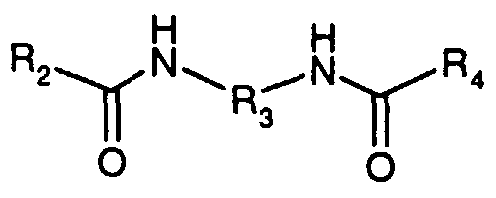
- An amido group-containing aliphatic compound usable as a mold release agent in the present invention is, for example, one that is represented by the following formula:
- each of R 2 and R represents a C,-C 30 alkyl group, and R, represents a C,-C 30 alkylene group.
- amido group-containing aliphatic compounds include ethylenebisstearylamide, ethylenebislaurylamide, ethylenebisoleylamide and ethylenebiserucic acid amide. These amide group-containing aliphatic compounds can be used individually or in combination.
- the additives may be added in a powdery form or in a molten form.
- a polyacetal resin composition of the present invention can be obtained by melt-kneading in an extruder a polyacetal resin and the synergistic combinations of components (b) or (c) and, if desired, further optional additives.
- the extruder may be a single-screw extruder or may be a twin-screw extruder.
- the components (b) or (c) and optional further additives may be added to a reaction system during the polymerization reaction for producing a polyacetal resin.
- Hindered phenol antioxidants of components (b) or (c) may be added to comonomers, such as ethylene oxide, propylene oxide, epichlorohydrine, 1 ,3-dioxolane and 1 ,4-butanediol, prior to reaction of a formaldehyde monomer or oligomer with a cyclic formaldehyde.
- comonomers such as ethylene oxide, propylene oxide, epichlorohydrine, 1 ,3-dioxolane and 1 ,4-butanediol
- the individual compounds of components (i) and (ii) or (iii) and (iv) may be added to the monomers, comonomers or polyacetal either separately or together. They may be added for instance as solid particles or in the molten state. The individual compounds may be added in the form of a master batch.
- the extrusion temperature is not particularly restricted, and, in general, it can be appropriately selected in the range of from about 170 to about 240°C.
- the polyacetal-molded articles of the present invention can be obtained by conventionally known methods, such as extrusion molding, injection molding, compression molding, vacuum forming, blow molding or foam molding.
- terminal-stabilized polyacetal resins and aliphatic carboxylic acid metal salts with occluded metal compounds and surface attached metal compounds may be employed in this invention. These components are disclosed in U.S. Patent Specification. No. 5,948,844, the relevant parts of which are hereby incorporated by reference.
- Polyoxymethylene copolymer pellets are blended with additives by using a Turbula mixer for 1 5-20 min. Total formulation size is 1000 g.
- the mixtures are then extruded with a 27 mm Leistritz twin-screw extruder. The extrusion is conducted under conditions such that the zone temperatures are 165, 1 70, 180, and 190°C, the melt temperature is 199°C, the melt pressure is 650-800 psi, and the feeder speed is 100 rpm.
- the resin composition obtained is pelletized by a cutter. The pelletized resin composition is dried for 3 hours in a vacuum oven (at 82°C, nitrogen bleed) prior to injection molding.
- BOY 50M injection molder is employed with zone temperatures of 182, 188, 193°C, nozzle temperature of 199°C, mold temperature of 90°C, to obtain plaque specimen of 2" x 2" x 0.06". These specimens are then placed in Blue M circulating air oven to be aging at 1 30 and 140°C. Color measurement is done on these oven aged specimens by using a DCI SF600 spectrophotometer. Yellowness Index (Yl) is reported in the following tables. Total levels of additives are 0.5% by weight based on the overall formulation. The results are compiled in Tables 1 - 7: Table 1
- Irganox ® 1010 and Irganox 3052 ® is synergistic towards preventing color formation in POM molded plaques.
- Plaques are prepared as in Example 1. Initial color (Yl) of the injection-molded plaques is measured on a spectrophotometer as in Example 1 . Total levels of additives are 0.5 weight percent, based on the overall weight of the formulation. Yl measurements are shown below.
Landscapes
- Chemical & Material Sciences (AREA)
- Health & Medical Sciences (AREA)
- Chemical Kinetics & Catalysis (AREA)
- Medicinal Chemistry (AREA)
- Polymers & Plastics (AREA)
- Organic Chemistry (AREA)
- Compositions Of Macromolecular Compounds (AREA)
- Polyurethanes Or Polyureas (AREA)
- Materials For Medical Uses (AREA)
Abstract
Description


Claims
Priority Applications (7)
| Application Number | Priority Date | Filing Date | Title |
|---|---|---|---|
| JP2002585534A JP4280972B2 (en) | 2001-04-30 | 2002-04-23 | Polyacetal moldings stabilized against discoloration |
| BR0209275-1A BR0209275A (en) | 2001-04-30 | 2002-04-23 | Anti-discoloration stabilized polyacetal molded articles |
| KR1020037014208A KR100858068B1 (en) | 2001-04-30 | 2002-04-23 | Polyacetal moldings stabilized against discoloration |
| DE60228253T DE60228253D1 (en) | 2001-04-30 | 2002-04-23 | SHAPED POLYACETAL ARTICLES STABILIZED AGAINST STAINLESSING |
| EP02735288A EP1401940B1 (en) | 2001-04-30 | 2002-04-23 | Polyacetal molded articles stabilized against discoloration |
| US10/475,875 US20040138357A1 (en) | 2001-04-30 | 2002-04-23 | Polyacetal molded articles stabilized against discolaration |
| US11/399,182 US20060223920A1 (en) | 2001-04-30 | 2006-04-06 | Polyacetal molded articles stabilized against discoloration |
Applications Claiming Priority (2)
| Application Number | Priority Date | Filing Date | Title |
|---|---|---|---|
| US28792601P | 2001-04-30 | 2001-04-30 | |
| US60/287,926 | 2001-04-30 |
Related Child Applications (1)
| Application Number | Title | Priority Date | Filing Date |
|---|---|---|---|
| US11/399,182 Continuation-In-Part US20060223920A1 (en) | 2001-04-30 | 2006-04-06 | Polyacetal molded articles stabilized against discoloration |
Publications (1)
| Publication Number | Publication Date |
|---|---|
| WO2002088240A1 true WO2002088240A1 (en) | 2002-11-07 |
Family
ID=23104960
Family Applications (1)
| Application Number | Title | Priority Date | Filing Date |
|---|---|---|---|
| PCT/EP2002/004461 Ceased WO2002088240A1 (en) | 2001-04-30 | 2002-04-23 | Polyacetal molded articles stabilized against discoloration |
Country Status (10)
| Country | Link |
|---|---|
| US (2) | US20040138357A1 (en) |
| EP (1) | EP1401940B1 (en) |
| JP (1) | JP4280972B2 (en) |
| KR (1) | KR100858068B1 (en) |
| CN (1) | CN1234759C (en) |
| AT (1) | ATE404625T1 (en) |
| BR (1) | BR0209275A (en) |
| DE (1) | DE60228253D1 (en) |
| ES (1) | ES2312579T3 (en) |
| WO (1) | WO2002088240A1 (en) |
Cited By (2)
| Publication number | Priority date | Publication date | Assignee | Title |
|---|---|---|---|---|
| EP2787038A4 (en) * | 2011-11-28 | 2015-07-15 | Polyplastics Co | FIBER RESISTANT RESIN MOLDED BODY |
| CN106589514A (en) * | 2015-10-20 | 2017-04-26 | 固安县天昊助剂有限公司 | Light stabilizer composition master batch and preparation method and application thereof |
Families Citing this family (8)
| Publication number | Priority date | Publication date | Assignee | Title |
|---|---|---|---|---|
| US8188173B2 (en) | 2008-01-16 | 2012-05-29 | Kuraray Co., Ltd. | Polyvinyl acetal powder coating material |
| TW201037028A (en) * | 2009-04-14 | 2010-10-16 | Fdc Lees Chemical Industry Co | Motified polyacetal with high thermal stability |
| KR101136530B1 (en) * | 2010-10-07 | 2012-04-17 | 송원산업 주식회사 | Novel compound for antioxidant and polyacetal resin composition including the same |
| JP6329478B2 (en) * | 2014-11-13 | 2018-05-23 | 旭化成株式会社 | Process for producing polyacetal copolymer |
| US20160222202A1 (en) * | 2015-02-04 | 2016-08-04 | E I Du Pont De Nemours And Company | Polyoxymethylene Compositions |
| JP6798806B2 (en) * | 2016-06-30 | 2020-12-09 | ポリプラスチックス株式会社 | Polyacetal resin composition for molding plate-shaped molded products, plate-shaped molded products, and carrier plates for wind regulators. |
| CN111018676A (en) * | 2019-12-11 | 2020-04-17 | 乌海时联环保科技有限责任公司 | Method for preventing resorcinol from discoloring |
| CN114437406B (en) * | 2020-11-06 | 2024-06-04 | 中国石油化工股份有限公司 | Compound antioxidant and butadiene rubber composition and application thereof |
Citations (6)
| Publication number | Priority date | Publication date | Assignee | Title |
|---|---|---|---|---|
| EP0435649A1 (en) * | 1989-12-28 | 1991-07-03 | Polyplastics Co. Ltd. | Polyoxymethylene composition |
| JPH04239048A (en) * | 1991-01-10 | 1992-08-26 | Toray Ind Inc | Acetal polymer composition |
| US5216052A (en) * | 1991-07-01 | 1993-06-01 | Ciba-Geigy Corporation | Bisbenzofuran-2-ones |
| EP0619344A2 (en) * | 1993-04-08 | 1994-10-12 | Asahi Kasei Kogyo Kabushiki Kaisha | Acetal resin compositions |
| EP0827979A1 (en) * | 1995-05-08 | 1998-03-11 | Idemitsu Kosan Co., Ltd. | Polystyrene resin composition |
| DE19828797A1 (en) * | 1998-06-27 | 1999-12-30 | Basf Ag | Thermoplastic polyoxymethylene molding composition for fibers and films |
Family Cites Families (3)
| Publication number | Priority date | Publication date | Assignee | Title |
|---|---|---|---|---|
| DE2043498C3 (en) * | 1970-09-02 | 1984-09-06 | Hoechst Ag, 6230 Frankfurt | Stabilized molding compounds made from polyoxymethylenes |
| US5948844A (en) * | 1995-09-29 | 1999-09-07 | Asahi Kasei Kogyo Kabushiki Kaisha | Polyacetal resin composition |
| GB0004437D0 (en) * | 2000-02-25 | 2000-04-12 | Clariant Int Ltd | Synergistic combinations of phenolic antioxidants |
-
2002
- 2002-04-23 WO PCT/EP2002/004461 patent/WO2002088240A1/en not_active Ceased
- 2002-04-23 KR KR1020037014208A patent/KR100858068B1/en not_active Expired - Fee Related
- 2002-04-23 BR BR0209275-1A patent/BR0209275A/en not_active IP Right Cessation
- 2002-04-23 JP JP2002585534A patent/JP4280972B2/en not_active Expired - Fee Related
- 2002-04-23 US US10/475,875 patent/US20040138357A1/en not_active Abandoned
- 2002-04-23 CN CNB028090896A patent/CN1234759C/en not_active Expired - Fee Related
- 2002-04-23 EP EP02735288A patent/EP1401940B1/en not_active Expired - Lifetime
- 2002-04-23 AT AT02735288T patent/ATE404625T1/en not_active IP Right Cessation
- 2002-04-23 ES ES02735288T patent/ES2312579T3/en not_active Expired - Lifetime
- 2002-04-23 DE DE60228253T patent/DE60228253D1/en not_active Expired - Lifetime
-
2006
- 2006-04-06 US US11/399,182 patent/US20060223920A1/en not_active Abandoned
Patent Citations (6)
| Publication number | Priority date | Publication date | Assignee | Title |
|---|---|---|---|---|
| EP0435649A1 (en) * | 1989-12-28 | 1991-07-03 | Polyplastics Co. Ltd. | Polyoxymethylene composition |
| JPH04239048A (en) * | 1991-01-10 | 1992-08-26 | Toray Ind Inc | Acetal polymer composition |
| US5216052A (en) * | 1991-07-01 | 1993-06-01 | Ciba-Geigy Corporation | Bisbenzofuran-2-ones |
| EP0619344A2 (en) * | 1993-04-08 | 1994-10-12 | Asahi Kasei Kogyo Kabushiki Kaisha | Acetal resin compositions |
| EP0827979A1 (en) * | 1995-05-08 | 1998-03-11 | Idemitsu Kosan Co., Ltd. | Polystyrene resin composition |
| DE19828797A1 (en) * | 1998-06-27 | 1999-12-30 | Basf Ag | Thermoplastic polyoxymethylene molding composition for fibers and films |
Non-Patent Citations (1)
| Title |
|---|
| DATABASE WPI Section Ch Week 199241, Derwent World Patents Index; Class A28, AN 1992-335432, XP002211560 * |
Cited By (3)
| Publication number | Priority date | Publication date | Assignee | Title |
|---|---|---|---|---|
| EP2787038A4 (en) * | 2011-11-28 | 2015-07-15 | Polyplastics Co | FIBER RESISTANT RESIN MOLDED BODY |
| US9249279B2 (en) | 2011-11-28 | 2016-02-02 | Polyplastics Co., Ltd. | Fuel resistant resin molded body |
| CN106589514A (en) * | 2015-10-20 | 2017-04-26 | 固安县天昊助剂有限公司 | Light stabilizer composition master batch and preparation method and application thereof |
Also Published As
| Publication number | Publication date |
|---|---|
| JP2004527624A (en) | 2004-09-09 |
| BR0209275A (en) | 2004-06-15 |
| EP1401940A1 (en) | 2004-03-31 |
| ATE404625T1 (en) | 2008-08-15 |
| CN1505656A (en) | 2004-06-16 |
| KR20040015220A (en) | 2004-02-18 |
| EP1401940B1 (en) | 2008-08-13 |
| KR100858068B1 (en) | 2008-09-10 |
| JP4280972B2 (en) | 2009-06-17 |
| US20040138357A1 (en) | 2004-07-15 |
| DE60228253D1 (en) | 2008-09-25 |
| CN1234759C (en) | 2006-01-04 |
| US20060223920A1 (en) | 2006-10-05 |
| ES2312579T3 (en) | 2009-03-01 |
Similar Documents
| Publication | Publication Date | Title |
|---|---|---|
| AU2021209170B2 (en) | Stabilizer compositions and methods for using same for protecting organic materials from uv light and thermal degradation | |
| US20070197697A1 (en) | Stabilized polyolefin compositions | |
| EP1401940B1 (en) | Polyacetal molded articles stabilized against discoloration | |
| JPS63260949A (en) | Polyacetal molding composition | |
| US5096951A (en) | Color stabilized polyoxymethylene molding compositions | |
| JP7612507B2 (en) | Polyacetal resin composition | |
| JP4676167B2 (en) | Polyacetal resin composition and molded article comprising the same | |
| JP2005263921A (en) | Polyacetal resin composition and molded article comprising the same | |
| KR101330607B1 (en) | Color Fast Polyurethanes | |
| JP2005171158A (en) | Polyacetal resin composition and molded article comprising the same | |
| JP2005162909A (en) | Polyacetal resin composition and molded article comprising the same | |
| EP0492974A2 (en) | Stabilized polyoxymethylene resin composition | |
| WO2024083872A1 (en) | Synergistic stabilizer compositions and methods for using same for protecting organic materials from uv light and thermal degradation | |
| JP3086266B2 (en) | Stabilized polyoxymethylene resin composition | |
| JP2006045331A (en) | Polyacetal resin composition and molded article comprising the same | |
| JP3105006B2 (en) | Stabilized polyoxymethylene resin composition | |
| KR20170080914A (en) | Polyoxymethylene Resin Composition and Molding Product Including the Same | |
| JP3086265B2 (en) | Stabilized polyoxymethylene resin composition | |
| JP2005171157A (en) | Polyacetal resin composition and molded article comprising the same | |
| JP2005306995A (en) | Polyacetal resin composition and molded article comprising the same | |
| KR20130078778A (en) | Polyoxymethylene resins composition | |
| KR20220056407A (en) | Polyoxymethylene Resin Composition and Molding product comprising the same | |
| JP2005179593A (en) | Polyacetal resin composition and molded article comprising the same | |
| JP2006045333A (en) | Polyacetal resin composition and molded article comprising the same | |
| JP2013103958A (en) | Polyacetal resin composition |
Legal Events
| Date | Code | Title | Description |
|---|---|---|---|
| AK | Designated states |
Kind code of ref document: A1 Designated state(s): AE AG AL AM AT AU AZ BA BB BG BR BY BZ CA CH CN CO CR CU CZ DE DK DM DZ EC EE ES FI GB GD GE GH GM HR HU ID IL IN IS JP KE KG KP KR KZ LC LK LR LS LT LU LV MA MD MG MK MN MW MX MZ NO NZ OM PH PL PT RO RU SD SE SG SI SK SL TJ TM TN TR TT TZ UA UG US UZ VN YU ZA ZM ZW |
|
| AL | Designated countries for regional patents |
Kind code of ref document: A1 Designated state(s): GH GM KE LS MW MZ SD SL SZ TZ UG ZM ZW AM AZ BY KG KZ MD RU TJ TM AT BE CH CY DE DK ES FI FR GB GR IE IT LU MC NL PT SE TR BF BJ CF CG CI CM GA GN GQ GW ML MR NE SN TD TG |
|
| 121 | Ep: the epo has been informed by wipo that ep was designated in this application | ||
| DFPE | Request for preliminary examination filed prior to expiration of 19th month from priority date (pct application filed before 20040101) | ||
| WWE | Wipo information: entry into national phase |
Ref document number: 2002735288 Country of ref document: EP |
|
| WWE | Wipo information: entry into national phase |
Ref document number: 10475875 Country of ref document: US |
|
| WWE | Wipo information: entry into national phase |
Ref document number: 028090896 Country of ref document: CN |
|
| WWE | Wipo information: entry into national phase |
Ref document number: 2002585534 Country of ref document: JP Ref document number: 1020037014208 Country of ref document: KR |
|
| REG | Reference to national code |
Ref country code: DE Ref legal event code: 8642 |
|
| WWP | Wipo information: published in national office |
Ref document number: 2002735288 Country of ref document: EP |
|
| WWG | Wipo information: grant in national office |
Ref document number: 2002735288 Country of ref document: EP |