WO2002091849A1 - A chewing gum having prolonged sensory benefits - Google Patents

A chewing gum having prolonged sensory benefits Download PDF

Info

Publication number
WO2002091849A1
WO2002091849A1 PCT/US2002/013862 US0213862W WO02091849A1 WO 2002091849 A1 WO2002091849 A1 WO 2002091849A1 US 0213862 W US0213862 W US 0213862W WO 02091849 A1 WO02091849 A1 WO 02091849A1
Authority
WO
WIPO (PCT)
Prior art keywords
oleoresin
chewing gum
group
hydrophobic
extract
Prior art date
Legal status (The legal status is an assumption and is not a legal conclusion. Google has not performed a legal analysis and makes no representation as to the accuracy of the status listed.)
Ceased
Application number
PCT/US2002/013862
Other languages
French (fr)
Inventor
Michael J. Greenberg
Sonya S. Johnson
Current Assignee (The listed assignees may be inaccurate. Google has not performed a legal analysis and makes no representation or warranty as to the accuracy of the list.)
WM Wrigley Jr Co
Original Assignee
WM Wrigley Jr Co
Priority date (The priority date is an assumption and is not a legal conclusion. Google has not performed a legal analysis and makes no representation as to the accuracy of the date listed.)
Filing date
Publication date
Application filed by WM Wrigley Jr Co filed Critical WM Wrigley Jr Co
Publication of WO2002091849A1 publication Critical patent/WO2002091849A1/en
Anticipated expiration legal-status Critical
Ceased legal-status Critical Current

Links

Classifications

    • AHUMAN NECESSITIES
    • A23FOODS OR FOODSTUFFS; TREATMENT THEREOF, NOT COVERED BY OTHER CLASSES
    • A23GCOCOA; COCOA PRODUCTS, e.g. CHOCOLATE; SUBSTITUTES FOR COCOA OR COCOA PRODUCTS; CONFECTIONERY; CHEWING GUM; ICE-CREAM; PREPARATION THEREOF
    • A23G4/00Chewing gum
    • A23G4/06Chewing gum characterised by the composition containing organic or inorganic compounds
    • AHUMAN NECESSITIES
    • A23FOODS OR FOODSTUFFS; TREATMENT THEREOF, NOT COVERED BY OTHER CLASSES
    • A23GCOCOA; COCOA PRODUCTS, e.g. CHOCOLATE; SUBSTITUTES FOR COCOA OR COCOA PRODUCTS; CONFECTIONERY; CHEWING GUM; ICE-CREAM; PREPARATION THEREOF
    • A23G4/00Chewing gum
    • A23G4/06Chewing gum characterised by the composition containing organic or inorganic compounds
    • A23G4/064Chewing gum characterised by the composition containing organic or inorganic compounds containing inorganic compounds
    • AHUMAN NECESSITIES
    • A23FOODS OR FOODSTUFFS; TREATMENT THEREOF, NOT COVERED BY OTHER CLASSES
    • A23GCOCOA; COCOA PRODUCTS, e.g. CHOCOLATE; SUBSTITUTES FOR COCOA OR COCOA PRODUCTS; CONFECTIONERY; CHEWING GUM; ICE-CREAM; PREPARATION THEREOF
    • A23G4/00Chewing gum
    • A23G4/06Chewing gum characterised by the composition containing organic or inorganic compounds
    • A23G4/068Chewing gum characterised by the composition containing organic or inorganic compounds containing plants or parts thereof, e.g. fruits, seeds, extracts
    • AHUMAN NECESSITIES
    • A23FOODS OR FOODSTUFFS; TREATMENT THEREOF, NOT COVERED BY OTHER CLASSES
    • A23GCOCOA; COCOA PRODUCTS, e.g. CHOCOLATE; SUBSTITUTES FOR COCOA OR COCOA PRODUCTS; CONFECTIONERY; CHEWING GUM; ICE-CREAM; PREPARATION THEREOF
    • A23G4/00Chewing gum
    • A23G4/18Chewing gum characterised by shape, structure or physical form, e.g. aerated products

Definitions

  • the present invention generally relates to chewing gums and methods of making same. More specifically, the present invention relates to chewing gums having improved sensory benefits.
  • Chewing gum compositions typically include ingredients such as gum base, flavoring agents, bulking agents, sweeteners and other optional ingredients including softeners and coloring agents.
  • Bulking agents and sweeteners often include sugar, glucose syrup and high-intensity sweeteners. The high-intensity sweeteners are most commonly used as applied to sugarless sweeteners.
  • the gum base defines a water insoluble portion that remains in the mouth of the consumer as the chewing gum is chewed.
  • Flavor and sweeteners define a water soluble portion that is released during the chew. The release of flavors is one of, if not, the most desirable characteristics of chewing gum.
  • sweeteners typically are rapidly released from the chewing gum product. As a result of such an early and rapid release of sweeteners, the chewing gum products lose their flavor after a short period of time.
  • encapsulating agents are known and used to control and prolong the release of sweeteners.
  • the encapsulating agents include a variety of different food grade encapsulating materials, such as food grade shellac, that can be applied to the gum in a variety of different ways, such as wet granulation, wax granulation, spray drying, spray chilling, fluid bed coating, coacervation, fiber extension and the like.
  • the use of encapsulating agents can be expensive and • may not be as effective to prolong the release of sweeteners as des ⁇ red.
  • the present invention provides improved chewing gums and methods of making and using same.
  • the chewing gums include sweet organic compounds that have a very low water solubility. These compounds or hydrophobic sweeteners are desirably added to the chewing gum to provide long lasting flavor, sweetness, cooling sensation, tingling sensation or other like chewing gum sensory benefits.
  • a chewing gum having prolonged sensory benefits includes a water insoluble base portion, a water soluble portion, a sensorally active component and a hydrophobic sweetener.
  • the chewing gum includes a water soluble portion, a flavor, a plurality of additional sensorally active components and a hydrophobic sweetener.
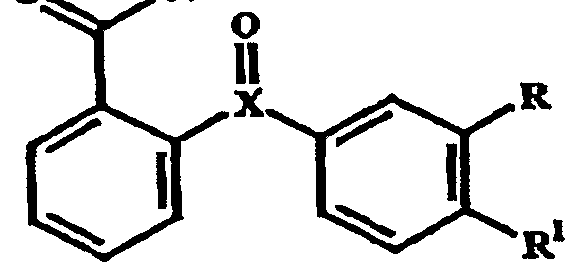
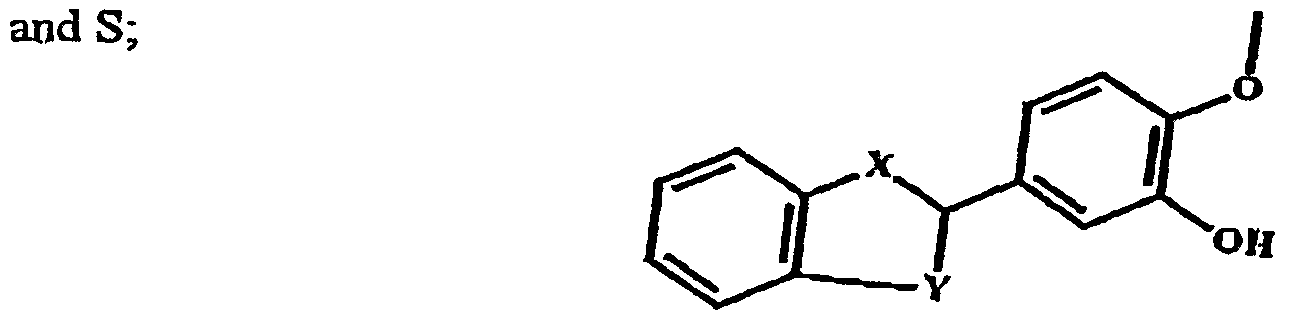
  • the hydrophobic sweetener has the formula selected from the group consisting of
  • X and Y are selected from the group consisting of S and O;
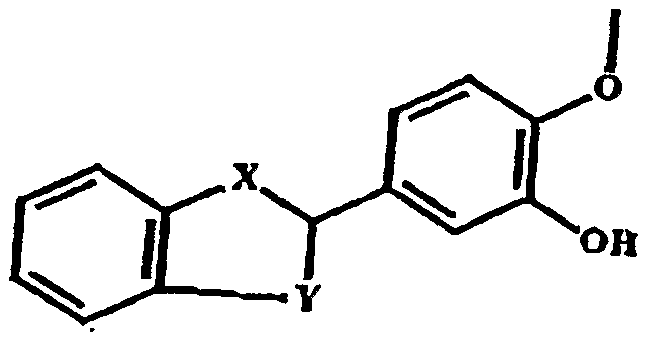
  • X is C or S; R is OH or H and R 1 is OCH3 or OH;
  • R, R 2 and R 3 are OH or H and R 1 is H or COOH;
  • R is CHsCHj, OH, N (CH3) 2 or Cl ;
  • a method of producing a chewing gum exhibiting prolonged trigeminal effects includes the steps of providing a plurality of chewing gum ingredients including a water insoluble base portion, a water soluble portion, a trigeminal stimulant and a hydrophobic sweetener; processing the ingredients and forming the chewing gum.
  • a method for prolonging sensory benefits of a chewing gum includes the step of chewing the chewing gum including a water insoluble base portion, a water soluble portion, a trigeminal stimulant and a hydrophobic sweetener.
  • an advantage of the present invention to provide chewing gums that can prolong the sensory benefits of same as it is chewed.
  • Another advantage of the present invention is to provide chewing gums that include a hydrophobic sweetener for providing long lasting flavor, sweetness or other like trigeminal effects.
  • a fuifther advantage of the present invention is to provide chewing gums that include sweet organic compounds which have a very low water solubility to promote and enhance cooling sensations in connection with cooling agents and or tingling sensations associated with tingling agents.
  • Yet a still Further advantage of the present invention is to provide a method for prolonging sensory benefits of a chewing gum that includes a hydrophobic sweetener and other suitable chewing gum ingredients.
  • Yet still another advantage of the present invention is a chewing gum for effectively enhancing the sensory benefits of the gum as it is chewed that can be readily produced at reduced costs as compared to, for example, encapsulating sweeteners within the chewing gum.
  • the present invention provides chewing gums and methods of making and using same.
  • the chewing gums of the present invention include, in part, hydrophobic sweeteners.
  • the inventors have uniquely discovered that the use of sweet organic compounds which have very low water solubility (i.e. hydrophobic sweeteners) can be effectively utilized to prolong and enhance senso ⁇ y benefits of the chewing gum, such as flavoring, cooling sensations, tingling sensations or the like, as the gum is chewed.
  • the chewing gums of the present invention can be composed of ingredients that are readily available and prepared at lower costs as compared to chewing gums that utilize encapsulating agents and methods thereof.
  • the chewing gum of the present invention includes a water insoluble base portion, a water soluble portion, a sensorally active component, such as a flavor, and a hydrophobic sweetener.
  • a sensorally active component such as a flavor
  • a hydrophobic sweetener facilitates the enhancement and prolonged effect of sensory benefits of the chewing gum as it is chewed.
  • sensory benefits can include, for example, flavor sensation, cooling sensations, warming sensations, tingling, numbing, pain, itch, mouth coating, combinations thereof or other oral trigeminal effects of chewing gums.
  • hydrophobic sweeteners can be released at a much slower rate into the aqueous saliva and have a stronger affinity to the lipophyllic or water insoluble gum base portion as compared to known sweeteners. Further, it is believed that the release mechanism of the hydrophobic sweeteners substantially matches that of flavors, cooling agents, tingling agents and other sensorally active components or trigeminal stimulants of the chewing gum. When the hydrophobic sweeteners of the present invention are optionally mixed with the sensorally active components) of the gum, the release of such component(s) along wiih the hydrophobic sweeteners can be prolonged and enhanced as the gum is chewed.
  • chewing gum includes the hydrophobic sweetener compound in an amount ranging from about 50 to about 5000 Sucrose Equivalents.
  • the Sucrose Equivalent factor is determined by multiplying the weight percent of the hydrophobic compound in the chewing gum by its relative sweetness.
  • the hydrophobic sweetener of the present invention can include a range of suitably sweet organic compounds and mixtures thereof that have a very low water solubility.
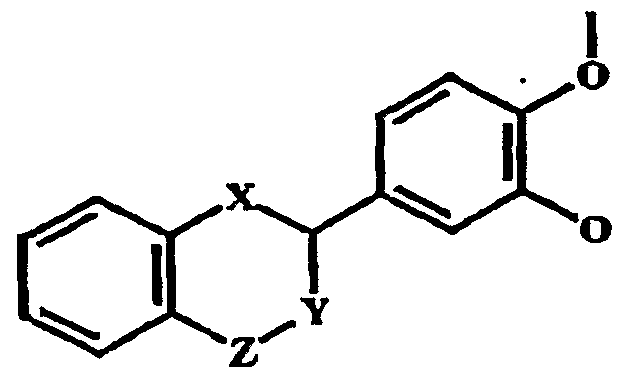
  • the hydrophobic sweetener compounds are defined by formulas I-XI as follows:
  • X, Y and Z are CH 2 , 0 or S;
  • X is C or S; R is OH or H and R 1 is OCH 3 or OH;
  • R 1 , R z and R 3 are OH or H; and R 1 is H or COOH;
  • R is CH 3> CH2CH 3 . OH, N(CH 3 ) 2 or CI;
  • the following tables illustrate a variety of hydrophobic sweetener compounds representative of the hydrophobic sweetener compounds of Formulas I-XI, as previously discussed.
  • the tables also indicate the relative sweetness of the hydrophobic sweetener compounds. As previously discussed, this factor can be utilized to calculate the Sucrose Equivalent calculation which relates to the amount of hydrophobic sweetener in the chewing gum.
  • the hydrophobic sweeteners of the present invention can be utilized to enhance and extend the flavor, sweetness, cooling, tingling and other sensory benefits of chewing gums as chewed.
  • the chewing gum of the present invention includes a cooling agent.
  • the cooling effect or sensation of the cooling agents can be prolonged and enhanced as the gum is chewed.
  • the cooling agents can be added to the chewing gum alone or in combination with flavors or other sensorally active components.
  • the cooling agents can include a range of different suitable materials.
  • the cooling agent can include menthol, WS3, N-substituted p-menthane ca boxamide, acyclic carboxamides including WS23, menthyl lactate, Takasago Cooling agent (TCA or 3-l-menthoxypro ⁇ ane-l 7 2-diol), menthyl succinate and menthone glycerol ketais, other like cooling agents or mixtures thereof.
  • the chewing gum of the present invention is not limited to the type, number and amount of sensorally active component or trigeminal stimulant.
  • the chewing gum of the present invention can include any suitable amount and variety of different sensorally active components alone or in combination with additional other sensorally active components or trigeminal stimulants.
  • the trigeminal effects of such components including, flavor, cooling, tingling, paresthesis, heat, pain, itch, like trigeminal effects or combinations thereof, can be prolonged and enhanced as the gum is chewed as previously discussed.
  • the sensorally active components or trigeminal stimulants can include, for example, cooling agents, flavors, tingling agents, Jambu extract, Vanillyl alkyl ethers, such as Vanillyl n-butyl ether, spilanthol, Echinacea extract, Northern Prickly Ash extract, capsaicin, capsicum oleoresin, red pepper oleoresin, black pepper oleoresin, piperine, ginger oleoresin, gingerol, shoagol, cinnamon oleoresin, cassia oleoresin, cinnamon oleoresin, cassia oleoresin, cinnamic aldehyde, eugenol, cyclic acetal of vanillin and menthol glycerin ether, unsaturated amides, like components or combinations thereof.
  • Jambu extract Vanillyl alkyl ethers, such as Vanillyl n-butyl ether, spilanthol, Echinacea extract
  • the chewing gum of the present invention generally consists of a water insoluble gum base, a water soluble portion, and flavors.
  • the water soluble portion dissipates with a portion of the flavor over a period of time during chewing.
  • the gum base portion is retained in the mouth throughout the chew.
  • the insoluble gum base generally comprises elastomers, resins, fats and oils, softeners, and inorganic fillers.
  • the gum base may or may not include wax.
  • the insoluble gum base can constitute approximately 5 to about 95 percent, by weight, of the chewing gum, more commonly, the gum base comprises 10 to about 50 percent of the gum, and in some preferred embodiments, 20 to about 35 percent, by weight, of the chewing gum.
  • the chewing gum base of the present invention contains about 20 to about 60 weight percent synthetic elastomer, 0 to about 30 weight percent natural elastomer, about 5 to about 55 weight percent elastomer plasticizer, about 4 to about 35 weight percent filler, about 5 to about 35 weight percent softener, and optional minor amounts (about one percent or less) of miscellaneous ingredients such as colorants, antioxidants or the like.
  • Synthetic elastomers may include, but are not limited to, polyisobutyle ⁇ e with
  • Preferred ranges are, for polyisobutylene, 50,000 to 80,000 GPC weight average molecular weight, for styrene-b ⁇ tadiene, 1:1 to 1 :3 bound styrene-butadiene, for polyv ⁇ nyl acetate, 10,000 to 65,000 GPC weight average molecular weight with the higher molecular weight polyviny] acetates typically used in bubble gum base, and for vinyl acetate-vinyl laurate, vinyl laurate content of 10-45 percent.
  • Natural elastomers may include natural rubber such as smoked or liquid latex and guayule as well as natural gums such as jelutong, lechi caspi, perillo, sorva, massaranduba balata, massaranduba chocolate, n ⁇ spero, rosindinha, chicle, gutta hang kang, and combinations thereof.
  • the preferred synthetic elastomer and natural elastomer concentrations vary depending on whether the chewing gum in which the base is used is abhesive or conventional, bubble gum or regular gum, as discussed below.
  • Preferred natural elastomers include jelutong, chicle, sorva and massaranduba balata.
  • Elastomer plasticizers may include, but are not limited lo, natural rosin esters such as glycerol esters of partially hydrogenated rosin, glycerol esters polymerized rosin, glycerol esters of partially dimerized rosin, glycerol esters of rosin, pentaerythritol esters of partially hydrogenated rosin, methyl and partially hydrogenated methyl esters of rosin, pentaerythritol esters of rosin; synthetics such as le ⁇ pene resins derived from alpha-pinene, beta-pinene, and/or d-limonene and any suitable combinations of the foregoing.
  • the preferred elastomer plasticizers will also vary depending on the specific application, and on the type of elastomer which is used.
  • Fillers/texturizes may include magnesium and calcium carbonate, ground limestone, silicate types such as magnesium and aluminum silicate, clay, alumina, talc, titanium oxide, mono-, di- and tri-calcium phosphate, cellulose polymers, such as wood, and combinations thereof.
  • Softe ⁇ ers/emulsifiers may include tallow, hydrogenated tallow, hydrogenated and partially hydrogenated vegetable oils, cocoa butter, glycerol monostearate, glycerol triacetate, lecithin, mono-, d ⁇ - and triglycerides, acetylated monoglycerides, fatty acids (e.g. stearic, palmitic, oleic and linoleic acids), and combinations thereof.
  • Colorants and whiteners may include FD&C-type dyes and lakes, fruit and vegetable extracts, titanium dioxide, and combinations thereof.
  • the base may or may not include wax.
  • An example of a wax-free gum base is disclosed in U.S. Patent No. 5,286,500, the disclosure of which is incorporated herein by reference.
  • a typical chewing gum composition includes a water soluble bulk portion and one or more flavoring agents.
  • the water soluble portion can include bulk sweeteners, high intensity sweeteners, flavoring agents, softeners, emulsifiers, colors?, acjdulants, fillers, antioxidants, and other components that provide desired attributes.
  • Softeners are added to the chewing gum in order to optimize the chewability and mouth feel of the gum.
  • the softeners which are also known as plasticizers and plasticizing agents, generally constitute between approximately 0.5 to about 15% by weight of the chewing gum.
  • the softeners may include glycerin, lecithin, and combinations thereof.
  • Aqueous sweetener solutions such as those containing sorbitol, hydrogenated starch hydrolysates, com syrup and combinations thereof, may also be used as softeners and binding agents in chewing gum.
  • Bulk sweeteners include both sugar and sugarless components. Bulk sweeteners typically constitute 5 to about 95% by weight of the chewing gum, more typically, 20 to 80% by weight, and more commonly, 30 to 60% by weight of the gum- Sugar sweeteners generally include saccharide-containing components commonly known in the chewing gum art, including, but not limited to, sucrose, dextrose, maltose, dextrin, dried invert sugar, fructose, lcvulose, galactose, com syrup solids, and the like, alone or in combination.
  • Sugarless bulk sweeteners include, but are not limited to, sugar alcohols such as sorbitol, mannitol, xylitol, hydrogenated starch hydrolysates, maltitol, and the like, alone or in combination.
  • High intensity artificial sweeteners other than the hydrophobic sweeteners of the present invention, can also be used, alone or in combination with the above.
  • Preferred sweeteners include, but are not limited to sucralose, aspartame, salts of acesulfame, alitame, saccharin and its salts, cycJamic acid and its salts, glycyrrhizin, dihydrochalcones, thaumatin, monellin. and the like, alone or in combination.
  • usage level of the artificial sweetener will vary greatly and will depend on such factors as potency of the sweetener, rate of release, desired sweetness of the product, level and type of flavor used and cost considerations.
  • the active level of artificial sweetener may vary from 0.02 to about 8%.
  • Combinations of sugar and/or sugarless sweeteners may be used in chewing gum. Additionally, the softener may also provide additional sweetness such as with aqueous sugar or alditol solutions.
  • a low calorie gum If a low calorie gum is desired, a low caloric bulking agent can be used.
  • low caloric bulking agents examples include: polydextrose; Raftilose, Raftilin;
  • Hydrolysate Silicon Fiber
  • indigestible dextrin Fibersol
  • other low calorie bulking agents can be used.
  • flavoring agents can be used.
  • the flavor can be used in amounts of approximately 0.1 to about 15 weight percent of the gum, and preferably, 0.2 to 5%.
  • Flavoring agents may include essential oils, synthetic flavors or mixtures thereof including, but not limited to, oils derived from plants and fruits such as citrus oils, fruit essences, peppemiint oil, spearmint oil, other mint oils, clove oil, oil of wintergreen, anise and the like.
  • Artificial flavoring agents and components may also be used. Natural and artificial flavoring agents may be combined in any sensorally acceptable fashion.
  • Additional oral health ingredients may be added including but not limited to, antiplaque anti-gingivitjs agents (such as chlorhcxidine, CPC, triclosan), pH control agents (including Urea and buffers,) other inorganic components for tarter or caries control (phosphates, fluoride) and biological agents (antibodies, enzymes).
  • antiplaque anti-gingivitjs agents such as chlorhcxidine, CPC, triclosan
  • pH control agents including Urea and buffers,
  • other inorganic components for tarter or caries control phosphates, fluoride
  • biological agents antibodies, enzymes.
  • the present invention provides a method for producing the chewing gum of the present invention.
  • the method of making or producing the chewing gum of the present invention can be carried out by any number and variation of suitable processes, such as blending, mixing and/or cooking the ingredients to obtain a desirable consistency or the like. It should also be appreciated that the chewing gum of the present invention can be formed into any suitable size and shape, such as sticks, chunks, pellets or the like.
  • a number of chewing gum ingredients at least including a water insoluble base portion, a water soluble portion, a flavor, a hydrophobic sweetener and optionally a cooling agent, tingling agent, like sensorally active components or mixture thereof are processed to form the chewing gum of the present invention. It should be appreciated that the ingredients can be added in any suitable amount.
  • the chewing gum ingredients can be processed in any suitable way to form the chewing gum of the present invention.
  • the hydrophobic sweetener is pre-mixed with the flavor, cooling agent, tingling agent, other hydrophobic sensorally active components of the chewing gum or combinations thereof.
  • the inventors have uniquely discovered that pre-mixing of the ingredients, particularly the hydrophobic sweetener and sensorally active components, can aid in synchronizing the release of same and further can facilitate uniform incorporation of these ingredients into the chewing gum mass.
  • the following examples illustrate the compositional breakdown of chewing gums embodying the present invention.
  • a chewing gum that does not contain a hydrophobic sweetener is provided in Example 1.
  • the hydrophobic sweetener compounds as detailed in the examples are identified by a hydrophobic sweetener number (No.) which corresponds to the hydrophobic sweetener compounds as previously discussed. Examples 1-50 are listed as follows:
  • Example 1 does not include a hydrophobic sweetener compound.
  • a hydrophobic sweetener compound i.e., peppermint flavor
  • cooling agents i.e., WS3
  • tingling agents i.e., Vanillyl n-butyl ether

Landscapes

  • Chemical & Material Sciences (AREA)
  • Life Sciences & Earth Sciences (AREA)
  • Engineering & Computer Science (AREA)
  • Food Science & Technology (AREA)
  • Polymers & Plastics (AREA)
  • Inorganic Chemistry (AREA)
  • Botany (AREA)
  • Confectionery (AREA)

Abstract

Chewing gums and methods of making same that have prolonged and enhanced sensory benefits are provided. The chewing gums of the present invention include a hydrophobic sweetener, a sensorally active component or trigeminal stimulant, such as a flavor, in addition to other typical chewing gum ingredients. The hydrophobic sweeteners are composed of sweet organic compounds that have a low water solubility.

Description

S P E C IF I C A T I O N
TITLE
"A CHEWING GUM HAVING PROLONGED SENSORY BENEFITS"
BACKGROUND OF THE INVENTION
The present invention generally relates to chewing gums and methods of making same. More specifically, the present invention relates to chewing gums having improved sensory benefits.
Chewing gum compositions typically include ingredients such as gum base, flavoring agents, bulking agents, sweeteners and other optional ingredients including softeners and coloring agents. Bulking agents and sweeteners often include sugar, glucose syrup and high-intensity sweeteners. The high-intensity sweeteners are most commonly used as applied to sugarless sweeteners.
The gum base defines a water insoluble portion that remains in the mouth of the consumer as the chewing gum is chewed. Flavor and sweeteners define a water soluble portion that is released during the chew. The release of flavors is one of, if not, the most desirable characteristics of chewing gum.
It is desirable to prolong and enhance the sensory benefits, such as flavor, sweeteners, and cooling sensations of the chewing gum as it is chewed. Thus, a variety of methods and compositians for prolonging the release of flavor and sweeteners have been considered and utilized.
With respect to Jlavors, it is known that the flavor sensation of the chewing gum during chewing can be enhanced and prolonged if the release of sweeteners can be controlled and prolonged. But, sweeteners typically are rapidly released from the chewing gum product. As a result of such an early and rapid release of sweeteners, the chewing gum products lose their flavor after a short period of time.
To address this issue, encapsulating agents are known and used to control and prolong the release of sweeteners. In general, the encapsulating agents include a variety of different food grade encapsulating materials, such as food grade shellac, that can be applied to the gum in a variety of different ways, such as wet granulation, wax granulation, spray drying, spray chilling, fluid bed coating, coacervation, fiber extension and the like. However, the use of encapsulating agents can be expensive and may not be as effective to prolong the release of sweeteners as desϊred.
A need, therefore exists, for improved chewing gums that exhibit prolonged sensory benefits as the gum is chewed.
SUMMARY OF THE INVENTION
The present invention provides improved chewing gums and methods of making and using same. The chewing gums include sweet organic compounds that have a very low water solubility. These compounds or hydrophobic sweeteners are desirably added to the chewing gum to provide long lasting flavor, sweetness, cooling sensation, tingling sensation or other like chewing gum sensory benefits.
To this end, in an embodiment of the present invention, a chewing gum having prolonged sensory benefits is provided. The chewing gum includes a water insoluble base portion, a water soluble portion, a sensorally active component and a hydrophobic sweetener.
In an embodiment, the chewing gum includes a water soluble portion, a flavor, a plurality of additional sensorally active components and a hydrophobic sweetener.
In an embodiment, the hydrophobic sweetener has the formula selected from the group consisting of
Figure imgf000003_0001
I wherein X, Y and Z are selected from the group consisting of CH2.0 and S;
Figure imgf000003_0002
wherein X and Y are selected from the group consisting of S and O;
Figure imgf000004_0001
111
wherein X is S or O; Y is O or CH* Z is CH2, SOz, or S; R is OCH3> OH or H; R1 is SH or OH and R2 is H or OH;
o^ jcm
Figure imgf000004_0002
IV
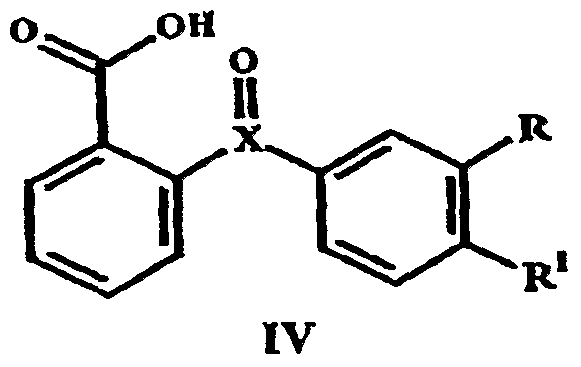
wherein X is C or S; R is OH or H and R1 is OCH3 or OH;
Figure imgf000004_0003
wherein R, R2 and R3 are OH or H and R1 is H or COOH;
Figure imgf000004_0004
wherein X is O or CH2 and R is COOH or H;
Figure imgf000005_0001
wherein R is CHsCHj, OH, N (CH3)2 or Cl ; and
Figure imgf000005_0002
Λ XI
In another embodiment, a method of producing a chewing gum exhibiting prolonged trigeminal effects is provided. The method includes the steps of providing a plurality of chewing gum ingredients including a water insoluble base portion, a water soluble portion, a trigeminal stimulant and a hydrophobic sweetener; processing the ingredients and forming the chewing gum.
In yet another embodiment of the present invention, a method for prolonging sensory benefits of a chewing gum is provided. The method includes the step of chewing the chewing gum including a water insoluble base portion, a water soluble portion, a trigeminal stimulant and a hydrophobic sweetener.
It is1, therefore, an advantage of the present invention to provide chewing gums that can prolong the sensory benefits of same as it is chewed. Another advantage of the present invention is to provide chewing gums that include a hydrophobic sweetener for providing long lasting flavor, sweetness or other like trigeminal effects. A fuifther advantage of the present invention is to provide chewing gums that include sweet organic compounds which have a very low water solubility to promote and enhance cooling sensations in connection with cooling agents and or tingling sensations associated with tingling agents. Yet a still Further advantage of the present invention is to provide a method for prolonging sensory benefits of a chewing gum that includes a hydrophobic sweetener and other suitable chewing gum ingredients.
Yet still another advantage of the present invention is a chewing gum for effectively enhancing the sensory benefits of the gum as it is chewed that can be readily produced at reduced costs as compared to, for example, encapsulating sweeteners within the chewing gum.
Additional features and advantages of the present invention are described in, and will be apparent in, the detailed description of the presently preferred embodiments.
DETAILED DESCRIPTION OF THE INVENTION
The present invention provides chewing gums and methods of making and using same. In particular, the chewing gums of the present invention include, in part, hydrophobic sweeteners. The inventors have uniquely discovered that the use of sweet organic compounds which have very low water solubility (i.e. hydrophobic sweeteners) can be effectively utilized to prolong and enhance sensoτy benefits of the chewing gum, such as flavoring, cooling sensations, tingling sensations or the like, as the gum is chewed. The chewing gums of the present invention can be composed of ingredients that are readily available and prepared at lower costs as compared to chewing gums that utilize encapsulating agents and methods thereof.
In an embodiment, the chewing gum of the present invention includes a water insoluble base portion, a water soluble portion, a sensorally active component, such as a flavor, and a hydrophobic sweetener. As previously discussed, the addition of the hydrophobic sweetener facilitates the enhancement and prolonged effect of sensory benefits of the chewing gum as it is chewed. Such sensory benefits can include, for example, flavor sensation, cooling sensations, warming sensations, tingling, numbing, pain, itch, mouth coating, combinations thereof or other oral trigeminal effects of chewing gums. It is believed that the hydrophobic sweeteners can be released at a much slower rate into the aqueous saliva and have a stronger affinity to the lipophyllic or water insoluble gum base portion as compared to known sweeteners. Further, it is believed that the release mechanism of the hydrophobic sweeteners substantially matches that of flavors, cooling agents, tingling agents and other sensorally active components or trigeminal stimulants of the chewing gum. When the hydrophobic sweeteners of the present invention are optionally mixed with the sensorally active components) of the gum, the release of such component(s) along wiih the hydrophobic sweeteners can be prolonged and enhanced as the gum is chewed.
It should be appreciated that due to the slow release of hydrophobic sweeteners from the chewing gum, it is believed that higher levels of the hydrophobic sweeteners as compared to typical water soluble sweeteners may be necessary to provide the desired level of sweetness or sweetness intensity. The amount can suitably vary depending on any number of factors, such as the desired level of sweetness and the relative sweetness intensity specific to the hydrophobic sweetener compound. As detailed below, the relative sweetness can vary depending on the type of hydrophobic sweetener compound. In an embodiment, chewing gum includes the hydrophobic sweetener compound in an amount ranging from about 50 to about 5000 Sucrose Equivalents. The Sucrose Equivalent factor is determined by multiplying the weight percent of the hydrophobic compound in the chewing gum by its relative sweetness.
The hydrophobic sweetener of the present invention can include a range of suitably sweet organic compounds and mixtures thereof that have a very low water solubility. Preferably, the hydrophobic sweetener compounds are defined by formulas I-XI as follows:
Figure imgf000008_0001
wherein, X, Y and Z are CH2, 0 or S;
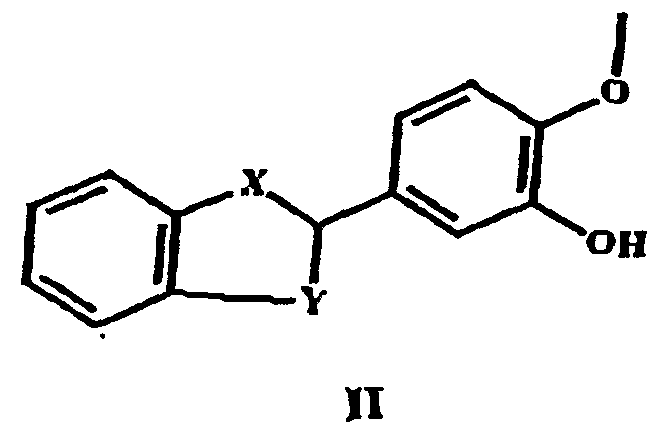
Figure imgf000008_0002
II
wherein X and Y are S or O;
Figure imgf000009_0001
III
wherein X is S or O; Y is O or CH2; Z is CH2, SOz, or S; R is OCH3, OH or H; R1 is SH or OH and R2 is H or OH;
Figure imgf000009_0002
IV
wherein X is C or S; R is OH or H and R1 is OCH3 or OH;
Figure imgf000009_0003
wherein R1, Rz and R3 are OH or H; and R1 is H or COOH;
Figure imgf000009_0004
VI
wherein X is O or CH2 and R is COOH or H;
Figure imgf000010_0001
wherein R is CH3> CH2CH3. OH, N(CH3)2 or CI; and
Figure imgf000010_0002
XI
By way of example and not limitation, the following tables illustrate a variety of hydrophobic sweetener compounds representative of the hydrophobic sweetener compounds of Formulas I-XI, as previously discussed. The tables also indicate the relative sweetness of the hydrophobic sweetener compounds. As previously discussed, this factor can be utilized to calculate the Sucrose Equivalent calculation which relates to the amount of hydrophobic sweetener in the chewing gum.
Table 1 —Hydrophobic Sweeteners of Formula I
Figure imgf000011_0001
Table 2 - Hydrophobic Sweeteners of Formula II
Figure imgf000011_0002
Table 3 - Hydrophobic Sweeteners of Formula III
Figure imgf000011_0003
Table 4 - Hydrophobic Sweeteners of Formula IV
Figure imgf000012_0001
Table 5 -Hydrophobic Sweeteners of Formula V
Figure imgf000012_0002
Table 6 - Hydrophobic Sweeteners of Fomiula VI
Figure imgf000012_0003
Table 7 - Hydrophobic Sweeteners of Formula VII
Figure imgf000012_0004
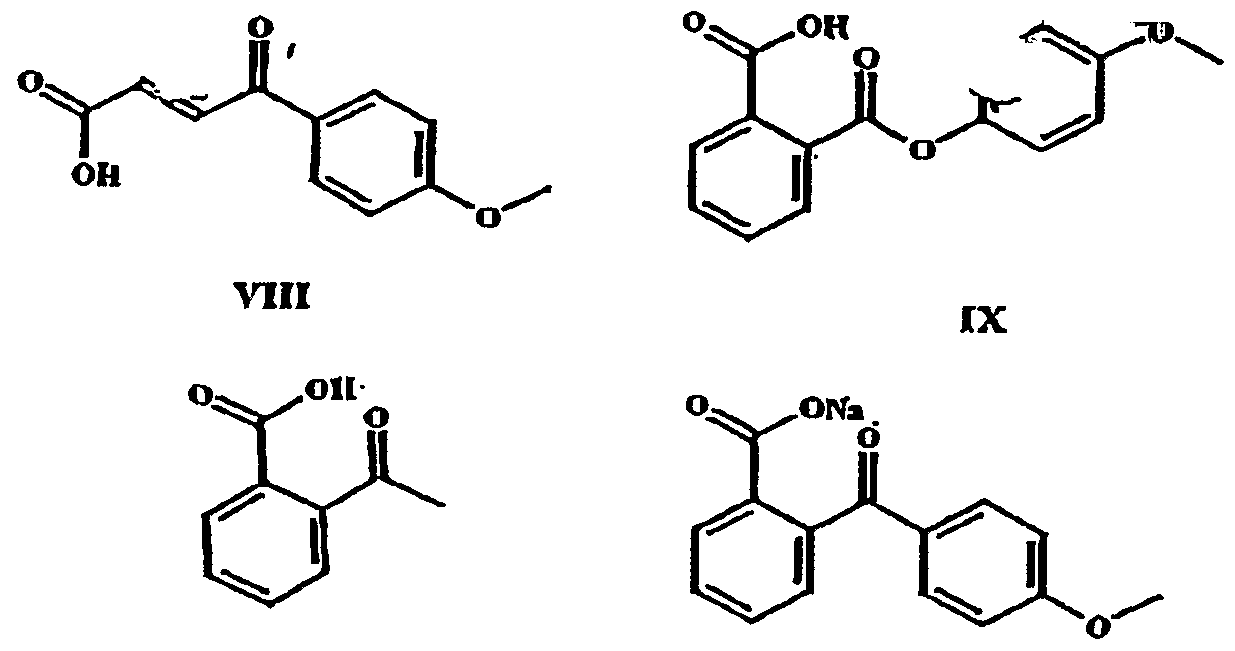
π Table 8 — Hydrophobic Sweeteners of Formulas VIII-XI
Figure imgf000013_0001
As previously discussed, the hydrophobic sweeteners of the present invention can be utilized to enhance and extend the flavor, sweetness, cooling, tingling and other sensory benefits of chewing gums as chewed. In an embodiment, the chewing gum of the present invention includes a cooling agent. When mixed with the hydrophobic sweeteners, the cooling effect or sensation of the cooling agents can be prolonged and enhanced as the gum is chewed. The cooling agents can be added to the chewing gum alone or in combination with flavors or other sensorally active components.
The cooling agents can include a range of different suitable materials. For example, the cooling agent can include menthol, WS3, N-substituted p-menthane ca boxamide, acyclic carboxamides including WS23, menthyl lactate, Takasago Cooling agent (TCA or 3-l-menthoxyproρane-l72-diol), menthyl succinate and menthone glycerol ketais, other like cooling agents or mixtures thereof.
It should be appreciated that the chewing gum of the present invention is not limited to the type, number and amount of sensorally active component or trigeminal stimulant. The chewing gum of the present invention can include any suitable amount and variety of different sensorally active components alone or in combination with additional other sensorally active components or trigeminal stimulants. When mixed with the hydrophobic sweeteners of the present invention, the trigeminal effects of such components, including, flavor, cooling, tingling, paresthesis, heat, pain, itch, like trigeminal effects or combinations thereof, can be prolonged and enhanced as the gum is chewed as previously discussed. In an embodiment, the sensorally active components or trigeminal stimulants can include, for example, cooling agents, flavors, tingling agents, Jambu extract, Vanillyl alkyl ethers, such as Vanillyl n-butyl ether, spilanthol, Echinacea extract, Northern Prickly Ash extract, capsaicin, capsicum oleoresin, red pepper oleoresin, black pepper oleoresin, piperine, ginger oleoresin, gingerol, shoagol, cinnamon oleoresin, cassia oleoresin, cinnamon oleoresin, cassia oleoresin, cinnamic aldehyde, eugenol, cyclic acetal of vanillin and menthol glycerin ether, unsaturated amides, like components or combinations thereof.
With respect to other ingredients, the chewing gum of the present invention generally consists of a water insoluble gum base, a water soluble portion, and flavors. The water soluble portion dissipates with a portion of the flavor over a period of time during chewing. The gum base portion is retained in the mouth throughout the chew.
The insoluble gum base generally comprises elastomers, resins, fats and oils, softeners, and inorganic fillers. The gum base may or may not include wax. The insoluble gum base can constitute approximately 5 to about 95 percent, by weight, of the chewing gum, more commonly, the gum base comprises 10 to about 50 percent of the gum, and in some preferred embodiments, 20 to about 35 percent, by weight, of the chewing gum.
In an embodiment, the chewing gum base of the present invention contains about 20 to about 60 weight percent synthetic elastomer, 0 to about 30 weight percent natural elastomer, about 5 to about 55 weight percent elastomer plasticizer, about 4 to about 35 weight percent filler, about 5 to about 35 weight percent softener, and optional minor amounts (about one percent or less) of miscellaneous ingredients such as colorants, antioxidants or the like. Synthetic elastomers may include, but are not limited to, polyisobutyleπe with
GPC weight average molecular weight of about 10,000 to about 95,000 isobutylene- isoprene copolymer (butyl elastomer), styrene-butadiene copolymers having st rene- butadiene ratios of about 1:3 to about 3:1, polyvinyl acetate having GPC weight average molecular weight of about 2,000 to about 90,000, polyisoprene, polyethylene, vinyl acetate-vinyl laurate copolymer having vinyl laurate content of about 5 to about
50 percent by weight of the copolymer, and combinations thereof. Preferred ranges are, for polyisobutylene, 50,000 to 80,000 GPC weight average molecular weight, for styrene-bυtadiene, 1:1 to 1 :3 bound styrene-butadiene, for polyvϊnyl acetate, 10,000 to 65,000 GPC weight average molecular weight with the higher molecular weight polyviny] acetates typically used in bubble gum base, and for vinyl acetate-vinyl laurate, vinyl laurate content of 10-45 percent.
Natural elastomers may include natural rubber such as smoked or liquid latex and guayule as well as natural gums such as jelutong, lechi caspi, perillo, sorva, massaranduba balata, massaranduba chocolate, nϊspero, rosindinha, chicle, gutta hang kang, and combinations thereof. The preferred synthetic elastomer and natural elastomer concentrations vary depending on whether the chewing gum in which the base is used is abhesive or conventional, bubble gum or regular gum, as discussed below. Preferred natural elastomers include jelutong, chicle, sorva and massaranduba balata.
Elastomer plasticizers may include, but are not limited lo, natural rosin esters such as glycerol esters of partially hydrogenated rosin, glycerol esters polymerized rosin, glycerol esters of partially dimerized rosin, glycerol esters of rosin, pentaerythritol esters of partially hydrogenated rosin, methyl and partially hydrogenated methyl esters of rosin, pentaerythritol esters of rosin; synthetics such as leτpene resins derived from alpha-pinene, beta-pinene, and/or d-limonene and any suitable combinations of the foregoing. The preferred elastomer plasticizers will also vary depending on the specific application, and on the type of elastomer which is used.
Fillers/texturizes may include magnesium and calcium carbonate, ground limestone, silicate types such as magnesium and aluminum silicate, clay, alumina, talc, titanium oxide, mono-, di- and tri-calcium phosphate, cellulose polymers, such as wood, and combinations thereof.
Softeπers/emulsifiers may include tallow, hydrogenated tallow, hydrogenated and partially hydrogenated vegetable oils, cocoa butter, glycerol monostearate, glycerol triacetate, lecithin, mono-, dϊ- and triglycerides, acetylated monoglycerides, fatty acids (e.g. stearic, palmitic, oleic and linoleic acids), and combinations thereof. Colorants and whiteners may include FD&C-type dyes and lakes, fruit and vegetable extracts, titanium dioxide, and combinations thereof. The base may or may not include wax. An example of a wax-free gum base is disclosed in U.S. Patent No. 5,286,500, the disclosure of which is incorporated herein by reference.
In addition to a water insoluble gum base portion, a typical chewing gum composition includes a water soluble bulk portion and one or more flavoring agents.
The water soluble portion can include bulk sweeteners, high intensity sweeteners, flavoring agents, softeners, emulsifiers, colors?, acjdulants, fillers, antioxidants, and other components that provide desired attributes.
Softeners are added to the chewing gum in order to optimize the chewability and mouth feel of the gum. The softeners, which are also known as plasticizers and plasticizing agents, generally constitute between approximately 0.5 to about 15% by weight of the chewing gum. The softeners may include glycerin, lecithin, and combinations thereof. Aqueous sweetener solutions such as those containing sorbitol, hydrogenated starch hydrolysates, com syrup and combinations thereof, may also be used as softeners and binding agents in chewing gum.
Bulk sweeteners include both sugar and sugarless components. Bulk sweeteners typically constitute 5 to about 95% by weight of the chewing gum, more typically, 20 to 80% by weight, and more commonly, 30 to 60% by weight of the gum- Sugar sweeteners generally include saccharide-containing components commonly known in the chewing gum art, including, but not limited to, sucrose, dextrose, maltose, dextrin, dried invert sugar, fructose, lcvulose, galactose, com syrup solids, and the like, alone or in combination.
Sugarless bulk sweeteners include, but are not limited to, sugar alcohols such as sorbitol, mannitol, xylitol, hydrogenated starch hydrolysates, maltitol, and the like, alone or in combination.
High intensity artificial sweeteners, other than the hydrophobic sweeteners of the present invention, can also be used, alone or in combination with the above.
Preferred sweeteners include, but are not limited to sucralose, aspartame, salts of acesulfame, alitame, saccharin and its salts, cycJamic acid and its salts, glycyrrhizin, dihydrochalcones, thaumatin, monellin. and the like, alone or in combination.
Usage level of the artificial sweetener will vary greatly and will depend on such factors as potency of the sweetener, rate of release, desired sweetness of the product, level and type of flavor used and cost considerations. Thus, the active level of artificial sweetener may vary from 0.02 to about 8%.
Combinations of sugar and/or sugarless sweeteners may be used in chewing gum. Additionally, the softener may also provide additional sweetness such as with aqueous sugar or alditol solutions.
If a low calorie gum is desired, a low caloric bulking agent can be used.
Examples of low caloric bulking agents include: polydextrose; Raftilose, Raftilin;
Fructooligosaccharides (NutraFlora); Palatinose oligosaccharide; Guar Gum
Hydrolysate (Sun Fiber); or indigestible dextrin (Fibersol). However, other low calorie bulking agents can be used.
A variety of flavoring agents can be used. The flavor can be used in amounts of approximately 0.1 to about 15 weight percent of the gum, and preferably, 0.2 to 5%. Flavoring agents may include essential oils, synthetic flavors or mixtures thereof including, but not limited to, oils derived from plants and fruits such as citrus oils, fruit essences, peppemiint oil, spearmint oil, other mint oils, clove oil, oil of wintergreen, anise and the like. Artificial flavoring agents and components may also be used. Natural and artificial flavoring agents may be combined in any sensorally acceptable fashion.
Additional oral health ingredients may be added including but not limited to, antiplaque anti-gingivitjs agents (such as chlorhcxidine, CPC, triclosan), pH control agents (including Urea and buffers,) other inorganic components for tarter or caries control (phosphates, fluoride) and biological agents (antibodies, enzymes). The only requirement is that the agents be safe and effective and that they do not react undesirably with each other such as may happen with phosphate salts. As previously discussed, the present invention provides a method for producing the chewing gum of the present invention. It should be appreciated that the method of making or producing the chewing gum of the present invention can be carried out by any number and variation of suitable processes, such as blending, mixing and/or cooking the ingredients to obtain a desirable consistency or the like. It should also be appreciated that the chewing gum of the present invention can be formed into any suitable size and shape, such as sticks, chunks, pellets or the like. In ah embodiment, a number of chewing gum ingredients at least including a water insoluble base portion, a water soluble portion, a flavor, a hydrophobic sweetener and optionally a cooling agent, tingling agent, like sensorally active components or mixture thereof are processed to form the chewing gum of the present invention. It should be appreciated that the ingredients can be added in any suitable amount.
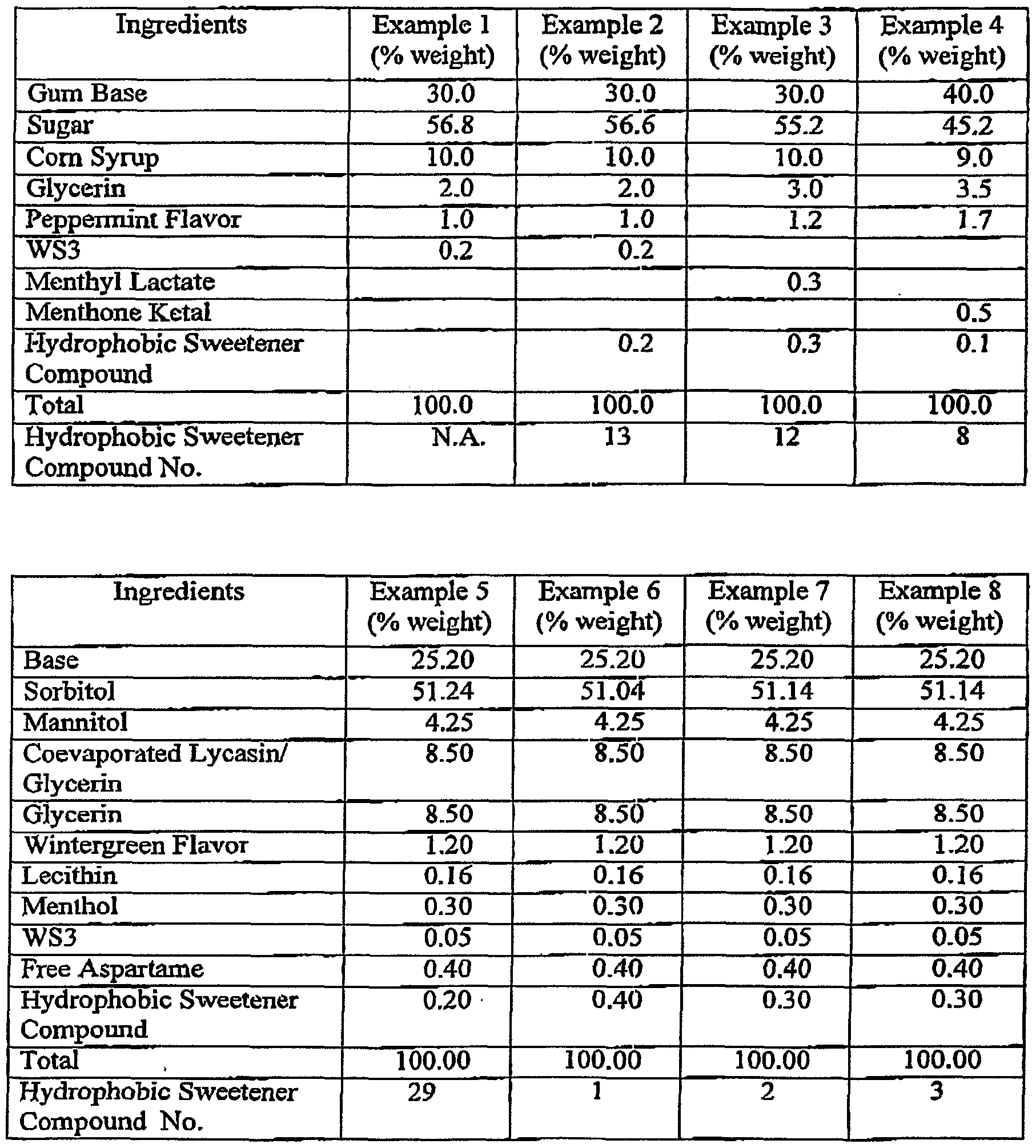
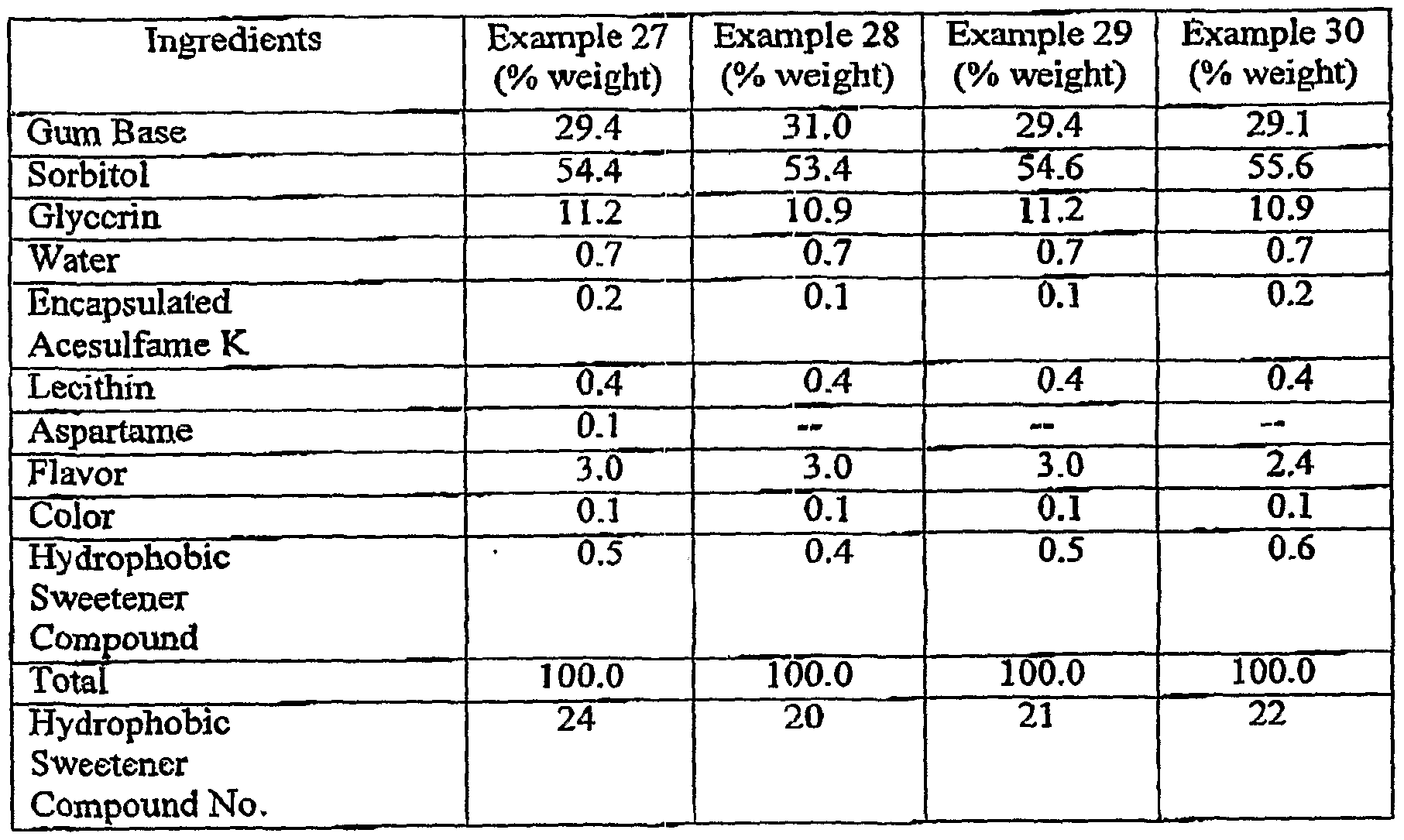
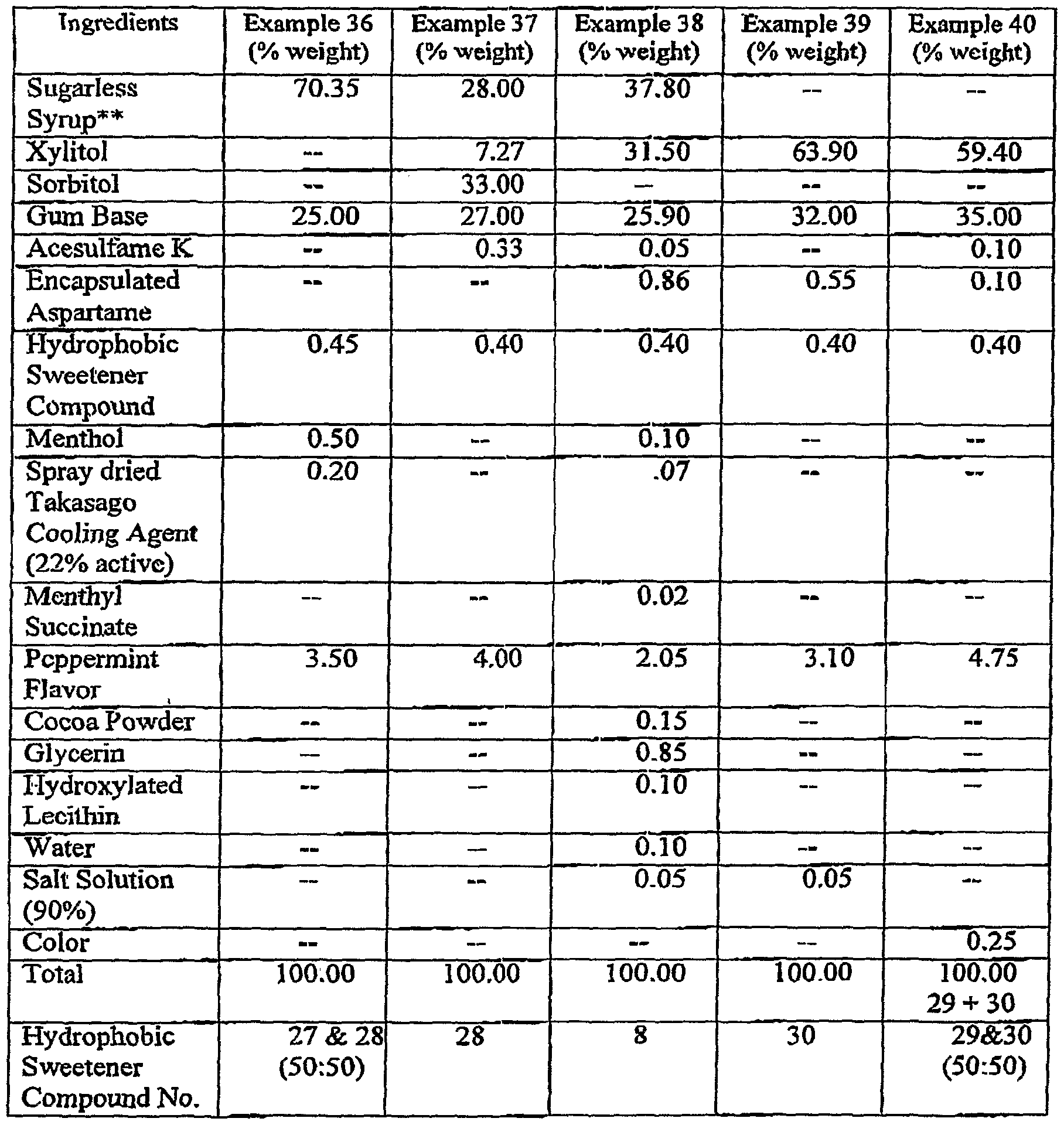
As previously discussed, the chewing gum ingredients can be processed in any suitable way to form the chewing gum of the present invention. In an embodiment, the hydrophobic sweetener is pre-mixed with the flavor, cooling agent, tingling agent, other hydrophobic sensorally active components of the chewing gum or combinations thereof. The inventors have uniquely discovered that pre-mixing of the ingredients, particularly the hydrophobic sweetener and sensorally active components, can aid in synchronizing the release of same and further can facilitate uniform incorporation of these ingredients into the chewing gum mass. By way of example and not limitation, the following examples illustrate the compositional breakdown of chewing gums embodying the present invention. For comparison, a chewing gum that does not contain a hydrophobic sweetener is provided in Example 1. It should be appreciated that the hydrophobic sweetener compounds as detailed in the examples are identified by a hydrophobic sweetener number (No.) which corresponds to the hydrophobic sweetener compounds as previously discussed. Examples 1-50 are listed as follows:
Figure imgf000019_0001
Figure imgf000020_0001
Figure imgf000020_0002
Figure imgf000021_0001
Figure imgf000022_0001
Figure imgf000023_0001
Figure imgf000023_0002
Figure imgf000024_0001
** Sugarless syrup contains 51.75% sorbitol, 39.50% glycerin, 4.00% mannitol, 2.00% maltitol and 2.75% water.
Figure imgf000025_0001
Figure imgf000025_0002
As indicated in the Examples, the critical distinction between Examples 2-50 and Example 1 is that Example 1 does not include a hydrophobic sweetener compound. As previously discussed, the inventors have uniquely discovered that the addition of a hydrophobic sweetener to chewing gum can prolong and enhance the release of flavors (i.e., peppermint flavor), cooling agents (i.e., WS3), tingling agents (i.e., Vanillyl n-butyl ether), like sensorally active components or combinations thereof as compared to the chewing gums without hydrophobic sweeteners.
It should be appreciated that various changes and modifications to the presently preferred embodiments described herein will be apparent to those skilled in the art. Such changes and modifications can be made without departing from the spirit and scope of the present invention and without diminishing its intended advantages. It is therefore intended that all such changes and modifications be covered by the appending claim.

Claims

CLAIMS:
A chewing gum having prolonged sensory benefits comprising:
a water insoluble base portion;
a water soluble portion;
a sensorally active component; and
a hydrophobic sweetener having the formula selected from the group consisting of
Figure imgf000027_0001
10
wherein X, Y and Z are selected from the group consisting of CH2, 0
Figure imgf000027_0002
)5 II wherein X and Y arc selected from the group consisting of S and O;
Figure imgf000027_0003
0 HI
wherein X is S or O; Y is O or CH2; Z is CH2. SO2, or S; R is OCH3, OH or H; R1 is SH or OH and Rz is H or OH;
Figure imgf000028_0001
wherein X is C or S; R is OH or H and R1 is OCH3 or OH;
Figure imgf000028_0002
V wherein R, R2 and R3 are OH or H and R1 is H or COOH;
Figure imgf000028_0003
wherein X is O or CH2 and R is COOH or H;
Figure imgf000028_0004
wherein R is CH3r CH2CH3, OH, N(CH3)2 or Cl; and
Figure imgf000029_0001
XI
2. The chewing gum of claim 1 wherein the sensory benefits include flavor sensations, tingling, numbing, mouth coating, cooling/warming sensations, pain, itch or combinations thereof.
3. The chewing gum of claim 1 wherein the sensorally active component is selected from the group consisting of a flavor, a cooling agent, a tingling agent, Jambu extract, Vanillyl alkyl ethers, Vanillyl π-butyl ether, spϊlanthol, Echinacea extract, Northern Prickly Ash extract, capsaicin, capsicum oleoresin, red pepper oleoresin, black pepper oleoresin, pipeline, ginger oleoresin, gingerol, shoagol, cinnamon oleoresin, cassia oleoresin, cinnamic aldehyde, eugenol, cyclic acetal of vanillin, menthol glycerin ether, unsaturated amides and combinations thereof.
4. The chewing gum of claim 3 wherein the cooling agent is selected from the group consisting of menthol, WS3, N-substituted p-menthane carboxamide, acyclic carboxamides, WS23, menthyl lactate, Takasago Cooling agent, 3-1- menthoxypropane-l,2-diol, menthyl succinate, menthone glycerol ketals and mixtures thereof.
5. The chewing gum of claim 1 wherein the hydrophobic sweetener is in an amount ranging from about 50 Sucrose Equivalents to about 5000 Sucrose Equivalents.
6. A chewing gum having prolonged sensory benefits comprising a water insoluble base portion; a water soluble portion; a flavor; a plurality of additional sensorally active components; and a hydrophobic sweetener wherein the hydrophobic sweetener has the formula selected from the group consisting of
Figure imgf000030_0001
wherein X, Y and Z are selected from the group consisting of CH2, 0 and S;
Figure imgf000030_0002
U
wherein X and Y are selected from the group consisting of S and O;
Figure imgf000030_0003
III
wherein X is S or O; Y is O or CH2; Z is CH2. SO2, or S; R is OCH3, OH or H; R1 is SH or OH and R2 is H or OH;
Figure imgf000030_0004
wherein X is C or S; R is OH or H; * is OCH3; or OH;
Figure imgf000031_0001
wherein, R, R2 and R3 are OH or H and R1 is H or COOH;
Figure imgf000031_0002
VI
wherein X is O or CH2; and R is COOH or H;
Figure imgf000031_0003
wherein R is CH3, CH2CH3. OH, N(CH3)2 or Cl; and
Figure imgf000031_0004
XI
7. The chewing gum of claim 6 wherein the additional sensorally active components are selected from the group consisting of a cooling agent, menthol, WS3, N-substituted p-menthane carboxamide, acyclic carboxamides, WS23, menthyl lactate, Takasago Cooling agent, 3-l-menthoxypropane-l,2-diol, menthyl succinate, menthone glycerol ketals, a tingling agent, Jambu extract, Vanillyl alkyl ethers, Vanillyl n-butyl ether, spilanthol, Echinacea extract, Northern Prickly Ash extract, capsaicin, capsicum oleoresin, red pepper oleoresin, black pepper oleoresin, pipeline, ginger oleoresin, gingerol, shoagol, cinnamon oleoresin, cassia oleoresin, cinnamic aldehyde, eugenol, cyclic acetal of vanillin, menthol glycerin ether, unsaturated amides and combinations thereof.
8. A method of producing a chewing gum exhibiting prolonged trigeminal effects comprising the steps of:
providing a plurality of chewing gum ingredients including a water insoluble base portion, a water soluble portion, a trigeminal stimulant and a hydrophobic sweetener;
processing the ingredients; and
forming the chewing gum.
9. The method of claim 8 wherein the hydrophobic sweetener is in an amount ranging from about 50 Sucrose Equivalents to about 5000 Sucrose Equivalents.
10. The method of claim 8 wherein the ingredients are processed by pre- mixing the hydrophobic sweetener with the trigeminal stimulant.
11. The method of claim 8 wherein the trigeminal stimulant is selected from the group consisting of a flavor, a cooling agent, menthol, WS3, N-substituted p- menthane carboxamide, acyclic carboxamides, WS23, menthyl lactate, Takasago
Cooling agent, 3-l-menthoxypropane-l,2-diol, menthyl succinate, menthone glycerol ketals, a tingling agent, Jambu extract, Vanillyl alkyl ethers, Vanillyl n-butyl ether, spilanthol, Echinacea extract, Northern Prickly Ash extract, capsaicin, capsicum- oleoresin, red pepper oleoresin, black pepper oleoresin, piperine, ginger oleoresin, gingerol, shoagol, cinnamon oleoresin, cassia oleoresin, cinnamic aldehyde, eugenol, cyclic acetal of vanillin, menthol glycerin ether, unsaturated amides and combinations thereof.
12. The method of claim 8 wherein the hydrophobic sweetener has a formula selected from the group consisting of:
Figure imgf000033_0001
wherein X, Y and Z are CH2 O or S
Figure imgf000033_0002
II wherein X and Y are S or O;
Figure imgf000033_0003
III
'wherein X is S or O; Y is O or CH2; Z is CH2, SO2, or S; R is OCH3l OH or H; R1 is SH or OH and R2is H or OH;
Figure imgf000034_0001
wherein X is C or S; R is OH or H; R1 is OCH3; or OH;
Figure imgf000034_0002
wherein, R, R2 and R3 are OH or H and R1 is H or COOH;
Figure imgf000034_0003
wherein X is O or CH2; and R is COOH or H;
Figure imgf000034_0004
VII
wherein R is CH3, CH2CH3. OH, N(CH3)z or Cl; and
Figure imgf000035_0001
XI
13. A method for prolonging sensory benefits of a chewing gum comprising the step of chewing the chewing gum which includes a water insoluble base portion, a water soluble portion, a trigeminal stimulant and a hydrophobic sweetener including a sweet organic compound.
14. file method of claim 13 wherein the trigeminal stimulant is selected from the group consisting of a flavor, a cooling agent, menthol, WS3, N-substituted p- menthane carboxamide, acyclic carboxamides, WS23, menthyl lactate, Takasago Cooling agent, 3-I-menthoxypropane-l,2-diol, menthyl succinate, menthone glycerol ketals, a tingling agent, Jambu extract, Vanillyl alkyl ethers, Vanillyl n-butyl ether, spilanthol, Echinacea extract, Northern Prickly Ash extract, capsaicin, capsicum oleoresin, red pepper oleoresin, black pepper oleoresin, piperine, ginger oleoresin, gingerol, shoagol, cinnamon oleoresin, cassia oleoresin, cinnamic aldehyde, eugenol, cyclic acetal of vanillin, menthol glycerin ether, unsaturated amides and combinations thereof.
PCT/US2002/013862 2001-05-11 2002-05-03 A chewing gum having prolonged sensory benefits Ceased WO2002091849A1 (en)

Applications Claiming Priority (2)

Application Number Priority Date Filing Date Title
US29038001P 2001-05-11 2001-05-11
US60/290,380 2001-05-11

Publications (1)

Publication Number Publication Date
WO2002091849A1 true WO2002091849A1 (en) 2002-11-21

Family

ID=23115733

Family Applications (1)

Application Number Title Priority Date Filing Date
PCT/US2002/013862 Ceased WO2002091849A1 (en) 2001-05-11 2002-05-03 A chewing gum having prolonged sensory benefits

Country Status (2)

Country Link
US (1) US7025999B2 (en)
WO (1) WO2002091849A1 (en)

Cited By (37)

* Cited by examiner, † Cited by third party
Publication number Priority date Publication date Assignee Title
US7078066B2 (en) 1997-09-18 2006-07-18 Wm. Wrigley Jr. Company Chewing gum containing physiological cooling agents and method of making
GB2423914A (en) * 2005-03-03 2006-09-13 Wrigley W M Jun Co Chewing gum containing a trigeminal stimulant
WO2010058341A1 (en) * 2008-11-19 2010-05-27 Firmenich Sa Chewing gum having longer lasting flavor
WO2013037977A2 (en) 2011-09-16 2013-03-21 Analyticon Discovery Gmbh Cosmetic preparations
AU2010216002B2 (en) * 2009-02-18 2013-04-04 Intercontinental Great Brands Llc Confectioneries providing mouth-moistening refreshment
CN103030646A (en) * 2011-09-29 2013-04-10 上海恒瑞医药有限公司 Benzodioxane derivative, and preparation method thereof and application of derivative in medicines
EP2620137A1 (en) 2012-01-30 2013-07-31 Symrise AG Compositions
WO2013171018A2 (en) 2012-05-16 2013-11-21 Symrise Ag Mixtures having improved cooling effect
EP2725026A1 (en) 2012-10-29 2014-04-30 Symrise AG Heterocyclic neoflavonoids with taste masking properties
WO2014090293A1 (en) 2012-12-12 2014-06-19 Symrise Ag Preparations
WO2014131532A1 (en) 2013-02-27 2014-09-04 Symrise Ag Material mixtures containing vanillin and vanillyl vanillate
EP2789247A1 (en) 2013-04-14 2014-10-15 Symrise AG Antioxidative composition
EP2801263A1 (en) 2013-05-09 2014-11-12 Symrise AG Cooling composition
EP2865372A1 (en) 2013-10-22 2015-04-29 Symrise AG Capsules comprising actives
EP2883459A1 (en) 2013-12-16 2015-06-17 Symrise AG Compositions for oral consumption
EP2926673A1 (en) 2014-04-01 2015-10-07 Symrise AG Compound mixtures
EP2932956A1 (en) 2014-04-14 2015-10-21 Symrise AG Capsules with high active load
EP2990036A1 (en) 2014-07-30 2016-03-02 Symrise AG Hydroxyflavones for stimulating appetite
DE202012013357U1 (en) 2012-12-12 2016-07-29 Symrise Ag preparations
EP3093002A1 (en) 2015-05-15 2016-11-16 Symrise AG Liquid cooling compositions
WO2017092796A1 (en) 2015-12-01 2017-06-08 Symrise Ag Substance mixtures
EP3181150A1 (en) 2015-12-19 2017-06-21 Analyticon Discovery GmbH Pharmaceutical compositions
EP3231294A1 (en) 2016-04-11 2017-10-18 Symrise AG Formulation and production of spinach extract with beta ecdyson
WO2017190789A1 (en) 2016-05-05 2017-11-09 Symrise Ag Coolant mixtures
WO2017198284A1 (en) 2016-05-14 2017-11-23 Symrise Ag Menthol-containing aroma preparations
WO2018233841A1 (en) 2017-06-22 2018-12-27 Symrise Ag AROMATIC AGENTS MODULATING FLAVOR
WO2019063067A1 (en) 2017-09-26 2019-04-04 Symrise Ag FRUIT AROMAS WITH YELLOW TASTE
US10392371B2 (en) 2015-10-01 2019-08-27 Senomyx, Inc. Compounds useful as modulators of TRPM8
WO2020033669A1 (en) 2018-08-10 2020-02-13 Firmenich Incorporated Antagonists of t2r54 and compositions and uses thereof
EP3689324A1 (en) 2019-02-04 2020-08-05 Symrise AG New cooling agents and preparations comprising them
EP3864966A1 (en) 2020-02-12 2021-08-18 Savanna Ingredients GmbH Oral compositions comprising allulose crystals
WO2021160701A1 (en) 2020-02-12 2021-08-19 Savanna Ingredients Gmbh Allulose in crystalline form
EP3915400A1 (en) 2020-05-25 2021-12-01 DMK Deutsches Milchkontor GmbH Lactose derivative with increased sweetness
WO2022106452A2 (en) 2020-11-17 2022-05-27 Symrise Ag New coolants, and preparations containing same
WO2023117119A1 (en) 2021-12-23 2023-06-29 Symrise Ag Active ingredients with sialagogue and tingling/fizzy effect, and preparations containing same
WO2023144326A1 (en) 2022-01-28 2023-08-03 Symrise Ag New coolants, and preparations containing same
WO2025026525A1 (en) 2023-07-28 2025-02-06 Symrise Ag Heterocyclic compounds as physiological coolants

Families Citing this family (77)

* Cited by examiner, † Cited by third party
Publication number Priority date Publication date Assignee Title
US7041277B2 (en) * 2000-03-10 2006-05-09 Cadbury Adams Usa Llc Chewing gum and confectionery compositions with encapsulated stain removing agent compositions, and methods of making and using the same
AU2002323135A1 (en) * 2001-08-14 2003-03-03 Variant Holdings, Llc. System for marketing goods and services utilizing computerized central and remote facilities
US7632531B2 (en) * 2003-04-11 2009-12-15 International Flavors & Fragnances Inc. Alkyldienamides exhibiting taste and sensory effect in flavor compositions
US7361376B2 (en) * 2003-04-11 2008-04-22 International Flavors & Fragrances Inc. Alkyldienamides exhibiting taste and sensory effect in flavor compositions
US6884906B2 (en) * 2003-07-01 2005-04-26 International Flavors & Fragrances Inc. Menthyl half acid ester derivatives, processes for preparing same, and uses thereof for their cooling/refreshing effect in consumable materials
US7141686B2 (en) * 2003-07-10 2006-11-28 International Flavors & Fragrances Inc. E2, E4, Z8-undecatrienoic acid and ester and carboxamide derivatives thereof, organoleptic uses thereof and processes for preparing same
US7329767B2 (en) * 2003-10-03 2008-02-12 International Flavors & Fragrances Inc. Conjugated dienamides, methods of production thereof, compositions containing same and uses thereof
US8007839B2 (en) * 2003-10-03 2011-08-30 International Flavors & Fragrances Conjugated dienamides, methods of production thereof, compositions containing same and uses thereof
US8591972B2 (en) 2005-05-23 2013-11-26 Kraft Foods Global Brands Llc Delivery system for coated active components as part of an edible composition
US8591973B2 (en) * 2005-05-23 2013-11-26 Kraft Foods Global Brands Llc Delivery system for active components and a material having preselected hydrophobicity as part of an edible composition
US9271904B2 (en) * 2003-11-21 2016-03-01 Intercontinental Great Brands Llc Controlled release oral delivery systems
US20050112236A1 (en) * 2003-11-21 2005-05-26 Navroz Boghani Delivery system for active components as part of an edible composition having preselected tensile strength
US8389032B2 (en) 2005-05-23 2013-03-05 Kraft Foods Global Brands Llc Delivery system for active components as part of an edible composition having selected particle size
US8389031B2 (en) * 2005-05-23 2013-03-05 Kraft Foods Global Brands Llc Coated delivery system for active components as part of an edible composition
US8591968B2 (en) * 2005-05-23 2013-11-26 Kraft Foods Global Brands Llc Edible composition including a delivery system for active components
US8597703B2 (en) * 2005-05-23 2013-12-03 Kraft Foods Global Brands Llc Delivery system for active components as part of an edible composition including a ratio of encapsulating material and active component
US8591974B2 (en) 2003-11-21 2013-11-26 Kraft Foods Global Brands Llc Delivery system for two or more active components as part of an edible composition
US20060263473A1 (en) * 2005-05-23 2006-11-23 Cadbury Adams Usa Llc Compressed delivery system for active components as part of an edible composition
US7238835B2 (en) * 2003-12-22 2007-07-03 Sanofi-Aventis Deutschland Gmbh Process for the preparation of substituted 2-(phenoxymethyl) benzoic acids
DE10360525B3 (en) * 2003-12-22 2005-08-18 Aventis Pharma Deutschland Gmbh Process for the preparation of substituted 2- (phenoxymethyl) benzoic acids
US20060068059A1 (en) * 2004-09-30 2006-03-30 Cadbury Adams Usa Llc Encapsulated compositions and methods of preparation
US20060068058A1 (en) * 2004-09-30 2006-03-30 Cadbury Adams Usa Llc Thermally stable, high tensile strength encapsulation compositions for actives
US7727565B2 (en) 2004-08-25 2010-06-01 Cadbury Adams Usa Llc Liquid-filled chewing gum composition
US20070148284A1 (en) 2004-08-25 2007-06-28 Cadbury Adams Usa Llc. Liquid-filled chewing gum
US7955630B2 (en) 2004-09-30 2011-06-07 Kraft Foods Global Brands Llc Thermally stable, high tensile strength encapsulated actives
US7541055B2 (en) * 2004-09-10 2009-06-02 International Flavors & Fragrances Inc. Saturated and unsaturated N-alkamides exhibiting taste and flavor enhancement effect in flavor compositions
US7427421B2 (en) * 2004-09-10 2008-09-23 International Flavors & Fragrances Inc. Saturated and unsaturated N-alkamides exhibiting taste and flavor enhancement effect in flavor compositions
CA2592635C (en) * 2004-12-29 2013-02-12 Wm. Wrigley Jr. Company Combinations of cooling agents for use in confections
US9198448B2 (en) * 2005-02-07 2015-12-01 Intercontinental Great Brands Llc Stable tooth whitening gum with reactive ingredients
US8435542B2 (en) * 2005-03-03 2013-05-07 Takasago International Corp. (Usa) Synergistic salivation agents
JP4982485B2 (en) 2005-05-23 2012-07-25 クラフト・フーズ・グローバル・ブランズ・エルエルシー Liquid filled chewing gum composition
WO2006127282A2 (en) 2005-05-23 2006-11-30 Cadbury Adams Usa Llc Center-filled chewing gum composition
CN101179943B (en) 2005-05-23 2013-06-26 卡夫食品环球品牌有限责任公司 Liquid-filled chewing gum composition
US7851005B2 (en) 2005-05-23 2010-12-14 Cadbury Adams Usa Llc Taste potentiator compositions and beverages containing same
US7851006B2 (en) 2005-05-23 2010-12-14 Cadbury Adams Usa Llc Taste potentiator compositions and beverages containing same
AU2006251543C1 (en) 2005-05-23 2014-03-13 Intercontinental Great Brands Llc Confectionery composition including an elastomeric component, a cooked saccharide component, and a modified release component
US7851000B2 (en) 2005-05-23 2010-12-14 Cadbury Adams Usa Llc Taste potentiator compositions and edible confectionery and chewing gum products containing same
US8287928B2 (en) 2005-08-22 2012-10-16 Kraft Foods Global Brands Llc Degradable chewing gum
US8263143B2 (en) * 2005-08-22 2012-09-11 Kraft Foods Global Brands Llc Degradable chewing gum
US8268371B2 (en) 2005-08-22 2012-09-18 Kraft Foods Global Brands Llc Degradable chewing gum
US8282971B2 (en) 2005-08-22 2012-10-09 Kraft Foods Global Brands Llc Degradable chewing gum
US20070178188A1 (en) * 2006-01-27 2007-08-02 Cadbury Adams Usa Llc Chewing gum compositions including free neotame sweetener compositions
MX2008013507A (en) * 2006-04-21 2008-10-28 Cadbury Adams Usa Llc Coating compositions, confectionery and chewing gum compositions and methods.
US7282224B1 (en) 2006-06-09 2007-10-16 Guthy-Renker Corporation Pain relief composition
JP5039134B2 (en) * 2006-06-12 2012-10-03 フイルメニツヒ ソシエテ アノニム Stinging and salivary secretion composition
MX2008016375A (en) 2006-06-28 2009-01-19 Cadbury Adams Usa Llc A process for manufacturing a delivery system for active components as part of an edible composition.
EP2079321B1 (en) * 2006-09-27 2013-05-01 Kraft Foods Global Brands LLC Cooling confectioneries and beverages
US20080107747A1 (en) * 2006-10-23 2008-05-08 Roederer Joy E Pain relief composition
US20080213440A1 (en) 2007-03-01 2008-09-04 Cadbury Adams Usa Llc Non-Aldehyde Cinnamon Flavor and Delivery Systems Therefor
EP2166871A4 (en) * 2007-05-14 2012-01-25 Taste potentiator compositions in oral delivery systems
WO2008138162A1 (en) * 2007-05-16 2008-11-20 Givaudan Sa Compositions and their use
GB0715226D0 (en) * 2007-08-01 2007-09-12 Cadbury Schweppes Plc Sweetener compositions
WO2009061871A1 (en) * 2007-11-09 2009-05-14 The Hershey Company Multi-layered fondant containing chewing gum
WO2009062332A2 (en) * 2007-11-16 2009-05-22 Givaudan Sa Cooling compounds
WO2009076792A1 (en) * 2007-12-19 2009-06-25 Givaudan Sa Cooling compounds
US20090162476A1 (en) * 2007-12-21 2009-06-25 Cadbury Adams Usa Llc Parallel Gum Component Mixing Systems And Methods
WO2010056697A1 (en) * 2008-11-12 2010-05-20 Cadbury Adams Usa Llc Sensate- plated sanding composition and products made therefrom
US20120045499A1 (en) 2008-12-31 2012-02-23 Cadbury Adams Mexico, S. De R.L. De C.V. Pearlescent pigment surface treatment for confectionery
WO2010083133A1 (en) 2009-01-15 2010-07-22 Cadbury Adams Usa Llc Compositions and methods for the treatment of throat discomfort
WO2011011137A1 (en) 2009-07-21 2011-01-27 Exxonmobil Chemical Patents Inc. Process for the preparation of keto acid esters useful as pvc plasticizers
CN103002750B (en) 2010-01-21 2015-10-07 洲际大品牌有限责任公司 Systems and methods of forming chewing gum and sizing and/or changing temperature of chewing gum
PL2353403T3 (en) * 2010-02-01 2012-10-31 Symrise Ag Use of 1-(2,4-dihydroxy-phenyl)-3-(3-hydroxy-4-methoxy-phenyl)-propan-1-on
ES2543910T3 (en) 2010-07-30 2015-08-25 Intercontinental Great Brands Llc A supply system for active components as part of an edible composition
JP2013534146A (en) 2010-08-18 2013-09-02 クラフト・フーズ・グローバル・ブランズ・エルエルシー Mouth moisturizing gum composition and product comprising the same
PL2683251T3 (en) 2011-03-11 2021-12-13 Intercontinental Great Brands Llc Method of forming multilayer confectionery
ES2656944T3 (en) 2011-04-29 2018-03-01 Intercontinental Great Brands Llc Encapsulated acid, method of preparation thereof, and chewing gum comprising it
WO2013013041A2 (en) 2011-07-21 2013-01-24 Kraft Foods Global Brands Llc Advanced gum forming
PL2734053T3 (en) 2011-07-21 2019-07-31 Intercontinental Great Brands Llc Advanced gum forming
JP5912180B2 (en) 2011-07-21 2016-04-27 インターコンチネンタル グレート ブランズ エルエルシー Systems and methods for chewing gum formation and cooling
JP6085364B2 (en) 2012-04-20 2017-02-22 インターコンチネンタル グレート ブランズ エルエルシー System and method for producing chewing gum
JP6068643B2 (en) 2012-09-21 2017-01-25 インターコンチネンタル グレート ブランズ エルエルシー Improved gum formation
WO2014172287A1 (en) 2013-04-17 2014-10-23 Intercontinental Great Brands Llc A system and method for forming a chewing gum product with at least one inclusion
EP3131405A1 (en) 2014-03-03 2017-02-22 Intercontinental Great Brands LLC Method for manufacturing a comestible
WO2015195534A2 (en) 2014-06-16 2015-12-23 Intercontinental Great Brands Llc Degradable chewing gum
MX2017017169A (en) 2015-06-30 2018-03-09 Wrigley W M Jun Co Long-lasting cooling formulations.
WO2017186299A1 (en) 2016-04-28 2017-11-02 Symrise Ag Use of 3-(3-hydroxy-4-methoxy-phenyl)-1-(2,4,6-trihydroxy-phenyl)-propan-1-one
WO2019080990A1 (en) 2017-10-23 2019-05-02 Symrise Ag Aroma composition

Citations (4)

* Cited by examiner, † Cited by third party
Publication number Priority date Publication date Assignee Title
US3821417A (en) * 1970-11-09 1974-06-28 Warner Lambert Co Flavor preservation in chewing gum compositions and candy products
US3857962A (en) * 1971-10-14 1974-12-31 Warner Lambert Co Flavor preservation in sugarless chewing gum compositions and candy products
US4013801A (en) * 1976-02-13 1977-03-22 Dynapol Corporation Edibles sweetened with flavanones
US5236721A (en) * 1992-02-12 1993-08-17 Columbia Laboratories, Inc. Sustained flavorant release composition, chewable structure incorporating same and method for making same

Family Cites Families (7)

* Cited by examiner, † Cited by third party
Publication number Priority date Publication date Assignee Title
US4045581A (en) 1975-05-15 1977-08-30 Life Savers, Inc. Long-lasting mint-flavored chewing gum
US4064274A (en) 1976-02-02 1977-12-20 Life Savers, Inc. Long-lasting flavored chewing gum including chalk-free gum base
US4762930A (en) 1981-12-11 1988-08-09 Warner-Lambert Company Process for the preparation of the aluminum salt of saccharin
US4568537A (en) 1983-06-06 1986-02-04 Wm. Wrigley Jr. Company Dental health method employing chewing gum
US4758438A (en) 1986-10-14 1988-07-19 Stroz John J Sweetener composition
US4906455A (en) 1988-04-15 1990-03-06 Wm. Wrigley Jr. Company Method for treating xerostomia employing chewing gum containing relatively insoluble, hydrophobic, food-grade organic acid
US6159509A (en) 1996-10-28 2000-12-12 Wm. Wrigley Jr. Company Method of making chewing gum products containing perillartine

Patent Citations (4)

* Cited by examiner, † Cited by third party
Publication number Priority date Publication date Assignee Title
US3821417A (en) * 1970-11-09 1974-06-28 Warner Lambert Co Flavor preservation in chewing gum compositions and candy products
US3857962A (en) * 1971-10-14 1974-12-31 Warner Lambert Co Flavor preservation in sugarless chewing gum compositions and candy products
US4013801A (en) * 1976-02-13 1977-03-22 Dynapol Corporation Edibles sweetened with flavanones
US5236721A (en) * 1992-02-12 1993-08-17 Columbia Laboratories, Inc. Sustained flavorant release composition, chewable structure incorporating same and method for making same

Cited By (49)

* Cited by examiner, † Cited by third party
Publication number Priority date Publication date Assignee Title
US7364761B2 (en) 1997-09-18 2008-04-29 Wm. Wrigley Jr. Company Chewing gum containing physiological cooling agents and method of preparing
US7078066B2 (en) 1997-09-18 2006-07-18 Wm. Wrigley Jr. Company Chewing gum containing physiological cooling agents and method of making
GB2423914A (en) * 2005-03-03 2006-09-13 Wrigley W M Jun Co Chewing gum containing a trigeminal stimulant
WO2010058341A1 (en) * 2008-11-19 2010-05-27 Firmenich Sa Chewing gum having longer lasting flavor
EP2398337A4 (en) * 2009-02-18 2014-10-08 Intercontinental Great Brands Llc CONFECTIONERY PRODUCING A REFRESHMENT OF HUMIDIFICATION OF THE MOUTH
AU2010216002B2 (en) * 2009-02-18 2013-04-04 Intercontinental Great Brands Llc Confectioneries providing mouth-moistening refreshment
WO2013037977A2 (en) 2011-09-16 2013-03-21 Analyticon Discovery Gmbh Cosmetic preparations
CN103030646A (en) * 2011-09-29 2013-04-10 上海恒瑞医药有限公司 Benzodioxane derivative, and preparation method thereof and application of derivative in medicines
EP2620137A1 (en) 2012-01-30 2013-07-31 Symrise AG Compositions
EP3219303A1 (en) 2012-01-30 2017-09-20 Symrise AG Compositions
WO2013171018A2 (en) 2012-05-16 2013-11-21 Symrise Ag Mixtures having improved cooling effect
US9743685B2 (en) 2012-05-16 2017-08-29 Symrise Ag Mixtures having improved cooling effect
EP2725026A1 (en) 2012-10-29 2014-04-30 Symrise AG Heterocyclic neoflavonoids with taste masking properties
DE202012013357U1 (en) 2012-12-12 2016-07-29 Symrise Ag preparations
WO2014090293A1 (en) 2012-12-12 2014-06-19 Symrise Ag Preparations
WO2014131532A1 (en) 2013-02-27 2014-09-04 Symrise Ag Material mixtures containing vanillin and vanillyl vanillate
EP2789247A1 (en) 2013-04-14 2014-10-15 Symrise AG Antioxidative composition
EP2801263A1 (en) 2013-05-09 2014-11-12 Symrise AG Cooling composition
DE102014006596A1 (en) 2013-05-09 2014-11-13 Symrise Ag Cooling composition
EP2865372A1 (en) 2013-10-22 2015-04-29 Symrise AG Capsules comprising actives
WO2015091298A1 (en) 2013-12-16 2015-06-25 Symrise Ag Aroma mixtures
EP2883459A1 (en) 2013-12-16 2015-06-17 Symrise AG Compositions for oral consumption
EP2926673A1 (en) 2014-04-01 2015-10-07 Symrise AG Compound mixtures
EP2932956A1 (en) 2014-04-14 2015-10-21 Symrise AG Capsules with high active load
EP2990036A1 (en) 2014-07-30 2016-03-02 Symrise AG Hydroxyflavones for stimulating appetite
WO2016184731A1 (en) 2015-05-15 2016-11-24 Symrise Ag Liquid coolant preparations
EP3093002A1 (en) 2015-05-15 2016-11-16 Symrise AG Liquid cooling compositions
US10392371B2 (en) 2015-10-01 2019-08-27 Senomyx, Inc. Compounds useful as modulators of TRPM8
WO2017092796A1 (en) 2015-12-01 2017-06-08 Symrise Ag Substance mixtures
EP3181150A1 (en) 2015-12-19 2017-06-21 Analyticon Discovery GmbH Pharmaceutical compositions
EP3231294A1 (en) 2016-04-11 2017-10-18 Symrise AG Formulation and production of spinach extract with beta ecdyson
WO2017178444A1 (en) 2016-04-11 2017-10-19 Symrise Ag Composition and production of spinach extract with ss-ecdysone
WO2017190789A1 (en) 2016-05-05 2017-11-09 Symrise Ag Coolant mixtures
WO2017198284A1 (en) 2016-05-14 2017-11-23 Symrise Ag Menthol-containing aroma preparations
WO2018233841A1 (en) 2017-06-22 2018-12-27 Symrise Ag AROMATIC AGENTS MODULATING FLAVOR
WO2019063067A1 (en) 2017-09-26 2019-04-04 Symrise Ag FRUIT AROMAS WITH YELLOW TASTE
WO2020033669A1 (en) 2018-08-10 2020-02-13 Firmenich Incorporated Antagonists of t2r54 and compositions and uses thereof
EP4566459A2 (en) 2018-08-10 2025-06-11 Firmenich Incorporated Antagonists of t2r54 and compositions and uses thereof
EP3689324A1 (en) 2019-02-04 2020-08-05 Symrise AG New cooling agents and preparations comprising them
EP3864966A1 (en) 2020-02-12 2021-08-18 Savanna Ingredients GmbH Oral compositions comprising allulose crystals
WO2021160701A1 (en) 2020-02-12 2021-08-19 Savanna Ingredients Gmbh Allulose in crystalline form
EP4606436A2 (en) 2020-02-12 2025-08-27 Savanna Ingredients GmbH Allulose in crystalline form
EP3915400A1 (en) 2020-05-25 2021-12-01 DMK Deutsches Milchkontor GmbH Lactose derivative with increased sweetness
WO2022106452A2 (en) 2020-11-17 2022-05-27 Symrise Ag New coolants, and preparations containing same
WO2022105986A1 (en) 2020-11-17 2022-05-27 Symrise Ag Novel cooling agents and preparations containing same
WO2023117119A1 (en) 2021-12-23 2023-06-29 Symrise Ag Active ingredients with sialagogue and tingling/fizzy effect, and preparations containing same
WO2023144326A1 (en) 2022-01-28 2023-08-03 Symrise Ag New coolants, and preparations containing same
WO2023143741A1 (en) 2022-01-28 2023-08-03 Symrise Ag New coolants, and preparations containing same
WO2025026525A1 (en) 2023-07-28 2025-02-06 Symrise Ag Heterocyclic compounds as physiological coolants

Also Published As

Publication number Publication date
US7025999B2 (en) 2006-04-11
US20030072842A1 (en) 2003-04-17

Similar Documents

Publication Publication Date Title
US7025999B2 (en) Chewing gum having prolonged sensory benefits
US20050202118A1 (en) Chewing gum products containing trigeminal stimulant and method of making the same
CA2158732C (en) Mint flavored chewing-gum having reduced bitterness and methods for making same
US5474787A (en) Chewing gum containing a lecithin/glycerol triacetate blend
US7087255B2 (en) Chewing gums that provide breath freshening characteristics
AU676929B2 (en) Improved chewing gum and candy products
AU2002231274A1 (en) Chewing gums and related products that provide freshening characteristics
AU682603B2 (en) Method for refining mint oils and chewing gum made from same
EP0758849B1 (en) Method for creating a chewing gum including a liquid sorbitol/mannitol/glycerin blend
CA2351180C (en) Method for refining mint oils and chewing gum made from same
EP0763980B1 (en) Use of medium chain triglycerides to improve properties of chewing gum
RU2201688C2 (en) Base of chewing gum containing triglycerides having middle length of chain, and method of producing base of chewing gum (versions)
AU703363B2 (en) Chewing gum having improved texture and containing medium chain triglycerides
US20050089600A1 (en) Chewing gum having extended flavor duration and methods for making same
AU2004200340B2 (en) Chewing Gum Having Extended Flavor Duration and Methods for Making Same
EP1137343A1 (en) Chewing gum having extended flavor duration and methods for making same
WO1997048286A1 (en) Improved chewing gum containing cuphea oil
WO1993017572A1 (en) Improved wax-free chewing gum base and chewing gums prepared therefrom
WO1997011595A1 (en) Method for treating mint plants and use of such mint plants
AU2005203063A1 (en) Chewing gums and related products that provide breath freshening characteristics
WO1995032636A1 (en) Improved chewing gum containing medium chain triglycerides

Legal Events

Date Code Title Description
AK Designated states

Kind code of ref document: A1

Designated state(s): AL AM AT AU AZ BB BG BR BY CA CH CN CZ DE DK EE ES FI GB GE HU IS JP KE KG KP KR KZ LK LR LS LT LU LV MD MG MK MN MW MX MZ NO NZ PL PT RO RU SD SE SG SI SK TJ TM TR TT UA UG US UZ VN

AL Designated countries for regional patents

Kind code of ref document: A1

Designated state(s): GH GM KE LS MW MZ SD SL SZ TZ UG ZM ZW AM AZ BY KG KZ MD RU TJ TM AT BE CH CY DE DK ES FI FR GB GR IE IT LU MC NL PT SE TR BF BJ CF CG CI CM GA GN GQ GW ML MR NE SN TD TG

121 Ep: the epo has been informed by wipo that ep was designated in this application
REG Reference to national code

Ref country code: DE

Ref legal event code: 8642

122 Ep: pct application non-entry in european phase
NENP Non-entry into the national phase

Ref country code: JP

WWW Wipo information: withdrawn in national office

Country of ref document: JP