WO2002094889A2 - Nieder- und hochmolekulare emulgatoren, insbesondere auf basis von polyisobutylen, sowie deren mischungen - Google Patents
Nieder- und hochmolekulare emulgatoren, insbesondere auf basis von polyisobutylen, sowie deren mischungen Download PDFInfo
- Publication number
- WO2002094889A2 WO2002094889A2 PCT/EP2002/005516 EP0205516W WO02094889A2 WO 2002094889 A2 WO2002094889 A2 WO 2002094889A2 EP 0205516 W EP0205516 W EP 0205516W WO 02094889 A2 WO02094889 A2 WO 02094889A2
- Authority
- WO
- WIPO (PCT)
- Prior art keywords
- weight
- general formula
- compound
- group
- compounds
- Prior art date
- Legal status (The legal status is an assumption and is not a legal conclusion. Google has not performed a legal analysis and makes no representation as to the accuracy of the status listed.)
- Ceased
Links
Classifications
-
- C—CHEMISTRY; METALLURGY
- C10—PETROLEUM, GAS OR COKE INDUSTRIES; TECHNICAL GASES CONTAINING CARBON MONOXIDE; FUELS; LUBRICANTS; PEAT
- C10L—FUELS NOT OTHERWISE PROVIDED FOR; NATURAL GAS; SYNTHETIC NATURAL GAS OBTAINED BY PROCESSES NOT COVERED BY SUBCLASSES C10G OR C10K; LIQUIFIED PETROLEUM GAS; USE OF ADDITIVES TO FUELS OR FIRES; FIRE-LIGHTERS
- C10L10/00—Use of additives to fuels or fires for particular purposes
- C10L10/08—Use of additives to fuels or fires for particular purposes for improving lubricity; for reducing wear
-
- C—CHEMISTRY; METALLURGY
- C08—ORGANIC MACROMOLECULAR COMPOUNDS; THEIR PREPARATION OR CHEMICAL WORKING-UP; COMPOSITIONS BASED THEREON
- C08F—MACROMOLECULAR COMPOUNDS OBTAINED BY REACTIONS ONLY INVOLVING CARBON-TO-CARBON UNSATURATED BONDS
- C08F110/00—Homopolymers of unsaturated aliphatic hydrocarbons having only one carbon-to-carbon double bond
- C08F110/04—Monomers containing three or four carbon atoms
- C08F110/08—Butenes
- C08F110/10—Isobutene
-
- C—CHEMISTRY; METALLURGY
- C08—ORGANIC MACROMOLECULAR COMPOUNDS; THEIR PREPARATION OR CHEMICAL WORKING-UP; COMPOSITIONS BASED THEREON
- C08F—MACROMOLECULAR COMPOUNDS OBTAINED BY REACTIONS ONLY INVOLVING CARBON-TO-CARBON UNSATURATED BONDS
- C08F8/00—Chemical modification by after-treatment
- C08F8/14—Esterification
-
- C—CHEMISTRY; METALLURGY
- C09—DYES; PAINTS; POLISHES; NATURAL RESINS; ADHESIVES; COMPOSITIONS NOT OTHERWISE PROVIDED FOR; APPLICATIONS OF MATERIALS NOT OTHERWISE PROVIDED FOR
- C09K—MATERIALS FOR MISCELLANEOUS APPLICATIONS, NOT PROVIDED FOR ELSEWHERE
- C09K23/00—Use of substances as emulsifying, wetting, dispersing, or foam-producing agents
- C09K23/017—Mixtures of compounds
-
- C—CHEMISTRY; METALLURGY
- C09—DYES; PAINTS; POLISHES; NATURAL RESINS; ADHESIVES; COMPOSITIONS NOT OTHERWISE PROVIDED FOR; APPLICATIONS OF MATERIALS NOT OTHERWISE PROVIDED FOR
- C09K—MATERIALS FOR MISCELLANEOUS APPLICATIONS, NOT PROVIDED FOR ELSEWHERE
- C09K23/00—Use of substances as emulsifying, wetting, dispersing, or foam-producing agents
- C09K23/017—Mixtures of compounds
- C09K23/018—Mixtures of two or more different organic oxygen-containing compounds
-
- C—CHEMISTRY; METALLURGY
- C09—DYES; PAINTS; POLISHES; NATURAL RESINS; ADHESIVES; COMPOSITIONS NOT OTHERWISE PROVIDED FOR; APPLICATIONS OF MATERIALS NOT OTHERWISE PROVIDED FOR
- C09K—MATERIALS FOR MISCELLANEOUS APPLICATIONS, NOT PROVIDED FOR ELSEWHERE
- C09K23/00—Use of substances as emulsifying, wetting, dispersing, or foam-producing agents
- C09K23/16—Amines or polyamines
-
- C—CHEMISTRY; METALLURGY
- C10—PETROLEUM, GAS OR COKE INDUSTRIES; TECHNICAL GASES CONTAINING CARBON MONOXIDE; FUELS; LUBRICANTS; PEAT
- C10L—FUELS NOT OTHERWISE PROVIDED FOR; NATURAL GAS; SYNTHETIC NATURAL GAS OBTAINED BY PROCESSES NOT COVERED BY SUBCLASSES C10G OR C10K; LIQUIFIED PETROLEUM GAS; USE OF ADDITIVES TO FUELS OR FIRES; FIRE-LIGHTERS
- C10L1/00—Liquid carbonaceous fuels
- C10L1/10—Liquid carbonaceous fuels containing additives
-
- C—CHEMISTRY; METALLURGY
- C10—PETROLEUM, GAS OR COKE INDUSTRIES; TECHNICAL GASES CONTAINING CARBON MONOXIDE; FUELS; LUBRICANTS; PEAT
- C10L—FUELS NOT OTHERWISE PROVIDED FOR; NATURAL GAS; SYNTHETIC NATURAL GAS OBTAINED BY PROCESSES NOT COVERED BY SUBCLASSES C10G OR C10K; LIQUIFIED PETROLEUM GAS; USE OF ADDITIVES TO FUELS OR FIRES; FIRE-LIGHTERS
- C10L1/00—Liquid carbonaceous fuels
- C10L1/10—Liquid carbonaceous fuels containing additives
- C10L1/14—Organic compounds
- C10L1/18—Organic compounds containing oxygen
- C10L1/192—Macromolecular compounds
- C10L1/198—Macromolecular compounds obtained otherwise than by reactions involving only carbon-to-carbon unsaturated bonds homo- or copolymers of compounds having one or more unsaturated aliphatic radicals, each having only one carbon to carbon double bond, and at least one being terminated by an acyloxy radical of a saturated carboxylic acid, of carbonic acid
-
- C—CHEMISTRY; METALLURGY
- C10—PETROLEUM, GAS OR COKE INDUSTRIES; TECHNICAL GASES CONTAINING CARBON MONOXIDE; FUELS; LUBRICANTS; PEAT
- C10L—FUELS NOT OTHERWISE PROVIDED FOR; NATURAL GAS; SYNTHETIC NATURAL GAS OBTAINED BY PROCESSES NOT COVERED BY SUBCLASSES C10G OR C10K; LIQUIFIED PETROLEUM GAS; USE OF ADDITIVES TO FUELS OR FIRES; FIRE-LIGHTERS
- C10L1/00—Liquid carbonaceous fuels
- C10L1/10—Liquid carbonaceous fuels containing additives
- C10L1/14—Organic compounds
- C10L1/18—Organic compounds containing oxygen
- C10L1/192—Macromolecular compounds
- C10L1/198—Macromolecular compounds obtained otherwise than by reactions involving only carbon-to-carbon unsaturated bonds homo- or copolymers of compounds having one or more unsaturated aliphatic radicals, each having only one carbon to carbon double bond, and at least one being terminated by an acyloxy radical of a saturated carboxylic acid, of carbonic acid
- C10L1/1985—Macromolecular compounds obtained otherwise than by reactions involving only carbon-to-carbon unsaturated bonds homo- or copolymers of compounds having one or more unsaturated aliphatic radicals, each having only one carbon to carbon double bond, and at least one being terminated by an acyloxy radical of a saturated carboxylic acid, of carbonic acid polyethers, e.g. di- polygylcols and derivatives; ethers - esters
-
- C—CHEMISTRY; METALLURGY
- C10—PETROLEUM, GAS OR COKE INDUSTRIES; TECHNICAL GASES CONTAINING CARBON MONOXIDE; FUELS; LUBRICANTS; PEAT
- C10L—FUELS NOT OTHERWISE PROVIDED FOR; NATURAL GAS; SYNTHETIC NATURAL GAS OBTAINED BY PROCESSES NOT COVERED BY SUBCLASSES C10G OR C10K; LIQUIFIED PETROLEUM GAS; USE OF ADDITIVES TO FUELS OR FIRES; FIRE-LIGHTERS
- C10L1/00—Liquid carbonaceous fuels
- C10L1/10—Liquid carbonaceous fuels containing additives
- C10L1/14—Organic compounds
- C10L1/22—Organic compounds containing nitrogen
- C10L1/234—Macromolecular compounds
- C10L1/238—Macromolecular compounds obtained otherwise than by reactions involving only carbon-to-carbon unsaturated bonds
-
- C—CHEMISTRY; METALLURGY
- C10—PETROLEUM, GAS OR COKE INDUSTRIES; TECHNICAL GASES CONTAINING CARBON MONOXIDE; FUELS; LUBRICANTS; PEAT
- C10L—FUELS NOT OTHERWISE PROVIDED FOR; NATURAL GAS; SYNTHETIC NATURAL GAS OBTAINED BY PROCESSES NOT COVERED BY SUBCLASSES C10G OR C10K; LIQUIFIED PETROLEUM GAS; USE OF ADDITIVES TO FUELS OR FIRES; FIRE-LIGHTERS
- C10L1/00—Liquid carbonaceous fuels
- C10L1/10—Liquid carbonaceous fuels containing additives
- C10L1/14—Organic compounds
- C10L1/22—Organic compounds containing nitrogen
- C10L1/234—Macromolecular compounds
- C10L1/238—Macromolecular compounds obtained otherwise than by reactions involving only carbon-to-carbon unsaturated bonds
- C10L1/2383—Polyamines or polyimines, or derivatives thereof (poly)amines and imines; derivatives thereof (substituted by a macromolecular group containing 30C)
-
- C—CHEMISTRY; METALLURGY
- C10—PETROLEUM, GAS OR COKE INDUSTRIES; TECHNICAL GASES CONTAINING CARBON MONOXIDE; FUELS; LUBRICANTS; PEAT
- C10L—FUELS NOT OTHERWISE PROVIDED FOR; NATURAL GAS; SYNTHETIC NATURAL GAS OBTAINED BY PROCESSES NOT COVERED BY SUBCLASSES C10G OR C10K; LIQUIFIED PETROLEUM GAS; USE OF ADDITIVES TO FUELS OR FIRES; FIRE-LIGHTERS
- C10L1/00—Liquid carbonaceous fuels
- C10L1/10—Liquid carbonaceous fuels containing additives
- C10L1/14—Organic compounds
- C10L1/22—Organic compounds containing nitrogen
- C10L1/234—Macromolecular compounds
- C10L1/238—Macromolecular compounds obtained otherwise than by reactions involving only carbon-to-carbon unsaturated bonds
- C10L1/2383—Polyamines or polyimines, or derivatives thereof (poly)amines and imines; derivatives thereof (substituted by a macromolecular group containing 30C)
- C10L1/2387—Polyoxyalkyleneamines (poly)oxyalkylene amines and derivatives thereof (substituted by a macromolecular group containing 30C)
-
- C—CHEMISTRY; METALLURGY
- C10—PETROLEUM, GAS OR COKE INDUSTRIES; TECHNICAL GASES CONTAINING CARBON MONOXIDE; FUELS; LUBRICANTS; PEAT
- C10L—FUELS NOT OTHERWISE PROVIDED FOR; NATURAL GAS; SYNTHETIC NATURAL GAS OBTAINED BY PROCESSES NOT COVERED BY SUBCLASSES C10G OR C10K; LIQUIFIED PETROLEUM GAS; USE OF ADDITIVES TO FUELS OR FIRES; FIRE-LIGHTERS
- C10L1/00—Liquid carbonaceous fuels
- C10L1/32—Liquid carbonaceous fuels consisting of coal-oil suspensions or aqueous emulsions or oil emulsions
- C10L1/328—Oil emulsions containing water or any other hydrophilic phase
-
- C—CHEMISTRY; METALLURGY
- C10—PETROLEUM, GAS OR COKE INDUSTRIES; TECHNICAL GASES CONTAINING CARBON MONOXIDE; FUELS; LUBRICANTS; PEAT
- C10L—FUELS NOT OTHERWISE PROVIDED FOR; NATURAL GAS; SYNTHETIC NATURAL GAS OBTAINED BY PROCESSES NOT COVERED BY SUBCLASSES C10G OR C10K; LIQUIFIED PETROLEUM GAS; USE OF ADDITIVES TO FUELS OR FIRES; FIRE-LIGHTERS
- C10L10/00—Use of additives to fuels or fires for particular purposes
- C10L10/02—Use of additives to fuels or fires for particular purposes for reducing smoke development
-
- C—CHEMISTRY; METALLURGY
- C10—PETROLEUM, GAS OR COKE INDUSTRIES; TECHNICAL GASES CONTAINING CARBON MONOXIDE; FUELS; LUBRICANTS; PEAT
- C10L—FUELS NOT OTHERWISE PROVIDED FOR; NATURAL GAS; SYNTHETIC NATURAL GAS OBTAINED BY PROCESSES NOT COVERED BY SUBCLASSES C10G OR C10K; LIQUIFIED PETROLEUM GAS; USE OF ADDITIVES TO FUELS OR FIRES; FIRE-LIGHTERS
- C10L10/00—Use of additives to fuels or fires for particular purposes
- C10L10/04—Use of additives to fuels or fires for particular purposes for minimising corrosion or incrustation
-
- C—CHEMISTRY; METALLURGY
- C10—PETROLEUM, GAS OR COKE INDUSTRIES; TECHNICAL GASES CONTAINING CARBON MONOXIDE; FUELS; LUBRICANTS; PEAT
- C10M—LUBRICATING COMPOSITIONS; USE OF CHEMICAL SUBSTANCES EITHER ALONE OR AS LUBRICATING INGREDIENTS IN A LUBRICATING COMPOSITION
- C10M129/00—Lubricating compositions characterised by the additive being an organic non-macromolecular compound containing oxygen
- C10M129/02—Lubricating compositions characterised by the additive being an organic non-macromolecular compound containing oxygen having a carbon chain of less than 30 atoms
- C10M129/68—Esters
- C10M129/76—Esters containing free hydroxy or carboxyl groups
-
- C—CHEMISTRY; METALLURGY
- C10—PETROLEUM, GAS OR COKE INDUSTRIES; TECHNICAL GASES CONTAINING CARBON MONOXIDE; FUELS; LUBRICANTS; PEAT
- C10M—LUBRICATING COMPOSITIONS; USE OF CHEMICAL SUBSTANCES EITHER ALONE OR AS LUBRICATING INGREDIENTS IN A LUBRICATING COMPOSITION
- C10M129/00—Lubricating compositions characterised by the additive being an organic non-macromolecular compound containing oxygen
- C10M129/86—Lubricating compositions characterised by the additive being an organic non-macromolecular compound containing oxygen having a carbon chain of 30 or more atoms
- C10M129/95—Esters
-
- C—CHEMISTRY; METALLURGY
- C10—PETROLEUM, GAS OR COKE INDUSTRIES; TECHNICAL GASES CONTAINING CARBON MONOXIDE; FUELS; LUBRICANTS; PEAT
- C10M—LUBRICATING COMPOSITIONS; USE OF CHEMICAL SUBSTANCES EITHER ALONE OR AS LUBRICATING INGREDIENTS IN A LUBRICATING COMPOSITION
- C10M133/00—Lubricating compositions characterised by the additive being an organic non-macromolecular compound containing nitrogen
- C10M133/02—Lubricating compositions characterised by the additive being an organic non-macromolecular compound containing nitrogen having a carbon chain of less than 30 atoms
- C10M133/16—Amides; Imides
-
- C—CHEMISTRY; METALLURGY
- C10—PETROLEUM, GAS OR COKE INDUSTRIES; TECHNICAL GASES CONTAINING CARBON MONOXIDE; FUELS; LUBRICANTS; PEAT
- C10M—LUBRICATING COMPOSITIONS; USE OF CHEMICAL SUBSTANCES EITHER ALONE OR AS LUBRICATING INGREDIENTS IN A LUBRICATING COMPOSITION
- C10M133/00—Lubricating compositions characterised by the additive being an organic non-macromolecular compound containing nitrogen
- C10M133/52—Lubricating compositions characterised by the additive being an organic non-macromolecular compound containing nitrogen having a carbon chain of 30 or more atoms
- C10M133/56—Amides; Imides
-
- C—CHEMISTRY; METALLURGY
- C10—PETROLEUM, GAS OR COKE INDUSTRIES; TECHNICAL GASES CONTAINING CARBON MONOXIDE; FUELS; LUBRICANTS; PEAT
- C10M—LUBRICATING COMPOSITIONS; USE OF CHEMICAL SUBSTANCES EITHER ALONE OR AS LUBRICATING INGREDIENTS IN A LUBRICATING COMPOSITION
- C10M141/00—Lubricating compositions characterised by the additive being a mixture of two or more compounds covered by more than one of the main groups C10M125/00 - C10M139/00, each of these compounds being essential
- C10M141/02—Lubricating compositions characterised by the additive being a mixture of two or more compounds covered by more than one of the main groups C10M125/00 - C10M139/00, each of these compounds being essential at least one of them being an organic oxygen-containing compound
-
- C—CHEMISTRY; METALLURGY
- C10—PETROLEUM, GAS OR COKE INDUSTRIES; TECHNICAL GASES CONTAINING CARBON MONOXIDE; FUELS; LUBRICANTS; PEAT
- C10M—LUBRICATING COMPOSITIONS; USE OF CHEMICAL SUBSTANCES EITHER ALONE OR AS LUBRICATING INGREDIENTS IN A LUBRICATING COMPOSITION
- C10M141/00—Lubricating compositions characterised by the additive being a mixture of two or more compounds covered by more than one of the main groups C10M125/00 - C10M139/00, each of these compounds being essential
- C10M141/06—Lubricating compositions characterised by the additive being a mixture of two or more compounds covered by more than one of the main groups C10M125/00 - C10M139/00, each of these compounds being essential at least one of them being an organic nitrogen-containing compound
-
- C—CHEMISTRY; METALLURGY
- C10—PETROLEUM, GAS OR COKE INDUSTRIES; TECHNICAL GASES CONTAINING CARBON MONOXIDE; FUELS; LUBRICANTS; PEAT
- C10M—LUBRICATING COMPOSITIONS; USE OF CHEMICAL SUBSTANCES EITHER ALONE OR AS LUBRICATING INGREDIENTS IN A LUBRICATING COMPOSITION
- C10M173/00—Lubricating compositions containing more than 10% water
-
- C—CHEMISTRY; METALLURGY
- C11—ANIMAL OR VEGETABLE OILS, FATS, FATTY SUBSTANCES OR WAXES; FATTY ACIDS THEREFROM; DETERGENTS; CANDLES
- C11D—DETERGENT COMPOSITIONS; USE OF SINGLE SUBSTANCES AS DETERGENTS; SOAP OR SOAP-MAKING; RESIN SOAPS; RECOVERY OF GLYCEROL
- C11D1/00—Detergent compositions based essentially on surface-active compounds; Use of these compounds as a detergent
- C11D1/008—Polymeric surface-active agents
-
- C—CHEMISTRY; METALLURGY
- C11—ANIMAL OR VEGETABLE OILS, FATS, FATTY SUBSTANCES OR WAXES; FATTY ACIDS THEREFROM; DETERGENTS; CANDLES
- C11D—DETERGENT COMPOSITIONS; USE OF SINGLE SUBSTANCES AS DETERGENTS; SOAP OR SOAP-MAKING; RESIN SOAPS; RECOVERY OF GLYCEROL
- C11D3/00—Other compounding ingredients of detergent compositions covered in group C11D1/00
- C11D3/16—Organic compounds
- C11D3/37—Polymers
- C11D3/3703—Macromolecular compounds obtained otherwise than by reactions only involving carbon-to-carbon unsaturated bonds
- C11D3/3715—Polyesters or polycarbonates
-
- C—CHEMISTRY; METALLURGY
- C11—ANIMAL OR VEGETABLE OILS, FATS, FATTY SUBSTANCES OR WAXES; FATTY ACIDS THEREFROM; DETERGENTS; CANDLES
- C11D—DETERGENT COMPOSITIONS; USE OF SINGLE SUBSTANCES AS DETERGENTS; SOAP OR SOAP-MAKING; RESIN SOAPS; RECOVERY OF GLYCEROL
- C11D3/00—Other compounding ingredients of detergent compositions covered in group C11D1/00
- C11D3/16—Organic compounds
- C11D3/37—Polymers
- C11D3/3746—Macromolecular compounds obtained by reactions only involving carbon-to-carbon unsaturated bonds
- C11D3/3757—(Co)polymerised carboxylic acids, -anhydrides, -esters in solid and liquid compositions
-
- C—CHEMISTRY; METALLURGY
- C08—ORGANIC MACROMOLECULAR COMPOUNDS; THEIR PREPARATION OR CHEMICAL WORKING-UP; COMPOSITIONS BASED THEREON
- C08F—MACROMOLECULAR COMPOUNDS OBTAINED BY REACTIONS ONLY INVOLVING CARBON-TO-CARBON UNSATURATED BONDS
- C08F2810/00—Chemical modification of a polymer
- C08F2810/20—Chemical modification of a polymer leading to a crosslinking, either explicitly or inherently
-
- C—CHEMISTRY; METALLURGY
- C09—DYES; PAINTS; POLISHES; NATURAL RESINS; ADHESIVES; COMPOSITIONS NOT OTHERWISE PROVIDED FOR; APPLICATIONS OF MATERIALS NOT OTHERWISE PROVIDED FOR
- C09K—MATERIALS FOR MISCELLANEOUS APPLICATIONS, NOT PROVIDED FOR ELSEWHERE
- C09K23/00—Use of substances as emulsifying, wetting, dispersing, or foam-producing agents
- C09K23/42—Ethers, e.g. polyglycol ethers of alcohols or phenols
-
- C—CHEMISTRY; METALLURGY
- C10—PETROLEUM, GAS OR COKE INDUSTRIES; TECHNICAL GASES CONTAINING CARBON MONOXIDE; FUELS; LUBRICANTS; PEAT
- C10L—FUELS NOT OTHERWISE PROVIDED FOR; NATURAL GAS; SYNTHETIC NATURAL GAS OBTAINED BY PROCESSES NOT COVERED BY SUBCLASSES C10G OR C10K; LIQUIFIED PETROLEUM GAS; USE OF ADDITIVES TO FUELS OR FIRES; FIRE-LIGHTERS
- C10L1/00—Liquid carbonaceous fuels
- C10L1/10—Liquid carbonaceous fuels containing additives
- C10L1/12—Inorganic compounds
- C10L1/1233—Inorganic compounds oxygen containing compounds, e.g. oxides, hydroxides, acids and salts thereof
- C10L1/125—Inorganic compounds oxygen containing compounds, e.g. oxides, hydroxides, acids and salts thereof water
-
- C—CHEMISTRY; METALLURGY
- C10—PETROLEUM, GAS OR COKE INDUSTRIES; TECHNICAL GASES CONTAINING CARBON MONOXIDE; FUELS; LUBRICANTS; PEAT
- C10L—FUELS NOT OTHERWISE PROVIDED FOR; NATURAL GAS; SYNTHETIC NATURAL GAS OBTAINED BY PROCESSES NOT COVERED BY SUBCLASSES C10G OR C10K; LIQUIFIED PETROLEUM GAS; USE OF ADDITIVES TO FUELS OR FIRES; FIRE-LIGHTERS
- C10L1/00—Liquid carbonaceous fuels
- C10L1/10—Liquid carbonaceous fuels containing additives
- C10L1/12—Inorganic compounds
- C10L1/1266—Inorganic compounds nitrogen containing compounds, (e.g. NH3)
-
- C—CHEMISTRY; METALLURGY
- C10—PETROLEUM, GAS OR COKE INDUSTRIES; TECHNICAL GASES CONTAINING CARBON MONOXIDE; FUELS; LUBRICANTS; PEAT
- C10L—FUELS NOT OTHERWISE PROVIDED FOR; NATURAL GAS; SYNTHETIC NATURAL GAS OBTAINED BY PROCESSES NOT COVERED BY SUBCLASSES C10G OR C10K; LIQUIFIED PETROLEUM GAS; USE OF ADDITIVES TO FUELS OR FIRES; FIRE-LIGHTERS
- C10L1/00—Liquid carbonaceous fuels
- C10L1/10—Liquid carbonaceous fuels containing additives
- C10L1/14—Organic compounds
- C10L1/18—Organic compounds containing oxygen
- C10L1/182—Organic compounds containing oxygen containing hydroxy groups; Salts thereof
- C10L1/1822—Organic compounds containing oxygen containing hydroxy groups; Salts thereof hydroxy group directly attached to (cyclo)aliphatic carbon atoms
- C10L1/1824—Organic compounds containing oxygen containing hydroxy groups; Salts thereof hydroxy group directly attached to (cyclo)aliphatic carbon atoms mono-hydroxy
-
- C—CHEMISTRY; METALLURGY
- C10—PETROLEUM, GAS OR COKE INDUSTRIES; TECHNICAL GASES CONTAINING CARBON MONOXIDE; FUELS; LUBRICANTS; PEAT
- C10L—FUELS NOT OTHERWISE PROVIDED FOR; NATURAL GAS; SYNTHETIC NATURAL GAS OBTAINED BY PROCESSES NOT COVERED BY SUBCLASSES C10G OR C10K; LIQUIFIED PETROLEUM GAS; USE OF ADDITIVES TO FUELS OR FIRES; FIRE-LIGHTERS
- C10L1/00—Liquid carbonaceous fuels
- C10L1/10—Liquid carbonaceous fuels containing additives
- C10L1/14—Organic compounds
- C10L1/18—Organic compounds containing oxygen
- C10L1/182—Organic compounds containing oxygen containing hydroxy groups; Salts thereof
- C10L1/1822—Organic compounds containing oxygen containing hydroxy groups; Salts thereof hydroxy group directly attached to (cyclo)aliphatic carbon atoms
- C10L1/1826—Organic compounds containing oxygen containing hydroxy groups; Salts thereof hydroxy group directly attached to (cyclo)aliphatic carbon atoms poly-hydroxy
-
- C—CHEMISTRY; METALLURGY
- C10—PETROLEUM, GAS OR COKE INDUSTRIES; TECHNICAL GASES CONTAINING CARBON MONOXIDE; FUELS; LUBRICANTS; PEAT
- C10L—FUELS NOT OTHERWISE PROVIDED FOR; NATURAL GAS; SYNTHETIC NATURAL GAS OBTAINED BY PROCESSES NOT COVERED BY SUBCLASSES C10G OR C10K; LIQUIFIED PETROLEUM GAS; USE OF ADDITIVES TO FUELS OR FIRES; FIRE-LIGHTERS
- C10L1/00—Liquid carbonaceous fuels
- C10L1/10—Liquid carbonaceous fuels containing additives
- C10L1/14—Organic compounds
- C10L1/18—Organic compounds containing oxygen
- C10L1/185—Ethers; Acetals; Ketals; Aldehydes; Ketones
- C10L1/1852—Ethers; Acetals; Ketals; Orthoesters
-
- C—CHEMISTRY; METALLURGY
- C10—PETROLEUM, GAS OR COKE INDUSTRIES; TECHNICAL GASES CONTAINING CARBON MONOXIDE; FUELS; LUBRICANTS; PEAT
- C10L—FUELS NOT OTHERWISE PROVIDED FOR; NATURAL GAS; SYNTHETIC NATURAL GAS OBTAINED BY PROCESSES NOT COVERED BY SUBCLASSES C10G OR C10K; LIQUIFIED PETROLEUM GAS; USE OF ADDITIVES TO FUELS OR FIRES; FIRE-LIGHTERS
- C10L1/00—Liquid carbonaceous fuels
- C10L1/10—Liquid carbonaceous fuels containing additives
- C10L1/14—Organic compounds
- C10L1/18—Organic compounds containing oxygen
- C10L1/185—Ethers; Acetals; Ketals; Aldehydes; Ketones
- C10L1/1857—Aldehydes; Ketones
-
- C—CHEMISTRY; METALLURGY
- C10—PETROLEUM, GAS OR COKE INDUSTRIES; TECHNICAL GASES CONTAINING CARBON MONOXIDE; FUELS; LUBRICANTS; PEAT
- C10L—FUELS NOT OTHERWISE PROVIDED FOR; NATURAL GAS; SYNTHETIC NATURAL GAS OBTAINED BY PROCESSES NOT COVERED BY SUBCLASSES C10G OR C10K; LIQUIFIED PETROLEUM GAS; USE OF ADDITIVES TO FUELS OR FIRES; FIRE-LIGHTERS
- C10L1/00—Liquid carbonaceous fuels
- C10L1/10—Liquid carbonaceous fuels containing additives
- C10L1/14—Organic compounds
- C10L1/18—Organic compounds containing oxygen
- C10L1/19—Esters ester radical containing compounds; ester ethers; carbonic acid esters
- C10L1/191—Esters ester radical containing compounds; ester ethers; carbonic acid esters of di- or polyhydroxyalcohols
-
- C—CHEMISTRY; METALLURGY
- C10—PETROLEUM, GAS OR COKE INDUSTRIES; TECHNICAL GASES CONTAINING CARBON MONOXIDE; FUELS; LUBRICANTS; PEAT
- C10L—FUELS NOT OTHERWISE PROVIDED FOR; NATURAL GAS; SYNTHETIC NATURAL GAS OBTAINED BY PROCESSES NOT COVERED BY SUBCLASSES C10G OR C10K; LIQUIFIED PETROLEUM GAS; USE OF ADDITIVES TO FUELS OR FIRES; FIRE-LIGHTERS
- C10L1/00—Liquid carbonaceous fuels
- C10L1/10—Liquid carbonaceous fuels containing additives
- C10L1/14—Organic compounds
- C10L1/22—Organic compounds containing nitrogen
- C10L1/222—Organic compounds containing nitrogen containing at least one carbon-to-nitrogen single bond
- C10L1/2222—(cyclo)aliphatic amines; polyamines (no macromolecular substituent 30C); quaternair ammonium compounds; carbamates
-
- C—CHEMISTRY; METALLURGY
- C10—PETROLEUM, GAS OR COKE INDUSTRIES; TECHNICAL GASES CONTAINING CARBON MONOXIDE; FUELS; LUBRICANTS; PEAT
- C10M—LUBRICATING COMPOSITIONS; USE OF CHEMICAL SUBSTANCES EITHER ALONE OR AS LUBRICATING INGREDIENTS IN A LUBRICATING COMPOSITION
- C10M2207/00—Organic non-macromolecular hydrocarbon compounds containing hydrogen, carbon and oxygen as ingredients in lubricant compositions
- C10M2207/28—Esters
- C10M2207/287—Partial esters
- C10M2207/288—Partial esters containing free carboxyl groups
-
- C—CHEMISTRY; METALLURGY
- C10—PETROLEUM, GAS OR COKE INDUSTRIES; TECHNICAL GASES CONTAINING CARBON MONOXIDE; FUELS; LUBRICANTS; PEAT
- C10M—LUBRICATING COMPOSITIONS; USE OF CHEMICAL SUBSTANCES EITHER ALONE OR AS LUBRICATING INGREDIENTS IN A LUBRICATING COMPOSITION
- C10M2215/00—Organic non-macromolecular compounds containing nitrogen as ingredients in lubricant Compositions
- C10M2215/12—Partial amides of polycarboxylic acids
-
- C—CHEMISTRY; METALLURGY
- C10—PETROLEUM, GAS OR COKE INDUSTRIES; TECHNICAL GASES CONTAINING CARBON MONOXIDE; FUELS; LUBRICANTS; PEAT
- C10M—LUBRICATING COMPOSITIONS; USE OF CHEMICAL SUBSTANCES EITHER ALONE OR AS LUBRICATING INGREDIENTS IN A LUBRICATING COMPOSITION
- C10M2215/00—Organic non-macromolecular compounds containing nitrogen as ingredients in lubricant Compositions
- C10M2215/24—Organic non-macromolecular compounds containing nitrogen as ingredients in lubricant Compositions having hydrocarbon substituents containing thirty or more carbon atoms, e.g. nitrogen derivatives of substituted succinic acid
- C10M2215/28—Amides; Imides
-
- C—CHEMISTRY; METALLURGY
- C10—PETROLEUM, GAS OR COKE INDUSTRIES; TECHNICAL GASES CONTAINING CARBON MONOXIDE; FUELS; LUBRICANTS; PEAT
- C10N—INDEXING SCHEME ASSOCIATED WITH SUBCLASS C10M RELATING TO LUBRICATING COMPOSITIONS
- C10N2010/00—Metal present as such or in compounds
- C10N2010/02—Groups 1 or 11
-
- C—CHEMISTRY; METALLURGY
- C10—PETROLEUM, GAS OR COKE INDUSTRIES; TECHNICAL GASES CONTAINING CARBON MONOXIDE; FUELS; LUBRICANTS; PEAT
- C10N—INDEXING SCHEME ASSOCIATED WITH SUBCLASS C10M RELATING TO LUBRICATING COMPOSITIONS
- C10N2010/00—Metal present as such or in compounds
- C10N2010/04—Groups 2 or 12
-
- C—CHEMISTRY; METALLURGY
- C10—PETROLEUM, GAS OR COKE INDUSTRIES; TECHNICAL GASES CONTAINING CARBON MONOXIDE; FUELS; LUBRICANTS; PEAT
- C10N—INDEXING SCHEME ASSOCIATED WITH SUBCLASS C10M RELATING TO LUBRICATING COMPOSITIONS
- C10N2020/00—Specified physical or chemical properties or characteristics, i.e. function, of component of lubricating compositions
- C10N2020/01—Physico-chemical properties
- C10N2020/04—Molecular weight; Molecular weight distribution
-
- C—CHEMISTRY; METALLURGY
- C10—PETROLEUM, GAS OR COKE INDUSTRIES; TECHNICAL GASES CONTAINING CARBON MONOXIDE; FUELS; LUBRICANTS; PEAT
- C10N—INDEXING SCHEME ASSOCIATED WITH SUBCLASS C10M RELATING TO LUBRICATING COMPOSITIONS
- C10N2030/00—Specified physical or chemical properties which is improved by the additive characterising the lubricating composition, e.g. multifunctional additives
- C10N2030/04—Detergent property or dispersant property
-
- C—CHEMISTRY; METALLURGY
- C10—PETROLEUM, GAS OR COKE INDUSTRIES; TECHNICAL GASES CONTAINING CARBON MONOXIDE; FUELS; LUBRICANTS; PEAT
- C10N—INDEXING SCHEME ASSOCIATED WITH SUBCLASS C10M RELATING TO LUBRICATING COMPOSITIONS
- C10N2030/00—Specified physical or chemical properties which is improved by the additive characterising the lubricating composition, e.g. multifunctional additives
- C10N2030/06—Oiliness; Film-strength; Anti-wear; Resistance to extreme pressure
-
- C—CHEMISTRY; METALLURGY
- C10—PETROLEUM, GAS OR COKE INDUSTRIES; TECHNICAL GASES CONTAINING CARBON MONOXIDE; FUELS; LUBRICANTS; PEAT
- C10N—INDEXING SCHEME ASSOCIATED WITH SUBCLASS C10M RELATING TO LUBRICATING COMPOSITIONS
- C10N2030/00—Specified physical or chemical properties which is improved by the additive characterising the lubricating composition, e.g. multifunctional additives
- C10N2030/12—Inhibition of corrosion, e.g. anti-rust agents or anti-corrosives
-
- C—CHEMISTRY; METALLURGY
- C10—PETROLEUM, GAS OR COKE INDUSTRIES; TECHNICAL GASES CONTAINING CARBON MONOXIDE; FUELS; LUBRICANTS; PEAT
- C10N—INDEXING SCHEME ASSOCIATED WITH SUBCLASS C10M RELATING TO LUBRICATING COMPOSITIONS
- C10N2050/00—Form in which the lubricant is applied to the material being lubricated
- C10N2050/01—Emulsions, colloids, or micelles
- C10N2050/013—Water-in-oil
Definitions
- Low and high molecular weight emulsifiers especially those based on polyisobutylene, and their mixtures
- the present invention relates to low and high molecular weight compounds, in particular based on polyisobutylene, and mixtures thereof, which are suitable as emulsifiers for water-in-oil emulsions, processes for the preparation of such compounds and the emulsions themselves.
- the invention also relates to the use of such compounds as additives for fuels and lubricants, and as a corrosion-inhibiting additive in water-containing liquids, and also fuels, lubricants, fuel and lubricant additive concentrates and water-containing liquids containing the compounds according to the invention.
- US Pat. No. 4,225,447 describes water-in-oil emulsions which are used as lubricants and a succinic anhydride substituted with an alkylenyl group (such as a polyisobutylenyl group), preferably with a number average molecular weight M n of 300 to 3000 g / mol Contain (earth) alkali metal salt of a succinic acid substituted with an alkenyl group or a succinic acid amide substituted with an alkenyl group as an emulsifier, optionally in combination with the salt of a resin acid.
- an alkylenyl group such as a polyisobutylenyl group
- EP-A 0 156 572 describes the use of surface-active substances based on succinic acid derivatives substituted with polyisobutylenyl groups, preferably with a cell-average molecular weight M n of 400 to 5000, with an anionic group for the preparation of water-in-oil or oil -in water emulsions.
- Suitable anionic groups are phosphate, phosphonate, sulfate, sulfonate and carboxymethyl groups.
- the applicant's German application filed on January 25, 2000 with the file number 100 03 105.6 describes the use of alkoxylated polyisobutylenes as emulsifiers in water-in-fuel emulsions.
- R is a polyisobutylene with a weight average molecular weight of 300 to 2300, preferably 500 to 2000.
- A is an alkylene radical with 2 to 8 carbon atoms.
- the number m is a number from 1 to 200, which is chosen so that the alkoxylated polyisobutylene contains 0.2 to 1.5 alkylene oxide units per C 4 unit, preferably 0.5 alkylene oxide units per C unit; n is either 0 or 1.
- R 1 is derived, inter alia, from a poly-1-butylene, -2-butylene or -to-butylene or mixtures thereof, and R 2 can be a polyalkylenepolyarnine or a polyalkylenimine radical.
- WO 00/15740 discloses water-in-fuel emulsions which contain, as emulsifiers, two succinic acid derivatives which are linked via a linker such as alkanolamine, polyamine or polyol and which are substituted by hydrocarbon radicals such as polyisobutylenyl groups, in one embodiment the one succinic acid derivative being a polyisobutylenyl group with 8 to 25 carbon atoms and the other succinic acid derivative contains a polyisobutylenyl group with 50 to 400 carbon atoms.
- a linker such as alkanolamine, polyamine or polyol and which are substituted by hydrocarbon radicals such as polyisobutylenyl groups
- drilling fluids which contain both graft or block copolymers of polycarboxylic acids and polyethylene glycol and also compounds which consist of a succinic anhydride substituted with a polyisobutylenyl group, preferably with a number average molecular weight M n of 400 to 5000, and polyols, Polyamines, hydroxycarboxylic acids or amino alcohols are produced.
- No. 4,708,753 discloses water-in-fuel emulsions which contain, inter alia, mono- or disalts of succinic acid with amines or amine salts of succinic acid monoesters as emulsifiers. These salts are formed by reacting alkanolamines, polyamines, oligoalcohols or polyols with succinic anhydrides which are substituted with C 2 o-C5 ⁇ ö hydrocarbon radicals such as polyisobutylenyl groups. In The examples only describe the salts of succinic acids or their monoesters which carry a polyisobutylenyl group with a number average molecular weight of 950 or 1700.
- Friction-reducing additives for fuels and lubricants as well as emulsifiers are already known from the prior art.
- US Pat. No. 5,858,029 describes friction-reducing additives for fuels and lubricants, in particular compounds of the formula R 1 (-OR -) a NH (CO) -R 3 -OH being used as friction-reducing additives, wherein R 1 is for a C] - bis C ⁇ so- alkyl radical, R is a C to C 4 alkylene radical, a is an integer from 1 to 12 and R is Ci to C alkylene or substituted alkylene or cycloalkylene.
- Succinimides substituted with polyisobutylenyl groups may also be present as dispersants and polyalkylene amines such as polyisobutylene amines may be present as surfactants.
- the object of the present invention is to provide further compounds which can be used as emulsifiers in water-in-oil emulsions.
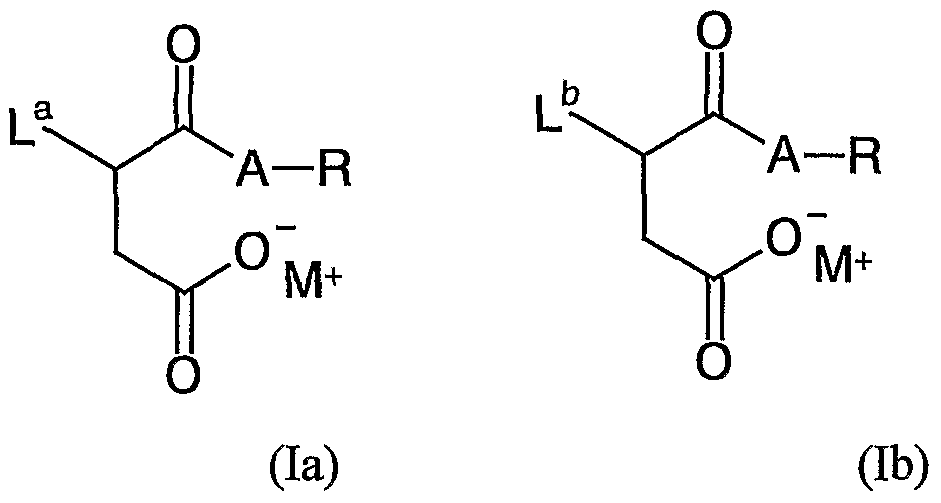
- L a stands for a polyisobutylenyl group with a number average molecular weight M n of 300 to 1000
- L b represents a polyisobutylenyl group with a number average molecular weight M n of 2,000 to 20,000
- -A- stands for -O- -N (H) - or -N (R ') -
- M + stands for H 1 " , an alkali metal ion, 0.5 alkaline earth metal ions or NH, where one or more H in NH + can be replaced by alkyl radicals,
- R represents a linear or branched saturated hydrocarbon radical which bears at least one substituent selected from the group OH, NH 2 or NH 3 + and optionally one or more C (O) H groups and optionally one or more non-adjacent -O- and / or contains secondary amines and / or tertiary amines, and wherein in the NH 2 - or NH 3 + groups one or more H may be replaced by alkyl radicals, and R 1 represents a linear or branched saturated hydrocarbon radical, which optionally has one or carries several substituents selected from the group OH, NH 2 , NH 3 + or C (O) H and optionally contains one or more non-adjacent -O- and / or secondary amines and / or tertiary amines, and wherein in the NH 2 - or NH 3 + groups one or more H may be replaced by alkyl radicals, and
- the proportion of A-R in the compound of the general formula (Ia) or (Ib) is at least 20% by weight.
- the compounds according to the invention can be used both individually and in a mixture as emulsifiers in water-in-oil emulsions. More stable emulsions can be produced than when using conventional emulsifiers.
- the compounds of the general formula (Ib) can be regarded as diblock emulsifiers linked via a linker, the lipophilic block L a or L b via a covalent CC bond and the hydrophilic block R or R 1 via an ester or amide bond is linked to the left succinic acid.
- Preferred compounds of the general formula (Ia) are those in which
- - L a stands for a polyisobutylenyl group with a number average molecular weight M n from 350 to 950, in particular from 350 to 650, and / or
- L a stands for a polyisobutylenyl group which has a polydispersity ⁇ 3.0, preferably from 1.1 to 2.5, particularly preferably from 1.1 to 2.0, and / or
- A-R in the compound of general formula (Ia) is at least 25% by weight, in particular 35 to 60% by weight, and / or
- R is composed of [-CH 2 -CH 2 -X] -, [-CH (CH 3 ) -CH 2 -X] - and / or [-CH 2 -CH (CH 3 ) -X] units, with X - O or NH.
- Preferred compounds of the general formula (Ib) are those in which
- L stands for a polyisobutylenyl group with a number average molecular weight from 2000 to 12000, in particular from 2300 to 5000, and / or
- L b stands for a polyisobutylenyl group which has a polydispersity 3,0 3.0, preferably from 1.1 to 2.5, particularly preferably from 1.1 to 2.0, and / or
- Particularly preferred are compounds of the general formula (Ia) or (Ib) in which A -O- and R is a monovalent radical of an oligomer or polymer of ethylene and / or propylene oxide or a monovalent radical of a block copolymer of ethylene and propylene oxide ,
- Particularly effective emulsifiers are compounds of the general formula (Ia) in which L a stands for a polyisobutylenyl group with a number average molecular weight M n of 350 to 950, in particular 350 to 650, this polyisobutylenyl group optionally having a polydispersity 3,0 3.0 from 1.1 to 2.5, particularly preferably from 1.1 to 2.0.
- L a is a polyisobutylenyl group with a number average molecular weight M n of 300 to 1000 and L b is a polyisobutylenyl group with a number average molecular weight M n of 2000 to 20,000,
- -A- stands for -O- -N (H) - or -N (R ! ) -
- M * stands for Ff 1 " , an alkali metal ion, 0.5 alkaline earth metal ions or NELt 4" , it being possible for one or more H in NHt + to be replaced by alkyl radicals,
- R represents a linear or branched saturated hydrocarbon radical which bears at least one substituent selected from the group OH, NH 2 or NH 3 + and optionally one or more C (O) H groups and optionally one or more non-adjacent -O- and / or contains secondary amines and or tertiary amines, and wherein one or more H in the NH 2 - or NH 3 + groups can be replaced by alkyl radicals, and
- R 1 stands for a linear or branched saturated hydrocarbon radical which optionally carries one or more substituents selected from the group OH, NH 2 , NH 3 + or C (O) H and optionally one or more non-adjacent -O- and / or contains secondary amines and / or tertiary amines, and wherein one or more H in the NH 2 - or NH 3 + groups can be replaced by alkyl radicals, and
- the proportion of A - R in the compound of the general formula (Ia) is at least 10% by weight and in the compound of the general formula (Ib) at least 20
- Effective emulsifier mixtures are obtained not only when using compounds of the general formula (Ia) with hydrophilic parts of at least 20% by weight, but also when using compounds of the general formula (Ia) with hydrophilic parts of at least 10% by weight.
- n is from 350 to 950, in particular from 350 to 650, and / or the proportion of AR in the connection of the general formula (Ia) is at least 15% by weight, preferably at least 20% by weight, particularly preferably at least 25% by weight, very particularly preferably 35 to 60% by weight.
- L b is a polyisobutylenyl group with a number average molecular weight M n of 2000 to 12000, in particular from 2300 to 5000, and or the proportion of AR in the compound of the general formula (Ib) is at least 25% by weight, in particular 35 to 60% by weight.
- the present invention also relates to processes for the preparation of the compounds of the general formula (Ia) or (Ib).
- polyisobutylene with fumaric acid dichloride, fumaric acid, maleic acid dichloride, maleic anhydride or maleic acid preferably with maleic anhydride or maleic acid dichloride, particularly preferably with maleic anhydride
- the reaction is carried out by the processes known to the person skilled in the art and, for example, analogously to the processes for the reaction of polyisobutylenes with maleic anhydride described in German Offenlegungsschriften DE-A 195 19 042, DE-A 43 19 671 and DE-A 43 19 672.
- the number average molecular weight M n of the resulting succinic anhydride derivative, which is substituted by a polyisobutylenyl group can be characterized by the saponification number [mg KOH / g substance].
- R is a linear or branched saturated hydrocarbon radical which has at least one substituent selected from the group OH, NH 2 or NH 3 + and optionally one or more C (O) H groups and optionally contains one or more non-adjacent -O- and / or secondary amines and / or tertiary amines, and wherein in the NH 2 - or NH + groups one or more H may be replaced by alkyl radicals, and
- R 1 stands for a linear or branched saturated hydrocarbon radical which optionally carries one or more substituents selected from the group OH, NH 2 , NH 3 + or C (O) H and optionally one or more non-adjacent -O- and / or contains secondary amines and / or tertiary amines, and one or more H in the NH - or NH + groups can be replaced by alkyl radicals.
- alkyl radicals that can replace the H atoms are - - alkyl radicals.
- Suitable polar reactants ROH and RR ⁇ H are alkanolamines, polyamines, oligoalcohols, polyols, oligoalkylene glycols, polyalkylene glycols as well as carbohydrates and sugar.
- Polar reactants can also be ethylene oxide and / or propylene oxide. The reaction with polyethylene glycol, polypropylene glycol, their (block) copolymers, ethylene oxide or propylene oxide is preferred.
- reaction with alkanolamines such as di- / triethanolamine, tris (hydroxymethyl) aminomethane and their salts, oligoalcohols such as sorbitol and pentaerythritol or carbohydrates and sugars is also preferred.
- alkanolamines such as di- / triethanolamine, tris (hydroxymethyl) aminomethane and their salts, oligoalcohols such as sorbitol and pentaerythritol or carbohydrates and sugars is also preferred.
- the reaction with tris (hydroxymethyl) aminomethane, choline, sugars and polyethylene glycol is particularly preferred for the preparation of compounds of the general formula (Ia).
- the amount of polar reactant is chosen so that the proportion of the hydrophilic radical AR in the compound of general formula (Ia) or (Ib) is at least 20 % By weight, preferably 25% by weight, particularly preferably 35 to 60% by weight.
- Compounds of the general formula (Ia) in which the hydrophilic content is 10 to 20% by weight can also be prepared by the processes described.
- the conversion ratio of the substituted succinic acid derivatives (Ha), (üb) or (IIc) to the alkanolamines, polyamines, oligoalcohols, polyols, oligoalkylene glycols or polyalkylene glycols is generally 1: (0.75 to 2), preferably 1: (0.8 to 1.2), particularly preferably 1: 1.
- the amount of ethylene and / or propylene oxide is selected in accordance with the desired chain length of the hydrophilic radical AR.
- succinic acid semiesters or half amides are obtained.
- alkanolamines the hydroxyl and / or amino groups react, so that mixtures of succinic acid and succinic acid halamides are generally obtained.
- maleic or fumaric acid dichloride is used as the starting material, the C (O) Cl group still present after the reaction steps mentioned is hydrolyzed to the CO 2 H group.
- the free CO 2 H group present in the succinic acid semiesters and half amides can then be reacted with NH 3 , amines, alkali metal or alkaline earth metal salts to give the corresponding A 1, alkali metal or alkaline earth metal salts.
- salts are compounds of the general formula (Ia) or (Ib) in which M * "is an alkali metal ion, 0.5 alkaline earth metal ion or NEU, where one or more H in NELi * can be replaced by alkyl radicals
- Suitable amines for salt formation are primary, secondary and tertiary amines which carry linear C 1 -C 4 or branched C 3 -C 6 alkyl groups.These alkyl groups can also be substituted by one or more hydroxyl groups.
- suitable alkyl amines are Diethylamine, diisopropylamine, trimethylamine, mono-, di- and triethanolamine and tris (hydroxymethyl) aminomethane.
- polyisobutylenes with a number average molecular weight M n of 300 to 1000, preferably from 350 to 950, particularly preferably from 350 to 650, are used to prepare the compounds of the general formula (Ia).
- polyisobutylenes with a number average molecular weight M n of 2,000 to 20,000, preferably from 2,000 to 12,000, particularly preferably from 2,300 to 5,000, are generally used.
- polyisobutylenes with a number-average molecular weight M n in the ranges mentioned preference is given to those which have a high content of vinylidene groups.
- Polyisobutylenes which have a number-average molecular weight M n in the abovementioned ranges, a high content of vinylidene groups and a uniform polymer skeleton structure are particularly preferably used.
- polyisobutylenes with a number-average molecular weight M n in the ranges mentioned, a high content of vinylidene groups and a uniform structure, which have a polydispersity pers 3.0, preferably from 1.1 to 2.5, particularly preferably from 1.1 to 2.0.
- Polydispersity means the quotient M w / M n from the weight-average molecular weight M w and the number-average molecular weight M n .
- Polyisobutylenes with a number average molecular weight M n in the ranges mentioned, which are essentially composed of isobutylene units and have a high content of vinylidene groups, are available, for example, from BASF AG under the trade name Glissopal®, such as Glissopal® 1000 with an M n of 1000 , Glissopal® V 33 with an M n of 550 and Glissopal® 2300 with an M n of 2300.
- Glissopal® such as Glissopal® 1000 with an M n of 1000
- Glissopal® V 33 with an M n of 550 and Glissopal® 2300 with an M n of 2300.
- suitable alkanolamines, polyamines, oligoalcohols, polyols and polyalkylene glycols which can be used for the preparation of the compounds according to the invention are described in WO 00/15740.
- alkanolamines are monoethanolamine, diethanolamine, 2-amino-1-butanol, 2-amino-2-methyl-1-propanol, 2-amino-2-methyl-1, 3-propanediol, 2-amino-2-ethyl- 1,3-propanediol, N- (2-hydroxypropyl) -N '- (2-aminoethyl) piperazine, tris (hydroxymethyl) amino-methane, 2-amino-1-butanol, ß- (2-hydroxyethoxy) ethylamine, glucamine , Glucosamine, 4-amino-3-hydroxy-3-methyl-1-butene, N- (3-aminopropyl) -4- (2-hydroxyethyl) piperidine, 2-amino-6-methyl-6-heptanol, 5- Amino-1-pentanol, N- (2-hydroxyethyl) -l, 3-diaminopropane
- the salts of the alkanolamines mentioned can also be used.
- one or more of the H atoms bound to N atoms can optionally be replaced by linear d-C ⁇ -alkyl or branched C 3 -C 6 -alkyl groups.
- Choline may be mentioned as an example.
- polyalkylene polyamines such as polymethylene polyamines, polyethylene polyamines, polypropylene polyamines, polybutylene polyamines and polypentylene polyamines; see also “Ethylene Amines” in Kirk Othmer's “Encyclopedia of Chemical Technology", 2nd Edition, Volume 7, pp. 22-37, Interscience Publishers, New York 1965.
- oligoalcohols and polyols examples include 1,2-butanediol, 2,3-dimethyl-2,3-butanediol, 2,3-hexanediol, 1,2-cyclohexanediol, (mono-, di-) - pentaerythritol, 1.7 - and 2,4- heptanediol, 1,2,3-, 1,2,4-, 1,2,5- and 2,3, 4-hexanetriol, 1,2,3- and 1,2,4- Butanetriol, 2,2,6,6-tetrakis (hydroxymethyl) cyclohexanol, 1,10-decanediol, 2-hydroxymethyl-2-methyl-1,3-propanediol, 2-hydroxymethyl-2-ethyl-1,3-propanediol, Sorbitol, mannitol and inositol.
- C 5 and C 6 sugars such as glucose and fructose are also
- Examples of (oligo) alkylene glycols are (tri, tetra, penta-, hexa-) ethylene glycol, (tri-, tetra-, penta-, hexa-) propylene glycol and (tri-, tetra-, penta-, hexa-) butylene glycol.
- Examples of polyalkylene glycols are polytetrahydrofuran, polyethylene glycol and polypropylene glycol.
- Preferred polyalkylene glycols are polyethylene glycol and polypropylene glycol.
- Polyethylene glycol and polypropylene glycol and their block copolymers are particularly preferred which have a number average molecular weight M n of 300 to 5000, preferably 300 to 2000, particularly preferably 500 to 1500.
- Such polyethylene glycols are available, for example, under the trade name Pluriol® E from BASF AG, such as Pluriol® E 300 with an M n of 300, Pluriol® E 600 with an M "of 600, Pluriol® E 4000 with an M" of 4000 and Pluriol® E 5000 with an M n of 5000.
- Polyethylene-polypropylene glycol block copolymers are available, for example, from BASF AG under the trade name Pluronic® PE, such as Pluronic® PE 3500 with an M n of 1900 and an ethylene oxide content of 50% by weight.
- the compounds according to the invention and or the mixtures according to the invention are used in oil-in-water emulsions, stable vesicles can be produced. This can be done, for example, by the action of ultrasound.
- the compounds of the invention and / or the mixtures of the invention can also be used in a variety of ways, e.g. B. as additives in fuels and lubricants, as a corrosion-inhibiting additive in water-containing liquids and as dispersants for inorganic and organic solid dispersions.
- the compounds according to the invention and / or the mixtures according to the invention can also be used as surfactants for washing and cleaning formulations.
- the high-molecular compounds of the general formula (Ib) which contain a monovalent residue of a polyethylene glycol as a hydrophilic block are particularly suitable for stabilizing inorganic and organic solid dispersions.
- the compounds according to the invention and / or mixtures according to the invention are also suitable as emulsifiers for water-in-oil emulsions in which the oil phase is formed from a vegetable, animal or synthetic oil or fat.
- emulsifiers for water-in-oil emulsions in which the oil phase is formed from a vegetable, animal or synthetic oil or fat.
- oils or fats are triglycerides and glycol esters of lauric acid, myristic acid, stearic acid, palmitic acid, oleic acid, linoleic acid and linolenic acid.
- the compounds and / or mixtures according to the invention are particularly advantageously used as emulsifiers for water-in-oil emulsions, in which the oil phase is formed by a fuel, light or heavy heating oil.
- a fuel light or heavy heating oil.
- All common types of fuel can be used, for example diesel fuel, petrol and kerosene. Diesel fuel is preferably used.
- Water-in-oil emulsions according to the invention generally contain 95 up to 60% by weight of oil, 3 to 35% by weight of water and 0.2 to 10% by weight of at least one compound according to the invention and / or a mixture according to the invention.
- Water-in-fuel emulsions according to the invention can also contain one or more C 4 alcohols and / or monoethylene glycol, in particular monoethylene glycol.
- the amount of C 1 -C 4 alcohol and / or monoethylene glycol used is from 5 to 50% by weight, based on the amount of water.
- the temperature range in which the emulsion is stable can be broadened.
- the water-in-fuel emulsions according to the invention have high stability and good combustion efficiency. Good exhaust gas values can still be obtained, the emission of soot and NO x being significantly reduced, particularly in the case of diesel engines. A largely complete and residue-free combustion can be achieved without deposits on the assemblies of the combustion apparatus, for example injection nozzles, pistons, annular grooves, valves and cylinder head.
- the water-in-fuel emulsions according to the present invention can have further components in addition to the components mentioned above. These are, for example, other emulsifiers such as sodium lauryl sulfate, quaternary ammonium salts such as
- Sorbitan monooleate, C 13 oxo alcohol ethoxylates and alkylphenol ethoxylates, for example octyl and nonylphenol ethoxylates, are preferably used as further emulsifiers.
- a combination of one or more of the above-mentioned further emulsifiers together with the compounds according to the invention and / or mixtures thereof is preferably used for the water-in-fuel emulsions according to the invention.
- these further emulsifiers are used, this is done in amounts of 0.5 to 5% by weight, preferably 1 to 2.5% by weight, based on the overall composition.
- the amount of this further emulsifier is chosen so that the total amount of emulsifier does not exceed the amount of 0.2 to 10% by weight given for the compounds according to the invention and their mixtures alone.
- the compounds and / or mixtures according to the invention are mixed with the oil, the water and the further, optionally usable components and emulsified in a manner known per se.
- the emulsification can be carried out in a rotor mixer, by means of a mixing nozzle or by an ultrasound probe. Particularly good results were achieved when a mixing nozzle of the type used as disclosed in German application, file number: 198 56 604 by the applicant on December 8, 1998 was used.
- Water-in-oil emulsions for the cosmetics sector can be produced as well as water-in-fuel emulsions.
- the compounds and / or mixtures according to the invention also have a lubricity-improving and corrosion-inhibiting effect. They also improve the wear protection behavior of liquids.
- the compounds and / or mixtures according to the invention are therefore used as additives for lubricants, fuels and water-containing liquids such as coolant liquids or drilling and cutting liquids. This use is also the subject of the present invention.
- the compounds and / or mixtures according to the invention can be added directly to the fuels and lubricants — together with other components.
- the compounds according to the invention and or mixtures according to the invention can first be mixed with other components to give fuel or lubricant additive concentrates.
- These fuel or lubricant additive concentrates according to the invention can be added to the fuels or lubricants undiluted or diluted with one or more solvents or carrier oils. The addition in dilute form is preferred.
- the fuels, lubricants, fuel additive and lubricant additive concentrates, and also water-containing liquids which contain the compounds and / or mixtures according to the invention are likewise the subject of the present invention and are to be explained in more detail below.
- Fuels according to the invention generally contain - in addition to conventional components - at least one compound according to the invention and / or a mixture according to the invention in an amount of 10 to 5000 ppm, preferably in an amount of 20 to 2000 ppm, based on the total amount.
- Lubricants according to the invention generally contain between 90 and 99.9% by weight, preferably between 95 and 99.5% by weight, of a liquid, semi-solid or solid lubricant and between 0.1 and 10% by weight, preferably between 0 , 5 and 5 wt .-% of at least one compound according to the invention and / or a mixture according to the invention, based on the total amount.
- Fuel additive and lubricant additive concentrates according to the invention contain - in addition to conventional components - at least one compound according to the invention and / or a mixture according to the invention in proportions of 0.1 to 80% by weight, in particular 0.5 to 60% by weight, based on the total weight of the concentrate.
- Typical components for fuels or fuel additive concentrates are, for example, additives with detergent action, as described in the applicant's German application, file number 100 36 956.1, dated July 28, 2000 (page 14 ff.), In the applicant's German application, file number 100 03 105.6, dated 25.1.2000 and in the PCT application of the applicant with the file number PCT / EP / 01/00496.
- the additives mentioned there and other fuel additives described there with polar Generations are part of the present application and are incorporated by reference.
- the fuels and fuel additive concentrates according to the invention can also contain fuel additives as described, for example, in European patent applications EP-A 0 277 345, 0 356 725, 0 476 485, 0 484 736, 0 539 821, 0 543 225, 0 548 617, 0 561 214, 0 567 810, 0 568 873, German patent applications DE-A 39 42 860, 43 09 074, 43 09 271, 43 13 088, 44 12 489, 44 25 834, 195 25 938, 196 06 845, 196 06 846, 196 15 404, 196 06 844, 196 16 569, 196 18 270, 196 14 349, and WO-A 96/03479.
- biocides such as glutardialdehyde or glyoxal.
- the biocides are usually used in an amount of 0.01 to 3% by weight, based on the total weight of the concentrate.
- further corrosion-inhibiting additives are those based on ammonium salts of organic carboxylic acids, which tend to form films, or on heterocyclic aromatics in the case of non-ferrous metal corrosion protection.
- stabilizers are those based on amines such as p-phenylenediamine, dicyclohexylamine or derivatives thereof or on phenols such as 2,4-di-tert-butylphenol or 3,5-di-tert-butyl-4-hydroxyphenylpropionic acid.
- organometallic compounds examples include ferrocene or methylcyclopentadienylmanganese tricarbonyl.
- cetane number improvers are organic C -C 10 nitrates such as 2-ethylhexyl nitrate, and inorganic cetane number improvers for the aqueous phase such as ammonium nitrate. 2-Ethylhexyl nitrate and ammonium nitrate are preferably used.
- the cetane number improvers are usually used in an amount of 0.05 to 5% by weight, based on the total weight of the concentrate.
- Solvents for the fuel and lubricant additive concentrates according to the invention are aliphatic and aromatic hydrocarbons such as solvent naphtha, isododecane, mihagol (a technical mixture of the fuels and lubricants themselves as well as carrier oils.
- Carrier oils which also serve to dilute the fuel and lubricant additive concentrates, are, for example, mineral carrier oils (base oils), in particular those of the viscosity class "Solvent Neutral (SN) 100 to 500", as well as synthetic carrier oils based on polyolefins, (poly) esters, ( Alkylphenol-started) polyethers, (aliphatic) (alkylphenol-started) polyetheramines, and carrier oils based on alkoxylated long-chain alcohols or phenols.
- base oils mineral carrier oils
- base oils in particular those of the viscosity class "Solvent Neutral (SN) 100 to 500”
- synthetic carrier oils based on polyolefins polyolefins
- poly poly esters
- Alkylphenol-started polyethers Alkylphenol-started polyethers
- aliphatic alkylphenol-started polyetheramines
- carrier oils based on alkoxylated long-chain alcohols or phenols.
- Polyethylene oxides, polypropylene oxides, polybutene oxides and mixtures thereof are also suitable carrier oils. Further suitable carrier oils and carrier oil mixtures are described, for example, in the publications DE-A 38 38 918, DE-A 38 26 608, DE-A 41 42241, DE-A 43 09074, US 4,877,416 and EP-A 0452 328.
- Water-containing liquids according to the invention contain the compounds and / or mixtures according to the invention, if appropriate in combination with other customary corrosion-inhibiting additives, generally in a proportion of about 1 to 10% by weight, based on the total amount.
- composition of the compounds produced can be found in Table 1.
- Glissopal® from BASF AG with a number average molecular weight M n of 380 to 8400 and a proportion of vinylidene end groups of> 70 was used as polyisobutylene
- Pluriol® E from BASF AG with a number average molecular weight M n of 300 to 5000 was used as the polyethylene glycol.
- Pluronic® PE 3500 from BASF AG with a number-average molecular weight M n of 1900 and an ethylene oxide content of 50% by weight was used as the polyethylene / polypropylene-glycol block copolymer.
- Heptane Mihagol, a mixture of C 10 -C 12 paraffins from Wintershall, and Solvesso® 150, a mixture of aromatic hydrocarbons from ExxonMobil Chemical, were used as solvents.
- Clariant commercially available under the name Ambossol®, was used as the ion exchanger.
- the compounds obtained were characterized via the acid number, the OH number, the viscosity and / or the IR spectra.
- the OH number was determined using solvent when using high-boiling solvents, i. H. that the OH number of the compounds in the respective solvent was measured and then extrapolated to the pure substance.
- high-boiling solvents i. H. that the OH number of the compounds in the respective solvent was measured and then extrapolated to the pure substance.
- low-boiling solvents such as heptane
- the solvent was removed by distillation and the OH number was determined from the pure substance.
- Table 1 Composition of the compounds of the general formula (Ia) or (Ib)
- An 11 four-necked flask with stirrer, dropping funnel and thermocouple is filled with 250 g PIBSA 550 and heated to 90 ° C. 67 g of diethanolamine are metered in via a dropping funnel within 5 minutes. The mixture is gradually heated to 130 ° C or 170 ° C. After 2 hours at 170 ° C, the brown reaction product is filtered at 100 ° C.
- An 11 four-necked flask with stirrer, distillation bridge and thermocouple is filled with 310 g PIBSA 750 and 60 g D-sorbitol.
- the mixture is gradually heated to 160 ° C or 220 ° C. Released water is removed using a stream of nitrogen; after 3 hours at 220 ° C, diluted with 200 g of Mihagol and filtered hot. A yellow, viscous product solution (65%) is obtained.
- a 21 four-necked flask with stirrer, dropping funnel and thermocouple is filled with 350 g Pluriol® E 300 and degassed at 90 ° C for 30 minutes in a vacuum.
- a solution of 650 g of PIBSA 380 in 350 g of heptane is metered into a dropping funnel at 80 ° C. in the course of 5 minutes. The mixture is gradually heated to 110 ° C or 140 ° C. Heptane is distilled off under reduced pressure (350 mbar).
- a 21 four-necked flask with stirrer, dropping funnel and thermocouple is filled with 300 g Pluriol® E 300 and degassed at 90 ° C for 30 minutes in a vacuum.
- a solution of 750 g of PIBSA 550 in 450 g of heptane is metered into a dropping funnel at 80 ° C. within 5 minutes. The mixture is gradually heated to 110 ° C or 140 ° C. Heptane is distilled off under reduced pressure (350 mbar). After 3 hours at 140 ° C, 105 g of diethanolamine are added in portions at 95 ° C. After a further 20 minutes at 95 ° C, the orange-brown product is filtered hot. OH number: 55; IR: intense band at 1736 cm "1 (ester).
- a 21 four-necked flask with stirrer, dropping funnel and thermocouple is filled with 400 g Pluriol® E 600 and degassed in a vacuum at 90 ° C for 30 minutes.
- a solution of 790 g of PIBSA 1000 in 450 g of heptane is metered in at 80 ° C. in the course of 5 minutes.
- the mixture is gradually heated to 110 ° C or 140 ° C.
- Heptane is distilled off under reduced pressure (350 mbar). After 3 hours at 140 ° C., a yellow product with a viscosity of 1650 mm 2 / s (100 ° C.) is obtained.
- An 11 four-necked flask with stirrer, dropping funnel and thermocouple is filled with 150 g Pluriol® E 4000 and degassed in a vacuum at 90 ° C for 30 minutes.
- a solution of 250 g PIBSA 5200 in 300 g Mihagol is dosed within 5 minutes at 80 ° C using a dropping funnel.
- the mixture is gradually heated to 110 ° C or 140 ° C. After 3 hours at 140 ° C, a beige wax is obtained.
- the product is isolated as a cream-colored wax (60% in Mihagol); IR: 1737 cm “1 .
- the product is isolated as an orange-yellow, highly viscous liquid. Viscosity: 2100 mm / s; 100 ° C.
- An 11 four-necked flask with stirrer, dropping funnel and thermocouple is filled with 75 g of a 45% methanolic solution of choline from Fluka and 150 g of Mihagol. Methanol is then removed at 50 ° C and reduced pressure (50 mbar) (45 minutes). 200 g of PIBSA 550 are added to this suspension and the mixture is heated to 90 ° C. in the course of 15 minutes. After 60 minutes, the temperature is raised to 170 ° C. and the mixture is stirred for a further two hours. The brown reaction product is filtered at 100 ° C.
- An 11 four-necked flask with stirrer, dropping funnel and thermocouple is filled with 300 g PIBSA 2300, 200 g PIBSA 1000 and 200 g Mihagol and heated to 95 ° C. 17.2 g of ethylene glycol are metered in at 95.degree. The mixture is heated to 130 ° C. and stirred at this temperature for three hours. The brown reaction product is filtered at 100 ° C.
- the emulsifier of comparative example 2 was produced according to the principle of WO 00/15740 according to example C-1, p. 34.
- a 21 four-necked flask with stirrer, dropping funnel and thermocouple is filled with 100 g Pluriol® E 200 and degassed in a vacuum at 90 ° C for 30 minutes.
- a solution of 590 g of PIBSA 1000 in 450 g of heptane is metered into a dropping funnel at 80 ° C. within 5 minutes.
- the mixture is gradually heated to 110 ° C or 140 ° C.
- Heptane is distilled off under reduced pressure (350 mbar). After 3 hours at 140 ° C., an amber-colored product with a viscosity of 1450 mm 2 / s (100 ° C.) is obtained.
- the hydrophilic or water-soluble components were previously dissolved in the aqueous phase, lipophilic components in the diesel oil.
- an Ultra-Turrax® (Jahnke and Kunkel laboratory device T25) 500 g of this mixture were homogenized with 100 ml water for 15 minutes at a speed of 24000 / min.
- the emulsion was produced on an industrial scale and the motor tests were carried out analogously to DE-A 198 56 604 by the applicant (registered on December 8, 1998), with a mixing nozzle described there.
- the pressure in the mixing apparatus was 50 to 200 bar (in front of the orifice), preferably 120 bar, with a conversion of (total) 12 kg / h.
- Example 3 Studies on the stability of the water-in-fuel emulsions
- the size of the water drops was physically determined by laser diffraction (X3, 2 values) using a Malvem Mastersizer 2000 from Malvem Instruments GmbH. The measurement method is described, for example, in Terence Allen, Particle Size Measurement, Volume 1, 5 ft Edition, Kluwer Academic Publishers, Dordrecht, Netherlands 1999. Depending on the actual size distribution, there are other methods besides laser light diffraction such as: B. the dynamic light scattering, single particle counter and ultrasonic extinction in question.
- the size of the water drops is a measure of the quality of the emulsion.
- the corresponding values for the drop size (the X3, 2 values) are summarized in Table 3.
- Table 3 the emulsions using the compounds according to the invention and also the mixtures according to the invention sometimes have significantly smaller drop sizes than the comparison emulsions.
- the fact that the drop size is really a measure of the stability of the emulsion at room temperature is shown by the stability values determined by storage tests.
- the emulsions with larger droplet sizes also have poorer storage stability.
- the stability of the emulsions was checked in a static storage test at 20 ° C (for 12 weeks) and additionally under changing temperatures (-20 ° C and 70 ° C, each for 1 week).
- the emulsion was filled into a scaled 100 ml standing cylinder and its quality was assessed visually in accordance with the specified conditions.
- the storage tests at -20 ° C were then assessed at room temperature.
- the emulsion according to Example 2 is comparatively homogeneous even without the addition of anti-freeze (e.g. monoethylene glycol). Otherwise, phase separation, a so-called "breaking" of the emulsion, took place after or even when heated.
- anti-freeze e.g. monoethylene glycol
- Example 4 Use of the compounds of the general formula (I) according to the invention as rust protection and wear protection additives
- a 20 x 40 mm sheet of iron is blasted with 40 ⁇ m glass beads and then - based on ASTM D-665 - immersed in the emulsions prepared in Example 2 and stored at 40 ⁇ 1 ° C for 24 hours. After 24 hours, the iron sheet is examined for rust formation.
- ASTM D-665 - immersed in the emulsions prepared in Example 2 and stored at 40 ⁇ 1 ° C for 24 hours. After 24 hours, the iron sheet is examined for rust formation.
- Example 5 Use of the compounds of the general formula (I) according to the invention in fuels and their wear protection behavior
- the connections listed in the table were solved in an unadditized diesel fuel (Miro, Düsseldorf).
- the concentration of additive in the diesel fuel was 75 ppm.
- the wear protection behavior was assessed using the HFRR test (High Frequency Roller Rig Test), which was carried out in accordance with ISO 12156-1.
- the length of the resulting grooves was measured and used as a measure of wear. The shorter the scoring, the better the wear protection of the additive added. Unaddivated diesel fuel was used for comparison.
- Table 4 the compounds according to the invention protected against wear.
Landscapes
- Chemical & Material Sciences (AREA)
- Oil, Petroleum & Natural Gas (AREA)
- Organic Chemistry (AREA)
- Chemical Kinetics & Catalysis (AREA)
- Engineering & Computer Science (AREA)
- General Chemical & Material Sciences (AREA)
- Health & Medical Sciences (AREA)
- Wood Science & Technology (AREA)
- Combustion & Propulsion (AREA)
- Life Sciences & Earth Sciences (AREA)
- Materials Engineering (AREA)
- Medicinal Chemistry (AREA)
- Polymers & Plastics (AREA)
- Emergency Medicine (AREA)
- Emulsifying, Dispersing, Foam-Producing Or Wetting Agents (AREA)
- Organic Low-Molecular-Weight Compounds And Preparation Thereof (AREA)
- Addition Polymer Or Copolymer, Post-Treatments, Or Chemical Modifications (AREA)
Abstract
Description


Claims


Priority Applications (5)
| Application Number | Priority Date | Filing Date | Title |
|---|---|---|---|
| JP2002592363A JP2004531614A (ja) | 2001-05-22 | 2002-05-17 | 殊にポリイソブチレンをベースとする低分子及び高分子乳化剤並びに該乳化剤の混合物 |
| US10/478,476 US20040154216A1 (en) | 2001-05-22 | 2002-05-17 | Low-molecular and high-molecular weight emulsifiers, particularly based on polyisobutylene, and mixtures thereof |
| EP02750949A EP1404726A2 (de) | 2001-05-22 | 2002-05-17 | Nieder- und hochmolekulare emulgatoren, insbesondere auf basis von polyisobutylen, sowie deren mischungen |
| CA002448033A CA2448033A1 (en) | 2001-05-22 | 2002-05-17 | Low-molecular and high-molecular emulsifiers, particularly based on polyisobutylene, and mixtures thereof |
| AU2002338977A AU2002338977A1 (en) | 2001-05-22 | 2002-05-17 | Low-molecular and high-molecular emulsifiers, particularly based on polyisobutylene, and mixtures thereof |
Applications Claiming Priority (2)
| Application Number | Priority Date | Filing Date | Title |
|---|---|---|---|
| DE10125158.0 | 2001-05-22 | ||
| DE10125158A DE10125158A1 (de) | 2001-05-22 | 2001-05-22 | Nieder-und hochmolekulare Emulgatoren, insbesondere auf Bassis von Polyisobutylen, sowie deren Mischungen |
Publications (2)
| Publication Number | Publication Date |
|---|---|
| WO2002094889A2 true WO2002094889A2 (de) | 2002-11-28 |
| WO2002094889A3 WO2002094889A3 (de) | 2003-11-27 |
Family
ID=7685881
Family Applications (1)
| Application Number | Title | Priority Date | Filing Date |
|---|---|---|---|
| PCT/EP2002/005516 Ceased WO2002094889A2 (de) | 2001-05-22 | 2002-05-17 | Nieder- und hochmolekulare emulgatoren, insbesondere auf basis von polyisobutylen, sowie deren mischungen |
Country Status (8)
| Country | Link |
|---|---|
| US (1) | US20040154216A1 (de) |
| EP (1) | EP1404726A2 (de) |
| JP (1) | JP2004531614A (de) |
| CN (1) | CN1511167A (de) |
| AU (1) | AU2002338977A1 (de) |
| CA (1) | CA2448033A1 (de) |
| DE (1) | DE10125158A1 (de) |
| WO (1) | WO2002094889A2 (de) |
Cited By (9)
| Publication number | Priority date | Publication date | Assignee | Title |
|---|---|---|---|---|
| WO2003085011A1 (de) * | 2002-04-05 | 2003-10-16 | Basf Aktiengesellschaft | Polyisobutenamine |
| WO2004055137A1 (en) * | 2002-12-13 | 2004-07-01 | The Lubrizol Corporation | Emulsified water blended fuels produced by using a low energy process and novel surfactant |
| EP1491561A1 (de) * | 2003-06-27 | 2004-12-29 | Chevron Oronite Company LLC | Veresterte Copolymere aus Polyalkylenen und ungesättigten Carbonsäurereagenzien, geeignet als Schmiermittel- und Brennstoffzusätze |
| WO2005018321A1 (de) * | 2003-08-18 | 2005-03-03 | Basf Aktiengesellschaft | Verwendung bestimmter copolymere als adjuvans und mittel für den agrotechnischen bereich |
| WO2007014915A1 (de) * | 2005-08-04 | 2007-02-08 | Basf Se | Wässrige dispersionen und ihre verwendung |
| DE112006003163T5 (de) | 2005-11-29 | 2009-01-29 | Akzo Nobel N.V. | Grenzflächenaktives Polymer und seine Verwendung in einer Wasser-in-Öl-Emulsion |
| GB2535253A (en) * | 2014-07-28 | 2016-08-17 | Innospec Ltd | Compositions and methods |
| WO2017016909A1 (de) * | 2015-07-24 | 2017-02-02 | Basf Se | Korrosionsinhibitoren für kraft- und schmierstoffe |
| US10351791B2 (en) | 2013-07-26 | 2019-07-16 | Innospec Limited | Quaternary ammonium compounds as fuel or lubricant additives |
Families Citing this family (33)
| Publication number | Priority date | Publication date | Assignee | Title |
|---|---|---|---|---|
| DE10147650A1 (de) * | 2001-09-27 | 2003-04-10 | Basf Ag | Hydrophile Emulgatoren auf Basis von Polyisobutylen |
| US8511259B2 (en) * | 2002-03-28 | 2013-08-20 | Cam Technologie S.P.A. | Method for reducing emission of pollutants from an internal combusion engine, and fuel emulsion comprising water and a liquid hydrocarbon |
| DE10232747A1 (de) * | 2002-07-18 | 2004-02-05 | Basf Ag | Verwendung von Polyisobutylen-Derivaten zur Behandlung von Metalloberflächen |
| DE10247462A1 (de) | 2002-10-11 | 2004-04-22 | Basf Ag | Derivate von Polymeren für die permanente Modifizierung von hydrophoben Polymeren |
| DE102004007501A1 (de) | 2004-02-13 | 2005-09-01 | Basf Ag | Amphiphile Blockcopolymere enthaltende wässrige Polymerdispersionen, Verfahren zu ihrer Herstellung und ihre Verwendung |
| US20090039543A1 (en) * | 2005-05-30 | 2009-02-12 | Basf Aktiengesellschaft | Polymer Composition Comprising Polyolefins And Amphiphilic Block Copolymers And Optionally Other Polymers And/Or Fillers And Method For Dying Compositions Of That Type Or Printing Thereon |
| DE102005025017A1 (de) * | 2005-05-30 | 2006-12-07 | Basf Ag | Verwendung von amphiphilen Blockcopolymeren zur Herstellung von Polymerblends |
| CN101233187A (zh) * | 2005-08-04 | 2008-07-30 | 巴斯福股份公司 | 水分散体及其用途 |
| JP4131748B1 (ja) * | 2008-01-16 | 2008-08-13 | 株式会社タイホーコーザイ | 燃料添加剤 |
| GB201003579D0 (en) * | 2010-03-04 | 2010-04-21 | Croda Int Plc | Friction reducing additive |
| MX340883B (es) * | 2010-05-12 | 2016-07-29 | Basf Se | Emulsiones de poliisobutenos, sustancia y proceso. |
| US20120010112A1 (en) | 2010-07-06 | 2012-01-12 | Basf Se | Acid-free quaternized nitrogen compounds and use thereof as additives in fuels and lubricants |
| BR112013000297B1 (pt) * | 2010-07-06 | 2020-10-06 | Basf Se | Processo para preparar compostos de nitrogênio quaternizados, composto de nitrogênio quaternizado,uso de um composto de nitrogênio quaternizado,concentrado de aditivo, e, composição |
| CN103347993B (zh) | 2011-01-11 | 2016-10-19 | 巴斯夫欧洲公司 | 基于聚异丁烯琥珀酸酯的水凝胶 |
| WO2013068272A1 (en) | 2011-11-11 | 2013-05-16 | Basf Se | Self-emulsifiable polyolefine compositions |
| US8759274B2 (en) | 2011-11-11 | 2014-06-24 | Basf Se | Self-emulsifiable polyolefine compositions |
| KR20140096112A (ko) * | 2011-11-11 | 2014-08-04 | 바스프 에스이 | 자가-유화성 폴리올레핀 조성물 |
| BR112015000970B1 (pt) * | 2012-07-16 | 2022-06-07 | Emulco Laboratories C.V.B.A. | Emulsões estáveis dos poliisobuteno e sua utilização |
| US9617443B2 (en) * | 2012-07-16 | 2017-04-11 | Emulco Laboratories C.V.B.A. | Method for the preparation of stable emulsions of polyisobutene |
| WO2014150663A1 (en) * | 2013-03-15 | 2014-09-25 | Cytec Industries Inc. | Corrosion inhibitors and methods of using same |
| KR101904585B1 (ko) | 2015-02-17 | 2018-10-08 | 주식회사 엘지화학 | 변성 이소부틸렌-이소프렌 고무, 이의 제조방법 및 경화물 |
| WO2017079123A1 (en) * | 2015-11-02 | 2017-05-11 | Lubrizol Oilfield Solutions, Inc. | Lubricant for water based drilling fluid |
| CN106929112A (zh) * | 2015-12-30 | 2017-07-07 | 中国石油化工股份有限公司 | 一种改善低硫柴油抗磨性的方法 |
| AU2018244799B2 (en) * | 2017-03-30 | 2023-07-27 | Innospec Limited | Method and use |
| SG11201908320SA (en) * | 2017-03-30 | 2019-10-30 | Innospec Ltd | Method and use |
| GB201705088D0 (en) * | 2017-03-30 | 2017-05-17 | Innospec Ltd | Composition, method and use |
| GB201705091D0 (en) * | 2017-03-30 | 2017-05-17 | Innospec Ltd | Compositions and methods and uses relating thereto |
| SG11201908789PA (en) | 2017-03-30 | 2019-10-30 | Innospec Ltd | Method and use |
| GB201705095D0 (en) * | 2017-03-30 | 2017-05-17 | Innospec Ltd | Composition and methods and uses relating thereto |
| GB201705138D0 (en) * | 2017-03-30 | 2017-05-17 | Innospec Ltd | Method and use |
| US10479953B2 (en) * | 2018-01-12 | 2019-11-19 | Afton Chemical Corporation | Emulsifier for use in lubricating oil |
| CN113574144B (zh) * | 2019-03-14 | 2022-12-13 | 日油株式会社 | 润滑油用添加剂、润滑油用添加剂组合物及含有该添加剂或添加剂组合物的润滑油组合物 |
| CN115895752B (zh) | 2021-09-30 | 2025-02-11 | 中国石油化工股份有限公司 | 一种抗磨添加剂、其制备方法及在油品中的应用 |
Family Cites Families (11)
| Publication number | Priority date | Publication date | Assignee | Title |
|---|---|---|---|---|
| DE1271877B (de) * | 1963-04-23 | 1968-07-04 | Lubrizol Corp | Schmieroel |
| GB1543359A (en) * | 1976-10-28 | 1979-04-04 | Shell Int Research | Esterification of hydrocarbyl-substituted succinic anhydrides |
| US4225447A (en) * | 1979-01-08 | 1980-09-30 | Mobil Oil Corporation | Emulsifiable lubricant compositions |
| US4368133A (en) * | 1979-04-02 | 1983-01-11 | The Lubrizol Corporation | Aqueous systems containing nitrogen-containing, phosphorous-free carboxylic solubilizer/surfactant additives |
| US4708753A (en) * | 1985-12-06 | 1987-11-24 | The Lubrizol Corporation | Water-in-oil emulsions |
| GB2231873A (en) * | 1989-03-10 | 1990-11-28 | Shell Int Research | Lubricating compositions |
| HU211439B (en) * | 1993-12-16 | 1996-02-28 | Veszpremi Egyetem | Ash-free detergent-dispergant polymer type additive composition and process for preparing thereof |
| US5712348A (en) * | 1996-03-13 | 1998-01-27 | E. I. Du Pont De Nemours And Company | Maleic acid copolymers with fluorinated thioether end-cap |
| CA2272654C (en) * | 1996-11-22 | 2005-08-23 | Clariant Gmbh | Additives for inhibiting gas hydrate formation |
| US5858029A (en) * | 1997-01-13 | 1999-01-12 | Mobil Oil Corporation | Friction reducing additives for fuels and lubricants |
| US6372855B1 (en) * | 1998-08-31 | 2002-04-16 | The Yokohama Rubber Co., Ltd. | Polymer containing isobutylene as repeating unit and rubber composition containing the same |
-
2001
- 2001-05-22 DE DE10125158A patent/DE10125158A1/de not_active Withdrawn
-
2002
- 2002-05-17 CN CNA02810580XA patent/CN1511167A/zh active Pending
- 2002-05-17 CA CA002448033A patent/CA2448033A1/en not_active Abandoned
- 2002-05-17 EP EP02750949A patent/EP1404726A2/de not_active Withdrawn
- 2002-05-17 AU AU2002338977A patent/AU2002338977A1/en not_active Abandoned
- 2002-05-17 US US10/478,476 patent/US20040154216A1/en not_active Abandoned
- 2002-05-17 WO PCT/EP2002/005516 patent/WO2002094889A2/de not_active Ceased
- 2002-05-17 JP JP2002592363A patent/JP2004531614A/ja not_active Withdrawn
Cited By (19)
| Publication number | Priority date | Publication date | Assignee | Title |
|---|---|---|---|---|
| WO2003085011A1 (de) * | 2002-04-05 | 2003-10-16 | Basf Aktiengesellschaft | Polyisobutenamine |
| US7291681B2 (en) | 2002-04-05 | 2007-11-06 | Basf Aktiengesellschaft | Polyisobutenamines |
| WO2004055137A1 (en) * | 2002-12-13 | 2004-07-01 | The Lubrizol Corporation | Emulsified water blended fuels produced by using a low energy process and novel surfactant |
| US7674863B2 (en) | 2003-06-27 | 2010-03-09 | Chevron Oronite Company Llc | Esterified copolymers of polyalkenes/unsaturated acidic reagents useful as lubricant and fuel additives |
| EP1491561A1 (de) * | 2003-06-27 | 2004-12-29 | Chevron Oronite Company LLC | Veresterte Copolymere aus Polyalkylenen und ungesättigten Carbonsäurereagenzien, geeignet als Schmiermittel- und Brennstoffzusätze |
| US7256242B2 (en) | 2003-06-27 | 2007-08-14 | Chevron Oronite Company, Llc | Esterified copolymers of polyalkenes/unsaturated acidic reagents useful as lubricant and fuel additives |
| US7863390B2 (en) | 2003-06-27 | 2011-01-04 | Chevron Oronise Company LLC | Esterified copolymers of polyalkenes/unsaturated acidic reagents useful as lubricant and fuel additives |
| WO2005018321A1 (de) * | 2003-08-18 | 2005-03-03 | Basf Aktiengesellschaft | Verwendung bestimmter copolymere als adjuvans und mittel für den agrotechnischen bereich |
| WO2007014915A1 (de) * | 2005-08-04 | 2007-02-08 | Basf Se | Wässrige dispersionen und ihre verwendung |
| DE112006003163T5 (de) | 2005-11-29 | 2009-01-29 | Akzo Nobel N.V. | Grenzflächenaktives Polymer und seine Verwendung in einer Wasser-in-Öl-Emulsion |
| US8044232B2 (en) | 2005-11-29 | 2011-10-25 | Akzo Nobel N.V. | Surface-active polymer and its use in a water-in-oil emulsion |
| US10351791B2 (en) | 2013-07-26 | 2019-07-16 | Innospec Limited | Quaternary ammonium compounds as fuel or lubricant additives |
| US10626341B2 (en) | 2013-07-26 | 2020-04-21 | Innospec Limited | Quaternary ammonium compounds as fuel or lubricant additives |
| US11066617B2 (en) | 2013-07-26 | 2021-07-20 | Innospec Limited | Quaternary ammonium compounds as fuel or lubricant additives |
| GB2535253A (en) * | 2014-07-28 | 2016-08-17 | Innospec Ltd | Compositions and methods |
| US10087384B2 (en) | 2014-07-28 | 2018-10-02 | Innospec Limited | Quaternary ammonium compounds and their use as fuel or lubricant additives |
| GB2535253B (en) * | 2014-07-28 | 2019-04-17 | Innospec Ltd | Compositions and methods |
| AU2015295049B2 (en) * | 2014-07-28 | 2019-07-11 | Innospec Limited | Quaternary ammonium compounds and their use as fuel or lubricant additives |
| WO2017016909A1 (de) * | 2015-07-24 | 2017-02-02 | Basf Se | Korrosionsinhibitoren für kraft- und schmierstoffe |
Also Published As
| Publication number | Publication date |
|---|---|
| US20040154216A1 (en) | 2004-08-12 |
| CA2448033A1 (en) | 2002-11-28 |
| AU2002338977A1 (en) | 2002-12-03 |
| CN1511167A (zh) | 2004-07-07 |
| DE10125158A1 (de) | 2002-12-05 |
| EP1404726A2 (de) | 2004-04-07 |
| WO2002094889A3 (de) | 2003-11-27 |
| JP2004531614A (ja) | 2004-10-14 |
Similar Documents
| Publication | Publication Date | Title |
|---|---|---|
| EP1404726A2 (de) | Nieder- und hochmolekulare emulgatoren, insbesondere auf basis von polyisobutylen, sowie deren mischungen | |
| DE69116697T2 (de) | Synergistische amin/amid- und ester/alkohol-reibungsverminderungsmittelmischung zur innenverbrennungsmotorkraftstoffsparungsverbesserung | |
| EP1613694B1 (de) | Polyalkenamine mit verbesserten anwendungseigenschaften | |
| DE2833171A1 (de) | Lagerbestaendige schmieroelmasse | |
| DE10147650A1 (de) | Hydrophile Emulgatoren auf Basis von Polyisobutylen | |
| DE2926225A1 (de) | Kohlenwasserstoffsubstituierte poly(oxyalkylen)-aminoester | |
| CH636638A5 (de) | Treibstoffzusammensetzung, verfahren zu deren herstellung und konzentrat zur durchfuehrung des verfahrens. | |
| DE3246123A1 (de) | Zusammensetzungen aus hydroxyaminen und carboxyl-dispersants und ihre verwendung als treibstoffzusaetze | |
| DE2924071A1 (de) | Schmieroelgemisch | |
| EP2240519A1 (de) | Spezielle polyisobutenamine und ihre verwendung als detergentien in kraftstoffen | |
| DE102004038113A1 (de) | Stickstoffhaltige heterocyclische Verbindungen als Reibverschleißvermindernder Zusatz zu Kraftstoffen | |
| DE2724297A1 (de) | Umsetzungsprodukt sowie seine verwendung als additiv in schmieroelen oder motorenbrennstoffen | |
| EP1157086B1 (de) | Polyalkenalkohol-polyalkoxylate und deren verwendung in kraft- und schmierstoffen | |
| DE68913849T2 (de) | Verwendung eines Additives für Brennstoff. | |
| DE60123139T2 (de) | Ein eine wasser-flüssig kohlenwasserstoff-emulsion enthaltender brennstoff | |
| CH658075A5 (de) | Korrosionsinhibierende waesserige fluessigkeit. | |
| DE69915683T2 (de) | Emulsionszusammensetzungen | |
| EP1390453A2 (de) | Emulgatoren, insbesondere auf basis von polyisobutylenaminen | |
| DE10209830A1 (de) | Kraftstoffadditivgemische für Ottokraftstoffe mit synergistischer IVD-Performance | |
| DE112006003163T5 (de) | Grenzflächenaktives Polymer und seine Verwendung in einer Wasser-in-Öl-Emulsion | |
| DE69912841T2 (de) | Emulsionssprengstoffzusammensetzung | |
| EP1177270B1 (de) | Polyalkenalkohol-polyetheramine und deren verwendung in kraft- und schmierstoffen | |
| DE3421477A1 (de) | Metallbearbeitungsoel-zusammensetzung | |
| EP1230328B1 (de) | Schmierfähigkeitsverbesserer und diese enthaltende kraftstoff- und schmierstoffzusammensetzungen | |
| DE2431160C2 (de) | Verfahren zur Herstellung einer aschefreien Detergensdispergiermittelzusammnesetzung und deren Verwendung in Kohlenwasserstoffölzusammensetzungen |
Legal Events
| Date | Code | Title | Description |
|---|---|---|---|
| AK | Designated states |
Kind code of ref document: A2 Designated state(s): AE AG AL AM AT AU AZ BA BB BG BR BY BZ CA CH CN CO CR CU CZ DE DK DM DZ EC EE ES FI GB GD GE GH GM HR HU ID IL IN IS JP KE KG KP KR KZ LC LK LR LS LT LU LV MA MD MG MK MN MW MX MZ NO NZ OM PH PL PT RO RU SD SE SG SI SK SL TJ TM TN TR TT TZ UA UG US UZ VN YU ZA ZM ZW |
|
| AL | Designated countries for regional patents |
Kind code of ref document: A2 Designated state(s): GH GM KE LS MW MZ SD SL SZ TZ UG ZM ZW AM AZ BY KG KZ MD RU TJ TM AT BE CH CY DE DK ES FI FR GB GR IE IT LU MC NL PT SE TR BF BJ CF CG CI CM GA GN GQ GW ML MR NE SN TD TG |
|
| 121 | Ep: the epo has been informed by wipo that ep was designated in this application | ||
| DFPE | Request for preliminary examination filed prior to expiration of 19th month from priority date (pct application filed before 20040101) | ||
| WWE | Wipo information: entry into national phase |
Ref document number: 1825/CHENP/2003 Country of ref document: IN |
|
| WWE | Wipo information: entry into national phase |
Ref document number: 2002592363 Country of ref document: JP Ref document number: 10478476 Country of ref document: US Ref document number: 2448033 Country of ref document: CA |
|
| WWE | Wipo information: entry into national phase |
Ref document number: 02810580X Country of ref document: CN |
|
| WWE | Wipo information: entry into national phase |
Ref document number: 2002750949 Country of ref document: EP |
|
| REG | Reference to national code |
Ref country code: DE Ref legal event code: 8642 |
|
| WWP | Wipo information: published in national office |
Ref document number: 2002750949 Country of ref document: EP |
|
| WWW | Wipo information: withdrawn in national office |
Ref document number: 2002750949 Country of ref document: EP |