WO2002097442A2 - Dispositif de presentation de polypeptides, utilisable comme 'puce' pour la detection miniaturisee de molecules. - Google Patents
Dispositif de presentation de polypeptides, utilisable comme 'puce' pour la detection miniaturisee de molecules. Download PDFInfo
- Publication number
- WO2002097442A2 WO2002097442A2 PCT/FR2002/001771 FR0201771W WO02097442A2 WO 2002097442 A2 WO2002097442 A2 WO 2002097442A2 FR 0201771 W FR0201771 W FR 0201771W WO 02097442 A2 WO02097442 A2 WO 02097442A2
- Authority
- WO
- WIPO (PCT)
- Prior art keywords
- polypeptides
- support
- function
- semicarbazide
- peptide
- Prior art date
- Legal status (The legal status is an assumption and is not a legal conclusion. Google has not performed a legal analysis and makes no representation as to the accuracy of the status listed.)
- Ceased
Links
Classifications
-
- G—PHYSICS
- G01—MEASURING; TESTING
- G01N—INVESTIGATING OR ANALYSING MATERIALS BY DETERMINING THEIR CHEMICAL OR PHYSICAL PROPERTIES
- G01N33/00—Investigating or analysing materials by specific methods not covered by groups G01N1/00 - G01N31/00
- G01N33/48—Biological material, e.g. blood, urine; Haemocytometers
- G01N33/50—Chemical analysis of biological material, e.g. blood, urine; Testing involving biospecific ligand binding methods; Immunological testing
- G01N33/53—Immunoassay; Biospecific binding assay; Materials therefor
- G01N33/543—Immunoassay; Biospecific binding assay; Materials therefor with an insoluble carrier for immobilising immunochemicals
- G01N33/54353—Immunoassay; Biospecific binding assay; Materials therefor with an insoluble carrier for immobilising immunochemicals with ligand attached to the carrier via a chemical coupling agent
Definitions
- the invention relates to a device for presenting peptides or proteins, which can be used as a "polypeptide chip" for the miniaturized detection of molecules which are structurally or functionally complementary to said polypeptides.
- This device consists of a flat support on which the polypeptides are covalently linked, this connection between the polypeptides and the support resulting from the formation of a semicarbazone bond.
- the semicarbazone link results in particular from the reaction between polypeptides carrying an aldehyde or ketone function and a support functionalized by semicarbazide groups.
- polypeptide will be used below to designate peptides (comprising at least 2 amino acids, which may be of the L or D series, alpha-amino acids, beta-amino acids, alpha-ydrazino acids, alpha-amin ⁇ proteinogenic acids or not), peptidomimetics (mimes of secondary structure, beta elbow mimes for example), and proteins or fragments of proteins.
- polypeptide chip corresponds to the English terms “peptide arrays, peptide microarrays or peptide chips”, commonly used in the literature.
- the invention also relates to the process for preparing supports and for fixing the polypeptides on these supports as well as their use as polypeptide chips.
- Such chips are particularly favorable for the detection, in various liquid biological media, of antibodies or specific parts thereof, antigens (including viral, bacterial or parasitic), receptors, sequences responsible for binding to a molecule (enzyme, receptor, antibody), studying the specificity of enzymes, developing receptors artificial ...
- Biochips were first developed and developed for the detection of nucleic acids. Similar products based on polypeptides are the subject of much research but have not yet been optimized. It is therefore especially in the publications and patents relating to DNA chips that the relevant prior art is found.
- microarrays Apart from the Affymetfix photolithography and ProtoGene inkjet technology, which involve the synthesis of oligonucleotides in si tu, the manufacture of "microarrays” most often uses “spotters” with needles and blades of glass as supports. The needles take the prepared probes from wells of microtiter plates and strike the surface of the material which serves as a support.
- DNA microarrays produced by depositing probes on a support suffer from many limitations. Some are linked to the apparatus itself (reproducibility- of the volume deposited), but- most are the consequence of the organic / inorganic and interface chemistry involved: too much background noise, sensitivity, efficiency of immobilization, degradation of the probes due to the different treatments necessary for immobilization, stability of the probe-support link during the various washes and during the microarray recycling step, quality of the support (uniformity of treatment, stability over time ), non-specific adsqrption on the support, false positives.
- polypeptide arrays In addition to these known problems related to nucleotide binding, the design of polypeptide arrays involves specific problems due to the existence on the polypeptides of various reactive functions located on side chains of amino acids which can interfere with immobilization methods, which entails fixation by multiple links or the formation of lateral bonds between polypeptides, which risks decreasing the - reactivity of the polypeptides fixed with respect to the biological liquids which will be tested on these chips.
- nucleotide chips are not directly transferable to the production of the polypeptide chips, they require the development work of chemoselective coupling methods.
- thiols have been used - but it has significant limitations: oxidation of thiols during their preparation, their conservation and their deposition on the supports (problem all the more important since during deposition, the surface film contact with air is important).
- this chemistry has been used to anchor RGD ' type peptides on silica (Portê-Durrieu, MC et al. J. Colloid Interface Science 1990, 134, 368-375), or antibodies on quartz ( eiping, Q. et al. Supramolecular Science 1998, 5, 701-703, disulfide formation). Mention may also be made of the formation of thioethers, and of the Hg-S bond formation (Rao, SV ' et al. Mi rochim. Acta 1998, 128, 127-143).
- the basic chemistry is of the Boc / benzyl type.
- the glass slide is silanized amino, then the first amino acid is coupled in the traditional way.
- the tBoc group is deprotected by irradiation (400 nm) in the presence of triarylsulfonium hexafluoroantimonate or diaryl iodium hexafluoroantimonate.
- the coupling of the following amino acid is done in the traditional way.
- a porous polymer is deposited on a series of electrodes.
- an Fmoc-amino acid-OH is coupled to the porous polymer.
- the Fmoc group is removed by applying a potential - on a given electrode in the presence of azobenzene.
- the biochip is then immersed in a solution containing the next activated amino acid.
- the support is used for the immobilization of amino aldehydes, then for the solid phase synthesis of protected aldehyde peptides in the form of semicarbazide.
- Semicarbazone is exchanged • in solution with pyruvic acid to release the aldehyde peptide.
- Murphy, AM et al. describe the reaction of an amino aldehyde in homogeneous phase with a semicarbazide functionalized by a carboxylic acid function.
- the synthon is anchored to a solid support (beads) and is used for the synthesis of aldehyde peptides in solid phase.
- the devices according to the invention comprise flat supports, of solid, organic or inorganic material which can be, for example, glass, silicon or its derivatives, natural or synthetic polymer, etc., having a "flat" surface.
- a group such as a semicarbazide group to immobilize in a controlled manner selected polypeptides by taking advantage of the formation of a semicarbazone bond. This is obtained by the use of polypeptides previously functionalized by an aldehyde or ketone group, and preferably alpha-oxoaldehyde or alpha-oxoketone.
- the aldehyde or ketone group is introduced during synthesis either at the N-terminal end, or at the C-terminal end, or on a side chain (from Lys or Cys).
- aldehyde groups are generated by oxidation of the polysaccharide residues.
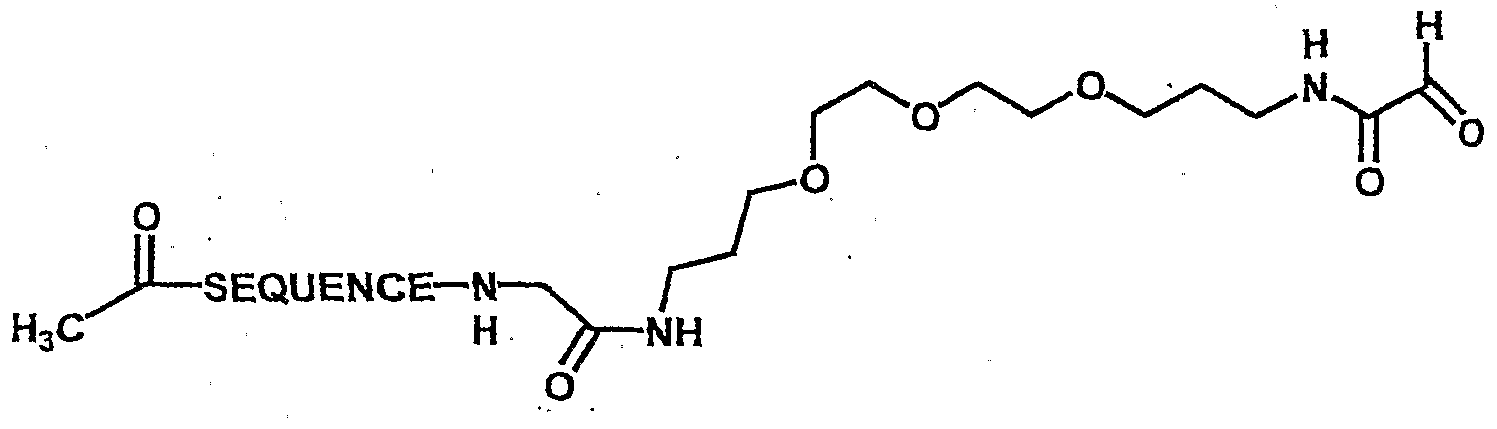
- the aldehyde or ketone function can be located on a spacer arm.
- the deposition of functionalized polypeptides on the semicarbazide support is accompanied by the spontaneous binding of the peptide to the support, under selected pH, temperature and humidity conditions.
- Semicarbazide slides can be printed, for example, with a needle “spotter”. After the deposition of the polypeptides on the slide, the latter can be soaked, when necessary, in a solution containing a polyethylene glycol derivatized by an ⁇ -oxoaldehyde or ketone function. Thus, all the reactive sites present between the spots are covalently linked to a PEG, via the same semicarbazone link used to immobilize the polypeptides, which further reduces the non-specific absorption of the test samples. So the immobilization strategy
- 5 - involves surfaces functionalized by a stable, non-hydrolyzable function; involves' very reactive functions, compensating for the low concentration of the polypeptides in the deposit;
- the quality of the functionalization of the support according to the invention can be controlled by its capacity to fix a synthetic peptide probe, fluorescent, derivatized by an ⁇ -oxoaldehyde function.
- the invention also relates to the process for preparing the polypeptide presentation devices which comprises the following steps:
- step 2 3- deposition in the form of spots of polypeptide samples obtained by step 1 on the functionalized support of step 2, under pH and humidity conditions ensuring the reaction between the aldehyde function or ketone and the semicarbazide function - to create the semicarbazone link.
- Step 1 can be carried out during the synthesis of a polypeptide using an automatic synthesizer. It can include the introduction of a spacer arm between the last amino acid of the polypeptide sequence and the aldehyde or ketone function.
- Step 1 can be carried out by oxidation of a polysaccharide of a natural glycoprotein or of a fragment thereof or by transamination of an N-terminal amino acid of a non-glycosylated natural protein or of a fragment thereof, or by the action of a bifunctional agent.
- Stage 2 includes
- step 2 can be carried out in a single reaction of a silane carrying a semicarbazide group which is preferably protected by the Fmoc.
- Stage 3 preferably comprises - the preparation of solutions of the polypeptides of stage 1 at 10 -3 or 10 ⁇ 4 M in an 0.1M acetate buffer at pH 5.5, - their distribution in a container suitable for their collection, of the microtitra ion plate well type, their collection using a "spotter", - and their deposit on the semicarbazide support. ; incubating the slides overnight at 37 ° C in a humid atmosphere and washing and saturation of nonspecific reactive sites.
- the invention also relates to the use of polypeptide display devices as "polypeptide chips" as a diagnostic tool.
- This use includes the detection of antigen -anti body type responses by the use of labeled, fluorescent, radioactive or chemically labeled reagents, as in non-miniaturized diagnostic tests.
- the devices according to the invention can also be used as polypeptide chips for the screening of molecules and for the analysis of the relationships between molecules, of ligand-receptor type.
- Figure 1 comparative test of sera on the HCVpc21-2 peptide in ELISA (measurement of OD) and in semicarbazide slides (measurement of fluorescence / 20000).
- Figure 2 Study of the correlation between the OD and fluorescence measurements, presented in Figure 1.
- Figure 3 comparative test of sera on 3 peptides ⁇ CVpc21 "small linker”, “large linker” and N-terminal (HCVpc21 3.2 and 1); fluorescence measurement.
- Figure 4 comparison of the responses of 30 positive sera with the peptides HCVpc21, NS4 and a pc2l / NS4 mixture (1 in 10); fluorescence measurement.
- Stage A washing, pickling and silanization
- Pre-cleaned commercial slides (Esco), with ground edges and frosted margin are immersed in a “piranha” solution (hydrogen peroxide / sulfuric acid, 50/50) overnight.
- Pre-rinses of three minutes are carried out with deionized water (3 times) then with methanol (1 time), before immersing the slides in a bath at 3% of aminopropyl-trimethoxysilane in 95% methanol for 30 minutes with ultrasound.
- the slides are rinsed successively by baths of 3 minutes in methanol.
- Step C Functionalization with a semicarbazide. These slides are then quickly drained before being directly immersed in the solution containing Fmoc-NH-JNH 2 (prepared according to Zhang et al. Anal. Biochem. 1991, 195, 160-170) at 22 mmol / 1 in DMF and treated for 2 hours with ultrasound.
- Fmoc-NH-JNH 2 prepared according to Zhang et al. Anal. Biochem. 1991, 195, 160-170
- the slides are then rinsed successively by two 3-minute baths in DMF.
- the "" - slides previously obtained are immersed in a DMF solution containing piperidine (0.2% by volume) and diazabicyclo-undecene (2% by volume) for 30 minutes. The slides are then rinsed successively by baths for 3 minutes in DMF (1 time), with deionized water (2 times) and finally with methanol (1 time) before being dried and stored in a desiccator under empty.
- the semicarbazide silanization and functionalization steps are coupled in a single reaction, by prior preparation of the reagent.
- Step A preparation of the reagent Fmoc-NH-NH-CO-NH- (CH 2 ) 3 -Si (0Et) 3 ) •
- the preparation of the reagent is carried out according to the following scheme:
- Stage B.-Preparation of the slides Pre-cleaned slides (Esco), with ground edges and frosted margin are immersed overnight with stirring in a freshly prepared solution of piranha (H2SO 4 / H 2 O 2 ).
- the slides are then rinsed with stirring in the following successive baths: water deionized (3 times 3 minutes), absolute ethanol (1 time 3 minutes) then dried with a vane pump. They are then immersed for 2 hours in a 1 mg / ml solution of silanization reagent (Fmoc-NH-NH- CO-NH- (CH 2 ) 3 -Si (OEt) 3 ) - in a mixture of 10% THF in toluene at 47 ° C and under ultrasound. The slides are then rinsed with stirring in toluene (2 times 3 minutes) before being drained, then dried for 15 minutes in an oven at 120 ° C and stored in a vacuum desiccator.
- silanization reagent Fmoc-NH-NH- CO-NH- (
- the slides previously obtained are immersed in a DMF solution for 3 minutes before being stirred in a bath containing piperidine (0.2% by volume) and due to diazabicyclo-undecene (2% by volume) in DMF for 30 minutes with stirring.
- the slides are then rinsed successively by baths of 3 minutes in DMF (1 time 3 minutes), in deionized water (2 times 3 minutes) and finally in methanol (1 time 3 minutes), before being dried and stored in a vacuum desiccator.
- the quality of the slides is therefore controlled using the same reaction as that which will be used to fix the polypeptides: 'We use a small synthetic peptide functionalized by an ⁇ -oxoaldehyde group and labeled with rhodamine (fluorescent marker), and, • as a negative control, the same peptide but in which the ⁇ -oxoaldehyde function is replaced by an amide group.
- the rhodamine peptide functionalized by an ⁇ -oxoaldehyde group of sequence (5) -6-carboxytetramethylrhodamine- Lys-Arg-NH- (CH 2 ) 3 -NH-CO-CHO was synthesized from the linker IPT (2, 3- O-isopropylidene-D-tartrate), described by JS Fruchart et al. H. Gras-Masse, O. Melnyk (A new linker for the synthesis of C-terminal peptide ⁇ -oxoaldehydes, - Tet. Lett.; 40; 6225-6228-1999), and in, patent application PCT / FR00 / 01035.
- the slides functionalized by a semicarbazide group are soaked for 1 hour at 37 ° C. in a bath of the rhodamine peptide (functionalized on the C-terminal side by an -oxoaldehyde or control - not functionalized) at a concentration of 0.1 mM in a buffer. 100 mM acetate and at pH 5.5.
- the slides are then rinsed by passing them through a deionized water bath. They are then transferred to a solution of K 2 HP0 4 at 5% in water for 2 hours and treated with ultrasound. The slides are then rinsed.
- This peptide is synthesized in solid phase from the C-terminal end to the N-terminal end according to an Fmoc strategy, on an F oc-PAL-PEG-PS resin.
- This peptide is synthesized '' in solid phase from the C-terminal end to the N-terminal end according to an Fmoc strategy on a “methyl-2,3-0 isopropylidene-D-tartryl-Val-PEGA resin, prepared as described in “Peptides for the new millenium”, proceeding of the 16th american peptide symposium, (kluwer academy publishers, Dordrecht, .2000, pl04-106).
- This peptide is synthesized in solid phase from the C-terminal end to the N-terminal end according to an Fmoc strategy on a methyl-2,3-0-isopropylidene-D-tartryl-Val-PEGA resin.
- This peptide is synthesized in solid phase from the C-terminal end to the N-terminal end according to an Fmoc strategy on a methyl-2,3-0-isopropylidene-D-tartryl-Val-PEGA resin. The synthesis is carried out according to the same protocol as that of the HCVpc21-2 peptide. 2 - EBV virus peptide
- This peptide was synthesized by solid phase from the end 'C-terminal towards the N-terminus as claimed in one • Fmoc strategy on methyl-2 resin, 3-0- isopropylidene-D-Val-PEGA-tartryl following the same protocol as for the HCVpc21-2 peptide.
- the functionalized peptides are first of all dissolved (at 10 " 3M or 10 " 4M) in 0.1 M acetate buffer, pH 5.5. They are then distributed in the wells of a 384-well ELISA plate (Microtest TM, Becton Dickinson, NJ USA). Using a 32-needle manual “Spotter” (Microarray Printer XMM 47832-Xenopore, Hawthorne, US), the peptides are taken from the ELISA plate and deposited on a semicarbazide glass slide. "
- the slides are then incubated for 1 night at 37 ° C. under a humid atmosphere.
- the slides are then incubated in the presence of lOO ⁇ l of patient serum diluted to l / 50 and in the dilution buffer (PBS + 2.5% semi-skimmed milk powder + 0.5% Tween 20) under a coverslip. glass cover glass (24x60mm).
- the incubation - of the slides - is carried out for 2 hours at 37 ° C under a humid atmosphere. 4 successive washings are then carried out for 3 minutes in PBS solution supplemented with 0.05% Tween 20.
- the reaction of the antibodies of patients on the polypeptides fixed on the slide is detected by the fixing, on the latter, of fluorescent human anti-Ig antibodies.
- the fluorescence emitted is then detected using a slide scanner (L35 / PMT 50, Affymetrix 418 Array Scanner, M G).
- the ELISA tests are carried out on COSTAR carbobind plates, with the same peptide HCVpc21-2.
- the table below expresses the mean fluorescence 'observed 9 different blades, with respect to the same serum identified HCV positive by ELISA. On each blade 120 spots of the HCVpc21-2 w large linker "peptide were produced at a concentration of 10 " 4 M.
- the standard deviation on the 9 slides is 1891, a standard deviation of 4.5%.
- the fluorescence is higher with the HCV peptide "large linker".
- the results are comparable for the peptide l small linker "and HCVpc21-l.
- the fluorescence gain mean on the 5 blades is 9.9% in favor of the "large linker” compared to the w small linker "and is 11.11% for the n large linker” compared to the HCVpc21-l peptide (COCHO function on the N-terminal position ).
- the HCVpc21 peptide is "spotted” according to the protocol described in Example 4 at a concentration of 10 "4 M, the NS4 peptide is spotted at 10 " 3 M.
- the NS4 peptide is at a concentration of 0, 5 10 " 3M and the peptide HCVpc21 at a concentration of 0.5 10 " 4 M (ratio 10/1).
- Each peptide is spotted 16 times per slide. The results expressed correspond to the average fluorescence of the 16 spots.
- results presented in FIG. 4 relate to 30 sera referenced HCV positive according to the test of the company Abbott. These sera were numbered from PI to P30.
- the test according to the invention made it possible to detect all the positive sera. 10 negative control sera were tested, for which no fluorescence was detected (fluorescence corresponding to the background noise). The test was therefore found to be sensitive and specific at 100% on the samples tested.
- a fresh blood sample (patient negative for HCV and positive for EBV), of 100 ⁇ l taken at the fingertip was diluted in 50 ⁇ l of dilution buffer (PBS buffer, Tween 0.1%, semi-skimmed milk 2, 5%). These 150 ⁇ l are then placed on the slide and incubated for 2 hours at 37 ° C under a coverslip.
- dilution buffer PBS buffer, Tween 0.1%, semi-skimmed milk 2, 5%
- the HCV fluorescence is zero, the EBV fluorescence is 22991 (average of the 16 spots, standard deviation of 8.1% on these 16 spots).
- the background noise after contact with the serum and the fluorescent antibody is on average 50, namely 0.1% of the maximum signal observed (statistical study on 100 sera referenced). This background noise is 16 times lower than that obtained on Carbobind ® plates with the same peptides. On the other hand, for negative sera, no fluorescence is observed at the peptide spots, apart from that attributed to background noise.
- HCVpc21-Met A peptide derived from HCVpc21 was synthesized in solid phase from the N-terminal end according to an F oc / tBu strategy, on an Fmoc-PAL-P ⁇ G-PS resin. Part of the product (HCVpc21-Met) will be used as a control:
- Each peptide is deposited at a concentration of 10 "4 M.
- a fluorescent antibody As a model for fixing a glycosylated protein on the semicarbazide slides, a fluorescent antibody is used, which allows its direct detection.
- An anti-IgG-AM rhodamine antibody is oxidized to generate an aldehyde function according to the procedure described by olfe and Hage (Anal. Bioch.; 231; 123-130 1995): 440 ⁇ l of antibody (1.5 g / ml), diluted in a 0.02M 0.15M sodium acetate NaCl buffer at pH 5.5 are placed at 4 ° C for 15 minutes. A 20mM sodium periodate solution in the same buffer is also placed at 4 ° C, protected from light. 275 ⁇ l of the sodium periodate " solution are added to 275 ⁇ l of the antibody solution protected from light, with stirring: solution A.
- the excess reagent is eliminated by a series of 4 centrifugations carried out without drying the membrane (3,000 revolutions per minute, 60 minutes then 10,000 revolutions per minute, 20 minutes) by rediluting each time in the acetate buffer solution at pH 5.5 (addition of 200 ⁇ l of buffer). These two solutions were taken using a 1 ⁇ l minicaps (Hirschmann Laborgerate) and spotted 8 times on a ⁇ A
- the slide is then incubated for 6 hours at 37 ° C. in a humid atmosphere. It is then washed by soaking in a 0.1% Tris acetate 0.1 M Tween 20 solution for 60 minutes under ultrasound. The slide is then rinsed with water and dried with ethanol. Fluorescence is revealed with a slide scanner.
- Example 8 epitopi ⁇ u ⁇ screening.
- a library of 24 decapeptides was synthesized in parallel to cover 3 loops exposed to the solvent of the NS3 protein.
- the synthesis was carried out in solid phase from the C-terminal end to the N-terminal end according to the classic Emoc / fcer-butyl strategy and an in situ PyBOP / DIEA activation on the resin "Gly-4, 7, 10 - trioxa-1, 13-dLamino-tridecanyl-methyl-2 ', 3' -O-is ⁇ pryldene-D-tartryl- Val-PBGA ", prepared as described for the peptide HCVpc21-2.
- the synthesis of the 24 peptides was carried out on an automatic multiple synthesizer of 96 channels of the ACT 496 MDS type from Advanced Chemtech. The syntheses were undertaken on a scale of 0.02 mmol and 15 eq. activated acid were used for each coupling step (simple couplings). The peptidyl-resins were acetylated with the Ac 2 O / DIEA / NMP mixture (3/0, 3/86, 7) after each coupling.
- the resins were transferred into syringes fitted with frits (of the ABIMED brand) and deprotected at te mp e raturea mb ianteav 1 ' mldu TFA / H 2 0 / etha ⁇ edithiol mixture (95 / 2.5 / 2.5 per vol.) for 2 hours.
- the resins were then washed with CH 2 C1 2 , methanol and finally ethyl ether and dried.
- the resins were conditioned in a solution of acetic acid at 10% in water, then treated with 6 eq. NaI0 4 (25.7 mg) dissolved in 500 ⁇ l of water for 2 minutes.
- the oxidative cut was stopped by adding 24 equivalents of ethanolamine (29 ⁇ l). After two washes with 1 ml of water, the filtrates were mixed and desalted by RP-HPLC (column C3-Zorbax, 0% B to 100% B, flow rate 5 ml. Min- 1 , detection 230 nm). After lyophilization, the peptides were analyzed by analytical RP-HPLC and by ornate mass spectrum MALDI-TOF. The results obtained are collated in the following table. The generic formula of the peptides is shown in the figure below.
- peptides 14 and 15 are of interest " for the detection of anti-NS3 antibodies, and that, in general, peptide biochips constitute an interesting tool for screening epitopes.
- Example 9 - study of li and receptor relationships: the ligand is a biotinylated peptide and the receptor is streptavidin or an anti-biotin antibody.
- the synthesis was carried out on Novasyn TGR resin (Novabiochem, lot A 23633, load 0.2 mmol / g) on a scale of 0.1 mmol.
- Oxidation is carried out with 6 eq. of NaI0 4 and 8 eq. of methionine at a concentration of 0.5 mM in 100 mM phosphate pH 6.6 / MeOH: 1/1 in flight for 15 min.
- the reaction is stopped with 12 eq. ethanolamine, diluted with water and purified on column C18 Nucleosil (0-23% 20 min, 23-23% 5 min, 23-35%, 35 min) to give the expected product.
- Biochip test
- the pep-biotin peptide is "spotted" according to the protocol described in example 4 paragraph 1 at the concentrations of 10 _3 M, 10 _4 M, 10 ⁇ 5 M and 10 ⁇ 5 M. Each concentration is spotted 6 times per slide.
- the slides are then incubated in the presence of 150 ⁇ l of ligand (Rhodamine Conjugated affinity Purified anti-Biotin [goat] solution (Rockland, Gilbertsville, PA, USA) or Streptavidin Tetramethyl Rhodamine conjugate solution (Molecular Probes, Oregon, USA)) diluted in 0.01 M PBS buffer, pH 7.2 (ligand concentrations: 10 ⁇ 1 mg / ml, 10 -2 mg / ml 10 _3 mg / ml, 10 _4 mg / ml) under a glass coverslip -object (24x60mm).
- ligand Rhodamine Conjugated affinity Purified anti-Biotin [goat] solution (Rockland, Gilbertsville,
- the slides are incubated for 2 hours at 37 ° C in a humid atmosphere. A series of 4 successive washes in PBS solution with 0.05% Tween 20 is carried out. The slides are then rinsed using a wash bottle of deionized water and then ethanol at 95 ° for 1 minute, then dried for 15 minutes in ambient air. The fluorescence is then detected using a slide scanner (L35 / PMT50, Affymetrix 418 Array Scanner, MG). The results expressed in the following table correspond to the average fluorescence and to the standard deviation of the 6 spots of each concentration obtained after incubation of rhodamine streptavidin and rhodamine anti-biotin antibody respectively.
- the pep-biotin peptide is "spotted" according to the protocol described in example 4 paragraph 1 at the concentrations of 10-3 M, 10 -6 M, 10-5 M and 10-6. Each concentration is spotted 6 times per slide.
- the slides are then incubated in the presence of 150 ⁇ l of a 10 -3 mg / ml solution of rhodamine streptavidin (streptavidin Tetramethyl Rhodamine conjugate solution (Molecular Probes, Oregon, USA)) diluted in 0.01 M PBS buffer, pH 7.2 in the presence of different concentrations of biotin (10- 3 M, 10-4M, -10-5M, et.0M 10-7M) as .a glass slide covers and ob "(24x60mm).
- the slides are incubated for 2 hours at 37 ° C. in a humid atmosphere. A series of 4 successive washes in PBS solution with 0.05% Tween 20 is carried out.
- the slides are then rinsed, - dried and analyzed as The results expressed in the following table correspond to the average fluorescence and to the standard deviation of the 6 spots of each concentration obtained after incubation.
Landscapes
- Health & Medical Sciences (AREA)
- Immunology (AREA)
- Life Sciences & Earth Sciences (AREA)
- Engineering & Computer Science (AREA)
- Molecular Biology (AREA)
- Biomedical Technology (AREA)
- Chemical & Material Sciences (AREA)
- Hematology (AREA)
- Urology & Nephrology (AREA)
- Biotechnology (AREA)
- Microbiology (AREA)
- Cell Biology (AREA)
- Food Science & Technology (AREA)
- Medicinal Chemistry (AREA)
- Physics & Mathematics (AREA)
- Analytical Chemistry (AREA)
- Biochemistry (AREA)
- General Health & Medical Sciences (AREA)
- General Physics & Mathematics (AREA)
- Pathology (AREA)
- Peptides Or Proteins (AREA)
- Investigating Or Analysing Biological Materials (AREA)
Abstract
Description





Claims
Priority Applications (4)
| Application Number | Priority Date | Filing Date | Title |
|---|---|---|---|
| US10/478,976 US20040235049A1 (en) | 2001-05-28 | 2002-05-27 | Device for presentation of polypeptides able to be used as a chip for miniaturised detection of molecules |
| EP02740818A EP1390751B1 (fr) | 2001-05-28 | 2002-05-27 | Dispositif de presentation de polypeptides, utilisable comme "puce" pour la detection miniaturisee de molecules. |
| CA002449220A CA2449220A1 (fr) | 2001-05-28 | 2002-05-27 | Dispositif de presentation de polypeptides, utilisable comme "puce" pour la detection miniaturisee de molecules |
| AT02740818T ATE535811T1 (de) | 2001-05-28 | 2002-05-27 | Vorrichtung zur polypeptidpräsentation, verwendbar als sensorchip zur miniaturisierten detektion von molekülen |
Applications Claiming Priority (2)
| Application Number | Priority Date | Filing Date | Title |
|---|---|---|---|
| FR0106931A FR2825095B1 (fr) | 2001-05-28 | 2001-05-28 | Dispositif de presentation de polypeptides, utilisable comme "puce" pour la detection miniaturisee de molecules |
| FR0106931 | 2001-05-28 |
Publications (2)
| Publication Number | Publication Date |
|---|---|
| WO2002097442A2 true WO2002097442A2 (fr) | 2002-12-05 |
| WO2002097442A3 WO2002097442A3 (fr) | 2003-11-06 |
Family
ID=8863681
Family Applications (1)
| Application Number | Title | Priority Date | Filing Date |
|---|---|---|---|
| PCT/FR2002/001771 Ceased WO2002097442A2 (fr) | 2001-05-28 | 2002-05-27 | Dispositif de presentation de polypeptides, utilisable comme 'puce' pour la detection miniaturisee de molecules. |
Country Status (6)
| Country | Link |
|---|---|
| US (1) | US20040235049A1 (fr) |
| EP (1) | EP1390751B1 (fr) |
| AT (1) | ATE535811T1 (fr) |
| CA (1) | CA2449220A1 (fr) |
| FR (1) | FR2825095B1 (fr) |
| WO (1) | WO2002097442A2 (fr) |
Cited By (1)
| Publication number | Priority date | Publication date | Assignee | Title |
|---|---|---|---|---|
| WO2003099855A1 (fr) * | 2002-05-28 | 2003-12-04 | Sedac Therapeutics | Dispositif de présentation de peptides ou de protéines, son procédé de préparation et ses utilisations. |
Families Citing this family (3)
| Publication number | Priority date | Publication date | Assignee | Title |
|---|---|---|---|---|
| PT2236608T (pt) * | 2005-10-04 | 2017-03-01 | Soligenix Inc | Péptidos novos para tratar e prevenir distúrbios relacionados com a imunidade, incluindo tratar e prevenir infecção por modulação da imunidade inata |
| US10450343B2 (en) | 2013-03-21 | 2019-10-22 | Sanofi-Aventis Deutschland Gmbh | Synthesis of cyclic imide containing peptide products |
| CA2907454C (fr) | 2013-03-21 | 2021-05-04 | Sanofi-Aventis Deutschland Gmbh | Synthese de produits peptidiques contenant de l'hydantoine |
Family Cites Families (8)
| Publication number | Priority date | Publication date | Assignee | Title |
|---|---|---|---|---|
| US5227297A (en) * | 1990-04-17 | 1993-07-13 | Smithkline Beecham Corporation | Affinity purification ligands |
| WO1993012076A1 (fr) * | 1991-12-13 | 1993-06-24 | Corvas International Inc. | Reactifs pour la synthese automatisee d'analogues peptidiques |
| US5877278A (en) * | 1992-09-24 | 1999-03-02 | Chiron Corporation | Synthesis of N-substituted oligomers |
| FR2706618B1 (fr) * | 1993-06-11 | 1995-09-01 | Bio Merieux | Dispositif pour le dosage d'haptènes et son utilisation. |
| US5856571A (en) * | 1995-06-07 | 1999-01-05 | Cellpro, Incorporated | Semicarbazide-containing linker compounds for formation of stably-linked conjugates and methods related thereto |
| HK1043622A1 (zh) * | 1998-12-15 | 2002-09-20 | Exiqon A/S | 報道基因基團導入細菌脂多醣衍生的碳水化合物及隨後使該衍生物偶合至固體表面上的方法 |
| US6339147B1 (en) * | 1999-07-29 | 2002-01-15 | Epoch Biosciences, Inc. | Attachment of oligonucleotides to solid supports through Schiff base type linkages for capture and detection of nucleic acids |
| FR2801904B1 (fr) * | 1999-12-07 | 2002-02-08 | Pasteur Institut | Produits comprenant un support sur lequel sont fixes des acides nucleiques et leur utilisation comme puce a adn |
-
2001
- 2001-05-28 FR FR0106931A patent/FR2825095B1/fr not_active Expired - Fee Related
-
2002
- 2002-05-27 WO PCT/FR2002/001771 patent/WO2002097442A2/fr not_active Ceased
- 2002-05-27 EP EP02740818A patent/EP1390751B1/fr not_active Expired - Lifetime
- 2002-05-27 US US10/478,976 patent/US20040235049A1/en not_active Abandoned
- 2002-05-27 AT AT02740818T patent/ATE535811T1/de active
- 2002-05-27 CA CA002449220A patent/CA2449220A1/fr not_active Abandoned
Non-Patent Citations (1)
| Title |
|---|
| None |
Cited By (1)
| Publication number | Priority date | Publication date | Assignee | Title |
|---|---|---|---|---|
| WO2003099855A1 (fr) * | 2002-05-28 | 2003-12-04 | Sedac Therapeutics | Dispositif de présentation de peptides ou de protéines, son procédé de préparation et ses utilisations. |
Also Published As
| Publication number | Publication date |
|---|---|
| FR2825095A1 (fr) | 2002-11-29 |
| ATE535811T1 (de) | 2011-12-15 |
| EP1390751A2 (fr) | 2004-02-25 |
| FR2825095B1 (fr) | 2003-09-26 |
| WO2002097442A3 (fr) | 2003-11-06 |
| US20040235049A1 (en) | 2004-11-25 |
| EP1390751B1 (fr) | 2011-11-30 |
| CA2449220A1 (fr) | 2002-12-05 |
Similar Documents
| Publication | Publication Date | Title |
|---|---|---|
| US12454771B2 (en) | Substrates, peptide arrays, and methods | |
| El-Mahdi et al. | α-Oxo aldehyde or glyoxylyl group chemistry in peptide bioconjugation | |
| JP2003536073A (ja) | プロテオミクス分析を実施するためのマイクロアレイ | |
| US7658946B2 (en) | Solid supports functionalized with phosphorus-containing dendrimers, process for preparing them and uses thereof | |
| JP2009522547A (ja) | 検体アッセイのための支持体及びその製造方法及び使用方法 | |
| Horn et al. | Incorporation of chemoselective functionalities into peptoids via solid-phase submonomer synthesis | |
| Olivier et al. | α-Oxo semicarbazone peptide or oligodeoxynucleotide microarrays | |
| JP2017509696A (ja) | 一段階ペプチドカップリングのためのアミノ酸の選択的光活性化 | |
| JPH09508473A (ja) | 金属キレート標識ペプチド | |
| AU2004272465B2 (en) | Size-controlled macromolecule | |
| EP1644527B1 (fr) | Substrat solide lie au derive de cucurbiturile et puce biologique utilisant ce substrat | |
| EP1390751B1 (fr) | Dispositif de presentation de polypeptides, utilisable comme "puce" pour la detection miniaturisee de molecules. | |
| JPH06505340A (ja) | 分析的な試薬の生産方法 | |
| Saini et al. | Performance comparison of three chemical vapor deposited aminosilanes in peptide synthesis: effects of silane on peptide stability and purity | |
| Hüttl et al. | Development of Peptidyl Lysine Dendrons: 1, 3‐Dipolar Cycloaddition for Peptide Coupling and Antibody Recognition | |
| EP1507792B1 (fr) | Dispositif de presentation de peptides ou de proteines, son procede de preparation et ses utilisations. | |
| Sola et al. | Clickable polymeric coating for oriented peptide immobilization | |
| Marik et al. | Peptide and small-molecule microarrays | |
| WO2007115444A1 (fr) | Composition de séparation ou d'analyse à nanostructure active et procédé de séparation ou d'analyse | |
| JP2002286723A (ja) | タンパク質の高感度検出方法 | |
| JP2007071719A (ja) | プローブ分子との分子間相互作用を検出する方法、プローブ分子が固定された担体およびプローブ分子の分子間相互作用を検出するキット | |
| FR2847983A1 (fr) | Dispositif miniature de detection electrique d'interactions de type ligand-recepteur, preparation et utilisations. |
Legal Events
| Date | Code | Title | Description |
|---|---|---|---|
| AK | Designated states |
Kind code of ref document: A2 Designated state(s): AE AG AL AM AT AU AZ BA BB BG BR BY BZ CA CH CN CO CR CU CZ DE DK DM DZ EC EE ES FI GB GD GE GH GM HR HU ID IL IN IS JP KE KG KP KR KZ LC LK LR LS LT LU LV MA MD MG MK MN MW MX MZ NO NZ OM PH PL PT RO RU SD SE SG SI SK SL TJ TM TN TR TT TZ UA UG US UZ VN YU ZA ZM ZW |
|
| AL | Designated countries for regional patents |
Kind code of ref document: A2 Designated state(s): GH GM KE LS MW MZ SD SL SZ TZ UG ZM ZW AM AZ BY KG KZ MD RU TJ TM AT BE CH CY DE DK ES FI FR GB GR IE IT LU MC NL PT SE TR BF BJ CF CG CI CM GA GN GQ GW ML MR NE SN TD TG |
|
| 121 | Ep: the epo has been informed by wipo that ep was designated in this application | ||
| DFPE | Request for preliminary examination filed prior to expiration of 19th month from priority date (pct application filed before 20040101) | ||
| WWE | Wipo information: entry into national phase |
Ref document number: 2449220 Country of ref document: CA |
|
| WWE | Wipo information: entry into national phase |
Ref document number: 2002740818 Country of ref document: EP |
|
| WWP | Wipo information: published in national office |
Ref document number: 2002740818 Country of ref document: EP |
|
| REG | Reference to national code |
Ref country code: DE Ref legal event code: 8642 |
|
| WWE | Wipo information: entry into national phase |
Ref document number: 10478976 Country of ref document: US |
|
| NENP | Non-entry into the national phase |
Ref country code: JP |
|
| WWW | Wipo information: withdrawn in national office |
Country of ref document: JP |