WO2002098381A1 - Method of treating hair - Google Patents
Method of treating hair Download PDFInfo
- Publication number
- WO2002098381A1 WO2002098381A1 PCT/JP2002/005419 JP0205419W WO02098381A1 WO 2002098381 A1 WO2002098381 A1 WO 2002098381A1 JP 0205419 W JP0205419 W JP 0205419W WO 02098381 A1 WO02098381 A1 WO 02098381A1
- Authority
- WO
- WIPO (PCT)
- Prior art keywords
- hair
- agent
- group
- weight
- acid
- Prior art date
- Legal status (The legal status is an assumption and is not a legal conclusion. Google has not performed a legal analysis and makes no representation as to the accuracy of the status listed.)
- Ceased
Links
Classifications
-
- A—HUMAN NECESSITIES
- A61—MEDICAL OR VETERINARY SCIENCE; HYGIENE
- A61K—PREPARATIONS FOR MEDICAL, DENTAL OR TOILETRY PURPOSES
- A61K8/00—Cosmetics or similar toiletry preparations
- A61K8/18—Cosmetics or similar toiletry preparations characterised by the composition
- A61K8/30—Cosmetics or similar toiletry preparations characterised by the composition containing organic compounds
- A61K8/46—Cosmetics or similar toiletry preparations characterised by the composition containing organic compounds containing sulfur
- A61K8/466—Cosmetics or similar toiletry preparations characterised by the composition containing organic compounds containing sulfur containing sulfonic acid derivatives; Salts
-
- A—HUMAN NECESSITIES
- A61—MEDICAL OR VETERINARY SCIENCE; HYGIENE
- A61K—PREPARATIONS FOR MEDICAL, DENTAL OR TOILETRY PURPOSES
- A61K8/00—Cosmetics or similar toiletry preparations
- A61K8/18—Cosmetics or similar toiletry preparations characterised by the composition
- A61K8/30—Cosmetics or similar toiletry preparations characterised by the composition containing organic compounds
- A61K8/46—Cosmetics or similar toiletry preparations characterised by the composition containing organic compounds containing sulfur
-
- A—HUMAN NECESSITIES
- A61—MEDICAL OR VETERINARY SCIENCE; HYGIENE
- A61K—PREPARATIONS FOR MEDICAL, DENTAL OR TOILETRY PURPOSES
- A61K8/00—Cosmetics or similar toiletry preparations
- A61K8/18—Cosmetics or similar toiletry preparations characterised by the composition
- A61K8/30—Cosmetics or similar toiletry preparations characterised by the composition containing organic compounds
- A61K8/55—Phosphorus compounds
-
- A—HUMAN NECESSITIES
- A61—MEDICAL OR VETERINARY SCIENCE; HYGIENE
- A61Q—SPECIFIC USE OF COSMETICS OR SIMILAR TOILETRY PREPARATIONS
- A61Q5/00—Preparations for care of the hair
- A61Q5/04—Preparations for permanent waving or straightening the hair
-
- A—HUMAN NECESSITIES
- A61—MEDICAL OR VETERINARY SCIENCE; HYGIENE
- A61K—PREPARATIONS FOR MEDICAL, DENTAL OR TOILETRY PURPOSES
- A61K2800/00—Properties of cosmetic compositions or active ingredients thereof or formulation aids used therein and process related aspects
- A61K2800/20—Chemical, physico-chemical or functional or structural properties of the composition as a whole
- A61K2800/24—Thermal properties
-
- A—HUMAN NECESSITIES
- A61—MEDICAL OR VETERINARY SCIENCE; HYGIENE
- A61K—PREPARATIONS FOR MEDICAL, DENTAL OR TOILETRY PURPOSES
- A61K2800/00—Properties of cosmetic compositions or active ingredients thereof or formulation aids used therein and process related aspects
- A61K2800/40—Chemical, physico-chemical or functional or structural properties of particular ingredients
- A61K2800/52—Stabilizers
-
- A—HUMAN NECESSITIES
- A61—MEDICAL OR VETERINARY SCIENCE; HYGIENE
- A61K—PREPARATIONS FOR MEDICAL, DENTAL OR TOILETRY PURPOSES
- A61K2800/00—Properties of cosmetic compositions or active ingredients thereof or formulation aids used therein and process related aspects
- A61K2800/80—Process related aspects concerning the preparation of the cosmetic composition or the storage or application thereof
- A61K2800/88—Two- or multipart kits
Definitions
- the present invention relates to a method for straightening hair with reduction of hair keratin, a method for maintaining or recovering the straightened state, and a composition for use therein.
- straight perm In order to straighten curly and curly hair, several hair straightening methods have been implemented in beauty salons and the like. One of them is a method called straight perm. This is done by applying the first-part composition of straight perm containing hair keratin-reducing substance to curly hair, fixing it in a straight line, leaving it to stand for a predetermined time, rinsing with water, and treating with the second-part composition containing an oxidizing agent. How to Although this method has the advantage of being relatively simple, it has a weakening effect, and has the disadvantage that it can easily return to the state of curly hair over time. There is also a method called iron hair straightening.
- This is a method of treating with a second agent composition comprising: Compared to the above-mentioned straight perm, this method has a high correction effect and a long lasting effect, but it is troublesome and time-consuming, and also has a problem that the swell of the hair tends to remain at the hair tips with a small amount of hair. is there.
- the hair returns to the state of curly hair due to repeated hair washing after the hair straightening treatment.
- straight perm or straightening of the hair of the eye must be performed again, and there is a problem that the hair is seriously damaged by repeating these procedures.
- An object of the present invention is to solve these conventional problems and to provide a hair treatment method having a very high curly hair straightening effect and a long lasting effect. It is another object of the present invention to provide a method for easily maintaining and recovering the curly hair straightening effect imparted by performing the hair treatment method without damaging the hair. Another object of the present invention is to provide a composition used in these hair treatment methods.
- the present inventors have found that during the step of so-called palm treatment using a first part composition containing a hair keratin-reducing substance and a second part composition containing an oxidizing agent, reduction of disulfide bonds in hair When the hair structure is relaxed due to the chemical cleavage, an organic acid having a specific structure is acted on, and the pH is adjusted to 1 to 5 using a buffering agent. It was also found that a high curly hair straightening effect and long-lasting effect could be obtained.
- a high curly hair straightening effect can be obtained only by a simple shaping operation such as passing through a comb, and if a heating tool such as a high-temperature eye opening is used as the shaping operation, furthermore, It has also been found that a high hair straightening effect can be obtained. '' Furthermore, in the case where hair is wrapped around a rod as a shaping operation in order to impart a wave to the hair, even curly or curly hair is shaped into curls while correcting it. We have also found that beautiful curls can be achieved.
- an aqueous treating agent composition having a pH of 1 to 5 containing an organic acid having a specific structure or a salt thereof and having a buffering function is acted on the hair straightened by the above method. It has also been found that by doing so, it is possible to easily maintain or recover the effect of straightening hair without damaging the hair.
- the present invention is a method comprising the steps (1-1) to (1_4), wherein the hair is shaped during any one or more of the steps, and a heating device is used as necessary.
- An object of the present invention is to provide a hair treatment method in which at least one of the first agent and the second agent contains an organic acid (A) or a salt thereof.
- the present invention comprises the steps (2-1) to (2-5), wherein the hair is shaped during any one or more of the steps, and in that case, a method using a heating tool is used as necessary.
- Another object of the present invention is to provide a hair treatment method in which at least one of the first agent and the intermediate treatment agent contains an organic acid (A) or a salt thereof.
- the present invention is a first agent for use in any of the above hair treatment methods
- the present invention provides an aqueous composition containing 0.1 to 40% by weight of the above-mentioned organic acid (A) or a salt thereof and 0.1 to 10% by weight of a hair keratin reducing substance and having a pH of 5 to 11. is there.
- the present invention further provides a second agent for use in any of the above hair treatment methods, wherein the organic acid (A) or a salt thereof is 0.1 to 40% by weight, and a buffer is 1 to 20% by weight. And an oxidizing agent in an amount of 0.1 to 20% by weight and a pH of 1 to 5.
- the present invention further provides an intermediate treatment agent for use in the above-mentioned hair treatment method, which comprises 0.1 to 40% by weight of the organic acid (A) or a salt thereof and 1 to 20% by weight of a buffer.
- the present invention provides an aqueous composition having a pH of 1 to 5.
- the present invention provides a method of treating a hair treated by any one of the above methods, comprising applying the above-mentioned organic acid (A) or a salt thereof, and applying a post-treatment agent having a buffering capacity of pH 1 to 5 to the hair. After leaving for a minute, the hair is rinsed with water and dried to provide a hair treatment method.
- A organic acid
- a post-treatment agent having a buffering capacity of pH 1 to 5
- the present invention further provides a post-treatment agent for use in the above-mentioned hair treatment method, which comprises 0.1 to 40% by weight of the organic acid (A) or a salt thereof and 1 to 20% by weight of a buffer. And an aqueous composition having a pH of 1 to 5.
- the hair treatment method of the present invention it is possible to obtain an extremely high curly hair straightening effect by a simple operation similar to that of an ordinary straight perm.
- the straightened state is maintained or the hair straightened state is restored by the daily aftercare at home without damaging the hair. Is possible. Therefore, it has become possible to avoid damage to the hair due to further processing such as straightening and ironing, which was conventionally required to maintain the straight hair state.
- the non-aromatic hydrophobic group having a total of 3 to 11 carbon atoms may be an aliphatic hydrocarbon group which may have a substituent, an alicyclic hydrocarbon group.
- examples of the aromatic hydrophobic group having a total of 4 to 18 carbon atoms include an aromatic hydrocarbon group which may have a substituent;
- a cyclic aromatic group Preferred examples of these hydrophobic groups include the following groups.
- aliphatic hydrocarbon group a straight-chain or straight-chain having 3 to 11 total carbon atoms, particularly 4 to 10 total carbon atoms. Is preferably a branched or saturated aliphatic hydrocarbon group, or a group in which these groups are substituted with an alkoxy group described later within the carbon number range.
- alicyclic hydrocarbon group examples include a hydrocarbon group having a saturated or unsaturated alicyclic structure in at least a part of a total of 3 to 11, particularly 5 to 10 carbon atoms, for example, cycloalkyl.
- cycloalkyl groups having a saturated or unsaturated alicyclic structure in at least a part of a total of 3 to 11, particularly 5 to 10 carbon atoms, for example, cycloalkyl.
- non-aromatic heterocyclic group examples include a group having at least a part of a saturated or unsaturated heterocyclic structure having 3 to 11 carbon atoms, particularly 4 to 10 carbon atoms, such as a pyrrolidyl group.
- a group in which these groups are substituted for a hydrogen group is preferable.
- aromatic hydrocarbon group examples include hydrocarbon groups having a total number of carbon atoms of 4 to 18, especially 6 to 14 carbon atoms and having at least a part of an aromatic ring, such as phenyl, naphthyl, anthryl, and biphenylyl.
- phenyl, naphthyl, anthryl, and biphenylyl such as phenyl, naphthyl, anthryl, and biphenylyl.
- groups in which these groups are substituted for the hydrocarbon groups described below are substituted for the hydrocarbon groups described below.
- heterocyclic aromatic group a group having a total number of carbon atoms of 4 to 18 and having at least a part of a heterocyclic ring, for example, a furyl group, a pyrrolyl group, a thiophenyl group, a quinolyl group, an isoquinolyl group, particularly a total carbon number of 6 To 14 having at least a part of a heterocyclic ring, for example, a quinolyl group, an isoquinolyl group, and the like, and a group in which these groups are substituted with a hydrocarbon group and a Z or alkoxy group described below within the carbon number range. And groups in which these groups are substituted for the hydrocarbon groups described below.
- the hydrocarbon group which may be substituted with the exemplified group and the hydrocarbon group which may be substituted with the exemplified group within the range of the total number of carbon atoms are 1 to 1 Trivalent hydrocarbon group having 1 to 10 carbon atoms, particularly linear or branched having 1 to 8 carbon atoms Examples thereof include a saturated or unsaturated aliphatic hydrocarbon group having a chain, and a saturated or unsaturated alicyclic hydrocarbon group having 5 to 8 carbon atoms.
- the alkoxy group which may be substituted with the exemplified group within the range of the total number of carbon atoms may be a straight-chain or straight-chain having 1 to 10 carbon atoms, particularly 1 to 8 carbon atoms. Examples include a branched chain alkoxy group. A plurality of these hydrocarbon groups and alkoxy groups may be substituted with the exemplified groups.
- a sulfo group, a sulfate group, a phosphono group and a phosphate group are preferred, and a sulfo group and a sulfate group, particularly a sulfo group, are preferred.
- the organic acid (A) or a salt thereof may have 0 to 2 amino groups and hydroxyl groups in total, but does not have any of these hydrophilic substituents from the viewpoint of the hair straightening effect. Is preferred.
- Examples of the salt of the organic acid (A) include a sodium salt, a potassium salt, and an ammonium salt.
- Preferred specific examples of the organic acid (A) or a salt thereof include the following compounds.
- an organic acid (A) having an aliphatic or alicyclic hydrocarbon group and a sulfo group, or a salt thereof straight-chain alkanesulfonic acids such as hexanesulfonic acid, heptanesulfonic acid, octanesulfonic acid, and nonanesulfonic acid; Salts; linear alkene sulfonic acids such as hexene sulfonic acid, heptene sulfonic acid, octene sulfonic acid, and nonene sulfonic acid and salts thereof; alicyclic having 6 to 8 carbon atoms such as cyclohexane sulfonic acid and cyclohexene sulfonic acid; Saturated or
- Organic acids (A) having an aromatic hydrocarbon group and a sulfo group (A) or salts thereof include toluene sulfonic acid, butyl toluene sulfonic acid, xylene sulfonic acid, styrene sulfonic acid, methyl styrene sulfonic acid, butyl styrene sulfonic acid, cumene sulfone Acid, methylcumenesulfonic acid, chimenesulfonic acid, trimethylbenzenesulfonic acid, ethylbenzenesulfonic acid, phenylenesulfonic acid, dimethylbenzenesulfonic acid, propyl or isopropylbenzenesulfonic acid, phenylpropanesulfonic acid, diisopropenyl Benzenesulfonic acid, divinylbenzenesulfonic acid, butyl-, isobut
- Examples of the organic acid (A) having a heterocyclic group and a sulfo group or a salt thereof include quinolinesulfonic acid, isoquinolinesulfonic acid, methylquinolinesulfonic acid, and salts thereof.
- organic acids (A) and salts thereof include sulfates, phosphonic acids, and phosphates having the same hydrophobic group as the above sulfonic acids, and salts thereof. Two or more organic acids (A) or salts thereof can be used in combination.
- At least one of the first and second components may contain the organic acid (A) or a salt thereof. Both preferably contain the organic acid (A) or a salt thereof.
- the above steps (2-1) to (2-5) In the hair treatment method, at least one of the first agent and the intermediate treatment agent may contain an organic acid (A) or a salt thereof, and both of them contain an organic acid (A) or a salt thereof.
- the second agent also contains the organic acid (A) or a salt thereof.
- the content is preferably 0.1 to 40% by weight, more preferably 1 to 30% by weight in each treatment agent. %, Especially 2 to 20% by weight.
- the term "having a buffering capacity" means that the concentration of a base required to raise the pH of a 10% by weight aqueous solution of the composition at 25 ° C from the initial value by 1 as a scale is determined by the following formula.
- B (hereinafter referred to as B value) is 0.001 gram equivalent / L or more.
- C B represents an ion concentration of the base (gram equivalent ZL).
- an organic or inorganic acid having an acid dissociation constant of 1 to 5 at 25 ° C. when having a plurality of pKa, At least one pKa), and preferably also a salt thereof.
- these acids include carboxylic acid and phosphoric acid such as citric acid, lactic acid, malic acid, tartaric acid, glycolic acid, succinic acid, benzoic acid, and pyrrolidone carboxylic acid.
- alkali metal salts such as sodium salt and potassium salt, alkaline earth metal salts, and ammonium salts.
- the hair straightening effect can be enhanced. This is because when anionic organic acids (A) or salts thereof are adsorbed and immobilized by ionic bonding on the cation sites formed by the cleavage of ionic bonds in hair under acidic conditions, the pH is increased. It is more advantageous to set the pH to a lower value, and it is considered that PH can be maintained at a low value by having a buffer capacity.
- the first agent used in the present invention contains a hair keratin reducing substance.
- Hair keratin reducing substances include, for example, thioglycolic acid, thiolactic acid, thioglycerol, glyceryl monothioglycolate and their salts or derivatives such as ammonium salts, sodium salts, cysteine, cysteine hydrochloride, N -Acetyl cysteine, sulfite and bisulfite.
- Two or more of these hair keratin reducing substances may be used in combination, and the content thereof is preferably 0.1 to 20% by weight, more preferably 1 to 10% by weight, particularly 2 to 10% by weight in the first agent. 8% by weight is preferred.
- dithiodiglycolic acid, dithiodilactic acid or a salt thereof, which is a dithio compound of the above-mentioned hair keratin-reducing thiol compound can also be added.
- the pH of the first agent is preferably from 5 to 11, more preferably from 6 to 10, particularly preferably from 7 to 9.6.
- the intermediate treatment agent used in the present invention has a buffering capacity, that is, the B value is 0.001 gram equivalent / L or more, but the 0.01 value is ZL or more, particularly 0.01 to 0.1. 2 gram equivalent / L is preferred.
- the intermediate treatment agent preferably contains 1 to 20% by weight of a buffer.
- the pH is 1 to 5, preferably 1 to 4, more preferably 1 to 3.5, particularly preferably 2.5 to 3.5.
- the intermediate treatment agent can be used to confirm that the pH has reached 1 to 5 when mixed with the first agent on the hair, such as methyl yellow, methyl orange, methyl red, and methyl red. It may contain a pH indicator such as bromophenol blue.
- an appropriate amount of a solid acid (such as citric acid) is mixed with the first agent during application of the first agent to the hair, and the pH is adjusted to 1 to 5.
- a solid acid is coated with a slowly soluble coating agent, and an appropriate amount is mixed with the first agent immediately before or during application of the first agent to the hair. It is also conceivable to set it to ⁇ 5.
- a water-soluble polymer such as polyethylene glycol, a gypsum film, a hydrophobic substance such as calcium fluoride, a solid oil or fat, a surfactant and the like can be used.
- the second agent used in the present invention contains an oxidizing agent.
- an oxidizing agent for example, examples thereof include sodium bromate, sodium perborate, and hydrogen peroxide, with hydrogen peroxide being particularly preferred. Two or more of these oxidizing agents may be used in combination, and the content thereof is preferably 0.1 to 20% by weight in the second agent.
- the second agent in the method comprising the steps (1-1) to (1-4) has a buffering capacity, that is, the B value is 0.001 gram equivalent or more, but 0.01 g equivalent / L or more, especially 0.01 to 0.2 gram equivalent ZL is preferred.
- This second agent preferably contains 1 to 20% by weight of a buffer.
- the pH is 1 to 5, preferably 1 to 4, more preferably 1 to 3.5, and particularly preferably 2.5 to 3.5.
- the intermediate treatment agent since the intermediate treatment agent has a buffering ability and has a pH of 1 to 5, the second agent necessarily has a buffering ability and has a pH of 1 to 5. It does not have to be 55, but it is preferable that it has a buffering capacity and ⁇ 1-5.
- the second agent When the second agent has a buffering function, it preferably contains 1 to 20% by weight of a buffering agent.
- the first agent, the intermediate treatment agent and the second agent contain an organic solvent in order to assist the penetration of the organic acid (A) or a salt thereof into the hair.
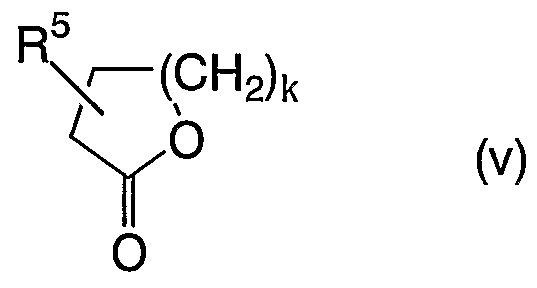
- organic solvents include those represented by any one of the general formulas (i), (ii), (iii), (iv) and (v).
- R 1 represents a hydrogen atom, a linear or branched alkyl group having 1 to 4 carbon atoms or a linear or branched alkoxy group having 1 to 4 carbon atoms
- W represents a single bond or a methylene group.
- Y represents a linear or branched alkylene group having 2 to 4 carbon atoms
- Y 1 represents a linear or branched alkylene group having 2 to 4 carbon atoms
- n represents an integer of 0 to 3.
- R 2 represents a linear, branched or cyclic alkyl group having 4 to 7 carbon atoms
- Y 2 represents a linear or branched alkylene group having 2 to 4 carbon atoms
- m represents 0 to Indicates an integer of 3.
- R 3 represents a linear or branched alkyl group having 1 to 4 carbon atoms.
- R 4 represents a hydrogen atom or a linear or branched alkyl group having 1 to 4 carbon atoms.
- R 5 represents a hydrogen atom, a linear or branched alkyl group having 1 to 4 carbon atoms, and k represents an integer of 1 or 2.
- examples of the linear or branched alkyl group having 1 to 4 carbon atoms represented by RRR 4 and R 5 include a methyl group, an ethyl group, a propyl group, an isopropyl group, and a butyl group. , Isobutyl, sec-butyl and tert-butyl.
- examples of the linear or branched alkoxy group having 1 to 4 carbon atoms represented by R 1 include a methoxy group, an ethoxy group, a propoxy group, an isopropoxy group, and a butoxy group.
- Straight chain of carbon number 4-7 represented by R 2 as the branched-chain or cyclic alkyl group, a butyl group, a pentyl group, a hexyl group, a heptyl group, an isobutyl group, cyclopentyl group, cyclohexyl group and the like cyclohexylene No.
- Examples of the linear or branched alkylene group having 2 to 4 carbon atoms represented by X, Y 1 and Y 2 include an ethylene group, a trimethylene group, a propylene group, and a tetramethylene group.
- Examples of the organic solvent (i) include 2-phenyloxyethanol, benzyl alcohol, 2-phenylethanol, and 2-benzyloxetanol, and examples of the organic solvent ( ⁇ ) include n-butanol and examples of the organic solvent (iii) include N-methyl alcohol monoethylene n-butyl ether and diethylene alcohol mono n-butyl ether. Examples of the organic solvent (iv) include ethylen carbonate and propylene carbonate, and examples of the organic solvent (V) include a-butyrolactone, a-valerolactone, and a-caprolactone. No. Of these, the organic solvent (i), particularly benzyl alcohol and 2-benzyloxyethanol, are preferred.
- lower alkynols such as ethanol and isopropanol
- polyols such as propylene glycol, hexylene glycol, and glycerin
- mono-lower alkyl ethers of ethylene diol and methylene glycol are also preferable to add lower alkynols such as ethanol and isopropanol, polyols such as propylene glycol, hexylene glycol, and glycerin, and mono-lower alkyl ethers of ethylene diol and methylene glycol.
- Two or more organic solvents may be used in combination, and the content thereof is preferably 1 to 50% by weight, more preferably 3 to 45% by weight, and particularly preferably 5 to 40% by weight in each treating agent.
- the applied amount of the first agent is preferably 0.1 to 4 times by weight, particularly preferably 0.5 to 2.5 times by weight, based on the hair to be treated.
- the treatment time with the first agent is appropriately adjusted within the range of 1 to 120 minutes depending on the strength, thickness and damage of the hair to be treated. At this time, heating may be performed if necessary, and it is preferable that the temperature around the hair be 30 to 55 ° C, particularly 35 to 50 ° C.
- Step (ii) is not performed when the first agent used in step (1-1) contains an organic acid (A) or a salt thereof, but does not contain an organic acid (A) or a salt thereof. If not, it is preferable to do so.
- the amount of the second agent applied is 0.1 to 3 times by weight, especially 0.5 to 2.5 times the hair to be treated when the step (1-2) is performed. Weight times are preferred.
- the amount is preferably 0.5 to 20 times by weight of the applied amount of the first agent.
- the treatment time with the second part is appropriately adjusted within a range of 1 to 60 minutes according to the hair keratin reducing power of the first part, the treatment time, the oxidizing power of the second part, and the like.
- step (1-4) first, the aqueous treatment agent on the hair is rinsed, and if necessary, shampoo, rinse and the like are dried.
- the shaping operation is performed in one or more of the above steps.
- the shaping operation itself can be performed in the same way as conventional perms (straight, wave, iron).
- a sufficient curly straightening effect can be obtained even by a simple operation of straightening the hair with a brush or the like when the first and second agents adhere to the hair.
- a heating tool iron
- a high hair straightening effect can also be obtained by rinsing the aqueous treating agent in step ⁇ -4) and then ironing.
- the temperature of the iron is preferably set to 70-180 ° C, especially 140-180 ° C.
- a treatment agent or the like containing a hair protection component or the like can be appropriately used. By using an iron, a higher curly hair straightening effect can be obtained.
- the application amount of the first agent is preferably 0.1 to 4 times by weight, particularly preferably 0.5 to 2.5 times by weight to the hair to be treated.
- the treatment time with the first agent is appropriately adjusted within the range of 1 to 120 minutes depending on the strength, thickness and damage of the hair to be treated. At this time, heating may be performed if necessary, and it is preferable that the temperature around the hair is 30 to 55 t, particularly 35 to 50 ° C.
- the intermediate treatment agent is applied to the hair treated with the first agent.
- the amount of the intermediate treatment agent applied is appropriately adjusted according to the pH of the first part, the pH of the intermediate treatment agent, the buffer capacity, and the like.
- An amount of the intermediate treatment agent is applied to the first agent, which is an aqueous alkali solution, such that the pH after mixing with the first agent is 1 to 5, preferably 2 to 4, and more preferably 2.5 to 3.8.
- the application amount of the intermediate treatment agent is preferably 1 to 50 times, more preferably 2 to 10 times the weight of the first agent.
- the treatment time with the intermediate treatment agent is appropriately adjusted within the range of 0.1 to 60 minutes depending on the strength, thickness and damage of the hair to be treated. At this time, if necessary, heating may be performed, and the temperature around the hair is preferably adjusted to 30 to 55 ° C, particularly preferably 35 to 50 ° C.
- the first agent does not contain the organic acid (A) or a salt thereof, it is preferable to rinse the first agent before applying the intermediate treatment agent to the hair.
- the application amount of the intermediate treatment agent is preferably 0.1 to 3 times by weight, particularly preferably 0.5 to 2.5 times by weight to the hair to be treated.
- the treatment time with the intermediate treatment agent is appropriately adjusted within the range of 1 to 60 minutes, depending on the strength, thickness and damage of the hair to be treated.
- heating may be performed if necessary, and the temperature around the hair is preferably adjusted to 30 to 55 ° C, particularly 35 to 50 ° C.
- the hair continuously treated with the first agent containing the organic acid (A) or a salt thereof and the intermediate treatment agent is rinsed with water, and then further treated with an intermediate treatment agent containing the organic acid (A) or a salt thereof.
- the rinsing in the step (2-3) is preferably performed in order to rinse away the treatment agent containing the remaining hair keratin reducing substance.
- the application amount of the second agent is preferably 0.1 to 3 times by weight, particularly preferably 0.5 to 2.5 times by weight, based on the hair to be treated.
- the treatment time of the second part is appropriately adjusted in the range of 1 to 60 minutes depending on the hair keratin reducing power of the first part, the treatment time, the acidity of the second part, and the like.
- step (2-5) first, the aqueous treatment agent on the hair is rinsed, and if necessary, shampoo, rinse and the like are dried.
- the shaping operation is performed in one or more of the above steps.
- the shaping operation itself can be performed in the same way as conventional perms (straight, wave, iron).
- straightening hair even when the first part, the second part, or the intermediate treatment agent is attached to the hair, the hair can be sufficiently straightened even with a simple operation of straightening the hair with a brush or the like.
- a correction effect is obtained.
- a high curly hair straightening effect can also be obtained by rinsing the aqueous treating agent in the step (2-3) or (2-5) and then subjecting it to eye opening.
- the temperature of the iron is preferably set to 70-180 ° C, especially 140-180 ° C.
- a treatment agent or the like containing a hair protection component or the like can be appropriately used. By using an iron, a higher curly hair straightening effect can be obtained.
- the hair treated by the above method also has excellent durability of the hair straightening effect.
- ordinary hair care shampoo, rinse, etc.
- a hair containing several days to several weeks is applied with a post-treatment agent containing an organic acid (A) or a salt thereof, having a buffering capacity and having ⁇ 1 to 5, and After leaving for 120 minutes, rinsing the hair with water and applying a hair treatment to dry it can maintain or restore the hair straightening effect for a longer period of time.
- the post-treatment agent used here has a buffering capacity, and has a B value of 0.001 dram equivalent / L or more, but 0.01 g equivalent or more of ZL, particularly 0.01 to 0.2. Gram equivalents ZL are preferred.
- the post-treatment agent preferably contains 1 to 20% by weight of a buffer. Ma
- the pH is from 1 to 5, preferably from 1 to 4, more preferably from 1 to 3.5, particularly preferably from 2.5 to 3.5.
- the content of the organic acid ( ⁇ ) or a salt thereof in the post-treatment agent is preferably 0.1 to 40% by weight, more preferably 1 to 30% by weight, particularly preferably 2 to 20% by weight.
- the post-treatment agent preferably contains an organic solvent to assist the penetration of the organic acid (A) or a salt thereof into the hair.
- Preferred organic solvents include those represented by any of the general formulas (i), (ii), (iii), (iv) and (v) shown above. Two or more organic solvents may be used in combination, and the content thereof is preferably 1 to 50% by weight, more preferably 3 to 45% by weight, and particularly preferably 5 to 40% by weight of the total composition.
- the post-treatment agent no longer needs to contain a hair keratin reducing substance or an oxidizing agent, the above-mentioned treatment does not cause hair damage due to these. Also, it can be used very easily because it can be made into a dosage form such as shampoo, rinse, pre-shampoo treatment.
- the post-treatment agent can be applied whether the hair is dry or wet, and the amount applied is appropriately adjusted depending on the dosage form, etc., but is 0.1 to 3 times the weight of the hair to be treated, especially 0. 5 to 2.5 times by weight is preferred.
- the treatment time with the post-treatment agent is appropriately adjusted in the range of 1 to 120 minutes. At this time, heating may be performed if necessary, and the temperature around the hair is preferably adjusted to 30 to 55 ° C, particularly preferably 35 to 50 ° C.
- the first agent, the second agent, the intermediate treatment agent, and the post-treatment agent in the present invention are preferably in the form of a liquid or a jell containing a thickener, using water as a medium.
- Various cosmetic ingredients can be included as needed. For example, pH adjusters
- Example 1 Example 1 and Comparative Example 1
- First agent X Constant 2-naphthalenesulfonic acid sodium salt (2-NSA)
- 2nd agent X composition is not blended with 2-NSA, balanced with purified water.
- Comparative Example 1 and Example 11A-I described in Table 1 were applied to Japanese hard hair, and the straightening effect was evaluated from the appearance of the hair after drying according to the following criteria.
- the hair was straightened and left for 30 minutes. However, 15 minutes after the application, the hair was straightened again with a finger or a comb.
- Example 11 In D and E, after rinsing the first agent with water and removing moisture with a towel, apply an intermediate treatment agent 1.5 times the weight of the hair to the hair, and straighten the hair After leaving for 30 minutes, it was rinsed with water and drained with a towel.
- Example 11 In Examples B and C, the first agent was not rinsed with water. In Comparative Example 1 and Example 1-A, the first agent was rinsed with water, and the towel was removed with a towel. No interim processing was performed.
- Example 11 Comparative Example 1 and Example 11 In A and D to I, the second agent having the same weight as the hair was applied to the hair, the hair was straightened, left for 15 minutes, rinsed with water, and dried. Was.
- Example 11 In B and C, a second agent 1.5 times the weight of the hair was applied to the hair, the hair was straightened, left for 15 minutes, rinsed with water, and dried.
- Example 1-1 XX Wash X 5
- Table 1 all treatment methods in which 2-NSA was allowed to act under acidic conditions at any point during the reduction or oxidation process achieved a higher corrective effect than Comparative Example 1, especially the first agent
- 2-NSA was added to the mixture and treated with an intermediate treatment agent having a buffering ability
- Example 11 F-I an intermediate treatment agent having a buffering ability
- Particularly excellent correction effect was obtained when 2-NSA was added to one or both of them (Example 11 G-I).
- the first agent Y, the intermediate treatment agent X and the second agent ⁇ , and the following intermediate treatment agents ⁇ and the second agent ⁇ used in Example 1 were used in the hair straightening treatment described below and its evaluation.
- Intermediate processing agent Z [2-NSA compound, no buffer capacity]
- An intermediate treatment agent containing the following 2-NSA but having no buffering ability was prepared, which almost corresponds to the intermediate treatment agent composition of Example 3 of JP-A-7-101840.
- Second agent Z Sodium bromate aqueous solution
- Comparative Example 2 and Example 2 shown in Table 2 were applied to Japanese hair, and the straightening effect was evaluated from the appearance of the hair after drying.
- a second agent of the same weight as the hair was applied to the hair, the hair was straightened, left for 15 minutes, rinsed with water and dried.
- Example 2 Compared to the treatment (Comparative Example 2) described in Example 3 of JP-A-7-101840, the treatment according to the method of the present invention using an intermediate treatment agent having a buffering ability (Example 2) 2) clearly showed a high corrective effect.
- a first agent, an intermediate treatment agent and a second agent containing various organic acids ( ⁇ ) having compositions shown in Tables 3 to 5 were prepared.
- the total amount of the organic acid ( ⁇ ) added to each agent is 0.39 mol.
- caustic soda aqueous solution pH3.0 — B mode
- the first agent was applied twice the weight of the hair, and the hair was straightened and left for 45 minutes.
- the first agent was rinsed with water, and the water was removed with a towel without performing the intermediate treatment.
- a second agent 1.5 times the weight of the hair was applied to the hair, the hair was straightened, left for 20 minutes, rinsed with water and dried.
- Table 6 shows the results. In all the examples except Comparative Example 3, a high correction effect was confirmed. Table 6
- Example 1 ⁇ Latin American and black hair were treated in the same manner as in Example 1-G and Comparative Example 1, and the appearance after drying was evaluated for the effect of straightening the hair according to the same criteria as in Example 1. did.
- the first agent is not rinsed with water, but the intermediate treatment agent, which is 5 times the amount of the first agent, is applied to the hair. The moisture was removed.
- the first agent was rinsed with water, the water was removed with evening water, and no intermediate treatment was performed.
- a second agent of the same weight as the hair was applied to the hair, the hair was straightened, left for 15 minutes, rinsed with water, and dried.
- Example 7 Using the first part X, the intermediate treatment agent Y, the second part X, and the ⁇ prepared in Example 1, the hairs of Latin Americans with strong curly hair were used in Examples 1-G and Example 5_A to Table 7 shown in Table 7. After the treatment of D, the effect of correcting the habit was evaluated from the appearance after drying. Table 7
- the first agent was applied to the hair in an amount 1.5 times the weight of the hair, and the hair was straightened and left for 30 minutes. However, 15 minutes after application, the hair was straightened again with a finger or a comb.
- an amount of an intermediate treatment agent five times the amount of the first part was applied to the hair, mixed well with the hair, rinsed with water, and drained with evening water.
- the hair was dried with a dryer, and further subjected to a high-temperature eye opening treatment (170 ° C.) according to a standard method.
- Example 5-In C and D high-temperature ironing (170 ° C) was further performed according to a standard method.
- the hair was sufficiently wetted again with water and dried, and the shape of the hair in that state was evaluated for its hair straightening effect.
- Example 5 In all cases A to D, a correction effect was obtained that was even higher than the result of Example 11-G.
- first agents X ′ and Y ′, intermediate treatment agents ⁇ ′, and second agents X ′ and Y ′ were prepared and used for permanent wave treatment and evaluation described below.
- Ammonium thiodalicholate (50 wt%) 13.6
- Appropriate amount (adjusted to PH8.5)
- composition of the first agent X ' 0SA is not blended, balanced with purified water-Intermediate treatment agent Y' (0SA not blended)
- caustic soda aqueous solution (adjusted to PH3.0)
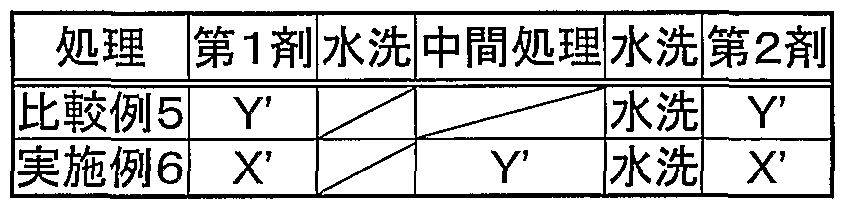
- a hair bundle was prepared from 10 strong curly hairs of Japanese, wrapped around a glass rod with a diameter of 10 thighs, treated as shown in Table 8, and the degree of perm was evaluated from the appearance.
- Table 8
- Example 6 the first agent having the same weight as the hair bundle was applied and left at 40 ° C. for 30 minutes.
- Example 6 the first part was not rinsed with water, and an amount of an intermediate treatment twice as much as the amount of the first part was applied to the hair, left for one minute, rinsed with water, and drained with a towel. .
- the first agent was rinsed with water and dried with a towel.
- Example 6 In both Example 6 and Comparative Example 5, a second agent having the same weight as the hair was applied to the hair, left at 40 ° C. for 20 minutes, rinsed with water, and the hair bundle was removed from the rod and air-dried. .
Landscapes
- Health & Medical Sciences (AREA)
- Life Sciences & Earth Sciences (AREA)
- Animal Behavior & Ethology (AREA)
- General Health & Medical Sciences (AREA)
- Public Health (AREA)
- Veterinary Medicine (AREA)
- Birds (AREA)
- Epidemiology (AREA)
- Cosmetics (AREA)
Description




Claims
Priority Applications (6)
| Application Number | Priority Date | Filing Date | Title |
|---|---|---|---|
| ES02730869.1T ES2504316T3 (es) | 2001-06-04 | 2002-06-03 | Procedimientos de tratamiento del cabello |
| KR10-2003-7001534A KR20030020961A (ko) | 2001-06-04 | 2002-06-03 | 모발 처리 방법 |
| EP02730869.1A EP1393708B1 (en) | 2001-06-04 | 2002-06-03 | Method of treating hair |
| BRPI0205514-7B1A BR0205514B1 (pt) | 2001-06-04 | 2002-06-03 | processos de tratamento de cabelo |
| MXPA03001032A MXPA03001032A (es) | 2001-06-04 | 2002-06-03 | Metodo de tratamiento de cabello. |
| US10/333,914 US20040011373A1 (en) | 2001-06-04 | 2002-06-03 | Method of treating hair |
Applications Claiming Priority (2)
| Application Number | Priority Date | Filing Date | Title |
|---|---|---|---|
| JP2001168078A JP3703738B2 (ja) | 2001-06-04 | 2001-06-04 | 縮毛矯正方法 |
| JP2001-168078 | 2001-06-04 |
Publications (1)
| Publication Number | Publication Date |
|---|---|
| WO2002098381A1 true WO2002098381A1 (en) | 2002-12-12 |
Family
ID=19010362
Family Applications (1)
| Application Number | Title | Priority Date | Filing Date |
|---|---|---|---|
| PCT/JP2002/005419 Ceased WO2002098381A1 (en) | 2001-06-04 | 2002-06-03 | Method of treating hair |
Country Status (11)
| Country | Link |
|---|---|
| US (1) | US20040011373A1 (ja) |
| EP (1) | EP1393708B1 (ja) |
| JP (1) | JP3703738B2 (ja) |
| KR (1) | KR20030020961A (ja) |
| CN (1) | CN1253143C (ja) |
| BR (1) | BR0205514B1 (ja) |
| ES (1) | ES2504316T3 (ja) |
| MX (1) | MXPA03001032A (ja) |
| TW (1) | TWI311487B (ja) |
| WO (1) | WO2002098381A1 (ja) |
| ZA (1) | ZA200300250B (ja) |
Cited By (2)
| Publication number | Priority date | Publication date | Assignee | Title |
|---|---|---|---|---|
| WO2017111095A1 (ja) * | 2015-12-25 | 2017-06-29 | 花王株式会社 | 毛髪処理方法 |
| WO2018142484A1 (ja) * | 2017-01-31 | 2018-08-09 | 花王株式会社 | 毛髪処理方法 |
Families Citing this family (27)
| Publication number | Priority date | Publication date | Assignee | Title |
|---|---|---|---|---|
| KR100389706B1 (en) * | 2003-02-10 | 2003-06-28 | Beebong Fine Ltd | Composition of self-diagnosis and reduction catalyst type permanent and straightener and manufacturing method thereof |
| JP4589820B2 (ja) * | 2005-06-20 | 2010-12-01 | 花王株式会社 | 毛髪化粧料 |
| JP4931374B2 (ja) * | 2005-06-20 | 2012-05-16 | 花王株式会社 | 毛髪化粧料 |
| FR2901471B1 (fr) | 2006-05-24 | 2010-06-04 | Oreal | Procede de defrisage des fibres keratiniques avec un moyen de chauffage et un derive d'acide |
| DE102008062397A1 (de) * | 2008-12-17 | 2010-06-24 | Henkel Ag & Co. Kgaa | Farbabzug mit Wärmebehandlung |
| CN102008424B (zh) * | 2010-12-17 | 2012-05-23 | 广州温雅日用化妆品有限公司 | 凝露状直发剂 |
| DE102010064052A1 (de) * | 2010-12-23 | 2012-06-28 | Henkel Ag & Co. Kgaa | Verfahren zur Umformung keratinhaltiger Fasern |
| EP2852376B1 (en) | 2012-05-21 | 2017-10-25 | Unilever PLC | Method of treating hair |
| WO2013174575A1 (en) * | 2012-05-21 | 2013-11-28 | Unilever Plc | Method of treating hair |
| JP6220387B2 (ja) | 2012-05-21 | 2017-10-25 | ユニリーバー・ナームローゼ・ベンノートシヤープ | 毛髪を処理する方法 |
| FR3009681B1 (fr) * | 2013-08-13 | 2015-08-07 | Oreal | Procede de traitement des fibres keratiniques a partir d'une composition hydroalcoolique comprenant un mono acide organique |
| BR112016009672B1 (pt) | 2013-11-21 | 2020-07-21 | Unilever Nv. | método para modelar os cabelos |
| EA028939B1 (ru) | 2013-11-21 | 2018-01-31 | Юнилевер Н.В. | Способ придания волосам определённой формы |
| EP3082750A1 (en) | 2013-12-19 | 2016-10-26 | The Procter & Gamble Company | Shaping keratin fibres using a reducing composition and a fixing composition |
| EP3082731B1 (en) | 2013-12-19 | 2018-07-04 | The Procter and Gamble Company | Shaping keratin fibres using an active agent comprising at least two functional groups selected from: -c(oh)- and -c(=o)oh |
| US11129784B2 (en) | 2013-12-19 | 2021-09-28 | The Procter And Gamble Company | Shaping keratin fibres using oxoethanoic acid and/or derivatives thereof |
| EP3082744A1 (en) | 2013-12-19 | 2016-10-26 | The Procter & Gamble Company | Shaping keratin fibres using carbonate ester |
| WO2015094757A1 (en) | 2013-12-19 | 2015-06-25 | The Procter & Gamble Company | Shaping keratin fibres using a sugar |
| JP6346951B2 (ja) | 2013-12-19 | 2018-06-20 | ザ プロクター アンド ギャンブル カンパニー | ケラチン繊維の成形方法 |
| WO2015095685A1 (en) * | 2013-12-19 | 2015-06-25 | The Procter & Gamble Company | Shaping keratin fibres using 2-hydroxypropane-1,2,3-tricarboxylic acid and/or 1,2,3,4-butanetetracarboxylic acid |
| CN107106438A (zh) | 2014-12-19 | 2017-08-29 | 宝洁公司 | 成形角蛋白纤维的方法 |
| MX2017008204A (es) | 2014-12-19 | 2017-10-06 | Procter & Gamble | Conformacion de las fibras de queratina mediante el uso de arabinosa y carbonato de etileno. |
| US10945931B2 (en) | 2015-06-18 | 2021-03-16 | The Procter And Gamble Company | Shaping keratin fibres using dialdehyde compounds |
| CN108697615B (zh) * | 2016-03-09 | 2021-04-13 | 熊谷昌代 | 毛发处理方法及毛发处理剂组 |
| JP7094661B2 (ja) * | 2017-04-24 | 2022-07-04 | 花王株式会社 | 毛髪処理方法 |
| JP7458207B2 (ja) * | 2019-05-10 | 2024-03-29 | 花王株式会社 | 毛髪処理方法 |
| JP2023163406A (ja) * | 2022-04-28 | 2023-11-10 | ホーユー株式会社 | 毛髪処理剤、多剤式毛髪処理剤及び毛髪処理方法 |
Citations (5)
| Publication number | Priority date | Publication date | Assignee | Title |
|---|---|---|---|---|
| EP0529437A1 (en) * | 1991-08-14 | 1993-03-03 | Kao Corporation | Hair treatment composition |
| JPH06293618A (ja) * | 1993-04-06 | 1994-10-21 | Kao Corp | ケラチン繊維処理剤組成物 |
| EP0629395A1 (en) * | 1993-04-28 | 1994-12-21 | Kao Corporation | Keratinous fiber treatment compositions |
| JPH07101840A (ja) * | 1993-10-06 | 1995-04-18 | Kao Corp | 縮毛矯正剤組成物及び該組成物を用いる縮毛矯正方法 |
| JPH0892043A (ja) * | 1994-09-29 | 1996-04-09 | Kao Corp | 毛髪変形剤組成物 |
Family Cites Families (4)
| Publication number | Priority date | Publication date | Assignee | Title |
|---|---|---|---|---|
| GB690866A (en) * | 1949-02-15 | 1953-04-29 | Henkel & Cie Gmbh | Process for the permanent waving of hair or equivalent operation |
| US3482581A (en) * | 1966-08-01 | 1969-12-09 | John D Weigand | Straightening of live human hair with an aqueous acidic glycol solution |
| JPS58222008A (ja) * | 1982-06-16 | 1983-12-23 | Lion Corp | パ−マネントウエ−ブ剤 |
| US5240695A (en) * | 1988-02-11 | 1993-08-31 | L'oreal | Use of 2-hydroxy-4-methoxybenzophenone-5-sulphonic acid or its salts for protecting the hair against environmental attacking agents, and especially against light and process for protecting the hair using the compound |
-
2001
- 2001-06-04 JP JP2001168078A patent/JP3703738B2/ja not_active Expired - Fee Related
-
2002
- 2002-06-03 KR KR10-2003-7001534A patent/KR20030020961A/ko not_active Withdrawn
- 2002-06-03 BR BRPI0205514-7B1A patent/BR0205514B1/pt not_active IP Right Cessation
- 2002-06-03 MX MXPA03001032A patent/MXPA03001032A/es unknown
- 2002-06-03 EP EP02730869.1A patent/EP1393708B1/en not_active Expired - Lifetime
- 2002-06-03 WO PCT/JP2002/005419 patent/WO2002098381A1/ja not_active Ceased
- 2002-06-03 US US10/333,914 patent/US20040011373A1/en not_active Abandoned
- 2002-06-03 CN CNB028018265A patent/CN1253143C/zh not_active Expired - Fee Related
- 2002-06-03 ES ES02730869.1T patent/ES2504316T3/es not_active Expired - Lifetime
- 2002-06-04 TW TW091111972A patent/TWI311487B/zh not_active IP Right Cessation
-
2003
- 2003-01-09 ZA ZA200300250A patent/ZA200300250B/en unknown
Patent Citations (5)
| Publication number | Priority date | Publication date | Assignee | Title |
|---|---|---|---|---|
| EP0529437A1 (en) * | 1991-08-14 | 1993-03-03 | Kao Corporation | Hair treatment composition |
| JPH06293618A (ja) * | 1993-04-06 | 1994-10-21 | Kao Corp | ケラチン繊維処理剤組成物 |
| EP0629395A1 (en) * | 1993-04-28 | 1994-12-21 | Kao Corporation | Keratinous fiber treatment compositions |
| JPH07101840A (ja) * | 1993-10-06 | 1995-04-18 | Kao Corp | 縮毛矯正剤組成物及び該組成物を用いる縮毛矯正方法 |
| JPH0892043A (ja) * | 1994-09-29 | 1996-04-09 | Kao Corp | 毛髪変形剤組成物 |
Non-Patent Citations (1)
| Title |
|---|
| See also references of EP1393708A4 * |
Cited By (8)
| Publication number | Priority date | Publication date | Assignee | Title |
|---|---|---|---|---|
| WO2017111095A1 (ja) * | 2015-12-25 | 2017-06-29 | 花王株式会社 | 毛髪処理方法 |
| JP2017119689A (ja) * | 2015-12-25 | 2017-07-06 | 花王株式会社 | 毛髪処理方法 |
| CN108366943A (zh) * | 2015-12-25 | 2018-08-03 | 花王株式会社 | 毛发处理方法 |
| WO2018142484A1 (ja) * | 2017-01-31 | 2018-08-09 | 花王株式会社 | 毛髪処理方法 |
| JPWO2018142484A1 (ja) * | 2017-01-31 | 2019-11-14 | 花王株式会社 | 毛髪処理方法 |
| EP3578162A4 (en) * | 2017-01-31 | 2020-07-29 | Kao Corporation | HAIR TREATMENT METHOD |
| JP7003068B2 (ja) | 2017-01-31 | 2022-01-20 | 花王株式会社 | 毛髪処理方法 |
| TWI775804B (zh) | 2017-01-31 | 2022-09-01 | 日商花王股份有限公司 | 毛髮處理方法 |
Also Published As
| Publication number | Publication date |
|---|---|
| JP2002363042A (ja) | 2002-12-18 |
| ZA200300250B (en) | 2004-02-10 |
| EP1393708A1 (en) | 2004-03-03 |
| KR20030020961A (ko) | 2003-03-10 |
| TWI311487B (ja) | 2009-07-01 |
| US20040011373A1 (en) | 2004-01-22 |
| ES2504316T3 (es) | 2014-10-08 |
| CN1253143C (zh) | 2006-04-26 |
| BR0205514A (pt) | 2003-07-08 |
| EP1393708B1 (en) | 2014-07-02 |
| EP1393708A4 (en) | 2010-02-17 |
| JP3703738B2 (ja) | 2005-10-05 |
| MXPA03001032A (es) | 2004-09-10 |
| CN1463190A (zh) | 2003-12-24 |
| BR0205514B1 (pt) | 2013-10-01 |
Similar Documents
| Publication | Publication Date | Title |
|---|---|---|
| WO2002098381A1 (en) | Method of treating hair | |
| JP2960344B2 (ja) | 塩基性アミノ酸およびカチオンポリマーを含有する還元組成物 | |
| EP2123250A1 (en) | Hair-shape controlling composition | |
| JPH0624946A (ja) | 還元性化粧料組成物 | |
| TWI324071B (ja) | ||
| JP6940076B2 (ja) | 毛髪処理方法 | |
| JP5033488B2 (ja) | 毛髪形状制御剤第1剤 | |
| JP3987381B2 (ja) | 毛髪処理方法 | |
| CN101583400B (zh) | 毛发矫直组合物 | |
| JP2001247436A (ja) | 一浴式毛髪変形剤 | |
| JP7531795B2 (ja) | 毛髪処理剤 | |
| JP2020070282A (ja) | 毛髪処理剤及びパーマネントウェーブ処理方法 | |
| JPH06502872A (ja) | 毛髪のパーマネント加工用固定剤および方法 | |
| JP5219234B2 (ja) | 毛髪処理剤 | |
| JP6199536B2 (ja) | パーマネントウェーブ用第1剤およびパーマネントウェーブ用剤 | |
| JP6929621B2 (ja) | 毛髪変形用第2剤、毛髪変形用剤及び毛髪変形方法 | |
| JP6929620B2 (ja) | 毛髪変形用第2剤、毛髪変形用剤及び毛髪変形方法 | |
| JP2007314498A (ja) | 毛髪処理方法 | |
| WO2018079478A1 (ja) | 毛髪処理剤及び毛髪浸透促進剤 | |
| JP2006347970A (ja) | パーマネントウエーブ剤組成物 | |
| JP5436802B2 (ja) | パ−マネントウエ−ブ方法 | |
| JP2005330267A (ja) | 低濃度システアミン含有毛髪処理剤および該毛髪処理剤を使用した毛髪処理方法 | |
| JPH05320031A (ja) | 毛髪処理剤組成物 | |
| JP2006016391A (ja) | 毛髪形状制御剤 | |
| JP2007507420A (ja) | 毛髪の酸化処理用薬剤におけるベンゾキノン類の使用、並びにパーマネントヘア加工のための方法及び薬剤 |
Legal Events
| Date | Code | Title | Description |
|---|---|---|---|
| AK | Designated states |
Kind code of ref document: A1 Designated state(s): BR CN ID KR MX US ZA |
|
| AL | Designated countries for regional patents |
Kind code of ref document: A1 Designated state(s): AT BE CH CY DE DK ES FI FR GB GR IE IT LU MC NL PT SE TR |
|
| WWE | Wipo information: entry into national phase |
Ref document number: 2003/00250 Country of ref document: ZA Ref document number: 200300250 Country of ref document: ZA |
|
| WWE | Wipo information: entry into national phase |
Ref document number: 028018265 Country of ref document: CN |
|
| WWE | Wipo information: entry into national phase |
Ref document number: 2002730869 Country of ref document: EP |
|
| WWE | Wipo information: entry into national phase |
Ref document number: PA/a/2003/001032 Country of ref document: MX Ref document number: 10333914 Country of ref document: US Ref document number: 1020037001534 Country of ref document: KR |
|
| 121 | Ep: the epo has been informed by wipo that ep was designated in this application | ||
| WWP | Wipo information: published in national office |
Ref document number: 1020037001534 Country of ref document: KR |
|
| WWP | Wipo information: published in national office |
Ref document number: 2002730869 Country of ref document: EP |