WO2002098960A1 - Composition de resine de polystyrene resistant aux agents chimiques et article moule - Google Patents
Composition de resine de polystyrene resistant aux agents chimiques et article moule Download PDFInfo
- Publication number
- WO2002098960A1 WO2002098960A1 PCT/JP2002/005157 JP0205157W WO02098960A1 WO 2002098960 A1 WO2002098960 A1 WO 2002098960A1 JP 0205157 W JP0205157 W JP 0205157W WO 02098960 A1 WO02098960 A1 WO 02098960A1
- Authority
- WO
- WIPO (PCT)
- Prior art keywords
- styrene
- weight
- component
- polymer
- parts
- Prior art date
- Legal status (The legal status is an assumption and is not a legal conclusion. Google has not performed a legal analysis and makes no representation as to the accuracy of the status listed.)
- Ceased
Links
Classifications
-
- C—CHEMISTRY; METALLURGY
- C08—ORGANIC MACROMOLECULAR COMPOUNDS; THEIR PREPARATION OR CHEMICAL WORKING-UP; COMPOSITIONS BASED THEREON
- C08L—COMPOSITIONS OF MACROMOLECULAR COMPOUNDS
- C08L25/00—Compositions of, homopolymers or copolymers of compounds having one or more unsaturated aliphatic radicals, each having only one carbon-to-carbon double bond, and at least one being terminated by an aromatic carbocyclic ring; Compositions of derivatives of such polymers
- C08L25/02—Homopolymers or copolymers of hydrocarbons
- C08L25/04—Homopolymers or copolymers of styrene
- C08L25/06—Polystyrene
-
- C—CHEMISTRY; METALLURGY
- C08—ORGANIC MACROMOLECULAR COMPOUNDS; THEIR PREPARATION OR CHEMICAL WORKING-UP; COMPOSITIONS BASED THEREON
- C08L—COMPOSITIONS OF MACROMOLECULAR COMPOUNDS
- C08L71/00—Compositions of polyethers obtained by reactions forming an ether link in the main chain; Compositions of derivatives of such polymers
- C08L71/08—Polyethers derived from hydroxy compounds or from their metallic derivatives
- C08L71/10—Polyethers derived from hydroxy compounds or from their metallic derivatives from phenols
- C08L71/12—Polyphenylene oxides
- C08L71/123—Polyphenylene oxides not modified by chemical after-treatment
-
- C—CHEMISTRY; METALLURGY
- C08—ORGANIC MACROMOLECULAR COMPOUNDS; THEIR PREPARATION OR CHEMICAL WORKING-UP; COMPOSITIONS BASED THEREON
- C08L—COMPOSITIONS OF MACROMOLECULAR COMPOUNDS
- C08L2205/00—Polymer mixtures characterised by other features
- C08L2205/02—Polymer mixtures characterised by other features containing two or more polymers of the same C08L -group
-
- C—CHEMISTRY; METALLURGY
- C08—ORGANIC MACROMOLECULAR COMPOUNDS; THEIR PREPARATION OR CHEMICAL WORKING-UP; COMPOSITIONS BASED THEREON
- C08L—COMPOSITIONS OF MACROMOLECULAR COMPOUNDS
- C08L53/00—Compositions of block copolymers containing at least one sequence of a polymer obtained by reactions only involving carbon-to-carbon unsaturated bonds; Compositions of derivatives of such polymers
- C08L53/02—Compositions of block copolymers containing at least one sequence of a polymer obtained by reactions only involving carbon-to-carbon unsaturated bonds; Compositions of derivatives of such polymers of vinyl-aromatic monomers and conjugated dienes
-
- C—CHEMISTRY; METALLURGY
- C08—ORGANIC MACROMOLECULAR COMPOUNDS; THEIR PREPARATION OR CHEMICAL WORKING-UP; COMPOSITIONS BASED THEREON
- C08L—COMPOSITIONS OF MACROMOLECULAR COMPOUNDS
- C08L71/00—Compositions of polyethers obtained by reactions forming an ether link in the main chain; Compositions of derivatives of such polymers
- C08L71/08—Polyethers derived from hydroxy compounds or from their metallic derivatives
- C08L71/10—Polyethers derived from hydroxy compounds or from their metallic derivatives from phenols
- C08L71/12—Polyphenylene oxides
Definitions
- the present invention 1 relates to a chemically resistant polystyrene resin molded article, and more particularly to a styrene-based polymer having a crystallinity of a certain value or less and mainly having a syndiotactic structure (hereinafter, syndiotactic polystyrene (B))
- the present invention relates to a chemically resistant polystyrene-based resin molded article having chemical resistance imparted by blending of.
- the present invention 2 also relates to a chemically resistant polystyrene resin molded product, and more specifically, a styrene polymer having a crystallization temperature peak value or less and having mainly a syndiotactic structure (hereinafter, referred to as a styrene polymer).
- the present invention relates to a chemical-resistant polystyrene resin composition imparted with chemical resistance by blending with syndiotactic polystyrene (C), and a molded article thereof.
- the present invention 3 relates to excellent chemical polystyrene resin molded article transparency, more specifically, by the styrene content as a rubber component is blended 7 0 mass 0/0 or more styrenic block polymers,
- the present invention relates to a highly transparent, chemically resistant polystyrene resin molded product that achieves both transparency and chemical resistance under strain.
- Polystyrene resins obtained by radical polymerization of aromatic vinyl compounds are inexpensive and have been conventionally used for various purposes, but are amorphous due to their atactic three-dimensional structure.
- the chemical resistance was not always satisfactory, and the range of application was narrowed.
- many of the detergents and toiletry-related products that have been commercialized in recent years often cause cracking and cracking of polystyrene-based resins, and there is a strong demand from the market to improve the chemical resistance of polystyrene-based resins. Have been.
- styrene polymer having an atactic structure hereinafter sometimes referred to as an atactic polystyrene
- styrene and a polar monomer such as acrylonitrile, metathallate, atalylate, maleic anhydride, or maleimide are used. Attempts have been made to improve the chemical resistance by copolymerizing and.
- syndiotactic polystyrene having crystallinity has been developed, and a composition with syndiotactic polystyrene has been proposed for the purpose of improving the chemical resistance of atactic polystyrene.
- Japanese Patent Application Laid-open No. Hei 11-2797347 and Japanese Patent Laid-Open No. Hei 11-27939 has been proposed for the purpose of improving the chemical resistance of atactic polystyrene.
- the present invention 1 has been made from the above viewpoint, and is a molded article comprising atactic polystyrene or a composition prepared by blending syndiotactic polystyrene (B) with atactic polystyrene and polyphenylene ether. It is another object of the present invention to provide a chemically resistant polystyrene resin molded article having more effectively exhibited chemical resistance.
- the present invention 2 relates to a case where ordinary syndiotactic polystyrene is blended by blending a specific syndiotactic polystyrene (C) with atactic polystyrene or atactic polystyrene and polyphenylene ether. It is an object of the present invention to provide a resin composition which can further improve chemical resistance as well as exhibit sufficient physical properties, and a molded article thereof.
- Polystyrene resins obtained by radical polymerization of aromatic vinyl compounds are inexpensive and have been conventionally used for various purposes, but are amorphous due to their atactic three-dimensional structure. However, the chemical resistance was not always satisfactory.
- GPPS general-purpose polythistyrene
- HIPS high-impact polystyrene
- atactic polystyrene matrix components and rubber components of HIPS and ABS (acrylonitrile-butadiene-styrene) are used.
- HIPS acrylonitrile-butadiene-styrene
- these copolymers have the problem that the random copolymerization ratio is limited, the productivity is reduced, the color tone is changed, there is an odor, and cyan gas is generated during incineration.
- these copolymers are different from polystyrene in chemical structure, they are not easily compatibilized with polystyrene and have a problem that mixing and recycling are difficult.
- syndiotactic polystyrene having crystallinity has been developed, and a composition having transparency and chemical resistance has been proposed by syndiotactic polystyrene alone or blended with GPPS (Japanese Patent Application Laid-Open No. 11-27999). No. 347, JP-A-11-2797349).
- syndiotactic polystyrene and the blending of syndiotactic and HIPS can improve toughness and cracking caused by chemicals under strain, but it is not possible to maintain transparency.
- a chemically resistant polystyrene resin composition having excellent transparency by giving a molded article having both transparency and chemical resistance under strain by adding a specific rubber component to len ether. ⁇ .
- molded products having a relative crystallinity of a certain value or less which are composed of atactic polystyrene or a composition in which syndiotactic polystyrene (B) is blended with atactic polystyrene and polyphenylene ether, Is more effectively expressed.
- the present inventor has conducted extensive research to solve the above problems, as a rubber component, a styrene content by using a 7 0 wt 0/0 or more styrenic Purokkupo Rimmer, transparency and distortion under It has been found that a molded article having both excellent chemical resistance can be obtained.
- the present invention has been completed based on such findings.
- the present invention 1 comprises (A) a styrene-based polymer having an atactic structure, or a total amount of 10 to 95 parts by weight of a styrene-based polymer having an atactic structure and polyphenylene ether, and (B) mainly A chemically resistant polystyrene resin molded article obtained by molding a styrene resin composition having 90 to 5 parts by weight of a styrene polymer having a syndiotactic structure,
- An object of the present invention is to provide a chemically resistant polystyrene resin molded product having a relative crystallinity of the component (B) of up to 0.5 mm from the surface of the product and a relative crystallinity of 30% or less.
- the present invention 2 comprises (A) a styrene-based polymer having an atactic structure, or a total amount of 10 to 95 parts by weight of a styrene-based polymer having an atactic structure and polyphenylene ether; According to a scanning calorimeter (DSC), it has a syndiotactic structure with a crystallization temperature (T c) peak value of 220 ° C or less when the temperature is lowered from 300 ° C at a rate of 20 ° C.
- T c crystallization temperature
- An object of the present invention is to provide a chemically resistant polystyrene resin composition comprising 90 to 5 parts by weight of a styrene polymer and a molded article thereof.
- the present invention 3 relates to (D) (d1) 97 to 3 parts by weight of a styrene-based polymer mainly having a syndiotactic structure or (d2) a styrene-based polymer mainly having a syndiotactic structure, or an atactic structure.
- a rubber component 3-9 7 parts by weight styrene content 7 is 0 mass 0/0 or more block polymer of ether
- Highly transparent chemical-resistant material comprising a styrene-based polymer having a syndiotactic structure and having a content of at least 3 parts by weight based on a total of 100 parts by weight of the components (D) and (E). It is intended to provide a water-soluble polystyrene resin composition and a molded product thereof.
- the atactic polystyrene of the component (A) used in the present inventions 1 and 2 can be obtained by a polymerization method such as solution polymerization, bulk polymerization, suspension polymerization, or bulk-suspension polymerization.
- a polymerization method such as solution polymerization, bulk polymerization, suspension polymerization, or bulk-suspension polymerization.
- R represents a substituent containing at least one of a hydrogen atom, a halogen atom or a carbon atom, an oxygen atom, a nitrogen atom, a sulfur atom, a phosphorus atom, a selenium atom, a tin atom and a silicon atom; m represents an integer of 1 to 3. However, when m is plural, each R may be the same or different.
- Preferred aromatic vinyl compounds include styrene, ⁇ -methylstyrene, methinolestyrene, ethynolestyrene, isopropynolestyrene, tert-butylinolestyrene, and other anolequinolestyrenes, phenyl / styrene, phenylinolestyrene, chlorostyrene, and the like. There are bromostyrene, phenolic styrene, chloromethinolestyrene, methoxystyrene, ethoxystyrene and the like, and these are used alone or in combination of two or more.
- aromatic vinyl compounds are styrene, ⁇ -methinolestyrene, m-methinolestyrene, p-tert-butylstyrene, p-chlorostyrene, m-chlorostyrene, and ⁇ -funolenerostyrene. is there.
- vinyl monomers copolymerizable with the aromatic vinyl compound include vinyl cyanide compounds such as acrylonitrile and methacrylonitrile; Tallylate, ethyl acrylate, propyl acrylate, butyl acrylate, amino acrylate, hexinole acrylate, octyl acrylate, 2-ethyl hex eno acrylate, 2-hexyl acrylate, hexyl acrylate, Acrylates such as dodecyl acrylate, octadecyl acrylate, phenyl acrylate, benzyl acrylate, etc., methyl methacrylate, ethyl methacrylate, butyl methacrylate, ami ⁇ / methacrylate, hexinomethacrylate Rate, otatinole methacrylate, 2-ethynolehexyl methacrylate, cyclohexyl methacrylate, dodec
- Examples of the rubbery polymer copolymerizable with the aromatic vinyl compound include polybutadiene, styrene-butadiene copolymer, acrylonitrile-butadiene copolymer, gen-based rubbers such as polyisoprene, and ethylene monoolefin.
- Non-gen-based rubbers such as copolymers, ethylene-olefin-polyene copolymers, polyacrylonitrile ester, etc., styrene-butadiene block copolymers, hydrogenated styrene-butadiene block copolymers, ethylene-propylene elastomer copolymers Styrene-graft ethylene-propylene elastomer, ethylene ionomer resin, hydrogenated styrene-isoprene copolymer, and the like.
- the atactic polystyrene of the component (A) is not particularly limited in its molecular weight, but generally has a weight average molecular weight of 10,000 or more, preferably 50,000 or more. That is all.
- the weight average molecular weight is less than 10,000, the thermal properties and mechanical properties of the obtained molded article are undesirably reduced.
- the atactic polystyrene as the component (D) used in the present invention 3 can be obtained by a polymerization method such as solution polymerization, bulk polymerization, suspension polymerization, or bulk-suspension polymerization.
- R represents a substituent containing at least one of a hydrogen atom, a halogen atom or a carbon atom, an oxygen atom, a nitrogen atom, a sulfur atom, a phosphorus atom, a selenium atom, a tin atom and a silicon atom; Represents an integer of 1 to 3. However, when m is plural, each R may be the same or different.
- Preferred aromatic biel compounds include alkylstyrenes such as styrene, ⁇ -methylstyrene, methinolestyrene, ethynolestyrene, isopropynolestyrene, and tert-butylstyrene, phenylenostyrene, vinylstyrene, chlorostyrene, bromostyrene, and phenylenestyrene. , Chloromethinole styrene, methoxy styrene, ethoxy styrene, etc., and these are used alone or in combination of two or more.
- aromatic vinyl compounds are styrene, ⁇ - The molecular weight of c (D) component atactic polystyrene, which is methynolestyrene, m-methynolestyrene, p-tert-butylstyrene, p-chlorostyrene, m-chlorostyrene, and p-phenololestyrene, Is not particularly limited, but generally has a weight average molecular weight of 10,000 or more, preferably 50,000 or more.
- the thermal and mechanical properties of the resulting molded product are undesirably reduced.
- polyphenylene ether can be used as part of the component (A) or the component (D) in order to improve the heat resistance of the molded article.
- Polyphenylene ether is a known compound, and for this purpose, U.S. Patent Nos. 3,306,874, 3,068,755, 3,257,357, and 32 Reference can be made to the respective specifications of the publication No. 5 7 3 5 8.
- Polyphenylene ethers are usually prepared by an oxidative coupling reaction to form homopolymers or copolymers in the presence of a copper amine complex, one or more di- or tri-substituted phenols.
- the copper amine complex may be a copper amine complex derived from primary, secondary and / or tertiary amines.
- polyphenylene ethers examples include poly (2,3-dimethyl-6-ethyl-1,4-phenylene ether), poly (2-methynole 6-chloro-mouth methylene 1,1,4-phenylene ether), poly ( 2-Methyl / Let 6-Hydroxyxetinole _1,4-Phenylene ether, Poly (2-methyl-6-n-Phyl-1 1,4,1-phenylene ether), Poly (2-ethyl-ethyl 6-iso) Propyl 1, 4—Hue-Leneethenole Poly (2—ethyl 6—n— Propyl-1,4-phenylene ether, poly (2,3,6-trimethyl 1,4, phenylene ether), poly (2- (4,1-methylphenylene))-1,4 — Phenylene ethereol, poly (2-bromo-6-phenylene 1,1,4-phenylene ether), poly (2-methyl-6-phenylene 1,4,4-pheny
- copolymers such as copolymers derived from two or more phenolic compounds used in the preparation of the homopolymer are also suitable. Further, those modified with a modifying agent such as maleic anhydride, fumaric acid or the like are also preferably used.
- a graft copolymer and a block copolymer of a vinyl aromatic compound such as polystyrene and the above-mentioned polyphenylene ether are also exemplified.
- a vinyl aromatic compound such as polystyrene and the above-mentioned polyphenylene ether
- particularly preferred is poly (2,6-dimethyl-1,4-phenylene ether).
- the molecular weight of this poly (ethylene ether) is not particularly limited, it is preferable that the intrinsic viscosity measured at 25 ° C in chloroform is not more than 0.5 deciliter / g. Alternatively, a material with a volume of 0.45 deciliters or less is used.
- the fluidity during molding may be significantly reduced.
- the blending ratio is not particularly limited, but is preferably 5 to 80% by mass, more preferably 10 to 60% by mass in the component (A). %.
- the compounding ratio is less than 5% by mass, the effect of improving heat resistance is small, and if it exceeds 80% by mass, the fluidity during molding may be significantly reduced.
- the total amount of the components (D) and (E) is 100% by weight.
- the proportion of syndiotactic polystyrene in the part must be at least 3 parts by weight.
- It is preferably at least 5 parts by weight, more preferably at least 10 parts by weight.
- a rubber-like elastic body can be used in combination with the component (A) in order to improve impact resistance.
- the rubber-like elastic body examples include natural rubber, polybutadiene, polyisoprene, polyisobutylene, neoprene, police / refined rubber, choco rubber, atalinole rubber, urethane rubber, silicone rubber, epichlorohydrin rubber, and styrene-butadiene block.
- SBR hydrogenated styrene-butadiene block copolymer
- SEB hydrogenated styrene-butadiene block copolymer
- SBS hydrogenated styrene-butadiene-styrene block copolymer
- SIR styrene-isoprene block copolymer
- SEP hydrogenated styrene-isoprene block copolymer
- SIS hydrogenated styrene-isoprene-styrene block copolymer
- SEPS hydrogenated styrene-isoprene-styrene block copolymer
- EPM ethylene propylene rubber
- EPDM butadiene-acrylonitrile-styrene-core-shell rubber
- ABS butadiene-acrylonitrile-styrene-core-shell rubber
- SBR SBR
- SEB SBS
- SEBS SEBS
- SIR SEP
- SIS SEPS
- SEP SEP
- SIS SEPS
- core chenore rubber EPM
- EPDM EPDM
- rubbers modified from these are preferably used.
- These rubber-like elastic bodies can be used alone or in combination of two or more.
- the mixing ratio of the rubber-like elastic material is not limited, but is not more than 50% by mass, preferably not more than 40% by mass, more preferably not more than 30% by mass in the component (A).
- the chemical resistance may be lowered and the elastic modulus may be lowered.
- the component (E) of the present invention 3 is a rubber component, and a block polymer having a styrene content of 70% by mass or more is used.
- the styrene content is preferably 75% by weight.
- the styrene content is less than 70% by mass, it is difficult to ensure sufficient transparency in the molded article.
- the upper limit of the styrene content is not particularly limited, but is preferably 95% by mass or less.
- Such rubber components include styrene-butadiene block copolymer (SBR), hydrogenated styrene-butadiene block copolymer (SEB, SEBC), styrene-butadiene-styrene block copolymer (SBS), hydrogen Styrene-butadiene-styrene block copolymer (SEBS), styrene-isoprene block copolymer (SIR), hydrogenated styrene-isoprene block copolymer (SEP), styrene-isoprene-styrene block copolymer (SIS ), Hydrogenated styrene-isoprene-styrene block copolymer (SEPS), or rubber modified from these.
- SBR styrene-butadiene block copolymer
- SEB hydrogenated styrene-butadiene block copolymer
- SBS hydrogen
- SBS SBS
- SEBS SEBS
- SIS SEPS
- SEPS SEPS
- SEBS and SEPS are more preferably used from the viewpoint of thermal stability.
- These rubber-like elastic bodies can be used alone or in combination of two or more.
- the syndiotactic structure means a stereochemical structure.
- the tacticity measured by the NMR method is The abundance ratio of the structural units can be represented by diads for two, triads for three, and pentads for five, but the styrene mainly having a syndiotactic structure referred to in the present invention.
- the term "polymer” refers to polystyrene having a syndiotacticity of usually 75% or more, preferably 85% or more in racemic diad, or 30% or more in racemic pentad, preferably 50% or more.
- Poly (alkyl styrene), poly (halogenated styrene), poly (halogenated alkyl styrene), poly (alkoxy styrene), poly (butyl benzoate), hydrogenated polymers of these, mixtures thereof, or these Refers to a copolymer whose main component is.
- poly (alkylstyrene) includes poly (methylstyrene), poly (ethylstyrene), poly (isopropylstyrene), poly (tertiary butylinolestyrene), poly (phenylenolestyrene), and poly (phenylenestyrene).
- bi naphthalene
- poly (halogenated styrene) includes poly (chlorostyrene), poly (bromostyrene), poly (fluorostyrene) and the like.
- poly (halogenated alkylstyrene) examples include poly (chloromethylstyrene), and examples of poly (alkoxystyrene) include poly (methoxystyrene) and poly (ethoxystyrene).
- styrenic polymers having a syndiotactic structure can be used alone or in combination of two or more.
- syndiotactic polystyrenes include polystyrene, poly (p-methylstyrene), poly (m-methylstyrene), poly (p-tert-butyltinolestyrene), and poly (p-chlorostyrene).
- the crystallinity of the syndiotactic polystyrene (B) component in the molded article of the present invention 1 needs to have a relative crystallinity of 30% or less from the molded article surface to a depth of 0.5 mm.
- This relative crystallinity is preferably 20% or less, more preferably 10% or less.
- the relative crystallinity exceeds 30%, it is difficult to sufficiently exhibit the chemical resistance of the molded article, and furthermore, the gloss of the molded article and the physical properties may be reduced.
- Methods for controlling the crystallinity include resin temperature, mold temperature, cooling rate, design of syndiotactic polystyrene (B) component, additives, ratio of syndiotactic polystyrene component, atactic polystyrene component and polyphenic acid. There is a method of controlling the molecular weight and the amount of the len ether component.
- the syndiotactic polystyrene (C) used in the present invention 2 has a crystallization temperature (T c) obtained by a differential scanning calorimeter (DSC) when the temperature is decreased from 300 ° C. at a rate of 20 ° C./min. It is necessary that the peak value of the temperature be below 220 ° C.
- the peak value of the crystallization temperature is preferably 210 ° C. or lower, more preferably 200 ° C. or lower.
- Syndiotactic polystyrene having a peak value of Tc of 220 ° C or less may be obtained, for example, by using a copolymer of styrene and substituted styrene, The addition of a direne ether component, the use of a low stereoregular polymer, and the use of a crystallization rate retarder such as metal montanic acid salts (such as sodium montanate and zinc montanate). It can be obtained by a method such as addition.
- the molecular weight of the syndiotactic polystyrene of the inventions 1 to 3 is not particularly limited, but is measured by GPC (gel permeation chromatography) at 135 ° C. using trichloro-mouth benzene as a solvent.
- the weight average molecular weight in terms of polystyrene is 10,000 or more, preferably 50,000 or more.
- the molecular weight distribution is not limited in its width, and various types can be applied.
- the weight average molecular weight is less than 10,000, the thermal properties and mechanical properties of the obtained composition or molded article are undesirably reduced.
- the melting points of the syndiotactic polystyrenes (B) and (D) of the present inventions 1 and 3 are not particularly limited, but are preferably 270 ° C or less, more preferably 250 ° C or less.
- a temperature of 280 to 300 ° C is required for molding, which may cause deterioration of the moldability of the composition and deterioration of physical properties due to thermal deterioration.
- the syndiotactic polystyrene (D) of the present invention 3 was measured by a differential scanning calorimeter (DSC) at a crystallization temperature (T c) when the temperature was lowered from 300 ° C. at a rate of 20 ° C./min. ) Is preferably 230 ° C or lower, more preferably 200 ° C or lower.
- syndiotactic polystyrene component When the peak value of the crystallization temperature exceeds 230 ° C., the syndiotactic polystyrene component is crystallized in the molded product, so that it is difficult to maintain the transparency of the molded product.
- Such syndiotactic styrenes of the present inventions 1 to 3 can be prepared, for example, by using a titanium compound and a condensation product of water and trialkylaluminum as a catalyst in an inert hydrocarbon solvent or in the absence of a solvent. And a method of polymerizing a monomer (a monomer corresponding to the above-mentioned styrene polymer) (Japanese Patent Application Laid-Open No. 62-187708).
- poly (halogenated alkylstyrene) and hydrogenated polymers thereof are also known in the art, for example, Japanese Patent Application Laid-Open Nos. 1-46912 and 11-175055. It can be obtained by a method described in a gazette or the like.
- the total amount of component (A) and component (B) is 100 parts by weight, and the blending amount of component (B) is 90 to 5 parts by weight. It is 0 to 10 parts by weight, more preferably 50 to 15 parts by weight.
- component (B) If the amount of component (B) is less than 5 parts by weight, the effect of improving chemical resistance is practically not recognized, and if it exceeds 90 parts by weight, it is disadvantageous in terms of cost, which is not preferred.
- the blending amount of the component (C) is preferably 9 ° to 5 parts by weight based on 100 parts by weight of the total amount of the components (A) and (C). Is from 80 to 10 parts by weight, more preferably from 50 to 15 parts by weight.
- component (C) is less than 5 parts by weight, the effect of improving chemical resistance is practically not recognized, and if it exceeds 90 parts by weight, it is not preferable because it is disadvantageous in terms of cost.
- the amount of the component (D) is preferably 3 to 97 parts by weight, based on 100 parts by weight of the total of the components (D) and (E). It is 5 to 90 parts by weight, more preferably 10 to 80 parts by weight.
- component (D) is less than 3 parts by weight, the effect of improving chemical resistance under strain is small, and if it exceeds 97 parts by weight, the amount of syndiotactic polystyrene decreases. , As well as reduced chemical resistance, preferred I don't.
- an inorganic filler such as a dye, carbon black and an antistatic agent, or other thermoplastic resins can be blended.
- Inorganic fillers include glass fiber, carbon fiber, whiskers, talc, carbon black, graphite, titanium dioxide, silica, my power, carbonic acid calcium, calcium sulfate, barium carbonate, magnesium carbonate, magnesium sulfate. , Barium sulfate, oxysulfate, tin oxide, alumina, kaolin, silicon carbide, metal powder, glass powder, glass flake, glass beads and the like.
- the antioxidant can be arbitrarily selected from phosphorus, phenol, zeolite and other known antioxidants.
- metal salts of carboxylic acids such as aluminum di (pt-butylbenzoate), and metal salts of phosphoric acid such as methylenebis (2,4-di-t-butylphenol) acid phosphate sodium , Talc, phthalocyanine derivatives and the like can be arbitrarily selected and used.
- the plasticizer can be arbitrarily selected from known ones such as polyethylene glycol, polyamide oligomer, ethylenebisstearamide, phthalate ester, polystyrene oligomer, polyethylene wax, mineral oil, and silicone oil. .
- the release agent may be selected from known materials such as polyethylene wax, silicone oil, long-chain carboxylic acid, and long-chain carboxylic acid metal salts. Can be.
- Flame retardants include brominated polymers such as brominated polystyrene, brominated syndiotactic polystyrene, brominated polyphenylene ether, brominated dibutylalkane, and brominated diphenyl ether. Any known phosphorus flame retardants such as aromatic compounds, tricresyl phosphate, triphenyl phosphate, tris-3-chloropropyl propyl phosphate, and the like can be arbitrarily selected and used.
- any one of antimony compounds such as antimony trioxide and other known compounds can be used.
- any known one such as Teflon can be used as the anti-dripping agent.
- thermoplastic resins of the present inventions 1 and 2 include polystyrene resins such as AS (acrylonitrile-styrene), ABS (acrylonitrile-butadiene-styrene), polycarbonate, polyethylene terephthalate, and polybutylene.
- Polyester resin such as terephthalate, polyamide 6, polyamide 6,6 or other polyamide resin, PPS (polyphenylene sulfide), polyether, etc. be able to.
- thermoplastic resin of the present invention polycarbonate, polyether and the like can be selected and used.
- the method for preparing the polystyrene resin compositions according to the present inventions 1 to 3 is not particularly limited, and can be prepared by a known method.
- the above components and various additives can be used in a ribbon blender, a Henschel mixer, a Banbury mixer, a drum tumbler, a single screw extruder, a twin screw extruder, a coneder, a multi-screw extruder, and the like. Melt-kneaded or dry-blended to make polystyrene resin A composition can be obtained.
- the molding method is not particularly limited, and molding can be performed by a known method such as injection molding, extrusion molding, thermoforming, or foam molding.
- the cylinder temperature during molding may be the component (C) or the component (D). It must be at least the melting point of the component syndiotactic polystyrene.
- the upper limit of the cylinder temperature varies depending on the material composition, but is usually 300 ° C. or lower, preferably 280 ° C. or lower, more preferably 260 ° C. or lower. If the molding temperature exceeds 300 ° C, the molding cycle may be reduced (cooling time may be increased), the shrinkage of the molded product may be deteriorated, and the material may be deteriorated when staying.
- the mold temperature during injection molding is preferably about 40 ° C.
- the chemically resistant polystyrene resin molded articles of the present invention 1 to 3 are used for kitchens, baths, toilets, other surfactants, fungicides, cleansing agents, shampoos, rinses, body soaps, bath additives, lipsticks, Resistant to cosmetics such as sunscreen, edible oils such as salad oil, sesame oil, soybean oil, cottonseed oil, foods such as margarine and butter, grease, machine oil, cutting oil, fuel oil and various other chemicals and oils. It has.
- the chemically resistant polystyrene resin molded products of the present inventions 1 and 2 can be used for various applications requiring chemical resistance, and the applications are not particularly limited.
- the chemically-resistant polystyrene resin molded article of the third invention can be used for various uses requiring chemical resistance and transparency, and the use is not particularly limited.
- radiator grills for automotive parts
- grills for automotive parts
- marks for automotive parts
- knock panels for automotive parts
- door mirrors for automotive parts
- hoi-no-lecaps for automotive parts
- air boilers for automotive parts
- instrument panels for instrument panels
- meter hoods as interior parts
- Pillars for glove boxes
- console boxes for console boxes
- power boxes for lids
- battery containers for battery containers.
- Examples of electrical appliance applications include housings, chassis, cassette cases, CD magazines, remote control cases, etc. for AV equipment, and linings, trays, arms, door caps, handles, etc. for electric refrigerators.
- Examples include housings, handles, pipes, suction ports, etc.
- examples of housings include housings, fans, remote control cases, drain pans, back panels, etc. Others include electric fans, ventilation fans, washing machines, parts for lighting fixtures, etc. A battery case and the like.
- General equipment applications include housings, chassis, ribbon cassettes, and trays for printers and copiers, and housings, floppy disk shells, and keyboards for personal computers.
- housings, receivers, mechanical chassis, etc. are used for telephones and communication devices.
- Other equipment includes sewing machines, registers, typewriters, computers, optical equipment, and musical instruments.
- toys such as sundries, remote control cars, radio control controllers, blocks, chinko table parts, writing utensils, writing utensils trays, surfboards, helmets, etc., stationery, leisure and sports equipment.
- Toilet seat toilet lid, tank, shower, vanity, bathroom storage panel, callan It is also used for housing equipment such as covers, lunch boxes, various containers, pot parts, household goods such as milk porcelain, building material housing parts, and furniture.
- pelletized syndiotactic polystyrene having the properties shown in Table 2 was used as the component (B).
- the weight-average molecular weight (Mw) and molecular weight distribution [Mw / Mn (Mn: number-average molecular weight)] of syndiotactic polystyrene (B) are as follows.
- C was measured in terms of polyethylene by gel permeation chromatography (GPC) method.
- the melting point was measured using a DSC (differential scanning calorimeter) and determined from the melting peak position when the temperature was raised at a rate of 20 ° C./min.
- Table 2 shows the weight average molecular weight and the like of the syndiotactic polystyrene (B) thus determined.
- Table 2 The components (A) and (B) were dry-blended with the compositions shown in Table 4 and extruded at a resin temperature of 280 ° C using a single screw extruder to obtain strands, which were pelletized.
- nucleating agent NA 11 methylene bis (2,4-di-tert-butylphenol) acid phosphate sodium salt, manufactured by Asahi Denka Kogyo Co., Ltd. was used as another component.
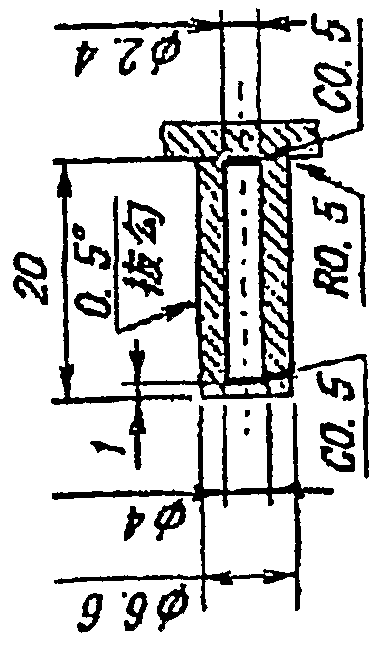
- a self-tapping boss mold was molded by an injection molding machine under the conditions shown in Table 4 and evaluated by the following method.
- Table 4 shows that the chemical resistance was effectively exhibited by controlling the relative crystallinity of the syndiotactic polystyrene (B) component in the molded article to 30% or less.
- Example 1 1 2 0 and Comparative Example 1 5 2 8
- component (C) a syndiotactic polystyrene having the properties shown in Table 6 or a mixture obtained by melting and blending sodium or zinc montanate with this syndiotactic polystyrene was used.
- the weight average molecular weight (Mw) and molecular weight distribution [Mw / Mn (Mn: number average molecular weight)] of syndiotactic polystyrene are based on gel permeation chromatography at 135 ° C using 1,2,4-trichlorobenzene as a solvent. It was measured in terms of polyethylene by the Tographi I (GPC) method.
- Tc The peak value of Tc was measured using a DSC (differential scanning calorimeter) and was determined from the peak position when the temperature was lowered at a rate of 20 ° CZ after holding at 300 for 5 minutes.
- Table 6 shows the weight average molecular weights and the like of the syndiotactic polystyrene obtained in this manner.
- Component (A), component (C), and Irganox 107 6 Jalti ⁇ Chemicals Co., Ltd., antioxidant] 0.2 phr and other components are dry blended with the composition shown in Table 8 and extruded at a resin temperature of 280 ° C using a single screw extruder. He got a strand and wrote it to Perez Toy.
- a self-tap boss mold was molded by an injection molding machine under the conditions shown in Table 7, and evaluated by the following method.
- the measurement was performed in accordance with JIS-K7110.
- Table 9 lists the syndiotactic polystyrene as component (D). Pelletized syndiotactic polystyrene having the following properties was used. The weight-average molecular weight (Mw) and molecular weight distribution [Mw / Mn (Mn: number-average molecular weight)] of syndiotactic polystyrene are based on gel permeation at 135 ° C using 1,2,4_trichlorobenzene as a solvent. The measurement was made in terms of polyethylene by the Affinity Chromatography I (GPC) method.
- GPC Affinity Chromatography I
- the melting point was measured using a DSC (differential scanning calorimeter), and was determined from the melting peak position when the temperature was raised at a rate of 20 ° CZ.
- Table 9 shows the weight average molecular weights of the syndiotactic polystyrene thus determined.
- the components (D) and (E) are melt-kneaded using a twin-screw extruder with the composition shown in Table 13 and the resin temperature and mold temperature are higher by 10 ° C than the melting point of syndiotactic polystyrene. At 40 ° C., a flat plate of 5 Omm ⁇ 50 mm ⁇ 3.2 mm and a bar of 3.2 mm thickness were injection molded.
- the obtained injection molded product was evaluated by the following method.
- the solvent impregnated in the gauze is placed on the strain part, and covered with wrap to prevent the solvent from volatilizing. It was left at room temperature for 24 hours, and the surface appearance change and the presence or absence of cracks were visually evaluated.
- Table 12 shows the solvents and conditions used for the evaluation. Table 12
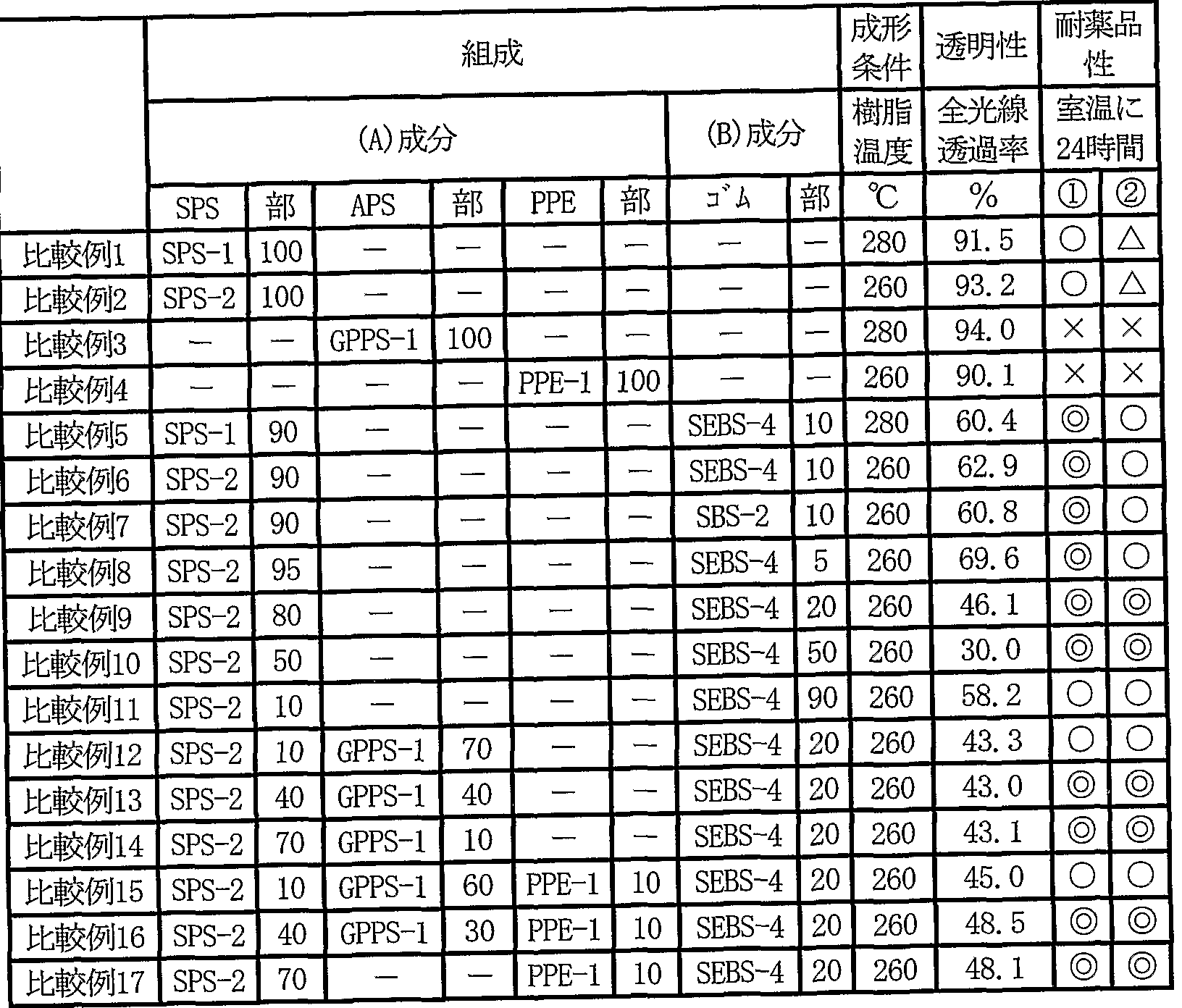
- Table 13 shows that when a styrene block polymer having a styrene content of 70% by mass or more is used as the component (E), a molded article having both transparency and chemical resistance under strain can be obtained. You can see that.
- the chemically resistant polystyrene resin molded article of the present invention which has effectively developed chemical resistance, can be used for various applications requiring chemical resistance.
- the chemical-resistant polystyrene resin composition of the present invention 2 exhibits excellent chemical resistance and physical properties, and has excellent properties.
- a molded article can be provided easily and at low cost.
- the chemically resistant polystyrene-based resin composition of the present invention 3 exhibits transparency and chemical resistance effectively, and easily provides a molded article having both transparency and chemical resistance. Is what you can do.
Landscapes
- Chemical & Material Sciences (AREA)
- Health & Medical Sciences (AREA)
- Chemical Kinetics & Catalysis (AREA)
- Medicinal Chemistry (AREA)
- Polymers & Plastics (AREA)
- Organic Chemistry (AREA)
- Manufacture Of Macromolecular Shaped Articles (AREA)
- Compositions Of Macromolecular Compounds (AREA)
Description




Claims
Priority Applications (2)
| Application Number | Priority Date | Filing Date | Title |
|---|---|---|---|
| US10/479,213 US20040152838A1 (en) | 2001-05-30 | 2002-05-28 | Chemical-resitant polystyrene resin compositon and molded article |
| EP02728178A EP1408068A4 (en) | 2001-05-30 | 2002-05-28 | CHEMICAL-RESISTANT POLYSTYRENE RESIN COMPOSITION AND FORM BODY |
Applications Claiming Priority (6)
| Application Number | Priority Date | Filing Date | Title |
|---|---|---|---|
| JP2001-161731 | 2001-05-30 | ||
| JP2001161731A JP4926335B2 (ja) | 2001-05-30 | 2001-05-30 | 透明性に優れた耐薬品性ポリスチレン系樹脂組成物及び成形品 |
| JP2001-161729 | 2001-05-30 | ||
| JP2001161729A JP4943590B2 (ja) | 2001-05-30 | 2001-05-30 | 耐薬品性ポリスチレン系樹脂成形品 |
| JP2001161730A JP4878697B2 (ja) | 2001-05-30 | 2001-05-30 | 耐薬品性ポリスチレン系樹脂組成物及び成形品 |
| JP2001-161730 | 2001-05-30 |
Publications (1)
| Publication Number | Publication Date |
|---|---|
| WO2002098960A1 true WO2002098960A1 (fr) | 2002-12-12 |
Family
ID=27346816
Family Applications (1)
| Application Number | Title | Priority Date | Filing Date |
|---|---|---|---|
| PCT/JP2002/005157 Ceased WO2002098960A1 (fr) | 2001-05-30 | 2002-05-28 | Composition de resine de polystyrene resistant aux agents chimiques et article moule |
Country Status (3)
| Country | Link |
|---|---|
| US (1) | US20040152838A1 (ja) |
| EP (1) | EP1408068A4 (ja) |
| WO (1) | WO2002098960A1 (ja) |
Cited By (2)
| Publication number | Priority date | Publication date | Assignee | Title |
|---|---|---|---|---|
| WO2004005397A1 (en) * | 2002-07-09 | 2004-01-15 | Polimeri Europa S.P.A. | Polymeric compositions based on impact resistant vinyl aromatic polymers. |
| JP2024022643A (ja) * | 2019-10-11 | 2024-02-16 | 王子ホールディングス株式会社 | フィルムコンデンサ用のフィルム用途に好適な樹脂組成物 |
Families Citing this family (3)
| Publication number | Priority date | Publication date | Assignee | Title |
|---|---|---|---|---|
| EP4043521A4 (en) * | 2019-10-11 | 2023-11-01 | Oji Holdings Corporation | RESIN COMPOSITION SUITABLE FOR USE FOR FILM IN A FILM CAPACITOR |
| US12139597B2 (en) | 2019-10-11 | 2024-11-12 | Oji Holdings Corporation | Resin composition suitable for use as film for film capacitor |
| CN111909502B (zh) * | 2020-06-30 | 2022-05-17 | 会通新材料股份有限公司 | 一种PPO-sPS组合物及其制备方法 |
Citations (11)
| Publication number | Priority date | Publication date | Assignee | Title |
|---|---|---|---|---|
| JPS57195139A (en) * | 1981-05-26 | 1982-11-30 | Nippon Steel Chem Co Ltd | Resin composition |
| EP0531931A2 (en) * | 1991-09-12 | 1993-03-17 | Idemitsu Kosan Company Limited | Use of thermoformed sheets of syndiotactic polystyrene in a chlorofluorohydrocarbon atmosphere |
| EP0531705A2 (en) * | 1991-08-09 | 1993-03-17 | Idemitsu Kosan Company Limited | Styrenic resin molding and process for producing same |
| JPH0892385A (ja) * | 1994-09-20 | 1996-04-09 | Asahi Chem Ind Co Ltd | スチレン系樹脂成形品の製造方法 |
| JPH08132538A (ja) * | 1994-11-10 | 1996-05-28 | Idemitsu Petrochem Co Ltd | スチレン系樹脂成形品の製造方法 |
| JPH11166115A (ja) * | 1997-12-02 | 1999-06-22 | Sumitomo Chem Co Ltd | ポリフェニレンエーテル系樹脂組成物 |
| EP0930341A2 (en) * | 1998-01-06 | 1999-07-21 | General Electric Company | Semi-transparent blends of polyphenylene ether and styrenic radial block copolymers |
| JP2000080228A (ja) * | 1998-09-08 | 2000-03-21 | Asahi Chem Ind Co Ltd | スチレン系熱可塑性樹脂組成物 |
| JP2001064411A (ja) * | 1999-09-01 | 2001-03-13 | Daicel Chem Ind Ltd | 二軸延伸ポリスチレン系樹脂シート及びそれを用いた容器 |
| WO2001025329A1 (en) * | 1999-10-05 | 2001-04-12 | Idemitsu Petrochemical Co., Ltd. | Molding material, process for producing molded article, and molded article |
| JP2002113756A (ja) * | 2000-10-05 | 2002-04-16 | Idemitsu Petrochem Co Ltd | 透明スチレン系樹脂成形体の製造方法及び透明スチレン系樹脂成形体 |
Family Cites Families (15)
| Publication number | Priority date | Publication date | Assignee | Title |
|---|---|---|---|---|
| US5891951A (en) * | 1987-09-14 | 1999-04-06 | Idemitsu Kosan Co., Ltd. | Styrene-based resin composition |
| MY104125A (en) * | 1988-01-13 | 1994-02-28 | Idemitsu Kosan Co | Styrene-based resin composition. |
| US5109068A (en) * | 1988-08-31 | 1992-04-28 | Idemitsu Kosan Co., Ltd. | Styrene-based polymer composition, stretched molding thereof and process for producing the same |
| JP2812972B2 (ja) * | 1989-02-02 | 1998-10-22 | 出光興産株式会社 | スチレン系樹脂組成物と成形品の製造方法 |
| EP0546497A3 (en) * | 1991-12-10 | 1993-11-18 | Idemitsu Kosan Co | Thermoplastic resin composition |
| JPH0693151A (ja) * | 1992-09-10 | 1994-04-05 | Idemitsu Kosan Co Ltd | ポリスチレン系樹脂組成物 |
| JP3139516B2 (ja) * | 1992-10-08 | 2001-03-05 | 出光興産株式会社 | 熱可塑性樹脂組成物 |
| US5760105A (en) * | 1993-06-04 | 1998-06-02 | Idemitsu Kosan Co., Ltd. | Styrenic resin composition |
| JPH08104785A (ja) * | 1994-10-05 | 1996-04-23 | Idemitsu Kosan Co Ltd | 耐衝撃性ポリスチレン系樹脂組成物 |
| JP3705624B2 (ja) * | 1995-05-16 | 2005-10-12 | 出光興産株式会社 | 酸変性ポリフェニレンエーテルの製造法 |
| JPH08319385A (ja) * | 1995-05-26 | 1996-12-03 | Idemitsu Petrochem Co Ltd | ポリスチレン系樹脂組成物及びその成形品 |
| KR970706340A (ko) * | 1995-07-28 | 1997-11-03 | 가와노 에이지로 | 도금성형체 및 도금성형체의 제조방법(plated molded article and process for producing a plated molded article) |
| EP0767211B1 (en) * | 1995-09-08 | 1999-04-21 | Idemitsu Petrochemical Co., Ltd. | Styrene-based resin composition |
| JP3805105B2 (ja) * | 1998-01-29 | 2006-08-02 | 出光興産株式会社 | スチレン系樹脂組成物及びその製造方法、スチレン系樹脂成形品の製造方法 |
| KR100367342B1 (ko) * | 2000-01-20 | 2003-01-10 | 삼성전자 주식회사 | 내충격성 향상을 위한 마크로모노머를 포함하는신디오탁틱 스티렌계 공중합체 수지 조성물 |
-
2002
- 2002-05-28 US US10/479,213 patent/US20040152838A1/en not_active Abandoned
- 2002-05-28 WO PCT/JP2002/005157 patent/WO2002098960A1/ja not_active Ceased
- 2002-05-28 EP EP02728178A patent/EP1408068A4/en not_active Withdrawn
Patent Citations (11)
| Publication number | Priority date | Publication date | Assignee | Title |
|---|---|---|---|---|
| JPS57195139A (en) * | 1981-05-26 | 1982-11-30 | Nippon Steel Chem Co Ltd | Resin composition |
| EP0531705A2 (en) * | 1991-08-09 | 1993-03-17 | Idemitsu Kosan Company Limited | Styrenic resin molding and process for producing same |
| EP0531931A2 (en) * | 1991-09-12 | 1993-03-17 | Idemitsu Kosan Company Limited | Use of thermoformed sheets of syndiotactic polystyrene in a chlorofluorohydrocarbon atmosphere |
| JPH0892385A (ja) * | 1994-09-20 | 1996-04-09 | Asahi Chem Ind Co Ltd | スチレン系樹脂成形品の製造方法 |
| JPH08132538A (ja) * | 1994-11-10 | 1996-05-28 | Idemitsu Petrochem Co Ltd | スチレン系樹脂成形品の製造方法 |
| JPH11166115A (ja) * | 1997-12-02 | 1999-06-22 | Sumitomo Chem Co Ltd | ポリフェニレンエーテル系樹脂組成物 |
| EP0930341A2 (en) * | 1998-01-06 | 1999-07-21 | General Electric Company | Semi-transparent blends of polyphenylene ether and styrenic radial block copolymers |
| JP2000080228A (ja) * | 1998-09-08 | 2000-03-21 | Asahi Chem Ind Co Ltd | スチレン系熱可塑性樹脂組成物 |
| JP2001064411A (ja) * | 1999-09-01 | 2001-03-13 | Daicel Chem Ind Ltd | 二軸延伸ポリスチレン系樹脂シート及びそれを用いた容器 |
| WO2001025329A1 (en) * | 1999-10-05 | 2001-04-12 | Idemitsu Petrochemical Co., Ltd. | Molding material, process for producing molded article, and molded article |
| JP2002113756A (ja) * | 2000-10-05 | 2002-04-16 | Idemitsu Petrochem Co Ltd | 透明スチレン系樹脂成形体の製造方法及び透明スチレン系樹脂成形体 |
Non-Patent Citations (1)
| Title |
|---|
| See also references of EP1408068A4 * |
Cited By (2)
| Publication number | Priority date | Publication date | Assignee | Title |
|---|---|---|---|---|
| WO2004005397A1 (en) * | 2002-07-09 | 2004-01-15 | Polimeri Europa S.P.A. | Polymeric compositions based on impact resistant vinyl aromatic polymers. |
| JP2024022643A (ja) * | 2019-10-11 | 2024-02-16 | 王子ホールディングス株式会社 | フィルムコンデンサ用のフィルム用途に好適な樹脂組成物 |
Also Published As
| Publication number | Publication date |
|---|---|
| EP1408068A1 (en) | 2004-04-14 |
| US20040152838A1 (en) | 2004-08-05 |
| EP1408068A4 (en) | 2005-01-05 |
Similar Documents
| Publication | Publication Date | Title |
|---|---|---|
| JP3805105B2 (ja) | スチレン系樹脂組成物及びその製造方法、スチレン系樹脂成形品の製造方法 | |
| JP4865952B2 (ja) | スチレン系重合体組成物及びこれを用いた成形品 | |
| JP4926335B2 (ja) | 透明性に優れた耐薬品性ポリスチレン系樹脂組成物及び成形品 | |
| JP4216581B2 (ja) | 芳香族系ポリカーボネート樹脂組成物及びその成形体 | |
| JP2000080228A (ja) | スチレン系熱可塑性樹脂組成物 | |
| JPH11172061A (ja) | スチレン系樹脂組成物 | |
| JPH11158366A (ja) | ポリフェニレンエーテル系樹脂組成物 | |
| WO2002098960A1 (fr) | Composition de resine de polystyrene resistant aux agents chimiques et article moule | |
| JP4481378B2 (ja) | スチレン系樹脂組成物 | |
| JP4943590B2 (ja) | 耐薬品性ポリスチレン系樹脂成形品 | |
| US6635712B1 (en) | Molding material, process for producing molded article, and molded article | |
| JP4878697B2 (ja) | 耐薬品性ポリスチレン系樹脂組成物及び成形品 | |
| JP4294328B2 (ja) | ポリフェニレンエーテル系樹脂組成物 | |
| JPH11172062A (ja) | スチレン系樹脂組成物 | |
| JPH11279349A (ja) | スチレン系樹脂組成物 | |
| JP2002003672A (ja) | 耐薬品性スチレン系樹脂組成物及びそれを利用した成形品 | |
| JP2001106851A (ja) | 成形材料及び成形品の製造法並びに成形品 | |
| JPH11279348A (ja) | スチレン系樹脂組成物 | |
| JPH11181226A (ja) | アクリロニトリル・ブタジエン・スチレン系樹脂組成物 | |
| JP2005008762A (ja) | 食品容器用樹脂組成物 | |
| JPH11181225A (ja) | アクリロニトリル・ブタジエン・スチレン系樹脂組成物 | |
| JP2003335882A (ja) | 耐溶剤性スチレン系樹脂組成物及び発泡成形品 | |
| JPH11181227A (ja) | アクリロニトリル・ブタジエン・スチレン系樹脂組成物及びその製造方法 | |
| JP2004269899A (ja) | シンジオタクチックポリスチレン系樹脂組成物 | |
| JP2001288328A (ja) | スチレン系重合体組成物及びそれを利用した成形品 |
Legal Events
| Date | Code | Title | Description |
|---|---|---|---|
| AK | Designated states |
Kind code of ref document: A1 Designated state(s): US |
|
| AL | Designated countries for regional patents |
Kind code of ref document: A1 Designated state(s): AT BE CH CY DE DK ES FI FR GB GR IE IT LU MC NL PT SE TR |
|
| 121 | Ep: the epo has been informed by wipo that ep was designated in this application | ||
| WWE | Wipo information: entry into national phase |
Ref document number: 2002728178 Country of ref document: EP |
|
| WWE | Wipo information: entry into national phase |
Ref document number: 10479213 Country of ref document: US |
|
| WWP | Wipo information: published in national office |
Ref document number: 2002728178 Country of ref document: EP |
|
| WWW | Wipo information: withdrawn in national office |
Ref document number: 2002728178 Country of ref document: EP |