WO2002102796A1 - Stereoselective method for the preparation of nucleoside analogues - Google Patents

Stereoselective method for the preparation of nucleoside analogues Download PDF

Info

Publication number
WO2002102796A1
WO2002102796A1 PCT/CA2002/000899 CA0200899W WO02102796A1 WO 2002102796 A1 WO2002102796 A1 WO 2002102796A1 CA 0200899 W CA0200899 W CA 0200899W WO 02102796 A1 WO02102796 A1 WO 02102796A1
Authority
WO
WIPO (PCT)
Prior art keywords
alkyl
optionally substituted
formula
process according
iodo
Prior art date
Legal status (The legal status is an assumption and is not a legal conclusion. Google has not performed a legal analysis and makes no representation as to the accuracy of the status listed.)
Ceased
Application number
PCT/CA2002/000899
Other languages
French (fr)
Other versions
WO2002102796A8 (en
Inventor
Qing Yu
Current Assignee (The listed assignees may be inaccurate. Google has not performed a legal analysis and makes no representation or warranty as to the accuracy of the list.)
Shire Canada Inc
Original Assignee
Shire BioChem Inc
Priority date (The priority date is an assumption and is not a legal conclusion. Google has not performed a legal analysis and makes no representation as to the accuracy of the date listed.)
Filing date
Publication date
Priority to SI200230273T priority Critical patent/SI1406896T1/en
Priority to NZ529906A priority patent/NZ529906A/en
Priority to EP02742572A priority patent/EP1406896B8/en
Priority to AU2002344862A priority patent/AU2002344862C1/en
Priority to CA2449338A priority patent/CA2449338C/en
Priority to AT02742572T priority patent/ATE313542T1/en
Priority to KR1020037016301A priority patent/KR100832617B1/en
Priority to IL15913902A priority patent/IL159139A0/en
Priority to BRPI0210444-0A priority patent/BRPI0210444B1/en
Priority to BR0210444-0A priority patent/BR0210444A/en
Priority to DE60208202T priority patent/DE60208202T2/en
Priority to MXPA03011627A priority patent/MXPA03011627A/en
Priority to EA200400042A priority patent/EA006372B1/en
Application filed by Shire BioChem Inc filed Critical Shire BioChem Inc
Priority to DK05017130T priority patent/DK1632490T3/en
Priority to HK05103299.7A priority patent/HK1070652B/en
Priority to JP2003506269A priority patent/JP4542776B2/en
Priority to HR20031021A priority patent/HRP20031021B1/en
Publication of WO2002102796A1 publication Critical patent/WO2002102796A1/en
Publication of WO2002102796A8 publication Critical patent/WO2002102796A8/en
Priority to ZA2003/09307A priority patent/ZA200309307B/en
Priority to IL159139A priority patent/IL159139A/en
Priority to NO20035556A priority patent/NO326135B1/en
Anticipated expiration legal-status Critical
Priority to AU2008203443A priority patent/AU2008203443B2/en
Ceased legal-status Critical Current

Links

Classifications

    • C—CHEMISTRY; METALLURGY
    • C07—ORGANIC CHEMISTRY
    • C07D—HETEROCYCLIC COMPOUNDS
    • C07D409/00—Heterocyclic compounds containing two or more hetero rings, at least one ring having sulfur atoms as the only ring hetero atoms
    • C07D409/02—Heterocyclic compounds containing two or more hetero rings, at least one ring having sulfur atoms as the only ring hetero atoms containing two hetero rings
    • C07D409/04—Heterocyclic compounds containing two or more hetero rings, at least one ring having sulfur atoms as the only ring hetero atoms containing two hetero rings directly linked by a ring-member-to-ring-member bond
    • A—HUMAN NECESSITIES
    • A61—MEDICAL OR VETERINARY SCIENCE; HYGIENE
    • A61P—SPECIFIC THERAPEUTIC ACTIVITY OF CHEMICAL COMPOUNDS OR MEDICINAL PREPARATIONS
    • A61P31/00—Antiinfectives, i.e. antibiotics, antiseptics, chemotherapeutics
    • A61P31/12—Antivirals
    • C—CHEMISTRY; METALLURGY
    • C07—ORGANIC CHEMISTRY
    • C07D—HETEROCYCLIC COMPOUNDS
    • C07D327/00—Heterocyclic compounds containing rings having oxygen and sulfur atoms as the only ring hetero atoms
    • C07D327/02—Heterocyclic compounds containing rings having oxygen and sulfur atoms as the only ring hetero atoms one oxygen atom and one sulfur atom
    • C07D327/04—Five-membered rings
    • C—CHEMISTRY; METALLURGY
    • C07—ORGANIC CHEMISTRY
    • C07D—HETEROCYCLIC COMPOUNDS
    • C07D411/00—Heterocyclic compounds containing two or more hetero rings, at least one ring having oxygen and sulfur atoms as the only ring hetero atoms
    • C07D411/02—Heterocyclic compounds containing two or more hetero rings, at least one ring having oxygen and sulfur atoms as the only ring hetero atoms containing two hetero rings
    • C07D411/04—Heterocyclic compounds containing two or more hetero rings, at least one ring having oxygen and sulfur atoms as the only ring hetero atoms containing two hetero rings directly linked by a ring-member-to-ring-member bond

Definitions

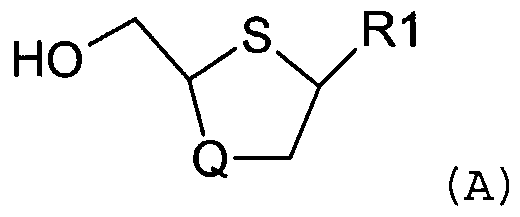
  • the present invention relates to a novel process for producing cis nucleosides or nucleoside analogues and derivatives of formula (A) :
  • Rl is a pyrimidine base or a pharmaceutically acceptable derivative thereof and Q is oxygen, carbon or sulphur.
  • Classes of compounds of formula (A) particularly the 2-substituted 4-substituted 1, 3-oxathiolanes have been found to have potent antiviral activity.
  • these compounds have been found to act as potent inhibitors of HIV-1 replication in T-lymphocytes over a prolonged period of time with less cytotoxic side effects than compounds known in the art (see Belleau et al (1993) Bioorg. ed. Chem. Lett. Vol. 3, No. 8, pp. 1723-1728).
  • These compounds have also been found active against 3TC-resistant HIV strains (see Taylor et al (2000) Antiviral Chem. Chemother. Vol 11, No. 4, pp. 291-301; Stoddart et al (2000) Antimicrob. Agents Chemother. Vol. 44, No. 3, pp. 783-786).
  • These compounds are also useful in prophylaxis and treatment of hepatitis B virus infections.
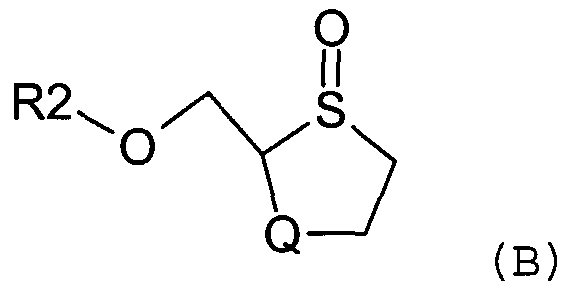
  • the process object of the present invention comprise the step of coupling the intermediate of formula (B) :
  • R2 is hydrogen or a hydroxyl protecting group such as C 7 - 10 arylalkyl, C ⁇ - ⁇ 6 acyl or Si (Z 1 ) (Z 2 ) (Z 3 ) , where Z 1 , Z 2 and Z 3 are independently selected from the group consisting of hydrogen; C 1 - 20 alkyl optionally substituted by fluoro, bromo, chloro, iodo, C 1-6 alkoxy or C 6 - 2 o aryloxy; C7-2 0 aralkyl optionally substituted by halogen, C1-20 alkyl or C ⁇ -20 alkoxy; C 6 - 2 o aryl optionally substituted by fluoro, bromo, chloro, iodo, C 1 -2 0 alkyl or C ⁇ _ 2 o alkoxy; trialkylsilyl ; fluoro; bromo; chloro and iodo; and
  • Q is carbon, oxygen or sulfur
  • the compound of formula (B) may be either :
  • the deprotection of intermediate of formula (D) is achieved by dissolving said intermediate in a suitable solvent in the presence of a deprotection agent.
  • the cis to trans ratio of the intermediate product of formula (D) is inversely proportional to the reaction temperature of the coupling step.
  • the deprotection step results in the selective precipitation of the cis nucleoside of formula (A) by the selection of an appropriate deprotection agent and solvent.
  • the processes of this invention have the advantages of allowing preparation of a nucleoside of formula (A) , analogues or derivatives thereof without using expensive starting materials, cumbersome protection and deprotection steps or addition and removal of 2 ' - or 3 ' - substituents .
  • the process of this invention produces cis nucleosides of formula (A) in high yields, with high purity and high stereoselectivity .
  • the process of this invention has the further advantage of generating nucleosides whose stereochemical configuration can be easily controlled simply by the selection of the appropriate starting conditions.
  • the present invention discloses a stereoselective process for making predominantly cis nucleosides or nucleoside analogues and derivatives of formula (A) :
  • Rl is a pyrimidine base or a pharmaceutically acceptable derivative thereof.
  • Q is carbon, oxygen or sulfur; consisting of coupling step of the a compound of formula (B) :
  • R2 is hydrogen or a hydroxyl protecting group such as C 7 - 10 aralalkyl, C ⁇ - ⁇ 6 acyl or Si (Z 1 ) (Z 2 ) (Z 3 ) , where Z 1 , Z 2 and Z 3 are independently selected from the group consisting of hydrogen; C 1 -20 alkyl optionally substituted by fluoro, bromo, chloro, iodo, C ⁇ . 6 alkoxy or C 6 . 2 o aryloxy; C 7- o
  • aralkyl optionally substituted by halogen, C ⁇ _ 2 o alkyl or C1-20 alkoxy; C 6 - 2 o aryl optionally substituted by fluoro, bromo, chloro, iodo, C1-20 alkyl or C ⁇ _ 2 o alkoxy; trialkylsilyl ; fluoro; bromo; chloro and iodo;
  • Rl is a pyrimidine base .5 or a pharmaceutically acceptable derivative thereof, in a suitable coupling solvent in the presence of a catalytic amount of an element or combination of elements of group IB or 11B ; a tertiary amine and a Lewis acid of formula (C) :
  • R4 , R5 and R6 are independently selected from the group consisting of hydrogen; C ⁇ -2 o alkyl optionally substituted by fluoro, bromo, chloro, iodo, C ⁇ -6 alkoxy or C 6- 2 0 aryloxy; C 7 - 2 o aralkyl optionally substituted by halogen, C ⁇ -20 alkyl or C1-20 alkoxy; C 6- 2o aryl optionally substituted by fluoro, bromo, chloro, iodo, C1-20 alkyl or C1-20 alkoxy; trialkylsilyl ; fluoro; bromo; chloro and iodo; and
  • R7 is selected from the group consisting of fluoro; bromo; chloro; iodo; C1-20 sulphonate esters, optionally substituted by fluoro, bromo, chloro or iodo; C ⁇ _ 2 o alkyl esters optionally substituted by fluoro, bromo, chloro or iodo; triiodide; a silyl group of the general formula (R4) (R5) (R6)Si (wherein R4 , R5, and R6 are as defined above); C 6 - 20 arylselenenyl; C 6 - 20 arylsulfenyl ; C 6 - 20 alkoxyalkyl; and trialkylsiloxy;
  • the coupling step is followed by a deprotection step to yield the cis nucleosides or nucleoside analogues or derivatives of formula (A) .
  • a simple two step preparation method for cis nucleosides of formula (A) wherein the process results in a product of formula (A) wherein the ratio of cis to trans is greater than 2 to 1.
  • the invention includes a process wherein the ratio of cis to trans is greater than or equal to 3 to 1.
  • alkyl refers to a saturated straight, branched, or cyclic, primary, secondary, or tertiary hydrocarbon of C]__3 Q , particularly C ⁇ _g, unsubstituted or optionally mono- or di- substituted by hydroxy, N3 , CN, SH, amino, halogen (F, Cl, Br, I) , Cg_i2 ar yl/ ]__g alkyl, 2 - 12 alkoxyalkyl or nitro.
  • acyl refers to a .0 functional group derived from an aliphatic carboxylic acid, by removal of the -OH group of 1 to 30 carbon atoms, particularly 1 to 6 carbon atoms.
  • an aliphatic acyl radical may be substituted (by a hydroxy, N3 , CN, halogen (F, Cl, Br, I), Cg_]_2 aryl, C ⁇ _g .5 alkyl, C2-12 alkoxyalkyl or nitro) or unsubstituted, and whatever the structure of the rest of the molecule may be, the properties of the functional group remain essentially the same (e.g., acetyl, propionyl, isobutanoyl, pivaloyl , hexanoyl, butyryl , pentanoyl, 3-methylbutyryl , hydrogen >0 succinate, mesylate, valeryl, caproic, capry
  • alkenyl and alkynyl represent 25 substituted (by a N3 , CN, halogen, hydroxyl or C _2o aryl) or unsubstituted straight, branched or cyclic hydrocarbon chains having 2 to 30 carbon atoms and preferably from 2 to 6 carbon atoms and containing at least one unsaturated group (e.g. allyl) .
  • alkoxy represents a substituted or unsubstituted alkyl group containing from 1 to 30 carbon atoms and preferably from 1 to 6 carbon atoms, wherein the alkyl group is covalently bonded ⁇ to an oxygen atom (e.g., methoxy and ethoxy) .
  • aryl represents a aromatic moiety which may be mono, bi, tri, tetra or penta-substituted by hydroxy, nitro, N3 , CN, halogen (F, Cl , Br, I) or combinations thereof and containing at least one benzenoid-type ring, the group may contain from 6 to 14 carbon atoms (e.g., phenyl and naphthyl) , particularly 6 to 10 carbon atoms.
  • aryloxy represents a substituted (by a halogen, trifluoromethyl or C ⁇ _5 alkoxy) or unsubstituted aryl moiety, having 6 to 14 carbon atoms, covalently bonded through an oxygen atom (e.g., benzyloxy, phenoxy) .
  • aralalkyl represents a substituent comprising an aryl moiety attached via an alkyl chain (e.g. benzyl, phenylethyl) wherein the sum total of carbon atoms for the aryl moiety and the alkyl chain is 7 to 21.
  • the aryl or chain portion of the group is optionally mono- or di-substituted with OH, SH, amino, halogen or C ⁇ -g alkyl.
  • thiol represents C]__g alkyl, Cg_ ⁇ 5 aryl, 07.21 aralkyl, C2_ alkenyl or C2- alkynyl groups covalently bonded to an adjacent sulfur atom bearing a hydrogen .
  • alkylthio e.g. thiomethy, thioethyl
  • arylthio e.g. thiophenyl, thiobenzyl
  • alkylthio e.g. thiomethy, thioethyl
  • arylthio e.g. thiophenyl, thiobenzyl
  • C ⁇ _g alkyl or Cg_]_o aryl groups unsubstituted or optionally mono- or di-substituted by # hydroxy, halogen (F, Cl, Br, I) , c 6-12 aryl, C__g alkyl, C2-12 alkoxyalkyl or nitro, covalently bonded to an adjacent sulfur atom.
  • acyloxy and “alkoxycarbonyl” refer to 1 to 30 carbon atoms chains, particularly 1 to 6 carbon atoms, that are either saturated or unsaturated and may also be straight or branched (e.g. : acetyloxy) .
  • the chains may be unsubstituted or optionally mono- or di-substituted by hydroxy, N3 , CN, SH, amino, halogen (F, Cl, Br, I), C _i2 aryl, C ⁇ _ alkyl, C2-12 alkoxyalkyl or nitro.
  • alkoxyalkyl represents a C]__g alkoxy group attached to an adjacent C ⁇ _g alkyl group (e.g., methoxymethyl , ethoxymethyl) . They may be unsubstituted or optionally mono- or di-substituted by hydroxy, N3 , CN, SH, amino, halogen (F, Cl, Br, I), C _i2 aryl, C _g alkyl, C2-12 alkoxyalkyl or nitro.
  • heterocycle represents a saturated or unsaturated mono- or polycyclic (i.e. bicyclic) ring incorporating 1 or more (i.e. 1-4) heteroatoms selected from N, O and S. It is understood that a heterocycle is optionally mono- or di-substituted with OH, SH, amino, halogen, CF3 , oxo or C ] __g alkyl.
  • suitable monocyclic heterocycles include but are not limited to pyridine, piperidine, pyrazine, piperazine, pyrimidine, imidazole, thiazole, oxazole, furan, pyran and thiophene.
  • suitable bicyclic heterocycles include but are not limited to indole, benzimidazole, quinoline, isoquinoline, purine, and carbazole.
  • aralkyl represents a substituent comprising a Cg__o aryl moiety attached via a C ⁇ _g alkyl chain (e.g. benzyl, phenethyl) .
  • the aryl or chain portion of the group is unsubstituted or optionally mono- or di- substituted by hydroxy, N3 , CN, SH, amino, halogen (F, Cl,
  • amino represents C]__g alkyl, C _ ⁇ o aryl, C2-g alkenyl, C2_g alkynyl, or C7_ ⁇ 2 aralkyl groups, unsubstituted or optionally mono- or di-substituted by hydroxy, N3 , CN, SH, amino, halogen (F, Cl, Br, I), Cg_ ⁇ 2 aryl, C ⁇ - alkyl, C2-12 alkoxyalkyl or nitro, wherein the carbon atoms are covalently bonded to an adjacent element through a nitrogen atom (e.g., pyrrolidine) . They include primary, secondary and tertiary amines and quaternary ammonium salts.
  • protected refers to a group that is added to an oxygen, nitrogen, or phosphorus atom to prevent its further reaction or for other purposes.
  • oxygen and nitrogen protecting groups are known to those skilled in the art of organic synthesis. Suitable protecting groups are described, for example, in Greene, et al . , "Protective
  • pyrimidine base derivative or analogue a pyrimidine base found in nucleoside or an analogue thereof which mimics such bases in that their structures (the kinds of atoms and their arrangement) are similar to the normal bases but may possess additional or lack certain of the functional properties of the normal bases.
  • Derivatives of such bases or analogues include those obtained by replacement of a CH moiety by a nitrogen atom (for example, 5-azapyrimidines such as 5-azacytosine) or may have ring substituted by halogen, hydroxyl, azido, cyano, amino, substituted amino, thiol , C ⁇ _g alkyl and Cg_ ⁇ o_aryl .
  • pharmaceutically acceptable 5 derivative of a pyrimidine any pyrimidine base which may give rise to a pharmaceutically acceptable salt, ester, or salt of such ester of a compound of formula (A), or any other compound which, upon administration to the recipient, is capable of providing (directly or indirectly)
  • L0 a compound of formula (A) or an antivirally active metabolite or residue thereof. It will be appreciated by those skilled in the art that the compounds of formula (A) may be modified to provide pharmaceutically acceptable derivatives thereof, at functional groups in the base
  • the compound of formula (B) may be either :
  • the sulfoxide may be a single enantiomer or a mixture of enantiomers including but not 20 limited to a racemic mixture.
  • the coupling step of the process object of the present invention includes the addition of one or more elements of group IB or llB.
  • the element or combination of elements used may be in their oxidized state.
  • This element 25 or combination of elements of group IB or llB catalyzes the coupling step.
  • the chosen element or combination of elements of group IB or llB are present in amounts between about 0.25 molar % and about 100 molar %.
  • the concentration of the element or combination of elements of group IB or llB may be between about 5% to about 35%.
  • the process object of the present invention includes a coupling step wherein the element or combination of elements of group IB or llB are selected from the group comprising Cu + , Cu 2+ ,Ag + , Au + , Au 3+ , Zn 2+ Cd 2+ and combinations thereof .
  • the process object of the present invention includes a coupling step wherein the element or combination of elements of group IB or llB are selected from Cu + , Cu 2+ or Zn 2+ .
  • tertiary amine includes tertiary amines with high basicity.
  • the tertiary amine is of the form N(Z 4 ) (Z 5 ) (Z G ) wherein (Z 4 ) , (Z 5 ) , (Z 6 ) are independently selected from the group consisting C ⁇ -6 alkyl optionally substituted with C ⁇ _ 3 alkyl, C 6 - ⁇ o aryl, halogen.
  • tertiary amine examples include triethylamine, diethylcyclohexylamine, diethylmethylamine, dimethylethylamine, dimethylisopropylamine, dimethylbutylamine, dimethylcyclohexylamine, tributylamine, diethylmethylamine, dimethylisopropylamine and diisopropylethylamine .
  • the amount of tertiary amine can vary between about 1 eq to about 4 eq.
  • the amount of tertiary amine used may vary between about 1 eq and 2 eq.
  • a suitable coupling solvent includes C ⁇ - 10 chlorinated organic solvents.
  • Suitable coupling solvents also include C ⁇ _ 8 chloroalkyls, C ⁇ - 8 chloroalkenyls, C 6 - ⁇ o chloroaryls , C ⁇ -8 alkylonitriles and combinations thereof.
  • the coupling solvents may be selected from chloromethanes, chloroethanes, methanonitriles or mixtures thereof.
  • the coupling solvents of interest include dichloromethane, chloroform, acetonitrile, dichloroethane, chlorobenzene and combinations thereof.
  • the amount of coupling solvent used may vary between about 5 mL per g of sulfoxide to 50 mL per gram of sulfoxide. In an alternate embodiment of the invention the amount of coupling solvent is between 10 mL per g of sulfoxide to 30 mL per gram of sulfoxide.
  • the coupling step of the process object of the present invention is affected by the temperature of the reaction.
  • the cis to trans ratio of the product of formula (D) is inversely proportional to the reaction temperature.
  • the coupling step is preformed at a temperature between about 40 degrees C and about - 40 degrees C. In an alternate embodiment, the coupling step reaction temperature is between about 30 degrees C and about - 50 degrees C.
  • the second step in the process object of the present invention is a deprotection step.
  • the deprotection crystallization step is preformed in a suitable solvent.
  • solvents that favor the crystallization of the product of formula (A) .
  • Suitable solvents include water, methanol, ethanol, toluene, tert- butyl methyl ether or combinations thereof.
  • the deprotection may also include the presence of adequate amounts a deprotection agent.
  • deprotection agents that will aid in the separation of the cis product of formula (A) .
  • Suitable deprotection agents are selected according to the identity of the protecting group on the intermediate of formula (D) as shown in Greene, et al . , "Protective Groups in Organic Synthesis," John Wiley and Sons, Second Edition, 1991.
  • Deprotection agents may be alkaline.
  • Deprotection agents include sodium hydroxide, sodium methoxide, ammonium hydroxide, potassium hydroxide, lithium hydroxide and methanolic ammonia.
  • the deprotection agent is present in catalytic amounts. In another embodiment the deprotection agent is present in concentrations between about 0.1 molar percentage and about 50 molar percentage. An alternative embodiment includes deprotection agent concentrations between about 5 to about 20 molar percentage of the deprotection agent.
  • the base Rl is selected from:
  • RgR9 can also be connected to the nitrogen atom to form a saturated or unsaturated C3..8 heterocyclic ring optionally substituted with C(0)OH, C(0)NH 2 , OH, SH, NH 2 , N0 2 , C!_g alkyl, C 2 _g alkenyl, C 2 _6 alkynyl, halogen, C(0)R14 wherein R14 is a C]__g alkyl, C2_ alkenyl, C2- alkynyl and C(0)OR15 wherein R15 is a C ⁇ . _g alkyl, C2_ alkenyl, C2_g alkynyl.
  • Another embodiment of the present invention includes a stereoselective process for making predominantly cis nucleosides or nucleoside analogues and derivatives of formula (A) :
  • Rl is a pyrimidine base selected from N 4 - alkylpyrimidines, N 4 -acylpyrimidines, 4-halopyrimidines, N 4 -acetylenic pyrimidines, 4 -amino and N 4 -acyl pyrimidines, 4- hydroxyalkyl pyrimidines, 4-thioalkyl pyrimidines, thymine, cytosine, 6-azapyrimidine, including 6-azacytosine, 2- and/or 4-mercaptopyrimidine, uracil, C 5 -alkylpyrimidines, C 5 -benzylpyrimidines, C 5 halopyrimidines, C 5 -vinylpyrimidine, C 5 -acetylenic pyrimidine, C 5 -acyl pyrimidine, C 5 - amidopyrimidine, C 5 -cyanopyrimidine, C 5 -nitropyrimidine, C 5 -aminopyrimidine, 5-azacy
  • Q is oxygen , consisting of coupling step of the a compound of formula (B) :
  • alkoxy or C 6 - 20 aryloxy optionally substituted by halogen, C ⁇ -20 alkyl or C ⁇ - 20 alkoxy; C 6-20 aryl optionally substituted by fluoro, bromo, chloro, iodo, C 1-2 o alkyl or C 1-2 o alkoxy; trialkylsilyl; fluoro; bromo; chloro and iodo;
  • R4, R5 and R6 are independently selected from the group consisting of hydrogen; C ⁇ o alkyl optionally substituted by fluoro, bromo, chloro, iodo, C 1-6 alkoxy or C 6- 2 0 aryloxy; C 7-20 aralkyl optionally substituted by halogen, C ⁇ _ 20 alkyl or C ⁇ - 20 alkoxy; C 3-2 o aryl optionally substituted by fluoro, bromo, chloro, iodo, C ⁇ _ 2 o alkyl or C1-20 alkoxy; trialkylsilyl ; fluoro; bromo; chloro and iodo; and
  • R7 is selected from the group consisting of fluoro; bromo; chloro; iodo; C ⁇ _ 2 o sulphonate esters, optionally substituted by fluoro, bromo, chloro or iodo; C1-20 alkyl esters optionally substituted by fluoro, bromo, chloro or iodo; triiodide; a silyl group of the general formula L0 (R4) (R5) (R6)Si (wherein R4 , R5 , and R6 are as defined above); C S - 2 o arylselenenyl ; C 6 -2o arylsulfenyl ; C 6 _ o alkoxyalkyl; and trialkylsiloxy;
  • W is halogen, C ⁇ . 16 alkyl, C 2 -i6 alkoxyalkyl, C 6 - ⁇ o aryl, C ⁇ - ⁇ 6 alkoxy or nitro; or
  • E is C 6 - ⁇ o aryl, C ⁇ - ⁇ 6 alkoxy, C 2 - ⁇ e alkoxyalkyl or C ⁇ . 16 alkyl ;
  • a base Rl as defined above, in a suitable coupling solvent in the presence of a catalytic amount of Cu or Zn or mixtures thereof; a tertiary amine and a Lewis acid selected from trimethylsilyl triflate bromotrimethylsilane or iodotrimethylsilane; to yield an intermediate or formula (D) :
  • Step 1 The sulfoxide of formula (B) may be obtained using several methods including those disclosed in PCT publications WO 92/08717 and WO 95/29176, J. Med. Chem. 38(1) 1-4 (1995), Tetrahedron Lett . 35(27) 4739-4742 (1994), Bioorg. Med. Chem. Lett. 3 (8) 1723-1728 (1993) and Eur. J. Org. Chem. 6:1455-1458 (1999).
  • the sulfoxide may be a single enantiomer or a mixture of enantiomers including but not limited to a race ic mixture.
  • the sulfoxide of formula (B) is coupled with base Rl .
  • the base Rl may be previously protected , for example silylated (or silylated in situ) pyrimidine base or pharmaceutically acceptable derivative may be used.
  • the coupling reaction takes place in the presence of a tertiary amine, a Lewis acid of formula (C) and catalytic amounts of an element of groups IB or IIB in a suitable coupling solvent to give the cis/trans pyrimidine nucleoside of formula (D) .
  • the cis isomer predominates over the trans isomer in a ratio equal to greater than 2 to 1.
  • the ratio of cis to trans isomer is inversely proportional to the temperature of the reaction temperature.
  • the coupling reaction may be preformed at or below room temperature.
  • the temperature of the coupling step may be between about 0 degrees C and about - 50 degrees C.
  • adequate silylating agent may include t-butyldimethylsilyl triflate 1,1,1,3,3,3 hexamethyldisilazane, TMSI, N,0,bis(TMS) acetonide and trimethylsilyl triflate. Additional protective agents are disclosed in Greene, et al . , "Protective Groups in Organic Synthesis,” John Wiley and Sons, Second Edition, 1991.
  • the tertiary amine used in step 1 include triethylamine, diethylcyclohexylamine, diethylmethylamine, dimethylethylamine, dimethylisopropylamine, dimethylbutylamine, dimethylcyclohexylamine, tributylamine, diethylmethylamine, dimethylisopropylamine and diisopropylethylamine and combinations thereof.
  • the element or combination of elements of groups IB or IIB used in step 1 include Cu, Ag, Au, Zn, or Cd in oxidized state.
  • a deprotection suitable solvent favors the crystallization of the product of formula (A) .
  • Suitable solvents include water, methanol, ethanol, toluene, tert- butyl methyl ether or combinations thereof.
  • Suitable deprotection agents include sodium hydroxide, sodium methoxide, ammonium hydroxide, potassium hydroxide, lithium hydroxide and methanolic ammonia. Of particular interest are deprotection agents which will aid in the separation of the product of formula (A) .
  • the sulfoxide of the 1,3 oxathiolane of formula (Bx) is coupled with base Rl .
  • the base Rl may be previously protected, for example silylated (or silylated in situ) pyrimidine base or pharmaceutically acceptable derivative.
  • the coupling reaction takes place in the presence of a tertiary amine, a Lewis acid of formula (C) and catalytic amounts of an element of groups IB or IIB in a suitable coupling solvent to give the cis/trans pyrimidine 1,3 oxathiolane nucleoside of formula (Dx) .
  • the cis isomer predominates 5 over the trans isomer in a ratio equal to greater than 2 to 1.
  • the ratio of cis to trans isomer is inversely proportional to the temperature of the reaction temperature.
  • the reaction may be preformed at or below room temperature.
  • the element or combination of elements of groups 20 IB or IIB used in step 1 include Cu, Ag, Au, Zn, or Cd in oxidized state.
  • the suitable coupling solvent is an organic solvent.
  • the suitable coupling solvents include CH 2 C1 2 , CH 3 CN or mixtures thereof .
  • the Lewis acid that may be used in this step include trimethylsilyl triflate bromotrimethylsilane iodotrimethylsilane and mixtures thereof.
  • the amount of the Lewis acid may be between about 2 eq to about 5 eq.
  • Step 2 The cis/trans pyrimidine nucleoside of 0 formula (Dx) is dissolved in a suitable deprotection solvent in the presence of adequate amounts of a deprotection agent to yield the cis nucleosides or nucleoside analogues or derivatives of formula (Ax) .
  • a suitable deprotection solvent favors the crystallization of the product of formula (A) .
  • Suitable solvents include water, methanol, ethanol, toluene, tert- butyl methyl ether or combinations thereof.
  • Suitable combinations of solvents include methanol and water, methanol and toluene, methanol and tert-butyl methyl ether mixtures.
  • Suitable deprotection agents include sodium hydroxide, sodium methoxide, ammonium hydroxide, potassium hydroxide, lithium hydroxide and methanolic ammonia. Of particular interest are deprotection agents that will aid in the separation of the product of formula (A) .
  • the deprotection step is preformed at a temperature below the boiling point of the suitable deprotection solvent
  • DIPEA diisopropylethylamine
  • TEA Triethylamine
  • DECA diethylcyclohexylamine
  • DMCA dimethylcyclohexylamine
  • Cu(acac) 2 Copper (II) acetylacetonate
  • the enantiomerically pure Compound (3a) was dissolved in CH 2 C1 2 (lOmL/g) and cooled to reaction temperature.
  • the amine was added followed by addition of TMSI while keeping the internal temperature below -5°C. stirred at -5°C to -40°C until the compound (3a) disappeared.
  • the CuCl (20%) and the pyrimidine (l.leq) was added.
  • the reaction mix was warmed up and kept between - 40 to 30°C until TLC indicated the reaction is complete.
  • the reaction was cooled to 0°C-5°C.
  • Celite (12g, 100% w/w) was added to the suspension and stirred. Concentrated ammonium hydroxyde (was added slowly and the suspension temperature was kept between 0 °C - 10 °C.
  • TEA Triethylamine
  • DIPEA Diisopropylethylamine
  • DMCA Dimethylcyclohexylamine

Landscapes

  • Organic Chemistry (AREA)
  • Chemical & Material Sciences (AREA)
  • Health & Medical Sciences (AREA)
  • Life Sciences & Earth Sciences (AREA)
  • Nuclear Medicine, Radiotherapy & Molecular Imaging (AREA)
  • General Health & Medical Sciences (AREA)
  • Oncology (AREA)
  • Chemical Kinetics & Catalysis (AREA)
  • General Chemical & Material Sciences (AREA)
  • Medicinal Chemistry (AREA)
  • Virology (AREA)
  • Pharmacology & Pharmacy (AREA)
  • Animal Behavior & Ethology (AREA)
  • Communicable Diseases (AREA)
  • Public Health (AREA)
  • Veterinary Medicine (AREA)
  • Pharmaceuticals Containing Other Organic And Inorganic Compounds (AREA)
  • Plural Heterocyclic Compounds (AREA)
  • Low-Molecular Organic Synthesis Reactions Using Catalysts (AREA)
  • Saccharide Compounds (AREA)
  • Heterocyclic Compounds Containing Sulfur Atoms (AREA)

Abstract

A process for producing predominantly cis nucleosides or nucleoside analogues and derivatives of formula (A): wherein R1 is a pyrimidine base or a pharmaceutically acceptable derivative thereof and Q is oxygen, carbon or sulphur, comprising a coupling step of the pyrimidine base with a molecule of formula (B) described herein in a suitable coupling solvent, in the presence of catalytic amounts of an element or combination of elements of groups 1B or 11B of the periodic table, a tertiary amine and a Lewis acid to obtained an intermediate of formula (D) which is deprotected in the subsequent step to generate the product of formula (A).

Description

ATEREOSELECTIVE METHOD FOR THE PREPARATION OF NUCLEOSIDE ANALOGUES
The present invention relates to a novel process for producing cis nucleosides or nucleoside analogues and derivatives of formula (A) :
Figure imgf000002_0001
wherein Rl is a pyrimidine base or a pharmaceutically acceptable derivative thereof and Q is oxygen, carbon or sulphur.
Classes of compounds of formula (A) , particularly the 2-substituted 4-substituted 1, 3-oxathiolanes have been found to have potent antiviral activity. In particular, these compounds have been found to act as potent inhibitors of HIV-1 replication in T-lymphocytes over a prolonged period of time with less cytotoxic side effects than compounds known in the art (see Belleau et al (1993) Bioorg. ed. Chem. Lett. Vol. 3, No. 8, pp. 1723-1728). These compounds have also been found active against 3TC-resistant HIV strains (see Taylor et al (2000) Antiviral Chem. Chemother. Vol 11, No. 4, pp. 291-301; Stoddart et al (2000) Antimicrob. Agents Chemother. Vol. 44, No. 3, pp. 783-786). These compounds are also useful in prophylaxis and treatment of hepatitis B virus infections.
Methods for the preparation of these compounds have been disclosed in PCT publications WO 92/08717 and WO 95/29176 as well as in publications by Belleau et al (1993) Bioorg. Med. Chem. Lett. Vol. 3, No. 8, pp. 1723-1728; Wang et al (1994) Tetrahedron Lett. Vol. 35, No.27, pp. 4739 - 4742; Mansour et al , (1995) J. of Med. Chem. Vol. 38, No. 1, pp. 1-4 and Caputo et al in Eur. J. Org. Chem. Vol. 6, pp. 1455-1458 (1999) . These processes involve a multitude of steps that increase the cost of production and reduce the yield of the desired compounds.
Summary of the Invention
The process object of the present invention comprise the step of coupling the intermediate of formula (B) :
Figure imgf000003_0001
wherein
R2 is hydrogen or a hydroxyl protecting group such as C7-10 arylalkyl, Cι-ι6 acyl or Si (Z1) (Z2) (Z3) , where Z1, Z2 and Z3 are independently selected from the group consisting of hydrogen; C1-20 alkyl optionally substituted by fluoro, bromo, chloro, iodo, C1-6 alkoxy or C6-2o aryloxy; C7-20 aralkyl optionally substituted by halogen, C1-20 alkyl or Cχ-20 alkoxy; C6-2o aryl optionally substituted by fluoro, bromo, chloro, iodo, C1-20 alkyl or Cι_2o alkoxy; trialkylsilyl ; fluoro; bromo; chloro and iodo; and
Q is carbon, oxygen or sulfur; with
Rl, a pyrimidine base or a pharmaceutically acceptable derivative thereof in the presence of a catalytic amount of an element or combination of elements of group IB or 11B, a Lewis acid and a tertiary amine. The resulting intermediate of formula (D)
Figure imgf000004_0001
is deprotected to obtain the cis nucleoside of formula (A)
Figure imgf000004_0002
The compound of formula (B) may be either :
(Bl)
Figure imgf000004_0003
or a mixture of the two enantiomers.
In an alternative embodiment of the present invention the deprotection of intermediate of formula (D) is achieved by dissolving said intermediate in a suitable solvent in the presence of a deprotection agent.
In an alternative embodiment of the present invention a simple two step preparation method for cis nucleosides of formula (A) wherein the coupling step results in a product wherein the ratio of cis to trans is greater than 2 to 1 is provided.
In a further embodiment the cis to trans ratio of the intermediate product of formula (D) is inversely proportional to the reaction temperature of the coupling step.
In an alternate embodiment of the present invention, the deprotection step results in the selective precipitation of the cis nucleoside of formula (A) by the selection of an appropriate deprotection agent and solvent.
The processes of this invention have the advantages of allowing preparation of a nucleoside of formula (A) , analogues or derivatives thereof without using expensive starting materials, cumbersome protection and deprotection steps or addition and removal of 2 ' - or 3 ' - substituents .
The process of this invention produces cis nucleosides of formula (A) in high yields, with high purity and high stereoselectivity .
The process of this invention has the further advantage of generating nucleosides whose stereochemical configuration can be easily controlled simply by the selection of the appropriate starting conditions.
Detailed Description of the Invention
The present invention discloses a stereoselective process for making predominantly cis nucleosides or nucleoside analogues and derivatives of formula (A) :
Figure imgf000005_0001
wherein
Rl is a pyrimidine base or a pharmaceutically acceptable derivative thereof; and
Q is carbon, oxygen or sulfur; consisting of coupling step of the a compound of formula (B) :
Figure imgf000006_0001
wherein
5 R2 is hydrogen or a hydroxyl protecting group such as C7-10 aralalkyl, Cι-ι6 acyl or Si (Z1) (Z2) (Z3) , where Z1, Z2 and Z3 are independently selected from the group consisting of hydrogen; C1-20 alkyl optionally substituted by fluoro, bromo, chloro, iodo, Cχ.6 alkoxy or C6.2o aryloxy; C7-o
0 aralkyl optionally substituted by halogen, Cι_2o alkyl or C1-20 alkoxy; C6-2o aryl optionally substituted by fluoro, bromo, chloro, iodo, C1-20 alkyl or Cι_2o alkoxy; trialkylsilyl ; fluoro; bromo; chloro and iodo;
with a base Rl , wherein Rl is a pyrimidine base .5 or a pharmaceutically acceptable derivative thereof, in a suitable coupling solvent in the presence of a catalytic amount of an element or combination of elements of group IB or 11B ; a tertiary amine and a Lewis acid of formula (C) :
Figure imgf000006_0002
>0 wherein
R4 , R5 and R6 are independently selected from the group consisting of hydrogen; Cι-2o alkyl optionally substituted by fluoro, bromo, chloro, iodo, Cι-6 alkoxy or C6- 20 aryloxy; C7-2o aralkyl optionally substituted by halogen, Cχ-20 alkyl or C1-20 alkoxy; C6-2o aryl optionally substituted by fluoro, bromo, chloro, iodo, C1-20 alkyl or C1-20 alkoxy; trialkylsilyl ; fluoro; bromo; chloro and iodo; and
R7 is selected from the group consisting of fluoro; bromo; chloro; iodo; C1-20 sulphonate esters, optionally substituted by fluoro, bromo, chloro or iodo; Cι_2o alkyl esters optionally substituted by fluoro, bromo, chloro or iodo; triiodide; a silyl group of the general formula (R4) (R5) (R6)Si (wherein R4 , R5, and R6 are as defined above); C6-20 arylselenenyl; C6-20 arylsulfenyl ; C6-20 alkoxyalkyl; and trialkylsiloxy;
to yield an intermediate or formula (D) :
Figure imgf000007_0001
The coupling step is followed by a deprotection step to yield the cis nucleosides or nucleoside analogues or derivatives of formula (A) .
In an alternative embodiment of the present invention a simple two step preparation method for cis nucleosides of formula (A) wherein the process results in a product of formula (A) wherein the ratio of cis to trans is greater than 2 to 1. The invention includes a process wherein the ratio of cis to trans is greater than or equal to 3 to 1.
The term "alkyl" , as used herein, unless otherwise specified, refers to a saturated straight, branched, or cyclic, primary, secondary, or tertiary hydrocarbon of C]__3Q, particularly C^_g, unsubstituted or optionally mono- or di- substituted by hydroxy, N3 , CN, SH, amino, halogen (F, Cl, Br, I) , Cg_i2 aryl/ ]__g alkyl, 2 - 12 alkoxyalkyl or nitro. It specifically includes methyl, ethyl, cyclopropyl, propyl , 5 isopropyl, butyl, isobutyl, t-butyl, pentyl , cyclopentyl, isopentyl, neopentyl, hexyl , isohexyl, cyclohexyl, eyelohexylmethyl , 3-methylpentyl , 2 , 2-dimethylbutyl , and 2 , 3 -dimethylbutyl .
The term "acyl", as used hereinafter refers to a .0 functional group derived from an aliphatic carboxylic acid, by removal of the -OH group of 1 to 30 carbon atoms, particularly 1 to 6 carbon atoms. Like the acid to which it is related, an aliphatic acyl radical may be substituted (by a hydroxy, N3 , CN, halogen (F, Cl, Br, I), Cg_]_2 aryl, Cχ_g .5 alkyl, C2-12 alkoxyalkyl or nitro) or unsubstituted, and whatever the structure of the rest of the molecule may be, the properties of the functional group remain essentially the same (e.g., acetyl, propionyl, isobutanoyl, pivaloyl , hexanoyl, butyryl , pentanoyl, 3-methylbutyryl , hydrogen >0 succinate, mesylate, valeryl, caproic, caprylic, capric, lauric, myristic, palmitic, stearic, oleic, 3- chlorobenzoate, trifluoroacetyl , chloroacetyl , and cyclohexanoyl) .
The terms "alkenyl" and "alkynyl" represent 25 substituted (by a N3 , CN, halogen, hydroxyl or C _2o aryl) or unsubstituted straight, branched or cyclic hydrocarbon chains having 2 to 30 carbon atoms and preferably from 2 to 6 carbon atoms and containing at least one unsaturated group (e.g. allyl) . The term "alkoxy" represents a substituted or unsubstituted alkyl group containing from 1 to 30 carbon atoms and preferably from 1 to 6 carbon atoms, wherein the alkyl group is covalently bonded^to an oxygen atom (e.g., methoxy and ethoxy) .
The term "aryl" represents a aromatic moiety which may be mono, bi, tri, tetra or penta-substituted by hydroxy, nitro, N3 , CN, halogen (F, Cl , Br, I) or combinations thereof and containing at least one benzenoid-type ring, the group may contain from 6 to 14 carbon atoms (e.g., phenyl and naphthyl) , particularly 6 to 10 carbon atoms.
The term "aryloxy" represents a substituted (by a halogen, trifluoromethyl or Cι_5 alkoxy) or unsubstituted aryl moiety, having 6 to 14 carbon atoms, covalently bonded through an oxygen atom (e.g., benzyloxy, phenoxy) .
The term "aralalkyl" represents a substituent comprising an aryl moiety attached via an alkyl chain (e.g. benzyl, phenylethyl) wherein the sum total of carbon atoms for the aryl moiety and the alkyl chain is 7 to 21. The aryl or chain portion of the group is optionally mono- or di-substituted with OH, SH, amino, halogen or C^-g alkyl.
The term "thiol" represents C]__g alkyl, Cg_χ5 aryl, 07.21 aralkyl, C2_ alkenyl or C2- alkynyl groups covalently bonded to an adjacent sulfur atom bearing a hydrogen .
The terms "alkylthio" (e.g. thiomethy, thioethyl) and "arylthio" (e.g. thiophenyl, thiobenzyl), refers to C^_g alkyl or Cg_]_o aryl groups, unsubstituted or optionally mono- or di-substituted by# hydroxy, halogen (F, Cl, Br, I) , c6-12 aryl, C__g alkyl, C2-12 alkoxyalkyl or nitro, covalently bonded to an adjacent sulfur atom.
The terms "acyloxy" and "alkoxycarbonyl" refer to 1 to 30 carbon atoms chains, particularly 1 to 6 carbon atoms, that are either saturated or unsaturated and may also be straight or branched (e.g. : acetyloxy) . The chains may be unsubstituted or optionally mono- or di-substituted by hydroxy, N3 , CN, SH, amino, halogen (F, Cl, Br, I), C _i2 aryl, C^_ alkyl, C2-12 alkoxyalkyl or nitro.
The term "alkoxyalkyl" represents a C]__g alkoxy group attached to an adjacent C^_g alkyl group (e.g., methoxymethyl , ethoxymethyl) . They may be unsubstituted or optionally mono- or di-substituted by hydroxy, N3 , CN, SH, amino, halogen (F, Cl, Br, I), C _i2 aryl, C _g alkyl, C2-12 alkoxyalkyl or nitro.
The term "heterocycle" represents a saturated or unsaturated mono- or polycyclic (i.e. bicyclic) ring incorporating 1 or more (i.e. 1-4) heteroatoms selected from N, O and S. It is understood that a heterocycle is optionally mono- or di-substituted with OH, SH, amino, halogen, CF3 , oxo or C]__g alkyl. Examples of suitable monocyclic heterocycles include but are not limited to pyridine, piperidine, pyrazine, piperazine, pyrimidine, imidazole, thiazole, oxazole, furan, pyran and thiophene. Examples of suitable bicyclic heterocycles include but are not limited to indole, benzimidazole, quinoline, isoquinoline, purine, and carbazole.
The term "aralkyl" represents a substituent comprising a Cg__o aryl moiety attached via a Cχ_g alkyl chain (e.g. benzyl, phenethyl) . The aryl or chain portion of the group is unsubstituted or optionally mono- or di- substituted by hydroxy, N3 , CN, SH, amino, halogen (F, Cl,
Br, I), Cg_]_2 aryl, C]__g alkyl, C2-12 alkoxyalkyl or nitro.
The term "amino" represents C]__g alkyl, C _ιo aryl, C2-g alkenyl, C2_g alkynyl, or C7_χ2 aralkyl groups, unsubstituted or optionally mono- or di-substituted by hydroxy, N3 , CN, SH, amino, halogen (F, Cl, Br, I), Cg_^2 aryl, C^- alkyl, C2-12 alkoxyalkyl or nitro, wherein the carbon atoms are covalently bonded to an adjacent element through a nitrogen atom (e.g., pyrrolidine) . They include primary, secondary and tertiary amines and quaternary ammonium salts.
The term "protected" as used herein and unless otherwise defined refers to a group that is added to an oxygen, nitrogen, or phosphorus atom to prevent its further reaction or for other purposes. A wide variety of oxygen and nitrogen protecting groups are known to those skilled in the art of organic synthesis. Suitable protecting groups are described, for example, in Greene, et al . , "Protective
Groups in Organic Synthesis," John Wiley and Sons, Second Edition, 1991, hereby incorporated by reference.
By pyrimidine base derivative or analogue is meant a pyrimidine base found in nucleoside or an analogue thereof which mimics such bases in that their structures (the kinds of atoms and their arrangement) are similar to the normal bases but may possess additional or lack certain of the functional properties of the normal bases. Derivatives of such bases or analogues include those obtained by replacement of a CH moiety by a nitrogen atom (for example, 5-azapyrimidines such as 5-azacytosine) or may have ring substituted by halogen, hydroxyl, azido, cyano, amino, substituted amino, thiol , Cχ_g alkyl and Cg_ιo_aryl .
By the term "pharmaceutically acceptable 5 derivative" of a pyrimidine is meant any pyrimidine base which may give rise to a pharmaceutically acceptable salt, ester, or salt of such ester of a compound of formula (A), or any other compound which, upon administration to the recipient, is capable of providing (directly or indirectly)
L0 a compound of formula (A) or an antivirally active metabolite or residue thereof. It will be appreciated by those skilled in the art that the compounds of formula (A) may be modified to provide pharmaceutically acceptable derivatives thereof, at functional groups in the base
L5 moiety.
The compound of formula (B) may be either :
Figure imgf000012_0001
(B2) or a mixture of the two enantiomers. The sulfoxide may be a single enantiomer or a mixture of enantiomers including but not 20 limited to a racemic mixture.
The coupling step of the process object of the present invention includes the addition of one or more elements of group IB or llB. The element or combination of elements used may be in their oxidized state. This element 25 or combination of elements of group IB or llB catalyzes the coupling step. The chosen element or combination of elements of group IB or llB are present in amounts between about 0.25 molar % and about 100 molar %. In another embodiment, the concentration of the element or combination of elements of group IB or llB may be between about 5% to about 35%.
The process object of the present invention includes a coupling step wherein the element or combination of elements of group IB or llB are selected from the group comprising Cu+, Cu2+,Ag+, Au+, Au3+, Zn2+ Cd2+ and combinations thereof .
The process object of the present invention includes a coupling step wherein the element or combination of elements of group IB or llB are selected from Cu+, Cu2+ or Zn2+.
The term tertiary amine includes tertiary amines with high basicity. The tertiary amine is of the form N(Z4) (Z5) (ZG) wherein (Z4) , (Z5) , (Z6) are independently selected from the group consisting Cι-6 alkyl optionally substituted with Cι_3 alkyl, C6-ιo aryl, halogen. Examples of the tertiary amine include triethylamine, diethylcyclohexylamine, diethylmethylamine, dimethylethylamine, dimethylisopropylamine, dimethylbutylamine, dimethylcyclohexylamine, tributylamine, diethylmethylamine, dimethylisopropylamine and diisopropylethylamine .
The amount of tertiary amine can vary between about 1 eq to about 4 eq. The amount of tertiary amine used may vary between about 1 eq and 2 eq.
The coupling step of the process object of the present invention is preformed in a suitable coupling solvent. A suitable coupling solvent includes Cι-10 chlorinated organic solvents. Suitable coupling solvents also include Cι_8 chloroalkyls, Cι-8 chloroalkenyls, C6-ιo chloroaryls , Cι-8 alkylonitriles and combinations thereof. The coupling solvents may be selected from chloromethanes, chloroethanes, methanonitriles or mixtures thereof. The coupling solvents of interest include dichloromethane, chloroform, acetonitrile, dichloroethane, chlorobenzene and combinations thereof.
The amount of coupling solvent used may vary between about 5 mL per g of sulfoxide to 50 mL per gram of sulfoxide. In an alternate embodiment of the invention the amount of coupling solvent is between 10 mL per g of sulfoxide to 30 mL per gram of sulfoxide.
The coupling step of the process object of the present invention is affected by the temperature of the reaction. The cis to trans ratio of the product of formula (D) is inversely proportional to the reaction temperature. The coupling step is preformed at a temperature between about 40 degrees C and about - 40 degrees C. In an alternate embodiment, the coupling step reaction temperature is between about 30 degrees C and about - 50 degrees C.
The second step in the process object of the present invention is a deprotection step. The deprotection crystallization step is preformed in a suitable solvent. Of particular interest are solvents that favor the crystallization of the product of formula (A) . Suitable solvents include water, methanol, ethanol, toluene, tert- butyl methyl ether or combinations thereof.
The deprotection may also include the presence of adequate amounts a deprotection agent. Of particular interest are deprotection agents that will aid in the separation of the cis product of formula (A) . Suitable deprotection agents are selected according to the identity of the protecting group on the intermediate of formula (D) as shown in Greene, et al . , "Protective Groups in Organic Synthesis," John Wiley and Sons, Second Edition, 1991. Deprotection agents may be alkaline. Deprotection agents include sodium hydroxide, sodium methoxide, ammonium hydroxide, potassium hydroxide, lithium hydroxide and methanolic ammonia.
In another embodiment of the present invention, the deprotection agent is present in catalytic amounts. In another embodiment the deprotection agent is present in concentrations between about 0.1 molar percentage and about 50 molar percentage. An alternative embodiment includes deprotection agent concentrations between about 5 to about 20 molar percentage of the deprotection agent.
Conveniently, the base Rl is selected from:
Figure imgf000015_0001
)
( 1 ) (11) ( 111) (IV
Figure imgf000015_0002
(V) (VI) (Vll) (Vlll)
wherein :
x is oxygen, NH or sulfur. y is oxygen, NH or sulfur.
R8 and R9 are independently selected from hydrogen, hydroxyl, amino, .& alkyl or C2-6 alkenyl, C2-6 alkynyl, Ci-io acyl, C6-ιo aryl, C6-n carbonylaryl , C1-7 carbonyloxyalkyl , C6-n carbonyloxyaryl , C2-7 carbonylaminoalkyl, or amino acids.
R8 may be a saturated or unsaturated C3-8 carbocyclic ring optionally substituted with COOH, C(0)NH2, OH, SH, NH2, N02, Cι-6 alkyl, C2-6 alkenyl, C2-6 alkynyl, halogen, C(0)R14 wherein R14 is a Cι_6 alkyl, C 2-e alkenyl, C 2-6 alkynyl and C(0)OR15 wherein R15 is a Cι-6 alkyl, C 2-e alkenyl, C 2-6 alkynyl; and R9 is chosen from H, C 1-6 alkyl, C 2-6 alkenyl and C 2.6 alkynyl .
RgR9 can also be connected to the nitrogen atom to form a saturated or unsaturated C3..8 heterocyclic ring optionally substituted with C(0)OH, C(0)NH2, OH, SH, NH2, N02, C!_g alkyl, C2_g alkenyl, C2_6 alkynyl, halogen, C(0)R14 wherein R14 is a C]__g alkyl, C2_ alkenyl, C2- alkynyl and C(0)OR15 wherein R15 is a Cτ._g alkyl, C2_ alkenyl, C2_g alkynyl.
RIO , Rll, R12 and R13 are each independently selected from hydrogen, halogen, hydroxyl, amino, cyano, carboxyl, carbamoyl, C2-7 alkoxycarbonyl , hydroxymethyl , trifluoromethyl, Cg_]_o arylthio, C^.g alkyl, C2- alkenyl substituted or unsubstituted with halogen or azido, C2_ alkynyl, Cι_ acyloxy, thiocarboxy, thiocarbamoyl , carbamate, ureido, amidino, or Cg_]_o aryloxy.
In another embodiment of the present invention Rl is
Figure imgf000017_0001
(1) (VI) or
wherein R8 and R9 are independently selected from hydrogen, hydroxyl, amino, Cι_ι0 alkyl or C2-ιo alkenyl, C2-ιo alkynyl, Cι-ι0 acyl, C6-ιo aryl, C6.16 carbonylaryl , Ci-io 5 carbonyloxyalkyl , C6-i6 carbonyloxyaryl , C2-i2 carbonylaminoalkyl , or amino acids; RIO and Rll are each independently selected from hydrogen, halogen, hydroxyl, hydroxyτnethyl , trifluoromethyl , C]__g alkyl, C2_ alkenyl substituted or unsubstituted with halogen , azido, C2_ .0 alkynyl, or C _ιo aryloxy; and
X and Y are independently selected from O or S .
In an alternate embodiment Rl is a pyrimidine base selected from N4 -alkylpyrimidines, N4 -acylpyrimidines, 4- halopyrimidines, N4 -acetylenic pyrimidines, 4 -amino and N4 -
L5 acyl pyrimidines, 4-hydroxyalkyl pyrimidines, 4-thioalkyl pyrimidines, thymine, cytosine, 6-azapyrimidine, including 6-azacytosine, 2- and/or 4-mercaptopyrimidine, uracil, C5 - alkylpyrimidines, C5 -benzylpyrimidines, C5 halopyrimidines, C5 -vinylpyrimidine, C5 -acetylenic pyrimidine, C5 -acyl
20 pyrimidine, C5 -amidopyrimidine, C5 -cyanopyrimidine, C5 - nitropyrimidine, C5 -aminopyrimidine, 5-azacytidinyl , 5- azauracilyl, triazolopyridinyl , imidazolopyridinyl , pyrrolopyrimidinyl or pyrazolopyrimidinyl .
The functional oxygen and nitrogen groups on Rl 5 can be protected as necessary or desired. Suitable protecting groups are well known to those skilled in the art, and include trimethylsilyl , dimethylhexylsilyl, t- butyldimethylsilyl, and t-butyldiphenylsilyl , trityl, C1-12 alkyl groups, C1-12 acyl groups such as acetyl and propionyl , benzoyl , methanesulfonyl , and p-toluenesulfonyl .
In an additional embodiment of the present invention Rl is selected from cytosine, uracil, thymine, 5- fluoropyrimidine or protected analogs of these bases.
Another embodiment of the present invention includes a stereoselective process for making predominantly cis nucleosides or nucleoside analogues and derivatives of formula (A) :
Figure imgf000018_0001
wherein
Rl is a pyrimidine base selected from N4 - alkylpyrimidines, N4 -acylpyrimidines, 4-halopyrimidines, N4 -acetylenic pyrimidines, 4 -amino and N4 -acyl pyrimidines, 4- hydroxyalkyl pyrimidines, 4-thioalkyl pyrimidines, thymine, cytosine, 6-azapyrimidine, including 6-azacytosine, 2- and/or 4-mercaptopyrimidine, uracil, C5 -alkylpyrimidines, C5 -benzylpyrimidines, C5 halopyrimidines, C5 -vinylpyrimidine, C5 -acetylenic pyrimidine, C5 -acyl pyrimidine, C5 - amidopyrimidine, C5 -cyanopyrimidine, C5 -nitropyrimidine, C5 -aminopyrimidine, 5-azacytidinyl , 5-azauracilyl , triazolopyridinyl, imidazolopyridinyl, pyrrolopyrimidinyl, pyrazolopyrimidinyl . or a pharmaceutically acceptable derivative thereof; and
Q is oxygen , consisting of coupling step of the a compound of formula (B) :
Figure imgf000019_0001
wherein
R2 is C7-10 aralalkyl, Cι-16 acyl or Si (Z1) (Z2) (Z3) , where Z1, Z2 and Z3 are independently selected from the group consisting of hydrogen; C1-20 alkyl optionally substituted by fluoro, bromo, chloro, iodo, C . alkoxy or C6-20 aryloxy; C7- 20 aralkyl optionally substituted by halogen, Cι-20 alkyl or Cχ-20 alkoxy; C6-20 aryl optionally substituted by fluoro, bromo, chloro, iodo, C1-2o alkyl or C1-2o alkoxy; trialkylsilyl; fluoro; bromo; chloro and iodo;
with a base Rl, as defined above, in a suitable coupling solvent in the presence of a catalytic amount of an element or combination of elements of group IB or llB ; a tertiary amine and a Lewis acid of formula (C) :
Figure imgf000019_0002
wherein
R4, R5 and R6 are independently selected from the group consisting of hydrogen; C^o alkyl optionally substituted by fluoro, bromo, chloro, iodo, C1-6 alkoxy or C6- 20 aryloxy; C7-20 aralkyl optionally substituted by halogen, Cι_20 alkyl or Cχ-20 alkoxy; C3-2o aryl optionally substituted by fluoro, bromo, chloro, iodo, Cι_2o alkyl or C1-20 alkoxy; trialkylsilyl ; fluoro; bromo; chloro and iodo; and
5 R7 is selected from the group consisting of fluoro; bromo; chloro; iodo; Cι_2o sulphonate esters, optionally substituted by fluoro, bromo, chloro or iodo; C1-20 alkyl esters optionally substituted by fluoro, bromo, chloro or iodo; triiodide; a silyl group of the general formula L0 (R4) (R5) (R6)Si (wherein R4 , R5 , and R6 are as defined above); CS-2o arylselenenyl ; C6-2o arylsulfenyl ; C6_ o alkoxyalkyl; and trialkylsiloxy;
to yield an intermediate or formula (D) :
Figure imgf000020_0001
L5 wherein Q, Rl and R2 are as defined above. The coupling step is followed by a deprotection step wherein said intermediate (D) is dissolved in a suitable solvent in the presence of appropriate amounts of a deprotection agent to yield the cis nucleosides or nucleoside analogues or
20 derivatives of formula (A) .
The present invention includes the embodiment wherein the stereoselective process for making predominantly cis nucleosides or nucleoside analogues and derivatives of formula (A) :
Figure imgf000020_0002
wherein
Rl is a pyrimidine base selected from cytosine, uracil, thymine, 5-fluoropyrimidine or a pharmaceutically acceptable derivative thereof; and
Q is oxygen ,
consisting of coupling step of the a compound of formula (B) :
Figure imgf000021_0001
wherein
R2 is
Figure imgf000021_0002
wherein W is halogen, Cχ.16 alkyl, C2-i6 alkoxyalkyl, C6-ιo aryl, Cι-ι6 alkoxy or nitro; or
Figure imgf000021_0003
wherein E is C6-ιo aryl, Cι-ι6 alkoxy, C2-ιe alkoxyalkyl or Cχ.16 alkyl ; or
SilZ1) (Z2) (Z3) , where Z1, Z2 and Z3 are independently selected from the group consisting of hydrogen; Cι_2o alkyl optionally substituted by fluoro, bromo, chloro, iodo; C7-ι0 aralalkyl optionally substituted by fluoro, bromo, chloro or iodo; and C6-ιo aryl optionally substituted by fluoro, bromo, chloro or iodo; with
a base Rl, as defined above, in a suitable coupling solvent in the presence of a catalytic amount of Cu or Zn or mixtures thereof; a tertiary amine and a Lewis acid selected from trimethylsilyl triflate bromotrimethylsilane or iodotrimethylsilane; to yield an intermediate or formula (D) :
Figure imgf000022_0001
wherein Q, Rl and R2 are as defined above. The coupling step is followed by a deprotection step wherein said intermediate (D) is dissolved in a suitable solvent in the presence of appropriate amounts of a deprotection agent to yield the cis nucleosides or nucleoside analogues or derivatives of formula (A) .
The process object of the present invention includes the reaction scheme shown in Scheme 1:
Scheme 1
Figure imgf000023_0001
protected cis/trans nucleoside
Figure imgf000023_0002
deprotected cis nucleoside
The various steps as illustrated in Scheme 1 may be briefly described as follows:
Step 1 : The sulfoxide of formula (B) may be obtained using several methods including those disclosed in PCT publications WO 92/08717 and WO 95/29176, J. Med. Chem. 38(1) 1-4 (1995), Tetrahedron Lett . 35(27) 4739-4742 (1994), Bioorg. Med. Chem. Lett. 3 (8) 1723-1728 (1993) and Eur. J. Org. Chem. 6:1455-1458 (1999). The sulfoxide may be a single enantiomer or a mixture of enantiomers including but not limited to a race ic mixture.
The sulfoxide of formula (B) is coupled with base Rl . The base Rl may be previously protected , for example silylated (or silylated in situ) pyrimidine base or pharmaceutically acceptable derivative may be used. The coupling reaction takes place in the presence of a tertiary amine, a Lewis acid of formula (C) and catalytic amounts of an element of groups IB or IIB in a suitable coupling solvent to give the cis/trans pyrimidine nucleoside of formula (D) . In the resulting intermediate of formula (D) , the cis isomer predominates over the trans isomer in a ratio equal to greater than 2 to 1. The ratio of cis to trans isomer is inversely proportional to the temperature of the reaction temperature. The coupling reaction may be preformed at or below room temperature. The temperature of the coupling step may be between about 0 degrees C and about - 50 degrees C.
If a silylated base is used, adequate silylating agent may include t-butyldimethylsilyl triflate 1,1,1,3,3,3 hexamethyldisilazane, TMSI, N,0,bis(TMS) acetonide and trimethylsilyl triflate. Additional protective agents are disclosed in Greene, et al . , "Protective Groups in Organic Synthesis," John Wiley and Sons, Second Edition, 1991.
The tertiary amine used in step 1 include triethylamine, diethylcyclohexylamine, diethylmethylamine, dimethylethylamine, dimethylisopropylamine, dimethylbutylamine, dimethylcyclohexylamine, tributylamine, diethylmethylamine, dimethylisopropylamine and diisopropylethylamine and combinations thereof.
The element or combination of elements of groups IB or IIB used in step 1 include Cu, Ag, Au, Zn, or Cd in oxidized state.
The suitable coupling solvent is an organic solvent with one to ten carbons. The suitable coupling solvents include CH2C12, CH3CN and mixtures thereof.
Suitable Lewis acids include trimethylsilyl triflate bromotrimethylsilane iodotrimethylsilane and combinations thereof. The amount of the Lewis acid may be between about 2 eq to about 5 eq.
Step 2 : The cis/trans pyrimidine 1 , 3-oxathiolane nucleoside of formula (D) is dissolved in a suitable deprotection solvent in the presence of adequate amounts of a deprotection agent to yield the cis nucleosides or nucleoside analogues or derivatives of formula (A) . The deprotection step is preformed at a temperature below the boiling point of the suitable deprotection solvent. The reaction temperature of the deprotection step may be between - 30 degrees C and 60 degrees C. The reaction may be preformed at a temperature between about 0 degrees C to about 35 degrees C.
A deprotection suitable solvent favors the crystallization of the product of formula (A) . Suitable solvents include water, methanol, ethanol, toluene, tert- butyl methyl ether or combinations thereof.
Suitable deprotection agents include sodium hydroxide, sodium methoxide, ammonium hydroxide, potassium hydroxide, lithium hydroxide and methanolic ammonia. Of particular interest are deprotection agents which will aid in the separation of the product of formula (A) .
Scheme la
Figure imgf000026_0001
cis/trans nucleoside
cis nucleoside
The various steps as illustrated in Schemes la may be briefly described as follows:
Step 1 : The sulfoxide of the 1,3 oxathiolane of formula (Bx) may be obtained using several methods including those disclosed in PCT publications WO 92/08717 and WO 95/29176, J. Med. Chem. 38(1) 1-4 (1995), Tetrahedron Lett . 35(27) 4739-4742 (1994), Bioorg. Med. Chem. Lett. 3 (8) 1723-1728 (1993) . The asymmetric synthesis of the sulfoxide of formula (Bx) is disclosed by Caputo et al in Eur. J. Org. Chem. 6:1455-1458 (1999).
The sulfoxide of the 1,3 oxathiolane of formula (Bx) is coupled with base Rl . The base Rl may be previously protected, for example silylated (or silylated in situ) pyrimidine base or pharmaceutically acceptable derivative. The coupling reaction takes place in the presence of a tertiary amine, a Lewis acid of formula (C) and catalytic amounts of an element of groups IB or IIB in a suitable coupling solvent to give the cis/trans pyrimidine 1,3 oxathiolane nucleoside of formula (Dx) . In the resulting intermediate of formula (Dx) , the cis isomer predominates 5 over the trans isomer in a ratio equal to greater than 2 to 1. The ratio of cis to trans isomer is inversely proportional to the temperature of the reaction temperature. The reaction may be preformed at or below room temperature.
The silylating agent that may be used for the .0 protection of Rl include t-butyldimethylsilyl triflate
1,1,1,3,3,3 hexamethyldisilazane, TMSI, N,0,bisTMS acetonite and trimethylsilyl triflate.
The tertiary amine used in step 1 include triethylamine, diethylcyclohexylamine, diethylmethylamine, L5 dimethylethylamine, dimethylisopropylamine, dimethylbutylamine, dimethylcyclohexylamine, tributylamine, diethylmethylamine, dimethylisopropylamine and diisopropylethylamine and combinations thereof.
The element or combination of elements of groups 20 IB or IIB used in step 1 include Cu, Ag, Au, Zn, or Cd in oxidized state.
The suitable coupling solvent is an organic solvent. The suitable coupling solvents include CH2C12, CH3CN or mixtures thereof .
5 The Lewis acid that may be used in this step include trimethylsilyl triflate bromotrimethylsilane iodotrimethylsilane and mixtures thereof. The amount of the Lewis acid may be between about 2 eq to about 5 eq.
Step 2 : The cis/trans pyrimidine nucleoside of 0 formula (Dx) is dissolved in a suitable deprotection solvent in the presence of adequate amounts of a deprotection agent to yield the cis nucleosides or nucleoside analogues or derivatives of formula (Ax) .
A suitable deprotection solvent favors the crystallization of the product of formula (A) . Suitable solvents include water, methanol, ethanol, toluene, tert- butyl methyl ether or combinations thereof. Suitable combinations of solvents include methanol and water, methanol and toluene, methanol and tert-butyl methyl ether mixtures.
Suitable deprotection agents include sodium hydroxide, sodium methoxide, ammonium hydroxide, potassium hydroxide, lithium hydroxide and methanolic ammonia. Of particular interest are deprotection agents that will aid in the separation of the product of formula (A) .
The deprotection step is preformed at a temperature below the boiling point of the suitable deprotection solvent
The following examples illustrate the present invention in a manner of which it can be practiced but, as such, should not be construed as limitations upon the overall scope of the processes of this invention.
1) 2-benzoyloxymethyl-l, 3-oxathiolane
Figure imgf000028_0001
(1) (2) Compound (1) was dissolved in toluene and the solution was heated up to 90-100°C. Catalyst was added followed by mercaptoethanol (portionwise) . 5 molar % of catalyst were used. Reactions were carried out on 15g scale at 0.3M concentration of (1) . The reaction mixture was refluxed with water removal by Dean-Stark trap. Results for this step are shown in Table 1.
Table 1
Figure imgf000029_0001
Compound (2) was identified by 1H- and 13C-NMR.
.0 Rf : 0.39 (hexane: ethyl acetate)
÷-H-NMR: δ (ppm in CDC13)
8.03 (m, 2H, aromatic)
7.53 (m, 1H, aromatic)
7.39 (m, 2H, aromatic)
L5 5.41 (dd, 1H, C2-H)
4.43 (m, 2H, C2-CH2OCC H5)
4.21 (m, 1H, C5-H)
3.96 (m, 1H, C5-H)
2.98 (m, 2H, C4-H)
0 13C-NMR: δ (ppm in CDCI3) 166.82, 133.74, 130.35, 128.97, 83.58, 71.87, 66.62 and 32.74
2) 2-benzoyloxymethyl-l, 3 -oxathiolane-S-oxide
Figure imgf000030_0001
(2)
(3)
Cold 30% hydrogen peroxide (46ml, 0.44 mol) was added to (2) (82g, 0.366 mol) in toluene (8 ml). 10M sulfuric acid (4.5ml, 0.044 mol, 10 mol %) was added dropwise (addition time approximately 1 min) . The reaction mixture was vigorously stirred at 25-30 °C for 2 h followed by 1 h string at 30 °C . Water (100ml) was added followed by sodium bicarbonate (3.7 g 0.044 mol) followed by sodium metabisulfite (8g) . Organic layer was separated and aqueous phase was extracted with dichloromethane (3x20 ml) . The combined organic extracts were dried over sodium sulfite, concentrated to dryness and triturated with hexane to form a solid. 83g
(94% ) of target compound (3) was obtained.
m.p. : 70-72°
l-H-NMR: δ (ppm in CDC13)
8.05 (m, 2H, aromatic, cis-isomer)
7.95 (m, 2H, aromatic, trans- isomer)
7.56 (m, aromatic)
7.23 (m, aromatic)
4.77 (m, 4H, C2-H, C5-H, and C2-CH2OOCCgH5) 4.43 (m, 1H, C5-H, trans-isomer) 4.09 (m, 1H, C5-H, cis-isomer) 3.11 (m, 2H, C4-H, trans-isomer) 2.75 (m, 2H, C4-H, cis-isomer)
13C-NMR: δ(ppm in CDC13:
cis-isomer:
166.64, 134.02, 130.42, 129.88, 129.06, 96.16, 68.83, 59.47 and 54.30
trans-isomer:
166.36, 134.12, 130.29, 129.68, 129.15, 108.07, 70.09, 61.83 and 53.47
3) (+/-)-Cis, trans-2benzoylmethyl-4- (N-acetylcytosine-1' yl) -1, 3-oxathiolane
Figure imgf000031_0001
Compound (3) was dissolved in CH2C12 (20mL/g) and cooled to -15 °C . The amine (between 1 and 2 eq) was added followed by addition of TMSI (between 2 and 5 eq) while keeping the internal temperature below -5°C. stirred at -5°C to -10°C until the compound (3) disappeared. The CuCl (20%) and the pyrimidine (l.leq) was added. The reaction mix was warmed up and kept between 5-10°C until TLC indicated the reaction is complete. The reaction mixture was poured into 5% NH4OH and stirred for 10 minutes until no solid precipitate was detected. The organic layer was separated and aqueous layer was extracted with CHC12. The organic layer was washed with water, 2% HCl, dilute Na2S203. The washed organic layer was evaporated to give the product, compound (4) . Results for this step are shown in Table 2.
These were characterized by ^H and 13C-NMR.
cis-isomer :
1-H-NMR: δ (ppm in CDCI3)
9 61 (b, 1H, C4.-NHCOCH3)
8 .29 (d, 1H, Cg.-H)
8 06 (m, 2H, aromatic)
7 65 (m, 1H, aromatic)
7 51 (m, 2H, aromatic)
7 .25 (d, 1H, C5.-H)
6 .61 (d, 1H, C4-H)
5 50 (t, 1H, C2-H)
4 80 (m, 2H, C2-CH2OOCCgH5)
4 48 (d, 1H, C5-H)
4 05 (dd , 1H , C5-H)
2 25 (s, 3H, CH3)
13p C_-NMR: δ(ppm in CDCI3)
170.93, 166.28, 162.80, 155.76, 146.06, 133.91, 129.90, 128.84, 97.45, 85.88, 78.25, 64.60, 63.53 and 24.71 trans-isomer:
1H-NMR: δ(ppm in DMSO dg)
10.88 (s IH , C4.-NHCOCH3)
8.13 (d, IH, Cg.-H)
7.96 (m, 2H, aromatic)
7.68 (m, IH, aromatic)
7.52 (m, 2H, aromatic)
7.20 (d, IH, C5.-H)
6.35 (d, IH, C4-H)
5.96 (dd , IH , C2-H)
4.58 (dd , IH , C2-CH2OOCC6H5)
4.44 (d, IH, C5-H)
4.29 (m, 2H, C5-H and CH2OOCCgH5)
2.07 (s, 3H, CH3)
13C-NMR: δ (ppm in DMSO dg)
171.53, 165.84, 162.76, 155.21, 146.59, 134.00, 129.64, 129.23, 96.54, 83.78, 74.24, 64.58, 64.01 and 24.35
Table 2
Figure imgf000034_0001
Cy = cytosine
DIPEA = diisopropylethylamine TEA = Triethylamine
DECA = diethylcyclohexylamine DMCA = dimethylcyclohexylamine Cu(acac)2 = Copper (II) acetylacetonate
4 ) 2 -hydroxymethyl-4- (cytosin-1 ' -yl) -1, 3 -oxathiolane
Figure imgf000035_0001
A suspension of the substrate, sodium methoxide, 10 mole percentage, and the appropriate solvent was stirred at RT for 2 h before it was filtered. The filter cake was dried and weighed before checking the C/T ratio (by ~i NMR ) and yield. Results for this step are shown in table 3.
Table 3
Figure imgf000036_0001
5) Synthiesis of 2benzoylmethyl-4- (N-acetylcytosine-1' -yl) - 1, 3 -oxathiolane using (-) or (+) 2-benzoyloxymethyl-l, 3- oxathiolane-S-oxide
Figure imgf000037_0001
The enantiomerically pure Compound (3a) was dissolved in CH2C12 (lOmL/g) and cooled to reaction temperature. The amine was added followed by addition of TMSI while keeping the internal temperature below -5°C. stirred at -5°C to -40°C until the compound (3a) disappeared. The CuCl (20%) and the pyrimidine (l.leq) was added. The reaction mix was warmed up and kept between - 40 to 30°C until TLC indicated the reaction is complete. The reaction was cooled to 0°C-5°C. Celite (12g, 100% w/w) was added to the suspension and stirred. Concentrated ammonium hydroxyde (was added slowly and the suspension temperature was kept between 0 °C - 10 °C. Stirred at 0°C-5°C. The suspension was filtered and the cake was resuspended in dichloromethane. Stirred then filtered. The phases were separated and the aqueous was extracted with dichloromethane . The combined organic layers were washed with a 2% solution of ammonium hydroxyde, water , 2% hydrochloric solution , 2% sodium metabisulfite solution and saturated sodium bicarbonate solution. The organic phase was dried over magnesium sulfate, filtered then reduced in volume in vacuo to give crude base-coupled material as a beige solid. The solids were dissolved in EtOAc and allowed to crystallize. The suspension was stirred at 0-5°C then filtered. The solids were dried in vacuo to give pure base-coupled product as a pale beige solid. Results for this step are shown in Table 4 and Table 5.
l-H NMR (300MHz) (CDC13) δ: 2.27 (s, 3H, CH3 cis), 2.29 (s, 3H, CH3 trans), 4.06 (dd, <J= 4.5 Hz & J"=10.8 Hz, IH, C5 cis), 4.30 (dd, J= 3.4 Hz & J=12.4 Hz, IH, C5 trans), 4.49 (dd, J=3.1 Hz & J=10.8 Hz, IH, C5 cis) 4.72 (dd, J=8.3 Hz & J=12.4 Hz, IH, C5 trans), 4.77, (AB, "=4.5 Hz, 2H, CH2OBz cis), 4.84 (AB, J=2.3 Hz, 2H, CH2OBz trans), 5.50 (dd, J= 3.1 Hz & J=4.5 Hz, IH, C4 cis), 5.92 (dd, J= 3.4 Hz & J=8.3 Hz, IH, C4 trans), 6.61 (dd, J= 2.3 Hz trans & J=4.5 Hz cis, IH, C2) , 7.25 (d, J=7.5 Hz, IH, C5'), 7.5-8.1 (m, 10H, aromatic cis & trans), 8.30 (d, J=7.5 Hz, IH, C6'), 9.50 (s IH, NH) .
13C NMR (300MHz) (CDCI3) δ: 25.9 (cis & trans), 64.3 (cis), 65.1 (trans), 65.3 (cis & trans), 76.1 (trans), 78.7 (cis), 84.7 (trans), 86.2 (cis), 97.9 (cis), 98.1 (trans), 128.6 (cis & trans), 128.7 (cis & trans), 129.2 (cis & trans), 129.4 (cis & trans), 129.8 (cis & trans), 133.5 (trans), 133.7 (cis), 145.3 (trans), 145.6 (cis), 155.2 (trans), 155.3 (cis), 162.5 (cis & trans), 162.6 (trans), 165.7 (cis), 171.0 (cis), 171.1 (trans). Table 4
Figure imgf000039_0001
Table 5
Figure imgf000040_0001
TEA = Triethylamine DIPEA = Diisopropylethylamine DMCA = Dimethylcyclohexylamine
(i-pro) NMe2 = Isoproplydimethylamine

Claims

1) A stereoselective process for making predominantly cis nucleosides or nucleoside analogues and derivatives of formula (A) :
Figure imgf000041_0001
wherein
Rl is a pyrimidine base or a pharmaceutically acceptable derivative thereof; and
Q is carbon, oxygen or sulfur;
L0 consisting of coupling step of the a compound of formula (B) :
Figure imgf000041_0002
wherein
R2 is C7-ιo aralalkyl, Cχ.16 acyl or Si (Z1) (Z2) (Z3) , L5 where Z1, Z2 and Z3 are independently selected from the group consisting of hydrogen; Cι-20 alkyl optionally substituted by fluoro, bromo, chloro, iodo, C1-6 alkoxy or C6-2o aryloxy; C7- 20 aralkyl optionally substituted by halogen, Cι-20 alkyl or Cχ-20 alkoxy; C6-2o aryl optionally substituted by fluoro, 20 bromo, chloro, iodo, Cι-20 alkyl or Cι_20 alkoxy; trialkylsilyl ; fluoro; bromo; chloro and iodo;
with a base Rl , wherein Rl is a pyrimidine base or a pharmaceutically acceptable derivative thereof; in a Cx-io coupling solvent in the presence of a catalytic amount of an element or combination of elements of group IB or llB of the periodic table; a tertiary amine and a Lewis acid to yield an intermediate of formula (D) :
Figure imgf000042_0001
wherein Rl, R2 and Q are defined above; and
a second step to deprotect the intermediate for formula (D) to yield of the cis nucleosides or nucleoside analogues or derivatives of formula (A) .
2) A process according to claim 1 wherein the Lewis acid is a compound of formula (C) :
Figure imgf000042_0002
wherein
R4 , R5 and R6 are independently selected from the group consisting of hydrogen; C1-20 alkyl optionally substituted by fluoro, bromo, chloro, iodo, Cι_6 alkoxy or C6- 20 aryloxy; C7.20 aralkyl optionally substituted by halogen, Ci-20 alkyl or Cι-2o alkoxy; C6-2o aryl optionally substituted by fluoro, bromo, chloro, iodo, Cι_2o alkyl or Cι-20 alkoxy; trialkylsilyl ; fluoro; bromo; chloro and iodo; and
R7 is selected from the group consisting of fluoro; bromo; chloro; iodo; Cι-20 sulphonate esters, optionally substituted by fluoro, bromo, chloro or iodo; C-2o alkyl esters optionally substituted by fluoro, bromo, chloro or iodo; triiodide; a silyl group of the general formula (R4) (R5) (R6)Si (wherein R4 , R5 , and R6 are as defined above); C6-2o arylselenenyl ; C6_20 arylsulfenyl ; C6-2o alkoxyalkyl; and trialkylsiloxy .
3) A process according to claim 1 wherein Rl is selected from:
Figure imgf000043_0001
( 1 ) (11) (111) (IV)
Figure imgf000043_0002
(V) (VI) (Vll) (Vlll)
wherein :
x is oxygen, NH or sulfur;
y is oxygen, NH or sulfur;
R8 and R9 are independently selected from hydrogen, hydroxyl, amino, Cχ.6 alkyl or C2_6 alkenyl, C2.s alkynyl, Ci-io acyl, C6-ιo aryl, C6-n carbonylaryl , CX-η carbonyloxyalkyl , C6-n carbonyloxyaryl , C-7 carbonylaminoalkyl , or amino acids ;
R8 may be a saturated or unsaturated C3-8 carbocyclic ring optionally substituted with COOH, C(0)NH2, OH, SH, NH2, N02, Cι-6 alkyl, C2-6 alkenyl, C2_6 alkynyl, halogen, C(0)R14 wherein R14 is a Cχ.6 alkyl, C 2-β alkenyl, C 2-6 alkynyl and C(0)OR15 wherein R15 is a Cι-6 alkyl, C 2-6 alkenyl, C 2-s alkynyl; and R9 is chosen from H, C ι_6 alkyl, C 2-6 alkenyl and C 2-6 alkynyl;
R3R9 can also be connected to the nitrogen atom to form a saturated or unsaturated 03.3 heterocyclic ring optionally substituted with C(0)OH, C(0)NH2, OH, SH, NH2, N02, Cx_ -6 alkyl, C2_6 alkenyl, C2_6 alkynyl, halogen, C (O) R14 wherein R14 is a C^_g alkyl, C2_g alkenyl, C2_g alkynyl and C(0)OR15 wherein R15 is a C^.g alkyl, C2_g alkenyl, C2_ 5 alkynyl ; and
RIO , Rll, R12 and R13 are each independently selected from hydrogen, halogen, hydroxyl, amino, cyano, carboxyl , carbamoyl , C2_7 alkoxycarbonyl, hydroxymethyl , trifluoromethyl, Cg_]_o arylthio, C]__g alkyl, C2_g alkenyl substituted or unsubstituted with halogen or azido, C2_g alkynyl, C^- acyloxy, thiocarboxy, thiocarbamoyl , carbamate, ureido, amidino, or Cg_]_o aryloxy.
4) A process according to claim 1 wherein the element or combination of elements of groups IB or IIB is Cu, Ag, Au, Zn or Cd.
5) A process according to claim 1 wherein the tertiary amine is of the form N(Z4) (Z5) (Z6) wherein (Z4) , (Z5) , (Z6) are independently selected from the group consisting Cχ-6 alkyl optionally substituted with C1-3 alkyl, C6-ιo aryl or halogen. 6) A process according to claim 1 wherein the organic solvent is a. Cι-8 chloroalkyl , a C1-8 chloroalkenyls, a C6-ιo chloroaryl , Cι-8 alkylonitrile or mixtures thereof.
7) A process according to claim 6 wherein the organic solvent is selected from the group consisting of chloromethanes, chloroethanes, methanonitriles and mixtures thereof .
8) A process according to claim 5 wherein the tertiary amine is triethylamine, diethylcyclohexylamine, diethylmethylamine, dimethylethylamine, dimethylisopropylamine, dimethylbutylamine, dimethylcyclohexylamine, tributylamine, diethylmethylamine, dimethylisopropylamine, diisopropylethylamine or combinations thereof.
9) A process according to claim 4 wherein the element or combination of elements of groups IB or IIB is Cu, Zn or combinations thereof.
10) A process according to claim 1 wherein Q is oxygen.
11) A process according to claim 1 wherein the coupling step is preformed at a temperature equal to or less than 30 degrees Celsius.
12) A process according to claim 1 wherein the deprotection step is preformed in the presence of a deprotecting agent and a deprotecting solvent which favors the crystallization of the cis nucleosides or nucleoside analogues or derivatives of formula (A) .
13) A process according to claim 12 wherein the deprotection agent is alkaline. 14) A process according to claim 13 wherein the deprotection agent is sodium hydroxide, sodium methoxide, ammonium hydroxide, potassium hydroxide, lithium hydroxide, methanolic ammonia or combinations thereof.
15) A process according to claim 12 wherein the deprotecting solvent is water, methanol, ethanol, toluene, tert-butyl methyl ether or combinations thereof.
16) A process according to claim 3 wherein Rl is selected from N4 -alkylpyrimidines, N4 -acylpyrimidines, 4- halopyrimidines, N4 -acetylenic pyrimidines, 4 -amino and N4 - acyl pyrimidines, 4-hydroxyalkyl pyrimidines, 4-thioalkyl pyrimidines, thymine, cytosine, 6-azapyrimidine, 2- mercaptopyrimidine, 4-mercaptopyrimidine, uracil, C5 -alkylpyrimidines, C5 -benzylpyrimidines, C5 halopyrimidines, C5-vinylpyrimidine, C5 -acetylenic pyrimidine, C5 -acyl pyrimidine, C5 -amidopyrimidine, C5 - cyanopyrimidine, C5 -nitropyrimidine, C5 -aminopyrimidine, 5- azacytidinyl , 5-azauracilyl, triazolopyridinyl, imidazolopyridinyl, pyrrolopyrimidinyl, pyrazolopyrimidinyl or a pharmaceutically acceptable derivative thereof.
17) A process according to claim 3 wherein R2 is
Figure imgf000046_0001
wherein is halogen, Cι-ι6 alkyl, C2-i6 alkoxyalkyl, Cs-io aryl, Cι_ι6 alkoxy or nitro; or
Figure imgf000046_0002
wherein E is C6-ιo aryl', Cι-ι6 alkoxy, C2_16 alkoxyalkyl or Ci-iβ alkyl; or
SKZ1) (Z2) (Z3) , where Z1, Z2 and Z3 are independently selected from the group consisting of hydrogen; Cι.20 alkyl optionally substituted by fluoro, bromo, chloro, iodo; C7_ι0 aralalkyl optionally substituted by fluoro, bromo, chloro or iodo; and C6-ιo aryl optionally substituted by fluoro, bromo, chloro or iodo.
PCT/CA2002/000899 2001-06-15 2002-06-14 Stereoselective method for the preparation of nucleoside analogues Ceased WO2002102796A1 (en)

Priority Applications (21)

Application Number Priority Date Filing Date Title
EA200400042A EA006372B1 (en) 2001-06-15 2002-06-14 Stereoselective method for the preparation of nucleoside analogues
EP02742572A EP1406896B8 (en) 2001-06-15 2002-06-14 Stereoselective method for the preparation of nucleoside analogues
AU2002344862A AU2002344862C1 (en) 2001-06-15 2002-06-14 Stereoselective method for the preparation of nucleoside analogues
CA2449338A CA2449338C (en) 2001-06-15 2002-06-14 Stereoselective method for the preparation of nucleoside analogues
AT02742572T ATE313542T1 (en) 2001-06-15 2002-06-14 STEREOSELECTIVE PROCESS FOR PRODUCING NUCLEOSIDE ANALOGS
KR1020037016301A KR100832617B1 (en) 2001-06-15 2002-06-14 Stereoselective Preparation of Nucleoside Homologs
IL15913902A IL159139A0 (en) 2001-06-15 2002-06-14 Stereoselective method for the preparation of nucleoside analogues
BRPI0210444-0A BRPI0210444B1 (en) 2001-06-15 2002-06-14 STEREO-RELEVANT PROCESS FOR PREPARATION OF NUCLEOSIDAL ANALOGS
NZ529906A NZ529906A (en) 2001-06-15 2002-06-14 Stereoselective method for the preparation of nucleoside analogues
DE60208202T DE60208202T2 (en) 2001-06-15 2002-06-14 STEREOSELECTIVE METHOD FOR THE PRODUCTION OF NUCLEOSIDANALOGA
MXPA03011627A MXPA03011627A (en) 2001-06-15 2002-06-14 Stereoselective method for the preparation of nucleoside analogues.
SI200230273T SI1406896T1 (en) 2001-06-15 2002-06-14 Atereoselective method for the preparation of nucleoside analogues
DK05017130T DK1632490T3 (en) 2001-06-15 2002-06-14 Stereoselective method for the preparation of nucleoside analogues
BR0210444-0A BR0210444A (en) 2001-06-15 2002-06-14 Stereoselective process for the preparation of nucleoside analogs
HK05103299.7A HK1070652B (en) 2001-06-15 2002-06-14 Stereoselective method for the preparation of nucleoside analogues
JP2003506269A JP4542776B2 (en) 2001-06-15 2002-06-14 Stereoselective methods for preparing nucleoside analogs
HR20031021A HRP20031021B1 (en) 2001-06-15 2002-06-14 STEREOSELECTIVE PROCEDURE FOR MAKING NUCLEOID ANALOGS
ZA2003/09307A ZA200309307B (en) 2001-06-15 2003-11-28 Stereoselective method for the preparation of nucleoside analogues
IL159139A IL159139A (en) 2001-06-15 2003-12-01 Stereoselective method for the preparation of nucleoside analogues
NO20035556A NO326135B1 (en) 2001-06-15 2003-12-12 Stereoselective method for the preparation of nucleosides
AU2008203443A AU2008203443B2 (en) 2001-06-15 2008-08-01 Stereoselective method for the preparation of nucleoside analogues

Applications Claiming Priority (2)

Application Number Priority Date Filing Date Title
US29807901P 2001-06-15 2001-06-15
US60/298,079 2001-06-15

Publications (2)

Publication Number Publication Date
WO2002102796A1 true WO2002102796A1 (en) 2002-12-27
WO2002102796A8 WO2002102796A8 (en) 2003-09-18

Family

ID=23148927

Family Applications (1)

Application Number Title Priority Date Filing Date
PCT/CA2002/000899 Ceased WO2002102796A1 (en) 2001-06-15 2002-06-14 Stereoselective method for the preparation of nucleoside analogues

Country Status (28)

Country Link
US (2) US7109334B2 (en)
EP (2) EP1406896B8 (en)
JP (1) JP4542776B2 (en)
KR (1) KR100832617B1 (en)
CN (1) CN1297553C (en)
AP (1) AP1559A (en)
AT (2) ATE370945T1 (en)
AU (2) AU2002344862C1 (en)
BR (2) BRPI0210444B1 (en)
CA (1) CA2449338C (en)
CO (1) CO5550497A2 (en)
CY (1) CY1107805T1 (en)
DE (2) DE60222031T2 (en)
DK (2) DK1632490T3 (en)
EA (1) EA006372B1 (en)
ES (2) ES2293445T3 (en)
HR (1) HRP20031021B1 (en)
IL (2) IL159139A0 (en)
MX (1) MXPA03011627A (en)
NO (1) NO326135B1 (en)
NZ (1) NZ529906A (en)
OA (1) OA12628A (en)
PL (2) PL215267B1 (en)
PT (1) PT1632490E (en)
RS (1) RS50868B (en)
SI (2) SI1632490T1 (en)
WO (1) WO2002102796A1 (en)
ZA (1) ZA200309307B (en)

Cited By (2)

* Cited by examiner, † Cited by third party
Publication number Priority date Publication date Assignee Title
US7501514B1 (en) 2003-10-15 2009-03-10 Shire Biochem, Inc. Enantiomeric resolution of 2-substituted 4-substituted 1,3-oxathiolanes nucleosides
RU2494098C2 (en) * 2007-09-28 2013-09-27 Авекса Лимитед Method for chiral resolution of 2,4-disubstituted 1,3-oxathiolanes

Families Citing this family (2)

* Cited by examiner, † Cited by third party
Publication number Priority date Publication date Assignee Title
JP4653966B2 (en) * 2004-04-19 2011-03-16 ダイセル化学工業株式会社 Method for producing 2-benzoyloxyacetaldehyde derivative
US20130165350A1 (en) * 2011-12-22 2013-06-27 Affymetrix, Inc. Surface linkers for array synthesis

Citations (1)

* Cited by examiner, † Cited by third party
Publication number Priority date Publication date Assignee Title
WO1995029176A1 (en) * 1994-04-20 1995-11-02 Biochem Pharma Inc. Substituted 1,3-oxathiolanes with antiviral properties

Family Cites Families (4)

* Cited by examiner, † Cited by third party
Publication number Priority date Publication date Assignee Title
KR840001591A (en) * 1981-09-29 1984-05-07 구라바야시 이꾸시로 Production method of sugar ketals
JP2960164B2 (en) * 1990-11-13 1999-10-06 バイオケム ファーマ インコーポレイテッド Substituted 1,3-oxathiolanes and substituted 1,3-dithiolanes having antiviral properties
US5532349A (en) * 1993-07-20 1996-07-02 Mitsui Toatsu Chemicals, Inc. Process for producing 1-(2'-deoxy-β-D-erythro-pentofuranosyl)-5-trifluoromethyluracil derivatives
CA2340214C (en) * 1998-08-12 2007-10-30 Triangle Pharmaceuticals, Inc. Method of manufacture of 1,3-oxathiolane nucleosides

Patent Citations (1)

* Cited by examiner, † Cited by third party
Publication number Priority date Publication date Assignee Title
WO1995029176A1 (en) * 1994-04-20 1995-11-02 Biochem Pharma Inc. Substituted 1,3-oxathiolanes with antiviral properties

Non-Patent Citations (3)

* Cited by examiner, † Cited by third party
Title
BELLEAU B ET AL: "A NOVEL CLASS OF 1,3-OXATHIOLANE NUCLEOSIDE ANALOGUES HAVING POTENTANTI-HIV ACTIVITY", BIOORGANIC & MEDICINAL CHEMISTRY LETTERS, OXFORD, GB, vol. 3, no. 8, 1993, pages 1723 - 1728, XP001024523, ISSN: 0960-894X *
CAPUTO ET AL.: "A new strategy for the asymetric synthesis of 1,3-oxathiolane-based nucleoside analogues", EUROPEAN JOURNAL OF ORGANIC CHEMISTRY, WILEY-VCH VERLAG, WEINHEIM, DE, 1999, pages 1455 - 1458, XP002210506, ISSN: 1434-193X *
MOON W C ET AL: "Syntheses and antiviral activities of 1,3-dioxolanyl-, 1,3-oxathiolanyl- and 1,3-dithiolanylnucleosides with 2-hydroxymethyl substituents", BIOORGANIC & MEDICINAL CHEMISTRY LETTERS, OXFORD, GB, vol. 7, no. 11, 3 June 1997 (1997-06-03), pages 1475 - 1480, XP004136239, ISSN: 0960-894X *

Cited By (2)

* Cited by examiner, † Cited by third party
Publication number Priority date Publication date Assignee Title
US7501514B1 (en) 2003-10-15 2009-03-10 Shire Biochem, Inc. Enantiomeric resolution of 2-substituted 4-substituted 1,3-oxathiolanes nucleosides
RU2494098C2 (en) * 2007-09-28 2013-09-27 Авекса Лимитед Method for chiral resolution of 2,4-disubstituted 1,3-oxathiolanes

Also Published As

Publication number Publication date
DE60208202D1 (en) 2006-01-26
US20030135048A1 (en) 2003-07-17
NO326135B1 (en) 2008-10-06
US7109334B2 (en) 2006-09-19
HRP20031021A2 (en) 2004-06-30
AU2008203443B2 (en) 2011-06-16
EP1632490B1 (en) 2007-08-22
CA2449338C (en) 2012-02-07
SI1632490T1 (en) 2008-02-29
DE60222031D1 (en) 2007-10-04
KR20040017233A (en) 2004-02-26
EP1632490A1 (en) 2006-03-08
DK1406896T3 (en) 2006-05-08
DK1632490T3 (en) 2008-01-28
HRP20031021B1 (en) 2007-09-30
ES2254695T3 (en) 2006-06-16
SI1406896T1 (en) 2006-04-30
WO2002102796A8 (en) 2003-09-18
PL218777B1 (en) 2015-01-30
IL159139A (en) 2010-04-15
RS50868B (en) 2010-08-31
CY1107805T1 (en) 2013-06-19
US20060183899A1 (en) 2006-08-17
NO20035556D0 (en) 2003-12-12
PL215267B1 (en) 2013-11-29
EA200400042A1 (en) 2004-06-24
DE60208202T2 (en) 2006-08-17
YU97503A (en) 2006-05-25
ES2293445T3 (en) 2008-03-16
AP1559A (en) 2006-01-24
BRPI0210444B1 (en) 2017-06-20
ATE313542T1 (en) 2006-01-15
EP1406896A1 (en) 2004-04-14
HK1070652A1 (en) 2005-06-24
AU2002344862C1 (en) 2009-02-19
AU2008203443A1 (en) 2008-08-21
EP1406896B1 (en) 2005-12-21
JP2004535428A (en) 2004-11-25
ZA200309307B (en) 2005-02-23
OA12628A (en) 2006-06-13
MXPA03011627A (en) 2005-03-07
IL159139A0 (en) 2004-06-01
BR0210444A (en) 2004-08-17
PL366907A1 (en) 2005-02-07
PL401835A1 (en) 2013-02-18
KR100832617B1 (en) 2008-05-27
ATE370945T1 (en) 2007-09-15
NZ529906A (en) 2006-03-31
PT1632490E (en) 2007-11-07
JP4542776B2 (en) 2010-09-15
CN1297553C (en) 2007-01-31
CN1543463A (en) 2004-11-03
EA006372B1 (en) 2005-12-29
AU2002344862B2 (en) 2008-05-01
CO5550497A2 (en) 2005-08-31
DE60222031T2 (en) 2008-05-21
US7230100B2 (en) 2007-06-12
CA2449338A1 (en) 2002-12-27
EP1406896B8 (en) 2006-11-15

Similar Documents

Publication Publication Date Title
EP0515157B1 (en) Processes for the diastereoselective synthesis of nucleosides
US6175008B1 (en) Processes for preparing substituted 1,3-oxathiolanes with antiviral properties
AU771779B2 (en) Method of manufacture of 1,3-oxathiolane nucleosides
SK281327B6 (en) Stereoselective process for producing nucleoside analogs and salicylates of nucleoside analogs
AU2008203443B2 (en) Stereoselective method for the preparation of nucleoside analogues
AU2002344862A1 (en) Stereoselective method for the preparation of nucleoside analogues
FI102279B (en) Intermediates for diastereoselective nucleoside synthesis procedures
HK1004221B (en) Process for the diastereoselective synthesis of nucleoside analogues

Legal Events

Date Code Title Description
WWE Wipo information: entry into national phase

Ref document number: P-975/03

Country of ref document: YU

AK Designated states

Kind code of ref document: A1

Designated state(s): AE AG AL AM AT AU AZ BA BB BG BR BY BZ CA CH CN CO CR CU CZ DE DK DM DZ EC EE ES FI GB GD GE GH GM HR HU ID IL IN IS JP KE KG KP KR KZ LC LK LR LS LT LU LV MA MD MG MK MN MW MX MZ NO NZ OM PH PL PT RO RU SD SE SG SI SK SL TJ TM TN TR TT TZ UA UG US UZ VN YU ZA ZM ZW

AL Designated countries for regional patents

Kind code of ref document: A1

Designated state(s): GH GM KE LS MW MZ SD SL SZ TZ UG ZM ZW AM AZ BY KG KZ MD RU TJ TM AT BE CH CY DE DK ES FI FR GB GR IE IT LU MC NL PT SE TR BF BJ CF CG CI CM GA GN GQ GW ML MR NE SN TD TG

DFPE Request for preliminary examination filed prior to expiration of 19th month from priority date (pct application filed before 20040101)
121 Ep: the epo has been informed by wipo that ep was designated in this application
WWE Wipo information: entry into national phase

Ref document number: 02089/DELNP/2003

Country of ref document: IN

WWE Wipo information: entry into national phase

Ref document number: 1-2003-501259

Country of ref document: PH

CFP Corrected version of a pamphlet front page

Free format text: UNDER (54) PUBLISHED TITLE REPLACED BY CORRECT TITLE

WWE Wipo information: entry into national phase

Ref document number: 2003/09307

Country of ref document: ZA

Ref document number: 200309307

Country of ref document: ZA

WWE Wipo information: entry into national phase

Ref document number: 159139

Country of ref document: IL

WWE Wipo information: entry into national phase

Ref document number: 529906

Country of ref document: NZ

Ref document number: 2449338

Country of ref document: CA

WWE Wipo information: entry into national phase

Ref document number: 2002344862

Country of ref document: AU

WWE Wipo information: entry into national phase

Ref document number: P20031021A

Country of ref document: HR

WWE Wipo information: entry into national phase

Ref document number: 1020037016301

Country of ref document: KR

WWE Wipo information: entry into national phase

Ref document number: 2003506269

Country of ref document: JP

Ref document number: PA/a/2003/011627

Country of ref document: MX

WWE Wipo information: entry into national phase

Ref document number: 2002742572

Country of ref document: EP

WWE Wipo information: entry into national phase

Ref document number: 04002061

Country of ref document: CO

Ref document number: 200400042

Country of ref document: EA

WWE Wipo information: entry into national phase

Ref document number: 20028159624

Country of ref document: CN

WWP Wipo information: published in national office

Ref document number: 2002742572

Country of ref document: EP

REG Reference to national code

Ref country code: DE

Ref legal event code: 8642

WWG Wipo information: grant in national office

Ref document number: 2002742572

Country of ref document: EP

WWP Wipo information: published in national office

Ref document number: 529906

Country of ref document: NZ