WO2003014256A1 - Electroluminescent device - Google Patents
Electroluminescent device Download PDFInfo
- Publication number
- WO2003014256A1 WO2003014256A1 PCT/GB2002/003588 GB0203588W WO03014256A1 WO 2003014256 A1 WO2003014256 A1 WO 2003014256A1 GB 0203588 W GB0203588 W GB 0203588W WO 03014256 A1 WO03014256 A1 WO 03014256A1
- Authority
- WO
- WIPO (PCT)
- Prior art keywords
- iii
- electroluminescent device
- groups
- electroluminescent
- substituted
- Prior art date
- Legal status (The legal status is an assumption and is not a legal conclusion. Google has not performed a legal analysis and makes no representation as to the accuracy of the status listed.)
- Ceased
Links
- UVJHQYIOXKWHFD-UHFFFAOYSA-N C1C=CCC=C1 Chemical compound C1C=CCC=C1 UVJHQYIOXKWHFD-UHFFFAOYSA-N 0.000 description 1
Classifications
-
- C—CHEMISTRY; METALLURGY
- C09—DYES; PAINTS; POLISHES; NATURAL RESINS; ADHESIVES; COMPOSITIONS NOT OTHERWISE PROVIDED FOR; APPLICATIONS OF MATERIALS NOT OTHERWISE PROVIDED FOR
- C09K—MATERIALS FOR MISCELLANEOUS APPLICATIONS, NOT PROVIDED FOR ELSEWHERE
- C09K11/00—Luminescent materials, e.g. electroluminescent or chemiluminescent
- C09K11/06—Luminescent materials, e.g. electroluminescent or chemiluminescent containing organic luminescent materials
-
- H—ELECTRICITY
- H10—SEMICONDUCTOR DEVICES; ELECTRIC SOLID-STATE DEVICES NOT OTHERWISE PROVIDED FOR
- H10K—ORGANIC ELECTRIC SOLID-STATE DEVICES
- H10K85/00—Organic materials used in the body or electrodes of devices covered by this subclass
- H10K85/30—Coordination compounds
-
- H—ELECTRICITY
- H10—SEMICONDUCTOR DEVICES; ELECTRIC SOLID-STATE DEVICES NOT OTHERWISE PROVIDED FOR
- H10K—ORGANIC ELECTRIC SOLID-STATE DEVICES
- H10K85/00—Organic materials used in the body or electrodes of devices covered by this subclass
- H10K85/30—Coordination compounds
- H10K85/321—Metal complexes comprising a group IIIA element, e.g. Tris (8-hydroxyquinoline) gallium [Gaq3]
-
- H—ELECTRICITY
- H10—SEMICONDUCTOR DEVICES; ELECTRIC SOLID-STATE DEVICES NOT OTHERWISE PROVIDED FOR
- H10K—ORGANIC ELECTRIC SOLID-STATE DEVICES
- H10K85/00—Organic materials used in the body or electrodes of devices covered by this subclass
- H10K85/30—Coordination compounds
- H10K85/341—Transition metal complexes, e.g. Ru(II)polypyridine complexes
-
- H—ELECTRICITY
- H10—SEMICONDUCTOR DEVICES; ELECTRIC SOLID-STATE DEVICES NOT OTHERWISE PROVIDED FOR
- H10K—ORGANIC ELECTRIC SOLID-STATE DEVICES
- H10K85/00—Organic materials used in the body or electrodes of devices covered by this subclass
- H10K85/30—Coordination compounds
- H10K85/341—Transition metal complexes, e.g. Ru(II)polypyridine complexes
- H10K85/342—Transition metal complexes, e.g. Ru(II)polypyridine complexes comprising iridium
-
- H—ELECTRICITY
- H10—SEMICONDUCTOR DEVICES; ELECTRIC SOLID-STATE DEVICES NOT OTHERWISE PROVIDED FOR
- H10K—ORGANIC ELECTRIC SOLID-STATE DEVICES
- H10K85/00—Organic materials used in the body or electrodes of devices covered by this subclass
- H10K85/30—Coordination compounds
- H10K85/341—Transition metal complexes, e.g. Ru(II)polypyridine complexes
- H10K85/344—Transition metal complexes, e.g. Ru(II)polypyridine complexes comprising ruthenium
-
- C—CHEMISTRY; METALLURGY
- C09—DYES; PAINTS; POLISHES; NATURAL RESINS; ADHESIVES; COMPOSITIONS NOT OTHERWISE PROVIDED FOR; APPLICATIONS OF MATERIALS NOT OTHERWISE PROVIDED FOR
- C09K—MATERIALS FOR MISCELLANEOUS APPLICATIONS, NOT PROVIDED FOR ELSEWHERE
- C09K2211/00—Chemical nature of organic luminescent or tenebrescent compounds
- C09K2211/10—Non-macromolecular compounds
-
- C—CHEMISTRY; METALLURGY
- C09—DYES; PAINTS; POLISHES; NATURAL RESINS; ADHESIVES; COMPOSITIONS NOT OTHERWISE PROVIDED FOR; APPLICATIONS OF MATERIALS NOT OTHERWISE PROVIDED FOR
- C09K—MATERIALS FOR MISCELLANEOUS APPLICATIONS, NOT PROVIDED FOR ELSEWHERE
- C09K2211/00—Chemical nature of organic luminescent or tenebrescent compounds
- C09K2211/10—Non-macromolecular compounds
- C09K2211/1003—Carbocyclic compounds
-
- C—CHEMISTRY; METALLURGY
- C09—DYES; PAINTS; POLISHES; NATURAL RESINS; ADHESIVES; COMPOSITIONS NOT OTHERWISE PROVIDED FOR; APPLICATIONS OF MATERIALS NOT OTHERWISE PROVIDED FOR
- C09K—MATERIALS FOR MISCELLANEOUS APPLICATIONS, NOT PROVIDED FOR ELSEWHERE
- C09K2211/00—Chemical nature of organic luminescent or tenebrescent compounds
- C09K2211/10—Non-macromolecular compounds
- C09K2211/1018—Heterocyclic compounds
-
- C—CHEMISTRY; METALLURGY
- C09—DYES; PAINTS; POLISHES; NATURAL RESINS; ADHESIVES; COMPOSITIONS NOT OTHERWISE PROVIDED FOR; APPLICATIONS OF MATERIALS NOT OTHERWISE PROVIDED FOR
- C09K—MATERIALS FOR MISCELLANEOUS APPLICATIONS, NOT PROVIDED FOR ELSEWHERE
- C09K2211/00—Chemical nature of organic luminescent or tenebrescent compounds
- C09K2211/18—Metal complexes
-
- H—ELECTRICITY
- H10—SEMICONDUCTOR DEVICES; ELECTRIC SOLID-STATE DEVICES NOT OTHERWISE PROVIDED FOR
- H10K—ORGANIC ELECTRIC SOLID-STATE DEVICES
- H10K50/00—Organic light-emitting devices
- H10K50/10—OLEDs or polymer light-emitting diodes [PLED]
- H10K50/11—OLEDs or polymer light-emitting diodes [PLED] characterised by the electroluminescent [EL] layers
-
- H—ELECTRICITY
- H10—SEMICONDUCTOR DEVICES; ELECTRIC SOLID-STATE DEVICES NOT OTHERWISE PROVIDED FOR
- H10K—ORGANIC ELECTRIC SOLID-STATE DEVICES
- H10K85/00—Organic materials used in the body or electrodes of devices covered by this subclass
- H10K85/10—Organic polymers or oligomers
- H10K85/141—Organic polymers or oligomers comprising aliphatic or olefinic chains, e.g. poly N-vinylcarbazol, PVC or PTFE
- H10K85/146—Organic polymers or oligomers comprising aliphatic or olefinic chains, e.g. poly N-vinylcarbazol, PVC or PTFE poly N-vinylcarbazol; Derivatives thereof
-
- H—ELECTRICITY
- H10—SEMICONDUCTOR DEVICES; ELECTRIC SOLID-STATE DEVICES NOT OTHERWISE PROVIDED FOR
- H10K—ORGANIC ELECTRIC SOLID-STATE DEVICES
- H10K85/00—Organic materials used in the body or electrodes of devices covered by this subclass
- H10K85/30—Coordination compounds
- H10K85/311—Phthalocyanine
-
- H—ELECTRICITY
- H10—SEMICONDUCTOR DEVICES; ELECTRIC SOLID-STATE DEVICES NOT OTHERWISE PROVIDED FOR
- H10K—ORGANIC ELECTRIC SOLID-STATE DEVICES
- H10K85/00—Organic materials used in the body or electrodes of devices covered by this subclass
- H10K85/60—Organic compounds having low molecular weight
-
- H—ELECTRICITY
- H10—SEMICONDUCTOR DEVICES; ELECTRIC SOLID-STATE DEVICES NOT OTHERWISE PROVIDED FOR
- H10K—ORGANIC ELECTRIC SOLID-STATE DEVICES
- H10K85/00—Organic materials used in the body or electrodes of devices covered by this subclass
- H10K85/60—Organic compounds having low molecular weight
- H10K85/615—Polycyclic condensed aromatic hydrocarbons, e.g. anthracene
- H10K85/621—Aromatic anhydride or imide compounds, e.g. perylene tetra-carboxylic dianhydride or perylene tetracarboxylic di-imide
-
- H—ELECTRICITY
- H10—SEMICONDUCTOR DEVICES; ELECTRIC SOLID-STATE DEVICES NOT OTHERWISE PROVIDED FOR
- H10K—ORGANIC ELECTRIC SOLID-STATE DEVICES
- H10K85/00—Organic materials used in the body or electrodes of devices covered by this subclass
- H10K85/60—Organic compounds having low molecular weight
- H10K85/631—Amine compounds having at least two aryl rest on at least one amine-nitrogen atom, e.g. triphenylamine
-
- Y—GENERAL TAGGING OF NEW TECHNOLOGICAL DEVELOPMENTS; GENERAL TAGGING OF CROSS-SECTIONAL TECHNOLOGIES SPANNING OVER SEVERAL SECTIONS OF THE IPC; TECHNICAL SUBJECTS COVERED BY FORMER USPC CROSS-REFERENCE ART COLLECTIONS [XRACs] AND DIGESTS
- Y10—TECHNICAL SUBJECTS COVERED BY FORMER USPC
- Y10S—TECHNICAL SUBJECTS COVERED BY FORMER USPC CROSS-REFERENCE ART COLLECTIONS [XRACs] AND DIGESTS
- Y10S428/00—Stock material or miscellaneous articles
- Y10S428/917—Electroluminescent
Definitions
- the present invention relates to electroluminescent devices incorporating electroluminescent materials.
- Liquid crystal devices and devices which are based on inorganic semiconductor systems are widely used, however these suffer from the disadvantages of high energy consumption, high cost of manufacture, low quantum efficiency and the inability to make flat panel displays.
- Organic polymers have been proposed as useful in electroluminescent devices, but it is not possible to obtain pure colours, they are expensive to make and have a relatively low efficiency.
- aluminium quinolate Another compound which has been proposed is aluminium quinolate, but this requires dopants to be used to obtain a range of colours and has a relatively low efficiency.
- Patent application WO98/58037 describes a range of lanthanide complexes which can be used in electroluminescent devices which have improved properties and give better results.
- Patent Applications PCT/GB98/01773, PCT/GB99/03619, PCT/GB99/04030, PCT/GB99/04024, PCT/GB99/04028, PCT/GB00/00268 describe electroluminescent complexes, structures and devices using rare earth chelates.
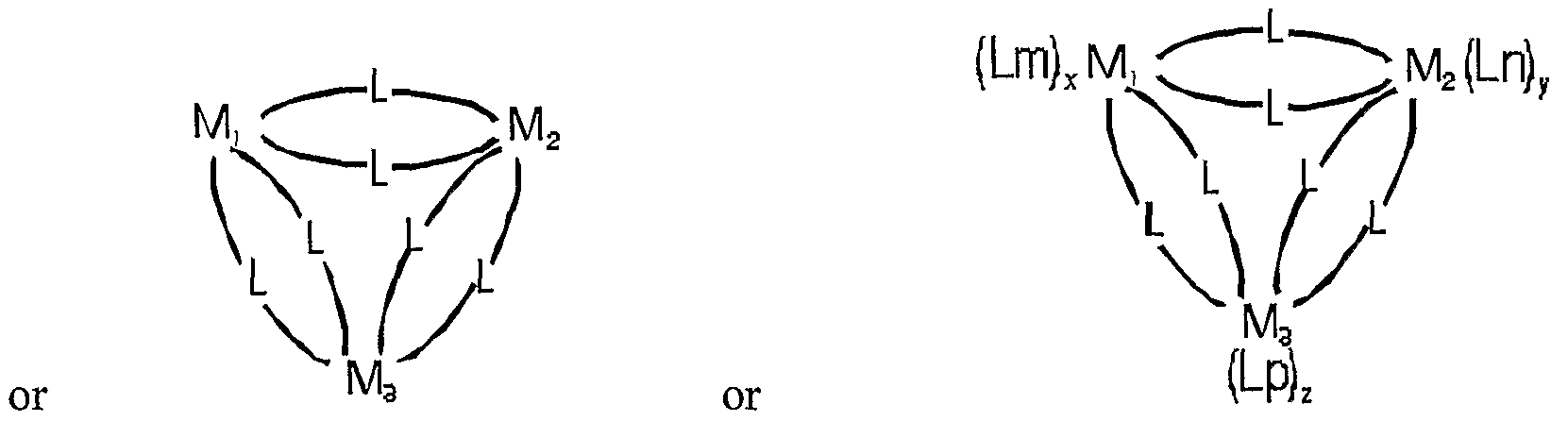
- an electroluminescent device which comprises sequentially a first electrode, a layer of an electroluminescent compound and second electrode in which the electroluminescent compound is selected from binuclear, trinuclear and polynuclear complexes of rare earth metals.
- binuclear is meant that there are least two metal atoms in the complex, at least one of which is a rare earth metal the other metals can be a rare earth or non rare earth metal one in which the metals are linked by a bridging ligand i.e. of formula
- Mi is a rare earth metal and M is a rare earth or non rare earth metal Lm and Ln are the same or different organic ligands
- x is the valence state of Lm and y is the valence state of Ln and L is a bridging ligand.
- x will be 3 when M t is in the III valence state and y will be 2 when M 2 and is in the 2 valence state etc.
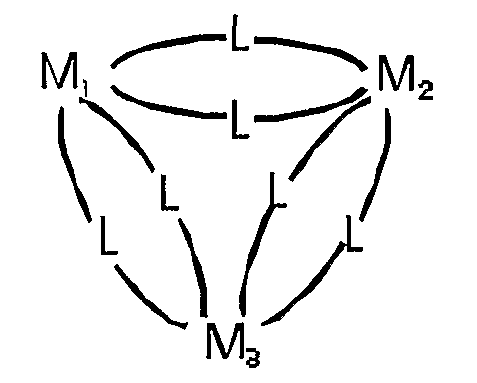
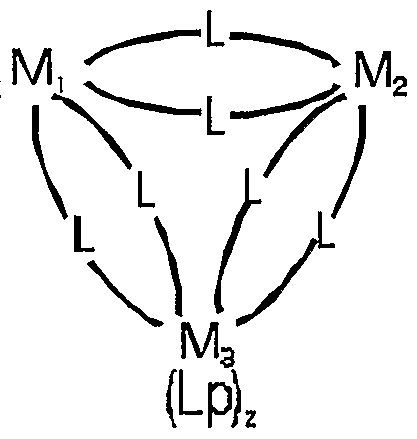
- trinuclear there are three metals joined by a bridging ligand one of which metals is a rare earth metal and at least one of which is a non rare earth metal, i.e. of formula
- L is a bridging ligand and at least one of Mi , M 2 and M 3 is a rare earth metal and the other metals can be a rare earth or non rare earth metals.
- Lm, Ln and Lp are organic ligands and x is the valence state of M-i , y is the valence state of M 2 and z is the valence state of M 3
- polynuclear there are more than three metals joined by bridging ligands and at least one of the metals is a rare earth metal and the other metals can be a rare earth or non rare earth metal.
- the rare earth metal is a metal having an unfilled inner shell and the preferred metals are selected from Sm(III), Eu(II), Eu( ⁇ II), Tb(III), Dy(III), Yb(IH), Lu( ⁇ i), Gd (III), Gd(III) U(III), Tm(III), Ce (III), Pr(III), Nd(i ⁇ ), Pm(III), Dy( ⁇ H), Ho(III), Er(III), Yb(ffl) and more preferably Eu(III), Tb(III), Dy(III), Gd (III).
- the non rare earth metal can be any non rare earth metal e.g. lithium, sodium, potassium, rubidium, caesium, beryllium, magnesium, calcium, strontium, barium, copper, silver, gold, zinc, cadmium, boron, aluminium, gallium, indium, germanium, tin, antimony, lead, and metals of the first, second and third groups of transition metals e.g. manganese, iron, ruthenium, osmium, cobalt, nickel, palladium, platinum, cadmium, cliromium. titanium, vanadium, zirconium, tantalum, molybdenum, rhodium, iridium, titanium, niobium, scandium, yttrium etc.
- non rare earth metal e.g. lithium, sodium, potassium, rubidium, caesium, beryllium, magnesium, calcium, strontium, barium, copper, silver, gold, zinc, cadmium, boron,
- x will be 3 when is in the III valence state and y will be 2 when M 2 and is in the 2 valence sate.
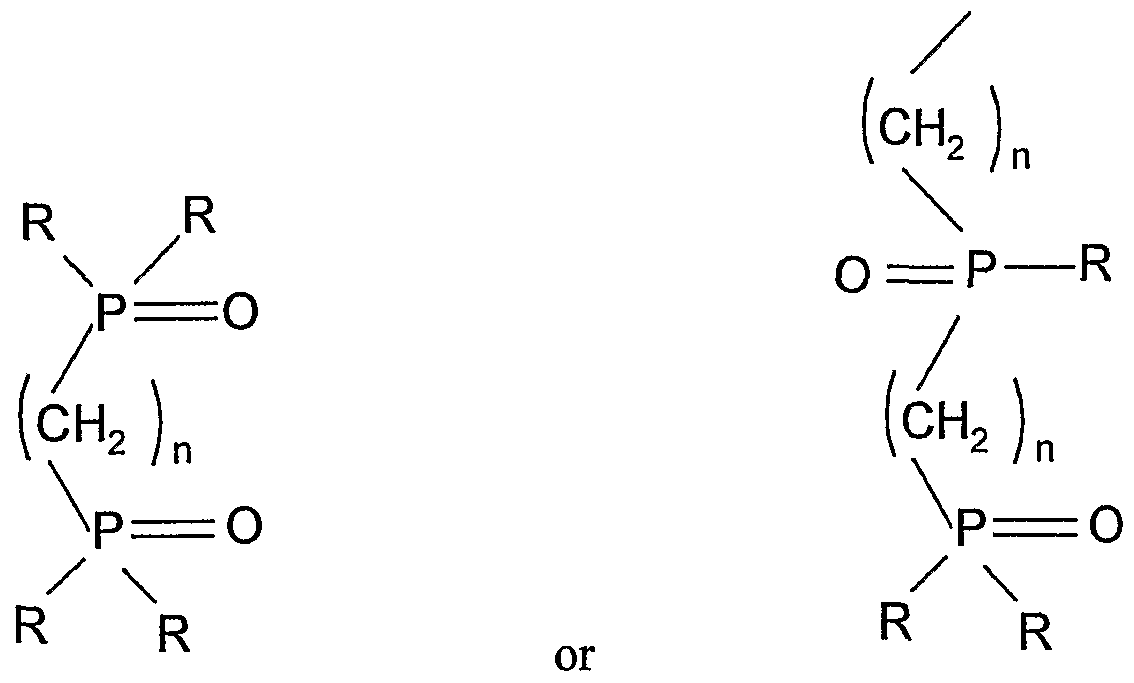
- the bridging ligands L are preferably bidentate or tridentate ligands and are preferably bis or tris phosphane oxide complexes e.g. of formula
- groups R which can be the same or different are selected from hydrogen, and substituted and unsubstituted hydrocarbyl groups such as substituted and unsubstituted aliphatic groups, substituted and unsubstituted aromatic, heterocyclic and polycyclic ring structures, fluorocarbons such as trifluoryl methyl groups, halogens such as fluorine or thiophenyl groups, n is preferably 1 to 10 e.g. 1 to 5 or as shown in figs. 17 of the drawings in which Ar are the same or different unsubstituted or substituted aromatic groups.
- R and n are as above.
- the groups R are unsubstituted or substituted aromatic groups or as shown in fig. 17.
- the groups Lm, Ln, Lp etc. which can also be the bridging ligands may all be the same or different and can be selected from ⁇ diketones such as those of formulae
- R 1; R 2 and R 3 can be the same or different and are selected from hydrogen, and substituted and unsubstituted hydrocarbyl groups such as substituted and unsubstituted aliphatic groups, substituted and unsubstituted aromatic, heterocyclic and polycyclic ring structures, fluorocarbons such as trifluoryl methyl groups, halogens such as fluorine or thiophenyl groups; R 1; R 2 and R 3 can also form substituted and unsubstituted fused aromatic, heterocyclic and polycyclic ring structures and can be copolymerisable with a monomer e.g. styrene.
- X is Se, S or O
- Y can be hydrogen, substituted or unsubstituted hydrocarbyl groups, such as substituted and unsubstituted aromatic, heterocyclic and polycyclic ring structures, fluorine, fluorocarbons such as trifluoryl methyl groups, halogens such as fluorine or thiophenyl groups or nitrile.
- R 1 and/or R 2 and/or R 3 examples include aliphatic, aromatic and heterocyclic alkoxy, aryloxy and carboxy groups, substituted and substituted phenyl, fluorophenyl, biphenyl, phenanthrene, anthracene, naphthyl and fluorene groups alkyl groups such as t-butyl, heterocyclic groups such as carbazole.
- Ri R 2 and R 3 can also be
- X is O, S, Se or NH.
- a preferred moiety Rj . is trifluoromethyl CF 3 and examples of such diketones are, banzoyltrifluoroacetone, p-chlorobenzoyltrifluoroacetone, p-bromotrifluoroacetone, p-phenyltrifluoroacetone, 1 -naphthoyltrifluoroacetone, 2-naphthoyltrifluoroacetone, 2-phenathoyltrifluoroacetone, 3-phenanthoyltrifluoroacetone, 9- anthroyltrifluoroacetonetrifluoroacetone, cinnamoyltrifluoroacetone, and 2- thenoyltrifluoroacetone.
- the different groups Lm, Ln and Lp may be the same or different ligands of formulae
- the different groups Lm, Ln and Lp may be the same or different quinolate derivatives such as
- R is hydrocarbyl, aliphatic, aromatic or heterocyclic carboxy, aryloxy, hydroxy or alkoxy e.g. the 8 hydroxy quinolate derivatives or
- R is as above or H or F or
- the different groups Lm, Ln and Lp may also be the same or different carboxylate groups
- R 5 is a substituted or unsubstituted aromatic, polycyclic or heterocyclic ring a polypyridyl group
- R 5 can also be a 2-ethyl hexyl group so Ln is 2-ethylhexanoate or R 5 can be a chair structure so that Ln is 2-acetyl cyclohexanoate or L can be
- R where R is as above e.g. alkyl, allenyl, amino or a fused ring such as a cyclic or polycyclic ring.
- the different groups Lm, Ln and Lp may also be used.
- a "cage" or “basket” structure is formed by the ligands Lm and Ln and Lp being condensed together and/or the metal atoms being linked by a hero atom or atoms such as oxygen, nitrogen etc.
- the groups R, R 1; R 2 and R 3 on the ligands Lm and the groups R , R 1; R 2 and R 3 on the ligands Ln can form a condensed or ring structure e.g. substituted and unsubstituted fused aromatic, heterocyclic and polycyclic ring structures
- the groups Lq can be selected from
- each Ph which can be the same or different and can be a phenyl (OPNP) or a substituted phenyl group, other substituted or unsubstituted aromatic group, a substituted or unsubstituted heterocyclic or polyclic group, a substituted or unsubstituted fused aromatic group such as a naphthyl, anthracene, phenanthrene, prylene or pyrene group.
- the substituents can be an alkyl, aralkyl, alkoxy, aromatic, heterocyclic, polyclic group, and halogen such as fluorine. Examples are given in figs.
- R, R 1; R 2j R ⁇ and R 5 can be the same or different and are selected from hydrogen, hydrocarbyl groups, substituted and unsubstituted aromatic, heterocyclic and polycyclic ring structures, fluorocarbons such as trifluoryl methyl groups, halogens such as fluorine or thiophenyl groups; R, R lt R 2; R 4 and R 5 can also be copolymerisable with a monomer e.g. styrene.
- Lq can also be compounds of formulae
- R 3 where R l5 R 2 and R 3 are as referred to above, for example bathophen shown in fig. 3 of the drawings..
- Lq chelates are as shown in figs. 4 and fluorene and fluorene derivatives e.g. a shown in figs. 5 and compounds of formulae as shown as shown in figs. 6 to 8.
- Lq are tripyridyl and TMHD, and TMHD complexes, ⁇ , ⁇ ', ⁇ " tripyridyl, crown ethers, cyclans, cryptans phthalocyanans, porphoryins ethylene diamine tetramine (EDTA), DCTA, DTPA and TTHA.
- TMHD 2,2,6,6- tetramethyl-3,5-heptanedionato
- OPNP is diphenylphosphonimide triphenyl phosphorane.
- the formulae of the polyamines in their acid form are shown in fig. 11.
- the first electrode is preferably a transparent substrate which is a conductive glass or plastic material which acts as the anode
- preferred substrates are conductive glasses such as indium tin oxide coated glass, but any glass which is conductive or has a conductive layer can be used.
- Conductive polymers and conductive polymer coated glass or plastics materials can also be used as the substrate.
- the hole transporting material can be an amine complex such as poly (vinylcarbazole), N, N'-diphenyl-N, N'-bis (3-methylphenyl) -1,1' -biphenyl -4,4'- diamine (TPD), an unsubstituted or substituted polymer of an amino substituted aromatic compound, a polyaniline, substituted polyanilines, polythiophenes, substituted polythiophenes, polysilanes etc.
- polyanilines are polymers of
- R is in the ortho - or meta-position and is hydrogen, Cl-18 alkyl, Cl-6 alkoxy, amino, chloro, bromo, hydroxy or the group
- R is alky or aryl and R' is hydrogen, Cl-6 alkyl or aryl with at least one other monomer of formula I above.
- the hole transporting material can be a polyaniline
- polyanilines which can be used in the present invention have the general formula
- XXVII where p is from 1 to 10 and n is from 1 to 20, R is as defined above and X is an anion, preferably selected from CI, Br, SO 4 , BF 4 , PF 6 , H 2 PO 3 , H 2 PO 4 , arylsulphonate, arenedicarboxylate, polystyrenesulphonate, polyacrylate alkysulphonate, vinylsulphonate, vinylbenzene sulphonate, cellulose sulphonate, camphor sulphonates, cellulose sulphate or a perfluorinated polyanion.
- arylsulphonates are p-toluenesulphonate, benzenesulphonate, 9,10- anthraquinone-sulphonate and anthracenesulphonate, an example of an arenedicarboxylate is phthalate and an example of arenecarboxylate is benzoate.
- evaporable deprotonated polymers of unsubstituted or substituted polymer of an amino substituted aromatic compound are used.
- the de-protonated unsubstituted or substituted polymer of an amino substituted aromatic compound can be formed by deprotonating the polymer by treatment with an alkali such as ammonium hydroxide or an alkali metal hydroxide such as sodium hydroxide or potassium hydroxide.
- the degree of protonation can be controlled by forming a protonated polyaniline and de-protonating.
- Methods of preparing polyanilines are described in the article by A. G. MacDiarmid and A. F. Epstein, Faraday Discussions, Chem Soc.88 P319 1989.
- the conductivity of the polyaniline is dependant on the degree of protonation with the maximum conductivity being when the degree of protonation is between 40 and 60% e.g. about 50% for example.
- the polymer is substantially fully deprotonated
- a polyaniline can be formed of octamer units i.e. p is four e.g. This is referred to as DDPANI
- the polyanilines can have conductivities of the order of 1 x 10 "1 Siemen cm "1 or higher.
- the aromatic rings can be unsubstituted or substituted e.g. by a CI to 20 alkyl group such as ethyl.
- the polyaniline can be a copolymer of aniline and preferred copolymers are the copolymers of aniline with o-anisidine, m-sulphanilic acid or o-aminophenol, or o- toluidine with o-aminophenol, o-ethylaniline, o-phenylene diamine or with amino anthracenes.
- polymers of an amino substituted aromatic compound which can be used include substituted or unsubstituted polyaminonapthalenes, polyaminoanthracenes, polyaminophenanthrenes, etc. and polymers of any other condensed polyaromatic compound.
- Polyaminoanthracenes and methods of making them are disclosed in US Patent 6,153,726.
- the aromatic rings can be unsubstituted or substituted e.g. by a group R as defined above.
- conjugated polymer and the conjugated polymers which can be used can be any of the conjugated polymers disclosed or referred to in US 5807627, PCT/WO90/13148 and PCT/WO92/03490.
- the preferred conjugated polymers are poly (p-phenylenevinylene)-PPV and copolymers including PPV.
- Other preferred polymers are poly (2, 5 dialkoxyphenylene vinylene) such as poly (2-methoxy-5-(2-methoxypentyloxy-l,4-phenylene vinylene), poly(2-methoxypentyloxy)- 1 ,4-phenylenevinylene), poly(2-methoxy-5-(2- dodecyloxy-l,4-phenylenevinylene) and other poly(2,5 dialkoxyphenylenevinylenes) with at least one of the alkoxy groups being a long chain solubilising alkoxy group, poly fluorenes and oligofluorenes, polyphenylenes and oligophenylenes, polyanthracenes and oligo anthracenes, ploythiophenes and oligothiophenes.
- the phenylene ring may optionally carry one or more substituents e.g. each independently selected from alkyl, preferably methyl, alkoxy, preferably methoxy or ethoxy.
- Any poly(arylenevinylene) including substituted derivatives thereof can be used and the phenylene ring in poly(p-phenylenevinylene) may be replaced by a fused ring system such as anthracene or naphthlyene ring and the number of vinylene groups in each polyphenylenevinylene moiety can be increased e.g. up to 7 or higher.
- the conjugated polymers can be made by the methods disclosed in US 5807627, PCT/WO90/13148 and PCT/WO92/03490.
- the thickness of the hole transporting layer is preferably 20nm to 200nm.
- polymers of an amino substituted aromatic compound such as polyanilines referred to above can also be used as buffer layers with or in conjunction with other hole transporting materials.
- R 1; R and R 3 can be the same or different and are selected from hydrogen, and substituted and unsubstituted hydrocarbyl groups such as substituted and unsubstituted aliphatic groups, substituted and unsubstituted aromatic, heterocyclic and polycyclic ring structures, fluorocarbons such as trifluoryl methyl groups, halogens such as fluorine or thiophenyl groups; R 1; R 2 and R 3 can also form substituted and unsubstituted fused aromatic, heterocyclic and polycyclic ring structures and can be copolymerisable with a monomer e.g.
- styrene X is Se, S or O
- Y can be hydrogen, substituted or unsubstituted hydrocarbyl groups, such as substituted and unsubstituted aromatic, heterocyclic and polycyclic ring structures, fluorine, fluorocarbons such as trifluoryl methyl groups, halogens such as fluorine or thiophenyl groups or nitrile.
- Ri and/or R 2 and/or R 3 include aliphatic, aromatic and heterocyclic alkoxy, aryloxy and carboxy groups, substituted and substituted phenyl, fluorophenyl, biphenyl, phenanthrene, anthracene, naphthyl and fluorene groups alkyl groups such as t-butyl, heterocyclic groups such as carbazole.
- the electron transmitting material is a material which will transport electrons when an electric current is passed through electron transmitting materials include a metal complex such as a metal quinolate e.g. an aluminium quinolate, lithium quinolate a cyano anthracene such as 9,10 dicyano anthracene, a polystyrene sulphonate and compounds of formulae shown in figs. 9 and 10.
- a metal complex such as a metal quinolate e.g. an aluminium quinolate, lithium quinolate a cyano anthracene such as 9,10 dicyano anthracene, a polystyrene sulphonate and compounds of formulae shown in figs. 9 and 10.
- the electron transmitting material can be mixed with the electroluminescent material and co-deposited with it.
- the thickness of the layers is from 5nm to 500nm.
- the second electrode functions as the cathode and can be any low work function metal e.g. aluminium, calcium, lithium, silver/magnesium alloys etc., aluminium is a preferred metal.
- Lithium fluoride can be used as the second electrode for example by having a lithium fluoride layer formed on a metal.
- the hole transporting material can optionally be mixed with the electroluminescent material in a ratio of 5 - 95% of the electroluminescent material to 95 to 5% of the hole transporting compound.
- the hole transporting materials, the electroluminescent material and the electron injecting materials can be mixed together to form one layer, which simplifies the construction.
- the electroluminescent material can be deposited on the substrate directly by evaporation from a solution of the material in an organic solvent.
- the solvent which is used will depend on the material but chlorinated hydrocarbons such as dichloromethane, n-methyl pyrrolidone, dimethyl sulphoxide, tetra hydrofuran dimethylformamide etc. are suitable in many cases.
- the material can be deposited by spin coating from solution or by vacuum deposition from the solid state e.g. by sputtering or any other conventional method can be used.
- Diethylether (50mL, dried and distilled over sodium) was added to Bis(diphenylphosphino)methane (2.0g. 5.2mmol, Sigma-Aldrich) in a three-necked flask equipped with condenser, pressure-equalising dropping funel and under a nitrogen atmosphere.
- Diphenylazidophosphane (2.78g, l l.Ommol) in dry diethylether (lOOmL) was added dropwise over 15 minutes to the suspension.
- a further 50mL diethylether was used to rinse the pressure-equalising dropping funnel, which was subsequently removed and the reaction refluxed for 3 hours. After stirring for 15 hours at room temperature, a white precipitate (3.0g.
- Diethylether (50mL, dried and distilled over sodium) was added to 1,2- Bis(diphenylphosphino)ethane (4.0g, lO.Ommol, Sigma-Aldrich) in a three-necked flask equipped with condenser, pressure-equalising dropping funnel and under a nitrogen atmosphere.
- Diphenylazidophosphane (6.0g. 25.0mmol) in dry diethylether (lOOmL) was added dropwise over 15 minutes to the suspension.
- a further 50mL diethylether was used to rinse the pressure-equalising dropping funnel, which was subsequently removed and the reaction refluxed for 3 hours.
- Diethylether (50mL, dried and distilled over sodium) was added to 1,6- Bis(diphenylphosphino)hexane (2.5g, 5.Smmol, Sigma-Aldrich) in a three-necked flask equipped with condenser, pressure-equalising dropping funnel and under a nitrogen atmosphere.
- Diphenylazidophosphane (2.56g, lO.Smmol) in dry diethylether (50mL) was added dropwise over 15 minutes to the suspension. A further 5OmL diethylether was used to rinse the pressure-equalising dropping funnel, which was subsequently removed and the reaction refluxed for 3 hours.
- Photoluminescence:PL :eff . :0.12cd m ⁇ rnW 1 @800 ⁇ W; peak 613nm CIE coordinates x: 0.66, y: 0.33.
- Example 16 Ethylene-bis(diphenylphosphinimino-phosphane oxide)- bis ⁇ europium tris(dibenzoyhnethane)]
- An electroluminescent device was made by depositing sequentially from solution onto a indium tin oxide glass anode layers of DDPANI 8nm; ⁇ -NPB; an electroluminescent layer comprising a compound made as in Example 14; aluminium quinolate and an aluminium cathode.
- the device is shown schematically in fig. 21 where (1) is the ITO anode; (2) is a DDPANI layer; (3) is an ⁇ -NPB layer; (4) is the electroluminescent layer comprising a compound made as in Example 14; (5) is an aluminium quinolate layer and (6) is an aluminium cathode.
Landscapes
- Chemical & Material Sciences (AREA)
- Engineering & Computer Science (AREA)
- Materials Engineering (AREA)
- Inorganic Chemistry (AREA)
- Crystallography & Structural Chemistry (AREA)
- Organic Chemistry (AREA)
- Electroluminescent Light Sources (AREA)
Abstract
Description





Claims



Priority Applications (2)
| Application Number | Priority Date | Filing Date | Title |
|---|---|---|---|
| US10/485,781 US7303824B2 (en) | 2001-08-04 | 2002-08-05 | Electroluminescent device |
| EP02749113A EP1414927A1 (en) | 2001-08-04 | 2002-08-05 | Electroluminescent device |
Applications Claiming Priority (6)
| Application Number | Priority Date | Filing Date | Title |
|---|---|---|---|
| GB0119109A GB0119109D0 (en) | 2001-08-04 | 2001-08-04 | Electroluminescent device |
| GB0119112A GB0119112D0 (en) | 2001-08-04 | 2001-08-04 | Electroluminescent device |
| GB0119116A GB0119116D0 (en) | 2001-08-04 | 2001-08-04 | Electroluminescent device |
| GB0119112.1 | 2001-08-04 | ||
| GB0119109.7 | 2001-08-04 | ||
| GB0119116.2 | 2001-08-04 |
Publications (1)
| Publication Number | Publication Date |
|---|---|
| WO2003014256A1 true WO2003014256A1 (en) | 2003-02-20 |
Family
ID=27256246
Family Applications (1)
| Application Number | Title | Priority Date | Filing Date |
|---|---|---|---|
| PCT/GB2002/003588 Ceased WO2003014256A1 (en) | 2001-08-04 | 2002-08-05 | Electroluminescent device |
Country Status (3)
| Country | Link |
|---|---|
| US (1) | US7303824B2 (en) |
| EP (1) | EP1414927A1 (en) |
| WO (1) | WO2003014256A1 (en) |
Cited By (12)
| Publication number | Priority date | Publication date | Assignee | Title |
|---|---|---|---|---|
| WO2004093210A1 (en) * | 2003-04-01 | 2004-10-28 | The University Of Southern California | Organic light emitting devices utilizing binuclear metal-compounds as emissive material |
| US7087323B2 (en) * | 2001-07-05 | 2006-08-08 | E. I. Du Pont De Nemours And Company | Photoactive lanthanide complexes with phosphine oxides, phosphine oxide-sulfides, pyridine N-oxides, and phosphine oxide-pyridine N-oxides, and devices made with such complexes |
| US7211334B2 (en) | 2001-07-09 | 2007-05-01 | Oled-T Limited | Electroluminescent materials and devices |
| US7235311B2 (en) | 2001-04-20 | 2007-06-26 | Oled-T Limited | Electroluminescent devices incorporating mixed metal organic complexes |
| US7303824B2 (en) | 2001-08-04 | 2007-12-04 | Oled-T Limited | Electroluminescent device |
| CN100365028C (en) * | 2005-09-07 | 2008-01-30 | 苏州大学 | Polymer europium complex, its preparation process and use |
| CN100374469C (en) * | 2005-09-07 | 2008-03-12 | 苏州大学 | Polymer samarium complex, its preparation process and application |
| US7354661B2 (en) | 2001-06-15 | 2008-04-08 | Oled-T Limited | Electroluminescent devices |
| JP2009242385A (en) * | 2008-03-11 | 2009-10-22 | Nara Institute Of Science & Technology | Rare earth metal complex and wavelength conversion material using the same |
| CN102329339A (en) * | 2011-07-11 | 2012-01-25 | 南京大学 | Coordination compounds of iridium (III), preparation method and application thereof in organic electroluminescence |
| JP2014019664A (en) * | 2012-07-18 | 2014-02-03 | Osaka City Univ | Luminescent metal complex |
| EP3747942A1 (en) | 2019-06-05 | 2020-12-09 | EMPA Eidgenössische Materialprüfungs- und Forschungsanstalt | Bridged phosphorus based flame retardants |
Families Citing this family (5)
| Publication number | Priority date | Publication date | Assignee | Title |
|---|---|---|---|---|
| JP3811142B2 (en) * | 2003-06-24 | 2006-08-16 | 株式会社東芝 | LED element and light emitting medium using rare earth complex |
| JP4185032B2 (en) * | 2004-09-13 | 2008-11-19 | 株式会社東芝 | Fluorescent image formed product and fluorescent light emitting ink |
| CN102227438B (en) * | 2008-11-28 | 2014-06-25 | 独立行政法人理化学研究所 | Novel compound and utilization of same |
| JP6333527B2 (en) * | 2013-09-05 | 2018-05-30 | 国立大学法人北海道大学 | Thin film for organic EL device and manufacturing method thereof |
| CN107876096B (en) * | 2017-11-09 | 2020-04-17 | 南京大学(苏州)高新技术研究院 | Powder catalytic material, preparation method and application of polyaniline-containing composite porous nano catalytic material |
Citations (5)
| Publication number | Priority date | Publication date | Assignee | Title |
|---|---|---|---|---|
| EP0744451A1 (en) * | 1995-05-25 | 1996-11-27 | AMERSHAM INTERNATIONAL plc | Fluorescent compounds |
| WO1998058037A1 (en) * | 1997-06-17 | 1998-12-23 | South Bank University Enterprises Ltd. | Electroluminescent material |
| EP0964459A2 (en) * | 1998-06-09 | 1999-12-15 | Bayer Aktiengesellschaft | Electroluminescent devices containing N-alkyl-2,2'-imino-bis-(8-hydroxy-quinoline) metal complexes |
| EP1026222A2 (en) * | 1999-02-04 | 2000-08-09 | Matsushita Electric Industrial Co., Ltd. | Organic material for electroluminescent device and electroluminescent device using the same |
| EP1052661A2 (en) * | 1999-05-14 | 2000-11-15 | Fuji Photo Film Co., Ltd. | Metal complex dye for a photoelectrochemical cell |
Family Cites Families (42)
| Publication number | Priority date | Publication date | Assignee | Title |
|---|---|---|---|---|
| US4356429A (en) | 1980-07-17 | 1982-10-26 | Eastman Kodak Company | Organic electroluminescent cell |
| US4455364A (en) | 1981-11-14 | 1984-06-19 | Konishiroku Photo Industry Co., Ltd. | Process for forming metallic image, composite material for the same |
| BR8300826A (en) | 1982-02-22 | 1983-11-16 | Minnesota Mining & Mfg | PROCESS TO IMPROVE RESISTANCE TO ABRASION OF DEPOSITED METAL LAYERS, AS STEAM, AND ITEM OBTAINED |
| JPS6137887A (en) | 1984-07-31 | 1986-02-22 | Canon Inc | EL element |
| JPS63186844A (en) | 1987-01-30 | 1988-08-02 | Hitachi Maxell Ltd | Amorphous material |
| US4720432A (en) | 1987-02-11 | 1988-01-19 | Eastman Kodak Company | Electroluminescent device with organic luminescent medium |
| US4885211A (en) | 1987-02-11 | 1989-12-05 | Eastman Kodak Company | Electroluminescent device with improved cathode |
| JP2505244B2 (en) | 1988-04-07 | 1996-06-05 | 出光興産株式会社 | Thin film EL device |
| GB8909011D0 (en) | 1989-04-20 | 1989-06-07 | Friend Richard H | Electroluminescent devices |
| US5128587A (en) | 1989-12-26 | 1992-07-07 | Moltech Corporation | Electroluminescent device based on organometallic membrane |
| JP3069139B2 (en) | 1990-03-16 | 2000-07-24 | 旭化成工業株式会社 | Dispersion type electroluminescent device |
| US5364654A (en) | 1990-06-14 | 1994-11-15 | Idemitsu Kosan Co., Ltd. | Process for production of a thin film electrode and an electroluminescence device |
| GB9018698D0 (en) | 1990-08-24 | 1990-10-10 | Lynxvale Ltd | Semiconductive copolymers for use in electroluminescent devices |
| EP0688849B1 (en) | 1992-02-14 | 2000-01-12 | Nycomed Amersham plc | Fluorescent compounds |
| EP0569827A2 (en) | 1992-05-11 | 1993-11-18 | Idemitsu Kosan Company Limited | Organic electroluminescence device |
| GB9215929D0 (en) | 1992-07-27 | 1992-09-09 | Cambridge Display Tech Ltd | Electroluminescent devices |
| JPH06145146A (en) | 1992-11-06 | 1994-05-24 | Chisso Corp | Oxinate derivative |
| US5707745A (en) | 1994-12-13 | 1998-01-13 | The Trustees Of Princeton University | Multicolor organic light emitting devices |
| DE19627070A1 (en) | 1996-07-05 | 1998-01-08 | Bayer Ag | Electroluminescent devices using glare systems |
| US5755999A (en) | 1997-05-16 | 1998-05-26 | Eastman Kodak Company | Blue luminescent materials for organic electroluminescent devices |
| GB9711237D0 (en) | 1997-06-02 | 1997-07-23 | Isis Innovation | Organomettallic Complexes |
| EP0921147B1 (en) | 1997-12-03 | 2005-01-12 | Nissan Chemical Industries, Limited | Transparent conducting polymers |
| GB9826406D0 (en) | 1998-12-02 | 1999-01-27 | South Bank Univ Entpr Ltd | Quinolates |
| JP4514841B2 (en) | 1998-02-17 | 2010-07-28 | 淳二 城戸 | Organic electroluminescent device |
| GB9823761D0 (en) | 1998-11-02 | 1998-12-23 | South Bank Univ Entpr Ltd | Novel electroluminescent materials |
| GB9826407D0 (en) | 1998-12-02 | 1999-01-27 | South Bank Univ Entpr Ltd | Novel electroluminescent materials |
| GB9826405D0 (en) | 1998-12-02 | 1999-01-27 | South Bank Univ Entpr Ltd | Method for forming films or layers |
| GB9901971D0 (en) | 1999-02-01 | 1999-03-17 | South Bank Univ Entpr Ltd | Electroluminescent material |
| GB0028436D0 (en) | 2000-11-21 | 2001-01-10 | South Bank Univ Entpr Ltd | Electroluminescent device incorporating conjugated polymer |
| GB0028439D0 (en) | 2000-11-21 | 2001-01-10 | South Bank Univ Entpr Ltd | Elecroluminescent device |
| GB0028317D0 (en) * | 2000-11-21 | 2001-01-03 | South Bank Univ Entpr Ltd | Electroluminescent device incorporating polyaniline |
| GB0109759D0 (en) | 2001-04-20 | 2001-06-13 | Elam T Ltd | Green light emitting electroluminescent material |
| GB0109757D0 (en) | 2001-04-20 | 2001-06-13 | Elam T Ltd | White light emitting electroluminescent material |
| GB0109758D0 (en) | 2001-04-20 | 2001-06-13 | Elam T Ltd | Mixed metal organic complexes |
| GB0109755D0 (en) * | 2001-04-20 | 2001-06-13 | Elam T Ltd | Devices incorporating mixed metal organic complexes |
| GB0110999D0 (en) | 2001-05-04 | 2001-06-27 | Elam T Ltd | Electroluminescent device |
| WO2002090465A1 (en) | 2001-05-04 | 2002-11-14 | Elam-T Limited | Electroluminescent devices |
| TWI303533B (en) | 2001-06-15 | 2008-11-21 | Oled T Ltd | Electroluminescent devices |
| US6875523B2 (en) * | 2001-07-05 | 2005-04-05 | E. I. Du Pont De Nemours And Company | Photoactive lanthanide complexes with phosphine oxides, phosphine oxide-sulfides, pyridine N-oxides, and phosphine oxide-pyridine N-oxides, and devices made with such complexes |
| GB0116644D0 (en) | 2001-07-09 | 2001-08-29 | Elam T Ltd | Electroluminescent materials and devices |
| EP1282291A1 (en) | 2001-08-02 | 2003-02-05 | Aerotech IFE Limited | Cable reel for handset and cradle |
| US7303824B2 (en) | 2001-08-04 | 2007-12-04 | Oled-T Limited | Electroluminescent device |
-
2002
- 2002-08-05 US US10/485,781 patent/US7303824B2/en not_active Expired - Fee Related
- 2002-08-05 EP EP02749113A patent/EP1414927A1/en not_active Withdrawn
- 2002-08-05 WO PCT/GB2002/003588 patent/WO2003014256A1/en not_active Ceased
Patent Citations (5)
| Publication number | Priority date | Publication date | Assignee | Title |
|---|---|---|---|---|
| EP0744451A1 (en) * | 1995-05-25 | 1996-11-27 | AMERSHAM INTERNATIONAL plc | Fluorescent compounds |
| WO1998058037A1 (en) * | 1997-06-17 | 1998-12-23 | South Bank University Enterprises Ltd. | Electroluminescent material |
| EP0964459A2 (en) * | 1998-06-09 | 1999-12-15 | Bayer Aktiengesellschaft | Electroluminescent devices containing N-alkyl-2,2'-imino-bis-(8-hydroxy-quinoline) metal complexes |
| EP1026222A2 (en) * | 1999-02-04 | 2000-08-09 | Matsushita Electric Industrial Co., Ltd. | Organic material for electroluminescent device and electroluminescent device using the same |
| EP1052661A2 (en) * | 1999-05-14 | 2000-11-15 | Fuji Photo Film Co., Ltd. | Metal complex dye for a photoelectrochemical cell |
Non-Patent Citations (4)
| Title |
|---|
| C. D. HALL, N. W. SHARPE: "Photophysical and Photochemical Studies on the Lanthanide Complexes of Metallocene-Containing Cryptands", JOURNAL OF PHOTOCHEMISTRY AND PHOTOBIOLOGY A: CHEMISTRY, vol. 56, 1991, pages 255 - 265, XP000900063 * |
| S. FERY-FORGUES, B. DELAVAUX-NICOT: "Ferrocene and Ferrocenyl Derivatives in Luminescent Systems", JOURNAL OF PHOTOCHEMISTRA AND PHOTOBIOLOGY A: CHEMISTRY, vol. 132, 20 April 2000 (2000-04-20), pages 137 - 159, XP002220496 * |
| S. R. DRAKE, A. LYONS, D. J. OTWAY, D. J. WILLIAMS: "An Unexpected Product Derived from the Reaction of TbCl3(H2O)6 and [Na(hfa)]n: Synthesis, Characterization, and X-ray Structure of{[Tb2(hfa)(u-O2CCF3)2(H2O)2]2:H2O}", INORGANIC CHEMISTRY, vol. 33, 16 March 1994 (1994-03-16), pages 1230 - 1233, XP002220495 * |
| Y.CUI, Y. T. QIAN, J. SH. HUANG: "Synthesis, characterization and X-ray structure of three types of triply crotonate-bridged heterometallic zinc(II)-lanthanide(III) complexes", POLYHEDRON, vol. 20, 30 June 2001 (2001-06-30), pages 1795 - 1802, XP002220494 * |
Cited By (16)
| Publication number | Priority date | Publication date | Assignee | Title |
|---|---|---|---|---|
| US7235311B2 (en) | 2001-04-20 | 2007-06-26 | Oled-T Limited | Electroluminescent devices incorporating mixed metal organic complexes |
| US7354661B2 (en) | 2001-06-15 | 2008-04-08 | Oled-T Limited | Electroluminescent devices |
| US7087323B2 (en) * | 2001-07-05 | 2006-08-08 | E. I. Du Pont De Nemours And Company | Photoactive lanthanide complexes with phosphine oxides, phosphine oxide-sulfides, pyridine N-oxides, and phosphine oxide-pyridine N-oxides, and devices made with such complexes |
| US7211334B2 (en) | 2001-07-09 | 2007-05-01 | Oled-T Limited | Electroluminescent materials and devices |
| US7303824B2 (en) | 2001-08-04 | 2007-12-04 | Oled-T Limited | Electroluminescent device |
| WO2004093210A1 (en) * | 2003-04-01 | 2004-10-28 | The University Of Southern California | Organic light emitting devices utilizing binuclear metal-compounds as emissive material |
| US7090928B2 (en) | 2003-04-01 | 2006-08-15 | The University Of Southern California | Binuclear compounds |
| US7824778B2 (en) | 2003-04-01 | 2010-11-02 | The University Of Southern California | Binuclear compounds |
| CN100365028C (en) * | 2005-09-07 | 2008-01-30 | 苏州大学 | Polymer europium complex, its preparation process and use |
| CN100374469C (en) * | 2005-09-07 | 2008-03-12 | 苏州大学 | Polymer samarium complex, its preparation process and application |
| JP2009242385A (en) * | 2008-03-11 | 2009-10-22 | Nara Institute Of Science & Technology | Rare earth metal complex and wavelength conversion material using the same |
| CN102329339A (en) * | 2011-07-11 | 2012-01-25 | 南京大学 | Coordination compounds of iridium (III), preparation method and application thereof in organic electroluminescence |
| CN102329339B (en) * | 2011-07-11 | 2014-04-30 | 南京大学 | Coordination compounds of iridium (III), preparation method and application thereof in organic electroluminescence |
| JP2014019664A (en) * | 2012-07-18 | 2014-02-03 | Osaka City Univ | Luminescent metal complex |
| EP3747942A1 (en) | 2019-06-05 | 2020-12-09 | EMPA Eidgenössische Materialprüfungs- und Forschungsanstalt | Bridged phosphorus based flame retardants |
| WO2020245434A1 (en) | 2019-06-05 | 2020-12-10 | Empa Eidgenössische Materialprüfungs- Und Forschungsanstalt | Bridged phosphorus-based flame retardants |
Also Published As
| Publication number | Publication date |
|---|---|
| EP1414927A1 (en) | 2004-05-06 |
| US7303824B2 (en) | 2007-12-04 |
| US20040253477A1 (en) | 2004-12-16 |
Similar Documents
| Publication | Publication Date | Title |
|---|---|---|
| US7303824B2 (en) | Electroluminescent device | |
| EP1578886A2 (en) | Electroluminescent materials and devices | |
| US20040023061A1 (en) | Electroluminescent device | |
| EP1336325A1 (en) | Electroluminescent device | |
| US20030215669A1 (en) | Electroluminescent device | |
| EP1578756B1 (en) | Electroluminescent materials and devices | |
| US20040166364A1 (en) | Electroluminescent devices | |
| WO2006090098A1 (en) | Electroluminescent materials and devices | |
| JP5564164B2 (en) | Electroluminescent materials and devices | |
| US7235311B2 (en) | Electroluminescent devices incorporating mixed metal organic complexes | |
| WO2003093394A1 (en) | Electroluminescent devices | |
| EP1786885B1 (en) | Electroluminescent materials and devices | |
| WO2006048679A2 (en) | Electroluminescent complexes | |
| EP1761614A1 (en) | Electroluminescent materials and devices | |
| WO2004016708A1 (en) | Electroluminescent materials and devices | |
| WO2002090465A1 (en) | Electroluminescent devices | |
| GB2440368A (en) | Cathode coating for an electroluminescent device | |
| US20080199727A1 (en) | Buffer Layer | |
| WO2004013252A1 (en) | Electroluminescent materials and devices | |
| WO2002075820A1 (en) | Electroluminescent devices |
Legal Events
| Date | Code | Title | Description |
|---|---|---|---|
| AK | Designated states |
Kind code of ref document: A1 Designated state(s): AE AG AL AM AT AU AZ BA BB BG BR BY BZ CA CH CN CO CR CU CZ DE DK DM DZ EC EE ES FI GB GD GE GH GM HR HU ID IL IN IS JP KE KG KP KR KZ LC LK LR LS LT LU LV MA MD MG MK MN MW MX MZ NO NZ OM PH PL PT RO RU SD SE SG SI SK SL TJ TM TN TR TT TZ UA UG US UZ VN YU ZA ZM ZW Kind code of ref document: A1 Designated state(s): AE AG AL AM AT AU AZ BA BB BG BY BZ CA CH CN CO CR CU CZ DE DM DZ EC EE ES FI GB GD GE GH HR HU ID IL IN IS JP KE KG KP KR LC LK LR LS LT LU LV MA MD MG MN MW MX MZ NO NZ OM PH PL PT RU SD SE SG SI SK SL TJ TM TN TR TZ UA UG US UZ VN YU ZA ZM |
|
| AL | Designated countries for regional patents |
Kind code of ref document: A1 Designated state(s): GH GM KE LS MW MZ SD SL SZ TZ UG ZM ZW AM AZ BY KG KZ MD RU TJ TM AT BE BG CH CY CZ DE DK EE ES FI FR GB GR IE IT LU MC NL PT SE SK TR BF BJ CF CG CI CM GA GN GQ GW ML MR NE SN TD TG Kind code of ref document: A1 Designated state(s): GH GM KE LS MW MZ SD SL SZ UG ZM ZW AM AZ BY KG KZ RU TJ TM AT BE BG CH CY CZ DK EE ES FI FR GB GR IE IT LU MC PT SE SK TR BF BJ CF CG CI GA GN GQ GW ML MR NE SN TD TG |
|
| 121 | Ep: the epo has been informed by wipo that ep was designated in this application | ||
| WWE | Wipo information: entry into national phase |
Ref document number: 2002749113 Country of ref document: EP |
|
| WWE | Wipo information: entry into national phase |
Ref document number: 10485781 Country of ref document: US |
|
| WWP | Wipo information: published in national office |
Ref document number: 2002749113 Country of ref document: EP |
|
| REG | Reference to national code |
Ref country code: DE Ref legal event code: 8642 |
|
| NENP | Non-entry into the national phase |
Ref country code: JP |
|
| WWW | Wipo information: withdrawn in national office |
Country of ref document: JP |