WO2003018661A1 - Process for the preparation of a coating, a coated substrate, an adhesive, film or sheet - Google Patents
Process for the preparation of a coating, a coated substrate, an adhesive, film or sheet Download PDFInfo
- Publication number
- WO2003018661A1 WO2003018661A1 PCT/NL2002/000555 NL0200555W WO03018661A1 WO 2003018661 A1 WO2003018661 A1 WO 2003018661A1 NL 0200555 W NL0200555 W NL 0200555W WO 03018661 A1 WO03018661 A1 WO 03018661A1
- Authority
- WO
- WIPO (PCT)
- Prior art keywords
- reactive
- reactive system
- compound
- substrate
- process according
- Prior art date
- Legal status (The legal status is an assumption and is not a legal conclusion. Google has not performed a legal analysis and makes no representation as to the accuracy of the status listed.)
- Ceased
Links
Classifications
-
- C—CHEMISTRY; METALLURGY
- C08—ORGANIC MACROMOLECULAR COMPOUNDS; THEIR PREPARATION OR CHEMICAL WORKING-UP; COMPOSITIONS BASED THEREON
- C08G—MACROMOLECULAR COMPOUNDS OBTAINED OTHERWISE THAN BY REACTIONS ONLY INVOLVING UNSATURATED CARBON-TO-CARBON BONDS
- C08G18/00—Polymeric products of isocyanates or isothiocyanates
- C08G18/06—Polymeric products of isocyanates or isothiocyanates with compounds having active hydrogen
- C08G18/08—Processes
- C08G18/10—Prepolymer processes involving reaction of isocyanates or isothiocyanates with compounds having active hydrogen in a first reaction step
-
- C—CHEMISTRY; METALLURGY
- C09—DYES; PAINTS; POLISHES; NATURAL RESINS; ADHESIVES; COMPOSITIONS NOT OTHERWISE PROVIDED FOR; APPLICATIONS OF MATERIALS NOT OTHERWISE PROVIDED FOR
- C09J—ADHESIVES; NON-MECHANICAL ASPECTS OF ADHESIVE PROCESSES IN GENERAL; ADHESIVE PROCESSES NOT PROVIDED FOR ELSEWHERE; USE OF MATERIALS AS ADHESIVES
- C09J175/00—Adhesives based on polyureas or polyurethanes; Adhesives based on derivatives of such polymers
- C09J175/04—Polyurethanes
- C09J175/14—Polyurethanes having carbon-to-carbon unsaturated bonds
- C09J175/16—Polyurethanes having carbon-to-carbon unsaturated bonds having terminal carbon-to-carbon unsaturated bonds
-
- C—CHEMISTRY; METALLURGY
- C08—ORGANIC MACROMOLECULAR COMPOUNDS; THEIR PREPARATION OR CHEMICAL WORKING-UP; COMPOSITIONS BASED THEREON
- C08G—MACROMOLECULAR COMPOUNDS OBTAINED OTHERWISE THAN BY REACTIONS ONLY INVOLVING UNSATURATED CARBON-TO-CARBON BONDS
- C08G18/00—Polymeric products of isocyanates or isothiocyanates
- C08G18/06—Polymeric products of isocyanates or isothiocyanates with compounds having active hydrogen
- C08G18/08—Processes
- C08G18/10—Prepolymer processes involving reaction of isocyanates or isothiocyanates with compounds having active hydrogen in a first reaction step
- C08G18/12—Prepolymer processes involving reaction of isocyanates or isothiocyanates with compounds having active hydrogen in a first reaction step using two or more compounds having active hydrogen in the first polymerisation step
-
- C—CHEMISTRY; METALLURGY
- C09—DYES; PAINTS; POLISHES; NATURAL RESINS; ADHESIVES; COMPOSITIONS NOT OTHERWISE PROVIDED FOR; APPLICATIONS OF MATERIALS NOT OTHERWISE PROVIDED FOR
- C09D—COATING COMPOSITIONS, e.g. PAINTS, VARNISHES OR LACQUERS; FILLING PASTES; CHEMICAL PAINT OR INK REMOVERS; INKS; CORRECTING FLUIDS; WOODSTAINS; PASTES OR SOLIDS FOR COLOURING OR PRINTING; USE OF MATERIALS THEREFOR
- C09D175/00—Coating compositions based on polyureas or polyurethanes; Coating compositions based on derivatives of such polymers
- C09D175/04—Polyurethanes
- C09D175/14—Polyurethanes having carbon-to-carbon unsaturated bonds
- C09D175/16—Polyurethanes having carbon-to-carbon unsaturated bonds having terminal carbon-to-carbon unsaturated bonds
Definitions
- the present invention relates to a process for the preparation of a coating, a coated substrate, an adhesive, film or sheet, to the thus obtained product and to a coating mixture to be used in the process.
- a coating mixture to be used in the process.
- several methods have been developed for solvent-free application of polyurethanes in the preparation of coatings, films and the like. An overview of these methods is presented in WO-123451. Further, in this patent application an invention is described which caused a breakthrough in the development of high solid systems.
- This invention describes a process for the preparation of coatings in which a mixture of a polyisocyanate-, polyepoxide- , polyanhydride-, or polyketone- functional compound and a compound containing reactive hydrogen, which mixture is not reactive at room temperature, is applied onto a substrate, whereafter the mixture reacts at elevated temperatures.
- the compound containing reactive hydrogen is a solid, which may be present in the mixture as a fine powder or as a dispersion in a medium.
- the known systems including the system described in WO-123451, have the disadvantage that after reaction the material retains its form so well that treatment such as embossing or otherwise moulding and subsequent fixing of the form, poses problems.
- the object of the present invention is to provide a process in which the disadvantages mentioned are eliminated and in which is taken advantage of the invention described in WO-123451.
- a process for the preparation of a coating, coated substrate, adhesive, film, sheet and the like which comprises.- _ the preparation of a coating mixture comprising a reactive system, _ applying of the coating mixture onto a substrate resulting in a substrate coated with the coating mixture and - reacting the reactive system, characterized, in that,
- the coating mixture is prepared as a mixture comprising a first and a second reactive system, after the application of the coating mixture the first reactive system is substantially reacted under conditions where the second reactive system is substantially not reacted,
- the coated substrate is remoulded resulting in a remoulded coating
- the second reactive system is substantially reacted during or after the remoulding of the coated substrate, resulting in a fixed remoulded coating; which means that the first reactive system and the second reactive system are essentially reacted as a sequential two-step reaction.
- the technical problems known in the art are solved. After the first reaction step a remouldable material is formed and after the second reaction step the remoulding is fixed by using the two-step reaction.
- a second advantage is that the material formed in the two-step reaction is extra strong and resistant. Moreover crosslinking or the formation of polymer networks can be achieved by the use of the two-step reaction.
- a coating mixture is prepared in which one reactive system from the first and the second reactive system comprises i) a compound with at least one isocyanate functionality, preferably a polyisocyanate, and ii) a compound with at least one reactive hydrogen, and the selected reactive system is non-reactive or hardly reactive at room temperature.
- the compound containing reactive hydrogen is a polyhydrazide- and/or polysemicarbazide- functional compound and/or carbodihydrazide.
- the polyhydrazide- or polysemicarbazide functional compound and/or carbodihydrazide are present in the mixture as a fine powder or as dispersion in a material that is non-reactive towards the hydrazide or semicarbazide function. This is favourable for reasons described in WO- 123451. By applying the conditions mentioned above a very useful and effective process is obtained.
- the other functional groups which are present in the coating mixture may be incorporated in the polyisocyanate or are present in another compound or polymer.
- the other functional group may be a ketone, anhydride, epoxide, hydrazide or semicarbazide with a lower reactivity or a different particle size, isocyanate with a different reactivity, blocked isocyanate, hydroxide, melamine, hindered amine, chlorinated amine, azetidine, aspartate, carboxyl, aromatic amine, siloxane, unsaturated compound and/or cyclic carbonate.
- isocyanate, ketone, anhydride, epoxide, isocyanate with a different reactivity, blocked isocyanate and cyclic carbonate react in the second step with hydroxide, carboxyl, hydrazide or semicarbazide with a lower reactivity or with a different particle size, amine, hindered amine, chlorinated amine, a polymer protected amine, blocked amine, azetidine, aspartate and aromatic amine, which may be present in the coating mixture.
- the melamine may either undergo a self-condensation reaction or react with the isocyanate or with likewise present ketone, anhydride, epoxide or cyclic carbonate functions .
- the siloxane function undergoes a self-condensation reaction after the addition of water and/or acid or after exposure to ambient moisture.
- the unsaturated compound undergoes a self-addition reaction after radical or UV-initiation.
- suitable conventional catalysts may be added prior to the second reaction step.
- This catalytic effect may also be achieved by incorporation of an acid function in the polyisocyanate functional compound, which is preferably a carboxylic acid function.
- the substrate coated with the coating mixture is preferably treated at an elevated temperature between 50 to 200°C to effect the first reaction step in which the first reactive system substantially reacts and the second reactive system is only slightly or not reacted.
- the polyisocyanate- functional compound, the hydrogen-functional compound and, optionally, a compound with one or more of the other functional groups described above and/or a catalyst are mixed together, whereafter the obtained mixture is applied onto a substrate and the thus obtained coated or impregnated substrate is heated in a first reaction step to a temperature from 50 to 200°C for 0.5 to 10 min, whereafter the formed intermediate material is treated in a second step by:
- the two-step reaction can be used in several applications. After the formation of the intermediate coating this can be embossed or remoulded otherwise.
- the mixture may be applied to various substrates and various techniques may be used.
- Example 1 Preparation of an isocyanate functional polyurethane prepoly er. Under a nitrogen atmosphere 112.78 g (507.56 mmol)
- Example 2 Preparation of an isocyanate functional polyurethane prepolymer. The procedure of Example 1 was repeated, with the exception that a polyurethane prepolymer was prepared from 188.89 g (850 mmol) of IPDI, 402.8 g (400 mmol) of polypropylene glycol with a molecular weight of 1007 and 9.0 g (100 mmol) of 1, 3-butanediol . The remaining NCO-content was measured and was 4.48 %.
- Example 3 Preparation of an isocyanate- and ketone- functional polyurethane prepolymer. The procedure of Example 1 was repeated, with the exception that a polyurethane prepolymer was prepared from 188.89 g (850 mmol) of IPDI, 314.66 g (157.33 mmol) of polypropylene glycol with a molecular weight of 2000, 172.78 g (171.58 mmol) of polypropylene glycol with a molecular weight of 1007 and 169.1 g (120.61 mmol) of a ketone functional polyester diol (obtainable from NeoResins as PEC 205) . The remaining NCO-content was measured and was 3.77 %.
- a polyurethane prepolymer was prepared from 188.89 g (850 mmol) of IPDI, 314.66 g (157.33 mmol) of polypropylene glycol with a molecular weight of 2000, 172.78 g (17
- Example 4 Preparation of an isocyanate- and trimethylsiloxane-functional polyurethane . Under a nitrogen atmosphere 4.72 g 3- (trimethoxysilyl)propylamine was added to 120 g of the product of Example 1 while stirring. The mixture was stirred for 15 min. The remaining NCO-content was 3.26 %.
- Example 5 Preparation of an isocyanate functional polyurethane containing incorporated unsaturated groups . Under a nitrogen atmosphere 4.55 g of a hydroxy functional polyesteracrylate (obtainable as Tone M-100 from Union Carbide) and 0.02 g of dibutyltindilaureate was added to 120 g of the product of Example 1 while stirring.
- a hydroxy functional polyesteracrylate obtainable as Tone M-100 from Union Carbide
- Example 6 Preparation of a mixture of an isocyanate- functional polyurethane and a melamine functional compound. Under a nitrogen atmosphere 100 g of the product of Example 2 was mixed with 3 g of a melamine-functional resin (obtainable as Cymel 303 from Cytec) . The remaining NCO- content was 4.12 %.
- Example 7 Evaluation of the two-step reactions using the products of the Examples 1 to 6.
- 50 g of the products of the examples 1 to 6 were mixed with an equivalent amount (with respect to the remaining NCO content) of a 1:1 dispersion of adipic dihydrazide in castor oil and with 1 g of a black pigment dispersion (obtainable as PermaQure EX-60-266/15 from Stahl Holland) .
- An additional amount of 3.27 g of the dispersion of adipic dihydrazide in castor oil was added to the product of Example 3 as an equivalent amount of the ketone functions .
- Films of a thickness of 200 ⁇ m were prepared and they were heated for 2 min at 160°C. The films obtained were flexible and dry.
- the films were embossed by pressing a pattern into the films for 20 sec at 200°C and 6.10 5 Pa (6 atm.) .
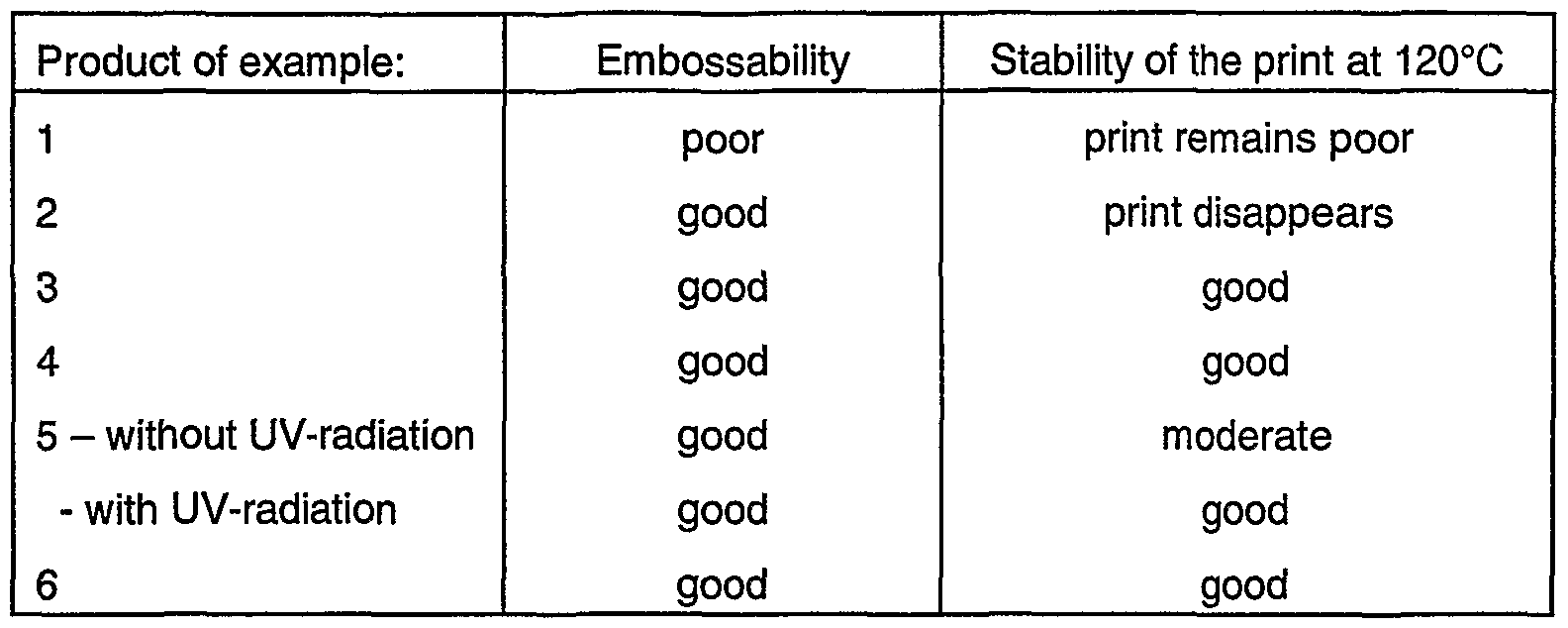
- the results of the embossing test are presented in Table I.
- a film of Example 5 was, after the embossing, further cured by exposing the film to UV-radiation at 240 nm and a total of energy of 4000 mJ/cm.
- the second reaction step occurs during the embossing (Examples 3, 4, 6) or during the UV-curing (Example 5); -
- a melamine resin By adding a melamine resin to the product of
- Example 2 a better stability of the print in the film is obtained
Landscapes
- Chemical & Material Sciences (AREA)
- Organic Chemistry (AREA)
- Polymers & Plastics (AREA)
- Health & Medical Sciences (AREA)
- Chemical Kinetics & Catalysis (AREA)
- Medicinal Chemistry (AREA)
- Engineering & Computer Science (AREA)
- Materials Engineering (AREA)
- Wood Science & Technology (AREA)
- Life Sciences & Earth Sciences (AREA)
- Paints Or Removers (AREA)
- Polyurethanes Or Polyureas (AREA)
- Adhesives Or Adhesive Processes (AREA)
- Application Of Or Painting With Fluid Materials (AREA)
Abstract
Description
Claims
Priority Applications (6)
| Application Number | Priority Date | Filing Date | Title |
|---|---|---|---|
| BR0212025-9A BR0212025A (en) | 2001-08-22 | 2002-08-21 | Process for preparing a coating, a coated substrate, an adhesive, film or foil |
| EP02753294A EP1423446A1 (en) | 2001-08-22 | 2002-08-21 | Process for the preparation of a coating, a coated substrate, an adhesive, film or sheet |
| JP2003523518A JP2005501148A (en) | 2001-08-22 | 2002-08-21 | Process for preparing coatings, coated substrates, adhesives, films or sheets |
| KR20047002444A KR20040039297A (en) | 2001-08-22 | 2002-08-21 | Process for the preparation of a coating, a coated substrate, an adhesive, film or sheet |
| MXPA04001550A MXPA04001550A (en) | 2001-08-22 | 2002-08-21 | Process for the preparation of a coating, a coated substrate, an adhesive, film or sheet. |
| US10/783,165 US20050003093A1 (en) | 2001-08-22 | 2004-02-19 | Process for the preparation of a coating, a coated substrate, an adhesive, film or sheet |
Applications Claiming Priority (2)
| Application Number | Priority Date | Filing Date | Title |
|---|---|---|---|
| NL1018796 | 2001-08-22 | ||
| NL1018796A NL1018796C2 (en) | 2001-08-22 | 2001-08-22 | Method for the preparation of a coating, a coated substrate, adhesive film or sheet. |
Related Child Applications (1)
| Application Number | Title | Priority Date | Filing Date |
|---|---|---|---|
| US10/783,165 Continuation-In-Part US20050003093A1 (en) | 2001-08-22 | 2004-02-19 | Process for the preparation of a coating, a coated substrate, an adhesive, film or sheet |
Publications (1)
| Publication Number | Publication Date |
|---|---|
| WO2003018661A1 true WO2003018661A1 (en) | 2003-03-06 |
Family
ID=19773898
Family Applications (1)
| Application Number | Title | Priority Date | Filing Date |
|---|---|---|---|
| PCT/NL2002/000555 Ceased WO2003018661A1 (en) | 2001-08-22 | 2002-08-21 | Process for the preparation of a coating, a coated substrate, an adhesive, film or sheet |
Country Status (11)
| Country | Link |
|---|---|
| US (1) | US20050003093A1 (en) |
| EP (1) | EP1423446A1 (en) |
| JP (1) | JP2005501148A (en) |
| KR (1) | KR20040039297A (en) |
| AU (1) | AU2002313609A1 (en) |
| BR (1) | BR0212025A (en) |
| IN (1) | IN2004DE00306A (en) |
| MX (1) | MXPA04001550A (en) |
| NL (1) | NL1018796C2 (en) |
| WO (1) | WO2003018661A1 (en) |
| ZA (1) | ZA200400795B (en) |
Cited By (1)
| Publication number | Priority date | Publication date | Assignee | Title |
|---|---|---|---|---|
| WO2012172032A1 (en) * | 2011-06-16 | 2012-12-20 | Evonik Röhm Gmbh | Process for continuous inline production of coated polymeric substrates or laminates |
Families Citing this family (4)
| Publication number | Priority date | Publication date | Assignee | Title |
|---|---|---|---|---|
| CN114521209B (en) | 2019-08-05 | 2024-01-02 | Ppg工业俄亥俄公司 | Low temperature curing coating composition |
| KR102802954B1 (en) | 2019-12-10 | 2025-05-02 | 피피지 인더스트리즈 오하이오 인코포레이티드 | Low temperature curing coating composition |
| NL2024438B1 (en) * | 2019-12-12 | 2021-09-01 | Stahl Int B V | Preparation of a coating, adhesive, film or sheet |
| JP6986174B1 (en) * | 2021-03-20 | 2021-12-22 | 光史 坂田 | Automated assembly house |
Citations (4)
| Publication number | Priority date | Publication date | Assignee | Title |
|---|---|---|---|---|
| EP0287736A2 (en) * | 1987-04-21 | 1988-10-26 | W.L. Gore & Associates, Inc. | Radiation curable compositions for hydrophilic coatings |
| US4912152A (en) * | 1987-11-30 | 1990-03-27 | Japan Synthetic Rubber Co., Ltd. | One-pack type thermosetting composition |
| DE4041753A1 (en) * | 1990-12-24 | 1992-06-25 | Henkel Kgaa | NEW REACTIVE CONTACT ADHESIVES, METHOD FOR THEIR PRODUCTION AND THEIR USE |
| WO2001023451A2 (en) * | 1999-09-30 | 2001-04-05 | Stahl International B.V. | Process for the preparation of a coating, a coated substrate, an adhesive, a film or sheet, for the thus obtained products and the coating mixture to be used in the process |
Family Cites Families (2)
| Publication number | Priority date | Publication date | Assignee | Title |
|---|---|---|---|---|
| US5500461A (en) * | 1995-04-19 | 1996-03-19 | Shell Oil Company | Stable waterborne epoxy resin dispersion containing micronized DICY |
| US5959775A (en) * | 1997-12-23 | 1999-09-28 | 3M Innovative Properties Company | Urethane/acrylate bead bond for retroreflective articles |
-
2001
- 2001-08-22 NL NL1018796A patent/NL1018796C2/en not_active IP Right Cessation
-
2002
- 2002-08-21 BR BR0212025-9A patent/BR0212025A/en not_active IP Right Cessation
- 2002-08-21 KR KR20047002444A patent/KR20040039297A/en not_active Withdrawn
- 2002-08-21 EP EP02753294A patent/EP1423446A1/en not_active Withdrawn
- 2002-08-21 AU AU2002313609A patent/AU2002313609A1/en not_active Abandoned
- 2002-08-21 JP JP2003523518A patent/JP2005501148A/en active Pending
- 2002-08-21 MX MXPA04001550A patent/MXPA04001550A/en unknown
- 2002-08-21 WO PCT/NL2002/000555 patent/WO2003018661A1/en not_active Ceased
-
2004
- 2004-01-30 ZA ZA200400795A patent/ZA200400795B/en unknown
- 2004-02-19 US US10/783,165 patent/US20050003093A1/en not_active Abandoned
- 2004-02-26 IN IN306DE2004 patent/IN2004DE00306A/en unknown
Patent Citations (4)
| Publication number | Priority date | Publication date | Assignee | Title |
|---|---|---|---|---|
| EP0287736A2 (en) * | 1987-04-21 | 1988-10-26 | W.L. Gore & Associates, Inc. | Radiation curable compositions for hydrophilic coatings |
| US4912152A (en) * | 1987-11-30 | 1990-03-27 | Japan Synthetic Rubber Co., Ltd. | One-pack type thermosetting composition |
| DE4041753A1 (en) * | 1990-12-24 | 1992-06-25 | Henkel Kgaa | NEW REACTIVE CONTACT ADHESIVES, METHOD FOR THEIR PRODUCTION AND THEIR USE |
| WO2001023451A2 (en) * | 1999-09-30 | 2001-04-05 | Stahl International B.V. | Process for the preparation of a coating, a coated substrate, an adhesive, a film or sheet, for the thus obtained products and the coating mixture to be used in the process |
Cited By (2)
| Publication number | Priority date | Publication date | Assignee | Title |
|---|---|---|---|---|
| WO2012172032A1 (en) * | 2011-06-16 | 2012-12-20 | Evonik Röhm Gmbh | Process for continuous inline production of coated polymeric substrates or laminates |
| US9630387B2 (en) | 2011-06-16 | 2017-04-25 | Evonik Roehm Gmbh | Process for continuous inline production of coated polymeric substrates or laminates |
Also Published As
| Publication number | Publication date |
|---|---|
| KR20040039297A (en) | 2004-05-10 |
| AU2002313609A1 (en) | 2003-03-10 |
| ZA200400795B (en) | 2004-10-13 |
| BR0212025A (en) | 2004-08-03 |
| EP1423446A1 (en) | 2004-06-02 |
| US20050003093A1 (en) | 2005-01-06 |
| IN2004DE00306A (en) | 2006-03-10 |
| JP2005501148A (en) | 2005-01-13 |
| NL1018796C2 (en) | 2003-02-25 |
| MXPA04001550A (en) | 2004-05-14 |
Similar Documents
| Publication | Publication Date | Title |
|---|---|---|
| EP2013256B1 (en) | Oil based aqueous polyurethane dispersions | |
| CA2316536C (en) | Coating compositions containing polyisocyanates and aspartate-terminated urea/urethane prepolymers | |
| JP3622169B2 (en) | A hot melt adhesive comprising an isocyanate prepolymer with a low free monomer content and a low oligomer content | |
| JPH10504350A (en) | Polyurethane composition with low monomeric diisocyanate content | |
| JP3830974B2 (en) | Coating systems and their use in making polyurethane acrylate surface coatings on laminated press plates | |
| CA2040280A1 (en) | Inernally-curable water-based polyurethanes | |
| JPS645627B2 (en) | ||
| TW200401787A (en) | Water dispersible polyisocyanate composition and its uses | |
| CA1251297A (en) | Process for the preparation of adhesives and their use for the formation of bonds | |
| US20040229045A1 (en) | Process for the preparation of a coating, a coated substrate, an adhesive, film or sheet | |
| US20050003093A1 (en) | Process for the preparation of a coating, a coated substrate, an adhesive, film or sheet | |
| JP2003306526A (en) | Solventless moisture-curable hot melt urethane resin composition, foam and sheet structure using the same | |
| CA2008590A1 (en) | Cross-linkable hot melt composition | |
| JP2003246830A (en) | Solvent-free, moisture-curable hot-melt urethane resin composition excellent in durability, foam, and sheet structure using the same | |
| JPH04359081A (en) | Improved aqueous emulsion based on polyol and hindered isocyanate compound | |
| KR19990083627A (en) | Heat-activatable polyurethane/urea adhesive in aqueous dispersion | |
| JPH06340804A (en) | Aqueous dispersion of polyurethane and condensation resin | |
| JP3961689B2 (en) | Hydrophilic polyurethane resin and method for producing the same | |
| US6602947B2 (en) | Primer | |
| JPH1081826A (en) | Crosslinkable polyurethane resin composition | |
| CN112266759B (en) | Reactive adhesive for hard-to-stick flexible material and application thereof | |
| JPS62197413A (en) | Thermosetting composition for mutual intrusion polymer network system | |
| JPS63191820A (en) | Moisture-curing one-pack polyurethane composition and its curing | |
| JPS63202611A (en) | Curable composition |
Legal Events
| Date | Code | Title | Description |
|---|---|---|---|
| AK | Designated states |
Kind code of ref document: A1 Designated state(s): AE AG AL AM AT AU AZ BA BB BG BY BZ CA CH CN CO CR CU CZ DE DM DZ EC EE ES FI GB GD GE GH HR HU ID IL IN IS JP KE KG KP KR LC LK LR LS LT LU LV MA MD MG MN MW MX MZ NO NZ OM PH PL PT RU SD SE SG SI SK SL TJ TM TN TR TZ UA UG US UZ VN YU ZA ZM Kind code of ref document: A1 Designated state(s): AE AG AL AM AT AU AZ BA BB BG BR BY BZ CA CH CN CO CR CU CZ DE DK DM DZ EC EE ES FI GB GD GE GH GM HR HU ID IL IN IS JP KE KG KP KR KZ LC LK LR LS LT LU LV MA MD MG MK MN MW MX MZ NO NZ OM PH PL PT RO RU SD SE SG SI SK SL TJ TM TN TR TT TZ UA UG US UZ VN YU ZA ZM ZW |
|
| AL | Designated countries for regional patents |
Kind code of ref document: A1 Designated state(s): GH GM KE LS MW MZ SD SL SZ TZ UG ZM ZW AM AZ BY KG KZ MD RU TJ TM AT BE BG CH CY CZ DE DK EE ES FI FR GB GR IE IT LU MC NL PT SE SK TR BF BJ CF CG CI CM GA GN GQ GW ML MR NE SN TD TG Kind code of ref document: A1 Designated state(s): GH GM KE LS MW MZ SD SL SZ UG ZM ZW AM AZ BY KG KZ RU TJ TM AT BE BG CH CY CZ DK EE ES FI FR GB GR IE IT LU MC PT SE SK TR BF BJ CF CG CI GA GN GQ GW ML MR NE SN TD TG |
|
| 121 | Ep: the epo has been informed by wipo that ep was designated in this application | ||
| DFPE | Request for preliminary examination filed prior to expiration of 19th month from priority date (pct application filed before 20040101) | ||
| WWE | Wipo information: entry into national phase |
Ref document number: 2002753294 Country of ref document: EP |
|
| WWE | Wipo information: entry into national phase |
Ref document number: 2002313609 Country of ref document: AU |
|
| WWE | Wipo information: entry into national phase |
Ref document number: 2004/00795 Country of ref document: ZA Ref document number: 200400795 Country of ref document: ZA |
|
| WWE | Wipo information: entry into national phase |
Ref document number: 00306/DELNP/2004 Country of ref document: IN |
|
| WWE | Wipo information: entry into national phase |
Ref document number: 10783165 Country of ref document: US Ref document number: 2003523518 Country of ref document: JP Ref document number: PA/a/2004/001550 Country of ref document: MX Ref document number: 1020047002444 Country of ref document: KR |
|
| WWE | Wipo information: entry into national phase |
Ref document number: 2004/00309 Country of ref document: TR |
|
| WWP | Wipo information: published in national office |
Ref document number: 2002753294 Country of ref document: EP |