WO2003020681A1 - Process for the production of acetic acid c4-esters - Google Patents
Process for the production of acetic acid c4-esters Download PDFInfo
- Publication number
- WO2003020681A1 WO2003020681A1 PCT/GB2002/003930 GB0203930W WO03020681A1 WO 2003020681 A1 WO2003020681 A1 WO 2003020681A1 GB 0203930 W GB0203930 W GB 0203930W WO 03020681 A1 WO03020681 A1 WO 03020681A1
- Authority
- WO
- WIPO (PCT)
- Prior art keywords
- stream
- butene
- acetate
- butenyl
- addition
- Prior art date
- Legal status (The legal status is an assumption and is not a legal conclusion. Google has not performed a legal analysis and makes no representation as to the accuracy of the status listed.)
- Ceased
Links
Classifications
-
- C—CHEMISTRY; METALLURGY
- C07—ORGANIC CHEMISTRY
- C07C—ACYCLIC OR CARBOCYCLIC COMPOUNDS
- C07C67/00—Preparation of carboxylic acid esters
- C07C67/04—Preparation of carboxylic acid esters by reacting carboxylic acids or symmetrical anhydrides onto unsaturated carbon-to-carbon bonds
-
- C—CHEMISTRY; METALLURGY
- C07—ORGANIC CHEMISTRY
- C07C—ACYCLIC OR CARBOCYCLIC COMPOUNDS
- C07C67/00—Preparation of carboxylic acid esters
- C07C67/48—Separation; Purification; Stabilisation; Use of additives
- C07C67/52—Separation; Purification; Stabilisation; Use of additives by change in the physical state, e.g. crystallisation
- C07C67/54—Separation; Purification; Stabilisation; Use of additives by change in the physical state, e.g. crystallisation by distillation
-
- Y—GENERAL TAGGING OF NEW TECHNOLOGICAL DEVELOPMENTS; GENERAL TAGGING OF CROSS-SECTIONAL TECHNOLOGIES SPANNING OVER SEVERAL SECTIONS OF THE IPC; TECHNICAL SUBJECTS COVERED BY FORMER USPC CROSS-REFERENCE ART COLLECTIONS [XRACs] AND DIGESTS
- Y02—TECHNOLOGIES OR APPLICATIONS FOR MITIGATION OR ADAPTATION AGAINST CLIMATE CHANGE
- Y02P—CLIMATE CHANGE MITIGATION TECHNOLOGIES IN THE PRODUCTION OR PROCESSING OF GOODS
- Y02P20/00—Technologies relating to chemical industry
- Y02P20/50—Improvements relating to the production of bulk chemicals
- Y02P20/582—Recycling of unreacted starting or intermediate materials
Definitions
- This mvention relates to a process for treating a mixed C 4 stream comprising isobutene and 1, 3- butadiene.
- naphtha steam-cracking naphtha is decomposed in the presence of a steam diluent at a temperature between 700 and 900°C.
- the process produces a number of products, including isomeric butanes, 1,3-butadiene and isomeric butenes (e.g. 1-butene, 2-butene and iso-butene). These compounds may be separated as a mixed C 4 stream.
- mixed C 4 streams maybe contacted with acetic acid in the presence of a catalyst.
- butadiene in the C 4 stream reacts with acetic acid to produce n-butenyl and sec-butenyl acetate.
- the sec- isomer may be recycled to the reactor.
- the n-isomer is recovered and hydrogenated to produce n-butyl acetate which is a useful solvent.
- a process for treating a mixed C 4 stream comprising iso-butene and 1,3-butadiene comprising: a) reacting acetic acid with said stream in an addition reactor, b) withdrawing from the addition reactor a product stream comprising iso-butene, sec-butenyl acetate, n-butenyl acetate and t-butyl acetate, and c) recovering n-butenyl acetate from the product stream, characterised in that d) t-butyl acetate is recycled to said addition reactor.
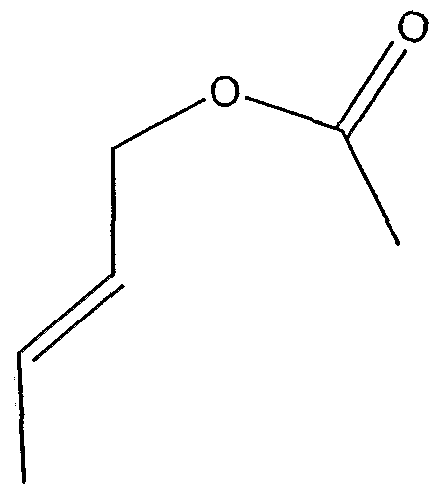
- sec-butenyl acetate and n-butenyl acetate have the following structures:
- iso-butene is preferably not produced by cracking t-butyl acetate as described in WO 00/26175, any unreacted iso-butene present in the original mixed C 4 stream may be recovered, for example, by distillation or flash separation techniques.
- the mixed C stream employed as a feedstock in the present process can be, for example, a by-product of a reaction, suGh as the dehydrogenation of butane or butene, or the steam cracking of naphtha.
- Such mixed C 4 streams frequently comprise isobutene and 1,3-butadiene.
- the mixed C 4 stream may also comprise one or more of isobutane, n-butane, 1-butene, trans-2-butene, cis-2-butene, 1,2-butadiene, propadiene, methyl acetylene, ethyl acetylene, dimethyl acetylene, vinyl acetylene, diacetylene, and C 5 acetylenes.
- the mixed C 4 stream is a by- product of naphtha steam cracking comprising isobutane (e.g. 1 - 2 %v/v), n-butane (e.g. 2 - 4%v/v), isobutene (e.g. 25 - 29%v/v), 1-butene (e.g. 8 - 10%v/v), trans-2-butene (e.g. 6 - 8%v/v), cis-2-butene (e.g. 3 - 5%v/v), 1,3-butadiene (e.g. 43 - 48%v/v), 1,2- butadiene (e.g.
- isobutane e.g. 1 - 2 %v/v
- n-butane e.g. 2 - 4%v/v
- isobutene e.g. 25 - 29%v/v
- 1-butene e.g. 8 - 10%v/v
- propadiene e.g. 0 - l%v/v
- methyl acetylene e.g. 0 - l%v/v
- ethyl acetylene e.g. 0 - l%v/v
- dimethyl acetylene e.g. 0 - l%v/v
- vinyl acetylene e.g. 0 - l%v/v
- diacetylene e.g. 0 - trace
- C 5 acetylenes e.g. 0 - trace
- the mixed C 4 stream is reacted with acetic acid in an addition reactor.
- the reaction conditions employed in the addition step are described in detail in WO 00/26175.
- the relative mole ratios of butadiene in the mixed C stream to acetic acid may be 5:1 to 1:50, preferably, 1:1 to 1:10.
- the addition reaction may be carried out at a temperature of 20 to 140°C, preferably, of 40 to 90°C.
- the reaction may be carried out using a homogeneous or heterogeneous catalyst, the latter being preferred.
- Suitable catalysts include acidic catalysts such as zeolites, and strong acid ion-exchange resins.
- Suitable ion-exchange resins include Amberlyst 15 ® and Amberlite IR120 ® .
- a proportion of the acidic sites of such resins may be exchanged with bulky counterions such as alkyl pyridinium, quaternary alkyl ammonium, quaternary arsonium and quaternary phosphonium compounds. Tetra-phenylphosphonium counterions, for example, may be employed. These counterions may account for up to 10% of the available acidic sites.
- Water may be present in the addition step in an amount between 0.05 and 50 % w/w, preferably, 0.5 and 20 w/w %, based on
- the activity of heterogeneous catalysts may decrease after prolonged use. This may be due to blockage of active sites by 1,3-butadiene oligo- and polymerisation products. In such cases,-it may be advantageous to carry out the addition reaction under conditions of high shear, as high shear rates are believed to reduce blockage of active sites by the formation of such oligo- and polymerisation products.
- polymerisation inhibitors may be added to the reaction mixture. Such inhibitors are well known in the art. Where oligo- and polymerisation products are present in the product stream, however, these may be recovered and recycled to the reactor.
- the addition reaction may be carried out using any suitable reactor.
- a fixed bed, slurry, trickle bed, bus loop, or fluidised bed reactor may be employed.
- the reaction between the mixed C 4 stream and acetic acid produces a product stream, which is withdrawn from the addition reactor in step b).
- This product stream comprises addition products including, inter alia, n-butenyl acetate, sec-butenyl acetate and t-butyl acetate.
- addition products account for 1 to 99%w/w, for example, 5 to 50%w/w of the product stream.
- n-butenyl and sec-butenyl acetates result from the addition of acetic acid to butadiene, whilst the t-butyl acetate results from the reaction between acetic acid and iso-butene.
- Such addition reactions do not generally go to completion and are controlled by a number of factors including how the reaction is conducted (e.g. LHSN), reaction kinetics and equilibrium constants.
- LHSN how the reaction is conducted
- reaction kinetics kinetics
- equilibrium constants e.g., unreacted isobutene and, optionally, unreacted 1,3- butadiene are also present in the product stream.
- These unreacted C 4 components are relatively volatile, and may be separated, for example, by gas disengagement using any suitable separation unit, such as a flash drum.
- the separated mixture of unreacted C 4 components may be used as a feedstock, for example, for alkylation, or for steam cracking.
- the mixture of unreacted C 4 components may be separated (e.g. by physical and or chemical methods) into one or more components for sale or use.
- Isobutene for example, may be recovered and polymerised to produce polyisobutene (PIB).
- PIB polyisobutene
- 1-Butene and/or 2-butene may be separated, for example, as a mixture and used as a fuel additive.
- the product stream may also comprise polymerisation by-products such as C 8 olefins (e.g. di-isobutene from isobutene) octatrienes (e.g.
- octadienes e.g. from butadiene and isobutene
- C 12 olefins e.g. from vinyl cyclohexene + butadiene, or C 8 olefin + butadiene
- C 8 acetates C ⁇ acetates and higher oligomeric materials. It maybe desirable to remove one or more of such components from the product stream, for example, by distillation. Di-isobutene recovered from the product stream can, if desired, be converted by hydrogenation to iso-octane, a valuable fuel additive.
- n-butenyl acetate is recovered from the product stream. This may be carried out using any suitable separating unit, for example, one or more distillation columns. An example of a suitable apparatus for performing such separation steps is described in WO 00/26175, particularly with reference to Figure 2 of that document. The full disclosure of WO 00/26175 is incorporated herein by reference.
- the n-butenyl acetate may be, if desired, cracked back to butadiene and acetic acid, or recycled to the reactor. Where the n-butenyl acetate is cracked back to butadiene and acetic acid, at least one of these components may be recycled to the reactor.
- the recovered n-butenyl acetate is hydrogenated to produce butyl acetate.
- the hydrogenation may be, for example, carried out under heterogeneous conditions over any suitable catalyst.
- suitable catalysts include ruthenium, platinum, nickel (e.g. Raney nickel) and palladium. These metals may be employed as elemental metals or metal compounds.
- unsupported catalysts may be employed, it is preferable to use catalysts supported on inert carriers, such as carbon or siliceous supports.
- Preferred catalysts include supported Raney nickels, and ruthenium on carbon.
- the hydrogenation may, for example, be carried out at 20 to 250 °C, preferably,
- the hydrogenation maybe, for example, carried at a pressure of 1 to 100 barg, preferably, 5 to 50 barg.
- the hydrogenation can be carried out, for example, in slurry and or flow reactors.
- t-butyl acetate is recovered from the product stream and recycled to the reactor.
- the recovery step may be carried out using any suitable separating unit, for example, a distillation column.
- the recovered t-butyl acetate stream may also contain other reaction products and or unreacted reactants including, for example, water and unreacted C 4 compounds.
- sec-butenyl acetate may be recovered from the product stream.
- the separated sec-butenyl acetate may be recycled to the reactor, or isolated for, for example, sale, direct use (eg as a solvent), or further processing.
- the sec-butenyl acetate is thermally cracked back to butadiene and acetic acid.
- One or both of these starting materials may be recycled to the reactor, or sold as such.
- t-butyl acetate, n-butenyl acetate and sec-butenyl acetate are recoverable from the product stream. This may be achieved by conventional methods, for example, by distillation. In certain cases, however, the components of the product stream have relatively similar boiling points. This may make conventional distillation difficult.
- components of the product stream comprising t-butyl acetate, n-butenyl acetate and sec-butenyl acetate may be separated from said product stream by azeotropic separative methods, for example using an azeotroping column.
- This technique involves, for example, introducing the product stream into an azeotroping column in the presence of water. Under these conditions, it is possible to form water/t-butyl acetate/n-butenyl acetate/sec-butenyl azeotrope(s).
- the azeotrope may be recovered as a process stream, preferably, from an upper portion of the azeotroping column, more preferably, as an overhead stream.
- the organic components of the azeotrope namely, t-butyl acetate, n- butenyl acetate and sec-butenyl may form a layer separate from the water and may be decanted therefrom.
- any residual water may be removed from the decanted mixture by drying the mixture further, for example, using molecular sieve treatment or azeotropic drying.
- the azeotroping technique can be adapted by employing an organic azeotroping agent, for example, cyclohexane. Water separated in this manner may be recycled to the azeotroping column.
- the mixture of t-butyl acetate, n-butenyl acetate and sec-butenyl may then be conveniently separated by conventional distillation techniques. If desired, mixtures of t-butyl acetate and sec-butenyl acetate can be recycled to the reactor thus rendering their separation from one another unnecessary.
- a stream comprising unreacted acetic acid and optionally, water and/or reaction by-products may be recovered from the base of the azeotroping column. This stream may be recycled to the reactor. It may be desirable to purify such streams prior to the recycling step, particularly, when tars are present. This may be achieved by introducing the stream into a settling tank, and allowing the tars to separate from the remainder of the stream as a separate phase. This settling step may be facilitated by the addition of water.
- azeotropic distillation procedure described above may be applied to any process stream comprising t-butyl acetate, n-butenyl acetate and sec-butenyl acetate.
- the invention is illustrated by reference to the following Tests which show how the composition of a C4 stream changes when subjected to treatment with acetic acid in an addition reactor, but without removal and recycle of the products.
- the Tests illustrate the build-up of by-products, some of which are valuable materials in their own right (e.g. di-isobutene) and some which are regarded of a lesser utility which would be removed at intervals from a commercial process to prevent undue build-up of involatile by-products.
- Tests 1 and 2 Reaction of acetic acid with a crude C4 stream
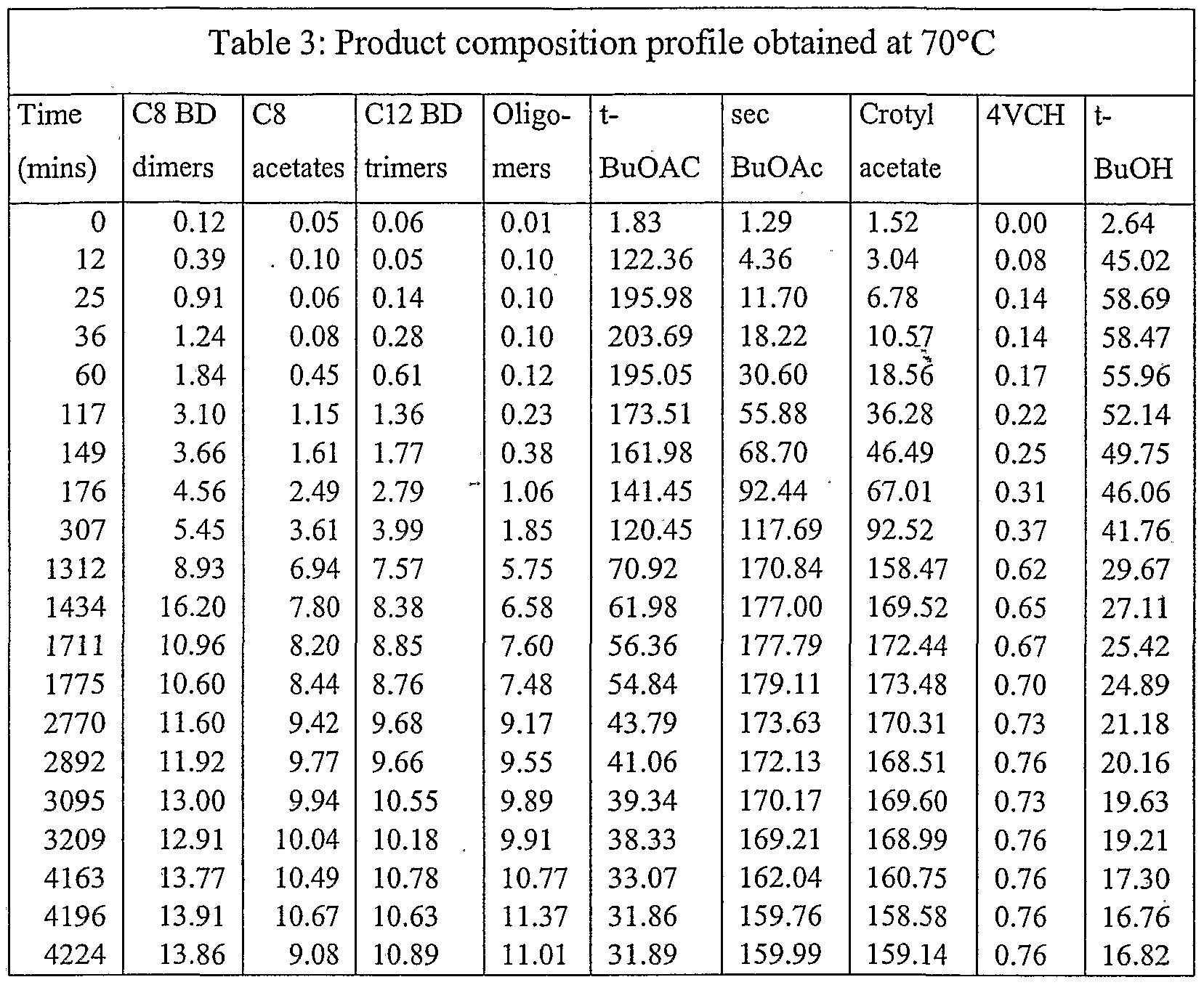
- the composition of the crude C4 stream is given in Table 1 below. Reaction time zero was taken as the moment of C4 addition, and the mixture was maintained at the stated temperature for a period of 4 days while liquid samples were periodically withdrawn and analysed by gas chromatography. The results showed a kinetic profile of product mixture; tertiary-butyl acetate, secondary butenyl acetate and crotyl acetate main products, with lesser amounts of tertiary butanol, C8 olefins and acetates, C12 olefins, 4-vinylcyclohexane and oligomer by-products, together with unreacted butadiene and acetic acid.
- Table 2 shows the product composition (analysis by gas chromatography) from Test 1.
Landscapes
- Chemical & Material Sciences (AREA)
- Organic Chemistry (AREA)
- Crystallography & Structural Chemistry (AREA)
- Organic Low-Molecular-Weight Compounds And Preparation Thereof (AREA)
- Low-Molecular Organic Synthesis Reactions Using Catalysts (AREA)
Abstract
Description



Claims
Priority Applications (7)
| Application Number | Priority Date | Filing Date | Title |
|---|---|---|---|
| US10/487,450 US6949671B2 (en) | 2001-08-30 | 2002-08-28 | Process for the production of acetic acid C4-esters |
| DE60218868T DE60218868D1 (en) | 2001-08-30 | 2002-08-28 | PROCESS FOR PREPARING ACETIC ACID ESTERS |
| KR10-2004-7002807A KR20040029044A (en) | 2001-08-30 | 2002-08-28 | Process for the production of acetic acid c4-esters |
| EP02755255A EP1421053B1 (en) | 2001-08-30 | 2002-08-28 | Process for the production of acetic acid c4-esters |
| JP2003524953A JP2005518341A (en) | 2001-08-30 | 2002-08-28 | Method for producing acetic acid C4-ester |
| PL02367725A PL367725A1 (en) | 2001-08-30 | 2002-08-28 | Process for the production of acetic acid c4-esters |
| BR0212162-0A BR0212162A (en) | 2001-08-30 | 2002-08-28 | Process for treating a mixed c4 stream |
Applications Claiming Priority (2)
| Application Number | Priority Date | Filing Date | Title |
|---|---|---|---|
| GB0120989.9 | 2001-08-30 | ||
| GBGB0120989.9A GB0120989D0 (en) | 2001-08-30 | 2001-08-30 | Process for treating a mixed c4 stream comprising iso-butene and 1,3-butadiene |
Publications (1)
| Publication Number | Publication Date |
|---|---|
| WO2003020681A1 true WO2003020681A1 (en) | 2003-03-13 |
Family
ID=9921198
Family Applications (1)
| Application Number | Title | Priority Date | Filing Date |
|---|---|---|---|
| PCT/GB2002/003930 Ceased WO2003020681A1 (en) | 2001-08-30 | 2002-08-28 | Process for the production of acetic acid c4-esters |
Country Status (13)
| Country | Link |
|---|---|
| US (1) | US6949671B2 (en) |
| EP (1) | EP1421053B1 (en) |
| JP (1) | JP2005518341A (en) |
| KR (1) | KR20040029044A (en) |
| CN (1) | CN1237044C (en) |
| AT (1) | ATE356793T1 (en) |
| BR (1) | BR0212162A (en) |
| DE (1) | DE60218868D1 (en) |
| GB (1) | GB0120989D0 (en) |
| PL (1) | PL367725A1 (en) |
| RU (1) | RU2004109816A (en) |
| WO (1) | WO2003020681A1 (en) |
| ZA (1) | ZA200401196B (en) |
Cited By (2)
| Publication number | Priority date | Publication date | Assignee | Title |
|---|---|---|---|---|
| WO2004113262A3 (en) * | 2003-06-16 | 2005-04-07 | Univ Southern Mississippi Res | Integrated process to produce derivatives of butadiene addition products |
| CN100463897C (en) * | 2007-02-02 | 2009-02-25 | 胡先念 | A method for separating sec-butyl acetate from the mixture after the reaction of acetic acid and mixed C4 |
Families Citing this family (3)
| Publication number | Priority date | Publication date | Assignee | Title |
|---|---|---|---|---|
| KR101107621B1 (en) * | 2009-04-27 | 2012-01-30 | 어코드 주식회사 | Soup pot with cylindrical heat exchanger |
| CN102234230A (en) * | 2010-05-05 | 2011-11-09 | 北京石油化工学院 | Process method for synthesizing sec-butyl acetate from C4 fractions |
| CN102372628A (en) * | 2010-08-13 | 2012-03-14 | 中国石油化工股份有限公司 | Method for preparing tert-butyl acetate |
Citations (2)
| Publication number | Priority date | Publication date | Assignee | Title |
|---|---|---|---|---|
| DE3105399A1 (en) * | 1981-02-14 | 1982-10-21 | EC Erdölchemie GmbH, 5000 Köln | Process for the preparation of carboxylic acid esters |
| WO2000026175A1 (en) * | 1998-10-30 | 2000-05-11 | Bp Chemicals Limited | A process for making n-butyl esters from butadiene |
-
2001
- 2001-08-30 GB GBGB0120989.9A patent/GB0120989D0/en not_active Ceased
-
2002
- 2002-08-28 BR BR0212162-0A patent/BR0212162A/en not_active Application Discontinuation
- 2002-08-28 RU RU2004109816/04A patent/RU2004109816A/en not_active Application Discontinuation
- 2002-08-28 AT AT02755255T patent/ATE356793T1/en not_active IP Right Cessation
- 2002-08-28 KR KR10-2004-7002807A patent/KR20040029044A/en not_active Withdrawn
- 2002-08-28 PL PL02367725A patent/PL367725A1/en not_active IP Right Cessation
- 2002-08-28 CN CNB028169794A patent/CN1237044C/en not_active Expired - Fee Related
- 2002-08-28 DE DE60218868T patent/DE60218868D1/en not_active Expired - Lifetime
- 2002-08-28 WO PCT/GB2002/003930 patent/WO2003020681A1/en not_active Ceased
- 2002-08-28 US US10/487,450 patent/US6949671B2/en not_active Expired - Fee Related
- 2002-08-28 EP EP02755255A patent/EP1421053B1/en not_active Expired - Lifetime
- 2002-08-28 JP JP2003524953A patent/JP2005518341A/en not_active Ceased
-
2004
- 2004-02-13 ZA ZA200401196A patent/ZA200401196B/en unknown
Patent Citations (2)
| Publication number | Priority date | Publication date | Assignee | Title |
|---|---|---|---|---|
| DE3105399A1 (en) * | 1981-02-14 | 1982-10-21 | EC Erdölchemie GmbH, 5000 Köln | Process for the preparation of carboxylic acid esters |
| WO2000026175A1 (en) * | 1998-10-30 | 2000-05-11 | Bp Chemicals Limited | A process for making n-butyl esters from butadiene |
Cited By (2)
| Publication number | Priority date | Publication date | Assignee | Title |
|---|---|---|---|---|
| WO2004113262A3 (en) * | 2003-06-16 | 2005-04-07 | Univ Southern Mississippi Res | Integrated process to produce derivatives of butadiene addition products |
| CN100463897C (en) * | 2007-02-02 | 2009-02-25 | 胡先念 | A method for separating sec-butyl acetate from the mixture after the reaction of acetic acid and mixed C4 |
Also Published As
| Publication number | Publication date |
|---|---|
| RU2004109816A (en) | 2005-10-20 |
| EP1421053A1 (en) | 2004-05-26 |
| CN1549806A (en) | 2004-11-24 |
| DE60218868D1 (en) | 2007-04-26 |
| ZA200401196B (en) | 2004-10-22 |
| KR20040029044A (en) | 2004-04-03 |
| ATE356793T1 (en) | 2007-04-15 |
| CN1237044C (en) | 2006-01-18 |
| JP2005518341A (en) | 2005-06-23 |
| US6949671B2 (en) | 2005-09-27 |
| EP1421053B1 (en) | 2007-03-14 |
| BR0212162A (en) | 2004-07-13 |
| US20040249192A1 (en) | 2004-12-09 |
| PL367725A1 (en) | 2005-03-07 |
| GB0120989D0 (en) | 2001-10-24 |
Similar Documents
| Publication | Publication Date | Title |
|---|---|---|
| CN1140486C (en) | Oligomerization process of isobutylene | |
| US20050043571A1 (en) | Obtaining tert-butanol | |
| US5382707A (en) | Integrated MTBE process | |
| JPS6228933B2 (en) | ||
| NZ204126A (en) | Producing tert-butyl alkyl ethers and butene-1 from c4 hydrocarbon feedstock | |
| JP2001507671A (en) | Etherification-hydrogenation method | |
| JP4292072B2 (en) | Production of t-butanol | |
| KR100681223B1 (en) | Process for preparing n-butyl ester from butadiene | |
| EP1421053B1 (en) | Process for the production of acetic acid c4-esters | |
| JP2691223B2 (en) | Increasing 2-methyl-2-butene concentration in isoamylene | |
| CN110172013B (en) | Process for synthesizing tertiary amyl alcohol based on catalytic distillation solvent method | |
| NZ204032A (en) | Process for producing tert butyl alkyl ethers | |
| JP2612194B2 (en) | Direct hydration of linear olefins. | |
| US11124470B2 (en) | Systems and methods of producing methyl tertiary butyl ether and propylene | |
| RU2177930C1 (en) | Alkene oligomers production process | |
| EP1140760B1 (en) | A process for making butyraldehyde from butadiene | |
| CN114456029B (en) | Method and device for producing 1-butene from carbon tetrahydrocarbons | |
| JPS6358811B2 (en) | ||
| GB1589457A (en) | Method for purifying methyl tert butyl ether | |
| WO2000026168A1 (en) | A process for making butyl ethers of glycols | |
| KR0127863B1 (en) | Method for producing high purity diisobutene | |
| EP0474843A1 (en) | Method for preparing 1,4-diacyloxy-2-butenes |
Legal Events
| Date | Code | Title | Description |
|---|---|---|---|
| AK | Designated states |
Kind code of ref document: A1 Designated state(s): AE AG AL AM AT AU AZ BA BB BG BR BY BZ CA CH CN CO CR CU CZ DE DK DM DZ EC EE ES FI GB GD GE GH GM HR HU ID IN IS JP KE KG KP KR KZ LC LK LR LS LT LU LV MA MD MG MK MN MW MX MZ NO NZ OM PH PL PT RO RU SD SE SG SI SK SL TJ TM TN TR TT TZ UA UG US UZ VC VN YU ZA ZM ZW Kind code of ref document: A1 Designated state(s): AE AG AL AM AT AU AZ BA BB BG BY BZ CA CH CN CO CR CU CZ DE DM DZ EC EE ES FI GB GD GE GH HR HU ID IN IS JP KE KG KP KR KZ LK LR LS LT LU LV MA MD MG MK MW MX MZ NO NZ OM PH PL PT RO SD SE SG SI SK SL TJ TM TN TR TT UA UG US UZ VC VN YU ZA ZM |
|
| AL | Designated countries for regional patents |
Kind code of ref document: A1 Designated state(s): GH GM KE LS MW MZ SD SL SZ TZ UG ZM ZW AM AZ BY KG KZ MD RU TJ TM AT BE BG CH CY CZ DE DK EE ES FI FR GB GR IE IT LU MC NL PT SE SK TR BF BJ CF CG CI CM GA GN GQ GW ML MR NE SN TD TG Kind code of ref document: A1 Designated state(s): GH GM KE LS MW MZ SD SL SZ UG ZM ZW AM AZ BY KG KZ RU TJ TM AT BE BG CH CY CZ DK EE ES FI FR GB GR IE IT LU MC PT SE SK TR BF BJ CF CG CI GA GN GQ GW ML MR NE SN TD TG |
|
| 121 | Ep: the epo has been informed by wipo that ep was designated in this application | ||
| DFPE | Request for preliminary examination filed prior to expiration of 19th month from priority date (pct application filed before 20040101) | ||
| WWE | Wipo information: entry into national phase |
Ref document number: 2002755255 Country of ref document: EP |
|
| WWE | Wipo information: entry into national phase |
Ref document number: 2004/01196 Country of ref document: ZA Ref document number: 200401196 Country of ref document: ZA |
|
| WWE | Wipo information: entry into national phase |
Ref document number: 366/DELNP/2004 Country of ref document: IN |
|
| WWE | Wipo information: entry into national phase |
Ref document number: 1020047002807 Country of ref document: KR |
|
| WWE | Wipo information: entry into national phase |
Ref document number: 20028169794 Country of ref document: CN Ref document number: 2003524953 Country of ref document: JP |
|
| WWP | Wipo information: published in national office |
Ref document number: 2002755255 Country of ref document: EP |
|
| WWE | Wipo information: entry into national phase |
Ref document number: 10487450 Country of ref document: US |
|
| WWG | Wipo information: grant in national office |
Ref document number: 2002755255 Country of ref document: EP |