WO2003020716A1 - Piperidine derivatives useful as ccr5 antagonists - Google Patents
Piperidine derivatives useful as ccr5 antagonistsInfo
- Publication number
- WO2003020716A1 WO2003020716A1 PCT/US2002/027389 US0227389W WO03020716A1 WO 2003020716 A1 WO2003020716 A1 WO 2003020716A1 US 0227389 W US0227389 W US 0227389W WO 03020716 A1 WO03020716 A1 WO 03020716A1
- Authority
- WO
- WIPO (PCT)
- Prior art keywords
- alkyl
- group
- aryl
- compounds
- compound
- Prior art date
- Legal status (The legal status is an assumption and is not a legal conclusion. Google has not performed a legal analysis and makes no representation as to the accuracy of the status listed.)
- Ceased
Links
- 0 CN(*)C(CC1)C(*)C(*)N1C(*)(CC1)CCN1C(*)=O Chemical compound CN(*)C(CC1)C(*)C(*)N1C(*)(CC1)CCN1C(*)=O 0.000 description 6
- ROUYFJUVMYHXFJ-UHFFFAOYSA-N CC(C)(C)OC(N(CC1)CCC1=O)=O Chemical compound CC(C)(C)OC(N(CC1)CCC1=O)=O ROUYFJUVMYHXFJ-UHFFFAOYSA-N 0.000 description 1
- ZEHZTYXNIXCCEI-UHFFFAOYSA-N CC(CC1)(CCN1C(c(c(C)c1)c(C)cc1-c1ccncc1)=O)N(CC1)CCC1N(c1ccccc1)c1ccc(C(F)(F)F)nc1 Chemical compound CC(CC1)(CCN1C(c(c(C)c1)c(C)cc1-c1ccncc1)=O)N(CC1)CCC1N(c1ccccc1)c1ccc(C(F)(F)F)nc1 ZEHZTYXNIXCCEI-UHFFFAOYSA-N 0.000 description 1
- LHPWRQSJVRDAQK-UHFFFAOYSA-N CC(CC1)(CCN1C(c1c(C)ncnc1C)=O)N(CC1)CCC1N(c1ccccc1)c1cc(F)cc(F)c1 Chemical compound CC(CC1)(CCN1C(c1c(C)ncnc1C)=O)N(CC1)CCC1N(c1ccccc1)c1cc(F)cc(F)c1 LHPWRQSJVRDAQK-UHFFFAOYSA-N 0.000 description 1
Classifications
-
- C—CHEMISTRY; METALLURGY
- C07—ORGANIC CHEMISTRY
- C07D—HETEROCYCLIC COMPOUNDS
- C07D401/00—Heterocyclic compounds containing two or more hetero rings, having nitrogen atoms as the only ring hetero atoms, at least one ring being a six-membered ring with only one nitrogen atom
- C07D401/14—Heterocyclic compounds containing two or more hetero rings, having nitrogen atoms as the only ring hetero atoms, at least one ring being a six-membered ring with only one nitrogen atom containing three or more hetero rings
-
- C—CHEMISTRY; METALLURGY
- C07—ORGANIC CHEMISTRY
- C07D—HETEROCYCLIC COMPOUNDS
- C07D401/00—Heterocyclic compounds containing two or more hetero rings, having nitrogen atoms as the only ring hetero atoms, at least one ring being a six-membered ring with only one nitrogen atom
- C07D401/02—Heterocyclic compounds containing two or more hetero rings, having nitrogen atoms as the only ring hetero atoms, at least one ring being a six-membered ring with only one nitrogen atom containing two hetero rings
- C07D401/04—Heterocyclic compounds containing two or more hetero rings, having nitrogen atoms as the only ring hetero atoms, at least one ring being a six-membered ring with only one nitrogen atom containing two hetero rings directly linked by a ring-member-to-ring-member bond
-
- A—HUMAN NECESSITIES
- A61—MEDICAL OR VETERINARY SCIENCE; HYGIENE
- A61P—SPECIFIC THERAPEUTIC ACTIVITY OF CHEMICAL COMPOUNDS OR MEDICINAL PREPARATIONS
- A61P1/00—Drugs for disorders of the alimentary tract or the digestive system
- A61P1/04—Drugs for disorders of the alimentary tract or the digestive system for ulcers, gastritis or reflux esophagitis, e.g. antacids, inhibitors of acid secretion, mucosal protectants
-
- A—HUMAN NECESSITIES
- A61—MEDICAL OR VETERINARY SCIENCE; HYGIENE
- A61P—SPECIFIC THERAPEUTIC ACTIVITY OF CHEMICAL COMPOUNDS OR MEDICINAL PREPARATIONS
- A61P11/00—Drugs for disorders of the respiratory system
- A61P11/06—Antiasthmatics
-
- A—HUMAN NECESSITIES
- A61—MEDICAL OR VETERINARY SCIENCE; HYGIENE
- A61P—SPECIFIC THERAPEUTIC ACTIVITY OF CHEMICAL COMPOUNDS OR MEDICINAL PREPARATIONS
- A61P17/00—Drugs for dermatological disorders
-
- A—HUMAN NECESSITIES
- A61—MEDICAL OR VETERINARY SCIENCE; HYGIENE
- A61P—SPECIFIC THERAPEUTIC ACTIVITY OF CHEMICAL COMPOUNDS OR MEDICINAL PREPARATIONS
- A61P17/00—Drugs for dermatological disorders
- A61P17/04—Antipruritics
-
- A—HUMAN NECESSITIES
- A61—MEDICAL OR VETERINARY SCIENCE; HYGIENE
- A61P—SPECIFIC THERAPEUTIC ACTIVITY OF CHEMICAL COMPOUNDS OR MEDICINAL PREPARATIONS
- A61P17/00—Drugs for dermatological disorders
- A61P17/06—Antipsoriatics
-
- A—HUMAN NECESSITIES
- A61—MEDICAL OR VETERINARY SCIENCE; HYGIENE
- A61P—SPECIFIC THERAPEUTIC ACTIVITY OF CHEMICAL COMPOUNDS OR MEDICINAL PREPARATIONS
- A61P19/00—Drugs for skeletal disorders
- A61P19/02—Drugs for skeletal disorders for joint disorders, e.g. arthritis, arthrosis
-
- A—HUMAN NECESSITIES
- A61—MEDICAL OR VETERINARY SCIENCE; HYGIENE
- A61P—SPECIFIC THERAPEUTIC ACTIVITY OF CHEMICAL COMPOUNDS OR MEDICINAL PREPARATIONS
- A61P25/00—Drugs for disorders of the nervous system
-
- A—HUMAN NECESSITIES
- A61—MEDICAL OR VETERINARY SCIENCE; HYGIENE
- A61P—SPECIFIC THERAPEUTIC ACTIVITY OF CHEMICAL COMPOUNDS OR MEDICINAL PREPARATIONS
- A61P25/00—Drugs for disorders of the nervous system
- A61P25/28—Drugs for disorders of the nervous system for treating neurodegenerative disorders of the central nervous system, e.g. nootropic agents, cognition enhancers, drugs for treating Alzheimer's disease or other forms of dementia
-
- A—HUMAN NECESSITIES
- A61—MEDICAL OR VETERINARY SCIENCE; HYGIENE
- A61P—SPECIFIC THERAPEUTIC ACTIVITY OF CHEMICAL COMPOUNDS OR MEDICINAL PREPARATIONS
- A61P29/00—Non-central analgesic, antipyretic or antiinflammatory agents, e.g. antirheumatic agents; Non-steroidal antiinflammatory drugs [NSAID]
-
- A—HUMAN NECESSITIES
- A61—MEDICAL OR VETERINARY SCIENCE; HYGIENE
- A61P—SPECIFIC THERAPEUTIC ACTIVITY OF CHEMICAL COMPOUNDS OR MEDICINAL PREPARATIONS
- A61P31/00—Antiinfectives, i.e. antibiotics, antiseptics, chemotherapeutics
- A61P31/12—Antivirals
-
- A—HUMAN NECESSITIES
- A61—MEDICAL OR VETERINARY SCIENCE; HYGIENE
- A61P—SPECIFIC THERAPEUTIC ACTIVITY OF CHEMICAL COMPOUNDS OR MEDICINAL PREPARATIONS
- A61P31/00—Antiinfectives, i.e. antibiotics, antiseptics, chemotherapeutics
- A61P31/12—Antivirals
- A61P31/14—Antivirals for RNA viruses
- A61P31/18—Antivirals for RNA viruses for HIV
-
- A—HUMAN NECESSITIES
- A61—MEDICAL OR VETERINARY SCIENCE; HYGIENE
- A61P—SPECIFIC THERAPEUTIC ACTIVITY OF CHEMICAL COMPOUNDS OR MEDICINAL PREPARATIONS
- A61P37/00—Drugs for immunological or allergic disorders
- A61P37/02—Immunomodulators
- A61P37/06—Immunosuppressants, e.g. drugs for graft rejection
-
- A—HUMAN NECESSITIES
- A61—MEDICAL OR VETERINARY SCIENCE; HYGIENE
- A61P—SPECIFIC THERAPEUTIC ACTIVITY OF CHEMICAL COMPOUNDS OR MEDICINAL PREPARATIONS
- A61P37/00—Drugs for immunological or allergic disorders
- A61P37/08—Antiallergic agents
-
- A—HUMAN NECESSITIES
- A61—MEDICAL OR VETERINARY SCIENCE; HYGIENE
- A61P—SPECIFIC THERAPEUTIC ACTIVITY OF CHEMICAL COMPOUNDS OR MEDICINAL PREPARATIONS
- A61P43/00—Drugs for specific purposes, not provided for in groups A61P1/00-A61P41/00
Definitions
- the present invention relates to piperidine derivatives useful as selective CCR5 antagonists, pharmaceutical compositions containing the compound of this invention, and methods of treatment using the inventive compounds.
- the invention also relates to the use of a combination of the compound of this invention and one or more antiviral or other agents useful in the treatment of Human Immunodeficiency Virus (HIV).
- HIV Human Immunodeficiency Virus
- the invention further relates to the use of the compound of this invention, alone or in combination with another agent, in the treatment of solid organ transplant rejection, graft v. host disease, arthritis, rheumatoid arthritis, inflammatory bowel disease, atopic dermatitis, psoriasis, asthma, allergies or multiple sclerosis.
- CCR5 gene plays a role in resistance to HIV infection.
- HIV infection begins by attachment of the virus to a target cell membrane through interaction with the cellular receptor CD4 and a secondary chemokine co-receptor molecule, and proceeds by replication and dissemination of infected cells through the blood and other tissue.
- CD4 cellular receptor
- a secondary chemokine co-receptor molecule a secondary chemokine co-receptor molecule
- CCR5 the principal chemokine receptor required for the entry of HIV into the cell. Therefore, interfering with the interaction between the viral receptor CCR5 and HIV can block HIV entry into the cell.
- the present invention relates to small molecules which are CCR5 antagonists.
- CCR5 receptors have been reported to mediate cell transfer in inflammatory diseases such as arthritis, rheumatoid arthritis, atopic dermatitis, psoriasis, asthma and allergies. Inhibitors of such receptors are expected to be useful in the treatment of such diseases, and in the treatment of other inflammatory diseases or conditions such as inflammatory bowel disease, multiple sclerosis, solid organ transplant rejection and graft v. host disease.
- piperidine derivatives which are muscarinic antagonists useful in the treatment of cognitive disorders such as Alzheimer's disease, are disclosed in US patents 5,883,096, 6,037,352, 5,889,006, 5,952,349, and 5,977,138.
- HAART Highly Active Antiretroviral Therapy
- NRTI nucleoside reverse transcriptase inhibitors
- NRTI non-nucleoside reverse transcriptase inhibitors
- PI HIV protease inhibitors
- the present invention provides a novel class of compounds as antagonists of the CCR5 receptor, methods of preparing such compounds, pharmaceutical compositions containing one or more such compounds, and methods of treatment, prevention or amelioration of one or more diseases associated with the CCR5 receptor.
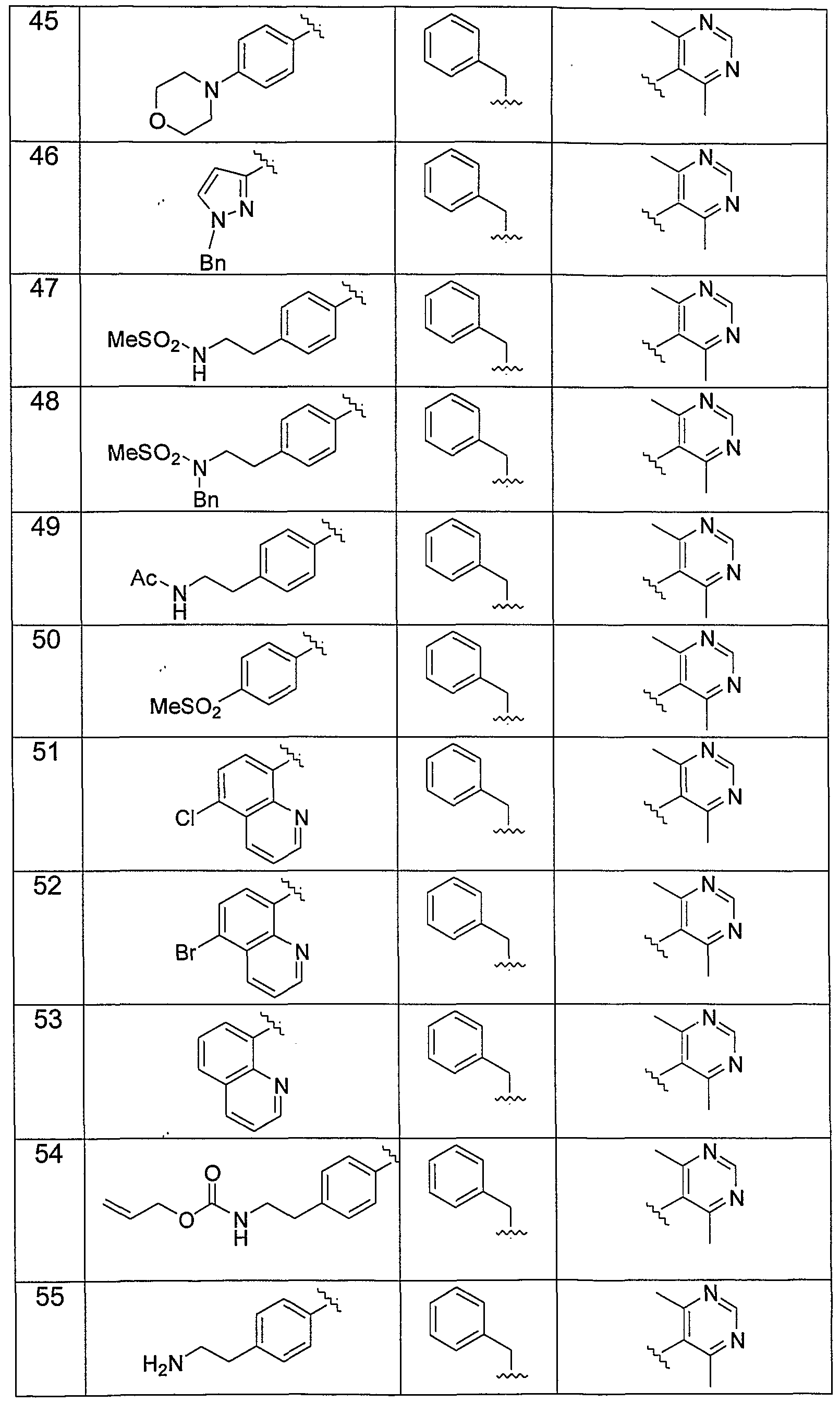
- One aspect of the invention relates to a compound having the general structure shown in Formula I:
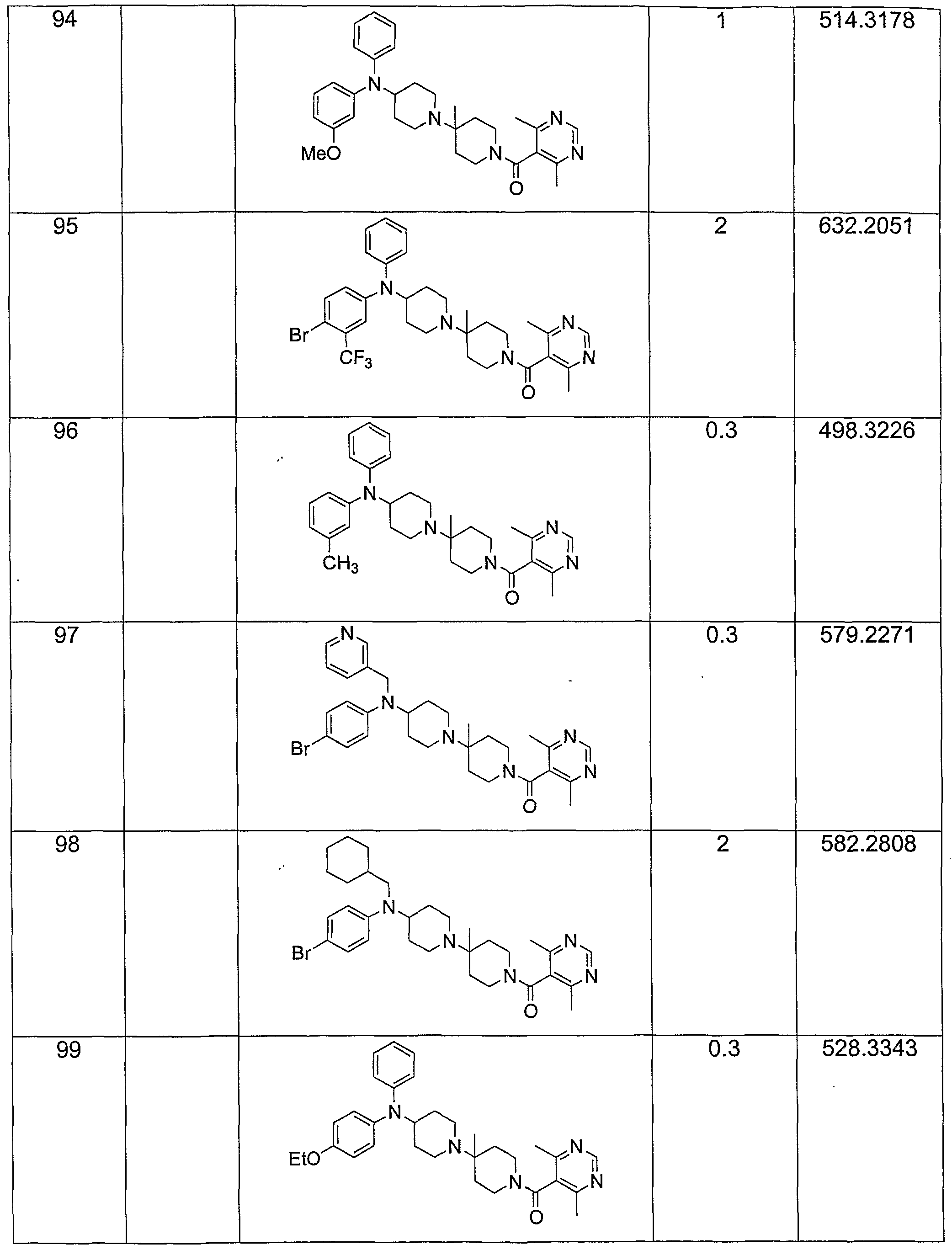
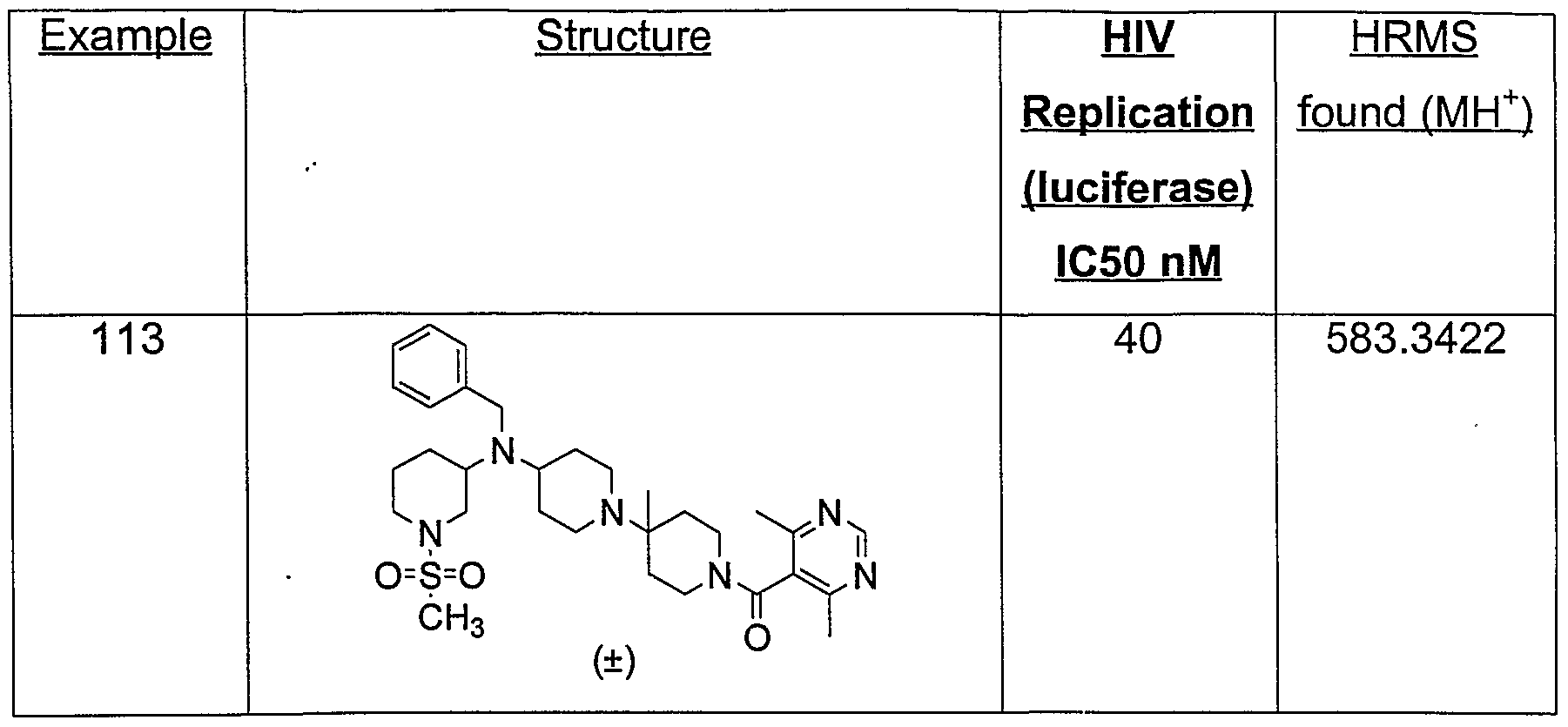
- R is selected from the group consisting of H, alkyl, aryl, arylalkyl, heteroarylalkyl, alkylketone, arylketone, alkyl, haloalkyl, cycloalkyl, cycloheteroalkyl, cycloalkylalkyl, alkylsulfonyl, arylsulfonyl, alkoxyalkyl, or amide; R 3 is selected from the group consisting of aryl, 6-membered heteroaryl, fluorenyl; and diphenylmethyl, 6 membered heteroaryl-N-oxide,
- heteroaryl wherein said aryl, fluorenyl, diphenyl or heteroaryl is optionally substituted with 1-4 substituents which can be the same or different and are independently selected from the group consisting of R 11 , R 12 ' R 13 , R 14 and R 15 ;
- R 4 is 1-3 substituents selected from the group consisting of H, halo, alkyl, haloalkyl, alkoxy, cycloalkyl, cycloheteroalkyl, amide, CF 3 , OCF 3 , aryl, heteroaryl, -XR 7 , -C(0)C 3 -C 8 cycloalkyl, -C(0)C 3 -C ⁇ cycloheteroalkyl, -(d- C 6 )alkyl-N(R 21 )S0 2 R 22 , -(CrC 6 )alkyl-C(O)NR 20 R 21 , -CN, -C0 2 H, -C0 2 R 22 ,
- R 4 can be the same or different and is independently selected when there is more than one R 4 present;
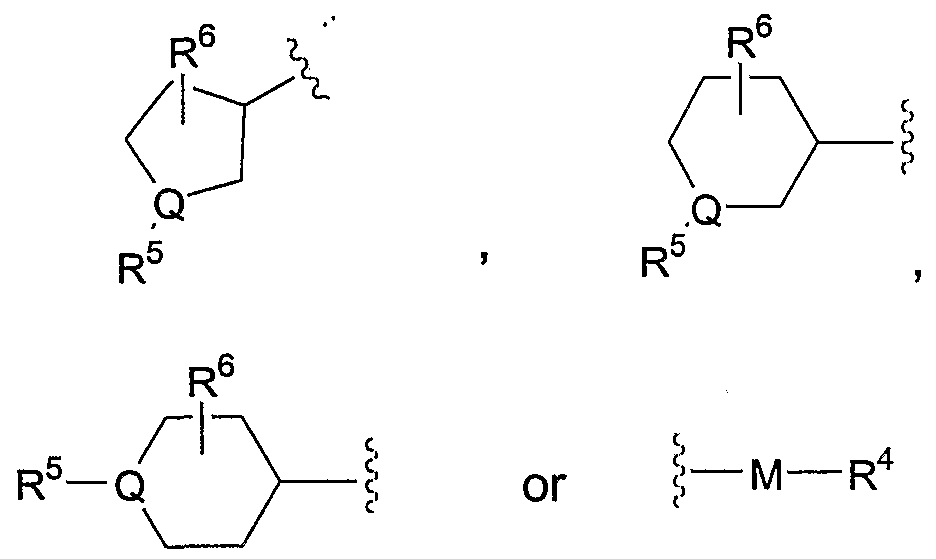
- R 5 is selected from the group consisting of H, arylalkyl, (C C 6 )alkyl,
- R 6 is H, -(C ⁇ -C 6 )alkyl, or -(C ⁇ C 6 )haloalkyl
- R 7 is selected from the group consisting of aryl, substituted aryl, heteroaryl, alkyl, haloalkyl and cycloalkyl
- R 8 is 1 , 2 or 3 substituents selected from the group consisting of H, halo, (C ⁇ -C ⁇ )alkyl, (C 1 -C 6 )alkoxy, -CF 3 , -OCF 3 , CH 3 C(0)-, -CN, CH 3 S0 2 -,
- R 8 can be the same or different and is independently selected when there are more than one R 8 present;
- R 9 , R 10 and B can be the same or different and are each independently selected from the group consisting of hydrogen, (C ⁇ -C 6 )alkyl, and -(C ⁇ -C 6 )haloalkyl;
- R 11 and R 12 can be the same or different and are each independently selected from the group consisting of (C- ⁇ -C 6 )alkyl, -(C ⁇ -C 6 )haloalkyl, halogen, -NR 19 R 20 , -OH, CF 3 , -OCH 3 , -O-acyl, and -OCF 3 ;
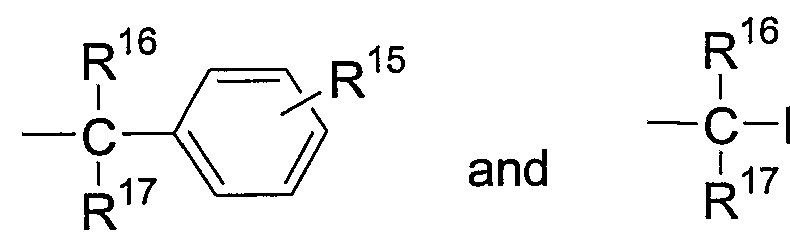
- R 14 is selected from the group consisting of (C ⁇ -C 6 )alkyl, -(d- C 6 )haloalkyl -NH 2 and R 15 -phenyl;
- R 15 is 1-3 substituents selected from the group consisting of hydrogen, (d-C ⁇ )alkyl, -(C ⁇ -C 6 )haloalkyl, -CF 3 , -C0 2 R 2 °, -CN, (d- C ⁇ jalkoxy and halogen; wherein R 15 can be the same or different and is independently selected when there are more than one R 15 present;
- R 16 and R 17 can each be the same or different and are each independently selected from the group consisting of hydrogen and (C-r C ⁇ jalkyl, or
- R 16 and R 17 together are a C 2 -C5 alkylene group and with the carbon to which they are attached from a spiro ring of 3 to 6 carbon atoms;
- R 19 , R 20 and R 21 can each be the same or different and are each independently selected from the group consisting of H, (C- ⁇ -C 6 )alkyl and (C -C 6 )cycloalkyl;
- R 22 is selected from the group consisting of (C- ⁇ -C 6 )alkyl, -(d- C 6 )haloalkyl, (C 2 -C 6 )hydroxyalkyl, (C 2 -C 6 )alkylene, (C 3 -C 6 )cycloalkyl, aryl and aryl(C C 6 )alkyl-;
- A is selected from the group consisting of H, (C ⁇ -C 6 )alkyl, and (C -
- M is aryl or heteroaryl optionally substituted with R 4 ;
- Q is CH or N; and X is selected from the group consisting of CH , S0 2 , SO, S, and O, with the following proviso: when R 1 is phenyl, pyridyl, thiophenyl or naphthyl, R 2 cannot be H, - (d-C 6 )alkyl or -C(0)-(d-C 6 )alkyl.
- Another aspect of the invention relates to a pharmaceutical composition for treatment of HIV comprising one or more compounds of formula I.
- Yet another aspect of the invention relates to a method of treating Human Immunodeficiency Virus comprising administering to a patient in need of such treatment a therapeutically effective amount of one or more compounds of formula I.
- a further aspect of the invention relates to a method of treating solid organ transplant rejection, graft v. host disease, arthritis, rheumatoid arthritis, inflammatory bowel disease, atopic dermatitis, psoriasis, asthma, allergies or multiple sclerosis comprising administering to a patient in need of such treatment a therapeutically effective amount of one or more compounds of formula I.
- Still another aspect of this invention relates to a method of treating Human I mmu no-deficiency Virus comprising administering to a patient in need of such treatment the one or more compounds of formula I in combination with one or more antiviral or other agents useful in the treatment.
- a further aspect of this invention relates to a method of treating solid organ transplant rejection, graft v. host disease, arthritis, rheumatoid arthritis, inflammatory bowel disease, atopic dermatitis, psoriasis, asthma or allergies comprising administering to a patient in need of such treatment one or more compounds of formula I in combination with one or more antiviral or other agents useful in the treatment.
- the CCR5 and antiviral or other agents which are components of the combination can be administered in a single dosage or administered separately.
- a kit comprising separate dosage forms of the actives is also contemplated.
- DETAILED DESCRIPTION OF THE INVENTION The present invention relates to a compound having the general structure shown in Formula I:
- R 1 , R 2 , R 3 , R 9 , R 10 , A and B are defined as above.
- Q is preferably CH or N, and R 2 is preferably alkyl, aryl or benzyl.
- R2 is preferably benzyl, phenyl or cyclopropylmethly.
- Alkyl means an aliphatic hydrocarbon group which may be straight or branched and comprising 1 to about 20 carbon atoms in the chain. Preferred alkyl groups contain 1 to about 12 carbon atoms in the chain. More preferred alkyl groups contain 1 to about 6 carbon atoms in the chain. Branched alkyl means that one or more lower alkyl groups such as methyl, ethyl or propyl, are attached to a linear alkyl chain. "Lower alkyl” means a group having about 1 to about 6 carbon atoms in the chain which may be straight or branched. Preferred alkyl groups in the present invention are lower alkyl groups.
- Non-limiting examples of suitable alkyl groups include methyl, ethyl, n-propyl, isopropyl, n-butyl, t-butyl, n-pentyl, heptyl, nonyl, decyl, trifluoromethyl and cyclopropylmethyl.
- Halo means fluoro, chloro, bromo, or iodo groups. Preferred are fluoro, chloro or bromo, and more preferred are fluoro and chloro.
- Halogen means fluorine, chlorine, bromine, or iodine. Preferred are fluorine, chlorine or bromine, and more preferred are fluorine and chlorine.
- Haloalkyl or "halogenated alkyl” means alkyl having one or more halo atom substituents.
- the haloalkyl is a haloalkyl.
- Non- limiting examples include -CH 2 CI, -CHCI 2 , -CCI 3 , -CH 2 F, -CHF 2 , -CF 3 , -CH 2 - CH 2 F, -CH 2 CHF 2 , -CH2CF3 and -CF 2 CF 3 .
- Ring system substituent means a substituent attached to an aromatic or non-aromatic ring system which, for example, replaces an available hydrogen on the ring system.
- Ring system substituents may be the same or different, each being independently selected from the group consisting of aryl, heteroaryl, aralkyl, alkylamino, arylamino, alkylaryl, aralkenyl, heteroaralkyl, alkylheteroaryl, heteroaralkenyl, hydroxy, hydroxyalkyl, alkoxy, aryloxy, aralkoxy, aralkyloxy, acyl, aroyl, halo, nitro, cyano, carboxy, alkoxycarbonyl, aryloxycarbonyl, aralkoxycarbonyl, alkylsulfonyl, arylsulfonyl, heteroarylsulfonyl, alkylsulfinyl, arylsulfinyl, heteroaryls
- Cycloalkyl means a non-aromatic mono- or multicyclic fused ring system comprising 3 to 10 ring carbon atoms, preferably 3 to 7 ring carbon atoms, more preferably 3 to 6 ring carbon atoms.
- the cycloalkyl can be optionally substituted with one or more "ring system substituents" which may be the same or different, and are as defined above.
- suitable monocyclic cycloalkyls include cyclopropyl, cyclobutyl, cyclopentyl, cyclohexyl and the like.
- suitable multicyclic cycloalkyls include 1-decalinyl, norbomenyl, adamantyl and the like.
- Cycloheteroalkyl means a non-aromatic mono- or multicyclic fused ring system comprising 3 to 10 ring carbon atoms, preferably 3 to 7 ring carbon atoms, more preferably 3 to 6 ring carbon atoms, wherein the cycloheteroaryi has 1 or 2 heteroatoms independently selected from O, S or N, said heteroatom(s) interrupting a carbocyclic ring structure provided that the rings do not contain adjacent oxygen and/or sulfur atoms.
- the cycloheteroalkyl can be optionally substituted with one or more "ring system substituents" which may be the same or different, and are as defined above.
- Aryl means an aromatic monocyclic or multicyclic ring system comprising 6 to 14 ring carbon atoms, preferably 6 to 10 ring carbon atoms.
- the aryl group can be optionally substituted with one or more "ring system substituents" which may be the same or different, and are as defined herein.
- suitable aryl groups include phenyl and naphthyl.
- Heteroaryl represents cyclic aromatic groups of 5 or 6 ring atoms or bicyclic groups of 11 to 12 ring atoms having 1 or 2 heteroatoms independently selected from O, S or N, said heteroatom(s) interrupting a carbocyclic ring structure and having a sufficient number of delocalized pi electrons to provide aromatic character, provided that the rings do not contain adjacent oxygen and/or sulfur atoms.
- Preferred heteroaryls contain 5 to 6 ring atoms.
- the “heteroaryl” can be optionally substituted by one or more "ring system substituents" which may be the same or different, and are as defined herein.
- the prefix aza, oxa or thia before the heteroaryl root name means that at least a nitrogen, oxygen or sulfur atom respectively, is present as a ring atom.
- Nitrogen atoms can form an N-oxide.
- AH regioisomers are contemplated, e.g., 2-pyridyl, 3-pyridyl and 4-pyridyl.
- Useful 6-membered heteroaryl groups include pyridyl, pyrimidinyl, pyrazinyl, pyridazinyl and the like and the N-oxides thereof.
- Useful 5- membered heteroaryl rings include furyl, thienyl, pyrrolyl, thiazolyl, isothiazolyl, imidazolyl, pyrazolyl, isoxazolyl and the like.
- Useful bicyclic groups include benzo-fused ring systems derived from the heteroaryl groups named above, e.g. quinolyl, phthalazinyl, quinazolinyl, benzofuranyl, benzothienyl, indolyl and the like.
- Amide is represented by RCONH wherein one or both of the hydrogen atoms in RCONH 2 can be substituted by an alkyl group and alkyl has the same meaning as defined above.
- Arylalkyl or aralkyl represents a moiety containing an aryl group linked to the main group or ring via an alkyl.
- Alkylketone represents a moiety containing an alkyl group linked to the main group or ring via a ketone.
- Arylketone represents a moiety containing an aryl group linked to the main group or ring via a ketone.
- Alkylaryl represents a moiety containing an alkyl linked to the main group or ring via an aryl group.
- Heteroarylalkyl represents a moiety containing a heteroaryl group linked to the main group or ring via an alkyl.
- the term "optionally substituted” means optional substitution with the specified groups, radicals or moieties.
- solvate as used herein means an aggregate that consists of a solute ion or molecule with one or more solvent molecules, for example, a hydrate containing such ions.
- composition and “formulation are intended to encompass a product comprising the specified ingredients, as well as any product which results, directly or indirectly, from combination of the specified ingredients.
- Patient includes mammals and other animals.
- mamal includes humans and other mammalian animals.
- terapéuticaally effective amount is intended to mean an amount of a therapeutic agent of the compound of formula I that will have an effect on a tissue, system, animal or patient that is being sought by the administrator (such as a researcher, doctor or veterinarian), which includes alleviation of the symptoms of the condition or disease being treated and the prevention, slowing or halting of progression of the disease or condition, for example, the inflammatory, immunomodulatory or respiratory diseases discussed herein.
- Prodrugs and solvates of the compounds of the invention are also contemplated within the scope of this invention.
- the term "prodrug”, as employed herein, denotes a compound that is a drug precursor which, upon administration to a subject, undergoes chemical conversion by metabolic or chemical processes to yield a compound of formula I or a salt and/or solvate thereof.
- a discussion of prodrugs is provided in T. Higuchi and V. Stella, Pro-drugs as Novel Delivery Systems (1987) Volume 14 of the A.C.S. Symposium Series, and in Bioreversible Carriers in Drug Design, (1987) Edward B. Roche, ed., American Pharmaceutical Association and Pergamon Press, both of which are incorporated herein by reference thereto.
- the compounds of formula I can form salts, solvates and prodrugs which are also within the scope of this invention.
- Reference to a compound of formula I herein is understood to include reference to salts, solvates and prodrugs thereof, unless otherwise indicated.
- salt(s) denotes acidic salts formed with inorganic and/or organic acids, as well as basic salts formed with inorganic and/or organic bases.
- a compound of formula I contains both a basic moiety, such as, but not limited to, a pyridine or imidazole, and an acidic moiety, such as, but not limited to a carboxylic acid, zwitterions ("inner salts") may be formed and are included within the term “salt(s)” as used herein.
- Pharmaceutically acceptable (i.e., non-toxic, physiologically acceptable) salts are preferred, although other salts are also useful.
- Salts of the compounds of the formula I may be formed, for example, by reacting a compound of formula I with an amount of acid or base, such as an equivalent amount, in a medium such as one in which the salt precipitates or in an aqueous medium followed by lyophilization.
- Exemplary acid addition salts include acetates, adipates, alginates, ascorbates, aspartates, benzoates, benzenesulforiates, bisulfates, borates, butyrates, citrates, camphorates, camphorsulfonates, cyclopentanepropionates, digluconates, dodecylsulfates, ethanesulfonates, fumarates, glucoheptanoates, glycerophosphates, hemisulfates, heptanoates, hexanoates, hydrochlorides, hydrobromides, hydroiodides, 2- hydroxyethanesulfonates, lactates, maleates, methanesulfonates, 2- naphthalenesulfonates, nicotinates, nitrates, oxalates, pectinates, persulfates, 3-phenylpropionates, phosphate
- Exemplary basic salts include ammonium salts, alkali metal salts such as sodium, lithium, and potassium salts, alkaline earth metal salts such as calcium and magnesium salts, salts with organic bases (for example, organic amines) such as benzathines, dicyclohexylamines, hydrabamines (formed with N.N-bis(dehydroabietyl)ethylenediamine), N- methyl-D-glucamines, N-methyl-D-glucamides, t-butyl amines, and salts with amino acids such as arginine, lysine and the like.
- Basic nitrogen- containing groups may be quartemized with agents such as lower alkyl halides (e.g.
- dialkyl sulfates e.g. dimethyl, diethyl, dibutyl, and diamyl sulfates
- long chain halides e.g. decyl, lauryl, myristyl and stearyl chlorides, bromides and iodides
- aralkyl halides e.g. benzyl and phenethyl bromides
- All stereoisomers (for example, geometric isomers, optical isomers and the like) of the present compounds including those of the salts, solvates and prodrugs of the compounds as well as the salts and solvates of the prodrugs), such as those which may exist due to asymmetric carbons on various substituents, including enantiomeric forms (which may exist even in the absence of asymmetric carbons), rotameric forms, atropisomers, and diastereomeric forms, are contemplated within the scope of this invention.
- Individual stereoisomers of the compounds of the invention may, for example, be substantially free of other isomers, or may be admixed, for example, as racemates or with all other, or other selected, stereoisomers.
- the chiral centers of the present invention can have the S or R configuration as defined by the IUPAC 1974 Recommendations.
- the use of the terms “salt”, “solvate” “prodrug” and the like, is intended to equally apply to the salt, solvate and prodrug of enantiomers, stereoisomers, rotamers, tautomers, racemates or prodrugs of the inventive compounds.
- nucleoside and nucleotide reverse transcriptase inhibitors as used herein means nucleosides and nucleotides and analogues thereof that inhibit the activity of HIV-1 reverse transcriptase, the enzyme which catalyzes the conversion of viral genomic HIV-1 RNA into proviral HIV-1 DNA.
- Typical suitable NRTls include zidovudine (AZT) available under the RETROVIR tradename from Glaxo-Wellcome Inc., Research Triangle, NC 27709; didanosine (ddl) available under the VIDEX tradename from Bristol- Myers Squibb Co., Princeton, NJ 08543; zalcitabine (ddC) available under the HMD tradename from Roche Pharmaceuticals, Nutley, NJ 07110; stavudine (d4T) available under the ZERIT trademark from Bristol-Myers Squibb Co., Princeton, NJ 08543; lamivudine (3TC) available under the EPIVIR tradename from Glaxo-Wellcome Research Triangle, NC 27709; abacavir (1592U89) disclosed in WO96/30025 and available under the ZIAGEN trademark from Glaxo-Wellcome Research Triangle, NC 27709; adefovir dipivoxil [bis(POM)-PMEA] available under the PREVON tradename
- NRTI non-nucleoside reverse transcriptase inhibitors
- Typical suitable NNRTIs include nevirapine (BI-RG-587) available under the VIRAMUNE tradename from Boehringer Ingelheim, the manufacturer for Roxane Laboratories, Columbus, OH 43216; delaviradine (BHAP, U-90152) available under the RESCRIPTOR tradename from Pharmacia & Upjohn Co., Bridgewater NJ 08807; efavirenz (DMP-266) a benzoxazin-2-one disclosed in WO94/03440 and available under the SUSTIVA tradename from DuPont Pharmaceutical Co., Wilmington, DE 19880-0723; PNU-142721 , a furopyridine-thio-pyrimide under development by Pharmacia and Upjohn, Bridgewater NJ 08807; AG-1549 (formerly Shionogi # S-1153); 5-(3,5-dichlorophenyl)- thio-4-isopropyl-1 -(4- pyridyl)methyl-IH-imidazol-2-ylmethyl carbonate disclosed in
- protease inhibitor means inhibitors of the HIV-1 protease, an enzyme required for the proteolytic cleavage of viral polyprotein precursors (e.g., viral GAG and GAG Pol polyproteins), into the individual functional proteins found in infectious HIV-1.
- HIV protease inhibitors include compounds having a peptidomimetic structure, high molecular weight (7600 daltons) and substantial peptide character, e.g. CRIXIVAN(available from Merck) as well as nonpeptide protease inhibitors e.g., VIRACEPT (available from Agouron).
- Typical suitable Pis include saquinavir (Ro 31-8959) available in hard gel capsules under the INVIRASE tradename and as soft gel capsules under the FORTOVASE tradename from Roche Pharmaceuticals, Nutley, NJ 07110-1199; ritonavir (ABT-538) available under the NORVIR tradename from Abbott Laboratories, Abbott Park, IL 60064; indinavir (MK- 639) available under the CRIXIVAN tradename from Merck & Co., Inc., West Point, PA 19486-0004; nelfnavir (AG-1343) available under the VIRACEPT tradename from Agouron Pharmaceuticals, Inc., LaJolla CA 92037-1020; amprenavir (141 W94), tradename AGENERASE, a non- peptide protease inhibitor under development by Vertex Pharmaceuticals, Inc., Cambridge, MA 02139-4211 and available from Glaxo-Wellcome, Research Triangle, NC under an expanded access program; lasinavir (
- antiviral agents include hydroxyurea, ribavirin, IL-2, IL-12, pentafuside and Yissum Project No. 11607.
- Hydroyurea (Droxia), a ribonucleoside triphosphate reductase inhibitor, the enzyme involved in the activation of T-cells, was discovered at the NCI and is under development by Bristol-Myers Squibb; in preclinical studies, it was shown to have a synergistic effect on the activity of didanosine and has been studied with stavudine.
- IL-2 is disclosed in Ajinomoto EP-0142268 , Takeda EP- 0176299, and Chiron U. S. Patent Nos.
- RE 33653, 4530787, 4569790, 4604377, 4748234, 4752585, and 4949314 and is available under the PROLEUKIN (aldesleukin) tradename from Chiron Corp., Emeryville, CA 94608-2997 as a lyophilized powder for IV infusion or sc administration upon reconstitution and dilution with water; a dose of about 1 to about 20 million lU/day, sc is preferred; a dose of about 15 million lU/day, sc is more preferred.
- IL-12 is disclosed in W096/25171 and is available from Roche Pharmaceuticals, Nutley, NJ 07110-1199 and American Home Prodocts, Madison, NJ 07940; a dose of about 0.5 microgram/kg/day to about 10 microgram/kg/day, sc is preferred.
- Pentafuside DP-178, T-20
- U.S. Patent No.5,464,933 licensed from Duke University to Trimeris which is developing pentafuside in collaboration with Duke University; pentafuside acts by inhibiting fusion of HIV-1 to target membranes.
- Pentafuside (3-100 mg /day) is given as a continuous sc infusion or injection together with efavirenz and 2 Pi's to HIV-1 positive patients refractory to a triple combination therapy; use of 100 mg/day is preferred.
- Yissum Project No. 11607 a synthetic protein based on the HIV -1 Vif protein, is under preclinical development by Yissum Research Development Co., Jerusalem 91042 , Israel.
- Ribavirin, 1- ⁇ -D-ribofuranosyl- 1H-1 ,2,4-triazole-3-carboxamide, is available from ICN Pharmaceuticals, Inc., Costa Mesa, CA; its manufacture and formulation are described in U.S. Patent No. 4,211 ,771.
- anti-HIV-1 therapy means any anti-HIV-1 drug found useful for treating HIV-1 infections in man alone, or as part of multidrug combination therapies, especially the HAART triple and quadruple combination therapies.
- Typical suitable known anti-HIV-1 therapies include, but are not limited to multidrug combination therapies such as (i) at least three anti-HIV-1 drugs selected from two NRTIs, one PI, a second PI, and one NNRTI; and (ii) at least two anti-HIV-1 drugs selected from NNRTIs and Pis.
- Typical suitable HAART - multidrug combination therapies include:
- triple combination therapies such as two NRTIs and one PI ; or (b) two NRTIs and one NNRTI ; and (c) quadruple combination therapies such as two NRTIs , one PI and a second PI or one NNRTI.
- triple combination therapies such as two NRTIs and one PI
- two NRTIs and one NNRTI two NRTIs and one NNRTI
- quadruple combination therapies such as two NRTIs , one PI and a second PI or one NNRTI.
- Drug compliance is essential.
- the CD4 + and HIV-1 -RNA plasma levels should be monitored every 3-6 months. Should viral load plateau, a fourth drug.e.g., one PI or one NNRTI could be added. See the table below wherein typical therapies are further described:
- the compound of the present invention also referred to herein as the inventive compound, is particularly useful as a CCR5 antagonist.
- Compounds of the invention can be made by the procedures known in the art, for example by the procedures described in the following reaction schemes, by the methods described in the examples below, and by using the methods described in US patents 5,883,096; 6,037,352; 5,889,006; 5,952,349; and 5,977,138.
- solvents and reagents may be referred to herein by the abbreviations indicated: tetrahydrofuran (THF); ethanol (EtOH); methanol (MeOH); acetic acid (HOAc or AcOH); ethyl acetate (EtOAc); N,N- dimethylformamide (DMF); trifluoroacetic acid (TFA); trifluoroacetic anhydride (TFAA); 1-hydroxy-benzotriazole (HOBT); m-chloroperbenzoic acid (MCPBA); triethylamine (Et3N); diethyl ether (Et2 ⁇ ); tert-butoxy- carbonyl (BOC); 1 ,8-diazabicyclo[5.4.0]undec-7-ene (DBU); dimethyl- sulfoxide (DMSO); p-toluene sulfonic acid (p-TSA); potassium bis(trimethylsilyl)-amide (KHMDA); 4-d
- the keto-amide 8 is reacted with a substituted 4-amino piperidine 7 in the presence of sodium triacetoxy borohydride to give the amine 8.
- the free amine in 8 can be functionalized either by reductive amination (RCHO/Na(AcO) 3 BH) or alkylation (NaH or Cs 2 C0 3 /R 2 X) to furnish compounds of formula IA.
- the keto-amide 5 is reacted with an amine 10 in the presence of sodium triacetoxyborohydride to furnish the functionalized amine 11.
- the amine 11 can be alkylated either with NaH, Cs 2 C0 3 /R 2 X or Na(AcO) 3 BH/RCHO to furnish the tertiary amine 12.
- the Boc group in 12 can be removed with an acid such as HCI or TFA, and the resulting piperidine can be coupled to acids to furnish compounds of formula IB.
- N-Boc-4-piperidone 2 is reacted with and amine (R 2 NH 2 ) in the presence of Na(AcO) 3 BH to furnish the amine 13.
- the amine 13 can be reacted with either aryl or heteroaryl halides/triflates under palladium catalysis or Cu(OAc) 2 /(R 4 M) 3 Bi to furnish the arylated amines 14.
- the Boc group in 14 can be removed, and the second piperidine ring can be added according to the procedure previously discussed (Scheme 1 ; Steps 1 and 2) to furnish the piperidine 15.
- the Boc group in 15 is removed with an acid such as TFA or HCL, and the amine is coupled to an acid represented by R 3 C ⁇ 2 H to furnish the compounds of formula IB.
- inert, pharmaceutically acceptable carriers can be either solid or liquid.
- Solid form preparations include powders, tablets, dispersible granules, capsules, cachets and suppositories.
- the powders and tablets may be comprised of from about 5 to about 95 percent active ingredient.
- Suitable solid carriers are known in the art, e.g. magnesium carbonate, magnesium stearate, talc, sugar or lactose. Tablets, powders, cachets and capsules can be used as solid dosage forms suitable for oral administration. Examples of pharmaceutically acceptable carriers and methods of manufacture for various compositions may be found in A. Gennaro (ed.), Remington's Pharmaceutical Sciences, 18th Edition, (1990), Mack Publishing Co., Easton, Pennsylvania.
- Liquid form preparations include solutions, suspensions and emulsions. An example of this includes, but is not limited to, water or water-propylene glycol solutions for parenteral injection or addition of sweeteners and opacifiers for oral solutions, suspensions and emulsions. Liquid form preparations may also include solutions for intranasal administration. Aerosol. preparations suitable for inhalation may include solutions and solids in powder form, which may be in combination with a pharmaceutically acceptable carrier, such as an inert compressed gas, e.g. nitrogen. Also included are solid form preparations which are intended to be converted, shortly before use, to liquid form preparations for either oral or parenteral administration. Such liquid forms include solutions, suspensions and emulsions.
- the compound of the invention may also be deliverable transdermally.
- the transdermal compositions can take the form of creams, lotions, aerosols and/or emulsions and can be included in a transdermal patch of the matrix or reservoir type as are conventional in the art for this purpose.
- the compounds of this invention may also be deliverable subcutaneously.
- the compound is administered orally.
- the pharmaceutical preparation is in a unit dosage form. In such form, the preparation is subdivided into suitably sized unit doses containing a therapeutically effective amount of the compound having formula I.
- the quantity of active compound in a unit dose of preparation may be varied or adjusted from about 10 mg to about 500 mg, preferably from about 25 mg to about 300 mg, more preferably from about 50 mg to about 250 mg, and most preferably from about 55 mg to about 200 mg, according to the particular application.
- the actual dosage of the inventive compound employed may be varied depending upon the requirements of the patient and the severity of the condition being treated. Determination of the proper dosage regimen for a particular situation is within the skill of the art. For convenience, the total daily dosage may be divided and administered in portions during the day as required.
- a typical recommended daily dosage regimen for oral administration can range from about 100 mg/day to about 300 mg/day, preferably 150 mg/day to 250 mg/day, more preferably about 200 mg/day, in two to four divided doses.
- the doses and dosage regimens of the NRTIs, NNRTIs, Pis and other agents used in combination with the compounds of this invention will be determined by the attending clinician inview of the approved doses and dosage regimens in the package inserts or as set forth in the protocols, taking into consideration the age, sex and condition of the patient and the severity of the condition treated.
- the compound of the present invention can be used to treat Human Immunodeficiency Virus by administering to a patient in need of such treatment a therapeutically effective amount of one or more compounds having formula I, preferably in combination with one or more pharmaceutically acceptable carriers.
- One or more, preferably one to four, antiviral agents useful in anti-HIV-1 therapy can be used in combination with the compound of the present invention.
- the antiviral agent or agents can be combined with one or more compounds of the present invention in a single dosage form, or the one or more compounds of the present.invention and the antiviral agent or agents may be administered simultaneously or sequentially as separate dosage forms.
- antiviral agents contemplated for use in combination with the compound of the present invention comprise nucleoside and nucleotide reverse transcriptase inhibitors, non-nucleoside reverse transcriptase inhibitors, protease inhibitors and other antiviral drugs listed below not falling within these classifications.
- antiviral agents include, but are not limited to, zidovudine, lamivudine, zalcitabine, didanosine, stavudine, abacavir, adefovir dipivoxil, lobucavir, BCH-10652, emitricitabine, beta-L-FD4, DAPD, lodenosine, nevirapine, delaviridine, efavirenz, PNU-142721 , AG-1549, MKC-442, (+)-calanolide A and B, saquinavir, indinavir, ritonavir, nelfinavir, lasinavir, DMP-450, BMS- 2322623, ABT-378, amprenavir, hydroxyurea, ribavirin, IL-2, IL-12, pentafuside, Yissum No.
- HAART a combination therapy with more than one active agent
- the active agents may be administered separately or in conjunction.
- the administration of one element may be prior to, concurrent to, or subsequent to the administration of the other agent.
- Another aspect of the invention provides a method of treating solid organ transplant rejection, graft v.
- the method for treating solid organ transplant rejection, graft v. host disease, rheumatoid arthritis, inflammatory bowel disease or multiple sclerosis further comprises administering one or more other agents useful in the treatment of said diseases in combination with one or more compounds of formula I.
- Agents known in the treatment of rheumatoid arthritis, transplant and graft v. host disease, inflammatory bowel disease and multiple sclerosis which can be administered in combination with the compound of the present invention are as follows: solid organ transplant rejection and graft v.
- IL-10 immune suppressants
- tacrolimus tacrolimus
- antilymphocyte globulin OKT-3 antibody
- steroids inflammatory bowel disease: IL-10 (see US 5,368,854), steroids and azulfidine
- rheumatoid arthritis methotrexate, azathioprine, cyclophosphamide, steroids and mycophenolate mofetil
- multiple sclerosis interferon-beta, interferon-alpha, and steroids.
- Another aspect of the invention relates to a kit comprising in separate containers in a single package pharmaceutical composition for use in combination to treat Human Immunodeficiency Virus.
- a pharmaceutical composition comprises one or more compounds of formula I in one or more pharmaceutically acceptable carriers, and in separate containers, one or more pharmaceutical compositions comprising an effective amount of one or more antiviral agents or other agents useful in the treatment of Human Immunodeficiency Virus in one or more pharmaceutically acceptable carriers.
- the goal of the HIV-1 therapy of the present invention is to reduce the HIV-1 -RNA viral load below the detectable limit.
- the "detectable limit of HIV-1 -RNA" in the context of the present invention means that there are fewer than about 200 to fewer than about 50 copies of HIV-1 -RNA per ml of plasma of the patient as measured by quantitative, multi-cycle reverse transcriptase PCR methodology. HIV-1 -RNA is preferably measured in the present invention by the methodology of Amplicor -1 Monitor 1.5 (available from Roche Diagnsotics) or of Nuclisens HIV-1 QT -1.
- CCR5 Membrane Binding Assay The following assays can be used to determine the CCR5 inhibitory and antagonistic activity of the compounds of the invention.
- CCR5 Membrane Binding Assay The following assays can be used to determine the CCR5 inhibitory and antagonistic activity of the compounds of the invention.
- a high throughput screen utilizing a CCR5 membrane binding assay identifies inhibitors of RANTES binding.
- This assay utilizes membranes prepared from NIH 3T3 cells expressing the human CCR5 chemokine receptor which have the ability to bind to RANTES, a natural ligand for the receptor. Using a 96-well plate format, membrane preparations are incubated with 125 ⁇ RANTES in the presence or absence of compound for one hour. Compounds are serially diluted over a wide range of 0.001 ug/ml to 1 ug/ml and tested in triplicates. Reaction cocktails are harvested through glass fiber filters, and washed thoroughly.
- HIV-1 Entry Assay :
- Replication defective HIV-1 reporter virions are generated by cotransfection of a plasmid encoding the NL4-3 strain of HIV-1 (which has been modified by mutation of the envelope gene and introduction of a luciferase reporter plasmid) along with a plasmid encoding one of several HIV- 1 envelope genes as described by Connor et al , Virology. 206 (1995), p. 935- 944. Following transfection of the two plasmids by calcium phosphate precipitation, the viral supematants are harvested on day 3 and a functional viral titer determined.
- This assay uses primary peripheral blood mononuclear cells or the stable U87-CCR5 cell line to determine the effect of anti-CCR5 compounds to block infection of primary HIV-1 strains.
- the primary lymphocytes are purified from normal healthy donors and stimulated in vitro with PHA and IL-2 three days prior to infection.
- cells are pretreated with drug for 1 hour at 37 °C and subsequently infected with an M-tropic HIV-1 isolates. Following infection, the cells are washed to remove residual inoculum and cultured in the presence of compound for 4 days. Culture supematants are harvested and viral replication measured by determination of viral p24 antigen concentration.
- a GTP S binding assay measures receptor activation by CCR5 ligands. This assay measures the binding of 3 ⁇ s labeled-GTP to receptor coupled G- proteins that occurs as a result of receptor activation by an appropriate ligand.
- the CCR5 ligand, RANTES is incubated with membranes from CCR5 expressing cells and binding to the receptor activation (or binding) is determined by assaying for bound 35s label.
- the assay quantitatively determines if compounds exhibit agonist characteristics by inducing activation of the receptor or alternatively antagonist properties by measuring inhibition of RANTES binding in a competitive or non-competitive fashion.
- the chemotaxis assay is a functional assay which characterizes the agonist vs. antagonist properties of the test compounds.
- the assay measures the ability of a non-adherent murine cell line expressing human CCR5 (BaF-550) to migrate across a membrane in response to either test compounds or natural ligands (i.e., RANTES, MIP-1 ⁇ ). Cells migrate across the permeable membrane towards compounds with agonist activity.
- Compounds that are antagonists not only fail to induce chemotaxis, but are also capable of inhibiting cell migration in response to known CCR5 ligands.
- Plasmids encoding the full length genome of HIV-1 pNL-4-Luc with the gp 120 V-3 loop replaced by the Bgl II fragment of HIV-1 ADA, YU-2 or HxB are obtained from Dr. Susan Pontow (Washington University, St. Louis MO).
- Replication- competent luciferase reporter virus stocks are generated by transfection of plasmids into 293T cells using Superfect (Qiagen) or Mirus transfection reagents. Viral stocks are collected 48 hours following transfection and titered for luciferase production on U-87-CCR5 or CXCR4 cells.
- U87-CD4- CCR5 cells (10 4/ well) are plated in 96-well cell culture plates and incubated overnight. Media is removed and replaced with 50 ⁇ l of fresh culture media (DMEM, 10% FCS) and 50 ⁇ l of compound diluted in culture medium. Cells are incubated with compound at 37°C for 1 hour. The resultant supernatant is removed and replaced with 20 ⁇ l of media containing compound and infected with an equal volume of diluted or undiluted virus stock at 37 °C for 3-4 hours. The cells are washed once with DMEM, and 200 ⁇ l of media containing compound is added.
- DMEM fresh culture media
- FCS 50% FCS
- Boc-piperidine (2.0 g, 6.7 mmol) was taken up in CH 2 CI 2 and TFA (7 mL) was added. The solution was stirred at rt for 1 h. The solution was - concentrated. The resulting salt was taken up in H 2 0 and basified with NaOH. The solution was extracted with CH CI 2 . The aqueous layer was extracted with CH CI 2 . The combined organic layers were dried (Na 2 S04), filtered, and concentrated to furnish 1.1 g (85 %) of deprotected piperidine.
- M aryl or hetero-aryl. Most preferred are when R 2 is benzyl, phenyl, and cyclopropylmethyl.
- Step 5 The cyano-amine from step 4 was treated with MeMgBr (1.5 mL of a 3.0 M solution in Et ⁇ O) according to the conditions described above in Step 2 of Example 1. Purification via preparative thin-layer chromatography (2/1 hexanes/EtOAc, Si0 2 ) gave 344 mg (70 %) of the amine as a colorless oil.
- the ketone 5 (5.0 g, 16.9 mmol), benzyl amine (1.67 mL, 15.3 mmol), Na(AcQ) 3 BH (3.89 g, 18.4 mmol), and AcOH (1.1 mL, 18.4 mL) were taken up in CH 2 CI2 and stirred at 25 °C for 18 hours. The solution was diluted with CH 2 CI 2 and quenched with 1 N NaOH. The aqueous layer
- Stepl 8-Amino quinoline (1.0g, 6.9 mmol), ketone 5 (3.08g, 10.4 mmol),
- Step 2 The aniline (85mg, 0.20 mmol), propanal (23mg, 0.4 mmol), and
- Na(AcO) 3 BH were taken up in CH 2 CI2 (2 mL). The solution was allowed to stir at 25°C for 16 hours. The solution was diluted with CH 2 CI 2 and quenched with 1 M NaOH. The aqueous layer was extracted with CH 2 CI 2 . The combined organic layers were dried over Na 2 S0 4 , filtered, and concentrated to afford 100 mg of a tertiary amine. The product was used without further purification.
- Step 4 The HCI salt from step 3, EDCI hydrochloride (61 mg, 0.032 mmol), HOBt (43mg, 0-032 mmol), iPr 2 Net (0.365 mL, 2.1 mmol), and 4,6-dimethyl- 3-pyrimidine carboxylic acid (49 mg, 0.32 mmol) were taken up in MeCN (2 mL) and stirred at 25°C for 24 hours. The solution was concentrated. The residue was parttioned between EtOAc and 1 N NaOH. The aqueous layer was extracted with EtOAc. The combined organic layers were washed with brine and dried over Na 2 S0 4 , filtered and concentrated.
- Step 2 The quinoline (1.28 g, 7.2 mmol) (3.18g, 10.7 mmol), AcOH (1.16 mL, 20.1 mmol), and Na(AcO) 3 BH (3.05g, 14.4 mmol) were taken up in 30 mL CICH 2 CH 2 CI and stirred at 25°C for 16 hours. The solution was diluted with CH2CI2 and quenched with 1M NaOH. The aqueous layer was extracted with CH 2 CI 2 . The combined organic layers were dried over Na2S0 4 , filtered, and concentrated. The crude product was purified via flash chromatography (2:1 hexanes/EtOAc) to afford 2.0 g (61%) of the quinoline as a yellow oil/foam.
- step 3 The product of step 3 was treated as described above for Example 5 (steps 3 and 4) to furnish the crude pyrimidine amide.
- Purification via preparative, thin-layer chromagotraphy 99:1 95/5 CH 2 Cl 2 /MeOH:7 N NH 3 in MeOH) gave 8 mg (53%) of Compound 111.
- the amide was taken up in EtOAc and was precipitated as the HCI salt upon addition of 2.0 M HCI in Et 2 0. m.p. (HCI salt): 164-167°C (decomposition).
- HRMS (MH+) calc'd 507.2639; found: 507.2634.
Landscapes
- Health & Medical Sciences (AREA)
- Chemical & Material Sciences (AREA)
- Organic Chemistry (AREA)
- Life Sciences & Earth Sciences (AREA)
- General Health & Medical Sciences (AREA)
- Animal Behavior & Ethology (AREA)
- Chemical Kinetics & Catalysis (AREA)
- General Chemical & Material Sciences (AREA)
- Medicinal Chemistry (AREA)
- Nuclear Medicine, Radiotherapy & Molecular Imaging (AREA)
- Veterinary Medicine (AREA)
- Pharmacology & Pharmacy (AREA)
- Public Health (AREA)
- Bioinformatics & Cheminformatics (AREA)
- Engineering & Computer Science (AREA)
- Immunology (AREA)
- Neurology (AREA)
- Dermatology (AREA)
- Neurosurgery (AREA)
- Virology (AREA)
- Pulmonology (AREA)
- Biomedical Technology (AREA)
- Rheumatology (AREA)
- Communicable Diseases (AREA)
- Oncology (AREA)
- Tropical Medicine & Parasitology (AREA)
- Molecular Biology (AREA)
- Pain & Pain Management (AREA)
- AIDS & HIV (AREA)
- Hospice & Palliative Care (AREA)
- Psychiatry (AREA)
- Transplantation (AREA)
- Orthopedic Medicine & Surgery (AREA)
- Physical Education & Sports Medicine (AREA)
- Pharmaceuticals Containing Other Organic And Inorganic Compounds (AREA)
- Medicines That Contain Protein Lipid Enzymes And Other Medicines (AREA)
- Plural Heterocyclic Compounds (AREA)
Abstract
Description


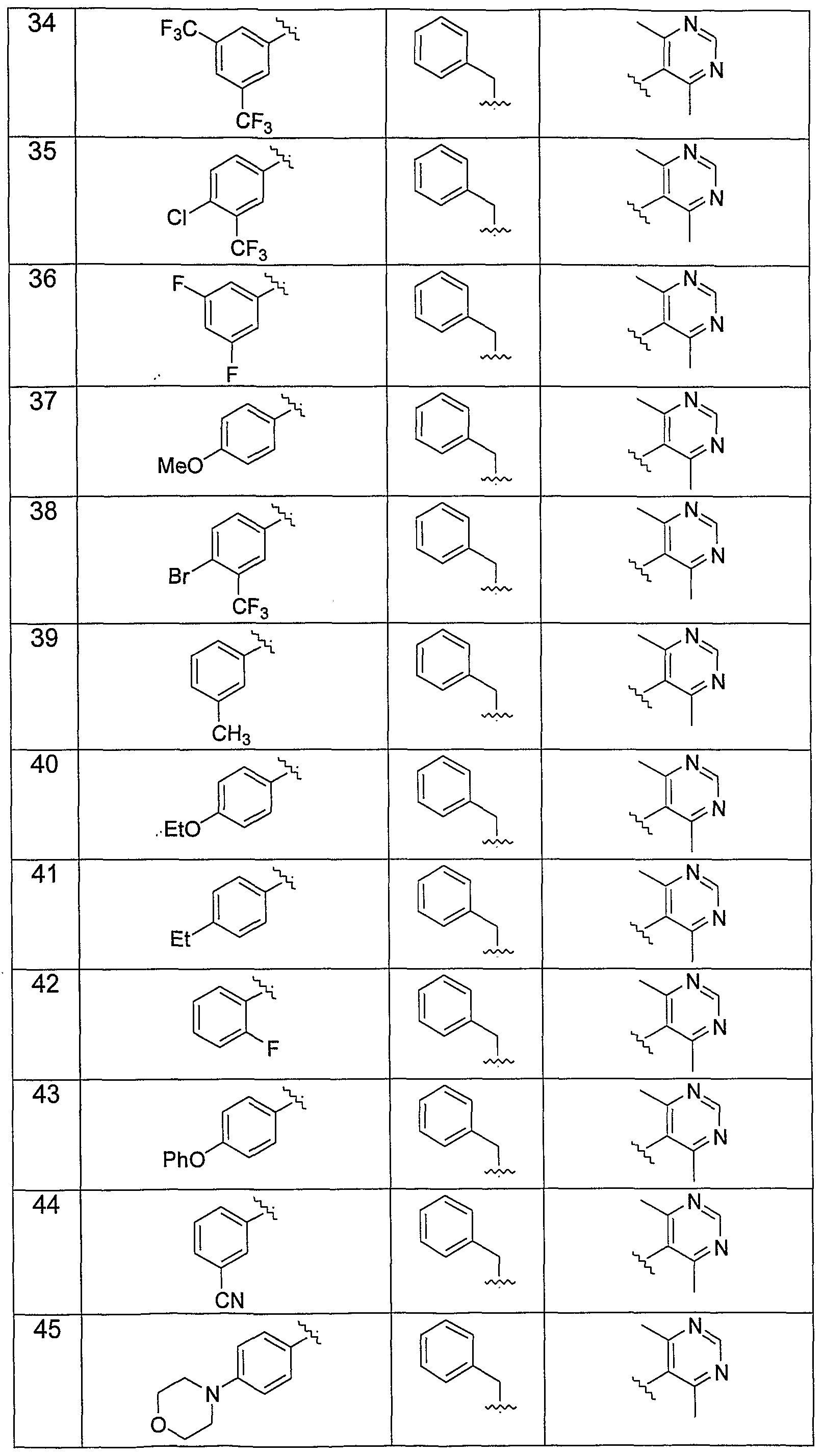


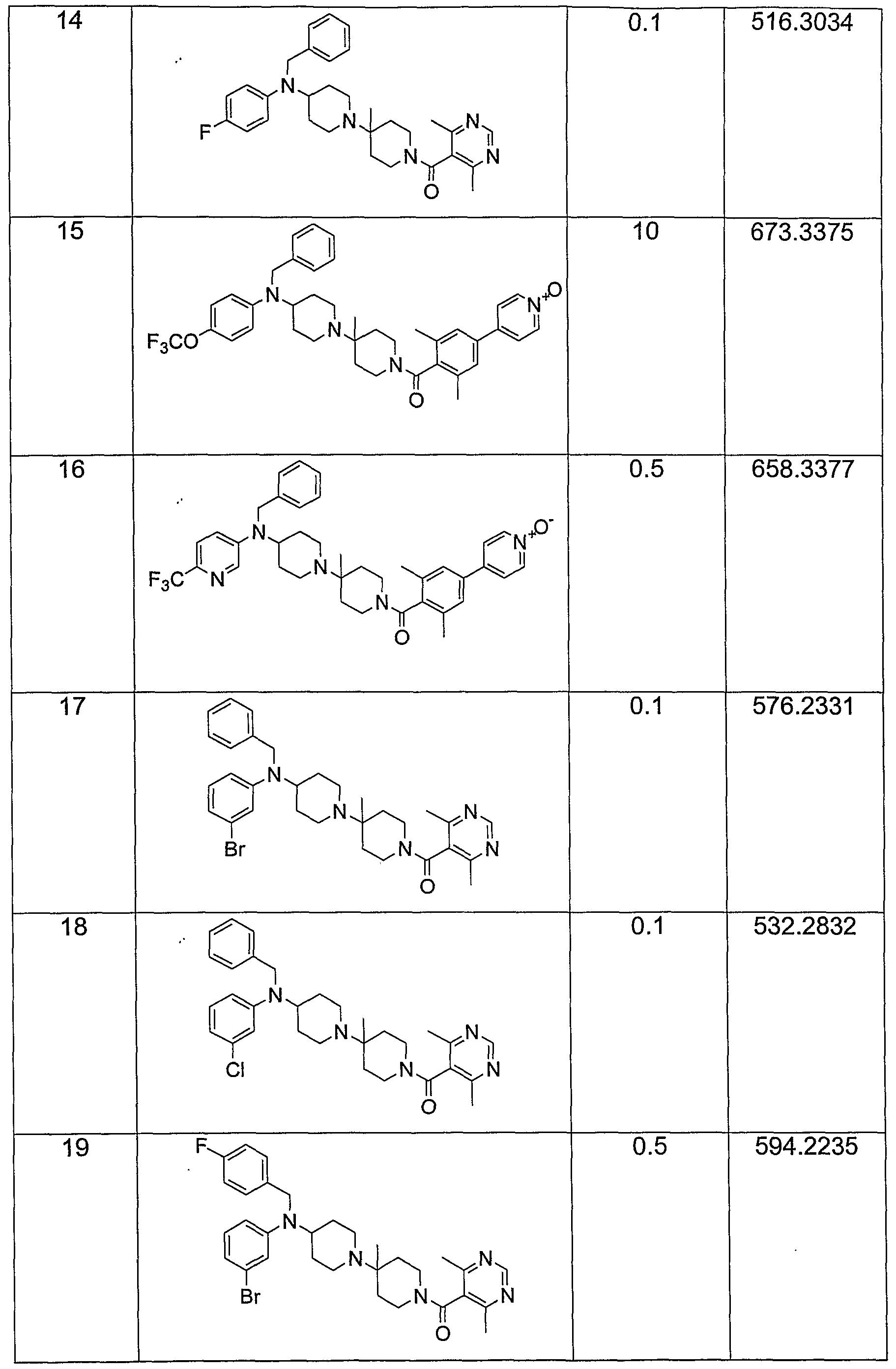


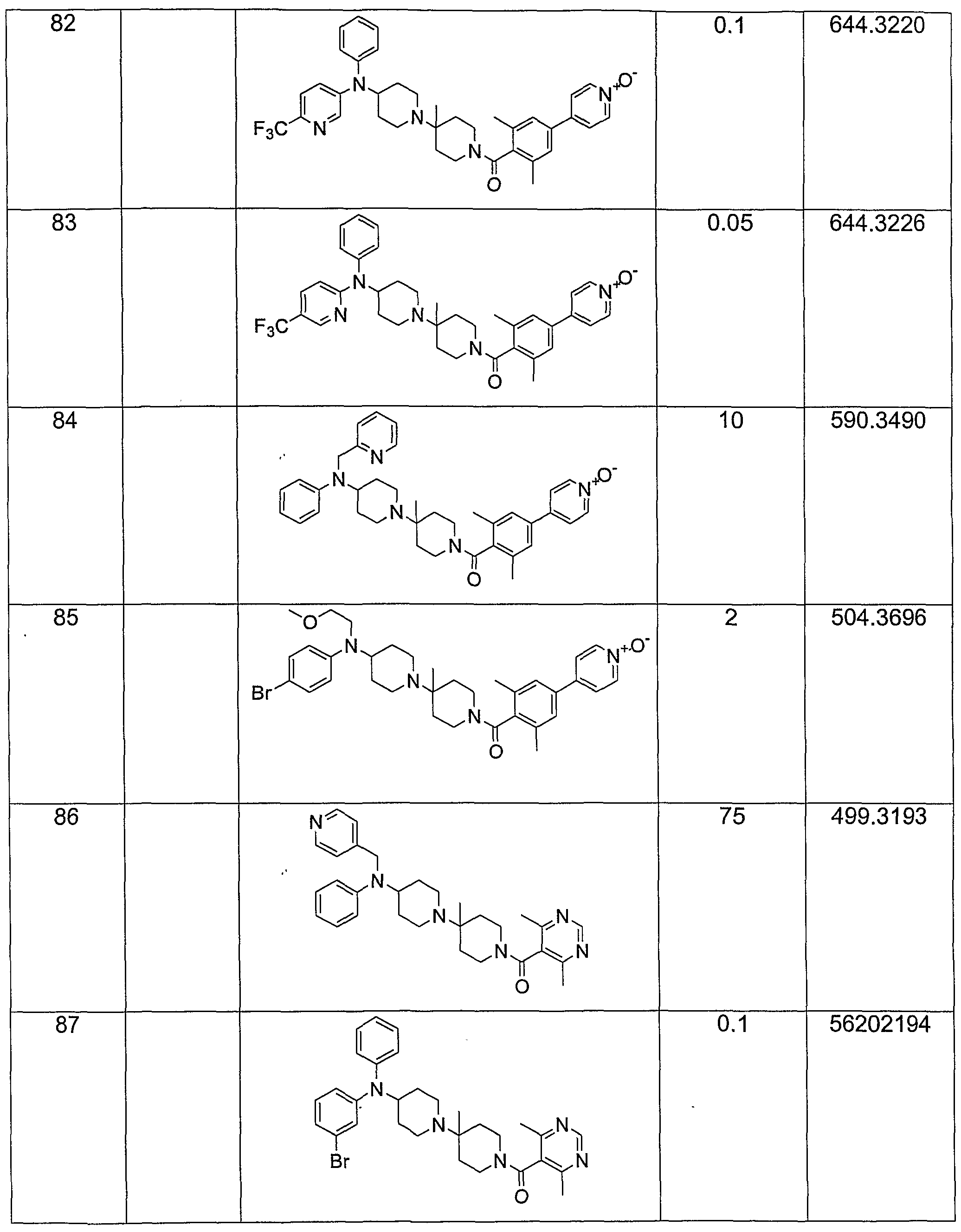
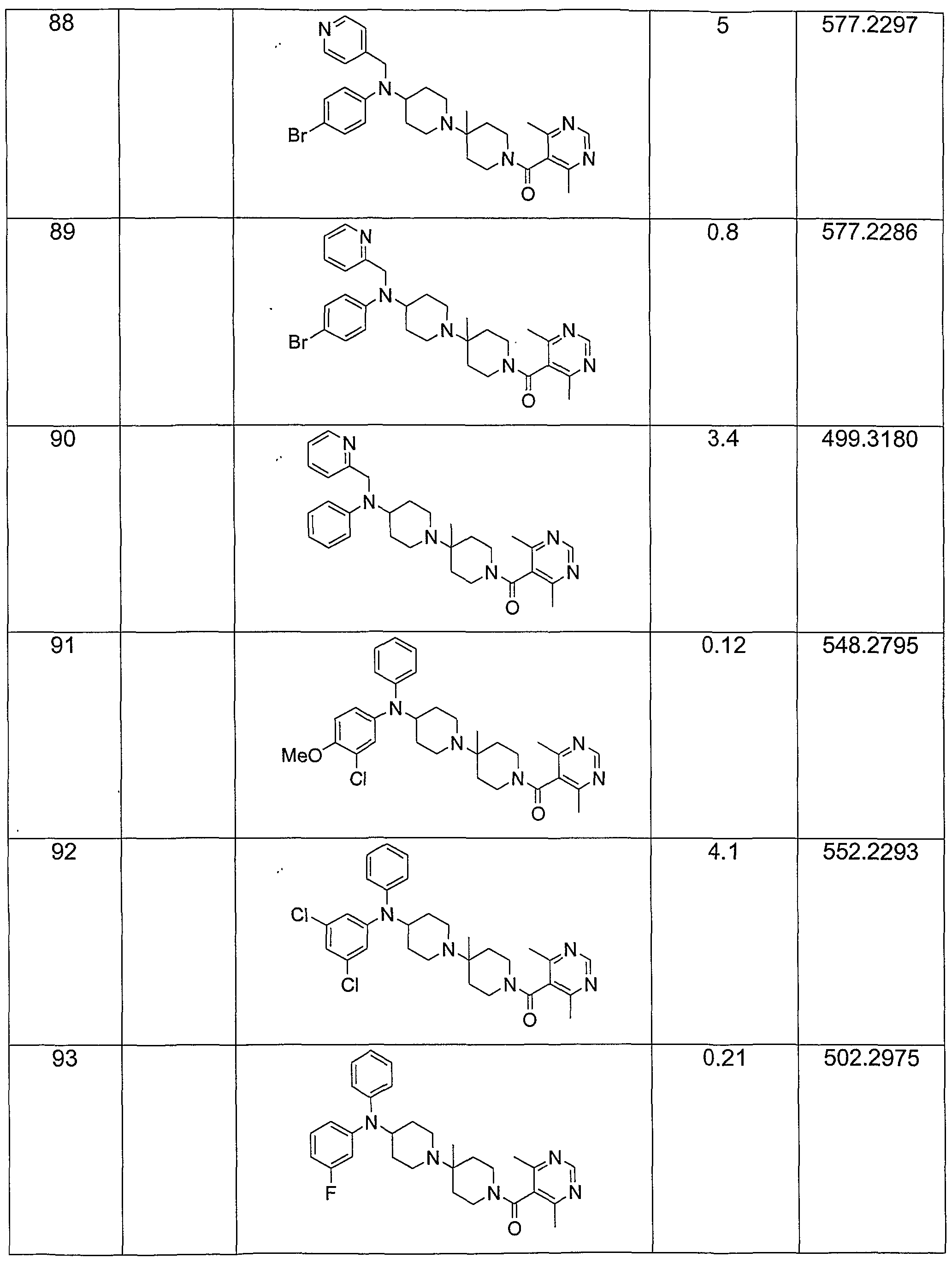


Claims





Priority Applications (13)
| Application Number | Priority Date | Filing Date | Title |
|---|---|---|---|
| HU0402019A HUP0402019A3 (en) | 2001-08-29 | 2002-08-28 | Piperidine derivatives useful as ccr5 antagonists and pharmaceutical compositions containing them |
| MXPA04001886A MXPA04001886A (en) | 2001-08-29 | 2002-08-28 | Piperidine derivatives useful as ccr5 antagonists. |
| EP02766142A EP1421075B1 (en) | 2001-08-29 | 2002-08-28 | Piperidine derivatives useful as ccr5 antagonists for the treatment of hiv |
| SI200230372T SI1421075T1 (en) | 2001-08-29 | 2002-08-28 | Piperidine derivatives useful as ccr5 antagonists for the treatment of hiv |
| HK04104463.6A HK1061563B (en) | 2001-08-29 | 2002-08-28 | Piperidine derivatives useful as ccr5 antagonists for the treatment of hiv |
| BR0212108-5A BR0212108A (en) | 2001-08-29 | 2002-08-28 | Piperidine derivatives useful as ccr5 antagonists |
| CA002457861A CA2457861A1 (en) | 2001-08-29 | 2002-08-28 | Piperidine derivatives useful as ccr5 antagonists |
| KR10-2004-7002835A KR20040029057A (en) | 2001-08-29 | 2002-08-28 | Piperidine derivatives useful as CCR5 antagonists |
| JP2003524986A JP4223950B2 (en) | 2001-08-29 | 2002-08-28 | Piperidine derivatives useful as CCR5 antagonists |
| IL16006002A IL160060A0 (en) | 2001-08-29 | 2002-08-28 | Piperidine derivatives useful as ccr5 antagonists |
| DE60212146T DE60212146T2 (en) | 2001-08-29 | 2002-08-28 | Piperidine derivatives as CCR5 receptor antagonists for the treatment of HIV |
| NO20041266A NO20041266L (en) | 2001-08-29 | 2004-03-26 | Piperidine derivatives which can be used as CCR5 antagonists |
| CY20061101271T CY1105198T1 (en) | 2001-08-29 | 2006-09-06 | PIPEIDINE DERIVATIVES USEFUL AS CCR5 ANTAGONISTS FOR THE TREATMENT OF HUMAN IMMUNODEFICIENCY VIRUS (HIV) |
Applications Claiming Priority (2)
| Application Number | Priority Date | Filing Date | Title |
|---|---|---|---|
| US31568301P | 2001-08-29 | 2001-08-29 | |
| US60/315,683 | 2001-08-29 |
Publications (1)
| Publication Number | Publication Date |
|---|---|
| WO2003020716A1 true WO2003020716A1 (en) | 2003-03-13 |
Family
ID=23225580
Family Applications (1)
| Application Number | Title | Priority Date | Filing Date |
|---|---|---|---|
| PCT/US2002/027389 Ceased WO2003020716A1 (en) | 2001-08-29 | 2002-08-28 | Piperidine derivatives useful as ccr5 antagonists |
Country Status (23)
| Country | Link |
|---|---|
| US (4) | US20040010008A1 (en) |
| EP (1) | EP1421075B1 (en) |
| JP (2) | JP4223950B2 (en) |
| KR (1) | KR20040029057A (en) |
| CN (1) | CN1304389C (en) |
| AR (1) | AR036366A1 (en) |
| AT (1) | ATE328879T1 (en) |
| BR (1) | BR0212108A (en) |
| CA (1) | CA2457861A1 (en) |
| CY (1) | CY1105198T1 (en) |
| DE (1) | DE60212146T2 (en) |
| DK (1) | DK1421075T3 (en) |
| EC (1) | ECSP044993A (en) |
| ES (1) | ES2264491T3 (en) |
| HU (1) | HUP0402019A3 (en) |
| IL (1) | IL160060A0 (en) |
| MX (1) | MXPA04001886A (en) |
| NO (1) | NO20041266L (en) |
| PL (1) | PL368827A1 (en) |
| PT (1) | PT1421075E (en) |
| RU (1) | RU2004109510A (en) |
| WO (1) | WO2003020716A1 (en) |
| ZA (1) | ZA200401594B (en) |
Cited By (23)
| Publication number | Priority date | Publication date | Assignee | Title |
|---|---|---|---|---|
| WO2004031172A1 (en) * | 2002-10-07 | 2004-04-15 | Novartis Ag | Piperidine derivatives as ccr5 inhibitors |
| WO2004035541A1 (en) * | 2002-10-15 | 2004-04-29 | Janssen Pharmaceutica, N.V. | Benzyl substituted (piperidin-4-yl) aminobenzamido derivatives as delta-opiod receptor modulators |
| WO2005047249A1 (en) * | 2003-11-10 | 2005-05-26 | Schering Aktiengesellschaft | Benzylether amine compounds useful as ccr-5 antagonists |
| WO2005042517A3 (en) * | 2003-11-03 | 2005-07-28 | Schering Corp | Bipiperidinyl derivatives useful as inhibitors of chemokine receptors |
| WO2006071875A1 (en) * | 2004-12-29 | 2006-07-06 | Millennium Pharmaceuticals, Inc. | Compounds useful as chemokine receptor antagonists |
| WO2006071958A1 (en) * | 2004-12-29 | 2006-07-06 | Millennium Pharmaceuticals, Inc. | Compounds useful as chemokine receptor antagonists |
| WO2006077499A1 (en) * | 2005-01-20 | 2006-07-27 | Pfizer Limited | Chemical compounds |
| US7307090B2 (en) | 2001-07-02 | 2007-12-11 | Astrazeneca Ab | Piperidine derivatives useful as modulators of chemokine receptor activity |
| US7482363B2 (en) | 2002-03-19 | 2009-01-27 | Astrazeneca Ab | Piperidine derivatives useful as modulators of chemokine receptor activity |
| US7495013B2 (en) | 2003-04-01 | 2009-02-24 | Astrazeneca Ab | Chemical compounds |
| US7517989B2 (en) | 2002-03-19 | 2009-04-14 | Astrazeneca Ab | Piperidine derivatives useful as modulators of chemokine receptor activity |
| WO2009043747A3 (en) * | 2007-10-01 | 2009-07-23 | Hoffmann La Roche | N-heterocyclic biaryl carboxamides as ccr receptor antagonists |
| WO2009153182A1 (en) * | 2008-06-18 | 2009-12-23 | F. Hoffmann-La Roche Ag | Novel heteroaryl carboxamide derivatives |
| US7678798B2 (en) | 2004-04-13 | 2010-03-16 | Incyte Corporation | Piperazinylpiperidine derivatives as chemokine receptor antagonists |
| US8314127B2 (en) | 2005-07-21 | 2012-11-20 | Astrazeneca Ab | Piperidine derivatives |
| WO2015091415A1 (en) | 2013-12-19 | 2015-06-25 | Bayer Pharma Aktiengesellschaft | Substituted bipiperidinyl derivatives as adrenoreceptor alpha 2c antagonists |
| WO2015091420A1 (en) * | 2013-12-19 | 2015-06-25 | Bayer Pharma Aktiengesellschaft | Substituted bipiperidinyl derivatives as adrenoreceptor alpha 2c antagonists |
| US9353086B2 (en) | 2010-10-14 | 2016-05-31 | Proximagen Limited | CXCR4 receptor antagonists |
| US9624198B2 (en) | 2013-12-19 | 2017-04-18 | Bayer Pharma Aktiengesellschaft | Substituted piperidinyltetrahydroquinolines |
| US9944621B2 (en) | 2013-12-19 | 2018-04-17 | Bayer Pharma Aktiengesellschaft | Substituted piperidinyl tetrahydroquinolines |
| WO2021222069A1 (en) | 2020-04-27 | 2021-11-04 | Incelldx, Inc. | Methods and compositions for treating cytokine storm infections, including covid-19, by inhibiting ccr5/ccl5 interaction |
| US11311552B2 (en) | 2015-04-02 | 2022-04-26 | Proximagen, Llc | Therapies for cancer |
| WO2023023532A2 (en) | 2021-08-18 | 2023-02-23 | Chemocentryx, Inc. | Aryl sulfonyl (hydroxy) piperidines as ccr6 inhibitors |
Families Citing this family (4)
| Publication number | Priority date | Publication date | Assignee | Title |
|---|---|---|---|---|
| GB0108876D0 (en) * | 2001-04-09 | 2001-05-30 | Novartis Ag | Organic Compounds |
| MX2007010257A (en) * | 2005-02-23 | 2007-09-11 | Schering Corp | Piperidinyl piperidine derivatives useful as inhibitors of chemokine receptors. |
| US20070010565A1 (en) * | 2005-04-25 | 2007-01-11 | Olaf Prien | New thiazolidinones without basic nitrogen, their production and use as pharmaceutical agents |
| US8119661B2 (en) * | 2007-09-11 | 2012-02-21 | Astrazeneca Ab | Piperidine derivatives and their use as muscarinic receptor modulators |
Citations (7)
| Publication number | Priority date | Publication date | Assignee | Title |
|---|---|---|---|---|
| EP0151824A2 (en) * | 1984-01-09 | 1985-08-21 | Janssen Pharmaceutica N.V. | N-(4-piperidinyl) bicyclic condensed 2-imidazolamine derivatives |
| WO1997024324A1 (en) * | 1995-12-27 | 1997-07-10 | Janssen Pharmaceutica N.V. | 1-(1,2-disubstituted piperidinyl)-4-substituted piperidine derivatives as tachykinin receptor antagonists |
| WO1998001425A1 (en) * | 1996-07-10 | 1998-01-15 | Schering Corporation | 1,4-di-sustituted piperidines as muscarinic antagonists |
| US5952349A (en) * | 1996-07-10 | 1999-09-14 | Schering Corporation | Muscarinic antagonists for treating memory loss |
| WO2001030348A1 (en) * | 1999-10-25 | 2001-05-03 | Janssen Pharmaceutica N.V. | Use of substance p antagonists for influencing the circadian timing system |
| WO2001077101A1 (en) * | 2000-04-08 | 2001-10-18 | Astrazeneca Ab | Chemical compounds |
| WO2002081449A1 (en) * | 2001-04-09 | 2002-10-17 | Novartis Ag | Bipiperidinyl-derivatives and their use as chemokine receptors inhibitors |
Family Cites Families (1)
| Publication number | Priority date | Publication date | Assignee | Title |
|---|---|---|---|---|
| PL203117B1 (en) * | 1999-05-04 | 2009-08-31 | Schering Corp | Piperidine derivatives useful as ccr5 antagonists |
-
2002
- 2002-08-27 AR ARP020103217A patent/AR036366A1/en unknown
- 2002-08-28 DK DK02766142T patent/DK1421075T3/en active
- 2002-08-28 ES ES02766142T patent/ES2264491T3/en not_active Expired - Lifetime
- 2002-08-28 HU HU0402019A patent/HUP0402019A3/en unknown
- 2002-08-28 RU RU2004109510/04A patent/RU2004109510A/en not_active Application Discontinuation
- 2002-08-28 CA CA002457861A patent/CA2457861A1/en not_active Abandoned
- 2002-08-28 WO PCT/US2002/027389 patent/WO2003020716A1/en not_active Ceased
- 2002-08-28 PT PT02766142T patent/PT1421075E/en unknown
- 2002-08-28 JP JP2003524986A patent/JP4223950B2/en not_active Expired - Fee Related
- 2002-08-28 EP EP02766142A patent/EP1421075B1/en not_active Expired - Lifetime
- 2002-08-28 PL PL02368827A patent/PL368827A1/en not_active Application Discontinuation
- 2002-08-28 AT AT02766142T patent/ATE328879T1/en not_active IP Right Cessation
- 2002-08-28 DE DE60212146T patent/DE60212146T2/en not_active Expired - Lifetime
- 2002-08-28 US US10/229,466 patent/US20040010008A1/en not_active Abandoned
- 2002-08-28 IL IL16006002A patent/IL160060A0/en unknown
- 2002-08-28 BR BR0212108-5A patent/BR0212108A/en not_active IP Right Cessation
- 2002-08-28 MX MXPA04001886A patent/MXPA04001886A/en active IP Right Grant
- 2002-08-28 CN CNB028166795A patent/CN1304389C/en not_active Expired - Fee Related
- 2002-08-28 KR KR10-2004-7002835A patent/KR20040029057A/en not_active Withdrawn
-
2003
- 2003-07-29 US US10/629,466 patent/US7442703B2/en not_active Expired - Fee Related
- 2003-07-29 US US10/628,933 patent/US7384948B2/en not_active Expired - Fee Related
-
2004
- 2004-02-25 ZA ZA200401594A patent/ZA200401594B/en unknown
- 2004-02-27 EC EC2004004993A patent/ECSP044993A/en unknown
- 2004-03-26 NO NO20041266A patent/NO20041266L/en not_active Application Discontinuation
-
2006
- 2006-09-06 CY CY20061101271T patent/CY1105198T1/en unknown
-
2008
- 2008-04-17 US US12/104,914 patent/US8034933B2/en not_active Expired - Fee Related
- 2008-05-22 JP JP2008134844A patent/JP2008222722A/en active Pending
Patent Citations (8)
| Publication number | Priority date | Publication date | Assignee | Title |
|---|---|---|---|---|
| EP0151824A2 (en) * | 1984-01-09 | 1985-08-21 | Janssen Pharmaceutica N.V. | N-(4-piperidinyl) bicyclic condensed 2-imidazolamine derivatives |
| WO1997024324A1 (en) * | 1995-12-27 | 1997-07-10 | Janssen Pharmaceutica N.V. | 1-(1,2-disubstituted piperidinyl)-4-substituted piperidine derivatives as tachykinin receptor antagonists |
| EP0855999A1 (en) * | 1995-12-27 | 1998-08-05 | Janssen Pharmaceutica N.V. | 1-(1,2-disubstituted piperidinyl)-4-substituted piperidine derivatives as tachykinin receptor antagonists |
| WO1998001425A1 (en) * | 1996-07-10 | 1998-01-15 | Schering Corporation | 1,4-di-sustituted piperidines as muscarinic antagonists |
| US5952349A (en) * | 1996-07-10 | 1999-09-14 | Schering Corporation | Muscarinic antagonists for treating memory loss |
| WO2001030348A1 (en) * | 1999-10-25 | 2001-05-03 | Janssen Pharmaceutica N.V. | Use of substance p antagonists for influencing the circadian timing system |
| WO2001077101A1 (en) * | 2000-04-08 | 2001-10-18 | Astrazeneca Ab | Chemical compounds |
| WO2002081449A1 (en) * | 2001-04-09 | 2002-10-17 | Novartis Ag | Bipiperidinyl-derivatives and their use as chemokine receptors inhibitors |
Non-Patent Citations (1)
| Title |
|---|
| PALANI, A. ET AL.: "Discovery of 4-[(Z)-(4-Bromophenyl)-(ethoxyimino)methyl]-1'-[(2,4-dimethyl-3-pyridinyl)carbonyl]-4'-methyl-1,4'-bipiperidine N-Oxide (SCH 351125): An Orally Bioavailable Human CCR5 Antagonist for the Treatment of HIV Infection", JOURNAL OF MEDICINAL CHEMISTRY, vol. 44, no. 21, 11 October 2001 (2001-10-11), pages 3339 - 3342, XP002220286 * |
Cited By (50)
| Publication number | Priority date | Publication date | Assignee | Title |
|---|---|---|---|---|
| US7307090B2 (en) | 2001-07-02 | 2007-12-11 | Astrazeneca Ab | Piperidine derivatives useful as modulators of chemokine receptor activity |
| US7517989B2 (en) | 2002-03-19 | 2009-04-14 | Astrazeneca Ab | Piperidine derivatives useful as modulators of chemokine receptor activity |
| US7482363B2 (en) | 2002-03-19 | 2009-01-27 | Astrazeneca Ab | Piperidine derivatives useful as modulators of chemokine receptor activity |
| CN100334083C (en) * | 2002-10-07 | 2007-08-29 | 诺瓦提斯公司 | Piperidine derivatives as CCR5 inhibitors |
| US7399771B2 (en) | 2002-10-07 | 2008-07-15 | Novartis Ag | Piperidine derivatives as CCR5 inhibitors |
| WO2004031172A1 (en) * | 2002-10-07 | 2004-04-15 | Novartis Ag | Piperidine derivatives as ccr5 inhibitors |
| US7576105B2 (en) | 2002-10-15 | 2009-08-18 | Janssen Pharmaceutica, Nv | Benzyl substituted (piperidin-4-yl)aminobenzamido derivatives |
| WO2004035541A1 (en) * | 2002-10-15 | 2004-04-29 | Janssen Pharmaceutica, N.V. | Benzyl substituted (piperidin-4-yl) aminobenzamido derivatives as delta-opiod receptor modulators |
| US7495013B2 (en) | 2003-04-01 | 2009-02-24 | Astrazeneca Ab | Chemical compounds |
| JP2007510653A (en) * | 2003-11-03 | 2007-04-26 | シェーリング コーポレイション | Bipiperidinyl derivatives useful as inhibitors of chemokine receptors |
| JP2008031180A (en) * | 2003-11-03 | 2008-02-14 | Schering Corp | Bipiperidinyl derivatives useful as inhibitors of chemokine receptors |
| WO2005042517A3 (en) * | 2003-11-03 | 2005-07-28 | Schering Corp | Bipiperidinyl derivatives useful as inhibitors of chemokine receptors |
| US7652142B2 (en) | 2003-11-03 | 2010-01-26 | Schering Corporation | Bipiperidinyl derivatives useful as inhibitors of chemokine receptors |
| JP4757802B2 (en) * | 2003-11-03 | 2011-08-24 | シェーリング コーポレイション | Bipiperidinyl derivatives useful as inhibitors of chemokine receptors |
| WO2005047249A1 (en) * | 2003-11-10 | 2005-05-26 | Schering Aktiengesellschaft | Benzylether amine compounds useful as ccr-5 antagonists |
| US9067921B2 (en) | 2004-04-13 | 2015-06-30 | Incyte Corporation | Piperazinylpiperidine derivatives as chemokine receptor antagonists |
| US8268826B2 (en) | 2004-04-13 | 2012-09-18 | Incyte Corporation | Piperazinylpiperidine derivatives as chemokine receptor antagonists |
| US8680104B2 (en) | 2004-04-13 | 2014-03-25 | Incyte Corporation | Piperazinylpiperidine derivatives as chemokine receptor antagonists |
| US7678798B2 (en) | 2004-04-13 | 2010-03-16 | Incyte Corporation | Piperazinylpiperidine derivatives as chemokine receptor antagonists |
| US8168788B2 (en) | 2004-12-29 | 2012-05-01 | Millennium Pharmaceuticals, Inc. | Substituted piperazinyl-pyrrolidine compounds useful as chemokine receptor antagonists |
| US7880002B2 (en) | 2004-12-29 | 2011-02-01 | Millennium Pharmaceuticals, Inc. | Substituted piperazinyl-pyrrolidine compounds useful as chemokine receptor antagonists |
| WO2006071875A1 (en) * | 2004-12-29 | 2006-07-06 | Millennium Pharmaceuticals, Inc. | Compounds useful as chemokine receptor antagonists |
| US7635698B2 (en) | 2004-12-29 | 2009-12-22 | Millennium Pharmaceuticals, Inc. | Compounds useful as chemokine receptor antagonists |
| WO2006071958A1 (en) * | 2004-12-29 | 2006-07-06 | Millennium Pharmaceuticals, Inc. | Compounds useful as chemokine receptor antagonists |
| US8648197B2 (en) | 2004-12-29 | 2014-02-11 | Millennium Pharmaceuticals, Inc. | Substituted piperazinyl-pyrrolidine compounds useful as chemokine receptor antagonists |
| US8399455B2 (en) | 2004-12-29 | 2013-03-19 | Millennium Pharmaceuticals, Inc. | Compounds useful as chemokine receptor antagonists |
| WO2006077499A1 (en) * | 2005-01-20 | 2006-07-27 | Pfizer Limited | Chemical compounds |
| US8314127B2 (en) | 2005-07-21 | 2012-11-20 | Astrazeneca Ab | Piperidine derivatives |
| WO2009043747A3 (en) * | 2007-10-01 | 2009-07-23 | Hoffmann La Roche | N-heterocyclic biaryl carboxamides as ccr receptor antagonists |
| US8153805B2 (en) | 2007-10-01 | 2012-04-10 | Hoffmann-La Roche Inc. | Biaryl derivatives |
| US8227613B2 (en) | 2008-06-18 | 2012-07-24 | Hoffmann-La Roche Inc. | Heteroaryl carboxamide derivatives |
| CN102066359B (en) * | 2008-06-18 | 2013-08-21 | 弗·哈夫曼-拉罗切有限公司 | Novel heteroaryl carboxamide derivatives |
| KR101357966B1 (en) * | 2008-06-18 | 2014-02-03 | 에프. 호프만-라 로슈 아게 | Novel heteroaryl carboxamide derivatives |
| WO2009153182A1 (en) * | 2008-06-18 | 2009-12-23 | F. Hoffmann-La Roche Ag | Novel heteroaryl carboxamide derivatives |
| CN102066359A (en) * | 2008-06-18 | 2011-05-18 | 弗·哈夫曼-拉罗切有限公司 | Novel heteroaryl carboxamide derivatives |
| US10155761B2 (en) | 2010-10-14 | 2018-12-18 | Proximagen, Llc | CXCR4 receptor antagonists |
| US10995091B2 (en) | 2010-10-14 | 2021-05-04 | Proximagen Llc | CXCR4 receptor antagonists |
| US9353086B2 (en) | 2010-10-14 | 2016-05-31 | Proximagen Limited | CXCR4 receptor antagonists |
| WO2015091415A1 (en) | 2013-12-19 | 2015-06-25 | Bayer Pharma Aktiengesellschaft | Substituted bipiperidinyl derivatives as adrenoreceptor alpha 2c antagonists |
| US9624199B2 (en) | 2013-12-19 | 2017-04-18 | Bayer Pharma Aktiengesellschaft | Substituted bipiperidinyl derivatives |
| US9944621B2 (en) | 2013-12-19 | 2018-04-17 | Bayer Pharma Aktiengesellschaft | Substituted piperidinyl tetrahydroquinolines |
| EP3329920A2 (en) | 2013-12-19 | 2018-06-06 | Bayer Pharma Aktiengesellschaft | Adrenoreceptor alpha2c receptor antagonists |
| US9624198B2 (en) | 2013-12-19 | 2017-04-18 | Bayer Pharma Aktiengesellschaft | Substituted piperidinyltetrahydroquinolines |
| US10323020B2 (en) | 2013-12-19 | 2019-06-18 | Bayer Pharma Aktiengesellschaft | Substituted piperidinyl tetrahydroquinolines |
| US10961221B2 (en) | 2013-12-19 | 2021-03-30 | Bayer Pharma Aktiengesellschaft | Substituted piperidinyl tetrahydroquinolines |
| WO2015091420A1 (en) * | 2013-12-19 | 2015-06-25 | Bayer Pharma Aktiengesellschaft | Substituted bipiperidinyl derivatives as adrenoreceptor alpha 2c antagonists |
| US11311552B2 (en) | 2015-04-02 | 2022-04-26 | Proximagen, Llc | Therapies for cancer |
| WO2021222069A1 (en) | 2020-04-27 | 2021-11-04 | Incelldx, Inc. | Methods and compositions for treating cytokine storm infections, including covid-19, by inhibiting ccr5/ccl5 interaction |
| WO2023023532A2 (en) | 2021-08-18 | 2023-02-23 | Chemocentryx, Inc. | Aryl sulfonyl (hydroxy) piperidines as ccr6 inhibitors |
| EP4387609A4 (en) * | 2021-08-18 | 2025-07-02 | Chemocentryx Inc | ARYLSULFONYL(HYDROXY)PIPERIDINES AS CCR6 INHIBITORS |
Also Published As
Similar Documents
| Publication | Publication Date | Title |
|---|---|---|
| US8034933B2 (en) | Piperidine derivatives useful as CCR5 antagonists | |
| EP1175401B1 (en) | Piperazine derivatives useful as ccr5 antagonists | |
| EP1373256A1 (en) | Ccr5 antagonists useful for treating aids | |
| AU2002255947A1 (en) | CCR5 antagonists useful for treating AIDS | |
| US20080095740A1 (en) | Piperidine derivatives useful as ccr5 antagonists | |
| EP1687295B1 (en) | Bipiperidinyl derivatives useful as inhibitors of chemokine receptors | |
| EP1951708A2 (en) | Piperazine derivatives useful as ccr5 antagonists | |
| CA2643323A1 (en) | Ccr5 antagonists useful for treating hiv | |
| AU2002329889A1 (en) | Piperidine derivatives useful as CCR5 antagonists | |
| HK1061563B (en) | Piperidine derivatives useful as ccr5 antagonists for the treatment of hiv | |
| CN100490811C (en) | Piperazine derivative used as CCRS antagonist | |
| WO2006091692A1 (en) | Piperidinyl piperazine derivatives useful as inhibitors of chemokine receptors | |
| US20060223856A1 (en) | Piperidinyl piperidine derivatives useful as inhibitors of chemokine receptors | |
| HK1088001A (en) | Piperazine derivatives useful as ccr5 antagonists |
Legal Events
| Date | Code | Title | Description |
|---|---|---|---|
| AK | Designated states |
Kind code of ref document: A1 Designated state(s): AE AG AL AM AT AU AZ BA BB BG BY BZ CA CH CN CO CR CZ DE DK DZ EC EE ES FI GB GD GE HR HU ID IN IS JP KG KR KZ LC LK LR LT LU MA MD MG MK MN MX MZ NO NZ PL PT RO RU SE SG SI SK SL TJ TM TR TT TZ UA UZ VC VN YU ZA Kind code of ref document: A1 Designated state(s): AE AG AL AM AT AU AZ BA BB BG BR BY BZ CA CH CN CO CR CZ DE DK DM DZ EC EE ES FI GB GD GE HR HU ID IL IN IS JP KG KR KZ LC LK LR LT LU LV MA MD MG MK MN MX MZ NO NZ PH PL PT RO RU SE SG SI SK SL TJ TM TN TR TT TZ UA UZ VC VN YU ZA ZM |
|
| AL | Designated countries for regional patents |
Kind code of ref document: A1 Designated state(s): GH GM KE LS MW MZ SD SL SZ TZ UG ZM ZW AM AZ BY KG KZ MD RU TJ TM AT BE BG CH CY CZ DE DK EE ES FI FR GB GR IE IT LU MC NL PT SE SK TR BF BJ CF CG CI CM GA GN GQ GW ML MR NE SN TD TG Kind code of ref document: A1 Designated state(s): GH GM KE LS MW MZ SD SL SZ UG ZM ZW AM AZ BY KG KZ RU TJ TM AT BE BG CH CY CZ DK EE ES FI FR GB GR IE IT LU MC PT SE SK TR BF BJ CF CG CI GA GN GQ GW ML MR NE SN TD TG |
|
| 121 | Ep: the epo has been informed by wipo that ep was designated in this application | ||
| DFPE | Request for preliminary examination filed prior to expiration of 19th month from priority date (pct application filed before 20040101) | ||
| WWE | Wipo information: entry into national phase |
Ref document number: 160060 Country of ref document: IL |
|
| WWE | Wipo information: entry into national phase |
Ref document number: 530809 Country of ref document: NZ |
|
| WWE | Wipo information: entry into national phase |
Ref document number: 1-2004-500159 Country of ref document: PH |
|
| WWE | Wipo information: entry into national phase |
Ref document number: 2002766142 Country of ref document: EP |
|
| WWE | Wipo information: entry into national phase |
Ref document number: 2457861 Country of ref document: CA |
|
| WWE | Wipo information: entry into national phase |
Ref document number: 2004/01594 Country of ref document: ZA Ref document number: 200401594 Country of ref document: ZA Ref document number: 20028166795 Country of ref document: CN |
|
| WWE | Wipo information: entry into national phase |
Ref document number: 2002329889 Country of ref document: AU Ref document number: 2003524986 Country of ref document: JP Ref document number: 1020047002835 Country of ref document: KR |
|
| WWE | Wipo information: entry into national phase |
Ref document number: PA/a/2004/001886 Country of ref document: MX |
|
| WWE | Wipo information: entry into national phase |
Ref document number: 433/CHENP/2004 Country of ref document: IN |
|
| WWP | Wipo information: published in national office |
Ref document number: 2002766142 Country of ref document: EP |
|
| WWG | Wipo information: grant in national office |
Ref document number: 2002766142 Country of ref document: EP |