WO2003022283A1 - Combination of an adenosine a2a receptor antagonist and an antidepressant or anxiolytic - Google Patents
Combination of an adenosine a2a receptor antagonist and an antidepressant or anxiolytic Download PDFInfo
- Publication number
- WO2003022283A1 WO2003022283A1 PCT/US2002/028865 US0228865W WO03022283A1 WO 2003022283 A1 WO2003022283 A1 WO 2003022283A1 US 0228865 W US0228865 W US 0228865W WO 03022283 A1 WO03022283 A1 WO 03022283A1
- Authority
- WO
- WIPO (PCT)
- Prior art keywords
- alkyl
- adenosine
- alkoxy
- antidepressant
- receptor antagonist
- Prior art date
- Legal status (The legal status is an assumption and is not a legal conclusion. Google has not performed a legal analysis and makes no representation as to the accuracy of the status listed.)
- Ceased
Links
- 0 **(cc1)cc2c1c1nc(-c3ccc[o]3)n[n]1c(N)n2 Chemical compound **(cc1)cc2c1c1nc(-c3ccc[o]3)n[n]1c(N)n2 0.000 description 3
- GWIVYVWPMZAIHN-UHFFFAOYSA-N CC=C1CCN(C)CC1 Chemical compound CC=C1CCN(C)CC1 GWIVYVWPMZAIHN-UHFFFAOYSA-N 0.000 description 1
- QHPYRHIUFSIQHB-UHFFFAOYSA-N CCC(CCNC)(C(NC1)=O)N1c1ccccc1 Chemical compound CCC(CCNC)(C(NC1)=O)N1c1ccccc1 QHPYRHIUFSIQHB-UHFFFAOYSA-N 0.000 description 1
- LTHAIAJHDPJXLG-UHFFFAOYSA-N CCCC(C)c1ccccc1 Chemical compound CCCC(C)c1ccccc1 LTHAIAJHDPJXLG-UHFFFAOYSA-N 0.000 description 1
- PLRACCBDVIHHLZ-UHFFFAOYSA-N CN(CC1)CC=C1c1ccccc1 Chemical compound CN(CC1)CC=C1c1ccccc1 PLRACCBDVIHHLZ-UHFFFAOYSA-N 0.000 description 1
- KLZKXQWYCOKWQV-UHFFFAOYSA-N CN(CC1)CCC11Oc2ccccc2O1 Chemical compound CN(CC1)CCC11Oc2ccccc2O1 KLZKXQWYCOKWQV-UHFFFAOYSA-N 0.000 description 1
- NSCCSVFQPMGASE-UHFFFAOYSA-N CN(CC1)CCC1=Cc1ccccc1 Chemical compound CN(CC1)CCC1=Cc1ccccc1 NSCCSVFQPMGASE-UHFFFAOYSA-N 0.000 description 1
- QGXFDBDCXDGTCG-UHFFFAOYSA-N Cc(cc1)ccc1C1=NC=[N]=C1 Chemical compound Cc(cc1)ccc1C1=NC=[N]=C1 QGXFDBDCXDGTCG-UHFFFAOYSA-N 0.000 description 1
Classifications
-
- A—HUMAN NECESSITIES
- A61—MEDICAL OR VETERINARY SCIENCE; HYGIENE
- A61K—PREPARATIONS FOR MEDICAL, DENTAL OR TOILETRY PURPOSES
- A61K45/00—Medicinal preparations containing active ingredients not provided for in groups A61K31/00 - A61K41/00
- A61K45/06—Mixtures of active ingredients without chemical characterisation, e.g. antiphlogistics and cardiaca
-
- A—HUMAN NECESSITIES
- A61—MEDICAL OR VETERINARY SCIENCE; HYGIENE
- A61K—PREPARATIONS FOR MEDICAL, DENTAL OR TOILETRY PURPOSES
- A61K31/00—Medicinal preparations containing organic active ingredients
- A61K31/33—Heterocyclic compounds
- A61K31/395—Heterocyclic compounds having nitrogen as a ring hetero atom, e.g. guanethidine or rifamycins
- A61K31/495—Heterocyclic compounds having nitrogen as a ring hetero atom, e.g. guanethidine or rifamycins having six-membered rings with two or more nitrogen atoms as the only ring heteroatoms, e.g. piperazine or tetrazines
- A61K31/505—Pyrimidines; Hydrogenated pyrimidines, e.g. trimethoprim
- A61K31/519—Pyrimidines; Hydrogenated pyrimidines, e.g. trimethoprim ortho- or peri-condensed with heterocyclic rings
-
- A—HUMAN NECESSITIES
- A61—MEDICAL OR VETERINARY SCIENCE; HYGIENE
- A61K—PREPARATIONS FOR MEDICAL, DENTAL OR TOILETRY PURPOSES
- A61K31/00—Medicinal preparations containing organic active ingredients
- A61K31/33—Heterocyclic compounds
- A61K31/395—Heterocyclic compounds having nitrogen as a ring hetero atom, e.g. guanethidine or rifamycins
- A61K31/53—Heterocyclic compounds having nitrogen as a ring hetero atom, e.g. guanethidine or rifamycins having six-membered rings with three nitrogens as the only ring hetero atoms, e.g. chlorazanil, melamine
-
- A—HUMAN NECESSITIES
- A61—MEDICAL OR VETERINARY SCIENCE; HYGIENE
- A61P—SPECIFIC THERAPEUTIC ACTIVITY OF CHEMICAL COMPOUNDS OR MEDICINAL PREPARATIONS
- A61P25/00—Drugs for disorders of the nervous system
- A61P25/22—Anxiolytics
-
- A—HUMAN NECESSITIES
- A61—MEDICAL OR VETERINARY SCIENCE; HYGIENE
- A61P—SPECIFIC THERAPEUTIC ACTIVITY OF CHEMICAL COMPOUNDS OR MEDICINAL PREPARATIONS
- A61P25/00—Drugs for disorders of the nervous system
- A61P25/24—Antidepressants
Definitions
- the present invention relates to a combination of an adenosine A 2a receptor antagonist with an antidepressant or an anxiolytic for the treatment of depression or anxiety-related disorders.
- the invention also relates to pharmaceutical compositions comprising said combinations.
- Adenosine is known to be an endogenous modulator of a number of physiological functions. At the cardiovascular system level, adenosine is a strong vasodilator and a cardiac depressor. On the central nervous system, adenosine induces sedative, anxiolytic and antiepileptic effects. On the respiratory system, adenosine induces bronchoconstriction. At the kidney level, it exerts a biphasic action, inducing vasoconstriction at low concentrations and vasodilation at high doses. Adenosine acts as a lipolysis inhibitor on fat cells and as an antiaggregant on platelets.
- Adenosine action is mediated by the interaction with different membrane specific receptors which belong to the family of receptors coupled with G proteins.
- Biochemical and pharmacological studies, together with advances in molecular biology, have allowed the identification of at least four subtypes of adenosine receptors: A.,, A 2a , A 2b and A 3 .
- Agonist activation of A ⁇ and A 3 receptors is associated with inhibiting the activity of the enzyme adenylate cyclase, whereas activation of A 2a and A 2b receptors is associated with stimulating the activity of the same enzyme.
- Analogs of adenosine able to interact as antagonists with the A.,, A 2a , A 2b and A 3 receptors have also been identified.
- a 2a antagonists for the A 2a receptor are of pharmacological interest because of their reduced level of side effects.
- a 2a antagonists can have antidepressant properties and stimulate cognitive functions.
- data has shown that A 2a receptors are present in high density in the basal ganglia, known to be important in the control of movement and emotion.
- a 2a antagonists can improve motor impairment due to neurodegenerative diseases such as Parkinson's disease, senile dementia as in Alzheimer's disease, and psychoses of organic origin.
- This invention relates to a method of treating depression or anxiety-related disorders comprising administering to a mammal in need of such treatment an effective amount of a combination of an adenosine A M antagonist and an antidepressant or an anxiolytic.
- the invention relates to the use of a combination of an adenosine A 2A antagonist and an antidepressant or an anxiolytic to treat depression or anxiety-related disorders, or to the use of a combination of an adenosine A 2A antagonist and an antidepressant or an anxiolytic for the preparation of a medicament for the treatment of depression or anxiety-related disorders
- Another aspect of the invention is a pharmaceutical composition
- a pharmaceutical composition comprising a therapeutically effective amount of a combination of an adenosine A 2A antagonist and an antidepressant in a pharmaceutically acceptable carrier, or a combination of an adenosine A 2A antagonist and an anxiolytic in a pharmaceutically acceptable carrier.
- a pharmaceutical composition comprising an adenosine A ⁇ antagonist and a separate pharmaceutical composition comprising an antidepressant or an anxiolytic can also be administered, simultaneously or sequentially, wherein the adenosine A ⁇ antagonist and the antidepressant or anxiolytic are administered in amounts chosen so that the combination is effective to treat depression or anxiety- related disorders. Kits comprising separate adenosine A 2A antagonist and antidepressant or anxiolytic pharmaceutical compositions in a single package are also contemplated.
- compounds having adenosine A 2a receptor antagonist activity are useful in the treatment of depression and anxiety-related disorders.
- anxiety-related disorders include social phobias, panic attack, generalized anxiety disorder (GAD), obsessive-compulsive disorders (OCD), and post-traumatic stress disorder (PTSD).
- GAD generalized anxiety disorder
- OCD obsessive-compulsive disorders
- PTSD post-traumatic stress disorder
- the combination of the invention is useful in the treatment of comorbid anxiety and depression in Parkinson's disease.
- Suitable adenosine A 2a receptor antagonists can be identified by the binding assay described below.
- Specific examples of suitable adenosine A 2a antagonists include the compounds disclosed in several US patents and US and PCT patent applications.
- US Serial No. 09/865,071 filed May 24, 2001 , equivalent to WO 01/92264, discloses compounds having the structural formula I
- R is R 1 -furanyl, R 1 -thienyl, R 1 -pyridyl, R 1 -pyridyl N-oxide, R 1 -oxazolyl,
- X is C 2 -C 6 alkylene or -C(0)CH 2 -;
- Y is -N(R 2 )CH 2 CH 2 N(R 3 )-, -OCH 2 CH 2 N(R 2 )-, -0-, -S-, -CH 2 S-, -(CH 2 ) 2 -NH-, or
- R 5 -phenyl is R 5 -phenyl, R 5 -phenyl(C r C 6 )alkyl, R 5 -heteroaryl, diphenylmethyl, R 6 -C(O)-,
- R 1 is 1 to 3 substituents independently selected from hydrogen, C,-C 6 -alkyl, -CF 3 , halogen, -NO 2 , -NR 12 R 13 , C,-C 6 alkoxy, C r C 6 alkylthio, C r C 6 alkylsulfinyl, and C r C 6 alkylsulfonyl;
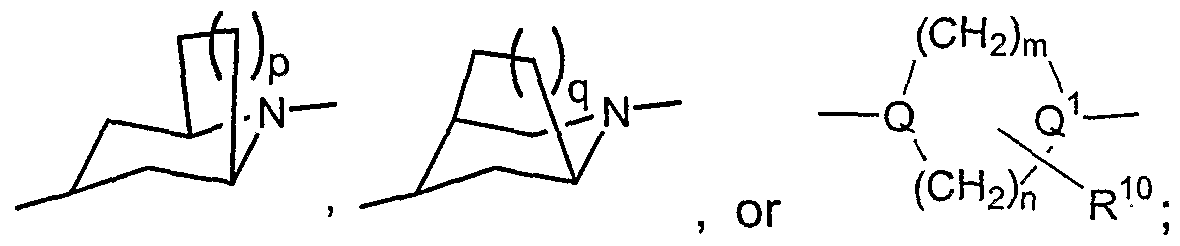
- R 2 and R 3 are independently selected from the group consisting of hydrogen and C,-C 6 alkyl; m and n are independently 2-3; Q is
- R 5 is 1 to 5 substituents independently selected from the group consisting of hydrogen, halogen, C,-C 6 alkyl, hydroxy, C.,-C 6 alkoxy, -CN, di-((C 1 -C 6 )alkyl)amino, -CF 3 , -OCF 3 , acetyl, -N0 2 , hydroxy(C 1 -C 6 )alkoxy, (C 1 -C 6 )-alkoxy(C 1 -C 6 )alkoxy, di-((C C 6 )-alkoxy)(C 1 -C 6 )alkoxy, (C 1 -C 6 )-alkoxy(C 1 -C 6 )alkoxy-(C 1 -C 6 )-alkoxy, carboxy(C 1
- R 6 is (C r C 6 )alkyl, R 5 -phenyl, R 5 -phenyl(C C 6 )alkyl, thienyl, pyridyl, (C 3 -C 6 )- cycloalkyl, (C 1 -C 6 )alkyl-OC(O)-NH-(C 1 -C 6 )alkyl-, di-((C 1 -C 6 )alkyl)aminomethyl, or
- R 7 is (C r C 6 )alkyl, R 5 -phenyl or R 5 -phenyl(C r C 6 )alkyl;
- R 8 is hydrogen or C C 6 alkyl; or R 7 and R 8 together are -(CH 2 ) p -A-(CH 2 ) q , wherein p and q are independently 2 or 3 and A is a bond, -CH 2 -, -S- or -0-, and form a ring with the nitrogen to which they are attached;
- R 9 is 1-2 groups independently selected from hydrogen, alkyl, hydroxy, C C 6 alkoxy, halogen, -CF 3 and (C 1 -C 6 )alkoxy(C 1 -C 6 )alkoxy ;
- R 10 is 1 to 5 substituents independently selected from the group consisting of hydrogen, halogen, C.,-C 6 alkyl, hydroxy, C.,-C 6 alkoxy, -CN, -NH 2 , C C 6 alkylamino, di-((C 1 -C 6 )alkyl)amino, -CF 3 , -OCF 3 and -S(O) 0 . 2 (C C 6 )alkyl;
- R 11 is H, alkyl, phenyl, benzyl, C 2 -C 6 alkenyl, alkoxy(C 1 -C 6 )alkyl, di- ((C 1 -C 6 )alkyl)amino(C 1 -C 6 )alkyI, pyrrolidinyl(C 1 -C 6 )alkyl or piperidino(C 1 -C 6 )alkyl;
- R 12 is H or C r C 6 alkyl; and Preferred compounds of formula I are those wherein R is R 1 -furanyl, R 1 -thienyl, R 1 -pyrrolyl or R 10 -phenyl, more preferably R 1 -furanyl.
- R 1 is preferably hydrogen or halogen.
- Another group of preferred compounds is that wherein X is alkylene,
- Q preferably being nitrogen.
- m and n are each 2, and R 4 is H.
- a preferred definition for Z is R 5 -phenyl, R 5 -heteroaryl, R 6 -C(0)- or R 6 -S0 2 -.
- R 5 is preferably H, halogen, alkyl, alkoxy, hydroxyalkoxy or alkoxyalkoxy.
- R 6 is preferably
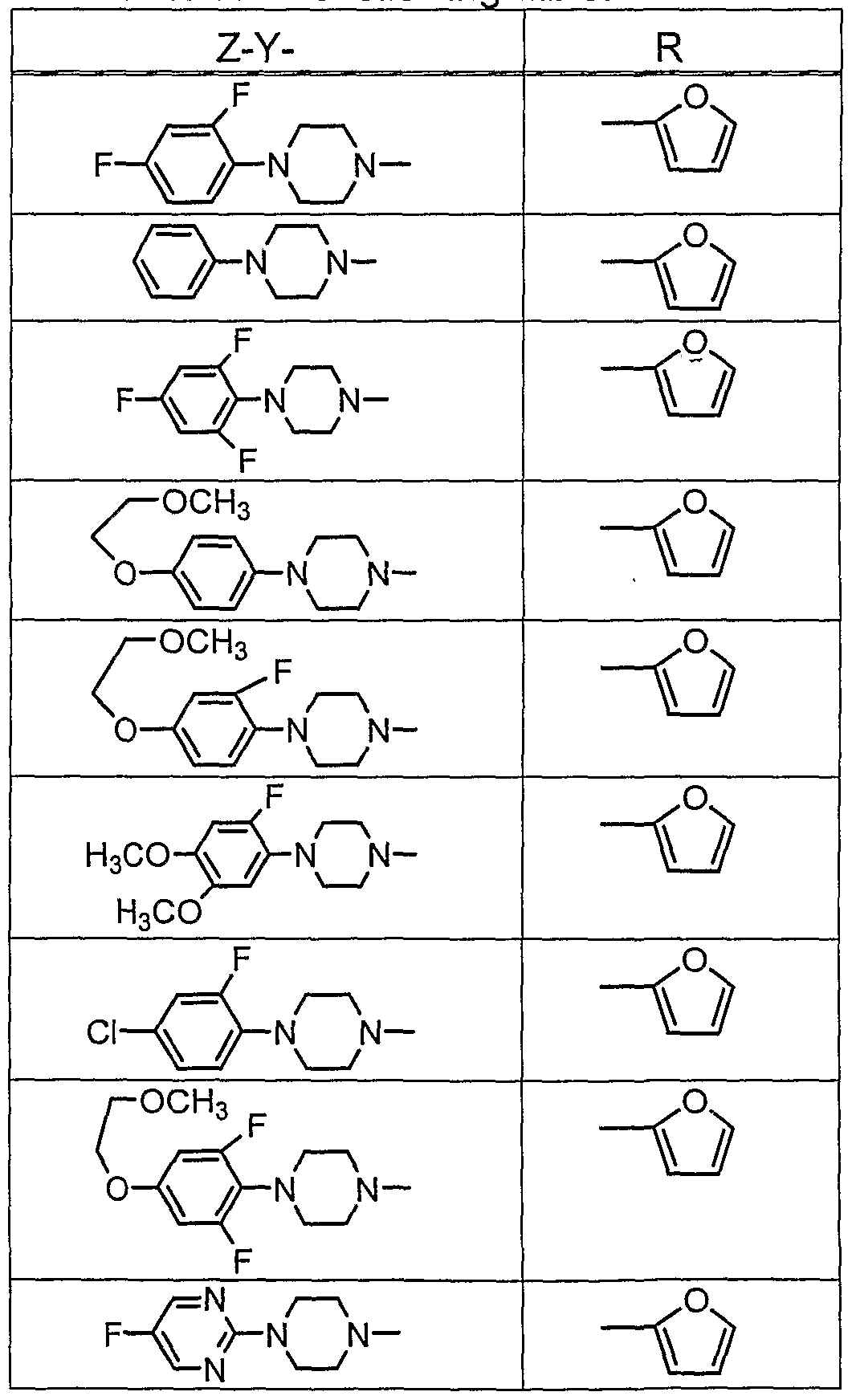
- Preferred specific compounds of formula I are those of the formula IA
- R and Z-Y are as defined in the following table:
- adenosine A 2a receptor antagonists include those disclosed in WO 95/01356 as compounds having the structural formula II
- A is pyrazole, imidazole or a triazole ring
- R is hydrogen; C C 8 alkyl; C 3 -C 7 alkenyl; C 3 -C 7 alkynyl; C 3 -C 7 cycloalkyl; C C 5 alkyl substituted with one or more halogen atoms, hydroxy groups, C C 4 alkoxy, C 3 - C 7 cycloalkyl, groups of formula -NR 1 R 2 , -CONR 1 R 2 ; aryl optionally substituted with halogen atoms, C C 4 alkoxy groups, C, ⁇ alkyl, nitro, amino, cyano, C C 4 haloalkyl, C C 4 haloalkoxy, carboxy, carboxyamido; C 7 -C 10 aralkyl in which the aryl moiety can be substituted with one or more of the substituents indicated above for the aryl group; a group of formula -(CH 2 ) m -Het, wherein Het is a 5-6 membered aromatic or non aromatic
- R 1 R 2 which are the same or different, are hydrogen, C C 5 alkyl, C 7 -C 10 aralkyl, phenyl, or taken together with the nitrogen they are linked to, form an azetidine ring or a 5-6 membered heterocyclic ring containing one or more heteroatoms such as N, O, S and n is an integer from 2 to 5.
- compounds of formula II are those wherein R is hydrogen, 0,-Cg alkyl, aryl or C 7 -C 10 aralkyl optionally substituted, preferably with halogen atoms.
- US 5,935,964 discloses useful adenosine A 2a receptor antagonist compounds having the structural formula III wherein A is pyrazole, imidazole or triazole ring;
- R ⁇ and R 2 which are the same or different, are H, OH, halogen, C C 4 alkoxy, C r C 4 alkyl, nitro, amino, cyano, C C 4 haloalkyl, C C 4 haloalkoxy, carboxy or carboxamido; or the OH group, together with one of Ri or R2, or Ri and R2, can form a methylenedioxy group -O-CH 2 -0-; and n is an integer from 0-4.
- Preferred compounds of formula III are those wherein A is pyrazolo[4,3-e] or 1 ,2,3-triazolo[5,4-e].
- R 1 represents hydrogen, substituted or unsubstituted lower alkyl, or substituted or unsubstituted lower alkanoyl
- R 2 represents hydrogen, substituted or unsubstituted lower alkyl, substituted or unsubstituted lower alkenyl, substituted or unubstituted cycloalkyl, substituted or unsubstituted aryl, substituted or unsubstituted aralkyl, or a substituted or unsubstituted heterocyclic group;
- R 3 represents a substituted or unsubstituted heterocyclic group
- X represents a single bond, O, S, S(O), S(O) 2 , or NR 4 (in which R 4 represents hydrogen, or substituted or unsubstituted lower alkyl; or R 2 and NR 4 are combined to form a substituted or unsubstituted 4 to 6-membered saturated heterocyclic group): and
- A represents N or CR 5 (in which R 5 represents hydrogen, or a substituted or unsubstituted lower alkyl); and wherein formula IVB is
- R 6 represents substituted or unsubstituted aryl, or a substituted or unsubstituted heterocyclic group
- Y represents O, S, or NR 7 (in which R 7 represents substituted or unsubstituted lower alkyl, substituted or unubstituted cycloalkyl, or substituted or unsubstituted aryl);
- R 8 represents hydrogen, substituted or unsubstituted lower alkyl, substituted or unsubstituted lower alkenyl, substituted or unsubstituted lower alkynyl, substituted or unubstituted cycloalkyl, substituted or unsubstituted aryl, substituted or unsubstituted aralkyl, or a substituted or unsubstituted heterocyclic group;
- B and the adjacent two carbon atoms are combined to form a substituted or unsubstituted, partially saturated or unsaturated, monocyclic or bicyclic, carbocyclic or heterocyclic group.
- X is C r C 6 alkylene, -C(0)CH 2 - or -C(O)N(R 2 )CH 2 -;
- Y is -N(R 2 )CH 2 CH 2 N(R 3 )-, -OCH 2 CH 2 N(R 2 )-, -0-, -S-, -CH 2 S-, -(CH 2 ) 2 . 3 -N(R 2 )-, R 5 -divalent heteroaryl,
- Z is R 5 -phenyl, R 5 -phenyl(C C 6 )alkyl, R 5 -heteroaryl, R 5 -bicyclic heteroaryl, R 5 -benzofused heteroaryl, diphenylmethyl or R 6 -C(O)-; or when Y is
- Z is also R 6 -S0 2 -, R 7 -N(R 8 )-C(O)- or R 7 -N(R 8 )-C(S)-;
- R 1 is 1 to 3 substituents independently selected from hydrogen, -CF 3 , halogen, -NO 2 , -NR 12 R 13 , C C ⁇ alkoxy, C r C 6 alkylthio, C C 6 alkylsulfinyl, C C 6 alkylsulfonyl, -COOR 7 or -C(O)NR 2 R 3 ;
- R 2 and R 3 are independently selected from the group consisting of hydrogen and C.,-C 6 alkyl; m and n are independently 2-3; p and q are independently 0-2;
- Q and Q 1 are independently selected from the group consisting of
- R 5 is 1 to 5 substituents independently selected from the group consisting of hydrogen, halogen, C C 6 alkyl, hydroxy, C,-C 6 alkoxy, -CN, di-((C 1 -C 6 )alkyl)amino,
- R 5 substituents together are -O-CH 2 -O-, -O-CH 2 CH 2 -O-, -O-CF 2 -0- or -O-CF 2 CF 2 -O- and form a ring with the carbon atoms to which they are attached;
- R 6 is (C C ⁇ )al yl.
- R 7 is (C r C 6 )alkyl, R 5 -phenyl or R 5 -phenyl(C r C 6 )alkyl;
- R 8 is hydrogen or C r C 6 alkyl; or R 7 and R 8 together are -(CH 2 ) p -A-(CH 2 ) q , wherein p and q are independently 2 or 3 and A is a bond, -CH 2 -, -S- or -0-, and form a ring with the nitrogen to which they are attached;
- R 9 is 1-2 substituents independently selected from the group consisting of hydrogen, C,-C 6 alkyl, hydroxy, C r C 6 alkoxy, halogen, -CF 3 and (C 1 -C 6 )alkoxy- (C C 6 )alkoxy;
- R 10 is 1 to 5 substituents independently selected from the group consisting of hydrogen, halogen, C C 6 alkyl, hydroxy, C C 6 alkoxy, -CN, -NH 2 , C,-C 6 alkylamino, di-((C r C 6 )alkyl)amino, -CF 3 , -OCF 3 , -S(O) 0 . 2 (C C 6 )alkyl and -CH 2 -SO 2 -phenyl;
- R 11 is H, C r C 6 alkyl, phenyl, benzyl, C 2 -C 6 alkenyl, C C 6 alkoxy(C 1 -C 6 )alkyl, di- ((C 1 -C 6 )alkyl)amino(C 1 -C 6 )alkyl, pyrrolidinyl(C C 6 )alkyl or piperidino(C r C 6 )alkyl;
- R 12 is H or alkyl
- R 14 is H, halogen, C r C 6 alkyl, hydroxy(C r C 6 )alkyl, cyc ⁇ thio(C r C 6 )alkyl, or NR 2 R 3 -(C 1 -C 6 )3lkyl
- snd R 15 is H, hslogen, C C 6 alkyl or C C 6 alkoxy.
- Preferred compounds of formula V are those wherein R is R 1 -furanyl, R 1 - thienyl, R 1 -pyrrolyl, R 1 -pyridyl or R 10 -phenyl, more preferably R 1 -furanyl or R 10 -phenyl.
- R 1 is preferably hydrogen or halogen.
- R 10 is preferably hydrogen, halogen, alkyl or - CF 3 .
- Another group of preferred compounds is that wherein X is alkylene, preferably ethylene.
- Y is H- , with Q preferably being nitrogen.
- m and n are each 2, and R 4 is H.
- a preferred definition for Z is R 5 -phenyl or R 5 -heteroaryl.
- R 5 is preferably H, halogen, alkyl, alkoxy, hydroxyalkoxy or alkoxyalkoxy.
- R 6 is preferably R 5 -phenyl.
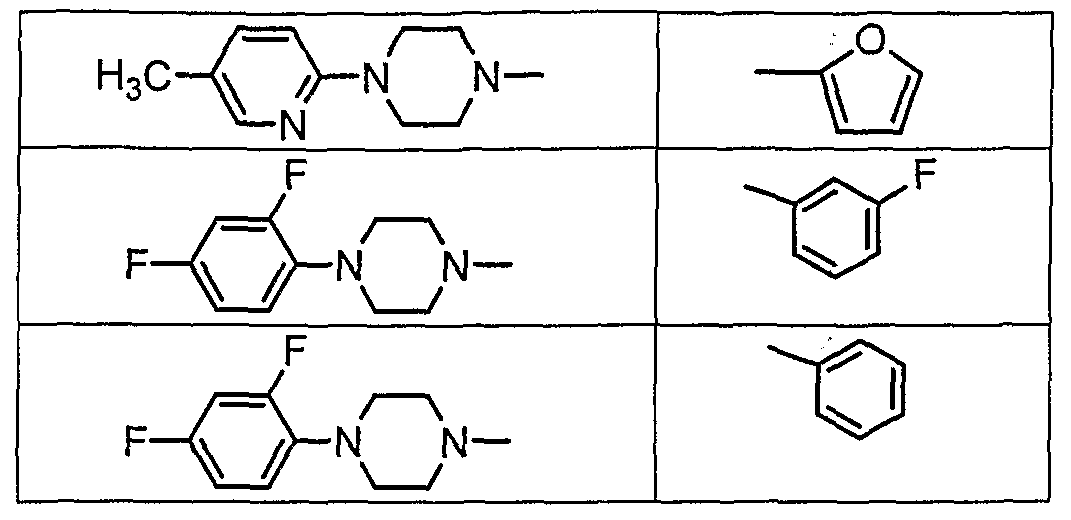
- Preferred specific compounds of formula V are those of the formula VA
- R and Z-Y are as defined in the fo lowing table:
- R is R 1 -furanyl, R 1 -thienyl, R 1 -pyridyl, R 1 -oxazolyl, R 1 -pyrrolyl or R 2 -phenyl;
- X is -(CH 2 ) n -;
- Y is a piperidinyl or pyrrolidinyl group fused to a monocyclic or bicyclic aryl or heteroaryl wherein X is attached to the N atom of the piperidinyl or pyrrolidinyl group; n is an integer from 1 to 4;
- R is 1-3 substituents, which may be the same or different, and are independently selected from hydrogen, C ⁇ C ⁇ -alkyl, -CF 3 , halogen or N0 2 ;
- R 2 is 1-3 substituents, which may be the same or different, and are independently selected from hydrogen, C r C 6 -alkyl, -CF 3 , halogen, NO 2 , C.,-C 6 -acyloxy, C C 6 -alkylamino, C C 6 -acylamino, C 1 -C 6 -alkylsulfonamido, C,-C 6 - alkylaminosulfonyl, aminosulfonyl, or hydroxyl.
- a 1 is N-X
- a 2 and A 3 each are CR 4 R 5 , or
- a 1 and A 3 each are CR 4 R 5 , and A 2 is N-X, or
- a 1 and A 2 each are CR 4 R 5 , and A 3 is N-X;
- a 4 is CR R 5 ;
- Z ⁇ Z 2 , Z 3 and Z 4 are selected from the group consisting of N and CR 3 , provided that 0-2 of Z ⁇ Z 2 , Z 3 or Z 4 are N and the remainder are CR 3 ;
- Z 5 is NR 5 , O, S or CR 4 R 5 ;
- Z 6 is N or CR 3 ;
- Z 7 is N or CR 3 ;
- m is an integer from 0 to 2;
- R 3 is hydrogen, C C 6 -alkyl, CF 3 , halogen, NO 2 , C C 6 -alkoxy, C ⁇ -Ce-acyloxy, C T C ⁇ -alkylaminosulfonyl, aminosulfonyl, or hydroxyl;
- R 4 is hydrogen, C,-C 6 -alkoxy, -CF 3 , halogen, hydroxy, or N0 2 ;
- R 5 is hydrogen or C C 6 alkyl.
- Preferred specific examples of compounds of formula VI include compounds of the formula VIA
- Q and Q 1 may be the same or different and are independently selected from the group consisting of
- W is aryl or heteroaryl having 1-3 heteroatoms, which may be the same or different and are independently selected from N, O or S, said aryl or heteroaryl optionally substituted by 1-3 substituents, which may be the same or different and are independently selected from alkyl, halo, hydroxy, hydroxyalkyl, alkoxy, -NR 6 R 7 , (C 2 - C 6 )alkene, or -CN;
- X is H, NH 2 , -N(R 6 )(CH 2 ) m -C 6 H 5 , -N(R 6 )(CH 2 ) m+1 -OH, -N(CH 3 ) 2 , or X is R 18 which is attached to -Y-Z; Y is -N(R 6 )CH 2 CH 2 N(R 7 )-, -OCH 2 CH 2 N(R 6 )-, -O-, -S-, -CH 2 S-, -(CH 2 ) ⁇ -N(R 6 )-,
- Z is alkoxyalkyl, R 8 -phenyl, R ⁇ pheny C C ⁇ alkyl, R 8 -heteroaryl, R 8 -bicyclic heteroaryl; R 8 -benzofused heteroaryl, diphenylmethyl or R 9 -C(0)-; or when Y is
- Z may also be H, R 9 -SO 2 -, R 17 -N(R 11 )-C(0)- or R 17 -N(R 11 )-C(S)-; or
- z may also be phenylamino or pyridylamino; or Z and Y taken together are
- R 2 is halo, -W-X, -NH(CH 2 ) m -W-X, -NHCH(CH 3 )-W-X, or R 2 is alkyl, alkenyl or -NR 18 R 19 which is optionally substituted by -W-X;
- R 3 is H, halo, alkyl, trifluoromethyl, alkoxy, alkoxyalkyl, hydroxyalkyl, alkylamino, alkylaminoalkyl, dialkylamino, dialkylaminoalkyl, aminoalkyl, aryl, heteroaryl, or CN;
- R 4 is 1 to 3 substituents, which may be the same or different and are independently selected from the group consisting of hydrogen, (C ⁇ C ⁇ -alkyl, -CF 3) halogen, -NO 2> -NR 15 R 16 , (C 1 -C 6 )alkoxy, (C r C 6 )alkylthio, (C 1 -C 6 )alkylsulfinyl, (C r C 6 )alkyIsulfonyl, -COOR 17 or -C(O)NR 6 R 7 ;
- R 5 is 1 to 5 substituents, which may be the same or different and are independently selected from the group consisting of hydrogen, halogen, (C 1 -C 6 )alkyl, hydroxy, (C 1 -C 6 )alkoxy, -CN, -NH 2 , (C C 6 )alkylamino, di-((C 1 -C 6 )alkyl)amino, -CF 3 , -OCF 3 , -S(O) 0 .
- R 6 and R 7 which may be the same or different, are independently selected from the group consisting of hydrogen and (C,-C 6 )alkyl;
- R 8 is 1 to 5 substituents, which may be the same or different and are independently selected from the group consisting of hydrogen, halogen, (C r C 6 )alkyl, hydroxy, C C 6 alkoxy, -CN, amino, di-((C 1 -C 6 )alkyl)amino, -CF 3 , -OCF 3 , acetyl, -N0 2 , hydroxy(C 1 -C 6 )alkoxy, (0,-0 6 )81 koxyhydroxy, (C 1 -C 6 )-alkoxy(C 1 -C 6 )alkoxy, di-((C C 6 )- alkoxy)(C C 6 )alkoxy, (C 1 -C 6 )-alkoxy(C 1 -C 6 )alkoxy-(C 1 -C 6 )-alkoxy, carboxy(C 1 -C 6 )- alkoxy, (C 1 -C 6 )-alkoxy
- R 8 substituents together are -O-CH 2 -0-, -O-CH 2 CH 2 -O-, -0-CF 2 -0- or
- R 9 is (C,-C 6 )alkyl, R 8 -phenyl, R ⁇ pheny CVC ⁇ alkyl, thienyl, pyridyl, (C 3 -C 6 )- cycloalkyl, (C 1 -C 6 )alkyl-OC(0)-NH-(C 1 -C 6 )aikyl-, di-((C r C 6 )alkyl)aminomethyl, or
- R 11 is hydrogen or (C.,-C 6 )alkyl; or R 17 and R 11 taken together are -(CH 2 ) p -A- (CH 2 ) q , wherein p and q are independently 2 or 3 and A is a bond, -CH 2 -, -S- or-O-, and form a ring with the nitrogen to which they are attached;
- R 12 is 1-2 substituents, which may be the same or different and are independently selected from the group consisting of hydrogen, (C C 6 )alkyl, hydroxy, (C C 6 )alkoxy, halogen, and -CF 3 ;
- R 13 is H, (C C 6 )alkyl, phenyl, benzyl, (C 2 -C 6 )alkenyl, (C 1 -C 6 )alkoxy(C 1 -C 6 )alkyl, di-((C 1 -C 6 )alkyl)amino(C 1 -C 6 )alkyl, or piperidino(C r C 6 )alkyl;
- R 14 is H, halogen, (C C 6 )alkyl or (C r C 6 )alkoxy; R 15 is H or (C ⁇ alkyl;
- R 16 is H, (C r C 6 )alkyl-C(O)- or (C r C 6 )alkyl-SO 2 -;
- R 17 is (C.,-C 6 )alkyl, R 8 -phenyl or R 8 -phenyl(C r C 6 )alkyl;
- R 18 is a bond, -CH 2 -, -CH(OH)-, -CH(CH 3 )-, or -C(CH 3 ) 2 -;
- R 19 is H or lower alkyl.
- A is C(R 1 ) and B is C(R 1a ); or A is C(R 1 ) and B is N; or A is N and B is C(R 1a ); or
- a and B are both N;
- R 1 and R 1a are independently selected from the group consisting of H, (C r C 6 )- alkyl, halo, CN and -CF 3 ;
- Y is -O-, -S-, -SO-, -S0 2 -, R 5 -heteroaryldiyl, R 5 -arylene or
- Q and Q 1 are independently selected from the group consisting of
- a and B are both N, and X is -C(R 3 )(R 3a )-, -C(O)-, -O-, -S-, -SO-, -SO 2 -, -N(R 9 )-, R 4 -arylene or R 4 -heteroaryldiyl; or A and B are both N, Y is a bond and X is -C(O)-, R 4 -arylene or R 4 -heteroaryldiyl; or
- A is C(R 1 ), B is N, and X is -C(R 3 )(R 3a )-, -C(O)-, -0-, -S-, -SO-, -S0 2 -, -N(R 9 )-, R 4 -arylene or R 4 -heteroaryldiyl; or A is C(R 1 ), B is N, Y is a bond, and X is
- A is C(R 1 ), B is C(R a ), and X is -C(R 3 )(R 3a )-, -C(O)-, -O-, -S-, -SO-, -SO 2 -, R 4 -arylene, R 4 -heteroaryldiyI, or -N(R 9 )-, provided that when X is -N(R 9 )-, R 2 -Y is not aryl(C C 6 alkyl)arylene; or A is C(R 1 ), B is C(R 1a ), Y is a bond, and X is -C(R 3 )(R 3a )-, -C(O)-, -O-, -S-, -SO-, -SO 2 -, R 4 -arylene, -N(R 9 )- or R 4 -heteroaryldiyl, provided that when X is -N(R 9
- A is N
- B is C(R 1a )
- X is -C(R 3 )(R 3a )-, -0(0)-, -0-, -S-, -SO-, -S0 2 -, -N(R 9 )-, R 4 -arylene or R 4 -heteroaryldiyl
- A is N
- B is C(R 1a )
- Y is a bond and X is -0(0)-, -N(R 9 )-, R 4 -arylene or R -heteroaryldiyl;
- R is R 5 aryl, R 5 -heteroaryl, R 6 -(C 2 -C 6 )alkenyl or R 6 -(C 2 -C 6 )alkynyl;
- R 2 is R 5 -aryl, R 5" heteroaryl, R 5 -aryl(C C 6 )alkyl or R S -heteroaryl ⁇ -C ⁇ alkyl; or R 2 -Y is selected from the group consisting of
- U, V, and W are independently selected from the group consisting of N and OR 1 , provided that at least one of U , V and W is CR 1 ;
- U a is -O-, -S-, -NH-, or-N(C r C 6 alkyl)-;
- R 3 and R 3a are independently selected from the group consisting of H, -OH, C C 6 alkyl, hydroxy(C C 6 )alkyl, (C 1 -C 6 )alkoxy(C 1 -C 6 )alkyl, amino(C 1 -C 6 )alkyl, (C r C 6 )alkylamino(C C 6 )alkyl and di(C 1 -C 6 )alkylamino(C 1 -C 6 )alkyl;
- R 4 is 1-3 substituents selected from the group consisting of H, (C.,-C 6 )alkyl,
- R 5 is 1-3 substituents independently selected from the group consisting of H, (C 1 -C 6 )alkyl, -OH, (C 1 -C 6 )alkoxy, (C 1 -C 6 )alkoxy(C 1 -C 6 )alkyl, (C 1 -C 6 )alkoxy(C 1 -C 6 )- alkoxy, halo, -CF 3 , -CN, -NH 2> (C 1 -C 6 )alkylamino, di(C 1 -C 6 )alkylamino, amino(C C 6 )- alkyl, (C 1 -C 6 )alkylamino(C 1 -C 6 )alkyl, di(C 1 -C 6 )alkylamino(C 1 -C 6 )alkyl, (C r C 6 )alkanoyl- amino, (C C alkanesulfonylamino, (C 1 -C 6
- R 6 is 1 to 3 substituents independently selected from the group consisting of H, (C r C ⁇ )alkyl, -OH, (C C ⁇ )alkoxy and halo;
- R 7 and R 7a are independently selected from the group consisting of H, (C
- R 8 is 1 to 3 substituents independently selected from H, (C,-C 6 )alkyl, -OH, (C r C 6 )alkoxy, (C ⁇ C ⁇ alkoxy ⁇ -C alkoxy, halo, -CF 3 , and -CN; and R 9 is H, C r C 6 alkyl, hydroxy(C 2 -C 6 )alkyl, (C 1 -C 6 )alkoxy(C 2 -C 6 )alkyl, amino(C 2 -
- Preferred compounds of formula VIII are those wherein A is N or C(R 1 ) and B is C(R 1a ), with compounds wherein A is N and B is C(R 1a ) being more preferred.
- a Annootthheerr ggrroouupp oof ⁇ pprreefTeerrrreed ⁇ ccoommppoouunnddss i iss t thnaatt — w 'here ⁇ -in X ⁇ - is -0 ⁇ -, -S ⁇ -, - M N( T R- »99 ⁇ )- o —r " R arylene.
- Preferred definitions for Y are a bond or piperazinyl (i.e., a group of the formula
- R 2 is preferably R 5 -aryl.
- R is preferably furyl.
- WO 01/02409 discloses useful adenosine A 2a receptor antagonist compounds having the structural formula IX
- X is O or S
- R 1 and R 2 are independently selected from hydrogen, alkyl, aryl, hydroxy, alkoky, aryloxy, cyano, nitro, C0 2 R 7 , COR 7 , OCOR 7 , CONR 7 R 8 , CONR 7 NR 8 R 9 , OCONR 7 R 8) NR 7 R 8 , NR 7 COR 8 , NR 7 CONR 8 R 9 , NR 7 CO 2 R 8 , NR 7 SO 2 R 8 ,
- R 3 is alkyl or aryl;
- Rg. R ⁇ o» R 11 an ⁇ " R 12 are independently selected from hydrogen, alkyl and aryl, or a pharmaceutically acceptable salt or prodrug thereof.
- Agents known to be useful in the treatment of depression which can be administered in combination with an adenosine A 2a receptor antagonist include: selective serotonin reuptake inhibitors such as fluoxetine, sertraline, paroxetine, citalopram, mirtazepine and fluvoxamine; selective norepinephrine reuptake inhibitors such as reboxetine, desipramine, amitriptyline, nortriptyline and imipramine; mixed serotonin/ norepinephrine reuptake inhibitors such as venlafaxine, buproprion, nefazodone and milnacipran, and combinations thereof.
- selective serotonin reuptake inhibitors such as fluoxetine, sertraline, paroxetine, citalopram, mirtazepine and fluvoxamine
- selective norepinephrine reuptake inhibitors such as reboxetine, desipramine, amitriptyline, nortriptyline and
- Agents known to be useful in the treatment of anxiety-related disorders which can be administered in combination with an adenosine A 2a receptor antagonist include alprazolam, buspirone, lorazepam, diazepam, clonazepam, doxepin, chlordiazepoxide and meprobamate, and combinations thereof.
- the US patents and applications cited herein are incorporated herein by reference.
- the adenosine A 2a receptor antagonists are prepared by known methods as described in the cited patents and applications.
- the antidepressants and anxiolytics are commercially available and are described in the literature, e.g., in The Physicians' Desk Reference (Montvale: Medical Economics Co., Inc., 2001 )
- two or more A 2a receptor antagonists could be administered in combination with one or more antidepressants or one or more anxiolytics to treat depression or anxiety-related disorders; it is also contemplated that one or more antidepressants and one or more anxiolytics could be combined with one or more A 2a receptor antagonists for the treatment of depression or anxiety- related disorders.
- the pharmacological activity of the compounds of the invention was determined by the following in vitro and in vivo assays to measure A 2a receptor activity.
- a 2a Human A 2a Adenosine Receptor membranes, Catalog #RB-HA2a, Receptor
- Membrane dilution buffer Dulbecco's Phosphate Buffered Saline (Gibco/BRL) + 10 mM MgCI 2 .
- a 2a To determine non-specific binding, add 100 nM CGS 15923 (RBI, Natick,
- Working stock is prepared at 400 nM in compound dilution buffer.
- Working stock is prepared at 400 ⁇ M in compound dilution buffer.
- Compound Dilution Compound Dilution:.
- Assay procedure Perform assays in deep well 96 well plates. Total assay volume is 200 ⁇ l.
- Rats Male male Sprague-Dowley rats (Charles River, Calco, Como, Italy), weighing 275-300 g, are used in all experiments.
- the rats are housed in groups of 4 per cage, with free access to food and water, under controlled temperature and 12 hour light/ dark cycle. The day before the surgery the rats are fasted over night with water ad libitum.
- Unilateral 6-hydroxydopamine (6-OHDA) lesion of the middle forebrain bundle is performed according to the method described in Ungerstedt et al, Brian Research, 24 (1970), p. 485-493, and Ungerstedt, Eur. J. Pharmacol., 5 (1968), p. 107-110, with minor changes. Briefly, the animals are anaesthetized with chloral hydrate (400 mg/kg, ip) and treated with desipramine (10 mpk, ip) 30 min prior to 6-OHDA injection in order to block the uptake of the toxin by the noradrenergic terminals. Then, the animals are placed in a stereotaxic frame.
- the skin over the skull is reflected and the stereotaxic coordinates (-2.2 posterior from bregma (AP), +1.5 lateral from bregma (ML), 7.8 ventral from dura (DV) are taken, according to the atlas of Pellegrino et al (Pellegrino L.J., Pellegrino A.S. and Cushman A.J.. A Stereotaxic Atlas of the Rat Brain. 1979, New York: Plenum Press).
- a burr hole is then placed in the skull over the lesion site and a needle, attached to a Hamilton syringe, is lowered into the left MFB.
- 6-OHDA-HCI 8 ⁇ g 6-OHDA-HCI is dissolved in 4 ⁇ l of saline with 0.05% ascorbic acid as antioxidant, and infused at the constant flow rate of 1 ⁇ l /1 min using an infusion pump. The needle is withdrawn after additional 5 min and the surgical wound is closed and the animals left to recover for 2 weeks.
- rats Two weeks after the lesion the rats are administered with L-DOPA (50 mg/kg, ip) plus Benserazide (25 mg/kg, ip) and selected on the basis of the number of full contralateral turns quantified in the 2 h testing period by automated rotameters (priming test). Any rat not showing at least 200 complete turns /2h is not included in the study.
- Selected rats receive the test drug 3 days after the priming test (maximal dopamine receptor supersensitivity).
- the new A ⁇ receptor antagonists are administered orally at dose levels ranging between 0.1 and 3 mg/kg at different time points (i.e., 1 , 6, 12 h) before the injection of a subthreshold dose of L-DOPA (4 mpk, ip) plus benserazide (4 mpk, ip) and the evaluation of turning behavior.
- adenosine A 2a receptor antagonists for use in the present invention preferably show A 2a Ki vaules of 0.3 to 100 nM, with preferred compounds showing Ki values between 0.3 and 5.0 nM.
- Selectivity is determined by dividing Ki for A 1 receptor by Ki for A 2a receptor.
- Preferred compounds of the invention have a selectivity ranging from about 100 to about 2000.
- Preferred compounds showed a 50-75% decrease in descent latency when tested orally at 1 mg/kg for anti-cataleptic activity in rats.
- Depression and anxiety are measure by the following tests, wherein immobility is an indication of depression.
- Mouse tail suspension test The tail suspension test is based on the observation that a mouse suspended by the tail shows alternate periods of agitation and immobility. The mouse, acoustically and visually isolated, is hung on the hook by an adhesive tape placed 20 mm from the extremity of its tail and it is kept 150 mm away from the nearest object. The duration of immobility is recorded for 6 min. The sum of immobility periods (duration of immobility) is measured by an observer who was unaware of the drug treatments. Each mouse is used only once for each experimental session.
- Mouse and rat forced swim test Mouse In the forced swimming test, mice are dropped individually into glass cylinders (height: 25 cm, diameter: 10 cm) containing 10 cm water, maintained at 25°C, and left there for 6 min. A mouse is judged to be immobile when it floats in an upright position, and makes only small movements to keep its head above water. The duration of immobility is recorded during the last 4-min of the 6-min testing period. The sum of immobility periods (duration of immobility) is measured by an observer who is unaware of the drug treatments. Each mouse is used only once for each experimental session.
- Rat Rat is placed in a cylinder 40 cm high and 18 cm in diameter containing 20 cm of water at 25°C. The animal is left to swim in the water for 15 min before being removed, allowed to dry beside a heated enclosure and returned to its home cage. Twenty-four h later, the animal is exposed again to the conditions outlined above and the total immobility time during a 5-min period recorded (test session). Furthermore, we also measure the active behavior of the animal as the time spent in climbing. Drugs are given 3 times before testing: 24, 5 and 1 h. In each test the measurements are always made under blind conditions.
- inert, pharmaceutically acceptable carriers can be either solid or liquid.
- Solid form preparations include powders, tablets, dispersible granules, capsules, cachets and suppositories.
- the powders and tablets may be comprised of from about 5 to about 70 percent active ingredient.
- Suitable solid carriers are known in the art, e.g. magnesium carbonate, magnesium stearate, talc, sugar, lactose. Tablets, powders, cachets and capsules can be used as solid dosage forms suitable for oral administration.
- a low melting wax such as a mixture of fatty acid glycerides or cocoa butter is first melted, and the active ingredient is dispersed homogeneously therein as by stirring. The molten homogeneous mixture is then poured into convenient sized molds, allowed to cool and thereby solidify.
- Liquid form preparations include solutions, suspensions and emulsions. As an example may be mentioned water or water-propylene glycol solutions for parenteral injection.
- Liquid form preparations may also include solutions for intranasal administration.
- Aerosol preparations suitable for inhalation may include solutions and solids in powder form, which may be in combination with a pharmaceutically acceptable carrier, such as an inert compressed gas.
- solid form preparations which are intended to be converted, shortly before use, to liquid form preparations for either oral or parenteral administration.
- liquid forms include solutions, suspensions and emulsions.
- the compounds of the invention may also be deliverable transdermally.
- the transdermal compositions can take the form of creams, lotions, aerosols and/or emulsions and can be included in a transdermal patch of the matrix or reservoir type as are conventional in the art for this purpose.
- the compounds are administered orally.
- the pharmaceutical preparation is in unit dosage form.
- the preparation is subdivided into unit doses containing appropriate quantities of each active component, e.g., an amount effective to achieve the desired purpose.
- the amount and frequency of administration of the compounds in the combination of this invention will be regulated according to the judgment of the attending clinician considering such factors as age, condition and size of the patient as well as severity of the symptoms being treated. Determination of the proper dosage for a particular situation is within the skill of the art. Generally, treatment is initiated with smaller dosages which are less than the optimum dose of the compound. Thereafter, the dosage is increased by small increments until the optimum effect under the circumstances is reached. For convenience, the total daily dosage may be divided and administered in portions during the day, if desired.
- the combination of drugs can be administered individually, either simultaneously or sequentially, in any conventional dosage form such as capsule, tablet, powder, cachet, suspension, solution, suppository, nasal spray, etc. Different drugs can be administered in different dosage forms. When used in combination, the dosage levels of the individual components are preferably lower than the recommended individual dosages because of the advantageous effect of the combination.
- the quantity of adenosine A 2a receptor antagonist in a unit dose of preparation may be varied or adjusted from about 0.1 mg to 1000 mg, more preferably from about 1 mg to 300 mg, according to the particular application.
- a typical recommended dosage regimen for an adenosine A 2a receptor antagonist is oral administration of from 10 mg to 2000 mg/day, preferably 10 to 1000 mg/day, in two to four divided doses to treat depression or anxiety-related disorders.
- the doses and dosage regimens of the antidepressant and anxiolytic components of the combination will be determined by the attending clinician in view of the approved doses and dosage regimen known in the art, e.g., in the package insert or other published information, taking into consideration the age, sex and condition of the patient and the severity of the disease.
- kits comprising in a single package, one container comprising an adenosine A 2a receptor antagonist in a pharmaceutically acceptable carrier, and a separate container comprising an antidepressant or anxiolytic in a pharmaceutically acceptable carrier, with the adenosine A 2a receptor antagonist and the antidepressant or anxiolytic agent being present in an amount such that the combination is effective to treat depression or anxiety-related disorders.
- a kit is advantageous for administering a combination when, for example, the components must be administered at different time intervals or when they are in different dosage forms (i.e., tablet and capsule).
- dosage forms suitable for the present invention.
- dosage forms are suitable for single actives (i.e. "Active” is an A 2a receptor antagonist or an antidepressant or an anxiolytic), or can contain both components (ie, "Active” comprises both an adenosine A 2a receptor antagonist and an antidepressant or anxiolytic).
- Active comprises both an adenosine A 2a receptor antagonist and an antidepressant or anxiolytic.
- the scope of the invention in its pharmaceutical composition aspect is not to be limited by the examples provided.
Landscapes
- Health & Medical Sciences (AREA)
- Chemical & Material Sciences (AREA)
- Medicinal Chemistry (AREA)
- Pharmacology & Pharmacy (AREA)
- Life Sciences & Earth Sciences (AREA)
- Animal Behavior & Ethology (AREA)
- General Health & Medical Sciences (AREA)
- Public Health (AREA)
- Veterinary Medicine (AREA)
- Epidemiology (AREA)
- Biomedical Technology (AREA)
- Nuclear Medicine, Radiotherapy & Molecular Imaging (AREA)
- Engineering & Computer Science (AREA)
- Neurology (AREA)
- Neurosurgery (AREA)
- Chemical Kinetics & Catalysis (AREA)
- General Chemical & Material Sciences (AREA)
- Bioinformatics & Cheminformatics (AREA)
- Organic Chemistry (AREA)
- Pain & Pain Management (AREA)
- Psychiatry (AREA)
- Pharmaceuticals Containing Other Organic And Inorganic Compounds (AREA)
- Medicines That Contain Protein Lipid Enzymes And Other Medicines (AREA)
- Acyclic And Carbocyclic Compounds In Medicinal Compositions (AREA)
Abstract
Description







Claims


Priority Applications (4)
| Application Number | Priority Date | Filing Date | Title |
|---|---|---|---|
| EP02768836A EP1425017A1 (en) | 2001-09-13 | 2002-09-11 | Combination of an adenosine a2a receptor antagonist and an antidepressant or anxiolytic |
| CA002459304A CA2459304A1 (en) | 2001-09-13 | 2002-09-11 | Combination of an adenosine a2a receptor antagonist and an antidepressant or anxiolytic |
| MXPA04002389A MXPA04002389A (en) | 2001-09-13 | 2002-09-11 | Combination of an adenosine a2a receptor antagonist and an antidepressant or anxiolytic. |
| JP2003526412A JP2005516891A (en) | 2001-09-13 | 2002-09-11 | Combination of an adenosine A2a receptor antagonist with an antidepressant or anxiolytic |
Applications Claiming Priority (2)
| Application Number | Priority Date | Filing Date | Title |
|---|---|---|---|
| US31869601P | 2001-09-13 | 2001-09-13 | |
| US60/318,696 | 2001-09-13 |
Publications (1)
| Publication Number | Publication Date |
|---|---|
| WO2003022283A1 true WO2003022283A1 (en) | 2003-03-20 |
Family
ID=23239230
Family Applications (1)
| Application Number | Title | Priority Date | Filing Date |
|---|---|---|---|
| PCT/US2002/028865 Ceased WO2003022283A1 (en) | 2001-09-13 | 2002-09-11 | Combination of an adenosine a2a receptor antagonist and an antidepressant or anxiolytic |
Country Status (6)
| Country | Link |
|---|---|
| US (1) | US20030139395A1 (en) |
| EP (1) | EP1425017A1 (en) |
| JP (1) | JP2005516891A (en) |
| CA (1) | CA2459304A1 (en) |
| MX (1) | MXPA04002389A (en) |
| WO (1) | WO2003022283A1 (en) |
Cited By (8)
| Publication number | Priority date | Publication date | Assignee | Title |
|---|---|---|---|---|
| WO2004108137A1 (en) | 2003-06-10 | 2004-12-16 | Kyowa Hakko Kogyo Co., Ltd. | A method of treating an anxiety disorder |
| WO2005009444A1 (en) * | 2003-07-25 | 2005-02-03 | Kyowa Hakko Kogyo Co., Ltd. | Medicinal compositions |
| EP1578409A1 (en) * | 2002-12-19 | 2005-09-28 | Schering Corporation | Uses of adenosine a2a receptor antagonists |
| EP2182803A4 (en) * | 2007-07-23 | 2010-09-01 | Synosia Therapeutics | 4-hydroxy-4-methyl-piperidine-1-carboxylic acid (4-methoxy-7-morpholin-4-yl-benzothiazol-2-yl)-amide for the treatment of post-traumatic stress disorder |
| WO2010103547A2 (en) | 2009-03-13 | 2010-09-16 | Advinus Therapeutics Private Limited | Substituted fused pyrimidine compounds |
| WO2011027806A1 (en) | 2009-09-02 | 2011-03-10 | 協和発酵キリン株式会社 | Therapeutic agent for anxiety disorders |
| WO2011027805A1 (en) | 2009-09-02 | 2011-03-10 | 協和発酵キリン株式会社 | Therapeutic agent for mood disorders |
| WO2011101861A1 (en) | 2010-01-29 | 2011-08-25 | Msn Laboratories Limited | Process for preparation of dpp-iv inhibitors |
Families Citing this family (4)
| Publication number | Priority date | Publication date | Assignee | Title |
|---|---|---|---|---|
| NZ561677A (en) * | 2005-04-04 | 2011-02-25 | Takeda Pharmaceutical | (S)-N-[2-(1,6,7,8-tetrahydro-2H-indeno[5,4-b]furan-8-yl)ethyl]propionamide, and its use for treating depression and anxiety neurosis |
| JP2010534676A (en) * | 2007-07-23 | 2010-11-11 | シノシア・セラピューティクス | Treatment of post-traumatic stress disorder |
| CA2698808A1 (en) | 2007-09-13 | 2009-03-19 | Concert Pharmaceuticals, Inc. | Synthesis of deuterated catechols and benzo[d][1,3] dioxoles and derivatives thereof |
| AU2022262777C1 (en) * | 2021-04-23 | 2025-02-13 | Chong Kun Dang Pharmaceutical Corp. | Compound as adenosine a2a receptor antagonist and pharmaceutical composition comprising same |
Citations (1)
| Publication number | Priority date | Publication date | Assignee | Title |
|---|---|---|---|---|
| EP1116722A1 (en) * | 1998-09-22 | 2001-07-18 | Kyowa Hakko Kogyo Co., Ltd. | [1,2,4]TRIAZOLO[1,5-c]PYRIMIDINE DERIVATIVES |
Family Cites Families (3)
| Publication number | Priority date | Publication date | Assignee | Title |
|---|---|---|---|---|
| EP0666079B1 (en) * | 1993-07-27 | 2001-11-07 | Kyowa Hakko Kogyo Co., Ltd. | Remedy for parkinson's disease |
| IT1277392B1 (en) * | 1995-07-28 | 1997-11-10 | Schering Plough S P A | HEROCYCLIC ANALOGS OF 1,2,4-TRIAZOLE (1,5-C] PYRIMIDINE WITH ANTAGONIST ACTIVITY FOR THE A2A RECEPTOR OF ADENOSINE |
| SI1283839T1 (en) * | 2000-05-26 | 2005-08-31 | Schering Corp |
-
2002
- 2002-09-11 EP EP02768836A patent/EP1425017A1/en not_active Withdrawn
- 2002-09-11 WO PCT/US2002/028865 patent/WO2003022283A1/en not_active Ceased
- 2002-09-11 US US10/241,120 patent/US20030139395A1/en not_active Abandoned
- 2002-09-11 JP JP2003526412A patent/JP2005516891A/en not_active Withdrawn
- 2002-09-11 CA CA002459304A patent/CA2459304A1/en not_active Abandoned
- 2002-09-11 MX MXPA04002389A patent/MXPA04002389A/en not_active Application Discontinuation
Patent Citations (1)
| Publication number | Priority date | Publication date | Assignee | Title |
|---|---|---|---|---|
| EP1116722A1 (en) * | 1998-09-22 | 2001-07-18 | Kyowa Hakko Kogyo Co., Ltd. | [1,2,4]TRIAZOLO[1,5-c]PYRIMIDINE DERIVATIVES |
Non-Patent Citations (1)
| Title |
|---|
| EL YACOUBI MALIKA ET AL: "Adenosine A2A receptor antagonists are potential antidepressants: Evidence based on pharmacology and A2A receptor knockout mice.", BRITISH JOURNAL OF PHARMACOLOGY, vol. 134, no. 1, September 2001 (2001-09-01), pages 68 - 77, XP009004386, ISSN: 0007-1188 * |
Cited By (24)
| Publication number | Priority date | Publication date | Assignee | Title |
|---|---|---|---|---|
| EP1578409A1 (en) * | 2002-12-19 | 2005-09-28 | Schering Corporation | Uses of adenosine a2a receptor antagonists |
| EP2295047A3 (en) * | 2002-12-19 | 2011-05-18 | Schering Corporation | Use of adenosine A2a receptor antagonists for the treatment of restless leg syndrome and other movement disorders |
| JP4778894B2 (en) * | 2003-06-10 | 2011-09-21 | 協和発酵キリン株式会社 | How to treat anxiety disorders |
| JP2006527264A (en) * | 2003-06-10 | 2006-11-30 | 協和醗酵工業株式会社 | How to treat anxiety disorders |
| WO2004108137A1 (en) | 2003-06-10 | 2004-12-16 | Kyowa Hakko Kogyo Co., Ltd. | A method of treating an anxiety disorder |
| WO2005009444A1 (en) * | 2003-07-25 | 2005-02-03 | Kyowa Hakko Kogyo Co., Ltd. | Medicinal compositions |
| JPWO2005009444A1 (en) * | 2003-07-25 | 2006-09-07 | 協和醗酵工業株式会社 | Pharmaceutical composition |
| JP4648193B2 (en) * | 2003-07-25 | 2011-03-09 | 協和発酵キリン株式会社 | Pharmaceutical composition |
| US9238033B2 (en) | 2003-07-25 | 2016-01-19 | Kyowa Hakko Kirin Co., Ltd. | Pharmaceutical composition containing KW-6002 and fluoxetine or paroxentine |
| US8440678B2 (en) | 2003-07-25 | 2013-05-14 | Kyowa Hakko Kirin Co., Ltd. | Pharmaceutical composition |
| US8034820B2 (en) | 2003-07-25 | 2011-10-11 | Kyowa Hakko Kogyo Co., Ltd. | Pharmaceutical composition |
| EP2182803A4 (en) * | 2007-07-23 | 2010-09-01 | Synosia Therapeutics | 4-hydroxy-4-methyl-piperidine-1-carboxylic acid (4-methoxy-7-morpholin-4-yl-benzothiazol-2-yl)-amide for the treatment of post-traumatic stress disorder |
| WO2010103547A2 (en) | 2009-03-13 | 2010-09-16 | Advinus Therapeutics Private Limited | Substituted fused pyrimidine compounds |
| US8859566B2 (en) | 2009-03-13 | 2014-10-14 | Advinus Therapeutics Private Limited | Substituted fused pyrimidine compounds |
| US9284316B2 (en) | 2009-03-13 | 2016-03-15 | Advinus Therapeutics Private Limited | Substituted fused pyrimidine compounds |
| CN102482272A (en) * | 2009-09-02 | 2012-05-30 | 协和发酵麒麟株式会社 | Therapeutic agent for mood disorders |
| WO2011027805A1 (en) | 2009-09-02 | 2011-03-10 | 協和発酵キリン株式会社 | Therapeutic agent for mood disorders |
| JP5663485B2 (en) * | 2009-09-02 | 2015-02-04 | 協和発酵キリン株式会社 | Anxiety disorder treatment |
| JP5663484B2 (en) * | 2009-09-02 | 2015-02-04 | 協和発酵キリン株式会社 | Mood disorder treatment |
| WO2011027806A1 (en) | 2009-09-02 | 2011-03-10 | 協和発酵キリン株式会社 | Therapeutic agent for anxiety disorders |
| US9249135B2 (en) | 2009-09-02 | 2016-02-02 | Kyowa Hakko Kirin Co., Ltd. | Therapeutic agent for mood disorders |
| EA023728B1 (en) * | 2009-09-02 | 2016-07-29 | Киова Хакко Кирин Ко., Лтд. | Therapeutic agent for anxiety disorders |
| EA030333B1 (en) * | 2009-09-02 | 2018-07-31 | Киова Хакко Кирин Ко., Лтд. | Method for the treatment and/or prophylaxis of mood disorders |
| WO2011101861A1 (en) | 2010-01-29 | 2011-08-25 | Msn Laboratories Limited | Process for preparation of dpp-iv inhibitors |
Also Published As
| Publication number | Publication date |
|---|---|
| EP1425017A1 (en) | 2004-06-09 |
| JP2005516891A (en) | 2005-06-09 |
| MXPA04002389A (en) | 2004-05-31 |
| US20030139395A1 (en) | 2003-07-24 |
| CA2459304A1 (en) | 2003-03-20 |
Similar Documents
| Publication | Publication Date | Title |
|---|---|---|
| ES2927712T3 (en) | Deuterated pyridone amides and prodrugs thereof as modulators of sodium channels | |
| AU685510B2 (en) | Potentiation of drug response | |
| EP1578409B1 (en) | Use of adenosine a2a receptor antagonists for treatment or prevention of extra-pyramidal syndrome | |
| US11395824B2 (en) | 5-HT2C receptor agonists and compositions and methods of use | |
| US20040082555A1 (en) | Use of gaba, inverse agonists in combination with nicotine receptor partial agonist, estrogen, selective estrogen modulators, or vitamin E for the treatment of cognitive disorders | |
| EA034446B1 (en) | 5-htreceptor agonists and compositions and methods of use thereof | |
| WO2004069339A1 (en) | Treatment for attention-deficit hyperactivity disorder | |
| EP1425017A1 (en) | Combination of an adenosine a2a receptor antagonist and an antidepressant or anxiolytic | |
| KR20200133259A (en) | KV7 channel activator composition and method of use thereof | |
| EP0759299B1 (en) | Potentiation of serotonin response | |
| TWI335329B (en) | 7-[2-[4-(6-fluoro-3-methyl-1,2-benzisoxazol-5-yl)-1-piperazinyl]ethyl]-2-(1-propynyl)-7h-pyrazolo-[4,3-e]-[1,2,4]-triazolo-[1,5-c]-pyrimidin-5-amine | |
| JP2005533788A (en) | Treatment of depression and anxiety with combinations of PDEIV inhibitors and antidepressants or anxiolytics | |
| JP2009508967A (en) | Adenosine A2a receptor antagonist for treating extrapyramidal syndromes and other movement disorders | |
| TW200800263A (en) | Adenosine A2 a receptor antagonists for the treatment of extra-pyramidal syndrome and other movement disorders | |
| CA2510655C (en) | Uses of adenosine a2a receptor antagonists | |
| US20070225334A1 (en) | Methods for treating cognitive and other disorders | |
| TW200524920A (en) | Treatment of circadian rhythm disorders with NPY Y5 receptor antagonist | |
| HK1149500A (en) | Use of adenosine a2a receptor antagonists for the treatment of restless leg syndrome and other movement disorders | |
| HK1074585B (en) | Use of adenosine a2a receptor antagonists for treatment or prevention of extra-pyramidal syndrome |
Legal Events
| Date | Code | Title | Description |
|---|---|---|---|
| AK | Designated states |
Kind code of ref document: A1 Designated state(s): AE AG AL AM AT AU AZ BA BB BG BY BZ CA CH CN CO CR CZ DE DK DZ EC EE ES FI GB GD GE HR HU ID IN IS JP KG KR KZ LC LK LR LT LU MA MD MG MK MN MX MZ NO NZ PL PT RO RU SE SG SI SK SL TJ TM TR TT TZ UA UZ VC VN YU ZA |
|
| AL | Designated countries for regional patents |
Kind code of ref document: A1 Designated state(s): GH GM KE LS MW MZ SD SL SZ UG ZM ZW AM AZ BY KG KZ RU TJ TM AT BE BG CH CY CZ DK EE ES FI FR GB GR IE IT LU MC PT SE SK TR BF BJ CF CG CI GA GN GQ GW ML MR NE SN TD TG |
|
| 121 | Ep: the epo has been informed by wipo that ep was designated in this application | ||
| DFPE | Request for preliminary examination filed prior to expiration of 19th month from priority date (pct application filed before 20040101) | ||
| WWE | Wipo information: entry into national phase |
Ref document number: 2002768836 Country of ref document: EP |
|
| WWE | Wipo information: entry into national phase |
Ref document number: 2459304 Country of ref document: CA |
|
| WWE | Wipo information: entry into national phase |
Ref document number: 2003526412 Country of ref document: JP |
|
| WWE | Wipo information: entry into national phase |
Ref document number: PA/a/2004/002389 Country of ref document: MX |
|
| WWP | Wipo information: published in national office |
Ref document number: 2002768836 Country of ref document: EP |
|
| WWW | Wipo information: withdrawn in national office |
Ref document number: 2002768836 Country of ref document: EP |