WO2003027367A1 - Procede de production de fibre sic de renforcement pour materiau composite sic - Google Patents
Procede de production de fibre sic de renforcement pour materiau composite sic Download PDFInfo
- Publication number
- WO2003027367A1 WO2003027367A1 PCT/JP2001/009914 JP0109914W WO03027367A1 WO 2003027367 A1 WO2003027367 A1 WO 2003027367A1 JP 0109914 W JP0109914 W JP 0109914W WO 03027367 A1 WO03027367 A1 WO 03027367A1
- Authority
- WO
- WIPO (PCT)
- Prior art keywords
- sic
- fiber
- polymethylsilane
- melt
- polycarbosilane
- Prior art date
- Legal status (The legal status is an assumption and is not a legal conclusion. Google has not performed a legal analysis and makes no representation as to the accuracy of the status listed.)
- Ceased
Links
Classifications
-
- D—TEXTILES; PAPER
- D01—NATURAL OR MAN-MADE THREADS OR FIBRES; SPINNING
- D01F—CHEMICAL FEATURES IN THE MANUFACTURE OF ARTIFICIAL FILAMENTS, THREADS, FIBRES, BRISTLES OR RIBBONS; APPARATUS SPECIALLY ADAPTED FOR THE MANUFACTURE OF CARBON FILAMENTS
- D01F9/00—Artificial filaments or the like of other substances; Manufacture thereof; Apparatus specially adapted for the manufacture of carbon filaments
- D01F9/08—Artificial filaments or the like of other substances; Manufacture thereof; Apparatus specially adapted for the manufacture of carbon filaments of inorganic material
- D01F9/10—Artificial filaments or the like of other substances; Manufacture thereof; Apparatus specially adapted for the manufacture of carbon filaments of inorganic material by decomposition of organic substances
-
- Y—GENERAL TAGGING OF NEW TECHNOLOGICAL DEVELOPMENTS; GENERAL TAGGING OF CROSS-SECTIONAL TECHNOLOGIES SPANNING OVER SEVERAL SECTIONS OF THE IPC; TECHNICAL SUBJECTS COVERED BY FORMER USPC CROSS-REFERENCE ART COLLECTIONS [XRACs] AND DIGESTS
- Y10—TECHNICAL SUBJECTS COVERED BY FORMER USPC
- Y10T—TECHNICAL SUBJECTS COVERED BY FORMER US CLASSIFICATION
- Y10T428/00—Stock material or miscellaneous articles
- Y10T428/29—Coated or structually defined flake, particle, cell, strand, strand portion, rod, filament, macroscopic fiber or mass thereof
- Y10T428/2913—Rod, strand, filament or fiber
- Y10T428/2927—Rod, strand, filament or fiber including structurally defined particulate matter
Definitions
- the present invention relates to a method for producing a reinforcing fiber for a SiC-based composite material to be used under conditions of high heat load, such as power generation, aerospace, nuclear power, nuclear fusion, and the like, and exposed to a severe environment.
- SiC has not only heat resistance, but also high strength and excellent wear resistance, as well as excellent chemical stability. Utilizing these advantages, it is a promising structural material in a wide range of fields from aerospace to nuclear power, nuclear fusion, and power generation. Furthermore, it has excellent properties such as wear resistance and corrosion resistance as well as thermal properties.
- SiC has excellent melting point of 2600 ° C and high temperature properties, it is a brittle material by itself. Therefore, SiC fiber / SiC composite materials reinforced with SiC fibers have been proposed, and various manufacturing processes such as hot pressing and liquid phase sintering are being studied.
- SiC fiber The production of SiC reinforced fiber used as a reinforcing material for ZSiC composite materials employs melt spinning of polycarbosilane (PCS) because flexible fibers can be obtained more easily than by the CVD method. ing.
- PCS polycarbosilane
- the melt spinning method strongly depends on the spinnability and moldability of polycarbosilane alone, which is adjusted by the thermal decomposition of polysilane, and there is no variation in the Si / C ratio of the yarn.
- a fine structure is formed after firing. Fine The homogeneity of the structure means that there is no inhibitory factor for crack propagation and crystal growth, and no further improvement in physical properties of the fiber itself, especially heat resistance, can be expected.
- the addition of a metal alkoxide or the like as a spinning aid is being studied.
- the metal alkoxide for example, polytitanocarbosilane is known.
- the development of the microstructure is due to the precipitation process of the second phase in the high temperature range, and the microstructure varies greatly depending not only on the amount of added alkoxide but also on the temperature and atmosphere of the heat treatment. Fluctuations in the microstructure fluidize the various grain boundaries present in the SiC fiber, resulting in a decrease in i-resistance and a decrease in the quality stability of the sic composite material.
- a second phase is easily generated at the grain boundary, which adversely affects the physical properties of the SiC fiber. Disclosure of the invention
- the present invention has been devised to solve such a problem, and the use of polymethylsilane added to polycarbosilane as one type of thermosetting agent requires a separate spinning aid.
- the objective is to produce SiC-reinforced fibers for SiC-based composite materials that have excellent heat resistance, toughness, strength, and elasticity.
- the production method of the present invention prepares a melt in which polymethylsilane is added to an organic solvent in which polycarbosilane is dissolved, and heats and melts the melt to promote partial crosslinking.
- a mixed polymer melt having a viscosity of 5 to 20 Pa's
- the mixed polymer melt is spun in a temperature range of 250 to 350 ° C, and the obtained fiber is oxidized in an oxidizing atmosphere of 100 to 200 ° C. It is characterized in that it is infusibilized by heating it under, and then fired at 1000 ° C or more in an inert atmosphere.
- Polymethylsilane is a type of polysilane whose main chain is composed of repeating Si-Si units, has a perfect SiZC ratio of 1, and contains many Si_H groups that are expected to be active in terms of chemical reactions.
- Si-Si units has a perfect SiZC ratio of 1, and contains many Si_H groups that are expected to be active in terms of chemical reactions.
- Si_H groups that are expected to be active in terms of chemical reactions.
- it since it is liquid at room temperature and has high compatibility with various organic solvents, it has been studied as a stoichiometric composition, in other words, as a precursor of chemically pure SiC.
- the present inventors focused on the characteristics of polymethylsilane and conducted various investigations on the crosslinking process of polymethylsilane in a controlled environment, such as heat treatment and radiation crosslinking, and the effect of the crosslinking process on subsequent ceramicization.
- a controlled environment such as heat treatment and radiation crosslinking
- polymethylsilane acts as a thermosetting agent in specified temperature ranges and environments.
- an investigation of the crystal structure of ceramics obtained from highly crosslinked polymethylsilane showed that the tendency to include Si phases in addition to SiC became stronger. Based on these findings, we have found that the properties of the entire melt can be optimized by blending polymethylsilane with polycarbosilane and controlling the reactivity of the polymethylsilane in the melt.
- polymethylsilane promotes the crosslinking reaction of the polymer, and adjusts the viscosity of the polymer blend to a range of 5 to 20 Pa's at which spinning is possible.
- polymethylsilane contains only slightly more Si in composition than polycarbosilane, and does not contain impurity elements other than Si.
- the resulting silicon carbide is amorphous and contains no impurities, and fluctuations in composition at the nanometer level can be expected.
- the mixed polymer melt whose viscosity is adjusted to the range of 5 to 20 Pa ⁇ s is melt-spun in a temperature range of 250 to 350 ° C. using a pinhole type extrusion spinning device or the like.
- the SiC fibers obtained by melt spinning usually have a fiber diameter of 5 to 15 ⁇ m.
- An infusibilizing treatment that heats SiC fibers in an oxidizing atmosphere at 100 to 200 ° C The cross-linking point is formed uniformly in the SiC fiber, and the softening resistance during high-temperature firing is improved.
- the infusibilized SiC fiber is ceramicized by firing at 1000 ° C or higher in an inert atmosphere, and becomes a fiber with excellent strength, elastic modulus, and heat resistance.
- the condition that enables continuous spinning is closely related to the viscosity of the melt. Continuous spinning becomes possible by adjusting the viscosity to 5 to 20 Pa's. Since the viscosity is determined by the balance between melting and crosslinking, the mixed polymer melt used for spinning was adjusted to 250 to 350 ° C so that a viscosity of 5 to 20 Pa's was obtained.
- the infusibilization process is a process aimed at firmly bonding the individual polymers constituting the fiber with the introduced oxygen and suppressing the softening and deformation of the fiber when firing at a higher temperature.
- a condition of heating to 100 to 200 ° C under an oxidizing atmosphere was adopted.
- the physical properties of the infusibilized SiC fiber depend not only on the raw material composition but also on the firing atmosphere and firing temperature.
- the effect of the firing conditions is attributed to the fact that the composition, density, and structure of the outermost surface of the fiber vary according to the balance between the partial pressure of CO gas and the partial pressure of SiO gas in the furnace during pyrolysis. Therefore, in order to stabilize the gas partial pressure, an inert atmosphere is used and the SiC fiber is fired at a high temperature of 1000 ° C or more.
- composition having a slight non-uniformity is prepared.
- the slight non-uniformity acts as a factor that inhibits the propagation of cracks and coarse crystal growth, and improves the properties of the final ceramic fiber, such as rupture toughness, elastic modulus, elongation at break, and heat resistance. .
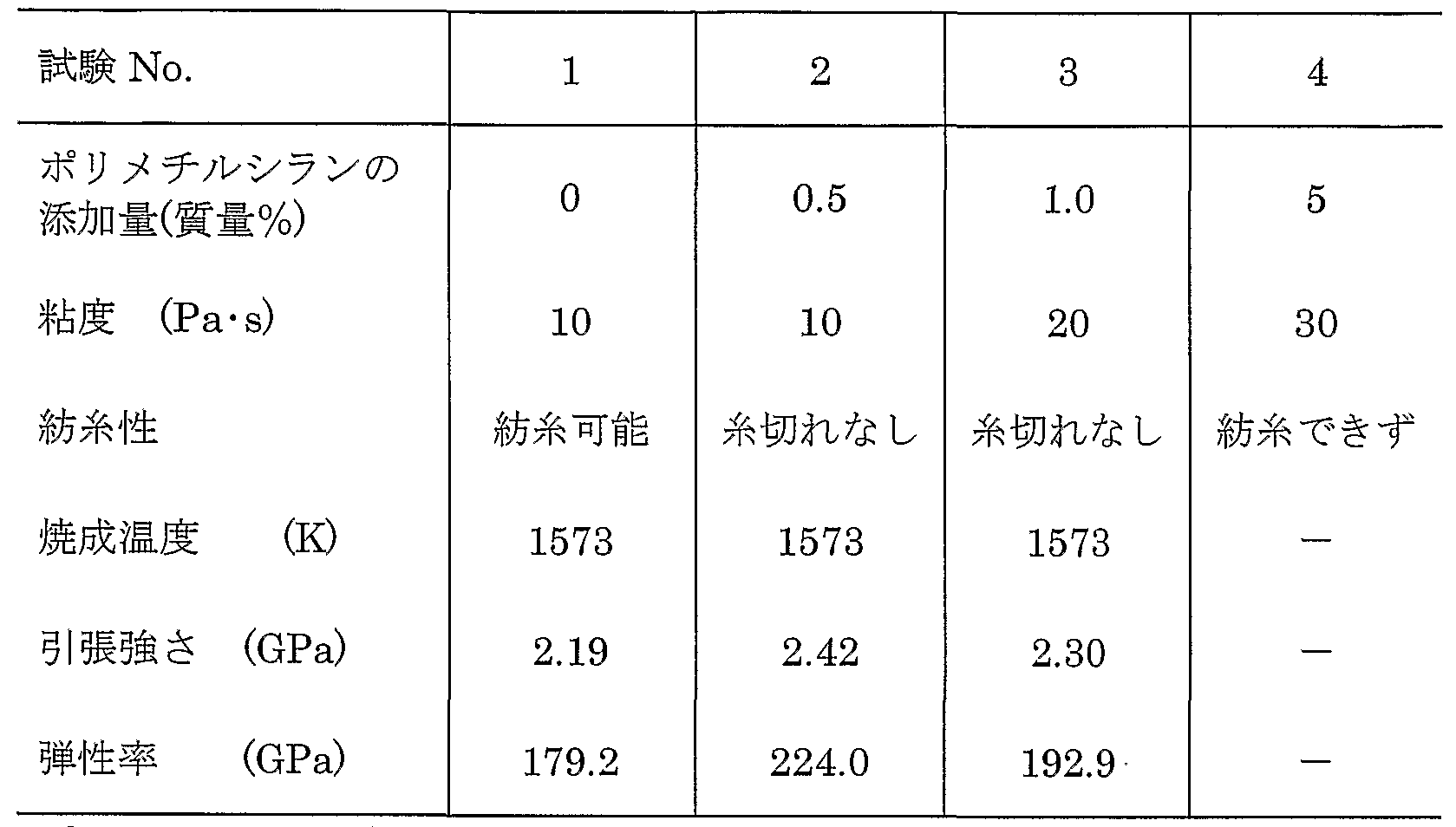
- Polymethylsilane is added at various ratios to an organic solvent (tetrahydrofuran) in which polycarbosilane is dissolved, and the mixture is stirred for 2 hours.
- a mer blend was prepared.
- the obtained polymer blend was melted in an inert atmosphere up to 600k for 2.5 hours, and was further held for 2 hours to prepare a self-assembled mixed polymer melt.
- the mixed polymer melt was spun by extruding it through a pinhole as it was, and heated to about 450K in an oxygen atmosphere to perform thermal oxidation and infusibility treatment.
- Each of the infusibilized fibers was fired at 1273K and further heat-treated at 1573K in an inert atmosphere.
- the effect of the addition of polymethylsilane on the tensile strength and the elastic modulus was large at an addition amount of 0.5% by mass, and the tensile strength was 10% and the elastic modulus was 20% as compared with the SiC fiber without polymethylsilane. It was improving relatively.
- Addition of polymethylsilane tended to reduce the fiber diameter and resulted in a slight increase in apparent crystallite size as measured by XRD. From the SEM observation results of the fiber surface and fracture surface, regardless of the presence or absence of polymethylsilane, all of the SiC fibers had a smooth surface, and no significant difference in morphology was detected. Smooth surfaces can be obtained using SiC-based materials that do not need to worry about a decrease in strength due to fiber surface defects under the preparation conditions described above. Indicates a fiber.
- the present invention enhances the cross-linking reactivity of a polymer blend by adding polymethylsilane to polycarbosilane, and eliminates the need to add a separate spinning aid to the hybrid melt in a molten state. Improves moldability and spinnability.
- polymethylsilane it is possible to impart yarn and composition fluctuations at the nanometer level, and to obtain SiC reinforced fibers with improved heat resistance, toughness, and strength.
- the SiC-based composite material obtained from the mixture of SiC reinforced fiber and SiC (matrix) is a structural material in extreme atmospheres such as power generation, aerospace, nuclear power, nuclear fusion, etc., utilizing the advantages of SiC reinforced fiber. Used for parts, etc.
Landscapes
- Chemical & Material Sciences (AREA)
- Chemical Kinetics & Catalysis (AREA)
- General Chemical & Material Sciences (AREA)
- Engineering & Computer Science (AREA)
- Textile Engineering (AREA)
- Inorganic Fibers (AREA)
Description
Claims
Priority Applications (3)
| Application Number | Priority Date | Filing Date | Title |
|---|---|---|---|
| US10/416,967 US7125514B2 (en) | 2001-09-19 | 2001-11-13 | Process for producing reinforcing SiC fiber for SiC composite material |
| EP01274199A EP1435405B1 (en) | 2001-09-19 | 2001-11-13 | Process for producing reinforcing sic fiber for sic composite material |
| DE60126159T DE60126159T2 (de) | 2001-09-19 | 2001-11-13 | Verfahren zum herstellen einer verstärkenden sic-faser für sic-verbundwerkstof fmaterial |
Applications Claiming Priority (2)
| Application Number | Priority Date | Filing Date | Title |
|---|---|---|---|
| JP2001284704A JP4334790B2 (ja) | 2001-09-19 | 2001-09-19 | SiC系複合材料用SiC強化繊維の製造 |
| JP2001-284704 | 2001-09-19 |
Publications (1)
| Publication Number | Publication Date |
|---|---|
| WO2003027367A1 true WO2003027367A1 (fr) | 2003-04-03 |
Family
ID=19107977
Family Applications (1)
| Application Number | Title | Priority Date | Filing Date |
|---|---|---|---|
| PCT/JP2001/009914 Ceased WO2003027367A1 (fr) | 2001-09-19 | 2001-11-13 | Procede de production de fibre sic de renforcement pour materiau composite sic |
Country Status (5)
| Country | Link |
|---|---|
| US (1) | US7125514B2 (ja) |
| EP (1) | EP1435405B1 (ja) |
| JP (1) | JP4334790B2 (ja) |
| DE (1) | DE60126159T2 (ja) |
| WO (1) | WO2003027367A1 (ja) |
Families Citing this family (19)
| Publication number | Priority date | Publication date | Assignee | Title |
|---|---|---|---|---|
| JP5557231B2 (ja) * | 2009-05-28 | 2014-07-23 | 独立行政法人日本原子力研究開発機構 | 多孔質セラミックス繊維体の製造方法 |
| CN101787588B (zh) * | 2010-01-21 | 2011-12-14 | 中国人民解放军国防科学技术大学 | 一种由pcs纤维制备连续碳化硅纤维的方法 |
| JP5612330B2 (ja) * | 2010-02-15 | 2014-10-22 | 公立大学法人大阪府立大学 | セラミックス繊維の製造方法およびその方法により得られるセラミックス繊維 |
| JP5598913B2 (ja) * | 2010-07-28 | 2014-10-01 | 独立行政法人日本原子力研究開発機構 | セラミックスマイクロチューブの作製方法 |
| US10208238B2 (en) | 2010-10-08 | 2019-02-19 | Advanced Ceramic Fibers, Llc | Boron carbide fiber reinforced articles |
| US10954167B1 (en) | 2010-10-08 | 2021-03-23 | Advanced Ceramic Fibers, Llc | Methods for producing metal carbide materials |
| US9199227B2 (en) | 2011-08-23 | 2015-12-01 | Advanced Ceramic Fibers, Llc | Methods of producing continuous boron carbide fibers |
| US8940391B2 (en) | 2010-10-08 | 2015-01-27 | Advanced Ceramic Fibers, Llc | Silicon carbide fibers and articles including same |
| US9275762B2 (en) | 2010-10-08 | 2016-03-01 | Advanced Ceramic Fibers, Llc | Cladding material, tube including such cladding material and methods of forming the same |
| US9803296B2 (en) | 2014-02-18 | 2017-10-31 | Advanced Ceramic Fibers, Llc | Metal carbide fibers and methods for their manufacture |
| CN102808241A (zh) * | 2012-08-27 | 2012-12-05 | 中国科学院化学研究所 | 物理共混改性制备连续碳化硅纤维的方法 |
| CN102943319A (zh) * | 2012-11-27 | 2013-02-27 | 天津工业大学 | 一种碳化硅先驱体复合纤维的制备方法 |
| CN103194224B (zh) * | 2013-04-10 | 2014-10-08 | 中国人民解放军国防科学技术大学 | 碳化硅量子点及其制备方法 |
| US9644158B2 (en) | 2014-01-13 | 2017-05-09 | General Electric Company | Feed injector for a gasification system |
| US10793478B2 (en) | 2017-09-11 | 2020-10-06 | Advanced Ceramic Fibers, Llc. | Single phase fiber reinforced ceramic matrix composites |
| WO2020207950A1 (en) * | 2019-04-08 | 2020-10-15 | Merck Patent Gmbh | Composition comprising block copolymer, and method for producing siliceous film using the same |
| CN113493944B (zh) * | 2020-03-18 | 2022-09-23 | 中国科学院山西煤炭化学研究所 | 一种纺丝液及其制备方法 |
| CN115385706A (zh) * | 2022-08-23 | 2022-11-25 | 广西三元华鑫特种陶瓷有限公司 | 一种提高微纳纤维增强碳化硅材料抗冲击韧性的方法 |
| CN115385704A (zh) * | 2022-08-23 | 2022-11-25 | 广西三元华鑫特种陶瓷有限公司 | 减少微纳纤维增强碳化硅材料半成品干燥应力变形方法 |
Citations (4)
| Publication number | Priority date | Publication date | Assignee | Title |
|---|---|---|---|---|
| JPS51149925A (en) * | 1975-05-16 | 1976-12-23 | Res Inst Iron Steel Tohoku Univ | Process for manufacturing high strength silicon carbide fibers |
| EP0051855A1 (en) * | 1980-11-11 | 1982-05-19 | Ube Industries, Ltd. | Method of preparing polycarbosilanes |
| US4737552A (en) * | 1986-06-30 | 1988-04-12 | Dow Corning Corporation | Ceramic materials from polycarbosilanes |
| DE4214045A1 (de) * | 1992-04-29 | 1993-11-04 | Solvay Deutschland | Verfahren zur herstellung von am silicium selektiv mit wasserstoff substituierten polycarbosilanen |
Family Cites Families (6)
| Publication number | Priority date | Publication date | Assignee | Title |
|---|---|---|---|---|
| KR940007325B1 (ko) * | 1991-02-25 | 1994-08-13 | 한국과학기술연구원 | 폴리실라메틸레노실란 중합체의 제조방법 |
| US5242870A (en) * | 1991-10-09 | 1993-09-07 | University Of Florida | SIC fibers having low oxygen content and methods of preparation |
| US5792416A (en) * | 1996-05-17 | 1998-08-11 | University Of Florida | Preparation of boron-doped silicon carbide fibers |
| US6069102A (en) * | 1997-08-04 | 2000-05-30 | University Of Florida | Creep-resistant, high-strength silicon carbide fibers |
| US5958324A (en) * | 1998-02-06 | 1999-09-28 | Dow Corning Corporation | Method for formation of crystalline boron-doped silicon carbide and amorphous boron silicon oxycarbide fibers from polymer blends containing siloxane and boron |
| JP4389128B2 (ja) * | 1999-06-25 | 2009-12-24 | 株式会社Ihi | セラミックス基複合材料の製造方法 |
-
2001
- 2001-09-19 JP JP2001284704A patent/JP4334790B2/ja not_active Expired - Fee Related
- 2001-11-13 EP EP01274199A patent/EP1435405B1/en not_active Expired - Lifetime
- 2001-11-13 WO PCT/JP2001/009914 patent/WO2003027367A1/ja not_active Ceased
- 2001-11-13 US US10/416,967 patent/US7125514B2/en not_active Expired - Fee Related
- 2001-11-13 DE DE60126159T patent/DE60126159T2/de not_active Expired - Lifetime
Patent Citations (4)
| Publication number | Priority date | Publication date | Assignee | Title |
|---|---|---|---|---|
| JPS51149925A (en) * | 1975-05-16 | 1976-12-23 | Res Inst Iron Steel Tohoku Univ | Process for manufacturing high strength silicon carbide fibers |
| EP0051855A1 (en) * | 1980-11-11 | 1982-05-19 | Ube Industries, Ltd. | Method of preparing polycarbosilanes |
| US4737552A (en) * | 1986-06-30 | 1988-04-12 | Dow Corning Corporation | Ceramic materials from polycarbosilanes |
| DE4214045A1 (de) * | 1992-04-29 | 1993-11-04 | Solvay Deutschland | Verfahren zur herstellung von am silicium selektiv mit wasserstoff substituierten polycarbosilanen |
Non-Patent Citations (1)
| Title |
|---|
| See also references of EP1435405A4 * |
Also Published As
| Publication number | Publication date |
|---|---|
| EP1435405A1 (en) | 2004-07-07 |
| DE60126159D1 (de) | 2007-03-08 |
| EP1435405A4 (en) | 2005-01-12 |
| US7125514B2 (en) | 2006-10-24 |
| DE60126159T2 (de) | 2007-10-18 |
| JP2003089929A (ja) | 2003-03-28 |
| US20040013876A1 (en) | 2004-01-22 |
| JP4334790B2 (ja) | 2009-09-30 |
| EP1435405B1 (en) | 2007-01-17 |
Similar Documents
| Publication | Publication Date | Title |
|---|---|---|
| JP4334790B2 (ja) | SiC系複合材料用SiC強化繊維の製造 | |
| CN110629324B (zh) | 一种含硼碳化硅纤维及其制备方法 | |
| CN107419364B (zh) | 一种高耐温性的高结晶近化学计量比连续SiC纤维的制备方法 | |
| Viard et al. | Polymer-derived ceramics route toward SiCN and SiBCN fibers: from chemistry of polycarbosilazanes to the design and characterization of ceramic fibers | |
| US5268336A (en) | Preparation of substantially polycrystalline silicon carbide fibers from methylpolydisilylazanes | |
| JP7122833B2 (ja) | 炭化ケイ素繊維の製造方法 | |
| CA2033656A1 (en) | Preparation of substantially crystalline silicon carbide fibers from polycarbosilane | |
| Yalamaç et al. | Ceramic fibers | |
| JP4458192B2 (ja) | SiC繊維結合セラミックス及びその製造方法 | |
| Hochet et al. | Microstructural evolution of the latest generation of small‐diameter SiC‐based fibres tested at high temperatures | |
| US12600676B2 (en) | Polymer-derived ceramic fibers and methods of preparing the same | |
| US6069102A (en) | Creep-resistant, high-strength silicon carbide fibers | |
| US12060302B2 (en) | Crystalline silicon carbide fiber and method for manufacturing same, and ceramic composite substrate | |
| Takeda et al. | Properties of polycarbosilane-derived silicon carbide fibers with various C/Si compositions | |
| JP2003113537A (ja) | 窒化ホウ素層を繊維表面に有する炭化珪素繊維及びその製造方法 | |
| WO2001038616A1 (en) | Organic silicon polymer, inorganic fiber with silicon carbide base, and method of manufacture thereof | |
| JPH0931756A (ja) | 高耐熱セラミックス繊維及びその製造方法 | |
| Denk et al. | Synergistic enhancement of thermomechanical properties and oxidation resistance in aligned Co-continuous carbon–ceramic hybrid fibers | |
| JP3279144B2 (ja) | 高耐熱性セラミックス繊維及びその製造方法 | |
| JP4784533B2 (ja) | SiC繊維結合型セラミックスの製造方法 | |
| JPWO2006085479A1 (ja) | 炭化ケイ素系ナノ繊維の製造方法 | |
| Potticary | Chemical and behavioral study of commercial polycarbosilanes for the processing of SiC fibers | |
| JP3279126B2 (ja) | 無機繊維及びその製造方法 | |
| JP2001279098A (ja) | 有機ケイ素重合体、炭化ケイ素系無機繊維及びそれらの製造方法 | |
| JPH09217235A (ja) | 耐熱性炭化珪素繊維 |
Legal Events
| Date | Code | Title | Description |
|---|---|---|---|
| WWE | Wipo information: entry into national phase |
Ref document number: 2001274199 Country of ref document: EP |
|
| AK | Designated states |
Kind code of ref document: A1 Designated state(s): CA |
|
| AL | Designated countries for regional patents |
Kind code of ref document: A1 Designated state(s): AT BE CH CY DE DK ES FI FR GB IE IT LU MC NL PT SE TR |
|
| WWE | Wipo information: entry into national phase |
Ref document number: 10416967 Country of ref document: US |
|
| 121 | Ep: the epo has been informed by wipo that ep was designated in this application | ||
| WWP | Wipo information: published in national office |
Ref document number: 2001274199 Country of ref document: EP |
|
| WWG | Wipo information: grant in national office |
Ref document number: 2001274199 Country of ref document: EP |