WO2003029182A1 - Method of making oleochemical oil-based polyols - Google Patents
Method of making oleochemical oil-based polyols Download PDFInfo
- Publication number
- WO2003029182A1 WO2003029182A1 PCT/US2002/027147 US0227147W WO03029182A1 WO 2003029182 A1 WO2003029182 A1 WO 2003029182A1 US 0227147 W US0227147 W US 0227147W WO 03029182 A1 WO03029182 A1 WO 03029182A1
- Authority
- WO
- WIPO (PCT)
- Prior art keywords
- oil
- oleochemical
- clay
- alcohol
- oleochemical oil
- Prior art date
- Legal status (The legal status is an assumption and is not a legal conclusion. Google has not performed a legal analysis and makes no representation as to the accuracy of the status listed.)
- Ceased
Links
Classifications
-
- C—CHEMISTRY; METALLURGY
- C07—ORGANIC CHEMISTRY
- C07C—ACYCLIC OR CARBOCYCLIC COMPOUNDS
- C07C67/00—Preparation of carboxylic acid esters
- C07C67/30—Preparation of carboxylic acid esters by modifying the acid moiety of the ester, such modification not being an introduction of an ester group
- C07C67/31—Preparation of carboxylic acid esters by modifying the acid moiety of the ester, such modification not being an introduction of an ester group by introduction of functional groups containing oxygen only in singly bound form
Definitions
- the present invention relates to a method for making oleochemical oil-based polyols using acid treated clay catalysts.
- the oleochemical oil-based polyols can be used to produce polyurethane resins for a variety of uses.
- Polyols may be produced from petroleum. However, polyols made from oleochemical oils would be preferred since they come from renewable resources. Oleochemical oils are produced from the fats and oils of, for example, beef tallow, palm oil, lard, castor oil, peanut oil, rapeseed oil, cottonseed oil, soya bean oil, sunflower oil, and linseed oil. Oleochemical oil molecules must be chemically transformed in order to introduce hydroxyl groups. For instance, soybean oil does not contain any hydroxyl groups but has on an average about 4.6 double bonds per molecule. The unsaturated portions of the vegetable oil molecule can be converted to hydroxyl groups. However, many reactions for preparing polyols from vegetable oils are not very selective.
- Vegetable oil-based polyols are known.
- U.S. Patent No. 6,107,433 to Petrovic, et al. discloses a process for converting vegetable oil into polyols by epoxidizing the oil using a fluoboric acid catalyst and then hydroxylating the epoxidized oil to a polyol using more fluoboric acid catalyst plus an alcohol or an alcohol and water, which is preferred.
- the problem with the process is that the fluoboric acid is expensive, highly reactive, hazardous to handle, and highly exothermic, must be quenched, and its byproducts present disposal problems.
- the polyols can be used to make polyurethane resins.
- 4,508,853 to Kluth, et al. teaches the preparation of polyurethane prepolymers containing terminal isocyanate groups in which oleochemical polyols are present as the polyol component.
- the polyols are made by subjecting epoxidized triglycerides to ring opening using acid catalysis such as mineral acids, including sulfuric acid, phosphoric acid, hydrochloric acid, or organic acids such as sulfonic acids, including p-toluene sulfonic acid.
- acid catalysis such as mineral acids, including sulfuric acid, phosphoric acid, hydrochloric acid, or organic acids such as sulfonic acids, including p-toluene sulfonic acid.
- Other examples of urethanes incorporating fatty polyols made by acid catalyzed hydroxylation of epoxidized fatty acids includes U.S. Patent No.
- a method for making oleochemical oil-based polyols from epoxidized oleochemical oil is needed for a variety of applications including preparation of, through polyurethane chemistry, of resins for a variety of uses.
- oleochemical oil-based polyols can be made using an acid activated or acid leached clay by mixing an epoxidized oleochemical oil, alcohol, and acid activated or acid leached clay so the epoxidized oleochemical oil reacts with said mixture to form an oleochemical oil-based polyol, filtering out said clay, stripping off any excess alcohol, and recovering the vegetable oil-based polyol.
- a further benefit from the process is that the clay can be recovered, recycled, and reused in the process.
- the process of the present invention provides a method for making polyols from renewable resources.
- the oleochemical oil-based polyols can be used to make polyurethane resins which can be used, for example, as cast resins, foams, coatings, adhesives, or to make composites.
- the oleochemical oil-based polyols have a favorable distribution of hydroxyl groups in the molecule so that when these polyols are reacted with isocyanates to form polyurethanes, crosslinking within the polyurethane is optimized.
- oleochemical oil-based polyols are made by reacting an epoxidized oleochemical oil and an alcohol using an acid activated or acid leached clay.
- the clay used in the process is filtered out and can be recovered, recycled, and reused in the process.
- the clays useful in the process are often referred to as acid activated clays.
- Preferred clays are acid activated sub-bentonites or bentonites which are characterized by rapid slaking when it is in the air dried state and only a slight swelling when placed in water. They consist predominantly of the clay mineral montmorillonite.
- the clay can be used in amounts from about 0.5 wt. % to about 20 percent by weight, based upon the weight of the epoxidized oleochemical oil, preferably from about 1 to about 10 wt. % with about 2 wt. % to about 10 wt. %, and 5 wt. % being further preferred.
- clay catalysts include Filtrol® and Retrol® clays available from Engelhard; Fulcat® 14, Fulmont® 700C, Fulmont® 237, and Fulcat® 22B clays available from Laporte Industries; and Katalysator® K10 clay available from Sud-Chemi.
- the clay catalysts may contain some water as received. The amount of water has some effect on the rate of the reaction, the hydroxyl number, and the molecular weight of the final product, but it is not considered critical. Retrol F20 clay catalyst is preferred.
- the clays are aluminosilicates.
- the aluminum III cations are bonded to an octahedral arrangement of oxygen anions. Repetition of these AlO 6 units in two dimensions forms an octahedral layer.
- a tetrahedral layer is formed from SiO 4 silicate units.
- Clays are classified according to the relative number of tetrahedral and octahedral layers. Montmorillonite clays, which have been used in organic chemical applications, have an octahedral layer sandwiched between two tetrahedral layers.
- epoxidized oleochemical oil may be used in this process.
- the epoxidized oleochemical oils are derived from triglycerides, such as fatty oils from vegetable, animal or marine animal origin or from free fatty acids. Examples of oils that may be used include, but are not limited to, soybean (or soya bean) oil, safflower oil, linseed oil, corn oil, sunflower oil, olive oil, canola oil, sesame oil, peanut oil, cottonseed oil, palm oil, rapeseed oil, tung oil, beef tallow, lard, castor oil, fish oil, or a blend of any of these oils, although epoxidized soybean oil is preferred.
- any partially hydrogenated vegetable oils or genetically modified vegetable oils can be used to obtain the desired hydroxyl content.
- partially hydrogenated vegetable oils or genetically modified vegetable oils include, but are not limited to, high oleic safflower oil, high oleic soybean oil, high oleic peanut oil, high oleic sunflower oil and high erucic rapeseed oil (crambe oil).
- the iodine values of these vegetable oils range from about 40 to 240 and more preferably from about 80 to 240.
- vegetable oils having lower iodine values are used to make vegetable oil-based polyols, polyols with lower hydroxyl numbers and thus lower viscosities are created.
- the epoxide content of the epoxidized oleochemical oil is not critical, but it is preferred that it is in the range of about 6.0 % by weight to about 7.0 % by weight.
- the hydroxylation reaction occurs between about 60° and 70° C.
- the rate of reaction depends upon the concentration and selection of the ingredients. For example, the greater the amount of the catalyst, the faster the reaction.
- the process conditions do not appear to be critical. As can be appreciated, the faster the reaction, the less opportunity there is for cross-linking, e.g., the reaction of the epoxide with the polyol product.
- the oleochemical oil-based polyols made by the method of the present invention can have a viscosity in the range of 1,000-12,000 centipoise at room temperature.
- the viscosity of these polyols is lower than oleochemical oil-based polyols made by other methods because the method of the present invention minimizes substantial side- reactions, such as polymerization or crosslinking.
- the oleochemical oil- based polyols made by the method of the present invention have a hydroxyl content ranging from 110 to 200 mg KOH/g of product, usually in the range of 140 to 180 mg KOH7 g of product.
- the polyol has a high hydroxyl content which equals to approximately one hydroxyl group per double bond of the oleochemical oil.
- Oleochemical oil-based polyols can be made in very high (85% to 95%) and nearly quantitative yields using the process of the present invention.
- the following examples are illustrative of the present invention and should not limit the scope of the invention.
- epoxidized vegetable oil epoxidized soybean oil having an epoxide content of about 6.8%
- an alcohol 156.25 grams of methanol
- a catalyst 12.5 grams of Retrol F-20 clay
- Example 2 The same process as Example 1 was followed, except that the kind of catalyst, the amount of catalyst, the kind of alcohol, the amount of alcohol, and sources of epoxidized soybean oil (EPSO) were varied as shown in Table I.
- the epoxidized soybean oil was supplied by Union Carbide ("A"), Ferro (“B”), and Witco ("C”), and a comparison is shown in Table II.
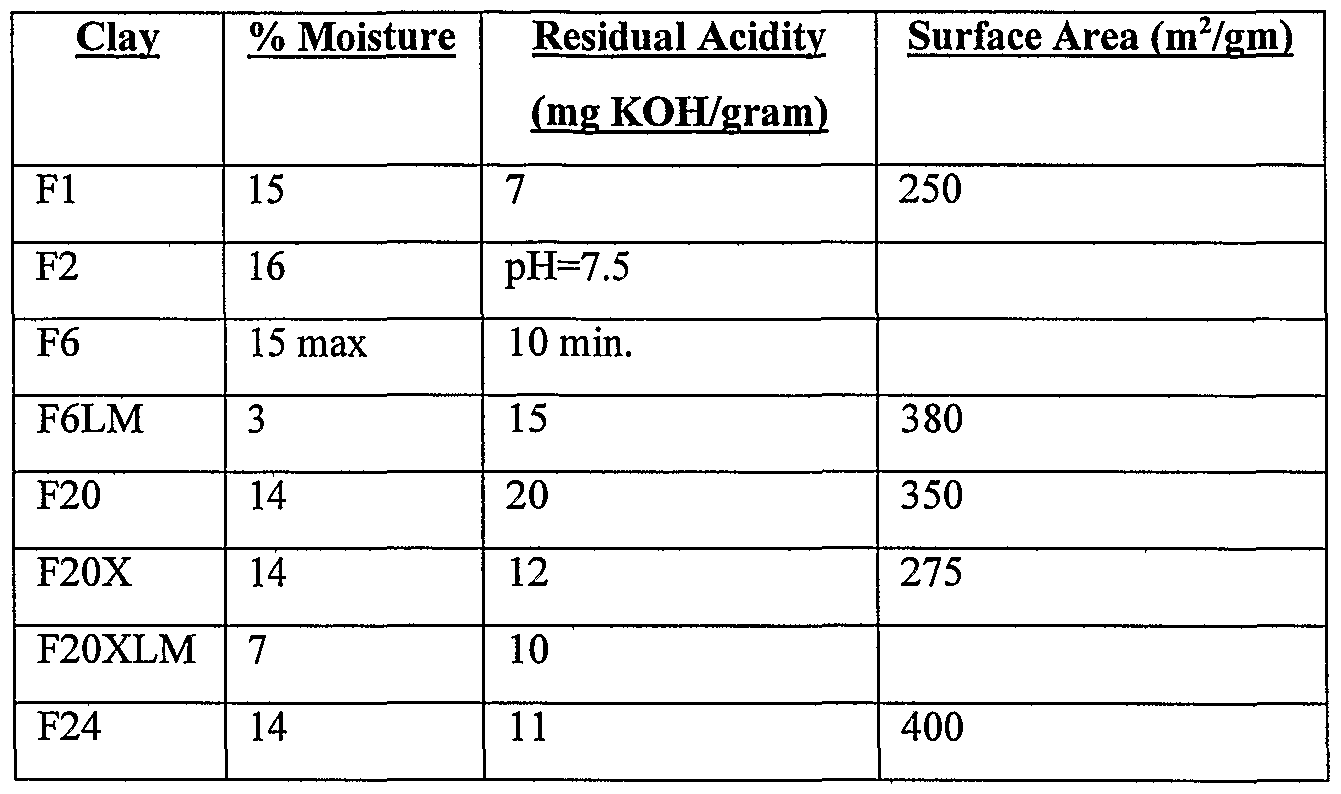
- the characteristics of the catalysts are shown in Table III. The results show that the process produces soy polyol using a wide range and amount of reactants.
- polyols can be made from a variety of sources of epoxidized soybean oil and that polyols made by the process of the present invention are similar to those made using a fluoroboric acid catalyst as is taught in Petrovic et al US Patent No. 6,107,433.
- Example 2 The same process was followed as Example 1, using the same amounts of reactants.
- the filter cake was recovered. 9.44 g of wet cake was dried and recovered. 8.86 g of wet cake was slurried with methanol to wash away the soy polyol, and afterward was again filtered to recover a second filter cake. The second filter cake was also dried and recovered. The dried clay catalyst was then blended together.
- Example 2 Following the same procedure as Example 1, 50 g of epoxidized soybean oil, 62.5 g of methanol, and 5 g of the recovered clay catalyst were combined and heated. The result using the recycled clay catalyst was the same as when it was used fresh.
Landscapes
- Chemical & Material Sciences (AREA)
- Organic Chemistry (AREA)
- Fats And Perfumes (AREA)
- Polyurethanes Or Polyureas (AREA)
- Organic Low-Molecular-Weight Compounds And Preparation Thereof (AREA)
- Electroluminescent Light Sources (AREA)
- Lubricants (AREA)
Abstract
Description

Claims
Priority Applications (5)
| Application Number | Priority Date | Filing Date | Title |
|---|---|---|---|
| BR0212971-0A BR0212971A (en) | 2001-10-02 | 2002-08-13 | Method for the production of oleochemical oil based polos |
| AT02768712T ATE292104T1 (en) | 2001-10-02 | 2002-08-13 | METHOD FOR PRODUCING POLYOLS BASED ON OLEOCHEMICAL OILS |
| DE60203526T DE60203526T2 (en) | 2001-10-02 | 2002-08-13 | METHOD FOR PRODUCING POLYOLES BASED ON OLEOCHEMICAL OILS |
| EP02768712A EP1432672B1 (en) | 2001-10-02 | 2002-08-13 | Method of making oleochemical oil-based polyols |
| MXPA04002965A MXPA04002965A (en) | 2001-10-02 | 2002-08-13 | Method of making oleochemical oil-based polyols. |
Applications Claiming Priority (2)
| Application Number | Priority Date | Filing Date | Title |
|---|---|---|---|
| US09/969,059 | 2001-10-02 | ||
| US09/969,059 US6891053B2 (en) | 2001-10-02 | 2001-10-02 | Method of making oleochemical oil-based polyols |
Publications (1)
| Publication Number | Publication Date |
|---|---|
| WO2003029182A1 true WO2003029182A1 (en) | 2003-04-10 |
Family
ID=25515118
Family Applications (1)
| Application Number | Title | Priority Date | Filing Date |
|---|---|---|---|
| PCT/US2002/027147 Ceased WO2003029182A1 (en) | 2001-10-02 | 2002-08-13 | Method of making oleochemical oil-based polyols |
Country Status (9)
| Country | Link |
|---|---|
| US (1) | US6891053B2 (en) |
| EP (1) | EP1432672B1 (en) |
| CN (1) | CN1246289C (en) |
| AT (1) | ATE292104T1 (en) |
| BR (1) | BR0212971A (en) |
| DE (1) | DE60203526T2 (en) |
| ES (1) | ES2239250T3 (en) |
| MX (1) | MXPA04002965A (en) |
| WO (1) | WO2003029182A1 (en) |
Cited By (5)
| Publication number | Priority date | Publication date | Assignee | Title |
|---|---|---|---|---|
| US7786239B2 (en) * | 2004-06-25 | 2010-08-31 | Pittsburg State University | Modified vegetable oil-based polyols |
| WO2011035743A1 (en) | 2009-09-22 | 2011-03-31 | Institute Of Macromolecular Chemistry As Cr, V.V.I. | Raw material for polyurethane production and process for its preparing from waste polyurethane |
| US8022257B2 (en) | 2009-09-03 | 2011-09-20 | The Ohio State University Research Foundation | Methods for producing polyols using crude glycerin |
| WO2018005538A2 (en) | 2016-06-28 | 2018-01-04 | Myriant Corporation | Hybrid polyols based on natural oil polyols |
| US12291599B2 (en) | 2021-05-05 | 2025-05-06 | H.B. Fuller Company | Semi-crystalline polyester polyol and method of making the same |
Families Citing this family (39)
| Publication number | Priority date | Publication date | Assignee | Title |
|---|---|---|---|---|
| US8293808B2 (en) * | 2003-09-30 | 2012-10-23 | Cargill, Incorporated | Flexible polyurethane foams prepared using modified vegetable oil-based polyols |
| US7691914B2 (en) | 2005-04-25 | 2010-04-06 | Cargill, Incorporated | Polyurethane foams comprising oligomeric polyols |
| US7538236B2 (en) * | 2006-01-04 | 2009-05-26 | Suresh Narine | Bioplastics, monomers thereof, and processes for the preparation thereof from agricultural feedstocks |
| US8575294B2 (en) * | 2006-09-21 | 2013-11-05 | Thomas M. Garrett | High bio content hybrid natural oil polyols and methods therefor |
| US7674925B2 (en) * | 2006-09-21 | 2010-03-09 | Athletic Polymer Systems, Inc. | Polyols from plant oils and methods of conversion |
| CN101535023B (en) * | 2006-10-30 | 2013-04-24 | 江森自控科技公司 | Non-petroleum-based polyurethane foam products having improved performance specifications and method of production |
| US7544763B2 (en) * | 2006-11-07 | 2009-06-09 | Arkema Inc. | Catalyst-free process for the manufacture of a fatty acid ester oil polyol |
| US9284401B2 (en) * | 2006-11-13 | 2016-03-15 | Bayer Materialscience Llc | Process for the preparation of polyether-ester polyols |
| MY145702A (en) | 2007-05-22 | 2012-03-30 | Malaysian Palm Oil Board Mpob | A process to produce polyols |
| DE102007055489B4 (en) | 2007-11-21 | 2019-07-11 | Mcpu Polymer Engineering Llc | Polyols from vegetable oils and process of transformation |
| US20110009515A1 (en) * | 2008-02-29 | 2011-01-13 | Dow Global Technologies Inc. | Storage and transportation stable polyol blends of natural oil based polyols and amine initiated polyols |
| US20090287007A1 (en) * | 2008-05-13 | 2009-11-19 | Cargill, Incorporated | Partially-hydrogenated, fully-epoxidized vegetable oil derivative |
| WO2009149034A1 (en) * | 2008-06-03 | 2009-12-10 | Dow Global Technologies Inc. | Heat activated adhesive compositions and method of making the same |
| BRPI0909880B1 (en) * | 2008-06-03 | 2021-01-05 | Dow Global Technologies Inc. | SENSITIVE SENSITIVE ADHESIVE COMPOSITION |
| WO2009148902A1 (en) * | 2008-06-03 | 2009-12-10 | Dow Global Technologies Inc. | A composite dispersion, method of producing the same, and articles made therefrom |
| WO2009152304A1 (en) * | 2008-06-12 | 2009-12-17 | Dow Global Technologies Inc. | Polyol prepolymers of natural oil based polyols |
| CN102159610A (en) * | 2008-07-18 | 2011-08-17 | 陶氏环球技术有限责任公司 | Natural resource based viscoelastic foams |
| US10239985B2 (en) | 2008-12-23 | 2019-03-26 | Covestro Llc | Polymer polyols comprising a natural oil base polyol, polyurethane foams comprising these polymer polyols and processes for their preparation |
| CN102414234A (en) | 2009-03-05 | 2012-04-11 | 陶氏环球技术有限责任公司 | Polyols derived from HPPO and polyurethane products prepared from the polyols |
| US20110034580A1 (en) * | 2009-08-07 | 2011-02-10 | ATI Industries, Inc. | Carbon-Negative Bio-Plastic Furniture |
| US8828269B1 (en) | 2009-11-16 | 2014-09-09 | Thomas M. Garrett | Method for increasing miscibility of natural oil polyol with petroleum-based polyol |
| US8541536B2 (en) * | 2010-01-07 | 2013-09-24 | Mcpu Polymer Engineering Llc | Coupling method for providing high molecular weight natural oil polyol |
| US8822625B2 (en) | 2010-01-07 | 2014-09-02 | MCPU Polymer Engineering, LLC | Method for providing higher molecular weight natural oil polyols without loss of functionality |
| US8865854B2 (en) | 2010-01-07 | 2014-10-21 | Thomas M Garrett | Method of synthesizing tuneably high functionality in high molecular weight natural oil polyols |
| US9414615B2 (en) * | 2010-01-18 | 2016-08-16 | PepciCo, Inc. | Gel-based compositions and methods of making same |
| US8933191B1 (en) | 2010-05-19 | 2015-01-13 | Thomas M. Garrett | Method for synthesizing high molecular weight natural oil polyols |
| EP2655475A1 (en) | 2010-12-20 | 2013-10-30 | Bayer Intellectual Property GmbH | Method for producing polyether ester polyols |
| EP3250619B1 (en) | 2015-01-26 | 2024-04-24 | Henkel AG & Co. KGaA | Functionalized polyurethanes prepared from renewable materials |
| CN104725210A (en) * | 2015-03-12 | 2015-06-24 | 中国科学院广州能源研究所 | Preparation method for microbial lipid-based polyhydric alcohol |
| WO2016160135A1 (en) | 2015-04-03 | 2016-10-06 | Henkel IP & Holding GmbH | (meth)acrylate-functionalized extended isosorbide |
| WO2016186830A1 (en) | 2015-05-15 | 2016-11-24 | Stepan Company | Ethoxylated vegetable oils in low density spray foam formulations |
| WO2017020124A1 (en) | 2015-07-31 | 2017-02-09 | The Governors Of The University Of Alberta | Synthesis of polyols suitable for castor oil replacement |
| EP3362492B1 (en) | 2015-10-16 | 2024-04-03 | Henkel AG & Co. KGaA | Reactive resins made from renewable sources |
| JP7170538B2 (en) | 2015-12-08 | 2022-11-14 | ヘンケル・アクチェンゲゼルシャフト・ウント・コムパニー・コマンディットゲゼルシャフト・アウフ・アクチェン | Functionalization-enhancing resins derived from renewable materials |
| US11453777B2 (en) | 2016-12-16 | 2022-09-27 | Oregon State University | Pressure sensitive adhesives from plant oil-based polyols |
| US10385261B2 (en) | 2017-08-22 | 2019-08-20 | Covestro Llc | Coated particles, methods for their manufacture and for their use as proppants |
| GB2576002B (en) | 2018-07-31 | 2022-08-17 | Henkel Ag & Co Kgaa | Anaerobically curable compositions containing alpha-methylene-lactones |
| US20210329918A1 (en) | 2018-08-27 | 2021-10-28 | Basf Se | Aqueous compositions of topramezone |
| TWI665185B (en) * | 2018-11-13 | 2019-07-11 | 台灣中油股份有限公司 | A method of preparing bio-polyols from epoxidized fatty acid esters |
Citations (3)
| Publication number | Priority date | Publication date | Assignee | Title |
|---|---|---|---|---|
| US4508853A (en) * | 1983-05-11 | 1985-04-02 | Henkel Kommanditgesellschaft | Polyurethane prepolymers based on oleochemical polyols |
| EP0554590A2 (en) * | 1992-02-04 | 1993-08-11 | HARBURGER FETTCHEMIE BRINCKMAN & MERGELL GmbH | Process for the preparation of hydroxylated fatty acids |
| US6107433A (en) * | 1998-11-06 | 2000-08-22 | Pittsburg State University | Process for the preparation of vegetable oil-based polyols and electroninsulating casting compounds created from vegetable oil-based polyols |
Family Cites Families (12)
| Publication number | Priority date | Publication date | Assignee | Title |
|---|---|---|---|---|
| US4054551A (en) * | 1975-05-02 | 1977-10-18 | The B. F. Goodrich Company | Benzofuranylphenol stabilizers |
| US4474602A (en) * | 1980-12-19 | 1984-10-02 | The Dow Chemical Company | Substituted pyridyl compounds, herbicidal compositions and method of use |
| DE3246612A1 (en) * | 1982-12-16 | 1984-06-20 | Henkel KGaA, 4000 Düsseldorf | METHOD FOR PRODUCING MODIFIED TRIGLYCERIDES WITH MEDIUM EPOXY AND HYDROXYL AND ETHER GROUPS |
| DE3347045A1 (en) * | 1983-12-24 | 1985-07-04 | Henkel KGaA, 4000 Düsseldorf | TWO COMPONENT POLYURETHANE ADHESIVE |
| US4546120A (en) * | 1985-03-26 | 1985-10-08 | Henkel Corporation | Urethane forming compositions based on fatty polyols |
| DE3626223A1 (en) * | 1986-08-02 | 1988-02-04 | Henkel Kgaa | POLYURETHANE PRE-POLYMERS BASED ON OLEOCHEMICAL POLYOLS, THEIR PRODUCTION AND USE |
| DE3630264A1 (en) * | 1986-09-05 | 1988-03-17 | Henkel Kgaa | METHOD FOR PRODUCING NEW, SOLID POLYURETHANE MATERIALS IN THE CASTING METHOD |
| DE3935127A1 (en) * | 1989-10-21 | 1991-04-25 | Henkel Kgaa | METHOD FOR THE PRODUCTION OF REACTION MIXTURES CONTAINING ESTER POLYOLS |
| DE3943080A1 (en) * | 1989-12-27 | 1991-07-04 | Henkel Kgaa | USE OF REACTION MIXTURES CONTAINING POLYESTER POLYOLS IN THE PRODUCTION OF SOLID POLYURETHANE MATERIALS BY THE MOLDING PROCESS |
| US5750787A (en) * | 1995-09-13 | 1998-05-12 | B. F. Goodrich Company | Liquid alkylated diphenylamine antioxidant |
| US5672752A (en) * | 1995-09-13 | 1997-09-30 | The Bfgoodrich Company | Liquid alkylated diphenylamine antioxidant |
| US6433121B1 (en) * | 1998-11-06 | 2002-08-13 | Pittsburg State University | Method of making natural oil-based polyols and polyurethanes therefrom |
-
2001
- 2001-10-02 US US09/969,059 patent/US6891053B2/en not_active Expired - Fee Related
-
2002
- 2002-08-13 ES ES02768712T patent/ES2239250T3/en not_active Expired - Lifetime
- 2002-08-13 MX MXPA04002965A patent/MXPA04002965A/en not_active Application Discontinuation
- 2002-08-13 WO PCT/US2002/027147 patent/WO2003029182A1/en not_active Ceased
- 2002-08-13 CN CNB028195256A patent/CN1246289C/en not_active Expired - Fee Related
- 2002-08-13 AT AT02768712T patent/ATE292104T1/en not_active IP Right Cessation
- 2002-08-13 DE DE60203526T patent/DE60203526T2/en not_active Expired - Fee Related
- 2002-08-13 BR BR0212971-0A patent/BR0212971A/en not_active IP Right Cessation
- 2002-08-13 EP EP02768712A patent/EP1432672B1/en not_active Expired - Lifetime
Patent Citations (3)
| Publication number | Priority date | Publication date | Assignee | Title |
|---|---|---|---|---|
| US4508853A (en) * | 1983-05-11 | 1985-04-02 | Henkel Kommanditgesellschaft | Polyurethane prepolymers based on oleochemical polyols |
| EP0554590A2 (en) * | 1992-02-04 | 1993-08-11 | HARBURGER FETTCHEMIE BRINCKMAN & MERGELL GmbH | Process for the preparation of hydroxylated fatty acids |
| US6107433A (en) * | 1998-11-06 | 2000-08-22 | Pittsburg State University | Process for the preparation of vegetable oil-based polyols and electroninsulating casting compounds created from vegetable oil-based polyols |
Cited By (8)
| Publication number | Priority date | Publication date | Assignee | Title |
|---|---|---|---|---|
| US7786239B2 (en) * | 2004-06-25 | 2010-08-31 | Pittsburg State University | Modified vegetable oil-based polyols |
| US8153746B2 (en) | 2004-06-25 | 2012-04-10 | Cargill, Incorporated | Modified vegetable oil-based polyols |
| US8022257B2 (en) | 2009-09-03 | 2011-09-20 | The Ohio State University Research Foundation | Methods for producing polyols using crude glycerin |
| WO2011035743A1 (en) | 2009-09-22 | 2011-03-31 | Institute Of Macromolecular Chemistry As Cr, V.V.I. | Raw material for polyurethane production and process for its preparing from waste polyurethane |
| WO2018005538A2 (en) | 2016-06-28 | 2018-01-04 | Myriant Corporation | Hybrid polyols based on natural oil polyols |
| KR20190039095A (en) | 2016-06-28 | 2019-04-10 | 피티티 글로벌 케미컬 퍼블릭 컴퍼니 리미티드 | Hybrid polyols based on natural oil polyols |
| US12291599B2 (en) | 2021-05-05 | 2025-05-06 | H.B. Fuller Company | Semi-crystalline polyester polyol and method of making the same |
| US12428523B2 (en) | 2021-05-05 | 2025-09-30 | H.B. Fuller Company | Polyurethanes and moisture curable compositions including the same |
Also Published As
| Publication number | Publication date |
|---|---|
| DE60203526T2 (en) | 2006-02-16 |
| ES2239250T3 (en) | 2005-09-16 |
| DE60203526D1 (en) | 2005-05-04 |
| BR0212971A (en) | 2004-10-13 |
| EP1432672A1 (en) | 2004-06-30 |
| MXPA04002965A (en) | 2004-07-05 |
| US6891053B2 (en) | 2005-05-10 |
| US20030088054A1 (en) | 2003-05-08 |
| ATE292104T1 (en) | 2005-04-15 |
| CN1246289C (en) | 2006-03-22 |
| EP1432672B1 (en) | 2005-03-30 |
| CN1564802A (en) | 2005-01-12 |
Similar Documents
| Publication | Publication Date | Title |
|---|---|---|
| EP1432672B1 (en) | Method of making oleochemical oil-based polyols | |
| CN102762707B (en) | Method for modifying vegetable oils and primary plasticizer for vinyl polymers | |
| US4886893A (en) | Process for the preparation of modified triglycerides | |
| EP0483197B1 (en) | Alkoxylation products of carboxylic acids and/or carboxylic acid derivatives containing oh groups | |
| JP2008504287A (en) | Modified vegetable oil based polyols | |
| JP3142557B2 (en) | Method for producing reaction mixture containing ester polyol | |
| KR102061375B1 (en) | Bio-polyols for Bio-lubricant and Bio-polymer and Methods for the Preparation thereof | |
| US4825004A (en) | Process for the production of alkane polyols | |
| CN101273005A (en) | Improved process for the production of derivatives of saturated carboxylic acids | |
| WO2016094859A1 (en) | Polyols from protein biomass | |
| DE3814850A1 (en) | METHOD FOR PRODUCING LONG-BEAMED CARBON COMPOUNDS WITH VICINAL DIOL GROUPS | |
| US7544763B2 (en) | Catalyst-free process for the manufacture of a fatty acid ester oil polyol | |
| US2890228A (en) | New polyamide like condensation products and process of producing the same | |
| US8541536B2 (en) | Coupling method for providing high molecular weight natural oil polyol | |
| US20050159608A1 (en) | Method of preparing an epoxidized functional vegetable oil | |
| CN1170809C (en) | Method for preparing o -nitrobenzyl alkyl ether | |
| EP1468982B1 (en) | Carboxylic acid esters on basis of 2-hydroxy-methyl-norbornane | |
| CN107151680B (en) | Tung oil-based polyol and preparation method thereof | |
| US3136783A (en) | Polyether polynitriles and polyether polyamines | |
| EP1516865B1 (en) | 3-(4'-methylcyclohexyl) butanol based carboxylic acid esters having low pour point | |
| KR100938236B1 (en) | Manufacturing method of biodiesel fuel | |
| KR20160038925A (en) | Production Method of Dicarboxylic Acid from Castor Oil | |
| CN107151216B (en) | Tung oil polyol and preparation method thereof | |
| WO1993014060A1 (en) | Process for producing oligomeric fatty acids | |
| WO1990012859A1 (en) | A process for isomerizing olefinically unsaturated secondary alcohols |
Legal Events
| Date | Code | Title | Description |
|---|---|---|---|
| AK | Designated states |
Kind code of ref document: A1 Designated state(s): AE AG AL AM AT AU AZ BA BB BG BY BZ CA CH CN CO CR CU CZ DE DM DZ EC EE ES FI GB GD GE GH HR HU ID IL IN IS JP KE KG KP KR LC LK LR LS LT LU LV MA MD MG MN MW MX MZ NO NZ OM PH PL PT RU SD SE SG SI SK SL TJ TM TN TR TZ UA UG UZ VC VN YU ZA ZM |
|
| AL | Designated countries for regional patents |
Kind code of ref document: A1 Designated state(s): GH GM KE LS MW MZ SD SL SZ UG ZM ZW AM AZ BY KG KZ RU TJ TM AT BE BG CH CY CZ DK EE ES FI FR GB GR IE IT LU MC PT SE SK TR BF BJ CF CG CI GA GN GQ GW ML MR NE SN TD TG |
|
| 121 | Ep: the epo has been informed by wipo that ep was designated in this application | ||
| DFPE | Request for preliminary examination filed prior to expiration of 19th month from priority date (pct application filed before 20040101) | ||
| WWE | Wipo information: entry into national phase |
Ref document number: 2002768712 Country of ref document: EP |
|
| WWE | Wipo information: entry into national phase |
Ref document number: 679/DELNP/2004 Country of ref document: IN |
|
| WWE | Wipo information: entry into national phase |
Ref document number: PA/a/2004/002965 Country of ref document: MX |
|
| WWE | Wipo information: entry into national phase |
Ref document number: 20028195256 Country of ref document: CN |
|
| WWP | Wipo information: published in national office |
Ref document number: 2002768712 Country of ref document: EP |
|
| WWG | Wipo information: grant in national office |
Ref document number: 2002768712 Country of ref document: EP |
|
| NENP | Non-entry into the national phase |
Ref country code: JP |
|
| WWW | Wipo information: withdrawn in national office |
Ref document number: JP |