WO2003030847A1 - Mittel zum färben von keratinhaltigen fasern - Google Patents

Mittel zum färben von keratinhaltigen fasern Download PDF

Info

Publication number
WO2003030847A1
WO2003030847A1 PCT/EP2002/010736 EP0210736W WO03030847A1 WO 2003030847 A1 WO2003030847 A1 WO 2003030847A1 EP 0210736 W EP0210736 W EP 0210736W WO 03030847 A1 WO03030847 A1 WO 03030847A1
Authority
WO
WIPO (PCT)
Prior art keywords
amino
acid
group
methyl
hydroxy
Prior art date
Legal status (The legal status is an assumption and is not a legal conclusion. Google has not performed a legal analysis and makes no representation as to the accuracy of the status listed.)
Ceased
Application number
PCT/EP2002/010736
Other languages
English (en)
French (fr)
Inventor
Wibke Gross
Doris Oberkobusch
Helmut Müller
Horst Höffkes
Hinrich Möller
Current Assignee (The listed assignees may be inaccurate. Google has not performed a legal analysis and makes no representation or warranty as to the accuracy of the list.)
Henkel AG and Co KGaA
Original Assignee
Henkel AG and Co KGaA
Priority date (The priority date is an assumption and is not a legal conclusion. Google has not performed a legal analysis and makes no representation as to the accuracy of the date listed.)
Filing date
Publication date
Application filed by Henkel AG and Co KGaA filed Critical Henkel AG and Co KGaA
Priority to DE50212390T priority Critical patent/DE50212390D1/de
Priority to EP02772344A priority patent/EP1432388B1/de
Publication of WO2003030847A1 publication Critical patent/WO2003030847A1/de
Anticipated expiration legal-status Critical
Ceased legal-status Critical Current

Links

Classifications

    • A—HUMAN NECESSITIES
    • A61—MEDICAL OR VETERINARY SCIENCE; HYGIENE
    • A61K—PREPARATIONS FOR MEDICAL, DENTAL OR TOILETRY PURPOSES
    • A61K8/00—Cosmetics or similar toiletry preparations
    • A61K8/18—Cosmetics or similar toiletry preparations characterised by the composition
    • A61K8/30—Cosmetics or similar toiletry preparations characterised by the composition containing organic compounds
    • A61K8/49—Cosmetics or similar toiletry preparations characterised by the composition containing organic compounds containing heterocyclic compounds
    • A61K8/4906—Cosmetics or similar toiletry preparations characterised by the composition containing organic compounds containing heterocyclic compounds with one nitrogen as the only hetero atom
    • A61K8/4926—Cosmetics or similar toiletry preparations characterised by the composition containing organic compounds containing heterocyclic compounds with one nitrogen as the only hetero atom having six membered rings
    • A—HUMAN NECESSITIES
    • A61—MEDICAL OR VETERINARY SCIENCE; HYGIENE
    • A61K—PREPARATIONS FOR MEDICAL, DENTAL OR TOILETRY PURPOSES
    • A61K8/00—Cosmetics or similar toiletry preparations
    • A61K8/18—Cosmetics or similar toiletry preparations characterised by the composition
    • A61K8/30—Cosmetics or similar toiletry preparations characterised by the composition containing organic compounds
    • A61K8/40—Cosmetics or similar toiletry preparations characterised by the composition containing organic compounds containing nitrogen
    • A—HUMAN NECESSITIES
    • A61—MEDICAL OR VETERINARY SCIENCE; HYGIENE
    • A61K—PREPARATIONS FOR MEDICAL, DENTAL OR TOILETRY PURPOSES
    • A61K8/00—Cosmetics or similar toiletry preparations
    • A61K8/18—Cosmetics or similar toiletry preparations characterised by the composition
    • A61K8/30—Cosmetics or similar toiletry preparations characterised by the composition containing organic compounds
    • A61K8/49—Cosmetics or similar toiletry preparations characterised by the composition containing organic compounds containing heterocyclic compounds
    • A61K8/4906—Cosmetics or similar toiletry preparations characterised by the composition containing organic compounds containing heterocyclic compounds with one nitrogen as the only hetero atom
    • A61K8/4913—Cosmetics or similar toiletry preparations characterised by the composition containing organic compounds containing heterocyclic compounds with one nitrogen as the only hetero atom having five membered rings, e.g. pyrrolidone carboxylic acid
    • A61K8/492—Cosmetics or similar toiletry preparations characterised by the composition containing organic compounds containing heterocyclic compounds with one nitrogen as the only hetero atom having five membered rings, e.g. pyrrolidone carboxylic acid having condensed rings, e.g. indol
    • A—HUMAN NECESSITIES
    • A61—MEDICAL OR VETERINARY SCIENCE; HYGIENE
    • A61K—PREPARATIONS FOR MEDICAL, DENTAL OR TOILETRY PURPOSES
    • A61K8/00—Cosmetics or similar toiletry preparations
    • A61K8/18—Cosmetics or similar toiletry preparations characterised by the composition
    • A61K8/30—Cosmetics or similar toiletry preparations characterised by the composition containing organic compounds
    • A61K8/49—Cosmetics or similar toiletry preparations characterised by the composition containing organic compounds containing heterocyclic compounds
    • A61K8/494—Cosmetics or similar toiletry preparations characterised by the composition containing organic compounds containing heterocyclic compounds with more than one nitrogen as the only hetero atom
    • A61K8/4953—Cosmetics or similar toiletry preparations characterised by the composition containing organic compounds containing heterocyclic compounds with more than one nitrogen as the only hetero atom containing pyrimidine ring derivatives, e.g. minoxidil
    • A—HUMAN NECESSITIES
    • A61—MEDICAL OR VETERINARY SCIENCE; HYGIENE
    • A61Q—SPECIFIC USE OF COSMETICS OR SIMILAR TOILETRY PREPARATIONS
    • A61Q5/00—Preparations for care of the hair
    • A61Q5/10—Preparations for permanently dyeing the hair

Definitions

  • the invention relates to an agent for dyeing keratin-containing fibers, in particular human hair, which contains cationic heterocyclic compounds and CH-acidic compounds, the use of this combination in agents for dyeing keratin-containing fibers and a method for dyeing keratin-containing fibers, in particular human hair.
  • Coupler and developer components are also referred to as oxidation dye precursors.
  • Primary aromatic amines with a further free or substituted hydroxy or amino group in the para or ortho position, diaminopyridine derivatives, heterocyclic hydrazones, 4-aminopyrazolone derivatives and 2,4,5,6-tetraaminopyrimidine and derivatives thereof are usually used as developer components used.
  • Special representatives are, for example, p-phenylenediamine, p-toluenediamine, 2,4,5,6-tetraaminopyrimidine, p-aminophenol, N, N-bis (2-hydroxyethyl) -p-phenylenediamine, 2- (2.5 - Diaminophenyl) ethanol, 2- (2,5-diaminophenoxy) ethanol, 1-phenyl-3-carboxyamido-4-amino-pyrazol-5-one, 4-amino-3-methylphenol, 2-aminomethyl-4- aminophenol, 2-hydroxymethyl-4-aminophenol, 2-hydroxy-4,5,6-triaminopyrimidine, 2,4-dihydroxy-5,6-diaminopyrimidine and 2,5,6-triamino-4-hydroxypyrimidine.
  • M-Phenylenediamine derivatives, naphthols, resorcinol and resorcinol derivatives, pyrazolones, m-aminophenols and substituted pyridine derivatives are generally used as coupler components.
  • coupler substances are ⁇ -naphthol, 1,5-, 2,7- and 1,7-dihydroxynaphthalene, 5-amino-2-methylphenol, m-aminophenol, resorcinol, resorcinol monomethyl ether, p-phenylenediamine, 2,4-diaminophenoxyethanol , 2-Amino-4- (2-hydroxyethylamino) anisole (Lehmanns Blau), 1-phenyl-3-methyl-pyrazol-5-one, 2,4-dichloro-3-aminophenol, 1,3-bis - (2,4-diaminophenoxy) propane, 2-chlororesorcinol, 4-chlororesorcinol, 2-chloro-6-methyl-3-aminophenol, 2-methylresorcinol, 5-methylresorcinol, 3-amino-6-methoxy-2 -methylamino-pyridine and 3,5-diamino-2,6-dimethoxypyridine.
  • oxidation dyes intensive dyeings with good fastness properties can be achieved, but the development of the color is generally done under the influence of oxidizing agents such. B. H 2 O 2 , which in some cases can damage the fiber. Furthermore, some oxidation dye precursors or certain mixtures of oxidation dye precursors can sometimes have a sensitizing effect on people with sensitive skin. Direct dyes are applied under gentler conditions, but their disadvantage is that the dyeings often have inadequate fastness properties.
  • Extraordinary colors and special effects on the hair are particularly popular with young people.
  • the object of the present invention is to provide colorants for keratin fibers, in particular human hair, which bring about unusual and / or fluorescent coloring. Furthermore, in terms of color depth, gray coverage and fastness properties, the colorants should be qualitatively at least equivalent to the usual oxidation hair colorants, but without necessarily oxidizing agents such as. B. need H 2 O 2 . In addition, the colorants may have no or only a very low sensitization potential.
  • the invention relates to a composition for dyeing keratin-containing fibers, in particular human hair
  • R 1 and R 2 independently of one another represent a hydrogen atom, a halogen atom, a hydroxy group, a CrC ⁇ hydroxyalkyl group, a CC 6 - aminoalkyl group, a CrC 4 dialkylamino -CC-C -alkyl group, a linear or branched C ⁇ -C 6 -Alkyl group, a C 2 -C 6 alkenyl group, an optionally substituted aryl group, a sulfonic acid group, a carboxyl group, a " formyl group, a nitro group, a cyano group or a group -NR 4 R 5 , where R 4 and R 5 are independent of one another represents a hydrogen atom, a C ⁇ -C6 alkyl group, a C 2 -C 6 alkenyl group, an aryl group or a CrC t -C 4 hydroxyalkyl group, wherein R 1 and R 2 together membered fused 5- or 6-
  • R 3 is 4 hydroxyalkyl group, a C ⁇ -C, a C ⁇ -C 6 aminoalkyl group, a CrC dialkylamino-C ⁇ -C alkyl group, a di (C 1 -C 4 hydroxyalkyl) amino-C 1 -C 4 alkyl group, a linear or branched CrC ⁇ alkyl group, a C 2 -C 6 alkenyl group, an optionally substituted aryl group,
  • X 1 stands for a halogen atom, a C.C. alkoxy group, a CC 4 alkyl mercapto group, a sulfonic acid group or a p-toluenesulfonyl group,
  • radicals X 1 or X 2 stands for a halogen atom, a C
  • C Ce alkyl radicals mentioned as substituents in the context of this application are the groups methyl, ethyl, propyl, isopropyl, n-butyl, sec-butyl, tert-butyl, n-pentyl, neopentyl and hexyl.
  • Ethyl and methyl are preferred alkyl radicals.
  • Examples of preferred C 2 -C 6 alkenyl radicals are vinyl and allyl.
  • Preferred dC alkoxy radicals according to the invention are, for example, a methoxy or an ethoxy group.
  • Preferred CC mercapto groups are the methyl mercapto or the ethyl mercapto group; the methyl mercapto group is particularly preferred.
  • a CrC 6 -hydroxyalkyl group a hydroxymethyl, a 2-hydroxyethyl, a 2-hydroxypropyl, a 3-hydroxypropyl, a 4-hydroxybutyl group, a 1, 2-dihydroxyethyl group and the 2,3- Dihydroxypropyl group can be called.
  • a 2-hydroxyethyl group and a 2,3-dihydroxypropyl group are particularly preferred.
  • Preferred aryl groups are phenyl, naphthyl and biphenyl.
  • halogen atoms are F, Cl or Br atoms, Cl atoms being very particularly preferred.
  • Preferred CrC 4 aminoalkyl groups are the aminomethyl, the aminoethyl and the aminopropyl group.
  • preferred CC 4 dialkylamino-CrCralkyl groups are 2- (N, N-dimethylamino) ethyl, 2- (N, N-diethylamino) ethyl, 3- (N, N-dimethylamino) propyl and 3- (N, N- diethylamino) propyl.
  • Examples of an aryl-dC ⁇ alkyl group are benzyl and 2-phenylethyl. According to the invention, the other terms used are derived from the definitions given here.
  • Keratin-containing fibers are wool, furs, feathers and in particular human hair.
  • the colorants according to the invention can also be used for dyeing other natural fibers, such as, for. As cotton, jute, sisal, linen or silk, modified natural fibers, such as. B. regenerated cellulose, nitro, alkyl or hydroxyalkyl or acetyl cellulose and synthetic fibers such as. B. polyamide, polyacrylonitrile, polyurethane and polyester fibers can be used.
  • Preferred compounds according to formula I or formula II are substances in which the cation is selected from 2-chloro-1-ethyl-quinolinium, 4-chloro-1-ethyl-quinolinium, 2-chloro-1-methyl-pyridinium, 4-chloro-1-methyl-pyridinium, 3-ethyl-2-methylmercapto-benzothiazolium, 3-ethyl-2-methylmercapto-benzoxazolium, 2-chloro-1, 3-diethyl- benzimidazolium, 2-chloro-3-ethyl-benzoxazolium or 2-chloro-3-ethyl-benzothiazolium and the counterion
  • A is selected from chloride, bromide, iodide, hexafluorophosphate, tetrachlorozincate, tetrafluoroborate, trifluoromethylsulfonate, methylsulfonate or p-toluenesulfon
  • Particularly preferred compounds according to formula I or II are 4-chloro-1-ethylquinolinium tetrafluoroborate, 3-ethyl-2-methylmercapto-benzothiazolium tetrafluoroborate and 3-ethyl-benzothiazolium-2-sulfonate
  • the CH-acidic compound is preferably selected from compounds according to one of the formulas C1 to C22
  • M 2 has the same meaning as M 1 or is a cyano group, a substituted or unsubstituted aryl group or aryl-dd-alkyl group, a substituted or unsubstituted, saturated or unsaturated heterocycle,
  • M is a cyano group, a substituted or unsubstituted aryl group or a Aryl-CrGralkyl group, a substituted or unsubstituted, saturated or unsaturated heterocycle or a group -COM 7 or COOM 7 , in which M 7 represents a hydrogen atom or a CrC 6 alkyl group, • M 6 represents a substituted or unsubstituted CrC 6 alkyl group, is an acetyloxy group, a C 3 -C 6 cycloalkyl group, a substituted or unsubstituted aryl group or aryl-CrCralkyl group, a substituted or unsubstituted aminoaryl group, a substituted or unsubstituted, saturated or unsaturated heterocycle,
  • M 8 is a cyano group, a substituted or unsubstituted aryl group or aryl-CC 4 -alkyl group, a substituted or unsubstituted, saturated or unsaturated heterocycle or a group -COM 10 or COOM 10 , in which M 10 represents a hydrogen atom or a CrC 6 - Alkyl group,
  • M 9 is a substituted or unsubstituted aryl group or aryl-C 4 alkyl group, a substituted or unsubstituted aminoaryl group, a substituted or unsubstituted, saturated or unsaturated heterocycle,
  • M 11 and M 12 independently of one another for a substituted or unsubstituted d-Ce-alkyl group, an acetyloxy group, a C 3 -C 6 cycloalkyl group, a substituted or unsubstituted aryl group or aryl-dC-alkyl group, a substituted or unsubstituted aminoaryl group, one substituted or unsubstituted, saturated or unsaturated heterocycle,
  • M 13 is a hydrogen atom or a substituted or unsubstituted dC 6 alkyl group
  • M 14 and M 15 independently represent a dC 6 alkyl group, a C 2 -C 6 - alkenyl group, a C 3 -C 6 cycloalkyl group, an aryl dd alkyl group, a substituted or unsubstituted aryl group, or via the residues M 14 or M 15 bound bicyclic,
  • X stands for an oxygen or a sulfur atom
  • M «16 is a substituted or unsubstituted C r C 6 alkyl group or substituted or unsubstituted aryl group
  • M 17 is a hydrogen atom, a substituted or unsubstituted dC 6 alkyl group or a substituted or unsubstituted aryl group,
  • M is a hydrogen atom, a cyano group, a substituted or unsubstituted d-Ce-alkyl group, a group COOM 19 , where M 19 is a hydrogen atom or a substituted or unsubstituted C 1 -C 6 -alkyl group,
  • A represents an oxygen atom, a sulfur atom, a sulfoxyl group, a sulfonyl group or a group NM 20a , where M 20a represents a hydrogen atom, a substituted or unsubstituted dC 6 alkylene group,
  • M and M independently of one another represent a hydrogen, a chlorine, a bromine atom, a hydroxy group, a nitro group, a dC 6 alkyl group, a CC 6 alkoxy, a carboxamide, a sulfonamide, a carboxyl, a dC -acyl, a cyano group or an amino group -NM 22 M 23 , in which M 22 and M 23 independently of one another represent a hydrogen atom or a dC 6 -alkyl group,
  • a ' represents an oxygen atom, a sulfur atom or a group NM 25 , in which M 25 represents a hydrogen atom or a substituted or unsubstituted CC 6 alkyl group,
  • M 24 stands for a hydrogen, a chlorine, a bromine atom, a hydroxy group, a nitro group, a dC 6 alkyl, a dC 6 alkoxy, a carboxamide, a sulfonamide, a carboxyl, a dC 4 -Acyl, a cyano group or an amino group -NM 26 M 27 , in which M 26 and M 27 independently represent hydrogen and a dC 6 -alkyl group
  • M ⁇ 2 ⁇ is a hydrogen atom, a hydroxy group, a substituted or unsubstituted dC 6 alkyl group or a substituted or unsubstituted aryl or dC 6 alkylaryl group;
  • M 30 is a hydrogen, a chlorine, a bromine atom, a nitro, a dC 6 -alkyl, a dC 6 -alkoxy, a carboxamide, a sulfonamide or a cyano group,
  • Z represents an oxygen atom or a group NM 32 , where M 32 represents a hydrogen atom or a CC 6 alkyl group,
  • Z ' represents a sulfur atom or a group NM 33 , in which M 33 represents a hydrogen atom or a dC 6 alkyl group,
  • M 31 represents a hydrogen atom, a dC 6 -alkyl group or a dd-carboxy-alkyl group
  • M 34 and M 35 independently represent a hydrogen, a chlorine, a bromine atom, a hydroxy group, a nitro group, a dC 6 alkyl, a dC 6 alkoxy, a carboxamide, a sulfonamide, one Carboxyl, a dd-acyl, a cyano group or an amino group -NM 36 M 37 , in which M 36 and M 37 independently represent hydrogen or a dC 6 -alkyl group,
  • M 38 and M 39 independently of one another represent a hydrogen, a chlorine, a bromine atom, a hydroxyl group, a nitro group, a C 1 -C 6 alkyl, a dC 6 alkoxy, a carboxamide, a sulfonamide -, a carboxyl, a dd-acyl, a cyano group or an amino group -NM 1 M 42 , in which M 41 and M 42 independently represent a hydrogen atom or a dC 6 -alkyl group,
  • M 40 represents a hydrogen atom or a dC 6 alkyl group
  • M 43 and M 44 independently of one another represent a hydrogen, a chlorine, a bromine atom, a hydroxyl group, a nitro group, a dC 6 -alkyl, a dC 6 - alkoxy, a carboxamide, a sulfonamide, one Carboxyl, a dd-acyl, a cyano group or an amino group -NM 45 M 46 , in which M 45 and M 46 independently of one another represent a hydrogen atom or a dC 6 alkyl group
  • D 1 is a fused aromatic or heteroaromatic ring
  • D 2 is a carbonyl group
  • a group C CD I D M or a group CDO ", in which D 1 or D 11 each have a substituent with a Hammett constant between
  • D 3 stands for a carbonyl group, an oxygen atom, a sulfur atom, a group
  • M 49 and M 50 independently of one another are a hydrogen atom or a substituted or unsubstituted dC 6 alkyl group
  • E 1 represents an oxygen, a sulfur atom or a group NH
  • E 2 represents a group NH or an oxygen atom
  • E 3 represents an amino group or a hydroxy group
  • M 51 and M 52 independently of one another represent a hydrogen atom, a halogen atom, a hydroxy group, a dC 4 -hydroxyalkyl group, a dC 6 - aminoalkyl group, a dd-dialkylamino-dd-alkyl group, a linear or branched Ci-d-alkyl group, a C 2 -C 6 alkenyl group, an optionally substituted aryl group, a sulfonic acid group, a carboxyl group, a formyl group, a nitro group, a cyano group or a group -NM 54 M 55 , where M 54 and M 55 independently of one another represent a hydrogen atom , a dC 6 -alkyl group, a C 2 -C 6 -alkenyl group, an aryl-dC 4 -alkyl group or a dC -hydroxyalkyl group, where M 51 and M 52 together form a fused-
  • M 53 stands for a hydrogen atom, a dC -hydroxyalkyl group, a dC 6 -aminoalkyl group, a dd-dialkylamino-dd-alkyl group, a linear or branched dC 6 -alkyl group, a C 2 -C 6 -alkenyl group, an optionally substituted aryl group , a dC -sulfonylalkyl group, a dd-carboxyalkyl group or a C 2 -C 6 -polyhydroxyalkyl group,
  • Y stands for an oxygen atom, a sulfur atom, an optionally substituted methylene group or a group NM 60 , where M 60 can stand for the same groups which are defined under M 55 ,
  • CH-acidic compounds also include enamines which arise from quaternized N-heterocycles with an CH-acidic alkyl group conjugated to the quaternary nitrogen by alkaline treatment.
  • suitable enamines are compounds with the general formula C22
  • M 61 stands for an aromatic radical, in particular for a 5-membered or 6-membered aryl group, preferably a phenyl group, or a 5-membered group optionally substituted with a dd-alkyl, dd-hydroxyalkyl, hydroxy, methoxy or halogen group or 6-membered, fused, aliphatic or aromatic, carbocyclic or heterocyclic ring, preferably a phenyl radical, a quinoline or pyridyl radical,
  • M 62 represents a hydrogen atom, a linear or branched CC 8 -alkyl, a linear or branched dC 8 -hydroxyalkyl or a d-Cs-alkoxyalkyl group, where an oxygen atom can sit between the C atoms of the alkyl chain
  • M 63 stands for a linear or branched dC B -alkyl group, a -C-C 6 -alkoxy-d- C 6 -alkyl group, a d-Ce-alkylamino-d-Ce-alkyl group, a CC 6 -alkylmercapto-dd-alkyl group, one Crd-alkoxy-d-Ce-alkylene group, a dd-alkylamino-dd-alkylene group, a d-Ce-alkylmercapto-d-Ce-alkylene group, a straight-chain or branched dC 8 -al
  • the CH-acidic compounds are selected from 1,2,3,3-tetramethyl! -3H-indolium iodide, 1,2,3,3-tetramethyl-3H-indolium p-toluenesulfonate, 1, 2, 3,3-tetramethyl-3H-indolium methanesulfonate, 1, 3,3-trimethyl-2-methylene indoline (Fischer's base), 2,3-dimethyl-benzothiazolium iodide, 2,3-dimethyl-benzothiazolium-p-toluenesulfonate, 2, 3-dimethyl-naphtho [1,2-d] thiazolium p-toluenesulfonate, 3-ethyl-2-methyl-naphtho [1, 2-d] thiazolium p-toluenesulfonate, rhodanine, rhodanine-3-acetic acid
  • component C selected from (a ) aromatic or heteroaromatic aldehydes or ketones, (b) amino acids, (c) oligopeptides composed of 2 to 9 amino acids and (d) compounds with primary or secondary amino group or hydroxy group, selected from primary or secondary aromatic amines, nitrogen-containing heterocyclic compounds and aromatic hydroxy compounds and their physiologically acceptable salts are used.
  • component C selected from (a ) aromatic or heteroaromatic aldehydes or ketones, (b) amino acids, (c) oligopeptides composed of 2 to 9 amino acids and (d) compounds with primary or secondary amino group or hydroxy group, selected from primary or secondary aromatic amines, nitrogen-containing heterocyclic compounds and aromatic hydroxy compounds and their physiologically acceptable salts are used.
  • a component C to the colorant, comprising at least one compound selected from (a) aromatic or heteroaromatic aldehydes or ketones, (b) amino acids, (c) oligopeptides composed of 2 to 9 amino acids and (d ) Add compounds with primary or secondary amino or hydroxy group, selected from aromatic hydroxy compounds, primary or secondary aromatic amines and nitrogen-containing heterocyclic compounds.
  • Component C preferably contains at least one compound selected from aromatic or heteroaromatic aldehydes or ketones.
  • Aromatic or heteroaromatic aldehydes or ketones which are preferably used are selected from
  • Carbazolaldehydes or carbazole ketones especially 9-methyl-3-carbazolaldehyde, 9-ethyl-3-carbazolaldehyde, 3-acetylcarbazole, 3,6-diacetyl-9-ethylcarbazole, 3-acetyl-9-methylcarbazole, 1, 4-dimethyl-3 carbazolaldehyde, 1,4,9-trimethyl-3-carbazolaldehyde,
  • Isatin derivatives such as 5-chloroisatin, 5-methoxyisatin, 5-nitroisatin, 6-nitroisatin, 5-sulfoisatin, isatin-5-sulfonic acid, isatin-4-carboxylic acid and isatin-5-carboxylic acid
  • N-substituted isatin derivatives such as N -Methylisatin, N- (2-hydroxyalkyl) -isatin, N- (2-hydroxypropyl) -isatin, N- (3-hydroxypropyl) -isatin, N- (2,3-dihydroxypropyl) -isatin, N- (2- Sulfoethyl) -isatin, (3-sulfopropyl) -isatin, N-allylisatin, N-vinylisatin, N-benzylisatin, N- (4-methoxybenzyl) -isatin, N- (4-carboxybenzy
  • Indanone derivatives such as. B. 1,2-indanedione, 2-oximo-1-indanone, indan-1,2,3-trione-2-oxime, 5-methoxy-indan-1,2,3-trione-2-oxime, 2- nitro-1,3-indandione
  • the primary and secondary aromatic amines of component C are preferably selected from N, N-dimethyl-p-phenylenediamine, N, N-diethyl-p-phenylenediamine, N- (2-hydroxyethyl) -N-ethyl-p-phenylenediamine, N , N-bis (2-hydroxyethyl) -p-phenylene diamine, N- (2-methoxyethyl) -p-phenylene diamine, 2,3-dichloro-p-phenylene diamine, 2,4-dichloro-p-phenylene diamine, 2.5 -Dichloro-p-phenylenediamine, 2-chloro-p-phenylenediamine, 2,5-dihydroxy-4-morpholinoaniline, 2-aminophenol, 3-aminophenol, 4-aminophenol, 2-aminomethyl-4-aminophenol, 2-hydroxymethyl -4-aminophenol
  • R 9 for a hydroxyl or an amino group which can be substituted by C 1-4 alkyl, d- 4 -hydroxyalkyl, can be substituted
  • R 10 , R 11 , R 12 , R 13 and R 14 independently of one another for a hydrogen atom, a hydroxy or an amino group, which is substituted by d ⁇ -alkyl-, d ⁇ -hydroxyalkyl, C M - alkoxy-, d- 4 -Aminoalkyl- or C ⁇ alkoxy-C ⁇ alkyl groups can be substituted, and
  • Q is a direct bond, a CH 2 or CHOH group
  • O is a number from 1 to 4,
  • 4,4'-diaminostilbene and its hydrochloride 4,4'-diaminostilbene-2,2'-disulfonic acid mono- or di-Na salt, 4-amino-4'-dimethylaminostilbene and its hydrochloride, 4, 4'-diaminodiphenylmethane, 4,4'-diaminodiphenyl sulfide, 4,4'-diaminodiphenyl sulfoxide, 4,4'-diaminodiphenylamine, 4,4'-diaminodiphenylamine-2-sulfonic acid, 4,4'-diaminobenzophenone, 4,4 ' Diaminodiphenyl ether, 3,3 ', 4,4'-tetraamino diphenyl, 3,3 ', 4,4'-tetraamino-benzophenone, 1,3-bis (2,4-diaminophenoxy) propane, 1,8-bis (2,4-
  • the nitrogen-containing heterocyclic compounds of component C are preferably selected from the group consisting of 2-aminopyridine, 3-aminopyridine, 4-aminopyridine, 2-amino-3-hydroxy-pyridine, 2,6-diamino-pyridine, 2,5-diamino -pyridine, 2- (aminoethylamino) -5-aminopyridine, 2,3-diamino-pyridine, 2-dimethylamino-5-amino-pyridine, 2-methylamino-3-amino-6-methoxy-pyridine, 2,3-diamino -6-methoxy-pyridine, 2,6-dimethoxy-3,5-diamino-pyridine, 2,4,5-triamino-pyridine, 2,6-dihydroxy-3,4-dimethylpyridine, N- [2- (2nd , 4-diaminophenyl) aminoethyl] -N- (5-amino-2-pyridyl) amine
  • the hydroxypyhmidines disclosed in DE-U1-299 08 573 can also be used as heterocyclic compounds.
  • the aforementioned compounds can be used both in free form and in the form of their physiologically tolerable salts, e.g. B. as salts of inorganic acids such as hydrochloric or sulfuric acid.
  • the aromatic hydroxy compounds of component C are preferably selected from 2-, 4-, 5-methylresorcinol, 2,5-dimethylresorcinol, resorcinol, 3-methoxyphenol, pyrocatechol, hydroquinone, pyrogallol, phloroglucinol, hydroxyhydroquinone, 2-, 3-, 4- Methoxy-, 3-dimethylamino-, 2- (2-hydroxyethyl) -, 3,4-methylenedioxyphenol, 2,4-, 3,4-dihydroxybenzoic acid, -phenylacetic acid, gallic acid, 2,4,6-trihydroxybenzoic acid, - acetophenone, 2-, 4-chlororesorcinol, 1-naphthol, 1,5-, 2,3-, 2,7-dihydroxynaphthalene, 6-dimethylamino-4-hydroxy-2-naphthalenesulfonic acid and 3,6-dihydroxy-2,7-naphtha - linsulfonic
  • Preferred amino acids are all naturally occurring and synthetic ⁇ -amino acids, e.g. obtained by hydrolysis from vegetable or animal proteins, e.g. Collagen, keratin, casein, elastin, soy protein, wheat gluten or almond protein accessible amino acids. Both acidic and alkaline amino acids can be used. Preferred amino acids are arginine, histidine, tyrosine, phenylalanine, DOPA (dihydroxyphenylalanine), omithin, proline, lysine and tryptophan. But also other amino acids, e.g. 6-aminocaproic acid and ⁇ -alanine can be used.
  • the oligopeptides can be naturally occurring or synthetic oligopeptides, but also the oligopeptides contained in polypeptide or protein hydrolyzates, provided that they have sufficient water solubility for use in the colorants according to the invention.
  • examples are e.g. Glutathione or the oligopeptides contained in the hydrolyzates of collagen, keratin, casein, elastin, soy protein, wheat gluten or almond protein.
  • Use together with compounds having a primary or secondary amino group or with aromatic hydroxy compounds is preferred.
  • the compounds of component C are particularly preferably selected from 4-formyl-1-ethylpyridinium p-toluenesulfonate, 4-formyl-1-methylquinolinium p-toluenesulfonate, 2-formyl-1-methylquinolinium p-toluenesulfonate, salicylaldehyde, vanillin, 4-hydroxy-3-methoxy-cinnamaldehyde, 4-dimethylaminobenzaldehyde, 4-dimethylamino-2-hydroxybenzaldehyde, 4-hydroxynaphthaldehyde, indole-3-carboxaldehyde and isatin, and in each case from the physiologically tolerable salts of these compounds formed preferably with inorganic acids.
  • the abovementioned compounds can be used both in free form and in the form of their physiologically tolerable salts, in particular as salts of inorganic acids, such as hydrochloric or sulfuric acid.
  • the compounds of the formula I or II and the compounds of components B and C are preferably used in the agents according to the invention in an amount of 0.03 to 65 mmol, in particular 1 to 40 mmol, based on 100 g of the total colorant , used. They can be used as substantive colorants or in the presence of customary oxidation dye precursors.
  • reaction products of the cationic heterocyclic compounds and the CH-acidic compounds as substantive colorants.
  • reaction products can e.g. B. be obtained by briefly heating the two components in stoichiometric amounts in an aqueous neutral to weakly alkaline medium, they either precipitate out of the solution as a solid or are isolated therefrom by evaporation of the solution.
  • the reaction products can also be used in combination with other dyes or dye precursors.
  • the agents according to the invention can additionally contain color enhancers.
  • the color enhancers are preferably selected from the group consisting of piperidine, piperidine-2-carboxylic acid, piperidine-3-carboxylic acid, piperidine-4-carboxylic acid, pyridine, 2-hydroxypyridine, 3-hydroxypyhdin, 4-hydroxypyridine, imidazole, 1-methylimidazole, Histidine, pyrrolidine, proline, pyrrolidone, pyrrolidone-5-carboxylic acid, pyrazole, 1,2,4-triazole, piperazidine, their derivatives and their physiologically tolerable salts.
  • the aforementioned color enhancers can be used in an amount of 0.03 to 65 mmol, in particular 1 to 40 mmol, in each case based on 100 g of the entire colorant.
  • Oxidizing agents e.g. B. H 2 O 2
  • Oxidizing agents are generally used in an amount of 0.01 to 6% by weight, based on the application solution.
  • a preferred oxidizing agent for human hair is H 2 O 2 .
  • Oxidation catalysts are, for example, metal salts or metal oxides, which allow an easy change between two oxidation states of the metal ions. Examples are salts or oxides of iron, ruthenium, manganese and copper.
  • the colorants according to the invention contain, in addition to the compounds contained according to the invention, customary direct dyes, for example, for further modification of the color shades.
  • customary direct dyes for example, for further modification of the color shades.
  • B. from the group of nitro-phenylenediamines, nitroaminophenols, anthraquinones or indophenols, such as. B.
  • the agents according to the invention in accordance with this embodiment preferably contain the substantive dyes in an amount of 0.01 to 20% by weight, based on the total colorant.
  • preparations according to the invention can also contain naturally occurring dyes, such as those contained in henna red, henna neutral, henna black, chamomile flowers, sandalwood, black tea, sapwood, sage, blue wood, madder root, catechu, sedre and alkanna root.
  • naturally occurring dyes such as those contained in henna red, henna neutral, henna black, chamomile flowers, sandalwood, black tea, sapwood, sage, blue wood, madder root, catechu, sedre and alkanna root.
  • oxidation dye precursors or the optional direct dyes each represent uniform compounds. Rather, in the colorants according to the invention, due to the production process for the individual dyes, further components may be present in minor amounts, provided that these do not adversely affect the coloring result or for other reasons, e.g. B. toxicological, must be excluded.
  • the colorants according to the invention produce intensive colorations even at physiologically tolerable temperatures of below 45 ° C. They are therefore particularly suitable for dyeing human hair.
  • the colorants can usually be incorporated into a water-containing cosmetic carrier.
  • Suitable water-containing cosmetic carriers are e.g. B. creams, emulsions, gels or surfactant-containing foaming solutions such.
  • the colorants according to the invention can contain all active ingredients, additives and auxiliaries known in such preparations.
  • the colorants contain at least one surfactant, both anionic and zwitterionic, ampholytic, nonionic and cationic surfactants being suitable in principle. In many cases, however, it has proven advantageous to select the surfactants from anionic, zwitterionic or nonionic surfactants.
  • Suitable anionic surfactants in preparations according to the invention are all anionic surface-active substances suitable for use on the human body. These are characterized by a water-solubilizing, anionic group such as. B. a carboxylate, sulfate, sulfonate or phosphate group and a lipophilic alkyl group with about 10 to 22 carbon atoms.
  • the molecule can contain glycol or polyglycol ether groups, ester, ether and amide groups and hydroxyl groups.
  • suitable anionic surfactants are, in each case in the form of the sodium, potassium and ammonium as well as the mono-, di- and trialkanolammonium salts with 2 or 3 carbon atoms in the alkanol group,
  • Sulfosuccinic acid mono- and dialkyl esters with 8 to 18 carbon atoms in the alkyl group and sulfosuccinic acid mono-alkyl polyoxyethyl esters with 8 to 18 carbon atoms in the alkyl group and 1 to 6 oxyethyl groups, linear alkane sulfonates with 12 to 18 carbon atoms, linear alpha-olefin sulfonates with 12 to 18 carbon atoms, alpha-sulfofatty acid methyl esters of fatty acids with 12 to 18 carbon atoms, alkyl sulfates and alkyl polyglycol ether sulfates of the formula RO (CH 2 -CH. 2 O) x -SO 3 H, in which R is a preferably linear alkyl group with 10 to 18 C atoms and x 0 or 1 to 12,
  • Esters of tartaric acid and citric acid with alcohols the addition products of about 2 to 15 molecules of ethylene oxide and / or propylene oxide to fatty alcohols with 8 to 22 carbon atoms.
  • Preferred anionic surfactants are alkyl sulfates, alkyl polyglycol ether sulfates and ether carboxylic acids with 10 to 18 carbon atoms in the alkyl group and up to 12 glycol ether groups in the molecule, and in particular salts of saturated and in particular unsaturated C 8 -C 22 carboxylic acids, such as oleic acid, stearic acid, isostearic acid and palmitic acid.
  • Zwitterionic surfactants are surface-active compounds that contain at least one quaternary ammonium group and at least one -COO H - or -SOs ⁇ group in the molecule.
  • Particularly suitable zwitterionic surfactants are the so-called betaines such as the N-alkyl-N, N-dimethylammonium glycinate, for example the coconut alkyl dimethylammonium glycinate, N-acylaminopropyl-N, N-dimethylammonium glycinate, for example the coconut acylaminopropyl dimethylammonium glycinate, and 2-alkyl-3-carboxymethyl-3-hydroxyethyl-imidazolines each having 8 to 18 carbon atoms in the alkyl or acyl group, and the cocoacylaminoethylhydroxyethylcarboxymethylglycinate.
  • a preferred zwitterionic surfactant is the fatty acid amide derivative known under the CT
  • Ampholytic surfactants are understood to mean those surface-active compounds which, in addition to a C 8 . 18 -alkyl or -acyl group in the molecule contain at least one free amino group and at least one -COOH or -SO 3 H group and are capable of forming internal salts.
  • ampholytic surfactants are N-alkylglycines, N-alkylpropionic acids, N-alkylaminobutyric acids, N-alkyliminodipropionic acids, N-hydroxyethyl-N-alkylamidopropylglycines, N-alkyltaurines, N-alkylsarcosines, 2-alkylaminopropionic acids and alkylaminoacetic acids each with about 8 to 18 carbon atoms in the alkyl group.
  • Particularly preferred ampholytic surfactants are N-cocoalkylaminopropionate, cocoacylaminoethylaminopropionate and C 12 . 18 - acyl sarcosine.
  • Nonionic surfactants contain z as a hydrophilic group.
  • B a polyol group, a polyalkylene glycol ether group or a combination of polyol and polyglycol ether group.
  • Such connections are, for example
  • Examples of the cationic surfactants which can be used in the hair treatment compositions according to the invention are, in particular, quaternary ammonium compounds.
  • Ammonium halides such as alkyltrimethylammoniumchlor.de, dialkyldimethylammonium chloride and trialkylmethylammonium chlorides, for.
  • the quaternized protein hydrolyzates are further cationic surfactants which can be used according to the invention.
  • cationic silicone oils such as, for example, the commercially available products Q2-7224 (manufacturer: Dow Corning; a stabilized trimethylsilylamodimethicone), Dow Corning 929 emulsion (containing a hydroxylamino-modified silicone, which is also referred to as amodimethicone) , SM-2059 (manufacturer: General Electric), SLM-55067 (manufacturer: Wacker) and Abil ® -Quat 3270 and 3272 (manufacturer: Th. Goldschmidt; diquaternary polydimethylsiloxanes, Quatemium-80).
  • alkylamidoamines especially fatty acid amidoamines such as the stearylamidopropyldimethylamine available under the name Tego Amid ® S 18, are notable for their good biodegradability.
  • estersquats alkyldialkoyloxyalkylammoniummethosulfate such as those sold under the trademark Stepantex ® hydroxy- methyl.
  • a suitable cationic surfactant quaternary sugar derivative is the commercial product Glucquat ® 100, according to CTFA nomenclature a "lauryl methyl Gluceth-10 Hydroxypropyl Dimonium Chloride”.
  • the compounds with alkyl groups used as surfactants can each be uniform substances. However, it is generally preferred to start from natural vegetable or animal raw materials in the production of these substances, so that substance mixtures with different alkyl chain lengths depending on the respective raw material are obtained.
  • both products with a "normal” homolog distribution and those with a narrowed homolog distribution can be used.
  • “Normal” homolog distribution is understood to mean mixtures of homologues that are used in the implementation of fatty alcohol and alkylene oxide using alkali metals, alkali metal hydroxides or alkali metal alcoholates as catalysts.
  • narrow homolog distributions are obtained if, for example, hydrotaicites, alkaline earth metal salts of ether carboxylic acids, alkaline earth metal oxides, hydroxides or alcoholates are used as catalysts. The use of products with a narrow homolog distribution can be preferred.
  • nonionic polymers such as, for example, vinylpyrrolidone / vinyl acrylate copolymers, polyvinylpyrrolidone and vinylpyrrolidone / vinyl acetate copolymers and polysiloxanes
  • cationic polymers such as quaternized cellulose ethers, polysiloxanes with quaternary acrylate groups, dimethyldiallyl dimiallydiallyl dimethyldiallyially - ammonium chloride copolymers, quaternized with diethyl sulfate dimethylaminoethyl methacrylate-vinylpyrrolidone copolymers, vinylpyrrolidone-imidazolidinone niummetrochlorid copolymers and quaternized polyvinyl alcohol, zwitterionic and amphoteric polymers such as, for example, acrylamidopropyl trimethyl ammonium chloride / acrylate cop
  • anionic polymers such as polyacrylic acids, crosslinked polyacrylic acids, vinyl acetate / crotonic acid copolymers, vinylpyrrolidone / vinyl acrylate copolymers, vinyl acetate / butyl maleate / isobornyl acrylate copolymers, methyl vinyl ether / maleic anhydride copolymers and acrylic acid / ethyl acrylate N-tert-butyl acrylamide terpolymers,
  • Thickeners such as agar agar, guar gum, alginates, xanthan gum, gum arabic, karaya gum, locust bean gum, linseed gums, dextrans, cellulose derivatives, e.g. As methyl cellulose, hydroxyalkyl cellulose and carboxymethyl cellulose, starch fractions and derivatives such as amylose, amylopectin and dextrins, clays such as. B. bentonite or fully synthetic hydrocolloids such.
  • B. polyvinyl alcohol . hol,
  • Structurants such as glucose and maleic acid, hair-conditioning compounds such as phospholipids, for example soy lecithin, egg lecithin and cephalins, and silicone oils,
  • Protein hydrolyzates in particular elastin, collagen, keratin, milk protein, soy protein and wheat protein hydrolyzates, their condensation products with fatty acids and quaternized protein hydrolyzates, Perfume oils, dimethyl isosorbide and cyclodextrins,
  • Solubilizers such as ethanol, isopropanol, ethylene glycol, propylene glycol, glycerin and diethylene glycol,
  • Anti-dandruff agents such as piroctone olamine and zinc omadine, other substances for adjusting the pH value,
  • Active ingredients such as panthenol, pantothenic acid, allantoin, pyrrolidone carboxylic acids and their salts, plant extracts and vitamins, cholesterol, light stabilizers,
  • Consistency enhancers such as sugar esters, polyol esters or polyol alkyl ethers, fats and waxes such as walrus, beeswax, montan wax, paraffins, fatty alcohols and fatty acid esters, fatty acid alkanoamides,
  • Swelling and penetration substances such as glycerol, propylene glycol monoethyl ether, carbonates, hydrogen carbonates, guanidines, ureas and primary, secondary and tertiary phosphates, imidazoles, tannins, pyrrole, opacifiers such as latex,
  • Pearlescent agents such as ethylene glycol mono- and distearate
  • Blowing agents such as propane-butane mixtures, N 2 O, dimethyl ether, CO 2 and air as well as antioxidants.
  • the constituents of the water-containing carrier are used to produce the colorants according to the invention in amounts customary for this purpose; z.
  • emulsifiers are used in concentrations of 0.5 to 30% by weight and thickeners in concentrations of 0.1 to 25% by weight of the total colorant.
  • Suitable metal salts are e.g. B. formates, carbonates, halides, sulfates, butyrates, valerates, capronates, acetates, lactates, glycolates, tartrates, citrates, gluconates, propionates, phosphates and phosphonates of alkali metals, such as potassium, sodium or lithium, alkaline earth metals, such as magnesium, calcium, Strontium or barium, or of aluminum, manganese, iron, cobalt, copper or zinc, where sodium acetate, lithium bromide, calcium bromide, calcium gluconate, zinc chloride, zinc sulfate, magnesium chloride, magnesium sulfate, ammonium carbonate, chloride and acetate are preferred.
  • These salts are preferably present in an amount of 0.03 to 65 mmol, in particular from 1 to 40 mmol, based on 100 g of the total
  • the pH of the ready-to-use coloring preparations is usually between 2 and 11, preferably between 5 and 10.
  • Another object of the present invention relates to the use of a combination of
  • C. at least one compound selected from the group consisting of (a) aromatic or heteroaromatic aldehydes or ketones, (b) amino acids, (c) oligopeptides composed of 2 to 9 amino acids and (d) compounds with primary or secondary amino or hydroxy group selected from aromatic hydroxy compounds, primary or secondary aromatic amines and nitrogen-containing heterocyclic compounds
  • Yet another object of the present invention relates to a process for dyeing keratin-containing fibers, in particular human hair, which contains a colorant
  • C. at least one compound selected from the group consisting of (a) aromatic or heteroaromatic aldehydes or ketones, (b) amino acids, (c) oligopeptides composed of 2 to 9 amino acids and (d) compounds with primary or secondary amino or hydroxy group selected from aromatic hydroxy compounds, primary or secondary aromatic amines and nitrogen-containing heterocyclic compounds
  • the combination of the compounds of the formula I or II and the compounds of component B or C can either be applied to the hair simultaneously or else in succession, i.e. H. in a multi-stage process, it doesn't matter which of the components is applied first.
  • the optionally contained ammonium or metal salts can be added to the compounds of formula I or II or to the compounds of component B. There may be a 30-minute interval between the application of the individual components in a multi-stage process. Pretreatment of the fibers with the saline solution is also possible.
  • the compounds of the formula I or II and the compounds of component B are first applied to the hair. After a period of up to 30 minutes, component C is then applied to the hair.
  • the compounds of formula I or II, the compounds of component B and the compounds of component C can either be stored separately or together, either in a liquid to pasty preparation (aqueous or anhydrous) or as a dry powder. If the components are stored together in a liquid preparation, this should be largely anhydrous to reduce a reaction of the components. When stored separately, the reactive components are only intimately mixed with one another immediately before use. In dry storage, a defined amount of warm (30 ° C to 80 ° C) water is usually added before use and a homogeneous mixture is produced.
  • 1-ethylquinolinium 4-sulfonate is synthesized according to GB-A-1102891.
  • a slurry or solution of component B (3 mmol) and 0.41 g sodium acetate in 30 ml water was prepared.
  • 3 mmol of the compound of the formula I or II are mixed in and the pH of the resulting colorant is adjusted to the pH according to Table 1 using 10% aqueous NaOH or hydrochloric acid.
  • a strand of human hair (natural white, Kerling company) was placed in this dye mixture at 30 ° C. for 30 minutes.
  • the lock was then rinsed with lukewarm water for 30 seconds, dried with warm air (30 ° C. to 40 ° C.) and then combed out.

Landscapes

  • Life Sciences & Earth Sciences (AREA)
  • Health & Medical Sciences (AREA)
  • Animal Behavior & Ethology (AREA)
  • General Health & Medical Sciences (AREA)
  • Public Health (AREA)
  • Veterinary Medicine (AREA)
  • Birds (AREA)
  • Epidemiology (AREA)
  • Cosmetics (AREA)

Abstract

Es wird ein Mittel zum Färben von keratinhaltigen Fasern, insbesondere menschlichen Haaren, beansprucht, das mindestens eine quaternierte heterozyklische Verbindung gemäss Formel I, mindestens eine CH-acide Verbindung enthält und sich auch in Abwesenheit von oxidierenden Agentien hervorragend zum Färben von keratinhaltigen Fasern mit modischen fluoreszierenden Farben eignet.

Description

"Mittel zum Färben von keratinhaltigen Fasern"
Die Erfindung betrifft ein Mittel zum Färben von keratinhaltigen Fasern, insbesondere menschlichen Haaren, das kationische heterozyklische Verbindungen und CH-acide Verbindungen enthält, die Verwendung dieser Kombination in Mitteln zum Färben von keratinhaltigen Fasern sowie ein Verfahren zum Färben von keratinhaltigen Fasern, insbesondere menschlichen Haaren.
Für das Färben von keratinhaltigen Fasern kommen im Allgemeinen entweder direktziehende Farbstoffe oder Oxidationsfarbstoffe, die durch oxidative Kupplung einer oder mehrerer Entwicklerkomponenten untereinander oder mit einer oder mehreren Kupplerkomponenten entstehen, zur Anwendung. Kuppler- und Entwicklerkomponenten werden auch als Oxidationsfarbstoffvorprodukte bezeichnet.
Als Entwicklerkomponenten werden üblicherweise primäre aromatische Amine mit einer weiteren, in para- oder ortho-Position befindlichen freien oder substituierten Hydroxy- oder Aminogruppe, Diaminopyridinderivate, heterocyclische Hydrazone, 4-Aminopyra- zolonderivate sowie 2,4,5,6-Tetraaminopyrimidin und dessen Derivate eingesetzt.
Spezielle Vertreter sind beispielsweise p-Phenylendiamin, p-Toluylendiamin, 2,4,5,6-Te- traaminopyrimidin, p-Aminophenol, N,N-Bis-(2-hydroxyethyl)-p-phenylendiamin, 2-(2,5- Diaminophenyl)-ethanol, 2-(2,5-Diaminophenoxy)-ethanol, 1 -Phenyl-3-carboxyamido-4- amino-pyrazol-5-on, 4-Amino-3-methylphenol, 2-Aminomethyl-4-aminophenoI, 2- Hydroxymethyl-4-aminophenol, 2-Hydroxy-4,5,6-triaminopyrimidin, 2,4-Dihydroxy-5,6- diaminopyrimidin und 2,5.6-Triamino-4-hydroxypyrimidin.
Als Kupplerkomponenten werden in der Regel m-Phenylendiaminderivate, Naphthole, Resorcin und Resorcinderivate, Pyrazolone, m-Aminophenole und substituierte Pyridin- derivate verwendet. Als Kupplersubstanzen eignen sich insbesondere α-Naphthol, 1,5-, 2,7- und 1,7-Dihydroxynaphthalin, 5-Amino-2-methylphenol, m-Aminophenol, Resorcin, Resorcinmonomethylether, p-Phenylendiamin, 2,4-Diaminophenoxyethanol, 2-Amino-4- (2-hydroxyethylamino)-anisol (Lehmanns Blau), 1-Phenyl-3-methyl-pyrazol-5-on, 2,4-Di- chlor-3-aminophenol, 1,3-Bis-(2,4-diaminophenoxy)-propan, 2-Chlorresorcin, 4-Chlorre- sorcin, 2-Chlor-6-methyl-3-aminophenol, 2-Methylresorcin, 5-Methylresorcin, 3-Amino-6- methoxy-2-methylamino-pyridin und 3,5-Diamino-2,6-dimethoxypyridin. Bezüglich weiterer üblicher Farbstoffkomponenten wird ausdrücklich auf die Reihe "Der- matology", herausgeben von Ch. Culnan, H. Maibach, Verlag Marcel Dekker Inc., New York, Basel, 1986, Bd. 7, Ch. Zviak, The Science of Hair Care, Kap. 7, Seiten 248 - 250 (Direktziehende Farbstoffe), und Kap. 8, Seiten 264 - 267 (Oxidationsfarbstoffe), sowie das "Europäische Inventar der Kosmetikrohstoffe", 1996, herausgegeben von der Europäischen Kommission, erhältlich in Diskettenform vom Bundesverband der deutschen Industrie- und Handelsunternehmen für Arzneimittel, Reformwaren und Körperpflegemittel e.V., Mannheim, Bezug genommen.
Mit Oxidationsfarbstoffen lassen sich zwar intensive Färbungen mit guten Echtheitseigenschaften erzielen, die Entwicklung der Farbe geschieht jedoch im Allgemeinen unter dem Einfluss von Oxidationsmitteln wie z. B. H2O2, was in einigen Fällen Schädigungen der Faser zur Folge haben kann. Desweiteren können einige Oxidationsfarbstoffvorpro- dukte bzw. bestimmte Mischungen von Oxidationsfarbstoffvorprodukten bisweilen bei Personen mit empfindlicher Haut sensibilisierend wirken. Direktziehende Farbstoffe werden unter schonenderen Bedingungen appliziert, ihr Nachteil liegt jedoch darin, daß die Färbungen häufig nur über unzureichende Echtheitseigenschaften verfügen.
Der Verbraucher verlangt von einem Färbemittel eine lange anhaltende und gleichmäßige Färbung und eine gute physiologische Verträglichkeit. Gerade bei jungen Menschen sind zusätzlich ausgefallene Farbtöne und spezielle Effekte auf dem Haar beliebt. Einen solchen Spezialeffekt bieten beispielsweise fluoreszierende Haarfarben.
Aufgabe der vorliegenden Erfindung ist es, Färbemittel für Keratinfasern, insbesondere menschliche Haare, bereitzustellen, die eine ausgefallene und/oder eine fluoreszierende Färbung bewirken. Des weiteren sollen die Färbemittel hinsichtlich der Farbtiefe, der Grauabdeckung und den Echtheitseigenschaften qualitativ den üblichen Oxidati- onshaarfärbemitteln mindestens gleichwertig sein, ohne jedoch unbedingt Oxidationsmittel wie z. B. H2O2 zu benötigen. Darüber hinaus dürfen die Färbemittel kein oder lediglich ein sehr geringes Sensibilisierungspotential aufweisen.
Überraschenderweise wurde nun gefunden, daß sich die Kombination aus kationischen heterozyklischen Verbindungen gemäß Formel I bzw. II und CH-aciden Verbindungen auch in Abwesenheit von oxidierenden Agentien hervorragend zum Färben von keratin- haltigen Fasern eignet. Der Einsatz von oxidierenden Agentien soll jedoch nicht prinzipiell ausgeschlossen werden. Es ergeben sich Ausfärbungen mit hervorragender Brillanz und Farbtiefe in vielfältigen Farbnuancen, insbesondere über einen Nuancenbereich von gelb über gelbbraun, orange, braunorange, rot, rotbraun, violett bis hin zu blau. Die Färbungen können fluoreszieren, besonders unter der Zuhilfenahme von UV-Licht (Schwarzlicht).
Haarfärbemittel mit einer Kombination aus CH-aciden Verbindungen und kationischen heterozyklischen Verbindungen gemäß Formel I bzw. II sind dem Fachmann nicht bekannt.
Gegenstand der Erfindung ist ein Mittel zum Färben von keratinhaltigen Fasern, insbesondere menschlichen Haaren, enthaltend
A. mindestens eine quatemierte heterozyklische Verbindung gemäß Formel I,
Figure imgf000004_0001
worin
R1 und R2 stehen unabhängig voneinander für ein Wasserstoff atom, ein Halogenatom, eine Hydroxygruppe, eine CrC^Hydroxyalkylgruppe, eine C C6- Aminoalkylgruppe, eine CrC4-Dialkylamino-Cι-C -alkylgruppe, eine lineare oder verzweigte Cι-C6-Alkylgruppe, eine C2-C6-Alkenylgruppe, eine gegebenenfalls substituierte Arylgruppe, eine Sulfonsäuregruppe, eine Carboxylgruppe, eine" Formylgruppe, eine Nitrogruppe, eine Cyanogruppe oder eine Gruppe -NR4R5, wobei R4 und R5 stehen unabhängig voneinander für ein Wasserstoffatom, eine Cι-C6-Alkylgruppe, eine C2-C6-Alkenylgruppe, eine Aryl-CrCt-alkylgruppe oder eine CrC4-Hydroxyalkylgruppe, wobei R1 und R2 zusammen einen ankondensierten 5- oder 6-gliedrigen, aliphatischen oder aromatischen Ring bilden können, welcher wiederum mit den Resten R6 und R7 substituiert-istr wobei R6 und R7 stehen unabhängig voneinander für die Reste, die unter R1 definiert sind,
• R3 steht für eine Cι-C4-Hydroxyalkylgruppe, eine Cι-C6-Aminoalkylgruppe, eine CrC -Dialkylamino-Cι-C -alkylgruppe, eine Di(C1-C4-hydroxyalkyl)amino-C1-C4- alkylgruppe, eine lineare oder verzweigte CrCβ-Alkylgruppe, eine C2-C6- Alkenylgruppe, eine gegebenenfalls substituierte Arylgruppe,
• A" steht für ein Chlorid, Bromid, lodid, Hexafluorophosphat, Tetrachlorozinkat, Tetrafluoroborat, Trifluormethylsulfonat, Methylsulfonat oder p-Toluolsulfonat,
• Y steht für ein Sauerstoffatom, ein Schwefelatom, eine Gruppe -N=CH-, eine gegebenenfalls substituierte Methylen- oder eine gegebenenfalls substituierte Vinylengruppe oder eine Gruppe NR8, wobei R8 für die gleichen Gruppen stehen kann, die unter R5 definiert sind,
. X1 steht für ein Halogenatom, eine C C.-Alkoxygruppe, eine C C4- Alkylmercaptogruppe, eine Sulfonsäuregruppe oder eine p-Toluolsulfonyl- gruppe,
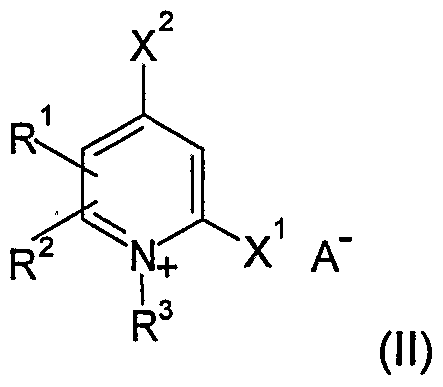
mit der Maßgabe, daß wenn Y eine gegebenenfalls substituierte Vinylengruppe ist, die Verbindungen der Formel II
Figure imgf000005_0001
wobei
• R1, R2, R3 und A" wie oben definiert sind,
• einer der Reste X1 oder X2 steht für ein Halogenatom, eine C|-C -Alkoxygruppe, eine CrC -Alkylmercaptogruppe, eine Sulfonsäuregruppe oder eine p- Toluolsulfonylgruppe und der andere für ein Wasserstoffatom oder die Gruppen, die unter R1 und R2 definiert sind,
mitumfaßt sind,
sowie entsprechenden inneren Salzen, wobei A" entfällt, und B. mindestens eine CH-acide Verbindung.
Beispiele für die als Substituenten im Rahmen dieser Anmeldung genannten C Ce- Alkylreste sind die Gruppen Methyl, Ethyl, Propyl, Isopropyl, n-Butyl, sec-Butyl, tert.- Butyl, n-Pentyl, Neopentyl und Hexyl. Ethyl und Methyl sind bevorzugte Alkylreste. Beispiele für bevorzugte C2-C6-Alkenylreste sind Vinyl und Allyl. Erfindungsgemäß bevorzugte d-C -Alkoxyreste sind beispielsweise eine Methoxy- oder eine Ethoxygruppe. Bevorzugte C C -Mercaptogruppen sind die Methylmercapto oder die Ethylmercaptogruppe; die Methylmercaptogruppe ist besonders bevorzugt. Weiterhin können als bevorzugte Beispiele für eine CrC6-Hydroxyalkylgruppe eine Hydroxymethyl- , eine 2-Hydroxyethyl-, eine 2-Hydroxy propyl, eine 3-Hydroxypropyl-, eine 4- Hydroxybutylgruppe, eine 1 ,2-DihydroxyethyIgruppe und die 2,3-Dihydroxypropylgruppe genannt werden. Eine 2-Hydroxyethylgruppe und eine 2,3-Dihydroxypropylgruppe sind besonders bevorzugt. Bevorzugte Arylgruppen sind Phenyl, Naphthyl und Biphenyl. Beispiele für Halogenatome sind F-, Cl-, oder Br-Atome, wobei Cl-Atome ganz besonders bevorzugt sind. Bevorzugte CrC4-Aminoalkylgruppen sind die Aminomethyl-, die Aminoethyl und die Aminopropylgruppe. Beispiele für bevorzugte C C4- Dialkylamino-CrCralkylgruppen sind 2-(N,N-Dimethylamino)ethyl, 2-(N,N- Diethylamino)ethyl, 3-(N,N-Dimethylamino)propyl und 3-(N,N-Diethylamino)propyl. Beispiele für eine Aryl-d-C^alkylgruppe sind Benzyl und 2-Phenylethyl. Die weiteren verwendeten Begriffe leiten sich erfindungsgemäß von den hier gegebenen Definitionen ab.
Die Verbindungen mit den Formeln I und II sind zum großen Teil literaturbekannt, im Handel erhältlich oder nach bekannten Syntheseverfahren herstellbar.
Unter keratinhaltigen Fasern sind Wolle, Pelze, Federn und insbesondere menschliche Haare zu verstehen. Die erfindungsgemäßen Färbemittel können prinzipiell aber auch zum Färben anderer Naturfasern, wie z. B. Baumwolle, Jute, Sisal, Leinen oder Seide, modifizierter Naturfasern, wie z. B. Regeneratcellulose, Nitro-, Alkyl- oder Hydroxyalkyl- oder Acetylcellulose und synthetischer Fasern, wie z. B. Polyamid-, Polyacrylnitril-, Polyurethan- und Polyesterfasern verwendet werden.
Bevorzugte Verbindungen gemäß Formel I bzw. Formel II sind Substanzen, in denen das Kation ausgewählt ist aus 2-Chlor-1-ethyl-chinolinium, 4-Chlor-1-ethyl-chinolinium, 2-Chlor-1-methyl-pyridinium, 4-Chlor-1-methyl-pyridinium, 3-Ethyl-2-methylmercapto- benzothiazolium, 3-Ethyl-2-methylmercapto-benzoxazolium, 2-Chlor-1 ,3-diethyl- benzimidazolium, 2-Chlor-3-ethyl-benzoxazolium oder 2-Chlor-3-ethyl-benzothiazolium und das Gegenion A" ausgewählt ist aus Chlorid, Bromid, lodid, Hexafluorophosphat, Tetrachlorozinkat, Tetrafluoroborat, Trifluormethylsulfonat, Methylsulfonat oder p- Toluolsulfonat sowie den inneren Salzen 3-Ethyl-benzothiazolium-2-sulfonat, 1-Ethyl- chinolinium-4-sulfonat und 1-Ethyl-chinolinium-2-sulfonat.
Besonders bevorzugte Verbindungen gemäß Formel I bzw. II sind 4-Chlor-1- ethylchinolinium-tetrafluororborat, 3-Ethyl-2-methylmercapto-benzothiazolium-tetrafluoro- borat und 3-Ethyl-benzothiazolium-2-sulfonat
Die CH-acide Verbindung ist bevorzugt ausgewählt aus Verbindungen gemäß einer der Formeln C1 bis C22
M1 - CH2 - M2 (C1)
worin
• M1 eine Gruppe -COM3, COOM3, S(O)M3 oder SO2M3 ist, worin M3 für ein Wasserstoffatom oder eine CrCβ-Alkylgruppe steht, oder eine Gruppe - C(M4)=C(C-sN)2 bedeutet, worin M4 für ein Wasserstoff atom, eine d-C4-Alkylgruppe oder eine Arylgruppe steht,
• M2 die gleiche Bedeutung wie M1 hat oder eine Cyanogruppe, eine substituierte oder unsubstituierte Arylgruppe oder Aryl-d-d-alkylgruppe, ein substituierter oder unsubstituierter, gesättigter oder ungesättigter Heterozyklus ist,
Verbindungen mit der Formel C2
Figure imgf000007_0001
worin
M eine Cyanogruppe, eine substituierte oder unsubstituierte Arylgruppe oder eine Aryl-CrGralkylgruppe, ein substituierter oder uπsubstituierter, gesättigter oder ungesättigter Heterozyklus oder eine Gruppe -COM7 oder COOM7 ist, worin M7 für ein Wasserstoffatom oder eine CrC6-Alkylgruppe steht, • M6 eine substituierte oder unsubstituierte CrC6-Alkylgruppe, eine Acetyloxygruppe, eine C3-C6-Cycloalkylgruppe, eine substituierte oder unsubstituierte Arylgruppe oder Aryl-CrCralkylgruppe, eine substituierte oder unsubstituierte Aminoarylgruppe, ein substituierter oder unsubstituierter, gesättigter oder ungesättigter Heterozyklus ist,
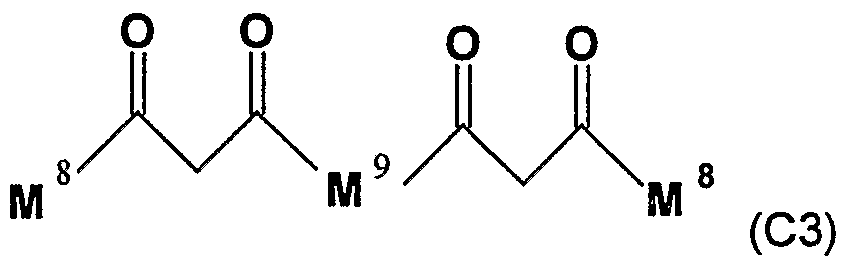
Verbindungen mit der Formel C3
Figure imgf000008_0001
worin
• M8 eine Cyanogruppe, eine substituierte oder unsubstituierte Arylgruppe oder Aryl- C C4-alkylgruppe, ein substituierter oder unsubstituierter, gesättigter oder ungesättigter Heterozyklus oder eine Gruppe -COM10 oder COOM10 ist, worin M10 für ein Wasserstoffatom oder eine CrC6-Alkylgruppe steht,
• M9 eine substituierte oder unsubstituierte Arylgruppe oder Aryl-C C4-alkylgruppe, eine substituierte oder unsubstituierte Aminoarylgruppe, ein substituierter oder unsubstituierter, gesättigter oder ungesättigter Heterozyklus ist,
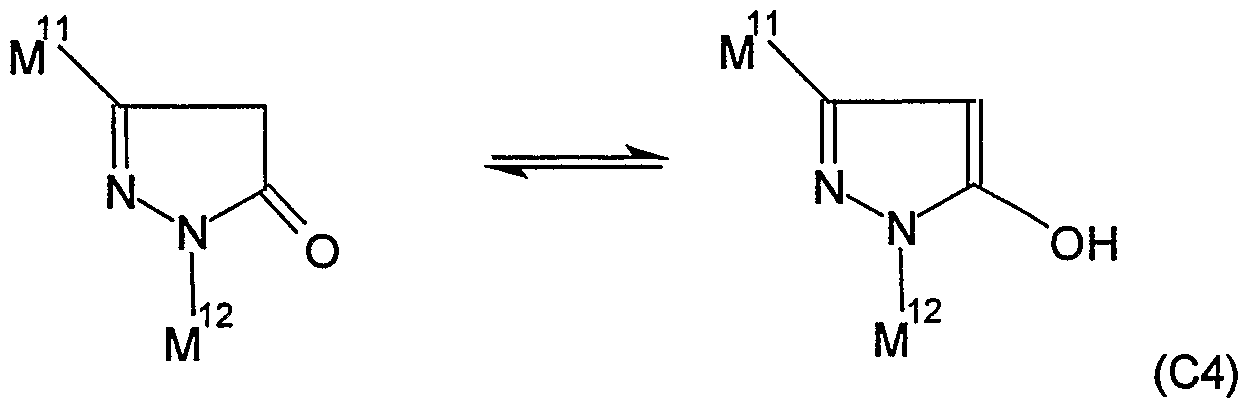
Pyrazolderivate (a), die ausgewählt sein können aus den folgenden Formeln C4 und C5
Figure imgf000008_0002
Figure imgf000009_0001
worin
• M11 und M12 unabhängig voneinander für eine substituierte oder unsubstituierte d- Ce-Alkylgruppe, eine Acetyloxygruppe, eine C3-C6-Cycloalkylgruppe, eine substituierte oder unsubstituierte Arylgruppe oder Aryl-d-C -alkylgruppe, eine substituierte oder unsubstituierte Aminoarylgruppe, einen substituierter oder unsubstituierter, gesättigten oder ungesättigten Heterozyklus stehen,
• M13 ein Wasserstoffatom oder eine substituierte oder unsubstituierte d-C6- Alkylgruppe ist,
(b) zwei über M11 oder M12 gebundene Pyrazolringe mit der Formel C4 oder C5
Barbitursäurederivate mit der folgenden Formel C6
Figure imgf000009_0002
worin
• M14 und M15 stehen unabhängig voneinander für eine d-C6-Alkylgruppe, eine C2-C6- Alkenylgruppe, eine C3-C6-Cycloalkylgruppe, eine Aryl-d-d-alkylgruppe, eine substituierte oder unsubstituierte Arylgruppe, oder einen über die Reste M14 oder M15 gebundenen Bicyclus,
• X steht für ein Sauerstoff- oder ein Schwefelatom,
Pyridinderivate mit der Formeln C7a und C7b
Figure imgf000010_0001
worin
M «16 eine substituierte oder unsubstituierte CrC6-Alkylgruppe oder substituierte oder unsubstituierte Arylgruppe ist,
M17 ein Wasserstoffatom, eine substituierte oder unsubstituierte d-C6-Alkylgruppe oder eine substituierte oder unsubstituierte Arylgruppe ist,
M ein Wasserstoffatom, eine Cyanogruppe, eine substituierte oder unsubstituierte d-Ce-Alkylgruppe, eine Gruppe COOM19, worin M19 ein Wasserstoffatom oder eine substituierte oder unsubstituierte C1-C6-Alkylgruppe bedeutet, ist,
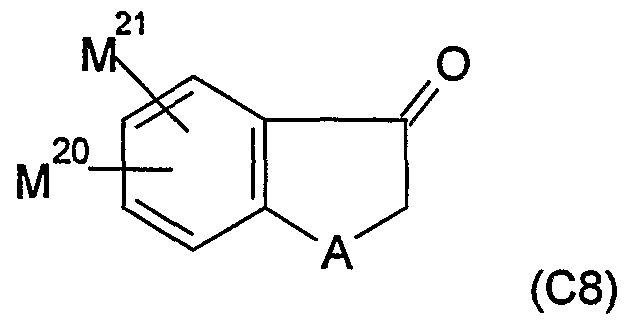
Verbindungen mit der.folgenden Formel C8
Figure imgf000010_0002
worin
A steht für ein Sauerstoffatom, ein Schwefelatom, eine Sulfoxylgruppe, eine Sulfonylgruppe oder eine Gruppe NM20a, worin M20a ein Wasserstoffatom, eine substituierte oder unsubstituierte d-C6-Alkylengruppe bedeutet,
• M und M stehen unabhängig voneinander für ein Wasserstoff-, ein Chlor-, ein Bromatom, eine Hydroxygruppe, eine Nitrogruppe, eine d-C6-Alkylgruppe, eine C C6-Alkoxy-, eine Carboxamid-, eine Sulfonamid-, eine Carboxyl-, eine d-C -Acyl, eine Cyanogruppe oder eine Aminogruppe -NM22M23, in der M22 und M23 unabhängig voneinander stehen für ein Wasserstoffatom oder eine d-C6-Alkylgruppe,
Verbindungen mit den Formeln C9 und C10
Figure imgf000011_0001
worin
A' steht für ein Sauerstoffatom, ein Schwefelatom oder eine Gruppe NM25, worin M25 ein Wasserstoffatom oder eine substituierte oder unsubstituierte C C6-Alkylgruppe bedeutet,
M24 steht für ein Wasserstoff-, ein Chlor-, ein Bromatom, eine Hydroxygruppe, eine Nitrogruppe, eine d-C6-Alkyl-, eine d-C6-Alkoxy-, eine Carboxamid-, eine Sulfonamid-, eine Carboxyl-, eine d-C4-Acyl, eine Cyanogruppe oder eine Aminogruppe -NM26M27, in der M26 und M27 unabhängig voneinander stehen für Wasserstoff und eine d-C6-Alkylgruppe
Verbindungen mit der Formel C11
Figure imgf000011_0002
worin
M χ2δ ein Wasserstoffatom, eine Hydroxygruppe, eine substituierte oder unsubstituierte d-C6-Alkylgruppe oder eine substituierte oder unsubstituierte Aryl- oder d-C6- Alkylarylgruppe ist;
M|29 steht für ein Wasserstoffatom oder eine d-d-Alkylgruppe
Indandionderivate mit der Formel C12
Figure imgf000011_0003
worin
• M30 ein Wasserstoff-, ein Chlor-, ein Bromatom, eine Nitro-, eine d-C6-Alkyl-, eine d-C6-Alkoxy-, eine Carboxamid-, eine Sulfonamid- oder eine Cyanogruppe ist,
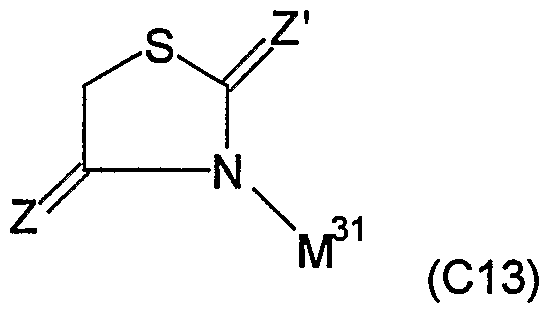
Verbindungen mit der Formel C13
Figure imgf000012_0001
worin
• Z steht für ein Sauerstoffatom oder eine Gruppe NM32, worin M32 ein Wasserstoffatom oder eine C C6-Alkylgruppe bedeutet,
• Z' steht für ein Schwefelatom oder eine Gruppe NM33, worin M33 ein Wasserstoffatom oder eine d-C6-Alkylgruppe bedeutet,
• M31 steht für ein Wasserstoff atom, eine d-C6-Alkylgruppe oder eine d-d-Carboxy- alkylgruppe,
Dioxopyrazolverbindungen mit der Formel C14
Figure imgf000012_0002
worin
• M34 und M35 stehen unabhängig voneinander für ein Wasserstoff-, ein Chlor-, ein Bromatom, eine Hydroxygruppe, eine Nitrogruppe, eine d-C6-Alkyl-, eine d-C6- Alkoxy-, eine Carboxamid-, eine Sulfonamid-, eine Carboxyl-, eine d-d-Acyl, eine Cyanogruppe oder eine Aminogruppe -NM36M37, in der M36 und M37 unabhängig voneinander stehen für Wasserstoff oder eine d-C6-Alkylgruppe,
5-Oxoimidazolderivate mit der Formel C15
Figure imgf000013_0001
worin
• M38 und M39 stehen unabhängig voneinander für ein Wasserstoff-, ein Chlor-, ein Bromatom, eine Hydroxygruppe, eine Nitrogruppe, eine C1-C6-Alkyl-, eine d-C6- Alkoxy-, eine Carboxamid-, eine Sulfonamid-, eine Carboxyl-, eine d-d-Acyl, eine Cyanogruppe oder eine Aminogruppe -NM 1M42, in der M41 und M42 unabhängig voneinander stehen für ein Wasserstoffatom oder eine d-C6-Alkylgruppe,
• M40 steht für ein Waserstoffatom oder eine d-C6-Alkylgruppe,
Derivate von Dehydrobutyrolacton mit der Formel C16
Figure imgf000013_0002
worin
• M43 und M44 unabhängig voneinander stehen für ein Wasserstoff-, ein Chlor-, ein Bromatom, eine Hydroxygruppe, eine Nitrogruppe, eine d-C6-Alkyl-, eine d-C6- Alkoxy-, eine Carboxamid-, eine Sulfonamid-, eine Carboxyl-, eine d-d-Acyl, eine Cyanogruppe oder eine Aminogruppe -NM45M46, in der M45 und M46 unabhängig voneinander stehen für ein Wasserstoffatom oder eine d-C6-Alkylgruppe
Verbindungen mit der Formel C17
D
(C17)
worin D1 ist ein ankondensierter aromatischer oder heteroaromatischer Ring,
D2 ist eine Carbonylgruppe, eine Gruppe C=CDIDM oder eine Gruppe CDO", in welchen D1 oder D11 jeweils ein Substituent mit einer Hammett-Konstante zwischen
0,4 und 2,0 oder beide Substituenten in der Summe eine Hammett-Konstante zwischen 0,4 und 2,0 aufweisen;
D3 steht für eine Carbonylgruppe, ein Sauerstoff-, ein Schwefelatom, eine Gruppe
NM47, wenn D2 nicht Sauerstoff ist, oder eine Gruppe C=S, eine Gruppe C=NR48, eine Sulfinylgruppe, eine Sulfonylgruppe, wobei R47 und R48 unabhängig voneinander ein Wasserstoffatom oder einen d-C4-Alkyirest bedeuten,
Hydroxypyrimidinderivate mit der Formel C18
Figure imgf000014_0001
worin
• M49 und M50 unabhängig voneinander ein Wasserstoffatom oder eine substituierte oder unsubstituierte d-C6-Alkylgruppe sind,
• E1 für ein Sauerstoff, ein Schwefelatom oder eine Gruppe NH steht,
• E2 für eine Gruppe NH oder ein Sauerstoffatom steht,
• E3 für eine Aminogruppe oder eine Hydroxygruppe steht,
mit der Maßgabe, daß a) wenn E1 und E2 für ein Sauerstoffatom stehen, E3 keine Hydroxygruppe ist, und b) wenn E1 ein Schwefelatom und E2 ein Sauerstoffatom ist, E3 keine Hydroxygruppe ist,
quatemierte Stickstoffverbindungen der Formel C19
Figure imgf000014_0002
worin,
M51 und M52 stehen unabhängig voneinander für ein Wasserstoff atom, ein Halogenatom, eine Hydroxygruppe, eine d-C4-Hydroxyalkylgruppe, eine d-C6- Aminoalkylgruppe, eine d-d-Dialkylamino-d-d-alkylgruppe, eine lineare oder verzweigte Ci-d-Alkylgruppe, eine C2-C6-Alkenylgruppe, eine gegebenenfalls substituierte Arylgruppe, eine Sulfonsäuregruppe, eine Carboxylgruppe, eine Formylgruppe, eine Nitrogruppe, eine Cyanogruppe oder eine Gruppe -NM54M55, wobei M54und M55 stehen unabhängig voneinander für ein Wasserstoff atom, eine d-C6-Alkylgruppe, eine C2-C6-Alkenylgruppe, eine Aryl-d-C4-alkylgruppe oder eine d-C -Hydroxyalkylgruppe, wobei M51 und M52 zusammen einen ankondensierten 5- oder 6-gliedrigen, aliphatischen oder aromatischen bzw. heteroaromatischen Ring bilden können, welcher wiederum mit den Resten M56 und M57 substituiert ist, wobei M56 und M57 stehen unabhängig voneinander für die Reste, die unter M51 definiert sind,
M53 steht für ein Wasserstoff atom, eine d-C -Hydroxyalkylgruppe, eine d-C6- Aminoalkylgruppe, eine d-d-Dialkylamino-d-d-alkylgruppe, eine lineare oder verzweigte d-C6-Alkylgruppe, eine C2-C6-Alkenylgruppe, eine gegebenenfalls substituierte Arylgruppe, eine d-C -Sulfonylalkylgruppe, eine d-d- Carboxyalkylgruppe oder eine C2-C6-Polyhydroxyalkylgruppe,
Y steht für ein Sauerstoffatom, ein Schwefelatom, eine gegebenenfalls substituierte Methylengruppe oder eine Gruppe NM60, wobei M60 für die gleichen Gruppen stehen kann, die unter M55 definiert sind,
A" steht für ein Chlorid, Bromid, lodid, Hexafluorophosphat, Tetrachlorozinkat, Tetrafluoroborat, Trifluormethylsulfonat, Methylsulfonat oder p-Toluolsulfonat,
Oniumverbindungen der Formeln C20 und C21
Figure imgf000015_0001
wobei M51, M52, M53 und A" aus den Gruppen ausgewählt werden, die unter Verbindung C19 definiert sind. Unter CH-acide Verbindungen fallen erfindungsgemäß auch Enamine, die aus quaternierten N-Heterocyclen mit einer in Konjugation zum quatären Stickstoff stehenden CH-aciden Alkylgruppe durch alkalische Behandlung entstehen. Als Beispiele für geeignete Enamine können Verbindungen mit der allgemeinen Formel C22 genannt werden,
Figure imgf000016_0001
worin
M61 steht für einen aromatischen Rest, insbesondere für einen gegebenenfalls mit einer d-d-Alkyl-, d-d-Hydroxyalkyl-, Hydroxy-, Methoxy- oder Halogengruppe substituierten 5-gliedrigen oder 6-gliedrigen Arylrest, vorzugsweise ein Phenylrest, oder einen 5-gliedrigen oder 6-gliedrigen, ankondensierten, aliphatischen oder aromatischen, carbozyklischen oder heterozyklischen Ring, vorzugsweise einen Phenylrest, einen Chinolin- oder Pyridylrest,
M62 steht für ein Wasserstoffatom, eine lineare oder verzweigte C C8-Alkyl-, eine lineare oder verzweigte d-C8-Hydroxyalkyl- oder eine d-Cs-Alkoxyalkylgruppe, wobei zwischen den C-Atomen der Alkylkette ein Sauerstoffatom sitzen kann, und M63 steht für eine lineare oder verzweigte d-CB-Alkylgruppe, eine Cι-C6-Alkoxy-d- C6-alkylgruppe, eine d-Ce-Alkylamino-d-Ce-alkylgruppe, eine C C6-Alkylmercapto- d-d-alkylgruppe, eine Crd-Alkoxy-d-Ce-alkylengruppe, eine d-d-Alkylamino- d-d-alkylengruppe, eine d-Ce-Alkylmercapto-d-Ce-alkylengruppe, eine geradkettige oder verzweigte d-C8-Alkylengruppe, oder ein Sauerstoffatom, ein Stickstoffatom oder ein Schwefelatom ist, mit der Maßgabe, daß die Reste M61 und M63 gemeinsam mit dem Stickstoffatom und dem Kohlenstoffatom der Enamingrundstruktur eine cyclische Verbindung bilden, wenn M63 gleich einer linearen oder verzweigten Cι-C8-Alkylengruppe, einer d-C8-AlkoxyaIkylengruppe, eine d-d-Alkylamino-d-Ce-alkylengruppe, eine d-Ce-Alkylmercapto-d-Cer alkylengruppe, einem Sauerstoffatom, einem Stickstoffatom oder einem Schwefelatom ist, wobei vorzugsweise M63 am aromatischen Rest M61 mit dem Kohlenstoff verbunden ist, der in ortho-Stellung zum Enamin-substituierten Kohlenstoff steht.
In einer besonders bevorzugten Ausführungsform sind die CH-aciden Verbindungen ausgewählt aus 1,2,3,3-Tetramethy!-3H-indoliumiodid, 1,2,3,3-Tetramethyl-3H-indolium- p-toluolsulfonat, 1 ,2,3,3-Tetramethyl-3H-indolium-methansulfonat, 1 ,3,3-Trimethyl-2- methylenindolin (Fischersche Base), 2,3-Dimethyl-benzothiazoliumiodid, 2,3-Dimethyl- benzothiazolium-p-toluolsulfonat, 2,3-Dimethyl-naphtho[1,2-d]thiazolium-p-toluolsulfonat, 3-Ethyl-2-methyl-naphtho[1 ,2-d]thiazolium-p-toluolsulfonat, Rhodanin, Rhodanin-3-es- sigsäure, 1 ,4-Dimethylchinolinium-iodid, 1,2-Dimethylchinolinium-iodid, Barbitursäure, Thiobarbitursäure, 1,3-Dimethylthiobarbitursäure, 1 ,3-Diethylthiobarbitursäure, 1 ,3- Diethylbarbitursäure, Oxindol, 3-lndoxylacetat, 2-Cumaranon, 5-Hydroxy-2-cumaranon, 6-Hydroxy-2-cumaranon, 1-Methyl-3-phenyl-pyrazolin-5-on, lndan-1,2-dion, lndan-1,3- dion, lndan-1-on, Benzoylacetonitril, 3-Dicyanmethylenindan-1-on, 1,3-Diiminoisoindolin, 2-Amino-4-imino-1 ,3-thiazolin-hydrochlorid, 5,5-Dimethylcyclohexan-1 ,3-dion, 2H-1 ,4- Benzoxazin-4H-3-on, 3-Ethyl-2-methyl-benzoxazoliumiodid, 3-EthyI-2-methyl- benzothiazoliumiodfd, 1-EthyI-4-methyl-chinoIiniumiodid, 1 -Ethyl-2- methylchinoliniumiodid, 1 ,2,3-Trimethylchinoxaliniumiodid, 3-Ethyl-2-methyl- benzoxazolium-p-toluolsulfonat, 3-Ethyl-2-methyl-benzothiazolium-p-toluolsulfonat, 1 - Ethyl-4-methyl-chinolinium-p-toluolsulfonat, 1-Ethyl-2-methylchinolinium-p-toluolsulfonat, und 1 ,2,3-Trimethylchinoxalinium-p-toluolsulfonat.
Färbungen mit noch erhöhter Brillanz und verbesserten Echtheitseigenschaften (Lichtechtheit, Waschechtheit, Reibechtheit) über einen weiten Nuancenbereich werden erzielt, wenn die erfindungsgemäß eingesetzten Verbindungen der Formeln I bzw II gemeinsam mit mindestens einer weiteren Komponente (im folgenden Komponente C genannt), ausgewählt aus (a) aromatischen oder heteroaromatischen Aldehyden oder Ketonen, (b) Aminosäuren, (c) aus 2 bis 9 Aminosäuren aufgebauten Oligopeptiden sowie (d) Verbindungen mit primärer oder sekundärer Aminogruppe oder Hydroxygruppe, ausgewählt aus primären oder sekundären aromatischen Aminen, stickstoffhaltigen heterocyclischen Verbindungen und aromatischen Hydroxyverbindungen und deren physiologisch verträglichen Salzen verwendet werden. Dies sind einerseits Verbindungen, die für sich alleine keratinhaltige Fasern nur schwach färben und erst gemeinsam mit den Verbindungen der Formeln I bzw. II brillante Färbungen ergeben. Andererseits sind darunter aber auch Verbindungen, die bereits als Oxidationsfarb- stoffvorprodukte eingesetzt werden.
In einer zweiten Ausführungsform ist es daher bevorzugt, dem Färbemittel zusätzlich eine Komponente C, enthaltend mindestens eine Verbindung ausgewählt aus (a) aromatischen oder heteroaromatischen Aldehyden oder Ketonen, (b) Aminosäuren, (c) aus 2 bis 9 Aminosäuren aufgebauten Oligopeptiden und (d) Verbindungen mit primärer oder sekundärer Amino- oder Hydroxygruppe, ausgewählt aus aromatischen Hydroxyverbindungen, primären oder sekundären aromatischen Aminen und stickstoffhaltigen heterozyklischen Verbindungen, zu addieren.
Bevorzugt enthält die Komponente C mindestens eine Verbindung ausgewählt aus aromatischen oder heteroaromatischen Aldehyden oder Ketonen.
Bevorzugt eingesetzte aromatische oder heteroaromatische Aldehyde oder Ketone sind ausgewählt aus
5-(4-Dimethylaminophenyl)-penta-2,4-dienaI, 5-(4-Diethylaminophenyl)-penta-2,4-di- enal, 5-(4-Methoxyphenyl)-penta-2,4-dienaI, 5-(3,4-Dimethoxyphenyl)-penta-2,4- dienal, 5-(2,4-Dimethoxyphenyl)-penta-2,4-dienal, 5-(4-Piperidinophenyl)-penta-2,4- dienal, 5-(4-Morpholinophenyl)-penta-2,4-dienal, 5-(4-Pyrrolidinophenyl)-penta-2,4- dienal, 6-(4-Dimethylaminophenyl)-hexa-3,5-dien-2-on, 6-(4-Diethylaminophenyl)- hexa-3,5-dien-2-on, 6-(4-Methoxyphenyl)-hexa-3,5-dien-2-on, 6-(3,4-
Dimethoxypheny!)-hexa-3,5-dien-2-on, 6-(2,4-Dimethoxyphenyl)-hexa-3,5-dien-2-on, 6-(4-Piperidinophenyl)-hexa-3,5-dien-2-on, 6-(4-Morpholinophenyl)-hexa-3,5-dien-2- on, 6-(4-Pyrrolidinophenyl)-hexa-3,5-dien-2-on, 5-(4-Dimethylaminonaphth-1-yl)- penta-2,4-dienal,
2-Nitropiperonal, 5-Nitropiperonal, 6-Nitropiperonal, 5-Hydroxy-2-nitropiperonal, 2- Hydroxy-5-nitropiperonaI, 2-Chlor-6-nitropiperonal, 5-Chlor-2-nitropiperonal, 2,6-Di- nitropiperonal,
2-Nitrobenzaldehyd, 3-Nitrobenzaldehyd, 4-Nitrobenzaldehyd, 4-Methyl-3-nitrobenz- aldehyd, 3-Hydroxy-4-nitrobenzaldehyd, 4-Hydroxy-3-nitrobenzaldehyd, 5-Hydroxy- 2-nitrobenzaldehyd, 2-Hydroxy-5-nitrobenzaldehyd, 2-Hydroxy-3-nitrobenzaldehyd, 2-Fluor-3-nitrobenzaldehyd, 3-Methoxy-2-nitrobenzaldehyd, 4-Chlor-3- nitrobenzaldehyd, 2-Chlor-6-nitrobenzaldehyd, 5-Chlor-2-nitrobenzaldehyd, 4-Chlor- 2-nitrobenzaldehyd, 2,4-Dinitrobenzaldehyd, 2,6-Dinitrobenzaldehyd, 2-Hydroxy-3- methoxy-5-nitrobenzaldehyd, 4,5-Dimethoxy-2-nitrobenzaldehyd, 5-Nitrovanillin, 3,5- Dinitrosalicylaldehyd, 5-Brom-3-nitrosalicylaIdehyd, 3-Nitro-4-formylben- zolsulfonsäure, 4-Nitro-1-naphthaldehyd, 2-Nitrozimtaldehyd, 3-Nitrozimtaldehyd, 4- Nitrozimtaldehyd,
Carbazolaldehyde oder Carbazolketone, insbesondere 9-Methyl-3-carbazolaldehyd, 9-Ethyl-3-carbazolaldehyd, 3-Acetylcarbazol, 3,6-Diacetyl-9-ethylcarbazol, 3-Acetyl- 9-methylcarbazol, 1 ,4-Dimethyl-3-carbazolaldehyd, 1 ,4,9-Trimethyl-3- carbazolaldehyd,
4-Trimethylammoniobenzaldehyd-, 4-Benzyldimethylammoniobenzaldehyd-, 4-Tri- methylammoniozimtaldehyd-, 4-Trimethylammonionaphthaldehyd-, 2-Methoxy-4- trimethylammoniobenzaldehyd-, N-(4-Acetylphenyl)-trimethylammonium-, 4-(N,N- Diethyl)-N-methylammonio)-benzaldehyd-, N-(4-Benzoylphenyl)-trimethyla- mmonium-, N-(4-Benzoylphenyl)-N,N-diethylmethylammonium-, N-(4-Formylphenyl)- N-methylpyrrolidinium-, N-(4-Formylphenyl)-N-methylpiperidinium-, N-(4-Formyl- phenyl)-N-methylmorpholinium-, N-(4-Acetylphenyl)-N-methylmorpholinium-, N-(4- Benzoylphenyl)-N-methylmorpholinium-, 3-Formyl-N-ethyl-N-methylcarbazolium-, 3- Formyl-9,9-dimethylcarbazolium-, 1-(4-Acetylphenyl)-3-methylimidazolium-, 1-(4- Acetylphenyl)-3-methyl-2-imidazolinium-, 1-(4-Benzoylphenyl)-3-methylimidazolium-, 5-Acetyl-1,3-diethyl-2-methylbenzimidazolium-, 5-Trimethylammonio-1-indanon- Salze, insbesondere die Benzolsulfonate, p-Toluolfulfonate, Methansulfonate, Ethansulfonate, Propansulfonate, Perchlorate, Sulfate, Chloride, Bromide, lodide, Tetrachlorozinkate, Methylsulfate, Trifluormethansulfonate, Hexafluorophosphate, Tetrafluoroborate,
4-Formyl-1 -methylpyridinium-, 2-Formyl-1 -methylpyridinium-, 4-Formyl-1 -ethylpyridi- nium-, 2-Formyl-1-ethylpyridinium-, 4-Formyl-1-benzylpyridinium-, 2-Formyl-1- benzylpyridinium-, 4-Formyl-1 ,2-dimethylpyridinium-, 4-Formyl-1 ,3-dimethylpyridini- um-, 4-Formyl-1-methylchinolinium-, 2-Formyl-1-methylchinolinium-, 4-Acety 1-1 -methylpyridinium-, 2-Acetyl-1 -methylpyridinium-, 4-Acetyl-1-methylchinolinium-, 5- Formyl-1 -methylchinolinium-, 6-Formyl-1 -methylchinolinium-, 7-Formyl-1 - methylchinolinium-, 8-Formyl-1 -methylchinolinium, 5-Formyl-1-ethylchinolinium-, 6- Formyl-1 -ethylchinolinium-, 7-Formyl-1 -ethylchinolinium-, 8-Formyl-1 - ethylchinolinium, 5-Formyl-1-benzylchinolinium-, 6-Formyl-1-benzylchinolinium-, 7- Formyl-1-benzylchinolinium-, 8-Formy.-1-benzylchinolinium, 5-Formyl-1- allylchinolinium-, 6-Formy 1-allylchinolinium-, 7-Formyl-1-allylchinolinium- und 8- Formyl-1 -allylchinolinium-, 5-Acetyl-1 -methylchinolinium-, 6-Acetyl-1 - methylchinolinium-, 7-Acetyl-1 -methylchinolinium-, 8-AcetyI-1 -methylchinolinium, 5- Acetyl-1 -ethylchinolinium-, 6-Acetyl-1 -ethylchinolinium-, 7-Acetyl-1 -ethylchinolinium-, 8-Acetyl-1 -ethylchinolinium, 5-Acetyl-1-benzylchino!inium-, 6-Acetyl-1- benzylchinolinium-, 7-Acetyl-1-benzylchinolinium-, 8-Acetyl-1-benzylchinolinium, 5- Acetyl-1 -allylchinolinium-, 6-Acetyl-1 -allylchinolinium-, 7-Acetyl-1 -allylchinolinium- und 8-Acetyl-1 -allylchinolinium, 9-Formyl-10-methylacridinium-, 4-(2-Formylvinyl)-1- methylpyridinium-, 1 ,3-Dimethyl-2-(4-formylphenyl)-benzimidazolinium-, 1 ,3- Dimethyl-2-(4-formylphenyl)-imidazolinium-, 2-(4-Formylphenyl)-3- methylbenzothiazolium-, 2-(4-Acetylphenyl)-3-methylbenzothiazolium-, 2-(4-Formyl- phenyl)-3-methyIbenzoxazolium-, 2-(5-Formyl-2-furyl)-3-methylbenzothiazolium-, 2- (5-Formyl-2-thienyl)-3-methylbenzothiazolium-, 2-(3-Formylphenyl)-3- methylbenzothiazolium-, 2-(4-Formylnaphth-1 -yl)-3-methylbenzothiazolium-, 5- Chlor-2-(4-formylphenyl)-3-methylbenzothiazolium-, 2-(4-Formylphenyl)-3,5- dimethylbenzothiazolium-, 1 -Methyl-2-[2-(4-formylphenyl)-ethenyl]-pyridinium-, 1 - Methyl-4-[2-(4-acetylphenyl)-ethenyl]-pyridinium-, 1-Benzyl-4-[2-(4-formylphenyl)- ethenylj-pyridinium, 1-Methyl-4-[2-(4-formylphenyl)-ethenyl]-pyridinium-, 1-Methyl-2- [2-(4-formylphenyl)-ethenyl]-pyridinium-, 1-Methyl-4-[2-(4-formylphenyl)-ethenyl]- chinolinium, 1-Methyl-2-[2-(4-formylphenyl)-ethenyl]-chinolinium-, 1-Methyl-2-[2-(5- formyl-2-furyl)-ethenyl]-chinolinium-, 1-MethyI-2-[2-(5-formyl-2-thienyl)-ethenyl]- chinolinium-, 1-Methyl-2-[2-(4-formylphenyl)-ethenyl]-benzothiazolinium-, 1 ,3-Di- methyl-2-[2-(4-formylphenyl)-ethenyl]-benzimidazolinium-, 1 ,3-Dimethyl-2-[2-(4-for- mylphenyl)-ethenyl]-imidazolinium-, 1 -Methyl-5-oxo-indeno[1 ,2-b]pyridinium(4-me- thyl-4-azonio-9-fluorenon-), 1-Ethyl-5-oxo-indeno[1 ,2-b]pyridinium(4-Ethyl-4-azonio- 9-fluorenon-), 1 -Benzyl-5-oxo-indeno[1 ,2-b]pyridinium(-4-benzyl-4-azonio-9-fluore- non-), 2-Methyl-5-oxo-indeno[1 ,2-c]pyridinium-, 2-Methyl-9-oxo-indeno[2,1-c]pyridini- um-, 1-Methyl-9-oxo-indeno[2,1-b]pyridinium-salze, insbesondere Benzolsulfonat, p- Toluolsulfonat, Methansulfonat, Perchlorat, Sulfat, Chlorid, Bromid, lodid, Tetrachlorozinkat, Methylsulfat, Trifluormethansulfonat, Tetrafluoroborat, Salicylaldehyd, Vanillin, 4-Hydroxy-3-methoxyzimtaldehyd (Coniferylaldehyd), 2,4- Dihydroxybenzaldehyd, 4-Dimethylaminobenzaldehyd, 4-Diethylaminobenzaldehyd, 4-Dimethylamino-2-hydroxybenzaldehyd, 4-Pyrrolidinobenzaldehyd, 4-
Morpholinobenzaldehyd, 4-Piperidinobenzaldehyd, 4-Dimethylaminoacetophenon, 4- Hydroxynaphthaldehyd, 4-Dimethylaminonaphthaldehyd, 4-
Dimethylaminobenzylidenaceton, 4-Dimethylaminozimtaldehyd, 2-
Dimethylaminobenzaldehyd, 2-Chlor-4-dimethylaminobenzaldehyd, 4- Dimethylamino-2-methylbenzaldehyd, trans-4-Diethylamino-zimtaldehyd, 4-(Dibutyl- amino)-benzaldehyd, 4-Diphenylaminobenzaldehyd, 2,3,6,7-Tetrahydro-1 H,5H-ben- zo[ij]chinolizin-9-carboxaldehyd, 4-Dimethylamino-2-methoxybenzaldehyd, 2,3,6,7- Tetrahydro-8-hydroxy-1 H,5H-benzo[ij]chinolizin-9-carboxaldehyd, 4-(1 -Imidazolyl)- benzaldehyd, 2-Morpholinobenzaldehyd, lndol-3-carboxaIdehyd, 1-Methylindol-3- carboxaldehyd, N-Ethylcarbazol-3-carboxaldehyd, 2-Formylmethylen-1 ,3,3- trimethylindolin (Tribasen Aldehyd)
1,3-Diacetylbenzol, 1,4-Diacetylbenzol, 1,3,5-Triacetylbenzol, 2-Benzoyl-aceto- phenon, 2-(4-Methoxybenzoyl)-acetophenon, 2-(2-Furoyl)-acetophenon, 2-(2- Pyridoyl)-acetophenon, 2-(3-Pyridoyl)-acetophenon,
1 -Phenyl-1 ,2-propandion, 1 -Phenyl-1 ,2-butandion, 1 -Phenyl-3,3-dimethyl-1 ,2- butandion, Benzil, Anisil, Salicil, 5,5'-Dibromsalicil, 2,2'-Furil, 2,2'-Thienil, 2,2'-, 4,4'- Pyridil, 6,6'-Dimethyl-4,4'-pyridil, 4-Hydroxy-, 4-Methoxy-, 4-Chlor-, 4-Methyl-, 4- Dimethylamino-, 4,4'-Dihydroxy-, -Dimethyl-, -Dibrom-, -Dichlor-, -Bis- dimethylamino-, 2,4-Dihydroxy-, 3,3'-Dimethoxy, 2'-Chlor-3,4-dimethoxy-, 3,4,5,3',4',5'-Hexamethoxybenzil,
Isatinderivate, wie 5-ChIorisatin, 5-Methoxyisatin, 5-Nitroisatin, 6-Nitroisatin, 5- Sulfoisatin, lsatin-5-sulfonsäure, lsatin-4-carbonsäure und lsatin-5-carbonsäure, N-substituierte Isatin-Derivate, wie N-Methylisatin, N-(2-Hydroxyalkyl)-isatin, N-(2- Hydroxypropyl)-isatin, N-(3-Hydroxypropyl)-isatin, N-(2,3-Dihydroxypropyl)-isatin, N- (2-Sulfoethyl)-isatin, (3-Sulfopropyl)-isatin, N-Allylisatin, N-Vinylisatin, N- Benzylisatin, N-(4-Methoxybenzyl)-isatin, N-(4-Carboxybenzyl)-isatin, N-(4- Sulfobenzyl)-isatin, N-(2-Dimethylaminoethyl)-isatin, N-(2-Pyrrolidinoethyl)-isatin, N- (2-Piperidinoethyl)-isatin, (2-Morpholinoethyl)-isatin, N-(2-Furylmethyl)-isatin, N- (Thien-2-ylmethyl)-isatin, N-(Pyhd-2-ylmethyl)-isatin, N-(Pyrid-3-ylmethyl)-isatin, N- (Pyrid-4-ylmethyl)-isatin, N-Allylisatin-5-sulfonsäure, 5-Chlor-N-(2-hydroxyethyl)- isatin, 5-Methyl-N-(2-hydroxyethyl)-isatin, 5,7-Dichlor-N-allylisatin, 5-Nitro-N- allylisatin, N-Hydroxymethylisatin, N-Hydroxymethyl-5-methylisatin, N-Hydroxyme- thyl-5-chlorisatin, N-Hydroxymethyl-5-sulfoisatin, N-Hydroxymethyl-5-carboxyisatin, N-Hydroxymethyl-5-nitroisatin, N-Hydroxymethyl-5-bromisatin, N-Hydroxymethyl-5- methoxyisatin, N-Hydroxymethyl-5,7-dichlorisatin, N-Dimethylaminomethylisatin, N- Diethylaminomethylisatin, N-(Bis-(2-hydroxyethyl)-aminomethyl)-isatin, N-(2- Hydroxyethylaminomethyl)-isatin, N-(Bis-(2-hydroxypropyl)-aminomethyl)-isatin, N- Pyrrolidinomethylisatin, N-Piperidinomethylisatin, N-Morpholinomethylisatin, N- (1 ,2,4-Triazolyl)-methylisatin, N-(1-lmidazolyI)-methylisatin, N-Carboxy- methylaminomethylisatin, N-(2-Carboxyethylaminomethyl)-isatin, N-(3-Carboxy- propylaminomethyl)-isatin, N-(Bis-(2-hydroxyethyl)-aminomethyl)-5-methylisatin, N- Piperidinomethyl-5-chlorisatin, N-(2-Sulfoethylamino)-isatin, sowie die Alkali- und gegebenenfalls Ammoniumsalze der sauren Verbindungen, Chinisatin und deren Derivate, wie N-Methylchinisatin,
Acetophenon, Propiophenon, 2-Hydroxyacetophenon, 3-Hydroxyacetophenon, 4- Hydroxyacetophenon, 2-Hydroxypropiophenon, 3-Hydroxypropiophenon, 4-Hy- droxypropiophenon, 2-Hydroxybutyrophenon, 3-Hydroxybutyrophenon, 4-Hy- droxybutyrophenon, 2,4-Dihydroxyacetophenon, 2,5-Dihydroxyacetophenon, 2,6- Dihydroxyacetophenon, 2,3,4-Trihydroxyacetophenon, 3,4,5-Trihydroxyaceto- phenon, 2,4,6-Thhydroxyacetophenon, 2,4,6-Trimethoxyacetophenon, 3,4,5-Tri- methoxyacetophenon, 3,4,5-Trimethoxy-acetophenon-diethylketal, 4-Hydroxy-3- methoxy-acetophenon, 3,5-Dimethoxy-4-hydroxy-acetophenon, 4-Amino-aceto- phenon, 4-Dimethylamino-acetophenon, 4-Morpholino-acetophenon, 4-Piperidino- acetophenon, 4-lmidazolino-acetophenon, 2-Hydroxy-5-brom-acetophenon, 4- Hydroxy-3-nitroacetophenon, Acetophenon-2-carbonsäure, Acetophenon-4- carbonsäure, Benzophenon, 4-Hydroxy-benzophenon, 2-Amino-benzophenon, 4,4'- Dihydroxy-benzophenon, 2,4-Dihydroxy-benzophenon, 2,4,4'-Trihydroxyben- zophenon, 2,3,4-Trihydroxybenzophenon, 2-Hydroxy-1-acetonaphthon, 1-Hydroxy- 2-acetonaphthon, Chromon, Chromon-2-carbonsäure, Flavon, 3-Hydroxyflavon, 3,5,7-Trihydroxyflavon, 4',5,7-Trihydroxyflavon, 5,6,7-Trihydroxyflavon, Quercetin, Indanon, 9-Fluorenon, 3-Hydroxyfluorenon, Anthron, 1,8-Dihydroxyanthron, heterocyclische Carbonylverbindungen, wie 2-lndolaldehyd, 3-lndolaldehyd, 1- Methylindol-3-aldehyd, 2-Methylindol-3-aldehyd, 1-Acetylindol-3-aldehyd, 3-Ace- tylindol, 1-Methyl-3-acetylindoI, 2-(1,3,3-Trimethyl-2-indolinyliden)-acetaldehyd, 1- Methylpyrrol-2-aldehyd, 1-Methyl-2-acetylpyrrol, 1-Pyridinaldehyd, 2-Pyridinaldehyd, 3-Pyridinaldehyd, 4-Acetylpyridin, 2-Acetylpyridin, 3-Acetylpyridin, Pyridoxal, Chi- nolin-3-aldehyd, Chinolin-4-aldehyd, Antipyrin-4-aldehyd, Furfural, 5-Nitrofurfural, 2- Thenoyl-trifluor-aceton, Chromon-3-aldehyd, 3-(5-Nitro-2-furyl)-acrolein, 3-(2-Furyl)- acrolein, lmidazol-2-aldehyd,
Indanon-Derivate, wie z. B. 1,2-lndandion, 2-Oximo-1 -indanon, lndan-1,2,3-trion-2- oxim, 5-Methoxy-indan-1,2,3-trion-2-oxim, 2-Nitro-1,3-indandion
sowie physiologisch verträgliche Salze der voranstehenden Verbindungen. Die primären und sekundären aromatischen Amine der Komponente C sind bevorzugt ausgewählt aus N,N-Dimethyl-p-phenylendiamin, N,N-Diethyl-p-phenylendiamin, N-(2- Hydroxyethyl)-N-ethyl-p-phenylendiamin, N,N-Bis-(2-hydroxyethyl)-p-phenylendiamin, N- (2-Methoxyethyl)-p-phenylendiamin, 2,3-Dichlor-p-phenylendiamin, 2,4-Dichlor-p- phenylendiamin, 2,5-Dichlor-p-phenyIendiamin, 2-Chlor-p-phenylendiamin, 2,5- Dihydroxy-4-morpholinoanilin, 2-Aminophenol, 3-Aminophenol, 4-Aminophenol, 2-Ami- nomethyl-4-aminophenol, 2-Hydroxymethyl-4-aminophenol, o-Phenylendiamin, m- Phenylendiamin, p-Phenylendiamin, 2,5-Diaminotoiuol, 2,5,-Diaminophenol, 2,5- Diaminoanisol, 2,5,Diaminophenethol, 4-Amino-3-methylphenol, 2-(2,5-Diaminophenyl)- ethanol, 2,4-Diaminophenoxyethanol, 2-(2,5-Diaminophenoxy)-ethanol, 3-Amino-4-(2- hydroxyethyloxy)phenol, 3,4-Methylendioxyphenol, 3,4-Methylendioxyanilin, 3-Amino- 2,4-dichlorphenol, 4-Methylaminophenol, 2-Methyl-5-aminophenol, 3-Methyl-4- aminophenol, 2-MethyI-5-(2-hydroxyethylamino)phenol, 3-Amino-2-chlor-6-methylphenol, 2-Methyl-5-amino-4-chIorphenol, 5-(2-Hydroxyethylamino)-4-methoxy-2-methylphenol, 4- Amino-2-hydroxymethylphenol, 2-(Diethylaminomethyl)-4-aminophenol, 4-Amino-1- hydroxy-2-(2-hydroxyethylaminomethyl)-benzol, 1-Hydroxy-2-amino-5-methyl-benzol, 1- Hydroxy-2-amino-6-methyl-benzol, 2-Amino-5-acetamido-phenol, 1 ,3-Dimethyl-2,5- diaminobenzol, 5-(3-Hydroxypropylamino-)2-methylphenol, 5-Amino-4-methoxy-2- methylphenol, N,N-Dimethyl-3-aminophenol, N-Cyclopentyl-3-aminophenol, 5-Amino-4- fluor-2-methylphenol, 2,4-Diamino-5-fluortoluol, 2,4-Diamino-5-(2-hydroxyethoxy)-toluol, 2,4-Diamino-5-methylphenetol, 3,5-Diamino-2-methoxy-1 -methylbenzol, 2-Amino-4-(2- hydroxyethylamino)-anisol, 2,6-Bis-(2-hydroxyethylamino)-1 -methylbenzol, 1 ,3-Diamino- 2,4-dimethoxybenzol, 3,5-Diamino-2-methoxy-toluol, 2-Aminobenzoesäure, 3- Aminobenzoesäure, 4-Aminobenzoesäure, 2-Aminophenylessigsäure, 3-Amino- phenylessigsäure, 4-Aminophenylessigsäure, 2,3-Diaminobenzoesäure, 2,4- Diaminobenzoesäure, 2,5-Diaminobenzoesäure, 3,4-Diaminobenzoesäure 3,5-Diamino- benzoesäure, 4-Aminosalicylsäure, 5-Aminosalicylsäure, 3-Amino-4-hydroxy- benzoesäure, 4-Amino-3-hydroxy-benzoesäure, 2-Aminobenzolsulfonsäure, 3-Ami- nobenzolsulfonsäure, 4-Aminobenzolsulfonsäure, 3-Amino-4-hydroxybenzolsulfonsäure, 4-Amino-3-hydroxynaphthalin-1-sulfonsäure, 6-Amino-7-hydroxynaphthalin-2-sulfon- säure, 7-Amino-4-hydroxynaphthalin-2-sulfonsäure, 4-Amino-5-hydroxynaphthalin-2,7-di- sulfonsäure, 3-Amino-2-naphthoesäure, 3-AminophthaIsäure, 5-Aminoisophthalsäure, 1,3,5-Triaminobenzol, 1 ,2,4-Thaminobenzol, 1,2,4,5-TetraaminobenzoI, 2,4,5-Thamino- phenol, Pentaaminobenzol, Hexaaminobenzol, 2,4,6-Triaminoresorcin, 4,5-Diamino- brenzcatechin, 4,6-Diaminopyrogallol, 1-(2-Hydroxy-5-aminobenzyl)-2-imidazolidinon, 4- Amino-2-((4-[(5-amino-2-hydroxyphenyl)methyl]-piperazinyl)methyl)phenol, 3,5-Diamino- 4-hydroxybrenzcatechin, 1 ,4-Bis-(4-aminophenyl)-1 ,4-diazacycloheptan, aromatische Nitrile, wie 2-Amino-4-hydroxybenzonitril, 4-Amino-2-hydroxybenzonitril, 4- Aminobenzonitril, 2,4-Diaminobenzonitril, Nitrogruppen-haltige Aminoverbindungen, wie 3-Amino-6-methylamino-2-nitro-pyridin, Pikraminsäure, [8-[(4-Amino-2-nitrophenyl)-azo]- 7-hydroxy-naphth-2-yI]-trimethylammoniumchlorid, [8-((4-Amino-3-nitrophenyl)-azo)-7- hydroxy-naphth-2-yl]-trimethylammoniumchlorid (Basic Brown 17), 1-Hydroxy-2-amino- 4,6-dinitrobenzol, 1-Amino-2-nitro-4-[bis-(2-hydroxyethyI)amino]-benzol, 1-Amino-2-[(2- hydroxyethyl)amino]-5-nitrobenzol (HC Yellow Nr. 5), 1-Amino-2-nitro-4-[(2- hydroxyethyl)amino]-benzol (HC Red Nr. 7), 2-Chlor-5-nitro-N-2-hydroxyethyl-1 ,4-pheny- lendiamin, 1-[(2-Hydroxyethyl)amino]-2-nitro-4-amino-benzol (HC Red Nr. 3), 4-Amino-3- nitrophenol, 4-Amino-2-nitrophenol, 6-Nitro-o-toluidin, 1-Amino-3-methyl-4-[(2-hydroxy- ethyl)amino]-6-nitrobenzol (HC Violet Nr. 1), 1-Amino-2-nitro-4-[(2,3- dihydroxypropyl)amino]-5-chlor-benzol (HC Red Nr. 10), 2-(4-Amino-2-nitroanilino)-ben- zoesäure, 6-Nitro-2,5-diaminopyridin, 2-Amino-6-chlor-4-nitrophenol, 1-Amino-2-(3- nitrophenylazo)-7-phenylazo-8-naphthol-3,6-disu!fonsäure Dinatriumsalz (Acid blue Nr. 29), 1 -Amino-2-(2-hydroxy-4-nitrophenylazo)-8-naphthol-3,6-disulfonsäure Dinatriumsalz (Palatinchrome green), 1-Amino-2-(3-chlor-2-hydroxy-5-nitrophenylazo)-8-naphthol-3,6- disulfonsäure Dinatriumsalz (Gallion), 4-Amino-4'-nitrostilben-2,2'-disulfonsäure Dinatriumsalz, 2,4-Diamino-3',5'-dinitro-2'-hydroxy-5-methyl-azobenzol (Mordant brown 4), 4'-Amino-4-nitrodiphenylamin-2-sulfonsäure, 4'-Amino-3'-nitrobenzophenon-2- carbonsäure, 1 -Amino-4-nitro-2-(2-nitrobenzylidenamino)-benzol, 2-[2-
(Diethylamino)ethylamino]-5-nitroanilin, 3-Amino-4-hydroxy-5-nitrobenzolsulfonsäure, 3- Amino-3'-nitrobiphenyl, 3-Amino-4-nitro-acenaphthen, 2-Amino-1-nitronaphthalin, 5- Amino-6-nitrobenzo-1,3-dioxol, Aniline, insbesondere Nitrogruppen-haltige Aniline, wie 4- Nitroanilin, 2-Nitroanilin, 1 ,4-Diamino-2-nitrobenzol, 1 ,2-Diamino-4-nitrobenzol, 1-Amino- 2-methyl-6-nitrobenzol, 4-Nitro-1 ,3-phenylendiamin, 2-Nitro-4-amino-1 -(2-hy- droxyethylamino)-benzol, 2-Nitro-1 -amino-4-[bis-(2-hydroxyethyl)-amino]-benzol, 4- Amino-2-nitrodiphenylamin-2'-carbonsäure, 1-Amino-5-chlor-4-(2-hydroyethylamino)-2- nitrobenzol, aromatische Aniline bzw. Phenole mit einem weiteren aromatischen Rest, wie sie in der Formel III dargestellt sind
Figure imgf000025_0001
in der
• R9 für eine Hydroxy- oder eine Aminogruppe, die durch C^-Alkyl-, d-4-Hydroxyalkyl- ,
Figure imgf000025_0002
substituiert sein kann, steht,
• R10, R11, R12, R13 und R14 unabhängig voneinander für ein Wasserstoffatom, eine Hydroxy- oder eine Aminogruppe, die durch d^-Alkyl-, d^-Hydroxyalkyl, CM- Alkoxy-, d-4-Aminoalkyl- oder C^-Alkoxy-C^-alkylgruppen substituiert sein kann, stehen, und
• P für eine direkte Bindung, eine gesättigte oder ungesättigte, ggf. durch Hydroxy- gruppen substituierte Kohlenstoffkette mit 1 bis 4 Kohlenstoff atomen, eine Carbonyl-, Sulfonyl- oder Iminogruppe, ein Sauerstoff- oder Schwefelatom, oder eine Gruppe mit der Formel IV
-Q'-(CH2-Q-CH2-Q")o- (IV)
in der
• Q eine direkte Bindung, eine CH2- oder CHOH-Gruppe bedeutet,
• Q' und Q" unabhängig voneinander für ein Sauerstoffatom, eine NR15-Gruppe, worin R15 ein Wasserstoff atom, eine d^-Alkyl- oder eine Hydroxy-d- -al- kylgruppe, wobei auch beide Gruppen zusammen mit dem Restmolekül einen 5- , 6- oder 7-Ring bilden können, bedeutet, die Gruppe O-(CH2)p-NH oder NH- (CH2)p'-O, worin p und p' 2 oder 3 sind, stehen und
• o eine Zahl von 1 bis 4 bedeutet,
wie beispielsweise 4,4'-Diaminostilben und dessen Hydrochlorid, 4,4'-Diaminostilben- 2,2'-disulfonsäure-mono- oder -di-Na-Salz, 4-Amino-4'-dimethylaminostilben und dessen Hydrochlorid, 4,4'-Diaminodiphenylmethan, 4,4'-Diaminodiphenylsulfid, 4,4'- Diaminodiphenylsulfoxid, 4,4'-Diaminodiphenylamin, 4,4'-Diaminodiphenylamin-2-sulfon- säure, 4,4'-Diaminobenzophenon, 4,4'-Diaminodiphenylether, 3,3',4,4'-Tetraamino- diphenyl, 3,3',4,4'-Tetraamino-benzophenon, 1,3-Bis-(2,4-diaminophenoxy)-propan, 1 ,8- Bis-(2,5-diaminophenoxy)-3,6-dioxaoctan, 1,3-Bis-(4-aminophenylamino)propan, , 1,3- Bis-(4-aminophenylamino)-2-propanol, 1,3-Bis-[N-(4-aminophenyl)-2-hydroxyethyla- mino]-2-propanol, N,N-Bis-[2-(4-aminophenoxy)-ethyl]-methylamin, N-Phenyl-1 ,4-phe- nylendiamin und Bis-(5-amino-2-hydroxyphenyl)-methan.
Die stickstoffhaltigen heterocyclischen Verbindungen der Komponente C sind bevorzugt ausgewählt aus der Gruppe bestehend aus 2-Aminopyridin, 3-Aminopyridin, 4- Aminopyridin, 2-Amino-3-hydroxy-pyridin, 2,6-Diamino-pyridin, 2,5-Diamino-pyridin, 2- (Aminoethylamino)-5-aminopyridin, 2,3-Diamino-pyridin, 2-Dimethylamino-5-amino- pyridin, 2-Methylamino-3-amino-6-methoxy-pyridin, 2,3-Diamino-6-methoxy-pyridin, 2,6- Dimethoxy-3,5-diamino-pyridin, 2,4,5-Triamino-pyridin, 2,6-Dihydroxy-3,4- dimethylpyridin, N-[2-(2,4-Diaminophenyl)aminoethyl]-N-(5-amino-2-pyridyl)-amin, N-[2- (4-Aminophenyl)aminoethyl]-N-(5-amino-2-pyridyl)-amin, 2,4-Dihydroxy-5,6- diaminopyrimidin, 4,5,6-Triaminopyrimidin, 4-Hydroxy-2,5,6-triaminopyrimidin, 2-Hy- droxy-4,5,6-triaminopyrimidin, 2,4,5,6-Tetraaminopyrimidin, 2-Methylamino-4,5,6-triami- nopyrimidin, 2,4-Diaminopyrimidin, 4,5-Diaminopyrimidin, 2-Amino-4-methoxy-6-methyl- pyrimidin, 3,5-Diaminopyrazol, 3,5-Diamino-1 ,2,4-triazol, 3-Aminopyrazol, 3-Amino-5- hydroxypyrazol, 1-Phenyl-4,5-diaminopyrazol, 1-(2-Hydroxyethyl)-4,5-diaminopyrazol, 1- Phenyl-3-methyl-4,5-diaminopyrazol, 4-Amino-2,3-dimethyl-1 -phenyl-3-pyrazolin-5-on (4- Aminoantipyrin), 1-Phenyl-3-methylpyrazol-5-on, 2-Aminochinolin, 3-Aminochinolin, 8- Aminochinolin, 4-Aminochinaldin, 2-Aminonicotinsäure, 6-Aminonicotinsäure, 5-Amino- isochinolin, 5-Aminoindazol, 6-Aminoindazol, 5-Aminobenzimidazol, 7-Ami- nobenzimidazol, 5-Aminobenzothiazol, 7-Aminobenzothiazol, 2,5-Dihydroxy-4- morpholino-anilin sowie Indol- und Indolinderivaten, wie 4-Aminoindol, 5-Aminoindol, 6- Aminoindol, 7-Aminoindol, 5,6-Dihydroxyindol, 5,6-Dihydroxyindolin und 4-Hydroxyin- dolin. Weiterhin als heterocyclische Verbindungen können erfindungsgemäß die in der DE-U1-299 08 573 offenbarten Hydroxypyhmidine eingesetzt werden. Die vorgenannten Verbindungen können sowohl in freier Form als auch in Form ihrer physiologisch verträglichen Salze, z. B. als Salze anorganischer Säuren, wie Salz- oder Schwefelsäure, eingesetzt werden.
Die aromatischen Hydroxyverbindungen der Komponente C sind bevorzugt ausgewählt aus 2-, 4-, 5-Methylresorcin, 2,5-Dimethylresorcin, Resorcin, 3-Methoxyphenol, Brenzkatechin, Hydrochinon, Pyrogallol, Phloroglucin, Hydroxyhydrochinon, 2-, 3-, 4- Methoxy-, 3-Dimethylamino-, 2-(2-Hydroxyethyl)-, 3,4-Methylendioxyphenol, 2,4-, 3,4- Dihydroxybenzoesäure, -phenylessigsäure, Gallussäure, 2,4,6-Trihydroxybenzoesäure, - acetophenon, 2-, 4-Chlorresorcin, 1-Naphthol, 1,5-, 2,3-, 2,7-Dihydroxynaphthalin, 6- Dimethylamino-4-hydroxy-2-naphthalinsulfonsäure und 3,6-Dihydroxy-2,7-naphtha- linsulfonsäure.
Als Aminosäuren kommen bevorzugt alle natürlich vorkommenden und synthetischen α- Aminosäuren in Frage, z.B. die durch Hydrolyse aus pflanzlichen oder tierischen Proteinen, z.B. Kollagen, Keratin, Casein, Elastin, Sojaprotein, Weizengluten oder Mandelprotein zugänglichen Aminosäuren. Dabei können sowohl sauer als auch alkalisch reagierende Aminosäuren eingesetzt werden. Bevorzugte Aminosäuren sind Arginin, Histidin, Tyrosin, Phenylalanin, DOPA (Dihydroxyphenylalanin), Omithin, Prolin, Lysin und Tryptophan. Aber auch andere Aminosäuren, wie z.B. 6-Aminocapronsäure und ß-Alanin, können eingesetzt werden.
Die Oligopeptide können dabei natürlich vorkommende oder synthetische Oligopeptide, aber auch die in Polypeptid- oder Proteinhydrolysaten enthaltenen Oligopeptide sein, sofern sie über eine für die Anwendung in den erfindungsgemäßen Färbemitteln ausreichende Wasserlöslichkeit verfügen. Als Beispiele sind z.B. Glutathion oder die in den Hydrolysaten von Kollagen, Keratin, Casein, Elastin, Sojaprotein, Weizengluten oder Mandelprotein enthaltenen Oligopeptide zu nennen. Bevorzugt ist dabei die Verwendung gemeinsam mit Verbindungen mit primärer oder sekundärer Aminogruppe oder mit aromatischen Hydroxyverbindungen.
Die Verbindungen der Komponente C werden besonders bevorzugt ausgewählt aus 4- Formyl-1 -ethylpyridinium-p-toluolsulfonat, 4-Formyl-1 -methylchinolinium-p-toluolsulfonat, 2-Formyl-1-methylchinolinium-p-toluolsulfonat, Salicylaldehyd, Vanillin, 4-Hydroxy-3- methoxy-zimtaldehyd, 4-DimethyIaminobenzaldehyd, 4-Dimethylamino-2- hydroxybenzaldehyd, 4-Hydroxynaphthaldehyd, lndol-3-carboxaldehyd und Isatin, sowie jeweils aus den vorzugsweise mit anorganischen Säuren gebildeten physiologisch verträglichen Salzen dieser Verbindungen.
Die vorgenannten Verbindungen können sowohl in freier Form als auch in Form ihrer physiologisch verträglichen Salze, insbesondere als Salze anorganischer Säuren, wie Salz- oder Schwefelsäure, eingesetzt werden. Die Verbindungen mit der Formel I bzw. II sowie die Verbindungen der Komponenten B bzw. C werden vorzugsweise in den erfindungsgemäßen Mitteln jeweils in einer Menge von 0,03 bis 65 mmol, insbesondere von 1 bis 40 mmol, bezogen auf 100 g des gesamten Färbemittels, verwendet. Sie können als direktziehende Färbemittel oder in Gegenwart von üblichen Oxidationsfarbstoffvorprodukten eingesetzt werden.
Unter die voranstehend beschriebene Ausführungsform fällt ebenfalls die Verwendung von solchen Substanzen, die Reaktionsprodukte der kationischen heterozyklischen Verbindungen und der CH-aciden Verbindungen als direktziehende Färbemittel. Derartige Reaktionsprodukte können z. B. durch kurzes Erwärmen der beiden Komponenten in stöchiometrischen Mengen in wässrigem neutralen bis schwach alkalischen Milieu erhalten werden, wobei sie entweder als Feststoff aus der Lösung ausfallen oder durch Eindampfen der Lösung daraus isoliert werden. Die Reaktionsprodukte können auch in Kombination mit anderen Farbstoffen oder Farbstoffvorprodukten eingesetzt werden.
In allen Färbemitteln können auch mehrere verschiedene Verbindungen mit der Formel I bzw. Formel II und verschiedene CH-acide Verbindungen gemeinsam zum Einsatz kommen.
Zur Erlangung weiterer und intensiverer Ausfärbungen können die erfindungsgemäßen Mittel zusätzlich Farbverstärker enthalten. Die Farbverstärker sind vorzugsweise ausgewählt aus der Gruppe bestehend aus Piperidin, Piperidin-2-carbonsäure, Piperidin-3- carbonsäure, Piperidin-4-carbonsäure, Pyridin, 2-Hydroxypyridin, 3-Hydroxypyhdin, 4- Hydroxypyridin, Imidazol, 1-Methylimidazol, Histidin, Pyrrolidin, Prolin, Pyrrolidon, Pyrroli- don-5-carbonsäure, Pyrazol, 1,2,4-Triazol, Piperazidin, deren Derivate sowie deren physiologisch verträglichen Salzen.
Die voranstehend genannten Farbverstärker können in einer Menge von jeweils 0,03 bis 65 mmol, insbesondere 1 bis 40 mmol, jeweils bezogen auf 100 g des gesamten Färbemittels, eingesetzt werden.
Auf die Anwesenheit von Oxidationsmitteln, z. B. H2O2, kann dabei verzichtet werden. Es kann jedoch unter Umständen wünschenswert sein, den erfindungsgemäßen Mitteln zur Erzielung der Nuancen, die heller als die zu färbende keratinhaltige Faser sind, Wasserstoffperoxid oder andere Oxidationsmittel zuzusetzen. Oxidationsmittel werden in der Regel in einer Menge von 0,01 bis 6 Gew.-%, bezogen auf die Anwendungslösung, eingesetzt. Ein für menschliches Haar bevorzugtes Oxidationsmittel ist H2O2. Auch Gemische von mehreren Oxidationsmitteln, wie beispielsweise eine Kombination aus Wasserstoffperoxid und Peroxodisulfaten der Alkail- und Erdalkalimetalle oder aus lodidionenquellen, wie z.B. Alkalimetalliodiden und Wasserstoffperoxid oder den vorgenannten Peroxodisulfaten, können verwendet werden. Das Oxidationsmittel bzw. die Oxidationsmittelkombination können erfindungsgemäß in Verbindung mit Oxidationskatalysatoren in dem Haarfärbemittel zur Anwendung kommen. Oxidationskatalysatoren sind beispielsweise Metallsalze oder Metalloxide, die einen leichten Wechsel zwischen zwei Oxidationsstufen der Metallionen ermöglichen. Beispiele sind Salze oder Oxide von Eisen, Ruthenium, Mangan und Kupfer.
In einer bevorzugten Ausführungsform enthalten die erfindungsgemäßen Färbemittel zur weiteren Modifizierung der Farbnuancen neben den erfindungsgemäß enthaltenen Ver- bindungen zusätzlich übliche direktziehende Farbstoffe, z. B. aus der Gruppe der Nitro- phenylendiamine, Nitroaminophenole, Anthrachinone oder Indophenole, wie z. B. die unter den internationalen Bezeichnungen bzw. Handelsnamen HC Yellow 2, HC Yellow 4, HC Yellow 6, Basic Yellow 57, Disperse Orange 3, HC Red BN, Basic Red 76, HC Blue 2, Disperse Blue 3, Basic Blue 99, Disperse Violet 1 , Disperse Violet 4, Disperse Black 9, Basic Brown 16 und Basic Brown 17 bekannten Verbindungen sowie 6-Nitro- 1 ,2,3,4-tetrahydrochinoxalin, 4-N-Ethyl-1 ,4-bis-(2-hydroxyethylamino)-2-nitrobenzol- hydrochlorid und 1-Methyl-3-nitro-4-(2-hydroxyethyl)-aminobenzol. Die erfindungsgemäßen Mittel gemäß dieser Ausführungsform enthalten die direktziehenden Farbstoffe bevorzugt in einer Menge von 0,01 bis 20 Gew.-%, bezogen auf das gesamte Färbemittel.
Weiterhin können die erfindungsgemäßen Zubereitungen auch in der Natur vorkommende Farbstoffe, wie sie beispielsweise in Henna rot, Henna neutral, Henna schwarz, Kamillenblüte, Sandelholz, schwarzen Tee, Faulbaumrinde, Salbei, Blauholz, Krappwurzel, Catechu, Sedre und Alkannawurzel enthalten sind, enthalten.
Es ist nicht erforderlich, daß die Oxidationsfarbstoffvorprodukte oder die fakultativ enthaltenen direktziehenden Farbstoffe jeweils einheitliche Verbindungen darstellen. Vielmehr können in den erfindungsgemäßen Färbemitteln, bedingt durch die Herstellungsverfahren für die einzelnen Farbstoffe, in untergeordneten Mengen noch weitere Komponenten enthalten sein, soweit diese nicht das Färbeergebnis nachteilig beeinflussen oder aus anderen Gründen, z. B. toxikologischen, ausgeschlossen werden müssen.
Die erfindungsgemäßen Färbemittel ergeben bereits bei physiologisch verträglichen Temperaturen von unter 45°C intensive Färbungen. Sie eignen sich deshalb besonders zum Färben von menschlichen Haaren. Zur Anwendung auf dem menschlichen Haar können die Färbemittel üblicherweise in einen wasserhaltigen kosmetischen Träger eingearbeitet werden. Geeignete wasserhaltige kosmetische Träger sind z. B. Cremes, Emulsionen, Gele oder auch tensidhaltige schäumende Lösungen wie z. B. Shampoos oder andere Zubereitungen, die für die Anwendung auf den keratinhaltigen Fasern geeignet sind. Falls erforderlich ist es auch möglich, die Färbemittel in wasserfreie Träger einzuarbeiten.
Weiterhin können die erfindungsgemäßen Färbemittel alle in solchen Zubereitungen bekannten Wirk-, Zusatz- und Hilfsstoffe enthalten. In vielen Fällen enthalten die Färbemittel mindestens ein Tensid, wobei prinzipiell sowohl anionische als auch zwitterionische, ampholytische, nichtionische und kationische Tenside geeignet sind. In vielen Fällen hat es sich aber als vorteilhaft erwiesen, die Tenside aus anionischen, zwitterionischen oder nichtionischen Tensiden auszuwählen.
Als anionische Tenside eignen sich in erfindungsgemäßen Zubereitungen alle für die Verwendung am menschlichen Körper geeigneten anionischen oberflächenaktiven Stoffe. Diese sind gekennzeichnet durch eine wasserlöslich machende, anionische Gruppe wie z. B. eine Carboxylat-, Sulfat-, Sulfonat- oder Phosphat-Gruppe und eine lipophile Alkylgruppe mit etwa 10 bis 22 C-Atomen. Zusätzlich können im Molekül Glykol- oder Polyglykolether-Gruppen, Ester-, Ether- und Amidgruppen sowie Hydroxylgruppen enthalten sein. Beispiele für geeignete anionische Tenside sind, jeweils in Form der Natrium-, Kalium- und Ammonium- sowie der Mono-, Di- und Trialkanolammonium- salze mit 2 oder 3 C-Atomen in der Alkanolgruppe,
lineare Fettsäuren mit 10 bis 22 C-Atomen (Seifen), Ethercarbonsäuren der Formel R-O-(CH2-CH2O)x-CH2-COOH, in der R eine lineare Alkylgruppe mit 10 bis 22 C-Atomen und x = 0 oder 1 bis 16 ist, Acylsarcoside mit 10 bis 18 C-Atomen in der Acylgruppe, Acyltauride mit 10 bis 18 C-Atomen in der Acylgruppe, Acylisethionate mit 10 bis 18 C-Atomen in der Acylgruppe,
Sulfobemsteinsäuremono- und -dialkylester mit 8 bis 18 C-Atomen in der Alkylgruppe und Sulfobernsteinsäuremono-alkylpolyoxyethylester mit 8 bis 18 C-Atomen in der Alkylgruppe und 1 bis 6 Oxyethylgruppen, lineare Alkansulfonate mit 12 bis 18 C-Atomen, lineare Alpha-Olefinsulfonate mit 12 bis 18 C-Atomen, Alpha-Sulfofettsäuremethylester von Fettsäuren mit 12 bis 18 C-Atomen, Alkylsulfate und Alkylpolyglykolethersulfate der Formel R-O(CH2-CH.2O)x-SO3H, in der R eine bevorzugt lineare Alkylgruppe mit 10 bis 18 C-Atomen und x = 0 oder 1 bis 12 ist,
Gemische oberflächenaktiver Hydroxysulfonate gemäß DE-A-37 25030, sulfatierte Hydroxyalkylpolyethylen- und/oder Hydroxyalkylenpropylenglykolether gemäß DE-A-37 23 354,
Sulfonate ungesättigter Fettsäuren mit 12 bis 24 C-Atomen und 1 bis 6 Doppelbindungen gemäß DE-A-39 26 344,
Ester der Weinsäure und Zitronensäure mit Alkoholen, die Anlagerungsprodukte von etwa 2 bis 15 Molekülen Ethylenoxid und/oder Propylenoxid an Fettalkohole mit 8 bis 22 C-Atomen darstellen.
Bevorzugte anionische Tenside sind Alkylsulfate, Alkylpolyglykolethersulfate und Ethercarbonsäuren mit 10 bis 18 C-Atomen in der Alkylgruppe und bis zu 12 Glykolethergrup- pen im Molekül sowie insbesondere Salze von gesättigten und insbesondere ungesättigten C8-C22-Carbonsäuren, wie Ölsäure, Stearinsäure, Isostearinsäure und Palmitin- säure.
Als zwitterionische Tenside werden solche oberflächenaktiven Verbindungen bezeichnet, die im Molekül mindestens eine quartäre Ammoniumgruppe und mindestens eine -COOH- oder -SOs^Gruppe tragen. Besonders geeignete zwitterionische Tenside sind die sogenannten Betaine wie die N-Alkyl-N,N-dimethylammonium-glycinate, beispielsweise das Kokosalkyl-dimethylammoniumglycinat, N-Acyl-aminopropyl-N,N-dimethylam- moniumglycinate, beispielsweise das Kokosacylaminopropyl-dimethylammoniumglycinat, und 2-Alkyl-3-carboxymethyl-3-hydroxyethyl-imidazoline mit jeweils 8 bis 18 C-Atomen in der Alkyl- oder Acylgruppe sowie das Kokosacylaminoethylhydroxyethylcarboxymethyl- glycinat. Ein bevorzugtes zwitterionisches Tensid ist das unter der CTFA-Bezeichnung Cocamidopropyl Betaine bekannte Fettsäureamid-Derivat.
Unter ampholytischen Tensiden werden solche oberflächenaktiven Verbindungen verstanden, die außer einer C8.18-Alkyl- oder -Acylgruppe im Molekül mindestens eine freie Aminogruppe und mindestens eine -COOH- oder -SO3H-Gruppe enthalten und zur Ausbildung innerer Salze befähigt sind. Beispiele für geeignete ampholytische Tenside sind N-Alkylglycine, N-Alkylpropionsäuren, N-Alkylaminobuttersäuren, N-Alkyliminodipropion- säuren, N-Hydroxyethyl-N-alkylamidopropylglycine, N-Alkyltaurine, N-Alkylsarcosine, 2- Alkylaminopropionsäuren und Alkylaminoessigsäuren mit jeweils etwa 8 bis 18 C-Atomen in der Alkylgruppe. Besonders bevorzugte ampholytische Tenside sind das N-Ko- kosalkylaminopropionat, das Kokosacylaminoethylaminopropionat und das C12.18- Acylsarcosin.
Nichtionische Tenside enthalten als hydrophile Gruppe z. B. eine Polyolgruppe, eine Po- lyalkylenglykolethergruppe oder eine Kombination aus Polyol- und Polyglykolether- gruppe. Solche Verbindungen sind beispielsweise
Anlagerungsprodukte von 2 bis 30 Mol Ethylenoxid und/oder 0 bis 5 Mol Propylen- oxid an lineare Fettalkohole mit 8 bis 22 C-Atomen, an Fettsäuren mit 12 bis 22 C-
Atomen und an Alkylphenole mit 8 bis 15 C-Atomen in der Alkylgruppe,
C12.22-Fettsäuremono- und -diester von Anlagerungsprodukten von 1 bis 30 Mol
Ethylenoxid an Glycerin,
C8.22-Alkylmono- und -oligoglycoside und deren ethoxylierte Analoga,
Anlagerungsprodukte von 5 bis 60 Mol Ethylenoxid an Rizinusöl und gehärtetes
Rizinusöl,
Anlagerungeprodukte von Ethylenoxid an Sorbitanfettsäureester
Anlagerungsprodukte von Ethylenoxid an Fettsäurealkanolamide.
Beispiele für die in den erfindungsgemäßen Haarbehandlungsmitteln verwendbaren kationischen Tenside sind insbesondere quartäre Ammoniumverbindungen. Bevorzugt sind Ammoniumhalogenide wie Alkyltrimethylammoniumchlor.de, Dialkyldimethylammonium- chloride und Trialkylmethylammoniumchloride, z. B. Cetyltrimethylammoniumchlorid, Stearyltrimethylammoniumchlorid, Distearyldimethylammoniumchlorid, Lauryldimethyl- ammoniumchlorid, Lauryldimethylbenzylammoniumchlorid und Tricetylmethylammonium- chlorid. Weitere erfindungsgemäß verwendbare kationische Tenside stellen die quaterni- sierten Proteinhydrolysate dar.
Erfindungsgemäß ebenfalls geeignet sind kationische Silikonöle wie beispielsweise die im Handel erhältlichen Produkte Q2-7224 (Hersteller: Dow Corning; ein stabilisiertes Tri- methylsilylamodimethicon), Dow Corning 929 Emulsion (enthaltend ein hydroxyl-amino- modifiziertes Silicon, das auch als Amodimethicone bezeichnet wird), SM-2059 (Hersteller: General Electric), SLM-55067 (Hersteller: Wacker) sowie Abil®-Quat 3270 und 3272 (Hersteller: Th. Goldschmidt; diquatemäre Polydimethylsiloxane, Quatemium-80).
Alkylamidoamine, insbesondere Fettsäureamidoamine wie das unter der Bezeichnung Tego Amid®S 18 erhältliche Stearylamidopropyldimethylamin, zeichnen sich neben einer guten konditionierenden Wirkung speziell durch ihre gute biologische Abbaubarkeit aus.
Ebenfalls sehr gut biologisch abbaubar sind quatemäre Esterverbindungen, sogenannte "Esterquats", wie die unter dem Warenzeichen Stepantex® vertriebenen Methyl hydroxy- alkyldialkoyloxyalkylammoniummethosulfate.
Ein Beispiel für ein als kationisches Tensid einsetzbares quaternäres Zuckerderivat stellt das Handelsprodukt Glucquat®100 dar, gemäß CTFA-Nomenklatur ein "Lauryl Methyl Gluceth-10 Hydroxypropyl Dimonium Chloride".
Bei den als Tenside eingesetzten Verbindungen mit Alkylgruppen kann es sich jeweils um einheitliche Substanzen handeln. Es ist jedoch in der Regel bevorzugt, bei der Herstellung dieser Stoffe von nativen pflanzlichen oder tierischen Rohstoffen auszugehen, so daß man Substanzgemische mit unterschiedlichen, vom jeweiligen Rohstoff abhängigen Alkylkettenlängen erhält.
Bei den Tensiden, die Anlagerungsprodukte von Ethylen- und/oder Propylenoxid an Fettalkohole oder Derivate dieser Anlagerungsprodukte darstellen, können sowohl Produkte mit einer "normalen" Homologenverteilung als auch solche mit einer eingeengten Homologenverteilung verwendet werden. Unter "normaler" Homologenverteilung werden dabei Mischungen von Homologen verstanden, die man bei der Umsetzung von Fettalkohol und Alkylenoxid unter Verwendung von Alkalimetallen, Alkalimetallhydroxiden oder Alkalimetallalkoholaten als Katalysatoren erhält. Eingeengte Homologenverteilungen werden dagegen erhalten, wenn beispielsweise Hydrotaicite, Erdalkalimetallsalze von Ethercarbonsäuren, Erdalkalimetalloxide, -hydroxide oder -alkoholate als Katalysatoren verwendet werden. Die Verwendung von Produkten mit eingeengter Homologenverteilung kann bevorzugt sein.
Weitere Wirk-, Hilfs- und Zusatzstoffe sind beispielsweise nichtionische Polymere wie beispielsweise Vinylpyrrolidon/Vinylacrylat-Copolymere, Polyvinylpyrrolidon und Vinylpyrrolidon/Vinylacetat-Copolymere und Polysiloxane, kationische Polymere wie quaternisierte Celluloseether, Polysiloxane mit quaternä- ren Gruppen, Dimethyldiallylammoniumchlorid-Polymere, Acrylamid-Dimethyldiallyl- ammoniumchlorid-Copolymere, mit Diethylsulfat quaternierte Dimethylaminoethyl- methacrylat-Vinylpyrrolidon-Copolymere, Vinylpyrrolidon-Imidazoli- niummethochlorid-Copolymere und quaternierter Polyvinylalkohol, zwitterionische und amphotere Polymere wie beispielsweise Acrylamidopropyl-tri- methylammoniumchlorid/Acrylat-Copolymere und Octylacrylamid/Methylmethacry- lat tert.-Butylaminoethylmethacrylat/2-Hydroxypropylmethacrylat-Copolymere, anionische Polymere wie beispielsweise Polyacrylsäuren, vernetzte Polyacrylsäu- ren, Vinylacetat/Crotonsäure-Copolymere, Vinylpyrrolidon/Vinylacrylat-Copolymere, Vinylacetat/Butylmaleat/Isobornylacrylat-Copolymere, Methylvinylether/Maleinsäure- anhydrid-Copolymere und Acrylsäure/Ethylacrylat N-tert.-Butylacrylamid-Terpoly- mere,
Verdickungsmittel wie Agar-Agar, Guar-Gum, Alginate, Xanthan-Gum, Gummi ara- bicum, Karaya-Gummi, Johannisbrotkernmehl, Leinsamengummen, Dextrane, Cel- lulose-Derivate, z. B. Methylcellulose, Hydroxyalkylcellulose und Carboxymethylcel- lulose, Stärke-Fraktionen und Derivate wie Amylose, Amylopektin und Dextrine, Tone wie z. B. Bentonit oder vollsynthetische Hydrokolloide wie z. B. Polyvinylalko=. hol,
Strukturanten wie Glucose und Maleinsäure, haarkonditionierende Verbindungen wie Phospholipide, beispielsweise Sojalecithin, Ei-Lecitin und Kephaline, sowie Silikonöle,
Proteinhydrolysate, insbesondere Elastin-, Kollagen-, Keratin-, Milcheiweiß-, Sojaprotein- und Weizenproteinhydrolysate, deren Kondensationsprodukte mit Fettsäuren sowie quaternisierte Proteinhydrolysate, Parfümöle, Dimethylisosorbid und Cyclodextrine,
Lösungsvermittler wie Ethanol, Isopropanol, Ethylenglykol, Propylenglykol, Glycerin und Diethylenglykol,
Antischuppenwirkstoffe wie Piroctone Olamine und Zink Omadine, weitere Substanzen zur Einstellung des pH-Wertes,
Wirkstoffe wie Panthenol, Pantothensäure, Allantoin, Pyrrolidoncarbonsäuren und deren Salze, Pflanzenextrakte und Vitamine, Cholesterin, Lichtschutzmittel,
Konsistenzgeber wie Zuckerester, Polyolester oder Polyolalkylether, Fette und Wachse wie Walrat, Bienenwachs, Montanwachs, Paraffine, Fettalkohole und Fettsäureester, Fettsäurealkanoiamide,
Komplexbildner wie EDTA, NTA und Phosphonsäuren,
Quell- und Penetrationsstoffe wie Glycerin, Propylenglykolmonoethylether, Carbonate, Hydrogencarbonate, Guanidine, Harnstoffe sowie primäre, sekundäre und ter- tiäre Phosphate, Imidazole, Tannine, Pyrrol, Trübungsmittel wie Latex,
Perlglanzmittel wie Ethylenglykolmono- und -distearat,
Treibmittel wie Propan-Butan-Gemische, N2O, Dimethylether, CO2 und Luft sowie Antioxidantien.
Die Bestandteile des wasserhaltigen Trägers werden zur Herstellung der erfindungsgemäßen Färbemittel in für diesen Zweck üblichen Mengen eingesetzt; z. B. werden Emulgiermittel in Konzentrationen von 0,5 bis 30 Gew.-% und Verdickungsmittel in Konzentrationen von 0,1 bis 25 Gew.-% des gesamten Färbemittels eingesetzt.
Für das Färbeergebnis kann es vorteilhaft sein, den Färbemitteln Ammonium- oder Metallsalze zuzugeben. Geeignete Metallsalze sind z. B. Formiate, Carbonate, Halogenide, Sulfate, Butyrate, Valeriate, Capronate, Acetate, Lactate, Glykolate, Tartrate, Citrate, Gluconate, Propionate, Phosphate und Phosphonate von Alkalimetallen, wie Kalium, Natrium oder Lithium, Erdalkalimetallen, wie Magnesium, Calcium, Strontium oder Barium, oder von Aluminium, Mangan, Eisen, Kobalt, Kupfer oder Zink, wobei Natriumace- tat, Lithiumbromid, Caiciumbromid, Caiciumgluconat, Zinkchlorid, Zinksulfat, Magnesiumchlorid, Magnesiumsulfat, Ammoniumcarbonat, -chlorid und -acetat bevorzugt sind. Diese Salze sind vorzugsweise in einer Menge von 0,03 bis 65 mmol, insbesondere von 1 bis 40 mmol bezogen auf 100 g des gesamten Färbemittels, enthalten.
Der pH-Wert der gebrauchsfertigen Färbezubereitungen liegt üblicherweise zwischen 2 und 11 , vorzugsweise zwischen 5 und 10.
Ein weiterer Gegenstand der vorliegenden Erfindung betrifft die Verwendung einer Kombination aus
A. mindestens einer quaternierten heterozyklischen Verbindung gemäß Formel I,
Figure imgf000036_0001
worin R1, R2, R3, X1 und A" wie oben definiert sind,
mit der Maßgabe, daß wenn Y eine gegebenenfalls substituierte Vinylengruppe ist, die Verbindungen der Formel II
Figure imgf000036_0002
wobei R1, R2, R3, X1, X2 und A" wie oben definiert sind, mitumfaßt sind,
sowie entsprechenden inneren Salzen, wobei A" entfällt, und
B. mindestens einer CH-aciden Verbindung, sowie gegebenenfalls
C. mindestens einer Verbindung ausgewählt aus der Gruppe, die gebildet wird aus (a) aromatischen oder heteroaromatischen Aldehyden oder Ketonen, (b) Aminosäuren, (c) aus 2 bis 9 Aminosäuren aufgebauten Oligopeptiden und (d) Verbindungen mit primärer oder sekundärer Amino- oder Hydroxygruppe, ausgewählt aus aromatischen Hydroxyverbindungen, primären oder sekundären aromatischen Aminen und stickstoffhaltigen heterozyklischen Verbindungen
als färbende Komponenten in Oxidationshaarfärbemitteln.
Noch ein weiterer Gegenstand der vorliegenden Erfindung betrifft ein Verfahren zum Färben von keratinhaltigen Fasern, insbesondere menschlichen Haaren, worin ein Färbemittel, enthaltend
A. mindestens eine quaternierte heterozyklische Verbindung gemäß Formel I,
Figure imgf000037_0001
worin R1, R2, R3, X1 und A" wie oben definiert sind,
mit der Maßgabe, daß wenn Y eine gegebenenfalls substituierte Vinylengruppe ist, die Verbindungen der Formel II
Figure imgf000037_0002
wobei R1, R2, R3, X1, X2 und A" wie oben definiert sind, mitumfaßt sind,
sowie entsprechenden inneren Salzen, wobei A" entfällt, und
B. mindestens einer CH-aciden Verbindung,
sowie gegebenenfalls
C. mindestens einer Verbindung ausgewählt aus der Gruppe, die gebildet wird aus (a) aromatischen oder heteroaromatischen Aldehyden oder Ketonen, (b) Aminosäuren, (c) aus 2 bis 9 Aminosäuren aufgebauten Oligopeptiden und (d) Verbindungen mit primärer oder sekundärer Amino- oder Hydroxygruppe, ausgewählt aus aromatischen Hydroxyverbindungen, primären oder sekundären aromatischen Aminen und stickstoffhaltigen heterozyklischen Verbindungen
auf die keratinhaltigen Fasern aufgebracht, einige Zeit, üblicherweise ca. 30 Minuten, auf der Faser belassen und anschließend wieder ausgespült oder mit einem Shampoo ausgewaschen wird.
Die Kombination der Verbindungen gemäß Formel I bzw. II und die Verbindungen der Komponente B bzw. C können entweder gleichzeitig auf das Haar aufgebracht werden oder aber auch nacheinander, d. h. in einem mehrstufigen Verfahren, wobei es unerheblich ist, welche der Komponenten zuerst aufgetragen wird. Die fakultativ enthaltenen Ammonium- oder Metallsalze können dabei den Verbindungen mit der Formel I bzw. II oder den Verbindungen der Komponente B zugesetzt werden. Zwischen dem Auftragen der einzelnen Komponenten in einem mehrstufigen Verfahren können bis zu 30 Minuten Zeitabstand liegen. Auch eine Vorbehandlung der Fasern mit der Salzlösung ist möglich.
In einer Variante dieser Ausführungsform des erfindungsgemäßen Verfahrens werden die Verbindungen gemäß Formel I bzw. II und die Verbindungen der Komponente B zuerst auf das Haar aufgetragen. Nach einem Zeitraum von bis zu 30 Minuten wird anschließend die Komponente C auf das Haar aufgebracht. Die Verbindungen mit der Formel I bzw. II, die Verbindungen mit der Komponente B und die Verbindungen der Komponente C können entweder getrennt oder zusammen gelagert werden, entweder in einer flüssigen bis pastösen Zubereitung (wässrig oder wasserfrei) oder als trockenes Pulver. Werden die Komponenten in einer flüssigen Zubereitung zusammen gelagert, so sollte diese zur Verminderung einer Reaktion der Komponenten weitgehend wasserfrei sein. Bei der getrennten Lagerung werden die reaktiven Komponenten erst unmittelbar vor der Anwendung miteinander innig vermischt. Bei der trockenen Lagerung wird vor der Anwendung üblicherweise eine definierte Menge warmen (30°C bis 80°C) Wassers hinzugefügt und eine homogene Mischung hergestellt.
Beispiele
1. Herstellung der kationischen heterozyklischen Verbindungen (erfindungsgemäß)
4-Chlor-1 -ethylchinolinium-tetraf luoroborat und 2-Chlor-1 -ethylchinolinium- tetrafluoroborat werden gemäß Liebigs Ann. Chem., 1967, 708, 158-209,
3-Ethyl-2-methylmercapto-benzothiazolium-tetrafluoroborat wird gemäß Liebigs Ann.
Chem., 1971, 752, 182-195 und
3-Ethyl-benzothiazolium-2-sulfonat wird gemäß Chem. Ber., 1968, 101, 1137-1139 und der Patentschrift CH 473121 synthetisiert.
4,7-DichIor-1-ethylchinolinium-tetrafluoroborat wird gemäß Liebigs Ann. Chem., 1967,
708, 198-209 synthetisiert.
1-Ethylchinolinium-4-sulfonat wird gemäß GB-A-1102891 synthetisiert.
2. Herstellung einer Färbelösung
Es wurde eine Aufschlämmung bzw. Lösung der Komponente B (3 mmol) und 0,41 g Natriumacetat in 30 ml Wasser hergestellt. Unmittelbar vor der Anwendung auf dem Haar werden 3 mmol der Verbindung gemäß Formel I bzw. II zugemischt und der pH- Wert des resultierenden Färbemittels mit 10 %-iger wäßriger NaOH oder Salzsäure auf den pH-Wert gemäß Tabelle 1 eingestellt.
In diese Färbemischung wurde bei 30°C 30 Minuten lang eine Strähne Menschenhaar (naturweiß, Firma Kerling) eingebracht. Die Strähne wurde dann 30 Sek. mit lauwarmem Wasser gespült, mit warmer Luft (30°C bis 40°C) getrocknet und anschließend ausgekämmt.
Die jeweiligen Farbnuancen und Fluoreszenzstärke im UV-Licht sind in der nachfolgenden Tabelle 1 wiedergegeben. Die Stärke der Fluoreszenz wird mit folgender Skala bewertet:
(+) stark (o) mittel (-) schwach Tabelle 1: Färbebeispiele
Figure imgf000041_0001
-Ethylchinolinium-4-sulfonat Benzoylacetonitril intensiv (-) gelborange

Claims

Patentansprüche
1. Mittel zum Färben von keratinhaltigen Fasern, insbesondere menschlichen Haaren, enthaltend
A. mindestens eine quaternierte heterozyklische Verbindung gemäß Formel I,
Figure imgf000043_0001
worin
R1 und R2 stehen unabhängig voneinander für ein Wasserstoffatom, ein Halogenatom, eine Hydroxygruppe, eine Cι-C -HydroxyalkyIgruppe, eine d-C6-;Aminoalkylgruppe, eine d-C4-DiaIkylamino-d-C4-alkylgruppe, eine lineare oder verzweigte d-d-Alkylgruppe, eine C2-C6-Alkenylgruppe, eine gegebenenfalls substituierte Arylgruppe, eine Sulfonsäuregruppe, eine Carboxylgruppe, eine Formylgruppe, eine Nitrogruppe, eine Cyanogruppe oder eine Gruppe -NR4R5, wobei R4 und R5 stehen unabhängig voneinander für ein Wasserstoff atom, eine d-C6-Alkylgruppe, eine C2-C6- Alkenylgruppe, eine Aryl-d-C4-alkylgruppe oder eine C C4- Hydroxyalkylgruppe, wobei R1 und R2 zusammen einen ankondensierten 5- oder 6-gliedrigen, aliphatischen oder aromatischen Ring bilden können, welcher wiederum mit den Resten R6 und R7 substituiert ist, wobei R6 und R7 stehen unabhängig voneinander für die Reste, die unter R1 definiert sind,
R3 steht für eine d-d-Hydroxyalkylgruppe, eine CrC6-Aminoalkylgruppe, eine d-d-Dialkylamino-d-d-alkylgruppe, eine Di(C C4- hydroxyalkyl)amino-Cι-C -alkylgruppe, eine lineare oder verzweigte d-C6- Alkylgruppe, eine C2-C6-Alkenylgruppe, eine gegebenenfalls substituierte Arylgruppe,
A" steht für ein Chlorid, Bromid, lodid, Hexafluorophosphat, Tetrachlorozinkat, Tetrafluoroborat, Trifluormethylsulfonat, Methylsulfonat oder p-Toluolsulfonat, • Y steht für ein Sauerstoffatom, ein Schwefelatom, eine Gruppe -N=CH-, eine gegebenenfalls substituierte Methylen- oder eine gegebenenfalls substituierte Vinylengruppe oder eine Gruppe NR8, wobei R8 für die gleichen Gruppen stehen kann, die unter R5 definiert sind,
• X1 steht für ein Halogenatom, eine d-C4-Alkoxygruppe, eine d-d- Alkylmercaptogruppe, eine Sulfonsäuregruppe oder eine p-Toluolsulfonyl- gruppe,
mit der Maßgabe, daß wenn Y eine gegebenenfalls substituierte Vinylengruppe ist, die Verbindungen der Formel II
Figure imgf000044_0001
wobei
. R1, R2, R3 und A- wie oben definiert sind,
• einer der Reste X1 oder X2 steht für ein Halogenatom, eine d-d- Alkoxygruppe, eine d-C4-Alkylmercaptogruppe, eine Sulfonsäuregruppe oder eine p-Toluolsulfonylgruppe und der andere für ein Wasserstoffatom oder die Gruppen, die unter R1 und R2 definiert sind,
mitumfaßt sind,
sowie entsprechenden inneren Salzen, wobei A" entfällt, und
B. mindestens eine CH-acide Verbindung.
2. Mittel gemäß Anspruch 1 , dadurch gekennzeichnet, daß die Verbindungen mit der Formel I bzw. Formel II ausgewählt sind aus Substanzen, in denen das Kation ausgewählt ist aus 2-Chlor-1-ethyl-chinoIinium, 4-Chlor-1-ethyl-chinolinium, 2-Chlor- 1-methyl-pyridinium, 4-Chlor-1-methyl-pyridinium, 3-Ethyl-2-methylmercapto- benzothiazolium, 3-Ethyl-2-methylmercapto-benzoxazolium, 2-Chlor-1 ,3-diethyl- und das Gegenion A" ausgewählt ist aus Chlorid, Bromid, lodid, Hexafluorophosphat, Tetrachlorozinkat, Tetrafluoroborat, Trifluormethylsulfonat, Methylsulfonat oder p-Toluolsulfonat und 3-Ethyl-benzothiazolium-2-suIfonat, 1- Ethyl-chinolinium-4-sulfonat und 1 -Ethyl-chinolinium-2-sulfonat.
3. Mittel nach einem der Ansprüche 1 oder 2, dadurch gekennzeichnet, daß die CH- acide Verbindung ausgewählt ist aus 1,2,3,3-Tetramethyl-3H-indoliumiodid, 1,2,3,3- Tetramethyl-3H-indolium-p-toluolsulfonat, 1,2,3,3-Tetramethyl-3H-indolium- methansulfonat, 1,3,3-Trimethyl-2-methylenindolin (Fischersche Base), 2,3-Dime- thyl-benzothiazoliumiodid, 2,3-Dimethyl-benzothiazolium-p-toluolsulfonat, 2,3-Dime- thyl-naphtho[1 ,2-d]thiazolium-p-toluolsulfonat, 3-Ethyl-2-methyl-naphtho[1 ,2- d]thiazolium-p-toluolsulfonat, Rhodanin, Rhodanin-3-essigsäure, 1,4- Dimethylchinolinium-iodid, 1 ,2-Dimethylchinolinium-iodid, Barbitursäure, Thiobar- bitursäure, 1,3-Dimethylthiobarbitursäure, 1,3-Diethylthiobarbitursäure, 1,3- Diethylbarbitursäure, Oxindol, 3-lndoxylacetat, 2-Cumaranon, 5-Hydroxy-2- cumaranon, 6-Hydroxy-2-cumaranon, 1-Methyl-3-phenyl-pyrazolin-5-on, lndan-1,2- dion, lndan-1,3-dion, lndan-1-on, Benzoylacetonitril, 3-Dicyanmethylenindan-1-on, 1 ,3-Diiminoisoindolin, 2-Amino-4-imino-1 ,3-thiazolin-hydrochlorid, 5,5- Dimethylcyclohexan-1 ,3-dion, 2H-1 ,4-Benzoxazin-4H-3-on, 3-Ethyl-2-methyl- benzoxazoliumiodid, 3-Ethyl-2-methyl-benzothiazoliumiodid, 1 -Ethyl-4-methyl- chinoliniumiodid, 1-Ethyl-2-methylchinoliniumiodid, 1,2,3- Trimethylchinoxaliniumiodid, 3-Ethyl-2-methyl-benzoxazolium-p-toluolsulfonat, 3- Ethyl-2-methyl-benzothiazolium-p-toluolsuIfonat, 1-Ethyl-4-methyl-chinolinium-p- toluolsulfonat, 1-Ethyl-2-methylchinolinium-p-toluolsulfonat, und 1,2,3- Trimethylchinoxalinium-p-toluolsulfonat.
4. Mittel nach einem der Ansprüche 1 bis 3, dadurch gekennzeichnet, daß es zusätzlich eine Komponente C, enthaltend mindestens eine Verbindung ausgewählt aus (a) aromatischen oder heteroaromatischen Aldehyden oder Ketonen, (b) Aminosäuren, (c) aus 2 bis 9 Aminosäuren aufgebauten Oligopeptiden und (d) Verbindungen mit primärer oder sekundärer Amino- oder Hydroxygruppe, ausgewählt aus aromatischen Hydroxyverbindungen, primären oder sekundären aromatischen Aminen und stickstoffhaltigen heterozyklischen Verbindungen, enthält.
5. Mittel gemäß Anspruch 4, dadurch gekennzeichnet, daß es als Komponente C mindestens eine Verbindung ausgewählt aus aromatischen oder heteroaromatischen Aldehyden oder Ketonen enthält.
6. Mittel nach einem der Anspruch 5, dadurch gekennzeichnet, daß die in Komponente C enthaltenen aromatischen und/oder heteroaromatischen Aldehyde und/oder Ketone ausgewählt sind aus
5-(4-Dimethylaminophenyl)-penta-2,4-dienal, 5-(4-Diethylaminophenyl)-penta- 2,4-dienal, 5-(4-Methoxyphenyl)-penta-2,4-dienal, 5-(3,4-Dimethoxyphenyl)- penta-2,4-dienal, 5-(2,4-Dimethoxyphenyl)-penta-2,4-dienal, 5-(4-
Piperidinophenyl)-penta-2,4-dienal, 5-(4-Morpholinophenyl)-penta-2,4-dienal, 5-(4-Pyrrolidinophenyl)-penta-2,4-dienaI, 6-(4-Dimethylaminophenyl)-hexa-3,5- dien-2-on, 6-(4-Diethylaminophenyl)-hexa-3,5-dien-2-on, 6-(4-Methoxyphenyl)- hexa-3,5-dien-2-on, 6-(3,4-Dimethoxyphenyl)-hexa-3,5-dien-2-on, 6-(2,4-Di- methoxyphenyl)-hexa-3,5-dien-2-on, 6-(4-Piperidinophenyl)-hexa-3,5-dien-2- on, 6-(4-Morpholinophenyl)-hexa-3,5-dien-2-on, 6-(4-Pyrrolidinophenyl)-hexa- 3,5-dien-2-on, 5-(4-Dimethylaminonaphth-1-yl)-penta-2,4-dienal, 2-Nitropiperonal, 5-Nitropiperonal, 6-Nitropiperonal, 5-Hydroxy-2- nitropiperonal, 2-Hydroxy-5-nitropiperonal, 2-Chlor-6-nitropiperonal, 5-Chlor-2- nitropiperonal, 2,6-Dinitropiperonal,
2-Nitrobenzaldehyd, 3-Nitrobenzaldehyd, 4-Nitrobenzaldehyd, 4-Methyl-3- nitrobenzaldehyd, 3-Hydroxy-4-nitrobenzaldehyd, 4-Hydroxy-3- nitrobenzaldehyd, 5-Hydroxy-2-nitrobenzaldehyd, 2-Hydroxy-5- nitrobenzaldehyd, 2-Hydroxy-3-nitrobenzaldehyd, 2-Fluor-3-nitrobenzaldehyd, 3-Methoxy-2-nitrobenzaldehyd, 4-Chlor-3-nitrobenzaldehyd, 2-Chlor-6-nitro- benzaldehyd, 5-Chlor-2-nitrobenzaldehyd, 4-Chlor-2-nitrobenzaldehyd, 2,4- Dinitrobenzaldehyd, 2,6-Dinitrobenzaldehyd, 2-Hydroxy-3-methoxy-5- nitrobenzaldehyd, 4,5-Dimethoxy-2-nitrobenzaldehyd, 5-Nitrovanillin, 3,5-.. Dinitrosalicylaldehyd, 5-Brom-3-nitrosaIicylaldehyd, 3-Nitro-4-formylben- zolsulfonsäure, 4-Nitro-1-naphthaldehyd, 2-Nitrozimtaldehyd, 3-
Nitrozimtaldehyd, 4-Nitrozimtaldehyd,
Carbazolaldehyde oder Carbazolketone, insbesondere 9-Methyl-3- carbazolaldehyd, 9-Ethyl-3-carbazolaldehyd, 3-Acetylcarbazol, 3,6-Diacetyl-9- ethylcarbazol, 3-Acetyl-9-methylcarbazol, 1 ,4-Dimethyl-3-carbazolaldehyd, 1,4,9-Trimethyl-3-carbazolaldehyd, 4-Trimethylammoniobenzaldehyd-, 4-Benzyldimethylammoniobenzaldehyd-, 4- Trimethylammoniozimtaldehyd-, 4-Trimethylammonionaphthaldehyd-, 2- Methoxy-4-trimethylammoniobenzaldehyd-, N-(4-Acetylphenyl)- trimethylammonium-, 4-(N,N-Diethyl)-N-methylammonio)-benzaldehyd-, N-(4- Benzoylphenyl)-trimethylammonium-, N-(4-Benzoylphenyl)-N,N- diethylmethylammonium-, N-(4-Formylphenyl)-N-methylpyrrolidinium-, N-(4- Formylphenyl)-N-methylpiperidinium-, N-(4-Formylphenyl)-N-methylmor- pholinium-, N-(4-Acetylphenyl)-N-methylmorpholinium-, N-(4-Benzoylphenyl)- N-methylmorpholinium-, 3-Formyl-N-ethyl-N-methylcarbazolium-, 3-Formyl- 9,9-dimethylcarbazolium-, 1 -(4-Acetylphenyl)-3-methylimidazolium-, 1 -(4- Acetylphenyl)-3-methyl-2-imidazolinium-, 1-(4-BenzoylphenyI)-3-tnethyI- imidazolium-, 5-Acetyl-1 ,3-diethyl-2-methylbenzimidazoIium-, 5-Trimethyl- ammonio-1-indanon-Salze, insbesondere die Benzolsulfonate, p-Toluolfulfonate, Methansulfonate, Ethansulfonate, Propansulfonate, Perchlorate, Sulfate, Chloride, Bromide, lodide, Tetrachlorozinkate, Methylsulfate, Trifluormethansulfonate, Hexafluorophosphate, Tetrafluoroborate, 4-Formyl-1 -methylpyridinium-, 2-Formyl-1 -methylpyridinium-, 4-Formyl-1 - ethylpyridinium-, 2-Formyl-1-ethylpyridinium-, 4-Formyl-1-benzylpyridinium-, 2- Formyl-1-benzylpyridinium-, 4-Formyl-1 ,2-dimethylpyridinium-, 4-Formyl-1 ,3- dimethylpyridinium-, 4-Formyl-1 -methylchinolinium-, 2-Formyl-1- methylchinolinium-, 4-Acetyl-1 -methylpyridinium-, 2-Acetyl-1 -methylpyridinium- , 4-AcetyI-1 -methylchinolinium-, 5-Formyl-1 -methylchinolinium-, 6-Formyl-1- methylchinolinium-, 7-Formyl-1 -methylchinolinium-, 8-Formyl-1 -methylchinolinium, 5-Formyl-1 -ethylchinolinium-, 6-Formyl-1 -ethylchinolinium-, 7- Formyl-1 -ethylchinolinium-, 8-Formyl-1 -ethylchinolinium, 5-Formyl-1 -ben- zylchinolinium-, 6-Formyl-1 -benzylchinolinium-, 7-Formyl-1 -benzylchinolinium-, 8-Formyl-1 -benzylchinolinium, 5-Formyl-1 -allylchinolinium-, 6-Formyl-1 - allylchinolinium-, 7-Formyl-1 -allylchinolinium- und 8-Formyl-1 -allylchinolinium-, 5-Acetyl-1 -methylchinolinium-, 6-Acetyl-1 -methylchinolinium-, 7-AcetyI-1- methylchinolinium-, 8-Acetyl-1 -methylchinolinium, 5-Acetyl-1 -ethylchinolinium-, 6-Acetyl-1 -ethylchinolinium-, 7-Acetyl-1 -ethylchinolinium-, 8-Acetyl-1 - ethylchinolinium, 5-Acetyl-1 -benzylchinolinium-, 6-Acetyl-1 -benzylchinolinium-, 7-Acetyl-1 -benzylchinolinium-, 8-Acetyl-1 -benzylchinolinium, 5-Acetyl-1- allylchinolinium-, 6-Acetyl-1 -allylchinolinium-,. -7-Acetyl-1 -allylchinolinium- und 8-Acetyl-1 -allylchinolinium, 9-Formyl-10-methylacridinium-, 4-(2-Formylvinyl)- 1 -methylpyridinium-, 1 ,3-Dimethyl-2-(4-formylphenyl)-benzimidazolinium-, 1 ,3- Dimethyl-2-(4-formylphenyl)-imidazolinium-, 2-(4-Formylphenyl)-3- methylbenzothiazolium-, 2-(4-Acetylphenyl)-3-methylbenzothiazoIium-, 2-(4- Formylphenyl)-3-methylbenzoxazolium-, 2-(5-Formyl-2-furyl)-3- methylbenzothiazolium-, 2-(5-Formyl-2-thienyl)-3-methylbenzothiazolium-, 2- (3-Formylphenyl)-3-methylbenzothiazolium-, 2-(4-Formylnaphth-1-yl)-3-methyl- benzothiazolium-, 5-Chlor-2-(4-formylphenyl)-3-methylbenzothiazolium-, 2-(4- FormylphenyI)-3,5-dimethylbenzothiazolium-, 1-Methyl-2-[2-(4-formylphenyl)- ethenylj-pyridinium-, 1 -Methyl-4-[2-(4-acetylphenyl)-ethenyl]-pyridinium-, 1 - Benzyl-4-[2-(4-formylphenyl)-ethenyl]-pyridinium, 1-Methyl-4-[2-(4- formylphenyl)-ethenyI]-pyridinium-, 1-Methyl-2-[2-(4-formylphenyl)-ethenyl]- pyridinium-, 1-Methyl-4-[2-(4-formylphenyl)-ethenyl]-chinolinium, 1-Methyl-2-[2- (4-formylphenyl)-ethenyl]-chinolinium-, 1-Methyl-2-[2-(5-formyl-2-furyl)-ethe- nyl]-chinolinium-, 1 -Methyl-2-[2-(5-formyl-2-thienyl)-ethenyl]-chinolinium-, 1 - Methyl-2-[2-(4-formylphenyl)-ethenyl]-benzothiazolinium-, 1,3-Dimethyl-2-[2-(4- formylphenyl)-ethenyl]-benzimidazolinium-, 1,3-Dimethyl-2-[2-(4-formylphenyl)- ethenylj-imidazolinium-, 1-Methyl-5-oxo-indeno[1,2-b]pyridinium(4-methyl-4- azonio-9-fluorenon-), 1 -Ethyl-5-oxo-indeno[1 ,2-b]pyridinium(4-Ethyl-4-azonio- 9-fluorenon-), 1-Benzyl-5-oxo-indeno[1,2-b]pyridinium(-4-benzyl-4-azonio-9- fluorenon-), 2-Methyl-5-oxo-indeno[1 ,2-c]pyridinium-, 2-Methyl-9-oxo- indeno[2, 1 -cjpyridinium-, 1 -Methyl-9-oxo-indeno[2, 1 -b]pyridinium-salze, insbesondere Benzolsulfonat, p-Toluolsulfonat, Methansulfonat, Perchlorat, Sulfat, Chlorid, Bromid, lodid, Tetrachlorozinkat, Methylsulfat, Trifluormethansulfonat, Tetrafluoroborat,
Salicylaldehyd, Vanillin, 4-Hydroxy-3-methoxyzimtaldehyd (Coniferylaldehyd), 2,4-Dihydroxybenzaldehyd, 4-Dimethylaminobenzaldehyd, 4-
Diethylaminobenzaldehyd, 4-Dimethylamino-2-hydroxybenzaldehyd, 4-Pyrroli- dinobenzaldehyd, 4-Morpholinobenzaldehyd, 4-PiperidinobenzaIdehyd, 4- Dimethylaminoacetophenon, 4-Hydroxynaphthaldehyd, 4-Dimethyl- aminonaphthaldehyd, 4-DimethyIaminobenzylidenaceton, 4-Dimethylamino- zimtaldehyd, 2-Dimethylaminobenzaldehyd, 2-Chlor-4-dimethylaminobenzal- dehyd, 4-Dimethylamino-2-methylbenzaldehyd, trans-4-Diethylamino- zimtaldehyd, 4-(Dibutylamino)-benzaldehyd, 4-Diphenylaminobenzaldehyd, 2,3,6,7-Tetrahydro-1H,5H-benzo[ij]chinolizin-9-carboxaldehyd, 4-
Dimethylamino-2-methoxybenzaldehyd, 2,3,6,7-Tetrahydro-8-hydroxy-1H,5H- benzo[ij]chinolizin-9-carboxaldehyd, 4-(1-lmidazolyl)-benzaldehyd, 2-Morpholi- nobenzaldehyd, lndol-3-carboxaldehyd, 1-Methylindol-3-carboxaldehyd, N- Ethylcarbazol-3-carboxaldehyd, 2-Formylmethylen-1 ,3,3-trimethylindolin (Tri- basen Aldehyd)
1 ,3-Diacetylbenzol, 1 ,4-Diacetylbenzol, 1,3,5-Triacetylbenzol, 2-Benzoyl- acetophenon , 2-(4-Methoxybenzoyl)-acetophenon , 2-(2-Furoyl)-acetophenon , 2-(2-Pyridoyl)-acetophenon, 2-(3-Pyridoyl)-acetophenon, 1 -Phenyl-1 ,2-propandion, 1 -Phenyl-1 ,2-butandion, 1 -Phenyl-3,3-dimethyl-1 ,2- butandion, Benzil, Anisil, Salicil, 5,5'-DibromsaliciI, 2,2'-Furil, 2,2'-Thienil, 2,2'-, 4,4'-Pyridil, 6,6'-Dimethyl-4,4'-pyridil, 4-Hydroxy-, 4-Methoxy-, 4-Chlor-, 4- Methyl-, 4-Dimethylamino-, 4,4'-Dihydroxy-, -Dimethyl-, -Dibrom-, -Dichlor-, - Bis-dimethylamino-, 2,4-Dihydroxy-, 3,3'-Dimethoxy, 2'-Chlor-3,4-dimethoxy-, 3,4,5,3',4',5'-Hexamethoxybenzil, lsatinderivate, wie 5-Chlorisatin, 5-Methoxyisatin, 5-Nitroisatin, 6-Nitroisatin, 5- Sulfoisatin, lsatin-5-sulfonsäure, lsatin-4-carbonsäure und lsatin-5-carbon- säure,
N-substituierte Isatin-Derivate, wie N-Methylisatin, N-(2-Hydroxyalkyl)-isatin, N-(2-Hydroxypropyl)-isatin, N-(3-Hydroxypropyl)-isatin, N-(2,3-
Dihydroxypropyl)-isatin, N-(2-Sulfoethyl)-isatin, (3-Sulfopropyl)-isatin, N- Allylisatin, N-Vinylisatin, N-Benzyiisatin, N-(4-Methoxybenzyl)-isatin, N-(4- Carboxybenzyl)-isatin, N-(4-Sulfobenzyl)-isatin, N-(2-Dimethylaminoethyl)- isatin, N-(2-Pyrrolidinoethyl)-isatin, N-(2-Piperidinoethyl)-isatin, (2- Morpholinoethyl)-isatin, N-(2-Furylmethyl)-isatin, N-(Thien-2-ylmethyl)-isatin, N-(Pyrid-2-ylmethyl)-isatin, N-(Pyrid-3-ylmethyl)-isatin, N-(Pyrid-4-ylmethyl)- isatin, N-Allylisatin-5-sulfonsäure, 5-Chlor-N-(2-hydroxyethyl)-isatin, 5-Methyl- N-(2-hydroxyethyl)-isatin, 5,7-Dichlor-N-allylisatin, 5-Nitro-N-allylisatin, N- Hydroxymethylisatin, N-Hydroxymethyl-5-methylisatin, N-Hydroxymethyl-5- chlorisatin, N-Hydroxymethyl-5-sulfoisatin, N-Hydroxymethyl-5-carboxyisatin, N-Hydroxymethyl-5-nitroisatin, N-Hydroxymethyl-5-bromisatin, N-Hydroxyme- thyl-5-methoxyisatin, N-Hydroxymethyl-5,7-dichlorisatin, N-Dimethylaminome- thylisatin, N-Diethylaminomethylisatin, N-(Bis-(2-hydroxyethyl)-aminomethyl)- isatin, N-(2-Hydroxyethylaminomethyl)-isatin, N-(Bis-(2-hydroxypropyl)-amino- methyl)-isatin, N-Pyrrolidinomethylisatin, N-Piperidinomethylisatin, N-Morpho- linomethylisatin, N-(1 ,2,4-Triazolyl)-methylisatin, N-(1-lmidazolyl)-methylisatin, N-Carboxymethylaminomethylisatin, N-(2-Carboxyethylaminomethyl)-isatin, N- (3-Carboxypropylaminomethyl)-isatin, N-(Bis-(2'-hydroxyethyl)-aminomethyl)- 5-methylisatin, N-Piperidinomethyl-5-chlorisatin, N-(2-Sulfoethylamino)-isatin, sowie die Alkali- und gegebenenfalls Ammoniumsalze der sauren Verbindungen,
Chinisatin und deren Derivate, wie N-Methylchinisatin, Acetophenon, Propiophenon, 2-Hydroxyacetophenon, 3-Hydroxyacetophenon, 4-Hydroxyacetophenon, 2-Hydroxypropiophenon, 3-Hydroxypropiophenon, 4- Hydroxypropiophenon, 2-Hydroxybutyrophenon, 3-Hydroxybutyrophenon, 4- Hydroxybutyrophenon, 2,4-Dihydroxyacetophenon, 2,5-
Dihydroxyacetophenon, 2,6-Dihydroxyacetophenon, 2,3,4-
Trihydroxyacetophenon, 3,4,5-Trihydroxyacetophenon, 2,4,6-Trihydroxy- acetophenon, 2,4,6-Trimethoxyacetophenon, 3,4,5-Trimethoxyacetophenon, 3,4,5-Trimethoxy-acetophenon-diethylketal, 4-Hydroxy-3-methoxy- acetophenon, 3,5-Dimethoxy-4-hydroxy-acetophenon, 4-Amino-acetophenon, 4-Dimethylamino-acetophenon, 4-Morpholino-acetophenon, 4-Piperidino- acetophenon, 4-lmidazolino-acetophenon, 2-Hydroxy-5-brom-acetophenon, 4- Hydroxy-3-nitroacetophenon, Acetophenon-2-carbonsäure, Acetophenon-4- carbonsäure, Benzophenon, 4-Hydroxy-benzophenon, 2-Amino-benzophenon, 4,4'-Dihydroxy-benzophenon, 2,4-Dihydroxy-benzophenon, 2,4,4'-
Trihydroxybenzophenon, 2,3,4-Trihydroxybenzophenon, 2-Hydroxy-1 - acetonaphthon, 1-Hydroxy-2-acetonaphthon, Chromon, Chromon-2- carbonsäure, Flavon, 3-Hydroxyflavon, 3,5,7-Trihydroxyflavon, 4',5,7- Trihydroxyflavon, 5,6,7-Trihydroxyflavon, Quercetin, Indanon, 9-Fluorenon, 3- Hydroxyfluorenon, Anthron, 1,8-Dihydroxyanthron, heterocyclische Carbonylverbindungen, wie 2-lndolaldehyd, 3-lndolaldehyd, 1- Methylindol-3-aldehyd, 2-Methylindol-3-aldehyd, 1-Acetylindol-3-aldehyd, 3- Acetylindol, 1 -Methyl-3-acetylindol, 2-(1 ,3,3-Trimethyl-2-indolinyliden)- acetaldehyd, 1-Methylpyrrol-2-aldehyd, 1-Methyl-2-acetylpyrrol, 1-PyridinaIde- hyd, 2-Pyridinaldehyd, 3-Pyridinaldehyd, 4-Acetylpyridin, 2-Acetylpyridin, 3- Acetylpyridin, Pyridoxal, Chinolin-3-aldehyd, Chinolin-4-aldehyd, Antipyrin-4- aldehyd, Furfural, 5-Nitrofurfural, 2-Thenoyl-trifluor-aceton, Chromon-3- aldehyd, 3-(5-Nitro-2-furyl)-acrolein, 3-(2-Furyl)-acrolein, lmidazol-2-aldehyd, Indanon-Derivate, wie z. B. 1,2-lndandion, 2-Oximo-1 -indanon, lndan-1,2,3- trion-2-oxim, 5-Methoxy-indan-1 ,2,3-trion-2-oxim, 2-Nitro-1 ,3-indandion sowie physiologisch verträglichen Salzen der voranstehenden Verbindungen. Mittel gemäß einem der Ansprüche 4 bis 6, dadurch gekennzeichnet, daß die primären und sekundären aromatischen Amine der Komponente C ausgewählt sind aus N,N-Dimethyl-p-phenylendiamin, N,N-Diethyl-p-phenylendiamin, N-(2-Hydroxy- ethyl)-N-ethyl-p-phenylendiamin, N,N-Bis-(2-hydroxyethyl)-p-phenylendiamin, N-(2- Methoxyethyl)-p-phenylendiamin, 2,3-Dichlor-p-phenylendiamin, 2,4-Dichlor-p- phenylendiamin, 2,5-Dichlor-p-phenyIendiamin, 2-Chlor-p-phenylendiamin, 2,5- Dihydroxy-4-morpholinoanilin, 2-Aminophenol, 3-Aminophenol, 4-Aminophenol, 2- Aminomethyl-4-aminophenol, 2-Hydroxymethyl-4-aminophenol, o-Phenylendiamin, m-Phenylendiamin, p-Phenylendiamin, 2,5-Diaminotoluol, 2,5,-Diaminophenol, 2,5- Diaminoanisol, 2,5,Diaminophenethol, 4-Amino-3-methylphenol, 2-(2,5-Diaminophe- nyl)-ethanol, 2,4-Diaminophenoxyethanol, 2-(2,5-Diaminophenoxy)-ethanol, 3- Amino-4-(2-hydroxyethyloxy)phenol, 3,4-Methylendioxyphenol, 3,4-Methylendioxy- anilin, 3-Amino-2,4-dichlorphenol, 4-Methylaminophenol, 2-Methyl-5-aminophenol, 3-Methyl-4-aminophenol, 2-Methyl-5-(2-hydroxyethylamino)phenol, 3-Amino-2-chlor- 6-methylphenol, • 2-Methyl-5-amino-4-chlorphenol, 5-(2-Hydroxyethylamino)-4- methoxy-2-methylphenol, 4-Amino-2-hydroxymethylphenol, 2-(Diethylaminomethyl)- 4-aminophenol, 4-Amino-1-hydroxy-2-(2-hydroxyethylaminomethyl)-benzol, 1- Hydroxy-2-amino-5-methyl-benzol, 1-Hydroxy-2-amino-6-methyl-benzol, 2-Amino-5- acetamido-phenol, 1 ,3-Dimethyl-2,5-diaminobenzol, 5-(3-Hydroxypropylamino-)2- methylphenol, 5-Amino-4-methoxy-2-methylphenol, N,N-Dimethyl-3-aminophenol, N-Cyclopentyl-3-aminophenol, 5-Amino-4-fluor-2-methylphenol, 2,4-Diamino-5- fluortoluol, 2,4-Diamino-5-(2-hydroxyethoxy)-toluol, 2,4-Diamino-5-methylphenetol, 3,5-Diamino-2-methoxy-1-methylbenzol, 2-Amino-4-(2-hydroxyethylamino)-anisol, 2,6-Bis-(2-hydroxyethylamino)-1 -methylbenzol, 1,3-Diamino-2,4-dimethoxybenzol, 3,5-Diamino-2-methoxy-toluol, 2-Aminobenzoesäure, 3-Aminobenzoesäure, 4-Ami- nobenzoesäure, 2-Aminophenylessigsäure, 3-Aminophenylessigsäure, 4-Amino- phenylessigsäure, 2,3-Diaminobenzoesäure, 2,4-Diaminobenzoesäure, 2,5- Diaminobenzoesäure, 3,4-Diaminobenzoesäure 3,5-Diaminobenzoesäure, 4- Aminosalicylsäure, 5-Aminosalicylsäure, 3-Amino-4-hydroxy-benzoesäure, 4-Amino- 3-hydroxy-benzoesäure, 2-Aminobenzolsulfonsäure, 3-Aminobenzolsulfonsäure, 4- Aminobenzolsulfonsäure, 3-Amino-4-hydroxybenzolsulfonsäure, 4-Amino-3-hydroxy- naphthalin-1 -sulfonsäure, 6-Amino-7-hydroxynaphthalin-2-sulfonsäure, 7-Amino-4- hydroxynaphthalin-2-sulfonsäure, 4-Amino-5-hydroxynaphthalin-2,7-disulfonsäure, 3-Amino-2-naphthoesäure, 3-Aminophthalsäure, 5-Aminoisophthalsäure, 1 ,3,5- Triaminobenzol, 1,2,4-Triaminobenzol, 1 ,2,4,5-TetraaminobenzoI, 2,4,5-Triamino- phenol, Pentaaminobenzol, Hexaaminobenzol, 2,4,6-Triaminoresorcin, 4,5-Diamino- brenzcatechin, 4,6-Diaminopyrogallol, 1-(2-Hydroxy-5-aminobenzyl)-2- imidazolidinon, 4-Amino-2-((4-[(5-amino-2-hydroxyphenyl)methyl]- piperazinyl)methyl)phenol, 3,5-Diamino-4-hydroxybrenzcatechin, 1 ,4-Bis-(4- aminophenyl)-1,4-diazacycloheptan, aromatische Nitrile, wie 2-Amino-4-hydroxy- benzonitril, 4-Amino-2-hydroxybenzonitril, 4-Aminobenzonitril, 2,4-
Diaminobenzonitril, Nitrogruppen-haltige Aminoverbindungen, wie 3-Amino-6- methylamino-2-nitro-pyridin, Pikraminsäure, [8-[(4-Amino-2-nitrophenyl)-azo]-7- hydroxy-naphth-2-yl]-trimethylammoniumchlorid, [8-((4-Amino-3-nitrophenyl)-azo)-7- hydroxy-naphth-2-yl]-trimethylammoniumchlorid (Basic Brown 17), 1-Hydroxy-2- amino-4,6-dinitrobenzol, 1-Amino-2-nitro-4-[bis-(2-hydroxyethyl)amino]-benzol, 1- Amino-2-[(2-hydroxyethyl)amino]-5-nitrobenzol (HC Yellow Nr. 5), 1-Amino-2-nitro-4- [(2-hydroxyethyl)amino]-benzol (HC Red Nr.
7), 2-Chlor-5-nitro-N-2-hydroxyethyl- 1,4-phenylendiamin, 1-[(2-Hydroxyethyl)amino]-2-nitro-4-amino-benzol (HC Red Nr. 3), 4-Amino-3-nitrophenol, 4-Amino-2-nitrophenol, 6-Nitro-o-toluidin, 1-Amino-3- methyl-4-[(2-hydroxyethyl)amino]-6-nitrobenzol (HC Violet Nr. 1), 1-Amino-2-nitro-4- [(2,3-dihydroxypropyl)amino]-5-chlor-benzol (HC Red Nr. 10), 2-(4-Amino-2- nitroanilino)-benzoesäure, 6-Nitro-2,5-diaminopyridin, 2-Amino-6-chlor-4- nitrophenol, 1-Amino-2-(3-nitrophenylazo)-7-phenylazo-8-naphthol-3,6-disulfonsäure Dinatriumsalz (Acid blue Nr. 29), 1-Amino-2-(2-hydroxy-4-nitrophenylazo)-8- naphthol-3,6-disulfonsäure Dinatriumsalz (Palatinchrome green), 1-Amino-2-(3- chlor-2-hydroxy-5-nitrophenylazo)-8-naphthol-3,6-disulfonsäure Dinatriumsalz
(Gallion), 4-Amino-4'-nitrostilben-2,2'-disulfonsäure Dinatriumsalz, 2,4-Diamino-3',5'- dinitro-2'-hydroxy-5-methyl-azobenzol (Mordant brown 4), 4'-Amino-4- nitrodiphenylamin-2-sulfonsäure, 4'-Amino-3'-nitrobenzophenon-2-carbonsäure, 1 - Amino-4-nitro-2-(2-nitrobenzylidenamino)-benzol, 2-[2-(Diethylamino)ethylamino]-5- nitroanilin, 3-Amino-4-hydroxy-5-nitrobenzolsulfonsäure, 3-Amino-3'-nitrobiphenyl, 3_- Amino-4-nitro-acenaphthen, 2-Amino-1-nitronaphthalin, 5-Amino-6-nitrobenzo-1 ,3- dioxol, Aniline, insbesondere Nitrogruppen-haltige Aniline, wie 4-Nitroanilin, 2- Nitroanilin, 1 ,4-Diamino-2-nitrobenzol, 1,2-Diamino-4-nitrobenzol, 1-Amino-2-methyl- 6-nitrobenzol, 4-Nitro-1 ,3-phenylendiamin, 2-Nitro-4-amino-1-(2-hydroxyethylamino)- benzol, 2-Nitro-1-amino-4-[bis-(2-hydroxyethyl)-amino]-benzol, 4-Amino-2- nitrodiphenylamin-2'-carbonsäure, 1-Amino-5-chlor-4-(2-hydroyethylamino)-2-nitro- benzol, 4,4'-DiaminostiIben und dessen Hydrochlorid, 4,4'-Diaminostilben-2,2'-disul- fonsäure-mono- oder -di-Na-Salz, 4-Amino-4'-dimethylaminostilben und dessen Hydrochlorid, 4,4'-Diaminodiphenylmethan, 4,4'-Diaminodipheny.su.fid, 4,4'- Diaminodiphenylsulfoxid, 4,4'-Diaminodiphenylamin, 4,4'-Diaminodiphenylamin-2- sulfonsäure, 4,4'-Diaminobenzophenon, 4,4'-Diaminodiphenylether, 3,3',4,4'-Tetra- aminodiphenyl, 3,3',4,4'-Tetraamino-benzophenon, 1 ,3-Bis-(2,4-diaminophenoxy)- propan, 1 ,8-Bis-(2,5-diaminophenoxy)-3,6-dioxaoctan, 1 ,3-Bis-(4-aminophenylami- no)propan, , 1,3-Bis-(4-aminophenylamino)-2-propanol, 1,3-Bis-[N-(4-aminophenyl)- 2-hydroxyethylamino]-2-propanol, N,N-Bis-[2-(4-aminophenoxy)-ethyl]-methylamin, N-Phenyl-1 ,4-phenylendiamin und Bis-(5-amino-2-hydroxyphenyl)-methan.
8. Mittel gemäß einem der Ansprüche 4 bis 7, dadurch gekennzeichnet, daß die stickstoffhaltigen heterocyclischen Verbindungen der Komponente C ausgewählt sind aus der Gruppe bestehend aus 2-Aminopyridin, 3-Aminopyridin, 4- Aminopyridin, 2-Amino-3-hydroxy-pyridin, 2,6-Diamino-pyridin, 2,5-Diamino-pyridin, 2-(Aminoethylamino)-5-aminopyridin, 2,3-Diamino-pyridin, 2-Dimethylamino-5- amino-pyridin, 2-Methylamino-3-amino-6-methoxy-pyridin, 2,3-Diamino-6-methoxy- pyridin, 2,6-Dimethoxy-3,5-diamino-pyridin, 2,4,5-Triamino-pyridin, 2,6-Dihydroxy- 3,4-dimethylpyridin, N-[2-(2,4-Diaminophenyl)aminoethyl]-N-(5-amino-2-pyridyl)- amin, N-[2-(4-Aminophenyl)aminoethyl]-N-(5-amino-2-pyridyl)-amin, 2,4-Dihydroxy- 5,6-diaminopyrimidin, 4,5,6-Triaminopyrimidin, 4-Hydroxy-2,5,6-triaminopyrimidin, 2- Hydroxy-4,5,6-triaminopyrimidin, 2,4,5,6-Tetraaminopyrimidin, 2-Methylamino-4,5,6- triaminopyrimidin, 2,4-Diaminopyrimidin, 4,5-Diaminopyrimidin, 2-Amino-4-methoxy- 6-methyl-pyrimidin, 3,5-Diaminopyrazol, 3,5-Diamino-1,2,4-triazol, 3-AminopyrazoI, 3-Amino-5-hydroxypyrazol, 1-Phenyl-4,5-diaminopyrazoI, 1-(2-Hydroxyethyl)-4,5- diaminopyrazol, 1-Phenyl-3-methyl-4,5-diaminopyrazol, 4-Amino-2,3-dimethyl-1- phenyl-3-pyrazolin-5-on (4-Aminoantipyrin), 1-Phenyl-3-methylpyrazol-5-on, 2- Aminochinolin, 3-Aminochinolin, 8-Aminochinolin, 4-Aminochinaldin, 2- Aminonicotinsäure, 6-Aminonicotinsäure, 5-Aminoisochinolin, 5-Aminoindazol, 6- Aminoindazol, 5-Aminobenzimidazol, 7-Aminobenzimidazol, 5-Aminobenzothiazol, 7-Aminobenzothiazol, 2,5-Dihydroxy-4-morpholino-anilin sowie Indol- und Indolinde- rivaten, wie 4-Aminoindol, 5-Aminoindol, 6-Aminoindol, 7-Aminoindol, 5,6- Dihydroxyindol, 5,6-Dihydroxyindolin, 4-Hydroxyindolin und Hydroxypyrimidin- Derivate und die physiologisch verträglichen Salze der vorgenannten Verbindungen.
9. Mittel gemäß einem der Ansprüche 4 bis 8, dadurch gekennzeichnet, daß die aromatischen Hydroxyverbindungen der Komponente C ausgewählt sind aus 2-, 4-, 5-Methylresorcin, 2,5-Dimethylresorcin, Resorcin, 3-Methoxyphenol, Brenzkatechin, Hydrochinon, Pyrogallol, Phloroglucin, Hydroxyhydrochinon, 2-, 3-, 4-Methoxy-, 3- Dimethylamino-, 2-(2-Hydroxyethyl)-, 3,4-Methylendioxyphenol, 2,4-, 3,4- Dihydroxybenzoesäure, -phenylessigsäure, Gallussäure, 2,4,6-Trihy- droxybenzoesäure, -acetophenon, 2-, 4-Chlorresorcin, 1-Naphthol, 1,5-, 2,3-, 2,7-Di- hydroxynaphthalin, 6-Dimethylamino-4-hydroxy-2-naphthalinsulfonsäure und 3,6- Dihydroxy-2,7-naphthalinsulfonsäure.
10. Mittel gemäß einem der Ansprüche 4 bis 9, dadurch gekennzeichnet, daß die Aminosäuren der Komponente C ausgewählt sind aus Arginin, Histidin, Tyrosin, Phenylalanin, DOPA (Dihydroxyphenylalanin), Omithin, Prolin, Lysin, Tryptophan, 6- Aminocapronsäure und ß-Alanin.
11. Mittel gemäß einem der Ansprüche 4 bis 10, dadurch gekennzeichnet, daß die Oligopeptide der Komponente C ausgewählt sind aus Glutathion oder den in den Hydrolysaten von Kollagen, Keratin, Casein, Elastin, Sojaprotein, Weizengluten oder Mandelprotein enthaltenen Oligopeptide.
12. Mittel gemäß einem der Ansprüche 4 bis 11 , dadurch gekennzeichnet, daß die in Komponente C enthaltenen Verbindungen ausgewählt sind aus 4-Formyl-1- ethylpyridinium-p-toluolsulfonat, 4-Formyl-1 -methylchinolinium-p-toluolsulfonat, 2- Formyl-1-methylchinolinium-p-toluolsulfonat, Salicylaldehyd, Vanillin, 4-Hydroxy-3- methoxy-zimtaldehyd, 4-Dimethylaminobenzaldehyd, 4-Dimethylamino-2- hydroxybenzaldehyd, 4-Hydroxynaphthaldehyd, lndol-3-carboxaldehyd und Isatin, sowie jeweils aus den vorzugsweise mit anorganischen Säuren gebildeten physiologisch verträglichen Salzen dieser Verbindungen.
13. Mittel gemäß einem der Ansprüche 1 bis 12, dadurch gekennzeichnet, daß die Verbindungen der Formel I in einer Menge von 0,03 bis 65 mmol, insbesondere von 1 bis 40 mmol, bezogen auf 100 g des gesamten Färbemittels, enthalten sind.
14. Mittel nach einem der Ansprüche 1 bis 13, dadurch gekennzeichnet, daß es Farbverstärker ausgewählt aus der Gruppe bestehend aus Piperidin, Piperidin-2- carbonsäure, Piperidin-3-carbonsäure, Piperidin-4-carbonsäure, Pyridin, 2- Hydroxypyridin, 3-Hydroxypyridin, 4-Hydroxypyridin, Imidazol, 1-Methylimidazol, Histidin, Pyrrolidin, Prolin, Pyrrolidon, Pyrrolidon-5-carbonsäure, Pyrazol, 1 ,2,4-Tri- azol, Piperazidin oder deren beliebigen Gemischen enthält.
15. Mittel nach einem der Ansprüche 1 bis 14, dadurch gekennzeichnet, daß es direkt ziehende Farbstoffe aus der Gruppe der Nitrophenylendiamine, Nitroaminophenole, Anthrachinone oder Indophenole vorzugsweise in einer Menge von 0,01 bis 20 Gew.-%, bezogen auf das gesamte Färbemittel, enthält.
16. Mittel nach einem der Ansprüche 1 bis 15, dadurch gekennzeichnet, daß Ammonium- oder Metallsalze ausgewählt aus der Gruppe der Formiate, Carbonate, Halogenide, Sulfate, Butyrate, Valeriate, Capronate, Acetate, Lactate, Glykolate, Tar- trate, Citrate, Gluconate, Propionate, Phosphate und Phosphonate von Alkalimetallen, wie Kalium, Natrium oder Lithium, Erdalkalimetallen, wie Magnesium, Calcium, Strontium oder Barium, oder von Aluminium, Mangan, Eisen, Kobalt, Kupfer oder Zink, zugegeben werden.
17. Mittel nach einem der Ansprüche 1 bis 16, dadurch gekennzeichnet, daß es Oxidationsmittel, insbesondere H2O2, in einer Menge von 0,01 bis 6 Gew.-%, bezogen auf die Anwendungslösung, enthält.
18. Mittel nach einem der Ansprüche 1 bis 17, dadurch gekennzeichnet, daß es anionische, zwitterionische oder nichtionische Tenside enthält.
19. Verwendung einer Kombination aus
A. mindestens einer quaternierten heterozyklischen Verbindung gemäß Formel
Figure imgf000055_0001
worin R , R , R , X1 und A" wie oben definiert sind,
mit der Maßgabe, daß wenn Y eine gegebenenfalls substituierte Vinylengruppe ist, die Verbindungen der Formel II
Figure imgf000056_0001
wobei R1, R2, R3, X1, X2 und A" wie oben definiert sind, mitumfaßt sind,
sowie entsprechenden inneren Salzen, wobei A" entfällt, und
B. mindestens einer CH-aciden Verbindung,
sowie gegebenenfalls
C. mindestens einer Verbindung ausgewählt aus der Gruppe, die gebildet wird aus (a) aromatischen oder heteroaromatischen Aldehyden oder Ketonen, (b) Aminosäuren, (c) aus 2 bis 9 Aminosäuren aufgebauten Oligopeptiden (e) quartären Ammoniumverbindungen und (f) Verbindungen mit primärer oder sekundärer Amino- oder Hydroxygruppe, ausgewählt aus aromatischen Hydroxyverbindungen, primären oder sekundären aromatischen Aminen und stickstoffhaltigen heterozyklischen Verbindungen
als eine färbende Komponente in Oxidationshaarfärbemitteln.
20. Verfahren zum Färben von keratinhaltigen Fasern, insbesondere menschlichen Haaren, worin ein Färbemittel gemäß den Ansprüchen 1 bis 18 auf die keratinhaltigen Fasern aufgebracht, einige Zeit, üblicherweise ca. 30 Minuten, auf der Faser belassen und anschließend wieder ausgespült oder mit einem Shampoo ausgewaschen wird.
PCT/EP2002/010736 2001-10-04 2002-09-25 Mittel zum färben von keratinhaltigen fasern Ceased WO2003030847A1 (de)

Priority Applications (2)

Application Number Priority Date Filing Date Title
DE50212390T DE50212390D1 (de) 2001-10-04 2002-09-25 Mittel zum färben von keratinhaltigen fasern
EP02772344A EP1432388B1 (de) 2001-10-04 2002-09-25 Mittel zum färben von keratinhaltigen fasern

Applications Claiming Priority (2)

Application Number Priority Date Filing Date Title
DE10148844.0 2001-10-04
DE10148844A DE10148844A1 (de) 2001-10-04 2001-10-04 Mittel zum Färben von keratinhaltigen Fasern

Publications (1)

Publication Number Publication Date
WO2003030847A1 true WO2003030847A1 (de) 2003-04-17

Family

ID=7701292

Family Applications (1)

Application Number Title Priority Date Filing Date
PCT/EP2002/010736 Ceased WO2003030847A1 (de) 2001-10-04 2002-09-25 Mittel zum färben von keratinhaltigen fasern

Country Status (4)

Country Link
EP (1) EP1432388B1 (de)
AT (1) ATE398440T1 (de)
DE (2) DE10148844A1 (de)
WO (1) WO2003030847A1 (de)

Cited By (2)

* Cited by examiner, † Cited by third party
Publication number Priority date Publication date Assignee Title
WO2006081245A1 (en) * 2005-01-27 2006-08-03 The Procter & Gamble Company Agents for coloring keratin fibers
KR101235549B1 (ko) 2007-09-24 2013-02-21 로레알 하나 이상의 무색 디술피드/티올 전구체를 포함하는 염료 조성물 및 상기 조성물을 이용하는 염색 방법

Families Citing this family (19)

* Cited by examiner, † Cited by third party
Publication number Priority date Publication date Assignee Title
FR2830189B1 (fr) 2001-09-28 2004-10-01 Oreal Composition de teinture a effet eclaircissant pour fibres keratiniques humaines
DE10211413A1 (de) * 2002-03-15 2003-09-25 Wella Ag Quinolinium-Salze enthaltende Färbemittel
US7261744B2 (en) 2002-12-24 2007-08-28 L'oreal S.A. Method for dyeing or coloring human keratin materials with lightening effect using a composition comprising at least one fluorescent compound and at least one optical brightener
US7150764B2 (en) 2003-04-01 2006-12-19 L'oreal S.A. Composition for dyeing a human keratin material, comprising at least one fluorescent dye and at least one insoluble conditioning agent, process thereof, use thereof, and devices thereof
US7250064B2 (en) 2003-04-01 2007-07-31 L'oreal S.A. Dye composition comprising at least one fluorescent dye and a non-associative thickening polymer for human keratin materials, process therefor, and method thereof
US7195650B2 (en) 2003-04-01 2007-03-27 L'oreal S.A. Process for dyeing, with a lightening effect, human keratin fibers that have been permanently reshaped, using at least one composition comprising at least one fluorescent dye
US7186278B2 (en) 2003-04-01 2007-03-06 L'oreal S.A. Composition for dyeing human keratin materials, comprising at least one fluorescent dye and at least one compound comprising an acid functional group and processes therefor
US7198650B2 (en) 2003-04-01 2007-04-03 L'oreal S.A. Method of dyeing human keratin materials with a lightening effect with compositions comprising at least one fluorescent dye and at least one amphoteric or nonionic surfactant, composition thereof, process thereof, and device therefor
US7208018B2 (en) 2003-04-01 2007-04-24 L'oreal Composition for dyeing human keratin materials, comprising at least one fluorescent dye and at least one associative polymer, process therefor and use thereof
US7303589B2 (en) 2003-04-01 2007-12-04 L'oreal S.A. Process for dyeing human keratin fibers, having a lightening effect, comprising at least one fluorescent compound and compositions of the same
US7192454B2 (en) 2003-04-01 2007-03-20 L'oreal S.A. Composition for dyeing human keratin materials, comprising a fluorescent dye and a particular sequestering agent, process therefor and use thereof
US7147673B2 (en) 2003-04-01 2006-12-12 L'oreal S.A. Composition for dyeing human keratin materials, comprising at least one fluorescent dye and at least one insoluble polyorganosiloxane conditioning polymer, process therefor and use thereof
US7195651B2 (en) 2003-04-01 2007-03-27 L'oreal S.A. Cosmetic composition for dyeing human keratin materials, comprising at least one fluorescent dye and at least one cationic polymer, and a dyeing process therefor
FR2853235B1 (fr) * 2003-04-01 2008-10-03 Oreal Composition de coloration pour matieres keratiniques humaines comprenant un colorant fluorescent et un compose particulier a fonction acide, procede et utilisation
US7204860B2 (en) 2003-04-01 2007-04-17 L'oreal Composition for dyeing human keratin materials, comprising at least one fluorescent dye and at least one polyol, process therefor and use thereof
US7736631B2 (en) 2003-04-01 2010-06-15 L'oreal S.A. Cosmetic dye composition with a lightening effect for human keratin materials, comprising at least one fluorescent dye and at least one aminosilicone, and process of dyeing
FR2920778B1 (fr) 2007-09-11 2009-10-30 Oreal Composes quinoliniums azoiques a motif disulfure/thiol, compositions les comprenant, procede de coloration de fibres keratiniques et dispositif.
FR2921382B1 (fr) 2007-09-21 2009-10-30 Oreal Colorant derive de phenyl-pyridol[1,2-a]indolium thiol-disulfure, composition tinctoriale comprenant ce colorant, procede d'eclaircissement des matieres keratiniques a partir de ce colorant
DE102008062236A1 (de) 2008-12-16 2009-10-15 Henkel Ag & Co. Kgaa Mittel zum Färben von keratinhaltigen Fasern

Citations (6)

* Cited by examiner, † Cited by third party
Publication number Priority date Publication date Assignee Title
EP0873744A2 (de) * 1997-04-24 1998-10-28 Henkel Kommanditgesellschaft auf Aktien Verwendung von heterocyclischen Carbonylverbindungen zum Färben von keratinhaltigen Fasern
WO2000038633A1 (de) * 1998-12-23 2000-07-06 Henkel Kommanditgesellschaft Auf Aktien Mittel zum färben von keratinhaltigen fasern
DE19936911A1 (de) * 1999-08-05 2001-02-08 Henkel Kgaa Mittel zum Färben von keratinhaltigen Fasern
WO2001010379A2 (de) * 1999-08-06 2001-02-15 Henkel Kommanditgesellschaft Auf Aktien Mittel zum färben von keratinhaltigen fasern
WO2001047483A1 (de) * 1999-12-24 2001-07-05 Henkel Kommanditgesellschaft Auf Aktien Verwendung von methylchinolinium-verbindungen zum färben von keratinhaltigen fasern
WO2001085111A1 (de) * 2000-05-10 2001-11-15 Wella Aktiengesellschaft Mittel zur färbung von fasern

Patent Citations (6)

* Cited by examiner, † Cited by third party
Publication number Priority date Publication date Assignee Title
EP0873744A2 (de) * 1997-04-24 1998-10-28 Henkel Kommanditgesellschaft auf Aktien Verwendung von heterocyclischen Carbonylverbindungen zum Färben von keratinhaltigen Fasern
WO2000038633A1 (de) * 1998-12-23 2000-07-06 Henkel Kommanditgesellschaft Auf Aktien Mittel zum färben von keratinhaltigen fasern
DE19936911A1 (de) * 1999-08-05 2001-02-08 Henkel Kgaa Mittel zum Färben von keratinhaltigen Fasern
WO2001010379A2 (de) * 1999-08-06 2001-02-15 Henkel Kommanditgesellschaft Auf Aktien Mittel zum färben von keratinhaltigen fasern
WO2001047483A1 (de) * 1999-12-24 2001-07-05 Henkel Kommanditgesellschaft Auf Aktien Verwendung von methylchinolinium-verbindungen zum färben von keratinhaltigen fasern
WO2001085111A1 (de) * 2000-05-10 2001-11-15 Wella Aktiengesellschaft Mittel zur färbung von fasern

Cited By (4)

* Cited by examiner, † Cited by third party
Publication number Priority date Publication date Assignee Title
WO2006081245A1 (en) * 2005-01-27 2006-08-03 The Procter & Gamble Company Agents for coloring keratin fibers
US7393366B2 (en) 2005-01-27 2008-07-01 The Procter & Gamble Company Agents for coloring keratin fibers
JP2008528593A (ja) * 2005-01-27 2008-07-31 ザ プロクター アンド ギャンブル カンパニー ケラチン繊維着色剤
KR101235549B1 (ko) 2007-09-24 2013-02-21 로레알 하나 이상의 무색 디술피드/티올 전구체를 포함하는 염료 조성물 및 상기 조성물을 이용하는 염색 방법

Also Published As

Publication number Publication date
DE10148844A1 (de) 2003-04-10
DE50212390D1 (de) 2008-07-31
ATE398440T1 (de) 2008-07-15
EP1432388B1 (de) 2008-06-18
EP1432388A1 (de) 2004-06-30

Similar Documents

Publication Publication Date Title
EP1534227B1 (de) Mittel zum färben von keratinhaltigen fasern
EP1434557B1 (de) Mittel zum färben von keratinhaltigen fasern
EP1432388B1 (de) Mittel zum färben von keratinhaltigen fasern
DE10261656A1 (de) Mittel zum Färben von keratinhaltigen Fasern
EP1434552A1 (de) Verfaren zum färben von keratinhaltigen fasern
WO2004058202A1 (de) Färbetablette
EP1778176B1 (de) Mittel zum färben von keratinhaltigen fasern
EP1432428B1 (de) Mittel zum Färben von keratinhaltigen Fasern
EP1300132A2 (de) Mittel zum Färben von keratinhaltigen Fasern
DE10359831A1 (de) Mittel zum Färben von keratinhaltigen Fasern
EP1433469B1 (de) Mittel zum Färben von keratinhaltigen Fasern
EP1433468A1 (de) N-Methylchinoliniumimine zum Färben keratinhaltiger Fasern
EP1776984A2 (de) Verfahren zur Verlängerung der Nachfärbezyklen
EP1575540A1 (de) Mittel zum f rben von keratinhaltigen fasern
DE102004039357A1 (de) Oxidationsfärbemittel mit Diaminobenzolderivaten
DE102005042052A1 (de) Oxidationsfärbemittel mit 2,6-Diamino-4-methylanisol und mindestens einem speziellen Entwickler
DE102005011924A1 (de) Neue Farbstoffe und Färbemittel mit speziellen Carbonylverbindungen
DE102005037681A1 (de) Verfahren zu schnellen Kaschierung des nachgewachsenen Haaransatzes bei gefärbtem Haar
DE10343236A1 (de) Mittel zur Verminderung der Kopfhautanfärbung
DE10343235A1 (de) Mittel zur Verminderung der Kopfhautanfärbung bei Haarfärbeprozessen
DE102005015329A1 (de) Mittel zum Färben von keratinhaltigen Fasern
DE102005015330A1 (de) Mittel zum Färben von keratinhaltigen Fasern

Legal Events

Date Code Title Description
AK Designated states

Kind code of ref document: A1

Designated state(s): AU BR CA CN HU JP NO PL RU US

AL Designated countries for regional patents

Kind code of ref document: A1

Designated state(s): AT BE BG CH CY CZ DE DK EE ES FR GB GR IE IT LU MC NL PT SE SK TR

121 Ep: the epo has been informed by wipo that ep was designated in this application
DFPE Request for preliminary examination filed prior to expiration of 19th month from priority date (pct application filed before 20040101)
WWE Wipo information: entry into national phase

Ref document number: 2002772344

Country of ref document: EP

WWP Wipo information: published in national office

Ref document number: 2002772344

Country of ref document: EP

NENP Non-entry into the national phase

Ref country code: JP

WWW Wipo information: withdrawn in national office

Country of ref document: JP

WWG Wipo information: grant in national office

Ref document number: 2002772344

Country of ref document: EP