WO2003031546A1 - Aqueous compositions for treating a surface - Google Patents
Aqueous compositions for treating a surface Download PDFInfo
- Publication number
- WO2003031546A1 WO2003031546A1 PCT/US2002/032197 US0232197W WO03031546A1 WO 2003031546 A1 WO2003031546 A1 WO 2003031546A1 US 0232197 W US0232197 W US 0232197W WO 03031546 A1 WO03031546 A1 WO 03031546A1
- Authority
- WO
- WIPO (PCT)
- Prior art keywords
- surfactant
- gloss
- alkyl
- cleaning
- composition
- Prior art date
- Legal status (The legal status is an assumption and is not a legal conclusion. Google has not performed a legal analysis and makes no representation as to the accuracy of the status listed.)
- Ceased
Links
Classifications
-
- C—CHEMISTRY; METALLURGY
- C11—ANIMAL OR VEGETABLE OILS, FATS, FATTY SUBSTANCES OR WAXES; FATTY ACIDS THEREFROM; DETERGENTS; CANDLES
- C11D—DETERGENT COMPOSITIONS; USE OF SINGLE SUBSTANCES AS DETERGENTS; SOAP OR SOAP-MAKING; RESIN SOAPS; RECOVERY OF GLYCEROL
- C11D1/00—Detergent compositions based essentially on surface-active compounds; Use of these compounds as a detergent
- C11D1/66—Non-ionic compounds
- C11D1/72—Ethers of polyoxyalkylene glycols
-
- C—CHEMISTRY; METALLURGY
- C11—ANIMAL OR VEGETABLE OILS, FATS, FATTY SUBSTANCES OR WAXES; FATTY ACIDS THEREFROM; DETERGENTS; CANDLES
- C11D—DETERGENT COMPOSITIONS; USE OF SINGLE SUBSTANCES AS DETERGENTS; SOAP OR SOAP-MAKING; RESIN SOAPS; RECOVERY OF GLYCEROL
- C11D1/00—Detergent compositions based essentially on surface-active compounds; Use of these compounds as a detergent
- C11D1/66—Non-ionic compounds
- C11D1/662—Carbohydrates or derivatives
-
- C—CHEMISTRY; METALLURGY
- C11—ANIMAL OR VEGETABLE OILS, FATS, FATTY SUBSTANCES OR WAXES; FATTY ACIDS THEREFROM; DETERGENTS; CANDLES
- C11D—DETERGENT COMPOSITIONS; USE OF SINGLE SUBSTANCES AS DETERGENTS; SOAP OR SOAP-MAKING; RESIN SOAPS; RECOVERY OF GLYCEROL
- C11D1/00—Detergent compositions based essentially on surface-active compounds; Use of these compounds as a detergent
- C11D1/66—Non-ionic compounds
- C11D1/825—Mixtures of compounds all of which are non-ionic
-
- C—CHEMISTRY; METALLURGY
- C11—ANIMAL OR VEGETABLE OILS, FATS, FATTY SUBSTANCES OR WAXES; FATTY ACIDS THEREFROM; DETERGENTS; CANDLES
- C11D—DETERGENT COMPOSITIONS; USE OF SINGLE SUBSTANCES AS DETERGENTS; SOAP OR SOAP-MAKING; RESIN SOAPS; RECOVERY OF GLYCEROL
- C11D1/00—Detergent compositions based essentially on surface-active compounds; Use of these compounds as a detergent
- C11D1/88—Ampholytes; Electroneutral compounds
- C11D1/94—Mixtures with anionic, cationic or non-ionic compounds
-
- C—CHEMISTRY; METALLURGY
- C11—ANIMAL OR VEGETABLE OILS, FATS, FATTY SUBSTANCES OR WAXES; FATTY ACIDS THEREFROM; DETERGENTS; CANDLES
- C11D—DETERGENT COMPOSITIONS; USE OF SINGLE SUBSTANCES AS DETERGENTS; SOAP OR SOAP-MAKING; RESIN SOAPS; RECOVERY OF GLYCEROL
- C11D3/00—Other compounding ingredients of detergent compositions covered in group C11D1/00
- C11D3/16—Organic compounds
- C11D3/26—Organic compounds containing nitrogen
- C11D3/32—Amides; Substituted amides
- C11D3/323—Amides; Substituted amides urea or derivatives thereof
-
- C—CHEMISTRY; METALLURGY
- C11—ANIMAL OR VEGETABLE OILS, FATS, FATTY SUBSTANCES OR WAXES; FATTY ACIDS THEREFROM; DETERGENTS; CANDLES
- C11D—DETERGENT COMPOSITIONS; USE OF SINGLE SUBSTANCES AS DETERGENTS; SOAP OR SOAP-MAKING; RESIN SOAPS; RECOVERY OF GLYCEROL
- C11D3/00—Other compounding ingredients of detergent compositions covered in group C11D1/00
- C11D3/16—Organic compounds
- C11D3/37—Polymers
- C11D3/3703—Macromolecular compounds obtained otherwise than by reactions only involving carbon-to-carbon unsaturated bonds
- C11D3/3723—Polyamines or polyalkyleneimines
-
- C—CHEMISTRY; METALLURGY
- C11—ANIMAL OR VEGETABLE OILS, FATS, FATTY SUBSTANCES OR WAXES; FATTY ACIDS THEREFROM; DETERGENTS; CANDLES
- C11D—DETERGENT COMPOSITIONS; USE OF SINGLE SUBSTANCES AS DETERGENTS; SOAP OR SOAP-MAKING; RESIN SOAPS; RECOVERY OF GLYCEROL
- C11D2111/00—Cleaning compositions characterised by the objects to be cleaned; Cleaning compositions characterised by non-standard cleaning or washing processes
- C11D2111/10—Objects to be cleaned
- C11D2111/14—Hard surfaces
Definitions
- the present invention relates to antimicrobial compositions for treating a surface, in particular to aqueous liquid compositions.
- the compositions comprise a polymeric biguanide.
- Aqueous compositions according to the present invention were found to exhibit a superior filming/streaking and shine retention/enhancement profile, as measured using a standard gloss-meter, whilst providing excellent disinfecting and/or antimicrobial benefits.
- compositions for treating hard surfaces such as, kitchen and bathroom surfaces, eyeglasses, and surfaces that require cleaning in industry for example surfaces of machinery or automobiles are known in the art.
- Such compositions can be used as such in a neat cleaning operation or in diluted form.
- Such compositions are often used in combination with conventional wiping products or more recently in combination with absorbent disposable cleaning pads.
- Conventional wiping products are typically natural or synthetic sponges, soft or scouring pads, brushes, cloths, paper towels. Such wiping products can be used, as desired, in combination with cleaning implements comprising a handle for tough to reach areas or for the cleaning of floors, walls, or other large area surfaces either inside or outside the home, in office settings or in commercial or public establishments. Such devices can also have the wiping element combined or built into the handle such as sponge mops, string mops and strip mops.
- Pre-moistened wipe cleaning products in the form of laminates are commercially available.
- One example is Swiffer Wet®, a tri-laminate wipe that comprises an aqueous composition impregnated on a point-bonded floor sheet, a cellulosic reservoir core and a spunbond attachment sheet.
- Swiffer Wet® a tri-laminate wipe that comprises an aqueous composition impregnated on a point-bonded floor sheet, a cellulosic reservoir core and a spunbond attachment sheet.
- Such products are further detailed in WO 2000-2000US26401, incorporated herein by reference.
- Absorbent disposable cleaning pads represent a new method of cleaning, geared toward achieving outstanding end result. These disposable pads are advantageous in that they not only loosen dirt, but also absorb more of the dirty solution as compared to conventional cleaning tools or pre-moistened wipes. As a result, surfaces are left with reduced residue and dry faster.
- the use of disposable pads comprising super-absorbent polymer, i.e., absorbent disposable cleaning pads are particularly advantageous in that the polymer improves the mileage, longevity, reuse-ability and economic value of the pads.
- Such pads are disclosed in U.S. Pat. No 6,048,123; 6,003,191; 5,960,508; and 6,101,661; incorporated herein by reference.
- the pads can be used as stand-alone products or in combination with an implement comprising a handle, particularly for the cleaning of floor surfaces. An example of such a product is currently sold by Procter and Gamble under "Swiffer WETJET ® ".
- a commonly known problem in treating hard surfaces is the formation of films and/or streaks on surfaces treated therewith. Indeed, after the treatment of a hard surface with a liquid composition, the formation of visible residues (streaks) and/or shine reducing films after drying can often be observed.
- compositions intended to wipe and clean surfaces increases the tendency of filming/streaking on said hard.
- the filming/streaking is particularly problematic when treating glossy surfaces, such as porcelain, chrome and other shiny metallic surfaces, tiles etc.
- compositions that shows a filming/streaking performance benefit (low or substantially no formation of streak- and/or film-formation). It has now been found that the above objective can be met by a composition for treating a hard surface having a pH of about 7 or less and comprising at least one low-residue surfactant and/or an alkyl ethoxylate surfactant; and a polymeric biguanide.
- aqueous compositions either in dilutable or in neat form that can be used in conjunction with sponges, cloths, rags, paper towels and the like.
- Such products can function as stand-alone products or can be used in combination with conventional cleaning implements including sponge mops, string mops, strip mops or used with an absorbent disposable cleaning pad that is optionally attached to a cleaning implement comprising a handle and mop head.
- compositions that leave little or no visible residue on hard surfaces.
- cleaning tools with or without cleaning implements (defined herein after), including sponges, cellulose strings or strips, clean paper or commercially available paper towels, or absorbent disposable cleaning pads or substrate.
- compositions herein may be used to treat shiny and matt hard-surfaces made of a variety of materials like glazed and non-glazed ceramic tiles, vinyl, no-wax vinyl, linoleum, melamine, glass, plastics, plastified wood.
- a further advantage of the present invention is that an excellent cleaning performance is obtained on different types of stains and soils.
- compositions comprising polymeric biguanides are known in the art.
- WO 98/56253 discloses a composition comprising a carrier and a polymeric biguanide compound in the form of its salt with an organic acid containing from 4 to 30 carbon atoms such as poly (hexamethylene biguanide) stearate.
- These compositions comprising poly (hexamethylene biguanide) exhibit high antimicrobial, especially antibacterial activity, and exhibit increased solubility in organic media, especially organic liquids.
- U.S. 5,141 ,803 discloses compositions for use in hard surfaces comprising biguanide antimicrobial compounds.
- EP 0 185 970 describes liquid disinfectant preparations for use on hard surfaces comprising specific oligo-hexamethyl biguanides, specific microbiocidically active phenolic compounds and, optionally builders.
- U.S. 6,045,817 discloses an antibacterial cleaning composition (pH > 7.5) comprising
- the present invention relates to aqueous liquid composition (i) having a pH of about 7 or less and comprising (ii) at least about one low-residue surfactant and/or an alkyl ethoxylate surfactant; and (iii) a polymeric biguanide.
- compositions simultaneously deliver excellent cleaning properties against acid- and alkaline-sensitive soils, excellent filming/streaking properties on a variety of hard surfaces and high biocidal effectiveness against relevant Gram positive and Gram negative organisms found in consumer homes, public domains, or commercial establishments.
- compositions of the present invention are preferably used for wiping and cleaning various surfaces, preferably hard surfaces.
- cleaning tool it is meant any material used to clean surfaces.
- a cleaning tool as defined herein, must directly contact the surface to be cleaned.
- Cleaning tool materials include conventional cleaning aids such as sponges, cloths, cellulose strings or strips, paper or commercially available paper towel, as well as novel cleaning tools including floor wipe laminates and absorbent disposable cleaning pads.
- 'implement' or 'cleaning implement' it is meant any material used in conjunction with cleaning tools to make the cleaning job easier, more efficient or more convenient.
- Cleaning implements consist of mop heads or short or long pole attachments with or without the mop heads, or other means used to attach, in any manner possible, a cleaning tool.
- 'absorbent it is meant any material or laminate that can absorb at least about 1 gram of de-ionized per gram of said material.
- 'absorbent disposable cleaning pad it is meant an absorbent pad that is typically used for a cleaning job and then disposed of.
- Absorbent disposable cleaning pads can range from simple dry absorbent non-woven structures to multi-layered absorbent composites. While it is understood that some pad designs can be used, stored and re-used, the amount of re-use is limited and is typically determined by the ability of the pad to continue to absorb more liquid and/or dirt. Unlike conventional systems such as sponge mops, strip and string mops, which are considered fully re-usable, once saturated, an absorbent disposable pad is not designed to be reversed by the consumer to get it back to its original state.
- composition of the present invention is formulated as a liquid composition.
- a preferred composition herein is an aqueous composition and therefore, preferably comprises water more preferably in an amount of from about 50% to about 99%, even more preferably of from about 60% to about 98% and most preferably about 70% to about 97% by weight of the total composition.
- the aqueous compositions of the present invention comprise a pH of about 7 or less and at least about one surfactant so as to lower the contact angle between the compositions and relevant hard surfaces, thereby assisting the wetting of such surfaces.
- the compositions also include a polymeric biguanide compound, which in the presence of the surfactant, acts as a hydrophilic wetting agent and preferably as an antimicrobial compound.
- the surfactant is a low residue surfactant, as further described herein.
- the aqueous compositions also comprise at least one water-soluble solvent with a vapour pressure of greater than about 0.05 mm Hg at 1 atmosphere pressure (about 6.66 Pa).
- the solids content of the aqueous compositions of the present invention, at usage levels is generally low, preferably from about 0% to about 4%, more preferably from about 0.05% to about 3%, most preferably from about 0.10% to about 2.0%.
- the aqueous compositions of the present invention can be made in the form of about 5X, about 10X, or even higher concentrates as desired, and then diluted prior use. This is expected particularly when the aqueous composition is sold as a liquid intended to be diluted in a bucket or other receptacle. The making of concentrated solutions can also be beneficial if the aqueous composition must be transported.
- the aqueous compositions have a pH of about 7 or less. It is found that the filming and streaking benefits are not observed, or are substantially attenuated, at a pH higher than about 7.
- the pH range of the compositions is preferably from about 0.5 to about 7, more preferably from pH about 1.0 to about 6, more preferably from pH about 2 to about 5.5, and most preferably from pH about 2.5 to about 5.
- the aqueous composition has a pH of from about 5 to about 7 and does not include an acidifying agent.
- the benefits of the invention are most noteworthy when the aqueous composition comprises at least about one surfactant selected from the group consisting of C8- 16 poly alkyl glycosides.
- the pH range of the compositions is preferably from about 0.5 to about 7, more preferably from pH about 1.0 to about 6, more preferably from pH about 2 to about 5.5, and most preferably from pH about 2.5 to about 5.
- a suitable acid for use herein is an organic and/or an inorganic acid, most preferably an organic acid. Suitable organic acids are monomeric, oligomeric or polymeric organic acids.
- a suitable organic acids include acetic acid, glycolic acid, lactic acid, succinic acid, adipic acid, malic acid, tartaric acid, lactic acid, polyacrylic acid, poly-aspartic acid, and the like.
- Highly preferred organic acids are selected from the group consisting of succinic acid, glutaric acid, adipic acid, lactic acid, tartaric acid and citric acid.
- succinic acid for cost, availability, buffering capacity and regulatory reasons, citric acid (food grade desired but not required) is most preferred.
- a typical level of organic acid for product is from about 0.01% to about 30%, preferably from about 0.05% to about 10% and more preferably from about 0.1% to about 7.5% by weight of the total composition.
- a typical level of organic acid is of from about 0.01% to about 3%, preferably from about 0.05% to about 2% and more preferably from about 0.1% to about 0.75% by weight of the total composition.
- the specific level of acid will depend on the magnitude and type of the benefits sought. Higher levels promote improved cleaning of acid-sensitive soils while lower levels provide better filming streaking. The most preferred levels have been found to provide a combination of adequate buffering capacity, excellent cleaning and good filming/streaking properties.
- organic acids selected from the group consisting of citric acid, tartaric acid and lactic acid are highly preferred.
- compositions are applied on hard surfaces soiled with hard watermarks, limescale and/or soap scum, and the like. Such soils are frequently encountered on bathroom surfaces. Accordingly, the compositions herein may further comprise acid or base buffers to adjust pH as appropriate.
- the composition according to the present invention comprises a low-residue surfactant or a mixture thereof.
- low-residue surfactant any surfactant that mitigates the appearance of either streaks or films upon evaporation of the aqueous compositions comprising said surfactant.
- a low residue surfactant-containing composition may be identified using either gloss-meter readings or expert visual grade readings.
- the conditions for the determination of what constitutes a low- residue surfactant are one of the following: (a) less than about 1.5% gloss loss on black shiny porcelain tiles, preferably on black shiny Extracompa® porcelain tiles used in this invention; or (b) lack of significant filming and/streaking as judged by one skilled in the art.
- the low residue surfactant requires less polymeric biguanide compound for gloss enhancement, relative to non-low residue surfactants. This can be important in light of cost considerations, potential stickiness issues delivered by higher concentrations of the polymeric biguanide, and/or concerns over the ability to completely strip a more concentrated polymeric biguanide film.
- low-residue surfactants exhibit a reduced tendency for inter-molecular aggregation. With less aggregation of surfactant molecules to form visible macromolecular complexes following evaporation of water from the aqueous compositions, the remaining residue is less visible, resulting in fewer streaks.
- conventional non-ionic surfactants such as alkyl ethoxylates and alkyl phenol ethoxylates, which exhibit rich phase chemistry
- the "low residue" surfactants do not easily form anisotropic macromolecular structures in water, which helps make the film which they form upon dry-down from solution less visible. Indeed, the residue is observed to be nearly colorless, leading to films that are essentially not visible to the naked eye or in some instances, films that enhance the gloss of the treated tiles.
- low-residue surfactants selected non-ionic surfactants, and zwitterionic surfactants and amphoteric surfactants and mixtures thereof.
- One class of low residue surfactants is the group of non-ionic surfactants that include a head group consisting of one or more sugar moieties. Examples include alkyl polyglycosides, especially poly alkyl glucosides, and sucrose esters.
- the chain length of these non-ionic surfactants is preferably about C6 to about C18, more preferably from about C8 to about C16.
- the hydrophilic component of these surfactants may comprise one or more sugar moieties liked by glycosidic linkages. In a preferred embodiment, the average number of sugar moieties per surfactant chain length is from about 1 to about 3, more preferably from about 1.1 to about 2.2.
- the most preferred non-ionic low residue surfactants are the alkylpolysaccharides that are disclosed in U.S. Patents: U.S. No. 5,776,872, Cleansing compositions, issued July 7, 1998, to Giret, Michel Joseph; Langlois, Anne; and Duke, Roland Philip; U.S. Pat. No 5,883,059, Three in one ultra mild lathering antibacterial liquid personal cleansing composition, issued March 16, 1999, to Furman, Christopher Allen; Giret, Michel Joseph; and Dunbar, James Charles; etc.; U.S. Pat No. 5,883,062, Manual dishwashing compositions, issued March 16, 1999, to Addison, Michael Crombie; Foley, Peter Robert; and Allsebrook, Andrew Micheal; and U.S. Pat. No. 5,906,973, issued May 25, 1999, Process for cleaning vertical or inclined hard surfaces, by Ouzounis, Dimitrios and Nierhaus,maschine.
- Suitable alkyl polyglucosides for use herein are disclosed in U.S. Patent No. 4,565,647, Llenado, issued January 21 , 1986, having a hydrophobic group containing from about 6 to about 30 carbon atoms, preferably from about 10 to about 16 carbon atoms and polysaccharide, e.g., a polyglycoside, hydrophilic group containing from about 1.3 to about 10, preferably from about 1.3 to about 3, most preferably from about 1.3 to about 2.7 saccharide units. Any reducing saccharide containing about 5 or about 6 carbon atoms can be used, e.g., glucose, galactose, and galactosyl moieties can be substituted for the glucosyl moieties.
- the hydrophobic group is attached at the 2-, 3-, 4-, etc. positions thus giving a glucose or galactose as opposed to a glucoside or galactoside.
- the intersaccharide bonds can be, e.g., between the one position of the additional saccharide units and the 2-, 3-, 4-, and/or 6- positions of the preceding saccharide units.
- the glycosyl is preferably derived from glucose.
- a polyalkyleneoxide chain joining the hydrophobic moiety and the polysaccharide moiety.
- the preferred alkyleneoxide is ethylene oxide.
- Typical hydrophobic groups include alkyl groups, either saturated or unsaturated, branched or unbranched containing from about 8 to about 18, preferably from about 10 to about 16, carbon atoms.
- the alkyl group can contain up to about 3 hydroxy groups and/or the polyalkyleneoxide chain can contain up to about 10, preferably less than about 5, alkyleneoxide moieties.
- Suitable alkyl polysaccharides are octyl, nonyldecyl, undecyldodecyl, tridecyl, tetradecyl, pentadecyl, hexadecyl, heptadecyl, and octadecyl, di-, tri-, tetra-, penta-, and hexaglucosides, galactosides, lactosides, glucoses, fructosides, fructoses and/or galactoses.
- Suitable mixtures include coconut alkyl, di-, tri-, tetra-, and pentaglucosides and tallow alkyl tetra-, penta-, and hexaglucosides.
- the preferred alkylpolyglycosides have the formula:
- R2 is selected from the group consisting of alkyl, alkylphenyl, hydroxyalkyl, hydroxyalkylphenyl, and mixtures thereof in which the alkyl groups contain from about 10 to about 18, preferably from about 12 to about 14, carbon atoms; n is about 2 or about 3, preferably about 2; t is from 0 to about 10, preferably 0; and x is from about 1.3 to about 10, preferably from about 1.3 to about 3, most preferably from about 1.3 to about 2.7.
- the glycosyl is preferably derived from glucose.
- the alcohol or alkylpolyethoxy alcohol is formed first and then reacted with glucose, or a source of glucose, to form the glucoside (attachment at the 1 -position).
- the additional glycosyl units can then be attached between their 1 -position and the preceding glycosyl units 2-, 3-, 4- and/or 6- position, preferably predominantely the 2- position.
- Zwitterionic surfactants represent a second class of highly preferred low residue surfactants. Zwitterionic surfactants contain both cationic and anionic groups on the same molecule over a wide pH range.
- the typical cationic group is a quaternary ammonium group, although other positively charged groups like sulfonium and phosphonium groups can also be used.
- the typical anionic groups are carboxylates and sulfonates, preferably sulfonates, although other groups like sulfates, phosphates and the like, can be used.
- Some common examples of these detergents are described in the patent literature: US Pat. No. 2,082,275, 2,702,279 and 2,255,082, incorporated herein by reference.
- R is a hydrophobic group
- R 2 and R 3 are each a C1-4 alkyl hydroxy alkyl or other substituted alkyl group which can be joined to form ring structures with the N
- R 4 is a moiety joining the cationic nitrogen to the hydrophilic anionic group, and is typically an alkylene, hydroxy alkylene, or polyalkoxyalkylene containing from one to four carbon atoms
- X is the hydrophilic group, most preferably a sulfonate group.
- Preferred hydrophobic groups R are alkyl groups containing from about 6 to about 20 carbon atoms, preferably less than about 18 carbon atoms.
- the hydrophobic moieties can optionally contain sites of instauration and/or substituents and/or linking groups such as aryl groups, amido groups, ester groups, etc.
- the simple alkyl groups are preferred for cost and stability reasons.
- a specific example of a "simple" zwitterionic surfactant is 3-(N-dodecyl- N,N-dimethyl)-2-hydroxypropane-1 -sulfonate available from the Degussa- Goldschmidt Company under the tradename Varion HC®.
- each R is a hydrocarbon, e.g., an alkyl group containing from about 6 to about 20, preferably up to about 18, more preferably up to about 16 carbon atoms
- each (R 2 ) is either a hydrogen (when attached to the amido nitrogen), short chain alkyl or substituted alkyl containing from about 1 to about 4 carbon atoms, preferably groups selected from the group consisting of methyl, ethyl, propyl, hydroxy substituted ethyl and propyl and mixtures thereof, more preferably methyl
- each (R 3 ) is selected from the group consisting of hydrogen and hydroxyl groups
- each n is a number from about 1 to about 4, more preferably about 2 or about 3, most preferably about 3, with no more than about 1 hydroxy group in any (CR 3 2 ) moiety.
- the R group can be linear or branched, saturated or unsaturated.
- the R 2 groups can also be connected to form ring structures.
- a highly preferred low residue surfactant of this type is a C12-14 acylamidopropylene (hydroxypropylene)_sulfobetaine that is available from Degussa-Goldschmidt under the tradename Rewoteric AM CAS-15U®.
- compositions of this invention containing the above hydrocarbyl amido sulfobetaine can contain more perfume and/or hydrophobic perfumes than similar compositions containing conventional anionic surfactants. This can be desirable in the preparation of consumer products.
- zwitterionic surfactants include hydrocarbyl, e.g., fatty alkylene betaines. These surfactants tend to become more cationic as pH is lowered due to protonation of the carboxyl anionic group, and in one embodiment have the generic formula:
- R is a hydrocarbon, e.g., an alkyl group containing from about 6 to about 20, preferably up to about 18, more preferably up to about 16 carbon atoms
- each (R 1 ) is a short chain alkyl or substituted alkyl containing from about 1 to about 4 carbon atoms, preferably groups selected from the group consisting of methyl, ethyl, propyl, hydroxy substituted ethyl and propyl and mixtures thereof, more preferably methyl
- (R 2 ) is selected from the group consisting of hydrogen and hydroxyl groups
- n is a number from about 1 to about 4, preferably about 1.
- a highly preferred low residue surfactant of this type is Empigen BB®, a coco dimethyl betaine produced by Albright & Wilson. In another equally preferred embodiment, these betaine surfactants have the generic formula:
- each R is a hydrocarbon, e.g., an alkyl group containing from about 6 to about 20, preferably up to about 18, more preferably up to about 16 carbon atoms
- each (R 2 ) is either a hydrogen (when attached to the amido nitrogen), short chain alkyl or substituted alkyl containing from about 1 to about 4 carbon atoms, preferably groups selected from the group consisting of methyl, ethyl, propyl, hydroxy substituted ethyl and propyl and mixtures thereof, more preferably methyl
- each (R 3 ) is selected from the group consisting of hydrogen and hydroxyl groups
- each n is a number from about 1 to about 4, more preferably about 2 or about 3, most preferably about 3, with no more than about 1 hydroxy group in any (CR 3 2 ) moiety.
- the R group can be linear or branched, saturated or unsaturated.
- the R 2 groups can also be connected to form ring structures.
- a highly preferred low residue surfactant of this type is TEGO Betain F®, a coco amido propyl betaine produced by Degussa-Goldschmidt.
- the third class of preferred low-residue surfactants comprises the group consisting of amphoteric surfactants. These surfactants function essentially as zwitterionic surfactants at acidic pH.
- One suitable amphoteric surfactant is a C8- C16 amido alkylene glycinate surfactant fampho glycinate').
- Another suitable amphoteric surfactant is a C8-C16 amido alkylene propionate surfactant ("ampho propionate').
- ampho propionate' a C8-C16 amido alkylene propionate surfactant
- R-C(O)- is a about C5 to about C15, pre hydrophobic fatty acyl moiety, each n is from about 1 to about 3, each R1 is preferably hydrogen or a C1-C2 alkyl or hydroxyalkyl group, and x is about 1 or about 2.
- Such surfactants are available, in the salt form, from Degussa-Goldschmidt chemicals under the tradename Rewoteric AM®.
- Examples of other suitable low residue surfactants include cocoyl amido ethyleneamine-N-(methyl) acetates, cocoyl amido ethyleneamine-N-(hydroxyethyl) acetates, cocoyl amido propyleneamine-N- (hydroxyethyl) acetates, and analogs and mixtures thereof.
- amphoteric surfactants being either cationic or anionic depending upon the pH of the system are represented by surfactants such as dodecylbeta- alanine, N-alkyltaurines such as the one prepared by reacting dodecylamine with sodium isethionate according to the teaching of U.S. Pat. No. 2,658,072, N- higher alkylaspartic acids such as those produced according to the teaching of U.S. Pat. No. 2,438,091 , and the products sold under the trade name "Miranol®", and described in U.S. Pat. No. 2,528,378, said patents being incorporated herein by reference.
- surfactants such as dodecylbeta- alanine, N-alkyltaurines such as the one prepared by reacting dodecylamine with sodium isethionate according to the teaching of U.S. Pat. No. 2,658,072, N- higher alkylaspartic acids such as those produced according to
- Low-residue surfactants contribute to the filming/streaking performance (i.e., low or substantially no streaks- and/or film-formation) of the compositions according to the present invention.
- the bulky sugar moieties of alkyl polyglycosides and sucrose esters function to inhibit the aggregation of surfactant that occurs upon evaporation of water in the aqueous solutions of the present invention.
- the zwitterionic and amphoteric surfactants show reduced aggregation relative to conventional surfactants because the intra-molecular electrostatic attractions between the anionically and cationically charged groups are stronger than the intermolecular surfactant-surfactant attractions. This results in a reduced tendency for molecular assembly that inhibits visible residue.
- the low-residue surfactant herein is selected in order to provide an Extracompa® black shiny porcelain tile treated with the composition herein with a gloss-meter reading such that at a 95% confidence level, the composition does not cause a significant loss in gloss on the tiles, relative to clean untreated tiles, when tested with a BYK gloss-meter® using a 60° angle setting.
- the above test is performed as described herein below.
- the samples When the calculated f-test exceeds ⁇ -critical, the samples are 'significantly' different. When f-calculated is less than ⁇ -critical, the samples are not 'significantly' different.
- the low residue surfactant herein is selected in order to provide an Extracompa® black shiny ceramic tile treated with the compositions herein with a gloss-meter reading such that at a 95% confidence level, the composition causes a significant enhancement/gain of gloss, relative to tiles treated with a similar composition not comprising the polymeric biguanide, when tested with a BYK gloss-meter® using a 60° angle setting.
- the above test is performed as described herein below.
- Low-residue surfactants can be present in the compositions of this invention at levels from about 0.01% to about 15%, preferably of from about 0.01% to about 10%, and more preferably of from about 0.03% to about 0.75% by weight of the total composition.
- the low-residue surfactants are typically present at levels from about 0.01 % to about 1.5%, more preferably from about 0.01 % to about 10%, and more preferably of from about 0.03% to about 0.75% by weight of the total composition.
- the Applicant has found that the use of a low residue surfactant in combination with a conventional surfactant (i.e., non- low residue) can mitigate filming and/or streaking issues relative to similar compositions that only use the conventional surfactant.
- composition according to the present invention comprises a polymeric biguanide. Any polymeric biguanide known to those skilled in the art may be used herein.
- Polymeric biguanides are characterised in comprising at least one, preferably about 2 or more, biguanide moieties according to the following formula:
- the polymeric biguanide are oligo- or poly alkylene biguanides or salts thereof or mixtures thereof. More preferred polymeric biguanides are oligo- or poly hexamethylene biguanides or salts thereof or mixtures thereof.
- said polymeric biguanide is a poly (hexamethylene biguanide) or salt thereof according to the following formula:
- n is an integer selected from about 1 to about 50, preferably about 1 to about 20, more preferably about 9 to about 18. More preferably said biguanide antimicrobial agents is a salt of a poly (hexamethylene biguanide) according to the following formula:
- n is an integer selected from about 1 to about 50, preferably about 1 to about 20, more preferably about 9 to about 18, and HX is salt component, preferably HCI.
- a most preferred poly (hexamethylene biguanide) hydrochloride (PBG) wherein in the above formula n 12, is commercially available under the trade name Vantocil P®, Vantocil IB® or Cosmocil CQ® from Avecia.
- PBG poly (hexamethylene biguanide) hydrochloride
- Another suitable PHMB wherein n 15, is commercially sold by Avecia under the tradename Reputex 20®.
- poly (hexamethylene biguanide) hydrochloride as the most preferred polymeric biguanide antimicrobial for the compositions of this invention is driven by its unusually good filming and streaking properties within the scope of the compositions disclosed herein, and by its regulatory status as an approved antimicrobial active for hard surface cleaning applications in the European Union (Biocidal Products Directive) and in the United States (EPA actives list).
- PHMB micro-effectiveness of PHMB is optimized at relatively low concentrations of organic acid.
- the effectiveness of PHMB as an antimicrobial active in a composition of the invention comprising about 0.25% citric acid is enhanced relative to a similar composition comprising 1% citric acid. This is advantageous since lower concentrations of acid tend to result in improved filming and streaking benefits, all while promoting good antimicrobial efficiency.
- compositions herein may comprise up to about 20%, preferably from about 0.01% to about 10%, more preferably from about 0.02% to about 7.5 %, by weight of the total composition of a polymeric biguanide.
- the compositions herein may comprise up to about 2%, preferably from about 0.01% to about 1%, more preferably from about 0.02% to about 0.75%, by weight of the total composition of a polymeric biguanide.
- the level of polymeric biguanide antimicrobial agent is dependent on the magnitude of the antimicrobial benefits sought.
- polymeric biguanide antimicrobial agent For hygiene claims in Europe, and sanitization, and 'Limited Disinfection' benefits in Canada and the United States, lower levels of polymeric biguanide antimicrobial agent, up to about 0.20%, are sufficient. For complete biocidal effectiveness against Gram positive and Gram negative micro-organisms, it is recommended that at least about 0.20%, more preferably about 0.25% most preferably about 0.30% polymeric biguanide compound be included in the aqueous composition. Higher levels of biguanide antimicrobial agent may be needed, up to about 1.5%, for particularly tough to kill microorganisms such as Trychophyton or other fungi.
- compositions of the present invention can incorporate, in addition to the essential low-residue surfactants, 'non low-residue' surfactants. These can be non-ionic, anionic, cationic, zwitterionic or amphoteric, and mixtures thereof.
- the required surfactant is defined as any material with a hydrophobic component consisting of a hydrocarbon moiety with between about 6 carbon atoms and about 20 carbon atoms, and a hydrophilic head group.
- the purpose of the surfactant is improved wetting of the hard surfaces to be treated.
- the wetting properties of the surfactant are essential to the compositions of the invention.
- the hydrophobic tail of the surfactant can be linear or branched, aliphatic aromatic.
- the hydrophilic head group can consist of any group such that provides wetting properties.
- Said surfactant may be present in the compositions according to the present invention in amounts of from about 0.01% to about 15%, preferably of from about 0.01% to about 10%, and more preferably of from about 0.02% to about 7.5% by weight of the total composition.
- the low residue surfactants are typically present at levels from about 0.01% to about 1.5%, more preferably from about 0.01% to about 10%, and more preferably of from about 0.03% to about 0.75% by weight of the total composition.
- non-ionic surfactants that can be used in the context of the following invention are as follows:
- the polyethylene oxide condensates of alkyl phenols, e.g., the condensation products of alkyl phenols having an alkyl group containing from about 6 to about 12 carbon atoms in either a straight chain or branched chain configuration, with ethylene oxide, the said ethylene oxide being present in amounts equal to about 10 to about 25 moles of ethylene oxide per mole of alkyl phenol.
- the alkyl substituent in such compounds may be derived from polymerized propylene, diisobutylene, octane, and nonane.
- an alkyl ethoxylates can have capping groups, meaning that they have the structure R1-(EO) x R2, where R1 is a C6-C18 linear or branched moiety, x is from about 1 to about 15 and R2, the capping group, is a about C1 to about C8 hydrocarbyl moiety.
- Trialkyl amine oxides and trialkyl phosphine oxides wherein one alkyl group ranges from about 10 to about 18 carbon atoms and two alkyl groups range from about 1 to about 3 carbon atoms; the alkyl groups can contain hydroxy substituents; specific examples are dodecyl di(2-hydroxyethyl)amine oxide and tetradecyl dimethyl phosphine oxide.
- the condensation products of ethylene oxide with a hydrophobic base formed by the condensation of propylene oxide with propylene glycol are also suitable for use herein.
- the hydrophobic portion of these compounds will preferably have a molecular weight of from about 1500 to about 1800 and will exhibit water insolubility.
- polyoxyethylene moieties tends to increase the water solubility of the molecule as a whole, and the liquid character of the product is retained up to the point where the polyoxyethylene content is about 50% of the total weight of the condensation product, which corresponds to condensation with up to about 40 moles of ethylene oxide.
- examples of compounds of this type include certain of the commercially available Pluronic® surfactants, marketed by BASF. Chemically, such surfactants have the structure (EO) x (PO) y (EO) z or (PO) x (EO) y (PO) z wherein x, y, and z are from about 1 to about 100, preferably about 3 to about 50.
- Pluronic® surfactants known to be good wetting surfactants are more preferred.
- a description of the Pluronic® surfactants, and properties thereof, including wetting properties, can be found in the brochure entitled BASF Performance Chemicals Plutonic® & Tetronic® Surfactants", available from BASF and incorporated herein by reference.
- non-ionic surfactants are the condensation products of ethylene oxide with the product resulting from the reaction of propylene oxide and ethylenediamine.
- the hydrophobic moiety of these products consists of the reaction product of ethylenediamine and excess propylene oxide, and generally has a molecular weight of from about 2,500 to about 3,000. This hydrophobic moiety is condensed with ethylene oxide to the extent that the condensation product contains from about 40% to about 80% by weight of polyoxyethylene and has a molecular weight of from about 5,000 to about 11 ,000.
- Examples of this type of non-ionic surfactant include certain of the commercially available Tetronic® compounds, marketed by BASF.
- non-ionic surfactants though not preferred, for use herein include polyhydroxy fatty acid amides of the structural formula:
- R ⁇ is H, C1-C4 hydrocarbyl, 2-hydroxy ethyl, 2-hydroxypropyl, or a mixture thereof, preferably C-1-C4 alkyl, more preferably C1 or C2 alkyl, most preferably C1 alkyl (i.e., methyl); and R 2 is a C5-C31 hydrocarbyl, preferably straight chain C7-C19 alkyl or alkenyl, more preferably straight chain C9-C17 alkyl or alkenyl, most preferably straight chain C11-C17 alkyl or alkenyl, or mixtures thereof; and Z is a polyfiydroxyhydrocarbyl having a linear hydrocarbyl chain with at least about 3 hydroxyls directly connected to the chain, or an alkoxylated derivative (preferably ethoxylated or propoxylated) thereof.
- Z preferably will be derived from a reducing sugar in a reductive amination reaction; more preferably Z is a glycityl.
- Suitable reducing sugars include glucose, fructose, maltose, lactose, galactose, mannose, and xylose.
- high dextrose corn syrup can be utilised as well as the individual sugars listed above. These corn syrups may yield a mix of sugar components for Z. It should be understood that it is by no means intended to exclude other suitable raw materials.
- Z preferably will be selected from the group consisting of -CH 2 -
- R' is H or a cyclic or aliphatic monosaccharide, and alkoxylated derivatives thereof. Most preferred are glycityls wherein n is 4, particularly -CH 2 -
- R ⁇ can be, for example, N-methyl, N-ethyi, N-propyl, N-isopropyl, N-butyl, N-2-hydroxy ethyl, or N-2-hydroxy propyl
- R 2 -CO-N ⁇ can be, for example, cocamide, stearamide, oleamide, lauramide, myristamide, capricamide, palmitamide, tallowamide, etc.
- Z can be 1-deoxyglucityl, 2-deoxyfructityl, 1- deoxymaltityl, 1-deoxylactityl, 1-deoxygalactityl, 1-deoxymannityl, 1- deoxymaltotriotityl, etc.
- Suitable non-ionic surfactants for use herein are the 2-alkyl alkanols having an alkyl chain comprising from about 6 to about 16, preferably from about 7 to about 13, more preferably from about 8 to about 12, most preferably from about 8 to about 10 carbon atoms and a terminal hydroxy group, said alkyl chain being substituted in the position (i.e., position number 2) by an alkyl chain comprising from about 1 to about 10, preferably from about 2 to about 8 and more preferably about 4 to about 6 carbon atoms.
- Isofol ® series such as Isofol® 12 (2-butyl octanol) or Isofol® 16 (2-hexyl decanol) commercially available from Condea.
- non-low residue non-ionic surfactants those formed by the reaction of an alcohol with one or more ethylene oxides, are most preferred. These surfactants are prone to form highly visible films in the absence of polymeric biguanides.
- the Applicant has found that addition of low to moderate levels (e.g., about 0.05% to about 0.30%) of the biguanides of the invention to compositions results in significant toning of the visible film, and leads to enhanced gloss on tile that is aesthetically pleasing.
- the polymeric biguanides of the invention are effective and efficient in removing alkyl ethoxylate-produced visible films from tiles.
- Non-limiting examples of groups of these preferred non-low residue alkyl alkoxylates include Neodol® surfactants (Shell), Tergitol® surfactants (Union Carbide) and lcconol® surfactants (BASF).
- Neodol 91- 6® an alkyl ethoxylate comprising from 9 to 11 carbon atoms and an average of 6 moles of ethoxylation made by Shell.
- Anionic surfactants are not preferred, particularly as stand-alone surfactants, but can also be used in the present invention.
- Suitable anionic surfactants for use herein include alkali metal (e.g., sodium or potassium) fatty acids, or soaps thereof, containing from about 8 to about 24, preferably from about 10 to about 20 carbon atoms, linear of branched C6-C16 alcohols, C6-C12 alkyl sulfonates, C6-C18 alkyl sulfates 2-ethyl-1-hexyl sulfosuccinate, C6-C16 alkyl carboxylates, C6-C18 alkyl ethoxy sulfates.
- alkali metal e.g., sodium or potassium
- the fatty acids including those used in making the soaps can be obtained from natural sources such as, for instance, plant or animal-derived glycerides (e.g., palm oil, coconut oil, babassu oil, soybean oil, castor oil, tallow, whale oil, fish oil, tallow, grease, lard and mixtures thereof).
- the fatty acids can also be synthetically prepared (e.g., by oxidation of petroleum stocks or by the Fischer- Tropsch process).
- Alkali metal soaps can be made by direct soapification of fats and oils or by the neutralization of the free fatty acids which are prepared in a separate manufacturing process. Particularly useful are the sodium and potassium salts of the mixtures of fatty acids derived from coconut oil and tallow, i.e., sodium and potassium tallow and coconut soaps.
- Suitable anionic surfactants for use herein include water-soluble salts, particularly the alkali metal salts, of organic sulphuric reaction products having in the molecular structure an alkyl radical containing from about 8 to about 22 carbon atoms and a radical selected from the group consisting of sulfonic acid and sulphuric acid ester radicals.
- these synthetic detergents are the sodium, ammonium or potassium alkyl sulfates, especially those obtained by sulfating the higher alcohols produced by reducing the glycerides of tallow or coconut oil; sodium or potassium alkyl benzene sulfonates, in which the alkyl group contains from about 9 to about 15 carbon atoms, especially those of the types described in U.S.
- Suitable anionic surfactants include C6-C18 alkyl ethoxy carboxylates, C8-C18 methyl ester sulfonates, 2- ethyl-1-hexyl sulfosuccinamate, 2-ethyl-1 -hexyl sulfosuccinate and the like.
- Cationic surfactants are not preferred but can be used at low levels in compositions of the present invention are those having a long-chain hydrocarbyl group.
- Examples of such cationic surfactants include the ammonium surfactants such as alkyldimethylammonium halogenides, and those surfactants having the formula:
- R 2 is an alkyl or alkyl benzyl group having from about 8 to about 18 carbon atoms in the alkyl chain
- each R3 is selected from the group consisting of -CH 2 CH 2 -, -CH 2 CH(CH 3 )-, -CH 2 CH(CH 2 OH)-, -CH 2 CH 2 CH 2 -, and mixtures thereof
- each R4 is selected from the group consisting of C-1-C4 alkyl, C1-C4 hydroxyalkyl, benzyl ring structures formed by joining the two R ⁇ groups, - CH 2 CHOH-CHOHCOR 6 CHOHCH 2 OH wherein R 6 is any hexose or hexose polymer having a molecular weight less than about 1000, and hydrogen when y is not 0
- R 5 is the same as R4 or is an alkyl chain wherein the total number of carbon atoms of R 2 plus R 5 is not more than about 18
- each y is from 0 to about 10
- the composition herein comprises one or more solvents or mixtures thereof.
- Solvents can provide improved filming and/or streaking benefits. Whilst not wishing to be limited by theory, it is believed that solvents disrupt micelle formation, thus reducing surfactant aggregation. As such, they act as gloss toning agents, reducing gloss loss or promoting gloss gain on the surfaces of the present invention. Solvents are also beneficial because of their surface tension reduction properties help the cleaning profile of the compositions disclosed herein. Finally, solvents, particularly solvents with high vapour pressure, specifically vapour pressures of about 0.05 mm Hg at 25°C and 1 atmosphere pressure (about 6.66 Pa) or higher, can provide cleaning and filming and/or streaking benefits without leaving residue.
- Solvents for use herein include all those known in the art for use in hard-surface cleaner compositions. Suitable solvents can be selected from the group consisting of: aliphatic alcohols, ethers and diethers having from about 4 to about 14 carbon atoms, preferably from about 6 to about 12 carbon atoms, and more preferably from about 8 to about 10 carbon atoms; glycols or alkoxylated glycols; glycol ethers; alkoxylated aromatic alcohols; aromatic alcohols; terpenes; and mixtures thereof. Aliphatic alcohols and glycol ether solvents are most preferred, particularly those with vapour pressure of about 0.05 mm Hg at 25°C and 1 atmosphere pressure (about 6.66 Pa).
- Aliphatic alcohols of the formula R-OH wherein R is a linear or branched, saturated or unsaturated alkyl group of from about 1 to about 20 carbon atoms, preferably from about 2 to about 15 and more preferably from about 5 to about 12, are suitable solvents.
- Suitable aliphatic alcohols are methanol, ethanol, propanol, isopropanol or mixtures thereof.
- ethanol and isopropanol are most preferred because of their high vapour pressure and tendency to leave no residue.
- Suitable glycols to be used herein are according to the formula HO-CR1 R2-OH wherein R1 and R2 are independently H or a C2-C10 saturated or unsaturated aliphatic hydrocarbon chain and/or cyclic. Suitable glycols to be used herein are dodecaneglycol and/or propanediol.
- At least one glycol ether solvent is incorporated in the compositions of the present invention.
- Particularly preferred glycol ethers have a terminal C3-C6 hydrocarbon attached to from one to three ethylene glycol or propylene glycol moieties to provide the appropriate degree of hydrophobicity and, preferably, surface activity.
- Examples of commercially available solvents based on ethylene glycol chemistry include mono-ethylene glycol n-hexyl ether (Hexyl Cellosolve®) available from Dow Chemical.
- Examples of commercially available solvents based on propylene glycol chemistry include the di-, and tri- propylene glycol derivatives of propyl and butyl alcohol, which are available from Arco under the trade names Arcosolv® and Dowanol®.
- preferred solvents are selected from the group consisting of mono-propylene glycol mono-propyl ether, di-propylene glycol mono-propyl ether, mono-propylene glycol mono-butyl ether, di-propylene glycol mono-propyl ether, di-propylene glycol mono-butyl ether; tri-propylene glycol mono-butyl ether; ethylene glycol mono-butyl ether; di-ethylene glycol mono-butyl ether, ethylene glycol mono-hexyl ether and di-ethylene glycol mono-hexyl ether, and mixtures thereof.
- butyl includes normal butyl, isobutyl and tertiary butyl groups.
- Mono-propylene glycol and mono-propylene glycol mono-butyl ether are the most preferred cleaning solvent and are available under the tradenames Dowanol DPnP® and Dowanol DPnB®.
- Di-propylene glycol mono-t-butyl ether is commercially available from Arco Chemical under the tradename Arcosolv PTB®.
- the cleaning solvent is purified so as to minimize impurities.
- impurities include aldehydes, dimers, trimers, oligomers and other by-products. These have been found to deleteriously affect product odour, perfume solubility and end result.
- common commercial solvents which contain low levels of aldehydes, can cause irreversible and irreparable yellowing of certain hard surfaces.
- terpenes can be used in the present invention. Suitable terpenes to be used herein monocyclic terpenes, dicyclic terpenes and/or acyclic terpenes. Suitable terpenes are: D-limonene; pinene; pine oil; terpinene; terpene derivatives as menthol, terpineol, geraniol, thymol; and the citronella or citronellol types of ingredients.
- Suitable alkoxylated aromatic alcohols to be used herein are according to the formula R-(A) n -OH wherein R is an alkyl substituted or non-alkyl substituted aryl group of from about 1 to about 20 carbon atoms, preferably from about 2 to about 15 and more preferably from about 2 to about 10, wherein A is an alkoxy group preferably butoxy, propoxy and/or ethoxy, and n is an integer of from about 1 to about 5, preferably about 1 to about 2.
- Suitable alkoxylated aromatic alcohols are benzoxyethanol and/or benzoxypropanol.
- Suitable aromatic alcohols to be used herein are according to the formula R-OH wherein R is an alkyl substituted or non-alkyl substituted aryl group of from about 1 to about 20 carbon atoms, preferably from about 1 to about 15 and more preferably from about 1 to about 10.
- R is an alkyl substituted or non-alkyl substituted aryl group of from about 1 to about 20 carbon atoms, preferably from about 1 to about 15 and more preferably from about 1 to about 10.
- a suitable aromatic alcohol to be used herein is benzyl alcohol.
- solvents are found to be most effective at levels from about 0.5% to about 25%, more preferably about 1.0% to about 20% and most preferably, about 2% to about 15%.
- Hydrotropes are advantageously used to ensure solubility of the aqueous composition compositions, and in particular to ensure adequate perfume solubility.
- Hydrotropes include the sulfonates of toluene, xylene and cumene, sulfates of naphthalene, anthracene, and higher aromatics, and C3-C10 linear or branched alkyl benzenes, C6-C8 sulfates such as hexyl sulfate and 2-ethyl-1- hexyl sulfate, short chain pyrrolidones such as octyl pyrrolidone, and the like.
- hydrotropes include the oligomers and polymers comprising polyethylene glycol.
- alkyl ethoxylates comprising at least an average of about 15 moles of ethylene oxide, more preferably at least about 20 moles of ethylene oxide per mole chain length (alcohol) are advantageously employed.
- the preferred alkyl ethoxylate hydrotropes are found to have little or no impact on the filming and streaking properties of the compositions of the present invention.
- hydrotropes are preferably used at solution weight percent of from about 0.01% to about 5%, more preferably about 0.01% to about 0.5%, still more preferably about 0.03% to about 0.25%.
- liquid compositions according to the present invention may comprise a variety of other optional ingredients depending on the technical benefit aimed for and the surface treated.
- Suitable optional ingredients for use herein include polymers, buffers, perfumes, colorants, pigments and/or dyes.
- compositions according to the present invention comprising a pH of about 7 or less, surfactant(s) and the polymeric biguanide show very low or even no filming/streaking ("filming/streaking performance benefit") when used on a hard surface, preferably when used on a shiny hard surface.
- filming/streaking performance benefit a filming/streaking performance benefit
- the overall filming and streaking profiles of surfaces treated with the compositions of the invention benefits are particularly good when the surfactant is a low residue surfactant.
- the polymeric biguanide induces substantially no, preferably no, incremental visible film or streak negatives when used in combination with a composition with pH of about 7 or less and surfactant as described herein to treat a hard surface.
- the polymeric biguanide compound acts as a wetting polymer at pH of about 7 or less and in the presence of surfactant. As such, it functions as a hydrophilic agent, helping evenly distribute the aqueous composition throughout the surface to be treated.
- the polymeric biguanide forms a colorless, uniform film on the treated hard surfaces, attenuating or masking the streaks and/or films due to other components in the composition, or enhancing the shine/gloss of the treated surface when the other components in the composition do not cause streaking and/or filming issues.
- the biguanide compound does not interact very strongly with charged surfaces, meaning that the primary interaction is between surfactants, solvents (i.e., cleaning agents) and the surface to be treated. As a result, the biguanide compound has a lower tendency to bind on hard surfaces and leave films and streaks.
- quaternary ammonium surfactants all surfactants of the form R1R2R3R4N + , wherein R1 is a C8 to C18 alkyl group, R2 and R3 are C1 to C18 alkyl groups, benzyl groups or substituted benzyl groups and R4 is a methyl group.
- R1 is a C8 to C18 alkyl group
- R2 and R3 are C1 to C18 alkyl groups
- benzyl groups or substituted benzyl groups and R4 is a methyl group.
- Such materials are widely available commercially and are sold by Lonza Corporation and Stepan Corporation as effective antimicrobial compounds. Quaternary ammonium compounds exhibit hydrophobic behavior in aqueous media.
- quaternary ammonium compounds are highly charged chemical species that will bind to negatively charged surfaces, including glass and ceramic. Once bound to these surfaces, their removal can require use of a second treatment comprising anionic surfactants and the like, for removal of the quaternary ammonium compounds (quats). This is highly undesirable. In one-step cleaning applications, quats will build up on negatively charged surfaces.
- the polymeric biguanide compounds within the framework provided by the compositions of this invention, are excellent wetting agents and do not strongly bind anionic surfaces.
- the polymeric biguanide surface film is clean and strip-able, meaning that it is easily removed and replaced in subsequent cleaning applications. Additionally, the hydrophilic nature of the polymer helps the wetting of floors in next-time cleaning applications.
- the compositions "sheet” water very well ensuring even-ness of cleaning or easier rinsing of tiles.
- the magnitude of the gloss improvement provided by the polymeric biguanides of the present invention, relative to similar compositions not comprising polymeric biguanides, will depend on the level of polymer incorporated. Increased levels of polymer will provide increased gloss.
- the Applicant has found that it is relatively straightforward to increase the gloss of untreated tiles with the compositions herein when said compositions comprise, at usage levels, at least about 0.3% polymeric biguanide and more preferably at least about 0.5% polymeric biguanide. The exact level will depend upon the nature of the cleaning tool used in the cleaning process. Cleaning tools that tend to absorb the polymeric biguanide will also reduce the amount deposited on hard surfaces. Examples are string and strip cellulosic cleaning tools, and wipe laminates such as Swiffer Wet®.
- the polymeric biguanides within the context of the compositions of the invention are shown to exhibit strong antimicrobial properties comparable to those of quaternary ammonium surfactants.
- the compositions are selected so as to maximize the gloss on a standard black shiny porcelain tile described hereinafter.
- the Applicant has found that the polymeric biguanide compound assists in gloss enhancement or retention. More specifically, the gloss readings provided by compositions that comprise the polymeric biguanide compound are equal or better than the gloss readings provided by identical compositions lacking the polymeric biguanide compound. Even more surprisingly, the compositions of the invention provide gloss retention or enhancement of clean untreated tiles. That is, the polymeric biguanide compound preserves or enhances the shine benefits of the clean tiles.
- Aqueous compositions comprising low-residue surfactant, lotion pH of about 7 or less, and polymeric biguanide compound are found to provide effective antimicrobial properties and excellent filming and streaking attributes when wiped on hard surfaces. That is, according to the present invention, aqueous acidic hard surface cleaning compositions comprising low residue surfactant and polymeric biguanide compounds can be used with traditional cleaning tools, including but not limited to, sponges, cloths, cellulose strings and strips, paper, commercially available paper towels, soft or scouring pads, brushes, and the like. These cleaning tools can optionally be used in combination with an implement for increased ease of use and improved area coverage.
- the compositions are packaged in a bottle or other container as concentrated product, and are then diluted with water, optionally in a bucket, prior to being used as cleaning compositions.
- the aqueous compositions are provided in the form of a "spray and mop" product.
- the liquid compositions are packaged in bottle or other receptacle that allows easy dosing directly on floors, preferably by spraying, then by wiped using a conventional mop or other cleaning implement.
- "Spray and mop" kits may be sold as a combined package comprising lotion and cleaning implement, or as liquid cleaner solution to be used in conjunction with implements or cleaning cloths or pads as desired by individual users.
- the compositions may be packaged and marketed in the form of floor wipes comprising said compositions.
- the aqueous compositions herein are used conjunction with an absorbent disposable cleaning pad. Packaging form of the aqueous compositions
- the aqueous compositions can be packaged in any container that allows proper dispensing of product.
- Such packages include, but are not limited to capped bottled, and spray bottles.
- the packages can be made of any material known in the art, such as plastic or glass.
- the aqueous compositions are sold in combination with other cleaning tools and/or implements.
- the compositions can be sold together with sponges or sponge mops.
- the compositions are bundled with commercial paper towels, or with string or strip mops.
- the aqueous compositions are packaged in spray bottles and bundled, or co-branded with a cleaning implement (spray and mop application).
- the aqueous compositions of the present invention are packaged with absorbent disposable cleaning pads and/or cleaning implements. Kits can also be sold where such pads are combined with a dispensing bottle containing aqueous compositions of the invention, optionally packaged together with a cleaning implement. These latter embodiments can be advantageously marketed and sold as 'starter kits', designed to help consumers leverage all of the power of the aqueous compositions.
- the present invention encompasses a process of cleaning a surface, preferably a hard surface, comprising the step of contacting, preferably wiping, said surface using an aqueous composition of the present invention.
- said process comprises the steps of contacting parts of said surface, more preferably soiled parts of said surface, with said aqueous composition.
- Hard-surfaces any kind of surfaces typically found in houses like kitchens, bathrooms, or in car interiors or exteriors, e.g., floors, walls, tiles, windows, sinks, showers, shower plastified curtains, wash basins, WCs, dishes, fixtures and fittings and the like made of different materials like ceramic, vinyl, no-wax vinyl, linoleum, melamine, glass, any plastics, plastified wood, metal or any painted or varnished or sealed surface and the like.
- Hard-surfaces also include household appliances including, but not limited to, refrigerators, freezers, washing machines, automatic dryers, ovens, microwave ovens, dishwashers and so on.
- Test Tiles Extracompa® black glossy ceramic tiles, obtained from Senio (via Tarroni 1 48012 Bagnacavallo (RA), Italy), with dimensions 20 cm X 20 cm X 1 cm are employed as the test surface. Prior to use, the tile surfaces are washed with soap and water. They are then rinsed with about 500 ml distilled water and wiped dry using paper towel, preferably using a low-binder clean paper towel such as Scott® paper towels. Approximately five milliliters of a 50% water, 50% 2- propanol solution mix is applied from a squirt bottle to the surface of the tiles, spread to cover the entire tile using clean paper towel and then wiped to dryness with more paper towel.
- the application of the water/2-propanol treatment is repeated and the tiles are allowed to air dry for five minutes.
- the test tiles are positioned on a horizontal surface, completely exposing the ceramic surface prior to testing.
- the tiles gloss readings for the cleaned tiles are measured and recorded. The measurement is performed using a 'BYK Gardner micro-TRI-gloss®' gloss-meter using the 60° angle setting.
- the gloss-meter is manufactured by BYK-Gardner, and is available under catalog number is GB-4520.
- the gloss of each tile is analytically measured at the four corners and the center of the tile, and the readings averaged. Tests are then conducted on single test tiles with a total of 3 replicates to ensure reproducibility.
- Test sponges So as to exemplify the use of conventional implements with the aqueous compositions of the present invention, the following protocol is used for sponges. Sponges with dimensions 14 cm X 9 cm X 2.5 cm purchased from VWR Scientific, catalog No. 58540-047, cut to size by cutting each sponge in thirds along the width of the sponge, washed in a conventional washing machine with detergent and then washed in plain water in a washing machine 3 times so as to strip the sponge finishes. The sponges are then allowed to dry in a working fume hood for 48 hours. The dimensions of the dry sponges after air-drying are about 9 cm X 4.5 cm X 2.5 cm. Dry test sponges are weighed (5 ⁇ 1 grams).
- Distilled water is then added at a load factor of 2 grams water per gram sponge so as moisten the sponge.
- the damp sponges are then dosed with 3 ml of test product. The dosing is done so as to evenly cover one of the four large faces of the sponge (area of about 14 cm X 9 cm), preferably the one with the smallest size visible pores.
- a hand-held damp sponge is then positioned with the length of the sponge (i.e., 14 cm) positioned parallel to the top left-hand side of the tile, and is then made to wipe the tile from left to right, right to left, left to right, right to left, and left to right motions, proceeding from the upper left hand side of the tile to the lower right hand side of the tile, so as to as evenly as possible cover the whole tile.
- the wiping motion is made continuously from side to side as described above, and the final pass is completed past the end of the tile.
- the total wiping time is about 3-4 seconds.
- Grading is performed within 30 minutes after the tiles have been wiped. For each test product (which consists of a and impregnated lotion), the wiping procedure described above is performed five times. The tiles are allowed to air dry at ambient conditions (20°C-25°C at a relative humidity of 40-50%) and then graded. Tiles are graded using visual grades and gloss-meter readings. Two sets of measurements are selected since the gloss-meter measurements allow for an analytical estimate of filming, while the visual grades advantageously employ human visual acuity for the identification of streaks and blotchy areas. The two grades are viewed as complementary and usually show similar trends. Visual grading is done with 5 expert panelists such that the panelists do not know the identity of the specific products tested.
- test tiles are prepared in the section entitled filming and streaking conventional cleaning tools: sponges.
- Test pads are those commercially available in the US as “Swiffer WETJET ® ". For the purposes of the test the pad is cut down to a dimension of 11.5 X 14.5 cm along the width of the pad in order to scale it down so it can effectively be used to clean the tile which has dimensions of 20 cm X 20 cm X 1 cm as described above. After cutting the edges, the pad is sealed with two-sided tape to prevent super-absorbent polymer from leaching out. The pad is then attached to a handle with a mop head.
- the implement head can be made using an implement such as that sold as "Swiffer ® ", taking the head portion only and cutting it down to 10.5 X11.5 cm (thus creating a mini implement to go with the reduced size pads used in the experiments).
- the pad can be attached with tape onto the Swiffer ® mini implement or with Velcro. Wiping Procedure: Prior to wiping the flaps on the WETJET ® pad are opened as per usage instructions. Three ml of the test solution are then applied at the bottom of the tile (3 mm above edge of bottom) using a pipette and spread along the full width of the tile trying to achieve even coverage.
- the implement comprising the WETJET ® pad is then placed over the solution at the bottom left hand corner of the tiles, and then made to wipe the complete surface of the test tiles in five un-interrupted over-lapping wipe motions: first from left to right, then repeated right to left.
- the wiping motion is made continuously from side to side as described above, and the final pass is completed past the end of the tile.
- Tests are conducted on single test tiles with a total of 3 replicates to ensure reproducibility. While a fresh aliquot of 3 ml of solution is applied to each test tile, the same pad is used for all replicates (pad has sufficient mileage to cleaning multiple tiles). Wiping time duration is about 5 seconds per tile.
- compositions used in a process according to the present invention are not intended to limit or otherwise define the scope of the present invention.
- the aqueous compositions are made by combining the listed ingredients in the listed proportions to form homogenous mixtures (solution weight % unless otherwise specified).
- the aqueous compositions A-P are used in conjunction with sponges for a general cleaning application, and are prepared from a base product lacking surfactant and polymeric biguanide.
- the base product includes: 0.05% C12-14 E021, 0.5% citric acid, 2% propylene glycol n-butyl ether (Dowanol PnB®), 8% ethanol and 0.1% perfume, and the remainder, excluding the hole left for surfactant and polymer/antimicrobial agent, up to 100%, water.
- Surfactant and polymer/antimicrobial agent are then incorporated into the base product.
- Compositions A-P have a pH near 2.5.
- compositions Q-X are used in conjunction with a disposable absorbent pad to illustrate a floor cleaning application.
- the composifions are prepared from a base product lacking surfactant and polymeric biguanide.
- the base product includes: 0.125% citric acid (except compositions W and X), 2% propylene glycol n-butyl ether (Dowanol PnB), and 0.05% perfume, and the remainder, excluding the hole left for surfactant (0.03%) and polymer/antimicrobial agent (0.05% if present), up to 100%, water.
- Surfactant and polymer/antimicrobial agent are then incorporated into the base product.
- Compositions Q-V have a pH of about 2.5; compositions W and X have a pH of about 6.
- compositions AA-AH illustrate the benefits of the organic acid comprising at least one hydroxyl group within the scope of this invention.
- the base products for these compositions comprise: 0.22% C12-14 sulfobetaine, 0.05% C12-14 E021, 0.5% acidifying agent (except for treatments AG and AH which use lower levels of inorganic acid), 2% propylene glycol n-butyl ether (Dowanol PnB), 8% ethanol and 0.1% perfume, and the remainder, excluding the hole left for polymeric biguanide, up to 100%, water.
- Compositions AA-AH have a pH of about 2.5.
- compositions used with conventional cleaning tools sponges
- VDiacids Adipic, glutaric and succinic manufactured by Rhodia as a commercial mixture. Compositions used in conjunction with absorbent disposable cleaning pads:
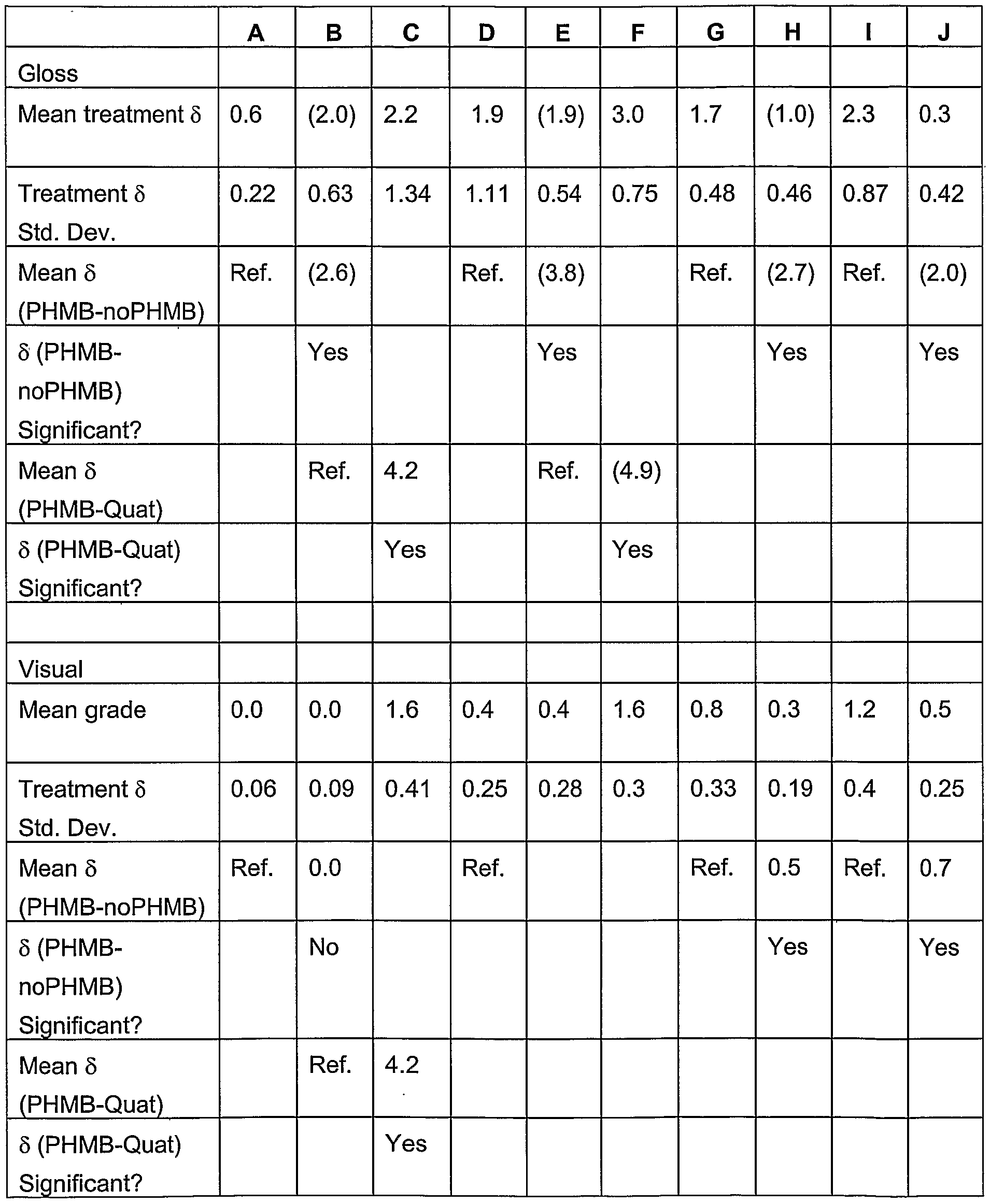
- gloss-meter readings are computed as a difference in gloss between tiles treated with the experimental compositions herein and that for the corresponding clean, untreated tiles.
- the clean tiles all have 60° angle gloss readings between 91 and 94.
- Gloss losses are computed as differences in readings. Positive values represent a loss in gloss. Negative values () suggest a gain in gloss.
- the mean gloss loss (gain) caused by treatments versus untreated tiles (mean treatment ⁇ ), and associated statistical significance are calculated.
- the statistic treatment of dependent paired samples (mean treatment ⁇ ) and independent paired samples ((PHMB-noPHMB or mean ⁇ (PHMB-Quat)) can be found in Anderson, Sweeney and Williams, Statistics for Business and Economics, 6 th edition, West Publishing Company, 1996, incorporated herein by reference. The statistics can be conveniently run using the statistical function in Microsoft ExcelTM.
- the streaking grades are provided as 0-4 visual grades using 5 expert panelists.
- the mean grade and standard deviations are computed.
- the significance of differences in visual grading is defined in analogous manner as described for the gloss-meter test.
- compositions A-F illustrate the filming and streaking benefits provided by compositions comprising polymeric biguanide as opposed to non-biguanide containing compositions and alternatives that substitute quaternary ammonium surfactant for the polymeric biguanide on an equal weight basis.
- quaternary ammonium surfactants have a significant deleterious effect on filming streaking properties relative to compositions not comprising the quaternary ammonium surfactant, as measured analytically by gloss-meter readings or by trained expert graders (compare filming/streaking results obtained for treatments A and D versus those obtained for treatments C and F).
- the polymeric biguanide-containing compositions significantly enhance the gloss of untreated tiles and provide a significant improvement versus compositions not comprising the polymeric biguanide.
- Gloss enhancement of untreated tiles is also observed for treatment H and L, which incorporate low residue surfactant, and this enhancement can be traced directly to the inclusion of PHMB in the composition (compare gloss-meter and expert grades for treatments H vs G and L vs. K).
- Treatment J which does not comprise a low residue surfactant does not enhance the gloss of untreated tile. Note however, that increased amount of PHMB (1%) does result in gloss enhancement, i.e., compare treatments I, J and O..
- compositions M-P illustrate the impact of a higher PHMB level on tile gloss.
- These compositions with 1 % PHMB, provide increased gloss relative to corresponding treatments B, H, J and L, which comprise 0.3% PHMB and treatments A, G, I and K, which do not comprise PHMB.
- the increased gloss as measured by the gloss-meter does not translate into any improvement in visual grade. The data suggest a point of diminishing returns in visual grades despite analytical gloss enhancement.
- compositions D, E and AA-AH illustrate the ability to use acids within the scope of this invention.
- Compositions comprising organic acid and inorganic acid all show gloss and visual grade benefits for polymeric biguanide (compare filming/streaking results for E vs. D, AB vs. AA, AD vs. AC, AF vs. AE, and AH vs. AG).
Landscapes
- Chemical & Material Sciences (AREA)
- Life Sciences & Earth Sciences (AREA)
- Engineering & Computer Science (AREA)
- Chemical Kinetics & Catalysis (AREA)
- Oil, Petroleum & Natural Gas (AREA)
- Wood Science & Technology (AREA)
- Organic Chemistry (AREA)
- Health & Medical Sciences (AREA)
- Molecular Biology (AREA)
- Detergent Compositions (AREA)
- Compositions Of Macromolecular Compounds (AREA)
- Treatments Of Macromolecular Shaped Articles (AREA)
Abstract
Description




Claims
Priority Applications (5)
| Application Number | Priority Date | Filing Date | Title |
|---|---|---|---|
| JP2003534517A JP2005505657A (en) | 2001-10-09 | 2002-10-08 | Aqueous composition for surface treatment |
| MXPA04003306A MXPA04003306A (en) | 2001-10-09 | 2002-10-08 | Aqueous compositions for treating a surface. |
| CA002460435A CA2460435A1 (en) | 2001-10-09 | 2002-10-08 | Aqueous compositions for treating a surface comprising a polymeric biguanide |
| EP02776189A EP1434837B1 (en) | 2001-10-09 | 2002-10-08 | Aqueous compositions for treating a surface |
| DE60210317T DE60210317T2 (en) | 2001-10-09 | 2002-10-08 | AQUEOUS COMPOSITIONS FOR SURFACE TREATMENT |
Applications Claiming Priority (2)
| Application Number | Priority Date | Filing Date | Title |
|---|---|---|---|
| US32800601P | 2001-10-09 | 2001-10-09 | |
| US60/328,006 | 2001-10-09 |
Publications (1)
| Publication Number | Publication Date |
|---|---|
| WO2003031546A1 true WO2003031546A1 (en) | 2003-04-17 |
Family
ID=23279089
Family Applications (1)
| Application Number | Title | Priority Date | Filing Date |
|---|---|---|---|
| PCT/US2002/032197 Ceased WO2003031546A1 (en) | 2001-10-09 | 2002-10-08 | Aqueous compositions for treating a surface |
Country Status (8)
| Country | Link |
|---|---|
| EP (1) | EP1434837B1 (en) |
| JP (1) | JP2005505657A (en) |
| AT (1) | ATE321836T1 (en) |
| CA (1) | CA2460435A1 (en) |
| DE (1) | DE60210317T2 (en) |
| ES (1) | ES2261741T3 (en) |
| MX (1) | MXPA04003306A (en) |
| WO (1) | WO2003031546A1 (en) |
Cited By (32)
| Publication number | Priority date | Publication date | Assignee | Title |
|---|---|---|---|---|
| US8114383B2 (en) | 2003-08-06 | 2012-02-14 | Gruenenthal Gmbh | Abuse-proofed dosage form |
| US8323889B2 (en) | 2004-07-01 | 2012-12-04 | Gruenenthal Gmbh | Process for the production of an abuse-proofed solid dosage form |
| US9161917B2 (en) | 2008-05-09 | 2015-10-20 | Grünenthal GmbH | Process for the preparation of a solid dosage form, in particular a tablet, for pharmaceutical use and process for the preparation of a precursor for a solid dosage form, in particular a tablet |
| US9629807B2 (en) | 2003-08-06 | 2017-04-25 | Grünenthal GmbH | Abuse-proofed dosage form |
| US9636303B2 (en) | 2010-09-02 | 2017-05-02 | Gruenenthal Gmbh | Tamper resistant dosage form comprising an anionic polymer |
| US9655853B2 (en) | 2012-02-28 | 2017-05-23 | Grünenthal GmbH | Tamper-resistant dosage form comprising pharmacologically active compound and anionic polymer |
| US9675610B2 (en) | 2002-06-17 | 2017-06-13 | Grünenthal GmbH | Abuse-proofed dosage form |
| US9737490B2 (en) | 2013-05-29 | 2017-08-22 | Grünenthal GmbH | Tamper resistant dosage form with bimodal release profile |
| US9750701B2 (en) | 2008-01-25 | 2017-09-05 | Grünenthal GmbH | Pharmaceutical dosage form |
| US9855263B2 (en) | 2015-04-24 | 2018-01-02 | Grünenthal GmbH | Tamper-resistant dosage form with immediate release and resistance against solvent extraction |
| US9872835B2 (en) | 2014-05-26 | 2018-01-23 | Grünenthal GmbH | Multiparticles safeguarded against ethanolic dose-dumping |
| US9913814B2 (en) | 2014-05-12 | 2018-03-13 | Grünenthal GmbH | Tamper resistant immediate release capsule formulation comprising tapentadol |
| US9925146B2 (en) | 2009-07-22 | 2018-03-27 | Grünenthal GmbH | Oxidation-stabilized tamper-resistant dosage form |
| DE102016223588A1 (en) | 2016-11-28 | 2018-05-30 | Clariant International Ltd | COPOLYMERS AND THEIR USE IN DETERGENT COMPOSITIONS |
| DE102016223586A1 (en) | 2016-11-28 | 2018-05-30 | Clariant International Ltd | COPOLYMERS AND THEIR USE IN DETERGENT COMPOSITIONS |
| DE102016223590A1 (en) | 2016-11-28 | 2018-05-30 | Clariant International Ltd | COPOLYMER-CONTAINING DETERGENT COMPOSITIONS |
| US10058548B2 (en) | 2003-08-06 | 2018-08-28 | Grünenthal GmbH | Abuse-proofed dosage form |
| US10064945B2 (en) | 2012-05-11 | 2018-09-04 | Gruenenthal Gmbh | Thermoformed, tamper-resistant pharmaceutical dosage form containing zinc |
| US10080721B2 (en) | 2009-07-22 | 2018-09-25 | Gruenenthal Gmbh | Hot-melt extruded pharmaceutical dosage form |
| US10154966B2 (en) | 2013-05-29 | 2018-12-18 | Grünenthal GmbH | Tamper-resistant dosage form containing one or more particles |
| US10201502B2 (en) | 2011-07-29 | 2019-02-12 | Gruenenthal Gmbh | Tamper-resistant tablet providing immediate drug release |
| US10300141B2 (en) | 2010-09-02 | 2019-05-28 | Grünenthal GmbH | Tamper resistant dosage form comprising inorganic salt |
| US10335373B2 (en) | 2012-04-18 | 2019-07-02 | Grunenthal Gmbh | Tamper resistant and dose-dumping resistant pharmaceutical dosage form |
| US10449547B2 (en) | 2013-11-26 | 2019-10-22 | Grünenthal GmbH | Preparation of a powdery pharmaceutical composition by means of cryo-milling |
| US10624862B2 (en) | 2013-07-12 | 2020-04-21 | Grünenthal GmbH | Tamper-resistant dosage form containing ethylene-vinyl acetate polymer |
| US10695297B2 (en) | 2011-07-29 | 2020-06-30 | Grünenthal GmbH | Tamper-resistant tablet providing immediate drug release |
| US10729658B2 (en) | 2005-02-04 | 2020-08-04 | Grünenthal GmbH | Process for the production of an abuse-proofed dosage form |
| US10842750B2 (en) | 2015-09-10 | 2020-11-24 | Grünenthal GmbH | Protecting oral overdose with abuse deterrent immediate release formulations |
| US11224576B2 (en) | 2003-12-24 | 2022-01-18 | Grünenthal GmbH | Process for the production of an abuse-proofed dosage form |
| US11805778B2 (en) | 2018-07-31 | 2023-11-07 | Kimberly-Clark Worldwide, Inc. | Composition including an antimicrobial boosting agent including an amphocarboxylate and methods of increasing the antimicrobial effectiveness of a composition |
| US11844865B2 (en) | 2004-07-01 | 2023-12-19 | Grünenthal GmbH | Abuse-proofed oral dosage form |
| US12295365B2 (en) | 2018-07-31 | 2025-05-13 | Kimberly-Clark Worldwide, Inc. | Composition including an antimicrobial boosting agent including a sultaine and methods of increasing the antimicrobial effectiveness of a composition |
Families Citing this family (6)
| Publication number | Priority date | Publication date | Assignee | Title |
|---|---|---|---|---|
| JP4781663B2 (en) * | 2004-11-17 | 2011-09-28 | 花王株式会社 | Antibacterial agent |
| JP5705510B2 (en) * | 2010-11-25 | 2015-04-22 | 大日本除蟲菊株式会社 | Acidic antibacterial detergent composition |
| EP2436754A1 (en) | 2011-09-30 | 2012-04-04 | Basf Se | Antimicrobial cleaning compound |
| US9160328B2 (en) | 2012-07-07 | 2015-10-13 | Skyworks Solutions, Inc. | Circuits, devices, methods and applications related to silicon-on-insulator based radio-frequency switches |
| JP7642337B2 (en) * | 2020-09-29 | 2025-03-10 | セッツ株式会社 | DETERGENT COMPOSITION, SPRAY BOTTLE-TYPE DETERGENT, WET WIPER, AND METHOD FOR CLEANING ARTICLE SURFACES |
| EP4299697A1 (en) * | 2022-06-27 | 2024-01-03 | The Procter & Gamble Company | Acidic hard surface cleaning composition |
Citations (9)
| Publication number | Priority date | Publication date | Assignee | Title |
|---|---|---|---|---|
| US4456543A (en) * | 1982-06-17 | 1984-06-26 | The Buckeye Cellulose Corporation | Bisbiguanide based antibacterial cleansing products |
| EP0185970A1 (en) * | 1984-12-15 | 1986-07-02 | Henkel Kommanditgesellschaft auf Aktien | Liquid preparation of disinfecting agents having a wide activity range |
| US4923685A (en) * | 1987-07-30 | 1990-05-08 | Henkel Kommanditgesellschaft Auf Aktien | Antimicrobial flavored compositions having particular utility as mouth washes |
| US5529713A (en) * | 1990-05-15 | 1996-06-25 | Eparco | Cleaning and disinfectant compositions for household use possessing hypoallergenic properties and acaricidal capabilities |
| EP0827691A1 (en) * | 1996-09-06 | 1998-03-11 | Peters | Decontaminating and cleaning composition in powder form and process for obtaining it |
| US6080706A (en) * | 1996-10-11 | 2000-06-27 | Colgate Palmolive Company | All Purpose liquid cleaning compositions |
| US6096701A (en) * | 1999-06-29 | 2000-08-01 | Colgate Palmolive Company | Antimicrobial multi purpose containing a cationic surfactant |
| US6191092B1 (en) * | 1997-04-24 | 2001-02-20 | Henkel Kommanditgesellschaft Auf Aktien | Liquid enzyme preparation and the use thereof |
| WO2002070639A1 (en) * | 2001-03-03 | 2002-09-12 | Selden Research Ltd | Biocidal cleaning composition |
Family Cites Families (3)
| Publication number | Priority date | Publication date | Assignee | Title |
|---|---|---|---|---|
| IL90554A0 (en) * | 1988-06-29 | 1990-01-18 | Sterling Drug Inc | Compositions containing preservative systems and nonwoven wipes impregnated therewith |
| JP3551667B2 (en) * | 1996-12-04 | 2004-08-11 | 株式会社日立製作所 | Solder bump height measurement method |
| EP1661503A3 (en) * | 1999-09-27 | 2008-01-02 | The Procter and Gamble Company | Hard surface cleaning compositions, premoistened wipes, methods of use, and articles comprising said compositions |
-
2002
- 2002-10-08 MX MXPA04003306A patent/MXPA04003306A/en active IP Right Grant
- 2002-10-08 AT AT02776189T patent/ATE321836T1/en not_active IP Right Cessation
- 2002-10-08 JP JP2003534517A patent/JP2005505657A/en active Pending
- 2002-10-08 WO PCT/US2002/032197 patent/WO2003031546A1/en not_active Ceased
- 2002-10-08 CA CA002460435A patent/CA2460435A1/en not_active Abandoned
- 2002-10-08 EP EP02776189A patent/EP1434837B1/en not_active Expired - Lifetime
- 2002-10-08 DE DE60210317T patent/DE60210317T2/en not_active Expired - Lifetime
- 2002-10-08 ES ES02776189T patent/ES2261741T3/en not_active Expired - Lifetime
Patent Citations (9)
| Publication number | Priority date | Publication date | Assignee | Title |
|---|---|---|---|---|
| US4456543A (en) * | 1982-06-17 | 1984-06-26 | The Buckeye Cellulose Corporation | Bisbiguanide based antibacterial cleansing products |
| EP0185970A1 (en) * | 1984-12-15 | 1986-07-02 | Henkel Kommanditgesellschaft auf Aktien | Liquid preparation of disinfecting agents having a wide activity range |
| US4923685A (en) * | 1987-07-30 | 1990-05-08 | Henkel Kommanditgesellschaft Auf Aktien | Antimicrobial flavored compositions having particular utility as mouth washes |
| US5529713A (en) * | 1990-05-15 | 1996-06-25 | Eparco | Cleaning and disinfectant compositions for household use possessing hypoallergenic properties and acaricidal capabilities |
| EP0827691A1 (en) * | 1996-09-06 | 1998-03-11 | Peters | Decontaminating and cleaning composition in powder form and process for obtaining it |
| US6080706A (en) * | 1996-10-11 | 2000-06-27 | Colgate Palmolive Company | All Purpose liquid cleaning compositions |
| US6191092B1 (en) * | 1997-04-24 | 2001-02-20 | Henkel Kommanditgesellschaft Auf Aktien | Liquid enzyme preparation and the use thereof |
| US6096701A (en) * | 1999-06-29 | 2000-08-01 | Colgate Palmolive Company | Antimicrobial multi purpose containing a cationic surfactant |
| WO2002070639A1 (en) * | 2001-03-03 | 2002-09-12 | Selden Research Ltd | Biocidal cleaning composition |
Cited By (43)
| Publication number | Priority date | Publication date | Assignee | Title |
|---|---|---|---|---|
| US10369109B2 (en) | 2002-06-17 | 2019-08-06 | Grünenthal GmbH | Abuse-proofed dosage form |
| US9675610B2 (en) | 2002-06-17 | 2017-06-13 | Grünenthal GmbH | Abuse-proofed dosage form |
| US10058548B2 (en) | 2003-08-06 | 2018-08-28 | Grünenthal GmbH | Abuse-proofed dosage form |
| US9629807B2 (en) | 2003-08-06 | 2017-04-25 | Grünenthal GmbH | Abuse-proofed dosage form |
| US8114383B2 (en) | 2003-08-06 | 2012-02-14 | Gruenenthal Gmbh | Abuse-proofed dosage form |
| US10130591B2 (en) | 2003-08-06 | 2018-11-20 | Grünenthal GmbH | Abuse-proofed dosage form |
| US11224576B2 (en) | 2003-12-24 | 2022-01-18 | Grünenthal GmbH | Process for the production of an abuse-proofed dosage form |
| US8323889B2 (en) | 2004-07-01 | 2012-12-04 | Gruenenthal Gmbh | Process for the production of an abuse-proofed solid dosage form |
| US11844865B2 (en) | 2004-07-01 | 2023-12-19 | Grünenthal GmbH | Abuse-proofed oral dosage form |
| US10729658B2 (en) | 2005-02-04 | 2020-08-04 | Grünenthal GmbH | Process for the production of an abuse-proofed dosage form |
| US10675278B2 (en) | 2005-02-04 | 2020-06-09 | Grünenthal GmbH | Crush resistant delayed-release dosage forms |
| US9750701B2 (en) | 2008-01-25 | 2017-09-05 | Grünenthal GmbH | Pharmaceutical dosage form |
| US9161917B2 (en) | 2008-05-09 | 2015-10-20 | Grünenthal GmbH | Process for the preparation of a solid dosage form, in particular a tablet, for pharmaceutical use and process for the preparation of a precursor for a solid dosage form, in particular a tablet |
| US10080721B2 (en) | 2009-07-22 | 2018-09-25 | Gruenenthal Gmbh | Hot-melt extruded pharmaceutical dosage form |
| US10493033B2 (en) | 2009-07-22 | 2019-12-03 | Grünenthal GmbH | Oxidation-stabilized tamper-resistant dosage form |
| US9925146B2 (en) | 2009-07-22 | 2018-03-27 | Grünenthal GmbH | Oxidation-stabilized tamper-resistant dosage form |
| US9636303B2 (en) | 2010-09-02 | 2017-05-02 | Gruenenthal Gmbh | Tamper resistant dosage form comprising an anionic polymer |
| US10300141B2 (en) | 2010-09-02 | 2019-05-28 | Grünenthal GmbH | Tamper resistant dosage form comprising inorganic salt |
| US10695297B2 (en) | 2011-07-29 | 2020-06-30 | Grünenthal GmbH | Tamper-resistant tablet providing immediate drug release |
| US10864164B2 (en) | 2011-07-29 | 2020-12-15 | Grünenthal GmbH | Tamper-resistant tablet providing immediate drug release |
| US10201502B2 (en) | 2011-07-29 | 2019-02-12 | Gruenenthal Gmbh | Tamper-resistant tablet providing immediate drug release |
| US9655853B2 (en) | 2012-02-28 | 2017-05-23 | Grünenthal GmbH | Tamper-resistant dosage form comprising pharmacologically active compound and anionic polymer |
| US10335373B2 (en) | 2012-04-18 | 2019-07-02 | Grunenthal Gmbh | Tamper resistant and dose-dumping resistant pharmaceutical dosage form |
| US10064945B2 (en) | 2012-05-11 | 2018-09-04 | Gruenenthal Gmbh | Thermoformed, tamper-resistant pharmaceutical dosage form containing zinc |
| US9737490B2 (en) | 2013-05-29 | 2017-08-22 | Grünenthal GmbH | Tamper resistant dosage form with bimodal release profile |
| US10154966B2 (en) | 2013-05-29 | 2018-12-18 | Grünenthal GmbH | Tamper-resistant dosage form containing one or more particles |
| US10624862B2 (en) | 2013-07-12 | 2020-04-21 | Grünenthal GmbH | Tamper-resistant dosage form containing ethylene-vinyl acetate polymer |
| US10449547B2 (en) | 2013-11-26 | 2019-10-22 | Grünenthal GmbH | Preparation of a powdery pharmaceutical composition by means of cryo-milling |
| US9913814B2 (en) | 2014-05-12 | 2018-03-13 | Grünenthal GmbH | Tamper resistant immediate release capsule formulation comprising tapentadol |
| US9872835B2 (en) | 2014-05-26 | 2018-01-23 | Grünenthal GmbH | Multiparticles safeguarded against ethanolic dose-dumping |
| US9855263B2 (en) | 2015-04-24 | 2018-01-02 | Grünenthal GmbH | Tamper-resistant dosage form with immediate release and resistance against solvent extraction |
| US10842750B2 (en) | 2015-09-10 | 2020-11-24 | Grünenthal GmbH | Protecting oral overdose with abuse deterrent immediate release formulations |
| DE102016223590A1 (en) | 2016-11-28 | 2018-05-30 | Clariant International Ltd | COPOLYMER-CONTAINING DETERGENT COMPOSITIONS |
| DE102016223588A1 (en) | 2016-11-28 | 2018-05-30 | Clariant International Ltd | COPOLYMERS AND THEIR USE IN DETERGENT COMPOSITIONS |
| DE102016223586A1 (en) | 2016-11-28 | 2018-05-30 | Clariant International Ltd | COPOLYMERS AND THEIR USE IN DETERGENT COMPOSITIONS |
| WO2018095920A1 (en) | 2016-11-28 | 2018-05-31 | Clariant International Ltd | Copolymers and use thereof in cleaning-agent compositions |
| WO2018095915A1 (en) | 2016-11-28 | 2018-05-31 | Clariant International Ltd | Cleaning agent compositions containing copolymer |
| US11530373B2 (en) | 2016-11-28 | 2022-12-20 | Clariant International Ltd | Cleaning agent compositions containing copolymer |
| US11649310B2 (en) | 2016-11-28 | 2023-05-16 | Clariant International Ltd | Copolymers and the use of same in cleaning agent compositions |
| US11692052B2 (en) | 2016-11-28 | 2023-07-04 | Clariant International Ltd | Copolymers and use thereof in cleaning-agent compositions |
| WO2018095918A1 (en) | 2016-11-28 | 2018-05-31 | Clariant International Ltd | Copolymers and the use of same in cleaning agent compositions |
| US11805778B2 (en) | 2018-07-31 | 2023-11-07 | Kimberly-Clark Worldwide, Inc. | Composition including an antimicrobial boosting agent including an amphocarboxylate and methods of increasing the antimicrobial effectiveness of a composition |
| US12295365B2 (en) | 2018-07-31 | 2025-05-13 | Kimberly-Clark Worldwide, Inc. | Composition including an antimicrobial boosting agent including a sultaine and methods of increasing the antimicrobial effectiveness of a composition |
Also Published As
| Publication number | Publication date |
|---|---|
| JP2005505657A (en) | 2005-02-24 |
| DE60210317T2 (en) | 2006-12-21 |
| DE60210317D1 (en) | 2006-05-18 |
| MXPA04003306A (en) | 2004-07-23 |
| EP1434837B1 (en) | 2006-03-29 |
| EP1434837A1 (en) | 2004-07-07 |
| ATE321836T1 (en) | 2006-04-15 |
| CA2460435A1 (en) | 2003-04-17 |
| ES2261741T3 (en) | 2006-11-16 |
Similar Documents
| Publication | Publication Date | Title |
|---|---|---|
| US6814088B2 (en) | Aqueous compositions for treating a surface | |
| EP1434837B1 (en) | Aqueous compositions for treating a surface | |
| CA2460431C (en) | Pre-moistened wipe comprising polymeric biguanide for treating a surface | |
| CA2460438C (en) | Pre-moistened wipe for treating a surface | |
| EP2723845B1 (en) | Choline salt cleaning compositions | |
| EP3149136B1 (en) | Optimized surfactant ratio for improved rinse feel | |
| US20100234269A1 (en) | Environmentally Acceptable Hard Surface Treatment Compositions | |
| US20110180100A1 (en) | Multi-surface kitchen cleaning system | |
| JPH10503797A (en) | Glass cleaner composition | |
| WO2008068463A1 (en) | Aqueous highly acidic hard surface cleaning compositions | |
| US20170015943A1 (en) | Laundry detergent composition | |
| EP3858961A1 (en) | Cleaning product | |
| WO2025174731A1 (en) | Aqueous acidic hard surface cleaning liquid composition | |
| US20250257287A1 (en) | Aqueous acidic hard surface cleaning liquid composition |
Legal Events
| Date | Code | Title | Description |
|---|---|---|---|
| AK | Designated states |
Kind code of ref document: A1 Designated state(s): AE AG AL AM AT AU AZ BA BB BG BR BY CA CH CN CO CR CU CZ DE DK DM DZ EC EE ES FI GB GD GE GM HR HU ID IL IN IS JP KE KG KP KZ LC LK LR LS LT LU LV MA MD MK MN MW MX MZ NO NZ OM PH PT RO RU SD SE SG SI SK SL TJ TM TN TR TZ UA UG UZ VC VN YU ZA ZM |
|
| AL | Designated countries for regional patents |
Kind code of ref document: A1 Designated state(s): GH GM KE LS MW MZ SD SL SZ UG ZM ZW AM AZ BY KG KZ RU TJ TM AT BE BG CH CY CZ DK EE ES FI FR GB GR IE IT LU MC PT SE SK TR BF BJ CF CG CI GA GN GQ GW ML MR NE SN TD TG |
|
| 121 | Ep: the epo has been informed by wipo that ep was designated in this application | ||
| DFPE | Request for preliminary examination filed prior to expiration of 19th month from priority date (pct application filed before 20040101) | ||
| WWE | Wipo information: entry into national phase |
Ref document number: 2460435 Country of ref document: CA |
|
| WWE | Wipo information: entry into national phase |
Ref document number: PA/a/2004/003306 Country of ref document: MX |
|
| WWE | Wipo information: entry into national phase |
Ref document number: 2003534517 Country of ref document: JP |
|
| WWE | Wipo information: entry into national phase |
Ref document number: 2002776189 Country of ref document: EP |
|
| WWP | Wipo information: published in national office |
Ref document number: 2002776189 Country of ref document: EP |
|
| WWG | Wipo information: grant in national office |
Ref document number: 2002776189 Country of ref document: EP |