WO2003033488A1 - Synthesis of 4-(piperidyl) (2-pyridyl)methanone-(e)-o-methyloxime and its salts - Google Patents

Synthesis of 4-(piperidyl) (2-pyridyl)methanone-(e)-o-methyloxime and its salts Download PDF

Info

Publication number
WO2003033488A1
WO2003033488A1 PCT/US2002/033118 US0233118W WO03033488A1 WO 2003033488 A1 WO2003033488 A1 WO 2003033488A1 US 0233118 W US0233118 W US 0233118W WO 03033488 A1 WO03033488 A1 WO 03033488A1
Authority
WO
WIPO (PCT)
Prior art keywords
formula
compound
solvent
acid
isomer
Prior art date
Legal status (The legal status is an assumption and is not a legal conclusion. Google has not performed a legal analysis and makes no representation as to the accuracy of the status listed.)
Ceased
Application number
PCT/US2002/033118
Other languages
French (fr)
Inventor
Wenxue Wu
Hongbiao Liao
David J. S. Tsai
Current Assignee (The listed assignees may be inaccurate. Google has not performed a legal analysis and makes no representation or warranty as to the accuracy of the list.)
Merck Sharp & Dohme LLC
Original Assignee
Schering Corp
Priority date (The priority date is an assumption and is not a legal conclusion. Google has not performed a legal analysis and makes no representation as to the accuracy of the date listed.)
Filing date
Publication date
Application filed by Schering Corp filed Critical Schering Corp
Priority to AT02793797T priority Critical patent/ATE298333T1/en
Priority to JP2003536228A priority patent/JP4425632B2/en
Priority to CA002463510A priority patent/CA2463510A1/en
Priority to HK04105560.5A priority patent/HK1062683B/en
Priority to MXPA04003477A priority patent/MXPA04003477A/en
Priority to EP02793797A priority patent/EP1436282B1/en
Priority to DE60204791T priority patent/DE60204791T2/en
Priority to SI200230145T priority patent/SI1436282T1/en
Priority to DK02793797T priority patent/DK1436282T3/en
Publication of WO2003033488A1 publication Critical patent/WO2003033488A1/en
Anticipated expiration legal-status Critical
Ceased legal-status Critical Current

Links

Classifications

    • C—CHEMISTRY; METALLURGY
    • C07—ORGANIC CHEMISTRY
    • C07D—HETEROCYCLIC COMPOUNDS
    • C07D401/00—Heterocyclic compounds containing two or more hetero rings, having nitrogen atoms as the only ring hetero atoms, at least one ring being a six-membered ring with only one nitrogen atom
    • C07D401/02—Heterocyclic compounds containing two or more hetero rings, having nitrogen atoms as the only ring hetero atoms, at least one ring being a six-membered ring with only one nitrogen atom containing two hetero rings
    • C07D401/06—Heterocyclic compounds containing two or more hetero rings, having nitrogen atoms as the only ring hetero atoms, at least one ring being a six-membered ring with only one nitrogen atom containing two hetero rings linked by a carbon chain containing only aliphatic carbon atoms

Definitions

  • This application specifically discloses a novel process to synthesize 4- (piperidyl) (2-pyridyl)methanone-(E)-0-methyloxime and its salts in high stereochemical purity. It also generically discloses a process to prepare compounds similar to the above in high stereochemical purity.
  • This application claims priority from U.S. provisional application, Serial No. 60/329,561 filed on October 15, 2001. The invention disclosed herein is related to that disclosed in the provisional patent application, Serial Number 60/329,562 filed on October 15, 2001.
  • 4-(Piperidyl) (2-pyridyl)methanone-(E)-0-methyloxime dihydrochloride (Formula I) is an intermediate used in the preparation of compounds that are histamine-H 3 antagonists.
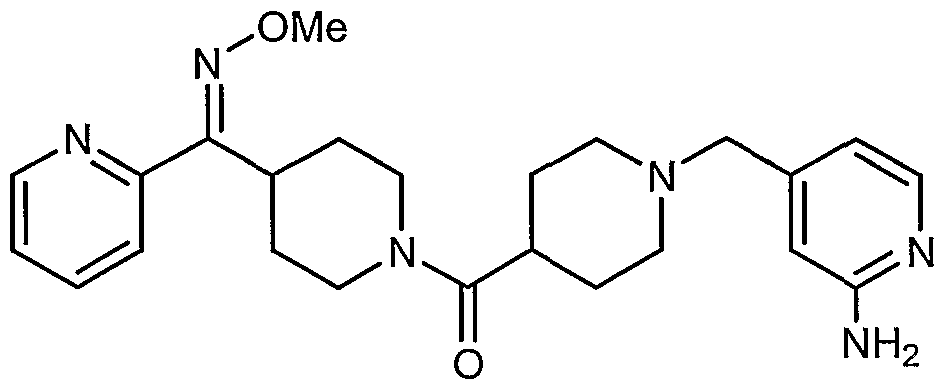
  • Histamine-H 3 antagonists is 1-[[1-[(2- Amino-5-pyrimidinyl)methyl]-4-piperidinyl]carbonyl]-4-[(E)-(methoxyimino)-2- pyridinylmethyl]piperidine shown in Formula II.
  • the present application teaches a novel, simple process of making a compound of Formula I, its monohydrochloride and its free base itself in high stereochemical purity and, via that process, a method of making a compound of Formula II in high yields and high stereochemical purity.
  • high stereochemical purity refers to at least about 90% of the desired isomer, which, in the present invention, is the E-isomer of the compound of Formula I, its monohydrochloride and its free base. Indeed, the stereochemical purity of the compound of Formula I, its monohydrochloride and its free base made by the inventive process typically exceeds 95% of the E-isomer.
  • high yields refers to at least about 60% yield of the desired product.
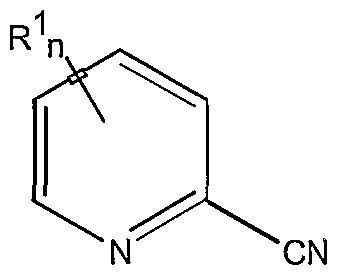
  • the present process comprises synthesizing compounds such as the compound of Formula I, its mono acid salt (for example, its monohydrochloride) and its free base from a compound of Formula 111:
  • R 1 , R 2 , R 3 and R 4 may be the same or different and are independently selected from the group consisting of H, halogen, alkyl, aryl, alkoxy, aryloxy, aralkyl (with the alkyl being the linker), alkylaryl (with the aryl being the linker), heteroalkyl, heteroaryl, alkyl-heteroaryl, heteroaralkyl, cycloalkyl and cycloalkylalkyl, wherein said alkyl, aryl, alkoxy, aryloxy, arylalkyl, alkylaryl, heteroalkyl, heteroaryl, alkyl-heteroaryl, heteroaralkyl, cycloalkyl and cycloalkylalkyl may optionally be substituted with one or more chemically-suitable substituents independently selected from the group consisting of alkyl, alkenyl, alkynyl, aryl, aralkyl, cycloalky
  • R 1 itself may be F, CI, Br or I.
  • halogen refers to F, CI, Br or I.
  • the acid- catalyzed isomerization in step (f) above is believed to be novel and offers the desired salt of the desired compound with the enriched E-isomer as noted above.
  • the inventive process to make the compound of Formulas IX and I has several advantages: it is economical, can be easily scaled-up and yields the desired E-isomer in high yields and in high stereochemical purity. Description of the Invention
  • the present invention discloses a novel, easy-to-use process for preparing the compound such as the compound of Formula I in high yields and high stereochemical purity. Additionally, it teaches novel processes to prepare intermediates such as the compounds of Formulas V, VII, VIII and IX in high yields.
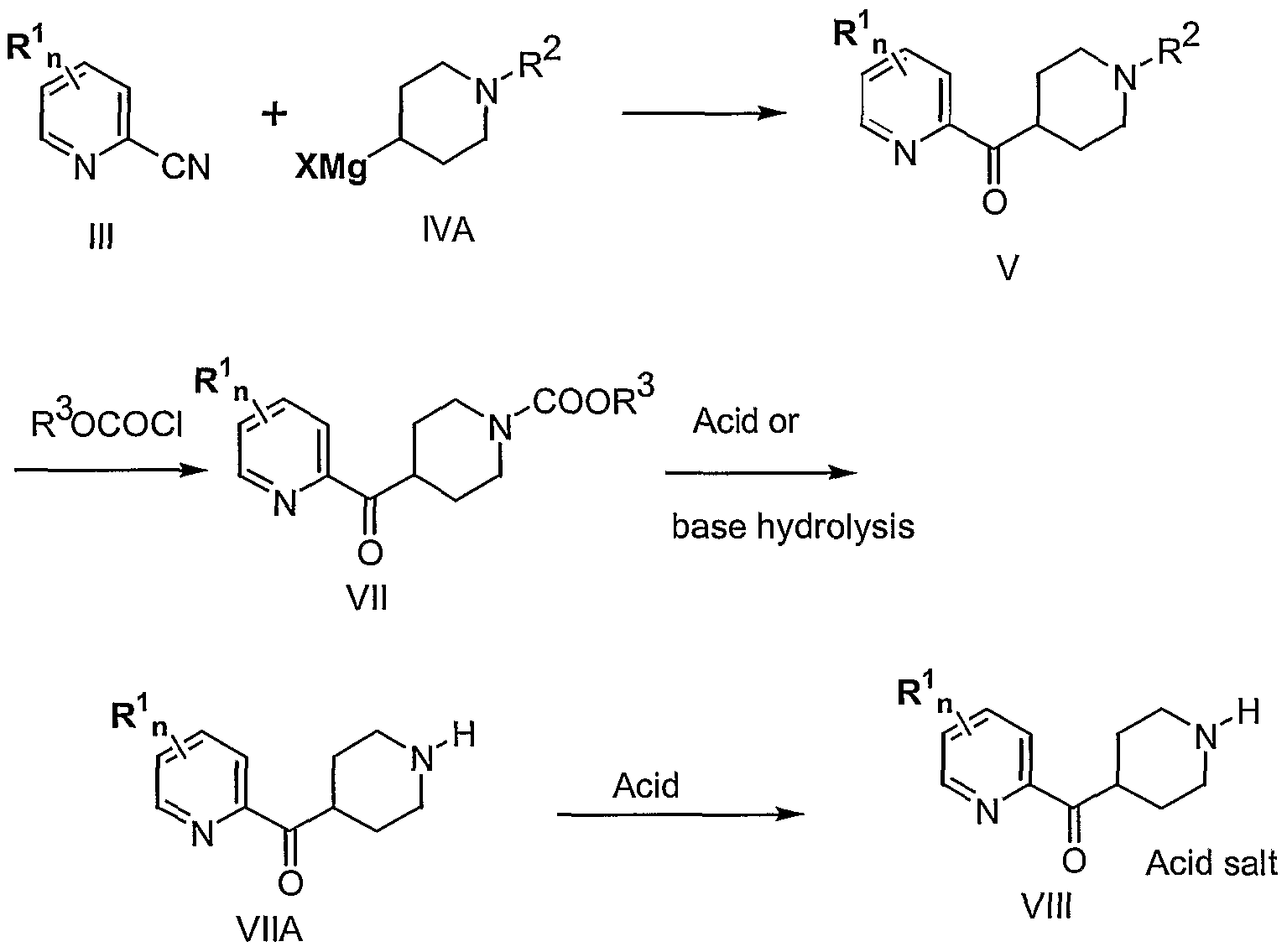
  • the inventive process to prepare such compounds is schematically described below in Scheme 1 :
  • alkyl refers to a monovalent group derived from a straight or branched chain saturated hydrocarbon by the removal of a single atom having from 1 to 8 carbon atoms, preferably from 1 to 6; aryl - represents a carbocyclic group having from 6 to 14 carbon atoms and having at least one benzenoid ring, with all available substitutable aromatic carbon atoms of the carbocyclic group being intended as possible points of attachment.
  • Preferred aryl groups include phenyl, 1-naphthyl, 2-naphthyl and indanyl, and especially phenyl and substituted phenyl; aralkyl - represents a moiety containing an aryl group linked vial a lower alkyl; alkylaryl - represents a moiety containing a lower alkyl linked via an aryl group; cycloalkyl - represents a saturated carbocyclic ring having from 3 to 8 carbon atoms, preferably 5 or 6, optionally substituted.
  • halogen - represents fluorine, chlorine, bromine and iodine; preferred halogens are CI and Br.
  • heteroaryl - represents a cyclic organic group having at least one O, S and/or N atom interrupting a carbocyclic ring structure and having a sufficient number of delocalized pi electrons to provide aromatic character, with the aromatic heterocyclic group having from 2 to 14, preferably 4 or 5 carbon atoms, e.g., 2-, 3- or 4-pyridyl, 2- or 3-furyl, 2- or 3-thienyl, 2-, 4- or 5-thiazolyl, 2- or 4-imidazolyl, 2-, 4- or 5-pyrimidinyl, 2-pyrazinyl, or 3- or 4-pyridazinyl, etc.
  • Preferred heteroaryl groups are 2-, 3- and 4- pyridyl; Such heteroaryl groups may also be optionally substituted.
  • heteroalkyl- represents an alkyl group containing one or more heteroatoms.
  • step 1 a 4-halo-1-R 2 substituted piperidine is converted to its Grignard analog (IV) by reacting with magnesium.
  • the reaction is performed generally at temperatures of about -10° C to reflux.
  • a hydrocarbon solvent such as, for example, toluene, xylene, chlorobenzene, and the like, an ether such as, for example, a C 5 -C 12 alkyl ether, 1 ,2-dimethoxyethane, 1.2-diethoxyethane, diglyme, 1 ,4-dioxane, tetrahydrofuran, methyl tetrahydrofuran, and the like, or a mixture of such solvents, is suitable for this reaction.
  • the solution is cooled to around -10° C to about 10° C and then reacted with a suitable 2-cyanopyridine (111), for about 10-120 minutes.
  • 2-cyanopyridine examples include 2-cyanopyridine, 4-methyl-2-cyanopyridine, 4-ethyl-2- cyanopyridine, 4-phenyl-2-cyanopyridine, and the like.
  • 2-cyanopyridine and 4-methyl-2-cyanopyridine examples include 2-cyanopyridine and 4-methyl-2-cyanopyridine.
  • Compounds such as, for example, Red-AI ® (from Aldrich Chemical Company, Milwaukee, Wisconsin), iodine and the like, may be used as initiators in this reaction.
  • the Grignard compound is used generally in about 1-4 molar equivalents with respect to the compound of formula III, preferably in about 1-3 molar equivalents and typically in about 1 .5-2.5 molar equivalents.
  • the product of formula V may be isolated by customary work-up procedures, such as, for example, treatment with an acid (e.g. HCI) preferably in a suitable solvent (e.g., tetrahydrofuran or ethyl acetate).
  • the product of Formula V may then be reacted with an alkyl chloroformate in the next step.
  • Suitable alkyl chloroformates are, for example, methyl chloroformate, ethyl chloroformate, propyl chloroformate, benzyl chloroformate., and the like, with the preferred being methyl chloroformate or ethyl chloroformate.
  • a solvent such as, for example, toluene, xylene, chlorobenzene, methylene chloride, ethylene chloride, ethyl acetate, isobutyl acetate, n-butyl acetate, a C 5 -C1 2 alkyl ether, 1 ,2- dimethoxyethane, 1.2-diethoxyethane, diglyme, 1 ,4-dioxane, tetrahydrofuran, methyl tetrahydrofuran and the like is suitable for this reaction.
  • the reaction is generally performed at about 25-100°C, preferably about 40-90°C and typically about 50-80°C, for about 1-5 hours.
  • the generated acid is washed off and the product of formula VII may be isolated by organic solvent extraction.
  • the compound of Formula VII may then be hydrolyzed to its free base (Formula VIIA) by acid (or base) hydrolysis, which may then be converted into its acid salt (Formula VIII) by treatment with an acid such as, for example, sulfuric acid, hydrochloric acid, trifluoroacetic acid and the like, generally in a solvent at temperatures between ambient and reflux of the solvent.
  • Suitable solvent is water containing the acid whose salt is desired.
  • the salt may be recrystallized. Suitable recrystallization solvents include water, water-miscible solvents such as, for example, acetonitrile, THF, ethanol, methanol, acetone and the like, and mixtures thereof; acetonitrile or acetonitrile-water mixture is preferred.
  • the salt VIII may have 1 or 2 moles of acid.
  • the compound of Formula VIII may then be converted to an alkyloxime of Formula IX by reacting it with an alkoxyamine (or its hydrochloride), usually in a protic solvent; water is preferred.
  • alkoxyamines are, for example, methoxyamine, ethoxyamine and the like. Methoxyamine is preferred.
  • the alkoxyamine (or its hydrochloride) is employed generally in about 1 to about 4 molar equivalents, preferably in about 1 to about 3 molar equivalents, and typically in about 1 to about 2 molar equivalents, with respect to the compound of Formula VIII.
  • the reaction is catalyzed by a weak acid such as, for example, acetic acid, formic acid and the like, or mixtures thereof.
  • the pH may be adjusted to be about 3-6 if so desired.
  • a cosolvent such as, for example, methanol, ethanol, isopropanol, n-butanol and the like, or mixtures thereof may be added, if so desired.
  • the product of Formula IX, after work-up, is a mixture of the Z- and the E-isomers, whose ratio may be analyzed for its stereochemical make-up, using techniques well known in the art such as, for example, HPLC.
  • the desired isomer is the E-isomer
  • the compound of Formula IX may be dissolved in a solvent such as, for example, ethanol, methanol, isopropanol, n-butanol and the like, ether such as methyl tert-butyl ether, tetrahydrofuran and the like, hydrocarbon such as, for example, heptane, hexane, toluene and the like, nitrile such as, for example, acetonitrile and the like, or mixtures of such solvents. It is then treated with a strong acid such as, for example, HCI, HBr, H 2 SO 4 and the like, at temperatures in the range 20 to 100°C for about 1-20 hours.
  • a strong acid such as, for example, HCI, HBr, H 2 SO 4 and the like
  • the acid is employed generally in about 1 to about 10 molar equivalents, preferably in about 1 to about 8 molar equivalents, and typically in about 1 to about 6 molar equivalents.
  • Work-up typically forms predominantly the acid salt of the E-isomer of the compound of Formula IX.
  • the final product may optionally be converted to its free base with the E isomer still predominating, by reacting with standard processes such as, for example, treatment with a suitable base.
  • the products of the various steps in the reaction schemes described herein may be isolated and purified by conventional techniques such as, for example, filtration, recrystallization, solvent extraction, distillation, precipitation, sublimation, column chromatography and the like, as is well known to those skilled in the art.
  • the products may be analyzed and/or checked for purity by conventional methods such as, for example, thin layer chromatography, NMR, HPLC, melting point, mass spectral analysis, elemental analysis and the like, well known to those skilled in the art.
  • Example 1 Preparation of the Compound of Formula XII: To a suspension of magnesium chips (110 g) in THF (2800 mL) was added Red-AI ® (9 mL, 65% solution of sodium bis(2-methoxyethoxy)aluminum hydride in toluene). The mixture was heated at reflux for 1 h and then cooled to room temperature. 4-chloro-1- methylpiperidine (71 mL) was added and the mixture was heated at gentle reflux for 30 min or until the Grignard reaction was initiated. The main portion of 4-chloro-1- methylpiperidine (633 mL) was then added over 60 min while maintaining the reaction mixture at gentle reflux.
  • Red-AI ® 9 mL, 65% solution of sodium bis(2-methoxyethoxy)aluminum hydride in toluene
  • the oil was found to be 86.1 % pure by HPLC analysis against a pure standard.
  • the crude material could be used directly in the next step or purified, if so desired.
  • the crude product was purified by vacuum distillation to give a yellow oil which solidified upon cooling (b.p.: 120- 125°C/0.5 torr, low melting solid).
  • Example 2 Preparation of the Compound of Formula Xlll: A sample of crude compound of Formula XII (from Example 1 ) (249 g, 60.4% purity) was azeotropically dried in toluene. To the dried solution in toluene (2000 mL) was added ethyl chloroformate (169 mL) over 30 min at 70-75°C. The reaction mixture was heated at 70-80 °C for 2 h and cooled to room temperature. An aqueous potassium bicarbonate solution (300 ml, 25%) was added over 30 min at 20 to 30°C. After stirring at room temperature for 15 min, the mixture was settled and the phases were separated.
  • the organic layer was washed with 10% aqueous acetic acid (1000 mL) followed by water (1000 mL).
  • the organic layer thus obtained (2720 mL) was found to contain 170 g of the compound of Formula Xlll by HPLC analysis against a pure standard.
  • the toluene solution can be used directly for the preparation of the compound of Formula XIV.
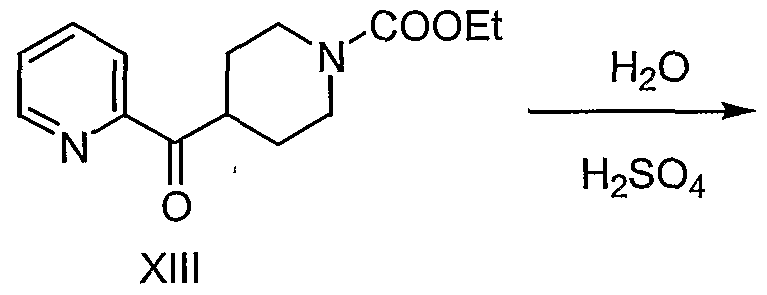
  • Example 3 Preparation of the Compound of Formula XIIIA and conversion into the Compound of Formula XIV: The above toluene solution (from Example 2) was extracted into 50% v/v sulfuric acid (330 mL) and the acid layer was heated at 90- 100°C for 20 h. The mixture was cooled to 50-60 °C and diluted with acetonitrile (2000 mL) and seeded. The mixture was cooled to room temperature and was filtered. The wet product was washed with acetonitrile and dried at 55-65°C under vacuum (248 g, brown solid).
  • Example 4 Preparation of the Compound of Formula XIV from the Compound of Formula XII: A sample of crude compound of Formula XII (240 g, 86.1 % purity) was azeotropically dried in toluene. To the dried solution in toluene (2000 mL) was added ethyl chloroformate (169 mL) over 30 min at 70-75°C. The reaction mixture was heated at 70-80°C for 5 h, over which time, triethylamine (21 mL) and more ethyl chloroformate (22 mL) were added. An aqueous potassium bicarbonate solution (300 ml, 25%) was added over 30 min at 20 to 30°C.
  • Example 5 Preparation of the Compound of Formula XV: To a solution of the compound of Formula XIV (150 g) in water (300 mL) was added 25% sodium hydroxide (270 mL) while maintaining temperature below 60°C. Acetic acid (34 mL) was added followed by 25-30% aqueous solution of methoxyamine hydrochloride (180 mL). The pH of the mixture was adjusted to be 3-6. The mixture was heated at 50-60°C for about 3 h. After the mixture is cooled to room temperature, 25% sodium hydroxide was added (150 mL) and the mixture was extracted with toluene (376 mL) twice.
  • Example 6 Isomerization to I as Predominantly the E isomer: After being azeotropically dried, the free base from Example 5 was dissolved in toluene (375 mL) and added to 5-6 N hydrochloric acid in isopropanol (300 mL). The mixture was heated at 60-70°C for 3 h, during which time the product crystallized out. The mixture was cooled to room temperature, filtered, and washed with isopropanol (300 mL).

Landscapes

  • Chemical & Material Sciences (AREA)
  • Organic Chemistry (AREA)
  • Plural Heterocyclic Compounds (AREA)
  • Pharmaceuticals Containing Other Organic And Inorganic Compounds (AREA)
  • Low-Molecular Organic Synthesis Reactions Using Catalysts (AREA)

Abstract

In one embodiment, the present invention describes the synthesis of 4-(piperidyl) (2-pyridyl)methanone-(E)-O-methyloxime dihydrochloride, monohydrochloride and free base, and similar compounds, in high stereochemical purity.

Description

SYNTHESIS OF 4- ( PIPERIDYL) ( 2-PYRIDYL) METHANONE- (E) - 0-METHYLOXIME AND ITS SALTS
Field of the Invention
This application specifically discloses a novel process to synthesize 4- (piperidyl) (2-pyridyl)methanone-(E)-0-methyloxime and its salts in high stereochemical purity. It also generically discloses a process to prepare compounds similar to the above in high stereochemical purity. This application claims priority from U.S. provisional application, Serial No. 60/329,561 filed on October 15, 2001. The invention disclosed herein is related to that disclosed in the provisional patent application, Serial Number 60/329,562 filed on October 15, 2001.
Background of the Invention
4-(Piperidyl) (2-pyridyl)methanone-(E)-0-methyloxime dihydrochloride (Formula I) is an intermediate used in the preparation of compounds that are histamine-H3 antagonists. An example of such histamine-H3 antagonists is 1-[[1-[(2- Amino-5-pyrimidinyl)methyl]-4-piperidinyl]carbonyl]-4-[(E)-(methoxyimino)-2- pyridinylmethyl]piperidine shown in Formula II.
Figure imgf000002_0001
Figure imgf000002_0002
The conversion of the compound of Formula I into a compound of Formula ll is disclosed in the commonly owned U.S. patent application, Serial No. 09/978,267 (Attomey Docket No. AL01348K) filed of even date herewith. Antagonists of the H3 receptor are useful for the treatment of allergy, asthma and other such respiratory disorders.
In view ofthe importance of the antagonists of histamine-H3, new, novel methods of making such antagonists and/or their intermediates are always of interest.
Summary of the Invention
In an embodiment, the present application teaches a novel, simple process of making a compound of Formula I, its monohydrochloride and its free base itself in high stereochemical purity and, via that process, a method of making a compound of Formula II in high yields and high stereochemical purity. The term "high stereochemical purity" refers to at least about 90% of the desired isomer, which, in the present invention, is the E-isomer of the compound of Formula I, its monohydrochloride and its free base. Indeed, the stereochemical purity of the compound of Formula I, its monohydrochloride and its free base made by the inventive process typically exceeds 95% of the E-isomer. The term "high yields" refers to at least about 60% yield of the desired product.
Thus, the present process comprises synthesizing compounds such as the compound of Formula I, its mono acid salt (for example, its monohydrochloride) and its free base from a compound of Formula 111:
Figure imgf000003_0001
III where R1 is defined below and n is a number from 1 to 4, and from a compound of Formula IV:
XA IV where R2 is defined below. The process of making a compound such as the compound of Formula I from a compound of Formula III and a compound of Formula IV comprises:
(a) converting the compound of Formula IV into its Grignard form of Formula IVA:
Figure imgf000004_0001
IV IVA where R2 is defined below and X is a halogen;
(b) reacting the compound of Formula III with the compound of Formula IVA to obtain a compound of Formula V:
Figure imgf000004_0002
v
(c) reacting the compound of Formula V with a suitable alkyl chloroformate of Formula VI:
R3-OCOCI VI where R3 is defined below, to yield a compound of Formula VII:
Figure imgf000004_0003
VII
(d) forming the free base (Formula VI IA) and then the acid salt (mono acid salt or diacid salt) of the free base (Formula VIII):
Figure imgf000004_0004
VIIA VIII (e) reacting the compound of Formula VIII with an alkoxyamine (NH2OR4) or its hydrochloride (where R4 is defined below) to form an oxime of Formula IX:
Figure imgf000005_0001
ιx and (f) isomerizing the compound of Formula IX predominantly to the E isomer by treatment with a strong acid and simultaneously converting to the desired acid salt of a compound such as the compound of Formula I with an enriched E isomer, wherein the E isomer predominates over the Z-isomer by at least a 90:10 ratio. The acid salt, which may be the mono acid salt or the diacid salt, may be optionally converted back to its free base, if so desired.
R1, R2, R3 and R4 may be the same or different and are independently selected from the group consisting of H, halogen, alkyl, aryl, alkoxy, aryloxy, aralkyl (with the alkyl being the linker), alkylaryl (with the aryl being the linker), heteroalkyl, heteroaryl, alkyl-heteroaryl, heteroaralkyl, cycloalkyl and cycloalkylalkyl, wherein said alkyl, aryl, alkoxy, aryloxy, arylalkyl, alkylaryl, heteroalkyl, heteroaryl, alkyl-heteroaryl, heteroaralkyl, cycloalkyl and cycloalkylalkyl may optionally be substituted with one or more chemically-suitable substituents independently selected from the group consisting of alkyl, alkenyl, alkynyl, aryl, aralkyl, cycloalkyl, heterocyclic and halogen. R1 itself may be F, CI, Br or I. The term "halogen" refers to F, CI, Br or I. The acid- catalyzed isomerization in step (f) above is believed to be novel and offers the desired salt of the desired compound with the enriched E-isomer as noted above. When R1 is H, n=1 , R4 = methyl, and the acid used in step (f) for isomerization is HCI in the above sequence, the final product is the compound of Formula I.
The inventive process to make the compound of Formulas IX and I has several advantages: it is economical, can be easily scaled-up and yields the desired E-isomer in high yields and in high stereochemical purity. Description of the Invention
In one embodiment, the present invention discloses a novel, easy-to-use process for preparing the compound such as the compound of Formula I in high yields and high stereochemical purity. Additionally, it teaches novel processes to prepare intermediates such as the compounds of Formulas V, VII, VIII and IX in high yields. The inventive process to prepare such compounds is schematically described below in Scheme 1 :
Figure imgf000006_0001
Figure imgf000006_0002
IX
Scheme 1 where the various terms are defined above.
Unless defined otherwise, all technical and scientific terms used herein have the same meaning as is commonly understood by one of skill in the art to which this invention belongs. Thus, for example, the term alkyl (including the alkyl portions of alkoxy) refers to a monovalent group derived from a straight or branched chain saturated hydrocarbon by the removal of a single atom having from 1 to 8 carbon atoms, preferably from 1 to 6; aryl - represents a carbocyclic group having from 6 to 14 carbon atoms and having at least one benzenoid ring, with all available substitutable aromatic carbon atoms of the carbocyclic group being intended as possible points of attachment. Preferred aryl groups include phenyl, 1-naphthyl, 2-naphthyl and indanyl, and especially phenyl and substituted phenyl; aralkyl - represents a moiety containing an aryl group linked vial a lower alkyl; alkylaryl - represents a moiety containing a lower alkyl linked via an aryl group; cycloalkyl - represents a saturated carbocyclic ring having from 3 to 8 carbon atoms, preferably 5 or 6, optionally substituted. halogen - represents fluorine, chlorine, bromine and iodine; preferred halogens are CI and Br. heteroaryl - represents a cyclic organic group having at least one O, S and/or N atom interrupting a carbocyclic ring structure and having a sufficient number of delocalized pi electrons to provide aromatic character, with the aromatic heterocyclic group having from 2 to 14, preferably 4 or 5 carbon atoms, e.g., 2-, 3- or 4-pyridyl, 2- or 3-furyl, 2- or 3-thienyl, 2-, 4- or 5-thiazolyl, 2- or 4-imidazolyl, 2-, 4- or 5-pyrimidinyl, 2-pyrazinyl, or 3- or 4-pyridazinyl, etc. Preferred heteroaryl groups are 2-, 3- and 4- pyridyl; Such heteroaryl groups may also be optionally substituted. heteroalkyl- represents an alkyl group containing one or more heteroatoms.
The synthesis of the specific compound of Formula I, following the above- noted process, is exemplified in Scheme 2:
Figure imgf000008_0001
EtOCOCI
Figure imgf000008_0002
alt
Figure imgf000008_0003
NaOH, AcOH
Figure imgf000008_0004
XV
(I, predominantly E isomer)
Scheme 2 The compounds of the Formulas XII, Xlll, XIIIA, XIV and XV and their isomers (where applicable) are believed to be novel compounds. As stated above, the inventive novel conversion of the compound of Formula XV to I surprisingly yields predominantly the E-isomer of the compound of Formula I in high stereochemical purity and high yields. Isomerization of a mixture of phenyl compounds by acid catalysis is discussed by T. Zsuzsanna et al, Hung.Magy.Km.Foly., 74(3) (1968), 116-119. While the preferred reagents and reaction conditions for the various steps in the inventive process are described in detail in the Examples section, the following summarizes the details for the generic synthesis according to Scheme 1. The presently disclosed process starts with the compound of Formula IV. In step 1 , a 4-halo-1-R2 substituted piperidine is converted to its Grignard analog (IV) by reacting with magnesium. The reaction is performed generally at temperatures of about -10° C to reflux. Generally a hydrocarbon solvent such as, for example, toluene, xylene, chlorobenzene, and the like, an ether such as, for example, a C5-C12 alkyl ether, 1 ,2-dimethoxyethane, 1.2-diethoxyethane, diglyme, 1 ,4-dioxane, tetrahydrofuran, methyl tetrahydrofuran, and the like, or a mixture of such solvents, is suitable for this reaction. The solution is cooled to around -10° C to about 10° C and then reacted with a suitable 2-cyanopyridine (111), for about 10-120 minutes. Examples of suitable 2-cyanopyridine are 2-cyanopyridine, 4-methyl-2-cyanopyridine, 4-ethyl-2- cyanopyridine, 4-phenyl-2-cyanopyridine, and the like. Preferred are 2-cyanopyridine and 4-methyl-2-cyanopyridine. Compounds such as, for example, Red-AI® (from Aldrich Chemical Company, Milwaukee, Wisconsin), iodine and the like, may be used as initiators in this reaction. The Grignard compound is used generally in about 1-4 molar equivalents with respect to the compound of formula III, preferably in about 1-3 molar equivalents and typically in about 1 .5-2.5 molar equivalents. The product of formula V may be isolated by customary work-up procedures, such as, for example, treatment with an acid (e.g. HCI) preferably in a suitable solvent (e.g., tetrahydrofuran or ethyl acetate). The product of Formula V may then be reacted with an alkyl chloroformate in the next step. Suitable alkyl chloroformates are, for example, methyl chloroformate, ethyl chloroformate, propyl chloroformate, benzyl chloroformate., and the like, with the preferred being methyl chloroformate or ethyl chloroformate. Generally a solvent such as, for example, toluene, xylene, chlorobenzene, methylene chloride, ethylene chloride, ethyl acetate, isobutyl acetate, n-butyl acetate, a C5-C12 alkyl ether, 1 ,2- dimethoxyethane, 1.2-diethoxyethane, diglyme, 1 ,4-dioxane, tetrahydrofuran, methyl tetrahydrofuran and the like is suitable for this reaction. The reaction is generally performed at about 25-100°C, preferably about 40-90°C and typically about 50-80°C, for about 1-5 hours. After the reaction, generally the generated acid is washed off and the product of formula VII may be isolated by organic solvent extraction.
The compound of Formula VII may then be hydrolyzed to its free base (Formula VIIA) by acid (or base) hydrolysis, which may then be converted into its acid salt (Formula VIII) by treatment with an acid such as, for example, sulfuric acid, hydrochloric acid, trifluoroacetic acid and the like, generally in a solvent at temperatures between ambient and reflux of the solvent. Suitable solvent is water containing the acid whose salt is desired. The salt may be recrystallized. Suitable recrystallization solvents include water, water-miscible solvents such as, for example, acetonitrile, THF, ethanol, methanol, acetone and the like, and mixtures thereof; acetonitrile or acetonitrile-water mixture is preferred. There being two nitrogen atoms in the compound of Formula VIIA, the salt VIII may have 1 or 2 moles of acid.
The compound of Formula VIII may then be converted to an alkyloxime of Formula IX by reacting it with an alkoxyamine (or its hydrochloride), usually in a protic solvent; water is preferred. Suitable alkoxyamines are, for example, methoxyamine, ethoxyamine and the like. Methoxyamine is preferred. The alkoxyamine (or its hydrochloride) is employed generally in about 1 to about 4 molar equivalents, preferably in about 1 to about 3 molar equivalents, and typically in about 1 to about 2 molar equivalents, with respect to the compound of Formula VIII. Generally, the reaction is catalyzed by a weak acid such as, for example, acetic acid, formic acid and the like, or mixtures thereof. The pH may be adjusted to be about 3-6 if so desired. A cosolvent such as, for example, methanol, ethanol, isopropanol, n-butanol and the like, or mixtures thereof may be added, if so desired. The product of Formula IX, after work-up, is a mixture of the Z- and the E-isomers, whose ratio may be analyzed for its stereochemical make-up, using techniques well known in the art such as, for example, HPLC.
Since the desired isomer is the E-isomer, it would be advantageous to enrich the compound of Formula IX in the desired E-isomer. Applicants found that treating the compound of Formula IX with a strong acid under certain reaction conditions surprisingly isomerizes the mixture of the Z and the E-isomers into predominantly the E-isomer. Generally, the compound of Formula IX may be dissolved in a solvent such as, for example, ethanol, methanol, isopropanol, n-butanol and the like, ether such as methyl tert-butyl ether, tetrahydrofuran and the like, hydrocarbon such as, for example, heptane, hexane, toluene and the like, nitrile such as, for example, acetonitrile and the like, or mixtures of such solvents. It is then treated with a strong acid such as, for example, HCI, HBr, H2SO4 and the like, at temperatures in the range 20 to 100°C for about 1-20 hours. The acid is employed generally in about 1 to about 10 molar equivalents, preferably in about 1 to about 8 molar equivalents, and typically in about 1 to about 6 molar equivalents. Work-up typically forms predominantly the acid salt of the E-isomer of the compound of Formula IX. Depending upon the reaction conditions, there may be one (e.g. 1 HCI), or two (e.g. 2HCI) molar equivalents of the acid in the isolated E isomer, since the compound contains two nitrogen atoms. As one skilled in the art knows, the final product may optionally be converted to its free base with the E isomer still predominating, by reacting with standard processes such as, for example, treatment with a suitable base. When R2= R3=R = methyl, n=1 and R1= H, and the acid salt is 2HCI in the isolated E isomer compound, it is in fact the compound of Formula I. HPLC analysis (when R2= R3=R4= methyl, n=1 and R1= H and the acid salt is 2HCI) after a typical reaction sequence as shown in the Examples section showed the presence of the E- isomer generally in about 90% or above stereochemical purity, and typically in about 95% or above stereochemical purity in the isolated product. Additionally, the yields of the desired compound in such stereochemical purity was quite high, demonstrating that such isomerization reaction using a strong acid may be applicable to prepare E- isomers of such oximes in high yields and high stereochemical purity.
The products of the various steps in the reaction schemes described herein may be isolated and purified by conventional techniques such as, for example, filtration, recrystallization, solvent extraction, distillation, precipitation, sublimation, column chromatography and the like, as is well known to those skilled in the art. The products may be analyzed and/or checked for purity by conventional methods such as, for example, thin layer chromatography, NMR, HPLC, melting point, mass spectral analysis, elemental analysis and the like, well known to those skilled in the art.
The following nonlimiting EXAMPLES are provided in order to further illustrate the present invention. While the EXAMPLES are described herein as the preparation of the compound of Formula 1 from the compound of Formula X as shown in Scheme 2, it will be apparent to those skilled in the art that many modifications, variations and alterations to the present disclosure, both to materials, methods and reaction conditions, may be practiced. All such modifications, variations and alterations are intended to be within the spirit and scope of the present invention. EXAMPLES
Unless otherwise stated, the following abbreviations have the stated meanings in the Examples below: HPLC= High Performance Liquid Chromatography
M.pt: melting point
NMR= nuclear magnetic resonance spectroscopy
DMSO= dimethylsulfoxide mL= milliliters g= grams rt= room temperature (ambient)
Figure imgf000013_0001
EtOCOCI
Figure imgf000013_0002
alt
Figure imgf000013_0003
NaOH, AcOH
Figure imgf000013_0004
XV (I, predominantly E isomer)
Scheme 2
Example 1. Preparation of the Compound of Formula XII: To a suspension of magnesium chips (110 g) in THF (2800 mL) was added Red-AI® (9 mL, 65% solution of sodium bis(2-methoxyethoxy)aluminum hydride in toluene). The mixture was heated at reflux for 1 h and then cooled to room temperature. 4-chloro-1- methylpiperidine (71 mL) was added and the mixture was heated at gentle reflux for 30 min or until the Grignard reaction was initiated. The main portion of 4-chloro-1- methylpiperidine (633 mL) was then added over 60 min while maintaining the reaction mixture at gentle reflux. After the addition was complete, the mixture was heated at reflux for 5 h and then cooled to -5 to 0°C. A solution of 2-cyanopyridine (281 g, from Aldrich Chemical Company) in THF (560 mL) was added over 1 h at -5 to 5°C. The mixture was stirred at -5 to 5°C for 30 min and poured into a mixture of concentrated hydrochloric acid (600 mL) and ice (3000 g). The phases were separated. To the aqueous layer was added sodium chloride (600 g) and the resulting solution was extracted with THF (2200 mL) three times. The organic layers were combined and concentrated under vacuum to give a brown oil (501 g). The oil was found to be 86.1 % pure by HPLC analysis against a pure standard. The crude material could be used directly in the next step or purified, if so desired. The crude product was purified by vacuum distillation to give a yellow oil which solidified upon cooling (b.p.: 120- 125°C/0.5 torr, low melting solid). H NMR (400 MHz, CDCI3): δ 8.42 (dd, J-F3.3 Hz, J2=0.9 Hz 1 H), 7.76 (d, J=7.8 Hz, 1 H), 7.58 (dt, J1=7.7 Hz, J2=1.7 Hz, 1 H), 7.21 (ddd, Jι=7.5 Hz, J2=4.8 Hz, J3=1.2 Hz, 1 H), 3.56 (tt, J^H .5 Hz, J2=3.8 Hz, 1 H), 2.65 (m, 2H), 2.03 (s, 3H), 1.85 (dt, J-ι=11.7 Hz, J2=2.5 Hz, 2H), 1.67 (br d, J=12.4 Hz, 2H), 1.53 (m, 2H). Example 2. Preparation of the Compound of Formula Xlll: A sample of crude compound of Formula XII (from Example 1 ) (249 g, 60.4% purity) was azeotropically dried in toluene. To the dried solution in toluene (2000 mL) was added ethyl chloroformate (169 mL) over 30 min at 70-75°C. The reaction mixture was heated at 70-80 °C for 2 h and cooled to room temperature. An aqueous potassium bicarbonate solution (300 ml, 25%) was added over 30 min at 20 to 30°C. After stirring at room temperature for 15 min, the mixture was settled and the phases were separated. The organic layer was washed with 10% aqueous acetic acid (1000 mL) followed by water (1000 mL). The organic layer thus obtained (2720 mL) was found to contain 170 g of the compound of Formula Xlll by HPLC analysis against a pure standard. The toluene solution can be used directly for the preparation of the compound of Formula XIV.
An analytically pure sample of the compound of Formula Xlll was obtained by flash column chromatography (pale yellow solid, m.p. 54.4°C). 1H NMR (400 MHz, CDCI3): δ 8.70 (dd, ^=5.3 Hz, J2=0.9 Hz, 1H), 8.05 (d, J=7.8 Hz, 1 H), 7.86 (dt, J1=7.7 Hz, J2=1.7 Hz, 1 H), 7.50 (m, 1 H), 4.23 (br s, 2H), 4.15 (q, J=7.1 Hz, 2H), 4.05 (tt,
Jι=11.5 Hz, J2=3.9 Hz, 1 H), 2.99 (br t, J=11.6, 2H), 1.91 (br s, 2H), 1.65 (dq, Jι=12.2 Hz, J2=3.6 Hz, 2H), 1.28 (t, J=7.1 Hz, 3H). Example 3. Preparation of the Compound of Formula XIIIA and conversion into the Compound of Formula XIV: The above toluene solution (from Example 2) was extracted into 50% v/v sulfuric acid (330 mL) and the acid layer was heated at 90- 100°C for 20 h. The mixture was cooled to 50-60 °C and diluted with acetonitrile (2000 mL) and seeded. The mixture was cooled to room temperature and was filtered. The wet product was washed with acetonitrile and dried at 55-65°C under vacuum (248 g, brown solid).
Example 4. Preparation of the Compound of Formula XIV from the Compound of Formula XII: A sample of crude compound of Formula XII (240 g, 86.1 % purity) was azeotropically dried in toluene. To the dried solution in toluene (2000 mL) was added ethyl chloroformate (169 mL) over 30 min at 70-75°C. The reaction mixture was heated at 70-80°C for 5 h, over which time, triethylamine (21 mL) and more ethyl chloroformate (22 mL) were added. An aqueous potassium bicarbonate solution (300 ml, 25%) was added over 30 min at 20 to 30°C. After stirring at room temperature for 15 min, the mixture was settled and the phases were separated. The organic layer was washed with 10% aqueous acetic acid (1000 mL) followed by water (1000 mL). The organic layer was extracted into 50% v/v sulfuric acid (450 mL) and the acid layer was heated at 90-100°C for 16 h. The mixture was cooled to 50-60°C and diluted with acetonitrile (2000 mL) and seeded. The mixture was cooled to room temperature and was filtered. The wet product was washed with acetonitrile and dried at 55-65°C under vacuum (360 g, off-white solid, m.p.: 247°C dec). 1H NMR (400 MHz, DMSO- d6): 10.68 (br s, 3H), 8.76 (m, 1 H), 8.63 (br s, 1 H), 8.33 (br s, 1 H), 8.03 (m, 2H), 7.72 (ddd,
Figure imgf000015_0001
.4 Hz, J2=3.5 Hz, 1H), 3.34 (br d, J=12.6 Hz, 2H), 3.08 (br q, J=11.8 Hz, 2H), 2.02 (br d, J=12.6 Hz, 2H), 1.74 (m, 2H).
Example 5. Preparation of the Compound of Formula XV: To a solution of the compound of Formula XIV (150 g) in water (300 mL) was added 25% sodium hydroxide (270 mL) while maintaining temperature below 60°C. Acetic acid (34 mL) was added followed by 25-30% aqueous solution of methoxyamine hydrochloride (180 mL). The pH of the mixture was adjusted to be 3-6. The mixture was heated at 50-60°C for about 3 h. After the mixture is cooled to room temperature, 25% sodium hydroxide was added (150 mL) and the mixture was extracted with toluene (376 mL) twice. The organic layers were combined and concentrated under vacuum to give the free base (mixture of E and Z isomers in about 53:47 ratio by HPLC analysis). Example 6. Isomerization to I as Predominantly the E isomer: After being azeotropically dried, the free base from Example 5 was dissolved in toluene (375 mL) and added to 5-6 N hydrochloric acid in isopropanol (300 mL). The mixture was heated at 60-70°C for 3 h, during which time the product crystallized out. The mixture was cooled to room temperature, filtered, and washed with isopropanol (300 mL). It was dried at 50-60°C to give an white solid (106.8 g, m.p.: 197°C dec, E/Z ratio: 97:3 by HPLC analysis). 1H NMR (400 MHz, D20, E isomer): δ 8.61 (dd, ^=6.1 Hz, J2=1.2 Hz, 1 H), 8.48 (dt, J-,=1.5 Hz, J2=8.0 Hz, 1 H), 8.12 (d, J=8.3 Hz, 1 H), 7.90 (ddd,
Jι=7.7 Hz, J2=5.9 Hz, J3=1.0 Hz 1 H), 3.99 (s, 3H), 3.39 (m, 2H), 3.30 (tt, ^=3.5 Hz, J2=12.4 Hz, 1 H), 2.94 (dt, Jι=2.6 Hz, J2=13.2 Hz, 2H), 2.37 (dq, J.,=3.9 Hz, J2=13.5 Hz, 2H), 1.93 (br d, J=14.2, 2H).

Claims

CLAIMSWhat is claimed is:
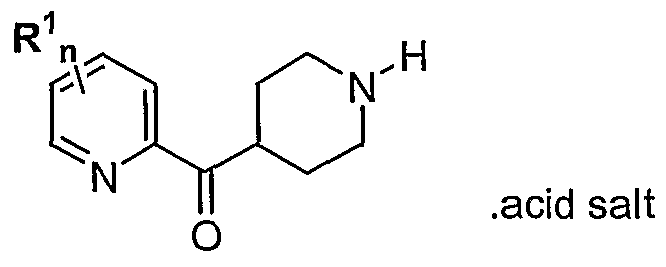
1. A process for preparing a compound of the Formula:
Figure imgf000017_0001
where R1 and R4 are defined below, m is 1 or 2, and n is a number from 1 to 4, and wherein said compound is in its E-isomer form in at least about 90% stereochemical purity, from a compound of Formula HI:
Figure imgf000017_0002
and from a compound of Formula IV:
Figure imgf000017_0003
IV where R is defined below and X is a halogen, said process comprising:
(a) converting the compound of Formula IV into its Grignard form of Formula IVA:
Figure imgf000017_0004
IVA
IV where R is defined below and X is a halogen;
(b) reacting the compound of Formula 111 with the compound of Formula IVA to obtain a compound of Formula V:
Figure imgf000018_0001
(c) reacting the compound of Formula V with a suitable alkyl chloroformate of Formula VI:
R3-OCOCI VI where R3 is defined below, to yield a compound of Formula VII:
Figure imgf000018_0002
VII
(d) converting the compound of Formula VII into its free base of Formula
VI I A:
Figure imgf000018_0003
,10 VI I A
(e) Forming the acid salt (Formula VIII) from the compound of Formula
VIIA:
Figure imgf000018_0004
VIII
(f) reacting the compound of Formula VIII with an alkoxyamine (NH2OR )
15 or its hydrochloride to form an oxime of Formula IX:
Figure imgf000018_0005
IX where R4 is defined below, and
(g) isomerizing the compound of Formula IX by treatment with a strong acid and simultaneously converting to the desired acid salt of Formula IX with an enriched E isomer, wherein the E isomer predominates over the Z-isomer by at least a 90:10 ratio, wherein R1, R2, R3 and R4 may be the same or different and are independently selected from the group consisting of H, halogen, alkyl, aryl, alkoxy, aryloxy, arylalkyl (with the alkyl being the linker), alkylaryl (with the aryl being the linker), heteroalkyl, heteroaryl, alkyl-heteroaryl, heteroaralkyl, cycloalkyl and cycloalkylalkyl, wherein said alkyl, aryl, alkoxy, aryloxy, arylalkyl, alkylaryl, heteroalkyl, heteroaryl, alkyl-heteroaryl, heteroaralkyl, cycloalkyl and cycloalkylalkyl may optionally be substituted with one or more chemically-suitable substituents independently selected from the group consisting of alkyl, alkenyl, alkynyl, aryl, aralkyl, cycloalkyl, heterocyclic and halogen, and further wherein halogen refers to F, CI, Br or I.
2. The process of claim 1 , wherein X is CI or Br, m is 2, (R1)n is H, and R2 = R3= R4= methyl or ethyl.
3. The process of claim 2, wherein said conversion in step (a) comprises reacting said compound of Formula IV with magnesium in the presence of an initiator in a solvent, wherein said solvent is selected from the group consisting of toluene, xylene, tetrahydrofuran and mixtures thereof.
4. The process of claim 3, wherein said solvent is tetrahydrofuran.
5. The process of claim 1 , wherein said initiator is sodium bis(2- methoxyethoxy)aluminum hydride or iodine.
6. The process of claim 1 , wherein in step (c), said alkyl chloroformate is selected from the group consisting of methyl chloroformate, ethyl chloroformate, propyl chloroformate and benzyl chloroformate.
7. The process of claim 6, wherein said alkyl chloroformate is ethyl chloroformate, and said reaction in step (c) is conducted in a solvent selected from the group consisting of toluene, xylene, chlorobenzene, methylene chloride, ethylene chloride, ethyl acetate, isopropyl acetate, n-butyl acetate, tetrahydrofuran, methyl tetrahydrofuran and mixtures thereof.
8. The process of claim 7, wherein said solvent is toluene.
9. The process claim 1 , wherein said reaction in step (d) is conducted by using acid hydrolysis or base hydrolysis.
10. The process of claim 1 , wherein said acid salt in step (e) is a sulfate, hydrochloride or trifluoroacetate.
11. The process of claim 10, wherein said salt is sulfate.
12. The process of claim 11 , wherein said sulfate VIII is formed in water, followed by recrystallization from a solvent, wherein said solvent for recrystallization is selected from the group consisting of water, acetonitrile, THF, ethanol, methanol, acetone and the like and mixtures thereof. ,
13. The process of claim 12, wherein said solvent is acetonitrile- water mixture.
14. The process of claim 1 , wherein said alkoxyamine in step (f) is methoxyamine or methoxyamine hydrochloride, and said acid is acetic acid.
15. The process of claim 1 , wherein said strong acid in step (g) is selected from the group consisting of HCI, HBr and H2S04, and said treatment of the compound of Formula VI comprises reacting with said strong acid in a solvent at about 20 to 100°C for about 1-20 hours.
16. The process of claim 15, wherein said acid is HCI.
17. The process of claim 25, wherein said HCI is present in about 1-10 molar equivalents, with respect to the compound of Formula IX, and said solvent is selected from the group consisting of ethanol, methanol, isopropanol, n-butanol, methyl tert- butyl ether, tetrahydrofuran, heptane, hexane, toluene, acetonitrile, ethyl acetate and mixtures thereof.
18. The process of claim 17, wherein said solvent is a mixture of isopropyl alcohol and toluene.
19. A process for preparing a compound of the Formula:
Figure imgf000020_0001
I wherein said compound is in its E-isomer form in at least about 90% stereochemical purity, from a compound of Formula X:
Figure imgf000021_0001
X and from a compound of Formula XI:
Figure imgf000021_0002
XIA said process comprising:
(a) converting the compound of Formula XIA into its Grignard form of Formula XI:
Figure imgf000021_0003
XI
(b) reacting the compound of Formula X with the compound of Formula XI to obtain a compound of Formula Xll:
Figure imgf000021_0004
Xll
(c) reacting the compound of Formula XII with ethyl chloroformate to yield a compound of Formula Xlll:
Figure imgf000021_0005
(d) converting the compound of Formula Xlll into its free base of Formula XI IIA:
Figure imgf000021_0006
(e) forming the sulfate salt (Formula XIV) of the compound of Formula
XIIIA:
Figure imgf000022_0001
XIV
(f) reacting the compound of Formula XIV with an alkoxyamine (NH20R2) or its hydrochloride to form an alkyloxime of Formula XV:
Figure imgf000022_0002
XV and
(g) isomerizing the compound of Formula XV by treatment with a strong acid and simultaneously converting to the desired acid salt of Formula l with an enriched E isomer, under conditions suitable to predominate the E isomer over the Z- isomer by at least a 90:10 ratio.
20. The process of claim 19, wherein said conversion in step (a) comprises reacting said compound of Formula XIA with magnesium in the presence of sodium bis(2-methoxyethoxy)aluminum hydride in a solvent selected from the group consisting of toluene, xylene, diethyl ether, tetrahydrofuran and mixtures thereof.
21. The process of claim 20, wherein said solvent is tetrahydrofuran.
22. The process of claim 19, wherein said reaction in step (c) is conducted in a solvent selected from the group consisting of toluene, xylene, chlorobenzene, methylene chloride, ethylene chloride, ethyl acetate, isopropyl acetate, n-butyl acetate, tetrahydrofuran and mixtures thereof, at about 25-100°C.
23. The process of claim 2, wherein said solvent is toluene.
24. The process claim 19, wherein said reaction in step (d) is conducted by using acid hydrolysis or base hydrolysis.
25. The process of claim 19, wherein said sulfate VIII in step (e) is formed in water, followed by recrystallization from a solvent selected from the group consisting of water, acetonitrile, THF, ethanol, methanol, acetone and the like and mixtures thereof. >
26. The process of claim 25, wherein said solvent is acetonitrile-water mixture.
27. The process of claim 19, wherein said alkoxyamine in step (f) is methoxyamine or methoxyamine hydrochloride.
28. The process of claim 19, wherein said strong acid in step (g) is selected from the group consisting of HCI, HBr and H2S04, and said treatment of the compound of Formula XV comprises reacting with said strong acid in a solvent at about 20 to 100°C for about 1-20 hours, wherein said solvent is selected from the group consisting of ethanol, methanol, isopropanol, n-butanol, methyl tert-butyl ether, tetrahydrofuran, heptane, hexane, toluene, acetonitrile, ethyl acetate and mixtures thereof.
29. The process of claim 28, wherein said acid is HCI.
30. The process of claim 28, wherein said solvent is a mixture of isopropyl alcohol and toluene.
31. The process of claim 19, wherein said desired salt in step (g) is a mono acid salt.
32. The process of claim 19, wherein said desired salt in step (g) is a diacid salt.
33. The process of claim 31 or 32, wherein said acid salt is further converted to its free base.
34. A compound of the Formula:
Figure imgf000023_0001
35. A compound of the Formula:
Figure imgf000023_0002
36. A compound of the formula:
Figure imgf000023_0003
wherein m is 0, 1 or 2.
37. A compound of the formula:
Figure imgf000024_0001
wherein m is 0, 1 or 2.
38. A process to isomerize a compound of the formula:
Figure imgf000024_0002
into predominantly its E isomer, wherein said E-isomer is in at least about 90% stereochemical purity, said process comprising treating said compound with a strong acid in a solvent at about 20-100°C for about 1-20 hours.
39. The process of claim 38, wherein said acid is HCI and said solvent is a mixture of isopropyl alcohol and toluene.
PCT/US2002/033118 2001-10-15 2002-10-15 Synthesis of 4-(piperidyl) (2-pyridyl)methanone-(e)-o-methyloxime and its salts Ceased WO2003033488A1 (en)

Priority Applications (9)

Application Number Priority Date Filing Date Title
AT02793797T ATE298333T1 (en) 2001-10-15 2002-10-15 SYNTHESIS OF 4-(PIPERIDYL)(2-PYRIDYL)METHANONE-(E)-O-METHYLOXIME AND ITS SALTS
JP2003536228A JP4425632B2 (en) 2001-10-15 2002-10-15 Synthesis of 4- (piperidyl) (2-pyridyl) methanone- (E) -O-methyloxime and its salts
CA002463510A CA2463510A1 (en) 2001-10-15 2002-10-15 Synthesis of 4-(piperidyl) (2-pyridyl)methanone-(e)-o-methyloxime and its salts
HK04105560.5A HK1062683B (en) 2001-10-15 2002-10-15 Synthesis of 4-(piperidyl) (2-pyridyl)methanone-(e)-o-methyloxime and its salts
MXPA04003477A MXPA04003477A (en) 2001-10-15 2002-10-15 Synthesis of 4-(piperidyl) (2-pyridyl)methanone-(e)-o-methyloxime and its salts.
EP02793797A EP1436282B1 (en) 2001-10-15 2002-10-15 Synthesis of 4-(piperidyl) (2-pyridyl)methanone-(e)-o-methyloxime and its salts
DE60204791T DE60204791T2 (en) 2001-10-15 2002-10-15 SYNTHESIS OF 4- (PIPERIDYL) (2-PYRIDYL) METHANONE- (E) -O-METHYLOXIM AND ITS SALTS
SI200230145T SI1436282T1 (en) 2001-10-15 2002-10-15 Synthesis of 4-(piperidyl) (2-pyridyl)methanone-(e)-o-methyloxime and its salts
DK02793797T DK1436282T3 (en) 2001-10-15 2002-10-15 Synthesis of 4- (piperidyl) (2-pyridyl) methanone (E) -O-methyloxime and its salts

Applications Claiming Priority (2)

Application Number Priority Date Filing Date Title
US32956101P 2001-10-15 2001-10-15
US60/329,561 2001-10-15

Publications (1)

Publication Number Publication Date
WO2003033488A1 true WO2003033488A1 (en) 2003-04-24

Family

ID=23285979

Family Applications (1)

Application Number Title Priority Date Filing Date
PCT/US2002/033118 Ceased WO2003033488A1 (en) 2001-10-15 2002-10-15 Synthesis of 4-(piperidyl) (2-pyridyl)methanone-(e)-o-methyloxime and its salts

Country Status (13)

Country Link
EP (1) EP1436282B1 (en)
JP (1) JP4425632B2 (en)
CN (2) CN100360520C (en)
AR (1) AR036881A1 (en)
AT (1) ATE298333T1 (en)
CA (1) CA2463510A1 (en)
DE (1) DE60204791T2 (en)
DK (1) DK1436282T3 (en)
ES (1) ES2240839T3 (en)
MX (1) MXPA04003477A (en)
PT (1) PT1436282E (en)
WO (1) WO2003033488A1 (en)
ZA (1) ZA200402070B (en)

Cited By (3)

* Cited by examiner, † Cited by third party
Publication number Priority date Publication date Assignee Title
WO2007075702A3 (en) * 2005-12-21 2007-08-16 Schering Corp Treatment of nonalcoholic fatty liver disease using cholesterol lowering agents and h3 receptor antagonist/inverse agonist
WO2010055255A1 (en) 2008-11-14 2010-05-20 Sanofi-Aventis Method for preparing eplivanserin hemifumarate
WO2013151982A1 (en) 2012-04-03 2013-10-10 Arena Pharmaceuticals, Inc. Methods and compounds useful in treating pruritus, and methods for identifying such compounds

Families Citing this family (1)

* Cited by examiner, † Cited by third party
Publication number Priority date Publication date Assignee Title
WO2018147368A1 (en) * 2017-02-08 2018-08-16 日産化学株式会社 Method for producing geometric isomer of oximino compound

Citations (1)

* Cited by examiner, † Cited by third party
Publication number Priority date Publication date Assignee Title
WO2002032893A2 (en) * 2000-10-17 2002-04-25 Schering Corporation Piperidine compounds as anti-allergic

Patent Citations (1)

* Cited by examiner, † Cited by third party
Publication number Priority date Publication date Assignee Title
WO2002032893A2 (en) * 2000-10-17 2002-04-25 Schering Corporation Piperidine compounds as anti-allergic

Non-Patent Citations (2)

* Cited by examiner, † Cited by third party
Title
PALANI A ET AL: "Discovery of 4-[(Z)-(4-Bromophenyl)-(ethoxyimino)methyl]-1'-[(2,4-dim ethyl-3-pyridinyl)carbonyl]-4'-methyl-1,4'-bipiperidine N-Oxide (SCH 351125): An Orally Bioavailable Human CCR5 Antagonist for the Treatment of HIV Infection", JOURNAL OF MEDICINAL CHEMISTRY, AMERICAN CHEMICAL SOCIETY. WASHINGTON, US, vol. 44, no. 21, 11 October 2001 (2001-10-11), pages 3339 - 3342, XP002220286, ISSN: 0022-2623 *
PIWINSKI J J ET AL: "Dual antagonists of platelet activating factor and histamine.Identification of structural requirements for dual activity of N-acyl-4-(5,6-dihydro-11H-benzo[5,6]cyclohepta-[1,2-b]pyridin-11-y lidene)piperidines", JOURNAL OF MEDICINAL CHEMISTRY, AMERICAN CHEMICAL SOCIETY. WASHINGTON, US, vol. 34, no. 1, 1991, pages 457 - 461, XP002169640, ISSN: 0022-2623 *

Cited By (3)

* Cited by examiner, † Cited by third party
Publication number Priority date Publication date Assignee Title
WO2007075702A3 (en) * 2005-12-21 2007-08-16 Schering Corp Treatment of nonalcoholic fatty liver disease using cholesterol lowering agents and h3 receptor antagonist/inverse agonist
WO2010055255A1 (en) 2008-11-14 2010-05-20 Sanofi-Aventis Method for preparing eplivanserin hemifumarate
WO2013151982A1 (en) 2012-04-03 2013-10-10 Arena Pharmaceuticals, Inc. Methods and compounds useful in treating pruritus, and methods for identifying such compounds

Also Published As

Publication number Publication date
MXPA04003477A (en) 2004-07-30
EP1436282B1 (en) 2005-06-22
DE60204791T2 (en) 2006-05-18
CN100360520C (en) 2008-01-09
DE60204791D1 (en) 2005-07-28
CA2463510A1 (en) 2003-04-24
ZA200402070B (en) 2005-04-29
AR036881A1 (en) 2004-10-13
CN1678605A (en) 2005-10-05
ATE298333T1 (en) 2005-07-15
HK1062683A1 (en) 2004-11-19
CN101157685A (en) 2008-04-09
PT1436282E (en) 2005-10-31
JP4425632B2 (en) 2010-03-03
ES2240839T3 (en) 2005-10-16
JP2005506357A (en) 2005-03-03
EP1436282A1 (en) 2004-07-14
DK1436282T3 (en) 2005-07-11

Similar Documents

Publication Publication Date Title
PL174647B1 (en) Method of obtaining 3-ethyl-5-methyl(+)2-[2-(n-trithylamine)ethoxyethyl]-4-[2-chlorophenyl)-1,4-dihydro-6-methylpyridinodicarboxylate-3,5 and 3-ethyl-5-methyl(+)2-[2-(n-trithylamine)ethoxyethyl]-4-[2-chlorophenyl)-1,4-dihydro-6-methylpyridinodicarboxylate-3,5 obtained thereby
RU2143428C1 (en) Method of preparing n-methyl-3-(1-methyl-4-piperidinyl)- 14-indol-5-ethanesulfoneamide
EP1436282B1 (en) Synthesis of 4-(piperidyl) (2-pyridyl)methanone-(e)-o-methyloxime and its salts
JP2002544207A (en) 2,2-Dimethyl-1,3-dioxane intermediate salt and method for producing the same
US6388091B1 (en) Process for the preparation of 1,2,3,9-tetrahydro-9-methyl-3-{(2-methyl-1H-imidazol-1-yl)methyl}-4H-carbazol-4-one
US6642385B2 (en) Synthesis of 4-(piperidyl)(2-pyridyl)methanone-(E)-O-methyloxime and salts
JP2005506357A5 (en)
HK1062683B (en) Synthesis of 4-(piperidyl) (2-pyridyl)methanone-(e)-o-methyloxime and its salts
AU2002325385B2 (en) Process for the preparation of 5-substituted isobenzofurans
JP4696258B2 (en) Process for producing alkoxytriazolinones
WO2005037823A1 (en) Process for preparing 1,2,3,9-tetrahydro-9-methyl-3-[(2-methyl-1h-imidazole-1-yl)methyl]-4h-carbazol-4-one or its salt
JP2002530365A (en) Method for producing alkenyl-substituted bis (oxime ether) derivative
US7524963B2 (en) Synthesis of (4-bromophenyl)(4-piperidyl)methanone-(Z)-O-ethyloxime and salts
CN101010289B (en) Method for preparing 4, 5-diamino shikimic acid
JPH10204084A (en) Method for producing 3- (3-pyridylmethylamino) -3,4-dihydro-2 (1H) -quinazolinone derivative and intermediate compound
KR100374405B1 (en) A new process for amlodipine besylate
KR100354806B1 (en) New intermediate for the preparation of amlodipine besylate and its process
JP2002173476A (en) 1,4-phenylenediamine derivative and method for producing the same
EP1140899A1 (en) Process for preparing tricyclic compounds having antihistaminic activity
EP2938595B1 (en) Method for the synthesis of a hydrazine that can be used in the treatment of the papilloma virus
JP2000229920A (en) Production of amide derivative
CN105849095A (en) A process for the preparation of olopatadine and sylil intermediates thereof
JP2009510017A (en) Process for preparing (3-chloro-4-fluorophenyl)-(4-fluoro-4-{[(5-methyl-pyrimidin-2-ylmethyl) -amino] -methyl} -piperidin-1-yl) -methanone and Novel intermediate pyrimidine derivatives
JPWO1999051567A1 (en) Method for producing hydroxyiminoacetamide derivatives and method for producing methoxyiminoacetamide derivatives using the same
JPS6327349B2 (en)

Legal Events

Date Code Title Description
AK Designated states

Kind code of ref document: A1

Designated state(s): AE AG AL AM AT AU AZ BA BB BG BY BZ CA CH CN CO CR CZ DE DK DZ EC EE ES FI GB GD GE GM HR HU IL IN IS JP KG KR KZ LC LK LR LT LU MA MD MG MK MN MX MZ NO NZ PL PT RO RU SE SG SI SK SL TJ TM TR TT TZ UA UZ VC VN YU ZA

AL Designated countries for regional patents

Kind code of ref document: A1

Designated state(s): GH GM KE LS MW MZ SD SL SZ UG ZM ZW AM AZ BY KG KZ RU TJ TM AT BE BG CH CY CZ DK EE ES FI FR GB GR IE IT LU MC PT SE SK TR BF BJ CF CG CI GA GN GQ GW ML MR NE SN TD TG

121 Ep: the epo has been informed by wipo that ep was designated in this application
WWE Wipo information: entry into national phase

Ref document number: 2004/02070

Country of ref document: ZA

Ref document number: 200402070

Country of ref document: ZA

WWE Wipo information: entry into national phase

Ref document number: 2002793797

Country of ref document: EP

WWE Wipo information: entry into national phase

Ref document number: 2463510

Country of ref document: CA

Ref document number: 2003536228

Country of ref document: JP

WWE Wipo information: entry into national phase

Ref document number: PA/a/2004/003477

Country of ref document: MX

WWE Wipo information: entry into national phase

Ref document number: 20028204271

Country of ref document: CN

WWP Wipo information: published in national office

Ref document number: 2002793797

Country of ref document: EP

WWG Wipo information: grant in national office

Ref document number: 2002793797

Country of ref document: EP