WO2003040116A1 - A process for the preparation of cephalosporins side chains - Google Patents

A process for the preparation of cephalosporins side chains Download PDF

Info

Publication number
WO2003040116A1
WO2003040116A1 PCT/EP2002/012328 EP0212328W WO03040116A1 WO 2003040116 A1 WO2003040116 A1 WO 2003040116A1 EP 0212328 W EP0212328 W EP 0212328W WO 03040116 A1 WO03040116 A1 WO 03040116A1
Authority
WO
WIPO (PCT)
Prior art keywords
formula
residue
nitrogen
salts
methyl
Prior art date
Legal status (The legal status is an assumption and is not a legal conclusion. Google has not performed a legal analysis and makes no representation as to the accuracy of the status listed.)
Ceased
Application number
PCT/EP2002/012328
Other languages
French (fr)
Other versions
WO2003040116A8 (en
Inventor
Walter Cabri
Marco Alpegiani
Giovanni Pozzi
Gomez Patricio Martin
Francesco Oliva
Valentina Pizzamiglio
Elena Pianta
Current Assignee (The listed assignees may be inaccurate. Google has not performed a legal analysis and makes no representation or warranty as to the accuracy of the list.)
Olon SpA
Original Assignee
Antibioticos SpA
Priority date (The priority date is an assumption and is not a legal conclusion. Google has not performed a legal analysis and makes no representation as to the accuracy of the date listed.)
Filing date
Publication date
Application filed by Antibioticos SpA filed Critical Antibioticos SpA
Priority to KR10-2004-7006840A priority Critical patent/KR20040064270A/en
Priority to JP2003542162A priority patent/JP2005508385A/en
Priority to EP02802646A priority patent/EP1442029A1/en
Publication of WO2003040116A1 publication Critical patent/WO2003040116A1/en
Anticipated expiration legal-status Critical
Publication of WO2003040116A8 publication Critical patent/WO2003040116A8/en
Ceased legal-status Critical Current

Links

Classifications

    • CCHEMISTRY; METALLURGY
    • C07ORGANIC CHEMISTRY
    • C07DHETEROCYCLIC COMPOUNDS
    • C07D277/00Heterocyclic compounds containing 1,3-thiazole or hydrogenated 1,3-thiazole rings
    • C07D277/02Heterocyclic compounds containing 1,3-thiazole or hydrogenated 1,3-thiazole rings not condensed with other rings
    • C07D277/20Heterocyclic compounds containing 1,3-thiazole or hydrogenated 1,3-thiazole rings not condensed with other rings having two or three double bonds between ring members or between ring members and non-ring members
    • C07D277/32Heterocyclic compounds containing 1,3-thiazole or hydrogenated 1,3-thiazole rings not condensed with other rings having two or three double bonds between ring members or between ring members and non-ring members with hetero atoms or with carbon atoms having three bonds to hetero atoms with at the most one bond to halogen, e.g. ester or nitrile radicals, directly attached to ring carbon atoms
    • C07D277/38Nitrogen atoms
    • C07D277/40Unsubstituted amino or imino radicals
    • CCHEMISTRY; METALLURGY
    • C07ORGANIC CHEMISTRY
    • C07DHETEROCYCLIC COMPOUNDS
    • C07D277/00Heterocyclic compounds containing 1,3-thiazole or hydrogenated 1,3-thiazole rings
    • C07D277/02Heterocyclic compounds containing 1,3-thiazole or hydrogenated 1,3-thiazole rings not condensed with other rings
    • C07D277/20Heterocyclic compounds containing 1,3-thiazole or hydrogenated 1,3-thiazole rings not condensed with other rings having two or three double bonds between ring members or between ring members and non-ring members
    • C07D277/587Heterocyclic compounds containing 1,3-thiazole or hydrogenated 1,3-thiazole rings not condensed with other rings having two or three double bonds between ring members or between ring members and non-ring members with aliphatic hydrocarbon radicals substituted by carbon atoms having three bonds to hetero atoms with at the most one bond to halogen, e.g. ester or nitrile radicals, directly attached to ring carbon atoms, said aliphatic radicals being substituted in the alpha-position to the ring by a hetero atom, e.g. with m >= 0, Z being a singly or a doubly bound hetero atom
    • CCHEMISTRY; METALLURGY
    • C07ORGANIC CHEMISTRY
    • C07DHETEROCYCLIC COMPOUNDS
    • C07D501/00Heterocyclic compounds containing 5-thia-1-azabicyclo [4.2.0] octane ring systems, i.e. compounds containing a ring system of the formula:, e.g. cephalosporins; Such ring systems being further condensed, e.g. 2,3-condensed with an oxygen-, nitrogen- or sulfur-containing hetero ring

Definitions

  • the present invention relates to a process for the preparation of salts of organic nitrogen bases with carboxylic acids of formula (I)
  • - Q is nitrogen, a hydrocarbyl (CH) or chlorocarbyl (CC1) residue;
  • the salts of acids of formula (I) with organic nitrogen bases can be easily transformed into the corresponding free acids (I) or into solvates thereof, or into compounds of general formula (III), which can either be isolated or used in situ, for the preparation of third and fourth generation cephalosporanic antibiotics, such as Cefdinir and Cefdaloxime
  • Q and R are as defined above, and Z is a carboxy-activating group conventionally used in the synthesis of cephalosporanic antibiotics, such as an anhydride, an ester or an acyl halide.
  • Carboxylic acids of formula (I) are important syntons for the preparation of third and fourth generation cephalosporins having wide spectrum activity and high potency against Gram-positive and Gram-negative microorganisms .
  • Said salts can be advantageously used for the preparation of intermediates, which can be isolated or used in situ, for the preparation of third and fourth generation cephalosporins.
  • these salts allow faster reaction rates with advantages in terms of both yield and purity of the obtained products.
  • the present invention relates to a process for the preparation of salts of organic nitrogen bases with carboxylic acids of general formula (I)
  • - Q is nitrogen, a hydrocarbyl (CH) or chlorocarbyl (CC1) residue, preferably nitrogen;
  • - R is trityl, benzhydryl or para-methoxy benzyl, preferably trityl; which process comprises reacting a carboxylic acid of general formula
  • halide of formula (V) (V) RX wherein R has the meaning defined above and X is a halogen selected from chlorine, bromine and iodine, in the presence of a nitrogen organic base and of an organic inert solvent.
  • the nitrogen organic base can be selected from tertiary amines, preferably triethylamine, tributylamine, N-ethyl diisopropylamine, N-methyl morpholine, N-methyl pyrrolidine, N-methyl piperidine, trioctylamine; amidines, preferably diazabicyclononene (DBN) and diazabicycloundecene
  • the organic inert solvent can be selected from: halogenated hydrocarbons, preferably methylene chloride and dichloroethane; carboxylic acid esters, preferably ethyl acetate and butyl acetate; ketones, preferably acetone, diethyl ketone and methyl ethyl ketone; amides, for example N,N-dimethylformamide, N,N- dimethylacetamide, N-methylpyrrolidone; aromatic hydrocarbons, preferably benzene, toluene and xylene; ethers, preferably tetrahydrofuran, dioxane or ethylene glycol dimethyl ether; sulfoxides or sulfones, preferably dimethylsulfoxide, dimethyl sulfone and sulfolane; or mixtures thereof.
  • halogenated hydrocarbons preferably methylene chloride and dichloroethane
  • carboxylic acid esters preferably ethy
  • the reaction can be carried out at temperatures ranging from -50° to 200°C, preferably from 0° to 100°C.
  • the halide (N) is used typically in stoichiometric amounts to compound of formula (II) or in a slight molar excess, whereas the organic base can be present in a ratio ranging from 1 : 1 to 1 :10, preferably from 1 :2 to 1 :5.
  • the halide which is usually added to a mixture consisting of compound of formula (II), base and organic inert solvent, can be added directly in a single or more portions, or it can be dissolved in a suitable organic solvent, for example methylene chloride, dichloroethane, toluene or xylene, and then added to the reaction mixture in a time ranging from a few minutes to some hours.
  • a suitable organic solvent for example methylene chloride, dichloroethane, toluene or xylene
  • the reaction is usually considered complete when the residual compound (II) is lower than 3% (HPLC analysis).
  • the salts which will hereinafter be referred to as compounds (IA), usually crystallize during the reaction or upon cooling the mixture and can therefore be filtered off easily.
  • salts (IA) can be further purified from traces of the starting compound (II) and any water-soluble amines hydrochlorides present by treatment with water or an aqueous solvent.
  • Drying of salts (IA) does not require particular procedures and can be carried out, for example, under vacuum or by ventilation at temperatures from 30° to 100°C.
  • Salts (IA) can be used for the preparation of the corresponding free acids of formula (I) and the solvates thereof, for example with formamide, dimethylformamide, dimethylacetamide or N-methylpyrrolidone, according to conventional methods reported in literature (Liebigs Ann. 1996, 1743 - 1749).
  • salts (IA) can be used for the preparation of reactive derivatives of general formula (III), which can be isolated or used in situ in the acylation reactions to obtain cephalosporanic antibiotics, such as Cefdinir, Cefdaloxime and other third and fourth generation cephalosporins, according to the procedures described in literature (US 6,093,814, Organic Process Research & Development 1997, 1 121-123).
  • thioester of formula -C(0)-S-R 3 wherein R 3 is a heterocyclic residue selected from 2-pyridyl, benzothiazol-2-yl, benzoxazol-2-yl, benzimidazol-2-yl; preferred is the thioester with 2- mercaptobenzothiazole (EP 0037380, EP 0849269);
  • NR 3 R 1 is the residue of a nitrogen heterocycle selected from imidazolyl, 1,2,4- triazolyl, tetrazolyl, benzotriazolyl; preferred is the amide with benzotriazol-3-oxide-l-yl (The Journal of Antibiotics , 1993, 46(2), 359 - 361);
  • salts (IA) are usually more soluble in the organic solvents traditionally used for the activation reactions, such as methylene chloride, ethyl acetate and tetrahydrofuran, and the reactions are usually faster, give higher yields and yield compounds of formula (III) having higher purity.
  • Salts (IA) allow therefore to carry out a process for the preparation of cephalosporins of general formula (IX),
  • Q is as defined above and A is a typical residue of cephalosporins chemistry, preferably vinyl, (-CH ⁇ CH ⁇ or methoxymethylene (-CH 2 -0-CH 3 ).
  • Example 1 Preparation of (Z)-2-(2-aminothiazoI-4-yI)-2- trityloxyimino acetic acid triethylammonium salt.
  • the suspension was heated to 50°C and a further 1100 ml of ethanol was added in 30 minutes.
  • the mixture was gradually cooled to 10°C in an hour, acidified to pH 4.0 by addition of 20% hydrochloric acid, then kept for an hour at 10°C and filtered.
  • the solid was washed with water and dried to obtain 366 g of (Z)-2-(2-aminothiazol-4-yl)-2-trityloxyimino acetic acid.

Landscapes

  • Chemical & Material Sciences (AREA)
  • Organic Chemistry (AREA)
  • Cephalosporin Compounds (AREA)
  • Thiazole And Isothizaole Compounds (AREA)

Abstract

A process for the preparation of salts of organic nitrogen bases with carboxylic acids of general formula (I), wherein Q and R have the meanings defined in the disclosure, useful for the preparation of cephalosporins side chains.

Description

A PROCESS FOR THE PREPARATION OF CEPHALOSPORINS SIDE CHAINS
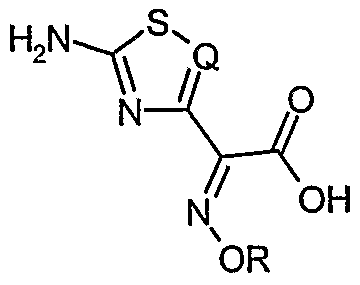
The present invention relates to a process for the preparation of salts of organic nitrogen bases with carboxylic acids of formula (I)
Figure imgf000002_0001
wherein:
- Q is nitrogen, a hydrocarbyl (CH) or chlorocarbyl (CC1) residue;
- R is trityl, benzhydryl or para-methoxy benzyl. The process provides the compounds of formula (I) in high yield and purity, starting from compounds of formula (II)
Figure imgf000002_0002
wherein Q is as defined above.
The salts of acids of formula (I) with organic nitrogen bases can be easily transformed into the corresponding free acids (I) or into solvates thereof, or into compounds of general formula (III), which can either be isolated or used in situ, for the preparation of third and fourth generation cephalosporanic antibiotics, such as Cefdinir and Cefdaloxime
Figure imgf000002_0003
In compounds of general formula (III), Q and R are as defined above, and Z is a carboxy-activating group conventionally used in the synthesis of cephalosporanic antibiotics, such as an anhydride, an ester or an acyl halide.
TECHNICAL BACKGROUND Carboxylic acids of formula (I) are important syntons for the preparation of third and fourth generation cephalosporins having wide spectrum activity and high potency against Gram-positive and Gram-negative microorganisms .
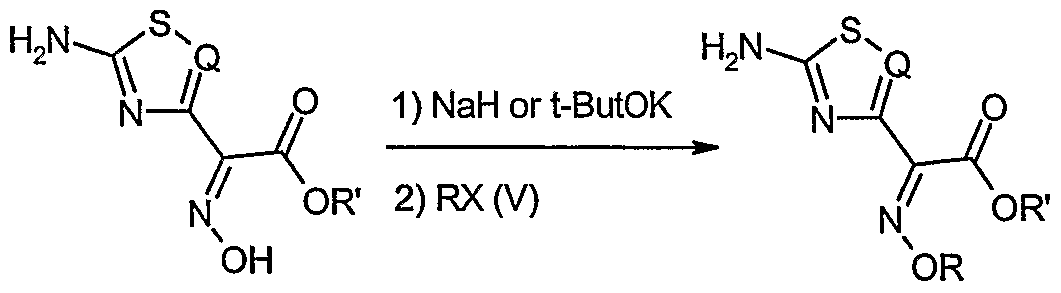
The more efficient methods known to date for the preparation of such compounds involve (Scheme 1) the derivatization of esters of formula (IN), by salification of the hydroxy-imino group with sodium hydride (US 4935508) or with potassium ter -butoxide (US 5637721) and the subsequent reaction with halides of formula (N) to obtain derivatives of formula (NI). The reaction yield usually does not exceed 80%. Compounds of formula (NI) have to undergo a hydrolysis reaction for the conversion into acids of formula (I), which have to be subsequently purified as solvates with organic amides. The overall yield usually does not exceed 60% and the process is unsuitable in terms of productivity, since it requires numerous steps to obtain suitably pure acids of formula (I) for the subsequent use.
1) Hydrolysis 2) PurifIcation
Figure imgf000003_0001
Figure imgf000003_0002
(IV) (VI) (I)
(Scheme 1) In compounds of Scheme 1, Q and R are as defined above and R' is an alkyl residue. As reported by Bucourt et al. in Tetrahedron 34, 2233 (1978), the reaction of esters of formula (IN) with halides of formula (N) in the presence of tertiary amines (Scheme 2) yields, on the other hand, Ν-functionalized compounds of formula (Nil) or Ν,0-bis-functionalized compounds of formula (NIII), in which Q, R and R' are as defined above.
Figure imgf000004_0001
(1V) (VII) (VIII)
(Scheme 2)
It now has been found that the salts of the compounds of formula (I) with organic nitrogen bases can be obtained in a single step, with high yields and purity, by reacting carboxylic acids of formula (II) with halides of formula (V) in the presence of organic nitrogen bases and in industrial inert organic solvents.
Said salts can be advantageously used for the preparation of intermediates, which can be isolated or used in situ, for the preparation of third and fourth generation cephalosporins. In fact, thanks to their good solubility in the organic solvents traditionally used for these preparations, such as methylene chloride, ethyl acetate and tetrahydro uran, these salts allow faster reaction rates with advantages in terms of both yield and purity of the obtained products.
DETAILED DISCLOSURE OF THE INVENTION
The present invention relates to a process for the preparation of salts of organic nitrogen bases with carboxylic acids of general formula (I)
Figure imgf000004_0002
wherein
- Q is nitrogen, a hydrocarbyl (CH) or chlorocarbyl (CC1) residue, preferably nitrogen;
- R is trityl, benzhydryl or para-methoxy benzyl, preferably trityl; which process comprises reacting a carboxylic acid of general formula
Figure imgf000005_0001
wherein Q has the meaning defined above, with a halide of formula (V) (V) RX wherein R has the meaning defined above and X is a halogen selected from chlorine, bromine and iodine, in the presence of a nitrogen organic base and of an organic inert solvent. The nitrogen organic base can be selected from tertiary amines, preferably triethylamine, tributylamine, N-ethyl diisopropylamine, N-methyl morpholine, N-methyl pyrrolidine, N-methyl piperidine, trioctylamine; amidines, preferably diazabicyclononene (DBN) and diazabicycloundecene
(DBU); guanidines, preferably tetramethyl guanidine. The organic inert solvent can be selected from: halogenated hydrocarbons, preferably methylene chloride and dichloroethane; carboxylic acid esters, preferably ethyl acetate and butyl acetate; ketones, preferably acetone, diethyl ketone and methyl ethyl ketone; amides, for example N,N-dimethylformamide, N,N- dimethylacetamide, N-methylpyrrolidone; aromatic hydrocarbons, preferably benzene, toluene and xylene; ethers, preferably tetrahydrofuran, dioxane or ethylene glycol dimethyl ether; sulfoxides or sulfones, preferably dimethylsulfoxide, dimethyl sulfone and sulfolane; or mixtures thereof.
The reaction can be carried out at temperatures ranging from -50° to 200°C, preferably from 0° to 100°C. The halide (N) is used typically in stoichiometric amounts to compound of formula (II) or in a slight molar excess, whereas the organic base can be present in a ratio ranging from 1 : 1 to 1 :10, preferably from 1 :2 to 1 :5.
The halide, which is usually added to a mixture consisting of compound of formula (II), base and organic inert solvent, can be added directly in a single or more portions, or it can be dissolved in a suitable organic solvent, for example methylene chloride, dichloroethane, toluene or xylene, and then added to the reaction mixture in a time ranging from a few minutes to some hours. The reaction is usually considered complete when the residual compound (II) is lower than 3% (HPLC analysis). The salts, which will hereinafter be referred to as compounds (IA), usually crystallize during the reaction or upon cooling the mixture and can therefore be filtered off easily. They are usually obtained in highly pure form; if necessary, they can be further purified from any by-products (such as bis- or tris-functionalized products), by treatment with inert organic solvents selected from halogenated hydrocarbons, preferably methylene chloride or dichloroethane; aromatic hydrocarbons, preferably toluene or xylene; or mixtures thereof, optionally in the presence of cosolvents such as amides, preferably Ν,Ν-dimethylformamide, N,N-dimethylacetamide and N-methyl pyrrolidinone, at temperatures ranging from 10° to 100°C, preferably from 25° to 70°C. Salts (IA) can be further purified from traces of the starting compound (II) and any water-soluble amines hydrochlorides present by treatment with water or an aqueous solvent.
Drying of salts (IA) does not require particular procedures and can be carried out, for example, under vacuum or by ventilation at temperatures from 30° to 100°C.
Salts (IA) can be used for the preparation of the corresponding free acids of formula (I) and the solvates thereof, for example with formamide, dimethylformamide, dimethylacetamide or N-methylpyrrolidone, according to conventional methods reported in literature (Liebigs Ann. 1996, 1743 - 1749).
Even more advantageously, salts (IA) can be used for the preparation of reactive derivatives of general formula (III), which can be isolated or used in situ in the acylation reactions to obtain cephalosporanic antibiotics, such as Cefdinir, Cefdaloxime and other third and fourth generation cephalosporins, according to the procedures described in literature (US 6,093,814, Organic Process Research & Development 1997, 1 121-123).
Figure imgf000007_0001
In compounds of formula (III), Q and R are as described above, and Z is a carboxy-activating group which, together with the C=0 group to which it is bound, forms:
1. a mixed anhydride of formula -C(0)-0-P(0)(OR1)2 wherein Ri is an aryl group or a Cι-C6 straight or branched alkyl group; a preferred anhydride is the anhydride with diethylphosphoric acid of formula -C(0)-0-P(0)(OEt)2 (Synthetic Communication, 28(1), 1998, 35-44); 2. a mixed anhydride of formula -C(0)-0-P(S)(OR1)2 wherein R! is as defined above; a preferred anhydride is that with diethylthiophosphoric acid, of formula -C(0)-0-P(S)(OEt)2 (EP 0812846); 3. a mixed anhydride of formula -C(0)-0-S02Rι wherein Ri is as defined above; a preferred mixed anhydride is that with para- toluenesulfonic acid, of formula -C(0)-0-S02(p-C6H4)CH3 (US 5,589,594);
4. a mixed anhydride of formula -C(0)-0-CORι wherein Ri is as defined above; a preferred mixed anhydride is that with pivalic acid, of formula -C(0)-0- COC(CH3)3;
5. a mixed anhydride of formula -C(0)-0-C02Rι wherein R] is as defined above; a preferred mixed anhydride is that with ethylcarbonic acid, of formula -C(0)-O-C02Et; 6. a reactive ester of formula -C(0)-0-R2 wherein R2 is an aryl or heterocyclic residue such as pentacloro-1-phenyl, benzotriazol-1-yl, N- succinimido, N-phthalimido; preferred is the ester with 1- hydroxybenzotriazole (The Journal of Antibiotics, 1990, 43(12), 1564 - 1572); 7. a thioester of formula -C(0)-S-R3 wherein R3 is a heterocyclic residue selected from 2-pyridyl, benzothiazol-2-yl, benzoxazol-2-yl, benzimidazol-2-yl; preferred is the thioester with 2- mercaptobenzothiazole (EP 0037380, EP 0849269);
8. a reactive amide of formula -C(0)NR3R4 wherein NR3R1 is the residue of a nitrogen heterocycle selected from imidazolyl, 1,2,4- triazolyl, tetrazolyl, benzotriazolyl; preferred is the amide with benzotriazol-3-oxide-l-yl (The Journal of Antibiotics , 1993, 46(2), 359 - 361);
9. an acid chloride of formula -C(0)C1, wherein the amino group of compound (I) can be free or in the form of salt with a mineral or organic acid (US 6,030,965).
Compared with acids of formula (I), salts (IA) are usually more soluble in the organic solvents traditionally used for the activation reactions, such as methylene chloride, ethyl acetate and tetrahydrofuran, and the reactions are usually faster, give higher yields and yield compounds of formula (III) having higher purity.
Salts (IA) allow therefore to carry out a process for the preparation of cephalosporins of general formula (IX),
Figure imgf000009_0001
comprising the conversion of a salt of formula (IA) into a compound of formula (III), the reaction of the latter with a suitable 7-amino- cephalosporanic acid derivative and the subsequent deprotection of the hydroxy-imino residue.
In compounds of formula (IX), Q is as defined above and A is a typical residue of cephalosporins chemistry, preferably vinyl, (-CH^CH^ or methoxymethylene (-CH2-0-CH3).
According to a preferred embodiment of the process of the invention, compounds (IX) Cefdinir, wherein Q is the hydrocarbyl residue (-CH) and A is vinyl, and Cefdaloxime, wherein Q is the hydrocarbyl residue (-CH) and A is methoxymethylene, are prepared.
The following examples illustrate the invention in greater detail. EXAMPLES
Example 1 - Preparation of (Z)-2-(2-aminothiazoI-4-yI)-2- trityloxyimino acetic acid triethylammonium salt. To a suspension of 200 g of (Z)-2-(2-aminothiazol-4-yl)-2- hydroxymmino acetic acid in 2.2 liters of sulfolane and 500 ml of triethylamine, heated at 84÷90°C, 297 g of triphenylchloromethane dissolved in 1300 ml of toluene was added in 2.5 hours under strong stirring. The reaction mixture was kept under vigorous stirring at 85÷90°C for 1 hour. The suspension was cooled to 20°C and filtered after 1.5 hour. The solid was washed with water and toluene, then dried to obtain 475 g of (Z)-2-(2- aminothiazol-4-yl)-2-trityloxyimino acetic acid triethylammonium salt. IR (KBr ., : 3440 -3230, 3054, 1610.
1H-NMR (300MHz, DMSO-d6) δ:7.45÷7.10 (15H, mm, phenyl-H); 7.00 (2H, s, -NH2); 6.50 (1H, s, thiazole-H); 2.97 (6H, q, -CH2 triethylamine); 1.14 (9H, t, -CH3 triethylamine).
Following the procedure described in Example 1, but replacing triethylamine with the suitable organic base, the following compounds were obtained:
- (Z)-2-(2-aminothiazol-4-yl)-2-trityloxyimino acetic acid tributylammonium salt;
- (Z)-2-(2-aminothiazol-4-yl)-2-trityloxyimino acetic acid N-methyl morpholinium salt;
- (Z)-2-(2-aminothiazol-4-yl)-2-trityloxyimino acetic acid N-methyl pyrrolidinium salt;
- (Z)-2-(2-aminothiazol-4-yl)-2-trityloxyimino acetic acid N-methyl piperidinium salt. Example 2 - Preparation (Z)-2-(2-aminothiazol-4-yl)-2- trityloxyimino acetic acid.
To a suspension of 200 g of (Z)-2-(2-aminothiazol-4-yl)-2- hydroxyimino acetic acid in 2.2 liters of sulfolane and 500 ml of triethylamine, heated at 85÷90°C, 297 g of triphenylchloromethane dissolved in 1300 ml toluene were added, under vigorous stirring in 2.5 hours. The reaction mixture was kept under vigorous stirring at 84÷90°C for 1 hour. The suspension was cooled to 20°C and filtered after 1.5 hour. After washing with water, the solid was taken up into 150 ml of purified water and 1100 ml of ethanol. The suspension was heated to 50°C and a further 1100 ml of ethanol was added in 30 minutes. The mixture was gradually cooled to 10°C in an hour, acidified to pH 4.0 by addition of 20% hydrochloric acid, then kept for an hour at 10°C and filtered. The solid was washed with water and dried to obtain 366 g of (Z)-2-(2-aminothiazol-4-yl)-2-trityloxyimino acetic acid.
IR and NMR analysis, compared with the data reported in literature (Kamachi et al., The Journal of Antibiotics, 1990, 1564-1572), confirmed the structure of the product.
Example 3 - Purification of (Z)-2-(2-aminothiazol-4-yI)-2- trityloxyimino acetic acid triethylammonium salt.
A suspension of 150 g of (Z)-2-(2-aminothiazol-4-yl)-2-trityloxyimino acetic acid triethylammonium salt in 600 ml of toluene was heated to 65°C and left under stirring at 65°C for 60 minutes. The suspension was then cooled to 5°C and filtered after an hour. The solid was washed with toluene and dried under vacuum at 65°C for 12 hours, to obtain 134 g of (Z)-2-(2-aminothiazol- 4-yl)-2-trityloxyimino acetic acid triethylammonium salt.
Example 4 - Purification of (Z)-2-(2-aminothiazol-4-yl)-2- trityloxyimino acetic acid triethylammonium salt.
A suspension of 300 g of (Z)-2-(2-aminothiazol-4-yl)-2-trityloxyimino acetic acid triethylammonium salt in 600 ml of purified water was cooled to 10°C and left under stirring for 2 hours. The suspension was then cooled to 2°C and filtered after an hour. The solid was washed with water, then dried to obtain 192 g of (Z)-2-(2-aminothiazol-4-yl)-2-trityloxyimino acetic acid triethylammonium salt. Example 5 - Preparation of 2-benzothiazolyI-(Z)-2-(2-aminothiazol-
4-yl)-2-trityloxyimino thioacetate.
To a suspension of 310 g of bis(2-mercaptobenzothiazolyl) disulfide in 2250 ml of methylene chloride at room temperature, 244 g of triphenylphosphine was added and the suspension was kept for 30 minutes under stirring at 21°C. Afterwards, 465 g of (Z)-2-(2-aminothiazol-4-yl)-2- trityloxyimino acetic acid triethylammonium salt were added to the suspension in 5 minutes. Temperature raised to 27°C. The suspension was kept at 23÷25°C for 90 minutes, then filtered and the solid was washed with methylene chloride and dried to obtain 456 g of 2-benzothiazolyl-(Z)-2-(2- aminothiazol-4-yl)-2-trityloxyiminothioacetate.
NMR analysis, compared with the data reported in literature ( ollmann et al., Liebigs Ann., 1996, 1743-1749), confirmed the structure of the product. 1H-NMR (300MHz, DMSO-d6) δ:8.30÷8.24 (1H, d), 8.13÷8.07 (1H, d),
7.63÷7.53 (2H, m); 7.40÷7.20 (17H, m); 6.83 (1H, s).

Claims

1. A process for the preparation of salts of organic nitrogen bases with carboxylic acids of general formula (I)
Figure imgf000013_0001
wherein: - Q is nitrogen, a hydrocarbyl (CH) or chlorocarbyl (CC1) residue;
R is trityl, benzhydryl or para-methoxy benzyl; which process comprises reacting a carboxylic acid of general formula (II)
Figure imgf000013_0002
wherein Q has the meaning defined above, with a halide of formula (N)
(N) RX wherein R has the meaning defined above and X is a halogen selected from chlorine, bromine and iodine, in the presence of a nitrogen organic base and of an organic inert solvent.
2. A process as claimed in claim 1, wherein the nitrogen organic base is a tertiary amine selected from triethylamine, tributylamine, Ν-ethyl disopropylamine, Ν-methyl morpholine, Ν-methyl pyrrolidine, Ν- methylpiperidine, trioctylamine.
3. A process as claimed in claim 1 wherein the nitrogen organic base is an amidine selected from diazabicyclononene (DBΝ) and diazabicycloundecene (DBU).
4. A process as claimed in claim 1 wherein the organic base is tetramethyl guanidine.
5. A process as claimed in any one of the above claims wherein the inert organic inert solvent is selected from halogenated hydrocarbons, carboxylic acid esters, ketones, amides, aromatic hydrocarbons, ethers, sulfoxides or sulfones, or mixtures thereof.
6. A process as claimed in claim 5 wherein the inert organic solvent is selected from methylene chloride, dichloroethane, ethyl acetate, butyl acetate, acetone, diethyl ketone, methyl-ethyl ketone, N,N-dimethylformamide, N,N- dimethylacetamide, N-methylpyrrolidone, benzene, toluene, xylene, tetrahydrofuran, dioxane, ethylene glycol dimethyl ether, dimethylsulfoxide, dimethyl sulfone and sulfolane or mixtures thereof.
7. A process as claimed in any one of the above claims, further comprising the transformation of the salts as defined in claim 1 into the respective carboxylic acids (I).
8. Salts of organic nitrogen bases with carboxylic acids of general formula
Figure imgf000014_0001
Q is nitrogen, a hydrocarbyl (CH) or chlorocarbyl (CC1) residue;
R is trityl, benzhydryl or para-methoxy benzyl.
9. Salts as claimed in claim 8 wherein the nitrogen organic base is a tertiary amine selected from triethylamine, tributylamine, N-ethyl diisopropylamine, N-methyl morpholine, N-methyl pyrrolidine, N-methyl piperidine, trioctylamine.
10. Salts as claimed in claim 8 wherein the nitrogen organic base is an amidine selected from diazabicyclononene (DBN) and diazabicycloundecene (DBU).
11. Salts as claimed in claim 8 wherein the nitrogen organic base is tetramethyl guanidine.
12. Salts as claimed in claim 9 selected from: (Z)-2-(2-aminothiazol-4-yl)-2-trityloxyimino acetic acid triethylammonium salt; (Z)-2-(2-aminothiazol-4-yl)-2-trityloxyimino acetic acid tributylammonium salt;
(Z)-2-(2-aminothiazol-4-yl)-2-trityloxyimino acetic acid N-methyl morpholinium salt;
(Z)-2-(2-aminothiazol-4-yl)-2-trityloxyimino acetic acid N-methyl pyrrolidinium salt; (Z)-2-(2-aminothiazol-4-yl)-2-trityloxyimino acetic acid N-methyl piperidinium salt.
13. A process for the preparation of cephalosporins of general formula (IX),
Figure imgf000015_0001
wherein Q is as defined in claim 1 and A is a vinyl or methoxymethylene residue, which process comprises reacting a derivative of formula (III),
Figure imgf000015_0002
(III) wherein Q and R are as defined in claim 1, and Z is a carboxy-activating group, with a 7-amino-cephalosporanic acid and subsequently deprotecting the hydroxy-imino residue, characterized in that derivative of formula (III) is obtained from the salt of claims 8 -12.
14. A process as claimed in claim 13, wherein in compounds of formula (III) Z is a carboxy-activating group which, together with the C-0 group to which it is bound, forms: - a mixed anhydride of formula -C(0)-0-P(0)(OR1)2 wherein Ri is an aryl group or a Cι-C6 straight or branched alkyl group; a mixed anhydride of formula -C(0)-0-P(S)(OR1)2 wherein Ri is as defined above; a mixed anhydride of formula -C(0)-0-S02R1 wherein Ri is as defined above; a mixed anhydride of formula -C(0)-0-COR1 wherein R! is as defined above; a mixed anhydride of formula -C(0)-0-C02R1 wherein Ri is as defined above; a reactive ester of formula -C(0)-0-R2 wherein R2 is an aryl or heterocyclic residue selected from pentacloro-1-phenyl, benzotriazol-1-yl, N-succinimido, N-phthalimido; a thioester of formula -C(0)-S-R3 wherein R3 is a heterocyclic residue selected from 2-pyridyl, benzothiazol-2-yl, benzoxazol- 2-yl, benzimidazol-2-yl; a reactive amide of formula -C(0)NR3R wherein NR3R is the residue of a nitrogen heterocycle selected from imidazolyl, 1,2,4- triazolyl, tetrazolyl, benzotriazolyl; an acid chloride of formula -C(0)C1, wherein the amino group of compound of formula (I) can be free or in the form of a salt with a mineral or organic acid.
15. A process as claimed in claims 13 and 14, wherein in compounds formula (IX) Q is a hydrocarbyl residue (-CH) and A is a vinyl residue (-CH=CH2).
16. A process as claimed in claims 13 and 14, wherein in compounds of formula (IX) Q is a hydrocarbyl residue (-CH) and A is a methoxymethylene residue (-CH2-0-CH3).
PCT/EP2002/012328 2001-11-09 2002-11-05 A process for the preparation of cephalosporins side chains Ceased WO2003040116A1 (en)

Priority Applications (3)

Application Number Priority Date Filing Date Title
KR10-2004-7006840A KR20040064270A (en) 2001-11-09 2002-11-05 A process for the preparation of cephalosporins side chains
JP2003542162A JP2005508385A (en) 2001-11-09 2002-11-05 Method for producing cephalosporin side chain
EP02802646A EP1442029A1 (en) 2001-11-09 2002-11-05 A process for the preparation of cephalosporins side chains

Applications Claiming Priority (2)

Application Number Priority Date Filing Date Title
IT2001MI002363A ITMI20012363A1 (en) 2001-11-09 2001-11-09 METHOD FOR THE SYNTHESIS OF SIDE CHAINS OF CEPHALOSPORINE
ITMI2001A002363 2001-11-09

Publications (2)

Publication Number Publication Date
WO2003040116A1 true WO2003040116A1 (en) 2003-05-15
WO2003040116A8 WO2003040116A8 (en) 2004-06-17

Family

ID=11448586

Family Applications (1)

Application Number Title Priority Date Filing Date
PCT/EP2002/012328 Ceased WO2003040116A1 (en) 2001-11-09 2002-11-05 A process for the preparation of cephalosporins side chains

Country Status (6)

Country Link
EP (1) EP1442029A1 (en)
JP (1) JP2005508385A (en)
KR (1) KR20040064270A (en)
CN (1) CN1309713C (en)
IT (1) ITMI20012363A1 (en)
WO (1) WO2003040116A1 (en)

Cited By (2)

* Cited by examiner, † Cited by third party
Publication number Priority date Publication date Assignee Title
WO2011029596A1 (en) * 2009-09-11 2011-03-17 Lonza Ltd Process for preparing 2-aminothiazol-4-yl-acetic acid derivates
US9139542B2 (en) 2013-03-13 2015-09-22 Theravance Biopharma Antibiotics Ip, Llc Crystalline form of a substituted thiazolylacetic acid triethylamine salt

Families Citing this family (1)

* Cited by examiner, † Cited by third party
Publication number Priority date Publication date Assignee Title
CN102659713B (en) * 2012-05-07 2014-03-05 山东金城柯瑞化学有限公司 Preparation method for cefdinir side-chain acid active ester

Citations (6)

* Cited by examiner, † Cited by third party
Publication number Priority date Publication date Assignee Title
US4935508A (en) * 1988-08-23 1990-06-19 Bristol-Myers Company Process for cephem prodrug esters
WO1992007840A1 (en) * 1990-11-02 1992-05-14 Taisho Pharmaceutical Co., Ltd. Thiazole thioester derivative
JPH0797368A (en) * 1993-09-29 1995-04-11 Tokuyama Corp Process for producing protected hydroxyl group-containing heterocyclic compound
JPH0841041A (en) * 1994-08-01 1996-02-13 Tokuyama Corp Method for producing 2- (2-aminothiazol-4-yl) -2-acetoxyiminoacetic acid or its derivative
US5589594A (en) * 1992-02-14 1996-12-31 Hoechst Aktiengesellschaft Process for the preparation of cephem prodrug esters
EP0849269A1 (en) * 1996-12-19 1998-06-24 F. Hoffmann-La Roche Ag Vinyl pyrrolidine cephalosporins with basic substituents

Patent Citations (7)

* Cited by examiner, † Cited by third party
Publication number Priority date Publication date Assignee Title
US4935508A (en) * 1988-08-23 1990-06-19 Bristol-Myers Company Process for cephem prodrug esters
WO1992007840A1 (en) * 1990-11-02 1992-05-14 Taisho Pharmaceutical Co., Ltd. Thiazole thioester derivative
US5589594A (en) * 1992-02-14 1996-12-31 Hoechst Aktiengesellschaft Process for the preparation of cephem prodrug esters
US5637721A (en) * 1992-02-14 1997-06-10 Hoechst Aktiengesellschaft Process for the preparation of cephem prodrug esters
JPH0797368A (en) * 1993-09-29 1995-04-11 Tokuyama Corp Process for producing protected hydroxyl group-containing heterocyclic compound
JPH0841041A (en) * 1994-08-01 1996-02-13 Tokuyama Corp Method for producing 2- (2-aminothiazol-4-yl) -2-acetoxyiminoacetic acid or its derivative
EP0849269A1 (en) * 1996-12-19 1998-06-24 F. Hoffmann-La Roche Ag Vinyl pyrrolidine cephalosporins with basic substituents

Non-Patent Citations (4)

* Cited by examiner, † Cited by third party
Title
CHEMICAL ABSTRACTS, vol. 123, no. 13, 25 September 1995, Columbus, Ohio, US; abstract no. 169430, KOYANAGI S. ET AL: "Preparation of heterocycles for side chains of cephems" XP002234210 *
CHEMICAL ABSTRACTS, vol. 124, no. 25, 17 June 1996, Columbus, Ohio, US; abstract no. 343292, IWASAKI F. ET AL: "Method for producing 2-(2-aminothiazol-4-yl)-2-acetoxyiminoacetic acid and its derivative" XP002234212 *
CHEMICAL ABSTRACTS, vol. 127, no. 24, 15 December 1997, Columbus, Ohio, US; abstract no. 331464, ZHU Y ET AL: "Improved synthesis of (Z)-2--(2-aminothiazol-4-yl)-2-trityloxyiminoacetic acid" XP002234211 *
ZHONGGUO YIYAO GONGYE ZAZHI, vol. 28, no. 6, 1997, CHINA, pages 270 - 271 *

Cited By (2)

* Cited by examiner, † Cited by third party
Publication number Priority date Publication date Assignee Title
WO2011029596A1 (en) * 2009-09-11 2011-03-17 Lonza Ltd Process for preparing 2-aminothiazol-4-yl-acetic acid derivates
US9139542B2 (en) 2013-03-13 2015-09-22 Theravance Biopharma Antibiotics Ip, Llc Crystalline form of a substituted thiazolylacetic acid triethylamine salt

Also Published As

Publication number Publication date
CN1585758A (en) 2005-02-23
EP1442029A1 (en) 2004-08-04
ITMI20012363A1 (en) 2003-05-09
KR20040064270A (en) 2004-07-16
JP2005508385A (en) 2005-03-31
WO2003040116A8 (en) 2004-06-17
CN1309713C (en) 2007-04-11

Similar Documents

Publication Publication Date Title
US6388070B1 (en) Thioester derivatives of thiazolyl acetic acid and their use in the preparation of cephalosporin compounds
JP3948628B2 (en) Method for producing cefdinir
CA2326441C (en) Process for purification of a cephalosporin derivative
EP0175814B1 (en) Process for preparing cephem derivatives
JP2939129B2 (en) Intermediates in the synthesis of cephalosporins
FI109127B (en) Process for the preparation of cefepime dihydrochloride hydrate antibiotic
KR100342600B1 (en) New Thiazole compounds and their preparations
WO2003040116A1 (en) A process for the preparation of cephalosporins side chains
AU690482B2 (en) Process for producing cephalosporin antibiotics
HU213267B (en) Process for producing stereospecific cefepime-dihydrochloride-hydrate at ph 5-7,5
KR890002107B1 (en) Method for preparing cephalosporin derivative
US5594130A (en) Preparation of a cephalosporin antibiotic using the syn-isomer of a thiazolyl intermediate
JPH064641B2 (en) Method for producing cefalosporin derivative
KR930007260B1 (en) Process for preparing cephalosporin derivatives
EP0613480A1 (en) Process for the preparation of cephem derivatives
KR100355115B1 (en) New cephem compouns for preparation of ceftiofur
EP0528343A2 (en) New process for the production of cephalosporines and novel intermediates in this process
KR0174432B1 (en) Novel crystalline Cefdinir intermediate and preparation method thereof
JPS6242989A (en) Production of 7alpha-methoxycephalosporin compound
KR100531669B1 (en) Processes for the preparation of cephem derivatives
HU197579B (en) Process for production of derivatives of cefem carbonic acid
JPH02270882A (en) Production of 7alpha-methoxycephalosporin compound
JPH0331287A (en) Synthesis of cephalosporin compound
JPH0623189B2 (en) Process for producing azetidinone derivative
WO2002008184A1 (en) Process for preparing distamycin derivatives

Legal Events

Date Code Title Description
AK Designated states

Kind code of ref document: A1

Designated state(s): AE AG AL AM AT AU AZ BA BB BG BR BY BZ CA CH CN CO CR CU CZ DE DK DM DZ EC EE ES FI GB GD GE GH GM HR HU ID IL IN IS JP KE KG KP KR KZ LC LK LR LS LT LU LV MA MD MG MK MN MW MX MZ NO NZ OM PH PL PT RO RU SD SE SG SI SK SL TJ TM TN TR TT TZ UA UG US UZ VC VN YU ZA ZM ZW

AL Designated countries for regional patents

Kind code of ref document: A1

Designated state(s): GH GM KE LS MW MZ SD SL SZ TZ UG ZM ZW AM AZ BY KG KZ MD RU TJ TM AT BE BG CH CY CZ DE DK EE ES FI FR GB GR IE IT LU MC NL PT SE SK TR BF BJ CF CG CI CM GA GN GQ GW ML MR NE SN TD TG

121 Ep: the epo has been informed by wipo that ep was designated in this application
DFPE Request for preliminary examination filed prior to expiration of 19th month from priority date (pct application filed before 20040101)
WWE Wipo information: entry into national phase

Ref document number: 2003542162

Country of ref document: JP

Ref document number: 1020047006840

Country of ref document: KR

WWE Wipo information: entry into national phase

Ref document number: 20028222148

Country of ref document: CN

WWE Wipo information: entry into national phase

Ref document number: 2002802646

Country of ref document: EP

CFP Corrected version of a pamphlet front page
CR1 Correction of entry in section i

Free format text: IN PCT GAZETTE 20/2003 UNDER (72, 75) REPLACE "POZZI, GIOVANNI, VIA BELVEDERE, 19/A, I-20045 BESANA BRIANZA" BY "POZZI, GIOVANNI, VIA BELVEDERE, 19/F, I-20045 BESANA BRIANZA"

WWP Wipo information: published in national office

Ref document number: 2002802646

Country of ref document: EP