WO2003054034A2 - Supported titanium-containing for homo-, co-, and ter-polymerization of olefins - Google Patents
Supported titanium-containing for homo-, co-, and ter-polymerization of olefins Download PDFInfo
- Publication number
- WO2003054034A2 WO2003054034A2 PCT/EP2002/013954 EP0213954W WO03054034A2 WO 2003054034 A2 WO2003054034 A2 WO 2003054034A2 EP 0213954 W EP0213954 W EP 0213954W WO 03054034 A2 WO03054034 A2 WO 03054034A2
- Authority
- WO
- WIPO (PCT)
- Prior art keywords
- silica
- catalyst
- catalyst supported
- titanium
- aluminum
- Prior art date
- Legal status (The legal status is an assumption and is not a legal conclusion. Google has not performed a legal analysis and makes no representation as to the accuracy of the status listed.)
- Ceased
Links
- 0 CC(C)(*(*)C(C=C1)=C(C)CC1Cl=C)[Tl+]=C Chemical compound CC(C)(*(*)C(C=C1)=C(C)CC1Cl=C)[Tl+]=C 0.000 description 1
Classifications
-
- C—CHEMISTRY; METALLURGY
- C08—ORGANIC MACROMOLECULAR COMPOUNDS; THEIR PREPARATION OR CHEMICAL WORKING-UP; COMPOSITIONS BASED THEREON
- C08F—MACROMOLECULAR COMPOUNDS OBTAINED BY REACTIONS ONLY INVOLVING CARBON-TO-CARBON UNSATURATED BONDS
- C08F10/00—Homopolymers and copolymers of unsaturated aliphatic hydrocarbons having only one carbon-to-carbon double bond
-
- C—CHEMISTRY; METALLURGY
- C07—ORGANIC CHEMISTRY
- C07C—ACYCLIC OR CARBOCYCLIC COMPOUNDS
- C07C53/00—Saturated compounds having only one carboxyl group bound to an acyclic carbon atom or hydrogen
- C07C53/15—Saturated compounds having only one carboxyl group bound to an acyclic carbon atom or hydrogen containing halogen
- C07C53/16—Halogenated acetic acids
-
- C—CHEMISTRY; METALLURGY
- C07—ORGANIC CHEMISTRY
- C07C—ACYCLIC OR CARBOCYCLIC COMPOUNDS
- C07C53/00—Saturated compounds having only one carboxyl group bound to an acyclic carbon atom or hydrogen
- C07C53/15—Saturated compounds having only one carboxyl group bound to an acyclic carbon atom or hydrogen containing halogen
- C07C53/19—Acids containing three or more carbon atoms
-
- C—CHEMISTRY; METALLURGY
- C07—ORGANIC CHEMISTRY
- C07C—ACYCLIC OR CARBOCYCLIC COMPOUNDS
- C07C57/00—Unsaturated compounds having carboxyl groups bound to acyclic carbon atoms
- C07C57/52—Unsaturated compounds having carboxyl groups bound to acyclic carbon atoms containing halogen
-
- C—CHEMISTRY; METALLURGY
- C07—ORGANIC CHEMISTRY
- C07C—ACYCLIC OR CARBOCYCLIC COMPOUNDS
- C07C57/00—Unsaturated compounds having carboxyl groups bound to acyclic carbon atoms
- C07C57/52—Unsaturated compounds having carboxyl groups bound to acyclic carbon atoms containing halogen
- C07C57/58—Unsaturated compounds having carboxyl groups bound to acyclic carbon atoms containing halogen containing six-membered aromatic rings
-
- C—CHEMISTRY; METALLURGY
- C07—ORGANIC CHEMISTRY
- C07F—ACYCLIC, CARBOCYCLIC OR HETEROCYCLIC COMPOUNDS CONTAINING ELEMENTS OTHER THAN CARBON, HYDROGEN, HALOGEN, OXYGEN, NITROGEN, SULFUR, SELENIUM OR TELLURIUM
- C07F3/00—Compounds containing elements of Groups 2 or 12 of the Periodic Table
- C07F3/003—Compounds containing elements of Groups 2 or 12 of the Periodic Table without C-Metal linkages
-
- C—CHEMISTRY; METALLURGY
- C08—ORGANIC MACROMOLECULAR COMPOUNDS; THEIR PREPARATION OR CHEMICAL WORKING-UP; COMPOSITIONS BASED THEREON
- C08F—MACROMOLECULAR COMPOUNDS OBTAINED BY REACTIONS ONLY INVOLVING CARBON-TO-CARBON UNSATURATED BONDS
- C08F110/00—Homopolymers of unsaturated aliphatic hydrocarbons having only one carbon-to-carbon double bond
- C08F110/04—Monomers containing three or four carbon atoms
- C08F110/06—Propene
-
- C—CHEMISTRY; METALLURGY
- C08—ORGANIC MACROMOLECULAR COMPOUNDS; THEIR PREPARATION OR CHEMICAL WORKING-UP; COMPOSITIONS BASED THEREON
- C08F—MACROMOLECULAR COMPOUNDS OBTAINED BY REACTIONS ONLY INVOLVING CARBON-TO-CARBON UNSATURATED BONDS
- C08F110/00—Homopolymers of unsaturated aliphatic hydrocarbons having only one carbon-to-carbon double bond
- C08F110/14—Monomers containing five or more carbon atoms
-
- C—CHEMISTRY; METALLURGY
- C08—ORGANIC MACROMOLECULAR COMPOUNDS; THEIR PREPARATION OR CHEMICAL WORKING-UP; COMPOSITIONS BASED THEREON
- C08F—MACROMOLECULAR COMPOUNDS OBTAINED BY REACTIONS ONLY INVOLVING CARBON-TO-CARBON UNSATURATED BONDS
- C08F210/00—Copolymers of unsaturated aliphatic hydrocarbons having only one carbon-to-carbon double bond
- C08F210/02—Ethene
-
- C—CHEMISTRY; METALLURGY
- C08—ORGANIC MACROMOLECULAR COMPOUNDS; THEIR PREPARATION OR CHEMICAL WORKING-UP; COMPOSITIONS BASED THEREON
- C08F—MACROMOLECULAR COMPOUNDS OBTAINED BY REACTIONS ONLY INVOLVING CARBON-TO-CARBON UNSATURATED BONDS
- C08F210/00—Copolymers of unsaturated aliphatic hydrocarbons having only one carbon-to-carbon double bond
- C08F210/04—Monomers containing three or four carbon atoms
- C08F210/06—Propene
-
- C—CHEMISTRY; METALLURGY
- C08—ORGANIC MACROMOLECULAR COMPOUNDS; THEIR PREPARATION OR CHEMICAL WORKING-UP; COMPOSITIONS BASED THEREON
- C08F—MACROMOLECULAR COMPOUNDS OBTAINED BY REACTIONS ONLY INVOLVING CARBON-TO-CARBON UNSATURATED BONDS
- C08F210/00—Copolymers of unsaturated aliphatic hydrocarbons having only one carbon-to-carbon double bond
- C08F210/16—Copolymers of ethene with alpha-alkenes, e.g. EP rubbers
- C08F210/18—Copolymers of ethene with alpha-alkenes, e.g. EP rubbers with non-conjugated dienes, e.g. EPT rubbers
Definitions
- the present invention relates to a supported catalyst containing titanium, active in the preparation of polymer, copoly ers and terpolymers, starting from olefin-unsatu- rated compounds.
- the present invention also relates to a catalytic system comprising a supported catalyst containing titanium and a cocatalyst selected from organo-derivatives of aluminum. More specifically, the present invention relates to a catalyst supported on silica, obtained by reacting one or more titanium halocarboxylates and one or more magnesium halocarboxylates with an aluminum chloroakylderivative, in the presence of a carrier essentially consisting of high porosity silica. The above reaction essentially takes place in the pores of the silica itself.
- Heterogeneous catalysts essentially consisting of derivatives of magnesium and titanium supported on inert a- terials are known as being active in the polymerization of ethylene, particularly in gas phase.
- inert a- terials for example silica or alumina
- US-A-4, 359, 561 describes the preparation of these materials and their use, together with an activator, in the polymerization of ethylene in gas phase.
- the preparation of these materials has numerous disadvantages.
- silica the preferred inert carrier
- 800°C see Example 1 Of US-A-4, 379, 748 .
- titanium halocarboxylates preferably titanium chloro- carboxylates, useful in the homo-, co- and ter- polymerization of alpha-olefins with non-conjugated dienes.
- These titanium halocarboxylates are suitable for the preparation of EPR elastomers and EPDM terpolymers.
- EP(D)M terpolymers in fact have a sufficiently narrow molecular weight distribution (M w /M n ⁇ 3), are random (r e xr p ⁇ 1.0) and are obtained with acceptable productivity (about 13-18 kg/g of titanium) .
- the catalytic systems based on titanium described in the above patent application IT MI01A000858 have the well- known disadvantages of homogeneous catalytic systems, for example difficulty in producing high molecular weights and unsatisfactory yields. In addition, they are not suitable for the homopolymerization of ⁇ -olefins.
- a catalyst based on titanium supported on silica has now been found, which overcomes the drawbacks described above, as it can be used for the homo-, co- and ter- polymerization of olefin-unsaturated compounds, with medium to high yields.
- the catalyst of the present invention also allows high molecular weights to be obtained, when desired.
- the preparation of the supported catalyst of the present invention also has the considerable advantage of being very simple and requiring minimum quantities of non-polar solvents. Furthermore, there is no pretreatment step of the silica at high temperatures.
- the present invention relates to a catalyst supported on silica, active in the polymerization, copolymerization and terpolymerization of olefin- unsaturated compounds, the above silica having a surface area of > 200 m 2 /g, preferably from 250 to 400 m 2 /g, a to- tal cumulative pore volume greater than 1 ml/g, preferably from 1.1 to 3 ml/g, even more preferably trom 1.2 to 2 ml/g, a quantity of total surface hydroxyls (isolated, vicinal, geminal) of less than 1.0 meq/g, preferably from
- an average particle diameter ranging from 5 ⁇ m to 100 ⁇ m, preferably from 20 ⁇ m to 60 ⁇ m, a free humidity content lower than or equal to 2% by weight, preferably lower than 1% by weight, obtained by means of a process which comprises :
- X 1 is a halogen, excluding iodine, preferably chlorine; m is selected from 0 to 1;
- R has the same meaning as R' ;
- - X is selected from chlorine, bromine, alkoxyl, car- boxyl, beta-dicarbonyl group, preferably chlorine; and wherein the atomic ratio between the Mg in (II) and Ti in (I) ranges from 0.5/1 to 10/1;
- step (iv) recovery of the supported catalyst obtained at the end of step (iii) , after elimination by washing of the aluminum-based by-products .
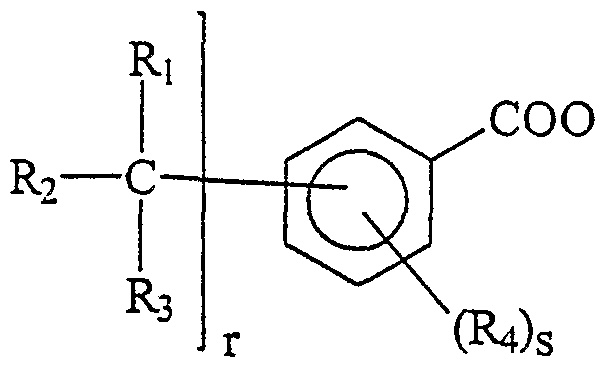
- R'-COO carboxyl groups in formula (II) and R-COO carboxyl groups of general formula (I) are selected from: (1)
- Ri, R 2 , R 3 , R 4 and R 5 are selected from H, F, Cl, Br, a monofunctional hydrocarbyl radical as such or having at least one of its hydrogen atoms substituted with a halogen selected from chlorine, bromine, fluorine, preferably chlorine; on the condition that at least one of the residues from Ri to R 5 is selected from fluorine, chlorine or bromine, preferably chlorine, or a monofunctional hydrocarbyl group containing a halogen selected from fluorine, chlorine or bromine, preferably chlorine; t and u independently vary from 0 to 10.
- Ri, R, R 3 , R 4 have the meaning defined above, on the condition that at least one of the residues from Ri to R 4 is selected from fluorine, chlorine or bromine, preferably chlorine, or a monofunctional hydrocarbyl group containing a halogen selected from fluorine, chlorine or bromine, preferably chlorine; r and s independently vary from 0 to 5, with the constraint that r+s ranges from 1 to 5.
- Non-limiting examples of these derivatives are repre- sented by: Cl 3 CC 6 H 4 COO, C1CH 2 C 6 H 4 C00, C1CH 2 C 6 H 2 C1 2 C00, C 6 Cl 5 COO. (3)
- R 6 have the same meaning as the other substituents, on the condition that at least one of the residues Z and Ri-R ⁇ is selected from fluorine, chlorine or bromine, preferably chlorine, or a monofunctional hydrocarbyl group containing a halogen selected from fluorine, chlorine or bromine, preferably chlorine; t and u independently vary from 0 to 10, preferably from 0 to 2.
- R-COO wherein R is a monofunctional hydrocarbyl radi- cal selected from cycloalkyl, polycycloalkyl, cycloalkenyl, polycycloalkenyl, having from 3 to 20 carbon atoms, substituted with at least one fluorine, chlorine or bromine, preferably with at least one chlorine, or with hydrocarbyl groups containing at least one fluorine, chlorine or bro- mine, preferably chlorine.
- R is a monofunctional hydrocarbyl radi- cal selected from cycloalkyl, polycycloalkyl, cycloalkenyl, polycycloalkenyl, having from 3 to 20 carbon atoms, substituted with at least one fluorine, chlorine or bromine, preferably with at least one chlorine, or with hydrocarbyl groups containing at least one fluorine, chlorine or bro- mine, preferably chlorine.
- Non-limiting examples of these derivatives are represented by:
- the catalyst of the present invention has an atomic composition Si 20 - 7 oMgo.5- ⁇ oAlo. 2 - ⁇ Ti ⁇ Cl 5 -4o and is active in the homopolymerization, copolymerization and terpolymerization of olefin-unsaturated compounds.
- the above catalyst is active in the homopolymerization of alpha- olefins, in the copolymerization of ethylene and alpha- olefins, in the copolymerization of ethylene with cyclic olefins, in the terpolymerization of ethylene - alpha- olefins - non-conjugated dienes.
- the titanium content of the supported catalyst thus obtained can vary within a wide range.
- the above catalyst has a titanium content higher than 0.5% by weight, preferably from 0.6 to 3.0% by weight, even more preferably from 0.6 to 2% by weight, with respect to the total weight of the solid catalyst.
- the molar ratio Mg/Ti of the catalyst of the present invention ranges from 0.5/1 to 10/1. More specifically, for low temperature homo-, co- and ter-polymerization processes ( ⁇ 100°C) , the above ratio preferably ranges from 0.5/1 to 4/1, whereas for high temperature (co) polymerization processes (from 100°C at 260°C) said ratio preferably ranges from 5/1 to 8/1.
- step (i) of the process of the present invention can be carried out by the following succession of operations: (ia) preparation of a hydrocarbon solution of compounds (I) and (II) ; (ib) treatment of the silica with a volume of the solution of (I) and (II) from 15% to 50%, preferably from 20% to 45%, higher than the to- tal cumulative pore volume of the silica, the above treatment being prolonged until the almost complete deposition of compounds (I) and (II) in the silica pores; (ic) elimination, preferably at reduced pressure, of the solvent used to dissolve compounds (I) and (II) .
- Step (i) is preferably carried out at room temperature, or at a temperature ranging from 20 to 30°C, in the presence of means suitable for stirring the mixture of silica and solution of (I) + (II) . It can be effected by adding the silica to the solution of (I) and (II) , or viceversa. At the end of step (ic) , or af- ter the elimination of the solvent, a silica is obtained in whose pores magnesium or titanium derivatives are deposited.
- step (ii) can be carried out using the same procedure described for step (i) after dissolution of the halogen alkyl derivative of aluminum (III) and/or (IV) in a suitable inert solvent. Also in this case the silica is treated with a volume of solution from 15% to 50%, preferably from 20% to 35%, higher than the total cumulative pore volume of the silica. In a preferred embodiment, step (iii) is carried out by heating the silica obtained at the end of step (ii) to a temperature ranging from 30°C to 120°C, preferably from 40°C to 100°C.
- Step (iv) consists in washing the silica obtained at the end of step (iii) and in the subsequent recovery of the supported catalyst thus obtained.
- Preferred solvents for the washing are C 5 -C 7 aliphatic hydrocarbons.
- the catalyst thus obtained is dried after washing at reduced pressure at a temperature lower than 40°C.
- the catalyst thus obtained at the end of the process of the present invention is free-flowing. Furthermore, it has average particle dimensions almost equivalent to the starting values of the silica.
- the solvent used for dissolving the magnesium and titanium derivatives in step (i) and the halogen alkyl derivatives of aluminum in step (ii) can be any organic solvent inert (non-reactive) towards the substances dissolved therein.
- Aliphatic, cycloaliphatic or aromatic hydrocarbon solvents liquid under the operating conditions, are pre- ferred for the purpose, for example hexane, heptane, octane, nonane, decane, undecane, dodecane, cyclopentane, cy- clohexane, benzene, toluene, xylenes and mesitylenes.
- Aro- matic solvents, particularly toluene are preferred.
- the process of the present invention has the great advantage of requiring much lower quantities of solvent with respect to the processes of the prior art.
- the compounds having general formula (II) can be prepared with a simple and convenient method. More specifi- cally, the compounds having general formula (II) can be obtained by the reaction of a halocarboxylic acid R'-COOH (wherein R 1 has the meaning defined above) with a magnesium halide MgX 2 (wherein X has the meaning defined above) , according to the reaction: MgX 2 + (2-m)R'-COOH > MgX m (R 1 -COO) ⁇ 2 . m) + (2-m)HX wherein m is selected from zero and 1.
- the magnesium halide used for the purpose is preferably selected from magnesium halides with a particle-size preferably not higher than about 100 ⁇ m and with preferably less than 1% by weight of water.
- the reaction between the magnesium halide and halocarboxylic acid R'-COOH is conveniently carried out in an inert organic solvent, preferably an aliphatic or cycloaliphatic or aromatic solvent, eliminating the hydrogen halide which is developed as reaction by-product, for example by bubbling a stream of inert gas.
- an inert organic solvent preferably an aliphatic or cycloaliphatic or aromatic solvent
- the solvent is obviously selected so as to have the maximum solubility possible of the reagents and reaction products.
- paraffinic solvents are preferred when aliphatic R'-COOH acids are used, and aromatic solvents when aromatic or prevalently aromatic R'-COOH acids are used.
- the use of mixed solvents is obviously not ex- eluded. In any case, any possible non-dissolved materials can be separated by filtration or decanting.
- the complexes having general formula (I) can be prepared according to any of the following processes.
- the first process comprises the following steps:
- the " ⁇ " type said treatment being carried out in a hydrocarbyl solvent or in a chlorinated solvent, preferably heptane or toluene;
- step (b) separation, preferably filtration, of the thallium halide formed in step (a) , (c) isolation of the titanium complex having general formula (I) .
- TiY n X s compounds are titanium halides, such as TiCl 4 , TiCl 3 , TiCl 2 (AcAc) 2 .
- step (c) is carried out by evaporation of the solvent or precipitation of the com- plex following the addition of a suitable precipitant, usually a hydrocarbon solvent, preferably pentane.
- a suitable precipitant usually a hydrocarbon solvent, preferably pentane.
- Step (a) is preferably carried out at a temperature ranging from 0 to 50°C, even more preferably from 15 to 30°C. At this temperature, the duration of step (a) indica- tively ranges from 30 minutes to 6 hours. Reaction times of
- the second process comprises: (a') Direct reaction between a titanium compound having the general formula TiY n X s with one or more carboxylic acids having the general formula RCOOH in an aliphatic or aromatic hydrocarbon solvent or in a chlorinated solvent, preferably heptane or toluene, until the stoichiometric development of hydrochloric acid. (b') Isolation of the titanium complex having general formula (I) formed in step (a 1 ) .
- step (b ' ) is carried out by evaporation of the solvent or precipitation of the complex following the addition of a suitable precipitant, usu- ally a hydrocarbon solvent, preferably pentane.
- Step (a 1 ) is preferably carried out at a temperature ranging from 0 to 200°C, even more preferably from 15 to 120°C. At these temperatures the duration of step (a') indicatively ranges from 30 minutes to 48 hours. Reaction times ranging from 1 to 16 hours are normally sufficient. Typical but non- limiting examples of these syntheses are provided in the experimental part.
- Typical but non-limiting examples of RCOO in the compound having general formula (I) are CCl 3 COO, CCl 3 CH 2 COO, CCl 3 (CH 2 ) 2 COO, CHCl 2 COO, CH 3 CCl 2 COO, C 6 H 5 CCl 2 CH 2 COO,
- typical examples of compounds having general formula (III) are AlEt 2 Cl (diethylaluminu chloride) , AlMe 2 Cl (dimethylaluminum chloride) , AlEtCl 2 (ethylalumi- numdichloride) , Al(i-Bu) 2 Cl (diisobutylaluminum chloride), Al(i-Bu)Cl 2 (isobutylaluminumdichloride) ;
- typical examples of compounds having general formula (IV) are Al 2 Et 3 Cl 3 (eth- ylaluminum sesquichloride) , Al 2 Me 3 Cl 3 (methylaluminum ses- quichloride) .
- a further object of the present invention relates to a catalytic system for the homo-, co- and ter-polymerization of olefin-unsaturated compounds which comprises: (a) catalyst supported on silica, prepared as described in claim 1, having an atomic composition:
- organo aluminum derivatives selected from aluminoxanes and compounds having general formula (V) A1R 3 wherein R is a C ⁇ -C 20 alkyl group.
- the molar ratio between the organo aluminum derivatives (b) and titanium contained in the supported catalyst (a) ranges from 5/1 to 2000/1, preferably from 10/1 to 1000/1, more preferably from 20/1 to 800/1.
- Typical examples of compounds having general formula (V) are AlMe 3 (trimethylaluminum) , AlEt 3 (triethylalumi- nu ) , Al(i-Bu) 3 (triisobutylaluminum) , Al(n-oct) 3 (trioc- tylaluminum) .
- aluminoxanes are compounds containing Al-O-Al bonds, with a varying O/Al ratio, obtained by the reaction, under controlled conditions, of an aluminum alkyl, or aluminum alkyl halide, with water or other compounds containing pre- established quantities of available water, as, for example, in the case of the reaction of aluminum trimethyl with aluminum hexahydrate sulfate, copper pentahydrate sulfate or iron pentahydrate sulfate.
- Aluminoxanes preferably used for the formation of the polymerization catalyst of the present in- vention are cyclic and/or linear, oligo- or polymeric com- pounds, characterized by the presence of repetitive units having the following formula:
- R 15 is a C ⁇ -C 6 alkyl group, preferably methyl.
- Each aluminoxane molecule preferably contains from 4 to 70 repetitive units which may also not all be the same, but contain different R 15 groups .
- the catalysts of the present invention can be substan- tially used in all known homo-, co- and ter-polymerization processes of olefin-unsaturated compounds.
- the catalysts of the present invention are used in the
- ⁇ -olefins having from 3 -to 10 carbon atoms, for example propylene, 1-butene, 1-hexene, 1-octene, -methyl-1-pentene, and cyclic olefins, for example, norbornene.
- the above processes can be carried out in suspension, at low pressure (up to about 20 bars) , or at medium pressure (from about 20 to about 100 bars) , at temperatures ranging from 30 to 100°C; or in a solution in an inert diluent at pressures ranging from 10 to 150 bars and temperatures ranging from 120 to 260°C; or in gas phase, with temperatures generally within the range of 60 to 100°C, at pressures ranging from 5 to 50 bars.
- the polymers or copolymers thus obtained can have a wide molecular weight range. If the molecular weight is to be regulated to a lower value than the maximum value obtainable, it is possible to use a chain transfer agent such as, for example, hydrogen, according to what is known in the art.
- the catalysts of the present invention can also be used in the copolymerization of ethylene with alpha- olefins, particularly propylene, and with cyclic olefins, and in the terpolymerization of ethylene with alpha-olefins and non-conjugated dienes.
- Elastomeric ethylene-propylene copolymers and ethylene - propylene - non-conjugated diene terpolymers to give EPDM rubbers are particular interesting.
- the non-conjugated diene can be selected from: alicyclic dienes with a linear chain such as 1,4- hexadiene and 1, 6-octadiene; - acyclic dienes with a branched chain such as 5-methyl- 1,4-hexadiene, 7-methyl-l, 6-octadiene, 3,7-dimethyl-l, 6- octadiene, 3 , 7-dimethyl-1, 7-octadiene; alicyclic dienes with a single ring such as 1,4- cyclohexadien , 1, 5-cyclo-octadiene; - dienes having condensed and bridged alicyclic rings such as methyltetrahydroindene, 5-ethylidene-2-norbornene (ENB) , 5-propenyl-2-norbornene.
- ENB 5-ethylidene-2-norbornene
- the diene is selected from ENB and 7-methyl-l, 6-octadiene.
- the elastomeric EP(D)M copolymers which can be ob- tained with the catalysts of the present invention usually contain from 10 to 98% in moles of propylene and quantities not higher than 5% of ENB.
- the catalyst of the present invention can be used in the preparation of ethylene - cyclic olefin copolymers, particularly ethylene-norbornene.
- the characteristics of the carrier were determined by means of BET whereas the quantity of -OH by means of IR and volumetric gas titra- tion.
- the BET analysis was carried out using a SORPTOMATIC apparatus mod. 1900 Fisons.
- the IR analysis was effected on samples of tablets treated at 160°C under vacuum using an FTIR Perkin-Elmer 1800 spectrophotometer.
- the volumetric gas titration was carried out with aluminum trimethyl using diglyme as solvent.
- the particle diameter was determined by means of granulometric analysis using a Malvern Particle Size 2600 instrument.
- the characterization by means of ⁇ -NMR spectroscopy was effected on a Bruker MSL-300 spectrometer.
- the characterization by means of FT-IR spectroscopy was effected on a Perkin-Elmer 1800 FT-IR spectrometer with 4 cm "1 resolution and 64 scans.
- the titanium and magnesium determination was effected on an inductively coupled plasma spectrometer (ICP) with atomic emission detection (AES) Perkin Elmer Plasma II.
- ICP inductively coupled plasma spectrometer
- AES atomic emission detection
- Perkin Elmer Plasma II Perkin Elmer Plasma II.
- the determination of the silicon and total chlorine was carried out by means of a Philips PW 1404/10 sequential X-ray fluorescence spectrometer (XRF) with an Sc/Mo double anode tube .
- the total chlorine is given by the sum of inorganic chlorine (i.e. bound to titanium) and organic chlorine (i.e. chlorine bound to a hydrocarbyl residue).
- the measurement was carried out on alcohol solutions of the titanium complex diluted with Milliq water at 2% by weight of HN0 3 with a ratio of 1:100 for the determination of the titanium and 1:1 for that of the chlorine.
- the con- centrations of titanium and chlorine were calculated on the basis of a calibration curve obtained with solutions with a known titer of the element to be determined (Ti or Cl) and having an identical composition to that of the samples (wa- ter, EtOH, HN0 3 ) .
- inorganic Cl was effected poten- tiometrically using a Titroprocessor 670 and an Ag electrode (cod. 6.0404.000) filled with a saturated solution of KNO 3 (both Metrohm) .
- the alcohol solution of the sample was acidified with H 2 S0 4 3 M and titrated with AgN0 3 0.1 N. CHARACTERIZATION OF THE POLYMERS
- the molecular weight measurement was carried out by means of Gel-permeation chromatography (GPC) .
- the analyses of the samples were effected in 1,2, 4-trichlorobenzene (stabilized with N,N' -m-phenylenedimaleimide) at 135°C with a WATERS 150-CV chromatograph using a Waters differential refractometer as detector.
- the chromatographic separation was obtained with a set of ⁇ -Styragel HT columns (Waters) with pore dimensions of 10 3 , 10 4 , 10 5 A, and 10 6 A, estab- lishing a flow-rate of the eluant of 1 ml/min.
- the data values were acquired and processed by means of Maxima 820 software version 3.30 (Millipores) .
- Mn and Mw weight average molecular weight (Mw) was obtained using polystyrene standard samples with molecular weights within the range of 6,500,000-2,000, and applying the Mark- Houwink equation valid for linear polyethylene and polypropylene; the molecular weight values were corrected in relation to the composition of the polymer using the Scholte equation.
- the propylene content in the ethylene-propylene copolymers and ethylene-propylene-diene terpolymers was determined on samples in the form of film using an FT-IR Per- kin Elmer 1800 spectrometer with 4 cm “1 resolution and 64 scans, measuring the band absorptions at 4390 and 4255 cm “1 , on the basis of the calibrations curves set up with copolymers having a known composition.
- the microstructure of the polymers was determined by means of 13 C-NMR spectroscopy on a Bruker AM 300 instrument.
- the spectra of the polymers were registered in C 2 D 2 C1 4 : C 2 H 2 C1 4 (1:1 mixture by volume) at 100°C.
- the central peak of C 2 D 2 C1 4 at 74.52 ppm was used as reference.
- the delay be- tween one scanning and the subsequent one is 2 seconds and the impulse is equal to 8 ⁇ s (about 60°) .
- About 30000 scannings were acquired for each sample.
- the reactivity ratio r E xr P was determined according to the method described in J.C. Carman, H.A. Harrington and C.E. Wilkes, Macromole- cules 10, 536 (1977); the m/r ratio was obtained by examin- ing the region of signals relating to the methylene carbons
- the T g glass transition temperature was determined by means of differential scan calorimetry with a Perkin- El er DSC-7.
- a commercial magnesium chloride is used (residual humidity lower than 1% by weight) consisting of particles having a diameter ranging from 20 to 100 ⁇ m.
- 408 grams (2.5 moles) of anhydrous trichloroacetic acid are slowly added to a suspension of 95 grams (1 mole) of anhydrous MgCl 2 in 1000 ml of hexane, maintained at 90°C.
- the reaction mixture is kept at a constant temperature until the complete development of hydrochloric acid.
- the mixture is then cooled, filtered, the solid residue is washed with pentane until the disappearance of the excess trichloroacetic acid and is then dried at 30°C and 10 "3 mmHg for 8 hours.
- Example 2c Synthesis of magnesium-monochloride- (2,4- dichloro-phenylacetate) 215 grams (1.05 moles) of 2,4-dichloro-phenylacetic acid are added to 95.2 grams (1 mole) of MgCl 2 suspended in 2 litres of heptane. The suspension is brought to reflux temperature under a light stream of nitrogen and is maintained at boiling point until the complete development of HCl (8-12 hours) . After cooling, the reaction mixture is treated with 10.1 g (0.1 moles) of triethylamine and filtered. 253.2 g (96% yield) of white solid are obtained from the filtrate, after evaporation and subsequent drying, with the following elemental analysis: Elemental analysis (%) :
- Example 2d Synthesis of magnesium-monochloride- (4,4,4- trichloro-butanoate) MgCl (OCOCH 2 CH 2 CC1 3 ) .
- EASC Ethylaluminum sesquichloride
- EASC Eth- ylaluminum sesquichloride
- Example 8 Preparation of the catalyst having the formula Si 28 . ⁇ Mgo. 5 Alo. 2 Ti ⁇ Cl 11 . 9 (C)
- EASC Ethylaluminum sesquichloride
- Example 9 Preparation of the catalyst having the formula
- EASC Ethylaluminum sesquichloride
- Example 10 Preparation of the catalyst having the formula
- EASC Ethylaluminum sesquichloride
- Example 11 Preparation of the catalyst having the formula
- EASC Ethylaluminum sesquichloride
- Example 12 Preparation of the heterogeneous catalytic component having the formula Si 45 .5Mg 4 . 5 Alo. 8 Ti ⁇ Cl 38 (G)
- EASC Ethylaluminum sesquichloride
- Example 13 Preparation of the catalyst having the formula
- EASC Ethylaluminum sesquichloride
- Example 14 Preparation of the catalyst having the formula Si4oMg 3 .9Alo.9Ti ⁇ Cl29.6 (L)
- EASC Ethylaluminum sesquichloride
- Examples 15-20 Polymerization of propylene in solution
- Vacuum-nitrogen is effected for at least three times at 90°C and for an overall duration of about 2 hours, in a Buchi autoclave with a 1 litre steel reactor, equipped with a burette for the feeding of the catalyst, propeller stirrer, thermo-resistance and heating jacket connected to a thermostat for the temperature control.
- a flushing of the reactor is carried out before each test, maintaining a solution containing 250 ml of anhydrous heptane and 2.5 ml of Al(i-Bu) 3 under stirring at 90°C for about 2 hours.
- the contents of the reactor are discharged through a valve situated on the bottom under a slight nitrogen pressure and a solution containing 500 ml of heptane and 0.2 ml of Al(i- Bu) 3 (0.8 mmoles) are charged into the autoclave.
- the autoclave is pressurized by introducing 33 g of propylene (4 ata) (measured by means of a HI-TECH flow-rate meter model F 201 C-FA-22-V-M FC) and the whole apparatus is thermo- stat-regulated at 65°C.
- Vacuum-nitrogen is effected for at least three times at 90°C and for an overall duration of about 2 hours, in a Buchi autoclave with a 1 litre steel reactor, equipped with a burette for the feeding of the catalyst, propeller stir- rer, thermo-resistance and heating jacket connected to a thermostat for the temperature control.
- a flushing of the reactor is carried out before each test, maintaining a solution containing 250 ml of anhydrous heptane and 2.5 ml of Al(i-Bu) 3 under stirring at 90°C for about 2 hours.
- the contents of the reactor are discharged through a valve situated on the bottom under a slight nitrogen pressure and a solution containing 500 ml of heptane and 0.2 ml of Al(i- Bu) 3 (0.8 mmoles) are charged into the autoclave.
- the autoclave is pressurized by introducing in order: propylene (33 g, 4 ata) and ethylene in the quantity specified in Table 3 (measured by means of a HI-TECH flow-rate meter model F 201 C-FA-22-V-M FC) and the whole apparatus is thermostat- regulated at 65°C.
- Vacuum-nitrogen is effected for at least three times in a 250 ml glass flask equipped with a propeller stirrer.
- Vacuum-nitrogen is effected for at least three times at 90°C and for an overall duration of about 2 hours, in a Buchi autoclave with a 2 litre steel reactor, equipped with a burette for the feeding of the catalyst, propeller stirrer, thermo-resistance and heating jacket connected to a thermostat for the temperature control.
- a flushing of the reactor is carried out before each test, maintaining a solution containing 500 ml of anhydrous heptane and 5 ml of Al(i-Bu) 3 under stirring at 90°C for about 2 hours.
- the contents of the reactor are discharged through a valve situated on the bottom under a slight nitrogen pressure and a solution containing 1 litre of heptane, 10 ml of ENB (75 mmoles) and 0.53 ml of Al(i-Bu) 3 (2.1 mmoles) are charged into the autoclave.
- the autoclave is pressurized by introducing in order: 200 g of propylene (4.9 ata) and 7 g of ethylene (1 ata) (measured by means of a HI-TECH flow-rate meter model F 201 C-FA-22-V-M FC) and the whole apparatus is thermostat-regulated at 30°C.
- Copolymerization of ethylene-propylene in liquid propylene Vacuum-nitrogen is effected for at least three times at 90°C and for an overall duration of about 2 hours, i a Buchi autoclave with a 500 ml steel reactor, equipped with a burette for the feeding of the catalyst, propeller stirrer, thermo-resistance and heating jacket connected to a thermostat for the temperature control .
- a flushing of the reactor is carried out before each test, maintaining a solution containing 100 ml of anhydrous heptane and 1 ml of Al(i-Bu) 3 under stirring at 90°C for about 2 hours.
- the contents of the reactor are discharged through a valve situated on the bottom under a slight nitrogen pressure and 120 g of liquid propylene are charged into the autoclave at 23°C.
- the reactor is then brought to the polymerization temperature of 40°C and 0.53 ml of Al(i-Bu) 3 (2.1 mmoles) are introduced; gaseous ethylene is subsequently charged until the equilibrium pressure is reached (20-22 ata) .
- Vacuum-nitrogen is effected for at least three times at 90°C and for an overall duration of about 2 hours, in a Buchi autoclave with a 1 litre steel reactor, equipped with a burette for the feeding of the catalyst, propeller stirrer, thermo-resistance and heating jacket connected to a thermostat for the temperature control.
- a flushing of the reactor is carried out before each test, maintaining a solution containing 500 ml of anhydrous heptane and 5 ml of Al(i-Bu) 3 under stirring at 90°C for about 2 hours.
- the contents of the reactor are discharged through a valve situated on the bottom under a slight nitrogen pressure and a solution containing 1 litre of heptane and 0.53 ml of
- Al(i-Bu) 3 (2.1 mmoles) are charged into the autoclave.
- the autoclave is pressurized by introducing 100 g of propylene
- the contents of the reactor are discharged under pressure by means of the valve situated on the bottom and co- agulated in about 1 litre of ethanol.
- the polymer is separated by means of filtration, washed with acetone and dried under vacuum at 40°C for about 8 hours.
- Vacuum-nitrogen is effected for at least three times at 90°C and for an overall duration of about 2 hours, in a Buchi autoclave with a 2 litre steel reactor, equipped with a burette for the feeding of the catalyst, propeller stirrer, thermo-resistance and heating jacket connected to a thermostat for the temperature control.
- a flushing of the reactor is carried out before each test, maintaining a solution containing 500 ml of anhydrous heptane and 5 ml of Al(i-Bu) 3 under stirring at 90°C for about 2 hours.
- the contents of the reactor are discharged through a valve situated on the bottom under a slight nitrogen pressure and a solution containing 1 litre of heptane, NB (in the quan- tity indicated in Table 7) and 0.53 ml of Al(i-Bu) 3 (2.1 mmoles) are charged into the autoclave.
- Table 4 relating to the polymerization of hexene shows high conversion values with respect to the monomer fed (> 95%) when catalysts with a high chlorine content are used, whereas there are low conversion values with a decrease in the chlorine content (compare examples 25 and 26) .
- the Mw values are higher than 300000 whereas the MWD values vary within the range of 3 to 5.
- Table 5 relating to EPDM terpolymers and Table 6 relating to EPR copolymers a slight decrease in the activity is observed with a decrease in the chlorine content (compare example 29 with 30-31 of Table 5 and example 32 with 33-34 of Table 6) and also a tendency to de- crease the r E xr P values with a decrease in the Mg/Ti ratio
Landscapes
- Chemical & Material Sciences (AREA)
- Organic Chemistry (AREA)
- Health & Medical Sciences (AREA)
- Chemical Kinetics & Catalysis (AREA)
- Medicinal Chemistry (AREA)
- Polymers & Plastics (AREA)
- Transition And Organic Metals Composition Catalysts For Addition Polymerization (AREA)
- Organic Low-Molecular-Weight Compounds And Preparation Thereof (AREA)
Abstract
Description








Claims
Priority Applications (7)
| Application Number | Priority Date | Filing Date | Title |
|---|---|---|---|
| EP02796594A EP1456254B1 (en) | 2001-12-20 | 2002-12-06 | Supported titanium-containing catalyst for homo-, co-, and ter-polymerization of olefins |
| AU2002361996A AU2002361996A1 (en) | 2001-12-20 | 2002-12-06 | Supported titanium-containing for homo-, co-, and ter-polymerization of olefins |
| DE60235769T DE60235769D1 (en) | 2001-12-20 | 2002-12-06 | SUPPORTED TITANIUM-CONTAINING CATALYST, PROCESS FOR PREPARING HOMO, CO AND TER POLYMERS OF OLEFINES |
| CA2470179A CA2470179C (en) | 2001-12-20 | 2002-12-06 | Supported titanium-containing catalyst for homo-, co-, and ter-polymerization of olefins |
| AT02796594T ATE461945T1 (en) | 2001-12-20 | 2002-12-06 | SUPPORTED TITANIUM-CONTAINING CATALYST, METHOD FOR PRODUCING HOMO-, CO- AND TER-POLYMERS OF OLEFINS |
| US10/497,549 US7449528B2 (en) | 2001-12-20 | 2002-12-06 | Supported catalyst containing active titanium in the homo, co-, and ter-polymerization of olefin-unsaturated compounds |
| NO20042535A NO331777B1 (en) | 2001-12-20 | 2004-06-17 | Process for Preparing a Catalyst and Process for Polymerization, Copolymerization and Terpolymerization of Olefin-unsaturated Compounds |
Applications Claiming Priority (2)
| Application Number | Priority Date | Filing Date | Title |
|---|---|---|---|
| IT2001MI002710A ITMI20012710A1 (en) | 2001-12-20 | 2001-12-20 | SUPPORTED CATALYST CONTAINING TITANIUM ACTIVE IN THE OMO-, CO-, AND TER-POLYMERIZATION OF OLEFINICALLY UNSATURATED COMPOUNDS |
| ITMI2001A002710 | 2001-12-20 |
Publications (2)
| Publication Number | Publication Date |
|---|---|
| WO2003054034A2 true WO2003054034A2 (en) | 2003-07-03 |
| WO2003054034A3 WO2003054034A3 (en) | 2003-08-21 |
Family
ID=11448719
Family Applications (1)
| Application Number | Title | Priority Date | Filing Date |
|---|---|---|---|
| PCT/EP2002/013954 Ceased WO2003054034A2 (en) | 2001-12-20 | 2002-12-06 | Supported titanium-containing for homo-, co-, and ter-polymerization of olefins |
Country Status (10)
| Country | Link |
|---|---|
| US (1) | US7449528B2 (en) |
| EP (1) | EP1456254B1 (en) |
| AT (1) | ATE461945T1 (en) |
| AU (1) | AU2002361996A1 (en) |
| CA (1) | CA2470179C (en) |
| DE (1) | DE60235769D1 (en) |
| ES (1) | ES2343240T3 (en) |
| IT (1) | ITMI20012710A1 (en) |
| NO (1) | NO331777B1 (en) |
| WO (1) | WO2003054034A2 (en) |
Families Citing this family (3)
| Publication number | Priority date | Publication date | Assignee | Title |
|---|---|---|---|---|
| CA2545785C (en) | 2003-11-14 | 2014-01-28 | Polimeri Europa S.P.A. | Improved solid catalyst component and process for the (co) polymerization of ethylene |
| US9701770B2 (en) * | 2012-04-19 | 2017-07-11 | Ineos Europe Ag | Catalyst for the polymerisation of olefins, process for its production and use |
| CN117772272A (en) * | 2022-09-20 | 2024-03-29 | 中国石油化工股份有限公司 | A butadiene cyclization trimerization method, catalyst used and preparation method of the catalyst |
Citations (2)
| Publication number | Priority date | Publication date | Assignee | Title |
|---|---|---|---|---|
| US3875075A (en) | 1973-04-16 | 1975-04-01 | Standard Oil Co | Catalyst for the polymerization of ethylene and terminal olefins |
| WO1997022633A1 (en) | 1995-12-19 | 1997-06-26 | Borealis A/S | Procatalyst, procatalyst precursor, and process for the preparation of a multimodal ethylene polymer |
-
2001
- 2001-12-20 IT IT2001MI002710A patent/ITMI20012710A1/en unknown
-
2002
- 2002-12-06 AU AU2002361996A patent/AU2002361996A1/en not_active Abandoned
- 2002-12-06 DE DE60235769T patent/DE60235769D1/en not_active Expired - Lifetime
- 2002-12-06 US US10/497,549 patent/US7449528B2/en not_active Expired - Lifetime
- 2002-12-06 WO PCT/EP2002/013954 patent/WO2003054034A2/en not_active Ceased
- 2002-12-06 EP EP02796594A patent/EP1456254B1/en not_active Expired - Lifetime
- 2002-12-06 AT AT02796594T patent/ATE461945T1/en not_active IP Right Cessation
- 2002-12-06 ES ES02796594T patent/ES2343240T3/en not_active Expired - Lifetime
- 2002-12-06 CA CA2470179A patent/CA2470179C/en not_active Expired - Lifetime
-
2004
- 2004-06-17 NO NO20042535A patent/NO331777B1/en not_active IP Right Cessation
Patent Citations (2)
| Publication number | Priority date | Publication date | Assignee | Title |
|---|---|---|---|---|
| US3875075A (en) | 1973-04-16 | 1975-04-01 | Standard Oil Co | Catalyst for the polymerization of ethylene and terminal olefins |
| WO1997022633A1 (en) | 1995-12-19 | 1997-06-26 | Borealis A/S | Procatalyst, procatalyst precursor, and process for the preparation of a multimodal ethylene polymer |
Non-Patent Citations (1)
| Title |
|---|
| H.N. CHENG, MACROMOLECULES, vol. 17, 1984, pages 1950 |
Also Published As
| Publication number | Publication date |
|---|---|
| US7449528B2 (en) | 2008-11-11 |
| DE60235769D1 (en) | 2010-05-06 |
| AU2002361996A8 (en) | 2003-07-09 |
| EP1456254A2 (en) | 2004-09-15 |
| CA2470179A1 (en) | 2003-07-03 |
| ITMI20012710A1 (en) | 2003-06-20 |
| ATE461945T1 (en) | 2010-04-15 |
| US20060014631A1 (en) | 2006-01-19 |
| EP1456254B1 (en) | 2010-03-24 |
| CA2470179C (en) | 2013-05-07 |
| NO331777B1 (en) | 2012-03-26 |
| NO20042535L (en) | 2004-09-20 |
| AU2002361996A1 (en) | 2003-07-09 |
| WO2003054034A3 (en) | 2003-08-21 |
| ES2343240T3 (en) | 2010-07-27 |
Similar Documents
| Publication | Publication Date | Title |
|---|---|---|
| EP2492291B1 (en) | Method for preparing a metallocene-supported catalyst, and metallocene-supported catalyst prepared by the method | |
| WO2007003378A2 (en) | Catalyst | |
| CN102725317B (en) | Ziegler-Natta-type catalysts for the (co)polymerization of α-olefins in high yields | |
| JP6290304B2 (en) | Solid catalyst component, catalyst comprising said solid component, and process for (co) polymerization of α-olefins | |
| JP3935985B2 (en) | Supported catalyst system for ethylene propylene copolymer production | |
| EP2623522B1 (en) | Preparation method of hybrid supported metallocene catalyst | |
| HK1044551A1 (en) | Bimetal catalyst for the (co)polymerization of a-olefins | |
| KR0154875B1 (en) | Process for olefin polymerization | |
| WO2003054034A2 (en) | Supported titanium-containing for homo-, co-, and ter-polymerization of olefins | |
| EP1002800B1 (en) | Catalysts based on vanadium, their preparation and use in the (co)polymerization of alpha-olefins. | |
| KR950001280B1 (en) | Catalyst for Ethylene (Co) Polymerization | |
| US6900155B2 (en) | Titanium catalysts, preparation and use in co- and ter-polymerization of alpha-olefins | |
| KR100714847B1 (en) | Olefin polymerization catalyst and polymerization method using the same | |
| JP4137190B2 (en) | Vanadium-based catalyst component and its use in EP (D) M production | |
| JP2008120733A (en) | Rare earth metal complex, catalyst for olefin polymerization, and method for producing olefin polymer | |
| ES2379381T3 (en) | Catalyst components for olefin polymerization | |
| JP4964431B2 (en) | Chlorinated promoters for vanadium-based polymerization catalysts. | |
| ES2371068T3 (en) | CATALYTIC COMPOSITION FOR THE OLIGOMERIZATION OF ETHYLENE THAT INCLUDES TITANIUM MONOCICLOPENTADIENYL COMPOUNDS. | |
| KR20070118144A (en) | Catalyst Component for Olefin Polymerization | |
| MXPA99010612A (en) | Catalysts based on vanadium, their preparation and use in the (co)polymerization of alpha-olefins |
Legal Events
| Date | Code | Title | Description |
|---|---|---|---|
| AK | Designated states |
Kind code of ref document: A2 Designated state(s): AE AG AL AM AT AU AZ BA BB BG BR BY BZ CA CH CN CO CR CU CZ DE DK DM DZ EC EE ES FI GB GD GE GH GM HR HU ID IL IN IS JP KE KG KP KR KZ LC LK LR LS LT LU LV MA MD MG MK MN MW MX MZ NO NZ OM PH PL PT RO RU SC SD SE SG SK SL TJ TM TN TR TT TZ UA UG US UZ VC VN YU ZA ZM ZW |
|
| AL | Designated countries for regional patents |
Kind code of ref document: A2 Designated state(s): GH GM KE LS MW MZ SD SL SZ TZ UG ZM ZW AM AZ BY KG KZ MD RU TJ TM AT BE BG CH CY CZ DE DK EE ES FI FR GB GR IE IT LU MC NL PT SE SI SK TR BF BJ CF CG CI CM GA GN GQ GW ML MR NE SN TD TG |
|
| 121 | Ep: the epo has been informed by wipo that ep was designated in this application | ||
| DFPE | Request for preliminary examination filed prior to expiration of 19th month from priority date (pct application filed before 20040101) | ||
| WWE | Wipo information: entry into national phase |
Ref document number: 2002796594 Country of ref document: EP |
|
| WWE | Wipo information: entry into national phase |
Ref document number: 2470179 Country of ref document: CA |
|
| WWP | Wipo information: published in national office |
Ref document number: 2002796594 Country of ref document: EP |
|
| ENP | Entry into the national phase |
Ref document number: 2006014631 Country of ref document: US Kind code of ref document: A1 |
|
| WWE | Wipo information: entry into national phase |
Ref document number: 10497549 Country of ref document: US |
|
| WWP | Wipo information: published in national office |
Ref document number: 10497549 Country of ref document: US |
|
| NENP | Non-entry into the national phase |
Ref country code: JP |
|
| WWW | Wipo information: withdrawn in national office |
Country of ref document: JP |