WO2003057225A2 - Phosphate transport inhibitors - Google Patents

Phosphate transport inhibitors Download PDF

Info

Publication number
WO2003057225A2
WO2003057225A2 PCT/US2002/041481 US0241481W WO03057225A2 WO 2003057225 A2 WO2003057225 A2 WO 2003057225A2 US 0241481 W US0241481 W US 0241481W WO 03057225 A2 WO03057225 A2 WO 03057225A2
Authority
WO
WIPO (PCT)
Prior art keywords
group
substituted
lower alkyl
structural formula
represented
Prior art date
Legal status (The legal status is an assumption and is not a legal conclusion. Google has not performed a legal analysis and makes no representation as to the accuracy of the status listed.)
Ceased
Application number
PCT/US2002/041481
Other languages
French (fr)
Other versions
WO2003057225A3 (en
Inventor
Thomas H. Jozefiak
Cecilia M. Bastos
Andrew T. Papoulis
Stephen Randall Holmes-Farley
Current Assignee (The listed assignees may be inaccurate. Google has not performed a legal analysis and makes no representation or warranty as to the accuracy of the list.)
Genzyme Corp
Original Assignee
Genzyme Corp
Priority date (The priority date is an assumption and is not a legal conclusion. Google has not performed a legal analysis and makes no representation as to the accuracy of the date listed.)
Filing date
Publication date
Application filed by Genzyme Corp filed Critical Genzyme Corp
Priority to EP02806234A priority Critical patent/EP1465638B1/en
Priority to AU2002367396A priority patent/AU2002367396A1/en
Priority to DE60220188T priority patent/DE60220188T2/en
Priority to JP2003557583A priority patent/JP4610900B2/en
Publication of WO2003057225A2 publication Critical patent/WO2003057225A2/en
Publication of WO2003057225A3 publication Critical patent/WO2003057225A3/en
Anticipated expiration legal-status Critical
Ceased legal-status Critical Current

Links

Classifications

    • A—HUMAN NECESSITIES
    • A61—MEDICAL OR VETERINARY SCIENCE; HYGIENE
    • A61K—PREPARATIONS FOR MEDICAL, DENTAL OR TOILETRY PURPOSES
    • A61K45/00—Medicinal preparations containing active ingredients not provided for in groups A61K31/00 - A61K41/00
    • A61K45/06—Mixtures of active ingredients without chemical characterisation, e.g. antiphlogistics and cardiaca
    • A—HUMAN NECESSITIES
    • A61—MEDICAL OR VETERINARY SCIENCE; HYGIENE
    • A61K—PREPARATIONS FOR MEDICAL, DENTAL OR TOILETRY PURPOSES
    • A61K31/00—Medicinal preparations containing organic active ingredients
    • A61K31/16—Amides, e.g. hydroxamic acids
    • A61K31/165—Amides, e.g. hydroxamic acids having aromatic rings, e.g. colchicine, atenolol, progabide
    • A61K31/166—Amides, e.g. hydroxamic acids having aromatic rings, e.g. colchicine, atenolol, progabide having the carbon of a carboxamide group directly attached to the aromatic ring, e.g. procainamide, procarbazine, metoclopramide, labetalol
    • A—HUMAN NECESSITIES
    • A61—MEDICAL OR VETERINARY SCIENCE; HYGIENE
    • A61K—PREPARATIONS FOR MEDICAL, DENTAL OR TOILETRY PURPOSES
    • A61K31/00—Medicinal preparations containing organic active ingredients
    • A61K31/16—Amides, e.g. hydroxamic acids
    • A61K31/17—Amides, e.g. hydroxamic acids having the group >N—C(O)—N< or >N—C(S)—N<, e.g. urea, thiourea, carmustine
    • A—HUMAN NECESSITIES
    • A61—MEDICAL OR VETERINARY SCIENCE; HYGIENE
    • A61K—PREPARATIONS FOR MEDICAL, DENTAL OR TOILETRY PURPOSES
    • A61K31/00—Medicinal preparations containing organic active ingredients
    • A61K31/16—Amides, e.g. hydroxamic acids
    • A61K31/18—Sulfonamides
    • A—HUMAN NECESSITIES
    • A61—MEDICAL OR VETERINARY SCIENCE; HYGIENE
    • A61K—PREPARATIONS FOR MEDICAL, DENTAL OR TOILETRY PURPOSES
    • A61K31/00—Medicinal preparations containing organic active ingredients
    • A61K31/33—Heterocyclic compounds
    • A61K31/395—Heterocyclic compounds having nitrogen as a ring hetero atom, e.g. guanethidine or rifamycins
    • A61K31/41—Heterocyclic compounds having nitrogen as a ring hetero atom, e.g. guanethidine or rifamycins having five-membered rings with two or more ring hetero atoms, at least one of which being nitrogen, e.g. tetrazole
    • A61K31/415—1,2-Diazoles
    • A—HUMAN NECESSITIES
    • A61—MEDICAL OR VETERINARY SCIENCE; HYGIENE
    • A61K—PREPARATIONS FOR MEDICAL, DENTAL OR TOILETRY PURPOSES
    • A61K31/00—Medicinal preparations containing organic active ingredients
    • A61K31/63—Compounds containing para-N-benzenesulfonyl-N-groups, e.g. sulfanilamide, p-nitrobenzenesulfonyl hydrazide
    • A—HUMAN NECESSITIES
    • A61—MEDICAL OR VETERINARY SCIENCE; HYGIENE
    • A61K—PREPARATIONS FOR MEDICAL, DENTAL OR TOILETRY PURPOSES
    • A61K33/00—Medicinal preparations containing inorganic active ingredients
    • A61K33/24—Heavy metals; Compounds thereof
    • A61K33/38—Silver; Compounds thereof
    • A—HUMAN NECESSITIES
    • A61—MEDICAL OR VETERINARY SCIENCE; HYGIENE
    • A61P—SPECIFIC THERAPEUTIC ACTIVITY OF CHEMICAL COMPOUNDS OR MEDICINAL PREPARATIONS
    • A61P13/00—Drugs for disorders of the urinary system
    • A61P13/12—Drugs for disorders of the urinary system of the kidneys
    • A—HUMAN NECESSITIES
    • A61—MEDICAL OR VETERINARY SCIENCE; HYGIENE
    • A61P—SPECIFIC THERAPEUTIC ACTIVITY OF CHEMICAL COMPOUNDS OR MEDICINAL PREPARATIONS
    • A61P19/00—Drugs for skeletal disorders
    • A—HUMAN NECESSITIES
    • A61—MEDICAL OR VETERINARY SCIENCE; HYGIENE
    • A61P—SPECIFIC THERAPEUTIC ACTIVITY OF CHEMICAL COMPOUNDS OR MEDICINAL PREPARATIONS
    • A61P19/00—Drugs for skeletal disorders
    • A61P19/08—Drugs for skeletal disorders for bone diseases, e.g. rachitism, Paget's disease
    • A—HUMAN NECESSITIES
    • A61—MEDICAL OR VETERINARY SCIENCE; HYGIENE
    • A61P—SPECIFIC THERAPEUTIC ACTIVITY OF CHEMICAL COMPOUNDS OR MEDICINAL PREPARATIONS
    • A61P19/00—Drugs for skeletal disorders
    • A61P19/08—Drugs for skeletal disorders for bone diseases, e.g. rachitism, Paget's disease
    • A61P19/10—Drugs for skeletal disorders for bone diseases, e.g. rachitism, Paget's disease for osteoporosis
    • A—HUMAN NECESSITIES
    • A61—MEDICAL OR VETERINARY SCIENCE; HYGIENE
    • A61P—SPECIFIC THERAPEUTIC ACTIVITY OF CHEMICAL COMPOUNDS OR MEDICINAL PREPARATIONS
    • A61P3/00—Drugs for disorders of the metabolism
    • A—HUMAN NECESSITIES
    • A61—MEDICAL OR VETERINARY SCIENCE; HYGIENE
    • A61P—SPECIFIC THERAPEUTIC ACTIVITY OF CHEMICAL COMPOUNDS OR MEDICINAL PREPARATIONS
    • A61P3/00—Drugs for disorders of the metabolism
    • A61P3/12—Drugs for disorders of the metabolism for electrolyte homeostasis
    • A61P3/14—Drugs for disorders of the metabolism for electrolyte homeostasis for calcium homeostasis
    • A—HUMAN NECESSITIES
    • A61—MEDICAL OR VETERINARY SCIENCE; HYGIENE
    • A61P—SPECIFIC THERAPEUTIC ACTIVITY OF CHEMICAL COMPOUNDS OR MEDICINAL PREPARATIONS
    • A61P5/00—Drugs for disorders of the endocrine system
    • A61P5/18—Drugs for disorders of the endocrine system of the parathyroid hormones
    • A—HUMAN NECESSITIES
    • A61—MEDICAL OR VETERINARY SCIENCE; HYGIENE
    • A61P—SPECIFIC THERAPEUTIC ACTIVITY OF CHEMICAL COMPOUNDS OR MEDICINAL PREPARATIONS
    • A61P9/00—Drugs for disorders of the cardiovascular system
    • A61P9/14—Vasoprotectives; Antihaemorrhoidals; Drugs for varicose therapy; Capillary stabilisers

Definitions

  • calcium salts have been widely used to bind intestinal phosphate and prevent its abso ⁇ tion.
  • Different types of calcium salts including calcium carbonate, acetate, citrate, alginate, and ketoacid salts have been utilized for phosphate binding.
  • the major problem with all of these therapeutics is the hypercalcemia which often results from abso ⁇ tion of high amounts of ingested calcium. Hypercalcemia causes serious side effects such as cardiac arrhythmias, renal failure, and skin and visceral calcification. Frequent monitoring of serum calcium levels is required during therapy with calcium-based phosphate binders.
  • Other, calcium and aluminum-free phosphate binders have drawbacks including the amount and frequency of dosing required to be therapeutically active.
  • An alternative approach to the prevention of phosphate abso ⁇ tion from the intestine in patients with elevated phosphate serum levels is through inhibition of the intestinal transport system which mediates phosphate uptake in the intestine. It is understood that phosphate absorption in the upper intestine is mediated at least in part by a carrier-mediated mechanism which couples the abso ⁇ tion of phosphate to that of sodium in an energy- dependent fashion. Inhibition of intestinal phosphate transport will reduce serum phosphate levels. This would be particularly advantageous in patients susceptible to hype ⁇ hosphatemia as a result of renal insufficiency or in patients that have a disease that is treatable by inhibiting the uptake of phosphate from the intestines. Inhibition of phosphate abso ⁇ tion from the urine by the kidneys would also be advantageous for treating chronic renal failure. Furthermore, inhibition of phosphate transport may slow the progression of renal failure and reduce risk of cardiovascular events.
  • Table 14 in Example 91 shows that a number of bis-phenyl amides, guanidines and ureas, as well a number of benzaminocarbonyl-substituted bis-phenyl sulfonamides and phenyl cycloalkyl ureas, inhibit phosphate transport with an IC 50 of 40 ⁇ M or below in an in vitro assay.
  • An ex vivo assay with the same compounds, the results of which are also presented in Table 14, further showed that they were effective in inhibiting phosphate uptake by the intestine.
  • One embodiment of the present invention is a method of inhibiting phosphate transport in a subject in need of such treatment, which comprises the step of administering an effective amount of a bis-aryl compound represented by Structural Formula (I):
  • Ari and Ar 2 are independently substituted or unsubstituted aryl groups or an optionally substituted five membered or six membered non- aromatic heterocyclic group fused to an optionally substituted monocyclic aryl group (e.g., phenyl group).
  • W and Y are independently a covalent bond or a C1-C3 substituted or unsubstituted alkylene group, (preferably a covalent bond or -CH 2 -; more preferably a covalent bond).
  • X is a heteroatom-containing functional group, an aromatic heterocyclic group, substituted aromatic heterocyclic group, non-aromatic heterocyclic group, substituted non-aromatic heterocyclic group, an olefin group or a substituted olefin group, examples of which are shown below.
  • the invention is a method of inhibiting phosphate transport in a subject in need of phosphate transport inhibition, where the method comprises the step of administering an effective amount of a compound represented by Structural Formula (II):
  • Rings A, B and C are optionally substituted.
  • the present invention is a method of inhibiting phosphate transport in a subject in need of phosphate transport inhibition, where the method comprises the step of administering an effective amount of a compound represented by Structural Formula (III) or (IV):
  • R 22 and R 2 are a halogen, a lower alkyl group, a substituted lower alkyl group, an alkoxy group, a substituted alkoxy group or -N0 2 ; and Rings A, B and F are optionally substituted with one or more groups other than R 22 or R 2 .
  • the present invention is a method of inhibiting phosphate transport in a subject in need of phosphate transport inhibition, where the method comprises the step of administering an effective amount of a compound represented by Structural Formula (V):
  • Rings A and E are optionally substituted.
  • the invention is also directed to novel compounds represented by the following structural formula:
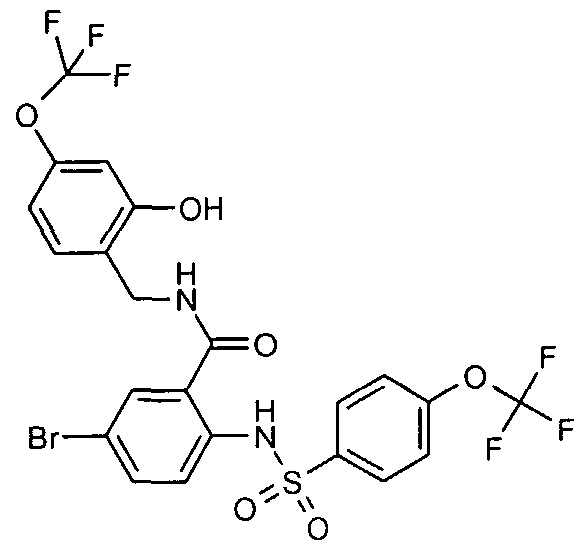
  • R 30 is a substituted alkoxy group, preferably a haloalkyl or a haloalkoxy group such as trifluoromethyl or trifluoromethoxy; Rings A and C are optionally substituted; and Ring B optionally comprises one or more substituents other than R 30 .
  • Pharmaceutical compositions of the these compounds comprising a carrier or diluent and methods of use therof for phosphate transport inhibition are also included in the present invention.
  • the phosphate transport inhibitors disclosed herein can be used for the manufacture of a medicament for inhibiting phosphate transport in a subject in need of such treatment, e.g., for treating or preventing disorders of phosphate metabolism or impaired phosphate transport function such as hype ⁇ hosphatemia, hype ⁇ arathyroidism, uremic bone disease, soft tissue calcification (e.g., cardiovascular calcification), progression of renal failure, cardiovascular events and osteoperosis.
  • the invention also relates to the use of the compounds disclosed herein for inhibiting phosphate transport in a subject in need of such treatment, e.g., for treating or for preventing chronic renal failure or a disease associated with hype ⁇ hosphatemia.
  • Another embodiment of the present invention includes a pharmaceutical composition comprising one or more of the compounds disclosed herein, which have been identified as phosphate transport inhibitors and a pharmaceutically acceptable carrier, diluent or excipient.
  • the invention includes the use of one of the compounds disclosed herein in the treatment of one or more of the conditions or diseases disclosed herein.
  • the invention also includes novel compounds disclosed herein.
  • Another embodiment of the present invention is the use of a compound represented by Structural Formulas (I)-(V) in combination with a pharmaceutically acceptable compound which binds phosphate (a "phosphate sequesterant").
  • the pharmaceutically acceptable phosphate binder can be a calcium, aluminum or lanthanum-containing phosphate binder or a phosphate-binding polymer such as those disclosed in U.S. Patent Nos. 5,496,545, 5,667,775 and 6,083,495; the contents of which are inco ⁇ orated herein by reference in their entirety.
  • the phosphate-binding polymer is a polyallylamine.
  • the compounds disclosed herein are effective inhibitors of phosphate transport and thus are useful for treatment of hype ⁇ hosphatemia, chronic renal failure, diseases associated with disorders of phosphate metabolism and impaired phosphate transport function.
  • the beneficial aspects on chronic renal failure, disorders of phosphate metabolism or impaired phosphate transport function e.g., hype ⁇ arathyroidism, uremic bone disease, renal bone disease, soft tissue calcification (e.g., cardiovascular calcification), cardiovascular events, and osteoporosis, could be mediated by either an effect on the intestinal transporters or on transporters in other tissues, such as those present in bone, kidney or vasculature.
  • small molecule compounds which are inhibitors of phosphate transport. These small molecule compounds are preferably used to inhibit (i.e., reduce or prevent, in whole or in part) phosphate transport in the gastrointestinal tract and are therefore useful in treating conditions and diseases characterized by elevated phosphate levels, for example, hype ⁇ hosphatemia, renal failure and hypoparafhyroidism. Many of the small molecule inhibitors are expected to be absorbed by the gastrointestinal tract and are therefore available systemically. As a consequence, they can inhibit phosphate transport in other organs such as the kidneys and can advantageously be used to treat chronic renal failure.
  • phosphate transport inhibitors are bis-aryl compounds in which two aryl groups are separated by a heterocyclic ring, a heteroatom containing functional group or an olefin, represented by "X" in Structural Formula (I).
  • one or both aryl groups can be replaced with an optionally substituted monocyclic five or six membered non-aromatic heterocyclic group fused to an optionally substituted monocyclic aryl group.
  • Other of the phosphate transport inhibitions have a central urea moiety, where one nitrogen is substituted with an aryl group and the other nitrogen atom is substituted with a cycloalkyl (e.g., cyclohexyl) group.
  • one or both aryl or cycloalkyl groups are separated from X by an alkylene group, but preferably the aryl or cycloalkyl groups are connected directly to X.
  • X in Structural formula (I) is -S(O) 2 -, -S(O) 2 CR ⁇ R 2 -, -S(O) 2 NR,S(O) 2 -, -C(O)NR,C(O)-, -NR,C(O)NR 2 -, -NR,C(NR 3 )NR 2 -,-(CH 2 ) n -, -P(O)(OH)-, -C(O)-, -NR,-, - N + R]R 2 -, or a group represented by a structural formula selected from:
  • Ri, R and R 3 are independently a hydrogen, lower alkyl group, substituted lower alkyl group, heteroalkyl group, substituted heteroalkyl group, cycloalkyl group, substituted cycloalkyl group, aralkyl group, substituted aralkyl, heteroaralkyl group, or substituted heteroaralkyl.
  • Ari and Ar 2 are independently a phenyl group, a substituted phenyl group, a furyl group, a substituted furyl group, a thienyl group, a substituted thienyl group, a thiazolyl group, a substituted thiazolyl group, a triazinyl group, a substituted triazinyl group, a pyridyl group, a substituted pyridyl group, a pyrrolyl group, a substituted pyrrolyl group, an imidazolyl group, a substituted imidazolyl group, a pyrimidyl group, a substituted pyrimidyl group, a pyrazolyl group or a substituted pyrazolyl group.
  • Ari and Ar are independently a phenyl group, a substituted phenyl group, a furyl group or a substituted furyl group.
  • R 4 , R 5 and R 6 are independently a hydrogen, lower alkyl group, substituted lower alkyl group, heteroalkyl group, substituted heteroalkyl group, cycloalkyl group, substituted cycloalkyl group, aralkyl group, substituted aralkyl, heteroaralkyl group, or substituted heteroaralkyl group, or R 4 and R 5 taken together with the atom to which they are bonded, form an aromatic heterocyclic group, substituted aromatic heterocyclic group, non-aromatic heterocyclic group, or substituted non-aromatic heterocyclic group.
  • R is a hydrogen, lower alkyl group, substituted lower alkyl group, heteroalkyl group, substituted heteroalkyl group, cycloalkyl group, substituted cycloalkyl group, an aryl group, a substituted aryl group, a heteroaryl group, a substituted heteroaryl group, substituted aralkyl, heteroaralkyl group, substituted heteroaralkyl, -OR ⁇ or -NR 4 R 5 .
  • phosphate transport inhibitors represented by Structural Formula (II) are represented by the structural formula:
  • R 9 is hydrogen or an electron-withdrawing group; and Ring A is optionally substituted with one or more substituents other than R 9 .
  • R 9 is hydrogen or a halogen.
  • Rio is hydrogen, a halogen, a substituted alkyl group, an alkoxy group, a substituted alkoxy group or -NO 2 ; Ring B is optionally substituted with one or more substituents other than Rio; Ring A is optionally substituted with one or more substituents other than R 9 ; and Ring C is optionally substituted.
  • Rio is hydrogen, a halogen, an alkoxy group, a substituted alkoxy group or -NO 2 .
  • Rio is a halogen or a substituted alkoxy group, such as a halogen-substituted alkoxy group.
  • An especially preferred substituted alkoxy group is a fluoro-substituted or perfluoro-substituted group such as a trifluoromethoxy group.
  • a yet more preferable compound represented by Structural Formula (II) is represented by the following structural formula: where Ri i is hydrogen, a halogen, an alkoxy group, a substituted alkoxy group or -NO 2 ; and Ring C is optionally substituted, as above.
  • Typical substituents for Ring C include halogens, hydroxyl groups, substituted or unsubstituted alkyl and substituted or unsubstituted alkoxy groups.
  • Ring C is substituted with a halogen (e.g., bromine, fluorine), a hydroxyl group or a substituted or unsubstituted alkoxy group (e.g., methoxy, trifluoromethoxy).
  • At least one Ring C substituent is typically ortho or para to the amide group, preferably ortho. Ring C typically has one or two substituents that are often ortho and para to the amide group.
  • Preferred compounds represented by Structural Formula (VI) are represented by the following structural formula:
  • Rings A and C are optionally substituted; and Ring B optionally comprises one or more substituents other than R 3 o- More preferably, the compound is represented by the structural formula: (XXIII), where R 31 is a halogen; Ring C is optionally substituted; and Rings A and B optionally comprise one or more substituents other than R 30 and R 31 . Even more preferably, the compound is represented by the following structural formula:
  • Ring C is optionally substituted; and Rings A and B optionally comprise one or more substituents other than R 30 and R 3 ). Rings A and B typically do not have substituents other than R 30 and R 3 j. More preferably, Ring A is monosubstituted with R 31 and Ring B is monosubstiUited with R 30 or disubstituted with R 30 and a nitro group ortho to the sulfonamide moiety. Ring C is typically substituted with a halogen (e.g., bromine, fluorine), a hydroxyl group or a substimted or unsubstituted alkoxy group (e.g., methoxy, trifluoromethoxy).
  • a halogen e.g., bromine, fluorine
  • At least one Ring C substituent is typically ortho or para to the amide group, preferably ortho. Ring C typically has one or two substituents that are often ortho and para to the amide group.
  • X in Structural Formula (I) is -NHC(O)NH-
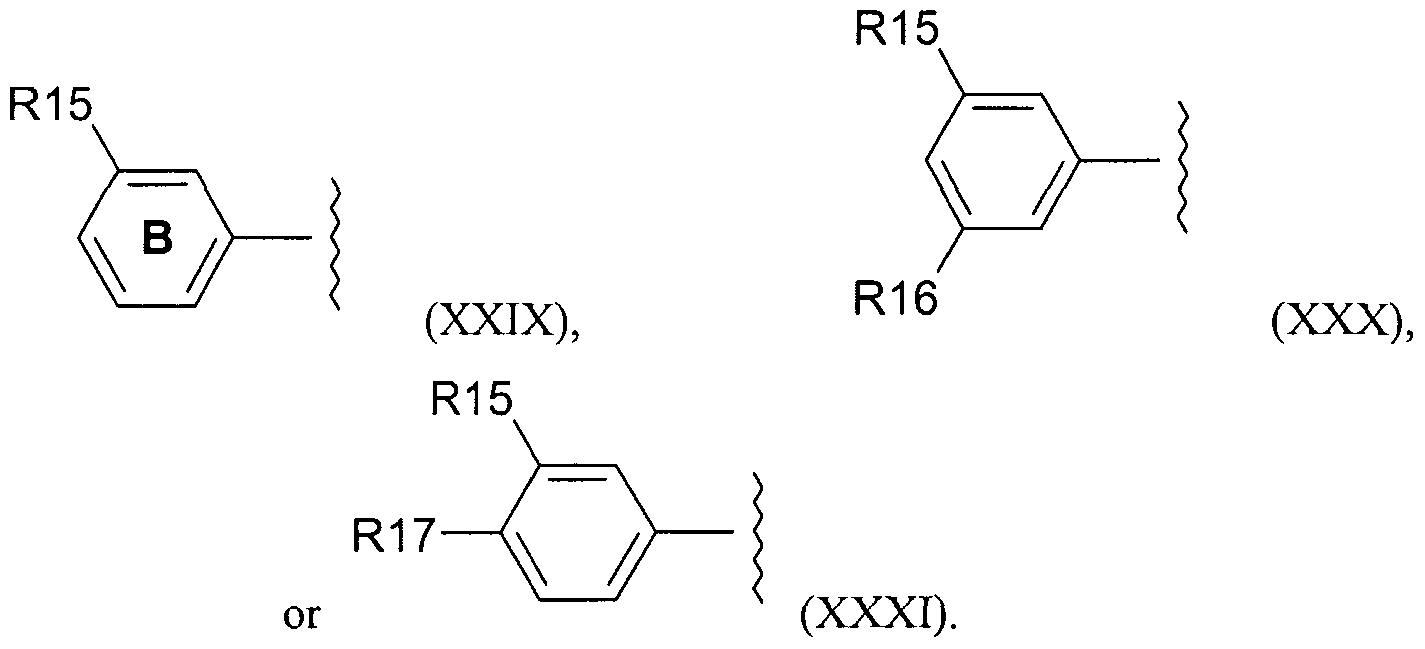
  • Ar 2 is preferably represented by a structural formula selected from:
  • R ⁇ 2 and Rn are independently a hydrogen, a halogen, a lower alkyl group, a substituted lower alkyl group, a cycloalkyl group, a substituted cycloalkyl group, an alkoxy group, a substituted alkoxy group, -C(O)NR 4 R 5 , -C(O)OR 6 , -P(O)(OR 6 ) 2 , -NO 2 , -SO 3 ,
  • R ⁇ 2 is more preferably -P(O)(OR 6 ) 2 .
  • R13 is more preferably a hydrogen, a halogen, a lower alkyl group, a substituted lower alkyl group, an alkoxy group or a substituted alkoxy group or -NO 2 .
  • R ⁇ 4 is -H or an electron withdrawing group, preferably -H or a halogen.
  • R 13 is a halogen (e.g., chlorine) or a substituted alkyl group (e.g., a haloalkyl group such as trifluoromethyl)
  • R ⁇ is advantageously hydrogen or a chloro group.
  • Rit-R are as defined above.
  • Ring A is optionally substituted with one or more substituents other than R ⁇ 2 and R 13 .
  • X is -NHC(O)NH- and Ar 2 is represented by Structural Formula (XXV),
  • Ari is represented by a structural formula selected from:
  • R 15 is a hydrogen, a halogen, a lower alkyl group, a substituted lower alkyl group, an alkoxy group or a substituted alkoxy group or -NO 2 .
  • ? are independently hydrogen, a halogen, a lower alkyl group, a substituted lower alkyl group, an alkoxy group, a substituted alkoxy group or -NO 2 .
  • R 15 is a haloalkyl or nitro group, preferably a fluoroalkyl or nitro group
  • R ⁇ 6 and R ⁇ are advantageously independently hydrogen, a halogen or a haloalkyl group, preferably hydrogen, a fluoro group or a trifluorometyl group.
  • Ring B is optionally substituted with one or more substituents other than R 15 .
  • Ar 2 is preferably represented by the following structural formula:
  • R ⁇ 8 and R 19 are independently, a hydrogen or a halogen.
  • X is represented by Structural Formula (IX) or (X) and Ar 2 is represented by Structural Formula (XXXII), then Ari is represented by the following structural formula:
  • R20 is a hydrogen or OR 21 ; and R 2 ⁇ is a hydrogen, an alkyl group, or an aryl group.
  • X is represented by Structural Formula (VII)
  • Ri and R 2 are preferably -H or a lower alkyl group. More preferably, Ri and R 2 are -H or a lower alkyl group and Arj and Ar 2 are independently represented by a structural formula selected from:
  • R8 is a hydrogen or -SO 3 .
  • Ar 2 is preferably an optionally substituted monocyclic heteroaryl ring fused to an optionally substituted phenyl ring, more preferably a nitrogen-containing heteroaryl ring fused to a phenyl ring, i.e., a bicyclic nitrogen-containing heteroaryl group.
  • the bicyclic heteroaryl group can be substituted or unsubstituted.
  • Examples of preferred bicyclic nitrogen-containing heteroaryl groups include indolyl, benzpyrazolyl, benzimidazolyl and benztriazolyl.
  • X is -S(O 2 )- and Ar 2 is a nitrogen-containing heteroaryl ring fused to a phenyl ring, then Ari is preferably a substituted or unsubstituted phenyl group.
  • Ari is a substituted or unsubstituted aryl group (preferably phenyl) and Ar 2 is an optionally substituted five member or six membered non- aromatic heterocyclic group fused to an optionally substituted monocyclic aryl group (preferably phenyl), i.e., a bicyclic ring system.
  • X is preferably - S(O 2 )- or can take on a new value of -C(O)NH-.
  • Preferred non-aromatic heterocyclic groups are nitrogen containing. Examples of bicyclic ring systems for Ar 2 include the following:
  • Rings C and D are independently substituted or unsubstituted.
  • X is -NR ⁇ C(NR 3 )NR 2 -.
  • Ri, R 2 and R 3 are as defined above, but are preferably each hydrogen.
  • Ari is typically represented by structural formulas:
  • R 15 , R ]6 and R ⁇ 7 are as defined above.
  • R ]5 , Ri 6 and R ⁇ are each independently a halogen or a substituted alkyl group, such as bromine, chlorine and a trifluoromethyl group.
  • R ⁇ and R ⁇ 4 are each independently a halogen or a substituted alkyl group.
  • R ⁇ , R ⁇ 4 , R ⁇ 5 and R ⁇ 6 are advantageously each a halogen or a haloalkyl group. Typical examples of these groups include chlorine, bromine and trifluoromethyl groups.
  • the compound is represented by Structural Formula (III) or (IV).
  • the compound is represented by one of the following structural formulas:
  • R 24 , R 25 and R 26 are each independently hydrogen or a substituted or unsubstituted alkyl group.
  • the alkyl groups are substituted alkyl groups, such as, in order of increasing specificity, haloalkyl groups, fluoroalkyl groups, perfluoroalkyl groups and trifluoromethyl groups.
  • the method of inhibiting phosphate transport in a subject comprises the step of administering a compound represented by the structural formula:
  • R is -P(O)(ORe) 2
  • R ⁇ is hydrogen or a lower alkyl group
  • Ring B is optionally substituted as described above.
  • the compound is represented by the structural formula:
  • the phosphate transport inhibitor compound is represented by Structural Formula (V).
  • Ring A can be substituted with one or more electron-withdrawing groups, such as a haloalkyl (e.g., trifluoromethyl) group.
  • Ring E is optionally substituted with one or more halogens or substituted or unsubstituted alkyl or alkoxy groups.
  • One example of a compound falling within Structural Formula (V) is represented by the structural formula:
  • R 27 and R 28 are independently hydrogen or a substituted alkyl group.
  • Preferred substituted alkyl groups include haloalkyl groups such as fluoroalkyl groups (e.g., trifluoromethyl).
  • physiologically acceptable salts of the compounds described herein can react with any of a number of organic or inorganic bases, and inorganic and organic acids to form a salt.
  • Salts of compounds containing an amine or other basic group can be obtained, for example, by reacting those compounds with a suitable organic or inorganic acid.
  • Salts of compounds containing a carboxylic acid or other acidic functional group can be prepared by reacting them with a suitable base.
  • Base addition salts include those derived from inorganic bases, such as ammonium or alkali or alkaline earth metal hydroxides, carbonates, bicarbonates, and the like. Such bases useful in preparing the salts of this invention thus include sodium hydroxide, potassium hydroxide, ammonium hydroxide, potassium carbonate, and the like.
  • Acids commonly employed to form acid addition salts from compounds with basic groups are inorganic acids such as hydrochloric acid, hydrobromic acid, hydroiodic acid, sulfuric acid, phosphoric acid, and the like, and organic acids such as -toluenesulfonic acid, methanesulfonic acid, oxalic acid, -bromophenyl-sulfonic acid, carbonic acid, succinic acid, citric acid, benzoic acid, acetic acid, and the like.
  • inorganic acids such as hydrochloric acid, hydrobromic acid, hydroiodic acid, sulfuric acid, phosphoric acid, and the like
  • organic acids such as -toluenesulfonic acid, methanesulfonic acid, oxalic acid, -bromophenyl-sulfonic acid, carbonic acid, succinic acid, citric acid, benzoic acid, acetic acid, and the like.
  • salts include the sulfate, pyrosulfate, bisulfate, sulfite, bisulfite, phosphate, monohydrogenphosphate, dihydrogenphosphate, metaphosphate, pyrophosphate, chloride, bromide, iodide, acetate, propionate, decanoate, caprylate, acrylate, formate, isobutyrate, caproate, heptanoate, propiolate, oxalate, malonate, succinate, suberate, sebacate, fumarate, maleate, butyne-1,4- dioate, hexyne-l,6-dioate, benzoate, chlorobenzoate, methylbenzoate, dinitrobenzoate, hydroxybenzoate, methoxybenzoate, phthalate, sulfonate, xylenesulfonate, phenylacetate, phenylpropionate, phenylbutyrate
  • lower alkyl group is a saturated straight chained or branched hydrocarbon. Typically, lower alkyl groups have from one to eight carbons. Preferably, lower alkyl groups have from one to six carbon atoms.
  • heteroalkyl group is a lower alkyl group in which at least one methylene group has been replaced with a heteroatom, such as nitrogen, oxygen, or sulfur.
  • a "cycloalkyl group” as used herein, is a non-aromatic carbocyclic ring system that has 3 to 10 atoms.
  • a cycloalkyl group can optionally be fused to a carbocyclic non-aromatic ring, carbocyclic aromatic ring, a heterocyclic aromatic ring, non-aromatic heterocyclic ring, or another non-aromatic carbocyclic ring.
  • Examples of a cycloalkyl group include cyclopropyl, cyclobutyl, cyclopentyl, cyclohexyl, cycloheptyl, cyclooctyl, cyclononyl, cyclodecyl, 1,2,3,4-tetrahydronaphthyl, and 1,2,3-tetrahydroindanyl.
  • a “heterocycloalkyl group” or a “non-aromatic heterocyclic group”, as used herein, is a non-aromatic ring system that has 3 to 10 atoms and includes at least one heteroatom, such as nitrogen, oxygen, or sulfur.
  • a heterocycloalkyl group is optionally fused to a carbocyclic non-aromatic ring, carbocyclic aromatic ring, a heterocyclic aromatic ring, or another non-aromatic heterocyclic ring.
  • heterocycloalkyl groups include piperazinyl, piperidinyl, homopiperazinyl, quinuclidinyl, azetidinyl, mo ⁇ holinyl, thiomo ⁇ holinyl, thiazolidinyl, 1,2,3,4-tetrahydroquinolinyl, 1,2,3-tetrahydroindolyl, indolyl, furanyl or imidazolyl.
  • aryl group includes both carbocyclic and heterocyclic aromatic ring systems.
  • An aryl group is optionally fused to a carbocyclic non-aromatic ring, a heterocyclic non-aromatic ring, a heterocyclic aromatic ring or another carbocyclic aromatic ring.
  • a carbocyclic aromatic system consists only of carbon ring atoms, preferably up to ten.
  • carbocyclic aryl groups include phenyl, naphthyl and 5,6,7, 8-tetrahydronaphthyl or 5,6,7-tetrahydroindanyl.
  • a “heteroaryl group” or an “aromatic heterocyclic group”, as used herein, is an aryl group that has 3 to 10 ring atoms including one or more ring heteroatoms such as nitrogen, oxygen and sulfur.
  • a heteroaryl group can be monocyclic.
  • a monocyclic heteroaryl group is fused to one or more other monocyclic heteroaryl groups or monocyclic carbocyclic aryl groups.
  • Preferably a heteroaryl group has 1 to 3 heteroatoms.
  • a heteroaryl group is optionally fused to a carbocyclic aromatic ring, carbocyclic non-aromatic ring or another heteroaryl ring.
  • heteroaryl group examples include thienyl, pyridyl, pyrazolyl, isoxazolyl, thiadiazolyl, oxadiazolyl, indazolyl, furyl, pyrrolyl, imidazolyl, pyrazolyl, triazolyl, pyrimidinyl, pyridazinyl, pyrazinyl, thiazolyl, isoxazolyl, isothiazolyl, tetrazolyl, oxazolyl, oxadiazolyl, quinolinyl, carbazolyl, benzocarbazolyl, benzotriazolyl, benzimidazole, benzothiophene, benzofuran or indolyl.
  • aralkyl group is an aryl group that is linked to a compound by an alkyl group having from one to about six carbon atoms.
  • a “heteroaralkyl group”, as used herein, is a heteroaryl group that is linked to a compound by an alkyl group having from one to about six carbon atoms.
  • halogen as used herein, includes fluorine, chlorine, bromine and iodine atoms.
  • an "olefin group” as used herein is a group containing a double bond.
  • the double bond may be an E- or Z-isomer.
  • Preferably the double bond is an E-isomer.
  • alkylene group is represented by -(CH 2 ) n -.
  • n is an integer from 1-10, preferably 1-4.
  • Suitable substituents on a substituted lower-alkyl group, substituted heteroalkyl group, substituted cycloalkyl group, substituted heterocycloalkyl group, substituted aryl group, substituted heteroaryl group, substituted aralkyl group, substituted heteroaralkyl group, substituted alkoxy group or substituted aryloxy group include for example, a hydrogen, a halogen, an electron withdrawing group, a hydroxy group, an alkoxy group, a lower alkyl group, a cycloalkyl group, a heterocycloalkyl group, an aryl group, a heteroaryl group, an aryloxy group, an aralkyl group, a heteroaralkyl group, -C(O)NR 4 Rs, -C(O)OR 6 , -P(O)(OR 6 ) 2 , -NR4R 5 , -NCR 7 (PO
  • R 4 , R 5 , R 6 and R 7 are as defined above.
  • a substituted lower-alkyl group, substituted heteroalkyl group, substituted cycloalkyl group, substituted heterocycloalkyl group, substituted aryl group, substituted heteroaryl group, substituted aralkyl group, substituted heteroaralkyl group, substituted alkoxy group or substituted aryloxy group can have more than one substituent.
  • a "subject” is preferably a human, but can also be an animal in need of treatment with a phosphate transport inhibitor, e.g., companion animals (e.g., dogs, cats, and the like), farm animals (e.g., cows, pigs, horses and the like) and laboratory animals (e.g., rats, mice, guinea pigs and the like).
  • companion animals e.g., dogs, cats, and the like
  • farm animals e.g., cows, pigs, horses and the like
  • laboratory animals e.g., rats, mice, guinea pigs and the like.
  • Subjects "in need of treatment” with a compound of the present invention, or subjects “in need of phosphate transport inhibition” include subjects with diseases and/or conditions that can be treated with phosphate transport inhibitors to achieve a beneficial therapeutic and/or prophylactic result.
  • a beneficial outcome includes a decrease in the severity of symptoms or delay in the onset of symptoms, increased longevity and/or more rapid or more complete resolution of the disease or condition.
  • a subject in need of treatment typically has elevated serum phosphate levels, hype ⁇ hosphatemia, resulting from, for example, impaired kidney function or hypoparathyroidism. Lower serum phosphate levels can be achieved, for example, by inhibiting phosphate transport in the intestines.
  • a subject "in need of treatment” also includes a subject with chronic renal failure who may have serum phosphate levels within the normal range. Inhibition of phosphate transport in the intestine or kidneys can slow rate of renal deterioration in these subjects, and decrease the risk of cardiovascular events.
  • Other examples of subjects in need of phosphate transport inhibitors include patients with a disease associated with disorders of phosphate metabolism or a disease medicated by impaired phosphate transport function. Examples of diseases and/or disorders of this type include soft tissue calcification, such as cardiovascular calcification, hype ⁇ arathyroidism, uremic bone disease, renal bone disease and osteoporosis.
  • an "effective amount" of a compound disclosed herein is a quantity that results in a beneficial clinical outcome of the condition being treated with the compound compared with the absence of treatment.
  • the amount of phosphate transport inhibiting compound administered will depend on the degree, severity, and type of the disease or condition, the amount of therapy desired, and the release characteristics of the pharmaceutical formulation. It will also depend on the subject's health, size, weight, age, sex and tolerance to drugs.
  • the compound is administered for a sufficient period of time to achieve the desired therapeutic effect.
  • a sufficient period of time typically between about 5 g per day and about 0.00 lg per day of compound (preferably between about lg per day and about 0.00 lg per day) is administered to the subject in need of treatment.
  • the compound can be administered by any suitable route.
  • the compound is preferably administrated orally (e.g., dietary) in capsules, suspensions, tablets, pills, dragees, liquids, gels, syrups, slurries, and the like.
  • compositions such as in a coating of hard gelatin or cyclodextran
  • the compounds can be administered to the subject in conjunction with an acceptable pharmaceutical carrier as part of a pharmaceutical composition.
  • the formulation of the pharmaceutical composition will vary according to the route of administration selected.
  • Suitable pharmaceutical carriers may contain inert ingredients which do not interact with the compound.
  • the carriers should be biocompatible, i.e., non-toxic, non-inflammatory, non-immunogenic and devoid of other undesired reactions at the administration site.
  • Examples of pharmaceutically acceptable carriers include, for example, saline, commercially available inert gels, or liquids supplemented with albumin, methyl cellulose or a collagen matrix. Standard pharmaceutical formulation techniques can be employed, such as those described in Remington's Pharmaceutical Sciences, Mack Publishing Company, Easton, PA.
  • compositions for oral use can be obtained by combining a compound of the present invention with a solid excipient, optionally grinding a resulting mixture, and processing the mixture of granules, after adding suitable auxiliaries, if desired, to obtain tablets or dragee cores.
  • suitable excipients are, in particular, fillers such as sugars, including lactose, sucrose, mannitol, or sorbitol; cellulose preparations such as, for example, maize starch, wheat starch, rice starch, potato starch, gelatin, gum tragacanth, methyl cellulose, hydroxypropylmethylcellulose, sodium carboxymethylcellulose, and/or polyvinylpyrrolidone (PVP).
  • disintegrating agents can be added, such as the cross-linked polyvinyl pyrrolidone, agar, or alginic acid or a salt thereof such as sodium alginate.
  • Dragee cores are provided with suitable coatings.
  • suitable coatings For this pu ⁇ ose, concentrated sugar solutions can be used, which can optionally contain gum arabic, talc, polyvinyl pyrrolidone, carbopol gel, polyethylene glycol, and/or titanium dioxide, lacquer solutions, and suitable organic solvents or solvent mixtures.
  • Dyestuffs or pigments can be added to the tablets or dragee coatings for identification or to characterize different combinations of active compound doses.
  • compositions which can be used orally include push-fit capsules made of a suitable material, such as gelatin, as well as soft, sealed capsules made of a suitable material, for example, gelatin, and a plasticizer, such as glycerol or sorbitol.
  • the push-fit capsules can contain the active ingredients in admixture with filler such as lactose, binders such as starches, and/or lubricants such as talc or magnesium stearate and, optionally, stabilizers.
  • the active compounds can be dissolved or suspended in suitable liquids, such as fatty oils, liquid paraffin, or liquid polyethylene glycols.
  • stabilizers can be added. All formulations for oral administration should be in dosages suitable for such administration.
  • certain compounds of the invention may be obtained as different stereoisomers (e.g., diastereomers and enantiomers) and that the invention includes all isomeric forms and racemic mixtures of the disclosed compounds and a method of treating a subject with both pure isomers and mixtures thereof, including racemic mixtures.
  • Stereoisomers can be separated and isolated using any suitable method, such as chromatography.
  • the activity of compounds of the present invention can be assessed using suitable assays, such as the 33 PO 4 Uptake In Rabbit Intestinal BBMV High Throughput Screening (HTS) assay, as described in the Example 66, and 33 PO 4 uptake in isolated rabbit intestinal rings, as described in Example 91.
  • suitable assays such as the 33 PO 4 Uptake In Rabbit Intestinal BBMV High Throughput Screening (HTS) assay, as described in the Example 66, and 33 PO 4 uptake in isolated rabbit intestinal rings, as described in Example 91.
  • Compounds of the present invention can also be identified by virtue of their ability to inhibit the abso ⁇ tion of phosphate in vivo, for example, in the gastrointestinal tract of a laboratory animal.
  • pharmacologically active agents examples include pharmaceutically active calcium, aluminum or lanthanum-containing phosphate binders or pharmaceutically active phosphate-binding polymers such as those disclosed in U.S. Patent Nos. 5,496,545, 5,667,775 and 6,083,495; the contents of which are inco ⁇ orated herein by reference in their entirety.
  • the pharmacologically active agent is a polyallylamine phosphate-binding polymer.
  • the pharmacologically active agent is an epichlorohydrin-cross-linked poly(allylamine hydrochloride) resin, also referred to as sevelamer hydrochloride or sevelamer, and marketed as RENAGEL® (GelTex Pharmaceuticals, Inc., Waltham, MA).
  • Another embodiment of the present invention is one of the compounds disclosed herein.
  • Yet another embodiment is a pharmaceutical composition comprising a pharmaceutically acceptable carrier or diluent and one of the compounds disclosed herein.
  • This compound was prepared using the procedure described in Example 4, using 3- bromo aniline instead of 2-methoxy benzyl amine and 5-bromo-2-[(4'-chlorophenyl)sulfonyl] amino benzoyl chloride instead of 5-bromo-2-[(4'-trifluoromethoxyphenyl)sulfonyl] amino benzoyl chloride.
  • M/Z of [M-H] " 541.
  • Example 11 N-[5-Bromo-2-(4'-trifluoromethoxy-benzenesulfonylamino)-phenyl]-2-(3"- methoxy phenyl)-acetamide. N-(2-amino-4-bromo phenyl)-4-(trifluoromethoxy)-benzene sulfonamide (0.042 g, 0.1 mmol) was dissolved in tetrahydrofuran (1 mL). The mixture was cooled below 5 °C in an ice bath.
  • This compound was prepared using the procedure described in Example 4, using 3- bromo aniline instead of 2-methoxy benzyl amine and 5-bromo-2-[(4'-methoxy-3 '- nitrophenyl)sulfonyl] amino benzoyl chloride instead of 5-bromo-2-[(4'- trifluoromethoxyphenyl)sulfonyl] amino benzoyl chloride.
  • Example 18 5-Bromo-2-[(4'-chloro-3'-nitrophenyl)sulfonyl]amino-N-(2',5'- dichlorophenyl) benzamide. This compound was prepared using the procedure described in Example 4, using 2,5- dichloro aniline instead of 2-methoxy benzyl amine and 5-bromo-2-[(4'-chloro-3'- nitrophenyl)sulfonyl] amino benzoyl chloride instead of 5-bromo-2-[(4'- trifluoromethoxyphenyl)sulfonyl] amino benzoyl chloride.
  • ⁇ NMR (DMSO) ⁇ 7.2-7.25 (IH), 7.3-7.4 (IH), 7.58-7.62 (IH), 7.6-7.7 (IH), 7.8-8.9 (4H), 8.32-8.36 (IH).
  • Example 20 5-Bromo-2-[(2',5'-dichloro thiophene)-3 -sulfonyl] amino benzoic acid.
  • Example 22 5 -Bromo-2- [(4-pentyl phenyl)sulfonyl] amino benzoic acid.
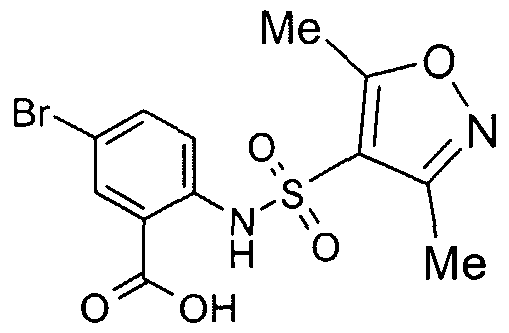
  • Example 24 5-Bromo-2-[(3',5'-dimethyl isoxazole)-4-sulfonyl] amino benzoic acid.
  • Example 25 5 -Bromo-2 - [(4 ' -trifluoromethoxyphenyl) sulfonyl] amino-N- [ethyl-2 -(2 ' - methoxyphenyl)] benzamide.
  • Example 27 N-(4-methyl benzyl)-4-(trifluoromethoxy)-benzene sulfonamide.
  • Example 28 N-[2-Chloro benzyl]-4-(trifluoromethoxy)-benzene sulfonamide.
  • Example 30 N-(4-bromo-2-nitro)-4(trifluoromethoxy)-benzene sulfonamide.
  • N-(4-bromo-2-nitro)-4(trifluoromethoxy)-benzene sulfonamide (0.406 g, 0.92 mmol) was dissolved in a mixture of tetrahydrofuran (5 mL) and methanol (15 mL). The mixture was cooled below 5 °C using an ice bath. BiCb (0.696 g, 2.2 mmol, 2.2 equivalents) was added. NaBH 4 (0.203 g, 5.4 mmol, 5.5 equivalents) was added slowly to the mixture. A black precipitate formed immediately. The mixture was warmed to room temperature, centrifuged and the solid was discarded. The solution was concentrated to dryness.
  • Example 39 3-Furan-2-yl-l-(4-hydroxy-phenyl)-propenone.
  • Example 41 3-Furan-2-yl-l-(4-phenoxy-phenyl)-propenone.
  • Example 42 3-(3-Fluoro-phenyl)-l-(4-methoxy-phenyl)-propenone.
  • Example 43 3-(3-Fluoro-phenyl)-l-(4-phenoxy-phenyl)-propenone.
  • Example 45 4-(5-Furan-2-yl-l-methyl-lH-pyrazol-3-yl)-phenol.
  • Example 47 5-(3-Fluoro-phenyl)-3-(4-methoxy-phenyl)-l-methyl-lH-pyrazole.
  • Example 48 5-Furan-2-yl-3-(4-methoxy-phenyl)-l-methyl-lH-pyrazole.
  • Example 49 5 -Furan-2-yl- 1 -methyl-3 -(4-phenoxy-phenyl)- 1 H-pyrazole .
  • 3-furan-2-yl-l-(4-phenoxy-phenyl) propenone 0.4 g was dissolved in dimethylsulfoxide (10 mL). Methylhydrazine (1.0 g) was added and the reaction mixture was heated to 85 C for 3 days. The reaction mixture was cooled to room temperature and ethyl acetate (100 mL) and water (50 mL) were added. The organic layer was washed twice with water (25 mL), then separated and dried over sodium sulfate. The solvent was removed after filtering away the drying agent.
  • Example 51 5-Furan-2-yl-3-(4-mefhoxy-phenyl)-isoxazole.
  • Example 52 5-Furan-2-yl-3-(4-phenoxy-phenyl)-isoxazole.
  • Example 53 l,3-Bis-(3-trifluoromethyl-phenyl)-urea.
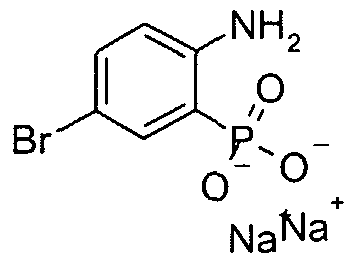
  • Example 57 2-Phosphono-4-bromoaniline disodium salt.
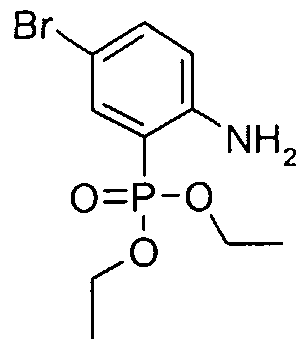
  • 2-Diethylphosphono-4-bromoacetanilide was treated with 20 mL of 6 N HCI in a 30 mL vial containing a stirring bar. The resulting mixture was heated at 100 °C with stirring for 18 hours and was then cooled to room temperature and diluted with 200 mL water. The resulting solution was concentrated by rotary evaporation and then diluted again with 20 mL water and concentrated. The product was recrystalhzed from a minimum amount of water and then the solid was redissolved in a small amount of water and then this was made basic with 1 N NaOH (pH 10-11). The disodium salt was precipitated by adding isopropanol and the product was dried in vacuo/P 2 O 5 .
  • Example 58 l-(2-Iodo-4-bromophenyl)-3-(3-trifluoromethylphenyl)urea.
  • Example 59 1 -(2-Diethylphosphono-4-bromophenyl)-3-(3-trifluoromethylphenyl)urea.
  • Example 60 Parallel Synthesis: l-(2-diethylphosphono-4-bromophenyl)-3-(3,5- bistrifluoromethylphenyl)urea.
  • Example 61 1 -(2-Phosphono-4-bromophenyl)-3-(3-trifluoromethylphenyl)urea.
  • Example 64 2-Diethylphosphono-4-bromo-(4-trifluoromethoxybenzoyl) anilide.
  • Example 65 2-Diethylphosphono-4-bromo-(4-bromobenzoyl)anilide.
  • BBMV Rabbit Intestinal Brush Border Membrane Vesicles
  • Mucosal scrapings (2 g per tube) were thawed in a 37 °C water bath for 3 minutes and then placed on ice.
  • the scrapings were suspended with a total of 7.5 ml of 300 MET, and transferred to a 250 mL Corning tube on ice.
  • To the suspension was added 30 mL cold (4 °C) deionized water (dH 2 0).
  • the suspension was homogenized with a tissue homogenizer (Polytron) on high speed for 2 minutes.
  • the suspension was mixed well by inverting the closed tube. The suspension was stirred on ice, ensuring that a good vortex is achieved with the stir bar, for 40 minutes.
  • the suspension was transferred to a chilled centrifuge tube and spun at 4000 x g for 15 minutes.
  • the supernatant was transferred to a new chilled centrifuge tube and spun at 32000 x g for 30 minutes.
  • the supernatant was discarded and the pellet was re-suspended with 34 mL cold 60 MET.
  • the suspension was homogenized with a Dounce homogenizer with 8 strokes.
  • the suspension was transferred to a fresh 250 mL Corning tube. A stir bar and 69.1 mg MgCl 2 were added.
  • the suspension was stirred well on ice for 10 minutes.
  • the suspension was transferred to a chilled centrifuge tube and spun at 4000 x g for 15 minutes.
  • the supernatant was transferred to a new chilled centrifuge tube and spun at 32000 x g for 30 minutes. The supernatant was discarded. At this stage, the preparation could be continued or this pellet (P4) could be frozen in liquid nitrogen and stored at -80 °C. When needed, this pellet could be allowed to thaw at room temperature for 5 minutes. Continuing the preparation, the pellet was resuspended with 34 mL cold 280 MH. The suspension was homogenized in a Dounce homogenize with 8 strokes. The suspension was transferred to a new chilled centrifuge tube and spun at 32000 x g for 30 minutes. The supernatant was discarded.
  • the BBMV Plate was kept on ice until just prior to the assay.
  • the reaction was initiated by aspiration of the hot uptake buffers (19 uL), from the Hot Stock Plate, and the compound solutions (2 uL), from the Compound Plate, dispensing into an empty 96-well V-bottom plate (Assay Plate), then immediately aspirating the BBMVs (19 ⁇ L), from the BBMV Plate and dispensing into the same Assay Plate.
  • the addition of the BBMVs to the assay plate marked the reaction start time. After 15 minutes, the reaction was quenched by addition of 200 ⁇ L of STOP buffer from a reservoir.
  • the Stop Buffer was aspirated by vacuum from the wells, through the filters, of the pre-soaked filter plate using a filter plate manifold.
  • the quenched reactions were aspirated and transferred to the filter plate under vacuum.
  • the filters were washed 2 times with 200 ⁇ L STOP buffer under vacuum.
  • the filter plate was removed, dried, and the bottom of the filter plate was sealed.
  • To each well of the filter plate was added 50 ⁇ L of scintillant (Microscint-20). A top seal was then applied to the filter plate.
  • the plate was incubated for approximately 20 minutes before reading for 33 P CPM on a scintillation counter (i.e., TopCount - Packard Instruments). Percent inhibition was calculated by comparing the CPM values from compound containing wells to the MAX and MIN controls on the same plate using the following formula.
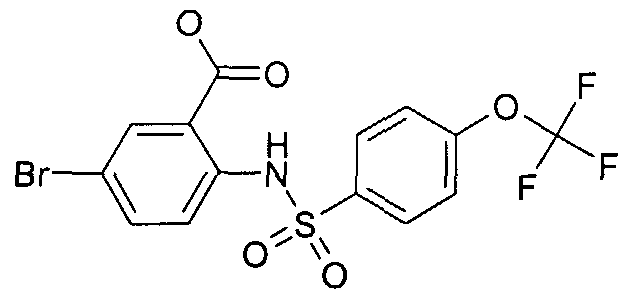
  • Example 68 5-Bromo-2-(4-trifluoromethoxy-benzenesulfonylamino)-benzoic acid.
  • Methyl 5-bromo-2-(4-trifluoromethoxy-benzenesulfonylamino)benzoate (0.854 g, 0.019 mmol) was dissolved in a mixture of tetrahydrofuran (20 mL)/water (10 mL). A solution of sodium hydroxide (50%, 5 mL) was added and the mixture was heated to reflux for 2-3 hours. The tetrahydrofuran was removed by rotary evaporation and the mixture was acidified with aqueous HCI (2 M). The mixture was extracted with ethyl acetate (20 mL). The organic solvent was removed to dryness.
  • Example 70 5-Bromo-N-(2-methoxy-benzyl)-2-(4-trifluoromethoxy-benzenesulfonylamino)- benzamide.
  • Example 72 5-Bromo-2-(4-chloro-benzenesulfonylamino)-N-(2-trifluoromethoxy-benzyl)- benzamide.
  • the reaction mixture was warmed to room temperature and extracted twice with ethyl acetate (150 mL). The organic layer was collected and washed with NaHCO 3 (sat., 30 mL). The organic layer was dried over MgSO 4 , filtered and the solvent removed to dryness. The mixture was purified by column chromatography (Si0 , 700 mL) using an eluent of hexane/ethyl acetate (10/2). Recovery: 2.42 g (33.8 % yield).
  • Example 77 5-Fluoro-2-methoxy-benzylamine hydrochloride.
  • Example 78 5-Bromo-N-(5-fluoro-2-methoxy-benzyl)-2-(4-trifluoromethoxy- benzenesulfonylamino)-benzamide.
  • Example 82 1,3 Bis(3-Trifluoromethylphenyl)urea.
  • 3-(Trifluoromethyl)aniline 10 g (62.1 mmol) was added to 500 ml of anhydrous dichloromethane in a 500 ml round bottomed flask. This stirred solution was cooled to 0°C using an ice water bath. 3-(Trifluoromethyl) phenyl isocyanate 15 g (80.1mmol) was added drop-wise over a period of 10 minutes. The reaction mixture was allowed to warm to room temperature and stirred at ambient temperatures for 18 hours. During this time a heavy precipitate was formed. This solid was collected by filtration on a Buchner funnel, and was re-suspended in 250 ml of dichloromethane.
  • Example 83 l-Cyclohexyl-3-(3,5-Bis trifluoromethyl-phenyl)-urea.
  • Example 84 5 -tert-Butyl-2-methyl-2H-pyrazole-3 -carboxylic acid (4-trifluoromethyl- phenyl)-amide.
  • N,N'-Bis-(3,5-bis-trifluoromethyl-phenyl)-guanidine Hydrochloride was prepared as described in example 87 using 3,5-bis-trifluoromethylaniline in place of 3-trifluoromethyl-4- bromoaniline.
  • 'H-NMR DMSO-d 6 ) ⁇ 7.85 (s, 2H, CF3CHCF 3 ), 7.90 (s, 4H, NHCCH), 8.68 (s, 2H, NH NH), 11.12 (s, 2H, Ngz).
  • Electrospray MS (m/z: MH + 484).
  • the phosphate transport inhibitors indicated in Table 14 were tested in both an in vitro and an ex vivo assay to determine their activity.
  • the in vitro assay is identical to the assay described in Example 66, with the exception that the glucose transport inhibiting activity of the compounds was also measured. Results are reported as the IC 50 value for the various types of inhibition.
  • a preferred compound will have high phosphate transport inhibiting activity, but little or no glucose transport inhibiting activity.
  • Tissues were then solublized by digesting them in a 5 ml volume of Solvable tissue solubilizer overnight at 50° C and P levels determined by scintillation counting.
  • Sodium-dependent uptake of 33 P was calculated by determining the difference in uptake between rings incubated in the presence and absence of Na + in the Hepes.-Buffered Ringer's solution. Results are reported as the percentage inhibition of phosphate and glucose uptake, respectively.
  • Table 14 shows that the compounds tested are effective and potent inhibitors of phosphate transport. Table 14 additionally shows that the compounds tested are selective, in that glucose transport into cells and tissues is generally minimally affected by the compounds.

Landscapes

  • Health & Medical Sciences (AREA)
  • Veterinary Medicine (AREA)
  • Chemical & Material Sciences (AREA)
  • Medicinal Chemistry (AREA)
  • Pharmacology & Pharmacy (AREA)
  • Life Sciences & Earth Sciences (AREA)
  • Animal Behavior & Ethology (AREA)
  • General Health & Medical Sciences (AREA)
  • Public Health (AREA)
  • Epidemiology (AREA)
  • Engineering & Computer Science (AREA)
  • Bioinformatics & Cheminformatics (AREA)
  • Nuclear Medicine, Radiotherapy & Molecular Imaging (AREA)
  • Organic Chemistry (AREA)
  • Chemical Kinetics & Catalysis (AREA)
  • General Chemical & Material Sciences (AREA)
  • Physical Education & Sports Medicine (AREA)
  • Rheumatology (AREA)
  • Orthopedic Medicine & Surgery (AREA)
  • Diabetes (AREA)
  • Endocrinology (AREA)
  • Inorganic Chemistry (AREA)
  • Hematology (AREA)
  • Obesity (AREA)
  • Vascular Medicine (AREA)
  • Urology & Nephrology (AREA)
  • Cardiology (AREA)
  • Heart & Thoracic Surgery (AREA)
  • Pharmaceuticals Containing Other Organic And Inorganic Compounds (AREA)
  • Acyclic And Carbocyclic Compounds In Medicinal Compositions (AREA)
  • Quinoline Compounds (AREA)
  • Furan Compounds (AREA)
  • Heterocyclic Carbon Compounds Containing A Hetero Ring Having Nitrogen And Oxygen As The Only Ring Hetero Atoms (AREA)
  • Plural Heterocyclic Compounds (AREA)
  • Organic Low-Molecular-Weight Compounds And Preparation Thereof (AREA)
  • Polysaccharides And Polysaccharide Derivatives (AREA)

Abstract

Disclosed are compounds, which have been identified as inhibitors of phosphate transport. Many of the compounds are represented by Structural Formula (I): Ar1-W-X-Y-Ar2; or a pharmaceutically acceptable salt thereof. Ar1 and Ar2 are independently a substituted or unsubstituted aryl group or an optionally substituted five membered or six membered non-aromatic heterocylic group fused to an optionally substituted monocylic aryl group. W and Y are independently a covalent bond or a C 1-C3 substituted or unsubstituted alkylene group. X is a heteroatom-containing functional group, an aromatic heterocyclic group, substituted aromatic heterocyclic group, non-aromatic heterocyclic group, substituted non-aromatic heterocyclic group, an olefin group or a substituted olefin group. Also disclosed are methods of treating a subject with a disease associated with hyperphosphatemia, as well as a disease mediated by phosphate-transport function. The methods comprise the step of administering an effective amount of the one of the compounds described above.

Description

PHOSPHATE TRANSPORT INHIBITORS
BACKGROUND OF THE INVENTION
People with inadequate renal function, hypoparathyroidism, or certain other medical conditions often have hypeφhosphatemia, or elevated serum phosphate levels (over 6 mg/dL). Hypeφhosphatemia, especially if present over extended periods of time, leads to severe abnormalities in calcium and phosphorus metabolism, often manifested by hypeφarathyroidism, bone disease and calcification in joints, lungs, eyes and vasculature. For patients who exhibit renal insufficiency, elevation of serum phosphorus within the normal range has been associated with progression of renal failure and increased risk of cardiovascular events. The progression of kidney disease can be slowed by reducing phosphate retention. Thus, for renal failure patients who are hypeφhosphatemic and for chronic kidney disease patients whose serum phosphate is within the normal range or is only slightly elevated, therapy to reduce phosphate retention is beneficial.
For patients who experience hypeφhosphatemia, calcium salts have been widely used to bind intestinal phosphate and prevent its absoφtion. Different types of calcium salts including calcium carbonate, acetate, citrate, alginate, and ketoacid salts have been utilized for phosphate binding. The major problem with all of these therapeutics is the hypercalcemia which often results from absoφtion of high amounts of ingested calcium. Hypercalcemia causes serious side effects such as cardiac arrhythmias, renal failure, and skin and visceral calcification. Frequent monitoring of serum calcium levels is required during therapy with calcium-based phosphate binders. Other, calcium and aluminum-free phosphate binders have drawbacks including the amount and frequency of dosing required to be therapeutically active.
An alternative approach to the prevention of phosphate absoφtion from the intestine in patients with elevated phosphate serum levels is through inhibition of the intestinal transport system which mediates phosphate uptake in the intestine. It is understood that phosphate absorption in the upper intestine is mediated at least in part by a carrier-mediated mechanism which couples the absoφtion of phosphate to that of sodium in an energy- dependent fashion. Inhibition of intestinal phosphate transport will reduce serum phosphate levels. This would be particularly advantageous in patients susceptible to hypeφhosphatemia as a result of renal insufficiency or in patients that have a disease that is treatable by inhibiting the uptake of phosphate from the intestines. Inhibition of phosphate absoφtion from the urine by the kidneys would also be advantageous for treating chronic renal failure. Furthermore, inhibition of phosphate transport may slow the progression of renal failure and reduce risk of cardiovascular events.
SUMMARY OF THE INVENTION
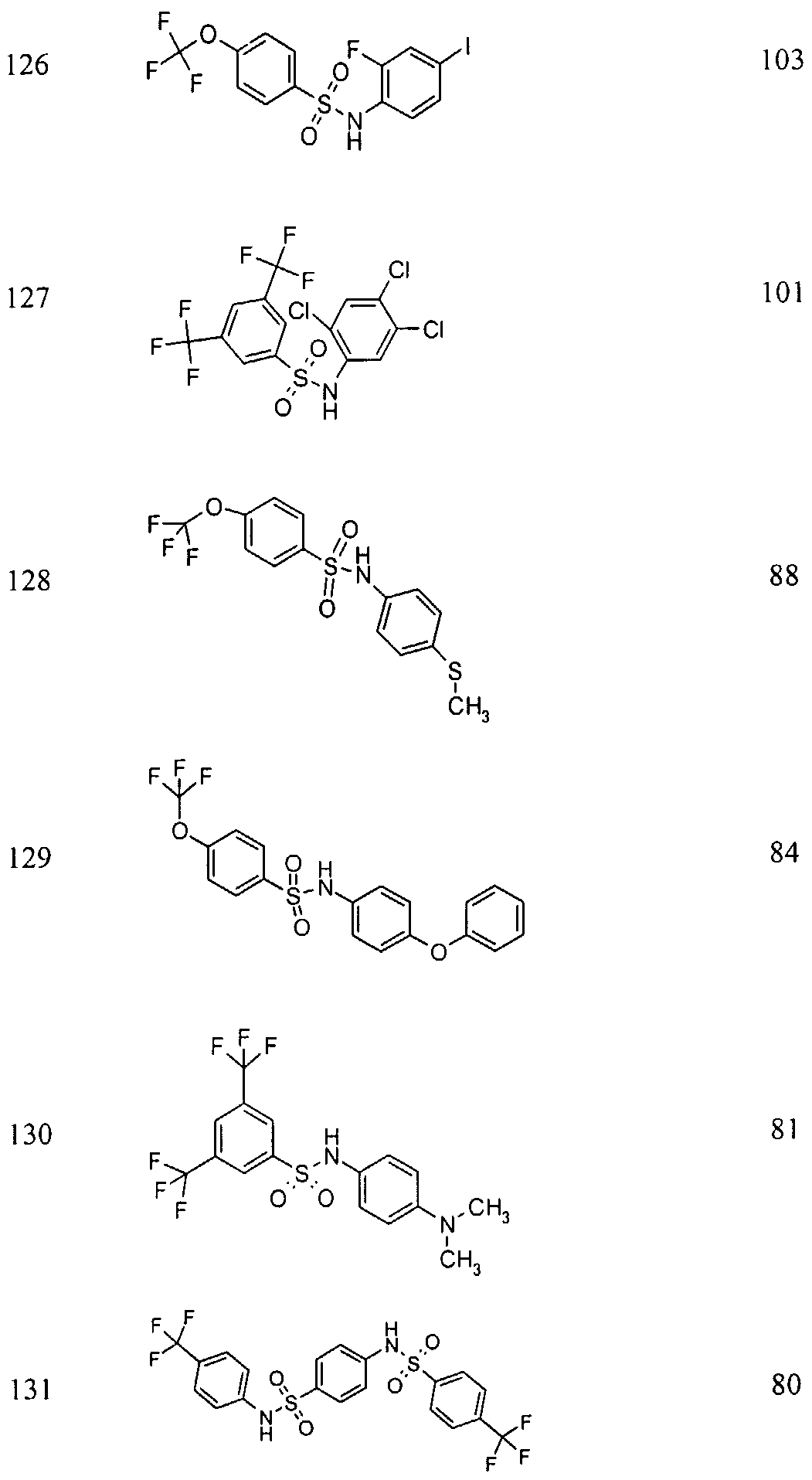
It has now been found that certain bis-aryl and other bis-cyclic compounds are effective inhibitors of phosphate transport proteins. For example, many bis-phenyl sulfonamides shown in Tables 1, 2 and 3, bis-phenyl ureas shown in Tables 4 and 5 and bis- aryl oxazolidines and bis-aryl pyrazoles shown in Tables 6 and 7 inhibit phosphate transport with an IC50 below 50 μM or a percent inhibition greater than 80% at 100 μM in an in vitro assay. In addition, Table 14 in Example 91 shows that a number of bis-phenyl amides, guanidines and ureas, as well a number of benzaminocarbonyl-substituted bis-phenyl sulfonamides and phenyl cycloalkyl ureas, inhibit phosphate transport with an IC50 of 40 μM or below in an in vitro assay. An ex vivo assay with the same compounds, the results of which are also presented in Table 14, further showed that they were effective in inhibiting phosphate uptake by the intestine. Based on this discovery, methods of treating a subject with chronic kidney disease, a disease associated with disorders of phosphate metabolism or a disease mediated by impaired phosphate-transport function are disclosed.
One embodiment of the present invention is a method of inhibiting phosphate transport in a subject in need of such treatment, which comprises the step of administering an effective amount of a bis-aryl compound represented by Structural Formula (I):
Ari— W— X— Y— Ar2 (I),
or a pharmaceutically acceptable salt thereof. Ari and Ar2 are independently substituted or unsubstituted aryl groups or an optionally substituted five membered or six membered non- aromatic heterocyclic group fused to an optionally substituted monocyclic aryl group (e.g., phenyl group). W and Y are independently a covalent bond or a C1-C3 substituted or unsubstituted alkylene group, (preferably a covalent bond or -CH2-; more preferably a covalent bond). X is a heteroatom-containing functional group, an aromatic heterocyclic group, substituted aromatic heterocyclic group, non-aromatic heterocyclic group, substituted non-aromatic heterocyclic group, an olefin group or a substituted olefin group, examples of which are shown below.
In one aspect, the invention is a method of inhibiting phosphate transport in a subject in need of phosphate transport inhibition, where the method comprises the step of administering an effective amount of a compound represented by Structural Formula (II):
Figure imgf000004_0001
where Rings A, B and C are optionally substituted.
In another aspect, the present invention is a method of inhibiting phosphate transport in a subject in need of phosphate transport inhibition, where the method comprises the step of administering an effective amount of a compound represented by Structural Formula (III) or (IV):
Figure imgf000004_0002
where R22 and R2 are a halogen, a lower alkyl group, a substituted lower alkyl group, an alkoxy group, a substituted alkoxy group or -N02; and Rings A, B and F are optionally substituted with one or more groups other than R22 or R2 .
In a second embodiment, the present invention is a method of inhibiting phosphate transport in a subject in need of phosphate transport inhibition, where the method comprises the step of administering an effective amount of a compound represented by Structural Formula (V):
Figure imgf000005_0001
where Rings A and E are optionally substituted.
The invention is also directed to novel compounds represented by the following structural formula:
Figure imgf000005_0002
where R30 is a substituted alkoxy group, preferably a haloalkyl or a haloalkoxy group such as trifluoromethyl or trifluoromethoxy; Rings A and C are optionally substituted; and Ring B optionally comprises one or more substituents other than R30. Pharmaceutical compositions of the these compounds comprising a carrier or diluent and methods of use therof for phosphate transport inhibition are also included in the present invention.
The phosphate transport inhibitors disclosed herein can be used for the manufacture of a medicament for inhibiting phosphate transport in a subject in need of such treatment, e.g., for treating or preventing disorders of phosphate metabolism or impaired phosphate transport function such as hypeφhosphatemia, hypeφarathyroidism, uremic bone disease, soft tissue calcification (e.g., cardiovascular calcification), progression of renal failure, cardiovascular events and osteoperosis. The invention also relates to the use of the compounds disclosed herein for inhibiting phosphate transport in a subject in need of such treatment, e.g., for treating or for preventing chronic renal failure or a disease associated with hypeφhosphatemia. Another embodiment of the present invention includes a pharmaceutical composition comprising one or more of the compounds disclosed herein, which have been identified as phosphate transport inhibitors and a pharmaceutically acceptable carrier, diluent or excipient. Similarly, the invention includes the use of one of the compounds disclosed herein in the treatment of one or more of the conditions or diseases disclosed herein. The invention also includes novel compounds disclosed herein.
Another embodiment of the present invention is the use of a compound represented by Structural Formulas (I)-(V) in combination with a pharmaceutically acceptable compound which binds phosphate (a "phosphate sequesterant"). The pharmaceutically acceptable phosphate binder can be a calcium, aluminum or lanthanum-containing phosphate binder or a phosphate-binding polymer such as those disclosed in U.S. Patent Nos. 5,496,545, 5,667,775 and 6,083,495; the contents of which are incoφorated herein by reference in their entirety. Preferably, the phosphate-binding polymer is a polyallylamine.
The compounds disclosed herein are effective inhibitors of phosphate transport and thus are useful for treatment of hypeφhosphatemia, chronic renal failure, diseases associated with disorders of phosphate metabolism and impaired phosphate transport function. The beneficial aspects on chronic renal failure, disorders of phosphate metabolism or impaired phosphate transport function, e.g., hypeφarathyroidism, uremic bone disease, renal bone disease, soft tissue calcification (e.g., cardiovascular calcification), cardiovascular events, and osteoporosis, could be mediated by either an effect on the intestinal transporters or on transporters in other tissues, such as those present in bone, kidney or vasculature.
DETAILED DESCRIPTION OF THE INVENTION Disclosed herein are small molecule compounds which are inhibitors of phosphate transport. These small molecule compounds are preferably used to inhibit (i.e., reduce or prevent, in whole or in part) phosphate transport in the gastrointestinal tract and are therefore useful in treating conditions and diseases characterized by elevated phosphate levels, for example, hypeφhosphatemia, renal failure and hypoparafhyroidism. Many of the small molecule inhibitors are expected to be absorbed by the gastrointestinal tract and are therefore available systemically. As a consequence, they can inhibit phosphate transport in other organs such as the kidneys and can advantageously be used to treat chronic renal failure. Many of these phosphate transport inhibitors are bis-aryl compounds in which two aryl groups are separated by a heterocyclic ring, a heteroatom containing functional group or an olefin, represented by "X" in Structural Formula (I). Optionally, one or both aryl groups can be replaced with an optionally substituted monocyclic five or six membered non-aromatic heterocyclic group fused to an optionally substituted monocyclic aryl group. Other of the phosphate transport inhibitions have a central urea moiety, where one nitrogen is substituted with an aryl group and the other nitrogen atom is substituted with a cycloalkyl (e.g., cyclohexyl) group. Optionally, one or both aryl or cycloalkyl groups are separated from X by an alkylene group, but preferably the aryl or cycloalkyl groups are connected directly to X.
Preferably X in Structural formula (I) is -S(O)2-, -S(O)2CRιR2-, -S(O)2NR,S(O)2-, -C(O)NR,C(O)-, -NR,C(O)NR2-, -NR,C(NR3)NR2-,-(CH2)n-, -P(O)(OH)-, -C(O)-, -NR,-, - N+R]R2-, or a group represented by a structural formula selected from:
Figure imgf000007_0001
Figure imgf000008_0001
(XVII) or (XVIII).
Ri, R and R3 are independently a hydrogen, lower alkyl group, substituted lower alkyl group, heteroalkyl group, substituted heteroalkyl group, cycloalkyl group, substituted cycloalkyl group, aralkyl group, substituted aralkyl, heteroaralkyl group, or substituted heteroaralkyl.
Preferably, Ari and Ar2 are independently a phenyl group, a substituted phenyl group, a furyl group, a substituted furyl group, a thienyl group, a substituted thienyl group, a thiazolyl group, a substituted thiazolyl group, a triazinyl group, a substituted triazinyl group, a pyridyl group, a substituted pyridyl group, a pyrrolyl group, a substituted pyrrolyl group, an imidazolyl group, a substituted imidazolyl group, a pyrimidyl group, a substituted pyrimidyl group, a pyrazolyl group or a substituted pyrazolyl group. More preferably, Ari and Ar are independently a phenyl group, a substituted phenyl group, a furyl group or a substituted furyl group. Even more preferably, Ari and Ar2 are independently a phenyl group substituted with one or more substituents selected from the group consisting of: a hydrogen, a halogen, a lower alkyl group, a substituted lower alkyl group, a cycloalkyl group, a substituted cycloalkyl group, an alkoxy group, a substituted alkoxy group, an aryloxy group, a substituted aryloxy group, -C(O)NR4R5, -C(O)OR6, -P(O)(OR6)2) -NR4R5, -N3, -CN, -NO2; -NR4SO2R5, -N=N-Rt, -S03, -S(O)2R6, -S(O)2NR4R5, -SR,, -C(O)R7, -CR7=NR4 or -N=C=S. R4, R5 and R6 are independently a hydrogen, lower alkyl group, substituted lower alkyl group, heteroalkyl group, substituted heteroalkyl group, cycloalkyl group, substituted cycloalkyl group, aralkyl group, substituted aralkyl, heteroaralkyl group, or substituted heteroaralkyl group, or R4 and R5 taken together with the atom to which they are bonded, form an aromatic heterocyclic group, substituted aromatic heterocyclic group, non-aromatic heterocyclic group, or substituted non-aromatic heterocyclic group.
R is a hydrogen, lower alkyl group, substituted lower alkyl group, heteroalkyl group, substituted heteroalkyl group, cycloalkyl group, substituted cycloalkyl group, an aryl group, a substituted aryl group, a heteroaryl group, a substituted heteroaryl group, substituted aralkyl, heteroaralkyl group, substituted heteroaralkyl, -ORβ or -NR4R5. In a preferred embodiment of the invention, phosphate transport inhibitors represented by Structural Formula (II) are represented by the structural formula:
Figure imgf000009_0001
where R9 is hydrogen or an electron-withdrawing group; and Ring A is optionally substituted with one or more substituents other than R9. Preferably, R9 is hydrogen or a halogen.
Even more preferably, a compound represented by Structural Formula (II) is represented by the following structural formula:
Figure imgf000009_0002
where Rio is hydrogen, a halogen, a substituted alkyl group, an alkoxy group, a substituted alkoxy group or -NO2; Ring B is optionally substituted with one or more substituents other than Rio; Ring A is optionally substituted with one or more substituents other than R9; and Ring C is optionally substituted. Preferably, Rio is hydrogen, a halogen, an alkoxy group, a substituted alkoxy group or -NO2. Even more preferably, Rio is a halogen or a substituted alkoxy group, such as a halogen-substituted alkoxy group. An especially preferred substituted alkoxy group is a fluoro-substituted or perfluoro-substituted group such as a trifluoromethoxy group.
A yet more preferable compound represented by Structural Formula (II) is represented by the following structural formula:
Figure imgf000010_0001
where Ri i is hydrogen, a halogen, an alkoxy group, a substituted alkoxy group or -NO2; and Ring C is optionally substituted, as above. Typical substituents for Ring C include halogens, hydroxyl groups, substituted or unsubstituted alkyl and substituted or unsubstituted alkoxy groups. Preferably, Ring C is substituted with a halogen (e.g., bromine, fluorine), a hydroxyl group or a substituted or unsubstituted alkoxy group (e.g., methoxy, trifluoromethoxy). At least one Ring C substituent is typically ortho or para to the amide group, preferably ortho. Ring C typically has one or two substituents that are often ortho and para to the amide group. Preferred compounds represented by Structural Formula (VI) are represented by the following structural formula:
Figure imgf000010_0002
where Rings A and C are optionally substituted; and Ring B optionally comprises one or more substituents other than R3o- More preferably, the compound is represented by the structural formula:
Figure imgf000011_0001
(XXIII), where R31 is a halogen; Ring C is optionally substituted; and Rings A and B optionally comprise one or more substituents other than R30 and R31. Even more preferably, the compound is represented by the following structural formula:
Figure imgf000011_0002
where Ring C is optionally substituted; and Rings A and B optionally comprise one or more substituents other than R30 and R3). Rings A and B typically do not have substituents other than R30 and R3j. More preferably, Ring A is monosubstituted with R31 and Ring B is monosubstiUited with R30 or disubstituted with R30 and a nitro group ortho to the sulfonamide moiety. Ring C is typically substituted with a halogen (e.g., bromine, fluorine), a hydroxyl group or a substimted or unsubstituted alkoxy group (e.g., methoxy, trifluoromethoxy). At least one Ring C substituent is typically ortho or para to the amide group, preferably ortho. Ring C typically has one or two substituents that are often ortho and para to the amide group. When X in Structural Formula (I) is -NHC(O)NH-, Ar2 is preferably represented by a structural formula selected from:
Figure imgf000011_0003
Figure imgf000012_0002
(XXVII) or
Figure imgf000012_0001
Rι2 and Rn are independently a hydrogen, a halogen, a lower alkyl group, a substituted lower alkyl group, a cycloalkyl group, a substituted cycloalkyl group, an alkoxy group, a substituted alkoxy group, -C(O)NR4R5, -C(O)OR6, -P(O)(OR6)2, -NO2, -SO3,
-S(O)2R6, -C(O)R7 or -CR7=NR4. Preferably, R,2 is -C(O)NR4R5, -C(O)OR6, -P(O)(OR6)2, -NO2, SO3, -S(O)2R6, -C(O)R7 or -CR7=NR4. Rι2 is more preferably -P(O)(OR6)2. R13 is more preferably a hydrogen, a halogen, a lower alkyl group, a substituted lower alkyl group, an alkoxy group or a substituted alkoxy group or -NO2. Rι4 is -H or an electron withdrawing group, preferably -H or a halogen. When R13 is a halogen (e.g., chlorine) or a substituted alkyl group (e.g., a haloalkyl group such as trifluoromethyl), Rι is advantageously hydrogen or a chloro group. Rit-R are as defined above.
Ring A is optionally substituted with one or more substituents other than Rι2 and R13. When X is -NHC(O)NH- and Ar2 is represented by Structural Formula (XXV),
(XXVI), (XXVII) or (XXVIII), then Ari is represented by a structural formula selected from:
Figure imgf000012_0003
R15 is a hydrogen, a halogen, a lower alkyl group, a substituted lower alkyl group, an alkoxy group or a substituted alkoxy group or -NO2.
Ri6 and R|? are independently hydrogen, a halogen, a lower alkyl group, a substituted lower alkyl group, an alkoxy group, a substituted alkoxy group or -NO2. When R15 is a haloalkyl or nitro group, preferably a fluoroalkyl or nitro group, then Rι6 and Rπ are advantageously independently hydrogen, a halogen or a haloalkyl group, preferably hydrogen, a fluoro group or a trifluorometyl group.
Ring B is optionally substituted with one or more substituents other than R15. When X is represented by Structural Formula (IX) or (X), then Ar2 is preferably represented by the following structural formula:
Figure imgf000013_0001
Rι8 and R19 are independently, a hydrogen or a halogen. When X is represented by Structural Formula (IX) or (X) and Ar2 is represented by Structural Formula (XXXII), then Ari is represented by the following structural formula:
Figure imgf000013_0002
(XXXIII).
R20 is a hydrogen or OR21; and R2ι is a hydrogen, an alkyl group, or an aryl group. When X is represented by Structural Formula (VII), Ri and R2 are preferably -H or a lower alkyl group. More preferably, Ri and R2 are -H or a lower alkyl group and Arj and Ar2 are independently represented by a structural formula selected from:
Figure imgf000013_0003
(XXXIV)
Figure imgf000013_0004
R8 is a hydrogen or -SO3.
R21 is a hydrogen, a hydroxy group, -NR4R5, -NR4SO2R5, -N=N-R4, or -NOS; and R4 and R5 are as described above. When X is -S(O2)-, Ar2 is preferably an optionally substituted monocyclic heteroaryl ring fused to an optionally substituted phenyl ring, more preferably a nitrogen-containing heteroaryl ring fused to a phenyl ring, i.e., a bicyclic nitrogen-containing heteroaryl group. The bicyclic heteroaryl group can be substituted or unsubstituted. Examples of preferred bicyclic nitrogen-containing heteroaryl groups include indolyl, benzpyrazolyl, benzimidazolyl and benztriazolyl. When X is -S(O2)- and Ar2 is a nitrogen-containing heteroaryl ring fused to a phenyl ring, then Ari is preferably a substituted or unsubstituted phenyl group.
In one preferred embodiment, Ari is a substituted or unsubstituted aryl group (preferably phenyl) and Ar2 is an optionally substituted five member or six membered non- aromatic heterocyclic group fused to an optionally substituted monocyclic aryl group (preferably phenyl), i.e., a bicyclic ring system. When Ar2 has this value, X is preferably - S(O2)- or can take on a new value of -C(O)NH-. Preferred non-aromatic heterocyclic groups are nitrogen containing. Examples of bicyclic ring systems for Ar2 include the following:
Figure imgf000014_0001
Figure imgf000015_0001
Rings C and D are independently substituted or unsubstituted. In another preferred embodiment, X is -NRιC(NR3)NR2-. Ri, R2 and R3 are as defined above, but are preferably each hydrogen. In this embodiment, Ari is typically represented by structural formulas:
Figure imgf000015_0002
(XXXVI) or (XXXVII), where R15, R]6 and Rι7 are as defined above. Preferably, R]5, Ri6 and Rπ are each independently a halogen or a substituted alkyl group, such as bromine, chlorine and a trifluoromethyl group.
When X is -NRιC(NR3)NR2- and Ari is represented by Structural Formula (XXXVI) or (XXXVII), Ar2 is typically represented by structural formula:
Figure imgf000015_0003
Figure imgf000015_0004
or R1 (XXXIX), where Rι3 and Rι4 are as defined above. Preferably, Rπ and Rι4 are each independently a halogen or a substituted alkyl group. In this embodiment, Rπ, Rι4, Rι5 and Rι6 are advantageously each a halogen or a haloalkyl group. Typical examples of these groups include chlorine, bromine and trifluoromethyl groups.
In another embodiment, the compound is represented by Structural Formula (III) or (IV). In one example, the compound is represented by one of the following structural formulas:
Figure imgf000016_0001
where R24, R25 and R26 are each independently hydrogen or a substituted or unsubstituted alkyl group. Typically, the alkyl groups are substituted alkyl groups, such as, in order of increasing specificity, haloalkyl groups, fluoroalkyl groups, perfluoroalkyl groups and trifluoromethyl groups.
In another embodiment of the invention, the method of inhibiting phosphate transport in a subject comprises the step of administering a compound represented by the structural formula:
Figure imgf000016_0002
where R is -P(O)(ORe)2, Rό is hydrogen or a lower alkyl group, and Ring B is optionally substituted as described above. In a preferred embodiment, the compound is represented by the structural formula:
Figure imgf000017_0001
(LXIII), where R9 is hydrogen or an electron-withdrawing group, such as a halogen.
In yet another embodiment, the phosphate transport inhibitor compound is represented by Structural Formula (V). Ring A can be substituted with one or more electron-withdrawing groups, such as a haloalkyl (e.g., trifluoromethyl) group. Ring E is optionally substituted with one or more halogens or substituted or unsubstituted alkyl or alkoxy groups. One example of a compound falling within Structural Formula (V) is represented by the structural formula:
Figure imgf000017_0002
where R27 and R28 are independently hydrogen or a substituted alkyl group. Preferred substituted alkyl groups include haloalkyl groups such as fluoroalkyl groups (e.g., trifluoromethyl).
Also included in the present invention are physiologically acceptable salts of the compounds described herein. Compounds disclosed herein which possess a sufficiently acidic, a sufficiently basic functional group or both, can react with any of a number of organic or inorganic bases, and inorganic and organic acids to form a salt. Salts of compounds containing an amine or other basic group can be obtained, for example, by reacting those compounds with a suitable organic or inorganic acid. Salts of compounds containing a carboxylic acid or other acidic functional group can be prepared by reacting them with a suitable base. Base addition salts include those derived from inorganic bases, such as ammonium or alkali or alkaline earth metal hydroxides, carbonates, bicarbonates, and the like. Such bases useful in preparing the salts of this invention thus include sodium hydroxide, potassium hydroxide, ammonium hydroxide, potassium carbonate, and the like.
Acids commonly employed to form acid addition salts from compounds with basic groups are inorganic acids such as hydrochloric acid, hydrobromic acid, hydroiodic acid, sulfuric acid, phosphoric acid, and the like, and organic acids such as -toluenesulfonic acid, methanesulfonic acid, oxalic acid, -bromophenyl-sulfonic acid, carbonic acid, succinic acid, citric acid, benzoic acid, acetic acid, and the like. Examples of such salts include the sulfate, pyrosulfate, bisulfate, sulfite, bisulfite, phosphate, monohydrogenphosphate, dihydrogenphosphate, metaphosphate, pyrophosphate, chloride, bromide, iodide, acetate, propionate, decanoate, caprylate, acrylate, formate, isobutyrate, caproate, heptanoate, propiolate, oxalate, malonate, succinate, suberate, sebacate, fumarate, maleate, butyne-1,4- dioate, hexyne-l,6-dioate, benzoate, chlorobenzoate, methylbenzoate, dinitrobenzoate, hydroxybenzoate, methoxybenzoate, phthalate, sulfonate, xylenesulfonate, phenylacetate, phenylpropionate, phenylbutyrate, citrate, lactate, gamma-hydroxybutyrate, glycolate, tartrate, methanesulfonate, propanesulfonate, naphthalene- 1 -sulfonate, naphthalene-2-sulfonate, mandelate, and the like.
A "lower alkyl group" as used herein, is a saturated straight chained or branched hydrocarbon. Typically, lower alkyl groups have from one to eight carbons. Preferably, lower alkyl groups have from one to six carbon atoms.
A "heteroalkyl group" as used herein, is a lower alkyl group in which at least one methylene group has been replaced with a heteroatom, such as nitrogen, oxygen, or sulfur.
A "cycloalkyl group" as used herein, is a non-aromatic carbocyclic ring system that has 3 to 10 atoms. A cycloalkyl group can optionally be fused to a carbocyclic non-aromatic ring, carbocyclic aromatic ring, a heterocyclic aromatic ring, non-aromatic heterocyclic ring, or another non-aromatic carbocyclic ring. Examples of a cycloalkyl group include cyclopropyl, cyclobutyl, cyclopentyl, cyclohexyl, cycloheptyl, cyclooctyl, cyclononyl, cyclodecyl, 1,2,3,4-tetrahydronaphthyl, and 1,2,3-tetrahydroindanyl.
A "heterocycloalkyl group" or a "non-aromatic heterocyclic group", as used herein, is a non-aromatic ring system that has 3 to 10 atoms and includes at least one heteroatom, such as nitrogen, oxygen, or sulfur. A heterocycloalkyl group is optionally fused to a carbocyclic non-aromatic ring, carbocyclic aromatic ring, a heterocyclic aromatic ring, or another non-aromatic heterocyclic ring. Examples of heterocycloalkyl groups include piperazinyl, piperidinyl, homopiperazinyl, quinuclidinyl, azetidinyl, moφholinyl, thiomoφholinyl, thiazolidinyl, 1,2,3,4-tetrahydroquinolinyl, 1,2,3-tetrahydroindolyl, indolyl, furanyl or imidazolyl.
The term "aryl group", as used herein, includes both carbocyclic and heterocyclic aromatic ring systems. An aryl group is optionally fused to a carbocyclic non-aromatic ring, a heterocyclic non-aromatic ring, a heterocyclic aromatic ring or another carbocyclic aromatic ring. A carbocyclic aromatic system consists only of carbon ring atoms, preferably up to ten.
Examples of carbocyclic aryl groups include phenyl, naphthyl and 5,6,7, 8-tetrahydronaphthyl or 5,6,7-tetrahydroindanyl.
A "heteroaryl group" or an "aromatic heterocyclic group", as used herein, is an aryl group that has 3 to 10 ring atoms including one or more ring heteroatoms such as nitrogen, oxygen and sulfur. A heteroaryl group can be monocyclic. Alternatively, a monocyclic heteroaryl group is fused to one or more other monocyclic heteroaryl groups or monocyclic carbocyclic aryl groups. Preferably a heteroaryl group has 1 to 3 heteroatoms. A heteroaryl group is optionally fused to a carbocyclic aromatic ring, carbocyclic non-aromatic ring or another heteroaryl ring. Examples of a heteroaryl group include thienyl, pyridyl, pyrazolyl, isoxazolyl, thiadiazolyl, oxadiazolyl, indazolyl, furyl, pyrrolyl, imidazolyl, pyrazolyl, triazolyl, pyrimidinyl, pyridazinyl, pyrazinyl, thiazolyl, isoxazolyl, isothiazolyl, tetrazolyl, oxazolyl, oxadiazolyl, quinolinyl, carbazolyl, benzocarbazolyl, benzotriazolyl, benzimidazole, benzothiophene, benzofuran or indolyl.
An "aralkyl group", as used herein, is an aryl group that is linked to a compound by an alkyl group having from one to about six carbon atoms. A "heteroaralkyl group", as used herein, is a heteroaryl group that is linked to a compound by an alkyl group having from one to about six carbon atoms.
A "halogen" as used herein, includes fluorine, chlorine, bromine and iodine atoms.
An "olefin group" as used herein, is a group containing a double bond. The double bond may be an E- or Z-isomer. Preferably the double bond is an E-isomer.
An "alkylene group", as used herein, is represented by -(CH2)n-. n is an integer from 1-10, preferably 1-4.
A "heteroatom containing functional group", as used herein, is a functional group containing one or more heteroatoms such as nitrogen, oxygen or sulfur. Examples include - NR,-, -NR,R2-, -O-, -S-, -C(O)-, -C(O)O-, -OC(O)-, -P(O)(OH)-, -CRι=N-, -N=CR,-, -S(O)2NR,-, -NR,S(O)2-, -S(0)2-, -S(O)2CR,R2-, -CR,R2S(O)2-, -S(O)2NR,S(O)2-, - NR,C(O)-, -C(O)NR,-, -C(0)NR,C(O)-, -NR,C(O)NR2-, -NR,C(S)NR2-, or -NRιC(NR3)NR2-. R, and R2 are as defined above.
Two rings are "fused" when they share two adjacent ring atoms. Suitable substituents on a substituted lower-alkyl group, substituted heteroalkyl group, substituted cycloalkyl group, substituted heterocycloalkyl group, substituted aryl group, substituted heteroaryl group, substituted aralkyl group, substituted heteroaralkyl group, substituted alkoxy group or substituted aryloxy group include for example, a hydrogen, a halogen, an electron withdrawing group, a hydroxy group, an alkoxy group, a lower alkyl group, a cycloalkyl group, a heterocycloalkyl group, an aryl group, a heteroaryl group, an aryloxy group, an aralkyl group, a heteroaralkyl group, -C(O)NR4Rs, -C(O)OR6, -P(O)(OR6)2, -NR4R5, -NCR7(PO3)2, -NO2, -SO3, -S(O)2R6, -C(O)R7, -SR4, -CR7=NR4, -NR4SO2R5, -N=N-R4, -CN, -N3 or -NOS. R4, R5, R6 and R7 are as defined above. A substituted lower-alkyl group, substituted heteroalkyl group, substituted cycloalkyl group, substituted heterocycloalkyl group, substituted aryl group, substituted heteroaryl group, substituted aralkyl group, substituted heteroaralkyl group, substituted alkoxy group or substituted aryloxy group can have more than one substituent.
The term "electron withdrawing group", as it is used herein, has the meaning commonly afforded the term in the art. Specifically, an electron withdrawing group is a functional group which withdraws electron density from the moiety to which it is attached. For example, an electron withdrawing group results in a phenyl ring that has less electron density when the group is present than when it is absent. Electron withdrawing groups may withdraw electron density by inductive or resonance effects. Electron withdrawing groups have a Hammet sigma value greater than zero (see, for example, C. Hansch, A. Leo and D. Hoeckman, "Exploring QSAR Hydrophobic, Electronic and Steric Constants", American Chemical Society (1995), pages 217-32). Examples of electron withdrawing groups include halogens, alkylimines, alkylsulfonyl, carboxamido, carboxylic alkyl esters, -CH=NH, -CN, and -NO2.
In the structural formulas depicted herein, the single or double bond by which a chemical group or moiety is connected to the remainder of the molecule or compound is indicated by the following symbol:
In the structural formulas depicted herein, a bond which is optionally a single or double bond is indicated by the following symbol:
It will be understood that the structures depicted herein will be read form left to right.
For example, when X is -S(O)2NH-, sulfur is the point of attachment to W and nitrogen is the point of attachment to Y.
A "subject" is preferably a human, but can also be an animal in need of treatment with a phosphate transport inhibitor, e.g., companion animals (e.g., dogs, cats, and the like), farm animals (e.g., cows, pigs, horses and the like) and laboratory animals (e.g., rats, mice, guinea pigs and the like).
Subjects "in need of treatment" with a compound of the present invention, or subjects "in need of phosphate transport inhibition" include subjects with diseases and/or conditions that can be treated with phosphate transport inhibitors to achieve a beneficial therapeutic and/or prophylactic result. A beneficial outcome includes a decrease in the severity of symptoms or delay in the onset of symptoms, increased longevity and/or more rapid or more complete resolution of the disease or condition. For example, a subject in need of treatment typically has elevated serum phosphate levels, hypeφhosphatemia, resulting from, for example, impaired kidney function or hypoparathyroidism. Lower serum phosphate levels can be achieved, for example, by inhibiting phosphate transport in the intestines. A subject "in need of treatment" also includes a subject with chronic renal failure who may have serum phosphate levels within the normal range. Inhibition of phosphate transport in the intestine or kidneys can slow rate of renal deterioration in these subjects, and decrease the risk of cardiovascular events. Other examples of subjects in need of phosphate transport inhibitors include patients with a disease associated with disorders of phosphate metabolism or a disease medicated by impaired phosphate transport function. Examples of diseases and/or disorders of this type include soft tissue calcification, such as cardiovascular calcification, hypeφarathyroidism, uremic bone disease, renal bone disease and osteoporosis. An "effective amount" of a compound disclosed herein, is a quantity that results in a beneficial clinical outcome of the condition being treated with the compound compared with the absence of treatment. The amount of phosphate transport inhibiting compound administered will depend on the degree, severity, and type of the disease or condition, the amount of therapy desired, and the release characteristics of the pharmaceutical formulation. It will also depend on the subject's health, size, weight, age, sex and tolerance to drugs.
Typically, the compound is administered for a sufficient period of time to achieve the desired therapeutic effect. Typically between about 5 g per day and about 0.00 lg per day of compound (preferably between about lg per day and about 0.00 lg per day) is administered to the subject in need of treatment. The compound can be administered by any suitable route. The compound is preferably administrated orally (e.g., dietary) in capsules, suspensions, tablets, pills, dragees, liquids, gels, syrups, slurries, and the like. Methods for encapsulating compositions (such as in a coating of hard gelatin or cyclodextran) are known in the art (Baker, et al, "Controlled Release of Biological Active Agents", John Wiley and Sons, 1986). The compounds can be administered to the subject in conjunction with an acceptable pharmaceutical carrier as part of a pharmaceutical composition. The formulation of the pharmaceutical composition will vary according to the route of administration selected. Suitable pharmaceutical carriers may contain inert ingredients which do not interact with the compound. The carriers should be biocompatible, i.e., non-toxic, non-inflammatory, non-immunogenic and devoid of other undesired reactions at the administration site. Examples of pharmaceutically acceptable carriers include, for example, saline, commercially available inert gels, or liquids supplemented with albumin, methyl cellulose or a collagen matrix. Standard pharmaceutical formulation techniques can be employed, such as those described in Remington's Pharmaceutical Sciences, Mack Publishing Company, Easton, PA.
Pharmaceutical preparations for oral use can be obtained by combining a compound of the present invention with a solid excipient, optionally grinding a resulting mixture, and processing the mixture of granules, after adding suitable auxiliaries, if desired, to obtain tablets or dragee cores. Suitable excipients are, in particular, fillers such as sugars, including lactose, sucrose, mannitol, or sorbitol; cellulose preparations such as, for example, maize starch, wheat starch, rice starch, potato starch, gelatin, gum tragacanth, methyl cellulose, hydroxypropylmethylcellulose, sodium carboxymethylcellulose, and/or polyvinylpyrrolidone (PVP). If desired, disintegrating agents can be added, such as the cross-linked polyvinyl pyrrolidone, agar, or alginic acid or a salt thereof such as sodium alginate.
Dragee cores are provided with suitable coatings. For this puφose, concentrated sugar solutions can be used, which can optionally contain gum arabic, talc, polyvinyl pyrrolidone, carbopol gel, polyethylene glycol, and/or titanium dioxide, lacquer solutions, and suitable organic solvents or solvent mixtures. Dyestuffs or pigments can be added to the tablets or dragee coatings for identification or to characterize different combinations of active compound doses.
Pharmaceutical preparations which can be used orally include push-fit capsules made of a suitable material, such as gelatin, as well as soft, sealed capsules made of a suitable material, for example, gelatin, and a plasticizer, such as glycerol or sorbitol. The push-fit capsules can contain the active ingredients in admixture with filler such as lactose, binders such as starches, and/or lubricants such as talc or magnesium stearate and, optionally, stabilizers. In soft capsules, the active compounds can be dissolved or suspended in suitable liquids, such as fatty oils, liquid paraffin, or liquid polyethylene glycols. In addition, stabilizers can be added. All formulations for oral administration should be in dosages suitable for such administration.
It will be understood that, certain compounds of the invention may be obtained as different stereoisomers (e.g., diastereomers and enantiomers) and that the invention includes all isomeric forms and racemic mixtures of the disclosed compounds and a method of treating a subject with both pure isomers and mixtures thereof, including racemic mixtures. Stereoisomers can be separated and isolated using any suitable method, such as chromatography.
The activity of compounds of the present invention can be assessed using suitable assays, such as the 33PO4 Uptake In Rabbit Intestinal BBMV High Throughput Screening (HTS) assay, as described in the Example 66, and 33PO4 uptake in isolated rabbit intestinal rings, as described in Example 91. Compounds of the present invention can also be identified by virtue of their ability to inhibit the absoφtion of phosphate in vivo, for example, in the gastrointestinal tract of a laboratory animal.
The compounds disclosed herein can be prepared accordingly as shown in Examples 1-65 and 67-90. The schemes are described in greater detail below.
In certain instances it may be advantageous to co-administer one or more additional pharmacologically active agents along with a phosphate transport inhibitor. Examples include pharmaceutically active calcium, aluminum or lanthanum-containing phosphate binders or pharmaceutically active phosphate-binding polymers such as those disclosed in U.S. Patent Nos. 5,496,545, 5,667,775 and 6,083,495; the contents of which are incoφorated herein by reference in their entirety. Preferably the pharmacologically active agent is a polyallylamine phosphate-binding polymer. More preferably, the pharmacologically active agent is an epichlorohydrin-cross-linked poly(allylamine hydrochloride) resin, also referred to as sevelamer hydrochloride or sevelamer, and marketed as RENAGEL® (GelTex Pharmaceuticals, Inc., Waltham, MA).
Another embodiment of the present invention is one of the compounds disclosed herein. Yet another embodiment is a pharmaceutical composition comprising a pharmaceutically acceptable carrier or diluent and one of the compounds disclosed herein.
The invention is illustrated by the following examples which are not intended to be limiting in any way.
EXEMPLICATION
Example 1. Methyl 5-bromo-2-[(4'-trifluoromethoxyphenyl)sulfonyl] amino benzoate.
Figure imgf000025_0001
Methyl 2-amino-5-bromo benzoate (2.78 g, 0.012 mol) was dissolved in pyridine (3 mL). The mixture was cooled in an ice bath below 5 °C and 4-trifluoromefhoxy benzene sulfonyl chloride (3.5 g, 0.013 mol, 1.1 equivalents) was added slowly to the mixture. The mixture was warmed to room temperature, and stirred for 1 hour. The solvent was removed and the resulting solid was suspended in HCI (IM, 40 mL) for 30 minutes. The mixture was filtered, the solid suspended in hexane (40 mL) and stirred for 30 minutes. The mixture was filtered and the solid was washed with hexane (2 X 20 mL). Solid was dried in a vacuum oven at 40 °C. Recovery = 4.63 g (85 % yield).
Example 2. 5-Bromo-2-[(4'-trifluoromethoxyphenyl)sulfonyl] amino benzoic acid.
Figure imgf000025_0002
Methyl 5-bromo-2-[(4'-trifluoromethoxyphenyl)sulfonyl]amino benzoate (0.854 g, 0.019 mmol) was dissolved in a mixture of tetrahydrofuran (20 mL)/water (10 mL). A solution of sodium hydroxide (50%, 5 mL) was added and the mixture was heated to reflux for 2-3 hours. The tetrahydrofuran was removed by rotary evaporation and the mixture was acidified with HCI (2 M). The mixture was extracted with ethyl acetate (20 mL). The organic solvent was removed to dryness and then dissolved in ethyl acetate (3 X 15 mL), and solvent removed. The oil was triturated in hexane (20 mL) until a solid formed. The mixture was filtered and the solid was dried in a vacuum oven at 40 °C. Recovery =
0.691 g (83 % yield). M/Z of (M-H)" = 432, Η NMR (DMSO) δ = 7.42-7.48 (1H), 7.55-7.6 (2H), 7.74-7.8 (1H), 7.92-8.0 (3H), 1 1.2 (br, 1H).
Example 3. 5-Bromo-2-[(4'-trifluoromethoxyphenyl)sulfonyl] amino benzoyl chloride.
Figure imgf000026_0001
5-bromo-2-[(4'-trifluoromethoxyphenyl)sulfonyl] amino benzoic acid (3.27 g, 7. 4mmol) was suspended in thionyl chloride (30 mL) and the mixture was heated to reflux for 4 hours. The solvent was removed to dryness and the residue was dissolved in anhydrous ethyl acetate (2 X 20 mL), and solvent removed. The solid was dried at 40 °C in vacuum oven overnight.
Example 4. 5-Bromo-2-[(4'-trifluoromethoxyphenyl)sulfonyl]amino-N-(2"-methoxybenzyl) benzamide.
Figure imgf000027_0001
5-Bromo-2-[(4'-trifluoromethoxyphenyl)sulfonyl] amino benzoyl chloride (5.124 g, 1 1.6 mmol) was dissolved in tetrahydrofuran (100 mL) and the mixture was cooled in an ice bath below 5 °C. 2-Methoxybenzyl amine (1.8 mL, 13.8 mmol,
1.2 equivalents) and triethyl amine (1.9 mL, 13.6 mmol, 1.2 equivalents) were added to the mixture keeping the temperature below 10 °C. The mixture was warmed to room temperature and the solvent was removed to dryness. The residue was partitioned between HCI (IM, 50 mL) and ethyl acetate (100 mL). The organic solvent was collected and concentrated to dryness. The resulting solid was dissolved in ethyl acetate (2 X 25 mL) and the solvent removed. The mixture was purified by column chromatography using 20% ethyl acetate in hexane. The solid was suspended in a mixture of 5% ethyl acetate in hexane (90 mL). The mixture was centrifuged and the solid dried at 40 °C overnight in vacuum oven. Recovery = 4.85 g (75 % yield). M/Z of [M-H]- = 557, Η NMR (CDC13) δ = 3.85 (s, 3H), 4.5 (sd, 2H), 6.5-6.6 (1H), 6.9-7.05 (4H), 7.3-7.4 (2H), 7.45 (1H), 7.5 (1H), 7.6 (1H), 7.8 (2H), 10.8 (br, 1H).
Example 5. 5-Bromo-2-[(4'-trifluoromethoxyphenyl)sulfonyl]amino-N-(4"-fluorobenzyl) benzamide.
Figure imgf000028_0001
This compound was prepared using the procedure described in Example 4, using 4- fluorobenzyl amine instead of 2-methoxy benzyl amine: M/Z of [M-H]" = 545. Η NMR (DMSO) δ = 4.4 (sd, 2H), 7.15-7.23 (2H), 7.3-7.4 (2H), 7.4-7.5 (3H), 7.65-7.7 (IH), 7.8-7.9 (2H), 7.9-8.0 (IH), 9.4 (br, IH), 11.5 (br, IH).
Example 6. 5-Bromo-2-[(4'-chlorophenyl)sulfonyl]amino-N-(4"-fluorobenzyl) benzamide.
Figure imgf000028_0002
This compound was prepared using the procedure described in Example 4, using 4- fluoro benzyl amine instead of 2-methoxy benzyl amine and 5-bromo-2-[(4'- chlorophenyDsulfonyl] amino benzoyl chloride instead of 5-bromo-2-[(4'- trifluoromethoxyphenyl)sulfonyl] amino benzoyl chloride: M/Z of [M-H]" = 495. Η NMR (DMSO) δ = 4.4 (sd, 2H), 7.15-7.25 (2H), 7.3-7.4 (2H), 7.45-7.5 (IH), 7.55-7.6
(2H), 7.65-7.75 (3H), 7.9-7.95 (2H), 9.4 (IH), 1 1.4 (br, IH).
Example 7. 5-Bromo-2-[(4'-chlorophenyl)sulfonyl]amino-N-(3"-bromophenyl) benzamide.
Figure imgf000029_0001
This compound was prepared using the procedure described in Example 4, using 3- bromo aniline instead of 2-methoxy benzyl amine and 5-bromo-2-[(4'-chlorophenyl)sulfonyl] amino benzoyl chloride instead of 5-bromo-2-[(4'-trifluoromethoxyphenyl)sulfonyl] amino benzoyl chloride. M/Z of [M-H]" = 541. Η NMR (DMSO) δ = 7.2-7.4 (IH), 7.27-7.32 (2H), 7.45-7.52 (2H), 7.52-7.6 (IH), 7.62-7.7 (2H), 7.8-7.84 (IH), 7.88-7.9 (IH), 10.2 (IH), 10.4 (IH).
Example 8. 5-Bromo-2-[(4'-chlorophenyl)sulfonyl]amino-N-(2"-methoxybenzyl) benzamide.
Figure imgf000029_0002
This compound was prepared using the procedure described in Example 4, using 5- bromo-2-[(4'-chlorophenyl)sulfonyl] amino benzoyl chloride instead of 5-bromo-2-[(4'- trifluoromethoxyphenyl)sulfonyl] amino benzoyl chloride. M/Z of [M-H]"= 507. Η NMR (CDC13) δ = 3.85 (s, 3H), 4.45 (sd, 2H), 6.45 (br, IH), 6.8-7.0 (2H), 7.15-7.2 (2H), 7.3-7.5 (3H), 7.55-7.6 (IH), 7.6-7.65 (2H), 10.65 (IH).
Example 9. 5-Bromo-2-[(4'-trifluoromethoxyphenyl)sulfonyl]amino-N-(4"-methylbenzyl) benzamide.
Figure imgf000030_0001
This compound was prepared using the procedure described in Example 4, using 4- methyl benzyl amine instead of 2-methoxy benzyl amine. M/Z for [M-H]" = 541. Η NMR (DMSO) δ = 2.3 (s, 3H), 4.35 (sd, 2H), 7.1-7.2 (4H), 7.4-7.5 (3H), 7.65-7.7 (IH), 7.8-7.85 (2H), 7.9-8.0 (IH), 9.4 (IH), 1 1.6 (IH).
Example 10. 5-Bromo-2-[(4'-chlorophenyl)sulfonyl]amino-N-(2"-trifluoromethoxybenzyl) benzamide.
Figure imgf000030_0002
This compound was prepared using the procedure described in Example 4, using 2- trifluoromethoxy benzyl amine instead of 2-methoxy benzyl amine and 5-bromo-2-[(4'- chlorophenyl)sulfonyl] amino benzoyl chloride instead of 5-bromo-2-[(4'- trifluoromethoxyphenyl)sulfonyl] amino benzoyl chloride. M/Z for [M-H]" = 561. Η NMR (DMSO) δ = 4.4 (sd, 2H), 7.38-7.5 (5H), 7.55-7.62 (2H), 7.7-7.8 (3H), 7.95-8.0 (IH), 9.4 (br, IH), 11.4 (br, IH).
Example 11. N-[5-Bromo-2-(4'-trifluoromethoxy-benzenesulfonylamino)-phenyl]-2-(3"- methoxy phenyl)-acetamide.
Figure imgf000031_0001
N-(2-amino-4-bromo phenyl)-4-(trifluoromethoxy)-benzene sulfonamide (0.042 g, 0.1 mmol) was dissolved in tetrahydrofuran (1 mL). The mixture was cooled below 5 °C in an ice bath. 3-Methoxy phenyl acetyl chloride (55 μL, 0.3 mmol) and triethyl amine (45 μL, 0.32 mmol) were added to the mixture. The mixture was warmed to room temperature and the solvent was removed to dryness. The resulting residue was partitioned between HCI (IM, lmL) and ethyl acetate (2 mL). The organic solvent was collected. The solvent was removed to dryness and the resulting solid was dissolved in ethyl acetate (2 X 5 mL). The crude product was purified by column chromatography using a 50/50 mixture of hexane and ethyl acetate. M/Z of [M-H]"= 559. Η NMR (CDC13) δ = 3.7 (s, 2H), 3.85 (s, 3H), 6.6-6.7 (IH), 6.8-7.0 (4H), 7.1-7.15 (IH), 7.2-7.3 (2H), 7.3-7.4 (IH), 7.6-7.65 (2H), 7.8-7.9 (2H).
Example 12. 5-Bromo-2-[(4'-chlorophenyl)sulfonyl]amino-N-(2'-chlorophenyl) benzamide.
Figure imgf000032_0001
This compound was prepared using the procedure described in Example 4, using 2- chloro aniline instead of 2-methoxy benzyl amine and 5-bromo-2-[(4'-chlorophenyl)sulfonyl] amino benzoyl chloride instead of 5-bromo-2-[(4'-trifluoromethoxyphenyl)sulfonyl] amino benzoyl chloride. M/Z of [M-H]"= 497. Η NMR (CDC13) δ = 7.15-7.2 (1 H), 7.25-7.3- (2H),
7.35-7.4 (IH), 7.45-7.5 (IH), 7.6-7.7 (5H), 8.0 (br, IH), 8.25-8.30 (IH), 101.1 (IH).
Example 13. 5-Bromo-2-[(4'-chloro-3 '-nitrophenyl)sulfonyl]amino-N-(2'-methoxyphenyl) benzamide.
Figure imgf000032_0002
This compound was prepared using the procedure described in Example 4, using 2- methoxy aniline instead of 2-methoxy benzyl amine and 5-bromo-2-[(4'-chloro-3'- nitrophenyl)sulfonyl] amino benzoyl chloride instead of 5-bromo-2-[(4'- trifluoromethoxyphenyl)sulfonyl] amino benzoyl chloride. M/Z of [M-H]" = 538, Η NMR (DMSO) δ = 3.8 (s, 3H), 6.85-6.95 (IH), 7.0-7.08 (IH), 7.1-7.2 (2H), 7.6-7.78 (2H), 7.82- 7.96 (3H), 8.3 (IH).
Example 14. 5-Bromo-2-[(4'-methoxy-3'-nitrophenyl)sulfonyl] amino benzoic acid.
Figure imgf000033_0001
This compound was prepared by hydrolysis of methyl 5-bromo-2-[(4'-chloro-3'- nitrophenyl)sulfonyl] amino benzoate using the procedure described in Example 2 using a mixture of methanol (3)/water(l) instead of tetrahydrofuran/water. M/Z of [M-H]" = 429.
Example 15. 5-Bromo-2-[(4'-methoxy-3'-nitrophenyl)sulfonyl]amino-N-(3'-bromophenyl) benzamide.
Figure imgf000033_0002
This compound was prepared using the procedure described in Example 4, using 3- bromo aniline instead of 2-methoxy benzyl amine and 5-bromo-2-[(4'-methoxy-3 '- nitrophenyl)sulfonyl] amino benzoyl chloride instead of 5-bromo-2-[(4'- trifluoromethoxyphenyl)sulfonyl] amino benzoyl chloride. M/Z of [M-H]" = 582, Η NMR (DMSO) δ = 3.8 (s, 3H), 7.24-7.28 (3H), 7.32-7.38 (IH), 7.48-7.54 (IH), 7.62-7.68 (IH), 7.78-7.82 (IH), 7.86-7.92 (2H), 8.14 (IH), 10.2 (IH), 10.4 (IH).
Example 16. 5-Bromo-2-[(4'-methoxy-3'-nitrophenyl)sulfonyl]amino-N-(2'-fluorophenyl) benzamide.
Figure imgf000034_0001
This compound was prepared using the procedure described in Example 4, using 2- fluoro aniline instead of 2-methoxy benzyl amine and 5-bromo-2-[(4'-methoxy-3 '- nitrophenyl)sulfonyl] amino benzoyl chloride instead of 5-bromo-2-[(4'- trifluoromethoxyphenyl)sulfonyl] amino benzoyl chloride M/Z of [M-H]" = 522, Η NMR (DMSO) δ = 3.95 (s, 3H), 7.14-7.3 (4H), 7.4-7.44 (IH), 7.56-7.7 (2H), 7.9-7.96 (2H), 8.2 (IH), 10.4 (IH), 10.8 (IH).
Example 17. 5 -Bromo-2- [(3 ' -nitrophenyl)sulfonyl]amino-N-(3 ' ,4 ' -dichlorophenyl) benzamide
Figure imgf000034_0002
This compound was prepared using the procedure described in Example 4, using 3,4- dichloro aniline instead of 2-methoxy benzyl amine and 5-bromo-2-[(3'-nitrophenyl)sulfonyl] amino benzoyl chloride instead of 5-bromo-2-[(4'-trifluoromethoxyphenyl)sulfonyl] amino benzoyl chloride. Η NMR (DMSO) δ = 7.22-7.28 (IH), 7.44-7.5 (IH), 7.58-7.62 (IH), 7.68- 7.82 (3H), 7.94 (IH), 8.06-8.1 (IH), 8.32-8.36 (IH), 8.42 (IH).
Example 18. 5-Bromo-2-[(4'-chloro-3'-nitrophenyl)sulfonyl]amino-N-(2',5'- dichlorophenyl) benzamide.
Figure imgf000035_0001
This compound was prepared using the procedure described in Example 4, using 2,5- dichloro aniline instead of 2-methoxy benzyl amine and 5-bromo-2-[(4'-chloro-3'- nitrophenyl)sulfonyl] amino benzoyl chloride instead of 5-bromo-2-[(4'- trifluoromethoxyphenyl)sulfonyl] amino benzoyl chloride. Η NMR (DMSO) δ = 7.2-7.25 (IH), 7.3-7.4 (IH), 7.58-7.62 (IH), 7.6-7.7 (IH), 7.8-8.9 (4H), 8.32-8.36 (IH).
Example 19. 2-[(4'-Chloro-3'-nitrophenyl)sulfonyl] amino benzoic acid.
Figure imgf000035_0002
This compound was prepared using the procedures described in Examples 1 and 2 using methyl anthralinate instead of methyl 5-bromo-2-amino benzoate and 4-chloro-3- nitrobenzene sulfonyl chloride instead of 4-trifluoromethoxybenzene sulfonyl chloride. M/Z of [M-H]" = 355.
Example 20. 5-Bromo-2-[(2',5'-dichloro thiophene)-3 -sulfonyl] amino benzoic acid.
Figure imgf000036_0001
This compound was prepared using the procedures described in Examples 1 and 2 using 2,5-dichloro thiophene-3 -sulfonyl chloride instead of 4-trifluoromethoxybenzene sulfonyl chloride. M/Z for [M-H]" = 427.
Example 21. 5-Bromo-2-[benzothiophene-3-sulfonyl] amino benzoic acid.
Figure imgf000036_0002
This compound was prepared using the procedures described in Examples 1 and 2 using benzothiophene-3-sulfonyl chloride instead of 4-trifluoromethoxybenzene sulfonyl chloride. M/Z for [M-H]" = 410.
Example 22. 5 -Bromo-2- [(4-pentyl phenyl)sulfonyl] amino benzoic acid.
Figure imgf000036_0003
This compound was prepared using the procedures described in Examples 1 and 2 using 4-pentyl phenyl-sulfonyl chloride instead of 4-trifluoromethoxybenzene sulfonyl chloride. M/Z for [M-H]" = 424. Example 23. 5-Bromo-2-[quinoline-8-sulfonyl] amino benzoic acid.
Figure imgf000037_0001
This compound was prepared using the procedures described in Examples 1 and 2 using 8-quinoline-sulfonyl chloride instead of 4-trifluoromethoxybenzene sulfonyl chloride. M/Z for [M-H]" = 405.
Example 24. 5-Bromo-2-[(3',5'-dimethyl isoxazole)-4-sulfonyl] amino benzoic acid.
Figure imgf000037_0002
This compound was prepared using the procedures described in Examples 1 and 2 using 3,5-dimethyl isoxazole-4-sulfonyl chloride instead of 4-trifluoromethoxybenzene sulfonyl chloride. M/Z for [M-H]" = 373.
Example 25. 5 -Bromo-2 - [(4 ' -trifluoromethoxyphenyl) sulfonyl] amino-N- [ethyl-2 -(2 ' - methoxyphenyl)] benzamide.
Figure imgf000037_0003
This compound was prepared using the procedure described in Example 4, using 2- methoxy phenyl ethyl amine instead of 2-methoxy benzyl amine. M/Z for [M-H]" = 571. Η NMR (DMSO) δ = 2.8 (t, 2H), 3.3 (2H), 3.8 (s, 3H), 6.8-6.9- (IH), 6.95-7.0 (IH), 7.1-7.15 (IH), 7.18-7.23 (IH), 7.41-7.45 (IH), 7.5-7.6 (2H), 7.65-7.75 (IH), 7.8-7.9 (3H). 9.0 (br, IH), 11.6 (br, IH). Example 26. N-(4-nitrophenyl)-4(trifluromethoxy)-benzene sulfonamide.
Figure imgf000038_0001
This compound was prepared using the procedure described in Example 1 , using 4- nitro aniline instead of methyl 2-amino-5-bromo benzoate. M/Z for [M-H]" = 362. Η NMR (DMSO) δ = 7.3-7.4 (2H), 7.55-7.65 (2H), 7.95-8.05 (2H), 8.15-8.25 (2H), 1 1.4 (H).
Example 27. N-(4-methyl benzyl)-4-(trifluoromethoxy)-benzene sulfonamide.
Figure imgf000038_0002
This compound was prepared using the procedure described in Example 1, using 4- methyl benzyl amine instead of methyl 2-amino-5-bromo benzoate. M/Z for [M-H]" = 344. Η NMR (CDC13) δ = 2.3 (s, 3H), 4.15 (sd, 2H), 7.0-7.15 (4H), 7.27-7.35 (2H), 7.8-7.9 (2H).
Example 28. N-[2-Chloro benzyl]-4-(trifluoromethoxy)-benzene sulfonamide.
Figure imgf000038_0003
This compound was prepared using the procedure described in Example 1, using 2- chloro benzyl amine instead of methyl 2-amino-5-bromo benzoate. M/Z for [M-H]" = 364. Η NMR (CDCI3) δ = 4.3 (sd, 2H), 5.65 (IH), 7.05-7.3 (6H), 7.7-7.75 (2H).
Example 29. N-(4-methylthio)-4- (trifluoromethoxy)-benzene sulfonamide.
Figure imgf000039_0001
This compound was prepared using the procedure described in Example 1 , using 4- methylthio aniline instead of methyl 2-amino-5-bromo benzoate. M/Z for [M-H]* = 362. Η NMR (CDC13) δ = 2.4 (s, 3H), 6.5 (s, IH), 6.95-7.05 (2H), 7.15-7.2 (2H), 7.25-7.3 (2H), 7.75-7.8 (2H).
Example 30. N-(4-bromo-2-nitro)-4(trifluoromethoxy)-benzene sulfonamide.
Figure imgf000039_0002
This compound was prepared using the procedure described in Example 1, using 4- bromo-2-nitro aniline instead of methyl 2-amino-5-bromo benzoate. Product was obtained as the minor product in -10 % yield. M/Z for [M-H]" = 439 Η NMR (CDCI3) δ = 7.3-7.35 (2H), 7.38-7.42 (IH), 7.7-7.75 (IH), 7.76-7.8 (IH), 7.88-7.92 (2H), 7.95-8.05 (IH), 8.3 (IH).
Example 31. N-(trifluoromethoxy phenyl)-N'-(4-bromo-2 -nitro phenyl)-4- (trifluoromethoxy)-benzene sulfonamide
Figure imgf000040_0001
This compound was prepared using the procedure described in Example 1 , using 4- bromo-2-nitro aniline instead of methyl 2-amino-5-bromo benzoate. Product was obtained as the main product. M/Z for [M-H]" = 599. Η NMR (CDC13) δ = 6.98-7.02 (IH), 7.38-7.42 (4H), 7.73-7.78 (IH), 8.0-8.06 (4H), 8.2 (IH).
Example 32. N-(2-amino-4-bromo phenyl)-4-(trifluoromethoxy) benzene sulfonamide
Figure imgf000040_0002
N-(4-bromo-2-nitro)-4(trifluoromethoxy)-benzene sulfonamide (0.406 g, 0.92 mmol) was dissolved in a mixture of tetrahydrofuran (5 mL) and methanol (15 mL). The mixture was cooled below 5 °C using an ice bath. BiCb (0.696 g, 2.2 mmol, 2.2 equivalents) was added. NaBH4 (0.203 g, 5.4 mmol, 5.5 equivalents) was added slowly to the mixture. A black precipitate formed immediately. The mixture was warmed to room temperature, centrifuged and the solid was discarded. The solution was concentrated to dryness. The resulting residue was purified by column chromatography using 20% ethyl acetate in hexane. Η NMR (CDC13) δ = 4.1-4.3 (br, 2H), 6.0 (IH), 6.2-6.3 (IH), 6.6-6.7
(IH), 6.9-7.0 (IH), 7.36-7.4 (2H), 7.72-7.76 (2H).
Example 33. N-(4-trifluoromethoxy phenyl)-N'-(2-amino-4-bromo phenyl)-4- (trifluoromethoxy)-benzene sulfonamide
Figure imgf000041_0001
This compound was prepared using the procedure described in Example 32, using N- (trifluoromethoxy phenyl)-N'-(4-bromo-2 -nitro phenyl)-4-(trifluoromethoxy)-benzene sulfonamide instead of N-(4-bromo-2-nitro)-4(trifluoromethoxy)-benzene sulfonamide. Η NMR (CDC13) δ = 5.0 (IH), 6.35-6.4 (IH), 6.95-7.05 (IH), 7.2-7.35-(lH), 7.38-7.45 (4H), 7.6 (IH), 8.0-8.1 (4H).
Example 34. N-(4-phenoxy phenyl) -4- (trifluoromethoxy) benzene sulfonamide
Figure imgf000041_0002
This compound was prepared using the procedure described in Example 1, using 4- phenox tyy aanniilliinnee iinnsstteeaadd ooff mmeetthhyyll 22--aammiinnoo--55--bbrroommoo bbeennzzooaattee.. MM//Z for [M-H]" = 408, H NMR (CDCI3) δ = 6.8-7.05 (6H), 7.1 (IH), 7.2-7.4 (4H), 7.8 (2H).
Example 35. N (4-iodo - 2-fluorophenyl) -4- (trifluoromethoxy) benzene sulfonamide
Figure imgf000042_0001
This compound was prepared using the procedure described in Example 1, using 2- fluoro- 44--iiooddoo aanniilliinnee iinnsstteeaadd ooff mmethyl 2-amino-5-bromo benzoate. Η NMR (CDCI3) δ 7.1-7.45 (5H), 7.8 (2H), 9.8 (IH).
Example 36. N- (2-methoxy benzyl) -4- trifluoromethoxy benzene sulfonamide
Figure imgf000042_0002
This compound was prepared using the procedure described in Example 1 , using 2- methoxy benzyl amine instead of methyl 2-amino-5-bromo benzoate. M/Z for [M-H]" = 360. Η NMR (d-MeOH) δ = 3.65 (s, 3H), 4.2 (s, 2H), 6.65-6.8 (2H), 7.05-7.12 (2H), 7.2-7.3 (2H), 7.7 (2H).
Example 37. N- (2-trifluoromethyl benzyl) -4- (trifluoromethoxy) benzene sulfonamide
Figure imgf000042_0003
This compound was prepared using the procedure described in Example 1 , using 2- trifluoromethyl benzyl amine instead of methyl 2-amino-5-bromo benzoate. M/Z for [M-H]' = 398. Example 38. 3-(3-Fluoro-phenyl)-l-(4-hydroxy-phenyl)-propenone.
Figure imgf000043_0001
In a vial, 3-fluorobenzaldehyde (1.0 g) and 4-hydroxyacetophenone (0.9 g) were stirred in methanol (30 mL). NaOH (1.4 mL of 50% w/v aqueous solution) was added at room temperature. The reaction mixture was left to stir overnight. The crude material was neutralized with 1 N HCI and extracted with ethyl acetate (100 mL). The organic layer was separated and dried over sodium sulfate. The drying agent was filtered away, and solvent was removed. The crude product was dissolved in acetone. Hexane was added until a precipitate was obtained. The solid was collected by filtration and dried, giving yellow crystals: 1.2 g (67% yield). Η NMR (400 MHz, DMSO) δ = 6.8 (d, 2H), 7.2 (m, IH), 7.4 (m, IH), 7.6 (s, IH), 7.6 (d, IH), 7.75 (d, IH), 7.9 (d, IH), 8.0 (d, 2H); MS calculated: m/z = 242, found: m/e 242.
Example 39. 3-Furan-2-yl-l-(4-hydroxy-phenyl)-propenone.
Figure imgf000043_0002
In a vial, 2-furaldehyde (1.0 g) and 4-hydroxyacetophenone (1.2 g) were stirred in methanol (30 mL). NaOH (1.8 mL of 50% w/v aqueous solution) was added at room temperature. The reaction mixture was left to stir overnight. The crude material was neutralized with 1 N HCI and extracted with ethyl acetate (100 mL). The organic layer was separated, dried over sodium sulfate, and solvent was removed. The resulting residue (1.4 g, 75% yield) was pure by Η NMR. Example 40. 3-Furan-2-yl-l-(4-methoxy-phenyl)-propenone.
Figure imgf000044_0001
In a vial, 2-furaldehyde (1.0 g) and 4-phenoxyacetophenone (1.3 g) were stirred in methanol (30 mL). NaOH (1.8 mL of 50% w/v aqueous solution) was added at room temperature. The reaction mixture was left to stir overnight. The crude material was neutralized with 1 N HCI and extracted with ethyl acetate (100 mL). The organic layer was separated, dried over sodium sulfate, and solvent was removed. The resulting residue (1.2 g, 69.5% yield) was pure by 'HNMR.
Example 41. 3-Furan-2-yl-l-(4-phenoxy-phenyl)-propenone.
Figure imgf000044_0002
In a vial, 2-furaldehyde (1.0 g) and 4-phenoxyacetophenone (1.8 g) were stirred in methanol (30 mL). NaOH (1.8 mL of 50% w/v aqueous solution) was added at room temperature. The reaction mixture was left to stir overnight. The next day, the crude solid product was collected by filtration and was triturated in methanol. The solid was then dried, giving the desired pure enone in 71% yield (1.8 g).
Example 42. 3-(3-Fluoro-phenyl)-l-(4-methoxy-phenyl)-propenone.
Figure imgf000044_0003
In a vial, 3-fluorobenzaldehyde (1.0 g) and 4-methoxyacetophenone (1.0 g) were stirred in methanol (30 mL). NaOH (1.4 mL of 50% w/v aqueous solution) was added at room temperature. The reaction mixture was left to stir overnight. The next day, the crude solid product was collected by filtration and was triturated in methanol. The solid was then dried, giving the desired enone in 70% yield (1.2 g).
Example 43. 3-(3-Fluoro-phenyl)-l-(4-phenoxy-phenyl)-propenone.
Figure imgf000045_0001
In a vial 3-fluorobenzaldehyde (1.0 g) and 4-phenoxyacetophenone (1.4 g) were stirred in methanol (30 mL). NaOH (1.4 mL of 50% w/v aqueous solution) was added at room temperature. The reaction mixture was left to stir overnight. The next day, the crude solid product was collected by filtration and was triturated in methanol. The solid was then dried, giving the desired pure enone in 75% yield (1.6 g).
Example 44. 4-[5-(3-Fluoro-phenyl)-l-methyl-lH-pyrazol-3-yl]-phenol.
Figure imgf000046_0001
In an open vial, 0.4 g of 3-(3-fluoro-phenyl)-l-(4-hydroxy-phenyl)-propenone was dissolved in dimethylsulfoxide (10 mL), 1 g of methylhydrazine was added and the reaction mixture was heated to 85 °C for 3 days. The disappearance of starting material was monitored by TLC (silica/30%) EtOAc-hexanes). TLC also monitored the disappearance of the pyrazoline intermediate. The desired pyrazole has higher Rf-value than the pyrazoline intermediate. The reaction was cooled to room temperature and ethyl acetate (100 mL) and water (50 mL) were added. The organic layer was washed twice with water (25 mL), then separated and dried over sodium sulfate. The solvent was removed after filtering away the drying agent. Purification through a short column of silica (eluted with 30% ethylacetate- hexanes) and crystallization from acetone/hexanes gave the desired pyrazole in moderate yield. (0.15 g, 34% yield). Η NMR (400 MHz, DMSO) δ = 3.9 (d, 3H), 6.8 (d, 2 H), 6.8 (s, IH), 7.3 (m, IH), 7.45 (m, 2 H), 7.6 (m, IH), 7.65 (d, 2H); MS calculated: m/e 268, found: m/e 268.
Example 45. 4-(5-Furan-2-yl-l-methyl-lH-pyrazol-3-yl)-phenol.
Figure imgf000046_0002
In an open vial, 3-furan-2-yl-l-(4-hydroxy-phenyl)-propenone (0.4 g) was dissolved in dimethylsulfoxide (10 mL). 1 g of methylhydrazine was added and the reaction mixture was heated to 85 °C for 2 days. Following the workup and the purification as described in Example 44, the desired pyrazole was obtained in a moderate yield (0.1 g). Example 46. 5-(3-Fluoro-phenyl)-l-methyl-3-(4-phenoxy-phenyl)-lH-pyrazole.
Figure imgf000047_0001
In an open vial, 3-(3-fluoro-pheny')-l-(4-phenoxy-phenyl)-propenone (0.4 g) was dissolved in dimethylsulfoxide (10 mL). Methylhydrazine (1.0 g) was added and the reaction mixture was heated to 85 °C for 3 days. The reaction mixture was cooled to room temperature and ethyl acetate (100 mL) and water (50 mL) were added. The organic layer was washed twice with water (25 mL), then separated and dried over sodium sulfate. The solvent was removed after filtering away the drying agent. Purification by column chromatography (silica, eluted with ethyl acetate-hexanes, 1 :9) gave the desired pyrazole in poor yield (0.075g).
Example 47. 5-(3-Fluoro-phenyl)-3-(4-methoxy-phenyl)-l-methyl-lH-pyrazole.
Figure imgf000047_0002
In an open vial, 3-(3-fluoro-phenyl)-l-(4-methoxy-phenyl)-propenone (0.4 g) was dissolved in dimethylsulfoxide (10 mL). Methylhydrazine (1.0 g) was added and the reaction mixture was heated to 85 °C for 3 days. The reaction was cooled to room temperature and ethyl acetate (100 mL) and water (50 mL) were added. The organic layer was washed twice with water (25 mL), then separated and dried over sodium sulfate. The solvent was removed after filtering away the drying agent. Purification by column chromatography (silica eluted with ethyl acetate-hexanes, 1 :9) gave the desired pyrazole in moderate yield (0.174g).
Example 48. 5-Furan-2-yl-3-(4-methoxy-phenyl)-l-methyl-lH-pyrazole.
Figure imgf000048_0001
In an open vial, 3-furan-2-yl-l-(4-methoxy-phenyl)-propenone (0.4 g) was dissolved in dimethylsulfoxide (10 mL). Methylhydrazine (1.0 g) was added and the reaction mixture was heated to 85 °C for 3 days. The reaction was cooled to room temperature and ethyl acetate (100 mL) and water (50 mL) were added. The organic layer was washed twice with water (25 mL), then separated and dried over sodium sulfate. The solvent was removed after filtering away the drying agent. Purification by column chromatography (silica, eluted with ethyl acetate-hexanes, 1 :9) gave the desired pyrazole in moderate yield (0.096 g).
Example 49. 5 -Furan-2-yl- 1 -methyl-3 -(4-phenoxy-phenyl)- 1 H-pyrazole .
Figure imgf000048_0002
In an open vial, 3-furan-2-yl-l-(4-phenoxy-phenyl) propenone (0.4 g) was dissolved in dimethylsulfoxide (10 mL). Methylhydrazine (1.0 g) was added and the reaction mixture was heated to 85 C for 3 days. The reaction mixture was cooled to room temperature and ethyl acetate (100 mL) and water (50 mL) were added. The organic layer was washed twice with water (25 mL), then separated and dried over sodium sulfate. The solvent was removed after filtering away the drying agent. Purification by column chromatography (silica, eluted with ethyl acetate-hexanes, 1 :9) gave the desired pyrazole in moderate yield (0.1 g). Example 50. 4-(5-Furan-2-yl-isoxazol-3-yl)-phenol.
Figure imgf000049_0001
To a mixture of 3-furan-2-yl-l-(4-hydroxy-phenyl)-propenone (0.4 g, 1.9mmol) and hydroxylamine hydrochloride (0.2 g, 2.85 mmol) was added sodium hydroxide (0.15 g, 2.8 mmol). The reaction mixuire was heated to reflux for 3 days. The mixture was then concentrated, and neutralized with diluted HCI. Ethyl acetate and water were then added, and the mixture was shaken. The organic layer was separated and dried over sodium sulfate. The solvent was removed and the residue was purified by column chromatography (eluted with 20% ethyl acetate/hexanes) to give the desired isoxazole in poor yield (50 mg). Η NMR (400 MHz, DMSO) δ = 6.65 (d, IH), 6.85 (d, 2H), 7.05 (d, IH), 7.15 (s, IH), 7.75 (d, 2H), 7.85 (d, IH). MS calculated = m/e 227, found = m/e 227.
Example 51. 5-Furan-2-yl-3-(4-mefhoxy-phenyl)-isoxazole.
Figure imgf000050_0001
To a mixture of 3-furan-2-yl-l-(4-methoxy-phenyl)-propenone (0.4 g, 1.75 mmol) and hydroxylamine hydrochloride (0.18 g, 2.6 mmol), was added sodium hydroxide (0.14 g, 3.5 mmol). The reaction mixture was heated to reflux for 3 days. The mixture was then concentrated, and neutralized with diluted HCI. Then ethyl acetate and water were added. The organic layer was separated and dried over sodium sulfate. The solvent was removed and the residue was purified by column chromatography (silica, eluted with 20% ethyl acetate/hexanes) to give the desired isoxazole in poor yield (10 mg).
Example 52. 5-Furan-2-yl-3-(4-phenoxy-phenyl)-isoxazole.
Figure imgf000050_0002
To a mixture of 3-furan-2-yl-l-(4-phenoxy-phenyl)-propenone (0.4 g, 1.4 mmol) and hydroxylamine hydrochloride (0.14 g, 2.1 mmol), was added sodium hydroxide (0.1 1 g, 2.8 mmol). The reaction mixture was heated to reflux for 3 days. The mixture was then concentrated, and neutralized with diluted HCI. Ethyl acetate and water were added. The organic layer was separated and dried over sodium sulfate. The solvent was removed and the residue was purified by column chromatography (silica, eluted with 20% ethyl acetate/hexanes) to give the desired isoxazole in poor yield (10 mg).
Example 53. l,3-Bis-(3-trifluoromethyl-phenyl)-urea.
In a round bottom flask under nitrogen, α,α,α-trifluro-m-tolyl isocyanate (3 g, 16 mmol) was dissolved in anhydrous dichloromethane (40 mL). 3-(Trifluoromethyl) aniline (2 g, 12.4 mmol) was added through a syringe at room temperature. A precipitate was formed 15 minutes after the completion of the addition. The reaction was left to stir overnight at room temperature. The next day the white solid was collected by filtration, washed with dichloromethane and dried. This solid corresponds to the desired urea. (4.2 g, 97% yield). Η NMR (400 MHz, DMSO) δ 7.35 (d, 2H), 7.55 (m, 2 H), 7.6 (d, 2H), 8.05 (s, 2H). MS calculated = m/e 348, found = m/e 348.
Example 54. 2-Iodo-4-bromoacetanilide.
Figure imgf000051_0002
To a mixture of 900 mL of MeOH and 100 L water 4-bromoaniline (40.0 g, 0.232 mol) was added and the resulting solution was cooled in an ice bath. To this 35 mL of concentrated H2SO4 was added followed by a 1 M solution of IC1 (255 mL 0.232 mol) in CH2C12 . The bath was then removed and the reaction was stirred overnight. The volatiles were then removed by rotary evaporation, 200 mL of ice water was added to the product along with 500 mL CH2CI2. The mixture was made strongly basic with 1 M NaOH and then extracted (3 x CH2C12). The combined extracts were dried with Na2SO and then concentrated and dried in vacuo to give 2-iodo-4-bromoaniline. Η-NMR (400 MHz, CDC13): 54.1 (s, 2H, NH), 6.60 (m, IH, NCH), 7.22 (m, IH, CHCH), 7.77 (s, IH, ICCHCBr). The crude product was then added to a mixture of acetyl chloride (36.0 g, 0.472 mol) and pyridine (56.0 g, 0.708 mol) in 1 L of dry THF cooled in an ice bath. The bath was then removed and the resulting mixture was stirred at room temperature overnight. THF was removed by rotary evaporation and then 400 mL of ice water was added. The product was extracted with CH2C12
(3 x 300 mL) and then the layers were combined and dried with Na2SO4. Silica column chromatography using mixtures of EtOAc and hexanes gave 12 g of 2-Iodo-4- bromoacetanilide. Η-NMR (400 MHz, CDC13): δ = 2.24 (s, 3H, CHj), 7.39 (s, IH, NH), 7.46 (d, 8.4 Hz, IH, BrCCH), 7.90 (s, IH, ICCHCBr), 8.13 (d, 8.0 Hz, IH, NCCH).
Example 55. 2-Diethylphosphono-4-bromoacetanilide.
Figure imgf000052_0001
To a 30 mL vial, 2-Iodo-4-bromoacetanilide (3.25 g, 9.23 mmol) was added along with triethylphosphite (2.31 g, 13.8 mmol) and PdCl2 (113 mg, 0.641 mmol). The vial was flushed with N2 sealed and then heated at 130 °C while stirring for 30 h. The resulting solution was cooled to room temperature, dissolved in a 1:1 mixture of EtOAc/hexane and then purified on a silica column using mixtures of EtOAc/hexanes to give 2.70 g of 2- Diethylphosphono-4-bromoacetanilide as a white solid. ' H-NMR (400 MHz, CDC13): δ = 1.36 (s, 6H, 6.8 Hz, CH2CH3_), 2.20 (s, 3H, CH3), 4.10 (m, 4H, CH2), 7.66 (m, 2H, CHBrCCH), 8.54 (m, IH, NCCH), 10.6 (s, IH, NH).
Example 56. 2-Diethylphosphono-4-bromoaniline.
Figure imgf000053_0001
To an oven dried 250 mL round bottom flask, Na (1.2 g, 52.2 mmol) was added along with a stirring bar. The flask was flushed with N2 and then cooled in an ice bath. The flask was sealed with a rubber septum containing a N2 inlet, then 100 mL of anhydrous EtOH was added slowly by syringe. The resulting mixture was stirred until all the Na dissolved and then 2.8 mL of this solution was added to an oven dried vial containing a stirring bar and 2- Diethylphosphono-4-bromoacetanilide (0.400 g, 0.1 14 mmol) which was dried in vacuo/FzOs. The vial was flushed with N2, sealed and then heated at 65° C for 5 h. The resulting solution was cooled to room temperature and then concentrated to dryness by rotary evaporation. The residue was dissolved with 3 mL of CHCI3 and then purified by silica column chromatography using EtOAc as the eluting solvent. This gave 220 mg (63 %) of a tan solid. ' H-NMR (400 MHz, CDCI3): δ = 1.30 (t, 6.8 Hz, 6H, CH3), 4.1 (m, 4H, CH∑), 6.50 (m, IH, NCCH), 7.28 (m, IH, BrCCHCH), 7.5 (m, IH, PCCHBr). 31P (400 MHz, CDCI3) 19.95 (s).
Example 57. 2-Phosphono-4-bromoaniline disodium salt.
Figure imgf000053_0002
2-Diethylphosphono-4-bromoacetanilide was treated with 20 mL of 6 N HCI in a 30 mL vial containing a stirring bar. The resulting mixture was heated at 100 °C with stirring for 18 hours and was then cooled to room temperature and diluted with 200 mL water. The resulting solution was concentrated by rotary evaporation and then diluted again with 20 mL water and concentrated. The product was recrystalhzed from a minimum amount of water and then the solid was redissolved in a small amount of water and then this was made basic with 1 N NaOH (pH 10-11). The disodium salt was precipitated by adding isopropanol and the product was dried in vacuo/P2O5. This gave 0.97 g of 2-phosphono-4-bromoaniline disodium salt as a white solid. Η-NMR (400 MHz, D2O): δ = 6.48 (m, IH, CHNH), 6.48 (d, 7.6 Hz, IH, BrCHCH), 7.44 (d, 1 H, BrCCHCP).
Example 58. l-(2-Iodo-4-bromophenyl)-3-(3-trifluoromethylphenyl)urea.
Figure imgf000054_0001
To a 100 mL of anhydrous THF in a 250 mL round bottom flask containing a stirring bar, 2-iodo-4-bromoaniline (2.00 g, 6.70 mmol) was added along with 3- trifluoromethylphenylisocyanate (1.51g, 7.00 mmol) and 52 mg of pyridine. The resulting solution was heated at 65 °C overnight. THF was removed by rotary evaporation and the product was recrystalhzed from ethyl acetate to give 3.0 g (92 %) of l-(2-iodo-4- bromophenyl)-3-(3-trifluoromethylphenyl)urea as a white solid.
Example 59. 1 -(2-Diethylphosphono-4-bromophenyl)-3-(3-trifluoromethylphenyl)urea.
Figure imgf000055_0001
To a 30 mL vial, l-(2-iodo-4-bromophenyl)-3-(3-trifluoromethylphenyl)urea (2.00 g,
4.12 mmol) was added along with triethylphosphite (1.03 g, 6.0 mmol) and PdCl2 (49 mg, 0.278 mmol). The vial was flushed with N2 sealed and then heated at 130 °C while stirring overnight. The resulting solution was cooled to room temperature, dissolved in a 1 : 1 mixture of EtO Ac/hexane and then purified on a silica column using mixtures of EtO Ac/hexanes to give 1.25 g of l-(2-diethylphosphono-4-bromophenyl)-3-(3-trifluoromethylphenyl)urea as a white solid.
Example 60. Parallel Synthesis: l-(2-diethylphosphono-4-bromophenyl)-3-(3,5- bistrifluoromethylphenyl)urea.
Figure imgf000055_0002
To an oven dried 30 mL vial containing a stirring bar 2 mL of pyridine was added followed by 3,5-bistrifluorometylphenylisocyanate (35 mg, 0.125) and 2-Diethylphosphono- 4-bromoaniline (32 mg, 0.104 mmol). The resulting solution was stirred at 65 °C for 3 hours. Pyridine was removed by rotary evaporation and then the product was purified by silica column chromatography using mixtures of EtOAc and hexanes to give 1 -(2- diethylphosphono-4-bromophenyl)-3-(3 ,5-bistrifluoromethylphenyl)urea. Η-NMR (400 MHz, CDC13): δ = 1.32 (t, 6.8 Hz, 6H CH3), 4.10 (m, 4H, CH∑), 7.52 (s, IH, CCF3CHCCF3), 7,64 (m, 2H, CHCBRCH), 8.03 (s, 2H, CCF3CHCNH), 8.30 (m, IH, CPCNCH), 8.62 (s, 1 H, NH), 9.82 (s, IH, PCCNH). 31P (400 Mz, CDC13) δ = 18.19 (s)
Example 61. 1 -(2-Phosphono-4-bromophenyl)-3-(3-trifluoromethylphenyl)urea. Method A
Figure imgf000056_0001
To a 40 mL vial containing a stirring bar, l-(2-Diethylphosphono-4-bromophenyl)-3- (3-trifluoromethylphenyl)urea (1.2 g, 2.42 mmol) was added along with 15 mL of CHCI3. This was cooled in an ice bath and then bromotrimethylsilane (5.0 g, 32.7 mmol) was added slowly under N2 while stirring. The bath was removed after the addition and then the vial was sealed and heated at 40 °C for 2 days. The resulting solution was cooled in an ice bath and water was added dropwise (5 mL) followed by 10 mL of isopropanol. After 10 minutes the bath was removed and the reaction was stirred at room temperature for one day. The mixture was then diluted with 50 mL water and concentrated until a precipitate formed. The precipitate was filtered and then recrystalhzed from ethyl acetate to give 750 mg of l-(2- Phosphono-4-bromophenyl)-3-(3-trifluoromethylphenyl)urea as a white solid. Η-NMR (400 MHz, DMSO-D6): δ = 7.27 (d, 8.0 Hz, IH, CHCHCCF3), 7.43 (m, IH, CHCHCCF3), 7.60 (m, 2H, CHCBrCH), 7.70 (dd, 15 Hz, 2H2, IH, BsCCHCP) 7.90 (s, IH, CHCF3), 8.05 (m, IH). 31P (400 Mz, CDCI3) δ = 13.41 (s).
Example 62. Parallel Synthesis: l-(2-phosphono-4-bromophenyl)-3-(3,5- bistrifluoromethylphenyl)urea disodium salt. Method B
Figure imgf000056_0002
To a 30 mL vial containing a stirring bar DMSO-D6 (0.5 mL), pyridine-Ds (1 drop), 3-trifluoromethylphenylisocyanate (14 mg, 0.080mol) and 2-Phosphono-4-bromoaniline disodium salt (10 mg, 0.036 mmol) were added. The resulting mixture was stirred at 65 °C for 3 hours, resulting in a DMSO solution of the desired urea.
Example 63. N-(4-Bromo-2-iodo-phenyl)-4-trifluoromethoxy-benzamide.
Figure imgf000057_0001
To a cooled 30 mL vial containing a stirring bar and 4- trifluoromethoxybenzoylchloride (0.70 g, 3.12 mmol), 2-iodo-4-bromoaniline (0.837 g, 2.81 mmol) in 3 mL of anhydrous pyridine was added. The bath was then removed. The reaction solution was stirred at room temperature overnight and 50 mL of EtOAc was added. The resulting solution was poured into 100 mL of 10% aq. HCI. The layers were stirred and then the organic layer was separated and washed with water
(2 x 50 mL), dried with Na2SO4 and concentrated, revealing the desired product. Η-NMR (400 MHz, CDC13): δ = 7.37 (d, 8.4 Hz, 2HCF3OCCH), 7.53 (m, IH, ICNCCH), 7.96 (d, 1.6 Hz, IH, BrCCHCI), 8.8 (d, 8.8 Hz, 2H, CHCHCCOCF3), 8.21 (s, IH, NH), 8.34 (d, 8.8 Hz, IH, , ICNCCHCH). MS (electrospray) 486 (MH+), 488 (MH++2).
Example 64. 2-Diethylphosphono-4-bromo-(4-trifluoromethoxybenzoyl) anilide.
Figure imgf000057_0002
To a 30 mL vial, 2-iodo-4-bromo-(4-trifluoromethoxybenzoyl)anilide (0.700 g, 1.56 mmol) was added along with triethylphosphite (0.776 g, 4.68 mmol) and PdCl2 (14 mg, 0.078 mmol). The vial was flushed with N2, sealed and then heated at 130 °C while stirring overnight. The resulting solution was cooled to room temperature and then purified by silica chromatography using a 1 : 1 mixture of EtOAc/hexane to give 0.45 g of the desired anilide as a white solid. Η-NMR (400 MHz, CDC13): δ = 1.36 (t, 6.8 Hz, 6H, CH3), 4.15 (m, 4H, CH2), 7.34 (d, 9.2 Hz, CF3OCCH), 2H, 7.70 (m, 2H, CHCBRCH), 8.15 (d, 8.8 Hz, 2H, OCCCH), 8.78 (m, IH, PCCNCH), 11.61 (s, IH, NH). 31P (400 Mz, CDCI3) δ = 18.60 (s).
Example 65. 2-Diethylphosphono-4-bromo-(4-bromobenzoyl)anilide.
Figure imgf000058_0001
To a 30 L vial containing a stirring bar, THF (1 mL) was added along with 5- methylbenzoxazoline-2-thione (10 mg, 0.033 mmol) and 4-bromobenzoyl chloride. The reaction mixture was stirred at room temperature for 0.5 hour and then 2-diethylphosphono- 4-bromoaniline (10 mg, 0.033 mmol) was added. The resulting solution was heated at 50° C overnight. Solvent was removed under a flow of N2 and then 0.5 mL of DMSO-D6 was added. Preparative TLC using silica plates and 2: 1 hexane/Ethyl Acetate as the eluting solvent gave the desired anilide as a white solid. Η-NMR (400 MHz, CDC13): δ = 1.36 (t, 7.6 Hz, 6H CH3), 4.10 (m, 4H, CU ), 7.70 (m, 4H, ArH), 7.96 (m, 2H, ArH), 8.77 (m, IH, CHNH), 11.60 (s, IH, NH). 31P (400 Mz, CDCI3) δ = 18.57 (s).
Example 66. PHOSPHATE TRANSPORTER INHIBITION IN VITRO TESTING
The following example outlines the procedures required for in vitro measurement of the inhibition of phosphate uptake by rabbit intestinal Brush Border Membrane Vesicles (BBMV).
BUFFER SOLUTION PREPARATION 300 MET 50 mL
300 mM mannitol 2.73 g
5 mM EGTA 117mg
12 mM Tris base 73 mg pH7.1 (w/HCl)
60 MET 250 mL
60 mM mannitol 2.73g
5 mM EGTA 585 mg
12 mM Tris base 363 mg pH7.1(w/HCl)
Na Uptake buffer 50 mL
100 mM NaCl 292 mg
50 mM HEPES 596 mg
100 mM mannitol 911 mg
100uMKH2PO4 50mL0.1 M stock pH 7.4 (wNaOH)
STOP buffer 1000 mL
100 mM mannitol 18.22 g
20 mM HEPES :Tris 20 mL total of 1 M stocks
20 mM MgSO4 4.93 g
100 mM choline Cl 13.96 g
5 mM KH2PO4 681 mg
280 MH 250 mL
280 mM mannitol 12.75 g
20 mM HEPES 5 mL of 1 M stock pH 7.4 (w/ KOH) K Uptake buffer 50 mL lOO mM KCl 373 mg
50 mM HEPES 596 mg
100 mM mannitol 911 mg 100 mM KH2PO4 50 mL 0.1 M stock
PH 7.4 (w/ KOH)
BBMV ISOLATION
Rabbit Intestinal Brush Border Membrane Vesicles (BBMV) were isolated from mucosal scrapings of the upper small intestine (duodenum) of male New Zealand White rabbits. The scrapings were divided into 2 g aliquots in cryopreservation vials, frozen in liquid nitrogen, and stored at -80 °C.
The following procedure was performed for each 2 g sample of BBMV mucosal scraping. Buffer volumes and container sizes were adjusted appropriately for the number of 2 g samples used. The entire preparation was performed on ice, unless otherwise stated.
Mucosal scrapings (2 g per tube) were thawed in a 37 °C water bath for 3 minutes and then placed on ice. The scrapings were suspended with a total of 7.5 ml of 300 MET, and transferred to a 250 mL Corning tube on ice. To the suspension was added 30 mL cold (4 °C) deionized water (dH20). The suspension was homogenized with a tissue homogenizer (Polytron) on high speed for 2 minutes. A stir bar and MgCl2 (81.3 mg) was added. The suspension was mixed well by inverting the closed tube. The suspension was stirred on ice, ensuring that a good vortex is achieved with the stir bar, for 40 minutes. The suspension was transferred to a chilled centrifuge tube and spun at 4000 x g for 15 minutes. The supernatant was transferred to a new chilled centrifuge tube and spun at 32000 x g for 30 minutes. The supernatant was discarded and the pellet was re-suspended with 34 mL cold 60 MET. The suspension was homogenized with a Dounce homogenizer with 8 strokes. The suspension was transferred to a fresh 250 mL Corning tube. A stir bar and 69.1 mg MgCl2 were added. The suspension was stirred well on ice for 10 minutes. The suspension was transferred to a chilled centrifuge tube and spun at 4000 x g for 15 minutes. The supernatant was transferred to a new chilled centrifuge tube and spun at 32000 x g for 30 minutes. The supernatant was discarded. At this stage, the preparation could be continued or this pellet (P4) could be frozen in liquid nitrogen and stored at -80 °C. When needed, this pellet could be allowed to thaw at room temperature for 5 minutes. Continuing the preparation, the pellet was resuspended with 34 mL cold 280 MH. The suspension was homogenized in a Dounce homogenize with 8 strokes. The suspension was transferred to a new chilled centrifuge tube and spun at 32000 x g for 30 minutes. The supernatant was discarded. To the pellet was added 500 μL 280 MH and the pellet was re-suspended very carefully with a 1 mL tuberculin syringe with a 25-gauge needle with care not to create bubbles. Once the entire pellet was suspended, the suspension was transferred to a chilled 1.5 mL microfuge tube. The suspension was evenly dispersed by bringing the suspension up into the syringe through the 25-gauge needle, and back out again 8 times with care not to create bubbles. The total protein concentration was determined by performing a Bradford Protein Assay. Using that value, the BBMV were diluted with 280 MH to reach approximately 0.5-2.0 mg/niL. The solution was used as soon as possible for uptake studies.
HIGH THROUGHPUT SCREENING (HTS)
33PO4 UPTAKE IN RABBIT INTESTINAL BBMV
The following experiment was performed using a Beckman Multimek 96-tip robotic pipettor. The following outlines the preparation required to screen one 96-well plate of compounds. However, multiple plates could be screened in one experiment.
To the "Uptake Buffers" was added 33PO4 to reach 200,000 CPM/19 μL. The buffer solutions were stored at room temperature. The following control solutions were prepared and placed into appropriate wells of a polypropylene, 96-well V-bottom plate ("Hot Stock Plate"): a. Maximum activity (MAX) - Na Uptake buffer + 33PO4 at 200,000 CPM/19 μL b. Midline activity (MID) - MAX + 100 μM KH2P04, pH 7.4 c. Minimum activity (MIN) - K Uptake buffer + 33PO4 at 200,000 CPM/19 μL
In the remaining wells, used for compound containing reactions, are placed MAX Control Buffer. The Hot Stock Plate was stored at room temperature. To each well of an appropriate 96-well filter plate was added approximately 200 μL Stop Buffer to pre-wet the filters for at least 15 minutes prior to assay. The "Compound Plate" was set-up by loading appropriate wells of a 96-well, polypropylene, V-bottom plate with compound solutions. This could be for testing inhibition at a single "screening" concentration, or to measure the potency of compounds by dose-response analysis at the appropriate concentrations. A "BBMV Plate" was set up by loading a 96-well, polypropylene, V-bottom plate with BBMVs at 0.5- 2.0 mg/mL (prepared as described above). The BBMV Plate was kept on ice until just prior to the assay. The reaction was initiated by aspiration of the hot uptake buffers (19 uL), from the Hot Stock Plate, and the compound solutions (2 uL), from the Compound Plate, dispensing into an empty 96-well V-bottom plate (Assay Plate), then immediately aspirating the BBMVs (19 μL), from the BBMV Plate and dispensing into the same Assay Plate. The addition of the BBMVs to the assay plate marked the reaction start time. After 15 minutes, the reaction was quenched by addition of 200 μL of STOP buffer from a reservoir. The Stop Buffer was aspirated by vacuum from the wells, through the filters, of the pre-soaked filter plate using a filter plate manifold. The quenched reactions were aspirated and transferred to the filter plate under vacuum. The filters were washed 2 times with 200 μL STOP buffer under vacuum. The filter plate was removed, dried, and the bottom of the filter plate was sealed. To each well of the filter plate was added 50 μL of scintillant (Microscint-20). A top seal was then applied to the filter plate. The plate was incubated for approximately 20 minutes before reading for 33P CPM on a scintillation counter (i.e., TopCount - Packard Instruments). Percent inhibition was calculated by comparing the CPM values from compound containing wells to the MAX and MIN controls on the same plate using the following formula.
1 -((CPM-MIN)/(M AX-MIN)) IC50 values were calculated from non-linear regression analysis within an appropriate software package (i.e., Prism GraphPad). The results using compounds of the present invention are shown in Tables 1-13. As can be seen, these compounds inhibit phosphate transport in brush border membrane vesicles. Table 1
Figure imgf000063_0001
Compound R2 R3 R4 R5 R6 IC so
1 H H C6H5 H H a
2 H H CF30 H H a
3 H CF3 H CF3 H b
4 H Cl Cl H Cl b
5 H H NO2 H H b
6 CH3 H CH3 H CH3 b
7 H H CF3 H H b
8 H H C6H5 H H b
9 H N02 CH3 H H b
10 H Cl H H H c
11 H H C6H5O H H c
12 H H Cl NO2 H c
13 H H H NO2 H c
14 H H CF3O H H c
15 H H Cl NO2 H c
16 H CF3 H H H c
17 -C4H4- H H H c
18 H H Br H H c
19 H H H -C4H4 c 0 H H CH3 N02 H c 1 H H H CF3 H c 2 H H H Cl H c 3 H H C2H3 H H c 4 H H I H H c 5 F H H H H c 6 H H H H CF3 c 7 H H Cl H H c 8 H H C5H11 H H c H H Cl H H c
H H C2H3 H H c
H H H H Cl c
H H H N02 H c
H H NO2 H H c
H H H F H c
CH30 H H CH30 H c
C3H3N2 H H H d
H H CH30 H H d
N02 H H H H e
H H Cl H H f
H H Cl N02 H f
H H CF3O H H f
H H CH3O N02 H f
H H Cl H H f
H NO2 HO H H f
H H CH3O N02 H f
H H Cl H H f
H H CHO2 H H f
H H H H N02 f
H H CH4N H H f
Table 2
Figure imgf000065_0001
Compound R2 R3 R4 R5 R6 R7 IC so
Figure imgf000065_0002
7 ^-Br
51 H H CF30
Figure imgf000065_0003
y-o~ CH,
56 H H CF30
7Λ ■i^CH,
57 H H CF30
X,-— -^
CH,
58 H H CF30 Cl
^-cι H H CF30 H H
F °^- F
X7—- -^s. H H CF30 H H
Figure imgf000066_0001
H H CF30 H H
Cl
X7 Cl H H CF30 H H
Figure imgf000066_0002
X
CH, H H CF30 H H
Figure imgf000066_0003
H H CF30
Figure imgf000067_0001
~" H,C CH,
H H CF30 H
Figure imgf000067_0002
X7
4T~0-* H H CF30 H
Figure imgf000067_0003
H CF30
Figure imgf000067_0004
H H CF30 H
Figure imgf000067_0005
Figure imgf000068_0001
H H Cl H H
90 H H Cl H H
Figure imgf000068_0002
*r\ Br
91 H H Cl H
92 H H Cl
Figure imgf000068_0003
Figure imgf000069_0001
H N02 CH30 H H
99 H N02 CH30 H H
Figure imgf000069_0002
Figure imgf000069_0003
« Br
103 H N02 CH30 H H
-Cl y
Cl
104 H N02 CH30 H H
Xf
Br
105 H N02 CH30 H H 106 H N02 CH30
107 H N02 CH30
108 H N02 CH30 H H
Figure imgf000070_0001
Figure imgf000070_0002
Cl
Cl X,
112 H N02 Cl H
Cl
*r\ Cl
13 H N02 Cl H
Figure imgf000070_0003
*r Br
16 H N02 Cl
17 H N02 Cl H H
Figure imgf000070_0004
Figure imgf000071_0001
Table 3
Compound Structure % Inhib. At 100 μM
Figure imgf000072_0001
Figure imgf000073_0001
Figure imgf000074_0001
Figure imgf000075_0001
Figure imgf000076_0001
Figure imgf000076_0002
Figure imgf000077_0001
Figure imgf000078_0001
Figure imgf000078_0002
Figure imgf000079_0001
Figure imgf000079_0002
Table 4
Figure imgf000080_0001
Compound RI ICs
Figure imgf000080_0002
Figure imgf000081_0001
185 < £'
Figure imgf000081_0002
0
190 CH,
Figure imgf000081_0003
Figure imgf000082_0001
200
*τv
201 ^
Figure imgf000082_0002
205 *r
Figure imgf000083_0001
CH,
210 χr If CH3
Figure imgf000083_0002
o
212 I -CH3
Figure imgf000083_0003
Table 5
Compound Structure %lnhib. atlOOμM
Figure imgf000083_0004
Figure imgf000084_0001
Na* Na
Figure imgf000084_0002
Figure imgf000085_0001
Na Na*
Figure imgf000085_0002
Table 6
% Inhib.
Compound Structure at 100 μM
Figure imgf000086_0001
Figure imgf000086_0002
Figure imgf000086_0003
Figure imgf000087_0001
Table 7
a = = 0-50 μM b : = 51-100 μM c = = 101-500 μM d = = 501-1000 μM e = = 1001-1500 μM f = = >1500 μM
Compound Structure ιc5„
N N'CH3
239 c
H3C'
Figure imgf000088_0001
Figure imgf000089_0001
Table 8
Compound Structure % Inhib. at 100 μM
Figure imgf000090_0001
Table 9
Co 100 μM
Figure imgf000091_0001
Table 10 a = 0-50μM b = 51-100μM c = 101-500 μM d = 501-1000 μM e = 1001-1500 μM f=>1500μM
Compound Structure IC,
Figure imgf000092_0001
255
256
Figure imgf000093_0001
Figure imgf000093_0002
Figure imgf000094_0001
Na
261
Figure imgf000094_0002
266
Figure imgf000095_0001
Table 11
a = 0-50 μM b = 51-100 μM c = 101-500 μM d = 501-1000 μM e = 1001-1500 μM f=>1500μM
Co ICs
Figure imgf000096_0001
Figure imgf000096_0002
Figure imgf000097_0001
Figure imgf000097_0002
Figure imgf000097_0003
Table 12
Compound Structure % Inhhib.atlOOμM
Figure imgf000098_0001
Figure imgf000099_0001
291 α- .f i II
Table 13
a = 0-50 μM b = 51-100 μM c = 101-500 μM d = 501-1000 μM e = 1001-1500 μM f=>1500 M
Compound Structure re.,
Figure imgf000100_0001
o s o ys~> i X J
298
Figure imgf000101_0001
°<N→0^S NrO"N
303
Na
Figure imgf000101_0002
Na
304
Na
Figure imgf000101_0003
305 Na
Figure imgf000102_0001
306
Figure imgf000102_0002
309
Na
Figure imgf000102_0003
310 Na
Figure imgf000102_0004
31 1
Example 67. Methyl 5-bromo-2-(4-trifluoromethoxy-benzenesulfonylamino)benzoate.
Figure imgf000103_0001
Methyl 2-amino-5-bromo benzoate (2.78 g, 0.012 mol) was dissolved in pyridine (3 mL). The mixture was cooled in an ice bath below 5 °C and 4-trifluoromethoxy-benzene sulfonyl chloride (3.5 g, 0.013 mol, 1.1 equivalents) was added slowly to the mixture. The mixture was warmed to room temperature, and stirred for 1 hour. The solvent was removed and the resulting solid was suspended in HCI (IM, 40 mL) for 30 minutes. The solid was collected by filtration and then suspended in hexane (40 mL) and stirred for 30 minutes. The mixture was filtered and the solid was washed with hexane (2 X 20 mL). The solid was dried in a vacuum oven at 40 °C. Recovery = 4.63 g (85 % yield).
Example 68. 5-Bromo-2-(4-trifluoromethoxy-benzenesulfonylamino)-benzoic acid.
Figure imgf000103_0002
Methyl 5-bromo-2-(4-trifluoromethoxy-benzenesulfonylamino)benzoate (0.854 g, 0.019 mmol) was dissolved in a mixture of tetrahydrofuran (20 mL)/water (10 mL). A solution of sodium hydroxide (50%, 5 mL) was added and the mixture was heated to reflux for 2-3 hours. The tetrahydrofuran was removed by rotary evaporation and the mixture was acidified with aqueous HCI (2 M). The mixture was extracted with ethyl acetate (20 mL). The organic solvent was removed to dryness. The residue was dried azeotropically by dissolution in ethyl acetate followed by evaporation (3 X 15 mL). This provided an oil, which was triturated in hexane (20 mL) until a solid formed. The solid was collected by . filtration and dried in a vacuum oven at 40 °C. Recovery = 0.691 g (83 % yield). M/Z of (M- H)" = 432, Η NMR (DMSO) δ = 7.42-7.48 (IH), 7.55-7.6 (2H), 7.74-7.8 (IH), 7.92-8.0 (3H), l l,2 (br, IH).
Example 69. 5-Bromo-2-(4-trifluoromethoxy-benzenesulfonylamino)-benzoyl chloride.
Figure imgf000104_0001
5-Bromo-2-(4-trifluoromethoxy-benzenesulfonylamino)-benzoic acid (3.27 g, 7. 4mmol) was suspended in thionyl chloride (30 mL). The mixture was heated to reflux for 4 hours. The solvent was removed to dryness. The residue was dissolved in anhydrous ethyl acetate and solvent removed (2 X 20 mL). The solid was dried at 40 °C in vacuum oven overnight.
Example 70. 5-Bromo-N-(2-methoxy-benzyl)-2-(4-trifluoromethoxy-benzenesulfonylamino)- benzamide.
Figure imgf000104_0002
5-Bromo-2-(4-trifluoromethoxy-benzenesulfonylamino)-benzoyl chloride (5.124 g, 11.6 mmol) was dissolved in tetrahydrofuran (100 mL) and the mixture was cooled in an ice bath below 5 °C. 2-Methoxy-benzyl amine (1.8 mL, 13.8 mmol, 1.2 equivalents) and triethyl amine (1.9 mL, 13.6 mmol, 1.2 equivalents) were added to the mixture keeping the temperature below 10 °C. The mixture was warmed to room temperature and the solvent was removed to dryness. The residue was partitioned between aqueous HCI (IM, 50 mL) and ethyl acetate (100 mL). The organic solvent was collected and concentrated to dryness. The resulting solid was dissolved in ethyl acetate and the solvent removed (2 X 25 mL). The resulting mixture was purified by column chromatography on silica with an eluent of 20% ethyl acetate in hexane. The solid was suspended in a mixture of 5% ethyl acetate in hexane (90 mL). The mixture was centrifuged and the solid dried at 40 °C overnight in vacuum oven. Recovery = 4.85 g (75 % yield). M/Z of [M-H]" = 557, Η NMR (CDC13) δ = 3.85 (s, 3H), 4.5 (sd, 2H), 6.5-6.6 (IH), 6.9-7.05 (4H), 7.3-7.4 (2H), 7.45 (IH), 7.5 (IH), 7.6 (I H), 7.8 (2H), 10.8 (br, IH).
Example 71. 5-Bromo-N-(4-fluoro-benzyl)-2-(4-trifluoromethoxy-benzenesulfonylamino)- benzamide.
Figure imgf000106_0001
This compound was prepared using the procedure described in Example 70, using 4- fluoro benzyl amine instead of 2-methoxy benzyl amine: M/Z of [M-H]" = 545. 'H NMR (DMSO) δ = 4.4 (sd, 2H), 7.15-7.23 (2H), 7.3-7.4 (2H), 7.4-7.5 (3H), 7.65-7.7 (IH), 7.8-7.9 (2H), 7.9-8.0 (IH), 9.4 (br, IH), 11.5 (br, IH).
Example 72. 5-Bromo-2-(4-chloro-benzenesulfonylamino)-N-(2-trifluoromethoxy-benzyl)- benzamide.
Figure imgf000106_0002
This compound was prepared using the procedure described in Example 70, using 5- bromo-2-(4-chloro-benzenesulfonylamino)-benzoyl chloride instead of 5-bromo-2-(4- trifluoromethoxy-benzenesulfonylamino)-benzoyl chloride, and 2-trifluoromethoxybenzyl amine instead of 2-methoxy benzyl amine. M/Z of [M-H]"= 563.8. Η NMR (DMSO) δ = 4.4 (sd, 2H), 7.3-7.4 (5H), 7.5 (2H), 7.65-7.7 (3H), 7.9-8.0 (IH), 9.4 (br, I H), 1 1.5 (br, IH).
Example 73. 2-Chloro-N-(2-hydroxy-4-trifluoromethoxy-benzyl)-acetamide.
Figure imgf000106_0003
3-(Trifluoromethoxy)phenol (4.827 g, 27 mmol) was dissolved in glacial acetic acid (20 mL). The mixture was cooled in an ice bath between 14-17 °C and concentrated sulfuric acid (2 mL) was slowly added keeping the temperature below 20 °C. The mixture was cooled below 10 °C and N-hydroxymethyl-2-chloroacetamide (3.52 g, 28.5 mmol) was added. The mixture was warmed slowly to room temperature and stirred overnight. The mixture was then poured slowly into ice (200 mL) and the pH was adjusted to ~ 4-5 with KOH pellets, keeping the temperature below 5 °C. The reaction mixture was warmed to room temperature and extracted twice with ethyl acetate (150 mL). The organic layer was collected and washed with NaHCO3 (sat., 30 mL). The organic layer was dried over MgSO4, filtered and the solvent removed to dryness. The mixture was purified by column chromatography (Si0 , 700 mL) using an eluent of hexane/ethyl acetate (10/2). Recovery: 2.42 g (33.8 % yield). Η NMR (DMSO) δ = 10.23 (IH, s), 8.56 (IH, st), 7.16-7.14 (IH, sd), 6.71-6.70 (2H, br), 4.18- 4.17 (2H, d), 4.08 (2H, s).
Example 74. 2-Aminomethyl-5-trifluoromethoxy-phenol.
Figure imgf000107_0001
2-Chloro-N-(2-hydroxy-4-trifluoromethoxy-benzyl)-acetamide (9.9 g, 37.4 mmol) was dissolved in a mixture of ethanol (100 mL)/aqueous HCI (12 M, 50 mL). The mixture was refluxed for ~ 6 hours. The solvent was removed by rotary evaporation and the residue was azeotropically dried by dissolution in ethyl acetate followed by rotary evaporation (6 X 150 mL). The resulting solid was suspended in ethyl acetate (100 mL), collected by filtration and dried at 65 °C in a vacuum oven overnight. Recovery: 8.68 g (95.3 % yield). M/Z (-HC1) of [M-H]" = 208. Η NMR (D20) δ = 7.26-7.22 (IH, sd), 6.76-6.75 (2H, br), 4.07 (2H, s).
Example 75. 5-Bromo-N-(2-hydroxy-4-trifluoromethoxy-benzyl)-2-(4-trifluoromethoxy- benzenesulfonylamino)-benzamide
Figure imgf000108_0001
This compound was prepared using the procedure described in Example 70, using 2- hydroxy-4-trifluoromethoxy benzyl amine hydrochloride instead of 2-methoxy benzyl amine: M/Z of [M-H]" = 629. Η NMR (DMSO) δ = 11.51 (IH, s), 10.28 (IH, s), 9.23 (IH, st), 7.95 (IH, sd), 7.81-7.79 (2H, m), 7.67-7.64 (IH, m), 7.45-7.40 (3H, m), 7.16-7.14 (IH, d), 6.73- 6.71 (2H, br), 4.29 (2H, sd).
Example 76. 2-Chloro-N-(5-fluoro-2-methoxy-benzyl)-acetamide.
Figure imgf000109_0001
This compound was prepared using the procedure described in Example 73, using 4- fluoro anisole instead of 3-trifluoromethoxy phenol. Η NMR (DMSO) δ = 8.65 (IH, Br), 7.09-7.03 (IH, dt), 7.02-6.95 (2H, m), 4.26-4.22 (2H, d), 4.1 92H, s).
Example 77. 5-Fluoro-2-methoxy-benzylamine hydrochloride.
Figure imgf000109_0002
This compound was prepared using the procedure described in Example 74, using 2- chloro-N-(2-methoxy-5-trifluoromethoxy-benzyl)-acetamide, instead of 2-chloro-N-(2- hydroxy-4-trifluoromethoxy-benzyl)-acetamide. Η NMR (CD3OD) δ = 7.15-7.11 (2H, m), 7.06-7.03 (IH, m), 4.06 (2H, s), 3.88 (3H, s).
Example 78. 5-Bromo-N-(5-fluoro-2-methoxy-benzyl)-2-(4-trifluoromethoxy- benzenesulfonylamino)-benzamide.
Figure imgf000110_0001
This compound was prepared using the procedure described in Example 70, using 2- methoxy-5 -fluoro benzyl amine hydrochloride instead of 2-methoxy benzyl amine: Η NMR (DMSO) δ = 11.45 (IH, s), 9.22 (IH, st), 7.97-7.96 (IH, sd), 7.82-7.80 (2H, sd), 7.67-7.65 (IH, sdd), 7.47-7.39 (3H, m), 7.09-7.02 (lh, dt), 6.98-6.92 (2H, m), 4.31 (2H, d), 3.31 (3H, s).
Example 79. 2-Amino-5-bromo-N-(2-methoxy-benzyl)-benzamide.
Figure imgf000110_0002
Under a nitrogen atmosphere, 2-methoxy benzylamine (lOg, 73 mmol) was suspended in anhydrous toluene (30 ml). This suspension was cooled down in ice bath and (2 M) trimethyl aluminum solution in hexanes (36 ml, 72mmol) was added slowly. The reaction mixture was stirred at room temperature for 1 hour after the completion of the addition. The resulting solution was then cooled in an ice bath and methyl-2-amino-5-bromobenzoate was added in small portions. The reaction was allowed to stir at room temperature overnight. This solution was poured into a pre-cooled solution 2N HCI (300 ml). The solid obtained was collected by filtration and triturated in methanol (50 ml). The solid was collected and dried under high vacuum oven at 65° C overnight. Pure product was recovered (16 g). Η NMR (DMSO) δ = 3.8 (s, 3H), 4.35 (sd, 2H), 6.5 (2H), 6.6 (IH), 6.85 (IH), 6.9 (IH), 7.1-7.25 (3H), 7.7 (IH), 8.7 (br, IH). Example 80. 5-Bromo-N-(2-methoxy-benzyl)-2-(4-trifluoromethyl-2-nitro- benzenesulfonylamino)-benzamide.
Figure imgf000111_0001
2-Amino-5-bromo-N-(2-methoxy-benzyl)-benzamide (9 g, 28 mmol) was suspended in anhydrous dichloromethane (300 ml) and cooled in ice bath. Pyridine (20 ml) was added with stirring, followed by addition of 2-nitro-4-trifluoromethyl-benzene sulfonyl chloride (15 g, 52 mmol). The reaction mixture was allowed to stir at room temperature for 2 days. The mixture was filtered to remove a solid precipitate and the filtrate was evaporated to dryness. Aqueous HCI (2N, 300 ml) was added, and the resulting solution was extracted with dichloromethane (500 ml). The organic layer was concentrated and the resulting residue was dissolved in ethyl acetate. Addition of hexanes to this solution produced a solid precipitate. This solid was dissolved in ethyl acetate and passed through a short column of silica using an eluent of dichloromethane and ethyl acetate to provide the desired product (7.5 g, 46% yield). M/Z of [M-H]'= 587. Η NMR (DMSO) δ = 3.8 (s, 3H), 4.35 (sd, 2H), 6.85 (IH), 6.95 (IH), 7.1 (IH), 7.2 (IH), 7.4 (IH), 7.65 (IH), 8 (I H), 8.15 (I H), 8.25 (I H), 8.55 (IH).
Example 81. N-(4-Bromo-phenyl)-3-trifluoromethyl-benzamide.
Figure imgf000112_0001
Under a nitrogen atmosphere, 4-bromoaniline (15.75 g, 91.6mmol) was dissolved in anhydrous dichloromethane (220 ml) in a 500-ml flask. Triethylamine (14.1ml, 100 mmol) was added to the solution. The mixture was cooled in an ice bath and 3 -(trifluoromethyl) benzoyl chloride (21 g, 100 mmol) was added slowly through a syringe. The reaction mixture was allowed to warm to room temperature with stirring overnight. Deionized water was added to the mixture and the solution was transferred to a separatory funnel. The organic layer was separated and washed one more time with deionized water. The water was discarded, and the organic layer contained a suspension that was collected and heated to 40° C to afford dissolution. After cooling to room temperature, a solid formed. The solid was collected by filtration and was triturated in dichloromethane (100 ml). The solid was then filtered and dried under high vacuum oven at 65 C. Pure product was obtained (28 g, 90% yield). M/Z of [M-H]"= 343. Η NMR (DMSO) δ = 7.6 (2H), 7.8 (3H), 7.95 (IH), 8.3(1H), 10.6 (IH).
Example 82. 1,3 Bis(3-Trifluoromethylphenyl)urea.
Figure imgf000112_0002
3-(Trifluoromethyl)aniline 10 g (62.1 mmol) was added to 500 ml of anhydrous dichloromethane in a 500 ml round bottomed flask. This stirred solution was cooled to 0°C using an ice water bath. 3-(Trifluoromethyl) phenyl isocyanate 15 g (80.1mmol) was added drop-wise over a period of 10 minutes. The reaction mixture was allowed to warm to room temperature and stirred at ambient temperatures for 18 hours. During this time a heavy precipitate was formed. This solid was collected by filtration on a Buchner funnel, and was re-suspended in 250 ml of dichloromethane. After approximately 30 minutes of stirring, the solid was again filtered on a Buchner funnel and then placed under vacuum at 40°C to dry for a period of 24 hours to give 20 g of a white solid (92.5 % yield). Η NMR (400 MHz DMSO) δ 9.20 (s 2H) 8.04 (s 2H) 7.61 (m 2H) 7.54 (t 2H) 7.34 (m 2H). MS: M+1 found 349.
Example 83. l-Cyclohexyl-3-(3,5-Bis trifluoromethyl-phenyl)-urea.
Figure imgf000113_0001
Cyclohexylamine 4.98 g (49.3 mmol) was added to 120 ml of anhydrous dichloromethane in a 500 ml round bottomed flask. This stirred solution was cooled to 0°C using an ice water bath. 3,5-Bis (trifluoromethyl) phenyl isocyanate 12.33 g (48.3 mmol) was added drop wise over a period of 15 minutes. The reaction mixture was allowed to warm to room temperature and stirred at ambient temperatures for 18 hours. During this time a heavy precipitate was formed. This solid was collected by filtration on a Buchner funnel, and was re-suspended in 250 ml of dichloromethane. After approximately 30 minutes of stirring, the solid was again filtered on a Buchner funnel and then placed under vacuum at 40°C to dry for a period of 24 hours to give 15.4 g of a white solid (90 % yield). Η NMR (400 MHz DMSO) δ 9.10 (s IH) 8.10 (s 2H) 7.53 (s IH) 6.43 (d IH) 3.49 (m IH) 1.81 (t 2H) 1.68 (m 2H) 1.54 (m IH) 1.25 (m 5H). MS: m/z 355 (M+1).
Example 84. 5 -tert-Butyl-2-methyl-2H-pyrazole-3 -carboxylic acid (4-trifluoromethyl- phenyl)-amide.
Figure imgf000114_0001
4-Trifluoromethylaniline (19.39g, 120.3 mmol) and triethylamine (13.4g ,132 mmol) was added to 400 ml of anhydrous dichloromethane in a 1 -liter round bottomed flask. This stirred solution was cooled to 4°C using an ice water bath. 3-tert-Butyl-l-methyl-lH- pyrazole-5-carbonyl chloride 26.57g (132 mmol) was added drop wise to this cooled solution. The reaction mixture was allowed to warm to room temperature and then was stirred at ambient temperature for 18 hours. The reaction mixture was then placed in an extraction funnel and then extracted first with 400 ml of IN HCI and subsequently with 300ml of water. The extraction with water was repeated. The organic layer was then stirred in a 2 liter Erlenmeyer flask and 500 ml of hexane added. The mixture was stirred for 2 hours and provided a precipitate which was collected by filtration on a Buchner funnel. The white solid was then dried in vacuum oven at 40°C for 24 hours to give 20.63 g of pure product (52 % yield). Η NMR (400 MHz CDC13) δ: 7.85 (s IH) 7.74 (s 2H) 7.62 (d IH) 6.53 (s lH) 4.16 (s 3H) 1.33 9s 9H). MS: m/z 324.2 (M-l)
Example 85. l-(2,5-Dichloro-phenyl)-3-(3-trifluoromethyl-phenyl)-urea
Figure imgf000115_0001
α-Trifluoro m-tolyl isocyanate (15 g, 80.16 mmol) was dissolved in 120mL of methylene chloride under a nitrogen atmosphere. A solution of 2, 5-dichloroaniline (13 g, 80.16 mmol,) dissolved in 30 mL of methylene chloride was added drop-wise. The reaction mixture was left to stir for 12 hours. During this time, an off-white precipitate formed. This solid was collected by filtration and dried under vacuum to give 11.2 g of pure product (40%yield). lU NMR (400 MHz CDC13) δ: 7.04 (dd, IH), 7.29 (s, IH), 7.41-7.49 (m, 3H), 7.98 (s, IH), 8.25 (d, IH), 8.47 (s, IH), 9.81 (s, IH). MS: m/z 371 (M+Na+).
Example 86. 1 -(4-Fluoro-3-nitro-phenyl)-3-(3-trifluoromethyl-phenyl)-urea
Figure imgf000115_0002
4-Fluoro-3-nitrophenyl isocyanate (15 g, 82.40 mmol) was dissolved in 200mL of methylene chloride under a nitrogen atmosphere. A solution of 3 -trifluoromethyl aniline (13.27 g, 82.40 mmol) dissolved in 50 mL of methylene chloride was added drop-wise. The reaction was left to stir for 12 hours. During this time, a yellow precipitate formed. This solid was collected by filtration and dried under vacuum to give 27.9 g of pure product (98%yield). Η NMR (400 MHz CDCI3) δ: 7.25 (dd, IH), 7.39-7.46 (m, 2H), 7.55 (d, IH), 7.63-7.67 (m, IH), 7.94 (s, IH), 8.36 (dd, IH), 9.14 (s, IH), 9.21 (s, IH). MS: m/z 366 (M+Na*).
Example 87. N,N'-Bis-(4-bromo-3-trifluoromethyl-phenyl)-guanidine Hydrochloride
Figure imgf000116_0001
To a 30 mL vial containing a magnetic stirring bar, 3-trifluoromethyl-4-bromoaniline (4.00 g, 16.7 mmol) was added along with anhydrous ethanol (15 mL) and a 5 M solution cyanogen bromide in acetonitrile (1.67 mL, 8.33 mmol). The vial was sealed and the resulting solution was stirred at 90-95 °C for 2 days. The volatiles were removed by rotary evaporation and the residue was dissolved in 50 mL CHC13. This was then washed with 3 N aqueous NaOH (50 L) followed by water (50 mL). Drying with Na2S0 and column chromatographic separation (silica, 3 : 1 EtO Ac/Hexanes) afforded 1.2 g of the guanidine product as a light yellow solid. Electrospray MS (m/z: MH+ 503, 505, 507). This was dissolved in a small amount of MeOH and titrated with 3 N aqueous HCI. The resulting solution was concentrated slightly by rotary evaporation to cause the precipitation of N,N'- Bis-(4-bromo-3 -trifluoromethyl -phenyl)-guanidine hydrochloride as a white solid. This was filtered, washed with rinsed with water and then dried in vacuo. 'H-NMR (DMSO-d6) δ 7.52 (d J 8.8 Hz, 2H, NHCHCH), 7.81 (s, 2H, NHCHCF3), 7.89 (d, J 8.8 Hz, 2H, CBrCH), 8.40 (s, 2H, NH, NH), 10.60 (s, 2H, NH2). Electrospray MS (m/z: MH+ 504, 506, 508), CHN calc. 33.27, 1.86, 7.76, found 33.32, 1.64, 7.58
Example 88. N,N'-Bis-(3,5-bis-trifluoromethyl-phenyl)-guanidine Hydrochloride
Figure imgf000117_0001
N,N'-Bis-(3,5-bis-trifluoromethyl-phenyl)-guanidine Hydrochloride was prepared as described in example 87 using 3,5-bis-trifluoromethylaniline in place of 3-trifluoromethyl-4- bromoaniline. 'H-NMR (DMSO-d6) δ 7.85 (s, 2H, CF3CHCF3), 7.90 (s, 4H, NHCCH), 8.68 (s, 2H, NH NH), 11.12 (s, 2H, Ngz). Electrospray MS (m/z: MH+ 484).
Example 89. N,N'-Bis-(4-chloro-3-trifluoromethyl-phenyl)-guanidine Hydrochloride
Figure imgf000117_0002
N,N'-Bis-(4-chloro-3-trifluoromethyl-phenyl)-guanidine Hydrochloride was prepared as described in example 87 using 3-trifluoromethyl-4-chloroaniline in place of 3- trifluoromethyl-4-bromoaniline. 'H-NMR (DMSO-d6) δ 7.65 (d, 8.4 Hz, 2H, NHCCHCH), 7.78 (d, 8.4 Hz, 2H, NHCCHCH), 7.87 (s, 2H, CHCCF3), 8.44 (s, 2H, NH^NH), 10.67 (s, 2H, NH2) Electrospray MS (m/z: MH+ 416, 418) CHN calc. 39.91, 2.23, 9.28, found 39.77, 2.03, 9.27
Example 90. N,N'-Bis-(3,4-bis-trifluoromethyl-phenyl)-guanidine Hydrochloride
Figure imgf000118_0001
N,N'-Bis-(3,4-bis-trifluoromethyl-phenyl)-guanidine Hydrochloride was prepared as described in example 1 using 3,4-bis-trifluoromethylaniline in place of 3-trifluoromethyl-4- bromoaniline. 'H-NMR (DMSO-d6) δ 7.79 (d, J 8.4 Hz, 2H, CNCHCCH), 7.99 (s, 2H, CNCHCCF3), 8.04 (d J 8.8 Hz, 2H, CF3CCHCH), 8.82 (s, 2H, NH, NH), 11.13 (s, 2H, NH2) Electrospray MS (m/z: MH+ 484)
Example 91. In vitro and ex vivo testing of phosphate transport inhibitors
The phosphate transport inhibitors indicated in Table 14 were tested in both an in vitro and an ex vivo assay to determine their activity. The in vitro assay is identical to the assay described in Example 66, with the exception that the glucose transport inhibiting activity of the compounds was also measured. Results are reported as the IC50 value for the various types of inhibition. A preferred compound will have high phosphate transport inhibiting activity, but little or no glucose transport inhibiting activity.
For the ex vivo assay, P uptake into isolated rabbit intestinal rings was measured using a modification of the method described by Crane and Mandelstam [Robert K. Crane and Paul Mandelstam "The active transport of sugars by various preparations of hamster intestine" Biochim. Biophys. Ada 45: 460 - 476, 1960; the contents of which are incorporated herein by reference]. Male New Zealand rabbits 2-3 kg in weight were aeuthinized by an i.v. injection of Fatal Plus®. A midline laparotomy was performed and the duodenum from the pyloric junction to the ligament of Trietz isolated and excised. Segments of bowel were everted, cut into 2 - 4 mm ring-like pieces and placed into a modified Hepes- Buffered Ringer's solution in which Na had been iso-osmotically replaced with N-mefhyl-D- glucamine. To measure phosphate uptake, six rings were incubated in a 50 ml conical tube containing a 10 ml volume of Ringer's solution, with or without Na+, bubbled with 100% 02 and maintained at 37° C. 0.5 uCi/ml P was then incubated with the rings for a 15-minute period, the tissue harvested, rinsed, blotted dry and weighed. Tissues were then solublized by digesting them in a 5 ml volume of Solvable tissue solubilizer overnight at 50° C and P levels determined by scintillation counting. Sodium-dependent uptake of 33P was calculated by determining the difference in uptake between rings incubated in the presence and absence of Na+ in the Hepes.-Buffered Ringer's solution. Results are reported as the percentage inhibition of phosphate and glucose uptake, respectively.
Table 14. Biological Testing of Phosphate Transport Inhibitors
Figure imgf000119_0001
Table 14 shows that the compounds tested are effective and potent inhibitors of phosphate transport. Table 14 additionally shows that the compounds tested are selective, in that glucose transport into cells and tissues is generally minimally affected by the compounds.
While this invention has been particularly shown and described with references to preferred embodiments thereof, it will be understood by those skilled in the art that various changes in form and details may be made therein without departing from the scope of the invention encompassed by the appended claims.

Claims

CLAΓMS
What is claimed is:
1. A method of inhibiting phosphate transport in a subject in need of phosphate transport inhibition, said method comprising the step of administering an effective amount of a compound represented by the following structural formula:
Figure imgf000122_0001
wherein Rings A, B and C are optionally substituted.
2. The method of Claim 1, wherein said subject is in need of treatment for hyperphosphatemia.
3. The method of Claim 1, wherein the subject is in need of treatment for chronic renal failure.
4. The method of Claim 1, wherein the subject is in need of treatment for disorders of phosphate metabolism or impaired phosphate transport function.
5. The method of Claim 1, wherein the subject is in need of treatment for hyperparafhyroidism, uremic bone disease, soft tissue calcification or osteoporosis.
6. The method of Claim 1, wherein the method further comprises co-administering one or more phosphate sequestrants to the subject.
7. The method of Claim 6, wherein the method further comprises co-administering sevelamer to the subject.
8. The method of Claim 2, wherein the compound is represented by the following structural formula:
Figure imgf000123_0001
wherein:
R9 is hydrogen or an electron-withdrawing group; and Ring A is optionally substituted with one or more substituents other than R9-
9. The method of Claim 8, wherein R9 is hydrogen or a halogen.
10. The method of Claim 9, wherein the compound is represented by the following structural formula:
Figure imgf000124_0001
wherein:
Rio is hydrogen, a halogen, a substituted alkyl group, an alkoxy group, a substituted alkoxy group or -NO2; and Ring B is optionally substituted with one or more substituents other than
Figure imgf000124_0002
11. The method of Claim 10, wherein Rio is a halogen or a substituted alkoxy group.
12. The method of Claim 11, wherein Rio is a trifluoromethoxy group.
13. The method of Claim 12, wherein the compound is represented by the following structural formula:
Figure imgf000124_0003
wherein Rn is hydrogen, a halogen, an alkoxy group, a substituted alkoxy group or -NO2.
4. A method of inhibiting phosphate transport in a subject in need of phosphate transport inhibition, said method comprising the step of administering an effective amount of a compound represented by the following structural formula:
Ar,— W— X— Y— Ar2 ;
or a pharmaceutically acceptable salt thereof, wherein:
Ari and Ar are independently a substituted or unsubstituted aryl group or an optionally substituted five membered or six membered non-aromatic heterocyclic group fused to an optionally substituted monocyclic aryl group;
W and Y are independently a covalent bond or a C1-C3 substituted or unsubstituted alkylene group; and
X is -S(O)2-, -S(O)2CR,R2-, -S(O)2NR,S(O)2-, -C(O)NR,C(O)-, -NR,C(O)NR2-, -NR,C(NR3)NR2-, -(CH2)n-, -C(O)-, -P(O)(OH)-, -NR,-, -NRιR2-, or a group represented by a structural formula selected from the group consisting of:
Figure imgf000125_0001
and wherein Ri, R and R3 are independently a hydrogen, lower alkyl group, substituted lower alkyl group, heteroalkyl group, substituted heteroalkyl group, cycloalkyl group, substituted cycloalkyl group, aralkyl group, substituted aralkyl, heteroaralkyl group, or substituted heteroaralkyl.
15. The method of Claim 14 wherein said subject is in need of treatment for hyperphosphatemia.
16. The method of Claim 14 wherein the subject is in need of treatment for chronic renal failure.
17. The method of Claim 14 wherein the subject is in need of treatment for disorders of phosphate metabolism or impaired phosphate transport function.
18. The method of Claim 14 wherein the subject is in need of treatment for hyperparathyroidism, uremic bone disease, soft tissue calcification or osteoporosis.
19. The method of Claim 14 wherein the method further comprises co-administering one or more phosphate sequesterants to the subject.
20. The method of Claim 19 wherein the method further comprises co-administering sevelamer to the subject.
21. The method of Claim 15 wherein W and Y are covalent bonds.
22. The method of Claim 21 wherein Ari and Ar2 are independently a phenyl group, a substituted phenyl group, a furyl group, a substituted furyl group, a thienyl group, a substituted thienyl group, a thiazolyl group, a substituted thiazolyl group, a triazinyl group, a substituted triazinyl group, a pyridyl group, a substituted pyridyl group, a pyrrolyl group, a substituted pyrrolyl group, an imidazolyl group, a substituted imidazolyl group, a pyrimidyl group, a substituted pyrimidyl group, a pyrazolyl group or a substituted pyrazolyl group.
23. The method of Claim 22 wherein Ari and Ar2 are independently a phenyl group, a substituted phenyl group, a furyl group or a substituted furyl group.
24. The method of Claim 23 wherein Ar, and Ar2 are independently a phenyl group or a substituted phenyl group.
25. The method of Claim 24 wherein Ari and Ar2 are independently a phenyl group substituted with one or more substituents selected from the group consisting of: a halogen, a lower alkyl group, a substituted lower alkyl group, a cycloalkyl group, a substituted cycloalkyl group, an alkoxy group, a substituted alkoxy group, -C(O)NR4R5, -C(O)OR6, -P(O)(OR6)2, -NO2, -SO3, -S(O)2R6, -C(O)R7 or -CR7=NR4;
R4, R5 and R6 are independently a hydrogen, lower alkyl group, substituted lower alkyl group, heteroalkyl group, substituted heteroalkyl group, a heteroaryl group, a substituted heteroaryl group, cycloalkyl group, substituted cycloalkyl group, aralkyl group, substituted aralkyl, heteroaralkyl group, or substituted heteroaralkyl, or and R5 taken together with the atom to which they are bonded, form an aromatic heterocyclic group, substituted aromatic heterocyclic group, non-aromatic heterocyclic group, or substituted non- aromatic heterocyclic group; and R7 is a hydrogen, lower alkyl group, substituted lower alkyl group, heteroalkyl group, substituted heteroalkyl group, cycloalkyl group, substituted cycloalkyl group, aralkyl group, substituted aralkyl, heteroaralkyl group, substituted heteroaralkyl, -OR6 or -NR4R5.
26. The method of Claim 24 wherein X is -NHC(O)NH-.
27. The method of Claim 26 wherein Ar2 is a group represented by a structural formula selected from the group consisting of:
Figure imgf000128_0001
wherein:
R,2 and Rj3 are independently a hydrogen, a halogen, a lower alkyl group, a substituted lower alkyl group, a cycloalkyl group, a substituted cycloalkyl group, an alkoxy group, a substituted alkoxy group, -C(O)NR4R5, -C(O)OR6, -P(O)(OR6)2, - N02, -SO3, -S(0)2R6, -C(O)R7 or -CR7=NR4;
R4, R5 and R6 are independently a hydrogen, lower alkyl group, substituted lower alkyl group, heteroalkyl group, substituted heteroalkyl group, a heteroaryl group, a substituted heteroaryl group, cycloalkyl group, substituted cycloalkyl group, aralkyl group, substituted aralkyl, heteroaralkyl group, or substituted heteroaralkyl, or Rt and R5 taken together with the atom to which they are bonded, form an aromatic heterocyclic group, substituted aromatic heterocyclic group, non-aromatic heterocyclic group, or substituted non-aromatic heterocyclic group;
R7 is a hydrogen, lower alkyl group, substituted lower alkyl group, heteroalkyl group, substituted heteroalkyl group, cycloalkyl group, substituted cycloalkyl group, aralkyl group, substituted aralkyl, heteroaralkyl group, substituted heteroaralkyl, -ORό or -NR4R5; and
Ring A is optionally substituted with one or more substituents other than R,2.
28. The method of Claim 27 wherein Ar2 is a group represented by the following structural formula:
Figure imgf000129_0001
wherein R,2 is -C(0)NR4R5, -C(0)OR6, -P(O)(OR6)2, -NO2, SO3, -S(O)2R6, -C(O)R7 or -CR7=NR4.
29. The method of Claim 27 wherein Ar2 is a group represented by the following structural formula:
Figure imgf000129_0002
wherein R,3 is hydrogen, a halogen, a lower alkyl group, a substituted lower alkyl group, an alkoxy group or a substituted alkoxy group or -NO2.
30. The method of Claim 27 wherein Ar, is a group represented by the following structural formula:
Figure imgf000129_0003
wherein:
R,5 is a hydrogen, a halogen, a lower alkyl group, a substituted lower alkyl group, an alkoxy group or a substituted alkoxy group or -NO2; and
Ring B is optionally substituted with one or more other substituents other than R,5.
31. The method of Claim 30 wherein Ar, is a group represented by a structural formula selected from:
Figure imgf000130_0001
wherein R,6 and R,7 are independently hydrogen, a halogen, a lower alkyl group, a substituted lower alkyl group, an alkoxy group, a substituted alkoxy group or -NO2.
32. The method of Claim 31 wherein R,5 is a fluoroalkyl group or a nitro group.
33. The method of Claim 32 wherein Ar2 is represented by the structural formula:
Figure imgf000130_0002
wherein R,3 is a halogen or a haloalkyl group and R,4 is hydrogen or a halogen.
34. The method of Claim 24 wherein X is -NR,C(NR3)NR2-.
35. The method of Claim 34 wherein R,, R2 and R3 are each hydrogen.
36. The method of Claim 35 wherein Ar, is represented by the structural formula:
Figure imgf000131_0001
wherein R,5, R,6 and R,7 are each independently a halogen or a substituted alkyl group.
37. The method of Claim 36 wherein Ar2 is represented by the structural formula:
Figure imgf000131_0002
wherein R,3 and R,4 are each independently a halogen or a substituted alkyl group.
38. The method of Claim 37 wherein R, , R,4, R,5 and R,6 are each independently a halogen or a haloalkyl group.
39. A method of inhibiting phosphate transport in a subject in need of phosphate transport inhibition, said method comprising the step of administering an effective amount of a compound represented by one of the following structural formulas:
Figure imgf000131_0003
wherein R22 and R23 are a halogen, a lower alkyl group, a substituted lower alkyl group, an alkoxy group, a substituted alkoxy group or -NO2; and Rings A, B and F are optionally substituted with one or more groups other than R22 or R23.
40. The method of Claim 39 wherein the compound is represented by one of the following structural formulas:
Figure imgf000132_0001
wherein R2 , R25 and R2<; are each independently hydrogen or a substituted or unsubstituted alkyl group.
41. The method of Claim 40 wherein R22 and R23 are perfluoroalkyl groups.
42. A method of inhibiting phosphate transport in a subject in need of phosphate transport inhibition, said method comprising the step of administering an effective amount of a compound represented by the following structural formula:
Figure imgf000132_0002
wherein Rings A and E are optionally substituted.
43. The method of Claim 42 wherein Ring A is substituted with one or more electron- withdrawing groups and Ring E is optionally substituted with one or more halogens or substituted or unsubstituted alkyl or alkoxy groups.
44. The method of Claim 43 wherein the electron-withdrawing group is a haloalkyl group.
45. The method of Claim 44 wherein the compound is represented by the following structural formula:
Figure imgf000133_0001
wherein R27 and R28 are independently hydrogen or a haloalkyl group.
46. The method of Claim 45 wherein R27 and R 8 are each a fluoroalkyl group.
47. A composition comprising a compound represented by the following structural formula:
Figure imgf000133_0002
wherein R30 is a substituted alkoxy group; Rings A and C are optionally substituted; and Ring B optionally comprises one or more substituents other than R30.
48. The composition of Claim 47 wherein the compound is represented by the following structural formula:
Figure imgf000134_0001
wherein Rings A and C are optionally substituted; and Ring B optionally comprises one or more substituents other than R30.
49. The composition of Claim 48 wherein R30 is a haloalkoxy group.
50. The composition of Claim 49 wherein the compound is represented by the following structural formula:
Figure imgf000134_0002
wherein R3, is a halogen; and
Ring C is optionally substituted; and Rings A and B optionally comprise one or more substituents other than R30 and R3 , .
51. The composition of Claim 50 wherein the compound is represented by the following structural formula:
Figure imgf000135_0001
wherein Ring C is optionally substituted; and Rings A and B optionally comprise one or more substituents other than R30 and R3,.
52. The composition of Claim 51 wherein R30 is a trifluoromethoxy group and R3, is bromine.
PCT/US2002/041481 2001-12-26 2002-12-24 Phosphate transport inhibitors Ceased WO2003057225A2 (en)

Priority Applications (4)

Application Number Priority Date Filing Date Title
EP02806234A EP1465638B1 (en) 2001-12-26 2002-12-24 Phosphate transport inhibitors
AU2002367396A AU2002367396A1 (en) 2001-12-26 2002-12-24 Phosphate transport inhibitors
DE60220188T DE60220188T2 (en) 2001-12-26 2002-12-24 HEMMER OF PHOSPHATE TRANSPORT
JP2003557583A JP4610900B2 (en) 2001-12-26 2002-12-24 Phosphate transport inhibitor

Applications Claiming Priority (4)

Application Number Priority Date Filing Date Title
US34466001P 2001-12-26 2001-12-26
US60/344,660 2001-12-26
US37164902P 2002-04-10 2002-04-10
US60/371,649 2002-04-10

Publications (2)

Publication Number Publication Date
WO2003057225A2 true WO2003057225A2 (en) 2003-07-17
WO2003057225A3 WO2003057225A3 (en) 2004-04-08

Family

ID=26994039

Family Applications (1)

Application Number Title Priority Date Filing Date
PCT/US2002/041481 Ceased WO2003057225A2 (en) 2001-12-26 2002-12-24 Phosphate transport inhibitors

Country Status (7)

Country Link
US (2) US7119120B2 (en)
EP (2) EP1465638B1 (en)
JP (2) JP4610900B2 (en)
AT (2) ATE362360T1 (en)
AU (1) AU2002367396A1 (en)
DE (2) DE60220188T2 (en)
WO (1) WO2003057225A2 (en)

Cited By (29)

* Cited by examiner, † Cited by third party
Publication number Priority date Publication date Assignee Title
WO2004037274A1 (en) * 2002-10-22 2004-05-06 Genzyme Corporation Amine polymers for promoting bone formation
EP1428814A1 (en) * 2002-12-09 2004-06-16 Bayer Chemicals AG Fluorine containing benzaldehydes
WO2006077901A1 (en) * 2005-01-20 2006-07-27 Shionogi & Co., Ltd. Ctgf expression inhibitor
WO2005118538A3 (en) * 2004-04-20 2006-12-21 Amgen Inc Arylsulfonamides and uses as hydroxysteroid dehydrogenase
EP1764363A3 (en) * 2005-09-15 2007-05-16 Riemser Arzneimittel AG Substituted acetophenonederivatives
WO2007071440A1 (en) * 2005-12-22 2007-06-28 Novartis Ag Inhibitors of ccr9 activity
WO2009038847A1 (en) 2007-06-22 2009-03-26 Chemocentryx, Inc. N-(2-(hetaryl)aryl)arylsulfonamides and n-(2-(hetaryl)hetaryl)arylsulfonamides
WO2009146875A1 (en) * 2008-06-03 2009-12-10 Fresenius Medical Care Deutschland Gmbh Pharmaceutical compositions comprising gamma secretase modulators
EP2164329A4 (en) * 2007-05-08 2010-11-17 Burnham Inst Medical Research NON-TISSUE ALKALINE PHOSPHATASE INHIBITORS AND USES THEREOF FOR TREATING VASCULAR CALCIFICATION
EP2590655A4 (en) * 2010-07-07 2013-12-18 Ardelyx Inc COMPOUNDS AND METHODS FOR INHIBITING PHOSPHATE TRANSPORT
CN103467452A (en) * 2013-09-11 2013-12-25 陕西理工学院 Benzamide compounds and application thereof
WO2014029983A1 (en) 2012-08-21 2014-02-27 Ardelyx, Inc. Compounds and methods for inhibiting nhe-mediated antiport in the treatment of disorders associated with fluid retention or salt overload and gastrointestinal tract disorders
US8809339B2 (en) 2010-07-07 2014-08-19 Ardelyx, Inc. Compounds and methods for inhibiting phosphate transport
US8815908B2 (en) 2010-07-07 2014-08-26 Ardelyx, Inc. Compounds and methods for inhibiting phosphate transport
US8916569B2 (en) 2010-07-07 2014-12-23 Ardelyx, Inc. Compounds and methods for inhibiting phosphate transport
US9198923B2 (en) 2009-01-26 2015-12-01 Opko Ireland Global Holdings, Ltd. Phosphate management with small molecules
CN106008360A (en) * 2016-08-11 2016-10-12 华南农业大学 Sulfanilyl imidazole and preparation method thereof
WO2018129557A1 (en) 2017-01-09 2018-07-12 Ardelyx, Inc. Inhibitors of nhe-mediated antiport
WO2018129552A1 (en) 2017-01-09 2018-07-12 Ardelyx, Inc. Compounds useful for treating gastrointestinal tract disorders
WO2018129556A1 (en) 2017-01-09 2018-07-12 Ardelyx, Inc. Compounds and methods for inhibiting nhe-mediated antiport in the treatment of disorders associated with fluid retention or salt overload and gastrointestinal tract disorders
EP3351248A1 (en) 2008-12-31 2018-07-25 Ardelyx, Inc. Compounds and methods for inhibiting nhe-mediated antiport in the treatment of disorders associated with fluid retention or salt overload and gastrointestinal tract disorders
US10071966B2 (en) 2008-06-09 2018-09-11 Ludwig-Maximalians-Universitat Munchen Drug for inhibiting aggregation of proteins involved in diseases linked to protein aggregation and/or neurodegenerative diseases
US10272079B2 (en) 2013-04-12 2019-04-30 Ardelyx, Inc. NHE3-binding compounds and methods for inhibiting phosphate transport
WO2019142191A1 (en) * 2018-01-17 2019-07-25 Gavish-Galilee Bio Applications Ltd. New methionine metabolic pathway inhibitors
US10376481B2 (en) 2012-08-21 2019-08-13 Ardelyx, Inc. Compounds and methods for inhibiting NHE-mediated antiport in the treatment of disorders associated with fluid retention or salt overload and gastrointestinal tract disorders
WO2019232384A1 (en) * 2018-06-01 2019-12-05 Promega Corporation Inhibitors of oplophorus luciferase-derived bioluminescent complexes
US10875849B2 (en) 2019-04-11 2020-12-29 Angion Biomedica Corp. Solid forms of (E)-3-[2-(2-thienyl)vinyl]-1H-pyrazole
US11639345B2 (en) 2018-01-17 2023-05-02 Migal—Galilee Research Institute Ltd. Methionine metabolic pathway inhibitors
US11851428B2 (en) 2016-12-15 2023-12-26 Ono Pharmaceutical Co., Ltd. Activator of TREK (TWIK RElated K+channels) channels

Families Citing this family (31)

* Cited by examiner, † Cited by third party
Publication number Priority date Publication date Assignee Title
US7119120B2 (en) * 2001-12-26 2006-10-10 Genzyme Corporation Phosphate transport inhibitors
US7119112B2 (en) * 2002-02-28 2006-10-10 Icagen, Inc. Sulfonamides as potassium channel blockers
US20060083791A1 (en) 2002-05-24 2006-04-20 Moerck Rudi E Rare earth metal compounds methods of making, and methods of using the same
US20040161474A1 (en) * 2002-05-24 2004-08-19 Moerck Rudi E. Rare earth metal compounds methods of making, and methods of using the same
EP1537075B1 (en) * 2002-09-05 2009-07-01 Neurosearch A/S Diarylurea derivatives and their use as chloride channel blockers
EP1398029A1 (en) * 2002-09-10 2004-03-17 LION Bioscience AG NR3B1 nuclear receptor binding 3-substituted pyrazole derivatives
US7491718B2 (en) * 2002-10-08 2009-02-17 Abbott Laboratories Sulfonamides having antiangiogenic and anticancer activity
AU2005295609A1 (en) * 2004-10-15 2006-04-27 Spectrum Pharmaceuticals, Inc. Phosphate binder with reduced pill burden
JP2009504779A (en) * 2005-08-17 2009-02-05 アルテアナノ インコーポレイテッド Treatment of chronic renal failure and other illnesses in livestock: compositions and methods
JP2009504781A (en) * 2005-08-17 2009-02-05 アルテアナノ インコーポレイテッド Hyperphosphatemia in livestock: compositions for treatment and methods of treatment
GB0526252D0 (en) * 2005-12-22 2006-02-01 Novartis Ag Organic compounds
WO2008005217A2 (en) * 2006-07-05 2008-01-10 Genzyme Corporation Iron(ii)-containing treatments for hyperphosphatemia
MX2011000051A (en) * 2008-07-07 2011-07-28 Fasgen Inc Novel compounds, pharmaceutical compositions containing same, methods of use for same, and methods for preparing same.
EP2486004B1 (en) 2009-10-09 2017-05-03 Zafgen, Inc. Sulphone compounds for use in the treatment of obesity
WO2011109731A2 (en) * 2010-03-05 2011-09-09 Duophos Arylfluorophosphate inhibitors of intestinal apical membrane sodium/phosphate co-transport
KR101940207B1 (en) 2010-05-12 2019-01-18 스펙트럼 파마슈티컬즈 인크 Lanthanum carbonate hydroxide, lanthanum oxycarbonate and methods of their manufacture and use
CN103249735B (en) 2010-07-22 2016-04-06 扎夫根股份有限公司 Tricyclic compounds and methods for their preparation and use
KR20140006888A (en) 2011-01-26 2014-01-16 자프겐 인크. Tetrazole compounds and methods of making and using same
BR112013028666A2 (en) 2011-05-06 2017-08-08 Zafgen Inc tricyclic pyrazolo sulfonamide compounds and methods for making and using the same
AU2012253759B2 (en) 2011-05-06 2016-01-21 Zafgen Inc. Tricyclic sulfonamide compounds and methods of making and using same
CA2835261C (en) 2011-05-06 2019-06-04 Zafgen, Inc. Partially saturated tricyclic compounds and methods of making and using same
MX2014008706A (en) 2012-01-18 2015-03-05 Zafgen Inc Tricyclic sulfonamide compounds and methods of making and using same.
JP2015509102A (en) 2012-01-18 2015-03-26 ザフゲン,インコーポレイテッド Tricyclic sulfone compounds and methods for making and using the same
JP2015536981A (en) 2012-11-05 2015-12-24 ザフゲン,インコーポレイテッド Tricyclic compounds and methods for their production and use
NZ707773A (en) 2012-11-05 2019-05-31 Zafgen Inc Methods of treating liver diseases
BR112015010223A2 (en) 2012-11-05 2017-07-11 Zafgen Inc tricyclic compounds for use in the treatment and / or control of obesity
JOP20190080A1 (en) 2016-10-14 2019-04-11 Bayer Pharma AG Compounds derived from 6-(1H-pyrazole-1-yl)pyrimidine-4-amine substituted and their uses
WO2019028343A1 (en) * 2017-08-03 2019-02-07 Georgetown University Small molecule inhibitors of slc25a1
WO2019179436A1 (en) * 2018-03-20 2019-09-26 成都海创药业有限公司 Acid amide compound and use thereof in treatment of cancers
WO2021041561A2 (en) * 2019-08-26 2021-03-04 Avantaggiati Mauria Laura Treating non-alcoholic fatty liver disease and inflammatory steatohepatitis with slc25a1 inhibitors
WO2023219127A1 (en) * 2022-05-11 2023-11-16 中外製薬株式会社 Pharmaceutical composition for treating or preventing cystic disease

Family Cites Families (16)

* Cited by examiner, † Cited by third party
Publication number Priority date Publication date Assignee Title
ES2227519T3 (en) 1992-07-28 2005-04-01 Aventis Pharma Limited INHIBITORS OF C-AMP-PHOSPHODIESTERASE.
EP0619116A3 (en) 1993-04-05 1994-11-23 Hoechst Japan Use of synthetic retinoids for osteopathy.
US5667775A (en) * 1993-08-11 1997-09-16 Geltex Pharmaceuticals, Inc. Phosphate-binding polymers for oral administration
US5496545A (en) * 1993-08-11 1996-03-05 Geltex Pharmaceuticals, Inc. Phosphate-binding polymers for oral administration
NZ277556A (en) 1993-12-27 1997-06-24 Eisai Co Ltd N-phenyl(alkyl)- and n-pyridyl(alkyl)anthranilic acid derivatives; intermediates
CA2235481A1 (en) 1995-10-23 1997-05-01 Sean M. Kerwin Compositions and methods for treating bone deficit conditions
TW523506B (en) * 1996-12-18 2003-03-11 Ono Pharmaceutical Co Sulfonamide or carbamide derivatives and drugs containing the same as active ingredients
CA2298824A1 (en) 1997-08-06 1999-02-18 Smithkline Beecham Corporation Macrophage scavenger receptor antagonists for use in the treatment of cardiovascular diseases
HUP0102782A3 (en) 1998-06-19 2002-12-28 Smithkline Beecham Corp Salycilanilide as inhibitors of transcription factor nf-kb
JP3972163B2 (en) * 1999-06-18 2007-09-05 株式会社大塚製薬工場 Phosphonic acid diester derivatives
CO5190714A1 (en) 1999-07-20 2002-08-29 Smithkline Beecham Corp PHOSPHATE TRANSPORTATION INHIBITORS
AU2001259354A1 (en) 2000-05-02 2001-11-12 Smith Kline Beecham Corporation Phosphate transport inhibitors
KR20020093983A (en) 2000-05-12 2002-12-16 스미스클라인 비참 코포레이션 Phosphate Transport Inhibitors
AU2002213048A1 (en) * 2000-10-05 2002-04-15 Smith Kline Beecham Corporation Phosphate transport inhibitors
DE10121003A1 (en) * 2001-04-28 2002-12-19 Aventis Pharma Gmbh Anthranilic acid amides, processes for their preparation, their use as medicaments and pharmaceutical preparations containing them
US7119120B2 (en) * 2001-12-26 2006-10-10 Genzyme Corporation Phosphate transport inhibitors

Cited By (59)

* Cited by examiner, † Cited by third party
Publication number Priority date Publication date Assignee Title
US7220406B2 (en) 2002-10-22 2007-05-22 Genzyme Corporation Method for promoting bone formation
WO2004037274A1 (en) * 2002-10-22 2004-05-06 Genzyme Corporation Amine polymers for promoting bone formation
EP1428814A1 (en) * 2002-12-09 2004-06-16 Bayer Chemicals AG Fluorine containing benzaldehydes
AU2005250336B2 (en) * 2004-04-20 2011-06-09 Amgen, Inc. Arylsulfonamides and uses as hydroxysteroid dehydrogenase
WO2005118538A3 (en) * 2004-04-20 2006-12-21 Amgen Inc Arylsulfonamides and uses as hydroxysteroid dehydrogenase
US7834047B2 (en) 2004-04-20 2010-11-16 Amgen Inc. Arylsulfonamides and uses related thereto
US7495012B2 (en) 2004-04-20 2009-02-24 Amgen Inc. Arylsulfonamides and uses related thereto
WO2006077901A1 (en) * 2005-01-20 2006-07-27 Shionogi & Co., Ltd. Ctgf expression inhibitor
EP1764363A3 (en) * 2005-09-15 2007-05-16 Riemser Arzneimittel AG Substituted acetophenonederivatives
WO2007071440A1 (en) * 2005-12-22 2007-06-28 Novartis Ag Inhibitors of ccr9 activity
US7759390B2 (en) 2005-12-22 2010-07-20 Novartis Ag Inhibitors of CCR9 activity
EP2433496A1 (en) * 2007-05-08 2012-03-28 Burnham Institute for Medical Research Tissue non-specific alkaline phosphatase inhibitors and uses thereof for treating vascular calcification
US8686003B2 (en) 2007-05-08 2014-04-01 Sanford-Burnham Medical Research Institute Tissue non-specific alkaline phosphatase inhibitors and uses thereof for treating vascular calcification
EP2164329A4 (en) * 2007-05-08 2010-11-17 Burnham Inst Medical Research NON-TISSUE ALKALINE PHOSPHATASE INHIBITORS AND USES THEREOF FOR TREATING VASCULAR CALCIFICATION
US7776877B2 (en) 2007-06-22 2010-08-17 Chemocentryx, Inc. N-(2-(hetaryl)aryl) arylsulfonamides and N-(2-(hetaryl) hetaryl arylsulfonamides
KR20100029841A (en) * 2007-06-22 2010-03-17 케모센트릭스, 인크. N-(2-(hetaryl)aryl)arylsulfonamides and n-(2-(hetaryl)hetaryl)arylsulfonamides
US8198309B2 (en) 2007-06-22 2012-06-12 Chemocentryx, Inc. N-(2-(hetaryl)aryl) arylsulfonamides and N-(2-(hetaryl)hetaryl arylsulfonamides
WO2009038847A1 (en) 2007-06-22 2009-03-26 Chemocentryx, Inc. N-(2-(hetaryl)aryl)arylsulfonamides and n-(2-(hetaryl)hetaryl)arylsulfonamides
US9409909B2 (en) 2007-06-22 2016-08-09 Chemocentryx, Inc. N-(2-(hetaryl)aryl)arylsulfonamides and N-(2-(hetaryl)hetaryl)arylsulfonamides
US8835468B2 (en) 2007-06-22 2014-09-16 Chemocentryx, Inc. N-(2-(hetaryl)aryl)arylsulfonamides and n-(2-(hetaryl)hetaryl) arylsulfonamides
WO2009146875A1 (en) * 2008-06-03 2009-12-10 Fresenius Medical Care Deutschland Gmbh Pharmaceutical compositions comprising gamma secretase modulators
US10435373B2 (en) 2008-06-09 2019-10-08 Ludwig-Maximilians-Universitat Munchen Drug for inhibiting aggregation of proteins involved in diseases linked to protein aggregation and/or neurodegenerative diseases
US10071966B2 (en) 2008-06-09 2018-09-11 Ludwig-Maximalians-Universitat Munchen Drug for inhibiting aggregation of proteins involved in diseases linked to protein aggregation and/or neurodegenerative diseases
EP3939964A1 (en) 2008-12-31 2022-01-19 Ardelyx, Inc. Combinations for inhibiting nhe-mediated antiport in the treatment of disorders associated with fluid retention or salt overload and gastrointestinal tract disorders
EP3351248A1 (en) 2008-12-31 2018-07-25 Ardelyx, Inc. Compounds and methods for inhibiting nhe-mediated antiport in the treatment of disorders associated with fluid retention or salt overload and gastrointestinal tract disorders
US9198923B2 (en) 2009-01-26 2015-12-01 Opko Ireland Global Holdings, Ltd. Phosphate management with small molecules
US8916569B2 (en) 2010-07-07 2014-12-23 Ardelyx, Inc. Compounds and methods for inhibiting phosphate transport
EP2590965A4 (en) * 2010-07-07 2014-12-03 Ardelyx Inc COMPOUNDS AND METHODS FOR INHIBITING PHOSPHATE TRANSPORT
US8815908B2 (en) 2010-07-07 2014-08-26 Ardelyx, Inc. Compounds and methods for inhibiting phosphate transport
US9278102B2 (en) 2010-07-07 2016-03-08 Ardelyx, Inc. Compounds and methods for inhibiting phosphate transport
US9289430B2 (en) 2010-07-07 2016-03-22 Ardelyx, Inc. Compounds and methods for inhibiting phosphate transport
US9289429B2 (en) 2010-07-07 2016-03-22 Ardelyx, Inc. Compounds and methods for inhibiting phosphate transport
US9301951B2 (en) 2010-07-07 2016-04-05 Ardelyx, Inc. Compounds and methods for inhibiting phosphate transport
US8815910B2 (en) 2010-07-07 2014-08-26 Ardelyx, Inc. Compounds and methods for inhibiting phosphate transport
US8809339B2 (en) 2010-07-07 2014-08-19 Ardelyx, Inc. Compounds and methods for inhibiting phosphate transport
EP2590655A4 (en) * 2010-07-07 2013-12-18 Ardelyx Inc COMPOUNDS AND METHODS FOR INHIBITING PHOSPHATE TRANSPORT
WO2014029983A1 (en) 2012-08-21 2014-02-27 Ardelyx, Inc. Compounds and methods for inhibiting nhe-mediated antiport in the treatment of disorders associated with fluid retention or salt overload and gastrointestinal tract disorders
US10376481B2 (en) 2012-08-21 2019-08-13 Ardelyx, Inc. Compounds and methods for inhibiting NHE-mediated antiport in the treatment of disorders associated with fluid retention or salt overload and gastrointestinal tract disorders
US10272079B2 (en) 2013-04-12 2019-04-30 Ardelyx, Inc. NHE3-binding compounds and methods for inhibiting phosphate transport
US10940146B2 (en) 2013-04-12 2021-03-09 Ardelyx, Inc. NHE3-binding compounds and methods for inhibiting phosphate transport
CN103467452A (en) * 2013-09-11 2013-12-25 陕西理工学院 Benzamide compounds and application thereof
CN106008360A (en) * 2016-08-11 2016-10-12 华南农业大学 Sulfanilyl imidazole and preparation method thereof
US11851428B2 (en) 2016-12-15 2023-12-26 Ono Pharmaceutical Co., Ltd. Activator of TREK (TWIK RElated K+channels) channels
WO2018129557A1 (en) 2017-01-09 2018-07-12 Ardelyx, Inc. Inhibitors of nhe-mediated antiport
WO2018129556A1 (en) 2017-01-09 2018-07-12 Ardelyx, Inc. Compounds and methods for inhibiting nhe-mediated antiport in the treatment of disorders associated with fluid retention or salt overload and gastrointestinal tract disorders
US12281103B2 (en) 2017-01-09 2025-04-22 Ardelyx, Inc. Compounds useful for treating gastrointestinal tract disorders
WO2018129552A1 (en) 2017-01-09 2018-07-12 Ardelyx, Inc. Compounds useful for treating gastrointestinal tract disorders
US11242337B2 (en) 2017-01-09 2022-02-08 Ardelyx, Inc. Compounds useful for treating gastrointestinal tract disorders
US11147884B2 (en) 2017-01-09 2021-10-19 Ardelyx, Inc. Inhibitors of NHE-mediated antiport
WO2019142191A1 (en) * 2018-01-17 2019-07-25 Gavish-Galilee Bio Applications Ltd. New methionine metabolic pathway inhibitors
US11639345B2 (en) 2018-01-17 2023-05-02 Migal—Galilee Research Institute Ltd. Methionine metabolic pathway inhibitors
US11647748B2 (en) 2018-01-17 2023-05-16 Migal—Galilee Research Institute Ltd. Sulphonamides as methionine metabolic pathway inhibitors
CN111630032B (en) * 2018-01-17 2024-06-07 米加尔-加利里研究院有限公司 Novel methionine metabolic pathway inhibitors
CN111630032A (en) * 2018-01-17 2020-09-04 米加尔-加利里研究院有限公司 Novel methionine metabolic pathway inhibitors
WO2019232384A1 (en) * 2018-06-01 2019-12-05 Promega Corporation Inhibitors of oplophorus luciferase-derived bioluminescent complexes
US11390599B2 (en) 2018-06-01 2022-07-19 Promega Corporation Inhibitors of oplophorus luciferase-derived bioluminescent complexes
US12065421B2 (en) 2018-06-01 2024-08-20 Promega Corporation Inhibitors of oplophorus luciferase-derived bioluminescent complexes
US11370783B2 (en) 2019-04-11 2022-06-28 Angion Biomedica Corp. Solid forms of (E)-3-[2-(2-thienyl)vinyl]-1H-pyrazole
US10875849B2 (en) 2019-04-11 2020-12-29 Angion Biomedica Corp. Solid forms of (E)-3-[2-(2-thienyl)vinyl]-1H-pyrazole

Also Published As

Publication number Publication date
EP1815860A3 (en) 2007-11-21
WO2003057225A3 (en) 2004-04-08
US7119120B2 (en) 2006-10-10
ATE362360T1 (en) 2007-06-15
JP4610900B2 (en) 2011-01-12
DE60220188D1 (en) 2007-06-28
DE60236117D1 (en) 2010-06-02
EP1465638A2 (en) 2004-10-13
JP2005514413A (en) 2005-05-19
AU2002367396A1 (en) 2003-07-24
US20040019113A1 (en) 2004-01-29
EP1815860B1 (en) 2010-04-21
US20070021509A1 (en) 2007-01-25
ATE464905T1 (en) 2010-05-15
EP1815860A2 (en) 2007-08-08
JP2010132674A (en) 2010-06-17
EP1465638B1 (en) 2007-05-16
DE60220188T2 (en) 2008-01-24

Similar Documents

Publication Publication Date Title
EP1465638A2 (en) Phosphate transport inhibitors
US6271247B1 (en) Hydrazide compounds
US20130224151A1 (en) Use of FAAH Inhibitors for Treating Abdominal, Visceral and Pelvic Pain
JP2009514954A (en) Compounds for modulating TRPV3 function
JP2024010040A (en) NHE3 binding compounds and methods of inhibiting phosphate transport
CN104010501B (en) SRC homology region 2-containing protein tyrosine phosphatase-1 potentiator and therapeutic method thereof
BR112020004697A2 (en) cxcr-2 inhibitors for the treatment of disorders
JP2000504722A (en) IL-8 receptor antagonist
CA2463724A1 (en) Organosulfur inhibitors of tyrosine phosphatases
JP2007527918A (en) Therapeutic modulation of PPAR gamma activity
JP2024075703A (en) HDAC INHIBITORS FOR THE TREATMENT OF DIABETIC PERIPHERAL NEUROPATHY - Patent application
EA009847B1 (en) Cystic fibrosis transmembrane conductance regulator protein inhibitors and uses thereof
KR20140125738A (en) Pharmaceutical composition for treating or preventing inflammatory bowel disease comprising amidopyridinol derivative or a pharmaceutically acceptable salt
WO2008008650A1 (en) Methods for treating cystic kidney diseases
JP6154007B2 (en) Imidazopyridine derivatives useful for the treatment of diabetes
JPS6210057A (en) Drug
EP3404020B1 (en) Pyridinol derivative or pharmaceutically acceptable salt thereof, and pharmaceutical composition containing same as active ingredient
DE3884858T2 (en) Phenol thioalkylamides as inhibitors of 5-lipoxygenase.
WO2019031470A1 (en) NOVEL AMIDE COMPOUND, AND Pin1 INHIBITOR, THERAPEUTIC AGENT FOR INFLAMMATORY DISEASES AND THERAPEUTIC AGENT FOR CANCER THAT USE THE SAME
EP4506346A1 (en) Thiobenzimidazole derivative or pharmaceutically acceptable salt thereof, and use thereof
CA2417883A1 (en) Pharmaceutical composition comprising metformin and a 5-phenoxyalkyl-2,4-thiazolidinedione-type derivative
US20250257061A1 (en) Compositions and methods for treating cancer and reducing wnt mediated effects
HK40011355A (en) Nhe3-binding compounds and methods for inhibiting phosphate transport
RS62656B1 (en) Ethynyl compounds, their preparation and their therapeutic use for the treatment of malaria
DE102006019589A1 (en) Inhibitors of the TASK-1 and Task-3 ion channel

Legal Events

Date Code Title Description
AK Designated states

Kind code of ref document: A2

Designated state(s): AE AG AL AM AT AU AZ BA BB BG BR BY BZ CA CH CN CO CR CU CZ DE DK DM DZ EC EE ES FI GB GD GE GH GM HR HU ID IL IN IS JP KE KG KP KR KZ LC LK LR LS LT LU LV MA MD MG MK MN MW MX MZ NO NZ OM PH PL PT RO RU SC SD SE SG SK SL TJ TM TN TR TT TZ UA UG UZ VC VN YU ZA ZM ZW

AL Designated countries for regional patents

Kind code of ref document: A2

Designated state(s): GH GM KE LS MW MZ SD SL SZ TZ UG ZM ZW AM AZ BY KG KZ MD RU TJ TM AT BE BG CH CY CZ DE DK EE ES FI FR GB GR IE IT LU MC NL PT SE SI SK TR BF BJ CF CG CI CM GA GN GQ GW ML MR NE SN TD TG

DFPE Request for preliminary examination filed prior to expiration of 19th month from priority date (pct application filed before 20040101)
121 Ep: the epo has been informed by wipo that ep was designated in this application
WWE Wipo information: entry into national phase

Ref document number: 2003557583

Country of ref document: JP

WWE Wipo information: entry into national phase

Ref document number: 2002806234

Country of ref document: EP

WWP Wipo information: published in national office

Ref document number: 2002806234

Country of ref document: EP

WWG Wipo information: grant in national office

Ref document number: 2002806234

Country of ref document: EP