WO2003070236A2 - Tricyclic pyrazole derivatives, process for their preparation and their use as antitumor agents - Google Patents

Tricyclic pyrazole derivatives, process for their preparation and their use as antitumor agents Download PDF

Info

Publication number
WO2003070236A2
WO2003070236A2 PCT/EP2003/001594 EP0301594W WO03070236A2 WO 2003070236 A2 WO2003070236 A2 WO 2003070236A2 EP 0301594 W EP0301594 W EP 0301594W WO 03070236 A2 WO03070236 A2 WO 03070236A2
Authority
WO
WIPO (PCT)
Prior art keywords
indazole
carboxamide
tetrahydropyrazolo
phenyl
dihydropyrazolo
Prior art date
Legal status (The legal status is an assumption and is not a legal conclusion. Google has not performed a legal analysis and makes no representation as to the accuracy of the status listed.)
Ceased
Application number
PCT/EP2003/001594
Other languages
French (fr)
Other versions
WO2003070236A3 (en
Inventor
Roberto D'alessio
Alberto Bargiotti
Maria Gabriella Brasca
Antonella Ermoli
Paolo Pevarello
Marcellino Tibolla
Current Assignee (The listed assignees may be inaccurate. Google has not performed a legal analysis and makes no representation or warranty as to the accuracy of the list.)
Pfizer Italia SRL
Original Assignee
Pharmacia Italia SpA
Priority date (The priority date is an assumption and is not a legal conclusion. Google has not performed a legal analysis and makes no representation as to the accuracy of the date listed.)
Filing date
Publication date
Application filed by Pharmacia Italia SpA filed Critical Pharmacia Italia SpA
Priority to DE60311567T priority Critical patent/DE60311567T2/en
Priority to CA002476822A priority patent/CA2476822A1/en
Priority to MXPA04008680A priority patent/MXPA04008680A/en
Priority to BR0307819-1A priority patent/BR0307819A/en
Priority to JP2003569192A priority patent/JP2005529850A/en
Priority to US10/505,200 priority patent/US20050176796A1/en
Priority to AU2003218989A priority patent/AU2003218989A1/en
Priority to EP03714744A priority patent/EP1478357B1/en
Publication of WO2003070236A2 publication Critical patent/WO2003070236A2/en
Publication of WO2003070236A3 publication Critical patent/WO2003070236A3/en
Anticipated expiration legal-status Critical
Ceased legal-status Critical Current

Links

Classifications

    • CCHEMISTRY; METALLURGY
    • C07ORGANIC CHEMISTRY
    • C07DHETEROCYCLIC COMPOUNDS
    • C07D403/00Heterocyclic compounds containing two or more hetero rings, having nitrogen atoms as the only ring hetero atoms, not provided for by group C07D401/00
    • C07D403/02Heterocyclic compounds containing two or more hetero rings, having nitrogen atoms as the only ring hetero atoms, not provided for by group C07D401/00 containing two hetero rings
    • C07D403/04Heterocyclic compounds containing two or more hetero rings, having nitrogen atoms as the only ring hetero atoms, not provided for by group C07D401/00 containing two hetero rings directly linked by a ring-member-to-ring-member bond
    • AHUMAN NECESSITIES
    • A61MEDICAL OR VETERINARY SCIENCE; HYGIENE
    • A61KPREPARATIONS FOR MEDICAL, DENTAL OR TOILETRY PURPOSES
    • A61K31/00Medicinal preparations containing organic active ingredients
    • A61K31/33Heterocyclic compounds
    • A61K31/395Heterocyclic compounds having nitrogen as a ring hetero atom, e.g. guanethidine or rifamycins
    • A61K31/41Heterocyclic compounds having nitrogen as a ring hetero atom, e.g. guanethidine or rifamycins having five-membered rings with two or more ring hetero atoms, at least one of which being nitrogen, e.g. tetrazole
    • A61K31/4151,2-Diazoles
    • AHUMAN NECESSITIES
    • A61MEDICAL OR VETERINARY SCIENCE; HYGIENE
    • A61PSPECIFIC THERAPEUTIC ACTIVITY OF CHEMICAL COMPOUNDS OR MEDICINAL PREPARATIONS
    • A61P11/00Drugs for disorders of the respiratory system
    • AHUMAN NECESSITIES
    • A61MEDICAL OR VETERINARY SCIENCE; HYGIENE
    • A61PSPECIFIC THERAPEUTIC ACTIVITY OF CHEMICAL COMPOUNDS OR MEDICINAL PREPARATIONS
    • A61P13/00Drugs for disorders of the urinary system
    • A61P13/08Drugs for disorders of the urinary system of the prostate
    • AHUMAN NECESSITIES
    • A61MEDICAL OR VETERINARY SCIENCE; HYGIENE
    • A61PSPECIFIC THERAPEUTIC ACTIVITY OF CHEMICAL COMPOUNDS OR MEDICINAL PREPARATIONS
    • A61P13/00Drugs for disorders of the urinary system
    • A61P13/12Drugs for disorders of the urinary system of the kidneys
    • AHUMAN NECESSITIES
    • A61MEDICAL OR VETERINARY SCIENCE; HYGIENE
    • A61PSPECIFIC THERAPEUTIC ACTIVITY OF CHEMICAL COMPOUNDS OR MEDICINAL PREPARATIONS
    • A61P17/00Drugs for dermatological disorders
    • A61P17/06Antipsoriatics
    • AHUMAN NECESSITIES
    • A61MEDICAL OR VETERINARY SCIENCE; HYGIENE
    • A61PSPECIFIC THERAPEUTIC ACTIVITY OF CHEMICAL COMPOUNDS OR MEDICINAL PREPARATIONS
    • A61P19/00Drugs for skeletal disorders
    • A61P19/02Drugs for skeletal disorders for joint disorders, e.g. arthritis, arthrosis
    • AHUMAN NECESSITIES
    • A61MEDICAL OR VETERINARY SCIENCE; HYGIENE
    • A61PSPECIFIC THERAPEUTIC ACTIVITY OF CHEMICAL COMPOUNDS OR MEDICINAL PREPARATIONS
    • A61P25/00Drugs for disorders of the nervous system
    • AHUMAN NECESSITIES
    • A61MEDICAL OR VETERINARY SCIENCE; HYGIENE
    • A61PSPECIFIC THERAPEUTIC ACTIVITY OF CHEMICAL COMPOUNDS OR MEDICINAL PREPARATIONS
    • A61P25/00Drugs for disorders of the nervous system
    • A61P25/28Drugs for disorders of the nervous system for treating neurodegenerative disorders of the central nervous system, e.g. nootropic agents, cognition enhancers, drugs for treating Alzheimer's disease or other forms of dementia
    • AHUMAN NECESSITIES
    • A61MEDICAL OR VETERINARY SCIENCE; HYGIENE
    • A61PSPECIFIC THERAPEUTIC ACTIVITY OF CHEMICAL COMPOUNDS OR MEDICINAL PREPARATIONS
    • A61P31/00Antiinfectives, i.e. antibiotics, antiseptics, chemotherapeutics
    • A61P31/12Antivirals
    • AHUMAN NECESSITIES
    • A61MEDICAL OR VETERINARY SCIENCE; HYGIENE
    • A61PSPECIFIC THERAPEUTIC ACTIVITY OF CHEMICAL COMPOUNDS OR MEDICINAL PREPARATIONS
    • A61P35/00Antineoplastic agents
    • AHUMAN NECESSITIES
    • A61MEDICAL OR VETERINARY SCIENCE; HYGIENE
    • A61PSPECIFIC THERAPEUTIC ACTIVITY OF CHEMICAL COMPOUNDS OR MEDICINAL PREPARATIONS
    • A61P35/00Antineoplastic agents
    • A61P35/04Antineoplastic agents specific for metastasis
    • AHUMAN NECESSITIES
    • A61MEDICAL OR VETERINARY SCIENCE; HYGIENE
    • A61PSPECIFIC THERAPEUTIC ACTIVITY OF CHEMICAL COMPOUNDS OR MEDICINAL PREPARATIONS
    • A61P37/00Drugs for immunological or allergic disorders
    • A61P37/02Immunomodulators
    • A61P37/06Immunosuppressants, e.g. drugs for graft rejection
    • AHUMAN NECESSITIES
    • A61MEDICAL OR VETERINARY SCIENCE; HYGIENE
    • A61PSPECIFIC THERAPEUTIC ACTIVITY OF CHEMICAL COMPOUNDS OR MEDICINAL PREPARATIONS
    • A61P43/00Drugs for specific purposes, not provided for in groups A61P1/00-A61P41/00
    • AHUMAN NECESSITIES
    • A61MEDICAL OR VETERINARY SCIENCE; HYGIENE
    • A61PSPECIFIC THERAPEUTIC ACTIVITY OF CHEMICAL COMPOUNDS OR MEDICINAL PREPARATIONS
    • A61P9/00Drugs for disorders of the cardiovascular system
    • AHUMAN NECESSITIES
    • A61MEDICAL OR VETERINARY SCIENCE; HYGIENE
    • A61PSPECIFIC THERAPEUTIC ACTIVITY OF CHEMICAL COMPOUNDS OR MEDICINAL PREPARATIONS
    • A61P9/00Drugs for disorders of the cardiovascular system
    • A61P9/10Drugs for disorders of the cardiovascular system for treating ischaemic or atherosclerotic diseases, e.g. antianginal drugs, coronary vasodilators, drugs for myocardial infarction, retinopathy, cerebrovascula insufficiency, renal arteriosclerosis
    • CCHEMISTRY; METALLURGY
    • C07ORGANIC CHEMISTRY
    • C07DHETEROCYCLIC COMPOUNDS
    • C07D231/00Heterocyclic compounds containing 1,2-diazole or hydrogenated 1,2-diazole rings
    • C07D231/54Heterocyclic compounds containing 1,2-diazole or hydrogenated 1,2-diazole rings condensed with carbocyclic rings or ring systems
    • CCHEMISTRY; METALLURGY
    • C07ORGANIC CHEMISTRY
    • C07DHETEROCYCLIC COMPOUNDS
    • C07D403/00Heterocyclic compounds containing two or more hetero rings, having nitrogen atoms as the only ring hetero atoms, not provided for by group C07D401/00
    • C07D403/02Heterocyclic compounds containing two or more hetero rings, having nitrogen atoms as the only ring hetero atoms, not provided for by group C07D401/00 containing two hetero rings
    • C07D403/06Heterocyclic compounds containing two or more hetero rings, having nitrogen atoms as the only ring hetero atoms, not provided for by group C07D401/00 containing two hetero rings linked by a carbon chain containing only aliphatic carbon atoms
    • CCHEMISTRY; METALLURGY
    • C07ORGANIC CHEMISTRY
    • C07DHETEROCYCLIC COMPOUNDS
    • C07D413/00Heterocyclic compounds containing two or more hetero rings, at least one ring having nitrogen and oxygen atoms as the only ring hetero atoms
    • C07D413/02Heterocyclic compounds containing two or more hetero rings, at least one ring having nitrogen and oxygen atoms as the only ring hetero atoms containing two hetero rings
    • C07D413/04Heterocyclic compounds containing two or more hetero rings, at least one ring having nitrogen and oxygen atoms as the only ring hetero atoms containing two hetero rings directly linked by a ring-member-to-ring-member bond
    • CCHEMISTRY; METALLURGY
    • C07ORGANIC CHEMISTRY
    • C07DHETEROCYCLIC COMPOUNDS
    • C07D471/00Heterocyclic compounds containing nitrogen atoms as the only ring hetero atoms in the condensed system, at least one ring being a six-membered ring with one nitrogen atom, not provided for by groups C07D451/00 - C07D463/00
    • C07D471/02Heterocyclic compounds containing nitrogen atoms as the only ring hetero atoms in the condensed system, at least one ring being a six-membered ring with one nitrogen atom, not provided for by groups C07D451/00 - C07D463/00 in which the condensed system contains two hetero rings
    • C07D471/04Ortho-condensed systems
    • CCHEMISTRY; METALLURGY
    • C07ORGANIC CHEMISTRY
    • C07DHETEROCYCLIC COMPOUNDS
    • C07D471/00Heterocyclic compounds containing nitrogen atoms as the only ring hetero atoms in the condensed system, at least one ring being a six-membered ring with one nitrogen atom, not provided for by groups C07D451/00 - C07D463/00
    • C07D471/12Heterocyclic compounds containing nitrogen atoms as the only ring hetero atoms in the condensed system, at least one ring being a six-membered ring with one nitrogen atom, not provided for by groups C07D451/00 - C07D463/00 in which the condensed system contains three hetero rings
    • C07D471/14Ortho-condensed systems
    • CCHEMISTRY; METALLURGY
    • C07ORGANIC CHEMISTRY
    • C07DHETEROCYCLIC COMPOUNDS
    • C07D487/00Heterocyclic compounds containing nitrogen atoms as the only ring hetero atoms in the condensed system, not provided for by groups C07D451/00 - C07D477/00
    • C07D487/02Heterocyclic compounds containing nitrogen atoms as the only ring hetero atoms in the condensed system, not provided for by groups C07D451/00 - C07D477/00 in which the condensed system contains two hetero rings
    • C07D487/04Ortho-condensed systems
    • CCHEMISTRY; METALLURGY
    • C07ORGANIC CHEMISTRY
    • C07DHETEROCYCLIC COMPOUNDS
    • C07D487/00Heterocyclic compounds containing nitrogen atoms as the only ring hetero atoms in the condensed system, not provided for by groups C07D451/00 - C07D477/00
    • C07D487/12Heterocyclic compounds containing nitrogen atoms as the only ring hetero atoms in the condensed system, not provided for by groups C07D451/00 - C07D477/00 in which the condensed system contains three hetero rings
    • C07D487/14Ortho-condensed systems
    • CCHEMISTRY; METALLURGY
    • C07ORGANIC CHEMISTRY
    • C07DHETEROCYCLIC COMPOUNDS
    • C07D495/00Heterocyclic compounds containing in the condensed system at least one hetero ring having sulfur atoms as the only ring hetero atoms
    • C07D495/02Heterocyclic compounds containing in the condensed system at least one hetero ring having sulfur atoms as the only ring hetero atoms in which the condensed system contains two hetero rings
    • C07D495/04Ortho-condensed systems

Definitions

  • the present invention relates to tricyclic pyrazole derivatives active as kinase inhibitors and, more in particular, it relates to tricyclic pyrazoles and analogues tricyclic heterocyclic derivatives, to a process for their preparation, to pharmaceutical compositions comprising them and to their use as therapeutic agents, particularly in the treatment of diseases linked to disregulated protein kinases. Discussion of background
  • PKs protein kinases
  • a large share of the oncogenes and proto-oncogenes involved in human cancers code for PKs.
  • the enhanced activities of PKs are also implicated in many non-malignant diseases, such as benign prostate hyperplasia, familial adenomatosis, polyposis, neuro- fibromatosis, psoriasis, vascular smooth cell proliferation associated with atherosclerosis, pulmonary fibrosis, arthritis glomerulonephritis and post-surgical stenosis and restenosis.
  • PKs are also implicated in inflammatory conditions and in the multiplication of viruses and parasites. PKs may also play a major role in the pathogenesis and development of neurodegenerative disorders.
  • the present inventors have now discovered that the compounds of the invention, hereinafter shortly referred to as tricyclic pyrazole derivatives, are endowed with multiple protein kinase inhibiting activity and are thus useful in therapy in the treatment of diseases associated with disregulated protein kinases.
  • the compounds of this invention are useful in the treatment of a variety of cancers including, but not limited to: carcinoma such as bladder, breast, colon, kidney, liver, lung, including small cell lung cancer, esophagus, gall-bladder, ovary, pancreas, stomach, cervix, thyroid, prostate, and skin, including squamous cell carcinoma; hematopoietic tumors of lymphoid lineage, including leukemia, acute lymphocitic leukemia, acute lymphoblastic leukemia, B-cell lymphoma, T-cell-lymphoma, Hodgkin's lymphoma, non-Hodgkin's lymphoma, hairy cell lymphoma and Burkett's lymphoma; hematopoietic tumors of myeloid lineage, including acute and chronic myelogenous leukemias, myelodysplastic syndrome and promyelocytic leukemia; tumors of mesenchymal origin, including fibrosar
  • PKs Due to the key role of PKs in the regulation of cellular proliferation, these compounds are also useful in the treatment of a variety of cell proliferative disorders such as, for instance, benign prostate hyperplasia, familial adenomatosis, polyposis, neuro- fibromatosis, psoriasis, vascular smooth cell proliferation associated with atherosclerosis, pulmonary f ⁇ brosis, arthritis glomerulonephritis and post-surgical stenosis and restenosis.
  • the compounds of the invention can be useful in the treatment of Alzheimer's disease, as suggested by the fact that cdk5 is involved in the phosphorylation of tau protein (J Biochem., I ll, 741-749, 1995).
  • the compounds of the invention are also useful in the treatment and prevention of radiotherapy-induced or chemotherapy-induced alopecia.
  • the compounds of this invention may also be useful in the treatment of cancer, viral infections, prevention of AIDS development in HTV-infected individuals, autoimmune diseases and neurodegenerative disorders.
  • the compounds of this invention may be useful in inhibiting tumor angiogenesis and metastasis, as well as in the treatment of organ transplant rejection and host versus graft diseases.
  • the compounds of the invention are useful as cyclin dependent kinase (cdk) inhibitors and also as inhibitors of other protein kinases such as, for instance, protein kinase C in different isoforms, Met, PAK-4, PAK-5, ZC-1, STLK-2, DDR-2, Aurora 1, Aurora 2, Bub-1, PLK, Chkl, Chk2, HER2, rafl, MEK1, MAPK, EGF-R, PDGF-R, FGF-R, IGF- R, VEGF-R, PI3K, weel kinase, Src, Abl, Akt, ILK, MK-2, IKK-2, Cdc7, Nek, and thus be effective in the treatment of diseases associated with other protein kinases.
  • cdk cyclin dependent kinase
  • U.S. patent No. 4,734,430 discloses benzo- and cycloheptadipyrazoles as bronchodilators; U.S. Patent No. 3,940,418 describes tricyclic 4,5-dihydrobenz[g]indazoles as anti- inflammatory agents.
  • R. Hamilton J. Heterocyclic Chem., 13, 545 (1976)] describes tricyclic 4,5-dihydrobenz[g]indazoles as anti-inflammatory agents.
  • U.S. Patent No. 5,134,155 describes fused tricyclic pyrazoles having a saturated ring bridging the pyrazole and a phenyl radical as HMG-CoA reductase inhibitors.
  • M. Hashem et al J Med. Chem., 19, 229 (1976)] describes fused tricyclic pyrazoles, having a saturated ring bridging the pyrazole and a phenyl radical, as antibiotics.
  • the phytotoxicity of pyrazole derivatives is described [M. Cocco et al, //. Farmaco-Ed. Sci., 40, 272 (1985)], specifically for l-[4-(aminosulfonyl)phenyl]-5-phenyl-lH-pyrazole- 3,4-dicarboxylic acid.
  • the use of styryl pyrazole esters for antidiabetes drugs is described [H. Mokhtar et al, Pharmazie, 33, 649-651 (1978)].
  • the use of styryl pyrazole carboxylic acids for antidiabetes drugs is described [R. Soliman et al, Pharmazie, 33, 184-5 (1978)].
  • a series of 4-[3-substituted methyl-5-phenyl-lH- pyrazol-l-yl]benzenesulfonamides has been prepared as intermediates for anti-diabetes agents, and more specifically, 4-[3-methyl-5-phenyl-lH-pyrazol-l- yljbenzenesulfonamide [ ⁇ . Feid-AUah, Pharmazie, 36, 754 (1981)].
  • WO 00/27822 discloses tricyclic pyrazole derivatives
  • WO 00/59901 discloses dihydroindeno pyrazoles
  • WO 95/15315 discloses diphenyl pyrazole compounds
  • WO 95/15317 discloses triphenyl pyrazole compounds
  • WO 95/15318 discloses tri-substituted pyrazole compounds
  • WO 96/09293 discloses benz[g]indazolyl derivatives.
  • WO 95/15316 discloses substituted pyrazolyl benzenesulfamide derivatives. Accordingly, the present invention provides a method for treating diseases caused by and/or associated with an altered protein kinase activity, by administering to a mammal in need thereof an effective amount of a compound represented by formula (I)
  • X, Y and Z, being part of an aromatic ring are selected, each independently, from the group consisting of N, NR 1; S, O and CR 1;
  • R' and R" are selected, each independently, from the group consisting of hydrido, hydroxy, alkyl, hydroxyalkyl, alkenyl, alkynyl, aryl, arylalkyl, heterocyclyl or heterocyclyl-alkyl;
  • B is an aromatic 5 or 6 membered ring having from 0 to 3 heteroatoms selected from S, O and N;
  • R z and R y are selected, each independently, from hydrido or lower alkyl; each of the X,Y,Z and B rings being optionally further substituted by one or more -L-R 2 groups, wherein L represents, each independently, a single bond, an alkylidene group or a divalent group selected from NH, NHCO, CONH, NHCONH, SO 2 NH and NHSO ;
  • R 2 is, each independently, hydrido, alkyl, 5 to 12 membered mono- or bi-cyclic ring having from 0 to 3 heteroatoms selected from S, O and N, optionally substituted with one or more -(CH 2 ) q -R 3 groups; or R is a group of formula
  • W is a 3 to 7 membered ring having one N heteroatom directly linked to Q and from 0 to 2 additional heteroatoms selected from the group consisting of S, SO, SO , O, N and NR 1 , wherein R' is as above defined;
  • Q is a divalent group selected from CO, SO 2 and (CH 2 ) n ;
  • the disease caused by and/or associated with an altered protein kinase activity is selected from the group consisting of cancer, cell proliferative disorders, Alzheimer's disease, viral infections, auto-immune diseases and neurodegenerative disorders.
  • Specific types of cancer that may be treated include carcinoma, squamous cell carcinoma, hematopoietic tumors of myeloid or lymphoid lineage, tumors of mesenchymal origin, tumors of the central and peripheral nervous system, melanoma, seminoma, teratocarcinoma, osteosarcoma, xeroderma pigmentosum, keratoxanthoma, thyroid follicular cancer and Kaposi's sarcoma.
  • the cell proliferative disorder is selected from the group consisting of benign prostate hyperplasia, familial adenomatosis polyposis, neuro-fibromatosis, psoriasis, vascular smooth cell proliferation associated with atherosclerosis, pulmonary fibrosis, arthritis glomeralonephritis and post- surgical stenosis and restenosis.
  • the method object of the present invention also provides tumor angiogenesis and metastasis inhibition.
  • the present invention further provides a compound represented by formula (I)
  • X, Y and Z, being part of an aromatic ring are selected, each independently, from the group consisting of N, NR 1? S, O and CR 1;
  • R' and R" are selected, each independently, from the group consisting of hydrido, hydroxy, alkyl, hydroxyalkyl, alkenyl, alkynyl, aryl, arylalkyl, heterocyclyl or heterocyclyl-alkyl;
  • B is an aromatic 5 or 6 membered ring having from 0 to 3 heteroatoms selected from S, O and N;
  • R z and R y are selected, each independently, from hydrido or lower alkyl; each of the X,Y,Z and B rings being optionally further substituted by one or more -L-R 2 groups, wherein L represents, each independently, a single bond, an alkylidene group or a divalent group selected from NH, NHCO, CONH, NHCONH, SO 2 NH and NHSO 2 ;
  • R 2 is, each independently, hydrido, alkyl, 5 to 12 membered mono- or bi-cyclic ring having from 0 to 3 heteroatoms selected from S, O and N, optionally substituted with one or more -(CH 2 ) q -R groups; or R 2 is a group of formula
  • W is a 3 to 7 membered ring having one N heteroatom directly linked to Q and from 0 to 2 additional heteroatoms selected from the group consisting of S, SO, SO 2 , O, N and NR ⁇ wherein R' is as above defined;
  • Q is a divalent group selected from CO, SO 2 and (CH 2 ) n ;
  • the present invention includes all of the hydrates, solvates, complexes and prodrugs of the compounds of this invention.
  • Prodrugs are any covalently bonded compounds, which release the active parent drug according to formula (I) in vivo.
  • a chiral center or another form of an isomeric center is present in a compound of the present invention, all forms of such isomer or isomers, including enantiomers and diastereomers, are intended to be covered herein.
  • Compounds containing a chiral center may be used as a racemic mixture, an enantiomerically enriched mixture, or the racemic mixture may be separated using well-known techniques and an individual enantiomer may be used alone, cases in which compounds have unsaturated carbon-carbon double bonds, both the cis (Z) and trans (E) isomers are within the scope of this invention.
  • compounds may exist in tautomeric forms, such as keto-enol tautomers, each tautomeric form is contemplated as being included within this invention whether existing in equilibrium or predominantly in one form.
  • any substituent at any one occurrence in formula (I) or any sub-formula thereof is independent of its meaning, or any other substituents meaning, at any other occurrence, unless specified otherwise.
  • each of X, Y and Z can be independently selected, as formerly indicated, among N, NRi, S, O and
  • aromatic ring does not need any further clarification as it refers to any ring which can be conventionally defined as aromatic, such a term being widely used in organic chemistry.
  • Non limiting examples of X, Y, Z aromatic rings according to the invention are, for instance, thiophene, furan, furazan, pyrrole, pyrazole, imidazole, thiazole, isothiazole, oxazole or isoxazole.
  • hydrido it is intended a single hydrogen atom (H); this hydrido radical may be attached, for example, to an oxygen atom to form a hydroxyl radical or two hydrido radicals may be attached to a carbon atom to form a methylene (-CH 2 -) radical.
  • lower alkyl group we intend any straight or branched alkyl group with from
  • 1 to 6 carbon atoms such as, for instance, methyl, ethyl, n-propyl, isopropyl, n-butyl, isobutyl, sec-butyl, tert-butyl, n-pentyl, n-hexyl, and the like.
  • Pefluorinated lower alkyl groups stand for the above lower alkyl groups being further substituted in any of the free positions, at the same or different carbon atom, by more than one fluorine atoms.
  • Non limiting examples of perfiuorinated alkyl groups are, for instance, trifluoromethyl, 2,2,2-trifluoroethyl, 1,2-difluoroethyl, 1,1,1,3,3,3- hexafluoropropyl-2-yl, and the like.
  • heterocyclyl we intend any 5 or 6 membered heterocyclic radical with from 1 to 3 heteroatoms selected among N, O and S. If not specifically noted otherwise, the said heterocyclic moieties may comprise saturated, partly unsaturated and fully unsaturated heterocycles; these latter, clearly referable to as aromatic heterocycles, are also conventionally known as heteroaromatic or heteroaryl rings.
  • Non limiting examples of the said heterocycles of the invention are, for instance, thiophene, furan, furazan, pyran, pyrrole, imidazole, pyrazole, thiazole, isothiazole, oxazole, isoxazole, pyridine, pyrazine, pyrimidine, pyridazine, pyrrolidine, pyrroline, imidazolidine, imidazoline, pyrazolidine, pyrazoline, piperidine, piperazine, morpholine, and the like.
  • hydroxyalkyl we intend any of the above straight or branched lower alkyl radicals having from one to six carbon atoms, any one of which may be substituted with one or more hydroxyl radicals.
  • halogen atom optionally referable to as "halo" group, herewith intended are fluorine, chlorine, bromine and iodine atoms.
  • alkenyl or alkynyl we intend any of the aforementioned lower alkyl groups with from 2 to 6 carbon atoms, bearing a double or triple bond.
  • alkenyl or alkynyl groups are thus, for instance, vinyl, allyl, 1-propenyl, isopropenyl, 1- butenyl, 2-butenyl, 3-butenyl, 2-pentenyl, 1-hexenyl, ethynyl, 2-propynyl, 4-pentynyl, and the like.
  • aryl we intend, unless otherwise specified, any aromatic ring hence including carbocyclic or 5 or 6 membered heterocyclic rings with from 1 to 3 heteroatoms selected among N, O and S.
  • aryl groups are thus phenyl, furyl, thienyl, pyrrolyl, imidazolyl, pyrazolyl, thiazolyl, isothiazolyl, oxazolyl, isoxazolyl, pyridyl, pyrazinyl, pyrimidinyl, pyridazinyl, and the like.
  • arylalkyl or heterocyclyl-alkyl groups we intend any of the above groups being defined according to the single moieties from which they derive. More particularly, arylalkyl and heterocyclyl-alkyl groups stand for the above alkyl groups further substituted by aryl or heterocyclyl groups, respectively, these latter being as above defined.
  • B represents a 5 to 6 membered aromatic ring, as formerly indicated, having from 0 to 3 heteroatoms selected from N, O and S. From the above it is clear to the skilled man that B may comprise phenyl, as a 6 membered aromatic ring with 0 heteroatoms, as well as any other 5 or 6 membered aromatic heterocycle with from 1 to 3 heteroatoms, as above defined.
  • A represents a divalent linker joining X, Y, Z ring with B ring. According to the meanings provided to A, therefore, it may represent a straight or branched alkylidene group being optionally unsaturated [e.g. -(CR z R y ) p - such as, for instance,
  • both B and X, Y, Z rings may be optionally further substituted, each independently, by one or more L-R 2 groups, being the same or different. Substitutions may obviously occur in any of the free positions of both rings, by replacement of one or more hydrogen atoms, otherwise referred to as hydrido.
  • L may represent a saturated divalent hydrocarbon group, with from 1 to 6 carbon atoms such as, for instance, a -(CH 2 ) 1-6 - group.
  • L may represent a saturated divalent hydrocarbon group, with from 1 to 6 carbon atoms such as, for instance, a -(CH 2 ) 1-6 - group.
  • each of the two ring units may be fused to each other or otherwise linked through a single bond.
  • Non limiting examples of the above carbocyclic ring systems include, for instance, cyclopentane, cyclopentene, cyclohexane, cyclohexene, cyclohexadiene, benzene, naphthalene and biphenylene.
  • Examples of the above heterocylic ring systems may typically include any of the aforementioned 5 or 6 membered, either saturated, partly unsaturated or fully unsaturated heterocycles (see examples above) which may be further condensed to, or linked through a single bond with, any of the aforementioned mono-cyclic carbocyclic or heterocyclic rings themselves.
  • the W ring represents a 3 to 7 membered heterocyclic ring at least containing a N nitrogen atom directly linked to Q, as set forth above.
  • pharmaceutically acceptable salts embraces salts commonly used to form alkali metal salts and to form addition salts of free acids or free bases. The nature of the salt is not critical, provided that it is pharmaceutically acceptable. Suitable pharmaceutically acceptable acid addition salts of compounds of the present invention may be prepared from an inorganic acid or from an organic acid. Examples of such inorganic acids are hydrochloric, hydrobromic, hydroiodic, nitric, carbonic, sulfuric, and phosphoric acid.
  • organic acids may be selected from aliphatic, cycloaliphatic, aromatic, araliphatic, heterocyclic, carboxylic and sulfonic classes of organic acids, examples of which are formic, acetic, trifluoroacetic propionic, succinic, glycolic, gluconic, lactic, malic, tartaric, citric, ascorbic, glucuronic, maleic, fumaric, pyruvic, aspartic, glutamic, benzoic, anthranilic, mesylic, salicyclic, salicyclic, phydroxybenzoic, phenylacetic, mandelic, embonic (pamoic), methanesulfonic, ethanesulfonic, benzenesulfonic, pantothenic, toluenesulfonic, 2-hydroxyethanesulfonic, sulfanilic, stearic, cyclohexylaminosulfonic, algenic, hydroxybutaned
  • Suitable pharmaceutically acceptable base addition salts of compounds of the present invention include metallic salts made from aluminum, calcium, lithium, magnesium, potassium, sodium and zinc or organic salts made from N,N'- dibenzylethylenediamine, chloroprocaine, choline, diethanolamine, ethylenediamine, meglumine (N-methyl-glucamine) and procaine. All of these salts may be prepared by conventional means from the corresponding compound of the present invention by reacting, for example, the appropriate acid or base.
  • a class of preferred compounds of the invention is represented by the derivatives of formula (la)
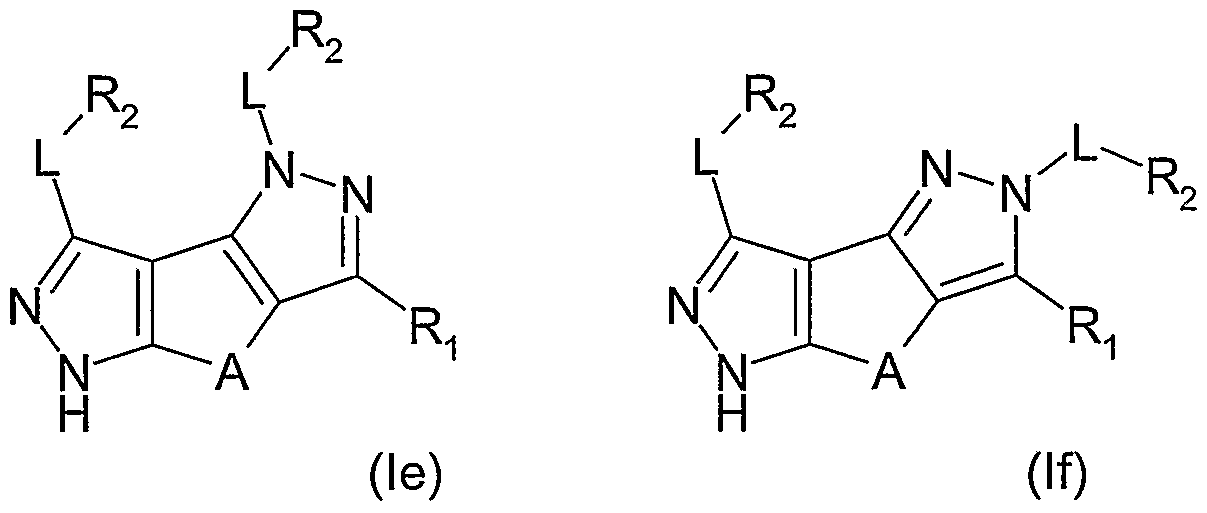
  • Another class of preferred compounds of the invention is represented by the derivatives of formulae (le) or (If)
  • L and R are, each independently and the same or different in each occasion, as above defined;
  • L is methylene or a single bond and R 2 is hydrido, phenyl or a 5 or 6 membered aromatic heterocycle having 1 or 2 heteroatoms selected among N, O and S, the said phenyl or heterocycle being optionally further substituted as above indicated.
  • R 2 being optionally further substituted as above indicated, is selected from the group consisting of hydrido, phenyl, pyridyl, pyridazinyl or pyrimidinyl.
  • Scheme I describes the synthesis of the pyrazoles of formula (I) with fused heterocycles such as, for instance, substituted pyrimidine and pyrazole derivatives.
  • 1,2- cyclohexanedione (1) was refluxed with alcohols such as methanol or ethanol in benzene to provide the desired enone (2).
  • enone (2) was treated with a base such as lithium bistrimethylsilylamide, followed by condensation with diethyl oxalate to afford 1,3-diketone (3).
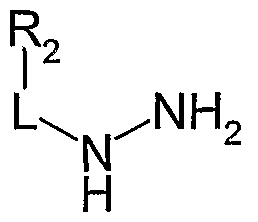
  • step three 1,3-diketone was allowed to react with a suitably substituted hydrazine of general formula (8) to form pyrazole (4).
  • step four pyrazole was treated with dimethylformamide di-tert-butyl acetal to give enaminone (5).
  • step five enaminone was condensed with cyclizing agents such as hydrazine, guanidine, or thiourea derivatives to afford fused pyrazoles and pyrimidines
  • the ester was converted to amide (7) by treatment with ammonium hydroxide in methanol, at a temperature ranging from about 25°C to about 70°C, in a sealed tube.
  • Hydrazines of general formula (8) are commercially available or can be obtained through synthetic procedures well described in the literature.
  • aryl-hydrazines can be conveniently obtained from the corresponding anilines by diazotization, using sodium nitrite, or an alkyl nitrite, followed by catalytic or chemical reduction as described, for example, in J. Med. Chem., 36, 1529 (1993).
  • aryl halides suitably activated with electron withdrawing groups can be converted to the corresponding arylhydrazines through displacement of the halogen atom with hydrazine or a carbazate, followed by hydrolysis of the protecting group, for instance as reported in J. Het. Chem., 25, 1543 (1988) or in Tetrah. Lett, 40 (18), 3543 (1999).
  • Alkyl-hydrazines can be obtained from alkyl-amines by treatment with hydroxylamine-O- sulfonic acid, for instance as described in JOC, 14, 813 (1949).
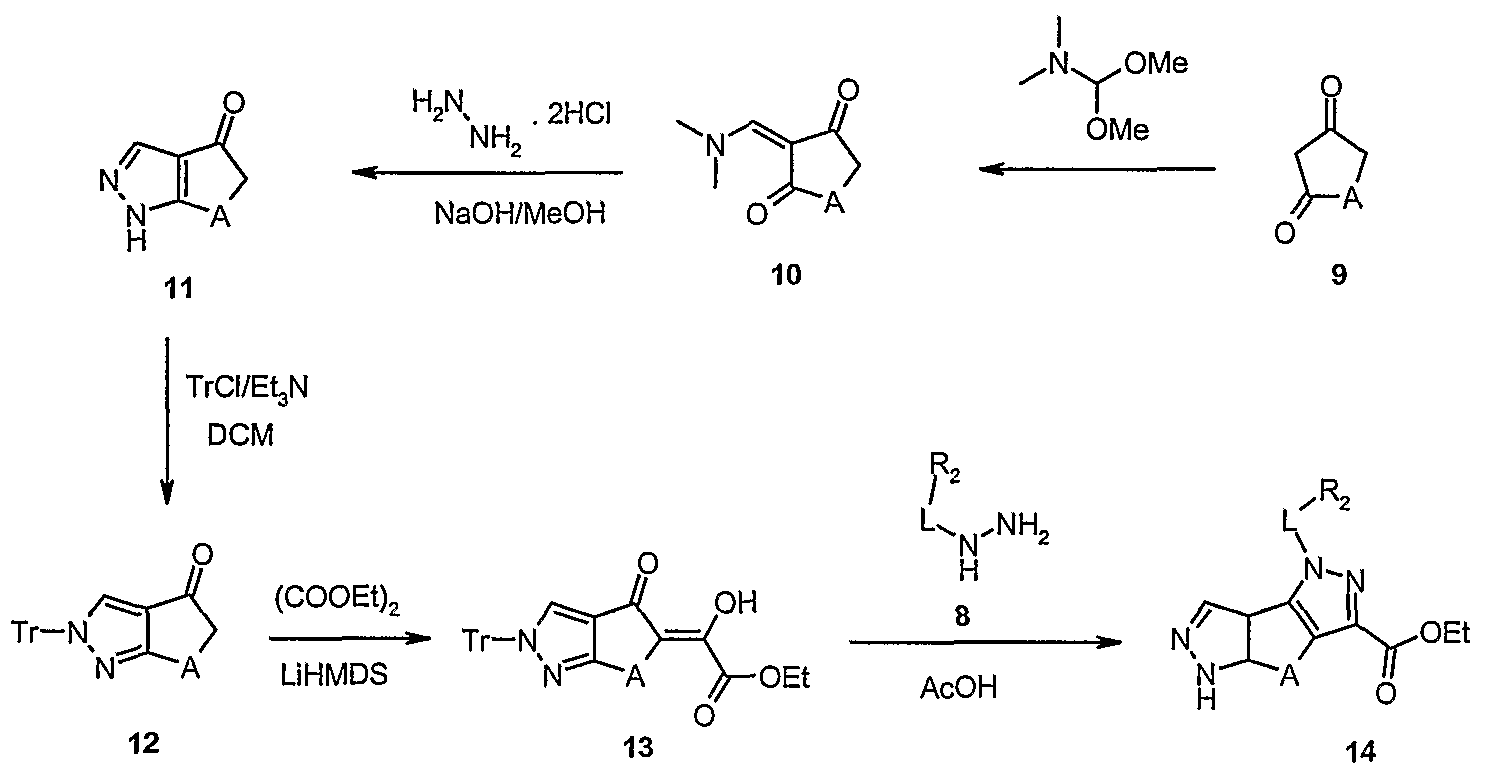
  • step one the cyclic diketone (9) was condensed with N,N-dimethylformamide dimethyl acetal to obtain the adduct (10), as described in Heterocycles, 32, 41 (1991).
  • step two the adduct (10) was reacted with hydrazine dihydrochloride to obtain the intermediate (11), that was protected with trityl chloride (step three) to give the intermediate (12).
  • step four After condensation with oxalyl chloride (step four), the diketoester (13) was allowed to react with a suitably substituted hydrazine (8) (step five) to form the dipyrazole (14). If a salified form of the hydrazine (8) is used (i.e. hydrochloride), the trityl protecting group is normally lost during the cyclization reaction. Optionally, diluted hydrochloric acid can be added to complete the deprotection, once the cyclization has occurred. In step six, the ester was then converted to the amide (15) by treatment with ammonium hydroxide in methanol, at a temperature ranging from about 25°C to about 70°C, in a sealed tube.
  • ammonium hydroxide in methanol
  • the intermediate compound (11) wherein A is -CH 2 - or -CH 2 -CH 2 -, as well as the intermediate compounds (12) and (13) wherein A is selected from -CH 2 -, -CH 2 -CH 2 - and -CH 2 -C(CH 3 ) 2 - are novel and, hence, represent a further object of the present invention.
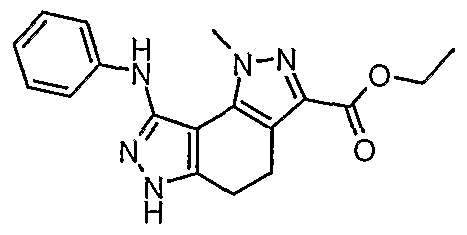
  • Scheme HI illustrates the general synthetic procedure for the preparation of benzodipyrazole derivatives of general formula (I) wherein B is further substituted by a L-R 2 group wherein L is NH.
  • step one the commercially available 3-ethoxy-cyclohex-2-enone (16) is condensed with diethyl oxalate to afford the diketoester (17), which is then reacted, in step two, with a suitably substituted hydrazine (8) to give the pyrazole derivative (18).
  • step three the pyrazole (18) is treated in the presence of a base, such as lithium bistrimethylsilylamide, with a suitably substituted isothiocyanate (19) to afford the intermediate (20), which is then converted to the 3-aminobenzodipyrazole ester of formula (21).
  • a base such as lithium bistrimethylsilylamide
  • isothiocyanate (19) to afford the intermediate (20), which is then converted to the 3-aminobenzodipyrazole ester of formula (21).
  • the ester (21) is finally converted to the corresponding amide (22) under standard operative conditions.
  • Isothiocyanates of general formula (19) are commercially available or can be obtained through synthetic procedures well described in the literature. SCHEME IV
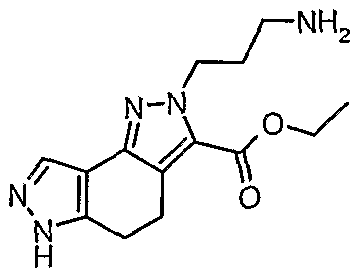
  • Scheme IV describes the general synthetic pathway to obtain compounds of general formula (I) wherein Y and Z are linked so as to form an additional lactamic ring and A is preferably selected from -CH 2 -, -CH 2 -CH 2 - or -CH 2 -C(CH 3 ) -. More generally, scheme IV can also be used to obtain compounds of general formula (I) wherein group L-R is linked to Y.
  • the intermediate compound (23) is reacted with hydrazine to form the pyrazole derivative (24).
  • step two This is then alkylated, in step two, using an alkyl halide bearing a protected amino group, for instance as tert-butoxy-carbonyl (BOC) amino group, hi step three, after removal of the protecting group, the intermediate (25) is allowed to cyclize so to form the final compound (26) under standard operative conditions.
  • a protected amino group for instance as tert-butoxy-carbonyl (BOC) amino group
  • Scheme V refers to some examples describing the possibility of obtaining compounds of general formula (I), differently substituted in R .
  • the oxidation of the central ring can be accomplished according to conventional techniques, for instance by using activated quinone derivatives, e.g. 2,3-dichloro-5,6-dicyano-l,4-benzoquinone or, alternatively, palladium on charcoal in a suitable solvent such as decalin, at high temperatures.
  • any compound of formula (I) of the invention may be prepared by working in analogy to what reported in any one of schemes I to VI and, perhaps, by optionally providing any required modification to the above reactions, on a case by case.
  • the said reactions are however known and conventionally adopted when preparing tricyclyc heterocyclic derivatives of formula (I) and substituted compounds thereof.
  • the inhibiting activity of putative Cdk/Cychn inhibitors and the potency of selected compounds was determined through a method of assay based on the use of the SPA technology (Amersham Pharmacia Biotech).
  • the assay consists of the transfer of radioactivity labelled phosphate moiety by the kinase to a biotinylated substrate.
  • a volume of 110 ⁇ l is transferred to Optiplate. After 20 min. incubation for substrate capture, 100. ⁇ l 5M CsCl were added to allow statification of beads to the top of the plate and let stand 4 hours before radioactivity counting in the Top-Count instrument IC50 determination: inhibitors were tested at different concentrations ranging from 0.0015 to 10 ⁇ M.
  • Kinetic parameter estimates were estimated by simultaneous nonlinear least-square regression using [Eq.l] (competitive inhibitor respect to ATP, random mechanism) using the complete data set (80 points):
  • the selected compounds have been characterized on a panel of ser/threo kinases strictly related to cell cycle (Cdk2/Cyclin E, Cdkl/cyclin Bl, Cdk5/p25, Cdk4/Cyclin Dl), and also for specificity on MAPK, PKA, EGFR, IGF1-R, Aurora-2 and Akt.
  • kinase reaction 0,4 uM ⁇ M mouse GST-Rb (769-921) (# sc-4112 from Santa Cruz) substrate, 10 ⁇ M ATP (0.5 ⁇ Ci P 33 ⁇ -ATP), 100 ng of baculovirus expressed GST- Cdk4/Cyclin Dl, suitable concentrations of inhibitor in a final volume of 50 ⁇ l buffer (TRIS HCl 10 mM pH 7.5, MgCl 2 10 mM, 7.5 mM DTT+ 0.2mg/ml BSA) were added to each well of a 96 U bottom well plate. After 40 min at 37 °C incubation, reaction was stopped by 20 ⁇ l EDTA 120 mM.
  • Capture 60 ⁇ l were transferred from each well to MultiScreen plate, to allow substrate binding to phosphocellulose filter. Plates were then washed 3 times with 150 ⁇ l/well PBS Ca ⁇ /Mg " free and filtered by MultiScreen filtration system. Detection: filters were allowed to dry at 37°C, then 100 ⁇ l/well scintillant were added and 33 P labeled Rb fragment was detected by radioactivity counting in the Top-Count instrument.
  • kinase reaction 10 ⁇ M in house biotinylated MBP (Sigma # M-1891) substrate, 2 ⁇ M ATP (0.04 microCi P 33 ⁇ -ATP), 36 ng insect cell expressed GST-EGFR, inhibitor in a final volume of 30 ⁇ l buffer (Hepes 50 mM pH 7.5, MgCl 2 3 mM, MnCl 2 3 mM, DTT 1 mM, NaVO 3 3 ⁇ M + 0.2 mg/ml BSA) were added to each well of a 96 U bottom. After 20 min at r.t.
  • reaction was stopped by 100 ⁇ l PBS + 32 mM EDTA + 0.1% Triton X-100 + 500 ⁇ M ATP, containing 1 mg SPA beads. Then a volume of 110 ⁇ l is transferred to Optiplate.
  • the inhibition assay of Cdc7/dbf4 activity was performed according to the following protocol.
  • Biotin-MCM2 substrate is trans-phosphorylated by the Cdc7/Dbf4 complex in the presence of ATP traced with ⁇ 33 -ATP.
  • the phosphorylated Biotin-MCM2 substrate is then captured by Streptavidin-coated SPA beads and the extent of phosphorylation evaluated by ⁇ counting.
  • the inhibition assay of Cdc7/dbf4 activity was performed in 96 wells plate according to the following protocol. To each well of the plate were added:
  • test compound (12 increasing concentrations in the nM to ⁇ M range to generate a dose-response curve) - 10 ⁇ l of a mixture of cold ATP (10 ⁇ M final concentration) and radioactive ATP
  • the compounds of formula (I) of the present invention suitable for administration to a mammal, e.g. to humans, can be administered by the usual routes and the dosage level depends upon the age, weight, conditions of the patient and the administration route.
  • a suitable dosage adopted for oral administration of a compound of formula (I) may range from about 10 to about 500 mg pro dose, from 1 to 5 times daily.
  • the compounds of the invention can be administered in a variety of dosage forms, e.g. orally, in the form of tablets, capsules, sugar or film coated tablets, liquid solutions or suspensions; rectally in the form of suppositories; parenteraUy, e.g. intramuscularly, or by intravenous and/or intrathecal and/or intraspinal injection or infusion.
  • the compounds of the invention can be administered either as single agents or, alternatively, in combination with known anticancer treatments such as radiation therapy or chemotherapy regimen in combination with cytostatic or cytotoxic agents, antibiotic-type agents, alkylating agents, antimetabolite agents, hormonal agents, immunological agents, interferon-type agents, cyclooxygenase inhibitors (e.g.
  • COX-2 inhibitors COX-2 inhibitors
  • metallomatrixprotease inhibitors telomerase inhibitors
  • tyrosine kinase inhibitors anti-growth factor receptor agents
  • anti-HER agents anti-EGFR agents
  • anti- angiogenesis agents farnesyl transferase inhibitors
  • ras-raf signal transduction pathway inhibitors cell cycle inhibitors, other cdks inhibitors, tubulin binding agents, topoisomerase I inhibitors, topoisomerase II inhibitors, and the like.
  • the compounds of the invention can be administered in combination with one or more chemotherapeutic agents such as, for instance, exemestane, formestane, anastrozole, letrozole, fadrozole, taxane, taxane derivatives, encapsulated taxanes, CPT- 11, camptothecin derivatives, anthracycline glycosides, e.g., doxorubicin, idarubicin, epirubicin, etoposide, navelbine, vinblastine, carboplatin, cisplatin, estramustine phosphate, celecoxib, tamoxifen, raloxifen, Sugen SU-5416, Sugen SU-6668, Herceptin, and the like, optionally within liposomal formulations thereof.
  • chemotherapeutic agents such as, for instance, exemestane, formestane, anastrozole, letrozole, fadrozole, taxane, taxane
  • compositions comprising a compound of formula (1) or a pharmaceutically acceptable salt thereof in association with a pharmaceutically acceptable excipient (which can be a carrier or a diluent).
  • a pharmaceutically acceptable excipient which can be a carrier or a diluent.
  • the pharmaceutical compositions containing the compounds of the invention are usually prepared following conventional methods and are administered in a pharmaceutically suitable form.
  • the solid oral forms may contain, together with the active compound, diluents, e.g. lactose, dextrose, saccharose, sucrose, cellulose, corn starch or potato starch; lubricants, e.g. silica, talc, stearic , magnesium or calcium stearate, and/or polyethylene glycols; binding agents, e.g. starches, arabic gum, gelatin, methylcellulose, carboxymethylcellulose or polyvinyl pyrrolidone; disaggregating agents, e.g.
  • diluents e.g. lactose, dextrose, saccharose, sucrose, cellulose, corn starch or potato starch
  • lubricants e.g. silica, talc, stearic , magnesium or calcium stearate, and/or polyethylene glycols
  • binding agents e.g. starches, arabic gum, gelatin, methylcellulose, carboxymethylcellulose or polyviny
  • a starch alginic, alginates or sodium starch glycolate
  • effervescing mixtures dyestuffs
  • sweeteners wetting agents such as lecithin, polysorbates, laurylsulfates
  • wetting agents such as lecithin, polysorbates, laurylsulfates
  • non-toxic and pharmacologically inactive substances used in pharmaceutical formulations.
  • Said pharmaceutical preparations may be manufactured in known mariner, for example, by means of mixing, granulating, tabletting, sugar-coating, or film-coating processes.
  • the liquid dispersions for oral administration may be e.g. syrups, emulsions and suspensions.
  • the syrups may contain as carrier, for example, saccharose or saccharose with glycerin and/or mannitol and/or sorbitol.
  • the suspensions and the emulsions may contain as carrier, for example, a natural gum, agar, sodium alginate, pectin, methylcellulose, carboxymethylcellulose, or polyvinyl alcohol.
  • the suspension or solutions for intramuscular injections may contain, together with the active compound, a pharmaceutically acceptable carrier, e.g. sterile water, olive oil, ethyl oleate, glycols, e.g. propylene glycol, and, if desired, a suitable amount of lidocaine hydrochloride.
  • the solutions for intravenous injections or infusions may contain as carrier, for example, sterile water or preferably they may be in the form of sterile, aqueous, isotonic saline solutions or they may contain as a carrier propylene glycol.
  • carrier for example, sterile water or preferably they may be in the form of sterile, aqueous, isotonic saline solutions or they may contain as a carrier propylene glycol.
  • the suppositories may contain together with the active compound a pharmaceutically acceptable carrier, e.g. cocoa butter, polyethylene glycol, a polyoxyethylene sorbitan fatty ester surfactant or lecithin.
  • Step 2 To a suspension of l,5,6,7-tetrahydro-4H-indazol-4-one (8 g, 58.75 mmols) and trityl chloride (18.02 g, 64.64 mmols) in dichloromethane (160 ml), triethylamine (9.8 ml, 70.50 mmols) was added dropwise. The reaction was slightly exothermic.
  • Step 3 To a suspension of 2-trityl-2,5,6,7-tetrahydro-4H-indazol-4-one (20 g,
  • Step 4 A suspension of ethyl oxo(4-oxo-2-trityl-4,5,6,7-tetrahydro-2H-indazol-5- yl)acetate (400 mg, 0.84 mmols) and (4-methoxyphenyl)-hydrazine hydrochloride (164 mg, 0.94 mmols) in acetic acid (4 ml) was stirred at 65°C for 3 hours.
  • Step 1 A solution of 3-Ethoxy-cyclohex-2-enone (4.65 ml, 31.92 mmols) and diethyl oxalate (6.49 ml, 47.89 mmols) in anhydrous ethyl ether (50 ml) is treated dropwise with a IM solution of lithium bis(trimethylsilyl)amide in tetrahydrofuran (47.9 ml, 47.9 mmols) under argon atmosphere. After standing at room temperature overnight, the mixture is poured into a 20% NaH2PO4 solution (150 ml) and extracted with ethyl acetate (100 ml x2).
  • Step 2 (4-Ethoxy-2-oxo-cyclohex-3-enyl)-oxo-acetic acid ethyl ester (8 g, 31.92 mmols theoretically) is treated with methylhydrazine (1.69 ml, 31.92 mmol) in EtOH (75 ml) and AcOH (5 ml) at room temperature. After 3 hours the solution was concentrated 03/07023
  • Step 3 Ethyl 6-ethoxy-l-methyl-4,5-dihydro-lH-indazole-3-carboxylate (7.59 g,
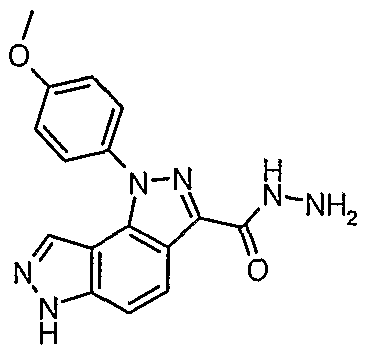
  • Example 6 1 - [l-(4-methylphenyl)-l ,6-dihydropyrazo ⁇ o [3 ,4-e] indazol-3-yl] ethanone
  • Triethylamine (0.82 ml; 6 mmols) was added to a 3M solution of EtMgCl in THF (0.67 ml; 2 mmols) at 0°C under argon atmosphere. After 10 min, a solution of ethyl l-(4- methylphenyl)-7-trityl-l,7-dihydropyrazolo[3,4-e]indazole-3-carboxylate (564 mg; 1 mmol) in anhydrous THF (6 ml) was added dropwise. After leaving at 0°C for 1 hour and 30 min at room temperature the resulting mixture was poured into a 20% NaH 2 PO 3 solution and extracted with ethyl acetate.

Landscapes

  • Chemical & Material Sciences (AREA)
  • Organic Chemistry (AREA)
  • Health & Medical Sciences (AREA)
  • Life Sciences & Earth Sciences (AREA)
  • Medicinal Chemistry (AREA)
  • Pharmacology & Pharmacy (AREA)
  • Animal Behavior & Ethology (AREA)
  • General Health & Medical Sciences (AREA)
  • Public Health (AREA)
  • Veterinary Medicine (AREA)
  • Nuclear Medicine, Radiotherapy & Molecular Imaging (AREA)
  • Engineering & Computer Science (AREA)
  • General Chemical & Material Sciences (AREA)
  • Chemical Kinetics & Catalysis (AREA)
  • Bioinformatics & Cheminformatics (AREA)
  • Immunology (AREA)
  • Urology & Nephrology (AREA)
  • Biomedical Technology (AREA)
  • Neurosurgery (AREA)
  • Neurology (AREA)
  • Epidemiology (AREA)
  • Cardiology (AREA)
  • Heart & Thoracic Surgery (AREA)
  • Oncology (AREA)
  • Virology (AREA)
  • Orthopedic Medicine & Surgery (AREA)
  • Transplantation (AREA)
  • Vascular Medicine (AREA)
  • Psychiatry (AREA)
  • Communicable Diseases (AREA)
  • Pulmonology (AREA)
  • Hospice & Palliative Care (AREA)
  • Rheumatology (AREA)
  • Physical Education & Sports Medicine (AREA)
  • Dermatology (AREA)
  • Pharmaceuticals Containing Other Organic And Inorganic Compounds (AREA)
  • Nitrogen Condensed Heterocyclic Rings (AREA)
  • Medicines That Contain Protein Lipid Enzymes And Other Medicines (AREA)

Abstract

Compounds which are tricyclic pyrazole derivatives and analogues thereof, as set forth in the specification, or pharmaceutically acceptable salts thereof, together with pharmaceutical compositions comprising them are disclosed; these compounds or compositions are useful in the treatment of diseases caused by and/or associated with an altered protein kinase activity such as cancer, cell proliferative disorders, Alzheimer's disease, viral infections, auto-immune diseases and neurodegenerative disorders.

Description
TITLE OF THE INVENTION TRICYCLIC PYRAZOLE DERIVATIVES, PROCESS FOR THEIR PREPARATION AND THEIR USE AS ANTITUMOR AGENTS. BACKGROUND OF THE INVENTION
Field of the invention
The present invention relates to tricyclic pyrazole derivatives active as kinase inhibitors and, more in particular, it relates to tricyclic pyrazoles and analogues tricyclic heterocyclic derivatives, to a process for their preparation, to pharmaceutical compositions comprising them and to their use as therapeutic agents, particularly in the treatment of diseases linked to disregulated protein kinases. Discussion of background
The malfunctioning of protein kinases (PKs) is the hallmark of numerous diseases. A large share of the oncogenes and proto-oncogenes involved in human cancers code for PKs. The enhanced activities of PKs are also implicated in many non-malignant diseases, such as benign prostate hyperplasia, familial adenomatosis, polyposis, neuro- fibromatosis, psoriasis, vascular smooth cell proliferation associated with atherosclerosis, pulmonary fibrosis, arthritis glomerulonephritis and post-surgical stenosis and restenosis. PKs are also implicated in inflammatory conditions and in the multiplication of viruses and parasites. PKs may also play a major role in the pathogenesis and development of neurodegenerative disorders.
For a general reference to PKs malfunctioning or disregulation see, for instance, Current
Opinion in Chemical Biology 1999, 3, 459 - 465.
SUMMARY OF THE INVENTION It is an object of the invention to provide compounds which are useful in therapy as agents against a host of diseases caused by and/or associated to a disregulated protein kinase activity.
It is another object to provide compounds which are endowed with multiple protein kinase inhibiting activity. The present inventors have now discovered that the compounds of the invention, hereinafter shortly referred to as tricyclic pyrazole derivatives, are endowed with multiple protein kinase inhibiting activity and are thus useful in therapy in the treatment of diseases associated with disregulated protein kinases.
More specifically, the compounds of this invention are useful in the treatment of a variety of cancers including, but not limited to: carcinoma such as bladder, breast, colon, kidney, liver, lung, including small cell lung cancer, esophagus, gall-bladder, ovary, pancreas, stomach, cervix, thyroid, prostate, and skin, including squamous cell carcinoma; hematopoietic tumors of lymphoid lineage, including leukemia, acute lymphocitic leukemia, acute lymphoblastic leukemia, B-cell lymphoma, T-cell-lymphoma, Hodgkin's lymphoma, non-Hodgkin's lymphoma, hairy cell lymphoma and Burkett's lymphoma; hematopoietic tumors of myeloid lineage, including acute and chronic myelogenous leukemias, myelodysplastic syndrome and promyelocytic leukemia; tumors of mesenchymal origin, including fibrosarcoma and rhabdomyosarcoma; tumors of the central and peripheral nervous system, including astrocytoma, neuroblastoma, glioma and schwannomas; other tumors, including melanoma, seminoma, teratocarcinoma, osteosarcoma, xeroderma pigmentosum, keratoxanthoma, thyroid follicular cancer and Kaposi's sarcoma.
Due to the key role of PKs in the regulation of cellular proliferation, these compounds are also useful in the treatment of a variety of cell proliferative disorders such as, for instance, benign prostate hyperplasia, familial adenomatosis, polyposis, neuro- fibromatosis, psoriasis, vascular smooth cell proliferation associated with atherosclerosis, pulmonary fϊbrosis, arthritis glomerulonephritis and post-surgical stenosis and restenosis. The compounds of the invention can be useful in the treatment of Alzheimer's disease, as suggested by the fact that cdk5 is involved in the phosphorylation of tau protein (J Biochem., I ll, 741-749, 1995). The compounds of the invention are also useful in the treatment and prevention of radiotherapy-induced or chemotherapy-induced alopecia.
The compounds of this invention, as modulators of apoptosis, may also be useful in the treatment of cancer, viral infections, prevention of AIDS development in HTV-infected individuals, autoimmune diseases and neurodegenerative disorders. The compounds of this invention may be useful in inhibiting tumor angiogenesis and metastasis, as well as in the treatment of organ transplant rejection and host versus graft diseases. The compounds of the invention are useful as cyclin dependent kinase (cdk) inhibitors and also as inhibitors of other protein kinases such as, for instance, protein kinase C in different isoforms, Met, PAK-4, PAK-5, ZC-1, STLK-2, DDR-2, Aurora 1, Aurora 2, Bub-1, PLK, Chkl, Chk2, HER2, rafl, MEK1, MAPK, EGF-R, PDGF-R, FGF-R, IGF- R, VEGF-R, PI3K, weel kinase, Src, Abl, Akt, ILK, MK-2, IKK-2, Cdc7, Nek, and thus be effective in the treatment of diseases associated with other protein kinases.
DETAILED DESCRIPTION OF THE INVENTION Several pyrazoles and analogues thereof are known in the art, for instance as synthetic intermediates or even as therapeutic agents. As an example, carboxamido-pyrazoles possessing cdk inhibitory activity have been described in U.S. Patent No. 6,218,418 to Pevarello et al.
Pyrazoles have been described for use in the treatment of inflammation. U.S. Patent No. 5,134,142 to Matsuo et al describes 1,5-diaryl pyrazoles, and specifically, l-(4- fluorophenyl)-5-[4-(methylsulfonyl)phenyl]-3-trifluoromethyl pyrazole, as having anti- inflammatory activity.
U.S. patent No. 4,734,430 discloses benzo- and cycloheptadipyrazoles as bronchodilators; U.S. Patent No. 3,940,418 describes tricyclic 4,5-dihydrobenz[g]indazoles as anti- inflammatory agents. In addition, R. Hamilton [J. Heterocyclic Chem., 13, 545 (1976)] describes tricyclic 4,5-dihydrobenz[g]indazoles as anti-inflammatory agents. U.S. Patent No. 5,134,155 describes fused tricyclic pyrazoles having a saturated ring bridging the pyrazole and a phenyl radical as HMG-CoA reductase inhibitors. European publication EP 477,049, published Mar. 25, 1992, describes [4,5-dihydro-l-phenyl-lH- benz[g]indazol-3-yl]amides as having antipsychotic activity. European publication EP 347,773, published Dec. 27, 1989, describes [4,5-dihydro-l-ρhenyl-lH-benz[g]indazol-3- yljpropanamides as immunostimulants. M. Hashem et al [J Med. Chem., 19, 229 (1976)] describes fused tricyclic pyrazoles, having a saturated ring bridging the pyrazole and a phenyl radical, as antibiotics.
Certain substituted pyrazolyl-benzenesulfonamides have been described in the literature as synthetic intermediates. Specifically, 4-[5-(4-chlorophenyl)-3-phenyl-lH-pyrazol-l- yl]benzenesulfonarnide has been prepared from a pyrazoline compound as an intermediate for compounds having hypoglycemic activity [R. Soliman et al, J Pharm. Sci., 16, 626 (1987)]. 4-[5-[2-(4-Bromophenyl)-2H-l,2,3-triazol-4-yl]-3-methyl-lH- pyrazol-l-yl]benzenesulfonamide has been prepared from a pyrazoline compound and described as potentially having hypoglycemic activity [H. Mokhtar, Pάk. J. Sci. Ind. Res., 31, 762 (1988)]. Similarly, 4-[4-bromo-5-[2-(4-chlorophenyl)-2H-l,2,3-triazol-4-yl]-3- methyl-lH-pyrazol-l-yl]benzenesulfonamide has been prepared [H. Mokhtar et al, Pak. J. Sci. Ind. Res. , 34, 9 (1991)] .
The phytotoxicity of pyrazole derivatives is described [M. Cocco et al, //. Farmaco-Ed. Sci., 40, 272 (1985)], specifically for l-[4-(aminosulfonyl)phenyl]-5-phenyl-lH-pyrazole- 3,4-dicarboxylic acid. The use of styryl pyrazole esters for antidiabetes drugs is described [H. Mokhtar et al, Pharmazie, 33, 649-651 (1978)]. The use of styryl pyrazole carboxylic acids for antidiabetes drugs is described [R. Soliman et al, Pharmazie, 33, 184-5 (1978)]. The use of 4-[3,4,5-trisubstituted-pyrazol-l-yl]benzenesulfonamides as intermediates for sulfonylurea anti-diabetes agents is described, and specifically, l-[4- (aminosulfonyl)phenyl]-3-methyl-5-phenyl-lH-pyrazole-4-carboxylic acid [R. Soliman et al, J Pharm. Sci., 72, 1004 (1983)]. A series of 4-[3-substituted methyl-5-phenyl-lH- pyrazol-l-yl]benzenesulfonamides has been prepared as intermediates for anti-diabetes agents, and more specifically, 4-[3-methyl-5-phenyl-lH-pyrazol-l- yljbenzenesulfonamide [Η. Feid-AUah, Pharmazie, 36, 754 (1981)]. i addition, l-(4- [aminosulfonyl]phenyl)-5-phenylpyrazole-3-carboxylic acid has been prepared from the above described 4-[3-methyl-5-phenyl-lH-pyrazol-l-yl]benzenesulfonamide compound [R. Soliman et al, J Pharm. Sci., 70, 602 (1981)].
WO 00/27822 discloses tricyclic pyrazole derivatives, WO 00/59901 discloses dihydroindeno pyrazoles, WO 95/15315 discloses diphenyl pyrazole compounds, WO 95/15317 discloses triphenyl pyrazole compounds, WO 95/15318 discloses tri-substituted pyrazole compounds, and WO 96/09293 discloses benz[g]indazolyl derivatives. WO 95/15316 discloses substituted pyrazolyl benzenesulfamide derivatives. Accordingly, the present invention provides a method for treating diseases caused by and/or associated with an altered protein kinase activity, by administering to a mammal in need thereof an effective amount of a compound represented by formula (I)
Figure imgf000005_0001
wherein
X, Y and Z, being part of an aromatic ring are selected, each independently, from the group consisting of N, NR1; S, O and CR1;
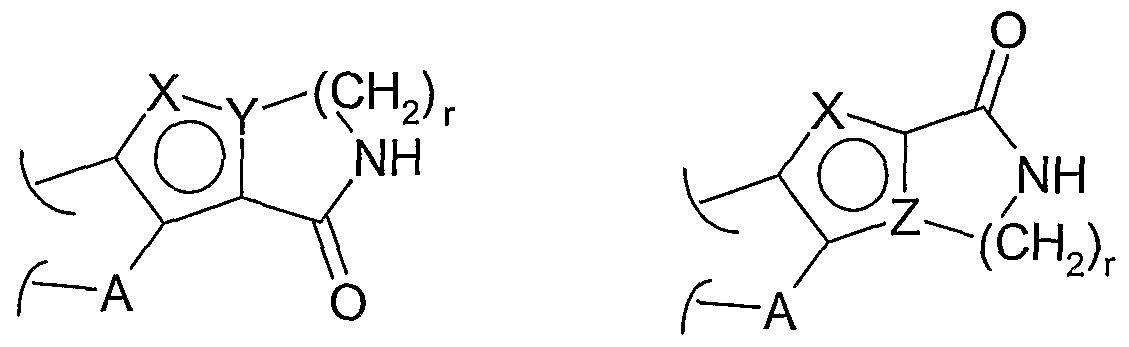
Ri is selected from the group consisting of hydrido, lower alkyl, perfluorinated lower alkyl, heterocyclyl, CN, CO2R', COCF3, COR', CONR'R", NR'R", C(=NR')NR'R", CONHNH2, CONHOR', NHCOR', CH2NH2, and CH2NHCOR'; or Rj may form, when part of Z or Y, a 5 to 7 membered ring together with the remaining of Y or Z, as per the formulae below
Figure imgf000006_0001
R' and R" are selected, each independently, from the group consisting of hydrido, hydroxy, alkyl, hydroxyalkyl, alkenyl, alkynyl, aryl, arylalkyl, heterocyclyl or heterocyclyl-alkyl;
B is an aromatic 5 or 6 membered ring having from 0 to 3 heteroatoms selected from S, O and N; A is selected from the group consisting of -(CH2)m-, -(CH )n-CH=CH-(CH2)n- and
-(CRzRy)p-;
Rz and Ry are selected, each independently, from hydrido or lower alkyl; each of the X,Y,Z and B rings being optionally further substituted by one or more -L-R2 groups, wherein L represents, each independently, a single bond, an alkylidene group or a divalent group selected from NH, NHCO, CONH, NHCONH, SO2NH and NHSO ;
R2 is, each independently, hydrido, alkyl, 5 to 12 membered mono- or bi-cyclic ring having from 0 to 3 heteroatoms selected from S, O and N, optionally substituted with one or more -(CH2)q-R3 groups; or R is a group of formula
Figure imgf000006_0002
W is a 3 to 7 membered ring having one N heteroatom directly linked to Q and from 0 to 2 additional heteroatoms selected from the group consisting of S, SO, SO , O, N and NR1, wherein R' is as above defined; Q is a divalent group selected from CO, SO2 and (CH2)n; R3 is selected, each independently, from the group consisting of alkyl, halogen, CF3, OCF3, NO2, CN, C(=NR')NR'R", OR', SR', OCOR', OCONR'R", COCF3, COR', CO2R', CONR'R", SO2R', SO2NR'R", NR'R", NR'COR*, NR'COOR', NR'CONR'R", NR'SO2R*, NR'SO2NR'R", wherein R' and R" are as above defined; m is an integer from 1 to 4; n is, each independently, 0, 1, or 2; p is 1 or 2; q is, each independently, 0 or an integer from 1 to 3; r is an integer from 1 to 3; or isomers, tautomers, carriers, prodrugs, and pharmaceutically acceptable salts thereof. In a preferred embodiment of the method described above, the disease caused by and/or associated with an altered protein kinase activity is selected from the group consisting of cancer, cell proliferative disorders, Alzheimer's disease, viral infections, auto-immune diseases and neurodegenerative disorders. Specific types of cancer that may be treated include carcinoma, squamous cell carcinoma, hematopoietic tumors of myeloid or lymphoid lineage, tumors of mesenchymal origin, tumors of the central and peripheral nervous system, melanoma, seminoma, teratocarcinoma, osteosarcoma, xeroderma pigmentosum, keratoxanthoma, thyroid follicular cancer and Kaposi's sarcoma. In another preferred embodiment of the method described above, the cell proliferative disorder is selected from the group consisting of benign prostate hyperplasia, familial adenomatosis polyposis, neuro-fibromatosis, psoriasis, vascular smooth cell proliferation associated with atherosclerosis, pulmonary fibrosis, arthritis glomeralonephritis and post- surgical stenosis and restenosis. h addition, the method object of the present invention, also provides tumor angiogenesis and metastasis inhibition.
The present invention further provides a compound represented by formula (I)
Figure imgf000007_0001
wherein X, Y and Z, being part of an aromatic ring are selected, each independently, from the group consisting of N, NR1? S, O and CR1;
Ri is selected from the group consisting of hydrido, lower alkyl, perfluorinated lower alkyl, heterocyclyl, CN, CO2R*, COCF3, COR', CONR'R", NR'R", C(=NR')NR'R", CONHNH2, CONHOR*, NHCOR', CH2NH2, and CH2NHCOR'; or Rj may form, when part of Z or Y, a 5 to 7 membered ring together with the remaining of Y or Z, as per the formulae below
Figure imgf000008_0001
R' and R" are selected, each independently, from the group consisting of hydrido, hydroxy, alkyl, hydroxyalkyl, alkenyl, alkynyl, aryl, arylalkyl, heterocyclyl or heterocyclyl-alkyl;
B is an aromatic 5 or 6 membered ring having from 0 to 3 heteroatoms selected from S, O and N;
A is selected from the group consisting of -(CH2)m-, -(CH )n-CH=CH-(CH2)n- and
-(CRzRy)p-;
Rz and Ry are selected, each independently, from hydrido or lower alkyl; each of the X,Y,Z and B rings being optionally further substituted by one or more -L-R2 groups, wherein L represents, each independently, a single bond, an alkylidene group or a divalent group selected from NH, NHCO, CONH, NHCONH, SO2NH and NHSO2;
R2 is, each independently, hydrido, alkyl, 5 to 12 membered mono- or bi-cyclic ring having from 0 to 3 heteroatoms selected from S, O and N, optionally substituted with one or more -(CH2)q-R groups; or R2 is a group of formula
Figure imgf000008_0002
W is a 3 to 7 membered ring having one N heteroatom directly linked to Q and from 0 to 2 additional heteroatoms selected from the group consisting of S, SO, SO2, O, N and NR\ wherein R' is as above defined; Q is a divalent group selected from CO, SO2 and (CH2)n; R3 is selected, each independently, from the group consisting of alkyl, halogen, CF3, OCF3, NO2, CN, C(=NR')NR'R", OR*, SR', OCOR', OCONR'R", COCF3, COR', CO2R', CONR'R", SO2R*, SO2NR'R", NR'R", NR'COR*, NR'COOR', NR'CONR'R", NR*SO2R', NR'SO2NR'R", wherein R' and R" are as above defined; m is an integer from 1 to 4; n is, each independently, 0, 1, or 2; p is 1 or 2; q is, each independently, 0 or an integer from 1 to 3; r is an integer from 1 to 3; or isomers, tautomers, carriers, prodrugs, and pharmaceutically acceptable salts thereof. Unless otherwise specified, when referring to the compounds of formula (I) per se as well as to any pharmaceutical composition thereof or to any therapeutic treatment comprising them, the present invention includes all of the hydrates, solvates, complexes and prodrugs of the compounds of this invention. Prodrugs are any covalently bonded compounds, which release the active parent drug according to formula (I) in vivo.
If a chiral center or another form of an isomeric center is present in a compound of the present invention, all forms of such isomer or isomers, including enantiomers and diastereomers, are intended to be covered herein. Compounds containing a chiral center may be used as a racemic mixture, an enantiomerically enriched mixture, or the racemic mixture may be separated using well-known techniques and an individual enantiomer may be used alone, cases in which compounds have unsaturated carbon-carbon double bonds, both the cis (Z) and trans (E) isomers are within the scope of this invention. In cases wherein compounds may exist in tautomeric forms, such as keto-enol tautomers, each tautomeric form is contemplated as being included within this invention whether existing in equilibrium or predominantly in one form.
The meaning of any substituent at any one occurrence in formula (I) or any sub-formula thereof is independent of its meaning, or any other substituents meaning, at any other occurrence, unless specified otherwise. In the present description, unless otherwise specified, within the X, Y, Z ring, each of X, Y and Z can be independently selected, as formerly indicated, among N, NRi, S, O and
CR1? the penta-atomic ring so defined being an aromatic ring. The term aromatic ring does not need any further clarification as it refers to any ring which can be conventionally defined as aromatic, such a term being widely used in organic chemistry.
Non limiting examples of X, Y, Z aromatic rings according to the invention are, for instance, thiophene, furan, furazan, pyrrole, pyrazole, imidazole, thiazole, isothiazole, oxazole or isoxazole.
When one or more of X, Y and Z are represented by NRi and/or CRi groups, the said ring is specifically substituted by R\ groups, as above indicated.
With the term hydrido it is intended a single hydrogen atom (H); this hydrido radical may be attached, for example, to an oxygen atom to form a hydroxyl radical or two hydrido radicals may be attached to a carbon atom to form a methylene (-CH2-) radical.
With the term lower alkyl group we intend any straight or branched alkyl group with from
1 to 6 carbon atoms such as, for instance, methyl, ethyl, n-propyl, isopropyl, n-butyl, isobutyl, sec-butyl, tert-butyl, n-pentyl, n-hexyl, and the like. Pefluorinated lower alkyl groups stand for the above lower alkyl groups being further substituted in any of the free positions, at the same or different carbon atom, by more than one fluorine atoms. Non limiting examples of perfiuorinated alkyl groups are, for instance, trifluoromethyl, 2,2,2-trifluoroethyl, 1,2-difluoroethyl, 1,1,1,3,3,3- hexafluoropropyl-2-yl, and the like. Unless otherwise specified in the present description, with the term heterocyclyl we intend any 5 or 6 membered heterocyclic radical with from 1 to 3 heteroatoms selected among N, O and S. If not specifically noted otherwise, the said heterocyclic moieties may comprise saturated, partly unsaturated and fully unsaturated heterocycles; these latter, clearly referable to as aromatic heterocycles, are also conventionally known as heteroaromatic or heteroaryl rings. Non limiting examples of the said heterocycles of the invention are, for instance, thiophene, furan, furazan, pyran, pyrrole, imidazole, pyrazole, thiazole, isothiazole, oxazole, isoxazole, pyridine, pyrazine, pyrimidine, pyridazine, pyrrolidine, pyrroline, imidazolidine, imidazoline, pyrazolidine, pyrazoline, piperidine, piperazine, morpholine, and the like. With the term hydroxyalkyl we intend any of the above straight or branched lower alkyl radicals having from one to six carbon atoms, any one of which may be substituted with one or more hydroxyl radicals. With the term halogen atom, optionally referable to as "halo" group, herewith intended are fluorine, chlorine, bromine and iodine atoms.
With the term alkenyl or alkynyl we intend any of the aforementioned lower alkyl groups with from 2 to 6 carbon atoms, bearing a double or triple bond. Non limiting examples of alkenyl or alkynyl groups are thus, for instance, vinyl, allyl, 1-propenyl, isopropenyl, 1- butenyl, 2-butenyl, 3-butenyl, 2-pentenyl, 1-hexenyl, ethynyl, 2-propynyl, 4-pentynyl, and the like.
With the term aryl we intend, unless otherwise specified, any aromatic ring hence including carbocyclic or 5 or 6 membered heterocyclic rings with from 1 to 3 heteroatoms selected among N, O and S. Non limiting examples of aryl groups are thus phenyl, furyl, thienyl, pyrrolyl, imidazolyl, pyrazolyl, thiazolyl, isothiazolyl, oxazolyl, isoxazolyl, pyridyl, pyrazinyl, pyrimidinyl, pyridazinyl, and the like.
With the terms arylalkyl or heterocyclyl-alkyl groups we intend any of the above groups being defined according to the single moieties from which they derive. More particularly, arylalkyl and heterocyclyl-alkyl groups stand for the above alkyl groups further substituted by aryl or heterocyclyl groups, respectively, these latter being as above defined. hi the present description, unless otherwise specified, B represents a 5 to 6 membered aromatic ring, as formerly indicated, having from 0 to 3 heteroatoms selected from N, O and S. From the above it is clear to the skilled man that B may comprise phenyl, as a 6 membered aromatic ring with 0 heteroatoms, as well as any other 5 or 6 membered aromatic heterocycle with from 1 to 3 heteroatoms, as above defined.
In formula (I), A represents a divalent linker joining X, Y, Z ring with B ring. According to the meanings provided to A, therefore, it may represent a straight or branched alkylidene group being optionally unsaturated [e.g. -(CRzRy)p- such as, for instance,
-(CH2)n-CH=CH-(CH2)n-].
Apart from what above reported, both B and X, Y, Z rings may be optionally further substituted, each independently, by one or more L-R2 groups, being the same or different. Substitutions may obviously occur in any of the free positions of both rings, by replacement of one or more hydrogen atoms, otherwise referred to as hydrido.
When referring to alkylidene, L may represent a saturated divalent hydrocarbon group, with from 1 to 6 carbon atoms such as, for instance, a -(CH2)1-6- group. Unless otherwise specified, with the term 5 to 12-membered, either mono- or bi-cyclic ring system, with 0 to 3 heteroatoms among N, O and S, we intend any carbocyclic (e.g. 0 heteroatoms) or heterocyclic (e.g. 1 to 3 heteroatoms) ring, either saturated, partly unsaturated or fully unsaturated (e.g. aromatic) ring system. Unless otherwise defined, within the above bi-cyclic ring systems, each of the two ring units may be fused to each other or otherwise linked through a single bond.
Non limiting examples of the above carbocyclic ring systems include, for instance, cyclopentane, cyclopentene, cyclohexane, cyclohexene, cyclohexadiene, benzene, naphthalene and biphenylene. Examples of the above heterocylic ring systems may typically include any of the aforementioned 5 or 6 membered, either saturated, partly unsaturated or fully unsaturated heterocycles (see examples above) which may be further condensed to, or linked through a single bond with, any of the aforementioned mono-cyclic carbocyclic or heterocyclic rings themselves. Finally, when referring to the W ring, it represents a 3 to 7 membered heterocyclic ring at least containing a N nitrogen atom directly linked to Q, as set forth above. The term "pharmaceutically acceptable salts" embraces salts commonly used to form alkali metal salts and to form addition salts of free acids or free bases. The nature of the salt is not critical, provided that it is pharmaceutically acceptable. Suitable pharmaceutically acceptable acid addition salts of compounds of the present invention may be prepared from an inorganic acid or from an organic acid. Examples of such inorganic acids are hydrochloric, hydrobromic, hydroiodic, nitric, carbonic, sulfuric, and phosphoric acid. Appropriate organic acids may be selected from aliphatic, cycloaliphatic, aromatic, araliphatic, heterocyclic, carboxylic and sulfonic classes of organic acids, examples of which are formic, acetic, trifluoroacetic propionic, succinic, glycolic, gluconic, lactic, malic, tartaric, citric, ascorbic, glucuronic, maleic, fumaric, pyruvic, aspartic, glutamic, benzoic, anthranilic, mesylic, salicyclic, salicyclic, phydroxybenzoic, phenylacetic, mandelic, embonic (pamoic), methanesulfonic, ethanesulfonic, benzenesulfonic, pantothenic, toluenesulfonic, 2-hydroxyethanesulfonic, sulfanilic, stearic, cyclohexylaminosulfonic, algenic, hydroxybutyric, salicyclic, galactaric and galacturonic acid. Suitable pharmaceutically acceptable base addition salts of compounds of the present invention include metallic salts made from aluminum, calcium, lithium, magnesium, potassium, sodium and zinc or organic salts made from N,N'- dibenzylethylenediamine, chloroprocaine, choline, diethanolamine, ethylenediamine, meglumine (N-methyl-glucamine) and procaine. All of these salts may be prepared by conventional means from the corresponding compound of the present invention by reacting, for example, the appropriate acid or base.
A class of preferred compounds of the invention is represented by the derivatives of formula (la)
Figure imgf000013_0001
wherein B, Rl5 L and R are as above defined and A is selected from the group consisting of -CH2-, -CH2-CH2-, -CH=CH- and -CH2-C(CH3)2-, the B ring being optionally further substituted as above defined.
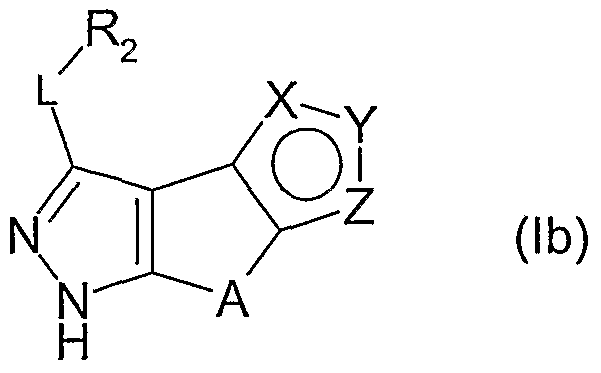
Another class of preferred compounds of the invention is represented by the derivatives of formula (lb)
Figure imgf000013_0002
wherein X, Y, Z, L and R2 are as above defined and A is selected from the group consisting of -CH2-, -CH2-CH2-, -CB=CH- and -CH2-C(CH3)2-, the X, Y, Z ring being optionally further substituted as above defined.
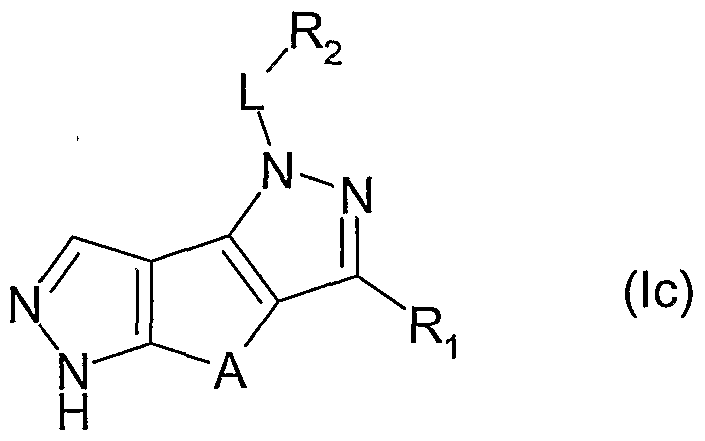
Another class of preferred compounds of the invention is represented by the derivatives of formula (Ic)
Figure imgf000013_0003
wherein Rl5 L and R2 are, each independently, as above defined, and A is selected from the group consisting of -CH2-, -CH2-CH2-, -CH=CH- and -CH2-C(CH3)2-. Another class of preferred compounds of the invention is represented by the derivatives of formula (Id)
Figure imgf000014_0001
wherein r and B are as above defined, A is selected from the group consisting of -CH2-, - CH2-CH2-, -CH=CH- and -CH2-C(CH3)2-, and the B ring being optionally further substituted as above defined.
Another class of preferred compounds of the invention is represented by the derivatives of formulae (le) or (If)
Figure imgf000014_0002
wherein L and R are, each independently and the same or different in each occasion, as above defined; A is selected from the group consisting of -CH -CH -, -CH=CH- and -CH2-C(CH3)2-; and R is a group selected from NR'R", CN, CO2R*, COR*, CONR'R", CONHOR', CONHNH2 and C(=NOH)NR'R", wherein R' and R" are, the same or different, hydrido or alkyl.
Another class of preferred compounds of the invention is represented by the derivatives of formula (Ig)
Figure imgf000014_0003
wherein L, R2 and r are as above defined; and A is selected from the group consisting of -CH2-CH2-, -CH=CH- and -CH2-C(CH3)2-. Still more preferred, in any one of the above classes, are the derivatives of formula (I) wherein L is methylene or a single bond and R2 is hydrido, phenyl or a 5 or 6 membered aromatic heterocycle having 1 or 2 heteroatoms selected among N, O and S, the said phenyl or heterocycle being optionally further substituted as above indicated. Even more preferred are these latter derivatives of formula (I) wherein R2, being optionally further substituted as above indicated, is selected from the group consisting of hydrido, phenyl, pyridyl, pyridazinyl or pyrimidinyl.
For a general reference to the specific compounds of formula (I) of the invention, and the pharmaceutically acceptable salts thetreof, see the experimental section. As set forth above, it is a further object of the present invention a process for preparing the compounds of formula (I) and the pharmaceutically acceptable salts thereof. The said process can be conveniently described as set forth below according to Schemes I- VI.
SCHEME I
Figure imgf000015_0001
Scheme I describes the synthesis of the pyrazoles of formula (I) with fused heterocycles such as, for instance, substituted pyrimidine and pyrazole derivatives. In step one, 1,2- cyclohexanedione (1) was refluxed with alcohols such as methanol or ethanol in benzene to provide the desired enone (2). h step two, enone (2) was treated with a base such as lithium bistrimethylsilylamide, followed by condensation with diethyl oxalate to afford 1,3-diketone (3).
In step three, 1,3-diketone was allowed to react with a suitably substituted hydrazine of general formula (8) to form pyrazole (4). In step four, pyrazole was treated with dimethylformamide di-tert-butyl acetal to give enaminone (5). In step five, enaminone was condensed with cyclizing agents such as hydrazine, guanidine, or thiourea derivatives to afford fused pyrazoles and pyrimidines
(6).
In the final step, the ester was converted to amide (7) by treatment with ammonium hydroxide in methanol, at a temperature ranging from about 25°C to about 70°C, in a sealed tube.
Hydrazines of general formula (8) are commercially available or can be obtained through synthetic procedures well described in the literature. For instance, aryl-hydrazines can be conveniently obtained from the corresponding anilines by diazotization, using sodium nitrite, or an alkyl nitrite, followed by catalytic or chemical reduction as described, for example, in J. Med. Chem., 36, 1529 (1993). In selected cases, aryl halides suitably activated with electron withdrawing groups can be converted to the corresponding arylhydrazines through displacement of the halogen atom with hydrazine or a carbazate, followed by hydrolysis of the protecting group, for instance as reported in J. Het. Chem., 25, 1543 (1988) or in Tetrah. Lett, 40 (18), 3543 (1999).
Alkyl-hydrazines can be obtained from alkyl-amines by treatment with hydroxylamine-O- sulfonic acid, for instance as described in JOC, 14, 813 (1949).
SCHEME II
Figure imgf000017_0001
aminolysis
Figure imgf000017_0002
15
The synthetic pathway reported in Scheme II illustrates a procedure, alternative to Scheme I, for the preparation of derivatives of general formula (I) wherein A is preferably selected among -CH2-, -CH2-CH2-, -CH2-C(CH3)2-. step one, the cyclic diketone (9) was condensed with N,N-dimethylformamide dimethyl acetal to obtain the adduct (10), as described in Heterocycles, 32, 41 (1991). In step two, the adduct (10) was reacted with hydrazine dihydrochloride to obtain the intermediate (11), that was protected with trityl chloride (step three) to give the intermediate (12). After condensation with oxalyl chloride (step four), the diketoester (13) was allowed to react with a suitably substituted hydrazine (8) (step five) to form the dipyrazole (14). If a salified form of the hydrazine (8) is used (i.e. hydrochloride), the trityl protecting group is normally lost during the cyclization reaction. Optionally, diluted hydrochloric acid can be added to complete the deprotection, once the cyclization has occurred. In step six, the ester was then converted to the amide (15) by treatment with ammonium hydroxide in methanol, at a temperature ranging from about 25°C to about 70°C, in a sealed tube. The intermediate compound (11) wherein A is -CH2- or -CH2-CH2-, as well as the intermediate compounds (12) and (13) wherein A is selected from -CH2-, -CH2-CH2- and -CH2-C(CH3)2- are novel and, hence, represent a further object of the present invention.
SCHEME III
Figure imgf000018_0001
22 21 20
Scheme HI illustrates the general synthetic procedure for the preparation of benzodipyrazole derivatives of general formula (I) wherein B is further substituted by a L-R2 group wherein L is NH. In step one the commercially available 3-ethoxy-cyclohex-2-enone (16) is condensed with diethyl oxalate to afford the diketoester (17), which is then reacted, in step two, with a suitably substituted hydrazine (8) to give the pyrazole derivative (18). step three the pyrazole (18) is treated in the presence of a base, such as lithium bistrimethylsilylamide, with a suitably substituted isothiocyanate (19) to afford the intermediate (20), which is then converted to the 3-aminobenzodipyrazole ester of formula (21). hi the last step, the ester (21) is finally converted to the corresponding amide (22) under standard operative conditions. Isothiocyanates of general formula (19) are commercially available or can be obtained through synthetic procedures well described in the literature. SCHEME IV
Figure imgf000019_0001
26 25
Scheme IV describes the general synthetic pathway to obtain compounds of general formula (I) wherein Y and Z are linked so as to form an additional lactamic ring and A is preferably selected from -CH2-, -CH2-CH2- or -CH2-C(CH3) -. More generally, scheme IV can also be used to obtain compounds of general formula (I) wherein group L-R is linked to Y. In the first step, the intermediate compound (23) is reacted with hydrazine to form the pyrazole derivative (24). This is then alkylated, in step two, using an alkyl halide bearing a protected amino group, for instance as tert-butoxy-carbonyl (BOC) amino group, hi step three, after removal of the protecting group, the intermediate (25) is allowed to cyclize so to form the final compound (26) under standard operative conditions.
SCHEME V
R, Conditions
Figure imgf000020_0001
Υ %
0 Me EtMgCI TEA
R.T.- 30 min; 22
Figure imgf000020_0002
\ NaOH/NaCIO
NH, reflux-15 min; 49%
Scheme V refers to some examples describing the possibility of obtaining compounds of general formula (I), differently substituted in R . Preferably, A is selected from the group consisting -CH2-, -CH2-CH2-, -CH2-C(CH3)2- and -CH=CH-.
The above reactions of transformation are generally performed by properly reacting the alkoxycarbonyl group of the intermediate (27) or the aminocarbonyl group of the intermediate (28), each of which may be suitably protected. The transformations and related experimental conditions shown in scheme V, are readily apparent to one skilled in the art and are thus provided for exemplification purposes only, without limiting the scope of the invention.
SCHEME VI
Figure imgf000020_0003
(I) (I)
A = -CH=CH-
Synthetic scheme VI describes a general procedure for transforming the compounds of formula (I) wherein both B and X, Y, Z rings are as defined in the above general formula and A is -CH2-CH2-, to the corresponding aromatic counterparts of general formula (I) wherein A is -CH=CH-. The oxidation of the central ring can be accomplished according to conventional techniques, for instance by using activated quinone derivatives, e.g. 2,3-dichloro-5,6-dicyano-l,4-benzoquinone or, alternatively, palladium on charcoal in a suitable solvent such as decalin, at high temperatures. When preparing the compounds of formula (I) according to any variant of the process, which are all to be intended as within the scope of the present invention, optional functional groups within both the starting materials, the reagents or the intermediates thereof, and which could give rise to unwanted side reactions, need to be properly protected according to conventional techniques. Likewise, the conversion of these latter into the free deprotected compounds may be carried out according to known procedures.
Pharmaceutically acceptable salts of the compounds of formula (I) or, alternatively, their free compounds from the salts thereof, my be all obtained according to conventional methods. Any of the starting material within schemes I to VI and reactants thereof are lαiown, or may be easily prepared according to known methods.
From all of the above, it is also clear to the skilled man that any compound of formula (I) of the invention may be prepared by working in analogy to what reported in any one of schemes I to VI and, perhaps, by optionally providing any required modification to the above reactions, on a case by case. The said reactions are however known and conventionally adopted when preparing tricyclyc heterocyclic derivatives of formula (I) and substituted compounds thereof.
PHARMACOLOGY The compounds of formula (I) are active as protein kinase inhibitors and are therefore useful, for instance, to restrict the unregulated proliferation of tumor cells.
In therapy, they may be used in the treatment of various tumors, such as those formerly reported, as well as in the treatment of other cell proliferative disorders such as psoriasis, vascular smooth cell proliferation associated with atherosclerosis and post-surgical stenosis and restenosis and in the treatment of Alzheimer's disease. The inhibiting activity of putative Cdk/Cychn inhibitors and the potency of selected compounds was determined through a method of assay based on the use of the SPA technology (Amersham Pharmacia Biotech). The assay consists of the transfer of radioactivity labelled phosphate moiety by the kinase to a biotinylated substrate. The resulting 33P-labelled biotinylated product is allowed to bind to streptavidin-coated SPA beads (biotin capacity 130 pmol/mg), and light emitted was measured in a scintillation counter. Inhibition assay of Cdk2/Cyclin A activity
Kinase reaction: 4 μM in house biotinylated histone HI (Sigma # H-5505) substrate, 10 μM ATP (0.1 microCi P33γ-ATP), 4.2 ng Cdk2/Cyclin A complex, inhibitor in a final volume of 30 μl buffer (TRIS HC1 10 mM pH 7.5, MgCl2 10 mM, DTT 7.5 mM + 0.2 mg/ml BSA) were added to each well of a 96 U bottom. After 30 min at r.t. incubation, reaction was stopped by 100 μl PBS + 32 mM EDTA + 0.1% Triton X-100 + 500 μM ATP, containing 1 mg SPA beads. Then a volume of 110 μl is transferred to Optiplate. After 20 min. incubation for substrate capture, 100. μl 5M CsCl were added to allow statification of beads to the top of the plate and let stand 4 hours before radioactivity counting in the Top-Count instrument IC50 determination: inhibitors were tested at different concentrations ranging from 0.0015 to 10 μM. Experimental data were analyzed by the computer program GraphPad Prizm using the four parameter logistic equation: y = bottom+(top-bottom)/(l+10Λ((logIC50-x)*slope)) where x is the logarithm of the inhibitor concentration, y is the response; y starts at bottom and goes to top with a sigmoid shape.
Ki calculation:
Experimental method: Reaction was carried out in buffer (10 mM Tris, pH 7.5, 10 mM MgCl2, 0.2 mg/ml BSA, 7.5 mM DTT) containing 3.7 nM enzyme, histone and ATP (constant ratio of cold/labeled ATP 1/3000). Reaction was stopped with EDTA and the substrate captured on phosphomembrane (Multiscreen 96 well plates from Millipore). After extensive washing, the multiscreen plates are read on a top counter. Control (time zero) for each ATP and histone concentrations was measured.
Experimental design: Reaction velocities are measured at different four ATP, substrate (histone) and inhibitor concentrations. An 80-point concentration matrix was designed around the respective ATP and substrate Km values, and the inhibitor IC50 values (0.3, 1 ,
3, 9 fold the Km or IC50 values). A preliminary time course experiment in the absence of inhibitor and at the different ATP and substrate concentrations allow the selection of a single endpoint time (10 min) in the linear range of the reaction for the Ki determination experiment.
Kinetic parameter estimates: Kinetic parameters were estimated by simultaneous nonlinear least-square regression using [Eq.l] (competitive inhibitor respect to ATP, random mechanism) using the complete data set (80 points):
Vm»A»B rτ?
V = a »Ka »Kb + a »Ka »B + a »Kb»A+ A»B + » — Ka •I* (Kb + — T ) C q ]
Ki β where A=[ATP], B=[Substrate], I=[inhibitor], Vm= maximum velocity, Ka, Kb, Ki the dissociation constants of ATP, substrate and inhibitor respectively, α and β the cooperativity factor between substrate and ATP binding and substrate and inhibitor binding respectively. h addition the selected compounds have been characterized on a panel of ser/threo kinases strictly related to cell cycle (Cdk2/Cyclin E, Cdkl/cyclin Bl, Cdk5/p25, Cdk4/Cyclin Dl), and also for specificity on MAPK, PKA, EGFR, IGF1-R, Aurora-2 and Akt.
Inhibition assay of Cdk2/Cyclin E activity
Kinase reaction: 10 μMin house biotinylated histone HI (Sigma # H-5505) substrate, 30 μMATP (0.3 microCi P33γ-ATP), 4 ng GST-Cdk2/Cyclin E complex, inhibitor in a final volume of 30 μl buffer (TRIS HCl 10 mM pH 7.5, MgCl2 10 mM, DTT 7.5 mM + 0.2 mg/ml BSA) were added to each well of a 96 U bottom. After 60 min at r.t. incubation, reaction was stopped by 100 μl PBS + 32 mM EDTA + 0.1% Triton X-100 + 500 μM ATP, containing 1 mg SPA beads. Then a volume of 110 μl is transferred to Optiplate. After 20 min. incubation for substrate capture, 100 μl 5M CsCl were added to allow statification of beads to the top of the plate and let stand 4 hours before radioactivity counting in the Top-Count instrument
IC50 determination: see above
Inhibition assay of Cdkl/Cyclin Bl activity
Kinase reaction: 4 μM in house biotinylated histone HI (Sigma # H-5505) substrate, 20 μM ATP (0.2 microCi P33γ-ATP), 3 ng Cdkl/Cyclin B complex, inhibitor in a final volume of 30 μl buffer (TRIS HCl 10 mM pH 7.5, MgCl2 10 mM, DTT 7.5 mM + 0.2 mg/ml BSA) were added to each well of a 96 U bottom. After 20 min at r.t. incubation, reaction was stopped by 100 μl PBS + 32 mM EDTA + 0.1% Triton X-100 + 500 μM ATP, containing 1 mg SPA beads. Then a volume of 110 μl is transferred to Optiplate. After 20 min. incubation for substrate capture, 100. μl 5M CsCl were added to allow statification of beads to the top of the Optiplate and let stand 4 hours before radioactivity counting in the Top-Count instrument. IC50 determination: see above Inhibition assay of Cdk5/p25 activity The inhibition assay of Cdk5/p25 activity was performed according to the following protocol.
Kinase reaction: 10 μM biotinylated histone HI (Sigma # H-5505) substrate, 30 μM ATP (0.3 microCi P33γ-ATP), 15 ng CDK5/p25 complex, inhibitor in a final volume of 30 μl buffer (TRIS HCl 10 mM pH 7.5, MgCl2 10 mM, DTT 7.5 mM + 0.2 mg/ml BSA) were added to each well of a 96 U bottom. After 30 min at r.t. incubation, reaction was stopped by 100 μl PBS + 32 mM EDTA + 0.1% Triton X- 100 + 500 μM ATP, containing 1 mg SPA beads. Then a volume of 110 μl is transferred to Optiplate. After 20 min. incubation for substrate capture, lOOμl 5M CsCl were added to allow statification of beads to the top of the plate and let stand 4 hours before radioactivity counting in the Top-Count instrument. IC50 determination: see above
Inhibition assay of Cdk4/Cyclin Dl activity
Kinase reaction: 0,4 uM μM mouse GST-Rb (769-921) (# sc-4112 from Santa Cruz) substrate, 10 μM ATP (0.5 μCi P33γ-ATP), 100 ng of baculovirus expressed GST- Cdk4/Cyclin Dl, suitable concentrations of inhibitor in a final volume of 50 μl buffer (TRIS HCl 10 mM pH 7.5, MgCl2 10 mM, 7.5 mM DTT+ 0.2mg/ml BSA) were added to each well of a 96 U bottom well plate. After 40 min at 37 °C incubation, reaction was stopped by 20 μl EDTA 120 mM.
Capture: 60 μl were transferred from each well to MultiScreen plate, to allow substrate binding to phosphocellulose filter. Plates were then washed 3 times with 150 μl/well PBS Ca^/Mg " free and filtered by MultiScreen filtration system. Detection: filters were allowed to dry at 37°C, then 100 μl/well scintillant were added and 33P labeled Rb fragment was detected by radioactivity counting in the Top-Count instrument.
IC50 determination: see above Inhibition assay of MAPK activity
Kinase reaction: 10 μM in house biotinylated MBP (Sigma # M-1891) substrate, 15 μM ATP (0.15 microCi P33γ-ATP), 30 ng GST-MAPK (Upstate Biothecnology # 14-173), inhibitor in a final volume of 30 μl buffer (TRIS HCl 10 mM pH 7.5, MgCl2 10 mM, DTT 7.5 mM + 0.2 mg/ml BSA) were added to each well of a 96 U bottom. After 30 min at r.t. incubation, reaction was stopped by 100 μl PBS + 32 mM EDTA + 0.1% Triton X- 100 + 500 μM ATP, containing 1 mg SPA beads. Then a volume of 110 μl is transferred to Optiplate.
After 20 min. incubation for substrate capture, 100 μl 5M CsCl were added to allow statification of beads to the top of the Optiplate and let stand 4 hours before radioactivity counting in the Top-Count instrument. IC50 determination: see above Inhibition assay of PKA activity
Kinase reaction: 10 μM in house biotinylated histone HI (Sigma # H-5505) substrate, 10 μM ATP (0.2 microM P33γ-ATP), 0.45 U PKA (Sigma # 2645), inhibitor in a final volume of 30 μl buffer (TRIS HCl 10 mM pH 7.5, MgCl2 10 mM, DTT 7.5 mM + 0.2 mg/ml BSA) were added to each well of a 96 U bottom. After 90 min at r.t. incubation, reaction was stopped by 100 μl PBS + 32 mM EDTA + 0.1% Triton X-100 + 500 μM ATP, containing 1 mg SPA beads. Then a volume of 110 μl is transferred to Optiplate. After 20 min. incubation for substrate capture, lOOμl 5M CsCl were added to allow statification of beads to the top of the Optiplate and let stand 4 hours before radioactivity counting in the Top-Count instrument.
IC50 determination: see above
Inhibition assay of EGFR activity
Kinase reaction: 10 μM in house biotinylated MBP (Sigma # M-1891) substrate, 2 μM ATP (0.04 microCi P33γ-ATP), 36 ng insect cell expressed GST-EGFR, inhibitor in a final volume of 30 μl buffer (Hepes 50 mM pH 7.5, MgCl2 3 mM, MnCl2 3 mM, DTT 1 mM, NaVO33μM + 0.2 mg/ml BSA) were added to each well of a 96 U bottom. After 20 min at r.t. incubation, reaction was stopped by 100 μl PBS + 32 mM EDTA + 0.1% Triton X-100 + 500 μM ATP, containing 1 mg SPA beads. Then a volume of 110 μl is transferred to Optiplate.
After 20 min. incubation for substrate capture, 100μl 5M CsCl were added to allow statification of beads to the top of the Optiplate and let stand 4 hours before radioactivity counting in the Top-Count instrument. IC50 determination: see above Inhibition assay of IGF1-R activity The inhibition assay of IGF1-R activity was performed according to the following protocol.
Kinase reaction: 10 μM biotinylated MBP (Sigma cat. # M-1891) substrate, 0-20 μM inhibitor, 6 μM ATP, 1 microCi 33P-ATP, and 22.5 ng GST-IGF1-R (pre-incubated for 30 min at room temperature with cold 60 μM cold ATP) in a final volume of 30 μl buffer (50 mM HEPES pH 7.9, 3 mM MnCl2, 1 mM DTT, 3 μM NaVO3) were added to each well of a 96 U bottom well plate. After incubation for 35 min at room temperature, the reaction was stopped by addition of 100 μl PBS buffer containing 32 mM EDTA, 500 μM cold ATP, 0.1% Triton XI 00 and lOmg/ml streptavidin coated SPA beads. After 20 min incubation, 110 μL of suspension were withdrawn and transferred into 96-well OPTIPLATEs containing 100 μl of 5M CsCl. After 4 hours, the plates were read for 2 min in a Packard TOP-Count radioactivity reader.
Inhibition assay of Aurora-2 activity
Kinase reaction: 8 μM biotinylated peptide (4 repeats of LRRWSLG), 10 μM ATP (0.5 uCi P33γ-ATP), 15 ng Aurora2, inliibitor in a final volume of 30 μl buffer (HEPES 50 mM pH 7.0, MgCl2 10 mM, 1 mM DTT, 0.2 mg/ml BSA, 3μM orthovanadate) were added to each well of a 96 U bottom well plate. After 30 minutes at room temperature incubation, reaction was stopped and biotinylated peptide captured by adding 100 μl of bead suspension.
Stratification: 100 μl of CsC12 5 M were added to each well and let stand 4 hour before radioactivity was counted in the Top-Count instrument. IC50 determination: see above Inhibition assay of Cdc7/dbf4 activity
The inhibition assay of Cdc7/dbf4 activity was performed according to the following protocol.
The Biotin-MCM2 substrate is trans-phosphorylated by the Cdc7/Dbf4 complex in the presence of ATP traced with γ33-ATP. The phosphorylated Biotin-MCM2 substrate is then captured by Streptavidin-coated SPA beads and the extent of phosphorylation evaluated by β counting.
The inhibition assay of Cdc7/dbf4 activity was performed in 96 wells plate according to the following protocol. To each well of the plate were added:
10 μl substrate (biotinylated MCM2, 6 μM final concentration)
10 μl enzyme (Cdc7/Dbf4, 12.5 nM final concentration)
10 μl test compound (12 increasing concentrations in the nM to μM range to generate a dose-response curve) - 10 μl of a mixture of cold ATP (10 μM final concentration) and radioactive ATP
(1/2500 molar ratio with cold ATP) was then used to start the reaction which was allowed to take place at 37°C. Substrate, enzyme and ATP were diluted in 50 mM HEPES pH 7.9 containing 15 mM MgCl2, 2 mM DTT, 3 μM NaVO3, 2mM glycerophosphate and 0.2mg/ml BSA. The solvent for test compounds also contained 10% DMSO.
After incubation for 20 minutes, the reaction was stopped by adding to each well 100 μl of PBS pH 7.4 containing 50 mM EDTA, 1 mM cold ATP, 0.1% Triton XI 00 and 10 mg/ml streptavidin coated SPA beads. After 15 minutes of incubation at room temperature to allow the biotinylated MCM2- streptavidin SPA beads interaction to occur, beads were trapped in a 96 wells filter plate
(UnifilterR GF/B™) using a Packard Cell Harvester (Filtermate), washed with distilled water and then counted using a Top Count (Packard).
Counts were blank-subtracted and then the experimental data (each point in triplicate) were analyzed for IC50 determination using a non-linear regression analysis (Sigma Plot). The compounds of formula (I) of the present invention, suitable for administration to a mammal, e.g. to humans, can be administered by the usual routes and the dosage level depends upon the age, weight, conditions of the patient and the administration route. For example, a suitable dosage adopted for oral administration of a compound of formula (I) may range from about 10 to about 500 mg pro dose, from 1 to 5 times daily.
The compounds of the invention can be administered in a variety of dosage forms, e.g. orally, in the form of tablets, capsules, sugar or film coated tablets, liquid solutions or suspensions; rectally in the form of suppositories; parenteraUy, e.g. intramuscularly, or by intravenous and/or intrathecal and/or intraspinal injection or infusion. In addition, the compounds of the invention can be administered either as single agents or, alternatively, in combination with known anticancer treatments such as radiation therapy or chemotherapy regimen in combination with cytostatic or cytotoxic agents, antibiotic-type agents, alkylating agents, antimetabolite agents, hormonal agents, immunological agents, interferon-type agents, cyclooxygenase inhibitors (e.g. COX-2 inhibitors), metallomatrixprotease inhibitors, telomerase inhibitors, tyrosine kinase inhibitors, anti-growth factor receptor agents, anti-HER agents, anti-EGFR agents, anti- angiogenesis agents, farnesyl transferase inhibitors, ras-raf signal transduction pathway inhibitors, cell cycle inhibitors, other cdks inhibitors, tubulin binding agents, topoisomerase I inhibitors, topoisomerase II inhibitors, and the like. As an example, the compounds of the invention can be administered in combination with one or more chemotherapeutic agents such as, for instance, exemestane, formestane, anastrozole, letrozole, fadrozole, taxane, taxane derivatives, encapsulated taxanes, CPT- 11, camptothecin derivatives, anthracycline glycosides, e.g., doxorubicin, idarubicin, epirubicin, etoposide, navelbine, vinblastine, carboplatin, cisplatin, estramustine phosphate, celecoxib, tamoxifen, raloxifen, Sugen SU-5416, Sugen SU-6668, Herceptin, and the like, optionally within liposomal formulations thereof.
If formulated as a fixed dose, such combination products employ the compounds of this invention within the dosage range described above and the other pharmaceutically active agent within the approved dosage range. Compounds of formula (I) may be used sequentially with known anticancer agents when a combination formulation is inappropriate. The present invention also includes pharmaceutical compositions comprising a compound of formula (1) or a pharmaceutically acceptable salt thereof in association with a pharmaceutically acceptable excipient (which can be a carrier or a diluent). The pharmaceutical compositions containing the compounds of the invention are usually prepared following conventional methods and are administered in a pharmaceutically suitable form.
For example, the solid oral forms may contain, together with the active compound, diluents, e.g. lactose, dextrose, saccharose, sucrose, cellulose, corn starch or potato starch; lubricants, e.g. silica, talc, stearic , magnesium or calcium stearate, and/or polyethylene glycols; binding agents, e.g. starches, arabic gum, gelatin, methylcellulose, carboxymethylcellulose or polyvinyl pyrrolidone; disaggregating agents, e.g. a starch, alginic, alginates or sodium starch glycolate; effervescing mixtures; dyestuffs; sweeteners; wetting agents such as lecithin, polysorbates, laurylsulfates; and, in general, non-toxic and pharmacologically inactive substances used in pharmaceutical formulations. Said pharmaceutical preparations may be manufactured in known mariner, for example, by means of mixing, granulating, tabletting, sugar-coating, or film-coating processes.
The liquid dispersions for oral administration may be e.g. syrups, emulsions and suspensions. The syrups may contain as carrier, for example, saccharose or saccharose with glycerin and/or mannitol and/or sorbitol.
The suspensions and the emulsions may contain as carrier, for example, a natural gum, agar, sodium alginate, pectin, methylcellulose, carboxymethylcellulose, or polyvinyl alcohol. The suspension or solutions for intramuscular injections may contain, together with the active compound, a pharmaceutically acceptable carrier, e.g. sterile water, olive oil, ethyl oleate, glycols, e.g. propylene glycol, and, if desired, a suitable amount of lidocaine hydrochloride. The solutions for intravenous injections or infusions may contain as carrier, for example, sterile water or preferably they may be in the form of sterile, aqueous, isotonic saline solutions or they may contain as a carrier propylene glycol. The suppositories may contain together with the active compound a pharmaceutically acceptable carrier, e.g. cocoa butter, polyethylene glycol, a polyoxyethylene sorbitan fatty ester surfactant or lecithin.
The following examples are herewith intended to better illustrate the present invention without posing any limitation to it.
Example 1 Ethyl l-(4-methoxyphenyl)-l,4,5,6-tetrahydropyrazolo[3,4-e]indazole-3-carboxylate
Figure imgf000030_0001
Step 1: Hydrazine hydrochloride (6.28 g, 59.8 mmols) was suspended in methanol (100 ml) and treated with 2N NaOH solution (90 ml, 3 eq). 2- [(dimethylamino)methylene]-cyclohexane-l,3-dione (10 g, 59.8 mmols) was then added and the mixture was kept at 80°C for 3 hours. After cooling, the mixture was neutralised with N HCl and evaporated to dryness. The solid was extracted with ethyl acetate (100 ml x 3) at 50°C. The extracts were collected and evaporated to give pure 1,5,6,7-tetrahydro- 4H-indazol-4-one (8.03 g, Y=98%) as a yellow crystalline solid
1H NMR (CDC13 / 300 MHz) 2.16 (m, 2H); 2.52 (m, 2H); 2.90 (t, 2H); 8.00 (s, 1H). Step 2: To a suspension of l,5,6,7-tetrahydro-4H-indazol-4-one (8 g, 58.75 mmols) and trityl chloride (18.02 g, 64.64 mmols) in dichloromethane (160 ml), triethylamine (9.8 ml, 70.50 mmols) was added dropwise. The reaction was slightly exothermic.
After stirring overnight, the organic layer was washed with water, dried over MgSO4 and evaporated to dryness. The crude material was taken up with hexane, kept under vigorous stirring for 15 minutes and filtered on buchner to give 2-trityl-2,5,6,7-tetrahydro-4H- indazol-4-one (21 g, Y=94%) 1H NMR (CDC13 / 300 MHz) 2.14 (m, 2H); 2.48 (m, 2H); 2.89 (m, 2H); 7.13 (m, 6H); 7.32 (m, 9H); 7.87 (s, 1H).
Step 3: To a suspension of 2-trityl-2,5,6,7-tetrahydro-4H-indazol-4-one (20 g,
52.84 mmols) and ethyl oxalate (7.88 ml, 58.13 mmols) in ethyl ether (150 ml), lithium bis(trimethylsilyl)amide IM in THF (56.54 ml) was added dropwise. The slurry was stirred overnight, poured into a 20% NaH PO solution (200 ml) and extracted with ethyl acetate. The extracts were washed with brine, dried over MgSO4 and evaporated to dryness. The residue was taken up with ethanol and filtered to give ethyl oxo(4-oxo-2- trityl-4,5,6,7-tetrahydro-2H-indazol-5-yl)acetate as a pink solid (23.5 g, Y=93%) 1H NMR (CDC13 / 300 MHz) 1.40 (t, 3H); 2.86 (m, 2H); 3.07 (m, 2H); 4.35 (q, 2H); 7.14 (m, 6H), 7.33 (m, 9H); 7.91 (s, 1H).
Step 4: A suspension of ethyl oxo(4-oxo-2-trityl-4,5,6,7-tetrahydro-2H-indazol-5- yl)acetate (400 mg, 0.84 mmols) and (4-methoxyphenyl)-hydrazine hydrochloride (164 mg, 0.94 mmols) in acetic acid (4 ml) was stirred at 65°C for 3 hours. After cooling, the resulting suspension was filtered on buchner and washed, in sequence, with acetic acid, ethyl ether and water to obtain ethyl l-(4-methoxyphenyl)-l,4,5,6- tetrahydropyrazolo[3,4-e]indazole-3-carboxylate (230 mg, Y=81%) as white solid 1H NMR (DMSO-d6/ 400 MHz) 1.25 (t, 3H; 2.83-3.15 (m, H); 3.82 (s, 3H); 4.23 (q, 2H);7.16 (d, 2H); 7.46 (d, 2H). By working according to an analogous procedure, the following compounds were prepared:
Ethyl l-[4-(aminosulfonyl)phenyl]-l,4,5,6-tetrahydropyrazolo[3,4-e]indazole-3- carboxylate 1H NMR (DMSO-^6/ 400 MHz) 1.3 (t, 3H); 2.8-3.1 (2d, 4H); 4.3 (q, 2H); 7.35 (s, 1H); 7.5 (d, 2H); 7.8-8.1 (2d, 4H);
Ethyl l-{4-[(methylamino)sulfonyl]phenyl}-l,4,5,6-tetrahydropyrazolo[3,4-e]indazole-3- carboxylate
1H NMR (DMSO- / 400 MHz) 1.26 (t, 3H); 2.43 (m, 3H); 2.85-3.09 (m, 4H); 4.31 (q, 2H); 7.39 (bs, 1H); 7.58 (q, 1H); 7.87 (d, 2H); 7.97 (d, 2H); Ethyl l-{4-[(butylamino)sulfonyl]phenyl}-l,4,5,6-tetrahydropyrazolo[3,4-e]indazole-3- carboxylate
!H NMR (DMSO- / 400 MHz) 0.79 (t, 3H); 1.13-1.39 (m, 7H); 2.79 (q, 2H); 2.83 (t, 2H); 3.07 (t, 2H); 4.31 (q, 2H); 7.32 (s, 1H); 7.71 (t, 1H); 7.85 (d, 2H); 7.88 (d, 2H); Ethyl 1 - {4-[(dimethylamino)sulfonyl]phenyl} - 1 ,4,5,6-tetrahydropyrazolo[3,4-e]indazole- 3-carboxylate
1H NMR (DMSO- 6/ 400 MHz) 1.25 (t, 3H); 2.62 (s, 6H); 2.89 (t, 2H); 3.07 (t, 2H); 4.26 (q, 2H); 7.41 (s, 1H); 7.89-7.96 (m, 4H); Ethyl l-{4-[(diprop-2-ynylamino)sulfonyl]phenyl}-l,4,5,6-tetrahydropyrazolo[3,4- e] indazole-3 -carboxylate
1H NMR (OMSO-dβ/ 400 MHz) 1.25 (t, 3H); 2.85-3.1 (m, 4H); 3.2 (s, 2H); 4.18 (d, 4H);
4.35 (q, 2H); 7.35 (s, 1H); 7.89-8.1 (2d, 4H); Ethyl 1 - [4-(anilinosulfonyl)phenyl] - 1 ,4, 5 ,6-tetrahydrop yrazolo [3 ,4-e] indazole-3 - carboxylate
1H NMR (DMSO-d6/ 400 MHz) 1.24 (t, 3H); 2.86 (t, 2H); 3.04 (t, 2H); 4.29 (q, 2H);
7.01-7.25 (m, 6H); 7.79 (d, 2H); 7.85 (d, 2H);
Ethyl l-[4-(methylsulfonyl)phenyl]-l,4,5,6-tetrahydropyrazolo[3,4-e]indazole-3- carboxylate;
1H NMR (OMSO-d6/ 400 MHz) 1.31 (t, 3H); 2.89 (t, 2H); 3.07 (t, 2H); 4.31 (q, 2H); 7.40
(s, 1H); 7.91 (d, 2H); 8.12 (d, 2H);
Ethyl l-(4-{[(2-hydroxypropyl)amino]sulfonyl}phenyl)-l,4,5,6-tetrahydropyrazolo-[3,4- e]indazole-3-carboxylate 1H NMR (OMSO-d6/ 400 MHz) 1.01 (d, 3 H); 1.25 (t, 3 H); 2.75 (m, 2 H); 2.85-3.1 (2 1,
4 H); 3.6 (dd, 1 H); 4.35 (dd, 1 H); 7.35 (s, 1 H); 7.7 (t, 1 H); 7.85-8.05 (2d, 4 H);
Ethyl l-[4-(aminocarbonyl)phenyl]-l,4,5,6-tetral ydropyrazolo[3,4-e]indazole-3- carboxylate
1H NMR (OMSO-d6/ 400 MHz) 1.31 (t, 3H); 2.88 (t, 2H); 3.07 (t, 2H); 4.31 (q, 2H); 7.21 (bs, 1H); 7.43 (s, 1H); 7.69 (d, 2H); 8.07 (d, 2H); 8.19 (s, 1H);
Ethyl 1 ,4,5,6-tetrahydropyrazolo[3,4-e]indazole-3-carboxylate
1H NMR (OMSO-d6/ 400 MHz) 1.3 (t, 3H); 2.8-3.05 (2t, 4 H); 4.3 (m, 2H); 7.7 (bs, 1 H);
Ethyl 1 -phenyl-1 ,4,5,6-tetrahydropyrazolo[3,4-e]indazole-3-carboxylate
1H NMR (DMSO- 6/ 400 MHz) 1.3 (t, 3H); 2.86 (m, 2H); 3.07 (m, 2H); 4.29 (q, 2H); 7.47 (s, 1H); 7.47 (s, 1H); 7.54-7.60 (m, 5H);
Ethyl l-(4-fluorophenyl)-l,4,5,6-tetrahydropyrazolo[3,4-e]indazole-3-carboxylate
1H NMR (ΩMSO-d6/ 400 MHz) 1.3 (t, 3H); 2.85-3.1 (m, 4 H); 4.3 (q, 2H); 7.2 (s, 1H);
7.4-7.7 (m, 4H);
Ethyl 1 -(4-bromophenyl)- 1 ,4, 5 , 6-tetrahydropyrazolo [3 ,4-e] indazole-3 -carboxylate 1H NMR (OMSO-d6/ 400 MHz) 1.30 (t, 3H), 2.88 (t, 2H), 3.04 (t, 2H), 4.29 (q, 2H); 7.27
(s, lH); 7.57 (d, 2H); 7.78 (d, 2H);
Ethyl l-(4-methylphenyl)-l,4,5,6-tetrahydropyrazolo[3,4-e]indazole-3-carboxylate 1H NMR (OMSO-d6/ 400 MHz) 1.3 (t, 3 H); 2.4 (s, 3H); 2.8-3.1 (2t, 4H); 4.3 (q, 2H); 7.1
(bs, IH); 7.4-7.5 (2d, 4H);
Ethyl 1 -(4-chlorophenyl)- 1,4, 5,6-tetrahydropyrazolo [3 ,4-e]indazole-3 -carboxylate
1H NMR (DMSO- 6/ 400 MHz) 1.3 (t, 3 H); 2.8-3.1 (m, 4 H); 4.3 (q, 2H); 7.35 (bs, IH); 7.65 (s, 4H);
Ethyl l-(4-cyanophenyl)-l,4,5,6-tetrahydropyrazolo[3,4-e]indazole-3-carboxylate
1H NMR (DMSO- 6/ 400 MHz) 1.31 (t, 3H); 2.88 (m, 2H); 3.05 (m, 2H); 4.31 (q, 2H);
7.25 (s, IH); 7.85 (d, 2H); 8.06 (d, 2H);
Ethyl 1 -(4-nitrophenyl)- 1,4,5, 6-tetrahydropyrazolo [3 ,4-e] indazole-3 -carboxylate 1H NMR (DMSO-c/y 400 MHz) 1.31(t, 3H); 2.89 (m, 2H), 3.05 (t, 2H); 4.32 (q, 2H);
7.47 (s, IH); 7.93 (d, 2H); 8.43 (d, 2H);
Ethyl l-[4-(trifluoromethyl)phenyl]-l,4,5,6-tetrahydropyrazolo[3,4-e]indazole-3- carboxylate
1H NMR (OMSO-dβ/ 400 MHz) 1.31 (t, 3H); 2.87 (m, 2H); 3.09 (M, 2H); 4.32 (q, 2H); 7.42 (bs, IH); 7.47 (s, IH); 7.87 (d, 2H); 7.96 (d, 2H);
Ethyl 1 -benzyl- 1 ,4,5,6-tetrahydropyrazolo[3,4-e]indazole-3-carboxylate
1H NMR (DMSO- 6/ 400 MHz) 1.3 (t, 3H); 2.8-3.05 (m, 4 H); 4.2 (q, 2H); 5.5 (s, IH);
7.1-7.25 (m, 5H);
Ethyl l-(3-hydroxybenzyl)-l,4,5,6-tetrahydropyrazolo[3,4-e]indazole-3-carboxylate 1H NMR (OMSO-d6/ 400 MHz) 1.3 (t, 3H); 2.8-3.05 (2t, 4 H); 4.25 (q, 2H); 5.4 (s, 2H);
6.5 (s, IH); 6.7 (m, 2H); 7.1 (t, IH); 7.8 (bs, IH); 9.4 (s, 1 H); Ethyl l-pyridin-2-yl-l,4,5,6-tetrahydropyrazolo[3,4-e]indazole-3-carboxylate 1H NMR (OMSO-dβ/ 400 MHz) 1.3 (t, 3H); 2.8-3.1 (2t, 4 H); 4.35 (q, 2H); 7.45 (t, IH); 7.9-8.1 (d + 1, 2 H); 8.15 (bs, 1 H); 8.6 (d, IH); Ethyl l-(6-chloropyridazin-3-yl)-l,4,5,6-tetrahydropyrazolo[3,4-e]indazole-3-carboxylate 1H NMR (OMSO-d6/ 400 MHz) 1.35 (t, 3H); 2.9-3.1 (2t, 4H); 4.38 (dd, 2H); 8.1(s, IH); 8.15-8.25 (2d, 2H);
Ethyl 1 - [4-(trifluoromethyl)p yrimidin-2-yl] - 1 ,4, 5, 6-tetrahydropyrazolo [3 ,4-e] indazole-3 - carboxylate 1H NMR (DMSO-.V 400 MHz) 1.3 (t, 3H); 2.85-3.1 (2t, 4H); 4.35 (q, 2H); 8.15 (s, IH);
8.2-9.4 (2d, 2H);
Ethyl l-(3-methylphenyl)-l,4,5,6-tetrahydropyrazolo[3,4-e]indazole-3-carboxylate 1H NMR (DMSO-d6/ 400 MHz) 1.3 (t, 3H); 2.4 (s, 3H); 2.8-3.1 (2t, 4H); 4.3 (q, 2H); 7.2
(bs, IH); 7.35-7.5 (m, 4H);
Ethyl l-(3-chlorophenyl)-l,4,5,6-tetrahydropyrazolo[3,4-e]indazole-3-carboxylate
1H NMR (DMSO-ύ?6/ 400 MHz) 1.3 (t, 3H); 2.8-3.1 (2m, 4H); 4.3 (q, 2H); 7.3 (s, IH); 7.6, 7.7 (2s, 4H);
Ethyl l-(3-fluorophenyl)-l,4,5,6-tetrahydropyrazolo[3,4-e]indazole-3-carboxylate
1H NMR (DMSO- / 400 MHz) 1.3 (t, 3H); 2.8-3.1 (2m, 4H); 4.3 (q, 2H); 7.3 (s, IH);
7.5-7.7 ( , 4H);
Ethyl 4,4-dimethyl- 1 -(4-methylphenyl)- 1,4,5, 6-tetrahydropyrazolo [3 ,4-e] indazole-3 - carboxylate
1H NMR (DMSO-d6/ 400 MHz) 1.29 (t, 3H); 1.33 (s, 6H); 2.40 (s, 3H); 2.73 (s, 2H);
4.28 (q, 2H); 7.02 (bs, IH); 7.43 (dd, 4H); 12.05 (bs, IH).
Ethyl 1 -pyridin-3 -yl- 1,4, 5 , 6-tetrahydropyrazolo [3 ,4-e] indazole-3 -carboxylate
1HNMR (DMSO-d6/ 400 MHz); 1.3 (t,3H); 2.85 (m,2H); 3.15 (t,2H); 4.31 (q, 2H); 7.21 (bs,lH); 7.6 (m, IH); 8.15 (d, IH); 8.75 (d, IH); 8.85 (s,lH); 12.7 (bs, IH)
Ethyl l-[4-(acetylamino)phenyl]-l,4,5,6-tetrahydropyrazolo[3,4-e]indazole-3-carboxylate
'HNMR (DMSO-d6/ 400 MHz); 1.25 (t,3H); 2.05 (s,3H); 2.8-3.05 (2 t,4H); 4.31 (q, 2H);
7.15 (s,lH); 7.45 (d, 2H); 7.8 (d, 2H); 10.21 (s, IH)
Ethyl l-{4-[(4-methylpiperazin-l-yl)sulfonyl]phenyl}-l,4,5,6-tetrahydropyrazolo[3,4- e] indazole-3 -carboxylate
1H NMR (DMSO- 6/ 400 MHz); 1.30 (t, 3H); 2.40 (s, 3H); 2.65-3.30 (m, 12H); 4.31 (q, 2H); 7.33 (bs, IH); 7.95 (m, 4H)
4-[3-(ethoxycarbonyl)-5,6-dihydropyrazolo[3,4-e]indazol-l(4H)-yl]benzoic acid 1H NMR (DMSO-d6/ 400 MHz); 1.31 (t, 3H); 2.89 (t, 2H); 3.07 (t, 3H); 4.31 (q, 2H); 7.34 (s, IH); 7.76 (dd, 2H); 8.14 (dd, 2H)
Ethyl 1 - [4-(trifluoromethoxy)phenyl] -1,4,5 , 6-tetrahydropyrazolo [3 ,4-e]indazole-3 - carboxylate
1H NMR (OMSO-d6/ 400 MHz); 1.30 (t, 3H); 2.88 (bt, 2H); 3.06 (t, 2H); 4.29 (q, 2H);
7.26 (bs,lH); 7.58 (bd, 2H); 7.75 (bd, 2H) Ethyl l-butyl-l,4,5,6-tetrahydropyrazolo[3,4-e]indazole-3-carboxylate
1H NMR (OMSO-d6/ 400 MHz); 0.85 (t, 3H); 1.28 (m, 5H); 1.71 (m, 2H); 2.80 (bt, 2H); 2.97 (bt, 2H); 4.25 (q, 2H); 8.04 (br, IH) Ethyl l-(2,5-dimethylphenyl)-l,4,5,6-tetrahydropyrazolo[3,4-e]indazole-3-carboxylate 1H NMR (DMSO- 6/ 400 MHz); 1.29 (t, 3H); 1.91 (s, 3H); 2.33 (s, 3H); 2.85 (bt, 2H); 3.08 (bt, 2H); 4.27 (q, 2H); 6.64 (bs, IH); 7.18 (bs, IH); 7.34 (dd, 2H) Ethyl 1 - {4-[amino(imino)methyl]phenyl} -1 ,4,5,6-tetrahydropyrazolo[3,4-e]indazole-3- carboxylate hydrochloride
1H NMR (DMSO- 6/ 400 MHz); 1.31 (t, 3H); 2.90 (bt, 2H); 3.07 (b, 2H); 4.30 (q, 2H); 7.19 (s, IH); 7.89 (d, 2H); 8.01 (d, 2H); 9.03 (bs, 2H); 9.44 (bs, 2H) Ethyl l-[4-(lH-imidazol-2-yl)phenyl]-l,4,5,6-tetrahydropyrazolo[3,4-e]indazole-3- carboxylate hydrochloride 1H NMR (DMSO-.V 400 MHz); 1.31 (t, 3H); 2.90 (t, 2H); 3.08 (t, 2H); 4.30 (q, 2H); 7.19 (s,lH);7.86 (s, 2H); 7.94 (d, 2H); 8.24 (d, 2H) Ethyl l-methyl-l,4,5,6-tetrahydropyrazolo[3,4-e]indazole-3-carboxylate !H NMR (DMSO-c 6/ 400 MHz); 1.31 (t, 3H); 2.82 (bt, 2H); 3.00 (bt, 2H); 3.98 (s, 3H); 4.27 (q, 2H); 8.13 (bs, IH) Example 2
Ethyl 8-anilino-l-methyl-l,4,5,6-tetrahydropyrazoIo[3,4-e]indazole-3-carboxylate
Figure imgf000035_0001
Step 1: A solution of 3-Ethoxy-cyclohex-2-enone (4.65 ml, 31.92 mmols) and diethyl oxalate (6.49 ml, 47.89 mmols) in anhydrous ethyl ether (50 ml) is treated dropwise with a IM solution of lithium bis(trimethylsilyl)amide in tetrahydrofuran (47.9 ml, 47.9 mmols) under argon atmosphere. After standing at room temperature overnight, the mixture is poured into a 20% NaH2PO4 solution (150 ml) and extracted with ethyl acetate (100 ml x2). The organic exctracts are washed with brine, dried on Na2SO4 and evaporated to dryness to afford crude ethyl (4-ethoxy-2-oxocyclohex-3-en-l- yl)(oxo)acetate (8 g) as an orange oil which is used for the next step without further purification.
Step 2: (4-Ethoxy-2-oxo-cyclohex-3-enyl)-oxo-acetic acid ethyl ester (8 g, 31.92 mmols theoretically) is treated with methylhydrazine (1.69 ml, 31.92 mmol) in EtOH (75 ml) and AcOH (5 ml) at room temperature. After 3 hours the solution was concentrated 03/07023
- 35 -
and the precipitate was collected to afford ethyl 6-ethoxy-l-methyl-4,5-dihydro-lH- indazole-3-carboxylate (7.59 g, Y=95%).
IH NMR (400 MHz, DMSO-D6) δ ppm 1.28 (t, J=7.07 Hz, 3 H) 1.31 (t, J=7.01 Hz, 3 H) 2.42 (t, J=8.60 Hz, 2 H) 2.85 (t, J=8.66 Hz, 2 H) 3.76 (s, 3 H) 3.93 (td, J=7.07, 6.83 Hz, 2 H) 4.23 (q, J=7.15 Hz, 2 H) 5.74 (s, 1 H)
Step 3: Ethyl 6-ethoxy-l-methyl-4,5-dihydro-lH-indazole-3-carboxylate (7.59 g,
30.36 mmols) was dissolved in dioxane (50 ml) and treated with HCl 2N (17 ml) overnight. The solution was concentrated, diluted with water and extracted with ethyl acetate. The organic phase was washed with brine, dried over sodium sulfate and evaporated to afford ethyl l-methyl-6-oxo-4,5,6,7-tetrahydro-lH-indazole-3-carboxylate (5.6 g, Y=83%).
IH NMR (400 MHz, DMSO-D6) δ ppm 1.30 (t, J=7.07 Hz, 3 H) 2.58 (t, J=6.89 Hz, 2 H) 2.99 (t, J=6.89 Hz, 2 H) 3.61 (s, 2 H) 3.76 (s, 3 H) 4.26 (q, J=7.07 Hz, 2 H) Step 4: A solution of ethyl l-methyl~6-oxo-4,5,6,7-tetrahydro-lH-indazole-3- carboxylate (2.66 g, 12 mmol) in DMF (45 ml) was treated with lithium bis(trimethylsilyl)amide IM in THF (13.2 ml, 13.2 mmol) at -40°C. After 15 minutes phenyl isothiocyanate (1.58 ml, 13.2 mmol) was added, dropwise.
After further 30 minutes the reaction mixture was treated with a 20% solution of sodium dihydrogen phosphate. The precipitate was filtered and washed with water to afford ethyl 7-(anilinocarbonothioyl)- 1 -methyl-6-oxo-4,5,6,7-tetrahydro- lH-indazole-3 -carboxylate
(3.11 g, Y=72%).
IH NMR (400 MHz, DMSO-D6) δ ppm 1.32 (t, J=7.07 Hz, 1 H) 2.90 (m, 4 H) 3.70 (s, 3 H) 4.30 (q, J=7.07 Hz, 2 H) 5.19 (s, 1 H) 7.32 (t, J=7.44 Hz, 1 H) 7.46 (t, J=7.93 Hz, 2 H) 7.81 (d, J=7.56 Hz, 2 H) 12.27 (s, 1 H) Step 5: A suspension of ethyl 7-(anilinocarbonothioyl)-l-methyl-6-oxo-4,5,6,7- tetrahydro-lH-indazole-3-carboxylate (3.10 g, 8.7 mmol) in EtOH (50 ml) and AcOH (0.5 ml) was treated with hydrazine hydrate (0.5 ml, 10.3 mmol) for 30 minutes under reflux. After cooling the white precipitated was collected by filtration to give ethyl 8- anilino-l-methyl-l,4,5,6-tetrahydropyrazolo[3,4-e]indazole-3-carboxylate (2.2 g, Y=75%). 1H NMR (400 MHz, DMSO-D6) δ ppm 1.30 (t, J=7.07 Hz, 1 H) 2.90 (m, 4 H) 3.83 (s, 3 H) 4.25 (q, J=7.07 Hz, 2 H) 7.32 (t, J=7.44 Hz, 1 H) 7.46 (t, J=7.93 Hz, 2 H) 7.81 (d, J=7.56 Hz, 2 H) 8.07 (s, 1 H) 12.79 (s, 1 H) By working analogously, the following compounds were prepared: Ethyl 8-anilino-l-(2,2,2-trifluoroethyl)-l,4,5,6-tetrahydropyrazolo[3,4-e]indazole-3- carboxylate
IH NMR (400 MHz, DMSO-D6) δ ppm 1.32 (t, J=7.07 Hz, 1 H) 2.90 (m, 4 H) 4.32 (q, J=7.07 Hz, 2 H) 5.31 (m, 2H) 6.7 (m, 3 H) 7.14 (m, 2 H) 8.07 (s, 1 H) 12.7 (s, 1 H) Ethyl 8-anilino-2-{2-[(tert-butoxycarbonyl)amino]ethyl}-2,4,5,6-tetrahydropyrazolo[3,4- e] indazole-3 -carboxylate
IH NMR (400 MHz, DMSO-D6) δ ppm 1.36 (s, 9 H), 1.36 (t, J=7.07 Hz, 1 H) 2.82 (m, 2 H) 3.05 (m, 2 H) 3.33 (m, 1 H), 4.33 (q, J=7.07 Hz, 2 H) 4.50 (m, 2 H), 6.77 (m, 2H) 7.21 (m, 3 H) 7.45 (m, 2 H) 12.11 (bs, 1 H) Ethyl 8-amino-l,4,5,6-tetraliydropyrazolo[3,4-e]indazole-3-carboxylate IH NMR (400 MHz, DMSO-D6) δ ppm 1.34 (t, 3H), 2.87 (t, 2H), 3.05 (t, 2H), 4.32 (q, 2H)
Example 3 l-(4-methoxyphenyI)-l,4,5,6-tetrahydro-pyrazoIo[3,4-e]indazole-3-carboxamide
Figure imgf000037_0001
A suspension of ethyl l-(4-methoxyphenyl)-l,4,5,6-tetrahydropyrazolo[3,4-e]indazole-3- carboxylate (200 mg; 0.59 mmols) in concentrated ammonium hydroxide (5 ml) and methanol (2.5 ml) was heated in a sealed tube at 65°C for 8 hours. The mixture was then diluted with water and filtered to give l-(4-methoxyphenyl)-l,4,5,6-tetrahydro- pyrazolo[3,4-e]indazole-3-carboxamide (137 mg; Y=75%) as a white solid 1H NMR (DMSO-d6/ 400 MHz) 3.06 (t, 2H); 3.83 (s, 3H); 7.09-7.11 (m, 3H); 7.20 (s, IH); 7.40 (s, IH); 7.50 (m, 2H).
By working analogously, the following compounds were prepared: l-[4-(aminosulfonyl)phenyl]-l,4,5,6-tetrahydropyrazolo[3,4-e]indazole-3-carboxamide 1H NMR (DMSO- 6/ 400 MHz) 2.8-3.2 (m, 4H); 7.3-7.5 (2s, 2H); 7.4 (s, IH); 7.45 (d,
2H); 7.8-8.05 (2d, 4H); l-{4-[(methylamino)sulfonyl]phenyl}-l,4,5,6-tetrahydropyrazolo[3,4-e]indazole-3- carboxamide 1H NMR (DMSO-d6/ 400 MHz) 2.47 (m, 3H; 2.81-3.07 (m, 4H); 7.25 (s, 2H); 7.41 (s,
IH); 7.45 (s, 2H); 7.54 (q, IH); 7.88-7.97 (m, 4H); l-{4-[(butylamino)sulfonyl]phenyl}-l,4,5,6-tetrahydropyrazolo[3,4-e]indazole-3- carboxamide
1H NMR (OMSO-d6f 400 MHz) 0.79 (t, 3H); 1.20 (q, 2H); 1.40 (q, 2H); 2.79-2.90 (m, 4H); 3.06 (t, 2H); 7.23-7.55 (m, 3H); 7.65 (t, IH); 7.85-7.98 (m, 4H); l-{4-[(dimethylamino)sulfonyl]phenyl}-l,4,5,6-tetrahydropyrazolo[3,4-e]indazole-3- carboxamide
1H NMR (DMSO- 6/ 400 MHz) 2.66 (s, 6H); 3.15 (t, 2H); 7.20-7.50 (m, 3H); 7.95 (m,
4H); 1 - {4-[(diprop-2-ynylamino)sulfonyl]phenyl} - 1 ,4,5,6-tetrahydropyrazolo[3,4-e]indazole-
3 -carboxamide
1H NMR DMSO-d6/ 400 MHz) 2.8-3.1 (2t, 4H); 3.25 (s, 2H); 4.20 (s, 4H); 7.25-7.45
(2s, 2H); 7.39 (s, 4H); 7.95-8.1 (2d, 4H); l-[4-(amlinosulfonyl)phenyl]-l,4,5,6-tetrahydropyrazolo[3,4-e]indazole-3-carboxamide 1H NMR (OMSO-d6/ 400 MHz) 2.75-3.10 (m, 4H); 7.0-7.45 (m, 8H); 7.80 (d, 2H); 7.85
(d, 2H); 10.25 (s, IH); l-[4-(methylsulfonyl)phenyl]-l,4,5,6-tetrahydropyrazolo[3,4-e]indazole-3-carboxamide 1H NMR (DMSO- 6/ 400 MHz) 2.80 (m, 2H); 3.10 (m, 2H); 3.29 (s, 3H); 7.30 (s, 2H); 7.49 (s, IH); 7.50 (s, 2H); 7.93 (d, 2H); 8.12 (d, 2H); l-[4-(aminocarbonyl)phenyl]-l,4,5,6-tetrahydropyrazolo[3,4-e]indazole-3-carboxamide 1H NMR (DMSO- 6/ 400 MHz) 2.85 (m, 2H); 3.07 (t, 2H); 7.20 (s, IH); 7.73 (d, 2H); 8.07 (d, 2H); l-(4-{[(2-hydroxypropyl)amino]sulfonyl}phenyl)-l,4,5,6-tetrahydropyrazolo[3,4- e] indazole-3 -carboxamide 1H NMR DMSO-d6/ 400 MHz) 1.02 (d, 3H); 2.72 (m, 2H); 2.8-3.15 (m, 4H); 3.6 (m,
IH); 4.65 (d, IH); 7.25-7. 5 (2d, 2H); 7.4 (s, IH); 7.65 (s, IH); 7.85 (d, 2H); 8.01 (d, 2H); l,4,5,6-tetrahydropyrazolo[3,4-e]indazole-3-carboxamide 1H NMR (DMSO- / 400 MHz) 2.79 (bs, 2H); 2.98 (m, 2H); 7.28 (bs, IH); l-phenyl-l,4,5,6-tetrahydropyrazolo[3,4-e]indazole-3-carboxamide
1H NMR (DMSO- 6/ 400 MHz) 2.82 (m, 2H); 3.09 (t, 2H); 7.20 (bs, IH); 7.21 (bs, IH);
7.43 (bs, IH); 7.45-7.63 (m, 5H); l-(4-fluorophenyl)-l,4,5,6-tetrahydropyrazolo[3,4-e]indazole-3-carboxamide
1H NMR (OMSO-d6/ 400 MHz) 2.8-3.1 (m, 4H); 7.2 (m, 2H); 7.45 (m, 3H); 7.65 (m,
2H); l-(4-bromophenyl)-l,4,5,6-tetrahydropyrazolo[3,4-e]indazole-3-carboxamide
1H NMR (/ 400 MHz) 2.82 (bt, 2H); 3.28 (bt, 2H); 7.24 (bs, IH); 7.36 (s, IH); 7.46 (bs, IH); 7.61 (d, 2H); 7.76 (d, 2H); l-(4-nitrophenyl)-l,4,5,6-tetrahydropyrazolo[3,4-e]indazole-3-carboxamide
1H NMR (/ 400 MHz) 2.85 ( , 2H); 3.06 (m, 2H); 7.32 (bs, IH); 7.55 (bs, IH); 7.57(s,
IH); 7.95 (d, 2H); 8.42 (d, 2H); l-(4-methylphenyl)-l,4,5,6-tetrahydropyrazolo[3,4-e]indazole-3-carboxamide 1H NMR (DMSO- 6/ 400 MHz) 2.4 (s, 3H); 2.8-3.1 (m, 4H); 7.15 (s, IH); 7.2-7.4 (2s,
2H); 7.35-7.45 (2d, 4H);
1 -(4-chlorophenyl)- 1 ,4,5,6-tetrahydropyrazolo[3,4-e]indazole-3-carboxamide
1H NMR (DMSO- / 400 MHz) 2.8-3.1 (m, 4H); 7.2-7.45 (2s, 2H); 7.3 (s, IH); 7.65 (m,
4H); 1 -(4-cyanophenyl)- 1 ,4, 5 ,6-tetrahydropyrazolo [3 ,4-e] indazole-3 -carboxamide
1H NMR (DMSO- 6/ 400 MHz) 2.85 (m, 2H); 3.06 (m, 2H); 7.30 (bs, IH); 7.45 (bs, IH); 7.55 (bs, IH); 7.87 (d, 2H); 8.05 (d, 2H); l-[4-(trifluoromethyl)phenyl]-l,4,5,6-tetrahydropyrazolo[3,4-e]indazole-3-carboxamide 1H NMR (OMSO-dβi 400 MHz) 2.85 (bs, 2H); 3.09 (m, 2H); 7.25 (bs, IH); 7.45 (bs, IH); 7.51 (bs, IH); 7.89 (d, 2H); 7.95 (d, 2H); l-benzyl-l,4,5,6-tetrahydropyrazolo[3,4-e]indazole-3-carboxamide
1H NMR (DMSO- / 400 MHz) 2.75-3.1 (m, 4H); 5.5 (s, 2H); 7.1-7.35 (m, 7H); 7.9 (s,
IH);
1 -(3 -hydroxybenzyl)- 1 ,4,5 ,6-tetrahydropyrazolo [3 ,4-e] indazole-3 -carboxamide 1H NMR (OMSO-d6/ 400 MHz) 2.65-3.05 (2t, 4H); 5.4 (s, 2H); 6.45-6.65 (m, 3H); 7.1-
7.3 (m, 3H); 7.8 (s, IH); 9.39 (s, IH); l-pyridin-2-yl-l,4,5,6-tetrahydropyrazolo[3,4-e]indazole-3-carboxamide 1H NMR (OMSO-d6/ 400 MHz) 2.85-3.1 (m, 4H); 7.3-7.65 (2s, 2H); 7.45 (m, IH); 8.1 (m, 2H); 8.2 (s, IH); 8.6 (d, IH); l-(3-methylphenyl)-l,4,5,6-tetrahydropyrazolo[3,4-e]indazole-3-carboxamide 1H NMR (OMSO-d6/ 400 MHz) 2.35 (s, 3H); 2.8-3.1 (m, 4H); 7.20 (s, IH); 7.35-7.5 (m, 6H); l-(3-chlorophenyl)-l,4,5,6-tetrahydropyrazolo[3,4-e]indazole-3-carboxamide
1H NMR (OMSO-d6/ 400 MHz) 2.8-3.1 (m, 4H); 7.2-7.35 (d + s, 3H); 7.4-7.8 (m, 4H); l-(3-fluorophenyl)-l,4,5,6-tetrahydropyrazolo[3,4-e]indazole-3-carboxamide
1H NMR (DMSO- / 400 MHz) 2.8-3.1 (2t, 4H); 7.2-7.4 (2s, 2H); 7.35 (s, IH); 7.45-7.65 (m, 4H); l-(6-chloropyridazin-3-yl)-l,4,5,6-tetrahydropyrazolo[3,4-e]indazole-3-carboxamide 1H NMR (OMSO-dβ/ 400 MHz) 2.83 (t, 2H); 3.10 (t, 2H); 7.45 (s, IH); 7.83 (s, IH); 8.12 (s, IH); 8.19 (d, IH); 8.48 (d, IH); 4,4-dimethyl-l-(4-methylphenyl)-l,4,5,6-tetrahydropyrazolo[3,4-e]indazole-3- carboxamide
1H NMR (DMSO- 6/ 400 MHz) 1.34 (s, 6H); 2.38 (s, 3H); 2.70 (s, 2H); 7.04 (bs, IH);
7.24 (bs, IH); 7.41 (dd, 4H); 7.53 (bs, IH), 12.60 (bs, IH). l-pyridin-3-yl-l,4,5,6-tetrahydropyrazolo[3,4-e]indazole-3-carboxamide
1HNMR (DMSO-d6/ 400 MHz); 2.8 (t,2H); 3.1 (t,2H); 7.1-7.3 ( d,2H); 7.45 (s,lH); 7.61 (m,lH); 8.10 (d, IH); 8.71 (d, IH); 8.9 (s,lH); 12.7 (bs,lH) l-[4-(acetylamino)phenyl]-l,4,5,6-tetrahydropyrazolo[3,4-e]indazole-3-carboxamide 1HNMR (DMSO-d6/ 400 MHz); 2.05 (s,3H); 2.8 (t,2H); 3.01 (t,2H); 7.1 (s,lH); 7.2 (s,lH); 7.4 (s, IH); 7.51 (d, 2H); 7.8 (d,2H); 10.2 (s,lH) l-(4-aminophenyl)-l,4,5,6-tetrahydropyrazolo[3,4-e]indazole-3-carboxamide 1H NMR (OMSO-d6/ 400 MHz); 2.80 (bt, 2H); 3.04 (bt, 2H); 5.45 (bs, 2H); 6.66 (d, 2H);
7.04 (bs, IH); 7.11 (bs, IH); 7.16 (d, 2H); 7.32 (bs, IH) l-{4-[(4-methylpiperazin-l-yl)sulfonyl]phenyl}-l,4,5,6-tetrahydropyrazolo[3,4- e]indazole-3-carboxamide
1H NMR (DMSO- 6/ 400 MHz); 2.15 (m, 7H); 2.96 (m, 6H); 3.96 (bt, 2H); 7.30 (bs, IH); 7.52 (bs, 2H); 7.93 (bs, 4H)
4-[3-(aminocarbonyl)-5,6-dihydropyrazolo[3,4-e]indazol-l(4H)-yl]benzoic acid 1H NMR (DMSO-d6/ 400 MHz); 2.84 (t, 2H); 3.06 (t, 2H); 7.27 (bs, IH); 7.77 (d, 2H); 8.12 (d, 2H) l-(4-morpholin-4-ylphenyl)-l,4,5,6-tetrahydropyrazolo[3,4-e]indazole-3-carboxamide 1H NMR (DMSO-d6/ 400 MHz); 2.82 (t, 2H); 3.05 (t, 2H); 3.19 (t, 4H); 3.75 (t, 4H); 7.08 (d, 2H); 7.09 (bs, IH); 7.16 (bs, IH); 7.36 (bs, IH); 7.42 (d, 2H) l-[4-(trifluoromethoxy)phenyl]-l,4,5,6-tetrahydropyrazolo[3,4-e]indazole-3-carboxamide 1H NMR (DMSO- / 400 MHz); 2.85 (bt, 2H); 3.07 (t, 2H); 7.26 (bs, 2H); 7.47 (bs, IH); 7.59 (d, 2H); 7.78 (d, 2H); 12.70 (bs, IH) l-butyl-l,4,5,6-tetrahydropyrazolo[3,4-e]indazole-3-carboxamide 1H NMR (DMSO- / 400 MHz); 0.86 (t, 3H); 1.27 (m, 2H); 1.73 (m, 2H); 2.76 (t, 2H); 2.97 (t, 2H); 4.20 (t, 2H); 7.05 (bs, IH); 7.16 (bs, IH); 7.99 (bs, IH); 12.75 (bs, IH) l-(2-hydroxyethyl)-l,4,5,6-tetrahydropyrazolo[3,4-e]indazole-3-carboxamide 1H NMR (OMSO-dβ/ 400 MHz); 2.72 (t, 2H); 2.98 (t, 2H); 3.67 (t, 2H);.4.05 (t, 2H); 4.80 (bs (IH); 7.08 (bs, IH); 7.24 (bs, IH); 7.69 (s, IH) l-(2,5-dimethylphenyl)-l,4,5,6-tetrahydropyrazolo[3,4-e]indazole-3-carboxamide
1H NMR (DMSO- 6/ 400 MHz); 1.94 (s, 3H); 2.32 (s, 3H); 2.81 (t, 2H); 3.09 (t, 2H); 6.65 (bs, IH); 7.14 (bs, IH); 7.20 (s, IH); 7.29 (d, IH); 7.33 (d, IH); 7.39 (bs, IH) l-(2,2,2-trifluoroethyl)-l,4,5,6-tetrahydropyrazolo[3,4-e]indazole-3-carboxamide 1H NMR (DMSO- 6/ 400 MHz); 2.77 (t, 2H); 3.00 (t, 2H); 5.17 (q, 2H); 7.23 (bs, 2H); 8.16 (bs, IH); 12.61 (bs, IH)
1 -(2-amino-2-oxoethyl)- 1 ,4,5,6-tetrahydropyrazolo[3,4-e]indazole-3-carboxamide 1H NMR (DMSO- / 400 MHz); 2.76 (t, 2H); 2.97 (t, 2H); 4.84 (s, 2H); 7.08-7.53 (br, 4H); 7.82 (bs, IH); 12.69 (br, IH) 1 - [4-( 1 H-imidazol-2-yl)phenyl] - 1 ,4,5 , 6-tetrahydropyrazolo [3 ,4-e] indazole-3 - carboxamide
!H NMR (DMSO-.V 400 MHz); 2.82 (t, 2H); 3.07 (t, 2H); 7.17-7.34 (m, 5H); 7.70 (d, 2H); 8.11 (d, 2H); 12.68 (bs, IH)
4,4-dimethyl-l-(2,2,2-trifluoroethyl)-l,4,5,6-tetrahydropyrazolo[3,4-e]indazole-3- carboxamide 1H NMR (OMSO-dβ/ 400 MHz); 1.29 (s, 6H); 2.64 (s, 2H); 5.16 (q, 2H); 7.30 (bs, IH);
7.38 (bs, IH); 8.11 (bs, IH); 12.63 (bs, IH)
1 -methyl- 1 ,4,5,6-tetrahydropyrazolo[3,4-e]indazole-3-carboxamide 1H NMR (DMSO- 6/ 400 MHz); 2.79 (t, 2H); 3.01 (t, 2H); 3.95 (s, 3H); 7.09 (bs, IH);
7.25 (bs, IH); 8.08 (bs, 1H);12.80 (bs, IH)
2-(2-hydroxyethyl)-2,4,5,6-tetrahydropyrazolo[3,4-e]indazole-3-carboxamide
1H NMR (OMSO-dβ/ 400 MHz); 2.77 (t, 2H); 2.85 (t, 2H); 3.07 (t, 2H); 4.30 (t, 2H); 4.97 (bs, IH); 7.61-7.86 (br, 3H); 12.58 (bs, IH)
8-Anilino-l-methyl-l,4,5,6-tetrahydropyrazolo[3,4-e]indazole-3-carboxamide
NMR (400 MHz, DMSO-D6) δ ppm 2.78 (m, 4 H) 3.79 (s, 3 H) 6.8 (m, 3 H) 7.08 (m, 4
H) 8.05 (s, 1 H)
8-Anilino-l-(2,2,2-trifluoroethyl)-l,4,5,6-tetrahydropyrazolo[3,4-e]indazole-3- carboxamide
IH NMR (400 MHz, DMSO-D6) δ ppm 3.05 (m, 4 H) 5.21 (m, 2 H) 6.7 (m, 3 H) 7.14
(m, 2 H) 7.26 (m, 2H) 8.07 (s, 1 H)
8-amino-l,4,5,6-tetrahydropyrazolo[3,4-e]indazole-3-carboxamide
IH NMR (400 MHz, DMSO-D6) δ ppm 2.86 (t, 2H), 3.06 (t, 2H), 7.2-7.6 (br, 4H) Example 4 l-[4-methoxyphenyl]-l,6-dihydropyrazolo[3,4-e]indazole-3-carboxamide
Figure imgf000042_0001
A suspension of l-[4-methoxyphenyl]-l,4,5,6-tetrahydropyrazolo[3,4-e]indazole-3- carboxamide (137mg, 0.44 mmols) in anhydrous dioxane (7 ml) was treated with DDQ (114 mg, 0.50 mmols) and stirred at 100°C for 3 hours. After cooling, the mixture was evaporated to dryness, taken up with a diluted solution of K2CO3, filtered on buchner and washed with water to obtain l-[4-methoxyphenyl]-l,6-dihydropyrazolo[3,4-e]indazole-3- carboxamide (98mg, Y-13%) as a solid 1H NMR (DMSO- 6/ 400 MHz) 3.81 (s, 3H); 7.21 (d, 2H); 7.48 (d, IH); 7.65 (s, IH); 7.72 (d, 2H); 8.17 (d, IH).
By working analogously, the following compounds were prepared:
1 -[4-(aminosulfonyl)phenyl]- 1 ,6-dihydropyrazolo[3,4-e]indazole-3-carboxamide
1H NMR (OMSO-dβ/ 400 MHz) 7.51 (s, 2H); 7.56 (d, IH); 7.91 (s, IH); 8.11 (m, 4H);
8.21 (d, IH); l-{4-[(methylamino)sulfonyl]phenyl}-l,6-dihydropyrazolo[3,4-e]indazole-3- carboxamide
1H NMR (OMSO-d6/ 400 MHz) 2.51 (m, 3H); 7.54 (s, IH); 7.56 (d, IH); 7.60 (m, IH);
7.89-7.97 (m, 2H); 8.06-8.14 (m, 4H); 8.21 (d, IH); l-{4-[(butylamino)sulfonyl]phenyl}-l,6-dihydropyrazolo[3,4-e]indazole-3-carboxamide
1H NMR (DMSO- / 400 MHz) 0.81 (t, 3H); 1.30 (q, 2H); 1.38 (q, 2H); 2.83 (q, 2H);
7.11 (s, IH); 7.54 (s, IH); 7.56 (d, IH); 7.73 (t, IH); 7.80 (s, IH); 8.10 (m, 4H); 8.21 (d,
IH); l-{4-[(dimethylamino)sulfonyl]phenyl}-l,6-dihydropyrazolo[3,4-e]indazole-3- carboxamide
1H NMR (OMSO-dβ/ 400 MHz) 2.71 (s, 6H); 7.57 (d, IH); 8.02 (s, IH); 8.11 (m, 4H);
8.21 (d, IH); l-{4-[(diprop-2-ynylamino)sulfonyl]phenyl}-l,6-dihydropyrazolo[3,4-e]indazole-3- carboxamide 1H NMR (OMSO-dβ/ 400 MHz) 3.25 (s, 2H); 4.2 (d, 4H); 7.75-8.2 (2d, 2H); 7.8-8.0 (2s,
2H); 7.9 (s, IH); 8.15 (m, 4H); l-[4-(anilinosulfonyl)phenyl]-l,6-dihydropyrazolo[3,4-e]indazole-3-carboxamide
1H NMR (OMSO-dβ/ 400 MHz) 7.1-7.21 (2m, 4H); 7. 5 (s, IH); 7.55, 8.1 (2d, 2H); 7.8,
7.9 (2s, 2H); 8.05 (s, 4H); 10.2 (s, IH); l-(4-{[(2-hydroxypropyl)amino]sulfonyl}phenyl)-l,6-dihydropyrazolo[3,4-e]indazole-3- carboxamide
1H NMR (OMSO-dβ/ 400 MHz) 1.01 (d, 3H); 2.75 (m, 2H); 3.62 (d, IH); 4.65 (s, IH);
7.55 (s, IH); 7.6-8.2 (2d, 2H); 7.75 (t, IH); 7.9-8.0 (2s, 2H); 8.1 (s, 4H); l-[4-(methylsulfonyl)phenyl]-l,6-dihydropyrazolo[3,4-e]indazole-3-carboxamide 1H NMR (OMSO-dβ/ 400 MHz) 3.35 (s, 3H); 7.5 (s, IH); 7.6-8.2 (2d, 2H); 7.9-8.05 (2s,
2H); 8.10-8.25 (m, 4H); l,6-dihydropyrazolo[3,4-e]indazole-3-carboxamide
1H NMR (DMSO- 6/ 400 MHz) 7.3-7.7 (2s, 2H); 7.35-8.2 (2d, 2H); 7.45 (s, IH); l-phenyl-l,6-dihydropyrazolo[3,4-e]indazole-3-carboxamide 1H NMR (DMSO-^6/ 400 MHz) 7.47 (s, IH); 7.52 (d, IH); 7.55-7.85 (m, 7H); 8.19 (d,
IH); l-(4-fluorophenyl)-l,6-dihydropyrazolo[3,4-e]indazole-3-carboxamide 1H NMR (DMSO-dβ/ 400 MHz) 7.43-7.9 (m, 8H); 8.2 (d, IH); l-(4-methylphenyl)-l,6-dihydropyrazolo[3,4-e]indazole-3-carboxamide
1H NMR (DMSO-dβ/ 400 MHz) 2.45 (s, 3H); 7.4-7.7 (2d, 4H); 7.5-8.2 (2d, 2H); 7.39-7.8
(2s, 2H); 7.75 (s, IH); 1 -(4-cyanophenyl)-l ,6-dihydropyrazolo[3,4-e]indazole-3-carboxamide
1H NMR (OMSO-dβ/ 400 MHz) 7.54 (bs, IH); 7.55 (d, IH); 7.93 (bs, IH); 7.99 (bs, IH);
8.11 (d, 2H); 8.17 (d, 2H); 8.21 (d, IH); l-[4-(trifluoiOmethyl)phenyl]-l,6-dihydropyrazolo[3,4-e]indazole-3-carboxamide
1H NMR (OMSO-dβ/ 400 MHz) 7.55 (bs, IH); 7.55 (d, 2H); 7.90 (bs, IH); 7.95 (bs, IH); 8.07 (d, 2H); 8.12 (d, 2H); 8.21 (d, IH);
1 -(4-chlorophenyl)- 1 ,6-dihydropyrazolo[3 ,4-e]indazole-3 -carboxamide
1H NMR (DMSO- 6/ 400 MHz) 7.5-8.2 (2d, 2H); 7.55-7.9 (s, 2H); 7.8 (s, IH); 7.75-7.95
(2d, 4H); l-(4-bromophenyl)-l,6-dihydropyrazolo[3,4-e]indazole-3-carboxamide 1H NMR (/ 400 MHz) 7.47-7.53 (m, 2H);7.81-7.90 (m, 6H); 8.19 (d, IH); 13.64 (s, IH); l-(4-nitrophenyl)-l,6-dihydropyrazolo[3,4-e]indazole-3-carboxamide
1H NMR (OMSO-dβ/ 400 MHz) 7.47 (s, IH); 7.57 (d, IH); 7.96 (bs, IH); 8.07 (bs, IH);
8.20 (m, 3H); 8.54 (d, 2H);
1 -benzyl-1 ,6-dihydropyrazolo[3,4-e]indazole-3-carboxamide 1H NMR (OMSO-dβ/ 400 MHz) 5.9 (s, 2H); 7.2-7.45 (m, 6H); 7.4-7.7 (2s, 2H); 8.20 (d,
IH); l-(3-hydroxybenzyl)-l,6-dihydropyrazolo[3,4-e]indazole-3-carboxamide
1H NMR (OMSO-dβ/ 400 MHz) 5.8 (s, 2H); 6.5-7.1 (m, 4H); 7.4-8.1 (2d, 2H); 7.35-7.7
(2s, 2H); 8.25 (s, IH); 8.35 (s, IH); 1 -pyridin-2-yl-l ,6-dihydropyrazolo[3,4-e]indazole-3-carboxamide
1H NMR (DMSO- 6/ 400 MHz) 7.4-7.59 (m, 2H); 7.6-8.15 (2s, 2H); 8.1 (m, IH); 8.2-8.3
(2d, 2H); 8.8 (d, IH); 8.9 (s, IH); l-(3-chlorophenyl)-l,6-dihydropyrazolo[3,4-e]indazole-3-carboxamide
1HNMR (DMSO- / 400 MHz) 7.52 (bs, IH); 7.52 (d, IH); 7.64-7.88 (m, 3H); 7.90 (s, IH); 7.95 (bs, IH); 7.97 (s, IH); 8.20 (d, IH); l-(3-methylphenyl)-l,6-dihydropyrazolo[3,4-e]indazole-3-carboxamide 1H NMR (DMSO- 6/ 400 MHz) 2.45 (s, 3H); 7.4-7.8 (2d, 2s, 4H); 7.45-7.65 (2s, 2H);
7.8 (s, IH); 7.5-8.2 (2d, 2H); l-(3-fluorophenyl)-l,6-dihydropyrazolo[3,4-e]indazole-3-carboxamide
1H NMR (OMSO-d6/ 400 MHz) 7.4-7.7 (2m, 4H); 7.5-8.2 (2d, 2H); 7.65-7.9 (2s, 2H); 7.85 (s, IH); l-(6-chloropyridazin-3-yl)-l,6-dihydropyrazolo[3,4-e]indazole-3-carboxamide
1H NMR (DMSO- 6/ 400 MHz) 7.45 (s, IH); 7.6-7.65 (2s, 2 H); 8.25-8.7 (2d, 2H); 8.2
(m, 2H);
1 -(4-methoxyphenyl)-l ,6-dihydropyrazolo[3,4-e]indazole-3-carboxylic acid 1H NMR (DMSO- / 400 MHz) 3.9 (s, 3H); 7.2-7.7 (2d, 2H); 7.5-8.2 (2d, 2H); 7.69 (s,
IH);
Ethyl 1 -phenyl-1 ,6-dihydropyrazolo[3,4-e]indazole-3-carboxylate
1H NMR (CDC13 / 400 MHz) 1.51 (t, 3H); 4.57 (q, 2H); 7.51 (d, IH); 7.72 (m, 5H); 7.82
(s, IH); 8.29 (d, IH); Ethyl l-(4-methoxyphenyl)-l,6-dihydropyrazolo[3;,4-e]indazole-3-carboxylate
1H NMR (DMSO- 6/ 400 MHz) 1.4 (t, 3 H); 3.9 (s, 3H); 4.45 (q, 2H); 7.25-7.7 (2d, 2H);
7.55-8.2 (2d, 2H); 7.6 (s, 1 H);
N-methyl-l-[4-(aminosulfonyl)phenyl]-l,6-dihydropyrazolo[3,4-e]indazole-3- carboxamide 1H NMR (DMSO- 6/ 400 MHz) 2.85 (d, 3H); 7.45 (s, 2H); 7.6-8.2 (2d, 2H); 7.9 (s, IH);
8.10 (m, 4H); 8. 5 (d, IH); 13.73 (s, IH);
N-methyl-l-{4-[(butylamino)sulfonyl]phenyl}-l,6-dihydropyrazolo[3,4-e]indazole-3- carboxamide
1H NMR (OMSO-dβ/ 400 MHz) 0.8 (t, 3H); 1.2-1.4 (2m, 4H); 2.81 (m, 5H); 7.45-8.2 (2d, 2H); 7.75 (t, IH); 7.95 (s, IH); 8.10 (m, 4H); 8.5 (m, IH); 13.7 (s, IH);
N-methyl-l-{4-[(dimethylamino)sulfonyl]phenyl}-l,6-dihydropyrazolo[3,4-e]indazole-3- carboxamide
1H NMR (DMSO-i6/ 400 MHz) 2.7 (s, 6H); 2.85 (d, 3H); 7.6-8.2 (2d, 2H); 8.05 (s, IH);
8.07-8.15 (2d, 4H); N-methyl-l-[4-(methylsulfonyl)phenyl]-l,6-dihydropyrazolo[3,4-e]indazole-3- carboxamide 1H NMR (DMSO- 6/ 400 MHz) 2.83 (d, 3H); 3.18 (s, 3H); 7.6-8.25 (2d, 2H); 8.05 (s,
IH); 8.15-8.20 (m, 4H); 8.45 (m, IH);
N-(allyloxy)- 1 - {4-[(butylamino)sulfonyl]phenyl} - 1 ,6-dihydropyrazolo[3 ,4-e]indazole-3- carboxamide 1H NMR (DMSO- 6/ 400 MHz) 0.8 (t, 3H); 1.2-1.4 (2m, 4H); 2.8 (q, 2H); 4.45 (d, 2H);
5.2-5.4 (2d, 2H); 6.1 (m, IH); 7.55-8.15 (2d, 2H); 7.7 (t, IH); 7.9 (s, IH); 8.1 (s, 4H);
7,8,9,10-tetrahydro[l,4]diazepino[l,2-b]pyrazolo[3,4-g]indazol-6(3H)-one
1H NMR (OMSO-dβ/ 400 MHz) 2.24 (m, 2H); 3.21 (m, 2H); 4.68 (bt, 2H); 7.33-7.38 (dd,
IH); 7.73-7.79 (dd, IH); 8.21 (s, IH); 8.32 (bs, IH); 13.36 (bs, IH). 1 -pyridin-3-yl- 1 ,6-dihydropyrazolo[3,4-e]indazole-3-carboxamide
1HNMR (DMSO-d6/ 400 MHz); 7.45 (d,2H); 7.75 (m,2H); 7.91 (s,lH); 8.2 (d,lH); 8.35
(d,lH); 8.81 (d, IH); 9.1 (s, IH)
1 - [4-(acetylamino)phenyl] - 1 ,6-dihydropyrazolo [3 ,4-e] indazole-3 -carboxamide
1H NMR (OMSO-dβ/ 400 MHz); 2.10 (s, 3H); 7.5 (bs, IH); 7.48 (d, IH); 7.73 (d, 2H); 7.79 (bs, IH); 7.87 (d, 2H); 8.17 (d, IH)
4-[3-(aminocarbonyl)pyrazolo[3,4-e]indazol-l(6H)-yl]benzoic acid
1H NMR (OMSO-dβ/ 400 MHz); 7.53 (bs, IH); 7.54 (d, IH); 7.89 (bs, IH); 7.95 (bs,
IH); 8.01 (d, 2H); 8.20 (d, IH); 8.24 (d, 2H) l-{4-[(4-methylpiperazin-l-yl)sulfonyl]phenyl}-l,6-dihydropyrazolo[3,4-e]indazole-3- carboxamide
1H NMR (OMSO-d6/ 400 MHz); 2.15 (s, 3H); 2.39 (bt, 4H); 3.01 (bt, 4H); 7.55 (d, IH);
7.56 (bs, IH); 7.91n(bs, IH); 8.02 (bs, IH); 8.04 (d, 2H); 8.16 (d, 2H); 8.21 (d, IH);
13.72 (bs, IH) l-[4-(trifluoromethoxy)phenyl]-l,6-dihydropyrazolo[3,4-e]indazole-3-carboxamide 1H NMR (OMSO-dβ/ 400 MHz); 7.52 (bs, IH); 7.53 (d, IH); 7.70 (d, 2H); 7.86 (bs, 2H);
8.01 (d, 2H); 8.20 (d, IH); 13.69 (bs, IH)
4-[3-(ethoxycarbonyl)pyrazolo[3,4-e]indazol- 1 (6H)-yl]benzoic acid 1H NMR (OMSO-dβ/ 400 MHz); 1.39 (t, 3H); 4.43 (q, 2H); 7.62 (d, IH); 7.93 (s, IH); 7.98 (d, 2H); 8.09 (d, 2H); 8.24 (d, 2H); 13.27 (bs, IH); 13.43 (bs, IH) l-(4-morpholin-4-ylphenyl)-l,6-dihydropyrazolo[3,4-e]indazole-3-carboxamide
1H NMR (OMSO-dβ/ 400 MHz); 3.26 (bt, 4H); 3.78 (bt, 4H); 7.19 (d, 2H); 7.42 (bs, IH); 7.46 (d, IH); 7.63 (d, 2H); 7.71 (bs, IH); 7.75 (bs, IH); 8.16 (d, IH); 13.59 (bs, IH) l-(2-hydroxyethyl)-l,6-dihydropyrazolo[3,4-e]indazole-3-carboxamide
1H NMR (DMSO- 6/ 400 MHz); 3.92 (t, 2H); 4.67 (t, 2H); 7.31 (bs, IH); 7.38 (d, IH);
7.61 (bs, IH); 8.06 (d, IH); 8.47 (bs, IH); 13.50 (bs, IH) l-(2,5-dimethylphenyl)-l,6-dihydropyrazolo[3,4-e]indazole-3-carboxamide 1H NMR (OMSO-d6/ 400 MHz); 1.94 (s, 3H); 2.37 (s, 3H); 7.20 (s, IH); 7.40 (m, 4H); 7.47 (d, IH); 7.79 (bs, IH); 8.18 (d, IH); 13.58 (bs, IH) l-(2-aminoethyl)-l,6-dihydropyrazolo[3,4-e]indazole-3-carboxamide hydrochloride 1H NMR (DMSO-dβ/ 400 MHz); 3.38 (t, 2H); 4.90 (t, 2H); 7.43 (d, IH); 7.44 (bs, IH);
7.89 (bs, IH); 8.08 (d, IH); 8.21 (bs 3H); 8.60 (s, IH) l-(2,2,2-trifluoroethyl)-l ,6-dihydropyrazolo[3,4-e]indazole-3-carboxamide
1H NMR (OMSO-dβ/ 400 MHz); 5.63 (m, 2H); 7.46 (d, IH); 7.50 (bs, IH); 8.11 (d, IH);
8.62 (s, IH); 13.62 (bs, IH) l-[4-(lH-imidazol-2-yl)phenyl]-l,6-dihydropyrazolo[3,4-e]indazole-3-carboxamide
1H NMR (OMSO-dβ/ 400 MHz); 7.25 (s, 2H); 7.50 (bs, IH); 7.52 (d, IH); 7.86 (bs, 2H); 7.94 (d, 2H); 8.20 (d, IH); 8.23 (d, 2H)12.50 (bs, IH)
1 -methyl- 1 ,6-dihydropyrazolo [3 ,4-e] indazole-3 -carboxamide
1H NMR (OMSO-dβ/ 400 MHz); 4.35 (s, 3H); 7.35 (bs, IH); 7.42 (d, IH); 7.65 (bs, IH);
8.10 (d, IH); 8.56 (s, IH); 13.56 (bs, IH)
8,9-dihydro-3H-pyrazino[l,2-b]pyrazolo[3,4-g]indazol-6(7H)-one 1H NMR (OMSO-dβ/ 400 MHz); 3.72 (m, 2H); 4.57 (t, 2H); 7.43 (d, IH); 7.83 (d, IH);
8.27 (bs, 2H); 13.42 (bs, IH)
2-(2-aminoethyl)-2,6-dihydropyrazolo[3,4-e]indazole-3-carboxamide hydrochloride 1H NMR (DMSO-d6/ 400 MHz); 3.55 (t, 2H); 4.84 (t, 2H); 7.42 (d, IH); 7.66 (d, IH); 8.00-8.12 (bs, 6H); 8.27 (s, IH) 2-(2-hydroxyethyl)-2,6-dihydropyrazolo[3,4-e]indazole-3-carboxamide
1H NMR (DMSO- 6/ 400 MHz); 3.84 (t, 2H); 4.67 (t, 2H); 7.35 (d, IH); 7.62 (d, IH);
7.90 (bs, IH); 8.177 (bs, IH); 8.25 (s, IH) 2-methyl-2,6-dihydropyrazolo[3,4-e]indazole-3-carboxamide
1H NMR (OMSO-dβ/ 400 MHz); 4.27 (s, 3H); 7.40 (d, IH); 7.66 (d, IH); 7.93 (bs, IH); 8.04 (bs, IH); 8.25 (s, 1H)13.38 (bs, IH) l-anilino-8,9-dihydro-3H-pyrazino[l,2-b]pyrazolo[3,4-g]indazol-6(7H)-one NMR (400 MHz, DMSO-D6) δ ppm 3.74 (m, 2 H) 4.64 (m, 2 H) 6.82 (t, J=7.32 Hz, 1 H) 7.25 (t, J=7.32 Hz, 2 H) 7.36 (d, J=9.02 Hz, 1 H) 7.57 (d, J=8.5 Hz, 2 H) 7.84 (bs, 1 H) 7.88 (d, J=9.02 Hz, 1 H) 8.34 (bs, 1 H)
Example 5 l-(4-methoxy-phenyI)-l,6-dihydropyrazolo[3,4-e]indazol-3-amine
Figure imgf000048_0001
A solution of l-[4-methoxyphenyl]-l,6-dihydropyrazolo[3,4-e]indazole-3-carboxamide (100 mg; 0.325 mmols) in 2.5 N NaOH (500 mg in 5 ml of water; 12.5 mmols) was treated with a IM solution of NaCIO (0.325 ml). The resulting mixture was heated at 100°C for 15 minutes. After cooling to room temperature, the solution was filtered and neutralized with HCl. The resulting precipitate was extracted with ethyl acetate, dried over Na2SO4 and evaporated to dryness. The crude material was then chromatographed on silica gel eluted with ethyl acetate to obtain l-(4-methoxy-phenyl)-l,6- dihydropyrazolo[3,4-e]indazol-3-amine (45 mg ; Y=49%) as a brown solid 1H NMR (OMSO-dβ/ 400 MHz) 5.65 (bs, 2H); 7.11 (d, 2H); 7.17 (d, IH); 7.56 (d, 2H); 7.67 (d, IH); 7.80 (s, IH).
Example 6 1 - [l-(4-methylphenyl)-l ,6-dihydropyrazoϊo [3 ,4-e] indazol-3-yl] ethanone
Figure imgf000048_0002
Triethylamine (0.82 ml; 6 mmols) was added to a 3M solution of EtMgCl in THF (0.67 ml; 2 mmols) at 0°C under argon atmosphere. After 10 min, a solution of ethyl l-(4- methylphenyl)-7-trityl-l,7-dihydropyrazolo[3,4-e]indazole-3-carboxylate (564 mg; 1 mmol) in anhydrous THF (6 ml) was added dropwise. After leaving at 0°C for 1 hour and 30 min at room temperature the resulting mixture was poured into a 20% NaH2PO3 solution and extracted with ethyl acetate. The organic extracts were collected, dried over Na2SO4 and evaporated to dryness. The crude material was chromatographed on silica gel eluted with hexane/ethyl acetate 8/2 to obtain l-[l-(4-methylphenyl)-7-trityl-l,7- dihydropyrazolo[3,4-e]indazol-3-yl]ethanone (120 mg; Y=22%) as a white solid. The latter was then suspended in acetone (6 ml) and treated with few drops of 37% HCl. The resulting mixture was left at room temperature for 1.5 hours and filtered to give l-[l-(4- methylphenyl)-l,6-dihydropyrazolo[3,4-e]indazol-3-yl]ethanone (50 mg; Y=78%) as a white solid
1H NMR (DMSO-d6/ 400 MHz) 2.41 (s, 3H); 2.84 (t, 2H); 3.06 (t, 2H); 7.13 (s, IH); 7.40 (d, 2H); 7.50 (d, 2H).
Example 7 l-(4-methoxyphenyl)-l,6-dihydropyrazolo[3,4-e]indazole-3-carbonitrile
Figure imgf000049_0001
A suspension of l-[4-methoxyphenyl]-l,6-dihydropyrazolo[3,4-e]indazole-3- carboxamide (20 mg; 0.065 mmols) in anhydrous THF (0.5 ml) was treated at room temperature under argon atmosphere with pyridine (0.05 ml; 0.65 mmols) and trifluoroacetic anhydride (0.05 ml; 0.39, mmols). The resulting solution was left at room temperature for 1 hour, diluted with water and filtered to obtain l-(4-methoxyphenyl)- l,6-dihydropyrazolo[3,4-e]indazole-3-carbonitrile (16 mg; Y=85%) as a white solid 1H NMR (OMSO-dβ/ 400 MHz) 3.89 (s,3H); 7.23 (d, 2H); 7.65 (d, IH); 7.74 (d, 2H), 7.75 (s, IH), 7.78 (db, IH). Example 8 l-(4-methoxyphenyl)-l,6-dihydropyrazolo[3,4-e]indazole-3-carbohydrazide
Figure imgf000049_0002
Ethyl l-(4-methoxyphenyl)-l,6-dihydropyrazolo[3,4-e]indazole-3-carboxylate (100 mg;
0.295 mmols) was suspended on MeOH (5 ml) and treated with hydrazine hydrate (2.5 ml). The mixture was refluxed for 7 hours, after cooling, concentrated under reduced pressure, diluted with water and filtred to obtain l-(4-methoxyphenyl)-l,6- dihydropyrazolo [3 ,4-e] indazole-3 -carbohydrazide (85 mg; Y=89%) as a white solid !H NMR (DMSO-dβ/ 400 MHz) 3.88 (s, 3H); 4.51 (bs, 2H); 7.22 (d, 2H); 7.47 (s, IH); 7.49 (d, IH); 7.72 (d, 2H); 8.13 (d, IH). By working analogously, the following compound was prepared: l-(4-methoxyphenyl)-l,4,5,6-tetrahydropyrazolo[3,4-e]indazole-3-carbohydrazide
1H NMR (DMSO-dβ/ 400 MHz) 2.80 (m, 2H); 3.05 (m, 2H); 3.82 (s, 3H); 4.38 (bs, 2H);
7.10 (d, 2H); 7.19 (bs, IH); 7.50 (d, 2H).
Example 9 N'-hydroxy-l-(4-methoxyphenyl)-l,6-dihydropyrazolo[3,4-e]indazole-3- carboximidamide
Figure imgf000050_0001
l-(4-methoxyphenyl)-l,6-dihydropyrazolo[3,4-e]indazole-3-carbonitrile (10 mg; 0.035 mmols) was suspended in ethanol (2.5 ml) and treated with hydroxylamine hydrochloride (116 mg; 1.68 mmols) and with a solution of sodium carbonate (146 mg) in water (1 ml). The resulting mixture was refluxed for 4 hours, after cooling, concentrated under vacuum, diluted with water and filtered to give N'-hydroxy-l-(4-methoxyphenyl)-l,6- dihydropyrazolo [3 ,4-e] indazole-3 -carboximidamide (8.3 mg; Y=76%) as a white solid 1H NMR (DMSO-dβ/ 400 MHz) 3.9 (s, 3H); 7.2-7.71 (2d, 4H); 7.69 (s, IH); 7.45-8.15 (2d, 2H); 9.1 (s, IH).
Example 10 l-(4-methoxyphenyI)-l,6-dihydropyrazoIo[3,4-e]mdazole-3-carboxyIic acid
Figure imgf000050_0002
To a suspension of ethyl l-(4-methoxyphenyl)-l,6-dihydropyrazolo[3,4-e]indazole-3- carboxylate (400 mg; 1.18 mmols) in methanol (10 ml) N NaOH (5.9 ml) was added dropwise. The resulting mixture was kept at 80°C for 2 hours. After cooling, the solution was acidified with 2N HCl and the product was filtered on buckner to give l-(4- methoxyphenyl)-l,6-dihydropyrazolo[3,4-e]indazole-3-carboxylic acid (360 mg; Y=98%)
1H NMR (DMSO- 6/ 400 MHz) 2.85-3.15 (2t, 4H); 3.85 (s, 3H); 7.1 (s, IH); 7.15-7.45
(2d, 4H). By working analogously, the following compounds were prepared:
1 -(4-bromophenyl)- 1 ,4,5,6-tetrahydropyrazolo[3,4-e]indazole-3-carboxylic acid
1H NMR (OMSO-dβ/ 400 MHz) 2.8-3.1 (m, 4H); 7.25 (s, IH); 7.45-7.75 (d, 4H); l-{4-[(butylamino)sulfonyl]phenyl}-l,4,5,6-tetrahydropyrazolo[3,4-e]indazole-3- carboxylic acid 1H NMR (OMSO-dβ/ 400 MHz) 0.8 (t, 3H); 1.2-1.4 (m, 4H); 2.8 (dd, 2H); 2.85-3.15 (2t,
4H); 7.35 (s, IH); 7.7 (t, IH); 7.85-8.05 (2d, 4H);
4,4-dimethyl- 1 -(4-methylphenyl)- 1 ,4, 5,6-tefrahydrop yrazolo [3 ,4-e] indazole-3 -carboxylic acid
1H NMR (OMSO-dβ/ 400 MHz) 1.34 (s, 6H); 2.39 (s, 3H); 2.71 (s, 2H); 7.03 (bs, IH); 7.42 (dd, 4H); 12.70 (bs, 2H).
Example 11
N-hydroxy-l-(4-methoxyphenyl)-l,6-dihydropyrazolo[3,4-e]indazole-3-carboxamide
Figure imgf000051_0001
To a solution of l-(4-methoxyphenyl)-l,6-dihydropyrazolo[3,4-e]indazole-3-carboxylic acid (100 mg; 0.325mmols) in DMF (2 ml), carbonyl diimidazole (106 mg; 0.65 mmols) was added and the mixture was stirred for 1 hour. Na2CO3 (65 mg; 0.60 mmols) and hydroxylamine hydrochloride (45 mg; 0.65 mmols) were then added and the mixture was stirred for 3 hours at room temperature. After evaporation of the solvent under reduced pressure, the crude material was taken up with water and filtered on buckner to give a solid compound that was further purified by chromatography on silica gel eluted with methylene chloride/methanol 10/1, to afford the desired N-hydroxy-l-(4- methoxyphenyl)-l,6-dihydropyrazolo[3,4-e]indazole-3-carboxamide (50 mg; Y=48%) 1H NMR (DMSO-dβ/ 400 MHz) 2.8-3.1 (m, 4H); 3.91 (s, 3H); 7.2 (s, IH); 7.15-7.45 (2d, 4H); 8.85 (s, IH); 10.81 (s, IH). By working analogously, the following compounds were prepared: N-(allyloxy)- 1- {4-[(butylamino)sulfonyl]phenyl} - 1 ,4,5,6-tetrahydroρyrazolo[3,4- e]indazole-3-carboxamide
1H NMR (DMSO-d6/ 400 MHz) 0.8 (m, 3H); 1.21-1.39 (m, 4H); 2.75 (m, 2H); 2.85-3.1 (m, 4H); 4.39 (d, 2H); 5.23-5.39 (2d, 2H); 5.9 (m, IH); 7.4 (s, IH); 7.65 (t, IH); 7.85-8.0 (2d, 4H); 11.45 (s, lH);
N-(allyloxy)-l-(4-methoxyphenyl)-l,4,5,6-tetrahydropyrazolo[3,4-e]indazole-3- carboxamide
1H NMR (DMSO-dβ/ 400 MHz) 2.85-3.15 (m, 4H); 3.8 (s, 3H); 4.4 (d, 2H); 5.2-5.35 (2d, 2H); 5.9 (m, IH); 7.1 (s, IH); 7.15-7.45 (2d, 4H); 11.39 (s, IH).
Example 12 N-methyI-l-[4-(methylsulfonyl)phenyl]-l,4,5,6-tetrahydropyrazolo[3,4-e]indazole-3- carboxamide
Figure imgf000052_0001
Ethyl 1 -[4-(methylsulfonyl)phenyl]- 1 ,4,5,6-tetrahydropyrazolo[3,4-e]indazole-3- carboxylate (200 mg; 0.52 mmols) was dissolved in a 33% solution of methylamine in ethanol (10 ml) and stirred at 65°C overnight. After evaporation of the solvent under reduced pressure, the residue was purified by chroatography on silica gel eluted with methylene chloride/methanol 10/1, to give N-methyl-l-[4-(methylsulfonyl)phenyl]- l,4,5,6-tetrahydropyrazolo[3,4-e]indazole-3-carboxamide (180 mg; Y=93%)
!H NMR (DMSO- 6/ 400 MHz) 2.75 (d, 3H); 2.85-3.1 (2m, 4H); 3.25 (s, 3H); 7.45 (s,
IH); 7.95-8.18 (2d, 4H).
By working analogously, the following compounds were prepared: l-[4-(aminosulfonyl)phenyl]-N-methyl-l,4,5,6-tetrahydropyrazolo[3,4-e]indazole-3- carboxamide
1H NMR (DMSO-dβ/ 400 MHz) 2.75 (d, 3H); 2.8-3.1 (m, 4H); 7.35 (s, IH); 7.45 (s, 2H);
7.85-8.05 (2d, 4H); 8.15 (d, IH);
1- {4-[(butylamino)sulfonyl]phenyl} -N-methyl- 1 ,4,5,6-tetrahydropyrazolo[3,4-e]indazole-
3-carboxamide 1H NMR (DMSO- 6/ 400 MHz) 0.8 (q, 3H); 1.2-1.4 (2m, 4H); 2.75 (d, 3H); 2.8 (m, 2H); 2.85-3.1 (2m, 4H); 7.35 (s, IH); 7.65 (t, IH); 7.85-7.95 (2d, 4H); 8.15 (q, IH); l-{4-[(dimethylamino)sulfonyl]phenyl}-N-methyl-l,4,5,6-tetrahydropyrazolo[3,4- e]indazole-3-carboxamide 1H NMR (DMSO-dβ/ 400 MHz) 2.65 (s, 6H); 2.85-3.1 (2m, 4H); 7.45 (s, IH); 7.95 (m, 4H); 8.18 (m, IH).
Example 13 Ethyl 2-(3-aminopropyl)-2,4,5,6-tetrahydropyrazolo[3,4-e]indazole-3-carboxyIate hydrochloride
Figure imgf000053_0001
A solution of ethyl 7-trityl-l,4,5,7-tetraliydropyrazolo[3,4-e]indazole-3-carboxylate (2 g; 4.2 mmols) in DMF (20 ml) was cooled to 0°C and treated dropwise with IM lithium t- butoxide in THF (8.4 ml; 8.4 mmols). The solution was kept at 0°C for 30 min and boc- aminopropyl bromide (1.1 g; 4.6 mmols) in THF (5 ml) was added dropwise. The mixture was stirred overnight at room temperature, poured in NaHPO4 aqueous solution and extracted with ethyl acetate. The organic layer was evaporated to dryness and the crude material dissolved in dioxane (20 ml), treated with 37% hydrochloric acid (8 ml) and stirred at room temperature for four hours. After removing the solvent under reduced pressure, the residue was taken up with ethyl acetate and filtered to give ethyl 2-(3- aminopropyl)-2,4,5,6-tetrahydropyrazolo[3,4-e]indazole-3-carboxylate hydrochloride (1.21g; Y=88%)
1H NMR (DMSO-dβ/ 400 MHz) 1.33 (t, 3H); 2.55 (m, 2H); 2.76 (m, 2H); 2.83 (t, 2H); 3.01 (t, 2H); 4.31 (q, 2H); 4.49 (t, 2H); 7.79 (s, IH).
Example 14 4,5,7,8,9,10-hexahydro [1 ,4] diazepino [1 ,2-b]pyrazolo [3,4-g]indazol-6(3H)-one
Figure imgf000053_0002
A solution of ethyl 2-(3-aminopropyl)-2,4,5,6-tetrahydropyrazolo[3,4-e]indazole-3- carboxylate (1.21 g; 3.71 mmols) in methanol (50 ml) was treated with cesium carbonate (2.42 g; 7.43 mmols) and stirred at room temperature for one day. The solution was evaporatd to dryness, taken up with water and, after vigorous stirring, filtred to give
4,5,7,8,9,10-hexahydro[l,4]diazeρino[l,2-b]pyrazolo[3,4-g]indazol-6(3H)-one (0.715 g;
Y=79%) 1H NMR (DMSO- 6/ 400 MHz) 2.05 (m, 2H); 2.75 (m, 2H); 2.86 (m, 2H), 3.14 (m, 2H),
4.30 (t, 2H); 7.79 (bs, IH); 8.09 (bs, IH).
By working analogously, the following compounds were prepared:
5,5-dimethyl-4,5,7,8,9,10-hexahydro[l,4]diazepino[l,2-b]pyrazolo[3,4-g]indazol-6(3H)- one 1H NMR (DMSO-dβ/ 400 MHz) 1.24 (s, 6H); 1.99 (m, 2H); 2.62 (s, 2H); 3.04 (bt, 2H);
4.25 (t, 2H); 7.72 (s, IH); 8.29 (bs, IH); 12.54 (bs, IH);
5,5-dimethyl-4,5,8,9-tetrahydro-3H-pyrazino[l,2-b]pyrazolo[3,4-g]indazol-6(7H)-one
1H NMR (DMSO-dβ/ 400 MHz) 1.35 (s, 6H); 2.64 (bs, 2H); 3.54 (t, 2H); 4.20 (t, 2H);
7.81 (bs, IH); 8.14 (bs, IH); 12.57 (bs, IH). 4,5,8,9-tetrahydro-3H-pyrazino[l,2-b]pyrazolo[3,4-g]indazol-6(7H)-one
1HNMR (DMSO-d6/ 400 MHz); 2.65 (t,2H); 2.95 (t,2H); 3.56 (m,2H); 4.19 (t,2H); 7.8
(bs,lH); 8.05 (s, IH); 12.7 (bs,lH) l-anilino-4,5,8,9-tetrahydro-3H-pyrazino[l,2-b]pyrazolo[3,4-g]indazol-6(7H)-one
NMR (400 MHz, DMSO-D6) δ ppm 2.85 (m, 2 H) 3.03 (m, 2 H) 3.60 (m, 2 H) 4.25 (m, 2 H) 6.75 (m, 1 H) 7.19 (m, 2 H) 7.30 (bs, 1 H) 7.45 (m, 2 H) 8.12 (s, 1 H)

Claims

1. A method for treating diseases caused by and/or associated with an altered protein kinase activity which comprises administering to a mammal in need thereof an effective amount of a compound of formula (I)
Figure imgf000055_0001
wherein
X, Y and Z, being part of an aromatic ring are selected, each independently, from the group consisting of N, NRi, S, O and CR1;
Ri is selected from the group consisting of hydrido, lower alkyl, perfluorinated lower alkyl, heterocyclyl, CN, CO2R', COCF3, COR', CONR'R", NR'R", C(=NR')NR'R",
CONHNH2, CONHOR', NHCOR', CH2 I2, and CH2NHCOR'; or Ri may form, when part of Z or Y, a 5 to 7 membered ring together with the remaining of Y or Z, as per the formulae below
Figure imgf000055_0002
R' and R" are selected, each independently, from the group consisting of hydrido, hydroxy, alkyl, hydroxyalkyl, alkenyl, alkynyl, aryl, arylalkyl, heterocyclyl or heterocyclyl-alkyl;
B is an aromatic 5 or 6 membered ring having from 0 to 3 heteroatoms selected from S, O andN;
A is selected from the group consisting of -(CH2)m-,
-(CH2)n-CH=CH-(CH2)n- and -(CRzRy)p-;
Rz and Ry are selected, each independently, from hydrido or lower alkyl; each of the X,Y,Z and B rings being optionally further substituted by one or more -L-R2 groups, wherein
L represents, each independently, a single bond, an alkylidene group or a divalent group selected from NH, NHCO, CONH, NHCONH, SO2NH and NHSO2; R2 is, each independently, hydrido, alkyl, 5 to 12 membered mono- or bi-cyclic ring having from 0 to 3 heteroatoms selected from S, O and N, optionally substituted with one or more -(CH2)q-R3 groups; or R2 is a group of formula
Figure imgf000056_0001
W is a 3 to 7 membered ring having one N heteroatom directly linked to Q and from 0 to
2 additional heteroatoms selected from the group consisting of S, SO, SO2, O, N and
NR', wherein R' is as above defined;
Q is a divalent group selected from CO, SO2 and (CH2)n;
R3 is selected, each independently, from the group consisting of alkyl, halogen, CF3, OCF3, NO2, CN, C(=NR')NR'R", OR', SR', OCOR', OCONR'R", COCF3, COR, CO2R',
CONR'R", SO2R', SO2NR'R", NR'R", NR'COR', NR'COOR', NR'CONRR", NR'SO2R',
NR'SO2NR'R", wherein R' and R" are as above defined; m is an integer from 1 to 4; n is, each independently, 0, 1, or 2; p is 1 or 2; q is, each independently, 0 or an integer from 1 to 3; r is an integer from 1 to 3; or isomers, tautomers, carriers, prodrugs, and pharmaceutically acceptable salts thereof.
2. The method of claim 1 wherein the disease caused by and/or associated with an altered protein kinase activity is a cell proliferative disorder selected from the group consisting of cancer, Alzheimer's disease, viral infections, auto-immune diseases and neurodegenerative disorders.
3. The method of claim 2 wherein the cancer is selected from carcinoma, squamous cell carcinoma, hematopoietic tumors of lymphoid or myeloid lineage, tumors of mesenchymal origin, tumors of the central and peripheral nervous system, melanoma, seminoma, teratocarcinoma, osteosarcoma, xeroderma pigmentosum, keratoxanthoma, thyroid follicular cancer and Kaposi's sarcoma.
4. The method of claim 1 wherein the cell proliferative disorder is selected from benign prostate hyperplasia, familial adenomatosis, polyposis, neuro-fibromatosis, psoriasis, vascular smooth cell proliferation associated with atherosclerosis, pulmonary fibrosis, arthritis glomeralonephritis and post-surgical stenosis and restenosis.
5. The method of claim 1 which provides tumor angiogenesis and metastasis inhibition.
6. The method of claim 1 further comprising subjecting the mammal in need thereof to a radiation therapy or chemotherapy regimen in combination with at least one cytostatic or cytotoxic agent.
7. The method of claim 1 wherein the mammal in need thereof is a human.
8. The method of claim 1 which comprises administering to a mammal in need thereof an effective amount of a compound of formula (Ic)
Figure imgf000057_0001
wherein Rl5 L and R2 are, each independently, as defined in claim 1, and A is selected from the group consisting of -CH2-, -CH2-CH2-, -CH=CH- and -CH2-C(CH3)2-.
9. The method of claim 1 which comprises administering to a mammal in need thereof an effective amount of a compound of formula (Id)
Figure imgf000057_0002
wherein r and B are as defined in claim 1, A is selected from the group consisting of -CH2-, -CH2-CH2-, -CH=CH- and -CH2-C(CH3)2-, and the B ring being optionally further substituted as defined in claim 1.
10. The method of claim 1 which comprises administering to a mammal in need thereof an effective amount of a compound of formula (le) or (If)
Figure imgf000058_0001
wherein L and R2 are, each independently and the same or different in each occasion, as defined in claim 1; A is selected from the group consisting of -CH2-CH2-, -CH=CH- and -CH2-C(CH3)2-; and Rt is a group selected from NR'R", CN, CO2R', COR', CONR'R", CONHOR', CONHNH2 and C(=NOH)NR'R", wherein R and R" are, the same or different, hydrido or lower alkyl.
11. The method of claim 1 which comprises administering to a mammal in need thereof an effective amount of a compound of formula (Ig)
Figure imgf000058_0002
wherein L, R2 and r are as defined in claim 1 and A is selected from the group consisting of -CH2-CH2-, -CH=CH- and -CH2-C(CH3)2-.
12. A method for inhibiting protein kinase activity which comprises contacting the said kinase with an effective amount of a compound of formula (I) as defined in claim 1.
13. A compound represented by formula (I)
Figure imgf000059_0001
wherein
X, Y and Z, being part of an aromatic ring are selected, each independently, from the group consisting of N, NRl3 S, O and CR1;
Ri is selected from the group consisting of hydrido, lower alkyl, perfluorinated lower alkyl, heterocyclyl, CN, CO2R', COCF3, COR*, CONR'R", NR'R", C(=NR')NR'R",
CONHNH2, CONHOR', NHCOR', CH2NH2, and CH2NHCOR'; or R1 may form, when part of Z or Y, a 5 to 7 membered ring together with the remaining of Y or Z, as per the formulae below
Figure imgf000059_0002
R' and R" are selected, each independently, from the group consisting of hydrido, hydroxy, alkyl, hydroxyalkyl, alkenyl, alkynyl, aryl, arylalkyl, heterocyclyl or heterocyclyl-alkyl;
B is an aromatic 5 or 6 membered ring having from 0 to 3 heteroatoms selected from S, O and N;
A is selected from the group consisting of -(CH )m-,
-(CH2)n-CH=CH-(CH2)n- and -(CR2Ry)p-;
Rz and Ry are selected, each independently, from hydrido or lower alkyl; each of the X,Y,Z and B rings being optionally further substituted by one or more -L-R2 groups, wherein
L represents, each independently, a single bond, an alkylidene group or a divalent group selected from NH, NHCO, CONH, NHCONH, SO2NH and NHSO2;
R2 is, each independently, hydrido, alkyl, 5 to 12 membered mono- or bi-cyclic ring having from 0 to 3 heteroatoms selected from S, O and N, optionally substituted with one or more -(CH2)q-R3 groups; or R2 is a group of formula
Figure imgf000059_0003
is a 3 to 7 membered ring having one N heteroatom directly linked to Q and from 0 to
2 additional heteroatoms selected from the group consisting of S, SO, SO2, O, N and
NR1, wherein R' is as above defined;
Q is a divalent group selected from CO, SO2 and (CH2)n;
R3 is selected, each independently, from the group consisting of alkyl, halogen, CF ,
OCF3, NO2, CN, C(=NR*)NR'R", OR', SR*, OCOR', OCONR'R", COCF3, COR, CO2R,
CONR'R", SO2R', SO2NR'R", NR'R", NR'COR', NR'COOR, NR'CONR'R", NR'SO2R',
NR'SO2NR'R", wherein R' and R" are as above defined; m is an integer from 1 to 4; n is, each independently, 0, 1, or 2; p is 1 or 2; q is, each independently, 0 or an integer from 1 to 3; r is an integer from 1 to 3; or isomers, tautomers, carriers, prodrugs, and pharmaceutically acceptable salts thereof.
14. A compound according to claim 13 of formula (la)
Figure imgf000060_0001
wherein B, Ri, L and R2 are as defined in claim 13 and A is selected from the group consisting of -CH2-, -CH2-CH2-, -CH=CH- and -CH2-C(CH3)2-, the B ring being optionally further substituted as defined in claim 13.
15. A compound according to claim 13 of formula (lb)
Figure imgf000060_0002
wherein X, Y, Z, L and R2 are as defined in claim 13 and A is selected from the group consisting of -CH2-, -CH2-CH2-, -CH=CH- and -CH2-C(CH3)2-, the X, Y, Z ring being optionally further substituted as defined in claim 13.
16. A compound according to claim 13 of formula (Ic)
Figure imgf000061_0001
wherein Rl5 L and R2 are, each independently, as defined in claim 13, and A is selected from the group consisting of -CH2-, -CH2-CH2-, -CH=CH- and -CH2-C(CH3)2-.
17. A compound of formula (Ic) according to claim 16 wherein each L is independently selected from methylene or a single bond and each R2 is independently selected from hydrido, phenyl or a 5 or 6 membered aromatic heterocycle having 1 or 2 heteroatoms selected among N, O and S.
18. A compound of formula (Ic) according to claim 17 wherein R2, being optionally further substituted as defined in claim 13, is selected from the group consisting of hydrido phenyl, pyridyl, pyridazinyl or pyrimidinyl.
19. A compound of formula (Id) according to claim 13
Figure imgf000061_0002
wherein r and B are as defined in claim 13, A is selected from the group consisting of -CH2-, -CH2-CH2-, -CH=CH- and -CH2-C(CH3)2-, and the B ring being optionally further substituted as defined in claim 13.
20. A compound of formula (le) or (If) according to claim 13
Figure imgf000062_0001
wherein L and R2 are, each independently and the same or different in each occasion, as defined in claim 13; A is selected from the group consisting of -CH2-CH2-, -CH=CH- and -CH2-C(CH3)2-; and Ri is a group selected from NR'R", CN, CO2R*, COR*, CONR'R", CONHOR', CONHNH2 and C(=NOH)NR'R", wherein R' and R" are, the same or different, hydrido or lower alkyl.
21. A compound of formula (Ig) according to claim 13
Figure imgf000062_0002
wherein L, R2 and r are as defined in claim 13 and A is selected from the group consisting of -CH2-CH2-, -CH=CH- and -CH2-C(CH3)2-.
22. A compound of formula (I) as defined in claim 13, optionally in the form of a pharmaceutically acceptable salt, selected from the group consisting of: 1. Ethyl l-(4-methoxyphenyl)-l,4,5,6-tetrahydropyrazolo[3,4-e]indazole-3- carboxylate;
2. Ethyl l-[4-(aminosulfonyl)phenyl]-l,4,5,6-tetralιydropyrazolo[3,4-e]indazole-3- carboxylate;
3. Ethyl 1- {4-[(methylamino)sulfonyl]phenyl}-l,4,5,6-tetrahydropyrazolo[3,4- e]indazole-3-carboxylate;
4. Ethyl l-{4-[(butylamino)sulfonyl]phenyl}-l,4,5,6-tetrahydropyrazolo[3,4- e]indazole-3-carboxylate;
5. Ethyl l-{4-[(dimethylamino)sulfonyl]phenyl}-l,4,5,6-tetrahydropyrazolo[3,4- e]indazole-3-carboxylate;
6. Ethyl l-{4-[(diprop-2-ynylamino)sulfonyl]phenyl}-l,4,5,6- tetrahydropyrazolo[3,4-e]indazole-3-carboxylate;
7. Ethyl 1 -[4-(anilinosulfonyl)phenyl]-l ,4,5,6-tetrahydropyrazolo[3,4-e]indazole-3- carboxylate;
8. Ethyl l-[4-(methylsulfonyl)phenyl]-l,4,5,6-tetrahydropyrazolo[3,4-e]indazole-3- carboxylate;
9. Ethyl l-(4-{[(2-hydroxypropyl)amino]sulfonyl}phenyl)-l,4,5,6- tetrahydropyrazolo-[3,4-e]indazole-3-carboxylate;
10. Ethyl l-[4-(aminocarbonyl)phenyl]-l,4,5,6-tetrahydropyrazolo[3,4-e]indazole-3- carboxylate;
11. Ethyl l,4,5,6-tetrahydropyrazolo[3,4-e]indazole-3-carboxylate;
12. Ethyl l-phenyl-l,4,5,6-tetrahydropyrazolo[3,4-e]indazole-3-carboxylate;
13. Ethyl l-(4-fluorophenyl)-l,4,5,6-tetrahydropyrazolo[3,4-e]indazole-3- carboxylate;
14. Ethyl l-(4-bromophenyl)-l,4,5,6-tetrahydropyrazolo[3,4-e]indazole-3- carboxylate;
15. Ethyl l-(4-methylphenyl)-l,4,5,6-tetrahydropyrazolo[3,4-e]indazole-3- carboxylate;
16. Ethyl l-(4-chlorophenyl)-l,4,5,6-tetrahydropyrazolo[3,4-e]indazole-3- carboxylate;
17. Ethyl l-(4-cyanophenyl)-l,4,5,6-tetrahydropyrazolo[3,4-e]indazole-3-carboxylate;
18. Ethyl l-(4-nitrophenyl)-l,4,5,6-tetrahydropyrazolo[3,4-e]indazole-3-carboxylate;
19. Ethyl l-[4-(trifluoromethyl)phenyl]-l,4,5,6-tetrahydropyrazolo[3,4-e]indazole-3- carboxylate;
20. Ethyl 1 -benzyl-1 ,4,5,6-tetrahydropyrazolo[3,4-e]indazole-3-carboxylate;
21. Ethyl l-(3-hydroxybenzyl)-l,4,5,6-tetrahydropyrazolo[3,4-e]indazole-3- carboxylate;
22. Ethyl l-pyridin-2-yl-l,4,5,6-tetrahydropyrazolo[3,4-e]indazole-3-carboxylate;
23. Ethyl l-(6-chloropyridazin-3-yl)-l,4,5,6-tetrahydropyrazolo[3,4-e]indazole-3- carboxylate;
24. Ethyl 1 -[4-(trifluoromethyl)pyrimidin-2-yl]- 1 ,4,5 ,6-tetrahydropyrazolo [3 ,4- e] indazole-3 -carboxylate;
25. Ethyl l-(3-methylphenyl)-l,4,5,6-tetrahydropyrazolo[3,4-e]indazole-3- carboxylate;
26. Ethyl l-(3-chlorophenyl)-l,4,5,6-tetrahydropyrazolo[3,4-e]indazole-3- carboxylate; 27. Ethyl l-(3-fluoroρhenyl)-l,4,5,6-tetrahydropyrazolo[3,4-e]indazole-3- carboxylate;
28. Ethyl 4,4-dimethyl-l-(4-methylphenyl)-l,4,5,6-tetrahydropyrazolo[3,4- e]indazole-3-carboxylate;
29. Ethyl l-pyridin-3-yl-l,4,5,6-tetrahydropyrazolo[3,4-e]indazole-3-carboxylate; 30. Ethyl l-[4-(acetylamino)phenyl]-l,4,5,6-tetrahydropyrazolo[3,4-e]indazole-3- carboxylate;
31. Ethyl l-{4-[(4-methylpiperazin-l-yl)sulfonyl]phenyl}-l,4,5,6- tetrahydropyrazolo[3,4-e]indazole-3-carboxylate;
32. 4-[3-(ethoxycarbonyl)-5,6-dihydropyrazolo[3,4-e]indazol-l (4H)-yl]benzoic acid; 33. Ethyl l-[4-(trifluoromethoxy)phenyl]-l,4,5,6-tetrahydropyrazolo[3,4-e]indazole-
3-carboxylate;
34. Ethyl 1 -butyl- 1 ,4,5 ,6-tetrahydropyrazolo [3 ,4-e]indazole-3-carboxylate;
35. Ethyl 1 -(2,5 -dimethylphenyl)- 1 ,4,5 ,6-tetrahydropyrazolo [3 ,4-e]indazole-3- carboxylate; 36. Ethyl l-{4-[amino(imino)methyl]phenyl}-l,4,5,6-tetrahydropyrazolo[3,4- e]indazole-3-carboxylate hydrochloride;
37. Ethyl 1 - [4-( 1 H-imidazol-2-yl)phenyl] - 1 ,4, 5 ,6-tetrahydropyrazolo [3 ,4-e]indazole- 3-carboxylate hydrochloride;
38. Ethyl l-methyl-l,4,5,6-tetrahydropyrazolo[3,4-e]indazole-3-carboxylate; 39. Ethyl 8-amlino-l-methyl-l,4,5,6-tetrahydropyrazolo[3,4-e]indazole-3- carboxylate;
40. Ethyl 8-anilino-l-(2,2,2-trifluoroethyl)-l,4,5,6-tetrahydropyrazolo[3,4-e]indazole- 3-carboxylate;
41. Ethyl 8-anilino-2- {2-[(tert-butoxycarbonyl)amino]ethyl} -2,4,5,6- tetrahydropyrazolo[3,4-e]indazole-3-carboxylate;
42. Ethyl 8-amino-l ,4,5,6-tetrahydropyrazolo[3,4-e]indazole-3-carboxylate;
43. 1 -(4-methoxyphenyl)-l ,4,5,6-tetrahydro-pyrazolo[3,4-e]indazole-3-carboxamide;
44. l-[4-(aminosulfonyl)phenyl]-l,4,5,6-tetrahydropyrazolo[3,4-e]indazole-3- carboxamide;
45. l-{4-[(methylamino)sulfonyl]phenyl}-l,4,5,6-tetrahydropyrazolo[3,4-e]indazole- 3-carboxamide; 46. l-{4-[(butylamino)sulfonyl]phenyl}-l,4,5,6-tetrahydropyrazolo[3,4-e]indazole-3- carboxamide; 47. l-{4-[(dimethylamino)sulfonyl]phenyl}-l,4,5,6-tetrahydropyrazolo[3,4- e]indazole-3-carboxamide; 48. 1- {4-[(diprop-2-ynylamino)sulfonyl]phenyl} - 1 ,4,5,6-tetrahydropyrazolo [3,4- e]indazole-3 -carboxamide;
49. l-[4-(anilinosulfonyl)phenyl]-l,4,5,6-tetrahydropyrazolo[3,4-e]indazole-3- carboxamide;
50. l-[4-(methylsulfonyl)phenyl]-l,4,5,6-tetrahydropyrazolo[3,4-e]indazole-3- carboxamide; 51. l-[4-(aminocarbonyl)phenyl]-l ,4,5,6-tetrahydropyrazolo[3,4-e]indazole-3- carboxamide;
52. l-(4-{[(2-hydroxypropyl)amino]sulfonyl}phenyl)-l,4,5,6-tetrahydropyrazolo[3,4- e]indazole-3-carboxamide;
53. l,4,5,6-tetrahydropyrazolo[3,4-e]indazole-3-carboxamide; 54. l-phenyl-l,4,5,6-tetral ydropyrazolo[3,4-e]indazole-3-carboxamide;
55. l-(4-fluorophenyl)-l,4,5,6-tetrahydropyrazolo[3,4-e]indazole-3-carboxamide; 56. 1 -(4-bromophenyl)- 1 ,4, 5 ,6-tetrahydropyrazolo [3 ,4-e] indazole-3 -carboxamide; 57. 1 -(4-nitrophenyl)- 1 ,4, 5 ,6-tetrahydropyrazolo [3 ,4-e] indazole-3 -carboxamide; 58. l-(4-methylphenyl)-l,4,5,6-tetrahydropyrazolo[3,4-e]indazole-3-carboxamide; 59. l-(4-chlorophenyl)-l,4,5,6-tetrahydropyrazolo[3,4-e]indazole-3-carboxamide;
60. l-(4-cyanophenyl)-l54,5,6-tetrahydropyrazolo[3,4-e]indazole-3-carboxamide;
61. l-[4-(trifluoromethyl)phenyl]-l,4,5,6-tetrahydropyrazolo[3,4-e]indazole-3- carboxamide;
62. 1-benzyl-l ,4,5,6-tetrahydropyrazolo[3,4-e]indazole-3-carboxamide; 63. l-(3-hydroxybenzyl)-l,4,5,6-tetrahydropyrazolo[3,4-e]indazole-3-carboxamide;
64. l-pyridin-2-yl-l,4,5,6-tetrahydropyrazolo[3,4-e]indazole-3-carboxamide;
65. l-(3-methylphenyl)-l,4,5,6-tefrahydropyrazolo[3,4-e]indazole-3-carboxamide;
66. l-(3-chlorophenyl)-l,4,5,6-tetrahydropyrazolo[3,4-e]indazole-3-carboxamide;
67. 1 -(3 -fluorophenyl)- 1 ,4, 5 ,6-tetrahydropyrazolo [3 ,4-e] indazole-3 -carboxamide;
68. l-(6-chloropyridazin-3-yl)-l,4,5,6-tetrahydropyrazolo[3,4-e]indazole-3- carboxarnide; 69. 4,4-dimethyl-l-(4-methylphenyl)-l,4,5,6-tetrahydropyrazolo[3,4-e]indazole-3- carboxamide; 70. 1 -pyridin-3-yl- 1 ,4,5,6-tetrahydropyrazolo[3,4-e]indazole-3-carboxamide; 71. 1- [4-(acetylamino)phenyl] - 1 ,4,5 ,6-tetrahydropyrazolo [3 ,4-e] indazole-3 - carboxamide; 72. l-(4-aminophenyl)-l,4,5,6-tetrahydropyrazolo[3,4-e]indazole-3-carboxamide;
73. 1 - {4-[(4-methylpiperazin- 1 -yl)sulfonyl]phenyl} - 1 ,4,5,6-tetrahydropyrazolo [3,4- e] indazole-3 -carboxamide;
74. 4-[3-(aminocarbonyl)-5,6-dihydropyrazolo[3,4-e]indazol-l (4H)-yl]benzoic acid;
75. l-(4-mo holin-4-ylphenyl)-l,4,5,6-tetrahydropyrazolo[3,4-e]indazole-3- carboxamide;
76. 1 -[4-(trifluoromethoxy)phenyl]- 1 ,4,5,6-tetrahydropyrazolo[3,4-e]indazole-3- carboxamide;
77. l-butyl-l,4,5,6-tetrahydropyrazolo[3,4-e]indazole-3-carboxamide;
78. 1 -(2-hydroxyethyl)- 1 ,4,5, 6-tetrahydropyrazolo [3 ,4-e] indazole-3 -carboxamide; 79. l-(2,5-dimethylphenyl)-l,4,5,6-tetrahydropyrazolo[3,4-e]indazole-3-carboxamide;
80. 1 -(2,2,2-trifluoroethyl)- 1 ,4,5,6-tetrahydropyrazolo[3,4-e]indazole-3-carboxamide;
81. l-(2-amino-2-oxoethyl)-l,4,5,6-tetrahydropyrazolo[3,4-e]indazole-3- carboxamide;
82. l-[4-(lH-imidazol-2-yl)phenyl]-l,4,5,6-tetrahydropyrazolo[3,4-e]indazole-3- carboxamide;
83. 4,4-dimethyl- 1 -(2,2,2-trifluoroethyl)- 1 ,4,5,6-tetralιydropyrazolo[3,4-e]indazole-3- carboxamide;
84. l-methyl-l,4,5,6-tetrahydropyrazolo[3,4-e]indazole-3-carboxamide;
85. 2-(2-hydroxyethyl)-2,4,5,6-tetrahydropyrazolo[3,4-e]indazole-3-carboxamide; 86. 8-Anilino-l-methyl-l,4,5,6-tetrahydropyrazolo[3,4-e]indazole-3-carboxamide;
87. 8- Anilino- 1 -(2,2,2-trifluoroethyl)- 1 ,4,5,6-tetrahydropyrazolo[3,4-e]indazole-3 - carboxamide;
88. 8-amino-l,4,5,6-tetrahydropyrazolo[3,4-e]indazole-3-carboxamide;
89. l-[4-methoxyphenyl]-l,6-dihydropyrazolo[3,4-e]indazole-3-carboxamide;
90. l-[4-(aminosulfonyl)phenyl]-l,6-dihydropyrazolo[3,4-e]indazole-3-carboxamide;
91. l-{4-[(methylamino)sulfonyl]phenyl}-l,6-dihydropyrazolo[3,4-e]indazole-3- carboxamide;
92. l-{4-[(butylamino)sulfonyl]phenyl}-l,6-dihydropyrazolo[3,4-e]indazole-3- carboxamide;
93. l-{4-[(dimethylamino)sulfonyl]phenyl}-l,6-dihydropyrazolo[3,4-e]indazole-3- carboxamide; 94. 1- {4-[(diprop-2-ynylamino)sulfonyl]phenyl}-l,6-dihydropyrazolo[3,4-e]indazole-
3 -carboxamide; 95. l-[4-(anilinosulfonyl)phenyl]-l,6-dihydropyrazolo[3,4-e]indazole-3-carboxamide; 96. 1 -(4- { [(2-hydroxypropyl)amino] sulfonyljphenyl)- 1 ,6-dihydropyrazolo [3 ,4- e]indazole-3-carboxamide; 97. 1- [4-(methylsulfonyl)phenyl] - 1 ,6-dihydropyrazolo [3 ,4-e] indazole-3 -carboxamide;
98. l,6-dihydropyrazolo[3,4-e]indazole-3-carboxamide;
99. l-phenyl-l,6-dihydropyrazolo[3,4-e]indazole-3-carboxamide;
100. l-(4-fluorophenyl)- l,6-dihydropyrazolo[3,4-e]indazole-3-carboxamide; 101. l-(4-methylphenyl)- l,6-dihydropyrazolo[3,4-e]indazole-3-carboxamide;
102. ' l-(4-cyanophenyl)- l,6-dihydropyrazolo[3,4-e]indazole-3-carboxamide;
103. l-[4- (trifluoromethyl)phenyl]-l,6-dihydropvrazolo[3,4-e]indazole-3-carboxamide;
104. l-(4-chlorophenyl)- l,6-dihydropyrazolo[3,4-e]indazole-3-carboxamide;
105. l-(4-bromophenyl)- l,6-dihydropyrazolo[3,4-e]indazole-3-carboxamide; 106. l-(4-nitroρhenyl)- l,6-dihydropyrazolo[3,4-e]indazole-3-carboxamide;
107. 1 -benzyl- 1,6- dihydrop yrazolo [3 ,4-e] indazole-3 -carboxamide;
108. l-(3- hydroxybenzyl)- 1 ,6-dihydropyrazolo[3,4-e]indazole-3-carboxamide; 109. l-pyridin-2-yl-l,6- dihydropyrazolo [3 ,4-e] indazole-3 -carboxamide;
110. l-(3-chlorophenyl)-l,6-dihydropyrazolo[3,4-e]indazole-3-carboxamide;
111. l-(3-methylphenyl)-l,6-dihydropyrazolo[3,4-e]indazole-3-carboxamide;
112. l-(3-fluorophenyl)-l,6-dihydropyrazolo[3,4-e]indazole-3-carboxamide; 113. l-(6-chloropyridazin-3-yl)-l,6-dihydropyrazolo[3,4-e]indazole-3- carboxamide;
114. l-(4-methoxyphenyl)-l,6-dihydropyrazolo[3,4-e]indazole-3-carboxylic acid;
115. Ethyl l-phenyl-l,6-dihydropyrazolo[3,4-e]indazole-3-carboxylate; 116. Ethyl l-(4-methoxyphenyl)-l,6-dihydropyrazolo[3,4-e]indazole-3- carboxylate;
117. ■ N-methyl-l-[4- (aminosulfonyl)phenyl]-l,6-dihydropyrazolo[3,4-e]indazole-3-carboxamide;
118. N-methyl-l-{4- [(butylamino)sulfonyl]phenyl}-l,6-dihydropyrazolo[3,4-e]indazole-3- carboxamide;
119. N-methyl-l-{4- [(dimethylamino)sulfonyl]phenyl} - 1 ,6-dihydropyrazolo[3,4-e]indazole-3- carboxamide; 120. N-methyl-l-[4-
(methylsulfonyl)phenyl]-l,6-dihydropyrazolo[3,4-e]indazole-3-carboxamide; 121. N-(allyloxy)-l-{4-
[(butylamino)sulfonyl]phenyl}-l,6-dihydropyrazolo[3,4-e]indazole-3- carboxamide; 122. 7,8,9,10- tetrahydro [ 1 ,4] diazepino [ 1 ,2-b]pyrazolo [3 ,4-g]indazol-6(3H)-one; 123. l-pyridin-3-yl-l,6-dihydropyrazolo[3,4-e]indazole-3-carboxamide;
124. l-[4-(acetylamino)phenyl]-l ,6-dihydropyrazolo[3,4-e]indazole-3- carboxamide;
125. 4-[3-(aminocarbonyl)pyrazolo[3,4-e]indazol-l(6H)-yl]benzoic acid;
126. l-{4-[(4-methylpiperazin-l-yl)sulfonyl]phenyl}-l,6-dihydropyrazolo[3,4- e]indazole-3-carboxamide;
127. 1 - [4-(trifluoromethoxy)phenyl] - 1 ,6-dihydropyrazolo [3 ,4-e] indazole-3 - carboxamide;
128. 4-[3-(ethoxycarbonyl)pyrazolo[3,4-e]indazol-l(6H)-yl]benzoic acid;
129. l-(4-morpholin-4-ylphenyl)-l,6-dihydropyrazolo[3,4-e]indazole-3- carboxamide;
130. 1 -(2-hydroxyethyl)- 1 ,6-dihydropyrazolo [3 ,4-e] indazole-3 -carboxamide;
131. l-(2,5-dimethylphenyl)-l,6-dihydropyrazolo[3,4-e]indazole-3- carboxamide;
132. 1 -(2-aminoethyl)- 1 ,6-dihydropyrazolo[3,4-e]indazole-3-carboxamide hydrochloride;
133. 1 -(2,2,2-trifluoroethyl)- 1 ,6-dihydropyrazolo[3,4-e]indazole-3- carboxamide;
134. l-[4-(lH-imidazol-2-yl)phenyl]-l,6-dihydropyrazolo[3,4-e]indazole-3- carboxamide; 135. l-methyl-l,6-dihydropyrazolo[3,4-e]indazole-3-carboxamide;
136. 8,9-dihydro-3H-pyrazino[l,2-b]pyrazolo[3,4-g]indazol-6(7H)-one;
137. 2-(2-aminoethyl)-2,6-dihydropyrazolo[3,4-e]indazole-3-carboxamide hydrochloride;
138. 2-(2-hydroxyethyl)-2,6-dihydropyrazolo[3,4-e]indazole-3-carboxaιnide; 139. 2-methyl-2,6-dihydropyrazolo[3,4-e]indazole-3-carboxamide;
140. l-anilino-8,9-dihydro-3H-pyrazino[l,2-b]pyrazolo[3,4-g]indazol-6(7H)- one;
141. l-(4-methoxy-phenyl)-l,6-dihydropyrazolo[3,4-e]indazol-3-amine;
142. 1 -[ 1 -(4-methylphenyl)- 1 ,6-dihydropyrazolo [3 ,4-e]indazol-3-yl] ethanone; 143. l-(4-methoxyphenyl)-l,6-dihydropyrazolo[3,4-e]indazole-3-carbonitrile;
144. 1 -(4-methoxyphenyl)- 1 ,6-dihydropyrazolo [3 ,4-e] indazole-3 - carbohydrazide;
145. l-(4-methoxyphenyl)-l,4,5,6-tetrahydropyrazolo[3,4-e]indazole-3- carbohydrazide;
146. N'-hydroxy- 1 -(4-methoxyphenyl)- 1 ,6-dihydropyrazolo [3 ,4-e] indazole-3 - carboximidamide; 147. 1 -(4-methoxyphenyl)- 1 ,6-dihydropyrazolo [3 ,4-e]indazole-3 -carboxylic acid;
148. l-(4-bromophenyl)-l,4,5,6-tetrahydropyrazolo[3,4-e]indazole-3- carboxylic acid;
149. l-{4-[(butylamino)sulfonyl]phenyl}-l,4,5,6-tetrahydropyrazolo[3,4- e]indazole-3-carboxylic acid;
150. 4,4-dimethyl- 1 -(4-methylphenyl)- 1 ,4,5, 6-tetrahydropyrazolo [3,4- e]indazole-3 -carboxylic acid;
151. N-hydroxy-l-(4-methoxyphenyl)-l,6-dihydropyrazolo[3,4-e]indazole-3- carboxamide; 152. N-(allyloxy)-l-{4-[(butylamino)sulfonyl]phenyl}-l,4,5,6- tetrahydropyrazolo[3,4-e]indazole-3-carboxamide;
153. N-(allyloxy)- 1 -(4-methoxyphenyl)- 1,4,5, 6-tetrahydropyrazolo [3,4- e] indazole-3 -carboxamide;
154. N-methyl-l-[4-(methylsulfonyl)phenyl]-l,4,5,6-tetralιydropyrazolo[3,4- e]indazole-3-carboxamide;
155. 1 - [4-(aminosulfonyl)phenyl] -N-methyl- 1,4,5, 6-tetrahydropyrazolo [3,4- e] indazole-3 -carboxamide;
156. 1 - {4-[(butylamino)sulfonyl]phenyl} -N-methyl- 1 , 4,5,6- tetrahydropyrazolo [3 ,4-e] indazole-3 -carboxamide; 157. 1 - {4-[(dimethylamino)sulfonyl]phenyl} -N-methyl- 1 ,4,5,6- tetrahydropyrazolo[3,4-e]indazole-3-carboxamide;
158. Ethyl 2-(3-aminopropyl)-2,4,5,6-tetrahydropyrazolo[3,4-e]indazole-3- carboxylate hydrochloride;
159. 4,5,7,8,9,10-hexahydro[l,4]diazepino[l,2-b]pyrazolo[3,4-g]indazol- 6(3H)-one;
160. 5,5-dimethyl-4,5,7,8,9,10-hexahydro[l,4]diazepino[l,2-b]pyrazolo[3,4- g]indazol-6(3H)-one;
161. 5,5 -dimethyl-4,5 , 8 ,9-tetrahydro-3H-pyrazino [ 1 ,2-b]pyrazolo [3 ,4- g]indazol-6(7H)-one;
162. 4,5,8,9-tetrahydro-3H-pyrazino[l,2-b]pyrazolo[3,4-g]indazol-6(7H)-one;
163. 1 -anilino-4,5,8,9-tetrahydro-3H-pyrazino[l ,2-b]pyrazolo[3,4-g]indazol- 6(7H)-one.
23. A process for preparing a compound of formula (Ic) as defined in claim 16
wherein L and R2 are as defined in claim 16, R\ is a group -COOEt or -CONH2, and A is selected from the group consisting of -CH2-, -CH2-CH2-, -CH=CH- and -CH2-C(CH3) -, which process comprises: a) reacting the compound (10) with hydrazine dihydrochloride, so as to obtain the compound (11)
Figure imgf000071_0002
(10) (11) wherein A is as above defined, other than -CH=CH-; b) reacting the compound (11) with trityl chloride, so as to obtain the compound
(12)
Figure imgf000071_0003
(12) wherein Tr stands for trityl, and condensing it with oxalyl chloride so as to obtain the compound (13)
Figure imgf000072_0001
c) reacting the compound (13) with a substituted hydrazine (8)
Figure imgf000072_0002
(8) wherein L and R2 are as defined in claim 16; so as to obtain a compound of formula (Ic) wherein RΪ is a group -COOEt and A is as above defined except
-CH=CH-; and, optionally d) reacting this latter with ammonium hydroxide so as to obtain the corresponding derivative of formula (Ic) wherein R\ is -CONH2; and, optionally e) reacting the compound of formula (Ic) wherein A is -CH2-CH2-, as obtained in steps c) or d), with a suitable oxidizing agent so as to obtain the corresponding derivative of formula (Ic) wherein A is -CH=CH-.
24. The process of claim 23 wherein, in step e), the oxidizing agent is 2,3-dichloro- 5,6-dicyano-l,4-benzoquinone.
25. The compound of formula (11)
Figure imgf000072_0003
(11) wherein A is selected from -CH2- or -CH2-CH2-
26. The compounds of formula (12) and (13)
Figure imgf000073_0001
(12) (13) wherein Tr is trityl and A is selected from -CH2-, -CH2-CH2- and -CH2-C(CH3)2-.
27. A pharmaceutical composition comprising an effective amount of a compound of formula (I) as defined in claim 13 and, at least, one pharmaceutically acceptable excipient, carrier or diluent.
28. A pharmaceutical composition according to claim 27 further comprising one or more chemotherapeutic agents, as a combined preparation for simultaneous, separate or sequential use in anticancer therapy.
29. A product or kit comprising a compound of claim 13 or a pharmaceutical composition thereof as defined in claim 27, and one or more chemotherapeutic agents, as a combined preparation for simultaneous, separate or sequential use in anticancer therapy.
30. A compound of formula (I) or a pharmaceutically acceptable salt thereof, as defined in claim 13, for use as a medicament.
31. Use of a compound of formula (I) or a pharmaceutically acceptable salt thereof, as defined in claim 13, in the manufacture of a medicament for treating diseases caused by and/or associated with an altered protein kinase activity.
32. Use according to claim 31 for treating tumors.
PCT/EP2003/001594 2002-02-19 2003-02-18 Tricyclic pyrazole derivatives, process for their preparation and their use as antitumor agents Ceased WO2003070236A2 (en)

Priority Applications (8)

Application Number Priority Date Filing Date Title
DE60311567T DE60311567T2 (en) 2002-02-19 2003-02-18 TRICYCLIC PYRAZOLE DERIVATIVES, METHOD FOR THE PRODUCTION THEREOF AND THEIR USE AS ANTITUMOR AGENTS
CA002476822A CA2476822A1 (en) 2002-02-19 2003-02-18 Tricyclic pyrazole derivatives, process for their preparation and their use as antitumor agents
MXPA04008680A MXPA04008680A (en) 2002-02-19 2003-02-18 Tricyclic pyrazole derivatives, process for their preparation and their use as antitumor agents.
BR0307819-1A BR0307819A (en) 2002-02-19 2003-02-18 Tricyclic pyrazole derivatives, process for preparing them as antitumor agents
JP2003569192A JP2005529850A (en) 2002-02-19 2003-02-18 Tricyclic pyrazole derivatives, their preparation and their use as antitumor agents
US10/505,200 US20050176796A1 (en) 2002-02-19 2003-02-18 Tricyclic pyrazole derivatives, process for their preparation and their use as antitumor agents
AU2003218989A AU2003218989A1 (en) 2002-02-19 2003-02-18 Tricyclic pyrazole derivatives, process for their preparation and their use as antitumor agents
EP03714744A EP1478357B1 (en) 2002-02-19 2003-02-18 Tricyclic pyrazole derivatives, process for their preparation and their use as antitumor agents

Applications Claiming Priority (2)

Application Number Priority Date Filing Date Title
US35791802P 2002-02-19 2002-02-19
US60/357,918 2002-02-19

Publications (2)

Publication Number Publication Date
WO2003070236A2 true WO2003070236A2 (en) 2003-08-28
WO2003070236A3 WO2003070236A3 (en) 2004-02-12

Family

ID=27757676

Family Applications (1)

Application Number Title Priority Date Filing Date
PCT/EP2003/001594 Ceased WO2003070236A2 (en) 2002-02-19 2003-02-18 Tricyclic pyrazole derivatives, process for their preparation and their use as antitumor agents

Country Status (11)

Country Link
US (2) US20040127492A1 (en)
EP (1) EP1478357B1 (en)
JP (1) JP2005529850A (en)
AT (1) ATE353013T1 (en)
AU (1) AU2003218989A1 (en)
BR (1) BR0307819A (en)
CA (1) CA2476822A1 (en)
DE (1) DE60311567T2 (en)
ES (1) ES2281633T3 (en)
MX (1) MXPA04008680A (en)
WO (1) WO2003070236A2 (en)

Cited By (70)

* Cited by examiner, † Cited by third party
Publication number Priority date Publication date Assignee Title
WO2004014922A1 (en) * 2002-08-10 2004-02-19 Astex Technology Limited 3-(carbonyl) 1h-indazole compounds as cyclin dependent kinases (cdk) inhibitors
WO2005095387A1 (en) 2004-03-24 2005-10-13 Abbott Laboratories Tricyclic pyrazole kinase inhibitors
EP1602658A1 (en) * 2004-05-24 2005-12-07 Neuroscienze Oharmaness S.c.a.r.l. Tricyclic pyrazole derivatives as cannabinoid receptor antagonists
WO2007022268A3 (en) * 2005-08-16 2007-04-12 Irm Llc Compounds and compositions as protein kinase inhibitors
WO2007060198A1 (en) * 2005-11-25 2007-05-31 Palau Pharma, S. A. Pyrazoloisoquinoline derivatives
JP2007521331A (en) * 2003-11-19 2007-08-02 シグナル ファーマシューティカルズ,エルエルシー Methods of treating diseases and disorders by targeting multiple kinases
US7320986B2 (en) 2003-03-07 2008-01-22 Abbott Labortories Fused tri and tetra-cyclic pyrazole kinase inhibitors
WO2008074788A1 (en) 2006-12-21 2008-06-26 Nerviano Medical Sciences S.R.L. Substituted pyrazolo-quinazoline derivatives, process for their preparation and their use as kinase inhibitors
US7456169B2 (en) 2003-02-27 2008-11-25 Abbott Laboratories Inc. Heterocyclic kinase inhibitors
US7601847B2 (en) 2004-10-26 2009-10-13 Wyeth Preparation and purification of 4-(indazol-3-yl)phenols
US7947707B2 (en) 2005-10-07 2011-05-24 Kissei Pharmaceutical Co., Ltd. Nitrogenated heterocyclic compound and pharmaceutical composition comprising the same
US8053440B2 (en) 2007-02-01 2011-11-08 Resverlogix Corporation Compounds for the prevention and treatment of cardiovascular diseases
US8114995B2 (en) 2008-06-26 2012-02-14 Resverlogix Corp. Methods of preparing quinazolinone derivatives
US8252812B2 (en) 2009-08-10 2012-08-28 Samumed, Llc Indazole inhibitors of the WNT signal pathway and therapeutic uses thereof
US8410109B2 (en) 2005-07-29 2013-04-02 Resverlogix Corp. Pharmaceutical compositions for the prevention and treatment of complex diseases and their delivery by insertable medical devices
US8450340B2 (en) 2009-12-21 2013-05-28 Samumed, Llc 1H-pyrazolo[3,4-b]pyridines and therapeutic uses thereof
US8507541B2 (en) 2006-09-19 2013-08-13 Incyte Corporation N-hydroxyamidinoheterocycles as modulators of indoleamine 2,3-dioxygenase
CN103387543A (en) * 2013-07-20 2013-11-13 李佰林 Synthesis method of tetrahydropyrazolone derivative
US8618128B1 (en) 2012-05-04 2013-12-31 Samumed, Llc 1H-pyrazolo[3,4-b]pyridines and therapeutic uses thereof
US8673936B2 (en) 2012-04-04 2014-03-18 Samumed, Llc Indazole inhibitors of the Wnt signal pathway and therapeutic uses thereof
US8796319B2 (en) 2008-07-08 2014-08-05 Incyte Corporation 1,2,5-oxadiazoles as inhibitors of indoleamine 2,3-dioxygenase
US8846726B2 (en) 2005-05-10 2014-09-30 Incyte Corporation Modulators of indoleamine 2,3-dioxygenase and methods of using the same
EP2789619A1 (en) 2013-04-12 2014-10-15 Kemotech S.r.l. Pharmaceutical compounds wiht angiogenesis inbhibitory activity
US8951536B2 (en) 2005-12-20 2015-02-10 Incyte Corporation N-hydroxyamidinoheterocycles as modulators of indoleamine 2,3-dioxygenase
US8952021B2 (en) 2009-01-08 2015-02-10 Resverlogix Corp. Compounds for the prevention and treatment of cardiovascular disease
US9073878B2 (en) 2012-11-21 2015-07-07 Zenith Epigenetics Corp. Cyclic amines as bromodomain inhibitors
US9238640B2 (en) 2009-03-18 2016-01-19 Resverlogix Corp. Anti-inflammatory agents
US9271978B2 (en) 2012-12-21 2016-03-01 Zenith Epigenetics Corp. Heterocyclic compounds as bromodomain inhibitors
US9321755B2 (en) 2013-11-08 2016-04-26 Incyte Corporation Process for the synthesis of an indoleamine 2,3-dioxygenase inhibitor
CN105916848A (en) * 2013-12-31 2016-08-31 山东轩竹医药科技有限公司 Kinase inhibitors and uses thereof
US9610251B2 (en) 2011-11-01 2017-04-04 Resverlogix Corp. Pharmaceutical compositions for substituted quinazolinones
US9657016B2 (en) 2014-09-08 2017-05-23 Samumed, Llc 3-(1h-benzo[d]imidazol-2-yl)-1h-pyrazolo[3,4-c]pyridine and therapeutic uses thereof
US9738638B2 (en) 2014-09-08 2017-08-22 Samumed, Llc 2-(1H-indazol-3-yl)-3H-imidazo[4,5-B]pyridine and therapeutic uses thereof
US9758531B2 (en) 2014-09-08 2017-09-12 Samumed, Llc 3-(3H-imidazo[4,5-B]pyridin-2-yl)-1H-pyrazolo[3,4-B]pyridine and therapeutic uses thereof
US9757368B2 (en) 2009-04-22 2017-09-12 Resverlogix Corp. Anti-inflammatory agents
US9765039B2 (en) 2012-11-21 2017-09-19 Zenith Epigenetics Ltd. Biaryl derivatives as bromodomain inhibitors
US9763951B2 (en) 2014-09-08 2017-09-19 Samumed, Llc 3-(3H-imidazo[4,5-C]pyridin-2-yl)-1H-pyrazolo[3,4-C]pyridine and therapeutic uses thereof
US9802916B2 (en) 2011-09-14 2017-10-31 Samumed, Llc Indazole-3-carboxamides and their use as Wnt/beta-catenin signaling pathway inhibitors
US9844536B2 (en) 2014-09-08 2017-12-19 Samumed, Llc 3-(1H-imidazo[4,5-C]pyridin-2-yl)-1H-pyrazolo[3,4-C]pyridine and therapeutic uses thereof
WO2018005883A1 (en) * 2016-06-29 2018-01-04 Novira Therapeutics, Inc. Diazepinone derivatives and their use in the treatment of hepatitis b infections
WO2018005881A1 (en) * 2016-06-29 2018-01-04 Novira Therapeutics, Inc. Oxadiazepinone derivatives and their use in the treatment of hepatitis b infections
US9889140B2 (en) 2014-09-08 2018-02-13 Samumed, Llc 3-(1H-imidazo[4,5-C]pyridin-2-yl)-1H-pyrazolo[3,4-B]pyridine and therapeutic uses thereof
US9908867B2 (en) 2013-01-08 2018-03-06 Samumed, Llc 3-(benzoimidazol-2-yl)-indazole inhibitors of the Wnt signaling pathway and therapeutic uses thereof
US9949976B2 (en) 2013-12-31 2018-04-24 Xuanzhu Pharma Co., Ltd. Kinase inhibitor and use thereof
US10072004B2 (en) 2016-06-01 2018-09-11 Samumed, Llc Process for preparing N-(5-(3-(7-(3-fluorophenyl)-3H-imidazo [4,5-C]pyridin-2-yl)-1H-indazol-5-yl)pyridin-3-yl)-3-methylbutanamide
US10081631B2 (en) 2014-09-08 2018-09-25 Samumed, Llc 2-(1H-indazol-3-yl)-1H-imidazo[4,5-C]pyridine and therapeutic uses thereof
US10111885B2 (en) 2015-03-13 2018-10-30 Resverlogix Corp. Compositions and therapeutic methods for the treatment of complement-associated diseases
US10166218B2 (en) 2015-08-03 2019-01-01 Samumed, Llc 3-(1H-indol-2-yl)-1H-pyrazolo[3,4-C]pyridines and therapeutic uses thereof
US10188634B2 (en) 2015-08-03 2019-01-29 Samumed, Llc 3-(3H-imidazo[4,5-C]pyridin-2-yl)-1 H-pyrazolo[4,3-B]pyridines and therapeutic uses thereof
US10195185B2 (en) 2015-08-03 2019-02-05 Samumed, Llc 3-(1H-imidazo[4,5-C]pyridin-2-yl)-1H-pyrazolo[4,3-B]pyridines and therapeutic uses thereof
US10206909B2 (en) 2015-08-03 2019-02-19 Samumed, Llc 3-(1H-pyrrolo[2,3-B]pyridin-2-yl)-1H-pyrazolo[4,3-B]pyridines and therapeutic uses thereof
US10206908B2 (en) 2015-08-03 2019-02-19 Samumed, Llc 3-(1H-pyrrolo[3,2-C]pyridin-2-YL)-1H-pyrazolo[3,4-C]pyridines and therapeutic uses thereof
US10226448B2 (en) 2015-08-03 2019-03-12 Samumed, Llc 3-(1H-pyrrolo[3,2-C]pyridin-2-yl)-1H-pyrazolo[3,4-B]pyridines and therapeutic uses thereof
US10226453B2 (en) 2015-08-03 2019-03-12 Samumed, Llc 3-(1H-indol-2-yl)-1H-pyrazolo[4,3-B]pyridines and therapeutic uses thereof
US10231956B2 (en) 2015-08-03 2019-03-19 Samumed, Llc 3-(1H-pyrrolo[3,2-C]pyridin-2-YL)-1 H-pyrazolo[4,3-B]pyridines and therapeutic uses thereof
US10285982B2 (en) 2015-08-03 2019-05-14 Samumed, Llc 3-(1H-pyrrolo[2,3-B]pyridin-2-yl)-1H-pyrazolo[3,4-C]pyridines and therapeutic uses thereof
US10285983B2 (en) 2015-08-03 2019-05-14 Samumed, Llc 3-(1H-pyrrolo[2,3-B]pyridin-2-yl)-1H-pyrazolo[3,4-B] pyridines and therapeutic uses thereof
US10329309B2 (en) 2015-08-03 2019-06-25 Samumed, Llc 3-(3H-imidazo[4,5-B]pyridin-2-yl)-1H-pyrazolo[4,3-B]pyridines and therapeutic uses thereof
US10350199B2 (en) 2015-08-03 2019-07-16 Samumed, Llc 3-(1h-pyrrolo[2,3-b]pyridin-2-yl)-1h-indazoles and therapeutic uses thereof
US10383861B2 (en) 2015-08-03 2019-08-20 Sammumed, LLC 3-(1H-pyrrolo[2,3-C]pyridin-2-yl)-1H-pyrazolo[3,4-C]pyridines and therapeutic uses thereof
US10392383B2 (en) 2015-08-03 2019-08-27 Samumed, Llc 3-(1H-benzo[d]imidazol-2-yl)-1H-pyrazolo[4,3-b]pyridines and therapeutic uses thereof
US10463651B2 (en) 2015-08-03 2019-11-05 Samumed, Llc 3-(1H-pyrrolo[3,2-C]pyridin-2-YL)-1H-indazoles and therapeutic uses thereof
US10519169B2 (en) 2015-08-03 2019-12-31 Samumed, Llc 3-(1H-pyrrolo[2,3-C]pyridin-2-yl)-1 H-pyrazolo[4,3-B]pyridines and therapeutic uses thereof
US10533020B2 (en) 2014-09-08 2020-01-14 Samumed, Llc 3-(3H-imidazo[4,5-B]pyridin-2-yl)-1 H-pyrazolo[3,4-C]pyridine and therapeutic uses thereof
US10544139B2 (en) 2015-11-06 2020-01-28 Samumed, Llc Treatment of osteoarthritis
US10604512B2 (en) 2015-08-03 2020-03-31 Samumed, Llc 3-(1H-indol-2-yl)-1H-indazoles and therapeutic uses thereof
US10758523B2 (en) 2016-11-07 2020-09-01 Samumed, Llc Single-dose, ready-to-use injectable formulations
US10806726B2 (en) 2016-10-21 2020-10-20 Samumed, Llc Methods of using indazole-3-carb oxamides and their use as Wnt/B-catenin signaling pathway inhibitors
US12281097B2 (en) 2016-04-27 2025-04-22 Biosplice Therapeutics, Inc. Isoquinolin-3-yl carboxamides and preparation and use thereof
WO2025157165A1 (en) * 2024-01-23 2025-07-31 杭州中美华东制药有限公司 Compound having pkmyt1 inhibition effect

Families Citing this family (26)

* Cited by examiner, † Cited by third party
Publication number Priority date Publication date Assignee Title
AU2002215053A1 (en) * 2000-11-27 2002-06-24 Pharmacia Italia S.P.A. Phenylacetamido- pyrazole derivatives and their use as antitumor agents
EP1824498A4 (en) * 2004-11-12 2009-06-24 Massachusetts Inst Technology METHODS AND COMPOSITIONS FOR TREATING CELLULAR PROLIFERATIVE DISEASES
US8440610B2 (en) 2004-11-12 2013-05-14 Massachusetts Institute Of Technology Mapkap kinase-2 as a specific target for blocking proliferation of P53-defective cells
AU2006335111A1 (en) * 2006-01-04 2007-07-19 Merck Sharp & Dohme Corp. Inhibitors of checkpoint kinases
CN102633783A (en) * 2006-02-10 2012-08-15 转化技术制药公司 Benzazole derivatives, compositions, and methods of use as aurora kinase inhibitors
JP5330990B2 (en) * 2007-04-11 2013-10-30 キッセイ薬品工業株式会社 Nitrogen-containing heterocyclic compound and pharmaceutical composition containing the same
CN101687869A (en) * 2007-07-16 2010-03-31 诺瓦提斯公司 Tetracyclic lactam derivatives as the MK2 inhibitor
TWI580356B (en) 2007-08-13 2017-05-01 孟山都科技有限責任公司 Compounds and methods for controlling plant parasitic nematodes and seeds coated the compounds
JP5748659B2 (en) * 2008-06-10 2015-07-15 アッヴィ・インコーポレイテッド New tricyclic compounds
KR101787116B1 (en) 2009-01-28 2017-10-18 케러 테라퓨틱스, 인코포레이티드 Bicyclic pyrazolo-heterocycles
US7741350B1 (en) 2009-01-28 2010-06-22 Cara Therapeutics, Inc. Bicyclic pyrazolo-heterocycles
KR20120102724A (en) * 2009-12-01 2012-09-18 아보트 러보러터리즈 Novel tricyclic compounds
PE20121336A1 (en) 2009-12-01 2012-11-03 Abbvie Inc NEW TRICYCLIC COMPOUNDS
ES2527363T3 (en) * 2009-12-04 2015-01-22 Nerviano Medical Sciences S.R.L. Tricyclopyrazole derivatives
KR102051881B1 (en) * 2010-10-25 2019-12-04 쥐원 쎄라퓨틱스, 인크. Cdk inhibitors
DK3071206T3 (en) 2013-11-22 2021-05-25 CL BioSciences LLC GASTRINE ANTAGONISTS (EG YF476, NETAZEPID) FOR THE TREATMENT AND PREVENTION OF OSTEOPOROSIS
US12365689B2 (en) 2015-10-16 2025-07-22 Abbvie Inc. Processes for the preparation of (3S,4R)-3-ethyl-4-(3H-imidazo[1,2-a]pyrrolo[2,3-e]-pyrazin-8-yl)-n-(2,2,2-trifluoroethyl)pyrrolidine-1-carboxamide and solid state forms thereof
US11780848B2 (en) 2015-10-16 2023-10-10 Abbvie Inc. Processes for the preparation of (3S,4R)-3-ethyl-4-(3H-imidazo[1,2-a]pyrrolo[2,3-e]-pyrazin-8-yl)-n-(2,2,2-trifluoroethyl)pyrrolidine-1- carboxamide and solid state forms thereof
US11365198B2 (en) 2015-10-16 2022-06-21 Abbvie Inc. Processes for the preparation of (3S,4R)-3-ethyl-4-(3H-imidazo[1,2-a]pyrrolo[2,3-e]-pyrazin-8-yl)-N-(2,2,2-trifluoroethyl)pyrrolidine-1-carboxamide and solid state forms thereof
US11512092B2 (en) 2015-10-16 2022-11-29 Abbvie Inc. Processes for the preparation of (3S,4R)-3-ethyl-4-(3H-imidazo[1,2-a]pyrrolo[2,3-e]-pyrazin-8-yl)-n-(2,2,2-trifluoroethyl)pyrrolidine-1-carboxamide and solid state forms thereof
EP3362455A1 (en) 2015-10-16 2018-08-22 AbbVie Inc. PROCESSES FOR THE PREPARATION OF (3S,4R)-3-ETHYL-4-(3H-IMIDAZO[1,2-a]PYRROLO[2,3-e]-PYRAZIN-8-YL)-N-(2,2,2-TRIFLUOROETHYL)PYRROLIDINE-1-CARBOXAMIDE AND SOLID STATE FORMS THEREOF
US11524964B2 (en) 2015-10-16 2022-12-13 Abbvie Inc. Processes for the preparation of (3S,4R)-3-ethyl-4-(3H-imidazo[1,2-a]pyrrolo[2,3-e]-pyrazin-8-yl)-n-(2,2,2-trifluoroethyl)pyrrolidine-1-carboxamide and solid state forms thereof
US10550126B2 (en) 2015-10-16 2020-02-04 Abbvie Inc. Processes for the preparation of (3S,4R)-3-ethyl-4-(3H-imidazo[1,2-A]pyrrolo[2,3-e]-pyrazin-8-yl)-N-(2,2,2-trifluoroethyl)pyrrolidine-1-carboxamide and solid state forms thereof
AR111419A1 (en) * 2017-04-27 2019-07-10 Novartis Ag INDAZOL PIRIDONA FUSIONED COMPOUNDS AS ANTIVIRALS
CN109574936B (en) * 2018-11-23 2022-02-22 沈阳药科大学 A kind of hydroxamic acid compound with HDAC6 inhibitory activity and its application
EP3827816A1 (en) 2019-11-28 2021-06-02 Universitätsmedizin der Johannes Gutenberg-Universität Mainz Prooxidative chain-transfer agents for use in the treatment of malignant tumour or infectious diseases

Family Cites Families (14)

* Cited by examiner, † Cited by third party
Publication number Priority date Publication date Assignee Title
KR880009024A (en) * 1987-01-27 1988-09-13 게리 디.스트리트 Dipyrazoles for Bronchodilators
US4734429A (en) * 1987-01-27 1988-03-29 Merrell Dow Pharmaceuticals Inc. Cycloalkane[1,2-c:4,3-c']dipyrazoles and their use as bronchodilators
US6046208A (en) * 1996-01-11 2000-04-04 Smithkline Beecham Corporation Substituted imidazole compounds
WO1997034137A2 (en) * 1996-03-12 1997-09-18 Smithkline Beecham Corporation Methods of the identification of pharmaceutically active compounds
US6514977B1 (en) * 1997-05-22 2003-02-04 G.D. Searle & Company Substituted pyrazoles as p38 kinase inhibitors
WO1999001452A1 (en) * 1997-07-02 1999-01-14 Smithkline Beecham Corporation Novel cycloalkyl substituted imidazoles
AU8101698A (en) * 1997-07-18 1999-02-10 Novo Nordisk A/S Use of fviia or fviiai for the treatment of adverse conditions related to the fviia mediated intracellular signalling pathway
WO1999032121A1 (en) * 1997-12-19 1999-07-01 Smithkline Beecham Corporation Compounds of heteroaryl substituted imidazole, their pharmaceutical compositions and uses
WO1999055335A1 (en) * 1998-04-30 1999-11-04 Basf Aktiengesellschaft Substituted tricyclic pyrazole derivatives with protein kinase activity
EP1127051A2 (en) * 1998-11-06 2001-08-29 Basf Aktiengesellschaft Tricyclic pyrazole derivatives
US6462036B1 (en) * 1998-11-06 2002-10-08 Basf Aktiengesellschaft Tricyclic pyrazole derivatives
US6143892A (en) * 1998-11-20 2000-11-07 G. D. Searle & Co. Process for making 5-substituted pyrazoles
CN1368970A (en) * 1999-04-06 2002-09-11 克诺尔股份有限公司 Substituted 1,4-dihydroindeno [1,2-C] pyrazoles as inhibitors of tyrosine kinase
AU2001260081B2 (en) * 2000-05-22 2005-07-28 Leo Pharma A/S Benzophenones as inhibitors of il-1beta and tnf-alpha

Cited By (144)

* Cited by examiner, † Cited by third party
Publication number Priority date Publication date Assignee Title
WO2004014922A1 (en) * 2002-08-10 2004-02-19 Astex Technology Limited 3-(carbonyl) 1h-indazole compounds as cyclin dependent kinases (cdk) inhibitors
US7456169B2 (en) 2003-02-27 2008-11-25 Abbott Laboratories Inc. Heterocyclic kinase inhibitors
US7320986B2 (en) 2003-03-07 2008-01-22 Abbott Labortories Fused tri and tetra-cyclic pyrazole kinase inhibitors
JP2007521331A (en) * 2003-11-19 2007-08-02 シグナル ファーマシューティカルズ,エルエルシー Methods of treating diseases and disorders by targeting multiple kinases
EP1791831A4 (en) * 2003-11-19 2009-07-08 Signal Pharm Llc Methods of treating diseases and disorders by targeting multiple kinases
WO2005095387A1 (en) 2004-03-24 2005-10-13 Abbott Laboratories Tricyclic pyrazole kinase inhibitors
US7468371B2 (en) 2004-03-24 2008-12-23 Abbott Laboratories Inc. Tricyclic pyrazole kinase inhibitors
US8106218B2 (en) 2004-05-24 2012-01-31 Neuroscienze Pharmaness S.C. A R.L. Pharmaceutical compounds
EP1602658A1 (en) * 2004-05-24 2005-12-07 Neuroscienze Oharmaness S.c.a.r.l. Tricyclic pyrazole derivatives as cannabinoid receptor antagonists
JP2005350457A (en) * 2004-05-24 2005-12-22 Neuroscienze Pharmaness Scarl Pharmaceutical compounds
US7485730B2 (en) 2004-05-24 2009-02-03 Neuroscienze Pharmaness S.C. A R.L. Pharmaceutical compounds
US7601847B2 (en) 2004-10-26 2009-10-13 Wyeth Preparation and purification of 4-(indazol-3-yl)phenols
US10208002B2 (en) 2005-05-10 2019-02-19 Incyte Corporation Modulators of indoleamine 2,3-dioxygenase and methods of using the same
US11192868B2 (en) 2005-05-10 2021-12-07 Incyte Corporation Modulators of indoleamine 2,3-dioxygenase and methods of using the same
US8846726B2 (en) 2005-05-10 2014-09-30 Incyte Corporation Modulators of indoleamine 2,3-dioxygenase and methods of using the same
US8410109B2 (en) 2005-07-29 2013-04-02 Resverlogix Corp. Pharmaceutical compositions for the prevention and treatment of complex diseases and their delivery by insertable medical devices
WO2007022268A3 (en) * 2005-08-16 2007-04-12 Irm Llc Compounds and compositions as protein kinase inhibitors
JP2009504757A (en) * 2005-08-16 2009-02-05 アイアールエム・リミテッド・ライアビリティ・カンパニー Compounds and compositions as protein kinase inhibitors
US7947707B2 (en) 2005-10-07 2011-05-24 Kissei Pharmaceutical Co., Ltd. Nitrogenated heterocyclic compound and pharmaceutical composition comprising the same
WO2007060198A1 (en) * 2005-11-25 2007-05-31 Palau Pharma, S. A. Pyrazoloisoquinoline derivatives
US8951536B2 (en) 2005-12-20 2015-02-10 Incyte Corporation N-hydroxyamidinoheterocycles as modulators of indoleamine 2,3-dioxygenase
US8507541B2 (en) 2006-09-19 2013-08-13 Incyte Corporation N-hydroxyamidinoheterocycles as modulators of indoleamine 2,3-dioxygenase
WO2008074788A1 (en) 2006-12-21 2008-06-26 Nerviano Medical Sciences S.R.L. Substituted pyrazolo-quinazoline derivatives, process for their preparation and their use as kinase inhibitors
US8889698B2 (en) 2007-02-01 2014-11-18 Resverlogix Corp. Compounds for the prevention and treatment of cardiovascular diseases
US9199990B2 (en) 2007-02-01 2015-12-01 Resverlogix Corp. Compounds for the prevention and treatment of cardiovascular diseases
US8053440B2 (en) 2007-02-01 2011-11-08 Resverlogix Corporation Compounds for the prevention and treatment of cardiovascular diseases
US10532054B2 (en) 2007-02-01 2020-01-14 Resverlogix Corp. Compounds for the prevention and treatment of cardiovascular diseases
US8114995B2 (en) 2008-06-26 2012-02-14 Resverlogix Corp. Methods of preparing quinazolinone derivatives
US8822511B2 (en) 2008-07-08 2014-09-02 Incyte Corporation 1,2,5-oxadiazoles as inhibitors of indoleamine 2,3-dioxygenase
US9320732B2 (en) 2008-07-08 2016-04-26 Incyte Corporation 1,2,5-oxadiazoles as inhibitors of indoleamine 2,3-dioxygenase
US10034864B2 (en) 2008-07-08 2018-07-31 Incyte Holdings Corporation 1,2,5-oxadiazoles as inhibitors of indoleamine 2,3-dioxygenase
US10653677B2 (en) 2008-07-08 2020-05-19 Incyte Holdings Corporation 1,2,5-oxadiazoles as inhibitors of indoleamine 2,3-dioxygenase
US9789094B2 (en) 2008-07-08 2017-10-17 Incyte Holdings Corporation 1,2,5-oxadiazoles as inhibitors of indoleamine 2,3-dioxygenase
US8796319B2 (en) 2008-07-08 2014-08-05 Incyte Corporation 1,2,5-oxadiazoles as inhibitors of indoleamine 2,3-dioxygenase
US8993605B2 (en) 2008-07-08 2015-03-31 Incyte Corporation 1,2,5-oxadiazoles as inhibitors of indoleamine 2,3-dioxygenase
US10369137B2 (en) 2008-07-08 2019-08-06 Incyte Corporation 1,2,5-Oxadiazoles as inhibitors of indoleamine 2,3-dioxygenase
US11207302B2 (en) 2008-07-08 2021-12-28 Incyte Corporation 1,2,5-oxadiazoles as inhibitors of indoleamine 2,3-dioxygenase
US8952021B2 (en) 2009-01-08 2015-02-10 Resverlogix Corp. Compounds for the prevention and treatment of cardiovascular disease
US10882828B2 (en) 2009-03-18 2021-01-05 Resverlogix Corp. Anti-inflammatory agents
US10131640B2 (en) 2009-03-18 2018-11-20 Resverlogix Corp. Anti-inflammatory agents
US11407719B2 (en) 2009-03-18 2022-08-09 Resverlogix Corp. Anti-inflammatory agents
US9238640B2 (en) 2009-03-18 2016-01-19 Resverlogix Corp. Anti-inflammatory agents
US9757368B2 (en) 2009-04-22 2017-09-12 Resverlogix Corp. Anti-inflammatory agents
US8604052B2 (en) 2009-08-10 2013-12-10 Samumed, Llc Indazole inhibitors of the WNT signal pathway and therapeutic uses thereof
US9763927B2 (en) 2009-08-10 2017-09-19 Samumed, Llc Indazole inhibitors of the Wnt signal pathway and therapeutic uses thereof
US8252812B2 (en) 2009-08-10 2012-08-28 Samumed, Llc Indazole inhibitors of the WNT signal pathway and therapeutic uses thereof
US9090613B2 (en) 2009-08-10 2015-07-28 Samumed, Llc Indazole inhibitors of the Wnt signal pathway and therapeutic uses thereof
US10016406B2 (en) 2009-08-10 2018-07-10 Samumed, Llc Indazole inhibitors of the WNT signal pathway and therapeutic uses thereof
US8450340B2 (en) 2009-12-21 2013-05-28 Samumed, Llc 1H-pyrazolo[3,4-b]pyridines and therapeutic uses thereof
US9067939B2 (en) 2009-12-21 2015-06-30 Samumed, Llc 1H-pyrazolo[3,4-b]pyridines and therapeutic uses thereof
US9855272B2 (en) 2009-12-21 2018-01-02 Samumed, Llc 1H-pyrazolo[3,4-B]pyridines and therapeutic uses thereof
US10105370B2 (en) 2009-12-21 2018-10-23 Samumed, Llc 1H-pyrazolo[3,4-B]pyridines and therapeutic uses thereof
US10464924B2 (en) 2011-09-14 2019-11-05 Samumed, Llc Indazole-3-carboxamides and their use as Wnt/β-catenin signaling pathway inhibitors
US11066388B2 (en) 2011-09-14 2021-07-20 Biosplice Therapeutics, Inc. Indazole-3-carboxamides and their use as WNT/B-catenin signaling pathway inhibitors
US11780823B2 (en) 2011-09-14 2023-10-10 Biosplice Therapeutics, Inc. Indazole-3-carboxamides and their use as Wnt/β-catenin signaling pathway inhibitors
US9802916B2 (en) 2011-09-14 2017-10-31 Samumed, Llc Indazole-3-carboxamides and their use as Wnt/beta-catenin signaling pathway inhibitors
US10016426B2 (en) 2011-11-01 2018-07-10 Resverlogix Corp. Pharmaceutical compositions for substituted quinazolinones
US9610251B2 (en) 2011-11-01 2017-04-04 Resverlogix Corp. Pharmaceutical compositions for substituted quinazolinones
US9994563B2 (en) 2012-04-04 2018-06-12 Samumed, Llc Indazole inhibitors of the wnt signal pathway and therapeutic uses thereof
US8673936B2 (en) 2012-04-04 2014-03-18 Samumed, Llc Indazole inhibitors of the Wnt signal pathway and therapeutic uses thereof
US11697649B2 (en) 2012-04-04 2023-07-11 Biosplice Therapeutics, Inc. Indazole inhibitors of the Wnt signal pathway and therapeutic uses thereof
US10947228B2 (en) 2012-04-04 2021-03-16 Samumed, Llc Indazole inhibitors of the Wnt signal pathway and therapeutic uses thereof
US10407425B2 (en) 2012-04-04 2019-09-10 Samumed, Llc Indazole inhibitors of the Wnt signal pathway and therapeutic uses thereof
US10071086B2 (en) 2012-05-04 2018-09-11 Samumed, Llc 1H-pyrazolo[3,4-b]pyridines and therapeutic uses thereof
US10342788B2 (en) 2012-05-04 2019-07-09 Samumed, Llc 1H-pyrazolo[3,4-b]pyridines and therapeutic uses thereof
US8618128B1 (en) 2012-05-04 2013-12-31 Samumed, Llc 1H-pyrazolo[3,4-b]pyridines and therapeutic uses thereof
US9765039B2 (en) 2012-11-21 2017-09-19 Zenith Epigenetics Ltd. Biaryl derivatives as bromodomain inhibitors
US9073878B2 (en) 2012-11-21 2015-07-07 Zenith Epigenetics Corp. Cyclic amines as bromodomain inhibitors
US9278940B2 (en) 2012-11-21 2016-03-08 Zenith Epigenetics Corp. Cyclic amines as bromodomain inhibitors
US9271978B2 (en) 2012-12-21 2016-03-01 Zenith Epigenetics Corp. Heterocyclic compounds as bromodomain inhibitors
US10654832B2 (en) 2013-01-08 2020-05-19 Samumed, Llc 3-(benzoimidazol-2-YL)-indazole inhibitors of the Wnt signaling pathway and therapeutic uses thereof
US9908867B2 (en) 2013-01-08 2018-03-06 Samumed, Llc 3-(benzoimidazol-2-yl)-indazole inhibitors of the Wnt signaling pathway and therapeutic uses thereof
US10183929B2 (en) 2013-01-08 2019-01-22 Samumed, Llc 3-(benzoimidazol-2-yl)-indazole inhibitors of the Wnt signaling pathway and therapeutic uses thereof
US9181196B2 (en) 2013-04-12 2015-11-10 Kemotech S.R.L. Pharmaceutical compounds
EP2789619A1 (en) 2013-04-12 2014-10-15 Kemotech S.r.l. Pharmaceutical compounds wiht angiogenesis inbhibitory activity
CN103387543A (en) * 2013-07-20 2013-11-13 李佰林 Synthesis method of tetrahydropyrazolone derivative
CN103387543B (en) * 2013-07-20 2015-08-05 李佰林 A kind of synthetic method of tetrahydropyrazolonederivative derivative
US9321755B2 (en) 2013-11-08 2016-04-26 Incyte Corporation Process for the synthesis of an indoleamine 2,3-dioxygenase inhibitor
US10280157B2 (en) 2013-11-08 2019-05-07 Incyte Corporation Process for the synthesis of an indoleamine 2,3-dioxygenase inhibitor
US9873688B2 (en) 2013-11-08 2018-01-23 Incyte Holdings Corporation Process for the synthesis of an indoleamine 2,3-dioxygenase inhibitor
CN105916848B (en) * 2013-12-31 2018-01-09 山东轩竹医药科技有限公司 Kinase inhibitors and uses thereof
US9949976B2 (en) 2013-12-31 2018-04-24 Xuanzhu Pharma Co., Ltd. Kinase inhibitor and use thereof
CN105916848A (en) * 2013-12-31 2016-08-31 山东轩竹医药科技有限公司 Kinase inhibitors and uses thereof
US9796701B2 (en) 2013-12-31 2017-10-24 Xuanzhu Pharma Co., Ltd. Kinase inhibitor and use thereof
US10202377B2 (en) 2014-09-08 2019-02-12 Samumed, Llc 3-(1H-benzo[D]imidazol-2-yl)-1H-pyrazolo[3,4-C]pyridine and therapeutic uses thereof
US10280166B2 (en) 2014-09-08 2019-05-07 Samumed, Llc 2-(1H-indazol-3-yl)-3H-imidazo[4,5-B]pyridine and therapeutic uses thereof
US10052331B2 (en) 2014-09-08 2018-08-21 Samumed, Llc 3-(3H-imidazo[4,5-C]pyridin-2-yl)-1H-pyrazolo[3,4-C]pyridine and therapeutic uses thereof
US10206929B2 (en) 2014-09-08 2019-02-19 Samumed, Llc 3-(1H-imidazo[4,5-c]pyridin-2-yl)-1H-pyrazolo[3,4-b]pyridine and therapeutic uses thereof
US10023572B2 (en) 2014-09-08 2018-07-17 Samumed, Llc 2-(1h-indazol-3-yl)-3h-imidazo[4,5-b]pyridine and therapeutic uses thereof
US10131677B2 (en) 2014-09-08 2018-11-20 Samumed, Llc 3-(3H-imidazo[4,5-B]pyridin-2-yl)-1H-pyrazolo[3,4-B]pyridine and therapeutic uses thereof
US9758531B2 (en) 2014-09-08 2017-09-12 Samumed, Llc 3-(3H-imidazo[4,5-B]pyridin-2-yl)-1H-pyrazolo[3,4-B]pyridine and therapeutic uses thereof
US9738638B2 (en) 2014-09-08 2017-08-22 Samumed, Llc 2-(1H-indazol-3-yl)-3H-imidazo[4,5-B]pyridine and therapeutic uses thereof
US9889140B2 (en) 2014-09-08 2018-02-13 Samumed, Llc 3-(1H-imidazo[4,5-C]pyridin-2-yl)-1H-pyrazolo[3,4-B]pyridine and therapeutic uses thereof
US9844536B2 (en) 2014-09-08 2017-12-19 Samumed, Llc 3-(1H-imidazo[4,5-C]pyridin-2-yl)-1H-pyrazolo[3,4-C]pyridine and therapeutic uses thereof
US10081631B2 (en) 2014-09-08 2018-09-25 Samumed, Llc 2-(1H-indazol-3-yl)-1H-imidazo[4,5-C]pyridine and therapeutic uses thereof
US10596154B2 (en) 2014-09-08 2020-03-24 Samumed, Llc 3-(1H-imidazo[4,5-C]pyridin-2-yl)-1H-pyrazolo[3,4-C]pyridine and therapeutic uses thereof
US9657016B2 (en) 2014-09-08 2017-05-23 Samumed, Llc 3-(1h-benzo[d]imidazol-2-yl)-1h-pyrazolo[3,4-c]pyridine and therapeutic uses thereof
US10533020B2 (en) 2014-09-08 2020-01-14 Samumed, Llc 3-(3H-imidazo[4,5-B]pyridin-2-yl)-1 H-pyrazolo[3,4-C]pyridine and therapeutic uses thereof
US10526347B2 (en) 2014-09-08 2020-01-07 Samumed, Llc 3-(3H-imidazo[4,5-B]pyridin-2-yl)-1H-pyrazolo[3,4-B]pyridine and therapeutic uses thereof
US9763951B2 (en) 2014-09-08 2017-09-19 Samumed, Llc 3-(3H-imidazo[4,5-C]pyridin-2-yl)-1H-pyrazolo[3,4-C]pyridine and therapeutic uses thereof
US10111885B2 (en) 2015-03-13 2018-10-30 Resverlogix Corp. Compositions and therapeutic methods for the treatment of complement-associated diseases
US10772894B2 (en) 2015-03-13 2020-09-15 Resverlogix Corp. Compositions and therapeutic methods for the treatment of complement-associated diseases
US10195185B2 (en) 2015-08-03 2019-02-05 Samumed, Llc 3-(1H-imidazo[4,5-C]pyridin-2-yl)-1H-pyrazolo[4,3-B]pyridines and therapeutic uses thereof
US10206908B2 (en) 2015-08-03 2019-02-19 Samumed, Llc 3-(1H-pyrrolo[3,2-C]pyridin-2-YL)-1H-pyrazolo[3,4-C]pyridines and therapeutic uses thereof
US10383861B2 (en) 2015-08-03 2019-08-20 Sammumed, LLC 3-(1H-pyrrolo[2,3-C]pyridin-2-yl)-1H-pyrazolo[3,4-C]pyridines and therapeutic uses thereof
US10350199B2 (en) 2015-08-03 2019-07-16 Samumed, Llc 3-(1h-pyrrolo[2,3-b]pyridin-2-yl)-1h-indazoles and therapeutic uses thereof
US10463651B2 (en) 2015-08-03 2019-11-05 Samumed, Llc 3-(1H-pyrrolo[3,2-C]pyridin-2-YL)-1H-indazoles and therapeutic uses thereof
US10519169B2 (en) 2015-08-03 2019-12-31 Samumed, Llc 3-(1H-pyrrolo[2,3-C]pyridin-2-yl)-1 H-pyrazolo[4,3-B]pyridines and therapeutic uses thereof
US10329309B2 (en) 2015-08-03 2019-06-25 Samumed, Llc 3-(3H-imidazo[4,5-B]pyridin-2-yl)-1H-pyrazolo[4,3-B]pyridines and therapeutic uses thereof
US10166218B2 (en) 2015-08-03 2019-01-01 Samumed, Llc 3-(1H-indol-2-yl)-1H-pyrazolo[3,4-C]pyridines and therapeutic uses thereof
US10285983B2 (en) 2015-08-03 2019-05-14 Samumed, Llc 3-(1H-pyrrolo[2,3-B]pyridin-2-yl)-1H-pyrazolo[3,4-B] pyridines and therapeutic uses thereof
US10188634B2 (en) 2015-08-03 2019-01-29 Samumed, Llc 3-(3H-imidazo[4,5-C]pyridin-2-yl)-1 H-pyrazolo[4,3-B]pyridines and therapeutic uses thereof
US10285982B2 (en) 2015-08-03 2019-05-14 Samumed, Llc 3-(1H-pyrrolo[2,3-B]pyridin-2-yl)-1H-pyrazolo[3,4-C]pyridines and therapeutic uses thereof
US10604512B2 (en) 2015-08-03 2020-03-31 Samumed, Llc 3-(1H-indol-2-yl)-1H-indazoles and therapeutic uses thereof
US10206909B2 (en) 2015-08-03 2019-02-19 Samumed, Llc 3-(1H-pyrrolo[2,3-B]pyridin-2-yl)-1H-pyrazolo[4,3-B]pyridines and therapeutic uses thereof
US10392383B2 (en) 2015-08-03 2019-08-27 Samumed, Llc 3-(1H-benzo[d]imidazol-2-yl)-1H-pyrazolo[4,3-b]pyridines and therapeutic uses thereof
US10231956B2 (en) 2015-08-03 2019-03-19 Samumed, Llc 3-(1H-pyrrolo[3,2-C]pyridin-2-YL)-1 H-pyrazolo[4,3-B]pyridines and therapeutic uses thereof
US10226448B2 (en) 2015-08-03 2019-03-12 Samumed, Llc 3-(1H-pyrrolo[3,2-C]pyridin-2-yl)-1H-pyrazolo[3,4-B]pyridines and therapeutic uses thereof
US10226453B2 (en) 2015-08-03 2019-03-12 Samumed, Llc 3-(1H-indol-2-yl)-1H-pyrazolo[4,3-B]pyridines and therapeutic uses thereof
US10544139B2 (en) 2015-11-06 2020-01-28 Samumed, Llc Treatment of osteoarthritis
US10882860B2 (en) 2015-11-06 2021-01-05 Samumed, Llc Treatment of osteoarthritis
US10899757B2 (en) 2015-11-06 2021-01-26 Samumed, Llc 2-(1H-indazol-3-yl)-3H-imidazo[4,5-C]pyridines and their anti-inflammatory uses thereof
US11667632B2 (en) 2015-11-06 2023-06-06 Biosplice Therapeutics, Inc. 2-(1H-indazol-3-yl)-3H-imidazo[4,5-C]pyridines and their anti-inflammatory uses thereof
US11560378B2 (en) 2015-11-06 2023-01-24 Biosplice Therapeutics, Inc. Treatment of osteoarthritis
US12281097B2 (en) 2016-04-27 2025-04-22 Biosplice Therapeutics, Inc. Isoquinolin-3-yl carboxamides and preparation and use thereof
US12012401B2 (en) 2016-06-01 2024-06-18 Biosplice Therapeutics, Inc. Process for preparing N-(5-(3-(7-(3-fluorophenyl)-3H-imidazo[4,5-c]pyridin-2-yl)-1H-indazol-5-yl)pyridin-3-yl)-3-methylbutanamide
US10072004B2 (en) 2016-06-01 2018-09-11 Samumed, Llc Process for preparing N-(5-(3-(7-(3-fluorophenyl)-3H-imidazo [4,5-C]pyridin-2-yl)-1H-indazol-5-yl)pyridin-3-yl)-3-methylbutanamide
US10633380B2 (en) 2016-06-01 2020-04-28 Samumed, Llc Process for preparing N-(5-(3-(7-(3-fluorophenyl)-3H-imidazo[4,5-C]pyridin-2-yl)-1H-indazol-5-yl)pyridin-3-yl)-3-methylbutanamide
CN109843892A (en) * 2016-06-29 2019-06-04 诺维拉治疗公司 Dislike diazepine ketone derivatives and its purposes in treatment hepatitis B infection
US10987359B2 (en) 2016-06-29 2021-04-27 Novira Therapeutics, Inc. Oxadiazepinone derivatives and methods of treating hepatitis B infections
AU2017286890B2 (en) * 2016-06-29 2021-09-09 Novira Therapeutics, Inc. Oxadiazepinone derivatives and their use in the treatment of hepatitis B infections
CN109641896A (en) * 2016-06-29 2019-04-16 诺维拉治疗公司 Diazepinone derivatives and their use in the treatment of hepatitis b infections
CN109843892B (en) * 2016-06-29 2022-01-25 诺维拉治疗公司 Oxadiazepine derivatives and their use in treating hepatitis B infection
AU2017290755B2 (en) * 2016-06-29 2021-07-01 Novira Therapeutics, Inc. Diazepinone derivatives and their use in the treatment of hepatitis B infections
WO2018005881A1 (en) * 2016-06-29 2018-01-04 Novira Therapeutics, Inc. Oxadiazepinone derivatives and their use in the treatment of hepatitis b infections
CN109641896B (en) * 2016-06-29 2021-09-21 诺维拉治疗公司 Diazepinone derivatives and their use in the treatment of hepatitis b infections
US10975077B2 (en) 2016-06-29 2021-04-13 Novira Therapeutics, Inc. Diazepinone derivatives and their use in the treatment of hepatitis B infections
WO2018005883A1 (en) * 2016-06-29 2018-01-04 Novira Therapeutics, Inc. Diazepinone derivatives and their use in the treatment of hepatitis b infections
US11684615B2 (en) 2016-10-21 2023-06-27 Biosplice Therapeutics, Inc. Methods of using indazole-3-carboxamides and their use as Wnt/β-catenin signaling pathway inhibitors
US10806726B2 (en) 2016-10-21 2020-10-20 Samumed, Llc Methods of using indazole-3-carb oxamides and their use as Wnt/B-catenin signaling pathway inhibitors
US11446288B2 (en) 2016-11-07 2022-09-20 Biosplice Therapeutics, Inc. Single-dose, ready-to-use injectable formulations
US11819499B2 (en) 2016-11-07 2023-11-21 Biosplice Therapeutics, Inc. Single-dose, ready-to-use injectable formulations
US10758523B2 (en) 2016-11-07 2020-09-01 Samumed, Llc Single-dose, ready-to-use injectable formulations
WO2025157165A1 (en) * 2024-01-23 2025-07-31 杭州中美华东制药有限公司 Compound having pkmyt1 inhibition effect

Also Published As

Publication number Publication date
EP1478357A2 (en) 2004-11-24
DE60311567D1 (en) 2007-03-22
ATE353013T1 (en) 2007-02-15
MXPA04008680A (en) 2004-12-06
CA2476822A1 (en) 2003-08-28
AU2003218989A1 (en) 2003-09-09
US20040127492A1 (en) 2004-07-01
US20050176796A1 (en) 2005-08-11
DE60311567T2 (en) 2007-10-31
WO2003070236A3 (en) 2004-02-12
EP1478357B1 (en) 2007-01-31
JP2005529850A (en) 2005-10-06
ES2281633T3 (en) 2007-10-01
BR0307819A (en) 2005-04-26

Similar Documents

Publication Publication Date Title
EP1478357B1 (en) Tricyclic pyrazole derivatives, process for their preparation and their use as antitumor agents
KR101084871B1 (en) Pyrazolo-quinazolin derivatives, methods for their preparation and their use as kinase inhibitors of said derivatives
EP1177185B1 (en) 4, 5, 6, 7-tetrahydroindazole derivatives as antitumor agents
AU2002313633B2 (en) Substituted 3-aryl-5-aryl-[1,2,4]-oxadiazoles and analogs
EP2118102B1 (en) Tricyclic indoles and (4,5-dihydro) indoles
JP5330498B2 (en) Hydroxamate-based inhibitors of deacetylase B
JP2003513091A (en) Pyrazolones substituted with heterocycles
EP1648884A2 (en) Pyrazolyl-indole derivatives active as kinase inhibitors, process for their preparation and pharmaceutical compositions comprising them
WO2010060854A1 (en) Bicyclic pyrazole and isoxazole derivatives as antitumor and antineurodegenerative agents
IL172923A (en) PYRROLO [3,4-c] PYRAZOLE DERIVATIVES AND PHARMACEUTICAL COMPOSITIONS COMPRISING THEM
CN103459396B (en) As [1,2,4] triazolo [4,3-b] pyridazine compound of c-Met tyrosine kinase inhibitor

Legal Events

Date Code Title Description
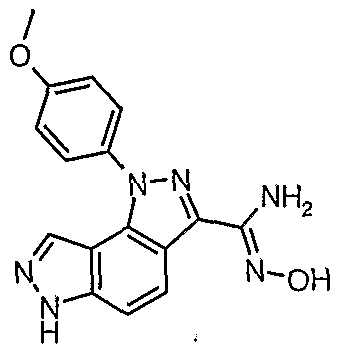
AK Designated states

Kind code of ref document: A2

Designated state(s): AE AG AL AM AT AU AZ BA BB BG BR BY BZ CA CH CN CO CR CU CZ DE DK DM DZ EC EE ES FI GB GD GE GH GM HR HU ID IL IN IS JP KE KG KP KR KZ LC LK LR LS LT LU LV MA MD MG MK MN MW MX MZ NO NZ OM PH PL PT RO RU SC SD SE SG SK SL TJ TM TN TR TT TZ UA UG US UZ VC VN YU ZA ZM ZW

AL Designated countries for regional patents

Kind code of ref document: A2

Designated state(s): GH GM KE LS MW MZ SD SL SZ TZ UG ZM ZW AM AZ BY KG KZ MD RU TJ TM AT BE BG CH CY CZ DE DK EE ES FI FR GB GR HU IE IT LU MC NL PT SE SI SK TR BF BJ CF CG CI CM GA GN GQ GW ML MR NE SN TD TG

121 Ep: the epo has been informed by wipo that ep was designated in this application
DFPE Request for preliminary examination filed prior to expiration of 19th month from priority date (pct application filed before 20040101)
WWE Wipo information: entry into national phase

Ref document number: 2003714744

Country of ref document: EP

Ref document number: 2476822

Country of ref document: CA

WWE Wipo information: entry into national phase

Ref document number: 2003569192

Country of ref document: JP

WWE Wipo information: entry into national phase

Ref document number: PA/a/2004/008680

Country of ref document: MX

WWP Wipo information: published in national office

Ref document number: 2003714744

Country of ref document: EP

WWE Wipo information: entry into national phase

Ref document number: 10505200

Country of ref document: US

WWG Wipo information: grant in national office

Ref document number: 2003714744

Country of ref document: EP