WO2003072648A1 - Stabilized polypropylene resin composition - Google Patents
Stabilized polypropylene resin composition Download PDFInfo
- Publication number
- WO2003072648A1 WO2003072648A1 PCT/NL2003/000141 NL0300141W WO03072648A1 WO 2003072648 A1 WO2003072648 A1 WO 2003072648A1 NL 0300141 W NL0300141 W NL 0300141W WO 03072648 A1 WO03072648 A1 WO 03072648A1
- Authority
- WO
- WIPO (PCT)
- Prior art keywords
- polypropylene resin
- resin composition
- pao
- hals
- composition according
- Prior art date
- Legal status (The legal status is an assumption and is not a legal conclusion. Google has not performed a legal analysis and makes no representation as to the accuracy of the status listed.)
- Ceased
Links
Classifications
-
- C—CHEMISTRY; METALLURGY
- C08—ORGANIC MACROMOLECULAR COMPOUNDS; THEIR PREPARATION OR CHEMICAL WORKING-UP; COMPOSITIONS BASED THEREON
- C08K—Use of inorganic or non-macromolecular organic substances as compounding ingredients
- C08K5/00—Use of organic ingredients
- C08K5/04—Oxygen-containing compounds
- C08K5/13—Phenols; Phenolates
- C08K5/134—Phenols containing ester groups
- C08K5/1345—Carboxylic esters of phenolcarboxylic acids
-
- C—CHEMISTRY; METALLURGY
- C08—ORGANIC MACROMOLECULAR COMPOUNDS; THEIR PREPARATION OR CHEMICAL WORKING-UP; COMPOSITIONS BASED THEREON
- C08K—Use of inorganic or non-macromolecular organic substances as compounding ingredients
- C08K5/00—Use of organic ingredients
- C08K5/0008—Organic ingredients according to more than one of the "one dot" groups of C08K5/01 - C08K5/59
-
- C—CHEMISTRY; METALLURGY
- C08—ORGANIC MACROMOLECULAR COMPOUNDS; THEIR PREPARATION OR CHEMICAL WORKING-UP; COMPOSITIONS BASED THEREON
- C08K—Use of inorganic or non-macromolecular organic substances as compounding ingredients
- C08K5/00—Use of organic ingredients
- C08K5/16—Nitrogen-containing compounds
- C08K5/34—Heterocyclic compounds having nitrogen in the ring
- C08K5/3412—Heterocyclic compounds having nitrogen in the ring having one nitrogen atom in the ring
- C08K5/3432—Six-membered rings
- C08K5/3435—Piperidines
Definitions
- the present invention relates to a polypropylene resin composition which is stabilized against photo-induced oxidation.
- the hindered piperidine compounds used are also called hindered amine-based light stabilizers (HALS); they are well known UV-stabilizers.
- the hindered anti-oxidants are phenolic antioxidants (PAO); they are normally known as long term heat and processing stabilizers. In the rest of the present text the above abbreviations are used.
- a coloured (or pigmented) polypropylene resin composition means a polypropylene composition in which pigments have been used, resulting in that plaques, made from this composition, have an L-value of less than 80 (as determined according to DIN 5033 (CIE LAB, D65, 10°, 45/0).
- Such a composition is different from the composition as described in the publications referenced above, as in the latter the composition is used in the preparation of transparent films.
- the aim of the present invention is to provide a pigmented polypropylene resin composition, stabilized against thermal and photochemical oxidation.
- a polypropylene resin composition comprising a hindered amine-based light stabilizer (HALS), a phenolic antioxidant (PAO) and a pigment, in which: a) both the HALS and the PAO are low-molecular weight components, the molecular weight of the HALS being equal to or below 1250, the molecular weight of the PAO being equal to or below 750; b) the HALS and the PAO each are present in an amount between 0.025 and 1.0 wt.%; c) the weight ratio of HALS to PAO is less than 5; d) the L-value of plaques, prepared from the composition, and determined according to DIN 5033 (CIE LAB, D65, 10°, 45/0), is less than 80.
- HALS hindered amine-based light stabilizer
- PAO phenolic antioxidant
- the composition of the invention has a remarkable photo-stability. This is especially in the case that the composition is used to form shaped articles having a wall thickness of at least 250 ⁇ m.
- HALS and PAO compounds to be used in the present invention are, as such, known in the art. They both have to be of a low molecular weight, which is contrary to the trend of recent years in which HALS and PAO compounds are developed based on ever larger molecules, in order to increase the lifetime of articles made of such polymer compositions.
- the hindered amine-based light stabilizers to be used in the polypropylene resin composition of the present invention, have a molecular weight of at most 1250 and are piperidine or piperazinone based.
- Non-exhaustive examples of such compounds are (with commercial examples thereof):
- Propanedioic acid [(4 ⁇ methoxyphenyl)methylene]-,bis(1 ,2,2,6,6-pentamethyl-4- piperidinyl) ester (Sanduvor® PR 31); Formamide, N,N'-1 ,6-hexanediyIbis[N-(2,2,6,6-tetramethyl-4-piperidinyl
- the phenolic antioxidants to be used in the polypropylene resin composition of the present invention, have a molecular weight of at most 750. They can either be monophenolic, bisphenolic or even polyphenolic. Non-exhaustive examples of such compounds are (with commercial examples thereof):
- Benzenepropanoic acid 3,5-bis(1 ,1-dimethylethyl)-4-hydroxy-C 13-15 branched and lineair alkyl esters (Anox® BF); Benzenepropanoic acid, 3,5-bis(1,1-dimethylethyl)-4-hydroxy;
- PAO compound are present in an amount between 0.025 and 1.0 wt.%; the weight ratio between the HALS and the PAO compound being less than 5, preferably less than
- HALS compound a preference is given to a HALS compound, having as chemical name:
- PAO compound As PAO compound, a preference is given to a PAO compound, having as chemical name:
- the polypropylene resin composition of the present invention also comprises one or more pigments, in order to obtain a cqloured product.
- the L-value of such a product is less than 80. More preferred, this L-value is less than 50 even; more preferred, the L- value is equal to or less than 30.
- the man skilled in the art is aware of the potential selections he can make for the pigments to be used in his specific composition, based on the above restriction regarding the L-value.
- the pigment is present in an amount equal to or above 0.05 wt.%; generally not more than 5 wt.% is necessary to obtain the desired colouring effect.
- the polypropylene polymer in the resin composition comprises a polymer based on propylene as the single or predominantly present monomer, or in other words: the polymer is either a homopolymer, a copolymer or a random polymer.
- the polypropylene resin in the composition of the present invention is a propylene/ ⁇ -olefin copolymer.
- ⁇ -olefin monomer having 2-12C-atoms is suited; the preference is for the ⁇ -olefin monomer to be selected from the group comprising ethylene, butylene and octene.
- the polyproylene homopolymer part in such a copolymer is preferably present in an amount equal to or less than 90 wt%, more preferred equal to or less than 85 wt%; most preferred equal to or less than 80 wt%.
- the ⁇ -olefin content of such a co- or random polymer is generally above 4 wt%, more preferred above 8 wt%, most preferred above 12 wt%.
- the polypropylene polymer can be a polymer made by any known polymerization technique as well as with any known polymerization catalyst system.
- any known polymerization catalyst system reference can be given to slurry, solution or gasphase polymerizations;
- the catalyst system reference can be given to Ziegler-Natta, metallocene, or (other) single-site catalyst systems. All are, in themselves, known in the art.
- the polypropylene polymer has a melt flow index (MFI), measured according to ISO 1133 at 230 °C and 2.16 kg, of between 0.1 and 100, more preferred between 1 and 50.
- MFI melt flow index
- the polypropylene resin composition of the present invention may also comprise known additional polymeric or inorganic additives and fillers.
- additional polymeric or inorganic additives and fillers are: of fibers (natural or polymeric); fillers (like clay or talcum), lubricants, UV- absorbers, flame retarding agents, additional rubber(s), etc. The man skilled in the art is aware of (mixtures of) these ingredients.
- the polypropylene resin composition according to the invention may be transformed into shaped (semi-)finished articles using a variety of processing techniques.
- suitable processing techniques include injection moulding, injection compression moulding, in-mould decorating via injection moulding, extrusion, and extrusion compression moulding.
- Injection moulding is widely used to produce articles such as for example automotive exterior parts like bumpers, automotive interior parts like instrument panels, or automotive parts under the bonnet.
- Extrusion is widely used to produce articles such as rods, sheets and pipes.
- Processes for preparing the polypropylene resin composition of the present invention can be any process known in the art to compound liquid or solid ingredients into a polymer. Examples hereof are: extruder mixing, mixing in a Banbury type equipment, solution blending etc.
- the preparation of) shaped articles having a wall thickness of at least 250 ⁇ m benefits from a polypropylene resin composition of the present invention.
- the wall thickness of such shaped articles is at least 500 ⁇ m, more preferred at least 800 ⁇ m and most preferred at least 1200 ⁇ m.
- the upper limit of the wall thickness is determined by what is practically possible with using known techniques to produce the articles.
- a high impact propylene/ethylene copolymer with 14 wt.% ethylene and a rubber content of 24 wt% was compounded and granulated on a single screw extruder at 240°C with 0.1 wt.% calcium stearate, 0.1 wt.% Ultranox® 626, 0.45 wt.%
- the ageing was measured by monitoring the degree of discolouration of the plaques by applying the grey scale assessment in accordance with DIN 54001. The ageing was stopped at a grey scale of 4. Table 1
- a high impact propylene/ethylene copolymer with 14 wt.% ethylene and a rubber content of 24 wt% was compounded and granulated on a single screw extruder at 240°C with 0.1 wt.% calcium-stearate, 0.04 wt.% Irganox® 1010, 0.4 wt.% Goodrite® 3034 and a phenolic antioxidant (see Table 2).
- the ageing was measured by monitoring the degree of discolouration of the plaques by applying the grey scale assessment in accordance with DIN 54001. The ageing was stopped at a grey scale of 3.
- Examples lll-IX, comparative experiment D A high impact propylene-ethylene copolymer with 14 wt.% ethylene and a rubber content of 24 wt% was compounded and granulated on a ZSK-30 twin- screw extruder at 240°C with 0.05 wt.% calcium stearate, 0.15 wt.% Irganox® B215, Tinuvin® 770 and Irganox® 1076 (for amounts see Table 3).
- the ageing was measured by monitoring the degree of discolouration of the plaques by applying the grey scale assessment in accordance with DIN 54001. The ageing was stopped at a grey scale of 4.
- a high impact propylene/ethylene copolymer with 14 wt.% ethylene and a rubber content of 24 wt% was compounded and granulated on a single-screw extruder at 240°C with 0.1 wt.% calcium stearate, 0.15 wt.% Irganox® B215, a HALS (Tinuvin® 770 or Chimassorb® 944) and Irganox® 1076 (for type and amounts see Table 4).
- the ageing was measured by monitoring the degree of discolouration of the plaques by applying the grey scale assessment in accordance with DIN 54001. The ageing was stopped at a grey scale of 4.
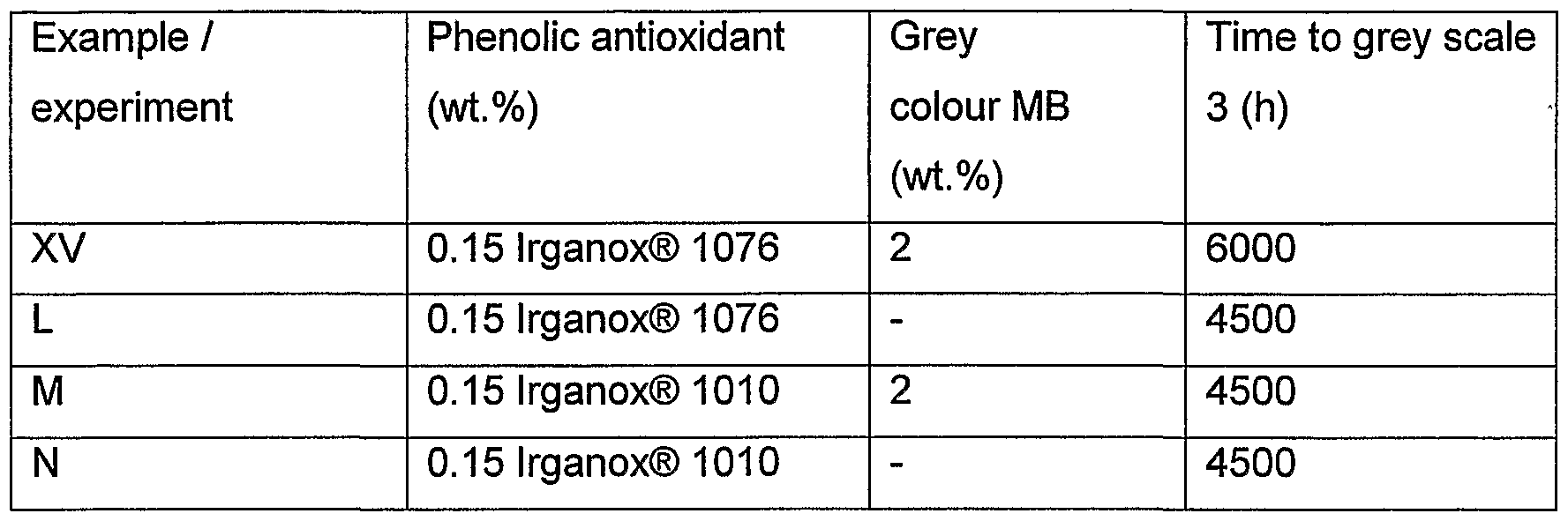
- Examples XIII-XIV. comparative experiments J-K A high impact propylene/ethylene copolymer with 17 wt.% ethylene and a rubber content of 32 wt% was compounded and granulated on a single-screw extruder at 240°C with 0.05 wt.% calcium stearate, 0.15 wt.% Irganox® B225, Tinuvin® 770 and Irganox® 1076 (for amounts see Table 5). The resulting granulates were mixed with 2 wt.% of two different dark grey colour masterbatches (for colour code and coordinates of the plaques: see Table 5) and injection molded at 260°C to textured plaques measuring 3.2 X 65 X 65 mm.
- the ageing was measured by monitoring the degree of discolouration of the plaques by applying the grey scale assessment in accordance with DIN 54001. The ageing was stopped at a grey scale of 4.
- the ageing was measured by monitoring the degree of discolouration of the plaques by applying the grey scale assessment in accordance with DIN 54001. The ageing was stopped at a grey scale of 3.
Landscapes
- Chemical & Material Sciences (AREA)
- Health & Medical Sciences (AREA)
- Chemical Kinetics & Catalysis (AREA)
- Medicinal Chemistry (AREA)
- Polymers & Plastics (AREA)
- Organic Chemistry (AREA)
- Compositions Of Macromolecular Compounds (AREA)
- Laminated Bodies (AREA)
Abstract
Description


Claims
Priority Applications (8)
| Application Number | Priority Date | Filing Date | Title |
|---|---|---|---|
| DE60301863T DE60301863T2 (en) | 2002-02-27 | 2003-02-21 | Stabilized Polypropyl Resin Composition |
| AT03743082T ATE306516T1 (en) | 2002-02-27 | 2003-02-21 | STABILIZED POLYPROPYLENE RESIN COMPOSITION |
| MXPA04008299A MXPA04008299A (en) | 2002-02-27 | 2003-02-21 | Stabilized polypropylene resin composition. |
| EP03743082A EP1478691B1 (en) | 2002-02-27 | 2003-02-21 | Stabilized polypropylene resin composition |
| BRPI0307955-4B1A BR0307955B1 (en) | 2002-02-27 | 2003-02-21 | Polypropylene resin composition and article made at least partially from said composition |
| ES03743082T ES2251695T3 (en) | 2002-02-27 | 2003-02-21 | COMPOSITION OF STABILIZED POLYPROPYLENE RESIN. |
| US10/505,856 US20050085574A1 (en) | 2002-02-27 | 2003-02-21 | Stabilized polypropylene resin composition |
| AU2003210071A AU2003210071A1 (en) | 2002-02-27 | 2003-02-21 | Stabilized polypropylene resin composition |
Applications Claiming Priority (2)
| Application Number | Priority Date | Filing Date | Title |
|---|---|---|---|
| EP02075778.7 | 2002-02-27 | ||
| EP02075778A EP1340789A1 (en) | 2002-02-27 | 2002-02-27 | Stabilized polypropylene resin composition |
Publications (1)
| Publication Number | Publication Date |
|---|---|
| WO2003072648A1 true WO2003072648A1 (en) | 2003-09-04 |
Family
ID=27675730
Family Applications (1)
| Application Number | Title | Priority Date | Filing Date |
|---|---|---|---|
| PCT/NL2003/000141 Ceased WO2003072648A1 (en) | 2002-02-27 | 2003-02-21 | Stabilized polypropylene resin composition |
Country Status (11)
| Country | Link |
|---|---|
| US (1) | US20050085574A1 (en) |
| EP (2) | EP1340789A1 (en) |
| CN (1) | CN1311018C (en) |
| AT (1) | ATE306516T1 (en) |
| AU (1) | AU2003210071A1 (en) |
| BR (1) | BR0307955B1 (en) |
| DE (1) | DE60301863T2 (en) |
| ES (1) | ES2251695T3 (en) |
| MX (1) | MXPA04008299A (en) |
| PL (1) | PL370437A1 (en) |
| WO (1) | WO2003072648A1 (en) |
Cited By (2)
| Publication number | Priority date | Publication date | Assignee | Title |
|---|---|---|---|---|
| WO2010149549A1 (en) * | 2009-06-22 | 2010-12-29 | Borealis Ag | Automotive interior article with reduced smell |
| WO2016101139A1 (en) * | 2014-12-23 | 2016-06-30 | Borouge Compounding Shanghai Co., Ltd. | Fiber reinforced polypropylene composite |
Families Citing this family (4)
| Publication number | Priority date | Publication date | Assignee | Title |
|---|---|---|---|---|
| US7947768B2 (en) * | 2009-03-02 | 2011-05-24 | Saudi Arabian Oil Company | Ultraviolet (UV) radiation stability and service life of woven films of polypropylene (PP) tapes for the production of jumbo bags |
| ES2637434T5 (en) | 2015-07-08 | 2020-07-06 | Borealis Ag | Tube made of a heterophasic polypropylene composition |
| CN105037944B (en) * | 2015-08-21 | 2017-06-20 | 天津市顺康科技发展有限公司 | The preparation method and application of soft base curing process construction material |
| CN120310135A (en) * | 2017-06-26 | 2025-07-15 | Sabic环球技术有限责任公司 | UV and heat stable flame retardant glass filled polymer compositions and reinforced articles made therefrom |
Citations (4)
| Publication number | Priority date | Publication date | Assignee | Title |
|---|---|---|---|---|
| US4975489A (en) * | 1987-08-12 | 1990-12-04 | Atochem North America, Inc. | Process for preparing polymer bound hindered amine light stabilizers |
| EP0411628A2 (en) * | 1989-08-02 | 1991-02-06 | Montell North America Inc. | Process for the stabilization of polyolefin and products obtained thereby |
| US5124456A (en) * | 1989-10-02 | 1992-06-23 | Rhone-Poulenc Chimie | Hindered amine-substituted dihydropyridines and heat/light stabilization of polymer substrates therewith |
| EP0501239A1 (en) * | 1991-02-22 | 1992-09-02 | The B.F. Goodrich Company | Piperidyl- and benzoate-based stabilizer system for polyolefin pigmented fibers and thin films |
Family Cites Families (4)
| Publication number | Priority date | Publication date | Assignee | Title |
|---|---|---|---|---|
| US4377651A (en) * | 1979-10-05 | 1983-03-22 | Phillips Petroleum Company | Polyolefin stabilization |
| JPS58113236A (en) * | 1981-12-28 | 1983-07-06 | Tounen Sekiyu Kagaku Kk | Polyolefin composition |
| JPS62201954A (en) * | 1986-03-03 | 1987-09-05 | Mitsubishi Gas Chem Co Inc | Reinforced polyolefin resin composition |
| US5049600A (en) * | 1990-01-23 | 1991-09-17 | The B. F. Goodrich Company | Multi-component stabilizer system for polyolefins pigmented with phthalocyanine pigments |
-
2002
- 2002-02-27 EP EP02075778A patent/EP1340789A1/en not_active Withdrawn
-
2003
- 2003-02-21 WO PCT/NL2003/000141 patent/WO2003072648A1/en not_active Ceased
- 2003-02-21 BR BRPI0307955-4B1A patent/BR0307955B1/en not_active IP Right Cessation
- 2003-02-21 ES ES03743082T patent/ES2251695T3/en not_active Expired - Lifetime
- 2003-02-21 US US10/505,856 patent/US20050085574A1/en not_active Abandoned
- 2003-02-21 AT AT03743082T patent/ATE306516T1/en not_active IP Right Cessation
- 2003-02-21 DE DE60301863T patent/DE60301863T2/en not_active Revoked
- 2003-02-21 PL PL03370437A patent/PL370437A1/en not_active Application Discontinuation
- 2003-02-21 AU AU2003210071A patent/AU2003210071A1/en not_active Abandoned
- 2003-02-21 EP EP03743082A patent/EP1478691B1/en not_active Revoked
- 2003-02-21 MX MXPA04008299A patent/MXPA04008299A/en active IP Right Grant
- 2003-02-21 CN CNB03804689XA patent/CN1311018C/en not_active Expired - Fee Related
Patent Citations (4)
| Publication number | Priority date | Publication date | Assignee | Title |
|---|---|---|---|---|
| US4975489A (en) * | 1987-08-12 | 1990-12-04 | Atochem North America, Inc. | Process for preparing polymer bound hindered amine light stabilizers |
| EP0411628A2 (en) * | 1989-08-02 | 1991-02-06 | Montell North America Inc. | Process for the stabilization of polyolefin and products obtained thereby |
| US5124456A (en) * | 1989-10-02 | 1992-06-23 | Rhone-Poulenc Chimie | Hindered amine-substituted dihydropyridines and heat/light stabilization of polymer substrates therewith |
| EP0501239A1 (en) * | 1991-02-22 | 1992-09-02 | The B.F. Goodrich Company | Piperidyl- and benzoate-based stabilizer system for polyolefin pigmented fibers and thin films |
Cited By (3)
| Publication number | Priority date | Publication date | Assignee | Title |
|---|---|---|---|---|
| WO2010149549A1 (en) * | 2009-06-22 | 2010-12-29 | Borealis Ag | Automotive interior article with reduced smell |
| RU2506288C2 (en) * | 2009-06-22 | 2014-02-10 | Бореалис Аг | Article for car interior decoration having reduced odour |
| WO2016101139A1 (en) * | 2014-12-23 | 2016-06-30 | Borouge Compounding Shanghai Co., Ltd. | Fiber reinforced polypropylene composite |
Also Published As
| Publication number | Publication date |
|---|---|
| MXPA04008299A (en) | 2005-06-08 |
| EP1478691B1 (en) | 2005-10-12 |
| US20050085574A1 (en) | 2005-04-21 |
| CN1639244A (en) | 2005-07-13 |
| ES2251695T3 (en) | 2006-05-01 |
| EP1340789A1 (en) | 2003-09-03 |
| BR0307955B1 (en) | 2013-10-22 |
| DE60301863T2 (en) | 2006-06-29 |
| EP1478691A1 (en) | 2004-11-24 |
| CN1311018C (en) | 2007-04-18 |
| ATE306516T1 (en) | 2005-10-15 |
| BR0307955A (en) | 2004-12-21 |
| AU2003210071A1 (en) | 2003-09-09 |
| PL370437A1 (en) | 2005-05-30 |
| DE60301863D1 (en) | 2006-02-23 |
Similar Documents
| Publication | Publication Date | Title |
|---|---|---|
| TWI589630B (en) | Resin composition | |
| US10214627B2 (en) | Stabilised resin composition | |
| US7947768B2 (en) | Ultraviolet (UV) radiation stability and service life of woven films of polypropylene (PP) tapes for the production of jumbo bags | |
| AU2008336876B2 (en) | Olefin elastic resin composition | |
| JP7033843B2 (en) | Polyolefin-based resin composition and molded product using this | |
| CN113330058B (en) | Nucleating agent composition, olefin resin composition, molded article thereof, and method for producing olefin resin composition | |
| US4985479A (en) | Stabilized polyolefin composition | |
| EP1478691B1 (en) | Stabilized polypropylene resin composition | |
| JP2002212347A (en) | Polyolefin resin composition and molded article thereof | |
| EP0257321A2 (en) | Improving weatherability and adherence of polypropylene | |
| JP4801830B2 (en) | Polyolefin resin composition | |
| DE10123732A1 (en) | Stabilized metallocene polyolefins | |
| JP2009120723A (en) | Resin composition and resin molded product | |
| KR102103946B1 (en) | Use of an extrusion processing aid for the production of coloured polyethylene pipes | |
| JP6952445B2 (en) | Polyolefin-based resin composition and automobile interior / exterior material using it | |
| DE10110665A1 (en) | Polypropylene resin composition useful for making molded products and films contains defined amounts of alkaline earth metal hydroxide and phenolic antioxidant | |
| JP2018193501A (en) | Polyolefin material | |
| KR20240021210A (en) | Nucleating agent composition, resin composition, molded article thereof, and method for producing the resin composition | |
| JP2003292788A (en) | Resin stabilizer composition and use thereof | |
| JPS58108238A (en) | Stabilized synthetic resin composition | |
| JP2019073646A (en) | Composition, olefinic resin composition and molding prepared therefrom | |
| AU2013204157A1 (en) | Olefin elastic resin composition |
Legal Events
| Date | Code | Title | Description |
|---|---|---|---|
| AK | Designated states |
Kind code of ref document: A1 Designated state(s): AE AG AL AM AT AU AZ BA BB BG BR BY BZ CA CH CN CO CR CU CZ DE DK DM DZ EC EE ES FI GB GD GE GH GM HR HU ID IL IN IS JP KE KG KP KR KZ LC LK LR LS LT LU LV MA MD MG MK MN MW MX MZ NO NZ OM PH PL PT RO RU SC SD SE SG SK SL TJ TM TN TR TT TZ UA UG US UZ VC VN YU ZA ZM ZW |
|
| AL | Designated countries for regional patents |
Kind code of ref document: A1 Designated state(s): GH GM KE LS MW MZ SD SL SZ TZ UG ZM ZW AM AZ BY KG KZ MD RU TJ TM AT BE BG CH CY CZ DE DK EE ES FI FR GB GR HU IE IT LU MC NL PT SE SI SK TR BF BJ CF CG CI CM GA GN GQ GW ML MR NE SN TD TG |
|
| 121 | Ep: the epo has been informed by wipo that ep was designated in this application | ||
| DFPE | Request for preliminary examination filed prior to expiration of 19th month from priority date (pct application filed before 20040101) | ||
| WWE | Wipo information: entry into national phase |
Ref document number: 2003743082 Country of ref document: EP |
|
| WWE | Wipo information: entry into national phase |
Ref document number: PA/a/2004/008299 Country of ref document: MX Ref document number: 2003804689X Country of ref document: CN |
|
| WWE | Wipo information: entry into national phase |
Ref document number: 10505856 Country of ref document: US |
|
| WWP | Wipo information: published in national office |
Ref document number: 2003743082 Country of ref document: EP |
|
| WWG | Wipo information: grant in national office |
Ref document number: 2003743082 Country of ref document: EP |
|
| NENP | Non-entry into the national phase |
Ref country code: JP |
|
| WWW | Wipo information: withdrawn in national office |
Ref document number: JP |