WO2003077656A1 - 4-aminopyrimidines and their use for the antimicrobial treatment of surfaces - Google Patents
4-aminopyrimidines and their use for the antimicrobial treatment of surfaces Download PDFInfo
- Publication number
- WO2003077656A1 WO2003077656A1 PCT/EP2003/002438 EP0302438W WO03077656A1 WO 2003077656 A1 WO2003077656 A1 WO 2003077656A1 EP 0302438 W EP0302438 W EP 0302438W WO 03077656 A1 WO03077656 A1 WO 03077656A1
- Authority
- WO
- WIPO (PCT)
- Prior art keywords
- alkyl
- hydrogen
- formula
- use according
- unsubstituted
- Prior art date
- Legal status (The legal status is an assumption and is not a legal conclusion. Google has not performed a legal analysis and makes no representation as to the accuracy of the status listed.)
- Ceased
Links
- 0 C*Nc1nc(*)nc(*)c1* Chemical compound C*Nc1nc(*)nc(*)c1* 0.000 description 2
Classifications
-
- C—CHEMISTRY; METALLURGY
- C07—ORGANIC CHEMISTRY
- C07D—HETEROCYCLIC COMPOUNDS
- C07D239/00—Heterocyclic compounds containing 1,3-diazine or hydrogenated 1,3-diazine rings
- C07D239/02—Heterocyclic compounds containing 1,3-diazine or hydrogenated 1,3-diazine rings not condensed with other rings
- C07D239/24—Heterocyclic compounds containing 1,3-diazine or hydrogenated 1,3-diazine rings not condensed with other rings having three or more double bonds between ring members or between ring members and non-ring members
- C07D239/28—Heterocyclic compounds containing 1,3-diazine or hydrogenated 1,3-diazine rings not condensed with other rings having three or more double bonds between ring members or between ring members and non-ring members with hetero atoms or with carbon atoms having three bonds to hetero atoms with at the most one bond to halogen, directly attached to ring carbon atoms
- C07D239/32—One oxygen, sulfur or nitrogen atom
- C07D239/42—One nitrogen atom
-
- A—HUMAN NECESSITIES
- A01—AGRICULTURE; FORESTRY; ANIMAL HUSBANDRY; HUNTING; TRAPPING; FISHING
- A01N—PRESERVATION OF BODIES OF HUMANS OR ANIMALS OR PLANTS OR PARTS THEREOF; BIOCIDES, e.g. AS DISINFECTANTS, AS PESTICIDES OR AS HERBICIDES; PEST REPELLANTS OR ATTRACTANTS; PLANT GROWTH REGULATORS
- A01N43/00—Biocides, pest repellants or attractants, or plant growth regulators containing heterocyclic compounds
- A01N43/48—Biocides, pest repellants or attractants, or plant growth regulators containing heterocyclic compounds having rings with two nitrogen atoms as the only ring hetero atoms
- A01N43/54—1,3-Diazines; Hydrogenated 1,3-diazines
-
- A—HUMAN NECESSITIES
- A01—AGRICULTURE; FORESTRY; ANIMAL HUSBANDRY; HUNTING; TRAPPING; FISHING
- A01N—PRESERVATION OF BODIES OF HUMANS OR ANIMALS OR PLANTS OR PARTS THEREOF; BIOCIDES, e.g. AS DISINFECTANTS, AS PESTICIDES OR AS HERBICIDES; PEST REPELLANTS OR ATTRACTANTS; PLANT GROWTH REGULATORS
- A01N43/00—Biocides, pest repellants or attractants, or plant growth regulators containing heterocyclic compounds
- A01N43/72—Biocides, pest repellants or attractants, or plant growth regulators containing heterocyclic compounds having rings with nitrogen atoms and oxygen or sulfur atoms as ring hetero atoms
- A01N43/74—Biocides, pest repellants or attractants, or plant growth regulators containing heterocyclic compounds having rings with nitrogen atoms and oxygen or sulfur atoms as ring hetero atoms five-membered rings with one nitrogen atom and either one oxygen atom or one sulfur atom in positions 1,3
- A01N43/78—1,3-Thiazoles; Hydrogenated 1,3-thiazoles
-
- A—HUMAN NECESSITIES
- A61—MEDICAL OR VETERINARY SCIENCE; HYGIENE
- A61P—SPECIFIC THERAPEUTIC ACTIVITY OF CHEMICAL COMPOUNDS OR MEDICINAL PREPARATIONS
- A61P31/00—Antiinfectives, i.e. antibiotics, antiseptics, chemotherapeutics
- A61P31/02—Local antiseptics
-
- A—HUMAN NECESSITIES
- A61—MEDICAL OR VETERINARY SCIENCE; HYGIENE
- A61P—SPECIFIC THERAPEUTIC ACTIVITY OF CHEMICAL COMPOUNDS OR MEDICINAL PREPARATIONS
- A61P31/00—Antiinfectives, i.e. antibiotics, antiseptics, chemotherapeutics
- A61P31/04—Antibacterial agents
-
- C—CHEMISTRY; METALLURGY
- C07—ORGANIC CHEMISTRY
- C07D—HETEROCYCLIC COMPOUNDS
- C07D401/00—Heterocyclic compounds containing two or more hetero rings, having nitrogen atoms as the only ring hetero atoms, at least one ring being a six-membered ring with only one nitrogen atom
- C07D401/02—Heterocyclic compounds containing two or more hetero rings, having nitrogen atoms as the only ring hetero atoms, at least one ring being a six-membered ring with only one nitrogen atom containing two hetero rings
- C07D401/04—Heterocyclic compounds containing two or more hetero rings, having nitrogen atoms as the only ring hetero atoms, at least one ring being a six-membered ring with only one nitrogen atom containing two hetero rings directly linked by a ring-member-to-ring-member bond
-
- C—CHEMISTRY; METALLURGY
- C07—ORGANIC CHEMISTRY
- C07D—HETEROCYCLIC COMPOUNDS
- C07D401/00—Heterocyclic compounds containing two or more hetero rings, having nitrogen atoms as the only ring hetero atoms, at least one ring being a six-membered ring with only one nitrogen atom
- C07D401/14—Heterocyclic compounds containing two or more hetero rings, having nitrogen atoms as the only ring hetero atoms, at least one ring being a six-membered ring with only one nitrogen atom containing three or more hetero rings
-
- C—CHEMISTRY; METALLURGY
- C07—ORGANIC CHEMISTRY
- C07D—HETEROCYCLIC COMPOUNDS
- C07D403/00—Heterocyclic compounds containing two or more hetero rings, having nitrogen atoms as the only ring hetero atoms, not provided for by group C07D401/00
- C07D403/02—Heterocyclic compounds containing two or more hetero rings, having nitrogen atoms as the only ring hetero atoms, not provided for by group C07D401/00 containing two hetero rings
- C07D403/04—Heterocyclic compounds containing two or more hetero rings, having nitrogen atoms as the only ring hetero atoms, not provided for by group C07D401/00 containing two hetero rings directly linked by a ring-member-to-ring-member bond
-
- C—CHEMISTRY; METALLURGY
- C07—ORGANIC CHEMISTRY
- C07D—HETEROCYCLIC COMPOUNDS
- C07D405/00—Heterocyclic compounds containing both one or more hetero rings having oxygen atoms as the only ring hetero atoms, and one or more rings having nitrogen as the only ring hetero atom
- C07D405/02—Heterocyclic compounds containing both one or more hetero rings having oxygen atoms as the only ring hetero atoms, and one or more rings having nitrogen as the only ring hetero atom containing two hetero rings
- C07D405/12—Heterocyclic compounds containing both one or more hetero rings having oxygen atoms as the only ring hetero atoms, and one or more rings having nitrogen as the only ring hetero atom containing two hetero rings linked by a chain containing hetero atoms as chain links
-
- C—CHEMISTRY; METALLURGY
- C07—ORGANIC CHEMISTRY
- C07D—HETEROCYCLIC COMPOUNDS
- C07D405/00—Heterocyclic compounds containing both one or more hetero rings having oxygen atoms as the only ring hetero atoms, and one or more rings having nitrogen as the only ring hetero atom
- C07D405/14—Heterocyclic compounds containing both one or more hetero rings having oxygen atoms as the only ring hetero atoms, and one or more rings having nitrogen as the only ring hetero atom containing three or more hetero rings
-
- C—CHEMISTRY; METALLURGY
- C07—ORGANIC CHEMISTRY
- C07D—HETEROCYCLIC COMPOUNDS
- C07D409/00—Heterocyclic compounds containing two or more hetero rings, at least one ring having sulfur atoms as the only ring hetero atoms
- C07D409/02—Heterocyclic compounds containing two or more hetero rings, at least one ring having sulfur atoms as the only ring hetero atoms containing two hetero rings
- C07D409/04—Heterocyclic compounds containing two or more hetero rings, at least one ring having sulfur atoms as the only ring hetero atoms containing two hetero rings directly linked by a ring-member-to-ring-member bond
-
- C—CHEMISTRY; METALLURGY
- C07—ORGANIC CHEMISTRY
- C07D—HETEROCYCLIC COMPOUNDS
- C07D417/00—Heterocyclic compounds containing two or more hetero rings, at least one ring having nitrogen and sulfur atoms as the only ring hetero atoms, not provided for by group C07D415/00
- C07D417/02—Heterocyclic compounds containing two or more hetero rings, at least one ring having nitrogen and sulfur atoms as the only ring hetero atoms, not provided for by group C07D415/00 containing two hetero rings
- C07D417/04—Heterocyclic compounds containing two or more hetero rings, at least one ring having nitrogen and sulfur atoms as the only ring hetero atoms, not provided for by group C07D415/00 containing two hetero rings directly linked by a ring-member-to-ring-member bond
Definitions
- the present invention relates to substituted 4-aminopyrimidines, to the preparation of such compounds, and to the use of such compounds in the antimicrobial treatment of surfaces, as antimicrobial active substances against gram-positive and gram-negative bacteria, yeasts and fungi and also in the preservation of cosmetics, household products, textiles and plastics and for use in disinfectants.
- the present invention relates to the use of 4-aminopyrimidines of formula
- R, and R 2 are each independently of the other hydrogen; C.-C 5 alkyl which is unsubstituted or substituted by one or more halogen atoms; biphenyl or C 6 -C 10 aryl which is unsubstituted or substituted by halogen, C.-C 5 alkyl, C.-C 5 alkoxy or by amino; a 5- to 7-membered heteroaryl radical; or cyclo-C 3 -C 7 alkyl;
- R- is hydrogen; phenyl or C.-C 5 alkyl which is unsubstituted or substituted by one or more halogen atoms;
- R 4 is hydrogen; C.-C. 0 alkyl; phenyl; or a 5- to 7-membered heteroaryl radical;
- R 5 is C.-C-.alkyl which is unsubstituted or substituted by one or more halogen atoms or by a heterocyclic radical or interrupted by one or more -O- or — N— groups or by a
- R' bivalent heterocyclic radical NR"R'"-C.-C 20 alkyl which is unsubstituted or substituted by a heterocyclic radical or interrupted by one or more -O- or — N— groups or by a
- R' is hydrogen; or C.-C 3 alkyl
- R" and R"' are each independently of the other hydrogen; C.-C.alkyl; or hydroxy-C.-C.alkyl; X is ⁇ O; ⁇ CH-R 1 '" ; or ⁇ N-R"" ;
- R" is hydrogen; C.- alkyl; or heteroaryl-C.-C 4 aIkyl; and n. and n 2 are each independently of the other from 1 to 8; in the antimicrobial treatment of surfaces.
- Ci-C 2 oAlkyl radicals are straight-chain or branched alkyl radicals, for example methyl, ethyl, n-propyl, isopropyl, n-butyl, sec-butyl, tert-butyl, amyl, isoamyl or tert-amyl, heptyl, octyl, isooctyl, nonyl, decyl, undecyl, dodecyl, tetradecyl, pentadecyl, hexadecyl, heptadecyl, octadecyl or eicosyl.
- Cycloalkyl denotes, for example, cyclopropyl, cyclobutyl, cyclopentyl, cyclohexyl, cycloheptyl, cyclooctyl, cyclononyl or cyclodecyl.
- Those radicals may be substituted, for example by one or more identical or different C.-C 4 alkyl radicals, especially by methyl, and/or by hydroxy.
- cycloalkyl radicals are substituted by one or more substituents, they are substituted preferably by one, two or four, especially by one or two, identical or different substituents.
- C C 5 Alkoxy radicals are straight-chain or branched radicals such as, for example, methoxy, ethoxy, propoxy, butoxy or pentyloxy.
- C 6 -C 10 Aryl and heteroaryl radicals may be unsubstituted or may carry one or more, for example one, two, three or four, identical or different substituents, which may be located in any positions.
- substituents are, for example, C.-C 4 alkyl, halogen, hydroxy, C.-C 4 alkoxy, trifluoromethyl, cyano, hydroxycarbonyl, C.-C 4 alkoxycarbonyl, aminocarbonyl, amino, C.-C 4 alkylamino, di-C.-C 4 aIkylamino and C.- alkylcarbonylamino.
- Heteroaryl radicals are derived from heterocydes containing one, two, three or four identical or different ring hetero atoms, especially from heterocydes containing one, two or three, more especially one or two, identical or different hetero atoms.
- the heterocydes may be mono- or poly-cyclic, for example mono-, bi- or tri-cydic. They are preferably mono- or bi- cyclic, especially monocyclic.
- the rings preferably contain 5, 6 or 7 ring members.
- Examples of monocyclic and bicyclic heterocyclic systems from which radicals occurring in the compounds of formula (1) can be derived are, for example, pyrrole, furan, thiophene, imidazole, pyrazole, 1 ,2,3-triazole, 1 ,2,4-triazole, pyridine, pyridazine, pyrimidine, pyrazine, pyran, thiopyran, 1 ,4-dioxane, 1 ,2-oxazine, 1,3-oxazine, 1 ,4-oxazine, indole, benzo- thiophene, benzofuran, pyrrolidine, piperidine, piperazine, morpholine and thiomorpholine.
- Unsaturated heterocydes may contain, for example, one, two or three unsaturated double bonds in the ring system.
- 5-membered rings and 6-membered rings in monocyclic and polycyclic heterocydes may also be, especially, aromatic.
- Halogen is fluorine, chlorine, bromine or iodine, preferably fluorine or chlorine.
- R 5 is R"R"'N-C,-C 20 alkyl which is uninterrupted or interrupted by one or more -O- or
- R' is hydrogen; or C.-C.alkyl
- R" and R"' are each independently of the other hydrogen; or methyl
- R., R 2 , R 3 and R 4 are as defined for formula (1 ).
- R 5 is R"R'"N-C.-C 20 alkyl which is uninterrupted or interrupted by — N N — .
- R 5 is R"R"'N-C 5 -C 20 alkyl which is uninterrupted or interrupted by one or more -O- or — N — groups;
- R' R' is hydrogen; or C.-C.alkyl; and
- R" and R'" are each independently of the other hydrogen; or methyl.
- preference is given to those wherein
- R. is R"R'"N-C 5 -C 20 alkyl
- R" and R" 1 are each independently of the other hydrogen; or methyl.
- R 4 is hydrogen; or C.-C.alkyl
- R. is C 3 -C 20 alkyl which is unsubstituted or interrupted by -NH-;
- R 1 and R 3 are as defined for formula (1); especially compounds of formula (1) wherein
- R is hydrogen; C.-C.alkyl; unsubstituted or C.-C 4 alkyl-substituted phenyl or phenyl-
- R 2 is hydrogen; or C.-C.alkyl; especially methyl;
- R 3 is hydrogen; or C.-C.alkyl
- R 4 is hydrogen; or C.-C.alkyl
- R 5 is C 5 -C 20 alkyl; and very especially compounds of formula (1) wherein
- R is hydrogen; C.-C.alkyl, especially isopropyl or methyl; unsubstituted or C.-C 4 alkyl- substituted phenyl; or pyridino;
- R 2 is methyl
- R 3 and R 4 are hydrogen
- R 5 is C 8 -C 1B alkyl.
- R 5 is linear C 8 -C 18 alkyl.
- R" is hydrogen; or pyridyl-C.-C 3 alkyl; and n, and n 2 are each 2.
- R. and R 2 are each independently of the other hydrogen; C.-C 5 alkyl; phenyl which is unsubstituted or substituted by halogen, C.-C.alkyl, C.-C 3 alkoxy or by amino; biphenyl; cyclo-C 3 -C 7 alkyl; 3-pyridyl; 4-pyridyl; 2-thiophenyl; 3-thiophenyl; or thiazolyl; or compounds of formula (1 ) wherein
- R 3 is hydrogen; or phenyl; or compounds of formula (1 ) wherein
- R 4 is hydrogen
- X is -O-; or — N— ; R'
- R' is hydrogen; or C,-C 3 alkyl; n is 1 -3; and m is 1 -3; and
- R., R 2 and R 3 are as defined for formula 1 ,
- the 4-aminopyrimidines used in accordance with the invention are prepared by methods known per se (J. Org. Chem.; 1967, 32, 1591 ).
- auxiliary base such as, for example, sodium carbonate, potassium hydroxide, sodium ethanolate, sodium methanolate, potassium tert-butanolate etc.
- a suitable solvent such as, for example, methanol, ethanol, butanol, tert-butanol, THF, DMF, acetonitrile, toluene, xylene etc., over a period of from 1 to 24 hours at a temperature of from 40 to 120°C.
- pyrimidine compound with a primary or secondary amine R 4 R 5 NH
- a suitable solvent such as, for example, DMF, dioxane, toluene, xylene, ethanol, butanol, and an auxiliary base such as, for example, triethylamine, DIEA, sodium carbonate, potassium hydroxide etc., or using an excess of amine at from 40 to 130°C over a period of from 1 to 24 hours.
- Preparation of the compounds of formula (2) is carried out by reacting an excess of from 2 to 10 equivalents of the diamine compound H 2 N(CH 2 ) n X(CH 2 ) m NH 2 in, for example, DMF, dichloromethane, THF or dioxane with trityl chloride polystyrene resin at a temperature of from 10 to 50°C over a period of from 0.5 to 24 hours. From 2 to 10 equivalents of the diamine compound H 2 N(CH 2 ) n X(CH 2 ) m NH 2 in, for example, DMF, dichloromethane, THF or dioxane with trityl chloride polystyrene resin at a temperature of from 10 to 50°C over a period of from 0.5 to 24 hours. From 2 to 10 equivalents of the diamine compound H 2 N(CH 2 ) n X(CH 2 ) m NH 2 in, for example, DMF, dichloromethane, THF or
- suitable solvent such as, for example, dichloromethane, DMF, THF or toluene
- suitable solvent such as, for example, dichloromethane, DMF, THF or toluene
- the 4- chloropyrimidines are reacted with from 2 to 10 equivalents of various boronic acids, from 1 to 10 % of palladium catalyst and from 2 to 10 equivalents of auxiliary base such as, for example, CaCO. and NaCO 3 , in, for example, THF, DMF or dioxane.
- the target compounds are split off using from 1 to 30 % trifluoroacetic acid (TFA) in dichloromethane (DCM) at 25°C over a period of from 1 to 5 hours.
- THF trifluoroacetic acid
- DCM dichloromethane
- the substances are freeze-dried from -BuOH/water 4:1 with from 1 to 10 % HOAc and once from -BuOH/water 4:1.
- R Nitrogen R 2 , R 3 , X, m and n being as defined for formula (2).
- R, and R 2 are each independently of the other hydrogen; C.-C.alkyl which is unsubstituted or substituted by one or more halogen atoms; biphenyl or C 6 -C 10 aryl which is unsubstituted or substituted by halogen, C.-C.alkyl, C.-C.alkoxy or by amino; a 5- to 7-membered heteroaryl radical; or cyclo-C--C 7 alkyl;
- R 3 is hydrogen; phenyl or C.-C.alkyl which is unsubstituted or substituted by one or more halogen atoms;
- R 4 is hydrogen; C.-C 10 alkyl; phenyl; or a 5- to 7-membered heteroaryl radical;
- R. is C.-C-.alkyl which is unsubstituted or substituted by one or more halogen atoms or by a heterocyclic radical or interrupted by one or more -O- or — N— groups or by a
- bivalent heterocyclic radical NR"R'"-C 1 -C 20 alkyl which is unsubstituted or substituted by a heterocyclic radical or interrupted by one or more -O- or — N— groups or by a
- R 1 bivalent heterocyclic radical; cydo-C.-C 8 alkyI; hydroxy-C C 20 alkyl; phenyl-C.-C 3 alkyl; a heterocyclic radical; or R 4 and R 5 , together with the nitrogen atom linking them, form a radical of
- R' is hydrogen; or C,-C 3 alkyl
- R" and R'" are each independently of the other hydrogen; C,-C.alkyl; or hydroxy-C.-C.alkyl;
- R" is hydrogen; C.-C ⁇ alkyl; or heteroaryl-C,-C 4 alkyl; and n. and n 2 are each independently of the other from 1 to 8; not including compounds of formula (V) wherein simultaneously
- R is C 6 -C 10 aryl; or C.-C 4 alkyl
- R 5 is C C 7 alkyl.
- the 4-aminopyrimidines used in accordance with the invention exhibit pronounced antimicrobial action, especially against pathogenic gram-positive and gram-negative bacteria and against bacteria of the skin flora, and also against yeasts and moulds. They are accordingly suitable especially for disinfection, deodorisation, and for general and antimicrobial treatment of the skin and mucosa and of integumentary appendages (hair), more especially for the disinfection of hands and wounds.
- Suitable as antimicrobial active substances and preservatives in personal care preparations such as, for example, shampoos, bath additives, haircare preparations, liquid and solid soaps (based on synthetic surfactants and salts of saturated and/or unsaturated fatty acids), lotions and creams, deodorants, other aqueous or alcoholic solutions, e.g. cleansing solutions for the skin, moist cleaning cloths, oils or powders.
- personal care preparations such as, for example, shampoos, bath additives, haircare preparations, liquid and solid soaps (based on synthetic surfactants and salts of saturated and/or unsaturated fatty acids), lotions and creams, deodorants, other aqueous or alcoholic solutions, e.g. cleansing solutions for the skin, moist cleaning cloths, oils or powders.
- the invention accordingly relates also to a personal care preparation comprising at least one compound of formula (1) and cosmetically tolerable carriers or adjuvants.
- the personal care preparation according to the invention contains from 0.01 to 15 % by weight, preferably from 0.1 to 10 % by weight, based on the total weight of the composition, of a compound of formula (1), and cosmetically tolerable adjuvants.
- the personal care preparation comprises, in addition to the 4-aminopyrimidine of formula (1), further constituents such as, for example, sequestering agents, colorants, perfume oils, thickeners or solidifiers (consistency regulators), emollients, UV-absorbers, skin protective agents, antioxidants, additives that improve the mechanical properties, such as dicarboxylic acids and/or aluminium, zinc, calcium or magnesium salts of C 14 -C 22 fatty acids, and, optionally, preservatives.
- further constituents such as, for example, sequestering agents, colorants, perfume oils, thickeners or solidifiers (consistency regulators), emollients, UV-absorbers, skin protective agents, antioxidants, additives that improve the mechanical properties, such as dicarboxylic acids and/or aluminium, zinc, calcium or magnesium salts of C 14 -C 22 fatty acids, and, optionally, preservatives.
- the personal care preparation according to the invention may be in the form of a water-in-oil or oil-in-water emulsion, an alcoholic or alcohol-containing formulation, a vesicular dispersion of an ionic or non-ionic amphiphilic lipid, a gel, a solid stick or an aerosol formulation.
- the cosmetically tolerable adjuvant contains preferably from 5 to 50 % of an oil phase, from 5 to 20 % of an emulsifier and from 30 to 90 % water.
- the oil phase may comprise any oil suitable for cosmetic formulations such as, for example, one or more hydrocarbon oils, a wax, a natural oil, a silicone oil, a fatty acid ester or a fatty alcohol.
- Preferred mono- or poly-ols are ethanol, isopropanol, propylene glycol, hexylene glycol, glycerol and sorbitol.
- Cosmetic formulations according to the invention are used in various fields. There come into consideration, for example, especially the following preparations: skin-care preparations, e.g. skin-washing and cleansing preparations in the form of tablet-form or liquid soaps, synthetic detergents or washing pastes, bath preparations, e.g. liquid (foam baths, milks, shower preparations) or solid bath preparations, e.g. bath cubes and bath salts; skin-care preparations, e.g. skin emulsions, multi-emulsions or skin oils; cosmetic personal care preparations, e.g. facial make-up in the form of day creams or powder creams, face powder (loose or pressed), rouge or cream make-up, eye-care preparations, e.g.
- skin-care preparations e.g. skin-washing and cleansing preparations in the form of tablet-form or liquid soaps, synthetic detergents or washing pastes
- bath preparations e.g. liquid (foam baths, milks, shower preparation
- eyeshadow preparations mascaras, eyeliners, eye creams or eye-fix creams
- lip-care preparations e.g. lipsticks, lip gloss, lip contour pencils, nail-care preparations, such as nail varnish, nail varnish removers, nail hardeners or cuticle removers
- intimate hygiene preparations e.g. intimate washing lotions or intimate sprays
- foot-care preparations e.g.
- foot baths foot powders, foot creams or foot balsams, special deodorants and antiperspirants or callus-removing preparations
- light-protective preparations such as sun milks, lotions, creams or oils, sun-blocks or tropicals, pre-tanning preparations or after-sun preparations
- skin-tanning preparations e.g. self-tanning creams
- depigmenting preparations e.g. preparations for bleaching the skin or skin-lightening preparations
- insect-repellents e.g.
- insect-repellent oils lotions, sprays or sticks
- deodorants such as deodorant sprays, pump-action sprays, deodorant gels, sticks or roll-ons
- antiperspirants e.g. antiperspirant sticks, creams or roll-ons
- preparations for cleansing and caring for blemished skin e.g. synthetic detergents (solid or liquid), peeling or scrub preparations or peeling masks
- shaving preparations e.g.
- fragrance preparations e.g. fragrances (eau de Cologne, eau de toilette, eau de perfume, perfume de toilette, perfume), perfume oils or perfume creams
- dental care denture-care and mouth-care preparations, e.g. toothpastes, gel toothpastes, tooth powders, mouthwash concentrates, anti-plaque mouthwashes, denture cleaners or denture fixatives
- cosmetic hair-treatment preparations e.g. hair-washing preparations in the form of shampoos and conditioners, hair-care preparations, e.g.
- pretreatment preparations hair tonics, styling creams, styling gels, pomades, hair rinses, treatment packs, intensive hair treatments, hair-structuring preparations, e.g. hair-waving preparations for permanent waves (hot wave, mild wave, cold wave), hair-straightening preparations, liquid hair- setting preparations, hair foams, hairsprays, bleaching preparations, e.g. hydrogen peroxide solutions, lightening shampoos, bleaching creams, bleaching powders, bleaching pastes or oils, temporary, semi-permanent or permanent hair colorants, preparations containing self-oxidising dyes, or natural hair colorants, such as henna or camomile.
- hair-structuring preparations e.g. hair-waving preparations for permanent waves (hot wave, mild wave, cold wave), hair-straightening preparations, liquid hair- setting preparations, hair foams, hairsprays, bleaching preparations, e.g. hydrogen peroxide solutions, lightening shampoos, bleaching cream
- An antimicrobial soap has, for example, the following composition:
- stearic acid 1 to 10 % by weight stearic acid, soap base ad 100 %, e.g. a sodium salt of tallow fatty acid or coconut fatty acid, or glycerol.
- a shampoo has, for example, the following composition: 0.01 to 5 % by weight of a compound of formula (1), 12.0 % by weight sodium laureth-2-sulfate, 4.0 % by weight cocamidopropyl betaine, 3.0 % by weight NaCI and water ad 100 %.
- a deodorant has, for example, the following composition:
- perfume oil 0.3 % by weight perfume oil, and water ad 100 %.
- the invention relates also to an oral composition containing from 0.01 to 15 % by weight, based on the total weight of the composition, of a compound of formula (1 ), and orally tolerable adjuvants.
- the oral composition according to the invention may be, for example, in the form of a gel, a paste, a cream or an aqueous preparation (mouthwash).
- the oral composition according to the invention may also comprise compounds that release fluoride ions which are effective against the formation of caries, for example inorganic fluoride salts, e.g. sodium, potassium, ammonium or calcium fluoride, or organic fluoride salts, e.g. amine fluorides, which are known under the trade name Olafluor.
- fluoride ions which are effective against the formation of caries
- inorganic fluoride salts e.g. sodium, potassium, ammonium or calcium fluoride
- organic fluoride salts e.g. amine fluorides, which are known under the trade name Olafluor.
- the 4-aminopyrimidines of formula (1) used in accordance with the invention are also suitable for treating, especially preserving, textile fibre materials.
- Such materials are undyed and dyed or printed fibre materials, for example of silk, wool, polyamide or polyurethanes, and especially cellulosic fibre materials of all kinds.
- Such fibre materials are, for example, natural cellulose fibres, such as cotton, linen, jute and hemp, as well as cellulose and regenerated cellulose.
- Preferred suitable textile fibre materials are made of cotton.
- the 4-aminopyrimidines according to the invention are suitable also for treating, especially imparting antimicrobial properties to or preserving, plastics such as, for example, polyethylene, polypropylene, polyurethane, polyester, polyamide, polycarbonate, latex etc..
- plastics such as, for example, polyethylene, polypropylene, polyurethane, polyester, polyamide, polycarbonate, latex etc.
- Fields of use therefor are, for example, floor coverings, plastics coatings, plastics containers and packaging materials; kitchen and bathroom utensils (e.g. brushes, shower curtains, sponges, bathmats), latex, filter materials (air and water filters), plastics articles used in the field of medicine such as, for example, dressing materials, syringes, catheters etc., so-called “medical devices", gloves and mattresses.
- Paper for example papers used for hygiene purposes, may also be provided with antimicrobial properties using the 4-aminopyrimidines according to the invention. It is also possible for nonwovens such as, for example, nappies/diapers, sanitary towels, panty liners, and cloths for hygiene and household uses, to be provided with antimicrobial properties in accordance with the invention.
- the 4-aminopyrimidines of formula (1) are also used in washing and cleaning formulations such as, for example, liquid or powder washing agents or softeners.
- the 4-aminopyrimidines of formula (1) can also be used especially in household and general-purpose cleaners for cleaning and disinfecting hard surfaces.
- a cleaning preparation has, for example, the following composition:
- the 4-aminopyrimidines of formula (1) are also suitable for the antimicrobial treatment of wood and for the antimicrobial treatment of leather, the preserving of leather and the provision of leather with antimicrobial properties.
- the compounds according to the invention are also suitable for the protection of cosmetic products and household products from microbial damage.
- the crude product is concentrated by evaporation and taken up in 30 ml of toluene.
- the product solution is dried over sodium sulfate and concentrated by evaporation.
- Example 2 Reaction of 4-chloro-6-methyl-2-phenylpyrimidine with monoamines 20.5 mg of 4-chloro-6-methyl-2-phenylpyrimidine (0.1 mmol) are heated with 3 equivalents of monoamines (0.3 mmol) in 0.5 ml of absolute dioxane at 100°C for 20 hours. After cooling, the products are concentrated in vacuo, taken up in t-BuOH/water 4/1 and freeze- dried. The end products are analysed by LC-MS.
- Example 3 Loading of trityl chloride polystyrene resin with N,N-bis.3-aminopropyl)methyl- amines and reaction with 4,6-dichloro-2,5-diphenylpyrimidine
- the resin is filtered off and washed with DCM, MeOH, THF, MeOH, DCM and MeOH and dried in vacuo.
- Example 4 Parallel reaction of 4-amino-6-chloro-1 5-diphenylpyrimidine-TCP resins with various boronic acids and splitting off
- the resin is heated with 126.1 g of caesium carbonate (6 eq., 0.387 mmol) and 300 ⁇ l of a toluene solution of 0.1 eq. of a palladium catalyst (WO 01 /16057) at 95°C for 15 minutes.
- the products are split off using 1 .5 ml of a 5 % TFA/DCM solution at room temperature for
- Example 6 Reaction of 4-chloro-6-methyi-2-(4-methyl)-phenylpyrimidine with monoamines 21 .9 mg of 4-chloro-6-methyl-2-(4-methyl)-phenylpyrimidine (0.1 mmol) are heated with 3 eq. of monoamines (0.3 mmol) in 0.5 ml of absolute dioxane at 100°C for 20 hours. After cooling, the products are concentrated in vacuo, taken up in t-BuOH/water 4/1 and freeze- dried. The end products are analysed by LC-MS.
- the end product is analysed by NMR, GC-MS and GC.
- Example 8 Preparation of 4-chloro-2-isopropyl-6-methylpyrimidine 76.1 g of 2-isopropyl-6-methyl-4-pyrimidinol [2814-20-2] (500 mmol) are dissolved in 300 ml of toluene at 90°C. 80.5 g of phosphorus oxychloride (525 mmol) are added dropwise thereto at from 90 to 103°C, and the reaction mixture is heated at 1 10°C for 2 hours. After cooling to 20°C, the reaction mixture is adjusted to pH 8 using 4M sodium hydroxide solution, with cooling. The aqueous phase is separated off and extracted with 100 ml of toluene. The combined organic phases are washed three times with 100 ml of water each time and dried at RT under 2 mbar. 89.7 g (105 %; contains toluene) are obtained.
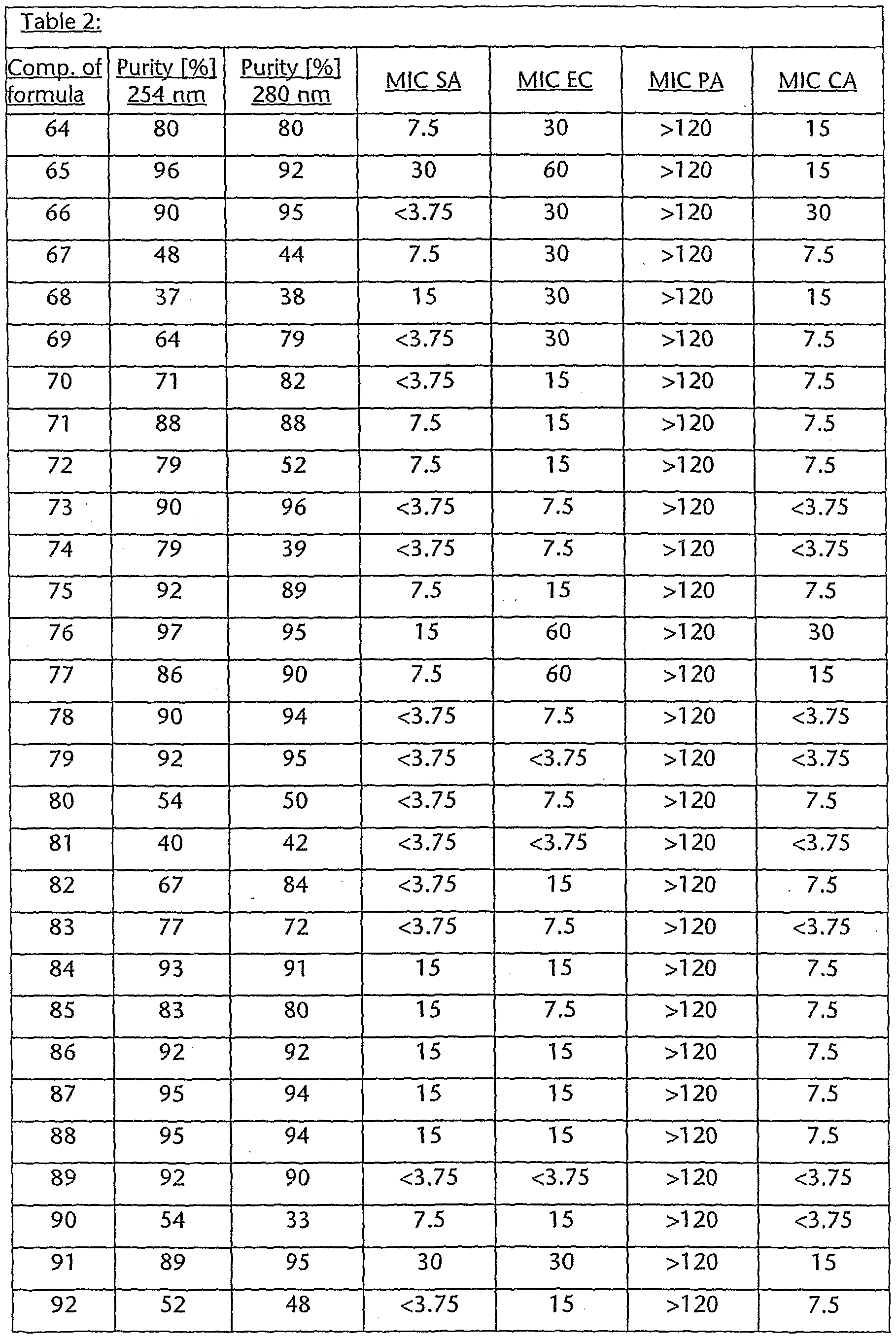
- Example 10 Determination of the minimum inhibitory concentration (MIC value) in microtitre plates
- test organisms examples include test organisms, test organisms, test organisms, test organisms, test organisms, test organisms, test organisms, test organisms, test organisms, test organisms, test organisms, test organisms, test organisms, test organisms, test organisms, test organisms, test organisms, test organisms, test organisms, test organisms, test organisms, test organisms, test organisms, test organisms, test organisms, test organisms, test organisms:
- test substances are pre-dissolved in dimethyl sulfoxide (DMSO) and tested in a dilution series of 1 :2.
- DMSO dimethyl sulfoxide
- Bacteria and yeast are cultured overnight in CASO broth.
- test organism suspensions are adjusted to an organism count of 1 - 5 x 10 6 CFU/ml using 0.85 % sodium chloride solution.
- test substances are pre-pipetted into microtitre plates in amounts of 8 ⁇ l per well.
- the pre-adjusted organism suspensions are diluted 1 :100 in CASO broth and are added in amounts of 192 ⁇ l per well to the test substances.
- test batches are incubated for 48 hours at 37°C.
- the growth is determined on the basis of the turbidity of the test batches (optical density) at 620 nm in a microplate reader.
- the minimum inhibitory concentration is the concentration of substance at which (compared to the growth of the control) an appreciable inhibition of growth ( ⁇ 20 % growth) of the test organisms is observed.
- Example 1 Agar incorporation test CG1 8e
- Test solution 1 % stock solutions of all the test substances are prepared in a suitable solvent and diluted in serial dilutions to end concentrations of from 1000 ppm to 10 ppm.
- each dilution step is mixed with 15 ml of nutrient medium while the latter is still liquid. After the nutrient medium has solidified, 10 ⁇ l of each of the following organism dilutions of the test strains in 0.85 % NaCl solution are spotted onto the agar medium:
- the plates are incubated at 37°C for 24 hours (A. niger at 28°C for 3 days) and then the highest dilution (lowest concentration) of the test substance at which growth is just no longer discernible (corresponds to the MIC) is determined.
- the results are shown in Table 3.
- Example 12 "Microbicidal activity" suspension test CG 161 /EN! 040
- test organisms examples include test organisms, test organisms, test organisms, test organisms, test organisms, test organisms, test organisms, test organisms, test organisms, test organisms, test organisms, test organisms, test organisms, test organisms, test organisms, test organisms, test organisms, test organisms, test organisms, test organisms, test organisms, test organisms, test organisms, test organisms, test organisms, test organisms, test organisms:
- test substances are dissolved in dimethyl sulfoxide (DMSO) and tested in a concentration of 120 ⁇ g/ml.
- DMSO dimethyl sulfoxide
- Bacteria are incubated overnight in CASO broth and adjusted to an organism count of
- test substances are pre-pipetted into microtitre plates in amounts of 8 ⁇ l per well.
- test organism suspensions are added in amounts of 192 ⁇ l per well to the test substances and mixed. After defined contact times, the test batches are mixed, an aliquot is withdrawn and diluted in several steps in a dilution series of 1 :10 in a suitable inactivation medium.
- test plates are incubated for 24 hours at 37°C. After incubation, the growth is determined on the basis of the turbidity of the test batches (optical density) at 620 nm in a microplate reader.
- the reduction in the test organism concentration is determined in powers of ten (log value).
- One microtitre plate is used for each test organism.
- Example 13 Determination of the minimum inhibitory concentration (MIC value) in microtitre plates
- test organisms there are used:
Landscapes
- Chemical & Material Sciences (AREA)
- Organic Chemistry (AREA)
- Life Sciences & Earth Sciences (AREA)
- Health & Medical Sciences (AREA)
- General Health & Medical Sciences (AREA)
- Engineering & Computer Science (AREA)
- Agronomy & Crop Science (AREA)
- Dentistry (AREA)
- Wood Science & Technology (AREA)
- Plant Pathology (AREA)
- Zoology (AREA)
- Pest Control & Pesticides (AREA)
- Environmental Sciences (AREA)
- Nuclear Medicine, Radiotherapy & Molecular Imaging (AREA)
- Communicable Diseases (AREA)
- Public Health (AREA)
- Animal Behavior & Ethology (AREA)
- Pharmacology & Pharmacy (AREA)
- Medicinal Chemistry (AREA)
- General Chemical & Material Sciences (AREA)
- Chemical Kinetics & Catalysis (AREA)
- Oncology (AREA)
- Veterinary Medicine (AREA)
- Cosmetics (AREA)
- Agricultural Chemicals And Associated Chemicals (AREA)
- Pharmaceuticals Containing Other Organic And Inorganic Compounds (AREA)
- Detergent Compositions (AREA)
- Paints Or Removers (AREA)
- Inks, Pencil-Leads, Or Crayons (AREA)
- Plural Heterocyclic Compounds (AREA)
Abstract
Description








Claims


Priority Applications (5)
| Application Number | Priority Date | Filing Date | Title |
|---|---|---|---|
| JP2003575716A JP2005520821A (en) | 2002-03-15 | 2003-03-10 | 4-Aminopyrimidine and its use for antimicrobial treatment of surfaces |
| EP03709767A EP1484971B1 (en) | 2002-03-15 | 2003-03-10 | Use of 4-aminopyrimidines for the antimicrobial treatment of surfaces |
| DE60314730T DE60314730T2 (en) | 2002-03-15 | 2003-03-10 | USE OF 4-AMINOPYRIMIDINES FOR ANTIMICROBIAL TREATMENT OF SURFACES |
| US10/507,800 US7731985B2 (en) | 2002-03-15 | 2003-03-10 | 4-aminopyrimidines and their use for the antimicrobial treatment of surfaces |
| AU2003214110A AU2003214110A1 (en) | 2002-03-15 | 2003-03-10 | 4-aminopyrimidines and their use for the antimicrobial treatment of surfaces |
Applications Claiming Priority (2)
| Application Number | Priority Date | Filing Date | Title |
|---|---|---|---|
| EP02405201.1 | 2002-03-15 | ||
| EP02405201 | 2002-03-15 |
Publications (1)
| Publication Number | Publication Date |
|---|---|
| WO2003077656A1 true WO2003077656A1 (en) | 2003-09-25 |
Family
ID=27838195
Family Applications (1)
| Application Number | Title | Priority Date | Filing Date |
|---|---|---|---|
| PCT/EP2003/002438 Ceased WO2003077656A1 (en) | 2002-03-15 | 2003-03-10 | 4-aminopyrimidines and their use for the antimicrobial treatment of surfaces |
Country Status (9)
| Country | Link |
|---|---|
| US (1) | US7731985B2 (en) |
| EP (1) | EP1484971B1 (en) |
| JP (1) | JP2005520821A (en) |
| CN (1) | CN1642422A (en) |
| AT (1) | ATE366045T1 (en) |
| AU (1) | AU2003214110A1 (en) |
| DE (1) | DE60314730T2 (en) |
| ES (1) | ES2290436T3 (en) |
| WO (1) | WO2003077656A1 (en) |
Cited By (16)
| Publication number | Priority date | Publication date | Assignee | Title |
|---|---|---|---|---|
| WO2004065380A1 (en) * | 2003-01-14 | 2004-08-05 | Arena Pharmaceuticals Inc. | 1,2,3-trisubstituted aryl and heteroaryl derivatives as modulators of metabolism and the prpphylaxis and treatment of disorders related thereto such as diabetes and hyperglycemia |
| WO2004062609A3 (en) * | 2003-01-10 | 2004-11-25 | Pharmacopeia Inc | Pyrimidine derivatives as il-8 receptor antagonists |
| WO2005099711A1 (en) * | 2004-04-13 | 2005-10-27 | Icagen, Inc. | Polycyclic pyrimidines as potassium ion channel modulators |
| EP1927594A1 (en) | 2003-01-14 | 2008-06-04 | Arena Pharmaceuticals, Inc. | 1,2,3-Trisubstituted aryl and heteroaryl derivatives as modulators of metabolism and the prophylaxis and treatment of disorders related thereto such as diabetes and hyperglycemia |
| US7449470B2 (en) | 2003-10-03 | 2008-11-11 | Universiteit Leiden | Substituted pyrimidines as ligands of adenosine receptors |
| US7470699B2 (en) | 2003-07-11 | 2008-12-30 | Arena Pharmaceuticals, Inc. | Trisubstituted aryl and heteroaryl derivatives as modulators of metabolism and the prophylaxis and treatment of disorders related thereto |
| US7524849B2 (en) | 2003-09-24 | 2009-04-28 | Wyeth Holdings Corporation | 5-arylpyrimidines as anticancer agents |
| WO2013004332A1 (en) * | 2011-07-07 | 2013-01-10 | Merck Patent Gmbh | Substituted azaheterocycles for the treatment of cancer |
| WO2014105952A3 (en) * | 2012-12-28 | 2014-10-09 | The United States Of America, As Represented By The Secretary, Department Of Health And Human Services | Inhibitors of the usp1/uaf1 deubiquitinase complex and uses thereof |
| US9725432B2 (en) | 2012-04-30 | 2017-08-08 | Janssen Sciences Ireland Us | Pyrimidine derivatives for the treatment of bacterial diseases |
| US10894787B2 (en) | 2010-09-22 | 2021-01-19 | Arena Pharmaceuticals, Inc. | Modulators of the GPR119 receptor and the treatment of disorders related thereto |
| US11007175B2 (en) | 2015-01-06 | 2021-05-18 | Arena Pharmaceuticals, Inc. | Methods of treating conditions related to the S1P1 receptor |
| US11534424B2 (en) | 2017-02-16 | 2022-12-27 | Arena Pharmaceuticals, Inc. | Compounds and methods for treatment of primary biliary cholangitis |
| US11884626B2 (en) | 2015-06-22 | 2024-01-30 | Arena Pharmaceuticals, Inc. | Crystalline L-arginine salt of (R)-2-(7-(4-cyclopentyl-3-(trifluoromethyl)benzyloxy)-1,2,3,4-tetrahydrocyclo-penta [b]indol-3-yl)acetic acid(Compound1) for use in S1P1 receptor-associated disorders |
| US11993580B1 (en) | 2022-12-02 | 2024-05-28 | Neumora Therapeutics, Inc. | Methods of treating neurological disorders |
| US12156866B2 (en) | 2018-06-06 | 2024-12-03 | Arena Pharmaceuticals, Inc. | Methods of treating conditions related to the S1P1 receptor |
Families Citing this family (2)
| Publication number | Priority date | Publication date | Assignee | Title |
|---|---|---|---|---|
| AU2018249550B2 (en) | 2017-04-05 | 2023-11-30 | Curza, Inc. | Compositions and methods comprising a triaryl polyamine |
| CN108162528B (en) * | 2017-12-22 | 2020-07-10 | 宿迁市金田塑业有限公司 | Novel high-performance antibacterial antifogging film |
Citations (7)
| Publication number | Priority date | Publication date | Assignee | Title |
|---|---|---|---|---|
| US4435402A (en) * | 1981-01-29 | 1984-03-06 | Sankyo Company, Limited | Aminopyrimidine derivatives, processes for their preparation, and fungicidal, insecticidal and acaricidal compositions containing them |
| EP0323757A2 (en) * | 1988-01-07 | 1989-07-12 | Ube Industries, Ltd. | Alkylaminopyrimidine derivative, process for producing the same, and insecticide, acaricide and fungicide containing the same as active ingredient |
| EP0407899A2 (en) * | 1989-07-11 | 1991-01-16 | Hoechst Schering AgrEvo GmbH | Aminopyrimidine derivatives, process for their preparation, agent containing them and their use as fungicides |
| EP0424125A2 (en) * | 1989-10-18 | 1991-04-24 | Ube Industries, Ltd. | Aralkylamine derivatives, preparation method thereof and fungicides containing the same |
| EP0519211A1 (en) * | 1991-05-17 | 1992-12-23 | Hoechst Schering AgrEvo GmbH | Substituted 4-aminopyrimidine, process for their preparation and their use as parasiticide |
| WO1995007278A1 (en) * | 1993-09-09 | 1995-03-16 | E.I. Du Pont De Nemours And Company | Fungicidal, miticidal and arthropodicidal aminopyrimidines |
| US6207668B1 (en) * | 1996-04-03 | 2001-03-27 | Hoechst Schering | Substituted pyridines/pyrimidines, their preparation, and their use as pesticides |
Family Cites Families (46)
| Publication number | Priority date | Publication date | Assignee | Title |
|---|---|---|---|---|
| GB1143167A (en) * | 1967-01-25 | 1969-02-19 | Ucb Sa | Derivatives of pyrimidine |
| US3755583A (en) * | 1970-06-05 | 1973-08-28 | Chas0!nhx | |
| US3707560A (en) * | 1970-10-05 | 1972-12-26 | Pfizer | Certain 4-amino-6-aryl-pyrimidines |
| DE2202385A1 (en) * | 1972-01-19 | 1973-07-26 | Boehringer Mannheim Gmbh | Nitrofuryl-pyrimidines and -1,2,4-thiadiazoles - - with antimicrobial activity |
| US4144338A (en) * | 1977-02-17 | 1979-03-13 | Merck & Co., Inc. | N-pyrimidinyl-N-dialkylaminoalkyl ureas |
| JPS6059883B2 (en) * | 1978-05-08 | 1985-12-27 | 北興化学工業株式会社 | Fungicide for agriculture and horticulture |
| MA18829A1 (en) * | 1979-05-18 | 1980-12-31 | Ciba Geigy Ag | PYRIMIDINE DERIVATIVES, METHODS FOR THEIR PREPARATION, PHARMACEUTICAL COMPOSITIONS CONTAINING THESE COMPOUNDS AND THEIR THERAPEUTIC USE |
| JPS57126481A (en) * | 1981-01-29 | 1982-08-06 | Sankyo Co Ltd | Aminopyrimidine derivative, fungicide, insecticide, and acaricide |
| JPS57176967A (en) * | 1981-04-21 | 1982-10-30 | Sankyo Co Ltd | Aminopyrimidine derivative and antibacterial, insecticidal and miticidal agent |
| JPS5936666A (en) * | 1982-07-23 | 1984-02-28 | Sankyo Co Ltd | Aminopyrimidine derivative |
| EP0136976A3 (en) * | 1983-08-23 | 1985-05-15 | Ciba-Geigy Ag | Use of phenyl pyrimidines as plant regulators |
| GB8417852D0 (en) * | 1984-07-13 | 1984-08-15 | Fujisawa Pharmaceutical Co | Pyrimidine derivatives |
| DE3642452A1 (en) * | 1986-12-12 | 1988-06-23 | Bayer Ag | SUBSTITUTED 4-AMINO-PYRIMIDINE |
| JPH01250363A (en) * | 1987-12-28 | 1989-10-05 | Kumiai Chem Ind Co Ltd | 4-benzylaminopyrimidine derivative and herbicide |
| JPH0745481B2 (en) * | 1988-01-07 | 1995-05-17 | 宇部興産株式会社 | Alkylaminopyrimidine derivative, method for producing the same, and insecticide, acaricide and fungicide containing the derivative as an active ingredient |
| JPH0368563A (en) * | 1989-08-09 | 1991-03-25 | Kumiai Chem Ind Co Ltd | (r)s)-alpha-methylbenzylaminopyrimidine derivative and herbicide |
| EP0555478A4 (en) * | 1990-08-31 | 1993-11-18 | Nippon Shinyaku Company, Limited | Pyrimidine derivative and medicine |
| DE4031798A1 (en) * | 1990-10-08 | 1992-04-09 | Hoechst Ag | Pyridyl-pyrimidine derivs. - fungicides useful as plant protectants and as preservatives in paints or oils |
| DE4034762A1 (en) * | 1990-11-02 | 1992-05-07 | Hoechst Ag | Pyridyl pyrimidine derivs. - are fungicides for plant protection and for protecting and preserving industrial materials |
| ATE176226T1 (en) * | 1990-11-19 | 1999-02-15 | Du Pont | INSECTICIDES, ACARICIDES AND FUNGICIDES AMINOPYRIMIDINES |
| JPH05194418A (en) * | 1992-01-23 | 1993-08-03 | Kirin Brewery Co Ltd | 2-aminopyrimidine derivative and its use |
| JP3086316B2 (en) * | 1992-01-31 | 2000-09-11 | アグロカネショウ株式会社 | Phenylcarbamate derivative, method for producing the same, and agricultural / horticultural fungicide containing the derivative as an active ingredient |
| JP2649119B2 (en) * | 1992-04-21 | 1997-09-03 | 宇部興産株式会社 | Alkylaminopyrimidine compounds, their preparation and pest control agents |
| US5354738A (en) * | 1992-09-04 | 1994-10-11 | G. D. Searle & Co. | Platelet aggregation inhibitors |
| AU7938994A (en) * | 1993-10-25 | 1995-05-22 | Shell Internationale Research Maatschappij B.V. | Pyrimidine derivatives |
| JPH08283246A (en) * | 1994-06-01 | 1996-10-29 | Nippon Soda Co Ltd | Pyrimidine derivative, its production and controlling agent for pest |
| DE19511562A1 (en) * | 1995-03-29 | 1996-10-02 | Hoechst Schering Agrevo Gmbh | Cyclohexylamino and alkoxy nitrogen heterocycles, process for their preparation and their use as pesticides and fungicides |
| DE19600934A1 (en) * | 1996-01-12 | 1997-07-17 | Basf Ag | Substituted aza and diazacycloheptane and cyclooctane compounds and their use |
| US6011029A (en) * | 1996-02-26 | 2000-01-04 | Bristol-Myers Squibb Company | Inhibitors of farnesyl protein transferase |
| JPH10130149A (en) * | 1996-07-12 | 1998-05-19 | Sankyo Co Ltd | TNF production inhibitor |
| JPH11246528A (en) * | 1997-12-05 | 1999-09-14 | Tomono Agrica Co Ltd | Nitrogen-containing aromatic compounds and salts thereof |
| DK1091957T3 (en) | 1998-05-23 | 2005-04-11 | Altana Pharma Ag | Pyrimidine-aminomethyl-pyridine derivatives, their preparation and their use in the control of Helicobacter bacteria |
| GB9816729D0 (en) * | 1998-08-01 | 1998-09-30 | Hoechst Schering Agrevo Gmbh | Substituted cyclohexylaminopyrimidines |
| DE19836697A1 (en) | 1998-08-13 | 2000-02-17 | Hoechst Marion Roussel De Gmbh | New substituted 4-amino-2-aryl-pyrimidines, are soluble guanylate cyclase activators useful e.g. for treating atherosclerosis, hypertension, angina pectoris, thrombosis, asthma or diabetes |
| JP2001139561A (en) * | 1999-11-17 | 2001-05-22 | Dainippon Pharmaceut Co Ltd | 5-halogeno-6- (4-trifluoromethylphenyl) -4-aminopyrimidine derivative |
| JP2001247411A (en) * | 2000-03-09 | 2001-09-11 | Tomono Agrica Co Ltd | Pest control agent |
| GB0018951D0 (en) * | 2000-08-03 | 2000-09-20 | Smithkline Beecham Plc | Novel compounds |
| AU2002227905B2 (en) * | 2000-11-10 | 2006-10-05 | F. Hoffmann-La Roche Ag | Pyrimidine derivatives and their use as neuropeptide Y receptor ligands |
| US20020137755A1 (en) * | 2000-12-04 | 2002-09-26 | Bilodeau Mark T. | Tyrosine kinase inhibitors |
| WO2002068409A1 (en) * | 2001-02-23 | 2002-09-06 | Merck & Co., Inc. | N-substituted nonaryl-heterocyclic nmda/nr2b antagonists |
| ES2242839T3 (en) * | 2001-04-20 | 2005-11-16 | Ciba Specialty Chemicals Holding Inc. | 4-AMINO-2- (PIRIDIN-2-IL) PYRIMIDINE AS ACTIVE SUBSTANCES MICROBICIDES. |
| EP1254903B1 (en) * | 2001-04-20 | 2005-06-08 | Ciba SC Holding AG | 4-Amino-2-(pyridin-2-yl)pyrimidine as microbicidal active substances |
| DE10131543A1 (en) * | 2001-06-29 | 2003-01-16 | Abbott Lab | Pyrimidinoxyalkylpiperazines and their therapeutic use |
| JPWO2003026661A1 (en) * | 2001-09-14 | 2005-01-06 | 山之内製薬株式会社 | Insulin secretion promoter and novel pyrimidine derivatives |
| GB0226724D0 (en) * | 2002-11-15 | 2002-12-24 | Merck Sharp & Dohme | Therapeutic agents |
| ATE527250T1 (en) * | 2002-11-21 | 2011-10-15 | Novartis Ag | 2,4,6-TRISUBSTITUTED PYRIMIDINES AS PHOSPHOTIDYLINOSITOL (PI) 3-KINASE INHIBITORS AND THEIR USE IN THE TREATMENT OF CANCER |
-
2003
- 2003-03-10 AU AU2003214110A patent/AU2003214110A1/en not_active Abandoned
- 2003-03-10 WO PCT/EP2003/002438 patent/WO2003077656A1/en not_active Ceased
- 2003-03-10 AT AT03709767T patent/ATE366045T1/en not_active IP Right Cessation
- 2003-03-10 CN CNA038059894A patent/CN1642422A/en active Pending
- 2003-03-10 EP EP03709767A patent/EP1484971B1/en not_active Expired - Lifetime
- 2003-03-10 US US10/507,800 patent/US7731985B2/en not_active Expired - Fee Related
- 2003-03-10 DE DE60314730T patent/DE60314730T2/en not_active Expired - Lifetime
- 2003-03-10 JP JP2003575716A patent/JP2005520821A/en active Pending
- 2003-03-10 ES ES03709767T patent/ES2290436T3/en not_active Expired - Lifetime
Patent Citations (7)
| Publication number | Priority date | Publication date | Assignee | Title |
|---|---|---|---|---|
| US4435402A (en) * | 1981-01-29 | 1984-03-06 | Sankyo Company, Limited | Aminopyrimidine derivatives, processes for their preparation, and fungicidal, insecticidal and acaricidal compositions containing them |
| EP0323757A2 (en) * | 1988-01-07 | 1989-07-12 | Ube Industries, Ltd. | Alkylaminopyrimidine derivative, process for producing the same, and insecticide, acaricide and fungicide containing the same as active ingredient |
| EP0407899A2 (en) * | 1989-07-11 | 1991-01-16 | Hoechst Schering AgrEvo GmbH | Aminopyrimidine derivatives, process for their preparation, agent containing them and their use as fungicides |
| EP0424125A2 (en) * | 1989-10-18 | 1991-04-24 | Ube Industries, Ltd. | Aralkylamine derivatives, preparation method thereof and fungicides containing the same |
| EP0519211A1 (en) * | 1991-05-17 | 1992-12-23 | Hoechst Schering AgrEvo GmbH | Substituted 4-aminopyrimidine, process for their preparation and their use as parasiticide |
| WO1995007278A1 (en) * | 1993-09-09 | 1995-03-16 | E.I. Du Pont De Nemours And Company | Fungicidal, miticidal and arthropodicidal aminopyrimidines |
| US6207668B1 (en) * | 1996-04-03 | 2001-03-27 | Hoechst Schering | Substituted pyridines/pyrimidines, their preparation, and their use as pesticides |
Cited By (28)
| Publication number | Priority date | Publication date | Assignee | Title |
|---|---|---|---|---|
| US7037916B2 (en) | 1999-07-15 | 2006-05-02 | Pharmacopeia Drug Discovery, Inc. | Pyrimidine derivatives as IL-8 receptor antagonists |
| WO2004062609A3 (en) * | 2003-01-10 | 2004-11-25 | Pharmacopeia Inc | Pyrimidine derivatives as il-8 receptor antagonists |
| AU2004205642B2 (en) * | 2003-01-14 | 2011-01-27 | Arena Pharmaceuticals, Inc. | 1,2,3-trisubstituted aryl and heteroaryl derivatives as modulators of metabolism and the prophylaxis and treatment of disorders related thereto such as diabetes and hyperglycemia |
| WO2004065380A1 (en) * | 2003-01-14 | 2004-08-05 | Arena Pharmaceuticals Inc. | 1,2,3-trisubstituted aryl and heteroaryl derivatives as modulators of metabolism and the prpphylaxis and treatment of disorders related thereto such as diabetes and hyperglycemia |
| EP1927594A1 (en) | 2003-01-14 | 2008-06-04 | Arena Pharmaceuticals, Inc. | 1,2,3-Trisubstituted aryl and heteroaryl derivatives as modulators of metabolism and the prophylaxis and treatment of disorders related thereto such as diabetes and hyperglycemia |
| HRP20050696B1 (en) * | 2003-01-14 | 2008-10-31 | Arena Pharmaceuticals Inc. | 1,2,3-trisubstituted aryl and heteroaryl derivatives as modulators of metabolism and the prpphylaxis and treatment of disorders related thereto such as diabetes and hyperglycemia |
| AU2004205642C1 (en) * | 2003-01-14 | 2012-01-12 | Arena Pharmaceuticals, Inc. | 1,2,3-trisubstituted aryl and heteroaryl derivatives as modulators of metabolism and the prophylaxis and treatment of disorders related thereto such as diabetes and hyperglycemia |
| EA011009B1 (en) * | 2003-01-14 | 2008-12-30 | Арена Фармасьютикалз Инк. | 1,2,3-substituted aryl and heteroaryl derivatives as modulators of metabolism and the prophylaxis and treatment of disorders related thereto such as diabetes and hyperglycemia |
| US8933083B2 (en) | 2003-01-14 | 2015-01-13 | Arena Pharmaceuticals, Inc. | 1,2,3-trisubstituted aryl and heteroaryl derivatives as modulators of metabolism and the prophylaxis and treatment of disorders related thereto such as diabetes and hyperglycemia |
| US7470699B2 (en) | 2003-07-11 | 2008-12-30 | Arena Pharmaceuticals, Inc. | Trisubstituted aryl and heteroaryl derivatives as modulators of metabolism and the prophylaxis and treatment of disorders related thereto |
| US7524849B2 (en) | 2003-09-24 | 2009-04-28 | Wyeth Holdings Corporation | 5-arylpyrimidines as anticancer agents |
| US7449470B2 (en) | 2003-10-03 | 2008-11-11 | Universiteit Leiden | Substituted pyrimidines as ligands of adenosine receptors |
| US7560464B2 (en) | 2004-04-13 | 2009-07-14 | Icagen, Inc. | Polycyclic pyrimidines as potassium ion channel modulators |
| WO2005099711A1 (en) * | 2004-04-13 | 2005-10-27 | Icagen, Inc. | Polycyclic pyrimidines as potassium ion channel modulators |
| US10894787B2 (en) | 2010-09-22 | 2021-01-19 | Arena Pharmaceuticals, Inc. | Modulators of the GPR119 receptor and the treatment of disorders related thereto |
| WO2013004332A1 (en) * | 2011-07-07 | 2013-01-10 | Merck Patent Gmbh | Substituted azaheterocycles for the treatment of cancer |
| US9199962B2 (en) | 2011-07-07 | 2015-12-01 | Merck Patent Gmbh | Substituted azaheterocycles for the treatment of cancer |
| AU2012280725B2 (en) * | 2011-07-07 | 2017-02-02 | Merck Patent Gmbh | Substituted azaheterocycles for the treatment of cancer |
| US9725432B2 (en) | 2012-04-30 | 2017-08-08 | Janssen Sciences Ireland Us | Pyrimidine derivatives for the treatment of bacterial diseases |
| US10221157B2 (en) | 2012-04-30 | 2019-03-05 | Janssen Pharmaceutica Nv | Pyrimidine derivatives for the treatment of bacterial diseases |
| US9802904B2 (en) | 2012-12-28 | 2017-10-31 | The United States Of America, As Represented By The Secretary, Department Of Health And Human Services | Inhibitors of the USP1/UAF1 deubiquitinase complex and uses thereof |
| WO2014105952A3 (en) * | 2012-12-28 | 2014-10-09 | The United States Of America, As Represented By The Secretary, Department Of Health And Human Services | Inhibitors of the usp1/uaf1 deubiquitinase complex and uses thereof |
| US11007175B2 (en) | 2015-01-06 | 2021-05-18 | Arena Pharmaceuticals, Inc. | Methods of treating conditions related to the S1P1 receptor |
| US11884626B2 (en) | 2015-06-22 | 2024-01-30 | Arena Pharmaceuticals, Inc. | Crystalline L-arginine salt of (R)-2-(7-(4-cyclopentyl-3-(trifluoromethyl)benzyloxy)-1,2,3,4-tetrahydrocyclo-penta [b]indol-3-yl)acetic acid(Compound1) for use in S1P1 receptor-associated disorders |
| US11534424B2 (en) | 2017-02-16 | 2022-12-27 | Arena Pharmaceuticals, Inc. | Compounds and methods for treatment of primary biliary cholangitis |
| US12156866B2 (en) | 2018-06-06 | 2024-12-03 | Arena Pharmaceuticals, Inc. | Methods of treating conditions related to the S1P1 receptor |
| US11993580B1 (en) | 2022-12-02 | 2024-05-28 | Neumora Therapeutics, Inc. | Methods of treating neurological disorders |
| US12371414B2 (en) | 2022-12-02 | 2025-07-29 | Neumora Therapeutics, Inc. | Methods of treating neurological disorders |
Also Published As
| Publication number | Publication date |
|---|---|
| US20050143387A1 (en) | 2005-06-30 |
| DE60314730T2 (en) | 2008-06-05 |
| EP1484971B1 (en) | 2007-07-04 |
| EP1484971A1 (en) | 2004-12-15 |
| DE60314730D1 (en) | 2007-08-16 |
| CN1642422A (en) | 2005-07-20 |
| ATE366045T1 (en) | 2007-07-15 |
| AU2003214110A1 (en) | 2003-09-29 |
| JP2005520821A (en) | 2005-07-14 |
| ES2290436T3 (en) | 2008-02-16 |
| US7731985B2 (en) | 2010-06-08 |
Similar Documents
| Publication | Publication Date | Title |
|---|---|---|
| EP1484971B1 (en) | Use of 4-aminopyrimidines for the antimicrobial treatment of surfaces | |
| US7015228B2 (en) | 4-amino-2-(2-pyridyl)pyrimidines as microbicidal active substances | |
| US7722893B2 (en) | Use of substitute 2,4-bis (alkylamino) pyrimidines or quinzolines as antimicrobials | |
| EP1254903B1 (en) | 4-Amino-2-(pyridin-2-yl)pyrimidine as microbicidal active substances | |
| US6689372B1 (en) | Microbicidal active substances | |
| US20040006061A1 (en) | Alkoxybenzylamine | |
| US6346260B1 (en) | Microbicidal active ingredients | |
| AU2003254560B2 (en) | Pyridyl-triazine derivatives as microbicidal active substances | |
| US6624182B1 (en) | Hydroxyphenylvinylthiazoles | |
| US20060052375A1 (en) | Bis-alkylbenzylamines | |
| US6967215B2 (en) | Tetrahydrocarbazoles, a process for the preparation of those compounds, and the use thereof | |
| US7078550B2 (en) | Silanyl phenols and naphthols | |
| US6743940B2 (en) | 4-aminobut-2-ynecarboxylic acid derivatives | |
| EP1074179B1 (en) | Microbicidal active ingredients | |
| EP1651177A1 (en) | 3-aryl-2-cyano-3-hydroxy-acrylic acid derivatives | |
| EP1215198A1 (en) | 4-Aminobut-2-yne carboxylic acid derivatives and their use as antimicrobial agents |
Legal Events
| Date | Code | Title | Description |
|---|---|---|---|
| AK | Designated states |
Kind code of ref document: A1 Designated state(s): AE AG AL AM AT AU AZ BA BB BG BR BY BZ CA CH CN CO CR CU CZ DE DK DM DZ EC EE ES FI GB GD GE GH GM HR HU ID IL IN IS JP KE KG KP KR KZ LC LK LR LS LT LU LV MA MD MG MK MN MW MX MZ NI NO NZ OM PH PL PT RO RU SC SD SE SG SK SL TJ TM TN TR TT TZ UA UG US UZ VC VN YU ZA ZM ZW |
|
| AL | Designated countries for regional patents |
Kind code of ref document: A1 Designated state(s): GH GM KE LS MW MZ SD SL SZ TZ UG ZM ZW AM AZ BY KG KZ MD RU TJ TM AT BE BG CH CY CZ DE DK EE ES FI FR GB GR HU IE IT LU MC NL PT RO SE SI SK TR BF BJ CF CG CI CM GA GN GQ GW ML MR NE SN TD TG |
|
| DFPE | Request for preliminary examination filed prior to expiration of 19th month from priority date (pct application filed before 20040101) | ||
| 121 | Ep: the epo has been informed by wipo that ep was designated in this application | ||
| WWE | Wipo information: entry into national phase |
Ref document number: 2003709767 Country of ref document: EP |
|
| WWE | Wipo information: entry into national phase |
Ref document number: 10507800 Country of ref document: US |
|
| WWE | Wipo information: entry into national phase |
Ref document number: 20038059894 Country of ref document: CN |
|
| WWE | Wipo information: entry into national phase |
Ref document number: 2003575716 Country of ref document: JP |
|
| WWE | Wipo information: entry into national phase |
Ref document number: 2294/CHENP/2004 Country of ref document: IN |
|
| WWP | Wipo information: published in national office |
Ref document number: 2003709767 Country of ref document: EP |
|
| WWG | Wipo information: grant in national office |
Ref document number: 2003709767 Country of ref document: EP |