WO2003081733A2 - Tunable laser - Google Patents

Tunable laser Download PDF

Info

Publication number
WO2003081733A2
WO2003081733A2 PCT/GB2003/001175 GB0301175W WO03081733A2 WO 2003081733 A2 WO2003081733 A2 WO 2003081733A2 GB 0301175 W GB0301175 W GB 0301175W WO 03081733 A2 WO03081733 A2 WO 03081733A2
Authority
WO
WIPO (PCT)
Prior art keywords
tuneable
section
quantum dots
laser
wavelength
Prior art date
Legal status (The legal status is an assumption and is not a legal conclusion. Google has not performed a legal analysis and makes no representation as to the accuracy of the status listed.)
Ceased
Application number
PCT/GB2003/001175
Other languages
French (fr)
Other versions
WO2003081733A3 (en
Inventor
Nick Zakhleniuk
Anthony Holden
Current Assignee (The listed assignees may be inaccurate. Google has not performed a legal analysis and makes no representation or warranty as to the accuracy of the list.)
Lumentum Technology UK Ltd
Original Assignee
Bookham Technology PLC
Priority date (The priority date is an assumption and is not a legal conclusion. Google has not performed a legal analysis and makes no representation as to the accuracy of the date listed.)
Filing date
Publication date
Priority claimed from GB0206441A external-priority patent/GB0206441D0/en
Priority claimed from GB0211039A external-priority patent/GB2388708B/en
Priority claimed from GB0211038A external-priority patent/GB2388707B/en
Application filed by Bookham Technology PLC filed Critical Bookham Technology PLC
Priority to AU2003229868A priority Critical patent/AU2003229868A1/en
Priority to EP03722704A priority patent/EP1485975A2/en
Priority to US10/508,386 priority patent/US20050175044A1/en
Publication of WO2003081733A2 publication Critical patent/WO2003081733A2/en
Publication of WO2003081733A3 publication Critical patent/WO2003081733A3/en
Anticipated expiration legal-status Critical
Ceased legal-status Critical Current

Links

Classifications

    • HELECTRICITY
    • H01ELECTRIC ELEMENTS
    • H01SDEVICES USING THE PROCESS OF LIGHT AMPLIFICATION BY STIMULATED EMISSION OF RADIATION [LASER] TO AMPLIFY OR GENERATE LIGHT; DEVICES USING STIMULATED EMISSION OF ELECTROMAGNETIC RADIATION IN WAVE RANGES OTHER THAN OPTICAL
    • H01S5/00Semiconductor lasers
    • H01S5/06Arrangements for controlling the laser output parameters, e.g. by operating on the active medium
    • H01S5/062Arrangements for controlling the laser output parameters, e.g. by operating on the active medium by varying the potential of the electrodes
    • H01S5/0625Arrangements for controlling the laser output parameters, e.g. by operating on the active medium by varying the potential of the electrodes in multi-section lasers
    • H01S5/06255Controlling the frequency of the radiation
    • H01S5/06256Controlling the frequency of the radiation with DBR-structure
    • BPERFORMING OPERATIONS; TRANSPORTING
    • B82NANOTECHNOLOGY
    • B82YSPECIFIC USES OR APPLICATIONS OF NANOSTRUCTURES; MEASUREMENT OR ANALYSIS OF NANOSTRUCTURES; MANUFACTURE OR TREATMENT OF NANOSTRUCTURES
    • B82Y20/00Nanooptics, e.g. quantum optics or photonic crystals
    • HELECTRICITY
    • H01ELECTRIC ELEMENTS
    • H01SDEVICES USING THE PROCESS OF LIGHT AMPLIFICATION BY STIMULATED EMISSION OF RADIATION [LASER] TO AMPLIFY OR GENERATE LIGHT; DEVICES USING STIMULATED EMISSION OF ELECTROMAGNETIC RADIATION IN WAVE RANGES OTHER THAN OPTICAL
    • H01S5/00Semiconductor lasers
    • H01S5/30Structure or shape of the active region; Materials used for the active region
    • H01S5/34Structure or shape of the active region; Materials used for the active region comprising quantum well or superlattice structures, e.g. single quantum well [SQW] lasers, multiple quantum well [MQW] lasers or graded index separate confinement heterostructure [GRINSCH] lasers
    • H01S5/341Structures having reduced dimensionality, e.g. quantum wires
    • H01S5/3412Structures having reduced dimensionality, e.g. quantum wires quantum box or quantum dash

Definitions

  • This invention relates to tuneable lasers and has particular reference to such tuneable lasers having a tuneable portion incorporating quantum dots.
  • the term "light” will be used in the sense that it is used in optical systems to mean not just visible light but also electromagnetic radiation having a wavelength between 800 nanometres (nm) and 3000 nm.
  • Single wavelength lasers are important for a number of applications in optical telecommunications and signal processing applications. These include multiple channel optical telecommunications networks using wavelength division multiplexing (WDM). Such networks can provide advanced features, such as wavelength routing, wavelength conversion, adding and dropping of channels and wavelength manipulation in much the same way as in time slot manipulation in time division multiplexed systems. Many of these systems operate in the C- and L- Bands in the range 1530 to 1610 nm.
  • WDM wavelength division multiplexing
  • Tuneable lasers for use in such optical communications systems, particularly in connection with the WDM telecommunication systems, are known.
  • a known tuneable system comprises stacks of single wavelength distributed Bragg reflectors (DBR) lasers, which can be individually selected, or tuned over a narrow range, or by a wide tuning range tuneable laser that can be electronically driven to provide the wavelength required.
  • DBR distributed Bragg reflectors
  • the free electron plasma effect can be used by free carrier injection, that is by passing an electric current through the tuning section.
  • the fundamental band-gap can be changed by thermal heating.
  • electro-refraction modification can be brought about using the electro-optic effect. In the latter case, an electrical field is established across the tuning section, which changes the refractive index of the section and thus alters the wavelength of the light as it passes through the tuning section.
  • the thermal tuning scheme is very slow, the current tuning scheme has its speed limited by thermal heating effects and the electro refraction scheme has limited bandwidth of modulation, and large output power variation.
  • the refractive index is modified ( through the change of the electronic contribution to the dielectric function due to the injection current.
  • the injected current creates Joule heating, which dissipates in the device active region.
  • the real wavelength switching speed of the laser device will be determined by the relatively long characteristic time of the heat dissipation, rather than by the electric current switching speed.
  • the thermal dissipation effects can be decreased through device optimisation but cannot be eliminated.
  • the thermally induced band-gap change has similar limitations.
  • quantum wells which will be referred to as QWs
  • quantum wires quantum wires
  • QDs quantum dots
  • the term QW is used to mean a material having a layer of narrow band-gap material sandwiched between layers of wide band-gap material, with the layer of the narrow band-gap material having a thickness d x of the order of the de Broglie wavelength ⁇ dB and the other two dimensions d y and d z of the layer of narrow band-gap material being very much greater than ⁇ dB .
  • the electrons are constrained in the x dimension but are free to move in the y and z dimensions.
  • the thickness of the layer for a QW material would be in the range ⁇ 50 A to ⁇ 300 A.
  • An overall QW may have some regions of one energy level only and some regions of a few energy levels.
  • the QW is now considered as having a second dimension, say d ⁇ , cut down to the size ⁇ B , so that both d x and d y are ⁇ dB and only d 2 is very much greater than ⁇ dBr then the electrons are constrained in two dimensions and thus there is, in effect, created a line in which the electrons can freely move in one dimension only, and this is referred to herein as a quantum wire.
  • quantum dot QD
  • d x , d y , and d z are all very much greater than ⁇ dB the material is simply considered as a bulk material with no quantum effects of the type discussed herein. If d x ⁇ dB there is provided a quantum well, QW. If d x , d y ⁇ ⁇ dB , there is provided a quantum wire, and if d X/ d y , and d z ⁇ ⁇ B , then there is provided a quantum dot, QD.
  • QWs quantum wires have yet to be produced on a commercial scale. In practise they have been formed in the laboratory by electrically constraining a QW structure with electrical fields or by so-called V-growth, but these are not yet practical commercially available processes.
  • the present invention is concerned with the use and application of QD materials in tuneable lasers.
  • Production processes for QD materials are well established. Two main processes have been developed, chemical etching and self-assembly, and the self-assembly process will be explained in more detail below.
  • QD materials have been widely suggested for use in lasers, see for example D Bimberg et al, Novel Infrared Quantum Dot Lasers: Theory and Reality, phys. stat. sol. (b) 224, No. 3, 787-796 (2001). Principally they have been suggested for use in the light creating lasing section of a current injection laser because they can produce light of a very narrowly defined wavelength, with a very low threshold current and QD materials have a very high characteristic temperature so as to give a temperature stable laser emitter. Because of these very significant benefits, most of the work on QD materials in laser applications has concentrated on their use in the emitter. Applications of the Invention
  • the present invention is not directed to the use of QD materials in laser emitters, but is directed to the use of QD materials in the tuning section of a tuneable laser.
  • the essence of the present invention is the enhancement of the linear electro- optic (LEO) coefficient in a bulk semiconductor material that forms a tuneable section of a tuneable laser, and especially in III-V semiconductors (e.g. GaAs), by the use of quantum dots.
  • the LEO coefficient can be regarded as a means of varying the refractive index (RI) of the material under the effect of an electrical field normally created by an applied voltage.
  • the LEO coefficient at optical wavelengths depends on the distortion, (i.e. polarisation) of the tightly bound core electrons in the semiconductor atoms on the application of an electric field. These are strongly bound and the effect is proportionately weak. This leads to the need for high drive voltages and long active regions to build a large enough phase change and effect modulation.
  • the weakly bound valence electrons do not contribute significantly because they form a conduction band and flow away when a field is applied and do not add to the local dipole moment or polarisation.
  • QDs are little boxes of narrow band-gap material formed inside the bulk III-V material. They confine these weakly bound electrons and their corresponding holes (in the valence band) and do not allow them to conduct. They are, in essence, artificial atoms. When a field is applied these weakly bound carriers contribute a large dipole moment, or polarisation , and hence a large LEO coefficient. In addition the shape of the quantum boxes also leads to a built-in dipole moment before the field is applied and this enhances the LEO coefficient further.
  • Initial results obtained by using the invention show that the LEO coefficient in the dot system is enhanced over the bulk GaAs system by around 200 times (see below). Even allowing for the reduced overlap of the light field in the dilute layers of dots (compared to the bulk material) this still leaves a factor of at least 5 or 6 in the net effect. The effect can be further enhanced using a plurality of layers of self assembled quantum dots.
  • r is the linear and s the quadratic electro-optic coefficient
  • F is the applied field
  • n 0 is the refractive index of the material at zero field
  • ⁇ n and ⁇ n Q are the linear and quadratic contributions to the change in refractive index respectively.
  • the invention is particularly concerned with tuneable lasers which exploit the linear part rather than the quadratic part of the electro-optic effect.
  • the quadratic part is strongest at wavelengths near the band-gap but suffers from high absorption and narrow optical bandwidth.
  • the LEO coefficient has a wide optical bandwidth and as it is operated well away from the band-gap there are low losses in addition to the wide bandwidth utilisation.
  • a tuneable laser including a light creating section to generate light and a tuneable section formed of a semiconductor material which utilises the electro-optic effect to achieve a change in the refractive index of the material, ⁇ n, under the influence of an applied field, F, in accordance with the equation:
  • n 0 the refractive index at zero field and ⁇ n L and ⁇ n Q are the linear and quadratic contributions to the change in refractive index respectively
  • r is the linear electro-optic coefficient of the material
  • s is the quadratic electro-optic coefficient of the material
  • the tuning section including a waveguide and the material of the waveguide incorporating a plurality of quantum dots and operating in a wavelength region where the value of rF is sufficiently greater than the value of sF 2 , so as to operate with the dominant effect on ⁇ n being contributed by the linear effect.
  • the invention also provides a tuneable laser including a light creating section to generate light of a wavelength ⁇ and a tuneable section; the tuneable section being formed of a semi-conducting material incorporating a plurality of quantum dots and exhibiting an electro-optic response thereby to permit variation of the refractive index; the band-gap of the semiconducting material incorporating the quantum dots being such that the corresponding wavelength ⁇ g is less than ⁇ .
  • the invention further provides a tuneable laser including a light creating section to generate light of a wavelength ⁇ and a tuneable section including a waveguide; the waveguide of the tuneable section being formed of a semiconducting material incorporating a plurality of quantum dots and exhibiting an electro-optic response thereby to permit variation of the refractive index; the band-gap of the semiconducting material incorporating the quantum dots being such that the corresponding wavelength ⁇ g is less than ⁇ .
  • the invention provides a tuneable laser including a Light creating section to generate light and a ⁇ tuneable section for adjusting the wavelength thereof within the range ⁇ x and ⁇ 2 ; the tuneable section being formed of a semiconducting material incorporating a plurality of quantum dots and exhibiting an electro-optic response thereby to permit variation of the refractive index; the band-gap of the semiconducting material incorporating the quantum dots being such that the corresponding wavelength ⁇ g is less than both ⁇ i and ⁇ 2 by an amount sufficient that the change in refractive index at ⁇ x and ⁇ 2 is substantially the same.
  • the invention provides a tuneable laser including a light creating section to generate light and a tuneable section for adjusting the wavelength thereof within the range ⁇ i and ⁇ 2 ;
  • the tuneable section including a waveguide, the waveguide of the tuneable section being formed of a semiconducting material incorporating a plurality of quantum dots and exhibiting an electro-optic response thereby to permit variation of the refractive index;
  • the band-gap of the semiconducting material incorporating the quantum dots being such that the corresponding wavelength ⁇ g is less than both ⁇ i and ⁇ 2 by an amount sufficient that the change in refractive index at ⁇ i and ⁇ 2 is substantially the same.
  • the tuneable section may be the tuning section of the laser, and may incorporate a distributed Bragg reflector.
  • the tuneable laser may incorporate a phase change section and the phase change section may be a tuneable section.
  • the semiconductor material may be a III-V semiconductor material, which may be based on a system selected from the group GaAs based, InAs based materials and InP- based materials.
  • the band-gap wavelength ⁇ g of the quantum dots may be smaller than the wavelength ( ⁇ ) of the photons emitted by the light creating section. It is preferred that the band-gap wavelength ⁇ g is separated from the operating wavelength(s) of the laser. Thus, the band-gap wavelength ⁇ g is typically 100 nm shorter than the wavelength of the photons emitted by the light creating section. This avoids considerable absorption of the light in a tuning section. Other suitable separations are achieved if ⁇ g is less than 90% of ⁇ and/or if ⁇ g is less than 1400nm in which case normal optical signals in the region of 1550nm are suitably separated.
  • the laser may comprise a combination of gain sections, phase sections and tuning sections and thereby be a three or four section laser, or have more than four sections.
  • the quantum dots may be self-assembled quantum dots in which the self- assembled quantum dots may be formed of InAs based material in host GaAs based semiconductor material.
  • the host material may be formed on a GaAs substrate.
  • the self-assembled quantum dots may be formed of InGaAs based material in host GaAs based semiconductor material which host material may be formed on a GaAs substrate.
  • the self-assembled quantum dots may be formed of InAs based material in host InGaAsP based semiconductor material which host material may be formed on an InP substrate.
  • the self-assembled quantum dots may be formed of InGaAs based material in host In x Ga ⁇ - x As y P ⁇ - y based semiconductor material which host material may be formed on an InP substrate.
  • the quantum dots may be formed by a chemical etching process.
  • Figure la. is a schematic cross section of a two section tuneable laser
  • Figure lb. is a schematic cross section of a three section tuneable laser
  • Figure lc. is a schematic cross section of an alternative three section tuneable laser
  • Figure 2. is a schematic graph of the values ⁇ n and ⁇ n Q against ' wavelength ⁇ .
  • tuneable lasers Semiconductor tuneable lasers are known in the art. The principals of tuneable lasers are described in chapters 4 and 5 of "Tuneable Laser Diodes", by Markus- Christian Amann and Jens Bus, ISBN 0-89006-963-8, published by Artech House, Inc.
  • this shows schematically in cross section a first embodiment two-section Distributed Bragg Reflector (DBR) tuneable laser, which can be used to demonstrate how the invention can be put into effect.
  • DBR Distributed Bragg Reflector
  • the laser comprises a gain section 1, and a tuning section 3 incorporating a DBR grating.
  • a partially reflecting mirror 4 At the front of the gain section on the opposite side to the tuning section is a partially reflecting mirror 4, which reflects at all operating wavelengths.
  • the laser works by injecting current through an electrode la into the gain section 1 and through a return electrode lb to create the carrier population inversion and cause the gain section to emit light. This light is reflected by the tuning section 3, which reflects at the lasing wavelength, and by the mirror 4, so as to build up into laser light at the wavelength of the reflection from the DBR grating, in a manner well known per se.
  • the laser light is emitted from the front of the laser in the direction of the arrow 6.
  • a common optical waveguide 8 operates across the whole longitudinal lasing cavity of the device.
  • the rear facet 7 of the laser is anti-reflection coated so that it does not produce any secondary reflections which would disturb the desired operation of the longitudinal lasing cavity formed between the tuning section and the front mirror 4.
  • a tap of laser light from the rear facet 7 may be used in wavelength locker applications.
  • Electrical isolation between sections 1 and 3 is achieved by an electrical barrier 5, which is optically transparent so as not to add any appreciable attenuation within optical waveguide 8.
  • a suitable means of constructing such a barrier is given in "Ultra-Fast Optical Switching Operation of DBR Lasers using an Electro-Optical Tuning Section”; F Delorme, A Ramdane, B Rose, S Slempkes and H Nakajima; IEEE Photonics Technology Letters, Volume 7, No. 3, p. 260, March 1995.
  • the DBR grating within tuning section 3 is preferably formed between a layer of material 9a of a refractive index n 2 and an upper layer of material 9b having a refractive index n 3 which is lower than the refractive index n 2 of the layer 9a.
  • the refractive indices n 2 and n 3 are both lower than refractive index ni of the waveguide 8.
  • the DBR grating itself is defined by a boundary between the two layers 9a and 9b.
  • layer 9a It is formed by laying down layer 9a upon waveguide layer 8, photo-etching the layer 9a in the manner well known per se, for example using electron beam writing techniques or phase mask holographic techniques as though it were any other material, and then laying down the upper layer 9b onto the layer 9a which has the DBR grating interface etched into it.
  • n eff is the effective refractive index of the waveguide material. In some cases, see below, n eff may not be exactly the same n ⁇ ⁇ is the pitch for first order gratings, which are preferred as they provide the strongest coupling.
  • the effective refractive index of the grating and the active material immediately underneath the electrode is decreased and hence the wavelength of the grating can be tuned.
  • Figure lb shows schematically in cross section a three-section DBR tuneable laser.
  • the laser comprises a gain section 1, a phase change section 2 and a tuning section 3 incorporating a DBR grating.
  • a partially reflecting mirror 4 At the front of the gain section on the opposite side to the phase change 2 is a partially reflecting mirror 4, which reflects at all operating wavelengths.
  • the laser works by injecting current through an electrode la into the gain section 1 and through a return electrode lb to create the carrier population inversion and cause the gain section to emit light. This light is reflected by the grating in the tuning section 3, which reflects at the lasing wavelength, and by the partially reflecting mirror 4, so as to build up into laser light at the wavelength of the reflection from the DBR grating.
  • the laser light is emitted from the front of the laser in the direction of the arrow 6.
  • the phase matching section 2 is used to maintain a constant longitudinal optical cavity length and thereby prevent mode hoping.
  • the phase section has its own independent electrodes 2a and 2b.
  • the tuning section 3 has its own independent electrodes 3a and 3b.
  • the three section device includes a longitudinal waveguide 8, rear facet 7, and electrical isolation barriers 5, between each of its sections.
  • the front mirror 4a would be designed for very high transmission and minimal reflectivity so that operationally the cavity defined by 4a and 7a, would be negated by the dynamics of the cavity defined by 7a and the tuning section 3.
  • Each of the sections 1, 2 and 3 in this design have their own independent sets of electrodes la, lb, 2a, 2b, and 3a, 3b respectively.
  • a voltage is applied between the electrode 3a and the return electrode 3b, to change the refractive index of the material of the tuning section and to cause it to reflect at a different wavelength.
  • This tuning mechanism is described in "Ultra-Fast Optical Switching Operation of DBR Lasers using an Electro-Optical Tuning Section”; F Delorme, A Ramdane, B Rose, S Slempkes and H Nakajima; IEEE Photonics Technology Letters, Volume 7, No. 3, p. 260, March 1995.
  • phase section In , a similar manner to the electrical drive of the tuning section so the phase section can be electrically driven to make fine tuning control.
  • the characteristic wavelength, ⁇ g is defined as follows.
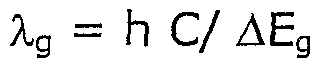
  • the band-gap is the energy difference ⁇ E g between the electrons in the valence band and the electrons in the conduction band. If such a material is illuminated with light at a plurality of wavelengths, then light at certain wavelengths will raise the energy of some of the electrons in the valence band and raise them up into the conduction band. If those electrons then fall back into the valence band from the conduction band, they each will emit a photon of a wavelength ⁇ g which is related to the energy difference between the two bands, ⁇ E g , defined as:
  • h Planck's constant
  • C the velocity of light in the material. This is referred to as the band-gap wavelength or sometimes the band edge wavelength.
  • the tuning section always uses material with a band-gap wavelength ⁇ g shorter than the lasing wavelength to overcome the absorption penalty incurred when operating close to the material band-gap wavelength ⁇ g .
  • use of the quadratic electro-optic effect in a tuning section of a tuneable laser is particularly disadvantageous because it forces the design of the tuning section material to have ⁇ g very close to the lasing wavelength.
  • the invention goes completely in the opposite direction and seeks to work in the regions where the linear electro-optic effect r ( ⁇ n L term) is dominant and significantly above the band-gap wavelength ⁇ g .
  • the linear effect ( ⁇ n ) is relatively insensitive to wavelength.
  • the linear effect is also not accompanied by the light absorption losses.
  • the first is to produce a flat relatively thick layer of bulk wide band-gap material and to deposit on it a thin layer of narrow band-gap material each of appropriately chosen lattice constant and band-gap.
  • the thin layer of narrow band-gap material is then covered with a layer of photo-resist, and exposed to form a pattern of dots.
  • the unwanted material is then chemically etched away and the photo-resist is then stripped off.
  • Another thick layer of bulk material is applied and the process is repeated as often as is required.
  • a preferred alternative method for forming the QDs is however the self-assembly method (SAQDs) as described in chapter 4 the Bimberg, Grundmann and Ledentsov reference above.
  • SAQDs self-assembly method
  • a thin layer of, for example, InAs is grown rapidly onto a thick bulk layer of, for example, GaAs.
  • MBE molecular beam epitaxy
  • MOVPE metal organic vapour phase epitaxy
  • MOVPE is also sometimes called metal organic chemical vapour deposition (MOCVD).
  • the amount of the InAs is so controlled as to exceed a critical thickness at which point the grown layer splits into isolated dots as a consequence of the strain between the InAs and the GaAs, of our example, and the growth conditions. These dots can be further overgrown by a further layer of GaAs, and then further InAs dots grown as described. This can be repeated for a plurality of layers. This results in a plurality of layers of individual quantum dots (QD).
  • QD quantum dots
  • MOVPE can be used, as is known, to create QDs on an industrial scale.
  • the QDs are self-assembling and typically contain a few thousand of atoms and are normally very flattened pyramids.
  • the ratio of the pyramid base, d, to their height, h, is normally in the range of 5 to 100. Since they are self-assembling, the dimensions of each dot cannot be separately controlled however, it is known that the average size and density of dots can be controlled technologically and manufactured reproducibly.
  • Equation (1) the linear effect ⁇ n L is mainly associated with the core electrons in bulk material.
  • the core electrons stay on the lattice, whilst the valence electrons go off into the conduction band and become conduction electrons if they attain an energy level sufficient to pass across the band-gap. These electrons are free to move throughout the material and provide electrical conduction.
  • the conduction electrons on atoms within a quantum dot cannot get away from the quantum dots, as they cannot attain sufficient energy to overcome the additional confinement energy of the quantum dot.
  • the outer band electrons are confined to the dot and are not free to move through the host semiconductor material and provide electrical conduction.
  • the linear electro-optic effect within a QD layer is much greater than in bulk material.
  • the enhancement factor is typically 200 as described in the Journal of Vacuum Science and Technology, B 19 (4) 1455, 2001. Even though current technology permits a packing density such that only 3% of the volume of a structure can be formed of QDs, this still means that the overall increase in the linear effect is 3% of 200, i.e. about six times greater.
  • the effect can be further enhanced by incorporating a plurality of quantum dot layers.
  • the bulk of the light passing through the tuneable laser is passing through the waveguide 8.
  • the Bragg grating formed in the tuning section influences only the evanescent tail of the light passing through the laser.
  • it is possible to influence the light passing through the laser by incorporating QDs in either of the layers 9a and 9b between which the Bragg grating is formed or within the waveguide itself.
  • Whichever material has the QDs in it will have a significantly greater change of refractive index under the influence of the electric field, so that the tuning effect, which relies on the overall change to the effective refractive index n eff of the tuning section as a whole, is significantly increased by the provision of the QDs.
  • n eff n 0 + ⁇ n.
  • the QDs should be located in the region of the material where the optical field is strongest. This would normally be at the high refractive index layer in the waveguide structure.
  • An advantage of using the linear electro-optic effect induced refractive index change is characterised in that a change of wavelength is not accompanied by a change in optical power output. This is because the change in refractive index consequential to the linear electro-optic effect is not accompanied by a change in the absorption coefficients of the light. This is in marked contrast to the case when using the quadratic electro-optic effect to change the refractive index due to its need to work with ⁇ g very close to the lasing wavelength. In this region the absorption varies strongly with applied voltage and output light power will vary across the tuning range as shown in Figure 2.
  • the current tuneable lasers for 1.55 ⁇ m are also based on the InP/In x Gai- x ASyPi-y material system. Therefore, it is very important from a practical point of view that quantum dots can also be incorporated into the tuneable section(s) of lasers based on the above materials.
  • quantum dots can also be incorporated into the tuneable section(s) of lasers based on the above materials.
  • the InP layer is lattice matched to In x Ga ⁇ . x As y P ⁇ - y , this means that the lattice mismatch between InAs and In x Ga ⁇ . x As y Pi- y is the same as between InAs and InP. Consequently, realisation of the quantum dots growth in the latter system means that they should also be capable of being grown in the former material system.
  • the band-gap wavelength corresponds to 1.42 ⁇ m wavelength.
  • Dot containing materials should and could be designed to achieve a similar or shorter band-gap wavelength. All the above can also apply in dots made using InGaAs instead of InAs. Table 1 below summarises the typical combinations that can be used for dots formed in an epitaxially grown host, which surrounds the quantum dots, on a given substrate.
  • QDs are used with a band-gap energy larger than the energy of the emitted photons in the gain section.
  • SAQDs have a band-gap energy corresponding to a wavelength typically of 1200 to 1300 nm, which is far away from the wavelength of 1550 nm used in the telecommunication C-band, this a very suitable system.
  • quantum dots in InP -based materials can also be designed and produced.
  • Present technology permits the creation of QDs using a wide range of III-V semiconductor materials. This permits the invention to be used in the tuneable section of lasers based on many otherwise unsuitable materials. The number of stacked layers is only limited by the technology available at the time of utilisation of the invention.
  • the linear effect is relatively independent of the wavelength compared to the quadratic effect.
  • the devices can operate over wide bandwidths when operating in the LEO effect mode, and without detrimental absorption of the light.
  • the invention thus permits high wavelength tuning speed, a wide tuning range, constant light output power, low energy consumption for switching operation and wavelength holding, substantial elimination of the Joule heating effect as compared to current injection, or thermal, tuning schemes.
  • tuneable lasers in which QD material is used in the phase sections are possible.
  • the phase section can be very much shorter, because the refractive index change is much greater, and thus the optical losses through this section can be reduced.
  • tuneable laser structures can be envisaged in which the QD material is used for all tuning sections and phase sections such as occur within four section, or higher order, tuneable lasers.
  • QD material may also be used in the gain section of a tuneable laser as is known in the art.

Landscapes

  • Physics & Mathematics (AREA)
  • Nanotechnology (AREA)
  • Engineering & Computer Science (AREA)
  • Chemical & Material Sciences (AREA)
  • Optics & Photonics (AREA)
  • Biophysics (AREA)
  • Life Sciences & Earth Sciences (AREA)
  • Electromagnetism (AREA)
  • General Physics & Mathematics (AREA)
  • Crystallography & Structural Chemistry (AREA)
  • Condensed Matter Physics & Semiconductors (AREA)
  • Semiconductor Lasers (AREA)
  • Investigating Or Analysing Materials By Optical Means (AREA)

Abstract

A tuneable laser including a light creating section to generate light and a tuneable section formed of a semiconductor material which utilises the electro-optic effect to achieve a change in the refractive index of the material, Δn, under the influence of an applied field, F, in accordance with the equation: Δn = - ½ n03 [rF + sF2] ≡ ΔnL + ΔnQ, where no is the refractive index at zero field and ΔnL and ΔnQ are the linear and quadratic contributions to the change in refractive index respectively, r is the linear electro-optic coefficient of the material and s is the quadratic electro-optic coefficient of the material, the tuning section including a waveguide and the material of the waveguide incorporating a plurality of quantum dots and operating in a wavelength region where the value of rF is sufficiently greater than the value of sF2, so as to operate with the dominant effect on Δn being contributed by the linear effect.

Description

Tuneable laser
This invention relates to tuneable lasers and has particular reference to such tuneable lasers having a tuneable portion incorporating quantum dots.
Background to the Invention
In this specification the term "light" will be used in the sense that it is used in optical systems to mean not just visible light but also electromagnetic radiation having a wavelength between 800 nanometres (nm) and 3000 nm.
Single wavelength lasers are important for a number of applications in optical telecommunications and signal processing applications. These include multiple channel optical telecommunications networks using wavelength division multiplexing (WDM). Such networks can provide advanced features, such as wavelength routing, wavelength conversion, adding and dropping of channels and wavelength manipulation in much the same way as in time slot manipulation in time division multiplexed systems. Many of these systems operate in the C- and L- Bands in the range 1530 to 1610 nm.
Tuneable lasers for use in such optical communications systems, particularly in connection with the WDM telecommunication systems, are known. A known tuneable system comprises stacks of single wavelength distributed Bragg reflectors (DBR) lasers, which can be individually selected, or tuned over a narrow range, or by a wide tuning range tuneable laser that can be electronically driven to provide the wavelength required.
In all of these tuneable lasers, reliance is placed on altering the refractive index of the tuning element of the laser by an external action to enable different wavelengths of the laser to be selected to satisfy the necessary lasing conditions. Three main methods of varying the refractive index have been proposed and used. In one method, the free electron plasma effect can be used by free carrier injection, that is by passing an electric current through the tuning section. In a second method, the fundamental band-gap can be changed by thermal heating. In a third method electro-refraction modification can be brought about using the electro-optic effect. In the latter case, an electrical field is established across the tuning section, which changes the refractive index of the section and thus alters the wavelength of the light as it passes through the tuning section.
Each of the tuning systems has advantages and drawbacks. In particular the thermal tuning scheme is very slow, the current tuning scheme has its speed limited by thermal heating effects and the electro refraction scheme has limited bandwidth of modulation, and large output power variation.
Preferably all tuning should be fast, it should consume as little energy as possible and it should provide as broad wavelength tuning as possible, ideally covering the C- and the L-bands without the output power variation. In the current injection tuning mechanism, the refractive index is modified (through the change of the electronic contribution to the dielectric function due to the injection current. At the same time, the injected current creates Joule heating, which dissipates in the device active region. As a result of this, the real wavelength switching speed of the laser device will be determined by the relatively long characteristic time of the heat dissipation, rather than by the electric current switching speed. The thermal dissipation effects can be decreased through device optimisation but cannot be eliminated. The thermally induced band-gap change has similar limitations.
The use of the electro-optic effect relies on the applied voltage rather than injected current and avoids excess heating and long thermal time constants. However, the low refractive index change available in technologically suitable materials, e.g. GaAs and other III-V semiconductors, is the main obstacle to its practical utilisation.
In recent years a great deal of interest has been shown, both theoretically and practically, in quantum well, quantum wire, and quantum dot containing materials. However, there is as yet no universally accepted and adopted nomenclature for these types of materials, for example these types of materials are sometimes referred to as low dimensional carrier confinement materials and other terms are also used. For clarity, therefore, in this specification there will be used three defined terms: quantum wells, which will be referred to as QWs; quantum wires; and quantum dots, which will be referred to as QDs.
In this specification the term QW is used to mean a material having a layer of narrow band-gap material sandwiched between layers of wide band-gap material, with the layer of the narrow band-gap material having a thickness dx of the order of the de Broglie wavelength λdB and the other two dimensions dy and dz of the layer of narrow band-gap material being very much greater than λdB. Within such a structure, the electrons are constrained in the x dimension but are free to move in the y and z dimensions. Typically for a III-V As based material the thickness of the layer for a QW material would be in the range ~50 A to ~300 A.
If now the thickness of the layer dx is reduced to a minimum to give the QW effect, then there is only room in the QW for one energy level for the electrons. An overall QW may have some regions of one energy level only and some regions of a few energy levels.
If the QW is now considered as having a second dimension, say dγ, cut down to the size ~λ B, so that both dx and dy are ~λdB and only d2 is very much greater than λdBr then the electrons are constrained in two dimensions and thus there is, in effect, created a line in which the electrons can freely move in one dimension only, and this is referred to herein as a quantum wire.
If now the quantum wire is further constrained so that dz is also ^λdB, then the electrons are constrained within a very small volume and have zero dimension to move in. This is called herein a quantum dot (QD).
Thus if dx, dy, and dz are all very much greater than λdB the material is simply considered as a bulk material with no quantum effects of the type discussed herein. If dxdB there is provided a quantum well, QW. If dx, dy~ λdB, there is provided a quantum wire, and if dX/ dy, and dz~ λ B, then there is provided a quantum dot, QD.
The technology for producing QWs is well known but quantum wires have yet to be produced on a commercial scale. In practise they have been formed in the laboratory by electrically constraining a QW structure with electrical fields or by so-called V-growth, but these are not yet practical commercially available processes.
The present invention is concerned with the use and application of QD materials in tuneable lasers. Production processes for QD materials are well established. Two main processes have been developed, chemical etching and self-assembly, and the self-assembly process will be explained in more detail below.
QD materials have been widely suggested for use in lasers, see for example D Bimberg et al, Novel Infrared Quantum Dot Lasers: Theory and Reality, phys. stat. sol. (b) 224, No. 3, 787-796 (2001). Principally they have been suggested for use in the light creating lasing section of a current injection laser because they can produce light of a very narrowly defined wavelength, with a very low threshold current and QD materials have a very high characteristic temperature so as to give a temperature stable laser emitter. Because of these very significant benefits, most of the work on QD materials in laser applications has concentrated on their use in the emitter. Applications of the Invention
The present invention is not directed to the use of QD materials in laser emitters, but is directed to the use of QD materials in the tuning section of a tuneable laser.
The essence of the present invention is the enhancement of the linear electro- optic (LEO) coefficient in a bulk semiconductor material that forms a tuneable section of a tuneable laser, and especially in III-V semiconductors (e.g. GaAs), by the use of quantum dots. The LEO coefficient can be regarded as a means of varying the refractive index (RI) of the material under the effect of an electrical field normally created by an applied voltage.
In bulk III-V semiconductors, the LEO coefficient at optical wavelengths depends on the distortion, (i.e. polarisation) of the tightly bound core electrons in the semiconductor atoms on the application of an electric field. These are strongly bound and the effect is proportionately weak. This leads to the need for high drive voltages and long active regions to build a large enough phase change and effect modulation. Notably, the weakly bound valence electrons do not contribute significantly because they form a conduction band and flow away when a field is applied and do not add to the local dipole moment or polarisation.
QDs are little boxes of narrow band-gap material formed inside the bulk III-V material. They confine these weakly bound electrons and their corresponding holes (in the valence band) and do not allow them to conduct. They are, in essence, artificial atoms. When a field is applied these weakly bound carriers contribute a large dipole moment, or polarisation , and hence a large LEO coefficient. In addition the shape of the quantum boxes also leads to a built-in dipole moment before the field is applied and this enhances the LEO coefficient further. Initial results obtained by using the invention show that the LEO coefficient in the dot system is enhanced over the bulk GaAs system by around 200 times (see below). Even allowing for the reduced overlap of the light field in the dilute layers of dots (compared to the bulk material) this still leaves a factor of at least 5 or 6 in the net effect. The effect can be further enhanced using a plurality of layers of self assembled quantum dots.
In general there are two contributions to the refractive index change, Δn, under an applied electric field F: the linear contribution due to the Pockels effect and quadratic contribution due to the Kerr effect. These are represented in the equation:
Δn = - y2 n0 3 [rF + sF2] ≡ ΔnL+ ΔnQ (1)
where r is the linear and s the quadratic electro-optic coefficient, F is the applied field, and n0 is the refractive index of the material at zero field, and Δn and ΔnQ are the linear and quadratic contributions to the change in refractive index respectively.
The invention is particularly concerned with tuneable lasers which exploit the linear part rather than the quadratic part of the electro-optic effect. The quadratic part is strongest at wavelengths near the band-gap but suffers from high absorption and narrow optical bandwidth. The LEO coefficient has a wide optical bandwidth and as it is operated well away from the band-gap there are low losses in addition to the wide bandwidth utilisation.
Brief Description of the Invention
By the present invention there is provided a tuneable laser including a light creating section to generate light and a tuneable section formed of a semiconductor material which utilises the electro-optic effect to achieve a change in the refractive index of the material, Δn, under the influence of an applied field, F, in accordance with the equation:
Δn = - 1/2 n0 3 [rF + sF2] = Δn + ΔnQ where n0 is the refractive index at zero field and ΔnL and ΔnQ are the linear and quadratic contributions to the change in refractive index respectively, r is the linear electro-optic coefficient of the material and s is the quadratic electro-optic coefficient of the material, the tuning section including a waveguide and the material of the waveguide incorporating a plurality of quantum dots and operating in a wavelength region where the value of rF is sufficiently greater than the value of sF2, so as to operate with the dominant effect on Δn being contributed by the linear effect.
- The invention also provides a tuneable laser including a light creating section to generate light of a wavelength λ and a tuneable section; the tuneable section being formed of a semi-conducting material incorporating a plurality of quantum dots and exhibiting an electro-optic response thereby to permit variation of the refractive index; the band-gap of the semiconducting material incorporating the quantum dots being such that the corresponding wavelength λg is less than λ.
The invention further provides a tuneable laser including a light creating section to generate light of a wavelength λ and a tuneable section including a waveguide; the waveguide of the tuneable section being formed of a semiconducting material incorporating a plurality of quantum dots and exhibiting an electro-optic response thereby to permit variation of the refractive index; the band-gap of the semiconducting material incorporating the quantum dots being such that the corresponding wavelength λg is less than λ.
In another form, the invention provides a tuneable laser including a Light creating section to generate light and a\ tuneable section for adjusting the wavelength thereof within the range λx and λ2; the tuneable section being formed of a semiconducting material incorporating a plurality of quantum dots and exhibiting an electro-optic response thereby to permit variation of the refractive index; the band-gap of the semiconducting material incorporating the quantum dots being such that the corresponding wavelength λg is less than both λi and λ2 by an amount sufficient that the change in refractive index at λx and λ2 is substantially the same.
In yet a further form, the invention provides a tuneable laser including a light creating section to generate light and a tuneable section for adjusting the wavelength thereof within the range λi and λ2; the tuneable section including a waveguide, the waveguide of the tuneable section being formed of a semiconducting material incorporating a plurality of quantum dots and exhibiting an electro-optic response thereby to permit variation of the refractive index; the band-gap of the semiconducting material incorporating the quantum dots being such that the corresponding wavelength λg is less than both λi and λ2 by an amount sufficient that the change in refractive index at λi and λ2 is substantially the same.
In this way, a device with a wide bandwidth is achieved by appropriately separating the band-gap wavelength and the operating wavelengths. As the separation increases, the slope of the linear effect with wavelength decreases and thus the difference in refractive index (which leads to dispersion) at λi and λ2 decreases. Experimental results for GaAs material given in "Analysis and Design of High-Speed High Efficiency GaAs - AIGaAs Double Heterostructure Waveguide Phase Modulator", Sang Sun Lee, Ramu V. Ramaswany and Veeravana S. Sundaram, IEEE Journal of Quantum Electronics, Vol. 27, No. 3, March 1991, suggests that in the dominant linear effect region the variation of the linear effect term ΔnL, is less than 0.1% per nanometre of wavelength change when operating in the range of wavelengths covering the telecommunication C and L- Bands (substantially 1530 nm to 1610 nm). By comparison the same data suggests that in this wavelength region the variation of the quadratic effect term ΔnQ, is greater than 1% per nanometre of wavelength change. To give a useful operating bandwidth, it is further preferred that the difference between λx and λ2 is greater than 1 nm. The tuneable section may be the tuning section of the laser, and may incorporate a distributed Bragg reflector.
The tuneable laser may incorporate a phase change section and the phase change section may be a tuneable section.
The semiconductor material may be a III-V semiconductor material, which may be based on a system selected from the group GaAs based, InAs based materials and InP- based materials.
The band-gap wavelength λg of the quantum dots may be smaller than the wavelength (λ) of the photons emitted by the light creating section. It is preferred that the band-gap wavelength λg is separated from the operating wavelength(s) of the laser. Thus, the band-gap wavelength λg is typically 100 nm shorter than the wavelength of the photons emitted by the light creating section. This avoids considerable absorption of the light in a tuning section. Other suitable separations are achieved if λg is less than 90% of λ and/or if λg is less than 1400nm in which case normal optical signals in the region of 1550nm are suitably separated.
The laser may comprise a combination of gain sections, phase sections and tuning sections and thereby be a three or four section laser, or have more than four sections.
The quantum dots may be self-assembled quantum dots in which the self- assembled quantum dots may be formed of InAs based material in host GaAs based semiconductor material. The host material may be formed on a GaAs substrate.
The self-assembled quantum dots may be formed of InGaAs based material in host GaAs based semiconductor material which host material may be formed on a GaAs substrate. The self-assembled quantum dots may be formed of InAs based material in host InGaAsP based semiconductor material which host material may be formed on an InP substrate.
The self-assembled quantum dots may be formed of InGaAs based material in host InxGaι-xAsyPι-y based semiconductor material which host material may be formed on an InP substrate.
Alternatively, the quantum dots may be formed by a chemical etching process.
There may be a plurality of layers of quantum dots.
Description of the Preferred Embodiments of the Invention
The present invention will now be described with reference to the accompanying drawings, of which : -
Figure la. is a schematic cross section of a two section tuneable laser
Figure lb. is a schematic cross section of a three section tuneable laser
Figure lc. is a schematic cross section of an alternative three section tuneable laser, and
Figure 2. is a schematic graph of the values Δn and ΔnQ against' wavelength λ.
Semiconductor tuneable lasers are known in the art. The principals of tuneable lasers are described in chapters 4 and 5 of "Tuneable Laser Diodes", by Markus- Christian Amann and Jens Bus, ISBN 0-89006-963-8, published by Artech House, Inc.
Referring to Figure la., this shows schematically in cross section a first embodiment two-section Distributed Bragg Reflector (DBR) tuneable laser, which can be used to demonstrate how the invention can be put into effect.
The laser comprises a gain section 1, and a tuning section 3 incorporating a DBR grating. At the front of the gain section on the opposite side to the tuning section is a partially reflecting mirror 4, which reflects at all operating wavelengths. The laser works by injecting current through an electrode la into the gain section 1 and through a return electrode lb to create the carrier population inversion and cause the gain section to emit light. This light is reflected by the tuning section 3, which reflects at the lasing wavelength, and by the mirror 4, so as to build up into laser light at the wavelength of the reflection from the DBR grating, in a manner well known per se. The laser light is emitted from the front of the laser in the direction of the arrow 6. A common optical waveguide 8 operates across the whole longitudinal lasing cavity of the device. The rear facet 7 of the laser is anti-reflection coated so that it does not produce any secondary reflections which would disturb the desired operation of the longitudinal lasing cavity formed between the tuning section and the front mirror 4. Typically a tap of laser light from the rear facet 7 may be used in wavelength locker applications. Electrical isolation between sections 1 and 3 is achieved by an electrical barrier 5, which is optically transparent so as not to add any appreciable attenuation within optical waveguide 8. A suitable means of constructing such a barrier is given in "Ultra-Fast Optical Switching Operation of DBR Lasers using an Electro-Optical Tuning Section"; F Delorme, A Ramdane, B Rose, S Slempkes and H Nakajima; IEEE Photonics Technology Letters, Volume 7, No. 3, p. 260, March 1995.
The DBR grating within tuning section 3 is preferably formed between a layer of material 9a of a refractive index n2 and an upper layer of material 9b having a refractive index n3 which is lower than the refractive index n2 of the layer 9a. The refractive indices n2 and n3 are both lower than refractive index ni of the waveguide 8. The DBR grating itself is defined by a boundary between the two layers 9a and 9b. It is formed by laying down layer 9a upon waveguide layer 8, photo-etching the layer 9a in the manner well known per se, for example using electron beam writing techniques or phase mask holographic techniques as though it were any other material, and then laying down the upper layer 9b onto the layer 9a which has the DBR grating interface etched into it.
The pitch of the grating formed between layers 9a and 9b can be determined by the Bragg condition. λ=2neffΛ
where λ is the wavelength, neff is the effective refractive index of the waveguide material. In some cases, see below, neff may not be exactly the same n^ Λ is the pitch for first order gratings, which are preferred as they provide the strongest coupling.
As is well known, if a potential is passed via electrode 3a, the effective refractive index of the grating and the active material immediately underneath the electrode is decreased and hence the wavelength of the grating can be tuned.
The tuneable laser shown in Figure la. is in the most basic form. A preferred embodiment is shown in Figure lb. Common integers have been used for equivalent functionality for all embodiments described.
Figure lb shows schematically in cross section a three-section DBR tuneable laser. The laser comprises a gain section 1, a phase change section 2 and a tuning section 3 incorporating a DBR grating. At the front of the gain section on the opposite side to the phase change 2 is a partially reflecting mirror 4, which reflects at all operating wavelengths. The laser works by injecting current through an electrode la into the gain section 1 and through a return electrode lb to create the carrier population inversion and cause the gain section to emit light. This light is reflected by the grating in the tuning section 3, which reflects at the lasing wavelength, and by the partially reflecting mirror 4, so as to build up into laser light at the wavelength of the reflection from the DBR grating. The laser light is emitted from the front of the laser in the direction of the arrow 6. The phase matching section 2 is used to maintain a constant longitudinal optical cavity length and thereby prevent mode hoping. The phase section has its own independent electrodes 2a and 2b. Similarly, the tuning section 3 has its own independent electrodes 3a and 3b. As with the two section tuneable laser the three section device includes a longitudinal waveguide 8, rear facet 7, and electrical isolation barriers 5, between each of its sections. Those of ordinary skill will appreciate that the architecture of Figure lb., may be modified to an alternative preferred embodiment as shown in Figure lc, wherein the tuning section and gain section have been interchanged. In this architecture the rear facet 7a would be coated for high reflectivity to act as a mirror. In this arrangement the front mirror 4a would be designed for very high transmission and minimal reflectivity so that operationally the cavity defined by 4a and 7a, would be negated by the dynamics of the cavity defined by 7a and the tuning section 3. Each of the sections 1, 2 and 3 in this design have their own independent sets of electrodes la, lb, 2a, 2b, and 3a, 3b respectively.
It will be appreciated that as well as two and three section longitudinal semiconductor tuneable lasers there are other classes of design such as the four section laser discussed in GB2337135B. In the main these higher order tuneable laser design use alternative mirror arrangements in place of the front facet mirror. In so far as these alternative mirror arrangements rely upon the material refractive index to determine the operating wavelength, so this invention may be used with these higher order tuneable laser designs.
With reference to Figure lb, a preferred embodiment, to vary the wavelength of light emitted by the laser, a voltage is applied between the electrode 3a and the return electrode 3b, to change the refractive index of the material of the tuning section and to cause it to reflect at a different wavelength. This tuning mechanism is described in "Ultra-Fast Optical Switching Operation of DBR Lasers using an Electro-Optical Tuning Section"; F Delorme, A Ramdane, B Rose, S Slempkes and H Nakajima; IEEE Photonics Technology Letters, Volume 7, No. 3, p. 260, March 1995.
In , a similar manner to the electrical drive of the tuning section so the phase section can be electrically driven to make fine tuning control.
The effect of the field established across the tuning section is to vary the refractive index in accordance with equation (1) above:
Δn = - V n0 3 [rF + sF2] = ΔnL+ ΔnQ However, the values of both r and s are only constant at a given wavelength and the variation in both r and s with wavelength λ is as shown schematically in Figure 2. It can be seen from this equation that both r and s decrease with increasing wavelength away from the characteristic wavelength λg, but that the value of s varies very significantly with wavelength whereas the value of r varies only by small amounts with wavelength.
The characteristic wavelength, λg, is defined as follows. The band-gap is the energy difference ΔEg between the electrons in the valence band and the electrons in the conduction band. If such a material is illuminated with light at a plurality of wavelengths, then light at certain wavelengths will raise the energy of some of the electrons in the valence band and raise them up into the conduction band. If those electrons then fall back into the valence band from the conduction band, they each will emit a photon of a wavelength λg which is related to the energy difference between the two bands, ΔEg, defined as:
Figure imgf000016_0001
where h is Planck's constant, and C is the velocity of light in the material. This is referred to as the band-gap wavelength or sometimes the band edge wavelength.
Given that the Δn varies only with the first power of F in the portion of the equation concerned with r (Δn term) but with the square of F in the portion concerned with s (ΔnQ term), and given that the wavelength λg corresponds to the band-gap energy for the semiconductor material of the tuning section 3, it can be understood why effort has been focussed on enhancing the electro-optic effect by utilising the quadratic term in equation (1) ΔnQ, for example, in light electro-absorption modulators such as described in "Fibre-Optic Communication Systems" by G.P. Agrawal, published by John Wiley and Sons, 1997, page 127, but the penalty is increased light absorption. Indeed, in all conventional tuneable lasers, including those using current injection tuning, the tuning section always uses material with a band-gap wavelength λg shorter than the lasing wavelength to overcome the absorption penalty incurred when operating close to the material band-gap wavelength λg. As a consequence use of the quadratic electro-optic effect in a tuning section of a tuneable laser is particularly disadvantageous because it forces the design of the tuning section material to have λg very close to the lasing wavelength.
The invention goes completely in the opposite direction and seeks to work in the regions where the linear electro-optic effect r (ΔnL term) is dominant and significantly above the band-gap wavelength λg.
However, in all currently known semiconductor bulk materials the linear electro- optic effect is very small and does not yield sufficient change in Δn for all practical implementations. The electro-optic tuning scheme has relied upon use of the quadratic effect only. This has been demonstrated in the experiment described in the paper "Ultra-Fast Optical Switching Operation of DBR Lasers using an Electro-Optical Tuning Section"; F Delorme, A Ramdane, B Rose, S Slempkes and H Nakajima; IEEE Photonics Technology Letters, Volume 1 , No. 3, p. 260, March 1995. A tuning range of only 2.5 nm was achieved. Such a small wavelength tuning range was limited by the increase of the absorption losses with increase of applied bias. Although ΔnQ could be increased further by increasing the applied bias, it could be achieved only at the expense of a decrease in the output power. For practical telecommunication devices a tuning range in excess of 40 nm is desired without any change of output power across the tuning range.
As shown in Figure 2., the linear effect (Δn ) is relatively insensitive to wavelength. The linear effect is also not accompanied by the light absorption losses.
To enhance the linear electro-optic effect (LEO) we now consider a QD structure. As mentioned above, this effectively comprises a plurality of small, notionally zero dimension regions, in a host of bulk, semiconductor material. These regions are capable of capturing and confining carriers (electrons and/or holes) as described in "Quantum Dot Heterostructures" by D. Bimberg, M. Grundmann and N. N. Ledentsov, published by Wiley, Chichester 1999, chapter 1. The mechanism of electro-optic effect enhancement is described below. Two main methods of producing such structures have been developed and are described in chapter 2 of the above reference. The first is to produce a flat relatively thick layer of bulk wide band-gap material and to deposit on it a thin layer of narrow band-gap material each of appropriately chosen lattice constant and band-gap. The thin layer of narrow band-gap material is then covered with a layer of photo-resist, and exposed to form a pattern of dots. The unwanted material is then chemically etched away and the photo-resist is then stripped off. Another thick layer of bulk material is applied and the process is repeated as often as is required.
A preferred alternative method for forming the QDs is however the self-assembly method (SAQDs) as described in chapter 4 the Bimberg, Grundmann and Ledentsov reference above. In this process a thin layer of, for example, InAs is grown rapidly onto a thick bulk layer of, for example, GaAs. This can be done using either molecular beam epitaxy (MBE) or metal organic vapour phase epitaxy (MOVPE). MOVPE is also sometimes called metal organic chemical vapour deposition (MOCVD).
The amount of the InAs is so controlled as to exceed a critical thickness at which point the grown layer splits into isolated dots as a consequence of the strain between the InAs and the GaAs, of our example, and the growth conditions. These dots can be further overgrown by a further layer of GaAs, and then further InAs dots grown as described. This can be repeated for a plurality of layers. This results in a plurality of layers of individual quantum dots (QD).
MOVPE can be used, as is known, to create QDs on an industrial scale. The QDs are self-assembling and typically contain a few thousand of atoms and are normally very flattened pyramids. The ratio of the pyramid base, d, to their height, h, is normally in the range of 5 to 100. Since they are self-assembling, the dimensions of each dot cannot be separately controlled however, it is known that the average size and density of dots can be controlled technologically and manufactured reproducibly.
We now discuss how such QDs can be used to enhance the linear electro-optic effect. In equation (1) above the linear effect ΔnL is mainly associated with the core electrons in bulk material. In a semiconductor, the core electrons stay on the lattice, whilst the valence electrons go off into the conduction band and become conduction electrons if they attain an energy level sufficient to pass across the band-gap. These electrons are free to move throughout the material and provide electrical conduction.
In a QD material the conduction electrons on atoms within a quantum dot cannot get away from the quantum dots, as they cannot attain sufficient energy to overcome the additional confinement energy of the quantum dot. The outer band electrons are confined to the dot and are not free to move through the host semiconductor material and provide electrical conduction.
When an external field is applied to the structure of a semi-conductor, the field distorts the atoms and it is this distortion that actually causes linear variation of the refractive index. In a bulk material the applied field has to interact with the valence electrons, which are strongly bound to the nucleus of the atoms, so the distortion is relatively small. However, in a QD the outer conduction electrons are locked into the dot. The QD behaves like an artificial atom. When an electric field is applied the conduction electrons confined within the QD behave like very loosely bound core electrons. The dot is therefore a very highly polarisable artificial atom. This unique characteristic of quantum dots (QD) distinguishes them over all other bulk, quantum well or quantum wire semiconductor materials.
As a consequence of the above the linear electro-optic effect within a QD layer is much greater than in bulk material. For example, in InAs dots in GaAs the enhancement factor is typically 200 as described in the Journal of Vacuum Science and Technology, B 19 (4) 1455, 2001. Even though current technology permits a packing density such that only 3% of the volume of a structure can be formed of QDs, this still means that the overall increase in the linear effect is 3% of 200, i.e. about six times greater. The effect can be further enhanced by incorporating a plurality of quantum dot layers.
This means that compared to bulk material a QD material would be typically six times or more effective in changing the refractive index via the linear electro- optic effect, for the same bias condition.
It is well known that the bulk of the light passing through the tuneable laser is passing through the waveguide 8. The Bragg grating formed in the tuning section influences only the evanescent tail of the light passing through the laser. Thus it is possible to influence the light passing through the laser by incorporating QDs in either of the layers 9a and 9b between which the Bragg grating is formed or within the waveguide itself. Whichever material has the QDs in it will have a significantly greater change of refractive index under the influence of the electric field, so that the tuning effect, which relies on the overall change to the effective refractive index neff of the tuning section as a whole, is significantly increased by the provision of the QDs. In this case neff = n0 + Δn. For maximum effect the QDs should be located in the region of the material where the optical field is strongest. This would normally be at the high refractive index layer in the waveguide structure.
In a practical application with a tuneable semiconductor laser such QD material used in the tuning section would allow the tuneability to be increased to typically six times the wavelength range. This makes the linear electro-optic effect a viable mechanism for tuning a semiconductor laser.
An advantage of using the linear electro-optic effect induced refractive index change is characterised in that a change of wavelength is not accompanied by a change in optical power output. This is because the change in refractive index consequential to the linear electro-optic effect is not accompanied by a change in the absorption coefficients of the light. This is in marked contrast to the case when using the quadratic electro-optic effect to change the refractive index due to its need to work with λg very close to the lasing wavelength. In this region the absorption varies strongly with applied voltage and output light power will vary across the tuning range as shown in Figure 2. of paper "Subnanosecond Tuneable Distributed Bragg Reflector Lasers with an Electro-optical Bragg Section": F Delorme, S Slempkes, A Ramdane, B Rose, H Nakajima, IEEE Journal of Selected Topics in Quantum Electronics, Volume 1, No. 2, p. 396, June 1995. Telecommunication systems require laser sources feeding the system with a constant output light power for each wavelength.
Use of an InP substrate for deposition of InAs quantum dots has been considered as one of the attractive methods in order to grow quantum dots in the gain or light creating and emitting section of a laser emitting at 1.55 μm, as described by A Pouchet, A Le Corre, H LΗaridon, B Lambert and A. Salaum, Applied Physics Letters No. 67, 1850 (1995).
The current tuneable lasers for 1.55μm are also based on the InP/InxGai-xASyPi-y material system. Therefore, it is very important from a practical point of view that quantum dots can also be incorporated into the tuneable section(s) of lasers based on the above materials. Although currently there is no experimental evidence to demonstrate growth of InAs quantum dots on the quarternary materials such as for example, InxGaι-xAsyPι-y, it is believed that there should not be any technological obstacles s to realise such a growth. This is because the most important parameter for quantum dots growth is a lattice mismatch between InAs and InxGax-xASyPi-y. Since the InP layer is lattice matched to InxGaι.xAsyPι-y, this means that the lattice mismatch between InAs and InxGaι. xAsyPi-yis the same as between InAs and InP. Consequently, realisation of the quantum dots growth in the latter system means that they should also be capable of being grown in the former material system.
For chosen compositions in the quarternary alloy InxGaι-xAsyPι-y in current tuneable lasers the band-gap wavelength corresponds to 1.42 μm wavelength. Dot containing materials should and could be designed to achieve a similar or shorter band-gap wavelength. All the above can also apply in dots made using InGaAs instead of InAs. Table 1 below summarises the typical combinations that can be used for dots formed in an epitaxially grown host, which surrounds the quantum dots, on a given substrate.
Table 1.
Figure imgf000022_0001
In order that optical losses near the band-gap edge are avoided, it is preferred that QDs are used with a band-gap energy larger than the energy of the emitted photons in the gain section. As naturally grown In(Ga) - As/GaAs SAQDs have a band-gap energy corresponding to a wavelength typically of 1200 to 1300 nm, which is far away from the wavelength of 1550 nm used in the telecommunication C-band, this a very suitable system. However, for compatibility with existing InP -based laser diode structures, quantum dots in InP -based materials can also be designed and produced.
Present technology permits the creation of QDs using a wide range of III-V semiconductor materials. This permits the invention to be used in the tuneable section of lasers based on many otherwise unsuitable materials. The number of stacked layers is only limited by the technology available at the time of utilisation of the invention.
As mentioned above and as shown with reference to Figure 2., the linear effect is relatively independent of the wavelength compared to the quadratic effect. Thus the devices can operate over wide bandwidths when operating in the LEO effect mode, and without detrimental absorption of the light.
The invention thus permits high wavelength tuning speed, a wide tuning range, constant light output power, low energy consumption for switching operation and wavelength holding, substantial elimination of the Joule heating effect as compared to current injection, or thermal, tuning schemes.
Embodiments of tuneable lasers in which QD material is used in the phase sections are possible. In such an embodiment the phase section can be very much shorter, because the refractive index change is much greater, and thus the optical losses through this section can be reduced. Similarly, tuneable laser structures can be envisaged in which the QD material is used for all tuning sections and phase sections such as occur within four section, or higher order, tuneable lasers. QD material may also be used in the gain section of a tuneable laser as is known in the art.

Claims

Claims
1. A tuneable laser including a light creating section to generate light and a tuneable section formed of a semiconductor material which utilises the electro- optic effect to achieve a change in the refractive index of the material, Δn, under the influence of an applied field, F, in accordance with the equation:
Δn = - 1/2 n0 3 [rF + sF2] -≡ ΔnL + ΔnQ
where n0 is the refractive index at zero field and Δnι_ and ΔΠQ are the linear and quadratic contributions to the change in refractive index respectively, r is the linear electro-optic coefficient of the material and s is the quadratic electro-optic coefficient of the material, the material incorporating a plurality of quantum dots and operating in a wavelength region where the value of rF is sufficiently greater than the value of sF2, so as to operate with the dominant effect on Δn being contributed by the linear effect.
2. A tuneable laser including a light creating section to generate light and a tuneable section formed of a semiconductor material which utilises the electro- optic effect to achieve a change in the refractive index of the material, Δn, under the influence of an applied field, F, in accordance with the equation:
Δn = - 1/z n0 3 [rF + sF2] ≡ ΔnL + ΔnQ
where n0 is the refractive index at zero field and ΔnL and ΔnQ are the linear and quadratic contributions to the change in refractive index respectively, r is the linear electro-optic coefficient of the material and s is the quadratic electro-optic coefficient of the material, the tuning section including a waveguide and the material of the waveguide incorporating a plurality of quantum dots and operating in a wavelength region where the value of rF is sufficiently greater than the value of sF2, so as to operate with the dominant effect on Δn being contributed by the linear effect.
3. A tuneable laser as claimed in claim 1 or 2 in which the band-gap wavelength λg of the quantum dots is shorter than the wavelength of the photons- emitted by the light creating section.
4. A tuneable laser as claimed in claim 1, 2, or 3 in which the band-gap wavelength λg of the quantum dots in the tuneable section is typically 100 nm shorter than the wavelength of the photons emitted by the light creating section.
5. A tuneable laser including a light creating section to generate light of a wavelength λ and a tuneable section; the tuneable section being formed of a semiconducting material incorporating a plurality of quantum dots and exhibiting an electro-optic response thereby to permit variation of the refractive index; the band-gap of the semiconducting material incorporating the quantum dots being such that the corresponding wavelength λg is less than λ.
6. A tuneable laser including a light creating section to generate light of a wavelength λ and a tuneable section including a waveguide; the waveguide of the tuneable section being formed of a semiconducting material incorporating a plurality of quantum dots and exhibiting an electro-optic response thereby to permit variation of the refractive index; the band-gap of the semiconducting material incorporating the quantum dots being such that the corresponding wavelength λg is less than λ.
7. A tuneable laser according to claim 5 or 6 in which λg is less than 1400nm.
8. A tuneable laser according to claim 5 or 6 in which λg is less than 90% of λ.
9. A tuneable laser according to claim 5 or 6 in which the difference between λg and λ is greater than lOOnm.
10. A tuneable laser including a light creating section to generate light and a tuneable section for adjusting the wavelength thereof within the range λi and λ2; the tuneable section being formed of a semiconducting material incorporating a plurality of quantum dots and exhibiting an electro-optic response thereby to permit variation of the refractive index; the band-gap of the semiconducting material incorporating quantum dots being such that the corresponding wavelength λg is less than both λl and λ2 by an amount sufficient that the change in refractive index at λl and λ2 is substantially the same.
11. A tuneable laser including a light creating section to generate light and a tuneable section for adjusting the wavelength thereof within the range λx and λ2, the tuneable section including a waveguide; the waveguide of the tuneable section being formed of a semiconducting material incorporating a plurality of quantum dots and exhibiting an electro-optic response thereby to permit variation of the refractive index; the band-gap of the semiconducting material incorporating the quantum dots being such that the corresponding wavelength λg is less than both λi and λ2 by an amount sufficient that the change in refractive index at λi and λ2 is substantially the same.
12. A tuneable laser according to claim 10 or 11 in which the difference in refractive index at λi and λ2 is less than 0.1% per nanometre of wavelength change.
13. A tuneable laser according to claim 10, 11 or 12 in which the difference between λi and λ2 is greater than lnnrf.
14. A tuneable laser as claimed in any one of the preceding claims in which the tuneable section is the tuning section of the laser.
15. A tuneable laser as claimed in claim 14 in which the tuneable section incorporates a distributed Bragg reflector.
16. A tuneable laser as claimed in claim 15 in which the distributed Bragg reflector is formed between two layers of different refractive indices and a plurality of quantum dots is provided in either of the layers between which the Bragg grating is formed.
17. A tuneable laser as claimed in any one of the preceding claims in which the tuneable laser incorporates a phase change section and the phase change section is a tuneable section.
18. A tuneable laser as claimed in any one of the preceding claims in which the semiconductor material is a III-V semiconductor material.
19. A tuneable laser as claimed in claim 18 in which the III-V semiconductor material is based on a system selected from the group GaAs, InAs based materials and InP based materials.
20. A tuneable laser as claimed in any one of the preceding claims in which the laser is a three or four section laser, or has more than four sections.
21. A tuneable laser as claimed in any one of the preceding claims in which the quantum dots are self-assembled quantum dots.
22. A tuneable laser as claimed in any one of the preceding claims in which the self-assembled quantum dots are formed of InAs based material in host GaAs based semiconductor material.
23. A tuneable laser as claimed in claim 22 in which the host material is formed on a GaAs substrate.
24. A tuneable laser as claimed in any one of claims 1 to 21 in which the self- assembled quantum dots are formed of InGaAs based material in host GaAs based semiconductor material.
25. A tuneable laser as claimed in claim 24 in which the host material is formed on a GaAs substrate.
26. A tuneable laser as claimed in any one of claims 1 to 21 in which the self- assembled quantum dots are formed of InAs based material in host InxGaι- xASyPi-y based semiconductor material.
27. A tuneable laser as claimed in claim 26 in which the host material is formed on an InP substrate.
28. A tuneable laser as claimed in any one of claims 1 to 21 in which the self- assembled quantum dots are formed of InGaAs based material in host InxGaι- xASy i-ybased semiconductor material.
29. A tuneable laser as claimed in claim 28 in which the host material is formed on an InP substrate.
30. A tuneable laser as claimed in any one of the preceding claims in which the quantum dots are formed by a chemical etching process.
31. A tuneable laser as claimed in any one of the preceding claims in which there is a plurality of layers of quantum dots.
PCT/GB2003/001175 2002-03-19 2003-03-19 Tunable laser Ceased WO2003081733A2 (en)

Priority Applications (3)

Application Number Priority Date Filing Date Title
AU2003229868A AU2003229868A1 (en) 2002-03-19 2003-03-19 Tunable laser
EP03722704A EP1485975A2 (en) 2002-03-19 2003-03-19 Tunable laser
US10/508,386 US20050175044A1 (en) 2002-03-19 2003-03-19 Tuneable laser

Applications Claiming Priority (8)

Application Number Priority Date Filing Date Title
GB0206441A GB0206441D0 (en) 2002-03-19 2002-03-19 Tuneable laser
GB0206441.8 2002-03-19
GB0207164.5 2002-03-27
GB0207164A GB2386753B (en) 2002-03-19 2002-03-27 Tunable laser
GB0211039A GB2388708B (en) 2002-05-15 2002-05-15 Tunable laser
GB0211038.5 2002-05-15
GB0211038A GB2388707B (en) 2002-05-15 2002-05-15 Tunable laser
GB0211039.3 2002-05-15

Publications (2)

Publication Number Publication Date
WO2003081733A2 true WO2003081733A2 (en) 2003-10-02
WO2003081733A3 WO2003081733A3 (en) 2004-07-01

Family

ID=28457821

Family Applications (1)

Application Number Title Priority Date Filing Date
PCT/GB2003/001175 Ceased WO2003081733A2 (en) 2002-03-19 2003-03-19 Tunable laser

Country Status (4)

Country Link
US (1) US20050175044A1 (en)
EP (1) EP1485975A2 (en)
AU (1) AU2003229868A1 (en)
WO (1) WO2003081733A2 (en)

Cited By (1)

* Cited by examiner, † Cited by third party
Publication number Priority date Publication date Assignee Title
EP1504505A2 (en) * 2002-05-15 2005-02-09 Bookham Technology Limited Tuneable laser

Families Citing this family (5)

* Cited by examiner, † Cited by third party
Publication number Priority date Publication date Assignee Title
JP2009518833A (en) 2005-12-07 2009-05-07 インノルメ ゲゼルシャフト ミット ベシュレンクテル ハフツング Laser light source with broadband spectral emission
US7561607B2 (en) * 2005-12-07 2009-07-14 Innolume Gmbh Laser source with broadband spectrum emission
US7835408B2 (en) * 2005-12-07 2010-11-16 Innolume Gmbh Optical transmission system
WO2010065731A2 (en) 2008-12-03 2010-06-10 Innolume Gmbh Semiconductor laser with low relative intensity noise of individual longitudinal modes and optical transmission system incorporating the laser
JP2010232424A (en) * 2009-03-27 2010-10-14 Fujitsu Ltd Semiconductor optical amplifier and optical module

Family Cites Families (15)

* Cited by examiner, † Cited by third party
Publication number Priority date Publication date Assignee Title
JPS6155981A (en) * 1984-08-27 1986-03-20 Kokusai Denshin Denwa Co Ltd <Kdd> Semiconductor light-emitting element
JPH0831653B2 (en) * 1987-07-21 1996-03-27 国際電信電話株式会社 Semiconductor laser
JPH01223791A (en) * 1988-03-02 1989-09-06 Fujitsu Ltd Semiconductor laser
FR2655434B1 (en) * 1989-12-05 1992-02-28 Thomson Csf OPTICAL DEVICE WITH QUANTUM WELLS AND METHOD FOR PRODUCING THE SAME.
JP3195159B2 (en) * 1993-11-25 2001-08-06 株式会社東芝 Optical semiconductor device
FR2728399B1 (en) * 1994-12-20 1997-03-14 Bouadma Nouredine LASER COMPONENT WITH BRAGG REFLECTOR IN ORGANIC MATERIAL AND METHOD FOR THE PRODUCTION THEREOF
JPH09222588A (en) * 1996-02-15 1997-08-26 Fujitsu Ltd Optical semiconductor device
JP2822994B2 (en) * 1996-09-11 1998-11-11 日本電気株式会社 Mode-locked semiconductor laser
JP3033517B2 (en) * 1997-04-17 2000-04-17 日本電気株式会社 Semiconductor tunable laser
JP3866836B2 (en) * 1997-08-14 2007-01-10 富士通株式会社 Nonlinear optical device
US6005707A (en) * 1997-11-21 1999-12-21 Lucent Technologies Inc. Optical devices comprising polymer-dispersed crystalline materials
US5909614A (en) * 1997-12-08 1999-06-01 Krivoshlykov; Sergei G. Method of improving performance of semiconductor light emitting device
US6956330B2 (en) * 2000-12-15 2005-10-18 The Board Of Trustees Of The Leland Stanford Junior University Quantum-dot triggered photon and triggered photon pair
US6580740B2 (en) * 2001-07-18 2003-06-17 The Furukawa Electric Co., Ltd. Semiconductor laser device having selective absorption qualities
GB2381123B (en) * 2001-10-17 2005-02-23 Marconi Optical Components Ltd Tuneable laser

Cited By (1)

* Cited by examiner, † Cited by third party
Publication number Priority date Publication date Assignee Title
EP1504505A2 (en) * 2002-05-15 2005-02-09 Bookham Technology Limited Tuneable laser

Also Published As

Publication number Publication date
EP1485975A2 (en) 2004-12-15
WO2003081733A3 (en) 2004-07-01
AU2003229868A1 (en) 2003-10-08
US20050175044A1 (en) 2005-08-11
AU2003229868A8 (en) 2003-10-08

Similar Documents

Publication Publication Date Title
US5680411A (en) Integrated monolithic laser-modulator component with multiple quantum well structure
JP4047718B2 (en) Quantum dash device
US5548607A (en) Article comprising an integrated laser/modulator combination
US10128635B2 (en) Photonic integrated device with dielectric structure
CN103119810B (en) Semiconductor device
JPH0629628A (en) Optical coupler and semiconductor laser
US5023878A (en) Apparatus comprising a quantum well device and method of operating the apparatus
EP0661783B1 (en) Method for fabricating semiconductor light integrated circuit
US5502741A (en) Direct amplitude modulation of lasers
US5099489A (en) Apparatus comprising a quantum well device
US20050175044A1 (en) Tuneable laser
Kudo et al. Wavelength-selectable microarray light sources of multiple ranges simultaneously fabricated on single wafer
US20050225828A1 (en) Electro-optic modulators incorporating quantum dots
EP1504504B8 (en) Tuneable laser
GB2386753A (en) Tuneable laser
GB2388708A (en) Tuneable Laser
Dhingra et al. A review on quantum well structures in photonic devices for enhanced speed and span of the transmission network
GB2388707A (en) Tuneable laser
GB2388706A (en) Tunable laser
JP2682474B2 (en) Semiconductor laser device
Xu et al. Direct Modulation Bandwidth Improvement in Two-section DFB Lasers Based on the Detuned Loading Effect
JP3204969B2 (en) Semiconductor laser and optical communication system
Bouley et al. Multi-quantum well lasers for telecommunications
Hunsperger Quantum-Well Devices
Fiore et al. QUANTUM-DOT SOURCES: Quantum-dot development pursues new applications Despite limited gain and modulation response, quantum dots offer several advantages as optical sources for telecommunications and other industrial applications.

Legal Events

Date Code Title Description
AK Designated states

Kind code of ref document: A2

Designated state(s): AE AG AL AM AT AU AZ BA BB BG BR BY BZ CA CH CN CO CR CU CZ DE DK DM DZ EC EE ES FI GB GD GE GH GM HR HU ID IL IN IS JP KE KG KP KR KZ LC LK LR LS LT LU LV MA MD MG MK MN MW MX MZ NO NZ OM PH PL PT RO RU SC SD SE SG SK SL TJ TM TN TR TT TZ UA UG US UZ VC VN YU ZA ZM ZW

AL Designated countries for regional patents

Kind code of ref document: A2

Designated state(s): GH GM KE LS MW MZ SD SL SZ TZ UG ZM ZW AM AZ BY KG KZ MD RU TJ TM AT BE BG CH CY CZ DE DK EE ES FI FR GB GR HU IE IT LU MC NL PT RO SE SI SK TR BF BJ CF CG CI CM GA GN GQ GW ML MR NE SN TD TG

121 Ep: the epo has been informed by wipo that ep was designated in this application
WWE Wipo information: entry into national phase

Ref document number: 2003722704

Country of ref document: EP

Ref document number: 10508386

Country of ref document: US

WWP Wipo information: published in national office

Ref document number: 2003722704

Country of ref document: EP

NENP Non-entry into the national phase

Ref country code: JP

WWW Wipo information: withdrawn in national office

Ref document number: JP

WWW Wipo information: withdrawn in national office

Ref document number: 2003722704

Country of ref document: EP