WO2003082835A1 - Process for the preparation of morpholine derivatives and intermediates therefore - Google Patents

Process for the preparation of morpholine derivatives and intermediates therefore Download PDF

Info

Publication number
WO2003082835A1
WO2003082835A1 PCT/EP2003/003343 EP0303343W WO03082835A1 WO 2003082835 A1 WO2003082835 A1 WO 2003082835A1 EP 0303343 W EP0303343 W EP 0303343W WO 03082835 A1 WO03082835 A1 WO 03082835A1
Authority
WO
WIPO (PCT)
Prior art keywords
alkyl
formula
aryl
compound
heteroaryl
Prior art date
Legal status (The legal status is an assumption and is not a legal conclusion. Google has not performed a legal analysis and makes no representation as to the accuracy of the status listed.)
Ceased
Application number
PCT/EP2003/003343
Other languages
French (fr)
Inventor
Martin Alistair Hayes
Gail Mills
Stephen Swanson
Andrew John Walker
Mark Wilkinson
Current Assignee (The listed assignees may be inaccurate. Google has not performed a legal analysis and makes no representation or warranty as to the accuracy of the list.)
Glaxo Group Ltd
Original Assignee
Glaxo Group Ltd
Priority date (The priority date is an assumption and is not a legal conclusion. Google has not performed a legal analysis and makes no representation as to the accuracy of the date listed.)
Filing date
Publication date
Priority to CA002479819A priority Critical patent/CA2479819A1/en
Priority to BR0308720-4A priority patent/BR0308720A/en
Priority to EP03745297A priority patent/EP1487809B1/en
Priority to AU2003226760A priority patent/AU2003226760A1/en
Priority to DE60318559T priority patent/DE60318559T2/en
Priority to KR10-2004-7015446A priority patent/KR20050008664A/en
Priority to US10/509,519 priority patent/US20050222147A1/en
Priority to MXPA04009457A priority patent/MXPA04009457A/en
Application filed by Glaxo Group Ltd filed Critical Glaxo Group Ltd
Priority to JP2003580303A priority patent/JP2005532281A/en
Publication of WO2003082835A1 publication Critical patent/WO2003082835A1/en
Priority to IS7401A priority patent/IS7401A/en
Priority to NO20044036A priority patent/NO20044036L/en
Anticipated expiration legal-status Critical
Ceased legal-status Critical Current

Links

Classifications

    • CCHEMISTRY; METALLURGY
    • C07ORGANIC CHEMISTRY
    • C07DHETEROCYCLIC COMPOUNDS
    • C07D209/00Heterocyclic compounds containing five-membered rings, condensed with other rings, with one nitrogen atom as the only ring hetero atom
    • C07D209/02Heterocyclic compounds containing five-membered rings, condensed with other rings, with one nitrogen atom as the only ring hetero atom condensed with one carbocyclic ring
    • C07D209/44Iso-indoles; Hydrogenated iso-indoles
    • C07D209/48Iso-indoles; Hydrogenated iso-indoles with oxygen atoms in positions 1 and 3, e.g. phthalimide
    • CCHEMISTRY; METALLURGY
    • C07ORGANIC CHEMISTRY
    • C07DHETEROCYCLIC COMPOUNDS
    • C07D265/00Heterocyclic compounds containing six-membered rings having one nitrogen atom and one oxygen atom as the only ring hetero atoms
    • C07D265/281,4-Oxazines; Hydrogenated 1,4-oxazines
    • C07D265/301,4-Oxazines; Hydrogenated 1,4-oxazines not condensed with other rings
    • CCHEMISTRY; METALLURGY
    • C07ORGANIC CHEMISTRY
    • C07DHETEROCYCLIC COMPOUNDS
    • C07D413/00Heterocyclic compounds containing two or more hetero rings, at least one ring having nitrogen and oxygen atoms as the only ring hetero atoms
    • C07D413/02Heterocyclic compounds containing two or more hetero rings, at least one ring having nitrogen and oxygen atoms as the only ring hetero atoms containing two hetero rings
    • C07D413/06Heterocyclic compounds containing two or more hetero rings, at least one ring having nitrogen and oxygen atoms as the only ring hetero atoms containing two hetero rings linked by a carbon chain containing only aliphatic carbon atoms

Definitions

  • This invention relates to novel processes, in particular to processes for preparing certain morpholine derivatives.
  • R 1 represents C 1-6 alkyl, C 2-6 alkenyl, C 2-6 alkynyl, aryl-Y 1 -, heteroaryl-Y -, aryl-(O) t -aryl-Y 1 -, aryl-(O)rheteroaryl-Y 1 -, heteroaryl-(O) r aryl-Y 1 -, heteroaryl-(O) r heteroaryl-Y 1 -, aryl- SO 2 -Y 1 -, C 1-6 alkyl-G-Y 1 -, heteroaryl-G-aryl-Y 1 -, J 1 -SO 2 -Y 1 -, R 17 O(CO)-C 2-6 alkenyl-Y 1 -, R 17 NHCO-Y 1 -, R 7 NHSO 2 -Y 1 -, C 2-6 alkynyl-Y 1 -, C 2-6 alkenyl-Y 1 -, aryl-O-Y 1 -, hetero
  • R 2 represents hydrogen or C ⁇ -6 alkyl optionally substituted by a hydroxy group
  • R 3 represents hydrogen or C 1-6 alkyl; or R 1 and R 2 may together with the nitrogen atom to which they are attached form a group of formula J 2 wherein said nitrogen atom substitutes for either X 1 or X 2 ; t represents 0 or 1 ;
  • X represents ethylene or a group of formula CR e R f wherein R e and R f independently represent hydrogen or C 1-4 alkyl or R e and R f may together with the carbon atom to which they are attached form a C 3-8 cycloalkyl group; R 4 and R 5 independently represent hydrogen or C 1- alkyl;
  • Z represents a bond, CO, SO 2 , CR 10 R 7 (CH 2 ) n , (CH 2 ) n CR 10 R 7 , CHR 7 (CH 2 ) n O, CHR 7 (CH 2 ) n S, CHR 7 (CH 2 ) n OCO, CHR 7 (CH 2 ) n CO, COCHR 7 (CH 2 ) n or SO 2 CHR 7 (CH 2 ) n ;
  • R 6 represents C 1-6 alkyl, C 2-6 alkenyl, aryl, heteroaryl, aryl-C 2-6 alkenyl-,
  • R 7 represents hydrogen, C 1-4 alkyl, CONR 8 R 9 or COOC 1-6 alkyl; a and b represent 1 or 2, such that a+b represents 2 or 3;
  • M represents a C 3-8 cycloalkyl or C 3-8 cycloalkenyl group fused to a monocyclic aryl or monocyclic heteroaryl group;
  • J 1 , J 2 and J 3 independently represent a moiety of formula (K):
  • X 1 represents oxygen, NR 11 or sulphur
  • X 2 represents CH 2 , oxygen
  • n represents an integer from 1 to 3 and m 2 represents an integer from 1 to 3, provided that m 1 +m 2 is in the range from 3 to 5, also provided that when both X 1 and X 2 represent oxygen, NR 11 , NR 12 or sulphur, m 1 and m 2 must both not equal less than 2, wherein K is optionally substituted by one or more (eg. 1 or 2) -Y 3 -aryI, -Y 3 -heteroaryl, -Y 3 -CO-aryl, -COC 3-8 cycloalkyl,
  • -Y 3 -CO-heteroaryl -C 1-6 alkyl, -Y 3 -COOC.,- 6 alkyl, -Y 3 -COC 1-6 alkyl, -Y 3 -W, -Y 3 - CO-W, -Y 3 -NR 15 R 16 , -Y 3 -CONR 15 R 16 , hydroxy, oxo, -Y 3 -SO 2 NR 15 R 16 , -Y 3 -SO 2 C 1-6 alkyl, -Y 3 -SO 2 aryl, -Y 3 -SO 2 heteroaryl, -Y 3 -NR 13 C 1-6 alkyl, -Y 3 -NR 13 SO 2 C 1-6 alkyl, -
  • R 8 , R 9 , R 10 , R 11 , R 12 , R 13 and R 14 independently represent hydrogen or C 1-6 alkyl
  • R 15 and R 16 independently represent hydrogen or C 1-6 alkyl or R 15 and R 16 together with the nitrogen atom to which they are attached may form a morpholine, piperidine or pyrrolidine ring;
  • R 17 and R 18 independently represent hydrogen or C 1-6 alkyl
  • W represents a saturated or unsaturated, non-aromatic 5-7 membered ring containing between 1 and 3 heteroatoms selected from nitrogen, oxygen or sulphur, optionally substituted with one or more d -6 alkyl, halogen or hydroxy groups;
  • Y 1 , Y 2 and Y 3 independently represent a bond or a group of formula -
  • R 2' represents hydrogen or lower alkyl (specifically C 1-4 alkyl);
  • R 3' represents hydrogen;
  • X' represents methylene or ethylene;
  • a' and b' both represent 1 ;
  • R 4' and R 5' both represent hydrogen; and wherein the moiety -Z'-R 6' represents halobenzyl, and; the compound of formula (I) is not a compound of formula (l) b :
  • R " represents a hydrogen atom, a C ⁇ -6 alkyl group, a C 3-6 cycloalkyl group, a C 3-6 cycloalkylC 1- alkyl group, an aryl group or an arylC 1- alkyl group (particularly wherein aryl represents phenyl or naphthyl) in which the aryl moiety of the aryl group or arylC 1-4 alkyl group may be optionally substituted with a halogen atom, a C 1-6 alkyl group, a C 1-6 alkoxy group, a C 1-6 alkoxycarbonyl group or an amino group;
  • R 2 represents hydrogen;
  • R 3" represents hydrogen or C 1-6 alkyl;
  • X" represents methylene; a" and b" both represent 1;
  • R 4" and R 5" both represent hydrogen; and wherein the moiety -Z"-R 6" represents a C 1-6 alkyl group, an arylC 1-4 alkyl
  • PCT/GB01/04530 also discloses a process for the preparation of compounds of formula (I) wherein enantiomers thereof may be prepared by a combination of an achiral synthesis with a resolution step. Examples of such a resolution step are preparative chiral high performance liquid chromatography (preparative chiral HPLC) and the fractional crystallisation of diastereoisomeric salts.
  • a resolution step is preparative chiral high performance liquid chromatography (preparative chiral HPLC) and the fractional crystallisation of diastereoisomeric salts.
  • an enantiomer of a compound of formula (I) may be prepared by the resolution of a racemic modification of a compound of formula (III)
  • R 3 , a, b, R 4 , R 5 , Z, and R 6 are as defined in formula (I) above; by fractional crystallisation of a diastereisomeric salt thereof, followed by reaction of the resolved enantiomer of the compound of formula (III) with a compound of formula (X) to give a compound of formula (IV)
  • L 2 and L 4 are leaving groups, and R 3 , a, b, R 4 , R 5 , Z, and R 6 are as defined in formula (I) above; followed by reaction of a compound of formula (IV) with a compound of formula (V)
  • R 1 and R 2 are as defined in formula (I) above; to give a compound of formula (I).
  • R 1 , R 2 , b, Z, and R 6 are as defined for formula (I), and; k is 1 or 2; and salts and solvates thereof has now been discovered, with the provisos that; the compound of formula (IA) is not a compound of formula (l) a :
  • R 2 represents hydrogen or lower alkyl (specifically C 1-4 alkyl);
  • R 3 represents hydrogen;
  • X' represents methylene or ethylene;
  • a' and b' both represent 1 ;
  • R 4' and R 5' both represent hydrogen; and wherein the moiety -Z'-R 6' represents halobenzyl, and; the compound of formula (IA) is not a compound of formula (l) b :
  • R 1" represents a hydrogen atom, a C 1-6 alkyl group, a C 3-6 cycloalkyl group, a C 3-6 cycloalkylC 1-4 alkyl group, an aryl group or an arylC 1-4 alkyl group (particularly wherein aryl represents phenyl or naphthyl) in which the aryl moiety of the aryl group or arylC 1-4 alkyl group may be optionally substituted with a halogen atom, a C 1-6 alkyl group, a C -6 alkoxy group, a C ⁇ alkoxycarbonyl group or an amino group;
  • R 2 represents hydrogen;
  • R 3 represents hydrogen or C 1-6 alkyl;
  • X" represents methylene; a" and b" both represent 1 ;
  • R 4" and R 5' both represent hydrogen; and wherein the moiety -Z"-R 6 represents a C 1-6 alkyl group, an arylC 1- alkyl group
  • A is a protected amino group and k is 1 or 2; followed by deprotection of the amino group to give a compound of formula (IIIA).
  • Suitable protecting groups for amines include phthalimido.
  • the compound of formula (IIIA) is typically prepared from the compounds of formulae (XX) and an enantiomer of a compound (XXI) under the Mitsonobu conditions as follows: Typically, a mixture of the compound of formula (XX) and an enantiomer of a compound of formula (XXI) in a suitable solvent, such as tetrahydrofuran or toluene, is stirred, suitably for 2-36 hours at a suitable temperature, suitably the reflux temperature of the mixture, under an inert atmosphere, suitably an atmosphere of nitrogen.
  • a suitable solvent such as tetrahydrofuran or toluene
  • a suitable alcohol suitably methanol or so-propyl alcohol, is added and the concentration step repeated. This may be repeated as necessary. Further alcohol is then added and the mixture may be heated to a temperature suitably between 55-75°C. After a suitable period, suitably 20-45 minutes, the resultant slurry is cooled, suitably to 15-25°C, and then allowed to stand, suitably for 1.5-3 hours, after which time the product is isolated by filtration. The filter bed is washed with more alcohol and then dried in vacuo at 35-45°C to yield the protected compound of formula (IIIA).
  • a suitable alcohol suitably methanol or so-propyl alcohol
  • the protected compound of formula (IIIA) may be deprotected to yield the compound of formula (IIIA) using standard conditions suitable for the removal of the particular protecting group, for example those conditions described in P J Kocienski, Protecting Groups, (1994), Thieme.
  • the process for the preparation of the protected compound of formula (IIIA) described above may also be undertaken in two stages, in which an intermediate compound of formula (NIB);
  • k, Z, R 6 , and b are as hereinbefore defined for formula (IIIA), and A is as hereinbefore defined for formula (XXI); is isolated.
  • a mixture of the compound of formula (XX) and an enantiomer of a compound of formula (XXI) in a suitable solvent such as tetrahydrofuran, C 3- alkanol, toluene, N-methylpyrrolidinone and N,N-dimethylformamide , is stirred, suitably for 2-36 hours at a suitable temperature, suitably the reflux temperature of the mixture under an inert atmosphere, suitably an atmosphere of nitrogen.
  • a compound of formula (IIIB) may be prepared by reaction of a compound of formula (XXII)
  • a mixture of the compound of formula (XX) and a compound of formula (XXII) in a suitable solvent is stirred, suitably for 2-36 hours at a suitable temperature, suitably room temperature, under an inert atmosphere, suitably an atmosphere of nitrogen.
  • a suitable solvent suitably N-methylpyrrolidinone and N,N- dimethylformamide, is added to the reaction mixture, followed by potassium phthalimide.
  • the mixture is stirred, suitably for 2-6 hours, at a suitable temperature, suitably 90-110°C.
  • the reaction mixture is then cooled, suitably to 50-80°C, and the compound is crystallised by addition of suitable co-solvents, suitably a mixture of C 1-4 alkanol and water.
  • suitable co-solvents suitably a mixture of C 1-4 alkanol and water.
  • the reaction mixture is then cooled, suitably to 0-10°C.
  • the compound of formula (IIIB) is isolated by filtration, washed with further co-solvent and dried in vacuo.
  • a protected compound of formula (IIIA) may then be prepared from a compound of formula (IIIB) using the process described previously.
  • the compound of formula (IIIA) is known and is disclosed in J. Med. Chem., 1991, 34(2), 616-624.
  • the enantiomer of the compound of formula (IIIA), being the compound of formula (IIIAS) may also be isolated from a mixture of the compound of formula (IIIAS) and its antipode, typically a racemic modification, by enzymatic resolution.
  • a mixture of the compound of formula (IIIAS) and its antipode may be prepared by using a mixture of the enantiomers of a compound of formula (XXI) in the processes hereinbefore described.
  • a racemic modification of the enantiomers of the compound of formula (XXI) may be prepared using procedures well known in the art.
  • a suitable solvent suitably fert-butyl methyl ether, and a suitable acyl donor, suitably ethyl octanoate
  • the enzyme suitably Lipase PS-C "Amano" II
  • an inert atmosphere suitably an atmosphere of nitrogen.
  • the mixture is stirred at elevated temperature, suitably 25-35°C for a suitable period of time, suitably 6-8hours.
  • the enzyme is removed by vacuum filtration.
  • de-ionised water To the filtrate is added de-ionised water, the resultant bi-phasic solution pH adjusted to pH 4-5 and the layers separated.
  • a suitable non-polar solvent suitably dichloromethane
  • a suitable non-polar solvent suitably dichloromethane
  • the pH of the resultant bi-phasic mixture adjusted to 9-10.
  • the layers are then separated and the non-polar solvent removed in vacuo to give a compound of formula (IIIAS).
  • L 2 and L 4 represent leaving groups wherein L 2 and L 4 are the same or L 4 represents a leaving group which is more labile than L 2 , to form a compound of formula (IVA)
  • L 2 , k, b, Z, and R 6 are as hereinbefore defined.
  • the compound of formula (IVA) is in turn is reacted with with a compound of formula (VA)
  • Suitable salts of the compounds of formula (IIIA) are those which may be useful in terms of isolation or handling of the compound of formula (IIIA) or those which may be useful in the preparation of compounds of formula (IA) and physiologically acceptable salts thereof.
  • acid addition salts may be derived from inorganic or organic acids, for example tartrates, hydrochlorides, hydrobromides, sulphates, phosphates, acetates, benzoates, citrates, succinates, lactates, tartrates, fumarates, maleates, 1-hydroxy-2-naphthoates, palmoates, methanesulphonates, formates or trifluoroacetates. Salts of the compounds of formula (IIIA) may be prepared by procedures well known to those skilled in the art.
  • Suitable salts of the compounds of the invention are those which may be useful in terms of isolation or handling of the compounds of the invention.
  • acid addition salts may be derived from inorganic or organic acids, for example tartrates, hydrochlorides, hydrobromides, sulphates, phosphates, acetates, benzoates, citrates, succinates, lactates, tartrates, fumarates, maleates, 1-hydroxy-2-naphthoates, palmoates, methanesulphonates, formates or trifluoroacetates.
  • Salts of the compounds of the invention may be prepared by procedures well known to those skilled in the art.
  • a compound of formula (IA) may be prepared from a compound of formula (IIIA) as follows.
  • a compound of formula (IIIA) in a suitable first solvent is reacted with N,N'-carbonyldiimidazole in the same solvent at reduced temperature, suitably a temperature in the range -10 - 20 °C over a suitable period of time, for example 5-60 minutes.
  • Suitable solvents include tetrahydrofuran, dichloromethane, C 3-4 alkanol, isopropyl acetate, N- methylpyrrolidinone and N,N-dimethylformamide.
  • the mixture is warmed to a suitable temperature, suitably 5-30°C and held at this temperature for a suitable period of time, for example 10-60 minutes.
  • the compound of formula (VA) is then added, the mixture heated to a suitable elevated temperature, for example a temperature in the range 40-65°C, and stirred for a suitable period of time, for example 60-360 minutes.
  • a suitable elevated temperature for example a temperature in the range 40-65°C
  • a suitable second solvent for example isopropyl acetate
  • a suitable acidic salt such as potassium dihydrogen phosphate or acetic acid.
  • the solution is clarified if necessary, the lower aqueous layer removed and the upper organic layer washed with further acidic salt solution, followed by water.
  • the organic phase is distilled at atmospheric pressure to remove the first solvent and leave a slurry or solution of the compound of formula (IA) in the second solvent.
  • the compound of formula (IA) may be isolated by filtration or evaporation of the solvent as appropriate.
  • a compound of formula (Ip) may be prepared from a compound of formula (IIIA) and a compound of formula R -COOH wherein R 1 is as defined for formula (Ip) as follows.
  • a solution of a compound of formula R 1 -COOH in N,N- dimethylformamide in an inert atmosphere is treated with O-(7-azabenzotriazol-1-yl)-N,N,N'N , -tetramethylammonium hexafluorophosphate and N,N-diisopropylethylamine followed by a solution of a compound of formula (IIIA) in a suitable solvent, for example N,N- dimethylformamide, and the mixture stirred at 18-30°C for 2-8 hours.
  • the solvent is removed in vacuo and the residue dissolved in a suitable solvent, for example ethyl acetate.
  • the solution is washed with 10% aqueous citric acid, brine, saturated aqueous sodium hydrogen carbonate, and brine dried over magnesium sulphate and evaporated in vacuo.
  • Suitable salts of the compounds of formulae (IA) and (Ip) include physiologically acceptable salts and salts which may not be physiologically acceptable but may be useful in the preparation of compounds of formulae (IA) and (Ip) and physiologically acceptable salts thereof.
  • acid addition salts may be derived from inorganic or organic acids, for example hydrochlorides, hydrobromides, sulphates, phosphates, acetates, benzoates, citrates, succinates, lactates, tartrates, fumarates, maleates, 1-hydroxy-2- naphthoates, palmoates, methanesulphonates, formates or trifluoroacetates.
  • solvates include hydrates.
  • Salts and solvates of the compounds of formulae (IA) and (Ip) may be prepared by procedures well known to those skilled in the art.
  • Suitable protecting groups in any of the above mentioned reactions are those used conventionally in the art.
  • the methods of formation and removal of such protecting groups are those conventional methods appropriate to the molecule being protected, for example those methods discussed in standard reference texts of synthetic methodology such as P J Kocienski, Protecting Groups, (1994), Thieme.
  • variable R 1 of compounds of formulae (IA) and (VA) represents C 1-6 alkyl, C 2-6 alkenyl, C 2-6 alkynyl, aryl-Y 1 -, heteroaryl-Y 1 -, aryl-(O) r aryl-Y 1 -, aryl-(O) r heteroaryl-Y 1 -, heteroaryl-(O) r aryl-Y 1 -, heteroaryl-(O) r heteroaryl-Y 1 -, aryl- SO 2 -Y 1 -, C 1-6 alkyl-G-Y 1 -, J 1 -SO 2 -Y 1 -, R 17 O(CO)-C 2 .
  • X 1 represents oxygen, NR 11 or sulphur
  • X 2 represents CH 2
  • m 1 represents an integer from 1 to 3
  • m 2 represents an integer from 1 to 3, provided that m 1 +m 2 is in the range from 3 to 5, also provided that when both X 1 and X 2 represent oxygen, NR 11 , NR 12 or sulphur, m 1 and m 2 must both not equal less than 2, wherein K is optionally substituted by one or more (eg.
  • variable R 2 of compounds of formulae (IA) and (VA) represents hydrogen or C 1-6 alkyl. More suitably, the variable R 1 of compounds of formulae (IA) and (VA) represents C 1-6 alkyl, C 2-6 alkenyl, C 2-6 alkynyl, aryl-Y 1 -, heteroaryl-Y 1 -, aryl-(O) t - aryl-Y 1 -, aryl-(O) r heteroaryl-Y 1 -, heteroaryl-(O) r aryl-Y 1 -, heteroaryl-(O) t - heteroaryl-Y 1 -, C 2-6 alkenyl-Y 1 -, aryl-O-Y 1 -, heteroaryl-O-Y 1 -, C 1-6 alkyl-SO 2 -Y 1 -, M-Y 1 -, -Y 1 -J 1 , -Y 1 -CO-J 1 or C 3 _ 3
  • J 1 , J 2 and J 3 independently represent a moiety of formula (K):
  • X 1 represents oxygen, nitrogen, NR 11 or sulphur
  • X 2 represents CH 2
  • m 1 represents an integer from 1 to 3
  • m 2 represents an integer from 1 to 3
  • K is optionally substituted by one or more (eg.
  • variable R 2 of compounds of formulae (IA) and (VA) represents hydrogen or C ⁇ -6 alkyl.
  • Preferred values of Z for compounds of formulae (IIIA), (XX), and (IA) are those wherein Z represents a bond, CO, SO 2 , CR 10 R 7 (CH 2 ) n , CHR 7 (CH 2 ) n O, CHR 7 (CH 2 ) n S, CHR 7 (CH 2 ) n OCO, or CHR 7 (CH 2 ) n CO.
  • references to 'aryl' include references to monocyclic carbocyclic aromatic rings (eg. phenyl) and bicyclic carbocyclic aromatic rings (e.g. naphthyl) and references to 'heteroaryl' include references to mono- and bicyclic heterocyclic aromatic rings containing 1-3 hetero atoms selected from nitrogen, oxygen and sulphur. References to 'heteroaryl' may also be extended to include references to mono- and bicyclic heterocyclic aromatic rings containing 4 hetero atoms selected from nitrogen, oxygen and sulphur. Examples of monocyclic heterocyclic aromatic rings include e.g.
  • bicyclic heterocyclic aromatic rings include eg. quinolinyl or indolyl.
  • bicyclic heterocyclic aromatic rings include benzimidazolyl.
  • Yet further examples of bicyclic heterocyclic aromatic rings include dihydrobenzofuranyl and pyrrolopyridinyl.
  • Carbocyclic and heterocyclic aromatic rings may be optionally substituted, e.g. by one or more C 1-6 alkyl, C 2-6 alkenyl, halogen, C 1-6 alkoxy, cyano, hydroxy, nitro, amino, W, -N(CH 3 ) 2 , - NHCOC 1-6 alkyl, -OCF 3 , -CF 3 , -COOC 1-6 alkyl, -OCHF 2 , -SCF 3 , -CONR 19 R 20 , - SO 2 NR 19 R 20 (wherein R 19 and R 20 independently represent hydrogen, C 1-6 alkyl or C 3-8 cycloalkyl), -NHSO 2 CH 3 , -SO 2 CH 3 or -SCH 3 groups.
  • a further substituent of carbocyclic and heterocyclic aromatic rings may be -COOH.
  • Examples of group M include tetrahydronaphthalenyl.
  • Examples of group W include piperidinyl, pyrrolidinyl, morpholinyl and piperazinyl which may be optionally substituted with one or more C 1-6 alkyl, halogen, or hydroxy groups.
  • Examples of group J 1 include N-(COOCH 2 CH 3 )-piperidin-4-yl, N-(CH 3 )- piperidin-4-yl, N-(COCH 3 )-piperidin-4-yl, pyrrolidin-1-yl, tetrahydropyran-4-yl or N-morpholinyl.
  • group J 1 examples include N-(cyclopropylcarbonyl)- piperidin-4-yl, N-(methylsulphonyl)-piperidin-4-yl, thiopyranyl and tetrahydrothienyl.
  • group J 2 examples include (4-phenyl)-piperidin-1-yl, (4-COOCH 2 CH 3 )- piperazin-1-yl, (2-(3-hydroxy-pyrrolidin-1-yl-methyl))-piperidin-1-yl, N-morpholinyl, (4-N(CH 3 ) 2 )-piperidin-1-yl, (4-(3-fluorophenyl))-piperazin-1-yl, (4-(4- fluorophenyl))-piperazin-1-yl, (4-pyrimidinyl)-piperazin-1-yI, (4-CH 3 )-piperazin-1- yl, (4-CONH 2 )-piperidin-1-yl, (3,3-dimethyl)-piperidin-1-yl, (4-COCH 3 )-piperazin- 1-yl, (4-(1-pyrrolidinyl-carbonylmethyl))-piperazin-1-yl, (4-hydroxy)-piperid
  • references to alkyl include references to both straight chain and branched chain aliphatic isomers of the corresponding alkyl. It will be appreciated that references to alkylene and alkoxy shall be interpreted similarly. References to C 3-8 cycloalkyl include references to all alicyclic (including branched) isomers of the corresponding alkyl.
  • aryl-CO-Y 1 - (particularly wherein aryl represents phenyl), C 3-8 cycloalkyl-Y 1 - or C ⁇ s cycloalkenyl-Y 1 -, which cycloalkyl or cycloalkenyl may be optionally substituted by one or more hydroxyl or C 1-6 alkyl groups and which C 2-6 alkynyl-Y 1 - may be optionally substituted with a -OR 17 group.
  • R 1 groups include C 1-6 alkyl, C 2-6 alkenyl, C 2- 6 alkynyl, aryl- Y 1 -, heteroaryl-Y 1 -, aryl-(O) r aryl-Y 1 -, aryl-(O) t -heteroaryl-Y 1 -, heteroaryl-(O) r aryl- Y 1 -, heteroaryl-(O) t -heteroaryl-Y 1 -, C 2-6 alkenyl-Y 1 -, aryl-O-Y 1 -, heteroaryl-O-Y 1 -, C 1-6 alkyl-SO 2 -Y 1 -, M-Y 1 -, J 1 -Y 1 -, J 1 -CO-Y 1 - or C 3-8 cycloalkyl-Y 1 - or C 3-8 cycloalkenyl-Y 1 -, which cycloalkyl or cycloalkenyl-Y
  • aryl represents phenyl or naphthyl optionally substituted by one or more C -6 alkyl (especially methyl), halogen (especially chlorine, fluorine and bromine), CH 3 O-, CH3S-, F 2 CHO-, CHsOC(O)-, -CN, -CF 3 , CF 3 -S-, CF 3 -O-, or (CH 3 ) 2 N-, groups, and wherein heteroaryl represents pyridinyl optionally substituted by one or more halogen atoms (especially chlorine) and wherein cycloalkyl represents cyclohexyl.
  • substituents of phenyl include -NHCOCH 3 and -CONH 2 .
  • substituents of phenyl include -SO 2 NH 2 , - CONHCH3, -OCH(CH 3 ) 2 , -OC(CH 3 ) 3 , -COOH, -CON(CH 3 ) 2 , -SO 2 CH 3 , - CONHCH 2 CH 3 , -CONHcyclopropyl and -SO 2 NHcyclopropyl.
  • R 1 represents C 2- 6 alkynyl-Y 1 -.
  • R 1 represents aryl-Y 1 - wherein aryl represents phenyl optionally substituted by one or more C 1-6 alkyl (especially methyl), halogen (especially chlorine, fluorine and bromine), CH 3 O-, CH 3 S-, F 2 CHO-, CH 3 OC(O)-, -CN or - CF 3 groups.
  • Further most preferred substituents of phenyl include -NHCOCH 3 and -CONH 2 .
  • a yet further most preferred substituent of phenyl includes SO 2 NH 2 .
  • R 1 groups are aryl-Y 1 - and heteroaryl-Y 1 -, most especially wherein aryl represents phenyl and heteroaryl represents a 5 membered monocyclic heterocyclic aromatic ring (most particularly tetrazolyl) each of which may be optionally substituted as indicated above.
  • Preferred substituents of heteroaryl include -CH 3 , -CONH 2 , -CH 2 N(CH 3 ) 2 , halogen (particularly chlorine), -OCH 3 , -COOCH 3 and -NH 2 .
  • R 1 represents phenyl-Y 1 - which phenyl is substituted with a -CONH 2 or -CONHCH 3 group, preferably -CONH 2 , and tetrazolyl-Y 1 - which tetrazolyl is substituted with a methyl group.
  • Y 1 represents a bond or C 1-6 alkylene, more preferably a bond, methylene or ethylene, propylene, -C(CH 3 ) 2 - or -CH(CH 3 )-, particularly a bond, methylene or ethylene, most preferably a bond or methylene, especially methylene.
  • Y 2 represents a bond.
  • Y 3 represents a bond
  • R 2 represents hydrogen, methyl or hydroxypropyl, more preferably hydrogen or methyl, especially hydrogen.
  • R 1 and R 2 together with the nitrogen atom to which they are attached form a group of formula J 2 wherein said nitrogen atom substitutes for either X 1 or X 2 .
  • R 4 and R 5 independently represent hydrogen or methyl. Most preferably, R 4 and R 5 represent hydrogen.
  • Z represents a bond, CO, SO 2 , CR 10 R 7 (CH 2 ) n , CHR 7 (CH 2 ) n O, CHR 7 (CH 2 ) n S, CHR 7 (CH 2 ) n OCO or CHR 7 (CH 2 ) n CO.
  • Z represents CO, CHR 7 (CH 2 ) n , CHR 7 (CH 2 ) n O, CHR 7 (CH 2 ) n S, CHR 7 (CH 2 ) n OCO or CHR 7 (CH 2 ) n CO, especially CH 2 CO, (CH 2 ) 2 , (CH 2 ) 2 S, (CH 2 ) 2 O, (CH 2 ) OCO, (CH 2 ) 3 CO, CO, CHR 7 , particularly CH 2) CHCH 3 or CH 2 CO, most particularly CH 2 or CH 2 CO, especially CH 2 .
  • R 6 represents d- ⁇ alkyl, C 2-6 alkenyl, CN, aryl, heteroaryl or a group of formula -Y 2 -J 3 , more preferably R 6 represents phenyl (optionally substituted with one or more halogen, phenyl or C 2-6 alkenyl groups), naphthyl, C-i- ⁇ alkyl, C 2-6 alkenyl, CN or a 5 membered aromatic heterocyclic ring containing 1 to 3 heteroatoms selected from O, N or S optionally substituted by halogen or C 1-6 alkyl.
  • halogen especially chlorine, fluorine or iodine
  • R 6 represents indolinyl (especially indolin-1-yl) or else represents phenyl substituted by one or more halogen (eg.
  • chlorine or fluorine groups particularly dichlorophenyl, 3-chlorophenyI, 5-chlorothiophenyl, 4-fluorophenyl and 3,4- difluorophenyl, most particularly dichlorophenyl, especially 3,4-dichlorophenyl.
  • R 7 represents hydrogen, methyl, COOC 1-6 alkyl or CONR 8 R 9 , more preferably hydrogen, COOC 1-6 alkyl or CONR 8 R 9 most preferably hydrogen, COOEt or CONR 8 R 9 , especially hydrogen.
  • R 8 and R 9 represent hydrogen.
  • R 10 represents hydrogen
  • R 11 and R 12 independently represent hydrogen or methyl.
  • R 13 and R 14 independently represent hydrogen or methyl.
  • R 15 and R 16 independently represent hydrogen or methyl or R 15 and R 16 together with the nitrogen atom to which they are attached may form a morpholine, piperidine or pyrrolidine ring, especially hydrogen or methyl.
  • R 17 represents hydrogen.
  • R 18 represents hydrogen.
  • R 19 and R 20 independently represent hydrogen, C 1-6 alkyl or C 3-8 cycloalkyl, especially hydrogen, cyclopropyl or methyl. Particularly, R 19 and R 20 represent hydrogen.
  • R c represents hydrogen or methyl, particularly hydrogen.
  • R d represents hydrogen or methyl, particularly hydrogen.
  • b 1
  • n 0, 1 or 2.
  • p + q equals an integer from 0 to 2
  • p and q independently represent 0 or 1 such that p + q equals an integer from 0 to 1.
  • t represents 0.
  • W represents pyrrolidinyl or piperidinyl, especially pyrrolidinyl.
  • X 1 represents oxygen, nitrogen or NR 11 .
  • X 2 represents CH 2 , oxygen, nitrogen or NR 12 .
  • n 1 and m 2 independently represent an integer from 1 to 2, such that m 1 + m 2 is in the range from 3 to 4.
  • J 1 represents piperidinyl (particularly piperidin-4-yl) or tetrahydropyranyl (particularly tetrahydropyran-4-yl) optionally substituted by one or two -COOCH 2 CH 3 , -COOtBu, -CH 3 , -COCH 3 , -SO 2 N(CH 3 ) 2 , -SO 2 CH 3 , - COPhenyl or 3, 5-dimethylisoxazol-4-ylsuIphonyl groups.
  • J 1 represents morpholinyl, thiopyranyl or tetrahydrothienyl which may be optionally substituted as above (particularly dioxidotetrahydrothienyl).
  • Preferred substituents for J 1 include -CH 2 -aryl (particularly wherein aryl represents phenyl optionally substituted with one or more halogen atoms, eg. dichlorophenyl), -COcyclopropyl or -Y 3 -SO 2 heteroaryl (particularly wherein heteroaryl represents dimethylisoxazolyl).
  • J 2 represents piperidinyl (particularly piperidin-1-yl), morpholinyl (particularly N-morpholinyl) or piperazinyl (particularly piperazin-1-yl) optionally substituted by one or two phenyl, -COOCH 2 CH 3 , -N(CH 3 ) 2 , fluorophenyl, -CH 3 , -CONH 2 , -COCH 3 , -CH 2 CO-(N-pyrrolidinyl), hydroxy, -CO-(2- furan), benzyl or -CH 2 SO 2 CH 3 .
  • J 2 also represents thiomorpholinyl, pyrrolidinyl or benzazepinyl optionally substituted in a similar manner.
  • J 2 includes halogen (particularly fluorine), -COOCH 2 CH 3 , -CO-furoyl, -SO 2 CH 3 , -pyridinyl-CH 3 or oxo groups.
  • J 3 represents indolinyl, particularly indolin-1-yl.
  • the variables R 1 and R 2 of compounds of formulae (IA) and (VA) represent 4-amidobenzyl or 2-methyltetrazol-5-ylmethyl, and hydrogen respectively;
  • the variables b, Z, and R 6 for the compounds of formulae (IIIA), (XX), (IVA), and (IA) represent 1 , -CH 2 -, and 3,4-dichlorophenyl respectively;
  • the variable k for the compounds of formulae (IIIA), (XXI), and (IA) represents 1.
  • Suitable salts of the compounds of formula (IA) include physiologically acceptable salts and salts which may not be physiologically acceptable but may be useful in the preparation of compounds of formula (I) and physiologically acceptable salts thereof.
  • acid addition salts may be derived from inorganic or organic acids, for example hydrochlorides, hydrobromides, sulphates, phosphates, acetates, benzoates, citrates, succinates, lactates, tartrates, fumarates, maleates, 1-hydroxy-2-naphthoates, palmoates, methanesulphonates, formates or trifluoroacetates.
  • solvates include hydrates. Salts and solvates of the compounds of formula (IA) may be prepared by procedures well known to those skilled in the art.
  • NMR Nuclear magnetic resonance
  • LCMS Liquid Chromatography Mass Spectroscopy
  • Reverse-phase high performance liquid chromatography was carried out using a Luna 3mm C18(2) (50 x 2.0mm i.d.) column eluting with solvents: A - 100% water, 0.05% TFA; and B - 100% acetonitrile, 0.05%TFA, at a flow rate of 2ml per minute, and at 60°C.
  • solvents A - 100% water, 0.05% TFA; and B - 100% acetonitrile, 0.05%TFA, at a flow rate of 2ml per minute, and at 60°C.
  • the following gradient profile was used:0-95% B over 2.00min, return to 0% B over 0.01 min.
  • Example 1 Preparation of f(2S)-4-(3,4-dichlorobenzyl)morpholin-2- yrimethylamine - enzyme method
  • a solution of [4-(3,4-dichlorobenzyl)morpholin-2-yl]methylamine (6g) and ethyl octanoate (17.2ml) in ferf-butyl methyl ether (60ml) was added enzyme Lipase PS-C "Amano" II (6g), under an atmosphere of nitrogen.
  • the mixture was stirred at 200rpm and heated to 30°C.
  • the mixture was stirred at 30°C for a further 6h.
  • the enzyme was removed by vacuum filtration and washed with terf-butyl methyl ether.
  • Diisopropylazodicarboxylate (2.1ml) was then added over 12min maintaining the temperature at ⁇ 7°. After 2.25h the mixture was allowed to warm to 22°. After 5.3h more triphenylphosphine (121mg) and diisopropylazodicarboxylate (0.09ml) were added. After 22.5h the reaction mixture was concentrated to near dryness. Propan-2-ol (12ml) was added and the concentration repeated, this was repeated once more. More propan-2-ol (12ml) was added and the mixture was heated to 70°. After 0.5h the slurry was cooled to 22° and then after a further 2h the product was collected. The bed was washed with propan-2-ol (2x4ml) and then dried in vacuo at 40° to give the title compound (2.622q).
  • Example 4 Preparation of 2-(f(2f?)-4-(3,4-dichlorobenzyl)morpholin-2-yllmethyl)- 1 H-isoindole-1.3(2H)-dione 5
  • a mixture of 2-[(3,4-dichlorobenzyl)amino]ethanoI (400g g) and (S)-2-(oxiran-2- yimethyl)-1 H-isoindole-1 ,3(2H)-dione (N-(2,3-epoxypropyl)-phthalimide) (399.6g) in toluene (1150ml) was stirred and heated at 103-107°C under nitrogen. After 22.5h the mixture was cooled to ⁇ 60°C and charged with tetrahydrofuran (2800ml). Triphenyl phosphine (548g) was added and the mixture was stirred
  • Diisopropylazodicarboxylate (412ml) was then added over 70min maintaining the temperature at ⁇ 12°. The mixture was warmed to 21-25° and stirred for 1.5h. The reaction mixture was concentrated by distillation to a final volume of 2800ml. Methanol (2800ml) was added and the concentration repeated to a volume of
  • Example 6 2-f(2R)-3-r(3.4-dichlorobenzyl)(2-hvdroxyethyl)amino1-2- hvdroxypropyl ⁇ -1 H-isoindole-1 ,3(2/- )-dione (alternative method) 5
  • a suspension of of 2-[3,4-dichlorobenzyI)amino]ethanol (10.0g) and (R)-(-)- epichlorohydrin (3.6ml) in 1-propanol (2.5ml) was stirred at 15-25°C for 20h.
  • the mixture was diluted with methyl tert-butyl ether (50ml) and treated with 2N hydrochloric acid (50ml).
  • the layers were separated, and the organic phase was washed with further 2N hydrochloric acid (20mi).
  • the combined aqueous 0 phases were treated with 10N sodium hydroxide (17ml) and extracted with methyl tert-butyl ether (50ml). Further 10N sodium hydroxide (3ml) was added to the aqueous phase, and this was extracted with methyl tert-butyl ether (20ml).
  • the combined organic phases were washed with water (40ml), and then concentrated to an oil. This was diluted with N,N-dimethylformamide (30ml) and treated with potassium phthalimide (8.3g).
  • the mixture was heated for 3h at 110°C, cooled to 80°C and diluted with 1-propanol (30ml) and water (50ml). After cooling to 60°C, further water (20ml) was added, and the mixture was seeded with authentic 2- ⁇ (2R)-3-[(3,4-dichlorobenzyl)(2-hydroxyethyl)amino]-2- hydroxypropyl ⁇ -1 H-isoindole-1 ,3(2/-/)-dione. The suspension was cooled to 0- 5°C, isolated by filtration and washed with aqueous 1-propanol (2 x 30ml). The cake was dried in vacuo at 40° to give the title compound as a white solid (7.5g).
  • Example 7 Preparation of 2- ⁇ r(2f?)-4-(3,4-dichlorobenzyl)morpholin-2-vnmethyl>- 1 H-isoindole-1.3(2H)-dione
  • a suspension of 2- ⁇ (2R)-3-[(3,4-dichlorobenzyl)(2-hydroxyethyl)amino]-2- hydroxypropyl ⁇ -1 H-isoindole-1 ,3(2H)-dione (5.0g) and triphenylphosphine (3.57g) in tetrahydrofuran (25ml) was treated with a solution of diisopropylazodicarboxylate (2.67ml) in tetrahydrofuran (3ml) at 8-13°C over 18min.
  • the reagent was rinsed in with tetrahydrofuran (2ml), and the mixture was warmed to 15-25°C and stirred for 1 hour.
  • the reaction mixture was concentrated in vacuo to a paste, and resuspended in methanol (30ml) at 55- 65°C.
  • the suspension was stirred for 30min at this temperature, cooled to 5- 10°C over 90min, and held at this temperature for 40min.
  • the product was collected by filtration, washed with chilled methanol (15ml) and dried in vacuo at 40° to give the title compound as a white solid (4.08g).
  • the organic phase is distilled at atmospheric pressure to remove THF and leave a slurry of 4-( ⁇ [( ⁇ [(2S)-4-(3,4-dichlorobenzyl)morpholin-2- yljmethyl ⁇ amino)carbonyl]amino ⁇ methyl)benzamide in isopropyl acetate (ca 60ml). This is cooled to 50+3° and isopropanol (30ml) is added, followed by an aqueous solution of benzene sulfonic acid (32% w/v, 10ml).
  • the mixture is cooled to 22+3° over ca 1h, seeded with authentic 4-( ⁇ [( ⁇ [(2S)-4-(3,4- dichlorobenzyl)morpholin-2-yl]methyl ⁇ amino)carbonyl]amino ⁇ methyl)benzamide hydrate and aged at 22+3° for 72 h.
  • the contents are cooled to 0+3° over 1 h and filtered.
  • the filter cake is washed with a 4:1:0.1 mixture of isopropyl acetate/isopropyl alcohol/water (2.5ml) and dried in vacuo at 25+5° to give the title compound as a white solid (6.9g).
  • the organic solution was concentrated to low volume, diluted with tetrahydrofuran (420ml) and reconcentrated to low volume.
  • This solution in tetrahydrofuran was added to a suspension of carbonyl diimidazole (29.8g) in tetrahydrofuran (455ml) over ca 20min at 0 - 5°C.
  • the mixture was warmed to 10-15°C, and held for 30min.
  • Isopropanol (21ml) was added over 5min, and the mixture was stirred for a further 20min at 10-15°C.
  • the solution was concentrated to low volume by distillation, diluted with isopropanol (595ml), and concentrated to low volume by distillation. Further isopropanol (770ml) was added, the mixture was heated to 75°C and cooled to 60-65°C. The solution was seeded, heated at 30-60°C for 18h, and then cooled to 10-15°C. The product was isolated by filtration, washed with isopropanol and dried in vacuo to give the title compound as a white solid (54.4g).

Landscapes

  • Chemical & Material Sciences (AREA)
  • Organic Chemistry (AREA)
  • Pharmaceuticals Containing Other Organic And Inorganic Compounds (AREA)
  • Plural Heterocyclic Compounds (AREA)
  • Heterocyclic Carbon Compounds Containing A Hetero Ring Having Nitrogen And Oxygen As The Only Ring Hetero Atoms (AREA)
  • Organic Low-Molecular-Weight Compounds And Preparation Thereof (AREA)
  • Preparation Of Compounds By Using Micro-Organisms (AREA)
  • Nitrogen And Oxygen Or Sulfur-Condensed Heterocyclic Ring Systems (AREA)

Abstract

Processes for the preparation of a compound of formula (IIIA)(I), or a salt thereof; wherein; Z represents a bond, CO, SO2, CR10R7(CH2)n, (CH2)nCR10R7, CHR7(CH2)nO, CHR7(CH2)nS, CHR7(CH2)nOCO, CHR7(CH2)nCO, COCHR7(CH2)n or SO2CHR7(CH2)n; R6 represents C1-6 alkyl, C2-6 alkenyl, aryl, heteroaryl, aryl-C2-6 alkenyl-, -CN or a group of formula -Y2-J3; R7 represents hydrogen, C1-4 alkyl, CONR8R9 or COOC1-6 alkyl;a and b represent 1 or 2, such that a+b represents 2 or 3;n represents an integer from 0 to 4; M represents a C3-8 cycloalkyl or C3-8 cycloalkenyl group fused to a monocyclic aryl or monocyclic heteroaryl group; J3 represents a moiety of formula (K): (II), wherein X1 represents oxygen, NR11 or sulphur, X2 represents CH2, oxygen, NR12 or sulphur, m1 represents an integer from 1 to 3 and m2 represents an integer from 1 to 3, provided that m1+m2 is in the range from 3 to 5, also provided that when both X1 and X2 represent oxygen, NR11, NR12 or sulphur, m1 and m2 must both not equal less than 2, wherein (K) is optionally substituted by one or more (eg. 1 or 2) -Y3-aryl, -Y3-heteroaryl, -Y3-CO-aryl, -COC3-8 cycloalkyl, -Y3-CO-heteroaryl, -C1-6 alkyl, -Y3-COOC1-6 alkyl, -Y3-COC1-6 alkyl, -Y3-W, -Y3-CO-W, -Y3-NR15R16, -Y3-CONR15R16, hydroxy, oxo, -Y3-SO2NR15R16, -Y3-SO2C1-6 alkyl, -Y3-SO2aryl, -Y3-SO2heteroaryl, -Y3-NR13C1-6 alkyl, -Y3-NR13SO2C1-6 alkyl, -Y3-NR13CONR15R16, -Y3-NR13COOR14 or -Y3-OCONR15R16 groups, and is optionally fused to a monocyclic aryl or heteroaryl ring; R8, R9, R10, R11, R12, R13 and R14 independently represent hydrogen or C1-6 alkyl; R15 and R16 independently represent hydrogen or C1-6 alkyl or R15 and R16 together with the nitrogen atom to which they are attached may form a morpholine, piperidine or pyrrolidine ring; R17 and R18 independently represent hydrogen or C1-6 alkyl; W represents a saturated or unsaturated, non-aromatic 5-7 membered ring containing between 1 and 3 heteroatoms selected from nitrogen, oxygen or sulphur, optionally substituted with one or more C1-6 alkyl, halogen or hydroxy groups; Y1, Y2 and Y3 independently represent a bond or a group of formula -(CH2)pCRcRd(CH2)q- wherein Rc and Rd independently represent hydrogen or C1-4 alkyl or Rc and Rd may together with the carbon atom to which they are attached form a C3-8 cycloalkyl group, and p and q independently represent an integer from 0 to 5 wherein p + q is an integer from 0 to 5;, and; k is 1 or 2;are disclosed.

Description

PROCESS FOR THE PREPARATION OF MORPHO INE DERIVATIVES AND INTERMEDIATES THEREFORE
Novel Process
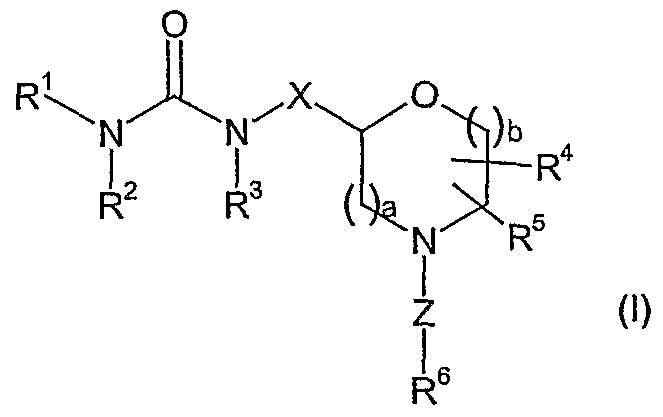
This invention relates to novel processes, in particular to processes for preparing certain morpholine derivatives. Co-pending International Patent Application number PCT/GB01/04530
(Glaxo Group Limited) relates to certain morpholine urea derivatives of formula
(0
Figure imgf000003_0001
wherein:
R1 represents C1-6 alkyl, C2-6 alkenyl, C2-6 alkynyl, aryl-Y1-, heteroaryl-Y -, aryl-(O)t-aryl-Y1-, aryl-(O)rheteroaryl-Y1-, heteroaryl-(O)raryl-Y1-, heteroaryl-(O)r heteroaryl-Y1-, aryl- SO2-Y1-, C1-6 alkyl-G-Y1-, heteroaryl-G-aryl-Y1-, J1-SO2-Y1-, R17O(CO)-C2-6 alkenyl-Y1-, R17NHCO-Y1-, R 7NHSO2-Y1-, C2-6 alkynyl-Y1-, C2-6 alkenyl-Y1-, aryl-O-Y1-, heteroaryl-O-Y1-, C1-6 alkyl-SO2-Y1-, M-Y1-, J1-Y1-, J1-CO- Y1-, aryl-CO-Y1- or C3-8 cycloalkyl-Y1- or C3-8 cycloalkenyl-Y1-, which C2-6 alkynyl and C2-6 alkynyl-Y1 may be optionally substituted with a -OR17 group, which C2-6 alkenyl may be optionally substituted by one or more -COOR17 groups and which cycloalkyl or cycloalkenyl may be optionally substituted by one or more hydroxyl or C1-6 alkyl groups;
R2 represents hydrogen or Cι-6 alkyl optionally substituted by a hydroxy group;
R3 represents hydrogen or C1-6 alkyl; or R1 and R2 may together with the nitrogen atom to which they are attached form a group of formula J2 wherein said nitrogen atom substitutes for either X1 or X2; t represents 0 or 1 ;
X represents ethylene or a group of formula CReRf wherein Re and Rf independently represent hydrogen or C1-4 alkyl or Re and Rf may together with the carbon atom to which they are attached form a C3-8 cycloalkyl group; R4 and R5 independently represent hydrogen or C1- alkyl;
Z represents a bond, CO, SO2, CR10R7(CH2)n, (CH2)nCR10R7, CHR7(CH2)nO, CHR7(CH2)nS, CHR7(CH2)nOCO, CHR7(CH2)nCO, COCHR7(CH2)n or SO2CHR7(CH2)n; R6 represents C1-6 alkyl, C2-6 alkenyl, aryl, heteroaryl, aryl-C2-6 alkenyl-,
2 ι3.
CN or a group of formula -Y -J ;
R7 represents hydrogen, C1-4 alkyl, CONR8R9 or COOC1-6 alkyl; a and b represent 1 or 2, such that a+b represents 2 or 3;
G represents -SO2-, -SO2NR18-, -NR18SO2-, -NR18CO-, CO or -CONR18-; n represents an integer from 0 to 4;
M represents a C3-8 cycloalkyl or C3-8 cycloalkenyl group fused to a monocyclic aryl or monocyclic heteroaryl group;
J1, J2 and J3 independently represent a moiety of formula (K):
Figure imgf000004_0001
wherein X1 represents oxygen, NR11 or sulphur, X2 represents CH2, oxygen,
NR12 or sulphur, m1 represents an integer from 1 to 3 and m2 represents an integer from 1 to 3, provided that m1+m2 is in the range from 3 to 5, also provided that when both X1 and X2 represent oxygen, NR11, NR12or sulphur, m1 and m2 must both not equal less than 2, wherein K is optionally substituted by one or more (eg. 1 or 2) -Y3-aryI, -Y3-heteroaryl, -Y3-CO-aryl, -COC3-8 cycloalkyl,
-Y3-CO-heteroaryl, -C1-6 alkyl, -Y3-COOC.,-6 alkyl, -Y3-COC1-6 alkyl, -Y3-W, -Y3- CO-W, -Y3-NR15R16, -Y3-CONR15R16, hydroxy, oxo, -Y3-SO2NR15R16, -Y3-SO2C1-6 alkyl, -Y3-SO2aryl, -Y3-SO2heteroaryl, -Y3-NR13C1-6 alkyl, -Y3-NR13SO2C1-6 alkyl, -
Y3-NR 3CONR15R16, -Y3-NR13COOR14 or -Y3-OCONR15R16 groups, and is optionally fused to a monocyclic aryl or heteroaryl ring;
R8, R9, R10, R11, R12, R13 and R14 independently represent hydrogen or C1-6 alkyl; R15 and R16 independently represent hydrogen or C1-6 alkyl or R15 and R16 together with the nitrogen atom to which they are attached may form a morpholine, piperidine or pyrrolidine ring;
R17 and R18 independently represent hydrogen or C1-6 alkyl; W represents a saturated or unsaturated, non-aromatic 5-7 membered ring containing between 1 and 3 heteroatoms selected from nitrogen, oxygen or sulphur, optionally substituted with one or more d-6 alkyl, halogen or hydroxy groups;
Y1, Y2 and Y3 independently represent a bond or a group of formula -
(CH2)pCRcRd(CH2)q- wherein Rc and Rd independently represent hydrogen or C1-4 alkyl or Rc and Rd may together with the carbon atom to which they are attached form a C3-8 cycloalkyl group, and p and q independently represent an integer from 0 to 5 wherein p + q is an integer from 0 to 5; and salts and solvates thereof; with the provisos that; the compound of formula (I) is not a compound of formula (l)a:
Figure imgf000005_0001
wherein R2' represents hydrogen or lower alkyl (specifically C1-4 alkyl); R3' represents hydrogen; X' represents methylene or ethylene; a' and b' both represent 1 ; R4' and R5' both represent hydrogen; and wherein the moiety -Z'-R6' represents halobenzyl, and; the compound of formula (I) is not a compound of formula (l)b:
Figure imgf000005_0002
wherein R " represents a hydrogen atom, a Cι-6 alkyl group, a C3-6 cycloalkyl group, a C3-6 cycloalkylC1- alkyl group, an aryl group or an arylC1- alkyl group (particularly wherein aryl represents phenyl or naphthyl) in which the aryl moiety of the aryl group or arylC1-4 alkyl group may be optionally substituted with a halogen atom, a C1-6 alkyl group, a C1-6 alkoxy group, a C1-6 alkoxycarbonyl group or an amino group; R2 represents hydrogen; R3" represents hydrogen or C1-6 alkyl; X" represents methylene; a" and b" both represent 1; R4" and R5" both represent hydrogen; and wherein the moiety -Z"-R6" represents a C1-6 alkyl group, an arylC1-4 alkyl group (particularly wherein aryl represents phenyl or naphthyl), a heteroarylC1-4 alkyl group (particularly wherein heteroaryl represents 2-pyridyl, 3-pyridyl, 4-pyridyl or 1H-indol-3-yl), an aryloxyC2-5 alkyl group or a pyrrolidinylcarbonylC1-4 alkyl group in which the aryl moiety of the said groups may be optionally substituted with a halogen atom, a C1-6 alkyl group, a C1-6 alkoxy group, a C1-β alkoxycarbonyl group or an amino group. Compounds of formula (I) possess a chiral carbon atom at the position marked '*' and may therefore exist as enantiomers.
Figure imgf000006_0001
PCT/GB01/04530 also discloses a process for the preparation of compounds of formula (I) wherein enantiomers thereof may be prepared by a combination of an achiral synthesis with a resolution step. Examples of such a resolution step are preparative chiral high performance liquid chromatography (preparative chiral HPLC) and the fractional crystallisation of diastereoisomeric salts. In particular, it is disclosed in PCT/GB01/04530 that an enantiomer of a compound of formula (I) may be prepared by the resolution of a racemic modification of a compound of formula (III)
wherein;
R3, a, b, R4, R5, Z, and R6 are as defined in formula (I) above; by fractional crystallisation of a diastereisomeric salt thereof, followed by reaction of the resolved enantiomer of the compound of formula (III) with a compound of formula (X) to give a compound of formula (IV)
Figure imgf000006_0003
wherein;
L2 and L4 are leaving groups, and R3, a, b, R4, R5, Z, and R6 are as defined in formula (I) above; followed by reaction of a compound of formula (IV) with a compound of formula (V)
Figure imgf000007_0001
(V)
wherein;
R1 and R2 are as defined in formula (I) above; to give a compound of formula (I).
Alternative processes for preparing an enantiomer of certain compounds of formula (I), being of formula (IA)
Figure imgf000007_0002
wherein;
R1, R2, b, Z, and R6 are as defined for formula (I), and; k is 1 or 2; and salts and solvates thereof has now been discovered, with the provisos that; the compound of formula (IA) is not a compound of formula (l)a:
Figure imgf000007_0003
wherein R2 represents hydrogen or lower alkyl (specifically C1-4 alkyl); R3 represents hydrogen; X' represents methylene or ethylene; a' and b' both represent 1 ; R4' and R5' both represent hydrogen; and wherein the moiety -Z'-R6' represents halobenzyl, and; the compound of formula (IA) is not a compound of formula (l)b:
Figure imgf000008_0001
wherein R1" represents a hydrogen atom, a C1-6 alkyl group, a C3-6 cycloalkyl group, a C3-6 cycloalkylC1-4 alkyl group, an aryl group or an arylC1-4 alkyl group (particularly wherein aryl represents phenyl or naphthyl) in which the aryl moiety of the aryl group or arylC1-4 alkyl group may be optionally substituted with a halogen atom, a C1-6 alkyl group, a C -6 alkoxy group, a C^ alkoxycarbonyl group or an amino group; R2 represents hydrogen; R3 represents hydrogen or C1-6 alkyl; X" represents methylene; a" and b" both represent 1 ; R4" and R5' both represent hydrogen; and wherein the moiety -Z"-R6 represents a C1-6 alkyl group, an arylC1- alkyl group (particularly wherein aryl represents phenyl or naphthyl), a heteroaryIC1- alkyl group (particularly wherein heteroaryl represents 2-pyridyl, 3-pyridyl, 4-pyridyl or 1 H-indol-3-yl), an aryloxyC2-5 alkyl group or a pyrrolidinylcarbonylCι- alkyl group in which the aryl moiety of the said groups may be optionally substituted with a halogen atom, a C1-6 alkyl group, a C1-6 alkoxy group, a C1-6 alkoxycarbonyl group or an amino group.
Co-pending International Patent Application publication WO 02/26722 (Glaxo Group Limited) discloses certain compounds of formula (Ip)
Figure imgf000008_0002
and processes for their preparation, including processes for the preparation of enentiomers of compounds of formula (Ip).
These processes involve the chiral synthesis of certain compounds of formula (III).
Accordingly, in a first aspect, there is provided a process for the preparation of a compound of formula (IIIA)
Figure imgf000009_0001
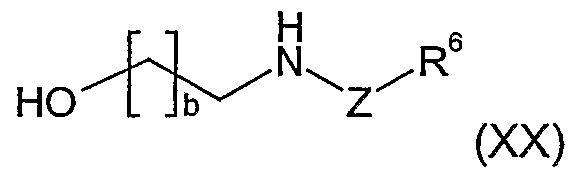
or a salt thereof; wherein; b, Z, and R6 are as defined for formula (I) above, and; k is 1 or 2; which process comprises the reaction of a compound of formula (XX)
Figure imgf000009_0002
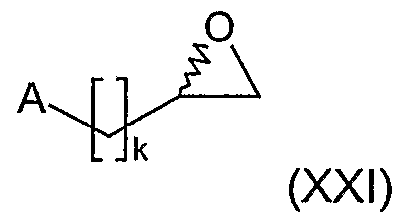
wherein; bb,, Z, and R6 are as defined for formula (I); with an enantiomer of a compound of formula (XXI)
Figure imgf000009_0003
wherein; A is a protected amino group and k is 1 or 2; followed by deprotection of the amino group to give a compound of formula (IIIA).
Suitable protecting groups for amines include phthalimido. The compound of formula (IIIA) is typically prepared from the compounds of formulae (XX) and an enantiomer of a compound (XXI) under the Mitsonobu conditions as follows: Typically, a mixture of the compound of formula (XX) and an enantiomer of a compound of formula (XXI) in a suitable solvent, such as tetrahydrofuran or toluene, is stirred, suitably for 2-36 hours at a suitable temperature, suitably the reflux temperature of the mixture, under an inert atmosphere, suitably an atmosphere of nitrogen. Further solvent, suitably toluene or tetrahydrofuran, is then added and the mixture cooled, suitably to 0-40°C. A phosphine, suitably triphenyl phosphine, is added and the mixture stirred until all the solid is dissolved. An azodicarboxylate, suitably diisopropylazodicarboxylate, is then added over a period of time, suitably 5-120 min, while maintaining the temperature at <40°C. The mixture is stirred at a suitable temperature, suitably 20-40°C. If necessary, further phosphine and azodicarboxylate reagents can be added. After a further period, the reaction mixture is concentrated to low volume. A suitable alcohol, suitably methanol or so-propyl alcohol, is added and the concentration step repeated. This may be repeated as necessary. Further alcohol is then added and the mixture may be heated to a temperature suitably between 55-75°C. After a suitable period, suitably 20-45 minutes, the resultant slurry is cooled, suitably to 15-25°C, and then allowed to stand, suitably for 1.5-3 hours, after which time the product is isolated by filtration. The filter bed is washed with more alcohol and then dried in vacuo at 35-45°C to yield the protected compound of formula (IIIA).
The protected compound of formula (IIIA) may be deprotected to yield the compound of formula (IIIA) using standard conditions suitable for the removal of the particular protecting group, for example those conditions described in P J Kocienski, Protecting Groups, (1994), Thieme. In a further aspect, the process for the preparation of the protected compound of formula (IIIA) described above may also be undertaken in two stages, in which an intermediate compound of formula (NIB);
Figure imgf000010_0001
wherein; k, Z, R6, and b are as hereinbefore defined for formula (IIIA), and A is as hereinbefore defined for formula (XXI); is isolated. Typically, a mixture of the compound of formula (XX) and an enantiomer of a compound of formula (XXI) in a suitable solvent, such as tetrahydrofuran, C3- alkanol, toluene, N-methylpyrrolidinone and N,N-dimethylformamide , is stirred, suitably for 2-36 hours at a suitable temperature, suitably the reflux temperature of the mixture under an inert atmosphere, suitably an atmosphere of nitrogen. Further compound of formula (XX) is added as necessary and the mixture heated at a suitable temperature, suitably the reflux temperature of the mixture, under an inert atmosphere, suitably an atmosphere of nitrogen, for a suitable period of time. The reaction mixture is then cooled, suitably to 20-25°C, and the compound precipitated by means of addition of a suitable co-solvent, suitably diisopropyl ether. The compound of formula (IIIB) is isolated by filtration, washed with further co-solvent and dried in vacuo.
Alternatively, a compound of formula (IIIB) may be prepared by reaction of a compound of formula (XXII)
Figure imgf000011_0001
with a compound of formula (XX).
Accordingly, there is further provided a process for the preparation of a compound of formula (IIIB) which process comprises the reaction of a compound of formula (XXII) with a compound of formula (XX).
Typically, a mixture of the compound of formula (XX) and a compound of formula (XXII) in a suitable solvent, such as methyl tert-butyl ether, C1-4 alkanol, toluene, N-methylpyrrolidinone and N,N-dimethylformamide, is stirred, suitably for 2-36 hours at a suitable temperature, suitably room temperature, under an inert atmosphere, suitably an atmosphere of nitrogen. An aqueous work-up may be used at this point. A suitable solvent, suitably N-methylpyrrolidinone and N,N- dimethylformamide, is added to the reaction mixture, followed by potassium phthalimide. The mixture is stirred, suitably for 2-6 hours, at a suitable temperature, suitably 90-110°C. The reaction mixture is then cooled, suitably to 50-80°C, and the compound is crystallised by addition of suitable co-solvents, suitably a mixture of C1-4 alkanol and water. The reaction mixture is then cooled, suitably to 0-10°C. The compound of formula (IIIB) is isolated by filtration, washed with further co-solvent and dried in vacuo. A protected compound of formula (IIIA) may then be prepared from a compound of formula (IIIB) using the process described previously.
The compounds of formulae (XX) and the enantiomers of a compound of formula (XXI) and (XXII) are known, commercially available compounds, or may be prepared by analogy with known procedures, for examples those disclosed in standard reference texts of synthetic methodology such as J. March, Advanced Organic Chemistry, 3rd Edition (1985), Wiley Interscience.
The compound of formula (IIIA) is known and is disclosed in J. Med. Chem., 1991, 34(2), 616-624. The enantiomer of the compound of formula (IIIA), being the compound of formula (IIIAS) may also be isolated from a mixture of the compound of formula (IIIAS) and its antipode, typically a racemic modification, by enzymatic resolution. A mixture of the compound of formula (IIIAS) and its antipode may be prepared by using a mixture of the enantiomers of a compound of formula (XXI) in the processes hereinbefore described. A racemic modification of the enantiomers of the compound of formula (XXI) may be prepared using procedures well known in the art.
Accordingly, there is provided in a still further aspect, a process for the separation of a compound of formula (IIIAS);
Figure imgf000012_0001
(IIIAS) wherein; k, b, Z, and R6 are as hereinbefore defined for formula (IIIA); from its antipode, which process comprises reaction of the mixture of a compound of formula (IIIAS) and its antipode with an enzyme and a suitable enzyme donor, such as an alkyl ester of a C4-8 alkanoic acid. A suitable enzyme is Lipase PS-C "Amano" II.
Typically, to a solution of a mixture of a compound of formula (IIIAS) and its antipode and a mixture of a suitable solvent, suitably fert-butyl methyl ether, and a suitable acyl donor, suitably ethyl octanoate, is added the enzyme, suitably Lipase PS-C "Amano" II, under an inert atmosphere, suitably an atmosphere of nitrogen. The mixture is stirred at elevated temperature, suitably 25-35°C for a suitable period of time, suitably 6-8hours. The enzyme is removed by vacuum filtration. To the filtrate is added de-ionised water, the resultant bi-phasic solution pH adjusted to pH 4-5 and the layers separated. To the aqueous phase is added a suitable non-polar solvent, suitably dichloromethane, and the resultant bi-phasic mixture pH adjusted to pH 6-7. The layers are then separated. To the aqueous phase is added a suitable non-polar solvent, suitably dichloromethane, and the pH of the resultant bi-phasic mixture adjusted to 9-10. The layers are then separated and the non-polar solvent removed in vacuo to give a compound of formula (IIIAS).
For any of the hereinbefore described reactions or processes, conventional methods of heating and cooling may be employed, for example electric heating mantles and ice/salt baths respectively.
Suitably, the absolute stereochemistry of a compound of formula (IIIA) at the position marked "*" is as shown in formula (IIIAS).
Compounds of formula (IA) may then be prepared from compounds of formula (IIIA) as follows: The compound of formula (IIIA) is reacted with a compound of formula
(XA)
Figure imgf000013_0001
wherein;
L2 and L4 represent leaving groups wherein L2 and L4 are the same or L4 represents a leaving group which is more labile than L2, to form a compound of formula (IVA)
Figure imgf000013_0002
wherein;
L2, k, b, Z, and R6 are as hereinbefore defined. The compound of formula (IVA) is in turn is reacted with with a compound of formula (VA)
R! — NHR (VA)
wherein R1 and R2 are as defined in formula (I) above, to give a compound of formula (IA).
Compounds of formulae (XA), and (VA) are also known, commercially available compounds, or may be prepared by analogy with known procedures, for examples those disclosed in standard reference texts of synthetic methodology such as J. March, Advanced Organic Chemistry, 3rd Edition (1985), Wiley Interscience.
Suitable salts of the compounds of formula (IIIA) are those which may be useful in terms of isolation or handling of the compound of formula (IIIA) or those which may be useful in the preparation of compounds of formula (IA) and physiologically acceptable salts thereof. If appropriate, acid addition salts may be derived from inorganic or organic acids, for example tartrates, hydrochlorides, hydrobromides, sulphates, phosphates, acetates, benzoates, citrates, succinates, lactates, tartrates, fumarates, maleates, 1-hydroxy-2-naphthoates, palmoates, methanesulphonates, formates or trifluoroacetates. Salts of the compounds of formula (IIIA) may be prepared by procedures well known to those skilled in the art.
It is considered that the compound of formula (IIIB) is novel. Accordingly, in an additional aspect, there is provided a compound of formula (IIIB) or a salt thereof.
Suitable salts of the compounds of the invention are those which may be useful in terms of isolation or handling of the compounds of the invention. If appropriate, acid addition salts may be derived from inorganic or organic acids, for example tartrates, hydrochlorides, hydrobromides, sulphates, phosphates, acetates, benzoates, citrates, succinates, lactates, tartrates, fumarates, maleates, 1-hydroxy-2-naphthoates, palmoates, methanesulphonates, formates or trifluoroacetates. Salts of the compounds of the invention may be prepared by procedures well known to those skilled in the art. A compound of formula (IA) may be prepared from a compound of formula (IIIA) as follows.
Typically, a compound of formula (IIIA) in a suitable first solvent is reacted with N,N'-carbonyldiimidazole in the same solvent at reduced temperature, suitably a temperature in the range -10 - 20 °C over a suitable period of time, for example 5-60 minutes. Suitable solvents include tetrahydrofuran, dichloromethane, C3-4 alkanol, isopropyl acetate, N- methylpyrrolidinone and N,N-dimethylformamide. The mixture is warmed to a suitable temperature, suitably 5-30°C and held at this temperature for a suitable period of time, for example 10-60 minutes. The compound of formula (VA) is then added, the mixture heated to a suitable elevated temperature, for example a temperature in the range 40-65°C, and stirred for a suitable period of time, for example 60-360 minutes. The reaction is then cooled to a suitable temperature, and a suitable second solvent, for example isopropyl acetate, added, followed by a aqueous solution of a suitable acidic salt, such as potassium dihydrogen phosphate or acetic acid. The solution is clarified if necessary, the lower aqueous layer removed and the upper organic layer washed with further acidic salt solution, followed by water. The organic phase is distilled at atmospheric pressure to remove the first solvent and leave a slurry or solution of the compound of formula (IA) in the second solvent. The compound of formula (IA) may be isolated by filtration or evaporation of the solvent as appropriate. A compound of formula (Ip) may be prepared from a compound of formula (IIIA) and a compound of formula R -COOH wherein R1 is as defined for formula (Ip) as follows.
Typically, a solution of a compound of formula R1-COOH in N,N- dimethylformamide in an inert atmosphere, suitably an atmosphere of nitrogen, is treated with O-(7-azabenzotriazol-1-yl)-N,N,N'N,-tetramethylammonium hexafluorophosphate and N,N-diisopropylethylamine followed by a solution of a compound of formula (IIIA) in a suitable solvent, for example N,N- dimethylformamide, and the mixture stirred at 18-30°C for 2-8 hours. The solvent is removed in vacuo and the residue dissolved in a suitable solvent, for example ethyl acetate. The solution is washed with 10% aqueous citric acid, brine, saturated aqueous sodium hydrogen carbonate, and brine dried over magnesium sulphate and evaporated in vacuo.
Suitable salts of the compounds of formulae (IA) and (Ip) include physiologically acceptable salts and salts which may not be physiologically acceptable but may be useful in the preparation of compounds of formulae (IA) and (Ip) and physiologically acceptable salts thereof. If appropriate, acid addition salts may be derived from inorganic or organic acids, for example hydrochlorides, hydrobromides, sulphates, phosphates, acetates, benzoates, citrates, succinates, lactates, tartrates, fumarates, maleates, 1-hydroxy-2- naphthoates, palmoates, methanesulphonates, formates or trifluoroacetates. Examples of solvates include hydrates.
Salts and solvates of the compounds of formulae (IA) and (Ip)may be prepared by procedures well known to those skilled in the art. Suitable protecting groups in any of the above mentioned reactions are those used conventionally in the art. The methods of formation and removal of such protecting groups are those conventional methods appropriate to the molecule being protected, for example those methods discussed in standard reference texts of synthetic methodology such as P J Kocienski, Protecting Groups, (1994), Thieme.
Suitably, the variable R1 of compounds of formulae (IA) and (VA) represents C1-6 alkyl, C2-6 alkenyl, C2-6 alkynyl, aryl-Y1-, heteroaryl-Y1-, aryl-(O)r aryl-Y1-, aryl-(O)rheteroaryl-Y1-, heteroaryl-(O)raryl-Y1-, heteroaryl-(O)r heteroaryl-Y1-, aryl- SO2-Y1-, C1-6 alkyl-G-Y1-, J1-SO2-Y1-, R17O(CO)-C2.6 alkenyl- Y1-, C2-6 alkynyl-Y1-, C2.6 alkenyl-Y1-, aryl-O-Y1-, heteroaryl-O-Y1-, C1-6 alkyl-SO2- Y1-, M-Y1-, J1-Y1-, J1-CO-Y1-, aryl-CO-Y1- or C3-8 cycloalkyl-Y1- or C3-8 cycloalkenyl-Y1-, which C2-6 alkynyl and C2-6 alkynyl-Y1 may be optionally substituted with a -OR17 group and which cycloalkyl or cycloalkenyl may be optionally substituted by one or more hydroxyl or C1-6 alkyl groups; J1, J2 and J3 independently represent a moiety of formula (K):
Figure imgf000016_0001
wherein X1 represents oxygen, NR11 or sulphur, X2 represents CH2, oxygen, NR12 or sulphur, m1 represents an integer from 1 to 3 and m2 represents an integer from 1 to 3, provided that m1+m2 is in the range from 3 to 5, also provided that when both X1 and X2 represent oxygen, NR11, NR12or sulphur, m1 and m2 must both not equal less than 2, wherein K is optionally substituted by one or more (eg. 1 or 2) -Y3-aryl, -Y3-heteroaryl, -Y3-CO-aryl, -Y3-CO-heteroaryl, -C1-6 alkyl, -Y3-COOC1-6 alkyl, -Y3-COC1-6 alkyl, -Y3-W, -Y3-CO-W, -Y3-NR15R16, - Y3-CONR15R16, hydroxy, oxo, -Y3-SO2NR15R16, -Y3-SO2C1-6 alkyl, -Y3-SO2aryl, - Y3-SO2heteroaryl, -Y3-NR13C1-6 alkyl, -Y3-NR13SO2C1-6 alkyl, -Y3-NR13CONR15R16, -Y3-NR13COOR14 or -Y3-OCONR15R16 groups, and is optionally fused to a monocyclic aryl or heteroaryl ring.
Suitably, the variable R2 of compounds of formulae (IA) and (VA) represents hydrogen or C1-6 alkyl. More suitably, the variable R1 of compounds of formulae (IA) and (VA) represents C1-6 alkyl, C2-6 alkenyl, C2-6 alkynyl, aryl-Y1-, heteroaryl-Y1-, aryl-(O)t- aryl-Y1-, aryl-(O)rheteroaryl-Y1-, heteroaryl-(O)raryl-Y1-, heteroaryl-(O)t- heteroaryl-Y1-, C2-6 alkenyl-Y1-, aryl-O-Y1-, heteroaryl-O-Y1-, C1-6 alkyl-SO2-Y1-, M-Y1-, -Y1-J1, -Y1-CO-J1 or C3_3 cycloalkyl-Y1- or C3-8 cycloalkenyl-Y1-, which cycloalkyl or cycloalkenyl may be optionally substituted by one or more hydroxyl or C1-6 alkyl groups;
J1, J2 and J3 independently represent a moiety of formula (K):
Figure imgf000016_0002
wherein X1 represents oxygen, nitrogen, NR11 or sulphur, X2 represents CH2, oxygen, nitrogen, NR12 or sulphur, m1 represents an integer from 1 to 3, m2 represents an integer from 1 to 3, provided that m1+m2 is in the range from 3 to 5, also provided that when X2 represents oxygen, nitrogen, NR12or sulphur, m1and m2 must both not equal less than 2, wherein K is optionally substituted by one or more (eg. 1 or 2) -Y3-aryl, -Y3-heteroaryl, -Y3-CO-aryl, -Y3-CO-heteroaryl, -C1-6 alkyl, -Y3-COOC1-6 alkyl, -Y3-COC1-6 alkyl, -Y3-W, -Y3-CO-W, -Y3-NR15R16, - Y3-CONR15R16, hydroxy, oxo, -Y3-SO2NR15R16, -V-SOaC^ alkyl, -Y3-SO2aryl, - Y3-SO2heteroaryl, -Y3-NR13C1-6 alkyl, -Y3-NR13SO2C1-6 alkyl, -Y3-NR13CONR15R16, -Y3-NR13COOR14 or -Y3-OCONR15R16 groups, and is optionally fused to a monocyclic aryl or heteroaryl ring.
More suitably, the variable R2 of compounds of formulae (IA) and (VA) represents hydrogen or Cι-6 alkyl.
Preferred values of Z for compounds of formulae (IIIA), (XX), and (IA) are those wherein Z represents a bond, CO, SO2, CR10R7(CH2)n, CHR7(CH2)nO, CHR7(CH2)nS, CHR7(CH2)nOCO, or CHR7(CH2)nCO.
References to 'aryl' include references to monocyclic carbocyclic aromatic rings (eg. phenyl) and bicyclic carbocyclic aromatic rings (e.g. naphthyl) and references to 'heteroaryl' include references to mono- and bicyclic heterocyclic aromatic rings containing 1-3 hetero atoms selected from nitrogen, oxygen and sulphur. References to 'heteroaryl' may also be extended to include references to mono- and bicyclic heterocyclic aromatic rings containing 4 hetero atoms selected from nitrogen, oxygen and sulphur. Examples of monocyclic heterocyclic aromatic rings include e.g. pyridinyl, pyrimidinyl, thiophenyl, furanyl, pyrrolyl, oxazolyl, isoxazolyl, oxadiazolyl, thiazolyl, thiadiazolyl. Further examples of monocyclic heterocyclic aromatic rings include pyrazinyl, tetrazolyl or imidazolyl. Examples of bicyclic heterocyclic aromatic rings include eg. quinolinyl or indolyl. Further examples of bicyclic heterocyclic aromatic rings include benzimidazolyl. Yet further examples of bicyclic heterocyclic aromatic rings include dihydrobenzofuranyl and pyrrolopyridinyl. Carbocyclic and heterocyclic aromatic rings may be optionally substituted, e.g. by one or more C1-6 alkyl, C2-6 alkenyl, halogen, C1-6 alkoxy, cyano, hydroxy, nitro, amino, W, -N(CH3)2, - NHCOC1-6 alkyl, -OCF3, -CF3, -COOC1-6 alkyl, -OCHF2, -SCF3, -CONR19R20, - SO2NR19R20 (wherein R19 and R20 independently represent hydrogen, C1-6 alkyl or C3-8 cycloalkyl), -NHSO2CH3, -SO2CH3 or -SCH3 groups. A further substituent of carbocyclic and heterocyclic aromatic rings may be -COOH. Yet further substituents of carbocyclic and heterocyclic aromatic rings may be -CH2N(CH3)2 or one or more -SH groups, wherein it will be appreciated that said group may tautomerise to form an =S group.
Examples of group M include tetrahydronaphthalenyl. Examples of group W include piperidinyl, pyrrolidinyl, morpholinyl and piperazinyl which may be optionally substituted with one or more C1-6 alkyl, halogen, or hydroxy groups. Examples of group J1 include N-(COOCH2CH3)-piperidin-4-yl, N-(CH3)- piperidin-4-yl, N-(COCH3)-piperidin-4-yl, pyrrolidin-1-yl, tetrahydropyran-4-yl or N-morpholinyl. Further examples of group J1 include N-(cyclopropylcarbonyl)- piperidin-4-yl, N-(methylsulphonyl)-piperidin-4-yl, thiopyranyl and tetrahydrothienyl.
Examples of group J2 include (4-phenyl)-piperidin-1-yl, (4-COOCH2CH3)- piperazin-1-yl, (2-(3-hydroxy-pyrrolidin-1-yl-methyl))-piperidin-1-yl, N-morpholinyl, (4-N(CH3)2)-piperidin-1-yl, (4-(3-fluorophenyl))-piperazin-1-yl, (4-(4- fluorophenyl))-piperazin-1-yl, (4-pyrimidinyl)-piperazin-1-yI, (4-CH3)-piperazin-1- yl, (4-CONH2)-piperidin-1-yl, (3,3-dimethyl)-piperidin-1-yl, (4-COCH3)-piperazin- 1-yl, (4-(1-pyrrolidinyl-carbonylmethyl))-piperazin-1-yl, (4-hydroxy)-piperidin-1-yl, (4-methyl)-piperidin-1-yl, (4-(2-furanyl-carbonyI))-piperazin-1-yl, (4-benzyl)- piperazin-1-yl or (3-CH3SO2CH2-)-morpholin-1-yl. Further examples of group J2 include thiomorpholinyl, pyrrolidinyl and benzazepinyl. Examples of group J3 include indolinyl, which may be optionally substituted.
References to alkyl include references to both straight chain and branched chain aliphatic isomers of the corresponding alkyl. It will be appreciated that references to alkylene and alkoxy shall be interpreted similarly. References to C3-8 cycloalkyl include references to all alicyclic (including branched) isomers of the corresponding alkyl.
Preferably, R1 represents C1-6 alkyl (particularly propyl), C2-6 alkenyl (particularly wherein said C2-6 alkenyl is substituted by one or more -COOR17 groups, eg. -HC=CH-COOH), C2-6 alkynyl, aryl-Y1-, heteroaryl-Y1- (particularly wherein heteroaryl represents thiazolyl, indolyl, furanyl, dihydrobenzofuran, oxoimidazolyl, isoxazolyl, thienyl, thioxodihydroimidazolyl, tetrazolyl, pyrazinyl, pyrrolopyridinyl), aryl-(O)raryI-Y1-, aryl-(O)t-heteroaryl-Y1- (particularly wherein aryl represents phenyl and heteroaryl represents thiadiazolyl, pyrazolyl or isoxazolyl), heteroaryI-(O)raryl-Y1-, heteroaryi-(O)t-heteroaryl-Y1-, C2-6 alkenyl- Y1-, aryl-O-Y1- (particularly wherein aryl represents phenyl), heteroaryl-O-Y1-, C,. 6 alkyl-SO2-Y1- (particularly wherein C1-6 alkyl represents ethyl, propyl, -CH(CH3)2 or -C(CH3)3), M-Y1-, J1-Y1-, J1-CO-Y1-, aryl-SO2-Y1-, C1-6 alkyl-G-Y - (particularly wherein C1-6 alkyl represents methyl and G represents -NR18CO-, -CONR18-, - NR18SO2- or -SO2NR18-), heteroaryl-G-aryl-Y1- (particularly wherein aryl represents phenyl and heteroaryl represents thiazolyl and G represents - NR18SO2-), J1-SO2-Y1- (particularly wherein J1 represents 1 -pyrrolidinyl), R17O(CO)-C2-6 alkenyl-Y1-, R17NHCO-Y1- (particularly wherein R17 represents hydrogen), C2-6 alkynyl-Y1- (particularly -C≡CH or wherein said C2,6 alkynyl is substituted with a -OR17 group, eg. HOCH2-C≡C-), aryl-CO-Y1- (particularly wherein aryl represents phenyl), C3-8 cycloalkyl-Y1- or C^s cycloalkenyl-Y1-, which cycloalkyl or cycloalkenyl may be optionally substituted by one or more hydroxyl or C1-6 alkyl groups and which C2-6 alkynyl-Y1- may be optionally substituted with a -OR17 group.
More preferred R1 groups include C1-6 alkyl, C2-6 alkenyl, C2-6 alkynyl, aryl- Y1-, heteroaryl-Y1-, aryl-(O)raryl-Y1-, aryl-(O)t-heteroaryl-Y1-, heteroaryl-(O)raryl- Y1-, heteroaryl-(O)t-heteroaryl-Y1-, C2-6 alkenyl-Y1-, aryl-O-Y1-, heteroaryl-O-Y1-, C1-6 alkyl-SO2-Y1-, M-Y1-, J1-Y1-, J1-CO-Y1- or C3-8 cycloalkyl-Y1- or C3-8 cycloalkenyl-Y1-, which cycloalkyl or cycloalkenyl may be optionally substituted by one or more hydroxyl or C1-6 alkyl groups. Yet more preferably, R1 represents aryl-Y1-, heteroaryl-Y1, aryl-(O)t-aryl-
Y1-, C3-8 cycloalkyl-Y1-, C2-6 alkenyl-Y1- or C-i-6 alkyl-SO2-Y1- especially wherein aryl represents phenyl or naphthyl optionally substituted by one or more C -6 alkyl (especially methyl), halogen (especially chlorine, fluorine and bromine), CH3O-, CH3S-, F2CHO-, CHsOC(O)-, -CN, -CF3, CF3-S-, CF3-O-, or (CH3)2N-, groups, and wherein heteroaryl represents pyridinyl optionally substituted by one or more halogen atoms (especially chlorine) and wherein cycloalkyl represents cyclohexyl. Further preferred substituents of phenyl include -NHCOCH3 and -CONH2. Yet further preferred substituents of phenyl include -SO2NH2, - CONHCH3, -OCH(CH3)2, -OC(CH3)3, -COOH, -CON(CH3)2, -SO2CH3, - CONHCH2CH3, -CONHcyclopropyl and -SO2NHcyclopropyl. Also preferably, R1 represents C2-6 alkynyl-Y1-. A series of particularly preferred compounds are those wherein R1 represents aryl-Y1- wherein aryl represents phenyl optionally substituted by one or more C1-6 alkyl (especially methyl), halogen (especially chlorine, fluorine and bromine), CH3O-, CH3S-, F2CHO-, CH3OC(O)-, -CN or - CF3 groups. Further most preferred substituents of phenyl include -NHCOCH3 and -CONH2. A yet further most preferred substituent of phenyl includes SO2NH2. Most preferably, R1 will also represent C2-6 alkenyl-Y1- (particularly CH2=CH-Y1-), C3-8 cycloalkyl-Y1- (particularly cyclohexyl-Y1-) and C1-6 alkyl- SO2Y1- (particularly CH3SO2-Y1-). Also most preferably, R1 represents C2-6 alkynyl-Y1- (particularly HC≡C-Y1).
Especially preferred R1 groups are aryl-Y1- and heteroaryl-Y1-, most especially wherein aryl represents phenyl and heteroaryl represents a 5 membered monocyclic heterocyclic aromatic ring (most particularly tetrazolyl) each of which may be optionally substituted as indicated above. Preferred substituents of heteroaryl include -CH3, -CONH2, -CH2N(CH3)2, halogen (particularly chlorine), -OCH3, -COOCH3 and -NH2.
Most especially preferred compounds are those wherein R1 represents phenyl-Y1- which phenyl is substituted with a -CONH2 or -CONHCH3 group, preferably -CONH2, and tetrazolyl-Y1- which tetrazolyl is substituted with a methyl group. Preferably, Y1 represents a bond or C1-6 alkylene, more preferably a bond, methylene or ethylene, propylene, -C(CH3)2- or -CH(CH3)-, particularly a bond, methylene or ethylene, most preferably a bond or methylene, especially methylene. Preferably, Y2 represents a bond.
Preferably, Y3 represents a bond.
Preferably, R2 represents hydrogen, methyl or hydroxypropyl, more preferably hydrogen or methyl, especially hydrogen.
Also preferably, R1 and R2 together with the nitrogen atom to which they are attached form a group of formula J2 wherein said nitrogen atom substitutes for either X1 or X2.
Preferably, R4 and R5 independently represent hydrogen or methyl. Most preferably, R4 and R5 represent hydrogen.
Preferably, Z represents a bond, CO, SO2, CR10R7(CH2)n, CHR7(CH2)nO, CHR7(CH2)nS, CHR7(CH2)nOCO or CHR7(CH2)nCO.
More preferably, Z represents CO, CHR7(CH2)n, CHR7(CH2)nO, CHR7(CH2)nS, CHR7(CH2)nOCO or CHR7(CH2)nCO, especially CH2CO, (CH2)2, (CH2)2S, (CH2)2O, (CH2) OCO, (CH2)3CO, CO, CHR7, particularly CH2) CHCH3 or CH2CO, most particularly CH2 or CH2CO, especially CH2. Preferably, R6 represents d-β alkyl, C2-6 alkenyl, CN, aryl, heteroaryl or a group of formula -Y2-J3, more preferably R6 represents phenyl (optionally substituted with one or more halogen, phenyl or C2-6 alkenyl groups), naphthyl, C-i-β alkyl, C2-6 alkenyl, CN or a 5 membered aromatic heterocyclic ring containing 1 to 3 heteroatoms selected from O, N or S optionally substituted by halogen or C1-6 alkyl. Especially, R6 represents phenyl (optionally substituted with one or more halogen (especially chlorine, fluorine or iodine), phenyl or 3- CH=CH2 groups), naphthyl, indolinyl, methyl, -CH=CH2, -CN or thiophenyl optionally substituted by halogen (especially chlorine). Most preferred R6 represents indolinyl (especially indolin-1-yl) or else represents phenyl substituted by one or more halogen (eg. chlorine or fluorine) groups, particularly dichlorophenyl, 3-chlorophenyI, 5-chlorothiophenyl, 4-fluorophenyl and 3,4- difluorophenyl, most particularly dichlorophenyl, especially 3,4-dichlorophenyl.
Preferably, R7 represents hydrogen, methyl, COOC1-6 alkyl or CONR8R9, more preferably hydrogen, COOC1-6 alkyl or CONR8R9 most preferably hydrogen, COOEt or CONR8R9, especially hydrogen.
Preferably, R8 and R9 represent hydrogen.
Preferably, R10 represents hydrogen.
Preferably, R11 and R12 independently represent hydrogen or methyl.
Preferably, R13 and R14 independently represent hydrogen or methyl. Preferably, R15 and R16 independently represent hydrogen or methyl or R15 and R16 together with the nitrogen atom to which they are attached may form a morpholine, piperidine or pyrrolidine ring, especially hydrogen or methyl.
Preferably, R17 represents hydrogen. Preferably, R18 represents hydrogen.
Preferably, R19 and R20 independently represent hydrogen, C1-6 alkyl or C3-8 cycloalkyl, especially hydrogen, cyclopropyl or methyl. Particularly, R19 and R20 represent hydrogen.
Preferably, Rc represents hydrogen or methyl, particularly hydrogen. Preferably, Rd represents hydrogen or methyl, particularly hydrogen.
Preferably, b represents 1.
Preferably, n represents 0, 1 or 2.
Preferably, p + q equals an integer from 0 to 2, more preferably, p and q independently represent 0 or 1 such that p + q equals an integer from 0 to 1. Preferably, t represents 0.
Preferably, W represents pyrrolidinyl or piperidinyl, especially pyrrolidinyl.
Preferably, X1 represents oxygen, nitrogen or NR11.
Preferably, X2 represents CH2, oxygen, nitrogen or NR12.
Preferably, m1 and m2 independently represent an integer from 1 to 2, such that m1 + m2 is in the range from 3 to 4.
Preferably, J1 represents piperidinyl (particularly piperidin-4-yl) or tetrahydropyranyl (particularly tetrahydropyran-4-yl) optionally substituted by one or two -COOCH2CH3, -COOtBu, -CH3, -COCH3, -SO2N(CH3)2, -SO2CH3, - COPhenyl or 3, 5-dimethylisoxazol-4-ylsuIphonyl groups. Also preferably, J1 represents morpholinyl, thiopyranyl or tetrahydrothienyl which may be optionally substituted as above (particularly dioxidotetrahydrothienyl).
Preferred substituents for J1 include -CH2-aryl (particularly wherein aryl represents phenyl optionally substituted with one or more halogen atoms, eg. dichlorophenyl), -COcyclopropyl or -Y3-SO2heteroaryl (particularly wherein heteroaryl represents dimethylisoxazolyl).
Preferably, J2 represents piperidinyl (particularly piperidin-1-yl), morpholinyl (particularly N-morpholinyl) or piperazinyl (particularly piperazin-1-yl) optionally substituted by one or two phenyl, -COOCH2CH3, -N(CH3)2, fluorophenyl, -CH3, -CONH2, -COCH3, -CH2CO-(N-pyrrolidinyl), hydroxy, -CO-(2- furan), benzyl or -CH2SO2CH3. Preferably, J2 also represents thiomorpholinyl, pyrrolidinyl or benzazepinyl optionally substituted in a similar manner.
Other preferred substituents for J2 include halogen (particularly fluorine), -COOCH2CH3, -CO-furoyl, -SO2CH3, -pyridinyl-CH3 or oxo groups.
Preferably, J3 represents indolinyl, particularly indolin-1-yl. In a most preferred aspect, the variables R1 and R2 of compounds of formulae (IA) and (VA) represent 4-amidobenzyl or 2-methyltetrazol-5-ylmethyl, and hydrogen respectively; the variables b, Z, and R6 for the compounds of formulae (IIIA), (XX), (IVA), and (IA) represent 1 , -CH2-, and 3,4-dichlorophenyl respectively; and the variable k for the compounds of formulae (IIIA), (XXI), and (IA) represents 1.
Suitable salts of the compounds of formula (IA) include physiologically acceptable salts and salts which may not be physiologically acceptable but may be useful in the preparation of compounds of formula (I) and physiologically acceptable salts thereof. If appropriate, acid addition salts may be derived from inorganic or organic acids, for example hydrochlorides, hydrobromides, sulphates, phosphates, acetates, benzoates, citrates, succinates, lactates, tartrates, fumarates, maleates, 1-hydroxy-2-naphthoates, palmoates, methanesulphonates, formates or trifluoroacetates. Examples of solvates include hydrates. Salts and solvates of the compounds of formula (IA) may be prepared by procedures well known to those skilled in the art.
Throughout the specification and the claims which follow, unless the context requires otherwise, the word 'comprise', and variations such as 'comprises' and 'comprising', will be understood to imply the inclusion of a stated integer or step or group of integers but not to the exclusion of any other integer or step or group of integers or steps.
The following Examples illustrate the invention but do not limit it in any way.
General experimental details
NMR
Nuclear magnetic resonance (NMR) spectra were acquired using a Bruker
DPX250 or DPX400 instrument.
LC/MS System A
The following Liquid Chromatography Mass Spectroscopy (LCMS) system was used: 3mm ABZ+PLUS (3.3cm x 4.6mm internal diameter) column, eluting with solvents: A - 0.1% formic acid + 0.077%) w/v ammonium acetate in water; and B - 95:5 acetonitrile:water + 0.05%v/v formic acid, at a flow rate of 3ml per minute.
The following gradient profile was used: 100% A for 0.7min; A + B mixtures, gradient profile 0 - 100% B over 3.5min; hold at 100%B for 1.1 min; return to
100% A over 0.2min.
LC/MS System B 03/082835
21
3μm Phenomenex Luna (50 x 2mm i.d.) column, eluting with solvents: A - 0.05% trifluoroacetic acid in water, B - 0.05% trifluoroacetic acid in acetonitrile, at 40°C and at a flow rate of 1ml per minute. The following linear gradient was used: 0 to 95% B over 8 minutes.
Analytical HPLC column, conditions and eluent
Reverse-phase high performance liquid chromatography was carried out using a Luna 3mm C18(2) (50 x 2.0mm i.d.) column eluting with solvents: A - 100% water, 0.05% TFA; and B - 100% acetonitrile, 0.05%TFA, at a flow rate of 2ml per minute, and at 60°C. The following gradient profile was used:0-95% B over 2.00min, return to 0% B over 0.01 min.
Chiral analytical HPLC
(Chiralpak AD column, 4.6 x 250mm, eluent 50:50:0.1 MeOH: EtOH: Butylamine, flow rate 0.5ml/min, UV detection at 220nm), Rt 8.9min.
Examples
Example 1 : Preparation of f(2S)-4-(3,4-dichlorobenzyl)morpholin-2- yrimethylamine - enzyme method To a solution of [4-(3,4-dichlorobenzyl)morpholin-2-yl]methylamine (6g) and ethyl octanoate (17.2ml) in ferf-butyl methyl ether (60ml) was added enzyme Lipase PS-C "Amano" II (6g), under an atmosphere of nitrogen. The mixture was stirred at 200rpm and heated to 30°C. The mixture was stirred at 30°C for a further 6h. The enzyme was removed by vacuum filtration and washed with terf-butyl methyl ether. Deionised water (30ml) was added to the filtrate and the resultant bi- phasic solution was pH adjusted to pH 5.7 and the layers were separated. To the aqueous phase was added dichloromethane (30ml) and the resultant bi- phasic mixture was pH adjusted to pH 6.6. The aqueous phase was separated, diluted with dichloromethane and the pH was adjusted to >pH 9. The layers were separated and solvent was evaporated in vacuo to give the title compound as a yellow oil (2.1g, 99%a/a, 96%ee) LC/MS (System A) Rt 1.77 min, Mass Spectrum m/z 275 [MH+].
Example 2: Preparation of 2-(r(2 ?)-4-(3_4-dichlorobenzyl)morpholin-2-vnmethyl)- 1 fy-isoindole-1 ,3(2H)-dione
A mixture of 2-[(3,4-dichlorobenzyl)amino]ethanol (2.038 g) and (S)-2-(oxiran-2- ylmethyl)-1 H-isoindole-1 ,3(2H)-dione (N-(2,3-epoxypropyl)-phthalimide) (2.032g) in tetrahydrofuran (3.3ml) was stirred and heated at reflux under nitrogen. After 21.5h more tetrahydrofuran (12.5ml) was added and the mixture was cooled to 3°. Triphenyl phosphine (2.793g) was added and the mixture was stirred until all the solid had dissolved. Diisopropylazodicarboxylate (2.1ml) was then added over 12min maintaining the temperature at <7°. After 2.25h the mixture was allowed to warm to 22°. After 5.3h more triphenylphosphine (121mg) and diisopropylazodicarboxylate (0.09ml) were added. After 22.5h the reaction mixture was concentrated to near dryness. Propan-2-ol (12ml) was added and the concentration repeated, this was repeated once more. More propan-2-ol (12ml) was added and the mixture was heated to 70°. After 0.5h the slurry was cooled to 22° and then after a further 2h the product was collected. The bed was washed with propan-2-ol (2x4ml) and then dried in vacuo at 40° to give the title compound (2.622q).
NMR (DMSO d-6): 1.93δ (1 H) d of d, J=11.0Hz, 8.8Hz; 2.10δ (1 H) d of t, J=3.5Hz, 11.3Hz; 2.52δ (1 H) broad d, J=11.3Hz; 2.77δ (1H) broad d, J=11.3Hz; 3.3 - 3.8δ (7H) m; 7.31 δ (1 H) d of d, J=8.2Hz, 1.9Hz; 7.55δ (1 H) d, J=1.9Hz; 7.68δ (1H) d, J=8.2Hz; 7.86δ (4H) m.
Preparation of f(2S)-4-(3,4-dichlorobenzyl)morpholin-2-yllmethylamine A slurry of 2-{[(2f?)-4-(3,4-dichlorobenzyl)morpholin-2-yl]methyl}-1H-isoindole- 1 ,3(2H)-dione (1.00g) in water(8.5ml) was heated to 75° and then treated dropwise with concentrated sulphuric acid (2.5ml). The mixture was then heated at reflux. After 23h the reaction mixture was cooled to 22° and then treated with dichloromethane (6ml). 880 Ammonia solution (7ml) was then added dropwise with cooling. More dichloromethane (10ml) was added. The aqueous phase was separated and extracted with more dichloromethane (10ml). The combined organic phase was washed with water (5ml) and then evaporated to dryness. The residue was reevaporated from DCM to give the title compound as an oil (662mg). LC/MS (System A) Rt 1.77 min, Mass Spectrum m/z 275 [MH+].
Example 3: Preparation of r(2S)-4-(3,4-dichlorobenzyl)morpholin-2- yllmethylamine - enzyme method
To a solution of [4-(3,4-dichlorobenzyl)morpholin-2-yl]methylamine (3g) and ethyl octanoate (5.8ml) in ferf-butyl methyl ether (30ml) was added enzyme Lipase PS-C "Amano" II (3g), under an atmosphere of nitrogen. The mixture was stirred at 200rpm and heated to 30°C. The mixture was stirred at 30°C for a further 6.5h. The enzyme was removed by vacuum filtration. To the filtrate was added de-ionised water (15ml). The resultant bi-phasic solution was pH adjusted to pH 5.5 and the layers were separated. To the aqueous phase was added DCM (15ml) and the resultant bi-phasic mixture was pH adjusted to pH 6.5. The layers were separated and solvent was evaporated in vacuo to give the title compound as a yellow oil (1.0g, 98.9%a/a, 94.8%ee) LC/MS (System A) Rt 1.77 min, Mass Spectrum m/z 275 [MH+].
Example 4: Preparation of 2-(f(2f?)-4-(3,4-dichlorobenzyl)morpholin-2-yllmethyl)- 1 H-isoindole-1.3(2H)-dione 5 A mixture of 2-[(3,4-dichlorobenzyl)amino]ethanoI (400g g) and (S)-2-(oxiran-2- yimethyl)-1 H-isoindole-1 ,3(2H)-dione (N-(2,3-epoxypropyl)-phthalimide) (399.6g) in toluene (1150ml) was stirred and heated at 103-107°C under nitrogen. After 22.5h the mixture was cooled to <60°C and charged with tetrahydrofuran (2800ml). Triphenyl phosphine (548g) was added and the mixture was stirred
10 until all the solid had dissolved, then cooled to 5-9°C.
Diisopropylazodicarboxylate (412ml) was then added over 70min maintaining the temperature at <12°. The mixture was warmed to 21-25° and stirred for 1.5h. The reaction mixture was concentrated by distillation to a final volume of 2800ml. Methanol (2800ml) was added and the concentration repeated to a volume of
15 2800ml. More methanol (2000ml) was added and the mixture was heated to 55°. After 0.75h the slurry was cooled to 18° and then after a further 1h the product was collected. The bed was washed with methanol (2x1200ml) and then dried in vacuo at 40° to give the title compound (526.9g).
0 Example 5: Preparation of 2 (2f?)-3-.(3,4-dichlorobenzyl)(2- hvdroxyethyl)aminol-2-hvdroxypropyl)-1 H-isoindole-1 ,3(2H)-dione To a solution of 2-[(3,4-dichlorobenzyl)amino]ethanol (2.8g) in tetrahydrofuran (6.2 ml) is added (S)-2-(oxiran-2-ylmethyl)-1 H-isoindole-1 ,3(2H)-dione (3.1g) with stirring, under a nitrogen atmosphere. The mixture was heated to 90 °C 5 over 1 h, then held at this temperature for 18 h. Further 2-[(3,4- dichlorobenzyl)amino]ethanol (0.14g) is added, and the reaction mixture heated to 90 °C for a further 5h. The reaction mixture is cooled to 22 °C, and diisopropyl ether (21ml) added, and the product isolated by vacuum filtration. The filter cake is washed with diisopropyl ether (3 ml) and dried in vacuo at 40 ° 0 to give the title compound as a white solid (4.79g).
LC/MS (System B) Rt 3.85min, Mass Spectrum m/z 423 [MH+]
Example 6: 2-f(2R)-3-r(3.4-dichlorobenzyl)(2-hvdroxyethyl)amino1-2- hvdroxypropyl}-1 H-isoindole-1 ,3(2/- )-dione (alternative method) 5 A suspension of of 2-[3,4-dichlorobenzyI)amino]ethanol (10.0g) and (R)-(-)- epichlorohydrin (3.6ml) in 1-propanol (2.5ml) was stirred at 15-25°C for 20h. The mixture was diluted with methyl tert-butyl ether (50ml) and treated with 2N hydrochloric acid (50ml). The layers were separated, and the organic phase was washed with further 2N hydrochloric acid (20mi). The combined aqueous 0 phases were treated with 10N sodium hydroxide (17ml) and extracted with methyl tert-butyl ether (50ml). Further 10N sodium hydroxide (3ml) was added to the aqueous phase, and this was extracted with methyl tert-butyl ether (20ml). The combined organic phases were washed with water (40ml), and then concentrated to an oil. This was diluted with N,N-dimethylformamide (30ml) and treated with potassium phthalimide (8.3g). The mixture was heated for 3h at 110°C, cooled to 80°C and diluted with 1-propanol (30ml) and water (50ml). After cooling to 60°C, further water (20ml) was added, and the mixture was seeded with authentic 2-{(2R)-3-[(3,4-dichlorobenzyl)(2-hydroxyethyl)amino]-2- hydroxypropyl}-1 H-isoindole-1 ,3(2/-/)-dione. The suspension was cooled to 0- 5°C, isolated by filtration and washed with aqueous 1-propanol (2 x 30ml). The cake was dried in vacuo at 40° to give the title compound as a white solid (7.5g).
Example 7: Preparation of 2-{r(2f?)-4-(3,4-dichlorobenzyl)morpholin-2-vnmethyl>- 1 H-isoindole-1.3(2H)-dione A suspension of 2-{(2R)-3-[(3,4-dichlorobenzyl)(2-hydroxyethyl)amino]-2- hydroxypropyl}-1 H-isoindole-1 ,3(2H)-dione (5.0g) and triphenylphosphine (3.57g) in tetrahydrofuran (25ml) was treated with a solution of diisopropylazodicarboxylate (2.67ml) in tetrahydrofuran (3ml) at 8-13°C over 18min. The reagent was rinsed in with tetrahydrofuran (2ml), and the mixture was warmed to 15-25°C and stirred for 1 hour. The reaction mixture was concentrated in vacuo to a paste, and resuspended in methanol (30ml) at 55- 65°C. The suspension was stirred for 30min at this temperature, cooled to 5- 10°C over 90min, and held at this temperature for 40min. The product was collected by filtration, washed with chilled methanol (15ml) and dried in vacuo at 40° to give the title compound as a white solid (4.08g).
Description 1 : Preparation of 4-({f((f(2S)-4-(3.4-dichlorobenzyl)morpholin-2- yllmethyl)amino)carbonyllamino)methyl)benzamide benzenesulfonate hydrate A solution of [(2S)-4-(3,4-dichlorobenzyl)morpholin-2-yl]methylamine (5g) in THF (10ml) is added to a slurry of N,N'-carbonyldiimidazole (3.2g) in THF (30ml) at 5- 10 °C over ca. 10 min. The mixture is warmed to 15+3° and held at this temperature for ca. 15min. 4-Aminomethyl benzamide (3.0g) is then added, the mixture heated to 60+3° and stirred at this temp for 75 min. The reaction is cooled to 22+3° and isopropyl acetate (40ml) added, followed by a solution of potassium dihydrogen phosphate (5% w/v, 40ml). The solution is filtered through celite (2g), the lower aqueous layer is removed and the upper organic layer washed with potassium dihydrogen phosphate (5% w/v, 2x40ml) then water (40ml). The organic phase is distilled at atmospheric pressure to remove THF and leave a slurry of 4-({[({[(2S)-4-(3,4-dichlorobenzyl)morpholin-2- yljmethyl} amino)carbonyl]amino}methyl)benzamide in isopropyl acetate (ca 60ml). This is cooled to 50+3° and isopropanol (30ml) is added, followed by an aqueous solution of benzene sulfonic acid (32% w/v, 10ml). The mixture is cooled to 22+3° over ca 1h, seeded with authentic 4-({[({[(2S)-4-(3,4- dichlorobenzyl)morpholin-2-yl]methyl} amino)carbonyl]amino}methyl)benzamide hydrate and aged at 22+3° for 72 h. The contents are cooled to 0+3° over 1 h and filtered. The filter cake is washed with a 4:1:0.1 mixture of isopropyl acetate/isopropyl alcohol/water (2.5ml) and dried in vacuo at 25+5° to give the title compound as a white solid (6.9g).
NMR (DMSO d-6): 2.81 δ (1H) broad t; 3.0 - 3.46 (5H) m; 3.67δ (2H) m; 4.026 (1 H) d of d, J=12.7Hz, 2.5Hz; 4.256 (1H) d, 5.9Hz; 4.376 (2H) m; 6.246 (1H) t, J=5.6Hz; 6,586 (1H) t, J=5.9Hz; 7.3δ (6H) m; 7.486 (1 H) d of d, J=8.3Hz, 2.0Hz; 7.616 (2H) m [benzene sulphonate]; 7.756 (1 H) d, J=8.3Hz; 7.816 (1 H) d, 2.0Hz; 7.82δ (2H) m; 7.916 (1H) broad s; 9.85 (1H) broad s [NH+].
Description 2: Preparation of N-(f(2S)-4-(3,4-dichlorobenzyl)-2- morpholinvπmethyl)-N'-.(2-methyl-2H-tetrazol-5yl)methyll A suspension of 1-[(2S)-4-(3,4-dichlorobenzyl)morpholin-2-yl]methylamine, 1 :1 salt with D-tartaric acid (70g) in water (350ml) and dichloromethane (420ml) was treated with 35% aqueous ammonia (35ml) at <10°C. The aqueous phase was washed with further dichloromethane (70ml), and the combined organic phases were washed with water (70ml). The organic solution was concentrated to low volume, diluted with tetrahydrofuran (420ml) and reconcentrated to low volume. This solution in tetrahydrofuran was added to a suspension of carbonyl diimidazole (29.8g) in tetrahydrofuran (455ml) over ca 20min at 0 - 5°C. The mixture was warmed to 10-15°C, and held for 30min. Isopropanol (21ml) was added over 5min, and the mixture was stirred for a further 20min at 10-15°C. 1- (2-Methyl-2H-tetrazol-5yl)methanamine hydrochloride (25.2g) was added, and the mixture was heated to 55-60°C, and held for 5h. Tetrahydrofuran (200ml) was removed by distillation, and the mixture was cooled to 40-45°C. The mixture was treated with 12% aqueous potassium dihydrogen phosphate (350ml), and the aqueous phase was removed. The organic phase was diluted with ethyl acetate (175ml) and washed with 3%w/w aqueous sodium chloride (175ml). The organic phase was warmed to 40-45°C, filtered and washed with tetrahydrofuran (70ml). The solution was concentrated to low volume by distillation, diluted with isopropanol (595ml), and concentrated to low volume by distillation. Further isopropanol (770ml) was added, the mixture was heated to 75°C and cooled to 60-65°C. The solution was seeded, heated at 30-60°C for 18h, and then cooled to 10-15°C. The product was isolated by filtration, washed with isopropanol and dried in vacuo to give the title compound as a white solid (54.4g). LC-MS (System A) Rt 2.21 min, mass spectrum 414/416, MH+ Description 3: N-{,(2S)-4-(3,4-Dichlorobenzyl)morpholin-2-vnmethyl)-2-(5- phenyl-2H-tetraazol-2-yl)acetamide
A solution of (5-phenyl-2H-tetraazol-2-yI)acetic acid (0.082g) in N,N- dimethylformamide (2ml) under nitrogen was treated with O-(7-azabenzotriazol- 1-yl)-N,N,N'N'-tetramethylammonium hexafluorophosphate (0.152g) and N,N- diisopropylethylamine (0.139ml) followed by a solution of 1-[(2S)-4-(3,4- dichlorobenzyl)morpholin-2-yl]methanamine (0.110g) in N,N-dimethylformamide (3ml), and the mixture was stirred at 22°C for 4h. The solvent was removed jn vacuo and the residue dissolved in ethyl acetate (20ml). The solution was washed with 10% aqueous citric acid (20ml), brine (20ml), saturated aqueous sodium hydrogen carbonate (20ml) and brine (20ml), dried (MgSO4) and evaporated in vacuo. Purification by flash chromatography on silica gel (Merck 9385), eluting with ethyl acetate, followed by trituration of the resultant product with diethyl ether, gave the title compound as a white solid (0.184g). LC-MS (System A): Rt 2.85min. Mass Spectrum m/z 461 [MH+].

Claims

Claims
1. A process for the preparation of a compound of formula (IIIA)
Figure imgf000029_0001
or a salt thereof; wherein;
Z represents a bond, CO, SO2, CR10R7(CH2)n, (CH2)nCR10R7, CHR7(CH2)nO, CHR7(CH2)nS, CHR7(CH2)nOCO, CHR7(CH2)nCO, COCHR7(CH2)n or SO2CHR7(CH2)n;
R6 represents C1-6 alkyl, C2-6 alkenyl, aryl, heteroaryl, aryl-C2-6 alkenyl-, - CN or a group of formula -Y2-J3;
R7 represents hydrogen, C1-4 alkyl, CONR8R9 or COOC1-6 alkyl; a and b represent 1 or 2, such that a+b represents 2 or 3; n represents an integer from 0 to 4;
M represents a C3.s cycloalkyl or C3-8 cycloalkenyl group fused to a monocyclic aryl or monocyclic heteroaryl group; J3 represents a moiety of formula (K):
Figure imgf000029_0002
wherein X1 represents oxygen, NR11 or sulphur, X2 represents CH2> oxygen, NR12 or sulphur, m1 represents an integer from 1 to 3 and m2 represents an integer from 1 to 3, provided that m1+m2 is in the range from 3 to 5, also provided that when both X1 and X2 represent oxygen, NR11, NR12or sulphur, m1 and m2 must both not equal less than 2, wherein K is optionally substituted by one or more (eg. 1 or 2) -Y3-aryl, -Y3-heteroaryl, -Y3-CO-aryl, -COC3-8 cycloalkyl, -Y3-CO-heteroaryl, -d-6 alkyl, -Y3-COOC1-6 alkyl, -Y3-COC1-6 alkyl, -Y3-W, -Y3- CO-W, -Y3-NR15R16, -Y3-CONR15R16, hydroxy, oxo, -Y3-SO2NR15R16, -Y3-SO2C1-6 alkyl, -Y3-SO2aryl, -Y3-SO2heteroaryl, -Y3-NR13C,-6 alkyl, -Y3-NR13SO2C1-6 alkyl, - Y3-NR13CONR15R16, -Y3-NR13COOR14 or -Y3-OCONR15R16 groups, and is optionally fused to a monocyclic aryl or heteroaryl ring;
R8, R9, R10, R11, R12, R13 and R14 independently represent hydrogen or d. e alkyl; R15 and R16 independently represent hydrogen or C1-6 alkyl or R15 and R16 together with the nitrogen atom to which they are attached may form a morpholine, piperidine or pyrrolidine ring;
R17 and R18 independently represent hydrogen or C1-6 alkyl;
W represents a saturated or unsaturated, non-aromatic 5-7 membered ring containing between 1 and 3 heteroatoms selected from nitrogen, oxygen or sulphur, optionally substituted with one or more C1-6 alkyl, halogen or hydroxy groups;
Y1, Y2 and Y3 independently represent a bond or a group of formula - (CH2)pCRcRd(CH2)q- wherein Rc and Rd independently represent hydrogen or d^ alkyl or Rc and Rd may together with the carbon atom to which they are attached form a C3-8 cycloalkyl group, and p and q independently represent an integer from 0 to 5 wherein p + q is an integer from 0 to 5;, and; k is 1 or 2; which process comprises the reaction of a compound of formula (XX)
Figure imgf000030_0001
wherein; bb, Z, and R6 are as defined for formula (IIIA); with an enantiomer of a compound of formula (XXI)
Figure imgf000030_0002
wherein; A is a protected amino group and k is 1 or 2; followed by deprotection of the amino group to give a compound of formula (IIIA).
2. A process according to claim 1 wherein an intermediate compound of formula of formula (IIIB);
Figure imgf000031_0001
wherein; k, Z, R6, and b are as hereinbefore defined for formula (IIIA) in claim 1, and A is a protected amino group; is isolated.
3. A process for the preparation of a compound of formula (IIIB) as defined in claim 2, which process comprises the reaction of a compound of formula (XXII)
Figure imgf000031_0002
with a compound of formula (XX) as defined in claim 1.
4. A process for the separation of a compound of formula (IIIAS);
Figure imgf000031_0003
wherein; k, b, Z, and R6 are as defined for formula (IIIA) in claim 1 ; from its antipode, which process comprises reaction of the mixture of a compound of formula (IIIAS) and its antipode with an enzyme and a suitable enzyme donor.
5. A compound of formula (IIIB)
Figure imgf000032_0001
wherein; k, Z, R6, and B are as defined for formula (IIIA) in claim 1 and A isa protected amino group; or a salt thereof.
PCT/EP2003/003343 2000-09-29 2003-03-27 Process for the preparation of morpholine derivatives and intermediates therefore Ceased WO2003082835A1 (en)

Priority Applications (11)

Application Number Priority Date Filing Date Title
US10/509,519 US20050222147A1 (en) 2000-09-29 2003-03-27 Process for the preparation of morpholine derivatives and intermediates therefore
EP03745297A EP1487809B1 (en) 2002-03-28 2003-03-27 Process for the preparation of morpholine derivatives and intermediates therefore
AU2003226760A AU2003226760A1 (en) 2002-03-28 2003-03-27 Process for the preparation of morpholine derivatives and intermediates therefore
DE60318559T DE60318559T2 (en) 2002-03-28 2003-03-27 METHOD OF PREPARING MORPHOLINE DERIVATIVES AND INTERMEDIATES THEREFOR
KR10-2004-7015446A KR20050008664A (en) 2002-03-28 2003-03-27 Process for the preparation of morpholine derivatives and intermediates therefore
CA002479819A CA2479819A1 (en) 2002-03-28 2003-03-27 Process for the preparation of morpholine derivatives and intermediates therefore
BR0308720-4A BR0308720A (en) 2002-03-28 2003-03-27 Processes for preparing and separating a compound, and, compound
MXPA04009457A MXPA04009457A (en) 2002-03-28 2003-03-27 Process for the preparation of morpholine derivatives and intermediates therefore.
JP2003580303A JP2005532281A (en) 2002-03-28 2003-03-27 Method for producing morpholine derivative and its intermediate
IS7401A IS7401A (en) 2002-03-28 2004-08-12 A process for the production of morpholine derivatives and intermediates as a result
NO20044036A NO20044036L (en) 2002-03-28 2004-09-24 Process for the preparation of morpholine derivatives and intermediates thereof

Applications Claiming Priority (2)

Application Number Priority Date Filing Date Title
GB0207450.8 2002-03-28
GBGB0207450.8A GB0207450D0 (en) 2002-03-28 2002-03-28 Novel compounds

Publications (1)

Publication Number Publication Date
WO2003082835A1 true WO2003082835A1 (en) 2003-10-09

Family

ID=9933999

Family Applications (1)

Application Number Title Priority Date Filing Date
PCT/EP2003/003343 Ceased WO2003082835A1 (en) 2000-09-29 2003-03-27 Process for the preparation of morpholine derivatives and intermediates therefore

Country Status (20)

Country Link
EP (1) EP1487809B1 (en)
JP (1) JP2005532281A (en)
KR (1) KR20050008664A (en)
CN (1) CN1642928A (en)
AR (1) AR039178A1 (en)
AT (1) ATE383349T1 (en)
AU (1) AU2003226760A1 (en)
BR (1) BR0308720A (en)
CA (1) CA2479819A1 (en)
DE (1) DE60318559T2 (en)
ES (1) ES2298539T3 (en)
GB (1) GB0207450D0 (en)
IS (1) IS7401A (en)
MX (1) MXPA04009457A (en)
NO (1) NO20044036L (en)
PL (1) PL373972A1 (en)
RU (1) RU2004125289A (en)
TW (1) TW200401772A (en)
WO (1) WO2003082835A1 (en)
ZA (1) ZA200406548B (en)

Cited By (2)

* Cited by examiner, † Cited by third party
Publication number Priority date Publication date Assignee Title
WO2008009700A1 (en) 2006-07-20 2008-01-24 Glaxo Group Limited Derivatives and analogs of n-ethylquinolones and n-ethylazaquinolones
WO2016027249A1 (en) 2014-08-22 2016-02-25 Glaxosmithkline Intellectual Property Development Limited Tricyclic nitrogen containing compounds for treating neisseria gonorrhoea infection

Families Citing this family (1)

* Cited by examiner, † Cited by third party
Publication number Priority date Publication date Assignee Title
WO2019168874A1 (en) 2018-02-27 2019-09-06 The Research Foundation For The State University Of New York Difluoromethoxylation and trifluoromethoxylation compositions and methods for synthesizing same

Citations (3)

* Cited by examiner, † Cited by third party
Publication number Priority date Publication date Assignee Title
DE2447732A1 (en) * 1974-10-07 1976-04-08 Wuelfing J A Fa 2-(Xanthinylmethyl or phthalimidomethyl)-morpholine derivs - prepd. e.g. by dehydrating N-(3-substd-2-hydroxypropyl)-ethanolamine derivs
EP0995746A1 (en) * 1997-06-23 2000-04-26 Yoshitomi Pharmaceutical Industries, Ltd. Prophylactic or therapeutic agent for diseases attributable to infection with helicobacters
WO2002026723A1 (en) * 2000-09-29 2002-04-04 Glaxo Group Limited Compounds useful in the treatment of inflammatory diseases

Patent Citations (3)

* Cited by examiner, † Cited by third party
Publication number Priority date Publication date Assignee Title
DE2447732A1 (en) * 1974-10-07 1976-04-08 Wuelfing J A Fa 2-(Xanthinylmethyl or phthalimidomethyl)-morpholine derivs - prepd. e.g. by dehydrating N-(3-substd-2-hydroxypropyl)-ethanolamine derivs
EP0995746A1 (en) * 1997-06-23 2000-04-26 Yoshitomi Pharmaceutical Industries, Ltd. Prophylactic or therapeutic agent for diseases attributable to infection with helicobacters
WO2002026723A1 (en) * 2000-09-29 2002-04-04 Glaxo Group Limited Compounds useful in the treatment of inflammatory diseases

Non-Patent Citations (4)

* Cited by examiner, † Cited by third party
Title
KATO S ET AL: "NOVEL BENZAMIDES AS SELECTIVE AND POTENT GASTRIC PROKINETIC AGENTS 1. SYNTHESIS AND STRUCTURE-ACTIVITY RELATIONSHIPS OF N-(2-MORPHOLINYL)ALKYLBENZAMIDES", JOURNAL OF MEDICINAL CHEMISTRY, AMERICAN CHEMICAL SOCIETY. WASHINGTON, US, vol. 33, no. 5, May 1990 (1990-05-01), pages 1406 - 1413, XP001037844, ISSN: 0022-2623 *
MORIE T ET AL: "ASYMMETRIC SYNTHESIS OF THE ENANTIOMERS OF 2-AMINOMETHYL-4-(4-FLUOROB ENZYL)MORPHOLINE, AN INTERMEDIATE OF MOSAPRIDE, A GASTROPROKINETIC AGENT", HETEROCYCLES, ELSEVIER SCIENCE PUBLISHERS B.V. AMSTERDAM, NL, vol. 38, no. 5, 1994, pages 1033 - 1040, XP001037848, ISSN: 0385-5414 *
MORIE T ET AL: "Synthesis and Biological Activities of the Optical Isomers OF (PLUS MINUS)-4-AMINO-5-CHLORO-2-ETHOXY-N-ÄÄ4-(4-FLUOROBENZYL)-2-MORPHOLINYL ÜMETHYLÜBENZAMIDE (MOSAPRIDE)", CHEMICAL AND PHARMACEUTICAL BULLETIN, PHARMACEUTICAL SOCIETY OF JAPAN. TOKYO, JP, vol. 42, no. 4, 1994, pages 877 - 882, XP002216378, ISSN: 0009-2363 *
SAKURAI N ET AL: "Synthesis and structure-activity relationships of 7-(2-aminoalkyl)morpholinoquinolones as anti-helicobacter pylori agents", BIOORGANIC & MEDICINAL CHEMISTRY LETTERS, OXFORD, GB, vol. 8, no. 16, 18 August 1998 (1998-08-18), pages 2185 - 2190, XP004137243, ISSN: 0960-894X *

Cited By (3)

* Cited by examiner, † Cited by third party
Publication number Priority date Publication date Assignee Title
WO2008009700A1 (en) 2006-07-20 2008-01-24 Glaxo Group Limited Derivatives and analogs of n-ethylquinolones and n-ethylazaquinolones
WO2016027249A1 (en) 2014-08-22 2016-02-25 Glaxosmithkline Intellectual Property Development Limited Tricyclic nitrogen containing compounds for treating neisseria gonorrhoea infection
EP3639824A1 (en) 2014-08-22 2020-04-22 GlaxoSmithKline Intellectual Property Development Limited Tricyclic nitrogen containing compounds for treating neisseria gonorrhoea infection

Also Published As

Publication number Publication date
RU2004125289A (en) 2005-06-27
DE60318559D1 (en) 2008-02-21
EP1487809B1 (en) 2008-01-09
BR0308720A (en) 2005-01-04
PL373972A1 (en) 2005-09-19
CA2479819A1 (en) 2003-10-09
JP2005532281A (en) 2005-10-27
DE60318559T2 (en) 2009-01-08
EP1487809A1 (en) 2004-12-22
IS7401A (en) 2004-08-12
GB0207450D0 (en) 2002-05-08
TW200401772A (en) 2004-02-01
ZA200406548B (en) 2005-09-19
NO20044036L (en) 2004-09-29
AU2003226760A1 (en) 2003-10-13
ES2298539T3 (en) 2008-05-16
ATE383349T1 (en) 2008-01-15
MXPA04009457A (en) 2005-01-25
KR20050008664A (en) 2005-01-21
CN1642928A (en) 2005-07-20
AR039178A1 (en) 2005-02-09

Similar Documents

Publication Publication Date Title
JP4853965B2 (en) Adamantane derivatives and azabicyclooctane derivatives and azabicyclononane derivatives and methods for their preparation and their use as DPP-IV inhibitors
CA2961984C (en) Novel chiral synthesis of n-acyl-(3-substituted)-(8-substituted)-5,6-dihydro-[1,2,4]triazolo[4,3-a]pyrazines
IL166255A (en) HIGH YIELD, HIGH PURITY PREPARATION OF A (6R, 12aR) - 2, 3, 6, 7, 12, 12a - HEXAHYDRO - 2 - METHYL - 6 - (3&#39;, 4 - METHYLENEDIOXYPHENYL) PYRAZINO - [2&#39; , 1&#39;&#39;:6,1] - PYRIDO [3, 4 - b] INDOLE- 1, 4 - DIONE
AU2015414743B2 (en) Process for the preparation of kinase inhibitors and intermediates thereof
HUP0500109A2 (en) Synthesis of 4,5-dihydro-pyrazolo[3,4-c]pyrid-2-ones
AU2019294256B2 (en) Novel pyridine and pyrazine compounds as inhibitors of cannabinoid receptor 2
CN117143176A (en) Compounds for degrading SOS1 protein and application thereof
CN117143175A (en) Compound for targeted SOS1 protein ubiquitination regulation and preparation method and application thereof
TWI679204B (en) Preparation of benzoxazinoids, and intermediates and crystal forms thereof
MXPA04002653A (en) Method for preparing pyrimidinone compound and pharmaceutically acceptable salts thereof.
CN101563329A (en) Novel method for producing 4,4&#39;-(1-methyl-1,2-ethanediyl)-bis-(2,6-piperazinedione)
CN118047774A (en) A method for preparing finerenone and its intermediates
KR20050067212A (en) Novel pyrimidine-4,6-dicarboxamides for the selective inhibition of collagenases
EP1487809B1 (en) Process for the preparation of morpholine derivatives and intermediates therefore
Huang et al. A facile approach to trans-4, 5-pyrrolidine lactam and application in the synthesis of nemonapride and streptopyrrolidine
FR2933701A1 (en) ANTICANCER DERIVATIVES, THEIR PREPARATION AND THEIR THERAPEUTIC APPLICATION
HUP0203365A2 (en) Synthetic routes for the preparation of rhinovirus protease inhibitors and their intermediates
JP4908706B2 (en) Benzofuran derivatives
EP4380930A1 (en) A cyclin-dependent kinase inhibitor
HUT70557A (en) N,n&#39;-disubstituted amine derivative, pharmaceutical compositions containing them and process for producing the compounds and the compositions
KR20150082588A (en) Novel acetamide derivatives as trp channel antagonists
Radadia et al. An efficient protocol for the synthesis of N-fused 2, 5-diketopiperazine via base catalyzed Ugi-type MCR
RU2797345C2 (en) New pyridine and pyrazine compounds as cannabinoid receptor 2 inhibitors
FR2943675A1 (en) ANTICANCER COMPOUNDS, THEIR PREPARATION AND THEIR THERAPEUTIC APPLICATION
EP0976735B1 (en) Process for producing piperidinecarboxylic acid amides

Legal Events

Date Code Title Description
AK Designated states

Kind code of ref document: A1

Designated state(s): AE AG AL AM AT AU AZ BA BB BG BR BY BZ CA CH CN CO CR CU CZ DE DK DM DZ EC EE ES FI GB GD GE GH GM HR HU ID IL IN IS JP KE KG KP KR KZ LC LK LR LS LT LU LV MA MD MG MK MN MW MX MZ NO NZ OM PH PL PT RO RU SC SD SE SG SK SL TJ TM TN TR TT TZ UA UG US UZ VC VN YU ZA ZM ZW

AL Designated countries for regional patents

Kind code of ref document: A1

Designated state(s): GH GM KE LS MW MZ SD SL SZ TZ UG ZM ZW AM AZ BY KG KZ MD RU TJ TM AT BE BG CH CY CZ DE DK EE ES FI FR GB GR HU IE IT LU MC NL PT RO SE SI SK TR BF BJ CF CG CI CM GA GN GQ GW ML MR NE SN TD TG

DFPE Request for preliminary examination filed prior to expiration of 19th month from priority date (pct application filed before 20040101)
121 Ep: the epo has been informed by wipo that ep was designated in this application
WWE Wipo information: entry into national phase

Ref document number: 163479

Country of ref document: IL

WWE Wipo information: entry into national phase

Ref document number: 2003226760

Country of ref document: AU

Ref document number: 1175/KOLNP/2004

Country of ref document: IN

WWE Wipo information: entry into national phase

Ref document number: 2004/06548

Country of ref document: ZA

Ref document number: 200406548

Country of ref document: ZA

WWE Wipo information: entry into national phase

Ref document number: 534837

Country of ref document: NZ

WWE Wipo information: entry into national phase

Ref document number: 2003745297

Country of ref document: EP

WWE Wipo information: entry into national phase

Ref document number: 2479819

Country of ref document: CA

WWE Wipo information: entry into national phase

Ref document number: 1020047015446

Country of ref document: KR

WWE Wipo information: entry into national phase

Ref document number: 2003580303

Country of ref document: JP

Ref document number: 1-2004-501529

Country of ref document: PH

WWE Wipo information: entry into national phase

Ref document number: PA/a/2004/009457

Country of ref document: MX

Ref document number: 20038073862

Country of ref document: CN

Ref document number: 373972

Country of ref document: PL

ENP Entry into the national phase

Ref document number: 2004125289

Country of ref document: RU

Kind code of ref document: A

WWP Wipo information: published in national office

Ref document number: 2003745297

Country of ref document: EP

WWP Wipo information: published in national office

Ref document number: 1020047015446

Country of ref document: KR

WWE Wipo information: entry into national phase

Ref document number: 10509519

Country of ref document: US

WWG Wipo information: grant in national office

Ref document number: 2003745297

Country of ref document: EP