WO2003084946A1 - Production of dihydronepetalactone by hydrogenation of nepetalactone - Google Patents
Production of dihydronepetalactone by hydrogenation of nepetalactone Download PDFInfo
- Publication number
- WO2003084946A1 WO2003084946A1 PCT/US2003/010072 US0310072W WO03084946A1 WO 2003084946 A1 WO2003084946 A1 WO 2003084946A1 US 0310072 W US0310072 W US 0310072W WO 03084946 A1 WO03084946 A1 WO 03084946A1
- Authority
- WO
- WIPO (PCT)
- Prior art keywords
- recited
- carbon
- dihydronepetalactone
- supported
- catalyst
- Prior art date
- Legal status (The legal status is an assumption and is not a legal conclusion. Google has not performed a legal analysis and makes no representation as to the accuracy of the status listed.)
- Ceased
Links
- LLWTZNZXYAXDET-UHFFFAOYSA-N CC(CCC1C(C)=C[NH+]2[O-])C1[IH]2=O Chemical compound CC(CCC1C(C)=C[NH+]2[O-])C1[IH]2=O LLWTZNZXYAXDET-UHFFFAOYSA-N 0.000 description 1
Classifications
-
- C—CHEMISTRY; METALLURGY
- C07—ORGANIC CHEMISTRY
- C07D—HETEROCYCLIC COMPOUNDS
- C07D311/00—Heterocyclic compounds containing six-membered rings having one oxygen atom as the only hetero atom, condensed with other rings
- C07D311/02—Heterocyclic compounds containing six-membered rings having one oxygen atom as the only hetero atom, condensed with other rings ortho- or peri-condensed with carbocyclic rings or ring systems
- C07D311/94—Heterocyclic compounds containing six-membered rings having one oxygen atom as the only hetero atom, condensed with other rings ortho- or peri-condensed with carbocyclic rings or ring systems condensed with rings other than six-membered or with ring systems containing such rings
Definitions
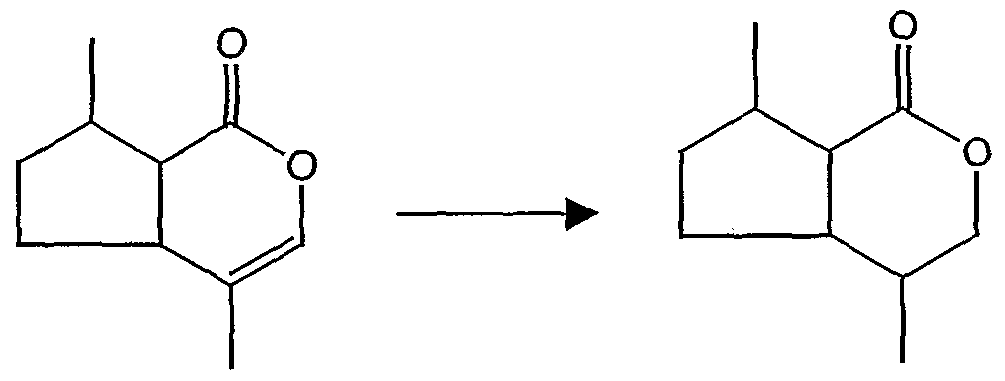
- This invention relates to a process for hydrogenating nepetalactone, utilizing a metal catalyst that is optionally supported, to yield dihydronepetalactone .
- nepetalactone Four stereoisomers of nepetalactone are known to exist in nature, which may be readily obtained from different species within the plant genus ' Nepeta. These chemicals exert a well-known excitatory effect on cats [Tucker, A.O. and S.S. Tucker. Economic Botany 42: 214- 231 (1988) ] , thus the oil--or more commonly, the dried herbage of this plant termed catnip- -is used in cat toys. The leaves and oil of Nepeta spp. do not possess a particularly attractive aroma. The uses of the herbage and oil has therefore been confined to the small market offered by domestic cat toys and accessories. A small proportion of the oil of various Nepeta spp.
- Iridoid monoterpenoids have long been known to be effective repellents to a variety of insect species [Eisner, T. Science 146:1318-1320 (1964); Eisner, T. Science 148:966-968 (1965); Peterson, C. and J. Coats, Pesticide Outlook 12:154-158 (2001); and Peterson, C. et al . Abstracts of Papers American Chemical Society, (2001) 222 (1-2) : AGR073] .
- studies of the repellency of dihydronepetalactones have been much less conclusive [Cavill, G.W.K., and D.V. Clark. J " . Insect Physiol .
- dihydronepetalactones may exert a repellent effect on the common insect pests of human society.
- a source of dihydronepetalactones (or a precursor) capable of supplying these compounds economically and in quantity may be required to allow commercial application of these molecules as insect repellents .
- dihydronepetalactone compounds be used as fragrance materials.
- a source of dihydronepetalactones (or a precursor) capable of supplying these compounds economically and in quantity may also be required to allow commercial application of these molecules as fragrance materials.
- the metals selected for use as catalysts in the process of this invention provide the desired economy and efficiency of production with a high degree of selectivity to the dihydronepetalactone product.
- One embodiment of this invention is a process for the production of a dihydronepetalactone of formula (II) by hydrogenating a nepetalactone of formula (I) according to the following scheme:
- Another embodiment of this invention is a process for the production of a dihydronepetalactone of formula (II) by hydrogenating a nepetalactone of formula (I) according to the following scheme:
- Figure 1 shows the chemical structures of the naturally-occurring iridoid (methylcyclopentanoid) nepetalactones .
- nepetalactone refers to the compound having the general structure, as defined by Formula I :
- dihydronepetalactones or "dihydronepetalactone mixtures” as used herein refers to any mixture of dihydronepetalactone stereoisomers .
- the molar or mass composition of each of these isomers relative to the whole dihydronepetalactone composition can be variable.
- Dihydronepetalactones are defined by Formula 2 :
- 4, 4a, 7 and 7a indicate the four chiral centers of the molecule and the structure encompasses all possible stereoisomers of dihydronepetalactone.
- dihydronepetalactone stereoisomers that may be derived from (7S) - nepetalactones are shown below.
- catalyst refers to a substance that affects the rate of a chemical reaction (but not the reaction equilibrium) and emerges from the process chemically unchanged.
- promoter as used herein is a compound that is added to enhance the physical or chemical function of a catalyst .
- a chemical promoter generally augments the activity of a catalyst and may be incorporated into the catalyst during any step in the chemical processing of the catalyst constituent.
- the chemical promoter generally enhances the physical or chemical function of the catalyst agent, but can also be added to retard undesirable side reactions.
- a “metal promoter” refers to a metallic compound that is added to enhance the physical or chemical function of a catalyst .
- Nepetalactone is a known material that can be conveniently obtained in relatively pure form from the essential oils isolated by various means from plants of the genus Nepeta (catmints) . Isolation of such oils is well known in the art, and examples of methodology for oil extraction include (but are not limited to) steam distillation, organic solvent extraction, microwave- assisted organic solvent extraction, supercritical fluid extraction, mechanical extraction and enfleurage (initial cold extraction into fats followed by organic solvent extraction) .
- Hydrogenation of nepetalactone is effected in the presence of a suitable active metal hydrogenation catalyst.
- Acceptable solvents, catalysts, apparatus, and procedures for hydrogenation in general can be found in Augustine, Heterogeneous Catalysis for the Synthetic Chemist, Marcel Decker, New York, N.Y. (1996) .
- the metal catalyst used in the process of this invention may be used as a supported or as an unsupported catalyst.
- a supported catalyst is one in which the active catalyst agent is deposited on a support material by spraying, soaking or physical mixing, followed by drying, calcination, and if necessary, activation through methods such as reduction or oxidation.
- Materials frequently used as support are porous solids with high total surface areas (external and internal) which can provide high concentrations of active sites per unit weight of catalyst.
- the catalyst support may enhance the function of the catalyst agent; and supported catalysts are generally preferred because the active metal catalyst is used more efficiently.
- a catalyst which is not supported on a catalyst support material is an unsupported catalyst .
- the catalyst support can be any solid, inert substance including, but not limited to, oxides such as silica, alumina, titania, calcium carbonate, barium sulfate, and carbons.
- the catalyst support can be in the form of powder, granules, pellets, or the like.
- a preferred support material of the present invention is selected from the group consisting of carbon, alumina, silica, silica-alumina, titania, titania-alumina, titania-silica, barium, calcium, compounds thereof and combinations thereof .
- Suitable supports include carbon, Si ⁇ 2 , CaC ⁇ 3 , BaS ⁇ 4 and AI 2 O 3 .
- supported catalytic metals may have the same supporting material or different supporting materials.
- a more preferred support is carbon.
- Further preferred supports are those, particularly carbon, that have a surface area greater than 100-200 m 2 /g.
- Further preferred supports are those, particularly carbon, that have a surface area of at least 300 m 2 /g.
- Carbons which may be used in this invention include those sold under the following trademarks: Bameby & SutcliffeTM, DarcoTM, NucharTM, Columbia JXNTM, Columbia LCKTM, Calgon PCBTM, Calgon BPLTM, WestvacoTM, NoritTM and Barnaby Cheny NBTM.
- the carbon can also be commercially available carbon such as Calsicat C, Sibunit C, or Calgon C (commercially available under the registered trademark Centaur ® ) .
- Preferred combinations of catalytic metal and support system include nickel on carbon, nickel on Al 2 0 3 , nickel on CaC0 3 , nickel on BaS0 4 , nickel on Si0 2 , platinum on carbon, platinum on Al 2 0 3 , platinum on CaC0 3 , platinum on BaS0 4 , platinum on Si0 2 , palladium on carbon, palladium on Al 2 0 3 , palladium on CaC0 3 , palladium on BaS0 4 , palladium on Si0 2 , iridium on carbon, iridium on Al 2 0 3 , iridium on Si0 2 , iridium on CaC0 3 , iridium on BaS0 4 , rhenium on carbon, rhenium on Al 2 0 3 , rhenium on Si0 2 , rhenium on CaC0 3 , rhenium on BaS0 4 , rhodium on carbon, rhodium on Al 2 0 3 .
- useful catalytic metals include component iridium, palladium, rhodium, nickel, ruthenium, platinum, rhenium; and useful support materials include carbon, alumina, silica, silica- alumina, titania, titania-alumina, titania-silica, barium, calcium, particularly carbon, Si ⁇ 2 , CaC ⁇ 3 , BaS ⁇ 4 and AI 2 O 3 .
- a supported catalyst may be made from any combination of the above named metals and support materials.
- a supported catalyst may also, however, be made from combinations of various metals and/or various support materials selected from subgroup (s) of the foregoing formed by omitting any one or more members from the whole groups as set forth in the lists above.
- the supported catalyst may in such instance not only be made from one or more metals and/or support materials selected from subgroup (s) of any size that may be formed from the whole groups as set forth in the lists above, but may also be made in the absence of the members that have been omitted from the whole groups to form the subgroup (s).
- the subgroup (s) formed by omitting various members from the whole groups in the lists above may, moreover, contain any number of the members of the whole groups such that those members of the whole groups that are excluded to form the subgroup (s) are absent from the subgroup (s) .
- a preferred content range of the metal in a supported catalyst is from about 0.1 wt% to about 20 wt% of the whole of the supported catalyst (catalyst weight plus the support weight) .
- a more preferred catalytic metal content range is from about 1 wt% to about 10 wt% by weight of the whole of the supported catalyst.
- a further preferred catalytic metal content range is from about 3 wt% to about 7 wt% by weight of the whole of the supported catalyst .
- a metal promoter may be used with the catalytic metal in the method of the present invention.
- Suitable metal promoters include: 1) those elements from groups 1 and 2 of the periodic table; 2) tin, copper, gold, silver, and combinations thereof; and 3) combinations of group 8 metals of the periodic table in lesser amounts.
- Temperature, solvent, catalyst, pressure and mixing rate are all parameters that affect the hydrogenation.
- the relationships among these parameters may be adjusted to effect the desired conversion, reaction rate, and selectivity in the reaction of the process .
- the preferred temperature is from about 25°C to 250°C, more preferably from about 50°C to about 150°C, and most preferred from about 50°C to 100°C.
- the hydrogen pressure is preferably about 0.1 to about 20 MPa, more preferably about 0.3 to 10 MPa, and most preferably about 0.3 to 4 MPa.
- the reaction may be performed neat or in the presence of a solvent .
- Useful solvents include those known in the art of hydrogenation such as hydrocarbons, ethers, and alcohols. Alcohols are most preferred, particularly lower alkanols such as methanol , ethanol , propanol , butanol , and pentanol .
- selectivites in the range of at least 70% are attainable where selectivites of at least 85% are typical.
- Selectivity is the weight percent of the converted material that is dihydronepetalactone where the converted material is the portion of the starting material that participates in the hydrogenation reaction.
- the process of the present invention may be carried out in batch, sequential batch (i.e. a series of batch reactors) or in continuous mode in any of the equipment customarily employed for continuous processes (see, for example, H.S. Fogler, Elementary Chemical Reaction Engineering, Prentice-Hall, Inc., NJ, USA) .
- the condensate water formed as the product of the reaction is removed by separation methods customarily employed for such separations.
- the resulting mixture of dihydronepetalactone isomer products may be separated by a conventional method, such as for example, by distillation, by crystallization, or by preparative liquid chromatography to yield each highly purified pair of dihydronepetalactone enantiomers. Chiral chromatography may be employed to separate enantiomers .
- Engelhard Corp. (E. Windsor, CT) .
- pressure is referred to in units of psi and MPa, where 14.7 psi is equivalent to 0.101325 MPa (which are both equivalent to 1 atm) .
- a commercially available support such as carbon, alumina, or silica available from Engelhard Corp. (E. Windsor, CT) ] was impregnated by incipient wetness with a metal salt .
- the precursors used were
- NiCl 2 -6H 2 0 Alfa Aesar
- H 2 PtClg Johnson Matthey, Inc., W. Deptford, NJ
- Re2 ⁇ 7 Alfa Aesar
- Calsicat Carbon is lot S-96-140 from Engelhard Corp., Beachwood, OH.
- Sibunit Carbon is Sibunit-2 from the Institute of Technical Carbon, 5th Kordnaya, Omsk 64418, Russia.
- Calgon Carbon is PCB Carbon (commercially available under the registered trademark of Centaur ® ) from Calgon Corp (Pittsburgh, PA) .
- the present example describes a series of experiments conducted to test the abilities of various catalysts to selectively convert nepetalactone to dihydronepetalactone via hydrogenation.
- the only variable altered in each experiment was the type of catalyst and support, while the following parameters were held constant (unless specifically noted below) : time — 2 hrs; temperature — 50 °C;
- Nepetalactone in ethanol 33% or 50% Nepetalactone in ethanol, and an amount of catalyst and support as indicated in the table below, were added to a 2 ml pressure reactor.
- the reactor was sealed and charged with 2.75 MPa of H and heated to a reaction temperature of 50°C. The pressure was maintained at the desired level during the course of the reaction. The reaction was stopped after a 2 hr period of time and permitted to cool .
- An internal standard (methoxyethylether) was added into the reaction product mixture.
- DHNE Selectivity is the weight percent of the converted material that is dihydronepetalactone where the converted material is the portion (by weight) of the starting material that participates in the hydrogenation reaction. Acid selectivity is defined as the percent by weight in the converted material of the ring-opened product, methyl- 2-isopropyl-5-methylcyclopentanecarboxylate .
- Table 1 Hydrogenation of Nepetalactone
- Preferred combinations of catalytic metal and support system includes
- Rh/C (Sibunit C, Calsicat C, and Calgon C)
Landscapes
- Chemical & Material Sciences (AREA)
- Organic Chemistry (AREA)
- Low-Molecular Organic Synthesis Reactions Using Catalysts (AREA)
- Catalysts (AREA)
- Organic Low-Molecular-Weight Compounds And Preparation Thereof (AREA)
- Plural Heterocyclic Compounds (AREA)
- Pyrane Compounds (AREA)
Abstract
Description


Claims

Priority Applications (8)
| Application Number | Priority Date | Filing Date | Title |
|---|---|---|---|
| BRPI0308833-2A BRPI0308833B1 (en) | 2002-04-03 | 2003-04-02 | Process for the production of a dihydronepetalactone |
| DE60314240T DE60314240T2 (en) | 2002-04-03 | 2003-04-02 | PREPARATION OF DIHYDRONEPETALACTONE BY HYDROGENATION OF NEPETALACTONE |
| HK05110244.8A HK1078312B (en) | 2002-04-03 | 2003-04-02 | Production of dihydronepetalactone by hydrogenation of nepetalactone |
| JP2003582143A JP2005530721A (en) | 2002-04-03 | 2003-04-02 | Production of dihydronepetalactone by hydrogenation of nepetalactone |
| CA2480116A CA2480116C (en) | 2002-04-03 | 2003-04-02 | Production of dihydronepetalactone by hydrogenation of nepetalactone |
| AU2003223414A AU2003223414A1 (en) | 2002-04-03 | 2003-04-02 | Production of dihydronepetalactone by hydrogenation of nepetalactone |
| IL16372403A IL163724A0 (en) | 2002-04-03 | 2003-04-02 | Production of dihydronepetalactone by hydrogenation of nepetalactone |
| EP03719543A EP1490351B1 (en) | 2002-04-03 | 2003-04-02 | Production of dihydronepetalactone by hydrogenation of nepetalactone |
Applications Claiming Priority (2)
| Application Number | Priority Date | Filing Date | Title |
|---|---|---|---|
| US36947002P | 2002-04-03 | 2002-04-03 | |
| US60/369,470 | 2002-04-03 |
Publications (1)
| Publication Number | Publication Date |
|---|---|
| WO2003084946A1 true WO2003084946A1 (en) | 2003-10-16 |
Family
ID=28791958
Family Applications (1)
| Application Number | Title | Priority Date | Filing Date |
|---|---|---|---|
| PCT/US2003/010072 Ceased WO2003084946A1 (en) | 2002-04-03 | 2003-04-02 | Production of dihydronepetalactone by hydrogenation of nepetalactone |
Country Status (13)
| Country | Link |
|---|---|
| US (1) | US7067677B2 (en) |
| EP (1) | EP1490351B1 (en) |
| JP (1) | JP2005530721A (en) |
| CN (1) | CN1331861C (en) |
| AT (1) | ATE364040T1 (en) |
| AU (1) | AU2003223414A1 (en) |
| BR (1) | BRPI0308833B1 (en) |
| CA (1) | CA2480116C (en) |
| DE (1) | DE60314240T2 (en) |
| ES (1) | ES2288604T3 (en) |
| IL (1) | IL163724A0 (en) |
| WO (1) | WO2003084946A1 (en) |
| ZA (1) | ZA200406756B (en) |
Cited By (6)
| Publication number | Priority date | Publication date | Assignee | Title |
|---|---|---|---|---|
| WO2006050519A1 (en) | 2004-11-03 | 2006-05-11 | E.I. Dupont De Nemours And Company | Insect repellent compositions comprising dihydronepetalactone, an alcohol, and an ester |
| US7067678B2 (en) | 2003-11-26 | 2006-06-27 | E. I. Du Pont De Nemours And Company | Derivatives of dihydronepetalactone and method for preparation |
| WO2008079252A1 (en) * | 2006-12-21 | 2008-07-03 | E. I. Du Pont De Nemours And Company | Production of dihydronepetalactone by hydrogenation of nepetalactone |
| US7547793B2 (en) * | 2003-03-19 | 2009-06-16 | E.I. Du Pont De Nemours And Company | Method for making insect repellent composition |
| CN102942544A (en) * | 2012-12-07 | 2013-02-27 | 南京中医药大学 | Nepetalactone trifluoromethyl benzoate as well as preparation process and use of nepetalactone trifluoromethyl benzoate |
| CN102942545A (en) * | 2012-12-07 | 2013-02-27 | 南京中医药大学 | Nepetalactone-o-bromobenzoic acid ester as well as preparation process and use of nepetalactone-o-bromobenzoic acid ester |
Families Citing this family (19)
| Publication number | Priority date | Publication date | Assignee | Title |
|---|---|---|---|---|
| US20050137252A1 (en) * | 2003-12-22 | 2005-06-23 | Scialdone Mark A. | Production of dihydronepetalactone |
| CA2592066A1 (en) * | 2004-12-29 | 2006-07-06 | E.I. Du Pont De Nemours And Company | Dihydronepetalactams and n-substituted derivatives thereof |
| US20060201391A1 (en) * | 2005-03-09 | 2006-09-14 | Scialdone Mark A | Compositions having sustained-release insect repellency |
| US20130165506A1 (en) * | 2005-09-30 | 2013-06-27 | E I Du Pont De Nemours And Company | Puleganic acid insect repellent |
| CN101316510A (en) * | 2005-09-30 | 2008-12-03 | 纳幕尔杜邦公司 | Pulenic Acid Insect Repellant |
| WO2007133683A2 (en) * | 2006-05-10 | 2007-11-22 | E. I. Du Pont De Nemours And Company | Formulated tick and insect repellent compositions |
| WO2008079253A1 (en) | 2006-12-21 | 2008-07-03 | E. I. Du Pont De Nemours And Company | Hydrogenation of catmint oil |
| US9521844B2 (en) | 2006-12-21 | 2016-12-20 | E I Du Pont De Nemours And Company | Solvent addition and removal in the hydrogenation of catmint oil |
| US8558015B2 (en) * | 2006-12-21 | 2013-10-15 | E I Du Pont De Nemours And Company | Solvent addition and removal in the hydrogenation of catmint oil |
| EP2129643A2 (en) * | 2006-12-21 | 2009-12-09 | E. I. Du Pont de Nemours and Company | Hydrogenation of caryophyllene |
| BRPI0719458A2 (en) * | 2006-12-21 | 2014-02-04 | Du Pont | "Processes for obtaining spinning oil" |
| KR101577472B1 (en) * | 2007-11-26 | 2015-12-14 | 이 아이 듀폰 디 네모아 앤드 캄파니 | Method for converting trans-cis nepetalactone to cis-trans nepetalactone using molecular sieves |
| US8420736B2 (en) * | 2009-06-25 | 2013-04-16 | Kaneka Corporation | Thermoplastic resin composition and molded body thereof |
| PH12012500935A1 (en) * | 2009-11-11 | 2012-11-26 | Du Pont | Method for the enhanced recovery of catmint oil |
| JP6310326B2 (en) * | 2014-05-27 | 2018-04-11 | 富士フレーバー株式会社 | Method for producing δ-valerolactone |
| WO2019113387A1 (en) | 2017-12-07 | 2019-06-13 | Zymergen Inc. | Engineered biosynthetic pathways for production of (6e)-8-hydroxygeraniol by fermentation |
| JP2021506316A (en) | 2017-12-21 | 2021-02-22 | ザイマージェン インコーポレイテッド | Microorganisms capable of producing nepetalactor oxidoreductase, nepetalactor synthase, and nepetalactone |
| US20230192637A1 (en) * | 2020-04-15 | 2023-06-22 | Zymergen Inc. | Hydrogenation of nepetalactone |
| US12378213B1 (en) | 2024-08-13 | 2025-08-05 | William Allen Boulanger | Process for the hydrogenation of catnip oil |
Family Cites Families (9)
| Publication number | Priority date | Publication date | Assignee | Title |
|---|---|---|---|---|
| US3978000A (en) | 1975-03-19 | 1976-08-31 | American Cyanamid Company | Catalysts based on carbon supports |
| NL7604669A (en) | 1976-05-01 | 1977-11-03 | Stamicarbon | PROCEDURE FOR PREPARING CARRIER CATALYSTERS. |
| JP2770357B2 (en) * | 1988-12-19 | 1998-07-02 | 味の素株式会社 | Method for producing nucleoside derivative |
| FR2653118B1 (en) * | 1989-10-13 | 1993-05-14 | Inst Francais Du Petrole | HYDROGENATION OF CITRAL. |
| JPH04108809A (en) * | 1990-08-29 | 1992-04-09 | Japan Synthetic Rubber Co Ltd | Hydrogenation of polymer |
| JP3337235B2 (en) * | 1992-03-26 | 2002-10-21 | 出光興産株式会社 | Hydrogen storage |
| DE19602710A1 (en) * | 1996-01-26 | 1997-07-31 | Basf Ag | Process for the selective hydrogenation of vinyloxirane to 1,2-butylene oxide over heterogeneous catalysts |
| JP2002069064A (en) * | 2000-08-24 | 2002-03-08 | New Japan Chem Co Ltd | METHOD FOR PRODUCING gamma-BUTYROLACTONE |
| CN1174973C (en) * | 2001-04-09 | 2004-11-10 | 南京中医药大学 | Nepetalactone and its extraction process and application |
-
2003
- 2003-04-02 US US10/405,444 patent/US7067677B2/en not_active Expired - Lifetime
- 2003-04-02 JP JP2003582143A patent/JP2005530721A/en active Pending
- 2003-04-02 AT AT03719543T patent/ATE364040T1/en not_active IP Right Cessation
- 2003-04-02 IL IL16372403A patent/IL163724A0/en unknown
- 2003-04-02 CN CNB038074125A patent/CN1331861C/en not_active Expired - Fee Related
- 2003-04-02 WO PCT/US2003/010072 patent/WO2003084946A1/en not_active Ceased
- 2003-04-02 BR BRPI0308833-2A patent/BRPI0308833B1/en not_active IP Right Cessation
- 2003-04-02 ES ES03719543T patent/ES2288604T3/en not_active Expired - Lifetime
- 2003-04-02 AU AU2003223414A patent/AU2003223414A1/en not_active Abandoned
- 2003-04-02 DE DE60314240T patent/DE60314240T2/en not_active Expired - Lifetime
- 2003-04-02 CA CA2480116A patent/CA2480116C/en not_active Expired - Fee Related
- 2003-04-02 EP EP03719543A patent/EP1490351B1/en not_active Expired - Lifetime
-
2004
- 2004-08-25 ZA ZA200406756A patent/ZA200406756B/en unknown
Non-Patent Citations (4)
| Title |
|---|
| BELLESIA ET AL.: "Synthesis and Molecular Structures of (1S)-cis, cis-Iridolactones", JOURNAL OF THE CHEMICAL SOCIETY, PERKIN TRANSACTIONS 2: PHYSICAL ORGANIC CHEMISTRY, vol. 10, 1979, pages 1341 - 1346, XP009012933 * |
| REGNIER ET AL.: "Studies on the composition of the essential oils of three Nepeta Species", PHYTOCHEMISTRY, vol. 6, 1967, pages 1281 - 1289, XP009012850 * |
| SAKAI T, ET AL.: "New Monoterpene Lactones of the Iridane Type from Actinidia polygama Miq.", BULL. CHEM. SOC. JPN., vol. 53, no. 12, 1980, pages 3683 - 3686, XP009012851 * |
| WOLINSKY J ET AL: "Syntheses of the dihydronepetalACTONES", JOURNAL OF ORGANIC CHEMISTRY, AMERICAN CHEMICAL SOCIETY. EASTON, US, vol. 37, no. 21, 1972, pages 3376 - 3378, XP002242594, ISSN: 0022-3263 * |
Cited By (10)
| Publication number | Priority date | Publication date | Assignee | Title |
|---|---|---|---|---|
| US7547793B2 (en) * | 2003-03-19 | 2009-06-16 | E.I. Du Pont De Nemours And Company | Method for making insect repellent composition |
| US7067678B2 (en) | 2003-11-26 | 2006-06-27 | E. I. Du Pont De Nemours And Company | Derivatives of dihydronepetalactone and method for preparation |
| WO2005054224A3 (en) * | 2003-11-26 | 2007-09-13 | Du Pont | Derivatives of dihydronepetalactone and method for preparation |
| WO2006050519A1 (en) | 2004-11-03 | 2006-05-11 | E.I. Dupont De Nemours And Company | Insect repellent compositions comprising dihydronepetalactone, an alcohol, and an ester |
| US8748477B2 (en) | 2004-11-03 | 2014-06-10 | E I Du Pont De Nemours And Company | Formulations containing insect repellent compounds |
| WO2008079252A1 (en) * | 2006-12-21 | 2008-07-03 | E. I. Du Pont De Nemours And Company | Production of dihydronepetalactone by hydrogenation of nepetalactone |
| US8765975B2 (en) | 2006-12-21 | 2014-07-01 | E I Du Pont De Nemours And Company | Production of dihydronepetalactone |
| CN102942544A (en) * | 2012-12-07 | 2013-02-27 | 南京中医药大学 | Nepetalactone trifluoromethyl benzoate as well as preparation process and use of nepetalactone trifluoromethyl benzoate |
| CN102942545A (en) * | 2012-12-07 | 2013-02-27 | 南京中医药大学 | Nepetalactone-o-bromobenzoic acid ester as well as preparation process and use of nepetalactone-o-bromobenzoic acid ester |
| CN102942544B (en) * | 2012-12-07 | 2014-08-27 | 南京中医药大学 | Nepetalactone trifluoromethyl benzoate as well as preparation process and use of nepetalactone trifluoromethyl benzoate |
Also Published As
| Publication number | Publication date |
|---|---|
| CN1642935A (en) | 2005-07-20 |
| EP1490351B1 (en) | 2007-06-06 |
| CA2480116C (en) | 2011-01-04 |
| US7067677B2 (en) | 2006-06-27 |
| BR0308833A (en) | 2005-01-25 |
| AU2003223414A1 (en) | 2003-10-20 |
| DE60314240T2 (en) | 2008-01-31 |
| CN1331861C (en) | 2007-08-15 |
| BRPI0308833B1 (en) | 2015-07-07 |
| CA2480116A1 (en) | 2003-10-16 |
| HK1078312A1 (en) | 2006-03-10 |
| ZA200406756B (en) | 2006-06-28 |
| JP2005530721A (en) | 2005-10-13 |
| ES2288604T3 (en) | 2008-01-16 |
| IL163724A0 (en) | 2005-12-18 |
| EP1490351A1 (en) | 2004-12-29 |
| DE60314240D1 (en) | 2007-07-19 |
| US20030225290A1 (en) | 2003-12-04 |
| ATE364040T1 (en) | 2007-06-15 |
Similar Documents
| Publication | Publication Date | Title |
|---|---|---|
| EP1490351B1 (en) | Production of dihydronepetalactone by hydrogenation of nepetalactone | |
| CN101563334B (en) | Production of dihydronepetalactone by hydrogenation of nepetalactone | |
| EP3455213B1 (en) | Method for purifying cannabinoid compounds via simulated moving bed chromatography | |
| EP2051972A1 (en) | Process for one-stage preparation of 2-methyltetrahydrofuran from furfural over two catalysts in a structured bed | |
| Gaudin | Synthesis and organoleptic properties of p-menthane lactones | |
| DE602004009573T2 (en) | PREPARATION OF 5-METHYL-DIHYDROFURAN-2-ON FROM LEVULINIC ACID IN SUPERCRITICAL MEDIA | |
| FI114022B (en) | Process for the preparation of vegetable lignans and a new intermediate | |
| US5296614A (en) | Preparation of phthalides | |
| Aı̈t-Mohand et al. | Palladium-catalyzed oxidative cyclization of 1, 4-and 1, 5-diols in 1, 2-dichloroethane | |
| JP2994462B2 (en) | Method for producing high-purity tetrahydrofuran | |
| HK1078312B (en) | Production of dihydronepetalactone by hydrogenation of nepetalactone | |
| Donohoe et al. | The synthesis of (−)-cis-and (−)-trans-crobarbatic acid | |
| EP1309580B1 (en) | Continuous process for the production of optically pure (s)-beta-hydroxy-gamma-butyrolactone | |
| HU209551B (en) | Process for preparation of 4-hydroxymethyl-tetrahydropyrane | |
| DE602005002136T2 (en) | PROCESS FOR THE PREPARATION OF TOCOPHERYL ACYLATES | |
| HK1136295B (en) | Production of dihydronepetalactone by hydrogenation of nepetalactone | |
| KR100490838B1 (en) | Praparation of gamma-butyrolactone using noble metal catalyst | |
| Ballini et al. | Synthesis of 3-alkyl-2, 5-dimethylfuran derivatives by indirect alkylation of 2, 5-dimethylfuran with aliphatic nitrocompounds | |
| JPH07138245A (en) | Production of (3s,4r)-3-hydroxy-4-hydroxymethyl-4-butanolide |
Legal Events
| Date | Code | Title | Description |
|---|---|---|---|
| AK | Designated states |
Kind code of ref document: A1 Designated state(s): AE AG AL AM AT AU AZ BA BB BG BR BY BZ CA CH CN CO CR CU CZ DE DK DM DZ EC EE ES FI GB GD GE GH GM HR HU ID IL IN IS JP KE KG KP KR KZ LC LK LR LS LT LU LV MA MD MG MK MN MW MX MZ NI NO NZ OM PH PL PT RO RU SC SD SE SG SK SL TJ TM TN TR TT TZ UA UG US UZ VC VN YU ZA ZM ZW |
|
| AL | Designated countries for regional patents |
Kind code of ref document: A1 Designated state(s): GH GM KE LS MW MZ SD SL SZ TZ UG ZM ZW AM AZ BY KG KZ MD RU TJ TM AT BE BG CH CY CZ DE DK EE ES FI FR GB GR HU IE IT LU MC NL PT RO SE SI SK TR BF BJ CF CG CI CM GA GN GQ GW ML MR NE SN TD TG |
|
| 121 | Ep: the epo has been informed by wipo that ep was designated in this application | ||
| WWE | Wipo information: entry into national phase |
Ref document number: 163724 Country of ref document: IL |
|
| WWE | Wipo information: entry into national phase |
Ref document number: 2004/06756 Country of ref document: ZA Ref document number: 200406756 Country of ref document: ZA |
|
| WWE | Wipo information: entry into national phase |
Ref document number: 2507/DELNP/2004 Country of ref document: IN |
|
| WWE | Wipo information: entry into national phase |
Ref document number: 2003223414 Country of ref document: AU |
|
| WWE | Wipo information: entry into national phase |
Ref document number: 2480116 Country of ref document: CA |
|
| WWE | Wipo information: entry into national phase |
Ref document number: 2003719543 Country of ref document: EP Ref document number: 2003582143 Country of ref document: JP |
|
| WWE | Wipo information: entry into national phase |
Ref document number: 20038074125 Country of ref document: CN |
|
| WWP | Wipo information: published in national office |
Ref document number: 2003719543 Country of ref document: EP |
|
| WWG | Wipo information: grant in national office |
Ref document number: 2003719543 Country of ref document: EP |