WO2003087950A1 - Toner for developing electrostatic charge image - Google Patents
Toner for developing electrostatic charge image Download PDFInfo
- Publication number
- WO2003087950A1 WO2003087950A1 PCT/JP2003/004558 JP0304558W WO03087950A1 WO 2003087950 A1 WO2003087950 A1 WO 2003087950A1 JP 0304558 W JP0304558 W JP 0304558W WO 03087950 A1 WO03087950 A1 WO 03087950A1
- Authority
- WO
- WIPO (PCT)
- Prior art keywords
- toner
- molecular weight
- resin
- developing
- low
- Prior art date
- Legal status (The legal status is an assumption and is not a legal conclusion. Google has not performed a legal analysis and makes no representation as to the accuracy of the status listed.)
- Ceased
Links
Classifications
-
- G—PHYSICS
- G03—PHOTOGRAPHY; CINEMATOGRAPHY; ANALOGOUS TECHNIQUES USING WAVES OTHER THAN OPTICAL WAVES; ELECTROGRAPHY; HOLOGRAPHY
- G03G—ELECTROGRAPHY; ELECTROPHOTOGRAPHY; MAGNETOGRAPHY
- G03G9/00—Developers
- G03G9/08—Developers with toner particles
- G03G9/097—Plasticisers; Charge controlling agents
- G03G9/09733—Organic compounds
- G03G9/0975—Organic compounds anionic
-
- G—PHYSICS
- G03—PHOTOGRAPHY; CINEMATOGRAPHY; ANALOGOUS TECHNIQUES USING WAVES OTHER THAN OPTICAL WAVES; ELECTROGRAPHY; HOLOGRAPHY
- G03G—ELECTROGRAPHY; ELECTROPHOTOGRAPHY; MAGNETOGRAPHY
- G03G9/00—Developers
- G03G9/08—Developers with toner particles
- G03G9/087—Binders for toner particles
-
- C—CHEMISTRY; METALLURGY
- C08—ORGANIC MACROMOLECULAR COMPOUNDS; THEIR PREPARATION OR CHEMICAL WORKING-UP; COMPOSITIONS BASED THEREON
- C08K—Use of inorganic or non-macromolecular organic substances as compounding ingredients
- C08K3/00—Use of inorganic substances as compounding ingredients
-
- C—CHEMISTRY; METALLURGY
- C08—ORGANIC MACROMOLECULAR COMPOUNDS; THEIR PREPARATION OR CHEMICAL WORKING-UP; COMPOSITIONS BASED THEREON
- C08L—COMPOSITIONS OF MACROMOLECULAR COMPOUNDS
- C08L23/00—Compositions of homopolymers or copolymers of unsaturated aliphatic hydrocarbons having only one carbon-to-carbon double bond; Compositions of derivatives of such polymers
- C08L23/02—Compositions of homopolymers or copolymers of unsaturated aliphatic hydrocarbons having only one carbon-to-carbon double bond; Compositions of derivatives of such polymers not modified by chemical after-treatment
- C08L23/18—Homopolymers or copolymers of hydrocarbons having four or more carbon atoms
-
- G—PHYSICS
- G03—PHOTOGRAPHY; CINEMATOGRAPHY; ANALOGOUS TECHNIQUES USING WAVES OTHER THAN OPTICAL WAVES; ELECTROGRAPHY; HOLOGRAPHY
- G03G—ELECTROGRAPHY; ELECTROPHOTOGRAPHY; MAGNETOGRAPHY
- G03G9/00—Developers
- G03G9/08—Developers with toner particles
- G03G9/087—Binders for toner particles
- G03G9/08702—Binders for toner particles comprising macromolecular compounds obtained by reactions only involving carbon-to-carbon unsaturated bonds
- G03G9/08704—Polyalkenes
-
- G—PHYSICS
- G03—PHOTOGRAPHY; CINEMATOGRAPHY; ANALOGOUS TECHNIQUES USING WAVES OTHER THAN OPTICAL WAVES; ELECTROGRAPHY; HOLOGRAPHY
- G03G—ELECTROGRAPHY; ELECTROPHOTOGRAPHY; MAGNETOGRAPHY
- G03G9/00—Developers
- G03G9/08—Developers with toner particles
- G03G9/087—Binders for toner particles
- G03G9/08702—Binders for toner particles comprising macromolecular compounds obtained by reactions only involving carbon-to-carbon unsaturated bonds
- G03G9/08706—Polymers of alkenyl-aromatic compounds
- G03G9/08708—Copolymers of styrene
- G03G9/08711—Copolymers of styrene with esters of acrylic or methacrylic acid
-
- G—PHYSICS
- G03—PHOTOGRAPHY; CINEMATOGRAPHY; ANALOGOUS TECHNIQUES USING WAVES OTHER THAN OPTICAL WAVES; ELECTROGRAPHY; HOLOGRAPHY
- G03G—ELECTROGRAPHY; ELECTROPHOTOGRAPHY; MAGNETOGRAPHY
- G03G9/00—Developers
- G03G9/08—Developers with toner particles
- G03G9/087—Binders for toner particles
- G03G9/08784—Macromolecular material not specially provided for in a single one of groups G03G9/08702 - G03G9/08775
- G03G9/08791—Macromolecular material not specially provided for in a single one of groups G03G9/08702 - G03G9/08775 characterised by the presence of specified groups or side chains
-
- G—PHYSICS
- G03—PHOTOGRAPHY; CINEMATOGRAPHY; ANALOGOUS TECHNIQUES USING WAVES OTHER THAN OPTICAL WAVES; ELECTROGRAPHY; HOLOGRAPHY
- G03G—ELECTROGRAPHY; ELECTROPHOTOGRAPHY; MAGNETOGRAPHY
- G03G9/00—Developers
- G03G9/08—Developers with toner particles
- G03G9/097—Plasticisers; Charge controlling agents
-
- G—PHYSICS
- G03—PHOTOGRAPHY; CINEMATOGRAPHY; ANALOGOUS TECHNIQUES USING WAVES OTHER THAN OPTICAL WAVES; ELECTROGRAPHY; HOLOGRAPHY
- G03G—ELECTROGRAPHY; ELECTROPHOTOGRAPHY; MAGNETOGRAPHY
- G03G9/00—Developers
- G03G9/08—Developers with toner particles
- G03G9/097—Plasticisers; Charge controlling agents
- G03G9/09733—Organic compounds
Definitions
- the present invention is applied to an image forming apparatus such as a copying machine, a printer, a facsimile, etc. using an electrophotographic technique, and in particular, an electrostatic charge image suitably used in an image forming apparatus employing a hot roll fixing method. It relates to a developing toner. Background art
- a dry developer applied to the development of an image forming apparatus using electrophotography is a two-component developer in which a toner and a carrier made of ferrite powder, iron powder, glass beads, etc. are mixed, and the magnetic powder is used in the toner itself. And a non-magnetic one-component developer that does not use magnetic force.
- the toner used in these developers contains a binder resin and a colorant as main components.
- a wax for improving the low-temperature fixability to a recording sheet and the releasability from a fixing roll, and an extreme A charge control agent or the like for imparting the property (positive charge or negative charge) is added.
- the toner is manufactured into a powder after these materials are mixed in a prescribed formulation, and then subjected to melt kneading, pulverization, classification, etc., and finally, fluidity, chargeability, cleaning properties, storage stability, etc.
- melt kneading, pulverization, classification, etc. and finally, fluidity, chargeability, cleaning properties, storage stability, etc.
- an external additive such as silica, titanium oxide, alumina, and various types of resin fine particles is performed, and the resultant is finally used as a developer.
- the main objectives of the above-mentioned image forming apparatuses have been to increase the number of functions, to increase the speed for the spread of so-called gray areas located at the border between printing machines and copiers, and to reduce the size and cost.
- Energy consumption reduction in power consumption
- simplification of the fixing mechanism typified by a hot roll fixing method and low energy consumption are required, and at the same time, the toner is adapted to the fixing mechanism as described above, and the printing speed is reduced. Characteristics that are suitable for high speed and long life of the developer are required. Therefore, the toner has both contradictory characteristics such as good fixing characteristics with low energy and improved stress resistance such as fusion characteristics to the charging blade. It is required to stand.
- toners mainly using styrene-acrylic resin as a binder resin have been used.
- a toner made of styrene-acrylic resin can easily improve the fixing properties, if the fixing properties are required, the strength of the resin itself is reduced, and the toner is easily broken by friction with a sleeve or the like.
- polyester-based resins are widely used to compensate for this insufficient stress resistance.
- the toner composed of the polyester resin the charge amount changes greatly in a low-temperature and low-humidity environment, and the thickness of the toner layer on the sleeve increases with the increase in the charge amount. The problem is that it causes problems such as the occurrence of pre-ground and pre-ground power, and satisfactory quality has not yet been obtained. Disclosure of the invention
- the present invention has been made in order to solve such problems, and it is possible to exhibit sufficient fixing characteristics even with a small amount of energy due to good low-temperature adhesion, and to achieve high blade resistance due to high stress resistance.
- An object of the present invention is to provide a toner for developing electrostatic images which does not cause fusing or the like and has good environmental resistance at low temperature and low humidity.
- the toner for developing an electrostatic image of the present invention is a toner for developing an electrostatic image containing at least a binder resin, a colorant, and a charge controlling agent, wherein at least the charge controlling agent has a low molecular weight polymer having a functional group.
- at least the binder resin is a cycloolefin copolymer resin.
- the electrostatic image developing toner of the present invention by using a cycloolefin copolymer resin as at least a binder resin, stress resistance and environmental characteristics are improved, and at least a low-molecular-weight resin having a functional group as a charge control agent is used.
- a high molecular weight polymer By using a high molecular weight polymer, good low-temperature fixability can be exhibited while maintaining sufficient chargeability.Sufficient image density can be obtained even in continuous copying of many sheets under high-temperature, high-humidity or low-temperature, low-humidity environments. And no problems such as capri, blade fusion, and offset.
- low molecular weight polymers having this functional group The effect of lowering the non-offset temperature on the low temperature side of the toner of the present invention is also achieved.
- a solvent or an endocrine disrupting substance (environmental hormone substance) used in the production of a styrene-acrylic resin or a polyester resin is used. It is excellent for environmental issues because it is not used.
- the low-molecular-weight polymer having a functional group in the present invention is a polymer-type charge control agent that does not contain a heavy metal such as chromium, instead of a structure containing a metal complex as in the conventional charge control agent.
- the electrostatic image developing toner of the present invention is extremely excellent for environmental problems.
- the toner for developing an electrostatic image according to the present invention contains, as essential constituent materials, a cycloolefin copolymer resin as a binder resin, a low molecular weight polymer having a functional group as a charge control agent, and a colorant.
- a cycloolefin copolymer resin as a binder resin
- a low molecular weight polymer having a functional group as a charge control agent e.g., a cycloolefin copolymer resin as a binder resin
- a low molecular weight polymer having a functional group as a charge control agent e.g., a cycloolefin copolymer resin
- a low molecular weight polymer having a functional group a charge control agent
- a colorant e.g., a colorant toner.
- low-melting wax and other additives to be added as necessary can be added as appropriate.
- Cycloolefin copolymer resin is a polyolefin resin having a cyclic structure, for example, a-olefin such as ethylene, propylene, and butylene, and an alicyclic ring having a double bond such as cyclohexene, norportene, and tetracyclododecene.
- the polyolefin resin having such a cyclic structure can be obtained by a known polymerization method using a meta-mouth catalyst or a Ziegler catalyst. For example, it can be synthesized by the methods disclosed in JP-A-5-33932, JP-A-5-9223, JP-A-6-271716, and the like. it can.
- the copolymerization ratio of a-refined olefin and cyclin-refined olefin in the cycloolefin copolymer resin can be varied over a wide range so that a desired product can be obtained by appropriately setting the reaction charge molar ratio of both. Is the sum of the two Chlorefin is set in the range of 2 to 98 mol%, preferably 2.5 to 50 mol%, more preferably 2.5 to 35 mol%.
- T g glass transition point
- the cycloolefin copolymer resin may have at least two or more peaks in a molecular weight distribution measured by gel permeation chromatography (hereinafter, abbreviated as “GPC:”).
- GPC gel permeation chromatography
- Such a cycloolefin copolymer resin may be a mixture of a low molecular weight fraction and a high molecular weight fraction, or the low molecular weight fraction and the high molecular weight fraction each have a peak in the molecular weight distribution by GPC during synthesis. It may be manufactured under such control.
- the number average molecular weight (hereinafter, abbreviated as “M n”) of the low molecular weight fraction is less than 7,500
- the M n of the high molecular weight fraction is 7,500 or more
- the ratio of the high molecular weight fraction in the binder resin is preferably 5% by weight to 50% by weight, more preferably 5% by weight to 30% by weight. If the proportion of the high molecular weight fraction is more than 50%, the uniform kneading property is extremely reduced, which hinders the toner performance and makes it impossible to obtain sufficient fixing strength in low-temperature fixing. On the other hand, if it is less than 5% by weight, a sufficient non-offset temperature range cannot be obtained.
- the term “fraction” means each resin component before mixing, and a single cycloolefin copolymer by synthesis.
- a coalesced resin it means a resin component in a portion having each peak with the lowest part between two peaks in the molecular weight distribution measured by the GPC method as a boundary.
- a low molecular weight fraction having Mn of less than 7,500 and a high molecular weight fraction having Mn of 7,500 or more are contained in the above proportions.
- the low molecular weight fraction More preferably, the molecular weight is in the range of M nl, 000 to less than 7,500, even more preferably M n 3,000 to, less than 50,000, and the high molecular weight fraction is It is more preferably in the range of Mn 7,500 to 1,000,000, even more preferably in the range of 500,000 to 700,000.
- the low molecular weight fraction is less than Mw 15,500, and more preferably from 1,000 to less than 15,500. More preferably, it is in the range of 4,000 to 15,500, while the high molecular weight fraction is Mw 5,500 or more, more preferably 100,000 to 1,000. , 500, 000 are preferably used.
- a carboxyl group may be introduced into the cycloolefin copolymer resin of the present invention by a melt air oxidation method or a modification with maleic anhydride. This can improve the compatibility with other resins and the dispersibility of the pigment. A similar effect can be obtained by introducing a hydroxyl group or an amino group by a known method.
- the cycloolefin copolymer resin may be copolymerized with a genomer such as norpolnadiene, cyclohexadiene, tetracyclododecadiene, or the like, or the cycloolefin resin resin having a lipoxyl group introduced therein, such as zinc, copper, or calcium. By introducing a crosslinked structure by adding a metal, it is also possible to improve the adhesion.
- the blending ratio of the cycloolefin copolymer resin in the binder resin is preferably set in the range of 20 to 100% by weight, and more preferably 50 to 100% by weight. If the cycloolefin copolymer resin is less than 20% by weight, it is not possible to maintain a sufficient image density in any environment when continuously copying a large number of sheets, and problems such as capri and toner scattering tend to occur. .
- resins that can be used in combination with the cycloolefin copolymer resin include polystyrene resin, polyacrylate resin, styrene-monoacrylate copolymer resin, styrene-methacrylate copolymer resin, and polychlorinated resin. Vinyl, polyvinyl acetate, polyvinylidene chloride, phenolic resin, epoxy resin, polyester resin, etc. It is preferable that the temperature (softening point) is as low as possible (for example, 120 to 150 ° C), and to improve the storage stability, it is preferable that the glass transition point is as high as 65 ° C or higher.
- the charge control agent is added to impart polarity.
- at least the charge control agent needs to be a low molecular weight polymer having a functional group, and M n is 1 , 0000 to 100, 0000, preferably 1, 000 to 7, 0000, more preferably 1, 000 to 5, 0000.
- Mn is less than 1, 000, the storage stability as a developer decreases. In addition, offset is likely to occur during fixing.
- Mn exceeds 100, 000, the compatibility with the binder resin is deteriorated, and uniform dispersion cannot be obtained, so that capri, photoconductor contamination, poor fixing, etc. occur. . Also, the effect of low-temperature fixing cannot be obtained.
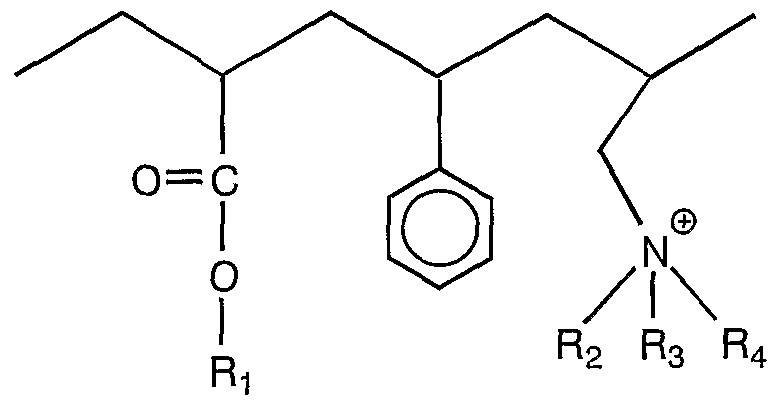
- Such a low molecular weight polymer include, for example, a positively charged type in which a quaternary ammonium salt type functional group is added to a styrene-acryl main chain as shown in the following chemical formula 1, And negatively charged styrene-acrylic main chains having a sulfonic acid type functional group added thereto. Since such a polymer-type charge control agent does not have a structure containing a metal complex as in the related art, it is also good for environmental problems. In the toner of the present invention, a generally known charge control agent may be used in combination with the low molecular weight polymer having the functional group as long as the effects of the present invention are not impaired.
- the amount of the low molecular weight polymer to be added to the toner of the present invention is preferably 1 to 15 parts by weight, more preferably 2 to 13 parts by weight, based on 100 parts by weight of the binder resin. If the blending amount of the low molecular weight polymer is less than 1 part by weight, the required charge amount cannot be obtained, the charge amount varies between toner particles, the fixed image becomes unclear, and the photoreceptor becomes dirty. Defects are likely to occur. On the other hand, if it exceeds 15 parts by weight, poor charging will occur due to a decrease in environmental resistance and compatibility, and capri will be generated. Chemical formula 1
- an alkyl group, and R 2 to R 4 each represent a hydrogen atom or an alkyl group.
- Colorants include Riki Bon Black, Ani Limble,
- the colorant must have a sufficient content of the colorant to form a visible image of sufficient density.
- the colorant is contained in an amount of 1 to 20 parts by weight based on 100 parts by weight of the binder resin. Just do it.
- additives include magnetic powder, wax and the like.
- the magnetic powder examples include fine particles such as ferrite powder, magnetite powder, and iron powder.
- the ferrite powder mixed sintered body of Me_ ⁇ one F e 2 0 3 is Ru are used in the present invention.
- Me ⁇ means an oxide such as Mn, Zn, Ni, Ba, Co, Cu, Li, Mg, Cr, Ca, V, and any one or two of them. Use the above Can be.
- mixed sintered body as the magnetite powder F e O- F e 2 ⁇ 3 is used.
- the magnetic powder preferably has a particle size in the range of 0.05 to 3 m, and the compounding ratio is preferably 70% by weight or less in the toner.
- Wax is added for the purpose of lowering the melting start temperature of the toner to improve the low-temperature fixability and as a release agent, and synthetic wax, petroleum wax, and the like are used.
- synthetic wax include polypropylene wax and Fischer-Tropsch wax
- examples of the petroleum-based wax include paraffin wax, microcrystalline wax, and petrolatum.
- Other waxes include natural waxes such as carnauba wax, rice wax, and candelilla wax. Further, if necessary, the above wax may be used in combination.
- the toner particles constituting the toner of the present invention can be produced by mixing and mixing the above materials at a predetermined ratio, and then subjecting the mixture to processes such as melt-kneading, pulverization, and classification.
- toner particles may be produced by a polymerization method using the raw materials of the above materials.
- the volume average particle size of the toner particles is generally set in the range of 5 to 15 zm.
- an external additive for controlling the fluidity, the chargeability, the cleaning property and the storage property of the toner.
- silica, alumina, talc, clay, calcium carbonate, magnesium carbonate, titanium oxide, magnetic powder or various kinds of resin fine particles are used.
- hydrophobic silica is particularly preferable.
- a plurality of types may be used in combination.
- the surface treatment of the main component powder with an external additive can be performed using a general stirrer such as a turbine type stirrer, a Henschel mixer or a super mixer.
- a general stirrer such as a turbine type stirrer, a Henschel mixer or a super mixer.
- Ethylene mono-norpolene copolymer resin A (trade name: TOPAS C ⁇ C, manufactured by Ticona Co., Ltd., Mn: 5,020, Mw: 138,000, Mw / Mn: 27.5, Mn of low molecular weight fraction: 4, 080, Mw: 7,960, Mn of high molecular weight fraction: 291,300, Mw: 703,400, high molecular weight fraction Z Low molecular weight fraction: 18.5 / 81.5) 100 parts by weight
- Carbon black (trade name: MA-100, manufactured by Mitsubishi Chemical Corporation) 7 parts by weight
- the raw materials having the above mixing ratios are mixed with a super mixer, and the temperature is set to 140 ° C with a twin-screw extruder.
- the mixture was pulverized by a jet mill, and then classified by a dry air classifier to obtain toner particles having a volume average particle diameter of 9 m.
- hydrophobic silica (trade name: R-972, manufactured by Nippon Aerosil Co., Ltd.) was blended with the obtained toner particles so that the adhesion amount was 0.5% by weight.
- the mixture was mixed at a peripheral speed of 4 OmXsec for 8 minutes to obtain a toner for developing an electrostatic image of Example 1.
- the Mn and Mw of the cycloolefin copolymer resin and the low molecular weight polymer are values measured by GPC under the following conditions. That is, tetrahydrofuran (THF) was flowed at a column temperature of 40 ° C at a flow rate of lm l./min, polystyrene was used as a standard substance, and the measured value was converted to a polystyrene equivalent value.
- THF tetrahydrofuran
- the cycloolefin copolymer resin of Example 1 was replaced with an ethylene-norbornene copolymer resin B (trade name: TOP AS C ⁇ C, manufactured by Ticona, Mn: 4,250, M w: 96, 100, Mw / Mn: 22.6, low molecular weight fraction Mn: 3,630, Mw: 6,790, high molecular weight fraction Mn: 309, 100, Mw: 683, 800, high molecular weight Fraction Z
- a toner for developing an electrostatic image of Example 2 was obtained in the same manner as in Example 1, except that 12.5 / 87.5) was used.
- Mn and Mw of the above cycloolefin copolymer resin are values measured by GPC under the same conditions as in Example 1.
- a toner for developing an electrostatic charge image of Example 3 was obtained in the same manner as in Example 1 except that the low molecular weight polymer of Example 1 was changed to 10 parts by weight.
- Example 4 The same procedure as in Example 1 was carried out except that the low molecular weight polymer of Example 1 was replaced by Fujikura Kasei Co., Ltd., trade name: FCA20 1-PS (cationic, Mn: 1,560, Mw: 3, 340). Thus, an electrostatic image developing toner of Example 4 was obtained. Note that Mn and Mw of the low-molecular-weight polymer are values measured by GPC under the same conditions as in Example 1.
- a toner for developing an electrostatic image of Example 5 was obtained in the same manner as in Example 4, except that the low-molecular-weight polymer of Example 4 was changed to 10 parts by weight.
- a comparative example was performed in the same manner as in Example 1 except that the cycloolefin copolymer resin A of Example 1 was replaced with a polyester resin (trade name: FC-316, manufactured by Mitsubishi Rayon Co., Ltd.) as a binder resin. Thus, No. 1 toner for developing an electrostatic image was obtained.
- a polyester resin trade name: FC-316, manufactured by Mitsubishi Rayon Co., Ltd.
- Example 2 The same procedure as in Example 1 was carried out except that the cycloolefin copolymer resin A of Example 1 was replaced with a styrene acrylate copolymer resin (trade name: CPR-100, manufactured by Mitsui Chemicals, Inc.) as the binder resin. Thus, an electrostatic image developing toner of Comparative Example 2 was obtained. Comparative Example 3>
- a toner for developing an electrostatic image of Comparative Example 3 was obtained in the same manner as in Example 1 except that the charge control agent of Example 1 was changed to T-77 (trade name, manufactured by Hodogaya Chemical Industry Co., Ltd.). .
- This charge control agent is an iron complex salt, not a low molecular weight polymer.
- the toner for developing an electrostatic image of Comparative Example 4 was obtained in the same manner as in Example 1 except that the charge control agent of Example 1 was changed to TN-105, a trade name of Hodogaya Chemical Industry Co., Ltd. Was.
- the charge control agent is a molybdenum complex salt, not a low molecular weight polymer.
- a toner for developing an electrostatic charge image of Comparative Example 5 was obtained in the same manner as in Example 1 except that the charge control agent of Example 1 was changed to Bontron N-04 (trade name, manufactured by Orient Chemical Industries, Ltd.).
- the charge control agent is a resin acid-modified azine compound, not a low molecular weight polymer.
- Comparative Example A comparative example was performed in the same manner as in Example 4 except that the cycloolefin copolymer resin of Example 4 was replaced with a polyester resin (trade name: FC-316, manufactured by Takahashi Rayon Co., Ltd.) as the binder resin. 6 was obtained.
- a polyester resin trade name: FC-316, manufactured by Takahashi Rayon Co., Ltd.
- Example 7 Same as Example 4 except that the cycloolefin copolymer resin of Example 4 was replaced with a styrene acrylate copolymer resin (trade name: CPR-100, manufactured by Mitsui Chemicals, Inc.) as the binder resin. Thus, an electrostatic image developing toner of Comparative Example 7 was obtained.
- a styrene acrylate copolymer resin (trade name: CPR-100, manufactured by Mitsui Chemicals, Inc.) as the binder resin.
- CPR-100 styrene acrylate copolymer resin
- Examples 1 to 3 and Comparative Examples 1 to 4 were put into a commercially available non-magnetic one-component imaging type printer using a negatively chargeable toner, and Examples 4 to 5 and Comparative Examples 5 to 7 were positively charged.
- A4 originals with a black ratio of 6% were placed on A4 transfer paper while the replenishment of the above toner, which is reduced by use, was carried out on A4 transfer paper.
- Continuous copying was performed up to the number of sheets. Copying is performed under normal temperature and normal humidity (temperature 20 ° C 58 RH), high temperature and high humidity (32 ° C 85% RH), and low temperature and low humidity (10 ° C 20% RH).
- the image density of the 100,000th sheet and the capri of the non-image area under the initial and normal temperature and normal humidity conditions were measured, and the presence or absence of blade fusion at that time was observed.
- Table 1 shows the results of these evaluations.
- the image density was measured by measuring a solid image with a reflection densitometer (trade name: RD-914, manufactured by Macbeth), and the capri was measured by a colorimeter (trade name: ZE200, manufactured by Nippon Denshoku Industries Co., Ltd.). ).
- the transfer image was visually observed for the presence or absence of blade fusion, and the presence or absence of streaks due to blade fusion was confirmed.
- * was added after the measured values of the image density and Capri in Table 1.
Landscapes
- Physics & Mathematics (AREA)
- General Physics & Mathematics (AREA)
- Chemical & Material Sciences (AREA)
- Chemical Kinetics & Catalysis (AREA)
- Spectroscopy & Molecular Physics (AREA)
- Health & Medical Sciences (AREA)
- Medicinal Chemistry (AREA)
- Polymers & Plastics (AREA)
- Organic Chemistry (AREA)
- Developing Agents For Electrophotography (AREA)
- Compositions Of Macromolecular Compounds (AREA)
Description


Claims
Priority Applications (4)
| Application Number | Priority Date | Filing Date | Title |
|---|---|---|---|
| KR1020047016446A KR100983742B1 (ko) | 2002-04-15 | 2003-04-10 | 정전하상 현상용 토너 |
| US10/510,978 US7314695B2 (en) | 2002-04-15 | 2003-04-10 | Toner for developing electrostatic charge image |
| EP03717554A EP1496401B1 (en) | 2002-04-15 | 2003-04-10 | Toner for developing electrostatic charge image |
| CA002482650A CA2482650A1 (en) | 2002-04-15 | 2003-04-10 | Toner for developing electrostatic charge image |
Applications Claiming Priority (2)
| Application Number | Priority Date | Filing Date | Title |
|---|---|---|---|
| JP2002111618A JP3863054B2 (ja) | 2002-04-15 | 2002-04-15 | 静電荷像現像用トナー |
| JP2002-111618 | 2002-04-15 |
Publications (1)
| Publication Number | Publication Date |
|---|---|
| WO2003087950A1 true WO2003087950A1 (en) | 2003-10-23 |
Family
ID=29243283
Family Applications (1)
| Application Number | Title | Priority Date | Filing Date |
|---|---|---|---|
| PCT/JP2003/004558 Ceased WO2003087950A1 (en) | 2002-04-15 | 2003-04-10 | Toner for developing electrostatic charge image |
Country Status (8)
| Country | Link |
|---|---|
| US (1) | US7314695B2 (ja) |
| EP (1) | EP1496401B1 (ja) |
| JP (1) | JP3863054B2 (ja) |
| KR (1) | KR100983742B1 (ja) |
| CN (1) | CN1646996A (ja) |
| CA (1) | CA2482650A1 (ja) |
| TW (1) | TWI288309B (ja) |
| WO (1) | WO2003087950A1 (ja) |
Families Citing this family (8)
| Publication number | Priority date | Publication date | Assignee | Title |
|---|---|---|---|---|
| JP2004292947A (ja) * | 2003-03-05 | 2004-10-21 | Fuji Photo Film Co Ltd | 磁性粒子の製造方法及び磁性粒子並びに磁気記録媒体 |
| JP4809586B2 (ja) * | 2003-03-05 | 2011-11-09 | 富士フイルム株式会社 | 磁性粒子の製造方法 |
| US8178270B2 (en) | 2006-06-30 | 2012-05-15 | Zeon Corporation | Toner for development of electrostatic image |
| US8313880B2 (en) * | 2009-08-13 | 2012-11-20 | Lexmark International, Inc. | Magenta toner with binder resin of selected molecular weight composition |
| JP5845570B2 (ja) * | 2010-11-30 | 2016-01-20 | 日本ゼオン株式会社 | 静電荷像現像用トナー及びその製造方法 |
| JP5840052B2 (ja) * | 2012-03-28 | 2016-01-06 | 花王株式会社 | 静電荷像現像用トナー |
| US9594320B2 (en) * | 2014-06-25 | 2017-03-14 | Canon Kabushiki Kaisha | Toner and method of producing the toner |
| US9904192B2 (en) | 2015-02-19 | 2018-02-27 | Zeon Corporation | Toner |
Citations (3)
| Publication number | Priority date | Publication date | Assignee | Title |
|---|---|---|---|---|
| JPH11305489A (ja) * | 1998-04-24 | 1999-11-05 | Ricoh Co Ltd | 静電荷像現像用トナー及びそれを用いた2成分現像剤 |
| JP2000275905A (ja) | 1999-03-26 | 2000-10-06 | Nippon Zeon Co Ltd | 静電荷像現像用トナー |
| JP2001272816A (ja) * | 2000-03-24 | 2001-10-05 | Mitsui Chemicals Inc | 静電荷像現像用トナー |
Family Cites Families (7)
| Publication number | Priority date | Publication date | Assignee | Title |
|---|---|---|---|---|
| DE59209568D1 (de) | 1991-02-27 | 1999-01-07 | Ticona Gmbh | Verfahren zur Herstellung von Cycloolefin(co)polymeren mit enger Molekulargewichtsverteilung |
| TW312695B (ja) | 1992-02-22 | 1997-08-11 | Hoechst Ag | |
| DE59402624D1 (de) | 1993-02-12 | 1997-06-12 | Hoechst Ag | Verfahren zur Herstellung von Cycloolefincopolymeren |
| JP3588213B2 (ja) | 1996-12-26 | 2004-11-10 | ティコナ・ゲゼルシャフト・ミット・ベシュレンクテル・ハフツング | 環状構造を有するポリオレフィン樹脂を含む静電荷像現像用トナー |
| CA2305002C (en) * | 2000-04-11 | 2008-02-19 | Ticona Gmbh | Toner for development of electrostatically charged image |
| JP4356212B2 (ja) * | 2000-08-09 | 2009-11-04 | コニカミノルタビジネステクノロジーズ株式会社 | 静電荷像現像用トナー |
| JP3863744B2 (ja) * | 2001-08-31 | 2006-12-27 | 株式会社巴川製紙所 | リサイクルシステム用トナー及びそれを用いたトナーリサイクル式現像方法 |
-
2002
- 2002-04-15 JP JP2002111618A patent/JP3863054B2/ja not_active Expired - Lifetime
-
2003
- 2003-04-10 WO PCT/JP2003/004558 patent/WO2003087950A1/ja not_active Ceased
- 2003-04-10 KR KR1020047016446A patent/KR100983742B1/ko not_active Expired - Lifetime
- 2003-04-10 EP EP03717554A patent/EP1496401B1/en not_active Expired - Lifetime
- 2003-04-10 CN CNA038085062A patent/CN1646996A/zh active Pending
- 2003-04-10 US US10/510,978 patent/US7314695B2/en not_active Expired - Lifetime
- 2003-04-10 CA CA002482650A patent/CA2482650A1/en not_active Abandoned
- 2003-04-15 TW TW092108637A patent/TWI288309B/zh not_active IP Right Cessation
Patent Citations (3)
| Publication number | Priority date | Publication date | Assignee | Title |
|---|---|---|---|---|
| JPH11305489A (ja) * | 1998-04-24 | 1999-11-05 | Ricoh Co Ltd | 静電荷像現像用トナー及びそれを用いた2成分現像剤 |
| JP2000275905A (ja) | 1999-03-26 | 2000-10-06 | Nippon Zeon Co Ltd | 静電荷像現像用トナー |
| JP2001272816A (ja) * | 2000-03-24 | 2001-10-05 | Mitsui Chemicals Inc | 静電荷像現像用トナー |
Non-Patent Citations (1)
| Title |
|---|
| See also references of EP1496401A4 * |
Also Published As
| Publication number | Publication date |
|---|---|
| CN1646996A (zh) | 2005-07-27 |
| KR100983742B1 (ko) | 2010-09-24 |
| US7314695B2 (en) | 2008-01-01 |
| JP3863054B2 (ja) | 2006-12-27 |
| EP1496401B1 (en) | 2013-02-13 |
| TWI288309B (en) | 2007-10-11 |
| EP1496401A4 (en) | 2006-11-08 |
| CA2482650A1 (en) | 2003-10-23 |
| KR20050012730A (ko) | 2005-02-02 |
| US20050106487A1 (en) | 2005-05-19 |
| EP1496401A1 (en) | 2005-01-12 |
| JP2003307878A (ja) | 2003-10-31 |
| TW200405958A (en) | 2004-04-16 |
Similar Documents
| Publication | Publication Date | Title |
|---|---|---|
| KR100983742B1 (ko) | 정전하상 현상용 토너 | |
| JP3880359B2 (ja) | オイルレス定着用フルカラートナー | |
| WO1997005528A1 (en) | Electrophotographic toner | |
| JP4078232B2 (ja) | 負帯電性トナー、画像形成方法及びプロセスカートリッジ | |
| JP3120644B2 (ja) | 静電潜像現像用トナー | |
| JP3863744B2 (ja) | リサイクルシステム用トナー及びそれを用いたトナーリサイクル式現像方法 | |
| JP3942520B2 (ja) | 電子写真用トナーおよびそれを使用した画像形成方法 | |
| CN100419579C (zh) | 电子照相用调色剂及使用该调色剂的显影方法 | |
| JP2004325843A (ja) | 電子写真用トナー | |
| JPH07287413A (ja) | 電子写真用トナー | |
| JP2000172015A (ja) | 正帯電性一成分現像用ブラックトナー、シアントナー、マゼンタトナー及びイエロートナー | |
| JP2005189755A (ja) | 静電像現像トナー | |
| KR101033800B1 (ko) | 오일리스 정착용 풀-칼라 토너 | |
| EP1600824A1 (en) | Electrophotographic developer | |
| JP2003167378A (ja) | 反転現像用トナー及び反転現像用二成分現像剤 | |
| WO2004077165A1 (ja) | 電子写真用二成分現像剤及びそれを用いた現像方法 | |
| JP2010128224A (ja) | マゼンタトナーおよびマゼンタトナーに用いる着色剤 |
Legal Events
| Date | Code | Title | Description |
|---|---|---|---|
| AK | Designated states |
Kind code of ref document: A1 Designated state(s): CA CN KR US |
|
| AL | Designated countries for regional patents |
Kind code of ref document: A1 Designated state(s): BE DE FR GB IT NL |
|
| 121 | Ep: the epo has been informed by wipo that ep was designated in this application | ||
| WWE | Wipo information: entry into national phase |
Ref document number: 10510978 Country of ref document: US |
|
| WWE | Wipo information: entry into national phase |
Ref document number: 2482650 Country of ref document: CA Ref document number: 1020047016446 Country of ref document: KR |
|
| WWE | Wipo information: entry into national phase |
Ref document number: 2003717554 Country of ref document: EP Ref document number: 20038085062 Country of ref document: CN |
|
| WWP | Wipo information: published in national office |
Ref document number: 2003717554 Country of ref document: EP |
|
| WWP | Wipo information: published in national office |
Ref document number: 1020047016446 Country of ref document: KR |