WO2003097582A2 - Synthesis of benzonitriles and benzimidates - Google Patents

Synthesis of benzonitriles and benzimidates Download PDF

Info

Publication number
WO2003097582A2
WO2003097582A2 PCT/US2003/015339 US0315339W WO03097582A2 WO 2003097582 A2 WO2003097582 A2 WO 2003097582A2 US 0315339 W US0315339 W US 0315339W WO 03097582 A2 WO03097582 A2 WO 03097582A2
Authority
WO
WIPO (PCT)
Prior art keywords
substituted
structural formula
represented
forming
protected
Prior art date
Legal status (The legal status is an assumption and is not a legal conclusion. Google has not performed a legal analysis and makes no representation as to the accuracy of the status listed.)
Ceased
Application number
PCT/US2003/015339
Other languages
French (fr)
Other versions
WO2003097582A3 (en
Inventor
Mukund S. Chorghade
Mukund K. Gurjar
Joseph Cherian
Current Assignee (The listed assignees may be inaccurate. Google has not performed a legal analysis and makes no representation or warranty as to the accuracy of the list.)
Genzyme Corp
Original Assignee
Genzyme Corp
Priority date (The priority date is an assumption and is not a legal conclusion. Google has not performed a legal analysis and makes no representation as to the accuracy of the date listed.)
Filing date
Publication date
Application filed by Genzyme Corp filed Critical Genzyme Corp
Priority to AU2003239472A priority Critical patent/AU2003239472A1/en
Priority to DE60324915T priority patent/DE60324915D1/en
Priority to JP2004505315A priority patent/JP4414331B2/en
Priority to EP03734040A priority patent/EP1506162B1/en
Publication of WO2003097582A2 publication Critical patent/WO2003097582A2/en
Publication of WO2003097582A3 publication Critical patent/WO2003097582A3/en
Anticipated expiration legal-status Critical
Ceased legal-status Critical Current

Links

Classifications

    • CCHEMISTRY; METALLURGY
    • C07ORGANIC CHEMISTRY
    • C07CACYCLIC OR CARBOCYCLIC COMPOUNDS
    • C07C227/00Preparation of compounds containing amino and carboxyl groups bound to the same carbon skeleton
    • C07C227/14Preparation of compounds containing amino and carboxyl groups bound to the same carbon skeleton from compounds containing already amino and carboxyl groups or derivatives thereof
    • C07C227/18Preparation of compounds containing amino and carboxyl groups bound to the same carbon skeleton from compounds containing already amino and carboxyl groups or derivatives thereof by reactions involving amino or carboxyl groups, e.g. hydrolysis of esters or amides, by formation of halides, salts or esters
    • AHUMAN NECESSITIES
    • A61MEDICAL OR VETERINARY SCIENCE; HYGIENE
    • A61PSPECIFIC THERAPEUTIC ACTIVITY OF CHEMICAL COMPOUNDS OR MEDICINAL PREPARATIONS
    • A61P11/00Drugs for disorders of the respiratory system
    • A61P11/06Antiasthmatics
    • AHUMAN NECESSITIES
    • A61MEDICAL OR VETERINARY SCIENCE; HYGIENE
    • A61PSPECIFIC THERAPEUTIC ACTIVITY OF CHEMICAL COMPOUNDS OR MEDICINAL PREPARATIONS
    • A61P29/00Non-central analgesic, antipyretic or antiinflammatory agents, e.g. antirheumatic agents; Non-steroidal antiinflammatory drugs [NSAID]
    • AHUMAN NECESSITIES
    • A61MEDICAL OR VETERINARY SCIENCE; HYGIENE
    • A61PSPECIFIC THERAPEUTIC ACTIVITY OF CHEMICAL COMPOUNDS OR MEDICINAL PREPARATIONS
    • A61P31/00Antiinfectives, i.e. antibiotics, antiseptics, chemotherapeutics
    • A61P31/12Antivirals
    • AHUMAN NECESSITIES
    • A61MEDICAL OR VETERINARY SCIENCE; HYGIENE
    • A61PSPECIFIC THERAPEUTIC ACTIVITY OF CHEMICAL COMPOUNDS OR MEDICINAL PREPARATIONS
    • A61P7/00Drugs for disorders of the blood or the extracellular fluid
    • A61P7/02Antithrombotic agents; Anticoagulants; Platelet aggregation inhibitors
    • CCHEMISTRY; METALLURGY
    • C07ORGANIC CHEMISTRY
    • C07CACYCLIC OR CARBOCYCLIC COMPOUNDS
    • C07C229/00Compounds containing amino and carboxyl groups bound to the same carbon skeleton
    • C07C229/02Compounds containing amino and carboxyl groups bound to the same carbon skeleton having amino and carboxyl groups bound to acyclic carbon atoms of the same carbon skeleton
    • C07C229/34Compounds containing amino and carboxyl groups bound to the same carbon skeleton having amino and carboxyl groups bound to acyclic carbon atoms of the same carbon skeleton the carbon skeleton containing six-membered aromatic rings
    • C07C229/36Compounds containing amino and carboxyl groups bound to the same carbon skeleton having amino and carboxyl groups bound to acyclic carbon atoms of the same carbon skeleton the carbon skeleton containing six-membered aromatic rings with at least one amino group and one carboxyl group bound to the same carbon atom of the carbon skeleton
    • CCHEMISTRY; METALLURGY
    • C07ORGANIC CHEMISTRY
    • C07CACYCLIC OR CARBOCYCLIC COMPOUNDS
    • C07C255/00Carboxylic acid nitriles
    • C07C255/49Carboxylic acid nitriles having cyano groups bound to carbon atoms of six-membered aromatic rings of a carbon skeleton
    • C07C255/53Carboxylic acid nitriles having cyano groups bound to carbon atoms of six-membered aromatic rings of a carbon skeleton containing cyano groups and hydroxy groups bound to the carbon skeleton
    • CCHEMISTRY; METALLURGY
    • C07ORGANIC CHEMISTRY
    • C07CACYCLIC OR CARBOCYCLIC COMPOUNDS
    • C07C255/00Carboxylic acid nitriles
    • C07C255/49Carboxylic acid nitriles having cyano groups bound to carbon atoms of six-membered aromatic rings of a carbon skeleton
    • C07C255/54Carboxylic acid nitriles having cyano groups bound to carbon atoms of six-membered aromatic rings of a carbon skeleton containing cyano groups and etherified hydroxy groups bound to the carbon skeleton
    • CCHEMISTRY; METALLURGY
    • C07ORGANIC CHEMISTRY
    • C07CACYCLIC OR CARBOCYCLIC COMPOUNDS
    • C07C257/00Compounds containing carboxyl groups, the doubly-bound oxygen atom of a carboxyl group being replaced by a doubly-bound nitrogen atom, this nitrogen atom not being further bound to an oxygen atom, e.g. imino-ethers, amidines
    • C07C257/04Compounds containing carboxyl groups, the doubly-bound oxygen atom of a carboxyl group being replaced by a doubly-bound nitrogen atom, this nitrogen atom not being further bound to an oxygen atom, e.g. imino-ethers, amidines without replacement of the other oxygen atom of the carboxyl group, e.g. imino-ethers
    • C07C257/08Compounds containing carboxyl groups, the doubly-bound oxygen atom of a carboxyl group being replaced by a doubly-bound nitrogen atom, this nitrogen atom not being further bound to an oxygen atom, e.g. imino-ethers, amidines without replacement of the other oxygen atom of the carboxyl group, e.g. imino-ethers having carbon atoms of imino-carboxyl groups bound to carbon atoms of six-membered aromatic rings
    • CCHEMISTRY; METALLURGY
    • C07ORGANIC CHEMISTRY
    • C07CACYCLIC OR CARBOCYCLIC COMPOUNDS
    • C07C319/00Preparation of thiols, sulfides, hydropolysulfides or polysulfides
    • C07C319/02Preparation of thiols, sulfides, hydropolysulfides or polysulfides of thiols
    • CCHEMISTRY; METALLURGY
    • C07ORGANIC CHEMISTRY
    • C07CACYCLIC OR CARBOCYCLIC COMPOUNDS
    • C07C319/00Preparation of thiols, sulfides, hydropolysulfides or polysulfides
    • C07C319/02Preparation of thiols, sulfides, hydropolysulfides or polysulfides of thiols
    • C07C319/06Preparation of thiols, sulfides, hydropolysulfides or polysulfides of thiols from sulfides, hydropolysulfides or polysulfides
    • CCHEMISTRY; METALLURGY
    • C07ORGANIC CHEMISTRY
    • C07CACYCLIC OR CARBOCYCLIC COMPOUNDS
    • C07C319/00Preparation of thiols, sulfides, hydropolysulfides or polysulfides
    • C07C319/02Preparation of thiols, sulfides, hydropolysulfides or polysulfides of thiols
    • C07C319/12Preparation of thiols, sulfides, hydropolysulfides or polysulfides of thiols by reactions not involving the formation of mercapto groups
    • CCHEMISTRY; METALLURGY
    • C07ORGANIC CHEMISTRY
    • C07CACYCLIC OR CARBOCYCLIC COMPOUNDS
    • C07C319/00Preparation of thiols, sulfides, hydropolysulfides or polysulfides
    • C07C319/14Preparation of thiols, sulfides, hydropolysulfides or polysulfides of sulfides
    • C07C319/20Preparation of thiols, sulfides, hydropolysulfides or polysulfides of sulfides by reactions not involving the formation of sulfide groups
    • CCHEMISTRY; METALLURGY
    • C07ORGANIC CHEMISTRY
    • C07DHETEROCYCLIC COMPOUNDS
    • C07D277/00Heterocyclic compounds containing 1,3-thiazole or hydrogenated 1,3-thiazole rings
    • C07D277/02Heterocyclic compounds containing 1,3-thiazole or hydrogenated 1,3-thiazole rings not condensed with other rings
    • C07D277/08Heterocyclic compounds containing 1,3-thiazole or hydrogenated 1,3-thiazole rings not condensed with other rings having one double bond between ring members or between a ring member and a non-ring member
    • C07D277/12Heterocyclic compounds containing 1,3-thiazole or hydrogenated 1,3-thiazole rings not condensed with other rings having one double bond between ring members or between a ring member and a non-ring member with hetero atoms or with carbon atoms having three bonds to hetero atoms with at the most one bond to halogen, e.g. ester or nitrile radicals, directly attached to ring carbon atoms
    • CCHEMISTRY; METALLURGY
    • C07ORGANIC CHEMISTRY
    • C07DHETEROCYCLIC COMPOUNDS
    • C07D303/00Compounds containing three-membered rings having one oxygen atom as the only ring hetero atom
    • C07D303/02Compounds containing oxirane rings
    • C07D303/12Compounds containing oxirane rings with hydrocarbon radicals, substituted by singly or doubly bound oxygen atoms
    • C07D303/18Compounds containing oxirane rings with hydrocarbon radicals, substituted by singly or doubly bound oxygen atoms by etherified hydroxyl radicals
    • C07D303/20Ethers with hydroxy compounds containing no oxirane rings
    • C07D303/24Ethers with hydroxy compounds containing no oxirane rings with polyhydroxy compounds
    • CCHEMISTRY; METALLURGY
    • C07ORGANIC CHEMISTRY
    • C07BGENERAL METHODS OF ORGANIC CHEMISTRY; APPARATUS THEREFOR
    • C07B2200/00Indexing scheme relating to specific properties of organic compounds
    • C07B2200/07Optical isomers

Definitions

  • Nitrile-containing compounds are highly in demand because nitrile moieties are versatile reagents for organic synthesis, as exemplified in their applications in the preparation of thiazoles, chrial 2-oxazolines, tetrazoles, 1,2-diarylimidazoles, triazolo[l,5-c]pyrimidines, and benzamidines.
  • Compounds prepared from nitriles have properties including superoxide inhibition, ferrielectric liquid crystal dopants, antipicornaviral agents, anti-inflammatory agents, anti-asthma agents, and fibrinogen antagonists.
  • An imidate moiety is strongly electrophilic, and as such, represents an important functional group in organic synthesis.
  • the imidate moiety can be transformed into a wide variety of products, by virtue of undergoing reaction with a large number of nucleophiles.
  • the imidate moiety can serve as a free radical scavenger.
  • ethyl 3,4,5- trihydroxybenzimidate blocks free radical generation from NADPH oxidase. This free radical scavenging activity decreases the amount of tissue damage, such as limiting damage to the heart following an infarction or other ischemic episode.
  • nitriles and aryl imidates in the preparation of thiazoles, or when reduced, thiazolines and thiazolidines, is of particular interest.
  • Compounds such as desferrithiocin and structural analogues contain a thiazoline ring, and these compounds represent an advance in iron chelation therapy for subjects suffering from iron overload diseases.
  • Present therapeutic agents such as desferroxamine require parenteral administration and have a very short half-life in the body, so that patient compliance and treatment cost are serious problems for subjects receiving long-term chelation therapy.
  • Desferrithiocin and related compounds are effective when orally administered, thereby reducing patient compliance issues.
  • 2,4-dihydroxybenzonitrile which is a precursor to the potent, less toxic form of desferrithiocin known as 4'-hydroxydesazadesferrithiocin, remains a synthetic challenge.
  • 2,4-dihydroxybenzonitrile and alkyl 2,4-dihydroxybenzimidates are not commercially available and the related 2,4-dimethoxybenzonitrile is expensive. Therefore, there is a need for novel methods of producing 2,4-dihydroxybenzonitrile and alkyl 2,4- dihydroxybenzimidates at a reasonable cost.
  • the invention includes a method of preparing a substituted benzonitrile represented by Structural Formula (I):
  • Rj and R 2 are each independently -H, a substituted or unsubstituted alkyl group, or a substituted or unsubstituted aryl group; comprising the steps of: a.) amidating a substituted benzoic acid represented by Structural Formula (II):
  • R 3 , R ⁇ R 5 , and R 6 are each -H or substituted or unsubstituted alkyl groups, thereby forming a substituted 2-phenyloxazoline represented by Structural Formula (IV):
  • the invention also includes a method of preparing a substituted benzonitrile represented by Structural Formula (V):
  • R 7 and R 8 are each -H or a substituted or unsubstituted aryl group; comprising the steps of: a.) protecting hydroxyl groups of 2,4-dihydroxybenzoic acid with one or more substituted or unsubstituted arylalkyl protecting groups, thereby forming a protected 2,4-dihydroxybenzoic acid; b.) amidating the protected 2,4-dihydroxybenzoic acid, by reacting the protected 2,4-dihydroxybenzoic acid with an activating agent and an ⁇ , ⁇ -aminoalcohol represented by Structural Formula (VI):
  • R 9 , Rio, R ⁇ , and R ⁇ 2 are each -H or substituted or unsubstituted alkyl groups, thereby forming a substituted 2-phenyloxazoline represented by Structural Formula (VII):
  • the invention provides a method of preparing a compound represented by Structural Formula (VIII):
  • Ri and R 2 are each independently -H, a substituted or unsubstituted alkyl group, or a substituted or unsubstituted aryl group; by reacting the substituted benzoic acid with an activating agent and an ⁇ , ⁇ -aminoalcohol represented by Structural Formula (Dl):
  • R 3 , R 4 , R 5 , and Re are each -H or substituted or unsubstituted alkyl groups, thereby forming a substituted 2-phenyloxazoline represented by Structural Formula (IV):
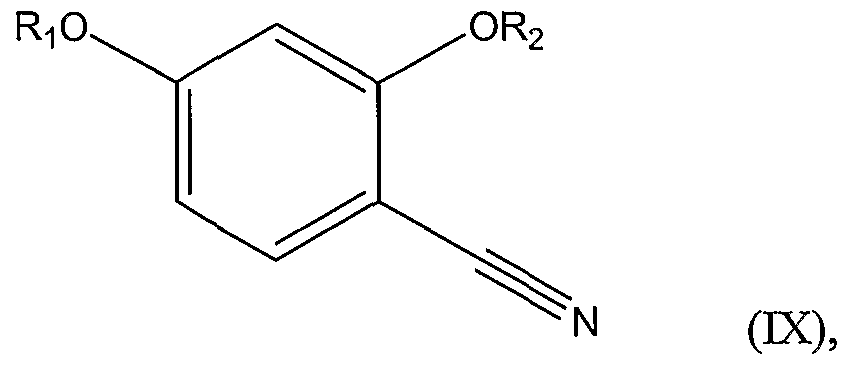
  • the invention includes a method of preparing a substituted benzonitrile represented by Structural Formula (DC):
  • Ri and R 2 are each independently -H, a substituted or unsubstituted alkyl group, or a substituted or unsubstituted aryl group; comprising the steps of: a.) reacting hydroxylamine or a protected derivative or a salt thereof and a disubstituted benzaldehyde represented by Structural Formula (X):
  • the invention is a method of preparing a compound represented by Structural Formula (XH):
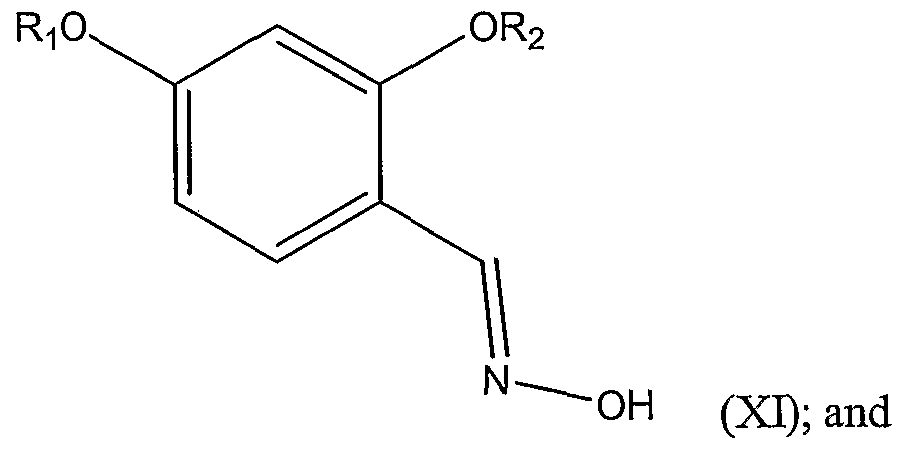
  • Ri and R 2 are each independently -H, a substituted or unsubstituted alkyl group, or a substituted or unsubstituted aryl group; thereby forming a substituted benzaldoxime represented by Structural Formula (Dl):
  • the invention is a method of preparing a substituted benzimidate represented by Structural Formula (XIII):
  • Ri and R 2 are each independently -H, a substituted or unsubstituted alkyl group, a substituted or unsubstituted aryl group, or a substituted or unsubstituted arylalkyl group;
  • R 3 is a substituted or unsubstituted alkyl group; comprising the steps of: a.) reacting a chlorinating agent and a disubstituted benzoic acid represented by
  • the invention is a method of preparing a 2,4- dihydroxybenzimidate represented by Structural Formula (XVII):
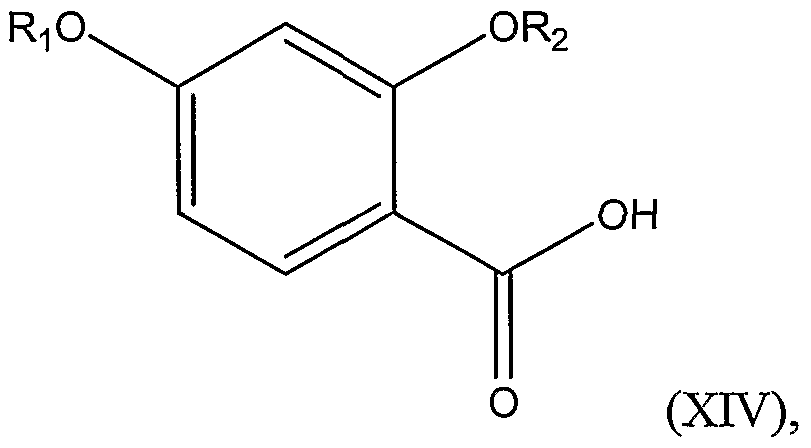
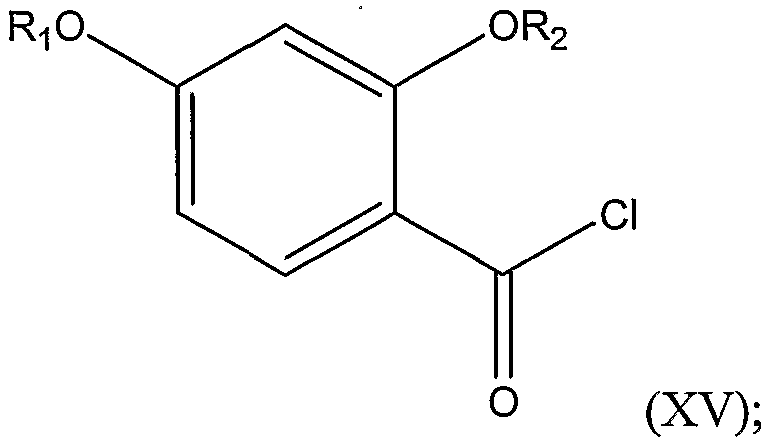
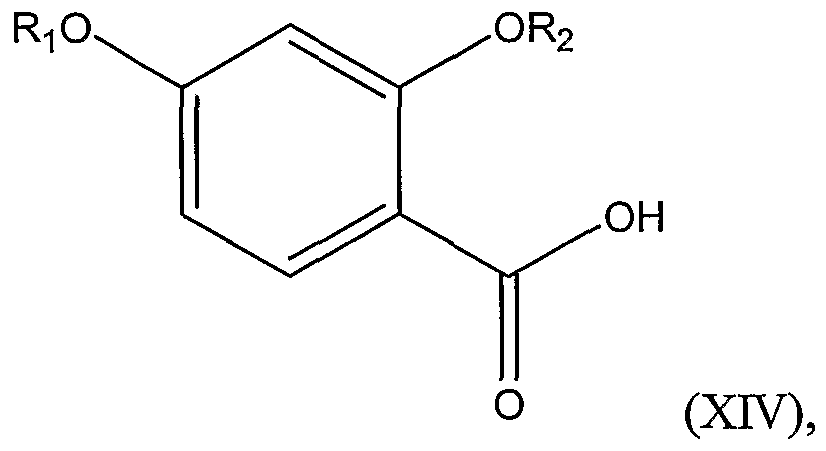
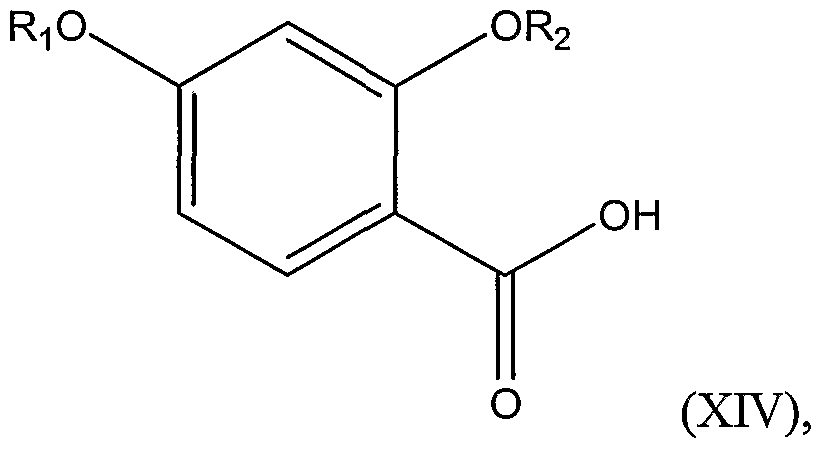
  • R 3 is a substituted or unsubstituted alkyl group; comprising the steps of: a.) protecting 2,4-dihydroxybenzoic acid with protecting groups, thereby forming protected benzoic acid represented by Structural Formula (XTV): wherein Ri and R 2 are each independently a substituted or unsubstituted alkyl group, a substituted or unsubstituted aryl group, or a substituted or unsubstituted arylalkyl group; b.) reacting a chlorinating agent and the protected benzoic acid, wherein Ri and R 2 are as defined above, thereby forming a protected benzoyl chloride represented by Structural Formula (XV):
  • the invention is a method of preparing a compound represented by Structural Formula (XDC):
  • Advantages of the present invention include the facile synthesis of 2,4- dihydroxybenzonitrile, or an ether or diether thereof, and alkyl 2,4-dihydroxybenzimidates from inexpensive and readily available starting materials.
  • 2,4-Dihydroxybenzonitrile and alkyl 2,4-dihydroxybenzimidates prepared by the method of the present invention can be coupled to (S)-2-methylcysteine to form 4'-hydroxydesazadesferrithiocin, also referred to as 4,5-dihydro-2-(2,4-dihydroxyphenyl)-4-methylthiazole-4(S)-carboxylic acid, an iron chelating agent.
  • a first useful and efficient method of preparing 2,4-dihydroxybenzonitrile, or an ether or diether thereof involves reacting 2,4-dihydroxybenzoic acid (or an ether or diether thereof) with an ⁇ , ⁇ -aminoalcohol to form a 2-(2',4'-dihydroxyphenyl)-oxazoline (or an ether or diether thereof).
  • the 2-(2',4'-dihydroxyphenyl)-oxazoline can subsequently be reacted with phosphorus oxychloride to obtain 2,4-dihydroxybenzonitrile or a related compound.
  • ethers and diethers of 2,4-dihydroxybenzonitrile additional steps may be desirable to cleave the ether moieties and obtain 2,4-dihydroxybenzonitrile.
  • a preferred protecting group is a substituted or unsubstituted arylalkyl group such as a benzyl group.
  • Protecting groups can be added, for example, by reacting 2,4- dihydroxybenzoic acid, a base, and a benzyl compound having a leaving group (e.g., benzyl tosylate, a benzyl halide such as benzyl chloride or benzyl bromide) in a polar solvent and refluxing the mixture for several hours, typically 1 or more hours, 1 to 12 hours, 2 to 8 hours, or 3 to 6 hours.
  • a leaving group e.g., benzyl tosylate, a benzyl halide such as benzyl chloride or benzyl bromide
  • the amount of the benzyl compound depends, in part, on the number of hydroxyl groups to be protected and is generally one or more (e.g., to protect one hydroxyl group) or two or more equivalents, such as about 1 to about 10 equivalents, about 2 to about 8 equivalents, or about 3 to about 5 equivalents.
  • the reaction temperature typically depends on the solvent, and is selected such that the reaction mixture refluxes at the chosen temperature(s), which is generally at or greater than room temperature.
  • Suitable solvents in the present reaction are typically polar, aprotic solvents such as acetone, tetrahydrofuran, dimethylformamide, acetonitrile, ethyl acetate, ethyl ether, dioxane, and hexamethylphosphoramide.
  • Suitable bases for the present reaction typically include alkali metal and alkaline earth metal hydroxides, alkoxides, and carbonates, including sodium hydroxide, sodium methoxide, sodium ethoxide, sodium carbonate, potassium hydroxide, potassium methoxide, potassium ethoxide, cesium carbonate, calcium carbonate, and potassium carbonate.
  • the fully protected product is generally a solid, and can be filtered and concentrated by suitable methods.
  • the solid can be reacted at, for example, room temperature or greater (e.g., 20-100°C, 25-80°C, 30-60°C, 35-50°C) with abase, such as those listed above, and a polar, protic solvent (e.g., methanol, ethanol, propanol, isopropanol, water, formamide, dimethylformamide, N-ethylacetamide, formaldehyde diethyl acetal) for several hours (e.g. one or more hours, 1-12 hours, 2-10 hours, 3-8 hours, 4-6 hours).
  • a polar, protic solvent e.g., methanol, ethanol, propanol, isopropanol, water, formamide, dimethylformamide, N-ethylacetamide, formaldehyde diethyl acetal
  • the amount of base can be catalytic or stoichiometric, but is preferably stoichiometric, such that there are one or more equivalents (e.g., about 1 to about 10 equivalents, about 2 to about 8 equivalents, about 3 to about 6 equivalents) of base.
  • the deprotected carboxylate acid (carboxylate) moiety can be neutralized with an excess of a dilute acid such as hydrochloric acid, hydrobromic acid, nitric acid, or sulfuric acid.
  • the neutralized acid often forms a solid, where only the hydroxyl groups of 2,4-dihydroxybenzoic acid are protected. This solid can be filtered and optionally recrystallized from a solvent mixture, such as a methanol-chloroform mixture.
  • either 2,4-dihydroxybenzoic acid or one of the protected species described above can be reacted with an activating agent such as a chlorinating agent, for example oxalyl chloride, phosphorus trichloride, or preferably thionyl chloride, in a nonpolar solvent such as pentane, heptane, octane, hexane(s), cyclohexane, carbon tetrachloride, toluene, xylenes, or preferably benzene, to form an acid chloride.
  • an activating agent such as a chlorinating agent, for example oxalyl chloride, phosphorus trichloride, or preferably thionyl chloride
  • a nonpolar solvent such as pentane, heptane, octane, hexane(s), cyclohexane, carbon tetrachloride, toluene, xylene
  • the acid chloride can be dissolved in a polar, aprotic solvent such as those listed above, and optionally cooled below room temperature (e.g., about 15°C to about -35°C, about 10°C to about -20°C, 5°C to about -5°C). Then, an ⁇ , ⁇ -aminoalcohol can be added, followed by a base. Alternatively, 2,4- dihydroxybenzoic acid or the protected species described above can be reacted with an activating agent such as hydroxybenzotriazole (HOBt), imidazole, or 1,3- dicyclohexylcarbodiimide (DCC) and an ⁇ , ⁇ -aminoalcohol to produce an N- hydroxyethylarnide.
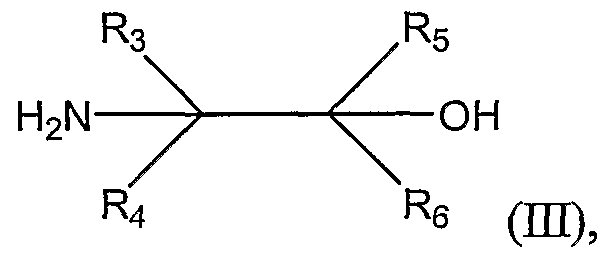
  • ⁇ , ⁇ -Aminoalcohols are typically represented by Structural Formula (III) or Structural Formula (VI):
  • R 3 , R4, R , and R ⁇ 0 are each independently an unsubstituted alkyl group, such as methyl, ethyl, propyl, isopropyl, butyl, isobutyl, or t-butyl, and R 5 , R 6 , R ⁇ , and R ⁇ 2 are each -H. Even more preferably, R 3 , R , R 9 , and Rio are each methyl.
  • Suitable bases include dialkylamines and trialkylamines, preferably dimethylamine, diethylamine, diphenylamine, triphenylamine, trimethylamine, diisopropylamine, diisopropylethylamine, 1,4- diazabicyclo[2.2.2]octane (DABCO), l,5-diazabicyclo[4.3.0]non-5-ene (DBN), or triethylamine.
  • the mixture of acid chloride and ⁇ , ⁇ -aminoalcohol are typically stirred at, for example, room temperature or greater, for at least about 15 minutes. Typically, the reaction continues for 15 minutes to 6 hours, 30 minutes to 3 hours, 45 minutes to 2 hours, or 60 to 90 minutes.
  • the mixture can be washed with an aqueous basic salt solution such as sodium hydroxide, potassium hydroxide, sodium carbonate, potassium carbonate, sodium bicarbonate, or potassium bicarbonate, and subsequently dried over a hydroscopic substance such as potassium carbonate, sodium carbonate, potassium sulfate, or sodium sulfate, and concentrated.
  • an aqueous basic salt solution such as sodium hydroxide, potassium hydroxide, sodium carbonate, potassium carbonate, sodium bicarbonate, or potassium bicarbonate
  • a hydroscopic substance such as potassium carbonate, sodium carbonate, potassium sulfate, or sodium sulfate
  • the N-hydroxyethylamide and one or more equivalents of an activating agent such as thionyl chloride are generally stirred for at least 10 minutes (e.g., 10 minutes to 200 minutes, 20 minutes to 100 minutes, 30 minutes to 50 minutes) at, for example, about 0°C to about 90°C, about 10°C to about 60°C, about 15°C to about 40°C, or about 20°C to about 30°C.
  • an activating agent such as thionyl chloride
  • the mixture of N-hydroxyethylamide and thionyl chloride is neutralized with an aqueous base such as potassium hydroxide, sodium hydroxide, potassium carbonate, sodium carbonate, potassium bicarbonate, or sodium bicarbonate.
  • an aqueous base such as potassium hydroxide, sodium hydroxide, potassium carbonate, sodium carbonate, potassium bicarbonate, or sodium bicarbonate.
  • the mixture can then be extracted with a polar, aprotic solvent, as listed above, and washed with water.
  • the mixture can be dried over a hydroscopic substance and concentrated to obtain a 2-aryloxazoline.
  • a mixture of the 2-aryloxazoline, an organic base, and phosphorus oxychloride are typically heated together.
  • Suitable organic bases include piperidine, pyrrolidine, and preferably pyridine, which are present in a stoichiometric or a catalytic amount.
  • the temperature is generally 60°C or greater, such as about 60°C to about 150°C, about 70°C to about 130°C, about 80°C to about 120°C, or about 90°C to about 110°C.
  • the above mixture is heated for at least about 30 minutes, such as about 30 minutes to about 6 hours, about 1 hour to about 4 hours, or about 2 hours to about 3 hours.
  • the mixture can be cooled to about room temperature (e.g., about 20°C to about 40°C or about 20°C to about 30°C), and then ice-cold water can be added.
  • the mixture can be extracted with a polar, aprotic solvent, preferably ethyl acetate.
  • the extracted mixture can be washed with a basic aqueous salt solution, preferably a sodium bicarbonate or potassium bicarbonate solution, before water is evaporated to give either 2,4-dihydroxybenzonitrile or the protected form, 2,4- dibenzyloxybenzonitrile.
  • a basic aqueous salt solution preferably a sodium bicarbonate or potassium bicarbonate solution
  • protecting groups of 2,4-dihydroxybenzonitrile are cleaved.
  • the protecting groups are typically bonded to 2,4-dihydroxybenzonitrile through an ether linkage (e.g., 2,4-dibenzyloxybenzonitrile).
  • Ether linkages can be cleaved, for example, by methods described on pages 433-434 and 1012-1014 of "Advanced Organic Chemistry, Fourth Edition," by Jerry March, Wiley-Interscience, 1992 and references therein, all of which are incorporated by reference.
  • ether linkages are cleaved by reaction with a mineral acid (e.g, HBr, HI) or a Lewis acid.
  • Suitable Lewis acids include BF 3 , BC1 3 , (CH 3 ) 2 BBr, BBr 3 , A1C1 3 , (CH 3 ) 3 SiI, SiC /Nal, SiH 2 I 2 , LiI, NaI/BF 3 , and (CH 3 ) 3 SiCl/NaI.
  • the invention includes a method of preparing 2,4- dihydroxybenzonitrile, or an ether or diether thereof, involves reacting 2,4- dihydroxybenzaldehyde or a diether thereof, such as 2,4-dimethoxybenzaldehyde, with hydroxylamine or a protected derivative or a salt thereof, to form an oxime.
  • the oxime is typically dehydrated with diphosphorus pentoxide to form 2,4-dihydroxybenzonitrile or an ether or diether thereof.
  • additional steps may be desirable to cleave the ether moieties and obtain 2,4-dihydroxybenzonitrile.
  • Ri and R 2 can be protected by protecting groups, prior to reaction of the aldehyde moiety.
  • a preferred protecting group is a substituted or unsubstituted alkyl group such as a methyl group.
  • Protecting groups can be added, for example, by reacting 2,4-dihydroxybenzaldehyde, a base, and CH 3 -Z, where Z is a leaving group (e.g., tosylate, halide such as chloride or bromide) in a polar, aprotic solvent.
  • Suitable bases include sodium hydroxide, potassium hydroxide, sodium methoxide, potassium methoxide, sodium ethoxide, potassium ethoxide, sodium carbonate, calcium carbonate, cesium carbonate, and potassium carbonate.
  • Polar, aprotic solvents include acetone, acetonitrile, dimethylformamide, dioxane, ethyl acetate, ethyl ether, tetrahydrofuran, and hexamethylphosphoramide.
  • Other suitable protecting group can be found in "Protective Groups in Organic Synthesis," by Peter G. M. Wuts and Theodora W. Greene, Wiley-hiterscience, 1990, the teachings of which are incorporated herein by reference in their entirety.
  • the first step of the reaction involves reacting a compound represented by Structural Formula (X):
  • Ri and R 2 are each independently a substituted or unsubstituted alkyl group or a substituted or unsubstituted aryl group. In a more preferred embodiment, Ri and R 2 are each methyl.
  • the compound represented by Structural Formula (X) is reacted with one or more equivalents (e.g., about 1 to about 10 equivalents, about 2 to about 8 equivalents, about 3 to about 6 equivalents) of hydroxylamine.
  • equivalents e.g., about 1 to about 10 equivalents, about 2 to about 8 equivalents, about 3 to about 6 equivalents
  • Suitable conditions for reacting an aldehyde and hydroxylamine can be found, for example, on pages 906-907 of "Advanced Organic Chemistry, Fourth Edition," by Jerry March, Wiley-
  • the pH of the solvent e.g., water or a mixture of water and a water-miscible organic solvent
  • the pH of the solvent is preferably about 4, or is in a range from about 3.5 to about 4.5, about 3 to about 5, or about 2 to about 6.
  • the second step of the reaction involves reacting the oxime with diphosphorus pentoxide.
  • P 2 O 5 is heated with the oxime for 1 or more hours (e.g., about 1 to about 12 hours, about 2 to about 8 hours, about 3 to about 6 hours) at room temperature or greater (e.g., about 20°C to about 200°C, about 40°C to about 150°C, about 60°C to about 100°C).
  • One or more equivalents, such as about 1 to about 6 equivalents, about 1.5 to about 5 equivalents, or about 2 to about 4 equivalents, of P 2 O 5 are generally required for the reaction.
  • deprotecting an ether group can be achieved by reacting a protected ether with a deprotecting agent.
  • Preferred deprotecting agents include boron trihalides such as boron trifluoride, boron trichloride, and boron tribromide. Additional deprotecting methods can be found in "Protective Groups in Organic Synthesis," which was previously incorporated by reference.
  • Diphosphorus pentoxide is a dehydrating agent.
  • Other dehydrating agents include acetic anhydride, ethyl ortho formate in an acidic solution, triphenylphosphine in carbon tefrachloride, trichloromethylchloroformate, methyl cyanoformate, ethyl cyanoformate, trifluoromethane sulfonic anhydride, P 2 I , SeO 2 , trichloroformyl chloride in triethylamine, and chloromethylene dimethylammonium chloride.
  • the invention includes a method of preparing ethyl 2,4- dihydroxybenzimidate, or an ether or diether thereof, involves amidating 2,4-dihydroxybenzoic acid or a diether thereof, such as 2,4-dibenzyloxybenzaldehyde.
  • the amide is typically reacted with a trialkyloxonium salt to form an imidate.
  • Functional groups protecting hydroxyl groups, such as benzyl groups, can be removed, for example, by hydrogenation.
  • Ri and R 2 of Structural Formula (XIII) are each -H
  • Ri and R 2 can be protected by protecting groups.
  • a preferred protecting group is a substituted or unsubstituted arylalkyl group such as a benzyl group.
  • Protecting groups can be added, for example, by reacting 2,4-dihydroxybenzoic acid, a base, and a benzyl compound substituted with a leaving group (e.g., benzyl tosylate, a benzyl halide such as benzyl chloride or benzyl bromide) in a polar, aprotic solvent (e.g., acetone, acetonitrile, dimethylformamide, dioxane, ethyl acetate, ethyl ether, hexamethylphosphoramide, tetrahydrofuran).
  • Suitable bases include sodium hydride, potassium hydride, sodium amide, potassium amide, and lithium diisopropylamide.
  • 2,4-dihydroxybenzoic acid is reacted with sodium hydride and benzyl bromide in dimethylformamide to yield a compound with protected hydroxyl and carboxylic acid groups.
  • the carboxylic acid can be deprotected by refluxing the compound in a basic dioxane solution. Suitable bases include sodium hydroxide and potassium hydroxide. The solution is acidified after refluxing. Additional protecting groups can be found, for example, in "Protective Groups in Organic Synthesis, Third Edition," by Peter G. M. Wuts and Theodora W. Greene, Wiley- hiterscience, 1999.
  • the first step of the reaction involves reacting a compound represented by Structural Formula (XIV):
  • a chlorinating agent in a polar, aprotic solvent (as defined above) or a mixture of a polar, aprotic solvent and a nonpolar solvent, in order to form an acid chloride.
  • Suitable chlorinating agents include thionyl chloride, phosphorus trichloride, or, preferably, oxalyl chloride.
  • Suitable nonpolar solvents include pentane, heptane, octane, hexane(s), cyclohexane, carbon tefrachloride, toluene, xylenes, and benzene.
  • the reaction is carried out at or below 30°C, such as from about -50°C to about 30°C, about -30°C to about 25°C, or about 0°C to about 25°C. If the carboxylic acid is protected (e.g., as a result of protecting the hydroxyl groups), the acid is preferably deprotected prior to reaction with a chlorinating agent.
  • the acid chloride can be reacted with ammonia or a salt thereof (e.g., NH OH) to form an amide (e.g., a benzamide).
  • an amide e.g., a benzamide
  • the acid chloride can be reacted with an aqueous ammonia solution in a polar, aprotic solvent such as methylene chloride or another of those listed above to form the amide.
  • the amide is typically reacted with a trialkyloxonium hexafluorophosphate of the formula (R 3 ) 3 OPF 6 to form a benzimidate.
  • R 3 groups are C1-C4 alkyl groups such as methyl, ethyl, propyl, isopropyl, butyl, isobutyl, and t-butyl. Ethyl is an especially preferred R 3 .
  • the amide formed above is reacted with triethyloxonium hexafluorophosphate in a polar, aprotic solvent such as methylene chloride to form an ethyl benzimidate.
  • a suitable method to deprotect the hydroxyl groups includes reacting the protected benzimidate with hydrogen.
  • a protected benzimidate can be hydrogenated by reacting the benzimidate with 1 atmosphere of hydrogen in the presence of a palladium-carbon catalyst in a polar, protic solvent such as methanol or ethanol. The hydrogenation yields a deprotected benzimidate, such as ethyl 2,4- dihydroxybenzimidate .
  • benzamide is preferably reacted with a trialkyloxonium hexafluorophosphate
  • benzamide can also be reacted with trialkyloxoxium tetrafluoroborate salts.
  • Cysteine or a 2-alkylcysteine such as (S)-2-methylcysteine can be coupled with 2,4- dihydroxybenzonitrile, or an ether or diether thereof. Cysteine and related compounds can also be coupled with other substituted and unsubstituted aryl nitriles.
  • (S)-2-methylcysteine is coupled to 2,4-dihydroxybenzonitrile to form 4,5-dihydro-2-(2,4- dihydroxyphenyl)-4-methylthiazole-4(S)-carboxylic acid (also known as 4'- hydroxydesazadesferrithiocin) .
  • Cysteine or a 2-alkylcysteine such as (S)-2-methylcysteine can be coupled with 2,4- dihydroxybenzimidate, or an ether or diether thereof.
  • (S)-2- methylcysteine is coupled to 2,4-dihydroxybenzimidate to form 4,5-dihydro-2-(2,4- dihydroxyphenyl)-4-methylthiazole-4(S)-carboxylic acid (also known as 4'- hydroxydesazadesferrithiocin).
  • cysteine and cysteine derivatives suitable for coupling can be found in U.S. Application Nos. 60/381,012, 60/381,021, 60/380,894, 60/380,910, 60/380,880, 60/381,017, 60/380,895 and 60/380,903, filed May 15, 2002, and U.S. Application No. 60/392,833, filed June 27, 2002; the entire teachings of which are incorporated herein by reference.
  • coupling of cysteine or a 2-alkylcysteine and a substituted benzonitrile includes converting the benzonitrile into a benzimidate.
  • the benzimidate can be formed, for example, by reacting the benzonitrile with an alcohol such as methanol, ethanol, n-propanol, or isopropanol in the presence of an acid such as hydrochloric acid.
  • the benzimidate (obtained from a benzonitrile or from the method disclosed herein) is then reacted with the cysteine (or related compound) under basic conditions.
  • Acceptable bases include trimethylamine, triethylamine, triphenylamine, diisopropylamine, diisopropylethylamine, diethylamine, dimethylamine, diphenylamine, DABCO, DBN, and the like.
  • the reaction between the benzimidate and the cysteine results in the thiazoline (or 4,5-dihydrothiazole) containing product.
  • the hydroxyl groups are advantageously protected (e.g., with a substituted or unsubstituted alkyl or arylalkyl group such as a benzyl group).
  • the protecting groups are subsequently cleaved, typically by catalytic hydrogenation.
  • Products of the above methods can be purified by methods known in the art, such as emulsion crystallization.
  • the methods of the claimed invention can be used to manufacture other related desferrithiocin analogs and derivatives. Examples of such analogs include those described in U.S. Patent Nos. 5,840,739, 6,083,966, 6,159,983, 6,521,652 and 6,525,080 to Raymond J. Bergeron, Jr., the contents of which are incorporated herein by reference. Additional examples can be found in PCT/US93/10936, PCT/US97/04666, and PCT/US99/ 19691, the contents of which are incorporated by reference.
  • alkyl group is a hydrocarbon in a molecule that is bonded to one other group in the molecule through a single covalent bond from one of its carbon atoms.
  • Alkyl groups can be cyclic or acyclic, branched or unbranched, and saturated or unsaturated. Typically, an alkyl group has one to about 24 carbons atoms, or one to about 12 carbon atoms. Lower alkyl groups have one to four carbon atoms and include methyl, ethyl, 77-propyl, ⁇ o-propyl, «-butyl, sec-butyl and tert-butyl.
  • Aromatic (or aryl) groups include carbocyclic aromatic groups such as phenyl, p-tolyl, 1 -naphthyl, 2-naphthyl, 1-anthracyl and 2-anthracyl.
  • Aromatic groups also include heteroaromatic groups such as N-imidazolyl, 2-imidazole, 2-thienyl, 3 -thienyl, 2-furanyl, 3- fiiranyl, 2-pyridyl, 3-pyridyl, 4-pyridyl, 2-pyrimidyl, 4-pyrimidyl, 2-pyranyl, 3-pyranyl, 3- pyrazolyl, 4-pyrazolyl, 5-pyrazolyl, 2-pyrazinyl, 2-thiazolyl, 4-thiazolyl, 5-thiazolyl, 2- oxazolyl, 4-oxazolyl and 5-oxazolyl.
  • heteroaromatic groups such as N-imidazolyl, 2-imidazole, 2-thienyl, 3 -thienyl, 2-furanyl, 3- fiiranyl, 2-pyridyl, 3-pyridyl, 4-pyridyl, 2-pyrimidyl, 4-pyrimidyl, 2-pyranyl, 3-pyr
  • Aromatic groups also include fused polycyclic aromatic ring systems in which a carbocyclic, alicyclic, or aromatic ring or heteroaryl ring is fused to one or more other heteroaryl or aryl rings.
  • Examples include 2-benzothienyl, 3 -benzothienyl, 2-benzofuranyl, 3- benzofuranyl, 2-indolyl, 3-indolyl, 2-quinolinyl, 3-quinolinyl, 2-benzothiazole, 2- henzooxazole, 2-benzimidazole, 2-quinolinyl, 3-quinolinyl, 1-isoquinolinyl, 3-quinolinyl, 1- isoindolyl and 3-isoindolyl.
  • Each R' is independently an alkyl group or an aryl group.
  • Alkyl groups can additionally be substituted by an aryl group (e.g. an alkyl group can be substituted with an aromatic group to form an arylalkyl group).
  • a substituted alkyl group can have more than one substituent.
  • Each R' is independently an alkyl group or an aryl group.
  • Aryl groups can additionally be substituted by an alkyl or cycloaliphatic group (e.g. an aryl group can be substituted with an alkyl group to form an alkylaryl group such as tolyl).
  • a substituted aryl group can have more than one substituent.
  • Boron trihalides are acceptable deprotecting agents (i.e., for hydrolysis of ethers) for use in the present invention.
  • Other deprotecting agents include (CH 3 ) 2 BBr, A1C1 3 , (CH 3 ) 3 SiI, SiCl 4 /NaI, SiH 2 I 2 , Lil, NaI/BF 3 , and (CH 3 ) 3 SiCl/NaI.
  • the solution was adjusted to pH 7.5 with 1.20 ml 20 % KOH and was extracted two times each with 20 mL methyl t-butyl ether (MTBE).
  • MTBE methyl t-butyl ether
  • the aqueous layer was separated, adjusted with 20 % KOH to pH 11 and again extracted two times each with 20 mL MTBE.
  • the pH was set with concentrated HCl to 7.5 and traces of MTBE were distilled off.
  • the aqueous solution was acidified with 1.50 L concentrated HCl to pH 1.5.
  • the product precipitated This suspension was stirred at 4 °C for 1 hour.
  • the precipitate was filtered, washed two times each with 10 mL water (5°C) and dried at 45 °C under vacuum.
  • 2,4-Dimethoxybenzoic acid is reacted with hydroxylamine to form 2,4- dimethoxybenzaldoxime.
  • 2,4-Dimethoxybenzaldoxime is reacted with diphosphorus pentoxide to form 2,4-dimethoxybenzonitrile.
  • 2,4-Dimethoxybenzonitrile is reacted with boron trichloride to form 2,4-dihydroxybenzonitrile.
  • 2,4-Dihydroxybenzoic acid was reacted with sodium hydride and benzyl bromide in dimethylformamide (DMF) to give a compound protected with benzyl groups at hydroxyl and carboxylic acids moieties in a 91% yield.
  • the benzyl group was removed from the carboxylic acid moiety by refluxing it with 2 N sodium hydroxide in dioxane, followed by acidifying the mixture, to give 2,4-dibenzyloxybenzoic acid in 83% yield.
  • 2,4-Dibenzyloxybenzoic acid was reacted with oxalyl chloride in toluene and DMF at 0- 25°C to give an acid chloride.
  • the acid chloride was reacted with aqueous ammonia in methylene chloride to yield 87% (over 2 steps) of 2,4-dibenzyloxybenzamide.
  • 2,4- Dibenzyloxybenzamide was reacted with triethyloxonium hexafluorophosphate in methylene chloride to yield 69% of ethyl 2,4-dibenzyloxybenzimidate.
  • the ethyl 2,4- dibenzyloxybenzimidate was hydrogenated over a palladium/carbon catalyst with 1 atmosphere of hydrogen gas in ethanol, to yield 75% of ethyl 2,4-dihydroxybenzimidate.
  • the overall yield for the reaction sequence was 34% for six steps.
  • the protected ethyl benzimidate described above was dissolved in methanol to generate a 10% solution and was catalytically hydrogenated at room temperature using 5% Pd/C as a catalyst. The reaction was completed after 8 hours. The solution was filtered and the solvent evaporated to yield the deprotected product as an orange-yellow solid. The reaction yielded 19.6 g (94%) of product.

Landscapes

  • Chemical & Material Sciences (AREA)
  • Organic Chemistry (AREA)
  • Health & Medical Sciences (AREA)
  • Chemical Kinetics & Catalysis (AREA)
  • Life Sciences & Earth Sciences (AREA)
  • General Health & Medical Sciences (AREA)
  • Veterinary Medicine (AREA)
  • General Chemical & Material Sciences (AREA)
  • Medicinal Chemistry (AREA)
  • Nuclear Medicine, Radiotherapy & Molecular Imaging (AREA)
  • Public Health (AREA)
  • Pharmacology & Pharmacy (AREA)
  • Animal Behavior & Ethology (AREA)
  • Bioinformatics & Cheminformatics (AREA)
  • Engineering & Computer Science (AREA)
  • Pulmonology (AREA)
  • Hematology (AREA)
  • Virology (AREA)
  • Communicable Diseases (AREA)
  • Oncology (AREA)
  • Pain & Pain Management (AREA)
  • Rheumatology (AREA)
  • Diabetes (AREA)
  • Organic Low-Molecular-Weight Compounds And Preparation Thereof (AREA)
  • Thiazole And Isothizaole Compounds (AREA)
  • Low-Molecular Organic Synthesis Reactions Using Catalysts (AREA)
  • Pharmaceuticals Containing Other Organic And Inorganic Compounds (AREA)
  • Heterocyclic Carbon Compounds Containing A Hetero Ring Having Nitrogen And Oxygen As The Only Ring Hetero Atoms (AREA)

Abstract

Benzonitrites and benzimidates represent important intermediates and starting materials, which are typically not commercially available. The present invention discloses a facile synthesis for 2,4-dihydroxybenzonitrile, and ethers and diethers thereof, from 2,4-dihydroxybenzoic acid and from 2,4-dihydroxybenzaldehyde. In addition, the invention discloses a method of preparing substituted benzimidates from substituted benzoic acid. The present invention also discloses a method of preparing a class of iron chelating agents related to desferrithiocin, all of which contain a thiazoline ring. In this method, 2,4-dihydroxybenzonitrile or an alkyl 2,4-dihydroxybenzonitrile or an alkyl 2,4-dihydroxybenzimidate is condensed with (S)-2-methylcysteine.

Description

SYNTHESIS OF BENZONITRILES AND BENZIMIDATES
RELATED APPLICATIONS This application claims the benefit of U.S. Provisional Application Nos. 60/381,012,
60/381,021, 60/380,894, 60/380,910, 60/380,880, 60/381,017, 60/380,895, 60/380,903, 60/381,013, 60/380,878 and 60/380,909, all of which were filed May 15, 2002. This application also claims the benefit of U.S. Provisional Application No. 60/392,833, filed June 27, 2002. The entire teachings of the above-referenced applications are incorporated herein by reference.
BACKGROUND OF THE INVENTION
Nitrile-containing compounds are highly in demand because nitrile moieties are versatile reagents for organic synthesis, as exemplified in their applications in the preparation of thiazoles, chrial 2-oxazolines, tetrazoles, 1,2-diarylimidazoles, triazolo[l,5-c]pyrimidines, and benzamidines. Compounds prepared from nitriles have properties including superoxide inhibition, ferrielectric liquid crystal dopants, antipicornaviral agents, anti-inflammatory agents, anti-asthma agents, and fibrinogen antagonists.
An imidate moiety is strongly electrophilic, and as such, represents an important functional group in organic synthesis. The imidate moiety can be transformed into a wide variety of products, by virtue of undergoing reaction with a large number of nucleophiles. In addition, the imidate moiety can serve as a free radical scavenger. For example, ethyl 3,4,5- trihydroxybenzimidate blocks free radical generation from NADPH oxidase. This free radical scavenging activity decreases the amount of tissue damage, such as limiting damage to the heart following an infarction or other ischemic episode.
The use of nitriles and aryl imidates in the preparation of thiazoles, or when reduced, thiazolines and thiazolidines, is of particular interest. Compounds such as desferrithiocin and structural analogues contain a thiazoline ring, and these compounds represent an advance in iron chelation therapy for subjects suffering from iron overload diseases. Present therapeutic agents such as desferroxamine require parenteral administration and have a very short half-life in the body, so that patient compliance and treatment cost are serious problems for subjects receiving long-term chelation therapy. Desferrithiocin and related compounds are effective when orally administered, thereby reducing patient compliance issues.
Unfortunately, 2,4-dihydroxybenzonitrile, which is a precursor to the potent, less toxic form of desferrithiocin known as 4'-hydroxydesazadesferrithiocin, remains a synthetic challenge. At this time, 2,4-dihydroxybenzonitrile and alkyl 2,4-dihydroxybenzimidates are not commercially available and the related 2,4-dimethoxybenzonitrile is expensive. Therefore, there is a need for novel methods of producing 2,4-dihydroxybenzonitrile and alkyl 2,4- dihydroxybenzimidates at a reasonable cost.
SUMMARY OF THE INVENTION
The invention includes a method of preparing a substituted benzonitrile represented by Structural Formula (I):
Figure imgf000003_0001
where Rj and R2 are each independently -H, a substituted or unsubstituted alkyl group, or a substituted or unsubstituted aryl group; comprising the steps of: a.) amidating a substituted benzoic acid represented by Structural Formula (II):
Figure imgf000003_0002
where Ri and R2 are as defined above; by reacting the substituted benzoic acid with an activating agent and an α,β-aminoalcohol represented by Structural Formula (H-I):
Figure imgf000004_0001
where R3, R^ R5, and R6 are each -H or substituted or unsubstituted alkyl groups, thereby forming a substituted 2-phenyloxazoline represented by Structural Formula (IV):
Figure imgf000004_0002
b.) reacting the substituted 2-phenyloxazoline with phosphorus oxychloride, thereby forming the substituted benzonitrile represented by Structural Formula (I). The invention also includes a method of preparing a substituted benzonitrile represented by Structural Formula (V):
Figure imgf000004_0003
where R7 and R8 are each -H or a substituted or unsubstituted aryl group; comprising the steps of: a.) protecting hydroxyl groups of 2,4-dihydroxybenzoic acid with one or more substituted or unsubstituted arylalkyl protecting groups, thereby forming a protected 2,4-dihydroxybenzoic acid; b.) amidating the protected 2,4-dihydroxybenzoic acid, by reacting the protected 2,4-dihydroxybenzoic acid with an activating agent and an α,β-aminoalcohol represented by Structural Formula (VI):
Figure imgf000005_0001
where R9, Rio, Rπ, and Rι2 are each -H or substituted or unsubstituted alkyl groups, thereby forming a substituted 2-phenyloxazoline represented by Structural Formula (VII):
Figure imgf000005_0002
c) reacting the substituted 2-phenyloxazoline with phosphorus oxychloride, thereby forming the substituted benzonitrile represented by Structural Formula (V). In another embodiment, the invention provides a method of preparing a compound represented by Structural Formula (VIII):
Figure imgf000005_0003
comprising the steps of: a.) amidating a substituted benzoic acid represented by Structural Formula (II):
Figure imgf000006_0001
where Ri and R2 are each independently -H, a substituted or unsubstituted alkyl group, or a substituted or unsubstituted aryl group; by reacting the substituted benzoic acid with an activating agent and an α,β-aminoalcohol represented by Structural Formula (Dl):
Figure imgf000006_0002
where R3, R4, R5, and Re are each -H or substituted or unsubstituted alkyl groups, thereby forming a substituted 2-phenyloxazoline represented by Structural Formula (IV):
Figure imgf000006_0003
b.) reacting the substituted 2-phenyloxazoline with phosphorus oxychloride, thereby forming a substituted benzonitrile; c) if Ri and R2 are not each -H, cleaving ether groups in the product of step (b.), thereby forming 2,4-dihydroxybenzonitrile; and d.) coupling (S)-2-methylcysteine with 2,4-dihydroxybenzonitrile, thereby forming the compound represented by Structural Formula (VM). The invention includes a method of preparing a substituted benzonitrile represented by Structural Formula (DC):
Figure imgf000007_0001
wherein Ri and R2 are each independently -H, a substituted or unsubstituted alkyl group, or a substituted or unsubstituted aryl group; comprising the steps of: a.) reacting hydroxylamine or a protected derivative or a salt thereof and a disubstituted benzaldehyde represented by Structural Formula (X):
Figure imgf000007_0002
wherein Ri and R2 are as defined above, thereby forming a substituted benzaldoxime represented by Structural Formula (XI):
Figure imgf000007_0003
b.) reacting the substituted benzaldoxime with diphosphorus pentoxide, thereby forming the substituted benzonitrile represented by Structural Formula (DC). In another embodiment, the invention is a method of preparing a compound represented by Structural Formula (XH):
Figure imgf000008_0001
comprising the steps of: a.) reacting hydroxylamine or a protected derivative or a salt thereof and a disubstituted benzaldehyde represented by Structural Formula (X):
Figure imgf000008_0002
wherein Ri and R2 are each independently -H, a substituted or unsubstituted alkyl group, or a substituted or unsubstituted aryl group; thereby forming a substituted benzaldoxime represented by Structural Formula (Dl):
Figure imgf000008_0003
b.) reacting the substituted benzaldoxime with diphosphorus pentoxide, thereby forming the substituted benzonitrile represented by Structural Formula (I):
Figure imgf000009_0001
c.) if Ri and R2 are not each -H, reacting the product of step (b.) with a deprotecting agent, thereby forming 2,4-dihydroxybenzonitrile; and d.) coupling (S)-2~ιnethylcysteine with 2,4-dihydroxybenzonitrile, thereby forming the compound represented by Structural Formula (XII)- In one embodiment, the invention is a method of preparing a substituted benzimidate represented by Structural Formula (XIII):
Figure imgf000009_0002
wherein: Ri and R2 are each independently -H, a substituted or unsubstituted alkyl group, a substituted or unsubstituted aryl group, or a substituted or unsubstituted arylalkyl group; and
R3 is a substituted or unsubstituted alkyl group; comprising the steps of: a.) reacting a chlorinating agent and a disubstituted benzoic acid represented by
Structural Formula (XIV):
Figure imgf000009_0003
wherein Ri and R2 are as defined above, thereby forming a substituted benzoyl chloride represented by Structural Formula (XV):
Figure imgf000010_0001
b.) reacting the substituted benzoyl chloride with ammonia or a salt thereof, thereby forming a substituted benzamide represented by Structural Formula (XVT):
Figure imgf000010_0002
c.) reacting the substituted benzamide with a trialkyloxonium hexafluorophosphate of the formula (R3)3OPF6, wherein R3 is as represented above, thereby forming the substituted benzimidate represented by Structural Formula (XIII). In another embodiment, the invention is a method of preparing a 2,4- dihydroxybenzimidate represented by Structural Formula (XVII):
Figure imgf000010_0003
wherein R3 is a substituted or unsubstituted alkyl group; comprising the steps of: a.) protecting 2,4-dihydroxybenzoic acid with protecting groups, thereby forming protected benzoic acid represented by Structural Formula (XTV):
Figure imgf000011_0001
wherein Ri and R2 are each independently a substituted or unsubstituted alkyl group, a substituted or unsubstituted aryl group, or a substituted or unsubstituted arylalkyl group; b.) reacting a chlorinating agent and the protected benzoic acid, wherein Ri and R2 are as defined above, thereby forming a protected benzoyl chloride represented by Structural Formula (XV):
Figure imgf000011_0002
c) reacting the protected benzoyl chloride with ammonia or a salt thereof, thereby forming a protected benzamide represented by Structural Formula (XVT):
Figure imgf000011_0003
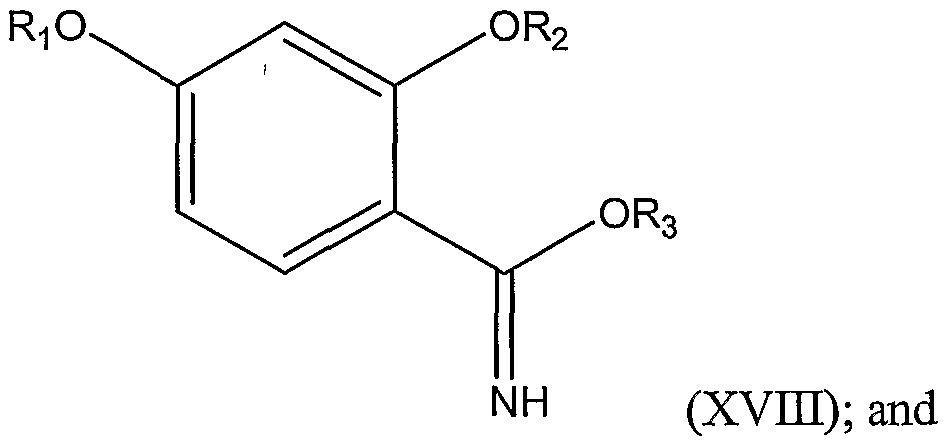
d.) reacting the protected benzamide with a trialkyloxonium hexafluorophosphate of the formula (R3)3OPF6, wherein R3 is as defined above, thereby forming a protected benzimidate represented by Structural Formula (XVTJI):
Figure imgf000012_0001
e.) deprotecting the protected benzimidate, thereby forming the 2,4- dihydroxybenzimidate. hi another embodiment, the invention is a method of preparing a compound represented by Structural Formula (XDC):
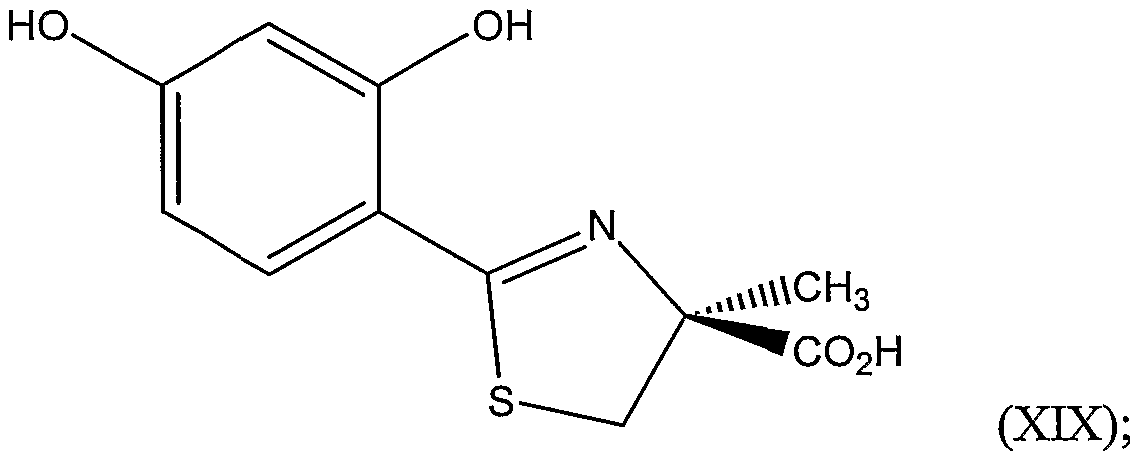
Figure imgf000012_0002
which is prepared by coupling (S)-2-methylcysteine and a 2,4-dihydroxybenzimidate, the preparation of which is described above.
Advantages of the present invention include the facile synthesis of 2,4- dihydroxybenzonitrile, or an ether or diether thereof, and alkyl 2,4-dihydroxybenzimidates from inexpensive and readily available starting materials. 2,4-Dihydroxybenzonitrile and alkyl 2,4-dihydroxybenzimidates prepared by the method of the present invention can be coupled to (S)-2-methylcysteine to form 4'-hydroxydesazadesferrithiocin, also referred to as 4,5-dihydro-2-(2,4-dihydroxyphenyl)-4-methylthiazole-4(S)-carboxylic acid, an iron chelating agent.
DETAILED DESCRIPTION OF THE INVENTION
A first useful and efficient method of preparing 2,4-dihydroxybenzonitrile, or an ether or diether thereof, involves reacting 2,4-dihydroxybenzoic acid (or an ether or diether thereof) with an α,β-aminoalcohol to form a 2-(2',4'-dihydroxyphenyl)-oxazoline (or an ether or diether thereof). The 2-(2',4'-dihydroxyphenyl)-oxazoline can subsequently be reacted with phosphorus oxychloride to obtain 2,4-dihydroxybenzonitrile or a related compound. For ethers and diethers of 2,4-dihydroxybenzonitrile, additional steps may be desirable to cleave the ether moieties and obtain 2,4-dihydroxybenzonitrile. hi one example, it is desirable to protect one, or preferably, both of the hydroxyl groups of 2,4-dihydroxybenzoic acid before proceeding with the conversion to 2,4- dihydroxybenzonitrile. A preferred protecting group is a substituted or unsubstituted arylalkyl group such as a benzyl group. Protecting groups can be added, for example, by reacting 2,4- dihydroxybenzoic acid, a base, and a benzyl compound having a leaving group (e.g., benzyl tosylate, a benzyl halide such as benzyl chloride or benzyl bromide) in a polar solvent and refluxing the mixture for several hours, typically 1 or more hours, 1 to 12 hours, 2 to 8 hours, or 3 to 6 hours. The amount of the benzyl compound depends, in part, on the number of hydroxyl groups to be protected and is generally one or more (e.g., to protect one hydroxyl group) or two or more equivalents, such as about 1 to about 10 equivalents, about 2 to about 8 equivalents, or about 3 to about 5 equivalents. The reaction temperature typically depends on the solvent, and is selected such that the reaction mixture refluxes at the chosen temperature(s), which is generally at or greater than room temperature. Suitable solvents in the present reaction are typically polar, aprotic solvents such as acetone, tetrahydrofuran, dimethylformamide, acetonitrile, ethyl acetate, ethyl ether, dioxane, and hexamethylphosphoramide. Suitable bases for the present reaction typically include alkali metal and alkaline earth metal hydroxides, alkoxides, and carbonates, including sodium hydroxide, sodium methoxide, sodium ethoxide, sodium carbonate, potassium hydroxide, potassium methoxide, potassium ethoxide, cesium carbonate, calcium carbonate, and potassium carbonate.
It may be advantageous to protect both the hydroxyl groups and the carboxylic acid of 2,4-dihydroxybenzoic acid, and the carboxylic acid can be protected before, simultaneously with or after the hydroxyl groups. The fully protected product is generally a solid, and can be filtered and concentrated by suitable methods.
In order to deprotect the carboxylic acid moiety, the solid can be reacted at, for example, room temperature or greater (e.g., 20-100°C, 25-80°C, 30-60°C, 35-50°C) with abase, such as those listed above, and a polar, protic solvent (e.g., methanol, ethanol, propanol, isopropanol, water, formamide, dimethylformamide, N-ethylacetamide, formaldehyde diethyl acetal) for several hours (e.g. one or more hours, 1-12 hours, 2-10 hours, 3-8 hours, 4-6 hours). The amount of base can be catalytic or stoichiometric, but is preferably stoichiometric, such that there are one or more equivalents (e.g., about 1 to about 10 equivalents, about 2 to about 8 equivalents, about 3 to about 6 equivalents) of base. The deprotected carboxylate acid (carboxylate) moiety can be neutralized with an excess of a dilute acid such as hydrochloric acid, hydrobromic acid, nitric acid, or sulfuric acid. The neutralized acid often forms a solid, where only the hydroxyl groups of 2,4-dihydroxybenzoic acid are protected. This solid can be filtered and optionally recrystallized from a solvent mixture, such as a methanol-chloroform mixture.
In the next step of the reaction, either 2,4-dihydroxybenzoic acid or one of the protected species described above can be reacted with an activating agent such as a chlorinating agent, for example oxalyl chloride, phosphorus trichloride, or preferably thionyl chloride, in a nonpolar solvent such as pentane, heptane, octane, hexane(s), cyclohexane, carbon tetrachloride, toluene, xylenes, or preferably benzene, to form an acid chloride. The acid chloride can be dissolved in a polar, aprotic solvent such as those listed above, and optionally cooled below room temperature (e.g., about 15°C to about -35°C, about 10°C to about -20°C, 5°C to about -5°C). Then, an α,β-aminoalcohol can be added, followed by a base. Alternatively, 2,4- dihydroxybenzoic acid or the protected species described above can be reacted with an activating agent such as hydroxybenzotriazole (HOBt), imidazole, or 1,3- dicyclohexylcarbodiimide (DCC) and an α,β-aminoalcohol to produce an N- hydroxyethylarnide. α,β-Aminoalcohols are typically represented by Structural Formula (III) or Structural Formula (VI):
Figure imgf000014_0001
Preferably, R3, R4, R , and Rι0 are each independently an unsubstituted alkyl group, such as methyl, ethyl, propyl, isopropyl, butyl, isobutyl, or t-butyl, and R5, R6, Rπ, and Rι2 are each -H. Even more preferably, R3, R , R9, and Rio are each methyl. Suitable bases include dialkylamines and trialkylamines, preferably dimethylamine, diethylamine, diphenylamine, triphenylamine, trimethylamine, diisopropylamine, diisopropylethylamine, 1,4- diazabicyclo[2.2.2]octane (DABCO), l,5-diazabicyclo[4.3.0]non-5-ene (DBN), or triethylamine. The mixture of acid chloride and α,β-aminoalcohol are typically stirred at, for example, room temperature or greater, for at least about 15 minutes. Typically, the reaction continues for 15 minutes to 6 hours, 30 minutes to 3 hours, 45 minutes to 2 hours, or 60 to 90 minutes. After a desired amount of time, the mixture can be washed with an aqueous basic salt solution such as sodium hydroxide, potassium hydroxide, sodium carbonate, potassium carbonate, sodium bicarbonate, or potassium bicarbonate, and subsequently dried over a hydroscopic substance such as potassium carbonate, sodium carbonate, potassium sulfate, or sodium sulfate, and concentrated. The product of this step is an N-hydroxyethylamide. The N-hydroxyethylamide and one or more equivalents of an activating agent such as thionyl chloride (e.g, about 1 to about 10 equivalents, about 2 to about 8 equivalents, about 3 to about 6 equivalents) are generally stirred for at least 10 minutes (e.g., 10 minutes to 200 minutes, 20 minutes to 100 minutes, 30 minutes to 50 minutes) at, for example, about 0°C to about 90°C, about 10°C to about 60°C, about 15°C to about 40°C, or about 20°C to about 30°C. The mixture of N-hydroxyethylamide and thionyl chloride is neutralized with an aqueous base such as potassium hydroxide, sodium hydroxide, potassium carbonate, sodium carbonate, potassium bicarbonate, or sodium bicarbonate. The mixture can then be extracted with a polar, aprotic solvent, as listed above, and washed with water. The mixture can be dried over a hydroscopic substance and concentrated to obtain a 2-aryloxazoline. A mixture of the 2-aryloxazoline, an organic base, and phosphorus oxychloride are typically heated together. Suitable organic bases include piperidine, pyrrolidine, and preferably pyridine, which are present in a stoichiometric or a catalytic amount. When the above mixture is heated, the temperature is generally 60°C or greater, such as about 60°C to about 150°C, about 70°C to about 130°C, about 80°C to about 120°C, or about 90°C to about 110°C. Preferably, the above mixture is heated for at least about 30 minutes, such as about 30 minutes to about 6 hours, about 1 hour to about 4 hours, or about 2 hours to about 3 hours. The mixture can be cooled to about room temperature (e.g., about 20°C to about 40°C or about 20°C to about 30°C), and then ice-cold water can be added. The mixture can be extracted with a polar, aprotic solvent, preferably ethyl acetate. The extracted mixture can be washed with a basic aqueous salt solution, preferably a sodium bicarbonate or potassium bicarbonate solution, before water is evaporated to give either 2,4-dihydroxybenzonitrile or the protected form, 2,4- dibenzyloxybenzonitrile. In one embodiment, protecting groups of 2,4-dihydroxybenzonitrile are cleaved. The protecting groups are typically bonded to 2,4-dihydroxybenzonitrile through an ether linkage (e.g., 2,4-dibenzyloxybenzonitrile). Ether linkages can be cleaved, for example, by methods described on pages 433-434 and 1012-1014 of "Advanced Organic Chemistry, Fourth Edition," by Jerry March, Wiley-Interscience, 1992 and references therein, all of which are incorporated by reference. Typically, ether linkages are cleaved by reaction with a mineral acid (e.g, HBr, HI) or a Lewis acid. Suitable Lewis acids include BF3, BC13, (CH3)2BBr, BBr3, A1C13, (CH3)3SiI, SiC /Nal, SiH2I2, LiI, NaI/BF3, and (CH3)3SiCl/NaI.
In another embodiment, the invention includes a method of preparing 2,4- dihydroxybenzonitrile, or an ether or diether thereof, involves reacting 2,4- dihydroxybenzaldehyde or a diether thereof, such as 2,4-dimethoxybenzaldehyde, with hydroxylamine or a protected derivative or a salt thereof, to form an oxime. The oxime is typically dehydrated with diphosphorus pentoxide to form 2,4-dihydroxybenzonitrile or an ether or diether thereof. For ethers and diethers of 2,4-dihydroxybenzonitrile, additional steps may be desirable to cleave the ether moieties and obtain 2,4-dihydroxybenzonitrile. In examples where Ri and R2 are each -H, Ri and R2 can be protected by protecting groups, prior to reaction of the aldehyde moiety. A preferred protecting group is a substituted or unsubstituted alkyl group such as a methyl group. Protecting groups can be added, for example, by reacting 2,4-dihydroxybenzaldehyde, a base, and CH3-Z, where Z is a leaving group (e.g., tosylate, halide such as chloride or bromide) in a polar, aprotic solvent. Suitable bases include sodium hydroxide, potassium hydroxide, sodium methoxide, potassium methoxide, sodium ethoxide, potassium ethoxide, sodium carbonate, calcium carbonate, cesium carbonate, and potassium carbonate. Polar, aprotic solvents include acetone, acetonitrile, dimethylformamide, dioxane, ethyl acetate, ethyl ether, tetrahydrofuran, and hexamethylphosphoramide. Other suitable protecting group can be found in "Protective Groups in Organic Synthesis," by Peter G. M. Wuts and Theodora W. Greene, Wiley-hiterscience, 1990, the teachings of which are incorporated herein by reference in their entirety.
The first step of the reaction involves reacting a compound represented by Structural Formula (X):
Figure imgf000017_0001
with hydroxylamine or a protected derivative or a salt thereof (e.g., hydroxylammonium sulfate), to form an oxime. The hydroxyl moiety of hydroxylamine can be protected as benzyl ether, t-butyl ether, 2,6-dichlorobenzyl ether, 2-bromobenzyl ether, and 3,5-dibromobenzyl ether. In a preferred embodiment, Ri and R2 are each independently a substituted or unsubstituted alkyl group or a substituted or unsubstituted aryl group. In a more preferred embodiment, Ri and R2 are each methyl. Typically, the compound represented by Structural Formula (X) is reacted with one or more equivalents (e.g., about 1 to about 10 equivalents, about 2 to about 8 equivalents, about 3 to about 6 equivalents) of hydroxylamine. Suitable conditions for reacting an aldehyde and hydroxylamine can be found, for example, on pages 906-907 of "Advanced Organic Chemistry, Fourth Edition," by Jerry March, Wiley-
Interscience, 1992, and references therein, all of which are incorporated by reference. In reactions of an aldehyde and hydroxylamine, the pH of the solvent (e.g., water or a mixture of water and a water-miscible organic solvent) is preferably about 4, or is in a range from about 3.5 to about 4.5, about 3 to about 5, or about 2 to about 6. The second step of the reaction involves reacting the oxime with diphosphorus pentoxide. Typically, P2O5 is heated with the oxime for 1 or more hours (e.g., about 1 to about 12 hours, about 2 to about 8 hours, about 3 to about 6 hours) at room temperature or greater (e.g., about 20°C to about 200°C, about 40°C to about 150°C, about 60°C to about 100°C). One or more equivalents, such as about 1 to about 6 equivalents, about 1.5 to about 5 equivalents, or about 2 to about 4 equivalents, of P2O5 are generally required for the reaction.
Following the second step, when Ri and R2 are not each -H, it is often advantageous to remove and R2, otherwise known as deprotecting the ether groups of a nitrile product. Typically, the product of the second step is isolated before proceeding with deprotecting. Deprotecting an ether group can be achieved by reacting a protected ether with a deprotecting agent. Preferred deprotecting agents include boron trihalides such as boron trifluoride, boron trichloride, and boron tribromide. Additional deprotecting methods can be found in "Protective Groups in Organic Synthesis," which was previously incorporated by reference.
Diphosphorus pentoxide is a dehydrating agent. Other dehydrating agents include acetic anhydride, ethyl ortho formate in an acidic solution, triphenylphosphine in carbon tefrachloride, trichloromethylchloroformate, methyl cyanoformate, ethyl cyanoformate, trifluoromethane sulfonic anhydride, P2I , SeO2, trichloroformyl chloride in triethylamine, and chloromethylene dimethylammonium chloride.
In yet another embodiment, the invention includes a method of preparing ethyl 2,4- dihydroxybenzimidate, or an ether or diether thereof, involves amidating 2,4-dihydroxybenzoic acid or a diether thereof, such as 2,4-dibenzyloxybenzaldehyde. The amide is typically reacted with a trialkyloxonium salt to form an imidate. Functional groups protecting hydroxyl groups, such as benzyl groups, can be removed, for example, by hydrogenation.
In examples where Ri and R2 of Structural Formula (XIII) are each -H, Ri and R2 can be protected by protecting groups. A preferred protecting group is a substituted or unsubstituted arylalkyl group such as a benzyl group. Protecting groups can be added, for example, by reacting 2,4-dihydroxybenzoic acid, a base, and a benzyl compound substituted with a leaving group (e.g., benzyl tosylate, a benzyl halide such as benzyl chloride or benzyl bromide) in a polar, aprotic solvent (e.g., acetone, acetonitrile, dimethylformamide, dioxane, ethyl acetate, ethyl ether, hexamethylphosphoramide, tetrahydrofuran). Suitable bases include sodium hydride, potassium hydride, sodium amide, potassium amide, and lithium diisopropylamide. In one example, 2,4-dihydroxybenzoic acid is reacted with sodium hydride and benzyl bromide in dimethylformamide to yield a compound with protected hydroxyl and carboxylic acid groups. The carboxylic acid can be deprotected by refluxing the compound in a basic dioxane solution. Suitable bases include sodium hydroxide and potassium hydroxide. The solution is acidified after refluxing. Additional protecting groups can be found, for example, in "Protective Groups in Organic Synthesis, Third Edition," by Peter G. M. Wuts and Theodora W. Greene, Wiley- hiterscience, 1999.
The first step of the reaction involves reacting a compound represented by Structural Formula (XIV):
Figure imgf000019_0001
with a chlorinating agent in a polar, aprotic solvent (as defined above) or a mixture of a polar, aprotic solvent and a nonpolar solvent, in order to form an acid chloride. Suitable chlorinating agents include thionyl chloride, phosphorus trichloride, or, preferably, oxalyl chloride. Suitable nonpolar solvents include pentane, heptane, octane, hexane(s), cyclohexane, carbon tefrachloride, toluene, xylenes, and benzene. Typically, the reaction is carried out at or below 30°C, such as from about -50°C to about 30°C, about -30°C to about 25°C, or about 0°C to about 25°C. If the carboxylic acid is protected (e.g., as a result of protecting the hydroxyl groups), the acid is preferably deprotected prior to reaction with a chlorinating agent.
The acid chloride can be reacted with ammonia or a salt thereof (e.g., NH OH) to form an amide (e.g., a benzamide). For example, the acid chloride can be reacted with an aqueous ammonia solution in a polar, aprotic solvent such as methylene chloride or another of those listed above to form the amide. The amide is typically reacted with a trialkyloxonium hexafluorophosphate of the formula (R3)3OPF6 to form a benzimidate. Preferred R3 groups are C1-C4 alkyl groups such as methyl, ethyl, propyl, isopropyl, butyl, isobutyl, and t-butyl. Ethyl is an especially preferred R3. In one example, the amide formed above is reacted with triethyloxonium hexafluorophosphate in a polar, aprotic solvent such as methylene chloride to form an ethyl benzimidate.
In examples where K\ and R2 are not each -H in the benzimidate formed above, it may be desirable to cleave Ri and R2 to deprotect hydroxyl groups. A suitable method to deprotect the hydroxyl groups includes reacting the protected benzimidate with hydrogen. For example, a protected benzimidate can be hydrogenated by reacting the benzimidate with 1 atmosphere of hydrogen in the presence of a palladium-carbon catalyst in a polar, protic solvent such as methanol or ethanol. The hydrogenation yields a deprotected benzimidate, such as ethyl 2,4- dihydroxybenzimidate .
Although a benzamide is preferably reacted with a trialkyloxonium hexafluorophosphate, benzamide can also be reacted with trialkyloxoxium tetrafluoroborate salts.
Common Definitions and Techniques
The section below applies to the invention as a whole, such that these definitions and techniques can generally be applied to the various methods and embodiments of the invention described above. Under circumstances where discussion in the individual sections above duplicates the discussion in this section, the discussion in the individual section should be considered as a preferred embodiment of that method. Unless otherwise indicated, these common definitions and techniques are applicable to the entire invention.
Cysteine or a 2-alkylcysteine such as (S)-2-methylcysteine can be coupled with 2,4- dihydroxybenzonitrile, or an ether or diether thereof. Cysteine and related compounds can also be coupled with other substituted and unsubstituted aryl nitriles. In a preferred embodiment, (S)-2-methylcysteine is coupled to 2,4-dihydroxybenzonitrile to form 4,5-dihydro-2-(2,4- dihydroxyphenyl)-4-methylthiazole-4(S)-carboxylic acid (also known as 4'- hydroxydesazadesferrithiocin) . Cysteine or a 2-alkylcysteine such as (S)-2-methylcysteine can be coupled with 2,4- dihydroxybenzimidate, or an ether or diether thereof. In a preferred embodiment, (S)-2- methylcysteine is coupled to 2,4-dihydroxybenzimidate to form 4,5-dihydro-2-(2,4- dihydroxyphenyl)-4-methylthiazole-4(S)-carboxylic acid (also known as 4'- hydroxydesazadesferrithiocin).
Syntheses of cysteine and cysteine derivatives suitable for coupling can be found in U.S. Application Nos. 60/381,012, 60/381,021, 60/380,894, 60/380,910, 60/380,880, 60/381,017, 60/380,895 and 60/380,903, filed May 15, 2002, and U.S. Application No. 60/392,833, filed June 27, 2002; the entire teachings of which are incorporated herein by reference. Typically, coupling of cysteine or a 2-alkylcysteine and a substituted benzonitrile includes converting the benzonitrile into a benzimidate. The benzimidate can be formed, for example, by reacting the benzonitrile with an alcohol such as methanol, ethanol, n-propanol, or isopropanol in the presence of an acid such as hydrochloric acid. The benzimidate (obtained from a benzonitrile or from the method disclosed herein) is then reacted with the cysteine (or related compound) under basic conditions. Acceptable bases include trimethylamine, triethylamine, triphenylamine, diisopropylamine, diisopropylethylamine, diethylamine, dimethylamine, diphenylamine, DABCO, DBN, and the like. The reaction between the benzimidate and the cysteine results in the thiazoline (or 4,5-dihydrothiazole) containing product. When forming the benzimidate from a hydroxylated benzonitrile (e.g., 2,4- dihydroxybenzonitrile), the hydroxyl groups are advantageously protected (e.g., with a substituted or unsubstituted alkyl or arylalkyl group such as a benzyl group). The protecting groups are subsequently cleaved, typically by catalytic hydrogenation.
Products of the above methods can be purified by methods known in the art, such as emulsion crystallization. The methods of the claimed invention can be used to manufacture other related desferrithiocin analogs and derivatives. Examples of such analogs include those described in U.S. Patent Nos. 5,840,739, 6,083,966, 6,159,983, 6,521,652 and 6,525,080 to Raymond J. Bergeron, Jr., the contents of which are incorporated herein by reference. Additional examples can be found in PCT/US93/10936, PCT/US97/04666, and PCT/US99/ 19691, the contents of which are incorporated by reference.
An alkyl group is a hydrocarbon in a molecule that is bonded to one other group in the molecule through a single covalent bond from one of its carbon atoms. Alkyl groups can be cyclic or acyclic, branched or unbranched, and saturated or unsaturated. Typically, an alkyl group has one to about 24 carbons atoms, or one to about 12 carbon atoms. Lower alkyl groups have one to four carbon atoms and include methyl, ethyl, 77-propyl, ώo-propyl, «-butyl, sec-butyl and tert-butyl.
Aromatic (or aryl) groups include carbocyclic aromatic groups such as phenyl, p-tolyl, 1 -naphthyl, 2-naphthyl, 1-anthracyl and 2-anthracyl. Aromatic groups also include heteroaromatic groups such as N-imidazolyl, 2-imidazole, 2-thienyl, 3 -thienyl, 2-furanyl, 3- fiiranyl, 2-pyridyl, 3-pyridyl, 4-pyridyl, 2-pyrimidyl, 4-pyrimidyl, 2-pyranyl, 3-pyranyl, 3- pyrazolyl, 4-pyrazolyl, 5-pyrazolyl, 2-pyrazinyl, 2-thiazolyl, 4-thiazolyl, 5-thiazolyl, 2- oxazolyl, 4-oxazolyl and 5-oxazolyl. Aromatic groups also include fused polycyclic aromatic ring systems in which a carbocyclic, alicyclic, or aromatic ring or heteroaryl ring is fused to one or more other heteroaryl or aryl rings. Examples include 2-benzothienyl, 3 -benzothienyl, 2-benzofuranyl, 3- benzofuranyl, 2-indolyl, 3-indolyl, 2-quinolinyl, 3-quinolinyl, 2-benzothiazole, 2- henzooxazole, 2-benzimidazole, 2-quinolinyl, 3-quinolinyl, 1-isoquinolinyl, 3-quinolinyl, 1- isoindolyl and 3-isoindolyl.
Suitable substituents for alkyl groups include -OH, halogen (-Br, -CI, -I and -F), -O(R'), -0-CO-(R '), -CΝ, -Ν02, -COOH, =O, -NH2, -NH(R'), -N(R')2, -COO(R'), -CONH2, -CONH(R'), -CON(R')2, -SH, -S(R'), and guanidine. Each R' is independently an alkyl group or an aryl group. Alkyl groups can additionally be substituted by an aryl group (e.g. an alkyl group can be substituted with an aromatic group to form an arylalkyl group). A substituted alkyl group can have more than one substituent.
Suitable substituents for aryl groups include -OH, halogen (-Br, -CI, -I and -F), -0(R'), -0-CO-(R '), -CN, -N02, -COOH, =O, -NH2, -NH(R'), -N(R') , -COO(R'), -CONH2, -CONH(R'), -CON(R')2, -SH, -S(R'), and guanidine. Each R' is independently an alkyl group or an aryl group. Aryl groups can additionally be substituted by an alkyl or cycloaliphatic group (e.g. an aryl group can be substituted with an alkyl group to form an alkylaryl group such as tolyl). A substituted aryl group can have more than one substituent.
Boron trihalides are acceptable deprotecting agents (i.e., for hydrolysis of ethers) for use in the present invention. Other deprotecting agents include (CH3)2BBr, A1C13, (CH3)3SiI, SiCl4/NaI, SiH2I2, Lil, NaI/BF3, and (CH3)3SiCl/NaI.
EXEMPLIFICATION
EXAMPLE 1
Synthesis of 2,4-Benzyloxybenzonitrile
A. 2,4-Dibenzyloxy Benzoic Acid A solution of 2,4-dihydroxybenzoic acid (5 g), anhydrous K C03 (40 g) and benzyl bromide (16 mL) in acetone (100 mL) was refluxed for 4 hours. After filtration of solid, the filtrate was concentrated. The residue was stirred at room temperature with KOH (6 g), and methanol (20 mL) for 4 hours, and neutralized with dilute HC1 (pH 2). The solid thus formed was filtered and recrystallized from a methanol-chloroform mixture (3:1) to get 3.5 g of the product. Concentration of mother liquor gave an additional 1 g of the product.
B . Preparation of Oxazoline
The suspension of the acid from Part A (3.2 g), SOCl2 (2 mL) in dry benzene (10 mL) was heated at reflux for 8 hours, concentrated and co-distilled with benzene. The resulting acid chloride was dissolved in CH2C12 (8 L), cooled in ice water and then 2-amino-2- methylpropanol (2.2 g) was added, followed by friethylamine (1.4 mL). The resulting mixture was stirred at room temperature for 1 hour and washed with a sodium bicarbonate solution, water, dried over K2C03 and concentrated to give an amide (3.3 g) as a solid. The above amide (1 g) and SOCl2 (1 mL) were stirred at room temperature for 0.5 hours, neutralized with 20% aqueous NaOH. The reaction mixture was extracted with CHC1 , washed with water, and dried over K2C03 and concentrated to give an oxazoline (0.88 g) as a solid.
C. Preparation of 2,4-Dibenzyloxy Benzonitrile
The oxazoline (0.75 g), pyridine (2 mL) and POCl3 (1 mL) were heated at 90°C for 2 hours, cooled to room temperature, and decomposed with ice cold water and extracted with ethyl acetate. The organic layer was washed with saturated sodium bicarbonate, and the water was evaporated to give 2,4-dibenzyloxybenzonitrile (0.45 g) as a solid.
EXAMPLE 2
35 mg of R- and S-4,5-dihydro-2-(2,4-dihydroxyphenyl)-4-methylthiazole-4- carboxylic acid were dissolved in 1 ml of a mixture of 9% N-methyl-pyrrolidone, 9% v/v 2- hexanol, 10% v/v Rhodafac RE 610, 5% v/v Soprophor FL and 68% v/v water by heating to 50°C in a 5 mL vial. After the product was completely dissolved, the microemulsion was cooled down to room temperature and agitated with a shaking machine (350 rpm). During two hours, no spontaneous crystallisation was observed. The mixture was then seeded with two drops of a dilute, finely ground suspension of pure S-product crystals grown under similar conditions. After two hours of shaking, the resulting crystals were filtered off, washed with water and dried in a gentle nitrogen stream. The procedure yielded 5.4 mg (15.4%) of colorless crystals, with a greater than 90% purity of the S enantiomer.
EXAMPLE 3
4.00 g (S)-2-methylcysteine hydrochloride (23.3 mmol,1.0 meq) and 3.14 g 2,4- dihydroxy benzonitrile (23.3 mmol, 1.0 meq) were suspended in 40 mL ethanol. After degassing this mixture with nitrogen (30 min) 4.95 g triethylamine (6.8 mL, 48.9 mmol, 2.05 meq) were added. The obtained suspension was heated under reflux in an atmosphere of nitrogen for 20 hours and then cooled to room temperature. From this suspension ethanol was evaporated under reduced pressure until an oil (20 % of the initial volume) was obtained. This oil was dissolved in 50 mL water. The solution was adjusted to pH 7.5 with 1.20 ml 20 % KOH and was extracted two times each with 20 mL methyl t-butyl ether (MTBE). The aqueous layer was separated, adjusted with 20 % KOH to pH 11 and again extracted two times each with 20 mL MTBE. After separating the aqueous layer the pH was set with concentrated HCl to 7.5 and traces of MTBE were distilled off. Then the aqueous solution was acidified with 1.50 L concentrated HCl to pH 1.5. The product precipitated. This suspension was stirred at 4 °C for 1 hour. Then the precipitate was filtered, washed two times each with 10 mL water (5°C) and dried at 45 °C under vacuum. The reaction yielded 5.17 g (87.6 %) of crude 4,5-dihydro-2-(2,4-dihydroxyphenyl)-4-methylthiazole-4(S)- carboxylic acid product. 'H-NMR showed no significant impurity.
EXAMPLE 4
2,4-Dimethoxybenzoic acid is reacted with hydroxylamine to form 2,4- dimethoxybenzaldoxime. 2,4-Dimethoxybenzaldoxime is reacted with diphosphorus pentoxide to form 2,4-dimethoxybenzonitrile. 2,4-Dimethoxybenzonitrile is reacted with boron trichloride to form 2,4-dihydroxybenzonitrile.
EXAMPLE 5
Synthesis of 2,4-Dihydroxybenzonitrile
In a double walled reactor 50.0 g (0.362 mol, 1.0 meq) 2,4-dihydroxy-benzaldehyde were added to 180 mL formic acid, which resulted in a brown suspension at room temperature. Then 45.8 g (0.673 mol, 1.8 meq) sodium formate were added over 2 min, and the temperature increased to 33°C. After the temperature decreased to 30 °C, 35.6 g (0.217 mol, 1.2 meq) hydroxyl ammonium sulfate were added during 3 min to give a thick brown suspension which became a brown solution after stirring 10 min at 30-32 °C. While heating the mixture to 100°C, crystallization occurred at 38°C and stirring was interrupted. At 70 °C the reaction mixture became a thin suspension, which was easy to stir. This reaction mixture was stirred for 2 hours at 100°C. The color turned dark brown. TLC (silica gel 60 F254, acetone:n-hexane:water 20:20:1) showed an almost complete reaction. Formic acid (170 mL) was evaporated under reduced pressure (60°C, 10 mbar). The solid dark brown residue was stirred with 400 mL MTBE at 40 °C for 1 hour (incomplete dissolution). The insoluble residue (62.5 g) was filtered and washed two times each with 50 mL MTBE. To the mother liquor 10 g activated carbon (Norit CA 5) were added and this mixture was refluxed for 1 hour and filtered at 40°C by Celite Super Hyflow (washing with 2x50 mL portions of MTBE). The MTBE-mother liquor was washed three times each with 100 mL water. After removing the water from this MTBE solution with azeotropic distillation (water separator) it was concentrated under reduced pressure to 20% of the starting volume and 500 mL toluene were added. Then the MTBE was distilled off under reduced pressure. During this process a brown residue began to precipitate, which was filtered. The toluene mother liquor was concentrated to 150 mL and 2,4- dihydroxybenzonitrile precipitated, which was filtered and washed two times each with 30 mL toluene. The pale tan product was dried under reduced pressure (45°C, 20 mbar). The reaction yielded 34.5 g of 2,4-dihydroxybenzonitrile (70.5%, purity 97% (HPLC)).
EXAMPLE 6
2,4-Dihydroxybenzoic acid was reacted with sodium hydride and benzyl bromide in dimethylformamide (DMF) to give a compound protected with benzyl groups at hydroxyl and carboxylic acids moieties in a 91% yield. The benzyl group was removed from the carboxylic acid moiety by refluxing it with 2 N sodium hydroxide in dioxane, followed by acidifying the mixture, to give 2,4-dibenzyloxybenzoic acid in 83% yield. 2,4-Dibenzyloxybenzoic acid was reacted with oxalyl chloride in toluene and DMF at 0- 25°C to give an acid chloride. The acid chloride was reacted with aqueous ammonia in methylene chloride to yield 87% (over 2 steps) of 2,4-dibenzyloxybenzamide. 2,4- Dibenzyloxybenzamide was reacted with triethyloxonium hexafluorophosphate in methylene chloride to yield 69% of ethyl 2,4-dibenzyloxybenzimidate. The ethyl 2,4- dibenzyloxybenzimidate was hydrogenated over a palladium/carbon catalyst with 1 atmosphere of hydrogen gas in ethanol, to yield 75% of ethyl 2,4-dihydroxybenzimidate. The overall yield for the reaction sequence was 34% for six steps.
EXAMPLE 7
2,4-Dibenzyloxybenzonixrile (0.121 mol) was dissolved in 5.85 g (0.127 mol) ethanol and 19.4 ml 1,2-dimethoxyethane in a double walled reactor. This solution was cooled to -5 °C, stirred and saturated with dry HCl gas over 5 hours at 0-3 °C. The reaction mixture was stirred overnight at 2-4 °C under nitrogen. During this time, a product crystallized. The white crystals were filtered off, washed with 1,2-dimethoxyethane (5 °C, three times each with 13 ml) and dried. A total of 30 of the protected ethyl benzimidate was isolated (Yield 88.4%, purity 98.9%).
The protected ethyl benzimidate described above was dissolved in methanol to generate a 10% solution and was catalytically hydrogenated at room temperature using 5% Pd/C as a catalyst. The reaction was completed after 8 hours. The solution was filtered and the solvent evaporated to yield the deprotected product as an orange-yellow solid. The reaction yielded 19.6 g (94%) of product.
In contrast, the formation of the imidate with 2,4 dihydroxybenzonitrile was a low yielding process, generating the desired product in only 20% yield and with less than desired purity.
While this invention has been particularly shown and described with references to preferred embodiments thereof, it will be understood by those skilled in the art that various changes in form and details may be made therein without departing from the scope of the invention encompassed by the appended claims.

Claims

CLA- S
What is claimed is:
1. A method of preparing a substituted benzonitrile represented by Structural Formula (I):
Figure imgf000029_0001
wherein Ri and R2 are each independently -H, a substituted or unsubstituted alkyl group, or a substituted or unsubstituted aryl group; comprising the steps of: a.) amidating a substituted benzoic acid represented by Structural Formula (IT):
Figure imgf000029_0002
wherein Ri and R2 are as defined above; by reacting said substituted benzoic acid with an activating agent and an α,β-aminoalcohol represented by Structural Formula (HI):
Figure imgf000029_0003
wherein R3, R , R5, and R^ are each -H or substituted or unsubstituted alkyl groups, thereby forming a substituted 2-phenyloxazoline represented by Structural Formula (IV):
Figure imgf000030_0001
b.) reacting the substituted 2-phenyloxazoline with phosphorus oxychloride, thereby forming the substituted benzonitrile represented by Structural Formula (I).
The method of Claim 1, wherem R3 and i are each independently an unsubstituted alkyl group, and R5 and R6 are each -H.
3. The method of Claim 2, wherein Ri and R2 are each benzyl.
4. The method of Claim 3, wherein R3 and i are each methyl.
5. The method of Claim 1, further comprising the step of preparing the substituting benzoic acid from 2,4-dihydroxybenzoic acid and a benzyl halide or benzyl tosylate.
The method of Claim 2, wherem Ri and R2 are each -H. The method of Claim 6, wherein R3 and R4 are each methyl.
A method of preparing a substituted benzonitrile represented by Structural Formula
(V):
Figure imgf000031_0001
wherein R and R8 are each-H or a substituted or unsubstituted aryl group; comprising the steps of: a.) protecting hydroxyl groups of 2,4-dihydroxybenzoic acid with one or more substituted or unsubstituted arylalkyl protecting groups, thereby forming a protected 2,4-dihydroxybenzoic acid; b.) amidating the protected 2,4-dihydroxybenzoic acid, by reacting said protected 2,4-dihydroxybenzoic acid with an activating agent and an ,β-aminoalcohol represented by Structural Formula (VI):
Figure imgf000031_0002
wherein R9, Rio, Rπ, and Rι2 are each -H or substituted or unsubstituted alkyl groups, thereby forming a substituted 2- phenyloxazoline represented by Structural Formula (VII):
Figure imgf000032_0001
c.) reacting the substituted 2-phenyloxazoline with phosphorus oxychloride, thereby forming the substituted benzonitrile represented by Structural Formula (V).
9. The method of Claim 8, wherein R9 and Rio are each independently an unsubstituted alkyl group and Rn and Rι2 are each -H.
10. The method of Claim 9, wherein R and Rio are each methyl.
11. The method of Claim 10, wherein the protecting groups are benzyl groups.
12. The method of Claim 11, further comprising the step of cleaving the protecting groups from product of step (c), thereby forming 2,4-dihydroxybenzonitrile.
13. A method of preparing a compound represented by Structural Formula (VET) :
Figure imgf000033_0001
comprising the steps of: a.) amidating a substituted benzoic acid represented by Structural Formula (II):
Figure imgf000033_0002
wherein Ri and R2 are each independently -H, a substituted or unsubstituted alkyl group, or a substituted or unsubstituted aryl group; by reacting said substituted benzoic acid with an activating agent and an α,β-aminoalcohol represented by Structural Formula (III):
Figure imgf000033_0003
wherein R3, R4, R5, and R6 are each -H or substituted or unsubstituted alkyl groups, thereby forming a substituted 2-phenyloxazoline represented by Structural Formula (IV):
Figure imgf000034_0001
b.) reacting the substituted 2-phenyloxazoline with phosphorus oxychloride, thereby forming a substituted benzonitrile; c.) if Ri and R2 are not each -H, cleaving ether groups in the product of step (b.), thereby forming 2,4-dihydroxybenzonitrile; and d.) coupling (S)-2-methylcysteine with 2,4-dihydroxybenzonitrile, thereby forming the compound represented by Structural Formula (Vm).
14. A method of preparing a substituted benzonitrile represented by Structural Formula (IX):
Figure imgf000034_0002
wherein Ri and R are each independently -H, a substituted or unsubstituted alkyl group, or a substituted or unsubstituted aryl group; comprising the steps of: a.) reacting hydroxylamine or a protected derivative or a salt thereof and a disubstituted benzaldehyde represented by Structural Formula (X):
Figure imgf000035_0001
wherein Ri and R2 are as defined above, thereby forming a substituted benzaldoxime represented by Structural Formula (XT):
Figure imgf000035_0002
b.) reacting the substituted benzaldoxime with diphosphorus pentoxide, thereby forming the substituted benzonitrile represented by Structural Formula (TX).
15. The method of Claim 14, wherein Ri and R2 are each independently a substituted or unsubstituted alkyl or a substituted or unsubstituted aryl group.
16. The method of Claim 15, wherein Ri and R2 are each a methyl group.
17. The method of Claim 16, further comprising the step of reacting the product of step (b.) with a deprotecting agent, thereby forming 2,4-dihydroxybenzonitrile.
18. The method of Claim 17, wherein the deprotecting agent is a boron trihalide.
19. The method of Claim 18, wherein the boron trihalide is boron trichloride.
20. A method of preparing a compound represented by Structural Formula (XII):
Figure imgf000036_0001
comprising the steps of:
) a.) reacting hydroxylamine or a protected derivative or a salt thereof and a disubstituted benzaldehyde represented by Structural Formula (X):
Figure imgf000036_0002
wherein Ri and R2 are each independently -H, a substituted or unsubstituted alkyl group, or a substituted or unsubstituted aryl group; thereby forming a substituted benzaldoxime represented by Structural Formula (XI):
Figure imgf000036_0003
b.) reacting the substituted benzaldoxime with diphosphorus pentoxide, thereby forming the substituted benzonitrile represented by Structural Formula (IX):
Figure imgf000037_0001
c) if Ri and R2 are not each -H, reacting the product of step (b.) with a deprotecting agent, thereby forming 2,4-dihydroxybenzonitrile; and d.) coupling (S)-2-methylcysteine with 2,4-dihydroxybenzonitrile, thereby forming the compound represented by Structural Formula (XII)-
21. A method of preparing a substituted benzimidate represented by Structural Formula
(xm):
Figure imgf000037_0002
wherein:
Ri and R2 are each independently -H, a substituted or unsubstituted alkyl group, a substituted or unsubstituted aryl group, or a substituted or unsubstituted arylalkyl group; and
R3 is a substituted or unsubstituted alkyl group; comprising the steps of: a.) reacting a chlorinating agent and a disubstituted benzoic acid represented by Structural Formula (XIV):
Figure imgf000038_0001
wherein Ri and R2 are as defined above, thereby forming a substituted benzoyl chloride represented by Structural Formula (XV):
Figure imgf000038_0002
b.) reacting the substituted benzoyl chloride with ammonia or a salt thereof, thereby foraiing a substituted benzamide represented by Structural Formula (XVI):
Figure imgf000038_0003
c.) reacting the substituted benzamide with a trialkyloxonium hexafluorophosphate of the formula (R3)3OPF6, wherein R3 is as represented above, thereby forming the substituted benzimidate represented by Structural Formula (XIII).
22. The method of Claim 21, wherein Ri and R2 are each substituted or unsubstituted arylalkyl groups.
23. The method of Claim 22, wherein Ri and R2 are each a benzyl group.
24. The method of Claim 23, wherein R is a C1-C4 alkyl group.
25. The method of Claim 24, wherein R3 is an ethyl group.
26. The method of Claim 25, wherein the chlorinating agent is oxalyl chloride.
27. A method of preparing a 2,4-dihydroxybenzimidate represented by Structural Formula (XVII):
Figure imgf000039_0001
wherein R3 is a substituted or unsubstituted alkyl group; comprising the steps of: a.) protecting 2,4-dihydroxybenzoic acid with protecting groups, thereby forming protected benzoic acid represented by Structural Formula
(XIV):
Figure imgf000040_0001
wherein Ri and R are each independently a substituted or unsubstituted alkyl group, a substituted or unsubstituted aryl group, or a substituted or unsubstituted arylalkyl group; b.) reacting a chlorinating agent and the protected benzoic acid, wherein Ri and R2 are as defined above, thereby forming a protected benzoyl chloride represented by Structural Formula (XV):
Figure imgf000040_0002
c.) reacting the protected benzoyl chloride with ammonia or a salt thereof, thereby forming a protected benzamide represented by Structural Formula (XVI):
Figure imgf000040_0003
d.) reacting the protected benzamide with a trialkyloxonium hexafluorophosphate of the formula (R3) OPF6, wherein R3 is as defmed above, thereby forming a protected benzimidate represented by Structural Formula (XNm):
Figure imgf000041_0001
e.) deprotecting the protected benzimidate, thereby forming the 2,4- dihydroxybenzimidate.
28. The method of Claim 27, wherein R3 is a C1-C4 alkyl group.
29. The method of Claim 28, wherein R3 is ethyl.
30. The method of Claim 29, wherein Ri and R2 are each substituted or unsubstituted arylalkyl groups.
31. The method of Claim 30, wherein Ri and R are each benzyl groups.
32. The method of Claim 31, wherein the chlorinating agent is oxalyl chloride.
33. The method of Claim 32, wherein deprotecting the protected benzimidate comprises reacting said protected benzimidate with hydrogen in the presence of a palladium- carbon catalyst.
34. A method of preparing a compound represented by Structural Formula (XIX):
Figure imgf000042_0001
comprising the steps of: a.) protecting 2,4-dihydroxybenzoic acid with protecting groups, thereby forming protected benzoic acid represented by Structural Formula (XIV):
Figure imgf000042_0002
wherein Ri and R2 are each independently a substituted or unsubstituted alkyl group, a substituted or unsubstituted aryl group, or a substituted or unsubstituted arylalkyl group; b.) reacting a chlorinating agent and the protected benzoic acid, wherein Ri and R2 are as defined above, thereby forming a protected benzoyl chloride represented by Structural Formula (XV):
Figure imgf000042_0003
C.) reacting the protected benzoyl chloride with ammonia or a salt thereof, thereby forming a protected benzamide represented by Structural Formula (XVI):
Figure imgf000043_0001
d.) reacting the protected benzamide with a trialkyloxonium hexafluorophosphate of the formula (R3)3OPF6, wherein R3 is as defined above, thereby forming a protected benzimidate represented by Structural Formula (XVm):
Figure imgf000043_0002
e.) deprotecting the protected benzimidate, thereby forming the 2,4- dihydroxybenzimidate; and
£) coupling the 2,4-dihydroxybenzimidate and (S)-2-methylcysteine, thereby forming the compound represented by Structural Formula (XIX).
PCT/US2003/015339 2002-05-15 2003-05-15 Synthesis of benzonitriles and benzimidates Ceased WO2003097582A2 (en)

Priority Applications (4)

Application Number Priority Date Filing Date Title
AU2003239472A AU2003239472A1 (en) 2002-05-15 2003-05-15 Synthesis of benzonitriles and benzimidates
DE60324915T DE60324915D1 (en) 2002-05-15 2003-05-15 PROCESS FOR THE PREPARATION OF BENZONITRILES AND BENZIMIDOSIC ACID DERIVATIVES
JP2004505315A JP4414331B2 (en) 2002-05-15 2003-05-15 Synthesis of benzonitrile and benzimidate
EP03734040A EP1506162B1 (en) 2002-05-15 2003-05-15 Synthesis of benzonitriles and benzimidates

Applications Claiming Priority (24)

Application Number Priority Date Filing Date Title
US38101702P 2002-05-15 2002-05-15
US38090302P 2002-05-15 2002-05-15
US38101302P 2002-05-15 2002-05-15
US38090902P 2002-05-15 2002-05-15
US38089402P 2002-05-15 2002-05-15
US38091002P 2002-05-15 2002-05-15
US38102102P 2002-05-15 2002-05-15
US38089502P 2002-05-15 2002-05-15
US38087802P 2002-05-15 2002-05-15
US38088002P 2002-05-15 2002-05-15
US38101202P 2002-05-15 2002-05-15
US60/380,895 2002-05-15
US60/380,878 2002-05-15
US60/380,909 2002-05-15
US60/381,021 2002-05-15
US60/380,880 2002-05-15
US60/381,017 2002-05-15
US60/380,910 2002-05-15
US60/380,894 2002-05-15
US60/381,012 2002-05-15
US60/381,013 2002-05-15
US60/380,903 2002-05-15
US39283302P 2002-06-27 2002-06-27
US60/392,833 2002-06-27

Publications (2)

Publication Number Publication Date
WO2003097582A2 true WO2003097582A2 (en) 2003-11-27
WO2003097582A3 WO2003097582A3 (en) 2004-02-12

Family

ID=29554649

Family Applications (2)

Application Number Title Priority Date Filing Date
PCT/US2003/015553 Ceased WO2003097622A2 (en) 2002-05-15 2003-05-15 Synthesis of 2-alkylcysteines, 2-(hydroxylated phenyl)-4-alkylthiazoline-4-carboxylic acids and derivatives thereof
PCT/US2003/015339 Ceased WO2003097582A2 (en) 2002-05-15 2003-05-15 Synthesis of benzonitriles and benzimidates

Family Applications Before (1)

Application Number Title Priority Date Filing Date
PCT/US2003/015553 Ceased WO2003097622A2 (en) 2002-05-15 2003-05-15 Synthesis of 2-alkylcysteines, 2-(hydroxylated phenyl)-4-alkylthiazoline-4-carboxylic acids and derivatives thereof

Country Status (6)

Country Link
US (17) US6846958B2 (en)
EP (2) EP1506162B1 (en)
JP (3) JP2005538950A (en)
AT (1) ATE415387T1 (en)
AU (2) AU2003239472A1 (en)
WO (2) WO2003097622A2 (en)

Cited By (4)

* Cited by examiner, † Cited by third party
Publication number Priority date Publication date Assignee Title
US6875883B2 (en) * 2002-05-15 2005-04-05 Genzyme Corporation Synthesis of benzonitriles from substituted benzaldehyde
WO2006058710A1 (en) * 2004-12-01 2006-06-08 Degussa Gmbh Method for producing amino- or hydroxybenzonitriles
WO2006103057A1 (en) * 2005-03-31 2006-10-05 Ucb Pharma, S.A. Compounds comprising an oxazoline or thiazoline moiety, processes for making them, and their uses
WO2010025968A3 (en) * 2008-09-05 2010-05-14 Max-Planck-Gesellschaft zur Förderung der Wissenschaften e. V. Process for enantioseparation of chiral systems with compound formation using two subsequent crystallization steps

Families Citing this family (35)

* Cited by examiner, † Cited by third party
Publication number Priority date Publication date Assignee Title
AT500490A1 (en) * 2001-10-16 2006-01-15 Dsm Fine Chem Austria Gmbh METHOD FOR THE PRODUCTION OF SUBSTITUTED THIAZOLINES AND THEIR INTERMEDIATE PRODUCTS
US20080086494A1 (en) * 2006-09-11 2008-04-10 Apple Computer, Inc. Transfer and synchronization of media data
US7394410B1 (en) * 2004-02-13 2008-07-01 Samplify Systems, Inc. Enhanced data converters using compression and decompression
US7432086B2 (en) 2004-07-22 2008-10-07 Mitsubishi Gas Chemical Company, Inc. L-amino acid amide asymmetric hydrolase and DNA encoding the same
AU2006238933B2 (en) 2005-04-28 2011-12-01 Pfizer Limited Amino acid derivatives
JP2006312614A (en) * 2005-05-09 2006-11-16 Ajinomoto Co Inc METHOD FOR PRODUCING THIAZOLINE COMPOUND AND OPTICALLY ACTIVE alpha-ALKYLCYSTEINE
US7947837B2 (en) * 2006-10-25 2011-05-24 Polyera Corporation Organic semiconductor materials and methods of preparing and use thereof
US7799934B2 (en) * 2007-06-29 2010-09-21 University Of South Florida Enantioselective ring-opening of aziridines
US8349899B1 (en) 2008-12-03 2013-01-08 Arrowhead Center, Inc. Selective inhibitors of EG5 motors and methods of use
US8765817B1 (en) 2008-12-03 2014-07-01 Arrowhead Center, Inc. Selective inhibitors of EG5 motors and methods of use
PL3300717T3 (en) * 2009-06-29 2021-04-19 Inolex Investment Corporation Cationic emulsifiers not derived from petrochemical processes that are neutralized esters of amino acids, and compositions and methods
US9828324B2 (en) 2010-10-20 2017-11-28 Sirrus, Inc. Methylene beta-diketone monomers, methods for making methylene beta-diketone monomers, polymerizable compositions and products formed therefrom
US10414839B2 (en) 2010-10-20 2019-09-17 Sirrus, Inc. Polymers including a methylene beta-ketoester and products formed therefrom
US9249265B1 (en) 2014-09-08 2016-02-02 Sirrus, Inc. Emulsion polymers including one or more 1,1-disubstituted alkene compounds, emulsion methods, and polymer compositions
KR20140020236A (en) * 2010-10-20 2014-02-18 바이오포믹스, 인크. Synthesis of methylene malonates using rapid recovery in the presence of a heat transfer agent
US9279022B1 (en) 2014-09-08 2016-03-08 Sirrus, Inc. Solution polymers including one or more 1,1-disubstituted alkene compounds, solution polymerization methods, and polymer compositions
EP3517523A1 (en) 2011-10-19 2019-07-31 Sirrus, Inc. Multifunctional monomers and methods for making them
CN102775399A (en) * 2011-12-27 2012-11-14 盛世泰科生物医药技术(苏州)有限公司 New synthesis method of endogenous ligand 2-(1'H3'-indolyl carbonyl) thiazole-4-carboxylic acid methyl ester of arylhydrocarbon receptor (AHR)
US9181365B2 (en) 2012-03-30 2015-11-10 Sirrus, Inc. Methods for activating polymerizable compositions, polymerizable systems, and products formed thereby
JP6345644B2 (en) 2012-03-30 2018-06-20 シラス・インコーポレイテッド Ink formulations and coating formulations and polymerizable systems for making them
EP3153530B1 (en) 2012-03-30 2021-02-24 Sirrus, Inc. Composite and laminate articles and polymerizable systems for producing the same
WO2013181600A2 (en) 2012-06-01 2013-12-05 Bioformix Inc. Optical material and articles formed therefrom
WO2014078689A1 (en) 2012-11-16 2014-05-22 Bioformix Inc. Plastics bonding systems and methods
US10607910B2 (en) 2012-11-30 2020-03-31 Sirrus, Inc. Composite compositions for electronics applications
CN105008321A (en) 2013-01-11 2015-10-28 瑟拉斯公司 The method of obtaining methylene malonate through the approach of bis(hydroxymethyl) malonate
US9416091B1 (en) 2015-02-04 2016-08-16 Sirrus, Inc. Catalytic transesterification of ester compounds with groups reactive under transesterification conditions
US9315597B2 (en) 2014-09-08 2016-04-19 Sirrus, Inc. Compositions containing 1,1-disubstituted alkene compounds for preparing polymers having enhanced glass transition temperatures
US10501400B2 (en) 2015-02-04 2019-12-10 Sirrus, Inc. Heterogeneous catalytic transesterification of ester compounds with groups reactive under transesterification conditions
US9334430B1 (en) 2015-05-29 2016-05-10 Sirrus, Inc. Encapsulated polymerization initiators, polymerization systems and methods using the same
US9217098B1 (en) 2015-06-01 2015-12-22 Sirrus, Inc. Electroinitiated polymerization of compositions having a 1,1-disubstituted alkene compound
US9518001B1 (en) 2016-05-13 2016-12-13 Sirrus, Inc. High purity 1,1-dicarbonyl substituted-1-alkenes and methods for their preparation
US9617377B1 (en) 2016-06-03 2017-04-11 Sirrus, Inc. Polyester macromers containing 1,1-dicarbonyl-substituted 1 alkenes
US10428177B2 (en) 2016-06-03 2019-10-01 Sirrus, Inc. Water absorbing or water soluble polymers, intermediate compounds, and methods thereof
US9567475B1 (en) 2016-06-03 2017-02-14 Sirrus, Inc. Coatings containing polyester macromers containing 1,1-dicarbonyl-substituted 1 alkenes
US10196481B2 (en) 2016-06-03 2019-02-05 Sirrus, Inc. Polymer and other compounds functionalized with terminal 1,1-disubstituted alkene monomer(s) and methods thereof

Family Cites Families (35)

* Cited by examiner, † Cited by third party
Publication number Priority date Publication date Assignee Title
FR2062210A5 (en) 1969-09-17 1971-06-25 Godo Shusei Kk
DE2020866A1 (en) 1970-04-29 1971-11-18 Basf Ag Hydroxy- and aminobenzonitriles prepd from benzoates using silica - gel soaked with phos
DE3002989A1 (en) 1980-01-29 1981-07-30 Hoechst Ag, 6000 Frankfurt HYDROXYPHENYL-THIAZOLE, -THIAZOLINE AND -THIAZOLIDINE-CARBONIC ACIDS, METHOD FOR THE PRODUCTION THEREOF AND THEIR USE FOR INFLUENCING COLLAGEN METABOLISM
EP0045281B1 (en) 1980-07-28 1985-05-08 Ciba-Geigy Ag Triazoline derivatives and processes for their preparation
GB9126832D0 (en) 1991-12-18 1992-02-19 Sandoz Ltd Separation process
AU5602594A (en) 1992-11-16 1994-06-08 University Of Florida Research Foundation, Inc. 2-(pyrid-2'-yl)-2-thiazoline-4(s)-carboxylic acid derivatives
US5840739A (en) 1992-11-16 1998-11-24 University Of Florida Research Foundation, Inc. Thiazoline acid derivatives
JPH08512281A (en) * 1993-02-26 1996-12-24 メレル ダウ ファーマス−ティカルズ インコーポレイテッド Adenosine A (1) Xanthine derivatives as receptor antagonists
US5554753A (en) * 1993-08-25 1996-09-10 Indiana University Foundation Catalytic enantioselective synthesis of α-amino acid derivatives by phase-transfer catalysis
US6319914B1 (en) * 1993-11-05 2001-11-20 Apollo Biopharmaceuticals, Inc. Cytoprotective effect of polycyclic phenolic compounds
US6197833B1 (en) * 1995-07-24 2001-03-06 Apollo Biopharmaceutics, Inc. Neuroprotective effects of polycyclic phenolic compounds
US6350739B1 (en) * 1999-08-11 2002-02-26 University Of Florida Resarch Foundation, Inc. Methods of prevention and treatment of ischemic damage
US5877169A (en) * 1993-11-05 1999-03-02 University Of Florida Research Foundation, Inc. Methods of treatment of ischemic damage
US5554601A (en) * 1993-11-05 1996-09-10 University Of Florida Methods for neuroprotection
US5859001A (en) * 1996-01-11 1999-01-12 University Of Florida Research Foundation, Inc. Neuroprotective effects of polycyclic phenolic compounds
US5665890A (en) 1995-03-14 1997-09-09 President And Fellows Of Harvard College Stereoselective ring opening reactions
ES2182025T3 (en) 1996-03-10 2003-03-01 Reuter Chemischer Appbau Kg SEPARATION PROCEDURE
DE69822806T2 (en) * 1997-01-16 2005-03-10 University of Florida Research Foundation, Inc., Gainesville COMPOUNDS FOR INCREASING CYTOPROTECTIVE EFFECT OF POLYCYCLIC PHENOL COMPOUNDS THROUGH SYNERGISTIC INTERACTION OF ANTIOXIDIZING AGENTS
WO1999012623A1 (en) 1997-09-06 1999-03-18 Reuter Chemische Apparatebau Kg Separation process
AU747807B2 (en) * 1997-11-24 2002-05-23 Apollo Biopharmaceutics Inc. Testosterone inhibitors and use for the protection of neurons
EP1054000A4 (en) * 1998-01-13 2003-07-23 Kaneka Corp Process for producing optically active cysteine derivatives
US5929252A (en) * 1998-06-15 1999-07-27 The Scripps Research Institute Aziridination of olefins
US6765109B1 (en) * 1998-06-29 2004-07-20 Roche Colorado Corporation Preparation of S-aryl-cysteine and its derivatives
AU4856199A (en) 1998-07-03 2000-01-24 Millennium Pharmaceuticals, Inc. Substituted nitrogen and sulfur alicyclic compounds, including methods for synthesis thereof
US6083966A (en) 1998-08-31 2000-07-04 University Of Florida Thiazoline acid derivatives
US6159983A (en) 1998-09-18 2000-12-12 University Of Florida Method and composition for treatment of inflammatory bowel disease
EP1143951A3 (en) 1998-09-21 2002-02-06 University Of Florida Research Foundation, Inc. Antimalarial agents
CN101332157B (en) * 1998-10-09 2012-01-11 味之素株式会社 Cysteine derivatives
US6339078B1 (en) * 1999-07-20 2002-01-15 University Of Florida Research Foundation, Inc. Methods of prevention and treatment of ischemic damage
US6326365B1 (en) * 1999-07-20 2001-12-04 Apollo Biopharmaceutics, Inc. Methods of prevention and treatment of ischemic damage
DE20000122U1 (en) * 2000-01-05 2000-04-20 ABT Advanced Bioanalytical Technology GmbH & Co KG, 01454 Radeberg Mobile handheld device with reusable biosensor
PL197821B1 (en) 2000-01-14 2008-04-30 Lundbeck & Co As H Method for the preparation of 5−cyanophthalide
AT500490A1 (en) * 2001-10-16 2006-01-15 Dsm Fine Chem Austria Gmbh METHOD FOR THE PRODUCTION OF SUBSTITUTED THIAZOLINES AND THEIR INTERMEDIATE PRODUCTS
US6846958B2 (en) 2002-05-15 2005-01-25 Genzyme Corporation Synthesis of benzimidate from benzoic acid
ITVR20020062A1 (en) * 2002-06-03 2003-12-03 Andrea Pretto ESTEMPORANEOUS PREPARATION OF ORGANIC PERIOXYACIDS STABLE OVER TIME

Cited By (7)

* Cited by examiner, † Cited by third party
Publication number Priority date Publication date Assignee Title
US6875883B2 (en) * 2002-05-15 2005-04-05 Genzyme Corporation Synthesis of benzonitriles from substituted benzaldehyde
WO2006058710A1 (en) * 2004-12-01 2006-06-08 Degussa Gmbh Method for producing amino- or hydroxybenzonitriles
US7629486B2 (en) 2004-12-01 2009-12-08 Alzchem Trostberg Gmbh Method for producing amino- or hydroxybenzonitriles
WO2006103057A1 (en) * 2005-03-31 2006-10-05 Ucb Pharma, S.A. Compounds comprising an oxazoline or thiazoline moiety, processes for making them, and their uses
US7863450B2 (en) 2005-03-31 2011-01-04 Ucb Pharma, S.A. Compounds comprising an oxazoline or thiazoline moiety, processes for making them, and their uses
WO2010025968A3 (en) * 2008-09-05 2010-05-14 Max-Planck-Gesellschaft zur Förderung der Wissenschaften e. V. Process for enantioseparation of chiral systems with compound formation using two subsequent crystallization steps
US8992783B2 (en) 2008-09-05 2015-03-31 Max-Planck-Gessellschaft zur förderung der Wissenschaften e.V. Process for enantioseparation of chiral systems with compound formation using two subsequent crystallization steps

Also Published As

Publication number Publication date
US20060069265A1 (en) 2006-03-30
US20030236426A1 (en) 2003-12-25
US20030225287A1 (en) 2003-12-04
EP1506162A2 (en) 2005-02-16
WO2003097582A3 (en) 2004-02-12
US7115769B2 (en) 2006-10-03
EP1529037A2 (en) 2005-05-11
US6982335B2 (en) 2006-01-03
US20060167267A1 (en) 2006-07-27
US6846958B2 (en) 2005-01-25
US7285676B2 (en) 2007-10-23
JP2007001986A (en) 2007-01-11
US20060217561A1 (en) 2006-09-28
US6875882B2 (en) 2005-04-05
EP1506162B1 (en) 2008-11-26
US7038073B2 (en) 2006-05-02
US6903220B2 (en) 2005-06-07
US20030236434A1 (en) 2003-12-25
US20040002613A1 (en) 2004-01-01
US20040024224A1 (en) 2004-02-05
AU2003247374A8 (en) 2003-12-02
JP2005538950A (en) 2005-12-22
US20040082796A1 (en) 2004-04-29
US7294718B2 (en) 2007-11-13
US20040006224A1 (en) 2004-01-08
AU2003239472A1 (en) 2003-12-02
ATE415387T1 (en) 2008-12-15
US20030236435A1 (en) 2003-12-25
WO2003097622A2 (en) 2003-11-27
US6875883B2 (en) 2005-04-05
US6861532B2 (en) 2005-03-01
US20050209462A1 (en) 2005-09-22
JP2005525427A (en) 2005-08-25
US20060142586A1 (en) 2006-06-29
EP1529037B1 (en) 2009-07-15
US6794515B2 (en) 2004-09-21
US7002036B2 (en) 2006-02-21
US7576234B2 (en) 2009-08-18
US6878828B2 (en) 2005-04-12
WO2003097622A3 (en) 2004-04-08
US20030236404A1 (en) 2003-12-25
US20030229231A1 (en) 2003-12-11
AU2003247374A1 (en) 2003-12-02
US20030220504A1 (en) 2003-11-27
JP4414331B2 (en) 2010-02-10
US7285670B2 (en) 2007-10-23
US20060281926A1 (en) 2006-12-14

Similar Documents

Publication Publication Date Title
WO2003097582A2 (en) Synthesis of benzonitriles and benzimidates
WO2011141933A2 (en) Process for preparation of 2-[3-cyano-4-(2-methylpropoxy)phenyl]-4-methylthiazole-5-carboxylic acid and its pharmaceutically acceptable salts
US20200024250A1 (en) Process for preparation of apalutamide
US4426531A (en) Process for the preparation of 1H-tetrazole-1 compounds using trimethylsilyl azide
US10807965B2 (en) Process for preparation of apalutamide
AU6083599A (en) Method for pressureless production of alpha,alpha-dimethylphenyl acetic acid from alpha,alpha-dimethyl benzyl cyanide
CN101168513B (en) The preparation method of DL-serine
JPH0576473B2 (en)
AU704720B2 (en) Process for preparing benzyl-substituted rhodanine derivatives
JPS6343382B2 (en)
KR870001793B1 (en) Process for preparing n-sulfamoyl-3-(2-guanidinothiazole-4-ylmethyltio)propionamide
EP2938595B1 (en) Method for the synthesis of a hydrazine that can be used in the treatment of the papilloma virus
US20050261498A1 (en) Preparation of 4-amino-1-naphthol ethers
WO2006108493A1 (en) Process for preparing oxazole carboxylic esters
CS202269B1 (en) Process for preparing hydrochloride of alpha-d-propoxyphenone

Legal Events

Date Code Title Description
AK Designated states

Kind code of ref document: A2

Designated state(s): AE AG AL AM AT AU AZ BA BB BG BR BY BZ CA CH CN CO CR CU CZ DE DK DM DZ EC EE ES FI GB GD GE GH GM HR HU ID IL IN IS JP KE KG KP KR KZ LC LK LR LS LT LU LV MA MD MG MK MN MW MX MZ NI NO NZ OM PH PL PT RO RU SC SD SE SG SK SL TJ TM TN TR TT TZ UA UG US UZ VC VN YU ZA ZM ZW

AL Designated countries for regional patents

Kind code of ref document: A2

Designated state(s): GH GM KE LS MW MZ SD SL SZ TZ UG ZM ZW AM AZ BY KG KZ MD RU TJ TM AT BE BG CH CY CZ DE DK EE ES FI FR GB GR HU IE IT LU MC NL PT RO SE SI SK TR BF BJ CF CG CI CM GA GN GQ GW ML MR NE SN TD TG

121 Ep: the epo has been informed by wipo that ep was designated in this application
DFPE Request for preliminary examination filed prior to expiration of 19th month from priority date (pct application filed before 20040101)
WWE Wipo information: entry into national phase

Ref document number: 2004505315

Country of ref document: JP

WWE Wipo information: entry into national phase

Ref document number: 2003734040

Country of ref document: EP

WWP Wipo information: published in national office

Ref document number: 2003734040

Country of ref document: EP