WO2003099720A1 - Crystalline silicoaluminophosphate salt molecular sieve having octaoxygen-membered ring pore, process for producing the same and process for producing methylamine with the molecular sieve as catalyst - Google Patents
Crystalline silicoaluminophosphate salt molecular sieve having octaoxygen-membered ring pore, process for producing the same and process for producing methylamine with the molecular sieve as catalyst Download PDFInfo
- Publication number
- WO2003099720A1 WO2003099720A1 PCT/JP2003/006477 JP0306477W WO03099720A1 WO 2003099720 A1 WO2003099720 A1 WO 2003099720A1 JP 0306477 W JP0306477 W JP 0306477W WO 03099720 A1 WO03099720 A1 WO 03099720A1
- Authority
- WO
- WIPO (PCT)
- Prior art keywords
- molecular sieve
- membered ring
- oxygen
- hydrothermal treatment
- producing
- Prior art date
- Legal status (The legal status is an assumption and is not a legal conclusion. Google has not performed a legal analysis and makes no representation as to the accuracy of the status listed.)
- Ceased
Links
Classifications
-
- C—CHEMISTRY; METALLURGY
- C01—INORGANIC CHEMISTRY
- C01B—NON-METALLIC ELEMENTS; COMPOUNDS THEREOF; METALLOIDS OR COMPOUNDS THEREOF NOT COVERED BY SUBCLASS C01C
- C01B39/00—Compounds having molecular sieve and base-exchange properties, e.g. crystalline zeolites; Their preparation; After-treatment, e.g. ion-exchange or dealumination
- C01B39/02—Crystalline aluminosilicate zeolites; Isomorphous compounds thereof; Direct preparation thereof; Preparation thereof starting from a reaction mixture containing a crystalline zeolite of another type, or from preformed reactants; After-treatment thereof
- C01B39/04—Crystalline aluminosilicate zeolites; Isomorphous compounds thereof; Direct preparation thereof; Preparation thereof starting from a reaction mixture containing a crystalline zeolite of another type, or from preformed reactants; After-treatment thereof using at least one organic template directing agent, e.g. an ionic quaternary ammonium compound or an aminated compound
-
- C—CHEMISTRY; METALLURGY
- C01—INORGANIC CHEMISTRY
- C01B—NON-METALLIC ELEMENTS; COMPOUNDS THEREOF; METALLOIDS OR COMPOUNDS THEREOF NOT COVERED BY SUBCLASS C01C
- C01B37/00—Compounds having molecular sieve properties but not having base-exchange properties
- C01B37/06—Aluminophosphates containing other elements, e.g. metals, boron
- C01B37/08—Silicoaluminophosphates [SAPO compounds], e.g. CoSAPO
-
- B—PERFORMING OPERATIONS; TRANSPORTING
- B01—PHYSICAL OR CHEMICAL PROCESSES OR APPARATUS IN GENERAL
- B01J—CHEMICAL OR PHYSICAL PROCESSES, e.g. CATALYSIS OR COLLOID CHEMISTRY; THEIR RELEVANT APPARATUS
- B01J29/00—Catalysts comprising molecular sieves
- B01J29/82—Phosphates
- B01J29/84—Aluminophosphates containing other elements, e.g. metals, boron
- B01J29/85—Silicoaluminophosphates [SAPO compounds]
-
- C—CHEMISTRY; METALLURGY
- C07—ORGANIC CHEMISTRY
- C07C—ACYCLIC OR CARBOCYCLIC COMPOUNDS
- C07C209/00—Preparation of compounds containing amino groups bound to a carbon skeleton
- C07C209/64—Preparation of compounds containing amino groups bound to a carbon skeleton by disproportionation
-
- B—PERFORMING OPERATIONS; TRANSPORTING
- B01—PHYSICAL OR CHEMICAL PROCESSES OR APPARATUS IN GENERAL
- B01J—CHEMICAL OR PHYSICAL PROCESSES, e.g. CATALYSIS OR COLLOID CHEMISTRY; THEIR RELEVANT APPARATUS
- B01J2229/00—Aspects of molecular sieve catalysts not covered by B01J29/00
- B01J2229/10—After treatment, characterised by the effect to be obtained
- B01J2229/12—After treatment, characterised by the effect to be obtained to alter the outside of the crystallites, e.g. selectivation
-
- B—PERFORMING OPERATIONS; TRANSPORTING
- B01—PHYSICAL OR CHEMICAL PROCESSES OR APPARATUS IN GENERAL
- B01J—CHEMICAL OR PHYSICAL PROCESSES, e.g. CATALYSIS OR COLLOID CHEMISTRY; THEIR RELEVANT APPARATUS
- B01J2229/00—Aspects of molecular sieve catalysts not covered by B01J29/00
- B01J2229/30—After treatment, characterised by the means used
- B01J2229/36—Steaming
-
- B—PERFORMING OPERATIONS; TRANSPORTING
- B01—PHYSICAL OR CHEMICAL PROCESSES OR APPARATUS IN GENERAL
- B01J—CHEMICAL OR PHYSICAL PROCESSES, e.g. CATALYSIS OR COLLOID CHEMISTRY; THEIR RELEVANT APPARATUS
- B01J2229/00—Aspects of molecular sieve catalysts not covered by B01J29/00
- B01J2229/60—Synthesis on support
- B01J2229/62—Synthesis on support in or on other molecular sieves
-
- Y—GENERAL TAGGING OF NEW TECHNOLOGICAL DEVELOPMENTS; GENERAL TAGGING OF CROSS-SECTIONAL TECHNOLOGIES SPANNING OVER SEVERAL SECTIONS OF THE IPC; TECHNICAL SUBJECTS COVERED BY FORMER USPC CROSS-REFERENCE ART COLLECTIONS [XRACs] AND DIGESTS
- Y10—TECHNICAL SUBJECTS COVERED BY FORMER USPC
- Y10S—TECHNICAL SUBJECTS COVERED BY FORMER USPC CROSS-REFERENCE ART COLLECTIONS [XRACs] AND DIGESTS
- Y10S423/00—Chemistry of inorganic compounds
- Y10S423/30—Alpo and sapo
Definitions
- the present invention relates to a crystalline silicoaluminophosphate molecular sieve having 8 oxygen-membered ring pores, a method for producing the same, and a method for producing methylamines using the same as a catalyst.
- the present invention relates to a crystalline silicoaluminophosphate molecular sheep having eight oxygen member ring pores (hereinafter referred to as an eight member ring SAPO in principle), a method for producing the same, and an eight member ring SAPO obtained by the method.
- the present invention relates to a method for producing methylamines used as a catalyst.
- an eight-membered ring SAPO having an amorphous oxide layer on the crystal particle surface that largely affects the catalytic performance, wherein silicon (Si / Al) atoms for aluminum in the amorphous oxide layer Characterized in that the ratio is higher than the atomic ratio of the whole crystal particles, and the method for producing the 8-membered-ring SAPO, and the production of methylamines using the 8-membered-ring SAPO obtained by the method as a catalyst About the method.
- the shabasite-type crystalline silicoaluminophosphate molecular sieve has a CHA-type structure as represented by the IUPAC structural code defined by the International Zeolite Association (IZA).
- IZA International Zeolite Association
- Methylamines especially dimethylamine, are important as a raw material for solvents such as dimethylformamide, rubber products, pharmaceuticals and surfactants.
- Methylamines are usually produced from methanol and ammonia at temperatures around 400 using solid acid catalysts such as silica-alumina.
- solid acid catalysts such as silica-alumina.
- silica-alumina catalyst when a silica-alumina catalyst is used, the product follows thermodynamic equilibrium, and trimethylamine, which has the least demand among three types of monoamine, di, and trimethylamine, is mainly used. It becomes a product.
- most of the demand for methylamines is In recent years, the development of a selective method for producing dimethylamine exceeding the thermodynamic equilibrium composition has been promoted.
- zeolite A for example, see Patent Document 1
- FU-1 for example, see Patent Document 2
- ZSM-5 for example, see Patent Document 3
- ferrierite and erionite for example, zeolites such as ZK-5, Rho, shabasite and erionite (see, for example, Patent Document 5) and mordenite (see, for example, Patent Documents 6, 7, 8, and 9) (Aluminosilicate molecular sieve).
- zeolites having a small pore entrance diameter are subjected to ion exchange, dealumination treatment, addition of a specific element, silylation treatment, etc. to control the pore entrance diameter, or to reduce the acid point of the outer surface.
- the modification is aimed at improving dimethylamine selectivity and improving catalytic activity.
- SAPO crystalline silicoaluminophosphate molecular sieve
- a method for producing monomethylamine or the like having a thermodynamic equilibrium equilibrium for example, And Patent Document 10.
- the present inventors have also studied selective dimethylamine production technology, and found that silica-modified SAPO and SAPO modified with various oxides have higher activity and higher dimethylamine than the prior art using a zeolite catalyst. They have found that they show selectivity and have already filed an application (see Patent Documents 11, 12, and 13).
- the surface of crystalline molecular sieves such as zeolite and SAPO is considered to have an exposed crystal surface. Therefore, the surface of zeolite or SAPO has a strong acidic point, which is a characteristic of molecular sieves containing silicon and aluminum, and gas phase chemistry using a silicon compound to improve dimethylamine selectivity.
- Vapor deposition treatment, liquid silylation treatment, modification with compounds containing boron and phosphorus For example, treatment of surface acidic points is often performed (see, for example, Patent Documents 14, 15, 15, 16, 17, 18). Further, the technology disclosed in the publications of the present inventors (see Patent Documents 11, 12, 13) is also based on this concept.
- a SAP0 having an average crystal particle diameter of 5 PLm or less and a crystal shape of a rectangular parallelepiped or a cubic shape.
- a jabasite-type 8-membered ring SAPO exhibits excellent catalytic activity and dimethylamine selectivity as a catalyst for the production of methylamines (see Patent Document 19).
- This 8-membered SAPA of the shabasite type exhibited excellent activity and selectivity without any post-synthesis modification.However, further studies by the present inventors revealed that there was a difference in the performance of these catalysts depending on the synthesis lot. There was a problem that it was recognized, and there was a problem that further technical improvement was required to stably obtain the best catalyst.
- Aluminum also 8-membered ring SAPO of chabazite of the particle size and shape, which like diethanol amine Ya tetraethylammonium hydroxide ammonium Niu beam, organic amines or organic ammonium two ⁇ unsalted, in terms of A1 2 0 3 Although it was synthesized using 1.5 ⁇ 0.5 times the amount of moles of the compound, the shabasite type as-synthesized before firing was used. The amount of these organic amines or organic Anmoniumu salts are incorporated in the 8-membered ring SAPO, to the A1 2 0 3 mole number, are 0.37 times about required to build the crystal structure .
- the organic amines or organic ammonium salts which are not incorporated into the crystal structure become excessive and need to be treated with activated sludge or the like. Therefore, if a pure 8-membered-ring SAPO can be synthesized by reducing the amount of organic amines or organic ammonium salts used, it can be an economically and environmentally superior method.
- SAPO-14, 17, 18, 33, 34, 35, 39, 42, 43, 44, 47, 56 are known as 8-membered SAPOs (for example, Non-Patent Documents 5 and 6, See).
- SAPO-34, SAPO_44 and SAPO-47 are known as 8-membered rings of shabasite type, and SAPO-34 of shabasite type structure is a catalyst for methylamine synthesis reaction and methanol conversion reaction. (See, for example, Patent Documents 10 and 21).
- these 8-membered-ring SAPOs have used compounds such as tetraethylammonium hydroxide, morpholine, cyclohexylamine, and getylethanolamine as type III agents, and have been used for gay compounds, aluminum compounds, phosphorus compounds, It is known that a mixture of water and water can be synthesized by hydrothermal treatment (for example, see Patent Document 20).
- such an eight-membered ring SAPO has an amorphous oxide layer on the crystal particle surface, that the amorphous oxide layer grows on the crystal particle surface during hydrothermal synthesis, and It is not known that the yield and selectivity of the methylamine synthesis reaction are significantly affected.
- Non-Patent Document 1 There is a literature describing the synthesis method of SAPO-34 using tetraethylammonium hydroxide (TEAOH) as a mold agent (for example, see Non-Patent Document 1). molar ratio of 2 0 3 is produced in the range of 2-3, is SAP 0-5 in the range of 1-2, it is described that produces high density phase is 1 or less. It is described that when three or more TEAOH are used, particles having an amorphous structure are generated.
- TEAOH tetraethylammonium hydroxide
- morpholine Ri literature there mentioned for synthesis of SAPO-34 used for ⁇ agent e.g., see Non-Patent Document 2
- -phosphate aluminum cristobalite in a molar ratio of morpholine ZA1 2 0 3 is 0.5 or less and becomes a mixture of amorphous compound
- the molar Horin'no A1 2 0 mixture of SAPO-34 molar ratio of 1.0 at 80% 3 20% cristobalite is obtained
- pure SAPO-34 molar ratio of morpholine ⁇ 1 2 ⁇ 3 Is obtained at 2.0 or higher.
- Patent Document 1 JP-A-56-69846
- Patent Document 2 JP-A-54-148708
- Patent Document 3 US Patent No. 4082805
- Patent Document 4 JP-A-56-113747
- Patent Document 5 JP-A-61-254256
- Patent Document 6 JP-A-56-46846,
- Patent Document 7 JP-A-58-49340
- Patent Document 8 JP-A-59-210050
- Patent Document 9 JP-A-59-227841
- Patent Document 10 JP-A-2-734
- Patent Document 11 JP-A-11-135527
- Patent Document 12 JP-A-11-239729,
- Patent Document 13 JP-A-2000-5604
- Patent Document 14 JP-A-3-262540
- Patent Document 15 Japanese Patent Publication No. 11-508901
- Patent Document 16 JP-A-6-179640,
- Patent Document 17 JP-A-7-2740
- Patent Document 18 JP-A-61-254256
- Patent Document 19 JP-A-2000-117114
- Patent Document 20 US Patent No. 4440871
- Patent Document 21 US Pat. No. 5,126,308
- Non-Patent Document 1 J. Liang, H. Li, S. Zhao, W. Guo, R. Wang, and M. Ying, Appl. Catal., 1991, 64, ⁇ ⁇ 31 ⁇ ⁇ .40
- Non-Patent Document 2 AM Prakash, S. Unnikrishnan, J. Chem. Soc. Farada y Trans., 1994, 90 (15), ⁇ .2291 ⁇ ⁇ .2296
- Non-Patent Document 3 S. Ashtekar, S. V. V. Chilukuri, D. K. Chakrabarty, J. Phys. Chem. 1994, 98, p.4878-p.4883
- Non-Patent Document 4 D.R.Corbin, S. Scwarz, and G.C.Sonnichsen, Catalysis Today, 1997, 37, p.71-p.l02.
- Non-Patent Document 5 E.M.Flanigen, B.M.Lok, R.L.Patton, and S.T.Wilson, New Developments in Zeolite Science and Technology, Elsevier, 1986, ⁇ .103- ⁇ .112.
- Non-Patent Document 6 Structure Commission of the International Zeolite Association, Atlas of Zeolite Framework Types, Elsevier, 2001, ⁇ .14- ⁇ .15.
- the present inventors Shabasite-type 8-membered ring SAPO with a particle size of 5 ⁇ m or less and a cubic or cubic crystal shape has excellent catalytic activity as a catalyst for the production of methylamines without modification after synthesis. They have found that they show dimethylamine selectivity and have already filed an application (Japanese Patent Application Laid-Open No. 2000-117114). However, even with the above particle diameters and shapes, differences in catalyst performance were sometimes observed depending on the lot.
- 8-membered ring SAPO of the chabazite-type the amount of organic amines or organic Anmoniumu salt such as tetra Edji Ruan monitor ⁇ beam (TEAOH) Ya diethanol ⁇ Min were converted to A1 2 0 3 It can be obtained by hydrothermal treatment of a raw material mixture in the range of 1.5 ⁇ 0.5 times the molar number of aluminum compound, but requires an excess of organic amines or organic ammonium salts as listed here. In this method, the yield of the obtained catalyst is low, and it is necessary to treat excess organic amines or organic ammonium salts with activated sludge or the like.
- an object of the present invention is to solve the above problems, to provide an eight-membered ring SAPO having excellent catalytic activity and dimethylamine selectivity, an inexpensive and stable production method thereof, and production of methylamines using the catalyst. It is to provide a method.
- the present inventors have conducted intensive studies to solve the above-mentioned problems, and as a result, during the synthesis process of the 8-membered ring SAPO, around the body of the crystalline molecular sheep particles, the silicon for the aluminum larger than the crystalline portion An amorphous oxide layer having an atomic ratio of (Si / Al) is formed, and the atomic ratio of Si7Al in the amorphous oxide layer is higher than the atomic ratio of the entire crystal grains, and an 8-membered ring SAPO is obtained.
- the atomic ratio or thickness of Si / Al in the amorphous oxide layer greatly affects the catalytic activity and dimethylamine selectivity, and the temperature and temperature of the hydrothermal treatment in the process of forming the amorphous oxide layer I found that it can be controlled precisely with time. It was found that the technique of controlling the Si / Al atomic ratio or the thickness of the amorphous oxide layer makes it possible to produce a catalyst with stable catalyst activity and dimethylamine selectivity.
- the conditions for the hydrothermal treatment are as follows: First, perform a hydrothermal treatment in a temperature range of 80 to 130 T: for 1 hour or more, and then perform a hydrothermal treatment in a temperature range of 150 to 200 for 1 to 10 hours.
- the 8-membered SAPO thus obtained was found to have better catalytic activity and dimethylamine selectivity than the SAPA-type SAPO obtained by the conventional production method.
- Manufacturing technology and the atomic ratio of Si / Al Established a method for stably producing a catalyst having excellent activity and dimethylamine selectivity by combining techniques for controlling the thickness, and completed the present invention.
- the present invention provides an eight-membered ring SAPO and an amorphous oxide layer, wherein an amorphous oxide layer in which the atomic ratio of Si / Al is larger than the entire crystal particles is provided on the crystal particle surface.
- the present invention relates to a method for producing an eight-membered SAPO, characterized in that the thickness or surface composition of crystal grains is precisely controlled by the temperature and time of hydrothermal treatment in the process of forming an amorphous oxide layer.
- organic amines and or organic Anmoniu arm salt and the aluminum compound is ⁇ agent, phosphorus compound, Kei-containing compound, and a raw material mixture comprising water and a hydrothermal treatment, in producing the 8-membered ring SAPO, A1 2 for 0 3 moles of converted been al Miniumu compound is in the range of the ratio of the total number of moles of organic Amin and organic Anmoniumu salt 0.4 to 0.98, and the raw material mixture, 80 as a first step: in 130 After the hydrothermal treatment for at least 1 hour within the temperature range described above, the hydrothermal treatment is performed for 1 to 10 hours within the temperature range of 150 to 200, and then the hydrothermal treatment within the range of 150 to 200 for at least 10 hours as the second step.
- the present invention relates to a method for producing an eight-membered ring SAPO, which is characterized by performing a process including a step of carrying out. Further, the present invention relates to a method for producing methylamines using an 8-membered-ring SAPO produced by combining these 8-membered-ring SAPO production technologies as a catalyst.
- the present invention relates to an 8-membered ring SAPO shown in the following (1) to (24) and a method for producing the same, and a method for producing methylamines using the same as a catalyst.
- An 8-membered ring SAPO having an amorphous oxide layer on the surface of a crystal particle, wherein the atomic ratio of silicon to aluminum in the amorphous oxide layer is smaller than the atomic ratio of the entire crystal particle.
- the 8-member ring SAPO is also characterized by its large size.
- the atomic ratio of GaAs to aluminum in the entire crystal grain is in the range of 0.05 to 0.30, and the amorphous oxide layer on the crystal grain surface measured by X-ray photoelectron spectroscopy
- the atomic ratio of silicon to phosphorus in the amorphous oxide layer on the surface of the crystal particles measured by X-ray photoelectron spectroscopy is 0.55 or more, according to any one of (1) and (2). 8-member ring SAPO.
- the eight-membered SAPO according to any one of (1) to (4), further including one or more elements selected from magnesium, yttrium, titanium, zirconium, manganese, iron, cobalt, and tin.
- An 8-membered ring SAPO having an amorphous oxide layer on the crystal particle surface by hydrothermally treating a raw material mixture containing an organic amine and Z or an organic ammonium salt, an aluminum compound, a phosphorus compound, a silicon compound, and water.
- a first step of producing a crystalline portion thereof and a second step of further performing a hydrothermal treatment to form an amorphous oxide layer on the surface of the crystal grains are provided, (1) to ( 8) The method for producing an 8-membered ring SAPO according to any one of the above.
- the hydrothermal treatment of the first step is performed for 1 hour or more within the temperature range of 80 to 130.
- the method for producing an eight-membered ring SAPO according to claim 9, comprising two steps: a step of performing a hydrothermal treatment within a temperature range of 150 to 200 and a step of 1 to: L0 hour.
- the step of performing a hydrothermal treatment within a temperature range of 80 to 130 for 1 hour or more is a step of raising the temperature between 80 to L30: for 1 hour or more.
- the first step of hydrothermal treatment is a step of performing hydrothermal treatment at a constant temperature between 95 and 125 for 3 to 24 hours, and a step of performing hydrothermal treatment within a temperature range of 150 to 200 and 1 to L0 hours.
- the eight-membered SAPO according to any one of (9) to (19), further including one or more elements selected from magnesium, yttrium, titanium, zirconium, manganese, iron, cobalt, and tin. Manufacturing method.
- (22) A method for producing methylamines, comprising reacting methanol and ammonia in the presence of the 8-membered ring SAPO according to any one of (1) to (8).
- SAPO in the present invention is an 8-membered ring SAPO having an amorphous oxide layer on the surface where the atomic ratio of Si / Al is larger than that of the whole crystal grains.
- the SAPO as described in U.S. Patent No. 4,440,871, along with a crystalline and microporous P0 2 +, A10 2 - and three-dimensional consisting Si0 2 tetrahedral units A compound having a microporous crystal skeleton structure.
- a compound containing tetrahedral units of metals other than silicon, aluminum and phosphorus in the three-dimensional microporous crystal skeleton structure is disclosed in European Patent No. 159,624, etc., and is referred to as ELAPSO molecular sieve. ing.
- ELAPSO molecular sieve a compound containing tetrahedral units of metals other than silicon, aluminum and phosphorus in the three-dimensional microporous crystal skeleton structure.
- ELAPSO molecular sieve amorphous oxide layer on the surface as in the present invention.
- the 8-membered ring SAPO of the present invention may contain metal components other than silicon, aluminum and phosphorus. It preferably contains an element selected from magnesium, yttrium, titanium, zirconium, manganese, iron, cobalt, and tin. Titanium and zirconium have the effect of improving the catalyst activity and life performance. It is preferred.
- These elemental components may exist outside the three-dimensional microporous crystal skeleton structure and / or the skeleton structure.
- the content of these elements is not particularly limited, but the atomic ratio of these elements to aluminum in combination is preferably in the range of 0.0001 to 0.1.
- the 8-membered ring SAPO containing these elements is used as a mold agent, a gay compound, an aluminum compound, a phosphorus compound, water, and nitrates, sulfates, chlorides, oxide sols, and oxide powders of the above elements. And a mixture of alkoxide and / or complex can be synthesized by hydrothermal treatment.
- the effective pore diameter of SAPO be in the range of 0.3 to 0.6 nanometers. These pores impede the passage of trimethylamine molecules and allow smaller molecules of monomethylamine and dimethylamine to pass, so the selectivity of the reaction is ultimately biased toward monomethylamine and dimethylamine.
- the effective pore diameter corresponds to the pore diameter of the 8- to 10-oxygen-membered ring of SAPO. Among them, the 8-membered-ring SAPO is necessary for lowering the selectivity of trimethylamine.
- SAPO-14 examples include SAPO-14, 17, 18, 33, 34, 35, 39, 42, 43, 44, 47 and 56.
- the relationship between the number assigned to each SAPO and the IUPAC structure code specified by the Structure Commission of the International Zeolite Association (IZA) is, for example, the structure commission of the International Zeolite Association, edited by Atlas of Zeolite Association. Framework Types '' 1st release from Elsevier, Inc. Have been.
- the SAPO IUPAC structure codes correspond to AFN, ERL AEI, ATT, CHA, LEV, ATN, LTA, GIS, CHA, CHA, and AFX, respectively.
- SAPO-17, 18, 34, 35, 44, 47 and 56 are preferred, and SAPO-34 having a chapasite type structure is particularly preferred.
- the shabasite type eight-membered ring SAPO in the present invention refers to gay element, aluminum, phosphorus, and the like having a structure of CHA type represented by the IUPAC structure code defined by the International Zeolite Association (IZA) described above. It is a crystalline molecular sieve mainly composed of oxygen. Specifically, it is a compound having a structure represented by CHA type among SAPOs described in US Pat. No. 4,440,871. SAPO having such a CHA type structure is described in EM Flanigen, RL Patton, and ST Wilson, Studies in Surface Science ana Catalysis, Innovation in Zeolite Materials Science, ⁇ .13 ⁇ .27 (1988). , SAPO-34, SAP0-44, SAPO-47 are known.
- the most significant feature of the 8-membered ring SAPO of the present invention is that it has on its surface an amorphous oxide layer having an atomic ratio larger than the Si / Al atomic ratio of the entire crystal grain.
- This amorphous oxide layer can be observed by FIB-STEM analysis.
- Figures 1 and 2 show an example of SAPO-34, which is a single cubic SAPO-34 particle with focused ion beams (FIB: Focused Ion Beam, Hitachi FB-2100 device).
- FIB Focused Ion Beam, Hitachi FB-2100 device.
- the cross section of the 80-nm-thick slice that had been scraped off was observed with a scanning transmission electron microscope (STEM: HD-2000 thin-film evaluation device manufactured by Hitachi, Ltd.).
- Figure 1 shows a three-layer structure, where the outermost layer is a layer of carbon, platinum, and tungsten deposited to fix the sample particles and increase conductivity.
- the central part is the crystal grain body, and the thin layer between them is the amorphous oxide layer.
- Fig. 2 is a close-up view of a portion about 100 nanometers from the surface of Fig. 1.
- the part with the lattice pattern corresponds to the crystal grain body excluding the amorphous oxide layer,
- the white layer without the child pattern corresponds to the amorphous oxide layer.
- the lattice pattern means a regular structure, and clear Laue spots were observed by electron beam diffraction, indicating that the crystal grain body is crystalline (Fig. 3).
- the white layer in which no lattice pattern is observed has no ordered structure and is amorphous because no Laue spots can be observed by electron diffraction (FIG. 4).
- composition analysis using an energy dispersive X-ray analysis (EDX) shows that the amorphous layer has a larger Si / Al atomic ratio than the crystal grain itself. It was confirmed that the oxide layer was rich in elemental components.
- the amorphous oxide layer is mainly composed of oxides of silicon, aluminum, and phosphorus, and has a strong acid property unlike silica-alumina because it is mainly composed of silicon. do not have.
- the preferred thickness of the amorphous oxide layer in the present invention is 3 to 20 nanometers, and more preferably 3.5 to 16 nanometers.
- the composition of the amorphous oxide layer can be analyzed by the energy dispersive X-ray spectrometer described above. However, by analyzing the surface composition of the crystal particles using X-ray photoelectron spectroscopy (XPS, ESCA), it can be more easily performed. Can be measured. X-ray photoelectron spectroscopy measures compositions ranging from the outermost surface of crystal grains to a depth of 1.5 to 4.0 nanometers.
- the composition of the crystal grains itself can be considered to be almost the same as the composition of the entire crystal grains because the amorphous oxide layer is very thin.
- SAP0 particles are completely dissolved with mineral acid, etc. It can be measured by inductively coupled plasma emission spectroscopy (ICP).
- the surface composition in the present invention was measured using an ESCALAB ⁇ device manufactured by VG Scientific Ltd., using ⁇ - ⁇ ⁇ -rays (1486.7 eV) as the X-ray source, and was described in JH Scofield, Journal of Electron Spectroscopy. and Related Phenomena, 8 (1976) p.129-p.137.
- the composition of the entire crystal particles was measured by dissolving SAPO in a solution containing a low concentration of hydrofluoric acid and using an SPS-1200VR device manufactured by Seiko Instruments Inc.
- the surface composition of crystal grains measured by X-ray photoelectron spectroscopy changes with the thickness of the amorphous oxide layer, and the atomic ratio of Si / Al and the atomic ratio of Si / P change with the thickness of the amorphous oxide layer. It will increase with time.
- the atomic ratio of Si / Al by X-ray photoelectron spectroscopy is 0.49, and the atomic ratio of Si / P Is 0.53, and when the thickness of the amorphous oxide layer is 7 nm, the atomic ratio of Si / Al is 1.61, the atomic ratio of Si / P is 2.45, and the amorphous oxide
- the thickness of the material layer is 13 nm, the atomic ratio of Si / Al is 1.98 and the atomic ratio of Si / P is 2.92.
- the atomic ratio of Si / Al and the atomic ratio of Si / P increase due to the formation of the amorphous oxide layer, which will be described later. This is because of the silicon, aluminum, and phosphorus components present in the mother liquor, the silicon component is selectively deposited on the crystal particle surface. This indicates that the silicon component in the mother liquor was selectively reduced by ICP analysis of the synthesized mother liquor during the formation of the amorphous oxide layer. It is understood from.
- the surface composition of the crystal grains corresponds to the thickness of the amorphous oxide layer.
- the atomic ratio of Si / Al on the surface of the eight-membered SAPO which shows excellent reaction activity and dimethylamine selectivity, is 0.50 to 2.20 when the silicon compound is not added in the second step described later. Range.
- the Si / P atomic ratio ranges from 0.55 to 3.10.
- the atomic ratio and the atomic ratio of Si / P are 0.50 or more and 0.55 or more, respectively.
- the atomic ratio of Si / Al in the entire 8-membered ring SAPO measured by ICP analysis varies depending on the synthesis conditions, but is generally in the range of 0.05 to 0.30.
- the eight-membered ring SAPO of the present invention has an atomic ratio of Si / Al on the crystal particle surface measured by X-ray photoelectron spectroscopy using A- ⁇ -ray (148.7 eV) as the X-ray source. Is preferably 0.50 or more, more preferably 0.50 to 2.20, which is larger than the Si / Al atomic ratio of the whole crystal particles measured by ICP analysis.
- the atomic ratio of Si / P on the crystal particle surface measured by X-ray photoelectron spectroscopy is preferably 0.55 or more, more preferably 0.55 to 3.10.
- the Si / Al atomic ratio of the entire crystal grain is preferably in the range of 0.05 to 0.30.
- the amorphous oxide layer of the present invention is mainly composed of an oxide containing gay silicon, aluminum and phosphorus, but may contain an element other than gay silicon, aluminum and phosphorus.
- the amorphous oxide layer is formed after most of the crystallization of the SAPO crystal particle body. That is, SAPO having the amorphous oxide layer of the present invention on its surface is obtained by subjecting a raw material mixture containing an organic amine and Z or an organic ammonium salt, an aluminum compound, a phosphorus compound, a gay compound, and water to a hydrothermal treatment, A first step of forming the crystalline portion, and further performing a hydrothermal treatment to form an amorphous oxide layer on the surface of the crystal grains. It is synthesized through two steps, the second step.
- the first step is a process in which most of the raw material mixture is crystallized in a very generally known method for producing an 8-membered ring SAPO
- the second step is the first step. Refers to the step of further hydrothermally treating the 8-membered ring SAPO crystallized in step 1 in a solution containing a silicon component.
- the first step is to carry out hydrothermal treatment for at least 1 hour between 80 and 130 where crystallization does not substantially proceed, and then the crystallization remarkably proceeds. This is the process up to hydrothermal treatment for 1 to 10 hours at a temperature range of 200.
- the second step after the 8-membered ring SAPO is crystallized by the hydrothermal treatment for 1 to 10 hours in the temperature range of 150 to 200, it is then subjected to hydrothermal treatment in the temperature range of 150 to 200.
- the thickness and surface composition of the amorphous oxide layer can be controlled by the hydrothermal treatment conditions in the second step.
- the thickness of the amorphous oxide layer increases as the hydrothermal treatment time increases.
- the hydrothermal treatment at a temperature of 170 is 2.5 nanometers in 5 hours and 7 nanometers in 50 hours. Meters, 13 nanometers in 100 hours and 25 nanometers in 175 hours.
- the formation rate of the amorphous oxide layer varies depending on the temperature.
- the thickness and surface composition of the amorphous oxide layer can be controlled.
- the thickness and the surface composition can be controlled to be suitable for a reaction such as production of methylamines by a reaction between methanol and ammonia.
- the temperature and time of the hydrothermal treatment in the second step are such that once the 8-membered SAPO crystal particles are formed by the hydrothermal treatment in the first step, the crystal particles are held in the synthetic mother liquor even after cooling to room temperature. By doing so, the formation of the amorphous oxide layer proceeds slowly even at room temperature, but is not particularly limited.
- the hydrothermal treatment of the second step is preferably performed within a temperature range of 150 to 20 (TC for 10 hours or more.
- the formation rate of the amorphous oxide layer depends on the temperature and time, It can also be controlled by the concentration of the elemental compound. Therefore, in the present invention, a silicon compound may be further added before or during the second step, which is particularly preferable when the formation rate of the amorphous oxide layer is low.
- the silicon compound that can be used include powdered silica, silica sol, orthokeic acid, and the like. Particularly preferred is silica sol.
- a compound containing an element such as yttrium, titanium, zirconium, iron, or tin may be appropriately added.
- a crystalline molecular sieve in which a pure silica layer is formed around the SAPO body is well known, and is disclosed in, for example, Japanese Patent Publication No. 11-508901.
- ammonium mordenite is treated with tetrachlorosilane in the gaseous phase. Examples include those subjected to a silylation treatment with a silicon compound.
- silica layer formed by the conventionally known modification method using a silicon compound is considered to be crystalline, and is different from the amorphous oxide layer of the present invention.
- the silica layer is used to dry crystalline molecular sieves under limited conditions, It is made by repeating elaborate and precise control and many steps such as treatment with lorosilane and washing and removing chlorine components generated by the treatment.
- the silylation treatment in the liquid phase also involves delicate control technologies and many processes, such as controlling the water content of the crystalline molecular sieve and treating the surface of the crystalline molecular sieve using hydrolysis of the organic gay compound. It is made by layering.
- the amorphous oxide layer in the present invention is formed in the process of synthesizing the eight-membered ring SAPO, the number of steps is much smaller than that of the conventionally known method, and the control of the catalyst performance is also very small. Easy and economical.
- the 8-membered ring SAPO is a substance that is completely different in concept and essence from crystalline molecular sieves modified with silica such as silica-modified SAPO that has been subjected to silylation treatment in the liquid phase.
- hydrothermal treatment conditions after the raw material mixture is subjected to the hydrothermal treatment for 1 hour or more between 80 and 130 in which the crystallization of the 8-membered ring SAPO does not substantially proceed in the first step of the hydrothermal treatment A hydrothermal treatment is performed within a temperature range of 150 to 200 where crystallization proceeds remarkably, and subsequently, a process including a hydrothermal treatment within a temperature range of 150 to 200 is performed as a second step.
- Another feature of the production method of the present invention is that the catalyst yield improves as the amount of the type III agent decreases. This is because the catalyst yield is greatly increased as compared with the conventionally known methods due to the two effects of using a small amount of the type III agent and improving the catalyst yield. It can be reduced, which is extremely convenient for industrial production. Thus, as compared with the conventionally known methods that require an excess of the type III agent, the production method of the present invention can not only reduce the use cost and the disposal cost of the type III agent, but also achieve a high catalyst yield. Since the catalyst production cost can be reduced, the economic efficiency has been greatly improved.
- the reason why the catalyst yield is improved is that in the conventionally known method that requires a large amount of alkaline type III agent, the pH of the raw material mixture is inevitably increased, and the components of SAPO such as gay, aluminum and phosphorus are inevitably increased. This can be explained by considering that the catalyst yield is reduced because the solubility of the compound is increased.
- the pH after hydrothermal treatment in the conventionally known method is in the range of 8 or more, but in the production method of the present invention, it is generally in the range of 5.5 to 7.5.
- the 8-membered ring SAP0 uses compounds such as tetraethylammonium hydroxide, morpholine, cyclohexylamine, and getylethanolamine as mold agents, mold agents, gayne compounds, aluminum compounds, It is synthesized by uniformly mixing the phosphorus compound and water and hydrothermally treating it in an autoclave at a temperature of 150 to 200 for several hours to 200 hours.
- the amount of tetra E chill ammonium Niu beam is ⁇ agent A1 2 0 moles of 3 2.0 times the amount.
- the 8-membered ring SAP0 contains the type III agent molecule in the pores.
- the amount of type III agent present in such pores can be determined by subjecting the sample before firing to composition analysis such as ICP, weight analysis such as TG, and loss on firing measurement (L0I). it can. References L Marchese, A. Frache, E. Gianot ti, G. Mart a, M. Causa, S. Coluccia, Micr oporous, and esoporous Materials 30 (1999) p.
- hydrothermal treatment in the first step 80: When 1 hour or more hydrothermal treatment between 130, be less than the amount of ⁇ agent is 1.0 times the number of moles of A1 2 0, pure and crystalline High 8
- the reason why the membered ring SAPO can be manufactured stably is unknown, but for example, in the case of the Shabasite-type 8-membered ring SAP0, it can be explained by thinking as follows.
- hydrothermal treatment between 80 and 130 for 1 hour or more gives a double 6-membered ring structure (Double-six- (Ring-structure) and Shabasite-type 8-membered SAPO nuclei are formed in the synthetic mother liquor, so when subjected to hydrothermal treatment at a temperature of 150 to 200, the Shabasite-type 8-membered SAPO rapidly crystallizes. Is expected to advance.
- the hydrothermal treatment is not performed for 1 hour or more between 80 and 130, the formation amount of the double 6-membered ring structure or the 8-membered SAPA nucleus of the chapasite type in the synthesized mother liquor becomes insufficient. It is thought that even if the hydrothermal treatment is performed at a temperature of 150 to 200, SAPO with an AFI-type structure other than the 8-membered-ring SAPO is generated or crystallization does not proceed completely. Such a phenomenon is unlikely to occur when the amount of the type III agent is large, but is considered to become more pronounced as the amount of the type III agent decreases.
- the purity of the eight-membered SAPO can be determined by X-ray diffraction.
- the purity of the shabasite-type 8-membered SAPO is determined by the ratio of the peak intensity of the (100) plane of the AFI structure to the peak intensity of the (100) plane of the shabasite structure measured by X-ray diffraction. be able to.
- the peaks of the (100) plane of the shabasite-type structure and the (100) plane of the AFI-type structure were determined by the scanning axis 20/0 method using CuKa rays, where 20 was about 9.5 degrees and about 20 degrees, respectively. 7. Appears at 4 degrees.
- the effective pore diameter of the 8-membered ring SAP0 is about 4 ⁇ , when producing methylamines by the reaction of methanol and ammonia, trimethyla having a molecular size of 6.3 X 5.8 X 4.1 ⁇ is used. Mine cannot come out of the pores and has the characteristic that dimethylamine, which is useful as a raw material for solvents, drugs, surfactants, etc., can be selectively produced.
- the effective pore diameter of SA P0-5, which has an AFI-type structure other than the 8-membered ring SAP0 is about 7 angstroms, so the trimethylamine molecule Can pass.
- the ratio of the peak intensity of the (100) plane of the AFI structure to the peak intensity of the (100) plane of the Shabasite structure exceeds 0.02.
- SAP0 is used in the reaction, more trimethylamine is produced, resulting in lower dimethylamine selectivity.
- the ratio of the peak intensity of the (100) plane of the AFI structure to the peak intensity of the (100) plane of the preferred shabasite-type structure of the 8-membered ring SAP0 of the present invention is 0%. 02 or less.
- the 8-membered ring SAP0 obtained by the method of the present invention has a high purity and a high crystallinity, and has an amorphous oxide layer having a thickness or a surface composition ratio in the above-mentioned preferable range, and therefore, methanol It exhibits excellent activity and selectivity for dimethylamines in the production of methylamines by the reaction of methane with ammonia, the reaction of methanol with monomethylamine, or the disproportionation reaction of monomethylamine.
- a hydrothermal treatment of the second step includes a hydrothermal treatment in a temperature range of 150 to 200 for at least 10 hours.
- the hydrothermal treatment of the first step is performed at a constant temperature of 95 to 125 t: for 3 to 24 hours, and the hydrothermal treatment of a part of the crystallization step of the first step and the second step is performed as follows.
- Hydrothermal treatment at a temperature in the range of 50 to 200 hours for 10 to 150 hours is performed under the following conditions: a pure and highly crystalline crystalline silicoaluminophosphate molecular sieve having eight oxygen-membered ring pores is stable. Therefore, it is particularly preferable as a temperature control method in hydrothermal treatment.
- the first step after performing hydrothermal treatment in the temperature range of 80 to 130 for 1 hour or more, and then performing hydrothermal treatment in the temperature range of 150 to 200, excellent catalytic activity and dimethylamine selectivity are obtained. Can be produced stably. If the reaction is carried out at a temperature exceeding 1 hour for 1 hour or more, the formation of an AFI-type structure other than the 8-membered ring SAP0 becomes remarkable, and the dimethylamine selectivity decreases. On the other hand, when the reaction is carried out at a temperature of less than 80 for 1 hour or more, the entire crystalline silicoaluminophosphate molecular sieve having eight oxygen-membered ring pores has a low gay content and a low catalytic activity.
- a preferable heating pattern when performing a heating operation is a pattern in which the temperature is raised from room temperature to 170 at a constant speed in 6 hours, A pattern in which the temperature is raised from room temperature to 80 at 1 hour and the temperature is raised from 80 to 170 at a constant rate in 3 hours.
- the temperature is raised from room temperature to 110 at 2 hours, held at 110 at 5 hours, and then at 170 And the like.
- 80 to: L30 There is no particular limitation on the temperature raising conditions between the hydrothermal treatment performed in the temperature range and the hydrothermal treatment performed in the temperature range of 150 to 200.
- the preferable treatment time of the hydrothermal treatment performed in the temperature range of 150 to 200 in the second step varies depending on the hydrothermal treatment temperature and the amount of silicon used in the raw material mixture, but the formation of the amorphous oxide layer proceeds sufficiently. It should be 10 hours or more. More preferably, the amorphous oxide layer having an appropriate thickness and surface composition ratio can be stably formed on the crystal grain surface in a range of 10 to 150 hours, and more preferably in a range of 20 to 120 hours. . The reason is that an 8-membered ring SAP0 having an amorphous oxide layer with a thickness and surface composition exhibiting excellent catalytic activity and dimethylamine selectivity can be stably produced.
- the stirring at the time of hydrothermal treatment is preferably stirring rather than standing, and more preferably the hydrothermal treatment mixture is sufficiently and uniformly mixed.
- the raw material for the raw material is powdery silica, silica sol, orthokeic acid, tetraethoxysilane, and the like.
- a silica sol is particularly preferred.
- the amount of Kei-containing compounds include, but are not limited especially, if the raw material mixture to hydrothermal treatment was expressed as the ratio of the oxide, 0.6 are preferred from 0.1 in a molar ratio of Si0 2 with respect to A1 2 0 3.
- raw materials include aluminum oxide such as aggregate, boehmite, gibbsite, bayerite, and alumina, aluminum hydroxide, hydrated aluminum oxide, and aluminum alkoxide such as aluminum triisopropoxide. It is mentioned as. Among these, pseudo-boehmite is particularly preferred in consideration of the raw material price, availability, and reactivity. Conversely, the use of an aluminate such as sodium aluminate is not preferable because it requires ion exchange of cations such as sodium ions in addition to the usual calcination, which requires a lot of post-treatment.
- Orthophosphoric acid is particularly preferred as a phosphorus compound used as a raw material, but is not limited thereto. It is not particularly limited The amount of phosphoric acid, if the raw material mixture used in the hydrothermal treatment was expressed as the ratio of the oxide, 7 to 0.1 in a molar ratio of PA for A1 2 0 3. 1 is preferred. Alternatively, aluminum phosphate may be used instead of the aluminum compound and the phosphorus compound, or together with the aluminum compound and the phosphorus compound. The amount of water used is not particularly limited, it may be a slurry concentration so uniformly be stirred, but considering the industrial production efficiency, the molar ratio of water against the A1 2 0 3 is 100 or less Is preferred.
- organic amine and the organic ammonium salt used as a mold release agent primary amine, secondary amine, tertiary amine, quaternary ammonium salt, amino alcohol and diamine can be used. 8-membered ring
- the organic amine and organic ammonium salt that can easily synthesize SAP0 include tetraethylammonium hydroxide, triethylmethylammonium hydroxide, diethanolamine, getylethanolamine, morpholine, methylbutyramine, and diisopropylamine.
- Alkyl ammonium hydroxide may contain chlorides, bromides, and the like, which are raw materials, but this is not a problem.
- tetraethylammonium hydroxide is preferred among the above molding agents in terms of average particle size and particle shape.
- the amount of the organic Anmoniumu salt is not particularly limited constant, to the number of moles of the aluminum compound is converted into AI 2 0 3, the total number of moles of organic Amin and organic Anmoniumu salt
- the ratio is in the range of 0.4 to 0.98
- an 8-membered ring SAPO having high purity and high crystallinity can be synthesized.
- A1 2 0 to the number of moles of converted aluminum compound 3 the ratio of the total number of moles of organic Amin and organic Anmoniumu salt from 0.4 to 0.
- a range of 98 is preferable since a chabazite-type 8-membered SAPO having high purity and high crystallinity can be synthesized.
- A1 2 0 also the ratio of the total moles of 3 organic Amin and organic Anmoniumu salt to is beyond 0.98, the 8-membered ring SAP0 of chabazite can be synthesized, it is preferable wards particle shape plate-like particles.
- the use of excess amine and ammonium salt leads to increased raw material costs and reduced catalyst yield. Further, these excess amine and ammonium salt are discharged as waste liquid in the separation / washing step after the hydrothermal treatment, but this is not preferable in view of an increase in processing cost and load on the environment.
- Examples of the general form of the eight-membered ring SAP0 include a cubic shape, a rectangular parallelepiped shape, a plate shape, a rod shape, a needle shape, a spherical shape, and an aggregate of these shapes.
- the preferred form of the shabasite-type 8-membered ring SAP0 in the present invention is the average particle diameter of the crystal. Is 5 ⁇ m or less and the shape is cubic or rectangular parallelepiped. Particularly preferred are crystals having an average particle diameter of l to 4 / zm and a cubic or rectangular parallelepiped shape.
- a plate-like form in which the average particle diameter of the crystal is 1 m or less or a form in which plate-like particles are aggregated to form a block are not preferred.
- the Shabasite-type 8-membered ring SAP0 which has an average crystal diameter of 5 m or less and has a cubic or rectangular parallelepiped shape, produces methylamines by the reaction between methanol and ammonia. This is because they exhibit excellent activity, dimethylamine selectivity and longevity performance.
- the average particle size can be easily measured with a laser diffraction type particle size distribution meter. The particle shape can be observed with a scanning electron microscope.
- the 8-membered ring SAP0 synthesized under the above hydrothermal treatment conditions is filtered, decanted or centrifuged and then washed. Thereafter, drying and baking at a temperature of 80 to 15 (TC. Baking is usually performed in a temperature range of 400 to 1000 in air or a mixed gas stream of air and nitrogen. Particularly preferred is 500 to 900. Temperature range.
- the 8-membered ring SAP0 of the present invention is directly subjected to compression molding, tablet compression molding or extrusion molding to form a reaction between methanol and ammonia, a reaction between methanol and monomethylamine, or a disproportionation reaction between monomethylamine. Used as a catalyst. It can also be applied to other catalytic reactions such as the production of lower olefins from methanol (MT0 reaction).
- the form of the reaction is as follows.
- Fixed bed system and fluidized bed system can be used.
- the reaction temperature is preferably in the range of 200 to 400, particularly preferably in the range of 250 to 350.
- the reaction pressure is not particularly limited, but is usually preferably in the range of 0.1 to 10 MPa.
- FIG. 1 is a scanning transmission electron microscope image (X80,000) of the catalyst of Example 14.
- Fig. 2 is an enlarged image of the white frame on the left end of Fig. 1 (X million magnification).
- Fig. 3 is an electron diffraction image of the part where the lattice pattern in Fig. 2 is seen.
- FIG. 4 is an electron diffraction image of the white layer where the lattice pattern of FIG. 2 is not seen.
- Catalyst yield weight after calcination of the resulting solid by silica compound of the charged raw material mixture in the autoclave, an aluminum compound, phosphorus compound, titanium compound, and Si0 each zirconium compound 2, A1 2 0 3, P 2 0 5 , Ti0 2, Zr0 after having translated into 2 weight, divided by their weight of the sum, expressed in weight percent over this 100.
- the weight of the obtained solid was measured after baking, dried at 110 at 8 hours, and in a sufficiently dried state (baked powder).
- the purity of the shabasite-type 8-membered ring SAP0 of the obtained solid was determined by X-ray diffraction of the calcined powder, and represented by the AFI-type structure abundance.
- the abundance ratio of the AFI structure was measured by X-ray diffraction and calculated by dividing the peak intensity of the (100) plane of the AFI structure by the peak intensity of the (100) plane of the shabasite structure.
- the degree of crystallinity was determined by measuring the calcined powder by X-ray diffraction and comparing the (100) of the shabasite-type structure of Comparative Example 8 synthesized according to the method of Catalyst Preparation Example 1 described in JP-A-2000-1 17114.
- the ratio was determined by the ratio of the peak intensity of the (100) plane of the shabasite type structure of each fired powder to the plane peak intensity.
- the fired powder was tableted or compression-molded, and a catalyst sized to l to 2 mm was used.
- the raw material tank, raw material supply pump, inert gas introduction device, reaction tube ( The test was carried out using a flow-type reactor equipped with an inner diameter of 13 mm, a length of 300 mm, SUS316), a cooling device, a sampling tank, and a back pressure valve.
- the composition of the reaction product was determined by taking a sample over 30 minutes and praying by gas chromatography.
- Examples 1 to 9 and Comparative Examples 1 to 9 are synthesis examples of an 8-membered ring SAP0 in which the amount of tetraethylammonium hydroxide used as a mold release agent and the temperature raising conditions for hydrothermal treatment were changed.
- Table 1 summarizes the catalyst yield, AFI-type structure abundance, crystallinity, particle shape and particle diameter of the examples and comparative examples.
- Table 2 summarizes the results of the reaction test. Reaction test, sized catalyst 2. 5 g of (3. 5 ml) was charged to the reaction tube, the methanol and ammonia 1: 1 mixture by weight was fed at hourly 8. 62 g, space velocity (GHSV) 25001T 1 The reaction was performed at a temperature of 305 and a pressure of 2 MPa.
- Example 1 summarizes the catalyst yield, AFI-type structure abundance, crystallinity, particle shape and particle diameter of the examples and comparative examples.
- Table 2 summarizes the results of the reaction test. Reaction test, sized catalyst 2. 5 g of
- the temperature of the content is raised from 25 to 170 at 25 tVh, and a part of the crystallization step of the first step and the second step are held at 170 ⁇ for 35 hours for 35 hours. went.
- the pressure during the hydrothermal treatment was the autogenous pressure. After cooling to room temperature, the autoclave was opened, and the resulting slurry was centrifuged to obtain a precipitate. The obtained precipitate was washed with 200 ml of pure water three times, centrifuged, and dried at 80 at 12 hours. Further, the mixture was calcined at 600 at 4 ° C. for 4 hours under an air stream to obtain a white powder (40.35 g). The catalyst yield was 77%.
- this powder was an 8-membered ring SAP0 having a pure shabasite-type structure, and no peak of the AFI-type structure, KPDS No. 20-0045 compound was observed.
- the crystallinity was good, 1.00.
- the particle properties were cubic crystals, and were well-sized and shaped.
- the average particle size was 1.
- the reaction results at 6 hours after the start of the raw material distribution were a methanol conversion rate of 92 w, a monomethylamine selectivity of 39 wt%, a dimethylamine selectivity of 54 w, and a trimethylamine selectivity of 7 wt%.
- the temperature of the contents was raised from 25 to 115 at 73 tVh at 73 tVh, held at 115: for 5 hours, and then heated from 115 to 170 at 73 h for 73 hours.
- a white calcined powder (40.50 g) was obtained in the same manner as in Example 1, except that a part of the crystallization step of the step and the second step were carried out by holding the specimen at 170 at 35 hours.
- Table 1 shows the catalyst yield, AFI-type structure abundance ratio, crystallinity, particle shape, and average particle size.
- Table 2 shows the reaction results 6 hours after starting the flow of raw materials.
- a white calcined powder (46.15 g) was prepared in the same manner as in Example 2 except that the charged amount of the 35 wt% aqueous solution of tetraethylammonium hydroxide was 63.14 g and the charged amount of pure water was 202.07 g. ).
- the composition in molar oxide ratio of the hydrothermally treated mixture was as follows: 0 . 75TEA0H: 1. 0 ⁇ 1 2 ⁇ 3 : 1. 0P 2 0 5: 0. 3Si0 2: 753 ⁇ 40.
- Table 1 shows the catalyst yield, AFI-type structure abundance ratio, crystallinity, particle shape, and average particle size.
- Table 2 shows the reaction results 6 hours after the start of raw material distribution.
- the hydrothermal treatment is carried out at the temperature of the contents, as the first step, 25 ⁇ 80 at 73 ⁇ /, 80 ⁇ 130 at 5 OtVh, 130 ⁇ 17 (T at 7 (TC / h, A white calcined powder (46.05 g) was obtained in the same manner as in Example 3, except that a part of the crystallization step of the step and the second step were carried out at 170 and held at 35 hours for 35 hours.
- the abundance ratio, crystallinity, particle shape, and average particle diameter of the AFI-type structure are shown in Table 1.
- Table 2 shows the reaction results 6 hours after the start of the raw material distribution.
- a white calcined powder (45.10 g) was prepared in the same manner as in Example 2 except that the charged amount of the 35 wt% aqueous tetraethylammonium hydroxide solution was 42.10 g and the charged amount of pure water was 215.74 g. 94 g and a catalyst yield of 88%) were obtained.
- Composition in molar oxide ratios of the mixture was hydrothermally treated was as follows: 0. 50TEA0H: 1. 0A1 2 0 3: 1. 0P 2 O 5: 0. 3Si0 2: 75H 2 0.
- the resulting calcined powder is a result of X-ray diffraction, in addition to the peak of chabazite structure, the peak of a small amount of KPDS number 20-0045 compounds were observed, the molar ratio of the same TEA0H / A1 2 0 3 The peak of the AFI-type structure observed in the catalyst of Comparative Example 3 synthesized in the above was not observed.
- the crystallinity was 0.65, which was higher than Comparative Example 3.
- the particle shape was a cubic crystal, and the average particle size was 1.1 m.
- Composition in molar oxide ratios of the mixture was as follows: 0. 75TEAOH: 1. 0A1 2 0 3: 1. 0P 2 0 5: 0. 3S i0 2: 0. 075Ti0 2: 50 0.
- the obtained raw material mixture was subjected to hydrothermal treatment in a 0.6 L stainless steel autoclave with stirring at 500 rpm.
- the temperature of the contents is raised in the first step from 25 to 110 at 65 / h, maintained at 110 at 5 hours, and then raised to 110 to 160 at 65 Vh for 65 hours. Heating was performed by holding at 160 at 35 hours for a part of the first crystallization step and the second step.
- the pressure during hydrothermal treatment was the autogenous pressure.
- the powder was an 8-membered ring SAP0 having a pure shabasite type structure as a result of X-ray diffraction, and an AFI type structure; TCPDS No. 20- The peak of the compound was not observed, and the crystallinity was good, and was 1. 10. Particles were cubic crystals, and were well-sized and shaped. 1.7 m.
- Example 6 In the first step, increase the temperature of the hydrothermal treatment from 65 to 125 at 65 tV h at the temperature of the contents, hold at 125 for 24 hours, and then increase the temperature from 125 to 170 at 65: / h
- a white calcined powder (47.81 g) was obtained in the same manner as in Example 6, except that a part of the crystallization step of the first step and the second step were carried out at 17 (holding at TC for 35 hours).
- the catalyst yield, AFI-type structure abundance, crystallinity, particle shape, and average particle size are shown in Table 1.
- Table 2 shows the reaction results 6 hours after starting the flow of the raw materials.
- the temperature of the hydrothermal treatment was raised from 25 to 90 at 65 t7 h at the temperature of the contents, and maintained at 90 at 5 hours, then from 90 to 165 at 65 Vh at 65 Vh, A white calcined powder (47.09 g) was obtained in the same manner as in Example 6, except that part of the crystallization step in the first step and the second step were carried out by holding at 165 for 12 hours.
- Table 1 shows the catalyst yield, AFI structure abundance, crystallinity, particle shape, and average particle size.
- Table 2 shows the reaction results 6 hours after the start of the raw material distribution.
- the amount of 35 wt% tetraethylammonium hydroxide aqueous solution charged was 42.09 g
- the amount of pure water charged was 11.800 g
- the amount of silica sol charged was 24.05 g
- the hydrothermal treatment was performed at the temperature of the contents.
- the temperature from 25 to 115 is increased by 2 (TC / h, and the temperature is maintained at 115 for 5 hours.
- the temperature from 115 to 170 is increased by 2 (r / h
- the yield composition in molar oxides ratio of water heat-treated mixture was as follows: 0. 50TEAOH: 1. 0A1 2 0 3: 1. 0P 2 O 5: 0. 4Si0 2: 0. 075TiO 2 : 50H 2 0o catalytic yield, AFI type structure exists ratio, crystallinity, showing particle shape, it exhibited a mean particle size in Table 1 also a 6 h th reaction results after the start of feed distribution in Table 2. Comparative Example 1
- the temperature of the contents is raised from 25 to 170 as 78 Vh in the first step at 78 Vh, and part of the crystallization step in the first step and held at 170 at 35 in the second step for 35 hours.
- a white calcined powder (43.30 g) was obtained in the same manner as in Example 3 except that the procedure was repeated.
- the peak of the shabasite-type structure having the 8-membered ring SAP0 the peak of the AFI-type structure having no 8-membered ring SAP0 and the peak of the JCPDS No. 20-0045 compound were observed.
- the abundance ratio of the AFI-type structure was 0.03.
- the crystallinity was poor, 0.79.
- the particles were cuboid crystals, but hexagonal columnar crystals, which were regarded as AFI-type structures, and amorphous substances, which were regarded as amorphous compounds, were observed.
- the average particle size was 1.5 / m.
- Table 2 shows the reaction results 6 hours after starting the raw material distribution.
- 35w White calcined powder (45.51 g) in the same manner as in Example 2 except that the charged amount of the aqueous solution of 35w tetraethylammonium hydroxide was 21.05 g and the charged amount of pure water was 229.43 g.
- I got Composition in molar oxide ratios of the mixture was hydrothermally treated was as follows: 0. 25TEAOH: 1. 0A1 2 0 3: 1. 0P 2 O 5: 0. 3Si0 2: 75H 2 0.
- the obtained calcined powder was a compound of the following structure: ICPDS No. 20-0045, and no peaks of the shabasite type structure and the AFI type structure were observed.
- the first step increase the temperature of the hydrothermal treatment from 25 to 135 at 65tVh at 65tVh at the temperature of the contents, hold at 135 at 5 hours, and then increase the temperature at 135 to 170 at 65TVh in the first step.
- a white calcined powder (47.65 g) was obtained in the same manner as in Example 6, except that a part of the crystallization step and the second step were carried out at 170 at 35 hours for 35 hours.
- a peak of the AFI structure was observed in addition to the peak of the shabasite structure. No peak of KPDS No. 20-0045 compound was observed.
- the AFI-type structure abundance was 0.04 and the crystallinity was 0.98.
- the particle properties in addition to the cubic crystals, needle-like crystals that were regarded as AFI-type structures were observed.
- the average particle size was 1.9; m.
- Table 2 shows the reaction results 6 hours after the start of raw material distribution.
- a white calcined powder (45.65 g) was obtained in the same manner as in Example 6, except that a part of the crystallization step in the first step and the second step were carried out at 170 for 35 hours.
- a peak of an AFI-type structure was observed in addition to a peak of a shabasite-type structure having an 8-membered ring SAP0. No peak was observed for the KPDS number 20-0045 compound.
- the AFI-type structure abundance was 0.03 and the crystallinity was 0.90.
- the particle properties are thick plate-like crystals Met. The average particle size was 1.5 m. Table 2 shows the reaction results 6 hours after the start of raw material distribution.
- Example 9 was carried out in the same manner as in Example 9 except that the charged amount of the 35 wt% aqueous tetraethylammonium hydroxide solution was 105.23 g, the charged amount of pure water was 76.93 g, and the stirring speed during the hydrothermal treatment was 200 rpm. A white calcined powder (36.40 g, catalyst yield 66%) was obtained. Composition in molar oxide ratios of the mixture was hydrothermally treated were as follows: 1. 25TEA0H: 1. OA1 2 0 3: 1. 0P 2 0 5: 0. 4S i0 2: 0. 075Ti0 2: 50H 2 O.
- the calcined powder obtained was a pure shabasite-type structure, and no peak was observed for the AFI-type structure: iCPDS No. 20-0045 compound.
- the crystallinity was poor at 0.65.
- the particle properties were thin plate-shaped crystals, and the average particle diameter was 0.6 m. Table 2 shows the reaction results 6 hours after starting the raw material distribution.
- Zirconia-modified SAP0-34 was synthesized in the same manner as in Catalyst Preparation Example 1 described in JP-A-2000-117114. Cool a homogeneous mixture of 35 wt% aqueous solution of tetraethylammonium hydroxide (151.41 g) and pure water (84.60 g) to 5 and add aluminum isopropoxide (81.80 g: Nacalai Tesque, Inc.) And stirred at high speed for 15 minutes. Next, silica sol (18.04 g) and zirconium oxide powder (2.40 g, Daiichi Rare Element Chemical Co., Ltd., RC-100) were added, and the mixture was stirred at high speed until uniform for 5 minutes.
- Zirconia-modified SAP0-34 was synthesized in the same manner as in Comparative Example 8, to obtain a white calcined powder (32.55 g, catalyst yield 59%).
- this powder was a pure chabazite-type structure, and no peak of the AFI-type structure or the compound of JCPDS No. 20-0045 was observed.
- the particle properties were cubic crystals, and were well-sized and shaped. The average particle size was 1.6; ⁇ m.
- the reaction results at 6 h after starting the raw material distribution are shown in Table 2.
- TEAOH AI203 molar ratio The ratio of the number of moles of TEAOH to the number of moles of aluminum compound converted to AI203.
- AFI-type abundance AFI-type structure (100-sharp peak intensity / high-site-type structure (100) plane peak intensity.
- Crystallinity shear strength of each example /, 'site type structure (100) plane peak intensity Z shear of Comparative Example 1,' site structure (100) plane peak intensity.
- Examples 1 to 9 are pseudoboehmite
- Comparative examples 1 to 7 are pseudoboehmite
- Comparative examples 8 and 9 are aluminum triisopropoxide.
- the catalysts of Comparative Examples 1 to 3, 5 and 6 in which the reaction was performed for less than 1 hour at a temperature an AFI-type structure other than the 8-membered ring SAP0 was found, and the crystallinity was low. Further, the conversion of methanol and the selectivity of dimethylamine in the reactions using these catalysts were low.
- the catalysts of Examples 1 to 9 in which the first step hydrothermal treatment was carried out at a temperature between 80 and 130 for 1 hour or more include the AFI type structure: iCPDS No. 20-0045 compound No crystal was observed and the crystallinity was good. Further, the methanol conversion and the dimethylamine selectivity of the reaction using these catalysts were better than those of the catalysts of Comparative Examples 1, 2, 5, and 6.
- the tetraethylammonium hydroxide ammonium Niu beam of ⁇ agent using 0.75 times the mole number of pseudoboehmite in terms of Al 2 0 3, and held at 125 at a temperature of 115 for the first step 1
- Comparative Examples 7 to 9 The oxidation of tetraethyl ammonium Niu beam, is an example of synthesized using 1.0 times or more relative to the number of moles of the aluminum compound in terms of A1 2 0 3.
- Example 4 a hydroxide Tetorae Chiruanmoniumu, A1 2 0 but 3 is an example of synthesized had a 0.25 times the mole number of pseudo Bemai Bok in terms of the resulting solid product, ICPDS No. 20-0045 is a structure of the compound, and a shabasite-type 8-membered ring SAP0 was not obtained.
- Example 9 in which 0.50 times the amount of tetraethylammonium hydroxide was used, pure shabasite-type 8-membered ring SAP0 could be synthesized, and the catalyst performance was good.
- Example 10 is a synthesis example of a shabasite-type 8-membered ring SAP0 using a mixture of tetraethylammonium hydroxide and diethanolamine as a type-forming agent, and Example 11 is a mixture of cyclohexylamine as a type-forming agent. is there.
- Table 3 shows the reaction test results of the obtained catalyst. The reaction test was performed in the same manner as in Examples 1 to 9.
- the temperature from 25 to 115 is raised at 65 tVh, and after holding at 115 for 5 hours, the temperature is raised from 115 to 170 at 65 / h, A part of the crystallization step of the first step and the second step were carried out at 170 at 35 hours for 35 hours.
- the pressure during the hydrothermal treatment was the autogenous pressure. After cooling to room temperature, the autoclave was opened and the resulting slurry was centrifuged to obtain a precipitate. The obtained precipitate was washed with 200 ml of pure water three times, centrifuged, and dried at 80 at 12 hours. Further, the powder was calcined at 600 at 600 ° C.
- this powder was an 8-membered ring SAP0 having a pure shabasite-type structure, and no peak of the AFI-type structure or the compound of JCPDS No. 20-0045 was observed.
- the crystallinity was good, 1.03.
- the particle properties were rectangular parallelepiped crystals, and were well-sized and shaped. The average particle size was 2.5 m. Table 3 shows the reaction results 6 hours after starting the flow of raw materials.
- the resulting mixture was subjected to hydrothermal treatment in a stainless steel autoclave with stirring.
- the hydrothermal treatment as the first step, the temperature is raised from 65 to 115 at 65 Vh at the temperature of the contents, and the temperature is maintained at 115 for 5 hours, and then from 115 to 180 at 65 ⁇ / 1 ⁇ . Heating was performed by holding at 180 at 35 hours for a part of the crystallization step of the first step and for the second step.
- the pressure during the hydrothermal treatment was the autogenous pressure. After cooling to room temperature, the autoclave was opened and the resulting slurry was centrifuged to obtain a precipitate.
- the obtained precipitate was washed with 200 ml of pure water three times, centrifuged, and dried at 80 for 12 hours. Further, the mixture was calcined at 600 for 4 hours in an air stream to obtain a white powder (43.90 g).
- the catalyst yield was 84%.
- this powder was an 8-membered ring SAP0 having a pure shabasite-type structure, and no peak of the AFI-type structure or the JCPDS No. 20-0045 compound was observed.
- the crystallinity was good, 1.00.
- the particle properties were cubic crystals, and were well-sized and shaped.
- the average particle size was 3. Table 3 shows the reaction results 6 hours after the start of raw material distribution.
- Molding agent Molar ratio of ZAI203 The sum of the molar ratio of organic amine and organic ammonium salt to aluminum compound converted to AI203.
- Reaction conditions temperature 305 ° C, pressure 2MPa, GHSV2500h-1.
- Examples 12 to 17 and Comparative Examples 10 and 11 are examples relating to the surface composition, thickness, and catalytic performance of an amorphous oxide layer of an 8-membered ring SAPO having a shabasite structure.
- Atomic ratio of Si / Al (atomic ratio of bulk Si / Al), atomic ratio of Si / Al at surface, atomic ratio of Si / P at surface, atomic ratio of amorphous Si / Al
- Table 4 summarizes the thickness of the oxide layer
- Table 5 summarizes the results of the reaction test. The reaction test was performed in the same manner as in Examples 1 to 9.
- the calcined powder obtained in Example 2 was analyzed by ICP and XPS, and as a result, the Si / Al atomic ratio of the entire crystal particle was 0.15, the Si / Al atomic ratio of the surface was 0.60, The atomic ratio of Si / P on the surface was 0.66.
- the calcined powder obtained in Example 6 was analyzed by ICP and XPS. As a result, the atomic ratio of Si / A1 in the entire crystal particles was 0.14, the atomic ratio of Si / Al on the surface was 1.07, and the surface The atomic ratio of Si / P was 1.24.
- the hydrothermal treatment at the temperature of the contents, as a first step, increase the temperature from 25 to 115 at 2 (Temperature rise at TC / h, hold at 1151: 5 hours, and then increase from 115 to 170 at 2 to 2 ( The temperature was raised at TC / h, and a part of the crystallization step of the first step and the second step were held at 170 T: for 50 hours, and the pressure during the hydrothermal treatment was set to the autogenous pressure. Thereafter, the autoclave was opened, and the resulting slurry was centrifuged to obtain a precipitate, and the obtained precipitate was washed 3 times with 200 ml of pure water, centrifuged, and dried at 80 for 12 hours.
- the mixture was calcined at 600 ° C. for 4 hours to obtain a white powder (88.2 g), which had a good catalyst yield of 83% and a pure chabazite-type structure as a result of X-ray diffraction. No peak was observed for the AFI-type structure, ICPDS No. 20-0045 compound, and the crystallinity was good, 1.05.
- the average particle size was 2.2 m, and the Si / Al atomic ratio of all the crystal particles in the obtained calcined powder was 0.
- the atomic ratio of Si / Al on the surface was 1.61, and the atomic ratio of Si / P on the surface was 2.45. It had an amorphous oxide layer with a thickness of 7 nanometers.
- the first step increase the temperature of the hydrothermal treatment from 25 to 115 at 20 Vh at the temperature of the contents at 20 Vh, hold at 115 for 5 hours, and then increase the temperature from 115 to 170 at 20 / h.
- a white calcined powder (86.2 g, catalyst yield) was obtained in the same manner as in Example 14 except that a part of the crystallization step of the first step and the second step were carried out by holding at 170 at 100 hours for 100 hours. Rate of 81%).
- this powder was an 8-membered ring SAP0 having a pure shabasite-type structure, and no peak of the AFI-type structure, KPDS No. 20-0045 compound was observed.
- the crystallinity was good, 1.03. Particle properties are cubic crystals, size, shape and Was also well prepared.
- the average particle size was 2.4 m.
- the atomic ratio of Si / Al of the whole crystal particles of the obtained calcined powder was 0.15, the atomic ratio of Si / Al on the surface was 1.98, and the atomic ratio of Si / P on the surface was 2.92. there were.
- the crystal particles of the calcined powder had an amorphous oxide layer having a thickness of 13 nm. Table 5 shows the reaction results 6 hours after the start of raw material distribution.
- the first step increase the temperature of the hydrothermal treatment from 25 to 115 at 20t: / h at the temperature of the contents at 20t: / h, hold at 115T: for 5 hours, and then increase the temperature from 115 to 170 at 2 (TC / h
- the temperature was raised, and a white calcined powder (45.70 g, catalyst yield) was obtained in the same manner as in Example 3 except that a part of the crystallization step of the first step and the second step were carried out by holding at 170 at 30 hours for 30 hours.
- this powder was a pure shabasite-type structure, and no peak was observed for the AFI-type structure and JCPD S No.
- the temperature was raised from 25 to 115 at 20 Vh, and held at 115 for 5 hours, and then from 115 to 170 at 207 h, holding a portion 170 at 20 hours as a second step crystallization process of the first step, then Rikazoru (6. lg: Nissan Chemical Industries, Ltd., SNOWTEX N, Si0 2 content 20 w) to a hydrothermal treatment
- a white calcined powder (46.21 g, catalyst yield 88%) was obtained in the same manner as in Example 16 except that the mixture was added to the mixture thus obtained and further subjected to the second-step hydrothermal treatment at 170 at 10 hours.
- Molar oxide ratio A1 2 0 3 of the added silica force sol was 0.10 at S i 0 2 / A 1 2 0 3 ratio.
- this powder has a pure 8-membered ring SAP0 A peak of the AFI-type structure, KPDS No. 20-0045 compound was not observed.
- the crystallinity was 1.00.
- the particle properties were cubic crystals, and were of good size and shape. The average particle size was 1.9 m.
- the atomic ratio of Si / Al of the whole crystal particles of the obtained fired powder is 0.15
- the atomic ratio of Si / Al on the surface is 2.13
- the atomic ratio of Si / P on the surface is 3.01
- Table 5 shows the reaction results 6 hours after the start of raw material distribution.
- the atomic ratio of Si / Al on the surface was larger than that in Example 16 in which the hydrothermal treatment time at a temperature of 17 ITC was the same. It was also found that the selectivity for dimethylamine was improved.
- the temperature of the contents is increased from 25 to 115 by 2 (T / h) at 25 to 115, held at 115 for 5 hours, and then increased from 15 to 170 by 20 tVh at 15 to 170.
- the white calcined powder (84.7 g, catalyst yield) was prepared in the same manner as in Example 14 except that the mixture was heated and held at 170 ° C. for 5 hours as a part of the crystallization step of the first step and the second step.
- this powder was a pure Shabasite-type structure, and no peak was observed for the AFI-type structure and JCPD S No. 20-0045 compound.
- the particle properties were cubic crystals, both in size and shape, and the average particle diameter was 2.5 mm.
- the atomic ratio of Si / Al was 0.14
- the atomic ratio of Si / Al on the surface was 0.49
- the atomic ratio of Si / P on the surface was 0.53.
- the crystal particles of the calcined powder had an amorphous oxide layer with a thickness of 2.5 nanometers.
- the hydrothermal treatment is performed at the temperature of the contents at the temperature of the contents as the first step from 25 to 115 at 2 (heated at TC / h, hold at 115 for 5 hours, and then increase to 115 to 170 at 20
- the temperature was raised at Vh, and a part of the crystallization step of the first step and the second step were performed by holding at 170 at 175 hours
- a white calcined powder (85.0 g, catalyst yield: 80%) was obtained in the same manner as in Example 14.
- this powder was an 8-membered ring SAP0 having a pure shabasite-type structure, and no peak of the AFI-type structure; iCPDS No.
- the crystallinity was 1.01.
- the particle properties were cubic crystals and were well-sized and shaped.
- the average particle size was 2.
- the Si / Al atomic ratio of the whole crystal particles of the obtained calcined powder was 0.14
- the atomic ratio of Si / Al on the surface was 2.26
- the atomic ratio of Si / P on the surface was 3.13.
- Met According to scanning transmission electron microscope observation, the crystal particles of the calcined powder had an amorphous oxide layer with a thickness of 25 nm. Table 5 shows the reaction results 6 hours after the start of raw material distribution.
- TEAOH molar ratio of AI203 The ratio of the number of moles of TEAOH to the number of moles of aluminum compound converted to AI203.
- Crystallinity peak intensity of (100) plane of shabasite-type structure in each example / peak intensity c of (100) plane of shabasite-type structure in Comparative Example 1
- the 8-membered ring SAP0 having a shabasite type structure of the present invention has an amorphous oxide layer in which the atomic ratio of Si / Al is larger than that of the entire crystal grain, and the crystal grain surface. It was found to have.
- the catalytic performance in the production of methylamines by the reaction of methanol and ammonia depends on the thickness of the amorphous oxide layer, the atomic ratio of Si / Al on the surface measured by X-ray photoelectron spectroscopy, and the Si on the surface. It was also found that there was a correlation with the atomic ratio of / P.
- Shabasite-type SAP0 having an amorphous oxide layer with a thickness in the range of 3 to 20 nanometers or an atomic ratio of Si / Al on the surface of 0.50 It can be seen that Shabasite SAP0 in the range of -2.20 or Shabasite-type SAP0 in which the atomic ratio of Si / P on the surface is in the range of 0.55-3.10 shows excellent catalytic performance.
- Rate of change of amorphous oxide layer thickness and surface composition ratio over time of hydrothermal treatment Although again, although affected by the TEA0H / A1 2 0 3 molar ratio or 0 / ⁇ 1 2 0 3 molar ratio of as hydrothermal treatment second stage time is long, the amorphous oxide layer is thick, the surface of the It can be seen that the atomic ratio of Si / Al and the atomic ratio of Si / P on the surface increase, and that the conversion of methanol and the selectivity of trimethylamine decrease.
- the reaction raw material was supplied under the conditions of a space velocity (GHSV) of 1,500 h, a temperature of 310, and a pressure of 2 MPa. Excellent selectivity of 37wt%, dimethylamine selectivity of 60w, trimethylamine selectivity of 3wt% showed excellent life performance.
- GHSV space velocity
- Examples 18 and 19 and Comparative Example 12 are examples relating to the surface composition and thickness and the catalytic performance of the amorphous oxide layer in SAPO-56 and SAP0-17 having eight oxygen-membered ring pores.
- Atomic ratio of Si / Al (atomic ratio of bulk Si / Al), atomic ratio of Si / A1 at the surface, atomic ratio of Si / P at the surface, atomic oxide of amorphous oxide in each example and comparative example Table 6 summarizes the layer thicknesses.
- the reaction test was performed in the same manner as in Examples 1 to 9.
- TMHD is N, N , N ', N'- represents tetramethyl_1,6-hexanediamine.
- the obtained mixture was subjected to hydrothermal treatment while stirring in a stainless steel autoclave.
- the hydrothermal treatment as the first step, the temperature is increased from 25 T: to 115 at 20 T / h at 20 / h, and maintained at 115 for 5 hours, and then from 115 to 171 T at 2 (TC / h). Temperature rising Then, a part of the crystallization step of the first step and the second step were performed at 170 at 75 ° C. for 75 hours.
- the pressure during hydrothermal treatment was the autogenous pressure.
- the autoclave was opened, and the resulting slurry was centrifuged to obtain a precipitate.
- the obtained precipitate was washed with 200 ml of pure water three times, washed and centrifuged, and dried at 80 for 12 h.
- the powder was calcined at 600 at 4 hours in an air stream to obtain a white powder.
- this powder was SAP0-56 having pure 8-oxygen member pores.
- the atomic ratio of Si / M in the whole crystal particles of this calcined powder was 0.27, the atomic ratio of Si / Al on the surface was 1.75, and the atomic ratio of Si / P on the surface was 2.71. .
- the crystal particles of the calcined powder had an amorphous oxide layer with a thickness of 10 nanometers. Table 6 shows the reaction results 6 hours after the start of raw material distribution.
- the obtained mixture was subjected to hydrothermal treatment while stirring in a stainless steel autoclave.
- the hydrothermal treatment as the first step, the temperature is raised from 25 to 115 at 20 / h at the temperature of the contents, and the temperature is held at 115 for 5 hours, and then the temperature is raised from 115 to 170 at 20 tVh, A part of the crystallization step of the first step and the second step were performed at 170 at 50 hours.
- the pressure during hydrothermal treatment was the autogenous pressure. After cooling to room temperature, the autoclave was opened, and the resulting slurry was centrifuged to obtain a precipitate.
- the obtained precipitate was washed with 200 ml of pure water three times, centrifuged, and dried at 80T: for 12 hours. Further, the mixture was calcined at 600 T: for 4 hours under an air stream to obtain a white powder. As a result of X-ray diffraction, this powder was SAP0-17 having pure eight oxygen member ring pores.
- the atomic ratio of Si / Al in the crystal grains of the calcined powder was 0.11
- the atomic ratio of Si / Al on the surface was 1.01
- the atomic ratio of Si / P on the surface was 1.36.
- the crystal particles of the calcined powder had an amorphous oxide layer having a thickness of 5 nanometers. Table 6 shows the reaction results 6 hours after starting the raw material distribution.
- the first step of the hydrothermal treatment at the temperature of the contents, increase the temperature from 25 to 115 by 2 (T / h, hold at 115 for 5 hours, and then increase the temperature from 115 to 170 by 2 (TC / A white fired powder was obtained in the same manner as in Example 18 except that the temperature was raised in h, and a part of the crystallization step of the first step and the second step were held at 170 for 5 hours.
- this powder was SAPO-56 having pure 8 oxygen-membered ring pores.
- the atomic ratio of Si / Al of the crystal grains of the calcined powder was 0.25, and the surface Si
- the atomic ratio of Al / Al was 0.48 and the atomic ratio of Si / P on the surface was 0.51
- the crystal particles of the calcined powder had a thickness of 2 nanometers. Table 6 shows the reaction results 6 hours after the start of raw material distribution.
- the amorphous oxide layer of the present invention in which the atomic ratio of Si / Al is larger than the entire crystal grain, It can be seen that it has on the particle surface.
- these 8-membered rings SAP0 having a preferred range of the thickness of the amorphous oxide layer or the preferred range of the surface composition ratio have excellent catalytic activity in the production of methylamines by the reaction between methanol and ammonium. It can be seen that the compound also exhibits dimethylamine amine selectivity. Table 6
- Example 20 and Comparative Example 13 are examples of a disproportionation reaction using monomethylamine as a raw material.
- the catalyst in the reaction tube was synthesized in Example 6 2. charged with 5 g (volume 3. 5 m l), the reaction pressure 2MP a, at temperatures 32ITC, the reaction was carried out by supplying Monomechiruamin in GHSV30001T 1. The results at the 6th hour after the start of the disproportionation reaction from monomethylamine to ammonia and dimethylamine were as follows.
- Trimethylamine selectivity 1% by weight
- Trimethylamine selectivity 2% by weight
- Example 20 Compared with the result of Comparative Example 13 using the catalyst of Comparative Example 8 synthesized according to the method of Catalyst Preparation Example 1 described in JP-A-2000-117114, it has a shabasite type structure of Example 6. As shown in Example 20, the eight-membered ring SAP0 was found to exhibit excellent performance in the disproportionation reaction of monomethylamine.
- the eight-membered ring SAP0 of the present invention has an amorphous oxide layer in which the atomic ratio of silicon to aluminum is larger than that of the entire crystal particles.
- the molecular sieve is industrially performed In the production of methylamines by the reaction between methanol and ammonia, the disproportionation reaction of monomethylamine, etc., it shows superior catalytic activity and dimethylamine selectivity compared to the prior art.
- the thickness and surface composition of the amorphous oxide layer have a great influence on the catalyst performance, but can be easily controlled by the synthesis conditions of the catalyst of the present invention.
- an eight-membered ring SAP0 of the present invention an eight-membered ring SAP0 having high purity and high crystallinity can be produced with a small amount of a type III agent, which was conventionally difficult to synthesize.
- a type III agent which was conventionally difficult to synthesize.
- both raw material costs and waste disposal costs can be reduced compared to conventional technologies, and catalysts can be produced efficiently at low cost.
- catalysts can be produced efficiently at low cost.
- the industrial value of the crystalline silicoaluminophosphate molecular sieve having eight oxygen-membered ring pores provided by the present invention, the method for producing the same, and the method for producing methylamines are extremely large.
Landscapes
- Chemical & Material Sciences (AREA)
- Organic Chemistry (AREA)
- Engineering & Computer Science (AREA)
- Materials Engineering (AREA)
- Chemical Kinetics & Catalysis (AREA)
- Inorganic Chemistry (AREA)
- Life Sciences & Earth Sciences (AREA)
- General Life Sciences & Earth Sciences (AREA)
- Geology (AREA)
- Silicates, Zeolites, And Molecular Sieves (AREA)
- Catalysts (AREA)
Description


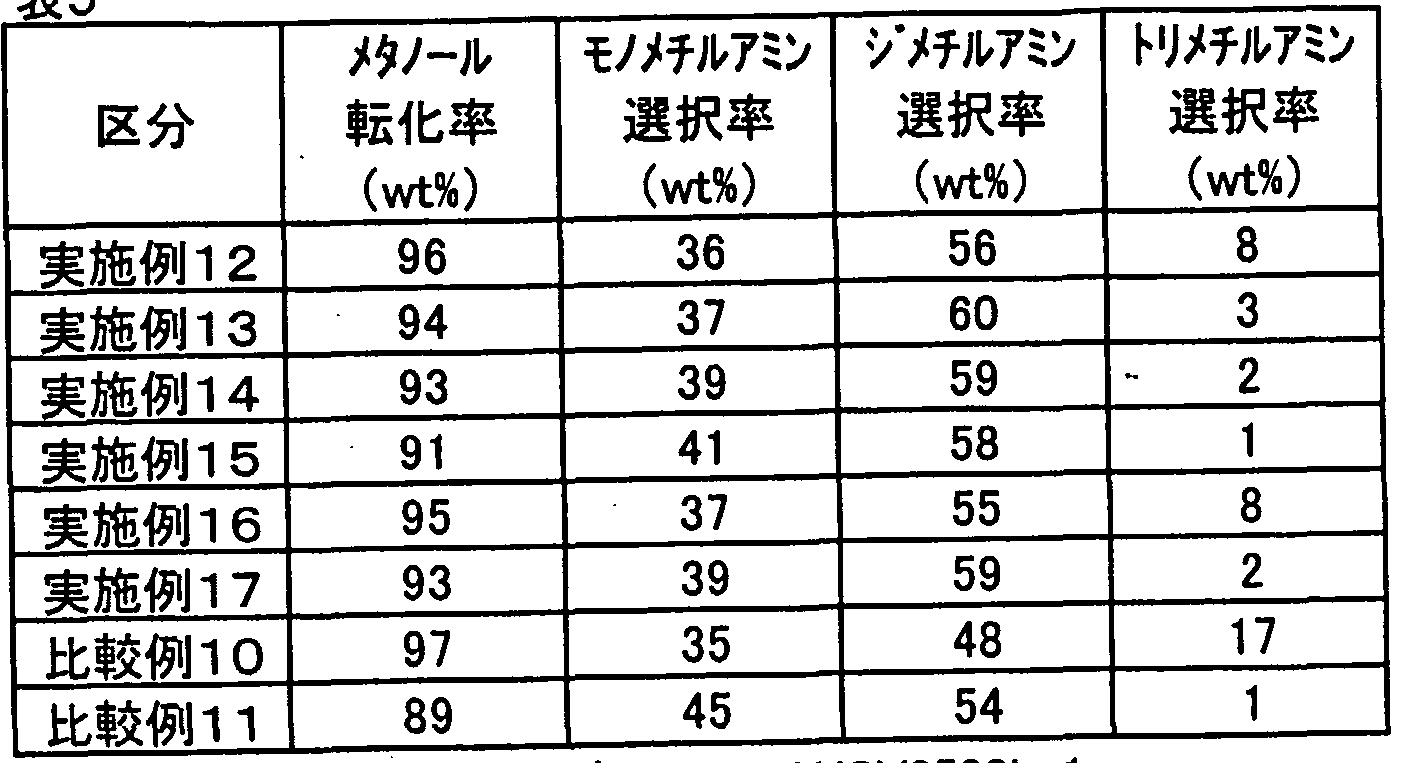
Claims
Priority Applications (4)
| Application Number | Priority Date | Filing Date | Title |
|---|---|---|---|
| KR1020047019036A KR100987726B1 (ko) | 2002-05-24 | 2003-05-23 | 8산소원환 미세공을 갖는 결정질 실리코알루미노포스페이트 분자체, 그 제조방법 및 촉매로서 상기분자체를 사용한 메틸아민류의 제조방법 |
| EP03730613.1A EP1512667B1 (en) | 2002-05-24 | 2003-05-23 | Crystalline silicoaluminophosphate salt molecular sieve having octaoxygen-membered ring pore, process for producing the same and process for producing methylamine with the molecular sieve as catalyst |
| AU2003242437A AU2003242437A1 (en) | 2002-05-24 | 2003-05-23 | Crystalline silicoaluminophosphate salt molecular sieve having octaoxygen-membered ring pore, process for producing the same and process for producing methylamine with the molecular sieve as catalyst |
| US10/515,380 US7115238B2 (en) | 2002-05-24 | 2003-05-23 | Crystalline silicoaluminophosphate salt molecular sieve having octaoxygen-membered ring pore, process for producing the same and process for producing methylamine with the molecular sieve as catalyst |
Applications Claiming Priority (2)
| Application Number | Priority Date | Filing Date | Title |
|---|---|---|---|
| JP2002151551 | 2002-05-24 | ||
| JP2002-151551 | 2002-05-24 |
Publications (1)
| Publication Number | Publication Date |
|---|---|
| WO2003099720A1 true WO2003099720A1 (en) | 2003-12-04 |
Family
ID=29561255
Family Applications (1)
| Application Number | Title | Priority Date | Filing Date |
|---|---|---|---|
| PCT/JP2003/006477 Ceased WO2003099720A1 (en) | 2002-05-24 | 2003-05-23 | Crystalline silicoaluminophosphate salt molecular sieve having octaoxygen-membered ring pore, process for producing the same and process for producing methylamine with the molecular sieve as catalyst |
Country Status (7)
| Country | Link |
|---|---|
| US (1) | US7115238B2 (ja) |
| EP (1) | EP1512667B1 (ja) |
| KR (1) | KR100987726B1 (ja) |
| CN (1) | CN1329296C (ja) |
| AU (1) | AU2003242437A1 (ja) |
| TW (1) | TWI281879B (ja) |
| WO (1) | WO2003099720A1 (ja) |
Cited By (2)
| Publication number | Priority date | Publication date | Assignee | Title |
|---|---|---|---|---|
| US9492818B2 (en) | 2009-06-12 | 2016-11-15 | Albemarle Europe Sprl | SAPO molecular sieve catalysts and their preparation and uses |
| CN114054081A (zh) * | 2021-11-08 | 2022-02-18 | 吉林大学 | 一种sapo-34/sapo-14复合分子筛及其制备方法和应用 |
Families Citing this family (18)
| Publication number | Priority date | Publication date | Assignee | Title |
|---|---|---|---|---|
| US7375050B2 (en) * | 2003-04-28 | 2008-05-20 | Exxonmobil Chemical Patents Inc. | Synthesis and use of aluminophosphates and silicoaluminophosphates |
| US7090814B2 (en) * | 2004-11-10 | 2006-08-15 | Exxonmobil Chemical Patents Inc. | Method of synthesizing silicoaluminophosphate molecular sieves |
| EP2246111A3 (en) | 2007-03-26 | 2011-09-07 | PQ Corporation | Novel microporous crystalline material comprising a molecular sieve or zeolite having an 8-ring pore opening structure and methods of making and using same |
| EP2391424B1 (en) | 2009-01-30 | 2016-12-28 | Beiersdorf AG | Cosmetic or dermatological preparation comprising cell growth promoting peptide and cellular complex |
| JP5385682B2 (ja) * | 2009-05-19 | 2014-01-08 | 新光電気工業株式会社 | 電子部品の実装構造 |
| WO2012029159A1 (ja) | 2010-09-02 | 2012-03-08 | イビデン株式会社 | シリコアルミナリン酸塩、ハニカム構造体及び排ガス浄化装置 |
| DE102010055728A1 (de) * | 2010-12-22 | 2012-06-28 | Süd-Chemie AG | Verfahren zur Umsetzung stickstoffhaltiger Verbindungen |
| RU2017146613A (ru) | 2012-01-31 | 2018-10-17 | Джонсон Мэтти Паблик Лимитед Компани | Каталитические смеси |
| EA025504B1 (ru) * | 2012-09-26 | 2016-12-30 | Далянь Инститьют Оф Кемикал Физикс, Чайниз Академи Оф Сайэнс | Молекулярное сито sapo-34 и способ его получения |
| DK2902362T3 (en) * | 2012-09-26 | 2017-08-07 | Dalian Inst Chemical Physics Cas | SAPO-34 MOLECULE AND SYNTHESIS PROCEDURES |
| EP2907571B1 (en) * | 2012-10-15 | 2017-12-13 | Mitsubishi Gas Chemical Company, Inc. | Method for producing catalyst for use in production of methylamine compound, and method for producing methylamine compound |
| CN103801377B (zh) * | 2012-11-13 | 2016-08-17 | 中国石油化工股份有限公司 | 一种加氢催化剂的制法 |
| CN103801372B (zh) * | 2012-11-13 | 2016-02-10 | 中国石油化工股份有限公司 | 含分子筛和无定形硅铝的加氢催化剂组合物的制备方法 |
| JP6740460B2 (ja) * | 2017-03-31 | 2020-08-12 | 日本碍子株式会社 | Afx構造のゼオライト膜、膜構造体、及び膜構造体の製造方法 |
| CN112079363A (zh) * | 2019-06-14 | 2020-12-15 | 中国石油化工股份有限公司 | Afn结构硅磷铝分子筛及其合成方法和应用 |
| CN113813879B (zh) * | 2021-08-30 | 2022-05-27 | 北京鑫美格工程设计有限公司 | 一种蒸发混合器及甲胺合成装置 |
| CN114702041B (zh) * | 2022-03-25 | 2023-09-01 | 常州工学院 | 一种类球状多孔级sapo-20沸石分子筛的制备方法及应用 |
| CN119591504A (zh) * | 2023-09-06 | 2025-03-11 | 中国石油化工股份有限公司 | 甲胺合成方法 |
Citations (4)
| Publication number | Priority date | Publication date | Assignee | Title |
|---|---|---|---|---|
| US4683334A (en) * | 1985-04-30 | 1987-07-28 | E. I. Du Pont De Nemours & Company | Modified 8-ring zeolites as catalysts for conversion of methanol and ammonia to dimethylamine |
| US5443812A (en) * | 1989-04-24 | 1995-08-22 | Kanebo Ltd. | Stabilized synthetic zeolite and a process for the preparation thereof |
| JPH08310810A (ja) * | 1995-05-17 | 1996-11-26 | Nippon Kayaku Co Ltd | 高純度結晶質シリコアルミノリン酸塩の製造方法 |
| JP2000117114A (ja) * | 1998-10-15 | 2000-04-25 | Mitsubishi Gas Chem Co Inc | メチルアミン製造触媒及び該触媒の製造方法 |
Family Cites Families (4)
| Publication number | Priority date | Publication date | Assignee | Title |
|---|---|---|---|---|
| US5126308A (en) * | 1991-11-13 | 1992-06-30 | Uop | Metal aluminophosphate catalyst for converting methanol to light olefins |
| US5994603A (en) * | 1996-05-29 | 1999-11-30 | Exxon Chemical Patents Inc. | Methylation of toluene to para-xylene |
| TWI234556B (en) * | 1997-07-23 | 2005-06-21 | Mitsubishi Gas Chemical Co | Catalysts for methanol conversion reactions |
| JP4174634B2 (ja) | 1997-12-26 | 2008-11-05 | 三菱瓦斯化学株式会社 | シリカ変性シリコアルミノホスフェート触媒、その製造方法及びそれを用いるメチルアミン類等の製造方法 |
-
2003
- 2003-05-23 EP EP03730613.1A patent/EP1512667B1/en not_active Expired - Lifetime
- 2003-05-23 US US10/515,380 patent/US7115238B2/en not_active Expired - Lifetime
- 2003-05-23 WO PCT/JP2003/006477 patent/WO2003099720A1/ja not_active Ceased
- 2003-05-23 KR KR1020047019036A patent/KR100987726B1/ko not_active Expired - Lifetime
- 2003-05-23 AU AU2003242437A patent/AU2003242437A1/en not_active Abandoned
- 2003-05-23 TW TW092114089A patent/TWI281879B/zh not_active IP Right Cessation
- 2003-05-23 CN CNB03811917XA patent/CN1329296C/zh not_active Expired - Lifetime
Patent Citations (4)
| Publication number | Priority date | Publication date | Assignee | Title |
|---|---|---|---|---|
| US4683334A (en) * | 1985-04-30 | 1987-07-28 | E. I. Du Pont De Nemours & Company | Modified 8-ring zeolites as catalysts for conversion of methanol and ammonia to dimethylamine |
| US5443812A (en) * | 1989-04-24 | 1995-08-22 | Kanebo Ltd. | Stabilized synthetic zeolite and a process for the preparation thereof |
| JPH08310810A (ja) * | 1995-05-17 | 1996-11-26 | Nippon Kayaku Co Ltd | 高純度結晶質シリコアルミノリン酸塩の製造方法 |
| JP2000117114A (ja) * | 1998-10-15 | 2000-04-25 | Mitsubishi Gas Chem Co Inc | メチルアミン製造触媒及び該触媒の製造方法 |
Non-Patent Citations (1)
| Title |
|---|
| See also references of EP1512667A4 * |
Cited By (3)
| Publication number | Priority date | Publication date | Assignee | Title |
|---|---|---|---|---|
| US9492818B2 (en) | 2009-06-12 | 2016-11-15 | Albemarle Europe Sprl | SAPO molecular sieve catalysts and their preparation and uses |
| CN114054081A (zh) * | 2021-11-08 | 2022-02-18 | 吉林大学 | 一种sapo-34/sapo-14复合分子筛及其制备方法和应用 |
| CN114054081B (zh) * | 2021-11-08 | 2022-10-21 | 吉林大学 | 一种sapo-34/sapo-14复合分子筛及其制备方法和应用 |
Also Published As
| Publication number | Publication date |
|---|---|
| CN1656019A (zh) | 2005-08-17 |
| TWI281879B (en) | 2007-06-01 |
| EP1512667A1 (en) | 2005-03-09 |
| KR100987726B1 (ko) | 2010-10-13 |
| EP1512667A4 (en) | 2009-08-26 |
| KR20050024285A (ko) | 2005-03-10 |
| CN1329296C (zh) | 2007-08-01 |
| EP1512667B1 (en) | 2014-07-23 |
| AU2003242437A1 (en) | 2003-12-12 |
| US7115238B2 (en) | 2006-10-03 |
| US20050249661A1 (en) | 2005-11-10 |
| TW200425953A (en) | 2004-12-01 |
Similar Documents
| Publication | Publication Date | Title |
|---|---|---|
| EP0993867B1 (en) | Methods for the preparation of methylamines using SAPO-34 catalysts | |
| JP4596116B2 (ja) | 8酸素員環細孔を持つ結晶質シリコアルミノリン酸塩モレキュラーシーブ及びその製造方法、並びにそれを触媒とするメチルアミン類の製造方法 | |
| JP6371476B2 (ja) | モレキュラーシーブssz−98の製造方法 | |
| JP6381797B2 (ja) | モレキュラーシーブssz−98 | |
| JP4221532B2 (ja) | メチルアミン製造用触媒及び該触媒を用いたメチルアミン類の製造方法 | |
| KR100987726B1 (ko) | 8산소원환 미세공을 갖는 결정질 실리코알루미노포스페이트 분자체, 그 제조방법 및 촉매로서 상기분자체를 사용한 메틸아민류의 제조방법 | |
| CN107690420B (zh) | 铝硅酸盐沸石ssz-98的合成 | |
| CN110167880A (zh) | 借助无溶剂沸石间转化制备沸石材料的方法 | |
| CN110540215A (zh) | Aei型铝硅酸盐沸石、催化剂和废气处理方法 | |
| US9889440B2 (en) | Method for synthesizing silicoaluminophosphate-34 molecular sieves | |
| JP2008260680A (ja) | ゼオライトベータの調製方法 | |
| US20080145310A1 (en) | Method for the Synthesis of Zeolite Beta with Diethylenetriamine | |
| CN104428248B (zh) | Maz型沸石的制造方法 | |
| CN107848821B (zh) | 制备沸石ssz-98的方法 | |
| US11214493B2 (en) | Accelerated aluminosilicate zeolite crystallization | |
| JP2008239450A (ja) | ベータ(β)−ゼオライトの合成方法 | |
| JP7572009B2 (ja) | Cha型ゼオライト材料、及びシクロアルキルアンモニウム化合物とヒドロキシアルキルアンモニウム化合物との組み合わせを使用するその製造方法 | |
| JP7207154B2 (ja) | ゼオライトの製造方法 | |
| CN1108869C (zh) | MeAPSO-35分子筛及其合成方法 | |
| CN106276946A (zh) | 一种rho-sapo分子筛的合成方法及其应用 |
Legal Events
| Date | Code | Title | Description |
|---|---|---|---|
| AK | Designated states |
Kind code of ref document: A1 Designated state(s): AE AG AL AM AT AU AZ BA BB BG BR BY BZ CA CH CN CO CR CU CZ DE DK DM DZ EC EE ES FI GB GD GE GH GM HR HU ID IL IN IS KE KG KP KR KZ LC LK LR LS LT LU LV MA MD MG MK MN MW MX MZ NO NZ OM PH PL PT RO RU SD SE SG SK SL TJ TM TN TR TT TZ UA UG US UZ VC VN YU ZA ZM ZW |
|
| AL | Designated countries for regional patents |
Kind code of ref document: A1 Designated state(s): GH GM KE LS MW MZ SD SL SZ TZ UG ZM ZW AM AZ BY KG KZ MD RU TJ TM AT BE BG CH CY CZ DE DK EE ES FI FR GB GR HU IE IT LU MC NL PT RO SE SI SK TR BF BJ CF CG CI CM GA GN GQ GW ML MR NE SN TD TG |
|
| 121 | Ep: the epo has been informed by wipo that ep was designated in this application | ||
| DFPE | Request for preliminary examination filed prior to expiration of 19th month from priority date (pct application filed before 20040101) | ||
| WWE | Wipo information: entry into national phase |
Ref document number: 2003730613 Country of ref document: EP |
|
| WWE | Wipo information: entry into national phase |
Ref document number: 1020047019036 Country of ref document: KR Ref document number: 2003811917X Country of ref document: CN |
|
| WWP | Wipo information: published in national office |
Ref document number: 2003730613 Country of ref document: EP |
|
| WWE | Wipo information: entry into national phase |
Ref document number: 10515380 Country of ref document: US |
|
| WWP | Wipo information: published in national office |
Ref document number: 1020047019036 Country of ref document: KR |