WO2003102872A2 - Unit for and method of estimating a motion vector - Google Patents
Unit for and method of estimating a motion vector Download PDFInfo
- Publication number
- WO2003102872A2 WO2003102872A2 PCT/IB2003/002180 IB0302180W WO03102872A2 WO 2003102872 A2 WO2003102872 A2 WO 2003102872A2 IB 0302180 W IB0302180 W IB 0302180W WO 03102872 A2 WO03102872 A2 WO 03102872A2
- Authority
- WO
- WIPO (PCT)
- Prior art keywords
- pixels
- group
- motion vectors
- image
- component
- Prior art date
- Legal status (The legal status is an assumption and is not a legal conclusion. Google has not performed a legal analysis and makes no representation as to the accuracy of the status listed.)
- Ceased
Links
Classifications
-
- H—ELECTRICITY
- H04—ELECTRIC COMMUNICATION TECHNIQUE
- H04N—PICTORIAL COMMUNICATION, e.g. TELEVISION
- H04N19/00—Methods or arrangements for coding, decoding, compressing or decompressing digital video signals
- H04N19/50—Methods or arrangements for coding, decoding, compressing or decompressing digital video signals using predictive coding
- H04N19/503—Methods or arrangements for coding, decoding, compressing or decompressing digital video signals using predictive coding involving temporal prediction
- H04N19/51—Motion estimation or motion compensation
-
- G—PHYSICS
- G06—COMPUTING OR CALCULATING; COUNTING
- G06T—IMAGE DATA PROCESSING OR GENERATION, IN GENERAL
- G06T7/00—Image analysis
- G06T7/20—Analysis of motion
- G06T7/223—Analysis of motion using block-matching
- G06T7/238—Analysis of motion using block-matching using non-full search, e.g. three-step search
-
- H—ELECTRICITY
- H04—ELECTRIC COMMUNICATION TECHNIQUE
- H04N—PICTORIAL COMMUNICATION, e.g. TELEVISION
- H04N19/00—Methods or arrangements for coding, decoding, compressing or decompressing digital video signals
- H04N19/50—Methods or arrangements for coding, decoding, compressing or decompressing digital video signals using predictive coding
- H04N19/503—Methods or arrangements for coding, decoding, compressing or decompressing digital video signals using predictive coding involving temporal prediction
- H04N19/51—Motion estimation or motion compensation
- H04N19/56—Motion estimation with initialisation of the vector search, e.g. estimating a good candidate to initiate a search
-
- G—PHYSICS
- G06—COMPUTING OR CALCULATING; COUNTING
- G06T—IMAGE DATA PROCESSING OR GENERATION, IN GENERAL
- G06T2207/00—Indexing scheme for image analysis or image enhancement
- G06T2207/10—Image acquisition modality
- G06T2207/10016—Video; Image sequence
Definitions
- the invention relates to a motion estimation unit for estimating a current motion vector for a group of pixels of an image, comprising:
- - generating means for generating a set of candidate motion vectors for the first group of pixels, the candidate motion vectors being extracted from a set of previously estimated motion vectors;
- a match error unit for calculating match errors of respective candidate motion vectors, the match error of a first one of the candidate motion vectors being based on a first component and a second component, the first component corresponding to a comparison of values of pixels of the first group of pixels with values of pixels of a second group of pixels of a second image, and the second component depending on a relation between the first group of pixels and a third group of pixels for which a first one of the previously estimated motion vectors has been estimated, the first one of the candidate motion vectors being based on the first one of the previously estimated motion vectors;
- - a selection unit for selecting the current motion vector from the candidate motion vectors by means of comparing the match errors of the respective candidate motion vectors.
- the invention further relates to a method of estimating a current motion vector for a group of pixels of an image, comprising:
- the match error of a first one of the candidate motion vectors being based on a first component and a second component, the first component corresponding to a comparison of values of pixels of the first group of pixels with values of pixels of a second group of pixels of a second image, and the second component depending on a relation between the first group of pixels and a third group of pixels for which a first one of the previously estimated motion vectors has been estimated, the first one of the candidate motion vectors being based on the first one of the previously estimated motion vectors; and - selecting the current motion vector from the candidate motion vectors by means of comparing the match errors of the respective candidate motion vectors.
- the invention further relates to an image processing apparatus comprising:
- a motion compensated image processing unit for determining processed images on basis of the images and the current motion vector.
- optical flow For many applications in video signal processing, it is necessary to know the apparent velocity field of a sequence of images, known as the optical flow.
- This optical flow is given as a time-varying motion vector field, i.e. one motion vector field per image-pair. Notice that an image can be part of several image-pairs.
- this motion vector field is estimated by dividing the image into blocks. For a set of candidate motion vectors of each block match errors are calculated and used in a minimization procedure to find the most appropriate motion vector from the set of candidate motion vectors of the block.
- the cited motion estimation unit relies on two basic assumptions. Firstly, objects are bigger than blocks, this means that a motion vector estimated in the neighborhood of a block will have a high correlation with the actual motion vector of this block and can therefor be used as a so-called spatial prediction, i.e. spatial candidate motion vector, for this motion vector. Secondly, objects have inertia. This means that the motion of the objects does not change erratically from image to image, and the actual motion vector for the current block will have high correlation with motion vectors of corresponding blocks in previous images. Motion vectors from these blocks can be used as so-called temporal predictions, i.e. temporal candidate motion vectors, for the motion vector of the current block. In order to allow updates of motion vectors, extra predictions, called random predictions, i.e. random candidate motion vectors are added which are equal to the spatial candidate motion vectors to which a small noise motion vector is added.
- temporal predictions i.e. temporal candidate motion vectors
- penalties are assigned to candidate motion vectors with a lower correlation. These penalties are added to the match error of the candidate motion vector (usually a sum of absolute differences), making it harder for that candidate motion vector to be chosen as the best matching motion vector. Random candidate motion vectors are given the highest penalty, spatial candidate motion vectors the lowest, the temporal candidate motion vectors have a penalty which is between the penalties of the spatial and random candidate motion vector.
- One of the problems with this motion estimation unit is that the assumption under which spatial candidate motion vector can be used, fails on object boundaries. A spatial candidate motion vector which is located in another object will have no correlation with the motion vector of the current block.
- This object of the invention is achieved in that the motion estimation unit is arranged to modulate the second component on basis of a result of segmentation for the first image, into segments of pixels, the result of segmentation being related to a probability that a first part of the first group of pixels and a first part of the third group of pixels both correspond to a particular one of the segments.
- Image segmentation is applied as a solution to the issue stated above. Image segmentation aims at dividing an image into segments in which a certain feature is constant or in between predetermined thresholds. For pixels or groups of pixels of the image, values are calculated representing probabilities of belonging to any of the segments.
- the feature can be anything from a simple grey value to complex texture measures combined with color information.
- the segmentation method i.e. the method of extracting the segments, based on the chosen feature, can be anything from simple thresholding to watershed algorithms. Assuming that the edges of the objects in the image are a subset of the segment edges, then the motion estimation is improved in quality by using this information. Since candidate motion vectors from other objects, i.e. previously estimated motion vectors belonging to other objects, have less correlation to the current (first) group of pixels as candidate motion vectors from the same object, the penalty of a candidate motion vector of another segment as the current group of pixels should be raised. Or in other words the second component of a motion vector candidate of another segment as the current group of pixels should be increased.
- An embodiment of the motion estimation unit is arranged to modulate the second component on basis of the size of the probability.
- a segmentation might be binary, resulting in a label per pixel indicating whether the pixel belongs or not belongs to a particular segment.
- a segmentation method provides for a pixel, or group of pixels, a probability of belonging to a particular segment. Multiple probabilities for a pixel are possible too: e.g. a first probability of 20% for belonging to segment A and a second probability of 80% for belonging to segment B.
- This embodiment according to the invention is arranged to apply the actual probability to modulate the second component. For instance, if the probability of not belonging to the same object is relatively high then the second components should be relatively high as well and vice versa. The advantage of this approach is a more accurate second component and thus a more accurate match error.
- Another embodiment of the motion estimation unit according to the invention is arranged to modulate the second component on basis of a ratio of a first number of pixels of the first part of the first group of pixels and a second number of pixels of the first group of pixels.
- Segmentation and motion estimation might be strongly correlated. That means that e.g. the segmentation is done for groups of pixels and the motion estimation is performed on the same groups of pixels. However segmentation and motion estimation might be performed independently. In that case the segmentation is e.g. performed on a pixel base and the motion estimation on a block base. As a consequence, it might be that the first part of the pixels of a group of pixels, to be used for motion estimation, are classified as belonging to segment A and another part of pixels is classified as belonging to segment B.
- an "overall probability of belonging to segment A" can be calculated for the group of pixels on basis of the ratio of the number of pixels of the first part and the number of pixels of the entire group of pixels.
- the advantage of this approach is a more accurate second component and thus a more accurate match error.
- the first group of pixels is a block of pixels.
- the group of pixels might have any shape, even irregular.
- a block based shape is preferred because this reduces the complexity of the design of the motion estimation unit.
- the selection unit is arranged to select, from the set of candidate motion vectors, a particular motion vector as the current motion vector, if the corresponding match error is the smallest of the match errors. This is a relatively easy approach for selecting the current motion vector from the set of candidate motion vectors.
- the match error unit is designed to calculate the match error of the first one of the candidate motion vectors by means of subtracting luminance values of pixels of the first group of pixels from luminance values of pixels of the second group of pixels of the second image.
- the sum of absolute luminance differences (SAD) is calculated.
- SAD is a relatively reliable measure for correlation which can be calculated relatively fast.
- This object of the invention is achieved in modulating the second component on basis of a result of segmentation for the first image, into segments of pixels, the result of segmentation being related to a probability that a first part of the first group of pixels and a first part of the third group of pixels both correspond to a particular one of the segments.
- the image processing apparatus may comprise additional components, e.g. a display device for displaying the processed images or storage means for storage of the processed images.
- the motion compensated image processing unit might support one or more of the following types of image processing: - De-interlacing: Interlacing is the common video broadcast procedure for transmitting the odd or even numbered image lines alternately. De-interlacing attempts to restore the full vertical resolution, i.e. make odd and even lines available simultaneously for each image; - Up-conversion: From a series of original input images a larger series of output images is calculated. Output images are temporally located between two original input images;
- Video compression i.e. encoding or decoding, e.g. according to the MPEG standard or H26L standard.
- Fig. 1 schematically shows a motion estimation unit in combination with an image segmentation unit
- Fig. 2 schematically shows a motion vector field
- Fig. 3 schematically shows elements of an image processing apparatus, comprising a motion estimation unit, according to the invention.
- Fig. 1 schematically shows a motion estimation unit 100 in combination with an image segmentation unit 108 and a memory device 1 10 for storage of images.
- the motion estimation unit 100 is arranged to estimate a current motion vector for a first group 212 of pixels of a first image and comprises:
- a generating unit 106 for generating a set of candidate motion vectors for the first group 212 of pixels, with the candidate motion vectors being extracted from a set of previously estimated motion vectors;
- a match error unit 102 for calculating match errors of respective candidate motion vectors, with the match error of a first one of the candidate motion vectors being based on a first component and a second component; and - a selection unit 104 for selecting the current motion vector from the candidate motion vectors by means of comparing the match errors of the respective candidate motion vectors.
- the first component of the match error is calculated by means of making a comparison of values of pixels of the first group 212 of pixels with values of pixels of a second group of pixels of a second image.
- the first component of the match error corresponds to the SAD: sum of absolute luminance differences between pixels in a block of the first image, and the pixels of a block in a reference image, i.e. the second image, shifted by the candidate motion vector. If the reference image and the first image directly succeed each other the SAD can be calculated with:
- the motion estimation unit 100 is arranged to modulate the second component on basis of a result of segmentation for the first image, into segments of pixels.
- the segmentation unit 108 is arranged to perform segmentation on a block base.
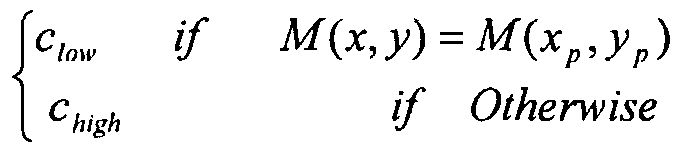
- every block B(x,y) is assigned a label l k corresponding to the segment S ⁇ it belongs to. This information is stored in the image segmentation mask M (x,y) .
- the second component C 2 is modulated according to:
- c hw is a small value in order to enforce spatial consistency
- c hlgh is a high value in order to discourage consistency across objects
- (x,y) is the position of the current block
- (x p ,y p ) s the position of the other block of pixels, i.e. the block of pixels for which the motion vector has been estimated and on which the motion vector candidate is based.
- the second component C 2 there are two different values for the second component C 2 : - c low if the result of segmentation yields that the current block and the other block both belong to the same segment S k ; and
- the match error ME ⁇ x,y,d x ,d y ,n)o ⁇ a particular motion vector candidate is calculated by summation of the first component and the second component of the particular motion vector candidate.
- the segmentation unit 108 is arranged to perform segmentation on a pixel base. That means that to each pixel a probability of belonging to segment S k is assigned.
- the motion estimation is still on block base, i.e. motion vectors are estimated for blocks of pixels.
- the second component is based on the probability that pixels of the current block and pixels of the other block belong to the same segment S k for Ic e K .
- Equation 4 The second component C 2 can be calculated with Equation 4:
- a connection 116 is depicted from the output 114 of the motion estimation unit 100 to the segmentation unit 108.
- This connection 116 is optional.
- motion estimation results e.g. a motion vector field, can be applied for segmentation of an image into segments of pixels. This might be for the same image as for which the motion estimation is performed or for another image of the series of images.
- the match error unit 102, the selection unit 104 and the generating unit 106 of the motion estimation unit 100 may be implemented using one processor. Normally, these functions are performed under control of a software program product. During execution, normally the software program product is loaded into a memory, like a RAM, and executed from there. The program may be loaded from a background memory, like a ROM, hard disk, or magnetically and/or optical storage, or may be loaded via a network like Internet. Optionally an application specific integrated circuit provides the disclosed functionality.
- Fig. 2 schematically shows a part of a motion vector field 200, i.e. a motion vector field under construction, of an image representing a scene with a white background in front of which a ball 202 is moving in an opposite direction related to the background.
- a set of candidate motion vectors 214-220 is created on basis of the motion vectors 214-226 previously calculated for the blocks 204-210 of pixels.
- the current block 212 of pixels is located in the segment that corresponds to the ball 202.
- block 204 of pixels is located in the segment that corresponds to the ball 202.
- block 210 of pixels corresponds to the background and the blocks 206 and 208 partly belong to the ball 202 and partly belong to the background.
- the second components for the respective candidate motion vectors will depend on the respective number of pixels of the blocks 204-210 which are labeled, by means of segmentation, as belonging to the segment representing the ball 202. Consequently the second component of the match error of the candidate motion vector 220 derived from block 204 of pixels will be the lowest and the second component of the match error of the candidate motion vector 218 derived from block 210 of pixels will be the lowest.
- Fig. 3 schematically shows elements of an image processing apparatus 300 comprising: - receiving unit 302 for receiving a signal representing images to be displayed after some processing has been performed.
- the signal may be a broadcast signal received via an antenna or cable but may also be a signal from a storage device like a VCR (Video Cassette Recorder) or Digital Versatile Disk (DVD).
- VCR Video Cassette Recorder
- DVD Digital Versatile Disk
- the signal is provided at the input connector 310.
- processing unit 304 comprising a motion estimation unit 100 and segmentation unit 108 as described in connection with Fig. 1;
- This display device 308 is optional.
- the motion compensated image processing unit 306 requires images and motion vectors as its input.
- the motion compensated image processing unit 306 might support one or more of the following types of image processing: de-interlacing; up- conversion; temporal noise reduction; and video compression.
- de-interlacing does not exclude the presence of elements or steps not listed in a claim.
- the word "a" or "an” preceding an element does not exclude the presence of a plurality of such elements.
- the invention can be implemented by means of hardware comprising several distinct elements and by means of a suitable programmed computer. In the unit claims enumerating several means, several of these means can be embodied by one and the same item of hardware.
Landscapes
- Engineering & Computer Science (AREA)
- Multimedia (AREA)
- Signal Processing (AREA)
- Computer Vision & Pattern Recognition (AREA)
- Physics & Mathematics (AREA)
- General Physics & Mathematics (AREA)
- Theoretical Computer Science (AREA)
- Image Analysis (AREA)
- Compression Or Coding Systems Of Tv Signals (AREA)
Abstract
Description

Claims
Priority Applications (5)
| Application Number | Priority Date | Filing Date | Title |
|---|---|---|---|
| JP2004509883A JP2005528709A (en) | 2002-05-30 | 2003-05-19 | Unit and method for estimating current motion vector |
| EP03725523A EP1514241A2 (en) | 2002-05-30 | 2003-05-19 | Unit for and method of estimating a motion vector |
| AU2003228054A AU2003228054A1 (en) | 2002-05-30 | 2003-05-19 | Unit for and method of estimating a motion vector |
| US10/515,745 US20050226462A1 (en) | 2002-05-30 | 2003-05-19 | Unit for and method of estimating a motion vector |
| KR10-2004-7019490A KR20050012768A (en) | 2002-05-30 | 2003-05-19 | Unit for and method of estimating a current motion vector |
Applications Claiming Priority (2)
| Application Number | Priority Date | Filing Date | Title |
|---|---|---|---|
| EP02077131 | 2002-05-30 | ||
| EP02077131.7 | 2002-05-30 |
Publications (2)
| Publication Number | Publication Date |
|---|---|
| WO2003102872A2 true WO2003102872A2 (en) | 2003-12-11 |
| WO2003102872A3 WO2003102872A3 (en) | 2004-02-12 |
Family
ID=29595020
Family Applications (1)
| Application Number | Title | Priority Date | Filing Date |
|---|---|---|---|
| PCT/IB2003/002180 Ceased WO2003102872A2 (en) | 2002-05-30 | 2003-05-19 | Unit for and method of estimating a motion vector |
Country Status (7)
| Country | Link |
|---|---|
| US (1) | US20050226462A1 (en) |
| EP (1) | EP1514241A2 (en) |
| JP (1) | JP2005528709A (en) |
| KR (1) | KR20050012768A (en) |
| CN (1) | CN1656514A (en) |
| AU (1) | AU2003228054A1 (en) |
| WO (1) | WO2003102872A2 (en) |
Cited By (3)
| Publication number | Priority date | Publication date | Assignee | Title |
|---|---|---|---|---|
| EP1603341A1 (en) * | 2004-05-25 | 2005-12-07 | STMicroelectronics | Method and device for image interpolation systems using motion estimation and compensation |
| CN102340663A (en) * | 2010-07-22 | 2012-02-01 | 华为技术有限公司 | Image motion estimation method and device |
| US9363530B2 (en) | 2009-11-18 | 2016-06-07 | Sk Telecom Co., Ltd. | Method and apparatus for encoding/decoding a motion vector by selecting a set of predicted candidate motion vectors, and method and apparatus for image encoding/decoding using the same |
Families Citing this family (15)
| Publication number | Priority date | Publication date | Assignee | Title |
|---|---|---|---|---|
| US7636481B2 (en) * | 2002-10-09 | 2009-12-22 | Sony Corporation | Image processing apparatus, method, storage medium, and program for compressing an input image using a motion vector that is detected based on stored position information of pixels |
| US7650016B2 (en) * | 2004-07-30 | 2010-01-19 | Lockheed Martin Corporation | System and method for tracking motion of an object image |
| US7522749B2 (en) * | 2005-04-08 | 2009-04-21 | Microsoft Corporation | Simultaneous optical flow estimation and image segmentation |
| KR100669251B1 (en) * | 2005-11-25 | 2007-01-16 | 한국전자통신연구원 | Digital image quality automatic analysis device and method |
| TWI361618B (en) * | 2006-12-26 | 2012-04-01 | Realtek Semiconductor Corp | Method and device for estimating noise |
| JP5138048B2 (en) * | 2007-12-19 | 2013-02-06 | ドルビー ラボラトリーズ ライセンシング コーポレイション | Adaptive motion estimation |
| JP4955616B2 (en) * | 2008-06-27 | 2012-06-20 | 富士フイルム株式会社 | Image processing apparatus, image processing method, and image processing program |
| GB2469679B (en) * | 2009-04-23 | 2012-05-02 | Imagination Tech Ltd | Object tracking using momentum and acceleration vectors in a motion estimation system |
| KR101441889B1 (en) * | 2011-01-06 | 2014-09-29 | 에스케이텔레콤 주식회사 | Apparatus and Method for Encoding and Decoding Motion Vector |
| CN107483928B (en) * | 2011-09-09 | 2020-05-12 | 株式会社Kt | Method for decoding video signal |
| BR112014011123B1 (en) * | 2011-11-08 | 2022-07-12 | Kt Corporation | VIDEO DECODING METHOD PERFORMED BY A DECODING DEVICE |
| JP6025467B2 (en) * | 2012-09-12 | 2016-11-16 | キヤノン株式会社 | Image processing apparatus and image processing method |
| CN105513004B (en) * | 2015-12-01 | 2018-11-16 | 中国航空工业集团公司洛阳电光设备研究所 | A kind of image distortion calibration system and its storage method and addressing method |
| CN111462170B (en) * | 2020-03-30 | 2023-08-25 | Oppo广东移动通信有限公司 | Motion estimation method, motion estimation device, storage medium and electronic equipment |
| CN112001943B (en) * | 2020-08-31 | 2024-07-30 | Oppo广东移动通信有限公司 | Motion estimation method and device, computer readable medium and electronic equipment |
Family Cites Families (1)
| Publication number | Priority date | Publication date | Assignee | Title |
|---|---|---|---|---|
| DE69727911D1 (en) * | 1997-04-24 | 2004-04-08 | St Microelectronics Srl | Method for increasing the motion-estimated and motion-compensated frame rate for video applications, and device for using such a method |
-
2003
- 2003-05-19 KR KR10-2004-7019490A patent/KR20050012768A/en not_active Withdrawn
- 2003-05-19 EP EP03725523A patent/EP1514241A2/en not_active Withdrawn
- 2003-05-19 US US10/515,745 patent/US20050226462A1/en not_active Abandoned
- 2003-05-19 WO PCT/IB2003/002180 patent/WO2003102872A2/en not_active Ceased
- 2003-05-19 CN CNA038122898A patent/CN1656514A/en active Pending
- 2003-05-19 AU AU2003228054A patent/AU2003228054A1/en not_active Abandoned
- 2003-05-19 JP JP2004509883A patent/JP2005528709A/en not_active Withdrawn
Non-Patent Citations (4)
| Title |
|---|
| DE HAAN G: "IC for motion compensated de-interlacing, noise reduction, and picture rate conversion" CONSUMER ELECTRONICS, 1999. ICCE. INTERNATIONAL CONFERENCE ON LOS ANGELES, CA, USA 22-24 JUNE 1999, PISCATAWAY, NJ, USA,IEEE, US, 22 June 1999 (1999-06-22), pages 212-213, XP010346606 ISBN: 0-7803-5123-1 * |
| HAAN DE G ET AL: "TRUE-MOTION ESTIMATION WITH 3-D RECURSIVE SEARCH BLOCK MATCHING" IEEE TRANSACTIONS ON CIRCUITS AND SYSTEMS FOR VIDEO TECHNOLOGY, IEEE INC. NEW YORK, US, vol. 3, no. 5, 1 October 1993 (1993-10-01), pages 368-379, XP000414663 ISSN: 1051-8215 cited in the application * |
| WITTEBROOD R B, HAAN DE G: "SECOND GENERATION VIDEO FORMAT CONVERSION SOFTWARE FOR A DIGITLA SIGNAL PROCESSOR" IEEE TRANSACTIONS ON CONSUMER ELECTRONICS, vol. 46, no. 3, 13 - 15 June 2000, pages 857-865, XP002263798 * |
| WITTEBROOD R B; HAAN DE G: "REAL-TIME RECURSIVE MOTION SEGMENTATION OF VIDEO DATA ON A PROGRAMMABLE DEVICE" IEEE TRANSACTIONS ON CONSUMER ELECTRONICS, vol. 47, no. 3, - 31 August 2001 (2001-08-31) pages 559-567, XP002263797 * |
Cited By (5)
| Publication number | Priority date | Publication date | Assignee | Title |
|---|---|---|---|---|
| EP1603341A1 (en) * | 2004-05-25 | 2005-12-07 | STMicroelectronics | Method and device for image interpolation systems using motion estimation and compensation |
| US9363530B2 (en) | 2009-11-18 | 2016-06-07 | Sk Telecom Co., Ltd. | Method and apparatus for encoding/decoding a motion vector by selecting a set of predicted candidate motion vectors, and method and apparatus for image encoding/decoding using the same |
| US9479793B2 (en) | 2009-11-18 | 2016-10-25 | Sk Telecom Co., Ltd. | Method and apparatus for encoding/decoding a motion vector by selecting a set of predicted candidate motion vectors, and method and apparatus for image encoding/decoding using the same |
| CN102340663A (en) * | 2010-07-22 | 2012-02-01 | 华为技术有限公司 | Image motion estimation method and device |
| CN102340663B (en) * | 2010-07-22 | 2013-02-27 | 华为技术有限公司 | Image motion estimation method and device |
Also Published As
| Publication number | Publication date |
|---|---|
| CN1656514A (en) | 2005-08-17 |
| KR20050012768A (en) | 2005-02-02 |
| AU2003228054A1 (en) | 2003-12-19 |
| EP1514241A2 (en) | 2005-03-16 |
| AU2003228054A8 (en) | 2003-12-19 |
| US20050226462A1 (en) | 2005-10-13 |
| JP2005528709A (en) | 2005-09-22 |
| WO2003102872A3 (en) | 2004-02-12 |
Similar Documents
| Publication | Publication Date | Title |
|---|---|---|
| KR101135454B1 (en) | Temporal interpolation of a pixel on basis of occlusion detection | |
| US7519230B2 (en) | Background motion vector detection | |
| US20050180506A1 (en) | Unit for and method of estimating a current motion vector | |
| US7949205B2 (en) | Image processing unit with fall-back | |
| EP1514241A2 (en) | Unit for and method of estimating a motion vector | |
| JP2004518341A (en) | Recognition of film and video objects occurring in parallel in a single television signal field | |
| US7382899B2 (en) | System and method for segmenting | |
| US20050163355A1 (en) | Method and unit for estimating a motion vector of a group of pixels | |
| EP1481546A1 (en) | Method and apparatus for field rate up-conversion | |
| US8102915B2 (en) | Motion vector fields refinement to track small fast moving objects | |
| US20080144716A1 (en) | Method For Motion Vector Determination | |
| EP1958451B1 (en) | Motion vector field correction | |
| US8582882B2 (en) | Unit for and method of segmentation using average homogeneity |
Legal Events
| Date | Code | Title | Description |
|---|---|---|---|
| AK | Designated states |
Kind code of ref document: A2 Designated state(s): AE AG AL AM AT AU AZ BA BB BG BR BY BZ CA CH CN CO CR CU CZ DE DK DM DZ EC EE ES FI GB GD GE GH GM HR HU ID IL IN IS JP KE KG KP KR KZ LC LK LR LS LT LU LV MA MD MG MK MN MW MX MZ NI NO NZ OM PH PL PT RO RU SC SD SE SG SK SL TJ TM TN TR TT TZ UA UG US UZ VC VN YU ZA ZM ZW |
|
| AL | Designated countries for regional patents |
Kind code of ref document: A2 Designated state(s): GH GM KE LS MW MZ SD SL SZ TZ UG ZM ZW AM AZ BY KG KZ MD RU TJ TM AT BE BG CH CY CZ DE DK EE ES FI FR GB GR HU IE IT LU MC NL PT RO SE SI SK TR BF BJ CF CG CI CM GA GN GQ GW ML MR NE SN TD TG |
|
| 121 | Ep: the epo has been informed by wipo that ep was designated in this application | ||
| WWE | Wipo information: entry into national phase |
Ref document number: 2003725523 Country of ref document: EP |
|
| WWE | Wipo information: entry into national phase |
Ref document number: 2004509883 Country of ref document: JP |
|
| WWE | Wipo information: entry into national phase |
Ref document number: 10515745 Country of ref document: US |
|
| WWE | Wipo information: entry into national phase |
Ref document number: 20038122898 Country of ref document: CN |
|
| WWE | Wipo information: entry into national phase |
Ref document number: 1020047019490 Country of ref document: KR |
|
| WWP | Wipo information: published in national office |
Ref document number: 1020047019490 Country of ref document: KR |
|
| WWP | Wipo information: published in national office |
Ref document number: 2003725523 Country of ref document: EP |
|
| WWW | Wipo information: withdrawn in national office |
Ref document number: 2003725523 Country of ref document: EP |