WO2003103582A2 - Reduction of gelatin cross-linking - Google Patents
Reduction of gelatin cross-linking Download PDFInfo
- Publication number
- WO2003103582A2 WO2003103582A2 PCT/US2003/017620 US0317620W WO03103582A2 WO 2003103582 A2 WO2003103582 A2 WO 2003103582A2 US 0317620 W US0317620 W US 0317620W WO 03103582 A2 WO03103582 A2 WO 03103582A2
- Authority
- WO
- WIPO (PCT)
- Prior art keywords
- gelatin
- cross
- linking
- shell
- capsule
- Prior art date
- Legal status (The legal status is an assumption and is not a legal conclusion. Google has not performed a legal analysis and makes no representation as to the accuracy of the status listed.)
- Ceased
Links
Classifications
-
- A—HUMAN NECESSITIES
- A61—MEDICAL OR VETERINARY SCIENCE; HYGIENE
- A61K—PREPARATIONS FOR MEDICAL, DENTAL OR TOILETRY PURPOSES
- A61K9/00—Medicinal preparations characterised by special physical form
- A61K9/48—Preparations in capsules, e.g. of gelatin, of chocolate
- A61K9/4808—Preparations in capsules, e.g. of gelatin, of chocolate characterised by the form of the capsule or the structure of the filling; Capsules containing small tablets; Capsules with outer layer for immediate drug release
-
- A—HUMAN NECESSITIES
- A61—MEDICAL OR VETERINARY SCIENCE; HYGIENE
- A61K—PREPARATIONS FOR MEDICAL, DENTAL OR TOILETRY PURPOSES
- A61K9/00—Medicinal preparations characterised by special physical form
- A61K9/48—Preparations in capsules, e.g. of gelatin, of chocolate
- A61K9/4816—Wall or shell material
- A61K9/4825—Proteins, e.g. gelatin
-
- A—HUMAN NECESSITIES
- A61—MEDICAL OR VETERINARY SCIENCE; HYGIENE
- A61K—PREPARATIONS FOR MEDICAL, DENTAL OR TOILETRY PURPOSES
- A61K31/00—Medicinal preparations containing organic active ingredients
- A61K31/33—Heterocyclic compounds
- A61K31/335—Heterocyclic compounds having oxygen as the only ring hetero atom, e.g. fungichromin
- A61K31/35—Heterocyclic compounds having oxygen as the only ring hetero atom, e.g. fungichromin having six-membered rings with one oxygen as the only ring hetero atom
- A61K31/352—Heterocyclic compounds having oxygen as the only ring hetero atom, e.g. fungichromin having six-membered rings with one oxygen as the only ring hetero atom condensed with carbocyclic rings, e.g. methantheline
- A61K31/353—3,4-Dihydrobenzopyrans, e.g. chroman, catechin
- A61K31/355—Tocopherols, e.g. vitamin E
-
- A—HUMAN NECESSITIES
- A61—MEDICAL OR VETERINARY SCIENCE; HYGIENE
- A61K—PREPARATIONS FOR MEDICAL, DENTAL OR TOILETRY PURPOSES
- A61K9/00—Medicinal preparations characterised by special physical form
- A61K9/48—Preparations in capsules, e.g. of gelatin, of chocolate
- A61K9/4841—Filling excipients; Inactive ingredients
- A61K9/4858—Organic compounds
Definitions
- the invention relates to compositions and methods for reducing cross-Unking in the gelatin shell of gelatin capsules by incorporation of free amino acid into the capsule shell and by inclusion of an ester of carboxylic acid either into the capsule filling- and/or into-the capsule shell and/or into the lubrication agent, or in combinations thereof.
- Described are soft gelatin capsules characterized by improved stability as compared with gelatin capsules that do not contain amino acid in the shell and carboxylic acid ester in the filling, shell or in the lubrication agent, or in combinations thereof.
- Gelatin capsules commonly used as a pharmaceutical dosage form or as food supplements, consist of a gelatin shell surrounding a core filled with the composition being delivered. Gelatin capsules and methods of making the same are well known and described in the general pharmacological literature. Gel capsules may be hard (filled with solid or semi-solid fill) formed by two halves joined to create a shell capsule, or a soft (filled with a liquid or semi- liquid fill) formed by a single gelatin shell. Caplets (sometimes also referred to as gel capsules) are modified tablets covered by gelatin shell.
- Soft-gelatin capsules are produced by injecting a liquid or a semi-liquid fill between two gelatin strips, either by discontinuous formation or by continuous formation (i.e., rotary-die process).
- both gelatin gel strips have to be lubricated by a suitable lubricant in order to avoid early sticking to machine parts or to each other.
- suitable lubricant agents commonly used in the art include mineral oils (e.g., paraffin oil), synthetic oils (e.g., si ⁇ cone oil) or vegetable oils (e.g., coconut oil and corn oil).
- Liquid or semi-liquid fills for soft-gelatin gel capsules are divided into two basic groups according to their miscibility with water (see, Horn and Jimerson, Capsules, Sofl, In: Encyclopedia of Pharmaceutical Technology. Vol. 2, Swabrick and Boylan (Eds), Marcel Dekker, New York and Basel, 269-284, 1990; and Lachmann, Theory and Practice of Industrial Pharmacy, 2 nd Ed. Lea and Febiger, Philadelphia, 1986).
- hydrophobic fills capsules e.g., vegetable and aromatic oils, aromatic and aliphatic hydrocarbons, chlorohydrocarbons, ethers, esters, alcohols and high molecular organic acids
- hydrophilic fills capsules e.g., polyethyleneglycols and non-ionogenic surfacial active material —surfactants
- a third group of compounds and compositions, which are not suitable for incorporation in a gelatin capsule includes: water and aqueous solutions, low molecular weight and water-soluble volatile organic substances (e.g., organic acids, alcohols, ketones, aldehydes, amines and esters). Besides their principle unsuitability for encapsulation due to dissolution- related irnpairrnent of the gelatin gel, some of these compounds can have deteriorating effect on the gelatin shell even if they are present in trace amounts. These compounds have been found to promote gelatin cross-linking (i.e., the formation of covalent chemical bonds across the polypeptide chains of gelatin) in the gelatin shell resulting in an insoluble polymer structure. Cross-linking may also arise during storage of gelatin capsules giving rise to a molecular (net-like) structure of gelatin, which is almost insoluble or poorly dissoluble in water.
- water-soluble volatile organic substances e.g., organic acids, alcohols, ketones, aldehydes,
- gelatin cross-l-inking in the shell of the capsules is promoted by use of certain chemical compounds in the fill of capsules and can arise in the course of aging of the capsules or after stress conditions.
- the formation of such a molecular (net-like) structure of gelatin results in worsened disintegration profile of the capsules resulting in a delayed release of pharmaceutically active substances contained in the capsule.
- gelatin capsules as an oral delivery means is well known in the pharmaceutical arts.
- soft gelatin capsules are especially suitable for oral acLministration of lipophilie active substances.
- the gelatin shell becomes less soluble in an aqueous medium, especially in an acidified water medium.
- the cross-linking delays the disintegration of the gelatin shell, which subsequently delays the dissolution of the inner content of the capsule as compared with a similar capsule not exposed to long time storage or stress-conditions which promote cross- linking.
- the gelatin capsule contains a component which promotes cross-linking in the gelatin shell to prepare a formulation which will not induce delayed disintegration and/or delayed dissolution of the inner content of the capsule following ⁇ storage or after exposure to stress conditions.
- the shells of both hard and soft gelatin capsules are susceptible to cross-linking.
- Cross-linking has been demonstrated by a prolongation of the dissolution time and release ol drug substance.
- the delay is attributed to only partial dissolution of the gelatin shell (in case of soft gelatin capsules, the dissolved part is the outer layer of shell).
- the inner layer of the gelatin shell forms a thin film, called a pellicle, which remains intact and envelopes the inner volume of the capsules. This effect is described by Carstensen and Rhodes (Drug Dev. led Pharm. 19(20):2709 (1993)) or Bottom, et aL, (J. ofPharm. So. 86(9):1057 (1997)).
- Cross-linking of the gelatin capsules may be promoted or accelerated by physical conditions or chemical substances.
- Physical conditions which promote or accelerate cross-linking include: (a) the combination of elevated temperature and humidity (Murthy et al, Pharm. Tech. 72 (1989)), (b) heating (critical temperature is between 37 — 40°C) (Hakata etal, Chem. & 'Pharm. Bull. 42(7):1496 (1994)), (c) dehydration as a result of heat treatment (Welz and Ofner, j. Pharm. Sci. 81_(1):85 (1992)) , (d) speed of drying (Reich et al, Pharm. Industry 57 (1995)), or (e) UV radiation.
- Chemical substances which activate, facilitate or force cross-linking include among others glucose, aldehydes (glutaraldehyde, formaldehyde, glyceraldehyde), peroxides (hydrogenperoxide), epoxides (1,3-butadiene diepoxide), benzene, sulfonic acid, or guanidine hydrochloride.
- Metal salts react with gelatin also and thus by complexation with the carboxylate groups (chromium salts, zirconium, uminium). Cross-l-inking reaction of gelatin is intentionally used in photographic industry for hardening of gelatin gels. A great deal of information about this subject is contained in books (Clark, R.C.
- Cross-linking of the gelatin in gelatin capsules is inhibited or reduced by chemical substances, which include among others: aminoacids (glycine, lysine), carboxylic acids (citric acid), semicarbazide, hyc oxylamine hydrochloride, piperazide, pyridine, pentamehtylene imine , glycerine, or p-aminobenzoic acid.
- chemical substances include among others: aminoacids (glycine, lysine), carboxylic acids (citric acid), semicarbazide, hyc oxylamine hydrochloride, piperazide, pyridine, pentamehtylene imine , glycerine, or p-aminobenzoic acid.
- gelatin cross-l king in gelatin capsules can be reduced or avoided if the amount of a nino-groups available along the molecular chain of the gelatin is reduced, either by masking through covalent bonds with suitable masking agents or by employment of e mipetitive ⁇ gents ⁇ ontaining-an ⁇ bundance-o&free ⁇ mino--groupS!
- a representative masking agent often used is succinic acid, because the two carboxyl groups of this organic acid enable both the reaction of one carboxyl group with an accessible amino- group on the molecular chain of the gelatin and, concurrently providing steric prevention of access of the cross-linking agent
- succination succinization
- a disadvantage of this approach results from the fact that the gelatin gels prepared from a modified (succinated) gelatin are characterized by high permeation and as such they are inappropriate for encapsulation of fillings which contain ethanol, propylene glycol or other volatile or migratable ingredients. Besides this, succinated gelatins are still susceptible to cross-1-b ⁇ king when complexation agents such as metal salts are the cross-linking promoters.
- Free monomeric amino acid is often used as a competition agent, for example glycine or lysine, whose free amino group competes with accessible amino groups on the molecular chain of the gelatin during its reaction with cross-linking agent.
- Glycine prevents cross-linking in both alcohol and non alcoholic formulations for gelatin capsules (unpublished observations of inventors). Glycine is currently used in pharmaceutical preparations, where dimethyl isosorbide is used as a solvent. A glycine concentration of around 0.5% is used for prevention of cross-linking. Pharmaceutical Acceptance of Glycine Usage in the Shell of Soft Gelatin Capsules - Practical Feasibility
- the patent literature discloses glycine contents between 0.1 to 25.0%, most preferably of 0.2 to 5%, related to a fresh gelatin gel.
- the glycine concentrations presented below describe levels reported for use in some common dosage forms. Amounts in common use include: 1.08 mg per 1 capsule (size 5 oval), 2.52 mg per 1 capsule (size 11 oblong), and 3.94 mgper 1 capsule (size 20 oblongs).
- the second drawback is caused by the high permeability of gelatin gels prepared from -uc ⁇ nated gelatin. This feature makes them unsuitable lor encapsulation ot fillings containing ethanol, propylene glycol or other volatile or migratable components.
- U.S. Patent No. 4,255,413 discloses improvement of the dissolution of soft gelatin capsules, in which the fill contains a composite formulation of poorly soluble active substances and surfactant.
- this invention maintains the use of surfactants and carbonated or bicarbonated salts, for example calcium carbonate, ammonium, sodium and potassium, in the fill.
- Patent Application DD 225 426 Al describes the use of nicotinamide, methylacetamide and urea for stabilization of gelatin gels.
- stabilization in this case referred to the stabilization of fresh gelatin compositions whose workability into forms (i.e., soft gelatin capsules) is time constrained by the progressive aging and degradation of fresh gelatin gel which occurs within a few hours after its preparation.
- Japanese Patent Application JP 6321541 describes the use of amino acids for the first time, in particular glycine, lysine and aspartic acid, for the suppression of insolubility of caramel containing soft gelatin.
- amino acids for the first time, in particular glycine, lysine and aspartic acid, for the suppression of insolubility of caramel containing soft gelatin.
- the benefits of the mentioned solution are described only for gelatin capsules containing caramel as a part of the gelatin shell, namely for such fills which must be protected from light (tocopherol, vitamins A, vitamins D, nifedipine,
- the disclosure relates to dry cryopellet production, formed by two hydrophilic gel matrices.
- the base for the first gel matrix is a polymer composed of amino acids (pepti.de) and the base for the second gel matrix is a polymer composed of sugars (polysaccharide) or polymer composed of amino acids (pepti.de) or from acrylate or methacrylate (polyacrylate, polymethacrylate), or simple sugar or simple amino acid, as for example glycine.
- a method for improving soft gelatin capsule stability under the influences of enhanced temperature, humidity or aldehydes is described in U.S. Patent No. 5,620,704.
- the method consists in the incorporation of an additive or mixture of additives into the gelatin gel before encapsulation.
- the preferred additives are glutamic acid, tryptophan and nitrilotrismethylene phosphonic acid.
- the claims further include ammonium hydrogencarbonate and carbonate, ammonium sulfur dioxide and hydrogendioxide, ammonium phosphate and hydrogenphosphate, an ammonium thiocyanate, as well as sodium, potassium, Htbium, calcium and magnesium sulfates and chlorides, ferrous and ferric chloride and sulfate, aspartic acid and asparagine, lysine, arginine, guanidine, urea, citric acid, ascorbic acid and ethylenediamintetraacetic acid (EDTA).
- the claims do not include glycine.
- Japanese Patent Application JP 01020078A further describes preparation of soft gelatin capsules with hydrophilic fills.
- Patent Application DD 295 765 A5 discloses the preparation of freeze-dried pharmaceutical formulations with cyclosporin, where the dispersion of cyclosporin is incorporated into a hydrophilic gel.
- the matrix here is formed similarly to that from U.S. Patent No. 5,405,616, using polymer composed of amino acids (peptide) or polymer composed of sugars (polysaccharide) or polymer composed of amino acids (peptide) or from acrylate or methacrylate (polyacrylate, polymethacrylate), or simple sugar or simple amino-acid, as for example glycine.
- the pharmaceutical composition is filled into tablets, capsules, or pellets only after freeze-drying.
- the disclosure does not teach the preparation of gelatin capsules displaying improved disintegration and dissolution characteristics as a result of an inhibition of the gelatin cross-linking.
- U.S. pre-issue publication number 2000/026282 Al describes a method for the improvement of dissolution characteristics of hard gelatin capsules filled with solid fillings in the form of a powder or granulate, using glycine in the formulation of the filling of hard gelatin capsules.
- the preparation of soft gelatin capsules having significantly reduced cross-linking in the capsule shell and displaying a significantly improved dissolution profile has been considered technically difficult or impossible, especially in those instances where the filling solution is of type 2 (described above) and consists in some part of hydrophilic or partially hydrophilic compounds miscible with water, (for example, polyethyleneglycols and non- ionogenic surfactants), and/or in the case when the filling solution contains compounds capable of migration into the soft gelatin capsule shell, (for example, lower alcohols (ethanol, ethylene glycol, propylene glycol), and/or in the case when the filling solution contains compounds which facilitate or promote migration of compounds other than water from the gelatin shell of the capsule into its fill.
- the instant application overcomes many of the technical disadvantages of the currently available approaches based on the findings that the effect of gelatin ⁇ oss-linMng on the gelatin capsule, can be reduced or eliminated by the use of effective amount of moieties which prevent/reduce gel cross-linking. These findings are applicable to both hard and soft gelatin capsules containing hydrophilic and lipophilie fillings, without concomitandy increasing gel permeability for migratable components.
- inhibitors and inhibitor-enhancers of the invention have been found to be effective not only by their simple concurrent addition into the formulation of the capsule filling, but also by their incorporation into the formulation of gelatin shell, or by their separate addition into the formulation of gelatin capsule shell and inclusion into the formulation of the capsule fill. It has also been found that the inhibitors and inhibitor-enhancers may be separately supplied into the formulation for gelatin capsule shell and/ or into the formulation of capsule fill on one side and into, for example, lubrication oil for gelatin ribbons on the other side.
- the instant invention provide in one aspect gelatin capsules comprising a fill and a gelatin shell containing amino-acid cross linking inhibitor, wherein the gel capsule also includes a cross-linking inhibitor enhancer.
- the cross- linking inhibitor enhancer is a carboxylic acid ester.
- Another aspect of the invention consists of methods for potentiating the action of a cross -linking inhibitor in a gelatin shell of a gelating capsule with a cross-linking inhibitor enhancer.
- cross-linking inhibitor enhancers are carboxylic acid esters.
- Figure 1 is a graphical representation (absorbance over time) comparing the dissolution of representative formulations according to the invention.
- FT is a glycine containing formulation containing formaldehyde and TPGS
- FO is a glycine containing formulation containing formaldehyde and no TPGS
- OO is a glycine cont-aining formulation which does not contain lormalctenyc-e or ⁇ r «o- ⁇
- ⁇ ns a giyc e containing formulation which does not contain formaldehyde but does contain TPGS.
- Figure 2 overall shows a comparison of multiple samples of gelatin capsules with Cyclosporine as the active ingredient in the capsule fill, cross-linking inhibition enhancer in the fill and cross-linking inhibitor in the shell versus gelatin capsules with Cyclosporine as the active ingredient without a c ⁇ oss-linking inhibition enhancer in the fill and without a cross-linking inhibitor in the shell.
- Figure 2B is a graphical representation showing the dissolution of 6 samples (labeled D1-D6) with no modifier at time 9 months.
- Figure 2C is a graphical representation showing the dissolution of 6 samples (labeled Dl- D6) with glycine at time 0.
- Figure 2D is a graphical representation showing the dissolution of 6 samples (labeled Dl- D6) with glycine at time 9 months.
- cross-linking inhibitors and inhibitor enhancers of the invention have been found to be effective not only by their simple concurrent addition into the formulation of gel capsule filling, but also by their incorporation into the formulation of gelatin shell, or by their separate addition into the formulation of gelatin capsule shell and inclusion into the formulation of the capsule fill. It has also been found that cross-linking inhibitors and inhibitor enhancers may be separately supplied into the formulation for gelatin capsule shell and/or into the formulation of capsule fill on one side and into, for example, lubrication oil for gelatin ribbons on the other side.
- the instant invention provide in one aspect gelatin capsules comprising a fill and a gelatin shell conti ning amino-acid cross linking inhibitor, wherein the gel capsule also includes a cross-linking inhibitor enhancer.
- the cross-linking inhibitor enhancer is a carboxylic acid ester.
- Another aspect of the invention consists of methods for potentiating the action of a cross -linking inhibitor in a gelatin shell of a gelating capsule with a cross-linking inhibitor enhancer.
- the cross-linking inhibitor and the cross-linking inhibitor enhancers result in a synergistic effect (i.e., the overall ⁇ oss-linking reducing effect observed when using both is more than the sum of the reducing effect observed when using the inhibitor and the enhancers alone).
- cross-linking inhibitor enhancers are carboxylic -aeid-ester-sr
- the invention sets forth compositions and methods for reducing cross- linking in the gelatin shell of gelatin capsules by incorporation of free amino acid into the capsule shell and by inclusion of an ester of carboxylic acid either into the capsule filling and/or into the capsule shell and/or into the lubrication agent, or into combinations thereof.
- the fill is the second type fill, i.e. has such character that it contains water miscible liquids, e.g., polyethyleneglycols or non-ionogenic surface active compounds (surfactants), i.e. agents in general which are capable of bonding a portion of the water penetrating into a capsule fill after its encapsulation.
- surfactants non-ionogenic surface active compounds
- either the gelatin shell or the gelatin fill, or both parts contains the agent(s) which enables, enhances or induces cross-linking.
- the method consists in the concurrent use of sufficiently active amount of two agents where one of the agents reduces cross-linking of the gelatin itself (an inhibitor of gelatin cross-linking) and the second one strengthens and potentiates this inhibitive effect (inhibition amplifier).
- the cross-linking inhibitor is incorporated into the composition of gelatin shell and the inhibition amplifier is contained, depending on the character of the fill, in either the capsule fill and/or gelatin shell and/or a lubricant used in the manufacture of capsules or in all the components of gelatin capsules simultaneously.
- gelatin capsules include every such dosage form or food supplement in which the fill material is packaged in a gelatin shell.
- Such capsules can be, for example, hard capsules filled with a solid or finished shell of a capsule, or, soft capsules whose liquid or semi-liquid fill is encapsulated by one piece of gelatin shell, and possibly also so-called caplet, i.e., tablets covered in a gelatin shell.
- Soft gelatin capsules are manufactured by conventional methods well known in the art such as by injecting a liquid, semi-liquid or paste-like fill between two lubricated gelatin ribbons in a rotary-die process of continual formation. Both ribbons of the gelatin gel must be lubricated with an appropriate lubricant in order to avoid premature sticking of the fresh gelatin gel to machinery or to each other.
- Gelatin cross-linking in a gelatin capsule shell is induced by the incorporation of certain chemical agents in the fill or under stress conditions. Formation of a net-like molecular gelatin structure, which is almost insoluble or hardly soluble in water, results in impaired disintegration of the capsules with slower release of the active pharmaceutical ingredients contained in the capsules, resulting in impaired rupture test and dissolution test results,
- the materials inducing the CToss-linking in a capsule shell include any such material which: (a) supports cross-linking (formation of a cross bond) between polypeptides of gelatin molecules in gelatin capsule shell, or (b) slows down dissolution of capsules either with time and/or after their exposure to increased temperature or humidity.
- Preferred cross-linking induction agents include agents with carbonyl groups such as ketones, aldehydes and their derivatives.
- Agents inducing cross-linking in a gelatin shell usually contains a carbonyl group or its derivative or components which decomposes into carbonyl-containing decomposition products or their derivatives. Aldehyde moieties are preferred carbonyl-containing agent.
- agents supporting or inducing cross-linking of gelatin molecules in gelatin capsule shell may contain aldehyde groups or components where decomposition results in the formation of aldehydes, especially formaldehyde.
- a capsule fill which contains material supporting cross-lj-nking results in pellicle formation and produces slow dissolution, slow disintegration or slow rupture time of the capsule during the rupture test (according to USP 24, (26)), is observed, when the capsules are tested during accelerated stability study, i.e. in storage at 75 % relative ⁇ mi ity-a -4 ⁇ ° -iHfor ⁇ ⁇ «eks ⁇ dissolution" means that the average 60-minute dissolution is reduced by at least 20% after the capsules are exposed to the conditions of the accelerated stability study.
- delayed disintegration means that the average disintegration time, as measured in disintegration test according to European Pharmacopoeia (27), is prolonged by at least 20% after the capsules are exposed to the above mentioned conditions of the accelerated stability study.
- decelerated time of capsule rupture means that average time of rupture, as measured in so- called dissolution test according to USP 24 in USP dissolution equipment No. 2 (26) is prolonged by at least 20% after the capsules are exposed to the above mentioned conditions of the accelerated stability study.
- Another indicator of cross-linking influence is the optical observation of a pellicle, which is the insoluble residue of the gelatin shell, seen either in the disintegration, rupture or dissolution tests as shown in several examples hereinafter.
- An "reducing effective amount" of a compound/moiety for reducing cross-linking is such an amount which is effective to improve the "dissolution after 60 minutes" parameter as denoted by a change of more than +/-20% of the starting value for gel capsules stored for 4 weeks under conditions of accelerated stability study and/or 9 months under room temperature conditions.
- the change in dissolution observed for formulations according to the invention does not change by more than +/-10% of the original value.
- the term "reducing” means preventing (entirely or in part) the onset of cross-linking, as well as reversing (entirely or in part) already existing cross-linking.
- the agent inducing the cross-linking is preferably either the active pharmaceutical ingredient of the formulation itself and/or a pharmaceutical excipient or their combination.
- the agent inducing cross-linking can be, under certain conditions, an agent which is not described in the product composition itself but comes into direct contact with the product.
- agent can be, for example, a lubricant used in the manufacture of soft gelatin capsules or agents for reducing the static charge in the case of hard gelatin capsules.
- any active pharmaceutical agent which is suitable for administration in a form of gelatin capsules can also be used in gelatin capsules stabilized by the described method.
- the method described is especially advantageous for stabilization of such capsules which contain pharmacologically effective amount of such active pharmaceutical ingredients which, in the n-iixture with pharmaceutical excipients, create fills of the second group character described above.
- Such fills contain the water miscible liquids, e.g., polyethyleneglycols and non-iogenic surface active ingredients (surfactants) or lower alcohols.
- the water miscible agents are characterized by their capability to migrate into the gelatin shell of a capsule and the fills containing the water miscible agents are characterized by their capability, unlike the fills solely composed of lipophilie, water mimiscible agents, to retain a certain part of the water penetrating into a capsule fill following encapsulation.
- the process of reverse water resorption from the fill into the shell during capsules drying is more complex and a determination of the balance is conditioned by HLB — value of fill and resorption hysteresis curves of gelatin shell of concrete composition (York,/. Pharm. Pharmacol. 33:269 (1981)).
- SEDDS Self Emulsifying Drug Delivery Systems
- SMEDDS Self MicroEmulsifying Drug Delivery Systems
- Barthelemy, et al. liquid and Semi-solid Excipients in Hard Capsules, and Viscous SMEDDS Solutions. (Lecture given at Chatenay Malabry - Paris XI, Faculty of Pharmacy, during the Conference organized by APGI, Capsugel and Gattefosse on November 1994), Gattefosse company application list, PF95249 - 1 st Edition April 95).
- Self emulsions are liquid or semi-solid isotropic mixtures of oleic phase and non-ionogenic tenzides or solvents and co- solvents having such character that they create the type of O/W (oil in water) emulsion in body fluids.
- Self microemulsions are water-free liquids or solid systems composed of oleic phase and non-ionogenic tensides or solvent and co-solvent having such character that they spontaneously create microemulsion in water or body fluids.
- compositions of the above mentioned character are used for such active pharmaceutical ingredients as cyclic undecapeptides and taxanes or their combinations or combinations of these agents with inhibitors of cytochrome P450, such as e.g., macrolide antibiotics, calcium channel blockators, glucocorticoids, ergot alkaloids, and imidazolic and triazolic antimycotics.
- cytochrome P450 such as e.g., macrolide antibiotics, calcium channel blockators, glucocorticoids, ergot alkaloids, and imidazolic and triazolic antimycotics.
- such active pharmacological ingredients may include combinations of ⁇ -the, .first nan- ⁇ e.d-gtoup_-with ind ⁇ r.etR--of--r-ytochrome 50---Si ⁇ ch-as-a.ntir.onv ⁇ lsivfiR- l snlfnn inirlps and rifampicin or their combinations.
- the above mentioned list also contemplates all salts of the active pharmaceutical ingredients and is not limited with respect to the claims of the patent.
- Especially useful pharmaceutically acceptable ingredients include monosaccharides such as e.g., glucose and fructose, disaccharides such as e.g., lactose and saccharose, trisaccharides, such as e.g., raffinose and polysaccharides such as e.g., starches (corn and potato starch), starch derivatives (pre- gelatinized starch), pectin and carrageenans, tenzides, especially non-ionogenic tenzides such as ethoxylated sorbitan (polysorbate Tween 80), lubricants such as e.g., magnesium stearate, stearyl sodium fumarate, hydrogenated vegetable oil, paraffin oil, fractionated corn oil, fractionated coconut oil, disintegration agents such as e.g., cross-linked povidon, binding agents such as e.g., povidon and pharmaceutically acceptable dyes and pigments such as e.g.,, FD&C red color
- the agent inducing gelatin cross-linking in the gelatin shell is the pharmaceutical active ingredient and/or pharmaceutical excipient and/or their combination.
- the gelatin composition of the shell of the capsule contains from 0.1 to 10% of an amino-acid moiety, referred to dry matter.
- the gelatin composition of the shell or capsule fill or lubricant oil used in the manufacture and/or combinations of these parts of gelatin capsule further contain from 0.01 to 10% of weight of an ester of carboxylic acid, referred to dry matter of the shell, i.e. weight of capsule fill.
- the gelatin composition of the shell of gelatin capsule contains from 0.2 to 5% of amino-acid moiety, referred to dry matter.
- the gelatin composition of the shell or capsule fill or lubricant oil used in the manufacture and/or combinations of these parts of gelatin capsule further contains from 0.01 to 10 by weight of ester of carboxyl acid, referred to dry matter of the shell, or weight of capsule fill, respectively.
- the amino-acid component according to the invention acts as a remover of free carbonyl groups, especially as a remover of formaldehyde, although the ability of amino-acids to act as acid and base may also be involved.
- the esters of carboxylic acid are expected to enable complete dissolution of amino-acid at the phase boundary of the gelatin gel of the shell and the liquid of - ner-e psi-de -ll wy.eh s- ⁇
- amino-acids which contain both free carboxyl and amino groups, especially a primary amino-group, or its salt, namely both monomer amino-acids and short peptide chains composed of two or three amino-acid residues.
- monomer amino-acids such as e.g., alpha and omega amino-acids.
- amino- acids of the group including acetylcysteine, glycine, tryptophan, lysine, leucine, threonine, aspartic acid, glutamic acid, asparagin, glutamine, arginine, cysteine, phenylalanine, tyrosine, Hstidine, valine, alanine, isoleucine, orr ⁇ thine, p-aminobenzoic acid and nicotinic acid, or their salts.
- An especially suitable amino-acid is glycine.
- esters of carboxyl acids suitable for the described method are the residues of C 4 — C 20 carboxyl acids containing one, two or three carboxyl (-COOH) groups or their salts esterically bound to one-, two- and polysaturated aliphatic or heterocyclic alcohols, branched and unbranched, with the chain length C 3 — C 1S , with the exception of esters of higher fatty acids and glycerol which are commonly used in a capsule fill as carrier.
- the monomer residue of carboxyl acid moieties useful according to the invention may be a residue with 4 - 10 carbon atoms (C 4 - C 10 ) or its salt and this carboxyl acid originally contained 1 - 3 carboxyl (-COOH) groups, preferably 2 carboxyl groups and came from the group of such agents such as benzoic acid, fumaric acid, malic acid, maleic acid, acetic acid, citric acid, ascorbic acid, ethylened mintetraacetic acid, lactic acid, sorbic acid, tartaric acid, adipic acid, succinic acid and gluconic acid.
- succinic, fumaric, acetic, citric, malic and tartaric acid are especially suitable.
- Esters of carboxyl acids or their salts are soluble in the composition of a gelatin capsule fill (if used as a component of the fill composition) or water (if used as a component of the shell composition) or lubricant (if used as a part of lubricant).
- Salts of the relevant carboxyl acids include the salts of alkaline metals, metals of alkaline soil and ammonia.
- the application set forth especially relates to gelatin capsules whose fill has the character of self emulsions and contains water miscible liquids such as e.g., polyethyleneglycols and non- ionogenic surface active agents (surfactants) or lower alcohols.
- the water miscible agents are characterized by their ability to migrate into the gelatin gel of capsules and the fills containing the water miscible agents are characterized by their ability, unlike the fills solely composed of lipophilie, water non-miscible agents, to contain or retain a certain part of the water penetrating into a capsule fill after its encapsulation.
- the pharmacologically active amount of the compound may be chosen from among cyclic undecapeptides and taxanes or pharmacologically active amounts of their combinations and/or combinations of these agents with inhibitors of cytochrome P450 such as e.g., macrolidic antibiotics, calcium channel blockators, glucocorticoids, ergot alkaloids and imidazolic and triazolic antimycotics, or such pharmacologically active agents can be the combinations of the first named group with inductors of cytochrome P450 such as anticonvulsives, sulfonamides and rifampicine or their combinations while the above mentioned list also relates to all salts of the pharmaceutically active agents.
- the described list is illustrative only and is not intended to limit the claims of the invention.
- the invention especially relates to capsules whose fill contains tocopherol acetate and /or tocopherol succinate and/ or d-alpha tocopheryl polyethylene glycol succinate (TPGS) as the ester of carboxyl group and whose gelatin shell contains glycine as amino-acid.
- TPGS polyethylene glycol succinate
- the invention contemplates gelatin capsules which are stabilized by the described method.
- the invention relates to gelatin capsules prepared by the above described method in which the agent inducing cross-link g in the gelatin of the gelatin shell is an active pharmaceutical ingredient or pharmaceutical excipient or their combinations; preferrably to such capsules whose fill has the character of self emulsion and contains water miscible liquids such as e.g., polyethyleneglycols and non-ionogenic surface active agents (surfactants), or lower alcohols.
- the agent inducing cross-link g in the gelatin of the gelatin shell is an active pharmaceutical ingredient or pharmaceutical excipient or their combinations
- water miscible liquids such as e.g., polyethyleneglycols and non-ionogenic surface active agents (surfactants), or lower alcohols.
- the gelatin shell of gelatin capsules according to the invention contain an amino-acid moiety.
- capsules according to the invention contain an amino-acid moiety in the gelatin shell of the capsule and a suitable ester of carboxylic acid into the fill of the capsule and/or into the gelatin shell of the capsule and/ or into the lubrication agent used during manufacturing process of the capsules, or into all of these three components at the same time.
- the gelatin shell of the capsules contains 0.1 - 10% of weight of amino acid moiety and gelatin shell or capsule fill or lubricant used in the manufacture of capsules contains 0.01 - 10%> by weight of an ester of carboxyl acid or its salt.
- the gelatin shell of the capsules contains 0.4 - 5% by weight of amino-acid and the gelatin shell or capsule fill or lubricant used in the manufacture of capsules contains 0.01 - 10% by weight of an ester of carboxyl acid or its salt.
- gelatin capsules prepared according to the disclosed method is that the rupture time (measured in the rupture test by means of dissolution apparatus of type II according to USP 24 (e.g., according to USP article for cyclosporin-containing gelatin capsules)), dissolution test for gelatin capsules (USP 24, method ⁇ 711>, page 1941) and/or the result of disintegration test (according to PhEur3 ) remains stable during the accelerated stability study.
- the submitted invention further relates to the capsules described above in which the rupture time in the rupture test remains in a range +/-20%, preferably +/- 0% after 4-weeks of storage at temperature of 40 +/-2°C and 75 % relative humidity with respect to the original rupture time value before the start of the stability study; and/or that the dissolution test carried out according to USP 24 method ⁇ 711>, page 1941 for 60 minutes remains in a range +/-20%, preferably +/-10% after 4-weeks of storage at temperature of 40 +/-2°C and 75 % relative humidity with respect to the original dissolution value before the start of stability tests; and/or that the disintegration time measured in disintegration test of capsules according to PhEur 3 remains in a range +/-20%, preferably +/-10% after 4-week storage at temperature 40 +/-2°C and 75%) relative humidity, with respect to the original dissolution value before the start of stability testing.
- the initial values of parameters and parameters after the end of the stability test are measured by the same gauge
- capsules prepared as described herein were treated with formaldehyde (known to promote cross-linking) and scored over time.
- formaldehyde known to promote cross-linking
- 36,5 % formaldehyde solution was injected into the fill of the capsules to reach 0.3 %> final concentration in the capsule fill (capsules 5 oval - 2 ⁇ l, 20 oblong capsules — 8.5 ⁇ l of 36.5% formaldehyde solution).
- the pinhole created by the injection needle was covered with melted gelatin solution of the same composition as capsule itself.
- individual capsules were placed into a thermobox under 40 °C for 15—16 hours to promote cross-linking.
- Type of gel composition G - with glycine
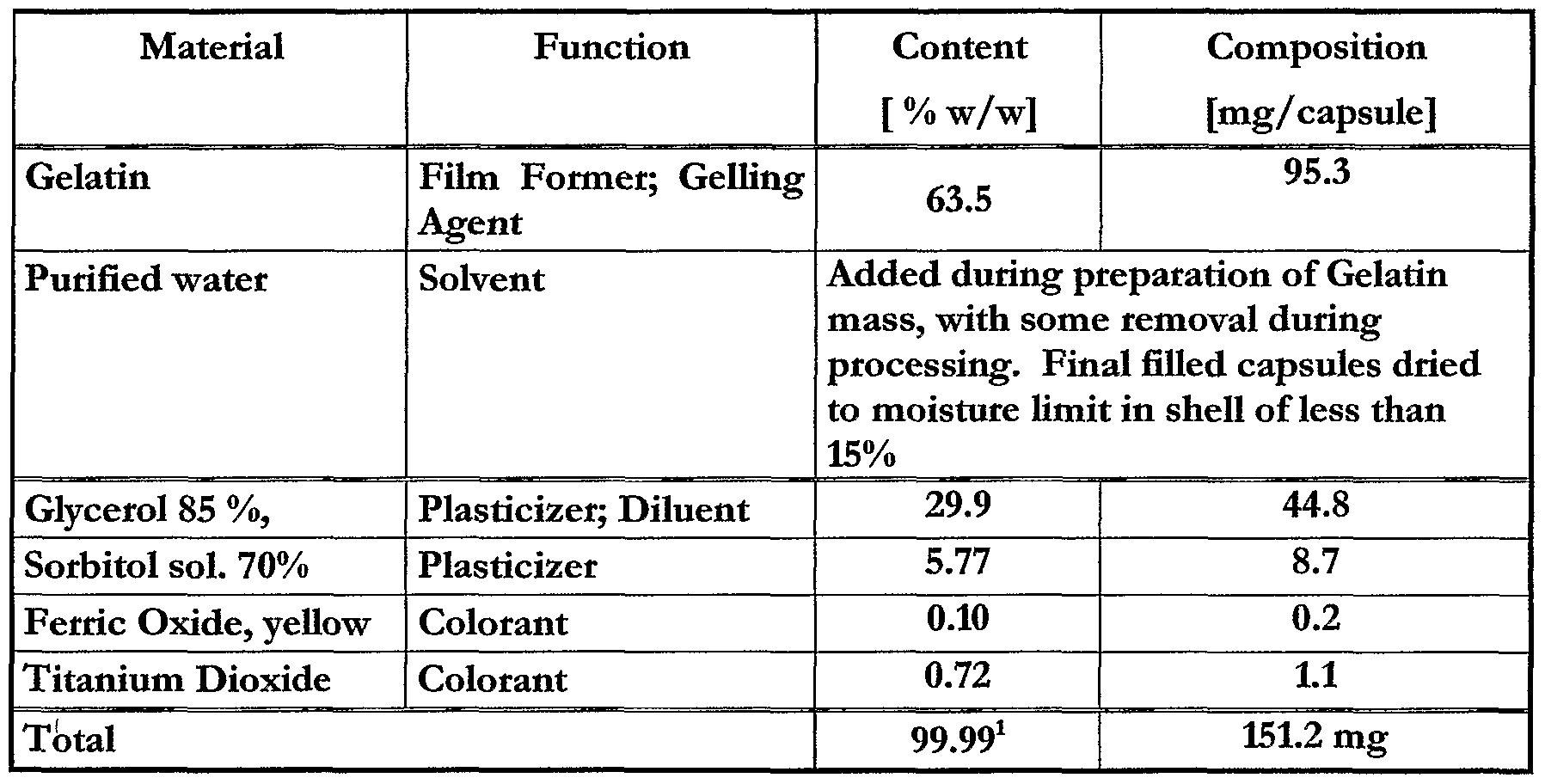
- a pharmaceutical composition according to the Table A was encapsulated into a soft gelatin capsule.
- the gelatin composition was as described in Table B and thus did not contain glycine and neither the gel, nor the fill and nor the lubricant contained ester of carboxylic acid. Results are given in the Tables 2 — 4. After 8 weeks under standard accelerated stability conditions (Table 4), a pellicle was observed (rupture test).
- Type of gel composition G - with glycine
- Type of gel composition G - with glycine
- Type of gel composition G - with glycine
- T tocopherol acetate
- A ascorbyl palmitate
- a pharmaceutical composition according to the Table C was encapsulated into a soft gelatin capsule, where the gelatin composition according to the Table B (supra) did not contain cross-linking inhibitor and neither the gel, nor the lubricant contained cross-linking inhibition enhancer (ester of carboxylic acid, tocopherol acetate), but the fill did.
- Table C Pharmaceutical composition for soft gelatin capsule fill with cross-linking inhibition enhancer - tocopherol
- Cross-linkJ-t-Lg promoted by placebo components and under accelerated stability conditions: Placebo with ester of carboxylic acid - ascorbyl palmitate
- a pharmaceutical composition according to the Table D was encapsulated into a soft gelatin capsule, where the gelatin composition did not contain glycine and neither the gel, nor the lubricant contained ester of carboxylic acid, but the fill did.
- a placebo of a pharmaceutical composition according to Table E was encapsulated into a soft gelatin capsule, where the gelatin composition according to Table B did not contain glycine and neither the gel, nor the lubricant contained esters of carboxylic acid, but the fill did.
- a pharmaceutical composition according to Table A was encapsulated into a soft gelatin capsule, where the gelatin composition according to Table F did contain glycine , but neither the gel, nor the lubricant, nor the fill contained esters of carboxylic acid.
- Results are given in the Tables 2 — 4 (supra). After 8 weeks in accelerated stability conditions (Table 4 (supra)), pellicle was observed (rupture test). However, the fill-release time was still under 10 min and the gelatin residuum after 60 min was smaller than in variants without glycine.
- a pharmaceutical composition according to Table C was encapsulated into a soft gelatin capsule, where the gelatin composition according to Table F did contain glycine and the fill contained ester of carboxylic acid, tocopherol acetate.
- Example 8 Cross-linking promoted by placebo components and under accelerated stability conditions: Placebo with ester of carboxylic acid, glycine in gelatin
- a pharmaceutical composition according to Table D was encapsulated into a soft gelatin capsule, where the gelatin composition according to Table F did contain glycine and the fill contained esters of carboxylic acid, ascorbyl palmitate.
- a pharmaceutical composition according to Table E was encapsulated into a soft gelatin capsule, where the gelatin composition accordinging to Table F did contain glycine and the fill contained ester of carboxylic acid, tocopherol acetate and ascorbyl palmitate.
- a pharmaceutical composition was prepared in 4 samples according to Table G.
- gelatin composition according to Table G containing glycine was prepared. Thin films were casted and round discs of gelatin ribbon were cut out from the films. Subsequently, 6 discs of the gelatin film were immersed into each one of the variant of the fill compositions listed in Table G. After 20 hours treatment at room temperature, discs were washed and placed into 50 ml of distilled water, thermostated at 37°C and shaked to dissolve. Samples were taken after 4, 8, 12 and 20 min and content of free, dissolved gelatin in the solution was measured by direct spectrophotometry at 275 m.
- Dissolving curves in Fig. 1 show that variant with TPGS (FT, blue dashed curve) displays an improved dissolution characteristic after treatment with placebo solution containing aldehydes as compared to the sample without TPGS (FO, red variant).
- Table G Pharmaceutical composition for soft gelatin capsule fill in 4 variants with/without cross-linking inhibition enhancer and with/without ctoss-linldng promoter
- Cyclosporine was used in this experiment to exemplify the benefits of the instant invention for an active pharmaceutical ingredient/agent formulated in an ethanol-containing formulation encapsulated into a soft gelatin capsule.
- capsules (5 oval size) were prepared with a gelatin composition containing glycine, and the fill containing tocopherol acetate (see the composition of the fill in Table I and composition of the shell in Table J). After 8 weeks under standard accelerated stability conditions, pellicles were not observed (rupture test). After 9 months under controlled room temperature (CRT) conditions, pellicles were not observed (rupture test). After 9 months under CRT conditions, dissolution testing showed a pattern similar to that observed at time 0 (see Fig. 2d, and compare to Fig. 2c).
- Cyclosporine was encapsulated into a soft gelatin capsule, where the gelatin composition did not contain glycine and the fill did not contain ester of carboxylic acid, tocopherol acetate (see the composition of the fill in Table K and composition of the shell in Table L).
- composition for soft gelatin capsule fill 5 oval with cross- linking inhibition enhancer (tocopherol acetate)
- Table K Pharmaceutical composition for soft gelatin capsule fill without cross-linking inhibition enhancer (without tocopherol acetate)
Landscapes
- Health & Medical Sciences (AREA)
- Life Sciences & Earth Sciences (AREA)
- Chemical & Material Sciences (AREA)
- Public Health (AREA)
- Epidemiology (AREA)
- Pharmacology & Pharmacy (AREA)
- Animal Behavior & Ethology (AREA)
- General Health & Medical Sciences (AREA)
- Medicinal Chemistry (AREA)
- Veterinary Medicine (AREA)
- Engineering & Computer Science (AREA)
- Bioinformatics & Cheminformatics (AREA)
- Medicinal Preparation (AREA)
- Proteomics, Peptides & Aminoacids (AREA)
- Chemical Kinetics & Catalysis (AREA)
- General Chemical & Material Sciences (AREA)
- Oil, Petroleum & Natural Gas (AREA)
Abstract
Description


Claims
Priority Applications (7)
| Application Number | Priority Date | Filing Date | Title |
|---|---|---|---|
| EP03731548.8A EP1549299B1 (en) | 2002-06-05 | 2003-06-05 | Reduction of gelatin cross-linking |
| ES03731548.8T ES2524000T3 (en) | 2002-06-05 | 2003-06-05 | Reduction of gelatin crosslinking |
| US10/516,904 US8895059B2 (en) | 2002-06-05 | 2003-06-05 | Reduction of cross-linking gelatin in gelatin capsules |
| AU2003240536A AU2003240536B2 (en) | 2002-06-05 | 2003-06-05 | Reduction of gelatin cross-linking |
| NZ537022A NZ537022A (en) | 2002-06-05 | 2003-06-05 | Reduction of gelatin cross-linking in the gelatin shell of gelatin capsules by incorporating a free amino acid into the capsule shall and a carboxylic acid ester into the capsule filling |
| IL16553404A IL165534A0 (en) | 2002-06-05 | 2004-12-02 | Reduction of gelatin cross linking |
| NO20045308A NO20045308L (en) | 2002-06-05 | 2004-12-03 | Reduction of gelatin crosslinking |
Applications Claiming Priority (2)
| Application Number | Priority Date | Filing Date | Title |
|---|---|---|---|
| US38611502P | 2002-06-05 | 2002-06-05 | |
| US60/386,115 | 2002-06-05 |
Publications (2)
| Publication Number | Publication Date |
|---|---|
| WO2003103582A2 true WO2003103582A2 (en) | 2003-12-18 |
| WO2003103582A3 WO2003103582A3 (en) | 2004-07-29 |
Family
ID=29736134
Family Applications (1)
| Application Number | Title | Priority Date | Filing Date |
|---|---|---|---|
| PCT/US2003/017620 Ceased WO2003103582A2 (en) | 2002-06-05 | 2003-06-05 | Reduction of gelatin cross-linking |
Country Status (7)
| Country | Link |
|---|---|
| US (1) | US8895059B2 (en) |
| EP (1) | EP1549299B1 (en) |
| AU (1) | AU2003240536B2 (en) |
| ES (1) | ES2524000T3 (en) |
| IL (1) | IL165534A0 (en) |
| NZ (1) | NZ537022A (en) |
| WO (1) | WO2003103582A2 (en) |
Cited By (11)
| Publication number | Priority date | Publication date | Assignee | Title |
|---|---|---|---|---|
| WO2006128685A3 (en) * | 2005-05-31 | 2007-04-19 | Gelita Ag | Process for making a low molecular weight gelatine hydrolysate and gelatine hydrolysate compositions |
| WO2007012539A3 (en) * | 2005-07-26 | 2007-04-19 | Nicox Sa | Pharmaceutical formulation of nitrooxyderivatives of nsaids |
| WO2008074479A1 (en) * | 2006-12-20 | 2008-06-26 | Novartis Ag | Gelatin capsules comprising an acid |
| US20120164217A1 (en) * | 2009-09-04 | 2012-06-28 | Dominique Nicolas Cade | Scented capsules |
| US8383678B2 (en) | 2004-02-13 | 2013-02-26 | Chrysalis Pharma Ag | Type a gelatin capsule containing PUFA in free acid form |
| WO2014209062A1 (en) * | 2013-06-28 | 2014-12-31 | Hanmi Pharm. Co., Ltd. | Oral soft capsule formulation comprising dutasteride |
| WO2018016962A1 (en) | 2016-07-22 | 2018-01-25 | Rousselot B.V. | Low cross-linking gelatine |
| US10201513B2 (en) | 2016-12-19 | 2019-02-12 | Axcella Health Inc. | Amino acid compositions and methods for the treatment of liver diseases |
| US10596136B2 (en) | 2018-06-20 | 2020-03-24 | Axcella Health Inc. | Compositions and methods for the treatment of fat infiltration in muscle |
| US10660870B2 (en) | 2017-08-14 | 2020-05-26 | Axcella Health Inc. | Compositions and methods for the treatment of liver diseases and disorders associated with one or both of hyperammonemia or muscle wasting |
| CN111840247A (en) * | 2020-07-23 | 2020-10-30 | 青岛益青生物科技股份有限公司 | Gelatin hollow capsule with anti-crosslinking effect and preparation method thereof |
Families Citing this family (32)
| Publication number | Priority date | Publication date | Assignee | Title |
|---|---|---|---|---|
| EP4137128A1 (en) | 2008-09-02 | 2023-02-22 | Amarin Pharmaceuticals Ireland Limited | Pharmaceutical composition comprising eicosapentaenoic acid and a statin, and methods of using same |
| NZ720946A (en) | 2009-04-29 | 2017-09-29 | Amarin Pharmaceuticals Ie Ltd | Pharmaceutical compositions comprising epa and a cardiovascular agent and methods of using the same |
| MX350088B (en) | 2009-04-29 | 2017-08-25 | Amarin Pharma Inc | Stable pharmaceutical composition and methods of using same. |
| CN108096209A (en) | 2009-06-15 | 2018-06-01 | 阿马里纳制药公司 | Triglycerides, composition and method without increasing LDL-C levels are reduced in the object of associated Statins therapy |
| US20110071176A1 (en) | 2009-09-23 | 2011-03-24 | Amarin Pharma, Inc. | Pharmaceutical composition comprising omega-3 fatty acid and hydroxy-derivative of a statin and methods of using same |
| US11712429B2 (en) | 2010-11-29 | 2023-08-01 | Amarin Pharmaceuticals Ireland Limited | Low eructation composition and methods for treating and/or preventing cardiovascular disease in a subject with fish allergy/hypersensitivity |
| NZ712068A (en) | 2010-11-29 | 2017-03-31 | Amarin Pharmaceuticals Ie Ltd | Low eructation composition and methods for treating and/or preventing cardiovascular disease in a subject with fish allergy/hypersensitivity |
| US20130131170A1 (en) | 2011-11-07 | 2013-05-23 | Amarin Pharmaceuticals Ireland Limited | Methods of treating hypertriglyceridemia |
| US11291643B2 (en) | 2011-11-07 | 2022-04-05 | Amarin Pharmaceuticals Ireland Limited | Methods of treating hypertriglyceridemia |
| ES2891473T3 (en) | 2012-01-06 | 2022-01-28 | Amarin Pharmaceuticals Ie Ltd | Compositions and methods for reducing high sensitivity levels (hs-CRP) in a subject |
| CA3067012C (en) | 2012-06-29 | 2021-10-05 | Amarin Pharmaceuticals Ireland Limited | Methods of reducing the risk of a cardiovascular event in a subject on statin therapy |
| WO2014074552A2 (en) | 2012-11-06 | 2014-05-15 | Amarin Pharmaceuticals Ireland Limited | Compositions and methods for lowering triglycerides without raising ldl-c levels in a subject on concomitant statin therapy |
| US20140187633A1 (en) | 2012-12-31 | 2014-07-03 | Amarin Pharmaceuticals Ireland Limited | Methods of treating or preventing nonalcoholic steatohepatitis and/or primary biliary cirrhosis |
| US9814733B2 (en) | 2012-12-31 | 2017-11-14 | A,arin Pharmaceuticals Ireland Limited | Compositions comprising EPA and obeticholic acid and methods of use thereof |
| US9452151B2 (en) | 2013-02-06 | 2016-09-27 | Amarin Pharmaceuticals Ireland Limited | Methods of reducing apolipoprotein C-III |
| US9624492B2 (en) | 2013-02-13 | 2017-04-18 | Amarin Pharmaceuticals Ireland Limited | Compositions comprising eicosapentaenoic acid and mipomersen and methods of use thereof |
| US9662307B2 (en) | 2013-02-19 | 2017-05-30 | The Regents Of The University Of Colorado | Compositions comprising eicosapentaenoic acid and a hydroxyl compound and methods of use thereof |
| US9283201B2 (en) | 2013-03-14 | 2016-03-15 | Amarin Pharmaceuticals Ireland Limited | Compositions and methods for treating or preventing obesity in a subject in need thereof |
| US20140271841A1 (en) | 2013-03-15 | 2014-09-18 | Amarin Pharmaceuticals Ireland Limited | Pharmaceutical composition comprising eicosapentaenoic acid and derivatives thereof and a statin |
| US10966968B2 (en) | 2013-06-06 | 2021-04-06 | Amarin Pharmaceuticals Ireland Limited | Co-administration of rosiglitazone and eicosapentaenoic acid or a derivative thereof |
| US20150065572A1 (en) | 2013-09-04 | 2015-03-05 | Amarin Pharmaceuticals Ireland Limited | Methods of treating or preventing prostate cancer |
| US9585859B2 (en) | 2013-10-10 | 2017-03-07 | Amarin Pharmaceuticals Ireland Limited | Compositions and methods for lowering triglycerides without raising LDL-C levels in a subject on concomitant statin therapy |
| US10561631B2 (en) | 2014-06-11 | 2020-02-18 | Amarin Pharmaceuticals Ireland Limited | Methods of reducing RLP-C |
| US10172818B2 (en) | 2014-06-16 | 2019-01-08 | Amarin Pharmaceuticals Ireland Limited | Methods of reducing or preventing oxidation of small dense LDL or membrane polyunsaturated fatty acids |
| US10406130B2 (en) | 2016-03-15 | 2019-09-10 | Amarin Pharmaceuticals Ireland Limited | Methods of reducing or preventing oxidation of small dense LDL or membrane polyunsaturated fatty acids |
| JP6843376B2 (en) * | 2016-10-14 | 2021-03-17 | アピ株式会社 | Capsule coating composition and capsule |
| WO2018213663A1 (en) | 2017-05-19 | 2018-11-22 | Amarin Pharmaceuticals Ireland Limited | Compositions and methods for lowering triglycerides in a subject having reduced kidney function |
| US11058661B2 (en) | 2018-03-02 | 2021-07-13 | Amarin Pharmaceuticals Ireland Limited | Compositions and methods for lowering triglycerides in a subject on concomitant statin therapy and having hsCRP levels of at least about 2 mg/L |
| MA51766A (en) | 2018-09-24 | 2020-12-16 | Amarin Pharmaceuticals Ie Ltd | METHODS OF REDUCING THE RISK OF CARDIOVASCULAR EVENTS IN A SUBJECT |
| BR112022009189A2 (en) | 2019-11-12 | 2022-07-26 | Amarin Pharmaceuticals Ie Ltd | METHODS TO REDUCE THE RISK OF CARDIOVASCULAR EVENT IN A SUBJECT WITH ATRIAL FIBRILLATION AND/OR ATRIAL PALPITATION |
| US11986452B2 (en) | 2021-04-21 | 2024-05-21 | Amarin Pharmaceuticals Ireland Limited | Methods of reducing the risk of heart failure |
| CN120643526B (en) * | 2025-05-23 | 2025-12-09 | 安徽威尔曼制药有限公司 | Eicosapentaenoic acid ethyl ester soft capsule and preparation process thereof |
Citations (2)
| Publication number | Priority date | Publication date | Assignee | Title |
|---|---|---|---|---|
| US5405616A (en) | 1992-01-17 | 1995-04-11 | Alfatec Pharma Gmbh | Means for containing active substances, having a shell of hydrophilic macromolecules, active substances and process for preparation thereof |
| WO1997033568A1 (en) | 1996-03-12 | 1997-09-18 | Novartis Ag | Filled gelatin capsules having a reduced degree of cross-linking |
Family Cites Families (18)
| Publication number | Priority date | Publication date | Assignee | Title |
|---|---|---|---|---|
| US2467715A (en) | 1946-03-08 | 1949-04-19 | Nat Starch Products Inc | Manufacture of animal glue jellies |
| US2519487A (en) | 1947-07-02 | 1950-08-22 | Merck & Co Inc | Multivitamin preparation |
| US3456051A (en) * | 1965-10-20 | 1969-07-15 | Takeda Chemical Industries Ltd | Soft gelatin sheet for soft gelatin capsule |
| US6090414A (en) * | 1970-05-20 | 2000-07-18 | Life Science Labs, Inc. | Method and composition to reduce cancer incidence |
| US4255413A (en) | 1979-10-01 | 1981-03-10 | Smithkline Corporation | Gelatin capsule dosage unit containing triamterene |
| DD225426A1 (en) | 1984-06-22 | 1985-07-31 | Jenapharm Veb | PROCESS FOR PRODUCING STABLE GELANTINE PREPARATIONS |
| JPS63215641A (en) * | 1987-03-05 | 1988-09-08 | Toyo Jozo Co Ltd | Gelatin film composition |
| FR2617047B1 (en) | 1987-06-23 | 1991-05-10 | Sanofi Sa | TANNING RESISTANT GELATIN COMPOSITION, CAPSULES BASED ON THIS COMPOSITION AND THEIR PHARMACEUTICAL APPLICATION, IN PARTICULAR TO FENOFIBRATE |
| DD295765A5 (en) | 1988-07-18 | 1991-11-14 | Arzneimittelwerk Dresden Gmbh,De | PROCESS FOR PREPARING GALENIC FORMULATIONS FOR HYDROPHOBIC OR BZW. LIPOPHILIC PEPTIDES |
| US5186944A (en) | 1989-02-15 | 1993-02-16 | Eimei Company Ltd. | Therapeutic medicament for thrombosis |
| JPH06321541A (en) | 1993-05-18 | 1994-11-22 | Etsuro Kato | Production of zirconia singly dispersed spherical ultrafine particle powder |
| CA2185803C (en) * | 1994-03-18 | 2006-07-11 | Edward M. Rudnic | Emulsified drug delivery systems |
| US5620704A (en) * | 1994-11-07 | 1997-04-15 | Warner-Lambert Company | Process for stabilizing gelatin products |
| CZ288631B6 (en) * | 1996-01-18 | 2001-08-15 | Galena, A. S. | Therapeutic preparations containing cyclosporin |
| JP2000002682A (en) | 1998-06-12 | 2000-01-07 | Horiba Ltd | Gas analyzer |
| US6136846A (en) * | 1999-10-25 | 2000-10-24 | Supergen, Inc. | Formulation for paclitaxel |
| US6685961B1 (en) * | 2000-10-24 | 2004-02-03 | Banner Pharmacaps, Inc. | Colored gelatin-based formulations and method |
| EP1526845A2 (en) | 2002-07-31 | 2005-05-04 | Pharmacia Corporation | Pharmaceutical dosage form capable of maintaining stable dissolution profile upon storage |
-
2003
- 2003-06-05 WO PCT/US2003/017620 patent/WO2003103582A2/en not_active Ceased
- 2003-06-05 US US10/516,904 patent/US8895059B2/en not_active Expired - Fee Related
- 2003-06-05 ES ES03731548.8T patent/ES2524000T3/en not_active Expired - Lifetime
- 2003-06-05 NZ NZ537022A patent/NZ537022A/en unknown
- 2003-06-05 EP EP03731548.8A patent/EP1549299B1/en not_active Expired - Lifetime
- 2003-06-05 AU AU2003240536A patent/AU2003240536B2/en not_active Ceased
-
2004
- 2004-12-02 IL IL16553404A patent/IL165534A0/en unknown
Patent Citations (2)
| Publication number | Priority date | Publication date | Assignee | Title |
|---|---|---|---|---|
| US5405616A (en) | 1992-01-17 | 1995-04-11 | Alfatec Pharma Gmbh | Means for containing active substances, having a shell of hydrophilic macromolecules, active substances and process for preparation thereof |
| WO1997033568A1 (en) | 1996-03-12 | 1997-09-18 | Novartis Ag | Filled gelatin capsules having a reduced degree of cross-linking |
Non-Patent Citations (19)
| Title |
|---|
| "Goodman and Gilman's The Pharmacological Basis if Therapeutics", 1996, MCGRAW HILL COMPANIES INC. |
| "Handbook of Pharmaceutical Excipients", AMERICAN PHARMACEUTICAL ASSOCIATION |
| "Remington: The Science and Practice of Pbarmacy", 1995, LIPPINCOTT, WILLIAMS & WILKINS |
| "Remington's Pharmaceutical Sciences", 1990, GENNARO, MACK PUBLISHING CO. |
| "United States Food and Drug Administration's (FDA", INACTIVE INGREDIENT GUIDE (IIG, 1996 |
| ADESUNLOYE; STACH, DRUG. DEV. INDUSTRIAL PHARMACY, 1998 |
| BARTHÉLÉMY ET AL.: "Lecture given at Chatenay Malabry - Paris XI, Faculty of Pharmacy, during the Conference organized by APGI, Capsugel and Gattefosse on November 1994", April 1995, GATTEFOSSE COMPANY APPLICATION LIST, article "Liquid and Semi-solid Excipients in Hard Capsules, and Viscous SMEDDS Solutions" |
| CHONAN, Y. ET AL.: "Photographic Binders", 1990, RESEARCH GROUP OF PHOTOGRAPHIC BINDERS IN JAPAN, article "The effects of Chemical Modification on the Physical Properties of Gelatin" |
| CLARK, R.C.; COURTS, A.: "The Science and Technology of Gelatin", 1977, ACADEMIC PRESS, article "The Chemical Reactivity of Gelatin" |
| DEY ET AL., PHARM. RES., vol. 10, no. 9, 1993, pages 1295 |
| DIGENIS, J. PHARM. SCI., vol. 83, no. 7, 1994, pages 915 |
| HAKATA ET AL., CHEM. & PHRM. BULL., vol. 42, no. 7, 1994, pages 1496 |
| MURTHY ET AL., PHARM. TECH., vol. 72, 1989 |
| MURTHY, PHARM. TECH., vol. 13, no. 6, 1989, pages 53 |
| REICH ET AL., PHARM. INDUSTRY, vol. 57, 1995 |
| See also references of EP1549299A4 |
| WELZ; OFNER, J. PHARM. SCI., vol. 81, no. 1, 1992, pages 85 |
| YORK, J., PHARM. PHARMACOL, vol. 33, 1981, pages 269 |
| YORK, J., PHARM. PHARMACOL., vol. 33, 1981, pages 269 |
Cited By (25)
| Publication number | Priority date | Publication date | Assignee | Title |
|---|---|---|---|---|
| US8383678B2 (en) | 2004-02-13 | 2013-02-26 | Chrysalis Pharma Ag | Type a gelatin capsule containing PUFA in free acid form |
| US9132112B2 (en) | 2004-02-13 | 2015-09-15 | Chysalis Pharma Ag | Type A gelatin capsule containing PUFA in free acid form |
| US9012501B2 (en) | 2004-02-13 | 2015-04-21 | Chrysalis Pharma Ag | Type A gelatin capsule containing PUFA in free acid form |
| US7897728B2 (en) | 2005-05-31 | 2011-03-01 | Gelita Ag | Process for making a low molecular weight gelatine hydrolysate |
| WO2006128685A3 (en) * | 2005-05-31 | 2007-04-19 | Gelita Ag | Process for making a low molecular weight gelatine hydrolysate and gelatine hydrolysate compositions |
| US8691869B2 (en) | 2005-07-26 | 2014-04-08 | Nicox S.A. | Pharmaceutical formulation of nitrooxyderivatives of NSAIDs |
| WO2007012539A3 (en) * | 2005-07-26 | 2007-04-19 | Nicox Sa | Pharmaceutical formulation of nitrooxyderivatives of nsaids |
| WO2008074479A1 (en) * | 2006-12-20 | 2008-06-26 | Novartis Ag | Gelatin capsules comprising an acid |
| US20120164217A1 (en) * | 2009-09-04 | 2012-06-28 | Dominique Nicolas Cade | Scented capsules |
| WO2014209062A1 (en) * | 2013-06-28 | 2014-12-31 | Hanmi Pharm. Co., Ltd. | Oral soft capsule formulation comprising dutasteride |
| JP2016514724A (en) * | 2013-06-28 | 2016-05-23 | ハンミ ファーム. シーオー., エルティーディー. | Oral soft capsule formulation containing dutasteride |
| EP4014972A1 (en) | 2016-07-22 | 2022-06-22 | Rousselot B.V. | Low cross-linking gelatine |
| WO2018016962A1 (en) | 2016-07-22 | 2018-01-25 | Rousselot B.V. | Low cross-linking gelatine |
| US10201513B2 (en) | 2016-12-19 | 2019-02-12 | Axcella Health Inc. | Amino acid compositions and methods for the treatment of liver diseases |
| US10471034B2 (en) | 2016-12-19 | 2019-11-12 | Axcella Health Inc. | Amino acid compositions and methods for the treatment of liver diseases |
| US11129804B2 (en) | 2016-12-19 | 2021-09-28 | Axcella Health Inc. | Amino acid compositions and methods for the treatment of liver diseases |
| US10238617B2 (en) | 2016-12-19 | 2019-03-26 | Axcella Health Inc. | Amino acid compositions and methods for the treatment of liver diseases |
| US11602511B2 (en) | 2016-12-19 | 2023-03-14 | Axcella Health Inc. | Amino acid compositions and methods for the treatment of liver diseases |
| US10660870B2 (en) | 2017-08-14 | 2020-05-26 | Axcella Health Inc. | Compositions and methods for the treatment of liver diseases and disorders associated with one or both of hyperammonemia or muscle wasting |
| US10682325B2 (en) | 2017-08-14 | 2020-06-16 | Axcella Health Inc. | Compositions and methods for the treatment of liver diseases and disorders associated with one or both of hyperammonemia or muscle wasting |
| US11571404B2 (en) | 2017-08-14 | 2023-02-07 | Axcella Health Inc. | Compositions and methods for the treatment of liver diseases and disorders associated with one or both of hyperammonemia or muscle wasting |
| US10596136B2 (en) | 2018-06-20 | 2020-03-24 | Axcella Health Inc. | Compositions and methods for the treatment of fat infiltration in muscle |
| US10973793B2 (en) | 2018-06-20 | 2021-04-13 | Axcella Health Inc. | Compositions and methods for the treatment of fat infiltration in muscle |
| US11833127B2 (en) | 2018-06-20 | 2023-12-05 | Axcella Health Inc. | Compositions and methods for the treatment of fat infiltration in muscle |
| CN111840247A (en) * | 2020-07-23 | 2020-10-30 | 青岛益青生物科技股份有限公司 | Gelatin hollow capsule with anti-crosslinking effect and preparation method thereof |
Also Published As
| Publication number | Publication date |
|---|---|
| NZ537022A (en) | 2006-10-27 |
| US20110097398A1 (en) | 2011-04-28 |
| WO2003103582A3 (en) | 2004-07-29 |
| EP1549299B1 (en) | 2014-08-20 |
| US8895059B2 (en) | 2014-11-25 |
| AU2003240536A1 (en) | 2003-12-22 |
| EP1549299A4 (en) | 2010-12-15 |
| AU2003240536B2 (en) | 2007-11-15 |
| ES2524000T3 (en) | 2014-12-03 |
| EP1549299A2 (en) | 2005-07-06 |
| IL165534A0 (en) | 2006-01-15 |
Similar Documents
| Publication | Publication Date | Title |
|---|---|---|
| US8895059B2 (en) | Reduction of cross-linking gelatin in gelatin capsules | |
| RS52904A (en) | Pharmaceutical compositions of orally active taxane derivatives having enhanced bioavailability | |
| CA2166204C (en) | Pharmaceutical compositions for sparingly soluble therapeutic agents | |
| CA2639921C (en) | Microspheres comprising nanocapsules containing a lipophilic drug | |
| KR100587551B1 (en) | Pharmaceutical Compositions Containing Omega-3 Fatty Acid Oils | |
| KR101833280B1 (en) | Oral soft capsule formulation comprising dutasteride | |
| BRPI0614417A2 (en) | pharmaceutical compositions comprising dihydropyridine calcium channel blockers and omega-3 fatty acids and methods of treatment using them | |
| ES2657813T3 (en) | Pharmaceutical compositions for calanolides, their derivatives and analogues, and process for their production | |
| Aungst et al. | Amphiphilic vehicles improve the oral bioavailability of a poorly soluble HIV protease inhibitor at high doses | |
| US20040019074A1 (en) | Pharmaceutical compositions for sparingly soluble therapeutic agents | |
| US11116744B2 (en) | Pharmaceutical composition for oral administration comprising taxane | |
| JP2002534382A (en) | Pharmaceutical formulations of taxanes | |
| JPH0830006B2 (en) | Ethanol-filled preparation for soft gel containing vitamins, dietary supplements, etc. | |
| RS55504A (en) | Pharmaceutical compositions based on azetidine derivatives | |
| JP5503939B2 (en) | Azelastine hydrochloride-containing capsule | |
| KR20050024314A (en) | Reduction of gelatin cross-linking | |
| Gao et al. | Design and development of supersaturatable self-emulsifying drug delivery systems for enhancing the gastrointestinal absorption of poorly soluble drugs | |
| JPH07267875A (en) | Liquid preparation containing high concentration of aureobasidin | |
| Damian et al. | Challenges of Dissolution Methods Development for Soft Gelatin Capsules. Pharmaceutics 2021, 13, 214 | |
| HK40041450A (en) | Pharmaceutical composition for oral administration comprising taxane | |
| Dressler | 6.1 Composition | |
| TH54046A (en) | Substances with medicinal properties. | |
| KR20040063523A (en) | The pharmaceutical composition containing biphenyldimethyldicarboxylate | |
| EP3515440A1 (en) | Stable liquid formulations |
Legal Events
| Date | Code | Title | Description |
|---|---|---|---|
| AK | Designated states |
Kind code of ref document: A2 Designated state(s): AE AG AL AM AT AU AZ BA BB BG BR BY BZ CA CH CN CO CR CU CZ DE DK DM DZ EC EE ES FI GB GD GE GH GM HR HU ID IL IN IS JP KE KG KP KR KZ LC LK LR LS LT LU LV MA MD MG MK MX MZ NO NZ OM PH PL PT RO RU SC SD SE SG SK SL TJ TM TN TR TT TZ UA UG US UZ VC VN YU ZA ZM ZW |
|
| AL | Designated countries for regional patents |
Kind code of ref document: A2 Designated state(s): GH GM KE LS MW MZ SD SL SZ TZ UG ZM ZW AM AZ BY KG KZ MD RU TJ TM AT BE BG CH CY CZ DE DK EE ES FI FR GB GR HU IE IT LU MC NL PT RO SE SI SK TR BF BJ CF CG CI CM GA GN GQ GW ML MR NE SN TD TG |
|
| 121 | Ep: the epo has been informed by wipo that ep was designated in this application | ||
| WWE | Wipo information: entry into national phase |
Ref document number: 165534 Country of ref document: IL |
|
| WWE | Wipo information: entry into national phase |
Ref document number: 2003240536 Country of ref document: AU |
|
| WWE | Wipo information: entry into national phase |
Ref document number: 1020047019853 Country of ref document: KR Ref document number: 537022 Country of ref document: NZ |
|
| WWE | Wipo information: entry into national phase |
Ref document number: 2003731548 Country of ref document: EP |
|
| WWP | Wipo information: published in national office |
Ref document number: 1020047019853 Country of ref document: KR |
|
| WWP | Wipo information: published in national office |
Ref document number: 2003731548 Country of ref document: EP |
|
| NENP | Non-entry into the national phase |
Ref country code: JP |
|
| WWW | Wipo information: withdrawn in national office |
Country of ref document: JP |
|
| ENP | Entry into the national phase |
Ref document number: 2003240536 Country of ref document: AU Date of ref document: 20030605 Kind code of ref document: B |
|
| WWE | Wipo information: entry into national phase |
Ref document number: 10516904 Country of ref document: US |